EP2676983A1 - Epoxy resin composition, prepreg, and fiber-reinforced composite material - Google Patents
Epoxy resin composition, prepreg, and fiber-reinforced composite material Download PDFInfo
- Publication number
- EP2676983A1 EP2676983A1 EP12747218.1A EP12747218A EP2676983A1 EP 2676983 A1 EP2676983 A1 EP 2676983A1 EP 12747218 A EP12747218 A EP 12747218A EP 2676983 A1 EP2676983 A1 EP 2676983A1
- Authority
- EP
- European Patent Office
- Prior art keywords
- epoxy resin
- resin composition
- fiber
- mass
- prepreg
- Prior art date
- Legal status (The legal status is an assumption and is not a legal conclusion. Google has not performed a legal analysis and makes no representation as to the accuracy of the status listed.)
- Granted
Links
Images

Classifications
-
- C—CHEMISTRY; METALLURGY
- C08—ORGANIC MACROMOLECULAR COMPOUNDS; THEIR PREPARATION OR CHEMICAL WORKING-UP; COMPOSITIONS BASED THEREON
- C08L—COMPOSITIONS OF MACROMOLECULAR COMPOUNDS
- C08L63/00—Compositions of epoxy resins; Compositions of derivatives of epoxy resins
- C08L63/04—Epoxynovolacs
-
- C—CHEMISTRY; METALLURGY
- C08—ORGANIC MACROMOLECULAR COMPOUNDS; THEIR PREPARATION OR CHEMICAL WORKING-UP; COMPOSITIONS BASED THEREON
- C08G—MACROMOLECULAR COMPOUNDS OBTAINED OTHERWISE THAN BY REACTIONS ONLY INVOLVING UNSATURATED CARBON-TO-CARBON BONDS
- C08G59/00—Polycondensates containing more than one epoxy group per molecule; Macromolecules obtained by polymerising compounds containing more than one epoxy group per molecule using curing agents or catalysts which react with the epoxy groups
- C08G59/18—Macromolecules obtained by polymerising compounds containing more than one epoxy group per molecule using curing agents or catalysts which react with the epoxy groups ; e.g. general methods of curing
- C08G59/20—Macromolecules obtained by polymerising compounds containing more than one epoxy group per molecule using curing agents or catalysts which react with the epoxy groups ; e.g. general methods of curing characterised by the epoxy compounds used
- C08G59/22—Di-epoxy compounds
- C08G59/30—Di-epoxy compounds containing atoms other than carbon, hydrogen, oxygen and nitrogen
- C08G59/304—Di-epoxy compounds containing atoms other than carbon, hydrogen, oxygen and nitrogen containing phosphorus
-
- C—CHEMISTRY; METALLURGY
- C08—ORGANIC MACROMOLECULAR COMPOUNDS; THEIR PREPARATION OR CHEMICAL WORKING-UP; COMPOSITIONS BASED THEREON
- C08G—MACROMOLECULAR COMPOUNDS OBTAINED OTHERWISE THAN BY REACTIONS ONLY INVOLVING UNSATURATED CARBON-TO-CARBON BONDS
- C08G59/00—Polycondensates containing more than one epoxy group per molecule; Macromolecules obtained by polymerising compounds containing more than one epoxy group per molecule using curing agents or catalysts which react with the epoxy groups
- C08G59/18—Macromolecules obtained by polymerising compounds containing more than one epoxy group per molecule using curing agents or catalysts which react with the epoxy groups ; e.g. general methods of curing
- C08G59/20—Macromolecules obtained by polymerising compounds containing more than one epoxy group per molecule using curing agents or catalysts which react with the epoxy groups ; e.g. general methods of curing characterised by the epoxy compounds used
- C08G59/32—Epoxy compounds containing three or more epoxy groups
- C08G59/3254—Epoxy compounds containing three or more epoxy groups containing atoms other than carbon, hydrogen, oxygen or nitrogen
- C08G59/3272—Epoxy compounds containing three or more epoxy groups containing atoms other than carbon, hydrogen, oxygen or nitrogen containing phosphorus
-
- C—CHEMISTRY; METALLURGY
- C08—ORGANIC MACROMOLECULAR COMPOUNDS; THEIR PREPARATION OR CHEMICAL WORKING-UP; COMPOSITIONS BASED THEREON
- C08J—WORKING-UP; GENERAL PROCESSES OF COMPOUNDING; AFTER-TREATMENT NOT COVERED BY SUBCLASSES C08B, C08C, C08F, C08G or C08H
- C08J5/00—Manufacture of articles or shaped materials containing macromolecular substances
- C08J5/24—Impregnating materials with prepolymers which can be polymerised in situ, e.g. manufacture of prepregs
- C08J5/241—Impregnating materials with prepolymers which can be polymerised in situ, e.g. manufacture of prepregs using inorganic fibres
- C08J5/243—Impregnating materials with prepolymers which can be polymerised in situ, e.g. manufacture of prepregs using inorganic fibres using carbon fibres
-
- C—CHEMISTRY; METALLURGY
- C08—ORGANIC MACROMOLECULAR COMPOUNDS; THEIR PREPARATION OR CHEMICAL WORKING-UP; COMPOSITIONS BASED THEREON
- C08J—WORKING-UP; GENERAL PROCESSES OF COMPOUNDING; AFTER-TREATMENT NOT COVERED BY SUBCLASSES C08B, C08C, C08F, C08G or C08H
- C08J5/00—Manufacture of articles or shaped materials containing macromolecular substances
- C08J5/24—Impregnating materials with prepolymers which can be polymerised in situ, e.g. manufacture of prepregs
- C08J5/249—Impregnating materials with prepolymers which can be polymerised in situ, e.g. manufacture of prepregs characterised by the additives used in the prepolymer mixture
-
- C—CHEMISTRY; METALLURGY
- C08—ORGANIC MACROMOLECULAR COMPOUNDS; THEIR PREPARATION OR CHEMICAL WORKING-UP; COMPOSITIONS BASED THEREON
- C08L—COMPOSITIONS OF MACROMOLECULAR COMPOUNDS
- C08L63/00—Compositions of epoxy resins; Compositions of derivatives of epoxy resins
-
- C—CHEMISTRY; METALLURGY
- C08—ORGANIC MACROMOLECULAR COMPOUNDS; THEIR PREPARATION OR CHEMICAL WORKING-UP; COMPOSITIONS BASED THEREON
- C08J—WORKING-UP; GENERAL PROCESSES OF COMPOUNDING; AFTER-TREATMENT NOT COVERED BY SUBCLASSES C08B, C08C, C08F, C08G or C08H
- C08J2363/00—Characterised by the use of epoxy resins; Derivatives of epoxy resins
-
- C—CHEMISTRY; METALLURGY
- C08—ORGANIC MACROMOLECULAR COMPOUNDS; THEIR PREPARATION OR CHEMICAL WORKING-UP; COMPOSITIONS BASED THEREON
- C08J—WORKING-UP; GENERAL PROCESSES OF COMPOUNDING; AFTER-TREATMENT NOT COVERED BY SUBCLASSES C08B, C08C, C08F, C08G or C08H
- C08J2363/00—Characterised by the use of epoxy resins; Derivatives of epoxy resins
- C08J2363/04—Epoxynovolacs
-
- C—CHEMISTRY; METALLURGY
- C08—ORGANIC MACROMOLECULAR COMPOUNDS; THEIR PREPARATION OR CHEMICAL WORKING-UP; COMPOSITIONS BASED THEREON
- C08J—WORKING-UP; GENERAL PROCESSES OF COMPOUNDING; AFTER-TREATMENT NOT COVERED BY SUBCLASSES C08B, C08C, C08F, C08G or C08H
- C08J2463/00—Characterised by the use of epoxy resins; Derivatives of epoxy resins
-
- C—CHEMISTRY; METALLURGY
- C08—ORGANIC MACROMOLECULAR COMPOUNDS; THEIR PREPARATION OR CHEMICAL WORKING-UP; COMPOSITIONS BASED THEREON
- C08J—WORKING-UP; GENERAL PROCESSES OF COMPOUNDING; AFTER-TREATMENT NOT COVERED BY SUBCLASSES C08B, C08C, C08F, C08G or C08H
- C08J2463/00—Characterised by the use of epoxy resins; Derivatives of epoxy resins
- C08J2463/04—Epoxynovolacs
-
- C—CHEMISTRY; METALLURGY
- C08—ORGANIC MACROMOLECULAR COMPOUNDS; THEIR PREPARATION OR CHEMICAL WORKING-UP; COMPOSITIONS BASED THEREON
- C08L—COMPOSITIONS OF MACROMOLECULAR COMPOUNDS
- C08L2201/00—Properties
- C08L2201/02—Flame or fire retardant/resistant
-
- C—CHEMISTRY; METALLURGY
- C08—ORGANIC MACROMOLECULAR COMPOUNDS; THEIR PREPARATION OR CHEMICAL WORKING-UP; COMPOSITIONS BASED THEREON
- C08L—COMPOSITIONS OF MACROMOLECULAR COMPOUNDS
- C08L2205/00—Polymer mixtures characterised by other features
- C08L2205/02—Polymer mixtures characterised by other features containing two or more polymers of the same C08L -group
-
- C—CHEMISTRY; METALLURGY
- C08—ORGANIC MACROMOLECULAR COMPOUNDS; THEIR PREPARATION OR CHEMICAL WORKING-UP; COMPOSITIONS BASED THEREON
- C08L—COMPOSITIONS OF MACROMOLECULAR COMPOUNDS
- C08L2205/00—Polymer mixtures characterised by other features
- C08L2205/02—Polymer mixtures characterised by other features containing two or more polymers of the same C08L -group
- C08L2205/025—Polymer mixtures characterised by other features containing two or more polymers of the same C08L -group containing two or more polymers of the same hierarchy C08L, and differing only in parameters such as density, comonomer content, molecular weight, structure
-
- C—CHEMISTRY; METALLURGY
- C08—ORGANIC MACROMOLECULAR COMPOUNDS; THEIR PREPARATION OR CHEMICAL WORKING-UP; COMPOSITIONS BASED THEREON
- C08L—COMPOSITIONS OF MACROMOLECULAR COMPOUNDS
- C08L2205/00—Polymer mixtures characterised by other features
- C08L2205/03—Polymer mixtures characterised by other features containing three or more polymers in a blend
Definitions
- the present invention relates to an epoxy resin composition, prepreg and fiber-reinforced composite material.
- the present application claims priority based on Japanese Patent Application No. 2011-030947 which was filed in Japan on 16 February 2011, the content of which is incorporated herein by reference.
- Fiber-reinforced composite materials produced by combining a reinforcement fiber with resin have been used in various applications due to excelling in lightweight properties, rigidity, impact resistance or the like.
- a production method of fiber-reinforced composite materials a method of curing a prepreg produced by impregnating a thermosetting resin such as epoxy resin into reinforcement fibers has generally been employed.
- flame retardance is demanded in the fiber-reinforced composite material.
- halogen-based flame retardant such as a brominated epoxy resin into a matrix resin of the composite material has come to be widely employed.
- halogen-based flame retardants have problems such as gas evolving during combustion, and thus a substitute technology thereof has come to be researched to be adopted.
- flameproofing methods substituting halogen-based flame retardants methods of adding red phosphorus or phosphoric acid ester compounds to a matrix resin have become mainstream (for example, Patent Document 1).
- a method of adding red phosphorus or phosphoric acid ester compounds to a matrix resin has problems such as: 1) mechanical strength declining; 2) poor storage stability; 3) red phosphorus or phosphoric acid ester compounds gradually seeping over a long time period; or 4) since red phosphorus and phosphoric acid ester compounds are easily hydrolyzed, use is difficult in printed circuit boards, electronic materials, etc. in which insulation property and water resistance are highly demanded.
- an inorganic flame retardant such as a metal hydroxide.
- the added amount of inorganic flame retardant is increased, a problem arises in that the mechanical strength of the resin declines.
- the decline in the mechanical strength of a resin causes a decline in the mechanical strength of the fiber-reinforced composite material. It is difficult to obtain sufficient flame retardancy with an added amount on the order that maintains the mechanical strength demanded in the fiber-reinforced composite material.
- the present invention has been made taking the above matters into account, and has an object of providing an epoxy resin composition that can obtain a composite material having superior flame retardance without containing halogen-based flame retardants, red phosphorus and phosphoric acid ester, and a prepreg, as well as a fiber-reinforced composite material obtained using the prepreg.
- the present invention relates to the following.
- an epoxy resin composition that can obtain a composite material having superior flame retardance without containing halogen-based flame retardants, red phosphorus and phosphoric acid esters, and a prepreg, as well as a fiber-reinforced composite material obtained using the prepreg.
- An epoxy resin composition of the present invention contains the following phosphorus-containing modified epoxy resin (A), a novolak epoxy resin (B), a hardener (C) for epoxy resins, and a metal hydroxide (D).
- A phosphorus-containing modified epoxy resin
- B novolak epoxy resin
- C hardener
- D metal hydroxide
- an epoxy resin is a resin compound having at least one epoxy group.
- the phosphorus-containing modified epoxy resin (A) consists of a compound (a) represented by the following Formula (a).
- n is an integer of at least 0.
- X is a group represented by the following Formula (I), (II) or (III), and (n+2) number of X in the Formula may be the same or different. However, at least one X among the (n+2) number of X is a group represented by the Formula (I) or (II).
- Y is -H or CH 3 , and (n+2) number of Y in the Formula may be the same or different.
- n is an integer of at least 0, an integer of 0 to 10 being preferable, and an integer of 0 to 5 being more preferable. So long as no more than 10, it will excel in balance of heat resistance and flowability.
- the phosphorus-containing modified epoxy resin (A) may be configured from only a compound in which a part of the (n+2) number of X in the Formula (a) is a group represented by Formula (I) or (II), and a part is a group represented by Formula (III), or may be configured from only a compound in which all of the (n+2) number of X in Formula (a) are groups represented by Formula (I) or (II), or may be a mixture of a compound in which a part of the (n+2) number of X in the Formula (a) is a group represented by Formula (I) or (II), and a part is a group represented by Formula (III), and a compound in which all of the (n+2) number of X in Formula (a) are groups represented by Formula (I)
- the phosphorus content of the phosphorus-containing modified epoxy resin (A) is preferably 1 to 8% by mass.
- the flame retardance of the cured product of the epoxy resin composition improves with higher phosphorus content, and the flame retardance of the composite material obtained using this epoxy resin composition improves.
- the heat resistance of the cured product of the epoxy resin composition improves with lower phosphorus content, and the heat resistance of the composite material obtained using this epoxy resin composition improves.
- phosphorus-containing modified epoxy resin (A) commercial products may be used, or those synthesized by a known production method may be used.
- commercial product for example, FX-289FA manufactured by Nippon Steel Chemical Co., Ltd. can be exemplified.
- the production method of the phosphorus-containing modified epoxy resin (A) for example, a method of reacting a compound represented by the following Formula (c) (9,10-dihydro-9-oxa-10- phosphaphenanthrene-10-oxide) with an epoxy resin (e.g., phenol novolak epoxy resin or cresol novolak epoxy resin) in which all of the (n+2) number of X in the Formula (a) are groups represented by the Formula (III), at high temperature under the presence of catalyst.
- an epoxy resin e.g., phenol novolak epoxy resin or cresol novolak epoxy resin
- the compound (a) constituting the phosphorus-containing modified epoxy resin (A) contained in the epoxy resin composition may be one, two or more types.
- the mass content C A (%) of the phosphorus-containing modified epoxy resin (A) relative to the total amount (mass) of epoxy resin composition is preferably at least 6% to no more than 40%, and more preferably at least 10% to no more than 35%.
- the C A being at least 6%, it is possible to impart sufficient flame retardancy due to the synergy with the metal hydroxide (D) described later.
- the C A being no more than 40%, it is possible to impart suitable curability and viscosity to the epoxy resin composition.
- a blended amount is preferable that makes the phosphorus atom content relative to the overall mass of the composition at least 0.7% by mass to no more than 2.4% by mass, and a blended amount that makes it at least 1.0% by mass to no more than 2.4% by mass is more preferable.
- a blended amount that makes it at least 1.0% by mass to no more than 2.4% by mass is more preferable.
- the metal hydroxide (D) is not particularly limited, and a known metal hydroxide can be used as an inorganic flame retardant.
- a metal hydroxide aluminum hydroxide, magnesium hydroxide or the like can be exemplified.
- aluminum hydroxide is preferable from the aspect of thermal decomposition temperature and endothermic energy amount during decomposition.
- the metal hydroxide (D) normally a granular one is used.
- the median particle size of the metal hydroxide (D) being no more than the diameter of the reinforcement fiber is preferable in the aspect of being able to achieve both high flame retardancy and high mechanical property, and the median particle size is more preferably at least 0.2 ⁇ m and no more than the diameter of the reinforcement fiber.
- the median particle size is more preferably at least 0.8 ⁇ m to no more than the diameter of the reinforcement fiber, and particularly preferably at least 1.0 ⁇ m to no more than 5.5 ⁇ m.
- the median particle size is a value measured by laser diffractometry.
- the free moisture of the metal hydroxide (D) being no more than 0.5% by mass is more preferable in the aspect of being able to suppress secondary aggregation, and the free moisture being at least 0.05% by mass is further preferable due to imparting flame retardance.
- the range of free moisture is preferably at least 0.05% by mass to no more than 0.5% by mass, more preferably at least 0.07% by mass to no more than 0.17% by mass, it is further preferable due to being able to achieve both high flame retardancy and high dispersibility.
- the free moisture of the metal hydroxide (D) was calculated based on JIS R 9301.
- the diameter of the reinforcement fiber is a value measured according to an image analysis method employing SEM images.
- surface treatment may be conducted on the metal hydroxide (D).
- surface treatment surface treatment using stearic acid, surface treatment using a coupling agent, or the like can be exemplified.
- metal hydroxide (D) commercial products may be used, or those synthesized by a known production method may be used.
- C-303, C-301, C-300GT, C-305, C-3250 or CM-450 manufactured by Sumitomo Chemical Company; HIGILITE H-42 or H-43 manufactured by Showa Denko Co.; or the like can be exemplified.
- magnesium hydroxide MAGSTAR #5, #4, #2, ECOMAG PZ-1 or Z-10 manufactured by Tateho Chemical Industries Co., Ltd.; or the like can be exemplified.
- the metal hydroxide (D) contained in the epoxy resin composition may be one type, or two or more types.
- the mass content C D (%) of the metal hydroxide (D) relative to the total amount (mass) of the epoxy resin composition is preferably at least 3% to no more than 30%, and more preferably at least 5% to no more than 25%.
- the C D being at least 3%, it is possible to impart sufficient flame retardancy due to the synergy with the phosphorus-containing modified epoxy resin (A).
- the C D being no more than 30%, it is possible to impart appropriate viscosity or handling properties to the epoxy resin composition. If the C D exceeds 30%, production of the prepreg described later will become difficult.
- the epoxy resin composition of the present invention in addition to the C A being at least 6% to no more than 40% and the C D being at least 3% to no more than 30% as mentioned above, it is necessary for 2.5C A +C D to be at least 45. It is thereby possible to impart sufficient flame retardancy. In the case of 2.5C A +C D being less than 45, the flame retardancy will be insufficient, even if C A and C D are within the respective above-mentioned ranges.
- the novolak epoxy resin (B) is not particularly limited so long as not containing phosphorus; however, at least one resin selected from the group consisting of phenol novolak epoxy resin and cresol novolak epoxy resin is suitable. These epoxy resins excel in flame retardance due to the chemical structure.
- the novolak epoxy resin (B) contained in the epoxy resin composition may be one type or two or more types.
- the blended amount of the novolak epoxy resin (B) is preferably at least 15 parts by mass to no more than 65 parts by mass, more preferably at least 20 parts by mass to no more than 55 parts by mass, and further preferably at least 25 parts by mass to no more than 50 parts by mass, as an amount relative to 100 parts by mass of the epoxy resin composition.
- the epoxy resin composition of the present invention may contain a trisphenolmethane epoxy resin (E) in partial substitution of the novolak epoxy resin (B).
- the trisphenolmethane epoxy resin (E) excels in flame retardance due to the chemical structure, similarly to the novolak epoxy resin (B).
- the trisphenolmethane epoxy resin (E) for example, a glycidyl ether of tris(hydroxyphenyl)methane or the like can be exemplified.
- the trisphenolmethane epoxy resin (E) contained in the epoxy resin composition may be one type, or two or more types.
- the blended amount of the trisphenolmethane epoxy resin (E) is preferably at least 10 parts by mass to no more than 30 parts by mass, and more preferably at least 15 parts by mass to no more than 25 parts by mass, as an amount relative to 100 parts by mass of the epoxy resin composition.
- the epoxy resin composition of the present invention can contain an other epoxy resin (G) other than the phosphorus-containing modified epoxy resin (A), novolak epoxy resin (B), and trisphenolmethane epoxy resin (E) as desired within a range not harming the effects of the present invention.
- an epoxy resin (G) for example, a bisphenol epoxy resin, glycidylamine epoxy resin, aminophenol epoxy resin, naphthalene epoxy resin, isocyanate modified epoxy resin or the like can be exemplified. Any one of these may be used independently, or two or more types may be jointly used. Thereamong, a bisphenol epoxy resin is preferable.
- the hardener (C) for epoxy resins may be of any structure so long as being able to cure epoxy resin, and a known hardener is applicable.
- amine, acid anhydride, novolak resin, phenol, mercaptan, Lewis acid amine complex, onium salt, imidazole, or the like can be exemplified.
- an amine-based hardener is preferable.
- amine-based hardener for example, aromatic amines such as diaminodiphenylmethane or diaminodiphenyl sulfone, aliphatic amines, imidazole derivatives, dicyandiamide, tetramethylguanidine, thiourea-added amine or the like, and isomers or modified forms of these can be employed.
- aromatic amines such as diaminodiphenylmethane or diaminodiphenyl sulfone, aliphatic amines, imidazole derivatives, dicyandiamide, tetramethylguanidine, thiourea-added amine or the like, and isomers or modified forms of these can be employed.
- dicyandiamide is particularly preferable due to excelling in the storage stability of a prepreg.
- the blended amount of the hardener (C) for epoxy resins in the epoxy resin composition is preferably an amount such that the ratio of "active hydrogen equivalents of hardener (C) for epoxy resins" to "epoxy equivalents of the epoxy resin composition in state excluding hardener (C) for epoxy resins” becomes 0.5 to 1.
- the ratio is more preferably 0.6 to 0.8.
- the epoxy resin composition can be sufficiently cured by setting to at least 0.5.
- the toughness of the cured product can be raised by setting to no more than 1.
- the epoxy resin composition of the present invention may contain a hardening accelerator (F) as desired in a range not harming the effects of the present invention.
- the hardening accelerator (F) is not particularly limited so long as being one having an effect of accelerating the curing reaction by the epoxy resin hardener (C) used.
- a urea derivative such as 3-phenyl-1,1-dimethylurea, 3-(3,4-dichlorophenyl)-1,1-dimethylurea (DCMU), 3-(3-chloro-4-methylphenyl)-1,1-dimethylurea, or 2,4-bis(3,3-dimethyl ureide)toluene is preferable as the hardening accelerator (F).
- a tertiary amine is preferable as the hardening accelerator (F).
- the hardener (C) for epoxy resins being diaminodiphenyl sulfone
- an imidazole compound or a urea compound such as phenyldimethylurea (PDMU); or an amine complex such as a monoethylamine trifluoride or amine trichloride complex
- a combination of dicyandiamide and DCMU is particularly preferable.
- the epoxy resin composition of the present invention may contain a thermoplastic resin as desired, in a range not harming the effects of the present invention.
- the type of thermoplastic resin is not particularly limited and, for example, phenoxy, polyamide, polyester, polycarbonate, polyethersulfone, polyphenylene ether, polyphenylene sulfide, polyetheretherketone, polyetherketoneketone, polyimide, polytetrafluoroethylene, polyether, polyolefin, crystalline polymer, polyarylate, polysulfone, polyacrylonitrile styrene, polystyrene, polyacrylonitrile, polmethylmethacrylate, ABS, AES, ASA, polyvinyl chloride, polyvinyl formal, or the like can be exemplified.
- At least one resin selected from the group consisting of polyethersulfone, polyetheretherketone and polyvinyl formal is preferable.
- the epoxy resin composition of the present invention may contain various known additives as desired, within a range not harming the effects of the present invention.
- additives for example, mold release agents such as silicone oil, natural waxes, synthetic waxes, metal salts of linear fatty acids, acid amide, esters, or paraffins; inorganic fillers such as powders of crystalline silica, fused silica, calcium silicate, alumina, calcium carbonate, talc, barium sulfate, etc., glass fibers, or carbon fibers; pigments such as carbon black or red iron oxide; silane coupling agents; and the like can be exemplified. Any one of these may be used individually, or two or more types may be jointly used.
- the epoxy resin composition of the present invention can be prepared by mixing each of the above-mentioned components.
- a method of mixing each component a method utilizing a mixer such as a three-roll mill, planetary mixer, kneader, all-purpose mixer, homogenizer or homodispenser can be exemplified.
- One aspect of the present invention relates to a prepreg obtained by impregnating an epoxy resin composition containing metal hydroxide into reinforcement fibers, in which the median particle size of the metal hydroxide is no more than the diameter of the reinforcement fiber.
- Another aspect of the present invention relates to a prepreg obtained by impregnating an epoxy resin composition containing a phosphorus compound and aluminum hydroxide into reinforcement fibers, in which the median particle size of the aluminum hydroxide is no more than the diameter of the reinforcement fiber.
- the metal hydroxide being aluminum hydroxide
- the median particle size of the aluminum hydroxide is no more than the diameter of the reinforcement fiber, it is considered that the aluminum hydroxide particles will be able to slip between the reinforcement fibers upon impregnating the epoxy resin composition containing aluminum hydroxide particles into the reinforcement fibers. It thereby becomes possible to cause the aluminum hydroxide particles to disperse over the entire prepreg, and is preferable due to preventing a decline in the mechanical characteristics or a decline in flame retardancy due to aggregation of the aluminum hydroxide particles, and being able to achieve both high flame retardancy and high mechanical characteristics.
- the median particle size it is more preferable for the median particle size to be at least 0.2 ⁇ m and no more than the diameter of the reinforcement fiber.
- the phosphorus compound is not particularly limited so long as being one containing a phosphorus atom in the molecule; however, phosphorus-containing compounds such as a phosphoric acid ester, condensed phosphoric acid ester or phosphaphenanthrene-based compounds or red phosphorus is preferably used. These phosphorus compounds can be incorporated into the epoxy resin skeleton during the curing reaction, and can also be dispersed or miscible with the epoxy resin composition.
- the content of the epoxy resin composition relative to the total prepreg weight (hereinafter referred to as resin content) is preferably 15 to 50% by mass, more preferably 20 to 45% by mass, and further preferably 25 to 35% by mass. If the resin content is less than 15% by mass, the adhesiveness between the reinforcement fibers and the epoxy resin composition may decline, and if exceeding 50% by mass, the flame retardancy may decline.
- the reinforcement fiber is not particularly limited, and may be appropriately selected depending on the application, etc. from among known materials as reinforcement fibers constituting fiber-reinforced composite materials.
- various inorganic fibers or organic fibers such as carbon fiber, aramid fiber, nylon fiber, high-strength polyester fiber, glass fiber, boron fiber, alumina fiber or silicon nitride fiber can be used.
- carbon fiber, aramid fiber, glass fiber, boron fiber, alumina fiber or silicon nitride fiber is preferable from the viewpoint of flame retardance, and carbon fiber is particularly preferable from the aspect of excelling in specific strength and elastic ratio.
- the carbon fiber preferably has a strand tensile strength measured based on JIS R7601 (1986) of 1.0 to 9.0 GPa and a strand tensile modulus of 150 to 1000 GPa, and more preferably has a strand tensile strength of 1.5 to 9.0 GPa and a strand tensile modulus of 200 to 1000 GPa.
- the diameter of the reinforcement fiber that can be used in the prepreg of the present invention it is preferable for the diameter to be set on the order of 6 to 8 ⁇ m, particularly if the reinforcement fiber is carbon fiber. Carbon fiber in this range of diameter can be preferably used due to obtaining being generally easy. However, the diameter of the carbon fiber is not limited to the above-mentioned range. As the form of the carbon fibers, it may be drawn to align in one direction, or may be a cloth or non-crimp fabric.
- the prepreg of the present invention can be produced by a known method using the epoxy resin composition of the present invention and reinforcement fibers.
- the fiber-reinforced composite material of the present invention is obtained by curing the prepreg.
- the fiber-reinforced composite material of the present invention can be produced by a known method using the prepreg of the present invention.
- the fiber-reinforced composite material of the present invention has superior flame retardance (for example, flame retardance when preparing a 0.8 mm-thick fiber-reinforced composite material molded plate satisfies V-0 in UL-94V, and the flame retardance when preparing a 3.0 mm-thick fiber-reinforced composite material molded plate satisfies FAR25.853, a-1 Part IV) without containing halogen-based flame retardants, red phosphorus and phosphoric acid esters, due to the matrix resin being the cured product of the epoxy resin composition of the present invention.
- superior flame retardance for example, flame retardance when preparing a 0.8 mm-thick fiber-reinforced composite material molded plate satisfies V-0 in
- the fiber-reinforced composite material of the present invention is useful in applications for which high degree flame retardancy is demanded, e.g., in electrical and electronic housing material and materials for aircraft interiors.
- the cured product of the epoxy resin composition of the present invention has sufficient mechanical strength even if containing a metal hydroxide that is an inorganic flame retardant.
- the fiber-reinforced composite material of the present invention is suitable in mechanical characteristics such as flexural property.
- the fiber-reinforced composite material preferably is a carbon fiber-reinforced composite material containing carbon fibers as the reinforcement fibers due to excelling in flame retardance and mechanical characteristics.
- the epoxy equivalent (g/eq) of resin (A-1, B-1, B-2, E-1 or G-1) and phosphorus content (% by mass) were as follows, respectively.
- Epoxy resin compositions were prepared similarly to Example 1, other than changing the compositional ratios as shown in Table 2.
- Epoxy resin compositions were prepared similarly to Example 8, other than substituting the compositional ratios as shown in Table 3.
- Epoxy resin compositions were prepared similarly to Example 8, other than substituting B-2 for B-1 and substituting the compositional ratios as shown in Table 3.
- Epoxy resin compositions were prepared similarly to Example 10, other than substituting D-1 for D-2, D-3, D-4 or D-5, respectively, and substituting the compositional ratios as shown in Table 3.
- Epoxy resin compositions were obtained similarly to Comparative Example 2, other than substituting the compositional ratios as shown in Table 4.
- the obtained epoxy resin composition was injected between two glass plates interposing a spacer of 2 mm-thick polytetrafluoroethylene, heated to cure at curing conditions of 2 hours at 130°C with a heating rate of 2°C/min to obtain a 2 mm-thick resin plate.
- the epoxy resin composition obtained in Example 10 was made into a film by a M-500 Comma Coater manufactured by HIRANO TECSEED Co., Ltd. to manufacture a resin film with a resin basis weight of 48 g/m 2 (hot melt film).
- This resin film was pasted on both sides of carbon fiber TR50S15L manufactured by Mitsubishi Rayon (diameter of obtained single fiber was 6.5 ⁇ m by measurement method described later) arranged in parallel by the drum wind technique, and impregnated with a heating roll to obtain a carbon fiber prepreg with a fiber basis weight of 225 g/m 2 and resin content of 30%.
- a carbon fiber prepreg with a fiber basis weight of 225 g/m 2 and resin content of 30% was obtained similarly to the above, except for using the epoxy resin composition obtained in Example 11 in place of the epoxy resin composition obtained in Example 10.
- a carbon fiber prepreg with a fiber basis weight of 225 g/m 2 and resin content of 30% was obtained similarly to the above, except for using the epoxy resin composition obtained in Example 12 in place of the epoxy resin composition obtained in Example 10.
- a carbon fiber prepreg with a fiber basis weight of 225 g/m 2 and resin content of 30% was obtained similarly to the above, except for using the epoxy resin composition obtained in Example 13 in place of the epoxy resin composition obtained in Example 10.
- a carbon fiber prepreg with a fibers basis weight of 225 g/m 2 and resin content of 30% was obtained similarly to the above, except for using the epoxy resin composition obtained in Example 14 in place of the epoxy resin composition obtained in Example 10.
- a carbon fiber prepreg with a fiber basis weight of 225 g/m 2 and resin content of 30% was obtained similarly to the above, except for using the epoxy resin composition obtained in Example 15 in place of the epoxy resin composition obtained in Example 10.
- a carbon fiber prepreg with fibers basis weight of 225 g/m 2 and resin content of 30% was obtained similarly to the above, except for using the epoxy resin composition obtained in Example 16 in place of the epoxy resin composition obtained in Example 10.
- the epoxy resin composition obtained in Example 7 was made into film form with an M-500 Comma Coater manufactured by HIRANO TECSEED Co., Ltd. to prepare a resin film with a resin basis weight of 67 g/m 2 .
- This resin film was pasted on both sides of carbon fiber fabric TR3110M manufactured by Mitsubishi Rayon, and impregnated with a heating roll to obtain a carbon fiber prepreg with fibers basis weight of 200 g/m 2 and a resin content of 40%.
- the cross-section of the sample was etching processed by the following method.
- Employed equipment: JP-170 Plasma Etching Device, JEOL, Ltd. Processing conditions: (ambient gas: Ar/O 2 75/25, plasma output: 50 W, vacuum: about 120 Pa, processing time: 5 min.)
- the cross-sections of the sample obtained by (1) and (2) were observed using an SEM (PHILIPS FEI-XL20), and five images in which at least five fiber cross-sections appeared on the screen were photographed arbitrarily.
- the obtained carbon fiber prepreg was cut to a size of 150 mm x 150 mm, four pieces were piled so that the fiber orientations were 0°/90°/90°/0°, and cured in an autoclave at conditions of 130°C x 90 minutes, heating rate of 2°C/min and pressure of 0.6 MPa to obtain a 0.8 mm-thick carbon fiber composite material plate ([0/90]s).
- the obtained carbon fiber prepreg was cut to a size of 200 mm x 200 mm, ten pieces were piled so that the fiber orientations were 0°/0°/0°/0°/0°/0°/0°/0°/0°/0°/0°, and cured in an autoclave at conditions of 130°C x 90 minutes, heating rate of 2°C/min and pressure of 0.6 MPa to obtain a 0.2 mm-thick carbon fiber composite material plate ([0°/0°/0°/0°/0°/0°/0°/0°/0°/0°/0°]).
- the obtained carbon fiber prepreg was cut to a size of 320 mm x 320 mm, fifteen pieces were piled so that the fiber orientations were 0°/90°/0°/90°/0°/90°/0°/90°/0°/90°/0°/90°/0°/90°/0°/90°/0°/90°/0°/90°/0°, and cured in an autoclave at conditions of 130°C x 90 minutes, heating rate of 2°C/min and pressure of 0.6 MPa to obtain a 3.0 mm-thick carbon fiber composite material plate ([0°/90°/0°/90°/0°/90°/0°/90°/0°/90°/0°/90°/0°/90°/0°/90°/0°/90°/0°]).
- the measuring instrument employed an ARES-RDS manufactured by TA Instruments.
- the obtained 2 mm-thick resin plate was processed into a test piece (length 55 mm x width 12.7 mm), the storage elastic modulus G' was logarithmically plotted relative to temperature at a measurement frequency of 1 Hz and heating rate of 5°C/min, and the temperature obtained from the intersection of an approximated line of the flat region of logG' and the approximated line of the region in which G' transitions was recorded as the glass transition temperature (G'-Tg).
- the results are shown in Tables 2 to 4.
- the obtained 2 mm-thick resin plate was processed into a test piece (length 60 mm x width 8 mm), and using a universal tester manufactured by Instron to which a 3-point bending jig (both indenter and support 3.2 mmR, distance between supports 32 mm) was installed, the flexural properties (flexural strength, flexural modulus, elongation during maximum load, fracture elongation) were measured at the condition of a 2 mm/min crosshead speed. The results are shown in Tables 2 to 4.
- the obtained 2 mm-thick resin plate was processed into a test piece (length 127 mm x width 12.7 mm), and the combustion test was conducted thereon in accordance with UL-94V standard using a combustion tester manufactured by Suga Test Instruments Co., Ltd. The complete combustion time (sec) and judgment result (V-0, V-1, V-2 and fail) were recorded. The results are shown in Tables 2 to 4.
- the obtained 0.8 mm-thick carbon fiber composite material was processed into a test piece (length 127 mm x width 12.7 mm), and the combustion test was conducted thereon in accordance with UL-94V standard using a combustion tester manufactured by Suga Test Instruments Co., Ltd. The complete combustion time (sec) and judgment result (V-0, V-1, V-2 and fail) were recorded. The results are shown in Table 3.
- the obtained 3.0 mm-thick carbon fiber composite material was processed into a test piece (length 150 mm x width 150 mm), and the combustion test was conducted thereon in accordance with FAR25.853 a-1 Part IV standard. The integral value at two minutes and maximum value at five minutes for the heat release rate were recorded. The results are shown in Table 3 or 4.
- the obtained 2-mm thick carbon fiber composite material plate was processed into a test piece (length 127 mm x width 12.7 mm), and using a universal tester manufactured by Instron to which a 3-point bending jig (indenter 5.0 mmR, support 3.2 mmR, distance between supports 80 mm) was installed, the flexural properties (flexural strength, flexural modulus, elongation during maximum load, fracture elongation) were measured at the condition of a 5.3 mm/min crosshead speed. The results are shown in Table 3 or 4.
- the obtained 2 mm-thick carbon fiber composite material plate processed into a test piece (length 25.4 mm x width 6.35 mm), and measured for ILSS characteristics (strength) using a universal tester manufactured by Instron to which a 3-point bending jig (indenter 3.2 mmR, support 1.6 mmR, distance between supports 8 mm) was installed at conditions of a 1.27 mm/min crosshead speed.
- Fig. 1 shows a graph showing the relationships between C A and C D of the epoxy resin compositions respectively prepared in Examples 1 to 12 and Comparative Examples 1 to 7.
- the graph is a graph with C A on the horizontal axis and C D on the vertical axis.
- the resin plates produced by curing the epoxy resin compositions of Examples 1 to 14 satisfying 2.5C A +C D ⁇ 45 (Formula (1)), 6 ⁇ C A ⁇ 40 (Formula (2)) and 3 ⁇ C D ⁇ 30 (Formula (3)) excelled in flame retardancy and also had favorable mechanical characteristics.
- Comparative Example 1 not containing the metal hydroxide (D) Comparative Examples 2 to 4 not satisfying Formula (1), and Comparative Example 5 not satisfying Formulas (1) and (2) had low flame retardancy of the resin plate.
- Comparative Example 6 not satisfying Formula (2) the flame retardancy of the resin plate was favorable; however, the carbon fiber prepreg did not have suitable drape property, and did not suit the preparation of a composite material.
- the epoxy resin composition or prepreg using the epoxy resin composition of the present invention it is possible to provide a composite material having excellent flame retardance without containing a halogen-based flame retardant, red phosphorus and phosphoric acid ester.
- the fiber-reinforced composite material of the present invention it is possible to achieve both excellent flame retardance and mechanical characteristics.
Landscapes
- Chemical & Material Sciences (AREA)
- Organic Chemistry (AREA)
- Health & Medical Sciences (AREA)
- Chemical Kinetics & Catalysis (AREA)
- Medicinal Chemistry (AREA)
- Polymers & Plastics (AREA)
- Engineering & Computer Science (AREA)
- Materials Engineering (AREA)
- Manufacturing & Machinery (AREA)
- Inorganic Chemistry (AREA)
- Reinforced Plastic Materials (AREA)
- Epoxy Resins (AREA)
- Compositions Of Macromolecular Compounds (AREA)
Abstract
Description
- The present invention relates to an epoxy resin composition, prepreg and fiber-reinforced composite material. The present application claims priority based on Japanese Patent Application No.
2011-030947 - Fiber-reinforced composite materials produced by combining a reinforcement fiber with resin have been used in various applications due to excelling in lightweight properties, rigidity, impact resistance or the like. As a production method of fiber-reinforced composite materials, a method of curing a prepreg produced by impregnating a thermosetting resin such as epoxy resin into reinforcement fibers has generally been employed.
Depending on the application, flame retardance is demanded in the fiber-reinforced composite material. Conventionally, as a flameproofing method of fiber-reinforced composite materials, a method of blending halogen-based flame retardant such as a brominated epoxy resin into a matrix resin of the composite material has come to be widely employed. However, halogen-based flame retardants have problems such as gas evolving during combustion, and thus a substitute technology thereof has come to be researched to be adopted.
As flameproofing methods substituting halogen-based flame retardants, methods of adding red phosphorus or phosphoric acid ester compounds to a matrix resin have become mainstream (for example, Patent Document 1). -
- Patent Document 1:
PCT International Application, Publication No. 2005/082982 - However, a method of adding red phosphorus or phosphoric acid ester compounds to a matrix resin has problems such as: 1) mechanical strength declining; 2) poor storage stability; 3) red phosphorus or phosphoric acid ester compounds gradually seeping over a long time period; or 4) since red phosphorus and phosphoric acid ester compounds are easily hydrolyzed, use is difficult in printed circuit boards, electronic materials, etc. in which insulation property and water resistance are highly demanded.
As a common flameproofing method of resins, there is a method of adding an inorganic flame retardant such as a metal hydroxide. However, when the added amount of inorganic flame retardant is increased, a problem arises in that the mechanical strength of the resin declines. The decline in the mechanical strength of a resin causes a decline in the mechanical strength of the fiber-reinforced composite material.
It is difficult to obtain sufficient flame retardancy with an added amount on the order that maintains the mechanical strength demanded in the fiber-reinforced composite material.
The present invention has been made taking the above matters into account, and has an object of providing an epoxy resin composition that can obtain a composite material having superior flame retardance without containing halogen-based flame retardants, red phosphorus and phosphoric acid ester, and a prepreg, as well as a fiber-reinforced composite material obtained using the prepreg. - As a result of thorough investigation, the present inventors have found that superior flame retardancy is imparted by blending specific amounts of a specific phosphorus-containing modified epoxy resin (A) and metal hydroxide (D), respectively, into an epoxy resin composition.
The present invention has been made based on the above knowledge, and has the following aspects. - (1) One aspect of the present invention relates to an epoxy resin composition comprising: a phosphorus-containing modified epoxy resin (A) consisting of a compound (a) represented by the following Formula (a); a novolak epoxy resin (B); a hardener (C) for epoxy resins; and a metal hydroxide (D), in which a mass content CA% of the phosphorus-containing modified epoxy resin (A) and mass content CD% of the metal hydroxide (D) relative to total amount of the epoxy resin composition satisfy the following Formulas (1), (2) and (3),


- n is an integer of at least 0,
- X is a group represented by the following Formula (I), (II) or (III), (n+2) number of X in the Formula may be the same or different from each other,
- with the proviso that at least one X among the (n+2) number of X is a group represented by the Formula (I) or (II), and
- Y is -H or CH3, and (n+2) number of Y in the Formula may be the same or different from each other.

- (2) Another aspect of the present invention relates to the epoxy resin composition according to (1), further comprising a trisphenolmethane epoxy resin (E).
- (3) Yet another aspect of the present invention relates to the epoxy resin composition according to (1) or (2), in which the metal hydroxide (D) is aluminum hydroxide.
- (4) Yet another aspect of the present invention relates to a prepreg obtained by impregnating the epoxy resin composition according to (1), (2) or (3) into reinforcement fibers.
- (5) Yet another aspect of the present invention relates to a fiber-reinforced composite material obtained by curing the prepreg according to (4).
- In other words, the present invention relates to the following.
- (1) An epoxy resin composition comprises: a phosphorus-containing modified epoxy resin (A) consisting of a compound (a) represented by the following Formula (a); a novolak epoxy resin (B); a hardener (C) for epoxy resins; and a metal hydroxide (D), in which a mass content CA% of the phosphorus-containing modified epoxy resin (A) and mass content CD% of the metal hydroxide (D) relative to total amount of the epoxy resin composition satisfy the following Formulas (1), (2) and (3),


X is a group represented by the following Formula (I), (II) or (III), (n+2) number of X in the Formula may be the same or different from each other,
with the proviso that at least one X among the (n+2) number of X is a group represented by the Formula (I) or (II), and
Y is -H or CH3, and (n+2) number of Y in the Formula may be the same or different from each other.

- (2) The epoxy resin composition according to (1) further comprises a trisphenolmethane epoxy resin (E).
- (3) The epoxy resin composition according to (1) or (2), in which the metal hydroxide (D) is an aluminum hydroxide.
- (4) A prepreg obtained by impregnating the epoxy resin composition according to any one of (1) to (3) into reinforcement fibers.
- (5) The prepreg according to (4), wherein the epoxy resin composition further comprises a trisphenolmethane epoxy resin (E).
- (6) The prepreg according to (4) or (5), wherein the metal hydroxide (D) is an aluminum hydroxide.
- (7) The prepreg according to (6), wherein the median particle size of the aluminum hydroxide is no more than the diameter of the reinforcement fiber.
- (8) A fiber-reinforced composite material obtained by curing the prepreg according to any one of (4) to (7).
- (9) A prepreg obtained by impregnating an epoxy resin composition containing a phosphorus compound and an aluminum hydroxide into reinforcement fibers, wherein the median particle size of the aluminum hydroxide is no more than the diameter of the reinforcement fiber.
- (10) A fiber-reinforced composite material obtained by curing the prepreg according to (9).
- According to the present invention, it is possible to provide an epoxy resin composition that can obtain a composite material having superior flame retardance without containing halogen-based flame retardants, red phosphorus and phosphoric acid esters, and a prepreg, as well as a fiber-reinforced composite material obtained using the prepreg.
-
-
FIG. 1 is a graph showing the relationship between CA and CD for each of Examples 1 to 12 and Comparative Examples 1 to 7; and -
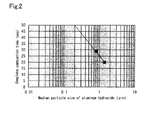
FIG. 2 is a schematic view relating to the extrapolation of data for metal hydroxides that can be preferably used in the present invention, performed in order to obtain a lower limit for the median particle size thereof. - Hereinafter, the present invention will be explained in detail.
- An epoxy resin composition of the present invention contains the following phosphorus-containing modified epoxy resin (A), a novolak epoxy resin (B), a hardener (C) for epoxy resins, and a metal hydroxide (D).
In the present disclosure and the claims, "an epoxy resin" is a resin compound having at least one epoxy group. - The phosphorus-containing modified epoxy resin (A) consists of a compound (a) represented by the following Formula (a).
-


-


- In Formula (a), n is an integer of at least 0, an integer of 0 to 10 being preferable, and an integer of 0 to 5 being more preferable. So long as no more than 10, it will excel in balance of heat resistance and flowability.
The phosphorus-containing modified epoxy resin (A) may be configured from only a compound in which a part of the (n+2) number of X in the Formula (a) is a group represented by Formula (I) or (II), and a part is a group represented by Formula (III), or may be configured from only a compound in which all of the (n+2) number of X in Formula (a) are groups represented by Formula (I) or (II), or may be a mixture of a compound in which a part of the (n+2) number of X in the Formula (a) is a group represented by Formula (I) or (II), and a part is a group represented by Formula (III), and a compound in which all of the (n+2) number of X in Formula (a) are groups represented by Formula (I) or (II).
The phosphorus content of the phosphorus-containing modified epoxy resin (A) is preferably 1 to 8% by mass. The flame retardance of the cured product of the epoxy resin composition improves with higher phosphorus content, and the flame retardance of the composite material obtained using this epoxy resin composition improves. The heat resistance of the cured product of the epoxy resin composition improves with lower phosphorus content, and the heat resistance of the composite material obtained using this epoxy resin composition improves. - As the phosphorus-containing modified epoxy resin (A), commercial products may be used, or those synthesized by a known production method may be used.
As the commercial product, for example, FX-289FA manufactured by Nippon Steel Chemical Co., Ltd. can be exemplified.
As the production method of the phosphorus-containing modified epoxy resin (A), for example, a method of reacting a compound represented by the following Formula (c) (9,10-dihydro-9-oxa-10- phosphaphenanthrene-10-oxide) with an epoxy resin (e.g., phenol novolak epoxy resin or cresol novolak epoxy resin) in which all of the (n+2) number of X in the Formula (a) are groups represented by the Formula (III), at high temperature under the presence of catalyst. -

- The compound (a) constituting the phosphorus-containing modified epoxy resin (A) contained in the epoxy resin composition may be one, two or more types.
The mass content CA (%) of the phosphorus-containing modified epoxy resin (A) relative to the total amount (mass) of epoxy resin composition is preferably at least 6% to no more than 40%, and more preferably at least 10% to no more than 35%.
By the CA being at least 6%, it is possible to impart sufficient flame retardancy due to the synergy with the metal hydroxide (D) described later. In addition, by the CA being no more than 40%, it is possible to impart suitable curability and viscosity to the epoxy resin composition.
In addition, for the blended amount of phosphorus-containing modified epoxy resin (A) in the epoxy resin composition of the present invention, a blended amount is preferable that makes the phosphorus atom content relative to the overall mass of the composition at least 0.7% by mass to no more than 2.4% by mass, and a blended amount that makes it at least 1.0% by mass to no more than 2.4% by mass is more preferable. By setting to at least 0.7% by mass, it is possible to impart sufficient flame retardancy. In addition, by setting to no more than 2.4% by mass, it is possible to maintain the heat resistance of the cured product of the epoxy resin composition and the composite material obtained using this epoxy resin composition. - The metal hydroxide (D) is not particularly limited, and a known metal hydroxide can be used as an inorganic flame retardant. As such a metal hydroxide, aluminum hydroxide, magnesium hydroxide or the like can be exemplified. Thereamong, aluminum hydroxide is preferable from the aspect of thermal decomposition temperature and endothermic energy amount during decomposition.
As the metal hydroxide (D), normally a granular one is used. In particular, in the case of using the epoxy resin composition of the present invention by impregnating into reinforcement fibers, from the viewpoint of dispersibility, the median particle size of the metal hydroxide (D) being no more than the diameter of the reinforcement fiber is preferable in the aspect of being able to achieve both high flame retardancy and high mechanical property, and the median particle size is more preferably at least 0.2 µm and no more than the diameter of the reinforcement fiber. In addition, the median particle size is more preferably at least 0.8 µm to no more than the diameter of the reinforcement fiber, and particularly preferably at least 1.0 µm to no more than 5.5 µm. The median particle size is a value measured by laser diffractometry.
In addition, the free moisture of the metal hydroxide (D) being no more than 0.5% by mass is more preferable in the aspect of being able to suppress secondary aggregation, and the free moisture being at least 0.05% by mass is further preferable due to imparting flame retardance. In other words, so long as the range of free moisture is preferably at least 0.05% by mass to no more than 0.5% by mass, more preferably at least 0.07% by mass to no more than 0.17% by mass, it is further preferable due to being able to achieve both high flame retardancy and high dispersibility.
The free moisture of the metal hydroxide (D) was calculated based on JIS R 9301. In other words, after a sample measured for mass beforehand (d1) was dried for 2 hours at 110°C, the mass was measured (d2), and the free moisture (% by mass) was calculated from the amount of decrease after drying (=(d1-d2)/d1 x 100). - The diameter of the reinforcement fiber is a value measured according to an image analysis method employing SEM images.
- As desired, surface treatment may be conducted on the metal hydroxide (D). As the surface treatment, surface treatment using stearic acid, surface treatment using a coupling agent, or the like can be exemplified.
As the metal hydroxide (D), commercial products may be used, or those synthesized by a known production method may be used. For example, as a commercial aluminum hydroxide, C-303, C-301, C-300GT, C-305, C-3250 or CM-450 manufactured by Sumitomo Chemical Company; HIGILITE H-42 or H-43 manufactured by Showa Denko Co.; or the like can be exemplified.
In addition, as a commercial magnesium hydroxide,MAGSTAR # 5, #4, #2, ECOMAG PZ-1 or Z-10 manufactured by Tateho Chemical Industries Co., Ltd.; or the like can be exemplified. - The metal hydroxide (D) contained in the epoxy resin composition may be one type, or two or more types.
The mass content CD (%) of the metal hydroxide (D) relative to the total amount (mass) of the epoxy resin composition is preferably at least 3% to no more than 30%, and more preferably at least 5% to no more than 25%. By the CD being at least 3%, it is possible to impart sufficient flame retardancy due to the synergy with the phosphorus-containing modified epoxy resin (A). In addition, by the CD being no more than 30%, it is possible to impart appropriate viscosity or handling properties to the epoxy resin composition. If the CD exceeds 30%, production of the prepreg described later will become difficult. - In the epoxy resin composition of the present invention, in addition to the CA being at least 6% to no more than 40% and the CD being at least 3% to no more than 30% as mentioned above, it is necessary for 2.5CA+CD to be at least 45. It is thereby possible to impart sufficient flame retardancy. In the case of 2.5CA+CD being less than 45, the flame retardancy will be insufficient, even if CA and CD are within the respective above-mentioned ranges.
- The novolak epoxy resin (B) is not particularly limited so long as not containing phosphorus; however, at least one resin selected from the group consisting of phenol novolak epoxy resin and cresol novolak epoxy resin is suitable. These epoxy resins excel in flame retardance due to the chemical structure.
The novolak epoxy resin (B) contained in the epoxy resin composition may be one type or two or more types.
In the epoxy resin composition, the blended amount of the novolak epoxy resin (B) is preferably at least 15 parts by mass to no more than 65 parts by mass, more preferably at least 20 parts by mass to no more than 55 parts by mass, and further preferably at least 25 parts by mass to no more than 50 parts by mass, as an amount relative to 100 parts by mass of the epoxy resin composition. - The epoxy resin composition of the present invention may contain a trisphenolmethane epoxy resin (E) in partial substitution of the novolak epoxy resin (B). The trisphenolmethane epoxy resin (E) excels in flame retardance due to the chemical structure, similarly to the novolak epoxy resin (B).
As the trisphenolmethane epoxy resin (E), for example, a glycidyl ether of tris(hydroxyphenyl)methane or the like can be exemplified.
The trisphenolmethane epoxy resin (E) contained in the epoxy resin composition may be one type, or two or more types.
In the epoxy resin composition, the blended amount of the trisphenolmethane epoxy resin (E) is preferably at least 10 parts by mass to no more than 30 parts by mass, and more preferably at least 15 parts by mass to no more than 25 parts by mass, as an amount relative to 100 parts by mass of the epoxy resin composition. - The epoxy resin composition of the present invention can contain an other epoxy resin (G) other than the phosphorus-containing modified epoxy resin (A), novolak epoxy resin (B), and trisphenolmethane epoxy resin (E) as desired within a range not harming the effects of the present invention.
As such an epoxy resin (G), for example, a bisphenol epoxy resin, glycidylamine epoxy resin, aminophenol epoxy resin, naphthalene epoxy resin, isocyanate modified epoxy resin or the like can be exemplified. Any one of these may be used independently, or two or more types may be jointly used. Thereamong, a bisphenol epoxy resin is preferable. - The hardener (C) for epoxy resins may be of any structure so long as being able to cure epoxy resin, and a known hardener is applicable. As specific examples, amine, acid anhydride, novolak resin, phenol, mercaptan, Lewis acid amine complex, onium salt, imidazole, or the like can be exemplified.
Among the above listed, an amine-based hardener is preferable. As an amine-based hardener, for example, aromatic amines such as diaminodiphenylmethane or diaminodiphenyl sulfone, aliphatic amines, imidazole derivatives, dicyandiamide, tetramethylguanidine, thiourea-added amine or the like, and isomers or modified forms of these can be employed. Thereamong, dicyandiamide is particularly preferable due to excelling in the storage stability of a prepreg.
The blended amount of the hardener (C) for epoxy resins in the epoxy resin composition is preferably an amount such that the ratio of "active hydrogen equivalents of hardener (C) for epoxy resins" to "epoxy equivalents of the epoxy resin composition in state excluding hardener (C) for epoxy resins" becomes 0.5 to 1. The ratio is more preferably 0.6 to 0.8. The epoxy resin composition can be sufficiently cured by setting to at least 0.5. The toughness of the cured product can be raised by setting to no more than 1. - The epoxy resin composition of the present invention may contain a hardening accelerator (F) as desired in a range not harming the effects of the present invention. The hardening accelerator (F) is not particularly limited so long as being one having an effect of accelerating the curing reaction by the epoxy resin hardener (C) used.
For example, in the case of the hardener (C) for epoxy resins being dicyandiamide, then a urea derivative such as 3-phenyl-1,1-dimethylurea, 3-(3,4-dichlorophenyl)-1,1-dimethylurea (DCMU), 3-(3-chloro-4-methylphenyl)-1,1-dimethylurea, or 2,4-bis(3,3-dimethyl ureide)toluene is preferable as the hardening accelerator (F). In addition, in the case of the hardener (C) for epoxy resins being an acid anhydride or novolak resin, a tertiary amine is preferable as the hardening accelerator (F). In addition, in the case of the hardener (C) for epoxy resins being diaminodiphenyl sulfone, an imidazole compound or a urea compound such as phenyldimethylurea (PDMU); or an amine complex such as a monoethylamine trifluoride or amine trichloride complex is preferable as the hardening accelerator (F). Thereamong, a combination of dicyandiamide and DCMU is particularly preferable. - The epoxy resin composition of the present invention may contain a thermoplastic resin as desired, in a range not harming the effects of the present invention.
The type of thermoplastic resin is not particularly limited and, for example, phenoxy, polyamide, polyester, polycarbonate, polyethersulfone, polyphenylene ether, polyphenylene sulfide, polyetheretherketone, polyetherketoneketone, polyimide, polytetrafluoroethylene, polyether, polyolefin, crystalline polymer, polyarylate, polysulfone, polyacrylonitrile styrene, polystyrene, polyacrylonitrile, polmethylmethacrylate, ABS, AES, ASA, polyvinyl chloride, polyvinyl formal, or the like can be exemplified. Any one of these may be used individually, or two or more types may be jointly used.
Among the above listed, from the aspect of excelling in heat resistance of the cured product or toughness, at least one resin selected from the group consisting of polyethersulfone, polyetheretherketone and polyvinyl formal is preferable. - The epoxy resin composition of the present invention may contain various known additives as desired, within a range not harming the effects of the present invention. As the additives, for example, mold release agents such as silicone oil, natural waxes, synthetic waxes, metal salts of linear fatty acids, acid amide, esters, or paraffins; inorganic fillers such as powders of crystalline silica, fused silica, calcium silicate, alumina, calcium carbonate, talc, barium sulfate, etc., glass fibers, or carbon fibers; pigments such as carbon black or red iron oxide; silane coupling agents; and the like can be exemplified. Any one of these may be used individually, or two or more types may be jointly used.
- The epoxy resin composition of the present invention can be prepared by mixing each of the above-mentioned components. As a method of mixing each component, a method utilizing a mixer such as a three-roll mill, planetary mixer, kneader, all-purpose mixer, homogenizer or homodispenser can be exemplified.
- One aspect of the present invention relates to a prepreg obtained by impregnating an epoxy resin composition containing metal hydroxide into reinforcement fibers, in which the median particle size of the metal hydroxide is no more than the diameter of the reinforcement fiber.
Another aspect of the present invention relates to a prepreg obtained by impregnating an epoxy resin composition containing a phosphorus compound and aluminum hydroxide into reinforcement fibers, in which the median particle size of the aluminum hydroxide is no more than the diameter of the reinforcement fiber. - In the prepreg of the present invention, in the case of the metal hydroxide being aluminum hydroxide, if the median particle size of the aluminum hydroxide is no more than the diameter of the reinforcement fiber, it is considered that the aluminum hydroxide particles will be able to slip between the reinforcement fibers upon impregnating the epoxy resin composition containing aluminum hydroxide particles into the reinforcement fibers. It thereby becomes possible to cause the aluminum hydroxide particles to disperse over the entire prepreg, and is preferable due to preventing a decline in the mechanical characteristics or a decline in flame retardancy due to aggregation of the aluminum hydroxide particles, and being able to achieve both high flame retardancy and high mechanical characteristics. In addition, it is more preferable for the median particle size to be at least 0.2 µm and no more than the diameter of the reinforcement fiber.
- The phosphorus compound is not particularly limited so long as being one containing a phosphorus atom in the molecule; however, phosphorus-containing compounds such as a phosphoric acid ester, condensed phosphoric acid ester or phosphaphenanthrene-based compounds or red phosphorus is preferably used. These phosphorus compounds can be incorporated into the epoxy resin skeleton during the curing reaction, and can also be dispersed or miscible with the epoxy resin composition.
- In the prepreg of the present invention, the content of the epoxy resin composition relative to the total prepreg weight (hereinafter referred to as resin content) is preferably 15 to 50% by mass, more preferably 20 to 45% by mass, and further preferably 25 to 35% by mass. If the resin content is less than 15% by mass, the adhesiveness between the reinforcement fibers and the epoxy resin composition may decline, and if exceeding 50% by mass, the flame retardancy may decline.
The reinforcement fiber is not particularly limited, and may be appropriately selected depending on the application, etc. from among known materials as reinforcement fibers constituting fiber-reinforced composite materials. For example, various inorganic fibers or organic fibers such as carbon fiber, aramid fiber, nylon fiber, high-strength polyester fiber, glass fiber, boron fiber, alumina fiber or silicon nitride fiber can be used. Thereamong, carbon fiber, aramid fiber, glass fiber, boron fiber, alumina fiber or silicon nitride fiber is preferable from the viewpoint of flame retardance, and carbon fiber is particularly preferable from the aspect of excelling in specific strength and elastic ratio.
The carbon fiber preferably has a strand tensile strength measured based on JIS R7601 (1986) of 1.0 to 9.0 GPa and a strand tensile modulus of 150 to 1000 GPa, and more preferably has a strand tensile strength of 1.5 to 9.0 GPa and a strand tensile modulus of 200 to 1000 GPa. - As the diameter of the reinforcement fiber that can be used in the prepreg of the present invention, it is preferable for the diameter to be set on the order of 6 to 8 µm, particularly if the reinforcement fiber is carbon fiber.
Carbon fiber in this range of diameter can be preferably used due to obtaining being generally easy. However, the diameter of the carbon fiber is not limited to the above-mentioned range.
As the form of the carbon fibers, it may be drawn to align in one direction, or may be a cloth or non-crimp fabric.
The prepreg of the present invention can be produced by a known method using the epoxy resin composition of the present invention and reinforcement fibers. - The fiber-reinforced composite material of the present invention is obtained by curing the prepreg.
The fiber-reinforced composite material of the present invention can be produced by a known method using the prepreg of the present invention.
The fiber-reinforced composite material of the present invention has superior flame retardance (for example, flame retardance when preparing a 0.8 mm-thick fiber-reinforced composite material molded plate satisfies V-0 in UL-94V, and the flame retardance when preparing a 3.0 mm-thick fiber-reinforced composite material molded plate satisfies FAR25.853, a-1 Part IV) without containing halogen-based flame retardants, red phosphorus and phosphoric acid esters, due to the matrix resin being the cured product of the epoxy resin composition of the present invention. Therefore, the fiber-reinforced composite material of the present invention is useful in applications for which high degree flame retardancy is demanded, e.g., in electrical and electronic housing material and materials for aircraft interiors.
In addition, the cured product of the epoxy resin composition of the present invention has sufficient mechanical strength even if containing a metal hydroxide that is an inorganic flame retardant. For this reason, the fiber-reinforced composite material of the present invention is suitable in mechanical characteristics such as flexural property.
In the present invention, the fiber-reinforced composite material preferably is a carbon fiber-reinforced composite material containing carbon fibers as the reinforcement fibers due to excelling in flame retardance and mechanical characteristics. - Next, the present invention will be explained in further detail by way of examples.
The raw materials (resin, etc.) used in each of the following examples, production method and evaluation method will be shown below. - As the phosphorus-containing modified epoxy resin (A), novolak epoxy resin (B), hardener (C) for epoxy resins, metal hydroxide (D), trisphenolmethane epoxy resin (E), hardening accelerator (F) or other epoxy resin (G), the products listed in Table 1 were prepared.
-
[Table 1] Reference number General name · chemical name Manufacturer product name Phosphorus-containing modified epoxy resin(A) A-1 Phosphorus-containing epoxy resin Nippon Steel Chemical Co., Ltd. FX-289FA Novolak epoxy resin(B) B-1 Liquid phenol novolak epoxy resin Mitsubishi Chemical Corporation jER152 B-2 Liquid phenol novolak epoxy resin Nippon Steel Chemical Co., Ltd. TX-0911 Hardener for epoxy resins(C) C-1 Dicyandiamide Mitsubishi Chemical Corporation DICY15 Metal hydroxide (D) D-1 Aluminum hydroxide Sumitomo Chemical Co., Ltd. C-301 D-2 Aluminum hydroxide Simitomo ChemicalCo., Ltd. C-300GT D-3 Aluminum hydroxide Sumitomo Chemical Co., Ltd. C-305 D-4 Aluminum hydroxide Sumitomo Chemical Co., Ltd. CM-450 D-5 Aluminum hydroxide Sumitomo Chemical Co., Ltd. C-3250 Trisphenolmethane epoxy resin (F) E-1 Trisphenolmethane epoxy resin Mitsubishi ChemicalCorporation jER1032H60 Hardening accelerator (E) F-1 3-(3,4-dichlorophenyl)-1,1-dimethylurea Hodogaya Chemical Co., Ltd. DCMU99 Other epoxy resin(G) G-1 Liquid bisphenol A epoxy resin Mitsubishi Chemical jER828 Thermoplastic resin(H) H-1 Bisphenol A phenoxy resin Mitsubishi Chemical Corporation YP-50S - Among the raw materials shown in Table 1, the epoxy equivalent (g/eq) of resin (A-1, B-1, B-2, E-1 or G-1) and phosphorus content (% by mass) were as follows, respectively.
- A-1: epoxy equivalents 7740 g/eq, phosphorus content 7.4% by mass
- B-1: epoxy equivalents 177 g/eq,
phosphorus content 0% by mass - B-2: epoxy equivalents 172 g/eq,
phosphorus content 0% by mass - E-1: epoxy equivalents 169 g/eq,
phosphorus content 0% by mass - G-1: epoxy equivalents 189 g/eq,
phosphorus content 0% by mass - 15 parts by mass of G-1, 7.5 parts by mass of C-1 and 5 parts by mass of F-1 were weighed, then stirred and mixed in a container. This was more finely mixed in a three-roll mixer to obtain a hardener master batch.
16 parts by mass of A-1 and 34 parts by mass of B-2 were weighed, then heated to 150°C using an oil bath to dissolve and mixed in a flask. Subsequently, the epoxy resin composition was obtained by cooling to about 65°C, and adding thereto 38 parts by mass of D-1, 21 parts by mass of B-1, 30 parts by mass of E-1 and the hardener master batch, and then stirring and mixing. - Epoxy resin compositions were prepared similarly to Example 1, other than changing the compositional ratios as shown in Table 2.
- 15 parts by mass of G-1, 7.5 parts by mass of C-1 and 5 parts by mass of F-1 were weighed, and then stirred and mixed in a container. This was more finely mixed in a three-roll mixer to obtain a hardener master batch.
4 parts by mass of G-1 and 2 parts by mass of H-1 were weighed, and then heated to 160°C using an oil bath to dissolve and mixed in a flask to obtain a thermoplastic resin master batch.
37 parts by mass of A-1 and 81 parts by mass of B-2 were weighed, then heated to 150°C using an oil bath to dissolve and mixed in another flask. Subsequently, the epoxy resin composition was obtained by cooling to about 65°C, and adding thereto 50 parts by mass of D-1, the hardener master batch and the thermoplastic resin master batch, and then stirring and mixing. - 15 parts by mass of G-1, 7.5 parts by mass of C-1 and 5 parts by mass of F-1 were weighed, then stirred and mixed in a container. This was more finely mixed in a three-roll mixer to obtain a hardener master batch.
40 parts by mass of A-1 and 85 parts by mass of B-2 were weighed, then heated to 150°C using an oil bath to dissolve and mixed in a flask. Subsequently, the epoxy resin composition was obtained by cooling to about 65°C, and adding thereto 30 parts by mass of D-1 and the hardener master batch, and then stirring and mixing. - Epoxy resin compositions were prepared similarly to Example 8, other than substituting the compositional ratios as shown in Table 3.
- Epoxy resin compositions were prepared similarly to Example 8, other than substituting B-2 for B-1 and substituting the compositional ratios as shown in Table 3.
- Epoxy resin compositions were prepared similarly to Example 10, other than substituting D-1 for D-2, D-3, D-4 or D-5, respectively, and substituting the compositional ratios as shown in Table 3.
- 15 parts by mass of G-1, 7.5 parts by mass of C-1 and 5 parts by mass of F-1 were weighed, then stirred and mixed in a container. This was more finely mixed in a three-roll mixer to obtain a hardener master batch.
19.2 parts by mass of A-1 and 40.8 parts by mass of B-2 were weighed, then heated to 150°C using an oil bath to dissolve and mixed in a flask. Subsequently, the epoxy resin composition was obtained by cooling to about 65°C, and adding thereto 44.2 parts by mass of E-1 and the hardener master batch, and then stirring and mixing. - 15 parts by mass of G-1, 7.5 parts by mass of C-1 and 5 parts by mass of F-1 were weighed, then stirred and mixed in a container. This was more finely mixed in a three-roll mixer to obtain a hardener master batch.
19.2 parts by mass of A-1 and 40.8 parts by mass of B-2 were weighed, then heated to 150°C using an oil bath to dissolve and mixed in a flask. Subsequently, the epoxy resin composition was obtained by cooling to about 65°C, and adding thereto 15 parts by mass of D-1, 44.2 parts by mass of E-1 and the hardener master batch, and then stirring and mixing. - Epoxy resin compositions were obtained similarly to Comparative Example 2, other than substituting the compositional ratios as shown in Table 4.
- An epoxy resin composition was obtained similarly to Example 1, other than substituting the compositional ratios as shown in Table 4.
- An epoxy resin composition was obtained similarly to Example 10, other than substituting the compositional ratios as shown in Table 4.
- An epoxy resin composition was obtained similarly to Example 7, other than substituting the compositional ratios as shown in Table 4.
- The obtained epoxy resin composition was injected between two glass plates interposing a spacer of 2 mm-thick polytetrafluoroethylene, heated to cure at curing conditions of 2 hours at 130°C with a heating rate of 2°C/min to obtain a 2 mm-thick resin plate.
- The epoxy resin composition obtained in Example 10 was made into a film by a M-500 Comma Coater manufactured by HIRANO TECSEED Co., Ltd. to manufacture a resin film with a resin basis weight of 48 g/m2 (hot melt film). This resin film was pasted on both sides of carbon fiber TR50S15L manufactured by Mitsubishi Rayon (diameter of obtained single fiber was 6.5 µm by measurement method described later) arranged in parallel by the drum wind technique, and impregnated with a heating roll to obtain a carbon fiber prepreg with a fiber basis weight of 225 g/m2 and resin content of 30%.
A carbon fiber prepreg with a fiber basis weight of 225 g/m2 and resin content of 30% was obtained similarly to the above, except for using the epoxy resin composition obtained in Example 11 in place of the epoxy resin composition obtained in Example 10.
A carbon fiber prepreg with a fiber basis weight of 225 g/m2 and resin content of 30% was obtained similarly to the above, except for using the epoxy resin composition obtained in Example 12 in place of the epoxy resin composition obtained in Example 10.
A carbon fiber prepreg with a fiber basis weight of 225 g/m2 and resin content of 30% was obtained similarly to the above, except for using the epoxy resin composition obtained in Example 13 in place of the epoxy resin composition obtained in Example 10.
A carbon fiber prepreg with a fibers basis weight of 225 g/m2 and resin content of 30% was obtained similarly to the above, except for using the epoxy resin composition obtained in Example 14 in place of the epoxy resin composition obtained in Example 10.
A carbon fiber prepreg with a fiber basis weight of 225 g/m2 and resin content of 30% was obtained similarly to the above, except for using the epoxy resin composition obtained in Example 15 in place of the epoxy resin composition obtained in Example 10.
A carbon fiber prepreg with fibers basis weight of 225 g/m2 and resin content of 30% was obtained similarly to the above, except for using the epoxy resin composition obtained in Example 16 in place of the epoxy resin composition obtained in Example 10.
Upon carrying out the preparation of a carbon fiber prepreg similarly to above, except for using the epoxy resin composition obtained in Comparative Example 6 in place of the epoxy resin composition obtained in Example 11, since the amount of phosphorus-containing modified epoxy resin (A) was great, suitable drape property was not possessed upon making the carbon fiber prepreg.
Upon performing the preparation of a carbon fiber prepreg similarly to above, except for using the epoxy resin composition obtained in Comparative Example 7 in place of the epoxy resin composition obtained in Example 11, since the amount of metal hydroxide (D) was great, a prepreg maintaining the suitable form was not obtained as the carbon fiber prepreg. - The epoxy resin composition obtained in Example 7 was made into film form with an M-500 Comma Coater manufactured by HIRANO TECSEED Co., Ltd. to prepare a resin film with a resin basis weight of 67 g/m2. This resin film was pasted on both sides of carbon fiber fabric TR3110M manufactured by Mitsubishi Rayon, and impregnated with a heating roll to obtain a carbon fiber prepreg with fibers basis weight of 200 g/m2 and a resin content of 40%.
Upon performing the preparation of a carbon fiber prepreg similarly to above, except for using the epoxy resin composition obtained in Comparative Example 7 in place of the epoxy resin composition obtained in Example 7, since the amount of metal hydroxide (D) was great, a prepreg maintaining the appropriate form was not obtained as the carbon fiber prepreg. - A carbon fiber bundle cut to a length of 5 cm was embedded in epoxy resin (EPO MOUNT base resin : EPO MOUNT hardener = 100:9 (mass ratio)), cut to 2 cm to expose a cross-section, and then mirror finished.
- Furthermore, in order to clarify the profile of the fibers, the cross-section of the sample was etching processed by the following method.
Employed equipment: JP-170 Plasma Etching Device, JEOL, Ltd.
Processing conditions: (ambient gas: Ar/O2 = 75/25, plasma output: 50 W, vacuum: about 120 Pa, processing time: 5 min.) - The cross-sections of the sample obtained by (1) and (2) were observed using an SEM (PHILIPS FEI-XL20), and five images in which at least five fiber cross-sections appeared on the screen were photographed arbitrarily.
- For each sample, 20 single fiber cross-sections were arbitrarily selected from five SEM images, provided that at least 3 were from one image, the profile of the fiber cross-section was traced using image analysis software (tradename: Image-Pro PLUS, manufactured by Nippon Roper K. K.), and the diameter d of the cross-section was measured. The average of the diameter d of all selected single fiber cross-sections was defined as the diameter Di of a single fiber in the carbon fiber bundle.
- The obtained carbon fiber prepreg was cut to a size of 150 mm x 150 mm, four pieces were piled so that the fiber orientations were 0°/90°/90°/0°, and cured in an autoclave at conditions of 130°C x 90 minutes, heating rate of 2°C/min and pressure of 0.6 MPa to obtain a 0.8 mm-thick carbon fiber composite material plate ([0/90]s).
- The obtained carbon fiber prepreg was cut to a size of 200 mm x 200 mm, ten pieces were piled so that the fiber orientations were 0°/0°/0°/0°/0°/0°/0°/0°/0°/0°, and cured in an autoclave at conditions of 130°C x 90 minutes, heating rate of 2°C/min and pressure of 0.6 MPa to obtain a 0.2 mm-thick carbon fiber composite material plate ([0°/0°/0°/0°/0°/0°/0°/0°/0°/0°]).
- The obtained carbon fiber prepreg was cut to a size of 320 mm x 320 mm, fifteen pieces were piled so that the fiber orientations were
0°/90°/0°/90°/0°/90°/0°/90°/0°/90°/0°/90°/0°/90°/0°, and cured in an autoclave at conditions of 130°C x 90 minutes, heating rate of 2°C/min and pressure of 0.6 MPa to obtain a 3.0 mm-thick carbon fiber composite material plate
([0°/90°/0°/90°/0°/90°/0°/90°/0°/90°/0°/90°/0°/90°/0°]). - The measuring instrument employed an ARES-RDS manufactured by TA Instruments.
The obtained 2 mm-thick resin plate was processed into a test piece (length 55 mm x width 12.7 mm), the storage elastic modulus G' was logarithmically plotted relative to temperature at a measurement frequency of 1 Hz and heating rate of 5°C/min, and the temperature obtained from the intersection of an approximated line of the flat region of logG' and the approximated line of the region in which G' transitions was recorded as the glass transition temperature (G'-Tg). The results are shown in Tables 2 to 4. - The obtained 2 mm-thick resin plate was processed into a test piece (length 60 mm x width 8 mm), and using a universal tester manufactured by Instron to which a 3-point bending jig (both indenter and support 3.2 mmR, distance between supports 32 mm) was installed, the flexural properties (flexural strength, flexural modulus, elongation during maximum load, fracture elongation) were measured at the condition of a 2 mm/min crosshead speed. The results are shown in Tables 2 to 4.
- After processing the obtained 2 mm-thick resin plate to the appropriate size, the weight in air and in water was measured, and the specific gravity was calculated by the Archimedes method. The results are shown in Tables 2 to 4.
- The obtained 2 mm-thick resin plate was processed into a test piece (length 127 mm x width 12.7 mm), and the combustion test was conducted thereon in accordance with UL-94V standard using a combustion tester manufactured by Suga Test Instruments Co., Ltd.
The complete combustion time (sec) and judgment result (V-0, V-1, V-2 and fail) were recorded. The results are shown in Tables 2 to 4. - The obtained 0.8 mm-thick carbon fiber composite material was processed into a test piece (length 127 mm x width 12.7 mm), and the combustion test was conducted thereon in accordance with UL-94V standard using a combustion tester manufactured by Suga Test Instruments Co., Ltd. The complete combustion time (sec) and judgment result (V-0, V-1, V-2 and fail) were recorded. The results are shown in Table 3.
- The obtained 3.0 mm-thick carbon fiber composite material was processed into a test piece (length 150 mm x width 150 mm), and the combustion test was conducted thereon in accordance with FAR25.853 a-1 Part IV standard. The integral value at two minutes and maximum value at five minutes for the heat release rate were recorded. The results are shown in Table 3 or 4.
- The obtained 2-mm thick carbon fiber composite material plate was processed into a test piece (length 127 mm x width 12.7 mm), and using a universal tester manufactured by Instron to which a 3-point bending jig (indenter 5.0 mmR, support 3.2 mmR, distance between supports 80 mm) was installed, the flexural properties (flexural strength, flexural modulus, elongation during maximum load, fracture elongation) were measured at the condition of a 5.3 mm/min crosshead speed. The results are shown in Table 3 or 4.
- The obtained 2 mm-thick carbon fiber composite material plate processed into a test piece (length 25.4 mm x width 6.35 mm), and measured for ILSS characteristics (strength) using a universal tester manufactured by Instron to which a 3-point bending jig (indenter 3.2 mmR, support 1.6 mmR, distance between supports 8 mm) was installed at conditions of a 1.27 mm/min crosshead speed. The results are shown in Table 3 or 4.
-


-


-


-
Fig. 1 shows a graph showing the relationships between CA and CD of the epoxy resin compositions respectively prepared in Examples 1 to 12 and Comparative Examples 1 to 7. The graph is a graph with CA on the horizontal axis and CD on the vertical axis. In addition, the straight line of 2.5CA+CD=45, i.e. straight line of CD=45-2.5CA, is written in the graph.
As shown inFIG. 1 and the results shown in Tables 2 to 4, the resin plates produced by curing the epoxy resin compositions of Examples 1 to 14 satisfying 2.5CA+CD≧45 (Formula (1)), 6≦CA≦40 (Formula (2)) and 3≦CD≦30 (Formula (3)) excelled in flame retardancy and also had favorable mechanical characteristics. In addition, the carbon fiber composite material plates produced by curing the prepreg prepared using the epoxy resin compositions prepared in Examples 10, 13 and 14 excelled in flame retardancy and also had favorable mechanical characteristics. On the other hand, Comparative Example 1 not containing the metal hydroxide (D), Comparative Examples 2 to 4 not satisfying Formula (1), and Comparative Example 5 not satisfying Formulas (1) and (2) had low flame retardancy of the resin plate. For Comparative Example 6 not satisfying Formula (2), the flame retardancy of the resin plate was favorable; however, the carbon fiber prepreg did not have suitable drape property, and did not suit the preparation of a composite material. For Comparative Example 7 not satisfying Formula (3), the flame retardancy of the resin plate was favorable; however, a prepreg assuming the appropriate form was not obtained as the carbon fiber prepreg, and did not suit the preparation of a composite material. In addition, the carbon fiber composite material plates produced by curing prepregs prepared using the epoxy resin compositions prepared in Examples 15 and 16, in which the median particle size of the aluminum hydroxide is at least the diameter of the reinforcement fiber, excelled in flame retardancy, but the mechanical characteristics declined. - According to the epoxy resin composition or prepreg using the epoxy resin composition of the present invention, it is possible to provide a composite material having excellent flame retardance without containing a halogen-based flame retardant, red phosphorus and phosphoric acid ester.
According to the fiber-reinforced composite material of the present invention, it is possible to achieve both excellent flame retardance and mechanical characteristics.
the median particle size of D-2 (measured by laser diffractometry) was 0.8 µm and the free moisture was 0.40% by mass;
the median particle size of D-3 (measured by laser diffractometry) was 5.5 µm and the free moisture was 0.07% by mass;
the median particle size of D-4 (measured by laser diffractometry) was 11.0 µm and the free moisture was 0.30% by mass;
the median particle size of D-5 (measured by laser diffractometry) was 35.0 µm and the free moisture was 0.20% by mass; and
the active hydrogen equivalents of C-1 were calculated as 21 g/eq from the hydrogen number in the molecular formula and molecular weight.
Claims (10)
- An epoxy resin composition comprising:a phosphorus-containing modified epoxy resin (A) consisting of a compound (a) represented by the following Formula (a);a novolak epoxy resin (B);a hardener (C) for epoxy resins; anda metal hydroxide (D),wherein a mass content CA% of the phosphorus-containing modified epoxy resin (A) and mass content CD% of the metal hydroxide (D) relative to total amount of the epoxy resin composition satisfy the following Formulas (1), (2) and (3),


X is a group represented by the following Formula (I), (II) or (III), (n+2) number of X in the Formula may be the same or different from each other,
with the proviso that at least one X among the (n+2) number of X is a group represented by the Formula (I) or (II), and
Y is -H or CH3, and (n+2) number of Y in the Formula may be the same or different from each other.
- The epoxy resin composition according to claim 1, further comprising a trisphenolmethane epoxy resin (E).
- The epoxy resin composition according to claim 1 or 2, wherein the metal hydroxide (D) is an aluminum hydroxide.
- A prepreg obtained by impregnating the epoxy resin composition according to claim 1 into reinforcement fibers.
- The prepreg according to claim 4, wherein the epoxy resin composition further comprises a trisphenolmethane epoxy resin (E).
- The prepreg according to claim 4 or 5, wherein the metal hydroxide (D) is an aluminum hydroxide.
- The prepreg according to claim 6, wherein the median particle size of the aluminum hydroxide is no more than the diameter of the reinforcement fiber.
- A fiber-reinforced composite material obtained by curing the prepreg according to any one of claims 4 to 7.
- A prepreg obtained by impregnating an epoxy resin composition containing a phosphorus compound and an aluminum hydroxide into reinforcement fibers, wherein the median particle size of the aluminum hydroxide is no more than the diameter of the reinforcement fiber.
- A fiber-reinforced composite material obtained by curing the prepreg according to claim 9.
Priority Applications (1)
| Application Number | Priority Date | Filing Date | Title |
|---|---|---|---|
| EP16160104.2A EP3048132A1 (en) | 2011-02-16 | 2012-02-16 | Prepreg and fiber-reinforced composite material |
Applications Claiming Priority (2)
| Application Number | Priority Date | Filing Date | Title |
|---|---|---|---|
| JP2011030947 | 2011-02-16 | ||
| PCT/JP2012/053647 WO2012111743A1 (en) | 2011-02-16 | 2012-02-16 | Epoxy resin composition, prepreg, and fiber-reinforced composite material |
Related Child Applications (2)
| Application Number | Title | Priority Date | Filing Date |
|---|---|---|---|
| EP16160104.2A Division EP3048132A1 (en) | 2011-02-16 | 2012-02-16 | Prepreg and fiber-reinforced composite material |
| EP16160104.2A Division-Into EP3048132A1 (en) | 2011-02-16 | 2012-02-16 | Prepreg and fiber-reinforced composite material |
Publications (3)
| Publication Number | Publication Date |
|---|---|
| EP2676983A1 true EP2676983A1 (en) | 2013-12-25 |
| EP2676983A4 EP2676983A4 (en) | 2014-09-03 |
| EP2676983B1 EP2676983B1 (en) | 2016-07-20 |
Family
ID=46672655
Family Applications (2)
| Application Number | Title | Priority Date | Filing Date |
|---|---|---|---|
| EP16160104.2A Withdrawn EP3048132A1 (en) | 2011-02-16 | 2012-02-16 | Prepreg and fiber-reinforced composite material |
| EP12747218.1A Active EP2676983B1 (en) | 2011-02-16 | 2012-02-16 | Epoxy resin composition, prepreg, and fiber-reinforced composite material |
Family Applications Before (1)
| Application Number | Title | Priority Date | Filing Date |
|---|---|---|---|
| EP16160104.2A Withdrawn EP3048132A1 (en) | 2011-02-16 | 2012-02-16 | Prepreg and fiber-reinforced composite material |
Country Status (8)
| Country | Link |
|---|---|
| US (2) | US20130338266A1 (en) |
| EP (2) | EP3048132A1 (en) |
| JP (4) | JP5565460B2 (en) |
| CN (2) | CN103370353B (en) |
| BR (1) | BR112013020165A2 (en) |
| CA (1) | CA2826672A1 (en) |
| ES (1) | ES2594928T3 (en) |
| WO (1) | WO2012111743A1 (en) |
Families Citing this family (13)
| Publication number | Priority date | Publication date | Assignee | Title |
|---|---|---|---|---|
| MX2016010139A (en) * | 2014-02-21 | 2016-10-07 | Halliburton Energy Services Inc | Cementing compositions and methods. |
| JP6657605B2 (en) * | 2015-06-11 | 2020-03-04 | 三菱ケミカル株式会社 | Epoxy resin composition, molded product, prepreg, fiber reinforced composite material and structure |
| CN105237959B (en) * | 2015-09-25 | 2018-06-29 | 宿松县焕然机电有限责任公司 | A kind of water-fast heat resistant insulation composite of motor slot wedge |
| CN108912609B (en) * | 2018-07-02 | 2021-01-08 | 广东航科新材料有限公司 | Epoxy resin composite material and preparation method thereof |
| JP7501989B2 (en) * | 2018-09-28 | 2024-06-18 | 京セラ株式会社 | Epoxy resin composition for casting and ignition coil |
| JP7281271B2 (en) * | 2018-11-30 | 2023-05-25 | 京セラ株式会社 | Sealing resin composition for film capacitor, and film capacitor |
| CN110272554A (en) * | 2019-06-26 | 2019-09-24 | 湖北航宇新型材料股份有限公司 | A kind of fire-retardant prepreg cloth of epoxy and its manufacturing process |
| CN114761468B (en) * | 2019-12-11 | 2024-10-15 | 东丽株式会社 | Prepregs, laminates and integrated moldings |
| EP4063424B1 (en) * | 2020-01-29 | 2025-09-03 | Toray Industries, Inc. | Epoxy resin composition, cured resin product, prepreg, and fiber-reinforced composite material |
| JP7512658B2 (en) * | 2020-04-20 | 2024-07-09 | 株式会社レゾナック | Compound manufacturing method, compound masterbatch, compound, molded body, and cured product of compound |
| EP3926024A1 (en) * | 2020-06-17 | 2021-12-22 | Clariant International Ltd | Phosphorus-containing flame retardant compounds, method for their preparation and their use and epoxy resin formulations containing these flame retardant compounds |
| JP2022144570A (en) * | 2021-03-19 | 2022-10-03 | 三菱ケミカル株式会社 | Epoxy resin composition and prepreg |
| CN116265230A (en) * | 2021-12-17 | 2023-06-20 | 上纬新材料科技股份有限公司 | High flame-resistant laminated composite material and its preparation method |
Family Cites Families (25)
| Publication number | Priority date | Publication date | Assignee | Title |
|---|---|---|---|---|
| JPH0251538A (en) * | 1988-08-12 | 1990-02-21 | Sumitomo Chem Co Ltd | Fiber-reinforced composite material |
| JPH10330513A (en) * | 1997-06-02 | 1998-12-15 | Toray Ind Inc | Prepreg and fiber reinforced composite material |
| JP3180077B2 (en) * | 1998-03-09 | 2001-06-25 | リグナイト株式会社 | Bow guide plate for stranded wire machine and method of manufacturing the same |
| JPH11293561A (en) * | 1998-04-13 | 1999-10-26 | Nitto Boseki Co Ltd | Method for producing glass fiber woven fabric for highly laser-processable laminate |
| JP4588834B2 (en) * | 2000-04-06 | 2010-12-01 | パナソニック電工株式会社 | Phosphorus-containing epoxy resin composition, flame-retardant resin sheet using the phosphorus-containing epoxy resin, metal foil with resin, prepreg and laminate, multilayer board |
| DE60114240T2 (en) * | 2000-12-18 | 2006-07-13 | Mitsubishi Rayon Co., Ltd. | FLAME-RESISTANT EPOXY RESIN COMPOSITION AND PREPREGS AND FIBER-REINFORCED COMPOSITES THEREFOR PREPREGOSED |
| JP2003277588A (en) * | 2002-03-27 | 2003-10-02 | Nec Corp | Thermosetting resin composition and laminate using the same |
| JP2004182850A (en) * | 2002-12-03 | 2004-07-02 | Mitsubishi Gas Chem Co Inc | Prepreg and laminate with excellent property balance |
| JP2004292484A (en) * | 2003-03-25 | 2004-10-21 | Sumitomo Bakelite Co Ltd | Resin composition, prepreg and laminate |
| JP4270926B2 (en) * | 2003-04-07 | 2009-06-03 | 三菱レイヨン株式会社 | Epoxy resin composition and prepreg |
| JP2005206707A (en) * | 2004-01-23 | 2005-08-04 | Sumitomo Bakelite Co Ltd | Resin composition, prepreg and laminated sheet |
| JP4606034B2 (en) * | 2004-02-03 | 2011-01-05 | 株式会社プライムポリマー | Fiber reinforced polyolefin resin composition and molded product thereof |
| EP1731553B1 (en) | 2004-02-27 | 2019-02-20 | Toray Industries, Inc. | Epoxy resin composition for carbon-fiber-reinforced composite material, prepreg, integrated molding, sheet of fiber-reinforced composite material and cabinet for electrical/electronic equipment |
| JP2005272672A (en) * | 2004-03-25 | 2005-10-06 | Toray Ind Inc | Flame retardant masterbatch, thermosetting resin composition, prepreg and fiber reinforced composite material |
| JP2006321942A (en) * | 2005-05-20 | 2006-11-30 | Hitachi Chem Co Ltd | Resin composition and prepreg and printed wiring board using the same |
| JP4969363B2 (en) * | 2006-08-07 | 2012-07-04 | 東レ株式会社 | Prepreg and carbon fiber reinforced composites |
| JP2008106100A (en) * | 2006-10-24 | 2008-05-08 | Sumitomo Chemical Co Ltd | Crystalline thermoplastic resin composition |
| JP5554500B2 (en) * | 2007-01-25 | 2014-07-23 | パナソニック株式会社 | Prepreg, printed wiring board, multilayer circuit board, and method for manufacturing printed wiring board |
| JP5245301B2 (en) * | 2007-06-28 | 2013-07-24 | 住友ベークライト株式会社 | Resin composition, prepreg, laminate, and semiconductor device |
| JP2009051978A (en) * | 2007-08-28 | 2009-03-12 | Panasonic Electric Works Co Ltd | Epoxy resin composition for printed wiring board, prepreg, metal foil-clad laminate, multilayer printed wiring board |
| EP2070962B1 (en) * | 2007-12-12 | 2010-08-18 | ATOTECH Deutschland GmbH | Solid powder formulations for the preparation of resin-coated foils and their use in the manufacture of printed circuit boards |
| TWI350716B (en) * | 2008-12-29 | 2011-10-11 | Nanya Plastics Corp | High thermal conductivity, halogen-free flame-retardent resin composition and its pre-impregnated and coating materials for printed circuit boards |
| JP5260400B2 (en) * | 2009-04-24 | 2013-08-14 | パナソニック株式会社 | Multilayer board for producing multilayer printed wiring boards |
| JP5720118B2 (en) * | 2009-06-01 | 2015-05-20 | 三菱レイヨン株式会社 | Epoxy resin composition, prepreg and fiber reinforced composite material |
| US9206308B2 (en) * | 2010-03-26 | 2015-12-08 | Panasonic Intellectual Property Management Co., Ltd. | Epoxy resin composition for prepreg, prepreg, and multilayer printed circuit board |
-
2012
- 2012-02-16 CN CN201280008669.4A patent/CN103370353B/en active Active
- 2012-02-16 CA CA2826672A patent/CA2826672A1/en not_active Abandoned
- 2012-02-16 CN CN201510141904.0A patent/CN104710640B/en active Active
- 2012-02-16 WO PCT/JP2012/053647 patent/WO2012111743A1/en not_active Ceased
- 2012-02-16 JP JP2012512095A patent/JP5565460B2/en active Active
- 2012-02-16 US US13/983,088 patent/US20130338266A1/en not_active Abandoned
- 2012-02-16 EP EP16160104.2A patent/EP3048132A1/en not_active Withdrawn
- 2012-02-16 BR BR112013020165A patent/BR112013020165A2/en not_active IP Right Cessation
- 2012-02-16 ES ES12747218.1T patent/ES2594928T3/en active Active
- 2012-02-16 EP EP12747218.1A patent/EP2676983B1/en active Active
-
2013
- 2013-11-15 JP JP2013237006A patent/JP5904194B2/en active Active
- 2013-11-15 JP JP2013237007A patent/JP2014028982A/en active Pending
-
2014
- 2014-12-15 US US14/570,904 patent/US20150099832A1/en not_active Abandoned
-
2015
- 2015-02-12 JP JP2015025302A patent/JP2015092004A/en active Pending
Non-Patent Citations (2)
| Title |
|---|
| No further relevant documents disclosed * |
| See also references of WO2012111743A1 * |
Also Published As
| Publication number | Publication date |
|---|---|
| CN104710640B (en) | 2018-10-19 |
| CA2826672A1 (en) | 2012-08-23 |
| EP2676983A4 (en) | 2014-09-03 |
| ES2594928T3 (en) | 2016-12-23 |
| US20130338266A1 (en) | 2013-12-19 |
| CN104710640A (en) | 2015-06-17 |
| BR112013020165A2 (en) | 2016-11-08 |
| JP5904194B2 (en) | 2016-04-13 |
| JPWO2012111743A1 (en) | 2014-07-07 |
| JP5565460B2 (en) | 2014-08-06 |
| EP3048132A1 (en) | 2016-07-27 |
| US20150099832A1 (en) | 2015-04-09 |
| CN103370353A (en) | 2013-10-23 |
| JP2014028982A (en) | 2014-02-13 |
| EP2676983B1 (en) | 2016-07-20 |
| CN103370353B (en) | 2016-03-23 |
| JP2015092004A (en) | 2015-05-14 |
| JP2014028981A (en) | 2014-02-13 |
| WO2012111743A1 (en) | 2012-08-23 |
Similar Documents
| Publication | Publication Date | Title |
|---|---|---|
| EP2676983B1 (en) | Epoxy resin composition, prepreg, and fiber-reinforced composite material | |
| JP6390755B2 (en) | Carbon fiber reinforced composite materials and structures | |
| EP2690121B1 (en) | Epoxy resin composition, prepreg, fiber-reinforced composite material, and housing for electrical or electronic equipment | |
| TWI437018B (en) | Epoxy resin composition, prepreg and reinforced fiber composite material | |
| JP6657605B2 (en) | Epoxy resin composition, molded product, prepreg, fiber reinforced composite material and structure | |
| US11091629B2 (en) | Hot/wet resistant low density epoxy compositions | |
| WO2002050153A1 (en) | Flame-retardant epoxy resin composition, and prepregs and fiber-reinforced composite materials made by using the composition | |
| JP2016044246A (en) | Epoxy resin composition, prepreg, fiber reinforced composite material and structure | |
| US12516149B2 (en) | Flame retardant epoxy resin composition | |
| JP2007302746A (en) | Phosphorus-containing modified epoxy resin, flame retardant matrix resin composition, prepreg and composite material |
Legal Events
| Date | Code | Title | Description |
|---|---|---|---|
| PUAI | Public reference made under article 153(3) epc to a published international application that has entered the european phase |
Free format text: ORIGINAL CODE: 0009012 |
|
| 17P | Request for examination filed |
Effective date: 20130806 |
|
| AK | Designated contracting states |
Kind code of ref document: A1 Designated state(s): AL AT BE BG CH CY CZ DE DK EE ES FI FR GB GR HR HU IE IS IT LI LT LU LV MC MK MT NL NO PL PT RO RS SE SI SK SM TR |
|
| DAX | Request for extension of the european patent (deleted) | ||
| A4 | Supplementary search report drawn up and despatched |
Effective date: 20140806 |
|
| RIC1 | Information provided on ipc code assigned before grant |
Ipc: C08L 63/00 20060101ALI20140731BHEP Ipc: C08J 5/24 20060101ALI20140731BHEP Ipc: C08G 59/20 20060101AFI20140731BHEP |
|
| GRAP | Despatch of communication of intention to grant a patent |
Free format text: ORIGINAL CODE: EPIDOSNIGR1 |
|
| INTG | Intention to grant announced |
Effective date: 20151125 |
|
| GRAJ | Information related to disapproval of communication of intention to grant by the applicant or resumption of examination proceedings by the epo deleted |
Free format text: ORIGINAL CODE: EPIDOSDIGR1 |
|
| GRAP | Despatch of communication of intention to grant a patent |
Free format text: ORIGINAL CODE: EPIDOSNIGR1 |
|
| GRAP | Despatch of communication of intention to grant a patent |
Free format text: ORIGINAL CODE: EPIDOSNIGR1 |
|
| INTG | Intention to grant announced |
Effective date: 20160502 |
|
| GRAS | Grant fee paid |
Free format text: ORIGINAL CODE: EPIDOSNIGR3 |
|
| GRAF | Information related to payment of grant fee modified |
Free format text: ORIGINAL CODE: EPIDOSCIGR3 |
|
| GRAA | (expected) grant |
Free format text: ORIGINAL CODE: 0009210 |
|
| AK | Designated contracting states |
Kind code of ref document: B1 Designated state(s): AL AT BE BG CH CY CZ DE DK EE ES FI FR GB GR HR HU IE IS IT LI LT LU LV MC MK MT NL NO PL PT RO RS SE SI SK SM TR |
|
| REG | Reference to a national code |
Ref country code: GB Ref legal event code: FG4D |
|
| REG | Reference to a national code |
Ref country code: CH Ref legal event code: EP |
|
| REG | Reference to a national code |
Ref country code: IE Ref legal event code: FG4D |
|
| REG | Reference to a national code |
Ref country code: AT Ref legal event code: REF Ref document number: 814030 Country of ref document: AT Kind code of ref document: T Effective date: 20160815 |
|
| REG | Reference to a national code |
Ref country code: DE Ref legal event code: R096 Ref document number: 602012020745 Country of ref document: DE |
|
| REG | Reference to a national code |
Ref country code: LT Ref legal event code: MG4D |
|
| REG | Reference to a national code |
Ref country code: NL Ref legal event code: MP Effective date: 20160720 |
|
| REG | Reference to a national code |
Ref country code: AT Ref legal event code: MK05 Ref document number: 814030 Country of ref document: AT Kind code of ref document: T Effective date: 20160720 |
|
| REG | Reference to a national code |
Ref country code: ES Ref legal event code: FG2A Ref document number: 2594928 Country of ref document: ES Kind code of ref document: T3 Effective date: 20161223 |
|
| REG | Reference to a national code |
Ref country code: FR Ref legal event code: PLFP Year of fee payment: 6 |
|
| PG25 | Lapsed in a contracting state [announced via postgrant information from national office to epo] |
Ref country code: IT Free format text: LAPSE BECAUSE OF FAILURE TO SUBMIT A TRANSLATION OF THE DESCRIPTION OR TO PAY THE FEE WITHIN THE PRESCRIBED TIME-LIMIT Effective date: 20160720 Ref country code: RS Free format text: LAPSE BECAUSE OF FAILURE TO SUBMIT A TRANSLATION OF THE DESCRIPTION OR TO PAY THE FEE WITHIN THE PRESCRIBED TIME-LIMIT Effective date: 20160720 Ref country code: FI Free format text: LAPSE BECAUSE OF FAILURE TO SUBMIT A TRANSLATION OF THE DESCRIPTION OR TO PAY THE FEE WITHIN THE PRESCRIBED TIME-LIMIT Effective date: 20160720 Ref country code: LT Free format text: LAPSE BECAUSE OF FAILURE TO SUBMIT A TRANSLATION OF THE DESCRIPTION OR TO PAY THE FEE WITHIN THE PRESCRIBED TIME-LIMIT Effective date: 20160720 Ref country code: IS Free format text: LAPSE BECAUSE OF FAILURE TO SUBMIT A TRANSLATION OF THE DESCRIPTION OR TO PAY THE FEE WITHIN THE PRESCRIBED TIME-LIMIT Effective date: 20161120 Ref country code: NL Free format text: LAPSE BECAUSE OF FAILURE TO SUBMIT A TRANSLATION OF THE DESCRIPTION OR TO PAY THE FEE WITHIN THE PRESCRIBED TIME-LIMIT Effective date: 20160720 Ref country code: NO Free format text: LAPSE BECAUSE OF FAILURE TO SUBMIT A TRANSLATION OF THE DESCRIPTION OR TO PAY THE FEE WITHIN THE PRESCRIBED TIME-LIMIT Effective date: 20161020 Ref country code: HR Free format text: LAPSE BECAUSE OF FAILURE TO SUBMIT A TRANSLATION OF THE DESCRIPTION OR TO PAY THE FEE WITHIN THE PRESCRIBED TIME-LIMIT Effective date: 20160720 |
|
| PG25 | Lapsed in a contracting state [announced via postgrant information from national office to epo] |
Ref country code: GR Free format text: LAPSE BECAUSE OF FAILURE TO SUBMIT A TRANSLATION OF THE DESCRIPTION OR TO PAY THE FEE WITHIN THE PRESCRIBED TIME-LIMIT Effective date: 20161021 Ref country code: LV Free format text: LAPSE BECAUSE OF FAILURE TO SUBMIT A TRANSLATION OF THE DESCRIPTION OR TO PAY THE FEE WITHIN THE PRESCRIBED TIME-LIMIT Effective date: 20160720 Ref country code: PL Free format text: LAPSE BECAUSE OF FAILURE TO SUBMIT A TRANSLATION OF THE DESCRIPTION OR TO PAY THE FEE WITHIN THE PRESCRIBED TIME-LIMIT Effective date: 20160720 Ref country code: SE Free format text: LAPSE BECAUSE OF FAILURE TO SUBMIT A TRANSLATION OF THE DESCRIPTION OR TO PAY THE FEE WITHIN THE PRESCRIBED TIME-LIMIT Effective date: 20160720 Ref country code: PT Free format text: LAPSE BECAUSE OF FAILURE TO SUBMIT A TRANSLATION OF THE DESCRIPTION OR TO PAY THE FEE WITHIN THE PRESCRIBED TIME-LIMIT Effective date: 20161121 Ref country code: BE Free format text: LAPSE BECAUSE OF FAILURE TO SUBMIT A TRANSLATION OF THE DESCRIPTION OR TO PAY THE FEE WITHIN THE PRESCRIBED TIME-LIMIT Effective date: 20160720 Ref country code: AT Free format text: LAPSE BECAUSE OF FAILURE TO SUBMIT A TRANSLATION OF THE DESCRIPTION OR TO PAY THE FEE WITHIN THE PRESCRIBED TIME-LIMIT Effective date: 20160720 |
|
| REG | Reference to a national code |
Ref country code: DE Ref legal event code: R097 Ref document number: 602012020745 Country of ref document: DE |
|
| PG25 | Lapsed in a contracting state [announced via postgrant information from national office to epo] |
Ref country code: RO Free format text: LAPSE BECAUSE OF FAILURE TO SUBMIT A TRANSLATION OF THE DESCRIPTION OR TO PAY THE FEE WITHIN THE PRESCRIBED TIME-LIMIT Effective date: 20160720 Ref country code: EE Free format text: LAPSE BECAUSE OF FAILURE TO SUBMIT A TRANSLATION OF THE DESCRIPTION OR TO PAY THE FEE WITHIN THE PRESCRIBED TIME-LIMIT Effective date: 20160720 |
|
| PLBE | No opposition filed within time limit |
Free format text: ORIGINAL CODE: 0009261 |
|
| STAA | Information on the status of an ep patent application or granted ep patent |
Free format text: STATUS: NO OPPOSITION FILED WITHIN TIME LIMIT |
|
| PG25 | Lapsed in a contracting state [announced via postgrant information from national office to epo] |
Ref country code: CZ Free format text: LAPSE BECAUSE OF FAILURE TO SUBMIT A TRANSLATION OF THE DESCRIPTION OR TO PAY THE FEE WITHIN THE PRESCRIBED TIME-LIMIT Effective date: 20160720 Ref country code: BG Free format text: LAPSE BECAUSE OF FAILURE TO SUBMIT A TRANSLATION OF THE DESCRIPTION OR TO PAY THE FEE WITHIN THE PRESCRIBED TIME-LIMIT Effective date: 20161020 Ref country code: SM Free format text: LAPSE BECAUSE OF FAILURE TO SUBMIT A TRANSLATION OF THE DESCRIPTION OR TO PAY THE FEE WITHIN THE PRESCRIBED TIME-LIMIT Effective date: 20160720 Ref country code: SK Free format text: LAPSE BECAUSE OF FAILURE TO SUBMIT A TRANSLATION OF THE DESCRIPTION OR TO PAY THE FEE WITHIN THE PRESCRIBED TIME-LIMIT Effective date: 20160720 Ref country code: DK Free format text: LAPSE BECAUSE OF FAILURE TO SUBMIT A TRANSLATION OF THE DESCRIPTION OR TO PAY THE FEE WITHIN THE PRESCRIBED TIME-LIMIT Effective date: 20160720 |
|
| 26N | No opposition filed |
Effective date: 20170421 |
|
| PG25 | Lapsed in a contracting state [announced via postgrant information from national office to epo] |
Ref country code: SI Free format text: LAPSE BECAUSE OF FAILURE TO SUBMIT A TRANSLATION OF THE DESCRIPTION OR TO PAY THE FEE WITHIN THE PRESCRIBED TIME-LIMIT Effective date: 20160720 |
|
| PG25 | Lapsed in a contracting state [announced via postgrant information from national office to epo] |
Ref country code: MC Free format text: LAPSE BECAUSE OF FAILURE TO SUBMIT A TRANSLATION OF THE DESCRIPTION OR TO PAY THE FEE WITHIN THE PRESCRIBED TIME-LIMIT Effective date: 20160720 |
|
| REG | Reference to a national code |
Ref country code: CH Ref legal event code: PL |
|
| PG25 | Lapsed in a contracting state [announced via postgrant information from national office to epo] |
Ref country code: LI Free format text: LAPSE BECAUSE OF NON-PAYMENT OF DUE FEES Effective date: 20170228 Ref country code: CH Free format text: LAPSE BECAUSE OF NON-PAYMENT OF DUE FEES Effective date: 20170228 |
|
| REG | Reference to a national code |
Ref country code: DE Ref legal event code: R082 Ref document number: 602012020745 Country of ref document: DE Representative=s name: HOFFMANN - EITLE PATENT- UND RECHTSANWAELTE PA, DE Ref country code: DE Ref legal event code: R081 Ref document number: 602012020745 Country of ref document: DE Owner name: MITSUBISHI CHEMICAL CORPORATION, JP Free format text: FORMER OWNER: MITSUBISHI RAYON CO., LTD., TOKIO/TOKYO, JP |
|
| REG | Reference to a national code |
Ref country code: IE Ref legal event code: MM4A |
|
| PG25 | Lapsed in a contracting state [announced via postgrant information from national office to epo] |
Ref country code: LU Free format text: LAPSE BECAUSE OF NON-PAYMENT OF DUE FEES Effective date: 20170216 |
|
| REG | Reference to a national code |
Ref country code: FR Ref legal event code: PLFP Year of fee payment: 7 |
|
| REG | Reference to a national code |
Ref country code: ES Ref legal event code: PC2A Owner name: MITSUBISHI CHEMICAL CORPORATION Effective date: 20180130 |
|
| PG25 | Lapsed in a contracting state [announced via postgrant information from national office to epo] |
Ref country code: IE Free format text: LAPSE BECAUSE OF NON-PAYMENT OF DUE FEES Effective date: 20170216 |
|
| REG | Reference to a national code |
Ref country code: FR Ref legal event code: CA Effective date: 20180515 Ref country code: FR Ref legal event code: CD Owner name: MITSUBISHI CHEMICAL CORPORATION, JP Effective date: 20180515 |
|
| PG25 | Lapsed in a contracting state [announced via postgrant information from national office to epo] |
Ref country code: MT Free format text: LAPSE BECAUSE OF NON-PAYMENT OF DUE FEES Effective date: 20170216 |
|
| PG25 | Lapsed in a contracting state [announced via postgrant information from national office to epo] |
Ref country code: AL Free format text: LAPSE BECAUSE OF FAILURE TO SUBMIT A TRANSLATION OF THE DESCRIPTION OR TO PAY THE FEE WITHIN THE PRESCRIBED TIME-LIMIT Effective date: 20160720 |
|
| PG25 | Lapsed in a contracting state [announced via postgrant information from national office to epo] |
Ref country code: HU Free format text: LAPSE BECAUSE OF FAILURE TO SUBMIT A TRANSLATION OF THE DESCRIPTION OR TO PAY THE FEE WITHIN THE PRESCRIBED TIME-LIMIT; INVALID AB INITIO Effective date: 20120216 |
|
| PG25 | Lapsed in a contracting state [announced via postgrant information from national office to epo] |
Ref country code: CY Free format text: LAPSE BECAUSE OF NON-PAYMENT OF DUE FEES Effective date: 20160720 |
|
| PG25 | Lapsed in a contracting state [announced via postgrant information from national office to epo] |
Ref country code: MK Free format text: LAPSE BECAUSE OF FAILURE TO SUBMIT A TRANSLATION OF THE DESCRIPTION OR TO PAY THE FEE WITHIN THE PRESCRIBED TIME-LIMIT Effective date: 20160720 |
|
| PG25 | Lapsed in a contracting state [announced via postgrant information from national office to epo] |
Ref country code: TR Free format text: LAPSE BECAUSE OF FAILURE TO SUBMIT A TRANSLATION OF THE DESCRIPTION OR TO PAY THE FEE WITHIN THE PRESCRIBED TIME-LIMIT Effective date: 20160720 |
|
| P01 | Opt-out of the competence of the unified patent court (upc) registered |
Effective date: 20230522 |
|
| PGFP | Annual fee paid to national office [announced via postgrant information from national office to epo] |
Ref country code: GB Payment date: 20260121 Year of fee payment: 15 |
|
| PGFP | Annual fee paid to national office [announced via postgrant information from national office to epo] |
Ref country code: ES Payment date: 20260302 Year of fee payment: 15 |
|
| PGFP | Annual fee paid to national office [announced via postgrant information from national office to epo] |
Ref country code: DE Payment date: 20260121 Year of fee payment: 15 |
|
| PGFP | Annual fee paid to national office [announced via postgrant information from national office to epo] |
Ref country code: FR Payment date: 20260121 Year of fee payment: 15 |