EP2676806A1 - Method for printing metal-tone printed matter and metal-tone printed matter - Google Patents
Method for printing metal-tone printed matter and metal-tone printed matter Download PDFInfo
- Publication number
- EP2676806A1 EP2676806A1 EP11858538.9A EP11858538A EP2676806A1 EP 2676806 A1 EP2676806 A1 EP 2676806A1 EP 11858538 A EP11858538 A EP 11858538A EP 2676806 A1 EP2676806 A1 EP 2676806A1
- Authority
- EP
- European Patent Office
- Prior art keywords
- printing
- metal
- metallic ink
- layer
- transferred
- Prior art date
- Legal status (The legal status is an assumption and is not a legal conclusion. Google has not performed a legal analysis and makes no representation as to the accuracy of the status listed.)
- Withdrawn
Links
Images


Classifications
-
- B—PERFORMING OPERATIONS; TRANSPORTING
- B41—PRINTING; LINING MACHINES; TYPEWRITERS; STAMPS
- B41J—TYPEWRITERS; SELECTIVE PRINTING MECHANISMS, i.e. MECHANISMS PRINTING OTHERWISE THAN FROM A FORME; CORRECTION OF TYPOGRAPHICAL ERRORS
- B41J2/00—Typewriters or selective printing mechanisms characterised by the printing or marking process for which they are designed
- B41J2/005—Typewriters or selective printing mechanisms characterised by the printing or marking process for which they are designed characterised by bringing liquid or particles selectively into contact with a printing material
- B41J2/01—Ink jet
-
- B—PERFORMING OPERATIONS; TRANSPORTING
- B32—LAYERED PRODUCTS
- B32B—LAYERED PRODUCTS, i.e. PRODUCTS BUILT-UP OF STRATA OF FLAT OR NON-FLAT, e.g. CELLULAR OR HONEYCOMB, FORM
- B32B27/00—Layered products comprising a layer of synthetic resin
- B32B27/06—Layered products comprising a layer of synthetic resin as the main or only constituent of a layer, which is next to another layer of the same or of a different material
- B32B27/08—Layered products comprising a layer of synthetic resin as the main or only constituent of a layer, which is next to another layer of the same or of a different material of synthetic resin
-
- B—PERFORMING OPERATIONS; TRANSPORTING
- B32—LAYERED PRODUCTS
- B32B—LAYERED PRODUCTS, i.e. PRODUCTS BUILT-UP OF STRATA OF FLAT OR NON-FLAT, e.g. CELLULAR OR HONEYCOMB, FORM
- B32B27/00—Layered products comprising a layer of synthetic resin
- B32B27/32—Layered products comprising a layer of synthetic resin comprising polyolefins
-
- B—PERFORMING OPERATIONS; TRANSPORTING
- B41—PRINTING; LINING MACHINES; TYPEWRITERS; STAMPS
- B41M—PRINTING, DUPLICATING, MARKING, OR COPYING PROCESSES; COLOUR PRINTING
- B41M5/00—Duplicating or marking methods; Sheet materials for use therein
- B41M5/025—Duplicating or marking methods; Sheet materials for use therein by transferring ink from the master sheet
- B41M5/0256—Duplicating or marking methods; Sheet materials for use therein by transferring ink from the master sheet the transferable ink pattern being obtained by means of a computer driven printer, e.g. an ink jet or laser printer, or by electrographic means
-
- B—PERFORMING OPERATIONS; TRANSPORTING
- B41—PRINTING; LINING MACHINES; TYPEWRITERS; STAMPS
- B41M—PRINTING, DUPLICATING, MARKING, OR COPYING PROCESSES; COLOUR PRINTING
- B41M5/00—Duplicating or marking methods; Sheet materials for use therein
- B41M5/025—Duplicating or marking methods; Sheet materials for use therein by transferring ink from the master sheet
- B41M5/03—Duplicating or marking methods; Sheet materials for use therein by transferring ink from the master sheet by pressure
-
- B—PERFORMING OPERATIONS; TRANSPORTING
- B42—BOOKBINDING; ALBUMS; FILES; SPECIAL PRINTED MATTER
- B42D—BOOKS; BOOK COVERS; LOOSE LEAVES; PRINTED MATTER CHARACTERISED BY IDENTIFICATION OR SECURITY FEATURES; PRINTED MATTER OF SPECIAL FORMAT OR STYLE NOT OTHERWISE PROVIDED FOR; DEVICES FOR USE THEREWITH AND NOT OTHERWISE PROVIDED FOR; MOVABLE-STRIP WRITING OR READING APPARATUS
- B42D15/00—Printed matter of special format or style not otherwise provided for
-
- B—PERFORMING OPERATIONS; TRANSPORTING
- B44—DECORATIVE ARTS
- B44C—PRODUCING DECORATIVE EFFECTS; MOSAICS; TARSIA WORK; PAPERHANGING
- B44C1/00—Processes, not specifically provided for elsewhere, for producing decorative surface effects
- B44C1/16—Processes, not specifically provided for elsewhere, for producing decorative surface effects for applying transfer pictures or the like
- B44C1/165—Processes, not specifically provided for elsewhere, for producing decorative surface effects for applying transfer pictures or the like for decalcomanias; sheet material therefor
- B44C1/17—Dry transfer
- B44C1/1712—Decalcomanias applied under heat and pressure, e.g. provided with a heat activable adhesive
-
- C—CHEMISTRY; METALLURGY
- C09—DYES; PAINTS; POLISHES; NATURAL RESINS; ADHESIVES; COMPOSITIONS NOT OTHERWISE PROVIDED FOR; APPLICATIONS OF MATERIALS NOT OTHERWISE PROVIDED FOR
- C09D—COATING COMPOSITIONS, e.g. PAINTS, VARNISHES OR LACQUERS; FILLING PASTES; CHEMICAL PAINT OR INK REMOVERS; INKS; CORRECTING FLUIDS; WOODSTAINS; PASTES OR SOLIDS FOR COLOURING OR PRINTING; USE OF MATERIALS THEREFOR
- C09D11/00—Inks
- C09D11/02—Printing inks
- C09D11/03—Printing inks characterised by features other than the chemical nature of the binder
- C09D11/037—Printing inks characterised by features other than the chemical nature of the binder characterised by the pigment
-
- C—CHEMISTRY; METALLURGY
- C09—DYES; PAINTS; POLISHES; NATURAL RESINS; ADHESIVES; COMPOSITIONS NOT OTHERWISE PROVIDED FOR; APPLICATIONS OF MATERIALS NOT OTHERWISE PROVIDED FOR
- C09D—COATING COMPOSITIONS, e.g. PAINTS, VARNISHES OR LACQUERS; FILLING PASTES; CHEMICAL PAINT OR INK REMOVERS; INKS; CORRECTING FLUIDS; WOODSTAINS; PASTES OR SOLIDS FOR COLOURING OR PRINTING; USE OF MATERIALS THEREFOR
- C09D11/00—Inks
- C09D11/02—Printing inks
- C09D11/10—Printing inks based on artificial resins
- C09D11/101—Inks specially adapted for printing processes involving curing by wave energy or particle radiation, e.g. with UV-curing following the printing
-
- B—PERFORMING OPERATIONS; TRANSPORTING
- B32—LAYERED PRODUCTS
- B32B—LAYERED PRODUCTS, i.e. PRODUCTS BUILT-UP OF STRATA OF FLAT OR NON-FLAT, e.g. CELLULAR OR HONEYCOMB, FORM
- B32B2255/00—Coating on the layer surface
- B32B2255/10—Coating on the layer surface on synthetic resin layer or on natural or synthetic rubber layer
-
- B—PERFORMING OPERATIONS; TRANSPORTING
- B32—LAYERED PRODUCTS
- B32B—LAYERED PRODUCTS, i.e. PRODUCTS BUILT-UP OF STRATA OF FLAT OR NON-FLAT, e.g. CELLULAR OR HONEYCOMB, FORM
- B32B2255/00—Coating on the layer surface
- B32B2255/20—Inorganic coating
- B32B2255/205—Metallic coating
Definitions
- the present invention relates to a method for printing a metal-tone printed matter and a metal-tone printed matter printed adopting the same.
- a metal-tone printed matter giving a texture such as a metal to the surface thereof there is, for example, proposed a metal-tone resin film prepared by heat press laminating a printing layer of a metallic ink transferred onto a base material layer and a skin layer which is laminated on the printing layer and in which hairlines are formed on one surface thereof.
- an acrylic release layer is laminated on a printing auxiliary film such as a PET film, etc.
- a printing layer is laminated with a metallic ink by means of gravure printing, and a vinyl acetate based adhesive layer is then laminated on the printing layer to form a transfer film.
- the transfer film is superimposed on a base material layer made of a thermoplastic film while facing the adhesive layer downward, followed by heat transfer.
- the printing auxiliary film that is an uppermost layer is removed to form a printing film.
- a skin layer on one surface of which hairlines are formed by sandpaper or the like is laminated on the printing layer of the printing film, followed by heat press lamination. It is disclosed that according to this, a metal-tone resin film in which the skin layer is hardly separated without causing a crack of the metallic ink (see PTL 1) .
- the direction of metal particles dispersed in a solvent or accumulated due to a low smoothness (surface roughness) of the printing surface of the base material layer is scattered, or irregularities are formed on the laminated surface of metal particles due to scattering in a charging amount of the ink per unit area.
- a metallic color that originally looks glossy is lowered in brightness and looks dark and dull.
- the present invention has been made, and an object thereof is to provide a method for printing a metal-tone printed matter capable of being printed with high brightness and glossy feel without darkening a metallic color of the printed matter printed with a metallic ink and a vivid and highly bright metal-tone printed matter printed adopting the same.
- a method for printing a metal-tone printed matter is characterized by including a printing step of printing a metallic ink having metal particles dispersed in a solvent on a printing medium having a smooth printing surface to form a metallic ink layer containing a metal layer having the metal particles accumulated on the printing surface side thereof; and a step of reversing the printing medium to transfer it onto a material to be transferred while making the smooth metal layer side as a display surface.
- the form of the metal particles may be either a three-dimensional granular form or a flat flaky form (leaf-like form).
- the metallic ink contains a solvent
- the solvent volatilizes, whereby the metal particles accumulate on the smooth printing surface side to form the metal layer. Since the metallic ink contains the solvent, the metal particles move easily in the solvent, and the metallic ink is low in viscosity, easy to cause leveling and good in wettability. Accordingly, when the metallic ink layer is printed on the transfer material, the solvent volatilizes, whereby the metal particles accumulate on the transfer surface side to easily form the metal layer. Therefore, in the metallic ink layer seen from the transfer surface side, the metal particles are laminated with good orientation, so that the glossy surface can be formed without causing darkening of a metallic color.
- the printing medium may be a transfer material.
- the present invention may also include a step of superimposing the transfer material on the material to be transferred to allow the metallic ink layer to adhere directly or indirectly thereonto and a step of removing the transfer material to transfer the metallic ink layer as a surface layer of the material to be transferred.
- a release layer is formed in advance on the transfer surface of the transfer material, by superimposing the transfer material on the material to be transferred via an adhesive layer and heating and pressing the resultant, the adhesive layer is thickened, whereby the metallic ink layer is easily separated from the transfer surface of the transfer material. Therefore, the metallic ink layer formed on the transfer material can be easily transferred onto the printing surface of the material to be transferred by means of heat transfer.
- the printing surface of the material to be transferred may be either a planar surface or a three-dimensional curved surface.
- the present invention may also include a step of laminating an adhesive layer on the metallic ink layer formed by printing the metallic ink on the transfer material, thereby allowing the adhesive layer to adhere onto the material to be transferred.
- the transfer material may be superimposed on the material to be transferred, thereby allowing the metallic ink layer to adhere onto the material to be transferred.
- the material to be transferred may be a light transmitting material having light transmission properties.
- the metallic ink layer may be allowed to adhere onto the material to be transferred by superimposing the transfer material on the material to be transferred via a UV-curable adhesive layer and radiating UV light from the side of the material to be transferred opposite to the printing surface thereof to cure the UV-curable adhesive layer.
- the metallic ink layer is formed by printing a solvent based ink diluted with a solvent, followed by drying.
- the printing step may be carried out in such a manner that the metallic ink layer is printed on the printing medium by an inkjet printing apparatus.
- an ink having a viscosity of from 7 to 10 cps (centipoises) is generally used as the ink for inkjet printing, and this viscosity is low as compared with that used for gravure printing or screen printing or the like. Therefore, when the metal particles contained in ink droplets are landed onto the printing surface (transfer surface), the metal particles are accumulated on the printing surface side to form the metallic ink layer, so that a glossy surface can be formed.
- an adhesive area is also formed in conformity with the metallic ink layer as compared with the case of separately laminating and forming the adhesive layer, and hence, the printing surface transferred onto the material to be transferred is free from staining of the adhesive, so that finishing of the printed matter becomes good.
- the metallic ink layer is printed adopting any one of the above-described methods for printing a metal-tone printed matter.
- a metallic ink having metal particles dispersed in a solvent is printed on a printing medium having a smooth printing surface in a printing step
- a metallic ink layer having a metal layer in which the metal particles are accumulated following the smooth printing surface side is formed.
- This printing medium is reversed and superimposed on a material to be transferred, whereby it can be transferred onto the material to be transferred while making the metal layer of the metallic ink layer as a display surface side.
- the metal layer made of metal particles accumulated along the smooth printing surface is the display surface side, and hence, it becomes possible to achieve metallic printing with high brightness and glossy feel without causing darkening of a metallic color.
- a metallic ink having metal particles dispersed in a solvent which is used in the present embodiment, is illustrated as follows.
- a solvent-type solvent ink containing a solvent is used as an ink for inkjet printing.
- An ink containing ink components for example, from 80 to 95 % by weight of Pnb (polypropylene glycol normal butyl ether) as a prime solvent; from less than 1 % by weight to 20 % by weight of IPA (isopropyl alcohol), ethyl acetate, propyl acetate, etc.
- an aluminum paste or an aluminum alloy
- a synthetic resin e.g., nitro cellulose, etc.
- the form of the metal particle contained in the aluminum paste (or the aluminum alloy) may be either a three-dimensional granular form or a flat flaky form (leaf-like form).
- a flat flaky form (leaf-like form) is adopted.
- the metal particle is not limited to the aluminum paste (or the aluminum alloy) displaying a silver color but may be a bronze powder (mixture of a copper powder and a zinc powder) displaying a gold color, a colored gold ink prepared by mixing an aluminum paste (or an aluminum alloy) and a yellow ink, or the like.
- a non-stretched sheet material having a receiving layer capable of receiving the solvent e.g., a PET based film, an acrylic film, an olefin based film, etc.
- a block material, or the like is useful as the transfer material which is used as the printing medium.
- the reason why the non-stretched transfer material is used resides in the matter that assuming that the transfer material is stretched, when the transfer material is transferred onto the material to be transferred other than a flat surface, a distortion or deformation of the printing surface becomes large, whereby the printing quality is lowered.
- the transfer surface of the transfer material is formed in a smooth surface; and that a release layer (for example, a layer coated with a fluorine based resin, a silicone based resin, a wax, or the like) is formed in advance.
- a release layer for example, a layer coated with a fluorine based resin, a silicone based resin, a wax, or the like.
- a non-stretched polyolefin based film in which the transfer surface thereof is a smooth surface with wettability and has releasability was used.
- the transfer material is formed of a light transmitting material, it is possible to use the transfer material as a coating material for the printing medium.
- the adhesive for example, a hot melt adhesive, a binder, a UV-curable adhesive, or the like is useful.
- the adhesive layer is formed by a variety of printing methods such as coating machine printing, screen printing, inkjet printing, etc.
- the adhesive layer can also be allowed to function by a metallic fixing resin (binder) of the metallic ink layer.
- the material to be transferred onto which a transfer image containing the metallic ink layer formed on the transfer material is transferred is not particularly limited so long as it is a member onto which the transfer image is able to adhere, and the adhesive surface is not limited to a flat surface but may also be a curved surface.
- the transfer image formed on a polyolefin based film as the transfer material was transferred onto a resin molded material (e.g., an acrylic resin material, a polycarbonate resin material, etc.) as the material to be transferred.
- a metallic ink layer 2 is printed on a polyolefin film 1 having a smooth printing surface (transfer surface) (hereinafter referred to as "transfer material") using a solvent ink (metallic ink) having flaky aluminum particles (metal particles) having an outer shape of about 5 ⁇ m dispersed in a solvent.
- solvent ink metallic ink
- metal particles flaky aluminum particles
- the aluminum particles become easy to accumulate following the smooth transfer surface of the transfer material 1.
- Step S1 it is possible to achieve printing adopting a variety of printing methods such as inkjet printing, screen printing, etc.
- the solvent volatilizes, and the aluminum particles are accumulated on the smooth printing surface (transfer surface) side to form a metal layer 2a having a thickness of from about 0.1 ⁇ m to 0.2 ⁇ m.
- the inkjet printing when the aluminum particles contained in ink droplets are landed onto the transfer material 1, the aluminum particles are accumulated on the smooth printing surface (transfer surface) side, whereby the metallic ink layer 2 can be formed.
- a surface roughness of the printing surface (transfer surface) is not more than 2 ⁇ m, and more preferably not more than 1 ⁇ m.
- an adhesive layer 3 is laminated on the metallic ink layer 2 printed on the transfer material 1.
- a hot melt adhesive is laminated and formed on the metallic ink layer by a variety of printing methods such as coating machine printing, screen printing, inkjet printing, etc. (Step S2 in FIG. 1 ).
- the transfer material 1 is reversed and superimposed on a material 4 to be transferred (e.g., an acrylic resin material, a polycarbonate resin material, etc.) via the adhesive layer 3 (Step S3 in FIG. 1 ).
- a material 4 to be transferred e.g., an acrylic resin material, a polycarbonate resin material, etc.
- the transfer material 1 polyolefin film
- the transfer material 1 can be superimposed following the surface properties of the printing surface (adhesive surface).
- the transfer material 1 by heating and pressing the transfer material 1 against the material 4 to be transferred at a prescribed temperature (from 80°C to 120°C) at which the adhesive layer 3 is cured, the adhesive layer 3 is thickened, whereby the metallic ink layer 2 adheres onto the printing surface (adhesive surface).
- the metallic ink layer 2 is separated from the transfer surface of the transfer material 1 having been subjected to a release treatment, whereby the metallic ink layer 2 is transferred onto the material 4 to be transferred while making the metal layer 2a made of aluminum particles as the most superficial layer (Step S4 in FIG. 1 ).
- the metallic ink layer 2 is printed on the smooth transfer surface of the transfer material 1 (polyolefin film) in the printing step; the adhesive layer 3 is laminated and formed on the metallic ink layer 2; and thereafter, the transfer material 1 is reversed and superimposed to adhere onto the material 4 to be transferred via the adhesive layer 3, followed by removing the transfer material 1.
- the metal layer 2a composed of aluminum particles accumulated along the smooth printing surface (transfer surface) is the display surface side, and hence, it becomes possible to achieve metallic printing with high brightness and glossy feel without causing darkening of a metallic color.
- a UV-curable ink diluted with a solvent may also be used for the metallic ink layer 2.
- the printing step is the same as that in the flowchart of FIG. 1 , the description is hereunder made centering on different steps.
- the metallic ink is discharged onto the transfer surface of the transfer material 1 from inkjet heads using an inkjet printing apparatus, and immediately thereafter, UV light is radiated from a UV irradiation lamp mounted in a carriage, thereby printing the metallic ink layer 2. Thereafter, a UV-curable adhesive (UV ink) is discharged onto the metallic ink layer 2 from inkjet heads, thereby forming the adhesive layer 3.
- UV ink UV-curable adhesive
- the metallic ink layer 2 and the adhesive layer 3 can be printed by superimposing the UV inks by means of inkjet printing using the inkjet printing apparatus, the formation of a transfer image by the metallic ink onto the transfer material 1 can be easily achieved.
- the lamination can be performed in such a manner that the adhesive layer 3 is not protruded from the metallic ink layer 2, and hence, the printing surface subsequently transferred onto the material 4 to be transferred is free from staining of the adhesive, so that finishing of the printed matter becomes good.
- a light transmitting material having light transmission properties e.g., an acrylic resin material, a polycarbonate resin material, etc.
- the transfer material 1 is superimposed on the material 4 to be transferred via the adhesive layer 3
- UV light is radiated from the side (arrow direction in FIG. 2C ) of the material 4 to be transferred opposite to the printing surface thereof to cure the adhesive layer 3, and the transfer material 1 is then separated from the metallic ink layer 2.
- the metallic ink when the metallic ink layer 2 is printed on the transfer material 1 using the inkjet printing apparatus, not only the printing step can be simplified and efficiently performed, but a printing area of the adhesive layer 3 can be formed in conformity with the metallic ink layer 2, so that finishing of the printed matter transferred onto the material 4 to be transferred becomes good.
- UV color ink layers may be superimposed and printed on the surface of the metal ink layer 2.
- decorativeness can be enhanced.
Landscapes
- Chemical & Material Sciences (AREA)
- Engineering & Computer Science (AREA)
- Wood Science & Technology (AREA)
- Life Sciences & Earth Sciences (AREA)
- Materials Engineering (AREA)
- Organic Chemistry (AREA)
- General Chemical & Material Sciences (AREA)
- Chemical Kinetics & Catalysis (AREA)
- General Engineering & Computer Science (AREA)
- Decoration By Transfer Pictures (AREA)
- Inks, Pencil-Leads, Or Crayons (AREA)
- Laminated Bodies (AREA)
- Printing Methods (AREA)
- Ink Jet Recording Methods And Recording Media Thereof (AREA)
Abstract
Provided is a method that is for printing a metal-tone printed matter and that is capable of highly precise and shiny printing without the metal color of the printed mater printed with metallic ink dulling. In a printing step, a metallic ink wherein aluminum particles have been dispersed in a solvent is printed onto a transfer material (1) having a flat printing surface, forming a metallic ink layer (2) containing a metal layer (2a) wherein the aluminum particles have been deposited on the printing surface side, and then the transfer material (1) is inverted, transferring the flat metal layer (2a) side as a display surface to the material (4) to which to transfer.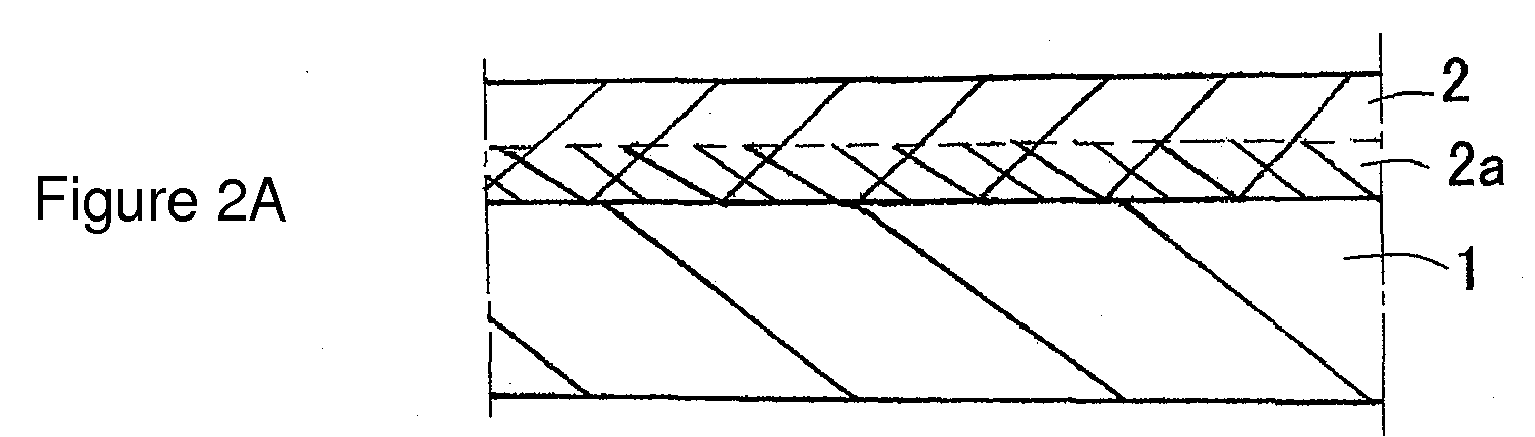

Description
- The present invention relates to a method for printing a metal-tone printed matter and a metal-tone printed matter printed adopting the same.
- As a metal-tone printed matter giving a texture such as a metal to the surface thereof, there is, for example, proposed a metal-tone resin film prepared by heat press laminating a printing layer of a metallic ink transferred onto a base material layer and a skin layer which is laminated on the printing layer and in which hairlines are formed on one surface thereof.
- In addition, as for a method for producing this metal-tone resin film, for example, an acrylic release layer is laminated on a printing auxiliary film such as a PET film, etc. , a printing layer is laminated with a metallic ink by means of gravure printing, and a vinyl acetate based adhesive layer is then laminated on the printing layer to form a transfer film. Subsequently, the transfer film is superimposed on a base material layer made of a thermoplastic film while facing the adhesive layer downward, followed by heat transfer. Then, the printing auxiliary film that is an uppermost layer is removed to form a printing film. Finally, a skin layer on one surface of which hairlines are formed by sandpaper or the like is laminated on the printing layer of the printing film, followed by heat press lamination. It is disclosed that according to this, a metal-tone resin film in which the skin layer is hardly separated without causing a crack of the metallic ink (see PTL 1) .
-
- PTL 1:
JP-A-2006-123390 - However, in the metallic ink of the metal-tone resin film printed by the foregoing production method, the direction of metal particles dispersed in a solvent or accumulated due to a low smoothness (surface roughness) of the printing surface of the base material layer is scattered, or irregularities are formed on the laminated surface of metal particles due to scattering in a charging amount of the ink per unit area. Thus, there was caused such an inconvenience that a metallic color that originally looks glossy is lowered in brightness and looks dark and dull.
- In order to solve the foregoing problem, the present invention has been made, and an object thereof is to provide a method for printing a metal-tone printed matter capable of being printed with high brightness and glossy feel without darkening a metallic color of the printed matter printed with a metallic ink and a vivid and highly bright metal-tone printed matter printed adopting the same.
- In order to solve the foregoing problem, a method for printing a metal-tone printed matter according to the present invention is characterized by including a printing step of printing a metallic ink having metal particles dispersed in a solvent on a printing medium having a smooth printing surface to form a metallic ink layer containing a metal layer having the metal particles accumulated on the printing surface side thereof; and a step of reversing the printing medium to transfer it onto a material to be transferred while making the smooth metal layer side as a display surface.
In that case, the form of the metal particles may be either a three-dimensional granular form or a flat flaky form (leaf-like form). - In the present invention, it is preferable that the metallic ink contains a solvent, and when the metallic ink layer is printed on the printing medium, the solvent volatilizes, whereby the metal particles accumulate on the smooth printing surface side to form the metal layer. Since the metallic ink contains the solvent, the metal particles move easily in the solvent, and the metallic ink is low in viscosity, easy to cause leveling and good in wettability. Accordingly, when the metallic ink layer is printed on the transfer material, the solvent volatilizes, whereby the metal particles accumulate on the transfer surface side to easily form the metal layer. Therefore, in the metallic ink layer seen from the transfer surface side, the metal particles are laminated with good orientation, so that the glossy surface can be formed without causing darkening of a metallic color.
- In addition, in the present invention, the printing medium may be a transfer material. The present invention may also include a step of superimposing the transfer material on the material to be transferred to allow the metallic ink layer to adhere directly or indirectly thereonto and a step of removing the transfer material to transfer the metallic ink layer as a surface layer of the material to be transferred. In that case, since a release layer is formed in advance on the transfer surface of the transfer material, by superimposing the transfer material on the material to be transferred via an adhesive layer and heating and pressing the resultant, the adhesive layer is thickened, whereby the metallic ink layer is easily separated from the transfer surface of the transfer material. Therefore, the metallic ink layer formed on the transfer material can be easily transferred onto the printing surface of the material to be transferred by means of heat transfer. At that time, the printing surface of the material to be transferred may be either a planar surface or a three-dimensional curved surface.
- In addition, the present invention may also include a step of laminating an adhesive layer on the metallic ink layer formed by printing the metallic ink on the transfer material, thereby allowing the adhesive layer to adhere onto the material to be transferred.
- In addition, in the present invention, the transfer material may be superimposed on the material to be transferred, thereby allowing the metallic ink layer to adhere onto the material to be transferred.
- In addition, in the present invention, the material to be transferred may be a light transmitting material having light transmission properties. The metallic ink layer may be allowed to adhere onto the material to be transferred by superimposing the transfer material on the material to be transferred via a UV-curable adhesive layer and radiating UV light from the side of the material to be transferred opposite to the printing surface thereof to cure the UV-curable adhesive layer.
- Furthermore, in the present invention, it is preferable that the metallic ink layer is formed by printing a solvent based ink diluted with a solvent, followed by drying.
- Moreover, the printing step may be carried out in such a manner that the metallic ink layer is printed on the printing medium by an inkjet printing apparatus. In that case, an ink having a viscosity of from 7 to 10 cps (centipoises) is generally used as the ink for inkjet printing, and this viscosity is low as compared with that used for gravure printing or screen printing or the like. Therefore, when the metal particles contained in ink droplets are landed onto the printing surface (transfer surface), the metal particles are accumulated on the printing surface side to form the metallic ink layer, so that a glossy surface can be formed.
In addition, in the case of printing the metallic ink layer by means of inkjet printing, an adhesive area is also formed in conformity with the metallic ink layer as compared with the case of separately laminating and forming the adhesive layer, and hence, the printing surface transferred onto the material to be transferred is free from staining of the adhesive, so that finishing of the printed matter becomes good. - In the metal-tone printed matter, it is preferable that the metallic ink layer is printed adopting any one of the above-described methods for printing a metal-tone printed matter.
- According to the present invention, when a metallic ink having metal particles dispersed in a solvent is printed on a printing medium having a smooth printing surface in a printing step, a metallic ink layer having a metal layer in which the metal particles are accumulated following the smooth printing surface side is formed. This printing medium is reversed and superimposed on a material to be transferred, whereby it can be transferred onto the material to be transferred while making the metal layer of the metallic ink layer as a display surface side. According to this, in the metallic ink layer transferred onto the material to be transferred, the metal layer made of metal particles accumulated along the smooth printing surface is the display surface side, and hence, it becomes possible to achieve metallic printing with high brightness and glossy feel without causing darkening of a metallic color.
- In metal-tone printed matters printed adopting the above-described printing method, a vivid and highly bright metal-tone printed matter can be provided.
-
- [
Fig. 1] FIG. 1 is a flowchart expressing a printing process of a metal-tone printed matter. - [
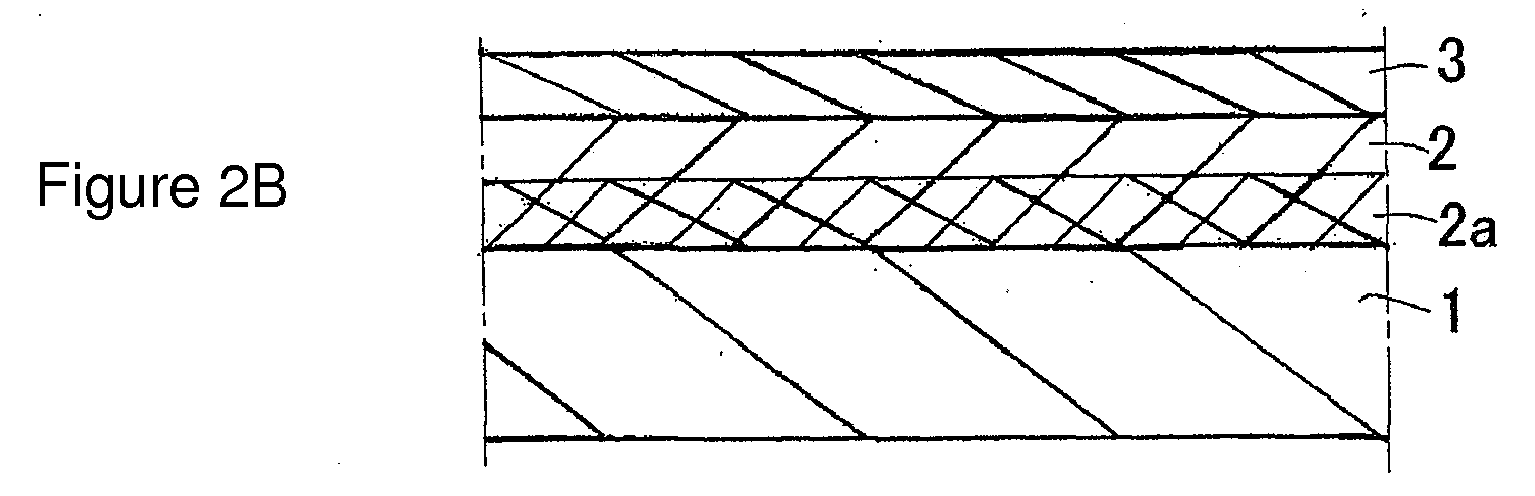
Fig. 2] FIGs. 2A to 2D are each a schematic cross-sectional view expressing a printing step of a metal-tone printed matter. - The metal-tone printed matter and the printing method thereof according to the present invention are hereunder described by reference to the accompanying drawings.
A metallic ink having metal particles dispersed in a solvent, which is used in the present embodiment, is illustrated as follows. As an example, a solvent-type solvent ink containing a solvent is used as an ink for inkjet printing. An ink containing ink components, for example, from 80 to 95 % by weight of Pnb (polypropylene glycol normal butyl ether) as a prime solvent; from less than 1 % by weight to 20 % by weight of IPA (isopropyl alcohol), ethyl acetate, propyl acetate, etc. as another solvent; from less than 1 % by weight to 5 % by weight of an aluminum paste (or an aluminum alloy) that is a pigment as a metal particle; and less than 1 % by weight of a synthetic resin (e.g., nitro cellulose, etc.) as a binder, is used. - The form of the metal particle contained in the aluminum paste (or the aluminum alloy) may be either a three-dimensional granular form or a flat flaky form (leaf-like form). In the present embodiment, a flat flaky form (leaf-like form) is adopted. Incidentally, it is also possible to use a UV-curable ink as described later in place of the solvent ink.
- In addition, the metal particle is not limited to the aluminum paste (or the aluminum alloy) displaying a silver color but may be a bronze powder (mixture of a copper powder and a zinc powder) displaying a gold color, a colored gold ink prepared by mixing an aluminum paste (or an aluminum alloy) and a yellow ink, or the like.
- In addition, as for the transfer material which is used as the printing medium, for example, a non-stretched sheet material having a receiving layer capable of receiving the solvent (e.g., a PET based film, an acrylic film, an olefin based film, etc.), a block material, or the like is useful. The reason why the non-stretched transfer material is used resides in the matter that assuming that the transfer material is stretched, when the transfer material is transferred onto the material to be transferred other than a flat surface, a distortion or deformation of the printing surface becomes large, whereby the printing quality is lowered. It is desirable that the transfer surface of the transfer material is formed in a smooth surface; and that a release layer (for example, a layer coated with a fluorine based resin, a silicone based resin, a wax, or the like) is formed in advance. In the experiment, a non-stretched polyolefin based film in which the transfer surface thereof is a smooth surface with wettability and has releasability was used.
Incidentally, so long as the transfer material is formed of a light transmitting material, it is possible to use the transfer material as a coating material for the printing medium. - For the adhesive, for example, a hot melt adhesive, a binder, a UV-curable adhesive, or the like is useful. The adhesive layer is formed by a variety of printing methods such as coating machine printing, screen printing, inkjet printing, etc.
Alternatively, the adhesive layer can also be allowed to function by a metallic fixing resin (binder) of the metallic ink layer. - In addition, the material to be transferred onto which a transfer image containing the metallic ink layer formed on the transfer material is transferred is not particularly limited so long as it is a member onto which the transfer image is able to adhere, and the adhesive surface is not limited to a flat surface but may also be a curved surface. In the present embodiment, the transfer image formed on a polyolefin based film as the transfer material was transferred onto a resin molded material (e.g., an acrylic resin material, a polycarbonate resin material, etc.) as the material to be transferred.
- Incidentally, as described later, in the case of using a UV-curable ink for the adhesive layer, it is necessary to use a light transmitting material having light transmission properties for the material to be transferred. As described later, this is because on the occasion of transferring the transfer image printed on the transfer material onto the material to be transferred via the UV-curable adhesive layer, it is necessary that UV light is radiated from the side of the material to be transferred opposite to the printing surface thereof to cure the UV-curable adhesive layer, and the metallic ink layer is separated from the transfer surface of the transfer material.
- Next, an example of the method for printing a metal-tone printed matter is described on the basis of a flowchart of
FIG. 1 while referring to schematic cross-sectional views ofFIGs. 2A to 2D .
First of all, inFIG. 2A , ametallic ink layer 2 is printed on apolyolefin film 1 having a smooth printing surface (transfer surface) (hereinafter referred to as "transfer material") using a solvent ink (metallic ink) having flaky aluminum particles (metal particles) having an outer shape of about 5 µm dispersed in a solvent. In addition, by using the solvent ink, the aluminum particles become easy to accumulate following the smooth transfer surface of thetransfer material 1. As for the printing mode, it is possible to achieve printing adopting a variety of printing methods such as inkjet printing, screen printing, etc. (Step S1). At that time, after printing themetallic ink layer 2 on thetransfer material 1 using the solvent ink, when drying is performed with a heater or the like, the solvent volatilizes, and the aluminum particles are accumulated on the smooth printing surface (transfer surface) side to form ametal layer 2a having a thickness of from about 0.1 µm to 0.2 µm. According to the inkjet printing, when the aluminum particles contained in ink droplets are landed onto thetransfer material 1, the aluminum particles are accumulated on the smooth printing surface (transfer surface) side, whereby themetallic ink layer 2 can be formed. At that time, a surface roughness of the printing surface (transfer surface) is not more than 2 µm, and more preferably not more than 1 µm. - Subsequently, as shown in
FIG. 2B , anadhesive layer 3 is laminated on themetallic ink layer 2 printed on thetransfer material 1. For example, a hot melt adhesive is laminated and formed on the metallic ink layer by a variety of printing methods such as coating machine printing, screen printing, inkjet printing, etc. (Step S2 inFIG. 1 ). - Subsequently, as shown in
FIG. 2C , thetransfer material 1 is reversed and superimposed on amaterial 4 to be transferred (e.g., an acrylic resin material, a polycarbonate resin material, etc.) via the adhesive layer 3 (Step S3 inFIG. 1 ). At that time, even when the superimposition surface of thematerial 4 to be transferred is not a flat surface but a three-dimensional curved surface, for example, a surface which is convex upward, the transfer material 1 (polyolefin film) can be superimposed following the surface properties of the printing surface (adhesive surface). Then, by heating and pressing thetransfer material 1 against thematerial 4 to be transferred at a prescribed temperature (from 80°C to 120°C) at which theadhesive layer 3 is cured, theadhesive layer 3 is thickened, whereby themetallic ink layer 2 adheres onto the printing surface (adhesive surface). - Finally, as shown in
FIG. 2D , by peeling off thetransfer material 1, themetallic ink layer 2 is separated from the transfer surface of thetransfer material 1 having been subjected to a release treatment, whereby themetallic ink layer 2 is transferred onto thematerial 4 to be transferred while making themetal layer 2a made of aluminum particles as the most superficial layer (Step S4 inFIG. 1 ). - In a metal-tone printed
matter 5 printed by the above-described printing method (seeFIG. 2D ), themetallic ink layer 2 is printed on the smooth transfer surface of the transfer material 1 (polyolefin film) in the printing step; theadhesive layer 3 is laminated and formed on themetallic ink layer 2; and thereafter, thetransfer material 1 is reversed and superimposed to adhere onto thematerial 4 to be transferred via theadhesive layer 3, followed by removing thetransfer material 1. According to this, in themetallic ink layer 2 transferred onto thematerial 4 to be transferred, themetal layer 2a composed of aluminum particles accumulated along the smooth printing surface (transfer surface) is the display surface side, and hence, it becomes possible to achieve metallic printing with high brightness and glossy feel without causing darkening of a metallic color. - In the foregoing embodiment, while the solvent ink containing a solvent was used as an example of the metallic ink, a UV-curable ink diluted with a solvent may also be used for the
metallic ink layer 2. Though the printing step is the same as that in the flowchart ofFIG. 1 , the description is hereunder made centering on different steps. - In the printing step (Step S1 in
FIG. 1 ) and the adhesive coating step (Step S2 inFIG. 1 ), the metallic ink is discharged onto the transfer surface of thetransfer material 1 from inkjet heads using an inkjet printing apparatus, and immediately thereafter, UV light is radiated from a UV irradiation lamp mounted in a carriage, thereby printing themetallic ink layer 2. Thereafter, a UV-curable adhesive (UV ink) is discharged onto themetallic ink layer 2 from inkjet heads, thereby forming theadhesive layer 3. Theadhesive layer 3 is not irradiated with UV light because an adhesion step is performed as a post step. - In this way, since the
metallic ink layer 2 and theadhesive layer 3 can be printed by superimposing the UV inks by means of inkjet printing using the inkjet printing apparatus, the formation of a transfer image by the metallic ink onto thetransfer material 1 can be easily achieved. In particular, when the transfer image is formed by means of inkjet printing, the lamination can be performed in such a manner that theadhesive layer 3 is not protruded from themetallic ink layer 2, and hence, the printing surface subsequently transferred onto thematerial 4 to be transferred is free from staining of the adhesive, so that finishing of the printed matter becomes good. - In addition, in the transfer step of the metallic ink layer 2 (Step S3 in
FIG. 1 ), a light transmitting material having light transmission properties (e.g., an acrylic resin material, a polycarbonate resin material, etc.) is used for thematerial 4 to be transferred. This is because inFIG. 2C , thetransfer material 1 is superimposed on thematerial 4 to be transferred via theadhesive layer 3, UV light is radiated from the side (arrow direction inFIG. 2C ) of thematerial 4 to be transferred opposite to the printing surface thereof to cure theadhesive layer 3, and thetransfer material 1 is then separated from themetallic ink layer 2. - In the light of the above, as another embodiment regarding the metallic ink, when the
metallic ink layer 2 is printed on thetransfer material 1 using the inkjet printing apparatus, not only the printing step can be simplified and efficiently performed, but a printing area of theadhesive layer 3 can be formed in conformity with themetallic ink layer 2, so that finishing of the printed matter transferred onto thematerial 4 to be transferred becomes good. - Incidentally, in the printing step, UV color ink layers may be superimposed and printed on the surface of the
metal ink layer 2. In that case, by adding a colorful color to the metallic color with high brightness and glossy feel on the printed matter, decorativeness can be enhanced. Alternatively, by laminating a UV clear ink layer (transparent ink layer) on themetal ink layer 2, it is also possible to add to the printed matter a texture (stereoscopic effect or depth) in addition to a glossy feel.
Claims (9)
- A method for printing a metal-tone printed matter, which is characterized by including
a printing step of printing a metallic ink having metal particles dispersed in a solvent on a printing medium having a smooth printing surface to form a metallic ink layer containing a metal layer having the metal particles accumulated on the printing surface side thereof; and
a step of reversing the printing medium to transfer it onto a material to be transferred while making the smooth metal layer side as a display surface. - The method for printing a metal-tone printed matter according to claim 1, wherein the metallic ink contains a solvent, and when the metallic ink layer is printed on the printing medium, the solvent volatilizes, whereby the metal particles accumulate on the smooth printing surface side to form the metal layer.
- The method for printing a metal-tone printed matter according to claim 1 or 2, wherein
the printing medium is a transfer material, and the method includes
a step of superimposing the transfer material on the material to be transferred to allow the metallic ink layer to adhere directly or indirectly thereonto; and
a step of removing the transfer material to transfer the metallic ink layer as a surface layer of the material to be transferred. - The method for printing a metal-tone printed matter according to claim 3, wherein the method includes a step of laminating an adhesive layer on the metallic ink layer formed by printing the metallic ink on the transfer material, thereby allowing the adhesive layer to adhere onto the material to be transferred.
- The method for printing a metal-tone printed matter according to claim 3, wherein the transfer material is superimposed on the material to be transferred, thereby allowing the metallic ink layer to adhere onto the material to be transferred.
- The method for printing a metal-tone printed matter according to claim 3, wherein the material to be transferred is a light transmitting material having light transmission properties, and the metallic ink layer is allowed to adhere onto the material to be transferred by superimposing the transfer material on the material to be transferred via a UV-curable adhesive layer and radiating UV light from the side of the material to be transferred opposite to the printing surface thereof to cure the UV-curable adhesive layer.
- The method for printing a metal-tone printed matter according to claim 1, wherein the metallic ink layer is formed by printing a solvent based ink diluted with a solvent, followed by drying.
- The method for printing a metal-tone printed matter according to claim 1, wherein the printing step is carried out in such a manner that the metallic ink layer is printed on the printing medium by an inkjet printing apparatus.
- A metal-tone printed matter, which is characterized by printing the metallic ink layer adopting the method for printing a metal-tone printed matter according to any one of claims 1 to 8.
Applications Claiming Priority (2)
| Application Number | Priority Date | Filing Date | Title |
|---|---|---|---|
| JP2011029902A JP2012166470A (en) | 2011-02-15 | 2011-02-15 | Method for printing metal-tone printed matter and metal-tone printed matter |
| PCT/JP2011/080493 WO2012111242A1 (en) | 2011-02-15 | 2011-12-28 | Method for printing metal-tone printed matter and metal-tone printed matter |
Publications (1)
| Publication Number | Publication Date |
|---|---|
| EP2676806A1 true EP2676806A1 (en) | 2013-12-25 |
Family
ID=46672191
Family Applications (1)
| Application Number | Title | Priority Date | Filing Date |
|---|---|---|---|
| EP11858538.9A Withdrawn EP2676806A1 (en) | 2011-02-15 | 2011-12-28 | Method for printing metal-tone printed matter and metal-tone printed matter |
Country Status (5)
| Country | Link |
|---|---|
| US (1) | US9643402B2 (en) |
| EP (1) | EP2676806A1 (en) |
| JP (1) | JP2012166470A (en) |
| CN (1) | CN103370208B (en) |
| WO (1) | WO2012111242A1 (en) |
Families Citing this family (16)
| Publication number | Priority date | Publication date | Assignee | Title |
|---|---|---|---|---|
| JP2012166470A (en) * | 2011-02-15 | 2012-09-06 | Mimaki Engineering Co Ltd | Method for printing metal-tone printed matter and metal-tone printed matter |
| JP2012200873A (en) * | 2011-03-23 | 2012-10-22 | Seiko Epson Corp | Transfer medium, manufacturing method of transfer medium, image forming method and recorded matter |
| JP6108173B2 (en) * | 2013-09-26 | 2017-04-05 | 豊田合成株式会社 | Decorative materials for vehicles |
| JP6296742B2 (en) | 2013-10-07 | 2018-03-20 | 株式会社ミマキエンジニアリング | Manufacturing method of laminate |
| CN106163161A (en) * | 2015-03-23 | 2016-11-23 | 小米科技有限责任公司 | Processing method, device housings and equipment to device housings |
| JP6955319B2 (en) * | 2015-03-25 | 2021-10-27 | 株式会社ミマキエンジニアリング | Inkjet printer and inkjet printing method |
| US9487027B1 (en) * | 2015-05-21 | 2016-11-08 | Graph-Tech-Usa, Llc | Single pass inkjet method of applying an adhesive to a substrate to bond a foil material to the substrate |
| WO2017116671A1 (en) | 2015-12-28 | 2017-07-06 | The Procter & Gamble Company | Method for transferring material with adhesive onto articles with a difference in degree of curing between the material and adhesive |
| EP3397494A1 (en) | 2015-12-28 | 2018-11-07 | The Procter and Gamble Company | Method and apparatus for applying a material onto articles using a transfer component that deflects on both sides |
| CN108472972A (en) | 2015-12-28 | 2018-08-31 | 宝洁公司 | The method and apparatus on product is applied material to the transfering part of predistortion |
| WO2019099183A1 (en) | 2017-11-17 | 2019-05-23 | The Procter & Gamble Company | Methods for applying a material onto articles |
| US20190240897A1 (en) * | 2018-02-07 | 2019-08-08 | Xerox Corporation | Transfer of uv print onto curved surfaces with stretchable uv inks |
| CN111546759A (en) | 2019-02-12 | 2020-08-18 | 宝洁公司 | Method and apparatus for applying material to articles using a transfer member |
| US11752792B2 (en) | 2020-03-09 | 2023-09-12 | The Procter & Gamble Company | Method and apparatus for applying a material onto articles using a transfer component |
| JP7838945B2 (en) * | 2021-11-17 | 2026-04-01 | スリーエム イノベイティブ プロパティズ カンパニー | Decorative laminate including metallic layer and adhesive layer |
| JP2026010761A (en) * | 2024-07-10 | 2026-01-23 | 株式会社ミマキエンジニアリング | Transfer method, manufacturing method of printed matter, and transfer device |
Family Cites Families (10)
| Publication number | Priority date | Publication date | Assignee | Title |
|---|---|---|---|---|
| JPS6418698A (en) * | 1987-07-15 | 1989-01-23 | Dainippon Printing Co Ltd | Transfer sheet with ionizing radiation curing protective layer |
| JP2003305941A (en) | 2002-04-12 | 2003-10-28 | Kansai Paint Co Ltd | Manufacturing method for ink jet printed matter |
| JP4173348B2 (en) * | 2002-10-21 | 2008-10-29 | 日本写真印刷株式会社 | Decorative sheet and decoration |
| JP2005349778A (en) * | 2004-06-14 | 2005-12-22 | Casio Comput Co Ltd | Decorative method and decorative member |
| JP4667001B2 (en) | 2004-10-29 | 2011-04-06 | 小島プレス工業株式会社 | Method for producing metallic resin film |
| JP2007160648A (en) * | 2005-12-13 | 2007-06-28 | Shin Etsu Polymer Co Ltd | Metallic decorative sheet and manufacturing method thereof |
| JP2008174712A (en) | 2006-12-19 | 2008-07-31 | Seiko Epson Corp | Pigment dispersion, ink composition, ink jet recording method, and recorded matter |
| JP2009107283A (en) | 2007-10-31 | 2009-05-21 | General Technology Kk | Metallic printing method |
| JP2010070693A (en) * | 2008-09-19 | 2010-04-02 | Fujifilm Corp | Ink set and inkjet recording method |
| JP2012166470A (en) * | 2011-02-15 | 2012-09-06 | Mimaki Engineering Co Ltd | Method for printing metal-tone printed matter and metal-tone printed matter |
-
2011
- 2011-02-15 JP JP2011029902A patent/JP2012166470A/en active Pending
- 2011-12-28 CN CN201180067588.7A patent/CN103370208B/en not_active Expired - Fee Related
- 2011-12-28 WO PCT/JP2011/080493 patent/WO2012111242A1/en not_active Ceased
- 2011-12-28 EP EP11858538.9A patent/EP2676806A1/en not_active Withdrawn
-
2013
- 2013-07-31 US US13/954,982 patent/US9643402B2/en not_active Expired - Fee Related
Non-Patent Citations (1)
| Title |
|---|
| See references of WO2012111242A1 * |
Also Published As
| Publication number | Publication date |
|---|---|
| WO2012111242A1 (en) | 2012-08-23 |
| JP2012166470A (en) | 2012-09-06 |
| US9643402B2 (en) | 2017-05-09 |
| CN103370208B (en) | 2015-11-25 |
| US20130314470A1 (en) | 2013-11-28 |
| CN103370208A (en) | 2013-10-23 |
Similar Documents
| Publication | Publication Date | Title |
|---|---|---|
| US9643402B2 (en) | Method for printing metal-tone printed matter and metal-tone printed matter | |
| JP5664911B2 (en) | Printing method of printed matter and printed matter | |
| CN103054284A (en) | Metallic coin stamped with holographic anti-counterfeiting pattern and manufacturing method thereof | |
| CN103666296A (en) | Double-sided adhesive film and manufacturing method thereof | |
| WO2014048589A1 (en) | Multi-layered decorative panel and method for manufacturing a multi-layered decorative panel | |
| CN202319328U (en) | A thermal transfer film with three-dimensional texture | |
| CN103009842A (en) | Manufacture method of microbead adornments | |
| CN101602302A (en) | A kind of alumite thermoprinting foil and manufacturing and application with picture and text | |
| KR101638374B1 (en) | Metallic Paper Expressing such as Feeling of Liquid Metal and Printing Method thereof | |
| CN104972681A (en) | Method for manufacturing double-curved-surface lens | |
| CN1324306A (en) | Screen printing reflective transfer sheet and manufacturing method thereof | |
| US10022939B1 (en) | Cold foil temporary tattoo and process for making the same | |
| JP6926602B2 (en) | Decorative molding with chipping resistance | |
| JP5885469B2 (en) | Method for producing decorative molded product by transfer sheet and vacuum pressure bonding method | |
| CN101367299A (en) | Method for manufacturing coating-free 3D transfer paper | |
| CN104846700A (en) | Matte silver foil and production method thereof | |
| CN109177385A (en) | 2.5D plate and processing technology thereof | |
| JP6242677B2 (en) | Manufacturing method of solid emblem | |
| CN204738181U (en) | Dull polish silver card paper | |
| JP5340220B2 (en) | Embossed ink, partial mat hard coat transfer sheet and method of manufacturing partial mat hard coat molded product | |
| CN201597219U (en) | Unidirectional perspective reflective film | |
| KR101774979B1 (en) | Image transfer method and image decalcomania sheet | |
| CN211280455U (en) | Gilt transfer film of fresnel lens location | |
| NL2006885C2 (en) | SCREEN PRINTING METHOD AND A PLATE FITTED IN ACCORDANCE WITH THIS SCREEN PRINTING METHOD. | |
| CN206888422U (en) | A kind of 3D round dots Grating glass compound tile |
Legal Events
| Date | Code | Title | Description |
|---|---|---|---|
| PUAI | Public reference made under article 153(3) epc to a published international application that has entered the european phase |
Free format text: ORIGINAL CODE: 0009012 |
|
| 17P | Request for examination filed |
Effective date: 20130916 |
|
| AK | Designated contracting states |
Kind code of ref document: A1 Designated state(s): AL AT BE BG CH CY CZ DE DK EE ES FI FR GB GR HR HU IE IS IT LI LT LU LV MC MK MT NL NO PL PT RO RS SE SI SK SM TR |
|
| DAX | Request for extension of the european patent (deleted) | ||
| STAA | Information on the status of an ep patent application or granted ep patent |
Free format text: STATUS: THE APPLICATION HAS BEEN WITHDRAWN |
|
| 18W | Application withdrawn |
Effective date: 20170728 |