EP2675112A1 - Method and energy management unit for load scheduling in building automation - Google Patents
Method and energy management unit for load scheduling in building automation Download PDFInfo
- Publication number
- EP2675112A1 EP2675112A1 EP12171766.4A EP12171766A EP2675112A1 EP 2675112 A1 EP2675112 A1 EP 2675112A1 EP 12171766 A EP12171766 A EP 12171766A EP 2675112 A1 EP2675112 A1 EP 2675112A1
- Authority
- EP
- European Patent Office
- Prior art keywords
- carbon dioxide
- dioxide emission
- level
- load
- energy cost
- Prior art date
- Legal status (The legal status is an assumption and is not a legal conclusion. Google has not performed a legal analysis and makes no representation as to the accuracy of the status listed.)
- Granted
Links
Images

Classifications
-
- H—ELECTRICITY
- H02—GENERATION; CONVERSION OR DISTRIBUTION OF ELECTRIC POWER
- H02J—ELECTRIC POWER NETWORKS; CIRCUIT ARRANGEMENTS OR SYSTEMS FOR SUPPLYING OR DISTRIBUTING ELECTRIC POWER; SYSTEMS FOR STORING ELECTRIC ENERGY
- H02J3/00—Circuit arrangements for AC mains or AC distribution networks
- H02J3/12—Arrangements for adjusting voltage in AC networks by changing a characteristic of the network load
-
- H—ELECTRICITY
- H04—ELECTRIC COMMUNICATION TECHNIQUE
- H04L—TRANSMISSION OF DIGITAL INFORMATION, e.g. TELEGRAPHIC COMMUNICATION
- H04L12/00—Data switching networks
- H04L12/28—Data switching networks characterised by path configuration, e.g. LAN [Local Area Networks] or WAN [Wide Area Networks]
- H04L12/2803—Home automation networks
- H04L12/283—Processing of data at an internetworking point of a home automation network
-
- H—ELECTRICITY
- H02—GENERATION; CONVERSION OR DISTRIBUTION OF ELECTRIC POWER
- H02J—ELECTRIC POWER NETWORKS; CIRCUIT ARRANGEMENTS OR SYSTEMS FOR SUPPLYING OR DISTRIBUTING ELECTRIC POWER; SYSTEMS FOR STORING ELECTRIC ENERGY
- H02J2105/00—Networks for supplying or distributing electric power characterised by their spatial reach or by the load
- H02J2105/40—Networks for supplying or distributing electric power characterised by their spatial reach or by the load characterised by the loads connecting to the networks or being supplied by the networks
- H02J2105/42—Home appliances
-
- Y—GENERAL TAGGING OF NEW TECHNOLOGICAL DEVELOPMENTS; GENERAL TAGGING OF CROSS-SECTIONAL TECHNOLOGIES SPANNING OVER SEVERAL SECTIONS OF THE IPC; TECHNICAL SUBJECTS COVERED BY FORMER USPC CROSS-REFERENCE ART COLLECTIONS [XRACs] AND DIGESTS
- Y02—TECHNOLOGIES OR APPLICATIONS FOR MITIGATION OR ADAPTATION AGAINST CLIMATE CHANGE
- Y02B—CLIMATE CHANGE MITIGATION TECHNOLOGIES RELATED TO BUILDINGS, e.g. HOUSING, HOUSE APPLIANCES OR RELATED END-USER APPLICATIONS
- Y02B70/00—Technologies for an efficient end-user side electric power management and consumption
- Y02B70/30—Systems integrating technologies related to power network operation and communication or information technologies for improving the carbon footprint of the management of residential or tertiary loads, i.e. smart grids as climate change mitigation technology in the buildings sector, including also the last stages of power distribution and the control, monitoring or operating management systems at local level
-
- Y—GENERAL TAGGING OF NEW TECHNOLOGICAL DEVELOPMENTS; GENERAL TAGGING OF CROSS-SECTIONAL TECHNOLOGIES SPANNING OVER SEVERAL SECTIONS OF THE IPC; TECHNICAL SUBJECTS COVERED BY FORMER USPC CROSS-REFERENCE ART COLLECTIONS [XRACs] AND DIGESTS
- Y02—TECHNOLOGIES OR APPLICATIONS FOR MITIGATION OR ADAPTATION AGAINST CLIMATE CHANGE
- Y02B—CLIMATE CHANGE MITIGATION TECHNOLOGIES RELATED TO BUILDINGS, e.g. HOUSING, HOUSE APPLIANCES OR RELATED END-USER APPLICATIONS
- Y02B70/00—Technologies for an efficient end-user side electric power management and consumption
- Y02B70/30—Systems integrating technologies related to power network operation and communication or information technologies for improving the carbon footprint of the management of residential or tertiary loads, i.e. smart grids as climate change mitigation technology in the buildings sector, including also the last stages of power distribution and the control, monitoring or operating management systems at local level
- Y02B70/3225—Demand response systems, e.g. load shedding, peak shaving
-
- Y—GENERAL TAGGING OF NEW TECHNOLOGICAL DEVELOPMENTS; GENERAL TAGGING OF CROSS-SECTIONAL TECHNOLOGIES SPANNING OVER SEVERAL SECTIONS OF THE IPC; TECHNICAL SUBJECTS COVERED BY FORMER USPC CROSS-REFERENCE ART COLLECTIONS [XRACs] AND DIGESTS
- Y04—INFORMATION OR COMMUNICATION TECHNOLOGIES HAVING AN IMPACT ON OTHER TECHNOLOGY AREAS
- Y04S—SYSTEMS INTEGRATING TECHNOLOGIES RELATED TO POWER NETWORK OPERATION, COMMUNICATION OR INFORMATION TECHNOLOGIES FOR IMPROVING THE ELECTRICAL POWER GENERATION, TRANSMISSION, DISTRIBUTION, MANAGEMENT OR USAGE, i.e. SMART GRIDS
- Y04S20/00—Management or operation of end-user stationary applications or the last stages of power distribution; Controlling, monitoring or operating thereof
- Y04S20/20—End-user application control systems
-
- Y—GENERAL TAGGING OF NEW TECHNOLOGICAL DEVELOPMENTS; GENERAL TAGGING OF CROSS-SECTIONAL TECHNOLOGIES SPANNING OVER SEVERAL SECTIONS OF THE IPC; TECHNICAL SUBJECTS COVERED BY FORMER USPC CROSS-REFERENCE ART COLLECTIONS [XRACs] AND DIGESTS
- Y04—INFORMATION OR COMMUNICATION TECHNOLOGIES HAVING AN IMPACT ON OTHER TECHNOLOGY AREAS
- Y04S—SYSTEMS INTEGRATING TECHNOLOGIES RELATED TO POWER NETWORK OPERATION, COMMUNICATION OR INFORMATION TECHNOLOGIES FOR IMPROVING THE ELECTRICAL POWER GENERATION, TRANSMISSION, DISTRIBUTION, MANAGEMENT OR USAGE, i.e. SMART GRIDS
- Y04S20/00—Management or operation of end-user stationary applications or the last stages of power distribution; Controlling, monitoring or operating thereof
- Y04S20/20—End-user application control systems
- Y04S20/222—Demand response systems, e.g. load shedding, peak shaving
-
- Y—GENERAL TAGGING OF NEW TECHNOLOGICAL DEVELOPMENTS; GENERAL TAGGING OF CROSS-SECTIONAL TECHNOLOGIES SPANNING OVER SEVERAL SECTIONS OF THE IPC; TECHNICAL SUBJECTS COVERED BY FORMER USPC CROSS-REFERENCE ART COLLECTIONS [XRACs] AND DIGESTS
- Y04—INFORMATION OR COMMUNICATION TECHNOLOGIES HAVING AN IMPACT ON OTHER TECHNOLOGY AREAS
- Y04S—SYSTEMS INTEGRATING TECHNOLOGIES RELATED TO POWER NETWORK OPERATION, COMMUNICATION OR INFORMATION TECHNOLOGIES FOR IMPROVING THE ELECTRICAL POWER GENERATION, TRANSMISSION, DISTRIBUTION, MANAGEMENT OR USAGE, i.e. SMART GRIDS
- Y04S20/00—Management or operation of end-user stationary applications or the last stages of power distribution; Controlling, monitoring or operating thereof
- Y04S20/20—End-user application control systems
- Y04S20/242—Home appliances
Definitions
- the present disclosure generally relates to building automation and in particular to a method and an energy management unit for scheduling of loads in a building automation system.
- the possibilities for a user of a building automation system to change settings/parameters of the building automation system are limited to set preferences and actions, like setting thermostats or setting up a weekly scheme for blinds, based on information from sensors connected to the building automation system.
- a general object of the present disclosure is to provide a method and an energy management unit for scheduling the operation of a load in a building automation system based on the environmental impact provided by the load.
- a method for scheduling the operation of at least one load in a building automation system comprising: providing carbon dioxide emission control parameters based on carbon dioxide emission statistics; receiving user selection data in which the at least one load is associated with at least one of the carbon dioxide emission control parameters, and which user selection data comprises a user-selected constraint of a level of importance of limiting the operation of the at least one load to the selected at least one carbon dioxide emission control parameter; and determining a schedule according to which the at least one load is allowed to operate for a time period based on the user selection data and on carbon dioxide emission data concerning expected carbon dioxide emission during the time period.
- a beneficial schedule By determining a schedule of operating loads based on user-selected carbon dioxide emission preferences a beneficial schedule, with regards to both users' preference of when to utilise loads and the magnitude of the environmental impact provided by the loads, may be determined.
- One embodiment comprises receiving the carbon dioxide emission data for the time period from a service provider prior to determining the schedule.
- each carbon dioxide emission control parameter is a carbon dioxide emission level.
- One embodiment comprises, prior to providing the carbon dioxide emission level data, generating the plurality of carbon dioxide emission levels in such a way that a highest carbon dioxide emission level in winter is equal to the highest carbon dioxide emission level in summer.
- One embodiment comprises providing energy cost level data of a plurality of energy cost levels that are based on energy cost statistics.
- One embodiment comprises receiving user selection data in which the at least one load is associated with at least one of the plurality of energy cost levels, and which user selection data comprises a user-selected constraint of a level of importance of limiting the operation of the at least one load to the selected at least one energy cost level.
- the determining of the schedule is further based on energy cost data concerning expected energy costs during the time period.
- One embodiment comprises receiving the energy cost data for the time period from a service provider prior to determining the schedule.
- One embodiment comprises, prior to providing the energy cost level data, generating the plurality of energy cost levels in such a way that a highest energy cost level in winter is equal to the highest energy cost level in summer.
- One embodiment comprises providing starting time data to the at least one load based on the schedule.
- a computer program product comprising computer-executable components for causing a device to perform the steps of the first aspect when the computer-executable components are run on a processor included in the device.
- an energy management unit for scheduling the operation of at least one load in a building automation system, wherein the energy management unit comprises: an output unit arranged to provide carbon dioxide emission level data of a plurality of carbon dioxide emission levels based on carbon dioxide emission statistics; an input unit arranged to receive user selection data in which the at least one load is associated with at least one of the plurality of carbon dioxide emission levels, and which user selection data comprises a user-selected constraint of a level of importance of limiting the operation of the at least one load to the selected at least one carbon dioxide emission level; and a processor arranged to determine a schedule according to which the at least one load is allowed to operate for a time period based on the user selection data and on carbon dioxide emission data concerning expected carbon dioxide emission during the time period.
- each carbon dioxide emission control parameter is a carbon dioxide emission level.
- the processor is arranged to generate the carbon dioxide emission levels in such a way that a highest carbon dioxide emission level in winter is equal to the highest carbon dioxide emission level in summer.
- the output unit is arranged to provide energy cost level data of a plurality of energy cost levels based on energy cost statistics.
- the input unit is arranged to receive user selection data in which the at least one load is associated with at least one of the plurality of energy cost levels, and which user selection data comprises a user-selected constraint of a level of importance of limiting the operation of the at least one load to the selected at least one energy cost level.
- the processor is arranged to determine the schedule further based on energy cost data concerning expected energy costs during the time period.
- the processor is arranged to generate the plurality of energy cost levels in such a way that a highest energy cost level in winter is equal to the highest energy cost level in summer.
- the processor is arranged to provide starting time data to the at least one load based on the schedule.
- Fig. 1 is an example of an energy management unit 1 for use in a building automation system for load scheduling/control.
- a building in this context may be a commercial building such as an office building, a sports arena, an airport, or a factory. Building may alternatively refer to a residential home, wherein the building automation system is a home automation system. Examples of building automation systems for the purpose of this disclosure are the Building Automation and Control System (BACS) and the Home and Building Electronic System (HBES).
- BAS Building Automation and Control System
- HBES Home and Building Electronic System
- a load is an electricity consuming entity that may be connected to the energy management unit 1, e.g. for scheduling and controlling of when the load should be operated.
- a load may for example be a lighting system, a hybrid or electric vehicle, heating, ventilation and air conditioning (HVAC), a thermostat or home appliances such as a washing machine, a tumble dryer, or a dishwasher.
- HVAC heating, ventilation and air conditioning
- the energy management unit 1 comprises an input unit 3, an output unit 5 and a processor operatively connected to the input unit 3 and the output unit 5.
- the energy management unit 1 may act as a network node between a first communications network that is external to the building automation system in which the energy management unit 1 may be arranged, and a second communications network which is internal to the building(s) with which the energy management unit 1 is associated.
- the energy management unit 1 may hence be seen as a gateway acting as an interface between the first communications network and the second communications network.
- the energy management unit 1 may be configured by means of a user interface UI, as shown in Fig. 2 .
- the user interface UI may be integrated with the energy management unit 1, or the user interface UI may be separate from the energy management unit 1.
- the user interface UI may for example be provided in the form of an application in a smart phone, a tablet computer, or it may be accessible through a web browser.
- the output unit 5 is according to one embodiment arranged, based on carbon dioxide emission statistics stored in the energy management unit 1, to provide carbon dioxide emission control parameters to the user interface UI.
- the carbon dioxide emission control parameters will be exemplified by carbon dioxide emission level data. According to the examples given herein, each carbon dioxide emission control parameter corresponds to a carbon dioxide emission level.
- the output unit 5 is according to one embodiment arranged, based on energy cost statistics stored in the energy management unit 1, to provide energy cost level data of a plurality of energy cost levels to the user interface UI.
- the input unit 3 is arranged to receive user selection data concerning energy management unit configurations, based on at least one of the carbon dioxide emission level data and energy cost level data.
- the input unit 3 may according to one variation be arranged to receive data from a service provider of carbon dioxide emission data, and energy cost data concerning expected carbon dioxide emission and energy cost, respectively, of a time period.
- the input unit 3 may according to one embodiment be arranged to receive starting time requests from the loads which the energy management unit 1 is arranged to schedule operating times for.
- the processor 7 is arranged to process user selection data. In embodiments where at least one of carbon dioxide emission data and energy cost data is received from a service provider, the processor is also arranged to process such data. Based on the user selection data, and at least one of the carbon dioxide emission data and energy cost data the processor 7 is arranged to determine a schedule that provides optimal operation of the loads according to user preferences. Starting times of the loads according to the determined schedule can be provided via the output unit 5 to the loads.
- Fig. 2 shows a building automation system 9 comprising an energy management unit 1, a user interface UI arranged to be in communication with the energy management unit 1, and a plurality of loads L arranged to be in communication with the energy management unit 1.
- the energy management unit 1 is arranged to communicate with e.g. a service provider SP via a first communications network N1.
- the energy management unit 1, the user interface UI and the plurality of loads L form part of a second communications network N2 that is internal to the building automation system 9 in the sense that it is a local network.
- Each of the first communications network N1 and the second communications network N2 may be a wireless network or a wired network.
- the energy management unit 1 may be arranged to communicate wirelessly, by means of wires, or a combination of wireless and wired communication.
- suitable wired communications standards are IEEE P1901, ITU-T G.Hn, and ANSI/CEA 709.2
- suitable wireless communications standards are Zigbee, Wi-Fi, and Z-wave.
- the energy management unit 1 upon instalment of the energy management unit 1 in a building automation system, is provided with carbon dioxide emission level data comprising a plurality of carbon dioxide emission levels.
- the carbon dioxide emission levels are generated based on carbon dioxide emission statistics that may be stored in the energy management unit.
- the carbon dioxide emission statistics can be stored in the energy management unit 1 e.g. during manufacturing, or it may be received by the energy management unit 1 via for example the first communications network N1 upon instalment in a building automation system.
- the carbon dioxide emission levels are generated in a step So in such a way that a highest carbon dioxide emission level in winter is equal to the highest carbon dioxide emission level in summer.
- the number of carbon dioxide emission levels may be selected by a user.
- the energy management unit may further be provided with energy cost level data comprising a plurality of energy cost levels.
- the energy cost levels are generated based on energy cost statistics that may be stored in the energy management unit.
- the energy cost statistics can be stored in the energy management unit 1 e.g. during manufacturing, or it may be received by the energy management unit 1 via for example the first communications network N1 upon instalment in a building automation system.
- the plurality of energy cost levels are generated in such a way that a highest energy cost level in winter is equal to the highest energy cost level in summer.
- the number of energy cost levels may be selected by a user.
- a step S1 the carbon dioxide emission level data of a plurality of carbon dioxide emission levels are provided by the energy storage unit 1 o the user interface UI.
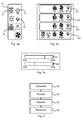
- Fig. 3a shows an example of user interface graphics 11 presented to a user by means of the user interface UI.
- the user interface graphics 11 comprises icons I1-I4 of home appliances, i.e. loads, such as a washing machine in icon I1, a charger for an electric vehicle in icon I2, a lighting system in icon I3 and HVAC in icon I4.
- the user may select any of the icons presented in the user interface graphics 11 and associate them, and thus the underlying loads, with any of the carbon dioxide emission levels C1-C4 in Fig. 3b displayed on the user interface UI.
- the carbon dioxide emission levels may for example be displayed according to the amount of emission, e.g. the highest emission level C1 on top, with the lower levels C2-C4 being presented in decreasing order.
- the user may for example drag those icons I1-I4 which he/she selects and would like to schedule, to the preferred carbon dioxide emission levels to thereby associate the loads with at least one carbon dioxide emission level C1-C4.
- the user may also be able to configure each load at each carbon dioxide emission level via the user interface UI.
- the user may for example be able to configure at which intensity a lighting system should be allowed operate at a selected carbon dioxide emission level.
- the user interface UI is further arranged to allow a user to configure a constraint concerning a level of importance of limiting the operation of the at least one load to the selected at least one carbon dioxide emission level, as shown in Fig. 3c .
- a user is thus able to select a preferred importance of restricting the scheduling of the loads to the selected carbon dioxide emission level(s).
- the presentation of energy cost levels on the user interface UI and associating of loads with energy cost levels is similar to that described above for carbon dioxide emission levels.
- the user may select any of the icons presented in the user interface graphics 11 and associate them, and thus the underlying loads, with the energy cost levels displayed on the user interface UI.
- the energy cost levels may for example be displayed according to the cost amount, e.g. the highest energy cost level on top, with the lower levels being presented in decreasing order.
- the user may for example drag those icons which he/she selects, to the preferred energy cost levels to thereby associate the loads with at least one energy cost level.
- the user may also be able to configure each load at each energy cost level via the user interface UI.
- a user may for example be able to configure at which intensity a lighting system should be allowed operate at a selected energy cost level.
- the user interface UI is further arranged to allow a user to configure a constraint concerning a level of importance of limiting the operation of the at least one load to the selected at least one energy cost level, as shown in Fig. 3c .
- a user is thus able to select a preferred importance of restricting the scheduling of the loads to the selected energy cost level(s).
- Data concerning the selection of at least one load and the association of the at least one load with at least one carbon dioxide emission level is provided to the energy management unit 1 in the form of user selection data.
- the energy management unit receives the user selection data, which user selection data also comprises a user-selected constraint of a level of importance of limiting the operation of the at least one load to the selected at least one carbon dioxide emission level.
- the energy management unit 1 also receives user selection data in which the at least one load is associated with at least one of the plurality of energy cost levels, and which user selection data comprises a user-selected constraint of a level of importance of limiting the operation of the at least one load to the selected at least one energy cost level.
- a schedule according to which the at least one load is allowed to operate for a time period is determined based on the user selection data and on carbon dioxide emission data concerning expected carbon dioxide emission during the time period.
- the determining of the schedule is further based on energy cost data concerning expected energy costs during the time period.
- the determining is based on an optimisation of a scheduling function based on the carbon dioxide emission levels which are associated with at least one load and the user-selected constraint concerning carbon dioxide emission.
- the optimization is further based on the energy cost levels which are associated with at last one load and the user-selected constraint concerning energy costs.
- An example of a suitable time period may for example be 24 hours.
- the schedule may comprise a plurality of time slots which together form the time period.
- a time slot may for example be one hour.
- the loads are scheduled to run at a specific carbon dioxide emission level, and in variations involving energy costs, also at a specific energy cost level.
- the carbon dioxide emission data for the time period may for example be received from a service provider, e.g. a retailer or the utility, prior to determining the schedule.
- the carbon dioxide emission data may be stored in the energy management unit 1 based on for example country specific statistics concerning carbon dioxide emission.
- the carbon dioxide emission data may be dynamic if delivered by a service provider or static in case country specific statistics are utilised.
- the energy cost data for the time period may for example be received from a service provider, e.g. a retailer or the utility, prior to determining the schedule.
- the energy cost data may be stored in the energy management unit 1 based on for example country specific statistics concerning energy costs.
- the energy cost data may be dynamic if delivered by a service provider or static in case country specific statistics are utilised.
- the energy management unit 1 When the energy management unit 1 receives requests of starting times from the loads, the energy management unit 1 can in a step S3 provide starting time data to the loads based on the determined schedule to thereby obtain operation according to the user's preferences concerning environmental impact and in some variations also energy costs.
- the energy management unit 1 When the schedule has been determined, it is provided by the energy management unit 1 to the user interface UI to present the possible time slots at which the load or loads may run for the time period.
- a user may select a certain load, wherein the scheduling of that load will be displayed.
- a user may also by means of interaction with the user interface UI generate a re-scheduling of the selected load.
- a user input of re-scheduling one or more loads can thereby be received by the energy management unit 1, wherein step S3 of determining is repeated based on the user input so as to determine a re-scheduling of the times at which the selected load may run.
Landscapes
- Engineering & Computer Science (AREA)
- Automation & Control Theory (AREA)
- Computing Systems (AREA)
- Computer Networks & Wireless Communication (AREA)
- Signal Processing (AREA)
- Power Engineering (AREA)
- Supply And Distribution Of Alternating Current (AREA)
- Remote Monitoring And Control Of Power-Distribution Networks (AREA)
Abstract
Description
- The present disclosure generally relates to building automation and in particular to a method and an energy management unit for scheduling of loads in a building automation system.
- Energy consumption of the residential building sector and the commercial building sector forms a non-negligible portion of all sectors' energy consumption. To that end, the energy costs of and the environmental impact provided by buildings are substantial. For the purpose of reducing energy costs, demand response programs for large-scale consumers such as industrial plants or commercial buildings are today in existence.
- The possibilities for a user of a building automation system to change settings/parameters of the building automation system are limited to set preferences and actions, like setting thermostats or setting up a weekly scheme for blinds, based on information from sensors connected to the building automation system.
- The publication "Wireless Sensor Networks for Cost-Efficient Residential Energy Management in the Smart Grid" by Erol-Kantarci et al., published in IEEE Transactions on smart grid, vol. 2, no. 2, June 2011, evaluates the performance of an in-home energy management system (iHEM) application. The performance of iHEM is compared with an optimization-based residential energy management scheme whose object is to minimize the energy expenses of the consumers by scheduling appliances to less expensive hours according to time-of-use tariffs. The possibility to control energy costs and the environmental impact of energy consumption is however still limited. There is hence a need to improve existing solutions.
- In view of the above, a general object of the present disclosure is to provide a method and an energy management unit for scheduling the operation of a load in a building automation system based on the environmental impact provided by the load.
- Hence, according to a first aspect of the present disclosure there is provided a method for scheduling the operation of at least one load in a building automation system, wherein the method comprises: providing carbon dioxide emission control parameters based on carbon dioxide emission statistics; receiving user selection data in which the at least one load is associated with at least one of the carbon dioxide emission control parameters, and which user selection data comprises a user-selected constraint of a level of importance of limiting the operation of the at least one load to the selected at least one carbon dioxide emission control parameter; and determining a schedule according to which the at least one load is allowed to operate for a time period based on the user selection data and on carbon dioxide emission data concerning expected carbon dioxide emission during the time period.
- By determining a schedule of operating loads based on user-selected carbon dioxide emission preferences a beneficial schedule, with regards to both users' preference of when to utilise loads and the magnitude of the environmental impact provided by the loads, may be determined.
- One embodiment comprises receiving the carbon dioxide emission data for the time period from a service provider prior to determining the schedule.
- According to one embodiment each carbon dioxide emission control parameter is a carbon dioxide emission level.
- One embodiment comprises, prior to providing the carbon dioxide emission level data, generating the plurality of carbon dioxide emission levels in such a way that a highest carbon dioxide emission level in winter is equal to the highest carbon dioxide emission level in summer.
- One embodiment comprises providing energy cost level data of a plurality of energy cost levels that are based on energy cost statistics.
- One embodiment comprises receiving user selection data in which the at least one load is associated with at least one of the plurality of energy cost levels, and which user selection data comprises a user-selected constraint of a level of importance of limiting the operation of the at least one load to the selected at least one energy cost level.
- According to one embodiment the determining of the schedule is further based on energy cost data concerning expected energy costs during the time period.
- One embodiment comprises receiving the energy cost data for the time period from a service provider prior to determining the schedule.
- One embodiment comprises, prior to providing the energy cost level data, generating the plurality of energy cost levels in such a way that a highest energy cost level in winter is equal to the highest energy cost level in summer.
- One embodiment comprises providing starting time data to the at least one load based on the schedule.
- According to a second aspect of the present disclosure there is provided a computer program product comprising computer-executable components for causing a device to perform the steps of the first aspect when the computer-executable components are run on a processor included in the device.
- According to a third aspect of the present disclosure there is provided an energy management unit for scheduling the operation of at least one load in a building automation system, wherein the energy management unit comprises: an output unit arranged to provide carbon dioxide emission level data of a plurality of carbon dioxide emission levels based on carbon dioxide emission statistics; an input unit arranged to receive user selection data in which the at least one load is associated with at least one of the plurality of carbon dioxide emission levels, and which user selection data comprises a user-selected constraint of a level of importance of limiting the operation of the at least one load to the selected at least one carbon dioxide emission level; and a processor arranged to determine a schedule according to which the at least one load is allowed to operate for a time period based on the user selection data and on carbon dioxide emission data concerning expected carbon dioxide emission during the time period.
- According to one embodiment each carbon dioxide emission control parameter is a carbon dioxide emission level.
- According to one embodiment the processor is arranged to generate the carbon dioxide emission levels in such a way that a highest carbon dioxide emission level in winter is equal to the highest carbon dioxide emission level in summer.
- According to one embodiment the output unit is arranged to provide energy cost level data of a plurality of energy cost levels based on energy cost statistics.
- According to one embodiment the input unit is arranged to receive user selection data in which the at least one load is associated with at least one of the plurality of energy cost levels, and which user selection data comprises a user-selected constraint of a level of importance of limiting the operation of the at least one load to the selected at least one energy cost level.
- According to one embodiment the processor is arranged to determine the schedule further based on energy cost data concerning expected energy costs during the time period.
- According to one embodiment the processor is arranged to generate the plurality of energy cost levels in such a way that a highest energy cost level in winter is equal to the highest energy cost level in summer.
- According to one embodiment the processor is arranged to provide starting time data to the at least one load based on the schedule.
- Generally, all terms used in the claims are to be interpreted according to their ordinary meaning in the technical field, unless explicitly defined otherwise herein. All references to "a/an/the element, apparatus, component, means, etc. are to be interpreted openly as referring to at least one instance of the element, apparatus, component, means, etc., unless explicitly stated otherwise. Moreover, any step in a method need not necessarily have to be carried out in the presented order, unless explicitly stated otherwise.
- The specific embodiments of the inventive concept will now be described, by way of example, with reference to the accompanying drawings, in which:
-
Fig. 1 is a schematic diagram of an energy management unit; -
Fig. 2 depicts a building automation system including the energy management unit inFig. 1 ; -
Figs. 3a-c are schematic view of a display of a user interface for scheduling loads by means of the energy management unit inFig. 1 ; and -
Fig. 4 is a flowchart of a method for scheduling the operation of a load in a building automation system. - The inventive concept will now be described more fully hereinafter with reference to the accompanying drawings, in which exemplifying embodiments are shown. The inventive concept may, however, be embodied in many different forms and should not be construed as limited to the embodiments set forth herein; rather, these embodiments are provided by way of example so that this disclosure will be thorough and complete, and will fully convey the scope of the inventive concept to those skilled in the art. Like numbers refer to like elements throughout the description.
-
Fig. 1 is an example of anenergy management unit 1 for use in a building automation system for load scheduling/control. A building in this context may be a commercial building such as an office building, a sports arena, an airport, or a factory. Building may alternatively refer to a residential home, wherein the building automation system is a home automation system. Examples of building automation systems for the purpose of this disclosure are the Building Automation and Control System (BACS) and the Home and Building Electronic System (HBES). - As defined herein a load is an electricity consuming entity that may be connected to the
energy management unit 1, e.g. for scheduling and controlling of when the load should be operated. A load may for example be a lighting system, a hybrid or electric vehicle, heating, ventilation and air conditioning (HVAC), a thermostat or home appliances such as a washing machine, a tumble dryer, or a dishwasher. - Returning now to
Fig. 1 , theenergy management unit 1 comprises aninput unit 3, anoutput unit 5 and a processor operatively connected to theinput unit 3 and theoutput unit 5. - The
energy management unit 1 may act as a network node between a first communications network that is external to the building automation system in which theenergy management unit 1 may be arranged, and a second communications network which is internal to the building(s) with which theenergy management unit 1 is associated. Theenergy management unit 1 may hence be seen as a gateway acting as an interface between the first communications network and the second communications network. - The
energy management unit 1 may be configured by means of a user interface UI, as shown inFig. 2 . The user interface UI may be integrated with theenergy management unit 1, or the user interface UI may be separate from theenergy management unit 1. The user interface UI may for example be provided in the form of an application in a smart phone, a tablet computer, or it may be accessible through a web browser. - The
output unit 5 is according to one embodiment arranged, based on carbon dioxide emission statistics stored in theenergy management unit 1, to provide carbon dioxide emission control parameters to the user interface UI. In the following, the carbon dioxide emission control parameters will be exemplified by carbon dioxide emission level data. According to the examples given herein, each carbon dioxide emission control parameter corresponds to a carbon dioxide emission level. - The
output unit 5 is according to one embodiment arranged, based on energy cost statistics stored in theenergy management unit 1, to provide energy cost level data of a plurality of energy cost levels to the user interface UI. - The
input unit 3 is arranged to receive user selection data concerning energy management unit configurations, based on at least one of the carbon dioxide emission level data and energy cost level data. - The
input unit 3 may according to one variation be arranged to receive data from a service provider of carbon dioxide emission data, and energy cost data concerning expected carbon dioxide emission and energy cost, respectively, of a time period. - The
input unit 3 may according to one embodiment be arranged to receive starting time requests from the loads which theenergy management unit 1 is arranged to schedule operating times for. - The
processor 7 is arranged to process user selection data. In embodiments where at least one of carbon dioxide emission data and energy cost data is received from a service provider, the processor is also arranged to process such data. Based on the user selection data, and at least one of the carbon dioxide emission data and energy cost data theprocessor 7 is arranged to determine a schedule that provides optimal operation of the loads according to user preferences. Starting times of the loads according to the determined schedule can be provided via theoutput unit 5 to the loads. -
Fig. 2 shows abuilding automation system 9 comprising anenergy management unit 1, a user interface UI arranged to be in communication with theenergy management unit 1, and a plurality of loads L arranged to be in communication with theenergy management unit 1. Theenergy management unit 1 is arranged to communicate with e.g. a service provider SP via a first communications network N1. Theenergy management unit 1, the user interface UI and the plurality of loads L form part of a second communications network N2 that is internal to thebuilding automation system 9 in the sense that it is a local network. Each of the first communications network N1 and the second communications network N2 may be a wireless network or a wired network. Hence, theenergy management unit 1 may be arranged to communicate wirelessly, by means of wires, or a combination of wireless and wired communication. Examples of suitable wired communications standards are IEEE P1901, ITU-T G.Hn, and ANSI/CEA 709.2, and examples of suitable wireless communications standards are Zigbee, Wi-Fi, and Z-wave. - The operation of the
energy management unit 1, including the determining of a schedule of loads, will now be described in more detail with reference toFigs. 3a-c and Fig. 4 . - Typically, upon instalment of the
energy management unit 1 in a building automation system, theenergy management unit 1 is provided with carbon dioxide emission level data comprising a plurality of carbon dioxide emission levels. The carbon dioxide emission levels are generated based on carbon dioxide emission statistics that may be stored in the energy management unit. The carbon dioxide emission statistics can be stored in theenergy management unit 1 e.g. during manufacturing, or it may be received by theenergy management unit 1 via for example the first communications network N1 upon instalment in a building automation system. - According to one embodiment, the carbon dioxide emission levels are generated in a step So in such a way that a highest carbon dioxide emission level in winter is equal to the highest carbon dioxide emission level in summer. According to one embodiment the number of carbon dioxide emission levels may be selected by a user.
- Optionally the energy management unit may further be provided with energy cost level data comprising a plurality of energy cost levels. The energy cost levels are generated based on energy cost statistics that may be stored in the energy management unit. The energy cost statistics can be stored in the
energy management unit 1 e.g. during manufacturing, or it may be received by theenergy management unit 1 via for example the first communications network N1 upon instalment in a building automation system. - According to one embodiment the plurality of energy cost levels are generated in such a way that a highest energy cost level in winter is equal to the highest energy cost level in summer. According to one embodiment the number of energy cost levels may be selected by a user.
- After the initial configuration of the
energy management unit 1 as described above, the scheduling of operation of one or more loads will now be described in more detail. - In a step S1 the carbon dioxide emission level data of a plurality of carbon dioxide emission levels are provided by the energy storage unit 1 o the user interface UI.
Fig. 3a shows an example ofuser interface graphics 11 presented to a user by means of the user interface UI. Although the example is provided in a home automation context, it is to be noted that similar principles also apply for commercial building automation. Theuser interface graphics 11 comprises icons I1-I4 of home appliances, i.e. loads, such as a washing machine in icon I1, a charger for an electric vehicle in icon I2, a lighting system in icon I3 and HVAC in icon I4. The user may select any of the icons presented in theuser interface graphics 11 and associate them, and thus the underlying loads, with any of the carbon dioxide emission levels C1-C4 inFig. 3b displayed on the user interface UI. The carbon dioxide emission levels may for example be displayed according to the amount of emission, e.g. the highest emission level C1 on top, with the lower levels C2-C4 being presented in decreasing order. The user may for example drag those icons I1-I4 which he/she selects and would like to schedule, to the preferred carbon dioxide emission levels to thereby associate the loads with at least one carbon dioxide emission level C1-C4. The user may also be able to configure each load at each carbon dioxide emission level via the user interface UI. The user may for example be able to configure at which intensity a lighting system should be allowed operate at a selected carbon dioxide emission level. - The user interface UI is further arranged to allow a user to configure a constraint concerning a level of importance of limiting the operation of the at least one load to the selected at least one carbon dioxide emission level, as shown in
Fig. 3c . A user is thus able to select a preferred importance of restricting the scheduling of the loads to the selected carbon dioxide emission level(s). - In embodiments where the scheduling of operation of the loads is further based on the energy costs, the presentation of energy cost levels on the user interface UI and associating of loads with energy cost levels is similar to that described above for carbon dioxide emission levels. To that end, the user may select any of the icons presented in the
user interface graphics 11 and associate them, and thus the underlying loads, with the energy cost levels displayed on the user interface UI. The energy cost levels may for example be displayed according to the cost amount, e.g. the highest energy cost level on top, with the lower levels being presented in decreasing order. The user may for example drag those icons which he/she selects, to the preferred energy cost levels to thereby associate the loads with at least one energy cost level. The user may also be able to configure each load at each energy cost level via the user interface UI. A user may for example be able to configure at which intensity a lighting system should be allowed operate at a selected energy cost level. - The user interface UI is further arranged to allow a user to configure a constraint concerning a level of importance of limiting the operation of the at least one load to the selected at least one energy cost level, as shown in
Fig. 3c . A user is thus able to select a preferred importance of restricting the scheduling of the loads to the selected energy cost level(s). - Data concerning the selection of at least one load and the association of the at least one load with at least one carbon dioxide emission level is provided to the
energy management unit 1 in the form of user selection data. Thus, in a step S2 the energy management unit receives the user selection data, which user selection data also comprises a user-selected constraint of a level of importance of limiting the operation of the at least one load to the selected at least one carbon dioxide emission level. - In embodiments where energy cost levels are involved the
energy management unit 1 also receives user selection data in which the at least one load is associated with at least one of the plurality of energy cost levels, and which user selection data comprises a user-selected constraint of a level of importance of limiting the operation of the at least one load to the selected at least one energy cost level. - In a step S3 a schedule according to which the at least one load is allowed to operate for a time period is determined based on the user selection data and on carbon dioxide emission data concerning expected carbon dioxide emission during the time period. In embodiments involving energy cost data, the determining of the schedule is further based on energy cost data concerning expected energy costs during the time period.
- The determining is based on an optimisation of a scheduling function based on the carbon dioxide emission levels which are associated with at least one load and the user-selected constraint concerning carbon dioxide emission. For embodiments involving energy costs the optimization is further based on the energy cost levels which are associated with at last one load and the user-selected constraint concerning energy costs.
- An example of a suitable time period may for example be 24 hours. The schedule may comprise a plurality of time slots which together form the time period. A time slot may for example be one hour. For each time slot, the loads are scheduled to run at a specific carbon dioxide emission level, and in variations involving energy costs, also at a specific energy cost level.
- The carbon dioxide emission data for the time period may for example be received from a service provider, e.g. a retailer or the utility, prior to determining the schedule. Alternatively, the carbon dioxide emission data may be stored in the
energy management unit 1 based on for example country specific statistics concerning carbon dioxide emission. To this end, the carbon dioxide emission data may be dynamic if delivered by a service provider or static in case country specific statistics are utilised. - The energy cost data for the time period may for example be received from a service provider, e.g. a retailer or the utility, prior to determining the schedule. Alternatively, the energy cost data may be stored in the
energy management unit 1 based on for example country specific statistics concerning energy costs. To this end, the energy cost data may be dynamic if delivered by a service provider or static in case country specific statistics are utilised. - When the
energy management unit 1 receives requests of starting times from the loads, theenergy management unit 1 can in a step S3 provide starting time data to the loads based on the determined schedule to thereby obtain operation according to the user's preferences concerning environmental impact and in some variations also energy costs. - When the schedule has been determined, it is provided by the
energy management unit 1 to the user interface UI to present the possible time slots at which the load or loads may run for the time period. A user may select a certain load, wherein the scheduling of that load will be displayed. A user may also by means of interaction with the user interface UI generate a re-scheduling of the selected load. A user input of re-scheduling one or more loads can thereby be received by theenergy management unit 1, wherein step S3 of determining is repeated based on the user input so as to determine a re-scheduling of the times at which the selected load may run. - It is envisaged that the methods and energy management unit presented herein may be used in existing grid system as well as in future smart grid systems.
- The inventive concept has mainly been described above with reference to a few examples. However, as is readily appreciated by a person skilled in the art, other embodiments than the ones disclosed above are equally possible within the scope of the inventive concept, as defined by the appended claims.
Claims (19)
- A method for scheduling the operation of at least one load (L) in a building automation system (9), wherein the method comprises:providing (S1) carbon dioxide emission control parameters based on carbon dioxide emission statistics,receiving (S2) user selection data in which the at least one load (L) is associated with at least one of the carbon dioxide emission control parameters, and which user selection data comprises a user-selected constraint of a level of importance of limiting the operation of the at least one load to the selected at least one carbon dioxide emission control parameter, anddetermining (S3) a schedule according to which the at least one load (L) is allowed to operate for a time period based on the user selection data and on carbon dioxide emission data concerning expected carbon dioxide emission during the time period.
- The method as claimed in claim 1, comprising receiving the carbon dioxide emission data for the time period from a service provider prior to determining the schedule.
- The method as claimed in claim 1 or 2, wherein each carbon dioxide emission control parameter is a carbon dioxide emission level (C1, C2, C3, C4).
- The method as claimed in claim 3, comprising, prior to providing the carbon dioxide emission level data, generating (So) the carbon dioxide emission levels in such a way that a highest carbon dioxide emission level in winter is equal to the highest carbon dioxide emission level in summer.
- The method as claimed in any of the preceding claim, comprising providing (S1) energy cost level data of a plurality of energy cost levels that are based on energy cost statistics.
- The method as claimed in claim 5, comprising receiving (S2) user selection data in which the at least one load is associated with at least one of the plurality of energy cost levels, and which user selection data comprises a user-selected constraint of a level of importance of limiting the operation of the at least one load to the selected at least one energy cost level.
- The method as claimed in claim 6, wherein the determining of the schedule is further based on energy cost data concerning expected energy costs during the time period.
- The method as claimed in claim 7, comprising receiving the energy cost data for the time period from a service provider prior to determining the schedule.
- The method as claimed in any of claims 5-8, comprising, prior to providing the energy cost level data, generating (So) the plurality of energy cost levels in such a way that a highest energy cost level in winter is equal to the highest energy cost level in summer.
- The method as claimed in any of the preceding claims, comprising providing starting time data to the at least one load based on the schedule.
- A computer program product comprising computer-executable components for causing a device to perform the steps recited in any one of claims 1-10 when the computer-executable components are run on a processor included in the device.
- An energy management unit (1) for scheduling the operation of at least one load (L) in a building automation system (9), wherein the energy management unit (1) comprises:an output unit (5) arranged to provide carbon dioxide emission control parameters based on carbon dioxide emission statistics,an input unit (3) arranged to receive user selection data in which the at least one load (L) is associated with at least one of the carbon dioxide emission control parameters, and which user selection data comprises a user-selected constraint of a level of importance of limiting the operation of the at least one load (L) to the selected at least one carbon dioxide control parameter, anda processor (7) arranged to determine a schedule according to which the at least one load (L) is allowed to operate for a time period based on the user selection data and on carbon dioxide emission data concerning expected carbon dioxide emission during the time period.
- The energy management unit (1) as claimed in claim 12, wherein each carbon dioxide emission control parameter is a carbon dioxide emission level (C1, C2, C3, C4).
- The energy management unit (1) as claimed in claim 13, wherein the processor (7) is arranged to generate the carbon dioxide emission levels (C1, C2, C3, C4) in such a way that a highest carbon dioxide emission level in winter is equal to the highest carbon dioxide emission level in summer.
- The energy management unit (1) as claimed in any of claims 12-14, wherein the output unit (5) is arranged to provide energy cost level data of a plurality of energy cost levels based on energy cost statistics.
- The energy management unit (1) as claimed in claim 15, wherein the input unit (3) is arranged to receive user selection data in which the at least one load is associated with at least one of the plurality of energy cost levels, and which user selection data comprises a user-selected constraint of a level of importance of limiting the operation of the at least one load to the selected at least one energy cost level.
- The energy management unit (1) as claimed in claim 16, wherein the processor (7) is arranged to determine the schedule further based on energy cost data concerning expected energy costs during the time period.
- The energy management unit (1) as claimed in any of claims 15-17, wherein the processor (7) is arranged to generate the plurality of energy cost levels in such a way that a highest energy cost level in winter is equal to the highest energy cost level in summer.
- The energy storage unit () as claimed in any of claims 12-18, wherein the processor is arranged to provide starting time data to the at least one load based on the schedule.
Priority Applications (1)
| Application Number | Priority Date | Filing Date | Title |
|---|---|---|---|
| EP12171766.4A EP2675112B1 (en) | 2012-06-13 | 2012-06-13 | Method and energy management unit for load scheduling in building automation |
Applications Claiming Priority (1)
| Application Number | Priority Date | Filing Date | Title |
|---|---|---|---|
| EP12171766.4A EP2675112B1 (en) | 2012-06-13 | 2012-06-13 | Method and energy management unit for load scheduling in building automation |
Publications (2)
| Publication Number | Publication Date |
|---|---|
| EP2675112A1 true EP2675112A1 (en) | 2013-12-18 |
| EP2675112B1 EP2675112B1 (en) | 2014-12-24 |
Family
ID=46750151
Family Applications (1)
| Application Number | Title | Priority Date | Filing Date |
|---|---|---|---|
| EP12171766.4A Active EP2675112B1 (en) | 2012-06-13 | 2012-06-13 | Method and energy management unit for load scheduling in building automation |
Country Status (1)
| Country | Link |
|---|---|
| EP (1) | EP2675112B1 (en) |
Cited By (3)
| Publication number | Priority date | Publication date | Assignee | Title |
|---|---|---|---|---|
| EP2993640A1 (en) * | 2014-09-08 | 2016-03-09 | Siemens Aktiengesellschaft | Power management system |
| CN114545878A (en) * | 2022-02-22 | 2022-05-27 | 山东大学 | Optimized scheduling method and system for comprehensive energy system |
| EP4365811A1 (en) * | 2022-11-07 | 2024-05-08 | Siemens Schweiz AG | Lowering power conversion and/or greenhouse gas emissions |
Citations (5)
| Publication number | Priority date | Publication date | Assignee | Title |
|---|---|---|---|---|
| GB2450357A (en) * | 2007-06-20 | 2008-12-24 | Royal Bank Scotland Plc | A resource management, monitoring and control system |
| WO2009151416A1 (en) * | 2008-06-10 | 2009-12-17 | Millennial Net, Inc. | System and method for energy management |
| WO2011083967A2 (en) * | 2010-01-05 | 2011-07-14 | 엘지전자 주식회사 | Network system |
| US20120065791A1 (en) * | 2010-09-28 | 2012-03-15 | General Electric Company | Home energy manager for providing energy projections |
| US20120083934A1 (en) * | 2010-09-30 | 2012-04-05 | Sharp Laboratories Of America, Inc. | Monitoring and controlling energy in an office environment |
-
2012
- 2012-06-13 EP EP12171766.4A patent/EP2675112B1/en active Active
Patent Citations (6)
| Publication number | Priority date | Publication date | Assignee | Title |
|---|---|---|---|---|
| GB2450357A (en) * | 2007-06-20 | 2008-12-24 | Royal Bank Scotland Plc | A resource management, monitoring and control system |
| WO2009151416A1 (en) * | 2008-06-10 | 2009-12-17 | Millennial Net, Inc. | System and method for energy management |
| WO2011083967A2 (en) * | 2010-01-05 | 2011-07-14 | 엘지전자 주식회사 | Network system |
| EP2523387A2 (en) * | 2010-01-05 | 2012-11-14 | LG Electronics Inc. | Network system |
| US20120065791A1 (en) * | 2010-09-28 | 2012-03-15 | General Electric Company | Home energy manager for providing energy projections |
| US20120083934A1 (en) * | 2010-09-30 | 2012-04-05 | Sharp Laboratories Of America, Inc. | Monitoring and controlling energy in an office environment |
Non-Patent Citations (1)
| Title |
|---|
| EROL-KANTARCI ET AL.: "Wireless Sensor Networks for Cost-Efficient Residential Energy Management in the Smart Grid", IEEE TRANSACTIONS ON SMART GRID, vol. 2, no. 2, June 2011 (2011-06-01), XP011479445, DOI: doi:10.1109/TSG.2011.2114678 |
Cited By (4)
| Publication number | Priority date | Publication date | Assignee | Title |
|---|---|---|---|---|
| EP2993640A1 (en) * | 2014-09-08 | 2016-03-09 | Siemens Aktiengesellschaft | Power management system |
| CN114545878A (en) * | 2022-02-22 | 2022-05-27 | 山东大学 | Optimized scheduling method and system for comprehensive energy system |
| CN114545878B (en) * | 2022-02-22 | 2023-09-01 | 山东大学 | Comprehensive energy system optimal scheduling method and system |
| EP4365811A1 (en) * | 2022-11-07 | 2024-05-08 | Siemens Schweiz AG | Lowering power conversion and/or greenhouse gas emissions |
Also Published As
| Publication number | Publication date |
|---|---|
| EP2675112B1 (en) | 2014-12-24 |
Similar Documents
| Publication | Publication Date | Title |
|---|---|---|
| US20220221885A1 (en) | Optimization of energy use through model-based simulations | |
| Khan et al. | HEMSs and enabled demand response in electricity market: An overview | |
| CA2713702C (en) | System and method for home energy monitor and control | |
| KR101970029B1 (en) | Automated demand response system | |
| Missaoui et al. | Managing energy smart homes according to energy prices: analysis of a building energy management system | |
| AU2016247175B2 (en) | Energy management system and method | |
| US8774143B2 (en) | System and method of communication using a smart meter | |
| US8504180B2 (en) | Establishing proximity detection using 802.11 based networks | |
| US8473109B1 (en) | Apparatus and method for altering an operating window of a device | |
| CN102637021B (en) | For changing power device and the power management apparatus of demand response control hierarchy | |
| US9257840B2 (en) | Synchronized PWM randomization for coordinated load management | |
| US10719894B2 (en) | Information processing apparatus, information processing method, and program | |
| US10885238B1 (en) | Predicting future indoor air temperature for building | |
| US9153964B2 (en) | Systems and methods to aggregate loads for demand response events | |
| JP2010146268A (en) | Electric energy monitoring system, management server, and electric energy monitoring method | |
| EP2675112B1 (en) | Method and energy management unit for load scheduling in building automation | |
| EP2600303A2 (en) | Method and system for detection of communication activities of a meter board | |
| WO2014091725A1 (en) | Controller | |
| WO2014005616A1 (en) | Energy scheduling to a load in building automation system | |
| Antonopoulos et al. | Optimal scheduling of smart homes' appliances for the minimization of energy cost under dynamic pricing | |
| WO2013170895A1 (en) | Energy management gateway | |
| EP2943842B1 (en) | Energy management gateway | |
| EP2680388A1 (en) | Energy management gateway and method thereof | |
| AU2012101944A4 (en) | An energy audit and control system and method | |
| Christensen et al. | Adopting Energy Efficiency in Connected Homes |
Legal Events
| Date | Code | Title | Description |
|---|---|---|---|
| PUAI | Public reference made under article 153(3) epc to a published international application that has entered the european phase |
Free format text: ORIGINAL CODE: 0009012 |
|
| AK | Designated contracting states |
Kind code of ref document: A1 Designated state(s): AL AT BE BG CH CY CZ DE DK EE ES FI FR GB GR HR HU IE IS IT LI LT LU LV MC MK MT NL NO PL PT RO RS SE SI SK SM TR |
|
| AX | Request for extension of the european patent |
Extension state: BA ME |
|
| 17P | Request for examination filed |
Effective date: 20140319 |
|
| RBV | Designated contracting states (corrected) |
Designated state(s): AL AT BE BG CH CY CZ DE DK EE ES FI FR GB GR HR HU IE IS IT LI LT LU LV MC MK MT NL NO PL PT RO RS SE SI SK SM TR |
|
| GRAP | Despatch of communication of intention to grant a patent |
Free format text: ORIGINAL CODE: EPIDOSNIGR1 |
|
| INTG | Intention to grant announced |
Effective date: 20140715 |
|
| RAP1 | Party data changed (applicant data changed or rights of an application transferred) |
Owner name: ABB AG |
|
| RAP1 | Party data changed (applicant data changed or rights of an application transferred) |
Owner name: ABB RESEARCH LTD. |
|
| GRAS | Grant fee paid |
Free format text: ORIGINAL CODE: EPIDOSNIGR3 |
|
| RAP1 | Party data changed (applicant data changed or rights of an application transferred) |
Owner name: ABB AG |
|
| GRAA | (expected) grant |
Free format text: ORIGINAL CODE: 0009210 |
|
| AK | Designated contracting states |
Kind code of ref document: B1 Designated state(s): AL AT BE BG CH CY CZ DE DK EE ES FI FR GB GR HR HU IE IS IT LI LT LU LV MC MK MT NL NO PL PT RO RS SE SI SK SM TR |
|
| REG | Reference to a national code |
Ref country code: GB Ref legal event code: FG4D |
|
| REG | Reference to a national code |
Ref country code: CH Ref legal event code: EP |
|
| REG | Reference to a national code |
Ref country code: IE Ref legal event code: FG4D |
|
| REG | Reference to a national code |
Ref country code: AT Ref legal event code: REF Ref document number: 703612 Country of ref document: AT Kind code of ref document: T Effective date: 20150115 |
|
| REG | Reference to a national code |
Ref country code: DE Ref legal event code: R096 Ref document number: 602012004460 Country of ref document: DE Effective date: 20150219 |
|
| REG | Reference to a national code |
Ref country code: NL Ref legal event code: T3 |
|
| REG | Reference to a national code |
Ref country code: SE Ref legal event code: TRGR |
|
| PG25 | Lapsed in a contracting state [announced via postgrant information from national office to epo] |
Ref country code: LT Free format text: LAPSE BECAUSE OF FAILURE TO SUBMIT A TRANSLATION OF THE DESCRIPTION OR TO PAY THE FEE WITHIN THE PRESCRIBED TIME-LIMIT Effective date: 20141224 Ref country code: NO Free format text: LAPSE BECAUSE OF FAILURE TO SUBMIT A TRANSLATION OF THE DESCRIPTION OR TO PAY THE FEE WITHIN THE PRESCRIBED TIME-LIMIT Effective date: 20150324 |
|
| REG | Reference to a national code |
Ref country code: LT Ref legal event code: MG4D |
|
| PG25 | Lapsed in a contracting state [announced via postgrant information from national office to epo] |
Ref country code: HR Free format text: LAPSE BECAUSE OF FAILURE TO SUBMIT A TRANSLATION OF THE DESCRIPTION OR TO PAY THE FEE WITHIN THE PRESCRIBED TIME-LIMIT Effective date: 20141224 Ref country code: LV Free format text: LAPSE BECAUSE OF FAILURE TO SUBMIT A TRANSLATION OF THE DESCRIPTION OR TO PAY THE FEE WITHIN THE PRESCRIBED TIME-LIMIT Effective date: 20141224 Ref country code: RS Free format text: LAPSE BECAUSE OF FAILURE TO SUBMIT A TRANSLATION OF THE DESCRIPTION OR TO PAY THE FEE WITHIN THE PRESCRIBED TIME-LIMIT Effective date: 20141224 Ref country code: GR Free format text: LAPSE BECAUSE OF FAILURE TO SUBMIT A TRANSLATION OF THE DESCRIPTION OR TO PAY THE FEE WITHIN THE PRESCRIBED TIME-LIMIT Effective date: 20150325 |
|
| REG | Reference to a national code |
Ref country code: AT Ref legal event code: MK05 Ref document number: 703612 Country of ref document: AT Kind code of ref document: T Effective date: 20141224 |
|
| PG25 | Lapsed in a contracting state [announced via postgrant information from national office to epo] |
Ref country code: CZ Free format text: LAPSE BECAUSE OF FAILURE TO SUBMIT A TRANSLATION OF THE DESCRIPTION OR TO PAY THE FEE WITHIN THE PRESCRIBED TIME-LIMIT Effective date: 20141224 Ref country code: ES Free format text: LAPSE BECAUSE OF FAILURE TO SUBMIT A TRANSLATION OF THE DESCRIPTION OR TO PAY THE FEE WITHIN THE PRESCRIBED TIME-LIMIT Effective date: 20141224 Ref country code: SK Free format text: LAPSE BECAUSE OF FAILURE TO SUBMIT A TRANSLATION OF THE DESCRIPTION OR TO PAY THE FEE WITHIN THE PRESCRIBED TIME-LIMIT Effective date: 20141224 Ref country code: RO Free format text: LAPSE BECAUSE OF FAILURE TO SUBMIT A TRANSLATION OF THE DESCRIPTION OR TO PAY THE FEE WITHIN THE PRESCRIBED TIME-LIMIT Effective date: 20141224 Ref country code: EE Free format text: LAPSE BECAUSE OF FAILURE TO SUBMIT A TRANSLATION OF THE DESCRIPTION OR TO PAY THE FEE WITHIN THE PRESCRIBED TIME-LIMIT Effective date: 20141224 |
|
| PG25 | Lapsed in a contracting state [announced via postgrant information from national office to epo] |
Ref country code: PL Free format text: LAPSE BECAUSE OF FAILURE TO SUBMIT A TRANSLATION OF THE DESCRIPTION OR TO PAY THE FEE WITHIN THE PRESCRIBED TIME-LIMIT Effective date: 20141224 Ref country code: AT Free format text: LAPSE BECAUSE OF FAILURE TO SUBMIT A TRANSLATION OF THE DESCRIPTION OR TO PAY THE FEE WITHIN THE PRESCRIBED TIME-LIMIT Effective date: 20141224 Ref country code: IS Free format text: LAPSE BECAUSE OF FAILURE TO SUBMIT A TRANSLATION OF THE DESCRIPTION OR TO PAY THE FEE WITHIN THE PRESCRIBED TIME-LIMIT Effective date: 20150424 |
|
| REG | Reference to a national code |
Ref country code: DE Ref legal event code: R097 Ref document number: 602012004460 Country of ref document: DE |
|
| PG25 | Lapsed in a contracting state [announced via postgrant information from national office to epo] |
Ref country code: DK Free format text: LAPSE BECAUSE OF FAILURE TO SUBMIT A TRANSLATION OF THE DESCRIPTION OR TO PAY THE FEE WITHIN THE PRESCRIBED TIME-LIMIT Effective date: 20141224 |
|
| PLBE | No opposition filed within time limit |
Free format text: ORIGINAL CODE: 0009261 |
|
| STAA | Information on the status of an ep patent application or granted ep patent |
Free format text: STATUS: NO OPPOSITION FILED WITHIN TIME LIMIT |
|
| 26N | No opposition filed |
Effective date: 20150925 |
|
| PG25 | Lapsed in a contracting state [announced via postgrant information from national office to epo] |
Ref country code: MC Free format text: LAPSE BECAUSE OF FAILURE TO SUBMIT A TRANSLATION OF THE DESCRIPTION OR TO PAY THE FEE WITHIN THE PRESCRIBED TIME-LIMIT Effective date: 20141224 |
|
| PG25 | Lapsed in a contracting state [announced via postgrant information from national office to epo] |
Ref country code: LU Free format text: LAPSE BECAUSE OF FAILURE TO SUBMIT A TRANSLATION OF THE DESCRIPTION OR TO PAY THE FEE WITHIN THE PRESCRIBED TIME-LIMIT Effective date: 20150613 Ref country code: SI Free format text: LAPSE BECAUSE OF FAILURE TO SUBMIT A TRANSLATION OF THE DESCRIPTION OR TO PAY THE FEE WITHIN THE PRESCRIBED TIME-LIMIT Effective date: 20141224 |
|
| REG | Reference to a national code |
Ref country code: IE Ref legal event code: MM4A |
|
| REG | Reference to a national code |
Ref country code: FR Ref legal event code: ST Effective date: 20160229 |
|
| PG25 | Lapsed in a contracting state [announced via postgrant information from national office to epo] |
Ref country code: IE Free format text: LAPSE BECAUSE OF NON-PAYMENT OF DUE FEES Effective date: 20150613 |
|
| PG25 | Lapsed in a contracting state [announced via postgrant information from national office to epo] |
Ref country code: FR Free format text: LAPSE BECAUSE OF NON-PAYMENT OF DUE FEES Effective date: 20150630 |
|
| PGFP | Annual fee paid to national office [announced via postgrant information from national office to epo] |
Ref country code: BE Payment date: 20160620 Year of fee payment: 5 |
|
| PG25 | Lapsed in a contracting state [announced via postgrant information from national office to epo] |
Ref country code: MT Free format text: LAPSE BECAUSE OF FAILURE TO SUBMIT A TRANSLATION OF THE DESCRIPTION OR TO PAY THE FEE WITHIN THE PRESCRIBED TIME-LIMIT Effective date: 20141224 |
|
| GBPC | Gb: european patent ceased through non-payment of renewal fee |
Effective date: 20160613 |
|
| PG25 | Lapsed in a contracting state [announced via postgrant information from national office to epo] |
Ref country code: GB Free format text: LAPSE BECAUSE OF NON-PAYMENT OF DUE FEES Effective date: 20160613 Ref country code: SM Free format text: LAPSE BECAUSE OF FAILURE TO SUBMIT A TRANSLATION OF THE DESCRIPTION OR TO PAY THE FEE WITHIN THE PRESCRIBED TIME-LIMIT Effective date: 20141224 Ref country code: BG Free format text: LAPSE BECAUSE OF FAILURE TO SUBMIT A TRANSLATION OF THE DESCRIPTION OR TO PAY THE FEE WITHIN THE PRESCRIBED TIME-LIMIT Effective date: 20141224 Ref country code: HU Free format text: LAPSE BECAUSE OF FAILURE TO SUBMIT A TRANSLATION OF THE DESCRIPTION OR TO PAY THE FEE WITHIN THE PRESCRIBED TIME-LIMIT; INVALID AB INITIO Effective date: 20120613 |
|
| PG25 | Lapsed in a contracting state [announced via postgrant information from national office to epo] |
Ref country code: CY Free format text: LAPSE BECAUSE OF FAILURE TO SUBMIT A TRANSLATION OF THE DESCRIPTION OR TO PAY THE FEE WITHIN THE PRESCRIBED TIME-LIMIT Effective date: 20141224 |
|
| PG25 | Lapsed in a contracting state [announced via postgrant information from national office to epo] |
Ref country code: TR Free format text: LAPSE BECAUSE OF FAILURE TO SUBMIT A TRANSLATION OF THE DESCRIPTION OR TO PAY THE FEE WITHIN THE PRESCRIBED TIME-LIMIT Effective date: 20141224 |
|
| REG | Reference to a national code |
Ref country code: BE Ref legal event code: FP Effective date: 20150210 Ref country code: BE Ref legal event code: MM Effective date: 20170630 |
|
| PG25 | Lapsed in a contracting state [announced via postgrant information from national office to epo] |
Ref country code: MK Free format text: LAPSE BECAUSE OF FAILURE TO SUBMIT A TRANSLATION OF THE DESCRIPTION OR TO PAY THE FEE WITHIN THE PRESCRIBED TIME-LIMIT Effective date: 20141224 |
|
| PG25 | Lapsed in a contracting state [announced via postgrant information from national office to epo] |
Ref country code: PT Free format text: LAPSE BECAUSE OF FAILURE TO SUBMIT A TRANSLATION OF THE DESCRIPTION OR TO PAY THE FEE WITHIN THE PRESCRIBED TIME-LIMIT Effective date: 20141224 |
|
| PG25 | Lapsed in a contracting state [announced via postgrant information from national office to epo] |
Ref country code: BE Free format text: LAPSE BECAUSE OF NON-PAYMENT OF DUE FEES Effective date: 20170630 |
|
| PG25 | Lapsed in a contracting state [announced via postgrant information from national office to epo] |
Ref country code: AL Free format text: LAPSE BECAUSE OF FAILURE TO SUBMIT A TRANSLATION OF THE DESCRIPTION OR TO PAY THE FEE WITHIN THE PRESCRIBED TIME-LIMIT Effective date: 20141224 |
|
| REG | Reference to a national code |
Ref country code: CH Ref legal event code: PUE Owner name: ABB SCHWEIZ AG, CH Free format text: FORMER OWNER: ABB AG, DE |
|
| PGFP | Annual fee paid to national office [announced via postgrant information from national office to epo] |
Ref country code: IT Payment date: 20190419 Year of fee payment: 14 Ref country code: FI Payment date: 20190620 Year of fee payment: 8 Ref country code: NL Payment date: 20190619 Year of fee payment: 8 |
|
| PGFP | Annual fee paid to national office [announced via postgrant information from national office to epo] |
Ref country code: SE Payment date: 20190619 Year of fee payment: 8 |
|
| PGFP | Annual fee paid to national office [announced via postgrant information from national office to epo] |
Ref country code: CH Payment date: 20190619 Year of fee payment: 8 |
|
| REG | Reference to a national code |
Ref country code: NL Ref legal event code: PD Owner name: ABB SCHWEIZ AG; CH Free format text: DETAILS ASSIGNMENT: CHANGE OF OWNER(S), ASSIGNMENT; FORMER OWNER NAME: ABB AG Effective date: 20190926 |
|
| REG | Reference to a national code |
Ref country code: DE Ref legal event code: R081 Ref document number: 602012004460 Country of ref document: DE Owner name: ABB SCHWEIZ AG, CH Free format text: FORMER OWNER: ABB AG, 68309 MANNHEIM, DE |
|
| REG | Reference to a national code |
Ref country code: FI Ref legal event code: MAE |
|
| PG25 | Lapsed in a contracting state [announced via postgrant information from national office to epo] |
Ref country code: FI Free format text: LAPSE BECAUSE OF NON-PAYMENT OF DUE FEES Effective date: 20200613 |
|
| REG | Reference to a national code |
Ref country code: CH Ref legal event code: PL |
|
| REG | Reference to a national code |
Ref country code: NL Ref legal event code: MM Effective date: 20200701 |
|
| PG25 | Lapsed in a contracting state [announced via postgrant information from national office to epo] |
Ref country code: CH Free format text: LAPSE BECAUSE OF NON-PAYMENT OF DUE FEES Effective date: 20200630 Ref country code: LI Free format text: LAPSE BECAUSE OF NON-PAYMENT OF DUE FEES Effective date: 20200630 Ref country code: NL Free format text: LAPSE BECAUSE OF NON-PAYMENT OF DUE FEES Effective date: 20200701 |
|
| PG25 | Lapsed in a contracting state [announced via postgrant information from national office to epo] |
Ref country code: SE Free format text: LAPSE BECAUSE OF NON-PAYMENT OF DUE FEES Effective date: 20200614 |
|
| REG | Reference to a national code |
Ref country code: SE Ref legal event code: EUG |
|
| PG25 | Lapsed in a contracting state [announced via postgrant information from national office to epo] |
Ref country code: IT Free format text: LAPSE BECAUSE OF NON-PAYMENT OF DUE FEES Effective date: 20200613 |
|
| PGFP | Annual fee paid to national office [announced via postgrant information from national office to epo] |
Ref country code: DE Payment date: 20250618 Year of fee payment: 14 |