EP2675069A1 - Method for encoding with GLDPC codes based on reed-solomon component codes - Google Patents
Method for encoding with GLDPC codes based on reed-solomon component codes Download PDFInfo
- Publication number
- EP2675069A1 EP2675069A1 EP12172196.3A EP12172196A EP2675069A1 EP 2675069 A1 EP2675069 A1 EP 2675069A1 EP 12172196 A EP12172196 A EP 12172196A EP 2675069 A1 EP2675069 A1 EP 2675069A1
- Authority
- EP
- European Patent Office
- Prior art keywords
- code
- codes
- encoding
- matrix
- ldpc
- Prior art date
- Legal status (The legal status is an assumption and is not a legal conclusion. Google has not performed a legal analysis and makes no representation as to the accuracy of the status listed.)
- Withdrawn
Links
Images

Classifications
-
- H—ELECTRICITY
- H03—ELECTRONIC CIRCUITRY
- H03M—CODING; DECODING; CODE CONVERSION IN GENERAL
- H03M13/00—Coding, decoding or code conversion, for error detection or error correction; Coding theory basic assumptions; Coding bounds; Error probability evaluation methods; Channel models; Simulation or testing of codes
- H03M13/37—Decoding methods or techniques, not specific to the particular type of coding provided for in groups H03M13/03 - H03M13/35
- H03M13/3761—Decoding methods or techniques, not specific to the particular type of coding provided for in groups H03M13/03 - H03M13/35 using code combining, i.e. using combining of codeword portions which may have been transmitted separately, e.g. Digital Fountain codes, Raptor codes or Luby Transform [LT] codes
Definitions
- the present invention relates to a method of data encoding and decoding for transmission across a binary erasure channel.
- LDPC Low Density Parity Check
- the author does not propose any implementation example of the matrix sub-matrix G'.
- MDS Maximum Distance Separable
- a method of encoding for transmission of K source symbols across a binary erasure channel comprising encoding said source symbols by means of an encoder connected to the transmitter device, whereby encoding is performed by a (NG, K) Generalized Low-Density Parity-Check (GLDPC) using:
- a (n,k) code is a code of length n (which represents the number of coded symbols), and dimension k (which represents the number of information symbols).
- MDS Maximum Distance Separable
- this construction has the nice property that the first repair symbol is also equal to the direct XOR sum of the source symbols: as a consequence, a complete compatibility between the LDPC and the RS codes is reached: if extra repair symbols are not requested, repair symbols can be calculated through the LDPC code only.
- the method can comprise one or more of the following additional characteristics:
- figure 1 schematically illustrates a block diagram of data exchanges between equipments of a network, which permits to carry out the method in accordance with the present invention.
- Encoding is performed through an encoder ENC connected to the transmitter device TR. It is to be noted that the method is also used for decoding symbols erased by the channel, by means of a decoder DEC connected to the receiver device REC.
- the LDPC code is a LDPC Staircase code.
- the LDPC code is a LDPC Triangular code. LDPC Staircase and LDPC Triangular codes are well-known by the person skilled in the art and described in the RFC 5170 standard.
- H L be the binary parity-check matrix associated with the LDPC code.
- H L has the form (H 1
- H 1 is the ML x K left-hand side part (information part) and each column is of degree N 1 (number of "1 " per column).
- H 2 is the ML x ML right-hand side part (redundancy part) and features a staircase (i.e. double diagonal) structure.
- H 1 is created in a fully regular way, in order to have constant column and row degree. More precisely, each column of H 1 is of degree N 1 , which is an input parameter during the LDPC Staircase code creation.
- the E extra-repair symbols associated to the m th row of H L are generated by a (km+1 +E, km) Reed-Solomon code.
- row m>1 the various source symbols that are involved in this row plus the previous repair symbol, are considered as source symbols from the RS point of view.
- the new LDPC-Staircase repair symbol for this row plus the E extra-repair symbols are considered as repair symbols from the RS point of view.
- the only difference is the fact there is no previous repair symbol.
- RS codes used in the claimed method are based on quasi-Hankel matrices.
- Hankel matrices are square matrices whose values are constant along the descending diagonals.
- T q 1 1 1 ... 1 1 1 1 1 1 b 1 b 2 b 3 ... b q - 3 b q - 2 1 b 2 b 3 . ... b q - 2 1 . . ... . . b q - 2 1 b q - 2 1
- the quasi-Hankel matrix T q does not contain any singular square sub-matrix as well. It is to be noted that the quasi-Hankel matrix T q is stored in the transmitter TR and in the receiver REC.
- the repair symbols (p 1 ,p 2 ,...,p ML ) are computed as usual, by "following the stairs" of the parity-check matrix H L . Moreover, for each row m in H L , the repair symbol p m is the XOR sum of the sources symbols (x 1 , ...,X km ). These symbols (x 1 , ...,x km ) are the subset S m that correspond to a 1 coefficient in row m on H L .
- An advantage is that the repair symbol p m can be considered indifferently as an LDPC-Staircase or a RS repair symbol.
- the E extra-repair symbols (e 1 ,e 2 ,...,e E ) are computed by multiplying the km symbols of S m plus the repair symbol p m-1 by the systematic generator matrix G of a (km+1+E, km) RS code.
- repair symbols for the LDPC Staircase code the repair symbols (p 1 ,p 2 ,...,p ML ) are obtained by the following calculations:
- repair symbols for the RS codes the repair symbols (p 1 ,p 2 ,...,p ML ) and the extra-repair symbols (e 1, e 2 ,...,e ne ) are obtained by the following calculations:
Landscapes
- Physics & Mathematics (AREA)
- Probability & Statistics with Applications (AREA)
- Engineering & Computer Science (AREA)
- Theoretical Computer Science (AREA)
- Error Detection And Correction (AREA)
Abstract
The present invention relates to a method of encoding for transmission of K source symbols (S=(s1,s2,...,sK)) across a binary erasure channel (CH), said method comprising encoding said source symbols (S=(s1,s2,...,sK)) by means of an encoder (ENC) connected to a transmitter device (TR), whereby encoding is performed by a (NG, K) Generalized Low-Density Parity-Check (GLDPC) using:
- A Low-Density Parity-Check (LDPC) code as a base code, and
- Reed-Solomon (RS) codes as component codes,
wherein RS codes are based on a quasi-Hankel matrix of the form :
where 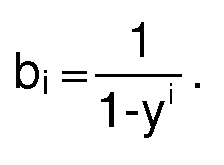
- A Low-Density Parity-Check (LDPC) code as a base code, and
- Reed-Solomon (RS) codes as component codes,
wherein RS codes are based on a quasi-Hankel matrix of the form :
where
Description
- The present invention relates to a method of data encoding and decoding for transmission across a binary erasure channel.
- To improve error floor, minimal distance and decoding complexity performances, an extension of Low Density Parity Check (LDPC) codes has been suggested by Tanner in "A recursive approach to low complexity codes", IEEE Transactions on Information Theory, vol. 27, no. 5, pp. 533-547, Sept. 1981. These codes are named Generalized LDPC (GLDPC) codes. They are constructed by extending a LDPC code (named base code) through component codes.
- An other construction of GLDPC using LDPC code as a base code and Reed Solomon (RS) codes as component codes has been proposed in "Low-rate coding using incremental redundancy for GLDPC codes", M. Cunche, IEEE International Workshop on Satellite and Space Communications, pp. 299-303, Oct. 2008.
- This construction has a key benefit: in addition to the LDPC repair symbols, extra-repair symbols can be produced by the component codes on demand and in large quantities, a feature that is well suited to situations where the channel conditions can be worse than expected, or to fountain like content distribution applications.
- The author writes:
- "Let the parameters of the RS code be (k+1+E, k). Thus, k is the number of information symbols (the code dimension), k+1+E is the number of coded symbols (the code length), and the number of repair symbols that can be generated by the code is equal to 1+E. Without losing generality, we may assume that the first repair symbol is the XOR sum of the k information symbols. Precisely, since the RS code is systematic, for any information symbols (x1,x2,...,xk), the repair symbols are computed as:

where G', a k×(1+E) matrix, is a sub-matrix of the systematic RS code associated to the repair symbols. The first repair symbol y1 is the XOR sum of the source symbols x1,..., xk if all the coefficients on the first column of G' are equal to 1. This can be obtained by multiplying the k×(1+E) sub-matrix (associated to the repair symbols), of a systematic RS generator matrix, at the left by an appropriate invertible matrix, which will change the way the encoding is done but not the MDS property of the code. " - First, the author does not propose any implementation example of the matrix sub-matrix G'. Secondly, it is inexact that the Maximum Distance Separable (MDS) property of a code is guaranteed if G' is multiplied at the left by an invertible matrix. At last, as the RS code should be applied in a dynamic way, the matrix should be created repetitively on the sender and receiver: this consumes a lot of CPU.
- It is an object of the invention to provide a method for encoding with a GLDPC code based on Reed-Solomon component codes, which minimize the encoding time while guarantying a Maximum Distance Separable property.
- To this end, there is provided a method of encoding for transmission of K source symbols across a binary erasure channel, said method comprising encoding said source symbols by means of an encoder connected to the transmitter device, whereby encoding is performed by a (NG, K) Generalized Low-Density Parity-Check (GLDPC) using:
- A Low-Density Parity-Check (LDPC) code as a base code, and
- Reed-Solomon (RS) codes as component codes,
wherein RS codes are based on a quasi-Hankel matrix of the form :
where
- It is to be noted that a (n,k) code is a code of length n (which represents the number of coded symbols), and dimension k (which represents the number of information symbols).
- Any square extracted matrix from Tq is invertible, so building a Maximum Distance Separable (MDS) systematic generator matrix of RS code using Tq, consists in extracting a rectangular sub-matrix of size k × (n - k) and concatenating it by identity matrix of order k.
- Besides, this construction has the nice property that the first repair symbol is also equal to the direct XOR sum of the source symbols: as a consequence, a complete compatibility between the LDPC and the RS codes is reached: if extra repair symbols are not requested, repair symbols can be calculated through the LDPC code only.
- According to not limited embodiments, the method can comprise one or more of the following additional characteristics:
- The method comprises decoding of coded symbols received by a receiver device, through said GLDPC code.
- The GLDPC code is adapted to generate ML repair symbols and ne=E*ML extra repair symbols, and:
- The base code is a (NL,K) LDPC code, where NL=ML+K, and
- The component codes are ML (km+1 +E, km) RS codes, where km = dm-1, dm being the degree of a row m of the binary parity-check matrix associated with the LDPC code.
- The LDPC code is a LDPC-Staircase code, and the generator matrix of a (km+1+E, km) RS code is of the form: G = [|km | A(km,1+E)] where A(km, 1+E) is a km x (1+E) matrix extracted from the upper triangle of Tq and lkm is a km x km unit matrix. The generation of G is really simple: it is a concatenation of two matrices. No operations are needed on Tq.
- In addition, there is provided an encoder adapted to carry out the provided method.
- In addition, there is provided a decoder adapted to carry out the provided method.
- Some embodiments of base station and/or methods in accordance with embodiments of the present invention are now described, by way of example only, and with reference to the accompanying drawing, in which
figure 1 schematically illustrates a block diagram of data exchanges between equipments of a network, which permits to carry out the method in accordance with the present invention. - As illustrated in
figure 1 , the invention relates to a method for encoding of K source symbols S=(S1,S2,...,SK) across a binary erasure channel CH between a transmitter device TR and a receiver device REC. Encoding is performed through an encoder ENC connected to the transmitter device TR. It is to be noted that the method is also used for decoding symbols erased by the channel, by means of a decoder DEC connected to the receiver device REC. - Encoding is performed through a (NG, K) generalized low-density parity-check (GLDPC) code adapted to generate ML repair symbols (p1,p2,...,PML) and ne=E*ML extra repair symbols (e1,e2,...,ene) on request. It is to be noted that E extra repair symbols are associated to each check node of the LDPC staircase. NG, K, ML and E are predetermined parameters.
- The GLDPC code used for encoding uses a (NL, K) low-density parity-check (LDPC) code as a base code, where NL=ML+K. In this not limited embodiment, the LDPC code is a LDPC Staircase code. In another not limited embodiment not described, the LDPC code is a LDPC Triangular code. LDPC Staircase and LDPC Triangular codes are well-known by the person skilled in the art and described in the RFC 5170 standard.
- Let HL be the binary parity-check matrix associated with the LDPC code. HL has the form (H1|H2). H1 is the ML x K left-hand side part (information part) and each column is of degree N1 (number of "1 " per column). H2 is the ML x ML right-hand side part (redundancy part) and features a staircase (i.e. double diagonal) structure. H1 is created in a fully regular way, in order to have constant column and row degree. More precisely, each column of H1 is of degree N1, which is an input parameter during the LDPC Staircase code creation.
- In addition, the GLDPC code is based on ML (km+1+E, km) Reed-Solomon codes as component codes, where km = dm-1, dm being the degree of a row m of the binary parity-check matrix HL. In other words, the E extra-repair symbols associated to the mth row of HL are generated by a (km+1 +E, km) Reed-Solomon code. For row m>1, the various source symbols that are involved in this row plus the previous repair symbol, are considered as source symbols from the RS point of view. The new LDPC-Staircase repair symbol for this row plus the E extra-repair symbols are considered as repair symbols from the RS point of view. For the first row, the only difference is the fact there is no previous repair symbol.
- RS codes used in the claimed method are based on quasi-Hankel matrices. Hankel matrices are square matrices whose values are constant along the descending diagonals. The construction method is based on the creation of the maximal triangular array, Bq, whose coefficients are constant along diagonals in a Hankel matrix fashion:

- The coefficients of the triangular array are equal to


- The quasi-Hankel matrix Tq does not contain any singular square sub-matrix as well. It is to be noted that the quasi-Hankel matrix Tq is stored in the transmitter TR and in the receiver REC.
- A generator matrix G of a (km+1+E, km) RS code can be calculated by the formula:

- For example, for E=2, km=4:

- With this technique, a systematic generator matrix is directly obtained by a trivial concatenation operation. This is a major benefit when the code needs to be produced on-the-fly.
- The repair symbols (p1,p2,...,pML) are computed as usual, by "following the stairs" of the parity-check matrix HL. Moreover, for each row m in HL, the repair symbol pm is the XOR sum of the sources symbols (x1, ...,Xkm). These symbols (x1, ...,xkm) are the subset Sm that correspond to a 1 coefficient in row m on HL. An advantage is that the repair symbol pm can be considered indifferently as an LDPC-Staircase or a RS repair symbol.
- For each row m, the E extra-repair symbols (e1,e2,...,eE) are computed by multiplying the km symbols of Sm plus the repair symbol pm-1 by the systematic generator matrix G of a (km+1+E, km) RS code. An advantage of this encoding approach is the fact that extra-repair symbols can be produced incrementally, on demand, rather than all at once.
- The following is an example of implementation of the invention with K=4, E=2, N1=2.

- As repair symbols for the LDPC Staircase code, the repair symbols (p1,p2,...,pML) are obtained by the following calculations:
- p1=XOR(s1, s3);
- p2=XOR(S2, s4, p1);
- p3=XOR(s1, s2, p2);
- p4=XOR(s3, s4, p3).
- Besides, as repair symbols for the RS codes, the repair symbols (p1,p2,...,pML) and the extra-repair symbols (e1,e2,...,ene) are obtained by the following calculations:
-

with
-

with
- Etc
- To conclude with, the encoding or decoding method as claimed:
- minimizes the encoding and the decoding time and limits the load in the CPU because generator matrices of RS codes are directly obtained by trivial concatenation operations;
- has capabilities very close to MDS codes performance, because each constraint node is associated to a MDS code;
- presents a complete compatibility with the LDPC. Indeed, if extra-repair symbols are not requested, the repair symbols can be computed through the LDPC code only.
Claims (6)
- A method of encoding for transmission of K source symbols (S=(s1,s2,...,sK)) across a binary erasure channel (CH), said method comprising encoding said source symbols (S=(s1,s2,...,sK)) by means of an encoder (ENC) connected to a transmitter device (TR), whereby encoding is performed by a (NG, K) Generalized Low-Density Parity-Check (GLDPC) using:- A Low-Density Parity-Check (LDPC) code as a base code, and- Reed-Solomon (RS) codes as component codes,
wherein RS codes are based on a quasi-Hankel matrix of the form :
where
- A method according to any of previous claims, wherein the Generalized Low-Density Parity-Check (GLDPC) code is adapted to generate ML repair symbols (p1,p2,...,pML) and ne=E*ML extra repair symbols (e1,e2,...,ene), and:- The base code is a (NL,K) LDPC code, where NL=ML+K, and- The component codes are ML (km+1 +E, km) RS codes, where km = dm-1, dm being the degree of a row m of the binary parity-check matrix (HL) associated with the LDPC code.
- A method according to the previous claim, wherein the base code is a LDPC-Staircase code, and the generator matrix (G) of a (km+1+E, km) RS code is of the form: G = [lkm | A(km,1 +E)] where A(km,1 +E) is a km x (1+E) matrix extracted from the upper triangle of the quasi-Hankel matrix (Tq).
- A method according to claim any of previous claims, comprising decoding, by means of a decoder (DEC), of coded symbols received by a receiver device (REC), wherein decoding is performed using said GLDPC code.
- An encoder (ENC) adapted to carry out a method according to any of the previous claims.
- A decoder (DEC) adapted to carry out a method according to claim 4.
Priority Applications (1)
| Application Number | Priority Date | Filing Date | Title |
|---|---|---|---|
| EP12172196.3A EP2675069A1 (en) | 2012-06-15 | 2012-06-15 | Method for encoding with GLDPC codes based on reed-solomon component codes |
Applications Claiming Priority (1)
| Application Number | Priority Date | Filing Date | Title |
|---|---|---|---|
| EP12172196.3A EP2675069A1 (en) | 2012-06-15 | 2012-06-15 | Method for encoding with GLDPC codes based on reed-solomon component codes |
Publications (1)
| Publication Number | Publication Date |
|---|---|
| EP2675069A1 true EP2675069A1 (en) | 2013-12-18 |
Family
ID=46245977
Family Applications (1)
| Application Number | Title | Priority Date | Filing Date |
|---|---|---|---|
| EP12172196.3A Withdrawn EP2675069A1 (en) | 2012-06-15 | 2012-06-15 | Method for encoding with GLDPC codes based on reed-solomon component codes |
Country Status (1)
| Country | Link |
|---|---|
| EP (1) | EP2675069A1 (en) |
Cited By (4)
| Publication number | Priority date | Publication date | Assignee | Title |
|---|---|---|---|---|
| US20160182087A1 (en) * | 2014-12-18 | 2016-06-23 | Apple Inc. | Gldpc soft decoding with hard decision inputs |
| CN109257050A (en) * | 2018-08-09 | 2019-01-22 | 东莞理工学院 | A repair binary code generator matrix construction method and repair method |
| US10715178B2 (en) | 2018-09-25 | 2020-07-14 | Western Digital Technologies, Inc. | Generalized low-density parity-check codes |
| RU2731600C1 (en) * | 2019-12-05 | 2020-09-04 | Акционерное общество "Калужский научно-исследовательский институт телемеханических устройств" | Decoding method of reed-solomon code |
Citations (1)
| Publication number | Priority date | Publication date | Assignee | Title |
|---|---|---|---|---|
| WO2006099517A2 (en) * | 2005-03-15 | 2006-09-21 | Tandberg Data Corp. | Multiply redundant raid system and xor-efficient implementation |
-
2012
- 2012-06-15 EP EP12172196.3A patent/EP2675069A1/en not_active Withdrawn
Patent Citations (1)
| Publication number | Priority date | Publication date | Assignee | Title |
|---|---|---|---|---|
| WO2006099517A2 (en) * | 2005-03-15 | 2006-09-21 | Tandberg Data Corp. | Multiply redundant raid system and xor-efficient implementation |
Non-Patent Citations (4)
| Title |
|---|
| MATHIEU CUNCHE ET AL: "Low-rate coding using incremental redundancy for GLDPC codes", SATELLITE AND SPACE COMMUNICATIONS, 2008. IWSSC 2008. IEEE INTERNATIONAL WORKSHOP ON, IEEE, PISCATAWAY, NJ, USA, 1 October 2008 (2008-10-01), pages 299 - 303, XP031352194, ISBN: 978-1-4244-1947-0 * |
| MATHIEU CUNCHE: "Codes AL-FEC hautes performances pour les canaux à effacements :variations autour des codes LDPC", 30 June 2010 (2010-06-30), XP002684741, Retrieved from the Internet <URL:http://tel.archives-ouvertes.fr/docs/00/49/65/06/PDF/these.pdf> [retrieved on 20121005] * |
| ROTH R M ET AL: "On generator matrices of MDS codes (Corresp.)", IEEE TRANSACTIONS ON INFORMATION THEORY, IEEE PRESS, USA, vol. 31, no. 6, 1 November 1985 (1985-11-01), pages 826 - 830, XP011423242, ISSN: 0018-9448, DOI: 10.1109/TIT.1985.1057113 * |
| V. OLSHEVSKY, M. AMIN SHOKROLLAHI: "A displacement approach to decoding algebraic codes", vol. Contemporary mathematics, 18 August 2000 (2000-08-18), Boston, Ma, US, pages 265 - 292, XP002684742, ISBN: 0-8218-3177-1, Retrieved from the Internet <URL:http://citeseerx.ist.psu.edu/viewdoc/download?doi=10.1.1.131.9918&rep=rep1&type=pdf> [retrieved on 20121004] * |
Cited By (5)
| Publication number | Priority date | Publication date | Assignee | Title |
|---|---|---|---|---|
| US20160182087A1 (en) * | 2014-12-18 | 2016-06-23 | Apple Inc. | Gldpc soft decoding with hard decision inputs |
| US10084481B2 (en) * | 2014-12-18 | 2018-09-25 | Apple Inc. | GLDPC soft decoding with hard decision inputs |
| CN109257050A (en) * | 2018-08-09 | 2019-01-22 | 东莞理工学院 | A repair binary code generator matrix construction method and repair method |
| US10715178B2 (en) | 2018-09-25 | 2020-07-14 | Western Digital Technologies, Inc. | Generalized low-density parity-check codes |
| RU2731600C1 (en) * | 2019-12-05 | 2020-09-04 | Акционерное общество "Калужский научно-исследовательский институт телемеханических устройств" | Decoding method of reed-solomon code |
Similar Documents
| Publication | Publication Date | Title |
|---|---|---|
| US10673462B2 (en) | Coding method and coding device | |
| EP2567462B1 (en) | Method and apparatus for channel coding and decoding in a communication system using a low-density parity-check code | |
| CN102035556B (en) | Method and system for encoding and decoding data | |
| EP1443656B1 (en) | Method of generating parity data based on a low-density parity check (LDPC) matrix and apparatus therefor | |
| EP1850484A1 (en) | Basic matrix based on irregular ldcp, codec and generation method thereof | |
| CN101459430B (en) | Coding method and device for low-density generator matrix code | |
| CN101567697B (en) | Coder and method for coding rate-compatible low-density parity-check codes | |
| KR100936022B1 (en) | Method and apparatus for generating additional information for error correction | |
| US20050149845A1 (en) | Method of constructing QC-LDPC codes using qth-order power residue | |
| CN102394660A (en) | Coding Method and Encoder for Quasi-Cyclic Extended Parallel Coding LDPC Codes with Packet Interleaving | |
| EP3119004A1 (en) | Method, device, and computer storage medium supporting low bit rate encoding | |
| KR100669152B1 (en) | Apparatus and method for encoding low density parity check code | |
| US11228323B2 (en) | Method and system for repairing Reed-Solomon codes | |
| US9543985B2 (en) | Method of codifying data including generation of a quasi-cyclic code | |
| EP2226945A1 (en) | Generation of optimized exponent matrices for multi-rate LDPC codes | |
| Zrelli et al. | Focus on theoretical properties of blind convolutional codes identification methods based on rank criterion | |
| EP2211470B1 (en) | Generating an exponent table for coding and decoding LDPC codewords of different lengths | |
| EP1715590A1 (en) | Method for encoding/decoding concatenated LDGM code | |
| CN102142929B (en) | Forward error correction method, device and system | |
| CN108429553B (en) | Encoding method, encoding device and equipment of polarization code | |
| EP2211469A1 (en) | Method of encoding or decoding for LDPC codes | |
| CN112367088B (en) | Encoding method and device based on index matrix | |
| CN111934692B (en) | Quantum LDPC code construction method based on BIBD variable code rate | |
| EP2148445B1 (en) | Generating exponent matrixes for LDPC codes | |
| JP2009182421A (en) | Decoding method and decoding apparatus |
Legal Events
| Date | Code | Title | Description |
|---|---|---|---|
| PUAI | Public reference made under article 153(3) epc to a published international application that has entered the european phase |
Free format text: ORIGINAL CODE: 0009012 |
|
| AK | Designated contracting states |
Kind code of ref document: A1 Designated state(s): AL AT BE BG CH CY CZ DE DK EE ES FI FR GB GR HR HU IE IS IT LI LT LU LV MC MK MT NL NO PL PT RO RS SE SI SK SM TR |
|
| AX | Request for extension of the european patent |
Extension state: BA ME |
|
| RAP1 | Party data changed (applicant data changed or rights of an application transferred) |
Owner name: INRIA - INSTITUT NATIONAL DE RECHERCHE EN INFORMAT Owner name: ALCATEL LUCENT |
|
| STAA | Information on the status of an ep patent application or granted ep patent |
Free format text: STATUS: THE APPLICATION IS DEEMED TO BE WITHDRAWN |
|
| 18D | Application deemed to be withdrawn |
Effective date: 20140619 |