EP2674917A2 - Streaming hierarchy traversal renderer - Google Patents
Streaming hierarchy traversal renderer Download PDFInfo
- Publication number
- EP2674917A2 EP2674917A2 EP13160548.7A EP13160548A EP2674917A2 EP 2674917 A2 EP2674917 A2 EP 2674917A2 EP 13160548 A EP13160548 A EP 13160548A EP 2674917 A2 EP2674917 A2 EP 2674917A2
- Authority
- EP
- European Patent Office
- Prior art keywords
- hierarchy
- traversal
- directional
- queries
- scene
- Prior art date
- Legal status (The legal status is an assumption and is not a legal conclusion. Google has not performed a legal analysis and makes no representation as to the accuracy of the status listed.)
- Ceased
Links
Images


Classifications
-
- G—PHYSICS
- G06—COMPUTING OR CALCULATING; COUNTING
- G06T—IMAGE DATA PROCESSING OR GENERATION, IN GENERAL
- G06T15/00—Three-dimensional [3D] image rendering
- G06T15/06—Ray-tracing
-
- G—PHYSICS
- G06—COMPUTING OR CALCULATING; COUNTING
- G06T—IMAGE DATA PROCESSING OR GENERATION, IN GENERAL
- G06T2210/00—Indexing scheme for image generation or computer graphics
- G06T2210/52—Parallel processing
Definitions
- Realistic lighting is an important component of high quality computer rendered graphics.
- scenes can be provided with convincing reflections, shadows and indirect illumination, providing the requisite visual detail demanded by feature length animated films and other content.
- a ray tracing renderer may be utilized to provide global illumination in a simple manner.
- the present disclosure is directed to a streaming hierarchy traversal renderer, substantially as shown in and/or described in connection with at least one of the figures, as set forth more completely in the claims.
- a method for providing a streaming hierarchy traversal renderer comprising:
- a computing device for providing a streaming hierarchy traversal renderer comprising:
- Preferable embodiments comprise the following features, either alone or in combination:
- the computing device wherein the spatial hierarchy is an n-ary hierarchy where n is at least three (3).
- the computing device wherein the streaming hierarchy traversal uses a prioritized parallel traversal based on a cost-metric comprising at least one of: an average distance of a given node from a query origin, a number of queries for a given node, an estimated overlap of a given node with other nodes of the plurality of scene nodes, a relative importance of a given query or node, and a partial result earlier determined from the streaming hierarchy traversal.
- a cost-metric comprising at least one of: an average distance of a given node from a query origin, a number of queries for a given node, an estimated overlap of a given node with other nodes of the plurality of scene nodes, a relative importance of a given query or node, and a partial result earlier determined from the streaming hierarchy traversal.
- the computing device wherein the processing of the plurality of directional queries further bounces the plurality of directional queries for multi-pass global illumination.
- the computing device wherein the plurality of directional queries further includes directional path information for light sources in the scene, and wherein the bouncing uses the directional path information.
- the computing device wherein the plurality of directional queries uses a tracing shape selected from the group consisting of camera rays, circular cones, elliptical cones, and polygonal cones.
- the computing device wherein the plurality of directional queries sample values selected from the group consisting of radiance values and visibility values.
- the computing device wherein the streaming hierarchy traversal records nearest hit points for the plurality of directional queries, and wherein the shading is done in a subsequent process using the nearest hit points to skip shading of occluded points.
- the computing device wherein the plurality of directional queries vary over time.
- the computing device wherein the plurality of directional queries are generated in a memory.
- the spatial hierarchy is an n-ary hierarchy where n is at least three (3).
- the method wherein the streaming hierarchy traversal uses a prioritized parallel traversal based on a cost-metric comprising at least one of: an average distance of a given node from a query origin, a number of queries for a given node, an estimated overlap of a given node with other nodes of the plurality of scene nodes, a relative importance of a given query or node, and a partial result earlier determined from the streaming hierarchy traversal.
- a cost-metric comprising at least one of: an average distance of a given node from a query origin, a number of queries for a given node, an estimated overlap of a given node with other nodes of the plurality of scene nodes, a relative importance of a given query or node, and a partial result earlier determined from the streaming hierarchy traversal.
- the method wherein the plurality of directional queries uses a tracing shape selected from the group consisting of camera rays, circular cones, elliptical cones, and polygonal cones.
- the computing device wherein the streaming hierarchy traversal performs a single pass over the plurality of directional queries at each of the plurality of scene nodes.
- the computing device wherein the streaming hierarchy traversal splits the plurality of directional queries over the spatial hierarchy by generating one child stream of directional queries for each child node of each of the plurality of scene nodes
- the computing device wherein the streaming hierarchy traversal uses a prioritized parallel traversal based on a cost-metric comprising at least one of: an average distance of a given node from a query origin, a number of queries for a given node, an estimated overlap of a given node with other nodes of the plurality of scene nodes, a relative importance of a given query or node, and a partial result earlier determined from the streaming hierarchy traversal.
- a cost-metric comprising at least one of: an average distance of a given node from a query origin, a number of queries for a given node, an estimated overlap of a given node with other nodes of the plurality of scene nodes, a relative importance of a given query or node, and a partial result earlier determined from the streaming hierarchy traversal.
- Rasterizing renderers provide high performance and are amenable to localized data access.
- rasterizing renderers can readily work with scene data divided into smaller coherent blocks, providing efficient rendering of large and complex scenes even with limited amounts of memory.
- only a lower quality approximation of global illumination can be provided with rasterizing renders, for example using environment maps or other techniques.
- approximations can also be provided using point-based rendering, point-based rendering still has the drawbacks of requiring separate pre-processing passes and sacrificing direct light shadowing support.
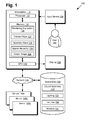
- Figure 1 presents an exemplary diagram of a system for providing a streaming hierarchy traversal renderer.
- Diagram 100 of Figure 1 includes workstation 110, display 118, user 130, input device 135, network 140, servers 145a, 145b and 145c, and scene data 150.
- Workstation 110 includes processor 112, memory 114, and graphics processing unit (GPU) 116.
- Memory 114 includes rendering application 120, camera rays 122, geometry node 124, spatial hierarchy 126, and output image 128.
- Scene data 150 includes object geometry 154, lighting 155, textures 156, and shaders 157.
- Workstation 110 may comprise any computing device such as a rackmount server, desktop computer, or mobile computer.
- User 130 may utilize input device 135, for example a keyboard and mouse, to direct the operation of rendering application 120 executing in memory 114 of processor 112.
- Rendering application 120 may process scene data 150 received from network 140 to generate a rendered output image 128 for output to display 118 through GPU 116.
- Network 140 may be a high speed network suitable for high performance computing (HPC), for example a 10 GigE network or an InfiniBand network.
- HPC high performance computing
- output image 128 may also be copied to non-volatile storage, not shown in Figure 1 .
- scene data 150 may further include motion data for object geometry 154, in which case several animation frames may be rendered by rendering application 120.
- Lighting 155 may include the properties of all light sources within the scene
- textures 156 may include all textures for object geometry 154
- shaders 157 may include any shaders to correctly shade object geometry 154.
- Other data may also be stored in scene data 150, for example virtual camera parameters and camera paths.
- rendering application 120 individually traces each of camera rays 122 as in a conventional ray tracing renderer. After each of camera rays 122 performs a first bounce on object geometry 154, data access of object geometry 154 quickly becomes incoherent due to the unpredicable manner in which the camera rays may travel. Such incoherent access patterns for object geometry 154 result in many cache misses as not enough memory 114 is available, causing heavy traffic across network 140 with the attendant latency penalties. If scene data 150 is relocated to a local disk of workstation 110, disk thrashing generates a similar latency penalty.
- a streaming hierarchy traversal renderer is proposed for rendering application 120. All the camera rays 122 for rendering output image 128 are generated and may be kept within memory 114. Camera rays 122 may sample radiance values as in a conventional ray-tracing algorithm. However, in other implementations, any kind of directional query may be utilized for camera rays 122. Thus, camera rays 122 may also sample visibility values, for example to skip occluded points during shading, and may also track any other scene attribute. Moreover, camera rays 122 do not necessarily need to be rays and can also be any desired tracing shape such as circular cones, elliptical cones, polygonal cones, and other shapes.
- Object geometry 154 is streamed into memory 114 as individual work units or nodes, with an exemplary geometry node 124 as shown in Figure 1 .
- the streaming of object geometry 154 into geometry node 124 may be according to a traversal of spatial hierarchy 126.
- Geometry node 124 is processed against camera rays 122 using other elements of scene data 150 as needed, after which geometry node 124 may be freed from memory 114. Since all processing may be completed after freeing or deallocating the node from memory 114, each geometry node 124 of object geometry 154 may be accessed at most once, and may also be skipped if the geometry node is not visible in the current scene.
- the above streaming of object geometry 154 is repeated for as many global illumination bounce passes as desired, for example 2-4 passes. Since performing only one pass is equivalent to ray casting, at least two passes may be done.
- memory 114 to provide sufficient memory space for all of camera rays 112 and the bandwidth of network 140 to efficiently stream the large amount of complex geometric data from object geometry 154
- data coherency may be greatly improved by enabling streaming of object geometry 154 in naturally coherent nodes.
- complex caching schemes for geometry may be omitted, simplifying the implementation of rendering application 120.
- servers 145a, 145b, and 145c may also be utilized for distributed parallel processing.
- Servers 145a, 145b, and 145c may contain components similar to those of workstation 110.
- SIMD (single instruction, multiple data) instructions on processor 112 and shaders on GPU 116 may be utilized to further enhance parallelism.
- Prioritized hierarchical traversal of camera rays 122 across spatial hierarchy 126 may also be utilized to reduce the number of intersection comparisons and increase parallelism, which is discussed further below.
- FIG. 2 presents an exemplary flowchart illustrating a method for providing a streaming hierarchy traversal renderer.
- Flowchart 200 begins when processor 112 of workstation 110 arranges a scene represented by scene data 150 into spatial hierarchy 126 (block 210).
- object geometry 154 may be spatially divided into scene nodes, which are then organized into a tree-based bounding volume hierarchy (BVH) or another data structure.
- the tree may be organized as a binary, quad, or n-ary BVH, and may preferably be an n-ary BVH where n is at least three (3) for greater parallelism.
- processor 112 of workstation 110 generates camera rays 122 for tracing in a scene represented by scene data 150 (block 220).
- the hierarchy traversal renderer may generate the camera rays 122 entirely within memory 114. For example, assuming a target render size of approximately 2 megapixels for high definition (1920 by 1080) video, and assuming a desired sampling of 100 samples per pixel to provide sufficient data for filtering, only 200 million camera ray records will be stored in memory 114. Assuming that each camera ray record occupies 100 bytes, approximately 20 gigabytes of memory is to be allocated, which is an amount easily accommodated by a modem server or even a high-end consumer class desktop computer. While radiance sampling camera rays 122 are utilized in the present example, processor 112 may also generate any desired directional query using any tracing shape, as previously described.
- the directional queries or camera rays 122 may not necessarily correspond to a single point in time. For example, to provide a smoother visual perception for lower frame rates such as the standard theatrical rate of 24 frames per second, it is often desirable to provide motion blur by lengthening the virtual exposure time of a scene, rather than capturing the scene at a specific instant. Thus, in some implementations, camera rays 122 may vary over time.
- camera rays 122 may be organized and sorted, for example by origin point and direction vector, or grouped hierarchically by position and/or direction, thereby facilitating bounding box (or sphere or other shape) testing. Since a large number of records may need to be sorted, GPU 116 may be utilized for accelerated sorting.
- the high performance RadixSorting algorithm can sort over 1G keys per second on a modem CUDA compatible GPU. See, "RadixSorting, High performance GPU radix sorting in CUDA", available from http://code.google.com/p/back40computing/wiki/RadixSorting.
- processor 112 of workstation 110 processes camera rays 122 using a streaming hierarchy traversal over spatial hierarchy 126 (block 230). More specifically, the streaming hierarchy traversal may perform a single pass over camera rays 122 for splitting into one child stream of camera rays for each child node of each of the scene nodes. Since the child streams provide each scene node in spatial hierarchy 126 with an associated set of camera rays rather than relying on a single copy of camera rays 122, processing of spatial hierarchy 126 can proceed in parallel and in any order. Thus, scene nodes of spatial hierarchy 126 may be divided and distributed for parallel processing across server 145a, 145b, 145c, and any other available resources.
- the streaming hierarchy traversal can operate on different nodes independently and in parallel, the final results should be resolved by merging directional queries intersecting multiple scene nodes and removing results that are occluded by other nodes. These operations may be carried out by a stream-merge operation at each node of spatial hierarchy 126, or by using a shared data structure. Alternatively, a prior streaming hierarchy traversal pass may determine nearest hit points such that a subsequent shading process uses the nearest hit points to skip shading of occluded points entirely.
- the directional queries or camera rays 122 may be bounced as appropriate when intersected with scene geometry in spatial hierarchy 126. These bounced directional queries may be gathered and processed for an additional rendering pass, enabling multiple bounce passes for global illumination.
- Directional path information for light sources in the scene, or lighting 155 may also be utilized to improve rendering quality.
- the directional path information includes information about direct and indirect light source locations, and may be discovered from a previous streaming hierarchy traversal bounce pass or otherwise known in advance. By using the directional path information to concentrate sampling directions towards known light paths, sampling quality may be improved.
- processor 112 of workstation 110 shades output image 128 based on the streaming hierarchy traversal (block 240). For example, processor 112 may stream into memory 114 a plurality of geometry nodes, including geometry node 124, from object geometry 154 for hit testing with camera rays 122. As discussed above, since all computations are finished after freeing each node, each of the plurality of geometry nodes is accessed no more than once, and may be skipped entirely if not visible in the scene, for example behind the camera view. After reducing the possible candidates of camera rays 122 for intersection testing with geometry node 124, for example by bounding box testing, hit testing may proceed, and hit points may be recorded accordingly. If cones or other tracing shapes are used, then cone integration may be carried out instead of hit testing with individual rays.
- Processor 112 may then shade output image 128 based on the hit testing or cone integration and optionally bounce camera rays 122 for further global illumination passes.
- various properties may be evaluated to determine the shading of the hit, including the material properties of the object surface, lighting 155, textures 156, and shaders 157. If geometry needs to be procedurally generated, displaced, instantiated, or tessellated, such operations may be performed here prior to the hit testing and may also take advantage of the natural coherence benefits from geometry node 124.
- these additional rays may be "bounced" or queued for deferred processing by future global illumination passes. By deferring the bounces in this manner, data access for object geometry 154 may be kept highly coherent.
- output image 128 may be filtered for outputting to a target display 118.
- 100 samples may be taken for each pixel.
- alternative embodiments may use different numbers of samples depending on the desired filtering quality.
- anti-alias filters may be applied to produce the final output image 128 in the target full HD resolution of 1920x1080.
- motion blur filters may also be applied depending on the movement of objects in the scene.
- FIG 3 presents an exemplary streaming hierarchy traversal for a streaming hierarchy traversal renderer.
- Hierarchy 354 may correspond to spatial hierarchy 126 in Figure 1 , which organizes the plurality of nodes in object geometry 154 in a bounding volume hierarchy (BVH).
- Diagram 302 demonstrates the splitting of rays based on downward traversal of hierarchy 354.
- Diagram 304 demonstrates the merging of shading results based on upward traversal of hierarchy 354. As shown in Figure 3 , only small portions of hierarchy 354, diagram 302, and diagram 304 are shown for simplicity.
- Hierarchy 354 may be generated as a binary BVH as shown in Figure 3 , but may also be generated as a quad BVH or preferably as an n-ary BVH where n is at least three (3), with each node representing a bounding volume around the corresponding geometry in object geometry 154, and leaf nodes corresponding to individual objects. Traversal begins at the top root node "A", and may proceed to be distributed in parallel downwards. As traversal proceeds downwards, the camera rays 122 may be split into one child stream for each child node as shown in diagram 302, with the A rays corresponding to all of the camera rays 122.
- the decision to split A rays into B rays and C rays in diagram 302 or the decision to not split further at all may be based on one or more factors including an average distance of a given node from a query origin, a number of queries for a given node, an estimated overlap of a given node with other nodes of the plurality of scene nodes, a relative importance of a given query or node, and a partial result earlier determined from the streaming hierarchy traversal.
- cost-metrics By integrating these cost-metrics, an optimized adaptive parallel-serial traversal can be provided, increasing parallelism while reducing redundant computations.
- results corresponding to output image 128 are completed, they are merged back up the hierarchy, and any redundant work is resolved, as shown in diagram 304. For example, if "B results" indicates a particular ray hits an object and B is closer to A than C in hierarchy 354, then the result for the same ray in C results, if any, may be overwritten, since the ray in C results would be occluded. If the ray is visible in both result sets, then the results may instead be merged.
Landscapes
- Engineering & Computer Science (AREA)
- Computer Graphics (AREA)
- Physics & Mathematics (AREA)
- General Physics & Mathematics (AREA)
- Theoretical Computer Science (AREA)
- Image Generation (AREA)
- Two-Way Televisions, Distribution Of Moving Picture Or The Like (AREA)
Abstract
Description
- Realistic lighting is an important component of high quality computer rendered graphics. By utilizing a renderer employing a global illumination model, scenes can be provided with convincing reflections, shadows and indirect illumination, providing the requisite visual detail demanded by feature length animated films and other content. Conventionally, a ray tracing renderer may be utilized to provide global illumination in a simple manner.
- The present disclosure is directed to a streaming hierarchy traversal renderer, substantially as shown in and/or described in connection with at least one of the figures, as set forth more completely in the claims.
- According to the present invention there is provided the following:
- A computing device for providing a streaming hierarchy traversal renderer, the computing device comprising:
- a processor configured to:
- arrange a scene comprising a plurality of scene nodes into a spatial hierarchy;
- generate a plurality of directional queries for tracing in the scene;
- process the plurality of directional queries using a streaming hierarchy traversal of the spatial hierarchy, wherein the streaming hierarchy traversal performs a single pass over the plurality of directional queries for splitting into one child stream of directional queries for each child node of each of the plurality of scene nodes;
- shade an output image based on the streaming hierarchy traversal.
- A method for providing a streaming hierarchy traversal renderer, the method comprising:
- arranging a scene comprising a plurality of scene nodes into a spatial hierarchy;
- generating a plurality of directional queries for tracing in the scene;
- processing the plurality of directional queries using a streaming hierarchy traversal of the spatial hierarchy, wherein the streaming hierarchy traversal performs a single pass over the plurality of directional queries for splitting into one child stream of directional queries for each child node of each of the plurality of scene nodes;
- shading an output image based on the streaming hierarchy traversal.
- A computing device for providing a streaming hierarchy traversal renderer, the computing device comprising:
- a processor configured to:
- arrange a scene comprising a plurality of scene nodes into a spatial hierarchy;
- generate a plurality of directional queries for tracing in the scene;
- process the plurality of directional queries using a streaming hierarchy traversal of the spatial hierarchy;
- shade an output image based on the streaming hierarchy traversal.
- Preferable embodiments comprise the following features, either alone or in combination:
- The computing device wherein the plurality of directional queries are grouped hierarchically by position and/or direction.
- The computing device wherein the spatial hierarchy is an n-ary hierarchy where n is at least three (3).
- The computing device wherein the streaming hierarchy traversal uses a prioritized parallel traversal based on a cost-metric comprising at least one of: an average distance of a given node from a query origin, a number of queries for a given node, an estimated overlap of a given node with other nodes of the plurality of scene nodes, a relative importance of a given query or node, and a partial result earlier determined from the streaming hierarchy traversal.
- The computing device wherein the processing of the plurality of directional queries further bounces the plurality of directional queries for multi-pass global illumination.
- The computing device wherein the plurality of directional queries further includes directional path information for light sources in the scene, and wherein the bouncing uses the directional path information.
- The computing device wherein the directional path information is discovered from a previous streaming hierarchy traversal bounce pass.
- The computing device wherein the plurality of directional queries uses a tracing shape selected from the group consisting of camera rays, circular cones, elliptical cones, and polygonal cones.
- The computing device wherein the plurality of directional queries sample values selected from the group consisting of radiance values and visibility values.
- The computing device wherein the streaming hierarchy traversal records nearest hit points for the plurality of directional queries, and wherein the shading is done in a subsequent process using the nearest hit points to skip shading of occluded points.
- The computing device wherein the plurality of directional queries vary over time.
- The computing device wherein the plurality of directional queries are generated in a memory.
- The method wherein the spatial hierarchy is an n-ary hierarchy where n is at least three (3).
- The method wherein the streaming hierarchy traversal uses a prioritized parallel traversal based on a cost-metric comprising at least one of: an average distance of a given node from a query origin, a number of queries for a given node, an estimated overlap of a given node with other nodes of the plurality of scene nodes, a relative importance of a given query or node, and a partial result earlier determined from the streaming hierarchy traversal.
- The method wherein the plurality of directional queries uses a tracing shape selected from the group consisting of camera rays, circular cones, elliptical cones, and polygonal cones.
- The computing device wherein the streaming hierarchy traversal performs a single pass over the plurality of directional queries at each of the plurality of scene nodes.
- The computing device wherein the streaming hierarchy traversal splits the plurality of directional queries over the spatial hierarchy by generating one child stream of directional queries for each child node of each of the plurality of scene nodes
- The computing device wherein the streaming hierarchy traversal uses a prioritized parallel traversal based on a cost-metric comprising at least one of: an average distance of a given node from a query origin, a number of queries for a given node, an estimated overlap of a given node with other nodes of the plurality of scene nodes, a relative importance of a given query or node, and a partial result earlier determined from the streaming hierarchy traversal.
-
-
Figure 1 presents an exemplary diagram of a system for providing a streaming hierarchy traversal renderer; -
Figure 2 presents an exemplary flowchart illustrating a method for providing a streaming hierarchy traversal renderer; -
Figure 3 presents an exemplary streaming hierarchy traversal for a streaming hierarchy traversal renderer. - The following description contains specific information pertaining to implementations in the present disclosure. One skilled in the art will recognize that the present disclosure may be implemented in a manner different from that specifically discussed herein. The drawings in the present application and their accompanying detailed description are directed to merely exemplary implementations. Unless noted otherwise, like or corresponding elements among the figures may be indicated by like or corresponding reference numerals. Moreover, the drawings and illustrations in the present application are generally not to scale, and are not intended to correspond to actual relative dimensions.
- With large processing overhead and highly random data access requirements, ray tracing is less suitable for complex scenes with larger amounts of data. Since memory requirements for efficient random access grow with scene complexity, the straightforward ray tracing renderer becomes impractical for rendering the highly detailed scenes demanded by feature films and other challenging applications.
- Rasterizing renderers, on the other hand, provide high performance and are amenable to localized data access. Thus, rasterizing renderers can readily work with scene data divided into smaller coherent blocks, providing efficient rendering of large and complex scenes even with limited amounts of memory. However, only a lower quality approximation of global illumination can be provided with rasterizing renders, for example using environment maps or other techniques. While approximations can also be provided using point-based rendering, point-based rendering still has the drawbacks of requiring separate pre-processing passes and sacrificing direct light shadowing support.
- Accordingly,
Figure 1 presents an exemplary diagram of a system for providing a streaming hierarchy traversal renderer. Diagram 100 ofFigure 1 includesworkstation 110,display 118, user 130,input device 135,network 140,servers scene data 150.Workstation 110 includesprocessor 112,memory 114, and graphics processing unit (GPU) 116.Memory 114 includesrendering application 120,camera rays 122,geometry node 124,spatial hierarchy 126, andoutput image 128.Scene data 150 includesobject geometry 154,lighting 155,textures 156, andshaders 157. -
Workstation 110 may comprise any computing device such as a rackmount server, desktop computer, or mobile computer. User 130 may utilizeinput device 135, for example a keyboard and mouse, to direct the operation of renderingapplication 120 executing inmemory 114 ofprocessor 112.Rendering application 120 may processscene data 150 received fromnetwork 140 to generate a renderedoutput image 128 for output to display 118 throughGPU 116.Network 140 may be a high speed network suitable for high performance computing (HPC), for example a 10 GigE network or an InfiniBand network. - Once completed,
output image 128 may also be copied to non-volatile storage, not shown inFigure 1 . For simplicity, it is assumed thatoutput image 128 is only a single frame and thatobject geometry 154 already includes the positioning of all objects within the scene for the associated frame. However, in alternative embodiments,scene data 150 may further include motion data forobject geometry 154, in which case several animation frames may be rendered by renderingapplication 120. - Moreover, some embodiments may render multiple frames of the same scene concurrently, for example to provide alternative camera angles or to provide stereoscopic rendering.
Lighting 155 may include the properties of all light sources within the scene,textures 156 may include all textures forobject geometry 154, andshaders 157 may include any shaders to correctly shadeobject geometry 154. Other data may also be stored inscene data 150, for example virtual camera parameters and camera paths. - As previously discussed, it is desirable to provide realistic lighting for a computer generated graphics rendering, or
output image 128. While rasterizing renderers can provide high performance, global illumination can only be approximated. For demanding applications such as feature film rendering, global illumination is desired fromrendering application 120. However, such demanding applications may also have highly complicated scenes, withobject geometry 154 ofscene data 150 being at least an order of magnitude larger thanmemory 114. Artists may desire massive complexity with the use of highly detailed three-dimensional models and tesselation, procedural generation of objects and landscapes, and asset duplication and re-use, resulting inobject geometry 154 having huge numbers of geometric primitives. Accordingly, using a straightforward ray tracing algorithm forrendering application 120 quickly grows impractial. - For example, assume
rendering application 120 individually traces each ofcamera rays 122 as in a conventional ray tracing renderer. After each ofcamera rays 122 performs a first bounce onobject geometry 154, data access ofobject geometry 154 quickly becomes incoherent due to the unpredicable manner in which the camera rays may travel. Such incoherent access patterns forobject geometry 154 result in many cache misses as notenough memory 114 is available, causing heavy traffic acrossnetwork 140 with the attendant latency penalties. Ifscene data 150 is relocated to a local disk ofworkstation 110, disk thrashing generates a similar latency penalty. Even assuming the ideal case wherescene data 150 can fit entirely withinmemory 114, the incoherent access patterns forobject geometry 154 results in many cache misses for the on-die cache ofprocessor 112, resulting in latency from accesses tomemory 114. Thus, the heavy latency penalties for conventional ray tracing renderers preclude practical usage in rendering large and complex scenes. Heavy latency is especially problematic as advancements for reducing latency are difficult to achieve and face fundamental physical limitations blocking further improvement. - On the other hand, present trends in computational performance indicate the doubling of bandwidth every two years, including processor speed, processor cache, memory capacity, disk capacity, network bandwidth, and so forth. Thus, the available on-die cache for
processor 112, the size ofmemory 114, and the bandwith fornetwork 140 may substantially increase over time. On the other hand, latency penalties for cache misses remains fairly static, improving 20-30% at best during the same two year period. Moreover, bandwidth is unbounded by physical limitations, unlike latency. Thus, it would be advantageous ifrendering application 120 can reduce processing factors that rely on latency in favor of those that rely on bandwidth. - Accordingly, a streaming hierarchy traversal renderer is proposed for
rendering application 120. All the camera rays 122 forrendering output image 128 are generated and may be kept withinmemory 114. Camera rays 122 may sample radiance values as in a conventional ray-tracing algorithm. However, in other implementations, any kind of directional query may be utilized for camera rays 122. Thus, camera rays 122 may also sample visibility values, for example to skip occluded points during shading, and may also track any other scene attribute. Moreover, camera rays 122 do not necessarily need to be rays and can also be any desired tracing shape such as circular cones, elliptical cones, polygonal cones, and other shapes. -
Object geometry 154 is streamed intomemory 114 as individual work units or nodes, with anexemplary geometry node 124 as shown inFigure 1 . The streaming ofobject geometry 154 intogeometry node 124 may be according to a traversal ofspatial hierarchy 126.Geometry node 124 is processed againstcamera rays 122 using other elements ofscene data 150 as needed, after whichgeometry node 124 may be freed frommemory 114. Since all processing may be completed after freeing or deallocating the node frommemory 114, eachgeometry node 124 ofobject geometry 154 may be accessed at most once, and may also be skipped if the geometry node is not visible in the current scene. - In oneconfiguration, the above streaming of
object geometry 154 is repeated for as many global illumination bounce passes as desired, for example 2-4 passes. Since performing only one pass is equivalent to ray casting, at least two passes may be done. Thus, by relying onmemory 114 to provide sufficient memory space for all ofcamera rays 112 and the bandwidth ofnetwork 140 to efficiently stream the large amount of complex geometric data fromobject geometry 154, data coherency may be greatly improved by enabling streaming ofobject geometry 154 in naturally coherent nodes. As a result, complex caching schemes for geometry may be omitted, simplifying the implementation ofrendering application 120. - Since each
geometry node 124 is an individual work unit and can be processed without dependencies from other geometry nodes,servers Servers workstation 110. SIMD (single instruction, multiple data) instructions onprocessor 112 and shaders onGPU 116 may be utilized to further enhance parallelism. Prioritized hierarchical traversal ofcamera rays 122 acrossspatial hierarchy 126 may also be utilized to reduce the number of intersection comparisons and increase parallelism, which is discussed further below. -
Figure 2 presents an exemplary flowchart illustrating a method for providing a streaming hierarchy traversal renderer.Flowchart 200 begins whenprocessor 112 ofworkstation 110 arranges a scene represented byscene data 150 into spatial hierarchy 126 (block 210). For example, objectgeometry 154 may be spatially divided into scene nodes, which are then organized into a tree-based bounding volume hierarchy (BVH) or another data structure. The tree may be organized as a binary, quad, or n-ary BVH, and may preferably be an n-ary BVH where n is at least three (3) for greater parallelism. - Next,
processor 112 ofworkstation 110 generates camera rays 122 for tracing in a scene represented by scene data 150 (block 220). As previously discussed, the hierarchy traversal renderer may generate the camera rays 122 entirely withinmemory 114. For example, assuming a target render size of approximately 2 megapixels for high definition (1920 by 1080) video, and assuming a desired sampling of 100 samples per pixel to provide sufficient data for filtering, only 200 million camera ray records will be stored inmemory 114. Assuming that each camera ray record occupies 100 bytes, approximately 20 gigabytes of memory is to be allocated, which is an amount easily accommodated by a modem server or even a high-end consumer class desktop computer. While radiance sampling camera rays 122 are utilized in the present example,processor 112 may also generate any desired directional query using any tracing shape, as previously described. - The directional queries or
camera rays 122 may not necessarily correspond to a single point in time. For example, to provide a smoother visual perception for lower frame rates such as the standard theatrical rate of 24 frames per second, it is often desirable to provide motion blur by lengthening the virtual exposure time of a scene, rather than capturing the scene at a specific instant. Thus, in some implementations, camera rays 122 may vary over time. - After camera rays 122 or any other directional queries are generated according to the desired camera view of
scene data 150, camera rays 122 may be organized and sorted, for example by origin point and direction vector, or grouped hierarchically by position and/or direction, thereby facilitating bounding box (or sphere or other shape) testing. Since a large number of records may need to be sorted,GPU 116 may be utilized for accelerated sorting. For example, the high performance RadixSorting algorithm can sort over 1G keys per second on a modem CUDA compatible GPU. See, "RadixSorting, High performance GPU radix sorting in CUDA", available from http://code.google.com/p/back40computing/wiki/RadixSorting. - Next,
processor 112 ofworkstation 110processes camera rays 122 using a streaming hierarchy traversal over spatial hierarchy 126 (block 230). More specifically, the streaming hierarchy traversal may perform a single pass overcamera rays 122 for splitting into one child stream of camera rays for each child node of each of the scene nodes. Since the child streams provide each scene node inspatial hierarchy 126 with an associated set of camera rays rather than relying on a single copy ofcamera rays 122, processing ofspatial hierarchy 126 can proceed in parallel and in any order. Thus, scene nodes ofspatial hierarchy 126 may be divided and distributed for parallel processing acrossserver - Since the streaming hierarchy traversal can operate on different nodes independently and in parallel, the final results should be resolved by merging directional queries intersecting multiple scene nodes and removing results that are occluded by other nodes. These operations may be carried out by a stream-merge operation at each node of
spatial hierarchy 126, or by using a shared data structure. Alternatively, a prior streaming hierarchy traversal pass may determine nearest hit points such that a subsequent shading process uses the nearest hit points to skip shading of occluded points entirely. - Additionally, if global illumination is to be provided, then the directional queries or
camera rays 122 may be bounced as appropriate when intersected with scene geometry inspatial hierarchy 126. These bounced directional queries may be gathered and processed for an additional rendering pass, enabling multiple bounce passes for global illumination. Directional path information for light sources in the scene, orlighting 155, may also be utilized to improve rendering quality. The directional path information includes information about direct and indirect light source locations, and may be discovered from a previous streaming hierarchy traversal bounce pass or otherwise known in advance. By using the directional path information to concentrate sampling directions towards known light paths, sampling quality may be improved. - Next,
processor 112 ofworkstation 110shades output image 128 based on the streaming hierarchy traversal (block 240). For example,processor 112 may stream into memory 114 a plurality of geometry nodes, includinggeometry node 124, fromobject geometry 154 for hit testing withcamera rays 122. As discussed above, since all computations are finished after freeing each node, each of the plurality of geometry nodes is accessed no more than once, and may be skipped entirely if not visible in the scene, for example behind the camera view. After reducing the possible candidates ofcamera rays 122 for intersection testing withgeometry node 124, for example by bounding box testing, hit testing may proceed, and hit points may be recorded accordingly. If cones or other tracing shapes are used, then cone integration may be carried out instead of hit testing with individual rays. -
Processor 112 may then shadeoutput image 128 based on the hit testing or cone integration and optionally bouncecamera rays 122 for further global illumination passes. Thus, at each recorded hit point, various properties may be evaluated to determine the shading of the hit, including the material properties of the object surface,lighting 155,textures 156, andshaders 157. If geometry needs to be procedurally generated, displaced, instantiated, or tessellated, such operations may be performed here prior to the hit testing and may also take advantage of the natural coherence benefits fromgeometry node 124. - If additional rays are to be spawned according to
lighting 155 and/or the reflective or transmissive properties of the object surface, these additional rays may be "bounced" or queued for deferred processing by future global illumination passes. By deferring the bounces in this manner, data access forobject geometry 154 may be kept highly coherent. - After the desired number of global illumination bounce passes are completed, then
output image 128 may be filtered for outputting to atarget display 118. As discussed above, 100 samples may be taken for each pixel. However, alternative embodiments may use different numbers of samples depending on the desired filtering quality. Thus, anti-alias filters may be applied to produce thefinal output image 128 in the target full HD resolution of 1920x1080. For animation, motion blur filters may also be applied depending on the movement of objects in the scene. Onceoutput image 128 is completed, it may be stored in non-volatile storage as part of a larger render project, and may also be output to display 118 for observation and possible adjustment by user 130. -
Figure 3 presents an exemplary streaming hierarchy traversal for a streaming hierarchy traversal renderer.Hierarchy 354 may correspond tospatial hierarchy 126 inFigure 1 , which organizes the plurality of nodes inobject geometry 154 in a bounding volume hierarchy (BVH). Diagram 302 demonstrates the splitting of rays based on downward traversal ofhierarchy 354. Diagram 304 demonstrates the merging of shading results based on upward traversal ofhierarchy 354. As shown inFigure 3 , only small portions ofhierarchy 354, diagram 302, and diagram 304 are shown for simplicity. -
Hierarchy 354 may be generated as a binary BVH as shown inFigure 3 , but may also be generated as a quad BVH or preferably as an n-ary BVH where n is at least three (3), with each node representing a bounding volume around the corresponding geometry inobject geometry 154, and leaf nodes corresponding to individual objects. Traversal begins at the top root node "A", and may proceed to be distributed in parallel downwards. As traversal proceeds downwards, the camera rays 122 may be split into one child stream for each child node as shown in diagram 302, with the A rays corresponding to all of the camera rays 122. - To determine the specific parallel or serial traversal of
hierarchy 354, it may be useful to prioritize traversal by using various cost-metrics. Thus, the decision to split A rays into B rays and C rays in diagram 302 or the decision to not split further at all may be based on one or more factors including an average distance of a given node from a query origin, a number of queries for a given node, an estimated overlap of a given node with other nodes of the plurality of scene nodes, a relative importance of a given query or node, and a partial result earlier determined from the streaming hierarchy traversal. By integrating these cost-metrics, an optimized adaptive parallel-serial traversal can be provided, increasing parallelism while reducing redundant computations. - As shading results corresponding to
output image 128 are completed, they are merged back up the hierarchy, and any redundant work is resolved, as shown in diagram 304. For example, if "B results" indicates a particular ray hits an object and B is closer to A than C inhierarchy 354, then the result for the same ray in C results, if any, may be overwritten, since the ray in C results would be occluded. If the ray is visible in both result sets, then the results may instead be merged. - From the above description it is manifest that various techniques can be used for implementing the concepts described in the present application without departing from the scope of those concepts. Moreover, while the concepts have been described with specific reference to certain implementations, a person of ordinary skill in the art would recognize that changes can be made in form and detail without departing from the spirit and the scope of those concepts. As such, the described implementations are to be considered in all respects as illustrative and not restrictive. It should also be understood that the present application is not limited to the particular implementations described herein, but many rearrangements, modifications, and substitutions are possible without departing from the scope of the present disclosure.
Claims (15)
- A computing device for providing a streaming hierarchy traversal renderer, the computing device comprising:a processor configured to:arrange a scene comprising a plurality of scene nodes into a spatial hierarchy;generate a plurality of directional queries for tracing in the scene;process the plurality of directional queries using a streaming hierarchy traversal of the spatial hierarchy, wherein the streaming hierarchy traversal performs a single pass over the plurality of directional queries for splitting into one child stream of directional queries for each child node of each of the plurality of scene nodes;shade an output image based on the streaming hierarchy traversal.
- The computing device of claim 1, wherein the plurality of directional queries are grouped hierarchically by position and/or direction.
- The computing device of claim 1, wherein the spatial hierarchy is an n-ary hierarchy where n is at least three (3).
- The computing device of claim 1, wherein the streaming hierarchy traversal uses a prioritized parallel traversal based on a cost-metric comprising at least one of: an average distance of a given node from a query origin, a number of queries for a given node, an estimated overlap of a given node with other nodes of the plurality of scene nodes, a relative importance of a given query or node, and a partial result earlier determined from the streaming hierarchy traversal.
- The computing device of claim 1, wherein the processing of the plurality of directional queries further bounces the plurality of directional queries for multi-pass global illumination.
- The computing device of claim 5, wherein the plurality of directional queries further includes directional path information for light sources in the scene, and wherein the bouncing uses the directional path information.
- The computing device of claim 6, wherein the directional path information is discovered from a previous streaming hierarchy traversal bounce pass.
- The computing device of claim 1, wherein the plurality of directional queries uses a tracing shape selected from the group consisting of camera rays, circular cones, elliptical cones, and polygonal cones.
- The computing device of claim 1, wherein the plurality of directional queries sample values selected from the group consisting of radiance values and visibility values.
- The computing device of claim 1, wherein the streaming hierarchy traversal records nearest hit points for the plurality of directional queries, and wherein the shading is done in a subsequent process using the nearest hit points to skip shading of occluded points.
- The computing device of claim 1, wherein the plurality of directional queries vary over time.
- The computing device of claim 1, wherein the plurality of directional queries are generated in a memory.
- A method for providing a streaming hierarchy traversal renderer, the method comprising:arranging a scene comprising a plurality of scene nodes into a spatial hierarchy;generating a plurality of directional queries for tracing in the scene;processing the plurality of directional queries using a streaming hierarchy traversal of the spatial hierarchy, wherein the streaming hierarchy traversal performs a single pass over the plurality of directional queries for splitting into one child stream of directional queries for each child node of each of the plurality of scene nodes;shading an output image based on the streaming hierarchy traversal.
- The method of claim 13, wherein the spatial hierarchy is an n-ary hierarchy where n is at least three (3).
- The method of claim 13, wherein the streaming hierarchy traversal uses a prioritized parallel traversal based on a cost-metric comprising at least one of: an average distance of a given node from a query origin, a number of queries for a given node, an estimated overlap of a given node with other nodes of the plurality of scene nodes, a relative importance of a given query or node, and a partial result earlier determined from the streaming hierarchy traversal.
Applications Claiming Priority (1)
| Application Number | Priority Date | Filing Date | Title |
|---|---|---|---|
| US13/493,902 US8957896B2 (en) | 2012-06-11 | 2012-06-11 | Streaming hierarchy traversal renderer |
Publications (2)
| Publication Number | Publication Date |
|---|---|
| EP2674917A2 true EP2674917A2 (en) | 2013-12-18 |
| EP2674917A3 EP2674917A3 (en) | 2017-11-01 |
Family
ID=48044580
Family Applications (1)
| Application Number | Title | Priority Date | Filing Date |
|---|---|---|---|
| EP13160548.7A Ceased EP2674917A3 (en) | 2012-06-11 | 2013-03-22 | Streaming hierarchy traversal renderer |
Country Status (4)
| Country | Link |
|---|---|
| US (1) | US8957896B2 (en) |
| EP (1) | EP2674917A3 (en) |
| CA (1) | CA2810873C (en) |
| NZ (1) | NZ608833A (en) |
Cited By (1)
| Publication number | Priority date | Publication date | Assignee | Title |
|---|---|---|---|---|
| GB2543562A (en) * | 2015-10-23 | 2017-04-26 | Geomerics Ltd | Graphics processing |
Families Citing this family (9)
| Publication number | Priority date | Publication date | Assignee | Title |
|---|---|---|---|---|
| US10198788B2 (en) * | 2013-11-11 | 2019-02-05 | Oxide Interactive Llc | Method and system of temporally asynchronous shading decoupled from rasterization |
| US10198856B2 (en) * | 2013-11-11 | 2019-02-05 | Oxide Interactive, LLC | Method and system of anti-aliasing shading decoupled from rasterization |
| US8928675B1 (en) | 2014-02-13 | 2015-01-06 | Raycast Systems, Inc. | Computer hardware architecture and data structures for encoders to support incoherent ray traversal |
| US11436783B2 (en) | 2019-10-16 | 2022-09-06 | Oxide Interactive, Inc. | Method and system of decoupled object space shading |
| US11398072B1 (en) * | 2019-12-16 | 2022-07-26 | Siemens Healthcare Gmbh | Method of obtaining a set of values for a respective set of parameters for use in a physically based path tracing process and a method of rendering using a physically based path tracing process |
| CN113034338B (en) * | 2019-12-24 | 2023-03-17 | 深圳市海思半导体有限公司 | BVH construction method and device for GPU and storage medium |
| US11238640B2 (en) * | 2020-06-26 | 2022-02-01 | Advanced Micro Devices, Inc. | Early culling for ray tracing |
| CN113888704B (en) * | 2021-12-01 | 2022-03-04 | 中国电子科技集团公司第二十八研究所 | A micro-scene hierarchical time-sharing rendering optimization method for low-latency interaction |
| CN119941956B (en) * | 2025-04-08 | 2025-06-13 | 杭州摩西科技发展有限公司 | Real-time rendering optimization method and system in Metaverse scene building engine |
Family Cites Families (30)
| Publication number | Priority date | Publication date | Assignee | Title |
|---|---|---|---|---|
| US5045995A (en) | 1985-06-24 | 1991-09-03 | Vicom Systems, Inc. | Selective operation of processing elements in a single instruction multiple data stream (SIMD) computer system |
| US6016150A (en) | 1995-08-04 | 2000-01-18 | Microsoft Corporation | Sprite compositor and method for performing lighting and shading operations using a compositor to combine factored image layers |
| US5923330A (en) * | 1996-08-12 | 1999-07-13 | Ncr Corporation | System and method for navigation and interaction in structured information spaces |
| US6064771A (en) | 1997-06-23 | 2000-05-16 | Real-Time Geometry Corp. | System and method for asynchronous, adaptive moving picture compression, and decompression |
| US6300965B1 (en) | 1998-02-17 | 2001-10-09 | Sun Microsystems, Inc. | Visible-object determination for interactive visualization |
| US6714936B1 (en) * | 1999-05-25 | 2004-03-30 | Nevin, Iii Rocky Harry W. | Method and apparatus for displaying data stored in linked nodes |
| US7783695B1 (en) | 2000-04-19 | 2010-08-24 | Graphics Properties Holdings, Inc. | Method and system for distributed rendering |
| US8248416B2 (en) | 2000-06-19 | 2012-08-21 | Mental Images Gmbh | Efficient ray tracing without acceleration data structure |
| US7168074B1 (en) | 2000-09-29 | 2007-01-23 | Intel Corporation | Runtime prediction framework for CPU intensive applications |
| US7095409B2 (en) | 2003-04-30 | 2006-08-22 | Pixar | Shot shading method and apparatus |
| US7129940B2 (en) | 2003-04-30 | 2006-10-31 | Pixar | Shot rendering method and apparatus |
| US7483024B2 (en) | 2003-12-31 | 2009-01-27 | Autodesk, Inc. | Accelerated ray-object intersection |
| WO2006094199A2 (en) | 2005-03-03 | 2006-09-08 | Pixar | Hybrid hardware-accelerated relighting system for computer cinematography |
| US7289119B2 (en) | 2005-05-10 | 2007-10-30 | Sony Computer Entertainment Inc. | Statistical rendering acceleration |
| US20070262988A1 (en) | 2006-05-09 | 2007-11-15 | Pixar Animation Studios | Method and apparatus for using voxel mip maps and brick maps as geometric primitives in image rendering process |
| US8115767B2 (en) * | 2006-12-08 | 2012-02-14 | Mental Images Gmbh | Computer graphics shadow volumes using hierarchical occlusion culling |
| US8174524B1 (en) | 2007-05-23 | 2012-05-08 | Pixar | Ray hit coalescing in a computer rendering program |
| US8106906B1 (en) | 2007-05-25 | 2012-01-31 | Pixar | Optical system effects for computer graphics |
| US8416260B1 (en) | 2007-05-25 | 2013-04-09 | Pixar | Sigma buffer for rendering small objects |
| US8400447B1 (en) * | 2008-02-15 | 2013-03-19 | Adobe Systems Incorporated | Space partitioning trees using planes selected from a discrete set of orientations |
| US8421801B2 (en) | 2008-09-09 | 2013-04-16 | Caustic Graphics, Inc. | Ray tracing using ray-specific clipping |
| US8217949B1 (en) | 2009-04-02 | 2012-07-10 | Pixar | Hybrid analytic and sample-based rendering of motion blur in computer graphics |
| US8411082B1 (en) | 2009-08-21 | 2013-04-02 | Pixar | Streamed ray tracing system and method |
| US8436867B1 (en) | 2009-11-06 | 2013-05-07 | Pixar | System and method for generating computer graphic images by identifying variant and invariant shader arguments |
| US8466919B1 (en) | 2009-11-06 | 2013-06-18 | Pixar | Re-rendering a portion of an image |
| US8436856B1 (en) | 2009-11-06 | 2013-05-07 | Pixar | Systems and methods for mixing the execution order of shading language code |
| US8493383B1 (en) | 2009-12-10 | 2013-07-23 | Pixar | Adaptive depth of field sampling |
| US20120147015A1 (en) | 2010-12-13 | 2012-06-14 | Advanced Micro Devices, Inc. | Graphics Processing in a Multi-Processor Computing System |
| EP2663925B1 (en) | 2011-01-14 | 2016-09-14 | Google, Inc. | A method and mechanism for performing both server-side and client-side rendering of visual data |
| JP5977023B2 (en) | 2011-11-07 | 2016-08-24 | 株式会社スクウェア・エニックス・ホールディングス | Drawing system, program, and recording medium |
-
2012
- 2012-06-11 US US13/493,902 patent/US8957896B2/en active Active
-
2013
- 2013-03-22 EP EP13160548.7A patent/EP2674917A3/en not_active Ceased
- 2013-03-27 CA CA2810873A patent/CA2810873C/en active Active
- 2013-03-28 NZ NZ608833A patent/NZ608833A/en unknown
Non-Patent Citations (4)
| Title |
|---|
| H DAMMERTZ ET AL: "Shallow Bounding Volume Hierarchies for Fast SIMD Ray Tracing of Incoherent Rays", COMPUTER GRAPHICS FORUM : JOURNAL OF THE EUROPEAN ASSOCIATION FOR COMPUTER GRAPHICS, vol. 27, no. 4, 1 June 2008 (2008-06-01), Oxford, pages 1225 - 1233, XP055650447, ISSN: 0167-7055, DOI: 10.1111/j.1467-8659.2008.01261.x * |
| KIRILL GARANZHA ET AL: "Fast Ray Sorting and Breadth-First Packet Traversal for GPU Ray Tracing", COMPUTER GRAPHICS FORUM : JOURNAL OF THE EUROPEAN ASSOCIATION FOR COMPUTER GRAPHICS, vol. 29, no. 2, 1 May 2010 (2010-05-01), Oxford, pages 289 - 298, XP055510566, ISSN: 0167-7055, DOI: 10.1111/j.1467-8659.2009.01598.x * |
| MANSSON ERIK ET AL: "Deep Coherent Ray Tracing", IEEE/EG SYMPOSIUM ON INTERACTIVE RAY TRACING 2007, 10-12. SEPT. 2007, 10 September 2007 (2007-09-10), Ulm, Germany, XP055796932, Retrieved from the Internet <URL:https://ieeexplore.ieee.org/stampPDF/getPDF.jsp?tp=&arnumber=4342594&ref=aHR0cHM6Ly9pZWVleHBsb3JlLmllZWUub3JnL2RvY3VtZW50LzQzNDI1OTQ=> [retrieved on 20210419] * |
| WALD INGO ET AL: "SIMD Ray Stream Tracing - SIMD Ray Traversal with Generalized Ray Packets and On-the-fly Re-Ordering", SCI INSTITUTE TECHNICAL REPORT,, no. UUSCI-2007-012, 2 August 2007 (2007-08-02), pages 1 - 8, XP002531940 * |
Cited By (3)
| Publication number | Priority date | Publication date | Assignee | Title |
|---|---|---|---|---|
| GB2543562A (en) * | 2015-10-23 | 2017-04-26 | Geomerics Ltd | Graphics processing |
| GB2543562B (en) * | 2015-10-23 | 2020-02-05 | Geomerics Ltd | Graphics processing |
| US10672177B2 (en) | 2015-10-23 | 2020-06-02 | Arm Limiteed | Using directional irradiance data for selecting the distribution of sampling rays in a final gather step in graphics processing |
Also Published As
| Publication number | Publication date |
|---|---|
| NZ608833A (en) | 2014-10-31 |
| US20130328857A1 (en) | 2013-12-12 |
| US8957896B2 (en) | 2015-02-17 |
| CA2810873A1 (en) | 2013-12-11 |
| EP2674917A3 (en) | 2017-11-01 |
| CA2810873C (en) | 2016-01-19 |
Similar Documents
| Publication | Publication Date | Title |
|---|---|---|
| CA2810873C (en) | Streaming hierarchy traversal renderer | |
| US20250104334A1 (en) | Method for handling of out-of-order opaque and alpha ray/primitive intersections | |
| US12067669B2 (en) | Watertight ray triangle intersection | |
| US11645810B2 (en) | Method for continued bounding volume hierarchy traversal on intersection without shader intervention | |
| CN110827388B (en) | Methods for advancing tree traversal mechanisms in hardware and programmable timeouts | |
| CN110827385B (en) | Query-specific behavior modification for tree traversal | |
| CN110176054B (en) | Generation of synthetic images for training neural network models | |
| CN114155331B (en) | Recovering 3D models from 2D images | |
| US11069124B2 (en) | Systems and methods for reducing rendering latency | |
| CA2810880C (en) | Integration cone tracing | |
| CN103593817B (en) | For using the method and apparatus of the graphics process of parallel pipeline | |
| JP4954005B2 (en) | Method for invalidating data in a memory cache, computer readable medium and image processing system | |
| US8284195B2 (en) | Cooperative utilization of spatial indices between application and rendering hardware | |
| US20080192054A1 (en) | Combined Spatial Index for Static and Dynamic Objects Within a Three-Dimensional Scene | |
| EP2054858A2 (en) | Methods and systems for partitioning a spatial index | |
| JP2010176663A (en) | Method for updating acceleration data structure of ray tracing between frames based on changing view field | |
| US8102389B2 (en) | Box casting using an integrated acceleration data structure | |
| CN114100118B (en) | Dynamic image smoothing based on network conditions | |
| CA2810921C (en) | Ordering rays in rendered graphics for coherent shading | |
| CN121095458A (en) | Scene rendering method and system based on three-dimensional Gaussian splatter | |
| US9123154B2 (en) | Distributed element rendering | |
| Wang et al. | GPU-based Grass Simulation with Accurate Blade Reconstruction |
Legal Events
| Date | Code | Title | Description |
|---|---|---|---|
| PUAI | Public reference made under article 153(3) epc to a published international application that has entered the european phase |
Free format text: ORIGINAL CODE: 0009012 |
|
| AK | Designated contracting states |
Kind code of ref document: A2 Designated state(s): AL AT BE BG CH CY CZ DE DK EE ES FI FR GB GR HR HU IE IS IT LI LT LU LV MC MK MT NL NO PL PT RO RS SE SI SK SM TR |
|
| AX | Request for extension of the european patent |
Extension state: BA ME |
|
| 17P | Request for examination filed |
Effective date: 20140321 |
|
| RBV | Designated contracting states (corrected) |
Designated state(s): AL AT BE BG CH CY CZ DE DK EE ES FI FR GB GR HR HU IE IS IT LI LT LU LV MC MK MT NL NO PL PT RO RS SE SI SK SM TR |
|
| PUAL | Search report despatched |
Free format text: ORIGINAL CODE: 0009013 |
|
| AK | Designated contracting states |
Kind code of ref document: A3 Designated state(s): AL AT BE BG CH CY CZ DE DK EE ES FI FR GB GR HR HU IE IS IT LI LT LU LV MC MK MT NL NO PL PT RO RS SE SI SK SM TR |
|
| AX | Request for extension of the european patent |
Extension state: BA ME |
|
| RIC1 | Information provided on ipc code assigned before grant |
Ipc: G06T 15/06 20110101AFI20170927BHEP |
|
| STAA | Information on the status of an ep patent application or granted ep patent |
Free format text: STATUS: EXAMINATION IS IN PROGRESS |
|
| 17Q | First examination report despatched |
Effective date: 20200515 |
|
| APBK | Appeal reference recorded |
Free format text: ORIGINAL CODE: EPIDOSNREFNE |
|
| APBN | Date of receipt of notice of appeal recorded |
Free format text: ORIGINAL CODE: EPIDOSNNOA2E |
|
| APBR | Date of receipt of statement of grounds of appeal recorded |
Free format text: ORIGINAL CODE: EPIDOSNNOA3E |
|
| APAF | Appeal reference modified |
Free format text: ORIGINAL CODE: EPIDOSCREFNE |
|
| P01 | Opt-out of the competence of the unified patent court (upc) registered |
Effective date: 20230524 |
|
| APBT | Appeal procedure closed |
Free format text: ORIGINAL CODE: EPIDOSNNOA9E |
|
| STAA | Information on the status of an ep patent application or granted ep patent |
Free format text: STATUS: THE APPLICATION HAS BEEN REFUSED |
|
| 18R | Application refused |
Effective date: 20241030 |