EP2674489A1 - Biotechnological 2-hydroxyisobutyric acid production - Google Patents
Biotechnological 2-hydroxyisobutyric acid production Download PDFInfo
- Publication number
- EP2674489A1 EP2674489A1 EP20120173010 EP12173010A EP2674489A1 EP 2674489 A1 EP2674489 A1 EP 2674489A1 EP 20120173010 EP20120173010 EP 20120173010 EP 12173010 A EP12173010 A EP 12173010A EP 2674489 A1 EP2674489 A1 EP 2674489A1
- Authority
- EP
- European Patent Office
- Prior art keywords
- bacterium
- knallgas
- acetogenic
- bar
- variant
- Prior art date
- Legal status (The legal status is an assumption and is not a legal conclusion. Google has not performed a legal analysis and makes no representation as to the accuracy of the status listed.)
- Withdrawn
Links
- BWLBGMIXKSTLSX-UHFFFAOYSA-N 2-hydroxyisobutyric acid Chemical compound CC(C)(O)C(O)=O BWLBGMIXKSTLSX-UHFFFAOYSA-N 0.000 title claims abstract description 102
- 238000004519 manufacturing process Methods 0.000 title claims abstract description 19
- 241000894006 Bacteria Species 0.000 claims abstract description 121
- CURLTUGMZLYLDI-UHFFFAOYSA-N Carbon dioxide Chemical compound O=C=O CURLTUGMZLYLDI-UHFFFAOYSA-N 0.000 claims abstract description 60
- 230000000789 acetogenic effect Effects 0.000 claims abstract description 42
- 239000007789 gas Substances 0.000 claims abstract description 36
- 229910002092 carbon dioxide Inorganic materials 0.000 claims abstract description 32
- 239000001257 hydrogen Substances 0.000 claims abstract description 29
- 229910052739 hydrogen Inorganic materials 0.000 claims abstract description 29
- 238000000034 method Methods 0.000 claims abstract description 28
- FFVUICCDNWZCRC-ZSJPKINUSA-N 2-hydroxyisobutanoyl-CoA Chemical compound O[C@@H]1[C@H](OP(O)(O)=O)[C@@H](COP(O)(=O)OP(O)(=O)OCC(C)(C)[C@@H](O)C(=O)NCCC(=O)NCCSC(=O)C(C)(C)O)O[C@H]1N1C2=NC=NC(N)=C2N=C1 FFVUICCDNWZCRC-ZSJPKINUSA-N 0.000 claims abstract description 27
- 239000001569 carbon dioxide Substances 0.000 claims abstract description 26
- UFHFLCQGNIYNRP-UHFFFAOYSA-N Hydrogen Chemical compound [H][H] UFHFLCQGNIYNRP-UHFFFAOYSA-N 0.000 claims abstract description 25
- 239000000203 mixture Substances 0.000 claims abstract description 18
- 239000012736 aqueous medium Substances 0.000 claims abstract description 9
- 150000007523 nucleic acids Chemical class 0.000 claims description 26
- 108090000623 proteins and genes Proteins 0.000 claims description 24
- QVGXLLKOCUKJST-UHFFFAOYSA-N atomic oxygen Chemical compound [O] QVGXLLKOCUKJST-UHFFFAOYSA-N 0.000 claims description 16
- 239000001301 oxygen Substances 0.000 claims description 16
- 229910052760 oxygen Inorganic materials 0.000 claims description 16
- 229920000331 Polyhydroxybutyrate Polymers 0.000 claims description 15
- 239000005015 poly(hydroxybutyrate) Substances 0.000 claims description 15
- 229920001184 polypeptide Polymers 0.000 claims description 14
- 108090000765 processed proteins & peptides Proteins 0.000 claims description 14
- 102000004196 processed proteins & peptides Human genes 0.000 claims description 14
- 108020004707 nucleic acids Proteins 0.000 claims description 13
- 102000039446 nucleic acids Human genes 0.000 claims description 13
- OKTJSMMVPCPJKN-UHFFFAOYSA-N Carbon Chemical compound [C] OKTJSMMVPCPJKN-UHFFFAOYSA-N 0.000 claims description 12
- 229910052799 carbon Inorganic materials 0.000 claims description 12
- 241000481518 Ralstonia eutropha H16 Species 0.000 claims description 9
- 102000004169 proteins and genes Human genes 0.000 claims description 9
- 150000001720 carbohydrates Chemical class 0.000 claims description 7
- 235000014633 carbohydrates Nutrition 0.000 claims description 7
- 241001468161 Acetobacterium Species 0.000 claims description 6
- 241001528480 Cupriavidus Species 0.000 claims description 6
- 241000605716 Desulfovibrio Species 0.000 claims description 6
- 102100026105 3-ketoacyl-CoA thiolase, mitochondrial Human genes 0.000 claims description 5
- 108010003902 Acetyl-CoA C-acyltransferase Proteins 0.000 claims description 5
- 108091000039 acetoacetyl-CoA reductase Proteins 0.000 claims description 5
- 241001112780 Acetoanaerobium Species 0.000 claims description 4
- 241000588986 Alcaligenes Species 0.000 claims description 4
- 241000193403 Clostridium Species 0.000 claims description 4
- 241000178985 Moorella Species 0.000 claims description 4
- 241000190932 Rhodopseudomonas Species 0.000 claims description 4
- 241000205188 Thermococcus Species 0.000 claims description 4
- 241000590020 Achromobacter Species 0.000 claims description 3
- 241000205046 Archaeoglobus Species 0.000 claims description 3
- 241001058118 Caldanaerobacter Species 0.000 claims description 3
- 241000776348 Carboxydocella Species 0.000 claims description 3
- 241000620141 Carboxydothermus Species 0.000 claims description 3
- 241000588923 Citrobacter Species 0.000 claims description 3
- 241000186541 Desulfotomaculum Species 0.000 claims description 3
- 241000186394 Eubacterium Species 0.000 claims description 3
- 241000202974 Methanobacterium Species 0.000 claims description 3
- 241000205276 Methanosarcina Species 0.000 claims description 3
- 241001302035 Methanothermobacter Species 0.000 claims description 3
- 241000187654 Nocardia Species 0.000 claims description 3
- 241000178986 Oxobacter Species 0.000 claims description 3
- 241001057811 Paracoccus <mealybug> Species 0.000 claims description 3
- 241000191992 Peptostreptococcus Species 0.000 claims description 3
- 241000589516 Pseudomonas Species 0.000 claims description 3
- 241000190967 Rhodospirillum Species 0.000 claims description 3
- 241001134722 Rubrivivax Species 0.000 claims description 3
- 241000493522 Thermincola Species 0.000 claims description 3
- 241000186339 Thermoanaerobacter Species 0.000 claims description 3
- 241000373158 Thermolithobacter Species 0.000 claims description 3
- 239000007864 aqueous solution Substances 0.000 claims description 3
- 230000002194 synthesizing effect Effects 0.000 claims description 3
- 238000003209 gene knockout Methods 0.000 claims description 2
- 235000015097 nutrients Nutrition 0.000 claims description 2
- 102000004190 Enzymes Human genes 0.000 description 41
- 108090000790 Enzymes Proteins 0.000 description 41
- 230000015572 biosynthetic process Effects 0.000 description 24
- 150000001413 amino acids Chemical class 0.000 description 21
- 238000003786 synthesis reaction Methods 0.000 description 21
- 210000004027 cell Anatomy 0.000 description 19
- 238000006243 chemical reaction Methods 0.000 description 18
- 239000002028 Biomass Substances 0.000 description 17
- 239000000047 product Substances 0.000 description 17
- 230000000694 effects Effects 0.000 description 15
- 239000000758 substrate Substances 0.000 description 14
- 230000037361 pathway Effects 0.000 description 12
- 241001528539 Cupriavidus necator Species 0.000 description 11
- 108091028043 Nucleic acid sequence Proteins 0.000 description 10
- ZSLZBFCDCINBPY-ZSJPKINUSA-N acetyl-CoA Chemical compound O[C@@H]1[C@H](OP(O)(O)=O)[C@@H](COP(O)(=O)OP(O)(=O)OCC(C)(C)[C@@H](O)C(=O)NCCC(=O)NCCSC(=O)C)O[C@H]1N1C2=NC=NC(N)=C2N=C1 ZSLZBFCDCINBPY-ZSJPKINUSA-N 0.000 description 10
- 230000008569 process Effects 0.000 description 9
- 230000012010 growth Effects 0.000 description 8
- 244000005700 microbiome Species 0.000 description 8
- LFQSCWFLJHTTHZ-UHFFFAOYSA-N EtOH Substances CCO LFQSCWFLJHTTHZ-UHFFFAOYSA-N 0.000 description 7
- 230000001580 bacterial effect Effects 0.000 description 7
- 238000009396 hybridization Methods 0.000 description 7
- 238000007254 oxidation reaction Methods 0.000 description 7
- OSJPPGNTCRNQQC-UWTATZPHSA-N 3-phospho-D-glyceric acid Chemical compound OC(=O)[C@H](O)COP(O)(O)=O OSJPPGNTCRNQQC-UWTATZPHSA-N 0.000 description 6
- 150000001875 compounds Chemical class 0.000 description 6
- 150000003839 salts Chemical class 0.000 description 6
- 239000000523 sample Substances 0.000 description 6
- 239000000126 substance Substances 0.000 description 6
- 235000014113 dietary fatty acids Nutrition 0.000 description 5
- 239000000194 fatty acid Substances 0.000 description 5
- 229930195729 fatty acid Natural products 0.000 description 5
- IJGRMHOSHXDMSA-UHFFFAOYSA-N Atomic nitrogen Chemical compound N#N IJGRMHOSHXDMSA-UHFFFAOYSA-N 0.000 description 4
- RGJOEKWQDUBAIZ-IBOSZNHHSA-N CoASH Chemical compound O[C@@H]1[C@H](OP(O)(O)=O)[C@@H](COP(O)(=O)OP(O)(=O)OCC(C)(C)[C@@H](O)C(=O)NCCC(=O)NCCS)O[C@H]1N1C2=NC=NC(N)=C2N=C1 RGJOEKWQDUBAIZ-IBOSZNHHSA-N 0.000 description 4
- 108030006433 Fatty-acid O-methyltransferases Proteins 0.000 description 4
- 229930091371 Fructose Natural products 0.000 description 4
- RFSUNEUAIZKAJO-ARQDHWQXSA-N Fructose Chemical compound OC[C@H]1O[C@](O)(CO)[C@@H](O)[C@@H]1O RFSUNEUAIZKAJO-ARQDHWQXSA-N 0.000 description 4
- 239000005715 Fructose Substances 0.000 description 4
- 108030006548 Jasmonate O-methyltransferases Proteins 0.000 description 4
- 108030006368 Loganate O-methyltransferases Proteins 0.000 description 4
- 102100025824 Palmitoyl-protein thioesterase 1 Human genes 0.000 description 4
- ZJUKTBDSGOFHSH-WFMPWKQPSA-N S-Adenosylhomocysteine Chemical compound O[C@@H]1[C@H](O)[C@@H](CSCC[C@H](N)C(O)=O)O[C@H]1N1C2=NC=NC(N)=C2N=C1 ZJUKTBDSGOFHSH-WFMPWKQPSA-N 0.000 description 4
- MEFKEPWMEQBLKI-AIRLBKTGSA-N S-adenosyl-L-methioninate Chemical compound O[C@@H]1[C@H](O)[C@@H](C[S+](CC[C@H](N)C([O-])=O)C)O[C@H]1N1C2=NC=NC(N)=C2N=C1 MEFKEPWMEQBLKI-AIRLBKTGSA-N 0.000 description 4
- 102000005488 Thioesterase Human genes 0.000 description 4
- RGJOEKWQDUBAIZ-UHFFFAOYSA-N coenzime A Natural products OC1C(OP(O)(O)=O)C(COP(O)(=O)OP(O)(=O)OCC(C)(C)C(O)C(=O)NCCC(=O)NCCS)OC1N1C2=NC=NC(N)=C2N=C1 RGJOEKWQDUBAIZ-UHFFFAOYSA-N 0.000 description 4
- 230000032050 esterification Effects 0.000 description 4
- 238000005886 esterification reaction Methods 0.000 description 4
- 230000004133 fatty acid degradation Effects 0.000 description 4
- 239000012634 fragment Substances 0.000 description 4
- 150000002431 hydrogen Chemical class 0.000 description 4
- 239000000543 intermediate Substances 0.000 description 4
- 230000009467 reduction Effects 0.000 description 4
- 108020002982 thioesterase Proteins 0.000 description 4
- 241000726118 Acidovorax facilis Species 0.000 description 3
- 241000848220 Aquincola tertiaricarbonis Species 0.000 description 3
- 241000588724 Escherichia coli Species 0.000 description 3
- 108010020056 Hydrogenase Proteins 0.000 description 3
- OKKJLVBELUTLKV-UHFFFAOYSA-N Methanol Chemical compound OC OKKJLVBELUTLKV-UHFFFAOYSA-N 0.000 description 3
- HEMHJVSKTPXQMS-UHFFFAOYSA-M Sodium hydroxide Chemical compound [OH-].[Na+] HEMHJVSKTPXQMS-UHFFFAOYSA-M 0.000 description 3
- OJFDKHTZOUZBOS-CITAKDKDSA-N acetoacetyl-CoA Chemical compound O[C@@H]1[C@H](OP(O)(O)=O)[C@@H](COP(O)(=O)OP(O)(=O)OCC(C)(C)[C@@H](O)C(=O)NCCC(=O)NCCSC(=O)CC(=O)C)O[C@H]1N1C2=NC=NC(N)=C2N=C1 OJFDKHTZOUZBOS-CITAKDKDSA-N 0.000 description 3
- 238000004458 analytical method Methods 0.000 description 3
- 230000004071 biological effect Effects 0.000 description 3
- 125000004432 carbon atom Chemical group C* 0.000 description 3
- KRKNYBCHXYNGOX-UHFFFAOYSA-N citric acid Chemical compound OC(=O)CC(O)(C(O)=O)CC(O)=O KRKNYBCHXYNGOX-UHFFFAOYSA-N 0.000 description 3
- 239000005516 coenzyme A Substances 0.000 description 3
- 229940093530 coenzyme a Drugs 0.000 description 3
- 238000012217 deletion Methods 0.000 description 3
- 230000037430 deletion Effects 0.000 description 3
- KDTSHFARGAKYJN-UHFFFAOYSA-N dephosphocoenzyme A Natural products OC1C(O)C(COP(O)(=O)OP(O)(=O)OCC(C)(C)C(O)C(=O)NCCC(=O)NCCS)OC1N1C2=NC=NC(N)=C2N=C1 KDTSHFARGAKYJN-UHFFFAOYSA-N 0.000 description 3
- 239000012510 hollow fiber Substances 0.000 description 3
- 238000012423 maintenance Methods 0.000 description 3
- 239000002609 medium Substances 0.000 description 3
- 230000001035 methylating effect Effects 0.000 description 3
- 230000003647 oxidation Effects 0.000 description 3
- 239000013612 plasmid Substances 0.000 description 3
- 239000005014 poly(hydroxyalkanoate) Substances 0.000 description 3
- 229920000903 polyhydroxyalkanoate Polymers 0.000 description 3
- -1 respectively Chemical group 0.000 description 3
- 150000007970 thio esters Chemical class 0.000 description 3
- OAJLVMGLJZXSGX-SLAFOUTOSA-L (2s,3s,4r,5r)-2-(6-aminopurin-9-yl)-5-methanidyloxolane-3,4-diol;cobalt(3+);[(2r,3s,4r,5s)-5-(5,6-dimethylbenzimidazol-1-yl)-4-hydroxy-2-(hydroxymethyl)oxolan-3-yl] [(2r)-1-[3-[(1r,2r,3r,4z,7s,9z,12s,13s,14z,17s,18s,19r)-2,13,18-tris(2-amino-2-oxoethyl)-7 Chemical compound [Co+3].O[C@H]1[C@@H](O)[C@@H]([CH2-])O[C@@H]1N1C2=NC=NC(N)=C2N=C1.[N-]([C@@H]1[C@H](CC(N)=O)[C@@]2(C)CCC(=O)NC[C@@H](C)OP([O-])(=O)O[C@H]3[C@H]([C@H](O[C@@H]3CO)N3C4=CC(C)=C(C)C=C4N=C3)O)\C2=C(C)/C([C@H](C\2(C)C)CCC(N)=O)=N/C/2=C\C([C@H]([C@@]/2(CC(N)=O)C)CCC(N)=O)=N\C\2=C(C)/C2=N[C@]1(C)[C@@](C)(CC(N)=O)[C@@H]2CCC(N)=O OAJLVMGLJZXSGX-SLAFOUTOSA-L 0.000 description 2
- QTBSBXVTEAMEQO-UHFFFAOYSA-M Acetate Chemical compound CC([O-])=O QTBSBXVTEAMEQO-UHFFFAOYSA-M 0.000 description 2
- 101710146995 Acyl carrier protein Proteins 0.000 description 2
- 102100022089 Acyl-[acyl-carrier-protein] hydrolase Human genes 0.000 description 2
- 102100025848 Acyl-coenzyme A thioesterase 8 Human genes 0.000 description 2
- 241001464894 Blautia producta Species 0.000 description 2
- 241000589174 Bradyrhizobium japonicum Species 0.000 description 2
- UGFAIRIUMAVXCW-UHFFFAOYSA-N Carbon monoxide Chemical compound [O+]#[C-] UGFAIRIUMAVXCW-UHFFFAOYSA-N 0.000 description 2
- RGHNJXZEOKUKBD-SQOUGZDYSA-N D-gluconic acid Chemical compound OC[C@@H](O)[C@@H](O)[C@H](O)[C@@H](O)C(O)=O RGHNJXZEOKUKBD-SQOUGZDYSA-N 0.000 description 2
- 101710116650 FAD-dependent monooxygenase Proteins 0.000 description 2
- 241000271815 Hydrogenimonas Species 0.000 description 2
- CPVQJXZBSGXTGJ-UHFFFAOYSA-N Juvenile hormone II Natural products CCC1(C)OC1CCC(C)=CCCC(C)=CC(=O)OC CPVQJXZBSGXTGJ-UHFFFAOYSA-N 0.000 description 2
- QVJMXSGZTCGLHZ-VWADHSNXSA-N Juvenile hormone III Natural products O=C(OC)/C=C(\CC/C=C(\CC[C@H]1C(C)(C)O1)/C)/C QVJMXSGZTCGLHZ-VWADHSNXSA-N 0.000 description 2
- 241000193459 Moorella thermoacetica Species 0.000 description 2
- 101710128228 O-methyltransferase Proteins 0.000 description 2
- LCTONWCANYUPML-UHFFFAOYSA-M Pyruvate Chemical compound CC(=O)C([O-])=O LCTONWCANYUPML-UHFFFAOYSA-M 0.000 description 2
- 241001524101 Rhodococcus opacus Species 0.000 description 2
- 241000187562 Rhodococcus sp. Species 0.000 description 2
- 241000190950 Rhodopseudomonas palustris Species 0.000 description 2
- 241000190984 Rhodospirillum rubrum Species 0.000 description 2
- 241001478284 Variovorax paradoxus Species 0.000 description 2
- XJLXINKUBYWONI-DQQFMEOOSA-N [[(2r,3r,4r,5r)-5-(6-aminopurin-9-yl)-3-hydroxy-4-phosphonooxyoxolan-2-yl]methoxy-hydroxyphosphoryl] [(2s,3r,4s,5s)-5-(3-carbamoylpyridin-1-ium-1-yl)-3,4-dihydroxyoxolan-2-yl]methyl phosphate Chemical compound NC(=O)C1=CC=C[N+]([C@@H]2[C@H]([C@@H](O)[C@H](COP([O-])(=O)OP(O)(=O)OC[C@@H]3[C@H]([C@@H](OP(O)(O)=O)[C@@H](O3)N3C4=NC=NC(N)=C4N=C3)O)O2)O)=C1 XJLXINKUBYWONI-DQQFMEOOSA-N 0.000 description 2
- 238000009825 accumulation Methods 0.000 description 2
- 239000002253 acid Substances 0.000 description 2
- 150000001298 alcohols Chemical class 0.000 description 2
- 230000002152 alkylating effect Effects 0.000 description 2
- 238000013459 approach Methods 0.000 description 2
- 238000011138 biotechnological process Methods 0.000 description 2
- 238000004364 calculation method Methods 0.000 description 2
- 229910002091 carbon monoxide Inorganic materials 0.000 description 2
- 230000003197 catalytic effect Effects 0.000 description 2
- 239000013599 cloning vector Substances 0.000 description 2
- 230000000295 complement effect Effects 0.000 description 2
- 230000001419 dependent effect Effects 0.000 description 2
- 238000002474 experimental method Methods 0.000 description 2
- 150000004665 fatty acids Chemical class 0.000 description 2
- 230000004927 fusion Effects 0.000 description 2
- 108020001507 fusion proteins Proteins 0.000 description 2
- 102000037865 fusion proteins Human genes 0.000 description 2
- 238000003780 insertion Methods 0.000 description 2
- 230000037431 insertion Effects 0.000 description 2
- 229930014550 juvenile hormone Natural products 0.000 description 2
- 239000002949 juvenile hormone Substances 0.000 description 2
- CPVQJXZBSGXTGJ-TZDLBHCHSA-N juvenile hormone II Chemical compound CC[C@]1(C)O[C@@H]1CC\C(C)=C\CC\C(C)=C\C(=O)OC CPVQJXZBSGXTGJ-TZDLBHCHSA-N 0.000 description 2
- 150000003633 juvenile hormone derivatives Chemical class 0.000 description 2
- 229930002340 juvenile hormones II Natural products 0.000 description 2
- 229920002521 macromolecule Polymers 0.000 description 2
- 239000000463 material Substances 0.000 description 2
- 150000004702 methyl esters Chemical class 0.000 description 2
- 230000004048 modification Effects 0.000 description 2
- 238000012986 modification Methods 0.000 description 2
- 239000000178 monomer Substances 0.000 description 2
- 230000035772 mutation Effects 0.000 description 2
- 229910052757 nitrogen Inorganic materials 0.000 description 2
- 230000003287 optical effect Effects 0.000 description 2
- 150000002894 organic compounds Chemical class 0.000 description 2
- 239000002243 precursor Substances 0.000 description 2
- 230000035806 respiratory chain Effects 0.000 description 2
- 238000012216 screening Methods 0.000 description 2
- 239000000725 suspension Substances 0.000 description 2
- 238000005406 washing Methods 0.000 description 2
- 229920001791 ((R)-3-Hydroxybutanoyl)(n-2) Polymers 0.000 description 1
- DNIAPMSPPWPWGF-VKHMYHEASA-N (+)-propylene glycol Chemical compound C[C@H](O)CO DNIAPMSPPWPWGF-VKHMYHEASA-N 0.000 description 1
- LXJXRIRHZLFYRP-VKHMYHEASA-L (R)-2-Hydroxy-3-(phosphonooxy)-propanal Natural products O=C[C@H](O)COP([O-])([O-])=O LXJXRIRHZLFYRP-VKHMYHEASA-L 0.000 description 1
- QHHKKMYHDBRONY-VKBDFPRVSA-N (S)-3-hydroxybutanoyl-CoA Chemical compound O[C@@H]1[C@H](OP(O)(O)=O)[C@@H](COP(O)(=O)OP(O)(=O)OCC(C)(C)[C@@H](O)C(=O)NCCC(=O)NCCSC(=O)C[C@@H](O)C)O[C@H]1N1C2=NC=NC(N)=C2N=C1 QHHKKMYHDBRONY-VKBDFPRVSA-N 0.000 description 1
- 108091032973 (ribonucleotides)n+m Proteins 0.000 description 1
- YPFDHNVEDLHUCE-UHFFFAOYSA-N 1,3-propanediol Substances OCCCO YPFDHNVEDLHUCE-UHFFFAOYSA-N 0.000 description 1
- AEQDJSLRWYMAQI-UHFFFAOYSA-N 2,3,9,10-tetramethoxy-6,8,13,13a-tetrahydro-5H-isoquinolino[2,1-b]isoquinoline Chemical compound C1CN2CC(C(=C(OC)C=C3)OC)=C3CC2C2=C1C=C(OC)C(OC)=C2 AEQDJSLRWYMAQI-UHFFFAOYSA-N 0.000 description 1
- QHHKKMYHDBRONY-RMNRSTNRSA-N 3-hydroxybutanoyl-CoA Chemical compound O[C@@H]1[C@H](OP(O)(O)=O)[C@@H](COP(O)(=O)OP(O)(=O)OCC(C)(C)[C@@H](O)C(=O)NCCC(=O)NCCSC(=O)CC(O)C)O[C@H]1N1C2=NC=NC(N)=C2N=C1 QHHKKMYHDBRONY-RMNRSTNRSA-N 0.000 description 1
- WHBMMWSBFZVSSR-UHFFFAOYSA-N 3-hydroxybutyric acid Chemical compound CC(O)CC(O)=O WHBMMWSBFZVSSR-UHFFFAOYSA-N 0.000 description 1
- QHHKKMYHDBRONY-XQUJUNONSA-N 3-hydroxybutyryl-coenzyme a Chemical compound O[C@@H]1[C@@H](OP(O)(O)=O)[C@H](CO[P@](O)(=O)O[P@@](O)(=O)OCC(C)(C)[C@H](O)C(=O)NCCC(=O)NCCSC(=O)C[C@H](O)C)O[C@H]1N1C2=NC=NC(N)=C2N=C1 QHHKKMYHDBRONY-XQUJUNONSA-N 0.000 description 1
- SJZRECIVHVDYJC-UHFFFAOYSA-M 4-hydroxybutyrate Chemical compound OCCCC([O-])=O SJZRECIVHVDYJC-UHFFFAOYSA-M 0.000 description 1
- 102000008146 Acetate-CoA ligase Human genes 0.000 description 1
- 108010049926 Acetate-CoA ligase Proteins 0.000 description 1
- 241001468163 Acetobacterium woodii Species 0.000 description 1
- 241000093895 Acidovorax sp. Species 0.000 description 1
- 241000203708 Aeromicrobium erythreum Species 0.000 description 1
- 241000588810 Alcaligenes sp. Species 0.000 description 1
- 241000205042 Archaeoglobus fulgidus Species 0.000 description 1
- 241000501791 Blastochloris sulfoviridis Species 0.000 description 1
- 241000190944 Blastochloris viridis Species 0.000 description 1
- 241000589171 Bradyrhizobium sp. Species 0.000 description 1
- 241001561077 Caldanaerobacter subterraneus subsp. pacificus Species 0.000 description 1
- 241000812918 Carboxydocella sporoproducens Species 0.000 description 1
- 241000776353 Carboxydocella thermautotrophica Species 0.000 description 1
- 241000620137 Carboxydothermus hydrogenoformans Species 0.000 description 1
- 241000873310 Citrobacter sp. Species 0.000 description 1
- 241001656810 Clostridium aceticum Species 0.000 description 1
- 241000193401 Clostridium acetobutylicum Species 0.000 description 1
- 241001656809 Clostridium autoethanogenum Species 0.000 description 1
- 241001611022 Clostridium carboxidivorans Species 0.000 description 1
- 108020004705 Codon Proteins 0.000 description 1
- RGHNJXZEOKUKBD-UHFFFAOYSA-N D-gluconic acid Natural products OCC(O)C(O)C(O)C(O)C(O)=O RGHNJXZEOKUKBD-UHFFFAOYSA-N 0.000 description 1
- LXJXRIRHZLFYRP-VKHMYHEASA-N D-glyceraldehyde 3-phosphate Chemical compound O=C[C@H](O)COP(O)(O)=O LXJXRIRHZLFYRP-VKHMYHEASA-N 0.000 description 1
- 108020004414 DNA Proteins 0.000 description 1
- 230000004544 DNA amplification Effects 0.000 description 1
- 241000592830 Desulfotomaculum kuznetsovii Species 0.000 description 1
- 241000186538 Desulfotomaculum nigrificans Species 0.000 description 1
- 241001147714 Desulfotomaculum thermobenzoicum Species 0.000 description 1
- 241000196324 Embryophyta Species 0.000 description 1
- 241000660147 Escherichia coli str. K-12 substr. MG1655 Species 0.000 description 1
- 241000186398 Eubacterium limosum Species 0.000 description 1
- 241000605233 Hydrogenobacter Species 0.000 description 1
- 241000605325 Hydrogenobacter thermophilus Species 0.000 description 1
- 241000922030 Hydrogenophaga flava Species 0.000 description 1
- 241000922020 Hydrogenophaga palleronii Species 0.000 description 1
- 241000216646 Hydrogenophaga pseudoflava Species 0.000 description 1
- 241000588117 Hydrogenophaga sp. Species 0.000 description 1
- 241000589536 Hydrogenophilus thermoluteolus Species 0.000 description 1
- 241000921774 Hydrogenothermus marinus Species 0.000 description 1
- 241001137856 Hydrogenovibrio Species 0.000 description 1
- 241001137857 Hydrogenovibrio marinus Species 0.000 description 1
- DGAQECJNVWCQMB-PUAWFVPOSA-M Ilexoside XXIX Chemical compound C[C@@H]1CC[C@@]2(CC[C@@]3(C(=CC[C@H]4[C@]3(CC[C@@H]5[C@@]4(CC[C@@H](C5(C)C)OS(=O)(=O)[O-])C)C)[C@@H]2[C@]1(C)O)C)C(=O)O[C@H]6[C@@H]([C@H]([C@@H]([C@H](O6)CO)O)O)O.[Na+] DGAQECJNVWCQMB-PUAWFVPOSA-M 0.000 description 1
- 229910001030 Iron–nickel alloy Inorganic materials 0.000 description 1
- 239000006142 Luria-Bertani Agar Substances 0.000 description 1
- 239000006137 Luria-Bertani broth Substances 0.000 description 1
- 102100025169 Max-binding protein MNT Human genes 0.000 description 1
- CERQOIWHTDAKMF-UHFFFAOYSA-N Methacrylic acid Chemical compound CC(=C)C(O)=O CERQOIWHTDAKMF-UHFFFAOYSA-N 0.000 description 1
- 241001139408 Methanosarcina acetivorans C2A Species 0.000 description 1
- 241000205275 Methanosarcina barkeri Species 0.000 description 1
- 241001302042 Methanothermobacter thermautotrophicus Species 0.000 description 1
- 241001305626 Methylibium petroleiphilum PM1 Species 0.000 description 1
- 241000589308 Methylobacterium extorquens Species 0.000 description 1
- 241000541663 Methylobacterium extorquens DM4 Species 0.000 description 1
- 241001049449 Methylobacterium extorquens PA1 Species 0.000 description 1
- 108010006519 Molecular Chaperones Proteins 0.000 description 1
- 241000186544 Moorella thermoautotrophica Species 0.000 description 1
- 241001509483 Oxobacter pfennigii Species 0.000 description 1
- 241000589597 Paracoccus denitrificans Species 0.000 description 1
- 241000589779 Pelomonas saccharophila Species 0.000 description 1
- 108091005804 Peptidases Proteins 0.000 description 1
- 229920005372 Plexiglas® Polymers 0.000 description 1
- 239000004365 Protease Substances 0.000 description 1
- 241001531427 Pseudomonas hydrogenovora Species 0.000 description 1
- 241000589774 Pseudomonas sp. Species 0.000 description 1
- 241000232299 Ralstonia Species 0.000 description 1
- 241000529919 Ralstonia sp. Species 0.000 description 1
- 102100037486 Reverse transcriptase/ribonuclease H Human genes 0.000 description 1
- 241000589187 Rhizobium sp. Species 0.000 description 1
- 241000190953 Rhodobacter blasticus Species 0.000 description 1
- 241000191023 Rhodobacter capsulatus Species 0.000 description 1
- 241000191043 Rhodobacter sphaeroides Species 0.000 description 1
- 241000769983 Rhodobacter sphaeroides ATCC 17029 Species 0.000 description 1
- 241000190956 Rhodoblastus acidophilus Species 0.000 description 1
- 241001522717 Rhodospirillum sp. Species 0.000 description 1
- 241001134684 Rubrivivax gelatinosus Species 0.000 description 1
- 241000187559 Saccharopolyspora erythraea Species 0.000 description 1
- 241000862997 Sorangium cellulosum Species 0.000 description 1
- 229920002472 Starch Polymers 0.000 description 1
- QAOWNCQODCNURD-UHFFFAOYSA-N Sulfuric acid Chemical compound OS(O)(=O)=O QAOWNCQODCNURD-UHFFFAOYSA-N 0.000 description 1
- 241000493523 Thermincola carboxydiphila Species 0.000 description 1
- 241000771702 Thermincola ferriacetica Species 0.000 description 1
- 241000204649 Thermoanaerobacter kivui Species 0.000 description 1
- 241000373157 Thermolithobacter carboxydivorans Species 0.000 description 1
- 241000190996 Thiocapsa roseopersicina Species 0.000 description 1
- 241000056137 Variovorax sp. Species 0.000 description 1
- 241001311561 Xanthobacter autotrophicus Py2 Species 0.000 description 1
- 241001495153 Xanthobacter sp. Species 0.000 description 1
- 239000008186 active pharmaceutical agent Substances 0.000 description 1
- 238000005273 aeration Methods 0.000 description 1
- 238000013019 agitation Methods 0.000 description 1
- 125000005907 alkyl ester group Chemical group 0.000 description 1
- 230000003698 anagen phase Effects 0.000 description 1
- 238000000137 annealing Methods 0.000 description 1
- 238000000149 argon plasma sintering Methods 0.000 description 1
- 238000010364 biochemical engineering Methods 0.000 description 1
- 230000033228 biological regulation Effects 0.000 description 1
- 238000010352 biotechnological method Methods 0.000 description 1
- 238000013452 biotechnological production Methods 0.000 description 1
- 239000000872 buffer Substances 0.000 description 1
- 108010031234 carbon monoxide dehydrogenase Proteins 0.000 description 1
- 239000007833 carbon precursor Substances 0.000 description 1
- 239000000969 carrier Substances 0.000 description 1
- 230000008859 change Effects 0.000 description 1
- 239000007795 chemical reaction product Substances 0.000 description 1
- 230000002759 chromosomal effect Effects 0.000 description 1
- 238000010367 cloning Methods 0.000 description 1
- 239000011248 coating agent Substances 0.000 description 1
- 238000000576 coating method Methods 0.000 description 1
- 230000007423 decrease Effects 0.000 description 1
- 230000002950 deficient Effects 0.000 description 1
- 230000006735 deficit Effects 0.000 description 1
- 238000011161 development Methods 0.000 description 1
- 230000018109 developmental process Effects 0.000 description 1
- OYFJQPXVCSSHAI-QFPUQLAESA-N enalapril maleate Chemical compound OC(=O)\C=C/C(O)=O.C([C@@H](C(=O)OCC)N[C@@H](C)C(=O)N1[C@@H](CCC1)C(O)=O)CC1=CC=CC=C1 OYFJQPXVCSSHAI-QFPUQLAESA-N 0.000 description 1
- 230000007613 environmental effect Effects 0.000 description 1
- 239000003797 essential amino acid Substances 0.000 description 1
- 235000020776 essential amino acid Nutrition 0.000 description 1
- 235000019387 fatty acid methyl ester Nutrition 0.000 description 1
- 239000000446 fuel Substances 0.000 description 1
- 108091008053 gene clusters Proteins 0.000 description 1
- 230000002068 genetic effect Effects 0.000 description 1
- 239000000174 gluconic acid Substances 0.000 description 1
- 235000012208 gluconic acid Nutrition 0.000 description 1
- 239000003292 glue Substances 0.000 description 1
- 239000001963 growth medium Substances 0.000 description 1
- 238000004128 high performance liquid chromatography Methods 0.000 description 1
- 101150063673 hoxX gene Proteins 0.000 description 1
- 230000003301 hydrolyzing effect Effects 0.000 description 1
- 230000002779 inactivation Effects 0.000 description 1
- 230000006698 induction Effects 0.000 description 1
- 239000004615 ingredient Substances 0.000 description 1
- 230000005764 inhibitory process Effects 0.000 description 1
- 229910052500 inorganic mineral Inorganic materials 0.000 description 1
- 238000011835 investigation Methods 0.000 description 1
- 150000002500 ions Chemical class 0.000 description 1
- 238000002955 isolation Methods 0.000 description 1
- 238000006317 isomerization reaction Methods 0.000 description 1
- ZNJFBWYDHIGLCU-HWKXXFMVSA-N jasmonic acid Chemical compound CC\C=C/C[C@@H]1[C@@H](CC(O)=O)CCC1=O ZNJFBWYDHIGLCU-HWKXXFMVSA-N 0.000 description 1
- SBUJHOSQTJFQJX-NOAMYHISSA-N kanamycin Chemical compound O[C@@H]1[C@@H](O)[C@H](O)[C@@H](CN)O[C@@H]1O[C@H]1[C@H](O)[C@@H](O[C@@H]2[C@@H]([C@@H](N)[C@H](O)[C@@H](CO)O2)O)[C@H](N)C[C@@H]1N SBUJHOSQTJFQJX-NOAMYHISSA-N 0.000 description 1
- 229930027917 kanamycin Natural products 0.000 description 1
- 229960000318 kanamycin Drugs 0.000 description 1
- 229930182823 kanamycin A Natural products 0.000 description 1
- 230000033001 locomotion Effects 0.000 description 1
- JNNGEAWILNVFFD-CDJYTOATSA-N loganic acid Chemical compound O([C@H]1[C@H]2[C@@H](C(=CO1)C(O)=O)C[C@H](O)[C@@H]2C)[C@@H]1O[C@H](CO)[C@@H](O)[C@H](O)[C@H]1O JNNGEAWILNVFFD-CDJYTOATSA-N 0.000 description 1
- 238000002844 melting Methods 0.000 description 1
- 230000008018 melting Effects 0.000 description 1
- 239000012528 membrane Substances 0.000 description 1
- 230000002503 metabolic effect Effects 0.000 description 1
- 230000004060 metabolic process Effects 0.000 description 1
- 239000002207 metabolite Substances 0.000 description 1
- 230000000813 microbial effect Effects 0.000 description 1
- 239000011707 mineral Substances 0.000 description 1
- 235000010755 mineral Nutrition 0.000 description 1
- 238000010369 molecular cloning Methods 0.000 description 1
- 238000012544 monitoring process Methods 0.000 description 1
- 229930027945 nicotinamide-adenine dinucleotide Natural products 0.000 description 1
- 238000005457 optimization Methods 0.000 description 1
- 150000007524 organic acids Chemical class 0.000 description 1
- 235000005985 organic acids Nutrition 0.000 description 1
- 238000000643 oven drying Methods 0.000 description 1
- 230000010627 oxidative phosphorylation Effects 0.000 description 1
- 239000003973 paint Substances 0.000 description 1
- 108010078304 poly-beta-hydroxybutyrate polymerase Proteins 0.000 description 1
- 229920000642 polymer Polymers 0.000 description 1
- 239000004926 polymethyl methacrylate Substances 0.000 description 1
- 108091033319 polynucleotide Proteins 0.000 description 1
- 102000040430 polynucleotide Human genes 0.000 description 1
- 239000002157 polynucleotide Substances 0.000 description 1
- 229920000166 polytrimethylene carbonate Polymers 0.000 description 1
- 239000011148 porous material Substances 0.000 description 1
- 159000000001 potassium salts Chemical class 0.000 description 1
- 238000011160 research Methods 0.000 description 1
- 210000003705 ribosome Anatomy 0.000 description 1
- 230000000630 rising effect Effects 0.000 description 1
- 239000011734 sodium Substances 0.000 description 1
- 229910052708 sodium Inorganic materials 0.000 description 1
- 239000000176 sodium gluconate Substances 0.000 description 1
- 229940005574 sodium gluconate Drugs 0.000 description 1
- 235000012207 sodium gluconate Nutrition 0.000 description 1
- 241000894007 species Species 0.000 description 1
- 238000001228 spectrum Methods 0.000 description 1
- 235000019698 starch Nutrition 0.000 description 1
- 239000008107 starch Substances 0.000 description 1
- 238000003860 storage Methods 0.000 description 1
- 238000006467 substitution reaction Methods 0.000 description 1
- KDYFGRWQOYBRFD-UHFFFAOYSA-L succinate(2-) Chemical compound [O-]C(=O)CCC([O-])=O KDYFGRWQOYBRFD-UHFFFAOYSA-L 0.000 description 1
- 235000000346 sugar Nutrition 0.000 description 1
- 150000008163 sugars Chemical class 0.000 description 1
- 230000009897 systematic effect Effects 0.000 description 1
- 238000012360 testing method Methods 0.000 description 1
- 238000000954 titration curve Methods 0.000 description 1
- 108091006107 transcriptional repressors Proteins 0.000 description 1
Images


Classifications
-
- C—CHEMISTRY; METALLURGY
- C12—BIOCHEMISTRY; BEER; SPIRITS; WINE; VINEGAR; MICROBIOLOGY; ENZYMOLOGY; MUTATION OR GENETIC ENGINEERING
- C12N—MICROORGANISMS OR ENZYMES; COMPOSITIONS THEREOF; PROPAGATING, PRESERVING, OR MAINTAINING MICROORGANISMS; MUTATION OR GENETIC ENGINEERING; CULTURE MEDIA
- C12N15/00—Mutation or genetic engineering; DNA or RNA concerning genetic engineering, vectors, e.g. plasmids, or their isolation, preparation or purification; Use of hosts therefor
- C12N15/09—Recombinant DNA-technology
- C12N15/63—Introduction of foreign genetic material using vectors; Vectors; Use of hosts therefor; Regulation of expression
- C12N15/74—Vectors or expression systems specially adapted for prokaryotic hosts other than E. coli, e.g. Lactobacillus, Micromonospora
-
- C—CHEMISTRY; METALLURGY
- C12—BIOCHEMISTRY; BEER; SPIRITS; WINE; VINEGAR; MICROBIOLOGY; ENZYMOLOGY; MUTATION OR GENETIC ENGINEERING
- C12N—MICROORGANISMS OR ENZYMES; COMPOSITIONS THEREOF; PROPAGATING, PRESERVING, OR MAINTAINING MICROORGANISMS; MUTATION OR GENETIC ENGINEERING; CULTURE MEDIA
- C12N9/00—Enzymes; Proenzymes; Compositions thereof; Processes for preparing, activating, inhibiting, separating or purifying enzymes
- C12N9/90—Isomerases (5.)
-
- C—CHEMISTRY; METALLURGY
- C12—BIOCHEMISTRY; BEER; SPIRITS; WINE; VINEGAR; MICROBIOLOGY; ENZYMOLOGY; MUTATION OR GENETIC ENGINEERING
- C12N—MICROORGANISMS OR ENZYMES; COMPOSITIONS THEREOF; PROPAGATING, PRESERVING, OR MAINTAINING MICROORGANISMS; MUTATION OR GENETIC ENGINEERING; CULTURE MEDIA
- C12N9/00—Enzymes; Proenzymes; Compositions thereof; Processes for preparing, activating, inhibiting, separating or purifying enzymes
- C12N9/0004—Oxidoreductases (1.)
- C12N9/0006—Oxidoreductases (1.) acting on CH-OH groups as donors (1.1)
-
- C—CHEMISTRY; METALLURGY
- C12—BIOCHEMISTRY; BEER; SPIRITS; WINE; VINEGAR; MICROBIOLOGY; ENZYMOLOGY; MUTATION OR GENETIC ENGINEERING
- C12N—MICROORGANISMS OR ENZYMES; COMPOSITIONS THEREOF; PROPAGATING, PRESERVING, OR MAINTAINING MICROORGANISMS; MUTATION OR GENETIC ENGINEERING; CULTURE MEDIA
- C12N9/00—Enzymes; Proenzymes; Compositions thereof; Processes for preparing, activating, inhibiting, separating or purifying enzymes
- C12N9/10—Transferases (2.)
- C12N9/1025—Acyltransferases (2.3)
- C12N9/1029—Acyltransferases (2.3) transferring groups other than amino-acyl groups (2.3.1)
-
- C—CHEMISTRY; METALLURGY
- C12—BIOCHEMISTRY; BEER; SPIRITS; WINE; VINEGAR; MICROBIOLOGY; ENZYMOLOGY; MUTATION OR GENETIC ENGINEERING
- C12P—FERMENTATION OR ENZYME-USING PROCESSES TO SYNTHESISE A DESIRED CHEMICAL COMPOUND OR COMPOSITION OR TO SEPARATE OPTICAL ISOMERS FROM A RACEMIC MIXTURE
- C12P7/00—Preparation of oxygen-containing organic compounds
- C12P7/40—Preparation of oxygen-containing organic compounds containing a carboxyl group including Peroxycarboxylic acids
- C12P7/42—Hydroxy-carboxylic acids
-
- C—CHEMISTRY; METALLURGY
- C12—BIOCHEMISTRY; BEER; SPIRITS; WINE; VINEGAR; MICROBIOLOGY; ENZYMOLOGY; MUTATION OR GENETIC ENGINEERING
- C12P—FERMENTATION OR ENZYME-USING PROCESSES TO SYNTHESISE A DESIRED CHEMICAL COMPOUND OR COMPOSITION OR TO SEPARATE OPTICAL ISOMERS FROM A RACEMIC MIXTURE
- C12P7/00—Preparation of oxygen-containing organic compounds
- C12P7/40—Preparation of oxygen-containing organic compounds containing a carboxyl group including Peroxycarboxylic acids
- C12P7/52—Propionic acid; Butyric acids
-
- C—CHEMISTRY; METALLURGY
- C12—BIOCHEMISTRY; BEER; SPIRITS; WINE; VINEGAR; MICROBIOLOGY; ENZYMOLOGY; MUTATION OR GENETIC ENGINEERING
- C12Y—ENZYMES
- C12Y504/00—Intramolecular transferases (5.4)
- C12Y504/99—Intramolecular transferases (5.4) transferring other groups (5.4.99)
-
- C—CHEMISTRY; METALLURGY
- C12—BIOCHEMISTRY; BEER; SPIRITS; WINE; VINEGAR; MICROBIOLOGY; ENZYMOLOGY; MUTATION OR GENETIC ENGINEERING
- C12Y—ENZYMES
- C12Y101/00—Oxidoreductases acting on the CH-OH group of donors (1.1)
- C12Y101/01—Oxidoreductases acting on the CH-OH group of donors (1.1) with NAD+ or NADP+ as acceptor (1.1.1)
Definitions
- the present invention relates to a knallgas bacterium or acetogenic bacterium expressing a 2-hydroxyisobutyryl-coenzyme A mutase, a method for the production of 2-hydroxyisobutyric acid, comprising contacting in an aqueous medium the knallgas bacterium or acetogenic with a gas mixture comprising hydrogen and carbon dioxide and the use of the knallgas bacterium or acetogenic bacterium for the production of 2-hydroxyisobutyric acid.
- 2-HIB can be used as precursor for methacrylic acid, a monomeric compound required for the synthesis of such prominent products like Plexiglas ® and as an important ingredient for coating materials, paint and glues.
- traditional biotechnological processes such as those for bio-ethanol production, are based on carbon sources of the so-called first generation, i.e. carbohydrates derived directly from plants like sugars or starch. It turns out, however, that such resources are limited and that it seems adequate to channel them into the production of foodstuffs rather than chemicals.
- PCT/EP2009/055089 teaches cell which has been genetically modified so as to be capable of producing more 2-hydroxyisobutyric acid or more polyhydroxyalkanoates containing 2-hydroxyisobutyric acid monomer units than its wild type, characterized in that 2-hydroxyisobutyric acid or polyhydroxyalkanoates containing 2-hydroxyisobutyric acid monomer units are produced via acetoacetyl-coenzyme A as intermediate and 3-hydroxybutyryl-coenzyme A as precursor.
- the process for the production of 2-HIB contemplates the use of carbohydrate-containing carbohydrates or derivates thereof, for examples sodium gluconate, which is to be avoided from an environmental point of view. Furthermore, a significant proportion of any carbon dioxide consumed in the production of said carbohydrates is not converted to the sought-after product 2-HIB, but lost in various metabolic routes on the way towards 2-HIB.
- the problem underlying the present invention is to devise a process for producing 2-HIB which may be carried out in the absence of energy-rich organic compounds. Moreover, the problem underlying the present invention is to devise a biotechnological route towards the production of 2-HIB. Moreover, the problem underlying the present invention is to devise a biotechnological method for the production of 2-HIB that is superior compared to state of the art processes in that more carbon atoms in the 2-HIB obtained are derived from carbon dioxide molecules, i.e. the proportion of carbon atoms derived from carbon dioxide rather than from any other organic molecules, for example alcohols or carbohydrates, is higher.
- the problem underlying the present invention is solved by a knallgas bacterium or acetogenic bacterium expressing a 2-hydroxyisobutyryl-coenzyme A mutase.
- the bacterium is genetically modified such that it has, compared to the respective wild type strain, a reduced capacity to synthesise polyhydroxybutyrate.
- the bacterium has a polyhydroxybutyrate synthase gene knockout.
- the bacterium is incapable of synthesising polyhydroxybutyrate.
- the bacterium is a knallgas bacterium selected from the group comprising Methanobacterium, Acetobacterium, Desulfovibrio, Desulfomonas, Paracoccus, Achromobacter, Alcaligenes, Pseudomonas, Nocardia and Cupriavidus, and is preferably a Cupriavidus strain, most preferably Cupriavidus necator H16, or an acetogenic bacterium selected from the group comprising Clostridium, Moorella and Acetoanaerobium, Acetobacterium, Archaeoglobus, Butyribacterium, Carboxydibrachium, Carboxydocella, Carboxydothermus, Citrobacter, Desulfotomaculum, Eubacterium, Methanosarcina, Methanothermobacter, Oxobacter Peptostreptococcus, Rhodopseudomonas, Rh
- the bacterium expresses the nucleic acid comprising SEQ ID NO 1 or a variant thereof or a polypeptide encoded by said nucleic acid or a variant of said polypeptide and expresses a nucleic acid comprising SEQ ID NO 2 or a variant thereof or a polypeptide encoded by the latter nucleic acid or a variant of the latter polypeptide.
- the bacterium expresses, in addition to a 2-hydroxyisobutyryl-coenzyme A mutase, a MeaB protein, the polypeptide encoded by SEQ ID NO 3 or a variant thereof.
- the bacterium expresses, the bacterium is capable of synthesizing 3-Hydroxybutyryl-Coenzym A.
- the bacterium expresses, the bacterium expresses a ⁇ -ketothiolase and a acetoacetyl-CoA reductase.
- the problem underlying the present invention is solved by a method for the production of 2-hydroxyisobutyric acid, comprising
- the hydrogen partial pressure in the gas mixture is 0.1 to 100 bar, more preferably 0.2 to 10 bar, most preferably 0.5 to 4 bar, and the carbon dioxide partial pressure is 0.03 to 100 bar, more preferably 0,05 to 1 bar, most preferably 0.05 to 0.3 bar.
- the bacterium tolerates the presence of oxygen and aqueous solution is aerobic.
- the bacterium tolerates the presence of oxygen and the gas mixture comprises oxygen in addition to hydrogen and carbon dioxide, and the oxygen partial pressure in the gas mixture is preferably 0.03 to 10 bar, more preferably 0.04 to 1 bar, most preferably 0.04 to 0.5 bar.
- the aqueous medium does not comprise carbohydrates or, preferably, any carbon source other than carbon dioxide.
- step a) is carried out in the absence of a growth-limiting nutrient other than a carbon.
- step a) is carried out at 20 to 37 °C, more preferably 25 to 35 °C, most preferably at 28 to 32 °C.
- the problem underlying the present invention is solved by the use of the knallgas bacterium or acetogenic bacterium according to any aspect or embodiment of the invention for the production of 2-hydroxyisobutyric acid.
- the present invention is based on the surprising finding that a knallgas bacterium or acetogenic bacterium expressing a 2-hydroxyisobutyryl-coenzyme A mutase may be used to produce 2-HIB.
- the present invention is based on the surprising finding that the yield of such a process may be increased by using for the production of 2-HIB a knallgas bacterium or acetogenic bacterium expressing a 2-hydroxyisobutyryl-coenzyme A mutase that has, compared to the respective wild type strain, a reduced capacity to synthesise polyhydroxybutyrate.
- the present invention is based on the surprising finding that the yield of such a process may be increased by using for the production of 2-HIB a knallgas bacterium or acetogenic bacterium expressing a 2-hydroxyisobutyryl-coenzyme A mutase subjected to growth-limiting conditions other than the absence of a carbon source.
- the present invention centers around the use of a knallgas bacterium or acetogenic bacterium expressing a 2-hydroxyisobutyryl-coenzyme A mutase. These bacteria have in common the capability of metabolising a mixture comprising hydrogen and carbon dioxide to build up organic compounds.
- acetogenic bacterium refers to a bacterium capable of using the Wood-Ljungdahl pathway, i.e. the pathway converting carbon monoxide, carbon dioxide and hydrogen to acetate.
- the activity of at least one enzyme involved in the Wood-Ljungdahl pathway is increased relative to the wild type cell.
- the term "enzyme involved in the Wood-Ljungdahl pathway”, as used herein, comprises any enzyme that binds to or, preferably accepts as a substrate, one of the substrates of said pathways, preferably carbon monoxide, carbon dioxide or hydrogen, or any of the intermediates formed within the pathway starting from any of these substrates as the substrates are converted to acetate or derivatives thereof.
- the term "enzyme involved in the Wood-Ljungdahl pathway”, as used herein refers to an enzyme from the group comprising CO dehydrogenase and acetyl-CoA synthetase.
- the acetogenic bacterium is selected from the group comprising Clostridium, Moorella and Acetoanaerobium, Acetobacterium, Archaeoglobus, Butyribacterium, Carboxydibrachium, Carboxydocella, Carboxydothermus, Citrobacter, Desulfotomaculum, Eubacterium, Methanosarcina, Methanothermobacter, Oxobacter Peptostreptococcus, Rhodopseudomonas, Rhodospirillum, Rubrivivax, Thermincola, Thermococcus, Thermolithobacter, Thermoanaerobacter and Thermosyntrophicum.
- Examplary acetogenic bacteria comprise, but are not limited to Acetoanaerobium notera, Acetobacterium woodii, Archaeoglobus fulgidus, Butyribacterium methylotrophicum, Butyribacterium methyltrophicum, Carboxydibrachium pacificus, Carboxydocella sporoproducens, Carboxydocella thermoautotrophica, Carboxydothermus hydrogenoformans, Citrobacter sp.
- the acetogenic bacterium is a bacterium genetically modified to be acetogenic, whilst the corresponding wild type strain is not.
- the bacterium may be any organism amenable to such modification, for example E. coli.
- the term "knallgas bacterium”, as used herein, refers to any bacterium capable of oxidising hydrogen, using oxygen as a terminal electron acceptor, and of fixing carbon dioxide under aerobic conditions.
- the knallgas bacterium is selected from the group comprising Methanobacterium, Acetobacterium, Desulfovibrio, Desulfomonas, Paracoccus, Achromobacter, Alcaligenes, Pseudomonas, Nocardia and Cupriavidus, and is preferably a Cupriavidus strain, most preferably Cupriavidus necator H16.
- Examplary knallgas bacteria comprise, but are not limited to Acidovorax facilis, Acidovorax sp., Alcaligenes eutropha, Alcaligenes sp., Bradyrhizobium japonicum, Bradyrhizobium sp., Cupriavidus necator DSM 531, Heliobacter sp., Hydrogenobacter sp., Hydrogenobacter thermophilus, Hydrogenomonas eutropha, Hydrogenomonas pantotropha, Hydrogenomonas sp., Hydrogenomonas facilis, Hydrogenophaga sp., Hydrogenovibrio marinus (strain MH-110), Hydrogenovibrio sp, .Oxyhydrogen microorganism, Pseudomonas hydrogenothermophila, Pseudomonas hydrogenovora, Pseudomonas sp., Ralstonia eutropha,
- the knallgas bacterium is a bacterium genetically modified to be a knallgas bacterium, whilst the corresponding wild type strain is not.
- the bacterium may be any organism amenable to such modifications, for example E. coli.
- polyhydroxybutyrate synthase refers to an enzyme capable of synthesising polyhydroxyalkanoates by catalysing the polymerisation of medium-chain acyl-CoA with a chain length of 3-14 carbon atoms, preferably hydroxybutyrate CoA.
- the inventive bacterium is genetically modified such that it has, compared to the respective wild type strain, a reduced capacity to synthesise polyhydroxybutyrate, or a capacity to synthesise polyhydroxybutyrate reduced such that the cell is no longer capable of synthesising detectable quantities of polyhydroxybutyrate.
- at least one gene, preferably all genes encoding a polyhydroxybutyrate synthase are knocked out, for example by introducing stop codons into the reading frame to the effect that an incomplete inactive protein is expressed.
- 2-hydroxyisobutyryl-coenzyme A mutase refers to an enzyme capable of catalysing the formation of 2-hydroxyisobutyryl-coenzyme A, preferably by conversion of 3-hydroxybutyric coenzyme A to 2-hydroxyisobutyryl-coenzyme A:
- the mutase is a heterodimeric enzyme comprising a large substrate-binding subunit and a small coenzyme B12-binding subunit.
- the mutase is expressed by way of expression of SEQ ID NO 1 or a variant thereof and the polypeptide SEQ ID NO 2 or a variant.
- the "2-hydroxyisobutyryl-coenzyme A mutase" is heterologous and/or overexpressed in the bacterium, i.e. expressed such that its concentration inside the cell is higher than in the respective wild type cell.
- the 2-hydroxyisobutyryl-coenzyme A mutase is expressed inside the bacterium or such that its active centre is exposed to the inside of the bacterium.
- 2-hydroxyisobutyric acid as any compound referred to throughout this application, includes, as used herein, not only to the protonated form, but also to any dissociated state or any salt of the compound, for example the sodium or potassium salts.
- the activity of the 2-hydroxyisobutyryl-coenzyme A mutase may be increased by coexpression of a chaperone instrumental in keeping the mutase in an active conformation.
- the knallgas bacterium or acetogenic bacterium expresses, in addition to a 2-hydroxyisobutyryl-coenzyme A mutase, a MeaB protein, preferably SEQ ID NO 3, or a variant thereof, in particular a fusion comprising a MeaB protein or a variant thereof and a 2-hydroxyisobutyryl-coenzyme A mutase or a variant thereof.
- MeaB proteins and fusion proteins comprising MeaB as well as variants thereof are disclosed in PCT/EP2010/065151 .
- Exemplary MeaB proteins include SEQ ID NO 3 ( Aquincola tertiaricarbonis DSM 18512), YP_001023545 ( Methylibium petroleiphilum PM1), YP_001409454 ( Xanthobacter autotrophicus Py2), YP_001045518 ( Rhodobacter sphaeroides ATCC 17029), YP_002520048 ( Rhodobacter sphaeroides ), AAL86727 ( Methylobacterium extorquens AMI), CAX21841 (Methylobacterium extorquens DM4), YP_001637793 ( Methylobacterium extorquens PA1), AAT28130 ( Aeromicrobium erythreum ), CAJ91091 ( Polyangium cellulo
- the teachings of the present invention may not only carried out using biological macromolecules having the exact amino acid or nucleic acid sequences referred to in this application explicitly, for example by name or accession number, or implicitly, but also using variants of such sequences.
- the term "variant”, as used herein comprises amino acid or nucleic acid sequences, respectively, that are 70, 75, 80, 85, 90, 92, 94, 95, 96, 97, 98 or 99 % identical to the reference amino acid or nucleic acid sequence, wherein preferably amino acids other than those essential for the function, for example the catalytic activity of a protein, or the fold or structure of a molecule are deleted, substituted or replaced by insertions or essential amino acids are replaced in a conservative manner.
- the state of the art comprises algorithms that may be used to align two given nucleic acid or amino acid sequences and to calculate the degree of identity, see Arthur Lesk (2008), Introduction to bioinformatics, 3rd edition, Thompson et al., Nucleic Acids Research 22, 4637-4680, 1994 , and Katoh et al., Genome Information, 16(1), 22-33, 2005 .
- the term "variant” is used synonymously and interchangeably with the term “homologue”.
- variants may be prepared by introducing deletions, insertions or substitutions in amino acid or nucleic acid sequences as well as fusions comprising such macromolecules or variants thereof.
- the term "variant”, with regard to amino acid sequence comprises, preferably in addition to the above sequence identity, amino acid sequences that comprise one or more conservative amino acid changes with respect to the respective reference or wild type sequence or comprises nucleic acid sequences encoding amino acid sequences that comprise one or more conservative amino acid changes.
- the term "variant" of an amino acid sequence or nucleic acid sequence comprises, preferably in addition to the above degree of sequence identity, any active portion and/or fragment of the amino acid sequence or nucleic acid sequence, respectively, or any nucleic acid sequence encoding an active portion and/or fragment of an amino acid sequence.
- the term "active portion”, as used herein, refers to an amino acid sequence or a nucleic acid sequence, which is less than the full length amino acid sequence or codes for less than the full length amino acid sequence, respectively, wherein the amino acid sequence or the amino acid sequence encoded, respectively retains at least some of its essential biological activity.
- an active portion and/or fragment of a protease is capable of hydrolysing peptide bonds in polypeptides.
- the term "retains at least some of its essential biological activity”, as used herein, means that the amino acid sequence in question has a biological activity exceeding and distinct from the background activity and the kinetic parameters characterising said activity, more specifically k cat and K M , are preferably within 3, more preferably 2, most preferably one order of magnitude of the values displayed by the reference molecule with respect to a specific substrate.
- the term "variant" of a nucleic acid comprises nucleic acids the complementary strand of which hybridises, preferably under stringent conditions, to the reference or wild type nucleic acid. Stringency of hybridisation reactions is readily determinable by one of ordinary skilled in the art, and in generally is an empirical calculation dependent on probe length, washing temperature and salt concentration.
- Hybridisation generally depends on the ability of denatured DNA to reanneal to complementary strands are present in an environment below their melting temperature. The higher the degree of desired homology between the probe and hybridisable sequence, the higher the relative temperature which may be used. As a result it follows that higher relative temperatures would tend to make the reaction conditions more stringent, while lower temperature less so.
- F. M. Ausubel (1995), Current Protocols in Molecular Biology. John Wiley & Sons, Inc. See F. M. Ausubel (1995), Current Protocols in Molecular Biology. John Wiley & Sons, Inc. ,.
- Probes having a lower degree of identity with respect to the target sequence may hybridise, but such hybrids are unstable and will be removed in a washing step under stringent conditions, for example lowering the concentration of salt to 2 x SSC or, optionally and subsequently, to 0,5 x SSC, while the temperature is, in order of increasing preference, approximately 50°C - 68°C, approximately 52°C - 68°C, approximately 54°C - 68°C, approximately 56°C - 68°C, approximately 58°C - 68°C, approximately 60°C - 68°C, approximately 62°C - 68°C, approximately 64°C - 68°C, approximately 66°C - 68°C.
- the temperature is approximately 64°C - 68°C or approximately 66°C - 68°C. It is possible to adjust the concentration of salt to 0.2 x SSC or even 0.1 x SSC. Polynucleotide fragments having a degree of identity with respect to the reference or wild type sequence of at least 70, 80, 90, 91, 92, 93, 94, 95, 96, 97, 98, 99 % may be isolated.
- the term "homologue" of a nucleic acid sequence refers to any nucleic acid sequence that encodes the same amino acid sequence as the reference nucleic acid sequence, in line with the degeneracy of the genetic code.
- the activities of 2-hydroxyisobutyryl-coenzyme A mutase, MeaB proteins, fusion proteins comprising MeaB or variants thereof may be increased relative the wild type cell from which they originate.
- Techniques that may be used to genetically modify bacterial cells are described in the prior art, for example in Sambrook et al. (Molecular Cloning - A Laboratory Manual (1989) Cold Spring Harbor Laboratory Press ), as are methods for increasing the activity of an enzyme in a bacterial cell, for example by increasing expression of the gene encoding the enzyme having the activity of interest by way of chromosomal gene amplification ( WO 03/014330 and WO 03/040373 ).
- Additional techniques that may be used to delete a gene encoding an enzyme or reduce the activity of such an enzyme in a microorganism include the exposition of cells to radioactivity followed by accumulation or screening of the resulting mutants, site-directed introduction of point mutations or knock out of a chromosomally integrated gene encoding for an active enzyme.
- the acetogenic bacterium or Knallgas bacterium is capable of synthesizing 3-Hydroxybutyryl-Coenzym A.
- the latter compound may be formed in a reaction starting with acetyl-CoA catalysed by the combination of ⁇ -ketothiolase and acetoacetyl-CoA reductase.
- ⁇ -ketothiolase refers to an enzyme capable of catalysing the conversion of two molecules acetyl-CoA to acetoacetyl-CoA and HS-CoA.
- An exemplary enzyme is the beta-ketothiolase from Ralstonia eutropha H16 (Accession number NC 008313.1 ).
- the term "acetoacetyl-CoA reductase”, as used herein, refers to an enzyme capable of catalysing the conversion from acetoacetyl-CoA and NADPH as well as H + to 3-Hydroxybutyryl-CoA and NADP + .
- An exemplary enzyme is the acetoacetyl-CoA reductase from Ralstonia eutropha H16 (Accession number NC 008313.1 ).
- a range of Knallgas bacteria and acetogenic bacteria, for example Ralstonia are capable of using this pathway using endogenous enzymes.
- Recombinant enzymes may be expressed in other strains such as E. coli to enable them to produce 3-Hydroxybutyryl-Coenzym A.
- Sought-after biotechnological products used to synthesise complex polymers include not only 2-hydroxyisobutyric acid, but also derivatives thereof, in particular alkyl esters such as methyl esters.
- the inventive bacterium expresses not only a 2-hydroxyisobutyryl-coenzyme A mutase, but also an enzyme capable of catalysing the esterification of 2-hydroxyisobutyryl-coenzyme A and/or 2-hydroxyisobutyric acid.
- the enzyme capable of catalysing the esterification of 2-hydroxyisobutyryl-coenzyme A and/or 2-hydroxyisobutyric acid is selected from the group comprising fatty acid O-methyltransferase (EC 2.1.1.15), Jasmonate O-methyltransferase (EC 2.1.1.141), Juvenile hormone O-methyltransferase (EC 2.1.1.-), Loganate O-methyltransferase (EC 2.1.1.50), alcohol O-acyltransferase (EC 2.3.1.75, EC 2.3.1.84), Acyl-CoA (Coenzyme A) thioesterase (EC 3.1.2.2, EC 3.1.2.18, EC 3.1.2.19, EC 3.1.2.20, EC 3.1.2.22) and Acyl-ACP (Acyl Carrier Protein) thioesterase (EC 3.1.2.14, EC 3.1.2.22).
- fatty acid O-methyltransferase EC 2.1.1.15
- fatty acid O-methyltransferase (EC 2.1.1.15)
- fatty acid O-methyltransferase (EC 2.1.1.15)
- jasmonate O-methyltransferase (EC 2.1.1.141)
- jasmonate S-adenosyl-L-homocysteine + jasmonate methylester.
- the term "loganate O-methyltransferase (EC 2.1.1.50)" as used herein, refers to an enzyme capable of catalyzing the reaction: S-adenosyl-L-methionine + loganate S-adenosyl-L-homocysteine + loganate methylester.
- the term "Acyl-CoA (Coenzyme A) thioesterase (EC 3.1.2.2, EC 3.1.2.18, EC 3.1.2.19, EC 3.1.2.20, EC 3.1.2.22)
- acyl-CoA thioester + alcohol a fatty acid alkyl ester + CoA.
- inventive method may comprise an additional step
- the inventive method contemplates contacting the knallgas bacterium or acetogenic bacterium with a gas mixture comprising hydrogen and carbon dioxide, wherein the gas mixture comprises, in order of increasing preference, 10 to 80, 15 to 70, 20 to 60 and 25 to 50 % hydrogen and, in order of increasing preference 5 to 60, 10 to 45 and 15 to 30 % carbon dioxide, with the proviso that the sum of the volumes is no more than 100 %, preferably at atmospheric pressure.
- the gas mixture may comprise oxygen in addition to hydrogen and carbon dioxide.
- the gas mixture comprises, in order of increasing preference, up to 20, 15, 10, 5 or 1 % oxygen.
- the term "aerotolerant", as used herein, means that the bacterium of interest is capable of growing in the presence of up to 1, 5, 10, 15 or 20 % oxygen, in order of increasing preference, preferably at atmospheric pressure.
- a bacterium is aerotolerant, for example by growing that bacterium under a gas atmosphere comprising a defined amount of oxygen and monitoring whether any growth occurs as indicated, for example, by a change of optical density or light scattering of the medium used.
- the pressure of the gas mixture applied is, in a preferred embodiment, 0.5 to 10 bars, more preferably 0.8 to 8, even more preferably 1.5 to 6 bar. In another preferred embodiment, the pressure is more than 1, 1.5, 2, 3, 4, 5, 6, 7, 8, 9, 10 bar. In a preferred embodiment, the pressure applied exceeds atmospheric pressure.
- the hydrogen partial pressure is 0.1 to 100 bar, more preferably 0.2 to 10 bar, most preferably 0.5 to 4 bar.
- the carbon dioxide partial pressure is 0.03 to 100 bar, more preferably 0,05 to 1 bar, most preferably 0.05 to 0.3 bar.
- the oxygen partial pressure is 0.03 to 10 bar, more preferably 0.04 to 1 bar, most preferably 0.04 to 0.5 bar. In a preferred embodiment, the total combined pressure is 1 to 200 bar, preferably 1 to 10 bar, most preferably 1 to 5 bar.
- the knallgas bacterium or acetogenic bacterium has a reduced fatty acid degradation capacity.
- the term "having a reduced fatty acid degradation capacity" means that the respective microorganism degrades fatty acids, preferably those taken up from the environment, at a lower rate than a comparable microorganism having normal fatty acid degradation capacity would.
- the fatty acid degradation of such a microorganism is lower on account of deletion, inhibition or inactivation of at least one gene encoding an enzyme involved in the ⁇ -oxidation pathway.
- At least one enzyme involved in the ⁇ -oxidation pathway has lost, in order of increasing preference, 5, 10, 20, 40, 50, 75, 90 or 99 % activity relative to the activity of the same enzyme under comparable conditions in the respective wild type microorganism.
- the person skilled in the art is familiar with various techniques that may be used to delete a gene encoding an enzyme or reduce the activity of such an enzyme in a microorganism, for example by exposition of cells to radioactivity followed by accumulation or screening of the resulting mutants, site-directed introduction of point mutations or knock out of a chromosomally integrated gene encoding for an active enzyme, as described in Sambrook/Fritsch/Maniatis (1989).
- the transcriptional repressor FadR may be over expressed to the effect that expression of enzymes involved in the ⁇ -oxidation pathway is repressed ( Y Fujita, H Matsuoka, and K Hirooka (2007) Mol. Microbiology 66(4), 829-839 ).
- the term "deletion of a gene" means that the nucleic acid sequence encoding said gene is modified such that the expression of active polypeptide encoded by said gene is reduced.
- the gene may be deleted by removing in-frame a part of the sequence comprising the sequence encoding for the catalytic active centre of the polypeptide.
- the ribosome binding site may be altered such that the ribosomes no longer translate the corresponding RNA.
- the person skilled in the art is able to routinely measure the activity of enzymes expressed by living cells using standard essays as described in enzymology text books, for example A Cornish-Bowden (1995), Fundamentals of Enzym Kinetics, Portland Press Limited, 1995 .
- the state of the art discloses various tests designed specifically for determining the activity of enzymes involved in the ⁇ -oxidation pathway, for example K Kameda & W D Nunn (1981) J. Biol. Chem.
- the acetogenic bacterium or knallgas bacterium is contacted with the gas mixture in an aqueous medium.
- aqueous medium comprises any aqueous solution that comprises the amount of salts and buffers necessary to grow or sustain an acetogenic bacterial cell and to sustain acetogenesis.
- an aqueous medium according to Hurst, K. M., and Lewis, R. (2010), Biochemical Engineering Journal 2010, 48, 159-165 may be used to carry out the inventive teachings.
- steps a) and b) needs to be chosen bearing in mind the needs of the acetogenic bacterium or knallgas bacterium on the one hand and thermodynamic parameters on the other hand.
- the state of the art teaches ranges of temperatures as well as optimum temperatures for a vast range of acetogenic bacteria.
- Clostridium thermoaceticum may be incubated at temperatures of up to 60 °C. See also standard textbooks of microbiology for temperatures that may be used to grow acetogenic bacterial and archaeal cells, for example Dworkin et al. (2006) The Prokaryotes - A Handbook on the Biology of Bacteria, Volume 2 .
- the temperature applied in step a) is, in order of increasing preference, 0 to 100 °C, 10 to 80 °C, 20 to 60 °C, 30 to 45 °C or 35 to 42 °C. In another preferred embodiment, the temperature applied in step a) is 37 °C or more.
- Example 1 Biotechnological production of 2-hydroxyisobutyric acid using a genetically modified strain of Cupriavidus necator H16 PHB-4 [47] DSM 541
- DSM 541 was obtained from the DSMZ (Leibniz-Institut DSMZ - Deutsche Sammlung von Mikroorganismen und Zellkulturen GmbH, Braunschweig, Germany) and modified by introducing the plasmid pBBR1MCS-2::HCM (Reinecke L, Schaffer S, Marx A, Pötter M, Haas T (2009) Recombinant cell producing 2-hydroxyisobutyric acid.
- the plasmid contains the genes hcmA and hcmB coding for the two subunits of the 2-hydroxy-isobutyryl-coenzyme A mutase from Aquincola tertiaricarbonis ( Yaneva N, Schuster J, Schfer F, Lede V, Przybylski D, Paproth T, Harms H, Müller RH, Rohwerder T (2012) A bacterial acyl-CoA mutase specifically catalyzes coenzyme B12-dependent isomerization of 2-hydroxyisobutyryl-CoA and (S)-3-hydroxybutyryl-CoA. J Biol Chem. doi:10.1074/jbc.M111.314690).
- Pre-cultures were prepared from single colonies at 30 °C and 150 rpm in 200 mL of the same medium but fructose as sole carbon source substrate and under aerobic conditions. After fructose exhaustion the culture was shifted to hydrogen and carbon dioxide and cultivation continued under batch conditions. The two gases in addition to oxygen were supplied from a storage tank of 18 L treated according to the gasometer principle. The initial gas concentrations were about 25-50 % H2, 15-30% CO2 and 10-20 % 02. Gases were offered to the culture via a hollow fiber module (Fresenius, St. Wendel, Germany) by a membrane pump at rate of 750 L/h. Hollow fibers had a pore width of 0.2 ⁇ m and a specific exchange area of 0.7 m 2 .
- the external volume of the hollow fiber module was flushed with the bacterial suspension at a rate of 750 L/h, fed with a gear pump. After passage through the module, gases and suspension were carried in a flask equipped with a stirrer. Gases were re-circulated to the gas tank and mixed with the residing gases by a propeller by means of a magnet-coupled motor installed outside of the tank. Consumption of gases was monitored in terms of total volume registering the horizontal movement of the gas tank and in terms of concentration by three specific sensors. Furthermore, gas consumption was calculated from the differential changes of total gas and individual gas concentrations. If required specific gases were refilled to the gas tank. As there was no automated pH control in this simplified cultivation system, pH was monitored off-line and adjusted to pH 7.5 by adding required volumes of 10 % NaOH according to a titration curve based on the growth medium.
- Biomass concentration was determined by optical density at 700 nm and gravimetrically in quadruplicate after oven-drying at 105 °C. Substrate consumption and 2-HIB synthesis were analyzed by isocratic HPLC (Shimadzu) on a Nucleogel Ion 3000A column (300mm ⁇ 7.8mm, Macherey-Nagel GmbH & Co. KG, Düren, Germany) at 70 °C with 0.6 mL/min 0.01 N H 2 SO 4 as eluant.
- 3-phosphoglycerate was defined as the central carbon precursor [51, 52] from which the complete biomass synthesis was derived.
- the molar composition of biomass in the model was taken as C 4 H 8 O 2 N. It is synthesized from ATP as the general energy carrier and proceeds with an efficiency of 10.5 g dry mass pro mol ATP ( Stouthamer AH (1973) A theoretical study on the amount of ATP required for synthesis of microbial cell material. Antonie Van Leeuwenhoek 39(3):545-65 ).
- the ATP required for CO 2 fixation is obtained from hydrogen oxidation via the respiratory chain; accordingly eq. 3a is extended to 4 CO 2 + 16 H 2 + 3.5 O 2 - > 2 - HIB + 12 H 2 ⁇ O
Landscapes
- Chemical & Material Sciences (AREA)
- Life Sciences & Earth Sciences (AREA)
- Health & Medical Sciences (AREA)
- Organic Chemistry (AREA)
- Engineering & Computer Science (AREA)
- Genetics & Genomics (AREA)
- Wood Science & Technology (AREA)
- Zoology (AREA)
- Bioinformatics & Cheminformatics (AREA)
- General Engineering & Computer Science (AREA)
- General Health & Medical Sciences (AREA)
- Biochemistry (AREA)
- Biotechnology (AREA)
- Microbiology (AREA)
- Biomedical Technology (AREA)
- Molecular Biology (AREA)
- Medicinal Chemistry (AREA)
- Chemical Kinetics & Catalysis (AREA)
- General Chemical & Material Sciences (AREA)
- Physics & Mathematics (AREA)
- Biophysics (AREA)
- Plant Pathology (AREA)
- Preparation Of Compounds By Using Micro-Organisms (AREA)
- Micro-Organisms Or Cultivation Processes Thereof (AREA)
- Enzymes And Modification Thereof (AREA)
Abstract
The present invention relates to a knallgas bacterium or acetogenic bacterium expressing a 2-hydroxyisobutyryl-coenzyme A mutase, a method for the production of 2-hydroxyisobutyric acid, comprising contacting in an aqueous medium the knallgas bacterium or acetogenic with a gas mixture comprising hydrogen and carbon dioxide and the use of the knallgas bacterium or acetogenic bacterium for the production of 2-hydroxyisobutyric acid.
Description
- The present invention relates to a knallgas bacterium or acetogenic bacterium expressing a 2-hydroxyisobutyryl-coenzyme A mutase, a method for the production of 2-hydroxyisobutyric acid, comprising contacting in an aqueous medium the knallgas bacterium or acetogenic with a gas mixture comprising hydrogen and carbon dioxide and the use of the knallgas bacterium or acetogenic bacterium for the production of 2-hydroxyisobutyric acid.
- Growing global population and worldwide raising life standards inevitably enforce the conflict of satisfying the people's demands for goods and services on one and for sustainable development and considerate treatment of nature and earth's resources on the other hand. It is not only that fossil carbon sources will become limited in the future, but also the accessibility of nowadays treated and prospected sites will increasingly be hindered. Known accidents drastically demonstrate this danger such as the recent oil disaster in the Gulf of Mexico. White biotechnology offers an elegant way to provide alternatives not only due to the application of microorganisms or components of cells but also due to the application of the broad spectrum of new generation renewable substrates.
- For ages the chemical industry has produced, for instance alcohols and organic acids, in bulk dimensions in biotechnological processes mainly to be used as chemicals, but above all as energy carriers. Of those, bio-ethanol is a recent integrant of modern fuels for motor vehicles and bio-butanol is contemplated. Based on the knowledge of bulk scale energy carrier production recent intentions envision the extension of platform chemicals for wider application. Special attempts are directed towards the synthesis of chemicals such as 1,3-propanediol, succinate, gluconic acid or citric acid. Likewise, 2-hydroxyisobutyric acid (2-HIB) fits well into this scheme as it is rising as platform chemical. In particular since 2-HIB can be used as precursor for methacrylic acid, a monomeric compound required for the synthesis of such prominent products like Plexiglas® and as an important ingredient for coating materials, paint and glues. Generally, traditional biotechnological processes, such as those for bio-ethanol production, are based on carbon sources of the so-called first generation, i.e. carbohydrates derived directly from plants like sugars or starch. It turns out, however, that such resources are limited and that it seems adequate to channel them into the production of foodstuffs rather than chemicals.
- The state of the art teaches biotechnological routes towards the production of 2-HIB. For example,
PCT/EP2009/055089 - Therefore, the problem underlying the present invention is to devise a process for producing 2-HIB which may be carried out in the absence of energy-rich organic compounds. Moreover, the problem underlying the present invention is to devise a biotechnological route towards the production of 2-HIB. Moreover, the problem underlying the present invention is to devise a biotechnological method for the production of 2-HIB that is superior compared to state of the art processes in that more carbon atoms in the 2-HIB obtained are derived from carbon dioxide molecules, i.e. the proportion of carbon atoms derived from carbon dioxide rather than from any other organic molecules, for example alcohols or carbohydrates, is higher.
- The problem underlying the present invention is solved by the subject matter of the attached claims.
- In a first aspect, the problem underlying the present invention is solved by a knallgas bacterium or acetogenic bacterium expressing a 2-hydroxyisobutyryl-coenzyme A mutase.
- In a first embodiment of the first aspect, the bacterium is genetically modified such that it has, compared to the respective wild type strain, a reduced capacity to synthesise polyhydroxybutyrate.
- In a second embodiment of the first aspect, which is also an embodiment of the first embodiment, the bacterium has a polyhydroxybutyrate synthase gene knockout.
- In a third embodiment of the first aspect, which is also an embodiment of the first to second embodiments, the bacterium is incapable of synthesising polyhydroxybutyrate.
- In a fourth embodiment of the first aspect, which is also an embodiment of the first to third embodiments, the bacterium is a knallgas bacterium selected from the group comprising Methanobacterium, Acetobacterium, Desulfovibrio, Desulfomonas, Paracoccus, Achromobacter, Alcaligenes, Pseudomonas, Nocardia and Cupriavidus, and is preferably a Cupriavidus strain, most preferably Cupriavidus necator H16, or an acetogenic bacterium selected from the group comprising Clostridium, Moorella and Acetoanaerobium, Acetobacterium, Archaeoglobus, Butyribacterium, Carboxydibrachium, Carboxydocella, Carboxydothermus, Citrobacter, Desulfotomaculum, Eubacterium, Methanosarcina, Methanothermobacter, Oxobacter Peptostreptococcus, Rhodopseudomonas, Rhodospirillum, Rubrivivax, Thermincola, Thermococcus, Thermolithobacter, Thermoanaerobacter and Thermosyntrophicum.
- In a 5th embodiment of the first aspect, which is also an embodiment of the first to fourth embodiments, the bacterium expresses the nucleic acid comprising SEQ ID NO 1 or a variant thereof or a polypeptide encoded by said nucleic acid or a variant of said polypeptide and expresses a nucleic acid comprising
SEQ ID NO 2 or a variant thereof or a polypeptide encoded by the latter nucleic acid or a variant of the latter polypeptide. - In a 6th embodiment of the first aspect, which is also an embodiment of the first to 5th embodiments, the bacterium expresses, in addition to a 2-hydroxyisobutyryl-coenzyme A mutase, a MeaB protein, the polypeptide encoded by SEQ ID NO 3 or a variant thereof.
- In a 7th embodiment of the first aspect, which is also an embodiment of the first to 6th embodiments,the bacterium expresses, the bacterium is capable of synthesizing 3-Hydroxybutyryl-Coenzym A.
- In a 8th embodiment of the first aspect, which is also an embodiment of the first to 7th embodiments, the bacterium expresses, the bacterium expresses a β-ketothiolase and a acetoacetyl-CoA reductase.
- In a second aspect, the problem underlying the present invention is solved by a method for the production of 2-hydroxyisobutyric acid, comprising
- a) contacting in an aqueous medium the knallgas bacterium or acetogenic bacterium according to any of claims 1 to 9 with a gas mixture comprising hydrogen and carbon dioxide.
- In a first embodiment of the second aspect, the hydrogen partial pressure in the gas mixture is 0.1 to 100 bar, more preferably 0.2 to 10 bar, most preferably 0.5 to 4 bar, and the carbon dioxide partial pressure is 0.03 to 100 bar, more preferably 0,05 to 1 bar, most preferably 0.05 to 0.3 bar.
- In a second embodiment of the second aspect, which is also an embodiment of the first embodiment, the bacterium tolerates the presence of oxygen and aqueous solution is aerobic.
- In a third embodiment of the second aspect, which is also an embodiment of the first to second embodiments, the bacterium tolerates the presence of oxygen and the gas mixture comprises oxygen in addition to hydrogen and carbon dioxide, and the oxygen partial pressure in the gas mixture is preferably 0.03 to 10 bar, more preferably 0.04 to 1 bar, most preferably 0.04 to 0.5 bar.
- In a fourth embodiment of the second aspect, which is also an embodiment of the first to third embodiments, the aqueous medium does not comprise carbohydrates or, preferably, any carbon source other than carbon dioxide.
- In a 5th embodiment of the first aspect, which is also an embodiment of the first to fourth embodiments, step a) is carried out in the absence of a growth-limiting nutrient other than a carbon.
- In a 6th embodiment of the first aspect, which is also an embodiment of the first to 5th embodiments, step a) is carried out at 20 to 37 °C, more preferably 25 to 35 °C, most preferably at 28 to 32 °C.
- In a third aspect, the problem underlying the present invention is solved by the use of the knallgas bacterium or acetogenic bacterium according to any aspect or embodiment of the invention for the production of 2-hydroxyisobutyric acid.
- The present invention is based on the surprising finding that a knallgas bacterium or acetogenic bacterium expressing a 2-hydroxyisobutyryl-coenzyme A mutase may be used to produce 2-HIB.
- Moreover, the present invention is based on the surprising finding that the yield of such a process may be increased by using for the production of 2-HIB a knallgas bacterium or acetogenic bacterium expressing a 2-hydroxyisobutyryl-coenzyme A mutase that has, compared to the respective wild type strain, a reduced capacity to synthesise polyhydroxybutyrate.
- Moreover, the present invention is based on the surprising finding that the yield of such a process may be increased by using for the production of 2-HIB a knallgas bacterium or acetogenic bacterium expressing a 2-hydroxyisobutyryl-coenzyme A mutase subjected to growth-limiting conditions other than the absence of a carbon source.
- The present invention centers around the use of a knallgas bacterium or acetogenic bacterium expressing a 2-hydroxyisobutyryl-coenzyme A mutase. These bacteria have in common the capability of metabolising a mixture comprising hydrogen and carbon dioxide to build up organic compounds.
- The present invention contemplates both the use of a wild type and genetically modified acetogenic bacterium or knallgas bacterium. In a preferred embodiment, the term "acetogenic bacterium", as used herein, refers to a bacterium capable of using the Wood-Ljungdahl pathway, i.e. the pathway converting carbon monoxide, carbon dioxide and hydrogen to acetate. In a preferred embodiment, the activity of at least one enzyme involved in the Wood-Ljungdahl pathway is increased relative to the wild type cell. In a preferred embodiment, the term "enzyme involved in the Wood-Ljungdahl pathway", as used herein, comprises any enzyme that binds to or, preferably accepts as a substrate, one of the substrates of said pathways, preferably carbon monoxide, carbon dioxide or hydrogen, or any of the intermediates formed within the pathway starting from any of these substrates as the substrates are converted to acetate or derivatives thereof. In another preferred embodiment, the term "enzyme involved in the Wood-Ljungdahl pathway", as used herein, refers to an enzyme from the group comprising CO dehydrogenase and acetyl-CoA synthetase. In a preferred embodiment, the acetogenic bacterium is selected from the group comprising Clostridium, Moorella and Acetoanaerobium, Acetobacterium, Archaeoglobus, Butyribacterium, Carboxydibrachium, Carboxydocella, Carboxydothermus, Citrobacter, Desulfotomaculum, Eubacterium, Methanosarcina, Methanothermobacter, Oxobacter Peptostreptococcus, Rhodopseudomonas, Rhodospirillum, Rubrivivax, Thermincola, Thermococcus, Thermolithobacter, Thermoanaerobacter and Thermosyntrophicum. Examplary acetogenic bacteria comprise, but are not limited to Acetoanaerobium notera, Acetobacterium woodii, Archaeoglobus fulgidus, Butyribacterium methylotrophicum, Butyribacterium methyltrophicum, Carboxydibrachium pacificus, Carboxydocella sporoproducens, Carboxydocella thermoautotrophica, Carboxydothermus hydrogenoformans, Citrobacter sp. Y19, Clostridium aceticum, Clostridium acetobutylicum, Clostridium autoethanogenum, Clostridium carboxidivorans, Clostridium Iungdahlii, Desulfotomaculum carboxydivorans, Desulfotomaculum kuznetsovii, Desulfotomaculum thermobenzoicum subsp., Thermosyntrophicum, Eubacterium limosum, Methanosarcina acetivorans C2A, Methanosarcina barkeri, Methanothermobacter thermoautotrophicus, Moorella AMP, Moorella thermoacetica, Moorella thermoautotrophica, Oxobacter pfennigii, Peptostreptococcus productus, Peptostreptococcus productus, Rhodopseudomonas palustris P4, Rhodospirillum rubrum, Rubrivivax gelatinosus, Thermincola carboxydiphila, Thermincola ferriacetica, Thermococcus AM4, Thermolithobacter carboxydivorans and Thermoanaerobacter kivui.
- In another preferred embodiment, the acetogenic bacterium is a bacterium genetically modified to be acetogenic, whilst the corresponding wild type strain is not. In this case, the bacterium may be any organism amenable to such modification, for example E. coli.
- In a preferred embodiment, the term "knallgas bacterium", as used herein, refers to any bacterium capable of oxidising hydrogen, using oxygen as a terminal electron acceptor, and of fixing carbon dioxide under aerobic conditions. In a preferred embodiment, the knallgas bacterium is selected from the group comprising Methanobacterium, Acetobacterium, Desulfovibrio, Desulfomonas, Paracoccus, Achromobacter, Alcaligenes, Pseudomonas, Nocardia and Cupriavidus, and is preferably a Cupriavidus strain, most preferably Cupriavidus necator H16. Examplary knallgas bacteria comprise, but are not limited to Acidovorax facilis, Acidovorax sp., Alcaligenes eutropha, Alcaligenes sp., Bradyrhizobium japonicum, Bradyrhizobium sp., Cupriavidus necator DSM 531, Heliobacter sp., Hydrogenobacter sp., Hydrogenobacter thermophilus, Hydrogenomonas eutropha, Hydrogenomonas pantotropha, Hydrogenomonas sp., Hydrogenomonas facilis, Hydrogenophaga sp., Hydrogenovibrio marinus (strain MH-110), Hydrogenovibrio sp, .Oxyhydrogen microorganism, Pseudomonas hydrogenothermophila, Pseudomonas hydrogenovora, Pseudomonas sp., Ralstonia eutropha, Ralstonia sp., Rhizobium japonicum, Rhizobium sp., Rhodococcus opacus, Rhodococcus sp., Rhodopseudomonas acidophila, Rhodopseudomonas blastica, Rhodopseudomonas capsulata, Rhodopseudomonas palustris, Rhodopseudomonas sheroides, Rhodopseudomonas sulfoviridis, Rhodopseudomonas viridis, Rhodoseudomonas sp., Rhodospirillum rubrum, Rhodospirillum sp., Thiocapsa roseopersicina, Thiocapsus sp., Variovorax paradoxus, Variovorax sp., Xanthobacter sp., Hydrogenothermus marinus, Ralstonia eutropha, Cupriavidus necator, Alcaligenes eutrophus, Alcaligenes paradoxus, Paracoccus denitrificans, Pseudomonas facilis, Pseudomonas flava, Pseudomonas palleronii, Pseudomonas saccharophila, and Rhodococcus sp. (Nocardia opaca), Pseudomonas pseudoflava. In another preferred embodiment, the knallgas bacterium is a bacterium genetically modified to be a knallgas bacterium, whilst the corresponding wild type strain is not. In this case, the bacterium may be any organism amenable to such modifications, for example E. coli.
- Many bacteria that may be used to solve the problem underlying the present invention are capable of synthesising polyhydroxybutyrate, a compound used to store carbon taken up by the cell. Such bacteria employ one or more polyhydroxybutyrate synthases. In a preferred embodiment, the term "polyhydroxybutyrate synthase", as used herein, refers to an enzyme capable of synthesising polyhydroxyalkanoates by catalysing the polymerisation of medium-chain acyl-CoA with a chain length of 3-14 carbon atoms, preferably hydroxybutyrate CoA.
- In preferred embodiment, the inventive bacterium is genetically modified such that it has, compared to the respective wild type strain, a reduced capacity to synthesise polyhydroxybutyrate, or a capacity to synthesise polyhydroxybutyrate reduced such that the cell is no longer capable of synthesising detectable quantities of polyhydroxybutyrate. In a preferred embodiment, at least one gene, preferably all genes encoding a polyhydroxybutyrate synthase are knocked out, for example by introducing stop codons into the reading frame to the effect that an incomplete inactive protein is expressed.
- In a preferred embodiment, the term "2-hydroxyisobutyryl-coenzyme A mutase", as used herein, refers to an enzyme capable of catalysing the formation of 2-hydroxyisobutyryl-coenzyme A, preferably by conversion of 3-hydroxybutyric coenzyme A to 2-hydroxyisobutyryl-coenzyme A:
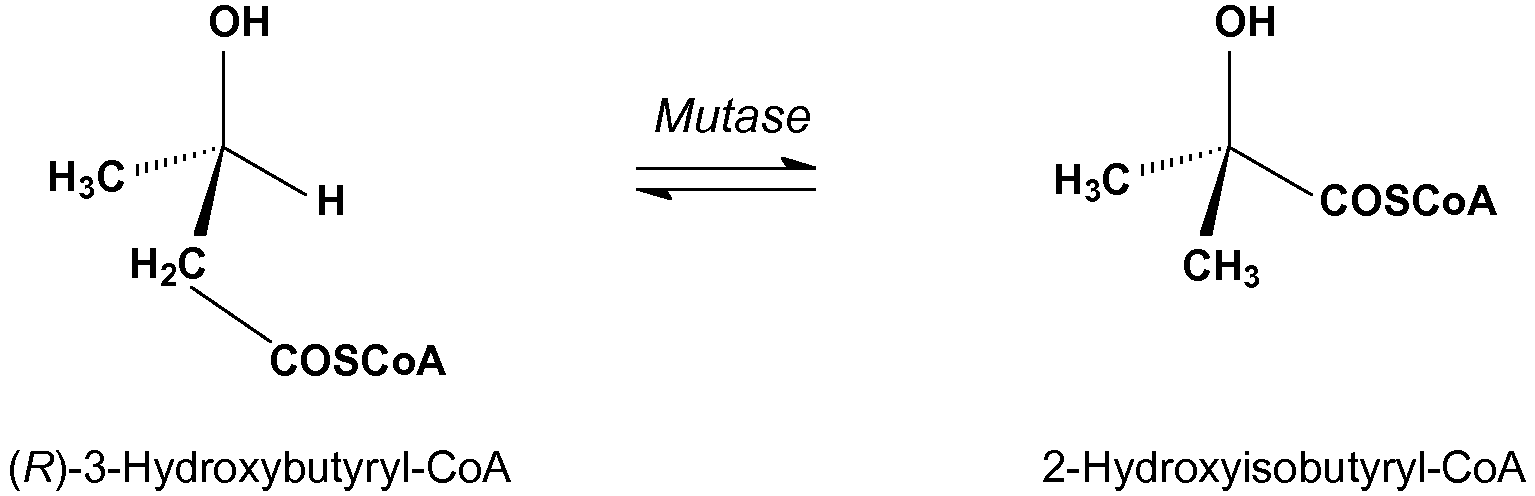
- Such enzymes as well as organisms expressing them are disclosed in international patent applications
PCT/EP2007/052830 PCT/EP2009/055089 PCT/EP2010/065151 SEQ ID NO 2 or a variant. - In a preferred embodiment, the "2-hydroxyisobutyryl-coenzyme A mutase" is heterologous and/or overexpressed in the bacterium, i.e. expressed such that its concentration inside the cell is higher than in the respective wild type cell. In a preferred embodiment, the 2-hydroxyisobutyryl-coenzyme A mutase is expressed inside the bacterium or such that its active centre is exposed to the inside of the bacterium.
- The term "2-hydroxyisobutyric acid", as any compound referred to throughout this application, includes, as used herein, not only to the protonated form, but also to any dissociated state or any salt of the compound, for example the sodium or potassium salts.
- The activity of the 2-hydroxyisobutyryl-coenzyme A mutase may be increased by coexpression of a chaperone instrumental in keeping the mutase in an active conformation. In a preferred embodiment, the knallgas bacterium or acetogenic bacterium expresses, in addition to a 2-hydroxyisobutyryl-coenzyme A mutase, a MeaB protein, preferably SEQ ID NO 3, or a variant thereof, in particular a fusion comprising a MeaB protein or a variant thereof and a 2-hydroxyisobutyryl-coenzyme A mutase or a variant thereof. Suitable MeaB proteins and fusion proteins comprising MeaB as well as variants thereof are disclosed in
PCT/EP2010/065151 - The teachings of the present invention may not only carried out using biological macromolecules having the exact amino acid or nucleic acid sequences referred to in this application explicitly, for example by name or accession number, or implicitly, but also using variants of such sequences. In a preferred embodiment, the term "variant", as used herein, comprises amino acid or nucleic acid sequences, respectively, that are 70, 75, 80, 85, 90, 92, 94, 95, 96, 97, 98 or 99 % identical to the reference amino acid or nucleic acid sequence, wherein preferably amino acids other than those essential for the function, for example the catalytic activity of a protein, or the fold or structure of a molecule are deleted, substituted or replaced by insertions or essential amino acids are replaced in a conservative manner. The state of the art comprises algorithms that may be used to align two given nucleic acid or amino acid sequences and to calculate the degree of identity, see Arthur Lesk (2008), Introduction to bioinformatics, 3rd edition, Thompson et al., Nucleic Acids Research 22, 4637-4680, 1994, and Katoh et al., Genome Information, 16(1), 22-33, 2005. The term "variant" is used synonymously and interchangeably with the term "homologue". Such variants may be prepared by introducing deletions, insertions or substitutions in amino acid or nucleic acid sequences as well as fusions comprising such macromolecules or variants thereof. In a preferred embodiment, the term "variant", with regard to amino acid sequence, comprises, preferably in addition to the above sequence identity, amino acid sequences that comprise one or more conservative amino acid changes with respect to the respective reference or wild type sequence or comprises nucleic acid sequences encoding amino acid sequences that comprise one or more conservative amino acid changes. In a preferred embodiment, the term "variant" of an amino acid sequence or nucleic acid sequence comprises, preferably in addition to the above degree of sequence identity, any active portion and/or fragment of the amino acid sequence or nucleic acid sequence, respectively, or any nucleic acid sequence encoding an active portion and/or fragment of an amino acid sequence. In a preferred embodiment, the term "active portion", as used herein, refers to an amino acid sequence or a nucleic acid sequence, which is less than the full length amino acid sequence or codes for less than the full length amino acid sequence, respectively, wherein the amino acid sequence or the amino acid sequence encoded, respectively retains at least some of its essential biological activity. For example an active portion and/or fragment of a protease is capable of hydrolysing peptide bonds in polypeptides. In a preferred embodiment, the term "retains at least some of its essential biological activity", as used herein, means that the amino acid sequence in question has a biological activity exceeding and distinct from the background activity and the kinetic parameters characterising said activity, more specifically kcat and KM, are preferably within 3, more preferably 2, most preferably one order of magnitude of the values displayed by the reference molecule with respect to a specific substrate. In a preferred embodiment, the term "variant" of a nucleic acid comprises nucleic acids the complementary strand of which hybridises, preferably under stringent conditions, to the reference or wild type nucleic acid. Stringency of hybridisation reactions is readily determinable by one of ordinary skilled in the art, and in generally is an empirical calculation dependent on probe length, washing temperature and salt concentration. In general longer probes require higher temperatures for proper annealing, while shorter probes need lower temperatures. Hybridisation generally depends on the ability of denatured DNA to reanneal to complementary strands are present in an environment below their melting temperature. The higher the degree of desired homology between the probe and hybridisable sequence, the higher the relative temperature which may be used. As a result it follows that higher relative temperatures would tend to make the reaction conditions more stringent, while lower temperature less so. For additional details and explanation of stringency of hybridisation reactions, see F. M. Ausubel (1995), Current Protocols in Molecular Biology. John Wiley & Sons, Inc.,. Moreover, the person skilled take in the art may follow the instructions given in the manual "The DIG System Users Guide for Filter Hybridization", Boehringer Mannheim GmbH, Mannheim, Germany, 1993 and in Liebl et al. (International Journal of Systematic Bacteriology 41: 255-260 (1991) on how to identify DNA sequences by means of hybridisation. In a preferred embodiment, stringent conditions are applied for any hybridisation, i.e. hybridisation occurs only if the probe is 70 % or more identical to the target sequence. Probes having a lower degree of identity with respect to the target sequence may hybridise, but such hybrids are unstable and will be removed in a washing step under stringent conditions, for example lowering the concentration of salt to 2 x SSC or, optionally and subsequently, to 0,5 x SSC, while the temperature is, in order of increasing preference, approximately 50°C - 68°C, approximately 52°C - 68°C, approximately 54°C - 68°C, approximately 56°C - 68°C, approximately 58°C - 68°C, approximately 60°C - 68°C, approximately 62°C - 68°C, approximately 64°C - 68°C, approximately 66°C - 68°C. In a particularly preferred embodiment, the temperature is approximately 64°C - 68°C or approximately 66°C - 68°C. It is possible to adjust the concentration of salt to 0.2 x SSC or even 0.1 x SSC. Polynucleotide fragments having a degree of identity with respect to the reference or wild type sequence of at least 70, 80, 90, 91, 92, 93, 94, 95, 96, 97, 98, 99 % may be isolated. In a preferred embodiment, the term "homologue" of a nucleic acid sequence, as used herein, refers to any nucleic acid sequence that encodes the same amino acid sequence as the reference nucleic acid sequence, in line with the degeneracy of the genetic code.
- In a preferred embodiment, the activities of 2-hydroxyisobutyryl-coenzyme A mutase, MeaB proteins, fusion proteins comprising MeaB or variants thereof may be increased relative the wild type cell from which they originate. Techniques that may be used to genetically modify bacterial cells are described in the prior art, for example in Sambrook et al. (Molecular Cloning - A Laboratory Manual (1989) Cold Spring Harbor Laboratory Press), as are methods for increasing the activity of an enzyme in a bacterial cell, for example by increasing expression of the gene encoding the enzyme having the activity of interest by way of chromosomal gene amplification (
WO 03/014330 WO 03/040373 - In a preferred embodiment, the acetogenic bacterium or Knallgas bacterium is capable of synthesizing 3-Hydroxybutyryl-Coenzym A. The latter compound may be formed in a reaction starting with acetyl-CoA catalysed by the combination of β-ketothiolase and acetoacetyl-CoA reductase. In a preferred embodiment, the term "β-ketothiolase", as used herein, refers to an enzyme capable of catalysing the conversion of two molecules acetyl-CoA to acetoacetyl-CoA and HS-CoA. An exemplary enzyme is the beta-ketothiolase from Ralstonia eutropha H16 (Accession number NC 008313.1). In a preferred embodiment, the term "acetoacetyl-CoA reductase", as used herein, refers to an enzyme capable of catalysing the conversion from acetoacetyl-CoA and NADPH as well as H+ to 3-Hydroxybutyryl-CoA and NADP+. An exemplary enzyme is the acetoacetyl-CoA reductase from Ralstonia eutropha H16 (Accession number NC 008313.1). A range of Knallgas bacteria and acetogenic bacteria, for example Ralstonia are capable of using this pathway using endogenous enzymes. Recombinant enzymes may be expressed in other strains such as E. coli to enable them to produce 3-Hydroxybutyryl-Coenzym A.
- Sought-after biotechnological products used to synthesise complex polymers include not only 2-hydroxyisobutyric acid, but also derivatives thereof, in particular alkyl esters such as methyl esters. In a preferred embodiment, the inventive bacterium expresses not only a 2-hydroxyisobutyryl-coenzyme A mutase, but also an enzyme capable of catalysing the esterification of 2-hydroxyisobutyryl-coenzyme A and/or 2-hydroxyisobutyric acid. In a preferred embodiment, the enzyme capable of catalysing the esterification of 2-hydroxyisobutyryl-coenzyme A and/or 2-hydroxyisobutyric acid is selected from the group comprising fatty acid O-methyltransferase (EC 2.1.1.15), Jasmonate O-methyltransferase (EC 2.1.1.141), Juvenile hormone O-methyltransferase (EC 2.1.1.-), Loganate O-methyltransferase (EC 2.1.1.50), alcohol O-acyltransferase (EC 2.3.1.75, EC 2.3.1.84), Acyl-CoA (Coenzyme A) thioesterase (EC 3.1.2.2, EC 3.1.2.18, EC 3.1.2.19, EC 3.1.2.20, EC 3.1.2.22) and Acyl-ACP (Acyl Carrier Protein) thioesterase (EC 3.1.2.14, EC 3.1.2.22). In a preferred embodiment, the term "fatty acid O-methyltransferase (EC 2.1.1.15)", as used herein, refers to an enzyme capable of catalyzing the reaction: S-adenosyl-L-methionine + a fatty acid = S-adenosyl-L-homocysteine + a fatty acid methyl ester. In another preferred embodiment, the term "jasmonate O-methyltransferase (EC 2.1.1.141)", as used herein, refers to an enzyme capable of catalyzing the main reaction: S-adenosyl-L-methionine + jasmonate = S-adenosyl-L-homocysteine + jasmonate methylester. IN another preferred embodiment, the term "juvenile hormone O-methyltransferase (EC 2.1.1.-)" as used herein, is an enzyme capable of catalyzing the reaction: S-adenosyl-L-methionine + juvenile hormone II acid = S-adenosyl-L-homocysteine + juvenile hormone II acid methylester. In a preferred embodiment, the term "loganate O-methyltransferase (EC 2.1.1.50)", as used herein, refers to an enzyme capable of catalyzing the reaction: S-adenosyl-L-methionine + loganate = S-adenosyl-L-homocysteine + loganate methylester. In a preferred embodiment, the term "alcohol O-acyltransferase" (EC 2.3.1.75, EC 2.3.1.84)", as used herein, catalyzing the reaction of an acyl-CoA thioester + alcohol = a fatty acid alkyl ester + CoA. In a preferred embodiment, the term "Acyl-CoA (Coenzyme A) thioesterase (EC 3.1.2.2, EC 3.1.2.18, EC 3.1.2.19, EC 3.1.2.20, EC 3.1.2.22)", as used herein, refers to an enzyme capable of catalyzing the reaction: acyl-CoA thioester + alcohol = a fatty acid alkyl ester + CoA. In a preferred embodiment, the term "Acyl-ACP (Acyl Carrier Protein) thioesterase (EC 3.1.2.14, EC 3.1.2.22))", as used herein, refers to an enzyme capable of catalyzing the reaction: acyl-ACP thioester + alcohol = a fatty acid alkyl ester + ACP.
- Such a bacterium may be used to carry out the inventive method. Accordingly, the inventive method may comprise an additional step
- b) alkylating, preferably methylating any 2-hydroxyisobutyric acid or 2-hydroxyisobutyryl-coenzyme A produced in step a).
- Rather than using a cell coexpressing an enzyme capable of catalysing the esterification of 2-hydroxyisobutyryl-coenzyme A and/or 2-hydroxyisobutyric acid, it may be advantageous to enrich or isolate any 2-hydroxyisobutyric acid or 2-hydroxyisobutyryl-coenzyme A produced in step a) and alkylating, preferably methylating it, for example by using synthetic approaches such as acid-catalysed esterification in the presence of methanol or by contacting the compound with an enzyme having methylating activity.
- The inventive method contemplates contacting the knallgas bacterium or acetogenic bacterium with a gas mixture comprising hydrogen and carbon dioxide, wherein the gas mixture comprises, in order of increasing preference, 10 to 80, 15 to 70, 20 to 60 and 25 to 50 % hydrogen and, in order of increasing preference 5 to 60, 10 to 45 and 15 to 30 % carbon dioxide, with the proviso that the sum of the volumes is no more than 100 %, preferably at atmospheric pressure.
- If the bacterium used to carry out is an aerotolerant bacterium, the gas mixture may comprise oxygen in addition to hydrogen and carbon dioxide. In a preferred embodiment, the gas mixture comprises, in order of increasing preference, up to 20, 15, 10, 5 or 1 % oxygen. In a preferred embodiment, the term "aerotolerant", as used herein, means that the bacterium of interest is capable of growing in the presence of up to 1, 5, 10, 15 or 20 % oxygen, in order of increasing preference, preferably at atmospheric pressure The person skilled in the art is able to readily determine whether or not a bacterium is aerotolerant, for example by growing that bacterium under a gas atmosphere comprising a defined amount of oxygen and monitoring whether any growth occurs as indicated, for example, by a change of optical density or light scattering of the medium used.
- The pressure of the gas mixture applied is, in a preferred embodiment, 0.5 to 10 bars, more preferably 0.8 to 8, even more preferably 1.5 to 6 bar. In another preferred embodiment, the pressure is more than 1, 1.5, 2, 3, 4, 5, 6, 7, 8, 9, 10 bar. In a preferred embodiment, the pressure applied exceeds atmospheric pressure. In a preferred embodiment, the hydrogen partial pressure is 0.1 to 100 bar, more preferably 0.2 to 10 bar, most preferably 0.5 to 4 bar. In a preferred embodiment, the carbon dioxide partial pressure is 0.03 to 100 bar, more preferably 0,05 to 1 bar, most preferably 0.05 to 0.3 bar. In a preferred embodiment, the oxygen partial pressure is 0.03 to 10 bar, more preferably 0.04 to 1 bar, most preferably 0.04 to 0.5 bar. In a preferred embodiment, the total combined pressure is 1 to 200 bar, preferably 1 to 10 bar, most preferably 1 to 5 bar.
- In a preferred embodiment, the knallgas bacterium or acetogenic bacterium has a reduced fatty acid degradation capacity. In a preferred embodiment, the term "having a reduced fatty acid degradation capacity", as used in herein, means that the respective microorganism degrades fatty acids, preferably those taken up from the environment, at a lower rate than a comparable microorganism having normal fatty acid degradation capacity would. In a preferred embodiment, the fatty acid degradation of such a microorganism is lower on account of deletion, inhibition or inactivation of at least one gene encoding an enzyme involved in the β-oxidation pathway. In a preferred embodiment of the present invention, at least one enzyme involved in the β-oxidation pathway has lost, in order of increasing preference, 5, 10, 20, 40, 50, 75, 90 or 99 % activity relative to the activity of the same enzyme under comparable conditions in the respective wild type microorganism. The person skilled in the art is familiar with various techniques that may be used to delete a gene encoding an enzyme or reduce the activity of such an enzyme in a microorganism, for example by exposition of cells to radioactivity followed by accumulation or screening of the resulting mutants, site-directed introduction of point mutations or knock out of a chromosomally integrated gene encoding for an active enzyme, as described in Sambrook/Fritsch/Maniatis (1989). In addition, the transcriptional repressor FadR may be over expressed to the effect that expression of enzymes involved in the β-oxidation pathway is repressed (Y Fujita, H Matsuoka, and K Hirooka (2007) Mol. Microbiology 66(4), 829-839). In a preferred embodiment, the term "deletion of a gene", as used herein, means that the nucleic acid sequence encoding said gene is modified such that the expression of active polypeptide encoded by said gene is reduced. For example, the gene may be deleted by removing in-frame a part of the sequence comprising the sequence encoding for the catalytic active centre of the polypeptide. Alternatively, the ribosome binding site may be altered such that the ribosomes no longer translate the corresponding RNA. Moreover, the person skilled in the art is able to routinely measure the activity of enzymes expressed by living cells using standard essays as described in enzymology text books, for example A Cornish-Bowden (1995), Fundamentals of Enzym Kinetics, Portland Press Limited, 1995. The state of the art discloses various tests designed specifically for determining the activity of enzymes involved in the β-oxidation pathway, for example K Kameda & W D Nunn (1981) J. Biol. Chem. 256, 5702-5707, H Marrakchi, W E DeWolf, C Quinn, J West, B J Polizzi, C Y So et al. (2003) Biochem. J. 370, 1055-1062, S Lobo, G Florova, and K A Reynolds (2001) Biochemistry 40 (39), 11955-64, X Yu, T Liu, F Zhu, and C Khosla (2011) PNAS, published online ).
- According to the inventive method, the acetogenic bacterium or knallgas bacterium is contacted with the gas mixture in an aqueous medium. In a preferred embodiment, the term "aqueous medium" comprises any aqueous solution that comprises the amount of salts and buffers necessary to grow or sustain an acetogenic bacterial cell and to sustain acetogenesis. For example, an aqueous medium according to Hurst, K. M., and Lewis, R. (2010), Biochemical Engineering Journal 2010, 48, 159-165 may be used to carry out the inventive teachings.
- The temperature in steps a) and b) needs to be chosen bearing in mind the needs of the acetogenic bacterium or knallgas bacterium on the one hand and thermodynamic parameters on the other hand. The state of the art teaches ranges of temperatures as well as optimum temperatures for a vast range of acetogenic bacteria. For example, Clostridium thermoaceticum may be incubated at temperatures of up to 60 °C. See also standard textbooks of microbiology for temperatures that may be used to grow acetogenic bacterial and archaeal cells, for example Dworkin et al. (2006) The Prokaryotes - A Handbook on the Biology of Bacteria, . In a preferred embodiment, the temperature applied in step a) is, in order of increasing preference, 0 to 100 °C, 10 to 80 °C, 20 to 60 °C, 30 to 45 °C or 35 to 42 °C. In another preferred embodiment, the temperature applied in step a) is 37 °C or more.
- The invention is further illustrated by the following figures and non-limiting examples from which further features, embodiments, aspects and advantages of the present invention may be taken.
-
Fig. 1 shows calculated data for hydrogen conversion efficiency out of biomass concentrations of 0-60 g/L and 2-HIB product concentrations of 0-100 g/L. -
Fig. 2 shows experimental data obtained when carrying out Example 1, more specifically the growth phase (0-60 h) and product synthesis phase (60 h-160 h) with • biomass in g/L ☆ 2-HIB in g/L and pH. - Cupriavidus necator H16 PHB-4 [47] DSM 541 was obtained from the DSMZ (Leibniz-Institut DSMZ - Deutsche Sammlung von Mikroorganismen und Zellkulturen GmbH, Braunschweig, Germany) and modified by introducing the plasmid pBBR1MCS-2::HCM (Reinecke L, Schaffer S, Marx A, Pötter M, Haas T (2009) Recombinant cell producing 2-hydroxyisobutyric acid.
WO/2009/156214 ), which originates from broad host range cloning vector pBBR1MCS (Kovach ME, Elzer PH, Hill DS, Robertson GT, Farris MA, Roop RM, Peterson KM (1995) Four new derivatives of the broad-host-range cloning vector pBBR1MCS, carrying different antibiotic-resistance cassettes. Gene 166(1):175-6).. The plasmid contains the genes hcmA and hcmB coding for the two subunits of the 2-hydroxy-isobutyryl-coenzyme A mutase from Aquincola tertiaricarbonis (Yaneva N, Schuster J, Schäfer F, Lede V, Przybylski D, Paproth T, Harms H, Müller RH, Rohwerder T (2012) A bacterial acyl-CoA mutase specifically catalyzes coenzyme B12-dependent isomerization of 2-hydroxyisobutyryl-CoA and (S)-3-hydroxybutyryl-CoA. J Biol Chem. doi:10.1074/jbc.M111.314690). - General cultivation was done in Luria Bertani broth (Miller) at 30 °C and the strain was stored on LB-agar plates at 4°C. For batch and continuous cultivations a mineral salt medium was used as described by Schlegel and co-authors (Schlegel HG, Kaltwasser H, Gottschalk G (1961) Ein Submersverfahren zur Kultur wasserstoffoxydierender Bakterien: Wachstumsphysiologische Untersuchungen. Arch Microbiol 38(3):209-222) supplied with kanamycin. Cultivations were carried out in lab-scale with shaking flasks containing 0.6 L working volume at 22 °C. Agitation was set to 200 rpm and aeration was kept constant at 5 L/h.
- Pre-cultures were prepared from single colonies at 30 °C and 150 rpm in 200 mL of the same medium but fructose as sole carbon source substrate and under aerobic conditions. After fructose exhaustion the culture was shifted to hydrogen and carbon dioxide and cultivation continued under batch conditions. The two gases in addition to oxygen were supplied from a storage tank of 18 L treated according to the gasometer principle. The initial gas concentrations were about 25-50 % H2, 15-30% CO2 and 10-20 % 02. Gases were offered to the culture via a hollow fiber module (Fresenius, St. Wendel, Germany) by a membrane pump at rate of 750 L/h. Hollow fibers had a pore width of 0.2 µm and a specific exchange area of 0.7 m2. The external volume of the hollow fiber module was flushed with the bacterial suspension at a rate of 750 L/h, fed with a gear pump. After passage through the module, gases and suspension were carried in a flask equipped with a stirrer. Gases were re-circulated to the gas tank and mixed with the residing gases by a propeller by means of a magnet-coupled motor installed outside of the tank. Consumption of gases was monitored in terms of total volume registering the horizontal movement of the gas tank and in terms of concentration by three specific sensors. Furthermore, gas consumption was calculated from the differential changes of total gas and individual gas concentrations. If required specific gases were refilled to the gas tank. As there was no automated pH control in this simplified cultivation system, pH was monitored off-line and adjusted to pH 7.5 by adding required volumes of 10 % NaOH according to a titration curve based on the growth medium.
- Gas concentrations were measured by specific sensors for hydrogen (0-100 %), oxygen (0-50 %) and carbon dioxide (0-50 %) (BlueSens, Herten, Germany) and their concentrations continuously monitored. Tubing of the cultivation system was arranged in a way that allowed measuring the gases from inflow as well as outflow.
- Biomass concentration was determined by optical density at 700 nm and gravimetrically in quadruplicate after oven-drying at 105 °C. Substrate consumption and 2-HIB synthesis were analyzed by isocratic HPLC (Shimadzu) on a Nucleogel Ion 3000A column (300mm×7.8mm, Macherey-Nagel GmbH & Co. KG, Düren, Germany) at 70 °C with 0.6 mL/min 0.01 N H2SO4 as eluant.
- 3-phosphoglycerate (PGA) was defined as the central carbon precursor [51, 52] from which the complete biomass synthesis was derived. The molar composition of biomass in the model was taken as C4H8O2N. It is synthesized from ATP as the general energy carrier and proceeds with an efficiency of 10.5 g dry mass pro mol ATP (Stouthamer AH (1973) A theoretical study on the amount of ATP required for synthesis of microbial cell material. Antonie Van Leeuwenhoek 39(3):545-65). The overall balance equation for biomass synthesis from PGA is accordingly:

- To define possible product yields in a growth associated process we implied a stoichiometric model. Knallgas bacteria like C. necator use the Calvin cycle to assimilate carbon and the enzyme hydrogenase to gain NAD(P)H + H+ from hydrogen as substrate for oxidative phosphorylation via the respiratory chain as well as source for carbon dioxide reduction. Therefore, the overall balance equation for biomass synthesis via PGA including energy generation from H2 oxidation at P/O = 2 results in

- With respect to growth this corresponds to a carbon conversion efficiency of CCE of 1 Cmol incorporated per Cmol supplied and a HCE (hydrogen conversion efficiency) of 0.214 Hmol assimilated per Hmol consumed. Synthesis of 2-HIB (C4H8O3) as desired product via the Calvin cycle with PGA and pyruvate as intermediates results in acetyl-CoA (AcCoA) according to

- The ATP required for CO2 fixation is obtained from hydrogen oxidation via the respiratory chain; accordingly eq. 3a is extended to

- The CCE is again 1 Cmol/Cmol, whereas the theoretical HCE is 0.25 Hmol/Hmol (eq. 3b). Combining biomass synthesis and product formation to an integral process, the interdependency between both processes defining the final HCE with respect to product is shown in
Figure 1 . We took into account two ranges of biomass concentration extending from 0 to 10 g/L and from 10 to 60 g/L to consider a wide spectrum of variables. Obviously, biomass synthesis is very costly (eq. 2). It is apparent that the overall process approaches a value of 0.2 to 0.25 Hmol/Hmol when the biomass concentration is below 10 g/L and the product concentration moves towards 100 g/L (Figure 1 ). Both, the increase in biomass and the reduction of product concentration, drastically decrease the HCE. - We used the strain C. necator H16 PHB-4 (Schlegel HG, Lafferty R, Krauss I (1970) The isolation of mutants not accumulating poly-β-hydroxybutyric acid. Arch Microbiol 71(3):283-294), which is deficient in PHB synthesis due to knock-out of the PHB polymerase gene. This allowed this strain to synthesize metabolites up to 3-HB-CoA under conditions of overflow metabolism. Cloning and expressing the 2-HIB-CoA mutase from A. tertiaricarbonis established the alternative/additional route for our desired dead-end product, 2-HIB. To proof the capacity of the chosen system for 2-HIB synthesis the strain, pre-grown on fructose, was used to inoculate the cultivation apparatus. A gas stream containing 25-50 % H2, 15-30 % CO2 and 10-20 % O2 was supplied as growth substrate therefore resulting in the induction of the enzymes required for chemo-litho-autotrophic growth, especially hydrogenases (Lenz O, Schwartz E, Dernedde J, Eitinger M, Friedrich B (1994) The Alcaligenes eutrophus H16 hoxX gene participates in hydrogenase regulation. J Bacteriol 176(14):4385-93; Burgdorf T, Lenz O, Buhrke T, van der Linden E, Jones AK, Albracht SP, Friedrich B (2005) [NiFe]-hydrogenases of Ralstonia eutropha H16: modular enzymes for oxygen-tolerant biological hydrogen oxidation. J Mol Microbiol Biotechnol 10(2-4):181-96) and for carbon dioxide fixation (Husemann M, Klintworth R, Büttcher V, Salnikow J, Weissenborn C, Bowien B (1988) Chromosomally and plasmid-encoded gene clusters for CO2 fixation (cfx genes) in Alcaligenes eutrophus. Mol Gen Genet MGG 214(1):112-120)). Under these conditions growth preceded at a rate of about 0.058/h until the nitrogen source was exhausted, attaining a final biomass concentration of approx. 2.0 g/L (
Figure 2 ). During exponential growth carbon dioxide was incorporated into biomass with a CCE = 0.58 Cmol/Cmol. Hydrogen conversion yielded an HCE of 0.0715 Hmol/Hmol. It should be noted that the theoretical maximum possible value of HCE with 0.214 Hmol/Hmol can not be attained due to requirements of energy (H2) necessary for maintenance purposes. Larger deviations from the theoretical values might be caused by the synthesis of products other than biomass, such as pyruvate. More detailed analyses, however, were not undertaken at this stage of investigation. - During biomass growth 2-HIB was found of only at low concentration. After exhaustion of the nitrogen source, however, there was a steep increase in external 2-HIB concentration (
Figure 2 ). The synthesis rate corresponded to 8.35 mg 2-HIB/(g dry mass h). This rate was stable up to a concentration of approx. 410 mg/L. Subsequently the product synthesis rate suddenly ceased which was likewise observed in repeated experiments. The abrupt shift indicated a distinct limitation/disturbance not obvious from the experimental setup but requiring further optimization. The amount of gases consumed per increment of 2-HIB was used to calculate the yield coefficients. The data was corrected for unspecific loss of gases determined by running experiments in the absence of biomass. The remaining was incorporated into 2-HIB with a CCE of 0.178 Cmol/Cmol. Hydrogen as second substrate was converted into this product with a HCE of 0.032 Hmol/Hmol. Noticeably, this is far from the above stated limit values. - The deficit in the balance of substrates can likely be explained by the putative synthesis of products other than 2-HIB. Taking into account the reduction of CO2 by hydrogen to yield the first intermediate of carbon fixation in the Calvin cycle, glyceraldehyde-3-phosphate (GAP, C3H6O3, phosphate-free sum formula), the CO2 available due to the present consumption characteristic will allow the synthesis of 0.57 mmol GAP per hour in the linear phase of 2-HIB formation. This in turn requires 5.16 mmol H2/h based on

- Due to the hydrogen balance 5.71 mmol H2 remain available after 2-HIB synthesis which could satisfy the putative product synthesis. Moreover, some hydrogen further remains available for maintenance purposes which are inevitably necessary in living cells. Taking into account the specific maintenance coefficient determined formerly for Ralstonia eutropha (C. necator) JMP 134 on fructose of ms = 0.09 mmol/(g dry mass h) [57] and converting this substrate-based coefficient into an energy (ATP)-based value (P/O=2) which would be equivalent to me = 2.34 mmol ATP/(g dry mass h) the hydrogen remaining after 2-HIB synthesis and putative other reduced products would be sufficient to generate 2.8 mmol ATP/(g dry mass h). This is in pretty coincidence with former results to this species.


Claims (17)
- A knallgas bacterium or acetogenic bacterium expressing a 2-hydroxyisobutyryl-coenzyme A mutase.
- The knallgas bacterium or acetogenic bacterium according to claim 1, wherein the bacterium is genetically modified such that it has, compared to the respective wild type strain, a reduced capacity to synthesise polyhydroxybutyrate.
- The knallgas bacterium or acetogenic bacterium according to claim 2, wherein the bacterium has a polyhydroxybutyrate synthase gene knockout.
- The knallgas bacterium or acetogenic bacterium according to any of claims 1 to 3, wherein the bacterium is incapable of synthesising polyhydroxybutyrate.
- The knallgas bacterium or acetogenic bacterium according to any of claims 1 to 4, wherein the bacterium is a knallgas bacterium selected from the group comprising Methanobacterium, Acetobacterium, Desulfovibrio, Desulfomonas, Paracoccus, Achromobacter, Alcaligenes, Pseudomonas, Nocardia and Cupriavidus, and is preferably a Cupriavidus strain, most preferably Cupriavidus necator H16, or an acetogenic bacterium selected from the group comprising Clostridium, Moorella and Acetoanaerobium, Acetobacterium, Archaeoglobus, Butyribacterium, Carboxydibrachium, Carboxydocella, Carboxydothermus, Citrobacter, Desulfotomaculum, Eubacterium, Methanosarcina, Methanothermobacter, Oxobacter Peptostreptococcus, Rhodopseudomonas, Rhodospirillum, Rubrivivax, Thermincola, Thermococcus, Thermolithobacter, Thermoanaerobacter and Thermosyntrophicum.
- The knallgas bacterium or acetogenic bacterium according to any of claims 1 to 5, wherein the bacterium expresses thea nucleic acid comprising SEQ ID NO 1 or a variant thereof or a polypeptide encoded by said nucleic acid or a variant of said polypeptide and expresses a nucleic acid comprising SEQ ID NO 2 or a variant thereof or a polypeptide encoded by the latter nucleic acid or a variant of the latter polypeptide.
- The knallgas bacterium or acetogenic bacterium according to any of claims 1 to 6, wherein the bacterium expresses, in addition to a 2-hydroxyisobutyryl-coenzyme A mutase, a MeaB protein or a variant thereof, preferably the polypeptide encoded by SEQ ID NO 3 or a variant thereof.
- The knallgas bacterium or acetogenic bacterium according to any of claims 1 to 7, wherein the bacterium is capable of synthesizing 3-Hydroxybutyryl-Coenzym A.
- The knallgas bacterium or acetogenic bacterium according to any of claims 1 to 8, wherein the bacterium expresses a β-ketothiolase and an acetoacetyl-CoA reductase.
- A method for the production of 2-hydroxyisobutyric acid, comprisingc) contacting in an aqueous medium the knallgas bacterium or acetogenic bacterium according to any of claims 1 to 9 with a gas mixture comprising hydrogen and carbon dioxide.
- The method according to claim 10, wherein the hydrogen partial pressure in the gas mixture is 0.1 to 100 bar, more preferably 0.2 to 10 bar, most preferably 0.5 to 4 bar and the carbon dioxide partial pressure is 0.03 to 100 bar, more preferably 0,05 to 1 bar, most preferably 0.05 to 0.3 bar.
- The method according to any of claims 10 to 11, wherein the bacterium tolerates the presence of oxygen and aqueous solution is aerobic.
- The method according to any of claims 10 to 12, wherein the bacterium tolerates the presence of oxygen and the gas mixture comprises oxygen in addition to hydrogen and carbon dioxide, and the oxygen partial pressure in the gas mixture is preferably 0.03 to 10 bar, more preferably 0.04 to 1 bar, most preferably 0.04 to 0.5 bar.
- The method according to any of claims 10 to 13, wherein the aqueous medium does not comprise carbohydrates or, preferably, any carbon source other than carbon dioxide.
- The method according to any of claims 10 to 14, wherein step a) is carried out in the absence of a growth-limiting nutrient other than a carbon.
- The method according to any of claims 10 to 15, wherein step a) is carried out at 20 to 37 °C, more preferably 25 to 35 °C, most preferably at 28 to 32 °C.
- A use of the knallgas bacterium or acetogenic bacterium according to any of claims 1 to 9 for the production of 2-hydroxyisobutyric acid.
Priority Applications (10)
| Application Number | Priority Date | Filing Date | Title |
|---|---|---|---|
| EP20120173010 EP2674489A1 (en) | 2012-06-15 | 2012-06-21 | Biotechnological 2-hydroxyisobutyric acid production |
| MX2014015285A MX2014015285A (en) | 2012-06-15 | 2013-06-14 | Biotechnological 2-hydroxyisobutyric acid production. |
| CN201380031378.1A CN104364373A (en) | 2012-06-15 | 2013-06-14 | Biotechnological 2-hydroxyisobutyric acid production |
| BR112014030760A BR112014030760A2 (en) | 2012-06-15 | 2013-06-14 | biotechnological production of 2-hydroxy isobutyric acid |
| EP13728753.8A EP2861730A1 (en) | 2012-06-15 | 2013-06-14 | Biotechnological 2-hydroxyisobutyric acid production |
| PCT/EP2013/062336 WO2013186340A1 (en) | 2012-06-15 | 2013-06-14 | Biotechnological 2-hydroxyisobutyric acid production |
| KR1020147034928A KR20150018813A (en) | 2012-06-15 | 2013-06-14 | Biotechnological 2-hydroxyisobutyric acid production |
| US14/405,050 US20150267231A1 (en) | 2012-06-15 | 2013-06-14 | Biotechnological 2-hydroxyisobutyric acid production |
| CA2875453A CA2875453A1 (en) | 2012-06-15 | 2013-06-14 | Biotechnological 2-hydroxyisobutyric acid production |
| RU2015100279A RU2015100279A (en) | 2012-06-15 | 2013-06-14 | BIOTECHNICAL METHOD FOR PRODUCING 2-HYDROXYI-BASIC ACID |
Applications Claiming Priority (2)
| Application Number | Priority Date | Filing Date | Title |
|---|---|---|---|
| EP12172192 | 2012-06-15 | ||
| EP20120173010 EP2674489A1 (en) | 2012-06-15 | 2012-06-21 | Biotechnological 2-hydroxyisobutyric acid production |
Publications (1)
| Publication Number | Publication Date |
|---|---|
| EP2674489A1 true EP2674489A1 (en) | 2013-12-18 |
Family
ID=46354049
Family Applications (2)
| Application Number | Title | Priority Date | Filing Date |
|---|---|---|---|
| EP20120173010 Withdrawn EP2674489A1 (en) | 2012-06-15 | 2012-06-21 | Biotechnological 2-hydroxyisobutyric acid production |
| EP13728753.8A Withdrawn EP2861730A1 (en) | 2012-06-15 | 2013-06-14 | Biotechnological 2-hydroxyisobutyric acid production |
Family Applications After (1)
| Application Number | Title | Priority Date | Filing Date |
|---|---|---|---|
| EP13728753.8A Withdrawn EP2861730A1 (en) | 2012-06-15 | 2013-06-14 | Biotechnological 2-hydroxyisobutyric acid production |
Country Status (9)
| Country | Link |
|---|---|
| US (1) | US20150267231A1 (en) |
| EP (2) | EP2674489A1 (en) |
| KR (1) | KR20150018813A (en) |
| CN (1) | CN104364373A (en) |
| BR (1) | BR112014030760A2 (en) |
| CA (1) | CA2875453A1 (en) |
| MX (1) | MX2014015285A (en) |
| RU (1) | RU2015100279A (en) |
| WO (1) | WO2013186340A1 (en) |
Cited By (1)
| Publication number | Priority date | Publication date | Assignee | Title |
|---|---|---|---|---|
| CN109868231A (en) * | 2017-12-01 | 2019-06-11 | 中国科学院烟台海岸带研究所 | A kind of greedy copper bacterium (Cupriavidus) and its application |
Families Citing this family (24)
| Publication number | Priority date | Publication date | Assignee | Title |
|---|---|---|---|---|
| EP2602328A1 (en) * | 2011-12-05 | 2013-06-12 | Evonik Industries AG | Method of Oxidation of alkanes employing an AlkB alkane 1-monooxygenase |
| EP2631298A1 (en) | 2012-02-22 | 2013-08-28 | Evonik Industries AG | Biotechnological method for producing butanol and butyric acid |
| EP2647696A1 (en) | 2012-04-02 | 2013-10-09 | Evonik Degussa GmbH | Method for aerobic production of alanine or a compound arising using alanine |
| DE102012207921A1 (en) | 2012-05-11 | 2013-11-14 | Evonik Industries Ag | Multi-stage synthesis process with synthesis gas |
| EP2759598A1 (en) | 2013-01-24 | 2014-07-30 | Evonik Industries AG | Process for preparing alpha, omega alkanediols |
| EP2944697A1 (en) | 2014-05-13 | 2015-11-18 | Evonik Degussa GmbH | Method of producing nylon |
| EP3020819A1 (en) * | 2014-11-17 | 2016-05-18 | Evonik Degussa GmbH | Fatty acid and derivatives production |
| CA2937594A1 (en) | 2015-02-26 | 2016-08-26 | Evonik Degussa Gmbh | Alkene production |
| WO2017102952A1 (en) | 2015-12-17 | 2017-06-22 | Evonik Degussa Gmbh | A genetically modified acetogenic cell |
| US10731185B2 (en) | 2016-03-22 | 2020-08-04 | University Of Georgia Research Foundation, Inc. | Genetically engineered microbes and methods for producing citramalate |
| EP3490969B1 (en) | 2016-07-27 | 2020-07-22 | Evonik Operations GmbH | N-acetyl homoserine |
| EP3339387B1 (en) | 2016-12-22 | 2020-06-24 | Evonik Operations GmbH | Compounds based on of adducts with isocyanates for coating compositions |
| WO2019152753A1 (en) * | 2018-02-01 | 2019-08-08 | Invista Textiles (U.K.) Limited | Methods and materials for the biosynthesis of beta hydroxy fatty acid anions and/or derivatives thereof and/or compounds related thereto |
| US12338428B2 (en) | 2018-03-30 | 2025-06-24 | Inv Nylon Chemicals Americas, Llc | Materials and methods for managing aerobic gas fermentation |
| US10975363B2 (en) | 2018-03-30 | 2021-04-13 | Inv Nylon Chemicals Americas, Llc | Materials and methods for biosynthetic manufacture and utilization of synthetic polypeptides, and products therefrom |
| WO2019191763A1 (en) | 2018-03-30 | 2019-10-03 | Invista North America S.A.R.L. | Methods for controlling oxygen concentration during aerobic biosynthesis |
| WO2019191772A1 (en) | 2018-03-30 | 2019-10-03 | Invista North America S.A.R.L | Materials and methods for biosynthetic manufacture of carbon-based chemicals |
| US12065636B2 (en) | 2018-03-30 | 2024-08-20 | Inv Nylon Chemicals Americas, Llc | High hydrogen utilization and gas recycle |
| WO2019213033A1 (en) | 2018-05-02 | 2019-11-07 | Invista North America S.A.R.L. | Materials and methods for maximizing biosynthesis through alteration of pyruvate-acetyl-coa-tca balance in species of the genera ralstonia and cupriavidus and organisms related thereto |
| US11702680B2 (en) | 2018-05-02 | 2023-07-18 | Inv Nylon Chemicals Americas, Llc | Materials and methods for controlling PHA biosynthesis in PHA-generating species of the genera Ralstonia or Cupriavidus and organisms related thereto |
| WO2019213019A1 (en) | 2018-05-02 | 2019-11-07 | Invista North America S.A.R.L. | Materials and methods for differential biosynthesis in species of the genera ralstonia and cupriavidus and organisms related thereto |
| WO2019213028A1 (en) | 2018-05-02 | 2019-11-07 | Invista North America S.A.R.L. | Materials and methods for controlling regulation in biosynthesis in species of the genera ralstonia or cupriavidus and organisms related thereto |
| EP3788135A1 (en) | 2018-05-02 | 2021-03-10 | INVISTA Textiles (U.K.) Limited | Materials and methods for controlling oxidation and reduction in biosynthetic pathways of species of the genera ralstonia and cupriavidus and organisms related thereto |
| FI129574B (en) * | 2021-04-28 | 2022-05-13 | Solar Foods Oy | Variants of bacterial strains and processes for the production of protein or biomass |
Citations (7)
| Publication number | Priority date | Publication date | Assignee | Title |
|---|---|---|---|---|
| WO2003014330A2 (en) | 2001-08-06 | 2003-02-20 | Degussa Ag | Coryneform bacteria which produce chemical compounds ii |
| WO2003040373A2 (en) | 2001-08-06 | 2003-05-15 | Degussa Ag | Production of l-lysine by genetically modified corynebacterium glutamicum strains |
| WO2007110394A2 (en) * | 2006-03-24 | 2007-10-04 | Evonik Röhm Gmbh | Method for the enzymatic production of 2-hydroxy-2-methyl carboxylic acids |
| WO2009135074A2 (en) * | 2008-05-01 | 2009-11-05 | Genomatica, Inc. | Microorganisms for the production of methacrylic acid |
| WO2009156214A1 (en) | 2008-06-27 | 2009-12-30 | Evonik Röhm Gmbh | Recombinant cell producing 2-hydroxyisobutyric acid |
| WO2010022763A1 (en) * | 2008-08-25 | 2010-03-04 | Metabolic Explorer | Method for the preparation of 2-hydroxy-isobutyrate |
| WO2011057871A2 (en) * | 2009-11-11 | 2011-05-19 | Evonik Röhm Gmbh | Use of a protein homologous to a meab protein for increasing the enzymatic activity of a 3-hydroxycarboxylic acid-coa mutase |
-
2012
- 2012-06-21 EP EP20120173010 patent/EP2674489A1/en not_active Withdrawn
-
2013
- 2013-06-14 CN CN201380031378.1A patent/CN104364373A/en active Pending
- 2013-06-14 KR KR1020147034928A patent/KR20150018813A/en not_active Withdrawn
- 2013-06-14 US US14/405,050 patent/US20150267231A1/en not_active Abandoned
- 2013-06-14 BR BR112014030760A patent/BR112014030760A2/en not_active IP Right Cessation
- 2013-06-14 MX MX2014015285A patent/MX2014015285A/en unknown
- 2013-06-14 RU RU2015100279A patent/RU2015100279A/en not_active Application Discontinuation
- 2013-06-14 WO PCT/EP2013/062336 patent/WO2013186340A1/en not_active Ceased
- 2013-06-14 EP EP13728753.8A patent/EP2861730A1/en not_active Withdrawn
- 2013-06-14 CA CA2875453A patent/CA2875453A1/en not_active Abandoned
Patent Citations (7)
| Publication number | Priority date | Publication date | Assignee | Title |
|---|---|---|---|---|
| WO2003014330A2 (en) | 2001-08-06 | 2003-02-20 | Degussa Ag | Coryneform bacteria which produce chemical compounds ii |
| WO2003040373A2 (en) | 2001-08-06 | 2003-05-15 | Degussa Ag | Production of l-lysine by genetically modified corynebacterium glutamicum strains |
| WO2007110394A2 (en) * | 2006-03-24 | 2007-10-04 | Evonik Röhm Gmbh | Method for the enzymatic production of 2-hydroxy-2-methyl carboxylic acids |
| WO2009135074A2 (en) * | 2008-05-01 | 2009-11-05 | Genomatica, Inc. | Microorganisms for the production of methacrylic acid |
| WO2009156214A1 (en) | 2008-06-27 | 2009-12-30 | Evonik Röhm Gmbh | Recombinant cell producing 2-hydroxyisobutyric acid |
| WO2010022763A1 (en) * | 2008-08-25 | 2010-03-04 | Metabolic Explorer | Method for the preparation of 2-hydroxy-isobutyrate |
| WO2011057871A2 (en) * | 2009-11-11 | 2011-05-19 | Evonik Röhm Gmbh | Use of a protein homologous to a meab protein for increasing the enzymatic activity of a 3-hydroxycarboxylic acid-coa mutase |
Non-Patent Citations (26)
| Title |
|---|
| "The DIG System Users Guide for Filter Hybridization", 1993, BOEHRINGER MANNHEIM GMBH |
| A CORNISH-BOWDEN: "Fundamentals of Enzym Kinetics", 1995, PORTLAND PRESS LIMITED |
| ARTHUR LESK: "Introduction to bioinformatics", 2008 |
| BURGDORF T; LENZ 0; BUHRKE T; VAN DER LINDEN E; JONES AK; ALBRACHT SP; FRIEDRICH B: "NiFe]-hydrogenases of Ralstonia eutropha H16 modular enzymes for oxygen- tolerant biological hydrogen oxidation.", J MOL MICROBIOL BIOTECHNOL, vol. 10, no. 2-4, 2005, pages 181 - 96, XP009109362, DOI: doi:10.1159/000091564 |
| DWORKIN ET AL.: "The Prokaryotes - A Handbook on the Biology of Bacteria", vol. 2, 2006 |
| F. M. AUSUBEL: "Current Protocols in Molecular Biology", 1995, JOHN WILEY & SONS, INC. |
| H MARRAKCHI; W E DEWOLF; C QUINN; J WEST; B J POLIZZI; C Y SO ET AL., BIOCHEM. J., vol. 370, 2003, pages 1055 - 1062 |
| HURST, K. M.; LEWIS, R., BIOCHEMICAL ENGINEERING JOURNAL, vol. 48, 2010, pages 159 - 165 |
| HUSEMANN M; KLINTWORTH R; BÜTTCHER V; SALNIKOW J; WEISSENBORN C; BOWIEN B: "Chromosomally and plasmid-encoded gene clusters for C02 fixation (cfx genes) in Alcaligenes eutrophus", MOL GEN GENET MGG, vol. 214, no. 1, 1988, pages 112 - 120 |
| K KAMEDA; W D NUNN, J. BIOL. CHEM., vol. 256, 1981, pages 5702 - 5707 |
| KATOH ET AL., GENOME INFORMATION, vol. 16, no. 1, 2005, pages 22 - 33 |
| KOVACH ME; ELZER PH; HILL DS; ROBERTSON GT; FARRIS MA; ROOP RM; PETERSON KM: "Four new derivatives of the broad-host-range cloning vector pBBR1 MCS, carrying different antibiotic-resistance cassettes", GENE, vol. 166, no. 1, 1995, pages 175 - 6, XP004043131, DOI: doi:10.1016/0378-1119(95)00584-1 |
| LENZ 0; SCHWARTZ E; DERNEDDE J; EITINGER M; FRIEDRICH B: "The Alcaligenes eutrophus H16 hoxX gene participates in hydrogenase regulation", J BACTERIOL, vol. 176, no. 14, 1994, pages 4385 - 93 |
| LIEBL ET AL., INTERNATIONAL JOURNAL OF SYSTEMATIC BACTERIOLOGY, vol. 41, 1991, pages 255 - 260 |
| N. YANEVA ET AL: "Bacterial Acyl-CoA Mutase Specifically Catalyzes Coenzyme B12-dependent Isomerization of 2-Hydroxyisobutyryl-CoA and (S)-3-Hydroxybutyryl-CoA", JOURNAL OF BIOLOGICAL CHEMISTRY, vol. 287, no. 19, 4 May 2012 (2012-05-04), pages 15502 - 15511, XP055036888, ISSN: 0021-9258, DOI: 10.1074/jbc.M111.314690 * |
| ROHWERDER THORE ET AL: "The alkyl tert-butyl ether intermediate 2-hydroxyisobutyrate is degraded via a novel cobalamin-dependent mutase pathway", APPLIED AND ENVIRONMENTAL MICROBIOLOGY, AMERICAN SOCIETY FOR MICROBIOLOGY, US, vol. 72, no. 6, 1 June 2006 (2006-06-01), pages 4128 - 4135, XP002460829, ISSN: 0099-2240, DOI: 10.1128/AEM.00080-06 * |
| S LOBO; G FLOROVA; K A REYNOLDS, BIOCHEMISTRY, vol. 40, no. 39, 2001, pages 11955 - 64 |
| SAMBROOK ET AL.: "Molecular Cloning - A Laboratory Manual", 1989, COLD SPRING HARBOR LABORATORY PRESS |
| SCHLEGEL HG; KALTWASSER H; GOTTSCHALK G: "Ein Submersverfahren zur Kultur wasserstoffoxydierender Bakterien: Wachstumsphysiologische Untersuchungen", ARCH MICROBIOL, vol. 38, no. 3, 1961, pages 209 - 222 |
| SCHLEGEL HG; LAFFERTY R; KRAUSS I: "The isolation of mutants not accumulating poly-¡3-hydroxybutyric acid", ARCH MICROBIOL, vol. 71, no. 3, 1970, pages 283 - 294 |
| STOUTHAMER AH: "A theoretical study on the amount of ATP required for synthesis of microbial cell material", ANTONIE VAN LEEUWENHOEK, vol. 39, no. 3, 1973, pages 545 - 65 |
| THOMPSON ET AL., NUCLEIC ACIDS RESEARCH, vol. 22, 1994, pages 4637 - 4680 |
| VALENTIN CRACAN ET AL: "Novel B 12 -Dependent Acyl-CoA Mutases and Their Biotechnological Potential", BIOCHEMISTRY, vol. 51, no. 31, 7 August 2012 (2012-08-07), pages 6039 - 6046, XP055037105, ISSN: 0006-2960, DOI: 10.1021/bi300827v * |
| X YU; T LIU; F ZHU; C KHOSLA, PNAS, 2011 |
| Y FUJITA; H MATSUOKA; K HIROOKA, MOL. MICROBIOLOGY, vol. 66, no. 4, 2007, pages 829 - 839 |
| YANEVA N; SCHUSTER J; SCHAFER F; LEDE V; PRZYBYLSKI D; PAPROTH T; HARMS H; MUIIER RH; ROHWERDER T: "A bacterial acyl-CoA mutase specifically catalyzes coenzyme B12- dependent isomerization of 2-hydroxyisobutyryl-CoA and (S)-3-hydroxybutyryl-CoA", J BIOL CHEM., 2012 |
Cited By (2)
| Publication number | Priority date | Publication date | Assignee | Title |
|---|---|---|---|---|
| CN109868231A (en) * | 2017-12-01 | 2019-06-11 | 中国科学院烟台海岸带研究所 | A kind of greedy copper bacterium (Cupriavidus) and its application |
| CN109868231B (en) * | 2017-12-01 | 2022-05-06 | 中国科学院烟台海岸带研究所 | A kind of copper greedy fungus (Cupriavidus) and its application |
Also Published As
| Publication number | Publication date |
|---|---|
| WO2013186340A1 (en) | 2013-12-19 |
| US20150267231A1 (en) | 2015-09-24 |
| KR20150018813A (en) | 2015-02-24 |
| EP2861730A1 (en) | 2015-04-22 |
| MX2014015285A (en) | 2015-02-20 |
| CN104364373A (en) | 2015-02-18 |
| CA2875453A1 (en) | 2013-12-19 |
| BR112014030760A2 (en) | 2017-07-25 |
| RU2015100279A (en) | 2016-08-10 |
Similar Documents
| Publication | Publication Date | Title |
|---|---|---|
| US20150267231A1 (en) | Biotechnological 2-hydroxyisobutyric acid production | |
| US20200255840A1 (en) | High yield route for the production of 1, 6-hexanediol | |
| US12006523B2 (en) | Method for the in vivo synthesis of 4-hydroxymethylfurfural and derivatives thereof | |
| EP2505656A1 (en) | Method of producing 3-hydroxypropionic acid using malonic semialdehyde reducing pathway | |
| KR20180002704A (en) | Genetically Engineered Microorganisms for the Production of Chlorisimide-Induced Products | |
| US9944955B1 (en) | Photosynthetic production of 3-hydroxybutyrate from carbon dioxide | |
| WO2020128618A2 (en) | Co-production pathway for 3-hp and acetyl-coa derivatives from malonate semialdehyde | |
| JP2022530475A (en) | Methods for improving genetically engineered microorganisms and aldehyde dehydrogenase activity | |
| JP2017516470A (en) | Nylon production method | |
| Shah et al. | Aerobic utilization of crude glycerol by recombinant Escherichia coli for simultaneous production of poly 3-hydroxybutyrate and bioethanol | |
| US10227617B2 (en) | Sequestration of carbon dioxide with hydrogen to useful products | |
| US12104160B2 (en) | Production of 4,6-dihydroxy-2-oxo-hexanoic acid | |
| WO2022155554A1 (en) | Methods and compositions for making amide compounds | |
| CN114317623A (en) | Butyl butyrate synthesis method based on lipase escherichia coli surface display strain | |
| Cavuzic et al. | Kinetic characterization of the N-terminal domain of Malonyl-CoA reductase | |
| WO2025038041A2 (en) | Production of dl-pantoic acid and dl-pantolactone via condensation of hydroxypivaldehyde and c1-derived formyl-coa | |
| TR2021013618T (en) | FOR IN VIVO SYNTHESIS OF 4-HYDROXYMETYLFURFURAL AND ITS DERIVATIVES | |
| Hawkins | Elucidation and implementation of a thermophilic carbon fixation cycle for electrofuels metabolic engineering |
Legal Events
| Date | Code | Title | Description |
|---|---|---|---|
| PUAI | Public reference made under article 153(3) epc to a published international application that has entered the european phase |
Free format text: ORIGINAL CODE: 0009012 |
|
| AK | Designated contracting states |
Kind code of ref document: A1 Designated state(s): AL AT BE BG CH CY CZ DE DK EE ES FI FR GB GR HR HU IE IS IT LI LT LU LV MC MK MT NL NO PL PT RO RS SE SI SK SM TR |
|
| AX | Request for extension of the european patent |
Extension state: BA ME |
|
| STAA | Information on the status of an ep patent application or granted ep patent |
Free format text: STATUS: THE APPLICATION IS DEEMED TO BE WITHDRAWN |
|
| 18D | Application deemed to be withdrawn |
Effective date: 20140619 |