EP2672779A1 - Avoiding call drop - Google Patents
Avoiding call drop Download PDFInfo
- Publication number
- EP2672779A1 EP2672779A1 EP12305660.8A EP12305660A EP2672779A1 EP 2672779 A1 EP2672779 A1 EP 2672779A1 EP 12305660 A EP12305660 A EP 12305660A EP 2672779 A1 EP2672779 A1 EP 2672779A1
- Authority
- EP
- European Patent Office
- Prior art keywords
- cell
- call
- incoming call
- mobile terminal
- mode
- Prior art date
- Legal status (The legal status is an assumption and is not a legal conclusion. Google has not performed a legal analysis and makes no representation as to the accuracy of the status listed.)
- Granted
Links
- 230000011664 signaling Effects 0.000 claims abstract description 46
- 238000000034 method Methods 0.000 claims abstract description 17
- 230000010267 cellular communication Effects 0.000 claims abstract description 16
- 230000008014 freezing Effects 0.000 claims abstract description 9
- 238000007710 freezing Methods 0.000 claims abstract description 9
- 238000004891 communication Methods 0.000 claims description 15
- 238000012360 testing method Methods 0.000 claims description 11
- 230000001413 cellular effect Effects 0.000 description 8
- 238000002360 preparation method Methods 0.000 description 5
- 230000035945 sensitivity Effects 0.000 description 5
- 238000011084 recovery Methods 0.000 description 4
- 230000009471 action Effects 0.000 description 3
- 230000003993 interaction Effects 0.000 description 2
- 230000004044 response Effects 0.000 description 2
- 230000008859 change Effects 0.000 description 1
- 230000000295 complement effect Effects 0.000 description 1
- 238000005259 measurement Methods 0.000 description 1
- 230000008569 process Effects 0.000 description 1
- 238000012545 processing Methods 0.000 description 1
- 238000013179 statistical model Methods 0.000 description 1
- 230000007704 transition Effects 0.000 description 1
Images


Classifications
-
- H—ELECTRICITY
- H04—ELECTRIC COMMUNICATION TECHNIQUE
- H04W—WIRELESS COMMUNICATION NETWORKS
- H04W76/00—Connection management
- H04W76/10—Connection setup
- H04W76/19—Connection re-establishment
-
- H—ELECTRICITY
- H04—ELECTRIC COMMUNICATION TECHNIQUE
- H04W—WIRELESS COMMUNICATION NETWORKS
- H04W76/00—Connection management
- H04W76/20—Manipulation of established connections
- H04W76/25—Maintenance of established connections
Definitions
- the technical domain is the domain of cellular communication networks. More particularly it addresses the problem of avoiding unnecessary call drop.
- a cellular network covers a geographical area by parting it into cells.
- Each cell comprises at least one base station managing the wireless communication with mobile terminals located in said cell.
- a mobile terminal handling an on-going call, while moving across a cellular network from cell to cell, is successively attached, one at a time, to several base stations. Since at least one base station manages wireless communications for a cell, these two words, base station and cell, may be indifferently used one for the other in the following.
- a mobile terminal handling an on-going call reaches/crosses an uncovered area while moving.
- An uncovered area can be an area where no base station is installed or an area where radio signals cannot propagate, such as e.g. a tunnel.
- a mobile terminal In such uncovered area a mobile terminal is unable to maintain/establish a wireless communication with any cell to support said on-going call.
- the farther the mobile terminal is going from the last hosting cell the worse the quality of said wireless communication becomes, that is the lower e.g. the wireless power received from the last hosting cell becomes.
- the mobile terminal drops said on-going call.
- This is known as a handover.
- a handover is a known sequence of messages and actions between a source cell, or initially hosting cell, to which a mobile terminal and said on-going call are attached at the beginning of the handover, and a target cell, or finally hosting cell, to which said mobile terminal and said on-going call are attached at the end of a successful handover. But a successful handover is never guaranteed.
- a target cell may not be able to accept a handover, e.g. if it lacks enough traffic resources to handle said incoming on-going call.
- a target cell declines the proposed handover and rejects said incoming call. If no other possible target cell is available in the vicinity of the mobile terminal that is able to accept the handover, the mobile terminal and the on-going call remain attached to the source cell.
- a handover is typically initiated when the quality of the wireless communication between the mobile terminal and the source cell starts to decrease.
- a further decrease of said quality may be expected leading to said quality going under a given threshold, where, in a prior art cellular communication system, as in the first scenario, the mobile terminal drops said on-going call.
- a call drop is not the best solution expected for a good user experience.
- a call drop means service interruption, most often loss of information, and a rather long time to later reconnect by means of a new call.
- An alternative to a call drop may then be useful.
- An idea underlying the present application is to allow for a temporary interruption in the service offered by a call, instead of a call drop, especially in cases where availability of enough traffic resources to carry on the call may soon be expected.
- One aspect is a mobile terminal, in a cellular communication network, comprising a freezing means able, when an on-going call is about to be dropped, to put said on-going call in frozen mode: freezing said on-going call by suspending the data traffic of said on-going call, instead of having said on-going call dropped.
- an "about to be dropped” condition is determined by a quality of the wireless communication going under a given threshold.
- an "about to be dropped" condition is determined by a predictive estimation of the location of the mobile terminal.
- said mobile terminal further comprises an orbiting means able, when a call is in frozen mode, to scan for a target hosting cell able to accept said frozen call either in normal mode or in silent mode.
- said mobile terminal further comprises a resuming means able, when a target hosting cell has been found that is able to accept said call in normal mode, to resume the call from frozen mode into normal mode.
- Another aspect is a cell, in a cellular communication network, comprising an admission means able, when an incoming call requests to be hosted, to make a decision by selecting among:
- a decision between rejecting said incoming call or accepting said incoming call in silent mode is made upon indicators among:
- said decision is made upon the following tests: if enough signalling traffic resources are available at said cell, and enough data and signalling traffic resources are available at at least one neighbour cell of said cell, or if enough signalling traffic resources are available at said cell, and not enough data traffic resources are available at any neighbour cell of said cell and said expected time until enough data traffic resources are available at at least one neighbour cell of said cell is lesser than said estimated time, for the mobile terminal handling said incoming call, to cross said cell, and enough signalling traffic resources are available at said at least one neighbour cell of said cell, said incoming call is accepted in silent mode by said cell, else said incoming call is rejected.
- said decision is made upon a comparison between a probability to find a target hosting cell able to accept said incoming call in normal mode as a function of estimated time, for the mobile terminal handling said incoming call, to cross current cell, and a given threshold.
- Another aspect is a method, in a cellular communication network for avoiding a call drop, comprising the following step: when an on-going call is about to be dropped, putting said on-going call in frozen mode, where said on-going call is frozen by having its data traffic suspended, instead of being dropped.
- an "about to be dropped” condition is determined by a quality of the wireless communication going under a given threshold.
- an "about to be dropped" condition is determined by a predictive estimation of the location of the mobile terminal.
- said method further comprises the steps of: once an on-going call has been put in frozen mode, scanning for a target hosting cell able to accept said frozen call either in normal mode or in silent mode.
- said method further comprises the steps of: accepting said call in normal mode, if said target hosting cell has enough data traffic resources to handle said incoming call, and resuming said call from frozen mode into normal mode.
- said method further comprises the steps of: accepting said call in silent mode, if said target hosting cell has not enough data traffic resources but has enough signalling traffic resources to handle said incoming call, keeping said call into frozen mode, and carrying on scanning for a target hosting cell able to accept said frozen call.
- An object of the present disclosure is to avoid call drop.
- a mobile terminal MT is handling an on-going call. To do so, said mobile terminal MT must be attached to a hosting cell. Said initial hosting cell is called a source cell.
- a mobile terminal MT in a cellular network regularly monitors the strength level of a radio signal received from its hosting source cell SC, as an indicator of the quality of the radio link.
- TC target cell
- the mobile terminal MT and its on-going call remain attached to the source cell SC.
- the mobile terminal MT drops said call.
- a freezing means is able, when an on-going call is about to be dropped, to put said on-going call in frozen mode.
- Said frozen mode of the call (or of the mobile terminal MT) consists in freezing said on-going call by suspending the data traffic of said on-going call, instead of having said on-going call dropped.
- an on-going call is not dropped when the radio link quality goes bellow said second low sensitivity threshold. Instead, said call is placed into a frozen mode. From this frozen mode it can exit toward a normal mode when the radio link quality reverts back to a satisfactory level, that is, a level greater than said second low sensitivity threshold.
- a call can only be in a normal mode or in dropped mode/rejected.
- a new additional mode named frozen mode. Said frozen mode allows for not immediately dropping a call, but instead place it in a wait mode/hold state, in order to provide some time to revert back to satisfactory conditions allowing to carry on with the call.
- a call can be placed into said frozen mode another when said call is about to be dropped.
- an "about to be dropped” condition can be determined by a quality of the wireless communication going under a given threshold.
- an "about to be dropped” condition can also be determined in a predictive way, e.g. by a predictive estimation of the location of the mobile terminal.
- a location can e.g. be compared to a coverage map. For instance, if a mobile terminal location is estimated to be soon entering an coverage hole, such as an area without any cell or an area where the radio signals cannot propagate, the "about to be dropped” condition can be determined before the quality of the wireless communication goes under a given threshold. This may allow some more time to manage the on-going call and the conservative measures.
- the predictive estimation of the location of the mobile terminal may advantageously further be used to determine when and where sad mobile terminal will exit said coverage hole. This may advantageously help to better manage the transition to frozen mode and from the frozen.
- the available cell(s) in the range of the mobile terminal when it exits from said coverage hole is so known and can be configured in advance, so as to be ready for the mobile terminal where and when it exits the coverage hole.
- One such recovery measure consists in scanning the radio range for a target hosting cell TC able to accept said frozen call, through a satisfactory handover. This is advantageously done by a so called orbiting means able to do such a scan. Said orbiting means is advantageously activated at least when a call is placed in frozen mode. Alternately it can be activated before such an event, or even permanently, in order to be ready before the need occurs.
- Another complementary conservative means helps in avoiding call drop, takes place on the cell side.
- the aim of said means is to provide support to a mobile terminal MT even if this support is incomplete, i.e. limited to signalling traffic.
- Data traffic comprises the useful data effectively exchanged in a communication, that is voice, data, etc.
- Signalling traffic comprises all the signalling messages exchanged between a mobile terminal and a cell to be able to control a communication. Said signalling messages comprises command to configure, establish, maintain a given communication.
- Data traffic is characterised by a relatively more important amount of necessary resources, called data traffic resources.
- signalling traffic is characterised by a less important amount of necessary resources, called signalling traffic resources. Due to said relative difference of amount, it may be possible to restrain a call to signalling traffic, when signalling traffic resources are available, while the lack of data traffic resources precludes from exchanging data traffic.
- a cell in a cellular communication network, comprises, as in prior art, an admission means AC, but said admission means AC has, according to the present, some extended functions.
- Said admission means AC is in charge of processing incoming calls requesting to be hosted by said cell.
- an admission means AC When an incoming call requests to be hosted, an admission means AC is able to make a decision by selecting among several decisions.
- a first decision is to accept said incoming call in normal mode NM.
- said call is then serviced normally. That is, all signalling and data aspects of said incoming call are served by the hosting cell. This means that said cell must have, at least, enough data traffic and enough signalling traffic resources to handle said incoming call.
- Another decision is to reject RE said incoming call. In this case the request of the call to be hosted by said cell ends.
- an admission means AC when an incoming call requests to be hosted, an admission means AC is only able to choose between accepting said call in normal mode NM or rejecting it RE. Consequently, if it is not possible to accept said incoming call in normal mode NM, e.g. because said cell has not enough data traffic resources to handle said incoming call, said admission means AC has no other choice than to reject RE said call.
- an admission means AC provides another choice.
- Said admission means AC is further able to accept said incoming call in silent mode SM.
- silent mode SM the cell services all signalling aspects of said incoming call, but only said signalling aspects. No data traffic aspects are serviced, and any data traffic of said incoming call is suspended, in both downward and upward directions.
- Such a silent mode SM may be selected for a call even when said cell has not enough data traffic resources to handle said incoming call. Such a selection however needs the cell to have enough signalling traffic resources to handle said incoming call.
- Said silent mode SM is advantageous in that it keeps a link between the core cellular network CN and said incoming call, despites not servicing it wholly, instead of simply rejecting it.
- a silent mode SM has quite no chance to remain undetected, albeit said silent mode SM only lasts a very short time. However, a blank in a phone conversation will always be shorter than a call drop, added to the time necessary to be aware of the call drop, added to the time to establish a new call.
- the call is a data call, the call usage of the data traffic may be discontinuous or asynchronous. If e.g. a user is browsing web pages, a short duration while no data traffic is available may remain undetected, as long as no interaction takes place during a blank. Even when an interaction occurs during a blank the lack of immediate response may be considered by the user as being part of a bad response time, as may sometimes be experienced.
- the decision between rejecting RE said incoming call or accepting said incoming call in silent mode SM may be made upon one or more indicators chosen among several indicators.
- a decision making heuristic may be built based on indicators related to said cell, to the neighbour cells of said cell or to other general parameters.
- Another indicator for said cell may be an expected time until data traffic resources are available. Depending on how long this time is, it may be considered to accept or not a call in silent mode SM, said silent mode SM acting here as a way to wait until said data traffic resources are available again.
- Another indicator for a neighbour cell can be likelihood to accept an incoming call.
- Said likelihood may e.g. be expressed by a load level of said neighbour cell or by an availability of data traffic resources.
- said cell may e.g. consider an acceptation in silent mode SM when at least one of its neighbour cells is able to immediately accept or is likely to be able to accept said incoming call soon.
- Means to determine said indicators, and/or to transmit to said cell may be any known means. They are at least out of the scope of the present disclosure.
- One indicator that may be useful, among general parameters, may be an estimated time T for the mobile terminal MT handling said incoming call, to cross said cell.
- the way to determine such an estimated time T may be e.g. either based on a physical model such as a model using the speed of said mobile terminal MT or based on statistical model tracking said time T as a function of e.g. the type of the mobile terminal MT or others parameters. By the way, said determination is out of the scope of the present disclosure.
- a first decision making algorithm is illustrated in figure 1 .
- the algorithm figures here a serial of four tests.
- T1 availability of data traffic resources is checked. If data traffic resources are available, then, as in prior art, the algorithm goes on by accepting the call in normal mode NM.
- the decision is made between rejecting RE and accepting in silent mode SM.
- the algorithm proceeds to a second test T2.
- availability of signalling traffic resources is checked. If signalling data traffic resources are not available, then the algorithm goes on by rejecting the call RE. If not, the algorithm proceeds to a third test T3.
- availability of enough data and signalling traffic resources, at at least one neighbour cell of said cell is checked. If available then the algorithm goes on by accepting the call in silent mode SM. If not available, the algorithm proceeds to a fourth test T4. In the fourth test T4, it is estimated if any neighbour cell of said cell will soon be able to accept said incoming call.
- the fourth test T4 compares two values.
- the first value is an expected time until enough data traffic resources are available at at least one neighbour cell of said cell.
- the second value is an estimated time T for the mobile terminal MT handling said incoming call to cross said cell. If the first value is lesser than the second value, for at least one neighbour cell, this indicates that at least one neighbour cell would be able to accept said incoming call when the mobile terminal MT would have crossed the current hosting cell. In that case said incoming call may advantageously be accepted in silent mode SM. Either, if the first value is greater than the second value, for all neighbour cells, this indicates that none of the neighbour cells would be able to accept said incoming call when the mobile terminal MT would have crossed the current hosting cell. In that case said incoming call may preferably be rejected RE.
- a second decision making algorithm is illustrated in figure 2 .
- Said second algorithm is based upon a probability function P.
- Said probability function P gives a probability to find a target hosting cell able to accept said incoming call in normal mode versus the estimated time T for the mobile terminal MT handling said incoming call to cross the current cell.
- the algorithm elaborates a value T of said estimated time.
- the algorithm elaborates, as a function of said estimated time T, a value P(T) of said probability.
- Said probability P(T) is then compared to a given threshold S. If said probability P(T) is greater than said threshold S, then the incoming call may be accepted in silent mode SM. Either, if the probability is too low, the incoming call may better be rejected RE.
- Said probability function may be elaborated by any known method. By the way, said elaboration is out of the scope of the present disclosure.
- a change of hosting cell, between a source cell and a target cell also named a handover, consists in exchange of messages between, a mobile terminal MT, a source cell SC, a target cell TC and the core CN of the cellular network.
- a handover and its amendments according to the present teaching are illustrated in figures 3-6 , depending on the different possible modes.
- Plain arrows indicate signalling traffic messages, while dotted arrows indicate data traffic.
- Figure 3 illustrates a handover preparation.
- a mobile terminal MT Before any handover, a mobile terminal MT is supposed to be attached to a source cell SC. Data traffic is then bi-directionally exchanged between mobile terminal MT and said source cell SC through link 1. Said data traffic is bi-directionally relayed between source cell SC and the core cellular network CN through link 2.
- a mobile terminal MT measures a radio link level and transmits 3 said measurement to its hosting source cell SC.
- a handover decision module HD compares said radio link level to a threshold. Under a first level threshold, said handover decision module HD decides to start a handover.
- said handover decision module HD may, by any predictive way, anticipates that the mobile terminal MT is about to enter into a coverage hole. Before said entering, the handover decision module HD may decide to start a handover.
- Said handover decision module HD starts a handover by sending a handover request 4 to a candidate target cell TC.
- Said handover request 4 is received by said target cell TC and examined e.g. by an admission control module AC.
- the admission control module AC opts for one of the three possible choices: acceptation in normal mode NM, acceptation in silent mode SM, rejection RE.
- the admission control module AC responds to the source cell SC by a handover request acknowledgement 5, containing the selected mode.
- the source cell SC sends a handover command message 6 to the mobile terminal MT. This ends the handover preparation.
- the mobile terminal MT may then attempt another handover with another target cell TC or later. If no successful handover can be realized with an accepting target cell TC, the quality of the radio link between the mobile terminal MT and the source cell SC may deteriorate until the mobile terminal MT must drop the call, as indicated by the cut cross 9.
- a handover process goes on, in case of acceptation in normal mode NM, as illustrated in figure 5 and in case of acceptation in silent mode SM, as illustrated in figure 6 .
- FIG. 5 is illustrated the execution of a handover in case of an acceptation in normal mode NM. Said execution is similar to the execution according to prior art.
- the handover execution is started by the source cell SC sending a status 11 of the mobile terminal MT to the candidate target cell TC. Then the data traffic exchanges between the source cell SC and the mobile terminal MT are stopped, as indicated by the cut cross 12. Instead data traffic received by the source cell SC to the attention of mobile terminal MT is instead redirected 13 toward the target cell TC.
- the mobile terminal MT establishes contact with the target cell TC. First the mobile terminal MT sends a synchronisation message 14 to the target cell TC.
- the target cell TC since it accepts the call in normal mode NM, answers to the mobile terminal MT with an allocating and timing advance message 15. Said message is acknowledged by the mobile terminal MT sending a handover confirm message 16. At this point the handover is complete.
- the data traffic is then bi-directionally exchanged between mobile terminal MT and said target cell TC through link 17. Said data traffic is relayed between target cell TC and the core cellular network CN through link 18.
- the handover execution is started by the source cell SC sending a status 31 of the mobile terminal MT to the candidate target cell TC. Then the data exchanges between the source cell SC and the mobile terminal MT are stopped, as indicated by the cut cross 32. Instead data traffic received by the source cell SC to the attention of mobile terminal MT is instead redirected 33 toward the target cell TC. In order not to lose any data traffic, said redirected data traffic is advantageously buffered until a new acceptation in normal mode NM can be obtained.
- the mobile terminal MT establishes contact with the target cell TC.
- the target cell TC since it accepts in silent mode SM, without any data traffic, does not need to synchronise with the mobile terminal MT.
- the mobile terminal MT only sends a handover confirm message 36 to the target cell TC. At this point the handover is complete.
- One such recovery measure consists in scanning the radio range for a target hosting cell TC able to accept said frozen call. This is advantageously done, as previously described, by an orbiting means able to do such a scan. During such a scan an orbiting means searches for candidate target cells TC that are able to accept said frozen call either in normal mode NM or at least in silent mode SM. By doing so, if a handover toward a target cell TC accepting in normal mode NM is most of the times preferred, a handover toward a target cell TC only accepting in silent mode SM appears to be better than no handover.
- the mobile terminal MT then advantageously further comprises a resuming means able to resume the call from frozen mode into normal mode.
- a call or a mobile terminal MT can be in normal mode, in frozen mode or dropped.
- a cell can be accepting in normal mode, accepting in silent mode or rejecting.
- a condition to apply such a resume action is first to find a target hosting cell TC able to accept said call in normal mode NM. To do so, said target cell TC must have enough data traffic and signalling traffic resources available at resuming time.
- It can be the current hosting cell that frees some resources and provides again enough resources to allow the mobile terminal MT to resume to normal mode.
- it can be a new target cell TC, discovered in the neighbourhood, which is able to accept the call in normal mode NM. In such a case the resume action is applied during or after a handover toward said target cell TC.
- the current teaching further concerns a method, in a cellular communication network, for avoiding a call drop.
- Said method advantageously uses a mobile terminal MT and/or a cell, modified as previously described.
- Said method comprises the following steps.
- As a first step when an on-going call is about to be dropped, said on-going call is put in frozen mode, instead of dropping said call.
- said frozen mode the data traffic of said on-going call is suspended. This advantageously provides some time, to allow, mainly the mobile terminal MT, to find another solution.
- the signalling traffic is, as far as possible, maintained.
- an "about to be dropped” condition may be determined either by a quality of the wireless communication going under a given threshold or by a predictive estimation of the location of the mobile terminal with respect a coverage hole.
- another step of the method consists in scanning the radio field in search for a target hosting cell TC able to accept said now frozen call either in normal mode NM or in silent mode SM.
- the mobile terminal MT scans the neighbour cells in range in order to find a new accepting target cell TC able to support said call.
- Said scanning step may advantageously be helped by a predictive method able to predict which target cell(s) will be available and when.
- a new target cell TC having enough data traffic resources and so able to accept the call in normal mode NM is preferred. If such a target cell TC can be found, a handover is applied toward said target cell TC, and a resume step may also be applied to resume said call to normal mode with said target cell TC as a support hosting cell.
- said call may be accepted in silent mode SM.
- said target cell TC provides support to the call, at least as a temporary measure, while waiting for a target cell TC able to accept said call in normal mode NM.
- the call is kept into frozen mode, since it cannot be resumed. In such a case, the scanning is carried on in search of a target hosting cell TC able to accept said frozen call.
Landscapes
- Engineering & Computer Science (AREA)
- Computer Networks & Wireless Communication (AREA)
- Signal Processing (AREA)
- Mobile Radio Communication Systems (AREA)
Abstract
- accepting said incoming call in normal mode (NM),
- rejecting (RE) said incoming call,
- accepting said incoming call in silent mode (SM): servicing all signalling aspects of said incoming call while suspending data traffic of said incoming call.
Description
- The technical domain is the domain of cellular communication networks. More particularly it addresses the problem of avoiding unnecessary call drop.
- A cellular network covers a geographical area by parting it into cells. Each cell comprises at least one base station managing the wireless communication with mobile terminals located in said cell. A mobile terminal, handling an on-going call, while moving across a cellular network from cell to cell, is successively attached, one at a time, to several base stations. Since at least one base station manages wireless communications for a cell, these two words, base station and cell, may be indifferently used one for the other in the following.
- A call risks to be dropped, that is, unwillingly ended before it reaches its normal end, because of a lack of resources in the cellular communication network. This may be due to at least two scenarios.
- In a first scenario, a mobile terminal handling an on-going call, reaches/crosses an uncovered area while moving. An uncovered area can be an area where no base station is installed or an area where radio signals cannot propagate, such as e.g. a tunnel.
- In such uncovered area a mobile terminal is unable to maintain/establish a wireless communication with any cell to support said on-going call. The farther the mobile terminal is going from the last hosting cell, the worse the quality of said wireless communication becomes, that is the lower e.g. the wireless power received from the last hosting cell becomes. Accordingly, in a prior art cellular communication system, when said quality goes under a given threshold, the mobile terminal drops said on-going call.
- In a second scenario, a mobile terminal handling an on-going call, while moving, changes its attachment from a cell to another. This is known as a handover. A handover is a known sequence of messages and actions between a source cell, or initially hosting cell, to which a mobile terminal and said on-going call are attached at the beginning of the handover, and a target cell, or finally hosting cell, to which said mobile terminal and said on-going call are attached at the end of a successful handover. But a successful handover is never guaranteed. A target cell may not be able to accept a handover, e.g. if it lacks enough traffic resources to handle said incoming on-going call. In such a case, in a prior art cellular communication system, a target cell declines the proposed handover and rejects said incoming call. If no other possible target cell is available in the vicinity of the mobile terminal that is able to accept the handover, the mobile terminal and the on-going call remain attached to the source cell.
- A handover is typically initiated when the quality of the wireless communication between the mobile terminal and the source cell starts to decrease. In case no target cell can be found to host said on-going call, a further decrease of said quality may be expected leading to said quality going under a given threshold, where, in a prior art cellular communication system, as in the first scenario, the mobile terminal drops said on-going call.
- However, even in these two or other scenarios, a call drop is not the best solution expected for a good user experience. A call drop means service interruption, most often loss of information, and a rather long time to later reconnect by means of a new call. An alternative to a call drop may then be useful.
- An idea underlying the present application is to allow for a temporary interruption in the service offered by a call, instead of a call drop, especially in cases where availability of enough traffic resources to carry on the call may soon be expected.
- One aspect is a mobile terminal, in a cellular communication network, comprising a freezing means able, when an on-going call is about to be dropped, to put said on-going call in frozen mode: freezing said on-going call by suspending the data traffic of said on-going call, instead of having said on-going call dropped.
- According to another feature, an "about to be dropped" condition is determined by a quality of the wireless communication going under a given threshold.
- According to another feature, an "about to be dropped" condition is determined by a predictive estimation of the location of the mobile terminal.
- According to another feature, said mobile terminal further comprises an orbiting means able, when a call is in frozen mode, to scan for a target hosting cell able to accept said frozen call either in normal mode or in silent mode.
- According to another feature, said mobile terminal further comprises a resuming means able, when a target hosting cell has been found that is able to accept said call in normal mode, to resume the call from frozen mode into normal mode.
- Another aspect is a cell, in a cellular communication network, comprising an admission means able, when an incoming call requests to be hosted, to make a decision by selecting among:
- accepting said incoming call in normal mode: servicing all signalling and data aspects of said incoming call, when said cell has enough data traffic resources to handle said incoming call,
- rejecting said incoming call, when said cell has not enough data traffic resources to handle said incoming call, or
- accepting said incoming call in silent mode: servicing all signalling aspects of said incoming call while suspending data traffic of said incoming call, when said cell has not enough data traffic resources to handle said incoming call.
- According to another feature, a decision between rejecting said incoming call or accepting said incoming call in silent mode is made upon indicators among:
- for said cell:
- signalling traffic resources availability,
- expected time until enough data traffic resources are available,
- for each neighbour cell of said cell:
- signalling traffic resources availability,
- expected time until enough data traffic resources are available,
- likelihood to accept an incoming call,
- and/or:
- estimated time, for the mobile terminal handling said incoming call, to cross said cell.
- According to another feature, said decision is made upon the following tests: if enough signalling traffic resources are available at said cell, and enough data and signalling traffic resources are available at at least one neighbour cell of said cell, or if enough signalling traffic resources are available at said cell, and not enough data traffic resources are available at any neighbour cell of said cell and said expected time until enough data traffic resources are available at at least one neighbour cell of said cell is lesser than said estimated time, for the mobile terminal handling said incoming call, to cross said cell, and enough signalling traffic resources are available at said at least one neighbour cell of said cell, said incoming call is accepted in silent mode by said cell, else said incoming call is rejected.
- According to another feature, said decision is made upon a comparison between a probability to find a target hosting cell able to accept said incoming call in normal mode as a function of estimated time, for the mobile terminal handling said incoming call, to cross current cell, and a given threshold.
- Another aspect is a method, in a cellular communication network for avoiding a call drop, comprising the following step: when an on-going call is about to be dropped, putting said on-going call in frozen mode, where said on-going call is frozen by having its data traffic suspended, instead of being dropped.
- According to another feature, an "about to be dropped" condition is determined by a quality of the wireless communication going under a given threshold.
- According to another feature, an "about to be dropped" condition is determined by a predictive estimation of the location of the mobile terminal.
- According to another feature, said method further comprises the steps of: once an on-going call has been put in frozen mode, scanning for a target hosting cell able to accept said frozen call either in normal mode or in silent mode.
- According to another feature, said method further comprises the steps of: accepting said call in normal mode, if said target hosting cell has enough data traffic resources to handle said incoming call, and resuming said call from frozen mode into normal mode.
- According to another feature, said method further comprises the steps of: accepting said call in silent mode, if said target hosting cell has not enough data traffic resources but has enough signalling traffic resources to handle said incoming call, keeping said call into frozen mode, and carrying on scanning for a target hosting cell able to accept said frozen call.
- Others features, details and advantages will become more apparent from the detailed illustrating description given hereafter with respect to the drawings on which:
-
figure 1 and 2 respectively illustrate a first and a second decision making algorithms, -
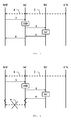
figure 3-6 are flowcharts of the exchanges between a mobile terminal, a source cell, a target cell and the core cellular network during some operations: -
figure 3 illustrates a handover preparation ended by an acceptation, -
figure 4 illustrates a handover preparation ended by a rejection, -
figure 5 illustrates a handover execution in case of an acceptation in normal mode, -
figure 6 illustrates a handover execution in case of an acceptation in silent mode. - An object of the present disclosure is to avoid call drop. Let us consider a mobile terminal MT is handling an on-going call. To do so, said mobile terminal MT must be attached to a hosting cell. Said initial hosting cell is called a source cell.
- As is known in the art, among other functions, a mobile terminal MT in a cellular network regularly monitors the strength level of a radio signal received from its hosting source cell SC, as an indicator of the quality of the radio link.
- When said quality goes below a first high sensitivity threshold, some conservative measures, such as handover, are attempted in order to carry on the on-going call with another new cell, potentially offering a better quality radio link. Said new cell is called a target cell TC.
- If, for any reason, no successful handover can be achieved, either because no target cell TC can be found in the vicinity or none of the found target cells TC is able to accept the proposed handover, the mobile terminal MT and its on-going call remain attached to the source cell SC.
- According to prior art, when the quality of the radio link further goes bellow a second low sensitivity threshold, corresponding to a minimum acceptable quality to exchange signals between a hosting cell and a mobile terminal MT, lower than said first high sensitivity threshold, the mobile terminal MT drops said call.
- According to a proposed embodiment, to avoid such a call drop and all its accompanying drawbacks, such as information losses and necessary re-establishment of the call, it is proposed to add to a mobile terminal MT a freezing means. Such a freezing means is able, when an on-going call is about to be dropped, to put said on-going call in frozen mode. Said frozen mode of the call (or of the mobile terminal MT) consists in freezing said on-going call by suspending the data traffic of said on-going call, instead of having said on-going call dropped.
- By doing so, an on-going call is not dropped when the radio link quality goes bellow said second low sensitivity threshold. Instead, said call is placed into a frozen mode. From this frozen mode it can exit toward a normal mode when the radio link quality reverts back to a satisfactory level, that is, a level greater than said second low sensitivity threshold.
- According to prior art, a call can only be in a normal mode or in dropped mode/rejected. According to the present teaching, a new additional mode, named frozen mode, is advantageously added. Said frozen mode allows for not immediately dropping a call, but instead place it in a wait mode/hold state, in order to provide some time to revert back to satisfactory conditions allowing to carry on with the call.
- According to the present teaching, a call can be placed into said frozen mode another when said call is about to be dropped.
- As in prior art, an "about to be dropped" condition can be determined by a quality of the wireless communication going under a given threshold.
- According to the present teaching, an "about to be dropped" condition can also be determined in a predictive way, e.g. by a predictive estimation of the location of the mobile terminal. Such a location can e.g. be compared to a coverage map. For instance, if a mobile terminal location is estimated to be soon entering an coverage hole, such as an area without any cell or an area where the radio signals cannot propagate, the "about to be dropped" condition can be determined before the quality of the wireless communication goes under a given threshold. This may allow some more time to manage the on-going call and the conservative measures.
- In said predictive configuration, the predictive estimation of the location of the mobile terminal may advantageously further be used to determine when and where sad mobile terminal will exit said coverage hole. This may advantageously help to better manage the transition to frozen mode and from the frozen. In such a case, the available cell(s) in the range of the mobile terminal when it exits from said coverage hole is so known and can be configured in advance, so as to be ready for the mobile terminal where and when it exits the coverage hole.
- Once a call has been so placed in frozen mode as a conservative measure, some recovery measures must be taken. One such recovery measure consists in scanning the radio range for a target hosting cell TC able to accept said frozen call, through a satisfactory handover. This is advantageously done by a so called orbiting means able to do such a scan. Said orbiting means is advantageously activated at least when a call is placed in frozen mode. Alternately it can be activated before such an event, or even permanently, in order to be ready before the need occurs.
- Another complementary conservative means, helping in avoiding call drop, takes place on the cell side. The aim of said means is to provide support to a mobile terminal MT even if this support is incomplete, i.e. limited to signalling traffic.
- In the course of the present disclosure, two types of traffics, exchanged between a cell and a mobile terminal, are considered separately: one is data traffic and the other is signalling traffic. Data traffic comprises the useful data effectively exchanged in a communication, that is voice, data, etc. Signalling traffic comprises all the signalling messages exchanged between a mobile terminal and a cell to be able to control a communication. Said signalling messages comprises command to configure, establish, maintain a given communication.
- Data traffic is characterised by a relatively more important amount of necessary resources, called data traffic resources. Instead signalling traffic is characterised by a less important amount of necessary resources, called signalling traffic resources. Due to said relative difference of amount, it may be possible to restrain a call to signalling traffic, when signalling traffic resources are available, while the lack of data traffic resources precludes from exchanging data traffic.
- To do that, a cell, in a cellular communication network, comprises, as in prior art, an admission means AC, but said admission means AC has, according to the present, some extended functions. Said admission means AC is in charge of processing incoming calls requesting to be hosted by said cell.
- When an incoming call requests to be hosted, an admission means AC is able to make a decision by selecting among several decisions.
- A first decision is to accept said incoming call in normal mode NM. When an incoming call is accepted in normal mode NM, said call is then serviced normally. That is, all signalling and data aspects of said incoming call are served by the hosting cell. This means that said cell must have, at least, enough data traffic and enough signalling traffic resources to handle said incoming call.
- Another decision is to reject RE said incoming call. In this case the request of the call to be hosted by said cell ends.
- According to prior art, when an incoming call requests to be hosted, an admission means AC is only able to choose between accepting said call in normal mode NM or rejecting it RE. Consequently, if it is not possible to accept said incoming call in normal mode NM, e.g. because said cell has not enough data traffic resources to handle said incoming call, said admission means AC has no other choice than to reject RE said call.
- According to an embodiment, an admission means AC provides another choice. Said admission means AC is further able to accept said incoming call in silent mode SM. In such silent mode SM, the cell services all signalling aspects of said incoming call, but only said signalling aspects. No data traffic aspects are serviced, and any data traffic of said incoming call is suspended, in both downward and upward directions.
- Such a silent mode SM may be selected for a call even when said cell has not enough data traffic resources to handle said incoming call. Such a selection however needs the cell to have enough signalling traffic resources to handle said incoming call.
- Said silent mode SM is advantageous in that it keeps a link between the core cellular network CN and said incoming call, despites not servicing it wholly, instead of simply rejecting it.
- It has to be noted that it is not necessarily prejudicial to place a call in such a silent mode SM. If the call is a phone call, a silent mode SM has quite no chance to remain undetected, albeit said silent mode SM only lasts a very short time. However, a blank in a phone conversation will always be shorter than a call drop, added to the time necessary to be aware of the call drop, added to the time to establish a new call. If the call is a data call, the call usage of the data traffic may be discontinuous or asynchronous. If e.g. a user is browsing web pages, a short duration while no data traffic is available may remain undetected, as long as no interaction takes place during a blank. Even when an interaction occurs during a blank the lack of immediate response may be considered by the user as being part of a bad response time, as may sometimes be experienced.
- This offers a third alternate decision for the admission means AC to select among.
- If a cell has enough data traffic resources to handle an incoming call, said incoming call will be accepted in normal mode NM. If a cell has not enough signalling traffic resources to handle an incoming call, said incoming call will be rejected RE. In between these two extreme cases, the decision between rejecting RE said incoming call or accepting said incoming call in silent mode SM may be made upon one or more indicators chosen among several indicators.
- A decision making heuristic may be built based on indicators related to said cell, to the neighbour cells of said cell or to other general parameters.
- Among the indicators for said cell, one can find an indicator of the availability of signalling traffic resources. In case this indicator is negative, a rejection RE is to be expected.
- Another indicator for said cell may be an expected time until data traffic resources are available. Depending on how long this time is, it may be considered to accept or not a call in silent mode SM, said silent mode SM acting here as a way to wait until said data traffic resources are available again.
- Among the possible indicators for each neighbour cell of said cell, one can find the same indicators: signalling traffic resources availability and expected time until enough data traffic resources are available. Another indicator for a neighbour cell can be likelihood to accept an incoming call. Said likelihood may e.g. be expressed by a load level of said neighbour cell or by an availability of data traffic resources. In such a case, said cell may e.g. consider an acceptation in silent mode SM when at least one of its neighbour cells is able to immediately accept or is likely to be able to accept said incoming call soon.
- Means to determine said indicators, and/or to transmit to said cell may be any known means. They are at least out of the scope of the present disclosure.
- One indicator that may be useful, among general parameters, may be an estimated time T for the mobile terminal MT handling said incoming call, to cross said cell. The way to determine such an estimated time T may be e.g. either based on a physical model such as a model using the speed of said mobile terminal MT or based on statistical model tracking said time T as a function of e.g. the type of the mobile terminal MT or others parameters. By the way, said determination is out of the scope of the present disclosure.
- As examples, two possible decision making algorithms are described.
- A first decision making algorithm is illustrated in
figure 1 . The algorithm figures here a serial of four tests. In the first test T1, availability of data traffic resources is checked. If data traffic resources are available, then, as in prior art, the algorithm goes on by accepting the call in normal mode NM. - If not, the decision is made between rejecting RE and accepting in silent mode SM. The algorithm proceeds to a second test T2. In the second test T2, availability of signalling traffic resources is checked. If signalling data traffic resources are not available, then the algorithm goes on by rejecting the call RE. If not, the algorithm proceeds to a third test T3. In the third test T3, availability of enough data and signalling traffic resources, at at least one neighbour cell of said cell, is checked. If available then the algorithm goes on by accepting the call in silent mode SM. If not available, the algorithm proceeds to a fourth test T4. In the fourth test T4, it is estimated if any neighbour cell of said cell will soon be able to accept said incoming call. The fourth test T4 compares two values. The first value is an expected time until enough data traffic resources are available at at least one neighbour cell of said cell. The second value is an estimated time T for the mobile terminal MT handling said incoming call to cross said cell. If the first value is lesser than the second value, for at least one neighbour cell, this indicates that at least one neighbour cell would be able to accept said incoming call when the mobile terminal MT would have crossed the current hosting cell. In that case said incoming call may advantageously be accepted in silent mode SM. Either, if the first value is greater than the second value, for all neighbour cells, this indicates that none of the neighbour cells would be able to accept said incoming call when the mobile terminal MT would have crossed the current hosting cell. In that case said incoming call may preferably be rejected RE.
- A second decision making algorithm is illustrated in
figure 2 . Said second algorithm is based upon a probability function P. Said probability function P gives a probability to find a target hosting cell able to accept said incoming call in normal mode versus the estimated time T for the mobile terminal MT handling said incoming call to cross the current cell. The algorithm elaborates a value T of said estimated time. Then the algorithm elaborates, as a function of said estimated time T, a value P(T) of said probability. Said probability P(T) is then compared to a given threshold S. If said probability P(T) is greater than said threshold S, then the incoming call may be accepted in silent mode SM. Either, if the probability is too low, the incoming call may better be rejected RE. - Said probability function may be elaborated by any known method. By the way, said elaboration is out of the scope of the present disclosure.
- A change of hosting cell, between a source cell and a target cell, also named a handover, consists in exchange of messages between, a mobile terminal MT, a source cell SC, a target cell TC and the core CN of the cellular network. Such a handover and its amendments according to the present teaching are illustrated in
figures 3-6 , depending on the different possible modes. Plain arrows indicate signalling traffic messages, while dotted arrows indicate data traffic. -
Figure 3 illustrates a handover preparation. Before any handover, a mobile terminal MT is supposed to be attached to a source cell SC. Data traffic is then bi-directionally exchanged between mobile terminal MT and said source cell SC through link 1. Said data traffic is bi-directionally relayed between source cell SC and the core cellular network CN throughlink 2. - Regularly, a mobile terminal MT measures a radio link level and transmits 3 said measurement to its hosting source cell SC.
- In said source cell SC, a handover decision module HD compares said radio link level to a threshold. Under a first level threshold, said handover decision module HD decides to start a handover.
- Alternately, said handover decision module HD may, by any predictive way, anticipates that the mobile terminal MT is about to enter into a coverage hole. Before said entering, the handover decision module HD may decide to start a handover.
- Said handover decision module HD starts a handover by sending a
handover request 4 to a candidate target cell TC. - Said
handover request 4 is received by said target cell TC and examined e.g. by an admission control module AC. At this step, the admission control module AC opts for one of the three possible choices: acceptation in normal mode NM, acceptation in silent mode SM, rejection RE. - Then the admission control module AC responds to the source cell SC by a
handover request acknowledgement 5, containing the selected mode. - If said selected mode is an acceptation, either in normal mode NM or in silent mode SM, the source cell SC sends a
handover command message 6 to the mobile terminal MT. This ends the handover preparation. - Either, if said selected mode is a rejection RE, as illustrated in
figure 4 , nohandover command message 6 is sent to the mobile terminal MT. This also ends the handover preparation, and the handover itself with a fail. The mobile terminal MT then remains attached to the source cell SC. - The mobile terminal MT may then attempt another handover with another target cell TC or later. If no successful handover can be realized with an accepting target cell TC, the quality of the radio link between the mobile terminal MT and the source cell SC may deteriorate until the mobile terminal MT must drop the call, as indicated by the cut cross 9.
- A handover process goes on, in case of acceptation in normal mode NM, as illustrated in
figure 5 and in case of acceptation in silent mode SM, as illustrated infigure 6 . - With reference to
figure 5 , is illustrated the execution of a handover in case of an acceptation in normal mode NM. Said execution is similar to the execution according to prior art. The handover execution is started by the source cell SC sending astatus 11 of the mobile terminal MT to the candidate target cell TC. Then the data traffic exchanges between the source cell SC and the mobile terminal MT are stopped, as indicated by thecut cross 12. Instead data traffic received by the source cell SC to the attention of mobile terminal MT is instead redirected 13 toward the target cell TC. In parallel, the mobile terminal MT establishes contact with the target cell TC. First the mobile terminal MT sends asynchronisation message 14 to the target cell TC. The target cell TC, since it accepts the call in normal mode NM, answers to the mobile terminal MT with an allocating andtiming advance message 15. Said message is acknowledged by the mobile terminal MT sending a handover confirm message 16. At this point the handover is complete. The data traffic is then bi-directionally exchanged between mobile terminal MT and said target cell TC throughlink 17. Said data traffic is relayed between target cell TC and the core cellular network CN throughlink 18. - With reference to
figure 6 , is illustrated the execution of a handover in case of an acceptation in silent mode SM. Said execution is quite similar to the execution in case of an acceptation in normal mode NM. It is however simplified due to the absence of data traffic. The handover execution is started by the source cell SC sending astatus 31 of the mobile terminal MT to the candidate target cell TC. Then the data exchanges between the source cell SC and the mobile terminal MT are stopped, as indicated by thecut cross 32. Instead data traffic received by the source cell SC to the attention of mobile terminal MT is instead redirected 33 toward the target cell TC. In order not to lose any data traffic, said redirected data traffic is advantageously buffered until a new acceptation in normal mode NM can be obtained. In parallel, the mobile terminal MT establishes contact with the target cell TC. The target cell TC, since it accepts in silent mode SM, without any data traffic, does not need to synchronise with the mobile terminal MT. There is no equivalent ofmessages figure 4 . The mobile terminal MT only sends ahandover confirm message 36 to the target cell TC. At this point the handover is complete. There is no data traffic exchanged between mobile terminal MT and said target cell TC. Exchanges between the mobile terminal MT and the target cell TC are limited to signalling traffic only, thus needing much lesser resources. - Once a call has been placed in frozen mode as a conservative measure, some recovery measures must be taken. One such recovery measure consists in scanning the radio range for a target hosting cell TC able to accept said frozen call. This is advantageously done, as previously described, by an orbiting means able to do such a scan. During such a scan an orbiting means searches for candidate target cells TC that are able to accept said frozen call either in normal mode NM or at least in silent mode SM. By doing so, if a handover toward a target cell TC accepting in normal mode NM is most of the times preferred, a handover toward a target cell TC only accepting in silent mode SM appears to be better than no handover.
- The mobile terminal MT then advantageously further comprises a resuming means able to resume the call from frozen mode into normal mode.
- It can be noted that there are two normal modes, one for a call/mobile terminal and one for a cell. A call or a mobile terminal MT can be in normal mode, in frozen mode or dropped. A cell can be accepting in normal mode, accepting in silent mode or rejecting.
- A condition to apply such a resume action is first to find a target hosting cell TC able to accept said call in normal mode NM. To do so, said target cell TC must have enough data traffic and signalling traffic resources available at resuming time.
- It can be the current hosting cell that frees some resources and provides again enough resources to allow the mobile terminal MT to resume to normal mode. Alternately, it can be a new target cell TC, discovered in the neighbourhood, which is able to accept the call in normal mode NM. In such a case the resume action is applied during or after a handover toward said target cell TC.
- The current teaching further concerns a method, in a cellular communication network, for avoiding a call drop. Said method advantageously uses a mobile terminal MT and/or a cell, modified as previously described.
- Said method comprises the following steps. As a first step, when an on-going call is about to be dropped, said on-going call is put in frozen mode, instead of dropping said call. In said frozen mode, the data traffic of said on-going call is suspended. This advantageously provides some time, to allow, mainly the mobile terminal MT, to find another solution. Depending on the available signalling traffic resources, the signalling traffic is, as far as possible, maintained.
- As previously described, an "about to be dropped" condition may be determined either by a quality of the wireless communication going under a given threshold or by a predictive estimation of the location of the mobile terminal with respect a coverage hole.
- At least from the instant when an on-going call has been put in frozen mode, another step of the method consists in scanning the radio field in search for a target hosting cell TC able to accept said now frozen call either in normal mode NM or in silent mode SM. During said step the mobile terminal MT scans the neighbour cells in range in order to find a new accepting target cell TC able to support said call.
- Said scanning step may advantageously be helped by a predictive method able to predict which target cell(s) will be available and when.
- A new target cell TC having enough data traffic resources and so able to accept the call in normal mode NM is preferred. If such a target cell TC can be found, a handover is applied toward said target cell TC, and a resume step may also be applied to resume said call to normal mode with said target cell TC as a support hosting cell.
- Either if a target cell TC has not enough data traffic resources but has enough signalling traffic resources to handle said incoming call, at least with respect to the signalling aspects of said call, said call may be accepted in silent mode SM. By doing so, said target cell TC provides support to the call, at least as a temporary measure, while waiting for a target cell TC able to accept said call in normal mode NM. In this case of said call accepted in silent mode SM, the call is kept into frozen mode, since it cannot be resumed. In such a case, the scanning is carried on in search of a target hosting cell TC able to accept said frozen call.
Claims (15)
- A cell, in a cellular communication network, comprising an admission means (AC) able, when an incoming call requests to be hosted, to make a decision by selecting among:- accepting said incoming call in normal mode (NM): servicing all signalling and data aspects of said incoming call, when said cell has enough data traffic resources to handle said incoming call,- rejecting (RE) said incoming call, when said cell has not enough data traffic resources to handle said incoming call, characterized in that said admission means (AC) is further able to select:- accepting said incoming call in silent mode (SM): servicing all signalling aspects of said incoming call while suspending data traffic of said incoming call, when said cell has not enough data traffic resources to handle said incoming call.
- The cell of claim 1, wherein a decision between rejecting (RE) said incoming call or accepting said incoming call in silent mode (SM) is made upon indicators among:for said cell:- signalling traffic resources availability,- expected time until enough data traffic resources are available,for each neighbour cell of said cell:- signalling traffic resources availability,- expected time until enough data traffic resources are available,- likelihood to accept an incoming call,and/or:- estimated time (T), for the mobile terminal (MT) handling said incoming call, to cross said cell.
- The cell of claim 2, wherein said decision is made upon the following tests: if enough signalling traffic resources are available at said cell, and enough data and signalling traffic resources are available at at least one neighbour cell of said cell, or if enough signalling traffic resources are available at said cell, and not enough data traffic resources are available at any neighbour cell of said cell and said expected time until enough data traffic resources are available at at least one neighbour cell of said cell is lesser than said estimated time (T), for the mobile terminal handling said incoming call, to cross said cell, and enough signalling traffic resources are available at said at least one neighbour cell of said cell, said incoming call is accepted in silent mode (SM) by said cell, else said incoming call is rejected (RE).
- The cell of claim 2, wherein said decision is made upon a comparison between a probability (P) to find a target hosting cell able to accept said incoming call in normal mode as a function of estimated time (T), for the mobile terminal (MT) handling said incoming call, to cross current cell, and a given threshold (S).
- A mobile terminal, in a cellular communication network, characterized in that it comprises a freezing means able, when an on-going call is about to be dropped, to put said on-going call in frozen mode: freezing said on-going call by suspending the data traffic of said on-going call, instead of having said on-going call dropped.
- The mobile terminal of claim 5, wherein an "about to be dropped" condition is determined by a quality of the wireless communication going under a given threshold.
- The mobile terminal of claim 5, wherein an "about to be dropped" condition is determined by a predictive estimation of the location of the mobile terminal.
- The mobile terminal of any one of claims 5 to 7, further comprising an orbiting means able, when a call is in frozen mode, to scan for a target hosting cell (TC) able to accept said frozen call either in normal mode (NM) or in silent mode (SM) .
- The mobile terminal of any one of claims 5 to 8, further comprising a resuming means able, when a target hosting cell (TC) has been found that is able to accept said call in normal mode (NM), to resume the call from frozen mode into normal mode (NM).
- A method, in a cellular communication network for avoiding a call drop characterized in that it comprises the following step: when an on-going call is about to be dropped, putting said on-going call in frozen mode, where said on-going call is frozen by having its data traffic suspended, instead of being dropped.
- The method of claim 10, wherein an "about to be dropped" condition is determined by a quality of the wireless communication going under a given threshold.
- The mobile terminal of claim 10, wherein an "about to be dropped" condition is determined by a predictive estimation of the location of the mobile terminal.
- The method of claim 10, further comprising the steps of: once an on-going call has been put in frozen mode, scanning for a target hosting cell (TC) able to accept said frozen call either in normal mode (NM) or in silent mode (SM).
- The method of any one of claims 10 to 13, further comprising the steps of: accepting said call in normal mode (NM), if said target hosting cell has enough data traffic resources to handle said incoming call, and resuming said call from frozen mode into normal mode (NM).
- The method of any one of claims 10 to 13, further comprising the steps of: accepting said call in silent mode (SM), if said target hosting cell has not enough data traffic resources but has enough signalling traffic resources to handle said incoming call, keeping said call into frozen mode, and carrying on scanning for a target hosting cell (TC) able to accept said frozen call.
Priority Applications (1)
| Application Number | Priority Date | Filing Date | Title |
|---|---|---|---|
| EP12305660.8A EP2672779B1 (en) | 2012-06-08 | 2012-06-08 | Avoiding call drop |
Applications Claiming Priority (1)
| Application Number | Priority Date | Filing Date | Title |
|---|---|---|---|
| EP12305660.8A EP2672779B1 (en) | 2012-06-08 | 2012-06-08 | Avoiding call drop |
Publications (2)
| Publication Number | Publication Date |
|---|---|
| EP2672779A1 true EP2672779A1 (en) | 2013-12-11 |
| EP2672779B1 EP2672779B1 (en) | 2019-11-06 |
Family
ID=46397122
Family Applications (1)
| Application Number | Title | Priority Date | Filing Date |
|---|---|---|---|
| EP12305660.8A Active EP2672779B1 (en) | 2012-06-08 | 2012-06-08 | Avoiding call drop |
Country Status (1)
| Country | Link |
|---|---|
| EP (1) | EP2672779B1 (en) |
Citations (3)
| Publication number | Priority date | Publication date | Assignee | Title |
|---|---|---|---|---|
| WO2001033891A1 (en) * | 1999-11-01 | 2001-05-10 | Telefonaktiebolaget Lm Ericsson (Publ) | Method and system for reconnecting dropped calls |
| US20030037146A1 (en) * | 2001-08-16 | 2003-02-20 | O'neill Alan | Methods and apparatus for controlling IP applications during resource shortages |
| US7076245B1 (en) * | 2002-03-19 | 2006-07-11 | Sprint Spectrum L.P. | Proactive management of dropped calls in a wireless communication system |
-
2012
- 2012-06-08 EP EP12305660.8A patent/EP2672779B1/en active Active
Patent Citations (3)
| Publication number | Priority date | Publication date | Assignee | Title |
|---|---|---|---|---|
| WO2001033891A1 (en) * | 1999-11-01 | 2001-05-10 | Telefonaktiebolaget Lm Ericsson (Publ) | Method and system for reconnecting dropped calls |
| US20030037146A1 (en) * | 2001-08-16 | 2003-02-20 | O'neill Alan | Methods and apparatus for controlling IP applications during resource shortages |
| US7076245B1 (en) * | 2002-03-19 | 2006-07-11 | Sprint Spectrum L.P. | Proactive management of dropped calls in a wireless communication system |
Also Published As
| Publication number | Publication date |
|---|---|
| EP2672779B1 (en) | 2019-11-06 |
Similar Documents
| Publication | Publication Date | Title |
|---|---|---|
| US6311065B1 (en) | Mobile communication system for predicting a transfer location of a mobile station | |
| CN105900486B (en) | mobile switch | |
| KR102026293B1 (en) | Measurement Control for UE Relay Selection in ProSe-based UE-to-Network Relay | |
| CN102870464B (en) | For the storage of the adjacent cell information of fast quick-recovery in the situation that of handoff failure | |
| US12219643B2 (en) | Callback tokens for dropped calls | |
| US11457393B2 (en) | Communication method and apparatus for realizing service continuity | |
| CN105684533B (en) | Respond to a paging request while waiting to request a connection to the wireless network | |
| JP2008035471A (en) | Mobile communication terminal, method of operating this by handover rejection, and method of rejecting handover in portable internet system | |
| JP2015525539A (en) | Method and apparatus for opportunistic load reduction from network communication to inter-device communication | |
| JP2008079079A (en) | Mobile terminal reconnection control method and apparatus | |
| JP5077442B2 (en) | Data communication system, radio base station, and data communication method | |
| JP2015515200A (en) | Load balancing | |
| CN112005581A (en) | Base station apparatus in wireless communication system that performs switching including relay transmission path, and control method and program thereof | |
| CN111641975B (en) | Wireless connection reestablishment method and device, terminal, storage medium | |
| CN101998484B (en) | Method and device for preventing switching user to forbidden state cell | |
| JP5237083B2 (en) | Call control system, call control device, terminal device, and call control method | |
| KR100918388B1 (en) | A handover method in access networks based on advance resource reservatioins and mobile device for the handver | |
| EP2672779B1 (en) | Avoiding call drop | |
| WO2023197220A1 (en) | Neighboring cell measurement method and apparatus, and device and storage medium | |
| JP2008113220A (en) | Wireless base station, wireless communication system, communication control method, and communication control program | |
| EP2876919B1 (en) | Mobile communication system, radio station, mobile communication control method, and nontemporary computer-readable medium in which mobile communication control program has been stored | |
| US20140098750A2 (en) | Dynamic management of small cells for traffic-related optimization of the energyconsumption of a network | |
| CN113840338B (en) | Migration methods, storage media, and electronic devices in hybrid networking | |
| US11496959B2 (en) | Establishing and controlling connection of user equipment to a heterogeneous network | |
| KR101384062B1 (en) | Load balancing with fast handoff scheme and device over wireless networks |
Legal Events
| Date | Code | Title | Description |
|---|---|---|---|
| PUAI | Public reference made under article 153(3) epc to a published international application that has entered the european phase |
Free format text: ORIGINAL CODE: 0009012 |
|
| AK | Designated contracting states |
Kind code of ref document: A1 Designated state(s): AL AT BE BG CH CY CZ DE DK EE ES FI FR GB GR HR HU IE IS IT LI LT LU LV MC MK MT NL NO PL PT RO RS SE SI SK SM TR |
|
| AX | Request for extension of the european patent |
Extension state: BA ME |
|
| 17P | Request for examination filed |
Effective date: 20140611 |
|
| RBV | Designated contracting states (corrected) |
Designated state(s): AL AT BE BG CH CY CZ DE DK EE ES FI FR GB GR HR HU IE IS IT LI LT LU LV MC MK MT NL NO PL PT RO RS SE SI SK SM TR |
|
| RAP1 | Party data changed (applicant data changed or rights of an application transferred) |
Owner name: ALCATEL LUCENT Owner name: INRIA - INSTITUT NATIONAL DE RECHERCHE EN INFORMAT |
|
| STAA | Information on the status of an ep patent application or granted ep patent |
Free format text: STATUS: EXAMINATION IS IN PROGRESS |
|
| 17Q | First examination report despatched |
Effective date: 20171023 |
|
| RAP1 | Party data changed (applicant data changed or rights of an application transferred) |
Owner name: INRIA - INSTITUT NATIONAL DE RECHERCHE EN INFORMAT Owner name: ALCATEL LUCENT |
|
| RIC1 | Information provided on ipc code assigned before grant |
Ipc: H04W 76/19 20180101AFI20181217BHEP Ipc: H04W 76/25 20180101ALN20181217BHEP |
|
| RIC1 | Information provided on ipc code assigned before grant |
Ipc: H04W 76/25 20180101ALN20190401BHEP Ipc: H04W 76/19 20180101AFI20190401BHEP |
|
| REG | Reference to a national code |
Ref country code: DE Ref legal event code: R079 Ref document number: 602012065409 Country of ref document: DE Free format text: PREVIOUS MAIN CLASS: H04W0076020000 Ipc: H04W0076190000 |
|
| GRAP | Despatch of communication of intention to grant a patent |
Free format text: ORIGINAL CODE: EPIDOSNIGR1 |
|
| STAA | Information on the status of an ep patent application or granted ep patent |
Free format text: STATUS: GRANT OF PATENT IS INTENDED |
|
| RIC1 | Information provided on ipc code assigned before grant |
Ipc: H04W 76/19 20180101AFI20190509BHEP Ipc: H04W 76/25 20180101ALN20190509BHEP |
|
| RIC1 | Information provided on ipc code assigned before grant |
Ipc: H04W 76/25 20180101ALN20190513BHEP Ipc: H04W 76/19 20180101AFI20190513BHEP |
|
| INTG | Intention to grant announced |
Effective date: 20190528 |
|
| RIN1 | Information on inventor provided before grant (corrected) |
Inventor name: CAPDEVIELLE, VERONIQUE Inventor name: ALTMAN, EITAN |
|
| GRAS | Grant fee paid |
Free format text: ORIGINAL CODE: EPIDOSNIGR3 |
|
| GRAA | (expected) grant |
Free format text: ORIGINAL CODE: 0009210 |
|
| STAA | Information on the status of an ep patent application or granted ep patent |
Free format text: STATUS: THE PATENT HAS BEEN GRANTED |
|
| AK | Designated contracting states |
Kind code of ref document: B1 Designated state(s): AL AT BE BG CH CY CZ DE DK EE ES FI FR GB GR HR HU IE IS IT LI LT LU LV MC MK MT NL NO PL PT RO RS SE SI SK SM TR |
|
| REG | Reference to a national code |
Ref country code: GB Ref legal event code: FG4D |
|
| REG | Reference to a national code |
Ref country code: CH Ref legal event code: EP Ref country code: AT Ref legal event code: REF Ref document number: 1200649 Country of ref document: AT Kind code of ref document: T Effective date: 20191115 |
|
| REG | Reference to a national code |
Ref country code: IE Ref legal event code: FG4D |
|
| REG | Reference to a national code |
Ref country code: DE Ref legal event code: R096 Ref document number: 602012065409 Country of ref document: DE |
|
| REG | Reference to a national code |
Ref country code: NL Ref legal event code: MP Effective date: 20191106 |
|
| REG | Reference to a national code |
Ref country code: LT Ref legal event code: MG4D |
|
| PG25 | Lapsed in a contracting state [announced via postgrant information from national office to epo] |
Ref country code: PT Free format text: LAPSE BECAUSE OF FAILURE TO SUBMIT A TRANSLATION OF THE DESCRIPTION OR TO PAY THE FEE WITHIN THE PRESCRIBED TIME-LIMIT Effective date: 20200306 Ref country code: ES Free format text: LAPSE BECAUSE OF FAILURE TO SUBMIT A TRANSLATION OF THE DESCRIPTION OR TO PAY THE FEE WITHIN THE PRESCRIBED TIME-LIMIT Effective date: 20191106 Ref country code: LT Free format text: LAPSE BECAUSE OF FAILURE TO SUBMIT A TRANSLATION OF THE DESCRIPTION OR TO PAY THE FEE WITHIN THE PRESCRIBED TIME-LIMIT Effective date: 20191106 Ref country code: NL Free format text: LAPSE BECAUSE OF FAILURE TO SUBMIT A TRANSLATION OF THE DESCRIPTION OR TO PAY THE FEE WITHIN THE PRESCRIBED TIME-LIMIT Effective date: 20191106 Ref country code: BG Free format text: LAPSE BECAUSE OF FAILURE TO SUBMIT A TRANSLATION OF THE DESCRIPTION OR TO PAY THE FEE WITHIN THE PRESCRIBED TIME-LIMIT Effective date: 20200206 Ref country code: FI Free format text: LAPSE BECAUSE OF FAILURE TO SUBMIT A TRANSLATION OF THE DESCRIPTION OR TO PAY THE FEE WITHIN THE PRESCRIBED TIME-LIMIT Effective date: 20191106 Ref country code: NO Free format text: LAPSE BECAUSE OF FAILURE TO SUBMIT A TRANSLATION OF THE DESCRIPTION OR TO PAY THE FEE WITHIN THE PRESCRIBED TIME-LIMIT Effective date: 20200206 Ref country code: GR Free format text: LAPSE BECAUSE OF FAILURE TO SUBMIT A TRANSLATION OF THE DESCRIPTION OR TO PAY THE FEE WITHIN THE PRESCRIBED TIME-LIMIT Effective date: 20200207 Ref country code: PL Free format text: LAPSE BECAUSE OF FAILURE TO SUBMIT A TRANSLATION OF THE DESCRIPTION OR TO PAY THE FEE WITHIN THE PRESCRIBED TIME-LIMIT Effective date: 20191106 Ref country code: LV Free format text: LAPSE BECAUSE OF FAILURE TO SUBMIT A TRANSLATION OF THE DESCRIPTION OR TO PAY THE FEE WITHIN THE PRESCRIBED TIME-LIMIT Effective date: 20191106 Ref country code: SE Free format text: LAPSE BECAUSE OF FAILURE TO SUBMIT A TRANSLATION OF THE DESCRIPTION OR TO PAY THE FEE WITHIN THE PRESCRIBED TIME-LIMIT Effective date: 20191106 |
|
| PG25 | Lapsed in a contracting state [announced via postgrant information from national office to epo] |
Ref country code: HR Free format text: LAPSE BECAUSE OF FAILURE TO SUBMIT A TRANSLATION OF THE DESCRIPTION OR TO PAY THE FEE WITHIN THE PRESCRIBED TIME-LIMIT Effective date: 20191106 Ref country code: RS Free format text: LAPSE BECAUSE OF FAILURE TO SUBMIT A TRANSLATION OF THE DESCRIPTION OR TO PAY THE FEE WITHIN THE PRESCRIBED TIME-LIMIT Effective date: 20191106 Ref country code: IS Free format text: LAPSE BECAUSE OF FAILURE TO SUBMIT A TRANSLATION OF THE DESCRIPTION OR TO PAY THE FEE WITHIN THE PRESCRIBED TIME-LIMIT Effective date: 20200306 |
|
| PG25 | Lapsed in a contracting state [announced via postgrant information from national office to epo] |
Ref country code: AL Free format text: LAPSE BECAUSE OF FAILURE TO SUBMIT A TRANSLATION OF THE DESCRIPTION OR TO PAY THE FEE WITHIN THE PRESCRIBED TIME-LIMIT Effective date: 20191106 |
|
| PG25 | Lapsed in a contracting state [announced via postgrant information from national office to epo] |
Ref country code: DK Free format text: LAPSE BECAUSE OF FAILURE TO SUBMIT A TRANSLATION OF THE DESCRIPTION OR TO PAY THE FEE WITHIN THE PRESCRIBED TIME-LIMIT Effective date: 20191106 Ref country code: CZ Free format text: LAPSE BECAUSE OF FAILURE TO SUBMIT A TRANSLATION OF THE DESCRIPTION OR TO PAY THE FEE WITHIN THE PRESCRIBED TIME-LIMIT Effective date: 20191106 Ref country code: EE Free format text: LAPSE BECAUSE OF FAILURE TO SUBMIT A TRANSLATION OF THE DESCRIPTION OR TO PAY THE FEE WITHIN THE PRESCRIBED TIME-LIMIT Effective date: 20191106 Ref country code: RO Free format text: LAPSE BECAUSE OF FAILURE TO SUBMIT A TRANSLATION OF THE DESCRIPTION OR TO PAY THE FEE WITHIN THE PRESCRIBED TIME-LIMIT Effective date: 20191106 |
|
| REG | Reference to a national code |
Ref country code: DE Ref legal event code: R097 Ref document number: 602012065409 Country of ref document: DE |
|
| REG | Reference to a national code |
Ref country code: AT Ref legal event code: MK05 Ref document number: 1200649 Country of ref document: AT Kind code of ref document: T Effective date: 20191106 |
|
| PG25 | Lapsed in a contracting state [announced via postgrant information from national office to epo] |
Ref country code: SM Free format text: LAPSE BECAUSE OF FAILURE TO SUBMIT A TRANSLATION OF THE DESCRIPTION OR TO PAY THE FEE WITHIN THE PRESCRIBED TIME-LIMIT Effective date: 20191106 Ref country code: SK Free format text: LAPSE BECAUSE OF FAILURE TO SUBMIT A TRANSLATION OF THE DESCRIPTION OR TO PAY THE FEE WITHIN THE PRESCRIBED TIME-LIMIT Effective date: 20191106 |
|
| PLBE | No opposition filed within time limit |
Free format text: ORIGINAL CODE: 0009261 |
|
| STAA | Information on the status of an ep patent application or granted ep patent |
Free format text: STATUS: NO OPPOSITION FILED WITHIN TIME LIMIT |
|
| 26N | No opposition filed |
Effective date: 20200807 |
|
| PG25 | Lapsed in a contracting state [announced via postgrant information from national office to epo] |
Ref country code: SI Free format text: LAPSE BECAUSE OF FAILURE TO SUBMIT A TRANSLATION OF THE DESCRIPTION OR TO PAY THE FEE WITHIN THE PRESCRIBED TIME-LIMIT Effective date: 20191106 Ref country code: AT Free format text: LAPSE BECAUSE OF FAILURE TO SUBMIT A TRANSLATION OF THE DESCRIPTION OR TO PAY THE FEE WITHIN THE PRESCRIBED TIME-LIMIT Effective date: 20191106 |
|
| PG25 | Lapsed in a contracting state [announced via postgrant information from national office to epo] |
Ref country code: MC Free format text: LAPSE BECAUSE OF FAILURE TO SUBMIT A TRANSLATION OF THE DESCRIPTION OR TO PAY THE FEE WITHIN THE PRESCRIBED TIME-LIMIT Effective date: 20191106 Ref country code: IT Free format text: LAPSE BECAUSE OF FAILURE TO SUBMIT A TRANSLATION OF THE DESCRIPTION OR TO PAY THE FEE WITHIN THE PRESCRIBED TIME-LIMIT Effective date: 20191106 |
|
| REG | Reference to a national code |
Ref country code: CH Ref legal event code: PL |
|
| PG25 | Lapsed in a contracting state [announced via postgrant information from national office to epo] |
Ref country code: LU Free format text: LAPSE BECAUSE OF NON-PAYMENT OF DUE FEES Effective date: 20200608 |
|
| REG | Reference to a national code |
Ref country code: BE Ref legal event code: MM Effective date: 20200630 |
|
| PG25 | Lapsed in a contracting state [announced via postgrant information from national office to epo] |
Ref country code: CH Free format text: LAPSE BECAUSE OF NON-PAYMENT OF DUE FEES Effective date: 20200630 Ref country code: LI Free format text: LAPSE BECAUSE OF NON-PAYMENT OF DUE FEES Effective date: 20200630 Ref country code: IE Free format text: LAPSE BECAUSE OF NON-PAYMENT OF DUE FEES Effective date: 20200608 |
|
| PG25 | Lapsed in a contracting state [announced via postgrant information from national office to epo] |
Ref country code: BE Free format text: LAPSE BECAUSE OF NON-PAYMENT OF DUE FEES Effective date: 20200630 |
|
| PG25 | Lapsed in a contracting state [announced via postgrant information from national office to epo] |
Ref country code: TR Free format text: LAPSE BECAUSE OF FAILURE TO SUBMIT A TRANSLATION OF THE DESCRIPTION OR TO PAY THE FEE WITHIN THE PRESCRIBED TIME-LIMIT Effective date: 20191106 Ref country code: MT Free format text: LAPSE BECAUSE OF FAILURE TO SUBMIT A TRANSLATION OF THE DESCRIPTION OR TO PAY THE FEE WITHIN THE PRESCRIBED TIME-LIMIT Effective date: 20191106 Ref country code: CY Free format text: LAPSE BECAUSE OF FAILURE TO SUBMIT A TRANSLATION OF THE DESCRIPTION OR TO PAY THE FEE WITHIN THE PRESCRIBED TIME-LIMIT Effective date: 20191106 |
|
| PG25 | Lapsed in a contracting state [announced via postgrant information from national office to epo] |
Ref country code: MK Free format text: LAPSE BECAUSE OF FAILURE TO SUBMIT A TRANSLATION OF THE DESCRIPTION OR TO PAY THE FEE WITHIN THE PRESCRIBED TIME-LIMIT Effective date: 20191106 |
|
| PGFP | Annual fee paid to national office [announced via postgrant information from national office to epo] |
Ref country code: FR Payment date: 20230510 Year of fee payment: 12 Ref country code: DE Payment date: 20230502 Year of fee payment: 12 |
|
| PGFP | Annual fee paid to national office [announced via postgrant information from national office to epo] |
Ref country code: GB Payment date: 20230504 Year of fee payment: 12 |
|
| REG | Reference to a national code |
Ref country code: DE Ref legal event code: R119 Ref document number: 602012065409 Country of ref document: DE |
|
| GBPC | Gb: european patent ceased through non-payment of renewal fee |
Effective date: 20240608 |
|
| PG25 | Lapsed in a contracting state [announced via postgrant information from national office to epo] |
Ref country code: DE Free format text: LAPSE BECAUSE OF NON-PAYMENT OF DUE FEES Effective date: 20250101 |
|
| PG25 | Lapsed in a contracting state [announced via postgrant information from national office to epo] |
Ref country code: FR Free format text: LAPSE BECAUSE OF NON-PAYMENT OF DUE FEES Effective date: 20240630 |
|
| PG25 | Lapsed in a contracting state [announced via postgrant information from national office to epo] |
Ref country code: GB Free format text: LAPSE BECAUSE OF NON-PAYMENT OF DUE FEES Effective date: 20240608 |