EP2671915A1 - Rubber composition for use in tires, and pneumatic tire - Google Patents
Rubber composition for use in tires, and pneumatic tire Download PDFInfo
- Publication number
- EP2671915A1 EP2671915A1 EP12765397.0A EP12765397A EP2671915A1 EP 2671915 A1 EP2671915 A1 EP 2671915A1 EP 12765397 A EP12765397 A EP 12765397A EP 2671915 A1 EP2671915 A1 EP 2671915A1
- Authority
- EP
- European Patent Office
- Prior art keywords
- group
- unbranched
- branched
- represented
- hydrogen atom
- Prior art date
- Legal status (The legal status is an assumption and is not a legal conclusion. Google has not performed a legal analysis and makes no representation as to the accuracy of the status listed.)
- Granted
Links
Classifications
-
- C—CHEMISTRY; METALLURGY
- C08—ORGANIC MACROMOLECULAR COMPOUNDS; THEIR PREPARATION OR CHEMICAL WORKING-UP; COMPOSITIONS BASED THEREON
- C08L—COMPOSITIONS OF MACROMOLECULAR COMPOUNDS
- C08L9/00—Compositions of homopolymers or copolymers of conjugated diene hydrocarbons
- C08L9/06—Copolymers with styrene
-
- B—PERFORMING OPERATIONS; TRANSPORTING
- B60—VEHICLES IN GENERAL
- B60C—VEHICLE TYRES; TYRE INFLATION; TYRE CHANGING; CONNECTING VALVES TO INFLATABLE ELASTIC BODIES IN GENERAL; DEVICES OR ARRANGEMENTS RELATED TO TYRES
- B60C1/00—Tyres characterised by the chemical composition or the physical arrangement or mixture of the composition
- B60C1/0016—Compositions of the tread
-
- C—CHEMISTRY; METALLURGY
- C08—ORGANIC MACROMOLECULAR COMPOUNDS; THEIR PREPARATION OR CHEMICAL WORKING-UP; COMPOSITIONS BASED THEREON
- C08C—TREATMENT OR CHEMICAL MODIFICATION OF RUBBERS
- C08C19/00—Chemical modification of rubber
- C08C19/30—Addition of a reagent which reacts with a hetero atom or a group containing hetero atoms of the macromolecule
- C08C19/42—Addition of a reagent which reacts with a hetero atom or a group containing hetero atoms of the macromolecule reacting with metals or metal-containing groups
- C08C19/44—Addition of a reagent which reacts with a hetero atom or a group containing hetero atoms of the macromolecule reacting with metals or metal-containing groups of polymers containing metal atoms exclusively at one or both ends of the skeleton
-
- C—CHEMISTRY; METALLURGY
- C08—ORGANIC MACROMOLECULAR COMPOUNDS; THEIR PREPARATION OR CHEMICAL WORKING-UP; COMPOSITIONS BASED THEREON
- C08K—Use of inorganic or non-macromolecular organic substances as compounding ingredients
- C08K3/00—Use of inorganic substances as compounding ingredients
- C08K3/34—Silicon-containing compounds
- C08K3/36—Silica
-
- C—CHEMISTRY; METALLURGY
- C08—ORGANIC MACROMOLECULAR COMPOUNDS; THEIR PREPARATION OR CHEMICAL WORKING-UP; COMPOSITIONS BASED THEREON
- C08K—Use of inorganic or non-macromolecular organic substances as compounding ingredients
- C08K5/00—Use of organic ingredients
- C08K5/54—Silicon-containing compounds
- C08K5/548—Silicon-containing compounds containing sulfur
-
- Y—GENERAL TAGGING OF NEW TECHNOLOGICAL DEVELOPMENTS; GENERAL TAGGING OF CROSS-SECTIONAL TECHNOLOGIES SPANNING OVER SEVERAL SECTIONS OF THE IPC; TECHNICAL SUBJECTS COVERED BY FORMER USPC CROSS-REFERENCE ART COLLECTIONS [XRACs] AND DIGESTS
- Y02—TECHNOLOGIES OR APPLICATIONS FOR MITIGATION OR ADAPTATION AGAINST CLIMATE CHANGE
- Y02T—CLIMATE CHANGE MITIGATION TECHNOLOGIES RELATED TO TRANSPORTATION
- Y02T10/00—Road transport of goods or passengers
- Y02T10/80—Technologies aiming to reduce greenhouse gasses emissions common to all road transportation technologies
- Y02T10/86—Optimisation of rolling resistance, e.g. weight reduction
Definitions
- the present invention relates to a rubber composition for a tire, and a pneumatic tire using the same.
- Tread is a tire component that accounts for a large portion of a tire.
- a method of reducing the amount of reinforcing filler is known as the method for enabling a rubber composition to have sufficiently low heat build-up.
- the hardness of the rubber composition may be decreased, causing a decrease in handling performance (handling stability), wet grip performance, and abrasion resistance.
- silica contains a hydrophilic silanol group on its surface, it has lower compatibility with rubber (particularly, natural rubber, butadiene rubber, styrene butadiene rubber, and the like, which are commonly used for tires), compared to carbon black. In some cases, silica is sometimes inferior to carbon black in terms of abrasion resistance and mechanical strength (tensile strength and elongation at break).
- Patent Literature 1 discloses a rubber composition for a tire, wherein the rubber composition results in a significant improvement in wet grip performance because it contains both anhydrous silica and hydrous silica. However, such a rubber composition leaves room for improvement in terms of fuel economy and abrasion resistance in addition to wet grip performance.
- the present invention aims to provide a rubber composition for a tire, which makes it possible to solve the above problems and improve fuel economy, wet grip performance, and abrasion resistance; and a pneumatic tire using the rubber composition.
- the present invention relates to a rubber composition for a tire, including:
- the modified styrene butadiene rubber is preferably contained in an amount of 5% by mass or more based on 100% by mass of the rubber component. Also, the modified styrene butadiene rubber is preferably a polymer in which at least one terminal is further modified by a modifier containing a functional group containing at least one selected from the group consisting of nitrogen, oxygen, and silicon.
- the rubber composition is preferably for use in a tread.
- the present invention also relates to a pneumatic tire, formed from the rubber composition.
- the rubber composition of the present invention contains a specific modified styrene butadiene rubber, silica, and a specific silane coupling agent, and therefore improves in fuel economy, wet grip performance, and abrasion resistance.
- the rubber composition of the present invention includes:
- the combined use of the above-described components allows good dispersion of silica and results in excellent fuel economy and abrasion resistance, as well as high wet grip performance.
- the combined use has a significant improvement effect on fuel economy and abrasion resistance, and these excellent fuel economy and abrasion resistance lead to environmentally-friendliness.
- the combined use provides excellent handling stability as well as good dry grip performance, mechanical strength, and processability.
- modified SBR examples include those mentioned in JP-A 2010-116545 and JP-A 2010-116546 .
- Examples of the saturated hydrocarbon group represented by X which contains nitrogen, oxygen, or sulfur include (CR 10 R 11 ) m -NR 12 - (CR 13 R 14 ) n , (CR 10 R 11 ) m -O- (CR 13 R 14 ) n , and (CR 10 R 11 ) m -S-(CR 13 R 14 ) n .
- R 10 to R 14 are the same or different and each represent a hydrogen atom, a C1-C30 (preferably C1-C5) aliphatic hydrocarbon group, a C3-C30 (preferably C3-C10) alicyclic hydrocarbon group, or a C5-C30 (preferably C5-C10) aromatic hydrocarbon group.
- n and n each represent an integer of 1 to 9 (preferably 1 to 6).
- the multiple (CR 10 R 11 ) S may be the same or different.
- the multiple (CR 13 R 14 ) s may be the same or different.
- Examples of the saturated hydrocarbon group represented by Z which contains nitrogen, oxygen, or sulfur include those mentioned for the saturated hydrocarbon group represented by X.
- R 0 is preferably a hydrogen atom or a C1 or C2 aliphatic hydrocarbon group.
- R 3 is preferably a hydrogen atom or a C1 or C2 hydrocarbon group.
- R 4 to R 7 each are preferably an aliphatic hydrocarbon group, an aromatic hydrocarbon group, or a heterocyclic group; and more preferably an aliphatic hydrocarbon group.
- R 10 to R 14 each are preferably a hydrogen atom or a C1 or C2 aliphatic hydrocarbon group.
- the modified SBR is a copolymer produced by copolymerizing styrene, butadiene (1,3-butadiene), and a nitrogen-containing compound (monomer) represented by the above formula, and contains a constitutional unit derived from the nitrogen-containing compound in a main chain portion.
- the "main chain portion” as used herein is a concept that encompasses the terminal portions.
- Examples of the nitrogen-containing compound represented by the above formula include 3- or 4- (2-azetidinoethyl) styrene, 3- or 4-(2-pyrrolidinoethyl)styrene, 3- or 4-(2-piperidinoethyl)styrene, and 3- or 4-(2-hexamethyleneiminoethyl)styrene. These compounds may be used alone or in combinations of two or more. For better dispersion of silica, 3- or 4-(2-pyrrolidinoethyl)styrene is preferred.
- the modified SBR preferably has at least one terminal that is modified by a modifier that contains a functional group containing at least one selected from the group consisting of nitrogen, oxygen, and silicon, and more preferably has both terminals modified by the modifier. This increases the effect to improve various performances.
- Examples of functional groups in the modifier include amino, amide, alkoxysilyl, isocyanate, imino, imidazole, urea, ether, carbonyl, carboxyl, hydroxyl, nitrile, and pyridyl groups. Preferred among these are amino and alkoxysilyl groups.
- the modifier examples include 3-(N,N-dimethylamino)propyltrimethoxysilane, 3-(N,N-diethylaminopropyl)trimethoxysilane, 3-(N,N-dimethylamino)propyltriethoxysilane, 3-(N,N-diethylaminopropyl)triethoxysilane, 3-glycidoxypropyltrimethoxysilane, 2-(4-pyridylethyl)triethoxysilane, N-(3-triethoxysilylpropyl)-4,5-dihydroimidazole, and silicon tetrachloride.
- 3-(N,N-dimethylamino)propyltrimethoxysilane is preferred because a resulting product is excellent in fuel economy, wet grip performance, and abrasion resistance.
- the amount of the nitrogen-containing compound in the modified SBR is preferably 0.05% by mass or more, and more preferably 0.1% by mass or more. An amount of less than 0.05% by mass is less likely to exert an improving effect on fuel economy and wet grip performance.
- the amount of the nitrogen-containing compound in the modified SBR is preferably 30% by mass or less, more preferably 20% by mass or less, and still more preferably 5% by mass or less. An amount of more than 30% by mass is less likely to produce an effect commensurate with the increased cost.
- the amount of the nitrogen-containing compound described herein is determined by a method described in the examples (described later).
- the weight average molecular weight (Mw) of the modified SBR is preferably 1.0 ⁇ 10 5 or more, and more preferably 2.0 ⁇ 10 5 or more. An Mw of less than 1.0 ⁇ 10 5 tends to deteriorate fuel economy and abrasion resistance.
- the Mw is preferably 2.0 ⁇ 10 6 or less, and more preferably 1.5 ⁇ 10 6 or less. An Mw of more than 2.0 ⁇ 10 6 tends to deteriorate processability.
- the weight average molecular weight (Mw) is determined by a method described in the examples (described later).
- the amount of the modified SBR is preferably 5% by mass or more, more preferably 10% by mass or more, and still more preferably 20% by mass or more. An amount of less than 5% by mass may fail to improve fuel economy.
- the upper limit of the amount of the modified SBR is not particularly limited and is preferably 90% by mass or less, more preferably 80% by mass or less, and still more preferably 75% by mass or less. The modified SBR in an amount of more than 90% by mass tends to result in extremely deteriorated tensile strength at break.
- the rubber component of the rubber composition preferably contains diene rubber in addition to the modified SBR.
- Diene rubbers include natural rubbers and/or synthetic diene rubbers.
- Examples of synthetic diene rubbers include isoprene rubber (IR), butadiene rubber (BR), styrene butadiene rubber (SBR), acrylonitrile-butadiene rubber (NBR), chloroprene rubber (CR), and butyl rubber (IIR).
- IR isoprene rubber
- BR butadiene rubber
- SBR styrene butadiene rubber
- NBR acrylonitrile-butadiene rubber
- CR chloroprene rubber
- IIR butyl rubber
- the amount of NR based on 100% by mass of the rubber component, is preferably 10% by mass or more, and more preferably 20% by mass or more.
- the addition of NR in an amount of less than 10% by mass tends to fail to produce its effects sufficiently.
- the amount of NR is preferably 70% by mass or less, and more preferably 50% by mass or less. An amount of more than 70% by mass results in a reduction of the amount of the modified SBR. Consequently, the dispersibility of silica tends to be deteriorated.
- the rubber composition of the present invention contains silica as a reinforcing agent.
- silica include dry-process silica (anhydrous silica) and wet-process silica (hydrous silica).
- Wet-process silica is preferred because it has many silanol groups.
- These silicas may be used alone or in combinations of two or more.
- the nitrogen adsorption specific surface area (N 2 SA) of silica is preferably 100 m 2 /g or larger, and more preferably 150 m 2 /g or larger.
- An N 2 SA of smaller than 100 m 2 /g tends to result in a small reinforcing effect and deteriorate abrasion resistance.
- the N 2 SA of silica is preferably 300 m 2 /g or smaller, and more preferably 200 m 2 /g or smaller.
- An N 2 SA of larger than 300 m 2 /g tends to decrease the dispersibility of silica and deteriorate fuel economy.
- the N 2 SA of silica is determined by the BET method in accordance with ASTM D3037-81.
- the amount of silica is preferably 10 parts by mass or more, more preferably 20 parts by mass or more, and still more preferably 50 parts by mass or more, per 100 parts by mass of the rubber component. An amount of less than 10 parts by mass may result in insufficient wet grip performance and abrasion resistance.
- the amount of silica is preferably 150 parts by mass or less, and more preferably 120 parts by mass or less. Silica tends to be less dispersible when the amount thereof exceeds 150 parts by mass, thus deteriorating processability and fuel economy.
- the rubber composition of the present invention contains a silane coupling agent represented by the following formula (1) and/or a silane coupling agent containing linking units A represented by the following formula (2) and linking units B represented by the following formula (3).
- R 21 represents a group represented by -O- (R 25 -O) t -R 26 (t pieces of R 25 are the same or different and each represent a branched or unbranched C1-C30 divalent hydrocarbon group;
- R 26 represents a branched or unbranched C1-C30 alkyl group, a branched or unbranched C2-C30 alkenyl group, a C6-C30 aryl group, or a C7-C30 aralkyl group; and t represents an integer of 1 to 30);
- R 22 and R 23 are the same or different and each represent a group as defined for R 21 , a branched or unbranched C1-C12 alkyl group, or a group represented by -O-R 27 (R 27
- R 28 represents a hydrogen atom, a halogen atom, a branched or unbranched C1-C30 alkyl or alkylene group, a branched or unbranched C2-C30 alkenyl or alkenylene group, a branched or unbranched C2-C30 alkynyl or alkynylene group, or the alkyl or alkenyl group that is terminally substituted with a hydroxy or carboxyl group;
- R 29 represents a hydrogen atom, a branched or unbranched C1-C30 alkylene or alkyl group, a branched or unbranched C2-C30 alkenylene or alkenyl group, or a branched or unbranched C2-C30 alkynylene or alkynyl group; and a pair of R 28 and R 29 may form a ring structure.
- silane coupling agent represented by formula (1) results in excellent fuel economy and high grip performance.
- R 21 in formula (1) represents a group represented by -O- (R 25 -O) t -R 26 in which t pieces of R 25 are the same or different and each represent a branched or unbranched C1-C30 divalent hydrocarbon group;
- R 26 represents a branched or unbranched C1-C30 alkyl group, a branched or unbranched C2-C30 alkenyl group, a C6-C30 aryl group, or C7-C30 aralkyl group; and t represents an integer of 1 to 30.
- R 25 s are the same or different and each represent a branched or unbranched C1-C30 (preferably C1-C10, more preferably C1-C3) divalent hydrocarbon group.
- the hydrocarbon group include branched or unbranched C1-C30 alkylene groups, branched or unbranched C2-C30 alkenylene groups, branched or unbranched C2-C30 alkynylene groups, and C6-C30 arylene groups.
- the alkylene groups are preferred because they easily bind to (react with) silica and can sufficiently improve fuel economy and abrasion resistance.
- Examples of branched or unbranched C1-C30 (preferably C1-C10, more preferably C1-C3) alkylene groups represented by R 25 include methylene, ethylene, propylene, butylene, pentylene, hexylene, heptylene, octylene, nonylene, decylene, undecylene, dodecylene, tridecylene, tetradecylene, pentadecylene, hexadecylene, heptadecylene, and octadecylene groups.
- Examples of branched or unbranched C2-C30 (preferably C2-C15, more preferably C2 or C3) alkenylene groups represented by R 25 include vinylene, 1-propenylene, 2-propenylene, 1-butenylene, 2-butenylene, 1-pentenylene, 2-pentenylene, 1-hexenylene, 2-hexenylene, and 1-octenylene groups.
- Examples of branched or unbranched C2-C30 (preferably C2-C15, more preferably C2 or C3) alkynylene groups represented by R 25 include ethynylene, propynylene, butynylene, pentynylene, hexynylene, heptynylene, octynylene, nonynylene, decynylene, undecynylene, and dodecynylene groups.
- Examples of C6-C30 (preferably C6-C15) arylene groups represented by R 25 include phenylene, tolylene, xylylene, and naphthylene groups.
- t represents an integer of 1 to 30 (preferably 2 to 20 and more preferably 5 or 6). When t is 0, it is disadvantageous in terms of bonding (reaction) with silica. When t is 31 or greater, it results in reduced reactivity with silica, which is disadvantageous in terms of process efficiency.
- R 26 represents a branched or unbranched C1-C30 alkyl group, a branched or unbranched C2-C30 alkenyl group, a C6-C30 aryl group, or a C7-C30 aralkyl group.
- the branched or unbranched C1-C30 alkyl group is particularly preferred for good reactivity with silica.
- Examples of branched or unbranched C1-C30 (preferably C3-C25, more preferably C10-C15) alkyl groups represented by R 26 include methyl, ethyl, n-propyl, isopropyl, n-butyl, iso-butyl, sec-butyl, tert-butyl, pentyl, hexyl, heptyl, 2-ethylhexyl, octyl, nonyl, decyl, undecyl, dodecyl, tridecyl, tetradecyl, pentadecyl, and octadecyl groups.
- Examples of branched or unbranched C2-C30 (preferably C3-C25, more preferably C10-C15) alkenyl groups represented by R 26 include vinyl, 1-propenyl, 2-propenyl, 1-butenyl, 2-butenyl, 1-pentenyl, 2-pentenyl, 1-hexenyl, 2-hexenyl, 1-octenyl, decenyl, undecenyl, dodecenyl, tridecenyl, tetradecenyl, pentadecenyl, and octadecenyl groups.
- C6-C30 (preferably C10-C20) aryl groups represented by R 26 include phenyl, tolyl, xylyl, naphthyl, and biphenyl groups.
- Examples of C7-C30 (preferably C10-C20) aralkyl groups represented by R 26 include benzyl and phenethyl groups.
- R 21 in formula(1) include -O-(C 2 H 4 -O) 5 -C 11 H 23 , -O-(C 2 H 4 -O) 5 -C 12 H 25 , -O-(C 2 H 4 -O) 5 -C 13 H 27 , -O-(C 2 H 4 -O) 5 -C 14 H 29 , -O-(C 2 H 4 -O) 5 -C 15 H 31 , -O-(C 2 H 4 -O) 3 -C 13 H 27 , -O-(C 2 H 4 -O) 4 -C 13 H 27 , -O-(C 2 H 4 -O) 6 -C 13 H 27 , and -O-(C 2 H 4 -O) 7 -C 13 H 27 ⁇ Preferred among these are -O-(C 2 H 4 -O) 5 -C 11 H 23 , -O-(C 2 H 4 -O) 5 -C 13 H 27 .
- R 22 and R 23 are the same or different and each represent a group as defined for R 21 (i.e., a group represented by -O-(R 25 -O) t -R 26 ), a branched or unbranched C1-C12 alkyl group, or a group represented by -O-R 27 in which R 27 represents a hydrogen atom, a branched or unbranched C1-C30 alkyl group, a branched or unbranched C2-C30 alkenyl group, a C6-C30 aryl group, or C7-C30 aralkyl group.
- the groups represented by R 21 and groups represented by -O-R 27 are preferred for good reactivity with silica.
- Examples of branched or unbranched C1-C12 (preferably C1-C10, more preferably C1-C8) alkyl groups represented by R 22 and R 23 include methyl, ethyl, n-propyl, isopropyl, n-butyl, iso-butyl, sec-butyl, tert-butyl, pentyl, hexyl, heptyl, 2-ethylhexyl, octyl, and nonyl groups.
- Examples of branched or unbranched C1-C30 (preferably C1-C10, more preferably C1-C3) alkyl groups represented by R 27 include those of the branched or unbranched C1-C30 alkyl groups represented by R 26 .
- Examples of branched or unbranched C2-C30 (preferably C2 to 10, more preferably C2-C5) alkenyl groups represented by R 27 include those of the branched or unbranched C2-C30 alkenyl groups represented by R 26 .
- Examples of C6-C30 (preferably C6-C12) aryl groups represented by R 27 include those of the C6-C30 aryl groups represented by R 26 .
- Examples of C7-C30 (preferably C7-C13) aralkyl groups represented by R 27 include those of the C7-C30 aralkyl groups represented by R 26 .
- R 22 and R 23 in formula (1) include -O-(C 2 H 4 -O) 5 -C 11 H 23 , -O-(C 2 H 4 -O) 5 -C 12 H 25 . -O-(C 2 H 4 -O) 5 -C 13 H 27 , -O-(C 2 H 4 -O) 5 -C 14 H 29 , -O-(C 2 H 4 -O) 5 -C 15 H 31 , -O-(C 2 H 4 -O) 3 -C 13 H 27 , -O-(C 2 H 4 -O) 4 -C 13 H 27 , -O-(C 2 H 4 -O) 6 -C 13 H 27 , -O-(C 2 H 4 -O) 7 -C 13 H 27 , C 2 H 5 -O-, CH 3 -O-, and C 3 H 7 -O-.
- Examples of the branched or unbranched C1-C30 (preferably C1-C10, more preferably C1-C5) alkylene group for R 24 include the same groups as mentioned for the branched or unbranched C1-C30 alkylene group represented by R 25 .
- silane coupling agent represented by formula (1) examples include Si363 available from Degussa. These silane coupling agents may be used alone or in combinations of two or more.
- silane coupling agent containing the linking units B represented by formula (3) and optionally the linking units A represented by formula (2) leads to improved fuel economy and abrasion resistance as compared with conventional silane coupling agents such as bis(3-triethoxysilylpropyl)tetrasulfide.
- the silane coupling agent containing the linking units A and the linking units B is preferably obtained by copolymerizing the linking unit B in a proportion of 1 to 70 mol% of the total amount of the linking units A and the linking units B.
- the silane coupling agent having a molar ratio of the linking unit A and the linking unit B in the above range suppresses an increase in viscosity during the processing, as compared with polysulfide silane such as bis-(3-triethoxysilylpropyl)tetrasulfide. This is probably due to the fact that the sulfide portion of the linking unit A is a C-S-C bond and is thus thermally more stable compared with tetrasulfide or disulfide, which consequently reduces an increase in Mooney viscosity.
- the silane coupling agent having a molar ratio of the linking unit A and the linking unit B in the above range suppresses a reduction in scorch time as compared with mercaptosilanes such as 3-mercaptopropyltrimethoxysilane. This is probably due to the fact that although the linking unit B has a mercaptosilane structure, the -SH group of the linking unit B is covered with the -C 7 H 15 moiety of the linking unit A, as a result of which the -SH group is less likely to react with polymers, and therefore scorching is less likely to occur.
- Examples of the halogen atom represented by R 28 include chlorine, bromine, and fluorine.
- Examples of branched or unbranched C1-C30 (preferably C1-C12, more preferably C1-C5) alkyl groups represented by R 28 and R 29 include those of the branched or unbranched C1-C30 alkyl groups represented by R 26 .
- Examples of branched or unbranched C1-C30 (preferably C1-C12) alkylene groups represented by R 28 and R 29 include groups those of the branched or unbranched C1-C30 alkylene groups represented by R 25 .
- Examples of branched or unbranched C2-C30 (preferably C2-C12) alkenyl groups represented by R 28 and R 29 include those of the branched or unbranched C2-C30 alkenyl groups represented by R 26 .
- Examples of branched or unbranched C2-C30 (preferably C2-C12) alkenylene groups represented by R 28 and R 29 include those of the branched or unbranched C2-C30 alkenylene groups represented by R 25 .
- Examples of branched or unbranched C2-C30 include ethynyl, propynyl, butynyl, pentynyl, hexynyl, heptynyl, octynyl, nonynyl, decynyl, undecynyl, and dodecynyl groups.
- Examples of branched or unbranched C2-C30 (preferably C2-C12) alkynylene groups represented by R 28 and R 29 include those of the branched or unbranched C2-C30 alkynylene groups represented by R 25 .
- the total repeating number (x + y) of the repeating number (x) of the linking unit A and the repeating number (y) of the linking unit B is preferably in the range of 3 to 300.
- the mercaptosilane of the linking unit B is covered with the -C 7 H 15 moiety of the linking unit A. This suppresses a reduction in scorch time, and ensures good reactivity with silica and the rubber component.
- silane coupling agent containing the linking unit A and the linking unit B examples include NXT-Z30, NXT-Z45, NXT-260, and NXT-Z100, all available from Momentive. These may be used alone or in combinations of two or more.
- the amount of the silane coupling agent is preferably 3 parts by mass or more, more preferably 6 parts by mass or more, and still more preferably 8 parts by mass or more, per 100 parts by mass of silica. An amount of less than 3 parts by mass tends to result in significantly reduced tensile strength at break. Also, the amount of the silane coupling agent is preferably 15 parts by mass or less, and more preferably 10 parts by mass or less. The addition of the silane coupling agent in an amount of more than 15 parts by mass is unlikely to produce its effects such as increased tensile strength at break and reduced rolling resistance. In the case where two or more types of silane coupling agents are concurrently used, the above-described amount refers to the total amount.
- additives commonly used in production of rubber compositions can be appropriately added in the rubber composition of the present invention.
- additives include reinforcing fillers such as carbon black and clay; antioxidants; processing aids such as zinc oxide, stearic acid, oils, waxes, and polyethylene glycol; vulcanizing agents such as sulfur; and vulcanization accelerators.
- the carbon black preferably has a nitrogen adsorption specific surface area (N 2 SA) of 30 m 2 /g or larger, and more preferably 90 m 2 /g or larger.
- N 2 SA nitrogen adsorption specific surface area
- An N 2 SA of smaller than 30 m 2 /g tends to result in insufficient reinforcement and abrasion resistance.
- the carbon black preferably has a N 2 SA of 180 m 2 /g or smaller, and more preferably 130 m 2 /g or smaller.
- the carbon black having an N 2 SA larger than 180 m 2 /g tends to have poor dispersibility and thereby increase heat build-up.
- the N 2 SA of carbon black is determined in accordance with JIS K 6217-2:2001.
- the amount of carbon black is preferably 2 parts by mass or more, and more preferably 5 parts by mass or more, per 100 parts by mass of the rubber component.
- the amount is preferably 20 parts by mass or less, and more preferably 15 parts by mass or less. An amount of less than 2 parts by mass tends to deteriorate processability. Conversely, an amount of more than 20 parts by mass tends to cause deterioration in wet grip performance and low heat build-up.
- the total amount of silica and carbon black is preferably 20 parts by mass or more, and more preferably 60 parts by mass or more, per 100 parts by mass of the rubber component. A total amount of less than 20 parts by mass may result in insufficient fuel economy, wet grip performance, and abrasion resistance.
- the total amount is preferably 160 parts by mass or less, and more preferably 120 parts by mass or less. A total amount of more than 160 parts by mass tends to deteriorate fuel economy.
- the silica content based on a total of 100% by mass of silica and carbon black, is preferably 30% by mass or more, more preferably 60% by mass or more, and still more preferably 80% by mass or more.
- the silica content is preferably 95% by mass or less, and more preferably 90% by mass or less. The effects of the present invention can be favorably achieved when the silica content is in that range.
- oils include process oils, vegetable fats and oils, and mixtures thereof.
- process oils include paraffinic process oil, aromatic process oil, and naphthenic process oil.
- vegetable fats and oils include castor oil, cottonseed oil, linseed oil, rapeseed oil, soybean oil, palm oil, coconut oil, peanut oil, rosin, pine oil, pine tar, tall oil, corn oil, rice oil, safflower oil, sesame oil, olive oil, sunflower oil, palm kernel oil, camellia oil, jojoba oil, macadamia nut oil, and tung oil.
- the amount of oil is preferably 5 parts by mass or more, and more preferably 15 parts by mass or more, per 100 parts by mass of the rubber component. An amount of less than 5 parts by mass may result in insufficient grip performance.
- the amount of oil is preferably 30 parts by mass or less, and more preferably 25 parts by mass or less. An amount of more than 30 parts by mass tends to deteriorate fuel economy and abrasion resistance.
- the rubber composition of the present invention is produced by an ordinary method.
- the rubber composition can be produced by a method of kneading the above components by a Banbury mixer, a kneader, an open roll mill or the like, and vulcanizing the resulting mixture.
- the rubber composition of the present invention can be used for any tire components and can be particularly suitably used for treads (particularly, cap tread).
- the pneumatic tire of the present invention is produced by an ordinary method using the rubber composition described above. Specifically, an unvulcanized rubber composition containing the above-described components is extruded and processed according to the shape of each tire component such as tread; and assembled with other tire components by an ordinary method in a tire building machine to form of an unvulcanized tire. The unvulcanized tire is then heated and pressed in a vulcanizer into a tire.
- the pneumatic tire of the present invention is suitably used as a passenger vehicle tire.
- a 100-mL vessel in which the air was sufficiently replaced by nitrogen was charged with 50 mL of cyclohexane, 4.1 mL (3.6 g) of pyrrolidine, and 6.5 g of divinylbenzene. Further, 0.7 mL of a 1.6 M solution of n-butyllithium in hexane was added to the vessel at 0°C, and the mixture was stirred. After one hour, isopropanol was added thereto to terminate the reaction. The resulting mixture was subjected to extraction and purification so as to obtain monomer (1).
- a 1000-mL pressure-resistant vessel in which the air was sufficiently replaced by nitrogen was charged with 600 mL of cyclohexane, 12.6 mL (11.4 g) of styrene, 71.0 mL (41.0 g) of butadiene, 0.29 g of monomer (1), and 0.11 mL of tetramethylethylenediamine. Then, 0.2 mL of a 1.6 M solution of n-butyllithium in hexane was added to the vessel at 40°C, and the mixture was stirred. After three hours, 3 mL of isopropanol was added to the mixture to terminate the polymerization. An amount of 1 g of 2,6-tert-butyl-p-cresol was added to the reaction solution. Then, the reaction solution was subjected to reprecipitation with methanol, and dried under heat so as to obtain polymer (1).
- a 1000-mL pressure-resistant vessel in which the air was sufficiently replaced by nitrogen was charged with 600 mL of cyclohexane, 12.6 mL (11.4 g) of styrene, 71.0 mL (41.0 g) of butadiene, 0.29 g of monomer (1), and 0.11 mL of tetramethylethylenediamine. Further, 0.2 mL of a 1.6 M solution of n-butyllithium in hexane was added to the vessel at 40°C, and the mixture was stirred.
- the weight average molecular weight (Mw) was determined using a device of GPC-8000 series available from Tosoh Corporation and a differential refractometer as the detector. The molecular weight was calibrated with polystyrene standards.
- the content of the nitrogen-containing compound-derived monomer in the polymer was determined using a device of JNM-ECA series available from JEOL Ltd.
- SBR E15 available from Asahi Kasei Chemicals Corporation Polymer (1): main chain-modified SBR (produced in Preparation 2; Mw: 3. 0 ⁇ 10 5 ; monomer (1) content: 1.0% by mass)
- NR RSS#3 Silica: ULTRASIL VN3 (N 2 SA: 175 m 2 /g) available from Degussa Carbon black: DIABLACK N220 (N 2 SA: 114 m 2 /g) available from Mitsubishi Chemical Corporation Silane coupling agent (1): Si69 (bis(3-triethoxysilylpropyl)tetrasulfide) available from Degussa Silane coupling agent (2): NXT-Z45 (copolymer of the linking unit A and the linking unit B; linking unit A
- Stearic acid stearic acid "Tsubaki” available from NOF Corporation
- Antioxidant (1) Antigene 6C (N-(1,3-dimethylbutyl)-N'-phenyl-p-phenylenediamine) available from Sumitomo Chemical Co., Ltd.
- Antioxidant (2) Antigene 3C available from Sumitomo Chemical Co., Ltd.
- Wax SUNNOC N available from Ouchi Shinko Chemical Industrial Co., Ltd.
- Sulfur powdered sulfur available from Karuizawa Iou K. K.
- Vulcanization accelerator (1) Nocceler CZ (N-cyclohexyl-2-benzothiazolylsulfenamide) available from Ouchi Shinko Chemical Industrial Co., Ltd.
- Vulcanization accelerator (2) Nocceler D (N,N'-diphenylguanidine) available from Ouchi Shinko Chemical Industrial Co., Ltd.
- Vulcanization accelerator (3) Soxinol CZ available from Sumitomo Chemical Co., Ltd.
- Vulcanization accelerator (4) Soxinol D available from Sumitomo Chemical Co., Ltd.
- test tires were evaluated as follows. Tables 1 and 2 show the results.
- a rolling resistance tester was used to measure the rolling resistance of the test tires when these tires were tested under the following conditions: rim of 15 ⁇ 6JJ, internal pressure of 230 kPa, load of 3.43 kN, and speed of 80 km/h. The measured value was converted into an index by the equation shown below. A higher index indicates a lower rolling resistance and better fuel economy.
- Rolling resistance index rolling resistance of Compareative Example 1 ⁇ or 5 / rolling resistance of each composition ⁇ 100
- a vehicle on which the test tires were mounted was driven in a city area, and the running distance corresponding to a reduction of the groove depth by 1 mm was calculated from the reduction of the groove depth after driving 8000 km. The calculated value was converted into an index by the following formula. A larger index indicates better abrasion resistance.
- Abrasion resistance index running distance of each composition / running distance of Comparative Example 1 or 5 ⁇ 100
- the examples which used a combination of silica, a specific silane coupling agent, and a modified SBR containing a specific nitrogen-containing compound in the main chain, exhibited better fuel economy and wet grip performance than the comparative examples, and these examples also exhibited good abrasion resistance and handling stability. Moreover, it is demonstrated that the combined use of the above components synergistically improved fuel economy and abrasion resistance, as compared with the comparative examples in which either the modified SBR or the specific silane coupling agent was contained. Moreover, the examples, in which a terminally-modified SBR was used, achieved higher levels of fuel economy, wet grip performance, and abrasion resistance.
Landscapes
- Chemical & Material Sciences (AREA)
- Health & Medical Sciences (AREA)
- Chemical Kinetics & Catalysis (AREA)
- Medicinal Chemistry (AREA)
- Polymers & Plastics (AREA)
- Organic Chemistry (AREA)
- Engineering & Computer Science (AREA)
- Mechanical Engineering (AREA)
- General Chemical & Material Sciences (AREA)
- Compositions Of Macromolecular Compounds (AREA)
- Tires In General (AREA)
- Addition Polymer Or Copolymer, Post-Treatments, Or Chemical Modifications (AREA)
Abstract
Description
- The present invention relates to a rubber composition for a tire, and a pneumatic tire using the same.
- The fuel economy of vehicles has been improved by decreasing the rolling resistance (or improving the performance in terms of rolling resistance) of tires. These days, better fuel economy is increasingly required of vehicles, and very low heat build-up is required of rubber compositions for producing tread. Tread is a tire component that accounts for a large portion of a tire.
- A method of reducing the amount of reinforcing filler is known as the method for enabling a rubber composition to have sufficiently low heat build-up. However, in the case of this method, the hardness of the rubber composition may be decreased, causing a decrease in handling performance (handling stability), wet grip performance, and abrasion resistance.
- A method of replacing carbon black used as a reinforcing filler by silica is also known. However, because silica contains a hydrophilic silanol group on its surface, it has lower compatibility with rubber (particularly, natural rubber, butadiene rubber, styrene butadiene rubber, and the like, which are commonly used for tires), compared to carbon black. In some cases, silica is sometimes inferior to carbon black in terms of abrasion resistance and mechanical strength (tensile strength and elongation at break).
- Patent Literature 1 discloses a rubber composition for a tire, wherein the rubber composition results in a significant improvement in wet grip performance because it contains both anhydrous silica and hydrous silica. However, such a rubber composition leaves room for improvement in terms of fuel economy and abrasion resistance in addition to wet grip performance.
-
- Patent Literature 1:
JP-A 2003-192842 - The present invention aims to provide a rubber composition for a tire, which makes it possible to solve the above problems and improve fuel economy, wet grip performance, and abrasion resistance; and a pneumatic tire using the rubber composition.
- The present invention relates to a rubber composition for a tire, including:
- a rubber component including a modified styrene butadiene rubber that contains a constitutional unit derived from a nitrogen-containing compound in a main chain; silica; and at least one silane coupling agent,
- the nitrogen-containing compound being represented by the following formula:


- wherein Z represents a divalent saturated hydrocarbon group optionally containing nitrogen, oxygen, or sulfur; and R4 to R7 are the same or different and each represent a hydrogen atom, a C1-C30 aliphatic hydrocarbon group, a C3-C30 alicyclic hydrocarbon group, a C5-C30 aromatic hydrocarbon group, or a heterocyclic group having 3 to 30 ring member atoms, and
- the at least one silane coupling agent being selected from the group consisting of a silane coupling agent represented by the following formula (1) and a silane coupling agent containing linking units A represented by the following formula (2) and linking units B represented by the following formula (3):

- wherein R21 represents a group represented by -O-(R25-O)t-R26 in which t pieces of R25 are the same or different and each represent a branched or unbranched C1-C30 divalent hydrocarbon group; R26 represents a branched or unbranched C1-C30 alkyl group, a branched or unbranched C2-C30 alkenyl group, a C6-C30 aryl group, or a C7-C30 aralkyl group; and t represents an integer of 1 to 30; R22 and R23 are the same or different and each represent a group as defined for R21, a branched or unbranched C1-C12 alkyl group, or a group represented by -O-R27 in which R27 represents a hydrogen atom, a branched or unbranched C1-C30 alkyl group, a branched or unbranched C2-C30 alkenyl group, a C6-C30 aryl group, or a C7-C30 aralkyl group; and R24 represents a branched or unbranched C1-C30 alkylene group;


- wherein x is an integer of 0 or greater; y is an integer of 1 or greater; R28 represents a hydrogen atom, a halogen atom, a branched or unbranched C1-C30 alkyl or alkylene group, a branched or unbranched C2-C30 alkenyl or alkenylene group, a branched or unbranched C2-C30 alkynyl or alkynylene group, or the alkyl or alkenyl group that is terminally substituted with a hydroxy or carboxyl group; R29 represents a hydrogen atom, a branched or unbranched C1-C30 alkylene or alkyl group, a branched or unbranched C2-C30 alkenylene or alkenyl group, or a branched or unbranched C2-C30 alkynylene or alkynyl group; and a pair of R28 and R29 may form a ring structure.
- The modified styrene butadiene rubber is preferably contained in an amount of 5% by mass or more based on 100% by mass of the rubber component. Also, the modified styrene butadiene rubber is preferably a polymer in which at least one terminal is further modified by a modifier containing a functional group containing at least one selected from the group consisting of nitrogen, oxygen, and silicon.
- The rubber composition is preferably for use in a tread.
The present invention also relates to a pneumatic tire, formed from the rubber composition. - The rubber composition of the present invention contains a specific modified styrene butadiene rubber, silica, and a specific silane coupling agent, and therefore improves in fuel economy, wet grip performance, and abrasion resistance.
- The rubber composition of the present invention includes:
- a rubber component including a modified styrene butadiene rubber (modified SBR) that contains a constitutional unit derived from a nitrogen-containing compound in a main chain; silica; and at least one silane coupling agent,
- the nitrogen-containing compound being represented by the following formula:

- wherein R0 represents a hydrogen atom, a C1-C30 aliphatic hydrocarbon group, a C3-C30 alicyclic hydrocarbon group, or a C5-C30 aromatic hydrocarbon group; R1 and R2 are the same or different and each represent a hydrogen atom,


- provided that at least one of R1 and R2 is not a hydrogen atom; R3 represents a hydrogen atom or a C1-C4 hydrocarbon group; X represents a divalent saturated hydrocarbon group optionally containing nitrogen, oxygen, or sulfur, and optionally substituted with


- wherein Z represents a divalent saturated hydrocarbon group optionally containing nitrogen, oxygen, or sulfur; and R4 to R7 are the same or different and each represent a hydrogen atom, a C1-C30 aliphatic hydrocarbon group, a C3-C30 alicyclic hydrocarbon group, a C5-C30 aromatic hydrocarbon group, or a heterocyclic group having 3 to 30 ring member atoms, and
- the at least one silane coupling agent being selected from the group consisting of a silane coupling agent represented by the following formula (1) and a silane coupling agent containing linking units A represented by the following formula (2) and linking units B represented by the following formula (3):

- wherein R21 represents a group represented by -O- (R25-O)t-R26 in which t pieces of R25 are the same or different and each represent a branched or unbranched C1-C30 divalent hydrocarbon group; R26 represents a branched or unbranched C1-C30 alkyl group, a branched or unbranched C2-C30 alkenyl group, a C6-C30 aryl group, or a C7-C30 aralkyl group; and t represents an integer of 1 to 30); R22 and R23 are the same or different and each represent a group as defined for R21, a branched or unbranched C1-C12 alkyl group, or a group represented by -O-R27 in which R27 represents a hydrogen atom, a branched or unbranched C1-C30 alkyl group, a branched or unbranched C2-C30 alkenyl group, a C6-C30 aryl group, or a C7-C30 aralkyl group; and R24 represents a branched or unbranched C1-C30 alkylene group;


- wherein x is an integer of 0 or greater; y is an integer of 1 or greater; R28 represents a hydrogen atom, a halogen atom, a branched or unbranched C1-C30 alkyl or alkylene group, a branched or unbranched C2-C30 alkenyl or alkenylene group, a branched or unbranched C2-C30 alkynyl or alkynylene group, or the alkyl or alkenyl group that is terminally substituted with a hydroxy or carboxyl group; R29 represents a hydrogen atom, a branched or unbranched C1-C30 alkylene or alkyl group, a branched or unbranched C2-C30 alkenylene or alkenyl group, or a branched or unbranched C2-C30 alkynylene or alkynyl group; and a pair of R28 and R29 may form a ring structure.
- The combined use of the above-described components allows good dispersion of silica and results in excellent fuel economy and abrasion resistance, as well as high wet grip performance. In particular, the combined use has a significant improvement effect on fuel economy and abrasion resistance, and these excellent fuel economy and abrasion resistance lead to environmentally-friendliness. In addition, the combined use provides excellent handling stability as well as good dry grip performance, mechanical strength, and processability.
- Examples of the modified SBR include those mentioned in
JP-A 2010-116545 JP-A 2010-116546 - Examples of the saturated hydrocarbon group represented by X which contains nitrogen, oxygen, or sulfur include (CR10R11)m-NR12- (CR13R14)n, (CR10R11)m-O- (CR13R14)n, and (CR10R11)m-S-(CR13R14)n. R10 to R14 are the same or different and each represent a hydrogen atom, a C1-C30 (preferably C1-C5) aliphatic hydrocarbon group, a C3-C30 (preferably C3-C10) alicyclic hydrocarbon group, or a C5-C30 (preferably C5-C10) aromatic hydrocarbon group. Herein, m and n each represent an integer of 1 to 9 (preferably 1 to 6). When m is 2 or greater, the multiple (CR10R11)S may be the same or different. When n is 2 or greater, the multiple (CR13R14) s may be the same or different.
- Examples of the saturated hydrocarbon group represented by Z which contains nitrogen, oxygen, or sulfur include those mentioned for the saturated hydrocarbon group represented by X.
- For better dispersion of silica, R0 is preferably a hydrogen atom or a C1 or C2 aliphatic hydrocarbon group. R3 is preferably a hydrogen atom or a C1 or C2 hydrocarbon group. R4 to R7 each are preferably an aliphatic hydrocarbon group, an aromatic hydrocarbon group, or a heterocyclic group; and more preferably an aliphatic hydrocarbon group. R10 to R14 each are preferably a hydrogen atom or a C1 or C2 aliphatic hydrocarbon group.
- The modified SBR is a copolymer produced by copolymerizing styrene, butadiene (1,3-butadiene), and a nitrogen-containing compound (monomer) represented by the above formula, and contains a constitutional unit derived from the nitrogen-containing compound in a main chain portion. The "main chain portion" as used herein is a concept that encompasses the terminal portions.
- Examples of the nitrogen-containing compound represented by the above formula include 3- or 4- (2-azetidinoethyl) styrene, 3- or 4-(2-pyrrolidinoethyl)styrene, 3- or 4-(2-piperidinoethyl)styrene, and 3- or 4-(2-hexamethyleneiminoethyl)styrene. These compounds may be used alone or in combinations of two or more. For better dispersion of silica, 3- or 4-(2-pyrrolidinoethyl)styrene is preferred.
- The modified SBR preferably has at least one terminal that is modified by a modifier that contains a functional group containing at least one selected from the group consisting of nitrogen, oxygen, and silicon, and more preferably has both terminals modified by the modifier. This increases the effect to improve various performances.
- Examples of functional groups in the modifier include amino, amide, alkoxysilyl, isocyanate, imino, imidazole, urea, ether, carbonyl, carboxyl, hydroxyl, nitrile, and pyridyl groups. Preferred among these are amino and alkoxysilyl groups. Examples of the modifier include 3-(N,N-dimethylamino)propyltrimethoxysilane, 3-(N,N-diethylaminopropyl)trimethoxysilane, 3-(N,N-dimethylamino)propyltriethoxysilane, 3-(N,N-diethylaminopropyl)triethoxysilane, 3-glycidoxypropyltrimethoxysilane, 2-(4-pyridylethyl)triethoxysilane, N-(3-triethoxysilylpropyl)-4,5-dihydroimidazole, and silicon tetrachloride. Among these, 3-(N,N-dimethylamino)propyltrimethoxysilane is preferred because a resulting product is excellent in fuel economy, wet grip performance, and abrasion resistance.
- The amount of the nitrogen-containing compound in the modified SBR is preferably 0.05% by mass or more, and more preferably 0.1% by mass or more. An amount of less than 0.05% by mass is less likely to exert an improving effect on fuel economy and wet grip performance. The amount of the nitrogen-containing compound in the modified SBR is preferably 30% by mass or less, more preferably 20% by mass or less, and still more preferably 5% by mass or less. An amount of more than 30% by mass is less likely to produce an effect commensurate with the increased cost.
The amount of the nitrogen-containing compound described herein is determined by a method described in the examples (described later). - The weight average molecular weight (Mw) of the modified SBR is preferably 1.0 × 10⁵ or more, and more preferably 2.0 × 10⁵ or more. An Mw of less than 1.0 × 10⁵ tends to deteriorate fuel economy and abrasion resistance. The Mw is preferably 2.0 × 10⁶ or less, and more preferably 1.5 × 10⁶ or less. An Mw of more than 2.0 × 10⁶ tends to deteriorate processability.
Herein, the weight average molecular weight (Mw) is determined by a method described in the examples (described later). - The amount of the modified SBR, based on 100% by mass of the rubber component, is preferably 5% by mass or more, more preferably 10% by mass or more, and still more preferably 20% by mass or more. An amount of less than 5% by mass may fail to improve fuel economy. The upper limit of the amount of the modified SBR is not particularly limited and is preferably 90% by mass or less, more preferably 80% by mass or less, and still more preferably 75% by mass or less. The modified SBR in an amount of more than 90% by mass tends to result in extremely deteriorated tensile strength at break.
- In the present invention, the rubber component of the rubber composition preferably contains diene rubber in addition to the modified SBR. Diene rubbers include natural rubbers and/or synthetic diene rubbers. Examples of synthetic diene rubbers include isoprene rubber (IR), butadiene rubber (BR), styrene butadiene rubber (SBR), acrylonitrile-butadiene rubber (NBR), chloroprene rubber (CR), and butyl rubber (IIR). Preferred among these are NR, BR, and SBR because these rubbers show a good balance of grip performance and abrasion resistance.
- The amount of NR, based on 100% by mass of the rubber component, is preferably 10% by mass or more, and more preferably 20% by mass or more. The addition of NR in an amount of less than 10% by mass tends to fail to produce its effects sufficiently. The amount of NR is preferably 70% by mass or less, and more preferably 50% by mass or less. An amount of more than 70% by mass results in a reduction of the amount of the modified SBR. Consequently, the dispersibility of silica tends to be deteriorated.
- The rubber composition of the present invention contains silica as a reinforcing agent. Non-limiting examples of silica include dry-process silica (anhydrous silica) and wet-process silica (hydrous silica). Wet-process silica is preferred because it has many silanol groups. These silicas may be used alone or in combinations of two or more.
- The nitrogen adsorption specific surface area (N2SA) of silica is preferably 100 m2/g or larger, and more preferably 150 m2/g or larger. An N2SA of smaller than 100 m2/g tends to result in a small reinforcing effect and deteriorate abrasion resistance. The N2SA of silica is preferably 300 m2/g or smaller, and more preferably 200 m2/g or smaller. An N2SA of larger than 300 m2/g tends to decrease the dispersibility of silica and deteriorate fuel economy.
The N2SA of silica is determined by the BET method in accordance with ASTM D3037-81. - The amount of silica is preferably 10 parts by mass or more, more preferably 20 parts by mass or more, and still more preferably 50 parts by mass or more, per 100 parts by mass of the rubber component. An amount of less than 10 parts by mass may result in insufficient wet grip performance and abrasion resistance. The amount of silica is preferably 150 parts by mass or less, and more preferably 120 parts by mass or less. Silica tends to be less dispersible when the amount thereof exceeds 150 parts by mass, thus deteriorating processability and fuel economy.
- The rubber composition of the present invention contains a silane coupling agent represented by the following formula (1) and/or a silane coupling agent containing linking units A represented by the following formula (2) and linking units B represented by the following formula (3).


- The use of the silane coupling agent represented by formula (1) results in excellent fuel economy and high grip performance.
- R21 in formula (1) represents a group represented by -O- (R25-O)t-R26 in which t pieces of R25 are the same or different and each represent a branched or unbranched C1-C30 divalent hydrocarbon group; R26 represents a branched or unbranched C1-C30 alkyl group, a branched or unbranched C2-C30 alkenyl group, a C6-C30 aryl group, or C7-C30 aralkyl group; and t represents an integer of 1 to 30.
- R25s are the same or different and each represent a branched or unbranched C1-C30 (preferably C1-C10, more preferably C1-C3) divalent hydrocarbon group.
Examples of the hydrocarbon group include branched or unbranched C1-C30 alkylene groups, branched or unbranched C2-C30 alkenylene groups, branched or unbranched C2-C30 alkynylene groups, and C6-C30 arylene groups. Among these, the alkylene groups are preferred because they easily bind to (react with) silica and can sufficiently improve fuel economy and abrasion resistance. - Examples of branched or unbranched C1-C30 (preferably C1-C10, more preferably C1-C3) alkylene groups represented by R25 include methylene, ethylene, propylene, butylene, pentylene, hexylene, heptylene, octylene, nonylene, decylene, undecylene, dodecylene, tridecylene, tetradecylene, pentadecylene, hexadecylene, heptadecylene, and octadecylene groups.
- Examples of branched or unbranched C2-C30 (preferably C2-C15, more preferably C2 or C3) alkenylene groups represented by R25 include vinylene, 1-propenylene, 2-propenylene, 1-butenylene, 2-butenylene, 1-pentenylene, 2-pentenylene, 1-hexenylene, 2-hexenylene, and 1-octenylene groups.
- Examples of branched or unbranched C2-C30 (preferably C2-C15, more preferably C2 or C3) alkynylene groups represented by R25 include ethynylene, propynylene, butynylene, pentynylene, hexynylene, heptynylene, octynylene, nonynylene, decynylene, undecynylene, and dodecynylene groups.
- Examples of C6-C30 (preferably C6-C15) arylene groups represented by R25 include phenylene, tolylene, xylylene, and naphthylene groups.
- The letter "t" represents an integer of 1 to 30 (preferably 2 to 20 and more preferably 5 or 6). When t is 0, it is disadvantageous in terms of bonding (reaction) with silica. When t is 31 or greater, it results in reduced reactivity with silica, which is disadvantageous in terms of process efficiency.
- R26 represents a branched or unbranched C1-C30 alkyl group, a branched or unbranched C2-C30 alkenyl group, a C6-C30 aryl group, or a C7-C30 aralkyl group. The branched or unbranched C1-C30 alkyl group is particularly preferred for good reactivity with silica.
- Examples of branched or unbranched C1-C30 (preferably C3-C25, more preferably C10-C15) alkyl groups represented by R26 include methyl, ethyl, n-propyl, isopropyl, n-butyl, iso-butyl, sec-butyl, tert-butyl, pentyl, hexyl, heptyl, 2-ethylhexyl, octyl, nonyl, decyl, undecyl, dodecyl, tridecyl, tetradecyl, pentadecyl, and octadecyl groups.
- Examples of branched or unbranched C2-C30 (preferably C3-C25, more preferably C10-C15) alkenyl groups represented by R26 include vinyl, 1-propenyl, 2-propenyl, 1-butenyl, 2-butenyl, 1-pentenyl, 2-pentenyl, 1-hexenyl, 2-hexenyl, 1-octenyl, decenyl, undecenyl, dodecenyl, tridecenyl, tetradecenyl, pentadecenyl, and octadecenyl groups.
- Examples of C6-C30 (preferably C10-C20) aryl groups represented by R26 include phenyl, tolyl, xylyl, naphthyl, and biphenyl groups.
- Examples of C7-C30 (preferably C10-C20) aralkyl groups represented by R26 include benzyl and phenethyl groups.
- Specific examples of R21 in formula(1) include -O-(C2H4-O)5-C11H23, -O-(C2H4-O)5-C12H25, -O-(C2H4-O)5-C13H27, -O-(C2H4-O)5-C14H29, -O-(C2H4-O)5-C15H31, -O-(C2H4-O)3-C13H27, -O-(C2H4-O)4-C13H27, -O-(C2H4-O)6-C13H27, and -O-(C2H4-O)7-C13H27· Preferred among these are -O-(C2H4-O)5-C11H23, -O-(C2H4-O)5-C13H27, -O-(C2H4-O)5-C15H31, and -O-(C2H4-O)6-C13H27.
- R22 and R23 are the same or different and each represent a group as defined for R21 (i.e., a group represented by -O-(R25-O)t-R26), a branched or unbranched C1-C12 alkyl group, or a group represented by -O-R27 in which R27 represents a hydrogen atom, a branched or unbranched C1-C30 alkyl group, a branched or unbranched C2-C30 alkenyl group, a C6-C30 aryl group, or C7-C30 aralkyl group. Among these, the groups represented by R21 and groups represented by -O-R27 (where R27 is a branched or unbranched C1-C30 alkyl group) are preferred for good reactivity with silica.
- Examples of branched or unbranched C1-C12 (preferably C1-C10, more preferably C1-C8) alkyl groups represented by R22 and R23 include methyl, ethyl, n-propyl, isopropyl, n-butyl, iso-butyl, sec-butyl, tert-butyl, pentyl, hexyl, heptyl, 2-ethylhexyl, octyl, and nonyl groups.
- Examples of branched or unbranched C1-C30 (preferably C1-C10, more preferably C1-C3) alkyl groups represented by R27 include those of the branched or unbranched C1-C30 alkyl groups represented by R26.
- Examples of branched or unbranched C2-C30 (preferably C2 to 10, more preferably C2-C5) alkenyl groups represented by R27 include those of the branched or unbranched C2-C30 alkenyl groups represented by R26.
- Examples of C6-C30 (preferably C6-C12) aryl groups represented by R27 include those of the C6-C30 aryl groups represented by R26.
- Examples of C7-C30 (preferably C7-C13) aralkyl groups represented by R27 include those of the C7-C30 aralkyl groups represented by R26.
- Specific examples of R22 and R23 in formula (1) include -O-(C2H4-O)5-C11H23, -O-(C2H4-O)5-C12H25. -O-(C2H4-O)5-C13H27, -O-(C2H4-O)5-C14H29, -O-(C2H4-O)5-C15H31, -O-(C2H4-O)3-C13H27, -O-(C2H4-O)4-C13H27, -O-(C2H4-O)6-C13H27, -O-(C2H4-O)7-C13H27, C2H5-O-, CH3-O-, and C3H7-O-. Preferred among these are -O-(C2H4-O)5-C11H23, -O-(C2H4-O)5-C13H27, -O-(C2H4-O)5-C15H31, -O-(C2H4-O)6-C13H27, and C2H5-O-.
- Examples of the branched or unbranched C1-C30 (preferably C1-C10, more preferably C1-C5) alkylene group for R24 include the same groups as mentioned for the branched or unbranched C1-C30 alkylene group represented by R25.
- Examples of the silane coupling agent represented by formula (1) include Si363 available from Degussa. These silane coupling agents may be used alone or in combinations of two or more.
- The use of the silane coupling agent containing the linking units B represented by formula (3) and optionally the linking units A represented by formula (2) leads to improved fuel economy and abrasion resistance as compared with conventional silane coupling agents such as bis(3-triethoxysilylpropyl)tetrasulfide.
- The silane coupling agent containing the linking units A and the linking units B is preferably obtained by copolymerizing the linking unit B in a proportion of 1 to 70 mol% of the total amount of the linking units A and the linking units B.
- The silane coupling agent having a molar ratio of the linking unit A and the linking unit B in the above range suppresses an increase in viscosity during the processing, as compared with polysulfide silane such as bis-(3-triethoxysilylpropyl)tetrasulfide. This is probably due to the fact that the sulfide portion of the linking unit A is a C-S-C bond and is thus thermally more stable compared with tetrasulfide or disulfide, which consequently reduces an increase in Mooney viscosity.
- The silane coupling agent having a molar ratio of the linking unit A and the linking unit B in the above range suppresses a reduction in scorch time as compared with mercaptosilanes such as 3-mercaptopropyltrimethoxysilane. This is probably due to the fact that although the linking unit B has a mercaptosilane structure, the -SH group of the linking unit B is covered with the -C7H15 moiety of the linking unit A, as a result of which the -SH group is less likely to react with polymers, and therefore scorching is less likely to occur.
- Examples of the halogen atom represented by R28 include chlorine, bromine, and fluorine.
- Examples of branched or unbranched C1-C30 (preferably C1-C12, more preferably C1-C5) alkyl groups represented by R28 and R29 include those of the branched or unbranched C1-C30 alkyl groups represented by R26.
- Examples of branched or unbranched C1-C30 (preferably C1-C12) alkylene groups represented by R28 and R29 include groups those of the branched or unbranched C1-C30 alkylene groups represented by R25.
- Examples of branched or unbranched C2-C30 (preferably C2-C12) alkenyl groups represented by R28 and R29 include those of the branched or unbranched C2-C30 alkenyl groups represented by R26.
- Examples of branched or unbranched C2-C30 (preferably C2-C12) alkenylene groups represented by R28 and R29 include those of the branched or unbranched C2-C30 alkenylene groups represented by R25.
- Examples of branched or unbranched C2-C30 (preferably C2-C12 alkynyl groups represented by R28 and R29 include ethynyl, propynyl, butynyl, pentynyl, hexynyl, heptynyl, octynyl, nonynyl, decynyl, undecynyl, and dodecynyl groups.
- Examples of branched or unbranched C2-C30 (preferably C2-C12) alkynylene groups represented by R28 and R29 include those of the branched or unbranched C2-C30 alkynylene groups represented by R25.
- In regard to the silane coupling agent containing the linking unit A and the linking unit B, the total repeating number (x + y) of the repeating number (x) of the linking unit A and the repeating number (y) of the linking unit B is preferably in the range of 3 to 300. When the total repeating number is in that range and x is 1 or greater, the mercaptosilane of the linking unit B is covered with the -C7H15 moiety of the linking unit A. This suppresses a reduction in scorch time, and ensures good reactivity with silica and the rubber component.
- Examples of the silane coupling agent containing the linking unit A and the linking unit B include NXT-Z30, NXT-Z45, NXT-260, and NXT-Z100, all available from Momentive. These may be used alone or in combinations of two or more.
- The amount of the silane coupling agent is preferably 3 parts by mass or more, more preferably 6 parts by mass or more, and still more preferably 8 parts by mass or more, per 100 parts by mass of silica. An amount of less than 3 parts by mass tends to result in significantly reduced tensile strength at break. Also, the amount of the silane coupling agent is preferably 15 parts by mass or less, and more preferably 10 parts by mass or less. The addition of the silane coupling agent in an amount of more than 15 parts by mass is unlikely to produce its effects such as increased tensile strength at break and reduced rolling resistance.
In the case where two or more types of silane coupling agents are concurrently used, the above-described amount refers to the total amount. - In addition to the above-described components, additives commonly used in production of rubber compositions can be appropriately added in the rubber composition of the present invention. Examples of such additives include reinforcing fillers such as carbon black and clay; antioxidants; processing aids such as zinc oxide, stearic acid, oils, waxes, and polyethylene glycol; vulcanizing agents such as sulfur; and vulcanization accelerators.
- The carbon black preferably has a nitrogen adsorption specific surface area (N2SA) of 30 m2/g or larger, and more preferably 90 m2/g or larger. An N2SA of smaller than 30 m2/g tends to result in insufficient reinforcement and abrasion resistance. The carbon black preferably has a N2SA of 180 m2/g or smaller, and more preferably 130 m2/g or smaller. The carbon black having an N2SA larger than 180 m2/g tends to have poor dispersibility and thereby increase heat build-up.
The N2SA of carbon black is determined in accordance with JIS K 6217-2:2001. - The amount of carbon black is preferably 2 parts by mass or more, and more preferably 5 parts by mass or more, per 100 parts by mass of the rubber component. The amount is preferably 20 parts by mass or less, and more preferably 15 parts by mass or less. An amount of less than 2 parts by mass tends to deteriorate processability. Conversely, an amount of more than 20 parts by mass tends to cause deterioration in wet grip performance and low heat build-up.
- The total amount of silica and carbon black is preferably 20 parts by mass or more, and more preferably 60 parts by mass or more, per 100 parts by mass of the rubber component. A total amount of less than 20 parts by mass may result in insufficient fuel economy, wet grip performance, and abrasion resistance. The total amount is preferably 160 parts by mass or less, and more preferably 120 parts by mass or less. A total amount of more than 160 parts by mass tends to deteriorate fuel economy.
- The silica content, based on a total of 100% by mass of silica and carbon black, is preferably 30% by mass or more, more preferably 60% by mass or more, and still more preferably 80% by mass or more. The silica content is preferably 95% by mass or less, and more preferably 90% by mass or less. The effects of the present invention can be favorably achieved when the silica content is in that range.
- Examples of oils include process oils, vegetable fats and oils, and mixtures thereof. Examples of process oils include paraffinic process oil, aromatic process oil, and naphthenic process oil. Examples of vegetable fats and oils include castor oil, cottonseed oil, linseed oil, rapeseed oil, soybean oil, palm oil, coconut oil, peanut oil, rosin, pine oil, pine tar, tall oil, corn oil, rice oil, safflower oil, sesame oil, olive oil, sunflower oil, palm kernel oil, camellia oil, jojoba oil, macadamia nut oil, and tung oil.
- In the case where the rubber composition contains oil, the amount of oil is preferably 5 parts by mass or more, and more preferably 15 parts by mass or more, per 100 parts by mass of the rubber component. An amount of less than 5 parts by mass may result in insufficient grip performance. The amount of oil is preferably 30 parts by mass or less, and more preferably 25 parts by mass or less. An amount of more than 30 parts by mass tends to deteriorate fuel economy and abrasion resistance.
- The rubber composition of the present invention is produced by an ordinary method. For example, the rubber composition can be produced by a method of kneading the above components by a Banbury mixer, a kneader, an open roll mill or the like, and vulcanizing the resulting mixture. The rubber composition of the present invention can be used for any tire components and can be particularly suitably used for treads (particularly, cap tread).
- The pneumatic tire of the present invention is produced by an ordinary method using the rubber composition described above. Specifically, an unvulcanized rubber composition containing the above-described components is extruded and processed according to the shape of each tire component such as tread; and assembled with other tire components by an ordinary method in a tire building machine to form of an unvulcanized tire. The unvulcanized tire is then heated and pressed in a vulcanizer into a tire.
- The pneumatic tire of the present invention is suitably used as a passenger vehicle tire.
- The present invention will be described in detail based on examples, but is not limited to these examples.
- The chemical agents used in synthesis of monomer (1) are listed below.
Cyclohexane: available from Kanto Chemical Co., Inc.
Pyrrolidine: available from Kanto Chemical Co., Inc.
Divinylbenzene: available from Sigma-Aldrich Japan K.K.
1.6 M solution of n-butyllithium in hexane: available from Kanto Chemical Co., Inc.
Isopropanol: available from Kanto Chemical Co., Inc. - A 100-mL vessel in which the air was sufficiently replaced by nitrogen was charged with 50 mL of cyclohexane, 4.1 mL (3.6 g) of pyrrolidine, and 6.5 g of divinylbenzene. Further, 0.7 mL of a 1.6 M solution of n-butyllithium in hexane was added to the vessel at 0°C, and the mixture was stirred.
After one hour, isopropanol was added thereto to terminate the reaction. The resulting mixture was subjected to extraction and purification so as to obtain monomer (1). - The chemical agents used in synthesis of polymers (1) and (2) are listed below.
Cyclohexane: available from Kanto Chemical Co., Inc.
Styrene: available from Kanto Chemical Co., Inc.
Butadiene: available from Takachiho Chemical Industrial Co., Ltd.
Tetramethylethylenediamine: available from Kanto Chemical Co., Inc.
1.6 M solution of n-butyllithium in hexane: available from Kanto Chemical Co., Inc.
Terminal modifier: 3-(N,N-dimethylaminopropyl)trimethoxysilane available from AZmax. Co.
Isopropanol: available from Kanto Chemical Co., Inc. - A 1000-mL pressure-resistant vessel in which the air was sufficiently replaced by nitrogen was charged with 600 mL of cyclohexane, 12.6 mL (11.4 g) of styrene, 71.0 mL (41.0 g) of butadiene, 0.29 g of monomer (1), and 0.11 mL of tetramethylethylenediamine. Then, 0.2 mL of a 1.6 M solution of n-butyllithium in hexane was added to the vessel at 40°C, and the mixture was stirred.
After three hours, 3 mL of isopropanol was added to the mixture to terminate the polymerization. An amount of 1 g of 2,6-tert-butyl-p-cresol was added to the reaction solution. Then, the reaction solution was subjected to reprecipitation with methanol, and dried under heat so as to obtain polymer (1). - A 1000-mL pressure-resistant vessel in which the air was sufficiently replaced by nitrogen was charged with 600 mL of cyclohexane, 12.6 mL (11.4 g) of styrene, 71.0 mL (41.0 g) of butadiene, 0.29 g of monomer (1), and 0.11 mL of tetramethylethylenediamine. Further, 0.2 mL of a 1.6 M solution of n-butyllithium in hexane was added to the vessel at 40°C, and the mixture was stirred.
After three hours, 0.5 mL (0.49 g) of 3-(N,N-dimethylaminopropyl)trimethoxysilane (modifier) was added to the mixture, and the resulting mixture was stirred.
After one hour, 3 mL of isopropanol was added thereto to terminate the polymerization. After the addition of 1 g of 2, 6-tert-butyl-p-cresol to the reaction solution, the reaction mixture was reprecipitated with methanol, and dried under heat so as to obtain polymer (2). - The weight average molecular weight (Mw) was determined using a device of GPC-8000 series available from Tosoh Corporation and a differential refractometer as the detector. The molecular weight was calibrated with polystyrene standards.
- The content of the nitrogen-containing compound-derived monomer in the polymer (the monomer (1) content) was determined using a device of JNM-ECA series available from JEOL Ltd.
- The chemical agents used in the examples and the comparative examples are listed below.
SBR: E15 available from Asahi Kasei Chemicals Corporation
Polymer (1): main chain-modified SBR (produced in Preparation 2; Mw: 3. 0 × 105; monomer (1) content: 1.0% by mass)
Polymer (2): main chain- and terminal-modified SBR (produced in Preparation 3; Mw: 3.0 × 10⁵; monomer (1) content: 1.0% by mass)
NR: RSS#3
Silica: ULTRASIL VN3 (N2SA: 175 m2/g) available from Degussa
Carbon black: DIABLACK N220 (N2SA: 114 m2/g) available from Mitsubishi Chemical Corporation
Silane coupling agent (1): Si69 (bis(3-triethoxysilylpropyl)tetrasulfide) available from Degussa
Silane coupling agent (2): NXT-Z45 (copolymer of the linking unit A and the linking unit B; linking unit A: 55 mol%; linking unit B: 45 mol%) available from Momentive
Silane coupling agent (3): Si75 (bis(3-triethoxysilylpropyl)disulfide), available from Degussa
Silane coupling agent (4): Si363 (silane coupling agent represented by a formula shown below (i.e., formula (1) wherein R21 = -O-(C2H4-O)5-C13H27, R22 = C2H5-O-, R23 = -O-(C2H4)5-C13H27, R24 = -C3H6-), available from Degussa
Stearic acid: stearic acid "Tsubaki" available from NOF Corporation
Antioxidant (1): Antigene 6C (N-(1,3-dimethylbutyl)-N'-phenyl-p-phenylenediamine) available from Sumitomo Chemical Co., Ltd.
Antioxidant (2): Antigene 3C available from Sumitomo Chemical Co., Ltd.
Wax: SUNNOC N available from Ouchi Shinko Chemical Industrial Co., Ltd.
Oil (1): Process X-140 available from Japan Energy Corporation
Oil (2) : Diana Process Oil AH-25 available from Idemitsu Kosan Co., Ltd.
Sulfur: powdered sulfur available from Karuizawa Iou K. K.
Vulcanization accelerator (1): Nocceler CZ (N-cyclohexyl-2-benzothiazolylsulfenamide) available from Ouchi Shinko Chemical Industrial Co., Ltd.
Vulcanization accelerator (2): Nocceler D (N,N'-diphenylguanidine) available from Ouchi Shinko Chemical Industrial Co., Ltd.
Vulcanization accelerator (3): Soxinol CZ available from Sumitomo Chemical Co., Ltd.
Vulcanization accelerator (4): Soxinol D available from Sumitomo Chemical Co., Ltd. - According to each formulation shown in Tables 1 and 2, ingredients except the sulfur and the vulcanization accelerators were kneaded in a Banbury mixer at 150°C for three minutes, whereby a kneaded mixture was obtained. Subsequently, the sulfur, the vulcanization accelerators, and crosslinking agent were added to the kneaded mixture, and then the resulting mixture was kneaded with an open roll mill at 50°C for five minutes, whereby an unvulcanized rubber composition was obtained. The thus obtained unvulcanized rubber composition was molded into the shape of a tread, assembled with other tire components to form a tire, and the tire was vulcanized at 170°C for 10 minutes to produce a test tire (tire size: 195/65R15).
- The thus obtained test tires were evaluated as follows. Tables 1 and 2 show the results.
- A rolling resistance tester was used to measure the rolling resistance of the test tires when these tires were tested under the following conditions: rim of 15 × 6JJ, internal pressure of 230 kPa, load of 3.43 kN, and speed of 80 km/h. The measured value was converted into an index by the equation shown below. A higher index indicates a lower rolling resistance and better fuel economy.

- A vehicle on which the test tires were mounted was run on a wet asphalt road, and the braking distance with an initial speed of 100 km/h was measured. The measured value was converted into an index by the equation shown below. A larger index indicates better wet grip performance (wet skid performance).

- A vehicle on which the test tires were mounted was driven in a city area, and the running distance corresponding to a reduction of the groove depth by 1 mm was calculated from the reduction of the groove depth after driving 8000 km. The calculated value was converted into an index by the following formula. A larger index indicates better abrasion resistance.

- A typical passenger vehicle equipped with the test tires was subjected to sensory evaluation (steering response) on a test course. Relative evaluation was made compared to the results of Comparative Example 5 that were given 5.5 points. A higher score indicates better handling stability.
-

-

- As shown in Table 1, the examples, which used a combination of silica, a specific silane coupling agent, and a modified SBR containing a specific nitrogen-containing compound in the main chain, exhibited better fuel economy and wet grip performance than the comparative examples, and these examples also exhibited good abrasion resistance and handling stability. Moreover, it is demonstrated that the combined use of the above components synergistically improved fuel economy and abrasion resistance, as compared with the comparative examples in which either the modified SBR or the specific silane coupling agent was contained. Moreover, the examples, in which a terminally-modified SBR was used, achieved higher levels of fuel economy, wet grip performance, and abrasion resistance.
Claims (5)
- A rubber composition for a tire, comprising:a rubber component comprising a modified styrene butadiene rubber that contains a constitutional unit derived from a nitrogen-containing compound in a main chain;silica; andat least one silane coupling agent,the nitrogen-containing compound being represented by the following formula:
 wherein R0 represents a hydrogen atom, a C1-C30 aliphatic hydrocarbon group, a C3-C30 alicyclic hydrocarbon group, or a C5-C30 aromatic hydrocarbon group; R1 and R2 are the same or different and each represent a hydrogen atom,
 or
or provided that at least one of R1 and R2 is not a hydrogen atom; R3 represents a hydrogen atom or a C1-C4 hydrocarbon group; X represents a divalent saturated hydrocarbon group optionally containing nitrogen, oxygen, or sulfur, and optionally substituted with
 or
or wherein Z represents a divalent saturated hydrocarbon group optionally containing nitrogen, oxygen, or sulfur; and R4 to R7 are the same or different and each represent a hydrogen atom, a C1-C30 aliphatic hydrocarbon group, a C3-C30 alicyclic hydrocarbon group, a C5-C30 aromatic hydrocarbon group, or a heterocyclic group having 3 to 30 ring member atoms, andthe at least one silane coupling agent being selected from the group consisting of a silane coupling agent represented by the following formula (1) and a silane coupling agent comprising linking units A represented by the following formula (2) and linking units B represented by the following formula (3):
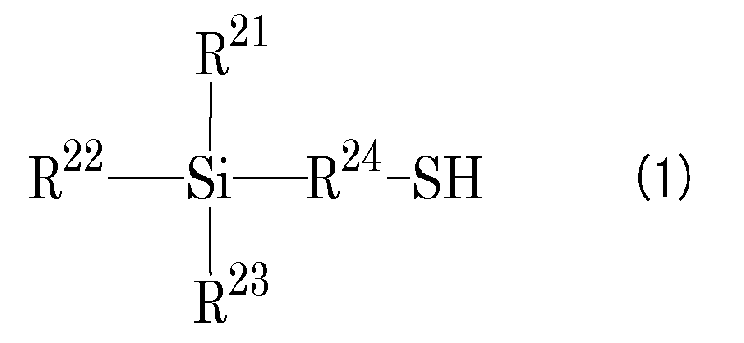 wherein R21 represents a group represented by -O-(R25-O)t-R26 in which t pieces of R25 are the same or different and each represent a branched or unbranched C1-C30 divalent hydrocarbon group; R26 represents a branched or unbranched C1-C30 alkyl group, a branched or unbranched C2-C30 alkenyl group, a C6-C30 aryl group, or a C7-C30 aralkyl group; and t represents an integer of 1 to 30; R22 and R23 are the same or different and each represent a group as defined for R21, a branched or unbranched C1-C12 alkyl group, or a group represented by -O-R27 in which R27 represents a hydrogen atom, a branched or unbranched C1-C30 alkyl group, a branched or unbranched C2-C30 alkenyl group, a C6-C30 aryl group, or a C7-C30 aralkyl group; and R24 represents a branched or unbranched C1-C30 alkylene group;
 and
and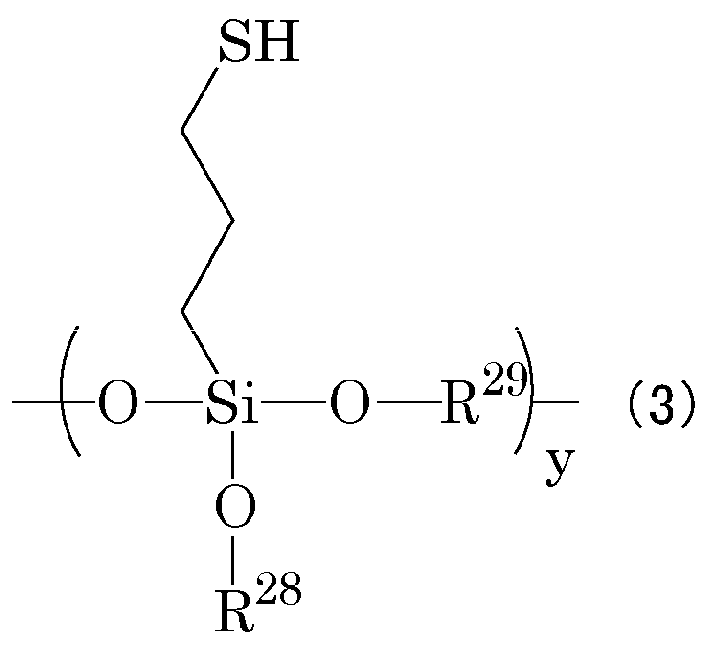 wherein x is an integer of 0 or greater; y is an integer of 1 or greater; R28 represents a hydrogen atom, a halogen atom, a branched or unbranched C1-C30 alkyl or alkylene group, a branched or unbranched C2-C30 alkenyl or alkenylene group, a branched or unbranched C2-C30 alkynyl or alkynylene group, or the alkyl or alkenyl group that is terminally substituted with a hydroxy or carboxyl group; R29 represents a hydrogen atom, a branched or unbranched C1-C30 alkylene or alkyl group, a branched or unbranched C2-C30 alkenylene or alkenyl group, or a branched or unbranched C2-C30 alkynylene or alkynyl group; and a pair of R28 and R29 may form a ring structure.
 - The rubber composition for a tire according to claim 1,
wherein the modified styrene butadiene rubber is contained in an amount of 5% by mass or more based on 100% by mass of the rubber component. - The rubber composition for a tire according to claim 1 or 2,
wherein the modified styrene butadiene rubber is a polymer in which at least one terminal is further modified by a modifier containing a functional group containing at least one selected from the group consisting of nitrogen, oxygen, and silicon. - The rubber composition for a tire according to any of claims 1 to 3, which is for use in a tread.
- A pneumatic tire, formed from the rubber composition according to any of claims 1 to 4.
Applications Claiming Priority (2)
| Application Number | Priority Date | Filing Date | Title |
|---|---|---|---|
| JP2011073202A JP5698050B2 (en) | 2011-03-29 | 2011-03-29 | Rubber composition for tire and pneumatic tire |
| PCT/JP2012/058052 WO2012133478A1 (en) | 2011-03-29 | 2012-03-28 | Rubber composition for use in tires, and pneumatic tire |
Publications (3)
| Publication Number | Publication Date |
|---|---|
| EP2671915A1 true EP2671915A1 (en) | 2013-12-11 |
| EP2671915A4 EP2671915A4 (en) | 2014-10-15 |
| EP2671915B1 EP2671915B1 (en) | 2016-01-06 |
Family
ID=46931188
Family Applications (1)
| Application Number | Title | Priority Date | Filing Date |
|---|---|---|---|
| EP12765397.0A Not-in-force EP2671915B1 (en) | 2011-03-29 | 2012-03-28 | Rubber composition for use in tires, and pneumatic tire |
Country Status (6)
| Country | Link |
|---|---|
| US (1) | US20130303683A1 (en) |
| EP (1) | EP2671915B1 (en) |
| JP (1) | JP5698050B2 (en) |
| CN (1) | CN103459486B (en) |
| BR (1) | BR112013025255A2 (en) |
| WO (1) | WO2012133478A1 (en) |
Cited By (2)
| Publication number | Priority date | Publication date | Assignee | Title |
|---|---|---|---|---|
| EP3312228A4 (en) * | 2015-06-18 | 2018-06-27 | Bridgestone Corporation | Vibration-damping rubber composition and vibration-damping rubber |
| EP4365230A1 (en) * | 2022-11-02 | 2024-05-08 | The Goodyear Tire & Rubber Company | Silica treated with a coupling agent and polyethylene glycol for a rubber composition |
Families Citing this family (5)
| Publication number | Priority date | Publication date | Assignee | Title |
|---|---|---|---|---|
| KR101508465B1 (en) | 2013-10-17 | 2015-04-14 | 주식회사 엘지화학 | End Functional Conjugated Diene Polymer And Method For Preparing The Same |
| BR112019001004A2 (en) * | 2016-07-22 | 2019-05-14 | Public Joint Stock Company "Sibur Holding" | rubber, its production method, rubber composition and use |
| CN107082920A (en) * | 2017-05-15 | 2017-08-22 | 北京化工大学 | Reactive solution polymerized butadiene styrene rubber composition and preparation method thereof and vulcanization rubber |
| JP6957126B2 (en) * | 2017-07-19 | 2021-11-02 | コンパニー ゼネラール デ エタブリッスマン ミシュラン | Rubber composition based on silicone oil |
| JP7820083B2 (en) * | 2020-03-10 | 2026-02-25 | 住友ゴム工業株式会社 | Rubber composition for tire tread, tire tread and passenger car tire |
Family Cites Families (24)
| Publication number | Priority date | Publication date | Assignee | Title |
|---|---|---|---|---|
| JP3986821B2 (en) | 2001-12-26 | 2007-10-03 | 住友ゴム工業株式会社 | Rubber composition for tire and tire using the rubber composition |
| CN1681876B (en) * | 2002-07-09 | 2012-05-30 | 莫门蒂夫性能材料股份有限公司 | Silica-rubber compound with improved hardness |
| US6812307B2 (en) * | 2002-08-16 | 2004-11-02 | The Goodyear Tire & Rubber Company | Functionalized monomers for synthesis of rubbery polymers |
| JP2006232917A (en) * | 2005-02-23 | 2006-09-07 | Yokohama Rubber Co Ltd:The | Rubber composition for tire |
| JP2007169431A (en) * | 2005-12-21 | 2007-07-05 | Sumitomo Rubber Ind Ltd | Rubber composition for sidewall |
| US7259205B1 (en) * | 2006-09-21 | 2007-08-21 | The Goodyear Tire & Rubber Company | Pneumatic tire |
| US7592384B2 (en) * | 2006-12-29 | 2009-09-22 | Shaun Fox | Elatomeric composition containing multiple silane coupling agents |
| BRPI0800118A (en) * | 2007-02-12 | 2008-10-07 | Goodyear Tire & Rubber | silica-reinforced rubber composition and use in tires |
| JP2009126907A (en) * | 2007-11-21 | 2009-06-11 | Sumitomo Rubber Ind Ltd | Rubber composition |
| EP2236554B1 (en) * | 2007-12-28 | 2013-08-07 | Bridgestone Corporation | Tire |
| JP5495153B2 (en) * | 2008-04-22 | 2014-05-21 | 住友ゴム工業株式会社 | Rubber composition and pneumatic tire using the same |
| CN101724127A (en) * | 2008-10-16 | 2010-06-09 | 住友橡胶工业株式会社 | Polymer, rubber composition and tire using the same |
| JP5466474B2 (en) * | 2008-10-16 | 2014-04-09 | 住友ゴム工業株式会社 | Rubber composition and tire using the same |
| CN101724185B (en) * | 2008-10-16 | 2013-10-23 | 住友橡胶工业株式会社 | Rubber composition and tire |
| JP5466473B2 (en) * | 2008-10-16 | 2014-04-09 | 住友ゴム工業株式会社 | Rubber composition and tire using the same |
| CN101724184B (en) * | 2008-10-29 | 2013-05-01 | 住友橡胶工业株式会社 | Rubber composition and tire |
| US20100190885A1 (en) * | 2009-01-29 | 2010-07-29 | Kuo-Chih Hua | Tire with rubber component containing silica and use of combination of blocked and unblocked alkoxyorganomercaptosilane coupling agents |
| JP2010189613A (en) * | 2009-02-20 | 2010-09-02 | Bridgestone Corp | Tire |
| JP5885504B2 (en) * | 2009-04-28 | 2016-03-15 | 株式会社ブリヂストン | Pneumatic tire |
| JP2010260920A (en) * | 2009-04-30 | 2010-11-18 | Bridgestone Corp | Tire |
| JP5566052B2 (en) * | 2009-06-04 | 2014-08-06 | 住友ゴム工業株式会社 | Rubber composition for tread and pneumatic tire using the same |
| JP2011032402A (en) * | 2009-08-04 | 2011-02-17 | Toyo Tire & Rubber Co Ltd | Rubber composition and pneumatic tire |
| JP5256262B2 (en) * | 2009-12-07 | 2013-08-07 | 住友ゴム工業株式会社 | Rubber composition for tire and pneumatic tire |
| JP2011140613A (en) * | 2009-12-09 | 2011-07-21 | Sumitomo Rubber Ind Ltd | Rubber composition for tire and pneumatic tire |
-
2011
- 2011-03-29 JP JP2011073202A patent/JP5698050B2/en not_active Expired - Fee Related
-
2012
- 2012-03-28 BR BR112013025255A patent/BR112013025255A2/en not_active IP Right Cessation
- 2012-03-28 WO PCT/JP2012/058052 patent/WO2012133478A1/en not_active Ceased
- 2012-03-28 US US13/981,026 patent/US20130303683A1/en not_active Abandoned
- 2012-03-28 EP EP12765397.0A patent/EP2671915B1/en not_active Not-in-force
- 2012-03-28 CN CN201280014880.7A patent/CN103459486B/en not_active Expired - Fee Related
Cited By (2)
| Publication number | Priority date | Publication date | Assignee | Title |
|---|---|---|---|---|
| EP3312228A4 (en) * | 2015-06-18 | 2018-06-27 | Bridgestone Corporation | Vibration-damping rubber composition and vibration-damping rubber |
| EP4365230A1 (en) * | 2022-11-02 | 2024-05-08 | The Goodyear Tire & Rubber Company | Silica treated with a coupling agent and polyethylene glycol for a rubber composition |
Also Published As
| Publication number | Publication date |
|---|---|
| US20130303683A1 (en) | 2013-11-14 |
| JP2012207108A (en) | 2012-10-25 |
| JP5698050B2 (en) | 2015-04-08 |
| CN103459486B (en) | 2015-11-25 |
| WO2012133478A1 (en) | 2012-10-04 |
| BR112013025255A2 (en) | 2017-02-07 |
| CN103459486A (en) | 2013-12-18 |
| EP2671915B1 (en) | 2016-01-06 |
| EP2671915A4 (en) | 2014-10-15 |
Similar Documents
| Publication | Publication Date | Title |
|---|---|---|
| EP2671915B1 (en) | Rubber composition for use in tires, and pneumatic tire | |
| JP6053495B2 (en) | Rubber composition for tire and pneumatic tire | |
| EP3072924B1 (en) | Pneumatic tire having tread fabricated using rubber composition | |
| EP3257688B1 (en) | Rubber composition and pneumatic tire comprising tread formed from said rubber composition | |
| JP2012122015A (en) | Rubber composition for tire, and pneumatic tire | |
| EP3763547A1 (en) | Tread rubber composition and pneumatic tire | |
| JP7435603B2 (en) | pneumatic tires | |
| JP2012158679A (en) | Rubber composition for tire and pneumatic tire | |
| JP2021167401A (en) | Composition for tire and tire | |
| JP2014012750A (en) | Rubber composition for tire, and pneumatic tire | |
| JP5827541B2 (en) | Rubber composition for tire and pneumatic tire | |
| JP2019182906A (en) | Rubber composition for tires, and pneumatic tire | |
| EP3705310A1 (en) | Rubber composition for tire, and tire | |
| JP2013082773A (en) | Tire rubber composition and pneumatic tire | |
| EP3176189B1 (en) | Rubber composition and pneumatic tire comprising tread formed from said rubber composition | |
| JP2022075724A (en) | Rubber composition for tread and pneumatic tire | |
| EP3907089B1 (en) | Tread rubber composition and pneumatic tire | |
| JP2019182907A (en) | Rubber composition for tire, and pneumatic tire | |
| JP2019182910A (en) | Rubber composition for tire, and pneumatic tire | |
| EP2692790A1 (en) | Rubber composition for use in tires, and pneumatic tire | |
| EP3778751B1 (en) | Rubber composition for tire, and pneumatic tire | |
| JP7180353B2 (en) | Method for producing rubber composition for tire | |
| JP5992770B2 (en) | Rubber composition for tire and pneumatic tire | |
| JP5587688B2 (en) | Rubber composition for tire and pneumatic tire | |
| JP7151134B2 (en) | Rubber composition for tire and pneumatic tire |
Legal Events
| Date | Code | Title | Description |
|---|---|---|---|
| PUAI | Public reference made under article 153(3) epc to a published international application that has entered the european phase |
Free format text: ORIGINAL CODE: 0009012 |
|
| 17P | Request for examination filed |
Effective date: 20130905 |
|
| AK | Designated contracting states |
Kind code of ref document: A1 Designated state(s): AL AT BE BG CH CY CZ DE DK EE ES FI FR GB GR HR HU IE IS IT LI LT LU LV MC MK MT NL NO PL PT RO RS SE SI SK SM TR |
|
| DAX | Request for extension of the european patent (deleted) | ||
| A4 | Supplementary search report drawn up and despatched |
Effective date: 20140916 |
|
| RIC1 | Information provided on ipc code assigned before grant |
Ipc: C08L 15/00 20060101AFI20140910BHEP Ipc: C08K 5/548 20060101ALI20140910BHEP Ipc: B60C 1/00 20060101ALI20140910BHEP Ipc: C08F 236/10 20060101ALI20140910BHEP Ipc: C08C 19/22 20060101ALI20140910BHEP Ipc: C08L 83/08 20060101ALI20140910BHEP Ipc: C08K 3/36 20060101ALI20140910BHEP Ipc: C08C 19/44 20060101ALI20140910BHEP Ipc: C08L 9/06 20060101ALI20140910BHEP |
|
| GRAP | Despatch of communication of intention to grant a patent |
Free format text: ORIGINAL CODE: EPIDOSNIGR1 |
|
| INTG | Intention to grant announced |
Effective date: 20150805 |
|
| GRAS | Grant fee paid |
Free format text: ORIGINAL CODE: EPIDOSNIGR3 |
|
| GRAA | (expected) grant |
Free format text: ORIGINAL CODE: 0009210 |
|
| AK | Designated contracting states |
Kind code of ref document: B1 Designated state(s): AL AT BE BG CH CY CZ DE DK EE ES FI FR GB GR HR HU IE IS IT LI LT LU LV MC MK MT NL NO PL PT RO RS SE SI SK SM TR |
|
| REG | Reference to a national code |
Ref country code: GB Ref legal event code: FG4D |
|
| REG | Reference to a national code |
Ref country code: CH Ref legal event code: EP |
|
| REG | Reference to a national code |
Ref country code: IE Ref legal event code: FG4D |
|
| REG | Reference to a national code |
Ref country code: AT Ref legal event code: REF Ref document number: 768842 Country of ref document: AT Kind code of ref document: T Effective date: 20160215 |
|
| REG | Reference to a national code |
Ref country code: DE Ref legal event code: R096 Ref document number: 602012013698 Country of ref document: DE |
|
| REG | Reference to a national code |
Ref country code: FR Ref legal event code: PLFP Year of fee payment: 5 |
|
| REG | Reference to a national code |
Ref country code: LT Ref legal event code: MG4D |
|
| REG | Reference to a national code |
Ref country code: NL Ref legal event code: MP Effective date: 20160106 |
|
| REG | Reference to a national code |
Ref country code: AT Ref legal event code: MK05 Ref document number: 768842 Country of ref document: AT Kind code of ref document: T Effective date: 20160106 |
|
| PG25 | Lapsed in a contracting state [announced via postgrant information from national office to epo] |
Ref country code: NL Free format text: LAPSE BECAUSE OF FAILURE TO SUBMIT A TRANSLATION OF THE DESCRIPTION OR TO PAY THE FEE WITHIN THE PRESCRIBED TIME-LIMIT Effective date: 20160106 |
|
| PG25 | Lapsed in a contracting state [announced via postgrant information from national office to epo] |
Ref country code: ES Free format text: LAPSE BECAUSE OF FAILURE TO SUBMIT A TRANSLATION OF THE DESCRIPTION OR TO PAY THE FEE WITHIN THE PRESCRIBED TIME-LIMIT Effective date: 20160106 Ref country code: GR Free format text: LAPSE BECAUSE OF FAILURE TO SUBMIT A TRANSLATION OF THE DESCRIPTION OR TO PAY THE FEE WITHIN THE PRESCRIBED TIME-LIMIT Effective date: 20160407 Ref country code: NO Free format text: LAPSE BECAUSE OF FAILURE TO SUBMIT A TRANSLATION OF THE DESCRIPTION OR TO PAY THE FEE WITHIN THE PRESCRIBED TIME-LIMIT Effective date: 20160406 Ref country code: HR Free format text: LAPSE BECAUSE OF FAILURE TO SUBMIT A TRANSLATION OF THE DESCRIPTION OR TO PAY THE FEE WITHIN THE PRESCRIBED TIME-LIMIT Effective date: 20160106 Ref country code: FI Free format text: LAPSE BECAUSE OF FAILURE TO SUBMIT A TRANSLATION OF THE DESCRIPTION OR TO PAY THE FEE WITHIN THE PRESCRIBED TIME-LIMIT Effective date: 20160106 Ref country code: IT Free format text: LAPSE BECAUSE OF FAILURE TO SUBMIT A TRANSLATION OF THE DESCRIPTION OR TO PAY THE FEE WITHIN THE PRESCRIBED TIME-LIMIT Effective date: 20160106 |
|
| PG25 | Lapsed in a contracting state [announced via postgrant information from national office to epo] |
Ref country code: SE Free format text: LAPSE BECAUSE OF FAILURE TO SUBMIT A TRANSLATION OF THE DESCRIPTION OR TO PAY THE FEE WITHIN THE PRESCRIBED TIME-LIMIT Effective date: 20160106 Ref country code: BE Free format text: LAPSE BECAUSE OF NON-PAYMENT OF DUE FEES Effective date: 20160331 Ref country code: RS Free format text: LAPSE BECAUSE OF FAILURE TO SUBMIT A TRANSLATION OF THE DESCRIPTION OR TO PAY THE FEE WITHIN THE PRESCRIBED TIME-LIMIT Effective date: 20160106 Ref country code: LT Free format text: LAPSE BECAUSE OF FAILURE TO SUBMIT A TRANSLATION OF THE DESCRIPTION OR TO PAY THE FEE WITHIN THE PRESCRIBED TIME-LIMIT Effective date: 20160106 Ref country code: AT Free format text: LAPSE BECAUSE OF FAILURE TO SUBMIT A TRANSLATION OF THE DESCRIPTION OR TO PAY THE FEE WITHIN THE PRESCRIBED TIME-LIMIT Effective date: 20160106 Ref country code: LV Free format text: LAPSE BECAUSE OF FAILURE TO SUBMIT A TRANSLATION OF THE DESCRIPTION OR TO PAY THE FEE WITHIN THE PRESCRIBED TIME-LIMIT Effective date: 20160106 Ref country code: PL Free format text: LAPSE BECAUSE OF FAILURE TO SUBMIT A TRANSLATION OF THE DESCRIPTION OR TO PAY THE FEE WITHIN THE PRESCRIBED TIME-LIMIT Effective date: 20160106 Ref country code: IS Free format text: LAPSE BECAUSE OF FAILURE TO SUBMIT A TRANSLATION OF THE DESCRIPTION OR TO PAY THE FEE WITHIN THE PRESCRIBED TIME-LIMIT Effective date: 20160506 Ref country code: PT Free format text: LAPSE BECAUSE OF FAILURE TO SUBMIT A TRANSLATION OF THE DESCRIPTION OR TO PAY THE FEE WITHIN THE PRESCRIBED TIME-LIMIT Effective date: 20160506 |
|
| REG | Reference to a national code |
Ref country code: DE Ref legal event code: R097 Ref document number: 602012013698 Country of ref document: DE |
|
| PG25 | Lapsed in a contracting state [announced via postgrant information from national office to epo] |
Ref country code: EE Free format text: LAPSE BECAUSE OF FAILURE TO SUBMIT A TRANSLATION OF THE DESCRIPTION OR TO PAY THE FEE WITHIN THE PRESCRIBED TIME-LIMIT Effective date: 20160106 Ref country code: DK Free format text: LAPSE BECAUSE OF FAILURE TO SUBMIT A TRANSLATION OF THE DESCRIPTION OR TO PAY THE FEE WITHIN THE PRESCRIBED TIME-LIMIT Effective date: 20160106 Ref country code: MC Free format text: LAPSE BECAUSE OF FAILURE TO SUBMIT A TRANSLATION OF THE DESCRIPTION OR TO PAY THE FEE WITHIN THE PRESCRIBED TIME-LIMIT Effective date: 20160106 Ref country code: LU Free format text: LAPSE BECAUSE OF FAILURE TO SUBMIT A TRANSLATION OF THE DESCRIPTION OR TO PAY THE FEE WITHIN THE PRESCRIBED TIME-LIMIT Effective date: 20160328 |
|
| REG | Reference to a national code |
Ref country code: CH Ref legal event code: PL |
|
| PLBE | No opposition filed within time limit |
Free format text: ORIGINAL CODE: 0009261 |
|
| STAA | Information on the status of an ep patent application or granted ep patent |
Free format text: STATUS: NO OPPOSITION FILED WITHIN TIME LIMIT |
|
| PG25 | Lapsed in a contracting state [announced via postgrant information from national office to epo] |
Ref country code: RO Free format text: LAPSE BECAUSE OF FAILURE TO SUBMIT A TRANSLATION OF THE DESCRIPTION OR TO PAY THE FEE WITHIN THE PRESCRIBED TIME-LIMIT Effective date: 20160106 Ref country code: SM Free format text: LAPSE BECAUSE OF FAILURE TO SUBMIT A TRANSLATION OF THE DESCRIPTION OR TO PAY THE FEE WITHIN THE PRESCRIBED TIME-LIMIT Effective date: 20160106 Ref country code: CZ Free format text: LAPSE BECAUSE OF FAILURE TO SUBMIT A TRANSLATION OF THE DESCRIPTION OR TO PAY THE FEE WITHIN THE PRESCRIBED TIME-LIMIT Effective date: 20160106 Ref country code: SK Free format text: LAPSE BECAUSE OF FAILURE TO SUBMIT A TRANSLATION OF THE DESCRIPTION OR TO PAY THE FEE WITHIN THE PRESCRIBED TIME-LIMIT Effective date: 20160106 |
|
| 26N | No opposition filed |
Effective date: 20161007 |
|
| GBPC | Gb: european patent ceased through non-payment of renewal fee |
Effective date: 20160406 |
|
| REG | Reference to a national code |
Ref country code: IE Ref legal event code: MM4A |
|
| PG25 | Lapsed in a contracting state [announced via postgrant information from national office to epo] |
Ref country code: BE Free format text: LAPSE BECAUSE OF FAILURE TO SUBMIT A TRANSLATION OF THE DESCRIPTION OR TO PAY THE FEE WITHIN THE PRESCRIBED TIME-LIMIT Effective date: 20160106 |
|
| PG25 | Lapsed in a contracting state [announced via postgrant information from national office to epo] |
Ref country code: LI Free format text: LAPSE BECAUSE OF NON-PAYMENT OF DUE FEES Effective date: 20160331 Ref country code: GB Free format text: LAPSE BECAUSE OF NON-PAYMENT OF DUE FEES Effective date: 20160406 Ref country code: CH Free format text: LAPSE BECAUSE OF NON-PAYMENT OF DUE FEES Effective date: 20160331 Ref country code: IE Free format text: LAPSE BECAUSE OF NON-PAYMENT OF DUE FEES Effective date: 20160328 |
|
| REG | Reference to a national code |
Ref country code: FR Ref legal event code: PLFP Year of fee payment: 6 |
|
| PG25 | Lapsed in a contracting state [announced via postgrant information from national office to epo] |
Ref country code: BG Free format text: LAPSE BECAUSE OF FAILURE TO SUBMIT A TRANSLATION OF THE DESCRIPTION OR TO PAY THE FEE WITHIN THE PRESCRIBED TIME-LIMIT Effective date: 20160406 Ref country code: SI Free format text: LAPSE BECAUSE OF FAILURE TO SUBMIT A TRANSLATION OF THE DESCRIPTION OR TO PAY THE FEE WITHIN THE PRESCRIBED TIME-LIMIT Effective date: 20160106 |
|
| PG25 | Lapsed in a contracting state [announced via postgrant information from national office to epo] |
Ref country code: MT Free format text: LAPSE BECAUSE OF FAILURE TO SUBMIT A TRANSLATION OF THE DESCRIPTION OR TO PAY THE FEE WITHIN THE PRESCRIBED TIME-LIMIT Effective date: 20160106 |
|
| REG | Reference to a national code |
Ref country code: FR Ref legal event code: PLFP Year of fee payment: 7 |
|
| PG25 | Lapsed in a contracting state [announced via postgrant information from national office to epo] |
Ref country code: HU Free format text: LAPSE BECAUSE OF FAILURE TO SUBMIT A TRANSLATION OF THE DESCRIPTION OR TO PAY THE FEE WITHIN THE PRESCRIBED TIME-LIMIT; INVALID AB INITIO Effective date: 20120328 Ref country code: CY Free format text: LAPSE BECAUSE OF FAILURE TO SUBMIT A TRANSLATION OF THE DESCRIPTION OR TO PAY THE FEE WITHIN THE PRESCRIBED TIME-LIMIT Effective date: 20160106 |
|
| PG25 | Lapsed in a contracting state [announced via postgrant information from national office to epo] |
Ref country code: TR Free format text: LAPSE BECAUSE OF FAILURE TO SUBMIT A TRANSLATION OF THE DESCRIPTION OR TO PAY THE FEE WITHIN THE PRESCRIBED TIME-LIMIT Effective date: 20160106 Ref country code: MK Free format text: LAPSE BECAUSE OF FAILURE TO SUBMIT A TRANSLATION OF THE DESCRIPTION OR TO PAY THE FEE WITHIN THE PRESCRIBED TIME-LIMIT Effective date: 20160106 Ref country code: MT Free format text: LAPSE BECAUSE OF FAILURE TO SUBMIT A TRANSLATION OF THE DESCRIPTION OR TO PAY THE FEE WITHIN THE PRESCRIBED TIME-LIMIT Effective date: 20160331 |
|
| PG25 | Lapsed in a contracting state [announced via postgrant information from national office to epo] |
Ref country code: AL Free format text: LAPSE BECAUSE OF FAILURE TO SUBMIT A TRANSLATION OF THE DESCRIPTION OR TO PAY THE FEE WITHIN THE PRESCRIBED TIME-LIMIT Effective date: 20160106 |
|
| PGFP | Annual fee paid to national office [announced via postgrant information from national office to epo] |
Ref country code: FR Payment date: 20190213 Year of fee payment: 8 |
|
| PG25 | Lapsed in a contracting state [announced via postgrant information from national office to epo] |
Ref country code: FR Free format text: LAPSE BECAUSE OF NON-PAYMENT OF DUE FEES Effective date: 20200331 |
|
| PGFP | Annual fee paid to national office [announced via postgrant information from national office to epo] |
Ref country code: DE Payment date: 20220203 Year of fee payment: 11 |
|
| REG | Reference to a national code |
Ref country code: DE Ref legal event code: R119 Ref document number: 602012013698 Country of ref document: DE |
|
| PG25 | Lapsed in a contracting state [announced via postgrant information from national office to epo] |
Ref country code: DE Free format text: LAPSE BECAUSE OF NON-PAYMENT OF DUE FEES Effective date: 20231003 |