EP2671873A1 - Method for the cyclization of hydrazinoacrylic acid derivatives - Google Patents
Method for the cyclization of hydrazinoacrylic acid derivatives Download PDFInfo
- Publication number
- EP2671873A1 EP2671873A1 EP12171094.1A EP12171094A EP2671873A1 EP 2671873 A1 EP2671873 A1 EP 2671873A1 EP 12171094 A EP12171094 A EP 12171094A EP 2671873 A1 EP2671873 A1 EP 2671873A1
- Authority
- EP
- European Patent Office
- Prior art keywords
- group
- substituted
- alkyl
- anyone
- formula
- Prior art date
- Legal status (The legal status is an assumption and is not a legal conclusion. Google has not performed a legal analysis and makes no representation as to the accuracy of the status listed.)
- Withdrawn
Links
- 238000007363 ring formation reaction Methods 0.000 title claims abstract description 8
- 238000000034 method Methods 0.000 title claims description 20
- SLNOZWZCYJQTKJ-UHFFFAOYSA-N 2-hydrazinylprop-2-enoic acid Chemical class NNC(=C)C(O)=O SLNOZWZCYJQTKJ-UHFFFAOYSA-N 0.000 title description 2
- 150000001875 compounds Chemical class 0.000 claims abstract description 32
- 229910052801 chlorine Inorganic materials 0.000 claims abstract description 15
- 229910052731 fluorine Inorganic materials 0.000 claims abstract description 15
- 125000000217 alkyl group Chemical group 0.000 claims abstract description 14
- 238000004519 manufacturing process Methods 0.000 claims abstract description 14
- 229910052794 bromium Inorganic materials 0.000 claims abstract description 8
- 229910052799 carbon Inorganic materials 0.000 claims abstract description 6
- 125000005843 halogen group Chemical group 0.000 claims abstract description 5
- 125000001424 substituent group Chemical group 0.000 claims abstract description 5
- 125000001309 chloro group Chemical group Cl* 0.000 claims abstract 3
- 238000006243 chemical reaction Methods 0.000 claims description 33
- -1 chlorobromomethyl Chemical group 0.000 claims description 19
- 239000000460 chlorine Chemical group 0.000 claims description 14
- ZAMOUSCENKQFHK-UHFFFAOYSA-N Chlorine atom Chemical group [Cl] ZAMOUSCENKQFHK-UHFFFAOYSA-N 0.000 claims description 12
- 239000011737 fluorine Substances 0.000 claims description 12
- 229910052757 nitrogen Inorganic materials 0.000 claims description 10
- 229910052760 oxygen Inorganic materials 0.000 claims description 10
- 125000006539 C12 alkyl group Chemical group [H]C([H])([H])C([H])([H])C([H])([H])C([H])([H])C([H])([H])C([H])([H])C([H])([H])C([H])([H])C([H])([H])C([H])([H])C([H])([H])C([H])([H])* 0.000 claims description 9
- 125000002877 alkyl aryl group Chemical group 0.000 claims description 9
- 125000003710 aryl alkyl group Chemical group 0.000 claims description 9
- 125000003118 aryl group Chemical group 0.000 claims description 9
- 125000000753 cycloalkyl group Chemical group 0.000 claims description 9
- WKBOTKDWSSQWDR-UHFFFAOYSA-N Bromine atom Chemical group [Br] WKBOTKDWSSQWDR-UHFFFAOYSA-N 0.000 claims description 7
- GDTBXPJZTBHREO-UHFFFAOYSA-N bromine Chemical group BrBr GDTBXPJZTBHREO-UHFFFAOYSA-N 0.000 claims description 7
- 125000001153 fluoro group Chemical group F* 0.000 claims description 7
- 125000005842 heteroatom Chemical group 0.000 claims description 7
- 125000004433 nitrogen atom Chemical group N* 0.000 claims description 7
- 229910052717 sulfur Inorganic materials 0.000 claims description 7
- 125000004775 chlorodifluoromethyl group Chemical group FC(F)(Cl)* 0.000 claims description 6
- UNBYUAUYBJREJB-UHFFFAOYSA-N ethyl 4-chloro-4,4-difluoro-2-[[methyl-(propan-2-ylideneamino)amino]methylidene]-3-oxobutanoate Chemical compound CCOC(=O)C(=CN(C)N=C(C)C)C(=O)C(F)(F)Cl UNBYUAUYBJREJB-UHFFFAOYSA-N 0.000 claims description 6
- FIOCAFXJNSJHHM-UHFFFAOYSA-N ethyl 3-[chloro(difluoro)methyl]-1-methylpyrazole-4-carboxylate Chemical compound CCOC(=O)C1=CN(C)N=C1C(F)(F)Cl FIOCAFXJNSJHHM-UHFFFAOYSA-N 0.000 claims description 4
- KJASTBCNGFYKSR-UHFFFAOYSA-N prop-2-enehydrazide Chemical class NNC(=O)C=C KJASTBCNGFYKSR-UHFFFAOYSA-N 0.000 claims description 4
- 230000000855 fungicidal effect Effects 0.000 claims description 3
- 125000004435 hydrogen atom Chemical group [H]* 0.000 claims description 3
- 150000003217 pyrazoles Chemical class 0.000 claims description 3
- 125000001478 1-chloroethyl group Chemical group [H]C([H])([H])C([H])(Cl)* 0.000 claims description 2
- 125000000453 2,2,2-trichloroethyl group Chemical group [H]C([H])(*)C(Cl)(Cl)Cl 0.000 claims description 2
- 125000004781 2,2-dichloro-2-fluoroethyl group Chemical group [H]C([H])(*)C(F)(Cl)Cl 0.000 claims description 2
- 125000004780 2-chloro-2,2-difluoroethyl group Chemical group [H]C([H])(*)C(F)(F)Cl 0.000 claims description 2
- 238000003302 UV-light treatment Methods 0.000 claims description 2
- 150000001450 anions Chemical class 0.000 claims description 2
- 125000004429 atom Chemical group 0.000 claims description 2
- 125000004773 chlorofluoromethyl group Chemical group [H]C(F)(Cl)* 0.000 claims description 2
- 125000004218 chloromethyl group Chemical group [H]C([H])(Cl)* 0.000 claims description 2
- 125000004772 dichloromethyl group Chemical group [H]C(Cl)(Cl)* 0.000 claims description 2
- MRQQMVMIANXDKC-UHFFFAOYSA-N ethyl 3-(difluoromethyl)-1-methylpyrazole-4-carboxylate Chemical compound CCOC(=O)C1=CN(C)N=C1C(F)F MRQQMVMIANXDKC-UHFFFAOYSA-N 0.000 claims description 2
- 239000001257 hydrogen Substances 0.000 claims description 2
- 229910052739 hydrogen Inorganic materials 0.000 claims description 2
- 125000003866 trichloromethyl group Chemical group ClC(Cl)(Cl)* 0.000 claims description 2
- ZCYVEMRRCGMTRW-UHFFFAOYSA-N 7553-56-2 Chemical group [I] ZCYVEMRRCGMTRW-UHFFFAOYSA-N 0.000 claims 3
- 229910052740 iodine Chemical group 0.000 claims 3
- 239000011630 iodine Chemical group 0.000 claims 3
- 230000000977 initiatory effect Effects 0.000 claims 1
- 239000000417 fungicide Substances 0.000 abstract description 4
- 239000000543 intermediate Substances 0.000 abstract description 3
- 239000002904 solvent Substances 0.000 description 15
- 125000002496 methyl group Chemical group [H]C([H])([H])* 0.000 description 14
- 125000001495 ethyl group Chemical group [H]C([H])([H])C([H])([H])* 0.000 description 13
- 239000011541 reaction mixture Substances 0.000 description 11
- LFQSCWFLJHTTHZ-UHFFFAOYSA-N Ethanol Chemical compound CCO LFQSCWFLJHTTHZ-UHFFFAOYSA-N 0.000 description 10
- GKASDNZWUGIAMG-UHFFFAOYSA-N triethyl orthoformate Chemical compound CCOC(OCC)OCC GKASDNZWUGIAMG-UHFFFAOYSA-N 0.000 description 10
- VLKZOEOYAKHREP-UHFFFAOYSA-N n-Hexane Chemical class CCCCCC VLKZOEOYAKHREP-UHFFFAOYSA-N 0.000 description 8
- 239000000203 mixture Chemical class 0.000 description 7
- 239000007858 starting material Substances 0.000 description 7
- WFDIJRYMOXRFFG-UHFFFAOYSA-N Acetic anhydride Chemical compound CC(=O)OC(C)=O WFDIJRYMOXRFFG-UHFFFAOYSA-N 0.000 description 6
- PXGOKWXKJXAPGV-UHFFFAOYSA-N Fluorine Chemical compound FF PXGOKWXKJXAPGV-UHFFFAOYSA-N 0.000 description 6
- IMNFDUFMRHMDMM-UHFFFAOYSA-N N-Heptane Chemical class CCCCCCC IMNFDUFMRHMDMM-UHFFFAOYSA-N 0.000 description 5
- OFBQJSOFQDEBGM-UHFFFAOYSA-N Pentane Chemical class CCCCC OFBQJSOFQDEBGM-UHFFFAOYSA-N 0.000 description 4
- 150000001298 alcohols Chemical class 0.000 description 4
- 238000004817 gas chromatography Methods 0.000 description 4
- PNDPGZBMCMUPRI-UHFFFAOYSA-N iodine Chemical group II PNDPGZBMCMUPRI-UHFFFAOYSA-N 0.000 description 4
- 239000000243 solution Substances 0.000 description 4
- YMWUJEATGCHHMB-UHFFFAOYSA-N Dichloromethane Chemical compound ClCCl YMWUJEATGCHHMB-UHFFFAOYSA-N 0.000 description 3
- OKKJLVBELUTLKV-UHFFFAOYSA-N Methanol Chemical compound OC OKKJLVBELUTLKV-UHFFFAOYSA-N 0.000 description 3
- YXFVVABEGXRONW-UHFFFAOYSA-N Toluene Chemical compound CC1=CC=CC=C1 YXFVVABEGXRONW-UHFFFAOYSA-N 0.000 description 3
- 125000000484 butyl group Chemical group [H]C([*])([H])C([H])([H])C([H])([H])C([H])([H])[H] 0.000 description 3
- 125000001028 difluoromethyl group Chemical group [H]C(F)(F)* 0.000 description 3
- 238000004821 distillation Methods 0.000 description 3
- 125000001160 methoxycarbonyl group Chemical group [H]C([H])([H])OC(*)=O 0.000 description 3
- 125000001436 propyl group Chemical group [H]C([*])([H])C([H])([H])C([H])([H])[H] 0.000 description 3
- 238000006722 reduction reaction Methods 0.000 description 3
- 238000001228 spectrum Methods 0.000 description 3
- 125000002023 trifluoromethyl group Chemical group FC(F)(F)* 0.000 description 3
- WZLFPVPRZGTCKP-UHFFFAOYSA-N 1,1,1,3,3-pentafluorobutane Chemical compound CC(F)(F)CC(F)(F)F WZLFPVPRZGTCKP-UHFFFAOYSA-N 0.000 description 2
- 238000005160 1H NMR spectroscopy Methods 0.000 description 2
- CSCPPACGZOOCGX-UHFFFAOYSA-N Acetone Chemical compound CC(C)=O CSCPPACGZOOCGX-UHFFFAOYSA-N 0.000 description 2
- IJGRMHOSHXDMSA-UHFFFAOYSA-N Atomic nitrogen Chemical compound N#N IJGRMHOSHXDMSA-UHFFFAOYSA-N 0.000 description 2
- 0 CC*OC(C(C)C(*)=N)OO Chemical compound CC*OC(C(C)C(*)=N)OO 0.000 description 2
- LYCAIKOWRPUZTN-UHFFFAOYSA-N Ethylene glycol Chemical compound OCCO LYCAIKOWRPUZTN-UHFFFAOYSA-N 0.000 description 2
- KFZMGEQAYNKOFK-UHFFFAOYSA-N Isopropanol Chemical compound CC(C)O KFZMGEQAYNKOFK-UHFFFAOYSA-N 0.000 description 2
- GWEVSGVZZGPLCZ-UHFFFAOYSA-N Titan oxide Chemical compound O=[Ti]=O GWEVSGVZZGPLCZ-UHFFFAOYSA-N 0.000 description 2
- HEDRZPFGACZZDS-MICDWDOJSA-N Trichloro(2H)methane Chemical compound [2H]C(Cl)(Cl)Cl HEDRZPFGACZZDS-MICDWDOJSA-N 0.000 description 2
- WETWJCDKMRHUPV-UHFFFAOYSA-N acetyl chloride Chemical compound CC(Cl)=O WETWJCDKMRHUPV-UHFFFAOYSA-N 0.000 description 2
- 230000015572 biosynthetic process Effects 0.000 description 2
- 125000004432 carbon atom Chemical group C* 0.000 description 2
- QPAXMPYBNSHKAK-UHFFFAOYSA-N chloro(difluoro)methane Chemical group F[C](F)Cl QPAXMPYBNSHKAK-UHFFFAOYSA-N 0.000 description 2
- CCGKOQOJPYTBIH-UHFFFAOYSA-N ethenone Chemical compound C=C=O CCGKOQOJPYTBIH-UHFFFAOYSA-N 0.000 description 2
- TZYAMDQYICXGAI-UHFFFAOYSA-N ethyl 4-chloro-2-(diethoxymethyl)-4,4-difluoro-3-oxobutanoate Chemical compound CCOC(OCC)C(C(=O)C(F)(F)Cl)C(=O)OCC TZYAMDQYICXGAI-UHFFFAOYSA-N 0.000 description 2
- 150000005826 halohydrocarbons Chemical class 0.000 description 2
- 229930195733 hydrocarbon Natural products 0.000 description 2
- 150000002430 hydrocarbons Chemical class 0.000 description 2
- 239000011261 inert gas Substances 0.000 description 2
- NNPPMTNAJDCUHE-UHFFFAOYSA-N isobutane Chemical compound CC(C)C NNPPMTNAJDCUHE-UHFFFAOYSA-N 0.000 description 2
- 239000007788 liquid Substances 0.000 description 2
- 125000004123 n-propyl group Chemical group [H]C([H])([H])C([H])([H])C([H])([H])* 0.000 description 2
- 239000003960 organic solvent Substances 0.000 description 2
- MSSNHSVIGIHOJA-UHFFFAOYSA-N pentafluoropropane Chemical compound FC(F)CC(F)(F)F MSSNHSVIGIHOJA-UHFFFAOYSA-N 0.000 description 2
- BWHMMNNQKKPAPP-UHFFFAOYSA-L potassium carbonate Chemical compound [K+].[K+].[O-]C([O-])=O BWHMMNNQKKPAPP-UHFFFAOYSA-L 0.000 description 2
- BDERNNFJNOPAEC-UHFFFAOYSA-N propan-1-ol Chemical compound CCCO BDERNNFJNOPAEC-UHFFFAOYSA-N 0.000 description 2
- 238000000746 purification Methods 0.000 description 2
- 238000005292 vacuum distillation Methods 0.000 description 2
- RIQRGMUSBYGDBL-UHFFFAOYSA-N 1,1,1,2,2,3,4,5,5,5-decafluoropentane Chemical compound FC(F)(F)C(F)C(F)C(F)(F)C(F)(F)F RIQRGMUSBYGDBL-UHFFFAOYSA-N 0.000 description 1
- NVSXSBBVEDNGPY-UHFFFAOYSA-N 1,1,1,2,2-pentafluorobutane Chemical compound CCC(F)(F)C(F)(F)F NVSXSBBVEDNGPY-UHFFFAOYSA-N 0.000 description 1
- YFMFNYKEUDLDTL-UHFFFAOYSA-N 1,1,1,2,3,3,3-heptafluoropropane Chemical compound FC(F)(F)C(F)C(F)(F)F YFMFNYKEUDLDTL-UHFFFAOYSA-N 0.000 description 1
- UOCLXMDMGBRAIB-UHFFFAOYSA-N 1,1,1-trichloroethane Chemical compound CC(Cl)(Cl)Cl UOCLXMDMGBRAIB-UHFFFAOYSA-N 0.000 description 1
- HEDRZPFGACZZDS-UHFFFAOYSA-N Chloroform Chemical compound ClC(Cl)Cl HEDRZPFGACZZDS-UHFFFAOYSA-N 0.000 description 1
- JNCMHMUGTWEVOZ-UHFFFAOYSA-N F[CH]F Chemical compound F[CH]F JNCMHMUGTWEVOZ-UHFFFAOYSA-N 0.000 description 1
- UFHFLCQGNIYNRP-UHFFFAOYSA-N Hydrogen Chemical compound [H][H] UFHFLCQGNIYNRP-UHFFFAOYSA-N 0.000 description 1
- QAOWNCQODCNURD-UHFFFAOYSA-L Sulfate Chemical compound [O-]S([O-])(=O)=O QAOWNCQODCNURD-UHFFFAOYSA-L 0.000 description 1
- WDJHALXBUFZDSR-UHFFFAOYSA-N acetoacetic acid Chemical class CC(=O)CC(O)=O WDJHALXBUFZDSR-UHFFFAOYSA-N 0.000 description 1
- 150000001252 acrylic acid derivatives Chemical class 0.000 description 1
- 150000001266 acyl halides Chemical class 0.000 description 1
- 230000010933 acylation Effects 0.000 description 1
- 238000005917 acylation reaction Methods 0.000 description 1
- 238000007281 aminoalkylation reaction Methods 0.000 description 1
- 239000003849 aromatic solvent Substances 0.000 description 1
- QVGXLLKOCUKJST-UHFFFAOYSA-N atomic oxygen Chemical compound [O] QVGXLLKOCUKJST-UHFFFAOYSA-N 0.000 description 1
- 239000003054 catalyst Substances 0.000 description 1
- XJHCXCQVJFPJIK-UHFFFAOYSA-M cesium fluoride Substances [F-].[Cs+] XJHCXCQVJFPJIK-UHFFFAOYSA-M 0.000 description 1
- 239000003153 chemical reaction reagent Substances 0.000 description 1
- 229960001701 chloroform Drugs 0.000 description 1
- 238000001816 cooling Methods 0.000 description 1
- 239000012045 crude solution Substances 0.000 description 1
- 238000002425 crystallisation Methods 0.000 description 1
- 230000008025 crystallization Effects 0.000 description 1
- 125000004122 cyclic group Chemical group 0.000 description 1
- 238000001212 derivatisation Methods 0.000 description 1
- GUYVVVAWKNQEAD-WAYWQWQTSA-N ethyl (2z)-4-chloro-2-(ethoxymethylidene)-4,4-difluoro-3-oxobutanoate Chemical compound CCO\C=C(C(=O)C(F)(F)Cl)/C(=O)OCC GUYVVVAWKNQEAD-WAYWQWQTSA-N 0.000 description 1
- ILOXLVPMINVBMG-UHFFFAOYSA-N ethyl 4-chloro-4,4-difluoro-3-oxobutanoate Chemical compound CCOC(=O)CC(=O)C(F)(F)Cl ILOXLVPMINVBMG-UHFFFAOYSA-N 0.000 description 1
- 125000001475 halogen functional group Chemical group 0.000 description 1
- UKACHOXRXFQJFN-UHFFFAOYSA-N heptafluoropropane Chemical compound FC(F)C(F)(F)C(F)(F)F UKACHOXRXFQJFN-UHFFFAOYSA-N 0.000 description 1
- 150000002391 heterocyclic compounds Chemical class 0.000 description 1
- 125000000623 heterocyclic group Chemical group 0.000 description 1
- WGCNASOHLSPBMP-UHFFFAOYSA-N hydroxyacetaldehyde Natural products OCC=O WGCNASOHLSPBMP-UHFFFAOYSA-N 0.000 description 1
- 235000013847 iso-butane Nutrition 0.000 description 1
- 238000002955 isolation Methods 0.000 description 1
- 125000001449 isopropyl group Chemical group [H]C([H])([H])C([H])(*)C([H])([H])[H] 0.000 description 1
- 239000007791 liquid phase Substances 0.000 description 1
- 238000003760 magnetic stirring Methods 0.000 description 1
- QSHDDOUJBYECFT-UHFFFAOYSA-N mercury Chemical compound [Hg] QSHDDOUJBYECFT-UHFFFAOYSA-N 0.000 description 1
- 229910052753 mercury Inorganic materials 0.000 description 1
- 229910052751 metal Inorganic materials 0.000 description 1
- 239000002184 metal Substances 0.000 description 1
- 229910052987 metal hydride Inorganic materials 0.000 description 1
- 150000004681 metal hydrides Chemical class 0.000 description 1
- 239000002808 molecular sieve Substances 0.000 description 1
- HDZGCSFEDULWCS-UHFFFAOYSA-N monomethylhydrazine Chemical compound CNN HDZGCSFEDULWCS-UHFFFAOYSA-N 0.000 description 1
- IJDNQMDRQITEOD-UHFFFAOYSA-N n-butane Chemical compound CCCC IJDNQMDRQITEOD-UHFFFAOYSA-N 0.000 description 1
- 125000004108 n-butyl group Chemical group [H]C([H])([H])C([H])([H])C([H])([H])C([H])([H])* 0.000 description 1
- 125000000740 n-pentyl group Chemical group [H]C([H])([H])C([H])([H])C([H])([H])C([H])([H])C([H])([H])* 0.000 description 1
- 239000001301 oxygen Substances 0.000 description 1
- 229910000027 potassium carbonate Inorganic materials 0.000 description 1
- 239000002243 precursor Substances 0.000 description 1
- 239000010453 quartz Substances 0.000 description 1
- 229920006395 saturated elastomer Polymers 0.000 description 1
- 125000002914 sec-butyl group Chemical group [H]C([H])([H])C([H])([H])C([H])(*)C([H])([H])[H] 0.000 description 1
- 238000000926 separation method Methods 0.000 description 1
- 238000007086 side reaction Methods 0.000 description 1
- VYPSYNLAJGMNEJ-UHFFFAOYSA-N silicon dioxide Inorganic materials O=[Si]=O VYPSYNLAJGMNEJ-UHFFFAOYSA-N 0.000 description 1
- URGAHOPLAPQHLN-UHFFFAOYSA-N sodium aluminosilicate Chemical compound [Na+].[Al+3].[O-][Si]([O-])=O.[O-][Si]([O-])=O URGAHOPLAPQHLN-UHFFFAOYSA-N 0.000 description 1
- 239000008399 tap water Substances 0.000 description 1
- 235000020679 tap water Nutrition 0.000 description 1
- 125000000999 tert-butyl group Chemical group [H]C([H])([H])C(*)(C([H])([H])[H])C([H])([H])[H] 0.000 description 1
- 238000009281 ultraviolet germicidal irradiation Methods 0.000 description 1
- XLYOFNOQVPJJNP-UHFFFAOYSA-N water Substances O XLYOFNOQVPJJNP-UHFFFAOYSA-N 0.000 description 1
Classifications
-
- C—CHEMISTRY; METALLURGY
- C07—ORGANIC CHEMISTRY
- C07D—HETEROCYCLIC COMPOUNDS
- C07D231/00—Heterocyclic compounds containing 1,2-diazole or hydrogenated 1,2-diazole rings
- C07D231/02—Heterocyclic compounds containing 1,2-diazole or hydrogenated 1,2-diazole rings not condensed with other rings
- C07D231/10—Heterocyclic compounds containing 1,2-diazole or hydrogenated 1,2-diazole rings not condensed with other rings having two or three double bonds between ring members or between ring members and non-ring members
- C07D231/12—Heterocyclic compounds containing 1,2-diazole or hydrogenated 1,2-diazole rings not condensed with other rings having two or three double bonds between ring members or between ring members and non-ring members with only hydrogen atoms, hydrocarbon or substituted hydrocarbon radicals, directly attached to ring carbon atoms
Definitions
- the present invention concerns a method for the cyclization of hydrazinoacrylic acid derivatives to form heterocyclic compounds.
- 1-substituted pyrazoles e.g. 1-alkylpyrazoles, as is described in US 2011/000962 , are intermediates for fungicides.
- the present invention concerns a method for the manufacture of 1-alkyl-3-haloalkyl-pyrazole-4-carboxylic acid derivatives of formula (I)
- R 1 is an organic substituent selected from the group consisting of C1 to C12 alkyl ; C3 to C8 cycloalkyl ; C2 to C12 alkenyl ; C2 to C12 alkynyl ; C6 to C8 aryl ; C7 to C19 arylalkyl ; and C7 to C19 alkylaryl ; each of which may be substituted by one or more groups selected from the group consisting of R', X, OR', SR', NR' 2 , SiR' 3 , COOR', C(O)R', CN and CONR' 2 wherein R' is H or a C 1 to C12 group ; R 2 is selected from C 1 to C4 alkyl groups are substituted by one, two or three halogen atoms selected from the group consisting of F, C1 and Br or a CF 3 group, with the proviso that R 2 is substituted by at least one C1 atom ; Y is selected from the group consisting
- R 4 , R 5 , R 6 , R 7 , R 8 and R 9 are preferably C 1 to C5 alkyl, and more preferably, methyl or ethyl; and X is fluorine, chlorine, bromine and iodine, preferably fluorine or chlorine ; and when Z is N + R 6 R 7 the positive charge is balanced by an anion, e.g. by a sulfate anion or Cl - to UV light to initiate a cyclization reaction.
- R 1 preferably is C 1 to C5 alkyl ; or C 1 to C5 alkyl, substituted by at least one halogen atom, and more preferably, R 1 is methyl, ethyl, n-propyl, i-propyl, n-butyl, s-butyl, t-butyl or n-pentyl. Especially preferably, R 1 is methyl or ethyl, most preferably, methyl.
- R 2 is chloromethyl, dichloromethyl, trichloromethyl, chlorobromomethyl, chlorofluoromethyl, chlorodifluoromethyl, fluorodichloromethyl, 1-chloroethyl, 2,2-dichloroethyl, 1,2-dichloroethyl, 2-chlorofluoroethyl, 2-chloro-2,2-difluoroethyl, 2,2-dichloro-2-fluoroethyl, 2,2,2-trichloroethyl ; especially preferably, R 2 is CClF 2 .
- Z is O.
- Y is C(O)OR 3 wherein R 3 is a C1 to C5 alkyl group.
- R 1 is methyl or ethyl
- R 2 is CHF 2 , CClF 2 or CF 3
- R 3 is methyl or ethyl
- R 1 is methyl
- R 2 is CHF 2 , CClF 2 or CF 3
- R 3 is methyl or ethyl
- R 3 , R 4 , R 5 , R 6 , R 7 , R 8 and R 9 are preferably methyl, ethyl, propyl or butyl, and especially preferably, they are methyl or ethyl.
- Preferred pyrazole compounds of formula (I) are assembled in table 1.
- Table 1 Preferred pyrazole compounds 3-CF 2 Cl-1-CH 3 -1 H-pyrazole-4-COOCH 3 3-CF 2 Cl-1-CH 3 -1 H-pyrazole-4-COOCH 2 CH 3 3-CF 2 Cl-1-CH 3 -1 H-pyrazole-4-COOCH 2 CH 2 CH 3 3-CFHCl-1-CH 3 -1 H-pyrazole-4-COOCH 3 3-CFHCl-1-CH 3 -1 H-pyrazole-4-COOCH 2 CH 3 3-CFHCl-1-CH 3 -1 H-pyrazole-4-COOCH 2 CH 2 CH 3 3-CH 2 Cl-1-CH 3 -1 H-pyrazole-4-COOCH 3 3-CH 2 Cl-1-CH 3 -1 H-pyrazole-4-COOCH 3 3-CH 2 Cl-1-CH 3 -1 H-pyrazole-4-COOCH 2 CH 3 3-CH 2 Cl-1-CH 3 -1 H-pyrazole-4-COOCH 3 3-CH
- the UV light treatment of the compound of formula (II) preferably is performed in a solvent.
- a solvent Protic, aprotic, polar and nonpolar organic solvents may be used. It is only necessary that the solvent contains water or moisture or a hydrogen atom, e.g. in the form of an O-H group or C-H group.
- aromatic solvents e.g. toluene
- Alcohols are also suitable as solvent, e.g. monobasic alcohols and dibasic alcohols, for example, methanol, ethanol, n-propanol, isopropanol or glycol.
- Hydrocarbons be they linear, branched or cyclic, can be applied, for example hydrocarbons with 3 to 10 carbon atoms, e.g. n-butane, 2-methylpropane, any isomers of pentane, e.g. n-pentane, any isomers of hexane, e.g. n-hexane, any isomers of heptane, e,g, n-heptane, and any mixtures thereof.
- Halohydrocarbons are suitable as solvent, e.g. saturated halohydrocarbons with 1 to 10 carbon atoms wherein halo denotes chlorine and fluorine.
- UV light providing irradiation comprising at least one wavelength, or a spectrum of wavelengths, in the range of 190 to 254 nm can be used for the UV treatment of the compound of formula (II).
- Low pressure mercury lamps and middle pressure UV lamps are very suitable.
- LEDs and OLEDs providing irradiation having at least one wavelength, or a spectrum of wavelengths, in the UV light region are also suitable.
- laser light in the UV is suitable.
- UV light is irradiated into the reaction mixture for the whole duration of the cyclization reaction. It is sufficient to switch it on in the beginning of the reaction to induce the reaction start. For example, it is sufficient to irradiate UV light into the reaction mixture for a time span in the range of 1 second to 5 minutes. If desired, UV light may be irradiated into the reaction mixture intermittently, e.g. every 10 to 30 minutes but this is not necessary.
- the advantage of the reaction is, for example, that it must not be performed in a photo reactor. It is only necessary that, to start the reaction, UV light is irradiated shortly into the respective reactor.
- the treatment with UV light can be performed in any reactor suitable for UV irradiation of liquid phase components.
- Stirred batch reactors are very suitable.
- Flow reactors in which the starting compounds are, usually quickly, passed through lines or other reactor parts in which the starting compounds are contacted with UV light, are also suitable.
- the reaction temperature for performing the UV treatment is very variable. For example, it can be performed between -30°C and +100°C. Preferably, the reaction temperature is ranging from-20°C to 30°C.
- the pressure is not critical. It is technically especially simple to perform the UV treatment at ambient pressure. But, if desired, the UV treatment can be performed under reduced pressure or at elevated pressure, e.g. at a pressure of equal to or less than 20 bar (abs).
- inert gas e.g., nitrogen
- inert gas can be used to prevent the intrusion of air or oxygen into the reactor in which the UV treatment is performed.
- the working up of the resulting reaction mixture can be performed according to methods known in the art.
- solvent can be evaporated off, and the desired compound of formula (I) can be isolated by distillation under a vacuum.
- the separation of the 3-R 2 isomer from the 5-R 2 isomer can be achieved by methods known in the art, especially by distillation in a vacuum. Since the undesired isomer is produced in very low amounts, e.g. of 1 % or less, it is preferred to remove it in a final purification step. For example, it can be removed by crystallization, e.g. in a mixture of 1,1,1,3,3-pentafluorobutane/hexane after a reduction step.
- the 1-R 1 -3-haloalkyl-pyrazole-4-carboxylic acid derivatives are precursors of fungicidal active compounds ; see for example, US 2011/0009642 and WO 03/070705 .
- the 3-halo group is CHF 2 .
- a compound of formula (I) is produced having a CClF 2 group, this group can be reduced to form a difluoromethyl group.
- the reduction can be performed as described in WO 2012010692 using metal hydrides, H 2 /catalyst (e.g. H 2 /Pd) or metal/hydrogen source, e.g. Zn/ethanol.
- the compounds of formula (II) can be manufactured as described in US 2011/0009462 .
- they can be prepared from 2-acylated or 2-iminoalkylated acrylic acid derivatives and an N-alkylhydrazone (according to step A of US 2011/0009462 ), by acylation of an acrylic acid hydrazone with an acyl halide (according to step B of US 2011/0009462 ) or by the aminoalkylation of an acrylic acid hydrazone with an ⁇ , ⁇ -dihaloamine (according to step C of US 2011/0009462 ).
- the compounds of formula (II) are manufactured from compounds of formula (III) and an N-alkylhydrazone of formula (IV) according to the reaction scheme A
- Y, Z, R 1 , R 2 , R 8 and R 9 have the meanings given above, respectively ;
- R 10 and R 11 independently of each other are C1 to C5 alkyl groups ; and
- A is a leaving group selected from the group consisting of OR 12 , SR 12 and NR 12 R 13 wherein R 12 and R 13 independently selected from the group consisting of C1 to C12 alkyl ; C3 to C8 cycloalkyl ; C2 to C12 alkenyl ; C2 to C12 alkynyl ; C6 to C8 aryl ; C7 to C19 arylalkyl ; and C7 to C19 alkylaryl ; each of which may be substituted by one or more groups selected from the group consisting of R', X, OR', SR', NR' 2 , SiR' 3 , COOR', C(O)R', CN and CONR' 2 wherein R' is H or
- the compounds of formula (III) wherein A is OR 12 can be manufactured, e.g. in the presence of acetic acid anhydride, from trialkyl orthoformate of formula (VI), HC(OR 12 )(OR 14 )(OR 15 ), and the respective derivative of 3-oxobutyric acid having the formula (VII), R 2 -C(O)-CH 2 -Y, wherein R 2 and Y have the meanings and the preferred meanings as given above ; R 12 , R 14 and R 15 are the same or different and are C1 to C5 alkyl ; R 12 , R 14 and R 15 are preferably methyl, ethyl, propyl or butyl.
- R 2 is CClF 2 .
- Z is O.
- Y is C(O)OR 3 wherein R 3 is a C1 to C5 alkyl group.
- the preferred compounds of formula (V) wherein Y is C(O)OR 3 can be manufactured, in the absence of acetic acid anhydride, by reacting compounds of formula (VIII), R 2 -C(O)-CH 2 -C(O)-OR 3 , wherein R 1 and R 3 have the meaning given above, and trialkylorthoformates having the formula (VI'), HC(OR 10 )(OR 11 )(OR 12 ) wherein R 10 , R 11 and R 12 have the meaning given above.
- Compounds of formulae (II) and (VIII) can be manufactured by the addition of an acetic acid chloride of formula R 2 -C(O)Cl to ketene as described in DE-AS 1158490 and subsequent derivatization ; the compounds of formula (VIII) can, for example, be obtained by the reaction of ketene with the acetic acid chloride R 2 -C(O)Cl and subsequent reaction with an alcohol having the formula R 3 OH ; R 2 has the meaning given above.
- reaction according to reaction scheme C between compounds of formula (VIII) and (VI') is performed at a temperature which allows for a reasonably fast reaction.
- the temperature is equal to or greater than 80°C. More preferably, it is equal to or greater than 90°C. Especially preferably, it is equal to or greater than 100°C.
- the upper limit of the reaction temperature is selected such that no undesired amounts of side reactions take place. Often, the reaction is performed at a temperature equal to or lower than 180°C, preferably, equal to or lower than 160°C.
- the reaction can be performed in the presence of an inert gas, e.g. it can be performed in the presence of N 2 .
- the reaction between compounds of formula (VIII) and (VI') can be performed in the presence of one or more solvents, for example, in the presence of at least one solvent selected from the group consisting of aprotic or protic organic solvents.
- solvents for example, in the presence of at least one solvent selected from the group consisting of aprotic or protic organic solvents.
- Those solvents mentioned above as being suitable solvents for the UV treatment may also be used in the reaction according to scheme C.
- an excess of the compound of formula (VI') is applied as solvent.
- triethylorthoformate is the preferred compound of formula (VI'), and thus, it is the especially preferred solvent.
- the reaction between compounds of formula (VIII) and (VI') is not sensitive to pressure ; it can be performed in a vacuum, at ambient pressure and under pressure above ambient pressure, e.g. at a pressure up to 10 bar (abs) or more.
- the resulting alcohol is distilled off, and thus, performing the reaction at ambient pressure or applying a vacuum is preferred.
- the distilled alcohol is of such a high purity that it can be used for other useful purposes, e.g. as a solvent or as a reagent to produce compounds of formula (VIII) according to the description of DE-AS 1158490 .
- any solvent is removed from the reaction mixture. This is preferably performed by applying a vacuum. If, for example, triethyl orthoformate (“TEOF”) is applied as starting compound of formula (VI), it is preferred to remove the excess of TEOF by keeping the reaction mixture at approximately 100°C and an initial vacuum of 100 mbar.
- TEOF triethyl orthoformate
- Solvent e.g. trialkyl orthoformate when applied in excess, can be reused.
- Triethylorthoformate TEOF
- Ethyl difluorochloroacetoacetate ECDFAA
- Solvay Fluor GmbH Hannover /Deutschland.
- Example 1 Manufacture of 4-Chloro-2-diethoxymethyl-4,4-difluoro-3-oxobutyric acid ethyl ester ("ECDFAA-DEM”)
- TEOF 130 g, 0.88 mol
- ECDFAA 35 g, 0.175 mol
- Example 3 Manufacture of ethyl 4-chloro-4,4-difluoro-2-((1-methyl-2-(propan-2-ylidene)hydrazinyl)methylene)-3-oxobutanoate
- Example 3.2. is repeated but EME-CDFAA of example 2 is reacted with t he monomethylhydrazone of example 3.1.
- the crude ethyl 3-(chlorodifluoromethyl)-1-methyl-1H-pyrazole-4- carboxylate, dissolved in THF, can be subjected to a reduction reaction with Pd/TiO 2 in the presence of CsF, molecular sieve and K 2 CO 3 as described in example 55 in WO 2012/010692 .
- the product obtained after the hydrodechlorination ethyl 1-methyl-3-difluoromethyl-pyrazole-4-carboxylate, is an intermediate useful for the manufacture of fungicides.
Landscapes
- Chemical & Material Sciences (AREA)
- Organic Chemistry (AREA)
- Agricultural Chemicals And Associated Chemicals (AREA)
Abstract
Compounds of formula (I)
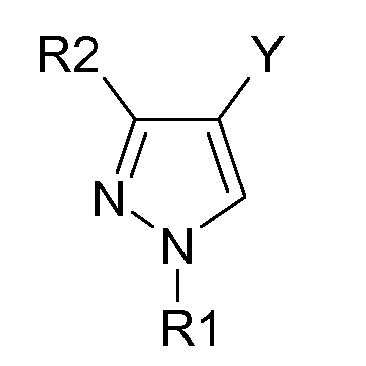
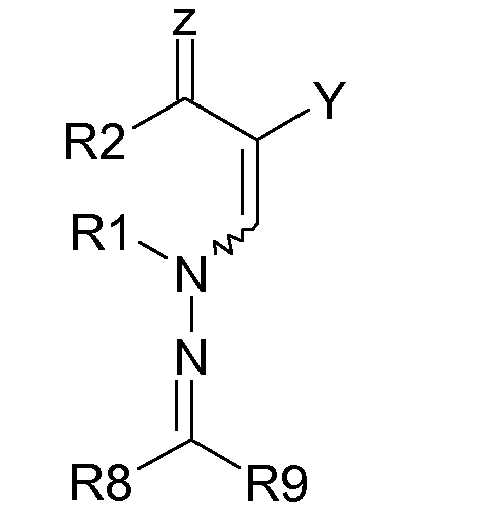
wherein R1 is an organic substituent, R2 is selected from C1 to C4 alkyl groups substituted by one, two or three halogen atoms selected from the group consisting of F, Cl and Br or a CF3 group, with the proviso that R2 is substituted by at least one Cl atom, and Y is selected from the group consisting of C(O)OR3, CN and C(O)NR4R5 can be produced by UV-light initiated cyclization of compounds of formula (II)
The compounds of formula (I) may be used as intermediates in the manufacture of fungicides.
Description
- The present invention concerns a method for the cyclization of hydrazinoacrylic acid derivatives to form heterocyclic compounds.
- 1-substituted pyrazoles, e.g. 1-alkylpyrazoles, as is described in
US 2011/000962 , are intermediates for fungicides. - Object of the present invention is to provide an improved method for the manufacture of heterocycles with an =N-N(R1) group, e.g. for the manufacture of 3-haloalkylpyrazole-4-carboxylic acid derivates substituted in the C1 position by an R1 group which is an organic substituent, especially an alkyl group.
- Accordingly, the present invention concerns a method for the manufacture of 1-alkyl-3-haloalkyl-pyrazole-4-carboxylic acid derivatives of formula (I)

- In which R1 is an organic substituent selected from the group consisting of C1 to C12 alkyl ; C3 to C8 cycloalkyl ; C2 to C12 alkenyl ; C2 to C12 alkynyl ; C6 to C8 aryl ; C7 to C19 arylalkyl ; and C7 to C19 alkylaryl ; each of which may be substituted by one or more groups selected from the group consisting of R', X, OR', SR', NR'2, SiR'3, COOR', C(O)R', CN and CONR'2 wherein R' is H or a C 1 to C12 group ;
R2 is selected from C 1 to C4 alkyl groups are substituted by one, two or three halogen atoms selected from the group consisting of F, C1 and Br or a CF3 group, with the proviso that R2 is substituted by at least one C1 atom ; Y is selected from the group consisting of C(O)OR3, CN and C(O)NR4R5 wherein R3, R4 and R5 are independently of each other are selected from the group consisting of C1 to C12 alkyl ; C3 to C8 cycloalkyl ; C2 to C12 alkenyl ; C2 to C12 alkynyl ; C6 to C8 aryl ; C7 to C19 arylalkyl ; and C7 to C19 alkylaryl ; each of which may be substituted by one or more groups selected from the group consisting of R', X, OR', SR', NR'2, SiR'3, COOR', C(O)R', CN and CONR'2 wherein R' is H or a C1 to C12 group ; and R4 and R5 together with the nitrogen atom to which they are attached may form a 5-membered or 6-membered ring which may optionally contain one or more further heteroatoms selected from the group consisting of O, S and an SO2 group and which may be substituted by one or more groups selected from the group consisting of R', X, OR', SR', NR'2, SiR'3, COOR', C(O)R', CN and CONR'2 wherein R' is H or a C 1 to C12 group ; and X is fluorine, chlorine, bromine and iodine, preferably fluorine or chlorine ;
a) by subjecting a 2-acylated or 2-iminoalkylated acrylic acid hydrazone of the formula (II)
and R6 and R7 together with the nitrogen atom to which they are attached may form a 5-membered or 6-membered ring which may optionally contain one or more further heteroatoms selected from the group consisting of O, S and an SO2 group and which may be substituted by one or more groups selected from the group consisting of R', X, OR', SR', NR'2, SiR'3, COOR', C(O)R', CN and CONR'2 wherein R' is H or a C1 to C12 group ; and X is fluorine, chlorine, bromine and iodine, preferably fluorine or chlorine ;
R8 and R9 are independently selected from the group consisting of C1
to C12 alkyl ; C3 to C8 cycloalkyl ; C2 to C12 alkenyl ; C2 to C12 alkynyl ; C6 to C8 aryl ; C7 to C19 arylalkyl ; and C7 to C19 alkylaryl ; each of which may be substituted by one or more groups selected from the group consisting of R', X, OR', SR', NR'2, SiR'3, COOR', C(O)R', CN and CONR'2 wherein R' is H or a C1 to C12 group ; and R8 and R9 together with the nitrogen atom to which they are attached may form a 5-membered or 6-membered ring which may optionally contain one or more further heteroatoms selected from the group consisting of O, S and an SO2 group and which may be substituted by one or more groups selected from the group consisting of R', X, OR', SR', NR'2, SiR'3, COOR', C(O)R', CN and CONR'2 wherein R' is H or a C1 to C12 group. R4, R5, R6, R7, R8 and R9 are preferably C 1 to C5 alkyl, and more preferably, methyl or ethyl; and X is fluorine, chlorine, bromine and iodine, preferably fluorine or chlorine ; and when Z is N+R6R7 the positive charge is balanced by an anion, e.g. by a sulfate anion or Cl- to UV light to initiate a cyclization reaction. - R1 preferably is C 1 to C5 alkyl ; or C 1 to C5 alkyl, substituted by at least one halogen atom, and more preferably, R1 is methyl, ethyl, n-propyl, i-propyl, n-butyl, s-butyl, t-butyl or n-pentyl. Especially preferably, R1 is methyl or ethyl, most preferably, methyl.
- Preferably, R2 is chloromethyl, dichloromethyl, trichloromethyl, chlorobromomethyl, chlorofluoromethyl, chlorodifluoromethyl, fluorodichloromethyl, 1-chloroethyl, 2,2-dichloroethyl, 1,2-dichloroethyl, 2-chlorofluoroethyl, 2-chloro-2,2-difluoroethyl, 2,2-dichloro-2-fluoroethyl, 2,2,2-trichloroethyl ; especially preferably, R2 is CClF2. Preferably, Z is O. Preferably, Y is C(O)OR3 wherein R3 is a C1 to C5 alkyl group.
- More preferably, R1 is methyl or ethyl, R2 is CHF2, CClF2 or CF3, and R3 is methyl or ethyl.
- Especially preferably, R1 is methyl, R2 is CHF2, CClF2 or CF3, and R3 is methyl or ethyl.
- R3, R4, R5, R6, R7, R8 and R9 are preferably methyl, ethyl, propyl or butyl, and especially preferably, they are methyl or ethyl.
- Preferred pyrazole compounds of formula (I) are assembled in table 1.
Table 1 : Preferred pyrazole compounds 3-CF2Cl-1-CH3-1 H-pyrazole-4-COOCH3 3-CF2Cl-1-CH3-1 H-pyrazole-4-COOCH2CH3 3-CF2Cl-1-CH3-1 H-pyrazole-4-COOCH2CH2CH3 3-CFHCl-1-CH3-1 H-pyrazole-4-COOCH3 3-CFHCl-1-CH3-1 H-pyrazole-4-COOCH2CH3 3-CFHCl-1-CH3-1 H-pyrazole-4-COOCH2CH2CH3 3-CH2Cl-1-CH3-1 H-pyrazole-4-COOCH3 3-CH2Cl-1-CH3-1 H-pyrazole-4-COOCH2CH3 3-CH2Cl-1-CH3-1 H-pyrazole-4-COOCH2CH2CH3 - The UV light treatment of the compound of formula (II) preferably is performed in a solvent. Protic, aprotic, polar and nonpolar organic solvents may be used. It is only necessary that the solvent contains water or moisture or a hydrogen atom, e.g. in the form of an O-H group or C-H group. For example, aromatic solvents, e.g. toluene, are suitable. Alcohols are also suitable as solvent, e.g. monobasic alcohols and dibasic alcohols, for example, methanol, ethanol, n-propanol, isopropanol or glycol. Hydrocarbons, be they linear, branched or cyclic, can be applied, for example hydrocarbons with 3 to 10 carbon atoms, e.g. n-butane, 2-methylpropane, any isomers of pentane, e.g. n-pentane, any isomers of hexane, e.g. n-hexane, any isomers of heptane, e,g, n-heptane, and any mixtures thereof. Halohydrocarbons are suitable as solvent, e.g. saturated halohydrocarbons with 1 to 10 carbon atoms wherein halo denotes chlorine and fluorine. For example, dichloromethane, trichloromethane, trichloroethane, any isomers of pentafluoropropane, e.g. 1,1,1,3,3-pentafluoropropane, the two isomers of heptafluoropropane, e.g. 1,1,1,2,3,3,3-heptafluoropropane, any isomers of pentafluorobutane, e.g. 1,1,1,3,3-pentafluorobutane, fluorosubstitutedpentanes, e.g. decafluoropentane, and and any mixtures thereof.
- UV light providing irradiation comprising at least one wavelength, or a spectrum of wavelengths, in the range of 190 to 254 nm can be used for the UV treatment of the compound of formula (II). Low pressure mercury lamps and middle pressure UV lamps are very suitable. LEDs and OLEDs providing irradiation having at least one wavelength, or a spectrum of wavelengths, in the UV light region are also suitable. Thus, laser light in the UV is suitable.
- It is not necessary that UV light is irradiated into the reaction mixture for the whole duration of the cyclization reaction. It is sufficient to switch it on in the beginning of the reaction to induce the reaction start. For example, it is sufficient to irradiate UV light into the reaction mixture for a time span in the range of 1 second to 5 minutes. If desired, UV light may be irradiated into the reaction mixture intermittently, e.g. every 10 to 30 minutes but this is not necessary.
- The advantage of the reaction is, for example, that it must not be performed in a photo reactor. It is only necessary that, to start the reaction, UV light is irradiated shortly into the respective reactor.
- The treatment with UV light can be performed in any reactor suitable for UV irradiation of liquid phase components. Stirred batch reactors are very suitable. Flow reactors in which the starting compounds are, usually quickly, passed through lines or other reactor parts in which the starting compounds are contacted with UV light, are also suitable.
- The reaction temperature for performing the UV treatment is very variable. For example, it can be performed between -30°C and +100°C. Preferably, the reaction temperature is ranging from-20°C to 30°C.
- The pressure is not critical. It is technically especially simple to perform the UV treatment at ambient pressure. But, if desired, the UV treatment can be performed under reduced pressure or at elevated pressure, e.g. at a pressure of equal to or less than 20 bar (abs).
- If desired, inert gas, e.g., nitrogen, can be used to prevent the intrusion of air or oxygen into the reactor in which the UV treatment is performed.
- The working up of the resulting reaction mixture can be performed according to methods known in the art. For example, solvent can be evaporated off, and the desired compound of formula (I) can be isolated by distillation under a vacuum. The separation of the 3-R2 isomer from the 5-R2 isomer can be achieved by methods known in the art, especially by distillation in a vacuum. Since the undesired isomer is produced in very low amounts, e.g. of 1 % or less, it is preferred to remove it in a final purification step. For example, it can be removed by crystallization, e.g. in a mixture of 1,1,1,3,3-pentafluorobutane/hexane after a reduction step.
- The 1-R1-3-haloalkyl-pyrazole-4-carboxylic acid derivatives are precursors of fungicidal active compounds ; see for example,
US 2011/0009642 andWO 03/070705 WO 2012010692 using metal hydrides, H2/catalyst (e.g. H2/Pd) or metal/hydrogen source, e.g. Zn/ethanol. - The compounds of formula (II) can be manufactured as described in
US 2011/0009462 . For example, they can be prepared from 2-acylated or 2-iminoalkylated acrylic acid derivatives and an N-alkylhydrazone (according to step A ofUS 2011/0009462 ), by acylation of an acrylic acid hydrazone with an acyl halide (according to step B ofUS 2011/0009462 ) or by the aminoalkylation of an acrylic acid hydrazone with an α,α-dihaloamine (according to step C ofUS 2011/0009462 ). - Preferably, the compounds of formula (II) are manufactured from compounds of formula (III) and an N-alkylhydrazone of formula (IV) according to the reaction scheme A

- Or, according to the reaction scheme B, from compounds of formula (V) and an N-alkylhydrazone of formula (IV) according to the reaction scheme B

- In compounds of formula (III), (IV) and (V), Y, Z, R1, R2, R8 and R9 have the meanings given above, respectively ; R10 and R11 independently of each other are C1 to C5 alkyl groups ; and A is a leaving group selected from the group consisting of OR12, SR12 and NR12R13 wherein R12 and R13 independently selected from the group consisting of C1 to C12 alkyl ; C3 to C8 cycloalkyl ; C2 to C12 alkenyl ; C2 to C12 alkynyl ; C6 to C8 aryl ; C7 to C19 arylalkyl ; and C7 to C19 alkylaryl ; each of which may be substituted by one or more groups selected from the group consisting of R', X, OR', SR', NR'2, SiR'3, COOR', C(O)R', CN and CONR'2 wherein R' is H or a C1 to C12 group ; and R12 and R13 together with the nitrogen atom to which they are attached may form a 5-membered or 6-membered ring which may optionally contain one or more further heteroatoms selected from the group consisting of O, S and an SO2 group and which may be substituted by one or more groups selected from the group consisting of R', X, OR', SR', NR'2, SiR'3, COOR', C(O)R', CN and CONR'2 wherein R' is H or a C 1 to C12 group ; and X is fluorine, chlorine, bromine and iodine, preferably fluorine or chlorine. Preferably, R10, R11, R12 and R13 are methyl, ethyl, propyl or butyl, and especially, methyl or ethyl.
- Compounds of formula (III) are known and can be manufactured according to known methods. The compounds of formula (III) wherein A is OR12 can be manufactured, e.g. in the presence of acetic acid anhydride, from trialkyl orthoformate of formula (VI), HC(OR12)(OR14)(OR15), and the respective derivative of 3-oxobutyric acid having the formula (VII), R2-C(O)-CH2-Y, wherein R2 and Y have the meanings and the preferred meanings as given above ; R12, R14 and R15 are the same or different and are C1 to C5 alkyl ; R12, R14 and R15 are preferably methyl, ethyl, propyl or butyl. Especially preferably, they are the same and are methyl, ethyl or n-propyl. Still more preferably, they are the same and are ethyl. The reaction is described in detail in
US 2011/0009642 . Especially preferably, R2 is CClF2. Preferably, Z is O. Preferably, Y is C(O)OR3 wherein R3 is a C1 to C5 alkyl group. - The preferred compounds of formula (V) wherein Y is C(O)OR3 can be manufactured, in the absence of acetic acid anhydride, by reacting compounds of formula (VIII), R2-C(O)-CH2-C(O)-OR3, wherein R1 and R3 have the meaning given above, and trialkylorthoformates having the formula (VI'), HC(OR10)(OR11)(OR12) wherein R10, R11 and R12 have the meaning given above. Compounds of formulae (II) and (VIII) can be manufactured by the addition of an acetic acid chloride of formula R2-C(O)Cl to ketene as described in
DE-AS 1158490 - The respective chemical reaction between compounds of formula (VIII) and formula (VI') is described in unpublished
EP patent application N° 12162417.5 filed March 30, 2012
R2-C(O)-CH2-C(O)-OR3 (VIII) + HC(OR10)(OR11)(OR12) → R2-C(O)-CH(R16)-C(O)-OR3 (V) + R12OH (VI')
- To be noted : for simplification, the reaction equation between compounds (VIII) and (VI') given above assumes that R10, R11 and R12 are the same. Otherwise, mixtures would be obtained, and different alcohols would be liberated. R16 is C(H)(OR10)(OR11).
- The reaction according to reaction scheme C between compounds of formula (VIII) and (VI') is performed at a temperature which allows for a reasonably fast reaction. Preferably, the temperature is equal to or greater than 80°C. More preferably, it is equal to or greater than 90°C. Especially preferably, it is equal to or greater than 100°C.
- The upper limit of the reaction temperature is selected such that no undesired amounts of side reactions take place. Often, the reaction is performed at a temperature equal to or lower than 180°C, preferably, equal to or lower than 160°C.
- If desired, the reaction can be performed in the presence of an inert gas, e.g. it can be performed in the presence of N2.
- If desired, the reaction between compounds of formula (VIII) and (VI') can be performed in the presence of one or more solvents, for example, in the presence of at least one solvent selected from the group consisting of aprotic or protic organic solvents. Those solvents mentioned above as being suitable solvents for the UV treatment may also be used in the reaction according to scheme C. According to a preferred embodiment, an excess of the compound of formula (VI') is applied as solvent. Especially preferably, triethylorthoformate is the preferred compound of formula (VI'), and thus, it is the especially preferred solvent.
- The reaction between compounds of formula (VIII) and (VI') is not sensitive to pressure ; it can be performed in a vacuum, at ambient pressure and under pressure above ambient pressure, e.g. at a pressure up to 10 bar (abs) or more. In a preferred embodiment, the resulting alcohol is distilled off, and thus, performing the reaction at ambient pressure or applying a vacuum is preferred. The distilled alcohol is of such a high purity that it can be used for other useful purposes, e.g. as a solvent or as a reagent to produce compounds of formula (VIII) according to the description of
DE-AS 1158490 - After completion of the reaction according to scheme C, preferably, any solvent is removed from the reaction mixture. This is preferably performed by applying a vacuum. If, for example, triethyl orthoformate ("TEOF") is applied as starting compound of formula (VI), it is preferred to remove the excess of TEOF by keeping the reaction mixture at approximately 100°C and an initial vacuum of 100 mbar.
- Solvent, e.g. trialkyl orthoformate when applied in excess, can be reused.
- The resulting compound of formula (V) is obtained in sufficient purity for further reaction steps.
- Should the disclosure of any patents, patent applications, and publications which are incorporated herein by reference conflict with the description of the present application to the extent that it may render a term unclear, the present description shall take precedence.
- The following examples are intended to explain the invention in further detail without the intention to limit it.
- Triethylorthoformate (TEOF) is commercially available. Ethyl difluorochloroacetoacetate (ECDFAA) is commercially available from Solvay Fluor GmbH, Hannover /Deutschland.
- TEOF (130 g, 0.88 mol) was placed in a flask equipped with a magnetic stirring bar and a vacuum distillation cooler. ECDFAA (35 g, 0.175 mol) was added.
- The resulting mixture was heated to 110°C (outer temperature of the flask) under a mild vacuum (300 mbar) ; ethanol formed during the reaction is slowly distilled out of the vessel. After 2h, the starting material was completely consumed, and product formation was observed by GC analysis. Excess of TEOF was removed from the reaction mixture by distillation (at 100°C, starting with a pressure of 100 mbar at the beginning and 10 mbar at the end, to remove all TEOF traces), resulting pure product as pale yellow liquid with quantitative yield.
- 1H NMR (500 MHz, CHLOROFORM-d) δ ppm 1.15 (t, 3 H) 1.20 (t, 3 H) 1.27 (t, 3 H) 3.49 - 3.57 (m, 1 H) 3.61 - 3.69 (m, 1 H) 3.71 - 3.79 (m, 2 H) 4.23 (q, 2 H) 4.34 (d, J=8.24 Hz, 1 H) 5.18 (d, J=8.24 Hz, 1 H). Example 2 : Manufacture of 4-chloro-2-[1-ethoxy-meth-(Z)-ylidene]-4,4-difluoro-3-oxo-butyric acid ethyl Ester ("EME-CDFAA")
- Triethylorthoformate (415 g = 2.15 mol), ECDFAA (280 g = 1.4 mol) and acetic acid anhydride (428 g = 4.2 mol) were given into a flask equipped with a vacuum distillation cooler. The resulting mixture was heated to 135°C (outer temperature. Slowly, formed light boilers were distilled off. After 9 hours, the mixture was heated to 110°C under slowly lowering the pressure from ambient pressure to a vacuum of 10 mbar ; all light boilers were distilled out of the reaction mixture. A yellow-brown liquid with a purity of 87 % (determined by gas chromatography) remained in the flask. The raw product could be used immediately without further purification for the next reaction step.
- 1H NMR (500 MHz, CHLOROFORM-d), δ ppm (the spectrum shows a ratio of E to Z compound of 1:2.5) : 1.25 - 1.35 (4 t, 6 H) ; 4.20 - 4.38 (4 q, 4 H) and 7.76 (bs, 1 H).
- To 25 ml of dry acetone, 0.76g (16.5 mmol) of monomethylhydrazine was added. A clear solution resulted. The solution was stirred for 30 min at room temperature.
- To the clear solution of example 3.1., 5 g (16.5 mmol) of 4-Chloro-2-diethoxymethyl-4,4-difluoro-3-oxo-butyric acid ethyl ester of example 1 was added drop-wise under moderate cooling of the reaction mixture with tap water. The resulting reaction mixture was stirred for 15 h. A sample was taken and analyzed by gas chromatography which revealed a quantitative consumption and formation of ethyl 4-chloro-4,4-difluoro-2-((1-methyl-2-(propan-2-ylidene)hydrazinyl)methylene)-3-oxobutanoate. The crude yellow solution was directly used as starting material in the cyclization reaction of example 4.
- Example 3.2. is repeated but EME-CDFAA of example 2 is reacted with t he monomethylhydrazone of example 3.1.
- Example 4 : Ethyl 3-(chlorodifluoromethyl)-1-methyl-1H-pyrazole-4-carboxylate
- The crude solution of ethyl 4-chloro-4,4-difluoro-2-((1-methyl-2-(propan-2-ylidene)hydrazinyl)methylene)-3-oxobutanoate, resulting from example 3.2, was irradiated in a quartz photo reactor operated with a 20W low pressure Hg lamp. The lamp was switched on for 1 minute and then switched off. The reaction mixture was continued to be stirred for further 10 minutes to complete the cyclizaion reaction. A GC analysis of a sample revealed quantitative conversion of the starting material. Solvent was evaporated yielding pure product in quantitative yield.
- Alternative to an isolation, the crude ethyl 3-(chlorodifluoromethyl)-1-methyl-1H-pyrazole-4- carboxylate, dissolved in THF, can be subjected to a reduction reaction with Pd/TiO2 in the presence of CsF, molecular sieve and K2CO3 as described in example 55 in
WO 2012/010692 . - The product obtained after the hydrodechlorination, ethyl 1-methyl-3-difluoromethyl-pyrazole-4-carboxylate, is an intermediate useful for the manufacture of fungicides.
Claims (13)
- A method for the manufacture of 1-alkyl-3-haloalkyl-pyrazole-4-carboxylic acid derivatives of formula (I)

R2 is selected from C1 to C4 alkyl groups are substituted by one, two or three halogen atoms selected from the group consisting of F, C1 and Br or a CF3 group, with the proviso that R2 is substituted by at least one C1 atom ;
Y is selected from the group consisting of C(O)OR3, CN and C(O)NR4R5 wherein R3, R4 and R5 are independently of each other are selected from the group consisting of C1 to C12 alkyl ; C3 to C8 cycloalkyl ; C2 to C12 alkenyl ; C2 to C12 alkynyl ; C6 to C8 aryl ; C7 to C19 arylalkyl ; and C7 to C19 alkylaryl ; each of which may be substituted by one or more groups selected from the group consisting of R', X, OR', SR', NR'2, SiR'3, COOR', C(O)R', CN and CONR'2 wherein R' is H or a C1 to C12 group ; and R4 and R5 together with the nitrogen atom to which they are attached may form a 5-membered or 6-membered ring which may optionally contain one or more further heteroatoms selected from the group consisting of O, S and an SO2 group and which may be substituted by one or more groups selected from the group consisting of R', X, OR', SR', NR'2, SiR'3, COOR', C(O)R', CN and CONR'2 wherein R' is H or a C1 to C12 group ; and X is fluorine, chlorine, bromine and iodine ;a) by subjecting a 2-acylated or 2-iminoalkylated acrylic acid hydrazone of formula (II)
and R6 and R7 together with the nitrogen atom to which they are attached may form a 5-membered or 6-membered ring which may optionally contain one or more further heteroatoms selected from the group consisting of O, S and an SO2 group and which may be substituted by one or more groups selected from the group consisting of R', X, OR', SR', NR'2, SiR'3, COOR', C(O)R', CN and CONR'2 wherein R' is H or a C1 to C12 group ; and X is fluorine, chlorine, bromine and iodine ;
R8 and R9 are independently selected from the group consisting of C1 to C12 alkyl ; C3 to C8 cycloalkyl ; C2 to C12 alkenyl ; C2 to C12 alkynyl ; C6 to C8 aryl ; C7 to C19 arylalkyl ; and C7 to C19 alkylaryl ; each of which may be substituted by one or more groups selected from the group consisting of R', X, OR', SR', NR'2, SiR'3, COOR', C(O)R', CN and CONR'2 wherein R' is H or a C1 to C12 group ; and R8 and R9 together with the nitrogen atom to which they are attached may form a 5-membered or 6-membered ring which may optionally contain one or more further heteroatoms selected from the group consisting of O, S and an SO2 group and which may be substituted by one or more groups selected from the group consisting of R', X, OR', SR', NR'2, SiR'3, COOR', C(O)R', CN and CONR'2 wherein R' is H or a C1 to C12 group ; and X is fluorine, chlorine, bromine and iodine ; and when Z is N+R6R7 the positive charge is balanced by an anion,
to UV light to initiate a cyclization reaction. - The method of claim 1 wherein R1 is an organic substituent selected from the group consisting of C1 to C5 alkyl.
- The method of claims 1 or 2 wherein Z is O.
- The method of anyone of claims 1 to 3 wherein Y is C(O)OR3 wherein R3 is a C1 to C5 alkyl group.
- The method of anyone of claims 1 to 4 wherein R2 is selected from the group consisting of chloromethyl, dichloromethyl, trichloromethyl, chlorobromomethyl, chlorofluoromethyl, chlorodifluoromethyl, fluorodichloromethyl, 1-chloroethyl, 2,2-dichloroethyl, 1,2-dichloroethyl, 2-chlorofluoroethyl, 2-chloro-2,2-difluoroethyl, 2,2-dichloro-2-fluoroethyl, 2,2,2-trichloroethyl.
- The method of anyone of claims 1 to 5 wherein R2 is CClF2.
- The method of anyone of claims 1 to 3 wherein R3, R4, R5, R6, R7, R8 and R9 are C1 to C5 alkyl.
- The method of anyone of claims 1 to 7 wherein the irradiation of UV light is stopped after the initiation of the cyclization reaction.
- The method of anyone of claims 1 to 8 wherein the UV light is intermittently switched on and off.
- The method of anyone of claims 1 to 9 wherein ethyl 3-(chlorodifluoromethyl)-1-methyl-1H-pyrazole-4- carboxylate is formed by UV light treatment of ethyl 4-chloro-4,4-difluoro-2-((1-methyl-2-(propan-2-ylidene)hydrazinyl)methylene)-3-oxobutanoate.
- The method of anyone of claims 1 to 10 wherein the at least one chlorine atom in the R2 is substituted by hydrogen.
- The method of claim 11 wherein the chlorine atom in ethyl 3-(chlorodifluoromethyl)-1-methyl-1H-pyrazole-4- carboxylate is substituted by a hydrogen atom to form ethyl 3-(difluoromethyl)-1-methyl-1H-pyrazole-4-carboxylate.
- A method for the manufacture of fungicidal pyrazoles comprising a step of manufacturing a compound of formula (I)

Priority Applications (1)
| Application Number | Priority Date | Filing Date | Title |
|---|---|---|---|
| EP12171094.1A EP2671873A1 (en) | 2012-06-06 | 2012-06-06 | Method for the cyclization of hydrazinoacrylic acid derivatives |
Applications Claiming Priority (1)
| Application Number | Priority Date | Filing Date | Title |
|---|---|---|---|
| EP12171094.1A EP2671873A1 (en) | 2012-06-06 | 2012-06-06 | Method for the cyclization of hydrazinoacrylic acid derivatives |
Publications (1)
| Publication Number | Publication Date |
|---|---|
| EP2671873A1 true EP2671873A1 (en) | 2013-12-11 |
Family
ID=46208362
Family Applications (1)
| Application Number | Title | Priority Date | Filing Date |
|---|---|---|---|
| EP12171094.1A Withdrawn EP2671873A1 (en) | 2012-06-06 | 2012-06-06 | Method for the cyclization of hydrazinoacrylic acid derivatives |
Country Status (1)
| Country | Link |
|---|---|
| EP (1) | EP2671873A1 (en) |
Cited By (7)
| Publication number | Priority date | Publication date | Assignee | Title |
|---|---|---|---|---|
| CN104016920A (en) * | 2014-06-16 | 2014-09-03 | 联化科技(上海)有限公司 | Co-production method of fluorine-containing methylpyrazole compounds |
| WO2017133942A1 (en) | 2016-02-02 | 2017-08-10 | Basf Se | Catalytic hydrogenation process for preparing pyrazoles |
| WO2019122194A1 (en) * | 2017-12-22 | 2019-06-27 | Solvay Sa | Process for the manufacture of iminium compounds and their application in the manufacture of pyrazole derivatives |
| US10414733B2 (en) | 2014-07-31 | 2019-09-17 | Basf Se | Process for preparing pyrazoles |
| CN110437160A (en) * | 2019-09-17 | 2019-11-12 | 郑州原理生物科技有限公司 | A kind of preparation method of uracil |
| US10584102B2 (en) | 2015-05-11 | 2020-03-10 | Basf Se | Process for preparing 4-amino-pyridazines |
| CN114195678A (en) * | 2021-12-24 | 2022-03-18 | 江苏七洲绿色科技研究院有限公司 | Intermediate, preparation method thereof and method for preparing 3-difluoromethyl-1-methylpyrazole-4-ethyl formate by using intermediate |
Citations (8)
| Publication number | Priority date | Publication date | Assignee | Title |
|---|---|---|---|---|
| DE1158490B (en) | 1960-12-17 | 1963-12-05 | Hoechst Ag | Process for the production of fluorine-containing acetoacetic acid chlorides or their solutions |
| EP1216241A1 (en) | 1999-09-14 | 2002-06-26 | Merck Frosst Canada & Co. | Carboxylic acids and acylsulfonamides, compositions containing such compounds and methods of treatment |
| WO2003070705A1 (en) | 2002-02-19 | 2003-08-28 | Bayer Cropscience Aktiengesellschaft | Disubstituted pyrazolyl carboxanilides |
| US20110000962A1 (en) | 2009-07-06 | 2011-01-06 | William Chi Yuen Chan | Transit Access System and Method Including Device Authentication |
| US20110009642A1 (en) | 2008-02-25 | 2011-01-13 | Bayer Cropscience Ag | Method for the Regioselective Synthesis of 1-Alkyl-3-haloalkyl-pyrazole-4-carboxylic Acid Derivatives |
| US20110009462A1 (en) | 2007-10-25 | 2011-01-13 | Lanxess Deutschland Gmbh | Stable, synergistic mixtures |
| US20110172436A1 (en) * | 2008-05-05 | 2011-07-14 | Basf Se | Method for preparing 1,3,4-substituted pyrazol compounds |
| WO2012010692A1 (en) | 2010-07-23 | 2012-01-26 | Solvay Sa | Process for the preparation of esters of 1-substituted-3-fluoroalkyl-pyrazole-4-carboxylic acids |
-
2012
- 2012-06-06 EP EP12171094.1A patent/EP2671873A1/en not_active Withdrawn
Patent Citations (8)
| Publication number | Priority date | Publication date | Assignee | Title |
|---|---|---|---|---|
| DE1158490B (en) | 1960-12-17 | 1963-12-05 | Hoechst Ag | Process for the production of fluorine-containing acetoacetic acid chlorides or their solutions |
| EP1216241A1 (en) | 1999-09-14 | 2002-06-26 | Merck Frosst Canada & Co. | Carboxylic acids and acylsulfonamides, compositions containing such compounds and methods of treatment |
| WO2003070705A1 (en) | 2002-02-19 | 2003-08-28 | Bayer Cropscience Aktiengesellschaft | Disubstituted pyrazolyl carboxanilides |
| US20110009462A1 (en) | 2007-10-25 | 2011-01-13 | Lanxess Deutschland Gmbh | Stable, synergistic mixtures |
| US20110009642A1 (en) | 2008-02-25 | 2011-01-13 | Bayer Cropscience Ag | Method for the Regioselective Synthesis of 1-Alkyl-3-haloalkyl-pyrazole-4-carboxylic Acid Derivatives |
| US20110172436A1 (en) * | 2008-05-05 | 2011-07-14 | Basf Se | Method for preparing 1,3,4-substituted pyrazol compounds |
| US20110000962A1 (en) | 2009-07-06 | 2011-01-06 | William Chi Yuen Chan | Transit Access System and Method Including Device Authentication |
| WO2012010692A1 (en) | 2010-07-23 | 2012-01-26 | Solvay Sa | Process for the preparation of esters of 1-substituted-3-fluoroalkyl-pyrazole-4-carboxylic acids |
Cited By (18)
| Publication number | Priority date | Publication date | Assignee | Title |
|---|---|---|---|---|
| CN104016920A (en) * | 2014-06-16 | 2014-09-03 | 联化科技(上海)有限公司 | Co-production method of fluorine-containing methylpyrazole compounds |
| US10414733B2 (en) | 2014-07-31 | 2019-09-17 | Basf Se | Process for preparing pyrazoles |
| US10513498B2 (en) | 2014-07-31 | 2019-12-24 | Basf Se | Process for preparing pyrazoles |
| US12162841B2 (en) | 2015-05-11 | 2024-12-10 | Basf Se | Process for preparing 4-amino-pyridazines |
| US11046656B2 (en) | 2015-05-11 | 2021-06-29 | Basf Se | Process for preparing 4-amino-pyridazines |
| US10584102B2 (en) | 2015-05-11 | 2020-03-10 | Basf Se | Process for preparing 4-amino-pyridazines |
| JP2019504883A (en) * | 2016-02-02 | 2019-02-21 | ビーエーエスエフ ソシエタス・ヨーロピアBasf Se | Catalytic hydrogenation process for preparing pyrazole |
| CN108699003A (en) * | 2016-02-02 | 2018-10-23 | 巴斯夫欧洲公司 | Prepare the catalytic hydrogenation of pyrazoles |
| RU2733958C2 (en) * | 2016-02-02 | 2020-10-08 | Басф Се | Method for catalytic hydrogenation for producing pyrazoles |
| US10975036B2 (en) | 2016-02-02 | 2021-04-13 | Basf Se | Catalytic hydrogenation process for preparing pyrazoles |
| KR20180104743A (en) * | 2016-02-02 | 2018-09-21 | 바스프 에스이 | Catalytic hydrogenation process for preparing pyrazole |
| CN108699003B (en) * | 2016-02-02 | 2023-02-03 | 巴斯夫欧洲公司 | Catalytic hydrogenation process for the preparation of pyrazoles |
| KR102651666B1 (en) | 2016-02-02 | 2024-03-26 | 바스프 에스이 | Catalytic hydrogenation process for producing pyrazole |
| WO2017133942A1 (en) | 2016-02-02 | 2017-08-10 | Basf Se | Catalytic hydrogenation process for preparing pyrazoles |
| WO2019122194A1 (en) * | 2017-12-22 | 2019-06-27 | Solvay Sa | Process for the manufacture of iminium compounds and their application in the manufacture of pyrazole derivatives |
| CN111587241A (en) * | 2017-12-22 | 2020-08-25 | 索尔维公司 | Method for producing iminium compound and use thereof for producing pyrazole derivative |
| CN110437160A (en) * | 2019-09-17 | 2019-11-12 | 郑州原理生物科技有限公司 | A kind of preparation method of uracil |
| CN114195678A (en) * | 2021-12-24 | 2022-03-18 | 江苏七洲绿色科技研究院有限公司 | Intermediate, preparation method thereof and method for preparing 3-difluoromethyl-1-methylpyrazole-4-ethyl formate by using intermediate |
Similar Documents
| Publication | Publication Date | Title |
|---|---|---|
| Xu et al. | A fast and highly efficient protocol for Michael addition of N-heterocycles to α, β-unsaturated compound using basic ionic liquid [bmIm] OH as catalyst and green solvent | |
| JP5753856B2 (en) | Method for preparing 1-alkyl- / 1-aryl-5-pyrazolecarboxylic acid derivatives | |
| DK2288597T3 (en) | PROCESS FOR THE PREPARATION OF 1,3,4-SUBSTITUTED pyrazole | |
| CN101133031A (en) | Process for producing 1-substituted-3-fluoroalkylpyrazole-4-carboxylic acid ester | |
| KR20180059471A (en) | Process for producing 3-fluoroalkyl-1-methylpyrazole-4-carboxylic acid | |
| BR112015004097B1 (en) | PROCEDURE FOR THE DECARBOXILATION OF 3,5-BIS (HALOalkyl) -PIRAZOL-4-CARBOXYLIC ACID DERIVATIVES | |
| DK2847183T3 (en) | PROCEDURE FOR MAKING TRIAZOL COMPOUNDS | |
| Althagafi et al. | Microwave assisted regioselective synthesis of novel pyrazoles and pyrazolopyridazines via fluorine containing building blocks | |
| ES2701082T3 (en) | Enaminoketones containing CF3O and its use for the preparation of pyrazoles containing CF3O | |
| KR20120039034A (en) | Process for producing aryl-substituted pyrazoles | |
| EP2644598A1 (en) | Method for the manufacture of heterocycles | |
| US20190375711A1 (en) | Pyridine based ionic fluoride for catalyzing indole and tetrazole formation | |
| EP2894150B1 (en) | Method for producing 1-substituted-3-fluoroalkylpyrazole-4-carboxylic acid ester | |
| BR112016010413B1 (en) | process for preparing 3,5-bis (haloalkyl) pyrazole derivatives from a, a-dihaloamines | |
| US9458084B2 (en) | Manufacture of 1-substituted methylidene compounds | |
| KR102091133B1 (en) | Method for the preparation of perfluoroalkyl containing pyrazoles carboxylates | |
| ES2849960T3 (en) | Process for the preparation of 3-fluoroalkyl-5-pyrazolecarboxylates and 3-fluoroalkyl-5-pyrazolecarboxylic acids | |
| BR112015027707B1 (en) | method of preparing 3,5-bis (fluoroalkyl) pyrazole derivatives and intermediate compounds involved in this method | |
| TWI781128B (en) | Processes for the preparation of pesticidal compounds | |
| CN105008330A (en) | Process for the preparation of bis-dihaloalkyl pyrazoles | |
| KR101005834B1 (en) | Process for preparing pyrazole | |
| JP2013043831A (en) | TERTIARY α-TRIFLUOROMETHYL KETONE DERIVATIVE, AND METHOD FOR PRODUCING THE SAME | |
| EP2644593A1 (en) | Dialkoxymethyl oxobutyric acid esters, their manufacture and use | |
| JP4075342B2 (en) | Process for producing 4,5-disubstituted-1,2,3-triazole | |
| EP3369726A1 (en) | Method for producing 2-amino-4-substituted phenol |
Legal Events
| Date | Code | Title | Description |
|---|---|---|---|
| PUAI | Public reference made under article 153(3) epc to a published international application that has entered the european phase |
Free format text: ORIGINAL CODE: 0009012 |
|
| AK | Designated contracting states |
Kind code of ref document: A1 Designated state(s): AL AT BE BG CH CY CZ DE DK EE ES FI FR GB GR HR HU IE IS IT LI LT LU LV MC MK MT NL NO PL PT RO RS SE SI SK SM TR |
|
| AX | Request for extension of the european patent |
Extension state: BA ME |
|
| STAA | Information on the status of an ep patent application or granted ep patent |
Free format text: STATUS: THE APPLICATION IS DEEMED TO BE WITHDRAWN |
|
| 18D | Application deemed to be withdrawn |
Effective date: 20140612 |