EP2671871A1 - Novel (aza)benzhydryl ether derivatives, their process of preparation and their use as H4-receptor ligands for therapeutical applications - Google Patents
Novel (aza)benzhydryl ether derivatives, their process of preparation and their use as H4-receptor ligands for therapeutical applications Download PDFInfo
- Publication number
- EP2671871A1 EP2671871A1 EP13170687.1A EP13170687A EP2671871A1 EP 2671871 A1 EP2671871 A1 EP 2671871A1 EP 13170687 A EP13170687 A EP 13170687A EP 2671871 A1 EP2671871 A1 EP 2671871A1
- Authority
- EP
- European Patent Office
- Prior art keywords
- methylpiperidin
- yloxy
- methyl
- fluoro
- alkyl
- Prior art date
- Legal status (The legal status is an assumption and is not a legal conclusion. Google has not performed a legal analysis and makes no representation as to the accuracy of the status listed.)
- Granted
Links
- 0 CC1=C****1 Chemical compound CC1=C****1 0.000 description 1
Classifications
-
- C—CHEMISTRY; METALLURGY
- C07—ORGANIC CHEMISTRY
- C07D—HETEROCYCLIC COMPOUNDS
- C07D401/00—Heterocyclic compounds containing two or more hetero rings, having nitrogen atoms as the only ring hetero atoms, at least one ring being a six-membered ring with only one nitrogen atom
- C07D401/02—Heterocyclic compounds containing two or more hetero rings, having nitrogen atoms as the only ring hetero atoms, at least one ring being a six-membered ring with only one nitrogen atom containing two hetero rings
- C07D401/12—Heterocyclic compounds containing two or more hetero rings, having nitrogen atoms as the only ring hetero atoms, at least one ring being a six-membered ring with only one nitrogen atom containing two hetero rings linked by a chain containing hetero atoms as chain links
-
- A—HUMAN NECESSITIES
- A61—MEDICAL OR VETERINARY SCIENCE; HYGIENE
- A61K—PREPARATIONS FOR MEDICAL, DENTAL OR TOILETRY PURPOSES
- A61K31/00—Medicinal preparations containing organic active ingredients
- A61K31/33—Heterocyclic compounds
- A61K31/395—Heterocyclic compounds having nitrogen as a ring hetero atom, e.g. guanethidine or rifamycins
- A61K31/435—Heterocyclic compounds having nitrogen as a ring hetero atom, e.g. guanethidine or rifamycins having six-membered rings with one nitrogen as the only ring hetero atom
- A61K31/44—Non condensed pyridines; Hydrogenated derivatives thereof
- A61K31/445—Non condensed piperidines, e.g. piperocaine
-
- A—HUMAN NECESSITIES
- A61—MEDICAL OR VETERINARY SCIENCE; HYGIENE
- A61K—PREPARATIONS FOR MEDICAL, DENTAL OR TOILETRY PURPOSES
- A61K31/00—Medicinal preparations containing organic active ingredients
- A61K31/33—Heterocyclic compounds
- A61K31/395—Heterocyclic compounds having nitrogen as a ring hetero atom, e.g. guanethidine or rifamycins
- A61K31/435—Heterocyclic compounds having nitrogen as a ring hetero atom, e.g. guanethidine or rifamycins having six-membered rings with one nitrogen as the only ring hetero atom
- A61K31/44—Non condensed pyridines; Hydrogenated derivatives thereof
- A61K31/445—Non condensed piperidines, e.g. piperocaine
- A61K31/4523—Non condensed piperidines, e.g. piperocaine containing further heterocyclic ring systems
- A61K31/4545—Non condensed piperidines, e.g. piperocaine containing further heterocyclic ring systems containing a six-membered ring with nitrogen as a ring hetero atom, e.g. pipamperone, anabasine
-
- A—HUMAN NECESSITIES
- A61—MEDICAL OR VETERINARY SCIENCE; HYGIENE
- A61K—PREPARATIONS FOR MEDICAL, DENTAL OR TOILETRY PURPOSES
- A61K45/00—Medicinal preparations containing active ingredients not provided for in groups A61K31/00 - A61K41/00
- A61K45/06—Mixtures of active ingredients without chemical characterisation, e.g. antiphlogistics and cardiaca
-
- A—HUMAN NECESSITIES
- A61—MEDICAL OR VETERINARY SCIENCE; HYGIENE
- A61P—SPECIFIC THERAPEUTIC ACTIVITY OF CHEMICAL COMPOUNDS OR MEDICINAL PREPARATIONS
- A61P11/00—Drugs for disorders of the respiratory system
-
- A—HUMAN NECESSITIES
- A61—MEDICAL OR VETERINARY SCIENCE; HYGIENE
- A61P—SPECIFIC THERAPEUTIC ACTIVITY OF CHEMICAL COMPOUNDS OR MEDICINAL PREPARATIONS
- A61P17/00—Drugs for dermatological disorders
-
- A—HUMAN NECESSITIES
- A61—MEDICAL OR VETERINARY SCIENCE; HYGIENE
- A61P—SPECIFIC THERAPEUTIC ACTIVITY OF CHEMICAL COMPOUNDS OR MEDICINAL PREPARATIONS
- A61P9/00—Drugs for disorders of the cardiovascular system
-
- C—CHEMISTRY; METALLURGY
- C07—ORGANIC CHEMISTRY
- C07D—HETEROCYCLIC COMPOUNDS
- C07D211/00—Heterocyclic compounds containing hydrogenated pyridine rings, not condensed with other rings
- C07D211/04—Heterocyclic compounds containing hydrogenated pyridine rings, not condensed with other rings with only hydrogen or carbon atoms directly attached to the ring nitrogen atom
- C07D211/06—Heterocyclic compounds containing hydrogenated pyridine rings, not condensed with other rings with only hydrogen or carbon atoms directly attached to the ring nitrogen atom having no double bonds between ring members or between ring members and non-ring members
- C07D211/08—Heterocyclic compounds containing hydrogenated pyridine rings, not condensed with other rings with only hydrogen or carbon atoms directly attached to the ring nitrogen atom having no double bonds between ring members or between ring members and non-ring members with hydrocarbon or substituted hydrocarbon radicals directly attached to ring carbon atoms
- C07D211/18—Heterocyclic compounds containing hydrogenated pyridine rings, not condensed with other rings with only hydrogen or carbon atoms directly attached to the ring nitrogen atom having no double bonds between ring members or between ring members and non-ring members with hydrocarbon or substituted hydrocarbon radicals directly attached to ring carbon atoms with substituted hydrocarbon radicals attached to ring carbon atoms
- C07D211/20—Heterocyclic compounds containing hydrogenated pyridine rings, not condensed with other rings with only hydrogen or carbon atoms directly attached to the ring nitrogen atom having no double bonds between ring members or between ring members and non-ring members with hydrocarbon or substituted hydrocarbon radicals directly attached to ring carbon atoms with substituted hydrocarbon radicals attached to ring carbon atoms with hydrocarbon radicals, substituted by singly bound oxygen or sulphur atoms
- C07D211/22—Heterocyclic compounds containing hydrogenated pyridine rings, not condensed with other rings with only hydrogen or carbon atoms directly attached to the ring nitrogen atom having no double bonds between ring members or between ring members and non-ring members with hydrocarbon or substituted hydrocarbon radicals directly attached to ring carbon atoms with substituted hydrocarbon radicals attached to ring carbon atoms with hydrocarbon radicals, substituted by singly bound oxygen or sulphur atoms by oxygen atoms
-
- C—CHEMISTRY; METALLURGY
- C07—ORGANIC CHEMISTRY
- C07D—HETEROCYCLIC COMPOUNDS
- C07D211/00—Heterocyclic compounds containing hydrogenated pyridine rings, not condensed with other rings
- C07D211/04—Heterocyclic compounds containing hydrogenated pyridine rings, not condensed with other rings with only hydrogen or carbon atoms directly attached to the ring nitrogen atom
- C07D211/06—Heterocyclic compounds containing hydrogenated pyridine rings, not condensed with other rings with only hydrogen or carbon atoms directly attached to the ring nitrogen atom having no double bonds between ring members or between ring members and non-ring members
- C07D211/36—Heterocyclic compounds containing hydrogenated pyridine rings, not condensed with other rings with only hydrogen or carbon atoms directly attached to the ring nitrogen atom having no double bonds between ring members or between ring members and non-ring members with hetero atoms or with carbon atoms having three bonds to hetero atoms with at the most one bond to halogen, e.g. ester or nitrile radicals, directly attached to ring carbon atoms
- C07D211/40—Oxygen atoms
- C07D211/44—Oxygen atoms attached in position 4
- C07D211/46—Oxygen atoms attached in position 4 having a hydrogen atom as the second substituent in position 4
Definitions
- the present patent application concerns novel (aza)benzhydryl ether derivatives as ligands of the H4-receptor, their process of preparation and their therapeutic use.
- H1 receptor and H1 receptor antagonists have found large therapeutic applications in allergic manifestations like the anaphylactic shock, allergic rhinitis, dermatitis, pruritus, etc.
- the histamine H4 receptor (H4R) has modified this landscape (reviewed in Thurmond et al, Nature Rev. Drug Disc., 2008, 7, 41 ).
- the H4R belongs to the superfamily of G-protein coupled heptahelical receptors and is expressed on the plasma membranes of a variety of immunocompetent/inflammatory cells, e.g. eosinophils, basophils, mast-cells or dendritic cells.
- the H4R has a chimiotactic role, controlling the afflux of e.g. mast-cells or eosinophils to inflammatory sites that is elicited by histamine release and, thereby plays a major role in the development of chronic inflammatory disorders.
- Blockade of the H4R by antagonists or inverse agonists should therefore constitute a novel therapeutic approach in diseases like asthma, emphysema, allergic rhinitis, nasal congestion, bronchitis, chronic obstructive pulmonary disease, dermatitis, arthritis, psoriasis, colitis, etc. in which they could be used alone or in association with already used other classes of anti-inflammatory medications, namely H1 R antagonists.
- H4R antagonists/inverse agonists is also of potential interest in a variety of autoimmune diseases e.g.
- H4R antagonists in a rodent model ( Bell et al, Br J Pharmacol, 2004, 142, 374 ) also suggests the use of these agents in pruritus, a manifestation only imperfectly controlled by available medications, namely H1R antagonists.
- H4R antagonists/inverse agonists have not yet reached clinical uses and there is therefore a need for compounds displaying high potency and safety.
- a novel chemical class of H4R ligands is disclosed.
- the instant invention thus relates to novel (aza)benzhydryl ether derivatives as H4 receptor ligands, to their preparation and to their application in therapeutics.
- R1 represents a C1- C6 alkyl
- Het represents a non aromatic monocyclic 3 to 7 membered heterocycle containing one nitrogen atom and optionally 1 to 3 additional heteroatoms, wherein said at least one nitrogen atom is linked to R1
- A represents a single bond or a-C1-C6 alkyl- group
- R2, R3, R4, R5, R6 identical or different is independently chosen from:
- X7, X8, X9, X10, R2, R3, R4, R5 and R6 are such as defined above, that the biaromatic moiety of the ether does not represent a benzhydryl substituted on its two para positions only.
- the compounds of formula (I) are of formula (Ib): wherein:
- the compounds of formula (I), (Ia) and (Ib) of the invention also include the following particular embodiments or any of their combinations:
- the compounds of formula (I) can comprise one or more asymmetric carbon atoms. They can therefore exist in the form of enantiomers or diastereoisomers. These enantiomers and diastereoisomers, as well as their mixtures, including racemic mixtures, form part of the invention.
- the compounds of formula (I) can be provided in the form of a free base or in the form of addition salts with acids, which also form part of the invention.
- salts are advantageously prepared with pharmaceutically acceptable acids, but salts with other acids, useful for example for the purification or for the isolation of the compounds of formula (I), also form part of the invention.
- the term "patient” refers to a warm-blooded animal such as a mammal, preferably a human or a human child, which is afflicted with, or has the potential to be afflicted with one or more diseases and conditions described herein.
- a "therapeutically effective amount” refers to an amount of a compound of the present invention which is effective in reducing, eliminating, treating or controlling the symptoms of the herein-described diseases and conditions.
- controlling is intended to refer to all processes wherein there may be a slowing, interrupting, arresting, or stopping of the progression of the diseases and conditions described herein, but does not necessarily indicate a total elimination of all disease and condition symptoms, and is intended to include prophylactic treatment and chronic use.
- pharmaceutically acceptable salts refer to derivatives of the disclosed compounds wherein the parent compound is modified by making acid or base salts thereof.
- the pharmaceutically acceptable salts include the conventional non-toxic salts or the quaternary ammonium salts of the parent compound formed, for example, from non-toxic inorganic or organic acids.
- such conventional non-toxic salts include those derived from inorganic acids such as hydrochloric, hydrobromic, sulfuric, sulfamic, phosphoric, nitric and the like; and the salts prepared from organic acids such as acetic, propanoic, succinic, tartaric, citric, methanesulfonic, benzenesulfonic, glucuronic, glutamic, benzoic, salicylic, toluenesulfonic, oxalic, fumaric, maleic, and the like.
- Further addition salts include ammonium salts such as tromethamine, meglumine, epolamine, etc., metal salts such as sodium, potassium, calcium, zinc or magnesium. Hydrochloride and oxalate salts are preferred.
- the pharmaceutically acceptable salts of the present invention can be synthesized from the parent compound which contains a basic or acidic moiety by conventional chemical methods.
- such salts can be prepared by reacting the free acid or base forms of these compounds with a stoichiometric amount of the appropriate base or acid in water or in an organic solvent, or in a mixture of the two.
- non-aqueous media like ether, ethyl acetate, ethanol, isopropanol, or acetonitrile are preferred. Lists of suitable salts are found in Remington's Pharmaceutical Sciences, 17th ed., Mack Publishing Company, Easton, PA, 1985, p. 1418 , the disclosure of which is hereby incorporated by reference.
- the present invention is also concerned with the process of preparation of the compounds of formula (I).
- the compounds and process of the present invention may be prepared in a number of ways well known to those skilled in the art.
- the compounds can be synthesized, for example, by application or adaptation of the methods described below, or variations thereon as appreciated by the skilled artisan.
- the appropriate modifications and substitutions will be readily apparent and well known or readily obtainable from the scientific literature to those skilled in the art.
- the compounds of the present invention may contain one or more asymmetrically substituted carbon atoms, and may be isolated in optically active or racemic forms.
- optically active or racemic forms all chiral, diastereomeric, racemic forms and all geometric isomeric forms of a structure are intended, unless the specific stereochemistry or isomeric form is specifically indicated.
- optically active forms mixtures of stereomers may be separated by standard techniques including, but not limited to, resolution of racemic forms, normal, reverse-phase, and chiral chromatography, preferential salt formation, recrystallization, and the like, or by chiral synthesis either from chiral starting materials or by deliberate synthesis of target chiral centers.
- Some reactions may be carried out in the presence of a base.
- a base There is no particular restriction on the nature of the base to be used in this reaction, and any base conventionally used in reactions of this type may equally be used here, provided that it has no adverse effect on other parts of the molecule.
- suitable bases include: sodium hydroxide, potassium carbonate, triethylamine, alkali metal hydrides, such as sodium hydride and potassium hydride; alkyllithium compounds, such as methyllithium and butyllithium; and alkali metal alkoxides, such as sodium methoxide and sodium ethoxide.
- solvents include: hydrocarbons, which may be aromatic, aliphatic or cycloaliphatic hydrocarbons, such as hexane, cyclohexane, methylcyclohexane, toluene and xylene; amides, such as N , N -dimethylformamide; alcohols such as ethanol and methanol and ethers, such as diethyl ether, methyl tert -butyl ether, methyl cyclopentyl ether and tetrahydrofuran.
- hydrocarbons which may be aromatic, aliphatic or cycloaliphatic hydrocarbons, such as hexane, cyclohexane, methylcyclohexane, toluene and xylene
- amides such as N , N -dimethylformamide
- alcohols such as ethanol and methanol and ethers, such as diethyl ether, methyl tert -butyl
- the reactions can take place over a wide range of temperatures. In general, we find it convenient to carry out the reaction at a temperature of from 0°C to 155°C (more preferably from about room temperature to 100°C).
- the time required for the reaction may also vary widely, depending on many factors, notably the reaction temperature and the nature of the reagents. However, provided that the reaction is effected under the preferred conditions outlined above, a period of from 1 hour to 24 hours will usually suffice.
- the compound thus prepared may be recovered from the reaction mixture by conventional means.
- the compounds may be recovered by distilling off the solvent from the reaction mixture or, if necessary, after distilling off the solvent from the reaction mixture, pouring the residue into water followed by extraction with a water-immiscible organic solvent and distilling off the solvent from the extract.
- the product can, if desired, be further purified by various well-known techniques, such as recrystallization, reprecipitation or the various chromatography techniques, notably column chromatography, preparative HPLC or preparative thin layer chromatography.
- compounds of formula (I) can be prepared by condensing an alcohol of formula (III) in which R, Het and A are as defined in general formula (I) with an alcohol of formula (IV) in which R2, R3, R4, R5, R6, X7, X8, X9 and X10 are as defined in general formula (I):
- This reaction can be performed with an acidic catalyst such as p-toluenesulfonic acid, methanesulfonic acid in 1,2-dichloroethane, toluene, N -methyl-2-pyrrolidinone or a mixture thereof at a temperature comprised between -20°C and 155°C.
- an acidic catalyst such as p-toluenesulfonic acid, methanesulfonic acid in 1,2-dichloroethane, toluene, N -methyl-2-pyrrolidinone or a mixture thereof at a temperature comprised between -20°C and 155°C.
- compounds of formula (I) can be obtained by condensing an alcohol of formula (III) in which R, Het and A are as defined in general formula (I) with an alkylating agent of formula (V) in which R2, R3, R4, R5, R6, X7, X8, X9 and X10 are as defined in general formula (I) and X represent a halogen or another leaving group such as a mesylate, a triflate, a nosylate or a tosylate
- This reaction is typically performed in an inert solvent such as acetone, acetonitrile, dichloromethane, toluene at a temperature comprised between room temperature and refluxing temperature, and in the optional presence of an organic or inorganic base such as triethylamine, potassium carbonate.
- an inert solvent such as acetone, acetonitrile, dichloromethane, toluene
- an organic or inorganic base such as triethylamine, potassium carbonate.
- compounds of formula (I) can be prepared from compounds of formula (I) by functionnal group elaboration.
- Such transformations include:
- This reaction can be performed with an halogenating agent such as thionyl chloride, phosphorus pentabromide or a sulfonate derivative such as mesyl chloride, triflic anhydride, nosyl chloride or tosyl chloride in an inert solvent such as acetone, acetonitrile, dichloromethane, toluene at a temperature comprised between 0 °C and refluxing temperature, in the optional presence of an organic or inorganic base such as triethylamine, diisopropylethylamine or potassium carbonate.
- an halogenating agent such as thionyl chloride, phosphorus pentabromide or a sulfonate derivative such as mesyl chloride, triflic anhydride, nosyl chloride or tosyl chloride in an inert solvent such as acetone, acetonitrile, dichloromethane, toluene at a temperature comprised between 0 °
- Reaction i. can be performed in the presence of a reducing agent such as a borohydride in an alcohol at a temperature comprised between 0°C and the refluxing temperature.
- a reducing agent such as a borohydride
- Reaction ii. can be performed by reacting the aldehyde (VII) with the corresponding compound of formula (IX) : in which R2, R3, R4, R5, R6 are as defined in general formula (I) and Hal represents a halogen atom, in the presence of an organometallic reagent such as an organomagnesium (e.g. n-butylmagnesium chloride, isopropylmagnesium chloride, etc..) or organolithium (e.g.
- organomagnesium e.g. n-butylmagnesium chloride, isopropylmagnesium chloride, etc..
- organolithium e.g.
- reaction ii. can also be performed by condensing the aldehyde (VII) with the corresponding derivative of formula (IX") in which R2, R3, R4, R5, R6 are as defined in general formula (I), in the presence of a lewis acid catalyst such as aluminum trichloride in an inert solvent such as dichloromethane at a temperature comprised between 0°C and reflux temperature.
- a lewis acid catalyst such as aluminum trichloride
- an inert solvent such as dichloromethane
- Reaction iii. can be performed by reacting the aldehyde (VIII) with the corresponding compound of formula (X) :
- X7, X8, X9 and X10 are as defined in formula (I) and Hal represents a halogen atom, in the presence of an organometallic reagent such as an organomagnesium (e.g. n-butylmagnesium chloride, isopropylmagnesium chloride, etc..) or organolithium (e.g. butyllithium, etc...), or with the corresponding compound of formula (X') : where X7, X8, X9 and X10 are as defined in formula (I) and Hal' represents a halogen atom in an inert solvent such as tetrahydrofuran at a temperature comprised between - 78°C and the reflux temperature.
- organometallic reagent such as an organomagnesium (e.g. n-butylmagnesium chloride, isopropylmagnesium chloride, etc..) or organolithium (e.g. butyllithium, etc...),
- the process of the invention may comprise the additional step of isolating the desired compound of formula (I).
- the present invention is also concerned with pharmaceutical compositions comprising a compound of formula (I) as defined above with a pharmaceutically acceptable excipient.
- the compounds of the invention are antagonists and/or inverse agonists of H4 R.
- the pharmaceutical compositions and compounds of the invention may thus be useful for use in the treatment and/or prevention of a disease associated with H 4 dysfunction, such as inflammatory disorders.
- Said disease includes adult respiratory distress syndrome, acute respiratory distress syndrome, bronchitis, chronic bronchitis, chronic obstructive pulmonary disease, cystic fibrosis, asthma, emphysema, rhinitis, chronic sinusitis, allergy, allergy induced airway responses, allergic rhinitis, viral rhinitis, non-allergic rhinitis, perennial and seasonal rhinitis, conjunctivitis, nasal congestion, allergic congestion; disorders of the genito-urinary tract such as female and male sexual dysfunction, overactive bladder conditions, urinary incontinence, bladder overactivity, benign prostate hyperplasia and lower urinary tract symptoms; dermatological diseases such as dermatitis and psoriasis and treatment of itchy skin; diseases of the cardiovascular system including thromboembolic diseases, atherosclerosis, myocardial infarction, angina pectoris, myocardial ischaemia and arrhythmia, peripheral arterial occlusive diseases, pulmonary embolisms
- the present invention also concerns a combination of a compound of the invention with one or more therapeutic agent(s) selected from:
- the present invention also concerns combinations comprising a compound of formula (I) of the invention with a H1R antagonist, such as cetirizine, levocetirizine, desloratadine, bepotastine or doxepin.
- a H1R antagonist such as cetirizine, levocetirizine, desloratadine, bepotastine or doxepin.
- the present invention is also concerned with a compound of formula (I) for the above conditions to be administered to a patient in the need thereof.
- the present invention also concerns the methods of treatment comprising administering an effective amount of a compound of the invention for treating and/or preventing the above conditions or disorders.
- a therapeutically effective amount can be readily determined by the attending diagnostician, as one skilled in the art, by the use of conventional techniques and by observing results obtained under analogous circumstances.
- determining the therapeutically effective amount a number of factors are considered by the attending diagnostician, including, but not limited to: the species of subject; its size, age, and general health; the specific disease involved; the degree of involvement or the severity of the disease; the response of the individual subject; the particular compound administered; the mode of administration; the bioavailability characteristic of the preparation administered; the dose regimen selected; the use of concomitant medication; and other relevant circumstances.
- the amount of a compound of formula (I), which is required to achieve the desired biological effect will vary depending upon a number of factors, including the dosage of the drug to be administered, the chemical characteristics (e.g. hydrophobicity) of the compounds employed, the potency of the compounds, the type of disease, the diseased state of the patient, and the route of administration.
- the compounds of this invention may be provided in an aqueous physiological buffer solution containing 0.1 to 10% w/v compound for parenteral administration.
- Typical dose ranges are from 1 ⁇ g/kg to 0.1 g/kg of body weight per day; a preferred dose range is from 0.01 mg/kg to 10 mg/kg of body weight per day.
- a preferred daily dose for adult humans includes 1, 5, 50, 100 and 200 mg, and an equivalent dose in a human child.
- the preferred dosage of drug to be administered is likely to depend on such variables as the type and extent of progression of the disease or disorder, the overall health status of the particular patient, the relative biological efficacy of the compound selected, and formulation of the compound excipient, and its route of administration.
- unit dose means a single dose which is capable of being administered to a patient, and which can be readily handled and packaged, remaining as a physically and chemically stable unit dose comprising either the active compound itself, or as a pharmaceutically acceptable composition, as described hereinafter.
- typical daily dose ranges are from 0,01 to 10 mg/kg of body weight.
- unit doses for humans range from 0,1 mg to 1000 mg per day.
- the unit dose range is from 1 to 500 mg administered one to four times a day, and even more preferably from 1 mg to 300 mg, once a day.
- compositions can be formulated into pharmaceutical compositions by admixture with one or more pharmaceutically acceptable excipients.
- Such compositions may be prepared for use in oral administration, particularly in the form of tablets or capsules, in particular orodispersible (lyoc) tablets; or parenteral administration, particularly in the form of liquid solutions, suspensions or emulsions; or intranasally, particularly in the form of powders, nasal drops, or aerosols; or dermally, for example, topically or via trans-dermal patches or ocular administration, or intravaginal or intra-uterine administration, particularly in the form of pessaries or by rectal administration.
- oral administration particularly in the form of tablets or capsules, in particular orodispersible (lyoc) tablets
- parenteral administration particularly in the form of liquid solutions, suspensions or emulsions
- intranasally particularly in the form of powders, nasal drops, or aerosols
- dermally for example, topically or via trans-dermal patches or ocular administration
- compositions may conveniently be administered in unit dosage form and may be prepared by any of the methods well known in the pharmaceutical art, for example, as described in Remington: The Science and Practice of Pharmacy, 20th ed.; Gennaro, A. R., Ed.; Lippincott Williams & Wilkins: Philadelphia, PA, 2000 .
- Pharmaceutically compatible binding agents and/or adjuvant materials can be included as part of the composition.
- Oral compositions will generally include an inert diluent carrier or an edible carrier.
- the tablets, pills, powders, capsules, troches and the like can contain one or more of any of the following ingredients, or compounds of a similar nature: a binder such as microcrystalline cellulose, or gum tragacanth; a diluent such as starch or lactose; a disintegrant such as starch and cellulose derivatives; a lubricant such as magnesium stearate; a glidant such as colloidal silicon dioxide; a sweetening agent such as sucrose or saccharin; or a flavoring agent such as peppermint, or methyl salicylate.
- a binder such as microcrystalline cellulose, or gum tragacanth
- a diluent such as starch or lactose
- a disintegrant such as starch and cellulose derivatives
- a lubricant such as magnesium stearate
- a glidant such as colloidal silicon dioxide
- a sweetening agent such as sucrose or saccharin
- a flavoring agent
- Capsules can be in the form of a hard capsule or soft capsule, which are generally made from gelatin blends optionally blended with plasticizers, as well as a starch capsule.
- dosage unit forms can contain various other materials that modify the physical form of the dosage unit, for example, coatings of sugar, shellac, or enteric agents.
- Other oral dosage forms syrup or elixir may contain sweetening agents, preservatives, dyes, colorings, and flavorings.
- the active compounds may be incorporated into fast dissolve, modified-release or sustained-release preparations and formulations, and wherein such sustained-release formulations are preferably bi-modal.
- Preferred formulations include pharmaceutical compositions in which a compound of the present invention is formulated for oral or parenteral administration, or more preferably those in which a compound of the present invention is formulated as a tablet.
- Preferred tablets contain lactose, cornstarch, magnesium silicate, croscarmellose sodium, povidone, magnesium stearate, or talc in any combination. It is also an aspect of the present disclosure that a compound of the present invention may be incorporated into a food product or a liquid.
- Liquid preparations for administration include sterile aqueous or non-aqueous solutions, suspensions, and emulsions.
- the liquid compositions may also include binders, buffers, preservatives, chelating agents, sweetening, flavoring and coloring agents, and the like.
- Non-aqueous solvents include alcohols, propylene glycol, polyethylene glycol, acrylate copolymers, vegetable oils such as olive oil, and organic esters such as ethyl oleate.
- Aqueous carriers include mixtures of alcohols and water, hydrogels, buffered media, and saline.
- biocompatible, biodegradable lactide polymer, lactide/glycolide copolymer, or polyoxyethylene-polyoxypropylene copolymers may be useful excipients to control the release of the active compounds.
- Intravenous vehicles can include fluid and nutrient replenishers, electrolyte replenishers, such as those based on Ringer's dextrose, and the like.
- Other potentially useful parenteral delivery systems for these active compounds include ethylene-vinyl acetate copolymer particles, osmotic pumps, implantable infusion systems, and liposomes.
- formulations for inhalation which include such means as dry powder, aerosol, or drops. They may be aqueous solutions containing, for example, polyoxyethylene-9-lauryl ether, glycocholate and deoxycholate, or oily solutions for administration in the form of nasal drops, or as a gel to be applied intranasally.
- Formulations for buccal administration include, for example, lozenges or pastilles and may also include a flavored base, such as sucrose or acacia, and other excipients such as glycocholate.
- Formulations suitable for rectal administration are preferably presented as unit-dose suppositories, with a solid based carrier, such as cocoa butter, and may include a salicylate.
- Formulations for topical application to the skin preferably take the form of an ointment, cream, lotion, paste, gel, spray, aerosol, or oil.
- Carriers which can be used include petroleum jelly, lanolin, polyethylene glycols, alcohols, or their combinations.
- Formulations suitable for transdermal administration can be presented as discrete patches and can be lipophilic emulsions or buffered, aqueous solutions, dissolved and/or dispersed in a polymer or an adhesive.
- Alternative administrations include also solutions, ointments or other formulations acceptable for ocular administration.
- HPLC-MS analyses are performed on a Waters AutoPurification HPLC/MS System equipped with a 3100 Mass Spectrometer and a 2998 Photodiode Array (PDA) Detector.
- PDA Photodiode Array
- Ethanol is removed under reduced pressure and the residue purified by chromatography over silica gel (gradient dichloromethane/methanol/ammonia from 95/5/0.5 to 90/10/0.5) to afford the pure base that is then converted into its oxalate salt in acetone to give 6- ⁇ 3-[(1-methylpiperidin-4-yloxy)pyridin-2-ylmethyl]phenyl ⁇ hex-5-ynylamine, oxalate displaying the following NMR spectrum: 1 H NMR (DMSO-d 6 ): 8.44 (d,1 H), 7.79 (t,1 H), 7.55 (d,1 H), 7.35-7.22 (ms,5H), 5.61(s, 1H), 2.90-2.70(ms,6H), 2.42 (m,2H), 2.34 (s,3H), 1.88 (m,2H), 1.62 (m,6H). Missing signals are masked by deuterated solvents peaks.
- a screw-cap tube is charged with 2-[(3-iodophenyl)(1-methylpiperidin-4-yloxy)methyl]pyridine (1 05mg, example 37), tetrakis(triphenylphosphine)palladium (52mg), copper(I) iodide (26mg), N -5-hexynylphthalimide (186mg), triethylamine (400 ⁇ L) and 1-methyl-2-pyrrolidinone (4mL).
- the tube is evacuated, filled with argon and sealed. After stirring at 90°C for 14h, the mixture is diluted with water and the aqueous phase is extracted with ethyl acetate.
- the pooled organic extracts are washed with water, dried over magnesium sulfate and concentrated under reduced pressure.
- the residue is purified by chromatography over silica gel (gradient dichloromethane/methanol/ammonia from 98/2/0.5 to 95/5/0.5) to give 2-(6- ⁇ 3-[(1-methylpiperidin-4-yloxy)-pyridin-2-ylmethyl]phenyl ⁇ hex-5-ynyl)isoindole-1,3-dione as an brown oil.
- the pooled organic extracts are washed with water, dried over magnesium sulfate and concentrated under reduced pressure.
- the residue is purified by chromatography over silica gel (gradient heptane/ethyl acetate from 2/1 to 1/1) to give pure (2-fluoro-5-trifluoromethoxyphenyl)pyridin-4-ylmethanol.
- 5-Fluoro-2-[(5-fluoropyridin-2-yl)hydroxymethyl]phenol is prepared according to general procedure 7B of example 7 with a supplementary equivalent of lithiated pyridine.
- 6- ⁇ 3-[(4-Chlorophenyl)(1-methylpiperidin-4-yloxy)methyl]phenyl ⁇ hex-5-ynylamine, dioxalate, solid melting at 90 °C, is prepared from example 35 according to general procedures 5A and 5B.
- the obtained suspension is stirred gently and submitted to a 25-26xg mechanic pressure exerted through a syringe.
- the cell lysate is then centrifuged at 300g 15 minutes at 4 °C in order to eliminate nucleus and cell scraps.
- the obtained supernatant is then centrifuged at 48000 g for 30 minutes at 4 °C.
- the final pellet is resuspended in buffer I with a potter homogenizer. Aliquots are frozen in liquid nitrogen and stored until use at -80 °C. Protein content is measured by the Bradford method.
- Defreezed membranes are diluted at a final concentration of 5 ⁇ g/180 ⁇ L/well in buffer I supplemented by GDP 10 ⁇ M and distributed in 96 well polystyrene microplate.
- GTP ⁇ [ 35 S] labelled ligand (0.2-0.3 nM) is added for additional 30 minutes. After transfer in a Millipore GF/C HTS ® microplate, the filtration of the reactional mix is followed by a three times 250 ⁇ l wash to stop the reaction.
- the filter-bound radioactivity is measured in a liquid scintillation counter Microbeta TRILUX ® with 50 ⁇ l of scintillation fluid.
- GTP ⁇ [ 35 S] dependent binding activity is determined in vitro for Histamine, Imetit, R(-)-alpha-methyl-histamine and all our compounds.
- the obtained supernatant was then centrifuged at 48000 g for 30 minutes at 4 °C.
- the final pellet is resuspended in buffer I with a potter homogenizer. Aliquots were frozen in liquid nitrogen and stored until use at -80 °C. Protein content is measured by the Bradford method.
- [ 3 H] Histamine labelled ligand (10-15 nM) is added for 60 minutes with compounds at room temperature under continuous stirring. Non specific binding was estimated in the presence of 10 ⁇ M BP1.2404 (JNJ 7777120). The reaction was terminated by filtration through GF/B filters pre-soaked 2 hours at 4 °C in 1 % polyethyleneimine. Filters were rinsed 3 times with 250 ⁇ l of ice cold incubation binding buffer.
- the filter-bound radioactivity was measured in a liquid scintillation counter Microbeta TRILUX® with 50 ⁇ l of scintillation fluid.
- the hH4 binding investigated by use of [ 3 H] Histamine give a Bmax ⁇ pmole/mg prot and a Kd ⁇ 9 nM.
- Ki or IC50 1 B B 2 C B 3 B 4 B B 5 B B 6 B 7 B B 8 B 9 B 10 B B 11 A 12 A 13 B 14 B 15 A 16 B 17 A 18 C B 19 B 20 B 21 B 22 C 23 C 24 C 25 C 26 B 27 A 28 A B 29 A 30 B B 31 B B 32 A A 33 B B 34 B 35 C B 36 C C 37 A A: Ki or IC50 ⁇ 1000nM B: Ki or IC50 ⁇ 300nM C: Ki or IC50 ⁇ 30nM
Landscapes
- Chemical & Material Sciences (AREA)
- Health & Medical Sciences (AREA)
- Organic Chemistry (AREA)
- Public Health (AREA)
- Animal Behavior & Ethology (AREA)
- Veterinary Medicine (AREA)
- General Health & Medical Sciences (AREA)
- Life Sciences & Earth Sciences (AREA)
- Medicinal Chemistry (AREA)
- Pharmacology & Pharmacy (AREA)
- Epidemiology (AREA)
- Engineering & Computer Science (AREA)
- Nuclear Medicine, Radiotherapy & Molecular Imaging (AREA)
- General Chemical & Material Sciences (AREA)
- Chemical Kinetics & Catalysis (AREA)
- Bioinformatics & Cheminformatics (AREA)
- Heart & Thoracic Surgery (AREA)
- Cardiology (AREA)
- Dermatology (AREA)
- Pulmonology (AREA)
- Pharmaceuticals Containing Other Organic And Inorganic Compounds (AREA)
Abstract
Description
- The present patent application concerns novel (aza)benzhydryl ether derivatives as ligands of the H4-receptor, their process of preparation and their therapeutic use.
- Until recently, the pro-inflammatory actions of histamine were thought to be essentially mediated by the H1 receptor and H1 receptor antagonists have found large therapeutic applications in allergic manifestations like the anaphylactic shock, allergic rhinitis, dermatitis, pruritus, etc.
- However these drugs essentially prevent the occurrence of major symptoms of these manifestations without modifying clearly the progressive development of the inflammatory process leading to chronic diseases like asthma in which, however, histamine release from mast-cells might represent an important trigger (reviewed in Galli et al, Nature, 2008, 454, 445).
- The recent discovery of the histamine H4 receptor (H4R) has modified this landscape (reviewed in Thurmond et al, Nature Rev. Drug Disc., 2008, 7, 41). The H4R belongs to the superfamily of G-protein coupled heptahelical receptors and is expressed on the plasma membranes of a variety of immunocompetent/inflammatory cells, e.g. eosinophils, basophils, mast-cells or dendritic cells. The H4R has a chimiotactic role, controlling the afflux of e.g. mast-cells or eosinophils to inflammatory sites that is elicited by histamine release and, thereby plays a major role in the development of chronic inflammatory disorders. It also controls the activity of eosinophils and some classes of lymphocytes. Blockade of the H4R by antagonists or inverse agonists should therefore constitute a novel therapeutic approach in diseases like asthma, emphysema, allergic rhinitis, nasal congestion, bronchitis, chronic obstructive pulmonary disease, dermatitis, arthritis, psoriasis, colitis, etc. in which they could be used alone or in association with already used other classes of anti-inflammatory medications, namely H1 R antagonists. In addition the utilisation of H4R antagonists/inverse agonists is also of potential interest in a variety of autoimmune diseases e.g. type I diabetes, Crohn's disease, multiple sclerosis, lupus, etc...The itch-preventing effect of some H4R antagonists in a rodent model (Bell et al, Br J Pharmacol, 2004, 142, 374) also suggests the use of these agents in pruritus, a manifestation only imperfectly controlled by available medications, namely H1R antagonists.
- H4R antagonists/inverse agonists have not yet reached clinical uses and there is therefore a need for compounds displaying high potency and safety. In the present application a novel chemical class of H4R ligands is disclosed.
- The instant invention thus relates to novel (aza)benzhydryl ether derivatives as H4 receptor ligands, to their preparation and to their application in therapeutics.
- The present invention concerns new compounds of formula (I):

Het represents a non aromatic monocyclic 3 to 7 membered heterocycle containing one nitrogen atom and optionally 1 to 3 additional heteroatoms, wherein said at least one nitrogen atom is linked to R1;
A represents a single bond or a-C1-C6 alkyl- group; - Each R2, R3, R4, R5, R6 identical or different is independently chosen from:
- hydrogen
- halo; azido; cyano; hydroxy; nitro;
- alkyl; alkoxy; alkylsulfanyl; alkenyl; alkynyl; alkenyloxy; alkenyloxy; alkenylsulfanyl; alkynylsulfanyl; cycloalkoxy; cycloalkylalkyl;
whose alkyl, alkenyl, alkynyl or cycloalkyl part can be substituted with one or more of halo, hydroxy, polyhydroxy, alkoxy, hydroxyalkoxy, cyano, amino, aminoalkyl, alkylamino, dialkylamino, aminoalkylamino, aminoalkylaminocarbonyl, alkoxycarbonylamino, diarylmethylimino (where aryl is optionally substituted with one or more of hydroxy or halo), cycloalkenylimino (where cylalkenyl is optionally substituted with one or more of alkyl, OH), alkylsulfanyl, alkylsulfinyl, alkylsulfonyl, cycloalkyl, polycycloalkyl, cycloalkenyl, polycycloalkenyl, guanidino, alkylcarbonylguanidino, acylguanidino, cyanoguanidino, alkoxycarbonylguanidino, alkoxycarbonyl, alkoxycarbonylalkylamino, alkoxycarbonylalkylcycloalkyl, alkoxycarbonylheterocyclyl, aminocarbonyl, alkylaminocarbonyl, alkylcarbonyl, alkylcarbonylalkoxy, aryloxy, arylsulfanyl, arylsulfinyl, arylsulfonyl, heteroaryl, heterocyclyl (heterocyclyl being optionally substituted with one or more of oxo, amino, imino), heteroaryloxy, heterocyclyloxy, heteroarylamino, heterocyclylamino, hydrazinocarbonyl, hydroxyalkylcycloalkyl, N-alkyl(thioureido), phtalimido, ureido, oxocycloalkenylamino substituted with amino, carbamimidoylheterocyclyl; - amino; alkylamino; alkylcarbonyl; alkoxycarbonyl; alkylsulfanyl; alkylsulfinyl; alkylsulfonyl; alkylsulfonyloxy
wherein :- alkyl can be substituted with one or more of halo;
and
at least one of R2, R3, R4, R5, R6 is different from H - each Xi , identical or different is chosen from -N=, -C(Ri)= and -C(Ri')= ,
- i representing the 7, 8, 9 or 10 indicia
- wherein
- either one of the Xi is -N= and the others are -C(Ri)= or
- either each Xi is chosen from -C(Ri)= and -C(Ri')= with at least one of Xi being -C(Ri')=
- wherein for each i said Xi may be identical or different and said Ri may be identical or different
- so that
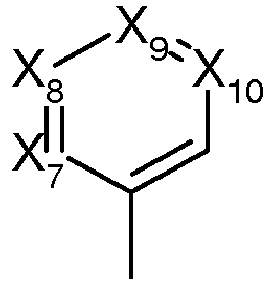
- said Ri(i=7, 8, 9, 10) are chosen from
- alkyl can be substituted with one or more of halo;
- H
- Ri'(i'=7, 8, 9, 10)
said Ri'(i'=7, 8, 9, 10) are chosen from: - halo, cyano, hydroxy, nitro,
- alkyl; alkoxy; alkylsulfanyl; alkenyl; alkynyl; alkenyloxy; alkenyloxy; alkenylsulfanyl; alkynylsulfanyl; cycloalkoxy; cycloalkylalkyl
whose alkyl, alkenyl, alkynyl or cycloalkyl part can be substituted with one or more of halo, hydroxy, polyhydroxy, alkoxy; - aryl; arylalkyl; aryloxy; arylalkoxy; arylalkylamino; arylalkylsulfanyl; heteroaryl; heteroaryloxy
whose (hetero)aryl part can be substituted with one or more of amino, halo, alkyl, (poly)haloalkyl, hydroxyalkyl, alkoxy, (poly)haloalkoxy, alkoxycarbonylamino, alkylcarbonyl, alkylsulfanyl, alkylsulfinyl, alkylsulfonyl, nitro, cyanoalkyl, or fused with a non aromatic heterocycle; - X9 is -CR9'=,
- X7=X8=X10= -CH=,
- R4 is not H and
- R2=R3= R5=R6= H.
- According to an embodiment, X7, X8, X9, X10, R2, R3, R4, R5 and R6 are such as defined above, that the biaromatic moiety of the ether does not represent a benzhydryl substituted on its two para positions only.
- According to an embodiment, the compounds of formula (I) are of formula (Ia):

R1, Het, A, R2-6 are defined as in formula (I)
X7 or X9 represents -N= and the other of X7 or X9 represents -CR7= or -CR9=
And where R8, R10 and optional R7 or R9, identical or different are chosen from - H
- halo, cyano, hydroxy, nitro,
- alkyl; alkoxy; alkylsulfanyl; alkenyl; alkynyl; alkenyloxy; alkenyloxy; alkenylsulfanyl; alkynylsulfanyl; cycloalkoxy; cycloalkylalkyl
whose alkyl, alkenyl, alkynyl or cycloalkyl part can be substituted with one or more of halo, hydroxy, polyhydroxy, alkoxy; - aryl; arylalkyl; aryloxy; arylalkoxy; arylalkylamino; arylalkylsulfanyl; heteroaryl; heteroaryloxy
whose (hetero)aryl part can be substituted with one or more of amino, halo, alkyl, (poly)haloalkyl, hydroxyalkyl, alkoxy, (poly)haloalkoxy, alkoxycarbonylamino, alkylcarbonyl, alkylsulfanyl, alkylsulfinyl, alkylsulfonyl, nitro, cyanoalkyl, or fused with a non aromatic heterocycle; - According to an alternative embodiment, the compounds of formula (I) are of formula (Ib):

- R1, Het, A, R2-6 are defined as in formula (I) and
- Each of R7-R10 is chosen from
- H
- halo, cyano, hydroxy, nitro,
- alkyl; alkoxy; alkylsulfanyl; alkenyl; alkynyl; alkenyloxy; alkenyloxy; alkenylsulfanyl; alkynylsulfanyl; cycloalkoxy; cycloalkylalkyl
whose alkyl, alkenyl, alkynyl or cycloalkyl part can be substituted with one or more of halo, hydroxy, polyhydroxy, alkoxy; - aryl; arylalkyl; aryloxy; arylalkoxy; arylalkylamino; arylalkylsulfanyl; heteroaryl; heteroaryloxy
whose (hetero)aryl part can be substituted with one or more of amino, halo, alkyl, (poly)haloalkyl, hydroxyalkyl, alkoxy, (poly)haloalkoxy, alkoxycarbonylamino, alkylcarbonyl, alkylsulfanyl, alkylsulfinyl, alkylsulfonyl, nitro, cyanoalkyl, or fused with a non aromatic heterocycle;
- The compounds of formula (I), (Ia) and (Ib) of the invention also include the following particular embodiments or any of their combinations:
- R1 represents a methyl; and/or
- Het represents a piperidine; and/or
- A represents a single bond; and/or
- each R2, R3, R4, R5, R6 identical or different is independently chosen from:
- hydrogen
- halo; hydroxy;
- alkyl; alkoxy; alkenyl;
whose alkyl, alkenyl, alkynyl part can be substituted with one or more of halo, amino, alkoxycarbonylamino,
where at least one of R2, R3, R4, R5, R6 is different from H;
- R2 and R5 are preferably H;

- H
- Ri'
said Ri' are chosen from: - halo, cyano,
- alkyl optionally substituted with one or more of halo;
- aryl;
and wherein R9 and R10 can form together with the C atoms to which they are attached an aromatic ring
with the exception of the compounds where simultaneously:
X9 is -CR9'=,
X7=X8=X10= -CH=,
R4 is not H and
R2=R3= R5=R6= H.
- According to a futher embodiments the compounds of teh invention may be chosen from:
- 2-[(2-Fluoro-5-trifluoromethoxyphenyl)(1-methylpiperidin-4-yloxy)methyl]pyridine
- 5-Chloro-2-[(2-fluoro-4-methylphenyl)(1-methylpiperidin-4-yloxy)methyl]pyridine
- 2-[(2-Fluoro-4-methylphenyl)(1-methylpiperidin-4-yloxy)methyl]pyridine
- 5-Chloro-2-[(2-fluoro-5-trifluoromethoxyphenyl)(1-methylpiperidin-4-yloxy)methyl]pyridine
- 6-{3-[(1-Methylpiperidin-4-yloxy)pyridin-2-ylmethyl]phenyl}hex-5-ynylamine
- 4-[(2-Fluoro-5-trifluoromethoxyphenyl)(1-methylpiperidin-4-yloxy)methyl]pyridine
- 2-[(2-Fluoro-4-methylphenyl)(1-methylpiperidin-4-yloxy)methyl]-4-methylpyridine
- 2-[(2-Fluoro-5-trifluoromethoxyphenyl)(1-methylpiperidin-4-yloxy)methyl]-4-methylpyridine
- 5-Chloro-2-[(4-chlorophenyl)(1-methylpiperidin-4-yloxy)methyl]pyridine
- 5-Fluoro-2-[(2-fluoro-4-methylphenyl)(1-methylpiperidin-4-yloxy)methyl]pyridine
- 5-Fluoro-2-[(2-fluoro-5-trifluoromethoxyphenyl)(1-methylpiperidin-4-yloxy)methyl]pyridine
- 5-Chloro-2-[(3-methoxyphenyl)(1-methylpiperidin-4-yloxy)methyl]pyridine
- 5-Chloro-2-[(3-iodophenyl)(1-methylpiperidin-4-yloxy)methyl]pyridine
- 2-[(2-Fluoro-4-methylphenyl)(1-methylpiperidin-4-yloxy)methyl]-4-trifluoromethylpyridine
- 2,3-Difluoro-6-[(5-fluoropyridin-2-yl)(1-methylpiperidin-4-yloxy)methyl]phenol
- 6-[(5-Chloropyridin-2-yl)(1-methylpiperidin-4-yloxy)methyl]-2,3-difluorophenol
- (6-{3-[(1-Methylpiperidin-4-yloxy)pyridin-2-ylmethyl]phenyl}hex-5-ynyl)carbamic acid ethyl ester
- 6-{3-[(5-Chloropyridin-2-yl)(1-methylpiperidin-4-yloxy)methyl]phenyl}hex-5-ynylamine
- 2-[(1-Methylpiperidin-4-yloxy)pyridin-2-ylmethyl]phenol
- 5-Fluoro-2-[(5-fluoropyridin-2-yl)(1-methylpiperidin-4-yloxy)methyl]phenol
- 2-Fluoro-6-[(5-fluoropyridin-2-yl)(1-methylpiperidin-4-yloxy)methyl]-3-methylphenol
- 6-[(5-Chloropyridin-2-yl)(1-methylpiperidin-4-yloxy)methyl]-2-fluoro-3-methylphenol
- 2-[(5-Chloropyridin-2-yl)(1-methylpiperidin-4-yloxy)methyl]-5-fluorophenol
- 2-[(5-Fluoropyridin-2-yl)(1-methylpiperidin-4-yloxy)methyl]-5-methylphenol
- 2-[(5-Chloropyridin-2-yl)(1-methylpiperidin-4-yloxy)methyl]-5-methylphenol
- 2-Fluoro-6-[(4-fluoropyridin-2-yl)(1-methylpiperidin-4-yloxy)methyl]-3-methylphenol
- 4-[(3-Iodophenyl)-p-tolylmethoxy]-1-methylpiperidine
- 4-[(2-Fluoro-5-trifluoromethoxyphenyl)naphthalen-2-ylmethoxy]-1-methylpiperidine
- 4-[(2-Fluoro-4-methylphenyl)naphthalen-2-yl-methoxy]-1-methylpiperidine
- 4-[(3,4-Dichlorophenyl)(2-fluoro-4-methylphenyl)methoxy]-1-methylpiperidine
- 4-[(3,4-Dichlorophenyl)(2-fluoro-5-trifluoromethoxyphenyl)methoxy]-1-methylpiperidine
- 4-[(2-Fluorophenyl)-(2-fluoro-5-trifluoromethoxyphenyl)methoxy]-1-methylpiperidine
- 4-[(4-Chlorophenyl)(2-fluoro-5-trifluoromethoxyphenyl)methoxy]-1-methylpiperidine
- 4-[(4-Chlorophenyl)(2-fluoro-4-methylphenyl)methoxy]-1-methylpiperidine
- 4-[(4-Chlorophenyl)(3-iodophenyl)methoxy]-1-methylpiperidine
- 6-{3-[(4-Chlorophenyl)(1-methylpiperidin-4-yloxy)methyl]phenyl}hex-5-ynylamine
- 2-[(3-Iodophenyl)(1-methylpiperidin-4-yloxy)methyl]pyridine
- Unless specified otherwise, the terms used hereabove or hereafter have the meaning ascribed to them below:
- "halogen" refers to fluorine, chlorine, bromine or iodine atom.
- "alkyl" represents an aliphatic-hydrocarbon group which may be straight or branched having 1 to 8 carbon atoms in the chain unless specified otherwise. Preferred alkyl groups have 1 to 6 carbon atoms in the chain. Branched means that one or more alkyl groups such as methyl, ethyl or propyl are attached to a linear alkyl chain. Exemplary alkyl groups include methyl, ethyl, n-propyl, i-propyl, n-butyl, t-butyl, 2,2-diméthylbutyl, n-pentyl, n-hexyl, octyl.
- "alkenyl" refers to an aliphatic hydrocarbon group containing a carbon-carbon double bond and which may be straight or branched having 2 to 8 carbon atoms in the chain unless specified otherwise. Preferred alkenyl groups have 2 to 6 carbon atoms in the chain. Exemplary alkenyl groups include ethenyl, n-propenyl, i-propenyl, n-butenyl, i-butenyl, 2,2-dimethylbut-1-enyl, n-pentenyl, heptenyl, octenyl.
- "alkynyl" refers to an aliphatic hydrocarbon group containing a carbon-carbon triple bond and which may be straight or branched having 2 to 8 carbon atoms in the chain unless specified otherwise. Preferred alkynyl groups have 2 to 6 carbon atoms in the chain. Exemplary alkynyl groups include ethynyl, propynyl, n-butynyl, 2-butynyl, 3-methyl-1-butynyl, n-pentynyl, heptynyl, octynyl.
- "cycloalkyl" refers to a saturated non-aromatic monocyclic hydrocarbon ring system of 3 to 10 carbon atoms. Preferred ring sizes of rings of the ring system include 3 to 8 ring atoms. Exemplary monocyclic cycloalkyl include cyclopropyl, cyclopentyl, cyclohexyl, and the like.
- "cycloalkenyl" refers to a cycloalkyl as herein described containing a carbon-carbon double bond. Exemplary cycloalkenyl include cyclopentenyl, cyclohexenyl, cycloheptenyl, and the like.
- "aryl" refers to an aromatic monocyclic or multicyclic hydrocarbon ring system of 6 to 14 carbon atoms, preferably of 6 to 10 carbon atoms. Exemplary aryl groups include phenyl, naphthyl, phenanthryl.
- "heterocycle" or "heterocyclyl" refer to a saturated or partially unsaturated non aromatic stable 3 to 14, preferably 5 to 10-membered mono, bi or multicyclic rings which can optionnaly be bridged and wherein at least one member of the ring is a hetero atom. Typically, heteroatoms include, but are not limited to, oxygen, nitrogen, sulfur, selenium, and phosphorus atoms. Preferable heteroatoms are oxygen, nitrogen and sulfur. Suitable heterocycles are also disclosed in the Handbook of Chemistry and Physics, 76th Edition, CRC Press, Inc., 1995-1996, pages 2-25 to 2-26, the disclosure of which is hereby incorporated by reference. Preferred heterocyclyl include, but are not limited to tetrahydropyridyl, tetraydrofuranyl, dioxolanyl, tetrahydropyranyl, dioxanyl, pyrrolidinyl, piperidyl, morpholinyl, imidazolidinyl, pyranyl, dihydropyranyl, thiopyranyl, dihydrothiopyranyl, 8-aza-bicyclo[3.2.1]oct-3-yl, azetidin-3-ylmethyl, piperidin-4-yl, pyrrolidin-3-yl, quinoclidin-3-yl, benzodioxole. Preferred heterocycles are chosen from piperidyl, tetrahydropyridyl, dihydropyranyl, dihydrothiopyranyl, 8-aza-bicyclo[3.2.1]oct-3-yl, azetidin-3-ylmethyl, piperidin-4-yl, pyrrolidin-3-yl, quinoclidin-3-yl, benzodioxole.
- "heteroaryl" refers to a 5 to 14, preferably 5 to 10 membered aromatic mono-, bi- or multicyclic ring wherein at least one member of the ring is a hetero atom. Examples include pyrrolyl, pyridyl, piperidinyl, pyrazolyl, thienyl, pyrimidinyl, pyrazinyl, tetrazolyl, indolyl, quinolinyl, purinyl, imidazolyl, thienyl, thiazolyl, benzothiazolyl, furanyl, benzofuranyl, 1,2,4-thiadiazolyl, isothiazolyl, triazoyl, tetrazolyl, isoquinolyl, benzothienyl, isobenzofuryl, pyrazolyl, carbazolyl, benzimidazolyl, oxazolyl.
- "aralkyl" refers to an arylalkyl group, the "aryl" and "alkyl" groups being as herein described.
- "sulfanyl" refers to a radical -S-.
- "sulfinyl" refers to a radical -SO-.
- "sulfonyl" refers to a radical -SO2-.
- "ureido" refers to a radical NH-CO- NH2. This radical can be linked for example to an alkyl or cycloalkyl group as herein described.
- "thioureido" refers to radical -NH-S-NH2. This radical can be linked for example to an alkyl or cycloalkyl group as herein described.
- "guanidino" refers to a radical:

- The compounds of formula (I) can comprise one or more asymmetric carbon atoms. They can therefore exist in the form of enantiomers or diastereoisomers. These enantiomers and diastereoisomers, as well as their mixtures, including racemic mixtures, form part of the invention.
- The compounds of formula (I) can be provided in the form of a free base or in the form of addition salts with acids, which also form part of the invention.
- These salts are advantageously prepared with pharmaceutically acceptable acids, but salts with other acids, useful for example for the purification or for the isolation of the compounds of formula (I), also form part of the invention.
- As used herein, the term "patient" refers to a warm-blooded animal such as a mammal, preferably a human or a human child, which is afflicted with, or has the potential to be afflicted with one or more diseases and conditions described herein.
- As used herein, a "therapeutically effective amount" refers to an amount of a compound of the present invention which is effective in reducing, eliminating, treating or controlling the symptoms of the herein-described diseases and conditions. The term "controlling" is intended to refer to all processes wherein there may be a slowing, interrupting, arresting, or stopping of the progression of the diseases and conditions described herein, but does not necessarily indicate a total elimination of all disease and condition symptoms, and is intended to include prophylactic treatment and chronic use.
- As used herein, "pharmaceutically acceptable salts" refer to derivatives of the disclosed compounds wherein the parent compound is modified by making acid or base salts thereof. The pharmaceutically acceptable salts include the conventional non-toxic salts or the quaternary ammonium salts of the parent compound formed, for example, from non-toxic inorganic or organic acids. For example, such conventional non-toxic salts include those derived from inorganic acids such as hydrochloric, hydrobromic, sulfuric, sulfamic, phosphoric, nitric and the like; and the salts prepared from organic acids such as acetic, propanoic, succinic, tartaric, citric, methanesulfonic, benzenesulfonic, glucuronic, glutamic, benzoic, salicylic, toluenesulfonic, oxalic, fumaric, maleic, and the like. Further addition salts include ammonium salts such as tromethamine, meglumine, epolamine, etc., metal salts such as sodium, potassium, calcium, zinc or magnesium. Hydrochloride and oxalate salts are preferred.
- The pharmaceutically acceptable salts of the present invention can be synthesized from the parent compound which contains a basic or acidic moiety by conventional chemical methods. Generally, such salts can be prepared by reacting the free acid or base forms of these compounds with a stoichiometric amount of the appropriate base or acid in water or in an organic solvent, or in a mixture of the two. Generally, non-aqueous media like ether, ethyl acetate, ethanol, isopropanol, or acetonitrile are preferred. Lists of suitable salts are found in Remington's Pharmaceutical Sciences, 17th ed., Mack Publishing Company, Easton, PA, 1985, p. 1418, the disclosure of which is hereby incorporated by reference.
- The compounds of the general formula (I) having geometrical and stereomers are also a part of the invention.
- According to a further object, the present invention is also concerned with the process of preparation of the compounds of formula (I).
- The compounds and process of the present invention may be prepared in a number of ways well known to those skilled in the art. The compounds can be synthesized, for example, by application or adaptation of the methods described below, or variations thereon as appreciated by the skilled artisan. The appropriate modifications and substitutions will be readily apparent and well known or readily obtainable from the scientific literature to those skilled in the art.
- In particular, such methods can be found in R.C. Larock, Comprehensive Organic Transformations, VCH publishers, 1989.
- It will be appreciated that the compounds of the present invention may contain one or more asymmetrically substituted carbon atoms, and may be isolated in optically active or racemic forms. Thus, all chiral, diastereomeric, racemic forms and all geometric isomeric forms of a structure are intended, unless the specific stereochemistry or isomeric form is specifically indicated. It is well known in the art how to prepare and isolate such optically active forms. For example, mixtures of stereomers may be separated by standard techniques including, but not limited to, resolution of racemic forms, normal, reverse-phase, and chiral chromatography, preferential salt formation, recrystallization, and the like, or by chiral synthesis either from chiral starting materials or by deliberate synthesis of target chiral centers.
- Compounds of the present invention may be prepared by a variety of synthetic routes. The reagents and starting materials are commercially available, or readily synthesized by well-known techniques by one of ordinary skill in the arts. All substituents, unless otherwise indicated, are as previously defined.
- In the reactions described hereinafter, it may be necessary to protect reactive functional groups. Conventional protecting groups may be used in accordance with standard practice, for examples see T.W. Greene and P. G. M. Wuts in Protective Groups in Organic Chemistry, John Wiley and Sons, 1991; J. F. W. McOmie in Protective Groups in Organic Chemistry, Plenum Press, 1973.
- Some reactions may be carried out in the presence of a base. There is no particular restriction on the nature of the base to be used in this reaction, and any base conventionally used in reactions of this type may equally be used here, provided that it has no adverse effect on other parts of the molecule. Examples of suitable bases include: sodium hydroxide, potassium carbonate, triethylamine, alkali metal hydrides, such as sodium hydride and potassium hydride; alkyllithium compounds, such as methyllithium and butyllithium; and alkali metal alkoxides, such as sodium methoxide and sodium ethoxide.
- Usually, reactions are carried out in a suitable solvent. A variety of solvents may be used, provided that it has no adverse effect on the reaction or on the reagents involved. Examples of suitable solvents include: hydrocarbons, which may be aromatic, aliphatic or cycloaliphatic hydrocarbons, such as hexane, cyclohexane, methylcyclohexane, toluene and xylene; amides, such as N,N-dimethylformamide; alcohols such as ethanol and methanol and ethers, such as diethyl ether, methyl tert-butyl ether, methyl cyclopentyl ether and tetrahydrofuran.
- The reactions can take place over a wide range of temperatures. In general, we find it convenient to carry out the reaction at a temperature of from 0°C to 155°C (more preferably from about room temperature to 100°C). The time required for the reaction may also vary widely, depending on many factors, notably the reaction temperature and the nature of the reagents. However, provided that the reaction is effected under the preferred conditions outlined above, a period of from 1 hour to 24 hours will usually suffice.
- The compound thus prepared may be recovered from the reaction mixture by conventional means. For example, the compounds may be recovered by distilling off the solvent from the reaction mixture or, if necessary, after distilling off the solvent from the reaction mixture, pouring the residue into water followed by extraction with a water-immiscible organic solvent and distilling off the solvent from the extract. Additionally, the product can, if desired, be further purified by various well-known techniques, such as recrystallization, reprecipitation or the various chromatography techniques, notably column chromatography, preparative HPLC or preparative thin layer chromatography.
- According to a first embodiment of the process of the invention, compounds of formula (I) can be prepared by condensing an alcohol of formula (III) in which R, Het and A are as defined in general formula (I) with an alcohol of formula (IV) in which R2, R3, R4, R5, R6, X7, X8, X9 and X10 are as defined in general formula (I):

- This reaction can be performed with an acidic catalyst such as p-toluenesulfonic acid, methanesulfonic acid in 1,2-dichloroethane, toluene, N-methyl-2-pyrrolidinone or a mixture thereof at a temperature comprised between -20°C and 155°C.
- According to a second embodiment, compounds of formula (I) can be obtained by condensing an alcohol of formula (III) in which R, Het and A are as defined in general formula (I) with an alkylating agent of formula (V) in which R2, R3, R4, R5, R6, X7, X8, X9 and X10 are as defined in general formula (I) and X represent a halogen or another leaving group such as a mesylate, a triflate, a nosylate or a tosylate

- This reaction is typically performed in an inert solvent such as acetone, acetonitrile, dichloromethane, toluene at a temperature comprised between room temperature and refluxing temperature, and in the optional presence of an organic or inorganic base such as triethylamine, potassium carbonate.
- Alternatively, compounds of formula (I) can be prepared from compounds of formula (I) by functionnal group elaboration. Such transformations include:
- reacting a primary or secondary amine present in a substituent onto a chloroformate to give a carbamate, this reaction can be performed in an inert solvent such a dichloromethane at a temperature comprised between 0°C and the reflux temperature
- reacting an aromatic halogen, present on an aromatic part represented by Ar or Ar", with an acetylenic compound in the presence of palladium and copper in an inert solvent such as N-methyl-2-pyrrolidinone at a temperature comprised between 60°C and 140 °C.
- Compounds of formula (V) in which R2, R3, R4, R5, R6, X7, X8, X9 and X10 are as defined in general formula (I) and X represent a halogen or another leaving group such as a mesylate, a triflate, a nosylate or a tosylate can be prepared from compounds of formula (IV) in which R2, R3, R4, R5, R6, X7, X8, X9 and X10 are as defined in general formula (I):

- This reaction can be performed with an halogenating agent such as thionyl chloride, phosphorus pentabromide or a sulfonate derivative such as mesyl chloride, triflic anhydride, nosyl chloride or tosyl chloride in an inert solvent such as acetone, acetonitrile, dichloromethane, toluene at a temperature comprised between 0 °C and refluxing temperature, in the optional presence of an organic or inorganic base such as triethylamine, diisopropylethylamine or potassium carbonate.
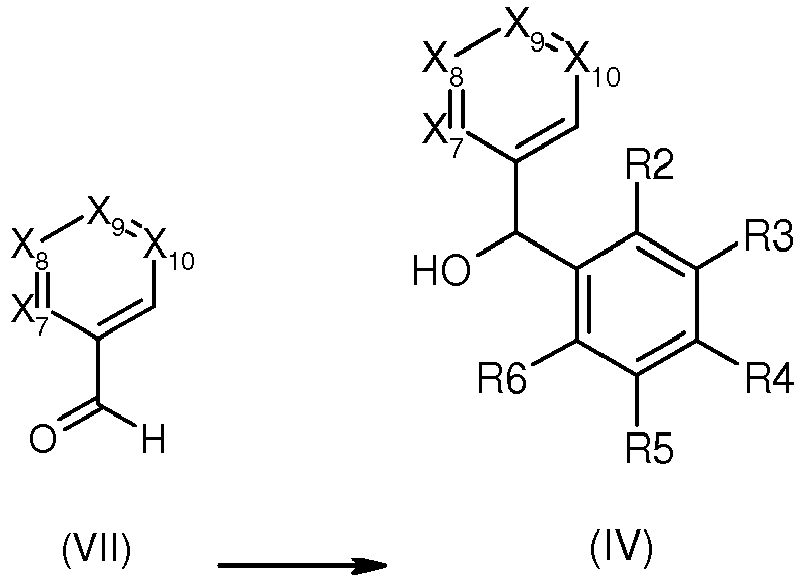
- Compounds of formula (IV) in which R2, R3, R4, R5, R6, X7, X8, X9 and X10 are as defined in general formula (I) can be obtained by either of the followig routes i, ii or iii :
- i. by reduction of the corresponding ketone (VI) in which R2, R3, R4, R5, R6, X7, X8, X9 and X10 are as defined in general formula (I):
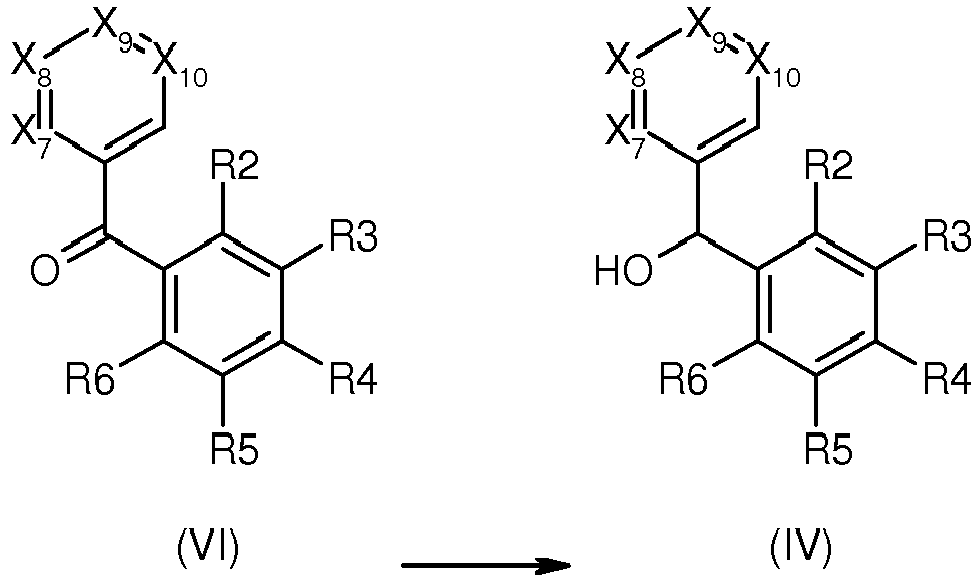
- ii. from a corresponding aldehyde (VII) in which X7, X8, X9 and X10 are as defined in general formula (I):
- iii. from a corresponding aldehyde (VIII) in which R2, R3, R4, R5, R6 are as defined in general formula (I):

- Reaction i. can be performed in the presence of a reducing agent such as a borohydride in an alcohol at a temperature comprised between 0°C and the refluxing temperature.
- Reaction ii. can be performed by reacting the aldehyde (VII) with the corresponding compound of formula (IX) :

or with the corresponding compound of formula (IX') :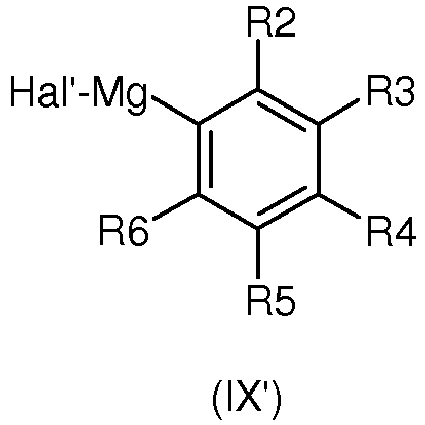
in an inert solvent such as tetrahydrofuran at a temperature comprised between - 78°C and the reflux temperature. - Alternatively, reaction ii. can also be performed by condensing the aldehyde (VII) with the corresponding derivative of formula (IX")

- Reaction iii. can be performed by reacting the aldehyde (VIII) with the corresponding compound of formula (X) :
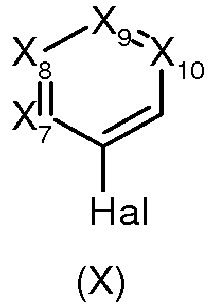
- Where X7, X8, X9 and X10 are as defined in formula (I) and Hal represents a halogen atom, in the presence of an organometallic reagent such as an organomagnesium (e.g. n-butylmagnesium chloride, isopropylmagnesium chloride, etc..) or organolithium (e.g. butyllithium, etc...),
or with the corresponding compound of formula (X') :
in an inert solvent such as tetrahydrofuran at a temperature comprised between - 78°C and the reflux temperature. - The process of the invention may comprise the additional step of isolating the desired compound of formula (I).
- According to a still further object, the present invention is also concerned with pharmaceutical compositions comprising a compound of formula (I) as defined above with a pharmaceutically acceptable excipient.
- The compounds of the invention are antagonists and/or inverse agonists of H4 R. The pharmaceutical compositions and compounds of the invention may thus be useful for use in the treatment and/or prevention of a disease associated with H4 dysfunction, such as inflammatory disorders.
- Said disease includes adult respiratory distress syndrome, acute respiratory distress syndrome, bronchitis, chronic bronchitis, chronic obstructive pulmonary disease, cystic fibrosis, asthma, emphysema, rhinitis, chronic sinusitis, allergy, allergy induced airway responses, allergic rhinitis, viral rhinitis, non-allergic rhinitis, perennial and seasonal rhinitis, conjunctivitis, nasal congestion, allergic congestion; disorders of the genito-urinary tract such as female and male sexual dysfunction, overactive bladder conditions, urinary incontinence, bladder overactivity, benign prostate hyperplasia and lower urinary tract symptoms; dermatological diseases such as dermatitis and psoriasis and treatment of itchy skin; diseases of the cardiovascular system including thromboembolic diseases, atherosclerosis, myocardial infarction, angina pectoris, myocardial ischaemia and arrhythmia, peripheral arterial occlusive diseases, pulmonary embolisms or deep venous thromboses, hypotension, pulmonary hypertension, malignant hypertension, cardiac insufficiency, heart or kidney failure, stroke and renal dysfunction; diseases of the gastrointestinal tract including inflammatory bowel disease, Crohn's disease, ulcerative colitis; autoimmune diseases including rheumatoid arthritis, multiple sclerosis; cancer; pain; lymphatic diseases.
- According to a further object, the present invention also concerns a combination of a compound of the invention with one or more therapeutic agent(s) selected from:
- Histamine H1, H2 or H3 receptor antagonists,
- Leukotriene antagonists,
- 5-Lipoxygenase (5-LO) inhibitors or 5-lipoxygenase activating protein (FLAP) antagonists
- CX1- and α2-adrenoceptor agonist vasoconstrictor sympathomimetic agents for decongestant use
- Xanthines, such as theophylline and aminophylline
- Non-steroidal antiinflammatories, such as sodium cromoglycate and nedocromil sodium
- Ketotifen
- COX-1 inhibitors (NSAIDs) and COX-2 selective inhibito
- Immunosuppressants
- mucolytics or anti-tussive agents.
- More particularly, the present invention also concerns combinations comprising a compound of formula (I) of the invention with a H1R antagonist, such as cetirizine, levocetirizine, desloratadine, bepotastine or doxepin.
- According to a still further object, the present invention is also concerned with a compound of formula (I) for the above conditions to be administered to a patient in the need thereof.
- According to a still further object, the present invention also concerns the methods of treatment comprising administering an effective amount of a compound of the invention for treating and/or preventing the above conditions or disorders.
- The identification of those subjects who are in need of treatment of herein-described diseases and conditions is well within the ability and knowledge of one skilled in the art. A clinician skilled in the art can readily identify, by the use of clinical tests, physical examination and medical/family history, those subjects who are in need of such treatment.
- A therapeutically effective amount can be readily determined by the attending diagnostician, as one skilled in the art, by the use of conventional techniques and by observing results obtained under analogous circumstances. In determining the therapeutically effective amount, a number of factors are considered by the attending diagnostician, including, but not limited to: the species of subject; its size, age, and general health; the specific disease involved; the degree of involvement or the severity of the disease; the response of the individual subject; the particular compound administered; the mode of administration; the bioavailability characteristic of the preparation administered; the dose regimen selected; the use of concomitant medication; and other relevant circumstances.
- The amount of a compound of formula (I), which is required to achieve the desired biological effect, will vary depending upon a number of factors, including the dosage of the drug to be administered, the chemical characteristics (e.g. hydrophobicity) of the compounds employed, the potency of the compounds, the type of disease, the diseased state of the patient, and the route of administration.
- In general terms, the compounds of this invention may be provided in an aqueous physiological buffer solution containing 0.1 to 10% w/v compound for parenteral administration. Typical dose ranges are from 1 µg/kg to 0.1 g/kg of body weight per day; a preferred dose range is from 0.01 mg/kg to 10 mg/kg of body weight per day. A preferred daily dose for adult humans includes 1, 5, 50, 100 and 200 mg, and an equivalent dose in a human child. The preferred dosage of drug to be administered is likely to depend on such variables as the type and extent of progression of the disease or disorder, the overall health status of the particular patient, the relative biological efficacy of the compound selected, and formulation of the compound excipient, and its route of administration.
- The compounds of the present invention are capable of being administered in unit dose forms, wherein the term "unit dose" means a single dose which is capable of being administered to a patient, and which can be readily handled and packaged, remaining as a physically and chemically stable unit dose comprising either the active compound itself, or as a pharmaceutically acceptable composition, as described hereinafter. As such, typical daily dose ranges are from 0,01 to 10 mg/kg of body weight. By way of general guidance, unit doses for humans range from 0,1 mg to 1000 mg per day. Preferably, the unit dose range is from 1 to 500 mg administered one to four times a day, and even more preferably from 1 mg to 300 mg, once a day. Compounds provided herein can be formulated into pharmaceutical compositions by admixture with one or more pharmaceutically acceptable excipients. Such compositions may be prepared for use in oral administration, particularly in the form of tablets or capsules, in particular orodispersible (lyoc) tablets; or parenteral administration, particularly in the form of liquid solutions, suspensions or emulsions; or intranasally, particularly in the form of powders, nasal drops, or aerosols; or dermally, for example, topically or via trans-dermal patches or ocular administration, or intravaginal or intra-uterine administration, particularly in the form of pessaries or by rectal administration.
- The compositions may conveniently be administered in unit dosage form and may be prepared by any of the methods well known in the pharmaceutical art, for example, as described in Remington: The Science and Practice of Pharmacy, 20th ed.; Gennaro, A. R., Ed.; Lippincott Williams & Wilkins: Philadelphia, PA, 2000. Pharmaceutically compatible binding agents and/or adjuvant materials can be included as part of the composition. Oral compositions will generally include an inert diluent carrier or an edible carrier.
- The tablets, pills, powders, capsules, troches and the like can contain one or more of any of the following ingredients, or compounds of a similar nature: a binder such as microcrystalline cellulose, or gum tragacanth; a diluent such as starch or lactose; a disintegrant such as starch and cellulose derivatives; a lubricant such as magnesium stearate; a glidant such as colloidal silicon dioxide; a sweetening agent such as sucrose or saccharin; or a flavoring agent such as peppermint, or methyl salicylate. Capsules can be in the form of a hard capsule or soft capsule, which are generally made from gelatin blends optionally blended with plasticizers, as well as a starch capsule. In addition, dosage unit forms can contain various other materials that modify the physical form of the dosage unit, for example, coatings of sugar, shellac, or enteric agents. Other oral dosage forms syrup or elixir may contain sweetening agents, preservatives, dyes, colorings, and flavorings. In addition, the active compounds may be incorporated into fast dissolve, modified-release or sustained-release preparations and formulations, and wherein such sustained-release formulations are preferably bi-modal.
- Preferred formulations include pharmaceutical compositions in which a compound of the present invention is formulated for oral or parenteral administration, or more preferably those in which a compound of the present invention is formulated as a tablet. Preferred tablets contain lactose, cornstarch, magnesium silicate, croscarmellose sodium, povidone, magnesium stearate, or talc in any combination. It is also an aspect of the present disclosure that a compound of the present invention may be incorporated into a food product or a liquid.
- Liquid preparations for administration include sterile aqueous or non-aqueous solutions, suspensions, and emulsions. The liquid compositions may also include binders, buffers, preservatives, chelating agents, sweetening, flavoring and coloring agents, and the like. Non-aqueous solvents include alcohols, propylene glycol, polyethylene glycol, acrylate copolymers, vegetable oils such as olive oil, and organic esters such as ethyl oleate. Aqueous carriers include mixtures of alcohols and water, hydrogels, buffered media, and saline. In particular, biocompatible, biodegradable lactide polymer, lactide/glycolide copolymer, or polyoxyethylene-polyoxypropylene copolymers may be useful excipients to control the release of the active compounds. Intravenous vehicles can include fluid and nutrient replenishers, electrolyte replenishers, such as those based on Ringer's dextrose, and the like. Other potentially useful parenteral delivery systems for these active compounds include ethylene-vinyl acetate copolymer particles, osmotic pumps, implantable infusion systems, and liposomes.
- Alternative modes of administration include formulations for inhalation, which include such means as dry powder, aerosol, or drops. They may be aqueous solutions containing, for example, polyoxyethylene-9-lauryl ether, glycocholate and deoxycholate, or oily solutions for administration in the form of nasal drops, or as a gel to be applied intranasally. Formulations for buccal administration include, for example, lozenges or pastilles and may also include a flavored base, such as sucrose or acacia, and other excipients such as glycocholate. Formulations suitable for rectal administration are preferably presented as unit-dose suppositories, with a solid based carrier, such as cocoa butter, and may include a salicylate. Formulations for topical application to the skin preferably take the form of an ointment, cream, lotion, paste, gel, spray, aerosol, or oil. Carriers which can be used include petroleum jelly, lanolin, polyethylene glycols, alcohols, or their combinations. Formulations suitable for transdermal administration can be presented as discrete patches and can be lipophilic emulsions or buffered, aqueous solutions, dissolved and/or dispersed in a polymer or an adhesive.
- Alternative administrations include also solutions, ointments or other formulations acceptable for ocular administration.
- Other features of the invention will become apparent in the course of the following description of exemplary embodiments that are given for illustration of the invention and not intended to be limiting thereof.
- RT: retention time
- Melting points are determinated on Büchi capillary melting point apparatus.
- Proton NMR spectra are recorded on a Bruker 250 MHz NMR instrument. The chemicals shifts δ are expressed in ppm. The following abbreviations are used to denote signal patterns: s = singlet, d = doublet, t = triplet, q = quadruplet, m = multiplet, ms = massif. The coupling contents are expressed in Hz. The spectra recorded are consistent with the proposed structures.
- HPLC-MS analyses are performed on a Waters AutoPurification HPLC/MS System equipped with a 3100 Mass Spectrometer and a 2998 Photodiode Array (PDA) Detector.
- The MS spectra recorded are consistent with the proposed structures.
- The LC retention times are obtained using the following elution conditions:
- LC/MS Method A: Xterra MS C18 5µm 2.1x1 0mm guard column, Xterra MS C18 5µm 3.0x100mm column, eluents: water/0.1% formic acid (A) and acetonitrile/0.1% formic acid (B), linear gradient from 5% (B) to 95% (B) in 6 minutes.
- LC/MS Method E: Sunfire C18 5µm 4.6x20mm guard column, Sunfire C18 5µm 4.6x150mm column, eluents: water/0.1% formic acid (A) and acetonitrile/0.1% formic acid (B), linear gradient from 5% (B) to 95% (B) in 10 minutes.
- A mixture of (2-fluoro-5-trifluoromethoxyphenyl)pyridin-2-ylmethanol (340mg) and 4-hydroxy-1-methylpiperidine (273mg) in methanesulfonic acid (1.5mL) is heated in a sealed tube at 145°C for 24 hours and then at 155°C for 7 hours. The mixture is cooled back to room temperature, poured into water which is then made alkaline with concentrated sodium hydroxide solution. The aqueous phase is extracted with diethyl ether. Pooled extracts are dried over magnesium sulphate and concentrated under reduced pressure. The residue is purified by column chromatography over silica gel (gradient dichloromethane/methanol/ammonia from 95/5/0.5 to 90/10/0.5) to afford the pure base that is then converted into its dioxalate salt in acetone to give 2-[(2-fluoro-5-trifluoromethoxyphenyl)(1-methylpiperidin-4-yloxy)methyl]pyridine, dioxalate melting at 45 °C.
- To a solution of 2-bromopyridine (380mg) in anhydrous tetrahydrofuran (3mL) is slowly added a 1 M solution of isopropylmagnesium bromide in tetrahydrofuran (2.64mL) at room temperature. After stirring for 2 hours, 2-fluoro-5-(trifluoromethoxy)benzaldehyde (0.50mL) is added and the reaction mixture stirred for 2 hours. After hydrolysis with water and 3N hydrochloric acid, the mixture is washed with diethyl ether, basified with concentrated sodium hydroxide and extracted with ethyl acetate twice. The pooled organic extracts are dried over magnesium sulfate and concentrated under reduced pressure. The residue is purified by chromatography over silica gel (heptane/ethyl acetate 2/1) to afford (2-fluoro-5-trifluoromethoxyphenyl)pyridin-2-ylmethanol as an orange oil.
- Further examples can be prepared according to example 1. As regards the etherification step it can be advantageous to rise the temperature progressively after having mixed the different reagents and to observe when etherification occurs. Once the right temperature has been found, reaction may be continued up to adequate conversion.
Ex. Name Melting point RT(min) HPLC/MS method 2 5-Chloro-2-[(2-fluoro-4-methylphenyl)(1-methylpiperidin-4-yloxy)methyl]pyridine, oxalate 165 °C 3 2-[(2-Fluoro-4-methylphenyl)(1-methylpiperidin-4-yloxy)methyl]pyridine, dioxalate 59 °C 4 5-Chloro-2-[(2-fluoro-5-trifluoromethoxyphenyl)(1-methylpiperidin-4-yloxy)methyl]pyridine, oxalate 75 °C 37 2-[(3-Iodophenyl)(1-methylpiperidin-4-yloxy)methyl]pyridine, oxalate 3.65 Method A - A solution of 2-(6-{3-[(1-methylpiperidin-4-yloxy)-pyridin-2-ylmethyl]phenyl}hex-5-ynyl)isoindole-1,3-dione (205mg) and hydrazine hydrate (150µL) in ethanol (1.5mL) is stirred a room temperature for 2 hours. Ethanol is removed under reduced pressure and the residue purified by chromatography over silica gel (gradient dichloromethane/methanol/ammonia from 95/5/0.5 to 90/10/0.5) to afford the pure base that is then converted into its oxalate salt in acetone to give 6-{3-[(1-methylpiperidin-4-yloxy)pyridin-2-ylmethyl]phenyl}hex-5-ynylamine, oxalate displaying the following NMR spectrum: 1H NMR (DMSO-d6): 8.44 (d,1 H), 7.79 (t,1 H), 7.55 (d,1 H), 7.35-7.22 (ms,5H), 5.61(s, 1H), 2.90-2.70(ms,6H), 2.42 (m,2H), 2.34 (s,3H), 1.88 (m,2H), 1.62 (m,6H). Missing signals are masked by deuterated solvents peaks.
- A screw-cap tube is charged with 2-[(3-iodophenyl)(1-methylpiperidin-4-yloxy)methyl]pyridine (1 05mg, example 37), tetrakis(triphenylphosphine)palladium (52mg), copper(I) iodide (26mg), N-5-hexynylphthalimide (186mg), triethylamine (400µL) and 1-methyl-2-pyrrolidinone (4mL). The tube is evacuated, filled with argon and sealed. After stirring at 90°C for 14h, the mixture is diluted with water and the aqueous phase is extracted with ethyl acetate. The pooled organic extracts are washed with water, dried over magnesium sulfate and concentrated under reduced pressure. The residue is purified by chromatography over silica gel (gradient dichloromethane/methanol/ammonia from 98/2/0.5 to 95/5/0.5) to give 2-(6-{3-[(1-methylpiperidin-4-yloxy)-pyridin-2-ylmethyl]phenyl}hex-5-ynyl)isoindole-1,3-dione as an brown oil.
- 4-[(2-Fluoro-5-trifluoromethoxyphenyl)(1-methylpiperidin-4-yloxy)methyl]pyridine, dioxalate, solid melting at 61 °C, is prepared according general procedure 1A from (2-fluoro-5-trifluoromethoxyphenyl)pyridin-4-ylmethanol.
- To a solution in tetrahydrofuran (3mL) at 0°C of 2.3M n-butyllithium in hexanes (0.95mL) and 2M n-butylmagnesium chloride in tetrahydrofuran (0.55mL) is added a solution of 2-bromo-1-fluoro-4-trifluoromethoxybenzene in tetrahydrofuran (4mL). After stirring at 0°C for 20 minutes 4-pyridinecarboxaldehyde (193 µL) is added and the mixture stirred at room temperature for one night. After hydrolysis with water, the aqueous phase is extracted with ethyl acetate. The pooled organic extracts are washed with water, dried over magnesium sulfate and concentrated under reduced pressure. The residue is purified by chromatography over silica gel (gradient heptane/ethyl acetate from 2/1 to 1/1) to give pure (2-fluoro-5-trifluoromethoxyphenyl)pyridin-4-ylmethanol.
- 2-[(2-Fluoro-4-methylphenyl)(1-methylpiperidin-4-yloxy)methyl]-4-methylpyridine, dioxalate, solid melting at 52°C, is prepared analogously to example 1 from (2-fluoro-4-methylphenyl)(4-methylpyridin-2-yl)methanol.
- To a solution of 2-bromo-4-methylpyridine (600mg) in diethyl ether (20mL) at - 78°C is added a 2.3M solution of butyllithium in hexanes (1.52mL). After stirring at this temperature for 1 hour 2-fluoro-4-methylbenzaldehyde is added and the mixture allowed to warm at room temperature. The reaction mixture is then hydrolyzed with diluted aqueous hydrochloric acid, washed with diethyl ether, basified with concentrated sodium hydroxide and extracted with diethyl ether. The pooled organic extracts are dried over magnesium sulfate and concentrated under reduced pressure. The residue is purified by chromatography over silica gel (heptane/ethyl acetate 2/1) to afford (2-fluoro-4-methylphenyl)(4-methyl-pyridin-2-yl)methanol as a pale yellow oil which solidifies on standing.
- Further examples can be prepared according to example 7. As regards the etherification step it can be advantageous to rise the temperature progressively after having mixed the different reagents and to observe when etherification occurs. Once the right temperature has been found, reaction may be continued up to adequate conversion.
Ex. Name Melting point RT(min) HPLC/MS method 8 2-[(2-Fluoro-5-trifluoromethoxyphenyl)(1-methylpiperidin-4-yloxy)methyl]-4-methylpyridine, dioxalate 43 °C 9 5-Chloro-2-[(4-chlorophenyl)(1-methylpiperidin-4-yloxy)methyl]pyridine, oxalate 190 °C 10 5-Fluoro-2-[(2-fluoro-4-methylphenyl)(1-methylpiperidin-4-yloxy)methyl]pyridine, oxalate 133 °C 11 5-Fluoro-2-[(2-fluoro-5-trifluoromethoxyphenyl)(1-methylpiperidin-4-yloxy)methyl]pyridine, oxalate 113 °C 12 5-Chloro-2-[(3-methoxyphenyl)(1-methylpiperidin-4-yloxy)methyl]pyridine, oxalate 175 °C 13 5-Chloro-2-[(3-iodophenyl)(1-methylpiperidin-4-yloxy)methyl]pyridine, oxalate 130 °C 14 2-[(2-Fluoro-4-methylphenyl)(1-methylpiperidin-4-yloxy)methyl]-4-trifluoromethylpyridine, oxalate 104 °C 15 2,3-Difluoro-6-[(5-fluoropyridin-2-yl)(1-methylpiperidin-4-yloxy)methyl]phenol 73 °C 3.76 Method A 16 6-[(5-Chloropyridin-2-yl)(1-methylpiperidin-4-yloxy)methyl]-2,3-difluorophenol 68 °C 3.91 Method A - To a solution of 6-{3-[(1-methylpiperidin-4-yloxy)pyridin-2-ylmethyl]phenyl}hex-5-ynylamine (28mg, example 5) in dichloromethane (1mL) is added a solution of ethyl chloroformate (142µL) in dichloromethane (2mL) at 0°C. After stirring at room temperature for one night, the reaction mixture is treated with 1 N sodium hydroxide. The organic phase is then submitted to chromatography over silica gel (gradient dichloromethane/methanol from 99/1 to 95/5) to afford the pure base that is then converted into its oxalate salt in ethanol to give (6-{3-[(1-methylpiperidin-4-yloxy)pyridin-2-ylmethyl]phenyl}hex-5-ynyl)carbamic acid ethyl ester, oxalate as a solid melting at 77 °C.
- 6-{3-[(5-Chloropyridin-2-yl)(1-methylpiperidin-4-yloxy)methyl]phenyl}hex-5-ynylamine, oxalate, solid melting at 136 °C, is prepared analogously to example 5 starting from example 13.
- A mixture of 2-(hydroxypyridin-2-ylmethyl)phenol (0.27g), 4-hydroxy-1-methylpiperidine (0.31g) and para-toluenesulfonic acid, monohydrate (0.89g) in toluene (20mL) and 1-methyl-2-pyrrolidinone (1mL) is heated for 3 hours in a Dean-Stark apparatus. The mixture is cooled back to room temperature, treated with aqueous NaHCO3 and extracted twice with ethyl acetate. Pooled organic extracts are washed with brine, dried over magnesium sulfate and concentrated. The residue is purified by column chromatography over silica gel (gradient dichloromethane/methanol/ammonia from 100/0/0.5 to 95/5/0.5) to afford the pure base that is then converted into its oxalate salt in acetone to give 2-[(1-methylpiperidin-4-yloxy)pyridin-2-ylmethyl]phenol, oxalate as a solid melting at 70 °C.
- To a solution of AlCl3 (1.42g) in dichloromethane (20mL) at 0 °C is added a solution of phenol (1g) in dichloromethane (20mL) and the mixture is stirred at this temperature for 40 minutes. After addition of a solution of pyridine-2-carboxaldehyde (1.21g) in dichloromethane (10mL), the mixture is allowed to warm at room temperature for 4 hours, then cooled to 0 °C, treated dropwise with aqueous ammonium chloride and stirred at room temperature for 30 minutes. The aqueous phase is extracted twice with dichloromethane and pooled organic extracts dried over magnesium sulfate and concentrated. The residue is purified by column chromatography over silica gel (gradient heptane/ethyl acetate from 100/0 to 70/30) to afford pure 2-(hydroxy-pyridin-2-yl-methyl)-phenol.
- A mixture of 5-fluoro-2-[(5-fluoropyridin-2-yl)hydroxymethyl]phenol (100mg), 4-hydroxy-1-methylpiperidine (97mg), methanesulfonic acid (109µL) in 1,2-dichloroethane (3mL) is heated for 1 hour at 80 °C. The mixture is cooled back to room temperature, slowly basified with a saturated aqueous sodium hydrogencarbonate solution and extracted with dichloromethane. Pooled extracts are dried over magnesium sulphate and concentrated under reduced pressure. The residue is purified by column chromatography over silica gel (gradient dichloromethane/methanol/ammonia from 95/5/0.5 to 90/10/0.5) to afford the pure base that is then converted into its oxalate salt in acetone to give 5-fluoro-2-[(5-fluoropyridin-2-yl)(1-methylpiperidin-4-yloxy)methyl]phenol, oxalate melting at 105 °C. HPLC-MS method A, RT=3.66min.
- Further examples can be prepared according to example 20. As regards the etherification step it can be advantageous to rise the temperature progressively after having mixed the different reagents and to observe when etherification occurs. Once the right temperature has been found, reaction may be continued up to adequate conversion. 1-Methyl-2-pyrrolidinone can be added to the mixture to ensure total solubility of the reagents.
Ex. Name Melting point RT(min) HPLC/MS method 21 2-Fluoro-6-[(5-fluoropyridin-2-yl)(1-methylpiperidin-4-yloxy)methyl]-3-methylphenol 62 °C 3.82 Method A 22 6-[(5-Chloropyridin-2-yl)(1-methylpiperidin-4-yloxy)methyl]-2-fluoro-3-methylphenol 67 °C 3.96 Method A 23 2-[(5-Chloropyridin-2-yl)(1-methylpiperidin-4-yloxy)methyl]-5-fluorophenol 57 °C 5.07 Method E 24 2-[(5-Fluoropyridin-2-yl)(1-methylpiperidin-4-yloxy)methyl]-5-methylphenol, oxalate 77 °C 3.74 Method A 25 2-[(5-Chloropyridin-2-yl)(1-methylpiperidin-4-yloxy)methyl]-5-methylphenol, oxalate 77 °C 3.95 Method A 26 2-Fluoro-6-[(4-fluoropyridin-2-yl)(1-methylpiperidin-4-yloxy)methyl]-3-methylphenol 64 °C 3.70 Method A - A mixture of chloro-(3-iodophenyl)-p-tolylmethane (2.47g), 4-hydroxy-1-methylpiperidine (1.66g) in acetonitrile is refluxed for one night. Solvent is then removed under reduced pressure and the residue diluted with water, 0.5N aqueous sodium hydroxide and ethyl acetate. The organic phase is dried over magnesium sulfate, concentrated and the residue purified by column chromatography over silica gel (gradient dichloromethane/methanol from 100/0 to 90/10) to afford the pure base that is then converted into its oxalate salt in acetone to give 4-[(3-iodophenyl)-p-tolylmethoxy]-1-methylpiperidine, oxalate, a solid melting at 60 °C.
- To a solution of (3-iodophenyl)-p-tolylmethanol (2.68g) in dichloromethane (50mL) at 0°C is slowly added thionyl chloride (633µL). After stirring at room temperature for 2 days, the mixture is washed with aqueous NaHCO3, dried over magnesium sulfate and concentrated under reduced pressure to afford chloro-(3-iodophenyl)-p-tolylmethane.
- To a solution of 3-iodobenzaldehyde (10g) in tetrahydrofuran (50mL) at 30°C is added a 0.43M solution of p-tolylmagnesium bromide in tetrahydrofuran. After stirring at 50 °C for 1 hour, the reaction mixture is hydrolyzed with a saturated aqueous solution of ammonium chloride and extracted ethyl acetate. Pooled organic extracts are washed with brine, dried over magnesium sulfate and concentrated. The residue is purified by column chromatography over silica gel (gradient heptane/ethyl acetate 95/5 to 90/10) to yield (3-iodophenyl)-p-tolylmethanol.
- 4-[(2-Fluoro-5-trifluoromethoxyphenyl)naphthalen-2-ylmethoxy]-1-methylpiperidine, oxalate, solid melting at 105°C, is prepared analogously to example 27.
- 4-[(2-Fluoro-4-methylphenyl)naphthalen-2-yl-methoxy]-1-methylpiperidine, oxalate, solid melting at 122 °C, is prepared analogously to example 27.
- 4-[(3,4-Dichlorophenyl)(2-fluoro-4-methylphenyl)methoxy]-1-methylpiperidine, oxalate, solid melting at 140 °C, is prepared according general procedures 1A (a few seconds at room temperature) and 6B from 3,4-dichlorobenzaldehyde and 1-bromo-2-fluoro-4-methylbenzene.
- 4-[(3,4-Dichlorophenyl)(2-fluoro-5-trifluoromethoxyphenyl)methoxy]-1-methylpiperidine, oxalate, solid melting at 115°C, is prepared according general procedures 1A (30 seconds at 60 °C) and 6B from 3,4-dichlorobenzaldehyde and 2-bromo-1-fluoro-4-trifluoromethoxybenzene.
- 4-[(2-Fluorophenyl)-(2-fluoro-5-trifluoromethoxyphenyl)methoxy]-1-methyl piperidine, oxalate, solid melting at 116°C, is prepared according general procedures 1A (15 minutes at 5°C) and 6B from 2-fluorobenzaldehyde and 2-bromo-1-fluoro-4-trifluoromethoxybenzene.
- 4-[(4-Chlorophenyl)(2-fluoro-5-trifluoromethoxyphenyl)methoxy]-1-methyl piperidine, oxalate, solid melting at 117°C, is prepared according general procedures 1A (10 minutes at -5°C) and 6B from 4-chlorobenzaldehyde and 2-bromo-1-fluoro-4-trifluoromethoxybenzene.
- 4-[(4-Chlorophenyl)(2-fluoro-4-methylphenyl)methoxy]-1-methylpiperidine, oxalate, solid melting at 165°C, is prepared according general procedures 1A (5 minutes at -15°C) and 6B from 4-chlorobenzaldehyde and 1-bromo-2-fluoro-4-methylbenzene.
- 4-[(4-Chlorophenyl)(3-iodophenyl)methoxy]-1-methylpiperidine, oxalate, solid melting at 141 °C, is prepared according general procedures 1A (10 minutes at -5°C) and 6B from 3-iodobenzaldehyde and 4-bromo-chlorobenzene.
- 6-{3-[(4-Chlorophenyl)(1-methylpiperidin-4-yloxy)methyl]phenyl}hex-5-ynylamine, dioxalate, solid melting at 90 °C, is prepared from example 35 according to general procedures 5A and 5B.
- SH-SY5Y cells stably expressing human H4 receptor are grown until sub-confluence and centrifuged at 300g 15 minutes at 4°C. Pellets are resuspended in buffer I Tris-HCl 50mM, MgCl2 10mM, NaCl 140mM, pH=7.4 supplemented by Leupeptin 10µg/mL, Phenyl Methyl Sulphonyl Fluoride (PMSF) 0.1mM, Aprotinin 2µg/mL and Pepstatin 2µM (or a 1/50 dilution of a mix of protease inhibitors). The obtained suspension is stirred gently and submitted to a 25-26xg mechanic pressure exerted through a syringe. The cell lysate is then centrifuged at 300g 15 minutes at 4 °C in order to eliminate nucleus and cell scraps. The obtained supernatant is then centrifuged at 48000 g for 30 minutes at 4 °C. The final pellet is resuspended in buffer I with a potter homogenizer. Aliquots are frozen in liquid nitrogen and stored until use at -80 °C. Protein content is measured by the Bradford method.
- Defreezed membranes are diluted at a final concentration of 5µg/180µL/well in buffer I supplemented by GDP 10µM and distributed in 96 well polystyrene microplate. GTPγ [35S] labelled ligand (0.2-0.3 nM) is added for additional 30 minutes. After transfer in a Millipore GF/C HTS® microplate, the filtration of the reactional mix is followed by a three times 250 µl wash to stop the reaction.
- The filter-bound radioactivity is measured in a liquid scintillation counter Microbeta TRILUX® with 50µl of scintillation fluid.
- GTPγ [35S] dependent binding activity is determined in vitro for Histamine, Imetit, R(-)-alpha-methyl-histamine and all our compounds.
- Compounds can also be tested against Histamine or Imetit to evaluate their antagonist potential. Results are expressed with IC50 and Ki values.
- CHO cells stably expressing human H4 receptor were grown until sub-confluence and centrifuged at 300g 15 minutes at 4 °C. Pellets were resuspended in buffer I Tris-HCl 50mM, MgCl2 10mM, NaCl 140mM, pH=7,4 supplemented by a 1/50 dilution of a mix of protease inhibitors. The obtained suspension is stirred gently and submitted to a 25-26xg mechanic pressure exerted through a syringe. The cell lysate is then centrifuged at 300g 15 minutes at 4°C in order to eliminate nucleus and cell scraps. The obtained supernatant was then centrifuged at 48000 g for 30 minutes at 4 °C. The final pellet is resuspended in buffer I with a potter homogenizer. Aliquots were frozen in liquid nitrogen and stored until use at -80 °C. Protein content is measured by the Bradford method.
- Defreezed membranes were diluted at a final concentration of 20µg / 180µL/ well in a binding buffer containing 50 mM Tris/HCl, 0.5 mM EDTA, pH=7.4 and distributed in 96 well polystyrene microplate. [3H] Histamine labelled ligand (10-15 nM) is added for 60 minutes with compounds at room temperature under continuous stirring. Non specific binding was estimated in the presence of 10 µM BP1.2404 (JNJ 7777120). The reaction was terminated by filtration through GF/B filters pre-soaked 2 hours at 4 °C in 1 % polyethyleneimine. Filters were rinsed 3 times with 250 µl of ice cold incubation binding buffer.
- The filter-bound radioactivity was measured in a liquid scintillation counter Microbeta TRILUX® with 50µl of scintillation fluid.
- The hH4 binding investigated by use of [3H] Histamine give a Bmax ∼ pmole/mg prot and a Kd ∼9 nM.
- Compounds described hereabove have been evaluated in the GTPγ [35S] assay or in the [3H] histamine binding assay and have been found active with a Ki or IC50 under 1000nM.
Ex Ki IC50 1 B B 2 C B 3 B 4 B B 5 B B 6 B 7 B B 8 B 9 B 10 B B 11 A 12 A 13 B 14 B 15 A 16 B 17 A 18 C B 19 B 20 B 21 B 22 C 23 C 24 C 25 C 26 B 27 A 28 A B 29 A 30 B B 31 B B 32 A A 33 B B 34 B 35 C B 36 C C 37 A A: Ki or IC50 <1000nM
B: Ki or IC50 <300nM
C: Ki or IC50 <30nM
as well as its enantiomers, diastereomers, mixtures thereof and pharmaceutically acceptable salts, tautomers, hydrates and solvates,
with the exception of the compounds where simultaneously:
wherein at least of R7-R10 is different from H, and
with the proviso that
when R9 is not H, R7=R8=R10=H, and R2=R3=R5=R6=H, then R4 is H; or
when R4 is not H, R7=R8=R10=H, and R2=R3=R5=R6=H then R9 is H.
Claims (15)
- Compounds of formula (I) :
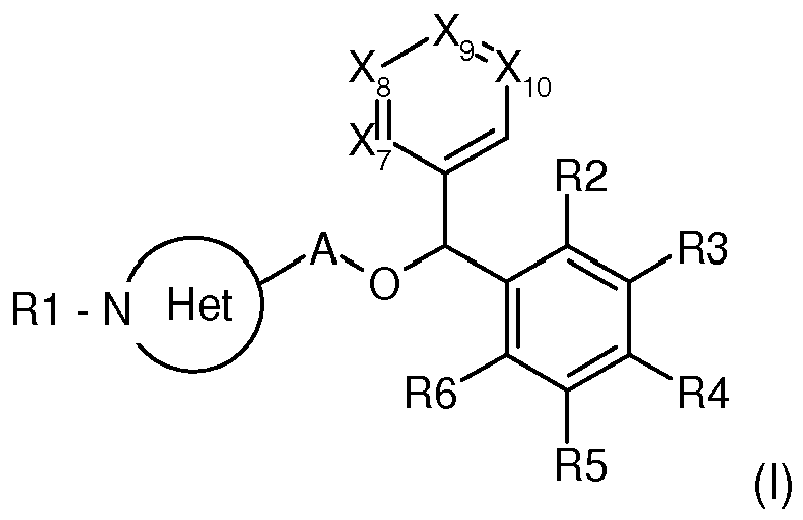
Het represents a non aromatic monocyclic 3 to 7 membered heterocycle containing one nitrogen atom and optionally 1 to 3 additional heteroatoms, wherein said at least one nitrogen atom is linked to R1;
A represents a single bond or a-C1-C6 alkyl- group;
Each R2, R3, R4, R5, R6 identical or different is independently chosen from:• hydrogen• halo; azido; cyano; hydroxy; nitro;• alkyl; alkoxy; alkylsulfanyl; alkenyl; alkynyl; alkenyloxy; alkenyloxy; alkenylsulfanyl; alkynylsulfanyl; cycloalkoxy; cycloalkylalkyl;
whose alkyl, alkenyl, alkynyl or cycloalkyl part can be substituted with one or more of halo, hydroxy, polyhydroxy, alkoxy, hydroxyalkoxy, cyano, amino, aminoalkyl, alkylamino, dialkylamino, aminoalkylamino, aminoalkylaminocarbonyl, alkoxycarbonylamino, diarylmethylimino (where aryl is optionally substituted with one or more of hydroxy or halo), cycloalkenylimino (where cylalkenyl is optionally substituted with one or more of alkyl, OH), alkylsulfanyl, alkylsulfinyl, alkylsulfonyl, cycloalkyl, polycycloalkyl, cycloalkenyl, polycycloalkenyl, guanidino, alkylcarbonylguanidino, acylguanidino, cyanoguanidino, alkoxycarbonylguanidino, alkoxycarbonyl, alkoxycarbonylalkylamino, alkoxycarbonylalkylcycloalkyl, alkoxycarbonylheterocyclyl, aminocarbonyl, alkylaminocarbonyl, alkylcarbonyl, alkylcarbonylalkoxy, aryloxy, arylsulfanyl, arylsulfinyl, arylsulfonyl, heteroaryl, heterocyclyl (heterocyclyl being optionally substituted with one or more of oxo, amino, imino), heteroaryloxy, heterocyclyloxy, heteroarylamino, heterocyclylamino, hydrazinocarbonyl, hydroxyalkylcycloalkyl, N-alkyl(thioureido), phtalimido, ureido, oxocycloalkenylamino substituted with amino, carbamimidoylheterocyclyl;• amino; alkylamino; alkylcarbonyl; alkoxycarbonyl; alkylsulfanyl; alkylsulfinyl; alkylsulfonyl; alkylsulfonyloxy
wherein :alkyl can be substituted with one or more of halo;
and
at least one of R2, R3, R4, R5, R6 is different from Heach Xi , identical or different is chosen from -N=, -C(Ri)= and -C(Ri')= ,i representing the 7, 8, 9 or 10 indiciawhereineither one of the Xi is -N= and the others are -C(Ri)= oreither each Xi is chosen from -C(Ri)= and -C(Ri')= with at least of Xi being -C(Ri')=wherein for each i said Xi may be identical or different and said Ri may be identical or differentso that said Ri(i=7, 8, 9, 10) are chosen from• H• Ri'(i'=7, 8, 9, 10)
said Ri'(i'=7, 8, 9, 10) are chosen from:• halo, cyano, hydroxy, nitro,• alkyl; alkoxy; alkylsulfanyl; alkenyl; alkynyl; alkenyloxy; alkenyloxy; alkenylsulfanyl; alkynylsulfanyl; cycloalkoxy; cycloalkylalkyl
whose alkyl, alkenyl, alkynyl or cycloalkyl part can be substituted with one or more of halo, hydroxy, polyhydroxy, alkoxy;• aryl; arylalkyl; aryloxy; arylalkoxy; arylalkylamino; arylalkylsulfanyl; heteroaryl; heteroaryloxy
whose (hetero)aryl part can be substituted with one or more of amino, halo, alkyl, (poly)haloalkyl, hydroxyalkyl, alkoxy, (poly)haloalkoxy, alkoxycarbonylamino, alkylcarbonyl, alkylsulfanyl, alkylsulfinyl, alkylsulfonyl, nitro, cyanoalkyl, or fused with a non aromatic heterocycle;
and wherein R9 and R10 can form together with the C atoms to which they are attached an aromatic ring as well as their enantiomers, diastereomers, mixtures thereof and pharmaceutically acceptable salts, tautomers, hydrates and solvates.
with the exception of the compounds where simultaneously:X9 is -CR9'=,X7=X8=X10= -CH=,R4 is not H andR2=R3= R5=R6= H. - Compounds according to claim 1 wherein the compounds of formula (I) are of formula (Ia):
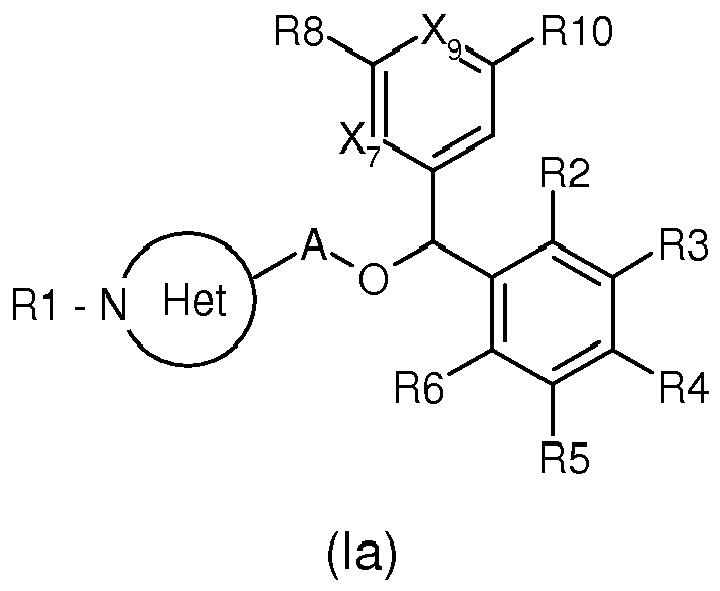
R1, Het, A, R2-6 are defined as in claim 1
X7 or X9 represents -N= and the other of X7 or X9 represents -CR7= or -CR9= And where R8, R10 and optional R7 or R9, identical or different are chosen from• H• halo, cyano, hydroxy, nitro,• alkyl; alkoxy; alkylsulfanyl; alkenyl; alkynyl; alkenyloxy; alkenyloxy; alkenylsulfanyl; alkynylsulfanyl; cycloalkoxy; cycloalkylalkyl
whose alkyl, alkenyl, alkynyl or cycloalkyl part can be substituted with one or more of halo, hydroxy, polyhydroxy, alkoxy;• aryl; arylalkyl; aryloxy; arylalkoxy; arylalkylamino; arylalkylsulfanyl; heteroaryl; heteroaryloxy
whose (hetero)aryl part can be substituted with one or more of amino, halo, alkyl, (poly)haloalkyl, hydroxyalkyl, alkoxy, (poly)haloalkoxy, alkoxycarbonylamino, alkylcarbonyl, alkylsulfanyl, alkylsulfinyl, alkylsulfonyl, nitro, cyanoalkyl, or fused with a non aromatic heterocycle;
and wherein R9 and R10 can form together with the C atoms to which they are attached an aromatic ring
as well as their enantiomers, diastereomers, mixtures thereof and pharmaceutically acceptable salts, tautomers, hydrates and solvates. - Compounds according to claim 1, wherein the compounds of formula (I) are of formula (Ib):
 R1, Het, A, R2-6 are defined as in claim 1 andEach of R7-R10 is chosen from• H• halo, cyano, hydroxy, nitro,• alkyl; alkoxy; alkylsulfanyl; alkenyl; alkynyl; alkenyloxy; alkenyloxy; alkenylsulfanyl; alkynylsulfanyl; cycloalkoxy; cycloalkylalkyl
whose alkyl, alkenyl, alkynyl or cycloalkyl part can be substituted with one or more of halo, hydroxy, polyhydroxy, alkoxy;• aryl; arylalkyl; aryloxy; arylalkoxy; arylalkylamino; arylalkylsulfanyl; heteroaryl; heteroaryloxyas well as their enantiomers, diastereomers, mixtures thereof and pharmaceutically acceptable salts, tautomers, hydrates and solvates.
whose (hetero)aryl part can be substituted with one or more of amino, halo, alkyl, (poly)haloalkyl, hydroxyalkyl, alkoxy, (poly)haloalkoxy, alkoxycarbonylamino, alkylcarbonyl, alkylsulfanyl, alkylsulfinyl, alkylsulfonyl, nitro, cyanoalkyl, or fused with a non aromatic heterocycle;
and wherein R9 and R10 can form together with the C atoms to which they are attached an aromatic ring;
wherein at least of R7-R10 is different from H, and
when R9 is not H, R7=R8=R10=H, and R2=R3=R5=R6=H, then R4 is H; or
when R4 is not H, R7=R8=R10=H, and R2=R3=R5=R6=H then R9 is H. - Compounds according to anyone of claims 1, 2 or 3, wherein
R1 represents a methyl. - Compounds according to anyone of the preceding claims, wherein Het represents a piperidine.
- Compounds according to anyone of the preceding claims, wherein A represents a single bond;
each R2, R3, R4, R5, R6 identical or different is independently chosen from:• hydrogen• halo; hydroxy;• alkyl; alkoxy; alkenyl;whose alkyl, alkenyl, alkynyl part can be substituted with one or more of halo, amino, alkoxycarbonylamino,
where at least one of R2, R3, R4, R5, R6 is different from H;
and • H• Ri'said Ri' are chosen from:• halo, cyano,• alkyl optionally substituted with one or more of halo;• aryl;and wherein R9 and R10 can form together with the C atoms to which they are attached an aromatic ring
with the exception of the compounds where simultaneously:X9 is -CR9'=,X7=X8=X10= -CH=,R4 is not H andR2=R3= R5=R6= H. - Compounds according to anyone of the preceding claims chosen from:- 2-[(2-Fluoro-5-trifluoromethoxyphenyl)(1-methylpiperidin-4-yloxy)methyl]pyridine- 5-Chloro-2-[(2-fluoro-4-methylphenyl)(1-methylpiperidin-4-yloxy)methyl]pyridine- 2-[(2-Fluoro-4-methylphenyl)(1-methylpiperidin-4-yloxy)methyl]pyridine- 5-Chloro-2-[(2-fluoro-5-trifluoromethoxyphenyl)(1-methylpiperidin-4-yloxy)methyl]pyridine- 6-{3-[(1-Methylpiperidin-4-yloxy)pyridin-2-ylmethyl]phenyl}hex-5-ynylamine- 4-[(2-Fluoro-5-trifluoromethoxyphenyl)(1-methylpiperidin-4-yloxy)methyl]pyridine- 2-[(2-Fluoro-4-methylphenyl)(1-methylpiperidin-4-yloxy)methyl]-4-methylpyridine- 2-[(2-Fluoro-5-trifluoromethoxyphenyl)(1-methylpiperidin-4-yloxy)methyl]-4-methylpyridine- 5-Chloro-2-[(4-chlorophenyl)(1-methylpiperidin-4-yloxy)methyl]pyridine- 5-Fluoro-2-[(2-fluoro-4-methylphenyl)(1-methylpiperidin-4-yloxy)methyl]pyridine- 5-Fluoro-2-[(2-fluoro-5-trifluoromethoxyphenyl)(1-methylpiperidin-4-yloxy)methyl]pyridine- 5-Chloro-2-[(3-methoxyphenyl)(1-methylpiperidin-4-yloxy)methyl]pyridine- 5-Chloro-2-[(3-iodophenyl)(1-methylpiperidin-4-yloxy)methyl]pyridine- 2-[(2-Fluoro-4-methylphenyl)(1-methylpiperidin-4-yloxy)methyl]-4-trifluoromethylpyridine- 2,3-Difluoro-6-[(5-fluoropyridin-2-yl)(1-methylpiperidin-4-yloxy)methyl]phenol- 6-[(5-Chloropyridin-2-yl)(1-methylpiperidin-4-yloxy)methyl]-2,3-difluorophenol- (6-{3-[(1-Methylpiperidin-4-yloxy)pyridin-2-ylmethyl]phenyllhex-5-ynyl)carbamic acid ethyl ester- 6-{3-[(5-Chloropyridin-2-yl)(1-methylpiperidin-4-yloxy)methyl]phenyl}hex-5-ynylamine- 2-[(1-Methylpiperidin-4-yloxy)pyridin-2-ylmethyl]phenol- 5-Fluoro-2-[(5-fluoropyridin-2-yl)(1-methylpiperidin-4-yloxy)methyl]phenol- 2-Fluoro-6-[(5-fluoropyridin-2-yl)(1-methylpiperidin-4-yloxy)methyl]-3-methylphenol- 6-[(5-Chloropyridin-2-yl)(1-methylpiperidin-4-yloxy)methyl]-2-fluoro-3-methylphenol- 2-[(5-Chloropyridin-2-yl)(1-methylpiperidin-4-yloxy)methyl]-5-fluorophenol- 2-[(5-Fluoropyridin-2-yl)(1-methylpiperidin-4-yloxy)methyl]-5-methylphenol- 2-[(5-Chloropyridin-2-yl)(1-methylpiperidin-4-yloxy)methyl]-5-methylphenol- 2-Fluoro-6-[(4-fluoropyridin-2-yl)(1-methylpiperidin-4-yloxy)methyl]-3-methylphenol- 4-[(3-Iodophenyl)-p-tolylmethoxy]-1-methylpiperidine- 4-[(2-Fluoro-5-trifluoromethoxyphenyl)naphthalen-2-ylmethoxy]-1-methylpiperidine- 4-[(2-Fluoro-4-methylphenyl)naphthalen-2-yl-methoxy]-1-methylpiperidine- 4-[(3,4-Dichlorophenyl)(2-fluoro-4-methylphenyl)methoxy]-1-methylpiperidine- 4-[(3,4-Dichlorophenyl)(2-fluoro-5-trifluoromethoxyphenyl)methoxy]-1-methylpiperidine- 4-[(2-Fluorophenyl)-(2-fluoro-5-trifluoromethoxyphenyl)methoxy]-1-methylpiperidine- 4-[(4-Chlorophenyl)(2-fluoro-5-trifluoromethoxyphenyl)methoxy]-1-methylpiperidine- 4-[(4-Chlorophenyl)(2-fluoro-4-methylphenyl)methoxy]-1-methylpiperidine- 4-[(4-Chlorophenyl)(3-iodophenyl)methoxy]-1-methylpiperidine- 6-{3-[(4-Chlorophenyl)(1-methylpiperidin-4-yloxy)methyl]phenyl}hex-5-ynylamine- 2-[(3-Iodophenyl)(1-methylpiperidin-4-yloxy)methyl]pyridine as well as their enantiomers, diastereomers, mixtures thereof and pharmaceutically acceptable salts, tautomers, hydrates and solvates.
- Process of preparation of the compounds of formula (I) according to anyone of the preceding claims comprising condensing an alcohol of formula (III) in which R, Het and A are as defined in anyone of claims 1 to 6 with an alcohol of formula (IV) in which R2, R3, R4, R5, R6, X7, X8, X9 and X10 are as defined in anyone of claims 1 to 6:

- Process of preparation of the compounds of formula (I) according to anyone of claims 1 to 7 comprising condensing an alcohol of formula (III) in which R, Het and A are as defined in anyone of claims 1 to 6 with an alkylating agent of formula (V) in which R2, R3, R4, R5, R6, X7, X8, X9 and X10 are as defined in anyone of claims 1 to 6 and X represents a halogen or a leaving group such as a mesylate, a triflate, a nosylate or a tosylate

- Process of preparation of the compounds of formula (I) according to anyone of claims 1 to 6 comprising functionally modifying a corresponding compound of formula (I) as defined in anyone of claims 1 to 6.
- The process according to any one of claims 8 to 10 further comprising the additional step of isolating the desired compound.
- A pharmaceutical composition comprising a compound of formula (I) according to any one of claims 1 to 6 with a pharmaceutically acceptable excipient.
- The compound according to any one of claims 1 to 6 for use to treat and/or prevent a disease associated with H4 dysfunction chosen from respiratory diseases such as respiratory inflammatory diseases, adult respiratory distress syndrome, acute respiratory distress syndrome, bronchitis, chronic bronchitis, chronic obstructive pulmonary disease, cystic fibrosis, asthma, emphysema, rhinitis, chronic sinusitis, allergy, allergy induced airway responses, allergic rhinitis, viral rhinitis, non-allergic rhinitis, perennial and seasonal rhinitis, conjunctivitis, nasal congestion, allergic congestion; disorders of the genito-urinary tract such as female and male sexual dysfunction, overactive bladder conditions, urinary incontinence, bladder overactivity, benign prostate hyperplasia and lower urinary tract symptoms; dermatological diseases such as dermatitis and psoriasis and treatment of itchy skin; diseases of the cardiovascular system including thromboembolic diseases, atherosclerosis, myocardial infarction, angina pectoris, myocardial ischaemia and arrhythmia, peripheral arterial occlusive diseases, pulmonary embolisms or deep venous thromboses, hypotension, pulmonary hypertension, malignant hypertension, cardiac insufficiency, heart or kidney failure, stroke and renal dysfunction; diseases of the gastrointestinal tract including inflammatory bowel disease, Crohn's disease, ulcerative colitis, food allergy; autoimmune and inflammatory diseases including rheumatoid arthritis, multiple sclerosis; cancer; pain; chronic hypereosinophilias; chronic diseases associated with mast-cell multiplication; lymphatic system diseases.
- A combination of a compound according to any one of claims 1 to 6 with one or more therapeutic agent(s) selected from:• Histamine H1, H2 or H3 receptor antagonists,• Leukotriene antagonists,• 5-Lipoxygenase (5-LO) inhibitors or 5-lipoxygenase activating protein (FLAP) antagonists• CX1- and α2-adrenoceptor agonist vasoconstrictor sympathomimetic agents for decongestant use• Xanthines, such as theophylline and aminophylline• Steroidal and non-steroidal antiinflammatories, such as sodium cromoglycate and nedocromil sodium• Ketotifen• COX-1 inhibitors (NSAIDs) and COX-2 selective inhibitors• Immunosuppressants• mucolytics or anti-tussive agents
- The combination according to claim 14, wherein the H1 R antagonist is chosen from cetirizine, desloratadine, bepotastine or doxepin.
Priority Applications (8)
| Application Number | Priority Date | Filing Date | Title |
|---|---|---|---|
| EP13170687.1A EP2671871B1 (en) | 2012-06-05 | 2013-06-05 | Novel (aza)benzhydryl ether derivatives, their process of preparation and their use as H4-receptor ligands for therapeutical applications |
| PL13170687T PL2671871T3 (en) | 2012-06-05 | 2013-06-05 | New (aza) benzhydryl ether derivatives, the method of their preparation and their use as H4 receptor ligands for therapeutic applications |
| SM20170032T SMT201700032T1 (en) | 2012-06-05 | 2013-06-05 | Novel (aza)benzhydryl ether derivatives, their process of preparation and their use as h4-receptor ligands for therapeutical applications |
| SI201330454A SI2671871T1 (en) | 2012-06-05 | 2013-06-05 | Novel (aza)benzhydryl ether derivatives, their process of preparation and their use as H4-receptor ligands for therapeutical applications |
| RS20170013A RS55562B1 (en) | 2012-06-05 | 2013-06-05 | NEW (AZA) BENZHYDRIL ETRA DERIVATIVES, THEIR PREPARATION PROCEDURES AND THEIR USE AS H4-RECEPTOR LIGANES FOR THERAPEUTIC APPLICATIONS |
| HRP20170052TT HRP20170052T1 (en) | 2012-06-05 | 2017-01-12 | NEW (AZA) BENZHYDRYL ETERY DERIVATIVES, THEIR PRODUCTION PROCEDURE AND THEIR USE AS A H4-RECEPTOR LIGAND FOR THERAPEUTIC APPLICATIONS |
| CY20171100059T CY1118614T1 (en) | 2012-06-05 | 2017-01-17 | NEW PRODUCERS (AZA) BENZHYDRATES, PROCESSING PROCESSES AND USE AS PROPOSED H4-RECEPTORS FOR THERAPEUTIC APPLICATIONS |
| SM201700032T SMT201700032B (en) | 2012-06-05 | 2017-01-18 | NEW DERIVATIVES OF (AZA) BENZIDRIL ETERE, THEIR PREPARATION PROCESS, AND THEIR USE AS LIGANDS OF THE H4 RECEPTOR FOR THERAPEUTIC APPLICATIONS |
Applications Claiming Priority (2)
| Application Number | Priority Date | Filing Date | Title |
|---|---|---|---|
| EP12305632.7A EP2671870A1 (en) | 2012-06-05 | 2012-06-05 | Novel (aza)benzhydryl ether derivatives, their process of preparation and their use as H4-receptor ligands for therapeutical applications |
| EP13170687.1A EP2671871B1 (en) | 2012-06-05 | 2013-06-05 | Novel (aza)benzhydryl ether derivatives, their process of preparation and their use as H4-receptor ligands for therapeutical applications |
Publications (2)
| Publication Number | Publication Date |
|---|---|
| EP2671871A1 true EP2671871A1 (en) | 2013-12-11 |
| EP2671871B1 EP2671871B1 (en) | 2016-10-19 |
Family
ID=48534299
Family Applications (2)
| Application Number | Title | Priority Date | Filing Date |
|---|---|---|---|
| EP12305632.7A Withdrawn EP2671870A1 (en) | 2012-06-05 | 2012-06-05 | Novel (aza)benzhydryl ether derivatives, their process of preparation and their use as H4-receptor ligands for therapeutical applications |
| EP13170687.1A Active EP2671871B1 (en) | 2012-06-05 | 2013-06-05 | Novel (aza)benzhydryl ether derivatives, their process of preparation and their use as H4-receptor ligands for therapeutical applications |
Family Applications Before (1)
| Application Number | Title | Priority Date | Filing Date |
|---|---|---|---|
| EP12305632.7A Withdrawn EP2671870A1 (en) | 2012-06-05 | 2012-06-05 | Novel (aza)benzhydryl ether derivatives, their process of preparation and their use as H4-receptor ligands for therapeutical applications |
Country Status (13)
| Country | Link |
|---|---|
| US (1) | US9242959B2 (en) |
| EP (2) | EP2671870A1 (en) |
| CY (1) | CY1118614T1 (en) |
| DK (1) | DK2671871T3 (en) |
| ES (1) | ES2606381T3 (en) |
| HR (1) | HRP20170052T1 (en) |
| HU (1) | HUE032870T2 (en) |
| LT (1) | LT2671871T (en) |
| PL (1) | PL2671871T3 (en) |
| PT (1) | PT2671871T (en) |
| RS (1) | RS55562B1 (en) |
| SI (1) | SI2671871T1 (en) |
| SM (2) | SMT201700032T1 (en) |
Families Citing this family (1)
| Publication number | Priority date | Publication date | Assignee | Title |
|---|---|---|---|---|
| CN104693183A (en) * | 2015-03-23 | 2015-06-10 | 上海皓元化学科技有限公司 | Synthetic method for 2-[(4-chlorphenyl) (4-piperidyl oxygroup) methyl] pyridine and derivate thereof |
Citations (4)
| Publication number | Priority date | Publication date | Assignee | Title |
|---|---|---|---|---|
| EP0243903A1 (en) * | 1986-04-28 | 1987-11-04 | Richter Gedeon Vegyészeti Gyár R.T. | Optionally substituted 1-(omega[bis(phenyl)-alcoxy]-alkyl)-4-(alkenyl)piperazines and -4-(alkynyl)piperazines, process for their preparation and medicines containing them |
| WO2005044807A2 (en) * | 2003-09-30 | 2005-05-19 | Janssen Pharmaceutica N.V. | Benzoimidazole compounds |
| WO2009089234A2 (en) * | 2008-01-07 | 2009-07-16 | Auspex Pharmaceuticals | Substituted dibenzhydrylpiperazines |
| WO2012041860A1 (en) * | 2010-09-27 | 2012-04-05 | Bioprojet | Benzazole derivatives as histamine h4 receptor ligands |
Family Cites Families (10)
| Publication number | Priority date | Publication date | Assignee | Title |
|---|---|---|---|---|
| US2479843A (en) * | 1948-06-02 | 1949-08-23 | Nopco Chem Co | 1-alkylpiperidyl-4-benzhydryl ethers, acid salts thereof and their preparation |
| DE934890C (en) * | 1951-10-07 | 1955-11-10 | Chem Fab Promonta Ges Mit Besc | Process for the preparation of basic benzhydryl ethers |
| US2745837A (en) * | 1954-01-21 | 1956-05-15 | Schering Corp | Benzhydryl ethers of alkyl piperidinols |
| GB780027A (en) * | 1955-01-20 | 1957-07-31 | Schering Corp | 3-piperidyl ethers and thioethers |
| US2974146A (en) * | 1956-02-24 | 1961-03-07 | Lakeside Lab Inc | 3-piperidyl benzhydryl ethers |
| US3280196A (en) * | 1962-05-25 | 1966-10-18 | S B Penick & Company | Benzhydryl-dihaloalkane ethers |
| AU6181196A (en) * | 1995-06-29 | 1997-01-30 | Mcneil-Ppc, Inc. | The combination of topical nasal antihistamines and topical nasal mast cell stabilizers |
| EP1618105A1 (en) * | 2003-05-01 | 2006-01-25 | Vernalis Research Limited | Azetidinecarboxamide derivatives and their use in the treatment of cb1 receptor mediated disorders |
| EP2120945A1 (en) * | 2007-02-28 | 2009-11-25 | Collegium Pharmaceutical, Inc. | Antihistamine combination |
| KR101146009B1 (en) * | 2009-10-01 | 2012-05-15 | 동인화학 주식회사 | Process for the preparation of active piperidine compounds by optical isolation |
-
2012
- 2012-06-05 EP EP12305632.7A patent/EP2671870A1/en not_active Withdrawn
-
2013
- 2013-06-05 RS RS20170013A patent/RS55562B1/en unknown
- 2013-06-05 PT PT131706871T patent/PT2671871T/en unknown
- 2013-06-05 SI SI201330454A patent/SI2671871T1/en unknown
- 2013-06-05 PL PL13170687T patent/PL2671871T3/en unknown
- 2013-06-05 ES ES13170687.1T patent/ES2606381T3/en active Active
- 2013-06-05 HU HUE13170687A patent/HUE032870T2/en unknown
- 2013-06-05 DK DK13170687.1T patent/DK2671871T3/en active
- 2013-06-05 SM SM20170032T patent/SMT201700032T1/en unknown
- 2013-06-05 LT LTEP13170687.1T patent/LT2671871T/en unknown
- 2013-06-05 EP EP13170687.1A patent/EP2671871B1/en active Active
- 2013-06-05 US US13/910,651 patent/US9242959B2/en active Active
-
2017
- 2017-01-12 HR HRP20170052TT patent/HRP20170052T1/en unknown
- 2017-01-17 CY CY20171100059T patent/CY1118614T1/en unknown
- 2017-01-18 SM SM201700032T patent/SMT201700032B/en unknown
Patent Citations (4)
| Publication number | Priority date | Publication date | Assignee | Title |
|---|---|---|---|---|
| EP0243903A1 (en) * | 1986-04-28 | 1987-11-04 | Richter Gedeon Vegyészeti Gyár R.T. | Optionally substituted 1-(omega[bis(phenyl)-alcoxy]-alkyl)-4-(alkenyl)piperazines and -4-(alkynyl)piperazines, process for their preparation and medicines containing them |
| WO2005044807A2 (en) * | 2003-09-30 | 2005-05-19 | Janssen Pharmaceutica N.V. | Benzoimidazole compounds |
| WO2009089234A2 (en) * | 2008-01-07 | 2009-07-16 | Auspex Pharmaceuticals | Substituted dibenzhydrylpiperazines |
| WO2012041860A1 (en) * | 2010-09-27 | 2012-04-05 | Bioprojet | Benzazole derivatives as histamine h4 receptor ligands |
Non-Patent Citations (13)
| Title |
|---|
| "Handbook of Chemistry and Physics", 1995, CRC PRESS, INC., pages: 2 - 25,2-26 |
| "Remington's Pharmaceutical Sciences", 1985, MACK PUBLISHING COMPANY, pages: 1418 |
| BEL ET AL., BR J PHARMACOL, vol. 142, 2004, pages 374 |
| DATABASE REGISTRY CHEMICAL ABSTRACTS SERVICE, COLUMBUS, OHIO, US; 1 June 2008 (2008-06-01), XP002686334, Database accession no. RN: 1024191-91-0 * |
| DATABASE REGISTRY CHEMICAL ABSTRACTS SERVICE, COLUMBUS, OHIO, US; 29 August 2002 (2002-08-29), XP002686332, Database accession no. RN: 445394-44-5 * |
| DATABASE REGISTRY CHEMICAL ABSTRACTS SERVICE, COLUMBUS, OHIO, US; 29 August 2002 (2002-08-29), XP002686333, Database accession no. RN: 445391-64-0 * |
| GALLI ET AL., NATURE, vol. 454, 2008, pages 445 |
| J. F. W. MCOMIE: "Protective Groups in Organic Chemistry", 1973, PLENUM PRESS |
| JILEK J ET AL: "POTENTIAL ANTICONVULSANTS: 3-CHLOROBENZOPHENONE DERIVATIVES", COLLECTION OF CZECHOSLOVAK CHEMICAL COMMUNICATIONS, vol. 54, no. 8, 1 January 1989 (1989-01-01), INSTITUTE OF ORGANIC CHEMISTRY & BIOCHEMISTRY, PRAGUE; CZ, pages 2248 - 2260, XP001022860, ISSN: 0010-0765 * |
| R.C. LAROCK: "Comprehensive Organic Transformations", 1989, VCH PUBLISHERS |
| REMINGTON: "The Science and Practice of Pharmacy", 2000, LIPPINCOTT WILLIAMS & WILKINS |
| T.W. GREENE; P. G. M. WUTS: "Protective Groups in Organic Chemistry", 1991, JOHN WILEY AND SONS |
| THURMOND ET AL., NATURE REV. DRUG DISC., vol. 7, 2008, pages 41 |
Also Published As
| Publication number | Publication date |
|---|---|
| SI2671871T1 (en) | 2017-01-31 |
| RS55562B1 (en) | 2017-05-31 |
| PL2671871T3 (en) | 2017-04-28 |
| HRP20170052T1 (en) | 2017-05-05 |
| CY1118614T1 (en) | 2017-07-12 |
| LT2671871T (en) | 2016-12-27 |
| EP2671870A1 (en) | 2013-12-11 |
| DK2671871T3 (en) | 2017-01-16 |
| PT2671871T (en) | 2017-01-09 |
| SMT201700032T1 (en) | 2017-03-08 |
| ES2606381T3 (en) | 2017-03-23 |
| SMT201700032B (en) | 2017-03-08 |
| EP2671871B1 (en) | 2016-10-19 |
| HUE032870T2 (en) | 2017-11-28 |
| US9242959B2 (en) | 2016-01-26 |
| US20130324507A1 (en) | 2013-12-05 |
Similar Documents
| Publication | Publication Date | Title |
|---|---|---|
| EP3795570B1 (en) | Substituted quinoline-8-carbonitrile derivatives having androgen receptor degradation activity and uses thereof | |
| EP1534703A2 (en) | Antagonists of melanin concentrating hormone receptor | |
| WO2021061644A1 (en) | Novel substituted quinoline-8-carbonitrile derivatives with androgen receptor degradation activity and uses thereof | |
| NZ720444A (en) | Prodrugs of pyridone amides useful as modulators of sodium channels | |
| JP2010510328A (en) | (R) -N-stereoisomers of 7,8-saturated-4,5-epoxy-morphinanium analogs | |
| KR20090034899A (en) | New Carbonylated (Aza) cyclohexanes as Dopamine D3 Receptor Ligands | |
| JP2010510325A (en) | (S) -N-stereoisomers of 7,8-saturated-4,5-epoxy-morphinanium analogs | |
| JP2002541104A (en) | Pyrrolidine chemokine receptor activity modulator | |
| WO2003090748A1 (en) | Use of compounds having ccr antagonism | |
| EP3269713A1 (en) | Piperidine derivatives as nk1 antagonists | |
| SG192543A1 (en) | 3, 4 - substituted piperidine derivatives as renin inhibitors | |
| US10106522B2 (en) | Benzimidazole derivatives as antihistamine agents | |
| EP2447263A1 (en) | Benzazole derivatives as histamine H4 receptor ligands | |
| KR20180067561A (en) | Therapeutic compounds and methods for their use | |
| TW200904449A (en) | Dibenzo[b,f][1,4]oxazapine compounds | |
| EP2671871B1 (en) | Novel (aza)benzhydryl ether derivatives, their process of preparation and their use as H4-receptor ligands for therapeutical applications | |
| EP3233799B1 (en) | Dopamine d2 receptor ligands | |
| BR112015009243B1 (en) | FLUORO-substituted CYCLIC AMINE COMPOUND, METHOD FOR PREPARING A FLUORO-substituted CYCLIC AMINE COMPOUND, PHARMACEUTICAL COMPOSITION, ACETYLCHOLINESTERASE INHIBITORS AND USE OF FLUORO-substituted CYCLIC AMINE COMPOUND | |
| EP3697795B1 (en) | Salts of (r)-9-(2,5-difluorophenethyl)-4-ethyl-2-methyl-1-oxa-4,9-diazaspiro[5.5]undecan-3-one | |
| EP1735302B1 (en) | 4-amino-piperidine derivatives as monoamine uptake inhibitors | |
| LABEEUW | 19, United States i, Patent Application Publication to, Pub. No.: US 2013/0324507A1 | |
| SK5282002A3 (en) | Phenyl- and pyridyl-tetrahydro-pyridines having tnf inhibiting activity | |
| US11306069B2 (en) | Benzimidazole derivatives as dual histamine H1 and histamine H4 receptor ligands | |
| JP2004083511A (en) | Acrylamide derivative | |
| WO2026096845A1 (en) | Carboxamide compounds for the treatment or prevention of malaria and other parasitic infections |
Legal Events
| Date | Code | Title | Description |
|---|---|---|---|
| PUAI | Public reference made under article 153(3) epc to a published international application that has entered the european phase |
Free format text: ORIGINAL CODE: 0009012 |
|
| AK | Designated contracting states |
Kind code of ref document: A1 Designated state(s): AL AT BE BG CH CY CZ DE DK EE ES FI FR GB GR HR HU IE IS IT LI LT LU LV MC MK MT NL NO PL PT RO RS SE SI SK SM TR |
|
| AX | Request for extension of the european patent |
Extension state: BA ME |
|
| 17P | Request for examination filed |
Effective date: 20140123 |
|
| RBV | Designated contracting states (corrected) |
Designated state(s): AL AT BE BG CH CY CZ DE DK EE ES FI FR GB GR HR HU IE IS IT LI LT LU LV MC MK MT NL NO PL PT RO RS SE SI SK SM TR |
|
| REG | Reference to a national code |
Ref country code: DE Ref legal event code: R079 Ref document number: 602013012876 Country of ref document: DE Free format text: PREVIOUS MAIN CLASS: C07D0211460000 Ipc: A61K0045060000 |
|
| GRAP | Despatch of communication of intention to grant a patent |
Free format text: ORIGINAL CODE: EPIDOSNIGR1 |
|
| RIC1 | Information provided on ipc code assigned before grant |
Ipc: A61K 31/445 20060101ALI20160421BHEP Ipc: C07D 211/46 20060101ALI20160421BHEP Ipc: A61K 31/4545 20060101ALI20160421BHEP Ipc: A61K 45/06 20060101AFI20160421BHEP Ipc: A61P 9/00 20060101ALI20160421BHEP Ipc: A61P 17/00 20060101ALI20160421BHEP Ipc: C07D 211/22 20060101ALI20160421BHEP Ipc: A61P 11/00 20060101ALI20160421BHEP Ipc: C07D 401/12 20060101ALI20160421BHEP |
|
| INTG | Intention to grant announced |
Effective date: 20160512 |
|
| GRAS | Grant fee paid |
Free format text: ORIGINAL CODE: EPIDOSNIGR3 |
|
| GRAA | (expected) grant |
Free format text: ORIGINAL CODE: 0009210 |
|
| AK | Designated contracting states |
Kind code of ref document: B1 Designated state(s): AL AT BE BG CH CY CZ DE DK EE ES FI FR GB GR HR HU IE IS IT LI LT LU LV MC MK MT NL NO PL PT RO RS SE SI SK SM TR |
|
| REG | Reference to a national code |
Ref country code: GB Ref legal event code: FG4D |
|
| REG | Reference to a national code |
Ref country code: CH Ref legal event code: NV Representative=s name: ARNOLD AND SIEDSMA AG, CH Ref country code: CH Ref legal event code: EP |
|
| REG | Reference to a national code |
Ref country code: AT Ref legal event code: REF Ref document number: 837769 Country of ref document: AT Kind code of ref document: T Effective date: 20161115 |
|
| REG | Reference to a national code |
Ref country code: IE Ref legal event code: FG4D |
|
| REG | Reference to a national code |
Ref country code: DE Ref legal event code: R096 Ref document number: 602013012876 Country of ref document: DE |
|
| REG | Reference to a national code |
Ref country code: NO Ref legal event code: T2 Effective date: 20161019 |
|
| REG | Reference to a national code |
Ref country code: PT Ref legal event code: SC4A Ref document number: 2671871 Country of ref document: PT Date of ref document: 20170109 Kind code of ref document: T Free format text: AVAILABILITY OF NATIONAL TRANSLATION Effective date: 20161230 |
|
| REG | Reference to a national code |
Ref country code: HR Ref legal event code: TUEP Ref document number: P20170052 Country of ref document: HR |
|
| REG | Reference to a national code |
Ref country code: DK Ref legal event code: T3 Effective date: 20170110 |
|
| REG | Reference to a national code |
Ref country code: SE Ref legal event code: TRGR |
|
| REG | Reference to a national code |
Ref country code: NL Ref legal event code: FP |
|
| REG | Reference to a national code |
Ref country code: EE Ref legal event code: FG4A Ref document number: E013144 Country of ref document: EE Effective date: 20170109 |
|
| REG | Reference to a national code |
Ref country code: HR Ref legal event code: T1PR Ref document number: P20170052 Country of ref document: HR |
|
| REG | Reference to a national code |
Ref country code: FR Ref legal event code: PLFP Year of fee payment: 5 |
|
| REG | Reference to a national code |
Ref country code: SK Ref legal event code: T3 Ref document number: E 23154 Country of ref document: SK |
|
| REG | Reference to a national code |
Ref country code: RO Ref legal event code: EPE |
|
| REG | Reference to a national code |
Ref country code: DE Ref legal event code: R097 Ref document number: 602013012876 Country of ref document: DE |
|
| PLBE | No opposition filed within time limit |
Free format text: ORIGINAL CODE: 0009261 |
|
| STAA | Information on the status of an ep patent application or granted ep patent |
Free format text: STATUS: NO OPPOSITION FILED WITHIN TIME LIMIT |
|
| 26N | No opposition filed |
Effective date: 20170720 |
|
| REG | Reference to a national code |
Ref country code: HU Ref legal event code: AG4A Ref document number: E032870 Country of ref document: HU |
|
| REG | Reference to a national code |
Ref country code: FR Ref legal event code: PLFP Year of fee payment: 6 |
|
| REG | Reference to a national code |
Ref country code: AT Ref legal event code: UEP Ref document number: 837769 Country of ref document: AT Kind code of ref document: T Effective date: 20161019 |
|
| REG | Reference to a national code |
Ref country code: HR Ref legal event code: ODRP Ref document number: P20170052 Country of ref document: HR Payment date: 20190521 Year of fee payment: 7 |
|
| REG | Reference to a national code |
Ref country code: HR Ref legal event code: ODRP Ref document number: P20170052 Country of ref document: HR Payment date: 20200518 Year of fee payment: 8 |
|
| REG | Reference to a national code |
Ref country code: HR Ref legal event code: ODRP Ref document number: P20170052 Country of ref document: HR Payment date: 20210520 Year of fee payment: 9 |
|
| REG | Reference to a national code |
Ref country code: HR Ref legal event code: ODRP Ref document number: P20170052 Country of ref document: HR Payment date: 20220603 Year of fee payment: 10 |
|
| REG | Reference to a national code |
Ref country code: HR Ref legal event code: ODRP Ref document number: P20170052 Country of ref document: HR Payment date: 20230517 Year of fee payment: 11 |
|
| P01 | Opt-out of the competence of the unified patent court (upc) registered |
Effective date: 20230515 |
|
| REG | Reference to a national code |
Ref country code: HR Ref legal event code: ODRP Ref document number: P20170052 Country of ref document: HR Payment date: 20240521 Year of fee payment: 12 |
|
| PGFP | Annual fee paid to national office [announced via postgrant information from national office to epo] |
Ref country code: NL Payment date: 20250528 Year of fee payment: 13 |
|
| REG | Reference to a national code |
Ref country code: HR Ref legal event code: ODRP Ref document number: P20170052 Country of ref document: HR Payment date: 20250527 Year of fee payment: 13 |
|
| PGFP | Annual fee paid to national office [announced via postgrant information from national office to epo] |
Ref country code: SM Payment date: 20250625 Year of fee payment: 13 |
|
| PGFP | Annual fee paid to national office [announced via postgrant information from national office to epo] |
Ref country code: MC Payment date: 20250527 Year of fee payment: 13 |
|
| PGFP | Annual fee paid to national office [announced via postgrant information from national office to epo] |
Ref country code: FI Payment date: 20250522 Year of fee payment: 13 |
|
| PGFP | Annual fee paid to national office [announced via postgrant information from national office to epo] |
Ref country code: DE Payment date: 20250617 Year of fee payment: 13 Ref country code: PL Payment date: 20250526 Year of fee payment: 13 |
|
| PGFP | Annual fee paid to national office [announced via postgrant information from national office to epo] |
Ref country code: GB Payment date: 20250625 Year of fee payment: 13 Ref country code: DK Payment date: 20250527 Year of fee payment: 13 |
|
| PGFP | Annual fee paid to national office [announced via postgrant information from national office to epo] |
Ref country code: LT Payment date: 20250523 Year of fee payment: 13 |
|
| PGFP | Annual fee paid to national office [announced via postgrant information from national office to epo] |
Ref country code: RS Payment date: 20250527 Year of fee payment: 13 Ref country code: IS Payment date: 20250521 Year of fee payment: 13 Ref country code: NO Payment date: 20250530 Year of fee payment: 13 |
|
| PGFP | Annual fee paid to national office [announced via postgrant information from national office to epo] |
Ref country code: AL Payment date: 20250618 Year of fee payment: 13 Ref country code: LU Payment date: 20250528 Year of fee payment: 13 Ref country code: BE Payment date: 20250625 Year of fee payment: 13 |
|
| PGFP | Annual fee paid to national office [announced via postgrant information from national office to epo] |
Ref country code: HR Payment date: 20250527 Year of fee payment: 13 |
|
| PGFP | Annual fee paid to national office [announced via postgrant information from national office to epo] |
Ref country code: PT Payment date: 20250523 Year of fee payment: 13 Ref country code: LV Payment date: 20250523 Year of fee payment: 13 |
|
| PGFP | Annual fee paid to national office [announced via postgrant information from national office to epo] |
Ref country code: HU Payment date: 20250530 Year of fee payment: 13 Ref country code: FR Payment date: 20250513 Year of fee payment: 13 Ref country code: EE Payment date: 20250527 Year of fee payment: 13 |
|
| PGFP | Annual fee paid to national office [announced via postgrant information from national office to epo] |
Ref country code: MT Payment date: 20250530 Year of fee payment: 13 Ref country code: GR Payment date: 20250523 Year of fee payment: 13 Ref country code: BG Payment date: 20250523 Year of fee payment: 13 |
|
| PGFP | Annual fee paid to national office [announced via postgrant information from national office to epo] |
Ref country code: RO Payment date: 20250603 Year of fee payment: 13 Ref country code: AT Payment date: 20250522 Year of fee payment: 13 |
|
| PGFP | Annual fee paid to national office [announced via postgrant information from national office to epo] |
Ref country code: TR Payment date: 20250529 Year of fee payment: 13 Ref country code: SK Payment date: 20250523 Year of fee payment: 13 |
|
| PGFP | Annual fee paid to national office [announced via postgrant information from national office to epo] |
Ref country code: CZ Payment date: 20250602 Year of fee payment: 13 |
|
| PGFP | Annual fee paid to national office [announced via postgrant information from national office to epo] |
Ref country code: IE Payment date: 20250521 Year of fee payment: 13 |
|
| PGFP | Annual fee paid to national office [announced via postgrant information from national office to epo] |
Ref country code: SI Payment date: 20250527 Year of fee payment: 13 Ref country code: SE Payment date: 20250619 Year of fee payment: 13 |
|
| PGFP | Annual fee paid to national office [announced via postgrant information from national office to epo] |
Ref country code: ES Payment date: 20250710 Year of fee payment: 13 |
|
| PGFP | Annual fee paid to national office [announced via postgrant information from national office to epo] |
Ref country code: IT Payment date: 20250606 Year of fee payment: 13 |
|
| PGFP | Annual fee paid to national office [announced via postgrant information from national office to epo] |
Ref country code: CH Payment date: 20250701 Year of fee payment: 13 |
|
| PGFP | Annual fee paid to national office [announced via postgrant information from national office to epo] |
Ref country code: MK Payment date: 20250522 Year of fee payment: 13 |
|
| PGFP | Annual fee paid to national office [announced via postgrant information from national office to epo] |
Ref country code: CY Payment date: 20250522 Year of fee payment: 13 |