EP2670733B1 - N-hydroxybenzamide derivatives as hdac inhibitors and therapeutic methods using the same - Google Patents
N-hydroxybenzamide derivatives as hdac inhibitors and therapeutic methods using the same Download PDFInfo
- Publication number
- EP2670733B1 EP2670733B1 EP12742236.8A EP12742236A EP2670733B1 EP 2670733 B1 EP2670733 B1 EP 2670733B1 EP 12742236 A EP12742236 A EP 12742236A EP 2670733 B1 EP2670733 B1 EP 2670733B1
- Authority
- EP
- European Patent Office
- Prior art keywords
- methyl
- disease
- cancer
- nmr
- present
- Prior art date
- Legal status (The legal status is an assumption and is not a legal conclusion. Google has not performed a legal analysis and makes no representation as to the accuracy of the status listed.)
- Active
Links
- 0 CC(C)N(*)C(C)C Chemical compound CC(C)N(*)C(C)C 0.000 description 2
- NYOFVLPPZWAFQN-UHFFFAOYSA-N CC(C)c1nc2ccccc2[n]1Cc(cc1)ccc1C(NO)=O Chemical compound CC(C)c1nc2ccccc2[n]1Cc(cc1)ccc1C(NO)=O NYOFVLPPZWAFQN-UHFFFAOYSA-N 0.000 description 2
- KGWPHCDTOLQQEP-UHFFFAOYSA-N Cc1c2[nH]ccc2ccc1 Chemical compound Cc1c2[nH]ccc2ccc1 KGWPHCDTOLQQEP-UHFFFAOYSA-N 0.000 description 2
- HPYLZSUEFFQHRS-UHFFFAOYSA-N C1=CON=CN1 Chemical compound C1=CON=CN1 HPYLZSUEFFQHRS-UHFFFAOYSA-N 0.000 description 1
- SMOHMDMTVAYPAI-UHFFFAOYSA-N C1C=CCCNC1 Chemical compound C1C=CCCNC1 SMOHMDMTVAYPAI-UHFFFAOYSA-N 0.000 description 1
- WNHPMKYMPWMAIT-UHFFFAOYSA-N C1CCN=CCC1 Chemical compound C1CCN=CCC1 WNHPMKYMPWMAIT-UHFFFAOYSA-N 0.000 description 1
- ZKULTALXLHDKIH-UHFFFAOYSA-N CCN(CC)Cc(cc1)ccc1C(NO)=O Chemical compound CCN(CC)Cc(cc1)ccc1C(NO)=O ZKULTALXLHDKIH-UHFFFAOYSA-N 0.000 description 1
- BSAVQSOIALMHAL-UHFFFAOYSA-N CN(C)CCc1c[n](Cc(cc2)ccc2C(N)=O)c2ccccc12 Chemical compound CN(C)CCc1c[n](Cc(cc2)ccc2C(N)=O)c2ccccc12 BSAVQSOIALMHAL-UHFFFAOYSA-N 0.000 description 1
- ATCRGSXWNSBBFM-UHFFFAOYSA-N CN(C)CCc1nc2ccccc2[n]1Cc(cc1)ccc1C(NO)=O Chemical compound CN(C)CCc1nc2ccccc2[n]1Cc(cc1)ccc1C(NO)=O ATCRGSXWNSBBFM-UHFFFAOYSA-N 0.000 description 1
- CWNMJLXJUMJDHO-UHFFFAOYSA-N CN(C)c1cc(Cc(cc2)ccc2C(NO)=O)ccc1 Chemical compound CN(C)c1cc(Cc(cc2)ccc2C(NO)=O)ccc1 CWNMJLXJUMJDHO-UHFFFAOYSA-N 0.000 description 1
- DQWZAGFXJVIOMU-SSDOTTSWSA-N CN1[C@@H](COC)CCC1 Chemical compound CN1[C@@H](COC)CCC1 DQWZAGFXJVIOMU-SSDOTTSWSA-N 0.000 description 1
- MXIPJUWAMKULQI-UHFFFAOYSA-N CN1c2ncccc2CCC1 Chemical compound CN1c2ncccc2CCC1 MXIPJUWAMKULQI-UHFFFAOYSA-N 0.000 description 1
- XSQKEIRWLOVLBH-AWEZNQCLSA-N COC[C@H]1N(Cc(cc2)ccc2C(OC)=O)CCC1 Chemical compound COC[C@H]1N(Cc(cc2)ccc2C(OC)=O)CCC1 XSQKEIRWLOVLBH-AWEZNQCLSA-N 0.000 description 1
- BLRHMMGNCXNXJL-UHFFFAOYSA-N C[n]1c2ccccc2cc1 Chemical compound C[n]1c2ccccc2cc1 BLRHMMGNCXNXJL-UHFFFAOYSA-N 0.000 description 1
- FGYADSCZTQOAFK-UHFFFAOYSA-N C[n]1c2ccccc2nc1 Chemical compound C[n]1c2ccccc2nc1 FGYADSCZTQOAFK-UHFFFAOYSA-N 0.000 description 1
- GQPCGGQDQRAYCE-UHFFFAOYSA-N Cc1c(C)[n](Cc(cc2)ccc2C(NO)=O)c2c1cccc2 Chemical compound Cc1c(C)[n](Cc(cc2)ccc2C(NO)=O)c2c1cccc2 GQPCGGQDQRAYCE-UHFFFAOYSA-N 0.000 description 1
- QCXGJTGMGJOYDP-UHFFFAOYSA-N Cc1c2[nH]cnc2ccc1 Chemical compound Cc1c2[nH]cnc2ccc1 QCXGJTGMGJOYDP-UHFFFAOYSA-N 0.000 description 1
- SGZCUGGIJNIVPP-UHFFFAOYSA-N Cc1nc(cccc2)c2[n]1Cc(cc1)ccc1C(NO)=O Chemical compound Cc1nc(cccc2)c2[n]1Cc(cc1)ccc1C(NO)=O SGZCUGGIJNIVPP-UHFFFAOYSA-N 0.000 description 1
- PBMFSQRYOILNGV-UHFFFAOYSA-N c1cnncc1 Chemical compound c1cnncc1 PBMFSQRYOILNGV-UHFFFAOYSA-N 0.000 description 1
- KYQCOXFCLRTKLS-UHFFFAOYSA-N c1nccnc1 Chemical compound c1nccnc1 KYQCOXFCLRTKLS-UHFFFAOYSA-N 0.000 description 1
Images
Classifications
-
- C—CHEMISTRY; METALLURGY
- C07—ORGANIC CHEMISTRY
- C07C—ACYCLIC OR CARBOCYCLIC COMPOUNDS
- C07C229/00—Compounds containing amino and carboxyl groups bound to the same carbon skeleton
- C07C229/52—Compounds containing amino and carboxyl groups bound to the same carbon skeleton having amino and carboxyl groups bound to carbon atoms of six-membered aromatic rings of the same carbon skeleton
-
- A—HUMAN NECESSITIES
- A61—MEDICAL OR VETERINARY SCIENCE; HYGIENE
- A61K—PREPARATIONS FOR MEDICAL, DENTAL OR TOILETRY PURPOSES
- A61K45/00—Medicinal preparations containing active ingredients not provided for in groups A61K31/00 - A61K41/00
- A61K45/06—Mixtures of active ingredients without chemical characterisation, e.g. antiphlogistics and cardiaca
-
- A—HUMAN NECESSITIES
- A61—MEDICAL OR VETERINARY SCIENCE; HYGIENE
- A61K—PREPARATIONS FOR MEDICAL, DENTAL OR TOILETRY PURPOSES
- A61K49/00—Preparations for testing in vivo
- A61K49/0002—General or multifunctional contrast agents, e.g. chelated agents
-
- A—HUMAN NECESSITIES
- A61—MEDICAL OR VETERINARY SCIENCE; HYGIENE
- A61K—PREPARATIONS FOR MEDICAL, DENTAL OR TOILETRY PURPOSES
- A61K51/00—Preparations containing radioactive substances for use in therapy or testing in vivo
- A61K51/02—Preparations containing radioactive substances for use in therapy or testing in vivo characterised by the carrier, i.e. characterised by the agent or material covalently linked or complexing the radioactive nucleus
- A61K51/04—Organic compounds
-
- A—HUMAN NECESSITIES
- A61—MEDICAL OR VETERINARY SCIENCE; HYGIENE
- A61K—PREPARATIONS FOR MEDICAL, DENTAL OR TOILETRY PURPOSES
- A61K51/00—Preparations containing radioactive substances for use in therapy or testing in vivo
- A61K51/02—Preparations containing radioactive substances for use in therapy or testing in vivo characterised by the carrier, i.e. characterised by the agent or material covalently linked or complexing the radioactive nucleus
- A61K51/04—Organic compounds
- A61K51/041—Heterocyclic compounds
- A61K51/044—Heterocyclic compounds having nitrogen as a ring hetero atom, e.g. guanethidine, rifamycins
- A61K51/0446—Heterocyclic compounds having nitrogen as a ring hetero atom, e.g. guanethidine, rifamycins having five-membered rings with one nitrogen as the only ring hetero atom, e.g. sulpiride, succinimide, tolmetin, buflomedil
-
- A—HUMAN NECESSITIES
- A61—MEDICAL OR VETERINARY SCIENCE; HYGIENE
- A61K—PREPARATIONS FOR MEDICAL, DENTAL OR TOILETRY PURPOSES
- A61K51/00—Preparations containing radioactive substances for use in therapy or testing in vivo
- A61K51/02—Preparations containing radioactive substances for use in therapy or testing in vivo characterised by the carrier, i.e. characterised by the agent or material covalently linked or complexing the radioactive nucleus
- A61K51/04—Organic compounds
- A61K51/041—Heterocyclic compounds
- A61K51/044—Heterocyclic compounds having nitrogen as a ring hetero atom, e.g. guanethidine, rifamycins
- A61K51/0453—Heterocyclic compounds having nitrogen as a ring hetero atom, e.g. guanethidine, rifamycins having five-membered rings with two or more ring hetero atoms, at least one of which being nitrogen, e.g. tetrazole
-
- A—HUMAN NECESSITIES
- A61—MEDICAL OR VETERINARY SCIENCE; HYGIENE
- A61K—PREPARATIONS FOR MEDICAL, DENTAL OR TOILETRY PURPOSES
- A61K51/00—Preparations containing radioactive substances for use in therapy or testing in vivo
- A61K51/02—Preparations containing radioactive substances for use in therapy or testing in vivo characterised by the carrier, i.e. characterised by the agent or material covalently linked or complexing the radioactive nucleus
- A61K51/04—Organic compounds
- A61K51/041—Heterocyclic compounds
- A61K51/044—Heterocyclic compounds having nitrogen as a ring hetero atom, e.g. guanethidine, rifamycins
- A61K51/0455—Heterocyclic compounds having nitrogen as a ring hetero atom, e.g. guanethidine, rifamycins having six-membered rings with one nitrogen as the only ring hetero atom
-
- A—HUMAN NECESSITIES
- A61—MEDICAL OR VETERINARY SCIENCE; HYGIENE
- A61K—PREPARATIONS FOR MEDICAL, DENTAL OR TOILETRY PURPOSES
- A61K51/00—Preparations containing radioactive substances for use in therapy or testing in vivo
- A61K51/02—Preparations containing radioactive substances for use in therapy or testing in vivo characterised by the carrier, i.e. characterised by the agent or material covalently linked or complexing the radioactive nucleus
- A61K51/04—Organic compounds
- A61K51/041—Heterocyclic compounds
- A61K51/044—Heterocyclic compounds having nitrogen as a ring hetero atom, e.g. guanethidine, rifamycins
- A61K51/0459—Heterocyclic compounds having nitrogen as a ring hetero atom, e.g. guanethidine, rifamycins having six-membered rings with two nitrogen atoms as the only ring hetero atoms, e.g. piperazine
-
- A—HUMAN NECESSITIES
- A61—MEDICAL OR VETERINARY SCIENCE; HYGIENE
- A61P—SPECIFIC THERAPEUTIC ACTIVITY OF CHEMICAL COMPOUNDS OR MEDICINAL PREPARATIONS
- A61P35/00—Antineoplastic agents
-
- C—CHEMISTRY; METALLURGY
- C07—ORGANIC CHEMISTRY
- C07C—ACYCLIC OR CARBOCYCLIC COMPOUNDS
- C07C259/00—Compounds containing carboxyl groups, an oxygen atom of a carboxyl group being replaced by a nitrogen atom, this nitrogen atom being further bound to an oxygen atom and not being part of nitro or nitroso groups
- C07C259/04—Compounds containing carboxyl groups, an oxygen atom of a carboxyl group being replaced by a nitrogen atom, this nitrogen atom being further bound to an oxygen atom and not being part of nitro or nitroso groups without replacement of the other oxygen atom of the carboxyl group, e.g. hydroxamic acids
- C07C259/10—Compounds containing carboxyl groups, an oxygen atom of a carboxyl group being replaced by a nitrogen atom, this nitrogen atom being further bound to an oxygen atom and not being part of nitro or nitroso groups without replacement of the other oxygen atom of the carboxyl group, e.g. hydroxamic acids having carbon atoms of hydroxamic groups bound to carbon atoms of six-membered aromatic rings
-
- C—CHEMISTRY; METALLURGY
- C07—ORGANIC CHEMISTRY
- C07D—HETEROCYCLIC COMPOUNDS
- C07D207/00—Heterocyclic compounds containing five-membered rings not condensed with other rings, with one nitrogen atom as the only ring hetero atom
- C07D207/02—Heterocyclic compounds containing five-membered rings not condensed with other rings, with one nitrogen atom as the only ring hetero atom with only hydrogen or carbon atoms directly attached to the ring nitrogen atom
- C07D207/04—Heterocyclic compounds containing five-membered rings not condensed with other rings, with one nitrogen atom as the only ring hetero atom with only hydrogen or carbon atoms directly attached to the ring nitrogen atom having no double bonds between ring members or between ring members and non-ring members
- C07D207/08—Heterocyclic compounds containing five-membered rings not condensed with other rings, with one nitrogen atom as the only ring hetero atom with only hydrogen or carbon atoms directly attached to the ring nitrogen atom having no double bonds between ring members or between ring members and non-ring members with hydrocarbon radicals, substituted by hetero atoms, attached to ring carbon atoms
-
- C—CHEMISTRY; METALLURGY
- C07—ORGANIC CHEMISTRY
- C07D—HETEROCYCLIC COMPOUNDS
- C07D207/00—Heterocyclic compounds containing five-membered rings not condensed with other rings, with one nitrogen atom as the only ring hetero atom
- C07D207/02—Heterocyclic compounds containing five-membered rings not condensed with other rings, with one nitrogen atom as the only ring hetero atom with only hydrogen or carbon atoms directly attached to the ring nitrogen atom
- C07D207/30—Heterocyclic compounds containing five-membered rings not condensed with other rings, with one nitrogen atom as the only ring hetero atom with only hydrogen or carbon atoms directly attached to the ring nitrogen atom having two double bonds between ring members or between ring members and non-ring members
- C07D207/32—Heterocyclic compounds containing five-membered rings not condensed with other rings, with one nitrogen atom as the only ring hetero atom with only hydrogen or carbon atoms directly attached to the ring nitrogen atom having two double bonds between ring members or between ring members and non-ring members with only hydrogen atoms, hydrocarbon or substituted hydrocarbon radicals, directly attached to ring carbon atoms
- C07D207/323—Heterocyclic compounds containing five-membered rings not condensed with other rings, with one nitrogen atom as the only ring hetero atom with only hydrogen or carbon atoms directly attached to the ring nitrogen atom having two double bonds between ring members or between ring members and non-ring members with only hydrogen atoms, hydrocarbon or substituted hydrocarbon radicals, directly attached to ring carbon atoms with only hydrogen atoms or radicals containing only hydrogen and carbon atoms directly attached to the ring nitrogen atoms
-
- C—CHEMISTRY; METALLURGY
- C07—ORGANIC CHEMISTRY
- C07D—HETEROCYCLIC COMPOUNDS
- C07D209/00—Heterocyclic compounds containing five-membered rings, condensed with other rings, with one nitrogen atom as the only ring hetero atom
- C07D209/02—Heterocyclic compounds containing five-membered rings, condensed with other rings, with one nitrogen atom as the only ring hetero atom condensed with one carbocyclic ring
- C07D209/04—Indoles; Hydrogenated indoles
- C07D209/08—Indoles; Hydrogenated indoles with only hydrogen atoms or radicals containing only hydrogen and carbon atoms, directly attached to carbon atoms of the hetero ring
-
- C—CHEMISTRY; METALLURGY
- C07—ORGANIC CHEMISTRY
- C07D—HETEROCYCLIC COMPOUNDS
- C07D209/00—Heterocyclic compounds containing five-membered rings, condensed with other rings, with one nitrogen atom as the only ring hetero atom
- C07D209/02—Heterocyclic compounds containing five-membered rings, condensed with other rings, with one nitrogen atom as the only ring hetero atom condensed with one carbocyclic ring
- C07D209/04—Indoles; Hydrogenated indoles
- C07D209/10—Indoles; Hydrogenated indoles with substituted hydrocarbon radicals attached to carbon atoms of the hetero ring
- C07D209/14—Radicals substituted by nitrogen atoms, not forming part of a nitro radical
-
- C—CHEMISTRY; METALLURGY
- C07—ORGANIC CHEMISTRY
- C07D—HETEROCYCLIC COMPOUNDS
- C07D209/00—Heterocyclic compounds containing five-membered rings, condensed with other rings, with one nitrogen atom as the only ring hetero atom
- C07D209/02—Heterocyclic compounds containing five-membered rings, condensed with other rings, with one nitrogen atom as the only ring hetero atom condensed with one carbocyclic ring
- C07D209/04—Indoles; Hydrogenated indoles
- C07D209/10—Indoles; Hydrogenated indoles with substituted hydrocarbon radicals attached to carbon atoms of the hetero ring
- C07D209/18—Radicals substituted by carbon atoms having three bonds to hetero atoms with at the most one bond to halogen, e.g. ester or nitrile radicals
-
- C—CHEMISTRY; METALLURGY
- C07—ORGANIC CHEMISTRY
- C07D—HETEROCYCLIC COMPOUNDS
- C07D209/00—Heterocyclic compounds containing five-membered rings, condensed with other rings, with one nitrogen atom as the only ring hetero atom
- C07D209/02—Heterocyclic compounds containing five-membered rings, condensed with other rings, with one nitrogen atom as the only ring hetero atom condensed with one carbocyclic ring
- C07D209/04—Indoles; Hydrogenated indoles
- C07D209/10—Indoles; Hydrogenated indoles with substituted hydrocarbon radicals attached to carbon atoms of the hetero ring
- C07D209/18—Radicals substituted by carbon atoms having three bonds to hetero atoms with at the most one bond to halogen, e.g. ester or nitrile radicals
- C07D209/20—Radicals substituted by carbon atoms having three bonds to hetero atoms with at the most one bond to halogen, e.g. ester or nitrile radicals substituted additionally by nitrogen atoms, e.g. tryptophane
-
- C—CHEMISTRY; METALLURGY
- C07—ORGANIC CHEMISTRY
- C07D—HETEROCYCLIC COMPOUNDS
- C07D213/00—Heterocyclic compounds containing six-membered rings, not condensed with other rings, with one nitrogen atom as the only ring hetero atom and three or more double bonds between ring members or between ring members and non-ring members
- C07D213/02—Heterocyclic compounds containing six-membered rings, not condensed with other rings, with one nitrogen atom as the only ring hetero atom and three or more double bonds between ring members or between ring members and non-ring members having three double bonds between ring members or between ring members and non-ring members
- C07D213/04—Heterocyclic compounds containing six-membered rings, not condensed with other rings, with one nitrogen atom as the only ring hetero atom and three or more double bonds between ring members or between ring members and non-ring members having three double bonds between ring members or between ring members and non-ring members having no bond between the ring nitrogen atom and a non-ring member or having only hydrogen or carbon atoms directly attached to the ring nitrogen atom
- C07D213/24—Heterocyclic compounds containing six-membered rings, not condensed with other rings, with one nitrogen atom as the only ring hetero atom and three or more double bonds between ring members or between ring members and non-ring members having three double bonds between ring members or between ring members and non-ring members having no bond between the ring nitrogen atom and a non-ring member or having only hydrogen or carbon atoms directly attached to the ring nitrogen atom with substituted hydrocarbon radicals attached to ring carbon atoms
- C07D213/54—Radicals substituted by carbon atoms having three bonds to hetero atoms with at the most one bond to halogen, e.g. ester or nitrile radicals
- C07D213/56—Amides
-
- C—CHEMISTRY; METALLURGY
- C07—ORGANIC CHEMISTRY
- C07D—HETEROCYCLIC COMPOUNDS
- C07D231/00—Heterocyclic compounds containing 1,2-diazole or hydrogenated 1,2-diazole rings
- C07D231/02—Heterocyclic compounds containing 1,2-diazole or hydrogenated 1,2-diazole rings not condensed with other rings
- C07D231/10—Heterocyclic compounds containing 1,2-diazole or hydrogenated 1,2-diazole rings not condensed with other rings having two or three double bonds between ring members or between ring members and non-ring members
- C07D231/12—Heterocyclic compounds containing 1,2-diazole or hydrogenated 1,2-diazole rings not condensed with other rings having two or three double bonds between ring members or between ring members and non-ring members with only hydrogen atoms, hydrocarbon or substituted hydrocarbon radicals, directly attached to ring carbon atoms
-
- C—CHEMISTRY; METALLURGY
- C07—ORGANIC CHEMISTRY
- C07D—HETEROCYCLIC COMPOUNDS
- C07D235/00—Heterocyclic compounds containing 1,3-diazole or hydrogenated 1,3-diazole rings, condensed with other rings
- C07D235/02—Heterocyclic compounds containing 1,3-diazole or hydrogenated 1,3-diazole rings, condensed with other rings condensed with carbocyclic rings or ring systems
- C07D235/04—Benzimidazoles; Hydrogenated benzimidazoles
- C07D235/06—Benzimidazoles; Hydrogenated benzimidazoles with only hydrogen atoms, hydrocarbon or substituted hydrocarbon radicals, directly attached in position 2
-
- C—CHEMISTRY; METALLURGY
- C07—ORGANIC CHEMISTRY
- C07D—HETEROCYCLIC COMPOUNDS
- C07D473/00—Heterocyclic compounds containing purine ring systems
-
- C—CHEMISTRY; METALLURGY
- C07—ORGANIC CHEMISTRY
- C07C—ACYCLIC OR CARBOCYCLIC COMPOUNDS
- C07C2601/00—Systems containing only non-condensed rings
- C07C2601/06—Systems containing only non-condensed rings with a five-membered ring
- C07C2601/08—Systems containing only non-condensed rings with a five-membered ring the ring being saturated
-
- Y—GENERAL TAGGING OF NEW TECHNOLOGICAL DEVELOPMENTS; GENERAL TAGGING OF CROSS-SECTIONAL TECHNOLOGIES SPANNING OVER SEVERAL SECTIONS OF THE IPC; TECHNICAL SUBJECTS COVERED BY FORMER USPC CROSS-REFERENCE ART COLLECTIONS [XRACs] AND DIGESTS
- Y02—TECHNOLOGIES OR APPLICATIONS FOR MITIGATION OR ADAPTATION AGAINST CLIMATE CHANGE
- Y02A—TECHNOLOGIES FOR ADAPTATION TO CLIMATE CHANGE
- Y02A50/00—TECHNOLOGIES FOR ADAPTATION TO CLIMATE CHANGE in human health protection, e.g. against extreme weather
- Y02A50/30—Against vector-borne diseases, e.g. mosquito-borne, fly-borne, tick-borne or waterborne diseases whose impact is exacerbated by climate change
Definitions
- the present invention relates to histone deacetylase (HDAC) inhibitors, to pharmaceutical compositions comprising one or more of the HDAC inhibitors, to methods of increasing the sensitivity of cancer cells to the cytotoxic effects of radiotherapy and/or chemotherapy comprising contacting the cell with one or more of the HDAC inhibitors, and to therapeutic methods of treating conditions and diseases wherein inhibition of HDAC provides a benefit, for example, a cancer, an inflammation, a neurological disease, a neurodegenerative disorder, stroke, traumatic brain injury, allograft rejection, autoimmune diseases, and malaria, comprising administering a therapeutically effective amount of a present HDAC inhibitor to an individual in need thereof.
- HDAC histone deacetylase
- HDAC inhibitors modulate transcription and induce cell growth arrest, differentiation, and apoptosis.
- HDACIs HDAC inhibitors
- CMT Charcot-Marie-Tooth disease
- SAHA suberoylanilide hydroxamic acid
- HDAC6 inhibitors have been shown to rescue the CMT phenotype, restore proper mitochondrial motility, and correct the axonal transport defects observed in transgenic mice.
- Selective HDAC6 inhibitors also induce the re-innervation of muscles and increase the number of observed neuromuscular junctions in these same models ( C. d'Ydewalle et al., Nature Medicine 2011 ) .
- HAT histone acetyltransferase
- HDAC histone acetyltransferase
- HDAC family is made up of class I HDACs, including HDAC1, 2, 3, and 8; class IIa, including HDAC4, 5, 7, and 9; class IIb, including HDAC6 and 10; and a class IV enzyme, HDAC11 ( A. J. de Ruijter et al., The Biochemical Journal 2003, 370(Pt), 737-749 ).
- the class I HDACs are found primarily in the nucleus and are expressed in all tissue types, except for the muscle cell-specific HDAC8.
- the class I HDACs interact with many key transcription factors regulating gene expression, including CoREST and NuRD.
- Class IIa HDACs have tissue specific expression, and are found in both the nucleus and cytoplasm.
- the class IIb HDAC6 does not extensively associate with transcription factors, and acts as a deacetylase on non-histone proteins, including ⁇ -tubulin, HSP90, cortactin, and the peroxiredoxins ( O. Witt et al., Cancer Letters 2008 ; R. B. Purgiana et al., PNAS 2008 ).
- HDACs form multiprotein complexes with many regulatory proteins inside the cell. For example, HDAC4, 5, and 7 actually lack intrinsic deacetylase ability, and gain activity only by interacting with HDAC3.
- Each isozyme interacts with a specific series of regulatory proteins and transcription factors and has a specific set of substrates, and thus each regulates a specific series of genes and proteins ( O. Witt et al., Cancer Letters 2008 ).
- the design of selective HDAC isozyme inhibitors allows preferential inhibition of only the isozyme(s) relevant to a particular disease or condition, thereby reducing the probability of counterproductive and/or adverse effects resulting from an unwanted and undesired inhibition of other HDAC isozymes.
- HDAC6 is the most abundant histone deacetylase isozyme in the human body, and along with HDAC7, is the most commonly expressed isozyme in the brain ( A. J. de Ruijter et al., The Biochemical Journal 2003, 370(Pt), 737-749 ).
- Structurally significant features of HDAC6 include two deacetylase domains and a zinc finger motif. It is most commonly found in the cytoplasm, but can be shuttled into the nucleus via its nuclear export signal. A cytoplasmic retention signal, which sequesters the enzyme in the cytoplasm, also was found ( A. Valenzuela-Fernandez et al., Trends in Cell Biology 2008, 18(6), 291-297 ).
- HDAC6 The functions of HDAC6 are unlike any of the other HDAC isozymes. Many non-histone substrates are deacetylated by HDAC6, including ⁇ -tubulin, HSP90, cortactin, and peroxiredoxins ( O. Witt et al., Cancer Letters 2008 ; R. B. Purgiani et al., PNAS USA 2008, 105(28), 9633-9638 ).
- a zinc binding group (ZBG) of the HDACI typically is a hydroxamic acid, benzamide, or thiol, although other functional groups have been used.
- ZBG moiety of the inhibitor chelates the zinc cofactor found in the active site of the enzyme.
- the ZBG moiety typically is bonded to a lipophilic linker group, which occupies a narrow channel leading from the HDAC surface to the active site.
- This linker is bonded to a surface recognition, or 'cap', moiety, which typically is an aromatic group that interacts with residues at the surface of the enzyme ( K. V. Butler et al., Current Pharmaceutical Design 2008, 14(6), 505-528 ).
- the linker region typically is a hydrophobic aryl or alkyl scaffold, which occupies the hydrophobic HDAC catalytic channel.
- Aromatic groups are frequently included in the linker region of an HDACI, for example, in the HDACIs panbinostat and belinostat.
- Manipulation of the cap group can greatly increase potency because this group has the potential to interact with multiple residues at the enzyme surface.
- the most potent inhibitors typically feature an aryl cap group scaffold.
- Biaryl and heteroaromatic cap group scaffolds have been extensively investigated.
- the large tetrapeptide motif of apicidin imparts high potency, and gives high potency with a number of diverse ZBGs.
- the tetrapeptide cap group motif is common to natural product HDACIs, and has been engineered to produce libraries of tetrapeptide HDACIs for use in screening protocols.
- HDACIs are in clinical development. These HDACIs can be divided into at least five chemical classes, illustrated below, based on their structure, and in most cases they broadly and nonselectively inhibit class I/II HDACs with varying efficiency. These five chemical classes are hydroxamates, cyclic tetrapeptides, cyclic peptides, short-chain fatty acids, and benzamides.
- known HDACIs fail to show prominent HDAC isozyme selectivity, which as stated above can cause serious problems in a clinical setting, especially in the treatment of diseases and conditions wherein a prolonged drug administration of an HDACI is required.
- HDACIs enhance lung and microglial inflammation (TSA and SAHA), as well as high glucose-induced inflammation. If this effect is linked to specific HDAC isozymes, the use of certain HDACIs would be contraindicated in various diseases and conditions, such as diabetes and asthma.
- Additional HDACI's include
- Table I Inhibitor Indications SAHA T-cell lymphoma (Approved) Romidepsin T-cell lymphoma (Approved) Multiple myeloma (Phase III) Peripheral T-cell lymphoma (Phase III) Refractory renal cell cancer (Phase II) Valproic Acid Bipolar disorder (Approved) Acute myeloid leukemia (Phase I/II with all trans-retinoic acid) PCI-24781 Leukemia (Phase I/II) ITF-2357 Hodgkins lymphoma (Phase II) Follicular lymphoma (Phase III, with yttrium-90-ibritumomab) Juvenile arthritis (Phase II) Myeloproliferative Diseases (Phase II) MS-275 Melanoma Lymphoma (halted due to dose limiting toxicities) Advanced
- HDAC-regulated factors have been implicated in the mechanisms of major central nervous system (CNS) disorders.
- PD Parkinson's disease
- ⁇ -synuclein binds to histones and inhibits HAT activity, causing neurodegeneration.
- HDACIs to PD neurons blocks ⁇ -synuclein toxicity.
- Dysregulation of histone acetylation, involving CBP, a neuroprotective transcription factor with histone acetyltransferase activity has been found in Huntington's disease (HD), Alzheimer's disease (AD), and Rubinstein-Taybi syndrome ( T. Abel et al., Curr. Opin. in Pharmacol. 2008, 8(1), 57-64 ).
- HDAC6 class II HDACs
- TSA trichostatin A
- HDACIs prevent or delay neuronal dysfunction and death in in vitro and in vivo models thereby indicating that HDACIs are broadly neuroprotective.
- HDACIs have shown therapeutic efficacy in the polyglutamine-expansion disorder Huntington's disease. While the neuroprotective mechanisms of the HDACIs in rodent models are not yet understood, it is clear that HDACIs induce the expression of certain genes that confer neuroprotection.
- the upregulation of HSP-70 and Bcl-2 through the inhibition of HDAC has been observed in the cortex and striatum of rats after focal cerebral ischemia.
- HSP-70 expression has been found to result in neuroprotection in a number of disease models including Alzheimer's disease (AD), Parkinson's disease (PD), and Huntington's disease (HD).
- AD Alzheimer's disease
- PD Parkinson's disease
- HD Huntington's disease
- HDAC6 inhibition leads to the acetylation of peroxiredoxin and increases its antioxidant acitivity which may contribute to the neuroprotective effects of these compounds ( R. B. Purgiana et al., PNAS 2008 ).
- HDACI-induced p21cip1/waf1 expression may play a significant role in HDACI-mediated neuroprotection. It recently was reported that p21cip1/waf1 overexpression protects neurons from oxidative stress-induced death, that p21cip1/waf1 is induced in the rodent brain by HDAC inhibition, and that homozygous loss of p21cip1/waf1 exacerbates damage in a mouse MCAO/reperfusion model of ischemic stroke.
- the HDAC inhibitor TSA was shown to increase gelsolin expression in neurons, and that gelsolin expression is necessary for neuroprotection in an oxygen/glucose deprivation model of neurodegeneration and a mouse MCAO/reperfusion model of ischemic stroke.
- proteins such as ⁇ -tubulin and HSP90 are targets for acetylation and become acetylated when HDACs are inhibited.
- the acetylation of HSP90 has been shown to decrease the ability of HSP90 to interact with certain client proteins and thereby abrogate chaperone function.
- TBI stroke and traumatic brain injury
- the inhibition of HSP90 is predicted to have a positive effect on neuronal survival.
- the pharmacological HSP90 inhibitor, Geldanamycin, and its analogs have been shown to be neuroprotective in a number of stroke models.
- HSP90 inhibition and the consequent release of heat-shock factor (HSF) to the nucleus may also, in part, explain an upregulation of HSP70 in the brain during focal ischemia and HDACI treatment.
- HDACIs are useful in the treatment of cancers.
- histone acetylation and deacetylation play important roles in chromatin folding and maintenance ( Kornberg et al., Bjorklund et al., Cell, 1999, 96:759-767 ; Struhl et al., Cell, 1998, 94:1-4 ).
- Acetylated chromatin is more open and has been implicated in the increased radiation sensitivities observed in some cell types ( Oleinick et al., Int. J. Radiat. Biol. 1994, 66:523-529 ).
- certain radiation-resistant human cancer cells treated with the HDACI inhibitor TSA were sensitized to the damaging effects of ionizing radiation.
- HDACIs appear useful as radiation sensitizing agents.
- WO 2008/055068 designating the U.S., discloses numerous diseases and conditions treatable by HDACIs, including the underlying science and reasoning supporting such treatments.
- HDAC6 therefore has emerged as an attractive target for drug development and research.
- C.M. Grozinger et al. Proc. Natl. Acad. Sci. U S A 1999, 96, 4868-73 ; and C. Boyault et al., Oncogene 2007, 26, 5468-76 .
- HDAC6 inhibition is believed to offer potential therapies for autoimmunity, cancer, and many neurodegenerative conditions.
- HDACIs in the treatment of a variety of conditions and diseases, such as cancers and CNS diseases and degenerations.
- HDAC inhibition like beneficial neuroprotective effects
- HDAC inhibition It is still unknown which is (are) the salient HDAC(s) that mediate(s) neuroprotection when inhibited.
- Emerging evidence suggests that at least some of the HDAC isozymes are absolutely required for the maintenance and survival of neurons, e.g., HDAC1. Additionally, adverse side effect issues have been noted with nonspecific HDAC inhibition.
- HDACIs for stroke, neurodegenerative disorders, neurological diseases, and other diseases and conditions ultimately may be limited. It is important therefore to design, synthesize, and test compounds capable of serving as potent, and preferably isozyme-selective, HDACIs that are able to ameliorate the effects of neurological disease, neurodegenerative disorder, traumatic brain injury, cancer, inflammation, malaria, autoimmune diseases, immunosuppressive therapy, and other conditions and diseases mediated by HDACs.
- HDACIs and particularly selective HDAC6 inhibitors, that are useful in the treatment of diseases wherein HDAC inhibition provides a benefit, such as cancers, neurological diseases, traumatic brain injury, neurodegenerative disorders and other peripheral neuropathies, stroke, hypertension, malaria, allograft rejection, rheumatoid arthritis, and inflammations.
- HDAC inhibition provides a benefit
- a significant need exists in the art for efficacious compounds, compositions, and methods useful in the treatment of such diseases, alone or in conjunction with other therapies used to treat these diseases and conditions.
- the present invention is directed to meeting this need.
- the present invention relates to HDACIs, pharmaceutical compounds according to claim 1 .
- the present invention also provides a pharmaceutical composition
- a pharmaceutical composition comprising a compound according to claim1 and a pharmaceutically acceptable carrier or vehicle.
- Compounds of the invention inhibit HDAC and are useful research tools for in vitro study of histone deacetylases and their role in biological processes.
- the present invention is directed to novel HDACIs and their use in therapeutic treatments of, for example, cancers, inflammations, traumatic brain injuries, neurodegenerative disorders, neurological diseases, peripheral neuropathies, strokes, hypertension, autoimmune diseases, inflammatory diseases, and malaria.
- the present HDACIs also increase the sensitivity of a cancer cell to the cytotoxic effects of radiotherapy and/or chemotherapy.
- the present HDACIs selectively inhibit HDAC6 over other HDAC isozymes.
- a disease or condition wherein inhibition of HDAC provides a benefit pertains to a condition in which HDAC and/or the action of HDAC is important or necessary, e.g., for the onset, progress, expression of that disease or condition, or a disease or a condition which is known to be treated by an HDAC inhibitor (such as, e.g., TSA, pivalolyloxymethylbutane (AN-9; Pivanex), FK-228 (Depsipeptide), PXD-101, NVP-LAQ824, SAHA, MS-275, and or MGCD0103).
- an HDAC inhibitor such as, e.g., TSA, pivalolyloxymethylbutane (AN-9; Pivanex), FK-228 (Depsipeptide), PXD-101, NVP-LAQ824, SAHA, MS-275, and or MGCD0103.
- Such conditions include, but are not limited to, cancer, psoriasis, fibroproliferative disorders (e.g., liver fibrosis), smooth muscle proliferative disorders (e.g., atherosclerosis, restenosis), neurodegenerative diseases (e.g., Alzheimer's, Parkinson's, Huntington's chorea, amyotropic lateral sclerosis, spino-cerebellar degeneration, Rett syndrome), peripheral neuropathies (Charcot-Marie-Tooth disease, Giant Axonal Neuropathy (GAN)), inflammatory diseases (e.g., osteoarthritis, rheumatoid arthritis, colitis), diseases involving angiogenesis (e.g., cancer, rheumatoid arthritis, psoriasis, diabetic retinopathy), hematopoietic disorders (e.g., anemia, sickle cell anemia, thalasseimia), fungal infections, parasitic infections (e.g., malaria, trypanosomias
- second therapeutic agent refers to a therapeutic agent different from a present HDACI and that is known to treat the disease or condition of interest.
- the second therapeutic agent can be a known chemotherapeutic drug, like taxol, or radiation, for example.
- HDAC refers to a family of enzymes that remove acetyl groups from a protein, for example, the ⁇ -amino groups of lysine residues at the N-terminus of a histone.
- the HDAC can be a human HDAC, including, HDACI, HDAC2, HDAC3, HDAC4, HDAC5, HDAC6, HDAC7, HDAC8, HDAC9, HDAC10, and HDAC11.
- the HDAC also can be derived from a protozoal or fungal source.
- HDACIs HDAC inhibitors
- M zinc binding group
- L linker region
- Cap capping group
- treat refers to eliminating, reducing, relieving, reversing, and/or ameliorating a disease or condition and/or symptoms associated therewith. Although not precluded, treating a disease or condition does not require that the disease, condition, or symptoms associated therewith be completely eliminated, including the treatment of acute or chronic signs, symptoms and/or malfunctions.
- the terms “treat,” “treating,” “treatment,” and the like may include “prophylactic treatment,” which refers to reducing the probability of redeveloping a disease or condition, or of a recurrence of a previously-controlled disease or condition, in a subject who does not have, but is at risk of or is susceptible to, redeveloping a disease or condition or a recurrence of the disease or condition, "treatment” therefore also includes relapse prophylaxis or phase prophylaxis.
- the term “treat” and synonyms contemplate administering a therapeutically effective amount of a compound of the invention to an individual in need of such treatment.
- a treatment can be orientated symptomatically, for example, to suppress symptoms. It can be effected over a short period, be oriented over a medium term, or can be a long-term treatment, for example within the context of a maintenance therapy.
- therapeutically effective amount refers to an amount of the active ingredient(s) that, when administered, is (are) sufficient, to efficaciously deliver the active ingredient(s) for the treatment of condition or disease of interest to an individual in need thereof.
- the therapeutically effective amount of the agent may reduce (i.e., retard to some extent and preferably stop) unwanted cellular proliferation; reduce the number of cancer cells; reduce the tumor size; inhibit (i.e., retard to some extent and preferably stop) cancer cell infiltration into peripheral organs; inhibit (i.e., retard to some extent and preferably stop) tumor metastasis; inhibit, to some extent, tumor growth; reduce HDAC signaling in the target cells; and/or relieve, to some extent, one or more of the symptoms associated with the cancer.
- the administered compound or composition prevents growth and/or kills existing cancer cells, it may be cytostatic and/or cytotoxic.
- container means any receptacle and closure therefor suitable for storing, shipping, dispensing, and/or handling a pharmaceutical product.
- insert means information accompanying a pharmaceutical product that provides a description of how to administer the product, along with the safety and efficacy data required to allow the physician, pharmacist, and patient to make an informed decision regarding use of the product.
- the package insert generally is regarded as the "label" for a pharmaceutical product.
- Concurrent administration means that two or more agents are administered concurrently to the subject being treated.
- concurrently it is meant that each agent is administered either simultaneously or sequentially in any order at different points in time. However, if not administered simultaneously, it is meant that they are administered to an individual in a sequence and sufficiently close in time so as to provide the desired therapeutic effect and can act in concert.
- a present HDACI can be administered at the same time or sequentially in any order at different points in time as a second therapeutic agent.
- a present HDACI and the second therapeutic agent can be administered separately, in any appropriate form and by any suitable route.
- a present HDACI and the second therapeutic agent can be administered in any order to a subject in need thereof.
- a present HDACI can be administered prior to (e.g., 5 minutes, 15 minutes, 30 minutes, 45 minutes, 1 hour, 2 hours, 4 hours, 6 hours, 12 hours, 24 hours, 48 hours, 72 hours, 96 hours, 1 week, 2 weeks, 3 weeks, 4 weeks, 5 weeks, 6 weeks, 8 weeks, or 12 weeks before), concomitantly with, or subsequent to (e.g., 5 minutes, 15 minutes, 30 minutes, 45 minutes, 1 hour, 2 hours, 4 hours, 6 hours, 12 hours, 24 hours, 48 hours, 72 hours, 96 hours, 1 week, 2 weeks, 3 weeks, 4 weeks, 5 weeks, 6 weeks, 8 weeks, or 12 weeks after) the administration of a second therapeutic agent treatment modality (e.g., radiotherapy), to an individual in need thereof.
- a second therapeutic agent treatment modality e.g., radiotherapy
- a present HDACI and the second therapeutic agent are administered 1 minute apart, 10 minutes apart, 30 minutes apart, less than 1 hour apart, 1 hour apart, 1 hour to 2 hours apart, 2 hours to 3 hours apart, 3 hours to 4 hours apart, 4 hours to 5 hours apart, 5 hours to 6 hours apart, 6 hours to 7 hours apart, 7 hours to 8 hours apart, 8 hours to 9 hours apart, 9 hours to 10 hours apart, 10 hours to 11 hours apart, 11 hours to 12 hours apart, no more than 24 hours apart or no more than 48 hours apart.
- the components of the combination therapies are administered at 1 minute to 24 hours apart.
- the present invention is directed to HDACIs compounds of claim 1, compositions comprising a present HDACI of claim 2, and therapeutic uses of the HDACIs of claim 3 within the following structural formula: Cap-L-M wherein Cap is selected from the group consisting of
- HDAC H-acetylase
- the present HDACIs are used in methods of treating a disease or condition wherein inhibition of HDAC provides a benefit, for example, cancers, neurological diseases, neurodegenerative conditions, peripheral neuropathies, autoimmune diseases, inflammatory diseases and conditions, stroke, hypertension, traumatic brain injury, autism, and malaria.
- the methods comprise administering a therapeutically effective amount of a present HDACI to an individual in need thereof.
- the present methods also encompass administering a second therapeutic agent to the individual in addition to a present HDACI.
- the second therapeutic agent is selected from agents, such as drugs and adjuvants, known as useful in treating the disease or condition afflicting the individual, e.g., a chemotherapeutic agent and/or radiation known as useful in treating a particular cancer.
- alkyl refers to straight chained and branched saturated hydrocarbon groups, nonlimiting examples of which include methyl, ethyl, and straight chain and branched propyl, butyl, pentyl, hexyl, heptyl, and octyl groups containing the indicated number of carbon atoms.
- C n means the alkyl group has "n" carbon atoms.
- alkylene refers to a bidentate moiety obtained by removing two hydrogen atoms from an alkane.
- An "alkylene” is positioned between two other chemical groups and serves to connect them.
- An example of an alkylene group is-(CH 2 ) n -.
- An alkyl, e.g., methyl, or alkylene, e.g., -CH 2 CH 2 -, group can be substituted, independently, with one or more of halo, trifluoromethyl, trifluoromethoxy, hydroxy, alkoxy, nitro, cyano, alkylamino, and amino groups, for example.
- alkenyl is defined identically as “alkyl,” except for containing a carbon-carbon double bond, e.g., ethenyl, propenyl, and butenyl.
- alkenylene is defined identically to “alkylene” except for containing a carbon-carbon double bond.
- alkdienylene is defined identically as “alkenylene” except the group contains two carbon-carbon double bonds, either conjugated or non-conjugated.
- heteroalkyl refers to an alkyl group having one or more, and typically one to three, heteroatoms in the carbon chain of the alkyl group.
- the heteroatoms independently, are selected from O, S, and NR, wherein R is hydrogen, alkyl, cycloalkyl, heterocycloalkyl, aryl, and heteroaryl.
- R is hydrogen, alkyl, cycloalkyl, heterocycloalkyl, aryl, and heteroaryl.
- C 1-6 heteroalkyl means that the group contains 1 to 6 carbon atoms in addition to the heteroatoms.
- perfluoroalkyl is defined as an alkyl group wherein all hydrogen atoms are replaced by fluorine atoms.
- halo and “Hal” are defined as fluoro, chloro, bromo, and iodo.
- hydroxy is defined as -OH.
- alkoxy is defined as -OR, wherein R is alkyl.
- perfluoroalkoxy is defined as an alkoxy group wherein all hydrogen atoms are replaced by fluorine atoms.
- amino is defined as -NR 2 , wherein each R group, independently, is hydrogen, alkyl, cycloalkyl, heterocycloalkyl, C 1-3 alkylenearyl, heteroaryl, or aryl, or both R groups are taken together with the N to which they are attached to form a 4 to 8 membered ring.
- nitro is defined as -NO 2 .
- cyano is defined as -CN.
- trifluoromethyl is defined as -CF 3 .
- trifluoromethoxy is defined as -OCF 3 .
- tBu is defined as tertiary butyl, i.e. -C(CH 3 ) 3 .
- Boc is defined as tert-butoxycarbonyl.
- groups such as C 1-3 alkylphenyl means a C 1-3 alkyl group bonded to a phenyl ring, for example,
- Groups such as C 1-3 alkylenephenyl means a phenyl group bonded to a C 1-3 alkylene group, for example,
- aryl refers to a monocyclic aromatic group, e.g., phenyl. Unless otherwise indicated, an aryl group can be unsubstituted or substituted with one or more, and in particular one to five, groups independently selected from, for example, halo, alkyl, alkenyl, -OCF 3 , -NO 2 , -CN, -NC, -OH, alkoxy, amino, alkylamino, -CO 2 H, -CO 2 alkyl, alkynyl, cycloalkyl, nitro, sulfhydryl, imino, amido, phosphonate, phosphinate, silyl, alkylthio, sulfonyl, sulfonamide, aldehyde, heterocycloalkyl, trifluoromethyl, aryl, and heteroaryl.
- aryl groups include, but are not limited to, phenyl, chlorophenyl, methylphenyl, methoxyphenyl, trifluoromethylphenyl, nitrophenyl, 2,4-methoxychlorophenyl, and the like.
- arylene refers to a bidentate aryl group that bonds to two other groups and serves to connect these groups, e.g.,
- C 1-4 alkylenearyleneC 1-4 alkylene means and serves to connect two other groups.
- C 1-6 alkylenearylene means and serves to connect two other groups.
- C 2-6 alkenylenearyleneC 1-4 alkylene means and serves to connect two other groups.
- heteroaryl refers to a monocyclic ring system containing at least one nitrogen, oxygen, or sulfur atom in an aromatic ring. Unless otherwise indicated, a heteroaryl group can be unsubstituted or substituted with one or more, and in particular one to four, substituents selected from, for example, halo, alkyl, alkenyl, -OCF 3 , -NO 2 , -CN, -NC, -OH, alkoxy, amino, alkylamino, -CO 2 H, -CO 2 alkyl, alkynyl, cycloalkyl, nitro, sulfhydryl, imino, amido, phosphonate, phosphinate, silyl, alkylthio, sulfonyl, sulfonamide, aldehyde, heterocycloalkyl, trifluoromethyl, aryl, and heteroaryl.
- heteroaryl groups include, but are not limited to, thienyl, furyl, oxazolyl, thiophenyl, triazolyl, isothiazolyl, isoxazolyl, imidazolyl, pyrimidinyl, thiazolyl, thiadiazolyl, pyridinyl, pyridazinyl, pyrazolyl, pyrazinyl, tetrazolyl, oxazolyl, pyrrolyl, and triazinyl.
- C 3-8 cycloalkyl means a monocyclic aliphatic ring containing three to eight carbon atoms, either saturated or unsaturated.
- heterocycloalkyl means a monocyclic or a bicyclic aliphatic ring containing 3 to 10 total atoms, either saturated or unsaturated, of which one to five of the atoms are independently selected from nitrogen, oxygen, and sulfur and the remaining atoms are carbon.
- bicyclic ring system can be, for example, a residue of:
- the linker L can be attached to any atom D, E, F, G, W, X, Y, or Z, and in some preferred embodiments the linker L is attached to a nitrogen atom of the bicyclic ring system.
- ring is a five- or six-membered, aliphatic or aromatic ring.
- the ring can be
- the linker L can be attached to any atom U, V, W, X, Y, or Z, and preferably is attached to a nitrogen or carbon atom of the ring.
- a bicyclic Cap group has a structure: either unsubstituted or substituted with one or more R 1 .
- a monocyclic Cap group has a structure: either unsubstituted or substituted with one or more R 1 group.
- an alicyclic Cap group has a structure wherein A is N, e.g.,
- R a is hydrogen, C 1-6 alkyl, C 1-6 heteroalkyl, and heteroaryl.
- the present invention further includes all possible stereoisomers and geometric isomers of the present compounds.
- the present invention includes both racemic compounds and optically active isomers.
- a present HDACI is desired as a single enantiomer, it can be obtained either by resolution of the final product or by stereospecific synthesis from either isomerically pure starting material or use of a chiral auxiliary reagent, for example, see Z. Ma et al., Tetrahedron: Asymmetry, 8(6), pages 883-888 (1997 ). Resolution of the final product, an intermediate, or a starting material can be achieved by any suitable method known in the art. Additionally, in situations where tautomers of a present compound is possible, the present invention is intended to include all tautomeric forms of the compounds.
- Prodrugs of the present compounds also are disclosed herein. It is well established that a prodrug approach, wherein a compound is derivatized into a form suitable for formulation and/or administration, then released as a drug in vivo, has been successfully employed to transiently (e.g., bioreversibly) alter the physicochemical properties of the compound (see, H. Bundgaard, Ed., “Design of Prodrugs,” Elsevier, Amsterdam, (1985 ); R.B. Silverman, "The Organic Chemistry of Drug Design and Drug Action,” Academic Press, San Diego, chapter 8, (1992 ); K.M. Hillgren et al., Med. Res. Rev., 15, 83 (1995 )). Specific prodrugs of HDACIs are discussed in WO 2008/055068 .
- Compounds according to one embodiment can contain one or more functional groups.
- the functional groups if desired or necessary, can be modified to provide a prodrug.
- Suitable prodrugs include, for example, acid derivatives, such as amides and esters. It also is appreciated by those skilled in the art that N-oxides can be used as a prodrug.
- compositions according to one embodiment can exist as salts.
- Pharmaceutically acceptable salts of the present HDACIs often are preferred in the methods of the invention.
- pharmaceutically acceptable salts refers to salts or zwitterionic forms of the present compounds. Salts of the present compounds can be prepared during the final isolation and purification of the compounds or separately by reacting the compound with an acid having a suitable cation.
- the pharmaceutically acceptable salts of the present compounds can be acid addition salts formed with pharmaceutically acceptable acids.
- acids which can be employed to form pharmaceutically acceptable salts include inorganic acids such as nitric, boric, hydrochloric, hydrobromic, sulfuric, and phosphoric, and organic acids such as oxalic, maleic, succinic, tartaric, and citric.
- Nonlimiting examples of salts of compounds of the invention include, but are not limited to, the hydrochloride, hydrobromide, hydroiodide, sulfate, bisulfate, 2-hydroxyethansulfonate, phosphate, hydrogen phosphate, acetate, adipate, alginate, aspartate, benzoate, bisulfate, butyrate, camphorate, camphorsulfonate, digluconate, glycerolphosphate, hemisulfate, heptanoate, hexanoate, formate, succinate, fumarate, maleate, ascorbate, isethionate, salicylate, methanesulfonate, mesitylenesulfonate, naphthylenesulfonate, nicotinate, 2-naphthalenesulfonate, oxalate, pamoate, pectinate, persulfate, 3-phenylproprionate, picrate, pivalate
- available amino groups present in the compounds of the invention can be quaternized with methyl, ethyl, propyl, and butyl chlorides, bromides, and iodides; dimethyl, diethyl, dibutyl, and diamyl sulfates; decyl, lauryl, myristyl, and stearyl chlorides, bromides, and iodides; and benzyl and phenethyl bromides.
- any reference to compounds of the present invention appearing herein is intended to include the present compounds as well as pharmaceutically acceptable salts, hydrates, or prodrugs thereof.
- the present compounds also can be conjugated or linked to auxiliary moieties that promote a beneficial property of the compound in a method of therapeutic use.
- Such conjugates can enhance delivery of the compounds to a particular anatomical site or region of interest (e.g., a tumor), enable sustained therapeutic concentrations of the compounds in target cells, alter pharmacokinetic and pharmacodynamic properties of the compounds, and/or improve the therapeutic index or safety profile of the compounds.
- Suitable auxiliary moieties include, for example, amino acids, oligopeptides, or polypeptides, e.g., antibodies, such as monoclonal antibodies and other engineered antibodies; and natural or synthetic ligands to receptors in target cells or tissues.
- Other suitable auxiliaries include fatty acid or lipid moieties that promote biodistribution and/or uptake of the compound by target cells (see, e.g., Bradley et al., Clin. Cancer Res. (2001) 7:3229 ).
- protecting groups can be utilized in accordance with general principles of synthetic organic chemistry to provide compounds of the present invention.
- Protecting group-forming reagents are well known to persons skilled in the art, for example, see T.W. Greene et al., "Protective Groups in Organic Synthesis, Third Edition," John Wiley and Sons, Inc., NY, N.Y. (1999 ). These protecting groups are removed when necessary by appropriate basic, acidic, or hydrogenolytic conditions known to persons skilled in the art. Accordingly, compounds of the present invention not specifically exemplified herein can be prepared by persons skilled in the art.
- Method 1 100% hexane, 5 min; 0-50% EtOAc/hexane, 25 min; 50% EtOAc/hexane, 5 min.
- Method 2 100% DCM, 5 min; 0-10% MeOH/DCM, 20 min, 10% MeOH/DCM, 5 min.
- Flow rate 30-40 mL/min (depending on cartridge size) with wavelength monitoring at 254 and 280 nm.
- Preparatory HPLC was carried out using a Shimadzu preparative liquid chromatograph with the following specifications: Column: ACE 5 AQ (150 ⁇ 21.2 mm) with 5 ⁇ m particle size.
- Method 1 25-100% MeOH/H 2 O, 30 min; 100% MeOH, 5 min; 100-25% MeOH/H 2 O, 4 min; 25% MeOH/H 2 O, 1 min.
- Method 2 8-100% MeOH/H 2 O, 30 min; 100% MeOH, 5 min; 100-8% MeOH/H 2 O, 4 min; 8% MeOH/H 2 O, 1 min.
- Reagents and conditions a) methyl 4-(bromomethyl)benzoate, NaH, DMF, 80 °C, 2 h; b) NH 2 OH ⁇ HCl, NaOMe, MeOH, 0 °C to rt, 16 h.
- bicyclic Cap groups include, but are not limited to:
- HDACIs having a bicyclic Cap group having a bicyclic Cap group:
- the title compound was prepared from 3-[2-(4-methyl-piperazin-1-yl)-ethyl]-1 H -indole 15 (0.400 g, 1.64 mmol) according to General Procedure A (substituting KO t Bu for NaH). The pH was adjusted to 10 with IN NaOH prior to extraction with EtOAc. The product was purified via automated column chromatography method 2 (0.412 g, 64%).
- the title compound was synthesized from 4- ⁇ 3-[2-(4-Methyl-piperazin-1-yl)-ethyl]-indol-1-ylmethyl ⁇ -benzoic acid methyl ester 16 (0.412 g, 1.05 mmol) according to General Procedure B (prep. HPLC method 2) and isolated as a white solid (0.265 g, 64%).
- the title compound was prepared from 2-(1 H -indol-3-yl)- N,N- dimethylethanamine (0.130 g, 0.69 mmol) according to General Procedure A.
- the pH was adjusted to 10 with IN NaOH prior to extraction with EtOAc.
- the product was purified via automated column chromatography method 2 (0.174 g, 61%).
- Methyl 4-((1 H- indol-1-yl)methyl)benzoate 1 was dissolved in MeOH (10 mL) and to it was added a 30% solution of ammonium hydroxide (5 mL). The reaction was heated to reflux for 16 h after which it was cooled to RT and H 2 O (30 mL) was added. The organic products were extracted with EtOAc (3 x 15 mL), washed with brine (15 mL), dried with Na 2 SO 4 and concentrated in vacuo. The crude product was dissolved in DMF and purified by preparatory HPLC method 1. The title compound was isolated as a white solid (37 mg, 13%).
- the title compound was prepared from 1 H- indole (0.500 g, 4.27 mmol) and 3-bromopropanamide (0.650 g, 4.27 mmol) following a procedure similar to General Procedure A.
- the title compound was purified by preparatory HPLC method 1 and isolated as a white solid (0.339 g, 42%).
- the title compound was prepared from N- (2-(1 H- indol-3-yl)ethyl)methanesulfonamide 28 (300 mg, 1.26 mmol) according to General Procedure A (substituting KO t Bu for NaH) and purified using automated column chromatography method 2. The product was isolated as a brown waxy solid (0.399g, 82%).
- the title compound was prepared from tert -Butyl (3-(1 H- benzo[ d ]imidazol-2-yl)propyl)carbamate 33 (433 mg, 1.57 mmol) using General Procedure C.
- the crude material was taken up into acetone (7 mL), added conc. HCl (3 equiv) and allowed to stir at 50 °C for 4 h.
- the reaction was quenched with saturated bicarbonate and worked up in the usual manner, affording the title compound as a viscous brown oil (458 (mg, 90%) used without further purification.
- the dihydrochloride intermediate (131 mg, 0.343 mmol) was dissolved in MeOH (3 mL) and cooled to 0 °C. AcOH (0.100 ⁇ M) was added followed by NaCNBH 3 (43 mg, 0.686 mmol) under an atmosphere of Ar. Lastly, a solution of CH 2 O (0.1 mL, 37% wt soln) in MeOH (1 mL) was added dropwise. The resulting reaction mixture was allowed to stir 4.5 h to RT. The reaction was quenched with 1N HCl (10 mL) and extracted with EtOAc (3 x 10 mL). The aqueous layer was made basic with 2N NaOH and again extracted with EtOAc (3 x 10 mL).
- Reagents and conditions a) methyl 4-(bromomethyl)benzoate, KO t Bu, DMF, 80 °C, 2 h; b) NH 2 OH ⁇ HCl, NaOMe, MeOH, 0 °C to rt, 16 h; or
- Reagents and conditions a) Tetrakis(triphenylphosphine)palladium(0), methyl 4-(bromomethyl)benzoate, Na 2 CO 3 , DME or diglyme, H 2 O, 100 °C, 4 h; b) NH 2 OH ⁇ HCl, NaOMe, MeOH, 0 °C to rt, 16 h.
- Examples of monocyclic Cap groups include, but are not limited to:
- HDACIs having a five-membered or six-membered monocylic Cap group having a five-membered or six-membered monocylic Cap group:
- Reagents and conditions a) methyl 4-(bromomethyl)benzoate, KO t Bu, DMF, 80°C, 2 h; b) NH 2 OH ⁇ HCl, NaOMe, MeOH, 0°C to rt, 16 h.
- acyclic Cap groups include, but are not limited to:
- HDACI compounds having an acyclic Cap group having an acyclic Cap group:
- the effectiveness, or potency, of a present HDACI with respect to inhibiting the activity of an HDAC is measured by an IC 50 value.
- the quantitative IC 50 value indicates the concentration of a particular compound that is needed to inhibit the activity of an enzyme by 50% in vitro. Stated alternatively, the IC 50 value is the half maximal (50%) inhibitory concentration of a compound tested using a specific enzyme, e.g., HDAC, of interest. The smaller the IC 50 value, the more potent the inhibiting action of the compound because a lower concentration of the compound is needed to inhibit enzyme activity by 50%.
- a present HDACI inhibits HDAC enzymatic activity by about at least 50%, preferably at least about 75%, at least 90%, at least 95%, or at least 99%.
- a present compound was tested against HDAC1, 2, 3, 4, 5, 8, 10, and 11.
- the tested compounds showed a range of IC 50 values vs. HDAC6 of about 1 nm to greater than 30 ⁇ m, and a range of IC 50 values vs. HDAC1 of about 91 nm to greater than 30 ⁇ m. Therefore, in some embodiments, a present HDACI is a selective HDAC6 inhibitor which, because of a low affinity for other HDAC isozymes, e.g., HDAC1, give rise to fewer side effects than compounds that are non-selective HDAC inhibitors.
- the present HDACIs interact with and reduce the activity of all histone deacetylases in a cell. In some preferred embodiments, the present HDACIs interact with and reduce the activity of fewer than all histone deacetylases in the cell. In certain preferred embodiments, the present HDACIs interact with and reduce the activity of one histone deacetylase (e.g., HDAC-6), but do not substantially interact with or reduce the activities of other histone deacetylases (e.g., HDAC-1, HDAC-2, HDAC-3, HDAC-4, HDAC-5, HDAC-7, HDAC-8, HDAC-9, HDAC-10, and HDAC-11).
- HDAC-6 histone deacetylase
- the present invention therefore provides HDACIs for use in the treatment of a variety of diseases and conditions wherein inhibition of HDAC has a beneficial effect.
- a present HDACI is selective for HDAC6 over the other HDAC isozymes by a factor of at least 2, at least 5, at least 10, at least 20, at least 50, at least 100, at least 500, at least 1000, at least 2000, at least 3000, and preferably up to about 4000.
- a present HDACI exhibits an IC 50 value versus HDAC6 that is about 350 or about 1000 times less than the IC 50 value vs. HDAC1, i.e., a selectivity ratio (HDAC1 IC 50 /HDAC6 IC 50 ) of about 350 or about 1000.
- the IC 50 values for compounds of structural formula (I) vs. HDAC1 and HDAC6 were determined as follows: The HDAC1, 2, 4, 5, 6, 7, 8, 9, 10, and 11 assays used isolated recombinant human protein; HDAC3/NcoR2 complex was used for the HDAC3 assay. Substrate for HDAC1, 2, 3, 6, 10, and 11 assays is a fluorogenic peptide from p53 residues 379-382 (RHKKAc); substrate for HDAC8 is fluorogenic diacyl peptide based on residues 379-382 of p53 (RHK Ac K Ac ). Acetyl-Lys(trifluoroacetyl)-AMC substrate was used for HDAC4, 5, 7, and 9 assays.
- Substrate for HDAC1 and HDAC6 Acetylated peptide substrate for HDAC, based on residues 379-382 of p53 (Arg-His-Lys-Lys(Ac)), a site of regulatory acetylation by the p300 and CBP acetyltransferases (lysines 381, 382)1-6, is the best for HDAC from among a panel of substrates patterned on p53, histone H3 and histone H4 acetylation sites7.
- Reaction Buffer 50 mM Tris-HCl, pH 8.0, 137 mM NaCl, 2.7 mM KCl, 1 mM MgCl 2 , 1 mg/ml BSA.
- HDAC1 75 nM HDAC1 and 50 ⁇ M HDAC substrate are in the reaction buffer and 1% DMSO final. Incubate for 2 hours at 30°C.
- HDAC6 12.6 nM HDAC6 and 50 ⁇ M HDAC substrate are in the reaction buffer and 1% DMSO final. Incubate for 2 hours at 30°C.
- HDAC activity Assays HDAC assay is performed using fluorescently-labeled acetylated substrate, which comprises an acetylated lysine side chain. After incubation with HDAC, deacetylation of the substrate sensitizes the substrate such that, in a second step, treatment with the detection enzyme produces a fluorophore. HDACs 1 and 6 were expressed as full length fusion proteins.
- Purified proteins were incubated with 50 ⁇ M fluorescently-labeled acetylated peptide substrate and test compound for 2 hours at RT in HDAC assay buffer containing 50 mM Tris-HCl (pH 8.0), 137 mM NaCl, 2.7 mM KCl, 1 mM MgCl 2 , 1% DMSO, and 1% BSA.
- HDACIs have demonstrated a relatively non-specific inhibition of various HDAC isozymes.
- Most HDACI so far identified primarily inhibit HDAC 1, 2, 3, and 8, producing an antiproliferative phenotype which is useful for oncology applications, but not for the many non-oncology applications of HDACIs.
- the potential toxicities associated with the inhibition of certain HDAC isozymes can lead to additional difficulties for the clinical development of pan-HDAC, i.e., nonselective HDAC, inhibitors. Because the network of cellular effects mediated by acetylation is so vast and because inhibition of some HDAC isozymes may lead to undesirable side effects, HDAC isozyme selective inhibitors hold a greater therapeutic promise than their nonselective counterparts.
- HDAC Isoform IC 50 ( ⁇ M) HDAC6 Selectivity (HDAC1/HDAC6) 1 2 3 4 5 6 7 8 9 10 11 5.83 9.19 0.00975 0.417 8.16 598 5.34 8.14 0.00251 0.397 18.3 2127 6.79 11.9 0.00511 0.911 14.5 1329 3.09 0.00146 2116 13.2 0.0293 0.324 451 5.86 0.0125 0.422 469 1.23 0.00294 0.174 418 0.940 0.00348 270 3.56 0.0142 251 6.47 0.0358 181 6.87 0.0119 577 5.73 0.0313 183 1.47 0.0109 135 6.66 4.50 2.38 1.48 29.0 0.540 1.20 54 27.9 0.150 1.82 186 >30 1.25 5.59 >24 >30 6.28 9.43 >5 23.8 0.124 1.92
- HDAC inhibition data for inventive HDACIs and comparative HDAC inhibitors Compound HDAC Isoform IC 50 ( ⁇ M) 1 2 3 4 5 6 7 8 9 10 11 Tubastatin A 16.4 >30 >30 >30 0.015 >30 0.854 >30 >30 >30 >30 Tubacin 1.40 6.27 1.27 17.3 3.35 0.004 9.70 1.27 4.31 3.71 3.79 Bicyclic 2 5.83 9.19 0.00975 0.417 8.16 4 5.34 8.14 0.00251 0.397 18.3 6 6.79 11.9 0.00511 0.911 14.5 8 12.2 0.00408 10 13.2 0.0293 0.324 12 0.940 0.00348 14 3.56 0.0142 17 1.23 0.00294 0.174 19 5.86 0.0125 0.422 21 3.09 0.00146 22 >30 >30 23 >30 >30 27 8.54 0.0294 30 0.623 0.000170 32 8.79 0.0092 36 14.7 0.0470 38 52.4 0.126 39 27.7 0.0470 Monocyclic 41 5.73 0.0313
- Triton X100 Triton X100
- the present HDACIs demonstrate excellent HDAC6 potency and selectivity, often exhibiting an IC 50 of 1 to 5 nM at HDAC6 and 1000- to 2000-fold selectivity against HDAC1. For example, 4 demonstrated an IC 50 of 2.5 nM at HDAC6 and 2125-fold selectivity against HDAC1.
- Ligand efficiency is an important metric to judge the value of potential drugs. Ligand efficiency was proposed after finding that the average molecular weight of successful drugs was lower than those at an early clinical phase, thereby establishing an association between lower molecular weight and a higher chance of clinical success. ( C. Abad-Zapatero, et al., Drug discovery today. 10:464-9, 2005 ; M. C. Wenlock, et al., J Med Chem. 46:1250-6, 2003 ). This observation led to the use of ligand efficiency values as an important value for determining lead and clinical candidate selection.
- Table 3 also shows that the indole and the diphenylamine cap had reduced HDAC8 activity relative to Tubastatin.
- the activity at HDAC8 should be minimized.
- the diphenylamine capped compound was greatly enhanced in this respect, with over 500-fold selectivity for HDAC6 vs HDAC8.
- the 2-methyl and 3-methylindole cap groups had greater selectivity for HDAC6 over HDAC8 compared to Tubastatin.
- Table 3 HDAC6 Inhibitors Featuring an Indole Scaffold.
- IC 50 values are the mean of two experiments. Data are shown as IC 50 values in ⁇ M ⁇ standard deviation. Compounds were tested in duplicate in 10-dose IC 50 mode with 3-fold serial dilution starting from 30 ⁇ M solutions. IC 50 values were extracted by curve-fitting the dose/response slopes. Assays performed by Reaction Biology Corp.
- the present compounds have been evaluated for their activity at HDAC6 and their selectivity for HDAC6 compared to HDAC1. It previously was shown that selective HDAC6 inhibitors are implicated in a variety of disease states including, but not limited to, arthritis, autoimmune disorders, inflammatory disorders, cancer,neurological diseases such as Rett syndrome, peripheral neuropathies such as CMT, stroke, hypertension, and diseases in which oxidative stress is a causative factor or a result thereof. It also was shown that selective HDAC6 inhibitors, when administered in combination with rapamycin, prolonged the lifespan of mice with kidney xenografts. This model was used to evaluate the immunosuppressant properties of the present compounds and serve as a model of transplant rejection.
- selective HDAC6 inhibitors confer neuroprotection in rat primary cortical neuron models of oxidative stress. These studies identified selective HDAC6 inhibitors as non-toxic neuroprotective agents.
- the present compounds behave in a similar manner because they also are selective HDAC6 agents.
- the present compounds demonstrate a ligand efficiency that renders them more drug-like in their physiochemical properties.
- the present compounds maintain the potency and selectivity observed in prior HDACIs. The present compounds therefore are pharmaceutical candidates and research tools to identify the specific functions of HDAC6.
- the methods described herein relate to the use of a present HDACI and an optional second therapeutic agent useful in the treatment of diseases and conditions wherein inhibition of HDAC provides a benefit.
- the methods described herein can be accomplished by administering a present HDACI as the neat compound or as a pharmaceutical composition. Administration of a pharmaceutical composition, or a neat HDACI of the present invention, can be performed during or after the onset of the disease or condition of interest.
- the pharmaceutical compositions are sterile, and contain no toxic, carcinogenic, or mutagenic compounds that would cause an adverse reaction when administered.
- a present HDACI is administered in conjunction with a second therapeutic agent useful in the treatment of a disease or condition wherein inhibition of HDAC provides a benefit.
- the second therapeutic agent is different from the present HDACI.
- a present HDACI and the second therapeutic agent can be administered simultaneously or sequentially.
- a present HDACI and second therapeutic agent can be administered from a single composition or two separate compositions.
- a present HDACI and the second therapeutic agent can be administered simultaneously or sequentially to achieve the desired effect.
- the second therapeutic agent is administered in an amount to provide its desired therapeutic effect.
- the effective dosage range for each second therapeutic agent is known in the art, and the second therapeutic agent is administered to an individual in need thereof within such established ranges.
- the present invention therefore is directed to compositions wherein inhibition of HDAC provides a benefit.
- the present invention also is directed to pharmaceutical compositions comprising a present HDACI and an optional second therapeutic agent useful in the treatment of diseases and conditions wherein inhibition of HDAC provides a benefit.
- kits comprising a present HDACI and, optionally, a second therapeutic agent useful in the treatment of diseases and conditions wherein inhibition of HDAC provides a benefit, packaged separately or together, and an insert having instructions for using these active agents.
- a present HDACI and the second therapeutic agent can be administered together as a single-unit dose or separately as multi-unit doses, wherein the present HDACI is administered before the second therapeutic agent or vice versa.
- One or more dose of a present HDACI and/or one or more dose of the second therapeutic agent can be administered.
- the present HDACIs therefore can be used in conjunction with one or more second therapeutic agents, for example, but not limited to, anticancer agents.
- a present HDACI is a potent inhibitor of HDAC and can be used in treating diseases and conditions wherein inhibition of HDAC provides a benefit, for example, cancer, a neurological disease, a neurodegenerative condition, traumatic brain injury, stroke, an inflammation, an autoimmune disease, autism, and malaria.
- the present invention provides composition for the prepration of a medicament for treating cancer, including but not limited to killing a cancer cell or neoplastic cell; inhibiting the growth of a cancer cell or neoplastic cell; inhibiting the replication of a cancer cell or neoplastic cell; or ameliorating a symptom thereof, said methods comprising administering to a subject in need thereof a therapeutically effective amount of a present HDACI.
- the invention provides a composition for the preparation of a medicament for treating cancer comprising administering to a subject in need thereof an amount of a present HDACI or a pharmaceutically acceptable salt thereof sufficient to treat the cancer.
- a present HDACI can be used as the sole anticancer agent, or in combination with another anticancer treatment, e.g., radiation, chemotherapy, and surgery.
- the invention provides a method for increasing the sensitivity of a cancer cell to the cytotoxic effects of radiotherapy and/or chemotherapy comprising contacting the cell with a present HDACI or a pharmaceutically acceptable salt thereof in an amount sufficient to increase the sensitivity of the cell to the cytotoxic effects of radiotherapy and/or chemotherapy.
- the present invention provides a composition for the preparation of a medicament for treating cancer comprising: (a) administering to an individual in need thereof an amount of a present HDACI compound; and (b) administering to the individual an amount of radiotherapy, chemotherapy, or both.
- the amounts administered are each effective to treat cancer.
- the amounts are together effective to treat cancer.
- the invention provides a composition for the preparation of a medicament for treating cancer, said treatment comprising administering to a subject in need thereof a pharmaceutical composition comprising an amount of a present HDACI effective to treat cancer.
- This combination therapy of the invention can be used accordingly in a variety of settings for the treatment of various cancers.
- the individual in need of treatment has previously undergone treatment for cancer.
- Such previous treatments include, but are not limited to, prior chemotherapy, radiotherapy, surgery, or immunotherapy, such as cancer vaccines.
- the cancer being treated is a cancer which has demonstrated sensitivity to radiotherapy and/or chemotherapy or is known to be responsive to radiotherapy and/or chemotherapy.
- cancers include, but are not limited to, non-Hodgkin's lymphoma, Hodgkin's disease, Ewing's sarcoma, testicular cancer, prostate cancer, ovarian cancer, bladder cancer, larynx cancer, cervical cancer, nasopharynx cancer, breast cancer, colon cancer, pancreatic cancer, head and neck cancer, esophageal cancer, rectal cancer, small-cell lung cancer, non-small cell lung cancer, brain tumors, or other CNS neoplasms.
- the cancer being treated has demonstrated resistance to radiotherapy and/or chemotherapy or is known to be refractory to radiotherapy and/or chemotherapy.
- a cancer is refractory to a therapy when at least some significant portion of the cancer cells are not killed or their cell division is not arrested in response to therapy.
- Such a determination can be made either in vivo or in vitro by any method known in the art for assaying the effectiveness of treatment on cancer cells, using the art-accepted meanings of "refractory" in such a context.
- a cancer is refractory where the number of cancer cells has not been significantly reduced or has increased.
- cancers and metastases selected from the group consisting of solid tumors, including but not limited to: fibrosarcoma, myxosarcoma, liposarcoma, chondrosarcoma, osteogenic sarcoma, chordoma, angiosarcoma, endotheliosarcoma, lymphangiosarcoma, lymphangioendotheliosarcoma, synovioma, mesothelioma, Ewing's tumor, leiomyosarcoma, rhabdomyosarcoma, colon cancer, colorectal cancer, kidney cancer, pancreatic cancer, bone cancer, breast cancer, ovarian cancer, prostate cancer, esophageal cancer, stomach cancer, oral cancer, nasal cancer, throat cancer, squamous cell carcinoma, basal cell carcinoma, adenocarcinoma, sweat gland carcinoma, sebaceous gland carcinoma, papillary
- the present HDACIs can also be administered to prevent progression to a neoplastic or malignant state, including but not limited to the cancers listed above.
- Such prophylactic use is indicated in conditions known or suspected of preceding progression to neoplasia or cancer, in particular, where non-neoplastic cell growth consisting of hyperplasia, metaplasia, or most particularly, dysplasia has occurred (for review of such abnormal growth conditions, see Robbins and Angell, 1976, Basic Pathology, 2d Ed., W.B. Saunders Co., Philadelphia, pp. 68-79 ).
- Hyperplasia is a form of controlled cell proliferation involving an increase in cell number in a tissue or organ, without significant alteration in structure or function.
- Metaplasia is a form of controlled cell growth in which one type of adult or fully differentiated cell substitutes for another type of adult cell. Metaplasia can occur in epithelial or connective tissue cells.
- a typical metaplasia involves a somewhat disorderly metaplastic epithelium.
- Dysplasia is frequently a forerunner of cancer, and is found mainly in the epithelia; it is the most disorderly form of non-neoplastic cell growth, involving a loss in individual cell uniformity and in the architectural orientation of cells.
- Dysplastic cells often have abnormally large, deeply stained nuclei, and exhibit pleomorphism. Dysplasia characteristically occurs where chronic irritation or inflammation exists, and often is found in the cervix, respiratory passages, oral cavity, and gall bladder.
- the presence of one or more characteristics of a transformed phenotype, or of a malignant phenotype, displayed in vivo or displayed in vitro by a cell sample from a subject can indicate the desirability of prophylactic/therapeutic administration of the composition of the invention.
- characteristics of a transformed phenotype include, for example, morphology changes, looser substratum attachment, loss of contact inhibition, loss of anchorage dependence, protease release, increased sugar transport, decreased serum requirement, expression of fetal antigens, disappearance of the 250,000 dalton cell surface protein.
- leukoplakia a benign-appearing hyperplastic or dysplastic lesion of the epithelium, or Bowen's disease, a carcinoma in situ, are pre-neoplastic lesions indicative of the desirability of prophylactic intervention.
- fibrocystic disease cystic hyperplasia, mammary dysplasia, particularly adenosis (benign epithelial hyperplasia) is indicative of the desirability of prophylactic intervention.
- human papilloma virus can lead to cervical cancer (see, e.g., Hernandez-Avila et al., Archives of Medical Research (1997) 28:265-271 ), Epstein-Barr virus (EBV) can lead to lymphoma (see, e.g., Herrmann et al., J Pathol (2003) 199(2):140-5 ), hepatitis B or C virus can lead to liver carcinoma (see, e.g., El-Serag, J Clin Gastroenterol (2002) 35(5 Suppl 2):S72-8 ), human T cell leukemia virus (HTLV)-I can lead to T-cell leukemia (see e.g., Mortreux et al., Leukemia (2003) 17(1):26-38 ), human herpesvirus-8 infection can lead to Kaposi's sarcoma (see, e.g., Kadow
- a subject exhibiting one or more of the following predisposing factors for malignancy can be treated by administration of the present HDACIs and methods described herein: a chromosomal translocation associated with a malignancy (e.g., the Philadelphia chromosome for chronic myelogenous leukemia, t(14;18) for follicular lymphoma, etc.), familial polyposis or Gardner's syndrome (possible forerunners of colon cancer), benign monoclonal gammopathy (a possible forerunner of multiple myeloma), a first degree kinship with persons having a cancer or procancerous disease showing a Mendelian (genetic) inheritance pattern (e.g., familial polyposis of the colon, Gardner's syndrome, hereditary exostosis, polyendocrine adenomatosis, medullary thyroid carcinoma with amyloid production and pheochromocytoma, Peutz-Jeghers syndrome, neurofibromato
- the present HDACIs and methods described herein are administered to a human subject to prevent progression of breast, colon, ovarian, or cervical cancer.
- the invention provides composition for the preparation of a medicamentfor treating cancer comprising (a) administering to an individual in need thereof an amount of a present HDACI; and (b) administering to the individual one or more additional anticancer treatment modality including, but not limited to, radiotherapy, chemotherapy, surgery or immunotherapy, such as a cancer vaccine.
- the administering of step (a) is prior to the administering of step (b).
- the administering of step (a) is subsequent to the administering of step (b).
- the administering of step (a) is concurrent with the administering of step (b).
- the additional anticancer treatment modality is radiotherapy and/or chemotherapy. In another embodiment, the additional anticancer treatment modality is surgery.
- the additional anticancer treatment modality is immunotherapy, such as cancer vaccines.
- a present HDACI or a pharmaceutically acceptable salt thereof is administered adjunctively with the additional anticancer treatment modality.
- the additional anticancer treatment modality is radiotherapy.
- any radiotherapy protocol can be used depending upon the type of cancer to be treated.
- Embodiments of the present invention employ electromagnetic radiation of: gamma-radiation (10 -20 to 10 -13 m), X-ray radiation (10 -12 to 10 -9 m), ultraviolet light (10 nm to 400 nm), visible light (400 nm to 700 nm), infrared radiation (700 nm to 1 mm), and microwave radiation (1 mm to 30 cm).
- X-ray radiation can be administered; in particular, high-energy megavoltage (radiation of greater that 1 MeV energy) can be used for deep tumors, and electron beam and orthovoltage X-ray radiation can be used for skin cancers.
- Gamma-ray emitting radioisotopes such as radioactive isotopes of radium, cobalt and other elements, can also be administered.
- Illustrative radiotherapy protocols useful in the present invention include, but are not limited to, stereotactic methods where multiple sources of low dose radiation are simultaneously focused into a tissue volume from multiple angles; "internal radiotherapy,” such as brachytherapy, interstitial irradiation, and intracavitary irradiation, which involves the placement of radioactive implants directly in a tumor or other target tissue; intraoperative irradiation, in which a large dose of external radiation is directed at the target tissue which is exposed during surgery; and particle beam radiotherapy, which involves the use of fast-moving subatomic particles to treat localized cancers.
- internal radiotherapy such as brachytherapy, interstitial irradiation, and intracavitary irradiation, which involves the placement of radioactive implants directly in a tumor or other target tissue
- intraoperative irradiation in which a large dose of external radiation is directed at the target tissue which is exposed during surgery
- particle beam radiotherapy which involves the use of fast-moving subatomic particles to treat localized
- radiosensitizers activated by electromagnetic radiation, e.g., X-rays.
- X-ray-activated radiosensitizers include, but are not limited to, metronidazole, misonidazole, desmethylmisonidazole, pimonidazole, etanidazole, nimorazole, mitomycin C, RSU 1069, SR 4233, EO9, RB 6145, nicotinamide, 5-bromodeoxyuridine (BUdR), 5-iododeoxyuridine (IUdR), bromodeoxycytidine, fluorodeoxyuridine (FUdR), hydroxyurea, cis-platin, and therapeutically effective analogs and derivatives of the same.
- Photodynamic therapy (PDT) of cancers employs visible light as the radiation activator of the sensitizing agent.
- photodynamic radiosensitizers include the following, but are not limited to: hematoporphyrin derivatives, PHOTOFRIN®, benzoporphyrin derivatives, NPe6, tin etioporphyrin (SnET2), pheoborbide-a, bacteriochlorophyll-a, naphthalocyanines, phthalocyanines, zinc phthalocyanine, and therapeutically effective analogs and derivatives of the same.
- Radiosensitizers can be administered in conjunction with a therapeutically effective amount of one or more compounds in addition to a present HDACI, such compounds including, but not limited to, compounds that promote the incorporation of radiosensitizers to the target cells, compounds that control the flow of therapeutics, nutrients, and/or oxygen to the target cells, chemotherapeutic agents that act on the tumor with or without additional radiation, or other therapeutically effective compounds for treating cancer or other disease.
- radiosensitizers examples include, but are not limited to, 5-fluorouracil (5-FU), leucovorin, oxygen, carbogen, red cell transfusions, perfluorocarbons (e.g., FLUOSOLW®-DA), 2,3-DPG, BW12C, calcium channel blockers, pentoxifylline, antiangiogenesis compounds, hydralazine, and L-BSO.
- 5-fluorouracil 5-FU
- leucovorin oxygen
- carbogen red cell transfusions
- perfluorocarbons e.g., FLUOSOLW®-DA
- 2,3-DPG 2,3-DPG
- BW12C calcium channel blockers
- pentoxifylline e.g., antiangiogenesis compounds
- hydralazine hydralazine
- L-BSO L-BSO
- a present HDACI or a pharmaceutically acceptable salt thereof is administered prior to the administration of radiotherapy and/or chemotherapy.
- a present HDACI or a pharmaceutically acceptable salt thereof is administered adjunctively with radiotherapy and/or chemotherapy.
- a present HDACI and additional treatment modalities can act additively or synergistically (i.e., the combination of a present HDACI or a pharmaceutically acceptable salt thereof, and an additional anticancer treatment modality is more effective than their additive effects when each are administered alone).
- a synergistic combination permits the use of lower dosages of a present HDACI and/or the additional treatment modality and/or less frequent administration of a present HDACI and/or additional treatment modality to a subject with cancer.
- the ability to utilize lower dosages of a present HDACI and/or an additional treatment modality and/or to administer a compound of the invention and the additional treatment modality less frequently can reduce the toxicity associated with the administration without reducing the efficacy of a present HDACI and/or the additional treatment modality in the treatment of cancer.
- a synergistic effect can result in the improved efficacy of the treatment of cancer and/or the reduction of adverse or unwanted side effects associated with the administration of a present HDACI and/or an additional anticancer treatment modality as monotherapy.
- the present HDACIs may act synergistically with radiotherapy when administered in doses typically employed when such HDACIs are used alone for the treatment of cancer. In another embodiment, the present HDACIs may act synergistically with radiotherapy when administered in doses that are less than doses typically employed when such HDACIs are used as monotherapy for the treatment of cancer.
- radiotherapy may act synergistically with a present HDACI when administered in doses typically employed when radiotherapy is used as monotherapy for the treatment of cancer.
- radiotherapy may act synergistically with a compound of the invention when administered in doses that are less than doses typically employed when radiotherapy is used as monotherapy for the treatment of cancer.
- the effectiveness of the HDACIs as HDAC inhibitors for sensitizing cancer cells to the effect of radiotherapy can be determined by the in vitro and/or in vivo determination of post-treatment survival using techniques known in the art.
- in vitro determinations exponentially growing cells can be exposed to known doses of radiation, and the survival of the cells monitored. Irradiated cells are plated and cultured for about 14- about 21 days, and the colonies are stained. The surviving fraction is the number of colonies divided by the plating efficiency of unirradiated cells. Graphing the surviving fraction on a log scale versus the absorbed dose on a linear scale generates a survival curve. Survival curves generally show an exponential decrease in the fraction of surviving cells at higher radiation doses after an initial shoulder region in which the dose is sublethal. A similar protocol can be used for chemical agents when used in the combination therapies of the invention.
- Inherent radiosensitivity of tumor cells and environmental influences, such as hypoxia and host immunity, can be further assessed by in vivo studies.
- the growth delay assay is commonly used. This assay measures the time interval required for a tumor exposed to radiation to regrow to a specified volume. The dose required to control about 50% of tumors is determined by the TCD 50 assay.
- In vivo assay systems typically use transplantable solid tumor systems in experimental subjects. Radiation survival parameters for normal tissues as well as for tumors can be assayed using in vivo methods known in the art.
- the present invention provides methods of treating cancers comprising the administration of an effective amount of a present HDACI in conjunction with recognized methods of surgery, radiotherapy, and chemotherapies, including, for example, chemical-based mimics of radiotherapy whereby a synergistic enhancement of the effectiveness of the recognized therapy is achieved.
- the effectiveness of a treatment can be measured in clinical studies or in model systems, such as a tumor model in mice, or cell culture sensitivity assays.
- the present invention provides combination therapies that result in improved effectiveness and/or reduced toxicity. Accordingly, in one aspect, the invention relates to the use of the present HDACIs as radiosensitizers in conjunction with radiotherapy.
- the combination therapy of the invention comprises administering a present HDACI with one or more additional anticancer agents
- the present HDACI and the additional anticancer agents can be administered concurrently or sequentially to an individual.
- the agents can also be cyclically administered. Cycling therapy involves the administration of one or more anticancer agents for a period of time, followed by the administration of one or more different anticancer agents for a period of time and repeating this sequential administration, i.e., the cycle, in order to reduce the development of resistance to one or more of the anticancer agents of being administered, to avoid or reduce the side effects of one or more of the anticancer agents being administered, and/or to improve the efficacy of the treatment.
- An additional anticancer agent may be administered over a series of sessions; anyone or a combination of the additional anticancer agents listed below may be administered.
- a present HDACI and one or more additional anticancer agents or pharmaceutically acceptable salts thereof comprising administering to an individual in need thereof a present HDACI and one or more additional anticancer agents or pharmaceutically acceptable salts thereof.
- a present HDACI and the additional anticancer agent can act additively or synergistically.
- Suitable anticancer agents include, but are not limited to, gemcitabine, capecitabine, methotrexate, taxol, taxotere, mereaptopurine, thioguanine, hydroxyurea, cyclophosphamide, ifosfamide, nitrosoureas, mitomycin, dacarbazine, procarbizine, etoposide, teniposide, campatheeins, bleomycin, doxorubicin, idarubicin, daunorubicin, dactinomycin, plicamycin, mitoxantrone, L-asparaginase, doxorubicin, epirubicin, 5-fluorouracil (5-FU), taxanes (such as docetaxel and paclitaxel), leucovorin, levamisole, irinotecan, estramustine, etoposide, nitrogen mustards, BCNU, nitrosoureas (such as car
- the anti-cancer agent can be, but is not limited to, a drug selected from the group consisting of alkylating agents, nitrogen mustards, cyclophosphamide, trofosfamide, chlorambucil, nitrosoureas, carmustine (BCNU), lomustine (CCNU), alkylsulphonates, busulfan, treosulfan, triazenes, plant alkaloids, vinca alkaloids (vineristine, vinblastine, vindesine, vinorelbine), taxoids, DNA topoisomcrase inhibitors, epipodophyllins, 9- aminocamptothecin, camptothecin, crisnatol, mitomycins, mitomycin C, anti-metabolites, anti-folates, DHFR inhibitors, trimetrexate, IMP dehydrogenase inhibitors, mycophenolic acid, tiazofurin, ribavirin, EICAR, ribonuclo
- anti-cancer agents include, but are not limited to, acivicin; aclarubicin; acodazole hydrochloride; acronine; adozelesin; aldesleukin; altretamine; ambomycin; ametantrone acetate; aminoglutethimide; amsacrine; anastrozole; anthramycin; asparaginase; asperlin; azacitidine; azetepa; azotomycin; batimastat; benzodepa; bicalutamide; bisantrene hydrochloride; bisnafide dimesylate; bizelcsin; bleomycin sulfate; brequinar sodium; bropirimine; busul fan; cactinomycin; calusterone; caracemide; carbetimer; carmustine; carubicin hydrochloride; carzelesin; cedefingol; chlorambuci
- anti-cancer drugs that can be used in the present invention include, but are not limited to: 17-AAG; 20-epi-1,25-dihydroxyvitamin D3; 5-ethynyluracil; abiraterone; aclarubicin; acylfulvene; adecypenol; adozelesin; aldesleukin; ALL TK antagonists; altretamine; ambamustine; amidox; amifostine; aminolevulinic acid; amrubicin; amsacrine; anagrelide; anastrozole; andrographolide; angiogenesis inhibitors; antagonist D; antagonist G; antarelix; anti-dorsalizing morphogenetic protein 1; antiandrogen, prostatic carcinoma; antiestrogen; antineoplaston; antisense oligonucleotides; aphidicolin glycinate; apoptosis gene modulators; apoptosis regulators; ap
- the present HDACIs can be administered in conjunction with chemical agents that are understood to mimic the effects of radiotherapy and/or that function by direct contact with DNA.
- Preferred agents for use in combination with the present HDACIs for treating cancer include, but are not limited to cis-diamminedichloro platinum (II) (cisplatin), doxorubicin, 5-fluorouracil, taxol, and topoisomerase inhibitors such as etoposide, teniposide, irinotecan and topotecan.
- herein are disclosed methods of treatment of cancer using the present HDACIs as an alternative to chemotherapy alone or radiotherapy alone where the chemotherapy or the radiotherapy has proven or can prove too toxic, e.g., results in unacceptable or unbearable side effects, for the subject being treated.
- the individual being treated can, optionally, be treated with another anticancer treatment modality such as chemotherapy, surgery, or immunotherapy, depending on which treatment is found to be acceptable or bearable.
- the present HDACIs can also be used in an in vitro or ex vivo fashion, such as for the treatment of certain cancers, including, but not limited to leukemias and lymphomas, such treatment involving autologous stem cell transplants.
- This can involve a multi-step process in which the subject's autologous hematopoietic stem cells are harvested and purged of all cancer cells, the subject is then administered an amount of a present HDACI effective to eradicate the subject's remaining bone-marrow cell population, then the stem cell graft is infused back into the subject. Supportive care then is provided while bone marrow function is restored and the subject recovers.
- the present composition for the preparation of a medicamentfor treating cancer can further comprise the administration of a present HDACI and an additional therapeutic agent or pharmaceutically acceptable salts or hydrates thereof.
- a composition comprising a present HDACI is administered concurrently with the administration of one or more additional therapeutic agent(s), which may be part of the same composition or in a different composition from that comprising the present HDACI.
- a present HDACI is administered prior to or subsequent to administration of another therapeutic agent(s).
- the other therapeutic agent may be an antiemetic agent.
- Suitable antiemetic agents include, but are not limited to, metoclopromide, domperidone, prochlorperazine, promethazine, chlorpromazine, trimethobenzamide, ondansetron, granisetron, hydroxyzine, acethylleucine monoethanolamine, alizapride, azasetron, benzquinamide, bietanautine, bromopride, buclizine, clebopride, cyclizine, dimenhydrinate, diphenidol, dolasetron, meclizine, methallatal, metopimazine, nabilone, oxypemdyl, pipamazine, scopolamine, sulpiride, tetrahydrocannabinols, thiethylperazine, thioproperazine, and tropisetron.
- the antiemetic agent is granisetron or ondansetron.
- the other therapeutic agent may be an hematopoietic colony stimulating factor. Suitable hematopoietic colony stimulating factors include, but are not limited to, filgrastim, sargramostim, molgramostim, and epoietin alfa.
- the other therapeutic agent may be an opioid or nonopioid analgesic agent.
- opioid analgesic agents include, but are not limited to, morphine, heroin, hydromorphone, hydrocodone, oxymorphone, oxycodone, metopon, apomorphine, normorphine, etorphine, buprenorphine, meperidine, lopermide, anileridine, ethoheptazine, piminidine, betaprodine, diphenoxylate, fentanil, sufentanil, alfentanil, remifentanil, levorphanol, dextromethorphan, phenazocine, pentazocine, cyclazocine, methadone, isomethadone, and propoxyphene.
- Suitable nonopioid analgesic agents include, but are not limited to, aspirin, celecoxib, rofecoxib, diclofinac, diflusinal, etodolac, fenoprofen, flurbiprofen, ibuprofen, ketoprofen, indomethacin, ketorolac, meclofenamate, mefanamic acid, nabumetone, naproxen, piroxicam, and sulindac.
- the other therapeutic agent may be an anxiolytic agent.
- Suitable anxiolytic agents include, but are not limited to, buspirene, and benzodiazepines such as diazepam, lorazepam, oxazapam, chlorazepate, clonazepam, chlordiazepoxide and alprazolam.
- the present HDACIs are used in methods of treating diseases, conditions, and injuries to the central nervous system, such as neurological diseases, neurodegenerative disorders, and traumatic brain injuries (TBIs).
- a present HDACI is capable of crossing the blood brain barrier to inhibit HDAC in the brain of the individual.
- HDAC6 inhibition protects against neuronal degeneration and stimulates neurite outgrowth in dorsal root ganglion neurons, therefore indicating methods of treating CNS diseases. Accordingly, present HDACI compounds were examined in a model of oxidative stress induced by homocysteic acid (HCA). This model leads to depletion of glutathione, the major intracellular antioxidant. HDAC6 inhibition rescues neuronal death in this model, possibly by causing hyperacetylation of peroxiredoxins.
- HCA homocysteic acid
- TSA was moderately neuroprotective at 0.5 ⁇ M, although protection declined at higher concentrations due to dose-dependant neurotoxicity ( FIG. 1 ).
- Compounds of the present inveniton displayed dose-dependent protection against HCA-induced neuronal cell death starting at 10 ⁇ M with near complete protection at 10 ⁇ M ( Figure 2 ). This compares well with published results showing that Tubacin induces ⁇ -tubulin acetylation at 5 ⁇ M and protects prostate cancer (LNCaP) cells from hydrogen peroxide-induced death at 8 ⁇ M via peroxiredoxin acetylation. ( R.B. Purgiani et al., Proc. Natl. Acad. Sci.
- Figures 1 and 2 contain neuroprotection bar graphs of the HCA oxidative stress test assay. Neurons were treated with TSA ( Fig. 1 ) or a present HDACI compound ( Fig. 2 ), alone or with the addition of HCA (homocysteic acid).
- Figs. 1 and 2 The data summarized in Figs. 1 and 2 was obtained according to the following neuroprotective assay.
- Primary cortical neuron cultures were obtained from the cerebral cortex of fetal Sprague-Dawley rats (embryonic day 17). All experiments were initiated 24 hours after plating. Under these conditions, the cells are not susceptible to glutamate-mediated excitotoxicity.
- cells were rinsed with warm PBS, then placed in minimum essential medium (Invitrogen) containing 5.5 g/liter glucose, 10% fetal calf serum, 2 mM L-glutamine, and 100 ⁇ M cystine. Oxidative stress was induced by the addition of the glutamate analog homocysteate (HCA; 5 mM) to the media.
- HCA glutamate analog homocysteate
- HCA was diluted from 100-fold concentrated solutions that were adjusted to pH 7.5.
- neurons were treated with either TSA or a present HDACI compound at the indicated concentrations. Viability was assessed after 24 hours by the MTT assay (3-(4,5-dimethylthiazol-2-yl)-2,5-diphenyltetrazolium bromide) method.
- the present HDACI compounds also provide a therapeutic benefit in models of peripheral neuropathies, such as CMT.
- HDAC6 inhibitors have been found to cross the blood nerve barrier and rescue the phenotype observed in transgenic mice exhibiting symptons of distal hereditary motor neuropathy.
- Administration of HDAC6 inhibitors to symptomatic mice increased acetylated ⁇ -tubulin levels, restored proper mitochondrial motility and axonal transport, and increased muscle re-innervation.
- Other peripheral neuropathies include, but are not limited to, giant axonal neuropathy and various forms of mononeuropathies, polyneuropathies, autonomic neuropathies, and neuritis.
- the present HDACI compounds also ameliorate associative memory loss following A ⁇ elevation.
- mice were infused with A ⁇ 42 via cannulas implanted into dorsal hippocampus 15 minutes prior to training.
- the test compounds are dosed ip (25 mg/kg) 2 hours before training.
- Fear learning was assessed 24 hours later.
- Contextual fear conditioning performed 24 hours after training shows a reduction of freezing in A ⁇ -infused mice compared to vehicle-infused mice.
- Treatment with a present compound ameliorates deficit in freezing responses in A ⁇ -infused mice, and has no effect in vehicle-infused mice.
- a test compound alone does not affect the memory performance of the mice.
- treatment had no effects on motor, sensorial, or motivational skills assessed using the visible platform test in which the compounds are injected twice a day for two days. During these experiments, no signs of overt toxicity, including changes in food and liquid intake, weight loss, or changes in locomotion and exploratory behavior, are observed.
- the present HDACIs therefore are useful for treating a neurological disease by administration of amounts of a present HDACI effective to treat the neurological disease or by administration of a pharmaceutical composition comprising amounts of a present HDACI effective to treat the neurological disease.
- the neurological diseases that can be treated include, but are not limited to, Huntington's disease, lupus, schizophrenia, multiple sclerosis, muscular dystrophy, dentatorubralpallidoluysian atrophy (DRRLA), spinal and bulbar muscular atrophy (SBMA), and fine spinocerebellar ataxias (SCA1, SCA2, SCA3/MJD (Machado-Joseph Disease), SCA6, and SCA7), drug-induced movement disorders, Creutzfeldt-Jakob disease, amyotrophic lateral sclerosis, Pick's disease, Alzheimer's disease, Lewy body dementia, cortico basal degeneration, dystonia, myoclonus, Tourette's syndrome, tremor, chorea, restless leg syndrome,
- the neurological disease treated is Huntington's disease, Parkinson's disease, Alzheimer's disease, spinal muscular atrophy, lupus, or schizophrenia.
- a present HDACI also can be used with a second therapeutic agent in methods of treating conditions, diseases, and injuries to the CNS.
- Such second therapeutic agents are those drugs known in the art to treat a particular condition, diseases, or injury, for example, but not limited to, lithium in the treatment of mood disorders, estradiol benzoate, and nicotinamide in the treatment of Huntington's disease.
- Traumatic brain injury is a serious and complex injury that occurs in approximately 1.4 million people each year in the United States. TBI is associated with a broad spectrum of symptoms and disabilities, including a risk factor for developing neurodegenerative disorders, such as Alzheimer's disease.
- TBI produces a number of pathologies including axonal injury, cell death, contusions, and inflammation.
- the inflammatory cascade is characterized by proinflammatory cytokines and activation of microglia which can exacerbate other pathologies.
- proinflammatory cytokines and activation of microglia which can exacerbate other pathologies.
- no efficacious anti-inflammatory therapies are currently available for the treatment of TBI.
- HDAC inhibitors have been found to be protective in different cellular and animal models of acute and chronic neurodegenerative injury and disease, for example, Alzheimer's disease, ischemic stroke, multiple sclerosis (MS), Huntington's disease (HD), amyotrophic lateral sclerosis (ALS), spinal muscular atrophy (SMA), and spinal and bulbar muscular atrophy (SBMA).
- MS multiple sclerosis
- HD Huntington's disease
- ALS amyotrophic lateral sclerosis
- SMA spinal muscular atrophy
- SBMA spinal and bulbar muscular atrophy
- a recent study in experimental pediatric TBI reported a decrease in hippocampal CA3 histone H3 acetylation lasting hours to days after injury. These changes were attributed to documented upstream excitotoxic and stress cascades associated with TBI. HDACIs also have been reported to have anti-inflammatory actions acting through acetylation of non-histone proteins.
- the HDAC6 selective inhibitor 4-dimethylamino-N-[5-(2-mercaptoacetylamino)pentyl]benzamide (DMA-PB), was found to be able to increase histone H3 acetylation and reduce microglia inflammatory response following traumatic brain injury in rats, which demonstrates the utility of HDACIs as therapeutics for inhibiting neuroinflammation associated with TBI.
- the present HDACIs therefore also are useful in the treatment of inflammation and strokes, and in the treatment of autism and autism spectrum disorders.
- the present HDACIs further can be used to treat parasitic infections, (e.g., malaria, toxoplasmosis, trypanosomiasis, helminthiasis, protozoal infections (see Andrews et al. Int. J. Parasitol. 2000, 30(6), 761-768 ).
- the compound of the invention can be used to treat malaria.
- a present HDACI can be co-administered with an antimalarial compound selected from the group consisting of aryl amino alcohols, cinchona alkaloids, 4-aminoquinolines, type 1 or type 2 folate synthesis inhibitors, 8-aminoquinolines, antimicrobials, peroxides, naphthoquinones, and iron chelating agents.
- the antimalarial compound can be, but is not limited to, quinine, quinidine, mefloquine, halfantrine, chloroquine, amodiaquine, proguanil, chloroproquanil, pyrimethamine, primaquine, 8-[(4-amino-1-methylbutyl)amino]-2,6-dimethoxy-4-methyl-5-[(3-trifluoromethyl)phenoxy]quinoline succinate (WR238,605), tetracycline, doxycycline, clindamycin, azithromycin, fluoroquinolones, artemether, areether, artesunate, artelinic acid, atovaquone, and deferrioxamine.
- the antimalarial compound is chloroquine.
- the present HDACIs also can be used as imaging agents.
- the labeled compound can image HDACs, tissues expressing HDACs, and tumors.
- Labeled HDACIs of the present invention also can image patients suffering from a cancer, or other HDAC-mediated diseases, e.g., stroke, by administration of an effective amount of the labeled compound or a composition containing the labeled compound.
- the labeled HDACI is capable of emitting positron radiation and is suitable for use in positron emission tomography (PET).
- a labeled HDACI of the present invention is used to identify areas of tissues or targets that express high concentrations of HDACs.
- the extent of accumulation of labeled HDACI can be quantified using known methods for quantifying radioactive emissions.
- the labeled HDACI can contain a fluorophore or similar reporter capable of tracking the movement of particular HDAC isoforms or organelles in vitro.
- the present HDACIs useful in the imaging methods contain one or more radioisotopes capable of emitting one or more forms of radiation suitable for detection by any standard radiology equipment, such as PET, SPECT, gamma cameras, MRI, and similar apparatus.
- Preferred isotopes including tritium ( 3 H) and carbon ( 11 C).
- Substituted HDACIs of the present invention also can contain isotopes of fluorine ( 18 F) and iodine ( 123 I) for imaging methods.
- a labeled HDACI of the present invention contains an alkyl group having a 11 C label, i.e., a 11 C-methyl group, or an alkyl group substituted with 18 F, 123 I, 125 I, 131 I, or a combination thereof.
- Fluorescently-labeled HDACIs of the present invention also can be used in the imaging method of the present invention.
- Such compounds have an FITC,carbocyamine moiety or other fluorophore which will allow visualization of the HDAC proteins in vitro.
- the labeled HDACIs and methods of use can be in vivo, and particularly on humans, and for in vitro applications, such as diagnostic and research applications, using body fluids and cell samples. Imaging methods using a labeled HDACI of the present invention are discussed in WO 03/060523 , designating the U.S.
- the method comprises contacting cells or tissues with a radiolabeled, isotopically labeled, fluorescently labeled, or tagged (such as biotin tagged) compound of the invention, and making a radiographic, fluorescent, or similar type of image depending on the visualization method employed, i.e., in regared to radiographic images, a sufficient amount to provide about 1 to about 30 mCi of the radiolabeled compound.
- Preferred imaging methods include the use of labeled HDACIs of the present invention which are capable of generating at least a 2:1 target to background ratio of radiation intensity, or more preferably about a 5:1, about 10:1, or about 15:1 ratio of radiation intensity between target and background.
- the labeled HDACIs of the present invention are excreted from tissues of the body quickly to prevent prolonged exposure to the radiation of the radiolabeled compound administered to the individual.
- labeled HDACIs of the present invention are eliminated from the body in less than about 24 hours. More preferably, labeled HDACIs are eliminated from the body in less than about 16 hours, 12 hours, 8 hours, 6 hours, 4 hours, 2 hours, 90 minutes, or 60 minutes.
- preferred labeled HDACIs are eliminated in about 60 to about 120 minutes.
- the present invention also embodies the use of derivatives containing tags (such as biotin) for the identification of biomolecules associated with the HDAC isoforms of interest for diagnostic, therapeutic or research purposes.
- tags such as biotin
- the present HDACIs also are useful in the treatment of autoimmune diseases and inflammations.
- Compounds of the present invention are particularly useful in overcoming graft and transplant rejections and in treating forms of arthritis.
- Tregs may be adoptively transferred to naive hosts to achieve beneficial therapeutic effects.
- HDAC6-/- mice treated for 14 days with low-dose RPM are assessed for displaying signs of tolerance induction and resistance to the development of chronic rejection, a continuing major loss of graft function long-term in the clinical transplant population. Tolerance is assessed by testing whether mice with long-surviving allografts reject a subsequent third-party cardiac graft and accept additional donor allografts without any immunosuppression, as can occur using a non-selective HDACI plus RPM.
- HDAC6 targeting is assessed in additional transplant models seeking readouts of biochemical significance, as is monitored clinically.
- effects of HDAC6 in targeting in renal transplant recipients are assessed.
- Renal transplants are the most common organ transplants performed, and the kidney performs multiple functions, e.g., regulating acid/base metabolism, blood pressure, red cell production, such that efficacy in this model indicates the utility of HDAC6 targeting.
- islet transplantation is a major unmet need given that clinical islet allografts are typically lost after the first one or two years post-transplant.
- HDAC6-/- Tregs were more effective than WT Tregs in regulating disease, and tubacin was able to rescue mice if treatment was begun once colitis had developed.
- control of colitis is assessed by inducing HDAC6 deletion at varying intervals after the onset of colitis with tamoxifen-regulated Cre.
- the present compounds are envisioned to demonstrate anti-arthritic efficacy in a collagen-induced arthritis model in DBA1/J mice.
- DBA1/J mice male, 7-8 weeks
- Systemic arthritis is induced with bovine collagen type II and CFA, plus an IF A booster injection on day 21.
- a present HDACI is dosed at 50 mg/kg and 100 mg/kg on day 28 for 2 consecutive weeks, and the effects determined from the Average Arthritic Score vs. Days of Treatment data.
- immunosuppressive therapy is critical to the viability of the donor organ in the host.
- immunosuppressive agents include azathioprine, methotrexate, cyclophosphamide, FK-506, rapamycin, and corticosteroids.
- the present HDACIs are potent immunosuppressive agents that suppress humoral immunity and cell-mediated immune reactions, such as allograft rejection, delayed hypersensitivity, experimental allergic encephalomyelitis, Freund's adjuvant arthritis and graft versus host disease.
- HDACIs of the present invention are useful for the prophylaxis of organ rejection subsequent to organ transplantation, for treatment of rheumatoid arthritis, for the treatment of psoriasis, and for the treatment of other autoimmune diseases, such as type I diabetes, Crohn's disease, and lupus.
- a therapeutically effective amount of a present HDACI can be used for immunosuppression including, for example, to prevent organ rejection or graft vs. host disease, and to treat diseases and conditions, in particular, autoimmune and inflammatory diseases and conditions.
- autoimmune and inflammatory diseases include, but are not limited to, Hashimoto's thyroiditis, pernicious anemia, Addison's disease, psoriasis, diabetes, rheumatoid arthritis, systemic lupus erythematosus, dermatomyositis, Sjogren's syndrome, dermatomyositis, lupus erythematosus, multiple sclerosis, myasthenia gravis, Reiter's syndrome, arthritis (rheumatoid arthritis, arthritis chronic progrediente, and arthritis deformans) and rheumatic diseases, autoimmune hematological disorder (hemolytic anaemia, aplastic anaemia, pure red cell anaemia and idi
- a present HDACI can be used alone, or in conjunction with a second therapeutic agent known to be useful in the treatment of autoimmune diseases, inflammations, transplants, and grafts, such as cyclosporin, rapamycin, methotrexate, cyclophosphamide, azathioprine, corticosteroids, and similar agents known to persons skilled in the art.
- a second therapeutic agent known to be useful in the treatment of autoimmune diseases, inflammations, transplants, and grafts, such as cyclosporin, rapamycin, methotrexate, cyclophosphamide, azathioprine, corticosteroids, and similar agents known to persons skilled in the art.
- HDACs include, but are not limited to asthma, cardiac hypertrophy, giant axonal neuropathy, mononeuropathy, mononeuritis, polyneuropathy, autonomic neuropathy, neuritis in general, and neuropathy in general. These disease and conditions also can be treated by a method of the present invention.
- a therapeutically effective amount of one or more HDACI of the present invention is administered to a human being in need thereof. Whether such a treatment is indicated depends on the individual case and is subject to medical assessment (diagnosis) that takes into consideration signs, symptoms, and/or malfunctions that are present, the risks of developing particular signs, symptoms and/or malfunctions, and other factors.
- a present HDACI can be administered by any suitable route, for example by oral, buccal, inhalation, topical, sublingual, rectal, vaginal, intracisternal or intrathecal through lumbar puncture, transurethral, nasal, percutaneous, i.e., transdermal, or parenteral (including intravenous, intramuscular, subcutaneous, intracoronary, intradermal, intramammary, intraperitoneal, intraarticular, intrathecal, retrobulbar, intrapulmonary injection and/or surgical implantation at a particular site) administration.
- Parenteral administration can be accomplished using a needle and syringe or using a high pressure technique.
- compositions include those wherein a present HDACI is present in a sufficient amount to be administered in an effective amount to achieve its intended purpose.
- the exact formulation, route of administration, and dosage is determined by an individual physician in view of the diagnosed condition or disease. Dosage amount and interval can be adjusted individually to provide levels of a present HDACI that is sufficient to maintain therapeutic effects.
- Toxicity and therapeutic efficacy of the present HDACI compounds can be determined by standard pharmaceutical procedures in cell cultures or experimental animals, e.g., for determining the LD 50 (the dose lethal to 50% of the population) and the ED 50 (the dose therapeutically effective in 50% of the population).
- the dose ratio between toxic and therapeutic effects is the therapeutic index, which is expressed as the ratio between LD 50 and ED 50 .
- Compounds that exhibit high therapeutic indices are preferred.
- the data obtained from such procedures can be used in formulating a dosage range for use in humans.
- the dosage preferably lies within a range of circulating compound concentrations that include the ED 50 with little or no toxicity.
- the dosage can vary within this range depending upon the dosage form employed, and the route of administration utilized. Determination of a therapeutically effective amount is well within the capability of those skilled in the art, especially in light of the detailed disclosure provided herein.
- a therapeutically effective amount of a present HDACI required for use in therapy varies with the nature of the condition being treated, the length of time that activity is desired, and the age and the condition of the patient, and ultimately is determined by the attendant physician. Dosage amounts and intervals can be adjusted individually to provide plasma levels of the HDACI that are sufficient to maintain the desired therapeutic effects.
- the desired dose conveniently can be administered in a single dose, or as multiple doses administered at appropriate intervals, for example as one, two, three, four or more subdoses per day. Multiple doses often are desired, or required.
- a present HDACI can be administered at a frequency of: four doses delivered as one dose per day at four-day intervals (q4d x 4); four doses delivered as one dose per day at three-day intervals (q3d x 4); one dose delivered per day at five-day intervals (qd x 5); one dose per week for three weeks (qwk3); five daily doses, with two days rest, and another five daily doses (5/2/5); or, any dose regimen determined to be appropriate for the circumstance.
- the dosage of a composition containing a present HDACI, or a composition containing the same can be from about 1 ng/kg to about 200 mg/kg, about 1 ⁇ g/kg to about 100 mg/kg, or about 1 mg/kg to about 50 mg/kg of body weight.
- the dosage of a composition may be at any dosage including, but not limited to, about 1 ⁇ g/kg, 10 ⁇ g/kg, 25 ⁇ g/kg, 50 ⁇ g/kg, 75 ⁇ g/kg, 100 ⁇ g/kg, 125 ⁇ g/kg, 150 ⁇ g/kg, 175 ⁇ g/kg, 200 ⁇ g/kg, 225 ⁇ g/kg, 250 ⁇ g/kg, 275 ⁇ g/kg, 300 ⁇ g/kg, 325 ⁇ g/kg, 350 ⁇ g/kg, 375 ⁇ g/kg, 400 ⁇ g/kg, 425 ⁇ g/kg, 450 ⁇ g/kg, 475 ⁇ g/kg, 500 ⁇ g/kg, 525 ⁇ g/kg, 550 ⁇ g/kg, 575 ⁇ g/kg, 600 ⁇ g/kg, 625 ⁇ g/kg, 650 ⁇ g/kg, 675 ⁇ g/kg, 700 ⁇ g/kg, 725 ⁇ g/kg, 750
- the above dosages are exemplary of the average case, but there can be individual instances in which higher or lower dosages are merited, and such are within the scope of this invention.
- the physician determines the actual dosing regimen that is most suitable for an individual patient, which can vary with the age, weight, and response of the particular patient.
- a present HDACI used in a method of the present invention typically is administered in an amount of about 0.005 to about 500 milligrams per dose, about 0.05 to about 250 milligrams per dose, or about 0.5 to about 100 milligrams per dose.
- a present HDACI can be administered, per dose, in an amount of about 0.005, 0.05, 0.5, 5, 10, 20, 30, 40, 50, 100, 150, 200, 250, 300, 350, 400, 450, or 500 milligrams, including all doses between 0.005 and 500 milligrams.
- the HDACIs of the present invention typically are administered in admixture with a pharmaceutical carrier selected with regard to the intended route of administration and standard pharmaceutical practice.
- Pharmaceutical compositions for use in accordance with the present invention are formulated in a conventional manner using one or more physiologically acceptable carriers comprising excipients and auxiliaries that facilitate processing of the present HDACIs.
- carrier refers to a diluent, adjuvant, or excipient, with which a present HDACI is administered.
- Such pharmaceutical carriers can be liquids, such as water and oils, including those of petroleum, animal, vegetable or synthetic origin, such as peanut oil, soybean oil, mineral oil, sesame oil, and the like.
- the carriers can be saline, gum acacia, gelatin, starch paste, talc, keratin, colloidal silica, urea, and the like.
- auxiliary, stabilizing, thickening, lubricating and coloring agents can be used.
- the pharmaceutically acceptable carriers are sterile. Water is a preferred carrier when a present HDACI is administered intravenously.
- Saline solutions and aqueous dextrose and glycerol solutions can also be employed as liquid carriers, particularly for injectable solutions.
- suitable pharmaceutical carriers also include excipients such as starch, glucose, lactose, sucrose, gelatin, malt, rice, flour, chalk, silica gel, sodium stearate, glycerol monostearate, talc, sodium chloride, dried skim milk, glycerol, propylene, glycol, water, ethanol, and the like.
- the present compositions if desired, can also contain minor amounts of wetting or emulsifying agents, or pH buffering agents.
- compositions can be manufactured, for example, by conventional mixing, dissolving, granulating, dragee-making, emulsifying, encapsulating, entrapping, or lyophilizing processes. Proper formulation is dependent upon the route of administration chosen.
- a therapeutically effective amount of a present HDACI is administered orally, the composition typically is in the form of a tablet, capsule, powder, solution, or elixir.
- the composition additionally can contain a solid carrier, such as a gelatin or an adjuvant.
- the tablet, capsule, and powder contain about 0.01% to about 95%, and preferably from about 1% to about 50%, of a present HDACI.
- a liquid carrier such as water, petroleum, or oils of animal or plant origin
- the liquid form of the composition can further contain physiological saline solution, dextrose or other saccharide solutions, or glycols.
- the composition When administered in liquid form, the composition contains about 0.1% to about 90%, and preferably about 1% to about 50%, by weight, of a present compound.
- a therapeutically effective amount of a present HDACI When a therapeutically effective amount of a present HDACI is administered by intravenous, cutaneous, or subcutaneous injection, the composition is in the form of a pyrogen-free, parenterally acceptable aqueous solution.
- a preferred composition for intravenous, cutaneous, or subcutaneous injection typically contains an isotonic vehicle.
- a present HDACI can be infused with other fluids over a 10-30 minute span or over several hours.
- the present HDACIs can be readily combined with pharmaceutically acceptable carriers well-known in the art.
- Such carriers enable the active agents to be formulated as tablets, pills, dragees, capsules, liquids, gels, syrups, slurries, suspensions and the like, for oral ingestion by a patient to be treated.
- Pharmaceutical preparations for oral use can be obtained by adding a present HDACI to a solid excipient, optionally grinding the resulting mixture, and processing the mixture of granules, after adding suitable auxiliaries, if desired, to obtain tablets or dragee cores.
- Suitable excipients include, for example, fillers and cellulose preparations. If desired, disintegrating agents can be added.
- a present HDACI can be formulated for parenteral administration by injection, e.g., by bolus injection or continuous infusion.
- Formulations for injection can be presented in unit dosage form, e.g., in ampules or in multidose containers, with an added preservative.
- the compositions can take such forms as suspensions, solutions, or emulsions in oily or aqueous vehicles, and can contain formulatory agents such as suspending, stabilizing, and/or dispersing agents.
- compositions for parenteral administration include aqueous solutions of the active agent in water-soluble form.
- suspensions of a present HDACI can be prepared as appropriate oily injection suspensions.
- Suitable lipophilic solvents or vehicles include fatty oils or synthetic fatty acid esters.
- Aqueous injection suspensions can contain substances which increase the viscosity of the suspension.
- the suspension also can contain suitable stabilizers or agents that increase the solubility of the compounds and allow for the preparation of highly concentrated solutions.
- a present composition can be in powder form for constitution with a suitable vehicle, e.g., sterile pyrogen-free water, before use.
- a present HDACI also can be formulated in rectal compositions, such as suppositories or retention enemas, e.g., containing conventional suppository bases.
- a present HDACI also can be formulated as a depot preparation.
- Such long-acting formulations can be administered by implantation (for example, subcutaneously or intramuscularly) or by intramuscular injection.
- a present HDACI can be formulated with suitable polymeric or hydrophobic materials (for example, as an emulsion in an acceptable oil) or ion exchange resins.
- a present HDACI can be administered orally, buccally, or sublingually in the form of tablets containing excipients, such as starch or lactose, or in capsules or ovules, either alone or in admixture with excipients, or in the form of elixirs or suspensions containing flavoring or coloring agents.
- excipients such as starch or lactose
- capsules or ovules either alone or in admixture with excipients, or in the form of elixirs or suspensions containing flavoring or coloring agents.
- Such liquid preparations can be prepared with pharmaceutically acceptable additives, such as suspending agents.
- the present HDACIs also can be injected parenterally, for example, intravenously, intramuscularly, subcutaneously, or intracoronarily.
- the present HDACIs are best used in the form of a sterile aqueous solution which can contain other substances, for example, salts or monosaccharides, such as mannitol or glucose, to make the solution isotonic with blood.
- a sterile aqueous solution which can contain other substances, for example, salts or monosaccharides, such as mannitol or glucose, to make the solution isotonic with blood.
- the present invention includes kits which comprise one or more compounds or compositions packaged in a manner that facilitates their use to practice methods of the invention.
- the kit includes a compound or composition described herein as useful for practice of a method (e.g., a composition comprising a present HDACI and an optional second therapeutic agent), packaged in a container, such as a sealed bottle or vessel, with a label affixed to the container or included in the kit that describes use of the compound or composition to practice the method of the invention.
- the compound or composition is packaged in a unit dosage form.
- the kit further can include a device suitable for administering the composition according to the intended route of administration, for example, a syringe, drip bag, or patch.
- the present compounds is a lyophilate.
- the kit can further comprise an additional container which contains a solution useful for the reconstruction of the lyophilate.
- Prior HDACIs possessed properties that hindered their development as therapeutic agents.
- the present HDACIs were synthesized and evaluated as inhibitors for HDAC.
- the present compounds demonstrate an increased HDAC6 potency and selectivity against HDAC1 and HDAC8 with improvements in BEI relative to prior compounds.
- the improved properties of the present compounds, particularly the increase in BEI and reduced potency at HDAC8, indicate that the present compounds are useful for applications such as, but not limited to, immunosuppresssive and neuroprotective agents.
- compounds of the present invention typically have a bonding affinity (IC 50 ) to HDAC6 of less than 100 ⁇ M, less than 25 ⁇ M, less than 10 ⁇ M, less than 1 ⁇ M, less than 0.5 ⁇ M, and less than 0.2 ⁇ M.
- IC 50 bonding affinity
Landscapes
- Chemical & Material Sciences (AREA)
- Organic Chemistry (AREA)
- Health & Medical Sciences (AREA)
- Life Sciences & Earth Sciences (AREA)
- Public Health (AREA)
- Veterinary Medicine (AREA)
- Animal Behavior & Ethology (AREA)
- General Health & Medical Sciences (AREA)
- Epidemiology (AREA)
- Medicinal Chemistry (AREA)
- Pharmacology & Pharmacy (AREA)
- Optics & Photonics (AREA)
- Proteomics, Peptides & Aminoacids (AREA)
- Physics & Mathematics (AREA)
- Nuclear Medicine, Radiotherapy & Molecular Imaging (AREA)
- General Chemical & Material Sciences (AREA)
- Chemical Kinetics & Catalysis (AREA)
- Pharmaceuticals Containing Other Organic And Inorganic Compounds (AREA)
- Emergency Medicine (AREA)
- Medicines That Contain Protein Lipid Enzymes And Other Medicines (AREA)
Description
- The present invention relates to histone deacetylase (HDAC) inhibitors, to pharmaceutical compositions comprising one or more of the HDAC inhibitors, to methods of increasing the sensitivity of cancer cells to the cytotoxic effects of radiotherapy and/or chemotherapy comprising contacting the cell with one or more of the HDAC inhibitors, and to therapeutic methods of treating conditions and diseases wherein inhibition of HDAC provides a benefit, for example, a cancer, an inflammation, a neurological disease, a neurodegenerative disorder, stroke, traumatic brain injury, allograft rejection, autoimmune diseases, and malaria, comprising administering a therapeutically effective amount of a present HDAC inhibitor to an individual in need thereof.
- Inhibitors of HDACs modulate transcription and induce cell growth arrest, differentiation, and apoptosis. HDAC inhibitors (HDACIs) also enhance the cytotoxic effects of therapeutic agents used in cancer treatment, including radiation and chemotherapeutic drugs. Moreover, recent research indicates that transcriptional dysregulation may contribute to the molecular pathogenesis of certain neurodegenerative disorders, such as Huntington's disease, Rett syndrome, Charcot-Marie-Tooth disease (CMT) and other peripheral neuropathies, spinal muscular atrophy, amyotropic lateral sclerosis, and ischemia. For example, suberoylanilide hydroxamic acid (SAHA) has been shown to penetrate into the brain to dramatically improve motor impairment in a mouse model of Huntington's disease, thereby validating research directed to HDACIs in the treatment of neurodegenerative diseases. Furthermore, selective HDAC6 inhibitors have been shown to rescue the CMT phenotype, restore proper mitochondrial motility, and correct the axonal transport defects observed in transgenic mice. Selective HDAC6 inhibitors also induce the re-innervation of muscles and increase the number of observed neuromuscular junctions in these same models (C. d'Ydewalle et al., Nature Medicine 2011) .
- A recent review summarized evidence that aberrant histone acetyltransferase (HAT) and HDAC activity may be a common underlying mechanism contributing to neurodegeneration. Moreover, from a mouse model of depression, the therapeutic potential of HDACs in treating depression is discussed. See
WO 2008/019025 , designating the United States. - Eleven isozymes in the HDAC family of enzymes, which can be grouped into classes by their evolutionary relationships, have been identified. Structure and function appear to be conserved among members of the various classes. The HDAC family is made up of class I HDACs, including HDAC1, 2, 3, and 8; class IIa, including HDAC4, 5, 7, and 9; class IIb, including HDAC6 and 10; and a class IV enzyme, HDAC11 (A. J. de Ruijter et al., The Biochemical Journal 2003, 370(Pt), 737-749).
- The class I HDACs are found primarily in the nucleus and are expressed in all tissue types, except for the muscle cell-specific HDAC8. The class I HDACs interact with many key transcription factors regulating gene expression, including CoREST and NuRD. Class IIa HDACs have tissue specific expression, and are found in both the nucleus and cytoplasm. Unlike the other isozymes, the class IIb HDAC6 does not extensively associate with transcription factors, and acts as a deacetylase on non-histone proteins, including α-tubulin, HSP90, cortactin, and the peroxiredoxins (O. Witt et al., Cancer Letters 2008; R. B. Parmigiana et al., PNAS 2008).
- HDACs form multiprotein complexes with many regulatory proteins inside the cell. For example, HDAC4, 5, and 7 actually lack intrinsic deacetylase ability, and gain activity only by interacting with HDAC3. Each isozyme interacts with a specific series of regulatory proteins and transcription factors and has a specific set of substrates, and thus each regulates a specific series of genes and proteins (O. Witt et al., Cancer Letters 2008). The design of selective HDAC isozyme inhibitors allows preferential inhibition of only the isozyme(s) relevant to a particular disease or condition, thereby reducing the probability of counterproductive and/or adverse effects resulting from an unwanted and undesired inhibition of other HDAC isozymes.
- HDAC6 is the most abundant histone deacetylase isozyme in the human body, and along with HDAC7, is the most commonly expressed isozyme in the brain (A. J. de Ruijter et al., The Biochemical Journal 2003, 370(Pt), 737-749). Structurally significant features of HDAC6 include two deacetylase domains and a zinc finger motif. It is most commonly found in the cytoplasm, but can be shuttled into the nucleus via its nuclear export signal. A cytoplasmic retention signal, which sequesters the enzyme in the cytoplasm, also was found (A. Valenzuela-Fernandez et al., Trends in Cell Biology 2008, 18(6), 291-297). The functions of HDAC6 are unlike any of the other HDAC isozymes. Many non-histone substrates are deacetylated by HDAC6, including α-tubulin, HSP90, cortactin, and peroxiredoxins (O. Witt et al., Cancer Letters 2008; R. B. Parmigiani et al., PNAS USA 2008, 105(28), 9633-9638).
- The design of HDACIs focuses on the three major domains of the enzyme molecule. A zinc binding group (ZBG) of the HDACI typically is a hydroxamic acid, benzamide, or thiol, although other functional groups have been used. This ZBG moiety of the inhibitor chelates the zinc cofactor found in the active site of the enzyme. The ZBG moiety typically is bonded to a lipophilic linker group, which occupies a narrow channel leading from the HDAC surface to the active site. This linker, in turn, is bonded to a surface recognition, or 'cap', moiety, which typically is an aromatic group that interacts with residues at the surface of the enzyme (K. V. Butler et al., Current Pharmaceutical Design 2008, 14(6), 505-528).
- Consideration of each structural element is important in the design of HDACIs (37). Alteration of the ZBG has profound effects on inhibitor potency. The most potent inhibitors frequently feature a hydroxamic acid ZBG, though other groups such as ketones, amides, and thiols effectively inhibit the enzyme with lower potency. Low molecular weight compounds having carboxylic acid ZBGs, such as valproic acid, inhibit HDACs at micromolar potency, but have profound effects in vivo when given in high doses. Hydroxamic acids chelate zinc in a bidentate fashion and hydrogen bond with H142 and H143 (HDAC8), as revealed by crystal structure data. Computational studies have refined this description of chelation, demonstrating that the hydroxamic acid carbonyl coordinates zinc more strongly than the hydroxyl group. Energetically favorable interactions between hydroxamic acid and the active site provide for high potency inhibition, but the hydroxamic acid functional group has some undesirable properties from a drug design perspective. Hydroxamic acids are potentially mutagenic, and have given positive results in the Ames test. Hydroxamic acids also are promiscuous zinc chelators and potently inhibit many zinc-containing metalloproteins. The replacement of hydroxamic acid with a different potent ZBG is an active area of research in HDACI design and development.
- The linker region typically is a hydrophobic aryl or alkyl scaffold, which occupies the hydrophobic HDAC catalytic channel. Most reported HDACIs, including SAHA, feature an alkyl chain linker, mimicking the lysine alkyl chain. Aromatic groups are frequently included in the linker region of an HDACI, for example, in the HDACIs panbinostat and belinostat.
- Manipulation of the cap group can greatly increase potency because this group has the potential to interact with multiple residues at the enzyme surface. The most potent inhibitors typically feature an aryl cap group scaffold. Biaryl and heteroaromatic cap group scaffolds have been extensively investigated. The large tetrapeptide motif of apicidin imparts high potency, and gives high potency with a number of diverse ZBGs. The tetrapeptide cap group motif is common to natural product HDACIs, and has been engineered to produce libraries of tetrapeptide HDACIs for use in screening protocols.
- Currently, at least eleven HDACIs are in clinical development. These HDACIs can be divided into at least five chemical classes, illustrated below, based on their structure, and in most cases they broadly and nonselectively inhibit class I/II HDACs with varying efficiency. These five chemical classes are hydroxamates, cyclic tetrapeptides, cyclic peptides, short-chain fatty acids, and benzamides. Typically, known HDACIs fail to show prominent HDAC isozyme selectivity, which as stated above can cause serious problems in a clinical setting, especially in the treatment of diseases and conditions wherein a prolonged drug administration of an HDACI is required. For example, it has been found that some HDACIs enhance lung and microglial inflammation (TSA and SAHA), as well as high glucose-induced inflammation. If this effect is linked to specific HDAC isozymes, the use of certain HDACIs would be contraindicated in various diseases and conditions, such as diabetes and asthma.

- Additional HDACI's include


- The following table summarizes some HDACIs that presently are in clinical trials.
Table I Inhibitor Indications SAHA T-cell lymphoma (Approved) Romidepsin T-cell lymphoma (Approved) Multiple myeloma (Phase III) Peripheral T-cell lymphoma (Phase III) Refractory renal cell cancer (Phase II) Valproic Acid Bipolar disorder (Approved) Acute myeloid leukemia (Phase I/II with all trans-retinoic acid) PCI-24781 Leukemia (Phase I/II) ITF-2357 Hodgkins lymphoma (Phase II) Follicular lymphoma (Phase III, with yttrium-90-ibritumomab) Juvenile arthritis (Phase II) Myeloproliferative Diseases (Phase II) MS-275 Melanoma Lymphoma (halted due to dose limiting toxicities) Advanced acute leukemias (Phase 1) Combination trials with DNA methyltransferase inhibitors and 5-azacitidine in non-small cell lung cancer (Preclinical) Panbinostat T-cell lymphoma (Phase II) Prostate cancer (Phase I with docetaxel) Belinostat Solid tumors (Phase I) Mesothelioma (Abandoned) MGCD0103 Solid tumors (Phase II with gemcitabine) Diffuse large B-cell lymphoma (Phase II) EVP-0334 Parkinson's disease (Phase I) - Clinical trial information relating to HDACIs is published in J. Tan et al., Journal of hematology & oncology. 3:5 (2010) and L. Wang et al., Nat Rev Drug Discov. 8:969-81 (2009).
- HDAC-regulated factors have been implicated in the mechanisms of major central nervous system (CNS) disorders. In Parkinson's disease (PD), α-synuclein binds to histones and inhibits HAT activity, causing neurodegeneration. Application of HDACIs to PD neurons blocks α-synuclein toxicity. Dysregulation of histone acetylation, involving CBP, a neuroprotective transcription factor with histone acetyltransferase activity, has been found in Huntington's disease (HD), Alzheimer's disease (AD), and Rubinstein-Taybi syndrome (T. Abel et al., Curr. Opin. in Pharmacol. 2008, 8(1), 57-64). In a cellular model of AD, cell death was accompanied by loss of CBP function and histone deacetylation. The mutant HD protein, htt, interacts with CBP, inhibiting the HAT activity and causing cell death. Treatment with an HDACI helps to restore histone acetylation, protecting against neurodegeneration and improving motor performance in a mouse model of HD (C. Rouaux et al., Biochem. Pharmacol. 2004, 68(6), 1157-1164).
- Various studies directed to the application of HDACIs in the context of CNS disorders have implicated the class II HDACs, particularly HDAC6, as potential therapeutic targets. One investigation revealed that inhibition of HDAC6 could be beneficial as a treatment for HD, a disease for which no pharmacological treatment is available. The mutant htt protein found in HD disrupts intracellular transport of the pro-survival and pro-growth nerve factor, BDNF, along the microtubule network, causing neuronal toxicity. Inhibition of HDAC6 promotes transport of BDNF by promoting tubulin hyperacetylation. TSA (trichostatin A), a nonselective HDAC inhibitor, was found to facilitate transport and release of BNDF-containing vesicles (J. P. Dompierre et al., J Neurosci 2007, 27(13), 3571-3583). These results provide a biological basis for the identification and development of HDACIs, and particularly HDAC6 selective inhibitors, as a treatment for HD and other neurodegenerative disorders.
- HDACIs prevent or delay neuronal dysfunction and death in in vitro and in vivo models thereby indicating that HDACIs are broadly neuroprotective. For example, HDACIs have shown therapeutic efficacy in the polyglutamine-expansion disorder Huntington's disease. While the neuroprotective mechanisms of the HDACIs in rodent models are not yet understood, it is clear that HDACIs induce the expression of certain genes that confer neuroprotection. The upregulation of HSP-70 and Bcl-2 through the inhibition of HDAC has been observed in the cortex and striatum of rats after focal cerebral ischemia. HSP-70 expression has been found to result in neuroprotection in a number of disease models including Alzheimer's disease (AD), Parkinson's disease (PD), and Huntington's disease (HD). In addition, HDAC6 inhibition leads to the acetylation of peroxiredoxin and increases its antioxidant acitivity which may contribute to the neuroprotective effects of these compounds (R. B. Parmigiana et al., PNAS 2008).
- Studies also provide good evidence that HDACI-induced p21cip1/waf1 expression may play a significant role in HDACI-mediated neuroprotection. It recently was reported that p21cip1/waf1 overexpression protects neurons from oxidative stress-induced death, that p21cip1/waf1 is induced in the rodent brain by HDAC inhibition, and that homozygous loss of p21cip1/waf1 exacerbates damage in a mouse MCAO/reperfusion model of ischemic stroke. In a similar study, the HDAC inhibitor TSA was shown to increase gelsolin expression in neurons, and that gelsolin expression is necessary for neuroprotection in an oxygen/glucose deprivation model of neurodegeneration and a mouse MCAO/reperfusion model of ischemic stroke.
- Alternatively, unrelated to histone acetylation and gene upregulation, proteins such as α-tubulin and HSP90 are targets for acetylation and become acetylated when HDACs are inhibited. In tumor cells, the acetylation of HSP90 has been shown to decrease the ability of HSP90 to interact with certain client proteins and thereby abrogate chaperone function. With regard to stroke and traumatic brain injury (TBI), as well as several other neurodegenerative diseases, the inhibition of HSP90 is predicted to have a positive effect on neuronal survival. Indeed, the pharmacological HSP90 inhibitor, Geldanamycin, and its analogs have been shown to be neuroprotective in a number of stroke models. HSP90 inhibition and the consequent release of heat-shock factor (HSF) to the nucleus may also, in part, explain an upregulation of HSP70 in the brain during focal ischemia and HDACI treatment.
- In addition, HDACIs are useful in the treatment of cancers. For example, histone acetylation and deacetylation play important roles in chromatin folding and maintenance (Kornberg et al., Bjorklund et al., Cell, 1999, 96:759-767; Struhl et al., Cell, 1998, 94:1-4). Acetylated chromatin is more open and has been implicated in the increased radiation sensitivities observed in some cell types (Oleinick et al., Int. J. Radiat. Biol. 1994, 66:523-529). Furthermore, certain radiation-resistant human cancer cells treated with the HDACI inhibitor TSA were sensitized to the damaging effects of ionizing radiation. Thus, HDACIs appear useful as radiation sensitizing agents.
-
WO 2008/055068 , designating the U.S., discloses numerous diseases and conditions treatable by HDACIs, including the underlying science and reasoning supporting such treatments. - HDAC6 therefore has emerged as an attractive target for drug development and research. (C.M. Grozinger et al., Proc. Natl. Acad. Sci. U S A 1999, 96, 4868-73; and C. Boyault et al., Oncogene 2007, 26, 5468-76.) Presently, HDAC6 inhibition is believed to offer potential therapies for autoimmunity, cancer, and many neurodegenerative conditions. (S. Minucci et al., Nat. Rev. Cancer. 2006, 6, 38-51; L. Wang et al., Nat. Rev. Drug Discov. 2009, 8, 969-81; J.P. Dompierre et al., J. Neurosci. 2007, 27, 3571-83; and A.G. Kazantsev et al., Nat. Rev. Drug Discov. 2008, 7, 854-68.) Selective inhibition of HDAC6 by small molecule or genetic tools has been demonstrated to promote survival and re-growth of neurons following injury, offering the possibility for pharmacological intervention in both CNS injury and neurodegenerative conditions. (M. A. Rivieccio et al., Proc. Natl. Acad. Sci. U S A 2009, 106, 19599-604.) Unlike other histone deacetylases, inhibition of HDAC6 does not appear to be associated with any toxicity, making it an excellent drug target. (O. Witt et al., Cancer Lett 2009, 277, 8-21.) Tubacin, an HDAC6 selective inhibitor, used in models of disease, has helped to validate, in part, HDAC6 as a drug target, but its non-drug-like structure, high lipophilicity (ClogP = 6.36 (KOWWIN)) and tedious synthesis make it more useful as a research tool than a drug. (S. Haggarty et al., Proc. Natl. .) Other compounds also have a modest preference for inhibiting HDAC6. (S. Schafer et al., ChemMedChem 2009, 4, 283-90; Y. Itoh et al., J. Med. Chem. 2007, 50, 5425-38; and S. Manku et al., Bioorg. Med. Chem. Lett. 2009, 19, 1866-70.)
- In summary, extensive evidence supports a therapeutic role for HDACIs in the treatment of a variety of conditions and diseases, such as cancers and CNS diseases and degenerations. However, despite exhibiting overall beneficial effects, like beneficial neuroprotective effects, for example, HDACIs known to date have little specificity with regard to HDAC inhibition, and therefore inhibit all zinc-dependent histone deacetylases. It is still unknown which is (are) the salient HDAC(s) that mediate(s) neuroprotection when inhibited. Emerging evidence suggests that at least some of the HDAC isozymes are absolutely required for the maintenance and survival of neurons, e.g., HDAC1. Additionally, adverse side effect issues have been noted with nonspecific HDAC inhibition. Thus, the clinical efficacy of present-day nonspecific HDACIs for stroke, neurodegenerative disorders, neurological diseases, and other diseases and conditions ultimately may be limited. It is important therefore to design, synthesize, and test compounds capable of serving as potent, and preferably isozyme-selective, HDACIs that are able to ameliorate the effects of neurological disease, neurodegenerative disorder, traumatic brain injury, cancer, inflammation, malaria, autoimmune diseases, immunosuppressive therapy, and other conditions and diseases mediated by HDACs.
- An important advance in the art would be the discovery of HDACIs, and particularly selective HDAC6 inhibitors, that are useful in the treatment of diseases wherein HDAC inhibition provides a benefit, such as cancers, neurological diseases, traumatic brain injury, neurodegenerative disorders and other peripheral neuropathies, stroke, hypertension, malaria, allograft rejection, rheumatoid arthritis, and inflammations. Accordingly, a significant need exists in the art for efficacious compounds, compositions, and methods useful in the treatment of such diseases, alone or in conjunction with other therapies used to treat these diseases and conditions. The present invention is directed to meeting this need.
- The present invention relates to HDACIs, pharmaceutical compounds according to claim 1 .
- In another embodiment, the present invention also provides a pharmaceutical composition comprising a compound according to claim1 and a pharmaceutically acceptable carrier or vehicle.
- Compounds of the invention inhibit HDAC and are useful research tools for in vitro study of histone deacetylases and their role in biological processes.
- These and other novel aspects of the present invention will become apparent from the following detailed description of the preferred embodiments.
-
-
Figure 1 contains bar graphs of concentrations of TSA vs. survival (% control) for the HCA oxidative stress assay; and -
Figure 2 contains bar graphs of concentrations of various inventive HDACIs vs. survival (% control) for the HCA oxidative stress assay. - The present invention is directed to novel HDACIs and their use in therapeutic treatments of, for example, cancers, inflammations, traumatic brain injuries, neurodegenerative disorders, neurological diseases, peripheral neuropathies, strokes, hypertension, autoimmune diseases, inflammatory diseases, and malaria. The present HDACIs also increase the sensitivity of a cancer cell to the cytotoxic effects of radiotherapy and/or chemotherapy. In some embodiments, the present HDACIs selectively inhibit HDAC6 over other HDAC isozymes.
- The present invention is described in connection with preferred embodiments.
- The term "a disease or condition wherein inhibition of HDAC provides a benefit" pertains to a condition in which HDAC and/or the action of HDAC is important or necessary, e.g., for the onset, progress, expression of that disease or condition, or a disease or a condition which is known to be treated by an HDAC inhibitor (such as, e.g., TSA, pivalolyloxymethylbutane (AN-9; Pivanex), FK-228 (Depsipeptide), PXD-101, NVP-LAQ824, SAHA, MS-275, and or MGCD0103). Examples of such conditions include, but are not limited to, cancer, psoriasis, fibroproliferative disorders (e.g., liver fibrosis), smooth muscle proliferative disorders (e.g., atherosclerosis, restenosis), neurodegenerative diseases (e.g., Alzheimer's, Parkinson's, Huntington's chorea, amyotropic lateral sclerosis, spino-cerebellar degeneration, Rett syndrome), peripheral neuropathies (Charcot-Marie-Tooth disease, Giant Axonal Neuropathy (GAN)), inflammatory diseases (e.g., osteoarthritis, rheumatoid arthritis, colitis), diseases involving angiogenesis (e.g., cancer, rheumatoid arthritis, psoriasis, diabetic retinopathy), hematopoietic disorders (e.g., anemia, sickle cell anemia, thalasseimia), fungal infections, parasitic infections (e.g., malaria, trypanosomiasis, helminthiasis, protozoal infections), bacterial infections, viral infections, and conditions treatable by immune modulation (e.g., multiple sclerosis, autoimmune diabetes, lupus, atopic dermatitis, allergies, asthma, allergic rhinitis, inflammatory bowel disease; and for improving grafting of transplants). One of ordinary skill in the art is readily able to determine whether a compound treats a disease or condition mediated by HDAC for any particular cell type, for example, by assays which conveniently can be used to assess the activity of particular compounds.
- The term "second therapeutic agent" refers to a therapeutic agent different from a present HDACI and that is known to treat the disease or condition of interest. For example, when a cancer is the disease or condition of interest, the second therapeutic agent can be a known chemotherapeutic drug, like taxol, or radiation, for example.
- The term "HDAC" refers to a family of enzymes that remove acetyl groups from a protein, for example, the ε-amino groups of lysine residues at the N-terminus of a histone. The HDAC can be a human HDAC, including, HDACI, HDAC2, HDAC3, HDAC4, HDAC5, HDAC6, HDAC7, HDAC8, HDAC9, HDAC10, and HDAC11. The HDAC also can be derived from a protozoal or fungal source.
- HDAC inhibitors (HDACIs) typically contain three structural elements which are analogous to the structure of acetyllysine. These three structural elements are a zinc binding group (M), which is responsible for chelation of zinc in the active site, a linker region (L), which binds to the hydrophobic channel that connects the active site to the outer enzyme surface, and a capping group (Cap), which interacts with residues at the outer enzyme surface.
- As used herein, the terms "treat," "treating," "treatment," and the like refer to eliminating, reducing, relieving, reversing, and/or ameliorating a disease or condition and/or symptoms associated therewith. Although not precluded, treating a disease or condition does not require that the disease, condition, or symptoms associated therewith be completely eliminated, including the treatment of acute or chronic signs, symptoms and/or malfunctions. As used herein, the terms "treat," "treating," "treatment," and the like may include "prophylactic treatment," which refers to reducing the probability of redeveloping a disease or condition, or of a recurrence of a previously-controlled disease or condition, in a subject who does not have, but is at risk of or is susceptible to, redeveloping a disease or condition or a recurrence of the disease or condition, "treatment" therefore also includes relapse prophylaxis or phase prophylaxis. The term "treat" and synonyms contemplate administering a therapeutically effective amount of a compound of the invention to an individual in need of such treatment. A treatment can be orientated symptomatically, for example, to suppress symptoms. It can be effected over a short period, be oriented over a medium term, or can be a long-term treatment, for example within the context of a maintenance therapy.
- The term "therapeutically effective amount" or "effective dose" as used herein refers to an amount of the active ingredient(s) that, when administered, is (are) sufficient, to efficaciously deliver the active ingredient(s) for the treatment of condition or disease of interest to an individual in need thereof. In the case of a cancer or other proliferation disorder, the therapeutically effective amount of the agent may reduce (i.e., retard to some extent and preferably stop) unwanted cellular proliferation; reduce the number of cancer cells; reduce the tumor size; inhibit (i.e., retard to some extent and preferably stop) cancer cell infiltration into peripheral organs; inhibit (i.e., retard to some extent and preferably stop) tumor metastasis; inhibit, to some extent, tumor growth; reduce HDAC signaling in the target cells; and/or relieve, to some extent, one or more of the symptoms associated with the cancer. To extent the administered compound or composition prevents growth and/or kills existing cancer cells, it may be cytostatic and/or cytotoxic.
- The term "container" means any receptacle and closure therefor suitable for storing, shipping, dispensing, and/or handling a pharmaceutical product.
- The term "insert" means information accompanying a pharmaceutical product that provides a description of how to administer the product, along with the safety and efficacy data required to allow the physician, pharmacist, and patient to make an informed decision regarding use of the product. The package insert generally is regarded as the "label" for a pharmaceutical product.
- "Concurrent administration," "administered in combination," "simultaneous administration," and similar phrases mean that two or more agents are administered concurrently to the subject being treated. By "concurrently," it is meant that each agent is administered either simultaneously or sequentially in any order at different points in time. However, if not administered simultaneously, it is meant that they are administered to an individual in a sequence and sufficiently close in time so as to provide the desired therapeutic effect and can act in concert. For example, a present HDACI can be administered at the same time or sequentially in any order at different points in time as a second therapeutic agent. A present HDACI and the second therapeutic agent can be administered separately, in any appropriate form and by any suitable route. When a present HDACI and the second therapeutic agent are not administered concurrently, it is understood that they can be administered in any order to a subject in need thereof. For example, a present HDACI can be administered prior to (e.g., 5 minutes, 15 minutes, 30 minutes, 45 minutes, 1 hour, 2 hours, 4 hours, 6 hours, 12 hours, 24 hours, 48 hours, 72 hours, 96 hours, 1 week, 2 weeks, 3 weeks, 4 weeks, 5 weeks, 6 weeks, 8 weeks, or 12 weeks before), concomitantly with, or subsequent to (e.g., 5 minutes, 15 minutes, 30 minutes, 45 minutes, 1 hour, 2 hours, 4 hours, 6 hours, 12 hours, 24 hours, 48 hours, 72 hours, 96 hours, 1 week, 2 weeks, 3 weeks, 4 weeks, 5 weeks, 6 weeks, 8 weeks, or 12 weeks after) the administration of a second therapeutic agent treatment modality (e.g., radiotherapy), to an individual in need thereof. In various embodiments, a present HDACI and the second therapeutic agent are administered 1 minute apart, 10 minutes apart, 30 minutes apart, less than 1 hour apart, 1 hour apart, 1 hour to 2 hours apart, 2 hours to 3 hours apart, 3 hours to 4 hours apart, 4 hours to 5 hours apart, 5 hours to 6 hours apart, 6 hours to 7 hours apart, 7 hours to 8 hours apart, 8 hours to 9 hours apart, 9 hours to 10 hours apart, 10 hours to 11 hours apart, 11 hours to 12 hours apart, no more than 24 hours apart or no more than 48 hours apart. In one embodiment, the components of the combination therapies are administered at 1 minute to 24 hours apart.
- The use of the terms "a", "an", "the", and similar referents in the context of describing the invention (especially in the context of the claims) are to be construed to cover both the singular and the plural, unless otherwise indicated. Recitation of ranges of values herein merely serve as a shorthand method of referring individually to each separate value falling within the range, unless otherwise indicated herein, and each separate value and subrange is incorporated into the specification as if it were individually recited herein. The use of any and all examples, or exemplary language (e.g., "such as" and "like") provided herein, is intended to better illustrate the invention and is not a limitation on the scope of the invention unless otherwise claimed. No language in the specification should be construed as indicating any non-claimed element as essential to the practice of the invention.
- In particular, the present invention is directed to HDACIs compounds of claim 1, compositions comprising a present HDACI of
claim 2, and therapeutic uses of the HDACIs of claim 3 within the following structural formula:
Cap-L-M
wherein Cap is selected from the group consisting of - (a)

- wherein ring

- W, X, Y, and Z independently are selected from the group consisting of null, C(R1)2, O, S, and NR1,
- ring

- D, E, F, and G independently are selected from the group consisting of null, C(R1)2, O, S, and NR1,
- R1, independently, is selected from the group consisting of null, hydrogen, C1-6alkyl, C1-6heteroalkyl, C2-6alkenyl, C1-6perfluoroalkyl, C1-6perfluoroalkoxy, aryl, heteroaryl, C3-10cycloalkyl, C3-10heterocycloalkyl, C1-6alkylenearyl, C1-6alkyleneheteroaryl, C1-6alkyleneheterocycloalkyl, C1-6alkylenecycloalkyl,


- Ra, independently, is selected from the group consisting of hydrogen, C1-6alkyl, C1-6heteroalkyl, C1-6alkyleneNH2, C1-6alkyleneNH(C1-6alkyl), C1-6alkyleneN(C1-6alkyl)2, C1-6alkyleneNH(C1-6alkyl)2, C1-6alkyleneNHC(=O)(C1-6alkyl), C1-6alkyleneC(=O)NH2, C1-6alkyleneOH, C1-6alkyleneCN, C1-6heteroalkyleneCN, C1-6alkyleneOC1-6alkyl, C1-6alkyleneSH, C1-6alkyleneSC1-6alkyl, C1-6alkyleneNH(SO2C1-6alkyl), aryl, heteroaryl, C3-8cycloalkyl, and C3-10heterocycloalkyl,
- wherein ring
- (b)

- wherein ring

- E, F, W, X, Y, Z, R1, and Ra are as defined above, and
- wherein ring
- (c)

- wherein A is C, N, O, S, B, or P, and L is attached to A,
- R2, R3 and R4 independently are selected from the group consisting of null, hydrogen, C1-6alkyl, C1-6heteroalkyl, C2-6alkenyl, C1-6perfluoroalkyl, C1-6perfluoroalkoxy, aryl, heteroaryl, C3-10cycloalkyl, C3-8heterocycloalkyl, C1-6alkylenearyl, C1-6alkyleneheteroaryl, C1-6alkyleneheterocycloalkyl, C1-6alkylenecycloalkyl,


- Ra is defined above;
- L is selected from the group consisting of null, C1-8alkylene, Ra substituted C1-8alkylene, NRa, C(=O), aryl, C(=O)aryl, C(=O)C1-6alkylene, C1-8alkyleneNRa, C1-6alkylenearyleneC1-6alkylene, C2-6alkenylene, C4-8alkdienylene, C1-6alkylenearylene, C1-6alkyleneheteroarylene, Ra substituted C1-6alkyleneheteroarylene, and C2-6alkenylenearyleneC1-6alkylene, and Ra is defined above;
- M is selected from the group consisting of -C(=O)N(Rb)OH,
- -O(CH2)1-6C(=O)N(Rb)ORb,
- -N(Rb)(CH2)1-6C(=O)N(Rb)ORb,
- -N(Rb)(CH2)1-6C(=O)N(Rb)ORb,
- arylC(=O)NHOH,
- -N(OH)C(=O)Rb,
- heteroarylC(=O)NHOH,
- -C3-6cycloalkyN-C(=O)CH2SH,
- -B(ORb)2,
- -SO2NHRb,
- -NHSO2NHRb,
- -NHSO2C1-6alkyl,
- -SO2C1-6alkyl,
- -SRc,

- -C(=O)Re,
- -P(=O)(ORf)2,
- -NH-P(=O)(ORf)2,


- -C(=O)(C(Rb)2)1-6SH,
- -C(=O)C(=O)NHRb,
- -C(=O)NHN(Rb)2,
- -C(=O)NH(CH2)1-3N(Rb)2,

- -S-(C=O)C1-6alkyl,
- C3-10heterocycloalkyl optionally substituted with oxo (=O), thioxo (=S), or both,
- aryl optionally substituted with one or more of C1-6alkyl, -C(=O)Rd, -NH2, and -SH,
- heteroaryl optionally substituted with -NH2, -SH, or both,
- -N(H)C(=O)SH,
- -NHC(=O)NHRd,
- -NHC(=O)CH2Rd,
- -NHC(=O)(CH2)1-6SH,
- -NHC(=O)CH2Hal,
- -NHC(=S)NHRd,
- -NHC(=S)CH2Rd,
- -C(=S)NHRd,
- -C(=S)CH2Rd,
- -NHC(=S)CH2Rd,
- -NHC(=S)CH2Hal, and
- -(C=O)C1-6alkyl;
- Rb, independently, is selected from the group consisting of hydrogen, (C=O)CH3, C1-6alkyl, CF3, CH2F, and aryl, or two Rb groups are taken together with the carbon to which they attached to form a C3-8cycloalkyl group;
- Rc is selected from hydrogen or (C=O)CH3;
- Rd is NH2 or OH;
- Re is selected from the group consisting of OH, N(Rb)2, NH(OCH3), N(CH3)OH, C1-6alkyl, CF3, aryl, heteroaryl, C3-8cycloalkyl, NHSO2CH3, NHSO2CF3, and C1-6haloalkyl;
- Rf independently is hydrogen, methyl, or ethyl; and
- Hal is halo,
- or a pharmaceutically acceptable salt, hydrate, or prodrug thereof.
- Compounds of the present invention inhibit HDAC and are useful in the treatment of a variety of diseases and conditions. In particular, the present HDACIs are used in methods of treating a disease or condition wherein inhibition of HDAC provides a benefit, for example, cancers, neurological diseases, neurodegenerative conditions, peripheral neuropathies, autoimmune diseases, inflammatory diseases and conditions, stroke, hypertension, traumatic brain injury, autism, and malaria. The methods comprise administering a therapeutically effective amount of a present HDACI to an individual in need thereof.
- The present methods also encompass administering a second therapeutic agent to the individual in addition to a present HDACI. The second therapeutic agent is selected from agents, such as drugs and adjuvants, known as useful in treating the disease or condition afflicting the individual, e.g., a chemotherapeutic agent and/or radiation known as useful in treating a particular cancer.
- As used herein, the term "alkyl" refers to straight chained and branched saturated hydrocarbon groups, nonlimiting examples of which include methyl, ethyl, and straight chain and branched propyl, butyl, pentyl, hexyl, heptyl, and octyl groups containing the indicated number of carbon atoms. The term Cn means the alkyl group has "n" carbon atoms.
- The term "alkylene" refers to a bidentate moiety obtained by removing two hydrogen atoms from an alkane. An "alkylene" is positioned between two other chemical groups and serves to connect them. An example of an alkylene group is-(CH2)n-. An alkyl, e.g., methyl, or alkylene, e.g., -CH2CH2-, group can be substituted, independently, with one or more of halo, trifluoromethyl, trifluoromethoxy, hydroxy, alkoxy, nitro, cyano, alkylamino, and amino groups, for example.
- The term "alkenyl" is defined identically as "alkyl," except for containing a carbon-carbon double bond, e.g., ethenyl, propenyl, and butenyl. The term "alkenylene" is defined identically to "alkylene" except for containing a carbon-carbon double bond. The term "alkdienylene" is defined identically as "alkenylene" except the group contains two carbon-carbon double bonds, either conjugated or non-conjugated.
- The term "heteroalkyl" refers to an alkyl group having one or more, and typically one to three, heteroatoms in the carbon chain of the alkyl group. The heteroatoms, independently, are selected from O, S, and NR, wherein R is hydrogen, alkyl, cycloalkyl, heterocycloalkyl, aryl, and heteroaryl. A term such as "C1-6heteroalkyl" means that the group contains 1 to 6 carbon atoms in addition to the heteroatoms.
- The term "perfluoroalkyl" is defined as an alkyl group wherein all hydrogen atoms are replaced by fluorine atoms.
- As used herein, the term "halo" and "Hal" are defined as fluoro, chloro, bromo, and iodo.
- The term "hydroxy" is defined as -OH.
- The term "alkoxy" is defined as -OR, wherein R is alkyl. The term "perfluoroalkoxy" is defined as an alkoxy group wherein all hydrogen atoms are replaced by fluorine atoms.
- The term "amino" is defined as -NR2, wherein each R group, independently, is hydrogen, alkyl, cycloalkyl, heterocycloalkyl, C1-3alkylenearyl, heteroaryl, or aryl, or both R groups are taken together with the N to which they are attached to form a 4 to 8 membered ring.
- The term "nitro" is defined as -NO2.
- The term "cyano" is defined as -CN.
- The term "trifluoromethyl" is defined as -CF3.
- The term "trifluoromethoxy" is defined as -OCF3.
- The term "Ac" is defined as -C(=O)CH3.
- The term "tBu" is defined as tertiary butyl, i.e. -C(CH3)3.
- The term "Boc" is defined as tert-butoxycarbonyl.
- As used herein, compounds such as


- As used herein, groups such as C1-3alkylphenyl means a C1-3alkyl group bonded to a phenyl ring, for example,


- As used herein, the term "aryl" refers to a monocyclic aromatic group, e.g., phenyl. Unless otherwise indicated, an aryl group can be unsubstituted or substituted with one or more, and in particular one to five, groups independently selected from, for example, halo, alkyl, alkenyl, -OCF3, -NO2, -CN, -NC, -OH, alkoxy, amino, alkylamino, -CO2H,
-CO2alkyl, alkynyl, cycloalkyl, nitro, sulfhydryl, imino, amido, phosphonate, phosphinate, silyl, alkylthio, sulfonyl, sulfonamide, aldehyde, heterocycloalkyl, trifluoromethyl, aryl, and heteroaryl. Exemplary aryl groups include, but are not limited to, phenyl, chlorophenyl, methylphenyl, methoxyphenyl, trifluoromethylphenyl, nitrophenyl, 2,4-methoxychlorophenyl, and the like. - The term "arylene" refers to a bidentate aryl group that bonds to two other groups and serves to connect these groups, e.g.,
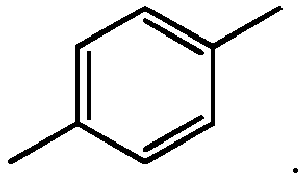
- The term "C1-4alkylenearyleneC1-4alkylene" means

- The term "C1-6alkylenearylene" means

- The term "C2-6alkenylenearyleneC1-4alkylene" means

- As used herein, the term "heteroaryl" refers to a monocyclic ring system containing at least one nitrogen, oxygen, or sulfur atom in an aromatic ring. Unless otherwise indicated, a heteroaryl group can be unsubstituted or substituted with one or more, and in particular one to four, substituents selected from, for example, halo, alkyl, alkenyl, -OCF3, -NO2, -CN, -NC, -OH, alkoxy, amino, alkylamino, -CO2H, -CO2alkyl, alkynyl, cycloalkyl, nitro, sulfhydryl, imino, amido, phosphonate, phosphinate, silyl, alkylthio, sulfonyl, sulfonamide, aldehyde, heterocycloalkyl, trifluoromethyl, aryl, and heteroaryl. Examples of heteroaryl groups include, but are not limited to, thienyl, furyl, oxazolyl, thiophenyl, triazolyl, isothiazolyl, isoxazolyl, imidazolyl, pyrimidinyl, thiazolyl, thiadiazolyl, pyridinyl, pyridazinyl, pyrazolyl, pyrazinyl, tetrazolyl, oxazolyl, pyrrolyl, and triazinyl.
- As used herein, the term "C3-8cycloalkyl" means a monocyclic aliphatic ring containing three to eight carbon atoms, either saturated or unsaturated.
- As used herein, the term "heterocycloalkyl" means a monocyclic or a bicyclic aliphatic ring containing 3 to 10 total atoms, either saturated or unsaturated, of which one to five of the atoms are independently selected from nitrogen, oxygen, and sulfur and the remaining atoms are carbon.
- In accordance with the present disclosure, bicyclic ring system





- The linker L can be attached to any atom D, E, F, G, W, X, Y, or Z, and in some preferred embodiments the linker L is attached to a nitrogen atom of the bicyclic ring system.
- In accordance with the present disclosure, ring





- The linker L can be attached to any atom U, V, W, X, Y, or Z, and preferably is attached to a nitrogen or carbon atom of the ring.
- In some embodiments, a bicyclic Cap group has a structure:


- In some embodiments, a monocyclic Cap group has a structure:


- In some embodiments, an alicyclic Cap group has a structure wherein A is N, e.g.,

- In some embodiments, R1 substituents on the Cap group, if present at all, preferably are null, hydrogen, ORa, halo, C1-6alkyl, aryl, heterocycloalkyl, -(CH2)1-4heterocycloalkyl, -(CH2)1-4N(Ra)2,


- In some embodiments, Ra is hydrogen, C1-6alkyl, C1-6heteroalkyl, and heteroaryl.
- In other preferred embodiments, L is null, -(CH2)1-6-,


- In still other preferred embodiments, M is





- Additionally, salts, prodrugs, hydrates, isotopically labeled, fluorescently labeled and any other therapeutically or diagnostically relevant derivations of the present HDACIs also are disclosed herein and can be used in the methods disclosed herein. The present invention further includes all possible stereoisomers and geometric isomers of the present compounds. The present invention includes both racemic compounds and optically active isomers. When a present HDACI is desired as a single enantiomer, it can be obtained either by resolution of the final product or by stereospecific synthesis from either isomerically pure starting material or use of a chiral auxiliary reagent, for example, see Z. Ma et al., Tetrahedron: Asymmetry, 8(6), pages 883-888 (1997). Resolution of the final product, an intermediate, or a starting material can be achieved by any suitable method known in the art. Additionally, in situations where tautomers of a present compound is possible, the present invention is intended to include all tautomeric forms of the compounds.
- Prodrugs of the present compounds also are disclosed herein. It is well established that a prodrug approach, wherein a compound is derivatized into a form suitable for formulation and/or administration, then released as a drug in vivo, has been successfully employed to transiently (e.g., bioreversibly) alter the physicochemical properties of the compound (see, H. Bundgaard, Ed., "Design of Prodrugs," Elsevier, Amsterdam, (1985); R.B. Silverman, "The Organic Chemistry of Drug Design and Drug Action," Academic Press, San Diego, chapter 8, (1992); K.M. Hillgren et al., Med. Res. Rev., 15, 83 (1995)). Specific prodrugs of HDACIs are discussed in
WO 2008/055068 . - Compounds according to one embodiment can contain one or more functional groups. The functional groups, if desired or necessary, can be modified to provide a prodrug. Suitable prodrugs include, for example, acid derivatives, such as amides and esters. It also is appreciated by those skilled in the art that N-oxides can be used as a prodrug.
- Compounds according to one embodiment can exist as salts. Pharmaceutically acceptable salts of the present HDACIs often are preferred in the methods of the invention. As used herein, the term "pharmaceutically acceptable salts" refers to salts or zwitterionic forms of the present compounds. Salts of the present compounds can be prepared during the final isolation and purification of the compounds or separately by reacting the compound with an acid having a suitable cation. The pharmaceutically acceptable salts of the present compounds can be acid addition salts formed with pharmaceutically acceptable acids. Examples of acids which can be employed to form pharmaceutically acceptable salts include inorganic acids such as nitric, boric, hydrochloric, hydrobromic, sulfuric, and phosphoric, and organic acids such as oxalic, maleic, succinic, tartaric, and citric. Nonlimiting examples of salts of compounds of the invention include, but are not limited to, the hydrochloride, hydrobromide, hydroiodide, sulfate, bisulfate, 2-hydroxyethansulfonate, phosphate, hydrogen phosphate, acetate, adipate, alginate, aspartate, benzoate, bisulfate, butyrate, camphorate, camphorsulfonate, digluconate, glycerolphosphate, hemisulfate, heptanoate, hexanoate, formate, succinate, fumarate, maleate, ascorbate, isethionate, salicylate, methanesulfonate, mesitylenesulfonate, naphthylenesulfonate, nicotinate, 2-naphthalenesulfonate, oxalate, pamoate, pectinate, persulfate, 3-phenylproprionate, picrate, pivalate, propionate, trichloroacetate, trifluoroacetate, phosphate, glutamate, bicarbonate, paratoluenesulfonate, undecanoate, lactate, citrate, tartrate, gluconate, methanesulfonate, ethanedisulfonate, benzene sulphonate, and p-toluenesulfonate salts. In addition, available amino groups present in the compounds of the invention can be quaternized with methyl, ethyl, propyl, and butyl chlorides, bromides, and iodides; dimethyl, diethyl, dibutyl, and diamyl sulfates; decyl, lauryl, myristyl, and stearyl chlorides, bromides, and iodides; and benzyl and phenethyl bromides. In light of the foregoing, any reference to compounds of the present invention appearing herein is intended to include the present compounds as well as pharmaceutically acceptable salts, hydrates, or prodrugs thereof.
- The present compounds also can be conjugated or linked to auxiliary moieties that promote a beneficial property of the compound in a method of therapeutic use. Such conjugates can enhance delivery of the compounds to a particular anatomical site or region of interest (e.g., a tumor), enable sustained therapeutic concentrations of the compounds in target cells, alter pharmacokinetic and pharmacodynamic properties of the compounds, and/or improve the therapeutic index or safety profile of the compounds. Suitable auxiliary moieties include, for example, amino acids, oligopeptides, or polypeptides, e.g., antibodies, such as monoclonal antibodies and other engineered antibodies; and natural or synthetic ligands to receptors in target cells or tissues. Other suitable auxiliaries include fatty acid or lipid moieties that promote biodistribution and/or uptake of the compound by target cells (see, e.g., Bradley et al., Clin. Cancer Res. (2001) 7:3229).
- Specific compounds of the present invention include
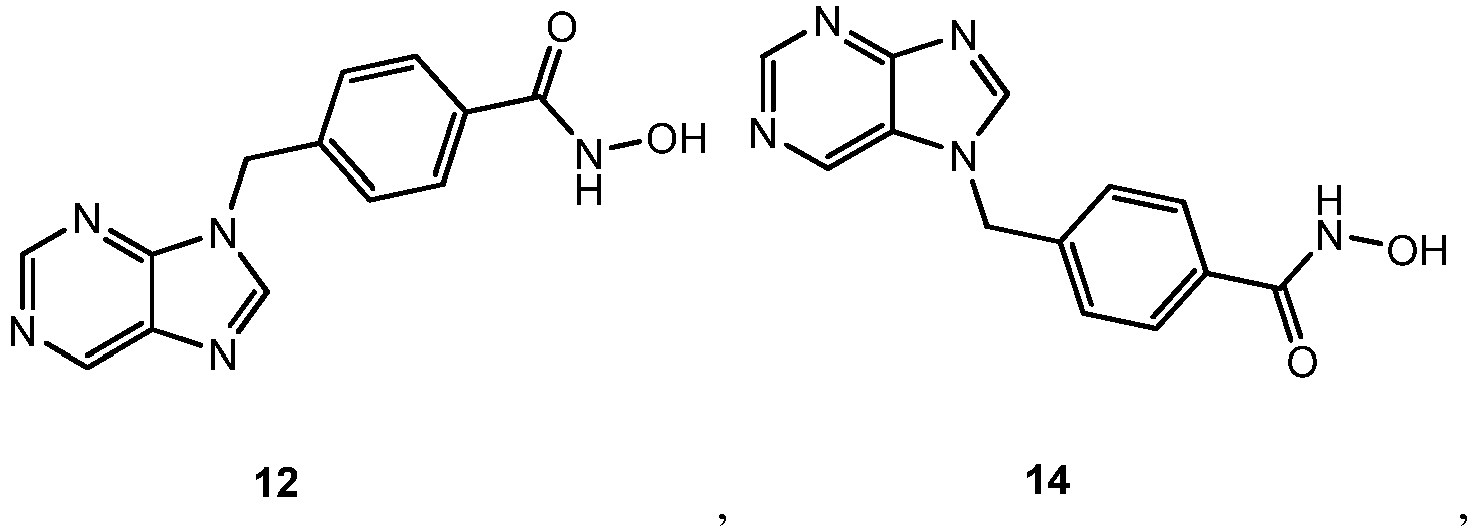


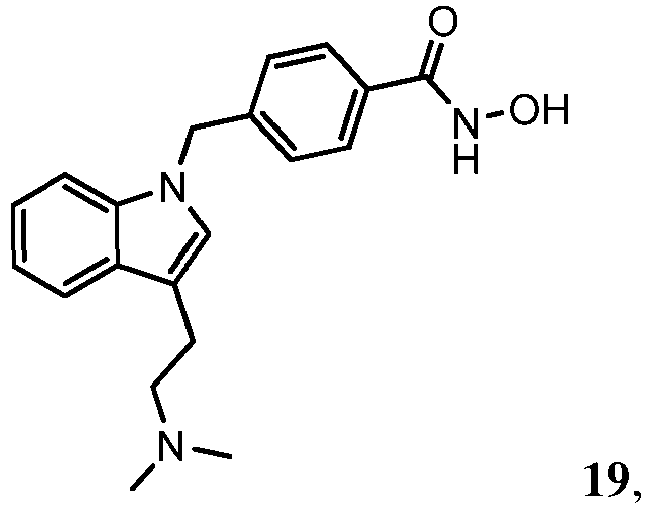


- The following synthetic schemes are representative of the reactions used to synthesize the present HDACIs. Modifications and alternate schemes to prepare HDACIs of the invention are readily within the capabilities of persons skilled in the art.
- In the synthetic methods, the examples, and throughout the specification, the abbreviations have the following meanings:
DMF dimethylformamide min minutes TLC thin layer chromatography CH2Cl2 methylene chloride MeOH methanol Na2SO4 sodium sulfate AcOH acetic acid MS mass spectrometry Na2CO3 sodium carbonate HPLC high performance liquid chromatography H or hrs hours NaHCO3 sodium bicarbonate HCl hydrochloric acid g gram mol mole mmol millimole mL milliliter H2SO4 sulfuric acid NaH sodium hydride TMS tetramethylsilane TFA trifluoroacetic acid KOH potassium hydroxide NH4Cl ammonium chloride NH2OH·HCl hydroxylamine hydrochloride NaOMe sodium methoxide CD3OD deuterated methanol M molar KOtBu potassium tert-butoxide DMSO dimethyl sulfoxide KOH potassium hydroxide NaCNBH3 sodium cyanoborohydroxide N normal KI potassium iodide SOCl2 thionyl chloride CD3CN deuterated acetonitrile RT room temperature DME dimethyl ether ZnCl2 zinc chloride CuI copper iodide NMR nuclear magnetic resonance spectrometry EtOAc ethyl acetate THF tetrahydrofuran NaOH sodium hydroxide PdCl2(PPh)3 dichloro-triphenylphosphino-palladium (II) Et3N triethylamine CDCl3 deuterated chloroform Hz Hertz - It should be understood that protecting groups can be utilized in accordance with general principles of synthetic organic chemistry to provide compounds of the present invention. Protecting group-forming reagents are well known to persons skilled in the art, for example, see T.W. Greene et al., "Protective Groups in Organic Synthesis, Third Edition," John Wiley and Sons, Inc., NY, N.Y. (1999). These protecting groups are removed when necessary by appropriate basic, acidic, or hydrogenolytic conditions known to persons skilled in the art. Accordingly, compounds of the present invention not specifically exemplified herein can be prepared by persons skilled in the art.
- General Information for Synthetic Procedures: 1H NMR and 13C NMR spectra were obtained using a Bruker spectrometer with TMS as an internal standard. The following standard abbreviations indicating multiplicity were used: s = singlet, d = doublet, t = triplet, q = quartet, quint = quintet, m = multiplet, dd = double doublet, dt = double triplet, and br = broad. LRMS experiments were carried out using an Agilent 1100 series LC/MSD instrument with MeCN and H2O spiked with 0.1% formic acid as the mobile phase. HRMS experiments were carried out using a Shimadzu IT-TOF instrument with MeCN and H2O spiked with 0.1% formic acid as the mobile phase. Reaction progress was monitored by TLC using precoated silica gel plates (
Merck silica gel 60 F254 , 250 µm thickness). Automated column chromatography was performed using the CombiFlash Rf apparatus available from Teledyne ISCO and prepacked cartridges (25 or 50 g) loaded with Merck silica gel (40-60 mesh) along with the following conditions: Method 1: 100% hexane, 5 min; 0-50% EtOAc/hexane, 25 min; 50% EtOAc/hexane, 5 min. Method 2: 100% DCM, 5 min; 0-10% MeOH/DCM, 20 min, 10% MeOH/DCM, 5 min. Flow rate = 30-40 mL/min (depending on cartridge size) with wavelength monitoring at 254 and 280 nm. Preparatory HPLC was carried out using a Shimadzu preparative liquid chromatograph with the following specifications: Column: ACE 5 AQ (150 × 21.2 mm) with 5 µm particle size. Method 1: 25-100% MeOH/H2O, 30 min; 100% MeOH, 5 min; 100-25% MeOH/H2O, 4 min; 25% MeOH/H2O, 1 min. Method 2: 8-100% MeOH/H2O, 30 min; 100% MeOH, 5 min; 100-8% MeOH/H2O, 4 min; 8% MeOH/H2O, 1 min. Flow rate = 17 mL/min with wavelength monitoring at 254 and 280 nm. Both solvents were spiked with 0.05% TFA. Where applicaple (unless otherwise specified), resin bound bicarbonate was used to neutralize the trifluoroacetic acid salts obtained during preparatory HPLC purification. Analytical HPLC was carried out using an Agilent 1100 series instrument with the following specifications: Column: Luna 5 µ C18(2) 100A (150 × 4.60 mm) with 5 µm particle size. Flow rate = 1.4 mL/min with wavelength monitoring at 254 nm. Gradient: 10-100% MeOH/H2O, 18 min; 100% MeOH, 3 min; 100-10% MeOH/H2O, 3 min; 10% MeOH/H2O, 5 min. Both solvents were spiked with 0.05% TFA. - A. General synthetic scheme for HDACI compounds containing a bicyclic Cap group:

Reagents and conditions: a) methyl 4-(bromomethyl)benzoate, KO t Bu or NaH, DMF, 80 °C, 2 h; b) NH2OH·HCl, NaOMe, MeOH, 0 °C to rt, 16 h. - B. General synthetic scheme for HDACI compound containing a five-membered monocyclic Cap group:

Reagents and conditions: a) methyl 4-(bromomethyl)benzoate, KO t Bu, DMF, 80 °C, 2 h; b) NH2OH·HCl, NaOMe, MeOH, 0 °C to rt, 16 h. - C. General synthetic scheme for HDACI compounds containing a six-membered monocyclic Cap group:

Reagents and conditions: a) Tetrakis(triphenylphosphine)palladium(0), methyl 4-(bromomethyl)benzoate, Na2CO3, DME or diglyme, H2O, 100 °C, 4 h; b) NH2OH·HCl, NaOMe, MeOH, 0 °C to rt, 16 h. - D. General synthetic scheme for HDACI compounds containing an acyclic Cap group:

Reagents and conditions: a) methyl 4-(bromomethyl)benzoate, KO t Bu, DMF, 80°C, 2 h; b) NH2OH·HCl, NaOMe, MeOH, 0°C to rt, 16 h. - General Procedure A: NaH (1 mol equiv) was dissolved in anhydrous DMF (5 mL/mmol) under argon and cooled to 0 °C. To it was added the appropriate bicyclic Cap group (1 mol equiv) dissolved in anhydrous DMF (3 mL/mmol). The reaction was stirred for 15 min at 0 °C followed by the addition of methyl 4-(bromomethyl)benzoate (1 mol equiv) in anhydrous DMF (2 mL/mmol). The reaction was stirred for 2 h at 70 °C and then quenched by the addition of H2O (30 mL). The organic products were extracted with EtOAc (3 x 30 mL), washed with H2O (2 x 30 mL), brine (15 mL), dried over Na2SO4, filtered and concentrated in vacuo.
- General Procedure B: The appropriate ester was dissolved/suspended in MeOH (3 mL/mmol) and added to a mixture of NH2OH•HCl (6 mol equiv) in MeOH (3 mL/mmol) which was followed by the addition of NaOMe (8 mol equiv of a 25% solution in MeOH). The mixture was stirred for 2 h at 0 °C followed by stirring for 22 h at RT. When the reaction was complete as evidenced by TLC, the reaction was quenched by the addition of trifluoroacetic acid (5 mol equiv of a 10% solution in DCM), filtered, and the filter cake was washed with additional MeOH (5-15 mL). The combined filtrate and wash were then concentrated in vacuo to yield the crude product which was dissolved in DMF and purified by preparatory HPLC.
- General Procedure C: To a round bottom flask charged with methyl 4-(bromomethyl)benzoate (1 mol equiv) in DMF (4 mL/mmol) was added the appropriate 2-subsitituted benzimidazole (1 mol equiv) and K2CO3 (2 mol equiv) in succession. The resulting mixture was allowed to stir at 80 °C for 2-16 hrs and the reaction was monitored by TLC. Upon completion, the reaction was quenched with H2O (20 mL) and extracted with EtOAc (3 x 20 mL). The combined organic extracts were washed with H2O (2 x 15 mL), brine (15 mL), dried over Na2SO4, filtered and concentrated in vacuo.
- General Procedure D: Solid NaOH (8 mol equiv) was dissolved in a 50% aq. solution of NH2OH (∼50 mol equiv) at 0 °C. Then, a solution of the appropriate ester (1 mol equiv) in THF/MeOH (9:9 mL/mmol) was added dropwise to the aforementioned, vigorously stirred hydroxylamine solution. Upon complete addition, the ice bath was removed and the reation was allowed to stir 15 min. The reaction was quenched with AcOH (10 mol equiv) and concentrated in vacuo to yield the crude product which was dissolved in DMF and purified by preparatory HPLC.
- General Procedure E: The appropriate boronic acid (1 mol equiv), methyl 4-(bromomethyl)benzoate (1.2 mol equiv), tetrakis(triphenylphosphine)Pd(0) (0.02 mol equiv), and K2CO3 (2.1 mol equiv) were placed in a dry, sealed tube under Ar atmosphere. Diglyme (4 mL/mmol) and H2O (2 mL/mmol) were added through a rubber septa which was immediately replaced by the screw on cap. The reaction was heated to 100 °C and stirred for 4 h. Then, the reaction was diluted with H2O (20 mL) and the organic products were extracted with DCM (3 x 15 mL), washed with brine (15 mL), dried over Na2SO4, filtered and concentrated in vacuo.
- An example of a present HDACI having a bicyclic Cap group is prepared as follows (see also General Synthetic Scheme A):

- Reagents and conditions: a) methyl 4-(bromomethyl)benzoate, NaH, DMF, 80 °C, 2 h; b) NH2OH·HCl, NaOMe, MeOH, 0 °C to rt, 16 h.
- Examples of bicyclic Cap groups include, but are not limited to:


- HDACIs having a bicyclic Cap group:
-

- The title compound was prepared from 1H-indole (0.500 g, 4.27 mmol) according to General Procedure A and purified using automated column chromatography method 1. The product was isolated as a white solid (0.860 g, 76%). 1H NMR (400 MHz, CDCl3): δ 8.05 (d, J = 8.23 Hz, 2H), 7.79 (d, J = 6.9 Hz, 1H), 7.24 (m, 6H), 6.70 (d, J = 3.05 (d, J = 3.05 Hz, 1H), 5.35 (s, 2H), 3.97 (s, 3H). 13C NMR (100 MHz, CDCl3): δ 166.7, 142.9, 136.3, 130.1, 129.6, 128.9, 128.4, 126.7, 122.0, 121.2, 119.9, 109.7, 102.2, 52.2, 49.8. ESI-HRMS: calc. for C17H15NO2: [M+H]+ = 266.1176 m/z, found: [M+H]+ = 266.1182 m/z.
-

- The title compound was synthesized from methyl 4-((1H-indol-1-yl)methyl)benzoate 1 (0.840 g, 3.17 mmol) according to General Procedure B (prep. HPLC method 1) and isolated as a white solid (0.443 g, 53%). 1H NMR (400 MHz, DMSO-d 6): δ 11.14 (S, 1H), 9.01 (br, 1H), 7.67 (d, J = 8.1 Hz, 2H), 7.56 (d, J = 7.77 Hz, 1H), 7.52 (d, J = 3.1 Hz, 1H), 7.42 (d, J = 8.1 Hz, 1H), 7.23 (d, J = 8.1 Hz, 2H), 7.09 (t, J = 7.2 Hz, 1H), 7.02 (t, J = 7.5 Hz, 1H), 6.50 (d, J = 3.0 Hz, 1H), 5.48 (s, 2H). 13C NMR (100 MHz, DMSO-d 6): δ 164.4, 141.9, 136.1, 132.3, 129.6, 128.7, 127.6, 127.3, 121.7, 120.9, 119.6, 110.5, 101.6, 49.2. ESI-HRMS: calc. for C16H14N2O2: [M+H]+ = 267.1128 m/z, found: [M+H]+ = 267.1137 m/z.
-

- The title compound was prepared from 2-methyl-1H-indole (2.00 g, 15.3 mmol) according to General Procedure A and purified using automated column chromatography method 1. The product was isolated as a white solid (2.87 g, 67%). 1H NMR (400 MHz, DMSO-d 6): δ 7.89 (d, J = 8.0 Hz, 2H), 7.48 (d, J = 7.6 Hz, 1H), 7.33 (d, J = 7.6 Hz, 1H), 7.09 (d, J = 8.0 Hz, 2H), 7.01 (m, 2H), 6.32 (s, 1H), 5.49 (s, 2H), 3.81 (s, 3H), 2.34 (s, 3H). 13C NMR (100 MHz, DMSO-d 6): δ 166.4, 144.5, 137.2, 137.1, 130.0, 128.9, 128.2, 126.8, 120.9, 119.8, 119.7, 109.9, 100.7, 52.5, 45.9, 12.8.
-

- The title compound was synthesized from methyl 4-((2-methyl-1H-indol-1-yl)methyl)benzoate 3 (0.259 g, 0.937 mmol) according to General Procedure B (prep. HPLC method 1) and isolated as a light brown solid (86 mg, 33%). 1H NMR (400 MHz, DMSO-d 6): δ 11.13 (s, 1H), 8.96 (br, 1H), 7.65 (d, J = 8.2 Hz, 2H), 7.46 (d, J = 7.1 Hz, 1H), 7.33 (d, J = 7.5 Hz, 1H), 7.00 (m, 4H), 6.31 (s, 1H), 5.45 (s, 2H), 2.36 (s, 3H). 13C NMR (100 MHz, DMSO-d 6): δ 166.0, 142.5, 136.6, 136.0, 128.9, 127.9, 127.0, 126.1, 120.6, 119.5, 119.4, 108.6, 100.5, 45.7, 12.3. ESI-HRMS: calc. for C17H16N2O2: [M+H]+ = 281.1285 m/z, found: [M+H]+ = 281.1283 m/z.
-

- The title compound was prepared from 3-methyl-1H-indole (0.500 g, 3.81 mmol) according to General Procedure A and purified using automated column chromatography method 1. The product was isolated as a white solid (0.668 g, 63%). 1H NMR (400 MHz, CDCl3): δ 8.04 (d, J = 7.9 Hz, 2H), 7.72 (d, J = 7.4 Hz, 1H), 7.24 (m, 5H), 6.94 (s, 1H), 5.31 (s, 2H), 3.97 (s, 3H), 2.46 (s, 3H). 13C NMR (100 MHz, CDCl3): δ 166.7, 143.1, 136.5, 130.0, 129.4, 129.0, 126.6, 125.7, 1221.8, 119.1, 119.0, 109.3, 71.8, 52.1, 49.5, 9.6. ESI-HRMS: calc. for C18H17NO2: [M+H]+ = 280.1332 m/z, found: [M+H]+ = 280.1322 m/z.
-

- The title compound was synthesized from methyl 4-((3-methyl-1H-indol-1-yl)methyl)benzoate 5 (0.200 g, 0.716 mmol) according to General Procedure B (prep. HPLC method1) and isolated as a white solid (0.108 g, 54%). 1H NMR (400 MHz, DMSO-d 6): δ 11.13 (s, 1H), 8.99 (s, 1H), 7.66 (d, J = 8.4 Hz, 2H), 7.50 (d, J = 8.0 Hz, 1H), 7.37 (d, J = 8.0 Hz, 1H), 7.23 (m, 3H), 7.06 (td, J = 8.0, 1.2 Hz, 1H), 7.03 (td, J = 7.6, 0.8 Hz, 1H), 5.39 (s, 2H), 2.27 (s, 3H). 13C NMR (100 MHz, DMSO-d 6): δ 166.48, 142.50, 136.57, 131.08, 128.99, 126.97, 126.49, 125.78, 121.15, 118.39, 118.35, 110.36, 109.09, 48.62, 8.25. ESI-HRMS: calc. for C17H16N2O2: [M+H]+ = 279.1139 m/z, found: [M+H]+ = 279.1144 m/z.
-

- The title compound was prepared from 2,3-dimethyl-1H-indole (0.500 g, 3.44 mmol) according to General Procedure A and purified using automated column chromatography method 1. The product was isolated as a viscous yellow oil (0.652 g, 65%). 1H NMR (400 MHz, CDCl3): δ 7.95 (d, J = 8.3 Hz, 2H), 7.57 (dd, J = 3.1 Hz, 2.2 Hz, 1H), 7.16 (m, 3H), 7.04 (d, J = 8.2 Hz, 2H), 5.36 (s, 2H), 3.91 (s, 3H), 2.32 (s, 3H), 2.29 (s, 3H). 13C NMR (100 MHz, CDCl3): δ 166.8, 143.5, 136.3, 132.2, 130.1, 129.2, 128.7, 126.0, 121.0, 119.1, 118.1, 108.6, 107.4, 52.1, 46.4, 10.1, 8.9. ESI-HRMS: calc. for C19H19NO2: [M+H]+ = 294.1489 m/z, found: [M+H]+ = 294.1503 m/z.
-

- The title compound was synthesized from methyl 4-((2,3-dimethyl-1H-indol-1-yl)methyl)benzoate 7 (0.632 g, 2.15 mmol) according to General Procedure B (prep. HPLC method 1) and isolated as a white solid (0.487 g, 77%). 1H NMR (400 MHz, DMSO-d 6): δ 11.13 (s, 1H), 9.00 (br, 1H), 7.66 (d, J = 8.2 Hz, 2H), 7.45 (d, J = 6.9 Hz, 1H), 7.32 (d, J = 7.3 Hz, 1H), 7.01 (m, 4H), 5.43 (s, 2H), 2.27 (s, 3H), 2.22 (s, 3H). 13C NMR (100 MHz, DMSO-d 6): δ 164.4, 142.4, 136.4, 133.0, 132.1, 128.6, 127.6, 126.5, 120.9, 119.0, 118.1, 109.6, 106.5, 45.9, 10.3, 9.2. ESI-HRMS: calc. for C18H18N2O2: [M+H]+ = 295.1441 m/z, found: [M+H]+ = 295.1453 m/z.
-

- To a solution of methyl 4-((1H-indol-1-yl)methyl)benzoate 1 (0.250 g, 0.94 mmol) and benzaldehyde (96 µL, 0.94 mmol) in DCM (10 mL) at 0 °C was added SiEt3H (0.45 mL, 2.83 mmol) followed by trifluoroacetic acid (0.14 mL, 1.88 mmol). The reaction was stirred at 0 °C for 1 h. The reaction was then adjusted to pH 10 with 2N NaOH and the organic products were extracted with DCM (3 x 15 mL). The combined organic fractions were washed with brine (15 mL), dried with Na2SO4, filtered and concentrated in vacuo. The title compound was isolated using automated column chromatography method 1 (0.262 g, 78%). 1H NMR (400 MHz, CDCl3): δ 7.97 (d, J = 8.0 Hz, 2H), 7.56 (d, J = 8.0 Hz, 1H), 7.32-7.27 (m, 4H), 7.23-7.10 (m, 6H), 6.87 (s, 1H), 5.33 (s, 2H), 4.15 (s, 2H), 3.91 (s, 3H). 13C NMR (100 MHz, CDCl3): δ 166.8, 143.0, 141.2, 136.8, 130.1, 129.5, 128.7, 128.4, 128.3, 126.6, 126.5, 126.0, 122.1, 119.5, 119.3, 115.4, 109.6, 52.2, 49.7, 31.6.
-

- The title compound was synthesized from methyl 4-((3-benzyl-1H-indol-1-yl)methyl)benzoate 9 (0.200 g, 0.563 mmol) according to General Procedure B (prep. HPLC method 1) and isolated as a white solid (80 mg, 40%). 1H NMR (400 MHz, DMSO-d 6): δ 11.20 (br, 1H), 7.67 (d, J = 8.2 Hz, 2H), 7.45 (d, J = 7.9 Hz, 1H), 7.36 (d, J = 8.2 Hz, 1H), 7.27 (m, 6H), 7.15 (d, J = 6.7 Hz, 1H), 7.07 (t, J = 7.9 Hz, 1H), 6.96 (t, J = 7.8 Hz, 1H), 5.40 (s, 2H), 4.05 (s, 2H). 13C NMR (100 MHz, MeOD): δ 164.48, 142.06, 141.91, 136.63, 132.18, 128.83, 128.68, 128.06, 127.57, 127.41, 127.29, 126.17, 121.83, 119.44, 119.19, 114.53, 110.45, 49.01, 31.30. ESI-HRMS: calc. for C23H20N2O2: [M+H]+ = 357.1598 m/z, found: [M+H]+ = 357.1597 m/z.
-

- The title compound was prepared from 9H-purine (0.500 g, 3.81 mmol) according to General Procedure A (substituting KO t Bu for NaH) and purified using automated
column chromatography method 2. The pH was adjusted to 10 with IN NaOH prior to extraction with EtOAc. The product was isolated as a white solid (0.287 g, 64%). 1H NMR (400 MHz, DMSO-d 6): δ 9.20 (s, 1H), 8.94 (s, 1H), 8.78 (s, 1H), 7.92 (d, J = 8.3 Hz, 2H), 7.44 (d, J = 8.3 Hz, 2H), 5.62 (s, 2H), 3.82 (s, 3H). 13C NMR (100 MHz, DMSO-d 6): δ 165.9, 152.3, 151.2, 148.0, 147.2, 141.7, 133.7, 129.7, 129.2, 127.8, 52.2, 46.1. ESI-HRMS: calc. for C14H12N4O2: [M+H]+ = 269.1033 m/z, found: [M+H]+ = 269.1032 m/z. -

- The title compound was synthesized from methyl 4-((9H-purin-9-yl)methyl)benzoate 11 (0.287 g, 1.07 mmol) according to General Procedure B (prep. HPLC method 2) and isolated as a white solid (288 mg, 45%). 1H NMR (400 MHz, DMSO-d 6): δ 11.18 (br, 1H), 9.20 (s, 1H), 8.95 (s, 1H), 8.78 (s, 1H), 7.71 (d, J = 8.2 Hz, 2H), 7.40 (d, J = 8.2 Hz, 2H), 5.58 (s, 2H), 3.73 (br, 1H). 13C NMR (100 MHz, DMSO-d 6): δ 164.2, 152.6, 151.5, 148.4, 147.5, 139.8, 134.0, 132.9, 128.0, 127.8, 46.5. ESI-HRMS: calc. for C13H11N5O2: [M+H]+ = 270.0986 m/z, found: [M+H]+ = 270.0992 m/z.
-

- The title compound was prepared from 9H-purine (0.500 g, 3.81 mmol) according to General Procedure A (substituting KO t Bu for NaH) and purified using automated
column chromatography method 2. The pH was adjusted to 10 with IN NaOH prior to extraction with EtOAc. The product was isolated as a viscous yellow oil (0.108 g, 24%). 1H NMR (400 MHz, DMSO-d 6): δ 9.16 (s, 1H), 9.02 (s, 1H), 8.97 (s, 1H), 7.94 (d, J = 8.2 Hz, 2H), 7.51 (d, J = 8.2 Hz, 2H), 5.74 (s, 2H), 3.83 (s, 3H). 13C NMR (100 MHz, DMSO-d 6): δ 165.9, 160.4, 152.0, 150.2, 141.2, 140.6, 129.8, 129.5, 128.0, 125.0, 52.2, 48.4. ESI-HRMS: calc. for C14H12N4O2: [M+H]+ = 269.1033 m/z, found: [M+H]+ = 269.1036 m/z. -

- The title compound was synthesized from methyl 4-((7H-purin-7-yl)methyl)benzoate 13 (0.108 g, 0.40 mmol) according to General Procedure B (prep. HPLC method 2) and isolated as a white solid (50 mg, 46%). 1H NMR (400 MHz, DMSO-d 6): δ 11.21 (br, 1H), 9.16 (s, 1H), 9.00 (s, 1H), 8.95 (s, 1H), 7.73 (d, J = 8.2 Hz, 2H), 7.47 (d, J = 8.2 Hz, 2H), 6.75 (br, 1H), 5.68 (s, 2H). 13C NMR (100 MHz, DMSO-d 6): δ 164.1, 160.7, 152.5, 150.3, 141.2, 139.3, 133.1, 128.2, 127.9, 125.3, 48.8. ESI-HRMS: calc. for C13H11N5O2: [M+H]+ = 270.0986 m/z, found: [M+H]+ = 270.0984 m/z.
-

- Tryptophol (0.500 g, 3.10 mmol) and Et3N (1 mL) were dissolved in DCM (2 mL) and then mesyl chloride (0.24 mL, 3.102 mmol) was added dropwise at RT. The reaction was stirred for 3 h and then volatiles were removed in vacuo. The crude mesylate was taken up in DCM (3 mL) and to it was added 1-methylpiperazine (1.72 mL, 15.5 mmol) and Et3N (1 mL). The reaction was heated to 40 °C and stirred overnight. After completion, the reaction mixture was poured into cold water, the pH was adjusted to 10 with IN NaOH and the organic products were extracted with DCM (3 x 15 mL). The combined organic extracts were washed with brine (15 mL), dried with Na2SO4, filtered and concentrated in vacuo. Automated
column chromatography method 2 was used to isolate the title compound (0.42 g, 56%). 1H NMR (400 MHz, CDCl3): δ 7.54 (d, J = 7.8 Hz, 1H), 7.34 (d, J = 8.1 Hz, 1H), 7.10 (t, J = 7.1 Hz, 1H), 7.03 (t, J = 7.3 Hz, 1H), 6.98 (s, 1H), 2.87 (t, J = 7.8 Hz, 2H), 2.58 (t, J = 5.9 Hz, 2H), 2.38 (br, 8H), 2.17 (s, 3H). 13C NMR (100 MHz, CDCl3): δ 136.7, 127.4, 121.8, 121.0, 118.3, 118.0, 112.4, 111.0, 58.9, 54.1, 52.2, 44.6, 22.2. ESI-HRMS: calc. for C15H21N3: [M+H]+ = 244.1808 m/z, found: [M+H]+ = 244.1797 m/z. -

- The title compound was prepared from 3-[2-(4-methyl-piperazin-1-yl)-ethyl]-1H-indole 15 (0.400 g, 1.64 mmol) according to General Procedure A (substituting KO t Bu for NaH). The pH was adjusted to 10 with IN NaOH prior to extraction with EtOAc. The product was purified via automated column chromatography method 2 (0.412 g, 64%). 1H NMR (400 MHz, CDCl3): δ 7.79 (d, J = 8.3 Hz, 2H), 7.56 (d, J = 7.0 Hz, 1H), 7.04 (m, 6H), 5.14 (s, 2H), 3.76 (s, 3H), 2.90 (t, J = 7.6 Hz, 2H), 2.63 (t, J = 8.6 Hz, 2H), 2.46 (br, 8H), 2.23 (s, 3H). 13C NMR (100 MHz, CDCl3): δ 166.2, 143.3, 136.2, 129.1, 128.6, 127.8, 126.1, 125.4, 121.2, 118.4, 118.2, 112.6, 109.1, 58.4, 53.8, 51.9, 50.8, 48.4, 44.3, 21.8. ESI-HRMS: calc. for C24H29N3O2: [M+H]+ = 392.2333 m/z, found: [M+H]+ = 392.2343 m/z.
-

- The title compound was synthesized from 4-{3-[2-(4-Methyl-piperazin-1-yl)-ethyl]-indol-1-ylmethyl}-benzoic acid methyl ester 16 (0.412 g, 1.05 mmol) according to General Procedure B (prep. HPLC method 2) and isolated as a white solid (0.265 g, 64%). 1H NMR (400 MHz, DMSO-d 6): δ 7.67 (d, J = 7.8 Hz, 3H), 7.42 (m, 2H), 7.24 (d, J = 7.9 Hz, 2H), 7.12 (t, J = 7.2 Hz, 1H), 7.04 (t, J = 7.4 Hz, 1H), 5.43 (s, 2H), 3.81 (m, 4H), 3.53 (br, 4H), 3.40 (br, 2H), 3.25 (br, 2H), 2.84 (s, 3H). 13C NMR (100 MHz, DMSO-d 6): δ 163.9, 141.4, 136.1, 131.9, 127.3, 127.2, 127.1, 127.0, 121.8, 119.0, 118.9, 110.3, 109.2, 55.6, 49.6, 48.7, 48.0, 42.2, 19.4. ESI-HRMS: calc. for C23H28N4O2: [M+H]+ = 393.2285 m/z, found: [M+H]+ = 393.2299 m/z.
-

- 1H NMR (400 MHz, CDCl3): δ 8.68 (s, 1H), 7.63 (d, J = 7.7 Hz, 1H), 7.35 (d, J = 8.0 Hz, 1H), 7.21 (t, J = 7.1 Hz, 1H), 7.14 (t, J = 7.5 Hz, 1H), 6.97 (s, 1H), 3.00 (t, J = 7.5 Hz, 2H), 2.72 (t, J = 8.4 Hz, 2H), 2.40 (s, 6H).
-

- The title compound was prepared from 2-(1H-indol-3-yl)-N,N-dimethylethanamine (0.130 g, 0.69 mmol) according to General Procedure A. The pH was adjusted to 10 with IN NaOH prior to extraction with EtOAc. The product was purified via automated column chromatography method 2 (0.174 g, 61%). 1H NMR (400 MHz, CDCl3): δ 7.97 (d, J = 8.3 Hz, 2H), 7.65 (d, J = 7.5 Hz, 1H), 7.17 (m, 5H), 6.99 (s, 1H), 5.34 (s, 2H), 3.91 (s, 3H), 3.04 (t, J = 7.6 Hz, 2H), 2.75 (m, 2H), 2.43 (s, 6H).
-

- The title compound was synthesized from methyl 4-((3-(2-(dimethylamino)ethyl)-1H-indol-1-yl)methyl)benzoate 18 (0.412 g, 1.05 mmol) according to General Procedure B (prep. HPLC method 2) and isolated as a white solid (18 mg, 11%). 1H NMR (400 MHz, MeOD): δ 7.66 (m, 3H), 7.29 (m, 2H), 7.31 (d, J =8.0 Hz, 2H), 7.13 (m, 2H), 5.41 (s, 2H), 3.48 (t, J = 7.4 Hz, 2H), 3.24 (t, J = 8.3 Hz, 2H), 2.97 (s, 6H). 13C NMR (100 MHz, MeOD): δ 166.33, 141.99, 136.78, 131.29, 127.48, 127.05, 126.74, 126.65, 121.88, 119.23, 118.09, 109.73, 109.73, 108.70, 57.65, 48.90, 42.12, 20.35. ESI-HRMS: calc. for C20H23N3O2: [M+H]+ = 338.1863 m/z, found: [M+H]+ = 338.1865 m/z.
-

- Methyl 4-((2-methyl-1H-indol-1-yl)methyl)benzoate 3 (0.500 g, 1.90 mmol) and dimethylformiminium chloride (0.200 g, 2.15 mmol) were heated to reflux in a solution of DCM (5 mL) and DMF (2 mL) for 20 h. The reaction was then cooled to RT and DCM (50 mL) was added along with sat. NaHCO3 (20 mL). The organic fraction was isolated and the aqueous solution was further extracted with DCM (2 x 20 mL). The combined organic fractions were washed with H2O (20 mL), brine (20 mL), dried with Na2SO4 and concentrated in vacuo. The desired product was purified via automated column chromatography method 2 (0.221 g, 37%). 1H NMR (400 MHz, CDCl3): δ 7.94 (d, J = 8.1 Hz, 2H), 7.69 (m, 1H), 7.14 (m, 3H), 7.02 (d, J = 8.0 Hz, 2H), 5.38 (s, 2H), 3.90 (s, 3H), 3.62 (s, 2H), 2.35 (s, 3H), 2.30 (s, 6H).
-

- The title compound was synthesized from methyl 4-((3-((dimethylamino)methyl)-2-methyl-1H-indol-1-yl)methyl)benzoate 20 (0.124 g, 1.78 mmol) according to General Procedure B (prep. HPLC method 2) and isolated as a white solid (0.100 g, 80%). 1H NMR (400 MHz, MeOD): δ 7.72 (br, 1H), 7.68 (d, J = 7.8 Hz, 2H), 7.38 (br, 1H), 7.21 (br, 2H), 7.08 (d, J = 7.9 Hz, 2H), 5.56 (s, 2H), 4.57 (s, 2H), 2.91 (s, 6H), 2.48 (s, 3H).
-

- Methyl 4-((1H-indol-1-yl)methyl)benzoate 1 was dissolved in MeOH (10 mL) and to it was added a 30% solution of ammonium hydroxide (5 mL). The reaction was heated to reflux for 16 h after which it was cooled to RT and H2O (30 mL) was added. The organic products were extracted with EtOAc (3 x 15 mL), washed with brine (15 mL), dried with Na2SO4 and concentrated in vacuo. The crude product was dissolved in DMF and purified by preparatory HPLC method 1. The title compound was isolated as a white solid (37 mg, 13%). 1H NMR (400 MHz, MeOD): δ 7.79 (d, J = 7.9 Hz, 2H), 7.58 (d, J = 7.8 Hz, 1H), 7.29 (m, 2H), 7.19 (d, J = 8.0 Hz, 2H), 7.11 (t, J = 7.2 Hz, 1H), 7.04 (t, J = 7.5 Hz, 1H), 6.53 (d, J = 2.8 Hz, 1H), 5.47 (s, 2H). 13C NMR (100 MHz, MeOD): δ 170.59, 142.41, 136.24, 132.64, 128.93, 128.14, 127.57, 126.36, 121.13, 120.32, 118.99, 109.29, 101.14, 48.93. ESI-LRMS: [M+H]+ = 251.1 m/z. ESI-HRMS: calc. for C16H14N2O: [M+H]+ = 251.1179 m/z, found: [M+H]+ = 251.1179 m/z.
-

- The title compound was prepared from 1H-indole (0.55 g, 4.69 mmol) and 1-(4-(bromomethyl)phenyl)ethanone (1.00 g, 4.69 mmol) following a procedure similar to General Procedure A. The title compound was purified using automated column chromatography method 1 (0.410 g, 35%). 1H NMR (400 MHz, CDCl3): δ 7.90 (d, J = 8.2 Hz, 2H), 7.69 (d, J = 7.5 Hz, 1H), 7.21 (m, 6H), 6.61 (d, J = 3.1 Hz, 1H), 5.41 (s, 2H), 2.58 (s, 3H). 13C NMR (100 MHz, MeOD): δ 198.58, 143.95, 136.22, 136.04, 128.94, 128.39, 128.17, 126.51, 121.19, 120.37, 119.06, 109.29, 101.24, 48.95, 25.23. ESI-HRMS: calc. for C17H15NO: [M+H]+ = 250.1226 m/z, found: [M+H]+ = 250.1232 m/z.
-

- The title compound was prepared from 1H-indole (0.500 g, 4.27 mmol) and 3-bromopropanamide (0.650 g, 4.27 mmol) following a procedure similar to General Procedure A. The title compound was purified by preparatory HPLC method 1 and isolated as a white solid (0.339 g, 42%). 1H NMR (400 MHz, MeOD): δ 7.53 (d, J = 7.9 Hz, 1H), 7.44 (d, J = 8.3 Hz, 1H), 7.19 (d, J = 2.9 Hz, 1H), 7.16 (t, J = 7.5 Hz, 1H), 7.03 (t, J = 7.4 Hz, 1H), 6.42 (d, J = 2.8 Hz, 1H), 4.47 (t, J = 6.8 Hz, 2H), 2.70 (t, J= 6.8 Hz, 2H). 13C NMR (100 MHz, DMSO-d 6): δ 172.4, 135.9, 129.0, 128.6, 121.4, 120.8, 119.4, 110.2, 101.0, 42.3, 36.2. ESI-LRMS: [M+H]+ = 189.1 m/z. ESI-HRMS: calc. for C11H12N2O1: [M+H]+ = 189.1022 m/z, found: [M+H]+ = 189.1030 m/z.
-

- NaH (0.444 g, 11.1 mmol) was dissolved in anhydrous DMF (5 mL) under argon and cooled to 0 °C. To it was added 1H-indole (1.00 g, 8.54 mmol) dissolved in anhydrous DMF (5 mL). The reaction was stirred for 15 min at 0 °C followed by the addition of ethyl 3-bromopropanoate (1.10 mL, 8.54 mmol). The reaction was then stirred for 3 h at 70 °C and then quenched by the addition of H2O (30 mL). The organic products were extracted with EtOAc (3 x 30 mL), washed with H2O (2 x 30 mL), brine (15 mL), dried with Na2SO4, filtered and concentrated in vacuo. The crude product was purified using automated column chromatography method 1 to yield ethyl 3-(1H-indol-1-yl)propanoate (0.759 g, 3.49 mmol). The title compound was then prepared from ethyl 3-(1H-indol-1-yl)propanoate (0.486 g, 5.52 mmol) according to General Procedure B (prep. HPLC method 1) and isolated as a white solid (0.104 g, 23%). 1H NMR (400 MHz, MeOD): δ 7.53 (d, J = 7.83 Hz, 1H), 7.42 (d, J = 8.1 Hz, 1H), 7.16 (m, 2H), 7.02 (t, J = 7.4 Hz, 1H), 6.41 (d, J = 2.8 Hz, 1H), 4.48 (t, J = 6.5 Hz, 2H), 2.56 (t, J= 6.6 Hz, 2H). ESI-LRMS: [M+H]+ = 205.1 m/z. ESI-HRMS: calc. for C11H12N2O2: [M+H]+ = 205.0972 m/z, found: [M+H]+ = 205.0971 m/z.
-

- The title compound was prepared from 1H-benzo[d]imidazole (236 mg, 2.0 mmol) according to General Procedure C and purified using automated
column chromatography method 2. The product was isolated as an off-white waxy solid (501 mg, 94%). 1H NMR (400 MHz, CDCl3) δ 8.02-7.98 (m, 3H), 7.85 (d, J = 7.6 Hz, 1H), 7.31-7.28 (m, 2H), 7.26-7.22 (m, 3H), 5.43 (s, 2H), 3.91 (s, 3H). 13C NMR (100 MHz, CDCl3) δ 166.41, 143.95, 143.13, 140.46, 133.72, 130.28, 130.14, 126.81, 123.26, 122.43, 120.54, 109.83, 52.19, 48.45 ESI-LRMS: [M+H]+ = 267 m/z. -

- The title compound was synthesized from methyl 4-((1H-benzo[d]imidazol-1-yl)methyl)benzoate 26 (93 mg, 0.349 mmol) according to General Procedure D (prep. HPLC method 2) and isolated as a white solid (81 mg, 87%). 1H NMR (400 MHz, DMSO-d 6) δ 11.21 (br s, 1H), 9.35 (s, 1H), 7.83 (m, 1H), 7.74 (m, 3H), 7.47 (m, 4H). 13C NMR (100 MHz, DMSO-d6 ) δ 163.59, 142.78, 138.12, 135.10, 131.65, 127.80, 127.41, 125.03, 116.58, 112.53, 48.64. ESI-LRMS: [M+H]+ = 268 m/z. ESI-HRMS: calc. for C15H13N3O2: [M+H]+ = 268.1081 m/z, found: [M+H]+ = 268.1080 m/z.
-

- A round bottom flask charged with tryptamine (2.0 g, 12.5 mmol) in DCM (20 mL) was added Et3N (3.5 mL, 25 mmol) under an atmosphere of Ar and cooled to 0 °C. The solution was then added mesyl chloride (1.5 mL, 18.7 mmol) and the resulting reaction mixture was stir to RT for 2 h. The reaction was quenched with water (20 mL) and extracted with DCM (
3x 20 mL). The combined organic extracts were washed with brine (30 mL), dried over Na2SO4 and concentrated in vacuo. The desired product was purified via automated column chromatography method 2 (2.1 g, 70%) and isolated as a brown oil. 1H NMR (400 MHz, MeOD) δ 7.55 (d, J = 7.6 Hz, 1H), 7.33 (d, J = 8.0 Hz, 1H), 7.08 (m, 2H), 7.01 (td, J = 8.0, 0.8 Hz, 1H), 3.35 (t, J = 7.2 Hz, 2H), 2.99 (t, J = 7.2 Hz, 2H), 2.76 (s, 3H). 13C NMR (100 MHz, MeOD) δ 138.28, 128.77, 123.91, 122.54, 119.85, 119.34, 112.93, 112.43, 45.09, 40.02, 27.60. -

- The title compound was prepared from N-(2-(1H-indol-3-yl)ethyl)methanesulfonamide 28 (300 mg, 1.26 mmol) according to General Procedure A (substituting KO t Bu for NaH) and purified using automated
column chromatography method 2. The product was isolated as a brown waxy solid (0.399g, 82%). 1H NMR (400 MHz, CDCl3) δ 8.20 (br s, 1 H), 8.01 (d, J = 8.0 Hz, 2 H), 7.42 (m, 3 H), 7.33 (d, J = 8.4 Hz, 1 H), 7.17 (t, J = 7.6 Hz, 1 H), 7.08 (t, J = 7.2 Hz, 1 H), 6.95 (d, J = 1.6 Hz, 1 H), 4.45 (s, 2 H), 3.92 (s, 3 H), 3.49 (t, J = 7.6 Hz, 2 H), 2.96 (t, J = 7.6 Hz, 2 H), 2.74 (s, 3 H). 13C NMR (100 MHz, CDCl3) δ 166.69, 141.53, 136.17, 129.95, 129.80, 126.96, 122.14, 122.13, 119.49, 118.40, 112.09, 111.27, 52.13, 51.23, 48.35, 38.90, 24.82. ESI-LRMS: [M+H]+ = 386 m/z. -

- The title compound was synthesized from methyl 4-((3-(2-(methylsulfonamido)ethyl)-1H-indol-1-yl)methyl)benzoate 29 (155 mg, 0.401 mmol) according to General Procedure D (prep. HPLC method 2) and isolated as a beige solid (55 mg, 35%). 1H NMR (400 MHz, DMSO-d 6) δ 11.22 (br s, 1H), 10.82 (s, 1H), 7.87 (d, J = 8.4 Hz, 2H), 7.48 (d, J = 8.4 Hz, 2H), 7.31 (d, J = 8.0 Hz, 1H), 7.11 (d, J = 2.4 Hz, 1H), 7.05 (td, J = 7.6, 0.8 Hz, 1H), 6.94 (td, J = 7.6, 0.8 Hz, 1H), 4.48 (s, 2H), 3.35 (m, 2H), 2.97 (s, 3H), 2.84 (m, 2H). 13C NMR (100 MHz, DMSO-d 6) δ 164.00, 140.73, 136.15, 131.99, 128.01, 127.09, 126.84, 122.98, 121.00, 118.32, 118.07, 111.42, 110.70, 50.53, 48.42, 38.02, 24.48. LR-ESI MS (m/z): 388 [M+H]+. ESI-HRMS: calc. for C19H21N3O4S: [M+H]+ = 388.1326 m/z, found: [M+H]+ = 388.1319 m/z.
-

- The title compound was prepared from 2-methyl-1H-benzo[d]imidazole (264 mg, 2.0 mmol) according to General Procedure C and purified using automated
column chromatography method 2. The product was isolated as an off-white waxy solid (298 mg, 53%). 1H NMR (400 MHz, CDCl3) δ 7.95 (d, J = 8.4 Hz, 2H), 7.72 (d, J = 8.0 Hz, 1H), 7.21 (m, 3H), 7.08 (d, J = 8.4 Hz, 2H), 5.32 (s, 2H), 3.87 (s, 3H), 2.53 (s, 2H). 13C NMR (100 MHz, CDCl3) δ 166.32, 151.60, 142.56, 140.77, 135.18, 130.18, 129.78, 126.04, 122.33, 122.08, 119.14, 109.06, 71.82, 52.06, 46.69, 13.81. ESI-LRMS: [M+H]+ = 281 m/z. -

- The title compound was synthesized from methyl 4-((2-methyl-1H-benzo[d]imidazol-1-yl)methyl)benzoate 31 (157 mg, 0.560) according to General Procedure D (prep. HPLC method 2) and isolated as an off-white solid (55 mg, 35%). 1H NMR (400 MHz, DMSO-d 6) δ 11.27 (br s, 1H), 7.74 (m, 3H), 7.69 (d, J = 8.4 Hz, 1H), 7.44 (m, 2H), 7.34 (d, J = 8.4 Hz, 2H), 5.72 (s, 2H), 2.80 (s, 3H). 13C NMR (100 MHz, DMSO-d 6) δ 164.05, 152.38, 138.48, 133.78, 133.10, 132.92, 127.90, 127.55, 125.24, 125.01, 115.64, 112.54, 47.33, 12.72. LR-ESI MS (m/z): 282 [M+H]+. ESI-HRMS: calc. for C16H15N3O2: [M+H]+ = 282.1237 m/z, found: [M+H]+ = 282.1244 m/z.
-

- To a round bottom flask charged with 4-((tert-butoxycarbonyl)amino)butanoic acid (0.5 g, 2.46 mmol) in DCM (10 mL) was added Et3N (1.03 mL, 7.36 mmol), EDCI (706 mg, 2.46 mmol), DMAP (30 mg, 0.246 mmol) and allowed to stir overnight at RT. The reaction was quenched with water (10 mL) and extracted with DCM (2 x 10 mL). Combined organics washed with 10% citric acid (10 mL), brine (10 mL), dried over Na2SO4 and concentrated in vacuo. The crude material was dissolved in AcOH (7 mL) and stirred at 65 °C for 1 h. The mixture was diluted with saturated bicarbonate (15 mL) and extracted with DCM (2 x 15 mL), and again worked up in the above manner. The title compound was obtained as a white solid (433 mg, 64%) and used without further purification. 1H NMR (400 MHz, CDCl3) δ 7.57 (m, 2H), 7.20 (m, 2H), (4.98 (s, 2H), 3.24 (m, 2H), 2.95 (m, 2H), 1.92 (m, 2H), 1.47 (s, 9H). ESI-LRMS: [M+H]+ = 276 m/z.
-
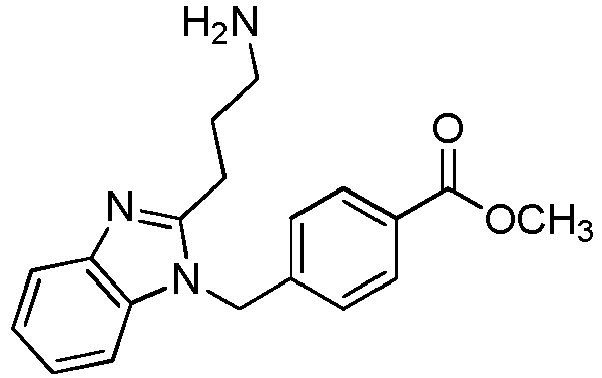
- The title compound was prepared from tert-Butyl (3-(1H-benzo[d]imidazol-2-yl)propyl)carbamate 33 (433 mg, 1.57 mmol) using General Procedure C. The crude material was taken up into acetone (7 mL), added conc. HCl (3 equiv) and allowed to stir at 50 °C for 4 h. The reaction was quenched with saturated bicarbonate and worked up in the usual manner, affording the title compound as a viscous brown oil (458 (mg, 90%) used without further purification. 1H NMR (400 MHz, MeOD) δ 7.95 (m, 3H), 7.63 (d, J= 7.6 Hz, 1H), 7.44 (d, J= 8.0 Hz, 1H), 7.33 (m, 1H), 7.23 (m, 2H), 7.18 (m, 2H), 5.58 (s, 2H), 3.86 (m, 3H), 2.93 (t, J = 7.6 Hz, 2H), 2.06 (t, J = 7.6 Hz, 2H), 1.98 (m, 2H). ESI-LRMS: [M+H]+ = 324 m/z.
-

- To a round bottom flask charged with methyl 4-((2-(3-aminopropyl)-1H-benzo[d]imidazol-1-yl)methyl)benzoate 34 (135 mg, 0.417 mmol) in DCM (5 mL) was added Et3N (0.076 mL, 0.543 mmol) and catalytic DMAP (5 mg, 0.042 mmol). The reaction was cooled to 0 °C and then Ac2O (0.051 mL, 0.543 mmol) was added dropwise. The resulting solution was allowed to warm to RT and stirred for 18 h after which the reaction was quenched with H2O (10 mL) and extracted with chloroform (3 x 10 mL). Combined extracts were washed with brine (20 mL), dried over Na2SO4 and concentrated in vacuo. The crude product was purified using automated
column chromatography method 2 and isolated as a white, waxy solid (53 mg, 35%). 1H NMR (400 MHz, CDCl3) δ 7.96 (d, J = 8.0 Hz, 2H), 7.73 (d, J = 7.6 Hz, 1H), 7.24 (m, 3H), 7.07 (d, J = 8.0 Hz, 2H), 6.73 (br s, 1H), 5.38 (s, 2H), 3.88 (s, 3H), 3.33 (m, 2H), 2.89 (t, J = 7.2 H, 2H), 2.05 (m, 2H), 1.86 (s, 3H). 13C NMR (100 MHz, CDCl3) δ 170.44, 166.32, 154.48, 141.76, 140.60, 134.98, 130.26, 129.91, 126.00122.81, 122.49, 118.89, 109.42, 52.12, 46.60, 38.91, 26.42, 24.92, 22.97. ESI-LRMS: [M+H]+ = 366 m/z. -

- The title compound was synthesized from methyl 4-((2-(3-acetamidopropyl)-1H-benzo[d]imidazol-1-yl)methyl)benzoate 35 (53 mg, 0.145 mmol) according to General Procedure D (prep. HPLC method 2) and isolated as a white solid (36 mg, 52%). 1H NMR (400 MHz, DMSO-d 6) δ 8.01 (m, 1H), 7.78 (m, 4H), 7.52 (m, 2H), 7.33 (d, J = 8.0 Hz, 2H), 5.78 (s, 2H), 3.18 (m, 4H), 1.92 (m, 2H), 1.78 (s, 3H). 13C NMR (100 MHz, DMSO-d 6) δ 169.12, 163.16, 157.65, 154.11, 137.32, 132.19, 131.80, 127.09, 126.62, 125.30, 124.98, 114.39, 112.34, 46.74, 37.29, 26.03, 22.62, 22.19. ESI-LRMS: [M+H]+ = 367 m/z. ESI-HRMS: calc. for C20H22N4O3: [M+H]+ = 367.1765 m/z, found: [M+H]+ = 367.1757 m/z.
-

- tert-Butyl 2-(1H-benzo[d]imidazol-2-yl)ethylcarbamate (390 mg, 1.70 mmol) was subjected to general procedure C to produce the ester intermediate methyl 4-((2-(2-(tert-butoxycarbonylamino)ethyl)-1H-benzo[d]imidazol-1-yl)methyl)benzoate. The crude material was dissolved in acetone (2 mL/mmol ester), conc. HCl (3 mol equiv) was added and then the reaction was stirred for 16 h. The precipitate was filetered, washed with acetone, dried, and used without further purification. The dihydrochloride intermediate (131 mg, 0.343 mmol) was dissolved in MeOH (3 mL) and cooled to 0 °C. AcOH (0.100 µM) was added followed by NaCNBH3 (43 mg, 0.686 mmol) under an atmosphere of Ar. Lastly, a solution of CH2O (0.1 mL, 37% wt soln) in MeOH (1 mL) was added dropwise. The resulting reaction mixture was allowed to stir 4.5 h to RT. The reaction was quenched with 1N HCl (10 mL) and extracted with EtOAc (3 x 10 mL). The aqueous layer was made basic with 2N NaOH and again extracted with EtOAc (3 x 10 mL). The basic extraction was washed with brine (20 mL), dried over Na2SO4 and concentrated in vacuo. Material was purified via automated
column chromatography method 2 to yield a white waxy solid (88 mg, 76%). 1H NMR (400 MHz, CDCl3) δ 7.98 (d, J = 8.4 Hz, 2H), 7.76 (J = 8.0 Hz, 1H), 7.23 (m, 3H), 7.11 (d, J = 8.4 Hz, 2H), 5.42 (s, 2H), 3.89 (s, 3H), 3.00 (t, J = 7.6 Hz, 2H), 2.83 (t, J = 7.6 Hz, 2H), 2.26 (s, 6H). 13C NMR (100 MHz, CDCl3) δ 166.44, 153.45, 142.61, 140.99, 135.17, 130.26, 129.86, 126.10, 122.58, 122.25, 119.42, 109.27, 57.13, 52.15, 46.68, 45.29, 26.07. ESI-LRMS: [M+H]+ = 338 m/z, [M+Na]+ = 360 m/z. -

- The title compound was synthesized from methyl 4-((2-(2-(dimethylamino)ethyl)-1H-benzo[d]imidazol-1-yl)methyl)benzoate 37 (88 mg, 0.261 mmol) according to General Procedure D (prep. HPLC method 2) and isolated as a white solid (53 mg, 60%). 1H NMR (400 MHz, DMSO-d 6) δ 7.68 (d, J = 8.4 Hz, 2H), 7.58 (m, 1H), 7.42 (m, 1H), 7.16 (m, 4H), 5.55 (s, 2H), 2.96 (t, J = 7.6 Hz, 2H), 2.64 (t, J= 7.6 Hz, 2H), 2.13 (s, 6H). 13C NMR (100 MHz, DMSO-d 6) δ 163.65, 153.91, 142.34, 139.87, 135.25, 132.50, 127.17, 126.34, 121.77, 121.42, 118.47, 110.10, 56.75, 45.80, 44.98, 25.15. ESI-LRMS: [M+H]+ = 339 m/z. ESI-HRMS: calc. for C19H22N4O2: [M+H]+ = 339.1816 m/z, found: [M+H]+ = 339.1811 m/z.
-

- The title compound was synthesized by subjecting 2-isopropyl-1H-benzo[d]imidazole (209 mg, 1.30 mmol) to General Procedure C (automated column chromatography method 2) followed by General Procedure D (prep. HPLC method 2). The desired product was isolated as a white solid (23 mg, 25%). 1H NMR (400 MHz, DMSO-d 6) δ 11.95 (s, 1H), 9.01 (s, 1H), 7.68 (d, J = 8.4 Hz, 2H), 7.60 (m, 1H), 7.40 (m, 1H), 7.16 (m, 2H), 7.10 (d, J = 8.4 Hz, 2H), 5.57 (s, 2H), 3.25 (quint, J = 6.8 Hz, 1H), 1.26 (s, 3H), 1.24 (s, 3H). 13C NMR (100 MHz, DMSO-d 6) δ 163.84, 159.85, 142.26, 140.43, 135.12, 131.98, 127.32, 126.20, 121.77, 121.44, 118.63, 110.20, 45.54, 25.71, 21.75 ESI-LRMS: [M+H]+ = 310 m/z. ESI-HRMS: calc. for C18H19N3O2: [M+H]+ = 310.1550 m/z, found: [M+H]+ = 310.1563 m/z.
- Two examples of present HDACIs having a monocyclic Cap group are prepared as follows (see also General Synthetic Schemes B and C):

- Reagents and conditions: a) methyl 4-(bromomethyl)benzoate, KO t Bu, DMF, 80 °C, 2 h; b) NH2OH·HCl, NaOMe, MeOH, 0 °C to rt, 16 h; or

- Reagents and conditions: a) Tetrakis(triphenylphosphine)palladium(0), methyl 4-(bromomethyl)benzoate, Na2CO3, DME or diglyme, H2O, 100 °C, 4 h; b) NH2OH·HCl, NaOMe, MeOH, 0 °C to rt, 16 h.
- Examples of monocyclic Cap groups include, but are not limited to:


- HDACIs having a five-membered or six-membered monocylic Cap group:
-
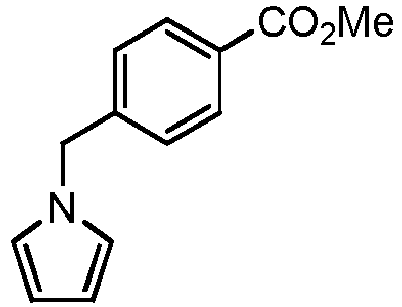
- The title compound was prepared from 1H-pyrrole (0.150 g, 2.24 mmol) according to General Procedure A (substituting KO t Bu for NaH) and purified using automated column chromatography method 1. The product was isolated as a clear viscous oil (0.432 g, 90%). 1H NMR (400 MHz, CDCl3): δ 8.01 (d, J = 8.3 Hz, 2H), 7.17 (d, J = 8.3 Hz, 2H), 6.72 (t, J = 2.0 Hz, 2H), 6.24 (t, J = 2.1 Hz, 2H), 5.15 (s, 2H), 3.93 (s, 3H). 13C NMR (100 MHz, CDCl3): δ 166.7, 143.4, 130.0, 129.5, 126.7, 121.2, 108.9, 53.0, 52.1.
-

- The title compound was synthesized from methyl 4-((1H-pyrrol-1-yl)methyl)benzoate 40 (0.400 g, 1.86 mmol) according to General Procedure B (prep. HPLC method 1) and isolated as a white solid (0.225 g, 56%). 1H NMR (400 MHz, MeOD): δ 7.70 (d, J = 8.3 Hz, 2H), 7.20 (d, J = 8.3 Hz, 2H), 6.73 (t, J = 2.0 Hz, 2H), 6.11 (t, J = 2.1 Hz, 2H), 5.17 (s, 2H). 13C NMR(100 MHz, MeOD): δ 166.4, 143.0, 131.2, 127.0, 126.6, 120.7, 108.0, 52.0. ESI-HRMS: calc. for C12H12N2O2: [M+H]+ = 217.0972 m/z, found: [M+H]+ = 217.0974 m/z.
-

- The title compound was prepared from 1H-pyrazole (0.150 g, 2.20 mmol) according to General Procedure A (substituting KO t Bu for NaH) and purified using automated column chromatography method 1. The product was isolated as a viscous yellow oil (0.387 g, 81%). 1H NMR (400 MHz, CDCl3): δ 7.99 (d, J = 8.2 Hz, 2H), 7.56 (s, 1H), 7.41 (d, J = 2.0 Hz, 1H), 7.20 (d, J = 8.1 Hz, 2H), 6.30 (d, J = 1.9 Hz, 1H), 5.36 (s, 2H), 3.88 (s, 3H). 13C NMR (100 MHz, CDCl3): δ 166.2, 141.5, 139.5, 129.7, 129.4, 129.1, 126.9, 105.9, 55.0, 51.7. ESI-HRMS: calc. for C12H12N2O2: [M+H]+ = 217.0972 m/z, found: [M+H]+ = 217.0969 m/z.
-

- The title compound was synthesized from methyl 4-((1H-pyrazol-1-yl)methyl)benzoate 42 (0.387 g, 1.79 mmol) according to General Procedure B (prep. HPLC method 1) and isolated as a white solid (0.251 g, 65%). 1H NMR (400 MHz, MeOD): δ 7.74 (m, 3H), 7.55 (d, J = 1.5 Hz, 1H), 7.27 (d, J = 8.4 Hz, 2H), 6.37 (t, J = 2.1 Hz, 1H), 5.43 (s, 2H). 13C NMR (100 MHz, MeOD): δ 166.3, 140.9, 139.3, 131.7, 130.5, 127.1, 127.0, 105.7, 54.3. ESI-HRMS: calc. for C11H11N3O2: [M+H]+ = 218.0924 m/z, found: [M+H]+ = 218.0917 m/z.
-

- The title compound was prepared from pyridin-4-ylboronic acid (0.123 g, 1.00 mmol) according to General Procedure E and purified using automated column chromatography method 2 (20 mg, 9%). 1H NMR (400 MHz, MeOD): δ 8.59 (d, J = 6.6 Hz, 2H), 7.86 (d, J = 8.3 Hz, 2H), 7.78 (d, J = 6.6 Hz, 2H), 7.28 (d, J = 8.3 Hz, 2H), 4.26 (s, 2H), 3.74 (s, 3H). 13C NMR (100 MHz, CDCl3): δ 166.7, 162.3, 142.4, 141.2, 129.9, 129.3, 129.1, 127.2, 51.3, 40.8. ESI-LRMS: [M+H]+ = 228 m/z.
-

- The title compound was synthesized from methyl 4-(pyridin-4-ylmethyl)benzoate 44 (0.020 g, 0.09 mmol) according to General Procedure B (prep. HPLC method 2) and isolated as a white solid (5 mg, 25%). 1H NMR (400 MHz, MeOD): δ 8.74 (d, J = 6.4 Hz, 2H), 7.93 (d, J = 6.3 Hz, 2H), 7.78 (d, J = 8.2 Hz, 2H), 7.43 (d, J = 8.1 Hz, 2H), 4.41 (s, 2H). 13C NMR (100 MHz, MeOD): δ 166.1, 162.4, 141.4, 140.8, 131.3, 129.3, 127.5, 127.1, 40.7. ESI-HRMS: calc. for C13H12N2O2: [M+H]+ = 229.0972 m/z, found: [M+H]+ = 229.0966 m/z.
-

- The title compound was prepared from 4-(dimethylamino)phenylboronic acid (0.165 g, 1.00 mmol) according to General Procedure E and purified using automated
column chromatography method 2. The product was isolated as an orange oil (0.211 g, 78%). 1H NMR (400 MHz, MeOD): δ 7.93 (d, J = 8.4 Hz, 2H), 7.59 (d, J = 8.7 Hz, 2H), 7.45 (d, J = 8.7 Hz, 2H), 7.33 (d, J = 8.4 Hz, 2H), 4.10 (s, 2H), 3.87 (s, 3H), 3.28 (s, 6H). 13C NMR (100 MHz, CDCl3): δ 166.9, 146.0, 142.8, 141.3, 130.6, 129.5, 128.7, 128.1, 120.3, 51.2, 45.6, 40.5. ESI-LRMS: [M+H]+ = 270 m/z. -

- The title compound was synthesized from methyl 4-(4-(dimethylamino)benzyl)benzoate 46 (0.211 g, 0.78 mmol) according to General Procedure B (prep. HPLC method 2) and isolated as a white solid (0.140 g, 66%). 1H NMR (400 MHz, MeOD): δ 7.69 (d, J = 8.2 Hz, 2H), 7.53 (d, J = 8.6 Hz, 2H), 7.42 (d, J = 8.56, 2H), 7.31 (d, J = 8.1 Hz, 2H), 4.09 (s, 2H), 3.25 (s, 6H). 13C NMR (100 MHz, MeOD): δ 166.6, 144.5, 142.3, 141.7, 130.5, 130.2, 128.8, 127.1, 119.8, 45.3, 40.4. ESI-HRMS: calc. for C16H18N2O2: [M+H]+ = 271.1441 m/z, found: [M+H]+ = 271.1448 m/z.
-

- The title compound was prepared from 3-(dimethylamino)phenylboronic acid (0.165 g, 1.00 mmol) according to General Procedure E and purified using automated
column chromatography method 2. The product was isolated as a clear oil (0.254 g, 94%). 1H NMR (400 MHz, CDCl3): δ 7.99 (d, J = 8.1 Hz, 2H), 7.30 (m, 6H), 4.08 (s, 2H), 3.91 (s, 3H), 3.15 (s, 6H). 13C NMR (100 MHz, CDCl3): δ 166.9, 144.9, 144.5, 143.1, 130.6, 130.0, 128.9, 128.8, 128.6, 119.9, 117.5, 52.1, 45.6, 41.6. ESI-LRMS: [M+H]+ = 270 m/z. -
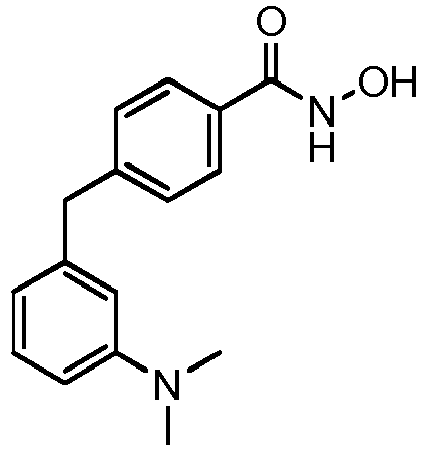
- The title compound was synthesized from methyl 4-(3-(dimethylamino)benzyl)benzoate 48 (0.254 g, 0.94 mmol) according to General Procedure B (prep. HPLC method 2) and isolated as a white solid (0.117 g, 46%). 1H NMR (400 MHz, CDCl3): δ 7.70 (d, J = 8.2 Hz, 2H), 7.50 (m, 3H), 7.35 (m, 3H), 4.12 (s, 2H), 3.27 (s, 6H). 13C NMR (100 MHz, CDCl3): δ 166.6, 144.3, 143.7, 143.6, 130.4, 130.2, 129.7, 128.8, 127.1, 120.2, 117.5, 45.4, 40.7. ESI-HRMS: calc. for C16H18N2O2: [M+H]+ = 271.1450 m/z, found: [M+H]+ = 271.1450 m/z.
- An example of a present HDACI having an acyclic Cap group is prepared as follows (see also General Synthetic Scheme D):

- Reagents and conditions: a) methyl 4-(bromomethyl)benzoate, KO t Bu, DMF, 80°C, 2 h; b) NH2OH·HCl, NaOMe, MeOH, 0°C to rt, 16 h.
- Examples of acyclic Cap groups include, but are not limited to:

- HDACI compounds having an acyclic Cap group:
-

- The title compound was prepared from diethylamine (0.350 g, 4.79 mmol) according to General Procedure A (substituting KO t Bu for NaH). The pH was adjusted to 10 with 2N NaOH prior to extraction with EtOAc. The product was isolated as a yellow oil and did not require further purification (0.790 g, 75%). 1H NMR (400 MHz, MeOD): δ 8.14 (d, J = 8.2 Hz, 2H), 7.66 (d, J = 8.2 Hz, 2H), 4.44 (s, 2H), 3.95 (s, 3H), 3.25 (m, 4H), 1.37 (t, J = 7.3 Hz, 6H). 13C NMR (100 MHz, DMSO-d 6): δ 166.2, 135.9, 131.8, 130.9, 130.0, 54.8, 52.8, 46.6, 8.8. ESI-HRMS: calc. for C13H19NO2: [M+H]+ = 222.1489 m/z, found: [M+H]+ = 222.1485 m/z.
-

- The title compound was synthesized from methyl 4-((diethylamino)methyl)benzoate 50 (0.518 g, 2.34 mmol) according to General Procedure B (prep. HPLC method 2) and isolated as a viscous, yellow oil (0.448 g, 56%). 1H NMR (400 MHz, MeOD): δ 7.72 (d, J = 8.2 Hz, 2H), 7.42 (d, J = 8.1 Hz, 2H), 3.65 (s, 2H), 2.55 (q, J = 7.2 Hz, 4H), 1.08 (t, J = 5.0 Hz, 6H). 13C NMR (100 MHz, MeOD): δ 166.3, 139.5, 131.9, 129.7, 127.0, 56.1, 46.4, 9.3. ESI-HRMS: calc. for C12H18N2O2: [M+H]+ = 223.1441 m/z, found: [M+H]+ = 223.1441 m/z.
-

- The title compound was prepared from diisopropylamine (0.500 g, 4.94 mmol) according to General Procedure A (substituting KO t Bu for NaH). The pH was adjusted to 10 with 2N NaOH prior to extraction with EtOAc. The product was isolated as a yellow oil and did not require further purification (1.10 g, 89%). 1H NMR (400 MHz, MeOD): δ 8.10 (d, J = 8.4 Hz, 2H), 7.71 (d, J = 8.4 Hz, 2H), 4.51 (s, 2H), 3.93 (s, 3H), 3.85 (m, 2H), 1.46 (dd, J = 6.1 Hz, J = 12.5 Hz, 12H). 13C NMR (100 MHz, MeOD): δ 165.9, 135.9, 130.6, 130.1, 129.4, 54.8, 51.1, 49.4, 17.2, 16.3. ESI-HRMS: calc. for C15H23NO2: [M+H]+ = 250.1802 m/z, found: [M+H]+ = 250.1800 m/z.
-

- The title compound was synthesized from methyl 4-((diisopropylamino)methyl)benzoate 52 (0.750 g, 3.0 mmol) according to General Procedure B (prep. HPLC method 2) and isolated as a viscous, light-yellow oil (0.324 g, 42%). 1H NMR (400 MHz, MeOD): δ 7.84 (d, J = 8.2 Hz, 2H), 7.67 (d, J = 8.2 Hz, 2H), 4.48 (s, 2H), 3.84 (m, 2H), 1.47 (br, 12H). 13C NMR (100 MHz, MeOD): δ 165.6, 134.7, 133.2, 130.5, 127.5, 55.1, 49.7, 17.5, 16.8. ESI-HRMS: calc. for C14H22N2O2: [M+H]+ = 251.1754 m/z, found: [M+H]+ = 251.1744 m/z.
-

- NaH (0.220 g, 5.54 mmol) was dissolved in anhydrous DMF (2 mL) under argon and cooled to 0 °C. To it was added diphenylamine (0.0.750 g, 4.43 mmol) dissolved in anhydrous DMF (2 mL). The reaction was stirred for 15 min at 0 °C followed by the addition of methyl 4-(bromomethyl)benzoate (1.02 g, 4.43 mmol) in anhydrous DMF (2 mL). The reaction was stirred for 2 h at 60 °C and then quenched by the addition of H2O (20 mL). The organic products were extracted with EtOAc (3 x 30 mL), washed with H2O (2 x 30 mL), brine (15 mL), dried with Na2SO4, filtered and concentrated in vacuo. The title compound was purified using automated column chromatography method 1 (0.746 g, 53%). 1H NMR (400 MHz, CDCl3): δ 8.00 (d, J = 8.2 Hz, 2H), 7.45 (d, J = 7.7 Hz, 2H), 7.27 (m, 4H), 7.07 (d, J = 7.9 Hz, 4H), 6.98 (t, J = 7.3 Hz, 2H), 5.06 (s, 2H), 3.92 (s, 3H). 13C NMR (100 MHz, CDCl3): δ 166.9, 147.8, 144.8, 130.0, 129.4, 128.9, 126.5, 121.7, 120.7, 56.3, 52.0. ESI-LRMS: [M+H]+ = 318 m/z.
-
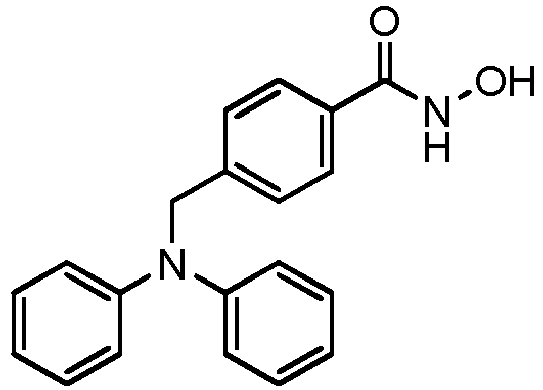
- The title compound was synthesized from methyl 4-((diphenylamino)methyl)benzoate 54 (0.200 g, 0.33 mmol) according to General Procedure B (prep. HPLC method 2) and isolated as a white solid (27 mg, 13%). 1H NMR (400 MHz, MeOD): δ 7.69 (d, J = 8.0 Hz, 2H), 7.47 (d, J = 8.0 Hz, 2H), 7.23 (t, J = 7.6 Hz, 4H), 7.05 (d, J = 8.0 Hz, 4H), 6.93 (t, J = 7.5 Hz, 2H), 5.07 (s, 2H). 13C NMR (100 MHz, DMSO-d 6): δ 164.5, 147.8, 143.0, 131.8, 129.8, 127.5, 126.9, 121.7, 120.7, 55.5. ESI-HRMS: calc. for C20H18N2O2: [M+H]+ = 319.1441 m/z, found: [M+H]+ = 319.1447 m/z.
-

- Pyrrolidine (0.12 mL, 1.52 mmol), methyl 4-formylbenzoate (0.250 g, 1.52 mmol), NaBH(OAc)3 (0.52 g, 2.4 mmol) and 5 Å molecular sieves were dissolved in 1,2-dichloroethane (5 mL) under Ar atmosphere and stirred for 24 h at RT. Then, the reaction was diluted with 2N NaOH (30 mL) and extracted with EtOAc (3 x 20 mL). The combined organic fractions were washed with brine (15 mL), dried over Na2SO4, filtered and concentrated in vacuo. The crude product was purified via automated column chromatography (50-100% EtOAc/hexane, 25 g cartridge) to yield the title compound as a clear oil (0.166 g, 50%). 1H NMR (400 MHz, CDCl3): δ 8.00 (d, J = 8.0 Hz, 2H), 7.43 (d, J = 8.0 Hz, 2H), 3.92 (s, 3H), 3.69 (s, 2H), 2.54 (br, 4H), 1.81 (t, J = 3.2 Hz, 4H).
-

- The title compound was synthesized from methyl 4-(pyrrolidin-1-ylmethyl)benzoate 56 (0.120 g, 0.55 mmol) according to General Procedure B (prep. HPLC method 2) and isolated as the trifluoroacetic acid salt (38 mg, 21%). 1H NMR (400 MHz, DMSO-d 6): δ 11.33 (s, 1H), 10.69 (br, 1H), 9.15 (br, 1H), 7.81 (d, J = 8.0 Hz, 2H), 7.58 (d, J = 8.0 Hz, 2H), 4.39 (s, 2H), 3.22 (br, 4H), 1.94 (br, 4H). 13C NMR (100 MHz,MeOD): δ 165.61, 134.17, 133.62, 130.29, 127.62, 57.21, 53.60, 22.37. ESI-HRMS: calc. for C12H16N2O2: [M+H]+ = 221.1285 m/z, found: [M+H]+ = 221.1286 m/z.
-

- The title compound was synthesized from (S)-2-(methoxymethyl)pyrrolidine (0.175 g, 1.52 mmol) according to a procedure similar to that used for compound 56. 1H NMR (400 MHz, CDCl3): δ 7.99 (d, J = 8.4 Hz, 2H), 7.42 (d, J = 8.0 Hz, 2H), 4.17 (d, J = 13.6 Hz, 1H), 3.92 (s, 3H), 3.45 (m, 2 H), 3.35 (m, 4H), 2.92 (m, 1H), 2.74 (m, 1H), 2.21 (m, 1H), 1.95 (m, 1H), 1.69 (m, 3H).
-

- The title compound was synthesized from (S)-methyl4-((2-(methoxymethyl)pyrrolidin-1-yl)methyl)benzoate 58 (0.120 g, 0.46 mmol) according to General Procedure B (prep. HPLC method 2) and isolated as the trifluoroacetic acid salt (23 mg, 13%). 1H NMR (400 MHz, MeOD): δ 7.87 (d, J = 8.0 Hz, 2H), 7.64 (d, J = 8.0 Hz, 2H), 4.67 (d, J = 12.8 Hz, 1H), 4.35 (d, J = 12.8 Hz, 1H), 3.85 (br, 1H), 3.60 (d, J = 4.8 Hz, 2H), 3.42 (br, 4H), 3.32 (m, 1H), 2.30 (m, 1H), 2.15 (m, 1H), 1.95 (m, 2H). 13C NMR (100 MHz, MeOD): δ 165.55, 133.74, 130.81, 127.55, 69.86, 67.00, 58.08, 57.75, 54.48, 26.03, 21.81. ESI-HRMS: calc. for C14H20N2O3: [M+H]+ = 265.1547 m/z, found: [M+H]+ = 265.1550 m/z.
-
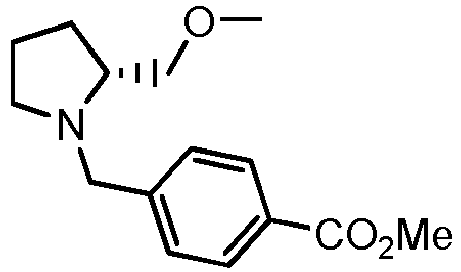
- The title compound was synthesized from (R)-2-(methoxymethyl)pyrrolidine (0.175 g, 1.52 mmol) according to a procedure similar to that used for compound 56. 1H NMR (400 MHz, CDCl3): δ 7.98 (d, J = 8.0 Hz, 2H), 7.41 (d, J = 8.0 Hz, 2H), 4.16 (d, J = 13.6 Hz, 1H), 3.91 (s, 3H), 3.42 (m, 2H), 3.33 (m, 4H), 2.92 (m, 1H), 2.73 (m, 1H), 2.19 (m, 1H), 1.93 (m, 1H), 1.70 (m, 3H). 13C NMR (100 MHz, CDCl3): δ 166.7, 144.7, 129.1, 128.4, 128.3, 76.0, 62.8, 58.9, 58.7, 54.2, 51.6, 28.0, 22.4. ESI-LRMS: [M+H]+ = 264 m/z.
-

- The title compound was synthesized from (R)-methyl 4-((2-(methoxymethyl)pyrrolidin-1-yl)methyl)benzoate 60 (0.120 g, 0.46 mmol) according to General Procedure B (prep. HPLC method 2) and isolated as the trifluoroacetic acid salt (21 mg, 12%). 1H NMR (400 MHz, DMSO-d 6): δ 11.23 (s, 1H), 9.87 (br, 1H), 9.02 (br, 1H), 7.71 (d, J = 8.4 Hz, 2H), 7.49 (d, J = 8.0 Hz, 2H), 4.45 (d, J = 12.8 Hz, 1H), 4.20 (m, 1H), 3.62 (br, 1H), 3.47 (m, 1H), 3.39 (m, 1H), 3.17 (s, 4H), 3.08 (br, 1H), 2.05 (m, 1H), 1.87 (m, 1H), 1.736 (m, 1H), 1.63 (m, 1H). 13C NMR (100 MHz, DMSO-d 6): δ 163.85, 134.05, 131.35, 127.68, 70.70, 66.37, 58.91, 57.36, 54.37, 26.59, 22.16. ESI-HRMS: calc. for C14H20N2O3: [M+H]+ = 265.1547 m/z, found: [M+H]+ = 265.1551 m/z.
- The effectiveness, or potency, of a present HDACI with respect to inhibiting the activity of an HDAC is measured by an IC50 value. The quantitative IC50 value indicates the concentration of a particular compound that is needed to inhibit the activity of an enzyme by 50% in vitro. Stated alternatively, the IC50 value is the half maximal (50%) inhibitory concentration of a compound tested using a specific enzyme, e.g., HDAC, of interest. The smaller the IC50 value, the more potent the inhibiting action of the compound because a lower concentration of the compound is needed to inhibit enzyme activity by 50%.
- In preferred embodiments, a present HDACI inhibits HDAC enzymatic activity by about at least 50%, preferably at least about 75%, at least 90%, at least 95%, or at least 99%.
- Compounds of the present invention were tested for IC50 values against both HDAC6 and HDACI. In some embodiments, a present compound also was tested against HDAC1, 2, 3, 4, 5, 8, 10, and 11. The tested compounds showed a range of IC50 values vs. HDAC6 of about 1 nm to greater than 30 µm, and a range of IC50 values vs. HDAC1 of about 91 nm to greater than 30 µm. Therefore, in some embodiments, a present HDACI is a selective HDAC6 inhibitor which, because of a low affinity for other HDAC isozymes, e.g., HDAC1, give rise to fewer side effects than compounds that are non-selective HDAC inhibitors.
- In some embodiments, the present HDACIs interact with and reduce the activity of all histone deacetylases in a cell. In some preferred embodiments, the present HDACIs interact with and reduce the activity of fewer than all histone deacetylases in the cell. In certain preferred embodiments, the present HDACIs interact with and reduce the activity of one histone deacetylase (e.g., HDAC-6), but do not substantially interact with or reduce the activities of other histone deacetylases (e.g., HDAC-1, HDAC-2, HDAC-3, HDAC-4, HDAC-5, HDAC-7, HDAC-8, HDAC-9, HDAC-10, and HDAC-11).
- The present invention therefore provides HDACIs for use in the treatment of a variety of diseases and conditions wherein inhibition of HDAC has a beneficial effect. Preferably, a present HDACI is selective for HDAC6 over the other HDAC isozymes by a factor of at least 2, at least 5, at least 10, at least 20, at least 50, at least 100, at least 500, at least 1000, at least 2000, at least 3000, and preferably up to about 4000. For example, in various embodiments, a present HDACI exhibits an IC50 value versus HDAC6 that is about 350 or about 1000 times less than the IC50 value vs. HDAC1, i.e., a selectivity ratio (HDAC1 IC50/HDAC6 IC50) of about 350 or about 1000.
- Other assays also showed a selectivity of a present HDACI for HDAC6 over HDAC1, 2, 3, 4, 5, 8, 10, and 11 of about 1000.
- The IC50 values for compounds of structural formula (I) vs. HDAC1 and HDAC6 were determined as follows:
The HDAC1, 2, 4, 5, 6, 7, 8, 9, 10, and 11 assays used isolated recombinant human protein; HDAC3/NcoR2 complex was used for the HDAC3 assay. Substrate for HDAC1, 2, 3, 6, 10, and 11 assays is a fluorogenic peptide from p53 residues 379-382 (RHKKAc); substrate for HDAC8 is fluorogenic diacyl peptide based on residues 379-382 of p53 (RHKAcKAc). Acetyl-Lys(trifluoroacetyl)-AMC substrate was used for HDAC4, 5, 7, and 9 assays. Compounds were dissolved in DMSO and tested in 10-dose IC50 mode with 3-fold serial dilution starting at 30 µM. Control Compound Trichostatin A (TSA) was tested in a 10-dose IC50 with 3-fold serial dilution starting at 5 µM. IC50 values were extracted by curve-fitting the dose/response slopes. Assays were performed in duplicate and IC50 values are an average of data from both experiments. - Human HDAC1 (GenBank Accession No. NM_004964): Full length with C-terminal GST tag, MW= 79.9 kDa, expressed by baculovirus expression system in Sf9 cells. Enzyme is in 50 mM Tris-HCl, pH 8.0, 138 mM NaCl, 20 mM glutathione, and 10% glycerol, and stable for >6 months at -80°C. Purity is > 10% by SDS-PAGE. Specific Activity is 20 U/µg, where one U =1 pmol/min under assay condition of 25 mM Tris/Cl, pH8.0, 137 mM NaCl, 2.7 mM KCl, 1 mM MgCl2, 0.1 mg/ml BSA, 100 µM HDAC substrate, and 13.2ng/µl HDAC1, incubation for 30 min at 30°C.
- Human HDAC6 (GenBank Accession No. BC069243): Full length with N-terminal GST tag, MW= 159 kDa, expressed by baculovirus expression system in Sf9 cells. Enzyme is in 50 mM Tris-HCl, pH 8.0, 138 mM NaCl, 20 mM glutathione, and 10% glycerol, and stable for >6 months at -80°C. Purity is >90% by SDS-PAGE. Specific Activity is 50 U/µg, where one U =1 pmol/min under assay condition of 25 mM Tris/Cl, pH8.0, 137 mM NaCl, 2.7 mM KCl, 1 mM MgCl2, and 0.1 mg/ml BSA, 30 µM HDAC substrate, and 5 ng/µl HDAC6, incubation for 60 min at 30°C.
- Substrate for HDAC1 and HDAC6: Acetylated peptide substrate for HDAC, based on residues 379-382 of p53 (Arg-His-Lys-Lys(Ac)), a site of regulatory acetylation by the p300 and CBP acetyltransferases (lysines 381, 382)1-6, is the best for HDAC from among a panel of substrates patterned on p53, histone H3 and histone H4 acetylation sites7.
- References: W. Gu et al., Cell (1997) 90 595; K. Sakaguchi et al., Genes Dev., (1998) 12 2831; L. Liu et al., Mol. Cell. Biol., (1999) 19 1202; A. Ito et al., EMBO J., (2001) 20 1331; N.A. Barlev et al., Mol. Cell, (2001) 8 1243; and A. Ito et al., EMBO J., (2002) 21 6236.
- Reaction Buffer: 50 mM Tris-HCl, pH 8.0, 137 mM NaCl, 2.7 mM KCl, 1 mM MgCl2, 1 mg/ml BSA.
- HDAC1: 75 nM HDAC1 and 50 µM HDAC substrate are in the reaction buffer and 1% DMSO final. Incubate for 2 hours at 30°C.
- HDAC6: 12.6 nM HDAC6 and 50 µM HDAC substrate are in the reaction buffer and 1% DMSO final. Incubate for 2 hours at 30°C.
- All IC50 values are automatically calculated using the GraphPad Prism version 5 and Equation of Sigmoidal dose-response (variable slope):
Y=Bottom + (Top-Bottom)/(1+10^((LogEC50-X)*HillSlope)), where X is the logarithm of concentration, Y is the response, Y starts at Bottom and goes to Top with a sigmoid shape. In most cases, "Bottom" is set 0, and "Top" is set "less than 120%". This is identical to the "four parameter logistic equation". IC50 curves also are drawn using the GraphPad Prism, and IC50 values and Hill slopes are provided. - HDAC Activity Assays: HDAC assay is performed using fluorescently-labeled acetylated substrate, which comprises an acetylated lysine side chain. After incubation with HDAC, deacetylation of the substrate sensitizes the substrate such that, in a second step, treatment with the detection enzyme produces a fluorophore. HDACs 1 and 6 were expressed as full length fusion proteins. Purified proteins were incubated with 50 µM fluorescently-labeled acetylated peptide substrate and test compound for 2 hours at RT in HDAC assay buffer containing 50 mM Tris-HCl (pH 8.0), 137 mM NaCl, 2.7 mM KCl, 1 mM MgCl2, 1% DMSO, and 1% BSA.
- Reactions were terminated by the addition of the Developer after 2 hours, and the development of fluorescence signal, which was relative to the amount of deacetylated peptide, was monitored by time-course measurement of EnVision (PerkinElmer). The HDAC activity was estimated from the slope of time-course measurement of the fluorescence intensity. The slope of no-enzyme control (substrate alone) was served as background, and % Enzyme activity was calculated using background-subtracted slope of no inhibitor control (DMSO) as 100% activity.
- To date, HDACIs have demonstrated a relatively non-specific inhibition of various HDAC isozymes. Most HDACI so far identified primarily inhibit
HDAC 1, 2, 3, and 8, producing an antiproliferative phenotype which is useful for oncology applications, but not for the many non-oncology applications of HDACIs. (K.B. Glaser et al, Biochemical and biophysical research communications 2003, 310, 529-36.) The potential toxicities associated with the inhibition of certain HDAC isozymes can lead to additional difficulties for the clinical development of pan-HDAC, i.e., nonselective HDAC, inhibitors. Because the network of cellular effects mediated by acetylation is so vast and because inhibition of some HDAC isozymes may lead to undesirable side effects, HDAC isozyme selective inhibitors hold a greater therapeutic promise than their nonselective counterparts. - As illustrated below, the HDACIs of the present invention as well as other HDACIs disclosed herein exhibit selective inhibition of HDAC6 compared to other HDAC isozymes.
Table 1. 
Cap HDAC Isoform IC50 (µM) HDAC6 Selectivity (HDAC1/HDAC6) 1 2 3 4 5 6 7 8 9 10 11 
5.83 9.19 0.00975 0.417 8.16 598 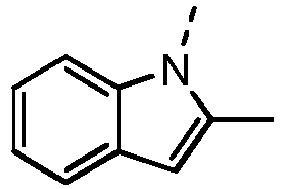
5.34 8.14 0.00251 0.397 18.3 2127 
6.79 11.9 0.00511 0.911 14.5 1329 
3.09 0.00146 2116 
13.2 0.0293 0.324 451 
5.86 0.0125 0.422 469 
1.23 0.00294 0.174 418 
0.940 0.00348 270 
3.56 0.0142 251 
6.47 0.0358 181 
6.87 0.0119 577 
5.73 0.0313 183 
1.47 0.0109 135 
6.66 4.50 2.38 1.48 
29.0 0.540 1.20 54 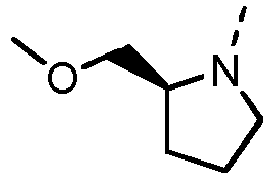
27.9 0.150 1.82 186 
>30 1.25 5.59 >24 
>30 6.28 9.43 >5 
23.8 0.124 1.92 192 Table 2. HDAC inhibition data for inventive HDACIs and comparative HDAC inhibitors. 

Compound HDAC Isoform IC50 (µM) 1 2 3 4 5 6 7 8 9 10 11 Tubastatin A 16.4 >30 >30 >30 >30 0.015 >30 0.854 >30 >30 >30 Tubacin 1.40 6.27 1.27 17.3 3.35 0.004 9.70 1.27 4.31 3.71 3.79 Bicyclic 2 5.83 9.19 0.00975 0.417 8.16 4 5.34 8.14 0.00251 0.397 18.3 6 6.79 11.9 0.00511 0.911 14.5 8 12.2 0.00408 10 13.2 0.0293 0.324 12 0.940 0.00348 14 3.56 0.0142 17 1.23 0.00294 0.174 19 5.86 0.0125 0.422 21 3.09 0.00146 22 >30 >30 23 >30 >30 27 8.54 0.0294 30 0.623 0.000170 32 8.79 0.0092 36 14.7 0.0470 38 52.4 0.126 39 27.7 0.0470 Monocyclic 41 5.73 0.0313 43 1.47 0.0109 45 6.47 0.0358 47 6.87 0.0119 49 12.2 0.0701 Acyclic 51 >30 6.28 9.43 53 23.8 0.124 1.92 55 6.66 4.50 2.38 57 29.0 0.540 1.20 59 27.9 0.150 1.82 61 >30 1.25 5.59 - Assays values are an average of two experiments. ISOX was previously found to have a low picomolar IC50 at HDAC6. When ISOX was tested in these assays, an HDAC6 IC50 value of 2.4 nM was observed. After investigating the source of this discrepancy, it was found that lack of a detergent (Triton X100) in the original assay caused the anomalously high activity.
- The present HDACIs demonstrate excellent HDAC6 potency and selectivity, often exhibiting an IC50 of 1 to 5 nM at HDAC6 and 1000- to 2000-fold selectivity against HDAC1. For example, 4 demonstrated an IC50 of 2.5 nM at HDAC6 and 2125-fold selectivity against HDAC1.
- Ligand efficiency is an important metric to judge the value of potential drugs. Ligand efficiency was proposed after finding that the average molecular weight of successful drugs was lower than those at an early clinical phase, thereby establishing an association between lower molecular weight and a higher chance of clinical success. (C. Abad-Zapatero, et al., Drug discovery today. 10:464-9, 2005; M. C. Wenlock, et al., J Med Chem. 46:1250-6, 2003). This observation led to the use of ligand efficiency values as an important value for determining lead and clinical candidate selection. Ligand efficiency relates binding free energy to the number of non-hydrogen atoms in the equation: Δg = ΔG/N, where N is the number of non-hydrogen atoms, and Δg is ligand efficiency. A closely related value used in the analysis of deacetylase inhibitors is binding efficiency index, defined as BEI = pIC50/MW, MW (molecular weight) in kDa.
- With the aim of improving ligand efficiency, cap group size was reduced while maintaining potency and selectivity. Table 3 shows that indole, 2-methylindole, and 3-methylindole cap groups had a potency at the target under 10 nM, while maintaining high HDAC6 selectivity. BEI was higher for the indole capped compounds compared to Tubastatin. Substitution at the indole 3' position with ethyldimethylamine or benzyl did not enhance potency at HDAC6 relative to the 2'-unsubstituted indole. Notably, the benzoyl substituted compound had very low activity at HDAC1, below the cutoff value for the assay. The importance of rigidity in the cap group also was investigated through synthesis of compound 55. The diphenylamine cap group of compound 55 is not locked in a planar conformation. The diphenylamine capped compound 55 in Table 3 was more potent and selective compared to an analogous carbazole compound.
- Table 3 also shows that the indole and the diphenylamine cap had reduced HDAC8 activity relative to Tubastatin. For compounds to be especially useful as molecular probes of HDAC6 activity, the activity at HDAC8 should be minimized. The diphenylamine capped compound was greatly enhanced in this respect, with over 500-fold selectivity for HDAC6 vs HDAC8. Likewise, the 2-methyl and 3-methylindole cap groups had greater selectivity for HDAC6 over HDAC8 compared to Tubastatin.
Table 3. HDAC6 Inhibitors Featuring an Indole Scaffold. HDAC1 IC50 (µM) HDAC6 IC50 (µM) HDAC8 IC50 (µM) BEI Tubastatin 16.4 ± 2.6 0.015 ± 0.001 0.854 ± 0.040 23.3 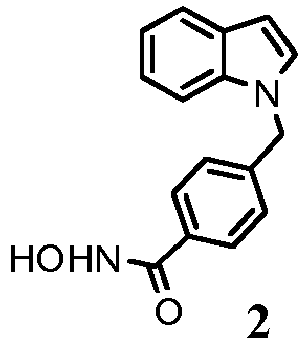
5.83 ± 0.70 0.0097 ± 0.0003 0.417 ± 0.040 30.1 
5.34 ± 0.16 0.0025 ± 0.0004 0.397 ± 0.099 30.7 
6.79 ± 0.29 0.0051 ± 0.0008 0.911 ± 0.042 29.6 
5.86 ± 1.19 0.013 ± 0.002 0.422 ± 0.044 23.4 
>30 0.035 ± 0.003 NT 20.9 
6.66 ± 0.51 0.0045 ± 0.0004 2.38 ± 0.25 26.3 - Values are the mean of two experiments. Data are shown as IC50 values in µM ± standard deviation. Compounds were tested in duplicate in 10-dose IC50 mode with 3-fold serial dilution starting from 30 µM solutions. IC50 values were extracted by curve-fitting the dose/response slopes. Assays performed by Reaction Biology Corp.
- The present compounds have been evaluated for their activity at HDAC6 and their selectivity for HDAC6 compared to HDAC1. It previously was shown that selective HDAC6 inhibitors are implicated in a variety of disease states including, but not limited to, arthritis, autoimmune disorders, inflammatory disorders, cancer,neurological diseases such as Rett syndrome, peripheral neuropathies such as CMT, stroke, hypertension, and diseases in which oxidative stress is a causative factor or a result thereof. It also was shown that selective HDAC6 inhibitors, when administered in combination with rapamycin, prolonged the lifespan of mice with kidney xenografts. This model was used to evaluate the immunosuppressant properties of the present compounds and serve as a model of transplant rejection. Furthermore, it was previously shown that selective HDAC6 inhibitors confer neuroprotection in rat primary cortical neuron models of oxidative stress. These studies identified selective HDAC6 inhibitors as non-toxic neuroprotective agents. The present compounds behave in a similar manner because they also are selective HDAC6 agents. The present compounds demonstrate a ligand efficiency that renders them more drug-like in their physiochemical properties. In addition, the present compounds maintain the potency and selectivity observed in prior HDACIs. The present compounds therefore are pharmaceutical candidates and research tools to identify the specific functions of HDAC6.
- The methods described herein relate to the use of a present HDACI and an optional second therapeutic agent useful in the treatment of diseases and conditions wherein inhibition of HDAC provides a benefit. The methods described herein can be accomplished by administering a present HDACI as the neat compound or as a pharmaceutical composition. Administration of a pharmaceutical composition, or a neat HDACI of the present invention, can be performed during or after the onset of the disease or condition of interest. Typically, the pharmaceutical compositions are sterile, and contain no toxic, carcinogenic, or mutagenic compounds that would cause an adverse reaction when administered.
- In many embodiments, a present HDACI is administered in conjunction with a second therapeutic agent useful in the treatment of a disease or condition wherein inhibition of HDAC provides a benefit. The second therapeutic agent is different from the present HDACI. A present HDACI and the second therapeutic agent can be administered simultaneously or sequentially. In addition, a present HDACI and second therapeutic agent can be administered from a single composition or two separate compositions. A present HDACI and the second therapeutic agent can be administered simultaneously or sequentially to achieve the desired effect.
- The second therapeutic agent is administered in an amount to provide its desired therapeutic effect. The effective dosage range for each second therapeutic agent is known in the art, and the second therapeutic agent is administered to an individual in need thereof within such established ranges.
- The present invention therefore is directed to compositions wherein inhibition of HDAC provides a benefit. The present invention also is directed to pharmaceutical compositions comprising a present HDACI and an optional second therapeutic agent useful in the treatment of diseases and conditions wherein inhibition of HDAC provides a benefit. Further provided are kits comprising a present HDACI and, optionally, a second therapeutic agent useful in the treatment of diseases and conditions wherein inhibition of HDAC provides a benefit, packaged separately or together, and an insert having instructions for using these active agents.
- A present HDACI and the second therapeutic agent can be administered together as a single-unit dose or separately as multi-unit doses, wherein the present HDACI is administered before the second therapeutic agent or vice versa. One or more dose of a present HDACI and/or one or more dose of the second therapeutic agent can be administered. The present HDACIs therefore can be used in conjunction with one or more second therapeutic agents, for example, but not limited to, anticancer agents.
- Within the meaning of the present invention, the term "disease" or "condition" denotes disturbances and/or anomalies that as a rule are regarded as being pathological conditions or functions, and that can manifest themselves in the form of particular signs, symptoms, and/or malfunctions. As demonstrated below, a present HDACI is a potent inhibitor of HDAC and can be used in treating diseases and conditions wherein inhibition of HDAC provides a benefit, for example, cancer, a neurological disease, a neurodegenerative condition, traumatic brain injury, stroke, an inflammation, an autoimmune disease, autism, and malaria.
- In one preferred embodiment, the present invention provides composition for the prepration of a medicament for treating cancer, including but not limited to killing a cancer cell or neoplastic cell; inhibiting the growth of a cancer cell or neoplastic cell; inhibiting the replication of a cancer cell or neoplastic cell; or ameliorating a symptom thereof, said methods comprising administering to a subject in need thereof a therapeutically effective amount of a present HDACI.
- In one embodiment, the invention provides a composition for the preparation of a medicament for treating cancer comprising administering to a subject in need thereof an amount of a present HDACI or a pharmaceutically acceptable salt thereof sufficient to treat the cancer. A present HDACI can be used as the sole anticancer agent, or in combination with another anticancer treatment, e.g., radiation, chemotherapy, and surgery.
- In another embodiment, the invention provides a method for increasing the sensitivity of a cancer cell to the cytotoxic effects of radiotherapy and/or chemotherapy comprising contacting the cell with a present HDACI or a pharmaceutically acceptable salt thereof in an amount sufficient to increase the sensitivity of the cell to the cytotoxic effects of radiotherapy and/or chemotherapy.
- In a further embodiment, the present invention provides a composition for the preparation of a medicament for treating cancer comprising: (a) administering to an individual in need thereof an amount of a present HDACI compound; and (b) administering to the individual an amount of radiotherapy, chemotherapy, or both. The amounts administered are each effective to treat cancer. In another embodiment, the amounts are together effective to treat cancer.
- In another embodiment, the invention provides a composition for the preparation of a medicament for treating cancer, said treatment comprising administering to a subject in need thereof a pharmaceutical composition comprising an amount of a present HDACI effective to treat cancer.
- This combination therapy of the invention can be used accordingly in a variety of settings for the treatment of various cancers. In a specific embodiment, the individual in need of treatment has previously undergone treatment for cancer. Such previous treatments include, but are not limited to, prior chemotherapy, radiotherapy, surgery, or immunotherapy, such as cancer vaccines.
- In another embodiment, the cancer being treated is a cancer which has demonstrated sensitivity to radiotherapy and/or chemotherapy or is known to be responsive to radiotherapy and/or chemotherapy. Such cancers include, but are not limited to, non-Hodgkin's lymphoma, Hodgkin's disease, Ewing's sarcoma, testicular cancer, prostate cancer, ovarian cancer, bladder cancer, larynx cancer, cervical cancer, nasopharynx cancer, breast cancer, colon cancer, pancreatic cancer, head and neck cancer, esophageal cancer, rectal cancer, small-cell lung cancer, non-small cell lung cancer, brain tumors, or other CNS neoplasms.
- In still another embodiment, the cancer being treated has demonstrated resistance to radiotherapy and/or chemotherapy or is known to be refractory to radiotherapy and/or chemotherapy. A cancer is refractory to a therapy when at least some significant portion of the cancer cells are not killed or their cell division is not arrested in response to therapy. Such a determination can be made either in vivo or in vitro by any method known in the art for assaying the effectiveness of treatment on cancer cells, using the art-accepted meanings of "refractory" in such a context. In a specific embodiment, a cancer is refractory where the number of cancer cells has not been significantly reduced or has increased.
- Other cancers that can be treated with the compounds and methods of the invention include, but are not limited to, cancers and metastases selected from the group consisting of solid tumors, including but not limited to: fibrosarcoma, myxosarcoma, liposarcoma, chondrosarcoma, osteogenic sarcoma, chordoma, angiosarcoma, endotheliosarcoma, lymphangiosarcoma, lymphangioendotheliosarcoma, synovioma, mesothelioma, Ewing's tumor, leiomyosarcoma, rhabdomyosarcoma, colon cancer, colorectal cancer, kidney cancer, pancreatic cancer, bone cancer, breast cancer, ovarian cancer, prostate cancer, esophageal cancer, stomach cancer, oral cancer, nasal cancer, throat cancer, squamous cell carcinoma, basal cell carcinoma, adenocarcinoma, sweat gland carcinoma, sebaceous gland carcinoma, papillary carcinoma, papillary adenocarcinomas, cystadenocarcinoma, medullary carcinoma, bronchogenic carcinoma, renal cell carcinoma, hepatoma, bile duct carcinoma, choriocarcinoma, seminoma, embryonal carcinoma, Wilms' tumor, cervical cancer, uterine cancer, testicular cancer, small cell lung carcinoma, bladder carcinoma, lung cancer, epithelial carcinoma, glioma, glioblastoma multiforma, astrocytoma, medulloblastoma, craniopharyngioma, ependymoma, pinealoma, hemangioblastoma, acoustic neuroma, oligodendroglioma, meningioma, skin cancer, melanoma, neuroblastoma, and retinoblastoma; blood-borne cancers, including but not limited to: acute lymphoblastic leukemia, acute lymphoblastic B-cell leukemia, acute lymphoblastic T-cell leukemia, acute myeloblastic leukemia, acute promyelocytic leukemia, acute monoblastic leukemia, acute erythroleukemic leukemia, acute megakaryoblastic leukemia, acute myclomonocytic leukemia, acute nonlymphocyctic leukemia, acute undifferentiated leukemia, chronic myclocytic leukemia, chronic lymphocytic leukemia, hairy cell leukemia, and multiple myeloma; acute and chronic leukemias: lymphoblastic, myelogenous lymphocytic, and myelocytic leukemias; lymphomas: Hodgkin's disease and non-Hodgkin's lymphoma; multiple myeloma; Waldenstrom's macroglobulinemia; heavy chain disease; and polycythemia vera.
- The present HDACIs can also be administered to prevent progression to a neoplastic or malignant state, including but not limited to the cancers listed above. Such prophylactic use is indicated in conditions known or suspected of preceding progression to neoplasia or cancer, in particular, where non-neoplastic cell growth consisting of hyperplasia, metaplasia, or most particularly, dysplasia has occurred (for review of such abnormal growth conditions, see Robbins and Angell, 1976, Basic Pathology, 2d Ed., W.B. Saunders Co., Philadelphia, pp. 68-79). Hyperplasia is a form of controlled cell proliferation involving an increase in cell number in a tissue or organ, without significant alteration in structure or function. For example, endometrial hyperplasia often precedes endometrial cancer and precancerous colon polyps often transform into cancerous lesions. Metaplasia is a form of controlled cell growth in which one type of adult or fully differentiated cell substitutes for another type of adult cell. Metaplasia can occur in epithelial or connective tissue cells. A typical metaplasia involves a somewhat disorderly metaplastic epithelium. Dysplasia is frequently a forerunner of cancer, and is found mainly in the epithelia; it is the most disorderly form of non-neoplastic cell growth, involving a loss in individual cell uniformity and in the architectural orientation of cells. Dysplastic cells often have abnormally large, deeply stained nuclei, and exhibit pleomorphism. Dysplasia characteristically occurs where chronic irritation or inflammation exists, and often is found in the cervix, respiratory passages, oral cavity, and gall bladder.
- Alternatively or in addition to the presence of abnormal cell growth characterized as hyperplasia, metaplasia, or dysplasia, the presence of one or more characteristics of a transformed phenotype, or of a malignant phenotype, displayed in vivo or displayed in vitro by a cell sample from a subject, can indicate the desirability of prophylactic/therapeutic administration of the composition of the invention. Such characteristics of a transformed phenotype include, for example, morphology changes, looser substratum attachment, loss of contact inhibition, loss of anchorage dependence, protease release, increased sugar transport, decreased serum requirement, expression of fetal antigens, disappearance of the 250,000 dalton cell surface protein.
- In a specific embodiment, leukoplakia, a benign-appearing hyperplastic or dysplastic lesion of the epithelium, or Bowen's disease, a carcinoma in situ, are pre-neoplastic lesions indicative of the desirability of prophylactic intervention.
- In another embodiment, fibrocystic disease (cystic hyperplasia, mammary dysplasia, particularly adenosis (benign epithelial hyperplasia)) is indicative of the desirability of prophylactic intervention.
- The prophylactic use of the compounds and methods of the present invention are also indicated in some viral infections that may lead to cancer. For example, human papilloma virus can lead to cervical cancer (see, e.g., Hernandez-Avila et al., Archives of Medical Research (1997) 28:265-271), Epstein-Barr virus (EBV) can lead to lymphoma (see, e.g., Herrmann et al., J Pathol (2003) 199(2):140-5), hepatitis B or C virus can lead to liver carcinoma (see, e.g., El-Serag, J Clin Gastroenterol (2002) 35(5 Suppl 2):S72-8), human T cell leukemia virus (HTLV)-I can lead to T-cell leukemia (see e.g., Mortreux et al., Leukemia (2003) 17(1):26-38), human herpesvirus-8 infection can lead to Kaposi's sarcoma (see, e.g., Kadow et al., Curr Opin Investig Drugs (2002) 3(11):1574-9), and Human Immune deficiency Virus (HIV) infection contribute to cancer development as a consequence of immunodeficiency (see, e.g., Dal Maso et al., Lancet Oncol (2003) 4(2):110-9).
- In other embodiments, a subject exhibiting one or more of the following predisposing factors for malignancy can be treated by administration of the present HDACIs and methods described herein: a chromosomal translocation associated with a malignancy (e.g., the Philadelphia chromosome for chronic myelogenous leukemia, t(14;18) for follicular lymphoma, etc.), familial polyposis or Gardner's syndrome (possible forerunners of colon cancer), benign monoclonal gammopathy (a possible forerunner of multiple myeloma), a first degree kinship with persons having a cancer or procancerous disease showing a Mendelian (genetic) inheritance pattern (e.g., familial polyposis of the colon, Gardner's syndrome, hereditary exostosis, polyendocrine adenomatosis, medullary thyroid carcinoma with amyloid production and pheochromocytoma, Peutz-Jeghers syndrome, neurofibromatosis of Von Recklinghausen, retinoblastoma, carotid body tumor, cutaneous melanocarcinoma, intraocular melanocarcinoma, xeroderma pigmentosum, ataxia telangiectasia, Chediak-Higashi syndrome, albinism, Fanconi's aplastic anemia, and Bloom's syndrome; see Robbins and Angell, 1976, Basic Pathology, 2d Ed., W.B. Saunders Co., Philadelphia, pp. 112-113) etc.), and exposure to carcinogens (e.g., smoking, and inhalation of or contacting with certain chemicals).
- In another specific embodiment, the present HDACIs and methods described herein are administered to a human subject to prevent progression of breast, colon, ovarian, or cervical cancer.
- In one embodiment, the invention provides composition for the preparation of a medicamentfor treating cancer comprising (a) administering to an individual in need thereof an amount of a present HDACI; and (b) administering to the individual one or more additional anticancer treatment modality including, but not limited to, radiotherapy, chemotherapy, surgery or immunotherapy, such as a cancer vaccine. In one embodiment, the administering of step (a) is prior to the administering of step (b). In another embodiment, the administering of step (a) is subsequent to the administering of step (b). In still another embodiment, the administering of step (a) is concurrent with the administering of step (b).
- In one embodiment, the additional anticancer treatment modality is radiotherapy and/or chemotherapy. In another embodiment, the additional anticancer treatment modality is surgery.
- In still another embodiment, the additional anticancer treatment modality is immunotherapy, such as cancer vaccines.
- In one embodiment, a present HDACI or a pharmaceutically acceptable salt thereof is administered adjunctively with the additional anticancer treatment modality.
- In a preferred embodiment, the additional anticancer treatment modality is radiotherapy. In the methods of the present invention, any radiotherapy protocol can be used depending upon the type of cancer to be treated. Embodiments of the present invention employ electromagnetic radiation of: gamma-radiation (10-20 to 10-13 m), X-ray radiation (10-12 to 10-9 m), ultraviolet light (10 nm to 400 nm), visible light (400 nm to 700 nm), infrared radiation (700 nm to 1 mm), and microwave radiation (1 mm to 30 cm).
- For example, but not by way of limitation, X-ray radiation can be administered; in particular, high-energy megavoltage (radiation of greater that 1 MeV energy) can be used for deep tumors, and electron beam and orthovoltage X-ray radiation can be used for skin cancers. Gamma-ray emitting radioisotopes, such as radioactive isotopes of radium, cobalt and other elements, can also be administered. Illustrative radiotherapy protocols useful in the present invention include, but are not limited to, stereotactic methods where multiple sources of low dose radiation are simultaneously focused into a tissue volume from multiple angles; "internal radiotherapy," such as brachytherapy, interstitial irradiation, and intracavitary irradiation, which involves the placement of radioactive implants directly in a tumor or other target tissue; intraoperative irradiation, in which a large dose of external radiation is directed at the target tissue which is exposed during surgery; and particle beam radiotherapy, which involves the use of fast-moving subatomic particles to treat localized cancers.
- Many cancer treatment protocols currently employ radiosensitizers activated by electromagnetic radiation, e.g., X-rays. Examples of X-ray-activated radiosensitizers include, but are not limited to, metronidazole, misonidazole, desmethylmisonidazole, pimonidazole, etanidazole, nimorazole, mitomycin C, RSU 1069, SR 4233, EO9, RB 6145, nicotinamide, 5-bromodeoxyuridine (BUdR), 5-iododeoxyuridine (IUdR), bromodeoxycytidine, fluorodeoxyuridine (FUdR), hydroxyurea, cis-platin, and therapeutically effective analogs and derivatives of the same.
- Photodynamic therapy (PDT) of cancers employs visible light as the radiation activator of the sensitizing agent. Examples of photodynamic radiosensitizers include the following, but are not limited to: hematoporphyrin derivatives, PHOTOFRIN®, benzoporphyrin derivatives, NPe6, tin etioporphyrin (SnET2), pheoborbide-a, bacteriochlorophyll-a, naphthalocyanines, phthalocyanines, zinc phthalocyanine, and therapeutically effective analogs and derivatives of the same.
- Radiosensitizers can be administered in conjunction with a therapeutically effective amount of one or more compounds in addition to a present HDACI, such compounds including, but not limited to, compounds that promote the incorporation of radiosensitizers to the target cells, compounds that control the flow of therapeutics, nutrients, and/or oxygen to the target cells, chemotherapeutic agents that act on the tumor with or without additional radiation, or other therapeutically effective compounds for treating cancer or other disease. Examples of additional therapeutic agents that can be used in conjunction with radiosensitizers include, but are not limited to, 5-fluorouracil (5-FU), leucovorin, oxygen, carbogen, red cell transfusions, perfluorocarbons (e.g., FLUOSOLW®-DA), 2,3-DPG, BW12C, calcium channel blockers, pentoxifylline, antiangiogenesis compounds, hydralazine, and L-BSO.
- In a preferred embodiment, a present HDACI or a pharmaceutically acceptable salt thereof is administered prior to the administration of radiotherapy and/or chemotherapy.
- In another preferred embodiment, a present HDACI or a pharmaceutically acceptable salt thereof is administered adjunctively with radiotherapy and/or chemotherapy.
- A present HDACI and additional treatment modalities can act additively or synergistically (i.e., the combination of a present HDACI or a pharmaceutically acceptable salt thereof, and an additional anticancer treatment modality is more effective than their additive effects when each are administered alone). A synergistic combination permits the use of lower dosages of a present HDACI and/or the additional treatment modality and/or less frequent administration of a present HDACI and/or additional treatment modality to a subject with cancer. The ability to utilize lower dosages of a present HDACI and/or an additional treatment modality and/or to administer a compound of the invention and the additional treatment modality less frequently can reduce the toxicity associated with the administration without reducing the efficacy of a present HDACI and/or the additional treatment modality in the treatment of cancer. In addition, a synergistic effect can result in the improved efficacy of the treatment of cancer and/or the reduction of adverse or unwanted side effects associated with the administration of a present HDACI and/or an additional anticancer treatment modality as monotherapy.
- In one embodiment, the present HDACIs may act synergistically with radiotherapy when administered in doses typically employed when such HDACIs are used alone for the treatment of cancer. In another embodiment, the present HDACIs may act synergistically with radiotherapy when administered in doses that are less than doses typically employed when such HDACIs are used as monotherapy for the treatment of cancer.
- In one embodiment, radiotherapy may act synergistically with a present HDACI when administered in doses typically employed when radiotherapy is used as monotherapy for the treatment of cancer. In another embodiment, radiotherapy may act synergistically with a compound of the invention when administered in doses that are less than doses typically employed when radiotherapy is used as monotherapy for the treatment of cancer.
- The effectiveness of the HDACIs as HDAC inhibitors for sensitizing cancer cells to the effect of radiotherapy can be determined by the in vitro and/or in vivo determination of post-treatment survival using techniques known in the art. In one embodiment, for in vitro determinations, exponentially growing cells can be exposed to known doses of radiation, and the survival of the cells monitored. Irradiated cells are plated and cultured for about 14- about 21 days, and the colonies are stained. The surviving fraction is the number of colonies divided by the plating efficiency of unirradiated cells. Graphing the surviving fraction on a log scale versus the absorbed dose on a linear scale generates a survival curve. Survival curves generally show an exponential decrease in the fraction of surviving cells at higher radiation doses after an initial shoulder region in which the dose is sublethal. A similar protocol can be used for chemical agents when used in the combination therapies of the invention.
- Inherent radiosensitivity of tumor cells and environmental influences, such as hypoxia and host immunity, can be further assessed by in vivo studies. The growth delay assay is commonly used. This assay measures the time interval required for a tumor exposed to radiation to regrow to a specified volume. The dose required to control about 50% of tumors is determined by the TCD50 assay.
- In vivo assay systems typically use transplantable solid tumor systems in experimental subjects. Radiation survival parameters for normal tissues as well as for tumors can be assayed using in vivo methods known in the art.
- The present invention provides methods of treating cancers comprising the administration of an effective amount of a present HDACI in conjunction with recognized methods of surgery, radiotherapy, and chemotherapies, including, for example, chemical-based mimics of radiotherapy whereby a synergistic enhancement of the effectiveness of the recognized therapy is achieved. The effectiveness of a treatment can be measured in clinical studies or in model systems, such as a tumor model in mice, or cell culture sensitivity assays.
- The present invention provides combination therapies that result in improved effectiveness and/or reduced toxicity. Accordingly, in one aspect, the invention relates to the use of the present HDACIs as radiosensitizers in conjunction with radiotherapy.
- When the combination therapy of the invention comprises administering a present HDACI with one or more additional anticancer agents, the present HDACI and the additional anticancer agents can be administered concurrently or sequentially to an individual. The agents can also be cyclically administered. Cycling therapy involves the administration of one or more anticancer agents for a period of time, followed by the administration of one or more different anticancer agents for a period of time and repeating this sequential administration, i.e., the cycle, in order to reduce the development of resistance to one or more of the anticancer agents of being administered, to avoid or reduce the side effects of one or more of the anticancer agents being administered, and/or to improve the efficacy of the treatment.
- An additional anticancer agent may be administered over a series of sessions; anyone or a combination of the additional anticancer agents listed below may be administered.
- Herein are disclosed methods for treating cancer comprising administering to an individual in need thereof a present HDACI and one or more additional anticancer agents or pharmaceutically acceptable salts thereof. A present HDACI and the additional anticancer agent can act additively or synergistically. Suitable anticancer agents include, but are not limited to, gemcitabine, capecitabine, methotrexate, taxol, taxotere, mereaptopurine, thioguanine, hydroxyurea, cyclophosphamide, ifosfamide, nitrosoureas, mitomycin, dacarbazine, procarbizine, etoposide, teniposide, campatheeins, bleomycin, doxorubicin, idarubicin, daunorubicin, dactinomycin, plicamycin, mitoxantrone, L-asparaginase, doxorubicin, epirubicin, 5-fluorouracil (5-FU), taxanes (such as docetaxel and paclitaxel), leucovorin, levamisole, irinotecan, estramustine, etoposide, nitrogen mustards, BCNU, nitrosoureas (such as carmustine and lomustine), platinum complexes (such as cisplatin, carboplatin and oxaliplatin), imatinib mesylate, hexamethylmelamine, topotecan, tyrosine kinase inhibitors, tyrphostins herbimycin A, genistein, erbstatin, and lavendustin A.
- In one embodiment, the anti-cancer agent can be, but is not limited to, a drug selected from the group consisting of alkylating agents, nitrogen mustards, cyclophosphamide, trofosfamide, chlorambucil, nitrosoureas, carmustine (BCNU), lomustine (CCNU), alkylsulphonates, busulfan, treosulfan, triazenes, plant alkaloids, vinca alkaloids (vineristine, vinblastine, vindesine, vinorelbine), taxoids, DNA topoisomcrase inhibitors, epipodophyllins, 9- aminocamptothecin, camptothecin, crisnatol, mitomycins, mitomycin C, anti-metabolites, anti-folates, DHFR inhibitors, trimetrexate, IMP dehydrogenase inhibitors, mycophenolic acid, tiazofurin, ribavirin, EICAR, ribonuclotide reductase inhibitors, hydroxyurea, deferoxamine, pyrimidine analogs, uracil analogs, floxuridine, doxifluridine, ratitrexed, cytosine analogs, cytarabine (ara C), cytosine arabinoside, fludarabine, purine analogs, mercaptopurine, thioguanine, DNA antimetabolites, 3-HP, 2'-deoxy-5-fluorouridine, 5-HP, alpha-TGDR, aphidicolin glycinate, ara-C, 5-aza-2'-deoxycytidine, beta-TGDR, cyclocytidine, guanazole (inosine glycodialdehyde), macebecin II, pyrazoloimidazole, hormonal therapies, receptor antagonists, anti-estrogen, tamoxifen, raloxifene, megestrol, LHRH agonists, goserelin, leuprolide acetate, anti-androgens, flutamide, bicalutamide, retinoids/deltoids, cis-retinoic acid, vitamin A derivative, all-trans retinoic acid (ATRA-IV), vitamin D3 analogs, El) 1089, CB 1093, ICH 1060, photodynamic therapies, vertoporfin, BPD-MA, phthalocyanine, photosensitizer Pc4, demethoxy-hypocrellin A (2BA-2-DMHA), cytokines, interferon-a, interferon-I3, interferon-y, tumor necrosis factor, angiogenesis inhibitors, angiostatin (plasminogen fragment), antiangiogenic antithrombin UI, angiozyme, ABT-627, Bay 12- 9566, benefin, bevacizumab, BMS-275291, cartilage-derived inhibitor (CDI), CAI, CD59 complement fragment, CEP-7055, Col 3, combretastatin A-4, endostatin (collagen XVIII fragment), fibronectin fragment, Gro-beta, halofuginone, heparinases, heparin hexasaccharide fragment, HMV833, human chorionic gonadotropin (hCG), IM-862, interferon inducible protein (IP-10), interleukin-12, kringle 5 (plasminogen fragment), marimastat, metalloproteinase inhibitors (UMPs), 2-methoxyestradiol, MMI 270 (CGS 27023A), MoAb IMC-I C11, neovastat, NM-3, panzem, P1-88, placental ribonuclease inhibitor, plasminogen activator inhibitor, platelet factor-4 (PF4), prinomastat, prolactin 161(D fragment, proliferin-related protein (PRP), PTK 787/ZK 222594, retinoids, solimastat, squalamine, SS 3304, SU 5416, SU 6668, SU 11248, tetrahydrocortisol-S, tetrathiomolybdate, thalidomide, thrombospondin-1 (TSP-1), TNP-470, transforming growth factor-beta (TGF-11), vasculostatin, vasostatin (calreticulin fragment), ZD 6126, ZD 6474, famesyl transferase inhibitors (FTI), bisphosphonates, antimitotic agents, allocolchicine, halichondrin B, colchicine, colchicine derivative, dolstatin 10, maytansine, rhizoxin, thiocolchicine, trityl cysteine, isoprenylation inhibitors, dopaminergic neurotoxins, 1-methyl-4-phenylpyridinium ion, cell cycle inhibitors, staurosporine, actinomycins, actinomycin D, dactinomycin, bleomycins, bleomycin A2, bleomycin B2, peplomycin, anthracycline, adriamycin, epirubicin, pirambicin, zorubicin, mitoxantrone, MDR inhibitors, verapamil, Ca2'ATPase inhibitors, and thapsigargin.
- Other anti-cancer agents that may be used in the present invention include, but are not limited to, acivicin; aclarubicin; acodazole hydrochloride; acronine; adozelesin; aldesleukin; altretamine; ambomycin; ametantrone acetate; aminoglutethimide; amsacrine; anastrozole; anthramycin; asparaginase; asperlin; azacitidine; azetepa; azotomycin; batimastat; benzodepa; bicalutamide; bisantrene hydrochloride; bisnafide dimesylate; bizelcsin; bleomycin sulfate; brequinar sodium; bropirimine; busul fan; cactinomycin; calusterone; caracemide; carbetimer; carmustine; carubicin hydrochloride; carzelesin; cedefingol; chlorambucil; cirolemycin; cisplatin; cladribine; crisnatol mesylate; cyclophosphamide; cytarabine; dacarbazine; dactinomycin; daunorubicin hydrochloride; decitabine; dexorrnaplatin; dezaguanine; dezaguanine mesylate; diaziquone; docetaxel; doxorubicin hydrochloride; droloxifene; droloxifene citrate; dromostanolone propionate; duazomycin; edatrexate; eflomithine hydrochloride; elsamitrucin; enloplatin; enpromate; epipropidine; epirubicin hydrochloride; erbulozole; esorubicin hydrochloride; estramustine; estramustine phosphate sodium; etanidazole; etoposide phosphate; etoprine; fadrozole hydrochloride; fazarabine; fenretinide; floxuridine; fludarabine phosphate; fluorouracil; flurocitabine; fosquidone; fostriecin sodium; gemcitabine hydrochloride; hydroxyurea; idarubicin hydrochloride; ifosfamide; ilmofosine; interleukin II (including recombinant interleukin II, or rIL2), interferon alfa-2a; interferon alfa-2b; interferon alfa-nl; interferon alfa-n3; interferon beta-Ia; interferon gamma-Ib; iproplatin; irinotecan hydrochloride; lanreotide acetate; letrozole; leuprolide acetate; liarozole hydrochloride; lometrexol sodium; lomustine; losoxantrone hydrochloride; masoprocol; maytansine; mecchlorethamine hydrochloride; megestrol acetate; melengestrol acetate; melphalan; menogaril; mercaptopurine; methotrexate sodium; metoprine; meturedepa; mitindomide; mitocarcin; mitocromin; mitogillin; mitomalcin; mitomycin; mitusper; mitotane; mitoxantrone hydrochloride; mycophenolic acid; nocodazole; nogalamycin; ormaplatin; oxisuran; pegaspargase; peliomycin; pentamustine; peplomycin sulfate; perfosfarnide; pipobroman; piposulfan; piroxantrone hydrochloride; plicamycin; plomestane; porfimer sodium; porfiromycin; prednimustine; procarbazine hydrochloride; puromycin; puromycin hydrochloride; pyrazofurin; riboprine; rogletimide; safingol; safingol hydrochloride; semustine; simtrazene; sparfosate sodium; sparsornycin; spirogermanium hydrochloride; spiromustine; spiroplatin; streptonigrin; streptozocin; sulofenur; talisomycin; tecogalan sodium; tegafur; teloxantrone hydrochloride; temoporfin; teroxirone; testolactone; thiamiprine; thioguanine; thiotepa; tiazofurin; tirapazamine; toremifene citrate; trestolone acetate; triciribine phosphate; trimetrexate; trimetrexate glucuronate; triptorelin; tubulozole hydrochloride; uracit mustard; uredepa; vapreotide; verteporfln; vinblastine sulfate; vincristine sulfate; vindesine; vindesine sulfate; vinepidine sulfate; vinglycinate sulfate; vinleurosine sulfate; vinorelbine tartrate; vinrosidine sulfate; vinzolidine sulfate; vorozolc; zeniplatin; zinostatin; zorubicin hydrochloride.
- Further anti-cancer drugs that can be used in the present invention include, but are not limited to: 17-AAG; 20-epi-1,25-dihydroxyvitamin D3; 5-ethynyluracil; abiraterone; aclarubicin; acylfulvene; adecypenol; adozelesin; aldesleukin; ALL TK antagonists; altretamine; ambamustine; amidox; amifostine; aminolevulinic acid; amrubicin; amsacrine; anagrelide; anastrozole; andrographolide; angiogenesis inhibitors; antagonist D; antagonist G; antarelix; anti-dorsalizing morphogenetic protein 1; antiandrogen, prostatic carcinoma; antiestrogen; antineoplaston; antisense oligonucleotides; aphidicolin glycinate; apoptosis gene modulators; apoptosis regulators; apurinic acid; ara CDP DL PTBA; arginine deaminase; asulacrine; atamestane; atrimustine; axinastatin 1; axinastatin 2; axinastatin 3; azasetron; azatoxin; azatyrosine; baccatin III derivatives; balanol; batimastat; BCR-ABL antagonists; benzochlorins; benzoylstaurosporine; beta lactam derivatives; beta alethine; betaclamycin B; betulinic acid; bFGF inhibitor; bicalutamide; bisantrene; bisaziridinylsperrnine; bisnafide; bistratene A; bizelesin; bortezomib; breflate; bropirimine; budotitane; buthionine sulfoximine; calcipotriol; calphostin C; camptothecin derivatives; canarypox IL- 2; carboxamide amino triazole; carboxyamidotriazole; CaRest M3; CARN 700; cartilage derived inhibitor; carzelesin; casein kinase inhibitors; castanospermine; cecropin B; cetrorelix; chlorins; chloroquinoxaline sulfonamide; cicaprost; cis porphyrin; cladribine; clomifene analogues; clotrimazole; collismycin A; collismycin B; combretastatin A4; combretastatin analogue; conagenin; crambescidin 816; crisnatol; cryptophycin 8; cryptophycin A derivatives; curacin A; cyclopentanthraquinones; cycloplatam; cypemycin; cytarabine ocfosfate; cytolytic factor; cytostatin; dacliximab; decitabine; dehydrodidemnin B; deslorelin; dexamethasone; dexifosfamide; dexrazoxane; dexverapamil; diaziquone; didemnin B; didox; diethylnorspermine; dihydro 5 azacytidine; dihydrotaxol, 9; dioxamycin; diphenyl spiromustine; docetaxel; docosanol; dolasetron; doxifluridine; droloxifene; dronabinol; duocarmycin SA; ebselen; ecomustine; edelfosine; edrecolomab; eflomithine; elemene; emitefur; epirubicin; epristeride; estramustine analogue; estrogen agonists; estrogen antagonists; etanidazole; etoposide phosphate; exemestane; fadrozole; fazarabine; fenretinide; filgrastim; finasteride; flavopiridol; flezelastine; fluasterone; fltidarabine; fluorodaunoruniein hydrochloride; forfenimex; formestane; fostriecin; fotemustine; gadolinium texaphyrin; gallium nitrate; galocitabine; ganirelix; gelatinase inhibitors; glutathione inhibitors; hepsulfam; heregulin; hexamethylene bisacetamide; hypericin; ibandronic acid; idarubicin; idoxifene; idramantone; ilmofosine; ilomastat; imidazoacridones; imiquimod; immunostimulant peptides; insulin like growth factor 1 receptor inhibitor; interferon agonists; interferons; interleukins; iobenguane; iododoxorubiein; ipomeanol, 4 ; iroplact; irsogladine; isobengazole; isohomohalicondrin B; itasetron; jasplakinolide; kahalalide F; lamellarin N triacetate; lanreotide; leinamycin; lenograstim; lentinan sulfate; leptolstatin; letrozole; leukemia inhibiting factor; leukocyte alpha interferon; leuprolide+estrogen+progesterone; leuprorelin; levamisole; liarozole; linear polyamine analogue; lipophilic disaccharide peptide; lipophilic platinum complexes; lissoclinamide 7; lobaplatin; lombricine; lometrexol; lonidamine; losoxantrone; lovastatin; loxoribine; lurtotecan; lutetium texaphyrin; lysofylline; lytic peptides; maitansine; mannostatin A; marimastat; masoprocol; maspin; matrilysin inhibitors; matrix metalloproteinase inhibitors; menogaril; merbarone; meterelin; methioninase; metoclopramide; MIF inhibitor; mifepristone; miltefosine; mirimostim; mismatched double stranded RNA; mitoguazone; mitolactol; mitomycin analogues; mitonafide; mitotoxin fibroblast growth factor saporin; mitoxantrone; mofarotene; molgramostim; monoclonal antibody, human chorionic gonadotrophin; monophosphoryl lipid A+myobacterium cell wall sk; mopidamol; multiple drug resistance gene inhibitor; multiple tumor suppressor 1 based therapy; mustard anti-cancer agent; mycaperoxide B; mycobacterial cell wall extract; myriaporone; N acetyldinaline; N substituted benzamides; nafarelin; nagrestip; naloxone+pentazocine; napavin; naphterpin; nartograstim; nedaplatin; nemorubicin; neridronic acid; neutral endopeptidase; nilutamide; nisamycin; nitric oxide modulators; nitroxide antioxidant; nitrullyn; 06 benzylguanine; octreotide; okicenone; oligonucleotides; onapristone; ondansetron; ondansetron; oracin; oral cytokine inducer; ormaplatin; osaterone; oxaliplatin; oxaunomycin; paclitaxel; paclitaxel analogues; paclitaxel derivatives; palauamine; palmitoylrhizoxin; pamidronic acid; panaxytriol; panomifene; parabactin; pazelliptine; pegaspargase; peldesine; pentosan polysulfate sodium; pentostatin; pentrozole; perflubron; perfosfamide; perillyl alcohol; phenazinomycin; phenylacetate; phosphatase inhibitors; picibanil; pilocarpine hydrochloride; pirarubicin; piritrexim; placetin A; placetin B; plasminogen activator inhibitor; platinum complex; platinum complexes; platinum triamine complex; porfimer sodium; porfiromycin; prednisone; acridones; prostaglandin J2; proteasome inhibitors; protein A based immune modulator; protein kinase C inhibitor; protein kinase C inhibitors, microalgal; protein tyrosine phosphatase inhibitors; purine nucleoside phosphorylase inhibitors; purpurins; pyrazoloaeridine; pyridoxylated hemoglobin polyoxyethylene conjugate; raf antagonists; raltitrexed; ramosetron; ras farnesyl protein transferase inhibitors; ras inhibitors; ras GAP inhibitor; retelliptine demethylated; rhenium Re 186 etidronate; rhizoxin; ribozymes; RH retinamide; rogletimide; rohitukine; romurtide; roquinimex; rubiginone BI; ruboxyl; safingol; saintopin; SarCNU; sarcophytol A; sargramostim; Sdi 1 mimetics; semustine; senescence derived inhibitor 1; sense oligonucleotides; signal transduction inhibitors; signal transduction modulators; single chain antigen binding protein; sizofiran; sobuzoxane; sodium borocaptate; sodium phenylacetate; solverol; somatomedin binding protein; sonermin; sparfosic acid; spicamycin D; spiromustine; splenopentin; spongistatin 1; squalamine; stem cell inhibitor; stem cell division inhibitors; stipiamide; stromelysin inhibitors; sulfinosine; superactive vasoactive intestinal peptide antagonist; suradista; suramin; swainsonine; synthetic glycosaminoglycans; tallimustine; tamoxifen methiodide; tauromustine; tazarotene; tecogalan sodium; tegafur; tellurapyrylium; telomerase inhibitors; temoporfin; temozolomide; teniposide; tetrachlorodecaoxide; tetrazomine; thaliblastine; thiocoraline; thrombopoietin; thrombopoietin mimetic; thymalfasin; thymopoietin receptor agonist; thymotrinan; thyroid stimulating hormone; tin ethyl etiopurpurin; tirapazamine; titanocene bichloride; topsentin; toremifene; totipotent stem cell factor; translation inhibitors; tretinoin; triacetyluridine; triciribine; trimetrexate; triptorelin; tropisetron; turosteride; tyrosine kinase inhibitors; tyrphostins; UBC inhibitors; ubenimex; urogenital sinus derived growth inhibitory factor; urokinase receptor antagonists; vapreotide; variolin B; vector system, erythrocyte gene therapy; velaresol; veramine; verdins; verteporfin; vinorelbine; vinxaltine; vitaxin; vorozole; zanoterone; zeniplatin; zilascorb; and zinostatin stimalamer.
- It is a further aspect of the invention that the present HDACIs can be administered in conjunction with chemical agents that are understood to mimic the effects of radiotherapy and/or that function by direct contact with DNA. Preferred agents for use in combination with the present HDACIs for treating cancer include, but are not limited to cis-diamminedichloro platinum (II) (cisplatin), doxorubicin, 5-fluorouracil, taxol, and topoisomerase inhibitors such as etoposide, teniposide, irinotecan and topotecan.
- Additionally, herein are disclosed methods of treatment of cancer using the present HDACIs as an alternative to chemotherapy alone or radiotherapy alone where the chemotherapy or the radiotherapy has proven or can prove too toxic, e.g., results in unacceptable or unbearable side effects, for the subject being treated. The individual being treated can, optionally, be treated with another anticancer treatment modality such as chemotherapy, surgery, or immunotherapy, depending on which treatment is found to be acceptable or bearable.
- The present HDACIs can also be used in an in vitro or ex vivo fashion, such as for the treatment of certain cancers, including, but not limited to leukemias and lymphomas, such treatment involving autologous stem cell transplants. This can involve a multi-step process in which the subject's autologous hematopoietic stem cells are harvested and purged of all cancer cells, the subject is then administered an amount of a present HDACI effective to eradicate the subject's remaining bone-marrow cell population, then the stem cell graft is infused back into the subject. Supportive care then is provided while bone marrow function is restored and the subject recovers.
- The present composition for the preparation of a medicamentfor treating cancer can further comprise the administration of a present HDACI and an additional therapeutic agent or pharmaceutically acceptable salts or hydrates thereof. In one embodiment, a composition comprising a present HDACI is administered concurrently with the administration of one or more additional therapeutic agent(s), which may be part of the same composition or in a different composition from that comprising the present HDACI. In another embodiment, a present HDACI is administered prior to or subsequent to administration of another therapeutic agent(s).
- In the present composition for the preparation of a medicament for treating cancer the other therapeutic agent may be an antiemetic agent. Suitable antiemetic agents include, but are not limited to, metoclopromide, domperidone, prochlorperazine, promethazine, chlorpromazine, trimethobenzamide, ondansetron, granisetron, hydroxyzine, acethylleucine monoethanolamine, alizapride, azasetron, benzquinamide, bietanautine, bromopride, buclizine, clebopride, cyclizine, dimenhydrinate, diphenidol, dolasetron, meclizine, methallatal, metopimazine, nabilone, oxypemdyl, pipamazine, scopolamine, sulpiride, tetrahydrocannabinols, thiethylperazine, thioproperazine, and tropisetron.
- In a preferred embodiment, the antiemetic agent is granisetron or ondansetron. In another embodiment, the other therapeutic agent may be an hematopoietic colony stimulating factor. Suitable hematopoietic colony stimulating factors include, but are not limited to, filgrastim, sargramostim, molgramostim, and epoietin alfa.
- In still another embodiment, the other therapeutic agent may be an opioid or nonopioid analgesic agent. Suitable opioid analgesic agents include, but are not limited to, morphine, heroin, hydromorphone, hydrocodone, oxymorphone, oxycodone, metopon, apomorphine, normorphine, etorphine, buprenorphine, meperidine, lopermide, anileridine, ethoheptazine, piminidine, betaprodine, diphenoxylate, fentanil, sufentanil, alfentanil, remifentanil, levorphanol, dextromethorphan, phenazocine, pentazocine, cyclazocine, methadone, isomethadone, and propoxyphene. Suitable nonopioid analgesic agents include, but are not limited to, aspirin, celecoxib, rofecoxib, diclofinac, diflusinal, etodolac, fenoprofen, flurbiprofen, ibuprofen, ketoprofen, indomethacin, ketorolac, meclofenamate, mefanamic acid, nabumetone, naproxen, piroxicam, and sulindac.
- In still another embodiment, the other therapeutic agent may be an anxiolytic agent. Suitable anxiolytic agents include, but are not limited to, buspirene, and benzodiazepines such as diazepam, lorazepam, oxazapam, chlorazepate, clonazepam, chlordiazepoxide and alprazolam.
- In addition to treating cancers and sensitizing a cancer cell to the cytotoxic effects of radiotherapy and chemotherapy, the present HDACIs are used in methods of treating diseases, conditions, and injuries to the central nervous system, such as neurological diseases, neurodegenerative disorders, and traumatic brain injuries (TBIs). In preferred embodiments, a present HDACI is capable of crossing the blood brain barrier to inhibit HDAC in the brain of the individual.
- It has been shown that HDAC6 inhibition protects against neuronal degeneration and stimulates neurite outgrowth in dorsal root ganglion neurons, therefore indicating methods of treating CNS diseases. Accordingly, present HDACI compounds were examined in a model of oxidative stress induced by homocysteic acid (HCA). This model leads to depletion of glutathione, the major intracellular antioxidant. HDAC6 inhibition rescues neuronal death in this model, possibly by causing hyperacetylation of peroxiredoxins. Previous work reported that nonselective, hydroxamic acid HDACIs displayed considerable toxicity to the primary cortical neurons. (A. P. Kozikowski et al., J. Med. Chem. 2007, 50, 3054-61.)
- In the HCA-induced neurodegeneration assays, TSA was moderately neuroprotective at 0.5 µM, although protection declined at higher concentrations due to dose-dependant neurotoxicity (
Fig. 1 ). Compounds of the present inveniton displayed dose-dependent protection against HCA-induced neuronal cell death starting at 10 µM with near complete protection at 10 µM (Figure 2 ). This compares well with published results showing that Tubacin induces α-tubulin acetylation at 5 µM and protects prostate cancer (LNCaP) cells from hydrogen peroxide-induced death at 8 µM via peroxiredoxin acetylation. (R.B. Parmigiani et al., Proc. Natl. Acad. Sci. U S A 2008, 105, 9633-8.) Importantly, when tested at all of the concentrations shown, the present HDACI compounds exhibited no toxicity, indicating that neurotoxicity is likely a product of class I HDAC inhibition, and not a property inherent to hydroxamic acids. These results demonstrate that HDAC6 inhibition provides a method for treating neurodegenerative conditions. -
Figures 1 and2 contain neuroprotection bar graphs of the HCA oxidative stress test assay. Neurons were treated with TSA (Fig. 1 ) or a present HDACI compound (Fig. 2 ), alone or with the addition of HCA (homocysteic acid). - The data summarized in
Figs. 1 and2 was obtained according to the following neuroprotective assay. Primary cortical neuron cultures were obtained from the cerebral cortex of fetal Sprague-Dawley rats (embryonic day 17). All experiments were initiated 24 hours after plating. Under these conditions, the cells are not susceptible to glutamate-mediated excitotoxicity. For cytotoxicity studies, cells were rinsed with warm PBS, then placed in minimum essential medium (Invitrogen) containing 5.5 g/liter glucose, 10% fetal calf serum, 2 mM L-glutamine, and 100 µM cystine. Oxidative stress was induced by the addition of the glutamate analog homocysteate (HCA; 5 mM) to the media. HCA was diluted from 100-fold concentrated solutions that were adjusted to pH 7.5. In combination with HCA, neurons were treated with either TSA or a present HDACI compound at the indicated concentrations. Viability was assessed after 24 hours by the MTT assay (3-(4,5-dimethylthiazol-2-yl)-2,5-diphenyltetrazolium bromide) method. - The present HDACI compounds also provide a therapeutic benefit in models of peripheral neuropathies, such as CMT. HDAC6 inhibitors have been found to cross the blood nerve barrier and rescue the phenotype observed in transgenic mice exhibiting symptons of distal hereditary motor neuropathy. Administration of HDAC6 inhibitors to symptomatic mice increased acetylated α-tubulin levels, restored proper mitochondrial motility and axonal transport, and increased muscle re-innervation. Other peripheral neuropathies include, but are not limited to, giant axonal neuropathy and various forms of mononeuropathies, polyneuropathies, autonomic neuropathies, and neuritis.
- The present HDACI compounds also ameliorate associative memory loss following Aβ elevation. In this test, mice were infused with Aβ42 via cannulas implanted into dorsal hippocampus 15 minutes prior to training. The test compounds are dosed ip (25 mg/kg) 2 hours before training. Fear learning was assessed 24 hours later.
- Contextual fear conditioning performed 24 hours after training shows a reduction of freezing in Aβ-infused mice compared to vehicle-infused mice. Treatment with a present compound ameliorates deficit in freezing responses in Aβ-infused mice, and has no effect in vehicle-infused mice. A test compound alone does not affect the memory performance of the mice. In addition, treatment had no effects on motor, sensorial, or motivational skills assessed using the visible platform test in which the compounds are injected twice a day for two days. During these experiments, no signs of overt toxicity, including changes in food and liquid intake, weight loss, or changes in locomotion and exploratory behavior, are observed.
- These results demonstrate that the HDACIs of the present invention are beneficial against impairment of associative memory following Aβ elevation.
- The present HDACIs therefore are useful for treating a neurological disease by administration of amounts of a present HDACI effective to treat the neurological disease or by administration of a pharmaceutical composition comprising amounts of a present HDACI effective to treat the neurological disease. The neurological diseases that can be treated include, but are not limited to, Huntington's disease, lupus, schizophrenia, multiple sclerosis, muscular dystrophy, dentatorubralpallidoluysian atrophy (DRRLA), spinal and bulbar muscular atrophy (SBMA), and fine spinocerebellar ataxias (SCA1, SCA2, SCA3/MJD (Machado-Joseph Disease), SCA6, and SCA7), drug-induced movement disorders, Creutzfeldt-Jakob disease, amyotrophic lateral sclerosis, Pick's disease, Alzheimer's disease, Lewy body dementia, cortico basal degeneration, dystonia, myoclonus, Tourette's syndrome, tremor, chorea, restless leg syndrome, Parkinson's disease, Parkinsonian syndromes, anxiety, depression, psychosis, manic depression, Friedreich's ataxia , Fragile X syndrome, spinal muscular dystrophy, Rett syndrome, Rubinstein-Taybi syndrome, Wilson's disease, multi-infarct state, CMT, GAN and other peripheral neuropathies.
- In a preferred embodiment, the neurological disease treated is Huntington's disease, Parkinson's disease, Alzheimer's disease, spinal muscular atrophy, lupus, or schizophrenia.
- A present HDACI also can be used with a second therapeutic agent in methods of treating conditions, diseases, and injuries to the CNS. Such second therapeutic agents are those drugs known in the art to treat a particular condition, diseases, or injury, for example, but not limited to, lithium in the treatment of mood disorders, estradiol benzoate, and nicotinamide in the treatment of Huntington's disease.
- The present HDACIs also are useful in the treatment of TBIs. Traumatic brain injury (TBI) is a serious and complex injury that occurs in approximately 1.4 million people each year in the United States. TBI is associated with a broad spectrum of symptoms and disabilities, including a risk factor for developing neurodegenerative disorders, such as Alzheimer's disease.
- TBI produces a number of pathologies including axonal injury, cell death, contusions, and inflammation. The inflammatory cascade is characterized by proinflammatory cytokines and activation of microglia which can exacerbate other pathologies. Although the role of inflammation in TBI is well established, no efficacious anti-inflammatory therapies are currently available for the treatment of TBI.
- Several known HDAC inhibitors have been found to be protective in different cellular and animal models of acute and chronic neurodegenerative injury and disease, for example, Alzheimer's disease, ischemic stroke, multiple sclerosis (MS), Huntington's disease (HD), amyotrophic lateral sclerosis (ALS), spinal muscular atrophy (SMA), and spinal and bulbar muscular atrophy (SBMA). A recent study in experimental pediatric TBI reported a decrease in hippocampal CA3 histone H3 acetylation lasting hours to days after injury. These changes were attributed to documented upstream excitotoxic and stress cascades associated with TBI. HDACIs also have been reported to have anti-inflammatory actions acting through acetylation of non-histone proteins. The HDAC6 selective inhibitor, 4-dimethylamino-N-[5-(2-mercaptoacetylamino)pentyl]benzamide (DMA-PB), was found to be able to increase histone H3 acetylation and reduce microglia inflammatory response following traumatic brain injury in rats, which demonstrates the utility of HDACIs as therapeutics for inhibiting neuroinflammation associated with TBI.
- The present HDACIs therefore also are useful in the treatment of inflammation and strokes, and in the treatment of autism and autism spectrum disorders. The present HDACIs further can be used to treat parasitic infections, (e.g., malaria, toxoplasmosis, trypanosomiasis, helminthiasis, protozoal infections (see Andrews et al. Int. J. Parasitol. 2000, 30(6), 761-768).
- In certain embodiments, the compound of the invention can be used to treat malaria. A present HDACI can be co-administered with an antimalarial compound selected from the group consisting of aryl amino alcohols, cinchona alkaloids, 4-aminoquinolines, type 1 or
type 2 folate synthesis inhibitors, 8-aminoquinolines, antimicrobials, peroxides, naphthoquinones, and iron chelating agents. The antimalarial compound can be, but is not limited to, quinine, quinidine, mefloquine, halfantrine, chloroquine, amodiaquine, proguanil, chloroproquanil, pyrimethamine, primaquine, 8-[(4-amino-1-methylbutyl)amino]-2,6-dimethoxy-4-methyl-5-[(3-trifluoromethyl)phenoxy]quinoline succinate (WR238,605), tetracycline, doxycycline, clindamycin, azithromycin, fluoroquinolones, artemether, areether, artesunate, artelinic acid, atovaquone, and deferrioxamine. In a preferred embodiment, the antimalarial compound is chloroquine. - The present HDACIs also can be used as imaging agents. In particular, by providing a radiolabeled, isotopically labeled, or fluorescently-labeled HDACI, the labeled compound can image HDACs, tissues expressing HDACs, and tumors. Labeled HDACIs of the present invention also can image patients suffering from a cancer, or other HDAC-mediated diseases, e.g., stroke, by administration of an effective amount of the labeled compound or a composition containing the labeled compound. In preferred embodiments, the labeled HDACI is capable of emitting positron radiation and is suitable for use in positron emission tomography (PET). Typically, a labeled HDACI of the present invention is used to identify areas of tissues or targets that express high concentrations of HDACs. The extent of accumulation of labeled HDACI can be quantified using known methods for quantifying radioactive emissions. In addition, the labeled HDACI can contain a fluorophore or similar reporter capable of tracking the movement of particular HDAC isoforms or organelles in vitro.
- The present HDACIs useful in the imaging methods contain one or more radioisotopes capable of emitting one or more forms of radiation suitable for detection by any standard radiology equipment, such as PET, SPECT, gamma cameras, MRI, and similar apparatus. Preferred isotopes including tritium (3H) and carbon (11C). Substituted HDACIs of the present invention also can contain isotopes of fluorine (18F) and iodine (123I) for imaging methods. Typically, a labeled HDACI of the present invention contains an alkyl group having a 11C label, i.e., a 11C-methyl group, or an alkyl group substituted with 18F, 123I, 125I, 131I, or a combination thereof.
- Fluorescently-labeled HDACIs of the present invention also can be used in the imaging method of the present invention. Such compounds have an FITC,carbocyamine moiety or other fluorophore which will allow visualization of the HDAC proteins in vitro.
- The labeled HDACIs and methods of use can be in vivo, and particularly on humans, and for in vitro applications, such as diagnostic and research applications, using body fluids and cell samples. Imaging methods using a labeled HDACI of the present invention are discussed in
WO 03/060523 - Preferred imaging methods include the use of labeled HDACIs of the present invention which are capable of generating at least a 2:1 target to background ratio of radiation intensity, or more preferably about a 5:1, about 10:1, or about 15:1 ratio of radiation intensity between target and background.
- In preferred methods, the labeled HDACIs of the present invention are excreted from tissues of the body quickly to prevent prolonged exposure to the radiation of the radiolabeled compound administered to the individual. Typically, labeled HDACIs of the present invention are eliminated from the body in less than about 24 hours. More preferably, labeled HDACIs are eliminated from the body in less than about 16 hours, 12 hours, 8 hours, 6 hours, 4 hours, 2 hours, 90 minutes, or 60 minutes. Typically, preferred labeled HDACIs are eliminated in about 60 to about 120 minutes.
- In addition to isotopically labeled and fluorescently labeled derivatives, the present invention also embodies the use of derivatives containing tags (such as biotin) for the identification of biomolecules associated with the HDAC isoforms of interest for diagnostic, therapeutic or research purposes.
- The present HDACIs also are useful in the treatment of autoimmune diseases and inflammations. Compounds of the present invention are particularly useful in overcoming graft and transplant rejections and in treating forms of arthritis.
- Despite successes of modern transplant programs, the nephrotoxicity, cardiovascular disease, diabetes, and hyperlipidemia associated with current therapeutic regimens, plus the incidence of post-transplant malignancies and graft loss from chronic rejection, drive efforts to achieve long-term allograft function in association with minimal immunosuppression. Likewise, the incidence of inflammatory bowel disease (IBD), including Crohn's disease and ulcerative colitis, is increasing. Animal studies have shown that T regulatory cells (Tregs) expressing the forkhead transcription family member, Foxp3, are key to limiting autoreactive and alloreactive immunity. Moreover, after their induction by costimulation blockade, immunosuppression, or other strategies, Tregs may be adoptively transferred to naive hosts to achieve beneficial therapeutic effects. However, attempts to develop sufficient Tregs that maintain their suppressive functions post-transfer in clinical trials have failed. Murine studies show that HDACIs limit immune responses, at least in significant part, by increasing Treg suppressive functions, (R. Tao et al., Nat Med, 13, 1299-1307, (2007)), and that selective targeting of HDAC6 is especially efficacious in this regard.
- With organ transplantation, rejection begins to develop in the days immediately post-transplant, such that prevention rather than treatment of rejection is a paramount consideration. The reverse applies in autoimmunity, wherein a patient presents with the disease already causing problems. Accordingly, HDAC6-/- mice treated for 14 days with low-dose RPM (rapamycin) are assessed for displaying signs of tolerance induction and resistance to the development of chronic rejection, a continuing major loss of graft function long-term in the clinical transplant population. Tolerance is assessed by testing whether mice with long-surviving allografts reject a subsequent third-party cardiac graft and accept additional donor allografts without any immunosuppression, as can occur using a non-selective HDACI plus RPM. These in vivo sutides are accompanied by assessment of ELISPOT and MLR activities using recipient lymphocytes challenged with donor cells. Protection against chronic rejection is assessed by analysis of host anti-donor humoral responses and analysis of graft transplant arteriosclerosis and interstitial fibrosis in long-surviving allograft recipients.
- The importance of HDAC6 targeting is assessed in additional transplant models seeking readouts of biochemical significance, as is monitored clinically. Thus, the effects of HDAC6 in targeting in renal transplant recipients (monitoring BUN, proteinuria) and islet allografts (monitoring blood glucose levels) are assessed. Renal transplants are the most common organ transplants performed, and the kidney performs multiple functions, e.g., regulating acid/base metabolism, blood pressure, red cell production, such that efficacy in this model indicates the utility of HDAC6 targeting. Likewise, islet transplantation is a major unmet need given that clinical islet allografts are typically lost after the first one or two years post-transplant. Having a safe and nontoxic means to extend islet survival without maintenance CNI therapy would be an important advance. Transplant studies also are strengthened by use of mice with floxed HDAC6. Using existing Foxp3-Cre mice, for example, the effects of deletion of HDAC6 just in Tregs is tested. This approach can be extended to targeting of HDAC6 in T cells (CD4-Cre) and dendritic cells (CD11c-Cre), for example. Using tamoxifen-regulated Cre, the importance of HDAC6 in induction vs. maintenance of transplants (with implications for short-term vs. maintenance HDAC6I therapy) is assessed by administering tamoxifen and inducing HDAC6 deletion at varying periods post-transplant.
- Studies of autoimmunity also are undertaken. In this case, interruption of existing disease is especially important and HDAC6 targeting can be efficacious without any requirement for additional therapy (in contrast to a need for brief low-dose RPM in the very aggressive, fully MHC-mismatched transplant models). Studies in mice with colitis indicated that HDAC6-/- Tregs were more effective than WT Tregs in regulating disease, and tubacin was able to rescue mice if treatment was begun once colitis had developed. These studies are extended by assessing whether deletion of HDAC6 in Tregs (Foxp3/Cre) vs. T cells (CD4=Cre) vs. DC (CD11c-Cre) differentially affect the development and severity of colitis. Similarly, control of colitis is assessed by inducing HDAC6 deletion at varying intervals after the onset of colitis with tamoxifen-regulated Cre.
- The present compounds are envisioned to demonstrate anti-arthritic efficacy in a collagen-induced arthritis model in DBA1/J mice. In this test, DBA1/J mice (male, 7-8 weeks) are used, with 8 animals per group. Systemic arthritis is induced with bovine collagen type II and CFA, plus an IF A booster injection on day 21. A present HDACI is dosed at 50 mg/kg and 100 mg/kg on day 28 for 2 consecutive weeks, and the effects determined from the Average Arthritic Score vs. Days of Treatment data.
- Despite efforts to avoid graft rejection through host-donor tissue type matching, in the majority of transplantation procedures, immunosuppressive therapy is critical to the viability of the donor organ in the host. A variety of immunosuppressive agents have been employed in transplantation procedures, including azathioprine, methotrexate, cyclophosphamide, FK-506, rapamycin, and corticosteroids.
- The present HDACIs are potent immunosuppressive agents that suppress humoral immunity and cell-mediated immune reactions, such as allograft rejection, delayed hypersensitivity, experimental allergic encephalomyelitis, Freund's adjuvant arthritis and graft versus host disease. HDACIs of the present invention are useful for the prophylaxis of organ rejection subsequent to organ transplantation, for treatment of rheumatoid arthritis, for the treatment of psoriasis, and for the treatment of other autoimmune diseases, such as type I diabetes, Crohn's disease, and lupus.
- A therapeutically effective amount of a present HDACI can be used for immunosuppression including, for example, to prevent organ rejection or graft vs. host disease, and to treat diseases and conditions, in particular, autoimmune and inflammatory diseases and conditions. Examples of autoimmune and inflammatory diseases include, but are not limited to, Hashimoto's thyroiditis, pernicious anemia, Addison's disease, psoriasis, diabetes, rheumatoid arthritis, systemic lupus erythematosus, dermatomyositis, Sjogren's syndrome, dermatomyositis, lupus erythematosus, multiple sclerosis, myasthenia gravis, Reiter's syndrome, arthritis (rheumatoid arthritis, arthritis chronic progrediente, and arthritis deformans) and rheumatic diseases, autoimmune hematological disorder (hemolytic anaemia, aplastic anaemia, pure red cell anaemia and idiopathic thrombocytopaenia), systemic lupus erythematosus, polychondritis, sclerodoma, Wegener granulamatosis, dermatomyositis, chronic active hepatitis, psoriasis, Steven-Johnson syndrome, idiopathic sprue, autoimmune inflammatory bowel disease (ulcerative colitis and Crohn's disease) endocrine opthalmopathy, Graves disease, sarcoidosis, primary biliary cirrhosis, juvenile diabetes (diabetes mellitus type I), uveitis (anterior and posterior), keratoconjunctivitis sicca and vernal keratoconjunctivitis, interstitial lung fibrosis, psoriatic arthritis, and glomerulonephritis.
- A present HDACI can be used alone, or in conjunction with a second therapeutic agent known to be useful in the treatment of autoimmune diseases, inflammations, transplants, and grafts, such as cyclosporin, rapamycin, methotrexate, cyclophosphamide, azathioprine, corticosteroids, and similar agents known to persons skilled in the art.
- Additional diseases and conditions mediated by HDACs, and particularly HDAC6, include, but are not limited to asthma, cardiac hypertrophy, giant axonal neuropathy, mononeuropathy, mononeuritis, polyneuropathy, autonomic neuropathy, neuritis in general, and neuropathy in general. These disease and conditions also can be treated by a method of the present invention.
- In the present method, a therapeutically effective amount of one or more HDACI of the present invention, typically formulated in accordance with pharmaceutical practice, is administered to a human being in need thereof. Whether such a treatment is indicated depends on the individual case and is subject to medical assessment (diagnosis) that takes into consideration signs, symptoms, and/or malfunctions that are present, the risks of developing particular signs, symptoms and/or malfunctions, and other factors.
- A present HDACI can be administered by any suitable route, for example by oral, buccal, inhalation, topical, sublingual, rectal, vaginal, intracisternal or intrathecal through lumbar puncture, transurethral, nasal, percutaneous, i.e., transdermal, or parenteral (including intravenous, intramuscular, subcutaneous, intracoronary, intradermal, intramammary, intraperitoneal, intraarticular, intrathecal, retrobulbar, intrapulmonary injection and/or surgical implantation at a particular site) administration. Parenteral administration can be accomplished using a needle and syringe or using a high pressure technique.
- Pharmaceutical compositions include those wherein a present HDACI is present in a sufficient amount to be administered in an effective amount to achieve its intended purpose. The exact formulation, route of administration, and dosage is determined by an individual physician in view of the diagnosed condition or disease. Dosage amount and interval can be adjusted individually to provide levels of a present HDACI that is sufficient to maintain therapeutic effects.
- Toxicity and therapeutic efficacy of the present HDACI compounds can be determined by standard pharmaceutical procedures in cell cultures or experimental animals, e.g., for determining the LD50 (the dose lethal to 50% of the population) and the ED50 (the dose therapeutically effective in 50% of the population). The dose ratio between toxic and therapeutic effects is the therapeutic index, which is expressed as the ratio between LD50 and ED50. Compounds that exhibit high therapeutic indices are preferred. The data obtained from such procedures can be used in formulating a dosage range for use in humans. The dosage preferably lies within a range of circulating compound concentrations that include the ED50 with little or no toxicity. The dosage can vary within this range depending upon the dosage form employed, and the route of administration utilized. Determination of a therapeutically effective amount is well within the capability of those skilled in the art, especially in light of the detailed disclosure provided herein.
- A therapeutically effective amount of a present HDACI required for use in therapy varies with the nature of the condition being treated, the length of time that activity is desired, and the age and the condition of the patient, and ultimately is determined by the attendant physician. Dosage amounts and intervals can be adjusted individually to provide plasma levels of the HDACI that are sufficient to maintain the desired therapeutic effects. The desired dose conveniently can be administered in a single dose, or as multiple doses administered at appropriate intervals, for example as one, two, three, four or more subdoses per day. Multiple doses often are desired, or required. For example, a present HDACI can be administered at a frequency of: four doses delivered as one dose per day at four-day intervals (q4d x 4); four doses delivered as one dose per day at three-day intervals (q3d x 4); one dose delivered per day at five-day intervals (qd x 5); one dose per week for three weeks (qwk3); five daily doses, with two days rest, and another five daily doses (5/2/5); or, any dose regimen determined to be appropriate for the circumstance.
- The dosage of a composition containing a present HDACI, or a composition containing the same, can be from about 1 ng/kg to about 200 mg/kg, about 1 µg/kg to about 100 mg/kg, or about 1 mg/kg to about 50 mg/kg of body weight. The dosage of a composition may be at any dosage including, but not limited to, about 1 µg/kg, 10 µg/kg, 25 µg/kg, 50 µg/kg, 75 µg/kg, 100 µg/kg, 125 µg/kg, 150 µg/kg, 175 µg/kg, 200 µg/kg, 225 µg/kg, 250 µg/kg, 275 µg/kg, 300 µg/kg, 325 µg/kg, 350 µg/kg, 375 µg/kg, 400 µg/kg, 425 µg/kg, 450 µg/kg, 475 µg/kg, 500 µg/kg, 525 µg/kg, 550 µg/kg, 575 µg/kg, 600 µg/kg, 625 µg/kg, 650 µg/kg, 675 µg/kg, 700 µg/kg, 725 µg/kg, 750 µg/kg, 775 µg/kg, 800 µg/kg, 825 µg/kg, 850 µg/kg, 875 µg/kg, 900 µg/kg, 925 µg/kg, 950 µg/kg, 975 µg/kg, 1 mg/kg, 5 mg/kg, 10 mg/kg, 15 mg/kg, 20 mg/kg, 25 mg/kg, 30 mg/kg, 35 mg/kg, 40 mg/kg, 45 mg/kg, 50 mg/kg, 60 mg/kg, 70 mg/kg, 80 mg/kg, 90 mg/kg, 100 mg/kg, 125 mg/kg, 150 mg/kg, 175 mg/kg, or 200 mg/kg. The above dosages are exemplary of the average case, but there can be individual instances in which higher or lower dosages are merited, and such are within the scope of this invention. In practice, the physician determines the actual dosing regimen that is most suitable for an individual patient, which can vary with the age, weight, and response of the particular patient.
- A present HDACI used in a method of the present invention typically is administered in an amount of about 0.005 to about 500 milligrams per dose, about 0.05 to about 250 milligrams per dose, or about 0.5 to about 100 milligrams per dose. For example, a present HDACI can be administered, per dose, in an amount of about 0.005, 0.05, 0.5, 5, 10, 20, 30, 40, 50, 100, 150, 200, 250, 300, 350, 400, 450, or 500 milligrams, including all doses between 0.005 and 500 milligrams.
- The HDACIs of the present invention typically are administered in admixture with a pharmaceutical carrier selected with regard to the intended route of administration and standard pharmaceutical practice. Pharmaceutical compositions for use in accordance with the present invention are formulated in a conventional manner using one or more physiologically acceptable carriers comprising excipients and auxiliaries that facilitate processing of the present HDACIs.
- The term "carrier" refers to a diluent, adjuvant, or excipient, with which a present HDACI is administered. Such pharmaceutical carriers can be liquids, such as water and oils, including those of petroleum, animal, vegetable or synthetic origin, such as peanut oil, soybean oil, mineral oil, sesame oil, and the like. The carriers can be saline, gum acacia, gelatin, starch paste, talc, keratin, colloidal silica, urea, and the like. In addition, auxiliary, stabilizing, thickening, lubricating and coloring agents can be used. The pharmaceutically acceptable carriers are sterile. Water is a preferred carrier when a present HDACI is administered intravenously. Saline solutions and aqueous dextrose and glycerol solutions can also be employed as liquid carriers, particularly for injectable solutions. Suitable pharmaceutical carriers also include excipients such as starch, glucose, lactose, sucrose, gelatin, malt, rice, flour, chalk, silica gel, sodium stearate, glycerol monostearate, talc, sodium chloride, dried skim milk, glycerol, propylene, glycol, water, ethanol, and the like. The present compositions, if desired, can also contain minor amounts of wetting or emulsifying agents, or pH buffering agents.
- These pharmaceutical compositions can be manufactured, for example, by conventional mixing, dissolving, granulating, dragee-making, emulsifying, encapsulating, entrapping, or lyophilizing processes. Proper formulation is dependent upon the route of administration chosen. When a therapeutically effective amount of a present HDACI is administered orally, the composition typically is in the form of a tablet, capsule, powder, solution, or elixir. When administered in tablet form, the composition additionally can contain a solid carrier, such as a gelatin or an adjuvant. The tablet, capsule, and powder contain about 0.01% to about 95%, and preferably from about 1% to about 50%, of a present HDACI. When administered in liquid form, a liquid carrier, such as water, petroleum, or oils of animal or plant origin, can be added. The liquid form of the composition can further contain physiological saline solution, dextrose or other saccharide solutions, or glycols. When administered in liquid form, the composition contains about 0.1% to about 90%, and preferably about 1% to about 50%, by weight, of a present compound.
- When a therapeutically effective amount of a present HDACI is administered by intravenous, cutaneous, or subcutaneous injection, the composition is in the form of a pyrogen-free, parenterally acceptable aqueous solution. The preparation of such parenterally acceptable solutions, having due regard to pH, isotonicity, stability, and the like, is within the skill in the art. A preferred composition for intravenous, cutaneous, or subcutaneous injection typically contains an isotonic vehicle. A present HDACI can be infused with other fluids over a 10-30 minute span or over several hours.
- The present HDACIs can be readily combined with pharmaceutically acceptable carriers well-known in the art. Such carriers enable the active agents to be formulated as tablets, pills, dragees, capsules, liquids, gels, syrups, slurries, suspensions and the like, for oral ingestion by a patient to be treated. Pharmaceutical preparations for oral use can be obtained by adding a present HDACI to a solid excipient, optionally grinding the resulting mixture, and processing the mixture of granules, after adding suitable auxiliaries, if desired, to obtain tablets or dragee cores. Suitable excipients include, for example, fillers and cellulose preparations. If desired, disintegrating agents can be added.
- A present HDACI can be formulated for parenteral administration by injection, e.g., by bolus injection or continuous infusion. Formulations for injection can be presented in unit dosage form, e.g., in ampules or in multidose containers, with an added preservative. The compositions can take such forms as suspensions, solutions, or emulsions in oily or aqueous vehicles, and can contain formulatory agents such as suspending, stabilizing, and/or dispersing agents.
- Pharmaceutical compositions for parenteral administration include aqueous solutions of the active agent in water-soluble form. Additionally, suspensions of a present HDACI can be prepared as appropriate oily injection suspensions. Suitable lipophilic solvents or vehicles include fatty oils or synthetic fatty acid esters. Aqueous injection suspensions can contain substances which increase the viscosity of the suspension. Optionally, the suspension also can contain suitable stabilizers or agents that increase the solubility of the compounds and allow for the preparation of highly concentrated solutions. Alternatively, a present composition can be in powder form for constitution with a suitable vehicle, e.g., sterile pyrogen-free water, before use.
- A present HDACI also can be formulated in rectal compositions, such as suppositories or retention enemas, e.g., containing conventional suppository bases. In addition to the formulations described previously, a present HDACI also can be formulated as a depot preparation. Such long-acting formulations can be administered by implantation (for example, subcutaneously or intramuscularly) or by intramuscular injection. Thus, for example, a present HDACI can be formulated with suitable polymeric or hydrophobic materials (for example, as an emulsion in an acceptable oil) or ion exchange resins.
- In particular, a present HDACI can be administered orally, buccally, or sublingually in the form of tablets containing excipients, such as starch or lactose, or in capsules or ovules, either alone or in admixture with excipients, or in the form of elixirs or suspensions containing flavoring or coloring agents. Such liquid preparations can be prepared with pharmaceutically acceptable additives, such as suspending agents. The present HDACIs also can be injected parenterally, for example, intravenously, intramuscularly, subcutaneously, or intracoronarily. For parenteral administration, the present HDACIs are best used in the form of a sterile aqueous solution which can contain other substances, for example, salts or monosaccharides, such as mannitol or glucose, to make the solution isotonic with blood.
- As an additional embodiment, the present invention includes kits which comprise one or more compounds or compositions packaged in a manner that facilitates their use to practice methods of the invention. In one simple embodiment, the kit includes a compound or composition described herein as useful for practice of a method (e.g., a composition comprising a present HDACI and an optional second therapeutic agent), packaged in a container, such as a sealed bottle or vessel, with a label affixed to the container or included in the kit that describes use of the compound or composition to practice the method of the invention. Preferably, the compound or composition is packaged in a unit dosage form. The kit further can include a device suitable for administering the composition according to the intended route of administration, for example, a syringe, drip bag, or patch. In another embodiment, the present compounds is a lyophilate. In this instance, the kit can further comprise an additional container which contains a solution useful for the reconstruction of the lyophilate.
- Prior HDACIs possessed properties that hindered their development as therapeutic agents. In accordance with an important feature of the present invention, the present HDACIs were synthesized and evaluated as inhibitors for HDAC. The present compounds demonstrate an increased HDAC6 potency and selectivity against HDAC1 and HDAC8 with improvements in BEI relative to prior compounds. The improved properties of the present compounds, particularly the increase in BEI and reduced potency at HDAC8, indicate that the present compounds are useful for applications such as, but not limited to, immunosuppresssive and neuroprotective agents. For example, compounds of the present invention typically have a bonding affinity (IC50) to HDAC6 of less than 100µM, less than 25µM, less than 10µM, less than 1µM, less than 0.5µM, and less than 0.2 µM.
Claims (4)
- A compound selected from the group consisting of
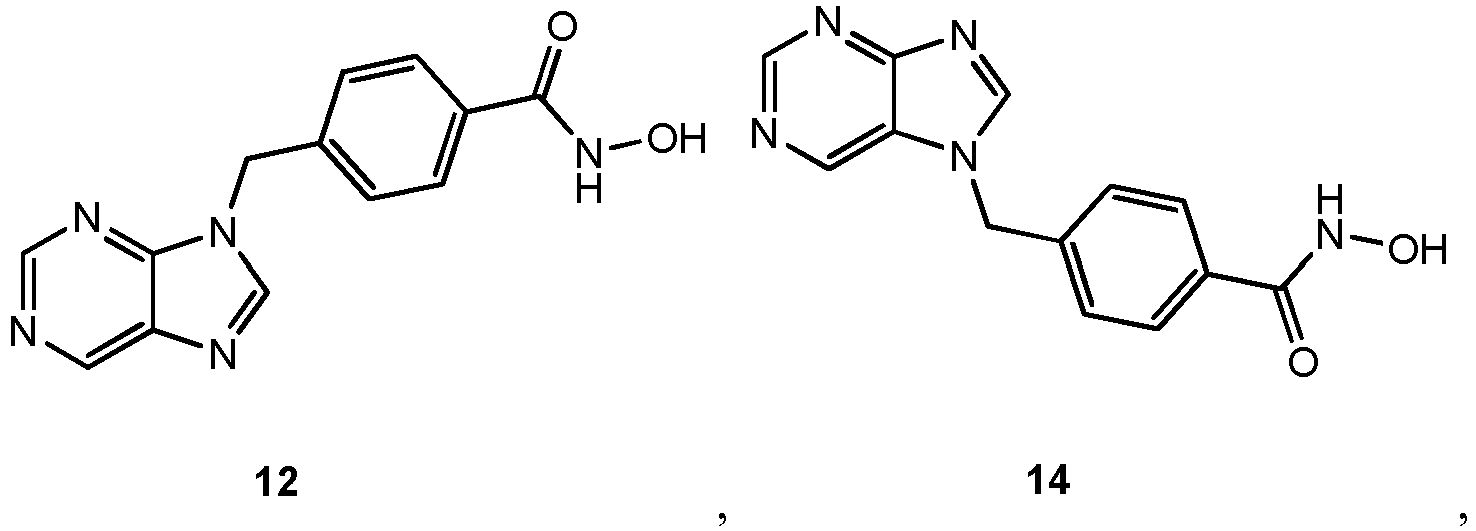


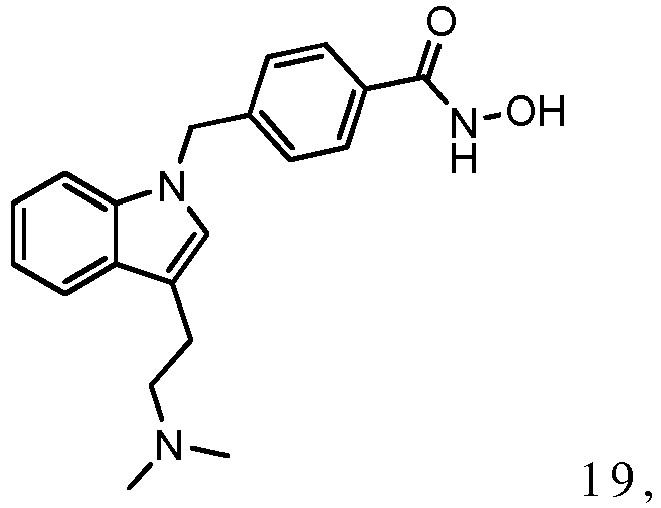
- A pharmaceutical composition comprising a compound of claim 1 and a pharmaceutically acceptable carrier or vehicle.
- The compound of claim 1 for the use in the treatment of cancer, psoriasis, fibroproliferative disorders (e.g., liver fibrosis), smooth muscle proliferative disorders (e.g., atherosclerosis, restenosis), neurodegenerative diseases, Alzheimer's, Parkinson's, spinocerebellar degeneration, Rett syndrome, peripheral neuropathies, Charcot-Marie-Tooth disease, Giant Axonal Neuropathy (GAN)), inflammatory diseases, osteoarthritis, rheumatoid arthritis, colitis, diseases involving angiogenesis, diabetic retinopathy, hematopoietic disorders, anemia, sickle cell anemia, thalasseimia, fungal infections, parasitic infections, malaria, trypanosomiasis, helminthiasis, protozoal infections, bacterial infections, viral infections, conditions treatable by immune modulation, autoimmune diabetes, lupus, atopic dermatitis, allergies, asthma, allergic rhinitis, inflammatory bowel disease, for improving grafting of transplants, arthritis, schizophrenia, muscular dystrophy, dentatorubralpallidoluysian atrophy (DRRLA), spinal and bulbar muscular atrophy (SBMA), fine spinocerebellar ataxias (SCA1, SCA2, SCA3/MJD (Machado-Joseph Disease), SCA6, and SCA7), drug-induced movement disorders, Creutzfeldt-Jakob disease, amyotrophic lateral sclerosis, Pick's disease, Lewy body dementia, cortico basal degeneration, dystonia, myoclonus, Tourette's syndrome, tremor, chorea, restless leg syndrome, Parkinsonian syndromes, anxiety, depression, psychosis, manic depression, Friedrich's ataxia , Fragile X syndrome, spinal muscular dystrophy, Rubinstein-Taybi syndrome, Wilson's disease, multi-infarct state, stroke, hypertension, diseases in which oxidative stress is a causative factor, associative memory loss following Aβ elevation, injuries to the CNS, Traumatic brain injury (TBI), acute and chronic neurodegenerative injury, ischemic stroke, multiple sclerosis (MS), Huntington's disease (HD), amyotrophic lateral sclerosis (ALS), spinal muscular atrophy (SMA), neuroinflammation associated with TBI, autism and autism spectrum disorders, toxoplasmosis, and optionally together with a therapeutically effective amount of a second therapeutic agent useful in the treatment of the disease or condition.
- The compound for use according to claim 3 wherein the disease is a cancer and the second therapeutic agent is one or more of a chemotherapeutic agent, radiation, and an immunotherapy.
Applications Claiming Priority (4)
| Application Number | Priority Date | Filing Date | Title |
|---|---|---|---|
| US201161438435P | 2011-02-01 | 2011-02-01 | |
| US201161443960P | 2011-02-17 | 2011-02-17 | |
| US201161554653P | 2011-11-02 | 2011-11-02 | |
| PCT/US2012/023332 WO2012106343A2 (en) | 2011-02-01 | 2012-01-31 | Hdac inhibitors and therapeutic methods using the same |
Publications (3)
| Publication Number | Publication Date |
|---|---|
| EP2670733A2 EP2670733A2 (en) | 2013-12-11 |
| EP2670733A4 EP2670733A4 (en) | 2014-07-09 |
| EP2670733B1 true EP2670733B1 (en) | 2019-04-10 |
Family
ID=46603265
Family Applications (1)
| Application Number | Title | Priority Date | Filing Date |
|---|---|---|---|
| EP12742236.8A Active EP2670733B1 (en) | 2011-02-01 | 2012-01-31 | N-hydroxybenzamide derivatives as hdac inhibitors and therapeutic methods using the same |
Country Status (6)
| Country | Link |
|---|---|
| US (2) | US9249087B2 (en) |
| EP (1) | EP2670733B1 (en) |
| AU (2) | AU2012212323A1 (en) |
| CA (1) | CA2825599C (en) |
| ES (1) | ES2734878T3 (en) |
| WO (1) | WO2012106343A2 (en) |
Families Citing this family (112)
| Publication number | Priority date | Publication date | Assignee | Title |
|---|---|---|---|---|
| DK3219705T3 (en) | 2005-12-28 | 2020-04-14 | Vertex Pharma | PHARMACEUTICAL COMPOSITIONS OF THE AMORPHIC FORM OF N- [2,4-BIS (1,1-DIMETHYLETHYL) -5-HYDROXYPHENYL] -1,4-DIHYDRO-4-OXOQUINOLIN-3-CARBOXAMIDE |
| UA103195C2 (en) | 2008-08-11 | 2013-09-25 | Глаксосмитклайн Ллк | PURCHASE DERIVATIVES FOR THE APPLICATION IN THE TREATMENT OF ALLERGIES, INFLAMMATORY AND INFECTIOUS DISEASES |
| CN105669540A (en) | 2009-01-28 | 2016-06-15 | 卡鲁斯治疗有限公司 | Scriptaid isosteres and their use in therapy |
| EP2845856A1 (en) | 2009-06-29 | 2015-03-11 | Incyte Corporation | Pyrimidinones as PI3K inhibitors |
| MX336731B (en) | 2010-01-28 | 2016-01-28 | Harvard College | Compositions and methods for enhancing proteasome activity. |
| ES2879314T3 (en) | 2010-08-18 | 2021-11-22 | Biosplice Therapeutics Inc | Dketones and hydroxyketones as activators of the catenin signaling pathway |
| TW201249844A (en) | 2010-12-20 | 2012-12-16 | Incyte Corp | N-(1-(substituted-phenyl)ethyl)-9H-purin-6-amines as PI3K inhibitors |
| US9249087B2 (en) | 2011-02-01 | 2016-02-02 | The Board Of Trustees Of The University Of Illinois | HDAC inhibitors and therapeutic methods using the same |
| US11466017B2 (en) | 2011-03-10 | 2022-10-11 | Board Of Regents, The University Of Texas System | Heterocyclic inhibitors of PTPN11 |
| RS58718B1 (en) | 2011-05-12 | 2019-06-28 | Proteostasis Therapeutics Inc | PROTEOSTASE REGULATORS |
| CA2840380A1 (en) * | 2011-06-24 | 2012-12-27 | Dana-Farber Cancer Institute, Inc. | Selective inhibitors of histone deacetylase isoform 6 and methods thereof |
| AU2012289042A1 (en) | 2011-07-22 | 2014-03-13 | Glaxosmithkline Llc | Composition |
| UA121539C2 (en) | 2011-09-02 | 2020-06-25 | Інсайт Холдинґс Корпорейшн | HETEROCYCLYLAMINE AS RI3K INHIBITORS |
| WO2013044028A2 (en) * | 2011-09-21 | 2013-03-28 | Texas A&M University System | Mycophenolic acid analogues as anti-tumor chemosensitizing agents |
| US9409858B2 (en) | 2012-03-07 | 2016-08-09 | H. Lee Moffitt Cancer Center And Research Institute, Inc. | Selective histone deactylase 6 inhibitors |
| US10039777B2 (en) | 2012-03-20 | 2018-08-07 | Neuro-Lm Sas | Methods and pharmaceutical compositions of the treatment of autistic syndrome disorders |
| AR090548A1 (en) | 2012-04-02 | 2014-11-19 | Incyte Corp | BICYCLIC AZAHETEROCICLOBENCILAMINS AS PI3K INHIBITORS |
| NZ702169A (en) | 2012-05-25 | 2016-10-28 | Berg Llc | The use of heat shock protein 90 (hsp90) modulators for the treatment of metabolic syndrome |
| MX359671B (en) | 2012-08-24 | 2018-10-05 | Glaxosmithkline Llc Star | Pyrazolopyrimidine compounds. |
| BR112015005627A2 (en) * | 2012-10-11 | 2017-08-08 | Hoffmann La Roche | compound, pharmaceutical composition, compound use, method of treatment and invention. |
| US9145412B2 (en) | 2012-11-02 | 2015-09-29 | Acetylon Pharmaceuticals, Inc. | Selective HDAC1 and HDAC2 inhibitors |
| IN2015DN03235A (en) | 2012-11-07 | 2015-10-02 | Karus Therapeutics Ltd | |
| WO2014081643A1 (en) | 2012-11-20 | 2014-05-30 | Glaxosmithkline Llc | Novel compounds |
| CA2890201A1 (en) | 2012-11-20 | 2014-05-30 | Glaxosmithkline Llc | Novel compounds |
| PL2922549T3 (en) | 2012-11-20 | 2017-11-30 | Glaxosmithkline Llc | Novel compounds |
| WO2014086478A1 (en) * | 2012-12-03 | 2014-06-12 | Helmholtz Zentrum München - Deutsches Forschungszentrum für Gesundheit und Umwelt (GmbH) | Inhibitors of malt1 protease |
| US9849135B2 (en) | 2013-01-25 | 2017-12-26 | President And Fellows Of Harvard College | USP14 inhibitors for treating or preventing viral infections |
| PL2968249T3 (en) | 2013-02-22 | 2019-06-28 | Samumed, Llc | Gamma-diketones as wnt/beta -catenin signaling pathway activators |
| TWI841376B (en) | 2013-03-01 | 2024-05-01 | 美商英塞特控股公司 | USE OF PYRAZOLOPYRIMIDINE DERIVATIVES FOR THE TREATMENT OF PI3Kδ RELATED DISORDERS |
| HUE041881T2 (en) * | 2013-04-29 | 2019-06-28 | Chong Kun Dang Pharmaceutical Corp | New compounds as selective histone deacetylase inhibitors and pharmaceutical compositions containing them |
| ES2688815T3 (en) * | 2013-05-10 | 2018-11-07 | Karus Therapeutics Limited | Novel histone deacetylase inhibitors |
| WO2015017546A1 (en) | 2013-07-30 | 2015-02-05 | H. Lee Moffitt Cancer Center And Research Institute, Inc. | Selective histone deactylase 6 inhibitors |
| AU2014306759B2 (en) | 2013-08-12 | 2018-04-26 | Pharmaceutical Manufacturing Research Services, Inc. | Extruded immediate release abuse deterrent pill |
| CN103467359B (en) * | 2013-09-27 | 2015-04-22 | 山东大学 | Cinnamon amides histone deacetylase inhibitor with benzpyrole and preparation method and application of same |
| ES2968371T3 (en) | 2013-10-10 | 2024-05-09 | Eastern Virginia Medical School | 4-((2-hydroxy-3-methoxybenzyl)amino)benzenesulfonamide derivatives as 12-lipoxygenase inhibitors |
| RU2016121868A (en) * | 2013-11-05 | 2017-12-08 | СИ ЭНД СИ БАЙОФАРМА, ЭлЭлСи | TREATMENT OF HEART REMODELING AND OTHER HEART CONDITIONS |
| WO2015073528A1 (en) | 2013-11-12 | 2015-05-21 | Proteostasis Therapeutics, Inc. | Proteasome activity enhancing compounds |
| EP3080125B1 (en) * | 2013-12-12 | 2018-10-10 | Chong Kun Dang Pharmaceutical Corp. | Novel azaindole derivatives as selective histone deacetylase (hdac) inhibitors and pharmaceutical compositions comprising the same |
| US9492444B2 (en) | 2013-12-17 | 2016-11-15 | Pharmaceutical Manufacturing Research Services, Inc. | Extruded extended release abuse deterrent pill |
| US10172797B2 (en) | 2013-12-17 | 2019-01-08 | Pharmaceutical Manufacturing Research Services, Inc. | Extruded extended release abuse deterrent pill |
| KR101685639B1 (en) * | 2014-01-03 | 2016-12-12 | 주식회사 종근당 | Indole Derivatives Compound, and the pharmaceutical composition comprising the same |
| CN103804334B (en) * | 2014-01-08 | 2016-06-08 | 石河子大学 | C is extracted from saussurea intybus15H18O5Method and application thereof |
| MX2016011833A (en) | 2014-03-12 | 2017-03-29 | Chong Kun Dang Pharmaceutical Corp | Novel compounds as histone deacetylase 6 inhibitors and pharmaceutical compositions comprising the same. |
| EP3116876A4 (en) * | 2014-03-13 | 2017-10-25 | Agency For Science, Technology And Research | Fused pyrimidine-based hydroxamate derivatives |
| WO2015157504A1 (en) | 2014-04-11 | 2015-10-15 | Taipei Medical University | Histone deacetylase inhibitors |
| WO2015188015A1 (en) * | 2014-06-04 | 2015-12-10 | Haro Pharmaceutical Inc. | 18-20 member bi-polycyclic compounds |
| WO2015188198A2 (en) | 2014-06-06 | 2015-12-10 | Berg Llc | Methods of treating a metabolic syndrome by modulating heat shock protein (hsp) 90-beta |
| US10077277B2 (en) | 2014-06-11 | 2018-09-18 | Incyte Corporation | Bicyclic heteroarylaminoalkyl phenyl derivatives as PI3K inhibitors |
| WO2015188368A1 (en) | 2014-06-13 | 2015-12-17 | Merck Sharp & Dohme Corp. | Pyrrolo[2,3-c]pyridines as imaging agents for neurofibrilary tangles |
| EP3169315B1 (en) | 2014-07-17 | 2020-06-24 | Pharmaceutical Manufacturing Research Services, Inc. | Immediate release abuse deterrent liquid fill dosage form |
| US9795550B2 (en) | 2014-08-20 | 2017-10-24 | Samumed, Llc | Gamma-diketones for treatment and prevention of aging skin and wrinkles |
| CN107250113B (en) | 2014-10-07 | 2019-03-29 | 弗特克斯药品有限公司 | Co-crystals of modulators of cystic fibrosis transmembrane conductance regulator proteins |
| US20160106737A1 (en) | 2014-10-20 | 2016-04-21 | Pharmaceutical Manufacturing Research Services, Inc. | Extended Release Abuse Deterrent Liquid Fill Dosage Form |
| GB201419228D0 (en) | 2014-10-29 | 2014-12-10 | Karus Therapeutics Ltd | Compounds |
| GB201419264D0 (en) | 2014-10-29 | 2014-12-10 | Karus Therapeutics Ltd | Compounds |
| US9616063B2 (en) | 2014-12-01 | 2017-04-11 | Astrazeneca Ab | 1-[2-(aminomethyl)benzyl]-2-thioxo-1,2,3,5-tetrahydro-4H-pyrrolo[3,2-d]pyrimidin-4-ones as inhibitors of myeloperoxidase |
| BR112017012504A2 (en) | 2014-12-12 | 2018-01-09 | Acetylon Pharmaceuticals, Inc. | piperidine derivatives as hdac1 / 2 inhibitors |
| WO2016110541A1 (en) | 2015-01-08 | 2016-07-14 | Universiteit Gent | Selective hdac6 inhibitors and uses thereof |
| WO2016126721A1 (en) | 2015-02-02 | 2016-08-11 | Forma Therapeutics, Inc. | 3-aryl-bicyclic [4,5,0] hydroxamic acids as hdac inhibitors |
| WO2016126726A1 (en) | 2015-02-02 | 2016-08-11 | Forma Therapeutics, Inc. | Bicyclic [4,6,0] hydroxamic acids as hdac6 inhibitors |
| UA122332C2 (en) | 2015-02-27 | 2020-10-26 | Інсайт Корпорейшн | Salts of pi3k inhibitor and processes for their preparation |
| EP3932914A1 (en) | 2015-03-13 | 2022-01-05 | Valo Health, Inc. | Alpha-cinnamide compounds and compositions as hdac8 inhibitors |
| WO2016183063A1 (en) | 2015-05-11 | 2016-11-17 | Incyte Corporation | Crystalline forms of a pi3k inhibitor |
| WO2016183060A1 (en) | 2015-05-11 | 2016-11-17 | Incyte Corporation | Process for the synthesis of a phosphoinositide 3-kinase inhibitor |
| US10836733B2 (en) | 2015-09-03 | 2020-11-17 | The Board Of Trustees Of The University Of Illinois | HDAC inhibitors and therapeutic methods using the same |
| WO2017053360A1 (en) * | 2015-09-22 | 2017-03-30 | The Board Of Trustees Of The University Of Illinois | Bicyclic and tricyclic cap bearing mercaptoacetamide derivatives as histone deacetylase inhibitors |
| CN105367479A (en) * | 2015-11-16 | 2016-03-02 | 青岛大学 | Histone deacetylase inhibitor 2-(1-(4-chlorobenzoyl)-5-methoxy-2-methyl-1 hydro-indole-3-yl-N-(2-(hydroxyamino)-2-ketoacyl) acetamide and preparation method and application thereof |
| US20200268720A1 (en) * | 2015-12-22 | 2020-08-27 | Glaxosmithkline Llc | Methods of use of a class iia hdac inhibitor |
| EP3442582A1 (en) | 2016-04-10 | 2019-02-20 | Yeda Research and Development Co. Ltd | Combinational therapies for treatment of cancer comprising a bacteriochlorophyll derivative |
| TWI659949B (en) * | 2016-05-16 | 2019-05-21 | 臺北醫學大學 | Histone deacetylase 6 inhibitors and use thereof |
| JP7044375B2 (en) | 2016-05-31 | 2022-03-30 | ボード オブ リージェンツ,ザ ユニバーシティ オブ テキサス システム | Heterocyclic inhibitor of PTPN11 |
| CN110526903B (en) * | 2016-06-01 | 2021-12-10 | 中国海洋大学 | Bisindolylmaleimide derivative and preparation method and application thereof |
| EP3472131B1 (en) | 2016-06-17 | 2020-02-19 | Forma Therapeutics, Inc. | 2-spiro-5- and 6-hydroxamic acid indanes as hdac inhibitors |
| WO2018075959A1 (en) * | 2016-10-20 | 2018-04-26 | Forma Therapeutics, Inc. | Methods using hdac11 inhibitors |
| US20180117029A1 (en) * | 2016-11-03 | 2018-05-03 | Beth Israel Deaconess Medical Center, Inc. | Targeting Metabolic Vulnerability in Triple-Negative Breast Cancer |
| JP7183178B2 (en) * | 2017-04-11 | 2022-12-05 | ザ ジェネラル ホスピタル コーポレイション | HDAC6 inhibitors and contrast agents |
| IT201700041723A1 (en) * | 2017-04-14 | 2018-10-14 | Italfarmaco Spa | New HDAC6 selective inhibitors |
| EP3624804B1 (en) | 2017-05-16 | 2022-02-16 | Annji Pharmaceutical Co., Ltd. | Histone deacetylases (hdacs) inhibitors |
| CN107149601B (en) * | 2017-05-25 | 2020-04-17 | 中国中医科学院中药研究所 | Application of artemisinin compound in preparation of medicine for treating neuropathic pain and/or complications |
| KR102236356B1 (en) | 2017-11-24 | 2021-04-05 | 주식회사 종근당 | Compositions for Preventing or Treating Lupus |
| CN110054625B (en) * | 2018-01-18 | 2022-01-07 | 山东大学 | N-acylbenzenesulfonamide hydroxamic acid Bcl-2 and HDAC double-target inhibitor, and preparation method and application thereof |
| US10815250B2 (en) | 2018-02-06 | 2020-10-27 | Ideaya Biosciences, Inc. | AhR modulators |
| KR20190118251A (en) * | 2018-04-10 | 2019-10-18 | 주식회사 종근당 | Compositions for Preventing or Treating Dry Eye |
| JP7297871B2 (en) | 2018-05-02 | 2023-06-26 | ナビール ファーマ,インコーポレイティド | Substituted heterocyclic inhibitors of PTPN11 |
| MX2020012826A (en) | 2018-06-01 | 2021-03-09 | Incyte Corp | DOSAGE REGIMEN FOR THE TREATMENT OF DISORDERS RELATED TO PHOSPHATIDYLINOSITOL 3-KINASES (PI3K). |
| CN108821947B (en) * | 2018-06-07 | 2021-03-30 | 中国科学院昆明植物研究所 | 8S-dec-9-ene-4,6-diyne-1,8-diol and its pharmaceutical composition and application |
| US12448374B2 (en) | 2018-06-07 | 2025-10-21 | Disarm Therapeutics, Inc. | Inhibitors of SARM1 |
| MA52813A (en) | 2018-06-07 | 2021-04-14 | Disarm Therapeutics Inc | SARM1 INHIBITORS |
| EP3801503A4 (en) | 2018-06-07 | 2021-12-08 | Disarm Therapeutics, Inc. | SARM1 INHIBITORS |
| WO2020033828A1 (en) | 2018-08-10 | 2020-02-13 | Board Of Regents, The University Of Texas System | 6-(4-amino-3-methyl-2-oxa-8-azaspiro[4.5]decan-8-yl)-3-(2,3-dichlorophenyl)-2-methylpyrimidin-4(3h)-one derivatives and related compounds as ptpn11 (shp2) inhibitors for treating cancer |
| CN110872268B (en) * | 2018-09-03 | 2023-07-25 | 复旦大学 | Isocoumarin derivatives, preparation method and medicinal use thereof |
| PT3860998T (en) | 2018-10-05 | 2024-04-02 | Annapurna Bio Inc | Compounds and compositions for treating conditions associated with apj receptor activity |
| US20220296599A1 (en) * | 2018-10-12 | 2022-09-22 | Chong Kun Dang Pharmaceutical Corp. | Pharmaceutical composition comprising histone deacetylase inhibitor and methotrexate |
| ES3013256T3 (en) | 2018-10-30 | 2025-04-11 | Gilead Sciences Inc | Imidazo[1,2-a]pyridine derivatives as alpha4beta7 integrin inhibitors for the treatment of inflammatory diseases |
| KR102630416B1 (en) | 2018-10-30 | 2024-02-01 | 길리애드 사이언시즈, 인코포레이티드 | Quinoline derivatives as alpha4beta7 integrin inhibitors |
| US11179383B2 (en) | 2018-10-30 | 2021-11-23 | Gilead Sciences, Inc. | Compounds for inhibition of α4β7 integrin |
| AU2019373242B2 (en) | 2018-10-30 | 2023-07-13 | Gilead Sciences, Inc. | Compounds for inhibition of alpha 4 beta 7 integrin |
| ES2974634T3 (en) | 2018-12-21 | 2024-06-28 | Celgene Corp | Thienopyridine inhibitors of RIPK2 |
| PH12021551324A1 (en) | 2019-01-08 | 2022-04-25 | Kyorin Seiyaku Kk | 15-pgdh inhibitor |
| US12304897B2 (en) | 2019-01-31 | 2025-05-20 | Kyorin Pharmaceutical Co., Ltd. | 15-PGDH inhibitors |
| ES2960987T3 (en) | 2019-04-12 | 2024-03-07 | Riboscience Llc | Bicyclic heteroaryl derivatives as inhibitors of ectonucleotide pyrophosphatase phosphodiesterase 1 |
| CN114555089A (en) * | 2019-08-08 | 2022-05-27 | 新加坡科技研究局 | Compounds for the treatment of hepatitis B |
| CN114222730B (en) | 2019-08-14 | 2024-09-10 | 吉利德科学公司 | Compounds for inhibiting α4β7 integrin |
| MX2022003769A (en) | 2019-10-03 | 2022-04-20 | Bristol Myers Squibb Co | INDAZOL CARBOXAMIDES AS KINASE INHIBITORS. |
| CN114980887A (en) | 2019-12-20 | 2022-08-30 | 特纳亚治疗股份有限公司 | Fluoroalkyl-oxadiazoles and their uses |
| US11266740B1 (en) * | 2020-09-04 | 2022-03-08 | King Abdulaziz University | Noble metal nanoparticles with radial pores |
| WO2022235842A1 (en) | 2021-05-04 | 2022-11-10 | Tenaya Therapeutics, Inc. | 2-fluoroalkyl-1,3,4-oxadiazol-5-yl-thiazol, hdac6 inhibitors for use in the treatment of metabolic disease and hfpef |
| CN113288902A (en) * | 2021-06-07 | 2021-08-24 | 长春中医药大学 | Application of fritillaria cirrhosa in preparation of medicine for preventing and/or treating ulcerative colitis |
| JP2025501630A (en) * | 2021-12-24 | 2025-01-22 | サイロ プロプライエタリ リミテッド | Compound |
| CN114907417B (en) * | 2022-06-10 | 2024-04-19 | 中国人民解放军空军军医大学 | A tetravalent platinum ternary complex containing artesunate and nonsteroidal anti-inflammatory drugs and its preparation method and application |
| WO2025079110A1 (en) * | 2023-10-11 | 2025-04-17 | Peptris Technologies Private Limited | Atovaquone for the treatment and management of muscular dystrophies |
| WO2026039412A1 (en) | 2024-08-12 | 2026-02-19 | Genzyme Corporation | Methods and compositions for raav production |
Citations (6)
| Publication number | Priority date | Publication date | Assignee | Title |
|---|---|---|---|---|
| EP0341231A1 (en) * | 1988-04-28 | 1989-11-08 | U C B, S.A. | Substituted 1-(1H-imidazol-4-yl)alkyl benzamides |
| WO2001070675A2 (en) * | 2000-03-24 | 2001-09-27 | Methylgene, Inc. | Inhibitors of histone deacetylase |
| US6541661B1 (en) * | 1999-11-23 | 2003-04-01 | Methylgene, Inc. | Inhibitors of histone deacetylase |
| WO2009055917A1 (en) * | 2007-11-02 | 2009-05-07 | Methylgene Inc. | Inhibitors of histone deacetylase |
| WO2010100475A1 (en) * | 2009-03-02 | 2010-09-10 | Astrazeneca Ab | Hydroxamic acid derivatives as gram-negative antibacterial agents |
| WO2011021209A1 (en) * | 2009-07-07 | 2011-02-24 | Portsmouth Technologies Llc | Histone deacetylase inhibitors |
Family Cites Families (16)
| Publication number | Priority date | Publication date | Assignee | Title |
|---|---|---|---|---|
| EP0887348A1 (en) | 1997-06-25 | 1998-12-30 | Boehringer Mannheim Italia S.p.A. | Bis-Indole derivatives having antimetastatic activity, a process for their preparation and pharmaceutical compositions containing them |
| US6437146B1 (en) | 1998-09-25 | 2002-08-20 | Fujisawa Pharmaceutical Co., Ltd. | Oxazole compounds as prostaglandin e2 agonists or antagonists |
| ATE443260T1 (en) | 2002-01-10 | 2009-10-15 | Univ Johns Hopkins | CONTRAST AGENTS AND METHOD FOR IMAGING NAALDASE OR PSMA |
| ATE395343T1 (en) | 2002-03-13 | 2008-05-15 | Janssen Pharmaceutica Nv | SULFONYL DERIVATIVES AS HISTONE DEACETYLASE INHIBITORS |
| WO2004076386A2 (en) | 2003-02-25 | 2004-09-10 | Topotarget Uk Limited | Carbamic acid compounds comprising a bicyclic heteroaryl group as hdac inhibitors |
| US7501518B2 (en) | 2003-04-22 | 2009-03-10 | Genzyme Corporation | Methods of making 2,6-diaryl piperidine derivatives |
| US20080319012A1 (en) | 2004-04-21 | 2008-12-25 | In2Gen Co., Ltd. | 2-Pyridyl substituted imidazoles as ALK5 and/or ALK4 inhibitors |
| US20080200521A1 (en) | 2005-06-30 | 2008-08-21 | Bexel Pharmaceuticals. Inc. | Novel hydroxamic acid containing amino acid derivatives |
| EP1940805A4 (en) | 2005-08-26 | 2009-11-11 | Methylgene Inc | Benzodiazepine and benzopiperazine analog inhibitors of histone deacetylase |
| CA2659478A1 (en) | 2006-08-03 | 2008-02-14 | Georgetown University | Isoform-selective hdac inhibitors |
| EP2049483A2 (en) * | 2006-10-28 | 2009-04-22 | Methylgene, Inc. | Inhibitors of histone deacetylase |
| DE102007047738A1 (en) | 2007-10-05 | 2009-04-09 | Merck Patent Gmbh | imidazole derivatives |
| CN101932325B (en) | 2007-11-30 | 2014-05-28 | 新联基因公司 | Ido inhibitors |
| US8431538B2 (en) | 2009-07-22 | 2013-04-30 | The Board Of Trustees Of The University Of Illinois | HDAC inhibitors and therapeutic methods of using same |
| US9249087B2 (en) | 2011-02-01 | 2016-02-02 | The Board Of Trustees Of The University Of Illinois | HDAC inhibitors and therapeutic methods using the same |
| CA2840380A1 (en) | 2011-06-24 | 2012-12-27 | Dana-Farber Cancer Institute, Inc. | Selective inhibitors of histone deacetylase isoform 6 and methods thereof |
-
2012
- 2012-01-31 US US13/985,760 patent/US9249087B2/en not_active Ceased
- 2012-01-31 ES ES12742236T patent/ES2734878T3/en active Active
- 2012-01-31 US US15/182,061 patent/USRE47009E1/en active Active
- 2012-01-31 AU AU2012212323A patent/AU2012212323A1/en not_active Abandoned
- 2012-01-31 CA CA2825599A patent/CA2825599C/en active Active
- 2012-01-31 WO PCT/US2012/023332 patent/WO2012106343A2/en not_active Ceased
- 2012-01-31 EP EP12742236.8A patent/EP2670733B1/en active Active
-
2017
- 2017-04-13 AU AU2017202477A patent/AU2017202477B2/en active Active
Patent Citations (6)
| Publication number | Priority date | Publication date | Assignee | Title |
|---|---|---|---|---|
| EP0341231A1 (en) * | 1988-04-28 | 1989-11-08 | U C B, S.A. | Substituted 1-(1H-imidazol-4-yl)alkyl benzamides |
| US6541661B1 (en) * | 1999-11-23 | 2003-04-01 | Methylgene, Inc. | Inhibitors of histone deacetylase |
| WO2001070675A2 (en) * | 2000-03-24 | 2001-09-27 | Methylgene, Inc. | Inhibitors of histone deacetylase |
| WO2009055917A1 (en) * | 2007-11-02 | 2009-05-07 | Methylgene Inc. | Inhibitors of histone deacetylase |
| WO2010100475A1 (en) * | 2009-03-02 | 2010-09-10 | Astrazeneca Ab | Hydroxamic acid derivatives as gram-negative antibacterial agents |
| WO2011021209A1 (en) * | 2009-07-07 | 2011-02-24 | Portsmouth Technologies Llc | Histone deacetylase inhibitors |
Non-Patent Citations (9)
| Title |
|---|
| ALLAN D. HEADLEY ET AL: "Effects of solvents on the tautomerization ofN,N-dimethylglycine", JOURNAL OF PHYSICAL ORGANIC CHEMISTRY, vol. 10, no. 12, 1 December 1997 (1997-12-01), pages 898 - 900, XP055185605, ISSN: 0894-3230, DOI: 10.1002/(SICI)1099-1395(199712)10:12<898::AID-POC959>3.0.CO;2-K * |
| C DELL'ERBA: "[alpha]-arylation vs. [alpha]-arylhydrazonylation of alkyl aryl ketones with arylazo tert-butyl sulfides", TETRAHEDRON, vol. 49, no. 1, 1 January 1993 (1993-01-01), pages 235 - 242, XP055003234, ISSN: 0040-4020, DOI: 10.1016/S0040-4020(01)80522-6 * |
| FAUL M M ET AL: "A New One Step Synthesis of Maleimides by Condensation of Glyoxylate Esters with Acetamides", TETRAHEDRON LETTERS, PERGAMON, GB, vol. 40, no. 6, 5 February 1999 (1999-02-05), pages 1109 - 1112, XP004152472, ISSN: 0040-4039, DOI: 10.1016/S0040-4039(98)02594-5 * |
| KAWASE M ET AL: "In vitro susceptibility of helicobacter pylori to trifluoromethyl ketones", BIOORGANIC & MEDICINAL CHEMISTRY LETTERS, PERGAMON, AMSTERDAM, NL, vol. 9, no. 2, 18 January 1999 (1999-01-18), pages 193 - 194, XP004152598, ISSN: 0960-894X, DOI: 10.1016/S0960-894X(98)00726-4 * |
| LAUTENS M ET AL: "RHODIUM-CATALYZED HECK-TYPE COUPLING OF BORONIC ACIDS WITH ACTIVATED ALKENES IN AN AQUEOUS EMULSION", SYNTHESIS, GEORG THIEME VERLAG, STUTTGART, DE, vol. 12, no. 12, 1 January 2004 (2004-01-01), pages 2006 - 2014, XP001205153, ISSN: 0039-7881, DOI: 10.1055/S-2004-829161 * |
| P. H. NELSON ET AL: "Synthesis and antiinflammatory activity of some 1,6-methano[10]annuleneacetic acids", JOURNAL OF MEDICINAL CHEMISTRY, vol. 18, no. 6, 1 June 1975 (1975-06-01), pages 583 - 586, XP055185510, ISSN: 0022-2623, DOI: 10.1021/jm00240a012 * |
| SEISHI TAKAGI ET AL: "Synthesis of Indolil Aryl 1, 2-Diketones", PHARMACEUTICAL BULLETIN, vol. 5, no. 6, 1 January 1957 (1957-01-01), pages 617 - 618, XP055185529, ISSN: 0369-9471, DOI: 10.1248/cpb1953.5.617 * |
| SMITH D G ET AL: "3-Anilino-4-arylmaleimides: potent and selective inhibitors of glycogen synthase kinase-3 (GSK-3)", BIOORGANIC & MEDICINAL CHEMISTRY LETTERS, PERGAMON, AMSTERDAM, NL, vol. 11, no. 5, 12 March 2001 (2001-03-12), pages 635 - 639, XP004230079, ISSN: 0960-894X, DOI: 10.1016/S0960-894X(00)00721-6 * |
| TOMOYA KITAZUME ET AL: "A synthetic approach to seven-membered lactones by the microbial transformation of ynones having a trifluoromethyl group", JOURNAL OF FLUORINE CHEMISTRY, vol. 30, no. 2, 1 November 1985 (1985-11-01), NL, pages 189 - 202, XP055230603, ISSN: 0022-1139, DOI: 10.1016/S0022-1139(00)80888-X * |
Also Published As
| Publication number | Publication date |
|---|---|
| USRE47009E1 (en) | 2018-08-28 |
| WO2012106343A2 (en) | 2012-08-09 |
| EP2670733A4 (en) | 2014-07-09 |
| WO2012106343A3 (en) | 2012-10-04 |
| CA2825599C (en) | 2021-07-13 |
| CA2825599A1 (en) | 2012-08-09 |
| ES2734878T3 (en) | 2019-12-12 |
| US20140128408A1 (en) | 2014-05-08 |
| EP2670733A2 (en) | 2013-12-11 |
| AU2017202477B2 (en) | 2018-12-13 |
| US9249087B2 (en) | 2016-02-02 |
| AU2017202477A1 (en) | 2017-05-04 |
| AU2012212323A1 (en) | 2013-09-12 |
Similar Documents
| Publication | Publication Date | Title |
|---|---|---|
| AU2017202477B2 (en) | HDAC inhibitors and therapeutic methods using the same | |
| EP2456757B1 (en) | Hdac inhibitors and therapeutic methods using the same | |
| US10934255B2 (en) | Nrf and HIF activators/HDAC inhibitors and therapeutic methods using the same | |
| US11739064B2 (en) | HDAC inhibitors and therapeutic methods using the same | |
| US12522572B2 (en) | Isoxazole hydroxamic acids as histone deacetylase 6 inhibitors | |
| CN1964716A (en) | Isoquinoline derivatives and methods of use thereof | |
| WO2017053360A1 (en) | Bicyclic and tricyclic cap bearing mercaptoacetamide derivatives as histone deacetylase inhibitors | |
| HK40022422A (en) | Nrf and hif activators/hdac inhibitors and therapeutic methods using the same |
Legal Events
| Date | Code | Title | Description |
|---|---|---|---|
| PUAI | Public reference made under article 153(3) epc to a published international application that has entered the european phase |
Free format text: ORIGINAL CODE: 0009012 |
|
| 17P | Request for examination filed |
Effective date: 20130830 |
|
| AK | Designated contracting states |
Kind code of ref document: A2 Designated state(s): AL AT BE BG CH CY CZ DE DK EE ES FI FR GB GR HR HU IE IS IT LI LT LU LV MC MK MT NL NO PL PT RO RS SE SI SK SM TR |
|
| DAX | Request for extension of the european patent (deleted) | ||
| A4 | Supplementary search report drawn up and despatched |
Effective date: 20140612 |
|
| RIC1 | Information provided on ipc code assigned before grant |
Ipc: A61K 31/404 20060101ALI20140605BHEP Ipc: C07D 487/04 20060101ALI20140605BHEP Ipc: A61P 35/00 20060101ALI20140605BHEP Ipc: C07D 209/12 20060101AFI20140605BHEP Ipc: C07D 209/20 20060101ALI20140605BHEP |
|
| 17Q | First examination report despatched |
Effective date: 20150429 |
|
| STAA | Information on the status of an ep patent application or granted ep patent |
Free format text: STATUS: EXAMINATION IS IN PROGRESS |
|
| GRAP | Despatch of communication of intention to grant a patent |
Free format text: ORIGINAL CODE: EPIDOSNIGR1 |
|
| STAA | Information on the status of an ep patent application or granted ep patent |
Free format text: STATUS: GRANT OF PATENT IS INTENDED |
|
| INTG | Intention to grant announced |
Effective date: 20180809 |
|
| GRAS | Grant fee paid |
Free format text: ORIGINAL CODE: EPIDOSNIGR3 |
|
| GRAJ | Information related to disapproval of communication of intention to grant by the applicant or resumption of examination proceedings by the epo deleted |
Free format text: ORIGINAL CODE: EPIDOSDIGR1 |
|
| GRAL | Information related to payment of fee for publishing/printing deleted |
Free format text: ORIGINAL CODE: EPIDOSDIGR3 |
|
| STAA | Information on the status of an ep patent application or granted ep patent |
Free format text: STATUS: EXAMINATION IS IN PROGRESS |
|
| INTC | Intention to grant announced (deleted) | ||
| GRAR | Information related to intention to grant a patent recorded |
Free format text: ORIGINAL CODE: EPIDOSNIGR71 |
|
| STAA | Information on the status of an ep patent application or granted ep patent |
Free format text: STATUS: GRANT OF PATENT IS INTENDED |
|
| INTG | Intention to grant announced |
Effective date: 20190130 |
|
| GRAA | (expected) grant |
Free format text: ORIGINAL CODE: 0009210 |
|
| STAA | Information on the status of an ep patent application or granted ep patent |
Free format text: STATUS: THE PATENT HAS BEEN GRANTED |
|
| AK | Designated contracting states |
Kind code of ref document: B1 Designated state(s): AL AT BE BG CH CY CZ DE DK EE ES FI FR GB GR HR HU IE IS IT LI LT LU LV MC MK MT NL NO PL PT RO RS SE SI SK SM TR |
|
| REG | Reference to a national code |
Ref country code: GB Ref legal event code: FG4D |
|
| REG | Reference to a national code |
Ref country code: CH Ref legal event code: EP Ref country code: AT Ref legal event code: REF Ref document number: 1118457 Country of ref document: AT Kind code of ref document: T Effective date: 20190415 |
|
| REG | Reference to a national code |
Ref country code: IE Ref legal event code: FG4D |
|
| REG | Reference to a national code |
Ref country code: DE Ref legal event code: R096 Ref document number: 602012058836 Country of ref document: DE |
|
| REG | Reference to a national code |
Ref country code: CH Ref legal event code: NV Representative=s name: HEPP WENGER RYFFEL AG, CH |
|
| REG | Reference to a national code |
Ref country code: NL Ref legal event code: MP Effective date: 20190410 |
|
| REG | Reference to a national code |
Ref country code: LT Ref legal event code: MG4D |
|
| REG | Reference to a national code |
Ref country code: AT Ref legal event code: MK05 Ref document number: 1118457 Country of ref document: AT Kind code of ref document: T Effective date: 20190410 |
|
| PG25 | Lapsed in a contracting state [announced via postgrant information from national office to epo] |
Ref country code: NL Free format text: LAPSE BECAUSE OF FAILURE TO SUBMIT A TRANSLATION OF THE DESCRIPTION OR TO PAY THE FEE WITHIN THE PRESCRIBED TIME-LIMIT Effective date: 20190410 |
|
| PG25 | Lapsed in a contracting state [announced via postgrant information from national office to epo] |
Ref country code: SE Free format text: LAPSE BECAUSE OF FAILURE TO SUBMIT A TRANSLATION OF THE DESCRIPTION OR TO PAY THE FEE WITHIN THE PRESCRIBED TIME-LIMIT Effective date: 20190410 Ref country code: AL Free format text: LAPSE BECAUSE OF FAILURE TO SUBMIT A TRANSLATION OF THE DESCRIPTION OR TO PAY THE FEE WITHIN THE PRESCRIBED TIME-LIMIT Effective date: 20190410 Ref country code: PT Free format text: LAPSE BECAUSE OF FAILURE TO SUBMIT A TRANSLATION OF THE DESCRIPTION OR TO PAY THE FEE WITHIN THE PRESCRIBED TIME-LIMIT Effective date: 20190910 Ref country code: LT Free format text: LAPSE BECAUSE OF FAILURE TO SUBMIT A TRANSLATION OF THE DESCRIPTION OR TO PAY THE FEE WITHIN THE PRESCRIBED TIME-LIMIT Effective date: 20190410 Ref country code: HR Free format text: LAPSE BECAUSE OF FAILURE TO SUBMIT A TRANSLATION OF THE DESCRIPTION OR TO PAY THE FEE WITHIN THE PRESCRIBED TIME-LIMIT Effective date: 20190410 Ref country code: NO Free format text: LAPSE BECAUSE OF FAILURE TO SUBMIT A TRANSLATION OF THE DESCRIPTION OR TO PAY THE FEE WITHIN THE PRESCRIBED TIME-LIMIT Effective date: 20190710 Ref country code: FI Free format text: LAPSE BECAUSE OF FAILURE TO SUBMIT A TRANSLATION OF THE DESCRIPTION OR TO PAY THE FEE WITHIN THE PRESCRIBED TIME-LIMIT Effective date: 20190410 |
|
| PG25 | Lapsed in a contracting state [announced via postgrant information from national office to epo] |
Ref country code: GR Free format text: LAPSE BECAUSE OF FAILURE TO SUBMIT A TRANSLATION OF THE DESCRIPTION OR TO PAY THE FEE WITHIN THE PRESCRIBED TIME-LIMIT Effective date: 20190711 Ref country code: PL Free format text: LAPSE BECAUSE OF FAILURE TO SUBMIT A TRANSLATION OF THE DESCRIPTION OR TO PAY THE FEE WITHIN THE PRESCRIBED TIME-LIMIT Effective date: 20190410 Ref country code: LV Free format text: LAPSE BECAUSE OF FAILURE TO SUBMIT A TRANSLATION OF THE DESCRIPTION OR TO PAY THE FEE WITHIN THE PRESCRIBED TIME-LIMIT Effective date: 20190410 Ref country code: BG Free format text: LAPSE BECAUSE OF FAILURE TO SUBMIT A TRANSLATION OF THE DESCRIPTION OR TO PAY THE FEE WITHIN THE PRESCRIBED TIME-LIMIT Effective date: 20190710 Ref country code: RS Free format text: LAPSE BECAUSE OF FAILURE TO SUBMIT A TRANSLATION OF THE DESCRIPTION OR TO PAY THE FEE WITHIN THE PRESCRIBED TIME-LIMIT Effective date: 20190410 |
|
| REG | Reference to a national code |
Ref country code: ES Ref legal event code: FG2A Ref document number: 2734878 Country of ref document: ES Kind code of ref document: T3 Effective date: 20191212 |
|
| PG25 | Lapsed in a contracting state [announced via postgrant information from national office to epo] |
Ref country code: IS Free format text: LAPSE BECAUSE OF FAILURE TO SUBMIT A TRANSLATION OF THE DESCRIPTION OR TO PAY THE FEE WITHIN THE PRESCRIBED TIME-LIMIT Effective date: 20190810 Ref country code: AT Free format text: LAPSE BECAUSE OF FAILURE TO SUBMIT A TRANSLATION OF THE DESCRIPTION OR TO PAY THE FEE WITHIN THE PRESCRIBED TIME-LIMIT Effective date: 20190410 |
|
| REG | Reference to a national code |
Ref country code: DE Ref legal event code: R097 Ref document number: 602012058836 Country of ref document: DE |
|
| PG25 | Lapsed in a contracting state [announced via postgrant information from national office to epo] |
Ref country code: DK Free format text: LAPSE BECAUSE OF FAILURE TO SUBMIT A TRANSLATION OF THE DESCRIPTION OR TO PAY THE FEE WITHIN THE PRESCRIBED TIME-LIMIT Effective date: 20190410 Ref country code: SK Free format text: LAPSE BECAUSE OF FAILURE TO SUBMIT A TRANSLATION OF THE DESCRIPTION OR TO PAY THE FEE WITHIN THE PRESCRIBED TIME-LIMIT Effective date: 20190410 Ref country code: CZ Free format text: LAPSE BECAUSE OF FAILURE TO SUBMIT A TRANSLATION OF THE DESCRIPTION OR TO PAY THE FEE WITHIN THE PRESCRIBED TIME-LIMIT Effective date: 20190410 Ref country code: EE Free format text: LAPSE BECAUSE OF FAILURE TO SUBMIT A TRANSLATION OF THE DESCRIPTION OR TO PAY THE FEE WITHIN THE PRESCRIBED TIME-LIMIT Effective date: 20190410 Ref country code: RO Free format text: LAPSE BECAUSE OF FAILURE TO SUBMIT A TRANSLATION OF THE DESCRIPTION OR TO PAY THE FEE WITHIN THE PRESCRIBED TIME-LIMIT Effective date: 20190410 |
|
| PLBE | No opposition filed within time limit |
Free format text: ORIGINAL CODE: 0009261 |
|
| STAA | Information on the status of an ep patent application or granted ep patent |
Free format text: STATUS: NO OPPOSITION FILED WITHIN TIME LIMIT |
|
| PG25 | Lapsed in a contracting state [announced via postgrant information from national office to epo] |
Ref country code: SM Free format text: LAPSE BECAUSE OF FAILURE TO SUBMIT A TRANSLATION OF THE DESCRIPTION OR TO PAY THE FEE WITHIN THE PRESCRIBED TIME-LIMIT Effective date: 20190410 |
|
| 26N | No opposition filed |
Effective date: 20200113 |
|
| PG25 | Lapsed in a contracting state [announced via postgrant information from national office to epo] |
Ref country code: TR Free format text: LAPSE BECAUSE OF FAILURE TO SUBMIT A TRANSLATION OF THE DESCRIPTION OR TO PAY THE FEE WITHIN THE PRESCRIBED TIME-LIMIT Effective date: 20190410 |
|
| PG25 | Lapsed in a contracting state [announced via postgrant information from national office to epo] |
Ref country code: SI Free format text: LAPSE BECAUSE OF FAILURE TO SUBMIT A TRANSLATION OF THE DESCRIPTION OR TO PAY THE FEE WITHIN THE PRESCRIBED TIME-LIMIT Effective date: 20190410 |
|
| PG25 | Lapsed in a contracting state [announced via postgrant information from national office to epo] |
Ref country code: MC Free format text: LAPSE BECAUSE OF FAILURE TO SUBMIT A TRANSLATION OF THE DESCRIPTION OR TO PAY THE FEE WITHIN THE PRESCRIBED TIME-LIMIT Effective date: 20190410 |
|
| REG | Reference to a national code |
Ref country code: BE Ref legal event code: MM Effective date: 20200131 |
|
| PG25 | Lapsed in a contracting state [announced via postgrant information from national office to epo] |
Ref country code: LU Free format text: LAPSE BECAUSE OF NON-PAYMENT OF DUE FEES Effective date: 20200131 |
|
| PG25 | Lapsed in a contracting state [announced via postgrant information from national office to epo] |
Ref country code: BE Free format text: LAPSE BECAUSE OF NON-PAYMENT OF DUE FEES Effective date: 20200131 |
|
| PG25 | Lapsed in a contracting state [announced via postgrant information from national office to epo] |
Ref country code: IE Free format text: LAPSE BECAUSE OF NON-PAYMENT OF DUE FEES Effective date: 20200131 |
|
| PG25 | Lapsed in a contracting state [announced via postgrant information from national office to epo] |
Ref country code: MT Free format text: LAPSE BECAUSE OF FAILURE TO SUBMIT A TRANSLATION OF THE DESCRIPTION OR TO PAY THE FEE WITHIN THE PRESCRIBED TIME-LIMIT Effective date: 20190410 Ref country code: CY Free format text: LAPSE BECAUSE OF FAILURE TO SUBMIT A TRANSLATION OF THE DESCRIPTION OR TO PAY THE FEE WITHIN THE PRESCRIBED TIME-LIMIT Effective date: 20190410 |
|
| PG25 | Lapsed in a contracting state [announced via postgrant information from national office to epo] |
Ref country code: MK Free format text: LAPSE BECAUSE OF FAILURE TO SUBMIT A TRANSLATION OF THE DESCRIPTION OR TO PAY THE FEE WITHIN THE PRESCRIBED TIME-LIMIT Effective date: 20190410 |
|
| PGFP | Annual fee paid to national office [announced via postgrant information from national office to epo] |
Ref country code: GB Payment date: 20241219 Year of fee payment: 14 |
|
| PGFP | Annual fee paid to national office [announced via postgrant information from national office to epo] |
Ref country code: FR Payment date: 20241223 Year of fee payment: 14 |
|
| PGFP | Annual fee paid to national office [announced via postgrant information from national office to epo] |
Ref country code: DE Payment date: 20241217 Year of fee payment: 14 |
|
| PGFP | Annual fee paid to national office [announced via postgrant information from national office to epo] |
Ref country code: ES Payment date: 20250207 Year of fee payment: 14 |
|
| PGFP | Annual fee paid to national office [announced via postgrant information from national office to epo] |
Ref country code: CH Payment date: 20250201 Year of fee payment: 14 |
|
| PGFP | Annual fee paid to national office [announced via postgrant information from national office to epo] |
Ref country code: IT Payment date: 20241230 Year of fee payment: 14 |