EP2670410B1 - Antimicrobial 4-oxoquinolizines - Google Patents
Antimicrobial 4-oxoquinolizines Download PDFInfo
- Publication number
- EP2670410B1 EP2670410B1 EP12702023.8A EP12702023A EP2670410B1 EP 2670410 B1 EP2670410 B1 EP 2670410B1 EP 12702023 A EP12702023 A EP 12702023A EP 2670410 B1 EP2670410 B1 EP 2670410B1
- Authority
- EP
- European Patent Office
- Prior art keywords
- methyl
- cyclopropyl
- quinolizine
- oxo
- carboxylic acid
- Prior art date
- Legal status (The legal status is an assumption and is not a legal conclusion. Google has not performed a legal analysis and makes no representation as to the accuracy of the status listed.)
- Active
Links
- ZUVKZCTUVRLOAQ-UHFFFAOYSA-N quinolizin-4-one Chemical class C1=CC=CN2C(=O)C=CC=C21 ZUVKZCTUVRLOAQ-UHFFFAOYSA-N 0.000 title description 111
- 230000000845 anti-microbial effect Effects 0.000 title description 15
- 150000001875 compounds Chemical class 0.000 claims description 256
- 239000000203 mixture Substances 0.000 claims description 89
- 229920000024 polymyxin B Polymers 0.000 claims description 81
- 108010093965 Polymyxin B Proteins 0.000 claims description 78
- 229960005266 polymyxin b Drugs 0.000 claims description 76
- -1 4-oxoquinolizine compound Chemical class 0.000 claims description 69
- 241000894006 Bacteria Species 0.000 claims description 68
- 150000003839 salts Chemical class 0.000 claims description 62
- 239000008194 pharmaceutical composition Substances 0.000 claims description 50
- 208000015181 infectious disease Diseases 0.000 claims description 49
- 208000035143 Bacterial infection Diseases 0.000 claims description 46
- 208000022362 bacterial infectious disease Diseases 0.000 claims description 46
- 125000004209 (C1-C8) alkyl group Chemical group 0.000 claims description 28
- 238000011282 treatment Methods 0.000 claims description 26
- 241000589291 Acinetobacter Species 0.000 claims description 25
- 229940125782 compound 2 Drugs 0.000 claims description 25
- 229940125898 compound 5 Drugs 0.000 claims description 18
- 229940126214 compound 3 Drugs 0.000 claims description 17
- 229910052739 hydrogen Inorganic materials 0.000 claims description 16
- 125000003118 aryl group Chemical group 0.000 claims description 15
- 239000001257 hydrogen Substances 0.000 claims description 14
- AOSZTAHDEDLTLQ-AZKQZHLXSA-N (1S,2S,4R,8S,9S,11S,12R,13S,19S)-6-[(3-chlorophenyl)methyl]-12,19-difluoro-11-hydroxy-8-(2-hydroxyacetyl)-9,13-dimethyl-6-azapentacyclo[10.8.0.02,9.04,8.013,18]icosa-14,17-dien-16-one Chemical compound C([C@@H]1C[C@H]2[C@H]3[C@]([C@]4(C=CC(=O)C=C4[C@@H](F)C3)C)(F)[C@@H](O)C[C@@]2([C@@]1(C1)C(=O)CO)C)N1CC1=CC=CC(Cl)=C1 AOSZTAHDEDLTLQ-AZKQZHLXSA-N 0.000 claims description 13
- 125000006648 (C1-C8) haloalkyl group Chemical group 0.000 claims description 13
- 229940126657 Compound 17 Drugs 0.000 claims description 13
- 229940125904 compound 1 Drugs 0.000 claims description 13
- 229910052736 halogen Inorganic materials 0.000 claims description 13
- 150000002367 halogens Chemical group 0.000 claims description 13
- 229940126639 Compound 33 Drugs 0.000 claims description 11
- 241000588653 Neisseria Species 0.000 claims description 11
- PNUZDKCDAWUEGK-CYZMBNFOSA-N Sitafloxacin Chemical compound C([C@H]1N)N(C=2C(=C3C(C(C(C(O)=O)=CN3[C@H]3[C@H](C3)F)=O)=CC=2F)Cl)CC11CC1 PNUZDKCDAWUEGK-CYZMBNFOSA-N 0.000 claims description 11
- 125000001072 heteroaryl group Chemical group 0.000 claims description 11
- 241000589562 Brucella Species 0.000 claims description 10
- 125000000623 heterocyclic group Chemical group 0.000 claims description 10
- 125000004435 hydrogen atom Chemical group [H]* 0.000 claims description 10
- 241000607768 Shigella Species 0.000 claims description 9
- OOKAZRDERJMRCJ-KOUAFAAESA-N (3r)-7-[(1s,2s,4ar,6s,8s)-2,6-dimethyl-8-[(2s)-2-methylbutanoyl]oxy-1,2,4a,5,6,7,8,8a-octahydronaphthalen-1-yl]-3-hydroxy-5-oxoheptanoic acid Chemical compound C1=C[C@H](C)[C@H](CCC(=O)C[C@@H](O)CC(O)=O)C2[C@@H](OC(=O)[C@@H](C)CC)C[C@@H](C)C[C@@H]21 OOKAZRDERJMRCJ-KOUAFAAESA-N 0.000 claims description 8
- QEBYEVQKHRUYPE-UHFFFAOYSA-N 2-(2-chlorophenyl)-5-[(1-methylpyrazol-3-yl)methyl]-4-[[methyl(pyridin-3-ylmethyl)amino]methyl]-1h-pyrazolo[4,3-c]pyridine-3,6-dione Chemical compound C1=CN(C)N=C1CN1C(=O)C=C2NN(C=3C(=CC=CC=3)Cl)C(=O)C2=C1CN(C)CC1=CC=CN=C1 QEBYEVQKHRUYPE-UHFFFAOYSA-N 0.000 claims description 8
- PYRKKGOKRMZEIT-UHFFFAOYSA-N 2-[6-(2-cyclopropylethoxy)-9-(2-hydroxy-2-methylpropyl)-1h-phenanthro[9,10-d]imidazol-2-yl]-5-fluorobenzene-1,3-dicarbonitrile Chemical compound C1=C2C3=CC(CC(C)(O)C)=CC=C3C=3NC(C=4C(=CC(F)=CC=4C#N)C#N)=NC=3C2=CC=C1OCCC1CC1 PYRKKGOKRMZEIT-UHFFFAOYSA-N 0.000 claims description 8
- GTCQILVHZWUXEM-UHFFFAOYSA-N 8-(4-amino-3-fluorophenyl)-1-cyclopropyl-7-fluoro-9-methyl-4-oxoquinolizine-3-carboxylic acid Chemical compound CC1=C(C=2C=C(F)C(N)=CC=2)C(F)=CN(C(C(C(O)=O)=C2)=O)C1=C2C1CC1 GTCQILVHZWUXEM-UHFFFAOYSA-N 0.000 claims description 8
- AKXNZYOOFQCWJG-UHFFFAOYSA-N 8-(4-amino-3-fluorophenyl)-1-cyclopropyl-9-methyl-4-oxoquinolizine-3-carboxylic acid Chemical compound CC1=C(C=2C=C(F)C(N)=CC=2)C=CN(C(C(C(O)=O)=C2)=O)C1=C2C1CC1 AKXNZYOOFQCWJG-UHFFFAOYSA-N 0.000 claims description 8
- AAENXNQKMQASEO-UHFFFAOYSA-N 8-(4-aminophenyl)-1-cyclopropyl-7-fluoro-9-methyl-4-oxoquinolizine-3-carboxylic acid Chemical compound CC1=C(C=2C=CC(N)=CC=2)C(F)=CN(C(C(C(O)=O)=C2)=O)C1=C2C1CC1 AAENXNQKMQASEO-UHFFFAOYSA-N 0.000 claims description 8
- PKMUHQIDVVOXHQ-HXUWFJFHSA-N C[C@H](C1=CC(C2=CC=C(CNC3CCCC3)S2)=CC=C1)NC(C1=C(C)C=CC(NC2CNC2)=C1)=O Chemical compound C[C@H](C1=CC(C2=CC=C(CNC3CCCC3)S2)=CC=C1)NC(C1=C(C)C=CC(NC2CNC2)=C1)=O PKMUHQIDVVOXHQ-HXUWFJFHSA-N 0.000 claims description 8
- LVDRREOUMKACNJ-BKMJKUGQSA-N N-[(2R,3S)-2-(4-chlorophenyl)-1-(1,4-dimethyl-2-oxoquinolin-7-yl)-6-oxopiperidin-3-yl]-2-methylpropane-1-sulfonamide Chemical compound CC(C)CS(=O)(=O)N[C@H]1CCC(=O)N([C@@H]1c1ccc(Cl)cc1)c1ccc2c(C)cc(=O)n(C)c2c1 LVDRREOUMKACNJ-BKMJKUGQSA-N 0.000 claims description 8
- 229910004749 OS(O)2 Inorganic materials 0.000 claims description 8
- 241000589516 Pseudomonas Species 0.000 claims description 8
- 241000607734 Yersinia <bacteria> Species 0.000 claims description 8
- 229940126179 compound 72 Drugs 0.000 claims description 8
- GWNFQAKCJYEJEW-UHFFFAOYSA-N ethyl 3-[8-[[4-methyl-5-[(3-methyl-4-oxophthalazin-1-yl)methyl]-1,2,4-triazol-3-yl]sulfanyl]octanoylamino]benzoate Chemical compound CCOC(=O)C1=CC(NC(=O)CCCCCCCSC2=NN=C(CC3=NN(C)C(=O)C4=CC=CC=C34)N2C)=CC=C1 GWNFQAKCJYEJEW-UHFFFAOYSA-N 0.000 claims description 8
- 125000006552 (C3-C8) cycloalkyl group Chemical group 0.000 claims description 7
- DTVAKENDWITVNL-UHFFFAOYSA-N 8-(4-amino-2,5-difluorophenyl)-1-cyclopropyl-9-methyl-4-oxoquinolizine-3-carboxylic acid Chemical compound CC1=C(C=2C(=CC(N)=C(F)C=2)F)C=CN(C(C(C(O)=O)=C2)=O)C1=C2C1CC1 DTVAKENDWITVNL-UHFFFAOYSA-N 0.000 claims description 7
- BHJNYJBPBFSPNP-UHFFFAOYSA-N 8-(4-aminophenyl)-1-cyclopropyl-9-methyl-4-oxoquinolizine-3-carboxylic acid Chemical compound CC1=C(C=2C=CC(N)=CC=2)C=CN(C(C(C(O)=O)=C2)=O)C1=C2C1CC1 BHJNYJBPBFSPNP-UHFFFAOYSA-N 0.000 claims description 7
- NXUOCQKMIASIEU-UHFFFAOYSA-N 8-(6-aminopyridin-3-yl)-1-cyclopropyl-7,9-dimethyl-4-oxoquinolizine-3-carboxylic acid Chemical compound CC1=CN(C(C(C(O)=O)=CC=2C3CC3)=O)C=2C(C)=C1C1=CC=C(N)N=C1 NXUOCQKMIASIEU-UHFFFAOYSA-N 0.000 claims description 7
- XEKZSIVSJQOZLD-UHFFFAOYSA-N 8-[4-(aminomethyl)phenyl]-1-cyclopropyl-9-methyl-4-oxoquinolizine-3-carboxylic acid Chemical compound CC1=C(C=2C=CC(CN)=CC=2)C=CN(C(C(C(O)=O)=C2)=O)C1=C2C1CC1 XEKZSIVSJQOZLD-UHFFFAOYSA-N 0.000 claims description 7
- 241000191940 Staphylococcus Species 0.000 claims description 7
- 229940125810 compound 20 Drugs 0.000 claims description 7
- JAXFJECJQZDFJS-XHEPKHHKSA-N gtpl8555 Chemical compound OC(=O)C[C@H](N)C(=O)N[C@@H](CCC(O)=O)C(=O)N[C@@H](C(C)C)C(=O)N[C@@H](C(C)C)C(=O)N1CCC[C@@H]1C(=O)N[C@H](B1O[C@@]2(C)[C@H]3C[C@H](C3(C)C)C[C@H]2O1)CCC1=CC=C(F)C=C1 JAXFJECJQZDFJS-XHEPKHHKSA-N 0.000 claims description 7
- UAOUIVVJBYDFKD-XKCDOFEDSA-N (1R,9R,10S,11R,12R,15S,18S,21R)-10,11,21-trihydroxy-8,8-dimethyl-14-methylidene-4-(prop-2-enylamino)-20-oxa-5-thia-3-azahexacyclo[9.7.2.112,15.01,9.02,6.012,18]henicosa-2(6),3-dien-13-one Chemical compound C([C@@H]1[C@@H](O)[C@@]23C(C1=C)=O)C[C@H]2[C@]12C(N=C(NCC=C)S4)=C4CC(C)(C)[C@H]1[C@H](O)[C@]3(O)OC2 UAOUIVVJBYDFKD-XKCDOFEDSA-N 0.000 claims description 6
- IUSARDYWEPUTPN-OZBXUNDUSA-N (2r)-n-[(2s,3r)-4-[[(4s)-6-(2,2-dimethylpropyl)spiro[3,4-dihydropyrano[2,3-b]pyridine-2,1'-cyclobutane]-4-yl]amino]-3-hydroxy-1-[3-(1,3-thiazol-2-yl)phenyl]butan-2-yl]-2-methoxypropanamide Chemical compound C([C@H](NC(=O)[C@@H](C)OC)[C@H](O)CN[C@@H]1C2=CC(CC(C)(C)C)=CN=C2OC2(CCC2)C1)C(C=1)=CC=CC=1C1=NC=CS1 IUSARDYWEPUTPN-OZBXUNDUSA-N 0.000 claims description 6
- WWTBZEKOSBFBEM-SPWPXUSOSA-N (2s)-2-[[2-benzyl-3-[hydroxy-[(1r)-2-phenyl-1-(phenylmethoxycarbonylamino)ethyl]phosphoryl]propanoyl]amino]-3-(1h-indol-3-yl)propanoic acid Chemical compound N([C@@H](CC=1C2=CC=CC=C2NC=1)C(=O)O)C(=O)C(CP(O)(=O)[C@H](CC=1C=CC=CC=1)NC(=O)OCC=1C=CC=CC=1)CC1=CC=CC=C1 WWTBZEKOSBFBEM-SPWPXUSOSA-N 0.000 claims description 6
- QFLWZFQWSBQYPS-AWRAUJHKSA-N (3S)-3-[[(2S)-2-[[(2S)-2-[5-[(3aS,6aR)-2-oxo-1,3,3a,4,6,6a-hexahydrothieno[3,4-d]imidazol-4-yl]pentanoylamino]-3-methylbutanoyl]amino]-3-(4-hydroxyphenyl)propanoyl]amino]-4-[1-bis(4-chlorophenoxy)phosphorylbutylamino]-4-oxobutanoic acid Chemical compound CCCC(NC(=O)[C@H](CC(O)=O)NC(=O)[C@H](Cc1ccc(O)cc1)NC(=O)[C@@H](NC(=O)CCCCC1SC[C@@H]2NC(=O)N[C@H]12)C(C)C)P(=O)(Oc1ccc(Cl)cc1)Oc1ccc(Cl)cc1 QFLWZFQWSBQYPS-AWRAUJHKSA-N 0.000 claims description 6
- KQZLRWGGWXJPOS-NLFPWZOASA-N 1-[(1R)-1-(2,4-dichlorophenyl)ethyl]-6-[(4S,5R)-4-[(2S)-2-(hydroxymethyl)pyrrolidin-1-yl]-5-methylcyclohexen-1-yl]pyrazolo[3,4-b]pyrazine-3-carbonitrile Chemical compound ClC1=C(C=CC(=C1)Cl)[C@@H](C)N1N=C(C=2C1=NC(=CN=2)C1=CC[C@@H]([C@@H](C1)C)N1[C@@H](CCC1)CO)C#N KQZLRWGGWXJPOS-NLFPWZOASA-N 0.000 claims description 6
- UNILWMWFPHPYOR-KXEYIPSPSA-M 1-[6-[2-[3-[3-[3-[2-[2-[3-[[2-[2-[[(2r)-1-[[2-[[(2r)-1-[3-[2-[2-[3-[[2-(2-amino-2-oxoethoxy)acetyl]amino]propoxy]ethoxy]ethoxy]propylamino]-3-hydroxy-1-oxopropan-2-yl]amino]-2-oxoethyl]amino]-3-[(2r)-2,3-di(hexadecanoyloxy)propyl]sulfanyl-1-oxopropan-2-yl Chemical compound O=C1C(SCCC(=O)NCCCOCCOCCOCCCNC(=O)COCC(=O)N[C@@H](CSC[C@@H](COC(=O)CCCCCCCCCCCCCCC)OC(=O)CCCCCCCCCCCCCCC)C(=O)NCC(=O)N[C@H](CO)C(=O)NCCCOCCOCCOCCCNC(=O)COCC(N)=O)CC(=O)N1CCNC(=O)CCCCCN\1C2=CC=C(S([O-])(=O)=O)C=C2CC/1=C/C=C/C=C/C1=[N+](CC)C2=CC=C(S([O-])(=O)=O)C=C2C1 UNILWMWFPHPYOR-KXEYIPSPSA-M 0.000 claims description 6
- VPVFWJHYZDUTOF-UHFFFAOYSA-N 1-cyclopropyl-9-methyl-8-[3-methyl-4-(methylamino)phenyl]-4-oxoquinolizine-3-carboxylic acid Chemical compound C1=C(C)C(NC)=CC=C1C1=C(C)C2=C(C3CC3)C=C(C(O)=O)C(=O)N2C=C1 VPVFWJHYZDUTOF-UHFFFAOYSA-N 0.000 claims description 6
- FQMZXMVHHKXGTM-UHFFFAOYSA-N 2-(1-adamantyl)-n-[2-[2-(2-hydroxyethylamino)ethylamino]quinolin-5-yl]acetamide Chemical compound C1C(C2)CC(C3)CC2CC13CC(=O)NC1=CC=CC2=NC(NCCNCCO)=CC=C21 FQMZXMVHHKXGTM-UHFFFAOYSA-N 0.000 claims description 6
- FMKGJQHNYMWDFJ-CVEARBPZSA-N 2-[[4-(2,2-difluoropropoxy)pyrimidin-5-yl]methylamino]-4-[[(1R,4S)-4-hydroxy-3,3-dimethylcyclohexyl]amino]pyrimidine-5-carbonitrile Chemical compound FC(COC1=NC=NC=C1CNC1=NC=C(C(=N1)N[C@H]1CC([C@H](CC1)O)(C)C)C#N)(C)F FMKGJQHNYMWDFJ-CVEARBPZSA-N 0.000 claims description 6
- QBWKPGNFQQJGFY-QLFBSQMISA-N 3-[(1r)-1-[(2r,6s)-2,6-dimethylmorpholin-4-yl]ethyl]-n-[6-methyl-3-(1h-pyrazol-4-yl)imidazo[1,2-a]pyrazin-8-yl]-1,2-thiazol-5-amine Chemical compound N1([C@H](C)C2=NSC(NC=3C4=NC=C(N4C=C(C)N=3)C3=CNN=C3)=C2)C[C@H](C)O[C@H](C)C1 QBWKPGNFQQJGFY-QLFBSQMISA-N 0.000 claims description 6
- NZDOLQUKYZTWAR-UHFFFAOYSA-N 8-(4-amino-3,5-difluorophenyl)-1-cyclopropyl-9-methyl-4-oxoquinolizine-3-carboxylic acid Chemical compound CC1=C(C=2C=C(F)C(N)=C(F)C=2)C=CN(C(C(C(O)=O)=C2)=O)C1=C2C1CC1 NZDOLQUKYZTWAR-UHFFFAOYSA-N 0.000 claims description 6
- CPCFEWKXQQINIJ-UHFFFAOYSA-N 8-(6-aminopyridin-3-yl)-1-cyclopropyl-7-fluoro-9-methyl-4-oxoquinolizine-3-carboxylic acid Chemical compound CC1=C(C=2C=NC(N)=CC=2)C(F)=CN(C(C(C(O)=O)=C2)=O)C1=C2C1CC1 CPCFEWKXQQINIJ-UHFFFAOYSA-N 0.000 claims description 6
- YFFNSFCALZLNND-UHFFFAOYSA-N 8-(6-aminopyridin-3-yl)-1-cyclopropyl-9-methyl-4-oxoquinolizine-3-carboxylic acid Chemical compound CC1=C(C=2C=NC(N)=CC=2)C=CN(C(C(C(O)=O)=C2)=O)C1=C2C1CC1 YFFNSFCALZLNND-UHFFFAOYSA-N 0.000 claims description 6
- 241000186216 Corynebacterium Species 0.000 claims description 6
- 241000588722 Escherichia Species 0.000 claims description 6
- 241000606790 Haemophilus Species 0.000 claims description 6
- 241000186781 Listeria Species 0.000 claims description 6
- OPFJDXRVMFKJJO-ZHHKINOHSA-N N-{[3-(2-benzamido-4-methyl-1,3-thiazol-5-yl)-pyrazol-5-yl]carbonyl}-G-dR-G-dD-dD-dD-NH2 Chemical compound S1C(C=2NN=C(C=2)C(=O)NCC(=O)N[C@H](CCCN=C(N)N)C(=O)NCC(=O)N[C@H](CC(O)=O)C(=O)N[C@H](CC(O)=O)C(=O)N[C@H](CC(O)=O)C(N)=O)=C(C)N=C1NC(=O)C1=CC=CC=C1 OPFJDXRVMFKJJO-ZHHKINOHSA-N 0.000 claims description 6
- 241000607142 Salmonella Species 0.000 claims description 6
- LNUFLCYMSVYYNW-ZPJMAFJPSA-N [(2r,3r,4s,5r,6r)-2-[(2r,3r,4s,5r,6r)-6-[(2r,3r,4s,5r,6r)-6-[(2r,3r,4s,5r,6r)-6-[[(3s,5s,8r,9s,10s,13r,14s,17r)-10,13-dimethyl-17-[(2r)-6-methylheptan-2-yl]-2,3,4,5,6,7,8,9,11,12,14,15,16,17-tetradecahydro-1h-cyclopenta[a]phenanthren-3-yl]oxy]-4,5-disulfo Chemical compound O([C@@H]1[C@@H](COS(O)(=O)=O)O[C@@H]([C@@H]([C@H]1OS(O)(=O)=O)OS(O)(=O)=O)O[C@@H]1[C@@H](COS(O)(=O)=O)O[C@@H]([C@@H]([C@H]1OS(O)(=O)=O)OS(O)(=O)=O)O[C@@H]1[C@@H](COS(O)(=O)=O)O[C@H]([C@@H]([C@H]1OS(O)(=O)=O)OS(O)(=O)=O)O[C@@H]1C[C@@H]2CC[C@H]3[C@@H]4CC[C@@H]([C@]4(CC[C@@H]3[C@@]2(C)CC1)C)[C@H](C)CCCC(C)C)[C@H]1O[C@H](COS(O)(=O)=O)[C@@H](OS(O)(=O)=O)[C@H](OS(O)(=O)=O)[C@H]1OS(O)(=O)=O LNUFLCYMSVYYNW-ZPJMAFJPSA-N 0.000 claims description 6
- XRWSZZJLZRKHHD-WVWIJVSJSA-N asunaprevir Chemical compound O=C([C@@H]1C[C@H](CN1C(=O)[C@@H](NC(=O)OC(C)(C)C)C(C)(C)C)OC1=NC=C(C2=CC=C(Cl)C=C21)OC)N[C@]1(C(=O)NS(=O)(=O)C2CC2)C[C@H]1C=C XRWSZZJLZRKHHD-WVWIJVSJSA-N 0.000 claims description 6
- 229940126086 compound 21 Drugs 0.000 claims description 6
- 229940126208 compound 22 Drugs 0.000 claims description 6
- 229940125961 compound 24 Drugs 0.000 claims description 6
- 229940125846 compound 25 Drugs 0.000 claims description 6
- 229940125877 compound 31 Drugs 0.000 claims description 6
- 229940125807 compound 37 Drugs 0.000 claims description 6
- 229940127113 compound 57 Drugs 0.000 claims description 6
- 125000004093 cyano group Chemical group *C#N 0.000 claims description 6
- PNORHMJMECZCTC-UHFFFAOYSA-N 1-cyclopropyl-9-methyl-8-[4-(methylamino)phenyl]-4-oxoquinolizine-3-carboxylic acid Chemical compound C1=CC(NC)=CC=C1C1=C(C)C2=C(C3CC3)C=C(C(O)=O)C(=O)N2C=C1 PNORHMJMECZCTC-UHFFFAOYSA-N 0.000 claims description 5
- COOPFGKUONRXDB-UHFFFAOYSA-N 8-(3-amino-4-fluorophenyl)-1-cyclopropyl-9-methyl-4-oxoquinolizine-3-carboxylic acid Chemical compound CC1=C(C=2C=C(N)C(F)=CC=2)C=CN(C(C(C(O)=O)=C2)=O)C1=C2C1CC1 COOPFGKUONRXDB-UHFFFAOYSA-N 0.000 claims description 5
- NBYPJAOXHPDBKF-UHFFFAOYSA-N 8-(3-amino-5-fluorophenyl)-1-cyclopropyl-9-methyl-4-oxoquinolizine-3-carboxylic acid Chemical compound CC1=C(C=2C=C(F)C=C(N)C=2)C=CN(C(C(C(O)=O)=C2)=O)C1=C2C1CC1 NBYPJAOXHPDBKF-UHFFFAOYSA-N 0.000 claims description 5
- DINXXCPLAPDTDR-UHFFFAOYSA-N 8-(4-amino-2,5-difluorophenyl)-1-cyclopropyl-7-fluoro-9-methyl-4-oxoquinolizine-3-carboxylic acid Chemical compound CC1=C(C=2C(=CC(N)=C(F)C=2)F)C(F)=CN(C(C(C(O)=O)=C2)=O)C1=C2C1CC1 DINXXCPLAPDTDR-UHFFFAOYSA-N 0.000 claims description 5
- SMBNPRPJOVUSKP-UHFFFAOYSA-N 8-(4-amino-2-fluorophenyl)-1-cyclopropyl-9-methyl-4-oxoquinolizine-3-carboxylic acid Chemical compound CC1=C(C=2C(=CC(N)=CC=2)F)C=CN(C(C(C(O)=O)=C2)=O)C1=C2C1CC1 SMBNPRPJOVUSKP-UHFFFAOYSA-N 0.000 claims description 5
- IKWYBGYPGPXYFJ-UHFFFAOYSA-N 8-(4-amino-3,5-dichlorophenyl)-1-cyclopropyl-9-methyl-4-oxoquinolizine-3-carboxylic acid Chemical compound CC1=C(C=2C=C(Cl)C(N)=C(Cl)C=2)C=CN(C(C(C(O)=O)=C2)=O)C1=C2C1CC1 IKWYBGYPGPXYFJ-UHFFFAOYSA-N 0.000 claims description 5
- IGQVYAWTNQMBDM-UHFFFAOYSA-N 8-(4-amino-3-methoxyphenyl)-1-cyclopropyl-9-methyl-4-oxoquinolizine-3-carboxylic acid Chemical compound C1=C(N)C(OC)=CC(C2=C(C=3N(C(C(C(O)=O)=CC=3C3CC3)=O)C=C2)C)=C1 IGQVYAWTNQMBDM-UHFFFAOYSA-N 0.000 claims description 5
- UYQFSZMQWBNMNU-UHFFFAOYSA-N 8-(4-amino-3-methylphenyl)-1-cyclopropyl-9-methyl-4-oxoquinolizine-3-carboxylic acid Chemical compound C1=C(N)C(C)=CC(C2=C(C=3N(C(C(C(O)=O)=CC=3C3CC3)=O)C=C2)C)=C1 UYQFSZMQWBNMNU-UHFFFAOYSA-N 0.000 claims description 5
- 241000589968 Borrelia Species 0.000 claims description 5
- 241000589989 Helicobacter Species 0.000 claims description 5
- 241000589248 Legionella Species 0.000 claims description 5
- 208000007764 Legionnaires' Disease Diseases 0.000 claims description 5
- 241000589902 Leptospira Species 0.000 claims description 5
- 208000016604 Lyme disease Diseases 0.000 claims description 5
- 241000606701 Rickettsia Species 0.000 claims description 5
- 241000194017 Streptococcus Species 0.000 claims description 5
- 241000589886 Treponema Species 0.000 claims description 5
- 241000607598 Vibrio Species 0.000 claims description 5
- ZVEYXXGLPNSLIT-UHFFFAOYSA-N 1-cyclopropyl-8-[4-(dimethylamino)phenyl]-9-methyl-4-oxoquinolizine-3-carboxylic acid Chemical compound C1=CC(N(C)C)=CC=C1C1=C(C)C2=C(C3CC3)C=C(C(O)=O)C(=O)N2C=C1 ZVEYXXGLPNSLIT-UHFFFAOYSA-N 0.000 claims description 4
- CXBJEQIQLAHPDE-UHFFFAOYSA-N 8-(2-aminopyrimidin-5-yl)-1-cyclopropyl-9-methyl-4-oxoquinolizine-3-carboxylic acid Chemical compound CC1=C(C=2C=NC(N)=NC=2)C=CN(C(C(C(O)=O)=C2)=O)C1=C2C1CC1 CXBJEQIQLAHPDE-UHFFFAOYSA-N 0.000 claims description 4
- AJLJHBFCKUWVAU-UHFFFAOYSA-N 8-[4-(aminomethyl)-3-fluorophenyl]-1-cyclopropyl-9-methyl-4-oxoquinolizine-3-carboxylic acid Chemical compound CC1=C(C=2C=C(F)C(CN)=CC=2)C=CN(C(C(C(O)=O)=C2)=O)C1=C2C1CC1 AJLJHBFCKUWVAU-UHFFFAOYSA-N 0.000 claims description 4
- ULAIFMRNJLJHHP-UHFFFAOYSA-N 8-[4-(aminomethyl)phenyl]-1-cyclopropyl-7-fluoro-9-methyl-4-oxoquinolizine-3-carboxylic acid Chemical compound CC1=C(C=2C=CC(CN)=CC=2)C(F)=CN(C(C(C(O)=O)=C2)=O)C1=C2C1CC1 ULAIFMRNJLJHHP-UHFFFAOYSA-N 0.000 claims description 4
- 241000193830 Bacillus <bacterium> Species 0.000 claims description 4
- 241000606161 Chlamydia Species 0.000 claims description 4
- 241000193403 Clostridium Species 0.000 claims description 4
- 241000194033 Enterococcus Species 0.000 claims description 4
- 241000204031 Mycoplasma Species 0.000 claims description 4
- GHYOCDFICYLMRF-UTIIJYGPSA-N (2S,3R)-N-[(2S)-3-(cyclopenten-1-yl)-1-[(2R)-2-methyloxiran-2-yl]-1-oxopropan-2-yl]-3-hydroxy-3-(4-methoxyphenyl)-2-[[(2S)-2-[(2-morpholin-4-ylacetyl)amino]propanoyl]amino]propanamide Chemical compound C1(=CCCC1)C[C@@H](C(=O)[C@@]1(OC1)C)NC([C@H]([C@@H](C1=CC=C(C=C1)OC)O)NC([C@H](C)NC(CN1CCOCC1)=O)=O)=O GHYOCDFICYLMRF-UTIIJYGPSA-N 0.000 claims description 3
- ONBQEOIKXPHGMB-VBSBHUPXSA-N 1-[2-[(2s,3r,4s,5r)-3,4-dihydroxy-5-(hydroxymethyl)oxolan-2-yl]oxy-4,6-dihydroxyphenyl]-3-(4-hydroxyphenyl)propan-1-one Chemical compound O[C@@H]1[C@H](O)[C@@H](CO)O[C@H]1OC1=CC(O)=CC(O)=C1C(=O)CCC1=CC=C(O)C=C1 ONBQEOIKXPHGMB-VBSBHUPXSA-N 0.000 claims description 3
- WEKOCKIVLMBOQO-UHFFFAOYSA-N 8-(4-amino-2-chloro-5-methylphenyl)-1-cyclopropyl-9-methyl-4-oxoquinolizine-3-carboxylic acid Chemical compound C1=C(N)C(C)=CC(C2=C(C=3N(C(C(C(O)=O)=CC=3C3CC3)=O)C=C2)C)=C1Cl WEKOCKIVLMBOQO-UHFFFAOYSA-N 0.000 claims description 3
- ITAMIWVFHBXZPW-UHFFFAOYSA-N 8-(4-amino-3-chlorophenyl)-1-cyclopropyl-9-methyl-4-oxoquinolizine-3-carboxylic acid Chemical compound CC1=C(C=2C=C(Cl)C(N)=CC=2)C=CN(C(C(C(O)=O)=C2)=O)C1=C2C1CC1 ITAMIWVFHBXZPW-UHFFFAOYSA-N 0.000 claims description 3
- PLPIWSIDDPHXBI-UHFFFAOYSA-N 8-(4-amino-3-ethyl-5-methylphenyl)-1-cyclopropyl-9-methyl-4-oxoquinolizine-3-carboxylic acid Chemical compound CC1=C(N)C(CC)=CC(C2=C(C=3N(C(C(C(O)=O)=CC=3C3CC3)=O)C=C2)C)=C1 PLPIWSIDDPHXBI-UHFFFAOYSA-N 0.000 claims description 3
- JAJBCRCXHUCNQU-UHFFFAOYSA-N 8-[3-(aminomethyl)-4-hydroxyphenyl]-1-cyclopropyl-9-methyl-4-oxoquinolizine-3-carboxylic acid Chemical compound CC1=C(C=2C=C(CN)C(O)=CC=2)C=CN(C(C(C(O)=O)=C2)=O)C1=C2C1CC1 JAJBCRCXHUCNQU-UHFFFAOYSA-N 0.000 claims description 3
- 241000186359 Mycobacterium Species 0.000 claims description 3
- 241000186429 Propionibacterium Species 0.000 claims description 3
- 229940125797 compound 12 Drugs 0.000 claims description 3
- 229940126142 compound 16 Drugs 0.000 claims description 3
- 125000000449 nitro group Chemical group [O-][N+](*)=O 0.000 claims description 3
- 125000001997 phenyl group Chemical group [H]C1=C([H])C([H])=C(*)C([H])=C1[H] 0.000 claims description 3
- OTBRWJWSGCWGMK-UHFFFAOYSA-N 8-(3-aminophenyl)-1-cyclopropyl-7-fluoro-9-methyl-4-oxoquinolizine-3-carboxylic acid Chemical compound CC1=C(C=2C=C(N)C=CC=2)C(F)=CN(C(C(C(O)=O)=C2)=O)C1=C2C1CC1 OTBRWJWSGCWGMK-UHFFFAOYSA-N 0.000 claims description 2
- UTVHEHGFTXGORG-UHFFFAOYSA-N 8-(3-aminophenyl)-1-cyclopropyl-9-methyl-4-oxoquinolizine-3-carboxylic acid Chemical compound CC1=C(C=2C=C(N)C=CC=2)C=CN(C(C(C(O)=O)=C2)=O)C1=C2C1CC1 UTVHEHGFTXGORG-UHFFFAOYSA-N 0.000 claims description 2
- POFLOBFUKLQAHE-UHFFFAOYSA-N 8-[5-(aminomethyl)furan-2-yl]-1-cyclopropyl-9-methyl-4-oxoquinolizine-3-carboxylic acid Chemical compound CC1=C(C=2OC(CN)=CC=2)C=CN(C(C(C(O)=O)=C2)=O)C1=C2C1CC1 POFLOBFUKLQAHE-UHFFFAOYSA-N 0.000 claims description 2
- ROYJUFMTOXMAGK-UHFFFAOYSA-N 8-[5-(aminomethyl)thiophen-2-yl]-1-cyclopropyl-9-methyl-4-oxoquinolizine-3-carboxylic acid Chemical compound CC1=C(C=2SC(CN)=CC=2)C=CN(C(C(C(O)=O)=C2)=O)C1=C2C1CC1 ROYJUFMTOXMAGK-UHFFFAOYSA-N 0.000 claims description 2
- 150000002431 hydrogen Chemical group 0.000 claims 3
- 238000002360 preparation method Methods 0.000 description 198
- XEKOWRVHYACXOJ-UHFFFAOYSA-N Ethyl acetate Chemical compound CCOC(C)=O XEKOWRVHYACXOJ-UHFFFAOYSA-N 0.000 description 177
- 238000000034 method Methods 0.000 description 152
- VYPSYNLAJGMNEJ-UHFFFAOYSA-N Silicium dioxide Chemical compound O=[Si]=O VYPSYNLAJGMNEJ-UHFFFAOYSA-N 0.000 description 131
- 239000007787 solid Substances 0.000 description 120
- YMWUJEATGCHHMB-UHFFFAOYSA-N Dichloromethane Chemical compound ClCCl YMWUJEATGCHHMB-UHFFFAOYSA-N 0.000 description 118
- 238000002330 electrospray ionisation mass spectrometry Methods 0.000 description 113
- OKKJLVBELUTLKV-UHFFFAOYSA-N Methanol Chemical class OC OKKJLVBELUTLKV-UHFFFAOYSA-N 0.000 description 112
- IAZDPXIOMUYVGZ-UHFFFAOYSA-N Dimethylsulphoxide Chemical compound CS(C)=O IAZDPXIOMUYVGZ-UHFFFAOYSA-N 0.000 description 108
- 108010040201 Polymyxins Proteins 0.000 description 67
- 238000005160 1H NMR spectroscopy Methods 0.000 description 62
- 238000004440 column chromatography Methods 0.000 description 61
- 239000000377 silicon dioxide Substances 0.000 description 61
- 239000011541 reaction mixture Substances 0.000 description 59
- 239000000243 solution Substances 0.000 description 57
- XLYOFNOQVPJJNP-UHFFFAOYSA-N water Substances O XLYOFNOQVPJJNP-UHFFFAOYSA-N 0.000 description 53
- IMNFDUFMRHMDMM-UHFFFAOYSA-N N-Heptane Chemical compound CCCCCCC IMNFDUFMRHMDMM-UHFFFAOYSA-N 0.000 description 52
- 241000588626 Acinetobacter baumannii Species 0.000 description 47
- HEDRZPFGACZZDS-MICDWDOJSA-N Trichloro(2H)methane Chemical class [2H]C(Cl)(Cl)Cl HEDRZPFGACZZDS-MICDWDOJSA-N 0.000 description 47
- 238000000746 purification Methods 0.000 description 46
- MYSWGUAQZAJSOK-UHFFFAOYSA-N ciprofloxacin Chemical compound C12=CC(N3CCNCC3)=C(F)C=C2C(=O)C(C(=O)O)=CN1C1CC1 MYSWGUAQZAJSOK-UHFFFAOYSA-N 0.000 description 38
- VLKZOEOYAKHREP-UHFFFAOYSA-N n-Hexane Chemical compound CCCCCC VLKZOEOYAKHREP-UHFFFAOYSA-N 0.000 description 37
- NGKGZIULNBQYIW-UHFFFAOYSA-N methyl 8-chloro-1-cyclopropyl-9-methyl-4-oxoquinolizine-3-carboxylate Chemical compound C=12C(C)=C(Cl)C=CN2C(=O)C(C(=O)OC)=CC=1C1CC1 NGKGZIULNBQYIW-UHFFFAOYSA-N 0.000 description 31
- HEMHJVSKTPXQMS-UHFFFAOYSA-M Sodium hydroxide Chemical compound [OH-].[Na+] HEMHJVSKTPXQMS-UHFFFAOYSA-M 0.000 description 27
- 229960003376 levofloxacin Drugs 0.000 description 27
- XKRFYHLGVUSROY-UHFFFAOYSA-N Argon Chemical compound [Ar] XKRFYHLGVUSROY-UHFFFAOYSA-N 0.000 description 26
- WYURNTSHIVDZCO-UHFFFAOYSA-N tetrahydrofuran Substances C1CCOC1 WYURNTSHIVDZCO-UHFFFAOYSA-N 0.000 description 26
- GSDSWSVVBLHKDQ-JTQLQIEISA-N Levofloxacin Chemical compound C([C@@H](N1C2=C(C(C(C(O)=O)=C1)=O)C=C1F)C)OC2=C1N1CCN(C)CC1 GSDSWSVVBLHKDQ-JTQLQIEISA-N 0.000 description 25
- 230000000844 anti-bacterial effect Effects 0.000 description 25
- PMZURENOXWZQFD-UHFFFAOYSA-L Sodium Sulfate Chemical compound [Na+].[Na+].[O-]S([O-])(=O)=O PMZURENOXWZQFD-UHFFFAOYSA-L 0.000 description 24
- UBQKCCHYAOITMY-UHFFFAOYSA-N pyridin-2-ol Chemical class OC1=CC=CC=N1 UBQKCCHYAOITMY-UHFFFAOYSA-N 0.000 description 24
- 229910052938 sodium sulfate Inorganic materials 0.000 description 24
- 238000004895 liquid chromatography mass spectrometry Methods 0.000 description 23
- 239000012044 organic layer Substances 0.000 description 23
- 230000000694 effects Effects 0.000 description 21
- 235000011152 sodium sulphate Nutrition 0.000 description 21
- 239000003242 anti bacterial agent Substances 0.000 description 20
- VEXZGXHMUGYJMC-UHFFFAOYSA-N Hydrochloric acid Chemical compound Cl VEXZGXHMUGYJMC-UHFFFAOYSA-N 0.000 description 19
- 229960003405 ciprofloxacin Drugs 0.000 description 19
- 239000010410 layer Substances 0.000 description 19
- BDAGIHXWWSANSR-UHFFFAOYSA-N methanoic acid Natural products OC=O BDAGIHXWWSANSR-UHFFFAOYSA-N 0.000 description 18
- 244000052769 pathogen Species 0.000 description 18
- 239000012267 brine Substances 0.000 description 17
- 229940079593 drug Drugs 0.000 description 17
- 239000003814 drug Substances 0.000 description 17
- XAEFZNCEHLXOMS-UHFFFAOYSA-M potassium benzoate Chemical compound [K+].[O-]C(=O)C1=CC=CC=C1 XAEFZNCEHLXOMS-UHFFFAOYSA-M 0.000 description 17
- 239000000047 product Substances 0.000 description 17
- HPALAKNZSZLMCH-UHFFFAOYSA-M sodium;chloride;hydrate Chemical compound O.[Na+].[Cl-] HPALAKNZSZLMCH-UHFFFAOYSA-M 0.000 description 17
- LKCWBDHBTVXHDL-RMDFUYIESA-N amikacin Chemical compound O([C@@H]1[C@@H](N)C[C@H]([C@@H]([C@H]1O)O[C@@H]1[C@@H]([C@@H](N)[C@H](O)[C@@H](CO)O1)O)NC(=O)[C@@H](O)CCN)[C@H]1O[C@H](CN)[C@@H](O)[C@H](O)[C@H]1O LKCWBDHBTVXHDL-RMDFUYIESA-N 0.000 description 16
- 239000012043 crude product Substances 0.000 description 16
- 230000003389 potentiating effect Effects 0.000 description 16
- QTBSBXVTEAMEQO-UHFFFAOYSA-N Acetic acid Chemical compound CC(O)=O QTBSBXVTEAMEQO-UHFFFAOYSA-N 0.000 description 15
- YXFVVABEGXRONW-UHFFFAOYSA-N Toluene Chemical compound CC1=CC=CC=C1 YXFVVABEGXRONW-UHFFFAOYSA-N 0.000 description 15
- 239000012074 organic phase Substances 0.000 description 15
- 150000007660 quinolones Chemical class 0.000 description 15
- 239000002253 acid Substances 0.000 description 14
- LFQSCWFLJHTTHZ-UHFFFAOYSA-N Ethanol Chemical compound CCO LFQSCWFLJHTTHZ-UHFFFAOYSA-N 0.000 description 13
- 229910052786 argon Inorganic materials 0.000 description 13
- 229940041153 polymyxins Drugs 0.000 description 13
- WEVYAHXRMPXWCK-UHFFFAOYSA-N Acetonitrile Chemical compound CC#N WEVYAHXRMPXWCK-UHFFFAOYSA-N 0.000 description 12
- 230000003115 biocidal effect Effects 0.000 description 12
- 238000010790 dilution Methods 0.000 description 12
- 239000012895 dilution Substances 0.000 description 12
- 239000003921 oil Substances 0.000 description 12
- LISFMEBWQUVKPJ-UHFFFAOYSA-N quinolin-2-ol Chemical compound C1=CC=C2NC(=O)C=CC2=C1 LISFMEBWQUVKPJ-UHFFFAOYSA-N 0.000 description 12
- 241000581608 Burkholderia thailandensis Species 0.000 description 11
- UIIMBOGNXHQVGW-UHFFFAOYSA-M Sodium bicarbonate Chemical compound [Na+].OC([O-])=O UIIMBOGNXHQVGW-UHFFFAOYSA-M 0.000 description 11
- 229940088710 antibiotic agent Drugs 0.000 description 11
- 229940041011 carbapenems Drugs 0.000 description 11
- 125000002496 methyl group Chemical group [H]C([H])([H])* 0.000 description 11
- 230000001717 pathogenic effect Effects 0.000 description 11
- 230000002195 synergetic effect Effects 0.000 description 11
- 241000193738 Bacillus anthracis Species 0.000 description 10
- 241000589602 Francisella tularensis Species 0.000 description 10
- 230000001580 bacterial effect Effects 0.000 description 10
- 238000001514 detection method Methods 0.000 description 10
- 238000002474 experimental method Methods 0.000 description 10
- 230000002401 inhibitory effect Effects 0.000 description 10
- OSWFIVFLDKOXQC-UHFFFAOYSA-N 4-(3-methoxyphenyl)aniline Chemical compound COC1=CC=CC(C=2C=CC(N)=CC=2)=C1 OSWFIVFLDKOXQC-UHFFFAOYSA-N 0.000 description 9
- 241001136175 Burkholderia pseudomallei Species 0.000 description 9
- 108010015899 Glycopeptides Proteins 0.000 description 9
- 102000002068 Glycopeptides Human genes 0.000 description 9
- 241000588747 Klebsiella pneumoniae Species 0.000 description 9
- KWYUFKZDYYNOTN-UHFFFAOYSA-M Potassium hydroxide Chemical compound [OH-].[K+] KWYUFKZDYYNOTN-UHFFFAOYSA-M 0.000 description 9
- 238000006069 Suzuki reaction reaction Methods 0.000 description 9
- 125000000217 alkyl group Chemical group 0.000 description 9
- 235000019253 formic acid Nutrition 0.000 description 9
- 239000002244 precipitate Substances 0.000 description 9
- 241000589567 Brucella abortus Species 0.000 description 8
- RTZKZFJDLAIYFH-UHFFFAOYSA-N Diethyl ether Chemical compound CCOCC RTZKZFJDLAIYFH-UHFFFAOYSA-N 0.000 description 8
- MZRVEZGGRBJDDB-UHFFFAOYSA-N N-Butyllithium Chemical compound [Li]CCCC MZRVEZGGRBJDDB-UHFFFAOYSA-N 0.000 description 8
- CDBYLPFSWZWCQE-UHFFFAOYSA-L Sodium Carbonate Chemical compound [Na+].[Na+].[O-]C([O-])=O CDBYLPFSWZWCQE-UHFFFAOYSA-L 0.000 description 8
- 241000191967 Staphylococcus aureus Species 0.000 description 8
- ZMANZCXQSJIPKH-UHFFFAOYSA-N Triethylamine Chemical compound CCN(CC)CC ZMANZCXQSJIPKH-UHFFFAOYSA-N 0.000 description 8
- 108010059993 Vancomycin Proteins 0.000 description 8
- 229960004821 amikacin Drugs 0.000 description 8
- 239000004599 antimicrobial Substances 0.000 description 8
- 239000002585 base Substances 0.000 description 8
- CZWOEPIYDWRSSK-UHFFFAOYSA-N ethyl 8-chloro-1-cyclopropyl-7-fluoro-9-methyl-4-oxoquinolizine-3-carboxylate Chemical compound C=12C(C)=C(Cl)C(F)=CN2C(=O)C(C(=O)OCC)=CC=1C1CC1 CZWOEPIYDWRSSK-UHFFFAOYSA-N 0.000 description 8
- 229960002260 meropenem Drugs 0.000 description 8
- DMJNNHOOLUXYBV-PQTSNVLCSA-N meropenem Chemical compound C=1([C@H](C)[C@@H]2[C@H](C(N2C=1C(O)=O)=O)[C@H](O)C)S[C@@H]1CN[C@H](C(=O)N(C)C)C1 DMJNNHOOLUXYBV-PQTSNVLCSA-N 0.000 description 8
- PIBWKRNGBLPSSY-UHFFFAOYSA-L palladium(II) chloride Chemical compound Cl[Pd]Cl PIBWKRNGBLPSSY-UHFFFAOYSA-L 0.000 description 8
- SCVFZCLFOSHCOH-UHFFFAOYSA-M potassium acetate Chemical compound [K+].CC([O-])=O SCVFZCLFOSHCOH-UHFFFAOYSA-M 0.000 description 8
- 239000000741 silica gel Substances 0.000 description 8
- 229910002027 silica gel Inorganic materials 0.000 description 8
- 239000002904 solvent Substances 0.000 description 8
- 239000000126 substance Substances 0.000 description 8
- 241000588724 Escherichia coli Species 0.000 description 7
- WMFOQBRAJBCJND-UHFFFAOYSA-M Lithium hydroxide Chemical compound [Li+].[OH-] WMFOQBRAJBCJND-UHFFFAOYSA-M 0.000 description 7
- 238000001816 cooling Methods 0.000 description 7
- 208000037265 diseases, disorders, signs and symptoms Diseases 0.000 description 7
- KTWOOEGAPBSYNW-UHFFFAOYSA-N ferrocene Chemical compound [Fe+2].C=1C=C[CH-]C=1.C=1C=C[CH-]C=1 KTWOOEGAPBSYNW-UHFFFAOYSA-N 0.000 description 7
- 238000001914 filtration Methods 0.000 description 7
- 239000012458 free base Substances 0.000 description 7
- 239000007789 gas Substances 0.000 description 7
- 125000005842 heteroatom Chemical group 0.000 description 7
- PHAXUQABSFMGCO-UHFFFAOYSA-N methyl 8-(4-amino-2,5-difluorophenyl)-1-cyclopropyl-9-methyl-4-oxoquinolizine-3-carboxylate Chemical compound C=12C(C)=C(C=3C(=CC(N)=C(F)C=3)F)C=CN2C(=O)C(C(=O)OC)=CC=1C1CC1 PHAXUQABSFMGCO-UHFFFAOYSA-N 0.000 description 7
- FABPRXSRWADJSP-MEDUHNTESA-N moxifloxacin Chemical compound COC1=C(N2C[C@H]3NCCC[C@H]3C2)C(F)=CC(C(C(C(O)=O)=C2)=O)=C1N2C1CC1 FABPRXSRWADJSP-MEDUHNTESA-N 0.000 description 7
- 229960003702 moxifloxacin Drugs 0.000 description 7
- NCCJWSXETVVUHK-ZYSAIPPVSA-N (z)-7-[(2r)-2-amino-2-carboxyethyl]sulfanyl-2-[[(1s)-2,2-dimethylcyclopropanecarbonyl]amino]hept-2-enoic acid;(5r,6s)-3-[2-(aminomethylideneamino)ethylsulfanyl]-6-[(1r)-1-hydroxyethyl]-7-oxo-1-azabicyclo[3.2.0]hept-2-ene-2-carboxylic acid Chemical compound C1C(SCC\N=C/N)=C(C(O)=O)N2C(=O)[C@H]([C@H](O)C)[C@H]21.CC1(C)C[C@@H]1C(=O)N\C(=C/CCCCSC[C@H](N)C(O)=O)C(O)=O NCCJWSXETVVUHK-ZYSAIPPVSA-N 0.000 description 6
- 0 CC(C(N1C=C2)=C(C3CC3)C=C(*)C1=O)=C2c1ccc(CN)[o]1 Chemical compound CC(C(N1C=C2)=C(C3CC3)C=C(*)C1=O)=C2c1ccc(CN)[o]1 0.000 description 6
- XTHFKEDIFFGKHM-UHFFFAOYSA-N Dimethoxyethane Chemical compound COCCOC XTHFKEDIFFGKHM-UHFFFAOYSA-N 0.000 description 6
- 241000588914 Enterobacter Species 0.000 description 6
- NQRYJNQNLNOLGT-UHFFFAOYSA-N Piperidine Chemical compound C1CCNCC1 NQRYJNQNLNOLGT-UHFFFAOYSA-N 0.000 description 6
- QAOWNCQODCNURD-UHFFFAOYSA-N Sulfuric acid Chemical compound OS(O)(=O)=O QAOWNCQODCNURD-UHFFFAOYSA-N 0.000 description 6
- 241000607479 Yersinia pestis Species 0.000 description 6
- IPWKHHSGDUIRAH-UHFFFAOYSA-N bis(pinacolato)diboron Chemical compound O1C(C)(C)C(C)(C)OB1B1OC(C)(C)C(C)(C)O1 IPWKHHSGDUIRAH-UHFFFAOYSA-N 0.000 description 6
- ZADPBFCGQRWHPN-UHFFFAOYSA-N boronic acid Chemical compound OBO ZADPBFCGQRWHPN-UHFFFAOYSA-N 0.000 description 6
- 125000000484 butyl group Chemical group [H]C([*])([H])C([H])([H])C([H])([H])C([H])([H])[H] 0.000 description 6
- 201000010099 disease Diseases 0.000 description 6
- 238000000105 evaporative light scattering detection Methods 0.000 description 6
- 239000000706 filtrate Substances 0.000 description 6
- 229940118764 francisella tularensis Drugs 0.000 description 6
- 238000004128 high performance liquid chromatography Methods 0.000 description 6
- NUJOXMJBOLGQSY-UHFFFAOYSA-N manganese dioxide Chemical compound O=[Mn]=O NUJOXMJBOLGQSY-UHFFFAOYSA-N 0.000 description 6
- 239000012071 phase Substances 0.000 description 6
- 238000002953 preparative HPLC Methods 0.000 description 6
- DYHSDKLCOJIUFX-UHFFFAOYSA-N tert-butoxycarbonyl anhydride Chemical compound CC(C)(C)OC(=O)OC(=O)OC(C)(C)C DYHSDKLCOJIUFX-UHFFFAOYSA-N 0.000 description 6
- MYPYJXKWCTUITO-LYRMYLQWSA-N vancomycin Chemical compound O([C@@H]1[C@@H](O)[C@H](O)[C@@H](CO)O[C@H]1OC1=C2C=C3C=C1OC1=CC=C(C=C1Cl)[C@@H](O)[C@H](C(N[C@@H](CC(N)=O)C(=O)N[C@H]3C(=O)N[C@H]1C(=O)N[C@H](C(N[C@@H](C3=CC(O)=CC(O)=C3C=3C(O)=CC=C1C=3)C(O)=O)=O)[C@H](O)C1=CC=C(C(=C1)Cl)O2)=O)NC(=O)[C@@H](CC(C)C)NC)[C@H]1C[C@](C)(N)[C@H](O)[C@H](C)O1 MYPYJXKWCTUITO-LYRMYLQWSA-N 0.000 description 6
- 229960003165 vancomycin Drugs 0.000 description 6
- MYPYJXKWCTUITO-UHFFFAOYSA-N vancomycin Natural products O1C(C(=C2)Cl)=CC=C2C(O)C(C(NC(C2=CC(O)=CC(O)=C2C=2C(O)=CC=C3C=2)C(O)=O)=O)NC(=O)C3NC(=O)C2NC(=O)C(CC(N)=O)NC(=O)C(NC(=O)C(CC(C)C)NC)C(O)C(C=C3Cl)=CC=C3OC3=CC2=CC1=C3OC1OC(CO)C(O)C(O)C1OC1CC(C)(N)C(O)C(C)O1 MYPYJXKWCTUITO-UHFFFAOYSA-N 0.000 description 6
- SOHBHFWRCLJGDV-UHFFFAOYSA-N 2,5-difluoro-4-(4,4,5,5-tetramethyl-1,3,2-dioxaborolan-2-yl)aniline Chemical compound O1C(C)(C)C(C)(C)OB1C1=CC(F)=C(N)C=C1F SOHBHFWRCLJGDV-UHFFFAOYSA-N 0.000 description 5
- UAHHMJZKBNKCIN-UHFFFAOYSA-N 2-bromo-4-chloro-3-methylpyridine Chemical compound CC1=C(Cl)C=CN=C1Br UAHHMJZKBNKCIN-UHFFFAOYSA-N 0.000 description 5
- ZANPJXNYBVVNSD-UHFFFAOYSA-N 4-(4,4,5,5-tetramethyl-1,3,2-dioxaborolan-2-yl)aniline Chemical compound O1C(C)(C)C(C)(C)OB1C1=CC=C(N)C=C1 ZANPJXNYBVVNSD-UHFFFAOYSA-N 0.000 description 5
- 241000588625 Acinetobacter sp. Species 0.000 description 5
- 241000194031 Enterococcus faecium Species 0.000 description 5
- 241000192125 Firmicutes Species 0.000 description 5
- 241000588748 Klebsiella Species 0.000 description 5
- 238000003556 assay Methods 0.000 description 5
- 229940065181 bacillus anthracis Drugs 0.000 description 5
- 125000004432 carbon atom Chemical group C* 0.000 description 5
- 238000006243 chemical reaction Methods 0.000 description 5
- 239000012230 colorless oil Substances 0.000 description 5
- 229940125773 compound 10 Drugs 0.000 description 5
- 230000003013 cytotoxicity Effects 0.000 description 5
- 231100000135 cytotoxicity Toxicity 0.000 description 5
- 238000000132 electrospray ionisation Methods 0.000 description 5
- RCPDCUKLCLYADY-UHFFFAOYSA-N ethyl 8-chloro-1-cyclopropyl-9-methyl-4-oxoquinolizine-3-carboxylate Chemical compound C=12C(C)=C(Cl)C=CN2C(=O)C(C(=O)OCC)=CC=1C1CC1 RCPDCUKLCLYADY-UHFFFAOYSA-N 0.000 description 5
- 238000003818 flash chromatography Methods 0.000 description 5
- 230000000155 isotopic effect Effects 0.000 description 5
- ZLVXBBHTMQJRSX-VMGNSXQWSA-N jdtic Chemical compound C1([C@]2(C)CCN(C[C@@H]2C)C[C@H](C(C)C)NC(=O)[C@@H]2NCC3=CC(O)=CC=C3C2)=CC=CC(O)=C1 ZLVXBBHTMQJRSX-VMGNSXQWSA-N 0.000 description 5
- FSFBPBOQKRSJDO-UHFFFAOYSA-N methyl 1-cyclopropyl-8-[3-fluoro-4-[[(2-methylpropan-2-yl)oxycarbonylamino]methyl]phenyl]-9-methyl-4-oxoquinolizine-3-carboxylate Chemical compound C=12C(C)=C(C=3C=C(F)C(CNC(=O)OC(C)(C)C)=CC=3)C=CN2C(=O)C(C(=O)OC)=CC=1C1CC1 FSFBPBOQKRSJDO-UHFFFAOYSA-N 0.000 description 5
- AJXRYJIKOPAJKU-UHFFFAOYSA-N methyl 8-chloro-1-cyclopropyl-9-methoxy-4-oxoquinolizine-3-carboxylate Chemical compound C=12C(OC)=C(Cl)C=CN2C(=O)C(C(=O)OC)=CC=1C1CC1 AJXRYJIKOPAJKU-UHFFFAOYSA-N 0.000 description 5
- 239000000725 suspension Substances 0.000 description 5
- 241001148471 unidentified anaerobic bacterium Species 0.000 description 5
- 239000003643 water by type Substances 0.000 description 5
- FEWDOXUVZITTJJ-UHFFFAOYSA-N (4-chloro-3-methylpyridin-2-yl)-cyclopropylmethanol Chemical compound CC1=C(Cl)C=CN=C1C(O)C1CC1 FEWDOXUVZITTJJ-UHFFFAOYSA-N 0.000 description 4
- CBGPBSKAYWQFLN-UHFFFAOYSA-N (4-chloro-3-methylpyridin-2-yl)-cyclopropylmethanone Chemical compound CC1=C(Cl)C=CN=C1C(=O)C1CC1 CBGPBSKAYWQFLN-UHFFFAOYSA-N 0.000 description 4
- MHCVCKDNQYMGEX-UHFFFAOYSA-N 1,1'-biphenyl;phenoxybenzene Chemical compound C1=CC=CC=C1C1=CC=CC=C1.C=1C=CC=CC=1OC1=CC=CC=C1 MHCVCKDNQYMGEX-UHFFFAOYSA-N 0.000 description 4
- RYHBNJHYFVUHQT-UHFFFAOYSA-N 1,4-Dioxane Chemical compound C1COCCO1 RYHBNJHYFVUHQT-UHFFFAOYSA-N 0.000 description 4
- KGSIYKIMYAKJGT-UHFFFAOYSA-N 1-cyclopropyl-8-[3-fluoro-4-[[(2-methylpropan-2-yl)oxycarbonylamino]methyl]phenyl]-9-methyl-4-oxoquinolizine-3-carboxylic acid Chemical compound CC1=C(C=2C=C(F)C(CNC(=O)OC(C)(C)C)=CC=2)C=CN(C(C(C(O)=O)=C2)=O)C1=C2C1CC1 KGSIYKIMYAKJGT-UHFFFAOYSA-N 0.000 description 4
- AEFZKIDMYJSWEL-UHFFFAOYSA-N 1-cyclopropyl-9-methyl-8-[6-(methylamino)pyridin-3-yl]-4-oxoquinolizine-3-carboxylic acid Chemical compound C1=NC(NC)=CC=C1C1=C(C)C2=C(C3CC3)C=C(C(O)=O)C(=O)N2C=C1 AEFZKIDMYJSWEL-UHFFFAOYSA-N 0.000 description 4
- XCDBKLLBNBNQRX-UHFFFAOYSA-N 2-(4-chloro-3-methylpyridin-2-yl)-2-cyclopropylacetaldehyde Chemical compound CC1=C(Cl)C=CN=C1C(C=O)C1CC1 XCDBKLLBNBNQRX-UHFFFAOYSA-N 0.000 description 4
- HNLITWQVAORLNK-UHFFFAOYSA-N 4-chloro-2-(1-cyclopropyl-2-methoxyethenyl)-3-methylpyridine Chemical compound N=1C=CC(Cl)=C(C)C=1C(=COC)C1CC1 HNLITWQVAORLNK-UHFFFAOYSA-N 0.000 description 4
- YFTAUNOLAHRUIE-UHFFFAOYSA-N 5-(4,4,5,5-tetramethyl-1,3,2-dioxaborolan-2-yl)pyridin-2-amine Chemical compound O1C(C)(C)C(C)(C)OB1C1=CC=C(N)N=C1 YFTAUNOLAHRUIE-UHFFFAOYSA-N 0.000 description 4
- UTFUZFDTONBKPW-UHFFFAOYSA-N 8-(6-amino-5-methylpyridin-3-yl)-1-cyclopropyl-9-methyl-4-oxoquinolizine-3-carboxylic acid Chemical compound N1=C(N)C(C)=CC(C2=C(C=3N(C(C(C(O)=O)=CC=3C3CC3)=O)C=C2)C)=C1 UTFUZFDTONBKPW-UHFFFAOYSA-N 0.000 description 4
- RJBYONSTKKOEDE-UHFFFAOYSA-N 8-(6-aminopyridin-3-yl)-1-cyclopropyl-9-methoxy-4-oxoquinolizine-3-carboxylic acid Chemical compound COC1=C(C=2C=NC(N)=CC=2)C=CN(C(C(C(O)=O)=C2)=O)C1=C2C1CC1 RJBYONSTKKOEDE-UHFFFAOYSA-N 0.000 description 4
- PAYRUJLWNCNPSJ-UHFFFAOYSA-N Aniline Chemical compound NC1=CC=CC=C1 PAYRUJLWNCNPSJ-UHFFFAOYSA-N 0.000 description 4
- IJGRMHOSHXDMSA-UHFFFAOYSA-N Atomic nitrogen Chemical compound N#N IJGRMHOSHXDMSA-UHFFFAOYSA-N 0.000 description 4
- 241001453380 Burkholderia Species 0.000 description 4
- 241000722910 Burkholderia mallei Species 0.000 description 4
- 241000194032 Enterococcus faecalis Species 0.000 description 4
- 241000282414 Homo sapiens Species 0.000 description 4
- 238000005481 NMR spectroscopy Methods 0.000 description 4
- KDLHZDBZIXYQEI-UHFFFAOYSA-N Palladium Chemical compound [Pd] KDLHZDBZIXYQEI-UHFFFAOYSA-N 0.000 description 4
- 241000589517 Pseudomonas aeruginosa Species 0.000 description 4
- VMHLLURERBWHNL-UHFFFAOYSA-M Sodium acetate Chemical compound [Na+].CC([O-])=O VMHLLURERBWHNL-UHFFFAOYSA-M 0.000 description 4
- 241000193998 Streptococcus pneumoniae Species 0.000 description 4
- 150000001412 amines Chemical class 0.000 description 4
- 238000004458 analytical method Methods 0.000 description 4
- 239000007864 aqueous solution Substances 0.000 description 4
- 239000012298 atmosphere Substances 0.000 description 4
- 229940074375 burkholderia mallei Drugs 0.000 description 4
- 239000006227 byproduct Substances 0.000 description 4
- 238000012512 characterization method Methods 0.000 description 4
- 210000002615 epidermis Anatomy 0.000 description 4
- 230000003993 interaction Effects 0.000 description 4
- 239000000543 intermediate Substances 0.000 description 4
- 230000004048 modification Effects 0.000 description 4
- 238000012986 modification Methods 0.000 description 4
- 125000002950 monocyclic group Chemical group 0.000 description 4
- 235000011056 potassium acetate Nutrition 0.000 description 4
- 229920006395 saturated elastomer Polymers 0.000 description 4
- 210000003491 skin Anatomy 0.000 description 4
- 239000011734 sodium Substances 0.000 description 4
- 239000001632 sodium acetate Substances 0.000 description 4
- 235000017281 sodium acetate Nutrition 0.000 description 4
- 229910000030 sodium bicarbonate Inorganic materials 0.000 description 4
- 235000017557 sodium bicarbonate Nutrition 0.000 description 4
- 229910000029 sodium carbonate Inorganic materials 0.000 description 4
- 238000006467 substitution reaction Methods 0.000 description 4
- DTYUGOHKMHFOMT-UHFFFAOYSA-N tert-butyl n-[(4-bromo-2-fluorophenyl)methyl]carbamate Chemical compound CC(C)(C)OC(=O)NCC1=CC=C(Br)C=C1F DTYUGOHKMHFOMT-UHFFFAOYSA-N 0.000 description 4
- SAUVAJYHMCIQNE-UHFFFAOYSA-N tert-butyl n-[[2-fluoro-4-(4,4,5,5-tetramethyl-1,3,2-dioxaborolan-2-yl)phenyl]methyl]carbamate Chemical compound C1=C(F)C(CNC(=O)OC(C)(C)C)=CC=C1B1OC(C)(C)C(C)(C)O1 SAUVAJYHMCIQNE-UHFFFAOYSA-N 0.000 description 4
- DTQVDTLACAAQTR-UHFFFAOYSA-N trifluoroacetic acid Substances OC(=O)C(F)(F)F DTQVDTLACAAQTR-UHFFFAOYSA-N 0.000 description 4
- 238000010626 work up procedure Methods 0.000 description 4
- DQJCDTNMLBYVAY-ZXXIYAEKSA-N (2S,5R,10R,13R)-16-{[(2R,3S,4R,5R)-3-{[(2S,3R,4R,5S,6R)-3-acetamido-4,5-dihydroxy-6-(hydroxymethyl)oxan-2-yl]oxy}-5-(ethylamino)-6-hydroxy-2-(hydroxymethyl)oxan-4-yl]oxy}-5-(4-aminobutyl)-10-carbamoyl-2,13-dimethyl-4,7,12,15-tetraoxo-3,6,11,14-tetraazaheptadecan-1-oic acid Chemical compound NCCCC[C@H](C(=O)N[C@@H](C)C(O)=O)NC(=O)CC[C@H](C(N)=O)NC(=O)[C@@H](C)NC(=O)C(C)O[C@@H]1[C@@H](NCC)C(O)O[C@H](CO)[C@H]1O[C@H]1[C@H](NC(C)=O)[C@@H](O)[C@H](O)[C@@H](CO)O1 DQJCDTNMLBYVAY-ZXXIYAEKSA-N 0.000 description 3
- NLHDMXYVBNMSQO-UHFFFAOYSA-N (4-chloro-3-methoxypyridin-2-yl)-cyclopropylmethanol Chemical compound COC1=C(Cl)C=CN=C1C(O)C1CC1 NLHDMXYVBNMSQO-UHFFFAOYSA-N 0.000 description 3
- ORWYVOCQDCHKKZ-UHFFFAOYSA-N (4-chloro-3-methoxypyridin-2-yl)-cyclopropylmethanone Chemical compound COC1=C(Cl)C=CN=C1C(=O)C1CC1 ORWYVOCQDCHKKZ-UHFFFAOYSA-N 0.000 description 3
- YGUUIRBBFPJZRH-UHFFFAOYSA-N 1-cyclopropyl-7-fluoro-9-methyl-8-[4-[[(2-methylpropan-2-yl)oxycarbonylamino]methyl]phenyl]-4-oxoquinolizine-3-carboxylic acid Chemical compound CC1=C(C=2C=CC(CNC(=O)OC(C)(C)C)=CC=2)C(F)=CN(C(C(C(O)=O)=C2)=O)C1=C2C1CC1 YGUUIRBBFPJZRH-UHFFFAOYSA-N 0.000 description 3
- HMFPTQYJVLRZID-UHFFFAOYSA-N 1-cyclopropyl-8-[4-hydroxy-3-[[(2-methylpropan-2-yl)oxycarbonylamino]methyl]phenyl]-9-methyl-4-oxoquinolizine-3-carboxylic acid Chemical compound CC1=C(C=2C=C(CNC(=O)OC(C)(C)C)C(O)=CC=2)C=CN(C(C(C(O)=O)=C2)=O)C1=C2C1CC1 HMFPTQYJVLRZID-UHFFFAOYSA-N 0.000 description 3
- SXZVVWUSGQZAGC-UHFFFAOYSA-N 1-cyclopropyl-9-methyl-8-[4-[(2-methylpropan-2-yl)oxycarbonylamino]-3-[[(2-methylpropan-2-yl)oxycarbonylamino]methyl]phenyl]-4-oxoquinolizine-3-carboxylic acid Chemical compound CC1=C(C=2C=C(CNC(=O)OC(C)(C)C)C(NC(=O)OC(C)(C)C)=CC=2)C=CN(C(C(C(O)=O)=C2)=O)C1=C2C1CC1 SXZVVWUSGQZAGC-UHFFFAOYSA-N 0.000 description 3
- JVCGCZQAVHDZGS-UHFFFAOYSA-N 1-cyclopropyl-9-methyl-8-[4-[[(2-methylpropan-2-yl)oxycarbonylamino]methyl]phenyl]-4-oxoquinolizine-3-carboxylic acid Chemical compound CC1=C(C=2C=CC(CNC(=O)OC(C)(C)C)=CC=2)C=CN(C(C(C(O)=O)=C2)=O)C1=C2C1CC1 JVCGCZQAVHDZGS-UHFFFAOYSA-N 0.000 description 3
- GMKFTRIXGSYXAH-UHFFFAOYSA-N 1-cyclopropyl-9-methyl-8-[5-[[(2-methylpropan-2-yl)oxycarbonylamino]methyl]thiophen-2-yl]-4-oxoquinolizine-3-carboxylic acid Chemical compound CC1=C(C=2SC(CNC(=O)OC(C)(C)C)=CC=2)C=CN(C(C(C(O)=O)=C2)=O)C1=C2C1CC1 GMKFTRIXGSYXAH-UHFFFAOYSA-N 0.000 description 3
- JAJVWIKTQPEFSS-UHFFFAOYSA-N 2-(4-chloro-3-methoxypyridin-2-yl)-2-cyclopropylacetaldehyde Chemical compound COC1=C(Cl)C=CN=C1C(C=O)C1CC1 JAJVWIKTQPEFSS-UHFFFAOYSA-N 0.000 description 3
- HMHORABGJRLNEW-UHFFFAOYSA-N 2-bromo-4-chloro-3-methoxypyridine Chemical compound COC1=C(Cl)C=CN=C1Br HMHORABGJRLNEW-UHFFFAOYSA-N 0.000 description 3
- XZMRRLPLIHBBQA-UHFFFAOYSA-N 2-bromo-4-chloropyridin-3-ol Chemical compound OC1=C(Cl)C=CN=C1Br XZMRRLPLIHBBQA-UHFFFAOYSA-N 0.000 description 3
- QADXKWUCCGPQNR-UHFFFAOYSA-N 3-bromo-4-chloropyridine Chemical compound ClC1=CC=NC=C1Br QADXKWUCCGPQNR-UHFFFAOYSA-N 0.000 description 3
- BBCAWDVBYZTNRN-UHFFFAOYSA-N 4-chloro-2-(1-cyclopropyl-2-methoxyethenyl)-3-methoxypyridine Chemical compound N=1C=CC(Cl)=C(OC)C=1C(=COC)C1CC1 BBCAWDVBYZTNRN-UHFFFAOYSA-N 0.000 description 3
- OJKYONLDAHKSBJ-UHFFFAOYSA-N 8-[3-(aminomethyl)-4-hydroxyphenyl]-1-cyclopropyl-9-methyl-4-oxoquinolizine-3-carboxylic acid;hydrochloride Chemical compound Cl.CC1=C(C=2C=C(CN)C(O)=CC=2)C=CN(C(C(C(O)=O)=C2)=O)C1=C2C1CC1 OJKYONLDAHKSBJ-UHFFFAOYSA-N 0.000 description 3
- WUIQIEOQPYZOKR-UHFFFAOYSA-N 8-[4-amino-3-(aminomethyl)phenyl]-1-cyclopropyl-9-methyl-4-oxoquinolizine-3-carboxylic acid;hydrochloride Chemical compound Cl.CC1=C(C=2C=C(CN)C(N)=CC=2)C=CN(C(C(C(O)=O)=C2)=O)C1=C2C1CC1 WUIQIEOQPYZOKR-UHFFFAOYSA-N 0.000 description 3
- CSCPPACGZOOCGX-UHFFFAOYSA-N Acetone Chemical compound CC(C)=O CSCPPACGZOOCGX-UHFFFAOYSA-N 0.000 description 3
- NLXLAEXVIDQMFP-UHFFFAOYSA-N Ammonia chloride Chemical compound [NH4+].[Cl-] NLXLAEXVIDQMFP-UHFFFAOYSA-N 0.000 description 3
- 241000589513 Burkholderia cepacia Species 0.000 description 3
- 241001517041 Corynebacterium jeikeium Species 0.000 description 3
- 241000588697 Enterobacter cloacae Species 0.000 description 3
- 241000194030 Enterococcus gallinarum Species 0.000 description 3
- 241000589601 Francisella Species 0.000 description 3
- 241000282412 Homo Species 0.000 description 3
- 241000588915 Klebsiella aerogenes Species 0.000 description 3
- 241000186779 Listeria monocytogenes Species 0.000 description 3
- 201000009906 Meningitis Diseases 0.000 description 3
- 241000588655 Moraxella catarrhalis Species 0.000 description 3
- 241000588771 Morganella <proteobacterium> Species 0.000 description 3
- 241000588772 Morganella morganii Species 0.000 description 3
- 239000007832 Na2SO4 Substances 0.000 description 3
- ZLMJMSJWJFRBEC-UHFFFAOYSA-N Potassium Chemical compound [K] ZLMJMSJWJFRBEC-UHFFFAOYSA-N 0.000 description 3
- 241000588769 Proteus <enterobacteria> Species 0.000 description 3
- 241000588770 Proteus mirabilis Species 0.000 description 3
- 241000588768 Providencia Species 0.000 description 3
- 241000588778 Providencia stuartii Species 0.000 description 3
- 206010040047 Sepsis Diseases 0.000 description 3
- 241000607720 Serratia Species 0.000 description 3
- 241000607715 Serratia marcescens Species 0.000 description 3
- 241000607758 Shigella sp. Species 0.000 description 3
- 241000191984 Staphylococcus haemolyticus Species 0.000 description 3
- 241001147691 Staphylococcus saprophyticus Species 0.000 description 3
- 241000122971 Stenotrophomonas Species 0.000 description 3
- 241000193985 Streptococcus agalactiae Species 0.000 description 3
- 241001291896 Streptococcus constellatus Species 0.000 description 3
- 241001134658 Streptococcus mitis Species 0.000 description 3
- 241000194025 Streptococcus oralis Species 0.000 description 3
- 241000193996 Streptococcus pyogenes Species 0.000 description 3
- 241000194023 Streptococcus sanguinis Species 0.000 description 3
- 241001468181 Streptococcus sp. 'group C' Species 0.000 description 3
- 239000004098 Tetracycline Substances 0.000 description 3
- 238000010171 animal model Methods 0.000 description 3
- 239000012300 argon atmosphere Substances 0.000 description 3
- 230000015572 biosynthetic process Effects 0.000 description 3
- 229940056450 brucella abortus Drugs 0.000 description 3
- 150000001768 cations Chemical class 0.000 description 3
- 210000004027 cell Anatomy 0.000 description 3
- 239000003153 chemical reaction reagent Substances 0.000 description 3
- 230000008878 coupling Effects 0.000 description 3
- 238000010168 coupling process Methods 0.000 description 3
- 238000005859 coupling reaction Methods 0.000 description 3
- NXQGGXCHGDYOHB-UHFFFAOYSA-L cyclopenta-1,4-dien-1-yl(diphenyl)phosphane;dichloropalladium;iron(2+) Chemical compound [Fe+2].Cl[Pd]Cl.[CH-]1C=CC(P(C=2C=CC=CC=2)C=2C=CC=CC=2)=C1.[CH-]1C=CC(P(C=2C=CC=CC=2)C=2C=CC=CC=2)=C1 NXQGGXCHGDYOHB-UHFFFAOYSA-L 0.000 description 3
- JMYVMOUINOAAPA-UHFFFAOYSA-N cyclopropanecarbaldehyde Chemical compound O=CC1CC1 JMYVMOUINOAAPA-UHFFFAOYSA-N 0.000 description 3
- 235000014113 dietary fatty acids Nutrition 0.000 description 3
- XISHMOXNLVYHDG-UHFFFAOYSA-N ethyl 1-cyclopropyl-7-fluoro-8-[3-fluoro-4-[(2-methylpropan-2-yl)oxycarbonylamino]phenyl]-9-methyl-4-oxoquinolizine-3-carboxylate Chemical compound C=12C(C)=C(C=3C=C(F)C(NC(=O)OC(C)(C)C)=CC=3)C(F)=CN2C(=O)C(C(=O)OCC)=CC=1C1CC1 XISHMOXNLVYHDG-UHFFFAOYSA-N 0.000 description 3
- PNWJUYKHIRONJS-UHFFFAOYSA-N ethyl 1-cyclopropyl-7-fluoro-9-methyl-8-[4-[[(2-methylpropan-2-yl)oxycarbonylamino]methyl]phenyl]-4-oxoquinolizine-3-carboxylate Chemical compound C=12C(C)=C(C=3C=CC(CNC(=O)OC(C)(C)C)=CC=3)C(F)=CN2C(=O)C(C(=O)OCC)=CC=1C1CC1 PNWJUYKHIRONJS-UHFFFAOYSA-N 0.000 description 3
- GBVVOCNBQUCRQU-UHFFFAOYSA-N ethyl 8-(3-aminophenyl)-1-cyclopropyl-7-fluoro-9-methyl-4-oxoquinolizine-3-carboxylate Chemical compound C=12C(C)=C(C=3C=C(N)C=CC=3)C(F)=CN2C(=O)C(C(=O)OCC)=CC=1C1CC1 GBVVOCNBQUCRQU-UHFFFAOYSA-N 0.000 description 3
- JBVUVADPTLHQML-UHFFFAOYSA-N ethyl 8-(4-amino-3-fluorophenyl)-1-cyclopropyl-7-fluoro-9-methyl-4-oxoquinolizine-3-carboxylate Chemical compound C=12C(C)=C(C=3C=C(F)C(N)=CC=3)C(F)=CN2C(=O)C(C(=O)OCC)=CC=1C1CC1 JBVUVADPTLHQML-UHFFFAOYSA-N 0.000 description 3
- ZWBVVTQXIZKXKB-UHFFFAOYSA-N ethyl 8-(4-aminophenyl)-1-cyclopropyl-7-fluoro-9-methyl-4-oxoquinolizine-3-carboxylate Chemical compound C=12C(C)=C(C=3C=CC(N)=CC=3)C(F)=CN2C(=O)C(C(=O)OCC)=CC=1C1CC1 ZWBVVTQXIZKXKB-UHFFFAOYSA-N 0.000 description 3
- 125000001495 ethyl group Chemical group [H]C([H])([H])C([H])([H])* 0.000 description 3
- 239000000194 fatty acid Substances 0.000 description 3
- 229930195729 fatty acid Natural products 0.000 description 3
- 150000004665 fatty acids Chemical class 0.000 description 3
- FVIZARNDLVOMSU-UHFFFAOYSA-N ginsenoside K Natural products C1CC(C2(CCC3C(C)(C)C(O)CCC3(C)C2CC2O)C)(C)C2C1C(C)(CCC=C(C)C)OC1OC(CO)C(O)C(O)C1O FVIZARNDLVOMSU-UHFFFAOYSA-N 0.000 description 3
- 230000006872 improvement Effects 0.000 description 3
- 239000000463 material Substances 0.000 description 3
- SJFNDMHZXCUXSA-UHFFFAOYSA-M methoxymethyl(triphenyl)phosphanium;chloride Chemical compound [Cl-].C=1C=CC=CC=1[P+](C=1C=CC=CC=1)(COC)C1=CC=CC=C1 SJFNDMHZXCUXSA-UHFFFAOYSA-M 0.000 description 3
- SICSBBXALBYVQG-UHFFFAOYSA-N methyl 1-cyclopropyl-8-[4-(dimethylamino)phenyl]-9-methyl-4-oxoquinolizine-3-carboxylate Chemical compound C=12C(C)=C(C=3C=CC(=CC=3)N(C)C)C=CN2C(=O)C(C(=O)OC)=CC=1C1CC1 SICSBBXALBYVQG-UHFFFAOYSA-N 0.000 description 3
- HOLWKTMDRGKAQF-UHFFFAOYSA-N methyl 1-cyclopropyl-8-[4-hydroxy-3-[[(2-methylpropan-2-yl)oxycarbonylamino]methyl]phenyl]-9-methyl-4-oxoquinolizine-3-carboxylate Chemical compound C=12C(C)=C(C=3C=C(CNC(=O)OC(C)(C)C)C(O)=CC=3)C=CN2C(=O)C(C(=O)OC)=CC=1C1CC1 HOLWKTMDRGKAQF-UHFFFAOYSA-N 0.000 description 3
- MZNQVEFTBJERQT-UHFFFAOYSA-N methyl 1-cyclopropyl-9-methyl-8-[3-methyl-4-(methylamino)phenyl]-4-oxoquinolizine-3-carboxylate Chemical compound C1=C(C)C(NC)=CC=C1C1=C(C)C2=C(C3CC3)C=C(C(=O)OC)C(=O)N2C=C1 MZNQVEFTBJERQT-UHFFFAOYSA-N 0.000 description 3
- BUMPWCCAIZDRBS-UHFFFAOYSA-N methyl 1-cyclopropyl-9-methyl-8-[4-(methylamino)phenyl]-4-oxoquinolizine-3-carboxylate Chemical compound C1=CC(NC)=CC=C1C1=C(C)C2=C(C3CC3)C=C(C(=O)OC)C(=O)N2C=C1 BUMPWCCAIZDRBS-UHFFFAOYSA-N 0.000 description 3
- MMQQCZIOXMQXGW-UHFFFAOYSA-N methyl 1-cyclopropyl-9-methyl-8-[4-[[(2-methylpropan-2-yl)oxycarbonylamino]methyl]phenyl]-4-oxoquinolizine-3-carboxylate Chemical compound C=12C(C)=C(C=3C=CC(CNC(=O)OC(C)(C)C)=CC=3)C=CN2C(=O)C(C(=O)OC)=CC=1C1CC1 MMQQCZIOXMQXGW-UHFFFAOYSA-N 0.000 description 3
- FSGQFEHPPSDSSU-UHFFFAOYSA-N methyl 1-cyclopropyl-9-methyl-8-[5-[[(2-methylpropan-2-yl)oxycarbonylamino]methyl]thiophen-2-yl]-4-oxoquinolizine-3-carboxylate Chemical compound C=12C(C)=C(C=3SC(CNC(=O)OC(C)(C)C)=CC=3)C=CN2C(=O)C(C(=O)OC)=CC=1C1CC1 FSGQFEHPPSDSSU-UHFFFAOYSA-N 0.000 description 3
- ZHMCQRNDGUJCLI-UHFFFAOYSA-N methyl 1-cyclopropyl-9-methyl-8-[6-(methylamino)pyridin-3-yl]-4-oxoquinolizine-3-carboxylate Chemical compound C1=NC(NC)=CC=C1C1=C(C)C2=C(C3CC3)C=C(C(=O)OC)C(=O)N2C=C1 ZHMCQRNDGUJCLI-UHFFFAOYSA-N 0.000 description 3
- AFZZJWSBKMLXFU-UHFFFAOYSA-N methyl 8-(2-aminopyrimidin-5-yl)-1-cyclopropyl-9-methyl-4-oxoquinolizine-3-carboxylate Chemical compound C=12C(C)=C(C=3C=NC(N)=NC=3)C=CN2C(=O)C(C(=O)OC)=CC=1C1CC1 AFZZJWSBKMLXFU-UHFFFAOYSA-N 0.000 description 3
- CRZNGKQEDANVLT-UHFFFAOYSA-N methyl 8-(3-amino-4-fluorophenyl)-1-cyclopropyl-9-methyl-4-oxoquinolizine-3-carboxylate Chemical compound C=12C(C)=C(C=3C=C(N)C(F)=CC=3)C=CN2C(=O)C(C(=O)OC)=CC=1C1CC1 CRZNGKQEDANVLT-UHFFFAOYSA-N 0.000 description 3
- YQGRLCPCFFBCOT-UHFFFAOYSA-N methyl 8-(3-aminophenyl)-1-cyclopropyl-9-methyl-4-oxoquinolizine-3-carboxylate Chemical compound C=12C(C)=C(C=3C=C(N)C=CC=3)C=CN2C(=O)C(C(=O)OC)=CC=1C1CC1 YQGRLCPCFFBCOT-UHFFFAOYSA-N 0.000 description 3
- WHQDUPRNQJNJOM-UHFFFAOYSA-N methyl 8-(4-amino-2-fluorophenyl)-1-cyclopropyl-9-methyl-4-oxoquinolizine-3-carboxylate Chemical compound C=12C(C)=C(C=3C(=CC(N)=CC=3)F)C=CN2C(=O)C(C(=O)OC)=CC=1C1CC1 WHQDUPRNQJNJOM-UHFFFAOYSA-N 0.000 description 3
- FNCGQEKEUYEGOO-UHFFFAOYSA-N methyl 8-(4-amino-3,5-dichlorophenyl)-1-cyclopropyl-9-methyl-4-oxoquinolizine-3-carboxylate Chemical compound C=12C(C)=C(C=3C=C(Cl)C(N)=C(Cl)C=3)C=CN2C(=O)C(C(=O)OC)=CC=1C1CC1 FNCGQEKEUYEGOO-UHFFFAOYSA-N 0.000 description 3
- HQJSABVZEYTTLX-UHFFFAOYSA-N methyl 8-(4-amino-3-chlorophenyl)-1-cyclopropyl-9-methyl-4-oxoquinolizine-3-carboxylate Chemical compound C=12C(C)=C(C=3C=C(Cl)C(N)=CC=3)C=CN2C(=O)C(C(=O)OC)=CC=1C1CC1 HQJSABVZEYTTLX-UHFFFAOYSA-N 0.000 description 3
- XVMPPUWSOOZNQL-UHFFFAOYSA-N methyl 8-(4-amino-3-fluorophenyl)-1-cyclopropyl-9-methyl-4-oxoquinolizine-3-carboxylate Chemical compound C=12C(C)=C(C=3C=C(F)C(N)=CC=3)C=CN2C(=O)C(C(=O)OC)=CC=1C1CC1 XVMPPUWSOOZNQL-UHFFFAOYSA-N 0.000 description 3
- MNAICMMHXQTMFF-UHFFFAOYSA-N methyl 8-(4-amino-3-methoxyphenyl)-1-cyclopropyl-9-methyl-4-oxoquinolizine-3-carboxylate Chemical compound C=12C(C)=C(C=3C=C(OC)C(N)=CC=3)C=CN2C(=O)C(C(=O)OC)=CC=1C1CC1 MNAICMMHXQTMFF-UHFFFAOYSA-N 0.000 description 3
- ZTIYIQQUOLUCQJ-UHFFFAOYSA-N methyl 8-(4-aminophenyl)-1-cyclopropyl-9-methyl-4-oxoquinolizine-3-carboxylate Chemical compound C=12C(C)=C(C=3C=CC(N)=CC=3)C=CN2C(=O)C(C(=O)OC)=CC=1C1CC1 ZTIYIQQUOLUCQJ-UHFFFAOYSA-N 0.000 description 3
- PGUZCLXVJLJHSL-UHFFFAOYSA-N methyl 8-(6-amino-5-methylpyridin-3-yl)-1-cyclopropyl-9-methyl-4-oxoquinolizine-3-carboxylate Chemical compound C=12C(C)=C(C=3C=C(C)C(N)=NC=3)C=CN2C(=O)C(C(=O)OC)=CC=1C1CC1 PGUZCLXVJLJHSL-UHFFFAOYSA-N 0.000 description 3
- AUMBLKZRRYENKB-UHFFFAOYSA-N methyl 8-(6-aminopyridin-3-yl)-1-cyclopropyl-9-methoxy-4-oxoquinolizine-3-carboxylate Chemical compound C=12C(OC)=C(C=3C=NC(N)=CC=3)C=CN2C(=O)C(C(=O)OC)=CC=1C1CC1 AUMBLKZRRYENKB-UHFFFAOYSA-N 0.000 description 3
- DGDPAWABCNEFKK-UHFFFAOYSA-N methyl 8-(6-aminopyridin-3-yl)-1-cyclopropyl-9-methyl-4-oxoquinolizine-3-carboxylate Chemical compound C=12C(C)=C(C=3C=NC(N)=CC=3)C=CN2C(=O)C(C(=O)OC)=CC=1C1CC1 DGDPAWABCNEFKK-UHFFFAOYSA-N 0.000 description 3
- LWARRESLRABFFD-UHFFFAOYSA-N methyl 8-chloro-1-cyclopropyl-7,9-dimethyl-4-oxoquinolizine-3-carboxylate Chemical compound C=12C(C)=C(Cl)C(C)=CN2C(=O)C(C(=O)OC)=CC=1C1CC1 LWARRESLRABFFD-UHFFFAOYSA-N 0.000 description 3
- 244000005700 microbiome Species 0.000 description 3
- 229940076266 morganella morganii Drugs 0.000 description 3
- UTCSSLNPPCBIOC-UHFFFAOYSA-N n,2-dimethyl-4-(4,4,5,5-tetramethyl-1,3,2-dioxaborolan-2-yl)aniline Chemical compound C1=C(C)C(NC)=CC=C1B1OC(C)(C)C(C)(C)O1 UTCSSLNPPCBIOC-UHFFFAOYSA-N 0.000 description 3
- 229910052757 nitrogen Inorganic materials 0.000 description 3
- 229910052760 oxygen Inorganic materials 0.000 description 3
- 108700018363 polymyxin B(1) Proteins 0.000 description 3
- 229910052700 potassium Inorganic materials 0.000 description 3
- 239000011591 potassium Substances 0.000 description 3
- 238000001556 precipitation Methods 0.000 description 3
- 210000002345 respiratory system Anatomy 0.000 description 3
- 229940037649 staphylococcus haemolyticus Drugs 0.000 description 3
- 239000011550 stock solution Substances 0.000 description 3
- 125000001424 substituent group Chemical group 0.000 description 3
- 238000001356 surgical procedure Methods 0.000 description 3
- 238000003786 synthesis reaction Methods 0.000 description 3
- AXLIIPFRVRMVSH-UHFFFAOYSA-N tert-butyl n-[2-[[(2-methylpropan-2-yl)oxycarbonylamino]methyl]-4-(4,4,5,5-tetramethyl-1,3,2-dioxaborolan-2-yl)phenyl]carbamate Chemical compound C1=C(NC(=O)OC(C)(C)C)C(CNC(=O)OC(C)(C)C)=CC(B2OC(C)(C)C(C)(C)O2)=C1 AXLIIPFRVRMVSH-UHFFFAOYSA-N 0.000 description 3
- BHRPGCOKTLXWCP-UHFFFAOYSA-N tert-butyl n-[4-bromo-2-[[(2-methylpropan-2-yl)oxycarbonylamino]methyl]phenyl]carbamate Chemical compound CC(C)(C)OC(=O)NCC1=CC(Br)=CC=C1NC(=O)OC(C)(C)C BHRPGCOKTLXWCP-UHFFFAOYSA-N 0.000 description 3
- 238000012360 testing method Methods 0.000 description 3
- 235000019364 tetracycline Nutrition 0.000 description 3
- 150000003522 tetracyclines Chemical class 0.000 description 3
- 238000004704 ultra performance liquid chromatography Methods 0.000 description 3
- ZYDUNXCLPOKBNQ-UHFFFAOYSA-N 2,2,6,6-tetramethyl-1,3-dihydropyridine Chemical compound CC1(C)CC=CC(C)(C)N1 ZYDUNXCLPOKBNQ-UHFFFAOYSA-N 0.000 description 2
- RKMGAJGJIURJSJ-UHFFFAOYSA-N 2,2,6,6-tetramethylpiperidine Chemical compound CC1(C)CCCC(C)(C)N1 RKMGAJGJIURJSJ-UHFFFAOYSA-N 0.000 description 2
- JGOZEXIYNJERIP-UHFFFAOYSA-N 2,6-difluoro-4-(4,4,5,5-tetramethyl-1,3,2-dioxaborolan-2-yl)aniline Chemical compound O1C(C)(C)C(C)(C)OB1C1=CC(F)=C(N)C(F)=C1 JGOZEXIYNJERIP-UHFFFAOYSA-N 0.000 description 2
- AIXGNRNTXUKZLC-UHFFFAOYSA-N 2-fluoro-4-(4,4,5,5-tetramethyl-1,3,2-dioxaborolan-2-yl)aniline Chemical compound O1C(C)(C)C(C)(C)OB1C1=CC=C(N)C(F)=C1 AIXGNRNTXUKZLC-UHFFFAOYSA-N 0.000 description 2
- KSBVFONMWDATON-UHFFFAOYSA-N 3,5-dichloro-4-(4,4,5,5-tetramethyl-1,3,2-dioxaborolan-2-yl)aniline Chemical compound O1C(C)(C)C(C)(C)OB1C1=C(Cl)C=C(N)C=C1Cl KSBVFONMWDATON-UHFFFAOYSA-N 0.000 description 2
- VHYFNPMBLIVWCW-UHFFFAOYSA-N 4-Dimethylaminopyridine Chemical compound CN(C)C1=CC=NC=C1 VHYFNPMBLIVWCW-UHFFFAOYSA-N 0.000 description 2
- XOYHFIQPPOJMFK-UHFFFAOYSA-N 4-bromo-2,5-difluoroaniline Chemical compound NC1=CC(F)=C(Br)C=C1F XOYHFIQPPOJMFK-UHFFFAOYSA-N 0.000 description 2
- VWYXYILJGHBAMC-UHFFFAOYSA-N 4-oxoquinolizine-3-carboxylic acid Chemical class C1=CC=CN2C(=O)C(C(=O)O)=CC=C21 VWYXYILJGHBAMC-UHFFFAOYSA-N 0.000 description 2
- 125000002471 4H-quinolizinyl group Chemical group C=1(C=CCN2C=CC=CC12)* 0.000 description 2
- GMOVMETTZJCKNR-UHFFFAOYSA-N 8-(4-amino-2-methylphenyl)-1-cyclopropyl-7-fluoro-9-methyl-4-oxoquinolizine-3-carboxylic acid Chemical compound CC1=CC(N)=CC=C1C1=C(C)C2=C(C3CC3)C=C(C(O)=O)C(=O)N2C=C1F GMOVMETTZJCKNR-UHFFFAOYSA-N 0.000 description 2
- KTUDWVJWRXWDNF-UHFFFAOYSA-N 8-[5-(aminomethyl)thiophen-2-yl]-1-cyclopropyl-9-methyl-4-oxoquinolizine-3-carboxylic acid;hydrochloride Chemical compound Cl.CC1=C(C=2SC(CN)=CC=2)C=CN(C(C(C(O)=O)=C2)=O)C1=C2C1CC1 KTUDWVJWRXWDNF-UHFFFAOYSA-N 0.000 description 2
- 241001232615 Acinetobacter baumannii ATCC 19606 = CIP 70.34 = JCM 6841 Species 0.000 description 2
- 229920001817 Agar Polymers 0.000 description 2
- 241000208199 Buxus sempervirens Species 0.000 description 2
- 101100108294 Caenorhabditis elegans aex-5 gene Proteins 0.000 description 2
- HEDRZPFGACZZDS-UHFFFAOYSA-N Chloroform Chemical compound ClC(Cl)Cl HEDRZPFGACZZDS-UHFFFAOYSA-N 0.000 description 2
- 241000588923 Citrobacter Species 0.000 description 2
- 241000588919 Citrobacter freundii Species 0.000 description 2
- 208000035473 Communicable disease Diseases 0.000 description 2
- OKKJLVBELUTLKV-MZCSYVLQSA-N Deuterated methanol Chemical compound [2H]OC([2H])([2H])[2H] OKKJLVBELUTLKV-MZCSYVLQSA-N 0.000 description 2
- 241000606768 Haemophilus influenzae Species 0.000 description 2
- 206010021703 Indifference Diseases 0.000 description 2
- KFZMGEQAYNKOFK-UHFFFAOYSA-N Isopropanol Chemical compound CC(C)O KFZMGEQAYNKOFK-UHFFFAOYSA-N 0.000 description 2
- 241000124008 Mammalia Species 0.000 description 2
- 241001465754 Metazoa Species 0.000 description 2
- 241000588621 Moraxella Species 0.000 description 2
- SBKRTALNRRAOJP-BWSIXKJUSA-N N-[(2S)-4-amino-1-[[(2S,3R)-1-[[(2S)-4-amino-1-oxo-1-[[(3S,6S,9S,12S,15R,18R,21S)-6,9,18-tris(2-aminoethyl)-15-benzyl-3-[(1R)-1-hydroxyethyl]-12-(2-methylpropyl)-2,5,8,11,14,17,20-heptaoxo-1,4,7,10,13,16,19-heptazacyclotricos-21-yl]amino]butan-2-yl]amino]-3-hydroxy-1-oxobutan-2-yl]amino]-1-oxobutan-2-yl]-6-methylheptanamide (6S)-N-[(2S)-4-amino-1-[[(2S,3R)-1-[[(2S)-4-amino-1-oxo-1-[[(3S,6S,9S,12S,15R,18R,21S)-6,9,18-tris(2-aminoethyl)-15-benzyl-3-[(1R)-1-hydroxyethyl]-12-(2-methylpropyl)-2,5,8,11,14,17,20-heptaoxo-1,4,7,10,13,16,19-heptazacyclotricos-21-yl]amino]butan-2-yl]amino]-3-hydroxy-1-oxobutan-2-yl]amino]-1-oxobutan-2-yl]-6-methyloctanamide sulfuric acid Polymers OS(O)(=O)=O.CC(C)CCCCC(=O)N[C@@H](CCN)C(=O)N[C@@H]([C@@H](C)O)C(=O)N[C@@H](CCN)C(=O)N[C@H]1CCNC(=O)[C@@H](NC(=O)[C@H](CCN)NC(=O)[C@H](CCN)NC(=O)[C@H](CC(C)C)NC(=O)[C@@H](Cc2ccccc2)NC(=O)[C@@H](CCN)NC1=O)[C@@H](C)O.CC[C@H](C)CCCCC(=O)N[C@@H](CCN)C(=O)N[C@@H]([C@@H](C)O)C(=O)N[C@@H](CCN)C(=O)N[C@H]1CCNC(=O)[C@@H](NC(=O)[C@H](CCN)NC(=O)[C@H](CCN)NC(=O)[C@H](CC(C)C)NC(=O)[C@@H](Cc2ccccc2)NC(=O)[C@@H](CCN)NC1=O)[C@@H](C)O SBKRTALNRRAOJP-BWSIXKJUSA-N 0.000 description 2
- 102100027069 Odontogenic ameloblast-associated protein Human genes 0.000 description 2
- 101710091533 Odontogenic ameloblast-associated protein Proteins 0.000 description 2
- 241000194105 Paenibacillus polymyxa Species 0.000 description 2
- 206010034133 Pathogen resistance Diseases 0.000 description 2
- KFSLWBXXFJQRDL-UHFFFAOYSA-N Peracetic acid Chemical compound CC(=O)OO KFSLWBXXFJQRDL-UHFFFAOYSA-N 0.000 description 2
- 241000122973 Stenotrophomonas maltophilia Species 0.000 description 2
- 241000194049 Streptococcus equinus Species 0.000 description 2
- NINIDFKCEFEMDL-UHFFFAOYSA-N Sulfur Chemical compound [S] NINIDFKCEFEMDL-UHFFFAOYSA-N 0.000 description 2
- 239000005864 Sulphur Substances 0.000 description 2
- OKJPEAGHQZHRQV-UHFFFAOYSA-N Triiodomethane Natural products IC(I)I OKJPEAGHQZHRQV-UHFFFAOYSA-N 0.000 description 2
- 208000027418 Wounds and injury Diseases 0.000 description 2
- MUBGEKQUCSEECZ-UHFFFAOYSA-N [4-[[(2-methylpropan-2-yl)oxycarbonylamino]methyl]phenyl]boronic acid Chemical compound CC(C)(C)OC(=O)NCC1=CC=C(B(O)O)C=C1 MUBGEKQUCSEECZ-UHFFFAOYSA-N 0.000 description 2
- 239000008272 agar Substances 0.000 description 2
- 239000012080 ambient air Substances 0.000 description 2
- 229940126575 aminoglycoside Drugs 0.000 description 2
- 238000009635 antibiotic susceptibility testing Methods 0.000 description 2
- QVGXLLKOCUKJST-UHFFFAOYSA-N atomic oxygen Chemical compound [O] QVGXLLKOCUKJST-UHFFFAOYSA-N 0.000 description 2
- 125000002619 bicyclic group Chemical group 0.000 description 2
- UWTDFICHZKXYAC-UHFFFAOYSA-N boron;oxolane Chemical compound [B].C1CCOC1 UWTDFICHZKXYAC-UHFFFAOYSA-N 0.000 description 2
- FNXLCIKXHOPCKH-UHFFFAOYSA-N bromamine Chemical compound BrN FNXLCIKXHOPCKH-UHFFFAOYSA-N 0.000 description 2
- FJDQFPXHSGXQBY-UHFFFAOYSA-L caesium carbonate Chemical compound [Cs+].[Cs+].[O-]C([O-])=O FJDQFPXHSGXQBY-UHFFFAOYSA-L 0.000 description 2
- 229910000024 caesium carbonate Inorganic materials 0.000 description 2
- XJHCXCQVJFPJIK-UHFFFAOYSA-M caesium fluoride Chemical compound [F-].[Cs+] XJHCXCQVJFPJIK-UHFFFAOYSA-M 0.000 description 2
- 125000003178 carboxy group Chemical group [H]OC(*)=O 0.000 description 2
- 238000004113 cell culture Methods 0.000 description 2
- 239000003795 chemical substances by application Substances 0.000 description 2
- 238000002512 chemotherapy Methods 0.000 description 2
- 210000002895 cranial sinus Anatomy 0.000 description 2
- 125000001559 cyclopropyl group Chemical group [H]C1([H])C([H])([H])C1([H])* 0.000 description 2
- YNHIGQDRGKUECZ-UHFFFAOYSA-N dichloropalladium;triphenylphosphanium Chemical compound Cl[Pd]Cl.C1=CC=CC=C1[PH+](C=1C=CC=CC=1)C1=CC=CC=C1.C1=CC=CC=C1[PH+](C=1C=CC=CC=1)C1=CC=CC=C1 YNHIGQDRGKUECZ-UHFFFAOYSA-N 0.000 description 2
- PPQIXJJJTFBVBZ-UHFFFAOYSA-N diethyl 2-[2-(4-chloro-3-methylpyridin-2-yl)-2-cyclopropylethylidene]propanedioate Chemical compound N=1C=CC(Cl)=C(C)C=1C(C=C(C(=O)OCC)C(=O)OCC)C1CC1 PPQIXJJJTFBVBZ-UHFFFAOYSA-N 0.000 description 2
- BEPAFCGSDWSTEL-UHFFFAOYSA-N dimethyl malonate Chemical compound COC(=O)CC(=O)OC BEPAFCGSDWSTEL-UHFFFAOYSA-N 0.000 description 2
- 210000000959 ear middle Anatomy 0.000 description 2
- 239000003480 eluent Substances 0.000 description 2
- 229940032049 enterococcus faecalis Drugs 0.000 description 2
- 150000002148 esters Chemical group 0.000 description 2
- GSFRHBGSYSJSDH-UHFFFAOYSA-N ethyl 8-(4-amino-2,5-difluorophenyl)-1-cyclopropyl-7-fluoro-9-methyl-4-oxoquinolizine-3-carboxylate Chemical compound C=12C(C)=C(C=3C(=CC(N)=C(F)C=3)F)C(F)=CN2C(=O)C(C(=O)OCC)=CC=1C1CC1 GSFRHBGSYSJSDH-UHFFFAOYSA-N 0.000 description 2
- BNBWZEHIXUFWMN-UHFFFAOYSA-N ethyl 8-(4-amino-2-chloro-5-methylphenyl)-1-cyclopropyl-9-methyl-4-oxoquinolizine-3-carboxylate Chemical compound C=12C(C)=C(C=3C(=CC(N)=C(C)C=3)Cl)C=CN2C(=O)C(C(=O)OCC)=CC=1C1CC1 BNBWZEHIXUFWMN-UHFFFAOYSA-N 0.000 description 2
- VOKGCGGQNQLPSG-UHFFFAOYSA-N ethyl 8-(6-aminopyridin-3-yl)-1-cyclopropyl-7-fluoro-9-methyl-4-oxoquinolizine-3-carboxylate Chemical compound C=12C(C)=C(C=3C=NC(N)=CC=3)C(F)=CN2C(=O)C(C(=O)OCC)=CC=1C1CC1 VOKGCGGQNQLPSG-UHFFFAOYSA-N 0.000 description 2
- 238000001704 evaporation Methods 0.000 description 2
- 230000008020 evaporation Effects 0.000 description 2
- 230000001747 exhibiting effect Effects 0.000 description 2
- 230000002349 favourable effect Effects 0.000 description 2
- 229940124307 fluoroquinolone Drugs 0.000 description 2
- 244000000058 gram-negative pathogen Species 0.000 description 2
- 244000000059 gram-positive pathogen Species 0.000 description 2
- 150000002430 hydrocarbons Chemical group 0.000 description 2
- 150000003840 hydrochlorides Chemical class 0.000 description 2
- 238000000099 in vitro assay Methods 0.000 description 2
- 208000022760 infectious otitis media Diseases 0.000 description 2
- INQOMBQAUSQDDS-UHFFFAOYSA-N iodomethane Chemical compound IC INQOMBQAUSQDDS-UHFFFAOYSA-N 0.000 description 2
- 125000000959 isobutyl group Chemical group [H]C([H])([H])C([H])(C([H])([H])[H])C([H])([H])* 0.000 description 2
- 125000001449 isopropyl group Chemical group [H]C([H])([H])C([H])(*)C([H])([H])[H] 0.000 description 2
- DLEDOFVPSDKWEF-UHFFFAOYSA-N lithium butane Chemical compound [Li+].CCC[CH2-] DLEDOFVPSDKWEF-UHFFFAOYSA-N 0.000 description 2
- DBTNVRCCIDISMV-UHFFFAOYSA-L lithium;magnesium;propane;dichloride Chemical compound [Li+].[Mg+2].[Cl-].[Cl-].C[CH-]C DBTNVRCCIDISMV-UHFFFAOYSA-L 0.000 description 2
- JMZFEHDNIAQMNB-UHFFFAOYSA-N m-aminophenylboronic acid Chemical compound NC1=CC=CC(B(O)O)=C1 JMZFEHDNIAQMNB-UHFFFAOYSA-N 0.000 description 2
- IUYHWZFSGMZEOG-UHFFFAOYSA-M magnesium;propane;chloride Chemical compound [Mg+2].[Cl-].C[CH-]C IUYHWZFSGMZEOG-UHFFFAOYSA-M 0.000 description 2
- 238000004949 mass spectrometry Methods 0.000 description 2
- 230000010534 mechanism of action Effects 0.000 description 2
- LVCWNVILKMXHEC-UHFFFAOYSA-N methyl 8-(3-amino-5-fluorophenyl)-1-cyclopropyl-9-methyl-4-oxoquinolizine-3-carboxylate Chemical compound C=12C(C)=C(C=3C=C(F)C=C(N)C=3)C=CN2C(=O)C(C(=O)OC)=CC=1C1CC1 LVCWNVILKMXHEC-UHFFFAOYSA-N 0.000 description 2
- SUZXXJRCTHLPPB-UHFFFAOYSA-N methyl 8-(4-amino-3-methylphenyl)-1-cyclopropyl-9-methyl-4-oxoquinolizine-3-carboxylate Chemical compound C=12C(C)=C(C=3C=C(C)C(N)=CC=3)C=CN2C(=O)C(C(=O)OC)=CC=1C1CC1 SUZXXJRCTHLPPB-UHFFFAOYSA-N 0.000 description 2
- LVMLLZJTGWPLHC-UHFFFAOYSA-N methyl 8-(6-aminopyridin-3-yl)-1-cyclopropyl-7,9-dimethyl-4-oxoquinolizine-3-carboxylate Chemical compound C=12C(C)=C(C=3C=NC(N)=CC=3)C(C)=CN2C(=O)C(C(=O)OC)=CC=1C1CC1 LVMLLZJTGWPLHC-UHFFFAOYSA-N 0.000 description 2
- 230000000813 microbial effect Effects 0.000 description 2
- 125000002911 monocyclic heterocycle group Chemical group 0.000 description 2
- 210000000214 mouth Anatomy 0.000 description 2
- 210000004877 mucosa Anatomy 0.000 description 2
- MUZYEKLWXWDOOD-IPWQJAHISA-N n-[(2s)-4-amino-1-[[(2s,3r)-1-[[(2s)-4-amino-1-oxo-1-[[(3r,6s,9s,12s,15r,18s,21s)-6,9,18-tris(2-aminoethyl)-15-benzyl-3-[(1r)-1-hydroxyethyl]-12-(2-methylpropyl)-2,5,8,11,14,17,20-heptaoxo-1,4,7,10,13,16,19-heptazacyclotricos-21-yl]amino]butan-2-yl]amino] Polymers N1C(=O)[C@H](CCN)NC(=O)[C@@H](NC(=O)[C@H](CCN)NC(=O)[C@H]([C@@H](C)O)NC(=O)[C@H](CCN)NC(=O)CCCCCCC)CCNC(=O)[C@@H]([C@@H](C)O)NC(=O)[C@H](CCN)NC(=O)[C@H](CCN)NC(=O)[C@H](CC(C)C)NC(=O)[C@H]1CC1=CC=CC=C1 MUZYEKLWXWDOOD-IPWQJAHISA-N 0.000 description 2
- AICOOMRHRUFYCM-ZRRPKQBOSA-N oxazine, 1 Chemical compound C([C@@H]1[C@H](C(C[C@]2(C)[C@@H]([C@H](C)N(C)C)[C@H](O)C[C@]21C)=O)CC1=CC2)C[C@H]1[C@@]1(C)[C@H]2N=C(C(C)C)OC1 AICOOMRHRUFYCM-ZRRPKQBOSA-N 0.000 description 2
- 239000001301 oxygen Substances 0.000 description 2
- 229910052763 palladium Inorganic materials 0.000 description 2
- 125000001147 pentyl group Chemical group C(CCCC)* 0.000 description 2
- 230000000704 physical effect Effects 0.000 description 2
- 239000002798 polar solvent Substances 0.000 description 2
- WQVJHHACXVLGBL-GOVYWFKWSA-N polymyxin B1 Polymers N1C(=O)[C@H](CCN)NC(=O)[C@@H](NC(=O)[C@H](CCN)NC(=O)[C@H]([C@@H](C)O)NC(=O)[C@H](CCN)NC(=O)CCCC[C@H](C)CC)CCNC(=O)[C@H]([C@@H](C)O)NC(=O)[C@H](CCN)NC(=O)[C@H](CCN)NC(=O)[C@H](CC(C)C)NC(=O)[C@H]1CC1=CC=CC=C1 WQVJHHACXVLGBL-GOVYWFKWSA-N 0.000 description 2
- SGPYLFWAQBAXCZ-RUDZPDEXSA-N polymyxin B2 Polymers N1C(=O)[C@H](CCN)NC(=O)[C@@H](NC(=O)[C@H](CCN)NC(=O)[C@H]([C@@H](C)O)NC(=O)[C@H](CCN)NC(=O)CCCCC(C)C)CCNC(=O)[C@H]([C@@H](C)O)NC(=O)[C@H](CCN)NC(=O)[C@H](CCN)NC(=O)[C@H](CC(C)C)NC(=O)[C@H]1CC1=CC=CC=C1 SGPYLFWAQBAXCZ-RUDZPDEXSA-N 0.000 description 2
- 108010089148 polymyxin B2 Proteins 0.000 description 2
- 229960003548 polymyxin b sulfate Drugs 0.000 description 2
- 230000002980 postoperative effect Effects 0.000 description 2
- BWHMMNNQKKPAPP-UHFFFAOYSA-L potassium carbonate Chemical compound [K+].[K+].[O-]C([O-])=O BWHMMNNQKKPAPP-UHFFFAOYSA-L 0.000 description 2
- 159000000001 potassium salts Chemical group 0.000 description 2
- LCYBPWGZNSMXDQ-UHFFFAOYSA-M potassium;1-cyclopropyl-9-methyl-8-[3-methyl-4-(methylamino)phenyl]-4-oxoquinolizine-3-carboxylate Chemical compound [K+].C1=C(C)C(NC)=CC=C1C1=C(C)C2=C(C3CC3)C=C(C([O-])=O)C(=O)N2C=C1 LCYBPWGZNSMXDQ-UHFFFAOYSA-M 0.000 description 2
- FDVURSQBXIMJBZ-UHFFFAOYSA-M potassium;1-cyclopropyl-9-methyl-8-[6-(methylamino)pyridin-3-yl]-4-oxoquinolizine-3-carboxylate Chemical compound [K+].C1=NC(NC)=CC=C1C1=C(C)C2=C(C3CC3)C=C(C([O-])=O)C(=O)N2C=C1 FDVURSQBXIMJBZ-UHFFFAOYSA-M 0.000 description 2
- VHMCGQYIJZADKK-UHFFFAOYSA-M potassium;8-(4-amino-3,5-difluorophenyl)-1-cyclopropyl-9-methyl-4-oxoquinolizine-3-carboxylate Chemical compound [K+].CC1=C(C=2C=C(F)C(N)=C(F)C=2)C=CN(C(C(C([O-])=O)=C2)=O)C1=C2C1CC1 VHMCGQYIJZADKK-UHFFFAOYSA-M 0.000 description 2
- XUSSCBPWLSVWBO-UHFFFAOYSA-M potassium;8-(4-aminophenyl)-1-cyclopropyl-7-fluoro-9-methyl-4-oxoquinolizine-3-carboxylate Chemical compound [K+].CC1=C(C=2C=CC(N)=CC=2)C(F)=CN(C(C(C([O-])=O)=C2)=O)C1=C2C1CC1 XUSSCBPWLSVWBO-UHFFFAOYSA-M 0.000 description 2
- JVWLVHASOXYDHC-UHFFFAOYSA-M potassium;8-(6-amino-5-methylpyridin-3-yl)-1-cyclopropyl-9-methyl-4-oxoquinolizine-3-carboxylate Chemical compound [K+].N1=C(N)C(C)=CC(C2=C(C=3N(C(C(C([O-])=O)=CC=3C3CC3)=O)C=C2)C)=C1 JVWLVHASOXYDHC-UHFFFAOYSA-M 0.000 description 2
- UYSMMSQIXDCSJE-UHFFFAOYSA-M potassium;8-(6-aminopyridin-3-yl)-1-cyclopropyl-7,9-dimethyl-4-oxoquinolizine-3-carboxylate Chemical compound [K+].CC1=CN(C(C(C([O-])=O)=CC=2C3CC3)=O)C=2C(C)=C1C1=CC=C(N)N=C1 UYSMMSQIXDCSJE-UHFFFAOYSA-M 0.000 description 2
- MPHTWGQZIYQWIK-UHFFFAOYSA-M potassium;8-(6-aminopyridin-3-yl)-1-cyclopropyl-7-fluoro-9-methyl-4-oxoquinolizine-3-carboxylate Chemical compound [K+].CC1=C(C=2C=NC(N)=CC=2)C(F)=CN(C(C(C([O-])=O)=C2)=O)C1=C2C1CC1 MPHTWGQZIYQWIK-UHFFFAOYSA-M 0.000 description 2
- OMKBMHPPHJBPQZ-UHFFFAOYSA-M potassium;8-(6-aminopyridin-3-yl)-1-cyclopropyl-9-methoxy-4-oxoquinolizine-3-carboxylate Chemical compound [K+].COC1=C(C=2C=NC(N)=CC=2)C=CN(C(C(C([O-])=O)=C2)=O)C1=C2C1CC1 OMKBMHPPHJBPQZ-UHFFFAOYSA-M 0.000 description 2
- XDLVXAQQHBBGPI-UHFFFAOYSA-M potassium;8-(6-aminopyridin-3-yl)-1-cyclopropyl-9-methyl-4-oxoquinolizine-3-carboxylate Chemical compound [K+].CC1=C(C=2C=NC(N)=CC=2)C=CN(C(C(C([O-])=O)=C2)=O)C1=C2C1CC1 XDLVXAQQHBBGPI-UHFFFAOYSA-M 0.000 description 2
- PTTYYUJBBRUPHY-UHFFFAOYSA-M potassium;8-[3-(aminomethyl)-4-hydroxyphenyl]-1-cyclopropyl-9-methyl-4-oxoquinolizine-3-carboxylate Chemical compound [K+].CC1=C(C=2C=C(CN)C(O)=CC=2)C=CN(C(C(C([O-])=O)=C2)=O)C1=C2C1CC1 PTTYYUJBBRUPHY-UHFFFAOYSA-M 0.000 description 2
- GMUZPPNKJMSEAS-UHFFFAOYSA-M potassium;8-[4-(aminomethyl)phenyl]-1-cyclopropyl-9-methyl-4-oxoquinolizine-3-carboxylate Chemical compound [K+].CC1=C(C=2C=CC(CN)=CC=2)C=CN(C(C(C([O-])=O)=C2)=O)C1=C2C1CC1 GMUZPPNKJMSEAS-UHFFFAOYSA-M 0.000 description 2
- YDHDAYCCCNYMHW-UHFFFAOYSA-M potassium;8-[4-amino-3-(aminomethyl)phenyl]-1-cyclopropyl-9-methyl-4-oxoquinolizine-3-carboxylate Chemical compound [K+].CC1=C(C=2C=C(CN)C(N)=CC=2)C=CN(C(C(C([O-])=O)=C2)=O)C1=C2C1CC1 YDHDAYCCCNYMHW-UHFFFAOYSA-M 0.000 description 2
- 125000002924 primary amino group Chemical group [H]N([H])* 0.000 description 2
- 108090000765 processed proteins & peptides Proteins 0.000 description 2
- 238000011321 prophylaxis Methods 0.000 description 2
- 125000001436 propyl group Chemical group [H]C([*])([H])C([H])([H])C([H])([H])[H] 0.000 description 2
- 230000005180 public health Effects 0.000 description 2
- 125000000168 pyrrolyl group Chemical group 0.000 description 2
- 230000009257 reactivity Effects 0.000 description 2
- 230000009467 reduction Effects 0.000 description 2
- 238000013341 scale-up Methods 0.000 description 2
- 239000007858 starting material Substances 0.000 description 2
- 229940031000 streptococcus pneumoniae Drugs 0.000 description 2
- 229910052717 sulfur Inorganic materials 0.000 description 2
- KZAOAUXJWOYGHP-UHFFFAOYSA-N tert-butyl N-[(5-bromo-2-hydroxyphenyl)methyl]carbamate Chemical compound CC(C)(C)OC(=O)NCC1=CC(Br)=CC=C1O KZAOAUXJWOYGHP-UHFFFAOYSA-N 0.000 description 2
- 229960002180 tetracycline Drugs 0.000 description 2
- 229930101283 tetracycline Natural products 0.000 description 2
- 210000001519 tissue Anatomy 0.000 description 2
- OGNSCSPNOLGXSM-UHFFFAOYSA-N (+/-)-DABA Natural products NCCC(N)C(O)=O OGNSCSPNOLGXSM-UHFFFAOYSA-N 0.000 description 1
- MNYRJMLYBUOADK-UHFFFAOYSA-N (2-amino-4-butoxycarbonyl-3-fluorophenyl)boronic acid Chemical compound CCCCOC(=O)C1=CC=C(B(O)O)C(N)=C1F MNYRJMLYBUOADK-UHFFFAOYSA-N 0.000 description 1
- RJQWLAXGKDJZNH-UHFFFAOYSA-N (2-amino-4-butoxycarbonylphenyl)boronic acid Chemical compound CCCCOC(=O)C1=CC=C(B(O)O)C(N)=C1 RJQWLAXGKDJZNH-UHFFFAOYSA-N 0.000 description 1
- NHZHXBVKNNGPON-UHFFFAOYSA-N (3-amino-5-fluorophenyl)boronic acid Chemical compound NC1=CC(F)=CC(B(O)O)=C1 NHZHXBVKNNGPON-UHFFFAOYSA-N 0.000 description 1
- RLTFBWCBGIZCDQ-UHFFFAOYSA-N (4-bromo-2-fluorophenyl)methanamine Chemical compound NCC1=CC=C(Br)C=C1F RLTFBWCBGIZCDQ-UHFFFAOYSA-N 0.000 description 1
- KELBZRTXCDCYAR-UHFFFAOYSA-N (5-bromo-2-hydroxyphenyl)methylcarbamic acid Chemical compound OC(=O)NCC1=CC(Br)=CC=C1O KELBZRTXCDCYAR-UHFFFAOYSA-N 0.000 description 1
- 125000004178 (C1-C4) alkyl group Chemical group 0.000 description 1
- 125000006527 (C1-C5) alkyl group Chemical group 0.000 description 1
- 125000004169 (C1-C6) alkyl group Chemical group 0.000 description 1
- KZPYGQFFRCFCPP-UHFFFAOYSA-N 1,1'-bis(diphenylphosphino)ferrocene Chemical compound [Fe+2].C1=CC=C[C-]1P(C=1C=CC=CC=1)C1=CC=CC=C1.C1=CC=C[C-]1P(C=1C=CC=CC=1)C1=CC=CC=C1 KZPYGQFFRCFCPP-UHFFFAOYSA-N 0.000 description 1
- 125000004506 1,2,5-oxadiazolyl group Chemical group 0.000 description 1
- 238000001644 13C nuclear magnetic resonance spectroscopy Methods 0.000 description 1
- BLCJBICVQSYOIF-UHFFFAOYSA-N 2,2-diaminobutanoic acid Chemical group CCC(N)(N)C(O)=O BLCJBICVQSYOIF-UHFFFAOYSA-N 0.000 description 1
- LTMRRSWNXVJMBA-UHFFFAOYSA-L 2,2-diethylpropanedioate Chemical compound CCC(CC)(C([O-])=O)C([O-])=O LTMRRSWNXVJMBA-UHFFFAOYSA-L 0.000 description 1
- OATYCBHROMXWJO-UHFFFAOYSA-N 2-amino-5-bromobenzonitrile Chemical compound NC1=CC=C(Br)C=C1C#N OATYCBHROMXWJO-UHFFFAOYSA-N 0.000 description 1
- BEXOYZKPTUJSCZ-UHFFFAOYSA-N 2-chloro-4-(4,4,5,5-tetramethyl-1,3,2-dioxaborolan-2-yl)aniline Chemical compound O1C(C)(C)C(C)(C)OB1C1=CC=C(N)C(Cl)=C1 BEXOYZKPTUJSCZ-UHFFFAOYSA-N 0.000 description 1
- VXNIVUKZNDRJBW-UHFFFAOYSA-N 2-fluoro-5-(4,4,5,5-tetramethyl-1,3,2-dioxaborolan-2-yl)aniline Chemical compound O1C(C)(C)C(C)(C)OB1C1=CC=C(F)C(N)=C1 VXNIVUKZNDRJBW-UHFFFAOYSA-N 0.000 description 1
- KEMUFKXFCINKAA-UHFFFAOYSA-N 2-methoxy-4-(4,4,5,5-tetramethyl-1,3,2-dioxaborolan-2-yl)aniline Chemical compound C1=C(N)C(OC)=CC(B2OC(C)(C)C(C)(C)O2)=C1 KEMUFKXFCINKAA-UHFFFAOYSA-N 0.000 description 1
- BMIBJCFFZPYJHF-UHFFFAOYSA-N 2-methoxy-5-methyl-3-(4,4,5,5-tetramethyl-1,3,2-dioxaborolan-2-yl)pyridine Chemical compound COC1=NC=C(C)C=C1B1OC(C)(C)C(C)(C)O1 BMIBJCFFZPYJHF-UHFFFAOYSA-N 0.000 description 1
- BXTJBKJWBAHLEZ-UHFFFAOYSA-N 2-methyl-4-(4,4,5,5-tetramethyl-1,3,2-dioxaborolan-2-yl)aniline Chemical compound C1=C(N)C(C)=CC(B2OC(C)(C)C(C)(C)O2)=C1 BXTJBKJWBAHLEZ-UHFFFAOYSA-N 0.000 description 1
- FLMNWVXAEGUVNY-UHFFFAOYSA-N 3-fluoro-4-(4,4,5,5-tetramethyl-1,3,2-dioxaborolan-2-yl)aniline Chemical compound O1C(C)(C)C(C)(C)OB1C1=CC=C(N)C=C1F FLMNWVXAEGUVNY-UHFFFAOYSA-N 0.000 description 1
- BWEOUBYDXFBFMA-UHFFFAOYSA-N 3-methyl-5-(4,4,5,5-tetramethyl-1,3,2-dioxaborolan-2-yl)pyridin-2-amine Chemical compound N1=C(N)C(C)=CC(B2OC(C)(C)C(C)(C)O2)=C1 BWEOUBYDXFBFMA-UHFFFAOYSA-N 0.000 description 1
- NPQBZKNXJZARBJ-UHFFFAOYSA-N 4-bromo-2,6-dichloroaniline Chemical compound NC1=C(Cl)C=C(Br)C=C1Cl NPQBZKNXJZARBJ-UHFFFAOYSA-N 0.000 description 1
- BFQSQUAVMNHOEF-UHFFFAOYSA-N 4-bromo-2,6-difluoroaniline Chemical compound NC1=C(F)C=C(Br)C=C1F BFQSQUAVMNHOEF-UHFFFAOYSA-N 0.000 description 1
- PCHYYOCUCGCSBU-UHFFFAOYSA-N 4-bromo-2-methylaniline Chemical compound CC1=CC(Br)=CC=C1N PCHYYOCUCGCSBU-UHFFFAOYSA-N 0.000 description 1
- VCZTYYHYOULJLT-UHFFFAOYSA-N 4-bromo-n,2-dimethylaniline Chemical compound CNC1=CC=C(Br)C=C1C VCZTYYHYOULJLT-UHFFFAOYSA-N 0.000 description 1
- 125000001819 4H-chromenyl group Chemical group O1C(=CCC2=CC=CC=C12)* 0.000 description 1
- BPQVMIDUTRJYSC-UHFFFAOYSA-N 5-(4,4,5,5-tetramethyl-1,3,2-dioxaborolan-2-yl)pyrimidin-2-amine Chemical compound O1C(C)(C)C(C)(C)OB1C1=CN=C(N)N=C1 BPQVMIDUTRJYSC-UHFFFAOYSA-N 0.000 description 1
- PVCONXMDUZOPJH-UHFFFAOYSA-N 5-bromo-2-hydroxybenzonitrile Chemical compound OC1=CC=C(Br)C=C1C#N PVCONXMDUZOPJH-UHFFFAOYSA-N 0.000 description 1
- KEIAXKDWQOXSHH-UHFFFAOYSA-N 8-(3-aminophenyl)-1-cyclopropyl-7-fluoro-9-methyl-4-oxoquinolizine-3-carboxylic acid Chemical compound Cc1c(c(F)cn2c1c(cc(C(O)=O)c2=O)C1CC1)-c1cccc(N)c1.Cc1c(c(F)cn2c1c(cc(C(O)=O)c2=O)C1CC1)-c1cccc(N)c1 KEIAXKDWQOXSHH-UHFFFAOYSA-N 0.000 description 1
- HCHUQICNPVIQKM-UHFFFAOYSA-N 8-(4-amino-3,5-dichlorophenyl)-1-cyclopropyl-2-ethyl-9-methyl-4-oxoquinolizine-3-carboxylic acid Chemical compound C=12C(C)=C(C=3C=C(Cl)C(N)=C(Cl)C=3)C=CN2C(=O)C(C(O)=O)=C(CC)C=1C1CC1 HCHUQICNPVIQKM-UHFFFAOYSA-N 0.000 description 1
- LKFXWUDJNJLPKH-UHFFFAOYSA-N 8-(4-amino-3-chlorophenyl)-1-cyclopropyl-9-methyl-4-oxoquinolizine-3-carboxylic acid Chemical compound Cc1c(ccn2c1c(cc(C(O)=O)c2=O)C1CC1)-c1ccc(N)c(Cl)c1.Cc1c(ccn2c1c(cc(C(O)=O)c2=O)C1CC1)-c1ccc(N)c(Cl)c1 LKFXWUDJNJLPKH-UHFFFAOYSA-N 0.000 description 1
- FTXIQYNINNOFGQ-UHFFFAOYSA-N 8-[4-(aminomethyl)-3-fluorophenyl]-1-cyclopropyl-9-methyl-4-oxoquinolizine-3-carboxylic acid;hydrochloride Chemical compound Cl.CC1=C(C=2C=C(F)C(CN)=CC=2)C=CN(C(C(C(O)=O)=C2)=O)C1=C2C1CC1 FTXIQYNINNOFGQ-UHFFFAOYSA-N 0.000 description 1
- YVTKPOZLXFWNHC-UHFFFAOYSA-N 8-[4-amino-3-(aminomethyl)phenyl]-1-cyclopropyl-9-methyl-4-oxoquinolizine-3-carboxylic acid Chemical compound CC1=C(C=2C=C(CN)C(N)=CC=2)C=CN(C(C(C(O)=O)=C2)=O)C1=C2C1CC1 YVTKPOZLXFWNHC-UHFFFAOYSA-N 0.000 description 1
- QTBSBXVTEAMEQO-UHFFFAOYSA-M Acetate Chemical compound CC([O-])=O QTBSBXVTEAMEQO-UHFFFAOYSA-M 0.000 description 1
- 241000606124 Bacteroides fragilis Species 0.000 description 1
- 108020004256 Beta-lactamase Proteins 0.000 description 1
- 206010005940 Bone and joint infections Diseases 0.000 description 1
- CPELXLSAUQHCOX-UHFFFAOYSA-M Bromide Chemical compound [Br-] CPELXLSAUQHCOX-UHFFFAOYSA-M 0.000 description 1
- HOHQNEAHOYXTDW-UHFFFAOYSA-N C1(CC1)C1=CC(C(N2C=C[ClH]C(=C12)C)=O)C(=O)OC Chemical compound C1(CC1)C1=CC(C(N2C=C[ClH]C(=C12)C)=O)C(=O)OC HOHQNEAHOYXTDW-UHFFFAOYSA-N 0.000 description 1
- ZXGHNZUKQKABAZ-UHFFFAOYSA-N CC(CN12)C(C(C=C(CN)CN)=C=C)=C(C)C1=C(C1CC1)C=C(C(O)=O)C2=O Chemical compound CC(CN12)C(C(C=C(CN)CN)=C=C)=C(C)C1=C(C1CC1)C=C(C(O)=O)C2=O ZXGHNZUKQKABAZ-UHFFFAOYSA-N 0.000 description 1
- WWTKUPZVCRFJHX-UHFFFAOYSA-N Cc1c(ccn2c1c(cc(C(O)=O)c2=O)C1CC1)-c1cccc(N)c1.Cc1c(ccn2c1c(cc(C(O)=O)c2=O)C1CC1)-c1cccc(N)c1 Chemical compound Cc1c(ccn2c1c(cc(C(O)=O)c2=O)C1CC1)-c1cccc(N)c1.Cc1c(ccn2c1c(cc(C(O)=O)c2=O)C1CC1)-c1cccc(N)c1 WWTKUPZVCRFJHX-UHFFFAOYSA-N 0.000 description 1
- 208000014912 Central Nervous System Infections Diseases 0.000 description 1
- 241001647378 Chlamydia psittaci Species 0.000 description 1
- 241000193155 Clostridium botulinum Species 0.000 description 1
- 241000193468 Clostridium perfringens Species 0.000 description 1
- 108010078777 Colistin Proteins 0.000 description 1
- 241000606678 Coxiella burnetii Species 0.000 description 1
- 241000223936 Cryptosporidium parvum Species 0.000 description 1
- 108010054814 DNA Gyrase Proteins 0.000 description 1
- 108010041052 DNA Topoisomerase IV Proteins 0.000 description 1
- IAZDPXIOMUYVGZ-WFGJKAKNSA-N Dimethyl sulfoxide Chemical compound [2H]C([2H])([2H])S(=O)C([2H])([2H])[2H] IAZDPXIOMUYVGZ-WFGJKAKNSA-N 0.000 description 1
- 206010014666 Endocarditis bacterial Diseases 0.000 description 1
- 241001646719 Escherichia coli O157:H7 Species 0.000 description 1
- 208000001860 Eye Infections Diseases 0.000 description 1
- PXGOKWXKJXAPGV-UHFFFAOYSA-N Fluorine Chemical compound FF PXGOKWXKJXAPGV-UHFFFAOYSA-N 0.000 description 1
- 206010017964 Gastrointestinal infection Diseases 0.000 description 1
- 206010061977 Genital infection female Diseases 0.000 description 1
- UFHFLCQGNIYNRP-UHFFFAOYSA-N Hydrogen Chemical compound [H][H] UFHFLCQGNIYNRP-UHFFFAOYSA-N 0.000 description 1
- 201000008225 Klebsiella pneumonia Diseases 0.000 description 1
- 101000740455 Klebsiella pneumoniae Metallo-beta-lactamase type 2 Proteins 0.000 description 1
- OGNSCSPNOLGXSM-VKHMYHEASA-N L-2,4-diaminobutyric acid Chemical compound NCC[C@H](N)C(O)=O OGNSCSPNOLGXSM-VKHMYHEASA-N 0.000 description 1
- 108010028921 Lipopeptides Proteins 0.000 description 1
- 206010024971 Lower respiratory tract infections Diseases 0.000 description 1
- RJQXTJLFIWVMTO-TYNCELHUSA-N Methicillin Chemical compound COC1=CC=CC(OC)=C1C(=O)N[C@@H]1C(=O)N2[C@@H](C(O)=O)C(C)(C)S[C@@H]21 RJQXTJLFIWVMTO-TYNCELHUSA-N 0.000 description 1
- 125000000729 N-terminal amino-acid group Chemical group 0.000 description 1
- 206010028980 Neoplasm Diseases 0.000 description 1
- QMJGSIZQJXTVMI-UHFFFAOYSA-N OC1=C(CNC(OC(C)(C)C)=O)C=C(C=C1)B1OC(C(O1)(C)C)(C)C.OC1=C(CNC(OC(C)(C)C)=O)C=C(C=C1)B1OC(C(O1)(C)C)(C)C Chemical compound OC1=C(CNC(OC(C)(C)C)=O)C=C(C=C1)B1OC(C(O1)(C)C)(C)C.OC1=C(CNC(OC(C)(C)C)=O)C=C(C=C1)B1OC(C(O1)(C)C)(C)C QMJGSIZQJXTVMI-UHFFFAOYSA-N 0.000 description 1
- 206010035664 Pneumonia Diseases 0.000 description 1
- 206010035717 Pneumonia klebsiella Diseases 0.000 description 1
- 229930182764 Polyoxin Natural products 0.000 description 1
- PLXBWHJQWKZRKG-UHFFFAOYSA-N Resazurin Chemical compound C1=CC(=O)C=C2OC3=CC(O)=CC=C3[N+]([O-])=C21 PLXBWHJQWKZRKG-UHFFFAOYSA-N 0.000 description 1
- 206010057190 Respiratory tract infections Diseases 0.000 description 1
- 241000606697 Rickettsia prowazekii Species 0.000 description 1
- 241000191963 Staphylococcus epidermidis Species 0.000 description 1
- 201000005010 Streptococcus pneumonia Diseases 0.000 description 1
- WKDDRNSBRWANNC-UHFFFAOYSA-N Thienamycin Natural products C1C(SCCN)=C(C(O)=O)N2C(=O)C(C(O)C)C21 WKDDRNSBRWANNC-UHFFFAOYSA-N 0.000 description 1
- 101710183280 Topoisomerase Proteins 0.000 description 1
- 206010046306 Upper respiratory tract infection Diseases 0.000 description 1
- 241000251539 Vertebrata <Metazoa> Species 0.000 description 1
- 241000607626 Vibrio cholerae Species 0.000 description 1
- QYKIQEUNHZKYBP-UHFFFAOYSA-N Vinyl ether Chemical class C=COC=C QYKIQEUNHZKYBP-UHFFFAOYSA-N 0.000 description 1
- ABRVLXLNVJHDRQ-UHFFFAOYSA-N [2-pyridin-3-yl-6-(trifluoromethyl)pyridin-4-yl]methanamine Chemical compound FC(C1=CC(=CC(=N1)C=1C=NC=CC=1)CN)(F)F ABRVLXLNVJHDRQ-UHFFFAOYSA-N 0.000 description 1
- JGIBXFXNISHHTO-UHFFFAOYSA-N [4-(butoxycarbonylamino)phenyl]boronic acid Chemical compound CCCCOC(=O)NC1=CC=C(B(O)O)C=C1 JGIBXFXNISHHTO-UHFFFAOYSA-N 0.000 description 1
- RIIPFHVHLXPMHQ-UHFFFAOYSA-N [4-(dimethylamino)phenyl]boronic acid Chemical compound CN(C)C1=CC=C(B(O)O)C=C1 RIIPFHVHLXPMHQ-UHFFFAOYSA-N 0.000 description 1
- LCYICDNCCZCYQI-UHFFFAOYSA-N [5-[[(2-methylpropan-2-yl)oxycarbonylamino]methyl]thiophen-2-yl]boronic acid Chemical compound CC(C)(C)OC(=O)NCC1=CC=C(B(O)O)S1 LCYICDNCCZCYQI-UHFFFAOYSA-N 0.000 description 1
- 230000002378 acidificating effect Effects 0.000 description 1
- 150000007513 acids Chemical class 0.000 description 1
- 230000009471 action Effects 0.000 description 1
- 239000004480 active ingredient Substances 0.000 description 1
- 238000003349 alamar blue assay Methods 0.000 description 1
- 150000001299 aldehydes Chemical class 0.000 description 1
- 125000003545 alkoxy group Chemical group 0.000 description 1
- 125000003282 alkyl amino group Chemical group 0.000 description 1
- 150000001413 amino acids Chemical class 0.000 description 1
- 150000003863 ammonium salts Chemical class 0.000 description 1
- 150000001448 anilines Chemical class 0.000 description 1
- 230000003042 antagnostic effect Effects 0.000 description 1
- 230000008485 antagonism Effects 0.000 description 1
- 239000008346 aqueous phase Substances 0.000 description 1
- 208000009361 bacterial endocarditis Diseases 0.000 description 1
- 244000052616 bacterial pathogen Species 0.000 description 1
- 150000007514 bases Chemical class 0.000 description 1
- 102000006635 beta-lactamase Human genes 0.000 description 1
- 108010034752 beta-lactamase NDM-1 Proteins 0.000 description 1
- 125000002618 bicyclic heterocycle group Chemical group 0.000 description 1
- YNHIGQDRGKUECZ-UHFFFAOYSA-L bis(triphenylphosphine)palladium(ii) dichloride Chemical compound [Cl-].[Cl-].[Pd+2].C1=CC=CC=C1P(C=1C=CC=CC=1)C1=CC=CC=C1.C1=CC=CC=C1P(C=1C=CC=CC=1)C1=CC=CC=C1 YNHIGQDRGKUECZ-UHFFFAOYSA-L 0.000 description 1
- 230000037396 body weight Effects 0.000 description 1
- 210000000988 bone and bone Anatomy 0.000 description 1
- 125000005621 boronate group Chemical class 0.000 description 1
- 238000002815 broth microdilution Methods 0.000 description 1
- 210000004899 c-terminal region Anatomy 0.000 description 1
- 201000011510 cancer Diseases 0.000 description 1
- 210000003169 central nervous system Anatomy 0.000 description 1
- 208000025222 central nervous system infectious disease Diseases 0.000 description 1
- 230000008859 change Effects 0.000 description 1
- GEYMMMXKROUBAI-UHFFFAOYSA-N chlorane Chemical compound Cl.Cl.Cl.Cl.Cl GEYMMMXKROUBAI-UHFFFAOYSA-N 0.000 description 1
- DHSUYTOATWAVLW-WFVMDLQDSA-N cilastatin Chemical compound CC1(C)C[C@@H]1C(=O)N\C(=C/CCCCSC[C@H](N)C(O)=O)C(O)=O DHSUYTOATWAVLW-WFVMDLQDSA-N 0.000 description 1
- 229960004912 cilastatin Drugs 0.000 description 1
- 229940000425 combination drug Drugs 0.000 description 1
- 239000010779 crude oil Substances 0.000 description 1
- 239000013078 crystal Substances 0.000 description 1
- 125000006165 cyclic alkyl group Chemical group 0.000 description 1
- 125000000753 cycloalkyl group Chemical group 0.000 description 1
- 125000001995 cyclobutyl group Chemical group [H]C1([H])C([H])([H])C([H])(*)C1([H])[H] 0.000 description 1
- 125000000582 cycloheptyl group Chemical group [H]C1([H])C([H])([H])C([H])([H])C([H])([H])C([H])(*)C([H])([H])C1([H])[H] 0.000 description 1
- 125000000113 cyclohexyl group Chemical group [H]C1([H])C([H])([H])C([H])([H])C([H])(*)C([H])([H])C1([H])[H] 0.000 description 1
- 125000000640 cyclooctyl group Chemical group [H]C1([H])C([H])([H])C([H])([H])C([H])([H])C([H])(*)C([H])([H])C([H])([H])C1([H])[H] 0.000 description 1
- 125000001511 cyclopentyl group Chemical group [H]C1([H])C([H])([H])C([H])([H])C([H])(*)C1([H])[H] 0.000 description 1
- 230000001086 cytosolic effect Effects 0.000 description 1
- 230000006378 damage Effects 0.000 description 1
- DEZRYPDIMOWBDS-UHFFFAOYSA-N dcm dichloromethane Chemical compound ClCCl.ClCCl DEZRYPDIMOWBDS-UHFFFAOYSA-N 0.000 description 1
- 125000004856 decahydroquinolinyl group Chemical group N1(CCCC2CCCCC12)* 0.000 description 1
- 230000001419 dependent effect Effects 0.000 description 1
- 238000010511 deprotection reaction Methods 0.000 description 1
- 238000013461 design Methods 0.000 description 1
- UXGNZZKBCMGWAZ-UHFFFAOYSA-N dimethylformamide dmf Chemical compound CN(C)C=O.CN(C)C=O UXGNZZKBCMGWAZ-UHFFFAOYSA-N 0.000 description 1
- DMBHHRLKUKUOEG-UHFFFAOYSA-N diphenylamine Chemical class C=1C=CC=CC=1NC1=CC=CC=C1 DMBHHRLKUKUOEG-UHFFFAOYSA-N 0.000 description 1
- 208000035475 disorder Diseases 0.000 description 1
- CETRZFQIITUQQL-UHFFFAOYSA-N dmso dimethylsulfoxide Chemical compound CS(C)=O.CS(C)=O CETRZFQIITUQQL-UHFFFAOYSA-N 0.000 description 1
- 239000003534 dna topoisomerase inhibitor Substances 0.000 description 1
- 210000000883 ear external Anatomy 0.000 description 1
- 238000010828 elution Methods 0.000 description 1
- JZIXOUHKTFEWNR-UHFFFAOYSA-N ethyl 1-cyclopropyl-7-fluoro-9-methyl-8-[4-[(2-methylpropan-2-yl)oxycarbonylamino]phenyl]-4-oxoquinolizine-3-carboxylate Chemical compound C=12C(C)=C(C=3C=CC(NC(=O)OC(C)(C)C)=CC=3)C(F)=CN2C(=O)C(C(=O)OCC)=CC=1C1CC1 JZIXOUHKTFEWNR-UHFFFAOYSA-N 0.000 description 1
- KJHMKYKGAWIWEO-UHFFFAOYSA-N ethyl 8-(4-amino-3,5-dichlorophenyl)-1-cyclopropyl-9-methyl-4-oxoquinolizine-3-carboxylate Chemical compound C=12C(C)=C(C=3C=C(Cl)C(N)=C(Cl)C=3)C=CN2C(=O)C(C(=O)OCC)=CC=1C1CC1 KJHMKYKGAWIWEO-UHFFFAOYSA-N 0.000 description 1
- LYKAWNUUUDYHKT-UHFFFAOYSA-N ethyl 8-chloro-1-cyclopropyl-7,9-dimethyl-4-oxoquinolizine-3-carboxylate Chemical compound C=12C(C)=C(Cl)C(C)=CN2C(=O)C(C(=O)OCC)=CC=1C1CC1 LYKAWNUUUDYHKT-UHFFFAOYSA-N 0.000 description 1
- 208000011323 eye infectious disease Diseases 0.000 description 1
- 229910052731 fluorine Inorganic materials 0.000 description 1
- 239000011737 fluorine Substances 0.000 description 1
- 125000002541 furyl group Chemical group 0.000 description 1
- 230000004927 fusion Effects 0.000 description 1
- 210000001035 gastrointestinal tract Anatomy 0.000 description 1
- 125000001188 haloalkyl group Chemical group 0.000 description 1
- 230000036541 health Effects 0.000 description 1
- 238000010438 heat treatment Methods 0.000 description 1
- 238000004896 high resolution mass spectrometry Methods 0.000 description 1
- 210000005260 human cell Anatomy 0.000 description 1
- 230000007062 hydrolysis Effects 0.000 description 1
- 238000006460 hydrolysis reaction Methods 0.000 description 1
- 239000005457 ice water Substances 0.000 description 1
- 125000002632 imidazolidinyl group Chemical group 0.000 description 1
- 125000002883 imidazolyl group Chemical group 0.000 description 1
- ZSKVGTPCRGIANV-ZXFLCMHBSA-N imipenem Chemical compound C1C(SCC\N=C\N)=C(C(O)=O)N2C(=O)[C@H]([C@H](O)C)[C@H]21 ZSKVGTPCRGIANV-ZXFLCMHBSA-N 0.000 description 1
- 229960002182 imipenem Drugs 0.000 description 1
- 238000000338 in vitro Methods 0.000 description 1
- 238000001727 in vivo Methods 0.000 description 1
- 238000011065 in-situ storage Methods 0.000 description 1
- 238000011534 incubation Methods 0.000 description 1
- 125000001041 indolyl group Chemical group 0.000 description 1
- 201000007119 infective endocarditis Diseases 0.000 description 1
- 238000002347 injection Methods 0.000 description 1
- 239000007924 injection Substances 0.000 description 1
- 208000014674 injury Diseases 0.000 description 1
- 150000002484 inorganic compounds Chemical class 0.000 description 1
- 229910010272 inorganic material Inorganic materials 0.000 description 1
- 238000007912 intraperitoneal administration Methods 0.000 description 1
- 238000002955 isolation Methods 0.000 description 1
- 125000001972 isopentyl group Chemical group [H]C([H])([H])C([H])(C([H])([H])[H])C([H])([H])C([H])([H])* 0.000 description 1
- 229960004592 isopropanol Drugs 0.000 description 1
- 210000001503 joint Anatomy 0.000 description 1
- 210000004072 lung Anatomy 0.000 description 1
- COTNUBDHGSIOTA-UHFFFAOYSA-N meoh methanol Chemical compound OC.OC COTNUBDHGSIOTA-UHFFFAOYSA-N 0.000 description 1
- 230000002503 metabolic effect Effects 0.000 description 1
- 229910052751 metal Inorganic materials 0.000 description 1
- 239000002184 metal Substances 0.000 description 1
- 150000002739 metals Chemical class 0.000 description 1
- CUPDLFZPGDCXKI-UHFFFAOYSA-N methyl 1-cyclopropyl-8-[3-fluoro-4-[(2-methylpropan-2-yl)oxycarbonylamino]phenyl]-9-methyl-4-oxoquinolizine-3-carboxylate Chemical compound C=12C(C)=C(C=3C=C(F)C(NC(=O)OC(C)(C)C)=CC=3)C=CN2C(=O)C(C(=O)OC)=CC=1C1CC1 CUPDLFZPGDCXKI-UHFFFAOYSA-N 0.000 description 1
- ZTGNJRSYCJOEBT-UHFFFAOYSA-N methyl 1-cyclopropyl-9-methyl-8-[4-[(2-methylpropan-2-yl)oxycarbonylamino]phenyl]-4-oxoquinolizine-3-carboxylate Chemical compound C=12C(C)=C(C=3C=CC(NC(=O)OC(C)(C)C)=CC=3)C=CN2C(=O)C(C(=O)OC)=CC=1C1CC1 ZTGNJRSYCJOEBT-UHFFFAOYSA-N 0.000 description 1
- PDLSYAQRMPSUSE-UHFFFAOYSA-N methyl 8-(6-aminopyridin-3-yl)-1-cyclopropyl-7-fluoro-9-methyl-4-oxoquinolizine-3-carboxylate Chemical compound C=12C(C)=C(C=3C=NC(N)=CC=3)C(F)=CN2C(=O)C(C(=O)OC)=CC=1C1CC1 PDLSYAQRMPSUSE-UHFFFAOYSA-N 0.000 description 1
- DLMPSRDHESHCGS-UHFFFAOYSA-N methyl 8-chloro-1-cyclopropyl-7-fluoro-9-methyl-4-oxoquinolizine-3-carboxylate Chemical compound C=12C(C)=C(Cl)C(F)=CN2C(=O)C(C(=O)OC)=CC=1C1CC1 DLMPSRDHESHCGS-UHFFFAOYSA-N 0.000 description 1
- 150000004702 methyl esters Chemical class 0.000 description 1
- 229960003085 meticillin Drugs 0.000 description 1
- 150000007522 mineralic acids Chemical class 0.000 description 1
- 125000002757 morpholinyl group Chemical group 0.000 description 1
- DFEINBRRTFYPQB-KOEMQTGPSA-N n-[(2s)-4-amino-1-[[(2s,3r)-1-[[(2s)-4-amino-1-oxo-1-[[(3s,6s,9s,12s,15r,18s,21s)-6,9,18-tris(2-aminoethyl)-15-benzyl-3-[(1r)-1-hydroxyethyl]-12-(2-methylpropyl)-2,5,8,11,14,17,20-heptaoxo-1,4,7,10,13,16,19-heptazacyclotricos-21-yl]amino]butan-2-yl]amino] Polymers N1C(=O)[C@H](CCN)NC(=O)[C@@H](NC(=O)[C@H](CCN)NC(=O)[C@H]([C@@H](C)O)NC(=O)[C@H](CCN)NC(=O)CCCCCC)CCNC(=O)[C@H]([C@@H](C)O)NC(=O)[C@H](CCN)NC(=O)[C@H](CCN)NC(=O)[C@H](CC(C)C)NC(=O)[C@H]1CC1=CC=CC=C1 DFEINBRRTFYPQB-KOEMQTGPSA-N 0.000 description 1
- JORAUNFTUVJTNG-BSTBCYLQSA-N n-[(2s)-4-amino-1-[[(2s,3r)-1-[[(2s)-4-amino-1-oxo-1-[[(3s,6s,9s,12s,15r,18s,21s)-6,9,18-tris(2-aminoethyl)-3-[(1r)-1-hydroxyethyl]-12,15-bis(2-methylpropyl)-2,5,8,11,14,17,20-heptaoxo-1,4,7,10,13,16,19-heptazacyclotricos-21-yl]amino]butan-2-yl]amino]-3-h Polymers CC(C)CCCCC(=O)N[C@@H](CCN)C(=O)N[C@H]([C@@H](C)O)CN[C@@H](CCN)C(=O)N[C@H]1CCNC(=O)[C@H]([C@@H](C)O)NC(=O)[C@H](CCN)NC(=O)[C@H](CCN)NC(=O)[C@H](CC(C)C)NC(=O)[C@@H](CC(C)C)NC(=O)[C@H](CCN)NC1=O.CCC(C)CCCCC(=O)N[C@@H](CCN)C(=O)N[C@H]([C@@H](C)O)CN[C@@H](CCN)C(=O)N[C@H]1CCNC(=O)[C@H]([C@@H](C)O)NC(=O)[C@H](CCN)NC(=O)[C@H](CCN)NC(=O)[C@H](CC(C)C)NC(=O)[C@@H](CC(C)C)NC(=O)[C@H](CCN)NC1=O JORAUNFTUVJTNG-BSTBCYLQSA-N 0.000 description 1
- YKQOSKADJPQZHB-YNWHQGOSSA-N n-[(2s)-4-amino-1-[[(2s,3r)-1-[[(2s)-4-amino-1-oxo-1-[[(3s,6s,9s,12s,15r,18s,21s)-6,9,18-tris(2-aminoethyl)-3-[(1s)-1-hydroxyethyl]-12,15-bis(2-methylpropyl)-2,5,8,11,14,17,20-heptaoxo-1,4,7,10,13,16,19-heptazacyclotricos-21-yl]amino]butan-2-yl]amino]-3-h Polymers CCC(C)CCCC(=O)N[C@@H](CCN)C(=O)N[C@@H]([C@@H](C)O)C(=O)N[C@@H](CCN)C(=O)N[C@H]1CCNC(=O)[C@H]([C@H](C)O)NC(=O)[C@H](CCN)NC(=O)[C@H](CCN)NC(=O)[C@H](CC(C)C)NC(=O)[C@@H](CC(C)C)NC(=O)[C@H](CCN)NC1=O YKQOSKADJPQZHB-YNWHQGOSSA-N 0.000 description 1
- WWGNYCWKFZIQQS-UHFFFAOYSA-N n-methyl-4-(4,4,5,5-tetramethyl-1,3,2-dioxaborolan-2-yl)aniline Chemical compound C1=CC(NC)=CC=C1B1OC(C)(C)C(C)(C)O1 WWGNYCWKFZIQQS-UHFFFAOYSA-N 0.000 description 1
- DGSHFYPVZNKFNA-UHFFFAOYSA-N n-methyl-5-(4,4,5,5-tetramethyl-1,3-dioxolan-2-yl)pyridin-2-amine Chemical compound C1=NC(NC)=CC=C1C1OC(C)(C)C(C)(C)O1 DGSHFYPVZNKFNA-UHFFFAOYSA-N 0.000 description 1
- 125000001624 naphthyl group Chemical group 0.000 description 1
- 125000001971 neopentyl group Chemical group [H]C([*])([H])C(C([H])([H])[H])(C([H])([H])[H])C([H])([H])[H] 0.000 description 1
- 239000012299 nitrogen atmosphere Substances 0.000 description 1
- 231100000252 nontoxic Toxicity 0.000 description 1
- 230000003000 nontoxic effect Effects 0.000 description 1
- 238000000655 nuclear magnetic resonance spectrum Methods 0.000 description 1
- 210000000056 organ Anatomy 0.000 description 1
- 150000007524 organic acids Chemical class 0.000 description 1
- 235000005985 organic acids Nutrition 0.000 description 1
- 150000002894 organic compounds Chemical class 0.000 description 1
- 206010033072 otitis externa Diseases 0.000 description 1
- 125000005475 oxolanyl group Chemical group 0.000 description 1
- LXNAVEXFUKBNMK-UHFFFAOYSA-N palladium(II) acetate Substances [Pd].CC(O)=O.CC(O)=O LXNAVEXFUKBNMK-UHFFFAOYSA-N 0.000 description 1
- YJVFFLUZDVXJQI-UHFFFAOYSA-L palladium(ii) acetate Chemical compound [Pd+2].CC([O-])=O.CC([O-])=O YJVFFLUZDVXJQI-UHFFFAOYSA-L 0.000 description 1
- 230000007170 pathology Effects 0.000 description 1
- 210000004303 peritoneum Anatomy 0.000 description 1
- 206010034674 peritonitis Diseases 0.000 description 1
- 125000004193 piperazinyl group Chemical group 0.000 description 1
- 125000003386 piperidinyl group Chemical group 0.000 description 1
- XDJYMJULXQKGMM-UHFFFAOYSA-N polymyxin E1 Natural products CCC(C)CCCCC(=O)NC(CCN)C(=O)NC(C(C)O)C(=O)NC(CCN)C(=O)NC1CCNC(=O)C(C(C)O)NC(=O)C(CCN)NC(=O)C(CCN)NC(=O)C(CC(C)C)NC(=O)C(CC(C)C)NC(=O)C(CCN)NC1=O XDJYMJULXQKGMM-UHFFFAOYSA-N 0.000 description 1
- YEBIHIICWDDQOL-YBHNRIQQSA-N polyoxin Polymers O[C@@H]1[C@H](O)[C@@H](C(C=O)N)O[C@H]1N1C(=O)NC(=O)C(C(O)=O)=C1 YEBIHIICWDDQOL-YBHNRIQQSA-N 0.000 description 1
- 239000013641 positive control Substances 0.000 description 1
- 229910000027 potassium carbonate Inorganic materials 0.000 description 1
- LPNYRYFBWFDTMA-UHFFFAOYSA-N potassium tert-butoxide Chemical compound [K+].CC(C)(C)[O-] LPNYRYFBWFDTMA-UHFFFAOYSA-N 0.000 description 1
- DOQKNMRKPGOHNF-UHFFFAOYSA-M potassium;8-(4-amino-2,5-difluorophenyl)-1-cyclopropyl-9-methyl-4-oxoquinolizine-3-carboxylate Chemical compound [K+].CC1=C(C=2C(=CC(N)=C(F)C=2)F)C=CN(C(C(C([O-])=O)=C2)=O)C1=C2C1CC1 DOQKNMRKPGOHNF-UHFFFAOYSA-M 0.000 description 1
- UIJXBCUOONLAKD-UHFFFAOYSA-M potassium;8-(4-amino-3-fluorophenyl)-1-cyclopropyl-7-fluoro-9-methyl-4-oxoquinolizine-3-carboxylate Chemical compound [K+].CC1=C(C=2C=C(F)C(N)=CC=2)C(F)=CN(C(C(C([O-])=O)=C2)=O)C1=C2C1CC1 UIJXBCUOONLAKD-UHFFFAOYSA-M 0.000 description 1
- XLCYICVWVCOFNG-UHFFFAOYSA-M potassium;8-(4-amino-3-fluorophenyl)-1-cyclopropyl-9-methyl-4-oxoquinolizine-3-carboxylate Chemical compound [K+].CC1=C(C=2C=C(F)C(N)=CC=2)C=CN(C(C(C([O-])=O)=C2)=O)C1=C2C1CC1 XLCYICVWVCOFNG-UHFFFAOYSA-M 0.000 description 1
- IUXINXFZEXTWEA-UHFFFAOYSA-M potassium;8-[4-(aminomethyl)-3-fluorophenyl]-1-cyclopropyl-9-methyl-4-oxoquinolizine-3-carboxylate Chemical compound [K+].CC1=C(C=2C=C(F)C(CN)=CC=2)C=CN(C(C(C([O-])=O)=C2)=O)C1=C2C1CC1 IUXINXFZEXTWEA-UHFFFAOYSA-M 0.000 description 1
- KDTIATYBASDANK-UHFFFAOYSA-M potassium;8-[5-(aminomethyl)thiophen-2-yl]-1-cyclopropyl-9-methyl-4-oxoquinolizine-3-carboxylate Chemical compound [K+].CC1=C(C=2SC(CN)=CC=2)C=CN(C(C(C([O-])=O)=C2)=O)C1=C2C1CC1 KDTIATYBASDANK-UHFFFAOYSA-M 0.000 description 1
- 230000002265 prevention Effects 0.000 description 1
- 150000003141 primary amines Chemical group 0.000 description 1
- 230000000069 prophylactic effect Effects 0.000 description 1
- 125000003373 pyrazinyl group Chemical group 0.000 description 1
- 125000003072 pyrazolidinyl group Chemical group 0.000 description 1
- 125000003226 pyrazolyl group Chemical group 0.000 description 1
- 125000002098 pyridazinyl group Chemical group 0.000 description 1
- 125000004076 pyridyl group Chemical group 0.000 description 1
- 125000000714 pyrimidinyl group Chemical group 0.000 description 1
- 125000000719 pyrrolidinyl group Chemical group 0.000 description 1
- 238000001953 recrystallisation Methods 0.000 description 1
- 239000002824 redox indicator Substances 0.000 description 1
- 238000010992 reflux Methods 0.000 description 1
- 230000003362 replicative effect Effects 0.000 description 1
- 230000000241 respiratory effect Effects 0.000 description 1
- 208000020029 respiratory tract infectious disease Diseases 0.000 description 1
- 229940046939 rickettsia prowazekii Drugs 0.000 description 1
- 231100000735 select agent Toxicity 0.000 description 1
- 208000013223 septicemia Diseases 0.000 description 1
- 210000002966 serum Anatomy 0.000 description 1
- 238000010898 silica gel chromatography Methods 0.000 description 1
- HRZFUMHJMZEROT-UHFFFAOYSA-L sodium disulfite Chemical compound [Na+].[Na+].[O-]S(=O)S([O-])(=O)=O HRZFUMHJMZEROT-UHFFFAOYSA-L 0.000 description 1
- 229940001584 sodium metabisulfite Drugs 0.000 description 1
- 235000010262 sodium metabisulphite Nutrition 0.000 description 1
- 210000004872 soft tissue Anatomy 0.000 description 1
- 238000001228 spectrum Methods 0.000 description 1
- 230000004083 survival effect Effects 0.000 description 1
- 208000024891 symptom Diseases 0.000 description 1
- 230000009044 synergistic interaction Effects 0.000 description 1
- 238000007910 systemic administration Methods 0.000 description 1
- 230000009885 systemic effect Effects 0.000 description 1
- 125000000999 tert-butyl group Chemical group [H]C([H])([H])C(*)(C([H])([H])[H])C([H])([H])[H] 0.000 description 1
- BOMSSAXKTZQFPG-UHFFFAOYSA-N tert-butyl n-[[2-hydroxy-5-(4,4,5,5-tetramethyl-1,3,2-dioxaborolan-2-yl)phenyl]methyl]carbamate Chemical compound C1=C(O)C(CNC(=O)OC(C)(C)C)=CC(B2OC(C)(C)C(C)(C)O2)=C1 BOMSSAXKTZQFPG-UHFFFAOYSA-N 0.000 description 1
- 229940040944 tetracyclines Drugs 0.000 description 1
- WHRNULOCNSKMGB-UHFFFAOYSA-N tetrahydrofuran thf Chemical compound C1CCOC1.C1CCOC1 WHRNULOCNSKMGB-UHFFFAOYSA-N 0.000 description 1
- 125000001412 tetrahydropyranyl group Chemical group 0.000 description 1
- WROMPOXWARCANT-UHFFFAOYSA-N tfa trifluoroacetic acid Chemical compound OC(=O)C(F)(F)F.OC(=O)C(F)(F)F WROMPOXWARCANT-UHFFFAOYSA-N 0.000 description 1
- 125000005458 thianyl group Chemical group 0.000 description 1
- 125000001544 thienyl group Chemical group 0.000 description 1
- 125000001166 thiolanyl group Chemical group 0.000 description 1
- 125000004568 thiomorpholinyl group Chemical group 0.000 description 1
- 230000000699 topical effect Effects 0.000 description 1
- 229940044693 topoisomerase inhibitor Drugs 0.000 description 1
- WLPUWLXVBWGYMZ-UHFFFAOYSA-N tricyclohexylphosphine Chemical compound C1CCCCC1P(C1CCCCC1)C1CCCCC1 WLPUWLXVBWGYMZ-UHFFFAOYSA-N 0.000 description 1
- 125000002023 trifluoromethyl group Chemical group FC(F)(F)* 0.000 description 1
- WRECIMRULFAWHA-UHFFFAOYSA-N trimethyl borate Chemical compound COB(OC)OC WRECIMRULFAWHA-UHFFFAOYSA-N 0.000 description 1
- 210000001635 urinary tract Anatomy 0.000 description 1
- 229940118696 vibrio cholerae Drugs 0.000 description 1
Images


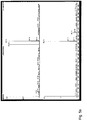


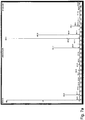
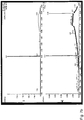
Classifications
-
- A—HUMAN NECESSITIES
- A61—MEDICAL OR VETERINARY SCIENCE; HYGIENE
- A61K—PREPARATIONS FOR MEDICAL, DENTAL OR TOILETRY PURPOSES
- A61K38/00—Medicinal preparations containing peptides
- A61K38/04—Peptides having up to 20 amino acids in a fully defined sequence; Derivatives thereof
- A61K38/12—Cyclic peptides, e.g. bacitracins; Polymyxins; Gramicidins S, C; Tyrocidins A, B or C
-
- A—HUMAN NECESSITIES
- A61—MEDICAL OR VETERINARY SCIENCE; HYGIENE
- A61K—PREPARATIONS FOR MEDICAL, DENTAL OR TOILETRY PURPOSES
- A61K31/00—Medicinal preparations containing organic active ingredients
- A61K31/33—Heterocyclic compounds
- A61K31/395—Heterocyclic compounds having nitrogen as a ring hetero atom, e.g. guanethidine or rifamycins
- A61K31/435—Heterocyclic compounds having nitrogen as a ring hetero atom, e.g. guanethidine or rifamycins having six-membered rings with one nitrogen as the only ring hetero atom
- A61K31/4353—Heterocyclic compounds having nitrogen as a ring hetero atom, e.g. guanethidine or rifamycins having six-membered rings with one nitrogen as the only ring hetero atom ortho- or peri-condensed with heterocyclic ring systems
- A61K31/4375—Heterocyclic compounds having nitrogen as a ring hetero atom, e.g. guanethidine or rifamycins having six-membered rings with one nitrogen as the only ring hetero atom ortho- or peri-condensed with heterocyclic ring systems the heterocyclic ring system containing a six-membered ring having nitrogen as a ring heteroatom, e.g. quinolizines, naphthyridines, berberine, vincamine
-
- A—HUMAN NECESSITIES
- A61—MEDICAL OR VETERINARY SCIENCE; HYGIENE
- A61K—PREPARATIONS FOR MEDICAL, DENTAL OR TOILETRY PURPOSES
- A61K31/00—Medicinal preparations containing organic active ingredients
- A61K31/33—Heterocyclic compounds
- A61K31/395—Heterocyclic compounds having nitrogen as a ring hetero atom, e.g. guanethidine or rifamycins
- A61K31/435—Heterocyclic compounds having nitrogen as a ring hetero atom, e.g. guanethidine or rifamycins having six-membered rings with one nitrogen as the only ring hetero atom
- A61K31/44—Non condensed pyridines; Hydrogenated derivatives thereof
- A61K31/4427—Non condensed pyridines; Hydrogenated derivatives thereof containing further heterocyclic ring systems
- A61K31/444—Non condensed pyridines; Hydrogenated derivatives thereof containing further heterocyclic ring systems containing a six-membered ring with nitrogen as a ring heteroatom, e.g. amrinone
-
- A—HUMAN NECESSITIES
- A61—MEDICAL OR VETERINARY SCIENCE; HYGIENE
- A61K—PREPARATIONS FOR MEDICAL, DENTAL OR TOILETRY PURPOSES
- A61K31/00—Medicinal preparations containing organic active ingredients
- A61K31/33—Heterocyclic compounds
- A61K31/395—Heterocyclic compounds having nitrogen as a ring hetero atom, e.g. guanethidine or rifamycins
- A61K31/435—Heterocyclic compounds having nitrogen as a ring hetero atom, e.g. guanethidine or rifamycins having six-membered rings with one nitrogen as the only ring hetero atom
- A61K31/44—Non condensed pyridines; Hydrogenated derivatives thereof
- A61K31/445—Non condensed piperidines, e.g. piperocaine
- A61K31/4523—Non condensed piperidines, e.g. piperocaine containing further heterocyclic ring systems
- A61K31/4545—Non condensed piperidines, e.g. piperocaine containing further heterocyclic ring systems containing a six-membered ring with nitrogen as a ring hetero atom, e.g. pipamperone, anabasine
-
- A—HUMAN NECESSITIES
- A61—MEDICAL OR VETERINARY SCIENCE; HYGIENE
- A61K—PREPARATIONS FOR MEDICAL, DENTAL OR TOILETRY PURPOSES
- A61K31/00—Medicinal preparations containing organic active ingredients
- A61K31/33—Heterocyclic compounds
- A61K31/395—Heterocyclic compounds having nitrogen as a ring hetero atom, e.g. guanethidine or rifamycins
- A61K31/435—Heterocyclic compounds having nitrogen as a ring hetero atom, e.g. guanethidine or rifamycins having six-membered rings with one nitrogen as the only ring hetero atom
- A61K31/47—Quinolines; Isoquinolines
- A61K31/4709—Non-condensed quinolines and containing further heterocyclic rings
-
- A—HUMAN NECESSITIES
- A61—MEDICAL OR VETERINARY SCIENCE; HYGIENE
- A61K—PREPARATIONS FOR MEDICAL, DENTAL OR TOILETRY PURPOSES
- A61K31/00—Medicinal preparations containing organic active ingredients
- A61K31/33—Heterocyclic compounds
- A61K31/395—Heterocyclic compounds having nitrogen as a ring hetero atom, e.g. guanethidine or rifamycins
- A61K31/495—Heterocyclic compounds having nitrogen as a ring hetero atom, e.g. guanethidine or rifamycins having six-membered rings with two or more nitrogen atoms as the only ring heteroatoms, e.g. piperazine or tetrazines
- A61K31/496—Non-condensed piperazines containing further heterocyclic rings, e.g. rifampin, thiothixene or sparfloxacin
-
- A—HUMAN NECESSITIES
- A61—MEDICAL OR VETERINARY SCIENCE; HYGIENE
- A61K—PREPARATIONS FOR MEDICAL, DENTAL OR TOILETRY PURPOSES
- A61K31/00—Medicinal preparations containing organic active ingredients
- A61K31/33—Heterocyclic compounds
- A61K31/395—Heterocyclic compounds having nitrogen as a ring hetero atom, e.g. guanethidine or rifamycins
- A61K31/495—Heterocyclic compounds having nitrogen as a ring hetero atom, e.g. guanethidine or rifamycins having six-membered rings with two or more nitrogen atoms as the only ring heteroatoms, e.g. piperazine or tetrazines
- A61K31/505—Pyrimidines; Hydrogenated pyrimidines, e.g. trimethoprim
- A61K31/506—Pyrimidines; Hydrogenated pyrimidines, e.g. trimethoprim not condensed and containing further heterocyclic rings
-
- A—HUMAN NECESSITIES
- A61—MEDICAL OR VETERINARY SCIENCE; HYGIENE
- A61P—SPECIFIC THERAPEUTIC ACTIVITY OF CHEMICAL COMPOUNDS OR MEDICINAL PREPARATIONS
- A61P31/00—Antiinfectives, i.e. antibiotics, antiseptics, chemotherapeutics
- A61P31/04—Antibacterial agents
-
- C—CHEMISTRY; METALLURGY
- C07—ORGANIC CHEMISTRY
- C07D—HETEROCYCLIC COMPOUNDS
- C07D455/00—Heterocyclic compounds containing quinolizine ring systems, e.g. emetine alkaloids, protoberberine; Alkylenedioxy derivatives of dibenzo [a, g] quinolizines, e.g. berberine
- C07D455/02—Heterocyclic compounds containing quinolizine ring systems, e.g. emetine alkaloids, protoberberine; Alkylenedioxy derivatives of dibenzo [a, g] quinolizines, e.g. berberine containing not further condensed quinolizine ring systems
-
- Y—GENERAL TAGGING OF NEW TECHNOLOGICAL DEVELOPMENTS; GENERAL TAGGING OF CROSS-SECTIONAL TECHNOLOGIES SPANNING OVER SEVERAL SECTIONS OF THE IPC; TECHNICAL SUBJECTS COVERED BY FORMER USPC CROSS-REFERENCE ART COLLECTIONS [XRACs] AND DIGESTS
- Y02—TECHNOLOGIES OR APPLICATIONS FOR MITIGATION OR ADAPTATION AGAINST CLIMATE CHANGE
- Y02A—TECHNOLOGIES FOR ADAPTATION TO CLIMATE CHANGE
- Y02A50/00—TECHNOLOGIES FOR ADAPTATION TO CLIMATE CHANGE in human health protection, e.g. against extreme weather
- Y02A50/30—Against vector-borne diseases, e.g. mosquito-borne, fly-borne, tick-borne or waterborne diseases whose impact is exacerbated by climate change
Definitions
- This invention is directed to 4-oxoquinolizines in combination with subinhibitory concentrations of polymyxin B.
- Second generation quinolones such as Ciprofloxacin are widely accepted for the treatment of bacterial infections of the respiratory and urinary tracts, skin and soft tissues. They have good pharmacokinetic profiles, potent activities against a wide range of Gram-positive and Gram-negative pathogens, and are widely used in both hospital and community settings. However, increasing frequency of bacterial resistance to quinolones has led to an urgent need for new analogs to overcome antibiotic resistance.
- 2-pyridones have the potential to exhibit a new mechanism of action with broad-spectrum antibacterial activity and favorable drug-like properties to become the first 2-pyridone members in such clinical use.
- 2-pyridones are distantly related to quinolones, but with a different heterocyclic nucleus and different electronic distribution over the molecule leading to significant changes in chemical reactivity.
- EP 1437354 A1 discloses synthetic antibacterial agents having antibacterial effects on gram positive bacteria, gram negative bacteria and anaerobic bacteria.
- the antibacterial agents are 4-oxoquinolizine agents that have a 2-pyridone skeleton.
- EP 1227096 A1 discloses synthetic 4-oxoquinolizine antibacterial agents having antibacterial effects against gram positive bacteria, gram negative bacteria and anaerobic bacteria.
- JP2003261566 A discloses the preparation of oxo-4H-quinolizine-3-carboxylic acid derivatives for use as antibacterial agents.
- JP2003012670 A discloses the preparation of 1-cyclopropyl-8-heterocyclyl-4-oxo-4H-quinolizine-3-carboxylic acid derivatives for use as antibacterial agents.
- JP2002308876 A discloses the preparation of 4-oxoquinolizine antibacterial agents having antibacterial effects against gram positive bacteria, gram negative bacteria and anaerobic bacteria.
- WO 95/10519 discloses 4-oxo-4H-quinolizine-3-carboxylic acid compounds for use in the treatment of microbial and bacterial infections, as well as pharmaceutical compositions containing these compounds.
- 2-pyridone compounds and their uses as antimicrobial agents.
- the 2-pyridone compounds of the invention are 4-oxoquinolizine compounds.
- a pharmaceutical composition comprising Polymyxin B and a 4-oxoquinolizine compound of formula IIIc: or a pharmaceutically acceptable salt thereof, wherein
- R 1 is hydrogen or halogen.
- the 4-oxoquinolizine compound is selected from the group consisting of the compounds: Compound 1 8-(3-fluoro-4-amino-phenyl)-1-cyclopropyl-9-methyl-4-oxoquinolizine-3-carboxylic acid Compound 2 8-(3,6-difluoro-4-amino-phenyl)-1-cyclopropyl-9-methyl-4-oxoquinolizine-3-carboxylic acid Compound 3 8-(3,5-dichloro-4-aminophenyl)-1-cyclopropyl-9-methyl-4-oxo-quinolizine-3-carboxylic acid Compound 4 8-(3-fluoro-4-aminomethylphenyl)-1-cyclopropyl-9-methyl-4-oxo-quinolizine-3-carboxylic acid Compound 5 8-(4-aminomethyl-phenyl)-1-cyclopropyl-9-methyl-4-oxoquinolizine-3-carboxylic acid Compound
- the Polymyxin B is present in a subinhibitory concentration.
- the composition is for treatment of a bacterial infection in an individual in need thereof.
- the composition is for treatment of a bacterial infection in an individual in need thereof and said bacterial infection is infection by a multiresistant strain.
- the composition is for treatment of a bacterial infection in an individual in need thereof, and said infection is infection by one or more bacteria of a genus selected from the group consisting of Acinetobacter, Bacillus, Bortadella, Borrelia, Brucella, Camphylobacter, Chlamydia, Clostridium, Corynebacterium, Enterococcus, Escherichia, Fransisella, Haemophilus, Helicobacter, Legionella, Leptospira, Listeria, Mycobacterium, Mycoplasma, Neisseria, Propionibacterium, Pseudomonas, Rickettsia, Salmonella, Shigella, Staphylococcus, Streptococcus, Treponema, Vibrio and Yersinia.
- Compound n is an integer. This refers to the compounds as named and numbered in Table 1 herein below.
- alkyl' refers to a saturated, straight or branched hydrocarbon chain.
- the hydrocarbon chain preferably contains of from one to eight carbon atoms (C 1-8 alkyl), such preferably from one to SIX carbon atoms (C 1-6 alkyl), more preferred of from one to five carbon atoms (C 1-5 -alkyl), including methyl, ethyl, propyl, isopropyl, butyl, isobutyl, secondary butyl, tertiary butyl, pentyl, isopentyl, neopentyl and tertiary pentyl.
- alkyl represents a C 1-4 -alkyl group, which may in particular include methyl, ethyl, propyl, isopropyl, butyl, isobutyl, secondary butyl, and tertiary butyl.
- aryl refers to an aromatic ring or aromatic ring system substituent.
- Aryl may for example be phenyl or naphthyl.
- cycloalkyl refers to a cyclic alkyl group, preferably containing of from three to eight carbon atoms (C 3-8 -cycloalkyl), including cyclopropyl, cyclobutyl, cyclopentyl, cyclohexyl, cycloheptyl and cyclooctyl, more preferably 3 carbon atoms (cyclopropyl).
- haloalkyl refers to an alkyl group as defined herein, which alkyl group is substituted one or more times with one or more halogen.
- heteroaryl refers to an aryl, wherein one or more ring carbons have been exchanged for a heteroatom.
- the heteroatom is in general selected from the group consisting of N, S and O.
- the heteroaryl preferably contains 1 to 3 heteroatoms.
- heterocyclyl refers to a monocyclic group or a multicyclic group holding one or more heteroatoms in its ring structure.
- heterocyclyl refers to monocyclic or bicyclic groups.
- Preferred heteroatoms include nitrogen (N), oxygen (O) and sulphur (S).
- Examples of 5-membered monocyclic heterocyclic groups include pyrrolidinyl, pyrrolyl, 3H-pyrrolyl, oxolanyl, furanyl, thiolanyl, thiophenyl, pyrazolyl, pyrazolidinyl, imidazolyl, imidazolidinyl, 1,2-oxazolyl, 1,3-oxazolyl, 1,2-thiazolyl, 1,3-thiazolyl, and 1,2,5-oxadiazolyl.
- 6-membered monocyclic heterocyclic groups include piperidinyl, pyridinyl, oxanyl, 2-H-pyranyl, 4-H-pyranyl, thianyl, 2H-thiopyranyl, pyridazinyl, 1,2-diazinanyl, pyrimidinyl, 1,3-diazinanyl, pyrazinyl, piperazinyl, 1,4-dioxinyl, 1,4-dioxane), 1,4-oxazinyl, morpholinyl, thiomorpholinyl and 1,4-oxathianyl.
- bicyclic heteroaryl refers to a bicyclic aromatic ring system substituent derived by fusion of two monocyclic groups, where at least one of said two monocyclic groups holds one or more heteroatoms in its ring structure.
- Preferred heteroatoms include nitrogen (N), oxygen (O) and sulphur (S).
- bicyclic heterocyclic group includes 1H-indolyl, decahydroquinolinyl, octahydrocyclopenta[b]pyrrolyl, 4H-chromenyl, 2,3-dihydro-1-benzofuranyl, 2H-1,3-benzodioxolyl, 1H-1,3-benzodiazolyl and 1,3-benzothiazolyl.
- halogen refers to a substiuent selected from the group consisting of -Cl, -F, -Br and -I.
- the instant disclosure provides novel 2-pyridones having potency, breadth of antimicrobial activity, lack of cross-resistance to existing drugs, safety, and/or efficacy in animal models for Category A & B CDC pathogens including the particularly problematic bacteria residing inside mammalian host cells.
- the preferred 2-pyridone compounds of the disclosure are 4-oxoquinolizine compounds.
- the disclosed 2-pyridone compounds have substituted 2-pyridone scaffolds and preferably the 2-pyridone compounds contain a substituted 4-oxoquinolizine scaffold. They target the well validated IIA bacterial topoisomerases, e.g.
- DNA gyrase and topoisomerase IV thereby inhibiting a broad spectrum of Gram-positive as well as Gram-negative bacteria - importantly, those resistant to quinolones and topoisomerase inhibitors, such as for example piperidinylalkylquinolines.
- 4-oxoquinolizine antibiotics have been found to be broad-spectrum and very potent against CDC pathogens, including Burkhofderia pseudomallei, Baciflus anthracis, Yersinia pestis, Francisella tularensis, and Brucella abortus in MIC90 ranges of low nanograms per milliliter.
- 2-pyridones are distantly related to quinolones, but with a different heterocyclic nucleus and different electronic distribution over the molecule leading to significant changes in chemical reactivity. Exhibiting a possibly new mechanism of action against a well-validated bacterial target, with favorable drug-like properties, the instant 2-pyridones are likely to become the first 2-pyridone members in such clinical use.
- the 2-pyridones may be 4-oxoquinolizine compounds.
- compositions comprising 2-pyridone compounds in combination with polymyxin.
- Said 2-pyridone compound is preferably a 4-oxoquinolizine compound and said Polymyxins is preferably present in a subinhibitory concentration and is preferably Polymyxin B as described herein elsewhere.
- the 2-pyridone compound according to the present disclosure may be any compound having a 2-pyridone skeleton as a partial structure.
- the 2-pyridone compound is a 4-oxoquinolizine compound, i.e. a compound comprising a 4-oxoquinolizine skeleton structure.
- compositions comprising a 4-oxoquinolizine compound and polymyxin, wherein said polymyxin preferably is present in subinhibitory concentrations.
- the 4-oxoquinolizine compound is a compound of formula IIIc: or a pharmaceuticalty acceptable salt thereof, wherein
- the 4-oxoquinolizine compound is selected from the group of compounds mentioned in Table 1 herein below.
- Table 1 Examples of 4-oxoquinolizines compounds Compounds Structure Name Compound 1 8-(3-fluoro-4-amino-phenyl)-1-cyclopropyl-9-methyl-4-oxoquinolizine-3-carboxylic acid Compound 2 8-(3,6-difluoro-4-aminophenyl)-1-cyclopropyl-9-methyl-4-oxo-quinolizine-3-carboxylic acid Compound 3 8-(3,5-dichloro-4-aminophenyl)-1-cyclopropyl-9-methyl-4-oxo-quinolizine-3-carboxylic acid Compound 4 8-(3-fluoro-4-aminomethylphenyl)-1-cyclopropyl-9-methyl-4-oxo-quinolizine-3-carboxylic acid Compound 5 8-(4-aminomethyl-phenyl)
- compositions comprising a 2-pyridone compound, preferably a 4-oxoquinolizine compound in combination with a Polymyxin, preferably Polymyxin B.
- Said 4-oxoquinolizine compound may be any of the 4-oxoquinolizine compounds described herein above in the section 4-oxoquinolizines, however it may also be any of the 4-oxoquinolizine compounds described in this section.
- particularly useful 2- pyridines i.e. such as particularly useful 4-oxoquinolizine compounds.
- Said particularly useful 4-oxoquinolizine compounds have a strong antibacterial effect, i.e. that they are useful in the treatment of bacterial infections.
- Examples of useful 4-oxoquinolizine compounds according to this aspect may for example be selected from the group consisting of compounds 4, 16, 17, 69 and 76 of Table 1.
- the disclosure provides the novel antimicrobial compounds, 1-6 and 17:
- 4-oxoquinolizine compounds used in the absence of polymyxins it is preferred that said 4-oxoquinolizine compounds are not any of compounds 1, 2, 3, 5, 6, 7, 8, 9, 11, 12, 13, 18, 20, 21, 22, 24, 25, 28, 31, 33, 37, 43 or 44 of Table 1.
- Pharmaceutically acceptable salts of the 4-oxoquinolizine compounds of the disclosure may include acid or base addition salts.
- Acid and base addition salts refers to the relatively nontoxic, inorganic and organic addition salts of compounds of the present disclosure. These salts can be prepared in situ during the final isolation and purification of the compounds, or by subsequently reacting the purified compound in its free acid or base form with a suitable organic or inorganic compound and isolating the salt thus formed.
- the pharmaceutically acceptable acid addition salts of the basic compounds are prepared by contacting the free base form with a sufficient amount of the desired acid to produce the salt in the conventional manner.
- the free base form may be regenerated by contacting the salt form with a base and isolating the free base in the conventional manner.
- the free base forms differ from their respective salt forms somewhat in certain physical properties such as solubility in polar solvents, but otherwise the salts are equivalent to their respective free base for purposes of the present disclosure.
- Base addition salts are formed with metals or amines.
- the base addition salts of acidic compounds are prepared by contacting the free acid form with a sufficient amount of the desired base to produce the salt in the conventional manner.
- the free acid form may be regenerated by contacting the salt form with an acid and isolating the free acid in a conventional manner.
- the free acid forms differ from their respective salt forms somewhat in certain physical properties such as solubility in polar solvents, but otherwise the salts are equivalent to their respective free acid for purposes of the present disclosure.
- Salts may be prepared from inorganic acids or organic acids.
- One example of a salt of the 4-oxoquinolizines according to the disclosure may be hydrochloric salts.
- Another example of a salt of the 4-oxoquinolizines according to the disclosure is potassium salts.
- the 4-oxoquinolizine compounds of the disclosure described herein in the sections “4-oxoquinolizines” and “Particular 4-oxoquinolizines” may be prepared using the methods outlined herein below in Example 8.
- useful scaffolds of the 4-oxoquinolizine compounds may be prepared as described in Example 8 and these may be further modified using methods known to the skilled person.
- suitable scaffolds may be prepared in 6 to 7 steps as described in Example 8. The suitable scaffolds may then be used to obtain the final 4-oxoquinolizine compounds in 2 to 5 steps.
- the 4-oxoquinolizine compounds of the disclosure may also be prepared as described for specific 4-oxoquinolizine compounds in Example 8. These methods may optionally be modified with relevant modifications known to the skilled person.
- Example 8 also described useful examples of preparing salts of 4-oxoquinolizine compounds. These methods may also be modified by the skilled person to prepare salts of other 4-oxoquinolizines.
- the preferred 4-oxoquinolizines according to the disclosure are preferably active antimicrobial compounds.
- the 2-pyridone compounds such as the 4-oxoquinolizine compounds of the disclosure show potent activity against a pathogen that is resistant against one or more of quinolones, carbapenems, aminosides and glycopeptides antibiotics, and specifically, against a pathogen that is a CDC category A or category B pathogen.
- the 4-oxoquinolizine compounds may in particular have a MIC ⁇ 10 ⁇ g/ml, such as ⁇ 5 ⁇ g/ml, for example ⁇ 1 ⁇ g/ml, such as ⁇ 0.5 ⁇ g/ml against B. thailandensis when determined as described herein below in Example 1.
- the 4-oxoquinolizine compounds may have a MIC ⁇ 10 ⁇ g/ml, such as ⁇ 5 ⁇ g/ml, for example ⁇ 1 ⁇ g/ml, such as ⁇ 0.5 ⁇ g/ml against one or more of, preferably against all of B. anthracis, F. tularensis, B. acortus and B. pseudomallei when determined as described herein below in Example 1.
- the 4-oxoquinolizine compounds of the disclosure may also have a MIC ⁇ 10 ⁇ g/ml, such as ⁇ 5 ⁇ g/ml against one or more bacteria selected from the group consisting of S. aureus, S. epidermis, E. faecalis and E. faecium when determined as described herein below in Example 2.
- the 4-oxoquinolizine compounds of the disclosure may also have a MIC ⁇ 50 ⁇ g/ml, such as ⁇ 20 ⁇ g/ml against A. baumanni, wherein said A. baumanni is a drug resistant strain of A. baumanni, for example a multidrug resistant strain of A. baumanni when determined as described herein below in Example 3.
- the 4-oxoquinolizine compounds of the disclosure preferably exhibit potent activities in presence of subinhibitory concentrations of polymyxin B against A. baumannii including quinolone and multiresistant strains of A. baumannii.
- the antimicrobial activity of the 4-oxoquinolizine compounds when combined with subinhibitory concentrations of polymyxin B against Acinetobacter baumannii including multiresistant clinical isolates may be determined as described herein below in Example 4.
- the 4-oxoquinolizine compounds of the disclosure may have a MIC ⁇ 20 ⁇ g/ml, such as ⁇ 15 ⁇ g/ml, for example ⁇ 10 ⁇ g/ml, such as ⁇ 5 ⁇ /ml against A. baumannii in the presence of 0.06 ⁇ g/ml Polymyxin B when determined as described in Example 4 herein below.
- the particular 4-oxoquinolizine compounds of the disclosure may also have a MIC ⁇ 10 ⁇ g/ml, such as ⁇ 5 ⁇ g/ml, for example ⁇ 1 ⁇ g/ml, such as ⁇ 0.5 ⁇ g/ml against at least one Gram negative bacterium and against at least one gram positive bacterium when determined as described herein below in Example 5.
- the 4-oxoquinolizine compounds of the disclosure in general have at least partly synergistic antibacterial activity with Polymyxin, such as with Polymyxin B. This may for example be determined as described herein below in example 6.
- the 4-oxoquinolizine compounds of the disclosure may have a FICI ⁇ 0.75, such as ⁇ 0.5 in relation to Polymyxins B against A. baumannii and/or K. pneumoniae, when determined as described herein below in Example 6.
- the 4-oxoquinolizine compounds of the dislosure preferably have a low cytotoxicity against human cells.
- the 4-oxoquinolizine compounds of the disclosure may have an IC50 of at least 20 ⁇ M, such as at least 40 ⁇ M in respect of HEPG2 V1 cells when determined as described herein below in Example 7.
- compositions comprising a 4-oxoquinolizine compound in combination with a Polymyxin.
- the Polymyxin to be used with the present disclosure may be any useful Polymyxin.
- Polymyxins are antibiotics isolated from cultures of Bacillus polymyxa. In general Polymyxins are active as antibiotics against most Gram-negative bacteria.
- Polymyxins according to the present disclosure are preferably decapeptides containing five or six residues of L-2,4-diaminobutyric acid. Preferably, the sequence of seven residues at the C-terminal end of the decapeptide is formed into a peptide ring through an isopeptide link to one of the diaminobutyric acid residues, while the N-terminal residue preferably is acylated with a fatty acid.
- the fatty acid is preferably -(CH 2 ) m -COOH, wherein m is an integer in the range of 6 to 15, preferably in the range of 7 to 10, more preferably in the range of 7 to 8, wherein said-(CH 2 ) m -COOH optionally may be substitiuted with one or more alkyl, preferably with one C 1-8 alkyl, more preferably with one alkyl, even more preferably with one alkyl, yet more preferably with one methyl.
- Preferred Polymixins to be used with the present disclosure are Polymyxin B or Polymyxin E or pharmaceutically acceptable salts thereof.
- Polymyxins B is a lipopeptide antibiotic originally isolated from Bacillus polymyxa.
- Polymyxin B according to the present disclosure preferably consists of a peptide ring of 7 amino acids and a tripeptide side chain with a fatty acid tail.
- Polymyxin B according to the disclosure preferably contains five primary amine groups and is thus a polycation at pH 7.
- Polymyxin B to be used with the present disclosure may be selected from the group consisting of Polymyxin B1 Polymyxin B2, Polymyxin B3 and Polymyxins B4.
- Polymyxins B to be used with the present disclosure may also be a mixture of 2 or more of the aforementioned, preferably Polymyxins B is a mixture containing at least Polymyxin B1 and Polymyxin B2, more preferably Polymyxin B to be used with the present disclosure is a mixture containing Polymyxin B1 Polymyxins B2, Polymyxin B3 and Polymyxin B4,
- compositions comprising a 4-oxoquinolizine compound in combination with Polymyxin, preferably Polymyxin B.
- Polymyxin e.g. Polymyxin B is present in a subinhibitory concentration.
- Said subinhibitory concentration is in general dependent on the individual to receive treatment with the pharmaceutical composition,
- said subinhibitory concentration of Polymyxin is administration of a less than 2 mg Polymyxin per kg of said individual per day,
- the subinhibitory concentration may be administration of less than 1,5 mg, such as less than 1 mg, for example less than 0,5 mg, such as less than 0,3 mg, for example less than 0.1 mg per kg of said individual per day.
- said subinhibitory concentration of Polymyxin B is administration of a less than 2 mg Polymyxin B per kg of said individual per day,
- the subinhibitory concentration may be administration of less than 1,5 mg, such as less than 1 mg, for example less than 0,5 mg, such as less than 0,3 mg, for example less than 0.1 mg Polymyxin B per kg of said individual per day.
- each dosage unit preferably comprises less than 150 mg Polymyxin, such as less than 130 mg Polymyxin, for example less than 110 mg Polymyxin, such as less than 90 mg Polymyxin, for example less than 70 mg Polymyxin, such as less than 50 mg Polymyxin, wherein the Polymyxin may be any of the Polymyxins described herein above in the section "Polymyxin", but preferably is Polymyxin B.
- the subinhibitory concentration is less than 0,5 ⁇ g/ml, such as less than 0,4 ⁇ g/ml, for example less than 0.3 ⁇ g/ml, such as less than 0.2 ⁇ g/ml.
- Polymyxin may however also be administered at regular concentrations, for example in the range of 2 to 5 mg Polymyxin, such as Polymyxin B per kg of said individual may be administered.
- compositions comprising Polymyxin and a 4-oxoquinolizine compound
- compositions comprising
- the present disclosure discloses that the antibacterial effect of Polymyxin and 4-oxoquinolizines is synergistic.
- the synergistic effect may be determined according to any useful method, such as using a checkerboard technique, e.g. by using the method described in Example 6 herein below.
- the compositions comprises a subinhibitory concentration of a polymyxin, for example Polymyxins B and a subinhibitory concentration of a 4-oxoquinolizine, wherein said composition is capable of inhibiting growth of at least one bacterium, more preferably the composition is capable of inhibiting growth of at least 2 different bacteria, for example of at least 5 different bacteria, such as of at least 10 different bacteria.
- a polymyxin for example Polymyxins B
- a subinhibitory concentration of a 4-oxoquinolizine wherein said composition is capable of inhibiting growth of at least one bacterium, more preferably the composition is capable of inhibiting growth of at least 2 different bacteria, for example of at least 5 different bacteria, such as of at least 10 different bacteria.
- compositions comprises
- the disclosure relates to a method of treating a bacterial infection in an individual in need thereof, wherein the method comprises the steps of:
- the Polyxin may be administered in any useful dosage, such as any of the dosages described herein above in the section "Dosage of Polymyxin".
- the polymyxin may be administered at in the range of 2 to 5 mg Polymyxin, such as Polymyxin B per kg of said individual, or the polymyxin may even be administered at subinhibitory concentrations.
- the 4-oxoquinolizine compound may preferably be administered as described herein below in the section "Pharmaceutical formulations”.
- compositions comprising a 4-oxoquinolizine compound in combination with a Polymyxin.
- Said pharmaceutical compositions are in particular useful for treatment of a bacterial infection in an individual in need thereof, and preferably for treatment of any of the bacterial infections described herein in this section.
- the pharmaceutical compositions comprising a 4-oxoquinolizine compound in combination with a Polymyxin or the particular 4-oxoquinolizine compounds of the disclosure are useful for treatment of a broad spectrum of different bacterial infections.
- they are typically useful for treatment infections by at least two different kinds of bacteria, such as at least 5 different kinds of bacteria, for example at least 10 different kinds of bacteria.
- said bacteria may be drug resistant bacteria, such as multidrug resistant bacteria.
- the 4-oxoquinolizine compounds and the pharmaceutical compositions comprising 4-oxoquinolizine and Polymyxin are antibacterial agents usable for the treatment of local infectious diseases or general infectious diseases of human beings or animals caused by Gram-positive bacteria, Gram-negative bacteria, anaerobic bacteria, acid-fast bacteria or other bacteria.
- this disclosure also provides methods of treating an infectious disorder in an individual in need thereof, wherein the individual for example may be a human or a mammal, by administering a safe and effective amount of a 4-oxoquinolizine compound to said subject optionally in combination with a Polymyxin.
- an "infectious disorder” is any disorder characterized by the presence of a microbial infection. Exemplary methods of this disclosure are for the treatment of bacterial infections.
- infectious disorders include for example central nervous system infections, external ear infections, infections of the middle ear (such as acute otitis media), infections of the cranial sinuses, eye infections, infections of the oral cavity (such as infections of the teeth, gums and mucosa), upper respiratory tract infections, lower respiratory tract infections, including pneumonia, genitourinary infections, gastrointestinal infections, gynecological infections, septicemia, sepsis, peritonitis, bone and joint infections, skin and skin structure infections, bacterial endocarditis, burns, antibacterial prophylaxis of surgery, or antibacterial prophylaxis in post-operative patients or in immunosuppressed patients (such as patients receiving cancer chemotherapy, or organ transplant patients).
- the bacterial infection may be infection by one or more bacteria of for example the central nervous system, external ear, the middle ear (such as acute otitis media), the cranial sinuses, the eyes, the oral cavity (such as of the teeth, gums and mucosa), upper respiratory tract, lower respiratory tract, including lung, genitourinary tract, gastrointestinal tract, peritoneum, bone and joints, skin or burns.
- the bacterial infection may also be related to sepsis, surgery, or bacterial infecitons in post-operative patients or in immunosuppressed patients.
- the bacterial infection may be infection by any bacteria; preferably the bacterium is pathogenic bacterium.
- the bacterial infection may be infection by a gram-negative or a gram-positive bacterium or it may be infection by a mixture of bacteria, which may be gram-positive or gram-negative.
- the present disclosure discloses that 4-oxoquinolizine compounds are effective in treatment of infections by both Gram-positive and Gram-negative bacteria.
- the bacteria is a Gram-negative bacterium.
- the bacterial infection to be treated with the pharmaceutical composition comprising a 4-oxoquinolizine compound and a Polymyxin or with the particular 4-oxoquinolizine compound according to the present disclosure is preferably infection by one or more bacteria of a genus selected from the group consisting of:
- the bacterial infection to be treated with the pharmaceutical composition comprising a 4-oxoquinolizine compound and a Polymyxin or with the particular 4-oxoquinolizine compound according to the present disclosure is preferably infection by one or more bacteria of genus selected from the group consisting of:
- the bacterial infection to be treated with the pharmaceutical composition comprising a 4-oxoquinolizine compound and a Polymyxin or with the particular 4-oxoquinolizine compound according to the present disclosure is infection by one or more bacteria of a genus selected from the group consisting of Acinetobacter, Bortadella, Borrelia, Brucella, Camphylobacter, Chlamydia, Clostridium, Corynebacterium, Fransisella, Helicobacter, Legionella, Leptospira, Listeria, Mycobacferium, Mycoplasma, Neisseria, Rickettsia, Salmonella, Shigella, Treponema, Vibrio and Yersinia.
- the bacterial infection to be treated with the pharmaceutical composition comprising a 4-oxoquinolizine compound and a Polymyxin or with the particular 4-oxoquinolizine compound according to the present disclosure is preferably infection by one or more bacteria of a genus selected from the group consisting of:
- the bacterial infection to be treated with the pharmaceutical composition comprising a 4-oxoquinolizine compound and a Polymyxin or with the particular 4-oxoquinolizine compound according to the present disclosure is preferably infection by one or more bacteria selected from the group consisting of:
- the bacteria can be selected from the group consisting of, (a) Acinetobacter baumannii, Bacillus anthracis, Brucella abortus, Burkholderia cepacia, Burkholderia mallei, Burkholderia pseudomallei, Burkholderia thailandensis, Cifrobacter freundii, Corynebacterium jeikeium, Enterobacter sp, Enterobacter cloacae, Enterococcus faecium, Enterococcus gallinarum, Francisella tularensis, Klebsiella aerogenes, Listeria monocytogenes, Moraxella catarrhalis, Morganella morganii,, Neisseria meningitides, Proteus mirabilis, Providencia stuartii, Serratia marcescens, Shigella sp, Staphylococcus haemolyticus, Staphylococcus saprophyticus
- drug-resistant strain a bacterial strain which is resistant to at least one antibiotic drug selected from the group consisting of quinolones, carbapenems, aminosides and glycopeptides antibiotics.
- Multidrug-resistant strains are bacterial strains resistant to at least two two antibiotic drugs of different classes, wherein said classes are selected from the group consisting of quinolones, carbapenems, aminosides and glycopeptides antibiotics.
- the bacterial infection to be treated with the 4-oxoquinolizine compounds described in the section "Particular 4-oxoquinolizines" are preferably bacteria selected from the group consisting of:
- the bacterial infection to be treated with the pharmaceutical composition comprising a 4-oxoquinolizine compound and a Polymyxin or with the particular 4-oxoquinolizine compound according to the present disclosure may be selected from the group consisting of Burkholderia pseudomallei, Bacillus anthracis, Yersinia pestis, Francisella tularensis, and Brucella abortu, Klebsiella, Pseudomanas, Acinetobacter and Staphylococcus aureus, wherein said Staphylococcus aureus may be Methicillin-resistant Staphylococcus aureus (MRSA).
- MRSA Methicillin-resistant Staphylococcus aureus
- the infection is infection by a Gram-positive bacterium.
- a Gram-positive bacterium This may in particular be the case in aspects of the disclosure relating to the particular 4-oxoquinolizine compounds described herein above in the section "Particular 4-oxoquinolizines”.
- Said Gram-positive bacterium may for example be selected from the group consisting of B. anthracis, S. epidermidis, Staphylococcus aureus, Streptococcus aureus, Streptococcus pneumonia, Enterococcus faecalis and Enterococcus faecium.
- the bacterial infection to be treated with pharmaceutical compositions comprising 4-oxoquinolizine compounds and Polymyxins may preferably be bacteria of a genus selected from the group consisting of:
- the bacterial infection to be treated with pharmaceutical compositions comprising 4-oxoquinolizine compounds and Polymyxins may preferably be selected from bacteria of a genus selected from the group consisting of
- the bacterial infection to be treated with the pharmaceutical composition comprising a 4-oxoquinolizine compound and a Polymyxin or with the particular 4-oxoquinolizine compound according to the present disclosure is infection by a Gram-negative bacterium.
- Said Gram-negative bacterium may for example be selected from the group consisting of F. tularensis, B. abortus, B. pseudomallei, Pseudamanas aeruginasa, Burkholderia thailandensi, Acinetobacter baumannii, Acinetobacter Escherichia coli and Klebsiella.
- the bacterial infection to be treated with the pharmaceutical composition comprising a 4-oxoquinolizine compound and a Polymyxin or with the particular 4-oxoquinolizine compound according to the present disclosure
- the infection is infection by an anaerobic bacterium.
- Said anaerobic bacterium may for example be Bacillus fragilis.
- the bacteria may be a bacterial strain that is resistant against one or more of quinolones, carbapenems, aminosides and glycopeptides antibiotics, and specifically, the bacterial infection may be infection by a pathogen that is a CDC category A or category B pathogen.
- CDC is the US Centers for Disease Control and Prevention, which have categorised pathogens according to risk to national security (Example 1 below describe examples of such bacteria).
- the bacterial infection to be treated with the 4-oxoquinolizine compounds of the disclosure or with pharmaceutical compostions comprising 4-oxoquinolizine compounds and Polymyxin according to the present disclosure may in one embodiment be a Category A bacteria according to CDC's classification.
- Category A bacteria are defined as bacteria that
- Category A bacteria may for example be selected from the group consisting of Bacillus anthracis, Clostridium botulinum, Yersinia pestis and Francisella tularensis.
- the bacterial infection to be treated with the 4-oxoquinolizine compounds of the disclosure or with pharmaceutical compostions comprising 4-oxoquinolizine compounds and Polymyxin according to the present disclosure may in one embodiment be a Category B bacteria according to CDC's classification.
- Catergoy B bacteria are defined as bacteria that
- Category B bacteria may for example be selected from the group consisting of Brucella species, Clostridium perfringens, Salmonella species, Escherichia coli O157:H7, Shigella, B. abortus, Burkholderia mallei, Burkholderia pseudomallei, Chlamydia psittaci, Coxiella burnetii, Staphylococcus spp. Rickettsia prowazekii, Vibrio cholerae and Cryptosporidium parvum.
- treatment is used herein to mean that, at a minimum, administration of a compound of the present disclosure mitigates a disease associated an infectious disorder, e.g. a bacterial infection in a host, such as in a mammalian subject, such as in humans.
- a disease associated an infectious disorder e.g. a bacterial infection in a host, such as in a mammalian subject, such as in humans.
- the term “treatment” includes inhibiting the infectious disorder; and/or alleviating or reversing the infectious disorder.
- the term “prevent” does not require that the disease state be completely thwarted.
- preventing refers to the ability of the skilled artisan to identify a population that is susceptible to infectious disorders, such that administration of the compounds of the present disclosure may occur prior to onset of infection. The term does not imply that the disease state be completely avoided.
- the present disclosure relates in one aspect to pharmaceutical compositions comprising 4-oxoquinolizine compounds and Polymyxin.
- the present disclosure also relates to pharmaceutical compositions comprising preferred 4-oxoquinolizine compounds with or without the presence of Polymyxins.
- the pharmaceutical compositions are preferably for treatment of an individual infected by the pathogen, such as an individual suffering from a bacterial infection.
- the compositions may however also be for administration to an individual at risk of acquiring such an infection.
- the individual is a vertebrate, preferably a mammal, and more preferably a human being.
- the treatment may be ameliorating or curative.
- curative it is intended to mean survival from the infection which otherwise in the absence of the treatment causes the subject suffering from the infection to show increasing pathology or even morbidity.
- the pharmaceutical compositions described herein may be prepared for prophylactic administration to an individual at risk of infection by the pathogen, preferably by the bacteria.
- the pharmaceutical composition is for reducing the risk of contagion caused by the infection or in an individual at risk of acquiring a bacterial infection. In relation to epidemic or even pandemic infections causing a high mortality rate, even slight reductions in risk of contagion may be of major importance.
- the pharmaceutical composition reduces the risk of contagion in a individual that has acquired a bacterial infection by at least 5%, preferably at least 10%, preferably at least 15%, more preferably at least 20%, or at least 30% or at least 40%, or at least 50%, or at least 60%, or at least 70% or at least 80%, or at least 90%, or more.
- the pharmaceutical compositions of the disclosure may also reduce the risk of contagion caused by a bacterial infection in an individual at risk of acquiring that infection by at least 5%, or at least 10%, or at least 15%, or at least 20%, or at least 30% or at least 40%, or at least 50%, or at least 60%, or at least 70% or at least 80%, or at least 90%, or more.
- administration of the anti-bacterial pharmaceutical compositions according to the disclosure may be only once or administration may be repeated for a number of times.
- the pharmaceutical compositions comprising 4-oxoquinolizine compounds or the pharmaceutical compositions comprising both Polymyxins and 4-oxoquinolizine compounds may be given repeatedly with regular intervals, for example in the range of 1 to 5 times daily for in the range of 1 to 100 days, such as in the range of 1 to 50 days, for example in the range of 1 to 25 days, such as in the range of 10 to 16 days.
- the total daily dose of the compounds of this disclosure administered to a host in single or in divided doses can be in amounts, Single dose compositions may contain such amounts or submultiples thereof as make up the daily dose.
- Preferred dosages of Polymyxin to be contained in these compositions are described herein in the section "Dosage of Polymyxin" and preferred dosages of 4-oxoquinolizine compounds are described herein below.
- the pharmaceutical compositions may be prepared for any suitable administration route, for example, topical, parenteral, oral, buccal, systemic, nasal, injection, transdermal, rectal, vaginal, etc., or a form suitable for administration by inhalation or insufflation.
- the pharmaceutical compositions of the disclosure are prepared for oral administration or for intraperitoneal administration, such as for oral administration.
- the pharmaceutical compositions of the disclosure may or may be used at the site of a wound on or in the body, for example as a result of surgery or injury. Equally, the pharmaceutical compositions of the disclosure may or may be used for an internal infection at the site of a prosthesis.
- Initial dosages suitable for administration to humans may be determined from in vitro assays or animal models.
- an initial dosage may be formulated to achieve a serum concentration that includes the IC 50 of the particular compound being administered, as measured in an in vitro assay.
- an initial dosage for humans may be based upon dosages found to be effective in animal models of the disease.
- thr dose may vary depending on the symptoms, age, body weight of the patient.
- the 4-oxoquinolizine compounds are administered to adults in a dose of 0.05 to 100 mg/kg/day, preferably 0.1 to 50 mg/kg/day, in the systemic administration.
- the concentration of the active ingredient is 0.01 to 5%, preferably 0.1 to 3%.
- Preferred dosages of Polymyxins are described herein elsewhere.
- the 4-oxoquinolizine compounds and the Polymyxin may preferably be administered simultaneously, however it is also contemplated that the 4-oxoquinolizine compounds and the Polymyxin is administrered sequentially in any order.
- the results for B. anthracis, F. tularensis, B. abortus, and B. pseudomallei are summarized in Table 2 below.
- the dilutions ranged from 32 ⁇ g/ml to 0.015 ⁇ g/ml (12 2-fold dilution range).
- the final DMSO concentration was 1.25% for B. anthracis and 2.5% for all other select agents.
- the assay was performed in duplicate in 96-well plates with a total assay volume of 100 ⁇ l.
- the bacteria were cultivated according to the CLSI guidelines.
- the MIC value was determined as the lowest concentration that resulted in no growth.
- the results for B. thailandensis are summarized in Table 3 below.
- thailandensis exhibited by 4-oxoquinolizine compounds and a 2 to 4 dilutions improvement shift in MIC90 between pH7 and pH5.
- Example 2 Minimal inhibitory concentration (MIC) determination for Gram-positive and Gram-negative bacteria
- Example 2 shows the potent antibacterial activity of a number of 4-oxoquinolizine compounds against a standard panel of Gram-positive and Gram-negative strains (Table 4) in comparison to a well-known marketed quinolone (Ciprofloxacin) and glycopeptide (Vancomycin).
- Table 5 shows the resistant strains used for the data displayed in Table 6 below that shows the activity of a selection of 4-oxoquinolizine compounds against a panel of quinolone-resistant strains.
- MICs were determined following the standard CLSI protocol as described herein below in Example 4 using doubling dilutions of compounds (0.03 to 32 ⁇ g/ml), Levofloxacin, Ciprofloxacin, Vancomycin (0.125 to 128 ⁇ g/ml) in cation adjusted Mueller Hinton broth (CAMHB, Oxoid). The MIC was determined as the lowest concentration of an individual drug that lead to no visible growth.
- Table 4 shows the MIC values for the instant 4-oxoquinolizines against a standard panel of Gram-positive and Gram-negative bacteria in comparison to a well-known marketed quinolone (Ciprofloxacin) and glycopeptide (Vancomycin).
- Table 5 shows the resistant strains used for the data displayed in Table 6 below that shows the activity of the instant 4-oxoquinolizine compounds against a panel of quinolone-resistant strains.
- Table 4 showing the MIC values for a selection of 4-oxoquinolizines against standard panels of Gram-positive and Gram -negative bacteria in comparison to a well-known marketed quinolone (Ciprofloxacin) and glycopeptide (Vancomycin).
- Example 3 Minimal inhibitory concentration (MIC) determination for acinetobacter strains
- Example 3 shows that 4-oxoquinolizine compounds show potent activity against a pathogen that is resistant against one or more of quinolones, carbapenems, aminosides and glycopeptides antibiotics, and specifically, The antibacterial activity of the compounds was assessed against a variety of A . bacter strains consisting mostly of resistant clinical isolates (Table 7 and 8).
- Organisms used were one type strain and clinical isolates of Acinetobacter baumannii from commercial culture collections or from K. Towner, Nottingham, UK.
- One Acinetobacter sp. (H064200250) was obtained from D. Livermore, London, UK (see Table 7 below which lists the Acinetobacter strains referred to in Table 8 below).
- Ciprofloxacin, Levofloxacin, Vancomycin and Amikacin were purchased from Fluka and Aldrich (Sigma - Aldrich, Buchs, Switzerland); moxifloxacin, meropenem and imipenem/cilastatin were purchased from Apin Chemicals Ltd. (Abingdon, Oxon, UK).
- MICs were determined following the standard CLSI protocol as described herein below in Example 4 using doubling dilutions of compounds (0.03 to 32 ⁇ g/ml), Levofloxacin, Ciprofloxacin, Moxifloxacin, Amikacin, Vancomycin, Meropenem and Imipenem/Cilastatin (0.125 to 128 ⁇ g/ml) in cation adjusted Mueller Hinton broth (CAMHB, Oxoid). Additionally, MICs were run in CAMHB supplemented. CLSI breakpoints were used to classify resistance to carbapenems, quinolones, aminosides, and glycopeptides 1 .
- the Acinetobacter strains were grown in CAMHB for 20-24 hours at 37°C in ambient air. The MIC was determined as the lowest concentration of an individual drug that lead to no visible growth. Referring to the following tables, Table 7 shows the Acinetobacter strains used and Table 8 below shows the activity of the present 4-oxoquinolizines against different Acinetobacter strains known to be resistant against a number of well-known marketed antibiotic drugs such as quinolones, carbapenems and aminoside antibiotics. Table 7: showing the Acinetobacter strains used for the data displayed in Table 8 below. Organism Strain Source Origin Resistance Phenotype A. baumannii ATCC 19606 DSMZ 1 Reference strain - A.
- Example 4 Antimicrobial activity of 4-oxoquinolizines in combination with sub-inhibitory concentrations of polymyxin B against clinical isolates including those which are resistant to quinolones, carbapenems and other antimicrobial agents
- Example 4 describes the determination of antimicrobial activity of 4-oxoquinolizine compounds with 8-aniline and 8-aniline-like substitutions and shows that these exhibited potent activities in presence of sub-inhibitory concentrations of polymyxin B against A . baumannii which are resistant to quinolones, carbapenems and other antimicrobial agents.
- the inventive 4-oxoquinolizine compounds with aniline or aniline-like substitutions exhibited potent activities in presence of sub-inhibitory concentrations of polymyxin B against A . baumannii including quinolone and multi-resistant strains.
- the activities of non-aniline amines 8-substitutions compounds and compound 10 (ABT-719) were less potentiated by polymyxin B.
- the potent antimicrobial activity shown by the instant compounds when combined with sub-inhibitory concentrations of polymyxin B against Acinetobacter baumannii including multi-resistant clinical isolates are shown in Table 9, 10 and 11 below. Additionally, the 4-oxoquinolizine compounds exhibit bactericidal activity in absence or presence of polymyxin B as determined using a preliminary MBC assay. MIC ranges without and with sub-inhibitory concentrations of polymyxin B against resistant strains of A . baumannii and one sensitive strain of Acinetobacter sp are shown in Table 12.
- Organisms used were one type strain and clinical isolates of Acinetobacter baumannii from commercial culture collections or from K. Towner, Nottingham, UK.
- One Acinetobacter sp. (H064200250) was obtained from D. Livermore, London, UK.
- the 4-oxoquinolizines with phenyl anilines and phenyl amines as 8-substitutions as well as reference compound 10 (ABT-719) were synthesized.
- Polymyxin B sulfate, levofloxacin and amikacin were purchased from Fluka (Sigma - Aldrich, Buchs, Switzerland); moxifloxacin, meropenem and imipenem/cilastatin were purchased from Apin Chemicals Ltd. (Abingdon, Oxon, UK).
- MICs were determined following the standard CLSI protocol ( Clinical and Laboratory Standards Institute. Methods for dilution antimicrobial susceptibility tests for bacteria that grow aerobically. Approved Standard-seventh edition M7-A7, Clinical and Laboratory Standards Institute, Wayne, PA, USA, 2006 ) using doubling dilutions of the 8-phenyl anilines and 8-phenyl amines (0.03 to 32 ⁇ g/ml), reference compound 10 (ABT-719) (0.008 to 8 ⁇ g/ml), and polymyxin B, levofloxacin, moxifloxacin, amikacin, meropenem and imipenem/cilastatin (0.125 to 128 ⁇ g/ml) in cation adjusted Mueller Hinton broth (CAMHB, Oxoid).
- CLSI protocol Clinical and Laboratory Standards Institute. Methods for dilution antimicrobial susceptibility tests for bacteria that grow aerobically. Approved Standard-seventh edition M7-A7, Clinical and Laboratory
- MICs were run in CAMHB supplemented with sub-inhibitory concentrations (0.25 x MIC) of polymyxin B sulfate.
- CLSI breakpoints were used to classify resistance to carbapenems, quinolones, aminoglycosides, and tetracyclines ( DSMZ, German Collection Strain of Microorganisms and Cell Cultures, Braunschweig, Germany ).
- DSMZ German Collection Strain of Microorganisms and Cell Cultures, Braunschweig, Germany
- the Acinetobacter strains were grown in CAMHB for 20-24 hours at 37°C in ambient air. The MIC was determined as the lowest concentration of an individual drug that lead to no visible growth.
- alamarBlue alamarBlueTM Assay, Biosource; Lucerna ChemAG
- the alamarBlue Assay incorporates a growth indicator based on detection of metabolic activity. Reduction related to growth causes the redox indicator to change from oxidized (blue) form to reduced (red) form. Following incubation at 37°C for 1 hour, the MIC was read as lowest concentration of an individual drug that lead to no growth indicated by blue color.
- microtiter plates were shaken (700 rpm, 5 minutes) and 5 ⁇ l culture from each well from the plates used for the MIC determination was spotted on Mueller-Hinton agar plates without antibiotic. The plates were incubated for 18-20 hours at 37°C. The MBC was read as the lowest concentration at which colony growth was ca. 90% less than the positive control (i.e. usually where single colonies or no colonies were observed).
- MIC data are shown in Table 10 (1st experiment) and Table 11 (2nd experiment) and MIC ranges are summarized in Table 12 below. All A. baumannii strains except for the type strain ATCC 19606 and one Acinetobacter sp. were resistant to ciprofloxacin and levofloxacin (one strain, A. baumannii A387 exhibited intermediate susceptibility against levofloxacin and resistance to ciprofloxacin). Additionally, most of the strains were resistant to carbapenems, aminoglycosides, and tetracycline. MICs for polymyxin B were ranging from 0.25 to 2 ⁇ g/ml (1st experiment) and 0.25 to 0.5 ⁇ g/ml (2nd experiment).
- Table 12 MIC ranges without and with sub-inhibitory concentrations of polymyxin B against resistant strains of A . baumannii and one strain of Acinetobacter sp. 1
- Compound 2 0.5 - 16 1-16 ⁇ 003 - 1 ⁇ 0.03-0.5 ⁇ 16 - ⁇ 512 16- ⁇ 512
- the 8-phenyl anilines compounds 1-8 and reference compound 10 (ABT-719) exhibited potent activities against the A. baumanii ATCC 19606 strain with and without sub-inhibitory concentrations of polymyxin B. Since this strain was more susceptible compared to the clinical isolates, its MIC values were not taken into account for calculations for MIC ranges (Table 12).
- the activity of the 8-phenyl anilines compounds 1, 2, 3, 7, 8 and 17 was potentiated in the presence of polymyxin B.
- the activities of the 8-phenyl anilines were 2- to >1000-fold greater in presence of polymyxin B compared to activities without polymyxin B (Table 12).
- Overall, MICs of the 8-phenyl anilines were ⁇ 0.03 to 0.5 ⁇ g/ml for the majority of strains except for 4-fold greater MICs against A. baumannii A-329 (MICs were 0.5 to 2 ⁇ g/ml).
- MBCs were estimated by spotting 5 ⁇ l of cultures from the MIC plates on agar. Preliminary MBC data are shown in Table 10 (1st experiment) and Table 11 (2nd experiment). The 8-phenyl anilines and 8-phenyl amines exhibited apparent bactericidal activities against A. baumannii with preliminary MBC/MIC ratios ranging from 1 to 4 except for a few compounds vs. a few strains with a MBC/MIC ratio of 8 (Table 10 and 11). There was no difference observed in MBC/MIC ratios in absence or presence of polymyxin B, although the absolute MBC (and MIC) values were lower in presence of polymyxin B especially for the 8-phenyl anilines.
- Example 5 Antimicrobial activity of 4-oxoquinolizines against a selected panel of Gram-positive and Gram-negative strains and K. pneumonia.
- Example 5 shows the antibacterial activity of partiuclar 4-oxoquinolizines against a selection of Gram-positive and Gram-negative strains (Table 13) and of a selection of three 4-oxoquinolizines on K. pneumonia strains (Table 14).
- MIC Values for all compounds were measured against a selection of bacterial strains.
- the MICs of 4-oxoquinolizines against a selection of Gram-negative and Gram-positive bacterial strains are shown in Table 13 in comparison with known antibiotics.
- Table 14 shows the activity of a selected number of 4-oxoquinoliznes against strains of K. pneumonia, one sensitive and one quinolone-resistant strain (NDM-1 BAA-2146).
- Example 6 Synergy of antimicrobial activity of 4-oxoquinolizines with polymyxin B against Acinetobacter and K. pneumonia strains.
- Example 6 shows that 4-oxoquinolizine compounds possess synergistic antibacterial activity with polymyxin B.
- a chequerboard technique was used to show synergistic interactions between three 4-oxoquinolizines compounds and polymyxin B (Table 15 and 16, Figures 1 , 2 and 3 ).
- compounds 2 and 33 in combination with polymyxin B are synergistic (or at least partially synergistic) against fluoroquinolone-resistant strains of A. baumannii. No interaction was seen between levofloxacin and polymyxin B.
- a chequerboard technique was used to identify possible synergistic or antagonistic interactions between the 4-oxoquinolizines compounds, levofloxacin and polymyxin B.
- Levofloxacin was included as a control.
- 10% Aqueous DMSO stock solutions were prepared for compound 2 (25.6mg/mL) and Compound 33 (12.8 mg/mL) as well as a levofloxacin stock solution of 1.28mg/mL and a polymyxin B stock solution of 0.64mg/mL.
- Final dilutions were made in Mueller-Hinton broth, the specific test medium used for MIC determinations according to CLSI guidelines (CLSI.
- the compounds 2 and 33, as well as levofloxacin were tested in combination with polymyxin B on the following isolates: GN31 Acinetobacter baumannii - antibiotic susceptible clinical isolate, GN52 Acinetobacter baumannii - levofloxacin resistant clinical isolate, GN56 Acinetobacter baumannii - levofloxacin resistant clinical isolate, GN48 Klebsiella pneumoniae - NCTC 13443 - NDM-1-metallo- ⁇ -lactamase and GN10 Pseudomonas aeruginosa - ATCC 27853 - antibiotic susceptible reference isolate. All isolates are from the collection maintained at Quotient Bioresearch Ltd., Cambridge, UK.
- the MIC values for the compounds and polymyxin B and levofloxacin were determined by broth microdilution following CLSI guidelines, and the MICs of agents in combination were determined as described by Pillai et.al ( Pillai SK, Moellering RC Jr, Eliopoulis GM; Antimicrobial Combinations in Antibiotics in Laboratory Medicine 5th Edition (V. Lorian Ed) (2005) p365-440 ). Initial MIC results were used to determine the microtiter plate patterns for the chequerboards. A suitable doubling dilution concentration range was selected such that the combination antibiotic range was at least two concentrations above and four concentrations below the MIC for each isolate.
- a fixed range of 0.008 to 8mg/L was tested for polymyxin B except in the case of A . baumannii GN31 where a range of 0.004 to 4mg/L was tested when in combination with the compounds 2 and 33 as well as levofloxacin.
- Table 15 Pre-chequerboard MIC of compounds for synergy study.
- Cytotoxicity was determined for the instant 4-oxoquinolizine compounds which show low cytotoxicity. (see Table 17 following). Thus, while the instant 4-oxoquinolizine compounds possess potent activity against both Gram-positive and Gram-negative resistant strains, including nosocomial strains as well as CDC pathogens, they have good drug profiles regarding safety and efficacy. Table 17 showing cytotoxity values for the instant 4-oxoquinolizines Compounds Structures Cytotoxicity IC 50 ( ⁇ M) 1 500 2 250 3 50 4 60 7 150 8 90
- HPLC analyses were performed on columns Waters XBridge (C18, 30x2.1 mm, 3.5 micron) at a column temperature of 35°C with a flow rate of 1mL/min of a mixture of eluent A (0.1% Formic acid in ACN) and eluent B (0.1% Formic acid in water); 3 methods of elution were used, method 1, method 2 and method 3 as described below.
- the 2-pyridones compounds were obtained in 2 steps from a suitable scaffold. Most of the compounds were prepared via a Palladium coupling between the ester-protected scaffold and a boronate reagent followed by hydrolysis of the ester moiety. Depending of the boronate reagents additional deprotection steps could be required. Some compounds were also made by substituting the scaffolds with an amine instead of a palladium coupling with a boronate hence forming an N-C bond instead of a C-C bond.
- Figure 4 shows the structure of 5 scaffolds.
- Scaffolds ethyl 8-chloro-1-cyclopropyl-9-methyl-4-oxo-quinolizine-3-carboxylate (Scaffold A), methyl 8-chloro-1-cyclopropyl-9-methyl-4-oxo-quinolizine-3-carboxylate (Scaffold B) and methyl 8-chloro-1-cyclopropyl-9-methoxy-4-oxo-quinolizine-3-carboxylate (Scaffold E) were prepared synthetically.
- Scaffolds ethyl 8-chloro-1-cyclopropyl-7,9-dimethyl-4-oxo-quinolizine-3-carboxylate (Scaffold D) was obtained as a side product of the synthesis of scaffold B.
- Scaffold methyl 8-chloro-1-cyclopropyl-7-fluoro-9-methyl-4-oxo-quinolizine-3-carboxylate (Scaffold C) was purchased from Beijing Louston Fine Chemical Co. Ltd., China.
- Scaffolds A, B and E were prepared in 6-7 steps from commercial 2-bromo-3-methyl-4-chloropyridine.
- the reaction mixture was stirred at -78°C for 30 min before iodomethane (7.78 mL, 125 mmol) was added over a period of 10 min.
- the reaction was stirred at -78°C for 30 min and was allowed to warm up to room temperature prior to be quenched with aqueous NH 4 Cl (65 mL).
- the aqueous phase was extracted with ethyl acetate (2X150 mL).
- the organic phases were separated, dried, and concentrated.
- the residue was purified by flash silica column chromatography (hexane:ethyl acetate, 5:1) to afford the title compound as a yellow solid (10.6 g, 49%).
- scaffold B methyl 8-chloro-1-cyclopropyl-9-methyl-4-oxo-quinolizine-3-carboxylate.
- the reaction mixture was diluted with water (100 mL), ethanol (100 mL) and ethyl acetate (100 mL). The mixture was extracted with ethyl acetate (2 x 100 mL). The organic layers were combined and washed with 50% brine (1:1 water/brine, 100 mL total) and brine (100 mL). Combined water layers were extracted with ethyl acetate (100 mL). The combined organic layers were dried over sodium sulfate, filtered and evaporated to dryness to yield a brown oil.
- the crude oil was dissolved again in ethyl acetate (50 mL), and ammonium salts precipitated and were filtered off. The filtrate was evaporated to dryness to yield a brown oily solid.
- a third of the obtained crude product was distillated with a kugelrohr apparatus at 100 °C under a 0.1 mbar reduced pressure. The distillate crystallized out on cooling yielding the intended compound (1.68 g, 12.4%).
- the remaining crude product was purified by flash chromatography using a gradient of 10-75% ethyl acetate in heptane affording a second batch of the compound (3.53 g, 24.3). The combined batches yielded the intended product (5.21 g, 36.7%).
- the reaction mixture was cooled to 0 °C and water (150 mL) was added carefully so temperature would not rise above 10 °C during the addition.
- the mixture was allowed to warm up to room temperature and was stirred for 1 h.
- the mixture was extracted with ethyl acetate (3X100 mL).
- the combined organic phases were washed with brine (100 mL), dried over sodium sulfate and evaporated.
- the residue was purified by flash chromatography over silica gel (0-30% ethyl acetate in heptane) yielding a yellow oil (3.47 g, 16.8%).
- the aqueous layer was diluted in ice, and solid sodium bicarbonate was added until pH reaches 7-8.
- the mixture was extracted with ethyl acetate (3 x 100 mL).
- the combined organic layers were washed with brine, dried over sodium sulfate, filtrated and evaporated to dryness.
- the oily residue was purified by flash column chromatography over silica gel using a gradient of ethyl acetate in heptane to yield a 1 to 1 mixture of the isomeric vinyl ethers as yellow oil (2.93 g, 82%).
- scaffold D methyl 8-chloro-1-cyclopropyl-7,9-dimethyl-4-oxo-quinolizine-3-carboxylate
- scaffold E methyl 8-chloro-1-cyclopropyl-9-methoxy-4-oxo-quinolizine-3-carboxylate
- 2-bromo-4-chloropyridin-3-ol (8.15 g, 39.1 mmol), potassium carbonate (10.5 g, 76 mmol) and iodomethane (3.65 ml, 58.6 mmol) were added to acetone (300 ml) and stirred for 18h at room temperature under inert conditions.
- the reaction mixture was evaporated to dryness, dissolved in ethyl acetate (100 mL), filtered over silica gel and the filter washed with ethyl acetate (3 x 100 mL).
- reaction mixture was extracted with ethyl acetate (3 x 75 mL), the organic phase dried over sodium sulfate, filtered and evaporated to dryness to obtain crude product which was purified over silica gel using 0:1 to 1:0 ethyl acetate in heptane to obtain (4-chloro-3-methoxy-2-pyridyl)-cyclopropyl-methanol as a yellow oil (2.4 g, 70%)
- the organic phase was separated, dried over sodium sulfate, filtered and evaporated to dryness to obtain a red oil which was not purified.
- the mixture was dissolved in Dowtherm A (100 ml) and heated at 240 °C for 1 h.
- the reaction mixture was purified over silica gel, rinsing off the Dowtherm A with heptane.
- the product was purified using 0:1 to 1:0 ethyl acetate in heptane to obtain: methyl 8-chloro-1-cyclopropyl-9-methoxy-4-oxo-4H-quinolizine-3-carboxylate as an orange-yellow crystalline solid (2.83 g, 47%).
- the compounds were first prepared according to the following methods. The preparation of compounds 1, 2, 3, 4, 5, 6, and 17 is described below. The same methods were also used to prepare compounds 7-16. Chemical names and structures of the compounds are given in Table 1.
- Ethanol (96%) (129 ⁇ l), 2M aqueous sodium carbonate (175 ⁇ l, 0.350 mmol), 2,5-difluoro-4-(4,4,5,5-tetramethyl-1,3,2-dioxaborolan-2-yl)aniline (38.6 mg, 0.152 mmol) were added to a solution of methyl 8-chloro-1-cyclopropyl-9-methyl-4-oxo-4H-quinolizine-3-carboxylate (34 mg, 0.117 mmol) in toluene (250 ⁇ l). The mixture was degassed with argon.
- 1,1'-Bis-diphenylphosphine ferrocene palladium(II) dichloride (8.52 mg, 0.012 mmol) was added and the mixture was heated at 90oC under an argon atmosphere for 4h. The reaction mixture was cooled. The mixture was diluted with DCM (3 mL) and water was added (3 mL). The layers were separated using a phase separator and the aqueous layer was extracted with DCM (3 x 2mL). The combined organic layers were concentrated in vacuum. Purification by with flash silica column chromatography using a gradient (heptane/ethyl acetate) (2:1 to 1:1) afforded a yellow solid (46 mg, 100%).
- the product was lyophilized and dissolved in a mixture of THF (0.5 mL). An aqueous 4N sodium hydroxide solution (0.33 mL) was added before being irradiated twice at 120 °C in a microwave oven for 10 min.
- the product was purified by preparative HPLC yielding compound 1 8-(4-amino-3-fluoro-phenyl)-1-cyclopropyl -9-methyl-4-oxo-quinolizine-3-carboxylic acid (19.2 mg, 16%).
- the quinolizine scaffold (1 eq.), boronate (1.3 eq.) and cesium carbonate (3 eq.) were added to a 3:1 mixture of 1,2-dimethoxyethane and water (4 mL). The mixture was degassed with argon. 1,1'-Bis-diphenylphosphine ferrocene palladium(II) dichloride (0.1 eq.) was added and the mixture was heated at 90 °C under an argon atmosphere for 1 h. The reaction mixture was allowed to cool down.
- the crude product was purified by flash silica column chromatography and dried in vacuum to afford the desired product.
- the quinolizine scaffold (1 eq.), boronate (1.3 eq.) and cesium carbonate (3 eq.) were added to a 3:1 mixture of 1,2-dimethoxyethane and water (4 mL). The mixture was degassed with argon. 1,1'-Bis-diphenylphosphine ferrocene palladium(II) dichloride (0.1 eq.) was added and the mixture was heated in a microwave oven at 150 °C under an argon atmosphere for 5 min. The reaction mixture was allowed to cool down.
- the crude product was purified by flash silica column chromatography and dried in vacuum to afford the desired product.
- the ester intermediate (1 eq.) was added to a solution of lithium hydroxide (2 eq.) in a 1:1 mixture of THF and water.
- the reaction mixture was stirred for 18h at 30 °C.
- the mixture was acidified using 1 M HCl in water.
- the precipitate was filtered off and dried in vacuum to afford the desired product.
- the BOC-protected amine intermediate (1 eq.) was suspended in DCM and 1 M HCl in diethyl ether (20 eq.) was added. The reaction mixture was stirred for 16h. The precipitate was filtered off and dried in vacuum to afford the desired product.
- Methyl 8-(4-amino-3-fluoro-phenyl)-l-cyclopropyl-9-methyl-4-oxo-4H-quinolizine-3-carboxylate was prepared according to General Procedure A from methyl 8-chlora-1-cyclopropyl-9-methyl-4-oxo-4H-quinolizine-3-carboxylate (200 mg, 0.68 mmol) and 2-fluoro-4-(4,4,5,5-tetramethyl-1,3,2-dioxaborolan-2-yl)aniline (195 mg, 0.82 mmol). Purification by flash silica column chromatography (DCM:MeOH) (1:0 to 9:1) afforded the title compound as a yellow solid (191 mg, 76%).
- DCM:MeOH 2-fluoro-4-(4,4,5,5-tetramethyl-1,3,2-dioxaborolan-2-yl)aniline
- Methyl 8-(4-amino-2,5-difluoro-phenyl)-1-cyclopropyl-9-methyl-4-oxo-4H-quinolizine-3-carboxylate was prepared according to General Procedure A from methyl 8-chloro-1-cyclopropyl-9-methyl-4-oxo-4H-quinolizine-3-carboxylate (500 mg, 1.71 mmol) and 2,5-difluoro-4-(4,4,5,5-tetramethyl-1,3,2-dioxaborolan-2-yl)-aniline (667 mg, 2.06 mmol). Purification by flash silica column chromatography (DCM:MeOH) (1:0 to 9:1) afforded the title compound as a yellow solid (500 mg, 75%).
- DCM:MeOH 2,5-difluoro-4-(4,4,5,5-tetramethyl-1,3,2-dioxaborolan-2-yl)-aniline
- reaction mixture was diluted with ethyl acetate (50 mL) and washed with water (2X20 mL). The organic phase was separated, dried, and concentrated. The residue was purified by flash silica column chromatography (hexane:ethyl acetate, 2:3) to afford the title compound as a yellow solid (140 mg, 81%).
- Methyl 8-chloro-1-cyclopropyl-9-methyl-4-oxo-4H-quinolizine-3-carboxylate (46 mg, 0.158 mmol) was dissolved in toluene (500 ⁇ L), ethanol (96%) (237 ⁇ L) and aqueous sodium carbonate 2M (237 ⁇ L, 0.473 mmol).
- tert -Butyl 2-fluoro-4-(4,4,5,5-tetramethyl-1,3,2-dioxaborolan-2-yl)benzylcarbamate (97 mg, 0.21 mmol) was added.
- the mixture was degassed with argon and 1,1'-bis(diphenylphosphino)-ferrocene palladium(II) dichloride (11.5 mg, 0.016 mmol) was added.
- the mixture was heated at 90 °C for 4h. After cooling, the mixture was diluted with DCM (3 mL) and water (3 mL). The layers were separated and the aqueous layer was extracted with DCM (3 x 2 mL). The organic layer was concentrated in vacuum.
- the crude product was purified with flash silica column chromatography (heptane:ethyl acetate) (1:1 to 1:2) to afford the title compound as a yellow solid (24 mg, 32%).
- Methyl 8-(4-(( tert -butoxycarbonylamino)methyl)-3-fluorophenyl)-1-cyclopropyl-9-methyl-4-oxo-4H-quinolizine-3-carboxylate (24 mg, 0.050 mmol) was dissolved in MeOH (2 mL) and 1 M aqueous sodium hydroxide (0.5 mL, 0.5 mmol) was added. The mixture was stirred at 50 °C for 2h. After cooling, the MeOH was removed in vacuum and the residue was dissolved in water (5 mL) and neutralized with 1M HCl ( ⁇ 0.5 mL).The precipitate formed was extracted with DCM (3x4 mL). The organic layer was concentrated to afford the title compound as a yellow solid (20 mg, 86%).
- Methyl 8-(4-((( tert -butoxycarbonyl)-amino)-methyl)-phenyl)-1-cyclopropyl-9-methyl-4-oxo-4H-quinolizine-3-carboxylate was prepared according to General Procedure A from methyl 8-chloro-1-cyclopropyl-9-methyl-4-oxo-4H-quinolizine-3-carboxylate (500 mg, 1.71 mmol) and (4-((( tert- butoxycarbonyl)-amino)-methyl)-phenyl)-boronic acid (516 mg, 2.06 mmol). Purification by flash silica column chromatography (DCM:MeOH) (1:0 to 9:1) afforded the title compound as a yellow solid (850 mg, 100%).
- 8-(4-(Aminomethyl)-phenyl)-1-cyclopropyl-9-methyl-4-oxo-4H-quinolizine-3-carboxylic acid was prepared according to General Procedure C from 8-(4-((( tert -butoxycarbonyl)-amino)-methyl)-phenyl)-1-cyclopropyl-9-methyl-4-oxo-4H-quinolizine-3-carboxylic acid (540 mg, 1.20 mmol) to afford the hydrochloric salt of the title compound compound 5 as a yellow solid (360 mg, 86%).
- Ethyl 8-(4-amino-phenyl)-1-cyclopropyl-7-fluoro-9-methyl-4-oxo-4H-quinolizine-3-carboxylate was prepared according to General Procedure A from ethyl 8-chloro-1-cyclopropyl-7-fluoro-9-methyl-4-oxo-4H-quinolizine-3-carboxylate (500 mg, 1.54 mmol) and 4-(4,4,5,5-tetramethyl-1,3,2-dioxaborolan-2-yl)-aniline (439 mg, 2.00 mmol). Purification by flash silica column chromatography (DCM:MeOH) (1:0 to 9:1) afforded the title compound as a yellow solid (550 mg, 93%).
- Methyl 8-(4-amino-phenyl)-1-cyclopropyl-9-methyl-4-oxo-4H-quinolizine-3-carboxylate was prepared according to General Procedure A from methyl 8-chloro-1-cyclopropyl-9-methyl-4-oxo-4H-quinolizine-3-carboxylate (150 mg, 0.51 mmol) and 4-(4,4,5,5-tetramethyl-1,3,2-dioxaborolan-2-yl)-aniline (135 mg, 0.62 mmol). Purification by flash silica column chromatography (DCM:MeOH) (1:0 to 9:1) afforded the title compound as a yellow solid (25 mg, 14%).
- DCM:MeOH 4-(4,4,5,5-tetramethyl-1,3,2-dioxaborolan-2-yl)-aniline
- Methyl 8-(3-amino-phenyl)-1-cyclopropyl-9-methyl-4-oxo-4H-quinolizine-3-carboxylate was prepared according to General Procedure A using methyl 8-chloro-1-cyclopropyl-9-methyl-4-oxo-4H-quinolizine-3-carboxylate (195 mg, 0.66 mmol) and (3-aminophenyl)-boronic acid (119 mg, 0.87 mmol). Purification by flash silica column chromatography (DCM:MeOH) (1:0 to 9:1) afforded the title compound as a yellow solid (91 mg, 39%).
- reaction mixture was diluted with ethyl acetate (20 mL), and washed with water (20 mL). The organic phase was separated, dried, and concentrated. The residue was purified by flash silica column chromatography (hexane:ethyl acetate, 1:3) to afford the title compound as a yellow solid (70 mg, 43%).
- Methyl 8-(5-(( tert -butoxycarbonylamino)methyl)thiophen-2-yl)-1-cyclopropyl-9-methyl-4-oxo-4H-quinolizine-3-carboxylate was prepared according to General Procedure A from methyl 8-chloro-1-cyclopropyl-9-methyl-4-oxo-4H-quinolizine-3-carboxylate (100 mg, 0.34 mmol) and 5-(BOC-aminomethyl)thiophene-2-boronic acid (106 mg, 0.41 mmol). Purification by flash silica column chromatography (DCM:MeOH) (1:0 to 9:1) afforded the title compound as a yellow solid (100.3 mg, 72%).
- the compound 8-(5-(( tert -butoxycarbonylamino)methyl)thiophen-2-yl)-1-cyclopropyl-9-methyl-4-oxo-4H-quinolizine-3-carboxylic acid was prepared according to General Procedure B from methyl 8-(5-(( tert -butoxycarbonylamino)methyl)thiophen-2-yl)-1-cyclopropyl-9-methyl-4-oxo-4H-quinolizine-3-carboxylate (76.2 mg, 0.19 mmol) to afford the compound as a yellow solid (54 mg, 68%).
- Ethyl 8-(4-amino-3-fluoro-phenyl)-1-cyclopropyl-7-fluoro-9-methyl-4-oxo-4H-quinolizine-3-carboxylate was prepared according to General Procedure A from ethyl 8-chloro-1-cyclopropyl-7-fluoro-9-methyl-4-oxo-4H-quinolizine-3-carboxylate (149 mg, 0.46 mmol) and 2-fluoro-4-(4,4,5,5-tetramethyl-1,3,2-dioxaborolan-2-yl)-aniline (134 mg, 0.58 mmol). Purification by flash silica column chromatography (DCM:MeOH) (1:0 to 9:1) afforded the title compound as a yellow solid (18 mg, 10%).
- Ethyl 8-(3-amino-phenyl)-1-cyclopropyl-7-fluoro-9-methyl-4-oxo-4H-quinolizine-3-carboxylate was prepared according to General Procedure A from ethyl 8-chloro-1-cyclopropyl-7-fluoro-9-methyl-4-oxo-4H-quinolizine-3-carboxylate (102.5 mg, 0.32 mmol) and (3-amino-phenyl)-boronic acid (54.8 mg, 0.40 mmol). Purification by flash silica column chromatography (DCM:MeOH) (1:0 to 9:1) afforded the title compound as a yellow solid (30 mg, 25%).
- Methyl 8-(4-amino-2-fluoro-phenyl)-1-cyclopropyl-9-methyl-4-oxo-4H-quinolizine-3-carboxylate was prepared according to General Procedure A from methyl 8-chloro-1-cyclopropyl-9-methyl-4-oxo-4H-quinolizine-3-carboxylate (100 mg, 0.34 mmol) and 3-fluoro-4-(4,4,5,5-tetramethyl-1,3,2-dioxaborolan-2-yl)-aniline (122 mg, 0.51 mmol). Purification by flash silica column chromatography (DCM:MeOH) (1:0 to 94:6) afforded the title compound 20 as a yellow solid (87 mg, 64%).
- Methyl 8-(3-amino-4-fluoro-phenyl)-1-cyclopropyl-9-methyl-4-oxo-4H-quinolizine-3-carboxylate was prepared according to General Procedure A from methyl 8-chloro-1-cyclopropyl-9-methyl-4-oxo-4H-quinolizine-3-carboxylate (100 mg, 0.34 mmol) and 2-fluoro-5-(4,4,5,5-tetramethyl-1,3,2-dioxaborolan-2-yl)-aniline (122 mg, 0.51 mmol). Purification by flash silica column chromatography (DCM:MeOH) (1:0 to 94:6) afforded the title compound as a yellow solid (128 mg, 98%).
- DCM:MeOH 2-fluoro-5-(4,4,5,5-tetramethyl-1,3,2-dioxaborolan-2-yl)-aniline
- Methyl 8-(3-amino-5-fluoro-phenyl)-1-cyclopropyl-9-methyl-4-oxo-4H-quinolizine-carboxylate was prepared according to General Procedure A from methyl 8-chloro-1-cyclopropyl-9-methyl-4-oxo-4H-quinolizine-3-carboxylate (100 mg, 0.34 mmol) and 3-amino-5-fluoro-phenyl-boronic acid (80 mg, 0.51 mmol). Purification by flash silica column chromatography (DCM:MeOH) (1:0 to 94:6) afforded the title compound as a yellow solid (108 mg, 81%).
- Methyl 8-(4-amino-3-chloro-phenyl)-1-cyclopropyl-9-methyl-4-oxo-4H-quinolizine-3-carboxylate was prepared according to General Procedure A from methyl 8-chloro-1-cyclopropyl-9-methyl-4-oxo-4H-quinolizine-3-carboxylate (76 mg, 0.26 mmol) and 2-chloro-4-(4,4,5,5-tetramethyl-1,3,2-dioxaborolan-2-yl)-aniline (78 mg, 0.31 mmol). Purification by flash silica column chromatography (DCM:MeOH) (1:0 to 94:6) afforded the title compound 24as a yellow solid (63 mg, 62%).
- Methyl 8-(4-amino-3-methoxy-phenyl)-1-cyclopropyl-9-methyl-4-oxo-4H-quinolizine-3-carboxylate was prepared according to General Procedure A from methyl 8-chloro-1-cyclopropyl-9-methyl-4-oxo-4H-quinolizine-3-carboxylate (76 mg, 0.26 mmol) and 2-methoxy-4-(4,4,5,5-tetramethyl-1,3,2-dioxaborolan-2-yl)-aniline (78 mg, 0.31 mmol). Purification by flash silica column chromatography (DCM:MeOH) (1:0 to 94:6) afforded the title compound as a yellow solid (41 mg, 40%).
- Methyl 8-(4-(methylamino)-phenyl)-1-cyclopropyl-9-methyl-4-oxo-4H-quinolizine-3-carboxylate was prepared according to General Procedure A from methyl 8-chloro-1-cyclopropyl-9-methyl-4-oxo-4H-quinolizine-3-carboxylate (74 mg, 0.25 mmol) and N -methyl-4-(4,4,5,5-tetramethyl-1,3,2-dioxaborolan-2-yl)-aniline (71 mg, 0.31 mmol). Purification by flash silica column chromatography (DCM:MeOH) (1:0 to 94:6) afforded the title compound as a yellow solid (81 mg, 81 %).
- the reaction mixture was cooled to room temperature and diluted with ethyl acetate (20 mL). The organic layer was washed with saturated sodium bicarbonate (20 mL) and brine (20 mL). The organic layer was dried with sodium sulfate, filtered and purified by flash silica column chromatography (heptane:ethyl acetate, 0-40%) to obtain a crude mixture of starting material and product. The mixture was purified using reversed phase column chromatography to obtain the title compound as a clear oil (50 mg, 21%).
- Methyl 8-(4-amino-3-methy)-phenyl)-1-cyclopropyl-9-methyl-4-oxo-4H-quinolizine-3-carboxylate was prepared according to General Procedure A from methyl 8-chloro-1-cyclopropyl-9-methyl-4-oxo-4H-quinolizine-3-carboxylate (50 mg, 0.17 mmol) and 4-(4,4,5,5-tetramethyl-1,3,2-dioxaborolan-2-yl)-aniline (52 mg, 0.22 mmol). Purification by flash silica column chromatography (DCM:MeOH) (1:0 to 9:1) afforded the title compound as a yellow solid (31 mg, 50%).
- Methyl 8-(6-amino-pyridin-3-yl)-1-cyclopropyl-9-methyl-4-oxo-4H-quinolizine-3-carboxylate was prepared according to General Procedure A from methyl 8-chloro-1-cyclopropyl-9-methyl-4-oxo-4H-quinolizine-3-carboxylate (100 mg, 0.34 mmol) and 5-(4,4,5,5-tetramethyl-1,3,2-dioxaborolan-2-yl)-pyridin-2-amine (113 mg, 0.51 mmol). Purification by flash silica column chromatography (DCM:MeOH) (1:0 to 94:6) afforded the title compound as a yellow solid (135 mg, 100%).
- 8-(6-Amino-pyridin-3-yl)-1-cyclopropyl-9-methyl-4-oxo-4H-quinolizine-3-carboxylic acid was prepared according to General Procedure B from methyl 8-(6-amino-pyridin-3-yl)-1-cyclopropyl-9-methyl-4-oxo-4H-quinolizine-3-carboxylate (61 mg, 0.17 mmol) to afford the title compound 33 as a yellow solid (34 mg, 60%).
- Methyl 8-(4-(dimethylamino)-phenyl)-1-cyclopropyl-9-methyl-4-oxo-4H-quinolizine-3-carboxylate was prepared according to General Procedure A from methyl 8-chloro-1-cyclopropyl-9-methyl-4-oxo-4H-quinolizine-3-carboxylate (77 mg, 0.26 mmol) and (4-(dimethylamino)-phenyl)-boronic acid (56 mg, 0.34 mmol). Purification by flash silica column chromatography (DCM:MeOH) (1:0 to 94:6) afforded the title compound as a yellow solid (39 mg, 31%).
- Ethyl 8-chloro-1-cyclopropyl-7-fluoro-9-methyl-4-oxo-4H-quinolizine-3-carboxylate (100 mg, 0.32 mmol), 2,5-difluoro-4-(4,4,5,5-tetramethyl-1,3,2-dioxaborolan-2-yl)-aniline (667 mg, 2.06 mmol), tricyclohexylphosphine (105 mg, 0.41 mmol) and cesium fluoride (482 mg, 3.2 mmol) were added to ACN (5 mL). The reaction mixture was degassed with argon. Palladium(II) acetate (24 mg, 0.11 mmol) was added.
- reaction mixture was diluted in ethyl acetate (150 mL) and washed with saturated sodium bicarbonate and brine (2X100 mL). The organic layer was collected, dried over sodium sulfate and dried in vacuum. Purification by flash silica column chromatography (hexane:ethyl acetate, 3:2) afforded the title compound as a white solid (4.5 g, 73%).
- Methyl 8-(4-amino-3,6-difluoro-phenyl)-1-cyclopropyl-9-methyl-4-oxo-4H-quinolizine-3-carboxylate was prepared according to General Procedure A from methyl 8-chloro-1-cyclopropyl-9-methyl-4-oxo-4H-quinolizine-3-carboxylate (500 mg, 1.71 mmol) and 2,6-difluoro-4-(4,4,5,5-tetramethyl-1,3,2-dioxaborolan-2-yl)-aniline (667 mg, 2.06 mmol). Purification by flash silica column chromatography (DCM:MeOH) (1:0 to 9:1) afforded the title compound as a yellow solid (1140 mg, 86%).
- DCM:MeOH 2,6-difluoro-4-(4,4,5,5-tetramethyl-1,3,2-dioxaborolan-2-yl)-aniline
- Potassium 8-(4-amino-3,5-difluoro-phenyl)-1-cyclopropyl-9-methyl-4-oxo-4H-quinolizine-3-carboxylate was prepared according to General Procedure D from 8-(4-amino-3,5-difluorophenyl)-1-cyclopropyl-9-methyl-4-oxo-4H-quinolizine-3-carboxylic acid (300 mg, 0.81 mmol) to afford the K salt of compound 44 as a yellow solid (335 mg, 100%).
- Methyl 8-(2-aminopyrimidin-5-yl)-1-cyclopropyl-9-methyl-4-oxo-4H-quinolizine-3-carboxylate was prepared according to General Procedure A from methyl 8-chloro-1-cyclopropyl-9-methyl-4-oxo-4H-quinolizine-3-carboxylate (100 mg, 0.34 mmol) and 5-(4,4,5,5-tetramethyl-1,3,2-dioxaborolan-2-yl)pyrimidin-2-amine (90.8 mg, 0.41 mmol). Purification by flash silica column chromatography (DCM:MeOH) (1:0 to 9:1) afforded the title compound as a yellow solid (96 mg, 80%).
- 8-(2-Aminopyrimidin-5-yl)-1-cyclopropyl-9-methyl-4-oxo-4H-quinolizine-3-carboxylic acid was prepared according to General Procedure B from methyl 8-(2-aminopyrimidin-5-yl)-1-cyclopropyl-9-methyl-4-oxo-4H-quinolizine-3-carboxylate (96 mg, 0.27 mmol). Purification by preparative HPLC afforded compound 57 as a yellow solid (10.8 mg, 11%).
- Ethyl 8-(6-aminopyridin-3-yl)-1-cyclopropyl-7-fluoro-9-methyl-4-oxo-4H-quinolizine-3-carboxylate was prepared according to General Procedure A from ethyl 8-chloro-1-cyclopropyl-7-fluoro-9-methyl-4-oxo-4H-quinolizine-3-carboxylate (100 mg, 0.34 mmol) and 5-(4,4,5,5-tetramethyl-1,3,2-dioxaborolan-2-yl)pyridin-2-amine (93.7 mg, 0.43 mmol). Purification by flash silica column chromatography (DCM:MeOH) (1:0 to 9:1) afforded quantitatively the title compound as a yellow solid.
- N,2-dimethyl-4-(4,4,5,5-tetramethyl-1,3,2-dioxaborolan-2-yl)aniline was prepared according to General Procedure G with 4-bromo-N,2-dimethylaniline and bis(pinacolato)diboron. Purification by flash silica column chromatography (heptane: ethyl acetate) (1:0 to 1:1) followed by recrystallization in DCM and heptane afforded the title compound as an off-white solid (104 mg, 17%).
- Methyl 8-(3-methyl-4-(methylamino)phenyl)-1-cyclopropyl-9-methyl-4-oxo-4H-quinolizine-3-carboxylate was prepared according to General Procedure A from methyl 8-chloro-1-cyclopropyl-9-methyl-4-oxo-4H-quinolizine-3-carboxylate (100 mg, 0.34 mmol) and N,2-dimethyl-4-(4,4,5,5-tetramethyl-1,3,2-dioxaborolan-2-yl)aniline (101.5 mg, 0.41 mmol). The residue was rinsed with DCM and dried in a vacuum stove to afford the title compound as a yellow solid (50mg, 39%).
- tert -Butyl 5-bromo-2-hydroxybenzylcarbamate was prepared according to General Procedure E from 5-bromo-2-hydroxybenzonitrile (1 g, 5.05 mmol). Purification by flash silica column chromatography (heptane: ethyl acetate) (1:0 to 4:1) afforded the title compound as a white solid (376 mg, 19%).
- Methyl 8-(3-((( tert- butoxycarbonyl)amino)methyl)-4-hydroxyphenyl)-1-cyclopropyl-9-methyl-4-oxo-4H-quinolizine-3-carboxylate was prepared according to General Procedure A from methyl 8-chloro-1-cyclopropyl-9-methyl-4-oxo-4H-quinolizine-3-carboxylate (65 mg, 0.22 mmol) and tert -butyl 2-hydroxy-5-(4,4,5,5-tetramethyl-1,3,2-dioxaborolan-2-yl)benzylcarbamate (93.3 mg, 0.27 mmol). Purification by flash silica column chromatography (DCM:MeOH) (1:0 to 9:1) afforded the title compound as a yellow solid (85 mg, 100%).
- tert -Butyl N-[4-bromo-2-[( tert -butoxycarbonylamino)-methyl]-phenyl]-carbamate was prepared according to General Procedure E from 2-amino-5-bromo-benzonitrile (1.045 g, 5.30 mmol). Purification by flash silica column chromatography (heptane: ethyl acetate) (1:0 to 9:1) afforded the title compound as a colorless oil (1.834 g, 84%).
- tert -Butyl N-[2-[( tert- butoxycarbonylamino)methyl]-4-(4,4,5,5-tetramethyl-1,3,2-dioxaborolan-2-yl)phenyl]-carbamate was prepared according to General Procedure G from tert -butyl N-[4-bromo-2-[( tert -butoxycarbonylamino)-methyl]-phenyl]-carbamate (780 mg, 1.94 mmol). Purification by flash silica column chromatography (heptane: ethyl acetate) (1:0 to 9:1) afforded the title compound as a white solid (314 mg, 30%).
- Methyl 8-(4-( tert -butoxycarbonyl)amino)-3-(( tert -butoxycarbonyl)amino)-methyl)-phenyl)-1-cyclopropyl-9-methyl-4-oxo-4H-quinolizine-3-carboxylate was prepared according to General Procedure A' from methyl 8-chloro-1-cyclopropyl-9-methyl-4-oxo-4H-quinolizine-3-carboxylate (95 mg, 0.33 mmol) and tert -butyl N-[2-[( tert -butoxycarbonylamino)methyl]-4-(4,4,5,5-tetramethyl-1,3,2-dioxaborolan-2-yl)phenyl]-carbamate (175 mg, 0.39 mmol). Purification by flash silica column chromatography (DCM:MeOH) (1:0 to 9:1) afforded the title compound as a yellow solid (176 mg, 94%).
- Methyl 8-(6-(methylamino)pyridin-3-yl)-1-cyclopropyl-9-methyl-4-oxo-4H-quinolizine-3-carboxylate was prepared according to General Procedure A from methyl 8-chloro-1-cyclopropyl-9-methyl-4-oxo-4H-quinolizine-3-carboxylate (100 mg, 0.34 mmol) and N-methyl-5-(4,4,5,5-tetramethyl-1,3-dioxolan-2-yl)pyridin-2-amine (96.2 mg, 0.41 mmol). Purification by flash silica column chromatography (DCM:MeOH) (1:0 to 9:1) afforded the title compound as a yellow solid (131.6 mg, 96%).
- Methyl 8-(6-amino-5-methylpyridin-3-yl)-1-cyclopropyl-9-methyl-4-oxo-4H-quinolizine-3-carboxylate was prepared according to General Procedure A from methyl 8-chloro-1-cyclopropyl-9-methyl-4-oxo-4H-quinolizine-3-carboxylate (100 mg, 0.34 mmol) and 3-methyl-5-(4,4,5,5-tetramethyl-1,3,2-dioxaborolan-2-yl)pyridin-2-amine (96.2 mg, 0.41 mmol). Purification by flash silica column chromatography (DCM:MeOH) (1:0 to 9:1) afforded quantitatively the title compound as a yellow solid.
- Methyl 8-(6-amino-pyridin-3-yl)-1-cyclopropyl-7,9-dimethyl-4-oxo-4H-quinolizine-3-carboxylate was prepared according to General Procedure A from methyl 8-chloro-1-cyclopropyl-7,9-dimethyl-4-oxo-4H-quinolizine-3-carboxylate (50 mg, 0.16 mmol) and 2-amino-pyridine-5-boronic acid pinacol ester (43 mg, 0.20 mmol). Purification by flash silica column chromatography (DCM:MeOH) (1:0 to 25:4) afforded the title compound as a yellow solid (44 mg, 69%).
- Methyl 8-(6-amino-pyridin-3-yl)-1-cyclopropyl-9-methoxy-4-oxo-4H-quinolizine-3-carboxylate was prepared according to General Procedure A from methyl 8-chloro-1-cyclopropyl-9-methoxy-4-oxo-4H-quinolizine-3-carboxylate (50 mg, 0.16 mmol), and 2-aminopyridine-5-boronic acid pinacol ester (42.9 mg, 0.20 mmol). Purification by flash silica column chromatography (DCM:MeOH) (1:0 to 9:1) afforded the title compound as an orange solid (35 mg, 57%).
Landscapes
- Health & Medical Sciences (AREA)
- Chemical & Material Sciences (AREA)
- Life Sciences & Earth Sciences (AREA)
- Medicinal Chemistry (AREA)
- Pharmacology & Pharmacy (AREA)
- Animal Behavior & Ethology (AREA)
- General Health & Medical Sciences (AREA)
- Public Health (AREA)
- Veterinary Medicine (AREA)
- Epidemiology (AREA)
- Organic Chemistry (AREA)
- Gastroenterology & Hepatology (AREA)
- Engineering & Computer Science (AREA)
- Bioinformatics & Cheminformatics (AREA)
- Immunology (AREA)
- Proteomics, Peptides & Aminoacids (AREA)
- Communicable Diseases (AREA)
- Oncology (AREA)
- Chemical Kinetics & Catalysis (AREA)
- General Chemical & Material Sciences (AREA)
- Nuclear Medicine, Radiotherapy & Molecular Imaging (AREA)
- Pharmaceuticals Containing Other Organic And Inorganic Compounds (AREA)
- Nitrogen Condensed Heterocyclic Rings (AREA)
Description
- This invention is directed to 4-oxoquinolizines in combination with subinhibitory concentrations of polymyxin B.
- Second generation quinolones such as Ciprofloxacin are widely accepted for the treatment of bacterial infections of the respiratory and urinary tracts, skin and soft tissues. They have good pharmacokinetic profiles, potent activities against a wide range of Gram-positive and Gram-negative pathogens, and are widely used in both hospital and community settings. However, increasing frequency of bacterial resistance to quinolones has led to an urgent need for new analogs to overcome antibiotic resistance.
- 2-pyridones have the potential to exhibit a new mechanism of action with broad-spectrum antibacterial activity and favorable drug-like properties to become the first 2-pyridone members in such clinical use. 2-pyridones are distantly related to quinolones, but with a different heterocyclic nucleus and different electronic distribution over the molecule leading to significant changes in chemical reactivity.
- In 1994, Abbott reported that 2-pyridone analogs were efficacious against certain quinolone resistant microorganisms (34th Interscience Conference on Antimicrobial Agents and Chemotherapy (ICAAC, paper F41), 1994;
US 5,789,591 ), specifically ABT-719, a 4-oxoquinolizine (also described herein as compound 10)
US 6,525,066 ;US 7,223,773 ) exhibiting strong antibacterial activity against Gram-positive and Gram-negative and anaerobic bacteria. - There is a continuing need for antimicrobial compounds that have potent activity against many pathogens particularly multiresistant ones.
-
EP 1437354 A1 discloses synthetic antibacterial agents having antibacterial effects on gram positive bacteria, gram negative bacteria and anaerobic bacteria. The antibacterial agents are 4-oxoquinolizine agents that have a 2-pyridone skeleton. -
EP 1227096 A1 discloses synthetic 4-oxoquinolizine antibacterial agents having antibacterial effects against gram positive bacteria, gram negative bacteria and anaerobic bacteria. -
JP2003261566 A -
JP2003012670 A -
JP2002308876 A -
WO 95/10519 - Ma Z et al, "Synthesis and antimicrobial activity of 4h-4-oxoquinolizine derivatives: consequences of structural modification at the C-8 position", Journal of Medicinal Chemistry, American Chemical Society, US, (19990101), vol. 42, doi:10.1021/jm990191k, issn 0022-2623, pages 4202 - 4213, XP00293606 discloses oxoquinolizines with varying substituents at the C-8 position and their effectiveness as antibacterial agents against gram positive bacteria.
- Anthony K L Fung et al, "The 2-pyridone antibacterial agents: 8-position modifications", Current Pharmaceutical Design, Bentham Science Publishers, NL, (19990701), vol. 5, no. 7, ISSN 1381-6128, pages 515 - 543, XP008144110 [X] 51,57-66 discloses 2-pyridone compounds and the effect that modifications at the C-8 position have on their antibacterial activity.
- Provided herein are 2-pyridone compounds and their uses as antimicrobial agents. Preferably the 2-pyridone compounds of the invention are 4-oxoquinolizine compounds.
- According to the present invention, there is provided a pharmaceutical composition comprising Polymyxin B and a 4-oxoquinolizine compound of formula IIIc:

- R1 is hydrogen, halogen, cyano, C1-8 alkyl, C1-8 haloalkyl, -ORX, -N(RX)2,-C(O)RX, -C(O)ORX, or -C(O)N(RX)2, wherein each RX is independently hydrogen, C1-8 alkyl, or C1-8 haloalkyl; and
- Y is aryl, or heteroaryl, each substituted with one to five groups that are either-N(RY1)2 or -C1-8 alkyl-RY where RY is -N(RY1)2 and further optionally substituted by one to four groups that are each independently halogen, C1-8 alkyl, C1-8 haloalkyl, C3-8cycloalkyl, heterocyclyl, aryl, heteroaryl, C3-8cycloalkyl(C1-8) alkyl, heterocyclyl(C1-8)alkyl, aryl(C1-8)alkyl, heteroaryl(C1-8)alkyl, -RY, or -C1-8alkyl-RY, wherein RY is nitro, cyano, -ORY1, -SRY1, -N(RY1)2, -C(O)RY1, -C(O)ORY1, -C(O)N(RY1)2, -OC(O)RY1, -OC(O)ORY1, -OC(O)N(RY1)2, -N(RY1)C(O)RY1, -N(RY1)C(O)ORY1, -N(RY1)C(O)N(RY1)2, -S(O)2RY1,-S(O)2ORY1, -S(O)2N(RY1)2, -OS(O)2RY1, -OS(O)2ORY1, -OS(OhN(RY1)2, -N(RY1)S(O)2RY1,-N(RY1)S(O)2ORY1, or -N(RY1)S(O)2N(RY1)2, wherein each RY1 is independently hydrogen, C1-8 alkyl, or C1-8 haloalkyl.
- Preferably, R1 is hydrogen or halogen.
- Advantageously, the 4-oxoquinolizine compound is selected from the group consisting of the compounds:
Compound 1
8-(3-fluoro-4-amino-phenyl)-1-cyclopropyl-9-methyl-4-oxoquinolizine-3- carboxylic acid Compound 2 
8-(3,6-difluoro-4-amino-phenyl)-1-cyclopropyl-9-methyl-4-oxoquinolizine-3- carboxylic acid Compound 3 
8-(3,5-dichloro-4-aminophenyl)-1-cyclopropyl-9-methyl-4-oxo-quinolizine-3-carboxylic acid Compound 4 
8-(3-fluoro-4-aminomethylphenyl)-1-cyclopropyl-9-methyl-4-oxo-quinolizine-3- carboxylic acid Compound 5 
8-(4-aminomethyl-phenyl)-1-cyclopropyl-9-methyl-4-oxoquinolizine-3- carboxylic acid Compound 6 
8-(4-aminomethyl-phenyl)-1-cyclopropyl-7-fluoro-9-methyl-4-oxo-quinolizine-3- carboxylic acid Compound 7 
8-(4-amino-phenyl)-1-cyclopropyl-7-fluoro-9-methyl-4-oxo-quinolizine-3- carboxylic acid Compound 8 
8-(4-amino-phenyl)-1-cyclopropyl-9-methyl-4-oxoquinolizine-3-carboxylic acid Compound 9 
8-(3-amino-phenyl)-1-cyclopropyl-9-methyl-4-oxoquinolizine-3-carboxylic acid Compound 11 
8-(2-chloro-4-amino-5-methylphenyl)-1-cyclopropyl-9-methyl-4-oxo-quinolizine-3-carboxylic acid Compound 12 
8-[5-aminomethyl-2-furyl]-1-cyclopropyl-9-methyl-4-oxoquinolizine-3-carboxylic acid Compound 13 
8-[5-aminomethyl-2-thienyl]-1-cyclopropyl-9-methyl-4-oxoquinolizine-3-carboxylic acid Compound 16 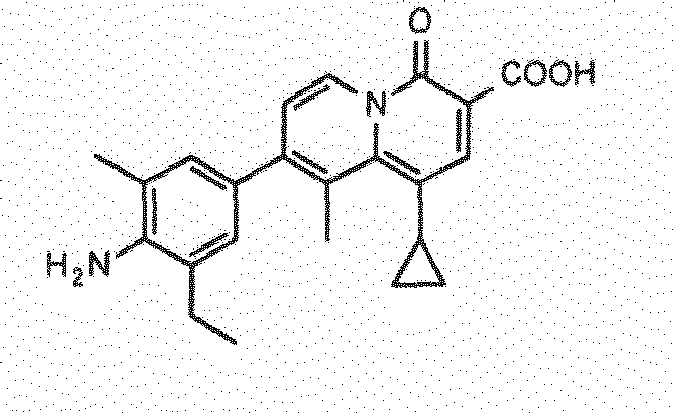
8-(4-amino-3-ethyl-5-methyl-phenyl)-1-cyclopropyl-9-methyl-4-oxo-quinolizine-3-carboxylic acid Compound 17 
8-(3-fluoro-4-amino-phenyl)-1-cyclopropyl-7-fluoro-9-methyl-4-oxo-quinolizine-3-carboxylic acid Compound 18 
8-(3-amino-phenyl)-1-cyclopropyl-7-fluoro-9-methyl-4-oxo-quinolizine-3- carboxylic acid Compound 20 
8-(2-fluoro-4-amino-phenyl)-1-cyclopropyl-9-methyl-4-oxoquinolizine-3-carboxylic acid Compound 21 
8-(3-amino-4-fluoro-phenyl)-1-cyclopropyl-9-methyl-4-oxo-quinolizine-3-carboxylic acid Compound 22 
8-(3-amino-5-fluoro-phenyl)-1-cyclopropyl-9-methyl-4-oxoquinolizine-3-carboxylic acid Compound 24 
8-(3-chloro-4-amino-phenyl)-1-cyclopropyl-9-methyl-4-oxoquinolizine-3- carboxylic acid Compound 25 
8-(3-methoxy-4-amino-phenyl)-1-cyclopropyl-9-methyl-4-oxoquinolizine-3-carboxylic acid Compound 28 
8-(4-methylamino-phenyl)-1-cyclopropyl-9-methyl-4-oxoquinolizine-3-carboxylic acid Compound 31 
8-(3-methyl-4-amino-phenyl)-1-cyclopropyl-9-methyl-4-oxoquinolizine-3- carboxylic acid Compound 33 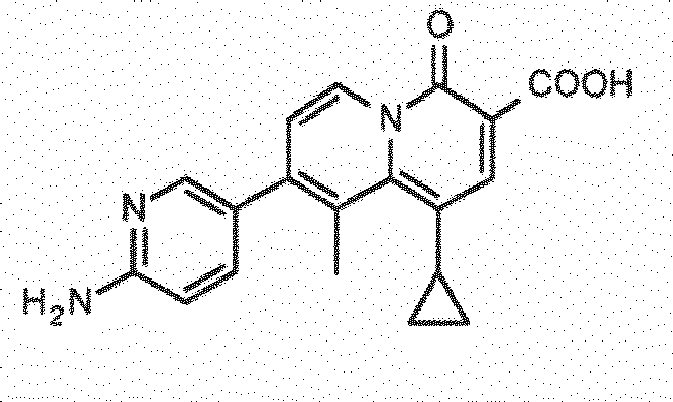
8-(6-amino-3-pyridyl)-1-cyclopropyl-9-methyl-4-oxoquinolizine-3-carboxylic acid Compound 37 
8-(4-dimethylamino-phenyl)-1-cyclopropyl-9-methyl-4-oxo-quinolizine-3-carboxylic acid Compound 43 
8-(2,5-difluoro-4-amino-phenyl)-1-cyclopropyl-7-fluoro-9-methyl-4-oxo-quinolizine-3-carboxylic acid Compound 44 
8-(3,5-difluoro-4-amino-phenyl)-1-cyclopropyl-9-methyl-4-oxoquinolizine-3-carboxylic acid Compound 57 
8-(2-aminopyrimidin-5-yl)-1-cyclopropyl-9-methyl-4-oxoquinolizine-3- carboxylic acid Compound 60 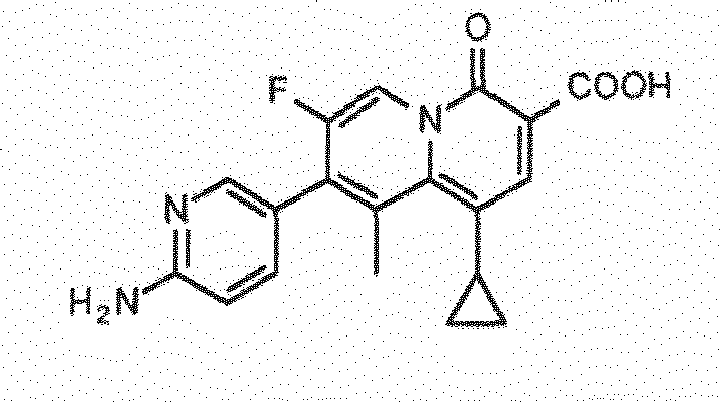
8-(6-amino-3-pyridyl)-1-cyclopropyl-7-fluoro-9-methyl-4-oxo-quinolizine-3-carboxylic acid Compound 69 
8-[3-methyl-4-(methylamino)phenyl]-1-cyclopropyl-9-methyl-4-oxoquinolizine-3-carboxylic acid Compound 72 
8-[3-(aminomethyl)-4-hydroxyphenyl]-1-cyclopropyl-9-methyl-4-oxo-quinolizine-3-carboxylic acid Compound 76 
8-[3-(arninornethyl)-4-arnino phenyl]-1-cyclopropy1-9-methyl-4-oxo-quinolizine-3-carboxylic acid Compound 78 
8-[6-(methylamino)-3-pyridyl]-1-cyclopropy1-9-methyl-4-oxo quinolizine-3-carboxylic acid Compound 79 
8-(6-arnino-5-methyl-3-pyridy1) 1-cyclopropy1-9-methyl-4-oxo quinolizine-3-carboxylic acid Compound 87 
8-(6-amino-3-pyridyl)-1-cyclopropyl-7,9-dimethyl-4-oxoquinolizine-3-carboxylic acid - Conveniently, the Polymyxin B is present in a subinhibitory concentration.
- Advantageously, the composition is for treatment of a bacterial infection in an individual in need thereof.
- Preferably, the composition is for treatment of a bacterial infection in an individual in need thereof and said bacterial infection is infection by a multiresistant strain. Advantageously, the composition is for treatment of a bacterial infection in an individual in need thereof, and said infection is infection by one or more bacteria of a genus selected from the group consisting of Acinetobacter, Bacillus, Bortadella, Borrelia, Brucella, Camphylobacter, Chlamydia, Clostridium, Corynebacterium, Enterococcus, Escherichia, Fransisella, Haemophilus, Helicobacter, Legionella, Leptospira, Listeria, Mycobacterium, Mycoplasma, Neisseria, Propionibacterium, Pseudomonas, Rickettsia, Salmonella, Shigella, Staphylococcus, Streptococcus, Treponema, Vibrio and Yersinia.
- The invention is defined by the claims. Any subject matter that is presented in the figures that does not fall within the scope of the claims is provided for information purposes only.
- The following detailed description of the embodiments of the present invention can be best understood when read in conjunction with the following drawings.
-
Figure 1 shows the Isobologram related to the synergy of the antibacterial activity ofcompounds -
Figure 2 shows the Isobologram related to the synergy of the antibacterial activity ofcompounds -
Figure 3 shows the Isobologram related to the synergy of the antibacterial activity ofcompounds -
Figure 4 shows the structures of the 5 scaffolds used as intermediates towards the preparation of the 4-oxoquinolizines compounds -
Figure 5 shows LC-MS characterization ofcompound 1. The data was recorded on a Waters Acquity UPLC system, equipped with SQD, PDA and ELSD detectors, with an Acquity BEH C18 1.7 micron column. LC was run with a 10 min gradient from 0 to 100% B (A: water with 0.1% formic acid, B: acetonitrile with 0.1% formic acid). -
Figure 6 shows LC-MS characterization ofcompound 5. The data was recorded on a Waters Acquity UPLC system, equipped with SQD, PDA and ELSD detectors, with an Acquity BEH C18 1.7 micron column. LC was run with a 10 min gradient from 0 to 100% B (A: water with 0.1% formic acid, B: acetonitrile with 0.1% formic acid). -
Figure 7 shows LC-MS characterization ofcompound 6. The data was recorded on a Waters Acquity UPLC system, equipped with SQD, PDA and ELSD detectors, with an Acquity BEH C18 1.7 micron column. LC was run with a 10 min gradient from 0 to 100% B (A: water with 0.1% formic acid, B: acetonitrile with 0.1% formic acid). - Elements in the figures are illustrated for simplicity and clarity and have not necessarily been drawn to scale. For example, the dimensions of some of the elements in the figures can be exaggerated relative to other elements to help improve understanding of the embodiments) of the present invention.
- The invention is defined by the claims. Any subject matter falling outside of the scope of the claims is provided for information purposes only.
- Specific compounds are named herein as Compound followed by a number, i.e. Compound n, wherein n is an integer. This refers to the compounds as named and numbered in Table 1 herein below.
- The term "alkyl'= as used herein refers to a saturated, straight or branched hydrocarbon chain. The hydrocarbon chain preferably contains of from one to eight carbon atoms (C1-8 alkyl), such preferably from one to SIX carbon atoms (C1-6 alkyl), more preferred of from one to five carbon atoms (C1-5-alkyl), including methyl, ethyl, propyl, isopropyl, butyl, isobutyl, secondary butyl, tertiary butyl, pentyl, isopentyl, neopentyl and tertiary pentyl. In a preferred aspect alkyl represents a C1-4-alkyl group, which may in particular include methyl, ethyl, propyl, isopropyl, butyl, isobutyl, secondary butyl, and tertiary butyl.
- The term "aryl" as used herein refers to an aromatic ring or aromatic ring system substituent. Aryl may for example be phenyl or naphthyl.
- The term "cycloalkyl" as used herein refers to a cyclic alkyl group, preferably containing of from three to eight carbon atoms (C3-8-cycloalkyl), including cyclopropyl, cyclobutyl, cyclopentyl, cyclohexyl, cycloheptyl and cyclooctyl, more preferably 3 carbon atoms (cyclopropyl).
- The term "haloalkyl" as used herein refers to an alkyl group as defined herein, which alkyl group is substituted one or more times with one or more halogen.
- The term "heteroaryl" refers to an aryl, wherein one or more ring carbons have been exchanged for a heteroatom. The heteroatom is in general selected from the group consisting of N, S and O. The heteroaryl preferably contains 1 to 3 heteroatoms.
- The term "heterocyclyl" as used herein refers to a monocyclic group or a multicyclic group holding one or more heteroatoms in its ring structure. Preferably heterocyclyl refers to monocyclic or bicyclic groups. Preferred heteroatoms include nitrogen (N), oxygen (O) and sulphur (S). Examples of 5-membered monocyclic heterocyclic groups include pyrrolidinyl, pyrrolyl, 3H-pyrrolyl, oxolanyl, furanyl, thiolanyl, thiophenyl, pyrazolyl, pyrazolidinyl, imidazolyl, imidazolidinyl, 1,2-oxazolyl, 1,3-oxazolyl, 1,2-thiazolyl, 1,3-thiazolyl, and 1,2,5-oxadiazolyl. Examples of 6-membered monocyclic heterocyclic groups include piperidinyl, pyridinyl, oxanyl, 2-H-pyranyl, 4-H-pyranyl, thianyl, 2H-thiopyranyl, pyridazinyl, 1,2-diazinanyl, pyrimidinyl, 1,3-diazinanyl, pyrazinyl, piperazinyl, 1,4-dioxinyl, 1,4-dioxane), 1,4-oxazinyl, morpholinyl, thiomorpholinyl and 1,4-oxathianyl.
- The term "bicyclic heteroaryl" as used herein refers to a bicyclic aromatic ring system substituent derived by fusion of two monocyclic groups, where at least one of said two monocyclic groups holds one or more heteroatoms in its ring structure. Preferred heteroatoms include nitrogen (N), oxygen (O) and sulphur (S). Examples of bicyclic heterocyclic group includes 1H-indolyl, decahydroquinolinyl, octahydrocyclopenta[b]pyrrolyl, 4H-chromenyl, 2,3-dihydro-1-benzofuranyl, 2H-1,3-benzodioxolyl, 1H-1,3-benzodiazolyl and 1,3-benzothiazolyl.
- The term "halogen" as used herein refers to a substiuent selected from the group consisting of -Cl, -F, -Br and -I.
- The term "oxo" as used herein refers to =O.
- The instant disclosure provides novel 2-pyridones having potency, breadth of antimicrobial activity, lack of cross-resistance to existing drugs, safety, and/or efficacy in animal models for Category A & B CDC pathogens including the particularly problematic bacteria residing inside mammalian host cells. The preferred 2-pyridone compounds of the disclosure are 4-oxoquinolizine compounds. The disclosed 2-pyridone compounds have substituted 2-pyridone scaffolds and preferably the 2-pyridone compounds contain a substituted 4-oxoquinolizine scaffold. They target the well validated IIA bacterial topoisomerases, e.g. DNA gyrase and topoisomerase IV, thereby inhibiting a broad spectrum of Gram-positive as well as Gram-negative bacteria - importantly, those resistant to quinolones and topoisomerase inhibitors, such as for example piperidinylalkylquinolines. By synthesis and profiling in vitro and in vivo, the presently disclosed series of 4-oxoquinolizine antibiotics have been found to be broad-spectrum and very potent against CDC pathogens, including Burkhofderia pseudomallei, Baciflus anthracis, Yersinia pestis, Francisella tularensis, and Brucella abortus in MIC90 ranges of low nanograms per milliliter. Similar MICs are obtained against important nosocomial pathogens, among them quinolane-resistant Klebsiella, Pseudomonas, Acinetobacter and Staphylococcus aureus MRSA. Furthermore, we have found that 4-oxoquinolizines are equally effective against a surrogate Burkholderia strain replicating inside mammalian host cells.
- 2-pyridones are distantly related to quinolones, but with a different heterocyclic nucleus and different electronic distribution over the molecule leading to significant changes in chemical reactivity. Exhibiting a possibly new mechanism of action against a well-validated bacterial target, with favorable drug-like properties, the instant 2-pyridones are likely to become the first 2-pyridone members in such clinical use. In particular, the 2-pyridones may be 4-oxoquinolizine compounds.
- It is one aspect of the present disclosure to provide pharmaceutical compositions comprising 2-pyridone compounds in combination with polymyxin. Said 2-pyridone compound is preferably a 4-oxoquinolizine compound and said Polymyxins is preferably present in a subinhibitory concentration and is preferably Polymyxin B as described herein elsewhere.
- The 2-pyridone compound according to the present disclosure may be any compound having a 2-pyridone skeleton as a partial structure. In a preferred aspect the 2-pyridone compound is a 4-oxoquinolizine compound, i.e. a compound comprising a 4-oxoquinolizine skeleton structure.
- Thus, in a preferred aspect of the disclosure the present disclosure relates to pharmaceutical compositions comprising a 4-oxoquinolizine compound and polymyxin, wherein said polymyxin preferably is present in subinhibitory concentrations.
- According to the present invention the 4-oxoquinolizine compound is a compound of formula IIIc:

- R1 is hydrogen, halogen, cyano, C1-8 alkyl, C1-8 haloalkyl, -ORX, -N(RX)2, -C(O)RX, -C(O) ORX, or -C(O)N(RX)2, wherein each RX is independently hydrogen, C1-8 alkyl, or C1-8 haloalkyl; and
- Y is aryl, or heteroaryl, each substituted with one to five groups that are either -N(RY1)2 or -C1-8 alkyl-RY where RY is -N(RY1)2 and further optionally substituted by one to four groups that are each independently halogen, C1-8 alkyl, C1-8 haloalkyl, C3-8cycloalkyl, heterocyclyl, aryl, heteroaryl, C3-8cycloalkyl(C1-8) alkyl, heterocyclyl(C1-8)alkyl, aryl(C1-8) alkyl, heteroaryl(C1-8)alkyl, -RY, or -C1-8alkyl-RY, wherein RY is nitro, cyano, -ORY1, -SRY1, -N(RY1)2, -C(O)RY1, -C(O)ORY1, -C(O)N(RY1)2, -OC(O)RY1, -OC(O)ORY1, -OC(I)N(RY1)2. -N(RY1)C(O)RY1, -N(RY1)C(O)ORY1, -N(RY1)C(O)N(RY1)2, -S(O)2RY1, -S(O)2ORY1, -S(O) 2N(RY1)2, -OS(O)2RY1, -OS(O)2ORY1, -OS(O)2N(RY1)2, -N(RY1)S(O)2RY1, -N(RY1)S(O) 2ORY1, or -N(RY1)S(O)2N(RY1)2, wherein each RY1 is independently hydrogen, C1-8 alkyl, or C1-8 haloalkyl.
R1 may preferably be as described in the following paragraph:- In one preferred aspect R1 may be hydrogen or halogen. Thus in one very preferred aspect R1 is hydrogen. In another preferred aspect R1 is halogen, and more preferably R1 may be fluorine. In another aspect, R1 is hydrogen, halogen, C1-8 alkyl, C1-8 alkoxy, amino, C1-8 alkylamino, or di(C1-8 alkyl)amino, preferably R1 may be C1-8 alkyl, more preferably C1-5 alkyl, even more preferably C1-2 alkyl, yet more preferably methyl. In another aspect R, is ORX, -N(RX)2, -C(O)RX, -C(O)ORX, or -C(O)N(RX)2. In another aspect, R1 is -ORX or -N(RX)2, In another aspect, R1 is -C(O)RX, -C(O)ORX, or -C(O)N(RX)2. In another aspect, R1 is C1-8haloalkyl (e.g., trifluoromethyl).
- In a preferred aspect of the disclosure the 4-oxoquinolizine compound is selected from the group of compounds mentioned in Table 1 herein below.
Table 1: Examples of 4-oxoquinolizines compounds Compounds Structure Name Compound 1 
8-(3-fluoro-4-amino-phenyl)-1-cyclopropyl-9-methyl-4-oxoquinolizine-3-carboxylic acid Compound 2 
8-(3,6-difluoro-4-aminophenyl)-1-cyclopropyl-9-methyl-4-oxo-quinolizine-3-carboxylic acid Compound 3 
8-(3,5-dichloro-4-aminophenyl)-1-cyclopropyl-9-methyl-4-oxo-quinolizine-3-carboxylic acid Compound 4 
8-(3-fluoro-4-aminomethylphenyl)-1-cyclopropyl-9-methyl-4-oxo-quinolizine-3-carboxylic acid Compound 5 
8-(4-aminomethyl-phenyl)-1-cyclopropyl-9-methyl-4-oxoquinolizine-3-carboxylic acid Compound 6 
8-(4-aminomethyl-phenyl)-1-cyclopropyl-7-fluoro-9-methyl-4-oxo-quinolizine-3-carboxylic acid Compound 7 
8-(4-amino-phenyl)-1-cyclopropyl-7-fluoro-9-methyl-4-oxo-quinolizine-3-carboxylic acid Compound 8 
8-(4-amino-phenyl)-1-cyclopropyl-9-methyl-4-oxoquinolizine-3-carboxylic acid Compound 9 
8-(3-amino-phenyl)-1-cyclopropyl-9-methyf-4-oxoquinolizine-3-carboxylic acid Compound 11 
8-(2-chloro-4-amino-5-methylphenyl)-1-cyclopropyl-9-methyl-4-oxo-qumolizine-3-carboxylic acid Compound 12 
8-[5-aminomethyl)-2-furyl]-1-cyclopropyl-9-methyl-4-oxoquinolizine-3-carboxylic acid Compound 13 
8-[5-aminomethyl)-2-thienyl]-1-cyclopropyl-9-methyl-4-oxoquinolizine-3-carboxylic acid Compound 16 
8-(4-amino-3-ethyl-5-methylphenyl)-1-cyclopropyl-9-methyl-4-oxo-quinolizine-3-carboxylic acid Compound 17 
8-(3-fluoro-4-amino-phenyl)-1-cyclopropyl-7-fluoro-9-methyl-4-oxo-quinolizine-3-carboxylic acid Compound 18 
8-(3-amino-phenyl)-1-cyclapropyl-7-fluoro-9-methyl-4-oxo-quinolizine-3-carboxylic acid Compound 20 
8-(2-fluoro-4-amino-phenyl)-1-cyclopropyl-9-methyl-4-oxoquinolizine-3-carboxylic acid Compound 21 
8-(3-amino-4-fluoro-phenyl)-1-cyclopropyl-9-methyl-4-oxoquinolizine-3-carboxylic acid Compound 22 
8-(3-amino-5-fluoro-phenyl)-1-cyclopropyl-9-methyl-4-oxoquinolizine-3-carboxylic acid Compound 24 
8-(3-chloro-4-amino-phenyl)-1-cyclopropyl-9-methyl-4-oxoquinolizine-3-carboxylic acid Compound 25 
8-(3-methoxy-4-amino-phenyl)-1-cyclopropyl-9-methyl-4-oxo-quinolizine-3-carboxylic acid Compound 28 
8-(4-methylamino-phenyl)-1-cyclopropyl-9-methyl-4-oxoquinolizine-3-carboxylic acid Compound 31 
8-(3-methyl-4-amino-phenyl)-1-cyclopropyl-9-methyl-4-oxoquinolizine-3-carboxylic acid Compound 33 
8-(6-amino-3-pyridyl)-1-cyclopropyl-9-methyl-4-oxoquinolizine-3-carboxylic acid Compound 37 
8-(4-dimethylamino-phenyl)-1-cyctopropyl-9-methyl-4-oxoquinolizine-3-carboxylic acid Compound 43 
8-(2,5-difluoro-4-aminophenyl)-1-cyclopropyl-7-fluoro-9-methyl-4-oxo-quinolizine-3-carboxylic acid Compound 44 
8-(3,5-difluoro-4-amino-phenyl)-1-cyclopropyl-9-methyl-4-oxo-quinolizine-3-carboxylic acid Compound 57 
8-(2-aminapyrimidin-5-yl)-1-cyclopropyl-9-methyl-4-oxoquinolizne-3-carboxylic acid Compound 60 
8-(6-amino-3-pyridyl)-1-cyclopropyl-7-fluoro-9-methyl-4-oxo-quinolizine-3-carboxylic acid Compound 69 
8-[3-methyl-4-(methylamino)phenyl]-1-cyclopropyl-9-methyl-4-oxoquinolizine-3-carboxylic acid Compound 72 
8-[3-(aminomethyl)-4-hydroxyphenyl]-1-cyclopropyl-9-methyl-4-oxo-quinolizine-3-carboxylic acid Compound 76 
8-[3-(aminomethyl)-4-aminophenyl]-1-cyclopropyl-9-methyl-4-oxo-quinolizine-3-carboxylic acid Compound 78 
8-[6-(methylamino)-3-pyridyl]-1-cyclopropyl-9-methyl-4-oxoquinolizine-3-carboxylic acid Compound 79 
8-(6-amino-5-methyl-3-pyridyl)-1-cyclopropyl-9-methyl-4-oxoquinolizine-3-carboxylic acid Compound 87 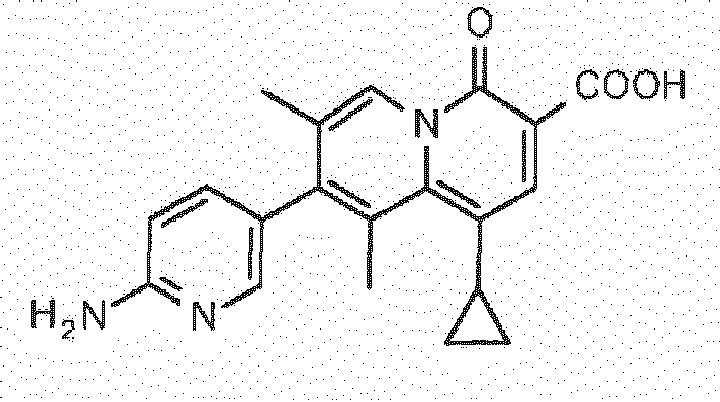
8-(6-amino-3-pyridyl)-1-cyclopropyl-7,9-dimethyl-4-oxo-quinolizine-3-carboxylic acid Compound 89 
8-(6-amino-3-pyridyl)-1-cyclopropyl-9-methoxy-4-oxoquinolizine-3-carboxylic acid - It is one aspect of the present disclosure to provide pharmaceutical compositions comprising a 2-pyridone compound, preferably a 4-oxoquinolizine compound in combination with a Polymyxin, preferably Polymyxin B. Said 4-oxoquinolizine compound may be any of the 4-oxoquinolizine compounds described herein above in the section 4-oxoquinolizines, however it may also be any of the 4-oxoquinolizine compounds described in this section.
- It is furthermore an aspect of the present disclosure to provide particularly useful 2- pyridines, i.e. such as particularly useful 4-oxoquinolizine compounds. Said particularly useful 4-oxoquinolizine compounds have a strong antibacterial effect, i.e. that they are useful in the treatment of bacterial infections.
- Examples of useful 4-oxoquinolizine compounds according to this aspect may for example be selected from the group consisting of compounds 4, 16, 17, 69 and 76 of Table 1.
- In specific aspects, the disclosure provides the novel antimicrobial compounds, 1-6 and 17:


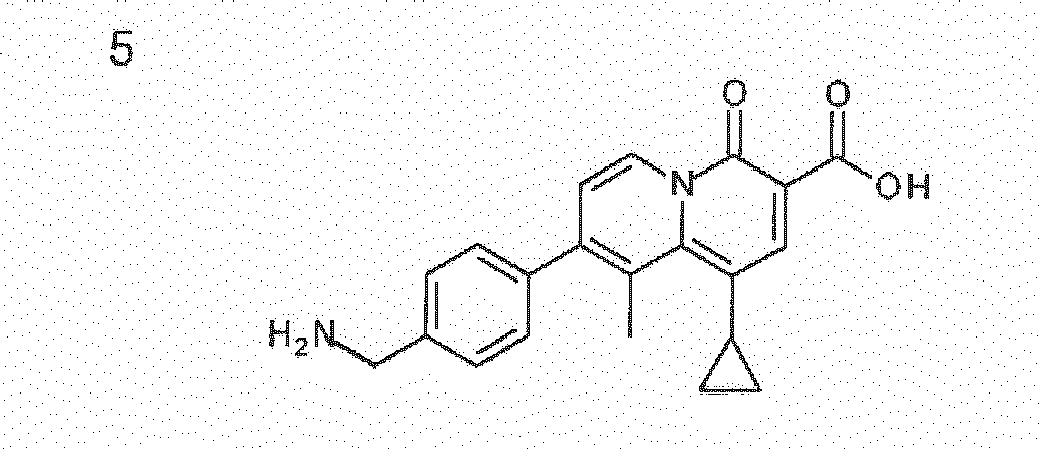


- In aspects of the disclosure relating to 4-oxoquinolizine compounds used in the absence of polymyxins it is preferred that said 4-oxoquinolizine compounds are not any of
compounds - The invention is defined by the claims. Any subject matter falling outside of the scope of the claims is provided for information purposes only.
- Pharmaceutically acceptable salts of the 4-oxoquinolizine compounds of the disclosure may include acid or base addition salts. Acid and base addition salts refers to the relatively nontoxic, inorganic and organic addition salts of compounds of the present disclosure. These salts can be prepared in situ during the final isolation and purification of the compounds, or by subsequently reacting the purified compound in its free acid or base form with a suitable organic or inorganic compound and isolating the salt thus formed.
- Although such salts must be pharmaceutically acceptable for administration to animals, it is often desirable in practice to initially isolate the base compound from the reaction mixture as a pharmaceutically unacceptable salt and then simply convert to the free base compound by treatment with an alkaline reagent and thereafter convert the free base to a pharmaceutically acceptable acid addition salt.
- The pharmaceutically acceptable acid addition salts of the basic compounds are prepared by contacting the free base form with a sufficient amount of the desired acid to produce the salt in the conventional manner. The free base form may be regenerated by contacting the salt form with a base and isolating the free base in the conventional manner. The free base forms differ from their respective salt forms somewhat in certain physical properties such as solubility in polar solvents, but otherwise the salts are equivalent to their respective free base for purposes of the present disclosure.
- Pharmaceutically acceptable base addition salts are formed with metals or amines. The base addition salts of acidic compounds are prepared by contacting the free acid form with a sufficient amount of the desired base to produce the salt in the conventional manner. The free acid form may be regenerated by contacting the salt form with an acid and isolating the free acid in a conventional manner. The free acid forms differ from their respective salt forms somewhat in certain physical properties such as solubility in polar solvents, but otherwise the salts are equivalent to their respective free acid for purposes of the present disclosure.
- Salts may be prepared from inorganic acids or organic acids. One example of a salt of the 4-oxoquinolizines according to the disclosure may be hydrochloric salts.
- Another example of a salt of the 4-oxoquinolizines according to the disclosure is potassium salts.
- The invention is defined by the claims. Any subject matter falling outside of the scope of the claims is provided for information purposes only.
- The 4-oxoquinolizine compounds of the disclosure described herein in the sections "4-oxoquinolizines" and "Particular 4-oxoquinolizines" may be prepared using the methods outlined herein below in Example 8. In particular, useful scaffolds of the 4-oxoquinolizine compounds may be prepared as described in Example 8 and these may be further modified using methods known to the skilled person. Thus, suitable scaffolds may be prepared in 6 to 7 steps as described in Example 8. The suitable scaffolds may then be used to obtain the final 4-oxoquinolizine compounds in 2 to 5 steps.
- The 4-oxoquinolizine compounds of the disclosure may also be prepared as described for specific 4-oxoquinolizine compounds in Example 8. These methods may optionally be modified with relevant modifications known to the skilled person.
- Example 8 also described useful examples of preparing salts of 4-oxoquinolizine compounds. These methods may also be modified by the skilled person to prepare salts of other 4-oxoquinolizines.
- The invention is defined by the claims. Any subject matter falling outside of the scope of the claims is provided for information purposes only.
- The preferred 4-oxoquinolizines according to the disclosure are preferably active antimicrobial compounds.
- In particular the 2-pyridone compounds, such as the 4-oxoquinolizine compounds of the disclosure show potent activity against a pathogen that is resistant against one or more of quinolones, carbapenems, aminosides and glycopeptides antibiotics, and specifically, against a pathogen that is a CDC category A or category B pathogen. The 4-oxoquinolizine compounds may in particular have a MIC ≤10 µg/ml, such as ≤5 µg/ml, for example ≤1 µg/ml, such as ≤0.5 µg/ml against B. thailandensis when determined as described herein below in Example 1. B. thailandensis is a surrogate strain, which may be used experimentially instead of B. pseudomallei. Thus, the 4-oxoquinolizine compounds may have a MIC ≤10 µg/ml, such as ≤5 µg/ml, for example ≤1 µg/ml, such as ≤0.5 µg/ml against one or more of, preferably against all of B. anthracis, F. tularensis, B. acortus and B. pseudomallei when determined as described herein below in Example 1.
- The 4-oxoquinolizine compounds of the disclosure may also have a MIC≤10 µg/ml, such as ≤5µg/ml against one or more bacteria selected from the group consisting of S. aureus, S. epidermis, E. faecalis and E. faecium when determined as described herein below in Example 2.
- The 4-oxoquinolizine compounds of the disclosure may also have a MIC≤50 µg/ml, such as ≤20µg/ml against A. baumanni, wherein said A. baumanni is a drug resistant strain of A. baumanni, for example a multidrug resistant strain of A. baumanni when determined as described herein below in Example 3.
- The 4-oxoquinolizine compounds of the disclosure preferably exhibit potent activities in presence of subinhibitory concentrations of polymyxin B against A. baumannii including quinolone and multiresistant strains of A. baumannii. The antimicrobial activity of the 4-oxoquinolizine compounds when combined with subinhibitory concentrations of polymyxin B against Acinetobacter baumannii including multiresistant clinical isolates may be determined as described herein below in Example 4. Thus the 4-oxoquinolizine compounds of the disclosure may have a MIC≤20 µg/ml, such as ≤15 µg/ml, for example ≤10 µg/ml, such as ≤5 µ/ml against A. baumannii in the presence of 0.06 µg/ml Polymyxin B when determined as described in Example 4 herein below.
- The particular 4-oxoquinolizine compounds of the disclosure may also have a MIC≤10 µg/ml, such as ≤5µg/ml, for example ≤1µg/ml, such as ≤0.5µg/ml against at least one Gram negative bacterium and against at least one gram positive bacterium when determined as described herein below in Example 5.
- The 4-oxoquinolizine compounds of the disclosure in general have at least partly synergistic antibacterial activity with Polymyxin, such as with Polymyxin B. This may for example be determined as described herein below in example 6. Thus, the 4-oxoquinolizine compounds of the disclosure may have a FICI<0.75, such as <0.5 in relation to Polymyxins B against A. baumannii and/or K. pneumoniae, when determined as described herein below in Example 6.
- The 4-oxoquinolizine compounds of the dislosure preferably have a low cytotoxicity against human cells. Thus the 4-oxoquinolizine compounds of the disclosure may have an IC50 of at least 20 µM, such as at least 40 µM in respect of HEPG2 V1 cells when determined as described herein below in Example 7.
- The invention is defined by the claims. Any subject matter falling outside of the scope of the claims is provided for information purposes only.
- It is an aspect of the present disclosure to provide pharmaceutical compositions comprising a 4-oxoquinolizine compound in combination with a Polymyxin. The Polymyxin to be used with the present disclosure may be any useful Polymyxin.
- Polymyxins are antibiotics isolated from cultures of Bacillus polymyxa. In general Polymyxins are active as antibiotics against most Gram-negative bacteria. Polymyxins according to the present disclosure are preferably decapeptides containing five or six residues of L-2,4-diaminobutyric acid. Preferably, the sequence of seven residues at the C-terminal end of the decapeptide is formed into a peptide ring through an isopeptide link to one of the diaminobutyric acid residues, while the N-terminal residue preferably is acylated with a fatty acid. The fatty acid is preferably -(CH2)m-COOH, wherein m is an integer in the range of 6 to 15, preferably in the range of 7 to 10, more preferably in the range of 7 to 8, wherein said-(CH2)m-COOH optionally may be substitiuted with one or more alkyl, preferably with one C1-8 alkyl, more preferably with one alkyl, even more preferably with one alkyl, yet more preferably with one methyl.
- Preferred Polymixins to be used with the present disclosure are Polymyxin B or Polymyxin E or pharmaceutically acceptable salts thereof.
- Polymyxins B is a lipopeptide antibiotic originally isolated from Bacillus polymyxa. Polymyxin B according to the present disclosure preferably consists of a peptide ring of 7 amino acids and a tripeptide side chain with a fatty acid tail. Polymyxin B according to the disclosure preferably contains five primary amine groups and is thus a polycation at
pH 7. - Polymyxin B to be used with the present disclosure may be selected from the group consisting of Polymyxin B1 Polymyxin B2, Polymyxin B3 and Polymyxins B4. Polymyxins B to be used with the present disclosure may also be a mixture of 2 or more of the aforementioned, preferably Polymyxins B is a mixture containing at least Polymyxin B1 and Polymyxin B2, more preferably Polymyxin B to be used with the present disclosure is a mixture containing Polymyxin B1 Polymyxins B2, Polymyxin B3 and Polymyxin B4,
- The invention is defined by the claims. Any subject matter falling outside of the scope of the claims is provided for information purposes only.
- It is one aspect of the present disclosure to provide pharmaceutical compositions comprising a 4-oxoquinolizine compound in combination with Polymyxin, preferably Polymyxin B. In one aspect of the disclosure said Polymyxin, e.g. Polymyxin B is present in a subinhibitory concentration.
- Said subinhibitory concentration is in general dependent on the individual to receive treatment with the pharmaceutical composition, Preferably said subinhibitory concentration of Polymyxin is administration of a less than 2 mg Polymyxin per kg of said individual per day, Thus the subinhibitory concentration may be administration of less than 1,5 mg, such as less than 1 mg, for example less than 0,5 mg, such as less than 0,3 mg, for example less than 0.1 mg per kg of said individual per day. Preferably said subinhibitory concentration of Polymyxin B is administration of a less than 2 mg Polymyxin B per kg of said individual per day, Thus the subinhibitory concentration may be administration of less than 1,5 mg, such as less than 1 mg, for example less than 0,5 mg, such as less than 0,3 mg, for example less than 0.1 mg Polymyxin B per kg of said individual per day.
- Thus, in aspects of the disclosure where the pharmaceutical composition is prepared in daily unit dosages for administration to adult human being, then each dosage unit preferably comprises less than 150 mg Polymyxin, such as less than 130 mg Polymyxin, for example less than 110 mg Polymyxin, such as less than 90 mg Polymyxin, for example less than 70 mg Polymyxin, such as less than 50 mg Polymyxin, wherein the Polymyxin may be any of the Polymyxins described herein above in the section "Polymyxin", but preferably is Polymyxin B.
- In one embodiment of the disclosure the subinhibitory concentration is less than 0,5 µg/ml, such as less than 0,4 µg/ml, for example less than 0.3 µg/ml, such as less than 0.2 µg/ml.
- Polymyxin may however also be administered at regular concentrations, for example in the range of 2 to 5 mg Polymyxin, such as Polymyxin B per kg of said individual may be administered.
- The invention is defined by the claims. Any subject matter falling outside of the scope of the claims is provided for information purposes only.
- It is one aspect of the disclosure to provide pharmaceutical compositions comprising
- a) A Polymyxin, which may be any of the Polymyxins described herein above in the section "Polymyxin"; and
- b) A 4-oxoquinolizine compound, which may be any of the 4-oxoquinolizne compounds described herein above in the section "4-oxoquinolizine compound" or the section "Particular 4-oxoquinolizine compound".
- Interestingly, the present disclosure discloses that the antibacterial effect of Polymyxin and 4-oxoquinolizines is synergistic. The synergistic effect may be determined according to any useful method, such as using a checkerboard technique, e.g. by using the method described in Example 6 herein below.
- Thus, in one aspect of the disclosure the compositions comprises a subinhibitory concentration of a polymyxin, for example Polymyxins B and a subinhibitory concentration of a 4-oxoquinolizine, wherein said composition is capable of inhibiting growth of at least one bacterium, more preferably the composition is capable of inhibiting growth of at least 2 different bacteria, for example of at least 5 different bacteria, such as of at least 10 different bacteria.
- In one aspect of the disclosure the pharmaceutical compositions comprises
- a) Polymyxin B; and
- b) a 4-oxoquinolizine compound, which may be any of the 4-oxoquinolizine compounds described herein above in the section "4-oxoquinolizine compound" or the section "Particular 4-oxoquinolizine compound", wherein the 4-oxoquinolnine compound has an antibacterial effect against at least one bacterium, such as against at least 2 different bacteria, for example against at least 5 different bacteria, such as against at least 10 different bacteria which is synergistic with the antibacterial effect of polymyxin B, wherein the synergistic effect preferably is determined as described herein below in Example 6.
- Although not in accordance with the present invention, in one aspect the disclosure relates to a method of treating a bacterial infection in an individual in need thereof, wherein the method comprises the steps of:
- i) administering Polymyxin B to a individual in need thereof; and
- ii) testing whether the bacterial infection is reduced or cured by said Polymyxin B; and
- iii) if the bacterial infection is not reduced or cured by said Polymyxin B, then administering to said individual a therapeutically effective amount of a 4-oxoquinolizine compound, which may be any of the 4-oxoquinolizine compounds described herein above in the section "4-oxoquinolizine compound" or the section "Particular 4-oxoquinolizine compound";
thereby treating said bacterial infection in said individual. - The Polyxin may be administered in any useful dosage, such as any of the dosages described herein above in the section "Dosage of Polymyxin". For example the polymyxin may be administered at in the range of 2 to 5 mg Polymyxin, such as Polymyxin B per kg of said individual, or the polymyxin may even be administered at subinhibitory concentrations.
- The 4-oxoquinolizine compound may preferably be administered as described herein below in the section "Pharmaceutical formulations".
- The invention is defined by the claims. Any subject matter falling outside of the scope of the claims is provided for information purposes only.
- It is an aspect of the present disclosure to provide pharmaceutical compositions comprising a 4-oxoquinolizine compound in combination with a Polymyxin. Said pharmaceutical compositions are in particular useful for treatment of a bacterial infection in an individual in need thereof, and preferably for treatment of any of the bacterial infections described herein in this section.
- It is furthermore an aspect of the present disclosure to provide particularly useful 4-oxoquinolizine compounds as described herein above in the section "Particular 4-oxoquinolizines". Said 4-oxoquinolizine compounds are in particular useful for treatment of a bacterial infection in an individual in need thereof, and preferably for treatment of any of the bacterial infections described herein in this section.
- In general the pharmaceutical compositions comprising a 4-oxoquinolizine compound in combination with a Polymyxin or the particular 4-oxoquinolizine compounds of the disclosure are useful for treatment of a broad spectrum of different bacterial infections. Thus, they are typically useful for treatment infections by at least two different kinds of bacteria, such as at least 5 different kinds of bacteria, for example at least 10 different kinds of bacteria. In particular, said bacteria may be drug resistant bacteria, such as multidrug resistant bacteria. The 4-oxoquinolizine compounds and the pharmaceutical compositions comprising 4-oxoquinolizine and Polymyxin are antibacterial agents usable for the treatment of local infectious diseases or general infectious diseases of human beings or animals caused by Gram-positive bacteria, Gram-negative bacteria, anaerobic bacteria, acid-fast bacteria or other bacteria.
- Although not in accordance with the present invention, this disclosure also provides methods of treating an infectious disorder in an individual in need thereof, wherein the individual for example may be a human or a mammal, by administering a safe and effective amount of a 4-oxoquinolizine compound to said subject optionally in combination with a Polymyxin. As used herein, an "infectious disorder" is any disorder characterized by the presence of a microbial infection. Exemplary methods of this disclosure are for the treatment of bacterial infections. Such infectious disorders include for example central nervous system infections, external ear infections, infections of the middle ear (such as acute otitis media), infections of the cranial sinuses, eye infections, infections of the oral cavity (such as infections of the teeth, gums and mucosa), upper respiratory tract infections, lower respiratory tract infections, including pneumonia, genitourinary infections, gastrointestinal infections, gynecological infections, septicemia, sepsis, peritonitis, bone and joint infections, skin and skin structure infections, bacterial endocarditis, burns, antibacterial prophylaxis of surgery, or antibacterial prophylaxis in post-operative patients or in immunosuppressed patients (such as patients receiving cancer chemotherapy, or organ transplant patients).
- Thus the bacterial infection may be infection by one or more bacteria of for example the central nervous system, external ear, the middle ear (such as acute otitis media), the cranial sinuses, the eyes, the oral cavity (such as of the teeth, gums and mucosa), upper respiratory tract, lower respiratory tract, including lung, genitourinary tract, gastrointestinal tract, peritoneum, bone and joints, skin or burns. The bacterial infection may also be related to sepsis, surgery, or bacterial infecitons in post-operative patients or in immunosuppressed patients.
- The bacterial infection may be infection by any bacteria; preferably the bacterium is pathogenic bacterium. The bacterial infection may be infection by a gram-negative or a gram-positive bacterium or it may be infection by a mixture of bacteria, which may be gram-positive or gram-negative. The present disclosure discloses that 4-oxoquinolizine compounds are effective in treatment of infections by both Gram-positive and Gram-negative bacteria.
- In aspects of the disclosure relating to pharmaceutical compositions comprising both 4-oxoquinolizine compounds and a Polymyxin, then it is preferred that the bacteria is a Gram-negative bacterium.
- The bacterial infection to be treated with the pharmaceutical composition comprising a 4-oxoquinolizine compound and a Polymyxin or with the particular 4-oxoquinolizine compound according to the present disclosure is preferably infection by one or more bacteria of a genus selected from the group consisting of:
- Acinetobacter, Bacillus, Bortadella, Borrelia, Brucella, Camphylobacter, Chlamydia, Clostridium, Corynebacterium, Enterococcus, Escherichia, Fransisella, Haemophilus, Helicobacter, Legionella, Leptospira, Listeria, Mycobacterium, Mycoplasma, Neisseria, Propionibacterium, Pseudomanas, Rickettsia, Salmonella, Shigella, Staphylococcus, Streptococcus, Treponema, Vibrio and Yersinia.
- The bacterial infection to be treated with the pharmaceutical composition comprising a 4-oxoquinolizine compound and a Polymyxin or with the particular 4-oxoquinolizine compound according to the present disclosure is preferably infection by one or more bacteria of genus selected from the group consisting of:
- Acinetobacter, Bacillus, Brucella, Burkholderia, Citrobacter, Corynebacterium, Enterobacter, Enterococcus, Escherichia, Francisella, Haemophilus, Klepsiella, Listeria, Moraxella, Morganella, Neisseria, Proteus, Providencia, Pseudomonas, Serratia, Shigella, Staphylococcus, Stenotrophomonas, Streptococcus and Yersinia.
- In one aspect of the disclosure the bacterial infection to be treated with the pharmaceutical composition comprising a 4-oxoquinolizine compound and a Polymyxin or with the particular 4-oxoquinolizine compound according to the present disclosure is infection by one or more bacteria of a genus selected from the group consisting of Acinetobacter, Bortadella, Borrelia, Brucella, Camphylobacter, Chlamydia, Clostridium, Corynebacterium, Fransisella, Helicobacter, Legionella, Leptospira, Listeria, Mycobacferium, Mycoplasma, Neisseria, Rickettsia, Salmonella, Shigella, Treponema, Vibrio and Yersinia.
- The bacterial infection to be treated with the pharmaceutical composition comprising a 4-oxoquinolizine compound and a Polymyxin or with the particular 4-oxoquinolizine compound according to the present disclosure is preferably infection by one or more bacteria of a genus selected from the group consisting of:
- Acinetobacter, Brucella, Burkholdena. Citrobacfer, Corynebacterium, Enterobacter, Francisella, Listeria, Moraxella, Morganella, Neisseria, Proteus, Providencia, Serratia, Shigella, Stenotrophomonas, and Yersinia.
- The bacterial infection to be treated with the pharmaceutical composition comprising a 4-oxoquinolizine compound and a Polymyxin or with the particular 4-oxoquinolizine compound according to the present disclosure is preferably infection by one or more bacteria selected from the group consisting of:
- Acinetobacter spp,, Acinefobacter baumannii, Bacillus anthracis, Brucella aborfus, Burkholderia cepacia, Burkholderia mallei, Burkholderia pseudomallei, Burkholderia thailandensis, Citrobacter freundii, Corynebacterium jeikeium, Enterobacter sp, Enterobacter cloacae, Enterococcus faecalis, Enterococcus faecium, Enterococcus gallinarum, Escherichia coli, Francisella tularensis, Haemophilus influenza, Klepsiella spp., Klebsiella aerogenes, Klebsiella pneumoniae, Listeria monocytogenes, Moraxella catarrhalis, Morganella morganii, Neisseria meningitides, Proteus mirabilis, Providencia stuartii, Pseudomonas spp., Pseudomonas aeruginosa, Serratia marcescens, Shigella sp, Staphylococcus aureus, Staphylococcus epidermis, Staphylococcus haemolyticus, Staphylococcus saprophyticus, Sfenotrophomonas maltophilia, Streptococcus agalactiae, Streptococcus bovis, Streptococcus constellatus, Streptococcus mitis, Streptococcus pneumoniae, Streptococcus pyogenes. Streptococcus oralis, Streptococcus sanguis, Group C Streptococcus, Yersinia pestis, and drug-resistant strains thereof.
- In an aspect of any of the preceding aspects, the bacteria can be selected from the group consisting of, (a) Acinetobacter baumannii, Bacillus anthracis, Brucella abortus, Burkholderia cepacia, Burkholderia mallei, Burkholderia pseudomallei, Burkholderia thailandensis, Cifrobacter freundii, Corynebacterium jeikeium, Enterobacter sp, Enterobacter cloacae, Enterococcus faecium, Enterococcus gallinarum, Francisella tularensis, Klebsiella aerogenes, Listeria monocytogenes, Moraxella catarrhalis, Morganella morganii,, Neisseria meningitides, Proteus mirabilis, Providencia stuartii, Serratia marcescens, Shigella sp, Staphylococcus haemolyticus, Staphylococcus saprophyticus, Stenotrophomonas maltophilia, Streptococcus agalactiae, Streptococcus bovis, Streptococcus constellatus, Streptococcus mitis, Streptococcus pyogenes, Streptococcus oralis, Streptococcus sanguis, Group C Streptococcus, and Yersinia pestis, (b) drug-resistant strains of any pathogen of part (a); and (c) and drug-resistant strains of Staphylococcus aureus, Staphylococcus epidermis, Streptococcus pneumoniae, Enteracoccus faecalis, Escherichia coli, Klebsiella pneumoniae, Pseudomonas aeruginosa, and Haemophilus influenza.
- By the term "drug-resistant strain" is meant a bacterial strain which is resistant to at least one antibiotic drug selected from the group consisting of quinolones, carbapenems, aminosides and glycopeptides antibiotics. Multidrug-resistant strains are bacterial strains resistant to at least two two antibiotic drugs of different classes, wherein said classes are selected from the group consisting of quinolones, carbapenems, aminosides and glycopeptides antibiotics.
- The bacterial infection to be treated with the 4-oxoquinolizine compounds described in the section "Particular 4-oxoquinolizines" are preferably bacteria selected from the group consisting of:
- Acinetobacter spp,, Acinetobacter baumannii, Bacillus anthracis, Brucella abortus, Burkholderia cepacia, Burkholderia mallei, Burkholderia pseudamallei, Burkholderia thailandensis, Citrobacter freundii, Corynebacterium jeikeium, Enterobacter sp, Enterobacter cloacae, Enterococcus gallinarum. Francisella tularensis, Klebsiella aerogenes, Listeria monocytogenes, Moraxella catarrhalis, Morganella morganii, Neisseria meningitides, Proteus mirabilis, Providencia stuartii, Serratia marcescens, Shigella sp, Staphylococcus haemolyticus, Staphylococcus saprophyticus, Stenotrophomonas maltophilia, Streptococcus agalactiae, Streptococcus bosis, Streptococcus constellatus, Streptococcus mitis, Streptococcus pyogenes, Streptococcus oralis, Streptococcus sanguis, Group C Streptococcus, Yersinia pestis, and drug-resistant strains thereof.
- The bacterial infection to be treated with the pharmaceutical composition comprising a 4-oxoquinolizine compound and a Polymyxin or with the particular 4-oxoquinolizine compound according to the present disclosure may be selected from the group consisting of Burkholderia pseudomallei, Bacillus anthracis, Yersinia pestis, Francisella tularensis, and Brucella abortu, Klebsiella, Pseudomanas, Acinetobacter and Staphylococcus aureus, wherein said Staphylococcus aureus may be Methicillin-resistant Staphylococcus aureus (MRSA).
- In one aspect the bacterial infection to be treated with the pharmaceutical composition comprising a 4-oxoquinolizine compound and a Polymyxin or with the particular 4-oxoquinolizine compound according to the present disclosure the infection is infection by a Gram-positive bacterium. This may in particular be the case in aspects of the disclosure relating to the particular 4-oxoquinolizine compounds described herein above in the section "Particular 4-oxoquinolizines". Said Gram-positive bacterium may for example be selected from the group consisting of B. anthracis, S. epidermidis, Staphylococcus aureus, Streptococcus aureus, Streptococcus pneumonia, Enterococcus faecalis and Enterococcus faecium.
- The bacterial infection to be treated with pharmaceutical compositions comprising 4-oxoquinolizine compounds and Polymyxins may preferably be bacteria of a genus selected from the group consisting of:
- Acinetobacter, Bortadella, Borrelia, Brucella, Camphylobacter, Escherichia, Fransisella, Haemophilus, Helicobacter, Legionella, Leptospira, Neisseria, Pseudomonas, Rickettsia, Salmonella, Shigella, Treponema, Vibrio and Yersinia.
- The bacterial infection to be treated with pharmaceutical compositions comprising 4-oxoquinolizine compounds and Polymyxins may preferably be selected from bacteria of a genus selected from the group consisting of
- Acinetobacter, Brucella, Burkholderia, Citrobacter, Enterobacter, Escherichia, Francisella, Haemophilus, Klepsiella, Maraxella, Morganella, Neisseria, Proteus, Providencia, Pseudomonas, Serratia, Shigella, Stenotrophomonas and Yersinia.
- In one aspect the bacterial infection to be treated with the pharmaceutical composition comprising a 4-oxoquinolizine compound and a Polymyxin or with the particular 4-oxoquinolizine compound according to the present disclosure the infection is infection by a Gram-negative bacterium. Said Gram-negative bacterium may for example be selected from the group consisting of F. tularensis, B. abortus, B. pseudomallei, Pseudamanas aeruginasa, Burkholderia thailandensi, Acinetobacter baumannii, Acinetobacter Escherichia coli and Klebsiella.
- In one aspect the bacterial infection to be treated with the pharmaceutical composition comprising a 4-oxoquinolizine compound and a Polymyxin or with the particular 4-oxoquinolizine compound according to the present disclosure the infection is infection by an anaerobic bacterium. Said anaerobic bacterium may for example be Bacillus fragilis.
- In particular the bacteria may be a bacterial strain that is resistant against one or more of quinolones, carbapenems, aminosides and glycopeptides antibiotics, and specifically, the bacterial infection may be infection by a pathogen that is a CDC category A or category B pathogen. CDC is the US Centers for Disease Control and Prevention, which have categorised pathogens according to risk to national security (Example 1 below describe examples of such bacteria).
- Thus, the bacterial infection to be treated with the 4-oxoquinolizine compounds of the disclosure or with pharmaceutical compostions comprising 4-oxoquinolizine compounds and Polymyxin according to the present disclosure may in one embodiment be a Category A bacteria according to CDC's classification. Category A bacteria are defined as bacteria that
- can be easily disseminated or transmitted from person to person;
- result in high mortality rates and have the potential for major public health impact;
- might cause public panic and social disruption; and
- require special action for public health preparedness.
- Category A bacteria may for example be selected from the group consisting of Bacillus anthracis, Clostridium botulinum, Yersinia pestis and Francisella tularensis.
- Thus, the bacterial infection to be treated with the 4-oxoquinolizine compounds of the disclosure or with pharmaceutical compostions comprising 4-oxoquinolizine compounds and Polymyxin according to the present disclosure may in one embodiment be a Category B bacteria according to CDC's classification. Catergoy B bacteria are defined as bacteria that
- are moderately easy to disseminate;
- result in moderate morbidity rates and low mortality rates; and
- require specific enhancements of CDC's diagnostic capacity and enhanced disease surveillance.
- Category B bacteria may for example be selected from the group consisting of Brucella species, Clostridium perfringens, Salmonella species, Escherichia coli O157:H7, Shigella, B. abortus, Burkholderia mallei, Burkholderia pseudomallei, Chlamydia psittaci, Coxiella burnetii, Staphylococcus spp. Rickettsia prowazekii, Vibrio cholerae and Cryptosporidium parvum.
- The term "treatment" is used herein to mean that, at a minimum, administration of a compound of the present disclosure mitigates a disease associated an infectious disorder, e.g. a bacterial infection in a host, such as in a mammalian subject, such as in humans. Thus, the term "treatment" includes inhibiting the infectious disorder; and/or alleviating or reversing the infectious disorder. Insofar as the methods of the present disclosure are directed to preventing infectious disorders, it is understood that the term "prevent" does not require that the disease state be completely thwarted. (See Webster's Ninth Collegiate Dictionary.) Rather, as used herein, the term preventing refers to the ability of the skilled artisan to identify a population that is susceptible to infectious disorders, such that administration of the compounds of the present disclosure may occur prior to onset of infection. The term does not imply that the disease state be completely avoided.
- The invention is defined by the claims. Any subject matter falling outside of the scope of the claims is provided for information purposes only.
- The present disclosure relates in one aspect to pharmaceutical compositions comprising 4-oxoquinolizine compounds and Polymyxin. The present disclosure also relates to pharmaceutical compositions comprising preferred 4-oxoquinolizine compounds with or without the presence of Polymyxins.
- According to the present disclosure, the pharmaceutical compositions are preferably for treatment of an individual infected by the pathogen, such as an individual suffering from a bacterial infection. The compositions may however also be for administration to an individual at risk of acquiring such an infection. Generally, the individual is a vertebrate, preferably a mammal, and more preferably a human being. The treatment may be ameliorating or curative. By curative, it is intended to mean survival from the infection which otherwise in the absence of the treatment causes the subject suffering from the infection to show increasing pathology or even morbidity. Thus, the pharmaceutical compositions described herein may be prepared for prophylactic administration to an individual at risk of infection by the pathogen, preferably by the bacteria.
- In one aspect of the disclosure, the pharmaceutical composition is for reducing the risk of contagion caused by the infection or in an individual at risk of acquiring a bacterial infection. In relation to epidemic or even pandemic infections causing a high mortality rate, even slight reductions in risk of contagion may be of major importance.
- In another aspect, the pharmaceutical composition reduces the risk of contagion in a individual that has acquired a bacterial infection by at least 5%, preferably at least 10%, preferably at least 15%, more preferably at least 20%, or at least 30% or at least 40%, or at least 50%, or at least 60%, or at least 70% or at least 80%, or at least 90%, or more. The pharmaceutical compositions of the disclosure may also reduce the risk of contagion caused by a bacterial infection in an individual at risk of acquiring that infection by at least 5%, or at least 10%, or at least 15%, or at least 20%, or at least 30% or at least 40%, or at least 50%, or at least 60%, or at least 70% or at least 80%, or at least 90%, or more.
- Although not in accordance with the present invention, administration
of the anti-bacterial pharmaceutical compositions according to the disclosure may be only once or administration may be repeated for a number of times. For example, the pharmaceutical compositions comprising 4-oxoquinolizine compounds or the pharmaceutical compositions comprising both Polymyxins and 4-oxoquinolizine compounds may be given repeatedly with regular intervals, for example in the range of 1 to 5 times daily for in the range of 1 to 100 days, such as in the range of 1 to 50 days, for example in the range of 1 to 25 days, such as in the range of 10 to 16 days. The total daily dose of the compounds of this disclosure administered to a host in single or in divided doses can be in amounts, Single dose compositions may contain such amounts or submultiples thereof as make up the daily dose. Preferred dosages of Polymyxin to be contained in these compositions are described herein in the section "Dosage of Polymyxin" and preferred dosages of 4-oxoquinolizine compounds are described herein below. - The pharmaceutical compositions may be prepared for any suitable administration route, for example, topical, parenteral, oral, buccal, systemic, nasal, injection, transdermal, rectal, vaginal, etc., or a form suitable for administration by inhalation or insufflation. For example, the pharmaceutical compositions of the disclosure are prepared for oral administration or for intraperitoneal administration, such as for oral administration. Similarly, the pharmaceutical compositions of the disclosure may or may be used at the site of a wound on or in the body, for example as a result of surgery or injury. Equally, the pharmaceutical compositions of the disclosure may or may be used for an internal infection at the site of a prosthesis.
- Initial dosages suitable for administration to humans may be determined from in vitro assays or animal models. For example, an initial dosage may be formulated to achieve a serum concentration that includes the IC50 of the particular compound being administered, as measured in an in vitro assay. Alternatively, an initial dosage for humans may be based upon dosages found to be effective in animal models of the disease. For example, thr dose may vary depending on the symptoms, age, body weight of the patient. Usually, the 4-oxoquinolizine compounds are administered to adults in a dose of 0.05 to 100 mg/kg/day, preferably 0.1 to 50 mg/kg/day, in the systemic administration. When 4-oxoquinolizine compounds are used for the local treatment, the concentration of the active ingredient is 0.01 to 5%, preferably 0.1 to 3%. Preferred dosages of Polymyxins are described herein elsewhere.
- Although not in accordance with the present invention, the 4-oxoquinolizine compounds and the Polymyxin may preferably be administered simultaneously, however it is also contemplated
that the 4-oxoquinolizine compounds and the Polymyxin is administrered sequentially in any order. - The Examples that follow are illustrative of specific aspects of the disclosure and various uses thereof. They are set forth for explanatory purposes only.
- The invention is defined by the claims. Any subject matter falling outside of the scope of the claims is provided for information purposes only.
- This example shows that 4-oxoquinolizine compounds show potent activity against a pathogen that is a CDC category A or category B pathogen (Table 2) and for example B. thailandensis (Table 3).
- The results for B. anthracis, F. tularensis, B. abortus, and B. pseudomallei are summarized in Table 2 below. The dilutions ranged from 32 µg/ml to 0.015 µg/ml (12 2-fold dilution range). The final DMSO concentration was 1.25% for B. anthracis and 2.5% for all other select agents. The assay was performed in duplicate in 96-well plates with a total assay volume of 100 µl. The bacteria were cultivated according to the CLSI guidelines. The MIC value was determined as the lowest concentration that resulted in no growth. The results for B. thailandensis are summarized in Table 3 below. A number of compounds showed a 2 to 4 dilutions improvement shift in MIC90 between pH7 and pH5. This property additionally makes the compounds therapeutically interesting, particularly for use in acidic infected tissues and tissues where cytosolic acidity rises as a result of infection.
Table 2 showing potent antimicrobial activity against a panel of CDC pathogens exhibited by 4-oxoquinolizine compounds. Compounds Structures MIC (ug / ml) B. anthracis F. tularensis B. abortus B. pseudomallei 1 
<0.008 <0.03 0.125 0.125 5 
0.125 0.125 1 2 6 
0.125 0.125 0.5 2 9 
0.06 0.125 0.25 0.5 Table 3 showing the potent antimicrobial activity against B. thailandensis exhibited by 4-oxoquinolizine compounds and a 2 to 4 dilutions improvement shift in MIC90 between pH7 and pH5. Compounds Structure MIC90 B. thailandensis (ug/ml) Dilutions improvement shift on B. thailandensis MIC90 (between pH 7 and pH 5)1 
<0.048 Yes, 4x 2 
<0.048 3 
<0.048 5 
0.390 6 
0.390 No 7 
<0.048 Yes, 4x 8 
<0.024 11 
<0.048 12 
0.390 13 
0.195 16 
<0.048 - Example 2 shows the potent antibacterial activity of a number of 4-oxoquinolizine compounds against a standard panel of Gram-positive and Gram-negative strains (Table 4) in comparison to a well-known marketed quinolone (Ciprofloxacin) and glycopeptide (Vancomycin). Table 5 below shows the resistant strains used for the data displayed in Table 6 below that shows the activity of a selection of 4-oxoquinolizine compounds against a panel of quinolone-resistant strains.
- MICs were determined following the standard CLSI protocol as described herein below in Example 4 using doubling dilutions of compounds (0.03 to 32 µg/ml), Levofloxacin, Ciprofloxacin, Vancomycin (0.125 to 128 µg/ml) in cation adjusted Mueller Hinton broth (CAMHB, Oxoid). The MIC was determined as the lowest concentration of an individual drug that lead to no visible growth.
- Table 4 below shows the MIC values for the instant 4-oxoquinolizines against a standard panel of Gram-positive and Gram-negative bacteria in comparison to a well-known marketed quinolone (Ciprofloxacin) and glycopeptide (Vancomycin). Table 5 below shows the resistant strains used for the data displayed in Table 6 below that shows the activity of the instant 4-oxoquinolizine compounds against a panel of quinolone-resistant strains.
Table 4: showing the MIC values for a selection of 4-oxoquinolizines against standard panels of Gram-positive and Gram -negative bacteria in comparison to a well-known marketed quinolone (Ciprofloxacin) and glycopeptide (Vancomycin). Compounds Structures MIC (ug / ml) S. aureus 25923 S. aureus 25923 HS S. aureus 101 S. epidermis 12228 E. faecalis 29212 E. faecium 19434 Compound 2 
<0.008 0,125 0,125 <0.008 <0.008 0,5 Compound 3 
<0.008 1 0,06 0,008 0,016 0,5 Compound 4 
0,06 0,125 4 0,06 0,125 2 Compound 5 
0,03 0,125 4 0,06 0,125 2 Compound 6 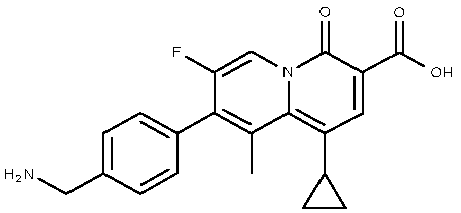
0,03 0,25 2 0,03 0,125 4 Compound 7 
<0.008 1 1 <0.008 0,06 2 Compound 8 
<0.008 0,25 0,5 <0.008 0,03 0,5 Vancomycin Vancomycin 2 2 2 2 2 1 Ciprofloxacin Ciprofloxacin 1 1 128 0,25 1 8 Compound 2 
<0.03 <0.008 0,25 2 0,06 Compound 3 
<0.03 0,06 0,5 2 0,25 Compound 4 
<0.03 <0.008 0,06 0,5 0,25 Compound 5 
<0.03 <0.008 0,06 0,5 0,25 Compound 6 
<0.03 0,03 0,125 2 0,5 Compound 7 
0,03 <0.008 1 4 0,5 Compound 8 
0,03 <0.008 0,25 1 0,125 Vancomycin Vancomycin >128 >128 >128 >128 Ciprofloxacin Ciprofloxacin <0.125 <0.125 <0.125 0,5 4 Table 5: listing the resistant strains used for the data displayed in Table 6 Organism Strain Resistance Phenotype A. baumannii OXA-51 CIP R, ESBL E. coli CTX-M-15 CIP R, ESBL E. coli 2906 CIP R Klebsiella spp KPC-3 CIP R, ESBL Pseudomonas spp PER-1 CIP R, ESBL P. aeruginosa 1388-3-02 CIP R, POL R P. aeruginosa 143-3-03 CIP I, POL R S. aureus SMITH CIP R S. pneumoniae 49619 LEV S S. pneumonia 1027 LEV R CIP, ciprofloxacin; POL, Polyoxin; ESBL, extended spectrum beta-lactamases Table 6: showing the activity of 4-o against a panel of quinolone-resistant strains Compounds Structures MIC (ug/ml) A. baumanii OXA-51 E. coli CTX-M-15 E. coli 2906 Klebsiella ssp KPC-3 S. aureus SMITH Compound 2 
4 >32 32 8 <0.03 Compound 3 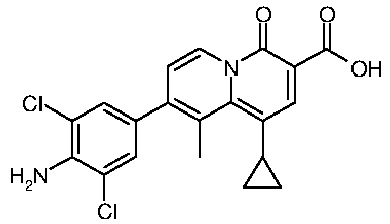
8 >32 >32 8 0,5 Compound 4 
16 16 8 4 0,125 Compound 5 
8 16 16 8 0,125 Compound 6 
8 16 16 16 0,125 Compound 7 
8 32 32 16 0,25 Compound 8 
4 >32 >32 16 <0.03 Ciprofloxacin Ciprofloxacin 128 128 128 128 32 Levofloxacin Levofloxacin 16 16 32 >128 8 Compound 2 
16 8 2 <0.03 0,5 Compound 3 
32 8 4 0,5 2 Compound 4 
8 16 4 0,125 1 Compound 5 
8 16 4 0,125 2 Compound 6 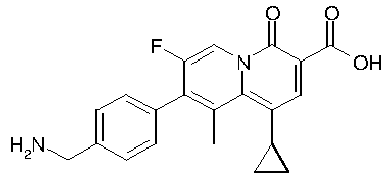
16 32 8 0,125 2 Compound 7 
16 16 4 0,25 4 Compound 8 
16 8 2 <0.03 2 Ciprofloxacin Ciprofloxacin 16 16 2 0,5 32 Levofloxacin Levofloxacin 32 32 8 0,5 16 - Example 3 shows that 4-oxoquinolizine compounds show potent activity against a pathogen that is resistant against one or more of quinolones, carbapenems, aminosides and glycopeptides antibiotics, and specifically, The antibacterial activity of the compounds was assessed against a variety of A. bacter strains consisting mostly of resistant clinical isolates (Table 7 and 8).
- Organisms used were one type strain and clinical isolates of Acinetobacter baumannii from commercial culture collections or from K. Towner, Nottingham, UK. One Acinetobacter sp. (H064200250) was obtained from D. Livermore, London, UK (see Table 7 below which lists the Acinetobacter strains referred to in Table 8 below).
- Ciprofloxacin, Levofloxacin, Vancomycin and Amikacin were purchased from Fluka and Aldrich (Sigma - Aldrich, Buchs, Switzerland); moxifloxacin, meropenem and imipenem/cilastatin were purchased from Apin Chemicals Ltd. (Abingdon, Oxon, UK).
- MICs were determined following the standard CLSI protocol as described herein below in Example 4 using doubling dilutions of compounds (0.03 to 32 µg/ml), Levofloxacin, Ciprofloxacin, Moxifloxacin, Amikacin, Vancomycin, Meropenem and Imipenem/Cilastatin (0.125 to 128 µg/ml) in cation adjusted Mueller Hinton broth (CAMHB, Oxoid). Additionally, MICs were run in CAMHB supplemented. CLSI breakpoints were used to classify resistance to carbapenems, quinolones, aminosides, and glycopeptides1. The Acinetobacter strains were grown in CAMHB for 20-24 hours at 37°C in ambient air. The MIC was determined as the lowest concentration of an individual drug that lead to no visible growth. Referring to the following tables, Table 7 shows the Acinetobacter strains used and Table 8 below shows the activity of the present 4-oxoquinolizines against different Acinetobacter strains known to be resistant against a number of well-known marketed antibiotic drugs such as quinolones, carbapenems and aminoside antibiotics.
Table 7: showing the Acinetobacter strains used for the data displayed in Table 8 below. Organism Strain Source Origin Resistance Phenotype A. baumannii ATCC 19606 DSMZ1 Reference strain - A. baumannii J2 Roche unknown LEV R, CIP R Acinetobacter sp. H064200250 (OXA51 upregulated) D. Livermore2 unknown LEV R, CIP R, MRP R, IMP I A. baumannii A329 K. Towner3 Barcelona, ES LEV R, CIP R, MRP R, IMP R, AMK R, TET R A. baumannii A387 K. Towner Ioannina, GR LEV I, CIP R, IPM R, AMK R, TET R A. baumannii A390 K. Towner Pleven, Bulgaria LEV R, CIP R, MRP R, IPM I, AMK R, TET I A. baumannii A401 K. Towner Taiwan LEV R, CIP R, AMK R, TET R A. baumannii A472 K. Towner Warsaw, PL LEV R, CIP R, MRP I, IMP I, AMK R, TET R A. baumannii A473 K. Towner Warsaw, PL LEV R, CIP R, MRP R, IMP R, AMK R, TET R A. baumannii A489 K. Towner Nottingham, UK (patient repatriated from Crete) LEV R, CIP R, MRP R, IMP R, AMK R, TET R LEV, Levofloxacin; CIP, Ciprofloxacin; MRP, Meropenem; IPM, Imipenem; AMK, Amikacin; TET, tetracycline
1DSMZ, German Collection Strain of Microorganisms and Cell Cultures, Braunschweig, Germany.
2D. Livermore, Health Protection Agency, London, UK.
3K. Towner, Nottingham University Hospitals NHS Trust, Nottingham, UK.
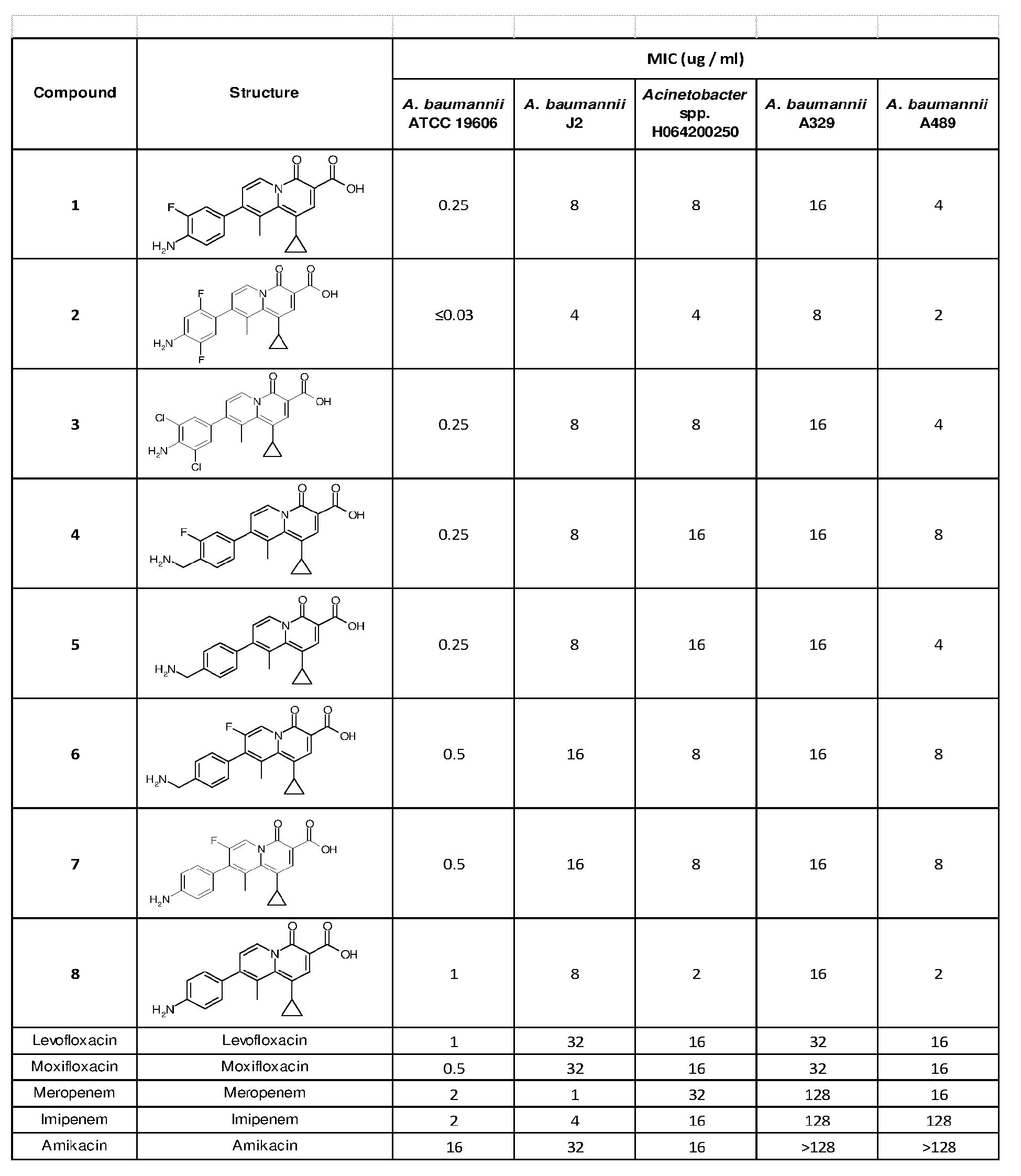

- Example 4 describes the determination of antimicrobial activity of 4-oxoquinolizine compounds with 8-aniline and 8-aniline-like substitutions and shows that these exhibited potent activities in presence of sub-inhibitory concentrations of polymyxin B against A. baumannii which are resistant to quinolones, carbapenems and other antimicrobial agents. The inventive 4-oxoquinolizine compounds with aniline or aniline-like substitutions exhibited potent activities in presence of sub-inhibitory concentrations of polymyxin B against A. baumannii including quinolone and multi-resistant strains. The activities of non-aniline amines 8-substitutions compounds and compound 10 (ABT-719) were less potentiated by polymyxin B. The potent antimicrobial activity shown by the instant compounds when combined with sub-inhibitory concentrations of polymyxin B against Acinetobacter baumannii including multi-resistant clinical isolates are shown in Table 9, 10 and 11 below. Additionally, the 4-oxoquinolizine compounds exhibit bactericidal activity in absence or presence of polymyxin B as determined using a preliminary MBC assay. MIC ranges without and with sub-inhibitory concentrations of polymyxin B against resistant strains of A. baumannii and one sensitive strain of Acinetobacter sp are shown in Table 12.
- Organisms used were one type strain and clinical isolates of Acinetobacter baumannii from commercial culture collections or from K. Towner, Nottingham, UK. One Acinetobacter sp. (H064200250) was obtained from D. Livermore, London, UK.
- The 4-oxoquinolizines with phenyl anilines and phenyl amines as 8-substitutions as well as reference compound 10 (ABT-719) (see Table 9 below) were synthesized. Polymyxin B sulfate, levofloxacin and amikacin were purchased from Fluka (Sigma - Aldrich, Buchs, Switzerland); moxifloxacin, meropenem and imipenem/cilastatin were purchased from Apin Chemicals Ltd. (Abingdon, Oxon, UK).
Table 9: Antimicrobial agents used and ranges tested Compounds Structure Range tested (µg/ml) Compound 1
0.03-32 Compound 17 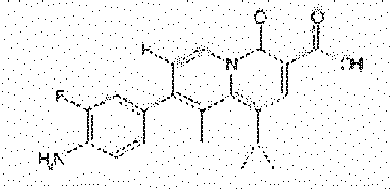
0 03-32 Compound 2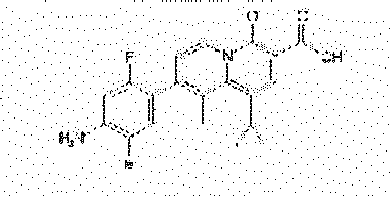
0.03-32 Compound 3
0.03-32 Compound 7
0 03-32 Compound 8
0 03-32 Compound 4 
0 03-32 Compound 5
0 03-32 Compound 6
003-32 Levofloxacin 0.125-128 Moxifloxacin 0.125-128 Meropenem 0.125-128 Impenem/cilastatin 0.125-128 Amikacin 0.125-128 Polymyxin B 0.125-128 - MICs were determined following the standard CLSI protocol (Clinical and Laboratory Standards Institute. Methods for dilution antimicrobial susceptibility tests for bacteria that grow aerobically. Approved Standard-seventh edition M7-A7, Clinical and Laboratory Standards Institute, Wayne, PA, USA, 2006) using doubling dilutions of the 8-phenyl anilines and 8-phenyl amines (0.03 to 32 µg/ml), reference compound 10 (ABT-719) (0.008 to 8 µg/ml), and polymyxin B, levofloxacin, moxifloxacin, amikacin, meropenem and imipenem/cilastatin (0.125 to 128 µg/ml) in cation adjusted Mueller Hinton broth (CAMHB, Oxoid). Additionally, MICs were run in CAMHB supplemented with sub-inhibitory concentrations (0.25 x MIC) of polymyxin B sulfate. CLSI breakpoints were used to classify resistance to carbapenems, quinolones, aminoglycosides, and tetracyclines (DSMZ, German Collection Strain of Microorganisms and Cell Cultures, Braunschweig, Germany). The Acinetobacter strains were grown in CAMHB for 20-24 hours at 37°C in ambient air. The MIC was determined as the lowest concentration of an individual drug that lead to no visible growth.
- Since trailing was observed in the first experiment, MICs were confirmed by adding 10 µl alamarBlue (alamarBlueTM Assay, Biosource; Lucerna ChemAG) to each well in the 2nd experiment. The alamarBlue Assay incorporates a growth indicator based on detection of metabolic activity. Reduction related to growth causes the redox indicator to change from oxidized (blue) form to reduced (red) form. Following incubation at 37°C for 1 hour, the MIC was read as lowest concentration of an individual drug that lead to no growth indicated by blue color.
- After reading the MICs, microtiter plates were shaken (700 rpm, 5 minutes) and 5 µl culture from each well from the plates used for the MIC determination was spotted on Mueller-Hinton agar plates without antibiotic. The plates were incubated for 18-20 hours at 37°C. The MBC was read as the lowest concentration at which colony growth was ca. 90% less than the positive control (i.e. usually where single colonies or no colonies were observed).
- MIC data are shown in Table 10 (1st experiment) and Table 11 (2nd experiment) and MIC ranges are summarized in Table 12 below. All A. baumannii strains except for the type strain ATCC 19606 and one Acinetobacter sp. were resistant to ciprofloxacin and levofloxacin (one strain, A. baumannii A387 exhibited intermediate susceptibility against levofloxacin and resistance to ciprofloxacin). Additionally, most of the strains were resistant to carbapenems, aminoglycosides, and tetracycline. MICs for polymyxin B were ranging from 0.25 to 2 µg/ml (1st experiment) and 0.25 to 0.5 µg/ml (2nd experiment).


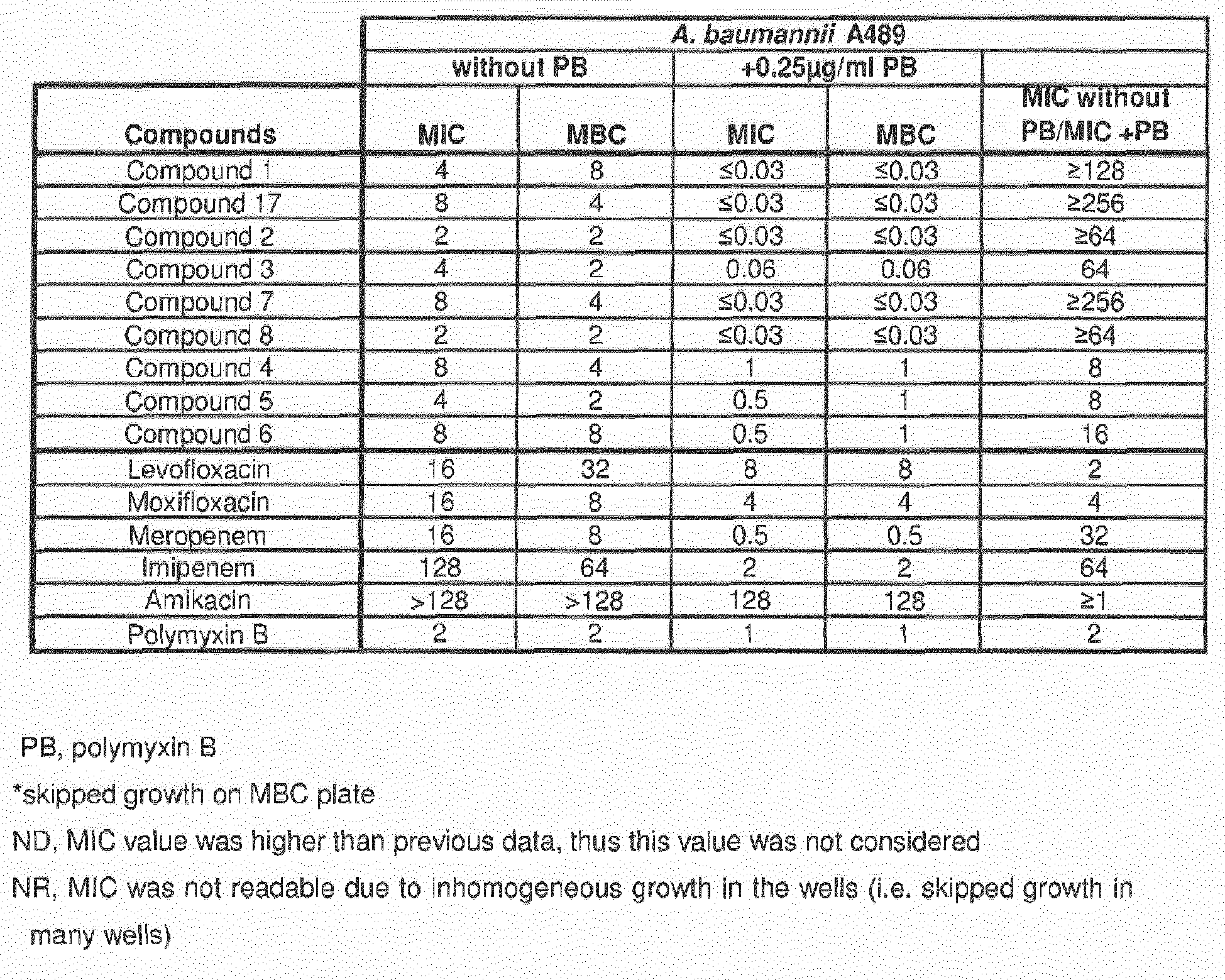


Table 12: MIC ranges without and with sub-inhibitory concentrations of polymyxin B against resistant strains of A. baumannii and one strain of Acinetobacter sp.1 Compounds Structure MIC range without PB MIC range with PB (0.25x MIC) Range ratios MIC without PB / MIC with PB 01-10-2008 14-10-2008 01-10-2008 14-10-2008 01-10-2008 14-10-2008 n=82 n=113 n=8 n=11 n=8 n=11 Compound 1 
1 - 32 4-32 ≤0.03 - 0.06 ≤0.03-2 ≥32 - ≥1024 8 - ≥1024 Compound 17 
1 - 16 ND4 ≤0.03 - 1 ND 8 - ≥512 ND Compound 2 
0.5 - 16 1-16 ≤003 - 1 ≤0.03-0.5 ≥16 - ≥512 16- ≥512 Compound 3 
1- >32 1->32 ≤0.03 - 1 ≤0.03-0.5 16 - ≥64 32- ≥1024 Compound 7 
2-32 2-16 ≤0.03 - 1 ≤0.03-2 8 - ≥512 8- ≥512 Compound 8 
2-32 2-32 ≤0.03 - 1 ≤ 0.03-8 32 - ≥1024 2- ≥512 Compound 4 
2 - 32 4-16 1 - 8 0.5-8 2 - 8 1-16 Compound 5 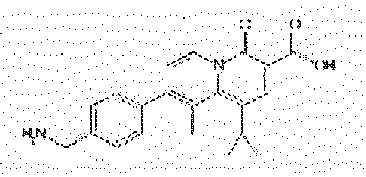
2 - 32 4-16 0.25 - 4 025-8 8 - 16 4-32 Compound 6 
4 - 32 ND 05 - 8 ND 2 - 32 ND Levofloxacin 8 - 32 4-32 4 - 32 4-32 1 - 4 0.5-8 Moxifloxacin 4 - 128 8-64 4 - 128 4-32 0.5 - 4 1-8 Meropenem 1 - 32 1 - 128 <0.125 - 4 ≤ 0.125-32 1 - ≥64 1-256 Imipenem/cilastatin 1 - 128 1->128 <0.125 - 16 ≤0.125-128 1 - 64 1-256 Amikacin 16 - >128 8->128 4 - >128 05->128 1 - ≥8 1-16 1 A. baumannii ATCC 19606 was not taken for the calculation of MIC ranges since it was very susceptible against the 4-oxoquinolizine compounds.
2n=8, three strains (A. baumannii A329, A390 and A473) were not taken for the calculation of MIC ranges since no homogenous growth (many skipped wells) was observed in presence of polymyxin B.
3n=11, all strains except for the ATCC strain were taken for the calculation of MIC ranges 4ND, not determined - The 8-phenyl anilines compounds 1-8 and reference compound 10 (ABT-719) exhibited potent activities against the A. baumanii ATCC 19606 strain with and without sub-inhibitory concentrations of polymyxin B. Since this strain was more susceptible compared to the clinical isolates, its MIC values were not taken into account for calculations for MIC ranges (Table 12).
- Three A. baumannii strains did not grow homogenously in all wells of the microtiter plates containing 0.125 µg/ml polymyxin B in the first experiment (A. baumannii A329, A390, A473), thus these strains were not considered for the calculation of MIC ranges in Table 12. In the 2nd experiment, a lower polymyxin B concentration was used (0.06 µg/ml) and the growth was homogenous in all wells.
- The activity of the 8-phenyl anilines compounds 1, 2, 3, 7, 8 and 17 was potentiated in the presence of polymyxin B.
The activities of the 8-phenyl anilines were 2- to >1000-fold greater in presence of polymyxin B compared to activities without polymyxin B (Table 12). Overall, MICs of the 8-phenyl anilines were ≤0.03 to 0.5 µg/ml for the majority of strains except for 4-fold greater MICs against A. baumannii A-329 (MICs were 0.5 to 2 µg/ml). For this strain, MICs of the 8-phenyl anilines were less affected by the presence of polymyxin B (2- to 32-fold lower MICs in presence of polymyxin B) in contrast to the other strains (Table 11).Compound compound 2 was more active against the quinolone resistant Acinetobacter strains thancompound 3 in absence of polymyxin B (Table 10 and 11). - The activities of levofloxacin, moxifloxacin or amikacin were not significantly affected by polymyxin B, whereas MICs of meropenem and imipenem/cilastatin were 1- to 256-fold lower in presence of polymyxin B (Table 12).
- MBCs were estimated by spotting 5 µl of cultures from the MIC plates on agar. Preliminary MBC data are shown in Table 10 (1st experiment) and Table 11 (2nd experiment). The 8-phenyl anilines and 8-phenyl amines exhibited apparent bactericidal activities against A. baumannii with preliminary MBC/MIC ratios ranging from 1 to 4 except for a few compounds vs. a few strains with a MBC/MIC ratio of 8 (Table 10 and 11). There was no difference observed in MBC/MIC ratios in absence or presence of polymyxin B, although the absolute MBC (and MIC) values were lower in presence of polymyxin B especially for the 8-phenyl anilines.
- Example 5 shows the antibacterial activity of partiuclar 4-oxoquinolizines against a selection of Gram-positive and Gram-negative strains (Table 13) and of a selection of three 4-oxoquinolizines on K. pneumonia strains (Table 14).
- MIC Values for all compounds were measured against a selection of bacterial strains. The MICs of 4-oxoquinolizines against a selection of Gram-negative and Gram-positive bacterial strains are shown in Table 13 in comparison with known antibiotics. Table 14 shows the activity of a selected number of 4-oxoquinoliznes against strains of K. pneumonia, one sensitive and one quinolone-resistant strain (NDM-1 BAA-2146).


- In addition, specific MICs on K. pneumoniae for
compound 2 andcompound 33 are shown in Table 14.
- Example 6 shows that 4-oxoquinolizine compounds possess synergistic antibacterial activity with polymyxin B. A chequerboard technique was used to show synergistic interactions between three 4-oxoquinolizines compounds and polymyxin B (Table 15 and 16,
Figures 1 ,2 and3 ). There is a strong indication that compounds 2 and 33 in combination with polymyxin B are synergistic (or at least partially synergistic) against fluoroquinolone-resistant strains of A. baumannii. No interaction was seen between levofloxacin and polymyxin B. - A chequerboard technique was used to identify possible synergistic or antagonistic interactions between the 4-oxoquinolizines compounds, levofloxacin and polymyxin B. Levofloxacin was included as a control. 10% Aqueous DMSO stock solutions were prepared for compound 2 (25.6mg/mL) and Compound 33 (12.8 mg/mL) as well as a levofloxacin stock solution of 1.28mg/mL and a polymyxin B stock solution of 0.64mg/mL. Final dilutions were made in Mueller-Hinton broth, the specific test medium used for MIC determinations according to CLSI guidelines (CLSI. Methods for Dilution Antimicrobial Susceptibility Tests for Bacteria That Grow Aerobically; Approved Standard-Eighth Edition (2009). CLSI Document M07-A8. CLSI, Wayne, Pennsylvania 19087-1898, USA.). The test medium used was a cation-adjusted Mueller-Hinton Broth II (Becton Dickinson UK Ltd., Oxford Science Park, Oxford, UK, OX4 4DQ).
- The
compounds - The MIC values for the compounds and polymyxin B and levofloxacin were determined by broth microdilution following CLSI guidelines, and the MICs of agents in combination were determined as described by Pillai et.al (Pillai SK, Moellering RC Jr, Eliopoulis GM; Antimicrobial Combinations in Antibiotics in Laboratory Medicine 5th Edition (V. Lorian Ed) (2005) p365-440). Initial MIC results were used to determine the microtiter plate patterns for the chequerboards. A suitable doubling dilution concentration range was selected such that the combination antibiotic range was at least two concentrations above and four concentrations below the MIC for each isolate. A fixed range of 0.008 to 8mg/L was tested for polymyxin B except in the case of A. baumannii GN31 where a range of 0.004 to 4mg/L was tested when in combination with the
compounds - From the raw data, fractional inhibitory concentration indices (FICI) were determined for the compounds of the invention and levofloxacin together with polymyxin B for each isolate as follows:



- Data was interpreted according to the methodology of Pillai: Synergy (FICI <0.5), partial synergy/addition (FICI 0.51 to 0.75), indifference (FICI 0.76 to 2.75), antagonism (FICI >2.75). Additionally isobolograms were created to represent the same data visually. Here, the MIC of polymyxn B was plotted against every concentration of the combination antibiotic up to the MIC. Initial MIC results for all isolates are given in Table 15 and FICI data are given in Table 16 and Isobolograms are shown in
Figures 1 to 3 . - There is a strong indication that compounds 2 and 33 in combination with polymyxin B are synergistic (or at least partially synergistic) against fluoroquinolone-resistant strains of A. baumannii. No interaction was seen between levofloxacin and polymyxin B in any of the chequerboard assays performed, all FICI values indicate indifference. No interaction was seen in any of the combinations tested for the antibiotic susceptible P. aeruginosa GN10. Surprisingly, also partial synergy was observed with
compound 2 combined with polymyxin B against the NDM-1-beta-lactamase producing Klebsiella pneumoniae when combined with polymyxin B.Table 15: Pre-chequerboard MIC of compounds for synergy study. MIC mg/L Antimicrobial agent GN31 Acinetobacter baumannii GN52 Acinetobacter baumannii GN56 Acinetobacter baumannii GN48 Klebsiella pneumoniae GN10 Pseudomonas aeruginosa Compound 33 0.03 2 16 16 0.5 Compound 20.06 8 16 32 1 Levofloxacin 0.12 8 32 64 1 Polymyxin B 0.5 0.5 0.5 1 1 

- Cytotoxicity was determined for the instant 4-oxoquinolizine compounds which show low cytotoxicity. (see Table 17 following). Thus, while the instant 4-oxoquinolizine compounds possess potent activity against both Gram-positive and Gram-negative resistant strains, including nosocomial strains as well as CDC pathogens, they have good drug profiles regarding safety and efficacy.
Table 17 showing cytotoxity values for the instant 4-oxoquinolizines Compounds Structures Cytotoxicity IC50 (µM) 1 
500 2 
250 3 
50 4 
60 7 
150 8 
90 - NMR spectra were recorded on a Bruker Avance-400 NMR or Bruker Avance-300 NMR or with samples in solution in deuterated chloroform (CDCl3), deuterated MeOH (CD3OD) or deuterated dimethyl sulfoxide (DMSO-d6). Chemical shifts and coupling constants are respectively expressed in part per million (ppm) and in Herz (Hz). Mass spectrometry (MS) analyses were performed on an Agilent MSD G1946D or a Waters TQD with electrospray ionization (ESI). High resolution mass spectrometry (High-Res MS) analyses were recorded on a Shimadzu IT-TOF apparatus. HPLC analyses were performed on columns Waters XBridge (C18, 30x2.1 mm, 3.5 micron) at a column temperature of 35°C with a flow rate of 1mL/min of a mixture of eluent A (0.1% Formic acid in ACN) and eluent B (0.1% Formic acid in water); 3 methods of elution were used,
method 1,method 2 andmethod 3 as described below. -
HPLC Method 1 - Lin. Gradient: t=0
min 2% A, t=1.6 min 98% A, t=3 min 98%A - Detection: DAD (220 - 320 nm)
- Detection: MSD (ESI pos/neg) mass range: 100 - 800
- Detection: ELSD (PL-ELS 2100) gas flow 1.1 mL/min; gas temp: 50°C
-
HPLC Method 2 - Lin. Gradient: t=0
min 2% A, t=3.5 min 98% A, t=6 min 98%A - Detection: DAD (220 - 320 nm)
- Detection: MSD (ESI pos/neg) mass range: 100 - 800
- Detection: ELSD (PL-ELS 2100) gas flow 1.1 mL/min; gas temp: 50°C
-
HPLC Method 3 - Lin. Gradient: t=0
min 2% A, t=10 min 98% A, t=14 min 98%A - Detection: DAD (220 - 320 nm)
- Detection: MSD (ESI pos/neg) mass range: 100 - 800
- Detection: ELSD (PL-ELS 2100) gas flow 1.1 mL/min; gas temp: 50°C
- The following acronyms and abbreviations are used:
ACN Acetonitrile BOC t-butoxycarbonyl DCM Dichloromethane DMF N,N-dimethylformamide DMSO Dimethylsulfoxide ESI-MS electrospray ionization mass spectrometry HPLC High-performance liquid chromatography LCMS Liquid chromatography-mass spectrometry MeOH methanol nBuLi n-butyl lithium NMR Nuclear magnetic resonance TFA Trifluoroacetic acid THF Tetrahydrofuran - The 2-pyridones compounds were obtained in 2 steps from a suitable scaffold. Most of the compounds were prepared via a Palladium coupling between the ester-protected scaffold and a boronate reagent followed by hydrolysis of the ester moiety. Depending of the boronate reagents additional deprotection steps could be required. Some compounds were also made by substituting the scaffolds with an amine instead of a palladium coupling with a boronate hence forming an N-C bond instead of a C-C bond.

- The invention is defined by the claims. Any subject matter falling outside of the scope of the claims is provided for information purposes only.
- Scaffolds ethyl 8-chloro-1-cyclopropyl-9-methyl-4-oxo-quinolizine-3-carboxylate (Scaffold A), methyl 8-chloro-1-cyclopropyl-9-methyl-4-oxo-quinolizine-3-carboxylate (Scaffold B) and methyl 8-chloro-1-cyclopropyl-9-methoxy-4-oxo-quinolizine-3-carboxylate (Scaffold E) were prepared synthetically. Scaffolds ethyl 8-chloro-1-cyclopropyl-7,9-dimethyl-4-oxo-quinolizine-3-carboxylate (Scaffold D) was obtained as a side product of the synthesis of scaffold B. Scaffold methyl 8-chloro-1-cyclopropyl-7-fluoro-9-methyl-4-oxo-quinolizine-3-carboxylate (Scaffold C) was purchased from Beijing Louston Fine Chemical Co. Ltd., China.
- Scaffolds A, B and E were prepared in 6-7 steps from commercial 2-bromo-3-methyl-4-chloropyridine.


- To a solution of 2,2,6,6-tetramethyl-pyridine (21.1 mL, 125 mmol) in freshly distilled THF (120 mL) at -78°C was added nBuLi (50 mL, 125 mmol) in 30 min. The resulting mixture was stirred at -78°C for 30 min and was added through a cannula over 30 min to a solution of 3-bromo-4-chloro-pyridine (20.0 g, 104 mmol) in freshly distilled THF (60 mL) that had been cooled to - 78°C prior to the addition. The reaction mixture was stirred at -78°C for 30 min before iodomethane (7.78 mL, 125 mmol) was added over a period of 10 min. The reaction was stirred at -78°C for 30 min and was allowed to warm up to room temperature prior to be quenched with aqueous NH4Cl (65 mL). The aqueous phase was extracted with ethyl acetate (2X150 mL). The organic phases were separated, dried, and concentrated. The residue was purified by flash silica column chromatography (hexane:ethyl acetate, 5:1) to afford the title compound as a yellow solid (10.6 g, 49%).
- 1H NMR (CDCl3, 300 MHz) δ ppm: 8.10 (d, J = 5.1 Hz, 1 H), 7.27 (d, J = 5.1 Hz, 1H), 2.51 (s, 3 H).
- A solution of 2-bromo-3-methyl-4-chloro-pyridine (10.6 g, 57.1 mmol) in freshly distilled THF (120 mL) was cooled down to 0°C and treated with isopropyl magnesium chloride (45.7 mL, 2.0 M in THF, 91.5 mmol). The resulting mixture was stirred at room temperature for 3 h then cooled to -5°C. Cyclopropane carboxaldehyde (6.83 mL, 91.5 mmol) was added. The reaction mixture was stirred at room temperature for 1 h and quenched by adding water (100 mL), and extracted with ethyl acetate (2X150 mL). The organic phase was separated, dried, and concentrated. The residue was purified by flash silica column chromatography (hexane:ethyl acetate, 3:1) to afford the title compound as a yellow oil (7.01 g, 62%).
- ESI-MS m/z: 198 (M+H)+; 1H NMR (CDCl3, 300 MHz) δ ppm: 8.28 (d, J = 5.4 Hz, 1 H), 7.26 (d, J = 5.4 Hz, 1 H), 4.79 (d, J = 5.4 Hz, 1 H), 4.55 (br s, 1 H), 2.39 (s, 3 H), 1.10-1.28 (m, 1 H), 0.41-0.58 (m, 4 H).
- A solution of (3-methyl-4-chloro-pyridin-2-yl)-cyclopropyl-methanol (7.01 g, 35.5 mmol) in DCM (80 mL) was treated with MnO2 (30.8 g, 355 mmol) at room temperature overnight. The reaction mixture was filtered through a pad of Celite and the filtrate was concentrated to dryness, affording the title compound (6.82 g, 98%).
- ESI-MS m/z: 196 (M+H)+; 1H NMR (CDCl3, 300 MHz) δ ppm: 8.41 (d, J= 5.4 Hz, 1 H), 7.42 (d, J = 5.4 Hz, 1 H), 2.96-3.04 (m, 1 H), 2.57 (s, 3 H), 1.20-1.28 (m, 2 H), 1.09-1.14 (m, 2 H).
- A solution of methoxymethyl triphenylphosphonium chloride (17.9 g, 52.3 mmol) in dry THF (80 mL) was treated with NaH (2.79 g, 69.8 mmol) at 0°C for 3 h. To this mixture was added a solution of (3-methyl-4-chloro-pyridin-2-yl)-cyclopropyl-methanone (6.82 g, 34.9 mmol) in dry THF (20 mL). The reaction mixture was heated at 40°C overnight. The reaction mixture was cooled down to room temperature and filtered. The filtrate was concentrated to dryness. The residue was purified by flash silica column chromatography (hexane:ethyl acetate, 3:1) to afford the title compound (6.41 g, 82%).
- ESI-MS m/z: 224 (M+H)+; 1H NMR (CDCl3, 300 MHz) δ ppm: 8.31 (d, J= 5.4 Hz, 0.5 H), 8.23 (d, J = 5.4 Hz, 0.5 H), 7.17 (d, J = 5.4 Hz, 1 H), 6.13-6.16 (m, 1 H), 3.70 (s, 1.5 H), 3.56 (s, 1.5 H), 2.38 (s, 1.5 H), 2.31 (s, 1.5 H), 1.91-1.94 (m, 0.5 H), 1.63-1.65 (m, 0.5 H), 0.66-0.72 (m, 1 H), 0.56-0.62 (m, 1 H), 0.35-0.38 (m, 1 H), 0.26-0.33 (m, 1 H).
- A solution of 2-(1-cyclopropyl-2-methoxy-vinyl)-3-methyl-4-chloro-pyridine (6.41 g, 28.7 mmol) in acetic acid (50 mL) was treated with sulfuric acid (6.52 mL, 143 mmol) at room temperature overnight. The reaction mixture was neutralized with 2N NaOH to pH 8-9 extracted with ethyl acetate (2X100 mL). The organic phases were combined, dried, and concentrated. The residue was purified by flash silica column chromatography (hexane/ethyl acetate = 2:1) to afford the title compound as a yellow solid (4.83 g, 80%).
- ESI-MS m/z: 210 (M+H)+; 1H NMR (CDCl3, 300 MHz) δ ppm: 9.89 (d, J= 2.4 Hz, 1 H), 8.35 (d, J= 5.1 Hz, 1 H), 7.26 (d, J = 5.4 Hz, 1 H), 3.26-3.28 (m, 1 H), 2.35 (s, 3 H), 1.53-1.59 (m, 1 H), 0.55-0.79 (m, 2 H), 0.25-0.39 (m, 2 H).
- A mixture of (3-methyl-4-chloro-pyridin-2-yl)-cyclopropyl-acetaldehyde (4.83 g, 23.0 mmol), diethyl malonate (7.02 g, 43.8 mmol), piperidine (3.62 mL, 36.6 mmol), and acetic acid (4.19 mL, 73.2 mmol) in ethanol (100 mL) was heated to reflux overnight. The reaction mixture was concentrated to dryness. The residue was purified by flash silica column chromatography (hexane:ethyl acetate, 4:1) to afford the title compound as a yellow oil (5.76 g, 71%).
ESI-MS m/z: 352 (M+H)+. - A solution of 2-[2-(3-methyl-4-chloro-pyridin-2-yl)-2-cyclopropyl-ethylidene]-malonic acid diethyl ester (5.76 g, 16.4 mmol) in Dowtherm A (80 mL) was heated in a preheated oil bath at 230 °C for 15 min. The reaction mixture was cooled to room temperature and purified by flash silica column chromatography (hexane:ethyl acetate, 2:1 to 1:2) to afford the title compound as a yellow solid (3.76 g, 75%).
- ESI-MS m/z: 306 (M+H)+; 1H NMR (CDCl3, 300 MHz) δ ppm: 9.34 (d, J= 7.8 Hz, 1 H), 8.40 (s, 1 H), 7.12 (d, J = 7.8 Hz, 1 H), 4.41 (q, 2 H), 3.00 (s, 3 H), 2.28-2.33 (m, 1 H), 1.42 (t, 3 H), 1.03-1.08 (m, 2 H), 0.71-0.76 (m, 2 H).
- In a 250 mL 3-neck flask, 2,2,6,6-tetramethyl-pyridine (10.5 mL, 61.7 mmol) was added to dry THF(100 mL) under inert atmosphere and the resulting yellow solution was cooled down to -78 ºC. N-Butyl lithium 2.5 M solution in hexane (25 mL, 62.5 mmol) was added over 0.5h and the reaction mixture was stirred at -78 ºC for 0.5h. The solution had turned from yellow to orange.
- In a 500 mL 3-neck flask, 3-bromo-4-chloro-pyridine (9.6 g, 49.9 mmol) was added to dry THF (50 mL) under inert atmosphere. This reaction mixture was cooled down to -78 ºC. The orange solution previously obtained was added via cannula over 0.75h and stirred at -78 °C for 0.5h. The solution/suspension turned black. lodomethane (3.9 mL, 62.6 mmol) was added over 0.5h and the reaction mixture was stirred at -78 ºC for 0.5h. The reaction mixture was left to warm to room temperature and was quenched by addition of an aqueous saturated ammonium chloride solution (65 mL). The reaction mixture was diluted with water (100 mL), ethanol (100 mL) and ethyl acetate (100 mL). The mixture was extracted with ethyl acetate (2 x 100 mL). The organic layers were combined and washed with 50% brine (1:1 water/brine, 100 mL total) and brine (100 mL). Combined water layers were extracted with ethyl acetate (100 mL). The combined organic layers were dried over sodium sulfate, filtered and evaporated to dryness to yield a brown oil.
- The crude oil was dissolved again in ethyl acetate (50 mL), and ammonium salts precipitated and were filtered off. The filtrate was evaporated to dryness to yield a brown oily solid. A third of the obtained crude product was distillated with a Kügelrohr apparatus at 100 °C under a 0.1 mbar reduced pressure. The distillate crystallized out on cooling yielding the intended compound (1.68 g, 12.4%). The remaining crude product was purified by flash chromatography using a gradient of 10-75% ethyl acetate in heptane affording a second batch of the compound (3.53 g, 24.3). The combined batches yielded the intended product (5.21 g, 36.7%).
- 1H NMR (400 MHz, CDCl3) δ ppm 8.11 (d, J = 5.2 Hz, 1 H), 7.27 (d, J = 6 Hz, 1 H), 2.52 (s, 3 H).
- A solution of 2-bromo-4-chloro-3-methylpyridine (7 g, 28.1 mmol) in dry THF (150 mL) was cooled down to 0 °C. An isopropyl magnesium chloride - Lithium chloride complex (26 mL, 33.8 mmol) was added carefully so temperature would not rise above 5 °C during the addition. The mixture was allowed to warm up to room temperature and was stirred for 1 h. The reaction mixture was cooled down to 0 °C and cyclopropane carboxaldehyde (2.5 mL, 33.5 mmol) was added carefully so temperature would not rise above 5 °C during the addition. The mixture was allowed to warm up to room temperature and was stirred for 1 h. The reaction mixture was cooled to 0 °C and water (150 mL) was added carefully so temperature would not rise above 10 °C during the addition. The mixture was allowed to warm up to room temperature and was stirred for 1 h. The mixture was extracted with ethyl acetate (3X100 mL). The combined organic phases were washed with brine (100 mL), dried over sodium sulfate and evaporated. The residue was purified by flash chromatography over silica gel (0-30% ethyl acetate in heptane) yielding a yellow oil (3.47 g, 16.8%).
- LC-MS: t = 1.33 min (method 1); 198 (M+H)+;1H NMR (400 MHz, CDCl3) δ ppm 8.28 (d, J = 5.2 Hz, 1 H), 7.25 (d, J = 5.6 Hz, 1 H), 4.80 (dd, J = 7.8 and 5.3 Hz, 1 H), 4.51 (d, J = 5.6 Hz, 1 H), 2.38 (s, 3 H), 1.05-1.15 (m, 1 H), 0.52 -0.58 (m, 1 H), 0.44-0.50 (m, 1 H), 0.35-0.42 (m, 1 H).
- Manganese dioxide (1126 mg, 12.95 mmol) was added to a solution of (4-chloro-3-methylpyridin-2-yl)-cyclopropyl-methanol (250 mg, 1.214 mmol) in DCM (10 mL). The reaction mixture was stirred at room temperature for 45h. The mixture was filtered over a porosity 4 filter. The filtrate was concentrated to dryness to yield white crystals (245 mg, 98%).
- LC-MS: t = 1.92 min (method 1); 196 (M+H)+; 1H NMR (400 MHz, CDCl3) δ ppm 8.41 (d, J = 5 Hz, 1 H), 7.44 (d, J = 5.3 Hz, 1 H), 5.30 (s, 1 H), 2.98-3.05 (1 H, m), 2.52 (s, 3 H), 1.24-1.29 (m, 2 H), 1.08-1.14 (m, 2 H).
- A yellow suspension of (4-chloro-3-methylpyridin-2-yl) (cyclopropyl) methanone (2.99 g, 15.28 mmol), (Methoxymethyl) triphenylphosphonium chloride (7.84 g, 22.87 mmol) and Potassium tert-butoxide (3.41 g, 30.4 mmol) in toluene (50 mL) was heated to 60 ºC and stirred for 3.5h. The reaction mixture was cooled down to room temperature and an aqueous solution of 4M Hydrochloric acid (50 mL) was added. The reaction mixture was washed with toluene (3 x 50 mL). The aqueous layer was diluted in ice, and solid sodium bicarbonate was added until pH reaches 7-8. The mixture was extracted with ethyl acetate (3 x 100 mL). The combined organic layers were washed with brine, dried over sodium sulfate, filtrated and evaporated to dryness. The oily residue was purified by flash column chromatography over silica gel using a gradient of ethyl acetate in heptane to yield a 1 to 1 mixture of the isomeric vinyl ethers as yellow oil (2.93 g, 82%).
- LC-MS: t = 1.68 min and 1.73 min (E and Z isomers) (method 1); 224 (M+H)+.
- To a solution of 4-chloro-2-(1-cyclopropyl-2-methoxyvinyl)-3-methylpyridine (1.7 g, 7.60 mmol) in THF (15 mL) a 2M aqueous solution of sulfuric acid (15.20 mL, 30.4 mmol) was added and the reaction mixture was stirred at 50 °C for a total of 2.5h. The resulting mixture was poured into water and neutralized with a saturated sodium bicarbonate solution, and thereafter, extracted with chloroform (3 X 20 mL). The resulting organic layers were washed with saturated salt water (20 mL), dried over sodium sulfate and concentrated under reduced pressure. The resulting yellow solid was purified by silica gel column chromatography (hexane:ethyl acetate) (4:1) to obtain the aldehyde (1.08 g, 67.8%).
- LC-MS: t = 1.55 min (method 1); 210 (M+H)+; 228 (M+H2O+H)+.
- Piperidine (7 mL, 70.9 mmol) and acetic acid (5.5 mL, 95 mmol) were added to a solution of 2-(4-chloro-3-methylpyridin-2-yl)-2-cyclopropylacetaldehyde (4.98 g, 23.75 mmol) in absolute ethanol (200 mL). Dimethyl malonate (16.44 mL, 144 mmol) was added and the reaction mixture was stirred at 100 ºC for 5h (the reaction mixture turned into a red solution). The solvent was evaporated under reduced pressure. The resulting mixture was diluted with ether (100 mL) and washed with water (100 mL) and brine (50 mL). The organic layer was separated and dried over sodium sulfate. The mixture was evaporated to dryness. Dowtherm A (110 mL) was added. This reaction mixture was heated to 240 ºC under microwave irradiation and stirred at this temperature for 0.5h during which the reaction mixture turned into a black solution. The residue was purified by reversed phase flash chromatography using a 5%-100% ACN gradient in water with 1% TFA yielding the cyclized methyl ester (4 g, 51.4%).
- LC-MS: t = 1.88 min (method 1); 292 (M+H)+.
- During the first scale up preparation of methyl 8-chloro-1-cyclopropyl-9-methyl-4-oxoquinolizine-3-carboxylate a side product was observed in the first step. Other scale-up preparations of the scaffold were optimized to avoid the side product. The side product was carried over till the last step. Reversed phase purification (40-80% ACN in 0.1 % formic acid in water over C18-silica) afforded methyl 8-chloro-1-cyclopropyl-7,9-dimethyl-4-oxo-4H-quinolizine-3-carboxylate as a yellow solid (0.4 g).
- ESI-MS m/z: 306 (M+H)+; 1H NMR (400 MHz DMSO-d6) δ ppm 9.33 (s, 1 H), 8.36 (s, 1 H), 3.93 (s, 3 H), 3.04 (s, 3 H), 2.48 (s, 3 H), 2.27-2.37 (m, 1 H), 1.01-1.09 (m, 2 H), 0.70-0.77 (m, 2 H); 13C NMR (100 MHz CDCl3) δ ppm 166.7, 155.2, 147.1, 145.1, 144.0, 130.9, 127.5, 125.7, 115.7, 104.6, 52.1, 20.0, 18.5, 17.0, 9.76 (2 C).
- A solution of 2.5 M n-BuLi in hexanes (180 mL, 450 mmol) was added dropwise to a solution of 2,2,6,6-Tetramethylpiperidine (75 mL, 441 mmol) in THF (800 mL) at -70 °C under inert atmosphere. The reaction mixture was agitated for 2 h and transferred to a solution of 3-bromo-4-chloropyridine (80.5 g, 418 mmol) in THF (500 mL) at -70 °C under inert atmosphere and stirred for 2h. Trimethyl borate (100 mL, 881 mmol) was added dropwise and reacted for 2h. 33% Peracetic acid in acetic acid (150 mL, 780 mmol) was added dropwise, the mixture was warmed to room temperature and stirred for 14h. The mixture was cooled to 0 °C and sodium metabisulfite (200 g, 1.05 mol) in water (400 mL) was added over 2h. Water (300 mL) and ethyl acetate (200 mL) were added. The layers were separated and the aqueous layer washed with ethyl acetate (3 x 1000 mL). The organic phase was dried over sodium sulfate, filtered and evaporated to dryness to obtain crude product which was purified over silica gel, using 0:1 to 3:2 ethyl acetate in heptane) to obtain 2-bromo-4-chloropyridin-3-ol as a white solid (46.3 g, 50%).
- ESI-MS m/z: 210 (M+H)+.
- 2-bromo-4-chloropyridin-3-ol (8.15 g, 39.1 mmol), potassium carbonate (10.5 g, 76 mmol) and iodomethane (3.65 ml, 58.6 mmol) were added to acetone (300 ml) and stirred for 18h at room temperature under inert conditions. The reaction mixture was evaporated to dryness, dissolved in ethyl acetate (100 mL), filtered over silica gel and the filter washed with ethyl acetate (3 x 100 mL). The filtrate was evaporated to dryness to obtain crude product which was purified over silica gel using 0:1 to 1:0 ethyl acetate in heptane to obtain 2-bromo-4-chloro-3-methoxypyridine as a white crystalline solid (6.8 g, 78%).
- ESI-MS m/z: 224 (M+H)+; 1H NMR (400 MHz, CDCl3) δ ppm 8.06 (d, J = 3.6Hz, 1 H), 7.31 (d, J = 5.0Hz, 1 H), 3.95 (s, 1 H).
- 2-bromo-4-chloro-3-methoxy-pyridine (2.97 g, 13.4 mmol) was added to THF (dry) (100 ml) and cooled to 0 °C. Isopropylmagnesium chloride - lithium chloride complex (13.5 ml, 17.6 mmol) was added and the reaction mixture stirred for 0.5h at room temperature. The mixture was cooled to 0 °C, cyclopropanecarboxaldehyde (1.297 ml, 17.4 mmol) was added and the reaction mixture stirred for 1h at room temperature. The mixture was cooled to 0 °C, water (72.3 ml, 4 mol) was added and the reaction mixture stirred overnight at room temperature. The reaction mixture was extracted with ethyl acetate (3 x 75 mL), the organic phase dried over sodium sulfate, filtered and evaporated to dryness to obtain crude product which was purified over silica gel using 0:1 to 1:0 ethyl acetate in heptane to obtain (4-chloro-3-methoxy-2-pyridyl)-cyclopropyl-methanol as a yellow oil (2.4 g, 70%)
- ESI-MS m/z: 214 (M+H)+; 1H NMR (400 MHz, CDCl3) δ ppm 8.23 (d, J = 5.0Hz, 1 H), 7.29 (d, J = 5.0Hz, 1 H), 4.63 (t, J = 7.8Hz, 1 H), 4.00 (d, J = 8.1 Hz, 1 H), 3.93 (s, 3 H), 1.15-1.22 (m, 1 H), 0.57-0.63 (m, 1 H), 0.42-0.50 (m, 3 H).
- To a solution of (4-chloro-3-methoxy-2-pyridyl)-cyclopropyl-methanol (700 mg, 3.28 mmol) in DCM (20 ml), manganese (IV) oxide (4.6 g, 58 mmol) was added and stirred for 14h at room temperature. The reaction mixture was filtered over Celite and the filtrate evaporated to dryness to obtain (4-chloro-3-methoxy-2-pyridyl)-cyclopropyl-methanone as a yellow oil (668 mg, 96%).
- ESI-MS m/z: 212 (M+H)+; 1H NMR (400 MHz, CDCl3) δ ppm 8.35 (d, J = 5.0Hz, 1 H), 7.49 (d, J = 5.0Hz, 1 H), 3.95 (s, 3 H), 2.96-2.89 (m, 1 H), 1.28-1.33 (m, 2 H), 1.08-1.16 (m, 2 H).
- (Methoxymethyl)triphenylphosphonium chloride (1.6 g, 4.7 mmol) was dissolved in THF (20 ml) and cooled to -30 °C. 2.5 Molar n-BuLi in hexanes (1.89 ml, 4.7 mmol) was and the mixture stirred for 1 h. (4-chloro-3-methoxypyridin-2-yl)-(cyclopropyl)methanone (500 mg, 2.4 mmol) dissolved in THF (5 ml) was added slowly and stirred for 4h. The reaction mixture was quenched with saturated ammonium chloride (20 mL) and stirred overnight. 25 mL ethyl acetate was added and the layers partitioned. The organic phase was dried over sodium sulfate, filtered and evaporated to dryness to obtain crude product which was purified over silica gel using 0:1 to 3:7 ethyl acetate in heptane to obtain 4-chloro-2-(1-cyclopropyl-2-methoxyvinyl)-3-methoxy-pyridine as a clear oil (361 mg, 63%).
- ESI-MS m/z: 240 (M+H)+; 1H NMR (400 MHz, CDCl3) δ ppm 8.16 (d, J = 5.3Hz, 1 H), 7.17 (d, J = 5.0Hz, 1 H), 6.57 (s, 1 H), 3.82 (s, 3 H), 3.76 (s, 3 H), 1.83-1.92 (m, 1 H), 0.70-0.77 (m, 2 H), 0.44-0.51 (m, 2 H).
- 4-chloro-2-(1-cyclopropyl-2-methoxyvinyl)-3-methoxy-pyridine (259 mg, 1.1 mmol) was dissolved in THF (10 ml) and cooled to 0 °C. 4M sulfuric acid (2.7 ml, 10 mmol) was added and the reaction was performed at reduced pressure while heating at 50 °C for 2.5h. The mixture was diluted in ice water (10 mL) and sodium bicarbonate added until neutralized. The mixture was washed with DCM (3 x 10 mL) and the organic phase dried, filtered and evaporated to dryness to obtain 2-(4-chloro-3-methoxy-pyridin-2-yl)-2-cyclopropyl-acetaldehyde as a yellow oil (233 mg) to be used without further purification.
- ESI-MS m/z: 226 (M+H)+.
- 2-(4-chloro-3-methoxy-pyridin-2-yl)-2-cyclopropyl-acetaldehyde (4.13 g, 18.3 mmol) was dissolved (60 ml). Acetic acid (4.2 ml, 73 mmol), piperidine (3.6 ml, 37 mmol) and dimethyl malonate (12.5 ml, 110 mmol) were added and stirred at 100 ºC for 5h. The solvent was distilled off in vacuum, the resulting mixture diluted with diethyl ether (200 mL), washed with water (100 mL) and brine (100 mL). The organic phase was separated, dried over sodium sulfate, filtered and evaporated to dryness to obtain a red oil which was not purified. The mixture was dissolved in Dowtherm A (100 ml) and heated at 240 °C for 1 h. The reaction mixture was purified over silica gel, rinsing off the Dowtherm A with heptane. The product was purified using 0:1 to 1:0 ethyl acetate in heptane to obtain: methyl 8-chloro-1-cyclopropyl-9-methoxy-4-oxo-4H-quinolizine-3-carboxylate as an orange-yellow crystalline solid (2.83 g, 47%).
- ESI-MS m/z: 308 (M+H)+; 1H NMR (400 MHz, CDCl3) δ ppm 9.27 (d, J = 7.8Hz, 1 H), 8.28 (s, 1 H), 7.13 (d, J = 7.8Hz, 1 H), 3.98 (s, 3 H), 3.94 (s, 3 H), 2.47-2.56 (m, 1 H), 0.97-1.04 (m, 2 H), 0.73-0.78 (m, 2 H).
- The compounds were first prepared according to the following methods. The preparation of
compounds - A 0.4 M solution of 4-Bromo-2,5-difluoroaniline (400 mg, 1.923 mmol) in dimethyl sulfoxide (4.8 mL) was added to sodium acetate (473 mg, 5.77 mmol) and bis-pinacolato diborane (537 mg, 2.115 mmol) in a flask under argon. The mixture was degassed with argon prior to the addition of bis-(triphenylphosphine) palladium(II) chloride (13.50 mg, 0.019 mmol).The reaction mixture was heated at 80ºC until complete consumption of starting material (16 h). After cooling the reaction mixture to room temperature ethyl acetate was added and the reaction mixture was partitioned between ethyl acetate and a saturated aqueous sodium bicarbonate solution. The organic layer was washed with brine (4 times) to remove the dimethyl sulfoxide. The material was dried with sodium sulfate and concentrated in vacuum. The crude product was purified by flash silica column chromatography (heptane/5% ethyl acetate) to give a white solid (220 mg, 44.9%).
- 1H NMR (400 MHz, CDCl3) δ ppm 7.26-7.30 (m, 1 H), 6.38-6.43 (m, 1 H), 4.02 (s, 2 H), 1.33 (s, 12 H).
- The following Suzuki coupling method was used towards the preparation of
compound 2 and is referred as the general Suzuki coupling method for the preparation of the other compounds. - Ethanol (96%) (129 µl), 2M aqueous sodium carbonate (175 µl, 0.350 mmol), 2,5-difluoro-4-(4,4,5,5-tetramethyl-1,3,2-dioxaborolan-2-yl)aniline (38.6 mg, 0.152 mmol) were added to a solution of methyl 8-chloro-1-cyclopropyl-9-methyl-4-oxo-4H-quinolizine-3-carboxylate (34 mg, 0.117 mmol) in toluene (250 µl). The mixture was degassed with argon. 1,1'-Bis-diphenylphosphine ferrocene palladium(II) dichloride (8.52 mg, 0.012 mmol) was added and the mixture was heated at 90ºC under an argon atmosphere for 4h. The reaction mixture was cooled. The mixture was diluted with DCM (3 mL) and water was added (3 mL). The layers were separated using a phase separator and the aqueous layer was extracted with DCM (3 x 2mL). The combined organic layers were concentrated in vacuum. Purification by with flash silica column chromatography using a gradient (heptane/ethyl acetate) (2:1 to 1:1) afforded a yellow solid (46 mg, 100%).
- LC-MS: t = 2.00 min (method 1); 385 (M+H)+; 383 (M-H)-.
- A solution of methyl 8-(4-amino-2,5-difluorophenyl)-1-cyclopropyl-9-methyl-4-oxo-4H-quinolizine-3-carboxylate (36 mg, 0.094 mmol) and sodium hydroxide 1N aqueous solution (0.5 mL, 0.5 mmol) in MeOH (2 mL) was stirred at 50ºC for 2h. The reaction mixture was cooled down and the MeOH was removed in vacuum and the residue was taken-up in 5 mL water and then neutralized with 1 N Hydrochloric acid (∼0.5 mL). A precipitation was formed and the mixture was stirred at room temperature overnight. The yellow solid was collected by filtration and dried in a desiccator. The precipitate was triturated with toluene/iso-propanol (1:1) (4 mL) and filtration afforded the product compound 2 (9 mg, 25.9%).
- LC-MS: t = 2.07 min (method 1); 371 (M+H)+; 369 (M-H)-; 1H NMR (400 MHz, CDCl3) δ ppm 9.45 (d, J = 6 Hz, 1 H), 8.43 (s, 1 H), 7.05 (d, J = 7.3 Hz, 1 H), 7.05 (d, J = 7.3 Hz. 1 H), 6.97 (dd, J = 11 and 6.3 Hz, 1 H), 6.62 (dd, J = 10.6 and 7.3 Hz, 1 H), 5.30 (s, 2 H), 2.30-2.40 (m, 1 H), 2.05 (s, 3 H), 1.00-1.10 (m, 2 H), 0.75-0.82 (m, 2 H).
- The general Suzuki coupling method described above was used to couple methyl 8-chloro-1-cyclopropyl-9-methyl-4-oxo-4H-quinolizine-3-carboxylate with 3-fluoro-4-butyloxycarbonyl-aminophenyl boronic acid. Purification by flash silica column chromatography yielded methyl 8-[4-(tert-butoxycarbonylamino)-3-fluoro-phenyl]-1-cyclopropyl-9-methyl-4-oxo-quinolizine-3-carboxylate as a yellow solid. A solution of the obtained solid and TFA (0.2 mL) in DCM (1 mL) was stirred at room temperature for 2h. The product was lyophilized and dissolved in a mixture of THF (0.5 mL). An aqueous 4N sodium hydroxide solution (0.33 mL) was added before being irradiated twice at 120 °C in a microwave oven for 10 min. The product was purified by preparative
HPLC yielding compound 1 8-(4-amino-3-fluoro-phenyl)-1-cyclopropyl -9-methyl-4-oxo-quinolizine-3-carboxylic acid (19.2 mg, 16%). - LC-MS: t = 8.30 min (method 3); 353 (M+H)+; 351 (M-H)-.
- A solution of 4-bromo-2,6-dichloroaniline (1 g, 4.15 mmol) in dimethyl sulfoxide (10 mL) (0.4 M) was added to sodium acetate (1.022 g, 12.45 mmol) and bis-pinacolato diborane (1.159 g, 4.57 mmol) in a flask under argon. The mixture was degassed with argon. 1,1'-Bis-diphenylphosphine ferrocene palladium(II) dichloride (0.328 g, 0.415 mmol) was added and the reaction mixture was heated at 80ºC for 16h. After cooling to room temperature ethyl acetate (50 mL) was added and the reaction mixture was filtered and partitioned between ethyl acetate and a saturated aqueous sodium bicarbonate solution (50 mL). The organic layer was washed with brine (4 X 50 mL), dried sodium sulfate and concentrated in vacuum. The crude product was purified by flash silica column chromatography (heptane/5% ethyl acetate) to give a white solid (470 mg, 39.3%).
- 1H NMR (400 MHz, CDCl3) δ ppm 7.60 (s, 2 H), 4.67 (s, 2 H), 1.32 (s, 12 H).
- The general Suzuki coupling method described above was used to couple methyl 8-chloro-1-cyclopropyl-9-methyl-4-oxo-4H-quinolizine-3-carboxylate with 3,5-dichloro-4-(4,4,5,5-tetramethyl-1,3,2-dioxaborolan-2-yl)aniline. Purification by flash silica column chromatography yielded methyl 8-(4-amino-3,5-dichloro-phenyl)-1-cyclopropyl-9-methyl-4-oxo-quinolizine-3-carboxylate as a yellow solid (41 mg, 78%).
- LC-MS: t = 2.14 min (method 1); 417 (M+H)+ and isotopic 419 (M+H)+.
- A solution of methyl 8-(4-amino-3,5-dichlorophenyl)-1-cyclopropyl-9-methyl-4-oxo-4H-quinolizine-3-carboxylate (29.2mg, 0.052 mmol) and sodium hydroxide 1 N aqueous solution (0.5 mL, 0.5 mmol) in MeOH (2 mL) was stirred at 50ºC for 2h. The mixture was cooled and the MeOH was evaporated. The residue was taken-up in 5 mL water and neutralized with 1 N hydrochloric acid ∼0.5 mL. A yellow precipitation was formed and the precipitate was stirred at room temperature for 4h. The yellow solid was collected by filtration and dried in a desiccator over potassium hydroxide. The crude product was purified with preparative HPLC and freeze-dried
yielding compound 3 as a yellow solid (13 mg, 61.4%). - LC-MS: t = 3.73 min (method 2); 403 (M+H)+ and isotopic 405 (M+H)+; 401 (M-H)- and isotopic 403 (M-H)-.
- Di-tert-butyl (4.01 g, 18.38 mmol) and triethylamine (2.56 mL, 18.38 mmol) were added to a solution of 4-bromo-2-fluorophenyl)-1-methylamine (2.5 g, 12.25 mmol) in DCM (50 mL) at 0ºC. The mixture was allowed to warm up to room temperature and stirred for 2h. Water was added (50 mL) and the layers were separated. The organic layer was washed with brine (3 X 50 mL), dried with sodium sulfate and concentrated in vacuum. The crude product was purified by flash silica column chromatography (heptane:ethyl) acetate (10:0 to 8:2) to yield a colorless oil (2.65 g, 71.1 %).
- 1H NMR (400 MHz, CDCl3) δ ppm 7.20-7.30 (m, 3 H), 4.90 (s, 1 H), 4.30 (d, J = 6 Hz, 2 H), 1.44 (s, 9H).
- A mixture of tert-butyl N-[(4-bromo-2-fluoro-phenyl)methyl]carbamate (1.3 g, 4.27 mmol), bis-pinacolato diborane (1.628 g, 6.41 mmol), and sodium acetate (1.052 g, 12.82 mmol) in dry dimethyl sulfoxide (4 mL) was degassed with argon. 1,1'-Bis-(diphenylphosphino)ferrocene palladium(II) dichloride (0.156 g, 0.214 mmol) was added and the mixture was heated at 90ºC for 3h. After cooling down had taken place, the reaction mixture was partitioned between ethyl acetate (50 mL) and water (50 mL). The layers were separated and the organic layer was washed with water (50 mL), brine (50 mL), dried with sodium sulfate and concentrated to give a red/brown crude product. The material was purified by flash column chromatography (heptane:ethyl acetate) (10:0 to 8:2) affording a colorless oil (0.98 g, 65.3%).
- 1H NMR (400 MHz, CDCl3) δ ppm 5.53 (d, J = 8 Hz, 1 H), 5.44 (d, J = 10 Hz, 1 H), 5.53 (t, J = 7.2 Hz, 1 H), 4.90 (s1 H), 4.37 (d, J = 5.8 Hz, 2 H), 1.39 (s, 9 H), 1.25 (s, 12 H).
- The general Suzuki coupling method described above was used to couple methyl 8-chloro-1-cyclopropyl-9-methyl-4-oxo-4H-quinolizine-3-carboxylate with tert-butyl N-[[2-fluoro-4-(4,4,5,5-tetramethyl-1,3,2-dioxaborolan-2-yl)phenyl]methyl]carbamate. Purification by flash silica column chromatography yielded methyl 8-[4-[(tert-butoxycarbonylamino)methyl]-3-fluorophenyl]-1-cyclopropyl-9-methyl-4-oxo-quinolizine-3-carboxylate (24 mg, 31.7%).
- LC-MS: t = 2.22 min (method 1); 481 (M+H)+.
- A solution of methyl 8-(4-((tert-butoxycarbonylamino)methyl)-3-fluorophenyl)-1-cyclopropyl-9-methyl-4-oxo-4H-quinolizine-3-carboxylate (24 mg, 0.050 mmol) and an aqueous 1 N sodium hydroxide solution (0.500 mL, 0.500 mmol) in MeOH (2 mL) was stirred at 50ºC for 2h. The reaction mixture was cooled. The MeOH was removed under reduced pressure, the residue was taken-up in water (5 mL) and then neutralized with a 1 N hydrochloric acid solution (∼0.5 mL). A precipitation was formed and the mixture was extracted with DCM (3x4 mL). The organic layer was concentrated to give the acid (20 mg, 86%).
- LC-MS: t = 2.17 min (method 1); 467 (M+H)+; 465 (M-H)-.
- A solution of 4M hydrochloric acid in dioxane (1 mL, 4 mmol) was added to a solution of 8-(4-((tert-butoxycarbonylamino)methyl)-3-fluorophenyl)-1-cyclopropyl-9-methyl-4-oxo-4H-quinolizine-3-carboxylic acid (24 mg, 0.051 mmol) in ACN (4 mL). The mixture was stirred for 4h and a suspension was formed. The product compound 4 was collected by filtration (17.7 mg, 78%).
- LC-MS: t = 2.54 min (method 2); 367 (M+H)+; 365 (M-H)-.
- The general Suzuki coupling method described above was used to couple methyl 8-chloro-1-cyclopropyl-9-methyl-4-oxo-4H-quinolizine-3-carboxylate with 4-butyloxycarbonyl-aminophenyl boronic acid. Purification by flash silica column chromatography yielded methyl 8-[4-(tert-butoxycarbonylamino)-phenyl]-1-cyclopropyl-9-methyl-4-oxo-quinolizine-3-carboxylate as a yellow solid. A solution of the obtained solid in a mixture of THF (1.5 mL) and aqueous 4N sodium hydroxide solution (0.5mL) was irradiated at 120°Cin a microwave oven for 10 min. The solvents were evaporated and the residue taken in DCM (10 mL). The organic phase was washed with water (10 mL), dried over sodium sulfate and concentrated to dryness. A solution of the residue and TFA (0.5 mL) in DCM (0.5 mL) was stirred at room temperature for 1.5h. After evaporation of the solvents, the product was purified by preparative
HPLC yielding compound 5 8-(4-aminophenyl)-1-cyclopropyl-9-methyl-4-oxo-quinolizine-3-carboxylic acid (28.9 mg, 43.7%). - LC-MS: t = 5.99 min (method 3); 349 (M+H)+; 332 (M-NH3+H)+.
- The general Suzuki coupling method described above was used to couple ethyl 8-chloro-1-cyclopropyl-7-fluoro-9-methyl-4-oxo-4H-quinolizine-3-carboxylate with 4-butyloxycarbonylamino-phenyl boronic acid. Purification by flash silica column chromatography yielded ethyl 8-[4-(tert-butoxycarbonylamino)-phenyl]-1-cyclopropyl-7-fluoro-9-methyl-4-oxoquinolizine-3-carboxylate as a yellow solid.
- A solution of the obtained yellow solid in a mixture of THF (1.5 mL) and of aqueous 4N sodium hydroxide solution (0.5mL) was irradiated at 120 °C in a microwave oven for 10 min. The solvents were evaporated and the residue taken in DCM (10 mL). The organic phase was washed with water (10 mL), dried over sodium sulfate and concentrated to dryness. A solution of the residue and TFA (0.5 mL) in DCM (0.5 mL) was stirred at room temperature for 1.5h. After evaporation of the solvents, the product was purified by preparative
HPLC yielding compound 6 8-(4-aminophenyl)-1-cyclopropyl-7-fluoro-9-methyl-4-oxo-quinolizine-3-carboxylic acid (16.4 mg, 52%). - LC-MS: t = 6.01 min (method 3); 367 (M+H)+; 350 (M-NH3+H)+; 1H NMR (400 MHz, DMSO-d6) δ ppm 13.89 (s, 1 H), 9.38 (d, J= 5.6 Hz, 1 H), 8.24(s, 1 H), 7.68 (d, J= 8 Hz, 2 H), 7.54 (d, J = 8 Hz, 1 H), 4.15 (s, 2 H), 2.77 (s, 3 H), 2.48-2.52 (m, 1 H), 1.03-1.05 (m, 2 H), 0.78-0.80 (m, 2 H).
- The general Suzuki coupling method described above was used to couple ethyl 8-chloro-1-cyclopropyl-7-fluoro-9-methyl-4-oxo-4H-quinolizine-3-carboxylate with 3-fluoro-4-(tert-butyloxycarbonylamino-phenyl boronic acid. Purification by flash silica column chromatography yielded ethyl 8-[4-(tert-butoxycarbonylamino)-3-fluoro-phenyl]-1-cyclopropyl-7-fluoro-9-methyl-4-oxo-quinolizine-3-carboxylate as a yellow solid (280 mg, 61%).
- LC-MS: t = 2.85 min (method 1); 499 (M+H)+.
- A solution of ethyl 8-(4-(tert-butoxycarbonylamino)-3-fluoro-phenyl)-1-cyclopropyl-7-fluoro-9-methyl-4-oxo-4H-quinolizine-3-carboxylate (260 mg, 0.52 mmol) in a 4N hydrochloric acid solution(20 mL). The mixture was stirred for 20 min at 50°C. The product was lyophilized and dissolved in a mixture of THF (1 mL) and of an aqueous 4N sodium hydroxide solution (1.31 mL, 5.2 mmol) before being irradiated at 140 °C in a microwave oven for 10 min. The product was purified by preparative HPLC yielding compound 17 8-(4-amino-3-fluoro-phenyl)-1-cyclopropyl-7-fluoro-9-methyl-4-oxo-quinolizine-3-carboxylic acid (5.1 mg, 2.5%).
- LC-MS: t = 2.24 min (method 1); 371 (M+H)+.
- Chemical names and structures of the compounds are given in Table 1.
- The preparation of the compounds from scaffold A, C, D and E is described below.
Compounds - Most of the examples were prepared according to the general procedures A-D described below. The preparation of the other examples is otherwise reported specifically in the experimental section. A number of boronates were specifically prepared to be reacted with the scaffolds by general procedures A or A'. These boronate were made from commercial bromo-nitriles with general procedures E, F and G described below.
- The quinolizine scaffold (1 eq.), boronate (1.3 eq.) and cesium carbonate (3 eq.) were added to a 3:1 mixture of 1,2-dimethoxyethane and water (4 mL). The mixture was degassed with argon. 1,1'-Bis-diphenylphosphine ferrocene palladium(II) dichloride (0.1 eq.) was added and the mixture was heated at 90 °C under an argon atmosphere for 1 h. The reaction mixture was allowed to cool down.
- The usual work up procedure was as follows. The mixture was diluted with DCM (3 mL) and water was added (3 mL). The layers were separated using a phase separator and the aqueous layer was extracted with DCM (2 x 5 mL). The combined organic layers were dried over sodium sulfate and concentrated in vacuum. An alternative work up procedure consisted in filtering the residue and rinsing it with DCM (5 mL) prior to concentration of the solvents.
- The crude product was purified by flash silica column chromatography and dried in vacuum to afford the desired product.
- The quinolizine scaffold (1 eq.), boronate (1.3 eq.) and cesium carbonate (3 eq.) were added to a 3:1 mixture of 1,2-dimethoxyethane and water (4 mL). The mixture was degassed with argon. 1,1'-Bis-diphenylphosphine ferrocene palladium(II) dichloride (0.1 eq.) was added and the mixture was heated in a microwave oven at 150 °C under an argon atmosphere for 5 min. The reaction mixture was allowed to cool down.
- The usual work up procedure was as follows. The mixture was diluted with DCM (3 mL) and water was added (3 mL). The layers were separated using a phase separator and the aqueous layer was extracted with DCM (2 x 5 mL). The combined organic layers were dried over sodium sulfate and concentrated in vacuum. An alternative work up procedure consisted in filtering the residue and rinsing it with DCM (5 mL) prior to concentration of the solvents.
- The crude product was purified by flash silica column chromatography and dried in vacuum to afford the desired product.
- The ester intermediate (1 eq.) was added to a solution of lithium hydroxide (2 eq.) in a 1:1 mixture of THF and water. The reaction mixture was stirred for 18h at 30 °C. The mixture was acidified using 1 M HCl in water. The precipitate was filtered off and dried in vacuum to afford the desired product.
- The BOC-protected amine intermediate (1 eq.) was suspended in DCM and 1 M HCl in diethyl ether (20 eq.) was added. The reaction mixture was stirred for 16h. The precipitate was filtered off and dried in vacuum to afford the desired product.
- The free acid (1 eq.) was added to a solution of potassium hydroxide (1.1 eq.) in water and stirred for 1 h. The solution was lyophilized to obtain the desired product
- A suspension of the bromo-nitrile (1 eq.) in dry (8 ml) was cooled in an ice bath under a N2 atmosphere. Di-tert-butyl dicarbonate (2-3 eq.) was added followed by the careful addition of borane-THF complex (1 M, 2.4 eq.). The mixture was stirred at room temperature for 2 hours. If needed, the borane-THF complex (1 M, 2.4 eq.) was added again and the mixture was stirred at room temperature overnight.
- The mixture was quenched at 0 °C with water (8 ml). The layers were separated. The water layer was extracted with DCM. The combined organic layers were dried over Na2SO4 and concentrated in vacuum to afford the crude BOC protected amine.
- To a solution of the bromo-amine (1 eq.) in THF (8 ml) was added Et3N (3 eq.), 4-dimethylaminopyridine (0.1 eq.) and di-tert-butyl dicarbonate (2.2 eq.). Gas evolution was observed. The mixture was stirred at room temperature overnight. Water was added. The mixture was extracted with DCM. The combined organic layers were dried over Na2SO4 and concentrated in vacuum to afford the crude BOC protected bromo-amine.
- A mixture of the bromide (1 eq.), bis(pinacolato)diboron (1.5 eq.) and potassium acetate (3 eq.) in 1,4-dioxane (6 ml) and water (2 ml) was degassed with argon. 1,1'-bis-(diphenylphosphino)-ferrocene) palladium dichloride (0.1 eq.) was added, the reaction tube was capped and heated at 90 °C for 3 hours. Water was added and the mixture was extracted with DCM. The combined organic layers were dried over Na2SO4 and concentrated in vacuum to afford the crude pinacol ester.
- Preparation of methyl 8-(4-amino-3-fluoro-phenyl)-1-cyclopropyl-9-methyl-4-oxo-4H-quinolizine-3-carboxylate
- Methyl 8-(4-amino-3-fluoro-phenyl)-l-cyclopropyl-9-methyl-4-oxo-4H-quinolizine-3-carboxylate was prepared according to General Procedure A from methyl 8-chlora-1-cyclopropyl-9-methyl-4-oxo-4H-quinolizine-3-carboxylate (200 mg, 0.68 mmol) and 2-fluoro-4-(4,4,5,5-tetramethyl-1,3,2-dioxaborolan-2-yl)aniline (195 mg, 0.82 mmol). Purification by flash silica column chromatography (DCM:MeOH) (1:0 to 9:1) afforded the title compound as a yellow solid (191 mg, 76%).
- ESI-MS m/z: 367 (M+H)+.
- 8-(4-Amino-3-fluoro-phenyl)-1-cyclopropyl-9-methyl-4-oxo-4H-quinolizine-3-carboxylic acid was prepared according to General Procedure B from methyl 8-(4-amino-3-fluoro-phenyl)-1-cyclopropyl-9-methyl-4-oxo-4H-quinolizine-3-carboxylate (191 mg, 0.52 mmol) to afford the
title compound 1 as a yellow solid (135 mg, 73%). - ESI-MS m/z: 353 (M+H)+; 1H NMR (400 MHz, DMSO-d6) δ ppm: 14.05 (br s, 1 H), 9.55 (d, J = 7.3 Hz, 1 H), 8.21 (s, 1 H), 7.57 (d, J = 7.3 Hz, 1 H), 7.16-7.34 (m, 2 H), 6.92 (t, J = 8.8 Hz, 1 H), 5.74 (s, 2 H), 2.89 (s, 3 H), 2.50-2.70 (m, 1 H), 1.02-1.05 (m, 2 H), 0.73-0.80 (m, 2 H).
- Preparation of compound 1 K, potassium salt of compound 1 - potassium 8-(4-amino-3-fluorophenyl)-1-cyclopropyl-9-methyl-4-oxo-4H-quinolizine-3-carboxylate
- Potassium 8-(4-amino-3-fluoro-phenyl)-1-cyclopropyl-9-methyl-4-oxo-4H-quinolizine-3-carboxylate was prepared according to General Procedure D from 8-(4-amino-3-fluorophenyl)-1-cyclopropyl-9-methyl-4-oxo-4H-quinolizine-3-carboxylic acid (compound 1) (260 mg, 0.74 mmol) to afford the title compound K salt of
compound 1 as a yellow solid (288 mg, 98%). - ESI-MS m/z: 353 (M-K+H)+.
- Potassium acetate (7.08 g, 72 mmol), 4,4,4',4',5,5,5',5'-octamethyl-2,2'-bi(1,3,2-dioxaborolane) (7.94 g, 31 mmol) and 4-bromo-2,5-difluoro-aniline (5 g, 24 mmol) were dissolved in 1,2-dimethoxyethane (60 mL), followed by the addition of 1'-Bis-diphenylphosphine ferrocene palladium(II) dichloride (2.1 g, 2.6 mmol). The reaction mixture was heated at 90 °C for 16h. The reaction mixture was evaporated to dryness in vacuum. The mixture was coated onto hydromatrix and purified by flash silica column chromatography (heptane:ethyl acetate, 3:1). The product was dried in vacuum and crystallized from DCM and heptane to give the title compound as a white solid (3.5 g, 57%).
- ESI-MS m/z: 256.2 (M+H)+; 1H NMR (400 MHz, CDCl3) δ ppm: 7.30 (dd, J = 5.0 Hz and J = 11.1 Hz, 1 H), 6.41 (q, J= 6.8 Hz, 1 H), 4.06 (br s, 1 H), 1.33 (s, 12 H).
- Preparation of methyl 8-(4-amino-2,5-difluoro-phenyl)-1-cyclopropyl-9-methyl-4-oxo-4H-quinolizine-3-carboxylate
- Methyl 8-(4-amino-2,5-difluoro-phenyl)-1-cyclopropyl-9-methyl-4-oxo-4H-quinolizine-3-carboxylate was prepared according to General Procedure A from methyl 8-chloro-1-cyclopropyl-9-methyl-4-oxo-4H-quinolizine-3-carboxylate (500 mg, 1.71 mmol) and 2,5-difluoro-4-(4,4,5,5-tetramethyl-1,3,2-dioxaborolan-2-yl)-aniline (667 mg, 2.06 mmol). Purification by flash silica column chromatography (DCM:MeOH) (1:0 to 9:1) afforded the title compound as a yellow solid (500 mg, 75%).
- ESI-MS m/z: 407 (M+Na)+.
- Preparation of
compound 2 8-(4-amino-2,5-difluoro-phenyl)-1-cyclopropyl-9-methyl-4-oxo-4H-quinolizine-3-carboxylic acid - 8-(4-Amino-2,5-difluoro-phenyl)-1-cyclopropyl-9-methyl-4-oxo-4H-quinolizine-3-carboxylic acid was prepared according to General Procedure B from methyl 8-(4-amino-2,5-difluoro-phenyl)-1-cyclopropyl-9-methyl-4-oxo-4H-quinolizine-3-carboxylate (1 g, 2.6 mmol) to afford the
title compound 2 as a yellow solid (639 mg, 66%). - ESI-MS m/z: 371 (M+H)+ ; 1H NMR (400 MHz, DMSO-d6) δ ppm: 13.97 (s, 1 H), 9.32 (d, J = 5.5Hz, 1 H), 8.24 (s, 1 H), 7.21 (d, J = 12.1 Hz, 1 H), 7.03 (d, J = 8.1 Hz, 1 H), 6.92 (t, J = 8.7Hz, 1 H), 6.00 (s, 2 H), 2.85 (s, 3 H), 2.40-2.60 (m, 1 H), 1.06-1.08 (m, 2 H), 0.77-0.79 (m, 2 H).
- Preparation of compound 2K (potassium salt of compound 2) potassium 8-(4-amino-2,5-difluoro-phenyl)-1-cyclopropyl-9-methyl-4-oxo-4H-quinolizine-3-carboxylate
- Compound 2K - potassium salt of compound 2 - Potassium 8-(4-amino-2,5-difluoro-phenyl)-1-cyclopropyl-9-methyl-4-oxo-4H-quinolizine-3-carboxylate was prepared according to General Procedure D from 8-(4-amino-2,5-difluoro-phenyl)-1-cyclopropyl-9-methyl-4-oxo-4H-quinolizine-3-carboxylic acid (290 mg, 0.78 mmol) to afford the K salt of
compound 2 as a yellow solid (287 mg, 90%). - ESI-MS m/z: 371 (M-K+H)+.
- A mixture of ethyl 8-chloro-1-cyclopropyl-9-methyl-4-oxo-4H-quinolizine-3-carboxylate (120 mg, 0.400 mmol), 2,6-dichloro-[4-(4,4,5,5-tetramethyl-[1,3,2]dioxa-borolan-2-yl)-aniline (138 mg, 0.48 mmol), (Ph3P)2PdCl2 (28 mg, 0.040 mmol), and Na2CO3 (190 mg in 0.8 mL of water, 1.80 mmol) in THF (5 mL) was degassed 3 times under N2 and heated to 80°C overnight. The reaction mixture was diluted with ethyl acetate (50 mL) and washed with water (2X20 mL). The organic phase was separated, dried, and concentrated. The residue was purified by flash silica column chromatography (hexane:ethyl acetate, 2:3) to afford the title compound as a yellow solid (140 mg, 81%).
- ESI-MS m/z: 431 (M+H)+.
- A solution of ethyl 8-(4-amino-3,5-dichloro-phenyl)-1-cyclopropyl-9-methyl-4-oxo-4H-quinolizine-3-carboxylate (140 mg, 0.326 mmol) in THF (6 mL) and water (2 mL) was treated with LiOH (55 mg, 1.31 mmol). The reaction was heated to 60°C overnight and acidified with 1N HCl to pH 4. The precipitate was dissolved with ethyl acetate (50 mL) and washed with brine (2X20 mL). The organic phase was separated, dried, and concentrated. The precipitate was filtered to afford the title compound compound 3 as yellow solid (90 mg, 69%).
- ESI-MS m/z: 403 (M+H)+; 1H NMR (300 MHz, DMSO-d6) δ ppm: 9.30 (d, J = 7.5 Hz, 1 H), 8.25 (s, 1 H), 7.64 (d, J= 7.5 Hz, 1 H), 7.57 (s, 2 H), 6.12 (s, 2 H), 2.92 (s, 3 H), 2.54-2.51 (m, 1 H), 1.13-1.10 (m, 2 H), 0.84-0.83 (m, 2 H).
- To a solution of (4-bromo-2-fluorophenyl) methanamine (2.5 g, 12 mmol) in DCM (50 mL) at 0 °C was added di-tert-butyl dicarbonate (4.01 g, 18 mmol) and triethylamine (2.6 mL, 18 mmol). The mixture was allowed to warm to room temperature and stirred for 2h. Water was added (50 mL) and the layers were separated. The organic layer was washed with brine, dried over sodium sulfate and concentrated in vacuum. The crude product was purified by flash silica column chromatography (heptane:ethyl acetate) (1:0 to 4:1) to afford the title compound as a colorless oil. (2.7 g, 71%).
- 1H NMR (400 MHz, DMSO-d6) δ ppm 7.21-7.26 (m, 3 H), 4.90 (br s, H), 4.27-4.33 (m, 2 H), 1.44 (s, 9 H).
- Preparation of tert-butyl 2-fluoro-4-(4,4,5,5-tetramethyl-1,3,2-dioxaborolan-2-yl)-benzylcarbamate
- A mixture of tert-butyl 4-bromo-2-fluorobenzyl-carbamate (1.3 g, 4.3 mmol), bis(pinacolato)-diboron (1.6 g, 6.4 mmol), and sodium acetate (1.1 g, 13 mmol) in DMSO (dry) (4 mL) was degassed with argon. 1,1'-Bis(diphenylphosphino)- ferrocene palladium(II) dichloride (0.156 g, 0.214 mmol) was added and the mixture was heated at 90 °C for 3h. After cooling, the reaction mixture was partitioned between ethyl acetate (50 mL) and water (50 mL). The layers were separated and the organic layer was washed with water (50 mL), brine, dried over sodium sulfate and concentrated to give a red/brown crude product. The material was purified by flash silica column chromatography (heptane:ethyl acetate) (1:0 to 4:1) to afford the title compound as a colorless oil (980 mg, 65%).
- 1H NMR (400 MHz, DMSO-d6) δ ppm 7.53 (d, J = 7.6 Hz, 1 H), 7.45 (d, J = 10.4 Hz, 1 H), 7.31-7.35 (m, 1 H), 4.91 (br s, H), 4.36-4.40 (m, 2 H), 1.44 (s, 9 H), 1.34 (s, 12 H).
- Methyl 8-chloro-1-cyclopropyl-9-methyl-4-oxo-4H-quinolizine-3-carboxylate (46 mg, 0.158 mmol) was dissolved in toluene (500 µL), ethanol (96%) (237 µL) and aqueous sodium carbonate 2M (237 µL, 0.473 mmol). tert-Butyl 2-fluoro-4-(4,4,5,5-tetramethyl-1,3,2-dioxaborolan-2-yl)benzylcarbamate (97 mg, 0.21 mmol) was added. The mixture was degassed with argon and 1,1'-bis(diphenylphosphino)-ferrocene palladium(II) dichloride (11.5 mg, 0.016 mmol) was added. The mixture was heated at 90 °C for 4h. After cooling, the mixture was diluted with DCM (3 mL) and water (3 mL). The layers were separated and the aqueous layer was extracted with DCM (3 x 2 mL). The organic layer was concentrated in vacuum. The crude product was purified with flash silica column chromatography (heptane:ethyl acetate) (1:1 to 1:2) to afford the title compound as a yellow solid (24 mg, 32%).
- ESI-MS m/z: 481 (M+H)+.
- Methyl 8-(4-((tert-butoxycarbonylamino)methyl)-3-fluorophenyl)-1-cyclopropyl-9-methyl-4-oxo-4H-quinolizine-3-carboxylate (24 mg, 0.050 mmol) was dissolved in MeOH (2 mL) and 1 M aqueous sodium hydroxide (0.5 mL, 0.5 mmol) was added. The mixture was stirred at 50 °C for 2h. After cooling, the MeOH was removed in vacuum and the residue was dissolved in water (5 mL) and neutralized with 1M HCl (∼0.5 mL).The precipitate formed was extracted with DCM (3x4 mL). The organic layer was concentrated to afford the title compound as a yellow solid (20 mg, 86%).
- ESI-MS m/z: 467 (M+H)+.
- 8-(4-((tert-Butoxycarbonylamino)methyl)-3-fluorophenyl)-1-cyclopropyl-9-methyl-4-oxo-4H-quinolizine-3-carboxylic acid (24 mg, 0.051 mmol) was dissolved in ACN (4 mL). HCl 4M in dioxane (1 mL, 4 mmol) was added. The mixture was stirred for 4h and a suspension was formed affording after filtration the title compound 4HCl as a yellow solid (17.7 mg, 86%).
- ESI-MS m/z: 453 (M+H)+.
- Compound 4K Potassium 8-(4-(aminomethyl)-3-fluorophenyl)-1-cyclopropyl-9-methyl-4-oxo-4H-quinolizine-3-carboxylate was prepared according to General Procedure D from 8-(4-(aminomethyl)-3-fluorophenyl)-1-cyclopropyl-9-methyl-4-oxo-4H-quinolizine-3-carboxylic acid hydrochloride (65 mg, 0.16 mmol) to afford the K salt of compound 4 as a yellow solid (79 mg, 100%).
- ESI-MS m/z: 367.0 (M-K+H)+.
- Preparation of methyl 8-(4-(((tert-butoxycarbonyl)-amino)-methyl)-phenyl)-1-cyclopropyl-9-methyl-4-oxo-4H-quinolizine-3-carboxylate
- Methyl 8-(4-(((tert-butoxycarbonyl)-amino)-methyl)-phenyl)-1-cyclopropyl-9-methyl-4-oxo-4H-quinolizine-3-carboxylate was prepared according to General Procedure A from methyl 8-chloro-1-cyclopropyl-9-methyl-4-oxo-4H-quinolizine-3-carboxylate (500 mg, 1.71 mmol) and (4-(((tert-butoxycarbonyl)-amino)-methyl)-phenyl)-boronic acid (516 mg, 2.06 mmol). Purification by flash silica column chromatography (DCM:MeOH) (1:0 to 9:1) afforded the title compound as a yellow solid (850 mg, 100%).
- ESI-MS m/z: 485 (M+Na)+, 463 (M+H)+.
- 8-(4-(((tert-Butoxycarbonyl)-amino)-methyl)-phenyl)-1-cyclopropyl-9-methyl-4-oxo-4H-quinolizine-3-carboxylic acid was prepared according to General Procedure B from methyl 8-(4-(((tert-butoxycarbonyl)-amino)-methyl)-phenyl)-1-cyclopropyl-9-methyl-4-oxo-4H-quinolizine-3-carboxylate (1050 mg, 2.3 mmol) to afford the title compound as a yellow solid (950 mg, 93%).
- ESI-MS m/z: 449 (M+H)+.
- 8-(4-(Aminomethyl)-phenyl)-1-cyclopropyl-9-methyl-4-oxo-4H-quinolizine-3-carboxylic acid was prepared according to General Procedure C from 8-(4-(((tert-butoxycarbonyl)-amino)-methyl)-phenyl)-1-cyclopropyl-9-methyl-4-oxo-4H-quinolizine-3-carboxylic acid (540 mg, 1.20 mmol) to afford the hydrochloric salt of the title compound compound 5 as a yellow solid (360 mg, 86%).
- ESI-MS m/z: 349 (M+H)+; 1H NMR (400 MHz, DMSO-d6) δ ppm: 14.07 (s, 1 H), 9.35 (d, J = 7.3Hz, 1 H), 8.64 (s, 2 H), 8.27 (s, 1 H), 7.73 (d, J = 7.8Hz, 2 H), 7.56-7.63 (m, 3 H), 4.13 (s, 2 H), 2.86 (s, 3 H), 2.40-2.60 (m, 1 H), 1.07-1.09 (m, 2 H), 0.78-0.80 (m, 2 H).
- Potassium 8-(4-(amino-methyl)-phenyl)-1-cyclopropyl-9-methyl-4-oxo-4H-quinolizine-3-carboxylate was prepared according to General Procedure D from 8-(4-(amino-methyl)-phenyl)-1-cyclopropyl-9-methyl-4-oxo-4H-quinolizine-3-carboxylic acid hydrochloric salt (200 mg, 0.52 mmol) to afford the K salt of
compound 5 as a yellow solid (153 mg, 76%). - ESI-MS m/z: 349 (M-K+H)+.
- Preparation of ethyl 8-(4-(((tert-butoxycarbonyl)-amino)-methyl)-phenyl)-1-cyclopropyl-7-fluoro-9-methyl-4-oxo-4H-quinolizine-3-carboxylate Ethyl 8-(4-(((tert-butoxycarbonyl)-amino)-methyl)-phenyl)-1-cyclopropyl-7-fluoro-9-methyl-4-oxo-4H-quinolizine-3-carboxylate was prepared according to General Procedure A from ethyl 8-chloro-1-cyclopropyl-7-fluoro-9-methyl-4-oxo-4H-quinolizine-3-carboxylate (100 mg, 0.31 mmol) and (4-(((tert-butoxycarbonyl)-amino)-methyl)-phenyl)-boronic acid (101 mg, 0.40 mmol). Purification by flash silica column chromatography (DCM:MeOH) (1:0 to 9:1) afforded the title compound as a yellow solid (167 mg, 100%).
- ESI-MS m/z: 495 (M+Na)+.
- 8-(4-(((tert-Butoxycarbonyl)-amino)-methyl)-phenyl)-1-cyclopropyl-7-fluoro-9-methyl-4-oxo-4H-quinolizine-3-carboxylic acid was prepared according to General Procedure B from ethyl 8-(4-(((tert-butoxycarbonyl)-amino)-methyl)-phenyl)-1-cyclopropyl-7-fluoro-9-methyl-4-oxo-4H-quinolizine-3-carboxylate (167 mg, 0.34 mmol) to afford the title compound as a yellow solid (150 mg, 95%).
- ESI-MS m/z: 467 (M+H)+.
- 8-(4-Amino-methyl-phenyl)-1-cyclopropyl-7-fluoro-9-methyl-4-oxo-4H-quinolizine-3-carboxylic acid was prepared according to General Procedure C from 8-(4-(((tert-butoxycarbonyl)-amino)-methyl)-phenyl)-1-cyclopropyl-7-fluoro-9-methyl-4-oxo-4H-quinolizine-3-carboxylic acid (150 mg, 0.32 mmol) to afford the hydrochloric salt of the title compound compound 6 as a yellow solid (137 mg, 100%).
- ESI-MS m/z: 367 (M+H)+; 1H NMR (400 MHz, DMSO-d6) δ ppm: 13.9 (br s, 1 H), 9.41 (d, J = 7.3Hz, 1 H), 8.50 (br s, 2 H), 8.28 (s, 1 H), 7.72 (d, J= 7.8Hz, 2 H), 7.56 (d, J= 7.8Hz 2 H), 4.16 (s, 2 H), 2.79 (s, 3 H), 2.40-2.60 (m, 1 H), 1.05-1.09 (m, 2 H), 0.79-0.82 (m, 2 H).
- Potassium 8-(4-amino-methyl)-phenyl)-1-cyclopropyl-7-fluoro-9-methyl-4-oxo-4H-quinolizine-3-carboxylate was prepared according to General Procedure D from 8-(4-aminomethyl-phenyl)-1-cyclopropyl-7-fluoro-9-methyl-4-oxo-4H-quinolizine-3-carboxylic acid hydrochloric salt (65 mg, 0.16 mmol) to afford the K salt of
compound 6 as a yellow solid (79 mg, 100%). - ESI-MS m/z: 367 (M-K+H))+; 1H NMR (400 MHz, DMSO-d6) δ ppm: 13.9 (br s, 1 H), 9.40 (d, J = 7.3Hz, 1 H), 8.43 (br s, 2 H), 8.28 (s, 1 H), 7.72 (d, J = 7.8Hz, 2 H), 7.56 (d, J = 7.8Hz, 2 H), 4.16 (s, 2 H), 2.79 (s, 3 H), 2.50-2.55 (m, 1 H), 1.05-1.09 (m, 2 H), 0.79-0.82 (m, 2 H).
- Ethyl 8-(4-amino-phenyl)-1-cyclopropyl-7-fluoro-9-methyl-4-oxo-4H-quinolizine-3-carboxylate was prepared according to General Procedure A from ethyl 8-chloro-1-cyclopropyl-7-fluoro-9-methyl-4-oxo-4H-quinolizine-3-carboxylate (500 mg, 1.54 mmol) and 4-(4,4,5,5-tetramethyl-1,3,2-dioxaborolan-2-yl)-aniline (439 mg, 2.00 mmol). Purification by flash silica column chromatography (DCM:MeOH) (1:0 to 9:1) afforded the title compound as a yellow solid (550 mg, 93%).
- ESI-MS m/z: 381 (M+H)+.
- 8-(4-Amino-phenyl)-1-cyclopropyl-7-fluoro-9-methyl-4-oxo-4H-quinolizine-3-carboxylic acid was prepared according to General Procedure B from ethyl 8-(4-amino-phenyl)-1-cyclopropyl-7-fluoro-9-methyl-4-oxo-4H-quinolizine-3-carboxylate (550 mg, 1.45 mmol) to afford the title compound compound 7 as a yellow solid (435 mg, 85%).
- ESI-MS m/z: 353 (M+H)+; 1H NMR (400 MHz, DMSO-d6) δ ppm: 13.95-14.02 (m, 1 H), 9.32 (d, J = 5.8Hz, 1 H), 8.21 (s, 1 H), 7.21 (d, J = 6.8Hz, 2 H), 6.79 (d, J = 8.3Hz, 2 H), 2.85 (s, 3 H), 2.50-2.60 (m, 1 H), 1.05-1.07 (m, 2 H), 0.76-0.78 (m, 2 H).
- Potassium 8-(4-amino-phenyl)-1-cyclopropyl-7-fluoro-9-methyl-4-oxo-4H-quinolizine-3-carboxylate was prepared according to General Procedure D from 8-(4-amino-phenyl)-1-cyclopropyl-7-fluoro-9-methyl-4-oxo-4H-quinolizine-3-carboxylic acid (460 mg, 0.74 mmol) to afford the title compound K salt of
compound 7 as a yellow solid (510 mg, 100%). - ESI-MS m/z: 353 (M-K+H)+.
- Methyl 8-(4-amino-phenyl)-1-cyclopropyl-9-methyl-4-oxo-4H-quinolizine-3-carboxylate was prepared according to General Procedure A from methyl 8-chloro-1-cyclopropyl-9-methyl-4-oxo-4H-quinolizine-3-carboxylate (150 mg, 0.51 mmol) and 4-(4,4,5,5-tetramethyl-1,3,2-dioxaborolan-2-yl)-aniline (135 mg, 0.62 mmol). Purification by flash silica column chromatography (DCM:MeOH) (1:0 to 9:1) afforded the title compound as a yellow solid (25 mg, 14%).
- ESI-MS m/z: 349 (M+H)+.
- 8-(4-Amino-phenyl)-1-cyclopropyl-9-methyl-4-oxo-4H-quinolizine-3-carboxylic acid was prepared according to General Procedure B from methyl 8-(4-amino-phenyl)-1-cyclopropyl-9-methyl-4-oxo-4H-quinolizine-3-carboxylate (25 mg, 0.07 mmol) to afford the title compound compound 8 as a yellow solid (18 mg, 77%).
- ESI-MS m/z: 335 (M+H)+; 1H NMR (400 MHz, DMSO-d6) δ ppm: 14.11 (s, 1 H), 9.24 (d, J = 7.1 Hz, 1 H), 8.22 (s, 1 H), 7.53 (s, 1 H), 7.30 (d, J = 8.1 Hz, 2 H), 6.72 (d, J = 8.4Hz, 2 H), 5.67 (s, 2 H), 2.89 (s, 3 H), 2.40-2.50 (m, 1 H), 1.05-1.07 (m, 2 H), 0.73-0.75 (m, 2 H).
- Methyl 8-(3-amino-phenyl)-1-cyclopropyl-9-methyl-4-oxo-4H-quinolizine-3-carboxylate was prepared according to General Procedure A using methyl 8-chloro-1-cyclopropyl-9-methyl-4-oxo-4H-quinolizine-3-carboxylate (195 mg, 0.66 mmol) and (3-aminophenyl)-boronic acid (119 mg, 0.87 mmol). Purification by flash silica column chromatography (DCM:MeOH) (1:0 to 9:1) afforded the title compound as a yellow solid (91 mg, 39%).
- ESI-MS m/z: 349 (M+H)+.
- Preparation of
compound 9 8-(3-amino-phenyl)-1-cyclopropyl-9-methyl-4-oxo-4H-quinolizine-3-carboxylic acid 8-(3-Amino-phenyl)-1-cyclopropyl-9-methyl-4-oxo-4H-quinolizine-3-carboxylic acid was prepared according to General Procedure B from methyl 8-(3-amino-phenyl)-1-cyclopropyl-9-methyl-4-oxo-4H-quinolizine-3-carboxylate (91 mg, 0.26 mmol) to afford the title compound compound 9 as a yellow solid (62.4 mg, 72%). - ESI-MS m/z: 335 (M+H)+; 1H NMR (400 MHz, DMSO-d6) δ ppm: 14.20 (br s, 1 H), 9.32 (d, J= 7.3 Hz, 1 H), 8.26 (s, 1 H), 7.52 (d, J = 7.3 Hz, 1 H), 7.35-7.53 (m, 1 H), 6.82-6.93 (m, 3 H), 2.86 (s, 3 H), 2.50-2.60 (m, 1 H), 1.00-1.10 (m, 2 H), 0.75-0.85 (m, 2 H).
- Preparation of ethyl 8-(4-amino-2-chloro-5-methyl-phenyl)-1-cyclopropyl-9-methyl-4-oxo-4H-quinolizine-3-carboxylate
- A mixture of ethyl 8-chloro-1-cyclopropyl-9-methyl-4-oxo-4H-quinolizine-3-carboxylate (120 mg, 0.4 mmol), 3-chloro-6-methyl-[4-(4,4,5,5-tetramethyl-[1,3,2]dioxa-borolan-2-yl)-aniline (128 mg, 0.48 mmol), (Ph3P)2PdCl2 (28 mg, 0.040 mmol), and Na2CO3 (190 mg in 0.8 mL of water, 1.80 mmol) in THF (5 mL) was degassed 3 times under N2 and heated to 80°C overnight. The reaction mixture was diluted with ethyl acetate (20 mL), and washed with water (20 mL). The organic phase was separated, dried, and concentrated. The residue was purified by flash silica column chromatography (hexane:ethyl acetate, 1:3) to afford the title compound as a yellow solid (70 mg, 43%).
- ESI-MS m/z: 411 (M+H)+.
- Preparation of compound 11 8-(4-amino-2-chloro-5-methyl-phenyl)-1-cyclopropyl-9-methyl-4-oxo-4H-quinolizine-3-carboxylic acid
- A solution of ethyl 8-(4-amino-2-chloro-5-methyl-phenyl)-1-cyclopropyl-9-methyl-4-oxo-4H-quinolizine-3-carboxylate (70 mg, 0.171 mmol) in THF (6 mL) and water (2 mL) was treated with LiOH (29 mg, 0.690 mmol). The reaction was heated to 60°C overnight and acidified with 1N HCl to pH 4. The precipitate was dissolved with ethyl acetate (50 mL) and washed with brine (2X20 mL). The organic phase was separated, dried, and concentrated. The precipitate was filtered to afford the title compound compound 11 as yellow solid (51 mg, 78%).
- ESI-MS m/z: 383 (M+H)+; 1H NMR (300 MHz, DMSO-d6) δ ppm: 9.28 (d, J= 7.5 Hz, 1 H), 8.24 (s, 1 H), 7.43 (d, J = 7.5 Hz, 1 H), 6.99 (s, 1 H), 6.81 (s, 1 H), 5.55 (s, 2 H), 2.75 (s, 3 H), 2.52-2.54 (m, 1 H), 2.07 (s, 3 H), 1.01-1.03 (m, 2 H), 0.70-0.74 (m, 2 H).
- Methyl 8-(5-((tert-butoxycarbonylamino)methyl)thiophen-2-yl)-1-cyclopropyl-9-methyl-4-oxo-4H-quinolizine-3-carboxylate was prepared according to General Procedure A from methyl 8-chloro-1-cyclopropyl-9-methyl-4-oxo-4H-quinolizine-3-carboxylate (100 mg, 0.34 mmol) and 5-(BOC-aminomethyl)thiophene-2-boronic acid (106 mg, 0.41 mmol). Purification by flash silica column chromatography (DCM:MeOH) (1:0 to 9:1) afforded the title compound as a yellow solid (100.3 mg, 72%).
- ESI-MS m/z: 469 (M+H)+.
- The compound 8-(5-((tert-butoxycarbonylamino)methyl)thiophen-2-yl)-1-cyclopropyl-9-methyl-4-oxo-4H-quinolizine-3-carboxylic acid was prepared according to General Procedure B from methyl 8-(5-((tert-butoxycarbonylamino)methyl)thiophen-2-yl)-1-cyclopropyl-9-methyl-4-oxo-4H-quinolizine-3-carboxylate (76.2 mg, 0.19 mmol) to afford the compound as a yellow solid (54 mg, 68%).
- ESI-MS m/z: 455 (M+H)+, 453 (M-H)-.
- Preparation of compound 13HCl (hydrochloric salt of compound 13) 8-(5-(aminomethyl)thiophen-2-yl)-1-cyclopropyl-9-methyl-4-oxo-4H-quinolizine-3-carboxylic acid hydrochloride
- The compound 8-(5-(aminomethyl)thiophen-2-yl)-1-cyclopropyl-9-methyl-4-oxo-4H-quinolizine-3-carboxylic acid hydrochloride was prepared according to General Procedure C from 8-(5-((tert-butoxycarbonylamino)methyl)thiophen-2-yl)-1-cyclopropyl-9-methyl-4-oxo-4H-quinolizine-3-carboxylic acid (105.3 mg, 0.23 mmol) to afford compound 13HCl as an orange solid (77.2 mg, 85%).
- ESI-MS m/z: 355 (M+H)+: 1H NMR (400 MHz, DMSO-d6) δ ppm 9.27 (d, J = 7.6Hz, 1 H), 8.80 (s, 2 H), 8.26 (s, 1 H), 7.63 (d, J= 7.3Hz, 1 H), 7.61 (d, J= 3.8Hz, 1 H), 7.45 (d, J= 3.8Hz, 1 H), 4.35 (s, 2 H), 3.03 (s, 3 H), 2.50-2.57 (m, 1 H), 1.06-1.11 (m, 2 H), 0.73-0.77 (m, 2 H).
- Preparation of compound 13K (potassium salt of compound 13) potassium 8-(5-(aminomethyl)thiophen-2-yl)-1-cyclopropyl-9-methyl-4-oxo-4H-quinolizine-3-carboxylate
- The compound potassium 8-(5-(aminomethyl)thiophen-2-yl)-1-cyclopropyl-9-methyl-4-oxo-4H-quinolizine-3-carboxylate was prepared according to General Procedure D from 8-(5-(aminomethyl)thiophen-2-yl)-1-cyclopropyl-9-methyl-4-oxo-4H-quinolizine-3-carboxylic acid hydrochloride (77.2 mg, 0.20 mmol) to afford compound 13K as an orange solid (86.0 mg, 100%).
- ESI-MS m/z: 355 (M-K+H)+, 353 (M-K-H)-.
- Ethyl 8-(4-amino-3-fluoro-phenyl)-1-cyclopropyl-7-fluoro-9-methyl-4-oxo-4H-quinolizine-3-carboxylate was prepared according to General Procedure A from ethyl 8-chloro-1-cyclopropyl-7-fluoro-9-methyl-4-oxo-4H-quinolizine-3-carboxylate (149 mg, 0.46 mmol) and 2-fluoro-4-(4,4,5,5-tetramethyl-1,3,2-dioxaborolan-2-yl)-aniline (134 mg, 0.58 mmol). Purification by flash silica column chromatography (DCM:MeOH) (1:0 to 9:1) afforded the title compound as a yellow solid (18 mg, 10%).
- ESI-MS m/z: 399 (M+H)+.
- 8-(4-Amino-3-fluoro-phenyl)-1-cyclopropyl-7-fluoro-9-methyl-4-oxo-4H-quinolizine-3-carboxylic acid was prepared according to General Procedure B from ethyl 8-(4-amino-3-fluoro-phenyl)-1-cyclopropyl-7-fluoro-9-methyl-4-oxo-4H-quinolizine-3-carboxylate (24 mg, 0.06 mmol) to afford the title compound compound 17 as a yellow solid (19 mg, 85%).
- ESI-MS m/z: 371 (M+H)+; 1H NMR (400 MHz, DMSO-d6) δ ppm: 13.99 (br s, 1 H), 9.32 (s, 1 H), 8.22 (s, 1 H), 6.80-7.30 (m, 3 H), 5.73 (s, 2 H), 2.84 (s, 3 H), 2.50-2.60 (m, 1 H), 1.04-1.08 (m, 2 H), 0.76-0.80 (m, 2 H).
- Potassium 8-(4-amino-3-fluorop-phenyl)-1-cyclopropyl-7-fluoro-9-methyl-4-oxo-4H-quinolizine-3-carboxylate was prepared according to General Procedure D from 8-(4-amino-3-fluoro-phenyl)-1-cyclopropyl-7-fluoro-9-methyl-4-oxo-4H-quinolizine-3-carboxylic acid (250 mg, 0.68 mmol) and potassium hydroxide to afford the title compound K salt of compound 17 as a yellow solid (276 mg, 90%).
- ESI-MS m/z: 371 (M-K+H)+.
- Ethyl 8-(3-amino-phenyl)-1-cyclopropyl-7-fluoro-9-methyl-4-oxo-4H-quinolizine-3-carboxylate was prepared according to General Procedure A from ethyl 8-chloro-1-cyclopropyl-7-fluoro-9-methyl-4-oxo-4H-quinolizine-3-carboxylate (102.5 mg, 0.32 mmol) and (3-amino-phenyl)-boronic acid (54.8 mg, 0.40 mmol). Purification by flash silica column chromatography (DCM:MeOH) (1:0 to 9:1) afforded the title compound as a yellow solid (30 mg, 25%).
- ESI-MS m/z: 381 (M+H)+.
- Preparation of compound 18 8-(3-amino-phenyl)-1-cyclopropyl-7-fluoro-9-methyl-4-oxo-4H-quinolizine-3-carboxylic acid 8-(3-Amino-phenyl)-1-cyclopropyl-7-fluoro-9-methyl-4-oxo-4H-quinolizine-3-carboxylic acid was prepared according to General Procedure B from ethyl 8-(3-amino-phenyl)-1-cyclopropyl-7-fluoro-9-methyl-4-oxo-4H-quinolizine-3-carboxylate (140 mg. 0.37 mmol) to afford the title compound compound 18 as a yellow solid (30 mg, 25%).
- ESI-MS m/z: 353 (M+H)+; 1H NMR (400 MHz, DMSO-d6) δ ppm: 9.35 (d, J= 5.8 Hz, 1 H), 8.25 (s, 1 H), 7.22 (t, J = 7.6 Hz, 1 H), 6.71 (dd, J = 1.6 Hz and J = 8.1 Hz, 1 H), 6.57 (s, 1 H), 6.51 (d, J = 7.6 Hz, 1 H), 5.40 (br s, 2 H), 2.82 (s. 3 H), 2.53-2.63 (m, 1 H), 1.04-1.07 (m, 2 H), 0.76-0.78 (m, 2 H).
- Methyl 8-(4-amino-2-fluoro-phenyl)-1-cyclopropyl-9-methyl-4-oxo-4H-quinolizine-3-carboxylate was prepared according to General Procedure A from methyl 8-chloro-1-cyclopropyl-9-methyl-4-oxo-4H-quinolizine-3-carboxylate (100 mg, 0.34 mmol) and 3-fluoro-4-(4,4,5,5-tetramethyl-1,3,2-dioxaborolan-2-yl)-aniline (122 mg, 0.51 mmol). Purification by flash silica column chromatography (DCM:MeOH) (1:0 to 94:6) afforded the
title compound 20 as a yellow solid (87 mg, 64%). - ESI-MS m/z: 367 (M+H)+.
- 8-(4-Amino-2-fluoro-phenyl)-1-cyclopropyl-9-methyl-4-oxo-4H-quinolizine-3-carboxylic acid was prepared according to General Procedure B from methyl 8-(4-amino-2-fluoro-phenyl)-1-cyclopropyl-9-methyl-4-oxo-4H-quinolizine-3-carboxylate (87 mg, 0.24 mmol) to afford the
title compound 20 as a yellow solid (50 mg, 59%). - ESI-MS m/z: 353 (M+H)+; 1H NMR (400 MHz, DMSO-d6) δ ppm: 9.27 (d, J= 7.3Hz, 1 H), 8.27 (s, 1 H), 7.48 (s, 1 H), 7.18 (t, J = 8.6Hz, 1 H), 6.57 (dd, J = 8.3Hz, J = 1.8Hz, 1 H), 6.49 (dd, J = 13.4Hz, J = 1.8Hz, 1 H), 5.92 (s, 2 H), 2.80 (s, 3 H), 2.40-2.60 (m, 1 H), 1.03-1.06 (m, 2 H), 0.70-0.72 (m, 2 H).
- Methyl 8-(3-amino-4-fluoro-phenyl)-1-cyclopropyl-9-methyl-4-oxo-4H-quinolizine-3-carboxylate was prepared according to General Procedure A from methyl 8-chloro-1-cyclopropyl-9-methyl-4-oxo-4H-quinolizine-3-carboxylate (100 mg, 0.34 mmol) and 2-fluoro-5-(4,4,5,5-tetramethyl-1,3,2-dioxaborolan-2-yl)-aniline (122 mg, 0.51 mmol). Purification by flash silica column chromatography (DCM:MeOH) (1:0 to 94:6) afforded the title compound as a yellow solid (128 mg, 98%).
- ESI-MS m/z: 367 (M+H)+.
- 8-(3-Amino-4-fluoro-phenyl)-1-cyclopropyl-9-methyl-4-oxo-4H-quinolizine-3-carboxylic acid was prepared according to General Procedure B from methyl 8-(3-amino-4-fluorophenyl)-1-cyclopropyl-9-methyl-4-oxo-4H-quinolizine-3-carboxylate (123 mg, 0.35 mmol) to afford the title compound compound 21 as a yellow solid (60 mg, 49%).
- ESI-MS m/z: 353 (M+H)+; 1H NMR (400 MHz, DMSO-d6) δ ppm: 9.31 (d, J= 7.3Hz, 1 H), 8.26 (s, 1 H), 7.50 (d, J = 7.3Hz, 1 H), 7.18 (dd, J = 8.3Hz, J = 11.4Hz, 1 H), 6.89 (dd, J = 2.0Hz, J = 8.6Hz, 1 H), 6.63-6.67 (m, 1 H), 5.44 (s, 2 H), 2.85 (s, 3 H), 2.40-2.54 (m, 1 H), 1.04-1.07 (m, 2 H), 0.76-0.78 (m, 2 H).
- Preparation of methyl 8-(3-amino-5-fluoro-phenyl)-1-cyclopropyl-9-methyl-4-oxo-4H-quinolizine-3-carboxylate
- Methyl 8-(3-amino-5-fluoro-phenyl)-1-cyclopropyl-9-methyl-4-oxo-4H-quinolizine-carboxylate was prepared according to General Procedure A from methyl 8-chloro-1-cyclopropyl-9-methyl-4-oxo-4H-quinolizine-3-carboxylate (100 mg, 0.34 mmol) and 3-amino-5-fluoro-phenyl-boronic acid (80 mg, 0.51 mmol). Purification by flash silica column chromatography (DCM:MeOH) (1:0 to 94:6) afforded the title compound as a yellow solid (108 mg, 81%).
- ESI-MS m/z: 367 (M+H)+.
- 8-(3-Amino-5-fluoro-phenyl)-1-cyclopropyl-9-methyl-4-oxo-4H-quinolizine-3-carboxylic acid was prepared according to General Procedure B from methyl 8-(3-amino-5-fluorophenyl)-1-cyclopropyl-9-methyl-4-oxo-4H-quinolizine-3-carboxylate (108 mg, 0.29 mmol) to afford the title compound compound 22 as a yellow solid (69 mg, 67%).
- ESI-MS m/z: 353 (M+H)+; 1H NMR (400 MHz, DMSO-d6) δ ppm: 9.22 (d, J = 7.3Hz, 1 H), 8.48 (s, 1 H), 7.19 (d, J = 7.6Hz, 1 H), 6.36-6.44 (m, 3 H), 6.68 (s, 2 H), 2.81 (s, 3 H), 2.40-2.50 (m, 1 H), 1.02-1.04 (m, 2 H), 0.70-0.72 (m, 2 H).
- Preparation of methyl 8-(4-amino-3-chloro-phenyl)-1-cyclopropyl-9-methyl-4-oxo-4H-quinolizine-3-carboxylate
- Methyl 8-(4-amino-3-chloro-phenyl)-1-cyclopropyl-9-methyl-4-oxo-4H-quinolizine-3-carboxylate was prepared according to General Procedure A from methyl 8-chloro-1-cyclopropyl-9-methyl-4-oxo-4H-quinolizine-3-carboxylate (76 mg, 0.26 mmol) and 2-chloro-4-(4,4,5,5-tetramethyl-1,3,2-dioxaborolan-2-yl)-aniline (78 mg, 0.31 mmol). Purification by flash silica column chromatography (DCM:MeOH) (1:0 to 94:6) afforded the title compound 24as a yellow solid (63 mg, 62%).
- ESI-MS m/z: 387 (M+H)+.
- Preparation of compound 24 8-(4-amino-3-chloro-phenyl)-1-cyclopropyl-9-methyl-4-oxo-4H-quinolizine-3-carboxylic acid 8-(4-Amino-3-chloro-phenyl)-1-cyclopropyl-9-methyl-4-oxo-4H-quinolizine-3-carboxylic acid was prepared according to General Procedure B from methyl 8-(4-amino-3-chloro-phenyl)-1-cyclopropyl-9-methyl-4-oxo-4H-quinolizine-3-carboxylate (63 mg, 0.16 mmol) to afford the title compound compound 24 as a yellow solid (37 mg, 62%).
- ESI-MS m/z: 369 (M+H)+; 1H NMR (400 MHz, DMSO-d6) δ ppm: 9.21 (d, J= 7.3Hz, 1 H), 8.38 (s, 1 H), 7.43 (s, 1 H), 7.30 (s, 1 H), 7.26 (d, J= 14.5Hz, 1 H), 6.94 (d, J= 8.3Hz, 1 H), 5.82 (s, 2 H), 2.85 (s, 3 H), 2.40-2.50 (m, 1 H), 1.04-1.06 (m, 2 H), 0.72-0.74 (m, 2 H).
- Methyl 8-(4-amino-3-methoxy-phenyl)-1-cyclopropyl-9-methyl-4-oxo-4H-quinolizine-3-carboxylate was prepared according to General Procedure A from methyl 8-chloro-1-cyclopropyl-9-methyl-4-oxo-4H-quinolizine-3-carboxylate (76 mg, 0.26 mmol) and 2-methoxy-4-(4,4,5,5-tetramethyl-1,3,2-dioxaborolan-2-yl)-aniline (78 mg, 0.31 mmol). Purification by flash silica column chromatography (DCM:MeOH) (1:0 to 94:6) afforded the title compound as a yellow solid (41 mg, 40%).
- ESI-MS m/z: 379 (M+H)+.
- 8-(4-Amino-3-methoxy-phenyl)-1-cyclopropyl-9-methyl-4-oxo-4H-quinolizine-3-carboxylic acid was prepared according to General Procedure B from methyl 8-(4-amino-3-methoxy-phenyl)-1-cyclopropyl-9-methyl-4-oxo-4H-quinolizine-3-carboxylate (41 mg, 0.11 mmol) to afford the title compound compound 25 as a yellow solid (29 mg, 92%).
- ESI-MS m/z: 365 (M+H)+; 1H NMR (400 MHz, DMSO-d6) δ ppm: 9.27 (d, J= 7.3Hz, 1 H), 8.19 (s, 1 H), 7.43 (d, J = 7.3Hz, 1 H), 7.03 (s, 1 H), 6.99 (dd, J = 1.8Hz, J = 8.1 Hz, 1 H), 6.80 (d, J = 8.1 Hz, 1 H), 5.38 (s, 2 H), 3.86 (s, 3 H), 2.92 (s, 3 H), 2.40-2.54 (m, 1 H), 1.06-1.10 (m, 2 H), 0.76-0.80 (m, 2 H).
- Methyl 8-(4-(methylamino)-phenyl)-1-cyclopropyl-9-methyl-4-oxo-4H-quinolizine-3-carboxylate was prepared according to General Procedure A from methyl 8-chloro-1-cyclopropyl-9-methyl-4-oxo-4H-quinolizine-3-carboxylate (74 mg, 0.25 mmol) and N-methyl-4-(4,4,5,5-tetramethyl-1,3,2-dioxaborolan-2-yl)-aniline (71 mg, 0.31 mmol). Purification by flash silica column chromatography (DCM:MeOH) (1:0 to 94:6) afforded the title compound as a yellow solid (81 mg, 81 %).
- ESI-MS m/z: 363 (M+H)+.
- 8-(4-(Methylamino)-phenyl)-1-cyclopropyl-9-methyl-4-oxo-4H-quinolizine-3-carboxylic acid was prepared according to General Procedure B from methyl 8-(4-(methylamino)-phenyl)-1-cyclopropyl-9-methyl-4-oxo-4H-quinolizine-3-carboxylate (81 mg, 0.22 mmol) to afford the title compound compound 28 as a yellow solid (55 mg, 72%).
- ESI-MS m/z: 349 (M+H)+; 1H NMR (400 MHz, DMSO-d6) δ ppm: 9.27 (d, J = 7.3Hz, 1 H), 8.20 (s, 1 H), 9.59 (d, J = 7.3Hz, 1 H), 7.39 (d, J = 8.6Hz, 2 H), 6.70 (d, J = 8.6Hz, 2 H), 6.28 (d, J = 5.1 Hz, 1 H), 2.90 (s, 3 H), 2.76 (d, J = 4.8Hz, 3 H), 2.40-2.52 (m, 1 H), 1.06-1.08 (m, 2 H), 0.75-0.77 (m, 2 H).
- Potassium acetate (317 mg, 3.22 mmol), 4,4,4',4',5,5,5',5'-octamethyl-2,2'-bi(1,3,2-dioxaborolane) (300 mg, 1.18 mmol) and 4-bromo-2-methyl-aniline (200 mg, 1.08 mmol) were dissolved in DMSO (3 mL). The reaction mixture was degassed using argon. 1,1'-Bis-diphenylphosphine ferrocene palladium(II) dichloride (24 mg, 0.03 mmol) was added and the reaction mixture was heated at 80 °C for 5 h. The reaction mixture was cooled to room temperature and diluted with ethyl acetate (20 mL). The organic layer was washed with saturated sodium bicarbonate (20 mL) and brine (20 mL). The organic layer was dried with sodium sulfate, filtered and purified by flash silica column chromatography (heptane:ethyl acetate, 0-40%) to obtain a crude mixture of starting material and product. The mixture was purified using reversed phase column chromatography to obtain the title compound as a clear oil (50 mg, 21%).
- ESI-MS m/z: 234 (M+H)+.
- Preparation of methyl 8-(4-amino-3-methyl-phenyl)-1-cyclopropyl-9-methyl-4-oxo-4H-quinolizine-3-carboxylate
- Methyl 8-(4-amino-3-methy)-phenyl)-1-cyclopropyl-9-methyl-4-oxo-4H-quinolizine-3-carboxylate was prepared according to General Procedure A from methyl 8-chloro-1-cyclopropyl-9-methyl-4-oxo-4H-quinolizine-3-carboxylate (50 mg, 0.17 mmol) and 4-(4,4,5,5-tetramethyl-1,3,2-dioxaborolan-2-yl)-aniline (52 mg, 0.22 mmol). Purification by flash silica column chromatography (DCM:MeOH) (1:0 to 9:1) afforded the title compound as a yellow solid (31 mg, 50%).
- ESI-MS m/z: 363 (M+H)+.
- Preparation of compound 31 8-(4-amino-3-methyl-phenyl)-1-cyclopropyl-9-methyl-4-oxo-4H-quinolizine-3-carboxylic acid
- 8-(4-Amino-3-methy-phenyl)-1-cyclopropyl-9-methyl-4-oxo-4H-quinolizine-3-carboxylic acid was prepared according to General Procedure B from methyl 8-(4-amino-3-methyl-phenyl)-1-cyclopropyl-9-methyl-4-oxo-4H-quinolizine-3-carboxylate (31 mg, 0.09 mmol) to afford the title compound compound 31 as a yellow solid (19 mg, 60%).
- ESI-MS m/z: 349 (M+H)+: 1H NMR (400 MHz, DMSO-d6) δ ppm: 13.99 (s, 1 H), 9.16-9.25 (m, 1 H), 8.21-8.34 (m, 1 H), 7.52-7.54 (m, 2 H), 7.16-7.20 (m, 1 H), 6.76 (d, J = 8.1Hz, 1 H), 5.43 (s, 2 H), 2.99 (s, 3 H), 2.89 (s, 3 H), 2.40-2.50 (m, 1 H), 1.03-1.07 (m, 2 H), 0.70-0.75 (m, 2 H).
- Methyl 8-(6-amino-pyridin-3-yl)-1-cyclopropyl-9-methyl-4-oxo-4H-quinolizine-3-carboxylate was prepared according to General Procedure A from methyl 8-chloro-1-cyclopropyl-9-methyl-4-oxo-4H-quinolizine-3-carboxylate (100 mg, 0.34 mmol) and 5-(4,4,5,5-tetramethyl-1,3,2-dioxaborolan-2-yl)-pyridin-2-amine (113 mg, 0.51 mmol). Purification by flash silica column chromatography (DCM:MeOH) (1:0 to 94:6) afforded the title compound as a yellow solid (135 mg, 100%).
- ESI-MS m/z: 350 (M+H)+.
- Preparation of
compound 33 8-(6-amino-pyridin-3-yl)-1-cyclopropyl-9-methyl-4-oxo-4H-quinolizine-3-carboxylic acid - 8-(6-Amino-pyridin-3-yl)-1-cyclopropyl-9-methyl-4-oxo-4H-quinolizine-3-carboxylic acid was prepared according to General Procedure B from methyl 8-(6-amino-pyridin-3-yl)-1-cyclopropyl-9-methyl-4-oxo-4H-quinolizine-3-carboxylate (61 mg, 0.17 mmol) to afford the
title compound 33 as a yellow solid (34 mg, 60%). - ESI-MS m/z: 336 (M+H)+; 1H NMR (400 MHz, DMSO-d6) δ ppm: 9.20 (d, J = 7.6Hz, 1 H), 8.47 (s, 1 H), 8.33 (s, 1 H), 8.12 (s, 1 H), 7.60 (dd, J = 2.3Hz, J = 8.6Hz, 1 H), 8.29 (d, J = 6.6Hz, 1 H), 6.59 (d, J = 8.8Hz, 1 H), 6.39 (s, 2 H), 2.84 (s, 3 H), 2.50-2.60 (m, 1 H), 1.23 (s, 2 H), 1.03-1.07 (m, 4 H) 0.70-0.72 (m, 2 H).
- Potassium 8-(6-amino-pyridin-3-yl)-1-cyclopropyl-9-methyl-4-oxo-4H-quinolizine-3-carboxylate was prepared according to General Procedure D from 8-(6-amino-pyridin-3-yl)-1-cyclopropyl-9-methyl-4-oxo-4H-quinolizine-3-carboxylic acid (510 mg, 1.52 mmol) to afford the K salt of
compound 33 as a yellow solid (564 mg, 99%). - ESI-MS m/z: 336 (M-K+H)+.
- Methyl 8-(4-(dimethylamino)-phenyl)-1-cyclopropyl-9-methyl-4-oxo-4H-quinolizine-3-carboxylate was prepared according to General Procedure A from methyl 8-chloro-1-cyclopropyl-9-methyl-4-oxo-4H-quinolizine-3-carboxylate (77 mg, 0.26 mmol) and (4-(dimethylamino)-phenyl)-boronic acid (56 mg, 0.34 mmol). Purification by flash silica column chromatography (DCM:MeOH) (1:0 to 94:6) afforded the title compound as a yellow solid (39 mg, 31%).
- ESI-MS m/z: 377 (M+H)+.
- 8-(4-(Dimethylamino)-phenyl)-1-cyclopropyl-9-methyl-4-oxo-4H-quinolizine-3-carboxylic acid was prepared according to General Procedure B from methyl 8-(4-(dimethylamino)-phenyl)-1-cyclopropyl-9-methyl-4-oxo-4H-quinolizine-3-carboxylate (34 mg, 0.09 mmol) to afford the title compound compound 37 as a yellow solid (5.1 mg, 15%).
- ESI-MS m/z: 363 (M+H)+; 1H NMR (400 MHz, DMSO-d6) δ ppm: 9.10-9.20 (m, 1 H), 8.44 (s, 1 H), 7.20-7.40 (m. 3 H), 6.80-6.85 (m, 2 H), 2.88 (s, 6 H), 2.82 (s, 3 H), 2.50-2.60 (m, 1 H), 0.98-1.05 (m, 1 H), 0.65-0.70 (m, 1 H).
- Ethyl 8-chloro-1-cyclopropyl-7-fluoro-9-methyl-4-oxo-4H-quinolizine-3-carboxylate (100 mg, 0.32 mmol), 2,5-difluoro-4-(4,4,5,5-tetramethyl-1,3,2-dioxaborolan-2-yl)-aniline (667 mg, 2.06 mmol), tricyclohexylphosphine (105 mg, 0.41 mmol) and cesium fluoride (482 mg, 3.2 mmol) were added to ACN (5 mL). The reaction mixture was degassed with argon. Palladium(II) acetate (24 mg, 0.11 mmol) was added. The reaction mixture was heated at 85 °C for 2h. The reaction mixture was cooled and evaporated in vacuum. Purification by flash silica column chromatography (DCM:MeOH) (1:0 to 9:1) afforded the title compound as a yellow solid (100 mg, 35%).
- ESI-MS m/z: 403 (M+H)+.
- 8-(4-Amino-2,5-difluoro-phenyl)-1-cyclopropyl-7-fluoro-9-methyl-4-oxo-4H-quinolizine-3-carboxylic acid was prepared according to General Procedure B from ethyl 8-(4-amino-2,5-difluoro-phenyl)-1-cyclopropyl-7-fluoro-9-methyl-4-oxo-4H-quinolizine-3-carboxylate (100 mg, 0.24 mmol). The compound was purified using preparative LCMS and dried in vacuum to afford the title compound 43 as a yellow solid (11 mg, 12%).
- ESI-MS m/z: 389 (M+H)+; 1H NMR (400 MHz, DMSO-d6) δ ppm: 14.0 (br s, 1 H), 9.30 (d, J = 4.3 Hz, 1 H), 8.26 (s, 1 H), 7.25 (q, J = 6.6 Hz, 1 H), 6.72 (t, J = 7.6 Hz, 1 H), 6.02 (s, 2 H), 2.84 (s, 3 H), 2.50-2.60 (m, 1 H), 0.98-1.12 (m, 2 H), 0.63-0.83 (m, 2 H).
- Potassium acetate (7.08 g, 72 mmol), 4,4,4',4',5,5,5',5'-octamethyl-2,2'-bi(1,3,2-dioxaborolane) (6.7 g, 26 mmol) and 4-bromo-2,6-difluoroaniline (5 g, 24 mmol) were dissolved in DMSO (30 mL), followed by the addition of 1'-Bis-diphenylphosphine ferrocene palladium(II) dichloride (0.53 g, 0.7 mmol). The reaction mixture was heated at 80 °C for 16h. The reaction mixture was diluted in ethyl acetate (150 mL) and washed with saturated sodium bicarbonate and brine (2X100 mL). The organic layer was collected, dried over sodium sulfate and dried in vacuum. Purification by flash silica column chromatography (hexane:ethyl acetate, 3:2) afforded the title compound as a white solid (4.5 g, 73%).
- ESI-MS m/z: 256 (M+H)+; 1H NMR (400 MHz, CDCl3) δ ppm: 7.20-7.30 (m, 2 H), 3.93 (br s, 2 H), 1.32 (s, 12 H).
- Methyl 8-(4-amino-3,6-difluoro-phenyl)-1-cyclopropyl-9-methyl-4-oxo-4H-quinolizine-3-carboxylate was prepared according to General Procedure A from methyl 8-chloro-1-cyclopropyl-9-methyl-4-oxo-4H-quinolizine-3-carboxylate (500 mg, 1.71 mmol) and 2,6-difluoro-4-(4,4,5,5-tetramethyl-1,3,2-dioxaborolan-2-yl)-aniline (667 mg, 2.06 mmol). Purification by flash silica column chromatography (DCM:MeOH) (1:0 to 9:1) afforded the title compound as a yellow solid (1140 mg, 86%).
- ESI-MS m/z: 423 (M+K)+, 407 (M+Na)+, 385 (M+H)+.
- 8-(4-Amino-3,5-difluoro-phenyl)-1-cyclopropyl-9-methyl-4-oxo-4H-quinolizine-3-carboxylic acid was prepared according to General Procedure B from methyl 8-(4-amino-3,6-difluoro-phenyl)-1-cyclopropyl-9-methyl-4-oxo-4H-quinolizine-3-carboxylate (1140 mg, 3.0 mmol) to afford the title compound compound 44 as a yellow solid (916 mg, 97%).
- ESI-MS m/z: 371 (M+H)+; 1H NMR (400 MHz, DMSO-d6) δ ppm: 14.08 (s, 1 H), 9.26 (d, J = 7.3Hz, 1 H), 8.22 (s, 1 H), 7.59 (d, J = 7.6Hz, 1 H), 7.25 (d, J = 7.3Hz, 2 H), 5.80 (s, 2 H), 2.89-2.91 (m, 3 H), 2.40-2.60 (m, 1 H), 1.07-1.09 (m, 2 H), 0.77-0.79 (m, 2 H).
- Preparation of compound 44K (potassium salt of compound 44) potassium 8-(4-amino-3,5-difluoro-phenyl)-1-cyclopropyl-9-methyl-4-oxo-4H-quinolizine-3-carboxylate
- Potassium 8-(4-amino-3,5-difluoro-phenyl)-1-cyclopropyl-9-methyl-4-oxo-4H-quinolizine-3-carboxylate was prepared according to General Procedure D from 8-(4-amino-3,5-difluorophenyl)-1-cyclopropyl-9-methyl-4-oxo-4H-quinolizine-3-carboxylic acid (300 mg, 0.81 mmol) to afford the K salt of compound 44 as a yellow solid (335 mg, 100%).
- ESI-MS m/z: 371 (M-K+H)+.
- Methyl 8-(2-aminopyrimidin-5-yl)-1-cyclopropyl-9-methyl-4-oxo-4H-quinolizine-3-carboxylate was prepared according to General Procedure A from methyl 8-chloro-1-cyclopropyl-9-methyl-4-oxo-4H-quinolizine-3-carboxylate (100 mg, 0.34 mmol) and 5-(4,4,5,5-tetramethyl-1,3,2-dioxaborolan-2-yl)pyrimidin-2-amine (90.8 mg, 0.41 mmol). Purification by flash silica column chromatography (DCM:MeOH) (1:0 to 9:1) afforded the title compound as a yellow solid (96 mg, 80%).
- ESI-MS m/z: 351 (M+H)+; 349 (M-H)-.
- 8-(2-Aminopyrimidin-5-yl)-1-cyclopropyl-9-methyl-4-oxo-4H-quinolizine-3-carboxylic acid was prepared according to General Procedure B from methyl 8-(2-aminopyrimidin-5-yl)-1-cyclopropyl-9-methyl-4-oxo-4H-quinolizine-3-carboxylate (96 mg, 0.27 mmol). Purification by preparative HPLC afforded compound 57 as a yellow solid (10.8 mg, 11%).
- ESI-MS m/z: 337 (M+H)'; 335 (M-H)-; 1H NMR (400 MHz, DMSO-d6) δ ppm 9.29 (d, J = 7.6Hz, 1 H), 8.54 (s, 2 H), 8.50 (s, 1 H), 8.23 (s, 1 H), 7.64 (d, J = 7.4Hz, 1 H), 7.22 (s, 2 H), 2.91 (s, 3 H), 2.40-2.60 (m, 1 H), 1.07-1.09 (m, 2 H), 0.76-0.78 (m, 2 H).
- Ethyl 8-(6-aminopyridin-3-yl)-1-cyclopropyl-7-fluoro-9-methyl-4-oxo-4H-quinolizine-3-carboxylate was prepared according to General Procedure A from ethyl 8-chloro-1-cyclopropyl-7-fluoro-9-methyl-4-oxo-4H-quinolizine-3-carboxylate (100 mg, 0.34 mmol) and 5-(4,4,5,5-tetramethyl-1,3,2-dioxaborolan-2-yl)pyridin-2-amine (93.7 mg, 0.43 mmol). Purification by flash silica column chromatography (DCM:MeOH) (1:0 to 9:1) afforded quantitatively the title compound as a yellow solid.
- ESI-MS m/z: 382 (M+H)+.
- 8-(6-Aminopyridin-3-yl)-1-cyclopropyl-7-fluoro-9-methyl-4-oxo-4H-quinolizine-3-carboxylic acid was prepared according to General Procedure B from ethyl 8-(6-aminopyridin-3-yl)-1-cyclopropyl-7-fluoro-9-methyl-4-oxo-4H-quinolizine-3-carboxylate (0.32 mmol) to afford
compound 60 as a yellow solid (81 mg. 72% in two steps). - ESI-MS m/z: 354 (M+H)+, 352 (M-H)-; 1H NMR (400 MHz, DMSO) δ ppm 13.94 (s, 1 H), 9.34 (d, J = 5.8Hz, 1 H), 8.24 (s, 1 H), 8.12 (s, 1 H), 7.68 (d, J = 8.8Hz, 1 H), 7.10 (s, 2 H), 6.79 (d, J = 8.8Hz, 1 H), 2.87 (s, 3 H), 2.40-2.60 (m, 1 H), 1.06-1.08 (m, 2 H), 0.78-0.80 (m, 2 H).
- potassium 8-(6-aminopyridin-3-yl)-1-cyclopropyl-7-fluoro-9-methyl-4-oxo-4H-quinolizine-3-carboxylate was prepared according to General Procedure D from 8-(6-aminopyridin-3-yl)-1-cyclopropyl-7-fluoro-9-methyl-4-oxo-4H-quinolizine-3-carboxylic acid (81.0 mg, 0.23 mmol) to afford the K salt of
compound 60 as a yellow solid (70.4 mg, 73%). - ESI-MS m/z: 354 (M-K+H)+, 352 (M-K-H)-.
- N,2-dimethyl-4-(4,4,5,5-tetramethyl-1,3,2-dioxaborolan-2-yl)aniline was prepared according to General Procedure G with 4-bromo-N,2-dimethylaniline and bis(pinacolato)diboron. Purification by flash silica column chromatography (heptane: ethyl acetate) (1:0 to 1:1) followed by recrystallization in DCM and heptane afforded the title compound as an off-white solid (104 mg, 17%).
- ESI-MS m/z: 248 (M+H)+; 1H NMR (400 MHz, DMSO) δ ppm 7.63 (dd, J =8.1 Hz, J = 1.0Hz, 1 H), 7.50 (s, 1 H), 6.58 (d, J = 8.1 Hz, 1 H), 3.83 (br s, 1 H), 2.91 (s, 3 H), 2.12 (s, 3 H), 1.32 (s, 12 H).
- Methyl 8-(3-methyl-4-(methylamino)phenyl)-1-cyclopropyl-9-methyl-4-oxo-4H-quinolizine-3-carboxylate was prepared according to General Procedure A from methyl 8-chloro-1-cyclopropyl-9-methyl-4-oxo-4H-quinolizine-3-carboxylate (100 mg, 0.34 mmol) and N,2-dimethyl-4-(4,4,5,5-tetramethyl-1,3,2-dioxaborolan-2-yl)aniline (101.5 mg, 0.41 mmol). The residue was rinsed with DCM and dried in a vacuum stove to afford the title compound as a yellow solid (50mg, 39%).
- ESI-MS m/z: 377 (M+H)+, 375 (M-H)-.
- 8-(3-Methyl-4-(methylamino)phenyl)-1-cyclopropyl-9-methyl-4-oxo-4H-quinolizine-3-carboxylic acid was prepared according to General Procedure B from methyl 8-(3-methyl-4-(methylamino)phenyl)-1-cyclopropyl-9-methyl-4-oxo-4H-quinolizine-3-carboxylate (50 mg, 0.13 mmol) to afford compound 69 as a yellow solid (44.3 mg, 92%).
- ESI-MS m/z: 363 (M+H)+, 361 (M-H)-; 1H NMR (400 MHz, DMSO-d6) δ ppm 14.15 (s, 1 H), 9.27 (d, J = 7.3Hz, 1 H), 8.19 (s, 1 H), 7.60 (d, J = 7.3Hz, 1 H), 7.34 (d, J = 7.8Hz, 1 H), 7.26 (s, 1 H), 6.64 (d, J = 8.3Hz, 1 H), 6.62-6.65 (m, 1 H), 2.91 (s, 3 H), 2.82 (d, J = 4.8Hz, 3 H), 2.40-2.60 (m, 1 H), 2.17 (s, 3 H), 1.05-1.10 (m, 2 H), 0.74-0.78 (m, 2 H).
- Preparation of compound 69K (potassium salt of compound 69) potassium 8-(3-methyl-4-(methylamino)phenyl)-1-cyclopropyl-9-methyl-4-oxo-4H-quinolizine-3-carboxylate
- Potassium 8-(3-methyl-4-(methylamino)phenyl)-1-cyclopropyl-9-methyl-4-oxo-4H-quinolizine-3-carboxylate was prepared according to General Procedure D from 8-(3-methyl-4-(methylamino)phenyl)-1-cyclopropyl-9-methyl-4-oxo-4H-quinolizine-3-carboxylic acid (41.0 mg, 0.11 mmol) to afford the K salt of compound 69 as a yellow solid (44.3 mg, 97%).
- ESI-MS m/z: 363 (M-K+H)+, 361 (M-K-H)-.
- tert-Butyl 5-bromo-2-hydroxybenzylcarbamate was prepared according to General Procedure E from 5-bromo-2-hydroxybenzonitrile (1 g, 5.05 mmol). Purification by flash silica column chromatography (heptane: ethyl acetate) (1:0 to 4:1) afforded the title compound as a white solid (376 mg, 19%).
- ESI-MS m/z: isotopic 302 and 300 (M+H)+.
- Preparation of tert-butyl 2-hydroxy-5-(4,4,5,5-tetramethyl-1,3,2-dioxaborolan-2-yl)benzylcarbamate tert-Butyl 2-hydroxy-5-(4,4,5,5-tetramethyl-1,3,2-dioxaborolan-2-yl)benzylcarbamate was prepared according to General Procedure G from tert-Butyli 5-bromo-2-hydroxybenzylcarbamate (376 mg, 1.24 mmol). Purification by flash silica column chromatography (heptane: ethyl acetate) (1:0 to 9:1) afforded the title compound as a white solid (96 mg, 21 %).
- SI-MS m/z: 348 (M-H)-; 1H NMR (400 MHz, DMSO) δ ppm 9.30 (s, 1 H), 7.67 (dd, J =8.1 Hz, J = 1.3Hz, 1 H), 7.53 (d, J = 1.5Hz, 1 H), 6.94 (d, J = 8.1 Hz, 1 H), 5.23-5.26 (m, 1 H), 4.23 (d, J = 6.8Hz, 2 H), 1.43 (s, 9 H), 1.33 (s, 12 H).
- Methyl 8-(3-(((tert-butoxycarbonyl)amino)methyl)-4-hydroxyphenyl)-1-cyclopropyl-9-methyl-4-oxo-4H-quinolizine-3-carboxylate was prepared according to General Procedure A from methyl 8-chloro-1-cyclopropyl-9-methyl-4-oxo-4H-quinolizine-3-carboxylate (65 mg, 0.22 mmol) and tert-butyl 2-hydroxy-5-(4,4,5,5-tetramethyl-1,3,2-dioxaborolan-2-yl)benzylcarbamate (93.3 mg, 0.27 mmol). Purification by flash silica column chromatography (DCM:MeOH) (1:0 to 9:1) afforded the title compound as a yellow solid (85 mg, 100%).
- ESI-MS m/z: 479 (M+H)+, 477 (M-H)-.
- 8-(3-((tert-Butoxycarbonylamino)methyl)-4-hydroxyphenyl)-1-cyclopropyl-9-methyl-4-oxo-4H-quinolizine-3-carboxylic acid was prepared according to General Procedure B from methyl 8-(3-(((tert-butoxycarbonyl)amino)methyl)-4-hydroxyphenyl)-1-cyclopropyl-9-methyl-4-oxo-4H-quinolizine-3-carboxylate (85 mg, 0.22 mmol) to afford the title compound as a yellow solid (27 mg, 27%).
- ESI-MS m/z: 465 (M+H)+, 463 (M-H)-.
- 8-(3-(Aminomethyl)-4-hydroxyphenyl)-1-cyclopropyl-9-methyl-4-oxo-4H-quinolizine-3-carboxylic acid hydrochloride was prepared according to General Procedure C from 8-(3-((tert-butoxycarbonylamino)methyl)-4-hydroxyphenyl)-1-cyclopropyl-9-methyl-4-oxo-4H-quinolizine-3-carboxylic acid (27.0 mg, 0.06 mmol) to afford the HCl salt of compound 72 as a yellow solid (23.4 mg, 97%).
- ESI-MS m/z: 365 (M+H)+, 363 (M-H); 1H NMR (400 MHz, MeOD-d6) δ ppm 9.40 (s, 1 H), 8.42 (s, 1 H), 7.40-7.65 (m, 3 H), 7.11 (d, J = 7.8Hz, 1 H), 4.22 (s, 2 H), 2.96 (s, 3 H), 2.45-2.60 (m, 1 H), 1.05-1.20 (m, 2 H), 0.75-0.90 (m, 2 H).
- Potassium 8-(3-(aminomethyl)-4-hydroxyphenyl)-1-cyclopropyl-9-methyl-4-oxo-4H-quinolizine-3-carboxylate was prepared according to General Procedure D from 8-(3-(aminomethyl)-4-hydroxyphenyl)-1-cyclopropyl-9-methyl-4-oxo-4H-quinolizine-3-carboxylic acid hydrochloride (23.4 mg, 0.06 mmol) to afford the K salt of compound 72 as a yellow solid (21.2 mg, 88%).
- ESI-MS m/z: 365 (M-K+H)+, 363 (M-K-H)-.
- tert-Butyl N-[4-bromo-2-[(tert-butoxycarbonylamino)-methyl]-phenyl]-carbamate was prepared according to General Procedure E from 2-amino-5-bromo-benzonitrile (1.045 g, 5.30 mmol). Purification by flash silica column chromatography (heptane: ethyl acetate) (1:0 to 9:1) afforded the title compound as a colorless oil (1.834 g, 84%).
- ESI-MS m/z: isotopic 401 and 399 (M+H)+; 1H NMR (400 MHz, DMSO) δ ppm 8.21 (br s, 1 H), 7.95 (d, J = 7.8Hz, 1 H), 7.37 (dd, J = 8.8Hz, J = 2.3Hz, 1 H), 7.26 (d, J = 2.3Hz, 1 H), 5.00 (br s, 1 H), 4.22 (d, J = 6.6Hz, 1 H), 1.53 (s, 9 H), 1.46 (s, 9 H).
- tert-Butyl N-[2-[(tert-butoxycarbonylamino)methyl]-4-(4,4,5,5-tetramethyl-1,3,2-dioxaborolan-2-yl)phenyl]-carbamate was prepared according to General Procedure G from tert-butyl N-[4-bromo-2-[(tert-butoxycarbonylamino)-methyl]-phenyl]-carbamate (780 mg, 1.94 mmol). Purification by flash silica column chromatography (heptane: ethyl acetate) (1:0 to 9:1) afforded the title compound as a white solid (314 mg, 30%).
- ESI-MS m/z: 449 (M+H)+, 447 (M-H)-; 1H NMR (400 MHz, DMSO) δ ppm 8.39 (br s, 1 H), 8.16 (d, J = 8.1 Hz, 1 H), 7.72 (dd, J =8.3Hz, J = 1.2Hz, 1 H), 7.55 (s, 1 H), 4.85-5.00 (m, 1 H), 4.28 (d, J = 6.3Hz, 2 H), 1.52 (s, 9 H), 1.46 (s, 9 H), 1.33 (s, 12 H).
- Methyl 8-(4-(tert-butoxycarbonyl)amino)-3-((tert-butoxycarbonyl)amino)-methyl)-phenyl)-1-cyclopropyl-9-methyl-4-oxo-4H-quinolizine-3-carboxylate was prepared according to General Procedure A' from methyl 8-chloro-1-cyclopropyl-9-methyl-4-oxo-4H-quinolizine-3-carboxylate (95 mg, 0.33 mmol) and tert-butyl N-[2-[(tert-butoxycarbonylamino)methyl]-4-(4,4,5,5-tetramethyl-1,3,2-dioxaborolan-2-yl)phenyl]-carbamate (175 mg, 0.39 mmol). Purification by flash silica column chromatography (DCM:MeOH) (1:0 to 9:1) afforded the title compound as a yellow solid (176 mg, 94%).
- ESI-MS m/z: 578 (M+H)+.
- 8-(4-(tert-Butoxycarbonylamino)-3-((tert-butoxycarbonylamino)-methyl)-phenyl)-1-cyclopropyl-9-methyl-4-oxo-4H-quinolizine-3-carboxylic acid was prepared according to General Procedure B from methyl 8-(4-((tert-butoxycarbonyl)amino)-3-((tert-butoxycarbonyl)-amino)methyl)-phenyl)-1-cyclopropyl-9-methyl-4-oxo-4H-quinolizine-3-carboxylate (176 mg, 0.30 mmol) to afford the title compound as a yellow solid (123 mg, 84%).
- ESI-MS m/z: 564 (M+H)+, 562 (M-H).
- 8-(4-Amino-3-(aminomethyl)phenyl)-1-cyclopropyl-9-methyl-4-oxo-4H-quinolizine-3-carboxylic acid hydrochloride was prepared according to General Procedure C from 8-(4-(tert-butoxycarbonylamino)-3-((tert-butoxycarbonylamino)methyl)-phenyl)-1-cyclopropyl-9-methyl-4-oxo-4H-quinolizine-3-carboxylic acid (123.0 mg, 0.22 mmol) to afford the HCl salt of compound 76 as a yellow solid (54.7 mg, 60%).
- ESI-MS m/z: 364 (M+H)+, 362 (M-H)-; 1H NMR (400 MHz, DMSO-d6) δ ppm 9.31 (d, J = 7.3Hz, 1 H), 8.31 (s, 3 H), 8.22 (s, 1 H), 7.60 (d, J = 7.6Hz, 1 H), 7.53 (d, J = 1.8Hz, 1 H), 7.41 (dd, J = 8.3Hz, J = 1.8Hz, 1 H), 6.95 (d, J = 8.3Hz, 1 H), 4.04 (s, 2 H), 2.92 (s, 3 H), 2.40-2.57 (m, 1 H), 1.06-1.11 (m, 2 H), 0.75-0.78 (m, 2 H).
- Potassium 8-(4-amino-3-(aminomethyl)phenyl)-1-cyclopropyl-9-methyl-4-oxo-4H-quinolizine-3-carboxylate was prepared according to General Procedure D from 8-(4-amino-3-(aminomethyl)phenyl)-1-cyclopropyl-9-methyl-4-oxo-4H-quinolizine-3-carboxylic acid hydrochloride (51.7 mg, 0.13 mmol) to afford the K salt of compound 76 as a yellow solid (47.9 mg, 86%).
- ESI-MS m/z: 364 (M-K+H)+, 362 (M-K-H)-.
- Methyl 8-(6-(methylamino)pyridin-3-yl)-1-cyclopropyl-9-methyl-4-oxo-4H-quinolizine-3-carboxylate was prepared according to General Procedure A from methyl 8-chloro-1-cyclopropyl-9-methyl-4-oxo-4H-quinolizine-3-carboxylate (100 mg, 0.34 mmol) and N-methyl-5-(4,4,5,5-tetramethyl-1,3-dioxolan-2-yl)pyridin-2-amine (96.2 mg, 0.41 mmol). Purification by flash silica column chromatography (DCM:MeOH) (1:0 to 9:1) afforded the title compound as a yellow solid (131.6 mg, 96%).
- ESI-MS m/z: 364 (M+H)+.
- 8-(6-(Methylamino)pyridin-3-yl)-1-cyclopropyl-9-methyl-4-oxo-4H-quinolizine-3-carboxylic acid was prepared according to General Procedure B from methyl 8-(6-(methylamino)pyridin-3-yl)-1-cyclopropyl-9-methyl-4-oxo-4H-quinolizine-3-carboxylate (131.6 mg, 0.33 mmol) to afford compound 78 as a yellow solid (39.5 mg, 31%).
- ESI-MS m/z: 350 (M+H)+, 348 (M-H)-; 1H NMR (400 MHz, DMSO-d6) δ ppm 14.01 (s, 1 H), 9.33 (d, J = 7.3Hz, 1 H), 8.85 (s, 1 H), 8.26 (s, 1 H), 8.20 (s, 1 H), 8.01 (d, J = 9.3Hz, 1 H), 7.61 (d, J = 7.3Hz, 1 H), 7.11 (d, J = 9.1 Hz, 1 H), 3.01 (s, 3 H), 2.89 (s, 3 H), 2.50-2.58 (m, 1 H), 1.06-1.10 (m, 2 H), 0.78-0.82 (m, 2 H).
- Potassium 8-(6-(methylamino)pyridin-3-yl)-1-cyclopropyl-9-methyl-4-oxo-4H-quinolizine-3-carboxylate was prepared according to General Procedure D from 8-(6-(methylamino)pyridin-3-yl)-1-cyclopropyl-9-methyl-4-oxo-4H-quinolizine-3-carboxylic acid (38.2 mg, 0.11 mmol) to afford the K salt of compound 78 as a yellow solid (37.9 mg, 89%).
- ESI-MS m/z: 350 (M-K+H)+, 348 (M-K-H)-.
- Methyl 8-(6-amino-5-methylpyridin-3-yl)-1-cyclopropyl-9-methyl-4-oxo-4H-quinolizine-3-carboxylate was prepared according to General Procedure A from methyl 8-chloro-1-cyclopropyl-9-methyl-4-oxo-4H-quinolizine-3-carboxylate (100 mg, 0.34 mmol) and 3-methyl-5-(4,4,5,5-tetramethyl-1,3,2-dioxaborolan-2-yl)pyridin-2-amine (96.2 mg, 0.41 mmol). Purification by flash silica column chromatography (DCM:MeOH) (1:0 to 9:1) afforded quantitatively the title compound as a yellow solid.
- ESI-MS m/z: 364 (M+H)+.
- 8-(6-Amino-5-methylpyridin-3-yl)-1-cyclopropyl-9-methyl-4-oxo-4H-quinolizine-3-carboxylic acid was prepared according to General Procedure B from methyl 8-(6-amino-5-methylpyridin-3-yl)-1-cyclopropyl-9-methyl-4-oxo-4H-quinolizine-3-carboxylate (0.34 mmol) to afford compound 79 as a yellow solid (75 mg, 57% in two steps).
- ESI-MS m/z: 350 (M+H)+, 348 (M-H)-; 1H NMR (400 MHz, DMSO-d6) δ ppm 14.13 (s, 1 H), 9.28 (d, J = 7.0Hz, 1 H), 8.21 (s, 1 H), 8.07 (s, 1 H), 7.60 (d, J = 6.8Hz, 1 H), 7.54 (s, 1 H), 6.33 (s, 2 H), 2.91 (s, 3 H), 2.40-2.60 (m, 1 H), 2.14 (s, 3 H), 1.06-1.09 (m, 2 H), 0.72-0.80 (m, 2 H).
- Potassium 8-(6-amino-5-methylpyridin-3-yl)-1-cyclopropyl-9-methyl-4-oxo-4H-quinolizine-3-carboxylate was prepared according to General Procedure D from 8-(6-amino-5-methylpyridin-3-yl)-1-cyclopropyl-9-methyl-4-oxo-4H-quinolizine-3-carboxylic acid (71.2 mg, 0.20 mmol) to afford the K salt of compound 79 as a yellow solid (81.1 mg, 100%).
- ESI-MS m/z: 350 (M-K+H)+.
- Methyl 8-(6-amino-pyridin-3-yl)-1-cyclopropyl-7,9-dimethyl-4-oxo-4H-quinolizine-3-carboxylate was prepared according to General Procedure A from methyl 8-chloro-1-cyclopropyl-7,9-dimethyl-4-oxo-4H-quinolizine-3-carboxylate (50 mg, 0.16 mmol) and 2-amino-pyridine-5-boronic acid pinacol ester (43 mg, 0.20 mmol). Purification by flash silica column chromatography (DCM:MeOH) (1:0 to 25:4) afforded the title compound as a yellow solid (44 mg, 69%).
- ESI-MS m/z: 3864 (M+H)+.
- 8-(6-Amino-pyridin-3-yl)-1-cyclopropyl-7,9-dimethyl-4-oxo-4H-quinolizine-3-carboxylic acid was prepared according to General Procedure B from 8-(6-amino-pyridin-3-yl)-1-cyclopropyl-7,9-dimethyl-4-oxo-4H-quinolizine-3-carboxylate (44 mg, 0.12 mmol) to afford compound 87 as a yellow solid (19 mg, 41%).
- ESI-MS m/z: 350 (M+H)+; 1H NMR (400 MHz DMSO-d6) δ ppm 14.2 (br s, 1 H), 9.26 (s, 1 H), 8.19 (s, 1 H), 7.95 (s, 1 H), 7.45-7.67 (m, 2 H), 7.20 (br s, 2 H), 6.86 (d, J = 8.4Hz, 1 H), 2.73 (s, 3 H), 2.50-2.60 (m, 1 H), 2.20 (s, 3 H), 0.98-1.12 (m, 2 H), 0.71-0.79 (m, 2 H).
- Potassium 8-(6-amino-pyridin-3-yl)-1-cyclopropyl-7,9-dimethyl-4-oxo-4H-quinolizine-3-carboxylate was prepared according to General Procedure D from 8-(6-amino-pyridin-3-yl)-1-cyclopropyl-7,9-dimethyl-4-oxo-4H-quinolizine-3-carboxylic acid (29 mg, 0.08 mmol) to afford the K salt of compound 87 as a yellow solid (28 mg, 90%).
- ESI-MS m/z: 350 (M-K+H)'.
- Methyl 8-(6-amino-pyridin-3-yl)-1-cyclopropyl-9-methoxy-4-oxo-4H-quinolizine-3-carboxylate was prepared according to General Procedure A from methyl 8-chloro-1-cyclopropyl-9-methoxy-4-oxo-4H-quinolizine-3-carboxylate (50 mg, 0.16 mmol), and 2-aminopyridine-5-boronic acid pinacol ester (42.9 mg, 0.20 mmol). Purification by flash silica column chromatography (DCM:MeOH) (1:0 to 9:1) afforded the title compound as an orange solid (35 mg, 57%).
- ESI-MS m/z: 366 (M+H)+.
- 8-(6-Amino-pyridin-3-yl)-1-cyclopropyl-9-methoxy-4-oxo-4H-quinolizine-3-carboxylic acid was prepared according to General Procedure B from methyl 8-(6-amino-pyridin-3-yl)-1-cyclopropyl-9-methoxy-4-oxo-4H-quinolizine-3-carboxylate (34 mg, 0.09 mmol) to afford compound 89 as an orange solid (22.3 mg, 68%).
- ESI-MS m/z: 352 (M+H)+; 1H NMR (400 MHz, CDCl3) δ ppm 14.09 (br s, 1 H), 9.29 (d, J = 7.6Hz, 1 H), 8.51 (d, J = 2Hz, 1 H), 8.42 (s, 1 H), 7.94 (dd, J = 8.8Hz, J = 2.5Hz 1 H), 7.38 (d, J = 7.3Hz, 1 H), 6.67 (d, J = 8.8Hz, 1 H), 4.84 (br s, 2 H), 3.58 (s, 3 H). 2.62-2.70 (m, 1 H), 1.01-1.06 (m, 2 H), 0.81-0.90 (m, 2 H).
- Potassium 8-(6-amino-pyridin-3-yl)-1-cyclopropyl-9-methoxy-4-oxo-4H-quinolizine-3-carboxylate was prepared according to General Procedure D from 8-(6-amino-pyridin-3-yl)-1-cyclopropyl-9-methoxy-4-oxo-4H-quinolizine-3-carboxylic acid (21.6 mg, 0.06 mmol) to afford the K salt of compound 89 as a yellow solid (22.7 mg, 91%).
- ESI-MS m/z: 352 (M-K+H)+.
Claims (7)
- A pharmaceutical composition comprising Polymyxin B and a 4-oxoquinolizine compound of formula IIIc:

R1 is hydrogen, halogen, cyano, C1-8 alkyl, C1-8 haloalkyl, -ORX, -N(RX)2, -C(O)RX, -C(O)ORX, or -C(O)N(RX)2, wherein each RX is independently hydrogen, C1-8 alkyl, or C1-8 haloalkyl; and
Y is aryl, or heteroaryl, each substituted with one to five groups that are either - N(RY1)2 or -C1-8 alkyl-RY where RY is -N(RY1)2 and further optionally substituted by one to four groups that are each independently halogen, C1-8 alkyl, C1-8 haloalkyl, C3-8cycloalkyl, heterocyclyl, aryl, heteroaryl, C3-8cycloalkyl(C1-8) alkyl, heterocyclyl(C1-8)alkyl, aryl(C1-8)alkyl, heteroaryl(C1-8)alkyl, -RY, or -C1-8alkyl-RY, wherein RY is nitro, cyano, -ORY1, -SRY1, -N(RY1)2, -C(O)RY1, -C(O)ORY1, -C(O)N(RY1)2, -OC(O)RY1, -OC(O)ORY1, -OC(O)N(RY1)2, -N(RY1)C(O)RY1, -N(RY1)C(O)ORY1, -N(RY1)C(O)N(RY1)2, -S(O)2RY1, -S(O)2ORY1, -S(O)2N(RY1)2, -OS(O)2RY1, -OS(O)2ORY1, -OS(O)2N(RY1)2, -N(RY1)S(O)2RY1, -N(RY1)S(O)2ORY1, or -N(RY1)S(O)2N(RY1)2, wherein each RY1 is independently hydrogen, C1-8 alkyl, or C1-8 haloalkyl. - The pharmaceutical composition according to claim 1, wherein R1 is hydrogen or halogen.
- The pharmaceutical composition according to claim 1, wherein the 4-oxoquinolizine compound is selected from the group consisting of the compounds:
Compound 1 
8-(3-fluoro-4-amino-phenyl)-1-cyclopropyl-9-methyl-4-oxoquinolizine-3-carboxylic acid Compound 2 
8-(3,6-difluoro-4-aminophenyl)-1-cyclopropyl-9-methyl-4-oxo-quinolizine-3-carboxylic acid Compound 3 
8-(3,5-dichloro-4-aminophenyl)-1-cyclopropyl-9-methyl-4-oxo-quinolizine-3-carboxylic acid Compound 4 
8-(3-fluoro-4-aminomethylphenyl)-1-cyclopropyl-9-methyl-4-oxo-quinolizine-3-carboxylic acid Compound 5 
8-(4-aminomethyl-phenyl)-1-cyclopropyl-9-methyl-4-oxoquinolizine-3-carboxylic acid Compound 6 
8-(4-aminomethyl-phenyl)-1-cyclopropyl-7-fluoro-9-methyl-4-oxo-quinolizine-3-carboxylic acid Compound 7 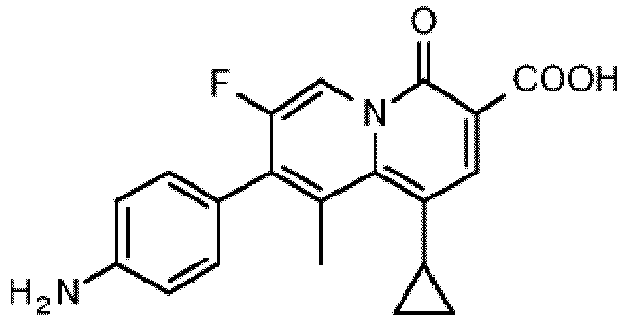
8-(4-amino-phenyl)-1-cyclopropyl-7-fluoro-9-methyl-4-oxo-quinolizine-3-carboxylic acid Compound 8 
8-(4-amino-phenyl)-1-cyclopropyl-9-methyl-4-oxoquinolizine-3-carboxylic acid Compound 9 
8-(3-amino-phenyl)-1-cyclopropyl-9-methyl-4-oxoquinolizine-3-carboxylic acid Compound 11 
8-(2-chloro-4-amino-5-methylphenyl)-1-cyclopropyl-9-methyl-4-oxo-quinolizine-3-carboxylic acid Compound 12 
8-[5-aminomethyl-2-furyl]-1-cyclopropyl-9-methyl-4-oxoquinolizine-3-carboxylic acid Compound 13 
8-[5-aminomethyl-2-thienyl]-1-cyclopropyl-9-methyl-4-oxoquinolizine-3-carboxylic acid Compound 16 
8-(4-amino-3-ethyl-5-methylphenyl)-1-cyclopropyl-9-methyl-4-oxo-quinolizine-3-carboxylic acid Compound 17 
8-(3-fluoro-4-amino-phenyl)-1-cyclopropyl-7-fluoro-9-methyl-4-oxo-quinolizine-3-carboxylic acid Compound 18 
8-(3-amino-phenyl)-1-cyclopropyl-7-fluoro-9-methyl-4-oxo-quinolizine-3-carboxylic acid Compound 20 
8-(2-fluoro-4-amino-phenyl)-1-cyclopropyl-9-methyl-4-oxoquinolizine-3-carboxylic acid Compound 21 
8-(3-amino-4-fluoro-phenyl)-1-cyclopropyl-9-methyl-4-oxoquinolizine-3-carboxylic acid Compound 22 
8-(3-amino-5-fluoro-phenyl)-1-cyclopropyl-9-methyl-4-oxoquinolizine-3-carboxylic acid Compound 24 
8-(3-chloro-4-amino-phenyl)-1-cyclopropyl-9-methyl-4-oxoquinolizine-3-carboxylic acid Compound 25 
8-(3-methoxy-4-amino-phenyl)-1-cyclopropyl-9-methyl-4-oxoquinolizine-3-carboxylic acid Compound 28 
8-(4-methylamino-phenyl)-1-cyclopropyl-9-methyl-4-oxoquinolizine-3-carboxylic acid Compound 31 
8-(3-methyl-4-amino-phenyl)-1-cyclopropyl-9-methyl-4-oxoquinolizine-3-carboxylic acid Compound 33 
8-(6-amino-3-pyridyl)-1-cyclopropyl-9-methyl-4-oxoquinolizine-3-carboxylic acid Compound 37 
8-(4-dimethylamino-phenyl)-1-cyclopropyl-9-methyl-4-oxoquinolizine-3-carboxylic acid Compound 43 
8-(2,5-difluoro-4-aminophenyl)-1-cyclopropyl-7-fluoro-9-methyl-4-oxo-quinolizine-3-carboxylic acid Compound 44 
8-(3,5-difluoro-4-aminophenyl)-1-cyclopropyl-9-methyl-4-oxo-quinolizine-3-carboxylic acid Compound 57 
8-(2-aminopyrimidin-5-yl)-1-cyclopropyl-9-methyl-4-oxoquinolizine-3-carboxylic acid Compound 60 
8-(6-amino-3-pyridyl)-1-cyclopropyl-7-fluoro-9-methyl-4-oxo-quinolizine-3-carboxylic acid Compound 69 
8-[3-methyl-4-(methylamino)phenyl]-1-cyclopropyl-9-methyl-4-oxoquinolizine-3-carboxylic acid Compound 72 
8-[3-(aminomethyl)-4-hydroxyphenyl]-1-cyclopropyl-9-methyl-4-oxo-quinolizine-3-carboxylic acid Compound 76 
8-[3-(aminomethyl)-4-amino phenyl]-1-cyclopropy1-9-methyl-4-oxo-quinolizine-3-carboxylic acid Compound 78 
8-[6-(methylamino)-3-pyridyl]-1-cyclopropy1-9-methyl-4-oxo quinolizine-3-carboxylic acid Compound 79 
8-(6-amino-5-methyl-3-pyridy1) 1-cyclopropy1-9-methyl-4-oxo quinolizine-3-carboxylic acid Compound 87 
8-(6-amino-3-pyridyl)-1-cyclopropyl-7,9-dimethyl-4-oxo-quinolizine-3-carboxylic acid - The pharmaceutical composition according to any one of claims 1 to 3, wherein the Polymyxin B is present in a subinhibitory concentration.
- The pharmaceutical composition according to any one of the preceding claims, wherein the composition is for treatment of a bacterial infection in an individual in need use in the thereof.
- The pharmaceutical composition according to any one of claims 1 to 5, wherein the composition is for use in the treatment of a bacterial infection in an individual in need thereof and said bacterial infection is infection by a multiresistant strain.
- The pharmaceutical composition according to any one of claims 1 to 6, wherein the composition is for use in the treatment of a bacterial infection in an individual in need thereof, and said infection is infection by one or more bacteria of a genus selected from the group consisting of Acinetobacter, Bacillus, Bortadella, Borrelia, Brucella, Camphylobacter, Chlamydia, Clostridium, Corynebacterium, Enterococcus, Escherichia, Fransisella, Haemophilus, Helicobacter, Legionella, Leptospira, Listeria, Mycobacterium, Mycoplasma, Neisseria, Propionibacterium, Pseudomonas, Rickettsia, Salmonella, Shigella, Staphylococcus, Streptococcus, Treponema, Vibrio and Yersinia.
Priority Applications (2)
| Application Number | Priority Date | Filing Date | Title |
|---|---|---|---|
| EP18209744.4A EP3476844B1 (en) | 2011-02-01 | 2012-01-31 | Antimicrobial 4-oxoquinolizines |
| EP17206164.0A EP3312176A1 (en) | 2011-02-01 | 2012-01-31 | Antimicrobial 4-oxoquinolizines |
Applications Claiming Priority (2)
| Application Number | Priority Date | Filing Date | Title |
|---|---|---|---|
| US201161438543P | 2011-02-01 | 2011-02-01 | |
| PCT/EP2012/051563 WO2012104305A1 (en) | 2011-02-01 | 2012-01-31 | Antimicrobial 4-oxoquinolizines |
Related Child Applications (2)
| Application Number | Title | Priority Date | Filing Date |
|---|---|---|---|
| EP18209744.4A Division EP3476844B1 (en) | 2011-02-01 | 2012-01-31 | Antimicrobial 4-oxoquinolizines |
| EP17206164.0A Division EP3312176A1 (en) | 2011-02-01 | 2012-01-31 | Antimicrobial 4-oxoquinolizines |
Publications (2)
| Publication Number | Publication Date |
|---|---|
| EP2670410A1 EP2670410A1 (en) | 2013-12-11 |
| EP2670410B1 true EP2670410B1 (en) | 2017-12-20 |
Family
ID=45560906
Family Applications (3)
| Application Number | Title | Priority Date | Filing Date |
|---|---|---|---|
| EP12702023.8A Active EP2670410B1 (en) | 2011-02-01 | 2012-01-31 | Antimicrobial 4-oxoquinolizines |
| EP18209744.4A Active EP3476844B1 (en) | 2011-02-01 | 2012-01-31 | Antimicrobial 4-oxoquinolizines |
| EP17206164.0A Withdrawn EP3312176A1 (en) | 2011-02-01 | 2012-01-31 | Antimicrobial 4-oxoquinolizines |
Family Applications After (2)
| Application Number | Title | Priority Date | Filing Date |
|---|---|---|---|
| EP18209744.4A Active EP3476844B1 (en) | 2011-02-01 | 2012-01-31 | Antimicrobial 4-oxoquinolizines |
| EP17206164.0A Withdrawn EP3312176A1 (en) | 2011-02-01 | 2012-01-31 | Antimicrobial 4-oxoquinolizines |
Country Status (4)
| Country | Link |
|---|---|
| US (3) | US9403818B2 (en) |
| EP (3) | EP2670410B1 (en) |
| ES (2) | ES2658346T3 (en) |
| WO (1) | WO2012104305A1 (en) |
Families Citing this family (5)
| Publication number | Priority date | Publication date | Assignee | Title |
|---|---|---|---|---|
| US8962842B2 (en) * | 2010-09-27 | 2015-02-24 | Evolva Sa | 2-pyridone antimicrobial compositions |
| ES2658346T3 (en) * | 2011-02-01 | 2018-03-09 | Emergent Product Development Gaithersburg Inc. | 4-Antimicrobial oxoquinolizines |
| GB201616014D0 (en) * | 2016-09-20 | 2016-11-02 | Helperby Therapeutics Ltd | Combination |
| CN109836341B (en) * | 2017-11-28 | 2021-08-27 | 江阴技源药业有限公司 | Preparation method of salicylamine acetate |
| EP3498812B1 (en) * | 2017-12-14 | 2020-06-17 | The Procter & Gamble Company | Films and unit dose articles comprising aversive uv-protective agents, and uses and methods related thereto |
Citations (1)
| Publication number | Priority date | Publication date | Assignee | Title |
|---|---|---|---|---|
| WO2012047487A1 (en) * | 2010-09-27 | 2012-04-12 | Evolva Sa | 2-pyridone antimicrobial compositions |
Family Cites Families (18)
| Publication number | Priority date | Publication date | Assignee | Title |
|---|---|---|---|---|
| US4623650A (en) | 1984-12-06 | 1986-11-18 | Pfizer Inc. | Antibiotic derivatives of 7-phenyl-1,4-dihydro-4-oxo-3-quinolinecarboxylic acids |
| US4921857A (en) | 1987-09-18 | 1990-05-01 | Merck & Co., Inc. | 4-Oxo-4h-quinolizine-3-carboxylic acids and derivatives thereof |
| US5726182A (en) * | 1990-05-02 | 1998-03-10 | Abbott Laboratories | Quinolizinone type compounds |
| JPH09503783A (en) | 1993-10-14 | 1997-04-15 | アボツト・ラボラトリーズ | Quinolidinone type compound |
| US5789591A (en) | 1996-10-23 | 1998-08-04 | Abbott Laboratories | Process for preparing 1-substituted 8-chloro-7-fluoro-9-methyl-4-oxo-4H-quinolizine-3-carboxylic acid ethyl ester compounds |
| KR100241673B1 (en) | 1997-08-09 | 2000-03-02 | 김충섭 | Quinolizine Carboxylic acid Derivatives |
| US5977133A (en) | 1998-08-19 | 1999-11-02 | Abbott Laboratories | Pyridone antibiotic with improved safety profile |
| ATE277042T1 (en) * | 1999-10-19 | 2004-10-15 | Sato Pharma | ANTIMICROBIAL 4-OXOCHINOLIZINE WITH 2-PYRIDONE FRAMEWORKS AS PARTIAL STRUCTURE |
| US6881731B1 (en) * | 2000-10-23 | 2005-04-19 | Shanbrom Technologies, Llc | Enhancers for microbiological disinfection |
| JP2004515549A (en) | 2000-12-14 | 2004-05-27 | ザ プロクター アンド ギャンブル カンパニー | Antimicrobial 2-pyridones, their composition and use |
| JP2002308876A (en) * | 2001-04-10 | 2002-10-23 | Sato Pharmaceutical Co Ltd | 4-oxoquinolizine compound with antibacterial activity |
| JP2003012670A (en) * | 2001-04-10 | 2003-01-15 | Sato Pharmaceutical Co Ltd | 4-oxoquinolizine-based compound having antimicrobial activity |
| ATE404558T1 (en) | 2001-09-28 | 2008-08-15 | Sato Pharma | ANTIMICROBIAL 4-OXOCINOLICINE COMPOUNDS THAT HAVE A 2-PYRIDONE SKELETON AS A PARTIAL STRUCTURE |
| JP2003261566A (en) | 2002-03-11 | 2003-09-19 | Sankyo Co Ltd | Drugs containing quinolizine |
| EP1919507A2 (en) * | 2005-08-04 | 2008-05-14 | Thomas William Rademacher | Nanoparticles comprising antibacterial ligands |
| WO2008076806A2 (en) * | 2006-12-15 | 2008-06-26 | Trustees Of Boston University | Compositions and methods to potentiate colistin activity |
| ES2658346T3 (en) * | 2011-02-01 | 2018-03-09 | Emergent Product Development Gaithersburg Inc. | 4-Antimicrobial oxoquinolizines |
| MY165004A (en) * | 2011-08-31 | 2018-02-28 | Otsuka Pharma Co Ltd | Quinolone compound |
-
2012
- 2012-01-31 ES ES12702023.8T patent/ES2658346T3/en active Active
- 2012-01-31 ES ES18209744T patent/ES2845551T3/en active Active
- 2012-01-31 US US13/823,187 patent/US9403818B2/en not_active Expired - Fee Related
- 2012-01-31 EP EP12702023.8A patent/EP2670410B1/en active Active
- 2012-01-31 EP EP18209744.4A patent/EP3476844B1/en active Active
- 2012-01-31 WO PCT/EP2012/051563 patent/WO2012104305A1/en not_active Ceased
- 2012-01-31 EP EP17206164.0A patent/EP3312176A1/en not_active Withdrawn
-
2016
- 2016-06-23 US US15/191,067 patent/US10155021B2/en active Active
-
2018
- 2018-11-13 US US16/188,877 patent/US20190105367A1/en not_active Abandoned
Patent Citations (1)
| Publication number | Priority date | Publication date | Assignee | Title |
|---|---|---|---|---|
| WO2012047487A1 (en) * | 2010-09-27 | 2012-04-12 | Evolva Sa | 2-pyridone antimicrobial compositions |
Also Published As
| Publication number | Publication date |
|---|---|
| US20170106045A1 (en) | 2017-04-20 |
| EP3476844B1 (en) | 2020-11-11 |
| EP2670410A1 (en) | 2013-12-11 |
| US20190105367A1 (en) | 2019-04-11 |
| WO2012104305A1 (en) | 2012-08-09 |
| US10155021B2 (en) | 2018-12-18 |
| US20170232060A9 (en) | 2017-08-17 |
| US9403818B2 (en) | 2016-08-02 |
| US20130252882A1 (en) | 2013-09-26 |
| ES2658346T3 (en) | 2018-03-09 |
| EP3476844A1 (en) | 2019-05-01 |
| ES2845551T3 (en) | 2021-07-27 |
| EP3312176A1 (en) | 2018-04-25 |
Similar Documents
| Publication | Publication Date | Title |
|---|---|---|
| US10517865B2 (en) | 2-pyridone antimicrobial compositions | |
| US20190105367A1 (en) | Antimicrobial 4-oxoquinolizines | |
| ES2789177T3 (en) | Cyclic boronic acid ester derivatives, process for their preparation and therapeutic uses thereof | |
| KR20130140868A (en) | Isoxazole derivatives useful as antibaterial agents | |
| JP2020528399A (en) | Antibiotic resistant breaker | |
| KR20170117158A (en) | 4-Substituted Benzoxaborole Compounds and Their Uses | |
| AU2010275375B2 (en) | Spectinamides as anti-tuberculosis agents | |
| TW201722967A (en) | Heterocyclic compounds and their use in preventing or treating bacterial infections | |
| CN111787921A (en) | Zinc ionophore and its use | |
| RU2723545C2 (en) | Compound, a pharmaceutical composition, a medicinal agent, use of the compound, a pharmaceutical composition, a medicinal agent | |
| WO2018075871A1 (en) | Novel antibiotics and methods of using same | |
| CN109071511B (en) | Zwitterionic propargyl-linked antifolates useful for the treatment of bacterial infections | |
| TWI906328B (en) | Therapeutic agents targeting gpr35 | |
| HK40000532A (en) | Antimicrobial 4-oxoquinolizines | |
| WO2019234509A2 (en) | Aminomethylamidine and methylamidine antimicrobial compounds | |
| GB2602096A (en) | Compounds | |
| CN113801135B (en) | Thienopyrazole compounds, pharmaceutical compositions containing the same and uses thereof | |
| WO2025218767A1 (en) | Imidazopyridine derivatives and use thereof | |
| CN120987845A (en) | A quaternary ammonium salt compound, its preparation method and application | |
| WO2020115547A2 (en) | Pyrrolo[2,3-d]pyrimidin-2-one antimicrobial compounds | |
| HK1171388B (en) | Spectinamides as anti-tuberculosis agents | |
| HK1171388A (en) | Spectinamides as anti-tuberculosis agents |
Legal Events
| Date | Code | Title | Description |
|---|---|---|---|
| PUAI | Public reference made under article 153(3) epc to a published international application that has entered the european phase |
Free format text: ORIGINAL CODE: 0009012 |
|
| 17P | Request for examination filed |
Effective date: 20130902 |
|
| AK | Designated contracting states |
Kind code of ref document: A1 Designated state(s): AL AT BE BG CH CY CZ DE DK EE ES FI FR GB GR HR HU IE IS IT LI LT LU LV MC MK MT NL NO PL PT RO RS SE SI SK SM TR |
|
| AX | Request for extension of the european patent |
Extension state: BA ME |
|
| RAP1 | Party data changed (applicant data changed or rights of an application transferred) |
Owner name: EMERGENT PRODUCT DEVELOPMENT GAITHERSBURG INC. |
|
| 17Q | First examination report despatched |
Effective date: 20151124 |
|
| GRAP | Despatch of communication of intention to grant a patent |
Free format text: ORIGINAL CODE: EPIDOSNIGR1 |
|
| INTG | Intention to grant announced |
Effective date: 20170630 |
|
| RIN1 | Information on inventor provided before grant (corrected) |
Inventor name: DALE, GLENN Inventor name: SCHNEIDER, PETER Inventor name: BARTELS, CHRISTIAN Inventor name: MILLIGAN, DANIEL Inventor name: HEIM, JUTTA Inventor name: ROUSSEL, PATRICK |
|
| GRAS | Grant fee paid |
Free format text: ORIGINAL CODE: EPIDOSNIGR3 |
|
| GRAA | (expected) grant |
Free format text: ORIGINAL CODE: 0009210 |
|
| AK | Designated contracting states |
Kind code of ref document: B1 Designated state(s): AL AT BE BG CH CY CZ DE DK EE ES FI FR GB GR HR HU IE IS IT LI LT LU LV MC MK MT NL NO PL PT RO RS SE SI SK SM TR |
|
| AX | Request for extension of the european patent |
Extension state: BA ME |
|
| REG | Reference to a national code |
Ref country code: GB Ref legal event code: FG4D |
|
| REG | Reference to a national code |
Ref country code: CH Ref legal event code: EP |
|
| REG | Reference to a national code |
Ref country code: IE Ref legal event code: FG4D |
|
| REG | Reference to a national code |
Ref country code: CH Ref legal event code: NV Representative=s name: ISLER AND PEDRAZZINI AG, CH Ref country code: AT Ref legal event code: REF Ref document number: 955731 Country of ref document: AT Kind code of ref document: T Effective date: 20180115 |
|
| REG | Reference to a national code |
Ref country code: DE Ref legal event code: R096 Ref document number: 602012041063 Country of ref document: DE |
|
| REG | Reference to a national code |
Ref country code: FR Ref legal event code: PLFP Year of fee payment: 7 |
|
| REG | Reference to a national code |
Ref country code: NL Ref legal event code: FP |
|
| REG | Reference to a national code |
Ref country code: ES Ref legal event code: FG2A Ref document number: 2658346 Country of ref document: ES Kind code of ref document: T3 Effective date: 20180309 |
|
| PG25 | Lapsed in a contracting state [announced via postgrant information from national office to epo] |
Ref country code: FI Free format text: LAPSE BECAUSE OF FAILURE TO SUBMIT A TRANSLATION OF THE DESCRIPTION OR TO PAY THE FEE WITHIN THE PRESCRIBED TIME-LIMIT Effective date: 20171220 Ref country code: SE Free format text: LAPSE BECAUSE OF FAILURE TO SUBMIT A TRANSLATION OF THE DESCRIPTION OR TO PAY THE FEE WITHIN THE PRESCRIBED TIME-LIMIT Effective date: 20171220 Ref country code: LT Free format text: LAPSE BECAUSE OF FAILURE TO SUBMIT A TRANSLATION OF THE DESCRIPTION OR TO PAY THE FEE WITHIN THE PRESCRIBED TIME-LIMIT Effective date: 20171220 Ref country code: NO Free format text: LAPSE BECAUSE OF FAILURE TO SUBMIT A TRANSLATION OF THE DESCRIPTION OR TO PAY THE FEE WITHIN THE PRESCRIBED TIME-LIMIT Effective date: 20180320 |
|
| REG | Reference to a national code |
Ref country code: LT Ref legal event code: MG4D |
|
| REG | Reference to a national code |
Ref country code: AT Ref legal event code: MK05 Ref document number: 955731 Country of ref document: AT Kind code of ref document: T Effective date: 20171220 |
|
| PG25 | Lapsed in a contracting state [announced via postgrant information from national office to epo] |
Ref country code: RS Free format text: LAPSE BECAUSE OF FAILURE TO SUBMIT A TRANSLATION OF THE DESCRIPTION OR TO PAY THE FEE WITHIN THE PRESCRIBED TIME-LIMIT Effective date: 20171220 Ref country code: GR Free format text: LAPSE BECAUSE OF FAILURE TO SUBMIT A TRANSLATION OF THE DESCRIPTION OR TO PAY THE FEE WITHIN THE PRESCRIBED TIME-LIMIT Effective date: 20180321 Ref country code: BG Free format text: LAPSE BECAUSE OF FAILURE TO SUBMIT A TRANSLATION OF THE DESCRIPTION OR TO PAY THE FEE WITHIN THE PRESCRIBED TIME-LIMIT Effective date: 20180320 Ref country code: LV Free format text: LAPSE BECAUSE OF FAILURE TO SUBMIT A TRANSLATION OF THE DESCRIPTION OR TO PAY THE FEE WITHIN THE PRESCRIBED TIME-LIMIT Effective date: 20171220 Ref country code: HR Free format text: LAPSE BECAUSE OF FAILURE TO SUBMIT A TRANSLATION OF THE DESCRIPTION OR TO PAY THE FEE WITHIN THE PRESCRIBED TIME-LIMIT Effective date: 20171220 |
|
| PG25 | Lapsed in a contracting state [announced via postgrant information from national office to epo] |
Ref country code: SK Free format text: LAPSE BECAUSE OF FAILURE TO SUBMIT A TRANSLATION OF THE DESCRIPTION OR TO PAY THE FEE WITHIN THE PRESCRIBED TIME-LIMIT Effective date: 20171220 Ref country code: EE Free format text: LAPSE BECAUSE OF FAILURE TO SUBMIT A TRANSLATION OF THE DESCRIPTION OR TO PAY THE FEE WITHIN THE PRESCRIBED TIME-LIMIT Effective date: 20171220 Ref country code: CY Free format text: LAPSE BECAUSE OF FAILURE TO SUBMIT A TRANSLATION OF THE DESCRIPTION OR TO PAY THE FEE WITHIN THE PRESCRIBED TIME-LIMIT Effective date: 20171220 Ref country code: CZ Free format text: LAPSE BECAUSE OF FAILURE TO SUBMIT A TRANSLATION OF THE DESCRIPTION OR TO PAY THE FEE WITHIN THE PRESCRIBED TIME-LIMIT Effective date: 20171220 |
|
| PG25 | Lapsed in a contracting state [announced via postgrant information from national office to epo] |
Ref country code: AT Free format text: LAPSE BECAUSE OF FAILURE TO SUBMIT A TRANSLATION OF THE DESCRIPTION OR TO PAY THE FEE WITHIN THE PRESCRIBED TIME-LIMIT Effective date: 20171220 Ref country code: PL Free format text: LAPSE BECAUSE OF FAILURE TO SUBMIT A TRANSLATION OF THE DESCRIPTION OR TO PAY THE FEE WITHIN THE PRESCRIBED TIME-LIMIT Effective date: 20171220 Ref country code: SM Free format text: LAPSE BECAUSE OF FAILURE TO SUBMIT A TRANSLATION OF THE DESCRIPTION OR TO PAY THE FEE WITHIN THE PRESCRIBED TIME-LIMIT Effective date: 20171220 Ref country code: IS Free format text: LAPSE BECAUSE OF FAILURE TO SUBMIT A TRANSLATION OF THE DESCRIPTION OR TO PAY THE FEE WITHIN THE PRESCRIBED TIME-LIMIT Effective date: 20180420 Ref country code: RO Free format text: LAPSE BECAUSE OF FAILURE TO SUBMIT A TRANSLATION OF THE DESCRIPTION OR TO PAY THE FEE WITHIN THE PRESCRIBED TIME-LIMIT Effective date: 20171220 |
|
| REG | Reference to a national code |
Ref country code: DE Ref legal event code: R097 Ref document number: 602012041063 Country of ref document: DE |
|
| PG25 | Lapsed in a contracting state [announced via postgrant information from national office to epo] |
Ref country code: MC Free format text: LAPSE BECAUSE OF FAILURE TO SUBMIT A TRANSLATION OF THE DESCRIPTION OR TO PAY THE FEE WITHIN THE PRESCRIBED TIME-LIMIT Effective date: 20171220 |
|
| PLBE | No opposition filed within time limit |
Free format text: ORIGINAL CODE: 0009261 |
|
| STAA | Information on the status of an ep patent application or granted ep patent |
Free format text: STATUS: NO OPPOSITION FILED WITHIN TIME LIMIT |
|
| PG25 | Lapsed in a contracting state [announced via postgrant information from national office to epo] |
Ref country code: LU Free format text: LAPSE BECAUSE OF NON-PAYMENT OF DUE FEES Effective date: 20180131 |
|
| REG | Reference to a national code |
Ref country code: BE Ref legal event code: MM Effective date: 20180131 |
|
| 26N | No opposition filed |
Effective date: 20180921 |
|
| PG25 | Lapsed in a contracting state [announced via postgrant information from national office to epo] |
Ref country code: DK Free format text: LAPSE BECAUSE OF FAILURE TO SUBMIT A TRANSLATION OF THE DESCRIPTION OR TO PAY THE FEE WITHIN THE PRESCRIBED TIME-LIMIT Effective date: 20171220 Ref country code: BE Free format text: LAPSE BECAUSE OF NON-PAYMENT OF DUE FEES Effective date: 20180131 |
|
| PG25 | Lapsed in a contracting state [announced via postgrant information from national office to epo] |
Ref country code: SI Free format text: LAPSE BECAUSE OF FAILURE TO SUBMIT A TRANSLATION OF THE DESCRIPTION OR TO PAY THE FEE WITHIN THE PRESCRIBED TIME-LIMIT Effective date: 20171220 |
|
| PG25 | Lapsed in a contracting state [announced via postgrant information from national office to epo] |
Ref country code: MT Free format text: LAPSE BECAUSE OF NON-PAYMENT OF DUE FEES Effective date: 20180131 |
|
| PG25 | Lapsed in a contracting state [announced via postgrant information from national office to epo] |
Ref country code: TR Free format text: LAPSE BECAUSE OF FAILURE TO SUBMIT A TRANSLATION OF THE DESCRIPTION OR TO PAY THE FEE WITHIN THE PRESCRIBED TIME-LIMIT Effective date: 20171220 |
|
| PG25 | Lapsed in a contracting state [announced via postgrant information from national office to epo] |
Ref country code: PT Free format text: LAPSE BECAUSE OF FAILURE TO SUBMIT A TRANSLATION OF THE DESCRIPTION OR TO PAY THE FEE WITHIN THE PRESCRIBED TIME-LIMIT Effective date: 20171220 Ref country code: HU Free format text: LAPSE BECAUSE OF FAILURE TO SUBMIT A TRANSLATION OF THE DESCRIPTION OR TO PAY THE FEE WITHIN THE PRESCRIBED TIME-LIMIT; INVALID AB INITIO Effective date: 20120131 |
|
| PG25 | Lapsed in a contracting state [announced via postgrant information from national office to epo] |
Ref country code: MK Free format text: LAPSE BECAUSE OF NON-PAYMENT OF DUE FEES Effective date: 20171220 |
|
| PG25 | Lapsed in a contracting state [announced via postgrant information from national office to epo] |
Ref country code: AL Free format text: LAPSE BECAUSE OF FAILURE TO SUBMIT A TRANSLATION OF THE DESCRIPTION OR TO PAY THE FEE WITHIN THE PRESCRIBED TIME-LIMIT Effective date: 20171220 |
|
| PGFP | Annual fee paid to national office [announced via postgrant information from national office to epo] |
Ref country code: FR Payment date: 20201210 Year of fee payment: 10 |
|
| PGFP | Annual fee paid to national office [announced via postgrant information from national office to epo] |
Ref country code: CH Payment date: 20210113 Year of fee payment: 10 Ref country code: IE Payment date: 20210111 Year of fee payment: 10 Ref country code: NL Payment date: 20210113 Year of fee payment: 10 |
|
| PGFP | Annual fee paid to national office [announced via postgrant information from national office to epo] |
Ref country code: GB Payment date: 20210120 Year of fee payment: 10 |
|
| REG | Reference to a national code |
Ref country code: CH Ref legal event code: PL |
|
| REG | Reference to a national code |
Ref country code: NL Ref legal event code: MM Effective date: 20220201 |
|
| GBPC | Gb: european patent ceased through non-payment of renewal fee |
Effective date: 20220131 |
|
| PG25 | Lapsed in a contracting state [announced via postgrant information from national office to epo] |
Ref country code: NL Free format text: LAPSE BECAUSE OF NON-PAYMENT OF DUE FEES Effective date: 20220201 Ref country code: GB Free format text: LAPSE BECAUSE OF NON-PAYMENT OF DUE FEES Effective date: 20220131 |
|
| PG25 | Lapsed in a contracting state [announced via postgrant information from national office to epo] |
Ref country code: FR Free format text: LAPSE BECAUSE OF NON-PAYMENT OF DUE FEES Effective date: 20220131 |
|
| PG25 | Lapsed in a contracting state [announced via postgrant information from national office to epo] |
Ref country code: LI Free format text: LAPSE BECAUSE OF NON-PAYMENT OF DUE FEES Effective date: 20220131 Ref country code: CH Free format text: LAPSE BECAUSE OF NON-PAYMENT OF DUE FEES Effective date: 20220131 |
|
| PG25 | Lapsed in a contracting state [announced via postgrant information from national office to epo] |
Ref country code: IE Free format text: LAPSE BECAUSE OF NON-PAYMENT OF DUE FEES Effective date: 20220131 |
|
| PGFP | Annual fee paid to national office [announced via postgrant information from national office to epo] |
Ref country code: ES Payment date: 20230213 Year of fee payment: 12 |
|
| PGFP | Annual fee paid to national office [announced via postgrant information from national office to epo] |
Ref country code: IT Payment date: 20221213 Year of fee payment: 12 Ref country code: DE Payment date: 20221207 Year of fee payment: 12 |
|
| REG | Reference to a national code |
Ref country code: DE Ref legal event code: R119 Ref document number: 602012041063 Country of ref document: DE |
|
| PG25 | Lapsed in a contracting state [announced via postgrant information from national office to epo] |
Ref country code: DE Free format text: LAPSE BECAUSE OF NON-PAYMENT OF DUE FEES Effective date: 20240801 |
|
| PG25 | Lapsed in a contracting state [announced via postgrant information from national office to epo] |
Ref country code: DE Free format text: LAPSE BECAUSE OF NON-PAYMENT OF DUE FEES Effective date: 20240801 |
|
| PG25 | Lapsed in a contracting state [announced via postgrant information from national office to epo] |
Ref country code: IT Free format text: LAPSE BECAUSE OF NON-PAYMENT OF DUE FEES Effective date: 20240131 |
|
| REG | Reference to a national code |
Ref country code: ES Ref legal event code: FD2A Effective date: 20250304 |
|
| PG25 | Lapsed in a contracting state [announced via postgrant information from national office to epo] |
Ref country code: ES Free format text: LAPSE BECAUSE OF NON-PAYMENT OF DUE FEES Effective date: 20240201 |