EP2669490A2 - Systems and methods for directing cooling flow into the surge plenum of an exhaust eductor cooling system - Google Patents
Systems and methods for directing cooling flow into the surge plenum of an exhaust eductor cooling system Download PDFInfo
- Publication number
- EP2669490A2 EP2669490A2 EP13166152.2A EP13166152A EP2669490A2 EP 2669490 A2 EP2669490 A2 EP 2669490A2 EP 13166152 A EP13166152 A EP 13166152A EP 2669490 A2 EP2669490 A2 EP 2669490A2
- Authority
- EP
- European Patent Office
- Prior art keywords
- plenum
- surge
- cooler
- wall
- flow
- Prior art date
- Legal status (The legal status is an assumption and is not a legal conclusion. Google has not performed a legal analysis and makes no representation as to the accuracy of the status listed.)
- Granted
Links
- 238000001816 cooling Methods 0.000 title claims abstract description 13
- 238000000034 method Methods 0.000 title claims description 10
- 238000013022 venting Methods 0.000 claims 1
- 239000007789 gas Substances 0.000 description 26
- 239000012530 fluid Substances 0.000 description 17
- 230000007423 decrease Effects 0.000 description 3
- 238000010438 heat treatment Methods 0.000 description 2
- 239000000463 material Substances 0.000 description 2
- 238000005086 pumping Methods 0.000 description 2
- 239000013598 vector Substances 0.000 description 2
- 239000000956 alloy Substances 0.000 description 1
- 229910045601 alloy Inorganic materials 0.000 description 1
- 230000007613 environmental effect Effects 0.000 description 1
- 238000012986 modification Methods 0.000 description 1
- 230000004048 modification Effects 0.000 description 1
Images




Classifications
-
- F—MECHANICAL ENGINEERING; LIGHTING; HEATING; WEAPONS; BLASTING
- F02—COMBUSTION ENGINES; HOT-GAS OR COMBUSTION-PRODUCT ENGINE PLANTS
- F02C—GAS-TURBINE PLANTS; AIR INTAKES FOR JET-PROPULSION PLANTS; CONTROLLING FUEL SUPPLY IN AIR-BREATHING JET-PROPULSION PLANTS
- F02C3/00—Gas-turbine plants characterised by the use of combustion products as the working fluid
- F02C3/32—Inducing air flow by fluid jet, e.g. ejector action
-
- F—MECHANICAL ENGINEERING; LIGHTING; HEATING; WEAPONS; BLASTING
- F02—COMBUSTION ENGINES; HOT-GAS OR COMBUSTION-PRODUCT ENGINE PLANTS
- F02C—GAS-TURBINE PLANTS; AIR INTAKES FOR JET-PROPULSION PLANTS; CONTROLLING FUEL SUPPLY IN AIR-BREATHING JET-PROPULSION PLANTS
- F02C7/00—Features, components parts, details or accessories, not provided for in, or of interest apart form groups F02C1/00 - F02C6/00; Air intakes for jet-propulsion plants
- F02C7/12—Cooling of plants
- F02C7/14—Cooling of plants of fluids in the plant, e.g. lubricant or fuel
-
- F—MECHANICAL ENGINEERING; LIGHTING; HEATING; WEAPONS; BLASTING
- F05—INDEXING SCHEMES RELATING TO ENGINES OR PUMPS IN VARIOUS SUBCLASSES OF CLASSES F01-F04
- F05D—INDEXING SCHEME FOR ASPECTS RELATING TO NON-POSITIVE-DISPLACEMENT MACHINES OR ENGINES, GAS-TURBINES OR JET-PROPULSION PLANTS
- F05D2220/00—Application
- F05D2220/50—Application for auxiliary power units (APU's)
-
- Y—GENERAL TAGGING OF NEW TECHNOLOGICAL DEVELOPMENTS; GENERAL TAGGING OF CROSS-SECTIONAL TECHNOLOGIES SPANNING OVER SEVERAL SECTIONS OF THE IPC; TECHNICAL SUBJECTS COVERED BY FORMER USPC CROSS-REFERENCE ART COLLECTIONS [XRACs] AND DIGESTS
- Y02—TECHNOLOGIES OR APPLICATIONS FOR MITIGATION OR ADAPTATION AGAINST CLIMATE CHANGE
- Y02T—CLIMATE CHANGE MITIGATION TECHNOLOGIES RELATED TO TRANSPORTATION
- Y02T50/00—Aeronautics or air transport
- Y02T50/60—Efficient propulsion technologies, e.g. for aircraft
Definitions
- Embodiments described herein relate to an exhaust eductor system, and more particularly, to a system and method for providing cooler air from an oil cooling plenum to the surge plenum of an eductor exhaust system.
- APU auxiliary power unit
- APUs are located in the aft section of the aircraft such as the tail cone and are isolated by a firewall.
- an APU produces exhaust gas that is directed through a nozzle and out of the aircraft through an exhaust opening.
- the nozzle may communicate with an eductor system that utilizes the APU exhaust gas to draw and direct other gases through the aircraft.
- eductor systems have been developed that include a first plenum (i.e. the oil cooler plenum) for drawing gas across an oil cooler, and a second plenum (i.e. the surge plenum) for directing surge flow to an exhaust duct (i.e. air not required by the aircraft to satisfy its pneumatic requirements, commonly referred to as surge bleed flow).
- the surge plenum is a dead-headed cavity with its aft facing outlet exposed to the mixed eductor flow; i.e. the turbine exhaust at perhaps 1000°F and the cooling air from the cooling plenum at approximately 200°F.
- the mixed eductor flow which may be about 500°F, enters the surge plenum, circulating in and out of the surge plenum, and heating the surge plenum to approximately 500°F, exceeding the strict temperature limits (i.e. 450°F) being imposed on the outer surfaces of the APU including the surge plenum.
- the strict temperature limits i.e. 450°F
- FIG. 1 is a cross-section view of an aircraft including a power unit and eductor system disposed therein;
- FIG. 2 is a cross-sectional view of an exemplary eductor oil cooler and surge flow plenum assembly that may be incorporated into the tail cone depicted in FIG. 1 in accordance with the prior art;
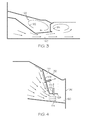
- FIG. 3 is a cross-sectional view of the exemplary eductor oil cooler and surge flow plenum illustrating the recirculation in the surge plenum when there is no surge flow;
- FIG. 4 is a cross-sectional view of a first embodiment wherein cooler air is deflected from the oil cooler plenum into the surge plenum;
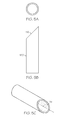
- FIG. 5A, 5B and 5C are side, top and isometric views of a beveled tube for use in conjunction with the embodiment shown in FIG. 4 ;
- FIG. 6A, 6B and 6C are side, top and isometric views of a tube terminating with a scoop for use in conjunction with the embodiment shown in FIG. 4 ;
- FIG. 7 is a cross-sectional view of yet another embodiment wherein cooler air enters the surge plenum from the cooler plenum via a one-way flap;
- FIG. 8 illustrates yet another embodiment utilizing a plurality of tubes for deflecting cooler air from the cooler plenum into the surge plenum.
- an eductor assembly comprising a primary nozzle configured to discharge turbine exhaust gas therefrom.
- the eductor assembly further comprises a cooler plenum having an inlet and an outlet, a surge plenum at least partially surrounding the cooler plenum and the nozzle, the surge plenum for conducting a surge flow, and a vent between the cooler plenum and the surge plenum through which gas flows from the cooler plenum into the surge plenum when there is no surge flow.
- a method for cooling the external surfaces of a surge plenum in an eductor assembly in an APU of the type wherein the surge plenum at least partially surrounds a cooler plenum comprises introducing cooler air from the cooler plenum into the surge plenum when there is no surge flow in the surge plenum.
- An eductor assembly comprises a primary nozzle configured to discharge turbine exhaust therefrom, a cooler plenum, a surge plenum at least partially surrounding the cooler plenum and the nozzle, the cooler plenum for conducting surge flow, a wall separating the cooler plenum and the surge plenum, and a passive valve in the wall for conducting cooler air from the cooler plenum to the surge plenum when there is no surge flow.
- FIG. 1 illustrates a housing 100 within which a power unit 102 and an eductor 104 are disposed.
- the housing 100 which may be an aircraft tail cone or helicopter housing, is generally conical and has a sidewall 103 and inlet and exhaust openings 105, 106 that are formed therein.
- the power unit 102 which may be an auxiliary power unit (“APU"), may be used to drive a number of non-illustrated devices, including, for example, a gearbox, a generator, or a load compressor, is mounted within the housing 100 and receives air from an inlet duct 107 that extends between the power unit 102 and the inlet opening 105.
- APU auxiliary power unit
- the power unit 102 includes a nozzle 108 that communicates with the eductor 104. It will be appreciated that the power unit 102 and eductor 104 may indirectly or directly communicate with each other. In any case, exhaust gas from the power unit 102 flows through the eductor 104 and an exhaust duct 109 and exits the aircraft via the exhaust opening 106.
- the eductor oil cooler and surge flow plenum assembly 104 is configured to employ the flow of high velocity exhaust gas to draw other gas through the aircraft.
- the assembly 104 includes an oil cooler plenum 120 and a surge flow plenum 122 that are disposed along the longitudinal axis 116 and are circumferentially around the nozzle 114.
- the oil cooler plenum 120 and surge flow plenum 122 are separated from each other and are each defined, in part, by a wall 126. More particularly, the wall 126 has an inner surface 128 that, together with the nozzle 114, forms the oil cooler plenum 120. Wall 126, together with an outer wall 132, forms the surge flow plenum 122.
- the oil cooler plenum 120 includes a fluid inlet 134 and a fluid outlet 136.
- the fluid inlet 134 communicates with an oil cooler duct 138 within which an oil cooler 140 is disposed.
- the oil cooler plenum 120 surrounds an entire circumference of the nozzle 114 to maximize contact between high velocity APU exhaust gas that flows through the nozzle 114 and the gas that is pulled through the oil cooler plenum 120 to thereby increase pumping of gas through the fluid inlet 134.
- the fluid outlet 136 is aligned with an end 144 of the nozzle 114.
- gas flowing through the fluid outlet 136 will be entrained by the high velocity APU exhaust gas and both will flow together through the exhaust duct 109 (shown in FIG. 1 ).
- the volume of space needed to accommodate the cooled gas decreases as distance from the fluid inlet 134 increases, and that the gas in the oil cooler plenum 120 preferably flows around the circumference of the nozzle 114 at a substantially constant flow velocity.
- the wall 126 may slope toward the longitudinal axis 116 forward to aft and is disposed nonconcentric thereto.
- the oil cooler plenum 120 includes a plurality of variously sized radial cross-sectional areas at different axial locations along the longitudinal axis 116 and a plurality of variously sized axial cross-sectional areas at different angular locations relative to the longitudinal axis 116.
- the cross-sectional areas which, as previously mentioned, preferably gradually decrease in size when the distance from the fluid inlet 134 increases, may be disposed axisymmetrically about the longitudinal axis 116.
- the surge flow plenum 122 is partially defined by the walls 126, 132 and includes a fluid inlet 154 and a fluid outlet 156.
- the fluid inlet 154 communicates with a surge bleed entry duct 158 that is coupled to or integrally formed as part of the outer wall 132.
- the fluid outlet 156 is preferably axially aligned with and coterminous with the oil cooler plenum fluid outlet 136.
- the surge flow plenum 122 preferably includes a plurality of variously sized axial cross-sectional areas at different angular locations relative to the longitudinal axis 116. Most preferably, the areas of the axial cross-sections gradually decrease as the distance away from the surge flow fluid inlet section increases without overlapping the oil cooler plenum 120.
- the oil cooler plenum 120 may surround the first circumferential section of the nozzle 114 and the surge flow plenum 122 may surround the second circumferential section and a portion of the first circumferential section.
- the APU 102 exhausts high velocity exhaust gas out of the nozzle 114.
- the gas enters the oil cooler 140, travels through fluid inlet 134, and flows through the oil cooler duct 138 into the oil cooler plenum 120.
- the gas exits the oil cooler fluid outlet 136, it is pulled through the exhaust duct 109 by the high velocity APU exhaust gas.
- the pull of the APU exhaust gas causes additional gas to be pumped into the oil cooler plenum 120.
- surge flow gas may be dumped into the surge bleed entry duct 158 and into the surge flow plenum 122.
- the surge flow gas which is already traveling at a high velocity, flows directly into the exhaust duct 109 and out the exhaust opening 106.
- the surge plenum becomes a dead-headed cavity with its aft outlet exposed to the mixed eductor flow which is about 500 0 F.
- This flow enters the surge plenum 122 and may continuously recirculate in and out of the surge plenum 122 heating the surge plenum surface to an unacceptable level.
- FIG. 3 This situation is illustrated in FIG. 3 .
- heated mixed eductor flow 160 recirculates in and out of surge plenum 122 as is indicated by arrows 162 and 164.
- Embodiments described herein contemplate introducing cooler air from the oil cooler plenum into the surge plenum during normal APU operation when there is no surge flow. It is further contemplated that this may be accomplished by positioning at least one vent in a wall between the oil cooler plenum and the surge plenum. It is still further contemplated that the vent may be a tube that includes a scarfed or scooped end (e.g. a thumbnail scoop) that extends into the oil cooler plenum and is positioned to function as a diverter to scoop cooler air and direct it into the surge plenum.
- the air exit portion of the tube that extends into the surge plenum should be long enough so as to prevent surge flow from entering into the oil cooler plenum during a surge event; i.e. the tube protruding into the surge plenum has a high entry pressure loss.
- the arrangement acts as a passive one way valve.
- FIG. 4 is a partial cross-sectional view in accordance with a first embodiment.
- a hollow tube 170 is shown extending through a wall of surge plenum 122 at first and second locations each of which will be discussed separately.
- tube 170 extends through an inclined wall 126 of surge plenum 122 to an area of the cooler plenum characterized by lower speed oil cooler flow.
- tube 170 extends through wall 128 of surge plenum 122 to an aft area characterized by a higher speed (e.g. 80-110 feet/second) oil cooler flow.
- tube 170 preferably extends substantially perpendicularly through walls 126 and 128, respectively, as the case may be.
- Tubes 170 may be manufactured from a variety of materials but are preferably made from a heat resistant weldable alloy.
- the tubes should be manufactured so as to exhibit characteristics that discourage backflow through the tubes; i.e. flow from the surge plenum 122 to the oil cooler 120 during a surge event.
- the tubes may have a length between 0.25 inch and 2.0 inches and preferably between 0.75 inch and 1.25 inches.
- the diameter of the tube is preferably one-half to one-third the tube's length.
- the obstruction may be a beveled portion of the tube.
- FIGS. 5A, 5B and 5C are top, side, and isometric views, respectively, of a beveled tube 180.
- the beveled portion 182 will extend into cooler plenum 120 and the bevel opening 184 will face the direction of air flow in cooler plenum 120.
- FIGS. 6A, 6B and 6C are top, side, and isometric views, respectively of a tube 190 that terminates with a scoop 192 which redirects air flowing in the cooler plenum 120 through tube 190 and into the surge plenum 122.
- FIG. 7 is a cross-sectional view of a further embodiment wherein cooler air is directed from the oil cooler plenum 120 into the surge plenum 122 through a flap 181 when there is no surge flow as indicated by arrow 183. A surge flow will prevent flap 181 from opening.
- FIG. 8 functionally illustrates an oil cooler plenum 200, a surge plenum 202, and an exhaust duct 204 in accordance with a still further embodiment. Also shown are a plurality of obstructions 206 (e.g. scoops) for deflecting air from cooler plenum 200 to surge plenum 202. It is known that the air exits the oil cooler 140, enters the air cooler plenum 200, and circulates around the plenum resulting in velocity vectors 208 having different directions in different parts of cooler plenum 200. Thus, the obstructions 206 in the form of bevels, scoops and the like as previously described are positioned such that their openings 210 are substantially perpendicular to the oil cooling flow velocity vectors 208 at their respective locations. The multiple scoops 206 provide substantially uniform cooling of surge plenum 202.
- obstructions 206 e.g. scoops
Landscapes
- Engineering & Computer Science (AREA)
- Chemical & Material Sciences (AREA)
- Combustion & Propulsion (AREA)
- Mechanical Engineering (AREA)
- General Engineering & Computer Science (AREA)
- Turbine Rotor Nozzle Sealing (AREA)
Abstract
Description
- Embodiments described herein relate to an exhaust eductor system, and more particularly, to a system and method for providing cooler air from an oil cooling plenum to the surge plenum of an eductor exhaust system.
- Many modem aircraft are equipped with an auxiliary power unit ("APU") that generates and provides electrical and pneumatic power to various parts of the aircraft for tasks such as environmental cooling, lighting, powering electronic systems, and main engine starting. Typically, such APUs are located in the aft section of the aircraft such as the tail cone and are isolated by a firewall. During operation, an APU produces exhaust gas that is directed through a nozzle and out of the aircraft through an exhaust opening. The nozzle may communicate with an eductor system that utilizes the APU exhaust gas to draw and direct other gases through the aircraft.
- To achieve this, eductor systems have been developed that include a first plenum (i.e. the oil cooler plenum) for drawing gas across an oil cooler, and a second plenum (i.e. the surge plenum) for directing surge flow to an exhaust duct (i.e. air not required by the aircraft to satisfy its pneumatic requirements, commonly referred to as surge bleed flow). During normal operation with no surge flow, the surge plenum is a dead-headed cavity with its aft facing outlet exposed to the mixed eductor flow; i.e. the turbine exhaust at perhaps 1000°F and the cooling air from the cooling plenum at approximately 200°F. Thus, the mixed eductor flow, which may be about 500°F, enters the surge plenum, circulating in and out of the surge plenum, and heating the surge plenum to approximately 500°F, exceeding the strict temperature limits (i.e. 450°F) being imposed on the outer surfaces of the APU including the surge plenum.
- In accordance with the forgoing, it would be desirable to provide a system and method for directing a cooling flow into the surge plenum to reduce the temperature of the surge plenum surfaces when there is no surge flow.
-
FIG. 1 is a cross-section view of an aircraft including a power unit and eductor system disposed therein; -
FIG. 2 is a cross-sectional view of an exemplary eductor oil cooler and surge flow plenum assembly that may be incorporated into the tail cone depicted inFIG. 1 in accordance with the prior art; -
FIG. 3 is a cross-sectional view of the exemplary eductor oil cooler and surge flow plenum illustrating the recirculation in the surge plenum when there is no surge flow; -
FIG. 4 is a cross-sectional view of a first embodiment wherein cooler air is deflected from the oil cooler plenum into the surge plenum; -
FIG. 5A, 5B and 5C are side, top and isometric views of a beveled tube for use in conjunction with the embodiment shown inFIG. 4 ; -
FIG. 6A, 6B and 6C are side, top and isometric views of a tube terminating with a scoop for use in conjunction with the embodiment shown inFIG. 4 ; -
FIG. 7 is a cross-sectional view of yet another embodiment wherein cooler air enters the surge plenum from the cooler plenum via a one-way flap; and -
FIG. 8 illustrates yet another embodiment utilizing a plurality of tubes for deflecting cooler air from the cooler plenum into the surge plenum. - This summary is provided to introduce a selection of concepts in a simplified form that are further described below in the detailed description. This summary is not intended to identify key features or essential features of the claimed subject matter, nor is it intended to be used as an aid for determining the scope of the claimed subject matter.
- In accordance with the foregoing, there is provided an eductor assembly comprising a primary nozzle configured to discharge turbine exhaust gas therefrom. The eductor assembly further comprises a cooler plenum having an inlet and an outlet, a surge plenum at least partially surrounding the cooler plenum and the nozzle, the surge plenum for conducting a surge flow, and a vent between the cooler plenum and the surge plenum through which gas flows from the cooler plenum into the surge plenum when there is no surge flow.
- In accordance with the foregoing, there is also provided a method for cooling the external surfaces of a surge plenum in an eductor assembly in an APU of the type wherein the surge plenum at least partially surrounds a cooler plenum. The method comprises introducing cooler air from the cooler plenum into the surge plenum when there is no surge flow in the surge plenum.
- An eductor assembly is also provided that comprises a primary nozzle configured to discharge turbine exhaust therefrom, a cooler plenum, a surge plenum at least partially surrounding the cooler plenum and the nozzle, the cooler plenum for conducting surge flow, a wall separating the cooler plenum and the surge plenum, and a passive valve in the wall for conducting cooler air from the cooler plenum to the surge plenum when there is no surge flow.
- The following detailed description is merely exemplary in nature and is not intended to limit the disclosed embodiments or the application and uses thereof. Furthermore, there is no intention to be bound by any theory presented in the preceding background or the following detailed description.
- Turning now to the description,
FIG. 1 illustrates ahousing 100 within which apower unit 102 and aneductor 104 are disposed. Thehousing 100, which may be an aircraft tail cone or helicopter housing, is generally conical and has asidewall 103 and inlet andexhaust openings power unit 102, which may be an auxiliary power unit ("APU"), may be used to drive a number of non-illustrated devices, including, for example, a gearbox, a generator, or a load compressor, is mounted within thehousing 100 and receives air from aninlet duct 107 that extends between thepower unit 102 and the inlet opening 105. Thepower unit 102 includes anozzle 108 that communicates with theeductor 104. It will be appreciated that thepower unit 102 andeductor 104 may indirectly or directly communicate with each other. In any case, exhaust gas from thepower unit 102 flows through theeductor 104 and anexhaust duct 109 and exits the aircraft via theexhaust opening 106. - The eductor oil cooler and surge
flow plenum assembly 104 is configured to employ the flow of high velocity exhaust gas to draw other gas through the aircraft. As shown inFIG. 2 , theassembly 104 includes anoil cooler plenum 120 and asurge flow plenum 122 that are disposed along thelongitudinal axis 116 and are circumferentially around thenozzle 114. Theoil cooler plenum 120 andsurge flow plenum 122 are separated from each other and are each defined, in part, by awall 126. More particularly, thewall 126 has aninner surface 128 that, together with thenozzle 114, forms theoil cooler plenum 120.Wall 126, together with anouter wall 132, forms thesurge flow plenum 122. - The
oil cooler plenum 120 includes afluid inlet 134 and afluid outlet 136. Thefluid inlet 134 communicates with anoil cooler duct 138 within which anoil cooler 140 is disposed. Preferably, theoil cooler plenum 120 surrounds an entire circumference of thenozzle 114 to maximize contact between high velocity APU exhaust gas that flows through thenozzle 114 and the gas that is pulled through theoil cooler plenum 120 to thereby increase pumping of gas through thefluid inlet 134. To further increase pumping of gas through thefluid inlet 134, thefluid outlet 136 is aligned with anend 144 of thenozzle 114. Thus, gas flowing through thefluid outlet 136 will be entrained by the high velocity APU exhaust gas and both will flow together through the exhaust duct 109 (shown inFIG. 1 ). - It will be appreciated that the volume of space needed to accommodate the cooled gas decreases as distance from the
fluid inlet 134 increases, and that the gas in theoil cooler plenum 120 preferably flows around the circumference of thenozzle 114 at a substantially constant flow velocity. In this regard, thewall 126 may slope toward thelongitudinal axis 116 forward to aft and is disposed nonconcentric thereto. As a result, theoil cooler plenum 120 includes a plurality of variously sized radial cross-sectional areas at different axial locations along thelongitudinal axis 116 and a plurality of variously sized axial cross-sectional areas at different angular locations relative to thelongitudinal axis 116. The cross-sectional areas, which, as previously mentioned, preferably gradually decrease in size when the distance from thefluid inlet 134 increases, may be disposed axisymmetrically about thelongitudinal axis 116. - Returning to
FIG. 2 , thesurge flow plenum 122 is partially defined by thewalls fluid inlet 154 and afluid outlet 156. Thefluid inlet 154 communicates with a surge bleed entry duct 158 that is coupled to or integrally formed as part of theouter wall 132. Thefluid outlet 156 is preferably axially aligned with and coterminous with the oil coolerplenum fluid outlet 136. - Similar to the
oil cooler plenum 120, thesurge flow plenum 122 preferably includes a plurality of variously sized axial cross-sectional areas at different angular locations relative to thelongitudinal axis 116. Most preferably, the areas of the axial cross-sections gradually decrease as the distance away from the surge flow fluid inlet section increases without overlapping theoil cooler plenum 120. In other embodiments, theoil cooler plenum 120 may surround the first circumferential section of thenozzle 114 and thesurge flow plenum 122 may surround the second circumferential section and a portion of the first circumferential section. - During operation, the APU 102 exhausts high velocity exhaust gas out of the
nozzle 114. When gas is needed to cool theoil cooler 140, the gas enters theoil cooler 140, travels throughfluid inlet 134, and flows through theoil cooler duct 138 into theoil cooler plenum 120. When the gas exits the oilcooler fluid outlet 136, it is pulled through theexhaust duct 109 by the high velocity APU exhaust gas. The pull of the APU exhaust gas causes additional gas to be pumped into theoil cooler plenum 120. Occasionally, surge flow gas may be dumped into the surge bleed entry duct 158 and into thesurge flow plenum 122. The surge flow gas, which is already traveling at a high velocity, flows directly into theexhaust duct 109 and out theexhaust opening 106. - As stated earlier, when there is no surge flow, the surge plenum becomes a dead-headed cavity with its aft outlet exposed to the mixed eductor flow which is about 5000F. This flow enters the
surge plenum 122 and may continuously recirculate in and out of thesurge plenum 122 heating the surge plenum surface to an unacceptable level. This situation is illustrated inFIG. 3 . With no surge flow in to surgeplenum 122, heatedmixed eductor flow 160 recirculates in and out ofsurge plenum 122 as is indicated byarrows 162 and 164. - Embodiments described herein contemplate introducing cooler air from the oil cooler plenum into the surge plenum during normal APU operation when there is no surge flow. It is further contemplated that this may be accomplished by positioning at least one vent in a wall between the oil cooler plenum and the surge plenum. It is still further contemplated that the vent may be a tube that includes a scarfed or scooped end (e.g. a thumbnail scoop) that extends into the oil cooler plenum and is positioned to function as a diverter to scoop cooler air and direct it into the surge plenum. The air exit portion of the tube that extends into the surge plenum should be long enough so as to prevent surge flow from entering into the oil cooler plenum during a surge event; i.e. the tube protruding into the surge plenum has a high entry pressure loss. Thus, the arrangement acts as a passive one way valve.
-
FIG. 4 is a partial cross-sectional view in accordance with a first embodiment. As can be seen, ahollow tube 170 is shown extending through a wall ofsurge plenum 122 at first and second locations each of which will be discussed separately. In the first location,tube 170 extends through aninclined wall 126 ofsurge plenum 122 to an area of the cooler plenum characterized by lower speed oil cooler flow. In the second location,tube 170 extends throughwall 128 ofsurge plenum 122 to an aft area characterized by a higher speed (e.g. 80-110 feet/second) oil cooler flow. In each location,tube 170 preferably extends substantially perpendicularly throughwalls -
Tubes 170 may be manufactured from a variety of materials but are preferably made from a heat resistant weldable alloy. For maximum efficiency, the tubes should be manufactured so as to exhibit characteristics that discourage backflow through the tubes; i.e. flow from thesurge plenum 122 to theoil cooler 120 during a surge event. To this end, the tubes may have a length between 0.25 inch and 2.0 inches and preferably between 0.75 inch and 1.25 inches. The diameter of the tube is preferably one-half to one-third the tube's length. These criteria will provide sufficient entry losses and friction losses to prevent flow back into the oilcooler plenum 120. - In order to deflect cooler air flowing in the oil
cooler plenum 120 into thesurge plenum 122, it is preferable to provide an obstruction at the end of the tube that resides within oilcooler plenum 120 and deflects cooler air in oilcooler plenum 120 through the tube and into thesurge plenum 122. - In a first embodiment, the obstruction may be a beveled portion of the tube. For example,
FIGS. 5A, 5B and 5C are top, side, and isometric views, respectively, of abeveled tube 180. Thebeveled portion 182 will extend intocooler plenum 120 and thebevel opening 184 will face the direction of air flow incooler plenum 120. Alternatively, in another embodiment,FIGS. 6A, 6B and 6C are top, side, and isometric views, respectively of atube 190 that terminates with ascoop 192 which redirects air flowing in thecooler plenum 120 throughtube 190 and into thesurge plenum 122. -
FIG. 7 is a cross-sectional view of a further embodiment wherein cooler air is directed from the oilcooler plenum 120 into thesurge plenum 122 through aflap 181 when there is no surge flow as indicated byarrow 183. A surge flow will preventflap 181 from opening. -
FIG. 8 functionally illustrates an oilcooler plenum 200, asurge plenum 202, and anexhaust duct 204 in accordance with a still further embodiment. Also shown are a plurality of obstructions 206 (e.g. scoops) for deflecting air fromcooler plenum 200 to surgeplenum 202. It is known that the air exits theoil cooler 140, enters theair cooler plenum 200, and circulates around the plenum resulting invelocity vectors 208 having different directions in different parts ofcooler plenum 200. Thus, theobstructions 206 in the form of bevels, scoops and the like as previously described are positioned such that theiropenings 210 are substantially perpendicular to the oil coolingflow velocity vectors 208 at their respective locations. Themultiple scoops 206 provide substantially uniform cooling ofsurge plenum 202. - Thus there has been provided a system and method for directing a cooling air flow into the surge plenum to reduce the temperature of the surge plenum surfaces when there is no surge flow.
- While the invention has been described with reference to a preferred embodiment, it will be understood by those skilled in the art that various changes may be made and equivalents may be substituted for elements thereof without departing from the scope of the invention. In addition, many modifications may be made to adapt to a particular situation or material to the teachings of the invention without departing from the essential scope thereof. Therefore, it is intended that the invention not be limited to the particular embodiment disclosed as the best mode contemplated for carrying out this invention, but that the invention will include all embodiments falling within the scope of the appended claims.
Claims (12)
- An eductor assembly, comprising:a primary nozzle configured to discharge turbine exhaust gas therefrom;a cooler plenum having an inlet and an outlet;a surge plenum at least partially surrounding the cooler plenum and the nozzle, the surge plenum for conducting a surge flow; anda vent between the cooler plenum and the surge plenum through which air flows from the cooler plenum into the surge plenum when there is no surge flow.
- An eductor assembly according to claim 1 further comprising a first wall separating the cooler plenum and the surge plenum and wherein the vent extends through the first wall.
- An eductor system according to claim 1 comprising:a first wall separating the cooler plenum and the surge plenum; anda second wall separating the cooler plenum and the surge plenum aft of the first wall and wherein the vent extends through the second wall, the second wall extending further into the primary nozzle than the first wall.
- An eductor assembly according to claim 1 further comprising a tube coupled to the vent and extending into the surge plenum.
- An eductor assembly according to claim 4 where the tube is disposed in a wall separating the surge plenum and the cooler plenum.
- An eductor assembly according to claim 5 wherein the tube extends substantially perpendicularly from the wall.
- An eductor assembly according to claim 6 further comprising an obstruction coupled to an end of the tube and extending into the cooler plenum for deflecting gas into the tube.
- An eductor assembly according to claim 7 further comprising:a plurality of openings through the wall and spaced around the cooler plenum;a plurality of tubes each one coupled to receive cooler air from the cooler plenum and direct it into the surge plenum; anda plurality of obstructions each one coupled to one of the plurality of tubes for deflecting cooler air into its associated tube.
- An eductor assembly according to claim 8 wherein each one of the plurality of obstructions is oriented to align with the local cooler plenum flow.
- A method for cooling the external surfaces of a surge plenum in the eductor assembly of an APU of the type wherein the surge plenum at least partially surrounds a cooler plenum, the method comprising introducing cooler air from the cooler plenum into the surge plenum when there is no surge flow in the surge plenum.
- A method according to claim 10 where the step of introducing comprises venting air through a tube in a wall between the cooler plenum and the surge plenum.
- A method according to claim 11 wherein the step of introducing comprises diverting air flowing in the cooler plenum with an obstruction coupled to the tube.
Applications Claiming Priority (1)
| Application Number | Priority Date | Filing Date | Title |
|---|---|---|---|
| US13/483,720 US8893508B2 (en) | 2012-05-30 | 2012-05-30 | Systems and methods for directing cooling flow into the surge plenum of an exhaust eductor cooling system |
Publications (3)
| Publication Number | Publication Date |
|---|---|
| EP2669490A2 true EP2669490A2 (en) | 2013-12-04 |
| EP2669490A3 EP2669490A3 (en) | 2017-05-24 |
| EP2669490B1 EP2669490B1 (en) | 2018-07-11 |
Family
ID=48325417
Family Applications (1)
| Application Number | Title | Priority Date | Filing Date |
|---|---|---|---|
| EP13166152.2A Not-in-force EP2669490B1 (en) | 2012-05-30 | 2013-05-01 | Systems and methods for directing cooling flow into the surge plenum of an exhaust eductor cooling system |
Country Status (2)
| Country | Link |
|---|---|
| US (1) | US8893508B2 (en) |
| EP (1) | EP2669490B1 (en) |
Families Citing this family (2)
| Publication number | Priority date | Publication date | Assignee | Title |
|---|---|---|---|---|
| US20140130510A1 (en) * | 2012-11-09 | 2014-05-15 | Honeywell International Inc. | Systems and methods for directing cooling flow into the surge plenum of an exhaust eductor cooling system |
| PL426033A1 (en) | 2018-06-22 | 2020-01-02 | General Electric Company | Fluid steam jet pumps, as well as systems and methods of entraining fluid using fluid steam jet pumps |
Family Cites Families (16)
| Publication number | Priority date | Publication date | Assignee | Title |
|---|---|---|---|---|
| US2625009A (en) * | 1948-07-15 | 1953-01-13 | Curtiss Wright Corp | Vehicle engine cooling system utilizing air ejector pump to induce flow of additional cooling air |
| US2958188A (en) * | 1957-08-05 | 1960-11-01 | Lockheed Aircraft Corp | Engine exhaust apparatus |
| US3286787A (en) * | 1963-08-26 | 1966-11-22 | Garrett Corp | Turbine exhaust silencer |
| US4573865A (en) * | 1981-08-31 | 1986-03-04 | General Electric Company | Multiple-impingement cooled structure |
| US5265408A (en) * | 1992-02-13 | 1993-11-30 | Allied-Signal Inc. | Exhaust eductor cooling system |
| JPH09236569A (en) | 1996-03-01 | 1997-09-09 | Hitachi Ltd | Function diagnosis device for exhaust gas purification device of internal combustion engine |
| GB2313580B (en) | 1996-05-31 | 2000-02-23 | Astovl Limited | An aircraft power plant |
| US6615576B2 (en) | 2001-03-29 | 2003-09-09 | Honeywell International Inc. | Tortuous path quiet exhaust eductor system |
| US6651929B2 (en) | 2001-10-29 | 2003-11-25 | Pratt & Whitney Canada Corp. | Passive cooling system for auxiliary power unit installation |
| US7152410B2 (en) * | 2004-06-10 | 2006-12-26 | Honeywell International, Inc. | System and method for dumping surge flow into eductor primary nozzle for free turbine |
| US7900459B2 (en) * | 2004-12-29 | 2011-03-08 | United Technologies Corporation | Inner plenum dual wall liner |
| US7966825B2 (en) | 2006-10-31 | 2011-06-28 | Honeywell International Inc. | Exhaust eductor system with a recirculation baffle |
| CA2591357A1 (en) | 2007-06-04 | 2008-12-04 | Honeywell International, Inc. | Compact, light weight eductor oil cooler plenum and surge flow plenum design |
| US7578369B2 (en) * | 2007-09-25 | 2009-08-25 | Hamilton Sundstrand Corporation | Mixed-flow exhaust silencer assembly |
| US8328508B2 (en) | 2009-09-22 | 2012-12-11 | Honeywell International Inc. | Cooling systems and assemblies for cooling an aft bearing assembly mounted to a rotor |
| US8235170B1 (en) * | 2011-04-29 | 2012-08-07 | Honeywell International Inc. | Integrated tailcone muffler assemblies and methods |
-
2012
- 2012-05-30 US US13/483,720 patent/US8893508B2/en not_active Expired - Fee Related
-
2013
- 2013-05-01 EP EP13166152.2A patent/EP2669490B1/en not_active Not-in-force
Non-Patent Citations (1)
| Title |
|---|
| None |
Also Published As
| Publication number | Publication date |
|---|---|
| US20130318995A1 (en) | 2013-12-05 |
| US8893508B2 (en) | 2014-11-25 |
| EP2669490A3 (en) | 2017-05-24 |
| EP2669490B1 (en) | 2018-07-11 |
Similar Documents
| Publication | Publication Date | Title |
|---|---|---|
| US7578369B2 (en) | Mixed-flow exhaust silencer assembly | |
| US8146342B2 (en) | Exhaust eductor system with a recirculation baffle | |
| CA2743279C (en) | Cooler in nacelle with radial coolant | |
| EP1892405B1 (en) | Gas turbine engine exhaust duct ventilation | |
| US8550208B1 (en) | High pressure muffling devices | |
| CN101365870B (en) | Infrared suppression system | |
| EP3225818B1 (en) | Turbine engine designs for improved fine particle separation efficiency | |
| EP2971664B2 (en) | Geared turbofan engine and cooling method thereof | |
| US8556027B2 (en) | Eductor exhaust silencer assembly with bypass gasflow | |
| EP2944794A1 (en) | Fan by-pass duct for intercooled turbo fan engines | |
| US20160017797A1 (en) | Turbofan aircraft engine | |
| EP3258115A1 (en) | Service routing configuration for gas turbine engine diffuser systems | |
| US10436114B2 (en) | Combustor cooling system | |
| CN104040147A (en) | Method for discharging exhaust gas from a gas turbine and exhaust assembly having an optimized configuration | |
| US8893508B2 (en) | Systems and methods for directing cooling flow into the surge plenum of an exhaust eductor cooling system | |
| US7698896B2 (en) | Compact, light weight eductor oil cooler plenum and surge flow plenum design | |
| CN113646233B (en) | Air inlet duct for a nacelle of an aircraft propulsion assembly | |
| EP3633162B1 (en) | Jet engine heat exchanger system | |
| US10280785B2 (en) | Shroud assembly for a turbine engine | |
| US10816014B2 (en) | Systems and methods for turbine engine particle separation | |
| CA2591357A1 (en) | Compact, light weight eductor oil cooler plenum and surge flow plenum design | |
| US8657569B2 (en) | Breather duct shielding | |
| CN110344943A (en) | Cooling structure for turbomachine component |
Legal Events
| Date | Code | Title | Description |
|---|---|---|---|
| PUAI | Public reference made under article 153(3) epc to a published international application that has entered the european phase |
Free format text: ORIGINAL CODE: 0009012 |
|
| 17P | Request for examination filed |
Effective date: 20130501 |
|
| AK | Designated contracting states |
Kind code of ref document: A2 Designated state(s): AL AT BE BG CH CY CZ DE DK EE ES FI FR GB GR HR HU IE IS IT LI LT LU LV MC MK MT NL NO PL PT RO RS SE SI SK SM TR |
|
| AX | Request for extension of the european patent |
Extension state: BA ME |
|
| RAP1 | Party data changed (applicant data changed or rights of an application transferred) |
Owner name: HONEYWELL INTERNATIONAL INC. |
|
| PUAL | Search report despatched |
Free format text: ORIGINAL CODE: 0009013 |
|
| STAA | Information on the status of an ep patent application or granted ep patent |
Free format text: STATUS: EXAMINATION IS IN PROGRESS |
|
| AK | Designated contracting states |
Kind code of ref document: A3 Designated state(s): AL AT BE BG CH CY CZ DE DK EE ES FI FR GB GR HR HU IE IS IT LI LT LU LV MC MK MT NL NO PL PT RO RS SE SI SK SM TR |
|
| AX | Request for extension of the european patent |
Extension state: BA ME |
|
| RIC1 | Information provided on ipc code assigned before grant |
Ipc: F02C 7/14 20060101ALI20170419BHEP Ipc: F02C 3/32 20060101AFI20170419BHEP |
|
| 17Q | First examination report despatched |
Effective date: 20170517 |
|
| GRAP | Despatch of communication of intention to grant a patent |
Free format text: ORIGINAL CODE: EPIDOSNIGR1 |
|
| STAA | Information on the status of an ep patent application or granted ep patent |
Free format text: STATUS: GRANT OF PATENT IS INTENDED |
|
| INTG | Intention to grant announced |
Effective date: 20180216 |
|
| GRAS | Grant fee paid |
Free format text: ORIGINAL CODE: EPIDOSNIGR3 |
|
| GRAA | (expected) grant |
Free format text: ORIGINAL CODE: 0009210 |
|
| STAA | Information on the status of an ep patent application or granted ep patent |
Free format text: STATUS: THE PATENT HAS BEEN GRANTED |
|
| RIN1 | Information on inventor provided before grant (corrected) |
Inventor name: HIDALGO, MARIO Inventor name: SHEORAN, YOGENDRA YOGI Inventor name: ZIMMERER, JOHN Inventor name: BOULDIN, BRUCE DAN |
|
| AK | Designated contracting states |
Kind code of ref document: B1 Designated state(s): AL AT BE BG CH CY CZ DE DK EE ES FI FR GB GR HR HU IE IS IT LI LT LU LV MC MK MT NL NO PL PT RO RS SE SI SK SM TR |
|
| REG | Reference to a national code |
Ref country code: GB Ref legal event code: FG4D |
|
| REG | Reference to a national code |
Ref country code: CH Ref legal event code: EP |
|
| REG | Reference to a national code |
Ref country code: AT Ref legal event code: REF Ref document number: 1017111 Country of ref document: AT Kind code of ref document: T Effective date: 20180715 |
|
| REG | Reference to a national code |
Ref country code: IE Ref legal event code: FG4D |
|
| REG | Reference to a national code |
Ref country code: DE Ref legal event code: R096 Ref document number: 602013039979 Country of ref document: DE |
|
| REG | Reference to a national code |
Ref country code: NL Ref legal event code: MP Effective date: 20180711 |
|
| REG | Reference to a national code |
Ref country code: LT Ref legal event code: MG4D |
|
| REG | Reference to a national code |
Ref country code: AT Ref legal event code: MK05 Ref document number: 1017111 Country of ref document: AT Kind code of ref document: T Effective date: 20180711 |
|
| PG25 | Lapsed in a contracting state [announced via postgrant information from national office to epo] |
Ref country code: NL Free format text: LAPSE BECAUSE OF FAILURE TO SUBMIT A TRANSLATION OF THE DESCRIPTION OR TO PAY THE FEE WITHIN THE PRESCRIBED TIME-LIMIT Effective date: 20180711 |
|
| PG25 | Lapsed in a contracting state [announced via postgrant information from national office to epo] |
Ref country code: GR Free format text: LAPSE BECAUSE OF FAILURE TO SUBMIT A TRANSLATION OF THE DESCRIPTION OR TO PAY THE FEE WITHIN THE PRESCRIBED TIME-LIMIT Effective date: 20181012 Ref country code: AT Free format text: LAPSE BECAUSE OF FAILURE TO SUBMIT A TRANSLATION OF THE DESCRIPTION OR TO PAY THE FEE WITHIN THE PRESCRIBED TIME-LIMIT Effective date: 20180711 Ref country code: NO Free format text: LAPSE BECAUSE OF FAILURE TO SUBMIT A TRANSLATION OF THE DESCRIPTION OR TO PAY THE FEE WITHIN THE PRESCRIBED TIME-LIMIT Effective date: 20181011 Ref country code: IS Free format text: LAPSE BECAUSE OF FAILURE TO SUBMIT A TRANSLATION OF THE DESCRIPTION OR TO PAY THE FEE WITHIN THE PRESCRIBED TIME-LIMIT Effective date: 20181111 Ref country code: LT Free format text: LAPSE BECAUSE OF FAILURE TO SUBMIT A TRANSLATION OF THE DESCRIPTION OR TO PAY THE FEE WITHIN THE PRESCRIBED TIME-LIMIT Effective date: 20180711 Ref country code: RS Free format text: LAPSE BECAUSE OF FAILURE TO SUBMIT A TRANSLATION OF THE DESCRIPTION OR TO PAY THE FEE WITHIN THE PRESCRIBED TIME-LIMIT Effective date: 20180711 Ref country code: FI Free format text: LAPSE BECAUSE OF FAILURE TO SUBMIT A TRANSLATION OF THE DESCRIPTION OR TO PAY THE FEE WITHIN THE PRESCRIBED TIME-LIMIT Effective date: 20180711 Ref country code: BG Free format text: LAPSE BECAUSE OF FAILURE TO SUBMIT A TRANSLATION OF THE DESCRIPTION OR TO PAY THE FEE WITHIN THE PRESCRIBED TIME-LIMIT Effective date: 20181011 Ref country code: SE Free format text: LAPSE BECAUSE OF FAILURE TO SUBMIT A TRANSLATION OF THE DESCRIPTION OR TO PAY THE FEE WITHIN THE PRESCRIBED TIME-LIMIT Effective date: 20180711 Ref country code: PL Free format text: LAPSE BECAUSE OF FAILURE TO SUBMIT A TRANSLATION OF THE DESCRIPTION OR TO PAY THE FEE WITHIN THE PRESCRIBED TIME-LIMIT Effective date: 20180711 |
|
| PG25 | Lapsed in a contracting state [announced via postgrant information from national office to epo] |
Ref country code: LV Free format text: LAPSE BECAUSE OF FAILURE TO SUBMIT A TRANSLATION OF THE DESCRIPTION OR TO PAY THE FEE WITHIN THE PRESCRIBED TIME-LIMIT Effective date: 20180711 Ref country code: AL Free format text: LAPSE BECAUSE OF FAILURE TO SUBMIT A TRANSLATION OF THE DESCRIPTION OR TO PAY THE FEE WITHIN THE PRESCRIBED TIME-LIMIT Effective date: 20180711 Ref country code: HR Free format text: LAPSE BECAUSE OF FAILURE TO SUBMIT A TRANSLATION OF THE DESCRIPTION OR TO PAY THE FEE WITHIN THE PRESCRIBED TIME-LIMIT Effective date: 20180711 Ref country code: ES Free format text: LAPSE BECAUSE OF FAILURE TO SUBMIT A TRANSLATION OF THE DESCRIPTION OR TO PAY THE FEE WITHIN THE PRESCRIBED TIME-LIMIT Effective date: 20180711 |
|
| REG | Reference to a national code |
Ref country code: DE Ref legal event code: R097 Ref document number: 602013039979 Country of ref document: DE |
|
| PG25 | Lapsed in a contracting state [announced via postgrant information from national office to epo] |
Ref country code: CZ Free format text: LAPSE BECAUSE OF FAILURE TO SUBMIT A TRANSLATION OF THE DESCRIPTION OR TO PAY THE FEE WITHIN THE PRESCRIBED TIME-LIMIT Effective date: 20180711 Ref country code: RO Free format text: LAPSE BECAUSE OF FAILURE TO SUBMIT A TRANSLATION OF THE DESCRIPTION OR TO PAY THE FEE WITHIN THE PRESCRIBED TIME-LIMIT Effective date: 20180711 Ref country code: IT Free format text: LAPSE BECAUSE OF FAILURE TO SUBMIT A TRANSLATION OF THE DESCRIPTION OR TO PAY THE FEE WITHIN THE PRESCRIBED TIME-LIMIT Effective date: 20180711 Ref country code: EE Free format text: LAPSE BECAUSE OF FAILURE TO SUBMIT A TRANSLATION OF THE DESCRIPTION OR TO PAY THE FEE WITHIN THE PRESCRIBED TIME-LIMIT Effective date: 20180711 |
|
| PLBE | No opposition filed within time limit |
Free format text: ORIGINAL CODE: 0009261 |
|
| STAA | Information on the status of an ep patent application or granted ep patent |
Free format text: STATUS: NO OPPOSITION FILED WITHIN TIME LIMIT |
|
| PG25 | Lapsed in a contracting state [announced via postgrant information from national office to epo] |
Ref country code: SK Free format text: LAPSE BECAUSE OF FAILURE TO SUBMIT A TRANSLATION OF THE DESCRIPTION OR TO PAY THE FEE WITHIN THE PRESCRIBED TIME-LIMIT Effective date: 20180711 Ref country code: DK Free format text: LAPSE BECAUSE OF FAILURE TO SUBMIT A TRANSLATION OF THE DESCRIPTION OR TO PAY THE FEE WITHIN THE PRESCRIBED TIME-LIMIT Effective date: 20180711 Ref country code: SM Free format text: LAPSE BECAUSE OF FAILURE TO SUBMIT A TRANSLATION OF THE DESCRIPTION OR TO PAY THE FEE WITHIN THE PRESCRIBED TIME-LIMIT Effective date: 20180711 |
|
| 26N | No opposition filed |
Effective date: 20190412 |
|
| PG25 | Lapsed in a contracting state [announced via postgrant information from national office to epo] |
Ref country code: SI Free format text: LAPSE BECAUSE OF FAILURE TO SUBMIT A TRANSLATION OF THE DESCRIPTION OR TO PAY THE FEE WITHIN THE PRESCRIBED TIME-LIMIT Effective date: 20180711 |
|
| REG | Reference to a national code |
Ref country code: CH Ref legal event code: PL |
|
| GBPC | Gb: european patent ceased through non-payment of renewal fee |
Effective date: 20190501 |
|
| PG25 | Lapsed in a contracting state [announced via postgrant information from national office to epo] |
Ref country code: MC Free format text: LAPSE BECAUSE OF FAILURE TO SUBMIT A TRANSLATION OF THE DESCRIPTION OR TO PAY THE FEE WITHIN THE PRESCRIBED TIME-LIMIT Effective date: 20180711 Ref country code: LI Free format text: LAPSE BECAUSE OF NON-PAYMENT OF DUE FEES Effective date: 20190531 Ref country code: CH Free format text: LAPSE BECAUSE OF NON-PAYMENT OF DUE FEES Effective date: 20190531 |
|
| REG | Reference to a national code |
Ref country code: BE Ref legal event code: MM Effective date: 20190531 |
|
| PG25 | Lapsed in a contracting state [announced via postgrant information from national office to epo] |
Ref country code: LU Free format text: LAPSE BECAUSE OF NON-PAYMENT OF DUE FEES Effective date: 20190501 |
|
| PG25 | Lapsed in a contracting state [announced via postgrant information from national office to epo] |
Ref country code: TR Free format text: LAPSE BECAUSE OF FAILURE TO SUBMIT A TRANSLATION OF THE DESCRIPTION OR TO PAY THE FEE WITHIN THE PRESCRIBED TIME-LIMIT Effective date: 20180711 |
|
| PG25 | Lapsed in a contracting state [announced via postgrant information from national office to epo] |
Ref country code: GB Free format text: LAPSE BECAUSE OF NON-PAYMENT OF DUE FEES Effective date: 20190501 Ref country code: IE Free format text: LAPSE BECAUSE OF NON-PAYMENT OF DUE FEES Effective date: 20190501 |
|
| PG25 | Lapsed in a contracting state [announced via postgrant information from national office to epo] |
Ref country code: BE Free format text: LAPSE BECAUSE OF NON-PAYMENT OF DUE FEES Effective date: 20190531 |
|
| PG25 | Lapsed in a contracting state [announced via postgrant information from national office to epo] |
Ref country code: FR Free format text: LAPSE BECAUSE OF NON-PAYMENT OF DUE FEES Effective date: 20190531 Ref country code: PT Free format text: LAPSE BECAUSE OF FAILURE TO SUBMIT A TRANSLATION OF THE DESCRIPTION OR TO PAY THE FEE WITHIN THE PRESCRIBED TIME-LIMIT Effective date: 20181111 |
|
| PG25 | Lapsed in a contracting state [announced via postgrant information from national office to epo] |
Ref country code: CY Free format text: LAPSE BECAUSE OF FAILURE TO SUBMIT A TRANSLATION OF THE DESCRIPTION OR TO PAY THE FEE WITHIN THE PRESCRIBED TIME-LIMIT Effective date: 20180711 |
|
| PG25 | Lapsed in a contracting state [announced via postgrant information from national office to epo] |
Ref country code: HU Free format text: LAPSE BECAUSE OF FAILURE TO SUBMIT A TRANSLATION OF THE DESCRIPTION OR TO PAY THE FEE WITHIN THE PRESCRIBED TIME-LIMIT; INVALID AB INITIO Effective date: 20130501 Ref country code: MT Free format text: LAPSE BECAUSE OF FAILURE TO SUBMIT A TRANSLATION OF THE DESCRIPTION OR TO PAY THE FEE WITHIN THE PRESCRIBED TIME-LIMIT Effective date: 20180711 |
|
| PGFP | Annual fee paid to national office [announced via postgrant information from national office to epo] |
Ref country code: DE Payment date: 20210527 Year of fee payment: 9 |
|
| PG25 | Lapsed in a contracting state [announced via postgrant information from national office to epo] |
Ref country code: MK Free format text: LAPSE BECAUSE OF FAILURE TO SUBMIT A TRANSLATION OF THE DESCRIPTION OR TO PAY THE FEE WITHIN THE PRESCRIBED TIME-LIMIT Effective date: 20180711 |
|
| REG | Reference to a national code |
Ref country code: DE Ref legal event code: R119 Ref document number: 602013039979 Country of ref document: DE |
|
| PG25 | Lapsed in a contracting state [announced via postgrant information from national office to epo] |
Ref country code: DE Free format text: LAPSE BECAUSE OF NON-PAYMENT OF DUE FEES Effective date: 20221201 |
|
| P01 | Opt-out of the competence of the unified patent court (upc) registered |
Effective date: 20230525 |