EP2667616A1 - A crosstalk reduction method and system for stereoscopic displays - Google Patents
A crosstalk reduction method and system for stereoscopic displays Download PDFInfo
- Publication number
- EP2667616A1 EP2667616A1 EP12168604.2A EP12168604A EP2667616A1 EP 2667616 A1 EP2667616 A1 EP 2667616A1 EP 12168604 A EP12168604 A EP 12168604A EP 2667616 A1 EP2667616 A1 EP 2667616A1
- Authority
- EP
- European Patent Office
- Prior art keywords
- pixel
- crosstalk
- viewing angle
- crosstalk reduction
- pixels
- Prior art date
- Legal status (The legal status is an assumption and is not a legal conclusion. Google has not performed a legal analysis and makes no representation as to the accuracy of the status listed.)
- Granted
Links
Images


Classifications
-
- H—ELECTRICITY
- H04—ELECTRIC COMMUNICATION TECHNIQUE
- H04N—PICTORIAL COMMUNICATION, e.g. TELEVISION
- H04N13/00—Stereoscopic video systems; Multi-view video systems; Details thereof
- H04N13/30—Image reproducers
- H04N13/332—Displays for viewing with the aid of special glasses or head-mounted displays [HMD]
- H04N13/337—Displays for viewing with the aid of special glasses or head-mounted displays [HMD] using polarisation multiplexing
Definitions
- the present invention is related to crosstalk reduction for stereoscopic displays
- the active type displays employ an electrically powered eyeglass which sequentially blacks out one of the glasses so that an image can only be seen by a single eye.
- the image shown on the display is synchronized with the black out order so that images are shown to correct eye to create 3 dimensional perceptions.
- polarizing or retarder-type display which comprises micro-polarisers to polarise light array stemming from the display in clockwise or counter-clockwise direction.
- a polarised eyeglass one of the glasses of which passes clockwise polarised light and the other passes counter-clockwise polarise light, directs the left and right eye views in accordance with polarisation of the received light array.
- Crosstalk is the distortion of the view of an eye by the image created for the other eye. Crosstalk generally occurs due to high contrast and/or brightness of the display and it significantly disturbs 3 dimensional perceptions. In the retarder type displays, left view and right view are discriminated by their polarisations. However, leakage of light from one view to the other occurs due to characteristics of polarised eyeglass filter used to separate views.
- crosstalk is mapped in relation to the brightness of the intended image (the image that is to be seen at an instant) and to the brightness of the unintended image (the image that is not to be seen at the instant) and a feedback is used either to modify 3 dimensional display or the image that is shown.
- the prior art document EP 2194727 A1 discloses a crosstalk reduction method in which each received image data is multiplied with a predetermined crosstalk reduction matrix to update intensity values of pixels of received image resulting in compensated crosstalk. Although the method is effectively applicable for stereoscopic displays, said method lacks change in crosstalk in accordance with user position. Consequently widely applicable crosstalk compensation cannot be achieved with said method.
- crosstalk is also related to the position of the user in relation to the display. Especially, the vertical viewing angle, which is the angle between an artificial line extending from the user eye to a point on display, and the normal of the display, drastically affects crosstalk performance. Therefore a user position dependent crosstalk reduction method is needed.
- EP 2421275 A2 discloses a 3 dimensional display system which determines the position of the user and adjusts displays non-transmissive region in accordance with detected user position. With the system of EP 2421275 A2 , crosstalk is dynamically compensated. However the system of EP 2421275 A2 requires a complex hardware in order to modify non-transmissive region of the display.
- the present invention provides a novel method and system for crosstalk reduction in especially retarder-type (polarizing) stereoscopic displays.
- the method comprises the steps of;
- the method and system of the invention provide compensation of crosstalk in relation to the position of the user. Therefore crosstalk performance of the display is increased regardless of the position of the user; and consequently the user comfort is ensured.
- the object of the invention is to provide a user position oriented crosstalk reduction method and system for stereoscopic displays.
- Another object of the invention is to provide a method and a system which ensures user comfort from all viewing angles.
- Another object of the invention is to provide an easily applicable, user position oriented crosstalk reduction method and system for stereoscopic displays.
- Crosstalk is the contamination of an image view, which is to be seen by an eye of the user, by the image view, which is to be seen by the other eye of the user. In other words, crosstalk is the interaction of left eye view and right eye view by each other.
- Crosstalk performances of the stereoscopic displays strictly depend on the position of the user. Especially, the vertical position of the user directly affects occurrence of crosstalk and viewing quality.
- Figure 1 shows side view of an exemplary display (D) and a user (U) at an indirect viewing angle.
- the vertical viewing angle ( ⁇ ) is preferably measured between a line extending from an eye of the user (U) to a point the user is viewing, which can be named as view normal (C), and a normal line (N) of the display (D).
- Present invention provides a novel crosstalk reduction method for especially retarder-type stereoscopic displays (D) comprising at least a first pixel, light of which is clockwise polarised, and at least a second pixel, light of which is counter-clockwise polarised, which comprises the steps of;
- the first step is to determine a vertical viewing angle ( ⁇ ). Since the vertical viewing angle ( ⁇ ) directly affects crosstalk performance, the determination of said angle ( ⁇ ) is essential.
- the angle may be determined by any method known from the state of the art such as acquiring an image of the user using an image input device (i.e. a camera) and identifying the position of the user in relation to a reference point in acquired image.
- a crosstalk reduction coefficient is calculated.
- the crosstalk reduction coefficient is used to update intensity values of pixels of display; so that the crosstalk is reduced by decreasing the intensity of the unintended pixel.
- the calculation of the crosstalk reduction is performed using a predefined crosstalk table.
- the predefined crosstalk table defines perceived intensity of a pixel in accordance with the real intensity value of said pixel and real intensity value of the unintended pixel (the neighbouring pixel to said pixel which has an opposite polarisation with the said pixel).
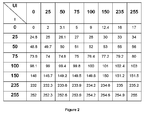
- Two exemplary crosstalk tables are given in figure 2 and figure 3 wherein the table in figure 2 is a crosstalk table for zero degrees vertical viewing angle ( ⁇ ) and the table in figure 3 is a crosstalk table for 10 degrees vertical viewing angle ( ⁇ ).
- first column stands for real intensity values of intended pixel (namely pixel of concern)
- first row stands for real intensity values of unintended pixel (namely neighbouring pixel).
- a plurality of predetermined crosstalk tables is associated with distinct angles. As the vertical viewing angle ( ⁇ ) of the user (U) is determined, the crosstalk table associated to an angle, which is closest to said determined vertical viewing angle ( ⁇ ), is used to calculate crosstalk reduction coefficient.
- a crosstalk table is generated in relation to determined vertical viewing angle ( ⁇ ) by interpolating at least 2 predetermined crosstalk tables which are associated with distinct angles.
- two crosstalk tables which are associated with angles, which are the closest to determined vertical viewing angle ( ⁇ ) are interpolated to generate said crosstalk table.
- intensity values of each pixel are updated by multiplying said intensity value with calculated crosstalk reduction coefficient, which is calculated for each pixel.
- all pixels of all views are updated such that the perceived pixel intensities are the same with the real intensities.
- the method of the invention may comprise the step of calculating a second crosstalk reduction coefficient, which is only dependent on intensity values of said first and/or second pixels, and updating intensity value of said first pixel and/or said second pixel in accordance with said calculated second crosstalk reduction coefficient.
- Stated steps may be used to reduce crosstalk reduction method into two steps one of which is applied as if the user is at a normal position (in other words at 0 vertical viewing angle ( ⁇ )) as known from the prior art.
- the crosstalk reduction based on vertical viewing angle ( ⁇ ) is performed afterwards if necessary. Stated performance may be useful for fail safe operation for cases in which multiple users are present and/or a true vertical viewing angle ( ⁇ ) cannot be detected.
- the steps of calculating a crosstalk reduction coefficient and updating intensity values of said pixels comprises the steps of;
- the computational complexity of the crosstalk reduction based on vertical viewing angle is reduced.
- the equation approximates required intensity deviation due to vertical viewing angle ( ⁇ ) using a first order approximation.
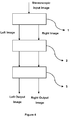
- the present invention provides a system for crosstalk reduction in stereoscopic displays (D) which comprises at least a first pixel and a second pixel, a block diagram of which is given in figure 4 , which essentially comprises;
- the system of the invention reduces crosstalk between left and right views of retarder type display (D) in accordance with the position of the user (U). Hence user comfort is ensured independent of user position in relation to the display.
Landscapes
- Engineering & Computer Science (AREA)
- Multimedia (AREA)
- Signal Processing (AREA)
- Control Of Indicators Other Than Cathode Ray Tubes (AREA)
- Testing, Inspecting, Measuring Of Stereoscopic Televisions And Televisions (AREA)
Abstract
Description
- The present invention is related to crosstalk reduction for stereoscopic displays
- Different mediums of 3D visualization have been introduced in the market ranging from small mobile displays to large screen TVs and theatre projectors. The wide availability of these mediums encouraged content producers to invest into this fast developing field and create new user experiences. Current generation of stereoscopic displays available in the market depends on the principle of accepting left and right images as input and directing them to the correct eye individually.
- Mainly two types of stereoscopic display technologies are used for 3 dimensional perceptions. The active type displays employ an electrically powered eyeglass which sequentially blacks out one of the glasses so that an image can only be seen by a single eye. The image shown on the display is synchronized with the black out order so that images are shown to correct eye to create 3 dimensional perceptions.
- Another type of stereoscopic display is the polarizing or retarder-type display which comprises micro-polarisers to polarise light array stemming from the display in clockwise or counter-clockwise direction. A polarised eyeglass, one of the glasses of which passes clockwise polarised light and the other passes counter-clockwise polarise light, directs the left and right eye views in accordance with polarisation of the received light array.
- No matter which technology is used to create 3 dimensional perceptions, considerable misperception occurs due to a problem called "crosstalk". Crosstalk is the distortion of the view of an eye by the image created for the other eye. Crosstalk generally occurs due to high contrast and/or brightness of the display and it significantly disturbs 3 dimensional perceptions. In the retarder type displays, left view and right view are discriminated by their polarisations. However, leakage of light from one view to the other occurs due to characteristics of polarised eyeglass filter used to separate views.
- Several methods are known from the state of the art in order to reduce crosstalk. Generally the crosstalk is mapped in relation to the brightness of the intended image (the image that is to be seen at an instant) and to the brightness of the unintended image (the image that is not to be seen at the instant) and a feedback is used either to modify 3 dimensional display or the image that is shown.
- The prior art document
EP 2194727 A1 discloses a crosstalk reduction method in which each received image data is multiplied with a predetermined crosstalk reduction matrix to update intensity values of pixels of received image resulting in compensated crosstalk. Although the method is effectively applicable for stereoscopic displays, said method lacks change in crosstalk in accordance with user position. Consequently widely applicable crosstalk compensation cannot be achieved with said method. - Observed crosstalk is also related to the position of the user in relation to the display. Especially, the vertical viewing angle, which is the angle between an artificial line extending from the user eye to a point on display, and the normal of the display, drastically affects crosstalk performance. Therefore a user position dependent crosstalk reduction method is needed.
- Prior art document
EP 2421275 A2 discloses a 3 dimensional display system which determines the position of the user and adjusts displays non-transmissive region in accordance with detected user position. With the system ofEP 2421275 A2 , crosstalk is dynamically compensated. However the system ofEP 2421275 A2 requires a complex hardware in order to modify non-transmissive region of the display. - The present invention provides a novel method and system for crosstalk reduction in especially retarder-type (polarizing) stereoscopic displays. The method comprises the steps of;
- Determining a vertical viewing angle of a user by measuring an angle between a view normal, which extends from an eye of the user to the first pixel and/or second pixel and a normal line of the display;
- Calculating a crosstalk reduction coefficient for at least the first pixel and/or the second pixel of said display based on at least one predetermined crosstalk table, which maps crosstalk between the first pixel and the second pixel, based on an intensity value of the first pixel and intensity value of the second pixel, and said calculated vertical viewing angle; and
- Updating intensity value of said first pixel or said second pixel in accordance with said calculated crosstalk reduction coefficient.
- The method and system of the invention provide compensation of crosstalk in relation to the position of the user. Therefore crosstalk performance of the display is increased regardless of the position of the user; and consequently the user comfort is ensured.
- The object of the invention is to provide a user position oriented crosstalk reduction method and system for stereoscopic displays.
- Another object of the invention is to provide a method and a system which ensures user comfort from all viewing angles.
- Another object of the invention is to provide an easily applicable, user position oriented crosstalk reduction method and system for stereoscopic displays.
-
-
Figure 1 shows an exemplary stereoscopic display, a user and the viewing angle of the user. -
Figure 2 shows perceived intensity values of a pixel of an image in accordance with real intensity value of the pixel and intensity value of the pixel of the unintended view from a direct (0 degrees viewing angle) case. -
Figure 3 shows perceived intensity values of a pixel of an image in accordance with real intensity value of the pixel and intensity value of the pixel of the unintended view from an indirect (10 degrees viewing angle) case. -
Figure 4 shows an exemplary block diagram of the system of the invention. -
- Display
- (D)
- User
- (U)
- View Normal
- (C)
- Display Normal
- (N)
- Viewing Angle
- (α)
- View separating Means
- (1)
- Crosstalk reduction Means
- (2)
- Vertical Update Means
- (3)
- Image quality of 3 dimensional displays or stereoscopic displays is reduced by a factor known as "crosstalk". Crosstalk is the contamination of an image view, which is to be seen by an eye of the user, by the image view, which is to be seen by the other eye of the user. In other words, crosstalk is the interaction of left eye view and right eye view by each other.
- Crosstalk performances of the stereoscopic displays strictly depend on the position of the user. Especially, the vertical position of the user directly affects occurrence of crosstalk and viewing quality.
-
Figure 1 shows side view of an exemplary display (D) and a user (U) at an indirect viewing angle. The vertical viewing angle (α) is preferably measured between a line extending from an eye of the user (U) to a point the user is viewing, which can be named as view normal (C), and a normal line (N) of the display (D). - As the vertical viewing angle (α) increases, the crosstalk increases; so the user comfort is reduced. Therefore; a crosstalk reduction method which is dependent on the stated vertical viewing angle (α) is needed.
- Present invention provides a novel crosstalk reduction method for especially retarder-type stereoscopic displays (D) comprising at least a first pixel, light of which is clockwise polarised, and at least a second pixel, light of which is counter-clockwise polarised, which comprises the steps of;
- Determining a vertical viewing angle (α) of a user (U) by measuring an angle between a view normal (C), which extends from an eye of the user (U) to the first pixel and/or second pixel and a normal line (N) of the display (D);
- Calculating a crosstalk reduction coefficient for at least the first pixel and/or the second pixel of said display (D) based on at least one predetermined crosstalk table, which maps crosstalk between the first pixel and the second pixel, based on an intensity value of the first pixel and intensity value of the second pixel, and said determined vertical viewing angle (α); and
- Updating intensity value of said first pixel or said second pixel in accordance with said calculated crosstalk reduction coefficient
- The first step is to determine a vertical viewing angle (α). Since the vertical viewing angle (α) directly affects crosstalk performance, the determination of said angle (α) is essential. The angle may be determined by any method known from the state of the art such as acquiring an image of the user using an image input device (i.e. a camera) and identifying the position of the user in relation to a reference point in acquired image.
- As the vertical viewing angle (α) is determined, a crosstalk reduction coefficient is calculated. The crosstalk reduction coefficient is used to update intensity values of pixels of display; so that the crosstalk is reduced by decreasing the intensity of the unintended pixel. The calculation of the crosstalk reduction is performed using a predefined crosstalk table. The predefined crosstalk table defines perceived intensity of a pixel in accordance with the real intensity value of said pixel and real intensity value of the unintended pixel (the neighbouring pixel to said pixel which has an opposite polarisation with the said pixel). Two exemplary crosstalk tables are given in
figure 2 andfigure 3 wherein the table infigure 2 is a crosstalk table for zero degrees vertical viewing angle (α) and the table infigure 3 is a crosstalk table for 10 degrees vertical viewing angle (α). In the tables, first column stands for real intensity values of intended pixel (namely pixel of concern) and first row stands for real intensity values of unintended pixel (namely neighbouring pixel). - In order to calculate the crosstalk reduction coefficient, several methods can be used. In one embodiment, a plurality of predetermined crosstalk tables is associated with distinct angles. As the vertical viewing angle (α) of the user (U) is determined, the crosstalk table associated to an angle, which is closest to said determined vertical viewing angle (α), is used to calculate crosstalk reduction coefficient.
- In another embodiment of the invention, a crosstalk table is generated in relation to determined vertical viewing angle (α) by interpolating at least 2 predetermined crosstalk tables which are associated with distinct angles. Preferably, two crosstalk tables which are associated with angles, which are the closest to determined vertical viewing angle (α), are interpolated to generate said crosstalk table.
- Finally, the crosstalk reduction coefficient is calculated by determining required reduction from the crosstalk table in accordance with the real value of the pixel and the real value of the oppositely polarised neighbouring pixel. For instance; if the vertical viewing angle (α) is 10 degrees and the crosstalk table in
Figure 3 is selected, and if the real value of the pixel is 30 and the real value of the neighbouring pixel is 75, the pixel intensity should be reduced to 25 to obtain perceived intensity as 30. So the crosstalk reduction coefficient is calculated as 25/30 = 0.83. - Finally intensity values of each pixel are updated by multiplying said intensity value with calculated crosstalk reduction coefficient, which is calculated for each pixel. Finally, all pixels of all views are updated such that the perceived pixel intensities are the same with the real intensities.
- Preferably, the method of the invention may comprise the step of calculating a second crosstalk reduction coefficient, which is only dependent on intensity values of said first and/or second pixels, and updating intensity value of said first pixel and/or said second pixel in accordance with said calculated second crosstalk reduction coefficient. Stated steps may be used to reduce crosstalk reduction method into two steps one of which is applied as if the user is at a normal position (in other words at 0 vertical viewing angle (α)) as known from the prior art. The crosstalk reduction based on vertical viewing angle (α) is performed afterwards if necessary. Stated performance may be useful for fail safe operation for cases in which multiple users are present and/or a true vertical viewing angle (α) cannot be detected.
- In an advantageous embodiment of the invention, the steps of calculating a crosstalk reduction coefficient and updating intensity values of said pixels comprises the steps of;
- Calculating a crosstalk reduction coefficient based on only the intensity values of said first and/or second pixels and independent of vertical viewing angle (α)
- Updating intensity values of said pixels using said crosstalk reduction coefficient
- Updating intensity values of said pixels using an nth order approximation function, which estimates final intensity values of said first and/or second pixels in relation to vertical viewing angle (α)
- With the stated advantageous embodiment of the invention, the computational complexity of the crosstalk reduction based on vertical viewing angle is reduced. Preferably the equation (1) is used to update intensity values of said pixels;

wherein Ifinal (x,y) stands for final intensity value of said pixel, Ioriginal(x,y) stands for original intensity value of said pixel, f(α) is a function of vertical viewing angle (α), IUpdate(x,y) stands for updated intensity value of said pixel, wherein said update operation is performed using a crosstalk reduction coefficient based on only the intensity values of said first and/or second pixels and independent of vertical viewing angle (α) and k1 and k2 stand for predetermined approximation coefficients. The equation approximates required intensity deviation due to vertical viewing angle (α) using a first order approximation. Hence computational complexity of the crosstalk reduction is significantly reduced. - The present invention provides a system for crosstalk reduction in stereoscopic displays (D) which comprises at least a first pixel and a second pixel, a block diagram of which is given in
figure 4 , which essentially comprises; - Means for separating views (1) of a stereoscopic input image into left image comprising the first pixel and right image comprising the second pixel;
- Means for reducing crosstalk (2) between said left image and said right image by calculating a crosstalk reduction coefficient based on intensity values of said first and/or second pixels, and updating intensity values of said first and/or second pixels using said crosstalk reduction coefficient; and
- Vertical update means (3) which determines vertical viewing angle (α) by measuring an angle between a view normal (C), which extends from an eye of a user (U) to the first pixel and/or second pixel and a normal line (N) of the display (D) and which updates intensity values of said first and/or second pixels in relation to said determined vertical viewing angle (α)
- The system of the invention reduces crosstalk between left and right views of retarder type display (D) in accordance with the position of the user (U). Hence user comfort is ensured independent of user position in relation to the display.
- With the method and system of the invention, crosstalk in retarder-type stereoscopic displays is effectively reduced regardless of the user position.
Claims (6)
- A crosstalk reduction method for stereoscopic displays (D), which comprises at least a first pixel, light of which is clockwise polarised, and at least a second pixel, light of which is counter-clockwise polarised, which comprises the steps of;- Determining a vertical viewing angle (α) of a user (U) by measuring an angle between a view normal (C), which extends from an eye of the user (U) to the first pixel and/or second pixel and a normal line (N) of the display (D);- Calculating a crosstalk reduction coefficient for at least the first pixel and/or the second pixel of said display (D) based on at least one predetermined crosstalk table, which maps crosstalk between the first pixel and the second pixel, based on an intensity value of the first pixel and an intensity value of the second pixel, and said calculated vertical viewing angle (α); and- Updating intensity value of said first pixel and/or said second pixel in accordance with said calculated crosstalk reduction coefficient.
- A crosstalk reduction method according to claim 1 wherein said crosstalk table is selected among a plurality of predetermined crosstalk tables, each of which are associated with a distinct angle, wherein a crosstalk table which is associated to an angle, which is closest to said determined vertical viewing angle (α), is selected.
- A crosstalk reduction method according to claim 1 wherein said crosstalk table is generated in relation to determined vertical viewing angle (α) by interpolating at least 2 predetermined crosstalk tables which are associated with angles which are closest to said determined vertical viewing angle (α).
- A crosstalk reduction method according to claim 1 wherein the steps of calculating a crosstalk reduction coefficient and updating intensity values of said pixels comprises the steps of;- calculating a crosstalk reduction coefficient based on intensity values of said first and/or second pixels;- Updating intensity values of said pixels using said crosstalk reduction coefficient- Updating intensity values of said pixels using an nth order approximation function, which estimates final intensity values of said first and/or second pixels in relation to vertical viewing angle (α)
- A crosstalk reduction method according to claim 4 wherein equation (1) is used to update intensity values of said first and/or second pixels;

wherein Ifinal (x,y) stands for final intensity value of said first and/or second pixel, Ioriginal(x,y) stands for original intensity value of said first and/or second pixel, f(α) is a function of vertical viewing angle (α), IUpdate(x,y) stands for updated intensity value of said first and/or second pixel, wherein said update operation is performed using a crosstalk reduction coefficient based on intensity values of said first and/or second pixels and independent of vertical viewing angle (α) and k1 and k2 stand for predetermined approximation coefficients. - A crosstalk reduction system for stereoscopic displays (D), which comprises at least a first pixel and a second pixel; which comprises;- Means for separating views (1) of a stereoscopic input image into left image comprising the first pixel and right image comprising the second pixel;- Means for reducing crosstalk (2) between said left image and said right image by calculating a crosstalk reduction coefficient based on intensity values of said first and/or second pixels, and updating intensity values of said first and/or second pixels using said crosstalk reduction coefficient; and- Vertical update means (3) which determines vertical viewing angle (α) by measuring an angle between a view normal (C), which extends from an eye of a user (U) to the first pixel and/or second pixel and a normal line (N) of the display (D) and which updates intensity values of said first and/or second pixels in relation to said determined vertical viewing angle (α)
Priority Applications (2)
| Application Number | Priority Date | Filing Date | Title |
|---|---|---|---|
| ES12168604.2T ES2539385T3 (en) | 2012-05-21 | 2012-05-21 | Procedure and system for crosstalk reduction for stereoscopic display devices. |
| EP12168604.2A EP2667616B1 (en) | 2012-05-21 | 2012-05-21 | A crosstalk reduction method and system for stereoscopic displays |
Applications Claiming Priority (1)
| Application Number | Priority Date | Filing Date | Title |
|---|---|---|---|
| EP12168604.2A EP2667616B1 (en) | 2012-05-21 | 2012-05-21 | A crosstalk reduction method and system for stereoscopic displays |
Publications (2)
| Publication Number | Publication Date |
|---|---|
| EP2667616A1 true EP2667616A1 (en) | 2013-11-27 |
| EP2667616B1 EP2667616B1 (en) | 2015-03-18 |
Family
ID=46084939
Family Applications (1)
| Application Number | Title | Priority Date | Filing Date |
|---|---|---|---|
| EP12168604.2A Active EP2667616B1 (en) | 2012-05-21 | 2012-05-21 | A crosstalk reduction method and system for stereoscopic displays |
Country Status (2)
| Country | Link |
|---|---|
| EP (1) | EP2667616B1 (en) |
| ES (1) | ES2539385T3 (en) |
Citations (8)
| Publication number | Priority date | Publication date | Assignee | Title |
|---|---|---|---|---|
| US20060268104A1 (en) * | 2005-05-26 | 2006-11-30 | Real D | Ghost-compensation for improved stereoscopic projection |
| EP2194727A1 (en) | 2008-12-03 | 2010-06-09 | Samsung Electronics Co., Ltd. | Apparatus and method for compensating for crosstalk between views in three dimensional (3D) display apparatus |
| US20110080401A1 (en) * | 2008-06-13 | 2011-04-07 | Imax Corporation | Methods and systems for reducing or eliminating perceived ghosting in displayed stereoscopic images |
| US20110157500A1 (en) * | 2009-12-29 | 2011-06-30 | Au Optronics Corp. | Stereoscopic display device and stereoscopic image displaying method |
| US20120013614A1 (en) * | 2010-02-02 | 2012-01-19 | Arisawa Mfg. Co., Ltd | Stereoscopic image display apparatus and method |
| EP2421275A2 (en) | 2010-08-16 | 2012-02-22 | LG Electronics Inc. | Apparatus and method of displaying 3-dimensinal image |
| US20120099033A1 (en) * | 2010-10-22 | 2012-04-26 | Fujifilm Corporation | Stereoscopic image recognition apparatus |
| US20120105604A1 (en) * | 2010-10-29 | 2012-05-03 | Lg Display Co., Ltd. | Optical measuring apparatus and method of stereoscopic display device |
-
2012
- 2012-05-21 EP EP12168604.2A patent/EP2667616B1/en active Active
- 2012-05-21 ES ES12168604.2T patent/ES2539385T3/en active Active
Patent Citations (8)
| Publication number | Priority date | Publication date | Assignee | Title |
|---|---|---|---|---|
| US20060268104A1 (en) * | 2005-05-26 | 2006-11-30 | Real D | Ghost-compensation for improved stereoscopic projection |
| US20110080401A1 (en) * | 2008-06-13 | 2011-04-07 | Imax Corporation | Methods and systems for reducing or eliminating perceived ghosting in displayed stereoscopic images |
| EP2194727A1 (en) | 2008-12-03 | 2010-06-09 | Samsung Electronics Co., Ltd. | Apparatus and method for compensating for crosstalk between views in three dimensional (3D) display apparatus |
| US20110157500A1 (en) * | 2009-12-29 | 2011-06-30 | Au Optronics Corp. | Stereoscopic display device and stereoscopic image displaying method |
| US20120013614A1 (en) * | 2010-02-02 | 2012-01-19 | Arisawa Mfg. Co., Ltd | Stereoscopic image display apparatus and method |
| EP2421275A2 (en) | 2010-08-16 | 2012-02-22 | LG Electronics Inc. | Apparatus and method of displaying 3-dimensinal image |
| US20120099033A1 (en) * | 2010-10-22 | 2012-04-26 | Fujifilm Corporation | Stereoscopic image recognition apparatus |
| US20120105604A1 (en) * | 2010-10-29 | 2012-05-03 | Lg Display Co., Ltd. | Optical measuring apparatus and method of stereoscopic display device |
Also Published As
| Publication number | Publication date |
|---|---|
| ES2539385T3 (en) | 2015-06-30 |
| EP2667616B1 (en) | 2015-03-18 |
Similar Documents
| Publication | Publication Date | Title |
|---|---|---|
| JP5615136B2 (en) | Stereoscopic image correction method, stereoscopic display device, and stereoscopic image generation device | |
| EP2786583B1 (en) | Image processing apparatus and method for subpixel rendering | |
| EP2854402B1 (en) | Multi-view image display apparatus and control method thereof | |
| KR102121389B1 (en) | Glassless 3d display apparatus and contorl method thereof | |
| EP2869571B1 (en) | Multi view image display apparatus and control method thereof | |
| CN105376558B (en) | Multi-view image shows equipment and its control method | |
| CN103474042B (en) | A kind of method of overvoltage drive, device and display device | |
| EP2259600B1 (en) | Image processing method, image processing device, and recording medium | |
| EP2348745A2 (en) | Perceptually-based compensation of unintended light pollution of images for display systems | |
| US20090141121A1 (en) | Calibration of a 3-dimensional display | |
| US20110007136A1 (en) | Image signal processing apparatus and image display | |
| KR20190029331A (en) | Image processing method and apparatus for autostereoscopic three dimensional display | |
| US20110074933A1 (en) | Reduction of viewer discomfort for stereoscopic images | |
| KR101869872B1 (en) | Method of multi-view image formation and stereoscopic image display device using the same | |
| US9396579B2 (en) | Method for visualizing three-dimensional images on a 3D display device and 3D display device | |
| KR101364883B1 (en) | Crosstalk reduction method for 3d steroscopic image and crosstalk reduction apparatus for 3d steroscopic image | |
| KR20150012976A (en) | multi view image processing apparatus and image processing method thereof | |
| CN104539935A (en) | Image brightness adjusting method, adjusting device and display device | |
| CN103237227A (en) | Method and display system for reducing stereo image crosstalk | |
| US9088774B2 (en) | Image processing apparatus, image processing method and program | |
| US20140071237A1 (en) | Image processing device and method thereof, and program | |
| US20110084966A1 (en) | Method for forming three-dimension images and related display module | |
| Shao et al. | Visual discomfort relaxation for stereoscopic 3D images by adjusting zero-disparity plane for projection | |
| JP2008541599A (en) | Inexpensive rendering for 3D displays | |
| EP2490173A1 (en) | Method for processing a stereoscopic image comprising a black band and corresponding device |
Legal Events
| Date | Code | Title | Description |
|---|---|---|---|
| PUAI | Public reference made under article 153(3) epc to a published international application that has entered the european phase |
Free format text: ORIGINAL CODE: 0009012 |
|
| AK | Designated contracting states |
Kind code of ref document: A1 Designated state(s): AL AT BE BG CH CY CZ DE DK EE ES FI FR GB GR HR HU IE IS IT LI LT LU LV MC MK MT NL NO PL PT RO RS SE SI SK SM TR |
|
| AX | Request for extension of the european patent |
Extension state: BA ME |
|
| 17P | Request for examination filed |
Effective date: 20140122 |
|
| GRAP | Despatch of communication of intention to grant a patent |
Free format text: ORIGINAL CODE: EPIDOSNIGR1 |
|
| INTG | Intention to grant announced |
Effective date: 20141016 |
|
| RAP1 | Party data changed (applicant data changed or rights of an application transferred) |
Owner name: VESTEL ELEKTRONIK SANAYI VE TICARET A.S. |
|
| GRAS | Grant fee paid |
Free format text: ORIGINAL CODE: EPIDOSNIGR3 |
|
| GRAA | (expected) grant |
Free format text: ORIGINAL CODE: 0009210 |
|
| AK | Designated contracting states |
Kind code of ref document: B1 Designated state(s): AL AT BE BG CH CY CZ DE DK EE ES FI FR GB GR HR HU IE IS IT LI LT LU LV MC MK MT NL NO PL PT RO RS SE SI SK SM TR |
|
| REG | Reference to a national code |
Ref country code: GB Ref legal event code: FG4D |
|
| REG | Reference to a national code |
Ref country code: CH Ref legal event code: EP |
|
| REG | Reference to a national code |
Ref country code: IE Ref legal event code: FG4D |
|
| REG | Reference to a national code |
Ref country code: AT Ref legal event code: REF Ref document number: 717194 Country of ref document: AT Kind code of ref document: T Effective date: 20150415 |
|
| REG | Reference to a national code |
Ref country code: FR Ref legal event code: PLFP Year of fee payment: 4 |
|
| REG | Reference to a national code |
Ref country code: DE Ref legal event code: R096 Ref document number: 602012005920 Country of ref document: DE Effective date: 20150430 |
|
| REG | Reference to a national code |
Ref country code: ES Ref legal event code: FG2A Ref document number: 2539385 Country of ref document: ES Kind code of ref document: T3 Effective date: 20150630 |
|
| REG | Reference to a national code |
Ref country code: NL Ref legal event code: VDEP Effective date: 20150318 |
|
| REG | Reference to a national code |
Ref country code: NL Ref legal event code: VDEP Effective date: 20150318 |
|
| PG25 | Lapsed in a contracting state [announced via postgrant information from national office to epo] |
Ref country code: SE Free format text: LAPSE BECAUSE OF FAILURE TO SUBMIT A TRANSLATION OF THE DESCRIPTION OR TO PAY THE FEE WITHIN THE PRESCRIBED TIME-LIMIT Effective date: 20150318 Ref country code: FI Free format text: LAPSE BECAUSE OF FAILURE TO SUBMIT A TRANSLATION OF THE DESCRIPTION OR TO PAY THE FEE WITHIN THE PRESCRIBED TIME-LIMIT Effective date: 20150318 Ref country code: NO Free format text: LAPSE BECAUSE OF FAILURE TO SUBMIT A TRANSLATION OF THE DESCRIPTION OR TO PAY THE FEE WITHIN THE PRESCRIBED TIME-LIMIT Effective date: 20150618 Ref country code: LT Free format text: LAPSE BECAUSE OF FAILURE TO SUBMIT A TRANSLATION OF THE DESCRIPTION OR TO PAY THE FEE WITHIN THE PRESCRIBED TIME-LIMIT Effective date: 20150318 Ref country code: HR Free format text: LAPSE BECAUSE OF FAILURE TO SUBMIT A TRANSLATION OF THE DESCRIPTION OR TO PAY THE FEE WITHIN THE PRESCRIBED TIME-LIMIT Effective date: 20150318 |
|
| REG | Reference to a national code |
Ref country code: AT Ref legal event code: MK05 Ref document number: 717194 Country of ref document: AT Kind code of ref document: T Effective date: 20150318 |
|
| REG | Reference to a national code |
Ref country code: LT Ref legal event code: MG4D |
|
| PG25 | Lapsed in a contracting state [announced via postgrant information from national office to epo] |
Ref country code: GR Free format text: LAPSE BECAUSE OF FAILURE TO SUBMIT A TRANSLATION OF THE DESCRIPTION OR TO PAY THE FEE WITHIN THE PRESCRIBED TIME-LIMIT Effective date: 20150619 Ref country code: RS Free format text: LAPSE BECAUSE OF FAILURE TO SUBMIT A TRANSLATION OF THE DESCRIPTION OR TO PAY THE FEE WITHIN THE PRESCRIBED TIME-LIMIT Effective date: 20150318 Ref country code: LV Free format text: LAPSE BECAUSE OF FAILURE TO SUBMIT A TRANSLATION OF THE DESCRIPTION OR TO PAY THE FEE WITHIN THE PRESCRIBED TIME-LIMIT Effective date: 20150318 |
|
| PG25 | Lapsed in a contracting state [announced via postgrant information from national office to epo] |
Ref country code: NL Free format text: LAPSE BECAUSE OF FAILURE TO SUBMIT A TRANSLATION OF THE DESCRIPTION OR TO PAY THE FEE WITHIN THE PRESCRIBED TIME-LIMIT Effective date: 20150318 |
|
| PG25 | Lapsed in a contracting state [announced via postgrant information from national office to epo] |
Ref country code: PT Free format text: LAPSE BECAUSE OF FAILURE TO SUBMIT A TRANSLATION OF THE DESCRIPTION OR TO PAY THE FEE WITHIN THE PRESCRIBED TIME-LIMIT Effective date: 20150720 Ref country code: SK Free format text: LAPSE BECAUSE OF FAILURE TO SUBMIT A TRANSLATION OF THE DESCRIPTION OR TO PAY THE FEE WITHIN THE PRESCRIBED TIME-LIMIT Effective date: 20150318 Ref country code: RO Free format text: LAPSE BECAUSE OF FAILURE TO SUBMIT A TRANSLATION OF THE DESCRIPTION OR TO PAY THE FEE WITHIN THE PRESCRIBED TIME-LIMIT Effective date: 20150318 Ref country code: CZ Free format text: LAPSE BECAUSE OF FAILURE TO SUBMIT A TRANSLATION OF THE DESCRIPTION OR TO PAY THE FEE WITHIN THE PRESCRIBED TIME-LIMIT Effective date: 20150318 Ref country code: EE Free format text: LAPSE BECAUSE OF FAILURE TO SUBMIT A TRANSLATION OF THE DESCRIPTION OR TO PAY THE FEE WITHIN THE PRESCRIBED TIME-LIMIT Effective date: 20150318 |
|
| PG25 | Lapsed in a contracting state [announced via postgrant information from national office to epo] |
Ref country code: IS Free format text: LAPSE BECAUSE OF FAILURE TO SUBMIT A TRANSLATION OF THE DESCRIPTION OR TO PAY THE FEE WITHIN THE PRESCRIBED TIME-LIMIT Effective date: 20150718 Ref country code: PL Free format text: LAPSE BECAUSE OF FAILURE TO SUBMIT A TRANSLATION OF THE DESCRIPTION OR TO PAY THE FEE WITHIN THE PRESCRIBED TIME-LIMIT Effective date: 20150318 Ref country code: AT Free format text: LAPSE BECAUSE OF FAILURE TO SUBMIT A TRANSLATION OF THE DESCRIPTION OR TO PAY THE FEE WITHIN THE PRESCRIBED TIME-LIMIT Effective date: 20150318 |
|
| REG | Reference to a national code |
Ref country code: DE Ref legal event code: R097 Ref document number: 602012005920 Country of ref document: DE |
|
| REG | Reference to a national code |
Ref country code: CH Ref legal event code: PL |
|
| PLBE | No opposition filed within time limit |
Free format text: ORIGINAL CODE: 0009261 |
|
| STAA | Information on the status of an ep patent application or granted ep patent |
Free format text: STATUS: NO OPPOSITION FILED WITHIN TIME LIMIT |
|
| PG25 | Lapsed in a contracting state [announced via postgrant information from national office to epo] |
Ref country code: MC Free format text: LAPSE BECAUSE OF FAILURE TO SUBMIT A TRANSLATION OF THE DESCRIPTION OR TO PAY THE FEE WITHIN THE PRESCRIBED TIME-LIMIT Effective date: 20150318 Ref country code: LI Free format text: LAPSE BECAUSE OF NON-PAYMENT OF DUE FEES Effective date: 20150531 Ref country code: DK Free format text: LAPSE BECAUSE OF FAILURE TO SUBMIT A TRANSLATION OF THE DESCRIPTION OR TO PAY THE FEE WITHIN THE PRESCRIBED TIME-LIMIT Effective date: 20150318 Ref country code: LU Free format text: LAPSE BECAUSE OF FAILURE TO SUBMIT A TRANSLATION OF THE DESCRIPTION OR TO PAY THE FEE WITHIN THE PRESCRIBED TIME-LIMIT Effective date: 20150521 Ref country code: CH Free format text: LAPSE BECAUSE OF NON-PAYMENT OF DUE FEES Effective date: 20150531 |
|
| 26N | No opposition filed |
Effective date: 20151221 |
|
| REG | Reference to a national code |
Ref country code: IE Ref legal event code: MM4A |
|
| REG | Reference to a national code |
Ref country code: FR Ref legal event code: PLFP Year of fee payment: 5 |
|
| PG25 | Lapsed in a contracting state [announced via postgrant information from national office to epo] |
Ref country code: SI Free format text: LAPSE BECAUSE OF FAILURE TO SUBMIT A TRANSLATION OF THE DESCRIPTION OR TO PAY THE FEE WITHIN THE PRESCRIBED TIME-LIMIT Effective date: 20150318 |
|
| PG25 | Lapsed in a contracting state [announced via postgrant information from national office to epo] |
Ref country code: IE Free format text: LAPSE BECAUSE OF NON-PAYMENT OF DUE FEES Effective date: 20150521 |
|
| PG25 | Lapsed in a contracting state [announced via postgrant information from national office to epo] |
Ref country code: BE Free format text: LAPSE BECAUSE OF FAILURE TO SUBMIT A TRANSLATION OF THE DESCRIPTION OR TO PAY THE FEE WITHIN THE PRESCRIBED TIME-LIMIT Effective date: 20150318 |
|
| PG25 | Lapsed in a contracting state [announced via postgrant information from national office to epo] |
Ref country code: MT Free format text: LAPSE BECAUSE OF FAILURE TO SUBMIT A TRANSLATION OF THE DESCRIPTION OR TO PAY THE FEE WITHIN THE PRESCRIBED TIME-LIMIT Effective date: 20150318 |
|
| REG | Reference to a national code |
Ref country code: FR Ref legal event code: PLFP Year of fee payment: 6 |
|
| PG25 | Lapsed in a contracting state [announced via postgrant information from national office to epo] |
Ref country code: SM Free format text: LAPSE BECAUSE OF FAILURE TO SUBMIT A TRANSLATION OF THE DESCRIPTION OR TO PAY THE FEE WITHIN THE PRESCRIBED TIME-LIMIT Effective date: 20150318 Ref country code: HU Free format text: LAPSE BECAUSE OF FAILURE TO SUBMIT A TRANSLATION OF THE DESCRIPTION OR TO PAY THE FEE WITHIN THE PRESCRIBED TIME-LIMIT; INVALID AB INITIO Effective date: 20120521 Ref country code: BG Free format text: LAPSE BECAUSE OF FAILURE TO SUBMIT A TRANSLATION OF THE DESCRIPTION OR TO PAY THE FEE WITHIN THE PRESCRIBED TIME-LIMIT Effective date: 20150318 |
|
| PG25 | Lapsed in a contracting state [announced via postgrant information from national office to epo] |
Ref country code: CY Free format text: LAPSE BECAUSE OF FAILURE TO SUBMIT A TRANSLATION OF THE DESCRIPTION OR TO PAY THE FEE WITHIN THE PRESCRIBED TIME-LIMIT Effective date: 20150318 |
|
| REG | Reference to a national code |
Ref country code: FR Ref legal event code: PLFP Year of fee payment: 7 |
|
| PG25 | Lapsed in a contracting state [announced via postgrant information from national office to epo] |
Ref country code: MK Free format text: LAPSE BECAUSE OF FAILURE TO SUBMIT A TRANSLATION OF THE DESCRIPTION OR TO PAY THE FEE WITHIN THE PRESCRIBED TIME-LIMIT Effective date: 20150318 |
|
| PG25 | Lapsed in a contracting state [announced via postgrant information from national office to epo] |
Ref country code: AL Free format text: LAPSE BECAUSE OF FAILURE TO SUBMIT A TRANSLATION OF THE DESCRIPTION OR TO PAY THE FEE WITHIN THE PRESCRIBED TIME-LIMIT Effective date: 20150318 |
|
| REG | Reference to a national code |
Ref country code: DE Ref legal event code: R082 Ref document number: 602012005920 Country of ref document: DE Representative=s name: LEONHARD, REIMUND, DIPL.-ING., DE Ref country code: DE Ref legal event code: R082 Ref document number: 602012005920 Country of ref document: DE Representative=s name: LEONHARD, REIMUND, DIPL.-ING., ES |
|
| PGFP | Annual fee paid to national office [announced via postgrant information from national office to epo] |
Ref country code: DE Payment date: 20250521 Year of fee payment: 14 |
|
| PGFP | Annual fee paid to national office [announced via postgrant information from national office to epo] |
Ref country code: GB Payment date: 20250521 Year of fee payment: 14 Ref country code: ES Payment date: 20250627 Year of fee payment: 14 |
|
| PGFP | Annual fee paid to national office [announced via postgrant information from national office to epo] |
Ref country code: IT Payment date: 20250527 Year of fee payment: 14 |
|
| PGFP | Annual fee paid to national office [announced via postgrant information from national office to epo] |
Ref country code: FR Payment date: 20250528 Year of fee payment: 14 |
|
| PGFP | Annual fee paid to national office [announced via postgrant information from national office to epo] |
Ref country code: TR Payment date: 20260520 Year of fee payment: 15 |