EP2667370A1 - Secure multiply-accumulate union system, computation device, secure multiply-accumulate union method, and program thereof - Google Patents
Secure multiply-accumulate union system, computation device, secure multiply-accumulate union method, and program thereof Download PDFInfo
- Publication number
- EP2667370A1 EP2667370A1 EP12754230.6A EP12754230A EP2667370A1 EP 2667370 A1 EP2667370 A1 EP 2667370A1 EP 12754230 A EP12754230 A EP 12754230A EP 2667370 A1 EP2667370 A1 EP 2667370A1
- Authority
- EP
- European Patent Office
- Prior art keywords
- secret
- function
- value
- random number
- secret value
- Prior art date
- Legal status (The legal status is an assumption and is not a legal conclusion. Google has not performed a legal analysis and makes no representation as to the accuracy of the status listed.)
- Granted
Links
Images



Classifications
-
- G—PHYSICS
- G06—COMPUTING OR CALCULATING; COUNTING
- G06F—ELECTRIC DIGITAL DATA PROCESSING
- G06F21/00—Security arrangements for protecting computers, components thereof, programs or data against unauthorised activity
- G06F21/60—Protecting data
- G06F21/602—Providing cryptographic facilities or services
-
- H—ELECTRICITY
- H04—ELECTRIC COMMUNICATION TECHNIQUE
- H04L—TRANSMISSION OF DIGITAL INFORMATION, e.g. TELEGRAPHIC COMMUNICATION
- H04L9/00—Cryptographic mechanisms or cryptographic arrangements for secret or secure communications; Network security protocols
- H04L9/08—Key distribution or management, e.g. generation, sharing or updating, of cryptographic keys or passwords
- H04L9/0816—Key establishment, i.e. cryptographic processes or cryptographic protocols whereby a shared secret becomes available to two or more parties, for subsequent use
- H04L9/085—Secret sharing or secret splitting, e.g. threshold schemes
-
- H—ELECTRICITY
- H04—ELECTRIC COMMUNICATION TECHNIQUE
- H04L—TRANSMISSION OF DIGITAL INFORMATION, e.g. TELEGRAPHIC COMMUNICATION
- H04L9/00—Cryptographic mechanisms or cryptographic arrangements for secret or secure communications; Network security protocols
- H04L9/008—Cryptographic mechanisms or cryptographic arrangements for secret or secure communications; Network security protocols involving homomorphic encryption
-
- H—ELECTRICITY
- H04—ELECTRIC COMMUNICATION TECHNIQUE
- H04L—TRANSMISSION OF DIGITAL INFORMATION, e.g. TELEGRAPHIC COMMUNICATION
- H04L9/00—Cryptographic mechanisms or cryptographic arrangements for secret or secure communications; Network security protocols
- H04L9/32—Cryptographic mechanisms or cryptographic arrangements for secret or secure communications; Network security protocols including means for verifying the identity or authority of a user of the system or for message authentication, e.g. authorization, entity authentication, data integrity or data verification, non-repudiation, key authentication or verification of credentials
- H04L9/3218—Cryptographic mechanisms or cryptographic arrangements for secret or secure communications; Network security protocols including means for verifying the identity or authority of a user of the system or for message authentication, e.g. authorization, entity authentication, data integrity or data verification, non-repudiation, key authentication or verification of credentials using proof of knowledge, e.g. Fiat-Shamir, GQ, Schnorr, ornon-interactive zero-knowledge proofs
-
- H—ELECTRICITY
- H04—ELECTRIC COMMUNICATION TECHNIQUE
- H04L—TRANSMISSION OF DIGITAL INFORMATION, e.g. TELEGRAPHIC COMMUNICATION
- H04L2209/00—Additional information or applications relating to cryptographic mechanisms or cryptographic arrangements for secret or secure communication H04L9/00
- H04L2209/42—Anonymization, e.g. involving pseudonyms
-
- H—ELECTRICITY
- H04—ELECTRIC COMMUNICATION TECHNIQUE
- H04L—TRANSMISSION OF DIGITAL INFORMATION, e.g. TELEGRAPHIC COMMUNICATION
- H04L2209/00—Additional information or applications relating to cryptographic mechanisms or cryptographic arrangements for secret or secure communication H04L9/00
- H04L2209/46—Secure multiparty computation, e.g. millionaire problem
-
- H—ELECTRICITY
- H04—ELECTRIC COMMUNICATION TECHNIQUE
- H04L—TRANSMISSION OF DIGITAL INFORMATION, e.g. TELEGRAPHIC COMMUNICATION
- H04L2209/00—Additional information or applications relating to cryptographic mechanisms or cryptographic arrangements for secret or secure communication H04L9/00
- H04L2209/50—Oblivious transfer
Definitions
- the present invention relates to a secure product-sum combination system, a computing apparatus, a secure product-sum combination method, and a program therefor that compute an formula including multiplication and addition while concealing data by secret sharing and keeping the validity of the result of the computation.
- Non-patent literature 1 describes a three-party secure function computation which is a technique for performing a computation including multiplication and addition while concealing data and ensuring validity of the result of the computation. This is a protocol that derives the result of an arithmetic/logical operation by cooperative computations by three parties (three computing entities) without reconstructing distributed input values.
- a secure product-sum combination system treats data as natural numbers less than a predetermined prime p. To conceal data, the data, a, is divided into three and distributed so that the following condition is satisfied.
- the concealment is commutative because the concealment is additive sharing. Accordingly, adding the shared values together and then reconstructing the values yields the same result as reconstructing the values and then adding the values together. That is, addition and multiplication by a constant can be performed in a distributed manner without communication. Multiplication is also possible, although communication and generation of random numbers are required. Accordingly, a logic circuit can be configured so that any computations can be performed.
- An example of the three-party secure function computation will be described below. While a computation result in the three-party secure function computation protocol is the remainder of division by p, "mod p" will be omitted in the following description for the sake of simplicity.
- X sends a 0 to Y and a 1 to Z.
- Y sends a 1 to Z and a 2 to X.
- Z sends a 2 to X and a 0 to Y.
- X computes a 0 + a 1 + a 2 to reconstruct a if a 2 received from Y and a 2 received from Z are equal.
- Y computes a 0 + a 1 + a 2 to reconstruct a if a 0 received from X and a 0 received from Z are equal.
- Z computes a 0 + a 1 + a 2 to reconstruct a if a 1 received from X and a 1 received from Y are equal.
- data b is also concealed by distribution among X, Y and Z in the same way as data a, namely (b 0 , b 1 ), (b 1 , b 2 ) and (b 2 , b 0 ) are distributed to X, Y and Z, respectively.
- P_ and P + alone generate and share a random number r and P_ and P + distribute r ⁇ a 0 , r ⁇ a 1 and r ⁇ a 2 to the parties as secret values for r ⁇ a.
- c' (r ⁇ a) ⁇ b is computed according to the method in (5) described above and determination is made as to whether r ⁇ c - c' is equal to 0 or not. If r ⁇ c - c' is not equal to 0, it is detected as tampering.
- Shamir's scheme Secure function computation based on Shamir secret sharing in Non-patent literature 2 (hereinafter referred to as "Shamir's scheme") is secure function computation without multiplication with tampering detection.
- Non-patent literature 1 Koji Chida, Koki Hamada, Dai Ikarashi, Katsumi Takahashi, "A Three-Party Secure Function Evaluation with Lightweight Verifiability Revisited ", CSS2010, 2010 .
- Non-patent literature 2 Secure SCM-Consortium, "D9.2 Security Analysis", Cryptographic Aspects, 2009, pp. 19 - 26 .
- Shamir's scheme requires half the amount of data required by the method described in Non-patent literature 1. In Shamir's scheme, four or more computing apparatuses may be used. However, there is not a known tampering detection method for Shamir's scheme, except a method using public key cryptography, which requires a huge computation cost (for example about 1000 times larger than other schemes).
- An object of the present invention is to provide a secure product-sum combination system, a computing apparatus, a secure product-sum combination method, and a program therefor that increase the efficiency of multiplications in secure function computation to enable faster secure function computation than before.
- Each of the computing apparatuses includes a random number generator, a function calculator, and a tampering detector.
- [ ] is a symbol representing that the value in [ ] is concealed by encryption or secret sharing and is used for distinguishing a secret value from an unconcealed value.
- [ ] conceptually represents a set of secret shares of the actual value enclosed in [ ].
- the secure product-sum combination system can be configured with three computing apparatuses. If the present invention is applied on the basis of Shamir's scheme, the secure product-sum combination system can be configured with three or more computing apparatuses.
- the random number generator generates a secret value [r] of a random number r greater than or equal to 1 and less than p in cooperation with the random number generators of the other two computing apparatuses.
- the tampering detector computes a secret value [r ⁇ C - C'] in corporation with the tampering detector of the other two computing apparatuses. If [r ⁇ C - C'] is equal to [0], then the tampering detector outputs [C]; otherwise, it outputs information indicating that tampering has been detected.
- the secure product-sum combination system, the computing apparatus, the secure product-sum combination method, and the program therefor of the present invention enable efficient multiplications in secure function computation to enable faster secure function computation than before.
- Arithmetic operations addressed by the present invention includes multiplication by a constant, addition of a constant, and addition and multiplication of secret values [a], [b] concealed by encryption or secret sharing of arbitrary values a, b greater than or equal to 0 and less than p (where p is a prime).
- ⁇ and ⁇ are arbitrary values greater than or equal to 0 and less than p. While each result is the remainder of division by p, "mod p" is omitted for the sake of simplicity.
- the first formula represents that a secret value of ( ⁇ a + ⁇ ) can be obtained by multiplying a secret value [a] of a by a constant ⁇ and adding a constant ⁇ .
- the second formula represents that a secret value [a + b] of (a + b) can be obtained by adding a secret value [a] of a and a secret value [b] of b together.
- the third formula represents that a secret value of (a ⁇ b) can be obtained by multiplying a secret value [a] of a and the secret value [b] of b together.
- the assumption of the secure product-sum combination system of the present invention is that concealment, multiplication by a constant, addition of a constant, and addition and multiplication of secret values can be performed so that the three formulae given above hold.
- the secure function computation in Non-patent literature 1 includes addition, multiplication, constant addition, and constant multiplication.
- the formulae given above can therefore be computed by using the secure function computation in Non-patent literature 1.
- the present invention provides a method capable of faster computation.
- the result of secure computation performed on the result of multiplication of a random number r is compared with the result of secure computation multiplied by a random number.
- the presence of the random number r prevents tampering that causes the two computations to yield the same results. Therefore if the two computation results are not equal, it means that there is tampering.
- This is based on the fact that when addition and multiplication are performed in a domain where the modulus is a prime p, multiplication by a random number r yields a random number and therefore tampering such that a computation result multiplied by a random number r is equal to a computation result not multiplied by a random number is impossible.
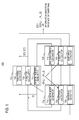
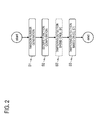
- Fig. 1 illustrates an exemplary configuration of a secure product-sum combination system 100 and Fig. 2 illustrates an exemplary process flow in the secure product-sum combination system 100.
- the secure product-sum combination system 100 includes three computing apparatuses 10x, 10y and 10z.
- the computing apparatus 10x includes a random number generator 11x, a function calculator 12x and a tampering detector 13x;
- computing apparatus 10y includes a random number generator 11y, a function calculator 12y, and a tampering detector 13y;
- computing apparatus 10z includes a random number generator 11z, a function calculator 12z and a tampering detector 13z.
- the random number generators 11x, 11y and 11z generate a secret value [r], which is a non-zero random number r (a random number randomly chosen from among integers greater than or equal to 1 and less than p) in corporation with one another (S1).
- the secret value [r] is generated as follows, for example (see Fig. 3 ).
- the random number generator 11x generates a non-zero random number r z and shares the random number r Z with the random number generator 11y
- the random number generator 11y generates a non-zero random number r X and shares the random number r X with the random number generator 11z
- the random number generator 11z generates a non-zero random number r Y and shares the random number r Y with the random number generator 11x (S1-1).
- the concealment method disclosed in Non-patent literature 1 is used to generate secret values [r X ], [r Y ] and [r Z ] of r X , r Y and r Z (S1-2).
- [C] and [C'] can be computed in parallel for higher efficiency of computation.
- the addition/multiplication of combinations of a constant, secret values, and secret pairs, which are pairs of secret values need to be defined. Twelve arithmetic operations are defined.
- the function f is configured with a combination of any one or more of the 12 arithmetic operations.
- the defined 12 arithmetic operations are referred to as fundamental operations. That is, the function f is one fundamental operation or a combination of multiple fundamental operations.
- [a] and [b] represent secret values in each fundamental operation
- [c] represents a secret value that is the result of each fundamental operation not multiplied by a random number r
- [c'] represents a secret value that is the result of each fundamental operation multiplied by a random number r
- [a] and [b] are secret values concealed by encryption or secret sharing of arbitrary values a and b greater than or equal to 0 and less than p
- Non-patent literature 1 Note additions and multiplications in the secure function computation in Non-patent literature 1 can be applied to five of the fundamental operations, namely, addition of secret values, addition of a constant to a secret value, multiplication of a secret value by a constant, addition of constants, and multiplication of constants.
- the other seven fundamental operations will be described here.
- each of the secret pair ([a], [a']) is multiplied by an arbitrary constant ⁇ greater than or equal to 0 and less than p to obtain a secret pair ( ⁇ ⁇ [a], ⁇ ⁇ [a']) as ([c], [c']).
- ([c], [c']) is a function value determined by a function that adds a constant to a secret pair ([a], [a'])
- a secret value [r] is multiplied by an arbitrary constant ⁇ greater than or equal to 0 and less than p to obtain a secret value [r ⁇ ⁇ ]
- the constant ⁇ is added to the secret value [a]
- the secret value [r ⁇ ⁇ ] is added to the secret value [a'] to obtain a secret pair ([a] + ⁇ , [a'] + [r ⁇ ⁇ ]) as ([c], [c']).
- ([c], [c']) is a function value determined by a function that adds a secret pair ([a], [a']) and a secret value [b] together
- the secret value [b] is multiplied by the secret value [r] using the multiplication without tampering detection in Non-patent literature 1 to obtain a secret value [b'] and the secret value [b] is added to the secret value [a] and the secret value [b'] is added to the secret value [a'] to obtain a secret pair ([a] + [b], [a'] + [b']) as ([c], [c']).
- ([c], [c']) is a function value determined by a function that multiples a secret pair ([a], [a']) by a secret value [b]
- the secret value [a] is multiplied by the secret value [b]
- the secret value [a'] is multiplied by [b] using the multiplication without tampering detection in Non-patent literature 1 to obtain a secret pair ([a] ⁇ [b], [a'] ⁇ [b]) as ([c], [c']).
- ([c], [c']) is a function value that can be determined by a function that multiples secret values [a] and [b] together
- the secret value [a] is multiplied by a secret value [r] by using the multiplication without tampering detection in Non-patent literature 1 to obtain a secret value [a']
- the secret value [a] is multiplied by the secret value [b]
- the secret value [a'] is multiplied by the secret value [b] by using the multiplication without tampering detection in Non-patent literature 1 to obtain a secret pair ([a] ⁇ [b], [a'] ⁇ [b]) as ([c], [c']).
- the tampering detectors 13x, 13y and 13z cooperate to obtain a secret value [r ⁇ C - C'] by the secure function computation method disclosed in Non-patent literature 1 and, if [r ⁇ C - C'] is equal to [0], output [C], otherwise, output information indicating that tampering has been detected (S3).
- the secret value [r ⁇ C - C'] can be more efficiently computed after the secret value [r] is reconstructed into r. If the fundamental operations constituting the function f include multiplication of secret pairs (([a], [a']) and ([b], [b'])), [b] and [b'] for each of the fundamental operations are recorded.
- the tampering detectors 13x, 13y and 13z cooperate to obtain a secret value [r ⁇ b - b'] for each [b] and [b'] by the secure function computation method disclosed in Non-patent literature 1. If any [r ⁇ b - b'] is not equal to [0], information indicating that tampering has been detected is output instead of [C] (S3'). The determination as to whether the value of [r ⁇ c - c'] is not zero may be made after every multiplication of secret pairs (([a], [a']) and ([b], [b'])).
- the efficiency of computation by the secure product-sum combination system and the secure product-sum combination method of the present invention configured as described above will be compared with the efficiency of the computation with tampering detection described in Non-patent literature 1.
- the amount of computation in Non-patent literature 1 mostly relates to encryption and decryption of communications performed when random number generation and a secure physical channel are not available.
- the amount of computation relating to the encryption and decryption is proportional to the number of communications. Therefore the number of random number generations can be compared with the number of communications to compare the efficiencies of the computations.
- the term the "number of rounds" as used in the following description refers to the number of communications that cannot concurrently be performed. For example, the number of rounds increases with the number of situations where a computing apparatus can start an operation only after receiving some information from another computing apparatus.
- Non-patent literature 1 The method in Non-patent literature 1 is used as the base secure computation.
- XOR can be rewritten as:
- the average number of random number generations is 10n excluding multiplications by a constant
- the average number of communications is 18n
- the number of rounds is 4n.
- the average number of random number generations is 2n
- the average number of communications is 4n
- the number of rounds is 2n because only two multiplications without tampering detection are required.
- the computation of the present invention is five times more efficient in the number of random number generations, 4.5 times more efficient in the number of communications, and twice more efficient in the number of rounds than the computation in Non-patent literature 1.
- the condition given above holds for any combination of the arithmetic operations defined with respect to the function calculators 12x, 12y and 12z. That is, if there is tampering of any of the elements in the set of ([b], [b']), the tampering is detected with a probability of 1 - 1/(p - 1) or higher; if there is not tampering of any of the elements, tampering of any of secret pairs is detected with a probability of 1 - 1/(p - 1) or higher.
- performing the process for detecting tampering of elements of a set of ([b], [b']) and the process for detecting tampering of output secret pairs [c] and [c'] can detect tampering, if any, of the output secret pairs can be detected with a probability of 1 - 1/(p - 1) or higher.
- a configuration based on secured function computation including multiplication with tampering detection described in Non-patent literature 1 has been described in the first embodiment.
- a configuration based on Shamir's scheme will be described in a third embodiment.
- random number generation in the first embodiment is limited to generation of uniform random numbers to eliminate the need for multiplication with tampering detection, thereby enabling the system to be applied to Shamir's scheme.
- This enables fast and secure arithmetic operations and reduction of the amount of data to half the amount of data in the method described in Non-patent literature 1.
- a secure product-sum combination system of the third embodiment can include more than three computing apparatuses because the system assumes Shamir's scheme.
- q 3.
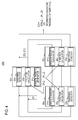
- Fig. 4 illustrates an exemplary configuration of a secure product-sum combination system 200 based on Shamir's scheme
- Fig. 5 illustrates an exemplary process flow in the secure product-sum combination system 200.
- the secure product-sum combination system 200 includes q computing apparatuses.
- three computing apparatuses computing apparatuses 20x, 20y and 20z
- the computing apparatus 20x includes a random number generator 21x, a function calculator 22x and a tampering detector 23x;
- computing apparatus 20y includes a random number generator 21y, a function calculator 22y, and a tampering detector 23y;
- computing apparatus 20z includes a random number generator 21z, a function calculator 22z and a tampering detector 23z.
- the random number generators 21x, 21y and 21z generate a secret value [r] of a uniform random number r in corporation with one another (S11).
- the secret value [r] is generated as follows, for example (see Fig. 6 ).
- the random number generator 21x generates a uniform random umber r X
- the random number generator 21y generates a uniform random number r Y
- the random number generator 21z generates a uniform random number r Z (S11-1).
- the data concealment method according to Shamir's scheme described above is used to generate secret values [r X ], [r Y ] and [r Z ] of r X , r Y and r Z .
- shares of [r X ] are denoted by r X,0 , r X,1 and r X,2
- shares of [r Y ] are denoted by r Y,0 , r Y,1 and r Y,2
- shares of [r Z ] are denoted by r Z,0 , r Z,1 and r Z,2 .
- the random number generator 21x records r X,0 , r Y,0 and r Z,0
- the random number generator 21y records r X,1 , r Y,1 and r Z,1
- the random number generator 21z records r X,2 , r Y,2 and r Z,2 (S11-2).
- [C] and [C'] can be computed in parallel for higher efficiency of computation.
- the addition/multiplication of combinations of a constant, secret values, and secret pairs, which are pairs of secret values need to be defined.
- the operations to be defined correspond to the fundamental operations described in the first embodiment. That is, as in the first embodiment, the function f in the third embodiment is one fundamental operation or a combination of multiple fundamental operations.
- each of the secret pair ([a], [a']) is multiplied by an arbitrary constant ⁇ greater than or equal to 0 and less than p to obtain a secret pair ( ⁇ ⁇ [a], ⁇ ⁇ [a']) as ([c], [c']).
- ([c], [c']) is a function value determined by a function that adds a constant to a secret pair ([a], [a'])
- a secret value [r] is multiplied by an arbitrary constant ⁇ greater than or equal to 0 and less than p to obtain a secret value [r ⁇ ⁇ ]
- the constant ⁇ is added to the secret value [a]
- the secret value [r ⁇ ⁇ ] is added to the secret value [a'] to obtain a secret pair ([a] + ⁇ , [a'] + [r ⁇ ⁇ ]) as ([c], [c']).
- ([c], [c']) is a function value determined by a function that adds a secret pair ([a], [a']) and a secret value [b] together
- the secret value [b] is multiplied by the secret value [r] using the multiplication without tampering detection of the secure function computation method according to Shamir's scheme to obtain a secret value [b']
- the secret value [b] is added to the secret value [a]
- the secret value [b'] is added to the secret value [a'] to obtain a secret pair ([a] + [b], [a'] + [b']) as ([c], [c']).
- ([c], [c']) is a function value determined by a function that multiples a secret pair ([a], [a']) by a secret value [b]
- the secret value [a] is multiplied by the secret value [b]
- the secret value [a'] is multiplied by [b] using the multiplication without tampering detection of the secure function computation method according to Shamir's scheme to obtain a secret pair ([a] ⁇ [b], [a'] ⁇ [b]) as ([c], [c']).
- ([c], [c']) is a function value that can be determined by a function that multiples secret values [a] and [b] together
- the secret value [a] is multiplied by a secret value [r] using the multiplication without tampering detection of the secure function computation method according to Shamir's scheme to obtain a secret value [a']
- the secret value [a] is multiplied by the secret value [b]
- the secret value [a'] is multiplied by the secret value [b] using the multiplication without tampering detection of the secure function computation method according to Shamir's scheme to obtain a secret pair ([a] ⁇ [b], [a'] ⁇ [b]) as ([c], [c']).
- the tampering detectors 23x, 23y and 23z cooperate to obtain a secret value [r ⁇ C - C'] by using the secure function computation method according to Shamir's scheme and, if [r ⁇ C - C'] is equal to [0], output [C], otherwise, output information indicating that tampering is detected (S13).
- the secret value [r ⁇ C - C'] can be more efficiently computed after the secret value [r] is reconstructed into r. If the fundamental operations constituting the function f includes multiplication of secret pairs (([a], [a']) and ([b], [b'])), [b] and [b'] for each of the fundamental operations are recorded.
- the tampering detectors 23x, 23y and 23z cooperate to obtain a secret value [r ⁇ b - b'] for each [b] and [b'] by the secure function computation method according to Shamir's scheme. If any [r ⁇ b - b'] is not equal to [0], information indicating that tampering has been detected is output instead of [C] (S13'). The determination as to whether the value of [r ⁇ c - c'] is not zero may be made after every multiplication of secret pairs (([a], [a']) and ([b], [b'])).
- any of the secure product-sum combination systems and the secure product-sum computing methods described above may be performed not only in time sequence as is written but also in parallel with one another or individually, depending on the throughput of the apparatuses that perform the processes or requirements.
- the functions of the components of any of the secure product-sum computing systems may be integrated together or separated as required. Other modification can be made as appropriate without departing from the spirit of the present invention.
- any of the secure product-sum computing systems and computing apparatuses of the embodiments of the present invention is implemented by a computer, the processes of the functions of the apparatus and its components are described by a program.
- the program may be stored in a hard disk device, for example, and when the program is executed, the program and data required are loaded into a RAM (Random Access Memory).
- the loaded program is executed by a CPU to implement the processes on the computer.
Landscapes
- Engineering & Computer Science (AREA)
- Computer Security & Cryptography (AREA)
- Computer Networks & Wireless Communication (AREA)
- Signal Processing (AREA)
- Theoretical Computer Science (AREA)
- General Health & Medical Sciences (AREA)
- Bioethics (AREA)
- Computer Hardware Design (AREA)
- Software Systems (AREA)
- Physics & Mathematics (AREA)
- General Engineering & Computer Science (AREA)
- General Physics & Mathematics (AREA)
- Health & Medical Sciences (AREA)
- Storage Device Security (AREA)
- Complex Calculations (AREA)
Abstract
Description
- The present invention relates to a secure product-sum combination system, a computing apparatus, a secure product-sum combination method, and a program therefor that compute an formula including multiplication and addition while concealing data by secret sharing and keeping the validity of the result of the computation.
-
Non-patent literature 1 describes a three-party secure function computation which is a technique for performing a computation including multiplication and addition while concealing data and ensuring validity of the result of the computation. This is a protocol that derives the result of an arithmetic/logical operation by cooperative computations by three parties (three computing entities) without reconstructing distributed input values. In the three-party secure function computation protocol, a secure product-sum combination system treats data as natural numbers less than a predetermined prime p. To conceal data, the data, a, is divided into three and distributed so that the following condition is satisfied. -

In practice, the secure product-sum combination system generates random numbers a1 and a2 so that a0 = a - a1 - a2. Then, (a0, a1), (a1, a2) and (a2, a0) are sent to three parties, X, Y and Z, respectively. Since a1 and a2 are random numbers, none of the parties X, Y and Z has information about a, but if any two of the parties cooperate, a can be reconstructed. - The concealment is commutative because the concealment is additive sharing. Accordingly, adding the shared values together and then reconstructing the values yields the same result as reconstructing the values and then adding the values together. That is, addition and multiplication by a constant can be performed in a distributed manner without communication. Multiplication is also possible, although communication and generation of random numbers are required. Accordingly, a logic circuit can be configured so that any computations can be performed. An example of the three-party secure function computation will be described below. While a computation result in the three-party secure function computation protocol is the remainder of division by p, "mod p" will be omitted in the following description for the sake of simplicity.
- X sends a0 to Y and a1 to Z. Y sends a1 to Z and a2 to X. Z sends a2 to X and a0 to Y.
- X computes a0 + a1 + a2 to reconstruct a if a2 received from Y and a2 received from Z are equal. Y computes a0 + a1 + a2 to reconstruct a if a0 received from X and a0 received from Z are equal. Z computes a0 + a1 + a2 to reconstruct a if a1 received from X and a1 received from Y are equal.
- Assume that data b is also concealed by distribution among X, Y and Z in the same way as data a, namely (b0, b1), (b1, b2) and (b2, b0) are distributed to X, Y and Z, respectively.
- Then, X computes and records (c0, c1) = (a0 + b0, a1 + b1), Y computes and records (c1, c2) = (a1 + b1, a2 + b2), and Z computes and records (c2, c0) = (a2 + b2, a0 + b0).
- X computes and records (c0, c1) = (a0 + α, a1) and Z computes and records (c2, c0) = (a2, a0 + α). Y performs no operation. (4) Secure computation of c = a · α
- X computes and records (c0, c1) = (a0 · α, a1 · α), Y computes and records (c1, c2) = (a1 · α, a2 · α), and Z computes and records (c2, c0) = (a2 · α, a0 · α).
- First, X generates random numbers r1, r2 and c0, computes c1 = (a0 + a1)(b0 + b1) - r1 - r2 - c0 and sends (r1, c1) to Y and (r2, c0) to Z.
- Then, Y computes y = a1 · b2 + b1 · a2 + r1 and sends y to Z. Z computes z = a2 · b0 + b0 · a2 + r2 and sends z to Y.
- Then, Y and Z independently compute c2 = y + z + a2 · b2.
- X records (c0, c1), Y records (c1, c2) and Z records (c2, c0).
- After the multiplication c = a · b according to the method in (5) described above, the following process is performed on each of X, Y and Z. Note that P in the process represents each of X, Y and Z; if P is X, P_ represents Z and P+ represents Y; if P is Y, P_ represents X and P+ represents Z; if P is Z, P_ represents Y and P+ represents X.
- First, P_ and P+ alone generate and share a random number r and P_ and P+ distribute r · a0, r · a1 and r · a2 to the parties as secret values for r · a. Then, c' = (r · a) · b is computed according to the method in (5) described above and determination is made as to whether r · c - c' is equal to 0 or not. If r · c - c' is not equal to 0, it is detected as tampering.
- Secure function computation based on Shamir secret sharing in Non-patent literature 2 (hereinafter referred to as "Shamir's scheme") is secure function computation without multiplication with tampering detection.
- Non-patent literature 1: Koji Chida, Koki Hamada, Dai Ikarashi, Katsumi Takahashi, "A Three-Party Secure Function Evaluation with Lightweight Verifiability Revisited ", CSS2010, 2010.
Non-patent literature 2: Secure SCM-Consortium, "D9.2 Security Analysis", Cryptographic Aspects, 2009, pp. 19 - 26. - Although multiplication is possible in three-party secure function computation, the multiplication involves communication and generation of random numbers. Accordingly, multiplication has been a bottleneck in computations and prohibits speeding up of secure function computation. Shamir's scheme requires half the amount of data required by the method described in
Non-patent literature 1. In Shamir's scheme, four or more computing apparatuses may be used. However, there is not a known tampering detection method for Shamir's scheme, except a method using public key cryptography, which requires a huge computation cost (for example about 1000 times larger than other schemes). - An object of the present invention is to provide a secure product-sum combination system, a computing apparatus, a secure product-sum combination method, and a program therefor that increase the efficiency of multiplications in secure function computation to enable faster secure function computation than before.
- A secure product-sum combination system of the present invention computes a concealed function value [C] = [f([A0], ..., [An - 1])] by three or more computing apparatuses performing secure function computation on secret values [A0], ..., [An - 1] concealed by encryption or secret sharing of n arbitrary values A0, ..., An - 1 greater than or equal to 0 and less than p (p is a prime) using a function f including addition and/or multiplication in cooperation with one another. Each of the computing apparatuses includes a random number generator, a function calculator, and a tampering detector. Here, [ ] is a symbol representing that the value in [ ] is concealed by encryption or secret sharing and is used for distinguishing a secret value from an unconcealed value. For example, if actual values are secret-shared, [ ] conceptually represents a set of secret shares of the actual value enclosed in [ ]. In the secure product-sum combination system of the present invention,


and
hold, where a, b, α and β are arbitrary values greater than or equal to 0 and less than p. If the present invention is applied on the basis of the technique described inNon-patent literature 1, the secure product-sum combination system can be configured with three computing apparatuses. If the present invention is applied on the basis of Shamir's scheme, the secure product-sum combination system can be configured with three or more computing apparatuses. - The random number generator generates a secret value [r] of a random number r greater than or equal to 1 and less than p in cooperation with the random number generators of the other two computing apparatuses.
- The function calculator computes secure function values [C] = [f([A0], ..., [An - 1])], [C'] = [r · f([A0], ..., [An - 1])] using a function f including addition and/or multiplication for the secret values [A0], ..., [An - 1] in cooperation with the function calculators of the other two computing apparatuses.
- The tampering detector computes a secret value [r · C - C'] in corporation with the tampering detector of the other two computing apparatuses. If [r · C - C'] is equal to [0], then the tampering detector outputs [C]; otherwise, it outputs information indicating that tampering has been detected.
- The secure product-sum combination system, the computing apparatus, the secure product-sum combination method, and the program therefor of the present invention enable efficient multiplications in secure function computation to enable faster secure function computation than before.
-
-
Fig. 1 is a diagram illustrating an exemplary configuration of a secure product-sum combination system 100; -
Fig. 2 is a diagram illustrating an exemplary process flow in a secure product-sum computing system 100; -
Fig. 3 is a diagram illustrating an exemplary process flow in a random-number generator -
Fig. 4 is a diagram illustrating an exemplary configuration of a secure product-sum combination system 200; -
Fig. 5 is a diagram illustrating an exemplary process flow in a secure product-sum computing system 200; and -
Fig. 6 is a diagram illustrating an exemplary process flow in arandom number generator - Arithmetic operations addressed by the present invention includes multiplication by a constant, addition of a constant, and addition and multiplication of secret values [a], [b] concealed by encryption or secret sharing of arbitrary values a, b greater than or equal to 0 and less than p (where p is a prime). Examples of the arithmetic operations include the following.


Non-patent literature 1 includes addition, multiplication, constant addition, and constant multiplication. The formulae given above can therefore be computed by using the secure function computation inNon-patent literature 1. However, the present invention provides a method capable of faster computation. - According to the present invention, the result of secure computation performed on the result of multiplication of a random number r is compared with the result of secure computation multiplied by a random number. The presence of the random number r prevents tampering that causes the two computations to yield the same results. Therefore if the two computation results are not equal, it means that there is tampering. This is based on the fact that when addition and multiplication are performed in a domain where the modulus is a prime p, multiplication by a random number r yields a random number and therefore tampering such that a computation result multiplied by a random number r is equal to a computation result not multiplied by a random number is impossible.
- Specifically, since the three formulae given above hold, the following relationship holds among arbitrary secret values [a], [b] greater than or equal to 0 and less than p and [a'] = r · [a] and [b'] = r · [b].



That is, the value in parentheses (secret value [c]) on the left-hand side of each formula, which is the value to be computed, multiplied by r can be computed by the formula on the right-hand side (secret value [c']). If the secret value [c] to be computed has not been tampered with, [c'] can be computed such that [r ·c] = [c'], i.e., [r · c - c'] = [0]. On the other hand, if there is tampering, that is, the results of computations on the left- and right-hand sides are not [c] and [c'] but have been tampered with by adding tampering values u and v as [c + u] and [c' + v], u and v need to satisfy [r · u - v] = [0] so that [r(c + u) - c' - v] = [r(c + u) - r · c - v] = [0] hold. However, since r is a random number, the probability that the attacker can add u and v that satisfy [r · u - v] = [0] is as low as 1/(p - 1) when r is a non-zero random number (1 ≤ r ≤ p - 1) or as low as 1/p when r is a uniform random number (0 ≤ r ≤ p - 1). Accordingly, tampering can be detected by computing [c] and [c'] and checking whether [r · c - c'] is equal to [0] or not. -
Fig. 1 illustrates an exemplary configuration of a secure product-sum combination system 100 andFig. 2 illustrates an exemplary process flow in the secure product-sum combination system 100. The secure product-sum combination system 100 includes threecomputing apparatuses computing apparatuses sum combination system 100 perform secure function computation on secret values [A0], ..., [An - 1] concealed by encryption or secret sharing of n arbitrary values A0, ..., An - 1 greater than or equal to 0 and less than p (p is a prime) by using a function f including addition and/or multiplication in cooperation with one another to compute a concealed function value [C] = [f([A0], ..., [An - 1])]. - The
computing apparatus 10x includes arandom number generator 11x, afunction calculator 12x and atampering detector 13x;computing apparatus 10y includes arandom number generator 11y, afunction calculator 12y, and atampering detector 13y;computing apparatus 10z includes arandom number generator 11z, afunction calculator 12z and atampering detector 13z. - The
random number generators Fig. 3 ). First, therandom number generator 11x generates a non-zero random number rz and shares the random number rZ with therandom number generator 11y, therandom number generator 11y generates a non-zero random number rX and shares the random number rX with therandom number generator 11z, and therandom number generator 11z generates a non-zero random number rY and shares the random number rY with therandom number generator 11x (S1-1). Then, the concealment method disclosed inNon-patent literature 1 is used to generate secret values [rX], [rY] and [rZ] of rX, rY and rZ (S1-2). Then multiplication with tampering detection inNon-patent literature 1 is used to multiply the secret values together to generate a secret value [r] = [rX · rY · rZ] (S1-3). While the random numbers r, rX, rY and rZ in the example are non-zero random numbers, the random numbers may be uniform random numbers (random numbers randomly chosen from among integers greater than or equal to 0 and less than p). In the case of uniform random numbers, S11 inFig. 6 is performed instead of S1. Specifically, therandom number generators Non-patent literature 1 to generate secret values [rX], [rY] and [rZ] of rX, rY and rZ (S11-2) and add the secret values together to generate a secret value [r] = [rX + rY + rZ] (S11-3). - The
function calculators - In the description, [a] and [b] represent secret values in each fundamental operation, [c] represents a secret value that is the result of each fundamental operation not multiplied by a random number r, and [c'] represents a secret value that is the result of each fundamental operation multiplied by a random number r. [a] and [b] are secret values concealed by encryption or secret sharing of arbitrary values a and b greater than or equal to 0 and less than p, and [a'] = r · [a] and [b'] = r · [b]. Note that if the function f consists of multiple fundamental operations, [c] and [c'] are computed for each of the fundamental operations. For example, in the case of addition of [A0], [A1] and [A2], addition of [A0] and [A1] is performed as the first fundamental operation. In the first fundamental operation, [A0] is [a] and [A1] is [b]. As the results of the first fundamental operation, [c] and [c'] are obtained. In the second fundamental operation, the results of the first computation, [c] and [c'], are set as [a] and [a'] and [A2] is set as [b] to perform addition to obtain the results of the second fundamental operation, [c] and [c']. Since the function f in this example is a combination of two additions, the results [c] and [c'] of the second fundamental operation are function values [C] and [C'] of the function f.
- Note additions and multiplications in the secure function computation in
Non-patent literature 1 can be applied to five of the fundamental operations, namely, addition of secret values, addition of a constant to a secret value, multiplication of a secret value by a constant, addition of constants, and multiplication of constants. The other seven fundamental operations will be described here. - If ([c], [c']) is a function value determined by a function that multiplies a secret pair ([a], [a']) by a constant, each of the secret pair ([a], [a']) is multiplied by an arbitrary constant α greater than or equal to 0 and less than p to obtain a secret pair (α · [a], α · [a']) as ([c], [c']).
- If ([c], [c']) is a function value determined by a function that adds a constant to a secret pair ([a], [a']), a secret value [r] is multiplied by an arbitrary constant β greater than or equal to 0 and less than p to obtain a secret value [r · β], the constant β is added to the secret value [a], and the secret value [r · β] is added to the secret value [a'] to obtain a secret pair ([a] + β, [a'] + [r · β]) as ([c], [c']).
- If ([c], [c']) is a function value determined by a function that adds secret pairs ([a], [a']) and ([b], [b']) together, the secret value [b] is added to the secret value [a] and the secret value [b'] is added to the secret value [a'] to obtain a secret pair ([a] + [b], [a'] + [b']) as ([c], [c']).
- If ([c], [c']) is a function value determined by a function that adds a secret pair ([a], [a']) and a secret value [b] together, the secret value [b] is multiplied by the secret value [r] using the multiplication without tampering detection in
Non-patent literature 1 to obtain a secret value [b'] and the secret value [b] is added to the secret value [a] and the secret value [b'] is added to the secret value [a'] to obtain a secret pair ([a] + [b], [a'] + [b']) as ([c], [c']). - If ([c], [c']) is a function value determined by a function that multiplies secret pairs ([a], [a']) and ([b], [b']) together, the secret value [a] is multiplied by the secret value [b] and the secret value [a'] is multiplied by [b] using the multiplication without tampering detection in
Non-patent literature 1 to obtain a secret pair ([a] · [b], [a'] · [b]) as ([c], [c']). - If ([c], [c']) is a function value determined by a function that multiples a secret pair ([a], [a']) by a secret value [b], the secret value [a] is multiplied by the secret value [b] and the secret value [a'] is multiplied by [b] using the multiplication without tampering detection in
Non-patent literature 1 to obtain a secret pair ([a] · [b], [a'] · [b]) as ([c], [c']). - If ([c], [c']) is a function value that can be determined by a function that multiples secret values [a] and [b] together, the secret value [a] is multiplied by a secret value [r] by using the multiplication without tampering detection in
Non-patent literature 1 to obtain a secret value [a'], the secret value [a] is multiplied by the secret value [b] and the secret value [a'] is multiplied by the secret value [b] by using the multiplication without tampering detection inNon-patent literature 1 to obtain a secret pair ([a] · [b], [a'] · [b]) as ([c], [c']). - The
tampering detectors Non-patent literature 1 and, if [r · C - C'] is equal to [0], output [C], otherwise, output information indicating that tampering has been detected (S3). The secret value [r · C - C'] can be more efficiently computed after the secret value [r] is reconstructed into r. If the fundamental operations constituting the function f include multiplication of secret pairs (([a], [a']) and ([b], [b'])), [b] and [b'] for each of the fundamental operations are recorded. Prior to the processing at step S3, thetampering detectors Non-patent literature 1. If any [r · b - b'] is not equal to [0], information indicating that tampering has been detected is output instead of [C] (S3'). The determination as to whether the value of [r · c - c'] is not zero may be made after every multiplication of secret pairs (([a], [a']) and ([b], [b'])). - The efficiency of computation by the secure product-sum combination system and the secure product-sum combination method of the present invention configured as described above will be compared with the efficiency of the computation with tampering detection described in
Non-patent literature 1. The amount of computation inNon-patent literature 1 mostly relates to encryption and decryption of communications performed when random number generation and a secure physical channel are not available. The amount of computation relating to the encryption and decryption is proportional to the number of communications. Therefore the number of random number generations can be compared with the number of communications to compare the efficiencies of the computations. The term the "number of rounds" as used in the following description refers to the number of communications that cannot concurrently be performed. For example, the number of rounds increases with the number of situations where a computing apparatus can start an operation only after receiving some information from another computing apparatus. - The present invention has the overhead of random number generation on the whole.
- Multiplication of a secret pair by a constant is equivalent in efficiency to multiplication of a secret value by a constant (the number of random number generations, the number of communications and the number of rounds are all 0)
- Addition of a constant to a secret pair is equivalent in efficiency to addition of a constant to a secret value (the number of random number generations, the number of communications and the number of rounds are all 0)
- Addition of secret pairs is equivalent to addition of secret values (the number of random number generations, the number of communications and the number of rounds are all 0)
- For addition of a secret pair and a secret value, the present invention has the overhead of one multiplication without tampering detection
- For multiplication of secret pairs, the average number of random number generations is 10, the average number of communications is 18, and the number of rounds is 4 in
Non-patent literature 1 whereas the average number of random number generations is 2, the average number of communications is 6, and the number of rounds is 2 in the present invention because only two multiplications without tampering detection and one reconstruction for tampering detection are required. The computation of the present invention is five time more efficient in the number of random number generations, three times more efficient in the number of communications, and twice more efficient in the number of rounds than the computation ofNon-patent literature 1. Note that the average number of random number generations is the average of the numbers of random number generations performed by the computing apparatuses. For example if one computing apparatus has generated three random numbers and the other two computing apparatus has not generated a random number, the average number of random number generations is one. - For multiplication of a secret pair and a secret value, the average number of random number generations is 10, the average number of communications is 18, and the number of rounds is 4 in
Non-patent literature 1. In the present invention, in contrast, the average number of random number generations is 2, the average number of communications is 4 and the number of rounds is 2 because only two multiplications without tampering detection are required. The computation of the present invention is five times more efficient in the number of random number generations, 4.5 times more efficient in the number of communications, and twice more efficient in the number of rounds than the computation inNon-patent literature 1. - For multiplication of secret values, the average number of random number generations is 10, the average number of communication is 18, and the number of rounds is 4 in
Non-patent literature 1. In the present invention, in contrast, the average number of random number generations is 3, the average number of communications is 6, and the number of rounds is 2 because only three multiplications without tampering detection are required. The computation of the present invention is about three times more efficient in the number of random number generations, three times more efficient in the number of communications, and twice more efficient in the number of rounds than the computation inNon-patent literature 1. - As seen above, although the efficiency of computations of the present invention other than multiplication is equivalent to or lower than computations in
Non-patent literature 1, the efficiency of multiplication, which is the primary bottleneck in secure function computation, is significantly increased. Accordingly, the overall computations of the present invention can be performed more efficiently than the computations inNon-patent literature 1. - In a second embodiment, an example will be given where the function f in the first embodiment is exclusive OR (XOR), that is, a function value [C] for inputs [A0], ..., [An - 1] is computed by:
-

Note that the function that can be efficiently computed is not limited to XOR; any function represented only addition and multiplication can be efficiently computed with the configuration of the first embodiment. - The method in
Non-patent literature 1 is used as the base secure computation. First, XOR can be rewritten as: -

- Therefore, the computation can be performed as follows.
- 1. Generate a secret value [r] of a random number r.
- 2. For each i (i = 0, ..., n - 1), compute [Ai - 1/2].
- 3. Compute [c'0] = [r(A0 - 1/2)] using multiplication without tampering detection in
Non-patent literature 1. In addition, set [c0] = [A0 - 1/2]. - 4. Repeat (a) and (b) given below for i = 1 to i = n - 1.


- 5. Reconstruct the secret value [r] to obtain r.
- 6. For ([cn-1], [c'n-1]), compute [r · cn-1 - c'n-1]. If the result of the computation is [0], output [cn-1] and end the process; if the result is not [0], output information indicating tampering has been detected and ends the process.
- When the same computation is performed by using the method in
Non-patent literature 1, n - 1 multiplications need to be performed, the average number of random number generations is 10n excluding multiplications by a constant, the average number of communications is 18n, and the number of rounds is 4n. In the present invention, in contrast, the average number of random number generations is 2n, the average number of communications is 4n, and the number of rounds is 2n because only two multiplications without tampering detection are required. The computation of the present invention is five times more efficient in the number of random number generations, 4.5 times more efficient in the number of communications, and twice more efficient in the number of rounds than the computation inNon-patent literature 1. - Since a secret pair corresponds to the results of addition and multiplication, there is one correct result of computation for each secret pair without tampering. A set of secret pairs that yield a without tampering is written as Pa.
- If a secret pair ([c], [c']) ∈ Pa is represented by ([a + u], [r · a + v]), tampering can be detected with a probability of 1 - 1/(p - 1) or higher by checking whether [r · c - c'] = [0], where r is a variable representing a non-zero random number (u and v are tampering values)
- If there is not tampering, there is no need to be able to detect tampering. Therefore, it can be assumed that u ≠ 0 or v ≠ 0 for tampering values u, v.
- If u ≠ 0, then [r · c - c'] = [r(a + u) - r · a - v] = [r · u - v], the probability that [r · u - v] = [0], that is, the probability that tampering is not detected is 1/(p - 1) as viewed from the attacker because r is a uniform random number greater than or equal to 1 and less than p and x ≠ 0. In other words, the probability that tampering is detected is 1 - 1/(p - 1).
- If u = 0, it should follow that v ≠ 0. Since [r · u - v] ≠ [0], tampering is detected without fail.
- A set of ([a + u], [r · a + v]) as given above is written as Ra (= {([a + u], [r · a + v])lu, v ∈ Z/pZ}). Then, by induction relating to the number k of arithmetic operations (any of 12 arithmetic operations) defined with respect to the
function calculators - Condition: If there is tampering in a set of ([b], [b']), the tampering is detected with a probability of 1 - 1/(p - 1) or higher; otherwise, all of the secret pairs that belong to Pa generated by the arithmetic operations given above belong to Ra.
- When k = 0, ([b], [b']) has not been generated and does not exist, therefore the condition is satisfied.
- When k = m + 1, the following holds for the m + 1-th computation, on the assumption that the condition is satisfied up to k = m.
-
- Multiplication of a secret pair by a constant:
- Assuming that ([a + u], [r · a + v]) ∈ Ra,
then (α[a + u], α[r · a + v]) =
([α · a + α · u], [r · α · a + α · v]) ∈ Rαa
- Assuming that ([a + u], [r · a + v]) ∈ Ra,
- Addition of a constant to a secret pair:
- Assuming that ([a + u], [r · a + v]) ∈ Ra,
then ([a + u] + β, [r · a + v] + [r · β]) =
([a + β + u], [r(a + β) + v]) ∈ Ra+β
- Assuming that ([a + u], [r · a + v]) ∈ Ra,
- Addition of secret pairs
Assuming that ([a + u], [r ·a + v]) ∈ Ra and ([b + u'], [r · b + v']) ∈ Rb, then ([a + u] + [a' + u'], [r · a + v] + [r · b + v']) = ([a+b+u+u'], [r(a + b) + v + v'] ∈ Ra+b - Addition of a secret pair and a secret value
The same as addition of secret pairs -
- Multiplication of secret pairs
Assuming that ([a + u], [r · a + v]) ∈ Ra and ([b + u']), [r · b + v']) ∈ Rb and if v' = 0 holds,
then ([a + u] [b + u'], [r · a + v][b + v']) =
([a · b + a · u' + b · u + u · u'], [r · a · b + r · a · v' + b · v + v · v']) E Rab - Multiplication of a secret pair and a secret value
If ([a + u], [r · a + v]) ∈ Ra and [b] is a secret value,
([a + u][b], [r · a + v][b]) =
([a · b + b · u], [r · a · b + b · v]) ∈ Rab - Multiplication of secret values
If [a] and [b] are secret values,
([a][b], [r · a][b]) = ([a · b], [r · a · b]) ∈ Rab - Therefore, by induction, the condition given above holds for any combination of the arithmetic operations defined with respect to the
function calculators - In conclusion, performing the process for detecting tampering of elements of a set of ([b], [b']) and the process for detecting tampering of output secret pairs [c] and [c'] can detect tampering, if any, of the output secret pairs can be detected with a probability of 1 - 1/(p - 1) or higher.
- A configuration based on secured function computation including multiplication with tampering detection described in
Non-patent literature 1 has been described in the first embodiment. A configuration based on Shamir's scheme will be described in a third embodiment. In the third embodiment, random number generation in the first embodiment is limited to generation of uniform random numbers to eliminate the need for multiplication with tampering detection, thereby enabling the system to be applied to Shamir's scheme. This enables fast and secure arithmetic operations and reduction of the amount of data to half the amount of data in the method described inNon-patent literature 1. Furthermore, a secure product-sum combination system of the third embodiment can include more than three computing apparatuses because the system assumes Shamir's scheme. - A method for concealing data and a method for recovering data by Shamir's scheme will be described. In Shamir's scheme, secret can be recovered by t + 1 computing apparatuses which are all or some of available q (q ≥ 3) computing apparatuses. Here, let J denote a set of identification numbers i of selected t + 1 computing apparatuses. To conceal data s (0 ≤ s ≤ p - 1) among t + 1 computing apparatuses that belong to J, t uniform random numbers (r1, ..., rt) are generated and si = s + r1 · i + ... + rt · it are distributed to each i-th computing apparatus. A secret value [s] (a set of t + 1 shares si) of the data s thus distribute among the t + 1 computing apparatuses can be reconstructed from the shares si distributed among the computing apparatuses by computing
-

- Since Shamir's scheme is additive secret sharing, the concealment is commutative. Accordingly, adding the shared values together and then reconstructing the values yields the same result as reconstructing the values and then adding the values together. That is, addition and multiplication by a constant can be performed in a distributed manner without communication. Multiplication is also possible, although communication and generation of random numbers are required. Therefore, the three formulae


given earlier can hold. Accordingly, a logic circuit can be configured, so that any operations can be performed. An example of secure function computation according to Shamir's scheme in the case where data a and b are distributed and concealed among three computing apparatuses X, Y and Z (q = 3) will be described below. Specifically, shares a1, a2 and a3 of a secret value [a] of data a and shares b1, b2 and b3 of a secret value [b] of data b are distributed as follows: (a1, b1) is distributed to the computing apparatus X, (a2, b2) is distributed to the computing apparatus Y, and (a3, b3) is distributed to the computing apparatus Z. Here, t = 1 (secret can be reconstructed by any two of the computing apparatuses). - Each of the computing apparatuses obtains a share cj of [c] (j = 1, ..., q) that is the sum of [a] and [b] by computing cj = aj + bj. In this example, q = 3. The computing apparatus X computes c1 = a1 + b1, the computing apparatus Y computes c2 = a2 + b2, and the computing apparatus Z computes c3 = a3 + b3.
- Each of the computing apparatuses obtains a share cj of [c] that is the sum of [a] and a constant α by computing cj = aj + α. In this example, the computing apparatus X computes c1 = a1 + α, the computing apparatus Y computes c2 = a2 + α, and the computing apparatus Z computes c3 = a3 + α. (3) Secure function computation of c = a · α
- Each of the computing apparatus obtains a share cj of [c] that is the product of [a] and a constant α by computing cj = aj · α. In this example, the computing apparatus X computes c1 = a1 · α, the computing apparatus Y computes c2 = a2 · α, and the computing apparatus Z computes c3 = a3 · α.
- The product [c] of [a] and [b] is obtained as follows.
- (i) Each of the computing apparatuses computes di = ai · bi (i = 1, ..., 2t + 1). In this example, the computing apparatus X computes d0 = a0 · b0, the computing apparatus Y computes d1 = a1 · b1, and the computing apparatus Z computes d2 = a2 · b2.
- (ii) Secret values [d1], [d2] and [d3] of d1, d2 and d3 are generated by the data concealment method according to Shamir's scheme described above. In this example, the shares of [d1] are denoted by d1,0, d1,1 and d1,2, the shares of [d2] are denoted by d2,0, d2,1 and d2,2, and the shares of [d3] are denoted by d3,0, d3,1 and d3,2. The computing apparatus X records d1,0, d2,0 and d3,0, the computing apparatus Y records d1,1, d2,1 and d3,1, and the computing apparatus Z records d1,2, d2,2 and d3,2, thereby concealing d1, d2 and d3.
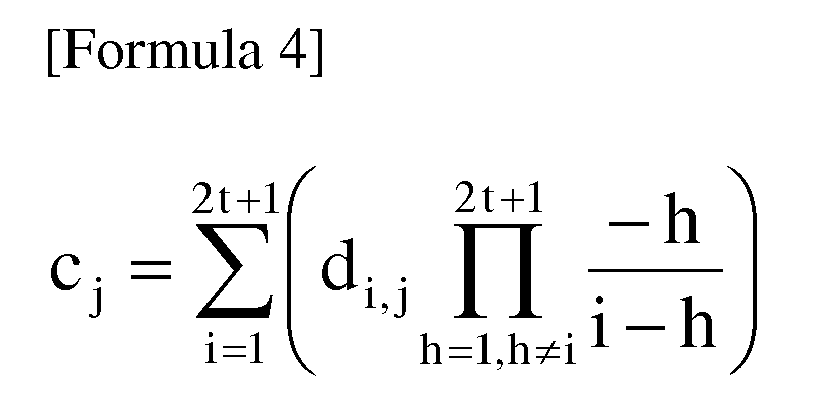
- (iii) Each of the computing apparatuses obtains a share cj of the product [c] of [a] and [b] by computing the formula given below. In this example, the computing apparatuses X, Y and Z compute c1, c2 and c3, respectively.
-
-
Fig. 4 illustrates an exemplary configuration of a secure product-sum combination system 200 based on Shamir's scheme andFig. 5 illustrates an exemplary process flow in the secure product-sum combination system 200. The secure product-sum combination system 200 includes q computing apparatuses. Here, an example where three computing apparatuses (computing apparatuses - The three
computing apparatuses sum combination system 200 perform secure function computation on secret values [A0], ..., [An - 1] concealed by secret sharing of n arbitrary values A0, ..., An - 1 greater than or equal to 0 and less than p by using a function f including addition and/or multiplication in cooperation with one another to compute a concealed function value [C] = [f([A0], ..., [An - 1])]. - The
computing apparatus 20x includes arandom number generator 21x, afunction calculator 22x and atampering detector 23x;computing apparatus 20y includes arandom number generator 21y, afunction calculator 22y, and atampering detector 23y; andcomputing apparatus 20z includes arandom number generator 21z, afunction calculator 22z and atampering detector 23z. - The
random number generators Fig. 6 ). First, therandom number generator 21x generates a uniform random umber rX, therandom number generator 21y generates a uniform random number rY, and therandom number generator 21z generates a uniform random number rZ (S11-1). Then, the data concealment method according to Shamir's scheme described above is used to generate secret values [rX], [rY] and [rZ] of rX, rY and rZ. Specifically, shares of [rX] are denoted by rX,0, rX,1 and rX,2, shares of [rY] are denoted by rY,0, rY,1 and rY,2, and shares of [rZ] are denoted by rZ,0, rZ,1 and rZ,2. Therandom number generator 21x records rX,0, rY,0 and rZ,0, therandom number generator 21y records rX,1, rY,1 and rZ,1, and therandom number generator 21z records rX,2, rY,2 and rZ,2 (S11-2). By distributing and recording the shares in this way, the data is concealed. Then therandom number generator 21x computes r0 = rX,0 + rY,0 + rZ,0, therandom number generator 21y computes r1 = rX, + rY,1 + rZ,1, and therandom number generator 21z computes r2 = rX,2 + rY,2 + rZ,2, thereby obtaining the shares r0, r1 and r2 of the secret value [r] (S11-3). - The
function calculators - The additions and multiplications of the secret function computation method according to Shamir's scheme described above can be applied to addition of secret values, addition of a constant to a secret value and multiplication of a secret value by a constant among the additions and multiplications to be defined. Here, the other operations will be described. It is assumed in the description that [a] and [b] are secret values concealed by encryption or secret sharing of arbitrary values a and b greater than or equal to 0 and less than p, and [a'] = r · [a] and [b'] = r · [b]. Note that if the function f consists of multiple fundamental operations, [c] and [c'] are computed for each of the fundamental operations. For example, in the case of addition of [A0], [A1] and [A2], addition of [A0] and [A1] is performed as the first fundamental operation. In the first fundamental operation, [A0] is [a] and [A1] is [b]. As the results of the first fundamental operation, [c] and [c'] are obtained. In the second fundamental operation, the results of the first computation, [c] and [c'], are set as [a] and [a'] and [A2] is set as [b] to perform addition to obtain the results of the second fundamental operation, [c] and [c']. Since the function f in this example is a combination of two additions, the results [c] and [c'] of the second fundamental operation are function values [C] and [C'] of the function f.
- If ([c], [c']) is a function value determined by a function that multiplies a secret pair ([a], [a']) by a constant, each of the secret pair ([a], [a']) is multiplied by an arbitrary constant α greater than or equal to 0 and less than p to obtain a secret pair (α · [a], α · [a']) as ([c], [c']).
- If ([c], [c']) is a function value determined by a function that adds a constant to a secret pair ([a], [a']), a secret value [r] is multiplied by an arbitrary constant β greater than or equal to 0 and less than p to obtain a secret value [r · β], the constant β is added to the secret value [a], and the secret value [r · β] is added to the secret value [a'] to obtain a secret pair ([a] + β, [a'] + [r · β]) as ([c], [c']).
- If ([c], [c']) is a function value determined by a function that adds secret pairs ([a], [a']) and ([b], [b']) together, the secret value [b] is added to the secret value [a] and the secret value [b'] is added to the secret value [a'] to obtain a secret pair ([a] + [b], [a'] + [b']) as ([c], [c']).
- If ([c], [c']) is a function value determined by a function that adds a secret pair ([a], [a']) and a secret value [b] together, the secret value [b] is multiplied by the secret value [r] using the multiplication without tampering detection of the secure function computation method according to Shamir's scheme to obtain a secret value [b'], the secret value [b] is added to the secret value [a] and the secret value [b'] is added to the secret value [a'] to obtain a secret pair ([a] + [b], [a'] + [b']) as ([c], [c']).
- If ([c], [c']) is a function value determined by a function that multiplies secret pairs ([a], [a']) and ([b], [b']) together, the secret value [a] is multiplied by the secret value [b] and the secret value [a'] is multiplied by the secret value [b] using the multiplication without tampering detection of the secure function computation method according to Shamir's scheme to obtain a secret pair ([a] · [b], [a'] · [b]) as ([c], [c']).
- If ([c], [c']) is a function value determined by a function that multiples a secret pair ([a], [a']) by a secret value [b], the secret value [a] is multiplied by the secret value [b] and the secret value [a'] is multiplied by [b] using the multiplication without tampering detection of the secure function computation method according to Shamir's scheme to obtain a secret pair ([a] · [b], [a'] · [b]) as ([c], [c']).
- If ([c], [c']) is a function value that can be determined by a function that multiples secret values [a] and [b] together, the secret value [a] is multiplied by a secret value [r] using the multiplication without tampering detection of the secure function computation method according to Shamir's scheme to obtain a secret value [a'], the secret value [a] is multiplied by the secret value [b] and the secret value [a'] is multiplied by the secret value [b] using the multiplication without tampering detection of the secure function computation method according to Shamir's scheme to obtain a secret pair ([a] · [b], [a'] · [b]) as ([c], [c']).
- The
tampering detectors tampering detectors - The processes in any of the secure product-sum combination systems and the secure product-sum computing methods described above may be performed not only in time sequence as is written but also in parallel with one another or individually, depending on the throughput of the apparatuses that perform the processes or requirements. Furthermore, the functions of the components of any of the secure product-sum computing systems may be integrated together or separated as required. Other modification can be made as appropriate without departing from the spirit of the present invention. When any of the secure product-sum computing systems and computing apparatuses of the embodiments of the present invention is implemented by a computer, the processes of the functions of the apparatus and its components are described by a program. The program may be stored in a hard disk device, for example, and when the program is executed, the program and data required are loaded into a RAM (Random Access Memory). The loaded program is executed by a CPU to implement the processes on the computer.
Claims (10)
- A secure product-sum combination system in which three or more computing apparatuses cooperate to perform a secure function computation on secret values [A0], ..., [An - 1] concealed by encryption or secret sharing of n arbitrary values A0, ..., An - 1 greater than or equal to 0 and less than p by using a function f including addition and/or multiplication to compute a concealed function value [C] as [C] = [f([A0], ..., [An - 1])], where p is a prime and [ ] is a symbol representing that a value is concealed by encryption or secret sharing,
wherein

and
hold, where a, b, α and β are arbitrary values greater than or equal to 0 and less than p; and
each of the computing apparatuses comprises:a random number generator cooperating with random number generators of other two computing apparatuses to generate a secret value [r] of a random number r greater than or equal to 0 and less than p;a function calculator cooperating with function calculators of other two computing apparatuses to compute concealed function values [C] = [f([A0], ..., [An - 1])] and [C'] = [r · f([A0], ..., [An - 1])] for the secret values [A0], ..., [An - 1] by using a function f including addition and/or multiplication; anda tampering detector cooperating with tampering detectors of other two computing apparatuses to compute a secret value [r · C - C'] and if [r · C - C'] is [0], outputting [C], otherwise outputting information indicating that tampering has been detected. - The secure product-sum combination system according to claim 1,
wherein [a'] = r · [a] and [b'] = r · [b], and
when ([c], [c']) is a function value determined by a function that multiplies a secret pair ([a], [a']) by a constant α, the function calculator multiplies each of the secret pair ([a], [a']) by the constant α to obtain a secret pair (α · [a], α · [a']) as ([c], [c']);
when ([c], [c']) is a function value determined by a function that adds a constant β to a secret pair ([a], [a']), the function calculator multiplies the secret value [r] by the constant β to obtain a secret value [r · β], adds the constant β to the secret value [a] and adds the secret value [r · β] to the secret value[a'] to obtain a secret pair ([a] + β, [a'] + [r · β]) as ([c], [c']);
when ([c], [c']) is a function value determined by a function that adds secret pairs (([a], [a']) and ([b], [b'])) together, the function calculator adds the secret value [b] to the secret value [a] and adds the secret value [b'] to the secret value [a'] to obtain a secret pair ([a] + [b], [a'] + [b']) as ([c], [c']);
when ([c], [c']) is a function value determined by a function that adds a secret pair ([a], [a']) and a secret value [b] together, the function calculator multiplies the secret value [b] by the secret value [r] to obtain a secret value [b'], adds the secret value [b] to the secret value [a] and adds the secret value [b'] to the secret value [a'] to obtain ([a] + [b], [a'] + [b']) as ([c], [c']);
when ([c], [c']) is a function value determined by a function that multiples secret pairs (([a], [a']) and ([b], [b'])) together, the function calculator multiplies the secret value [a] by the secret value [b] and multiplies the secret value [a'] by the secret value [b] to obtain a secret pair ([a] · [b], [a'] · [b]) as ([c], [c']);
when ([c], [c']) is a function value determined by a function that multiplies a secret pair ([a], [a']) and a secret value [b] together, the function calculator multiplies the secret value [a] by the secret value [b] and multiplies the secret value [a'] by the secret value [b] to obtain a secret pair ([a] · [b], [a'] · [b]) as ([c], [c']);
when ([c], [c']) is a function value determined by a function that multiplies secret values [a] and [b] together, the function calculator multiplies the secret value [a] by the secret value [r] to obtain a secret value [a'], multiplies the secret value [a] by the secret value [b] and multiplies the secret value [a'] by the secret value [b] to obtain a secret pair ([a] · [b], [a'] · [b]) as ([c], [c']); and
when ([c], [c']) is a function value determined by a function that multiplies secret pairs (([a], [a']) and ([b], [b'])) together, the tampering detector further cooperates with the tampering detectors of other two computing apparatuses to obtain a secret value [r · b - b'] and, if the secret value [r · b - b'] is not 0, outputs information indicating that tampering has been detected without outputting [C]. - The secure product-sum combination system according to claim 1 or 2,
wherein there are three of the computing apparatuses cooperating to perform a secret function computation, the three computing apparatuses being a computing apparatus X, a computing apparatus Y and a computing apparatus Z;
the random number generator of the computing apparatus X generates a random number rZ greater than or equal to 1 and less than p and shares the random number rZ with the random number generator of the computing apparatus Y;
the random number generator of the computing apparatus Y generates a random number rX greater than or equal to 1 and less than p and shares the random number rX with the random number generator of the computing apparatus Z;
the random number generator of the computing apparatus Z generates a random number rY greater than or equal to 1 and less than p and shares the random number rX with the random number generator of the computing apparatus X; and
the random number generators of the three computing apparatuses cooperate to generate secret values [rX], [rY] and [rZ] and multiply the secret values [rX], [rY] and [rZ] together to generate a secret value [r] = [rX · rY · rZ]. - The secure product-sum combination system according to claim 1 or 2,
wherein there are three of the computing apparatuses cooperating to perform a secret function computation, the three computing apparatuses being a computing apparatus X, a computing apparatus Y and a computing apparatus Z;
the random number generator of the computing apparatus X generates a random number rZ greater than or equal to 0 and less than p and shares the random number rZ with the random number generator of the computing apparatus Y;
the random number generator of the computing apparatus Y generates a random number rX greater than or equal to 0 and less than p and shares the random number rX with the random number generator of the computing apparatus Z;
the random number generator of the computing apparatus Z generates a random number rY greater than or equal to 0 and less than p and shares the random number rX with the random number generator of the computing apparatus X; and
the random number generators of the three computing apparatuses cooperate to generate secret values [rX], [rY] and [rZ] and multiply the secret values [rX], [rY] and [rZ] together to generate a secret value [r] = [rX + rY + rZ]. - A computing apparatus constituting a secure product-sum combination system in which three or more computing apparatuses cooperate to perform a secure function computation on secret values [A0], ..., [An - 1] concealed by encryption or secret sharing of n arbitrary values A0, ..., An - 1 greater than or equal to 0 and less than p by using a function f including addition and/or multiplication to compute a concealed function value [C] as [C] = [f([A0], ..., [An - 1])], where p is a prime and [ ] is a symbol representing that a value is concealed by encryption or secret sharing,
wherein in the secure product-sum combination system,

and
hold, where a, b, α and β are arbitrary values greater than or equal to 0 and less than p; and
the computing apparatus comprises:a random number generator cooperating with random number generators of other two computing apparatuses to generate a secret value [r] of a random number r greater than or equal to 0 and less than p;a function calculator cooperating with function calculators of other two computing apparatuses to compute concealed function values [C] = [f([A0], ..., [An - 1])] and [C'] = [r · f([A0], ..., [An - 1])] for the secret values [A0], ..., [An - 1] by using a function f including addition and/or multiplication; anda tampering detector cooperating with tampering detectors of other two computing apparatuses to compute a secret value [r · C - C'] and if [r · C - C'] is [0], outputting [C], otherwise outputting information indicating that tampering has been detected. - A secure product-sum combination method for three or more computing apparatuses to cooperate to perform a secure function computation on secret values [A0], ..., [An - 1] concealed by encryption or secret sharing of n arbitrary values A0, ..., An - 1 greater than or equal to 0 and less than p by using a function f including addition and/or multiplication to compute a concealed function value [C] as [C] = [f([A0], ..., [An - 1])], where p is a prime and [ ] is a symbol representing that a value is concealed by encryption or secret,
wherein

and
hold, where a, b, α and β are arbitrary values greater than or equal to 0 and less than p, and
the secure product-sum combination method comprises:a random number generating step of generating a secret value [r] of a random number r greater than or equal to 0 and less than p by cooperation among the three computing apparatuses;a function computing step of computing concealed function values [C] = [f([A0], ..., [An - 1])] and [C'] = [r · f([A0], ..., [An - 1])] for the secret values [A0], ..., [An - 1] by using a function f including addition and/or multiplication by cooperation among the three computing apparatuses; anda tampering detecting step of computing a secret value [r · C - C'] by cooperation among the three computing apparatuses, and if [r · C - C'] is [0], outputting [C], otherwise, outputting information indicating that tampering has been detected. - The secure product-sum combination method according to claim 6,
wherein [a'] = r · [a] and [b'] = r · [b], and
when ([c], [c']) is a function value determined by a function that multiplies a secret pair ([a], [a']) by a constant α, the function computing step multiplies each of the secret pair ([a], [a']) by the constant α to obtain a secret pair (α · [a], α · [a']) as ([c], [c']);
when ([c], [c']) is a function value determined by a function that adds a constant β to a secret pair ([a], [a']), the function computing step multiplies the secret value [r] by the constant β to obtain a secret value [r · β], adds the constant β to the secret value [a] and adds the secret value [r · β] to the secret value[a'] to obtain a secret pair ([a] + β, [a'] + [r · β]) as ([c], [c']);
when ([c], [c']) is a function value determined by a function that adds secret pairs (([a], [a']) and ([b], [b'])) together, the function computing step adds the secret value [b] to the secret value [a] and adds the secret value [b'] to the secret value [a'] to obtain a secret pair ([a] + [b], [a'] + [b']) as ([c], [c']);
when ([c], [c']) is a function value determined by a function that adds a secret pair ([a], [a']) and a secret value [b] together, the function computing step multiplies the secret value [b] by the secret value [r] to obtain a secret value [b'], adds the secret value [b] to the secret value [a] and adds the secret value [b'] to the secret value [a'] to obtain ([a] + [b], [a'] + [b']) as ([c], [c']);
when ([c], [c']) is a function value determined by a function that multiples secret pairs (([a], [a']) and ([b], [b'])) together, the function computing step multiplies the secret value [a] by the secret value [b] and multiplies the secret value [a'] by the secret value [b] to obtain a secret pair ([a] · [b], [a'] · [b]) as ([c], [c']);
when ([c], [c']) is a function value determined by a function that multiplies a secret pair ([a], [a']) and a secret value [b] together, the function computing step multiplies the secret value [a] by the secret value [b] and multiplies the secret value [a'] by the secret value [b] to obtain a secret pair ([a] · [b], [a'] · [b]) as ([c], [c']);
when ([c], [c']) is a function value determined by a function that multiplies secret values [a] and [b] together, the function computing step multiplies the secret value [a] by the secret value [r] to obtain a secret value [a'], multiplies the secret value [a] by the secret value [b] and multiplies the secret value [a'] by the secret value [b] to obtain a secret pair ([a] · [b], [a'] · [b]) as ([c], [c']); and
when ([c], [c']) is a function value determined by a function that multiplies secret pairs (([a], [a']) and ([b], [b'])) together, the tampering detecting step further cooperates with the tampering detectors of other two computing apparatuses to obtain a secret value [r · b - b'] and, if he secret value [r · b - b'] is not 0, outputs information indicating that tampering has been detected without outputting [C]. - The secure product-sum combination method according to claim 6 or 7,
wherein there are three of the computing apparatuses cooperating to perform a secret function computation, the three computing apparatuses being a computing apparatus X, a computing apparatus Y and a computing apparatus Z; and
the random number generating step comprises:a fragment sharing sub-step of the computing apparatus X generating a random number rZ greater than or equal to 1 and less than p and sharing the random number rZ with the computing apparatus Y, the computing apparatus Y generating a random number rX greater than or equal to 1 and less than p and sharing the random number rX with the computing apparatus Z, and the computing apparatus Z generating a random number rY greater than or equal to 1 and less than p and sharing the random number rX with the computing apparatus X;a fragment concealing sub-step of generating secret values [rX], [rY] and [rZ] by cooperation among the three computing apparatuses; anda fragment combining sub-step of multiplying the secret values [rX], [rY] and [rZ] together to generate a secret value [r] = [rX · rY · rZ] by cooperation among the three computing apparatuses. - The secure product-sum combination method according to claim 6 or 7,
wherein there are three of the computing apparatuses cooperating to perform a secret function computation, the three computing apparatuses being a computing apparatus X, a computing apparatus Y and a computing apparatus Z; and
the random number generating step comprises:a fragment sharing sub-step of the computing apparatus X generating a random number rZ greater than or equal to 0 and less than p and sharing the random number rZ with the computing apparatus Y, the computing apparatus Y generating a random number rX greater than or equal to 0 and less than p and sharing the random number rX with the computing apparatus Z, and the computing apparatus Z generating a random number rY greater than or equal to 0 and less than p and sharing the random number rY with the computing apparatus X;a fragment concealing sub-step of generating secret values [rX], [rY] and [rZ] by cooperation among the three computing apparatuses; anda fragment combining sub-step of multiplying the secret values [rX], [rY] and [rZ] together to generate a secret value [r] = [rX + rY + rZ] by cooperation among the three computing apparatuses. - A computer program for causing a computer to function as a secure product-sum combination system according to any one of claims 1 to 4 or a computing apparatus according to claim 5.
Applications Claiming Priority (3)
| Application Number | Priority Date | Filing Date | Title |
|---|---|---|---|
| JP2011053284 | 2011-03-10 | ||
| JP2011142715 | 2011-06-28 | ||
| PCT/JP2012/055974 WO2012121333A1 (en) | 2011-03-10 | 2012-03-08 | Secure multiply-accumulate union system, computation device, secure multiply-accumulate union method, and program thereof |
Publications (3)
| Publication Number | Publication Date |
|---|---|
| EP2667370A1 true EP2667370A1 (en) | 2013-11-27 |
| EP2667370A4 EP2667370A4 (en) | 2015-03-04 |
| EP2667370B1 EP2667370B1 (en) | 2016-12-07 |
Family
ID=46798288
Family Applications (1)
| Application Number | Title | Priority Date | Filing Date |
|---|---|---|---|
| EP12754230.6A Active EP2667370B1 (en) | 2011-03-10 | 2012-03-08 | Secure product-sum combination system, computing apparatus, secure product-sum combination method and program therefor |
Country Status (5)
| Country | Link |
|---|---|
| US (1) | US9064123B2 (en) |
| EP (1) | EP2667370B1 (en) |
| JP (1) | JP5531154B2 (en) |
| CN (1) | CN103403781B (en) |
| WO (1) | WO2012121333A1 (en) |
Cited By (1)
| Publication number | Priority date | Publication date | Assignee | Title |
|---|---|---|---|---|
| EP3767608A4 (en) * | 2018-03-12 | 2021-12-08 | Nippon Telegraph And Telephone Corporation | DEVICE AND METHOD FOR CALCULATING SECRET, PROGRAM, AND RECORDING MEDIA |
Families Citing this family (25)
| Publication number | Priority date | Publication date | Assignee | Title |
|---|---|---|---|---|
| EP2947814B1 (en) * | 2013-01-17 | 2018-03-14 | Nippon Telegraph and Telephone Corporation | Tampering detection device, tampering detection method, and program |
| WO2014112548A1 (en) * | 2013-01-17 | 2014-07-24 | 日本電信電話株式会社 | Secure-computation system, computing device, secure-computation method, and program |
| CN103294959B (en) * | 2013-05-29 | 2015-11-25 | 南京信息工程大学 | A kind of text information hiding method of anti-statistical study |
| CN104618332B (en) * | 2014-12-30 | 2017-10-24 | 桂林电子科技大学 | Secure two party computation method and system based on symbol boundary values Binary Decision Diagrams |
| JP5968484B1 (en) * | 2015-03-18 | 2016-08-10 | 日本電信電話株式会社 | Share recovery system, share recovery method, and program |
| EP3346455B1 (en) * | 2015-08-31 | 2020-09-30 | Nec Corporation | Secret calculation system, secret calculation apparatus, and secret calculation method |
| WO2017065123A1 (en) * | 2015-10-13 | 2017-04-20 | 日本電信電話株式会社 | Secret random number combination device, secret random number combination method, and program |
| US10972271B2 (en) * | 2015-10-13 | 2021-04-06 | Nippon Telegraph And Telephone Corporation | Secret authentication code adding device, secret authentication code adding method, and program |
| CN109478381B (en) * | 2016-07-06 | 2021-12-14 | 日本电信电话株式会社 | Secret computing system, secret computing device, secret computing method, and program |
| EP3483866B1 (en) * | 2016-07-06 | 2020-12-23 | Nippon Telegraph and Telephone Corporation | Secure computation system, secure computation device, secure computation method, and program |
| US11200346B2 (en) * | 2016-07-06 | 2021-12-14 | Nippon Telegraph And Telephone Corporation | Secure computation for reading multiple elements from a secure text array |
| JP6988807B2 (en) * | 2016-08-18 | 2022-01-05 | 日本電気株式会社 | Secret calculation system, secret calculation method, secret calculation device and secret calculation program |
| CN110088756B (en) * | 2016-12-19 | 2023-06-02 | 三菱电机株式会社 | Concealment device, data analysis device, concealment method, data analysis method, and computer-readable storage medium |
| WO2018135511A1 (en) * | 2017-01-18 | 2018-07-26 | 日本電信電話株式会社 | Secure computation method, secure computation system, secure computation device, and program |
| CN110199338B (en) * | 2017-01-20 | 2022-09-20 | 日本电信电话株式会社 | Secret calculation system, secret calculation device, secret calculation method, and recording medium |
| JP6766182B2 (en) * | 2017-01-20 | 2020-10-07 | 日本電信電話株式会社 | Secret calculation system, secret calculation device, secret calculation method, program |
| AU2018295722B2 (en) * | 2017-07-05 | 2020-11-19 | Ntt, Inc. | Secure computation system, secure computation apparatus, secure computation method, program, and recording medium |
| AU2018336413B2 (en) * | 2017-09-21 | 2020-11-26 | Ntt, Inc. | Secure reading and writing apparatus, secure reading and writing method, and program |
| EP3686870B1 (en) * | 2017-09-21 | 2022-07-27 | Nippon Telegraph And Telephone Corporation | Secure reading apparatus, secure writing apparatus, method thereof, and program |
| US11354317B2 (en) * | 2018-05-08 | 2022-06-07 | Nippon Telegraph And Telephone Corporation | Safety assessment apparatus, safety assessment method, and program |
| GB201815396D0 (en) * | 2018-09-21 | 2018-11-07 | Nchain Holdings Ltd | Computer implemented system and method |
| EP3863002B1 (en) * | 2018-10-04 | 2023-02-15 | Nippon Telegraph And Telephone Corporation | Hidden sigmoid function calculation system, hidden logistic regression calculation system, hidden sigmoid function calculation device, hidden logistic regression calculation device, hidden sigmoid function calculation method, hidden logistic regression calculation method, and program |
| WO2020250269A1 (en) * | 2019-06-10 | 2020-12-17 | 日本電信電話株式会社 | Secret division system, secret calculation device, secret division method, and program |
| CN111857649B (en) * | 2020-06-22 | 2022-04-12 | 复旦大学 | Fixed point number coding and operation system for privacy protection machine learning |
| CN112688779B (en) * | 2021-03-09 | 2021-07-13 | 华控清交信息科技(北京)有限公司 | Data processing method and device and data processing device |
Family Cites Families (5)
| Publication number | Priority date | Publication date | Assignee | Title |
|---|---|---|---|---|
| JPH0373990A (en) * | 1989-05-18 | 1991-03-28 | Toshiba Corp | Decentralized information processor |
| CN1218284C (en) * | 1997-01-28 | 2005-09-07 | 松下电器产业株式会社 | Message producing type signature device |
| JP2007124612A (en) * | 2006-06-14 | 2007-05-17 | Chiba Univ | Key generator |
| CA2668676C (en) * | 2006-11-07 | 2016-01-05 | Security First Corp. | Systems and methods for distributing and securing data |
| WO2008056667A1 (en) * | 2006-11-10 | 2008-05-15 | Laputa, Inc. | Information management system and encryption system |
-
2012
- 2012-03-08 JP JP2013503601A patent/JP5531154B2/en active Active
- 2012-03-08 US US14/003,637 patent/US9064123B2/en active Active
- 2012-03-08 WO PCT/JP2012/055974 patent/WO2012121333A1/en not_active Ceased
- 2012-03-08 CN CN201280011766.9A patent/CN103403781B/en active Active
- 2012-03-08 EP EP12754230.6A patent/EP2667370B1/en active Active
Non-Patent Citations (1)
| Title |
|---|
| See references of WO2012121333A1 * |
Cited By (1)
| Publication number | Priority date | Publication date | Assignee | Title |
|---|---|---|---|---|
| EP3767608A4 (en) * | 2018-03-12 | 2021-12-08 | Nippon Telegraph And Telephone Corporation | DEVICE AND METHOD FOR CALCULATING SECRET, PROGRAM, AND RECORDING MEDIA |
Also Published As
| Publication number | Publication date |
|---|---|
| US9064123B2 (en) | 2015-06-23 |
| CN103403781A (en) | 2013-11-20 |
| EP2667370A4 (en) | 2015-03-04 |
| JPWO2012121333A1 (en) | 2014-07-17 |
| CN103403781B (en) | 2016-01-20 |
| JP5531154B2 (en) | 2014-06-25 |
| US20130339728A1 (en) | 2013-12-19 |
| WO2012121333A1 (en) | 2012-09-13 |
| EP2667370B1 (en) | 2016-12-07 |
Similar Documents
| Publication | Publication Date | Title |
|---|---|---|
| EP2667370B1 (en) | Secure product-sum combination system, computing apparatus, secure product-sum combination method and program therefor | |
| Stevens et al. | Efficient differentially private secure aggregation for federated learning via hardness of learning with errors | |
| Xagawa et al. | Fault-injection attacks against NIST’s post-quantum cryptography round 3 KEM candidates | |
| Bauer et al. | Horizontal collision correlation attack on elliptic curves: –Extended Version– | |
| El Housni et al. | Optimized and secure pairing-friendly elliptic curves suitable for one layer proof composition | |
| Faust et al. | Protecting circuits from leakage: the computationally-bounded and noisy cases | |
| Perin et al. | Attacking randomized exponentiations using unsupervised learning | |
| Kim et al. | Hyphen: A hybrid packing method and its optimizations for homomorphic encryption-based neural networks | |
| EP3230921B1 (en) | Multiplicative masking for cryptographic operations | |
| EP2947642A1 (en) | Secure-computation system, computing device, secure-computation method, and program | |
| Chen et al. | Improving timing attack on RSA-CRT via error detection and correction strategy | |
| Teske | An elliptic curve trapdoor system | |
| Liu et al. | Partially known nonces and fault injection attacks on SM2 signature algorithm | |
| EP4167213B1 (en) | Secret computation method, secret computation system, secret computation apparatus, and program | |
| Jauvart et al. | Improving side-channel attacks against pairing-based cryptography | |
| Kabin et al. | Horizontal address-bit DEMA against ECDSA | |
| EP3776305B1 (en) | Using cryptographic blinding for efficient use of montgomery multiplication | |
| Martínez Padilla et al. | Security evaluation of Tree Parity Re-keying Machine implementations utilizing side-channel emissions | |
| Riasi et al. | Privacy-preserving verifiable neural network inference service | |
| Xu et al. | Verifiable privacy-preserving cox regression from multi-key fully homomorphic encryption | |
| US20250038995A1 (en) | Side Channel Attack Resistant Cryptographic Accelerator | |
| Kotov et al. | Analysis of a certain polycyclic-group-based cryptosystem | |
| Shim et al. | Lite-Rainbow: lightweight signature schemes based on multivariate quadratic equations and their secure implementations | |
| Li et al. | A novel algorithm for scalar multiplication in ecdsa | |
| Moloney et al. | Efficient implementation of elliptic curve point operations using binary Edwards curves |
Legal Events
| Date | Code | Title | Description |
|---|---|---|---|
| PUAI | Public reference made under article 153(3) epc to a published international application that has entered the european phase |
Free format text: ORIGINAL CODE: 0009012 |
|
| 17P | Request for examination filed |
Effective date: 20130820 |
|
| AK | Designated contracting states |
Kind code of ref document: A1 Designated state(s): AL AT BE BG CH CY CZ DE DK EE ES FI FR GB GR HR HU IE IS IT LI LT LU LV MC MK MT NL NO PL PT RO RS SE SI SK SM TR |
|
| DAX | Request for extension of the european patent (deleted) | ||
| REG | Reference to a national code |
Ref country code: DE Ref legal event code: R079 Ref document number: 602012026306 Country of ref document: DE Free format text: PREVIOUS MAIN CLASS: G09C0001000000 Ipc: H04L0009000000 |
|
| A4 | Supplementary search report drawn up and despatched |
Effective date: 20150204 |
|
| RIC1 | Information provided on ipc code assigned before grant |
Ipc: H04L 9/00 20060101AFI20150129BHEP Ipc: H04L 9/32 20060101ALI20150129BHEP |
|
| 17Q | First examination report despatched |
Effective date: 20151203 |
|
| GRAP | Despatch of communication of intention to grant a patent |
Free format text: ORIGINAL CODE: EPIDOSNIGR1 |
|
| INTG | Intention to grant announced |
Effective date: 20160628 |
|
| GRAS | Grant fee paid |
Free format text: ORIGINAL CODE: EPIDOSNIGR3 |
|
| GRAA | (expected) grant |
Free format text: ORIGINAL CODE: 0009210 |
|
| STAA | Information on the status of an ep patent application or granted ep patent |
Free format text: STATUS: THE PATENT HAS BEEN GRANTED |
|
| AK | Designated contracting states |
Kind code of ref document: B1 Designated state(s): AL AT BE BG CH CY CZ DE DK EE ES FI FR GB GR HR HU IE IS IT LI LT LU LV MC MK MT NL NO PL PT RO RS SE SI SK SM TR |
|
| REG | Reference to a national code |
Ref country code: GB Ref legal event code: FG4D |
|
| REG | Reference to a national code |
Ref country code: CH Ref legal event code: EP Ref country code: AT Ref legal event code: REF Ref document number: 852542 Country of ref document: AT Kind code of ref document: T Effective date: 20161215 |
|
| REG | Reference to a national code |
Ref country code: IE Ref legal event code: FG4D |
|
| REG | Reference to a national code |
Ref country code: DE Ref legal event code: R096 Ref document number: 602012026306 Country of ref document: DE |
|
| PG25 | Lapsed in a contracting state [announced via postgrant information from national office to epo] |
Ref country code: LV Free format text: LAPSE BECAUSE OF FAILURE TO SUBMIT A TRANSLATION OF THE DESCRIPTION OR TO PAY THE FEE WITHIN THE PRESCRIBED TIME-LIMIT Effective date: 20161207 |
|
| REG | Reference to a national code |
Ref country code: FR Ref legal event code: PLFP Year of fee payment: 6 |
|
| REG | Reference to a national code |
Ref country code: LT Ref legal event code: MG4D |
|
| REG | Reference to a national code |
Ref country code: NL Ref legal event code: MP Effective date: 20161207 |
|
| PG25 | Lapsed in a contracting state [announced via postgrant information from national office to epo] |
Ref country code: LT Free format text: LAPSE BECAUSE OF FAILURE TO SUBMIT A TRANSLATION OF THE DESCRIPTION OR TO PAY THE FEE WITHIN THE PRESCRIBED TIME-LIMIT Effective date: 20161207 Ref country code: GR Free format text: LAPSE BECAUSE OF FAILURE TO SUBMIT A TRANSLATION OF THE DESCRIPTION OR TO PAY THE FEE WITHIN THE PRESCRIBED TIME-LIMIT Effective date: 20170308 Ref country code: NO Free format text: LAPSE BECAUSE OF FAILURE TO SUBMIT A TRANSLATION OF THE DESCRIPTION OR TO PAY THE FEE WITHIN THE PRESCRIBED TIME-LIMIT Effective date: 20170307 Ref country code: SE Free format text: LAPSE BECAUSE OF FAILURE TO SUBMIT A TRANSLATION OF THE DESCRIPTION OR TO PAY THE FEE WITHIN THE PRESCRIBED TIME-LIMIT Effective date: 20161207 |
|
| REG | Reference to a national code |
Ref country code: AT Ref legal event code: MK05 Ref document number: 852542 Country of ref document: AT Kind code of ref document: T Effective date: 20161207 |
|
| PG25 | Lapsed in a contracting state [announced via postgrant information from national office to epo] |
Ref country code: ES Free format text: LAPSE BECAUSE OF FAILURE TO SUBMIT A TRANSLATION OF THE DESCRIPTION OR TO PAY THE FEE WITHIN THE PRESCRIBED TIME-LIMIT Effective date: 20161207 Ref country code: FI Free format text: LAPSE BECAUSE OF FAILURE TO SUBMIT A TRANSLATION OF THE DESCRIPTION OR TO PAY THE FEE WITHIN THE PRESCRIBED TIME-LIMIT Effective date: 20161207 Ref country code: HR Free format text: LAPSE BECAUSE OF FAILURE TO SUBMIT A TRANSLATION OF THE DESCRIPTION OR TO PAY THE FEE WITHIN THE PRESCRIBED TIME-LIMIT Effective date: 20161207 Ref country code: RS Free format text: LAPSE BECAUSE OF FAILURE TO SUBMIT A TRANSLATION OF THE DESCRIPTION OR TO PAY THE FEE WITHIN THE PRESCRIBED TIME-LIMIT Effective date: 20161207 |
|
| PG25 | Lapsed in a contracting state [announced via postgrant information from national office to epo] |
Ref country code: NL Free format text: LAPSE BECAUSE OF FAILURE TO SUBMIT A TRANSLATION OF THE DESCRIPTION OR TO PAY THE FEE WITHIN THE PRESCRIBED TIME-LIMIT Effective date: 20161207 |
|
| PG25 | Lapsed in a contracting state [announced via postgrant information from national office to epo] |
Ref country code: IS Free format text: LAPSE BECAUSE OF FAILURE TO SUBMIT A TRANSLATION OF THE DESCRIPTION OR TO PAY THE FEE WITHIN THE PRESCRIBED TIME-LIMIT Effective date: 20170407 Ref country code: SK Free format text: LAPSE BECAUSE OF FAILURE TO SUBMIT A TRANSLATION OF THE DESCRIPTION OR TO PAY THE FEE WITHIN THE PRESCRIBED TIME-LIMIT Effective date: 20161207 Ref country code: EE Free format text: LAPSE BECAUSE OF FAILURE TO SUBMIT A TRANSLATION OF THE DESCRIPTION OR TO PAY THE FEE WITHIN THE PRESCRIBED TIME-LIMIT Effective date: 20161207 Ref country code: RO Free format text: LAPSE BECAUSE OF FAILURE TO SUBMIT A TRANSLATION OF THE DESCRIPTION OR TO PAY THE FEE WITHIN THE PRESCRIBED TIME-LIMIT Effective date: 20161207 Ref country code: CZ Free format text: LAPSE BECAUSE OF FAILURE TO SUBMIT A TRANSLATION OF THE DESCRIPTION OR TO PAY THE FEE WITHIN THE PRESCRIBED TIME-LIMIT Effective date: 20161207 |
|
| PG25 | Lapsed in a contracting state [announced via postgrant information from national office to epo] |
Ref country code: IT Free format text: LAPSE BECAUSE OF FAILURE TO SUBMIT A TRANSLATION OF THE DESCRIPTION OR TO PAY THE FEE WITHIN THE PRESCRIBED TIME-LIMIT Effective date: 20161207 Ref country code: SM Free format text: LAPSE BECAUSE OF FAILURE TO SUBMIT A TRANSLATION OF THE DESCRIPTION OR TO PAY THE FEE WITHIN THE PRESCRIBED TIME-LIMIT Effective date: 20161207 Ref country code: PT Free format text: LAPSE BECAUSE OF FAILURE TO SUBMIT A TRANSLATION OF THE DESCRIPTION OR TO PAY THE FEE WITHIN THE PRESCRIBED TIME-LIMIT Effective date: 20170407 Ref country code: PL Free format text: LAPSE BECAUSE OF FAILURE TO SUBMIT A TRANSLATION OF THE DESCRIPTION OR TO PAY THE FEE WITHIN THE PRESCRIBED TIME-LIMIT Effective date: 20161207 Ref country code: BE Free format text: LAPSE BECAUSE OF FAILURE TO SUBMIT A TRANSLATION OF THE DESCRIPTION OR TO PAY THE FEE WITHIN THE PRESCRIBED TIME-LIMIT Effective date: 20161207 Ref country code: BG Free format text: LAPSE BECAUSE OF FAILURE TO SUBMIT A TRANSLATION OF THE DESCRIPTION OR TO PAY THE FEE WITHIN THE PRESCRIBED TIME-LIMIT Effective date: 20170307 Ref country code: AT Free format text: LAPSE BECAUSE OF FAILURE TO SUBMIT A TRANSLATION OF THE DESCRIPTION OR TO PAY THE FEE WITHIN THE PRESCRIBED TIME-LIMIT Effective date: 20161207 |
|
| REG | Reference to a national code |
Ref country code: DE Ref legal event code: R097 Ref document number: 602012026306 Country of ref document: DE |
|
| REG | Reference to a national code |
Ref country code: DE Ref legal event code: R119 Ref document number: 602012026306 Country of ref document: DE Ref country code: DE Ref legal event code: R409 Ref document number: 602012026306 Country of ref document: DE |
|
| PLBE | No opposition filed within time limit |
Free format text: ORIGINAL CODE: 0009261 |
|
| STAA | Information on the status of an ep patent application or granted ep patent |
Free format text: STATUS: NO OPPOSITION FILED WITHIN TIME LIMIT |
|
| REG | Reference to a national code |
Ref country code: CH Ref legal event code: PL |
|
| 26N | No opposition filed |
Effective date: 20170908 |
|
| REG | Reference to a national code |
Ref country code: DE Ref legal event code: R409 Ref document number: 602012026306 Country of ref document: DE |
|
| PG25 | Lapsed in a contracting state [announced via postgrant information from national office to epo] |
Ref country code: SI Free format text: LAPSE BECAUSE OF FAILURE TO SUBMIT A TRANSLATION OF THE DESCRIPTION OR TO PAY THE FEE WITHIN THE PRESCRIBED TIME-LIMIT Effective date: 20161207 Ref country code: DK Free format text: LAPSE BECAUSE OF FAILURE TO SUBMIT A TRANSLATION OF THE DESCRIPTION OR TO PAY THE FEE WITHIN THE PRESCRIBED TIME-LIMIT Effective date: 20161207 Ref country code: MC Free format text: LAPSE BECAUSE OF FAILURE TO SUBMIT A TRANSLATION OF THE DESCRIPTION OR TO PAY THE FEE WITHIN THE PRESCRIBED TIME-LIMIT Effective date: 20161207 |
|
| REG | Reference to a national code |
Ref country code: IE Ref legal event code: MM4A |
|
| PG25 | Lapsed in a contracting state [announced via postgrant information from national office to epo] |
Ref country code: LU Free format text: LAPSE BECAUSE OF NON-PAYMENT OF DUE FEES Effective date: 20170308 |
|
| PG25 | Lapsed in a contracting state [announced via postgrant information from national office to epo] |
Ref country code: IE Free format text: LAPSE BECAUSE OF NON-PAYMENT OF DUE FEES Effective date: 20170308 Ref country code: CH Free format text: LAPSE BECAUSE OF NON-PAYMENT OF DUE FEES Effective date: 20170331 Ref country code: LI Free format text: LAPSE BECAUSE OF NON-PAYMENT OF DUE FEES Effective date: 20170331 |
|
| REG | Reference to a national code |
Ref country code: FR Ref legal event code: PLFP Year of fee payment: 7 |
|
| PG25 | Lapsed in a contracting state [announced via postgrant information from national office to epo] |
Ref country code: MT Free format text: LAPSE BECAUSE OF NON-PAYMENT OF DUE FEES Effective date: 20170308 |
|
| PG25 | Lapsed in a contracting state [announced via postgrant information from national office to epo] |
Ref country code: HU Free format text: LAPSE BECAUSE OF FAILURE TO SUBMIT A TRANSLATION OF THE DESCRIPTION OR TO PAY THE FEE WITHIN THE PRESCRIBED TIME-LIMIT; INVALID AB INITIO Effective date: 20120308 |
|
| PG25 | Lapsed in a contracting state [announced via postgrant information from national office to epo] |
Ref country code: CY Free format text: LAPSE BECAUSE OF NON-PAYMENT OF DUE FEES Effective date: 20161207 |
|
| PG25 | Lapsed in a contracting state [announced via postgrant information from national office to epo] |
Ref country code: MK Free format text: LAPSE BECAUSE OF FAILURE TO SUBMIT A TRANSLATION OF THE DESCRIPTION OR TO PAY THE FEE WITHIN THE PRESCRIBED TIME-LIMIT Effective date: 20161207 |
|
| PG25 | Lapsed in a contracting state [announced via postgrant information from national office to epo] |
Ref country code: TR Free format text: LAPSE BECAUSE OF FAILURE TO SUBMIT A TRANSLATION OF THE DESCRIPTION OR TO PAY THE FEE WITHIN THE PRESCRIBED TIME-LIMIT Effective date: 20161207 |
|
| PG25 | Lapsed in a contracting state [announced via postgrant information from national office to epo] |
Ref country code: AL Free format text: LAPSE BECAUSE OF FAILURE TO SUBMIT A TRANSLATION OF THE DESCRIPTION OR TO PAY THE FEE WITHIN THE PRESCRIBED TIME-LIMIT Effective date: 20161207 |
|
| REG | Reference to a national code |
Ref country code: DE Ref legal event code: R081 Ref document number: 602012026306 Country of ref document: DE Owner name: NTT, INC., JP Free format text: FORMER OWNER: NIPPON TELEGRAPH AND TELEPHONE CORPORATION, TOKYO, JP Ref country code: DE Ref legal event code: R082 Ref document number: 602012026306 Country of ref document: DE Representative=s name: DENNEMEYER & ASSOCIATES RECHTSANWALTSGESELLSCH, DE |
|
| PGFP | Annual fee paid to national office [announced via postgrant information from national office to epo] |
Ref country code: GB Payment date: 20260324 Year of fee payment: 15 |
|
| PGFP | Annual fee paid to national office [announced via postgrant information from national office to epo] |
Ref country code: DE Payment date: 20260319 Year of fee payment: 15 |
|
| PGFP | Annual fee paid to national office [announced via postgrant information from national office to epo] |
Ref country code: FR Payment date: 20260320 Year of fee payment: 15 |