EP2666762A1 - Fullerene derivative and photoelectric transducer using same - Google Patents
Fullerene derivative and photoelectric transducer using same Download PDFInfo
- Publication number
- EP2666762A1 EP2666762A1 EP12736451.1A EP12736451A EP2666762A1 EP 2666762 A1 EP2666762 A1 EP 2666762A1 EP 12736451 A EP12736451 A EP 12736451A EP 2666762 A1 EP2666762 A1 EP 2666762A1
- Authority
- EP
- European Patent Office
- Prior art keywords
- alkoxy
- fullerene derivative
- fullerene
- alkylthio
- substituted
- Prior art date
- Legal status (The legal status is an assumption and is not a legal conclusion. Google has not performed a legal analysis and makes no representation as to the accuracy of the status listed.)
- Withdrawn
Links
- 0 CCOC1=CCCC(*C)=C1C Chemical compound CCOC1=CCCC(*C)=C1C 0.000 description 8
- UXUMXOILNCSSPT-UHFFFAOYSA-N Cc1c2[n](C)ccc2cc2c1N(C)CC2 Chemical compound Cc1c2[n](C)ccc2cc2c1N(C)CC2 UXUMXOILNCSSPT-UHFFFAOYSA-N 0.000 description 1
Classifications
-
- B—PERFORMING OPERATIONS; TRANSPORTING
- B82—NANOTECHNOLOGY
- B82Y—SPECIFIC USES OR APPLICATIONS OF NANOSTRUCTURES; MEASUREMENT OR ANALYSIS OF NANOSTRUCTURES; MANUFACTURE OR TREATMENT OF NANOSTRUCTURES
- B82Y10/00—Nanotechnology for information processing, storage or transmission, e.g. quantum computing or single electron logic
-
- C—CHEMISTRY; METALLURGY
- C07—ORGANIC CHEMISTRY
- C07C—ACYCLIC OR CARBOCYCLIC COMPOUNDS
- C07C43/00—Ethers; Compounds having groups, groups or groups
- C07C43/02—Ethers
- C07C43/20—Ethers having an ether-oxygen atom bound to a carbon atom of a six-membered aromatic ring
- C07C43/21—Ethers having an ether-oxygen atom bound to a carbon atom of a six-membered aromatic ring containing rings other than six-membered aromatic rings
-
- H—ELECTRICITY
- H10—SEMICONDUCTOR DEVICES; ELECTRIC SOLID-STATE DEVICES NOT OTHERWISE PROVIDED FOR
- H10K—ORGANIC ELECTRIC SOLID-STATE DEVICES
- H10K85/00—Organic materials used in the body or electrodes of devices covered by this subclass
- H10K85/20—Carbon compounds, e.g. carbon nanotubes or fullerenes
- H10K85/211—Fullerenes, e.g. C60
- H10K85/215—Fullerenes, e.g. C60 comprising substituents, e.g. PCBM
-
- C—CHEMISTRY; METALLURGY
- C07—ORGANIC CHEMISTRY
- C07C—ACYCLIC OR CARBOCYCLIC COMPOUNDS
- C07C2604/00—Fullerenes, e.g. C60 buckminsterfullerene or C70
-
- H—ELECTRICITY
- H10—SEMICONDUCTOR DEVICES; ELECTRIC SOLID-STATE DEVICES NOT OTHERWISE PROVIDED FOR
- H10K—ORGANIC ELECTRIC SOLID-STATE DEVICES
- H10K30/00—Organic devices sensitive to infrared radiation, light, electromagnetic radiation of shorter wavelength or corpuscular radiation
- H10K30/20—Organic devices sensitive to infrared radiation, light, electromagnetic radiation of shorter wavelength or corpuscular radiation comprising organic-organic junctions, e.g. donor-acceptor junctions
-
- H—ELECTRICITY
- H10—SEMICONDUCTOR DEVICES; ELECTRIC SOLID-STATE DEVICES NOT OTHERWISE PROVIDED FOR
- H10K—ORGANIC ELECTRIC SOLID-STATE DEVICES
- H10K30/00—Organic devices sensitive to infrared radiation, light, electromagnetic radiation of shorter wavelength or corpuscular radiation
- H10K30/30—Organic devices sensitive to infrared radiation, light, electromagnetic radiation of shorter wavelength or corpuscular radiation comprising bulk heterojunctions, e.g. interpenetrating networks of donor and acceptor material domains
-
- H—ELECTRICITY
- H10—SEMICONDUCTOR DEVICES; ELECTRIC SOLID-STATE DEVICES NOT OTHERWISE PROVIDED FOR
- H10K—ORGANIC ELECTRIC SOLID-STATE DEVICES
- H10K30/00—Organic devices sensitive to infrared radiation, light, electromagnetic radiation of shorter wavelength or corpuscular radiation
- H10K30/50—Photovoltaic [PV] devices
-
- Y—GENERAL TAGGING OF NEW TECHNOLOGICAL DEVELOPMENTS; GENERAL TAGGING OF CROSS-SECTIONAL TECHNOLOGIES SPANNING OVER SEVERAL SECTIONS OF THE IPC; TECHNICAL SUBJECTS COVERED BY FORMER USPC CROSS-REFERENCE ART COLLECTIONS [XRACs] AND DIGESTS
- Y02—TECHNOLOGIES OR APPLICATIONS FOR MITIGATION OR ADAPTATION AGAINST CLIMATE CHANGE
- Y02E—REDUCTION OF GREENHOUSE GAS [GHG] EMISSIONS, RELATED TO ENERGY GENERATION, TRANSMISSION OR DISTRIBUTION
- Y02E10/00—Energy generation through renewable energy sources
- Y02E10/50—Photovoltaic [PV] energy
- Y02E10/549—Organic PV cells
Definitions
- the present invention relates to fullerene derivatives and photoelectric conversion device containing the same.
- the organic thin film solar cell is an all solid type thin film solar cell containing an organic semiconductor and thus has been expected to be large in area and produced by an inexpensive manner, as well as light in weight and rich in flexibility.
- a significant increase in the conversion efficiency of the organic thin film solar cell has become an important issue towards the practical realization of the cell, and as the result, researches and development therefor have been vigorously carried out around Europe and the United States.
- the fullerene derivative is an organic semiconductor material that is high in electron accepting properties and has been expected to be applied to an organic photoelectric conversion device (organic solar cells, light sensors).
- a methanofullerene wherein phenyl and butyric acid ester groups are cross-linked with methylene is a widely known fullerene derivative for an organic thin film solar cell, and an improvement in energy conversion efficiency by 5 percent was achieved by an organic thin film solar cell of bulk heterojunction structure comprising a mixed active layer of the PCBM and a conjugated polymer, i.e., poly(3-hexylthiophene: P3HT) (see Non-Patent Literatures 1 and 2).
- conversion efficiency ( ⁇ ) open circuit voltage (V oc ) ⁇ short circuit current (J sc ) ⁇ fill factor (FF)".
- conversion efficiency ( ⁇ ) open circuit voltage (V oc ) ⁇ short circuit current (J sc ) ⁇ fill factor (FF)
- Non-Patent Literature 5 is an example which refers to the LUMO energy level of an acceptor material and has designed an acceptor having a higher LUMO energy than PCBM, but exhibited an open circuit voltage of 0.65 V when formed into a device with P3HT, which open circuit voltage cannot be regarded as a significant improvement.
- Non-Patent Literature 6 a study was carried out about the correlation of open circuit voltages of various methanofullerene derivatives produced by introducing substituents into the phenyl group of PCBM, but these compounds have methanofullerene derivative structures where the substituents are substituted for the fullerene nucleus via a methylene bridge and thus the effect of the substituents is indirect with respect to the fullerene nucleus. There is, therefore, a certain limit to enhance the LUMO energy. As described above, these reports are generally insufficient as guidelines to obtain higher open circuit voltage and thus insufficient to solve the problems.
- the inventors of the present invention have succeeded in developing a novel fullerene derivative providing a high LUMO energy by introducing substituents directly into a fullerene without via a methylene bridge.
- the use of the novel fullerene derivative according to the present invention can produce a photoelectric conversion device exhibiting a high open circuit voltage.
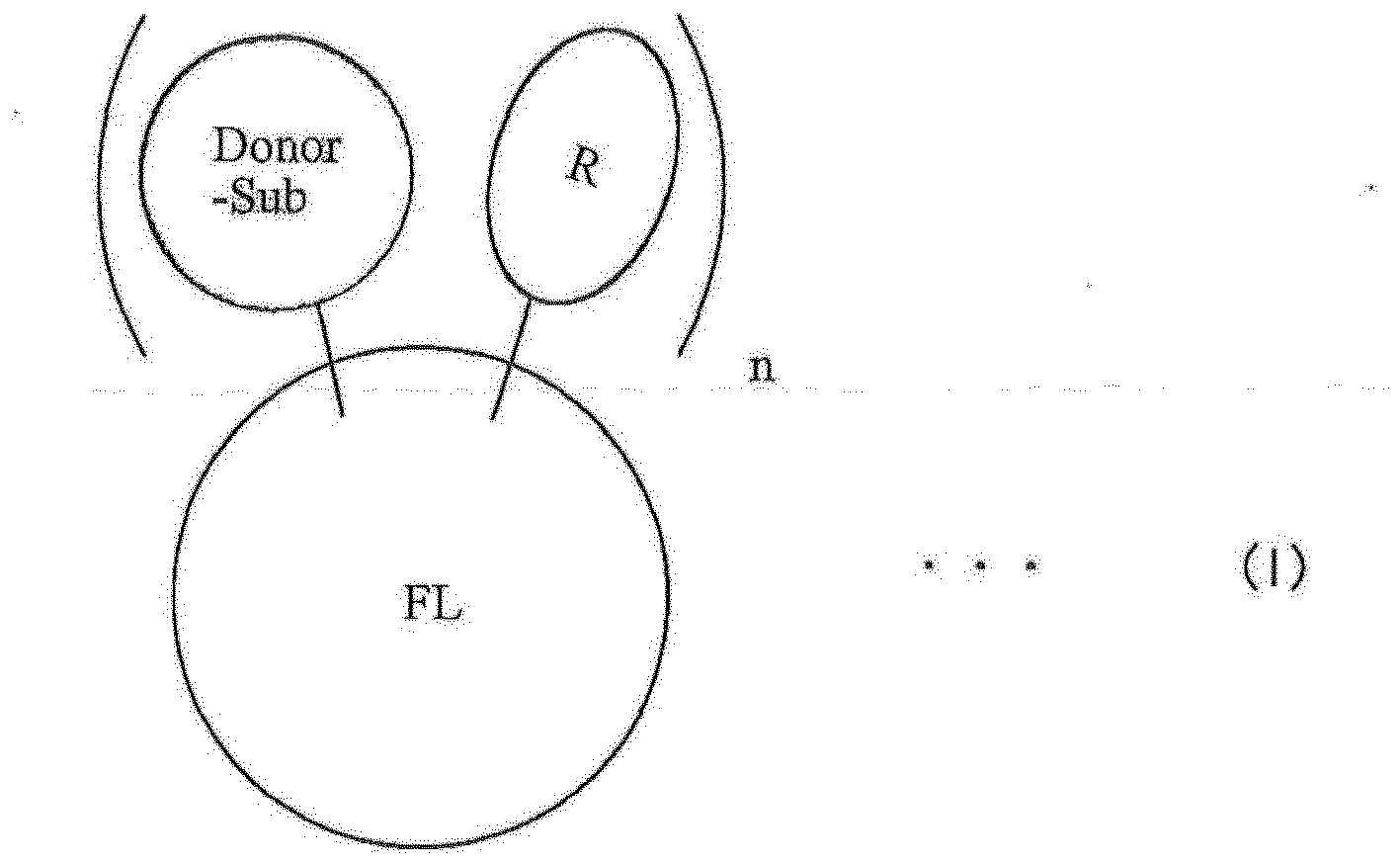
- the present invention relates to a fullerene derivative represented by formula (I).
- the encircled FL represents fullerene C 60 or C 70
- Donor-Sub represents a substituent having at least one electron donating substituent atom located at a position apart from the fullerene nucleus by two bonds
- R is hydrogen, Donor-Sub, an alkyl, cycloalkyl, alkoxy, alkoxy-substituted alkyl, alkoxy-substituted alkoxy, alkylthio-substituted alkoxy, alkylthio, alkylthio-substituted alkylthio, or alkoxy-substituted alkylthio group, having a total carbon atoms of 1 or more and 20 or fewer, or a benzyl or phenyl group, and n is an integer of 1 to 10.
- the present invention also relates to the forgoing fullerene derivative having a first reduction potential of 1160 mV or higher.
- the present invention also relates to a photoelectric conversion device having a heterojunction layer comprising a p type conjugate polymer having electron donating properties and an n type fullerene derivative, wherein the foregoing fullerene derivative is used in a photoelectric conversion layer.
- the fullerene derivative of the present invention can be synthesized at a high yield and has a high LUMO energy, it can provide an organic thin film solar cell exhibiting a high open circuit voltage and therefore is extremely useful as an acceptor material for an organic thin film solar cell.
- the fullerene derivative of the present invention is represented by formula (I) and characterized by having an electron donating structure (hereinafter referred to as "Donor-Sub”) adjacent to the fullerene nucleus.
- Donor-Sub electron donating structure
- the encircled FL represents fullerene C 60 or C 70 .
- Donor-Sub represents a monovalent substituent having an aromatic ring or heterocyclic ring with at least one electron donating substituting atom located at a position apart from the fullerene nucleus by two bonds, and R is hydrogen, Donor-Sub, an alkyl, cycloalkyl, alkoxy, alkoxy-substituted alkyl, alkoxy-substituted alkoxy, alkylthio-substituted alkoxy, alkylthio, alkylthio-substituted alkylthio, or alkoxy-substituted alkylthio group, having a total carbon atoms of 1 or more and 20 or fewer, or a benzyl or phenyl group.
- n is an integer of 1 to 10, preferably 1 to 6. Examples of Donor
- R is an alkyl, cycloalkyl, alkoxy, alkoxy-substituted alkyl, alkoxy-substituted alkoxy, alkylthio-substituted alkoxy, alkylthio, alkylthio-substituted alkylthio, or alkoxy-substituted alkylthio group, having a total carbon atoms of 1 or more and 20 or fewer, or a benzyl or phenyl group and may contain an unsaturated bond or a branched structure in part of the bonds.
- R examples include methyl, ethyl, propyl, butyl, pentyl, hexyl, heptyl, octyl, nonyl, decyl and isomers thereof, methoxymethyl, ethoxymethyl, ethoxyethyl, methoxyethyl, methoxyethoxyethyl, and ethoxyethoxyethyl groups.
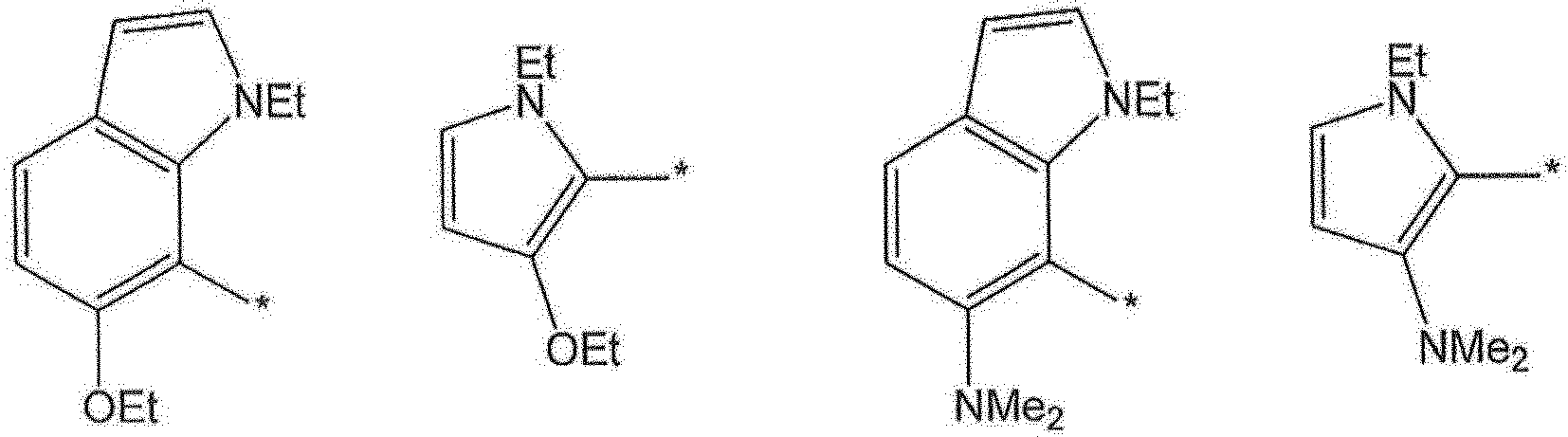
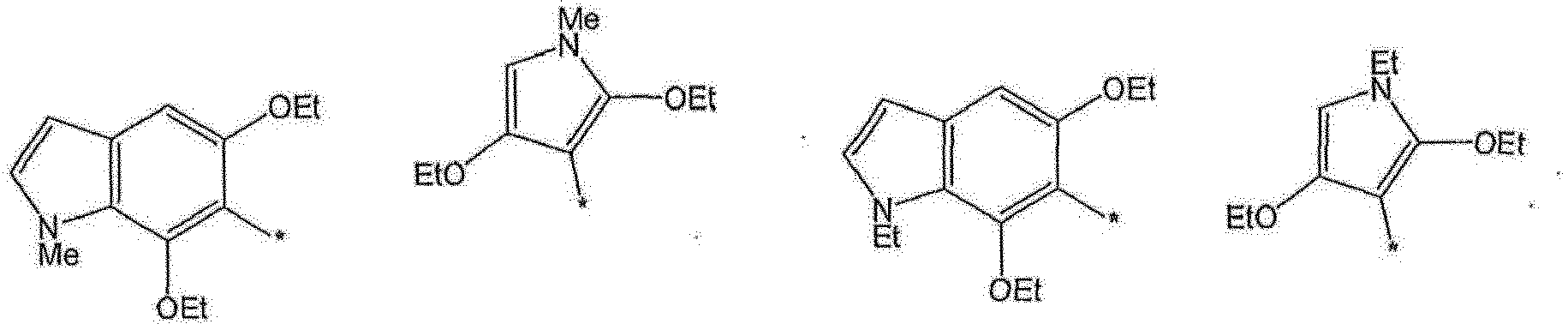
- Donor-Subs include the followings but are not limited thereto. In the following formulas, Me is methyl and Et is ethyl.
- the resulting fullerene derivative is reacted with an organic halide (corresponding to 4, 5, 6 in Examples below) in o-dichlorobenzene/benzonitrile to which potassium-tert-butoxide has been added, at room temperature to 150°C thereby producing a fullerene derivative having two different kinds of substituents.
- an oxidized fullerene C 60 O is reacted with a benzene derivative (corresponding to 7a, 8a in Examples below) in the presence of Lewis acid in o-dichlorobenzene at 0°C thereby producing a fullerene derivative having two Donor-subs.
- the fullerene derivative of the present invention exhibits a higher LUMO energy level than the conventional fullerene derivative (PCBM). It is known that as the LUMO energy is higher, the open circuit voltage tends to be high.
- the LUMO energy of a fullerene derivative may be generally evaluated by determining and/or comparing the first reduction potential measured with cyclic voltammetry. That is, it is suggested that a fullerene derivative with a higher first reduction potential be higher in LUMO energy level.
- the first reduction potential may be measured by dissolving a fullerene derivative in an o-dichlorobenzene solution containing a tetrabutylammonium perchloric acid salt and then measuring it by potentiostat/galvanostat.
- the first reduction potential can be obtained as an average value of the first reduction peak and the oxidation peak thereof, using the oxidation/reduction potential (Fc/Fc + ) of a ferrocene as the internal reference.
- the fullerene derivative of the present invention has a feature that it exhibits a higher first reduction potential than at least PCBM and exhibits a reduction potential of at least 1160 mV (vs Fc/Fc + ) or higher.
- the photoelectric conversion device of the present invention may be a heterojunction type device having a photoelectric conversion layer formed by laminating or mixing the fullerene derivative used as an electron transport material with a suitable hole transport material.
- a layer may be formed using only the fullerene derivative of the present invention.
- the hole transport material is desirously a low molecular weight dye or a polymer compound.
- the structure of the heterojunction type electron device of the present invention may be a structure having a photoelectric conversion layer formed by the fullerene derivative of the present invention and a hole transport material between an electrically conductive electrode substrate at least one of which surface is transparent or translucent and a counter electrode.
- the organic photoelectric conversion device During the operation of the organic photoelectric conversion device, light energy entered through a transparent/translucent electrode is absorbed by a photoelectric conversion layer formed of an organic semiconductor material and excitons are generated. The exciton migrates to the heterojunction interface between the electron transport material and the hole transport material, and then is separated to an electron and a hole thereby generating charges (electron and hole). The charge thus generated migrates to the electrode and is externally withdrawn in the form of electrical energy.
- the hole transport material used in the organic photoelectric conversion device may be a hole transport polymer such as polyphenylene vinylene, polythiophene, polypyrrole, polyaniline, or polycarbazole.
- the hole transport material is preferably a compound having a relatively high mobility such as thiophene-based polymers or copolymers of thiophenes and other compounds with conjugate structures.
- the photoelectric conversion layer may be produced by a method where the fullerene derivative of the present invention and the above-described hole transport material are dissolved in a solvent and then coated on a substrate.
- the solvent may be any solvent if it can dissolve both the fullerene derivative and hole transport material. Examples of such a solvent include toluene, xylene, chloroform, dichloromethane, tetrahydrofuran, carbon tetrachloride, chlorobenzene, dichlorobenzene, trichlorobenzene, and carbon disulfide.
- the solution may be coated on a surface of a substrate surface by a method such as casting, spin coating, spray coating, and bar coating.
- the photoelectric conversion layer is finally formed by evaporating the solvent.
- the transparent electrically conductive substrate is generally produced by laminating a transparent electrode layer over a transparent substrate.
- a transparent substrate which may be glass, plastic resin material, and silicon.
- the resin material include polyester, polyamide, polysulfone, polyethersulfone, polyether ether ketone, polycarbonate, polyimide, polymethylmethacrylate, and polystyrene.
- the transparent electrically conductive film forming the transparent electrode of electrically conductive layer may be a metal film of gold, silver, chromium, copper, or tungsten or an electrically conductive film of a metal oxide.
- suitable metal oxide film include films produced by doping a trace amount of a different metal element to tin oxide or zinc oxide, such as indium tin oxide (ITO) or NESA.
- the film thickness is usually from 1 nm to 50 ⁇ m, preferably from 10 nm to 10 ⁇ m.
- the counter electrode may be a metal such as gold, platinum, silver, copper, aluminum, magnesium, lithium, and potassium or a carbon electrode.
- the counter electrode may be produced by vacuum deposition, electron beam vacuum deposition, or sputtering.
- a buffer layer may be additionally formed between the photoelectric conversion layer and the counter electrode metal layer.
- the material of the buffer layer which may, however, be an organic such as phenanthrorine or bathocuproin, an inorganic compound or inorganic oxide such as lithium fluoride or TiOx.
- Photoelectric conversion devices can be evaluated by attaching terminals to the transparent electrode and counter electrode and measuring the change in current value when light is irradiated or not.
- Fullerene derivative 1b (BDP-H) was synthesized in the following manner.
- Fullerene derivative 2b (BPP-H) was synthesized in the following manner.
- BMEP-H Fullerene derivative 3b
- Fullerene derivative 1c (BDP-DPM) was synthesized in the following manner.
- Fullerene derivative 2c (BPP-DPM) was synthesized in the following manner.
- BMEP-DPM Fullerene derivative 3c
- Fullerene derivative 1d (BDP-Bn) was synthesized in the following manner.
- Fullerene derivative 1e (BDP-Hex) was synthesized in the following manner.
- Fullerene derivative 7b (bis-HpTMP C 60 ) was synthesized in the following manner.
- Fullerene derivative 8b (bis-BETMP C 60 ) was synthesized in the following manner.
- a solution for the measurement was prepared by adding 3.87 mg of ferrocene to 50 mL of a 0.1 M o-dichlorobenzene solution of a tetrabutylammonium perchloric acid salt. To 2 mL of this solution was added 1.5 mg of a fullerene derivative to measure the oxidation-reduction potential at a sweep rate 20 mV/s with an electrochemical analyzer model 630A manufactured by ALS.
- the first reduction potential (mV) was set forth in Table 1. As shown in Table 1, the fullerene derivatives exhibited a larger first reduction potential than the conventional fullerene derivative (PCBM).
- Baytron P manufactured by H.C. Stark GmbH was spin-coated at 5000 rpm (50s) on a glass substrate having been washed, on which an ITO film with a surface resistance of 15 ⁇ /sq was formed by sputtering, and then dried at a temperature of 240°C for 10 minutes.
- Fullerene derivative 1c was mixed with poly(3-hexylthiophene) having a molecular weight of 17,500 (manufactured by Sigma-Aldrich Co. LLC) at a weight ratio of 1.0:0.5, and then dissolved in chlorobenzene such that the concentration of fullerene derivative 1c was one percent by weight.
- This mixed solution was spin-coated on the glass substrate at 1000 rpm (50s) thereby forming a photoelectric conversion layer.
- the ITO-glass substrate with the photoelectric conversion layer was heated under a nitrogen atmosphere at 150°C for 6 minutes and then titanium tetraisopropoxide was spin-coated at 4000 rpm over the substrate and left for 30 minutes.
- a 100 nm thickness A1 was deposited under a vacuum of about 10 -5 torr to form a counter electrode thereby producing a photoelectric conversion device.
- an artificial sunlight of 100 mW/cm 2 was irradiated to the photoelectric conversion device, the voltage-current characteristics thereof were measured. The maximum efficiency was calculated from the voltage-current characteristics.
- a photoelectric conversion device was produced using 2c in place of 1c in the same manner as Example 12 to measure the voltage-current characteristics, from which the maximum efficiency was calculated.
- a photoelectric conversion device was produced using 3c in place of 1c in the same manner as Example 12 to measure the voltage-current characteristics, from which the maximum efficiency was calculated.
- a photoelectric conversion device was produced using 1d in place of 1c in the same manner as Example 12 to measure the voltage-current characteristics, from which the maximum efficiency was calculated.
- a photoelectric conversion device was produced using 1e in place of 1d in the same manner as Example 12 to measure the voltage-current characteristics, from which the maximum efficiency was calculated.
- the fullerene derivative of the present invention is an organic semiconductor material, which can be used in an organic TFT and an organic solar cell and is significantly large in industrial value.
Landscapes
- Chemical & Material Sciences (AREA)
- Engineering & Computer Science (AREA)
- Organic Chemistry (AREA)
- Nanotechnology (AREA)
- Materials Engineering (AREA)
- Mathematical Physics (AREA)
- Physics & Mathematics (AREA)
- Theoretical Computer Science (AREA)
- Crystallography & Structural Chemistry (AREA)
- Photovoltaic Devices (AREA)
- Organic Low-Molecular-Weight Compounds And Preparation Thereof (AREA)
- Nitrogen Condensed Heterocyclic Rings (AREA)
- Electroluminescent Light Sources (AREA)
- Compositions Of Macromolecular Compounds (AREA)
Abstract

Description
- The present invention relates to fullerene derivatives and photoelectric conversion device containing the same.
- The organic thin film solar cell is an all solid type thin film solar cell containing an organic semiconductor and thus has been expected to be large in area and produced by an inexpensive manner, as well as light in weight and rich in flexibility. However, a significant increase in the conversion efficiency of the organic thin film solar cell has become an important issue towards the practical realization of the cell, and as the result, researches and development therefor have been vigorously carried out around Europe and the United States.
The fullerene derivative is an organic semiconductor material that is high in electron accepting properties and has been expected to be applied to an organic photoelectric conversion device (organic solar cells, light sensors). A methanofullerene wherein phenyl and butyric acid ester groups are cross-linked with methylene (phenyl-C61-butyric acid methyl ester; PCBM) is a widely known fullerene derivative for an organic thin film solar cell, and an improvement in energy conversion efficiency by 5 percent was achieved by an organic thin film solar cell of bulk heterojunction structure comprising a mixed active layer of the PCBM and a conjugated polymer, i.e., poly(3-hexylthiophene: P3HT) (see Non-Patent Literatures 1 and 2). - The energy conversion efficiency is represented by the formula "conversion efficiency (η) =open circuit voltage (Voc)×short circuit current (Jsc)×fill factor (FF)".
As apparent from the formula, an increase in open circuit voltage contributes significantly to an increase in conversion efficiency. Furthermore, it is known that the open circuit voltage correlates strongly to the energy difference between the HOMO (highest occupied molecular orbital) of a donor and the LUMO (lowest unoccupied molecular orbital) of an acceptor (Non-Patent Literature 3), and thus an increase in the LUMO energy of an acceptor material leads to an increase in open circuit voltage. Specifically, Blom et al have reported that bismethanofullerene (bisPCBM) where two phenyl butyric acid ester groups were substituted was increased in LUMO energy by about 100 meV compared with PCBM (by first reduction potential measurement) and thus was increased in open circuit voltage by 0.15 V and had 1.2 time of photoelectric conversion efficiency (Non-Patent Literature 4). - Non-Patent Literature 5 is an example which refers to the LUMO energy level of an acceptor material and has designed an acceptor having a higher LUMO energy than PCBM, but exhibited an open circuit voltage of 0.65 V when formed into a device with P3HT, which open circuit voltage cannot be regarded as a significant improvement.
Meanwhile, in Non-Patent Literature 6, a study was carried out about the correlation of open circuit voltages of various methanofullerene derivatives produced by introducing substituents into the phenyl group of PCBM, but these compounds have methanofullerene derivative structures where the substituents are substituted for the fullerene nucleus via a methylene bridge and thus the effect of the substituents is indirect with respect to the fullerene nucleus. There is, therefore, a certain limit to enhance the LUMO energy.
As described above, these reports are generally insufficient as guidelines to obtain higher open circuit voltage and thus insufficient to solve the problems. -
- Non-Patent Literature 1: "Applied Physics Letters" by M. R-Reyes, K. Kim, D.L. Carroll, vol. 87, 083506, 2005,
- Non-Patent Literature 2: "Advanced Functional Material" by W. Ma, C. Yang, X. Gong, K. Lee, A.J. Heeger, vol. 15, p. 1617-1622, 2005
- Non-Patent Literature 3: "Advanced Material" by M.C. Scharber, D. Muhlbacher, M. Koppe, P. Denk, C. Waldauf, A.J. Heeger, C.J. Brabec, vol. 18, p. 789-794, 2006
- Non-Patent Literature 4: "Advanced Material" by M. Lenes, G.A.H. Wetzelaer, F.B. Kooistra, S.C. Veenstra, J.C. Hummelen, P.W.M. Blom, vol. 20, p. 2116-2119, 2008,
- Non-Patent Literature 5: "Thin Solid Films" by I. Riedel, N. Martin, F. Giacalone, J.L. Segura, D. Chirvase, J. Parisi, V. Dyakonov, vol. 43, p. 451-452, 2004,
- Non-Patent Literature 6: "Organic Letters" by F.B. Kooistra, J. Knol, F. Kastenberg, L.M. Popescu, W.J.H. Verhees, J.M. Kroon, J.C. Hummelen, vol. 9, p. 551-554, 2007
- As the results of extensive research and study in view of the above-described problems, the inventors of the present invention have succeeded in developing a novel fullerene derivative providing a high LUMO energy by introducing substituents directly into a fullerene without via a methylene bridge. The use of the novel fullerene derivative according to the present invention can produce a photoelectric conversion device exhibiting a high open circuit voltage.
- The present invention relates to a fullerene derivative represented by formula (I).

- In formula (I), the encircled FL represents fullerene C60 or C70, Donor-Sub represents a substituent having at least one electron donating substituent atom located at a position apart from the fullerene nucleus by two bonds, R is hydrogen, Donor-Sub, an alkyl, cycloalkyl, alkoxy, alkoxy-substituted alkyl, alkoxy-substituted alkoxy, alkylthio-substituted alkoxy, alkylthio, alkylthio-substituted alkylthio, or alkoxy-substituted alkylthio group, having a total carbon atoms of 1 or more and 20 or fewer, or a benzyl or phenyl group, and n is an integer of 1 to 10.
The present invention also relates to the forgoing fullerene derivative having a first reduction potential of 1160 mV or higher.
The present invention also relates to a photoelectric conversion device having a heterojunction layer comprising a p type conjugate polymer having electron donating properties and an n type fullerene derivative, wherein the foregoing fullerene derivative is used in a photoelectric conversion layer. - Since the fullerene derivative of the present invention can be synthesized at a high yield and has a high LUMO energy, it can provide an organic thin film solar cell exhibiting a high open circuit voltage and therefore is extremely useful as an acceptor material for an organic thin film solar cell.
- The present invention will be described in detail below.
The fullerene derivative of the present invention is represented by formula (I) and characterized by having an electron donating structure (hereinafter referred to as "Donor-Sub") adjacent to the fullerene nucleus. -

- In formula (I), the encircled FL represents fullerene C60 or C70.
Donor-Sub represents a monovalent substituent having an aromatic ring or heterocyclic ring with at least one electron donating substituting atom located at a position apart from the fullerene nucleus by two bonds, and R is hydrogen, Donor-Sub, an alkyl, cycloalkyl, alkoxy, alkoxy-substituted alkyl, alkoxy-substituted alkoxy, alkylthio-substituted alkoxy, alkylthio, alkylthio-substituted alkylthio, or alkoxy-substituted alkylthio group, having a total carbon atoms of 1 or more and 20 or fewer, or a benzyl or phenyl group. No particular limitation is imposed on the number of paired Donor-Sub and substituent R. However, n is an integer of 1 to 10, preferably 1 to 6.
Examples of Donor-Sub in formula (I) include those having the following structures. -

- In the above formulas, R is an alkyl, cycloalkyl, alkoxy, alkoxy-substituted alkyl, alkoxy-substituted alkoxy, alkylthio-substituted alkoxy, alkylthio, alkylthio-substituted alkylthio, or alkoxy-substituted alkylthio group, having a total carbon atoms of 1 or more and 20 or fewer, or a benzyl or phenyl group and may contain an unsaturated bond or a branched structure in part of the bonds. Specific examples of R include methyl, ethyl, propyl, butyl, pentyl, hexyl, heptyl, octyl, nonyl, decyl and isomers thereof, methoxymethyl, ethoxymethyl, ethoxyethyl, methoxyethyl, methoxyethoxyethyl, and ethoxyethoxyethyl groups.
Specific examples of these Donor-Subs include the followings but are not limited thereto. In the following formulas, Me is methyl and Et is ethyl. -


-






-


-


-


-


-


-



- [Method for Producing Fullerene Derivative] A method for synthesizing the fullerene derivative of the present invention will be described but is not limited thereto. Boronic acids (corresponding to 1a, 2a, 3a in Examples below) and fullerene C60, which are precursors of the intended fullerene are heated in the presence of a rhodium catalyst in o-dichlorobenzene/water at a temperature of 60 to 100°C for one to 12 hours (see "Chem. Soc." vol. 129, p.8080-8081, 2007 by M. Nambo, R. Noyori, K. Itami, J. Am.) thereby producing the intended fullerene derivative. Furthermore, the resulting fullerene derivative is reacted with an organic halide (corresponding to 4, 5, 6 in Examples below) in o-dichlorobenzene/benzonitrile to which potassium-tert-butoxide has been added, at room temperature to 150°C thereby producing a fullerene derivative having two different kinds of substituents. Alternatively, an oxidized fullerene C60O is reacted with a benzene derivative (corresponding to 7a, 8a in Examples below) in the presence of Lewis acid in o-dichlorobenzene at 0°C thereby producing a fullerene derivative having two Donor-subs.
- The fullerene derivative of the present invention exhibits a higher LUMO energy level than the conventional fullerene derivative (PCBM). It is known that as the LUMO energy is higher, the open circuit voltage tends to be high. The LUMO energy of a fullerene derivative may be generally evaluated by determining and/or comparing the first reduction potential measured with cyclic voltammetry. That is, it is suggested that a fullerene derivative with a higher first reduction potential be higher in LUMO energy level. For example, the first reduction potential may be measured by dissolving a fullerene derivative in an o-dichlorobenzene solution containing a tetrabutylammonium perchloric acid salt and then measuring it by potentiostat/galvanostat. The first reduction potential can be obtained as an average value of the first reduction peak and the oxidation peak thereof, using the oxidation/reduction potential (Fc/Fc+) of a ferrocene as the internal reference. The fullerene derivative of the present invention has a feature that it exhibits a higher first reduction potential than at least PCBM and exhibits a reduction potential of at least 1160 mV (vs Fc/Fc+) or higher.
- Next, a description will be given of a photoelectric conversion device (organic photoelectric conversion device) produced using the fullerene derivative of the present invention. For example, the photoelectric conversion device of the present invention may be a heterojunction type device having a photoelectric conversion layer formed by laminating or mixing the fullerene derivative used as an electron transport material with a suitable hole transport material. Alternatively, a layer may be formed using only the fullerene derivative of the present invention. The hole transport material is desirously a low molecular weight dye or a polymer compound.
The structure of the heterojunction type electron device of the present invention may be a structure having a photoelectric conversion layer formed by the fullerene derivative of the present invention and a hole transport material between an electrically conductive electrode substrate at least one of which surface is transparent or translucent and a counter electrode. - During the operation of the organic photoelectric conversion device, light energy entered through a transparent/translucent electrode is absorbed by a photoelectric conversion layer formed of an organic semiconductor material and excitons are generated. The exciton migrates to the heterojunction interface between the electron transport material and the hole transport material, and then is separated to an electron and a hole thereby generating charges (electron and hole). The charge thus generated migrates to the electrode and is externally withdrawn in the form of electrical energy.
- The hole transport material used in the organic photoelectric conversion device may be a hole transport polymer such as polyphenylene vinylene, polythiophene, polypyrrole, polyaniline, or polycarbazole. Among these compounds, the hole transport material is preferably a compound having a relatively high mobility such as thiophene-based polymers or copolymers of thiophenes and other compounds with conjugate structures.
- The photoelectric conversion layer may be produced by a method where the fullerene derivative of the present invention and the above-described hole transport material are dissolved in a solvent and then coated on a substrate. The solvent may be any solvent if it can dissolve both the fullerene derivative and hole transport material. Examples of such a solvent include toluene, xylene, chloroform, dichloromethane, tetrahydrofuran, carbon tetrachloride, chlorobenzene, dichlorobenzene, trichlorobenzene, and carbon disulfide. The solution may be coated on a surface of a substrate surface by a method such as casting, spin coating, spray coating, and bar coating. The photoelectric conversion layer is finally formed by evaporating the solvent.
- The transparent electrically conductive substrate is generally produced by laminating a transparent electrode layer over a transparent substrate. No particular limitation is imposed on the transparent substrate, which may be glass, plastic resin material, and silicon. Examples of the resin material include polyester, polyamide, polysulfone, polyethersulfone, polyether ether ketone, polycarbonate, polyimide, polymethylmethacrylate, and polystyrene.
- The transparent electrically conductive film forming the transparent electrode of electrically conductive layer may be a metal film of gold, silver, chromium, copper, or tungsten or an electrically conductive film of a metal oxide. Examples of suitable metal oxide film include films produced by doping a trace amount of a different metal element to tin oxide or zinc oxide, such as indium tin oxide (ITO) or NESA. The film thickness is usually from 1 nm to 50 µm, preferably from 10 nm to 10 µm.
- The counter electrode may be a metal such as gold, platinum, silver, copper, aluminum, magnesium, lithium, and potassium or a carbon electrode. The counter electrode may be produced by vacuum deposition, electron beam vacuum deposition, or sputtering.
- Before forming the counter electrode metal layer, a buffer layer may be additionally formed between the photoelectric conversion layer and the counter electrode metal layer. No particular limitation is imposed on the material of the buffer layer, which may, however, be an organic such as phenanthrorine or bathocuproin, an inorganic compound or inorganic oxide such as lithium fluoride or TiOx.
- Photoelectric conversion devices can be evaluated by attaching terminals to the transparent electrode and counter electrode and measuring the change in current value when light is irradiated or not.
- The present invention will be described in more details with reference to the following examples but is not limited thereto.
- Fullerene derivative 1b (BDP-H) was synthesized in the following manner.

- Into a 100 mL eggplant flask were put 362 mg of a boronic acid compound 1a, 500 mg of C60 and 26 mg of catalyst [Rh(cod)(MeCN)2]BF4 (cod represents 1,5-cyclooctadiene), to which 50 mL of o-dichlorobenzene (ODCB) and 12.5 mL of water were added under an argon gas atmosphere followed by stirring at 60°C for two hours. After completion of the reaction, insolubles were filtered out and the solvent was removed under reduced pressure. The resulting product was separated and refined by recycle preparative column chromatography (toluene solvent) thereby producing 521 mg of 1b (yield 67%). The resulting product was confirmed with a high-performance liquid chromatography and identified with 1H-NMR, 13C-NMR, and MALDI-TOF-MS.
- [Analyzed Data]
1H-NMR (270 MHz; CDCl3) δ7.48 (t, 1H, 8.4Hz), 6.95 (d, 2H, 8.6Hz), 6.80 (s, 1H), 4.30 (br, 4H), 1.86-1.84 (m, 4H), 1.22 (br, 26H), 0.84 (t, 6H, 6.4Hz); 13C-NMR (67.8MHz; CDCl3) δ158.64, 156.46, 155.06, 147.32, 146.44, 146.32, 146.22, 146.15, 146.06, 146.05, 145.41, 145. 34, 145.15, 144.98, 144.81, 144.78, 143.42, 142.59, 142.51, 142.29, 142.00, 141.75, 141.57, 141.52, 240.07, 139.23, 137.79, 135.51, 129.62 (CH), 122.99, 106.43 (CH), 70.07 (OCH2), 64.01, 63.28 (CH), 31.86 (CH2), 29.66 (CH2) , 29.56 (CH2), 29.3 (CH2), 29.26 (CH2), 26.8 (CH2), 22.66 (CH2), 14.11 (CH3); MALDI-TOF-MS 1110.4[M]+. - Fullerene derivative 2b (BPP-H) was synthesized in the following manner.

- Into a 200 mL eggplant flask were put 219 mg of a boronic acid compound 2a, 488 mg of C60 and 26 mg of catalyst [Rh(cod)(MeCN)2]BF4, to which 60 mL of o-dichlorobenzene and 15 mL of water were then added under an argon gas atmosphere, followed by stirring at 60°C for 4 hours. After completion of the reaction, insolubles were filtered out and the solvent was removed under reduced pressure. The resulting product was separated and refined by recycle preparative column chromatography (toluene solvent) thereby producing 508 mg of 2b (yield 77%). The resulting product was confirmed with a high-performance liquid chromatography and identified with 1H-NMR, 13C-NMR, and MALDI-TOF-MS.
- 1H-NMR (300MHz; CDCl3/CS2) δ7.44 (t, 1H, 8.3Hz), 6.90 (d, 2H, 8.4Hz), 6.76 (s, 1H), 4.28 (br, 4H), 1.88-1.83 (m, 4H), 1.49-1.31 (m, 12H), 0.89 (t, 6H, 7.2Hz) ; 13C-NMR (75MHz; CDCl3/CS2) 5158.47, 156.24, 154.85, 147.38, 147.19, 147.14, 146.27, 146.20, 146.06, 145.95, 145.92, 145.29, 145.27, 145.03, 144.88, 144.70, 144.67, 143.35, 142.99, 142.49, 142.41, 142.18, 141.89, 141.61, 141.47, 141.42, 139.81, 139.13, 137.66, 135.38, 129.56 (CH), 122.77, 106.33 (CH), 69.91 (OCH2) , 63.83, 63.19 (CH), 28.97 (CH2), 28.85 (CH2), 22.74 (CH2), 26.8 (CH2), 22.66 (CH2), 14.14 (CH3); MALDI-TOF-MS 971.2[M]+.
- Fullerene derivative 3b (BMEP-H) was synthesized in the following manner.

- Into a 200 mL eggplant flask were put 412 mg of a boronic acid compound 3a, 1.0g of C60 and 53 mg of catalyst [Rh (cod) (MeCN)2]BF4, to which 80 mL of o-dichlorobenzene and 20 mL of water were then added under an argon gas atmosphere, followed by stirring at 60°C for 3 hours. After completion of the reaction, insolubles were filtered out and the solvent was removed under reduced pressure. The resulting product was separated and refined by recycle preparative column chromatography (toluene solvent) thereby producing 997 mg of 3b (yield 76%). The resulting product was confirmed with a high-performance liquid chromatography and identified with 1H-NMR, 13C-NMR, and MALDI-TOF-MS.
- 1H-NMR (300 MHz; CDCl3/CS2) δ7.41 (t, 1H, 8.4Hz), 6.89 (d, 2H, 8.4Hz), 6.76 (s, 1H), 4.37 (br, 4H), 3.70 (t, 4H, 4.8Hz), 3.26 (s, 6H); 13C-NMR (75MHz; CDCl3/CS2) δ158.15, 155. 91, 154.99, 147.29, 147.17, 147.05, 146.24, 146.11, 145.98, 145.87, 145.85, 145.18, 145.10, 144.95, 144.85, 144.61, 144.60, 143.27, 142.92, 142.42, 142.34, 142.12, 141.82, 141.58, 141.39, 141.37, 139.72, 139.03, 137.38, 135.41, 129.58 (CH), 122.98, 106.79 (CH), 70.37 (OCH2). 68.84 (OCH2), 63.57, 62.93 (CH), 58.79 (CH3); MALDI-TOF-MS 946.0 [M]+.
- Fullerene derivative 1c (BDP-DPM) was synthesized in the following manner.

- Into a 100 mL eggplant flask were put 100mg of 1b synthesized in Example 1, to which 6 mL of o-dichlorobenzene and 12 mL of benzonitrile (PhCN) were then added under an argon gas atmosphere and 0.09 mL of potassium-tert-butoxide (1.0 M tetrahydrofuran solution) was added at 120°C, followed by stirring for one minute. To this solution was added 0.18 mL of a 0.5 M o-dichlorobenzene solution of α-bromodiphenyl methane 4, followed by stirring for 5 minutes. For this solution, filtration of insolubles and removal of the solvent were carried out, followed by separation and refining by recycle preparative GPC (solvent chloroform) thereby producing 55 mg of 1c (yield 50%). The resulting product was confirmed with a high-performance liquid chromatography and identified with 1H-NMR, 13C-NMR, and ESI-MS.
- 1H-NMR (300MHz; CD2Cl2) δ7.77 (d, 2H, 7.3Hz), 7.69 (d, 2H, 7.3Hz), 7.33 (t, 1H, 8.3Hz), 7.24-7.19 (m, 4H), 7.14 (d, 2H, 7.2Hz), 6.81 (d, 1H, 8.4Hz), 6.68 (d, 1H, 8.4Hz), 5.24 (s, 1H), 4.22 (t, 2H, 6.5Hz), 3.93 (t, 2H, 5.8Hz), 1.95-1.75 (m, 2H), 1.40 (br, 4H), 1.16 (br, 26H), 0.82-0.77 (m, 6H) ; 13C-NMR (75MHz; CD2Cl2) 5160.13, 159.01, 156.75, 155.58, 154.13, 149.25, 149.16, 149.05, 149.01, 148.91, 148.84, 148.56, 148.35, 147.41, 147.35, 147.31, 147.25, 147.19, 147.05, 146.82, 146.66, 145.94, 145.70, 145.64, 145.53, 145.50, 145.45, 145.07, 145.03, 144.99, 144.66, 144.47, 144.44, 144.33, 144.21, 144.18, 144.04, 143.71, 143.61, 143.55, 143.41, 143.33, 143.28, 143.19, 143.16, 143.03, 142.96, 142.77, 142.74, 142.61, 142.27, 141.85, 141.59, 140.97, 140.58, 140.46, 140.24, 139.34, 138.94, 138.08, 130.86, 130.28 (CH), 129.93 (CH), 129.84 (CH), 128.68 (CH), 128.62 (CH), 128.15(CH), 127.86 (CH), 127.72 (CH), 126.27 (CH), 116.05, 106.53 (CH), 106.20 (CH), 70.47(OCH2), 69.75 (OCH2), 64.98 (CH), 63.86, 57.82, 32.29 (CH2), 30.11 (CH2), 30.03 (CH2), 29.75 (CH2), 29.30 (CH2), 27.12 (CH2), 27.04 (CH2), 23.11 (CH2), 14.33 (CH3); ESI-MS 1300.4 [M+Na]+.
- Fullerene derivative 2c (BPP-DPM) was synthesized in the following manner.
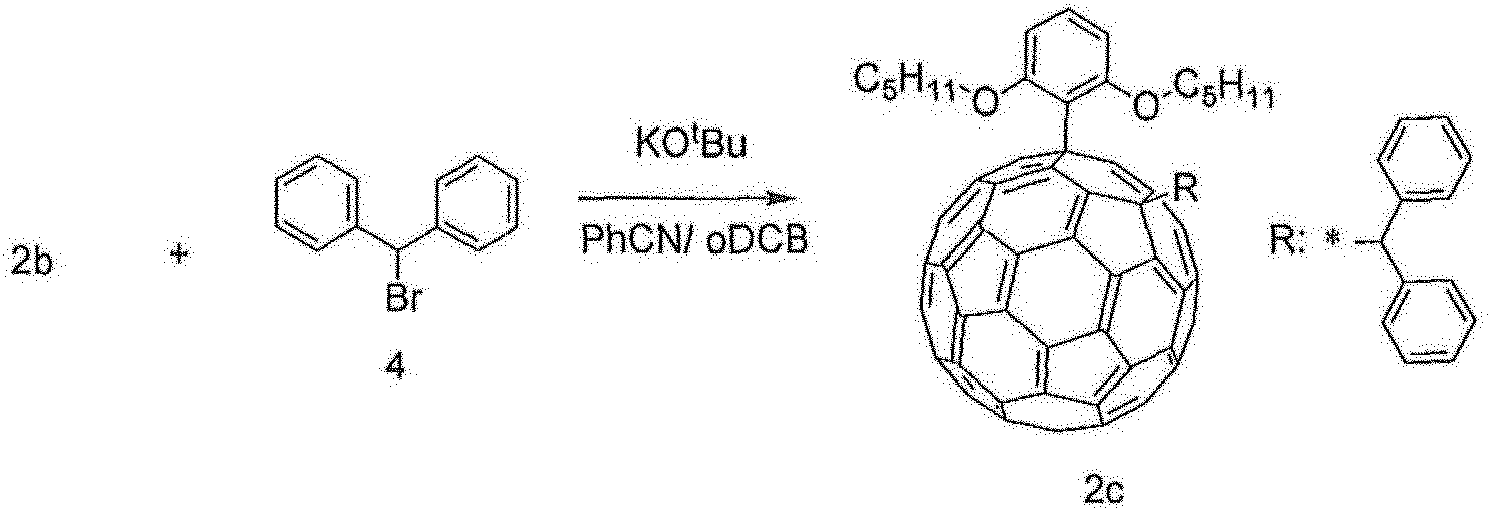
- Into a 100 mL eggplant flask were put 250 mg of 2b synthesized in Example 2, to which 25 mL of o-dichlorobenzene and 25 mL of benzonitrile were added under an argon gas atmosphere and 0.26 mL of potassium -tert-butoxide (1.0 M tetrahydrofuran solution) was added at 120°c, followed by stirring for one minute. To this solution was added 0.51 mL of a 0.5 M o-dichlorobenzene solution of α-bromodiphenyl methane 4, followed by stirring for 5 minutes. For this solution, filtration of insolubles and removal of the solvent were carried out, followed by separation and refining by recycle preparative GPC (solvent chloroform) thereby producing 137 mg of 2c (yield 47%) . The resulting product was confirmed with a high-performance liquid chromatography and identified with 1H-NMR, 13C-NMR, and ESI-MS.
- 1H-NMR (270MHz; CDCl3) δ7.84 (d, 2H, 7.3Hz), 7.74 (d, 2H, 7.3Hz), 7.39 (t, 1H, 8.4Hz), 7.3 1-7.21 (m, 6H), 6.86 (d, 1H, 8.2Hz), 6.74 (d, 1H, 8.2Hz), 5.28 (s, 1H), 4.29(t, 2H, 6.6Hz), 3.99(t, 2H, 6.8Hz), 1.94-1.82 (m, 2H), 1.50-1.21 (m, 10H), 0.91-0.80 (m, 6H); 13C-NMR (67.8MHz; CDCl3) 5159.74, 158.61, 156.21, 155.04, 153.61, 148.85, 148.68, 148.53, 148.10, 147.96, 147.06, 147.01, 146.98, 146.91, 146.84, 146.71, 146.21, 146.15, 145.73, 145. 32, 145.17, 145.12, 144.70, 144.62, 144.30, 144.10, 143.91, 143.85, 143.80, 143.62, 143.34, 143.23, 143.00, 142.96, 142.85, 142.78, 142.68, 142.63, 142.44, 142.38, 142.27, 141.87, 141.48, 141.21, 140.47, 140.13, 140.06, 139.88, 138.98, 138.56, 137.65, 129.95 (CH), 129.60(CH), 129.37 (CH), 128.26 (CH), 128.19 (CH), 127.42 (CH), 127.29 (CH), 115.9, 106.08 (CH), 105.76 (CH), 70.00 (OCH2), 69.28 (OCH2), 64.61 (CH), 63.45, 57.32, 28.95 (CH2), 28.72 (CH2), 28.59 (CH2), 28.47 (CH2), 22.62 (CH2), 14.11 (CH3), 14.05 (CH3); ESI-MS 1159.2 [M+Na]+.
- Fullerene derivative 3c (BMEP-DPM) was synthesized in the following manner.

- Into a 100 mL eggplant flask were put 200 mg of 3b synthesized in Example 3, to which 20 mL of o-dichlorobenzene and 20 mL of benzonitrile were then added under an argon gas atmosphere and 0.21 mL of potassium-tert-butoxide (1.0 M tetrahydrofuran solution) was added at 120°C, followed by stirring for one minute. To this solution was added 0.42 mL of a 0.5 M o-dichlorobenzene solution of α-bromodiphenyl methane 4, followed by stirring for 5 minutes. For this solution, filtration of insolubles and removal of the solvent were carried out, followed by separation and refining by recycle preparative GPC (solvent chloroform) thereby producing 118 mg of 3c (yield 50%). The resulting product was confirmed with a high-performance liquid chromatography and identified with 1H-NMR, 13C-NMR, and ESI-MS.
- 1H-NMR (270MHz; (CD3)2CO/CS2) δ7.75 (d, 2H, 7.3Hz), 7.65 (d, 2H, 7.3 Hz), 7.31(t, 1H, 8.2Hz), 7.2 2-7.04 (m, 6H), 6.81 (d, 1H, 8.2Hz), 6.69 (d, 1H, 8.2 Hz), 5.19 (s, 1H), 4.33 (t, 2H, 4.8 Hz), 4.09-4.06 (m, 2H), 3.68 (t, 2H, 4.8Hz), 3.35-3.26 (m, 2H), 3.22 (s, 3H), 3.15(s, 3H) ; 13C-NMR (67.8 MHz; (CD3)2CO/CS2) δ159.99, 158.47, 156.26, 155.74, 153.86, 149.13, 149.00, 148.95, 148.85, 148.73, 148.43, 148.32, 147.45, 147.37, 147.33, 147.24, 147.20, 147.07, 146.64, 146.30, 146.19, 145.72, 145.62, 145.50, 145.12, 145.03, 144.71, 144.52, 144.29, 144.16, 143.97, 143.73, 143.62, 143.41, 143.33, 143.17, 143.07, 142.78, 142.24, 141.98, 141.89, 141.60, 140.49, 140.40, 140.11, 140.07, 139.56, 138.98, 138.24, 130.46(CH), 130.16 (CH), 129.88 (CH), 128.67 (CH), 128.54 (CH), 128.08 (CH), 127.84 (CH), 127.68 (CH), 116.56, 107.13 (CH), 106.73 (CH), 71.06 (OCH2), 70.64 (OCH2), 69.26(OCH2), 68.98 (OCH2), 64.76 (CH), 63.82, 59.19 (OCH3), 57.47; ESI-MS 1135.2 [M+Na]+.
- Fullerene derivative 1d (BDP-Bn) was synthesized in the following manner.
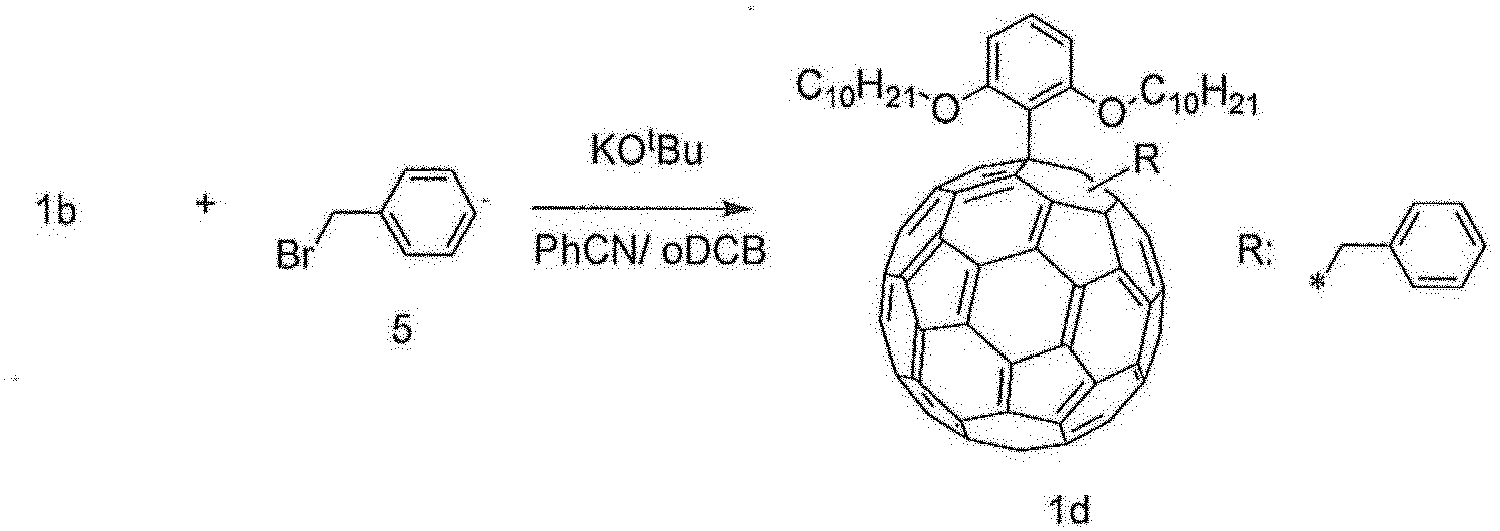
- Into a 100 mL eggplant flask were put 100 mg of 1b synthesized in Example 1, to which 1 mL of o-dichlorobenzene, 8 mL of benzonitrile and 0.21 mL of benzylbromide 5 were then added under an argon gas atmosphere and 0.54 mL of potassium-tert-butoxide (0.25 M 1-methyl-2-pyrrolidone solution) was added at room temperature, followed by stirring for 30 minutes. After insolubles were filtered out, the solvent was removed, followed by separation and refining by recycle preparative GPC (solvent chloroform) thereby producing 50 mg of 1d (yield 46%). The resulting product was confirmed with a high-performance liquid chromatography and identified with 1H-NMR, 13C-NMR, and FD-MS.
- 1H-NMR (270MHz; CD2Cl2) δ7.46-6.73 (m, 8H), 4.35 (s, 2H), 4.32- 4.03 (m, 4H), 2.0 1- .91 (m, 2H), 1.73- 1.63 (m, 2H), 1.59-1.15 (m, 28H), 0.77 (t, 6H, 6.3Hz); 13C-NMR (67.8MHz; CD2Cl2) δ159.71, 158.66, 157.95, 156.87, 154.49, 149.07, 148.78, 148.64, 148.46, 147.95, 147.45, 147.30, 147.20, 147.03, 146.85, 146.65, 146.48, 146.40, 146.21, 145.82, 145.75, 145.57, 145.41, 145.32, 145.23, 145.18, 144.62, 144.53, 144.44, 144.30, 144.24, 143.87, 143.74, 143.51, 143.25, 143.14, 143.00, 142.84, 142.76, 142.72, 142.50, 142.42, 141.98, 141.81, 141.69, 141.52, 141.16, 139. 30, 139. 24, 138.53, 138.40, 138.33, 137.60, 137.13, 136.62, 132.53 (CH), 130.96 (CH), 130.53 (CH), 129.8 (CH), 128.29 (CH), 128.07 (CH), 127.57 (CH), 127.05 (CH), 119.30, 116.42, 1106.43(CH), 106.12 (CH), 70.12 (OCH2), 69.58, 68.55, 60.24, 57.77, 48.63 (Bn-CH2), 47.94 (Bn-CH2), 32.28 (CH2), 30.16 (CH2), 30. 12 (CH2), 30.06 (CH2), 30.01 (CH2), 29.98 (CH2), 29.84 (CH2), 29.76 (CH2), 29.73 (CH2), 29.63 (CH2), 27.43 (CH2), 27.09 (CH2), 23.09 (CH2), 14.28(CH3); FD-MS 1201.8[M]+.
- Fullerene derivative 1e (BDP-Hex) was synthesized in the following manner.

- Into a 100 mL eggplant flask were put 100 mg of 1b synthesized in Example 1, to which 20 mL of benzonitrile and 0.27 mL of 1-iodinehexane 6 were then added under an argon gas atmosphere and 0.54 mL of potassium-tert-butoxide (0.25 M tetrahydrofuran solution) was added at room temperature, followed by stirring for 30 minutes. After insolubles were filtered out, the solvent was removed, followed by separation and refining by recycle preparative GPC (solvent chloroform) thereby producing 59 mg of 1e (yield 55%). The resulting product was confirmed with a high-performance liquid chromatography and identified with 1H-NMR, 13C-NMR, and FD-MS.
- 1H-NMR (270 MHz; CD2Cl2) δ7.38-7.32 (m, 1H), 6.8 3-6.74 (m, 2H), 4.23-4.13 (m, 4H), 3.15-3.09 (m, 1H), 2.8 3-2.80 (m, 1H), 2.08-1.14 (br, 40H), 0.83-0.74 (m, 9H) ; 13C-NMR (67.8MHz; CD2Cl2) δ160.09, 159.55, 159.09, 159.02, 156.95, 154.42, 149.10, 149.06, 148.84, 148.79, 148.73, 148.60, 148.46, 148.04, 147.47, 147.38, 147.26, 147.17, 146. 98, 146. 90, 146.82, 146. 67, 146. 49, 146.39, 146.25, 146.04, 145.81, 145.78, 145.61, 145. 56, 145.47, 145. 37, 145.29, 145.24, 145.02, 144.60, 144.55, 144.51, 144.38, 144.23, 144.15, 143.83, 143.74, 143.50, 143.33, 143.29, 143.26, 143.19, 143.15, 143.02, 142.86, 142.75, 142.70, 142.54, 142.03, 141.89, 141.76, 141.66, 141.44, 140.45, 140.04, 139.51, 139.24, 138.71, 138.40, 137.19, 136. 99, 130.3 (CH), 129. 88 (CH), 119. 40, 116.86, 106.33 (CH), 106.16 (CH), 70.06 (OCH2), 68.29, 68.22, 59.71, 57.86, 42.47 (CH2), 42.30 (CH2), 32.29 (CH2), 30.31 (CH2), 30.12 (CH2), 30.08 (CH2), 29.98 (CH2), 29.95 (CH2), 29.83 (CH2), 29.75 (CH2), 29.62 (CH2), 27.51 (CH2), 27.38 (CH2) , 27.07 (CH2), 23.09 (CH2), 23.01 (CH2), 22.95 (CH2), 14.31 (CH3); FD-MS 1195.8[M]+.
- Fullerene derivative 7b (bis-HpTMP C60) was synthesized in the following manner.

- Into a 50 mL eggplant flask were put 40 mg of oxidized fullerene (C60O) and 153 mg of 7a, to which 8 mL of o-dichlorobenzene were then added under an argon gas atmosphere and 34 µL of trifluoroborane diethylether complex at 0°C, followed by stirring for 3.5 hours. After insolubles were filtered out, the solvent was removed. The resulting produce was washed with acetone and methanol and then separated and refined by recycle preparative GPC (solvent chloroform) thereby producing 30 mg of 7b (yield 44%). The resulting product was confirmed with a high-performance liquid chromatography and identified with 1H-NMR, 13C-NMR, and MALDI-TOF-MS.
- 1H-NMR (300MHz; CDCl3) 56.39 (s, 1H), 3.91 (s, 3H), 3.86 (t, 2H, 6.7Hz), 3.83 (s, 3H), 3.76 (s, 3H), 1.75 (m, 2H), 1.49-1.25 (m, 8H), 0.90 (t, 3H, 6.7Hz); 13C-NMR (75.5MHz; CDCl3) δ155.65, 154.98, 153.95, 153.68, 150.17, 148.67, 148.55, 148.25, 147.02, 146.92, 146.65, 145.27, 145.05, 144.59, 144.18, 144.00, 143.65, 143.59, 143.28, 142.93, 142.84, 142.73, 142.46, 142.38, 141.30, 140.48, 140.20, 139.09, 137.34, 136.54, 114.89, 93.29 (CH), 73.67 (OCH2), 60.86 (OCH3), 56.41, 55.99 (OCH3), 55.77 (OCH3), 31.90 (CH2), 30.34 (CH2), 29.21 (CH2), 26.07 (CH2), 22.66 (CH2), 14.13 (CH3); MALDI-TOF-MS 1282.3[M]+.
- Fullerene derivative 8b (bis-BETMP C60) was synthesized in the following manner.

- Into a 50 mL eggplant flask were put 50 mg of oxidized fullerene and 193 mg of 8a, to which 10 mL of o-dichlorobenzene were then added under an argon gas atmosphere and 43 µL of trifluoro borane diethyl ether complex were added at 0°C, followed by stirring for 3.5 hours. After insolubles were filtered out, the solvent was removed. The product was washed with acetone and methanol and then separated and refined by recycle preparative GPC (solvent chloroform) thereby producing 32 mg of 8b (yield 37%). The resulting product was confirmed by high-performance liquid chromatography and identified with 1H-NMR, 13C-NMR, and MALDI-TOF-MS.
- 1H-NMR (270MHz; CDCl3) δ6.39 (s, 1H), 4.04 (t, 2H, 4.6Hz), 3.92 (s, 3H), 3.83(s, 3H), 3.79 (s, 3H), 3.72 (t, 2H, 4.7Hz), 3.52 (t, 2H, 6.6Hz), 1.6 (m, 2H), 1.39 (m, 2H), 0.92 (t, 3H, 7.3Hz); 13C-NMR (67.8MHz; CDCl3) δ155.79, 154.92, 153.90, 153.60, 150.08, 148.65, 148.51, 148.16, 146.97, 146.87, 146.61, 145.24, 145.00, 144.55, 144.17, 143.96, 143.60, 143.59, 193.24, 192.89, 142.79, 142.69, 142.41, 142.33, 141.28, 140.43, 139.12, 137.31, 136.09, 114.75, 93.14 (CH), 72.32 (OCH2), 71.10 (OCH2), 70.00 (OCH2), 60.93 (OCH3), 56.33, 56.00 (OCH3), 55.65 (OCH3), 31.84 (CH2), 19.32 (CH2), 13.97 (CH3); MALDI-TOF-MS 1286.3 [M]+.
- A solution for the measurement was prepared by adding 3.87 mg of ferrocene to 50 mL of a 0.1 M o-dichlorobenzene solution of a tetrabutylammonium perchloric acid salt. To 2 mL of this solution was added 1.5 mg of a fullerene derivative to measure the oxidation-reduction potential at a sweep rate 20 mV/s with an electrochemical analyzer model 630A manufactured by ALS. The first reduction potential (mV) was set forth in Table 1. As shown in Table 1, the fullerene derivatives exhibited a larger first reduction potential than the conventional fullerene derivative (PCBM).
-
[Table 1] First Reduction Potential of Fullerene Derivatives (mV; FC/FC+ basis) Compound No. Fullerene Derivative First Redution Potential (m\/; FC/FC+ basis) 1b BDP-H 1245 1c BDP-DPM 1259 2c DPP-DPM 1254 3c BMEP-DPM 1258 7b bis-HpTMPC60 1293 8b bis-BETMPC60 1291 PCBM 1153 - Baytron P (manufactured by H.C. Stark GmbH) was spin-coated at 5000 rpm (50s) on a glass substrate having been washed, on which an ITO film with a surface resistance of 15 Ω/sq was formed by sputtering, and then dried at a temperature of 240°C for 10 minutes. Fullerene derivative 1c was mixed with poly(3-hexylthiophene) having a molecular weight of 17,500 (manufactured by Sigma-Aldrich Co. LLC) at a weight ratio of 1.0:0.5, and then dissolved in chlorobenzene such that the concentration of fullerene derivative 1c was one percent by weight. This mixed solution was spin-coated on the glass substrate at 1000 rpm (50s) thereby forming a photoelectric conversion layer. The ITO-glass substrate with the photoelectric conversion layer was heated under a nitrogen atmosphere at 150°C for 6 minutes and then titanium tetraisopropoxide was spin-coated at 4000 rpm over the substrate and left for 30 minutes. A 100 nm thickness A1 was deposited under a vacuum of about 10-5 torr to form a counter electrode thereby producing a photoelectric conversion device. While an artificial sunlight of 100 mW/cm2 was irradiated to the photoelectric conversion device, the voltage-current characteristics thereof were measured. The maximum efficiency was calculated from the voltage-current characteristics.
- A photoelectric conversion device was produced using 2c in place of 1c in the same manner as Example 12 to measure the voltage-current characteristics, from which the maximum efficiency was calculated.
- A photoelectric conversion device was produced using 3c in place of 1c in the same manner as Example 12 to measure the voltage-current characteristics, from which the maximum efficiency was calculated.
- A photoelectric conversion device was produced using 1d in place of 1c in the same manner as Example 12 to measure the voltage-current characteristics, from which the maximum efficiency was calculated.
- A photoelectric conversion device was produced using 1e in place of 1d in the same manner as Example 12 to measure the voltage-current characteristics, from which the maximum efficiency was calculated.
- The results of Examples 12 to 16 are set forth in Table 2
-
[Table 2] Photoelectric Conversion Characteristics of Fullerene Derivatives Compound No. Fullerene Derivative Jsc [mA/cm2] Voc [V] FF Efficiency [%] 1c BDP-DPM 3.93 0.51 0.35 0.7 2c BPP-DPM 1.24 0.41 0.35 0.18 3c BMEP-DPM 2.18 0.44 0.28 0.27 1d BDP-Bn 4.73 0.56 0.36 0.95 1e BDP-Hex 1.96 0.47 0.36 0.33 - The fullerene derivative of the present invention is an organic semiconductor material, which can be used in an organic TFT and an organic solar cell and is significantly large in industrial value.
Claims (3)
- A fullerene derivative represented by formula (I):
- The fullerene derivative according to claim 1 having a first reduction potential of 1160 mV or higher.
- A photoelectric conversion device having a heterojunction layer comprising a p type conjugate polymer having electron donating properties and an n type fullerene derivative, wherein the fullerene derivative according to claim 1 or 2 is used in a photoelectric conversion layer.
Applications Claiming Priority (2)
| Application Number | Priority Date | Filing Date | Title |
|---|---|---|---|
| JP2011008117A JP5730031B2 (en) | 2011-01-18 | 2011-01-18 | Fullerene derivative and photoelectric conversion element using the same |
| PCT/JP2012/050800 WO2012099097A1 (en) | 2011-01-18 | 2012-01-17 | Fullerene derivative and photoelectric transducer using same |
Publications (2)
| Publication Number | Publication Date |
|---|---|
| EP2666762A1 true EP2666762A1 (en) | 2013-11-27 |
| EP2666762A4 EP2666762A4 (en) | 2016-11-16 |
Family
ID=46515721
Family Applications (1)
| Application Number | Title | Priority Date | Filing Date |
|---|---|---|---|
| EP12736451.1A Withdrawn EP2666762A4 (en) | 2011-01-18 | 2012-01-17 | FULLERENE DERIVATIVE AND PHOTOELECTRIC SENSOR USING THE SAME |
Country Status (5)
| Country | Link |
|---|---|
| US (1) | US9287506B2 (en) |
| EP (1) | EP2666762A4 (en) |
| JP (1) | JP5730031B2 (en) |
| CN (1) | CN103429561B (en) |
| WO (1) | WO2012099097A1 (en) |
Families Citing this family (3)
| Publication number | Priority date | Publication date | Assignee | Title |
|---|---|---|---|---|
| JP6145602B2 (en) * | 2012-09-13 | 2017-06-14 | 住友化学株式会社 | Composition and photoelectric conversion element |
| CN105531267B (en) * | 2013-09-11 | 2018-11-30 | 默克专利有限公司 | Cyclohexadiene fullerene derivate |
| CN104788313B (en) * | 2015-03-20 | 2017-01-18 | 西安近代化学研究所 | An acceptor material with benzhydryl derivatives and PC60BM double adducts |
Family Cites Families (10)
| Publication number | Priority date | Publication date | Assignee | Title |
|---|---|---|---|---|
| JP2002154992A (en) * | 2000-11-22 | 2002-05-28 | Fuji Xerox Co Ltd | Novel fullerene derivative and synthesis method thereof |
| EP1447860A1 (en) * | 2003-02-17 | 2004-08-18 | Rijksuniversiteit Groningen | Organic material photodiode |
| JP4270381B2 (en) * | 2003-02-28 | 2009-05-27 | 国立大学法人京都大学 | Conductive polymer, method for producing the same, and organic solar cell using the same |
| JP2005255591A (en) * | 2004-03-10 | 2005-09-22 | Kyoto Univ | Terthiophene-fullerene linking compound having a long-chain alkyl group and polymer thereof |
| US8076050B2 (en) * | 2006-07-06 | 2011-12-13 | Solenne Bv | Blends of fullerene derivatives, and uses thereof in electronic devices |
| JP5011032B2 (en) * | 2007-08-29 | 2012-08-29 | 国立大学法人京都大学 | Photoelectric conversion element, manufacturing method thereof, and solar cell |
| JP5383016B2 (en) * | 2007-09-03 | 2014-01-08 | 地方独立行政法人 大阪市立工業研究所 | Methanofullerene derivative and photoelectric conversion element using the same |
| JP5493496B2 (en) * | 2009-06-24 | 2014-05-14 | コニカミノルタ株式会社 | Organic photoelectric conversion element, solar cell, and optical sensor array |
| JP5476969B2 (en) | 2009-12-14 | 2014-04-23 | コニカミノルタ株式会社 | Organic photoelectric conversion element, solar cell, and optical sensor array |
| US8952249B2 (en) * | 2010-06-18 | 2015-02-10 | The Regents Of The University Of California | 1,4-fullerene addends in photovoltaic cells |
-
2011
- 2011-01-18 JP JP2011008117A patent/JP5730031B2/en active Active
-
2012
- 2012-01-17 CN CN201280013483.8A patent/CN103429561B/en not_active Expired - Fee Related
- 2012-01-17 EP EP12736451.1A patent/EP2666762A4/en not_active Withdrawn
- 2012-01-17 WO PCT/JP2012/050800 patent/WO2012099097A1/en not_active Ceased
- 2012-01-17 US US13/980,159 patent/US9287506B2/en not_active Expired - Fee Related
Also Published As
| Publication number | Publication date |
|---|---|
| JP5730031B2 (en) | 2015-06-03 |
| US9287506B2 (en) | 2016-03-15 |
| WO2012099097A1 (en) | 2012-07-26 |
| JP2012148999A (en) | 2012-08-09 |
| CN103429561A (en) | 2013-12-04 |
| EP2666762A4 (en) | 2016-11-16 |
| CN103429561B (en) | 2016-06-29 |
| US20140014882A1 (en) | 2014-01-16 |
Similar Documents
| Publication | Publication Date | Title |
|---|---|---|
| US9166171B2 (en) | Methanofullerene derivatives and photoelectric conversion devices using same | |
| Wu et al. | Influence of nonfused cores on the photovoltaic performance of linear triphenylamine-based hole-transporting materials for perovskite solar cells | |
| Intemann et al. | Molecular weight effect on the absorption, charge carrier mobility, and photovoltaic performance of an indacenodiselenophene-based ladder-type polymer | |
| Page et al. | Conjugated thiophene-containing polymer zwitterions: Direct synthesis and thin film electronic properties | |
| EP2828902B1 (en) | Inert solution-processable molecular chromophores for organic electronic devices | |
| EP2643865B1 (en) | Organic small molecule semiconducting chromophores for use in organic electronic devices | |
| Poverenov et al. | Flat conjugated polymers combining a relatively low HOMO energy level and band gap: polyselenophenes versus polythiophenes | |
| Zhao et al. | Solution-processable crystalline platinum-acetylide oligomers with broadband absorption for photovoltaic cells | |
| EP2123690A1 (en) | Polymer having unit obtained by condensation of difluorocyclopentanedione ring and aromatic ring, organic thin film using the same, and organic thin film device | |
| Mei et al. | A Facile Approach to Defect-Free Vinylene-Linked Benzothiadiazole− Thiophene Low-Bandgap Conjugated Polymers for Organic Electronics | |
| US20150069304A1 (en) | Cyclohexadiene fullerene derivatives | |
| Xiang et al. | Synthesis and characterization of porphyrin-terthiophene and oligothiophene π-conjugated copolymers for polymer solar cells | |
| Hoang et al. | Asymmetric electron-donating 4-Alkyl-8-alkoxybenzo [1, 2-b: 4, 5-b′] dithiophene unit for use in high-efficiency bulk heterojunction polymer solar cells | |
| US20120298976A1 (en) | N-Type Materials And Organic Electronic Devices | |
| Pang et al. | Structural and electronic effects of 1, 3, 4-thiadiazole units incorporated into polythiophene chains | |
| EP2682412A1 (en) | Polymer and photoelectric conversion element | |
| JP2020186316A (en) | Acceptor-acceptor type n-type semiconductor polymer, manufacturing method thereof, as well as organic semiconductor layer containing such polymer and organic electronic device | |
| McEntee et al. | Synthesis and electropolymerization of hexadecyl functionalized bithiophene and thieno [3, 2-b] thiophene end-capped with EDOT and EDTT units | |
| San Juan et al. | Development of low band gap molecular donors with phthalimide terminal groups for use in solution processed organic solar cells | |
| Sathiyan et al. | Synthesis and studies of carbazole-based donor polymer for organic solar cell applications | |
| Chou et al. | Synthesis and characterization of new asymmetric thieno [3, 4-b] pyrazine-based D− π− A− A type small molecular donors with near-infrared absorption and their photovoltaic applications | |
| Chen et al. | Solution-processable tetrazine and oligothiophene based linear A–D–A small molecules: Synthesis, hierarchical structure and photovoltaic properties | |
| US9287506B2 (en) | Fullerene derivative and photoelectric conversion device using same | |
| Kylberg et al. | Oligothiophene dendron-decorated squaraine dyes: Synthesis, thin film formation, and performance in organic solar cells | |
| JP2007091714A (en) | NOVEL NITROGEN SEMICONDUCTOR COMPOUND AND ORGANIC THIN FILM TRANSISTOR, ORGANIC SOLAR CELL AND ORGANIC ELECTROLUMINESCENT ELEMENT USING THE SAME |
Legal Events
| Date | Code | Title | Description |
|---|---|---|---|
| PUAI | Public reference made under article 153(3) epc to a published international application that has entered the european phase |
Free format text: ORIGINAL CODE: 0009012 |
|
| 17P | Request for examination filed |
Effective date: 20130717 |
|
| AK | Designated contracting states |
Kind code of ref document: A1 Designated state(s): AL AT BE BG CH CY CZ DE DK EE ES FI FR GB GR HR HU IE IS IT LI LT LU LV MC MK MT NL NO PL PT RO RS SE SI SK SM TR |
|
| DAX | Request for extension of the european patent (deleted) | ||
| RA4 | Supplementary search report drawn up and despatched (corrected) |
Effective date: 20161019 |
|
| RIC1 | Information provided on ipc code assigned before grant |
Ipc: C08K 9/04 20060101ALI20161013BHEP Ipc: C08L 101/00 20060101ALI20161013BHEP Ipc: H01L 51/46 20060101ALI20161013BHEP Ipc: C07C 43/21 20060101AFI20161013BHEP |
|
| STAA | Information on the status of an ep patent application or granted ep patent |
Free format text: STATUS: THE APPLICATION HAS BEEN WITHDRAWN |
|
| 18W | Application withdrawn |
Effective date: 20170728 |