EP2664603A1 - Processes for producing -olefin oligomer - Google Patents
Processes for producing -olefin oligomer Download PDFInfo
- Publication number
- EP2664603A1 EP2664603A1 EP12734029.7A EP12734029A EP2664603A1 EP 2664603 A1 EP2664603 A1 EP 2664603A1 EP 12734029 A EP12734029 A EP 12734029A EP 2664603 A1 EP2664603 A1 EP 2664603A1
- Authority
- EP
- European Patent Office
- Prior art keywords
- olefin oligomer
- catalyst
- producing
- solution
- oxygen
- Prior art date
- Legal status (The legal status is an assumption and is not a legal conclusion. Google has not performed a legal analysis and makes no representation as to the accuracy of the status listed.)
- Withdrawn
Links
Images


Classifications
-
- C—CHEMISTRY; METALLURGY
- C08—ORGANIC MACROMOLECULAR COMPOUNDS; THEIR PREPARATION OR CHEMICAL WORKING-UP; COMPOSITIONS BASED THEREON
- C08F—MACROMOLECULAR COMPOUNDS OBTAINED BY REACTIONS ONLY INVOLVING CARBON-TO-CARBON UNSATURATED BONDS
- C08F10/00—Homopolymers and copolymers of unsaturated aliphatic hydrocarbons having only one carbon-to-carbon double bond
- C08F10/14—Monomers containing five or more carbon atoms
-
- C—CHEMISTRY; METALLURGY
- C07—ORGANIC CHEMISTRY
- C07C—ACYCLIC OR CARBOCYCLIC COMPOUNDS
- C07C2/00—Preparation of hydrocarbons from hydrocarbons containing a smaller number of carbon atoms
- C07C2/02—Preparation of hydrocarbons from hydrocarbons containing a smaller number of carbon atoms by addition between unsaturated hydrocarbons
- C07C2/04—Preparation of hydrocarbons from hydrocarbons containing a smaller number of carbon atoms by addition between unsaturated hydrocarbons by oligomerisation of well-defined unsaturated hydrocarbons without ring formation
- C07C2/06—Preparation of hydrocarbons from hydrocarbons containing a smaller number of carbon atoms by addition between unsaturated hydrocarbons by oligomerisation of well-defined unsaturated hydrocarbons without ring formation of alkenes, i.e. acyclic hydrocarbons having only one carbon-to-carbon double bond
- C07C2/08—Catalytic processes
- C07C2/26—Catalytic processes with hydrides or organic compounds
- C07C2/32—Catalytic processes with hydrides or organic compounds as complexes, e.g. acetyl-acetonates
- C07C2/34—Metal-hydrocarbon complexes
-
- C—CHEMISTRY; METALLURGY
- C08—ORGANIC MACROMOLECULAR COMPOUNDS; THEIR PREPARATION OR CHEMICAL WORKING-UP; COMPOSITIONS BASED THEREON
- C08F—MACROMOLECULAR COMPOUNDS OBTAINED BY REACTIONS ONLY INVOLVING CARBON-TO-CARBON UNSATURATED BONDS
- C08F6/00—Post-polymerisation treatments
- C08F6/02—Neutralisation of the polymerisation mass, e.g. killing the catalyst also removal of catalyst residues
-
- C—CHEMISTRY; METALLURGY
- C10—PETROLEUM, GAS OR COKE INDUSTRIES; TECHNICAL GASES CONTAINING CARBON MONOXIDE; FUELS; LUBRICANTS; PEAT
- C10M—LUBRICATING COMPOSITIONS; USE OF CHEMICAL SUBSTANCES EITHER ALONE OR AS LUBRICATING INGREDIENTS IN A LUBRICATING COMPOSITION
- C10M107/00—Lubricating compositions characterised by the base-material being a macromolecular compound
- C10M107/02—Hydrocarbon polymers; Hydrocarbon polymers modified by oxidation
- C10M107/10—Hydrocarbon polymers; Hydrocarbon polymers modified by oxidation containing aliphatic monomer having more than 4 carbon atoms
-
- C—CHEMISTRY; METALLURGY
- C07—ORGANIC CHEMISTRY
- C07C—ACYCLIC OR CARBOCYCLIC COMPOUNDS
- C07C2531/00—Catalysts comprising hydrides, coordination complexes or organic compounds
- C07C2531/16—Catalysts comprising hydrides, coordination complexes or organic compounds containing coordination complexes
- C07C2531/22—Organic complexes
-
- C—CHEMISTRY; METALLURGY
- C08—ORGANIC MACROMOLECULAR COMPOUNDS; THEIR PREPARATION OR CHEMICAL WORKING-UP; COMPOSITIONS BASED THEREON
- C08F—MACROMOLECULAR COMPOUNDS OBTAINED BY REACTIONS ONLY INVOLVING CARBON-TO-CARBON UNSATURATED BONDS
- C08F4/00—Polymerisation catalysts
- C08F4/42—Metals; Metal hydrides; Metallo-organic compounds; Use thereof as catalyst precursors
- C08F4/44—Metals; Metal hydrides; Metallo-organic compounds; Use thereof as catalyst precursors selected from light metals, zinc, cadmium, mercury, copper, silver, gold, boron, gallium, indium, thallium, rare earths or actinides
- C08F4/60—Metals; Metal hydrides; Metallo-organic compounds; Use thereof as catalyst precursors selected from light metals, zinc, cadmium, mercury, copper, silver, gold, boron, gallium, indium, thallium, rare earths or actinides together with refractory metals, iron group metals, platinum group metals, manganese, rhenium technetium or compounds thereof
- C08F4/62—Refractory metals or compounds thereof
- C08F4/64—Titanium, zirconium, hafnium or compounds thereof
- C08F4/659—Component covered by group C08F4/64 containing a transition metal-carbon bond
- C08F4/65908—Component covered by group C08F4/64 containing a transition metal-carbon bond in combination with an ionising compound other than alumoxane, e.g. (C6F5)4B-X+
-
- C—CHEMISTRY; METALLURGY
- C08—ORGANIC MACROMOLECULAR COMPOUNDS; THEIR PREPARATION OR CHEMICAL WORKING-UP; COMPOSITIONS BASED THEREON
- C08F—MACROMOLECULAR COMPOUNDS OBTAINED BY REACTIONS ONLY INVOLVING CARBON-TO-CARBON UNSATURATED BONDS
- C08F4/00—Polymerisation catalysts
- C08F4/42—Metals; Metal hydrides; Metallo-organic compounds; Use thereof as catalyst precursors
- C08F4/44—Metals; Metal hydrides; Metallo-organic compounds; Use thereof as catalyst precursors selected from light metals, zinc, cadmium, mercury, copper, silver, gold, boron, gallium, indium, thallium, rare earths or actinides
- C08F4/60—Metals; Metal hydrides; Metallo-organic compounds; Use thereof as catalyst precursors selected from light metals, zinc, cadmium, mercury, copper, silver, gold, boron, gallium, indium, thallium, rare earths or actinides together with refractory metals, iron group metals, platinum group metals, manganese, rhenium technetium or compounds thereof
- C08F4/62—Refractory metals or compounds thereof
- C08F4/64—Titanium, zirconium, hafnium or compounds thereof
- C08F4/659—Component covered by group C08F4/64 containing a transition metal-carbon bond
- C08F4/65912—Component covered by group C08F4/64 containing a transition metal-carbon bond in combination with an organoaluminium compound
-
- C—CHEMISTRY; METALLURGY
- C10—PETROLEUM, GAS OR COKE INDUSTRIES; TECHNICAL GASES CONTAINING CARBON MONOXIDE; FUELS; LUBRICANTS; PEAT
- C10M—LUBRICATING COMPOSITIONS; USE OF CHEMICAL SUBSTANCES EITHER ALONE OR AS LUBRICATING INGREDIENTS IN A LUBRICATING COMPOSITION
- C10M2205/00—Organic macromolecular hydrocarbon compounds or fractions, whether or not modified by oxidation as ingredients in lubricant compositions
- C10M2205/02—Organic macromolecular hydrocarbon compounds or fractions, whether or not modified by oxidation as ingredients in lubricant compositions containing acyclic monomers
- C10M2205/028—Organic macromolecular hydrocarbon compounds or fractions, whether or not modified by oxidation as ingredients in lubricant compositions containing acyclic monomers containing aliphatic monomers having more than four carbon atoms
- C10M2205/0285—Organic macromolecular hydrocarbon compounds or fractions, whether or not modified by oxidation as ingredients in lubricant compositions containing acyclic monomers containing aliphatic monomers having more than four carbon atoms used as base material
-
- C—CHEMISTRY; METALLURGY
- C10—PETROLEUM, GAS OR COKE INDUSTRIES; TECHNICAL GASES CONTAINING CARBON MONOXIDE; FUELS; LUBRICANTS; PEAT
- C10N—INDEXING SCHEME ASSOCIATED WITH SUBCLASS C10M RELATING TO LUBRICATING COMPOSITIONS
- C10N2040/00—Specified use or application for which the lubricating composition is intended
- C10N2040/25—Internal-combustion engines
-
- C—CHEMISTRY; METALLURGY
- C10—PETROLEUM, GAS OR COKE INDUSTRIES; TECHNICAL GASES CONTAINING CARBON MONOXIDE; FUELS; LUBRICANTS; PEAT
- C10N—INDEXING SCHEME ASSOCIATED WITH SUBCLASS C10M RELATING TO LUBRICATING COMPOSITIONS
- C10N2070/00—Specific manufacturing methods for lubricant compositions
Definitions
- the invention relates to a method for producing an ⁇ -olefin oligomer. More particularly, the invention relates to a method for producing an ⁇ -olefin oligomer having a smaller amount of catalyst-derived metal components which are mixed in.
- An ⁇ -olefin oligomer obtained by polymerizing an ⁇ -olefin having 6 to 20 carbon atoms is produced mainly as raw material oil for synthetic lubricant oil such as engine oil.
- synthetic lubricant oil composed mainly of an ⁇ -olefin oligomer of 1-decene and an ⁇ -olefin oligomer of 1-octene and 1-dodecene of such ⁇ -olefin oligomers is significantly useful as raw material oil for industrial gear oil and high-performance engine oil. Accordingly, the demand for such synthetic lubricant oil has been increasing.
- the above-mentioned ⁇ -olefin oligomer can be produced by a method in which monomers are polymerized in the presence of a catalyst, the catalyst is deactivated and the resulting mixture of ⁇ -olefin oligomers differing in polymerization degree (trimer, tetramer and pentamer, for example) are fractionated, or by other methods.
- the catalyst used for the production of an ⁇ -olefin oligomer is normally an organic metal compound. Mixing of metal components contained in a catalyst in an ⁇ -olefin oligomer deteriorates the performance of synthetic lubricant oil, and hence, prevention of mixing in of metal components is necessary in order to keep the oil quality.
- Patent Document 1 discloses that, for the method for producing an olefin-based polymer in which an organic aluminum compound is used as a catalyst, metal residues of catalyst components can be decreased by adding an oxygen-containing compound having an active proton to a reaction solution after the polymerization and adding water and an alkaline substance such that the pH of an aqueous phase becomes 9 to 13.
- Patent Document 2 discloses that an aqueous base phase is mixed with a reaction solution to deactivate a catalyst, the aqueous base phase contains deactivated catalyst components and an organic phase containing an oligomer is separated from the aqueous base phase. Further, Patent Document 2 discloses that, in the method for producing a poly ⁇ -olefin, catalyst residues are adsorbed after polymerization by contacting a solid adsorbent, followed by filtration, and alumna, acid clay, Celite or the like are used as the solid adsorbent.
- An object of the invention is to provide a method for producing an ⁇ -olefin oligomer which can effectively reduce contamination of metal components derived from a catalyst in an ⁇ -olefin oligomer.
- the following method for producing an ⁇ -olefin oligomer is provided.
- a method for producing an ⁇ -olefin oligomer which can effectively reduce contamination of catalyst-derived metal components in an ⁇ -olefin oligomer can be provided.
- FIG. 1 is a view showing part of one embodiment of the production process of an ⁇ -olefin oligomer.
- a feed monomer is polymerized in a polymerization vessel 10 by a catalyst (a metallocene catalyst, for example).
- a catalyst a metallocene catalyst, for example.
- a mixture of a variety of oligomers (a trimer, a tetramer and a pentamer, for example) obtained by polymerization is sent to a balance vessel 20, where the process is changed from the batch process to the continuous process.
- an aqueous solution of an alkaline metal hydroxide as a deactivator is added, whereby a catalyst is deactivated. Due to the addition of an aqueous solution of an alkaline metal hydroxide, metal components in the metallocene are precipitated in the form of hydroxides in an aqueous phase (an aqueous solution of an alkaline metal hydroxide), the aqueous phase containing such precipitates and an oil phase containing the oligomer mixture are separated by the separation vessel 30. The aqueous phase containing metal components are discharged in the separation vessel 30, and the oil phase is sent to a distillation columns 40, where oligomers are fractionated.
- the catalyst-derived metal components are contained in an aqueous phase and they can be removed by separating in the separation vessel 30.
- reaction solution after the deactivation is not clearly separated to an ⁇ -olefin oligomer phase (hereinafter, often referred to as the "oil phase”) and an aqueous solution phase (hereinafter, often referred to as the "aqueous phase”), and solid sediments are generated at the interface between the oli phase and the aqueous phase.
- the solid sediments (hereinafter, often referred to as the "precipitates”) contain catalyst-derived metal components, and hence, metal components cannot be separated completely only by separating the aqueous phase.
- Precipitates which are generated at the interface between the oil phase and the aqueous phase when an aqueous sodium hydroxide solution is used as a deactivator for the combination of bis(tertiary-butylcyclopentadienyl)zirconium dichloride as a metallocene catalyst and MAO (methyaluminoxane) as a co-catalyst is assumed to have the following structure.
- the compound with the following structure has an organic substance having a cyclopentane framework, since it has an appropriate amount of a hydroxyl group, it can be present at the interface between the oil phase and the aqueous phase as solid sediments.
- R is an olefin monomer and AOO is an ⁇ -olefin oligomer.
- one or more ⁇ -olefins having 6 to 20 carbon atoms are polymerized to produce an ⁇ -olefin oligomer, and the oligomer is mixed (liquid-liquid mixing, for example) with a deactivator from which oxygen is removed, thereby to deactivate the catalyst. It is preferred that the mixing be conducted in the atmosphere of an inert gas (nitrogen or the like) (or in the absence of oxygen).
- the ⁇ -olefin oligomer obtained by the first production method has excellent physical properties as synthetic lubricant oil since almost no catalyst-derived metal components are mixed in. Further, since the formation of precipitates as an impurity can be suppressed, load on a filter or the like during the production process can be decreased, whereby the production cost can be cut.
- a deactivator usable in the first production method alcohol, water, an acid, an alkali, an oxygen-containing compound and an aqueous solution thereof can be given, for example.
- a deactivator include an aqueous sodium hydroxide solution, ethanol, isopropyl alcohol, hydrochloric acid and acetone.
- a deactivator is preferably an aqueous solution with a pH of 11 to 14, further preferably with a pH of 13 to 14. If an aqueous solution has a pH of less than 11, an aluminum hydroxide compound may be deposited as a solid.
- the method for removing oxygen from a deactivator is not particularly restricted as long as it can remove oxygen from a deactivator.
- the removal of oxygen is preferably conducted by inert gas bubbling, further preferably by nitrogen gas bubbling.
- the inert gas bubbling is conducted for 30 minutes to 48 hours, for example, preferably for 24 to 48 hours.
- a gas-liquid contact method including a stripping method and a method using an oxygen remover can be given.
- Removal of oxygen with the above-mentioned oxygen remover can be conducted by a method in which an oxygen remover is added to a deactivator such that the concentration of an oxygen remover in the deactivator becomes around several thousands ppm.
- the oxygen remover hydrosulfate or the like can be given.
- a deactivation reaction can be conducted in a state in which the amount of oxygen in a reaction solution is kept small.
- oxygen can be removed from an aqueous solution and water before adjustment, or oxygen may be removed after adjustment of pH.
- the deactivator from which oxygen is removed preferably has an oxygen concentration of 1 mg/L or less, more preferably 0.1 mg/L or less. It is further preferred that the deactivator contain substantially no oxygen (less than the lower limit of measurement).
- oxygen concentration indicates the concentration of dissolved oxygen in the deactivator.
- the oxygen concentration can be measured by means of a galvanic cell type oxygen meter (DO-24P, a portable dissolved oxygen meter manufactured by DKK-TOA Corporation).
- an ⁇ -olefin oligomer in the presence of a catalyst, is produced by polymerizing one or more ⁇ -olefin oligomers having 6 to 20 carbon atoms to produce an ⁇ -olefin oligomer, and a reaction solution containing the ⁇ -olefin oligomer is passed through a bag filter.
- the second production method by passing a reaction solution containing an ⁇ -olefin oligomer after the deactivation reaction through a bag filter, catalyst-derived metal components can be removed, whereby physical properties of the resulting ⁇ -olefin oligomer can be improved. Further, since the bag filter has a longer life as compared with that of a sintered metal filter since it hardly causes clogging, it can contribute to cut the production cost.
- a bag filter 50 is provided from a separation vessel 30 to a distillation columns 40. By passing an oil phase which is separated by the separation vessel 30 through the bag filter 50, catalyst-derived metal components are removed.
- the bag filter 50 may be provided at any position between the distillation tower 40 and a product tank. However, it is preferred that the bag filter 50 be provided between the separation vessel 30 and the distillation columns 40 since the viscosity of the solution is low due to the large amount of unreacted raw materials or light components therebetween.
- the bag filter have a nominal filtration rating, which may be referred to as "filtration rating” hereinafter, of 5 ⁇ m or less, more preferably 3 ⁇ m or less, and particularly preferably 1 ⁇ m or less. Further, the bag filter preferably has an absolute filtration rating of 15 ⁇ m or less, more preferably 10 ⁇ m and particularly preferably 5 ⁇ m or less. If the filtration rating is too large, precipitates cannot be captured sufficiently.
- the nominal filtration rating and the absolute filtration rating the "absolute filtration rating” means that 99.9% or more of particles with an indicated diameter are captured, and the "nominal filtration rating” means that 80% or more of particles with an indicated diameter are captured.
- the material of the filter of the bag filter used is not particularly restricted, and a filter formed of nylon, polypropylene or the like may be used, for example.
- a filter formed of polypropylene is preferable.
- a filter be used at a low pressure drop. If pressure drop is high, a treatment may not be conducted unless the filtration area is increased. If the filter of the bag filter is formed of polypropylene, in respect of the filter structure, a high filtration rating can be obtained with a low pressure drop. Accordingly, the power such as a pump can be decreased.
- An ⁇ -olefin having 6 to 20 carbon atoms used in the first and second methods for producing an ⁇ -olefin oligomer (hereinafter referred to as the "method for producing an ⁇ -olefin oligomer of the invention") is preferably an ⁇ -olefin having 6 to 14 carbon atoms, more preferably an ⁇ -olefin having 8 to 12 carbon atoms, and further preferably 1-decene, 1-octene and 1-dodecene.
- a metallocene catalyst such as (1,1'-dimethylsilylene)(2,2'-dimethylsilylene)-bis(cyclopentadienyl)zirconium dichloride and a compound shown by the following formula (I) can be used.
- R is preferably a hydrogen atom or a hydrocarbon group having 1 to 4 carbon atoms.
- M include titanium, zirconium and hafnium. Of these, zirconium is preferable.
- X include a hydrogen atom, a halogen atom, a hydrocarbon group having 1 to 20 (preferably 1 to 10) carbon atoms, an alkoxy group having 1 to 20 (preferably 1 to 10) carbon atoms, an amino group, a phosphorous-containing hydrocarbon group having 1 to 20 (preferably 1 to 12) carbon atoms (a diphenylphosphine group, for example), a silicon-containing hydrocarbon group having 1 to 20 (preferably 1 to 12) carbon atoms (a trimethylsilyl group, for example), a boron compound containing a hydrocarbon group having 1 to 20 (preferably 1 to 12) carbon atoms, or halogen (for example, B(C 6 H 5 ) 4 , BF 4 ) can be given.
- metallocene compound represented by the above formula (I) include bis(cyclopentadienyl)zirconium dichloride, bis(methylcyclopentadienyl)zirconium didichloride, bis(ethylcyclopentadienyl)zirconium dichloride, bis(iso-propylcyclopentadienyl)zirconium dichloride, bis(n-propylcyclopentadienyl)zirconium dichloride, bis(n-butylcyclopentadienyl)zirconium dichloride, bis(t-butylcyclopentadienyl)zirconium dichloride, bis(thexylcyclopentadienyl)zirconium dichloride, bis(trimethylsilylcyclopentadienyl)zirconium dichloride, bis(trimethylsilylmetylcyclopentadienyl)zirconium dichloride, bis(cycl(cyclopen
- bis(t-butylcyclopentadienyl)zirconium dichloride can be preferably given. Further, those obtained by replacing a chlorine atom of these compounds by a bromine atom, an iodine atom, a hydrogen atom, a methyl group, a phenyl group or the like, or those obtained by replacing zirconium as the central metal of these compounds by titanium and hafnium can be given.
- Methylaluminoxane can be used in combination with the above-mentioned metallocene catalyst.
- methylaluminoxane known methylaluminoxanes can be used.
- a chain or cyclic methylaluminoxane represented by the following formula (II) or (III) can be given.
- p is a polymerization degree which is normally 3 to 50, preferably 7 to 40.
- the methylaluminoxane may be used alone or in combination of two or more.
- the molar ratio of methylaluminoxane/metallocene compound is normally 15 to 150, preferably 20 to 120, and further preferably 25 to 100. If the molar ratio is less than 15, the catalytic activity may not be developed. In addition, a dimer of an ⁇ -olefin tends to be generated easily, and as a result, a yield of an oligomer larger than a trimer may be decreased. On the other hand, if the molar ratio exceeds 150, removal of the catalyst-derived metal component may be insufficient.
- the production method of the invention is preferably carried out without using a solvent.
- a solvent In this case, an aromatic hydrocarbon such as benzene, toluene, xylene and ethylbenzene; an alicyclic hydrocarbon such as cyclopentane, cyclohexane and methylcyclohexane; an aliphatic hydrocarbon such as pentane, hexane, heptane and octane and halogenated hydrocarbon such as chloroform and dichloromethane can be used.
- These solvents may be used singly or in combination of two or more. Further, a monomer such as 1-butene can be used as a solvent.
- the polymerization method there are no particular restrictions being imposed on the polymerization method. Any of bulk polymerization, solution polymerization, suspension polymerization, slurry polymerization, and vapor phase polymerization may be used.
- the polymerization temperature is normally 0 to 200°C, preferably 30 to 150°C and more preferably 40 to 120°C.
- the amount ratio of the catalyst relative to the raw monomer it is preferred that the raw monomer/the metallocene catalyst (molar ratio) be 1 to 10 8 , particularly 100 to 10 5 .
- the polymerization time is normally 5 minutes to 20 hours, and the reaction pressure is preferably from normal pressure to 0.2 MPaG, with from normal pressure to 0.1 MPaG being particularly preferable.
- a preliminary polymerization can be conducted by using the above-mentioned catalyst for polymerization.
- a preliminary polymerization can be conducted by allowing a small amount of olefin to contact catalyst components, for example. No specific restrictions are imposed on the method, and a known method can be used. No specific restrictions are imposed on the olefin used in a preliminary polymerization, and ethylene, an ⁇ -olefin having 3 to 20 carbon atoms or a mixture thereof can be used. It is advantageous to use the same olefin as the monomer used in this polymerization.
- a preliminary polymerization temperature is normally -20°C to 200°C, preferably -10°C to 130°C, and more preferably 0°C to 80°C.
- a solvent an inert hydrocarbon, an aliphatic hydrocarbon, an aromatic hydrocarbon, a monomer or the like can be used. Of these, an aliphatic hydrocarbon and an aromatic hydrocarbon are particularly preferable.
- a preliminary polymerization may be conducted without using a solvent. In a preliminary polymerization, it is preferred that conditions be adjusted such that the amount of a preliminary polymerization product relative to one mmol of transitional metal components in catalyst is preferably 1 to 10,000g, in particular 1 to 1,000g.
- a stainless-made autoclave with an inner volume of 1 liter was completely dried, and replaced with nitrogen. Then, 200 mL of 1-decene was placed, and the temperature thereof was elevated to 40°C. After adding 0.5 mmol of methylaluminoxane (0.25 ml of a toluene solution of 2.0 mmol/ml), 5 ⁇ mol of bis(t-butylcyclopentadienyl)zirconium dichloride (1 ml of a toluene solution of 5 ⁇ mol/ml) were placed. Immediately after, hydrogen was introduced to allow the reaction pressure to be 0.05 MPaG, and polymerization was started. After 120 minutes from the start of the polymerization, the temperature was lowered to room temperature, and a polymerization solution containing a decene oligomer was transferred to a nitrogen-filled bottle with a Schlenk cork in the atmosphere of nitrogen.
- Deactivation of a catalyst contained in the polymerization solution was conducted by means of an apparatus shown in FIG. 2 .
- An agitation vessel 10 of FIG.2 was purged with nitrogen.
- 400 mL of a polymerization solution in the bottle with a Schlenk cork was placed in an agitation vessel, and the solution was heated to 50°C with stirring.
- 100 mL of an aqueous NaOH solution (pH 13) treated by having nitrogen bubbled through for 44 hours was placed in an input tube 20.
- the concentration of dissolved oxygen in an aqueous NaOH solution after nitrogen bubbling with a galvanic cell type oxygen meter was found to be 4 wt ppm.
- An aqueous NaOH solution after nitrogen bubbling was input to the agitation vessel 10, and the catalyst was deactivated with stirring for 10 minutes. Stirring was stopped and the solution was allowed to stand for 30 minutes. The solution was separated into an oil phase and an aqueous phase, and precipitates at the interface of the oil phase and the aqueous phase could not be confirmed by observing the inside of the vessel.
- the resulting oil phase was filtered with a filter having a pore size of 1.00 ⁇ m (T100A-, manufactured by Advantech Co., Ltd.), and the resulting residues were washed with toluene to measure the weight of precipitates (constant weights of residues and filter paper after drying-constant weight of filter paper before filtration).
- the weight of precipitates which were captured was 0.0091g
- the concentration of precipitates in the oil phase was 15 wt ppm.
- a decene oligomer was produced in the same manner as in Example 1, except that no nitrogen bubbling was conducted for an aqueous NaOH solution of the deactivator, and the atmosphere of the agitation vessel was air without replacing the atmosphere inside the vessel by nitrogen.
- the resulting precipitates were evaluated. As a result, it was found that the amount of the precipitates which were captured was 0.2185g relative to 156g of the oil phase.
- White solid sediments (precipitates) were generated between the oil phase and the aqueous phase by observing the inside of the agitation vessel. That is, essentially three phases were confirmed.
- the agitation vessel 10 shown in FIG. 2 was purged by a certain amount of nitrogen.
- a simulated solution was placed in the agitation vessel 10, and the solution was heated to 50°C with stirring.
- 100 mL of an aqueous NaOH solution (pH 13) was placed, followed by nitrogen bubbling for 44 hours.
- DO-24P galvanic cell type oxygen meter
- the aqueous NaOH solution after nitrogen bubbling was put to the agitation vessel 10. Deactivation of a catalyst was conducted by stirring for 10 minutes.
- the stirring was stopped and the solution was allowed to stand for 30 minutes.
- the concentration of a monomer oxide generated in the resulting oil phase was evaluated.
- the monomer oxide concentration reflects the amount of oxygen in the agitation vessel which could not be removed by nitrogen purge.
- the concentration of the precipitates in the oil phase was evaluated. The results are shown in Table 1.
- the simulated solution mentioned above was obtained by putting a catalyst in the polymerization solution after washing with water.
- Reference Examples 2 to 6 the concentration of the monomer oxide generated in the oil phase and the concentration of the precipitates were evaluated in the same manner as in Reference Example 1.
- Reference Example 7 is the same as Comparative Example 1. The results are shown in Table 1.
- Reference Examples 4 to 7 the three phases, i.e. the oil phase, the precipitates and the aqueous phase, were photographed. The results are shown in FIG. 3 .
- a stainless-made autoclave with an internal volume of 1 liter was completely dried, and replaced with nitrogen. Then, 200 ml of 1-decene and 0.8 mmol of methylaluminoxane were placed, and the temperature was increased to 40°C. After inputting 8 micromoles of bis(t-butylcyclopentadienyl)zirconium dichloride, 2 KPaG of hydrogen was introduced to start polymerization. After conducting a reaction at 40°C for 5 hours, the resultant was added to 50 mL of a 1 wt% aqueous NaOH solution, followed by stirring.
- a depth-pleated type cartridge filter (SHP-020-M25DKC, manufactured by Roki Techno Co., Ltd., Filtration area: 4.9 cm 2 ) having a filtration rating of 2 ⁇ m was used to evaluate the filtration time.
- 60 ml of the oil phase was collected by using a 200-mL syringe while the oil phase was mixed with stirring, and the syringe was then connected to a filtration apparatus provided with the above-mentioned cartridge filter and the corrected oil phase was pushed under pressure to pass through the filter. The time from the start to the completion of passage in was taken as the filtration time.
- the filtration time was found to be 210 seconds.
- the filtrate after the filtration was separated by allowing it to stand.
- the thus separated polymer solution was subjected to ashing by adding sulfuric acid.
- the aluminum concentration was measured by alkali fusion AAS, and the concentration of aluminum was 2 wt ppm. By the visual observation, the resulting filtrate was a turbid solution. The results are shown in Table 2.
- the bag filter was evaluated by using the apparatus shown in FIG. 6 .
- 16 L of an ⁇ -olefin oligomer solution obtained in the same manner as in Evaluation Example 1 was placed in a tank (T1).
- the solution was heated to 60°C with stirring by means of a tape heater.
- 4 L of a 1 wt% aqueous NaOH solution which had been diluted with pure water was added, and stirring was continued for 15 minutes. Further, the resultant was allowed to stand for 15 minutes, whereby the resultant was separated into an oil phase and an aqueous phase. Thereafter, from the bottom of a T1 tank, an aqueous NaOH solution was taken out.
- the concentration of precipitates was quantified from the filter inlet sample and the concentrations of Al and Zr in the oil phase from the filter outlet sample to confirm the filtration rating.
- the results are shown in FIG. 7 .
- the Al concentration was evaluated by alkali fusion AAS after adding sulfuric acid and ashing.
- the Zr concentration was evaluated by ICP-AES method after ashing and an acid treatment.
- Example 2 By using an apparatus shown in FIG. 8 , the bag filter used in Example 2 was cut such that the filtration area became 0.00062 m 2 .
- the oil phases which were obtained by the method described below were passed through the filter at a flow rate of 50 ml/min.
- the following three polymerization solutions were passed through.
- a polymerization solution (30L-20°C alkaline washed oil phase) obtained by using a 30 L-reactor and putting 1 wt% aqueous NaOH solution to a polymerization solution at 20°C for stopping the polymerization
- a polymerization solution (30L-80°C alkaline washed oil phase) obtained by using a 30L-reactor and putting 1 wt% aqueous NaOH solution to a polymerization solution at 80°C for stopping the polymerization
- a polymerization solution (100L-80°C alkaline washed oil phase) obtained by using a 100L-reactor and putting 1 wt% aqueous NaOH solution to a polymerization solution at 80°C for stopping the polymerization.
- the oil phases evaluated as above were obtained by enlarging the scale of the following method according to the size of the reactor.
- a stainless-made autoclave with an inner volume of 5 L was completely dried. After replacement by nitrogen, 1750 ml of 1-dodecene, 1250 ml of 1-octene and subsequently 1.5 mmol of triisobutyl aluminum were placed therein. The temperature was elevated to 105°C.
- 0.05 MPaG of hydrogen was introduced to start the polymerization. After the lapse of 120 minutes, 24 ml of the remaining catalyst mixture was added, and the resultant was allowed to react at 105°C for 120 minutes. The content was taken out and added to 750 ml of a 1 wt% aqueous NaOH solution. The resulting mixture was stirred and the polymerization was stopped. This solution was transferred to a separatory funnel to isolate the oil phase.
- the above-mentioned catalyst mixture solution was obtained as follows. Specifically, in a 100 mL-glass made bottle with a Schlenk cork, 3 mmol of triisobutyl aluminum (6 mL of a toluene solution of 0.5 mmol/mL), 60 ⁇ mol of (1,1'-dimethylsilylene)(2,2'-dimethylsilylene)-bis(cyclopentadienyl)zirconium dichloride (12 mL of a toluene solution of 5 ⁇ mol/mL) and 0.12 mmol (96 mg) of powdery N,N-diemthylanilinium tetrakis(pentafluorophenyl)borate were placed, and the resultant was stirred at room temperature for 1 minute. Thereafter, 15 mL of 1-octene and 15 mL of 1-dodecene were added, followed by further stirring for 1 hour at room temperature.
- the ⁇ -olefin oligomer obtained by the method of the invention can be preferably used for lubricant oil which requires high quality since it contains almost no catalyst-derived metal components.
Landscapes
- Chemical & Material Sciences (AREA)
- Organic Chemistry (AREA)
- Chemical Kinetics & Catalysis (AREA)
- Health & Medical Sciences (AREA)
- Medicinal Chemistry (AREA)
- Polymers & Plastics (AREA)
- General Chemical & Material Sciences (AREA)
- Oil, Petroleum & Natural Gas (AREA)
- Addition Polymer Or Copolymer, Post-Treatments, Or Chemical Modifications (AREA)
- Organic Low-Molecular-Weight Compounds And Preparation Thereof (AREA)
- Low-Molecular Organic Synthesis Reactions Using Catalysts (AREA)
- Lubricants (AREA)
- Transition And Organic Metals Composition Catalysts For Addition Polymerization (AREA)
- Crystallography & Structural Chemistry (AREA)
- Engineering & Computer Science (AREA)
- Materials Engineering (AREA)
Abstract
A method for producing an α-olefin oligomer including: polymerizing in the presence of a catalyst one or more α-olefins having 6 to 20 carbon atoms to produce an α-olefin oligomer; and deactivating the catalyst by a deactivator from which oxygen is removed. A method for producing an α-olefin oligomer including: polymerizing in the presence of a catalyst one or more α-olefins having 6 to 20 carbon atoms to produce an α-olefin oligomer; and passing the reaction solution containing the α-olefin oligomer through a bag filter.
Description
- The invention relates to a method for producing an α-olefin oligomer. More particularly, the invention relates to a method for producing an α-olefin oligomer having a smaller amount of catalyst-derived metal components which are mixed in.
- An α-olefin oligomer obtained by polymerizing an α-olefin having 6 to 20 carbon atoms is produced mainly as raw material oil for synthetic lubricant oil such as engine oil. In particular, synthetic lubricant oil composed mainly of an α-olefin oligomer of 1-decene and an α-olefin oligomer of 1-octene and 1-dodecene of such α-olefin oligomers is significantly useful as raw material oil for industrial gear oil and high-performance engine oil. Accordingly, the demand for such synthetic lubricant oil has been increasing.
- The above-mentioned α-olefin oligomer can be produced by a method in which monomers are polymerized in the presence of a catalyst, the catalyst is deactivated and the resulting mixture of α-olefin oligomers differing in polymerization degree (trimer, tetramer and pentamer, for example) are fractionated, or by other methods.
The catalyst used for the production of an α-olefin oligomer is normally an organic metal compound. Mixing of metal components contained in a catalyst in an α-olefin oligomer deteriorates the performance of synthetic lubricant oil, and hence, prevention of mixing in of metal components is necessary in order to keep the oil quality. -
Patent Document 1 discloses that, for the method for producing an olefin-based polymer in which an organic aluminum compound is used as a catalyst, metal residues of catalyst components can be decreased by adding an oxygen-containing compound having an active proton to a reaction solution after the polymerization and adding water and an alkaline substance such that the pH of an aqueous phase becomes 9 to 13. -
Patent Document 2 discloses that an aqueous base phase is mixed with a reaction solution to deactivate a catalyst, the aqueous base phase contains deactivated catalyst components and an organic phase containing an oligomer is separated from the aqueous base phase. Further,Patent Document 2 discloses that, in the method for producing a poly α-olefin, catalyst residues are adsorbed after polymerization by contacting a solid adsorbent, followed by filtration, and alumna, acid clay, Celite or the like are used as the solid adsorbent. -
- Patent Document 1:
JP-A-2008-231261 - Patent Document 2:
JP-T-2009-504577 - An object of the invention is to provide a method for producing an α-olefin oligomer which can effectively reduce contamination of metal components derived from a catalyst in an α-olefin oligomer.
- According to the invention, the following method for producing an α-olefin oligomer is provided.
- 1. A method for producing an α-olefin oligomer comprising:
- polymerizing in the presence of a catalyst one or more α-olefins having 6 to 20 carbon atoms to produce an α-olefin oligomer; and
- deactivating the catalyst by a deactivator from which oxygen is removed.
- 2. The method for producing an α-olefin oligomer according to 1, wherein the oxygen in the deactivator is removed by nitrogen bubbling.
- 3. The method for producing an α-olefin oligomer according to 1 or 2, wherein the concentration of oxygen in the deactivator after removal thereof is 1 mg/L or less.
- 4. The method for producing an α-olefin oligomer according to any of 1 to 3, wherein the catalyst is deactivated in an atmosphere of an inert gas.
- 5. A method for producing an α-olefin oligomer comprising:
- polymerizing in the presence of a catalyst one or more α-olefins having 6 to 20 carbon atoms to produce an α-olefin oligomer; and
- passing the reaction solution containing the α-olefin oligomer through a bag filter.
- 6. The method for producing an α-olefin oligomer according to 5, wherein the filtration rating of the bag filter is 5 µm or less.
- 7. The method for producing an α-olefin oligomer according to 5 or 6, wherein the filter of the bag filter is formed of polypropylene.
- 8. An α-olefin oligomer which is produced by the method for producing an α-olefin oligomer according to any of 1 to 7.
- According to the invention, a method for producing an α-olefin oligomer which can effectively reduce contamination of catalyst-derived metal components in an α-olefin oligomer can be provided.
-
-
FIG. 1 is a view showing part of one embodiment of the production process of an α-olefin oligomer; -
FIG. 2 is a schematic view of an apparatus used for deactivation of a catalyst; -
FIG. 3 is a view showing the oil phases, the precipitates and the aqueous phases of Reference Examples 4 to 7; -
FIG. 4 is a view showing the relationship between the oxide concentration and the concentration of precipitates; -
FIG. 5 is a view showing the evaluation method of Evaluation Example 1; -
FIG. 6 is a view showing the process in Example 2; -
FIG. 7 is a view showing the filtration rating of Example 2; -
FIG. 8 is a view showing the process in Example 3; and -
FIG. 9 is a view showing the filtration rating of Example 3. -
FIG. 1 is a view showing part of one embodiment of the production process of an α-olefin oligomer.
In the production of an α-olefin oligomer, a feed monomer is polymerized in apolymerization vessel 10 by a catalyst (a metallocene catalyst, for example). A mixture of a variety of oligomers (a trimer, a tetramer and a pentamer, for example) obtained by polymerization is sent to abalance vessel 20, where the process is changed from the batch process to the continuous process. To the oligomer mixture, in a flow path from thebalance vessel 20 to aseparation vessel 30, an aqueous solution of an alkaline metal hydroxide as a deactivator is added, whereby a catalyst is deactivated. Due to the addition of an aqueous solution of an alkaline metal hydroxide, metal components in the metallocene are precipitated in the form of hydroxides in an aqueous phase (an aqueous solution of an alkaline metal hydroxide), the aqueous phase containing such precipitates and an oil phase containing the oligomer mixture are separated by theseparation vessel 30. The aqueous phase containing metal components are discharged in theseparation vessel 30, and the oil phase is sent to adistillation columns 40, where oligomers are fractionated. - As mentioned above, it was thought that the catalyst-derived metal components are contained in an aqueous phase and they can be removed by separating in the
separation vessel 30. - For example, it was believed that, when an aqueous sodium hydroxide solution is used as a deactivator for the combination of bis(tert-butylcyclopentadienyl)zirconium dichloride as a metallocene catalyst and a MAO (methylaluminoxane) as a co-catalyst, the following reaction proceeds.
MAO + 2H2O + NaOH → NaAl(OH)4 + CH4
tBuCp2ZrCl2 + 2H2O + 2NaOH → Zr(OH)4↓ + 2tBuC5H6 + 2NaCl
However, actually, the reaction solution after the deactivation is not clearly separated to an α-olefin oligomer phase (hereinafter, often referred to as the "oil phase") and an aqueous solution phase (hereinafter, often referred to as the "aqueous phase"), and solid sediments are generated at the interface between the oli phase and the aqueous phase. The solid sediments (hereinafter, often referred to as the "precipitates") contain catalyst-derived metal components, and hence, metal components cannot be separated completely only by separating the aqueous phase. - Precipitates which are generated at the interface between the oil phase and the aqueous phase when an aqueous sodium hydroxide solution is used as a deactivator for the combination of bis(tertiary-butylcyclopentadienyl)zirconium dichloride as a metallocene catalyst and MAO (methyaluminoxane) as a co-catalyst is assumed to have the following structure.
Although the compound with the following structure has an organic substance having a cyclopentane framework, since it has an appropriate amount of a hydroxyl group, it can be present at the interface between the oil phase and the aqueous phase as solid sediments.
- In the first method for producing an α-olefin oligomer according to the invention, generation of the above-mentioned precipitates can be significantly reduced by removing oxygen from the deactivator before deactivating a catalyst.
- Specifically, in the presence of a catalyst, one or more α-olefins having 6 to 20 carbon atoms are polymerized to produce an α-olefin oligomer, and the oligomer is mixed (liquid-liquid mixing, for example) with a deactivator from which oxygen is removed, thereby to deactivate the catalyst. It is preferred that the mixing be conducted in the atmosphere of an inert gas (nitrogen or the like) (or in the absence of oxygen).
- The α-olefin oligomer obtained by the first production method has excellent physical properties as synthetic lubricant oil since almost no catalyst-derived metal components are mixed in. Further, since the formation of precipitates as an impurity can be suppressed, load on a filter or the like during the production process can be decreased, whereby the production cost can be cut.
- As a deactivator usable in the first production method, alcohol, water, an acid, an alkali, an oxygen-containing compound and an aqueous solution thereof can be given, for example.
Specific examples of a deactivator include an aqueous sodium hydroxide solution, ethanol, isopropyl alcohol, hydrochloric acid and acetone. - When an organic aluminum compound is used as the catalyst, in respect of the solubility of an aluminum hydroxide compound which is a deactivated product of an organic aluminum compound, a deactivator is preferably an aqueous solution with a pH of 11 to 14, further preferably with a pH of 13 to 14. If an aqueous solution has a pH of less than 11, an aluminum hydroxide compound may be deposited as a solid.
- The method for removing oxygen from a deactivator is not particularly restricted as long as it can remove oxygen from a deactivator. However, the removal of oxygen is preferably conducted by inert gas bubbling, further preferably by nitrogen gas bubbling. The inert gas bubbling is conducted for 30 minutes to 48 hours, for example, preferably for 24 to 48 hours.
- When the removal of oxygen is conducted by nitrogen bubbling, 1200 L of nitrogen is bubbled into 10 m3 of the deactivator, whereby a deactivator through which nitrogen passed in an amount of 0.12 to 0.24 nitrogen m3/m3 is obtained.
If the amount of nitrogen that passed through a deactivator is less than 0.12 m3/m3, oxygen may not be removed completely. On the other hand, if the amount of nitrogen that passed through a catalyst exceeds 0.24 nitrogen m3/m3, deactivator components may be evaporated. - As means for removing oxygen from a deactivator, in addition to the above-mentioned bubbling with inert gas, methods such as a gas-liquid contact method including a stripping method and a method using an oxygen remover can be given.
Removal of oxygen with the above-mentioned oxygen remover can be conducted by a method in which an oxygen remover is added to a deactivator such that the concentration of an oxygen remover in the deactivator becomes around several thousands ppm. As the oxygen remover, hydrosulfate or the like can be given. - In the first production method, there are no particular restrictions as long as a deactivation reaction can be conducted in a state in which the amount of oxygen in a reaction solution is kept small. For example, if the pH of the deactivator in the form of an aqueous solution is adjusted, oxygen can be removed from an aqueous solution and water before adjustment, or oxygen may be removed after adjustment of pH.
- The deactivator from which oxygen is removed preferably has an oxygen concentration of 1 mg/L or less, more preferably 0.1 mg/L or less. It is further preferred that the deactivator contain substantially no oxygen (less than the lower limit of measurement).
The above-mentioned "oxygen concentration" indicates the concentration of dissolved oxygen in the deactivator. The oxygen concentration can be measured by means of a galvanic cell type oxygen meter (DO-24P, a portable dissolved oxygen meter manufactured by DKK-TOA Corporation). - In the second method for producing an α-olefin oligomer of the invention, in the presence of a catalyst, an α-olefin oligomer is produced by polymerizing one or more α-olefin oligomers having 6 to 20 carbon atoms to produce an α-olefin oligomer, and a reaction solution containing the α-olefin oligomer is passed through a bag filter.
- In the second production method, by passing a reaction solution containing an α-olefin oligomer after the deactivation reaction through a bag filter, catalyst-derived metal components can be removed, whereby physical properties of the resulting α-olefin oligomer can be improved. Further, since the bag filter has a longer life as compared with that of a sintered metal filter since it hardly causes clogging, it can contribute to cut the production cost.
- In the second production method, in the process shown in
FIG. 1 , abag filter 50 is provided from aseparation vessel 30 to adistillation columns 40. By passing an oil phase which is separated by theseparation vessel 30 through thebag filter 50, catalyst-derived metal components are removed.
Thebag filter 50 may be provided at any position between thedistillation tower 40 and a product tank. However, it is preferred that thebag filter 50 be provided between theseparation vessel 30 and thedistillation columns 40 since the viscosity of the solution is low due to the large amount of unreacted raw materials or light components therebetween. - It is preferred that the bag filter have a nominal filtration rating, which may be referred to as "filtration rating" hereinafter, of 5 µm or less, more preferably 3 µm or less, and particularly preferably 1 µm or less. Further, the bag filter preferably has an absolute filtration rating of 15 µm or less, more preferably 10 µm and particularly preferably 5 µm or less. If the filtration rating is too large, precipitates cannot be captured sufficiently.
As for the nominal filtration rating and the absolute filtration rating, the "absolute filtration rating" means that 99.9% or more of particles with an indicated diameter are captured, and the "nominal filtration rating" means that 80% or more of particles with an indicated diameter are captured. - The material of the filter of the bag filter used is not particularly restricted, and a filter formed of nylon, polypropylene or the like may be used, for example. A filter formed of polypropylene is preferable.
In general, in respect of life or required power, it is preferred that a filter be used at a low pressure drop. If pressure drop is high, a treatment may not be conducted unless the filtration area is increased. If the filter of the bag filter is formed of polypropylene, in respect of the filter structure, a high filtration rating can be obtained with a low pressure drop. Accordingly, the power such as a pump can be decreased. - An α-olefin having 6 to 20 carbon atoms used in the first and second methods for producing an α-olefin oligomer (hereinafter referred to as the "method for producing an α-olefin oligomer of the invention") is preferably an α-olefin having 6 to 14 carbon atoms, more preferably an α-olefin having 8 to 12 carbon atoms, and further preferably 1-decene, 1-octene and 1-dodecene.
- As the catalyst used in the method for producing an α-olefin oligomer of the invention, a metallocene catalyst such as
(1,1'-dimethylsilylene)(2,2'-dimethylsilylene)-bis(cyclopentadienyl)zirconium dichloride and a compound shown by the following formula (I) can be used.
(RC5H4)2MX2 (I)
- wherein R is a hydrogen atom or a hydrocarbon group having 1 to 10 carbon atoms;
- M is a transitional metal element belonging to the fourth group of the periodic table of elements; and
- X is a covalent ligand or an ionic ligand.
- In the formula (I), R is preferably a hydrogen atom or a hydrocarbon group having 1 to 4 carbon atoms.
Specific examples of M include titanium, zirconium and hafnium. Of these, zirconium is preferable.
Specific example of X include a hydrogen atom, a halogen atom, a hydrocarbon group having 1 to 20 (preferably 1 to 10) carbon atoms, an alkoxy group having 1 to 20 (preferably 1 to 10) carbon atoms, an amino group, a phosphorous-containing hydrocarbon group having 1 to 20 (preferably 1 to 12) carbon atoms (a diphenylphosphine group, for example), a silicon-containing hydrocarbon group having 1 to 20 (preferably 1 to 12) carbon atoms (a trimethylsilyl group, for example), a boron compound containing a hydrocarbon group having 1 to 20 (preferably 1 to 12) carbon atoms, or halogen (for example, B(C6H5)4, BF4) can be given. Of these, a hydrogen atom, a halogen atom, and a group selected from a hydrocarbon group and an alkoxy group are preferable. - Specific examples of the metallocene compound represented by the above formula (I) include bis(cyclopentadienyl)zirconium dichloride, bis(methylcyclopentadienyl)zirconium didichloride, bis(ethylcyclopentadienyl)zirconium dichloride, bis(iso-propylcyclopentadienyl)zirconium dichloride, bis(n-propylcyclopentadienyl)zirconium dichloride, bis(n-butylcyclopentadienyl)zirconium dichloride, bis(t-butylcyclopentadienyl)zirconium dichloride, bis(thexylcyclopentadienyl)zirconium dichloride, bis(trimethylsilylcyclopentadienyl)zirconium dichloride, bis(trimethylsilylmetylcyclopentadienyl)zirconium dichloride, bis(cyclopentadienyl)zirconium chlorohydride, bis(cyclopentadienyl)methylzirconium chloride, bis(cyclopentadienyl)ethylzirconium chloride, bis(cylopentadienyl)methoxyzirconium chloride, bis(cyclopentadieny)phenylzirconium chloride, bis(cyclopentadienyl)dimethylzirconium, bis(cyclopentadienyl)diphenylzirconium, bis(cyclopentadienyl)dineopentylzirconium, bis(cyclopentadienyl)dihydrozirconium, and bis(cyclopentadienyl)dimethoxyzirconium. Of these, bis(t-butylcyclopentadienyl)zirconium dichloride can be preferably given.
Further, those obtained by replacing a chlorine atom of these compounds by a bromine atom, an iodine atom, a hydrogen atom, a methyl group, a phenyl group or the like, or those obtained by replacing zirconium as the central metal of these compounds by titanium and hafnium can be given. - Methylaluminoxane can be used in combination with the above-mentioned metallocene catalyst.
As the above-mentioned methylaluminoxane, known methylaluminoxanes can be used. For example, a chain or cyclic methylaluminoxane represented by the following formula (II) or (III) can be given.
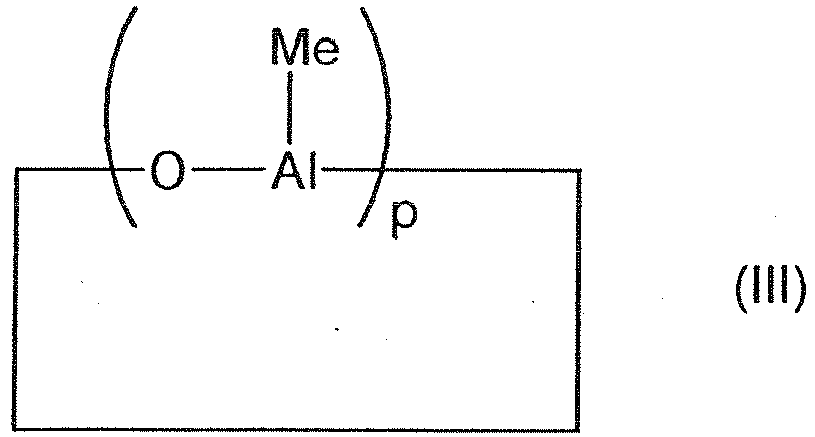
- In the formulas (II) and (III), p is a polymerization degree which is normally 3 to 50, preferably 7 to 40. The methylaluminoxane may be used alone or in combination of two or more.
- As for the amount ratio of the metallocene compound and the methylaluminoxane, the molar ratio of methylaluminoxane/metallocene compound is normally 15 to 150, preferably 20 to 120, and further preferably 25 to 100. If the molar ratio is less than 15, the catalytic activity may not be developed. In addition, a dimer of an α-olefin tends to be generated easily, and as a result, a yield of an oligomer larger than a trimer may be decreased. On the other hand, if the molar ratio exceeds 150, removal of the catalyst-derived metal component may be insufficient.
- In respect of productivity, the production method of the invention is preferably carried out without using a solvent. It is possible to use a solvent. In this case, an aromatic hydrocarbon such as benzene, toluene, xylene and ethylbenzene; an alicyclic hydrocarbon such as cyclopentane, cyclohexane and methylcyclohexane; an aliphatic hydrocarbon such as pentane, hexane, heptane and octane and halogenated hydrocarbon such as chloroform and dichloromethane can be used. These solvents may be used singly or in combination of two or more. Further, a monomer such as 1-butene can be used as a solvent.
- In the production method of the invention, there are no particular restrictions being imposed on the polymerization method. Any of bulk polymerization, solution polymerization, suspension polymerization, slurry polymerization, and vapor phase polymerization may be used.
As for the polymerization conditions, the polymerization temperature is normally 0 to 200°C, preferably 30 to 150°C and more preferably 40 to 120°C. As for the amount ratio of the catalyst relative to the raw monomer, it is preferred that the raw monomer/the metallocene catalyst (molar ratio) be 1 to 108, particularly 100 to 105. Further, the polymerization time is normally 5 minutes to 20 hours, and the reaction pressure is preferably from normal pressure to 0.2 MPaG, with from normal pressure to 0.1 MPaG being particularly preferable. - In the invention, a preliminary polymerization can be conducted by using the above-mentioned catalyst for polymerization.
A preliminary polymerization can be conducted by allowing a small amount of olefin to contact catalyst components, for example. No specific restrictions are imposed on the method, and a known method can be used. No specific restrictions are imposed on the olefin used in a preliminary polymerization, and ethylene, an α-olefin having 3 to 20 carbon atoms or a mixture thereof can be used. It is advantageous to use the same olefin as the monomer used in this polymerization. - A preliminary polymerization temperature is normally -20°C to 200°C, preferably -10°C to 130°C, and more preferably 0°C to 80°C.
In a preliminary polymerization, as a solvent, an inert hydrocarbon, an aliphatic hydrocarbon, an aromatic hydrocarbon, a monomer or the like can be used. Of these, an aliphatic hydrocarbon and an aromatic hydrocarbon are particularly preferable.
Further, a preliminary polymerization may be conducted without using a solvent. In a preliminary polymerization, it is preferred that conditions be adjusted such that the amount of a preliminary polymerization product relative to one mmol of transitional metal components in catalyst is preferably 1 to 10,000g, in particular 1 to 1,000g. - The invention will be explained hereinbelow with reference to the following examples which should not be construed as limiting the scope of the invention.
- A stainless-made autoclave with an inner volume of 1 liter was completely dried, and replaced with nitrogen. Then, 200 mL of 1-decene was placed, and the temperature thereof was elevated to 40°C. After adding 0.5 mmol of methylaluminoxane (0.25 ml of a toluene solution of 2.0 mmol/ml), 5 µmol of bis(t-butylcyclopentadienyl)zirconium dichloride (1 ml of a toluene solution of 5 µmol/ml) were placed. Immediately after, hydrogen was introduced to allow the reaction pressure to be 0.05 MPaG, and polymerization was started. After 120 minutes from the start of the polymerization, the temperature was lowered to room temperature, and a polymerization solution containing a decene oligomer was transferred to a nitrogen-filled bottle with a Schlenk cork in the atmosphere of nitrogen.
- Deactivation of a catalyst contained in the polymerization solution was conducted by means of an apparatus shown in
FIG. 2 .
Anagitation vessel 10 ofFIG.2 was purged with nitrogen. With a syringe, 400 mL of a polymerization solution in the bottle with a Schlenk cork was placed in an agitation vessel, and the solution was heated to 50°C with stirring. 100 mL of an aqueous NaOH solution (pH 13) treated by having nitrogen bubbled through for 44 hours was placed in aninput tube 20. The concentration of dissolved oxygen in an aqueous NaOH solution after nitrogen bubbling with a galvanic cell type oxygen meter (DO-24P, a portable dissolved oxygen meter manufactured by DKK-TOA Corporation) was found to be 4 wt ppm.
An aqueous NaOH solution after nitrogen bubbling was input to theagitation vessel 10, and the catalyst was deactivated with stirring for 10 minutes. Stirring was stopped and the solution was allowed to stand for 30 minutes. The solution was separated into an oil phase and an aqueous phase, and precipitates at the interface of the oil phase and the aqueous phase could not be confirmed by observing the inside of the vessel. - The resulting oil phase was filtered with a filter having a pore size of 1.00 µm (T100A-, manufactured by Advantech Co., Ltd.), and the resulting residues were washed with toluene to measure the weight of precipitates (constant weights of residues and filter paper after drying-constant weight of filter paper before filtration). As a result, the weight of precipitates which were captured was 0.0091g, and the concentration of precipitates in the oil phase was 15 wt ppm.
- A decene oligomer was produced in the same manner as in Example 1, except that no nitrogen bubbling was conducted for an aqueous NaOH solution of the deactivator, and the atmosphere of the agitation vessel was air without replacing the atmosphere inside the vessel by nitrogen. The resulting precipitates were evaluated. As a result, it was found that the amount of the precipitates which were captured was 0.2185g relative to 156g of the oil phase.
White solid sediments (precipitates) were generated between the oil phase and the aqueous phase by observing the inside of the agitation vessel. That is, essentially three phases were confirmed. - The
agitation vessel 10 shown inFIG. 2 was purged by a certain amount of nitrogen. A simulated solution was placed in theagitation vessel 10, and the solution was heated to 50°C with stirring. Into theinput tube
The aqueous NaOH solution after nitrogen bubbling was put to theagitation vessel 10. Deactivation of a catalyst was conducted by stirring for 10 minutes. The stirring was stopped and the solution was allowed to stand for 30 minutes.
The concentration of a monomer oxide generated in the resulting oil phase was evaluated. The monomer oxide concentration reflects the amount of oxygen in the agitation vessel which could not be removed by nitrogen purge. The concentration of the precipitates in the oil phase was evaluated. The results are shown in Table 1.
The simulated solution mentioned above was obtained by putting a catalyst in the polymerization solution after washing with water. - In Reference Examples 2 to 6, the concentration of the monomer oxide generated in the oil phase and the concentration of the precipitates were evaluated in the same manner as in Reference Example 1. Reference Example 7 is the same as Comparative Example 1. The results are shown in Table 1. As for Reference Examples 4 to 7, the three phases, i.e. the oil phase, the precipitates and the aqueous phase, were photographed. The results are shown in
FIG. 3 . -
Table 1 Concentration of oxides [wtppm] Amount of generated precipitates [g] Concentration of precipitates [wtppm] Ref. Ex. 1 11 - - Ref. Ex. 2 6 - - Ref. Ex. 3 8 0.0193 104 Ref. Ex. 4 3 0.0062 33 Ref. Ex. 5 - 0.0053 28 Ref. Ex. 6 5.4 0.0145 78 Ref. Ex. 7 - 0.2185 140 - For Reference Examples 3, 4 and 6, the relationship between the oxygen concentration and the concentration of the precipitates is shown in
FIG. 4 , taking the abscissa and the vertical axis as the oxide concentration and the precipitate concentration, respectively. Table 1 andFIG. 4 demonstrate that the concentration of the precipitates was increased with an increase in the concentration of an oxide (a decrease in the amount of nitrogen purge flow). This indicates that the oxygen amount relates to generation of the precipitates. - A stainless-made autoclave with an internal volume of 1 liter was completely dried, and replaced with nitrogen. Then, 200 ml of 1-decene and 0.8 mmol of methylaluminoxane were placed, and the temperature was increased to 40°C. After inputting 8 micromoles of bis(t-butylcyclopentadienyl)zirconium dichloride, 2 KPaG of hydrogen was introduced to start polymerization. After conducting a reaction at 40°C for 5 hours, the resultant was added to 50 mL of a 1 wt% aqueous NaOH solution, followed by stirring.
- For the filtration of the resulting oil phase (organic phase), a depth-pleated type cartridge filter (SHP-020-M25DKC, manufactured by Roki Techno Co., Ltd., Filtration area: 4.9 cm2) having a filtration rating of 2 µm was used to evaluate the filtration time. Specifically, as shown in
FIG. 5 , 60 ml of the oil phase was collected by using a 200-mL syringe while the oil phase was mixed with stirring, and the syringe was then connected to a filtration apparatus provided with the above-mentioned cartridge filter and the corrected oil phase was pushed under pressure to pass through the filter. The time from the start to the completion of passage in was taken as the filtration time. As a result, the filtration time was found to be 210 seconds.
The filtrate after the filtration was separated by allowing it to stand. The thus separated polymer solution was subjected to ashing by adding sulfuric acid. The aluminum concentration was measured by alkali fusion AAS, and the concentration of aluminum was 2 wt ppm. By the visual observation, the resulting filtrate was a turbid solution. The results are shown in Table 2. - Filtration was conducted in the same manner as in Evaluation Example 1 by using the filters shown in Table 2 for the periods of time shown in Table 2, and the metal concentration in the filtrate and the resulting filtrate were visually observed. The results are shown in Table 2.
The cartridge filters in Evaluation Examples 2 to 4 were SHP-030-M25DKC, SHP-050-M25DKC and SNP-030-M25DKC, respectively. No cartridge filter was used in Evaluation Example 5. -
Table 2 Filter for treatment Al concentration [wt ppm] Filtration time Filtrate Filtration rating Type Material Evaluation Ex. 1 2 µm Depth-pleated Polypropylene 2 210 sec Turbid Evaluation Ex. 2 3 µm Depth-pleated Polypropylene 5 140 sec Turbid Evaluation Ex. 3 5 µm Depth-pleated Polypropylene 7 90 sec Turbid Evaluation Ex. 4 3 µm Depth-pleated All nylon <<1 30 minutes or more Transparent Evaluation Ex. 5 - 32 - Turbid - The bag filter was evaluated by using the apparatus shown in
FIG. 6 .
16 L of an α-olefin oligomer solution obtained in the same manner as in Evaluation Example 1 was placed in a tank (T1). The solution was heated to 60°C with stirring by means of a tape heater. When the solution reached the prescribed temperature, 4 L of a 1 wt% aqueous NaOH solution which had been diluted with pure water was added, and stirring was continued for 15 minutes. Further, the resultant was allowed to stand for 15 minutes, whereby the resultant was separated into an oil phase and an aqueous phase. Thereafter, from the bottom of a T1 tank, an aqueous NaOH solution was taken out. When the mixture of precipitates into the solution was visually confirmed, taking out of an aqueous phase was stopped.
The remaining oil phase was stirred again to allow the precipitates to be dispersed. Thereafter, the pump was started, and the oil was passed through a bag filter (AccuGAF filter bag AGF-53 manufactured by Eaton Corporation, formed of polypropylene) at a constant flow rate of 4 Umin to confirm the pressure before and after the filter. - During the passage of the oil phase, sampling was conducted from the pump discharge drain and the filter outlet drain. The concentration of precipitates was quantified from the filter inlet sample and the concentrations of Al and Zr in the oil phase from the filter outlet sample to confirm the filtration rating. The results are shown in
FIG. 7 .
The Al concentration was evaluated by alkali fusion AAS after adding sulfuric acid and ashing. The Zr concentration was evaluated by ICP-AES method after ashing and an acid treatment. - By using an apparatus shown in
FIG. 8 , the bag filter used in Example 2 was cut such that the filtration area became 0.00062 m2. The oil phases which were obtained by the method described below were passed through the filter at a flow rate of 50 ml/min. The following three polymerization solutions were passed through. Specifically, a polymerization solution (30L-20°C alkaline washed oil phase) obtained by using a 30 L-reactor and putting 1 wt% aqueous NaOH solution to a polymerization solution at 20°C for stopping the polymerization; a polymerization solution (30L-80°C alkaline washed oil phase) obtained by using a 30L-reactor and putting 1 wt% aqueous NaOH solution to a polymerization solution at 80°C for stopping the polymerization; and a polymerization solution (100L-80°C alkaline washed oil phase) obtained by using a 100L-reactor and putting 1 wt% aqueous NaOH solution to a polymerization solution at 80°C for stopping the polymerization.
During the passage of the oil phase, sampling was conducted from the pump discharge drain and the filter outlet drain, the concentration of precipitates was quantified by the inlet sample. In the same manner as in Example 2, the concentrations of Al and Zr in the oil phase after the passage from the outlet sample were respectively evaluated to confirm the filtration rating. The results are shown inFIG. 9 . - The oil phases evaluated as above were obtained by enlarging the scale of the following method according to the size of the reactor.
A stainless-made autoclave with an inner volume of 5 L was completely dried. After replacement by nitrogen, 1750 ml of 1-dodecene, 1250 ml of 1-octene and subsequently 1.5 mmol of triisobutyl aluminum were placed therein. The temperature was elevated to 105°C. After putting 24 ml of a catalyst mixture solution, 0.05 MPaG of hydrogen was introduced to start the polymerization. After the lapse of 120 minutes, 24 ml of the remaining catalyst mixture was added, and the resultant was allowed to react at 105°C for 120 minutes. The content was taken out and added to 750 ml of a 1 wt% aqueous NaOH solution. The resulting mixture was stirred and the polymerization was stopped. This solution was transferred to a separatory funnel to isolate the oil phase. - The above-mentioned catalyst mixture solution was obtained as follows. Specifically, in a 100 mL-glass made bottle with a Schlenk cork, 3 mmol of triisobutyl aluminum (6 mL of a toluene solution of 0.5 mmol/mL), 60 µmol of (1,1'-dimethylsilylene)(2,2'-dimethylsilylene)-bis(cyclopentadienyl)zirconium dichloride (12 mL of a toluene solution of 5 µmol/mL) and 0.12 mmol (96 mg) of powdery N,N-diemthylanilinium tetrakis(pentafluorophenyl)borate were placed, and the resultant was stirred at room temperature for 1 minute. Thereafter, 15 mL of 1-octene and 15 mL of 1-dodecene were added, followed by further stirring for 1 hour at room temperature.
- The α-olefin oligomer obtained by the method of the invention can be preferably used for lubricant oil which requires high quality since it contains almost no catalyst-derived metal components.
- Although only some exemplary embodiments and/or examples of this invention have been described in detail above, those skilled in the art will readily appreciate that many modifications are possible in the exemplary embodiments and/or examples without materially departing from the novel teachings and advantages of this invention. Accordingly, all such modifications are intended to be included within the scope of this invention.
The documents described in the specification are incorporated herein by reference in its entirety.
Claims (8)
- A method for producing an α-olefin oligomer comprising:polymerizing in the presence of a catalyst one or more α-olefins having 6 to 20 carbon atoms to produce an α-olefin oligomer; anddeactivating the catalyst by a deactivator from which oxygen is removed.
- The method for producing an α-olefin oligomer according to claim 1, wherein the oxygen in the deactivator is removed by nitrogen bubbling.
- The method for producing an α-olefin oligomer according to claim 1 or 2, wherein the concentration of oxygen in the deactivator after removal thereof is 1 mg/L or less.
- The method for producing an α-olefin oligomer according to any of claims 1 to 3, wherein the catalyst is deactivated in an atmosphere of an inert gas.
- A method for producing an α-olefin oligomer comprising:polymerizing in the presence of a catalyst one or more α-olefins having 6 to 20 carbon atoms to produce an α-olefin oligomer; andpassing the reaction solution containing the α-olefin oligomer through a bag filter.
- The method for producing an α-olefin oligomer according to claim 5, wherein the filtration rating of the bag filter is 5 µm or less.
- The method for producing an α-olefin oligomer according to claim 5 or 6, wherein the filter of the bag filter comprises polypropylene.
- An α-olefin oligomer which is produced by the method for producing an α-olefin oligomer according to any of claims 1 to 7.
Applications Claiming Priority (3)
| Application Number | Priority Date | Filing Date | Title |
|---|---|---|---|
| JP2011005501 | 2011-01-14 | ||
| JP2011005502 | 2011-01-14 | ||
| PCT/JP2012/000101 WO2012096160A1 (en) | 2011-01-14 | 2012-01-11 | Processes for producing α-olefin oligomer |
Publications (1)
| Publication Number | Publication Date |
|---|---|
| EP2664603A1 true EP2664603A1 (en) | 2013-11-20 |
Family
ID=46507069
Family Applications (1)
| Application Number | Title | Priority Date | Filing Date |
|---|---|---|---|
| EP12734029.7A Withdrawn EP2664603A1 (en) | 2011-01-14 | 2012-01-11 | Processes for producing -olefin oligomer |
Country Status (7)
| Country | Link |
|---|---|
| US (1) | US8816034B2 (en) |
| EP (1) | EP2664603A1 (en) |
| JP (2) | JP5868875B2 (en) |
| CN (1) | CN103328414A (en) |
| CA (1) | CA2824274A1 (en) |
| SG (1) | SG191072A1 (en) |
| WO (1) | WO2012096160A1 (en) |
Families Citing this family (11)
| Publication number | Priority date | Publication date | Assignee | Title |
|---|---|---|---|---|
| WO2007011462A1 (en) | 2005-07-19 | 2007-01-25 | Exxonmobil Chemical Patents Inc. | Lubricants from mixed alpha-olefin feeds |
| US9382358B2 (en) | 2011-07-13 | 2016-07-05 | Idemitsu Kosan Co., Ltd. | Method for producing olefin polymer |
| JP5735367B2 (en) | 2011-07-13 | 2015-06-17 | 出光興産株式会社 | Process for producing olefin polymer |
| JP2013209541A (en) * | 2012-03-30 | 2013-10-10 | Idemitsu Kosan Co Ltd | Apparatus for producing organic compound |
| KR101761395B1 (en) | 2015-04-15 | 2017-07-25 | 주식회사 엘지화학 | Ligand compound, catalyst system for oligomerization, and method for olefin oligomerization using the same |
| US10059898B2 (en) | 2015-08-21 | 2018-08-28 | Exxonmobil Chemical Patents Inc. | High-viscosity metallocene polyalpha-olefins with high electrohydrodynamic performance |
| EP3337880A1 (en) | 2015-08-21 | 2018-06-27 | ExxonMobil Chemical Patents Inc. | Lubricant base stock blends |
| US10611980B2 (en) | 2015-10-15 | 2020-04-07 | Exxonmobil Chemical Patents Inc. | Lubricant containing high-viscosity metallocene polyalpha-olefins |
| US10351488B2 (en) | 2016-08-02 | 2019-07-16 | Exxonmobil Chemical Patents Inc. | Unsaturated polyalpha-olefin materials |
| KR102334363B1 (en) * | 2017-09-29 | 2021-12-02 | 에스케이이노베이션 주식회사 | Process for preparing oligomer using olefin |
| CN113522191B (en) * | 2020-04-20 | 2022-11-15 | 中国石油化工股份有限公司 | Apparatus and method for preparing polyalphaolefin |
Family Cites Families (11)
| Publication number | Priority date | Publication date | Assignee | Title |
|---|---|---|---|---|
| JPH08301926A (en) | 1995-05-01 | 1996-11-19 | Asahi Chem Ind Co Ltd | Method for aftertreating alpha-olefin polymer after reaction |
| JP3501330B2 (en) | 1996-11-13 | 2004-03-02 | 出光石油化学株式会社 | Method for producing polymer provided with means for removing catalyst residue, and monomer recovery device used therefor |
| JPH10158308A (en) | 1996-12-02 | 1998-06-16 | Mitsui Chem Inc | Bag filter for gaseous phase polymerizer |
| WO2001082008A1 (en) * | 2000-04-27 | 2001-11-01 | Bp Corporation North America Inc. | Method for control of a chemical manufacturing process |
| WO2005024522A1 (en) * | 2003-09-03 | 2005-03-17 | Zeon Corporation | Toner |
| JP4434713B2 (en) | 2003-12-05 | 2010-03-17 | 出光興産株式会社 | Catalyst deactivation method |
| JP2007021347A (en) * | 2005-07-14 | 2007-02-01 | Idemitsu Kosan Co Ltd | Treatment of water containing persistent substances |
| EP1754694A1 (en) | 2005-08-10 | 2007-02-21 | Linde AG | Method for deactivation and removal of catalytic components in the oligomerisation of ethylene |
| JP2009007386A (en) | 2006-02-17 | 2009-01-15 | Kaneka Corp | Production method of isobutylene polymer |
| JP2008231261A (en) | 2007-03-20 | 2008-10-02 | Sumitomo Chemical Co Ltd | Process for producing olefin polymer and olefin polymer |
| JP2009101981A (en) * | 2007-10-02 | 2009-05-14 | Osumo:Kk | Car wash method and car wash apparatus |
-
2012
- 2012-01-11 CN CN201280005258XA patent/CN103328414A/en active Pending
- 2012-01-11 JP JP2012552677A patent/JP5868875B2/en active Active
- 2012-01-11 WO PCT/JP2012/000101 patent/WO2012096160A1/en not_active Ceased
- 2012-01-11 US US13/978,971 patent/US8816034B2/en active Active
- 2012-01-11 SG SG2013044300A patent/SG191072A1/en unknown
- 2012-01-11 CA CA2824274A patent/CA2824274A1/en not_active Abandoned
- 2012-01-11 EP EP12734029.7A patent/EP2664603A1/en not_active Withdrawn
-
2016
- 2016-01-05 JP JP2016000358A patent/JP6326072B2/en active Active
Non-Patent Citations (1)
| Title |
|---|
| See references of WO2012096160A1 * |
Also Published As
| Publication number | Publication date |
|---|---|
| US20130296518A1 (en) | 2013-11-07 |
| WO2012096160A1 (en) | 2012-07-19 |
| SG191072A1 (en) | 2013-07-31 |
| CN103328414A (en) | 2013-09-25 |
| JP6326072B2 (en) | 2018-05-16 |
| CA2824274A1 (en) | 2012-07-19 |
| JPWO2012096160A1 (en) | 2014-06-09 |
| US8816034B2 (en) | 2014-08-26 |
| JP2016041829A (en) | 2016-03-31 |
| JP5868875B2 (en) | 2016-02-24 |
Similar Documents
| Publication | Publication Date | Title |
|---|---|---|
| US8816034B2 (en) | Method for producing alpha-olefin oligomer | |
| KR102009005B1 (en) | Method for producing solid polymethylaluminoxane composition having small particle diameter | |
| KR101721277B1 (en) | Process for controlling the viscosity of polyalphaolefins | |
| CN1049899C (en) | Process for the preparation of a bridged metallocene compound as well as a catalyst component and a process for the polymerization of olefins | |
| JP5555490B2 (en) | Method for producing polyolefin using metallocene catalyst | |
| JP5856561B2 (en) | Solid support-polymethylaluminoxane complex, method for producing the same, polymerization catalyst for olefins, and method for producing polyolefins | |
| CN1124296C (en) | Ethylene copolymerization method | |
| KR102574150B1 (en) | Solid State MAO Composition Containing Al2O3 and Manufacturing Method Thereof | |
| JP2009543927A5 (en) | ||
| US20100069687A1 (en) | Process for synthesis of polyalphaolefin and removal of residual catalyst components | |
| CN1351615A (en) | aggregation method | |
| EP2059538B1 (en) | Process for removal of residual catalyst components | |
| CN105008409A (en) | α-olefin polymer and method for producing hydrogenated α-olefin polymer | |
| JP2020147629A (en) | Method for producing ethylene-based polymer | |
| CN103562234A (en) | Borane activated titanium catalyst system comprising guanidine and diene ligands | |
| US9056931B2 (en) | Method for producing olefin polymer | |
| JP7216958B2 (en) | High-purity solid aluminoxane and method for producing the same | |
| JP2000143718A (en) | Method for recovering polymerization solvent and / or unreacted olefin and method for producing polyolefin | |
| US10793652B2 (en) | Solid PMAO composition and method for producing same | |
| WO2014047538A1 (en) | Production of vinyl terminated polyethylene using supported catalyst system |
Legal Events
| Date | Code | Title | Description |
|---|---|---|---|
| PUAI | Public reference made under article 153(3) epc to a published international application that has entered the european phase |
Free format text: ORIGINAL CODE: 0009012 |
|
| 17P | Request for examination filed |
Effective date: 20130723 |
|
| AK | Designated contracting states |
Kind code of ref document: A1 Designated state(s): AL AT BE BG CH CY CZ DE DK EE ES FI FR GB GR HR HU IE IS IT LI LT LU LV MC MK MT NL NO PL PT RO RS SE SI SK SM TR |
|
| DAX | Request for extension of the european patent (deleted) | ||
| STAA | Information on the status of an ep patent application or granted ep patent |
Free format text: STATUS: THE APPLICATION HAS BEEN WITHDRAWN |
|
| 18W | Application withdrawn |
Effective date: 20140708 |