EP2664595B1 - Process for preparing a plasticizer-containing hardening accelerator composition - Google Patents
Process for preparing a plasticizer-containing hardening accelerator composition Download PDFInfo
- Publication number
- EP2664595B1 EP2664595B1 EP13179257.4A EP13179257A EP2664595B1 EP 2664595 B1 EP2664595 B1 EP 2664595B1 EP 13179257 A EP13179257 A EP 13179257A EP 2664595 B1 EP2664595 B1 EP 2664595B1
- Authority
- EP
- European Patent Office
- Prior art keywords
- branched
- calcium
- group
- alkyl group
- process according
- Prior art date
- Legal status (The legal status is an assumption and is not a legal conclusion. Google has not performed a legal analysis and makes no representation as to the accuracy of the status listed.)
- Active
Links
- 0 C*C(C(*)(*)C(*1)=O)C1=O Chemical compound C*C(C(*)(*)C(*1)=O)C1=O 0.000 description 1
Images


Classifications
-
- C—CHEMISTRY; METALLURGY
- C04—CEMENTS; CONCRETE; ARTIFICIAL STONE; CERAMICS; REFRACTORIES
- C04B—LIME, MAGNESIA; SLAG; CEMENTS; COMPOSITIONS THEREOF, e.g. MORTARS, CONCRETE OR LIKE BUILDING MATERIALS; ARTIFICIAL STONE; CERAMICS; REFRACTORIES; TREATMENT OF NATURAL STONE
- C04B40/00—Processes, in general, for influencing or modifying the properties of mortars, concrete or artificial stone compositions, e.g. their setting or hardening ability
- C04B40/0028—Aspects relating to the mixing step of the mortar preparation
- C04B40/0039—Premixtures of ingredients
- C04B40/0042—Powdery mixtures
-
- C—CHEMISTRY; METALLURGY
- C04—CEMENTS; CONCRETE; ARTIFICIAL STONE; CERAMICS; REFRACTORIES
- C04B—LIME, MAGNESIA; SLAG; CEMENTS; COMPOSITIONS THEREOF, e.g. MORTARS, CONCRETE OR LIKE BUILDING MATERIALS; ARTIFICIAL STONE; CERAMICS; REFRACTORIES; TREATMENT OF NATURAL STONE
- C04B28/00—Compositions of mortars, concrete or artificial stone, containing inorganic binders or the reaction product of an inorganic and an organic binder, e.g. polycarboxylate cements
- C04B28/02—Compositions of mortars, concrete or artificial stone, containing inorganic binders or the reaction product of an inorganic and an organic binder, e.g. polycarboxylate cements containing hydraulic cements other than calcium sulfates
-
- C—CHEMISTRY; METALLURGY
- C04—CEMENTS; CONCRETE; ARTIFICIAL STONE; CERAMICS; REFRACTORIES
- C04B—LIME, MAGNESIA; SLAG; CEMENTS; COMPOSITIONS THEREOF, e.g. MORTARS, CONCRETE OR LIKE BUILDING MATERIALS; ARTIFICIAL STONE; CERAMICS; REFRACTORIES; TREATMENT OF NATURAL STONE
- C04B2103/00—Function or property of ingredients for mortars, concrete or artificial stone
- C04B2103/10—Accelerators; Activators
- C04B2103/14—Hardening accelerators
-
- Y—GENERAL TAGGING OF NEW TECHNOLOGICAL DEVELOPMENTS; GENERAL TAGGING OF CROSS-SECTIONAL TECHNOLOGIES SPANNING OVER SEVERAL SECTIONS OF THE IPC; TECHNICAL SUBJECTS COVERED BY FORMER USPC CROSS-REFERENCE ART COLLECTIONS [XRACs] AND DIGESTS
- Y02—TECHNOLOGIES OR APPLICATIONS FOR MITIGATION OR ADAPTATION AGAINST CLIMATE CHANGE
- Y02W—CLIMATE CHANGE MITIGATION TECHNOLOGIES RELATED TO WASTEWATER TREATMENT OR WASTE MANAGEMENT
- Y02W30/00—Technologies for solid waste management
- Y02W30/50—Reuse, recycling or recovery technologies
- Y02W30/91—Use of waste materials as fillers for mortars or concrete
Definitions
- the present invention relates to a process for the preparation of a hardening accelerator composition, the hardening accelerator composition and the use of the hardening accelerator composition.
- admixtures in the form of dispersants are often added to aqueous slurries of pulverulent inorganic or organic substances, such as clays, silicate powders, chalks, carbon blacks, powdered rocks and hydraulic binders, for improving their workability, i.e. kneadability, spreadability, sprayability, pumpability or flowability.
- Such admixtures are capable of breaking up solid agglomerates, dispersing the particles formed and in this way improving the fluidity.
- This effect is also utilised in a targeted manner in particular in the preparation of building material mixtures which contain hydraulic binders, such as cement, lime, gypsum, calcium sulphate hemihydrate (bassanite), anhydrous calcium sulphate (anhydrite), or latent hydraulic binders, such as fly ash, blast furnace slag or pozzolans.
- hydraulic binders such as cement, lime, gypsum, calcium sulphate hemihydrate (bassanite), anhydrous calcium sulphate (anhydrite), or latent hydraulic binders, such as fly ash, blast furnace slag or pozzolans.
- admixtures which are generally referred to as water-reducer compositions or plasticizers are used.
- copolymers which are prepared by free radical copolymerization of acid monomers with polyether macromonomers are used in practice as such compositions.
- admixtures for building material mixtures comprising hydraulic binders typically also contain hardening accelerators which shorten the setting time of the hydraulic binder.
- hardening accelerators which shorten the setting time of the hydraulic binder.
- calcium silicate hydrate in particular present in dispersed (finely or particularly finely dispersed) form can be used as such a hardening accelerator.
- commercially available calcium silicate hydrate or corresponding calcium silicate hydrate dispersions may be regarded only as hardening accelerators which have little effect.
- JP 2002187758 A describes the production of a cement plate which involves preparing an aqueous slurry by mixing a powdery cement material, reinforcing fibers and fumed silica and forming the plate.
- JP 200158863 A describes a kneaded cement mixture which is prepared by kneading a material which releases calcium ions in water, a polycarboxylate polymer and fine silica. The cement mixture gives rise to a reduced kneading load and ultrahigh strength concrete and mortar.
- JP 200095554 A describes an ultrahigh early-strength cement composition which is obtained by adding silica sol to the cence.
- WO 2005/077857 A2 describes an ultra-high performance, self-compacting concrete which comprises cement, a mixture of calcined bauxite sands of various particle sizes, silica fume and ultrafine calcium carbonate particles as well as other additives.
- the cement is obtained by mixing the constituents until a concrete of the desired fluidity is obtained.
- the Ph.D. thesis of Markus Arnold, 1 January 2004 relates to the polymer controlled preparation of calcium silicate hydrate by adding a calcium chloride solution to a sodium silicate solution or by a hydrothermal reaction between calcium oxide and pyrogenic silica.
- US 5,709,743 describes the use of an aqueous suspension of a siliceous hydraulic binder as an accelerator for the setting and hardening of said binder.
- the object of the present invention is to provide a composition which acts in particular as a hardening accelerator and moreover performs as a plasticizer.
- This object is achieved by a process for the preparation of a hardening accelerator composition by reaction of a calcium compound, preferably a calcium salt, most preferably a water-soluble calcium salt, with a silicon dioxide containing component under alkaline conditions at a temperature not exceeding 80 °C and by applying milling, the reaction being carried out in the presence of an aqueous solution of a water-soluble comb polymer suitable as a plasticizer for hydraulic binders.
- a calcium compound preferably a calcium salt, most preferably a water-soluble calcium salt
- the calcium compounds are calcium salts (e.g. calcium salts of carboxylic acids).
- the calcium salt can be for example calcium chloride, calcium nitrate, calcium formate, calcium acetate, calcium bicarbonate, calcium bromide, calcium carbonate, calcium citrate, calcium chlorate, calcium fluoride, calcium gluconate, calcium hydroxide, calcium oxide, calcium hypochlorite, calcium iodate, calcium iodide, calcium lactate, calcium nitrite, calcium oxalate, calcium phosphate, calcium propionate, calcium silicate, calcium stearate, calcium sulphate, calcium sulphate hemihydrate, calcium sulphate dihydrate, calcium sulphide, calcium tartrate, calcium aluminate, tricalcium silicate and/or dicalcium silicate.
- the water-soluble calcium compound is not a calcium silicate.
- the silicates calcium silicate, dicalcium silicate and/or tricalcium silicate are less preferred because of low solubility (especially in the case of calcium silicate) and for economic reasons (price) (especially in case of dicalcium silicate and tricalcium silicate).
- Less preferable are also not so good soluble calcium salts like for example calcium carbonate and also calcium salts with retarding anions (e.g. citrate, gluconate, tartrate can retard the hardening of hydraulic binders).
- neutral or acid calcium salts e.g.
- a suitable base to adjust the pH-value to alkaline conditions (e.g. lithium hydroxide, sodium hydroxide, potassium hydroxide, ammonia, magnesium hydroxide or any other earth alkali hydroxide).
- a pH-value higher than 8 more preferable higher than 9 and most preferable higher than 11.
- the pH-value is measured preferably at 25 °C and with a solid content of the suspension of 1 weight %.
- any material which contains silicon dioxide for example microsilica, pyrogenic silica, precipitated silica, blast furnace slag, and/or quartz sand. Small particle sizes of the silicon dioxide containing material are preferable, especially particle sizes below 1 ⁇ m. Further it is possible to use compounds which are able to react in an aqueous alkaline environment to silicon dioxide like for example tetraalkoxy silicon compounds of the general formula Si(OR) 4 .
- R can be the same or different and can be for example selected from a branched or non-branched C1 to C10 alkyl group. Preferably R is methyl, especially preferably ethyl.
- the silicon dioxide containing compound is selected from the group of microsilica, pyrogenic silica, precipitated silica, blast furnace slag and/or quartz sand.
- microsilica, pyrogenic silica and/or precipitated silica especially precipitated and/or pyrogenic silica.
- the types of silica, which are listed above are defined in Ullmann's Encyclopedia of Industrial Chemistry, Wiley-VCH, Release 2009, 7th Edition, DOI 10.1002/14356007.a23_583.pub3 .
- milling means herein any process in which high shear forces are exerted on the reaction mixture in order to accelerate the reaction and to obtain a suitable particle size.
- milling can be carried out in a planet ball mill in a continuous or batch operation mode.
- an ultradisperser preferably with a number of revolutions higher than 5.000 r.p.m. can be used.
- shaker equipment in which small grinding bodies, preferably smaller than 1 mm in diameter are put together with the reaction mixture into a receptacle and are shaken.
- the respective shaker equipment is for example available from the company Skandex.
- pH-value of the process for the preparation of a hardening accelerator is higher than 9.
- the molar ratio of calcium from the calcium compound to silicon from the silicon dioxide containing component is from 0.6 to 2, preferably 1.1 to 1.8.
- the weight ratio of water to the sum of calcium compound and silicon dioxide containing component is from 0.2 to 50, preferably 2 to 10, most preferably 4 to 6.
- water means the water in the reaction mixture, in which the process is carried out. It is preferable to carry out the process at relatively low water contents in order to increase the output of the process. Also it is possible to obtain relatively conveniently dry products from the wet products because not so much water has to be removed. A ratio of 2 to 10, respectively 4 to 6 is especially preferred because a paste like consistency of the products can be obtained, which is preferable for the milling process.
- the water-soluble comb polymer suitable as a plasticizer for hydraulic binders is present as a copolymer which contains, on the main chain, side chains having ether functions and acid functions.
- the water-soluble comb polymer suitable as a plasticizer for hydraulic binders is present as a copolymer which is produced by free radical polymerization in the presence of acid monomer, preferably carboxylic acid monomer, and polyether macromonomer, so that altogether at least 45 mol %, preferably at least 80 mol %, of all structural units of the copolymer are produced by incorporation of acid monomer, preferably carboxylic acid monomer, and polyether macromonomer in the form of polymerized units.
- Acid monomer is to be understood as meaning monomers which are capable of free radical copolymerization, have at least one carbon double bond, contain at least one acid function, preferably a carboxylic acid function, and react as an acid in an aqueous medium.
- acid monomer is also to be understood as meaning monomers which are capable of free radical copolymerization, have at least one carbon double bond, form at least one acid function, preferably a carboxylic acid function, in an aqueous medium as a result of a hydrolysis reaction and react as an acid in an aqueous medium (example: maleic anhydride or hydrolysable esters of (meth)acrylic acid).
- polyether macromonomers are compounds which are capable of free radical copolymerization, have at least one carbon double bond, and have at least two ether oxygen atoms, with the proviso that the polyether macromonomer structural units present in the copolymer have side chains which contain at least two ether oxygen atoms, preferably at least 4 ether oxygen atoms, more preferably at least 8 ether oxygen atoms, most preferably at least 15 ether oxygen atoms.
- Structural units which do not constitute an acid monomer or a polyether macromonomer can be for example styrene and derivatives of styrene (for example methyl substituted derivatives), vinyl acetate, vinyl pyrrolidon, butadiene, vinyl proprionate, unsaturated hydrocarbons like for example ethylene, propylene and/or (iso)butylene.
- styrene and derivatives of styrene for example methyl substituted derivatives
- vinyl acetate vinyl pyrrolidon
- butadiene vinyl proprionate
- unsaturated hydrocarbons like for example ethylene, propylene and/or (iso)butylene.
- This listing is a non-exhaustive enumeration.
- Preferable are monomers with not more than one carbon double bond.
- the water-soluble comb-polymer suitable as plasticizer for hydraulic binders is a copolymer of styrene and a half ester of maleic acid with a monofunctional polyalkylene glycol.
- a copolymer can be produced by free radical polymerization of the monomers styrene and maleic anhydride (or maleic acid) in a first step.
- polyalkylene glycols preferably alkyl polyalkylene glycols (preferably alkyl polyethylene glycols, most preferably methyl polyethyleneglycol) are reacted with the copolymer of styrene and maleic anhydride in order to to achieve an esterification of the acid groups.
- Styrene can be completely or partially replaced by styrene derivatives, for example methyl substituted derivatives.
- Copolymers of this preferred embodiment are described in US 5,158,996 .
- a structural unit is produced in the copolymer by incorporation of the acid monomer in the form of polymerized units, which structural unit is in accordance with the general formulae (Ia), (Ib), (Ic) and/or (Id) where
- a structural unit is produced in the copolymer by incorporation of the polyether macromonomer in the form of polymerized units, which structural unit is in accordance with the general formulae (IIa), (IIb) and/or (IIc) where
- a structural unit is produced in the copolymer by incorporation of the polyether macromonomer in the form of polymerized units, which structural unit is in accordance with the general formula (IId) where
- Alkoxylated isoprenol and/or alkoxylated hydroxybutyl vinyl ether and/or alkoxylated (meth)allyl alcohol and/or vinylated methylpolyalkylene glycol having preferably in each case an arithmetic mean number of 4 to 340 oxyalkylene groups is preferably used as the polyether macromonomer.
- Methacrylic acid, acrylic acid, maleic acid, maleic anhydride, a monoester of maleic acid or a mixture of a plurality of these components is preferably used as the acid monomer.
- the process according to this invention is carried out at a site of concrete production (for example a ready-mix concrete, precast concrete plant or any other plant where mortar, concrete or any other cementitious products are produced), whereby the obtained hardening accelerator composition is used as the batching water.
- the obtained hardening accelerator composition is an aqueous system and can be used directly as the batching water, especially when designing the hardening accelerators according to the specific needs of a job-site.
- Batching water in this context is the water, which is used in concrete production or production of similar cementitious materials.
- the batching water is mixed with cement and for example, aggregates at a ready mix concrete plant or precast concrete plant, at a construction site or any other place where concrete or other cementitious materials are produced.
- the batching water can contain a wide range of additives like for example plasticizers, hardening accelerators, retarders, shrinkage reducing additives, air entrainers and/or defoamers. It is advantageous to produce the hardening accelerators according to this invention in the batching water intended for production of concrete or similar materials, because there is no need to transport the respective admixtures.
- the aqueous solution in which the reaction is carried out contains besides the comb polymer a second polymer.
- the second polymer is a polycondensate as described in the previous text of this embodiment and following embodiments.
- the comb polymer used together with the polycondensate is obtainable by a radical polymerization.
- polycondensates according to this embodiment are known in the prior art ( US 20080108732 A1 ) to be effective as a superplasticiser in cementitious compositions.
- US 20080108732 A1 describes polycondensates based on an aromatic or heteroaromatic compound (A) having 5 to 10 C atoms or heteroatoms, having at least one oxyethylene or oxypropylene radical, and an aldehyde (C) selected from the group consisting of formaldehyde, glyoxylic acid and benzaldehyde or mixtures thereof, which result in an improved plasticizing effect of inorganic binder suspensions compared with the conventionally used polycondensates and maintain this effect over a longer period ("slump retention").
- these may also be phosphated polycondensates.
- the polycondensate contains (I) at least one structural unit consisting of an aromatic or heteroaromatic moiety bearing a polyether side chain, preferably a polyalkylene glycol side chain, more preferably a polyethylene glycol side chain.
- the structural unit consisting of an aromatic or heteroaromatic moiety bearing a polyether side chain, preferably a polyethylene glycol side chain is selected preferably from the group of alkoxylated, preferably ethoxylated, hydroxy-functionalized aromates or heteroaromates (for example the aromates can be selected from phenoxyethanol, phenoxypropanol, 2-alkoxyphenoxyethanols, 4-alkoxyphenoxyethanols, 2-alkylphenoxyethanols, 4-alkylphenoxyethanols) and/or alkoxylated, preferably ethoxylated, amino-functionalized aromates or heteroaromates (for example the aromates can be selected from N,N-(Dihydroxyethyl)aniline, N,-(Hydroxye
- alkoxylated phenol derivatives for example phenoxyethanol or phenoxypropanol
- alkoxylated, especially ethoxylated phenol derivatives featuring weight average molecular weights between 300 g/mol and 10,000 g/mol for example polyethylenglycol monophenylethers.
- the polycondensate contains (II) at least one phosphated structural unit consisting of an aromatic or heteroaromatic moiety bearing at least one phosphoric acid ester group and/or a salt of the phosphoric acid ester group, which is selected preferably from the group of alkoxylated hydroxy-functionalized aromates or heteroaromates (for example phenoxyethanol phosphate, polyethylenglycol monophenylether phosphates) and/or alkoxylated amino-functionalized aromates or heteroaromates (for example N,N-(Dihydroxyethyl)aniline diphosphate, N,N-(Dihydroxyethyl)aniline phosphate, N,-(Hydroxypropyl)aniline phosphate), which bear at least one phosphoric acid ester group and/or a salt of the phosphoric acid ester group (e.g.
- alkoxylated phenols bearing at least one phosphoric acid ester group and/or a salt of the phosphoric acid ester group for example polyethylenglycol monophenylether phosphates with less than 25 ethylene glycol units
- alkoxylated phenols featuring weight average molecular weights between 200 g/mol and 600 g/mol for example phenoxyethanol phosphate, polyethylenglycol monophenylether phosphates with 2 to 10 ethyleneglycol units
- the alkoxylated phenols bearing at least one phosphoric acid ester group and/or a salt of the phosphoric acid ester group e.g. by esterification with phosphoric acid and optional addition of bases.
- the groups A and D in the general formulae (I) and (II) of the polycondensate are preferably represented by phenyl, 2-hydroxyphenyl, 3-hydroxyphenyl, 4-hydroxyphenyl, 2-methoxyphenyl, 3-methoxyphenyl, 4-methoxyphenyl, naphthyl, 2-hydroxynaphthyl, 4-hydroxynaphthyl, 2-methoxynaphthyl, 4-methoxynaphthyl, preferably phenyl, it being possible for A and D to be chosen independently of one another and also in each case to consist of a mixture of said compounds.
- the groups B and E, independently of one another are preferably represented by O.
- the radicals R 1 , R 2 , R 3 and R 4 can be chosen independently of one another and are preferably represented by H, methyl, ethyl or phenyl, particularly preferably by H or methyl and especially preferably by H.
- a is preferably represented by an integer from 1 to 300, in particular 3 to 200 and particularly preferably 5 to 150 and b in general formula (II) by an integer from 1 to 300, preferably 1 to 50 and particularly preferably 1 to 10.
- the respective radicals the length of which is defined by a and b, respectively, may consist here of uniform building blocks, but a mixture of different building blocks may also be expedient.
- the radicals of the general formulae (I) or (II), independently of one another, may each have the same chain length, a and b each being represented by a number. As a rule, however, it will be expedient if mixtures having different chain lengths are present in each case so that the radicals of the structural units in the polycondensate have different numerical values for a and independently for b.
- the phosphated polycondensate according to the invention has a weight average molecular weight of 5.000 g/mol to 200.000 g/mol, preferably 10.000 to 100.000 g/mol and particularly preferably 15.000 to 55.000 g/mol.
- the phosphated polycondensate can be present also in form of its salts, as for example the sodium, potassium, organic ammonium, ammonium and/or calcium salt, preferably as the sodium and/or calcium salt.
- the molar ratio of the structural units (I):(II) is 1:10 to 10:1, preferably 1:8 to 1:1. It is advantageous to have a relatively high proportion of structural units (II) in the polycondensate because a relatively high negative charge of the polymers has a good influence on the stability of the suspensions.
- the polycondensate contains a further structural unit (III) which is represented by the following formula where
- the polycondensates are typically prepared by a process in which (I) at least one structural unit consisting of an aromatic or heteroaromatic moiety bearing a polyether side chain (for example poly(ethyleneglycol)monophenyl ether) and (II) at least one structural unit consisting of an aromatic or heteroaromatic moiety bearing at least one phosphoric acid ester group and/or a salt of the phosphoric acid ester group (for example phenoxyethanol phosphoric acid ester) are reacted with (IIIa) a monomer having a keto group.
- the monomer having a keto group is represented by the general formula (IIIa), where
- the monomer having a keto group is selected from the group of ketones, preferably being an aldehyde, most preferably formaldehyde.
- ketones preferably being an aldehyde, most preferably formaldehyde.
- Examples for chemicals according to general structure (IIIa) are formaldehyde, acetaldehyde, acetone, glyoxylic acid and/or benzaldehyde. Formaldehyde is preferable.
- R 5 and R 6 in structural unit (III), independently of one another, are H, COOH or methyl. Most preferably H.
- the molar ratio of the structural units [(I) + (II)] : (III) is 1: 0.8 to 3 in the polycondensate.
- the polycondensation is carried out in the presence of an acidic catalyst, this catalyst preferably being sulphuric acid, methanesulphonic acid, para-toluenesulphonic acid or mixtures thereof.
- an acidic catalyst preferably being sulphuric acid, methanesulphonic acid, para-toluenesulphonic acid or mixtures thereof.
- the polycondensation and the phosphation are advantageously carried out at a temperature between 20 and 150 °C and a pressure between 1 and 10 bar. In particular, a temperature range between 80 and 130°C has proved to be expedient.
- the duration of the reaction may be between 0.1 and 24 hours, depending on temperature, the chemical nature of the monomers used and the desired degree of crosslinking.
- Crosslinking can preferably occur if monosubstituted monomers of structural unit I and/or II are used because the condensation reaction can occur in the two ortho positions and the para position. Once the desired degree of polycondensation has been reached, which can also be determined, for example, by measurement of the viscosity of the reaction mixture, the reaction mixture is cooled.
- the reaction mixture might be subjected to a thermal after treatment at a pH between 8 and 13 and a temperature between 60 and 130°C after the end of the condensation and phosphation reaction.
- a thermal after treatment which advantageously lasts for between 5 minutes and 5 hours, it is possible substantially to reduce the aldehyde content, in particular the formaldehyde content, in the reaction solution.
- the reaction mixture can be subjected to a vacuum treatment or other methods known in the prior art to reduce the content of (form)aldehyde.
- reaction solutions In order to obtain a better shelf life and better product properties, it is advantageous to treat the reaction solutions with basic compounds. It is therefore to be regarded as being preferred to react the reaction mixture after the end of the reaction with a basic sodium, potassium, ammonium or calcium compound. Sodium hydroxide, potassium hydroxide, ammonium hydroxide or calcium hydroxide has proved to be particularly expedient here, it being regarded as being preferred to neutralize the reaction mixture.
- Sodium hydroxide, potassium hydroxide, ammonium hydroxide or calcium hydroxide has proved to be particularly expedient here, it being regarded as being preferred to neutralize the reaction mixture.
- other alkali metal and alkaline earth metal salts and salts of organic amine are suitable as salts of the phosphated polycondensates as well.
- Mixed salts of the phosphated polycondensates can also be prepared by reaction of the polycondensates with at least two basic compounds.
- the catalyst used can also be separated off. This can conveniently be done via the salt formed during the neutralization. If sulphuric acid is used as a catalyst and the reaction solution is treated with calcium hydroxide, the calcium sulphate formed can be separated off, for example, in a simple manner by filtration.
- the phosphated polycondensate can be separated from the aqueous salt solution by phase separation and can be isolated.
- the phosphated polycondensate can then be taken up in the desired amount of water.
- other methods known to the person skilled in the art such as dialysis, ultrafiltration or the use of an ion exchanger, are also suitable for separating off the catalyst.
- the reaction is carried out completely or partially in the presence of an aqueous solution containing a viscosity enhancer polymer, selected from the group of polysaccharide derivatives and/or (co)polymers with an average molecular weight M w higher than 500.000 g/mol, more preferably higher than 1.000.000 g/mol, the (co)polymers containing structural units derived (preferably by free radical polymerization) from non-ionic (meth)acrylamide monomer derivatives and/or sulphonic acid monomer derivatives. It is possible that the viscosity enhancer polymer is added at the beginning, during the process or at the end of the process.
- a viscosity enhancer polymer selected from the group of polysaccharide derivatives and/or (co)polymers with an average molecular weight M w higher than 500.000 g/mol, more preferably higher than 1.000.000 g/mol, the (co)polymers containing structural units derived (preferably by free radical polymerization) from
- the viscosity enhancer polymer can also be used during the process of preparing a hardening accelerator composition by reaction of a calcium compound, preferably a calcium salt, most preferably a water-soluble calcium salt with a silicon dioxide containing component.
- a calcium compound preferably a calcium salt, most preferably a water-soluble calcium salt with a silicon dioxide containing component.
- the viscosity enhancer polymer is added at the end of the reaction (at the end of the reactants addition) in order to prevent any particles to be destabilized and to keep the best stability.
- the viscosity enhancer has a stabilizing function in that segregation (aggregation and sedimentation) of for example calcium silicate hydrate) can be prevented.
- the viscosity enhancers are used at a dosage from 0.001 to 10 weight %, more preferably 0.001 to 1 weight % with respect to the weight of the hardening accelerator suspension.
- the viscosity enhancer polymer preferably should be dosed in a way that a plastic viscosity of the hardening accelerator suspensions higher than 80 mPa ⁇ s is obtained.
- cellulose ethers for example alkylcelluloses such as methylcellulose, ethylcellulose, propylcellulose and methylethylcellulose, hydroxyalkylcelluloses such as hydroxyethylcellulose (HEC), hydroxypropylcellulose (HPC) and hydroxyethylhydroxypropylcellulose, alkylhydroxyalkylcelluloses such as methylhydroxyethylcelluose (MHEC), methylhydroxypropylcelluose (MHPC) and propylhydroxypropylcellulose.
- alkylcelluloses such as methylcellulose, ethylcellulose, propylcellulose and methylethylcellulose
- HEC hydroxyethylcellulose
- HPC hydroxypropylcellulose
- MHEC methylhydroxyethylcelluose
- MHPC methylhydroxypropylcelluose
- cellulose ether derivatives methylcellulose (MC), hydroxypropylcellulose (HPC), hydroxyethylcellulose (HEC) and ethylhydroxyethylcellulose (EHEC), and particular preference is given to methylhydroxyethylcelluose (MHEC) and methylhydroxypropylcelluose (MHPC).
- MC methylcellulose
- HPC hydroxypropylcellulose
- HEC hydroxyethylcellulose
- EHEC ethylhydroxyethylcellulose
- MHEC methylhydroxyethylcelluose
- MHPC methylhydroxypropylcelluose
- CMC carboxymethylcellulose
- non ionic starch ether derivatives such as hydroxypropylstarch, hydroxyethylstarch and methylhydroxypropylstarch.
- the viscosity enhancer (co)polymers with a weight average molecular weight M w higher than 500.000 g/mol, more preferably higher than 1.000.000 g/mol can be produced (preferably by free radical polymerization) from non-ionic (meth)acrylamide monomer derivatives and/or sulphonic acid monomer derivatives.
- the respective monomers can be selected for example from the group of acrylamide, preferably acrylamide, methacrylamide, N-methylacrylamide, N-methylmethacrylamide, N,N-dimethylacrylamide, N-ethylacrylamide, N,N-diethylacrylamide, N-cyclohexylacrylamide, N-benzylacrylamide, N,N-dimethylaminopropylacrylamide, N,N-dimethylaminoethylacrylamide and/or N-tert-butylacrylamide and/or sulphonic acid monomer derivatives selected from the group of styrene sulphonic acid, 2-acrylamido-2-methylpropanesulphonic acid, 2-methacrylamido-2-methylpropanesulphonic acid, 2-acrylamidobutanesulphonic acid, and/or 2-acrylamido-2,4,4-trimethylpentanesulphonic acid or the salts of the acids mentioned.
- acrylamide preferably acrylamide, methacryl
- the viscosity enhancer contains more than 50 mol %, more preferably more than 70 mol % of structural units derived from non-ionic (meth)acrylamide monomer derivatives and/or sulphonic acid monomer derivatives.
- Other structural units preferably being contained in the copolymers can be derived from for example the monomers (meth)acrylic acid, esters of (meth)acrylic acid with branched or non-branched C1 to C10 alcohols, vinyl acetate, vinyl proprionate and/or styrene.
- the viscosity enhancer polymer is a polysaccharide derivative selected from the group of methylcellulose, hydroxyethylcellulose (HEC), hydroxypropylcellulose (HPC), methylhydroxyethylcellulose (MHEC), methylhydroxypropylcellulose (MHPC) and/or (co)polymers with an average molecular weight M w higher than 500.000 g/mol, more preferably higher than 1.000.000 g/mol, the (co)polymers containing structural units derived (preferably by free radical polymerization) from non-ionic (meth)acrylamide monomer derivatives selected from the group of acrylamide, preferably acrylamide, methacrylamide, N-methylacrylamide, N-methylmethacrylamide, N,N-dimethylacrylamide, N-ethylacrylamide, N,N-diethylacrylamide, N-cyclohexylacrylamide, N-benzylacrylamide, N,N-dimethylaminopropylacryl
- non-ionic (meth)acrylamide monomer derivatives preference is given to methylacrylamide, N,N-dimethylacrylamide and/or methacrylamide, and particular preference is given to acrylamide.
- sulphonic acid monomers 2-acrylamido-2-methylpropanesulphonic acid (AMPS) and its salts are preferable.
- AMPS 2-acrylamido-2-methylpropanesulphonic acid
- the viscosity enhancer polymers can be added at the beginning of the process or at any other time.
- the reaction is carried out completely or partially in the presence of an aqueous solution containing hardening accelerators selected from the group of alkanolamines, preferably triisopropanolamine and/or tetrahydroxyethyl ethylene diamine (THEED).
- hardening accelerators selected from the group of alkanolamines, preferably triisopropanolamine and/or tetrahydroxyethyl ethylene diamine (THEED).
- the alkanolamines are used at a dosage from 0.01 to 2.5 weight % with respect to the weight of hydraulic binder, preferably cement. Synergistic effects could be found when using amines, especially triisopropanolamine and tetrahydroxyethyl ethylene diamine, with respect to the early strength development of hydraulic binder systems, especially cementitious systems.
- the amine is added at the end of the reaction.
- the reaction is carried out completely or partially in the presence of an aqueous solution containing setting retarders selected from the group of citric acid, tartaric acid, gluconic acid, phosphonic acid, amino-trimethylenphosphonic acid, ethylendiaminotetra(methylenphosphonic) acid, diethylentriaminopenta(methylenephosphonic) acid, in each case including the respective salts of the acids, pyrophosphates, pentaborates, metaborates and/or sugars (e.g. glucose, molasses).
- setting retarders selected from the group of citric acid, tartaric acid, gluconic acid, phosphonic acid, amino-trimethylenphosphonic acid, ethylendiaminotetra(methylenphosphonic) acid, diethylentriaminopenta(methylenephosphonic) acid, in each case including the respective salts of the acids, pyrophosphates, pentaborates, metaborates and/or sugars (e.g. glucose,
- open-time is understood by the person skilled in the art as the time interval after preparing the hydraulic binder mixture until the point of time at which the fluidity is considered as not sufficient anymore to allow a proper workability and the placement of the hydraulic binder mixture.
- the open-time depends on the specific requirements at the job site and on the type of application. As a rule the precast industry requires between 30 and 45 minutes and the ready-mix concrete industry requires about 90 minutes of open-time.
- the setting retarders are used at a dosage from 0.01 to 0.5 weight % with respect to the weight of hydraulic binder, preferably cement. The retarders can be added at the beginning of the process or at any other time.
- the hardening accelerator composition obtained according to any of the above mentioned embodiments is dried, preferably by a spray drying process.
- the drying method is not especially limited, another possible drying method is for example the use of a fluid bed dryer. It is generally known that water, also if only in low quantities, is detrimental to many binders, especially cement, because of undesired premature hydration processes.
- Powder products with their typically very low content of water are advantageous compared to aqueous systems because it is possible to mix them into cement and/or other binders like gypsum, calcium sulphate hemihydrate (bassanite), anhydrous calcium sulphate, slags, preferably ground granulated blast furnace slag, fly ash, silica dust, metakaolin, natural pozzolan, calcined oil shale, calcium sulphoaluminate cement and/or calcium aluminate cement.
- binders like gypsum, calcium sulphate hemihydrate (bassanite), anhydrous calcium sulphate, slags, preferably ground granulated blast furnace slag, fly ash, silica dust, metakaolin, natural pozzolan, calcined oil shale, calcium sulphoaluminate cement and/or calcium aluminate cement.
- the process described above provides a hardening accelerator composition .
- the composition preferably aqueous hardening accelerator suspension, contains a water-soluble comb polymer suitable as plasticizer for hydraulic binders and calcium silicate hydrate particles with a particle diameter smaller than 500 nm, preferably smaller than 300 nm, more preferably smaller than 200 nm, the particle size of the calcium silicate hydrate being measured by analytical ultracentrifugation, is concerned.
- Typical reflexes are at d-values of 11-14 ⁇ , 5.0-5.6 ⁇ , 3.0 - 3.1 ⁇ , and 2.76-2.83 ⁇ according to a mixture of different calcium silicate hydrate phases like tobermorite and xonotlite with a crystallite size smaller than 20 nm (please compare with the example in figure 1 ).
- Figure 1 shows the x-ray diffraction pattern (XRD) of a sample of calcium silicate hydrate according to this invention, synthesized from Ca(OH) 2 and microsilica in liquid suspension with the comb polymer Melflux® 267L and the phosphated polycondensate P1 (please compare with table 1 for the structure of P1) by milling in a planetary ball mill for 80 minutes (Acc. M3 of table 3).
- the measured curve (2)) is compared with a calculated curve (1)) from the structure of tobermorite (ICSD: 100405) and shows the similarity between tobermorite and the synthesized calcium silicate hydrate sample.
- the calculation was done by Rietveld refinement with the software Topas 4.2 (Bruker).
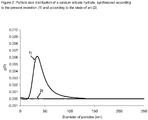
- Figure 2 shows the size distribution (mass weighted signal (g(D)) of calcium silicate hydrate particles as a function of the diameter of the particles (under the assumption that the particles are spherical) .
- the integral in the region from 0 to 150 nm equals to 100 %.
- the state-of-art calcium silicate hydrate particles (Acc. 29 in table 2) show no detectable particles in this region. The detected particles were larger than 1.000 nm.
- composition contains
- the calcium silicate hydrate in the composition is foshagite, hillebrandite, xonotlite, nekoite, clinotobermorite , 9 ⁇ -tobermorite (riversiderite), 11 ⁇ -tobermorite, 14 ⁇ -tobermorite (plombierite), jennite, metajennite, calcium chondrodite, afwillite, ⁇ - C 2 SH, dellaite, jaffeite, rosenhahnite, killalaite and/or suolunite.
- the calcium silicate hydrate in the composition is xonotlite, 9 ⁇ - tobermorite (riversiderite), 11 ⁇ -tobermorite, 14 ⁇ - tobermorite (plombierite), jennite, metajennite, afwillite and/or jaffeite.
- the molar ratio of calcium to silicon in the calcium silicate hydrate in the composition is from 0.6 to 2, preferably 1.1 to 1.8.
- the molar ratio of calcium to water in the calcium silicate hydrate is from 0.6 to 6, preferably 0.6 to 2, more preferably 0.8 to 2. Said ranges are similar to those found for example in calcium silicate hydrate phases, which are formed during the hydration of cement. Advantage is a good acceleration effect for hydraulic binders.
- the hardening accelerators according to this invention in combination with cements containing a relatively high content of soluble sulphates (from 0.1 to 5 weight % with respect to the cement).
- soluble sulphates from 0.1 to 5 weight % with respect to the cement.
- Such cements are commercially available or the water-soluble sulphate salt can be added to the cement.
- Said cement is preferably rich in anhydrous aluminate phases.
- the water-soluble sulphate is selected from sodium and/or potassium sulphate.
- the composition preferably aqueous hardening accelerator suspension, contains preferably hardening accelerators selected from the group of alkanolamines, preferably triisopropanolamine and / or tetrahydroxyethyl ethylene diamine (THEED).
- the alkanolamines are used at a dosage from 0.01 to 2.5 weight % with respect to the weight of hydraulic binder, preferably cement. Synergistic effects could be found when using amines, especially triisopropanolamine and tetrahydroxyethyl ethylene diamine, with respect to the early strength development of hydraulic binder systems, especially cementitious systems.
- the composition preferably aqueous hardening accelerator suspension, contains preferably setting retarders selected from the group of citric acid, tartaric acid, gluconic acid, phosphonic acid, amino-trimethylenphosphonic acid, ethylendiaminotetra(methylenephosphonic) acid, diethylentriaminopenta(methylenphosphonic) acid, in each case including the respective salts of the acids, pyrophosphates, pentaborates, metaborates and/or sugars (e.g. glucose, molasses).
- the advantage of the addition of setting retarders is that the open-time can be controlled and in particular if necessary can be prolonged.
- the setting retarders are used at a dosage from 0.01 to 0.5 weight % with respect to the weight of hydraulic binder, preferably cement.
- compositions preferably aqueous hardening accelerator suspensions can also contain any formulation component typically used in the field of construction chemicals, preferably defoamers, air entrainers, retarders, shrinkage reducers, redispersible powders, other hardening accelerators, anti-freezing agents and/or anti-efflorescence agents.
- formulation component typically used in the field of construction chemicals preferably defoamers, air entrainers, retarders, shrinkage reducers, redispersible powders, other hardening accelerators, anti-freezing agents and/or anti-efflorescence agents.
- the invention concerns also a composition, preferably a hardening accelerator composition, which is in powder form.
- the powder product can be obtained from the aqueous product by for example spray drying or drying in a fluid bed dryer.
- the hardening accelerator composition is used in building material mixtures containing cement, gypsum, anhydrite, slag, preferably ground granulated blast furnace slag, fly ash, silica dust, metakaolin, natural pozzolans, calcined oil shale, calcium sulphoaluminate cement and/or calcium aluminate cement, preferably in building material mixtures which contain substantially cement as a hydraulic binder.
- Gypsum comprises in this context all possible calcium sulphate carriers with different amounts of crystal water molecules, like for example also calcium sulphate hemihydrate.
- the hardening accelerator composition can also be used for reducing the permeability, preferably the water penetration depth according to DIN EN 12390-8.
- the building material mixtures containing cement, gypsum, anhydrite, slag, preferably ground granulated blast furnace slag, fly ash, silica dust, metakaolin, natural pozzolans, calcined oil shale, calcium sulpho aluminate cement and/or calcium aluminate cement, preferably the building material mixtures contain substantially cement as a hydraulic binder.
- aqueous liquids means in this context water, which might contain aggressive substances like salts (e.g. chloride ions, sulphate ions). For building material mixtures it is decisive that the permeation of water can be reduced in order to obtain a higher durability.
- the measurement of the water penetration depth is a good indicator how a cementitious material can resist to damages from the environment, for example leaching, weathering or sulphate attack.
- the test shows in how far a material can be impermeable to the penetration of aggressive aqueous agents.
- a decrease of the water penetration depth is consequently information about the durability of the concrete.
- a long durability is a very important property required by concrete producers and contractors.
- the reduced water penetration depth found in the experimental tests using the accelerator compositions of this invention were very surprising. It is believed that the positive effect of the accelerators on this material property is due to different structures of the hydration products in the concrete, which reduce the porosity of the concrete.
- the building material mixtures which contain a composition, preferably an aqueous hardening accelerator suspension, according to this invention and cement, gypsum, anhydrite, slag, preferably ground granulated blast furnace slag, fly ash, silica dust, metakaolin, natural pozzolans, calcined oil shale, calcium sulpho aluminate cement and/or calcium aluminate cement.
- a composition preferably an aqueous hardening accelerator suspension, according to this invention and cement, gypsum, anhydrite, slag, preferably ground granulated blast furnace slag, fly ash, silica dust, metakaolin, natural pozzolans, calcined oil shale, calcium sulpho aluminate cement and/or calcium aluminate cement.
- the building material mixtures contain substantially cement as a hydraulic binder.
- the hardening accelerator composition is contained in the building material mixture preferably at a dosage of
- building material mixtures can mean mixtures in dry or aqueous form and in the hardened or plastic state.
- Dry building material mixtures could be for example mixtures of said binders, preferably cement and the hardening accelerator compositions (preferably in powder form) according to this invention.
- Mixtures in aqueous form usually in the form of slurries, pastes, fresh mortar or fresh concrete are produced by the addition of water to the binder component(s) and the hardening accelerator composition, they transform then from the plastic to the hardened state.
- a reactor, equipped with heating and stirrer is charged with a compound according to structural unit (I), for example polyethylenglycol monophenylether (in the following called PhPEG), a compound according to structural unit (II), for example polyethylenglycol monophenylether phosphate or phenoxyethanol phosphate (in the following called "phosphate”) and a keton compound (IIIa), for example formaldehyde (paraformaladehyde can be used as well as aqueous formaldehyde or trioxane).
- the reaction mixture is heated to temperatures typically between 90 °C and 120 °C and the polycondensation is started by the addition of the acid catalyst (typically sulfuric acid or methansulfonic acid).
- the acid catalyst typically sulfuric acid or methansulfonic acid
- the formaldehyde source F is a 30.5 % aqueous solution of formaldehyde, P is paraformaldehyde and T is trioxane.
- the Acid type S is sulphuric acid and M is methane sulfonic acid.
- Table 1 Polymer composition of phosphated polycondensates Example PhPEG Mn [g/mol] " Phosphate type CH 2 O source Acid type Reaction Temp. Reaction Time Solid Content Mol.
- Ca(OH) 2 powder and fumed silica were used as starting materials for synthesis. 14.83 g of Ca(OH) 2 was mixed with 153 g CO 2 free water in which 5.37 g of the used polymer was dissolved. 12.01 g of fumed SiO 2 (Sigma Aldrich) was mixed with the Ca(OH) 2 slurry. The resulting slurry was put into a planetary ball mill (Fritsch Pulverisette 4) equipped with ZrO 2 grinding tools of 250 ml in volume. 100 grinding bodies with 10 mm in diameter were used. The relative ratio of the rotations during the grinding process was - 2.18. The total grinding time was 80 minutes, stopped after each 20 minutes for holding temperature in the paste below 70 °C. Grinding bodies were separated after the milling process by sieving the paste and rinsing with CO 2 free water. The resulting suspension has a solid content of 13.5 weight-% determined after heating the suspension for 14 hours at 45 °C and reaching a constant weight.
- Table 3 are summarized the different accelerator types synthesized by the procedure described above.
- the weight of polymers is according to the solid content of the polymer suspensions.
- Table 2 composition of hardening accelerators ID Polymer Weight polymer [g] Solid content of suspension (%) Acc. M1 - - 5.5 Acc. M2 Melflux®267L/40 % 5.16 10.1 Acc. M3 Melflux®267L/40 % P1 0.51 4.65 26.9
- Accelerator M1 is the reference accelerator which was synthesized without polymer according the process described above.
- the influence of the hardening accelerators was tested on the cement Karlstadt 42.5 R by the measurement of the heat release by heat flow calorimetry.
- the accelerator suspension was mixed with the batching water and the resulting suspension mixed with 20 g of the cement.
- the water to cement (w/c) ratio was set to 0.32.
- the dosage of the accelerators to be tested is expressed as weight percentage of solid content with respect to the cement weight.
- the heat flow curves are presented by Figure 3 .
- the addition of the hardening accelerator described in the invention accelerates the acceleration period (defined in H. F. W. Taylor (1997): Cement Chemistry, 2nd edition, p. 212ff ). The effect is summarized in Table 11.
- Heat flow curve 1 represents the blank (Karlstadt cement only), curves 2 to 4 show the results for Karlstadt cement with addition of 0.6 weight % of the respective accelerator (curve 2: Acc. M1 not according to this invention, curve 3: Acc. M2 and curve 4: Acc. M3).
- Table 3 Time of minimal heat flow and 1 st heat flow maximum in the main period of hydration according to figure 3.
- Sample Min [h] 1. Max [h] ⁇ [h] Acceleration [%] Karlstadt without Acc. 1.7 9.4 7.7 ⁇ 0 + 0.6 wt.-% Acc. M1 1.2 8.3 7.1 -8 + 0.6 wt.-% Acc. M2 1.1 6.7 5.6 - 27 + 0.6 wt.-% Acc. M3 1.1 6.7 5.6 - 27
- the accelerator according to the invention was mixed with the batching water before addition to the cement. Water from the accelerator suspension is included in the total water content. The addition of the accelerator is given in active solid content (calcium silicate hydrate) in the acceleration suspension with respect to the cement content of the mortar.
Landscapes
- Chemical & Material Sciences (AREA)
- Engineering & Computer Science (AREA)
- Ceramic Engineering (AREA)
- Structural Engineering (AREA)
- Materials Engineering (AREA)
- Organic Chemistry (AREA)
- Inorganic Chemistry (AREA)
- Chemical Kinetics & Catalysis (AREA)
- Curing Cements, Concrete, And Artificial Stone (AREA)
- Compositions Of Macromolecular Compounds (AREA)
- Macromonomer-Based Addition Polymer (AREA)
- Phenolic Resins Or Amino Resins (AREA)
- Adhesives Or Adhesive Processes (AREA)
- Organic Low-Molecular-Weight Compounds And Preparation Thereof (AREA)
- Polyethers (AREA)
Description
- The present invention relates to a process for the preparation of a hardening accelerator composition, the hardening accelerator composition and the use of the hardening accelerator composition.
- It is known that admixtures in the form of dispersants are often added to aqueous slurries of pulverulent inorganic or organic substances, such as clays, silicate powders, chalks, carbon blacks, powdered rocks and hydraulic binders, for improving their workability, i.e. kneadability, spreadability, sprayability, pumpability or flowability. Such admixtures are capable of breaking up solid agglomerates, dispersing the particles formed and in this way improving the fluidity. This effect is also utilised in a targeted manner in particular in the preparation of building material mixtures which contain hydraulic binders, such as cement, lime, gypsum, calcium sulphate hemihydrate (bassanite), anhydrous calcium sulphate (anhydrite), or latent hydraulic binders, such as fly ash, blast furnace slag or pozzolans.
- In order to convert these building material mixtures based on said binders into a ready-to-use, workable form, as a rule substantially more mixing water is required than would be necessary for the subsequent hydration and hardening process. The proportion of cavities which are formed in the concrete body by the excess water which subsequently evaporates leads to significantly poorer mechanical strengths and durabilities.
- In order to reduce this excess proportion of water at a predetermined processing consistency and/or to improve the workability at a predetermined water/binder ratio, admixtures which are generally referred to as water-reducer compositions or plasticizers are used. In particular, copolymers which are prepared by free radical copolymerization of acid monomers with polyether macromonomers are used in practice as such compositions.
- Furthermore, admixtures for building material mixtures comprising hydraulic binders typically also contain hardening accelerators which shorten the setting time of the hydraulic binder. According to
WO 02/070425 -
JP 2002187758 A JP 200158863 A JP 200095554 A WO 2005/077857 A2 describes an ultra-high performance, self-compacting concrete which comprises cement, a mixture of calcined bauxite sands of various particle sizes, silica fume and ultrafine calcium carbonate particles as well as other additives. The cement is obtained by mixing the constituents until a concrete of the desired fluidity is obtained. - H. Matsuyama et al., Concrete Science And Engineering, Vol. 1, September 1999, pp 148-156 describes the formation of C-S-H/polymer complexes with superplasticizing polymers by adding a calcium nitrate solution to a sodium silicate solution.
- The Ph.D. thesis of Markus Arnold, 1 January 2004, relates to the polymer controlled preparation of calcium silicate hydrate by adding a calcium chloride solution to a sodium silicate solution or by a hydrothermal reaction between calcium oxide and pyrogenic silica.
-
US 5,709,743 describes the use of an aqueous suspension of a siliceous hydraulic binder as an accelerator for the setting and hardening of said binder. - The object of the present invention is to provide a composition which acts in particular as a hardening accelerator and moreover performs as a plasticizer.
- This object is achieved by a process for the preparation of a hardening accelerator composition by reaction of a calcium compound, preferably a calcium salt, most preferably a water-soluble calcium salt, with a silicon dioxide containing component under alkaline conditions at a temperature not exceeding 80 °C and by applying milling, the reaction being carried out in the presence of an aqueous solution of a water-soluble comb polymer suitable as a plasticizer for hydraulic binders.
- Typically the calcium compounds are calcium salts (e.g. calcium salts of carboxylic acids). The calcium salt can be for example calcium chloride, calcium nitrate, calcium formate, calcium acetate, calcium bicarbonate, calcium bromide, calcium carbonate, calcium citrate, calcium chlorate, calcium fluoride, calcium gluconate, calcium hydroxide, calcium oxide, calcium hypochlorite, calcium iodate, calcium iodide, calcium lactate, calcium nitrite, calcium oxalate, calcium phosphate, calcium propionate, calcium silicate, calcium stearate, calcium sulphate, calcium sulphate hemihydrate, calcium sulphate dihydrate, calcium sulphide, calcium tartrate, calcium aluminate, tricalcium silicate and/or dicalcium silicate.
- Preferable are calcium hydroxide and/or calcium oxide because of their strong alkaline properties. Preferably the water-soluble calcium compound is not a calcium silicate. The silicates calcium silicate, dicalcium silicate and/or tricalcium silicate are less preferred because of low solubility (especially in the case of calcium silicate) and for economic reasons (price) (especially in case of dicalcium silicate and tricalcium silicate). Less preferable are also not so good soluble calcium salts like for example calcium carbonate and also calcium salts with retarding anions (e.g. citrate, gluconate, tartrate can retard the hardening of hydraulic binders). In the case of neutral or acid calcium salts (e.g. calcium chloride or calcium nitrate) it is preferable to use a suitable base to adjust the pH-value to alkaline conditions (e.g. lithium hydroxide, sodium hydroxide, potassium hydroxide, ammonia, magnesium hydroxide or any other earth alkali hydroxide). Preferable is a pH-value higher than 8, more preferable higher than 9 and most preferable higher than 11. The pH-value is measured preferably at 25 °C and with a solid content of the suspension of 1 weight %.
- It is possible to use any material which contains silicon dioxide, for example microsilica, pyrogenic silica, precipitated silica, blast furnace slag, and/or quartz sand. Small particle sizes of the silicon dioxide containing material are preferable, especially particle sizes below 1 µm. Further it is possible to use compounds which are able to react in an aqueous alkaline environment to silicon dioxide like for example tetraalkoxy silicon compounds of the general formula Si(OR)4. R can be the same or different and can be for example selected from a branched or non-branched C1 to C10 alkyl group. Preferably R is methyl, especially preferably ethyl.
- In a preferred embodiment the silicon dioxide containing compound is selected from the group of microsilica, pyrogenic silica, precipitated silica, blast furnace slag and/or quartz sand. Preferable are microsilica, pyrogenic silica and/or precipitated silica, especially precipitated and/or pyrogenic silica. The types of silica, which are listed above are defined in Ullmann's Encyclopedia of Industrial Chemistry, Wiley-VCH, Release 2009, 7th Edition, DOI 10.1002/14356007.a23_583.pub3.
- Mechanical energy by milling is applied to the reaction mixture in order to activate and/or accelerate the reaction of the calcium salt with the usually low water-soluble silicon dioxide containing component. The mechanical energy is also advantageous in order to reach the desired small particle sizes of the calcium silicate hydrates. The wording "milling" means herein any process in which high shear forces are exerted on the reaction mixture in order to accelerate the reaction and to obtain a suitable particle size. For example milling can be carried out in a planet ball mill in a continuous or batch operation mode. Alternatively an ultradisperser, preferably with a number of revolutions higher than 5.000
r.p.m. can be used. Also it is possible to apply a so-called shaker equipment in which small grinding bodies, preferably smaller than 1 mm in diameter are put together with the reaction mixture into a receptacle and are shaken. The respective shaker equipment is for example available from the company Skandex. - Typically the pH-value of the process for the preparation of a hardening accelerator is higher than 9.
- Preferably the molar ratio of calcium from the calcium compound to silicon from the silicon dioxide containing component is from 0.6 to 2, preferably 1.1 to 1.8.
- Typically the weight ratio of water to the sum of calcium compound and silicon dioxide containing component is from 0.2 to 50, preferably 2 to 10, most preferably 4 to 6.
In this context water means the water in the reaction mixture, in which the process is carried out. It is preferable to carry out the process at relatively low water contents in order to increase the output of the process. Also it is possible to obtain relatively conveniently dry products from the wet products because not so much water has to be removed. A ratio of 2 to 10, respectively 4 to 6 is especially preferred because a paste like consistency of the products can be obtained, which is preferable for the milling process. - In a preferred embodiment, the water-soluble comb polymer suitable as a plasticizer for hydraulic binders is present as a copolymer which contains, on the main chain, side chains having ether functions and acid functions.
- In a preferred embodiment, the water-soluble comb polymer suitable as a plasticizer for hydraulic binders is present as a copolymer which is produced by free radical polymerization in the presence of acid monomer, preferably carboxylic acid monomer, and polyether macromonomer, so that altogether at least 45 mol %, preferably at least 80 mol %, of all structural units of the copolymer are produced by incorporation of acid monomer, preferably carboxylic acid monomer, and polyether macromonomer in the form of polymerized units. Acid monomer is to be understood as meaning monomers which are capable of free radical copolymerization, have at least one carbon double bond, contain at least one acid function, preferably a carboxylic acid function, and react as an acid in an aqueous medium. Furthermore, acid monomer is also to be understood as meaning monomers which are capable of free radical copolymerization, have at least one carbon double bond, form at least one acid function, preferably a carboxylic acid function, in an aqueous medium as a result of a hydrolysis reaction and react as an acid in an aqueous medium (example: maleic anhydride or hydrolysable esters of (meth)acrylic acid).
In the context of the present invention, polyether macromonomers are compounds which are capable of free radical copolymerization, have at least one carbon double bond, and have at least two ether oxygen atoms, with the proviso that the polyether macromonomer structural units present in the copolymer have side chains which contain at least two ether oxygen atoms, preferably at least 4 ether oxygen atoms, more preferably at least 8 ether oxygen atoms, most preferably at least 15 ether oxygen atoms. - Structural units, which do not constitute an acid monomer or a polyether macromonomer can be for example styrene and derivatives of styrene (for example methyl substituted derivatives), vinyl acetate, vinyl pyrrolidon, butadiene, vinyl proprionate, unsaturated hydrocarbons like for example ethylene, propylene and/or (iso)butylene. This listing is a non-exhaustive enumeration. Preferable are monomers with not more than one carbon double bond.
- In a preferred embodiment of the invention the water-soluble comb-polymer suitable as plasticizer for hydraulic binders is a copolymer of styrene and a half ester of maleic acid with a monofunctional polyalkylene glycol. Preferably such a copolymer can be produced by free radical polymerization of the monomers styrene and maleic anhydride (or maleic acid) in a first step. In the second step polyalkylene glycols, preferably alkyl polyalkylene glycols (preferably alkyl polyethylene glycols, most preferably methyl polyethyleneglycol) are reacted with the copolymer of styrene and maleic anhydride in order to to achieve an esterification of the acid groups. Styrene can be completely or partially replaced by styrene derivatives, for example methyl substituted derivatives. Copolymers of this preferred embodiment are described in
US 5,158,996 . - Frequently, a structural unit is produced in the copolymer by incorporation of the acid monomer in the form of polymerized units, which structural unit is in accordance with the general formulae (Ia), (Ib), (Ic) and/or (Id)

- R1 is H or a non-branched or a branched C1 - C4 alkyl group;
- X is NH-(CnH2n), where n = 1, 2, 3 or 4, or O-(CnH2n) where n = 1, 2, 3 or 4, or is not present;
- R2 is SO3H, PO3H2, O-PO3H2 aor para-substituted C6H4-SO3H, or, if X is not present, R2 is OH;
- R3 is H or a non-branched or a branched C1 - C4 alkyl group; n = 0, 1,2, 3 or 4
- R4 is SO3H, PO3H2, O-PO3H2 or para-substituted C6H4-SO3H;
- R5 is Hor a non-branched or a branched C1 - C4 alkyl group;
- Z is O or NH;
- R6 is H or a non-branched or a branched C1 - C4 alkyl group;
- Q is NH or O;
- R7 is H, (CnH2n)-SO3H, where n = 0, 1, 2, 3 or 4, preferably 1, 2, 3 or 4, (CnH2n)-OH, where n = 0, 1, 2, 3 or 4, preferably 1, 2, 3 or 4; (CnH2n)-PO3H2, where n = 0, 1, 2, 3 or 4, preferably 1, 2, 3 or 4, (CnH2n)-OPO3H2, where n= 0, 1, 2, 3 or 4, preferably 1, 2, 3 or 4, (C6H4)-SO3H, (C6H4)-PO3H2, (C6H4)-OPO3H2 or (CmH2m)e-O-(A'O)α-R9, where m = 0, 1, 2, 3 or 4, preferably 1, 2, 3 or 4, e = 0, 1, 2, 3 or 4, preferably 1, 2, 3 or 4, A' = Cx'H2x', where x' = 2, 3, 4 or 5 or CH2C(C6H5)H-, α = an integer from 1 to 350 where R9 is a non-branched or a branched C1 - C4 alkyl group.
- Typically, a structural unit is produced in the copolymer by incorporation of the polyether macromonomer in the form of polymerized units, which structural unit is in accordance with the general formulae (IIa), (IIb) and/or (IIc)

- R10, R11 and R12, independently of one another, are H or a non-branched or a branched C1 - C4 alkyl group;
- E a non-branched or branched C1 - C6 alkylene group, preferably C2 - C6 alkylene group, a cyclohexylen group, CH2-C6H10, ortho-, meta- or para-substituted C6H4 or is not present; G is O, NH or CO-NH, with the proviso that, if E is not present, G is also not present;
- A is CxH2x, where x = 2, 3, 4 or 5 (preferably x = 2), or CH2CH(C6H5);
- n is 0, 1, 2, 3, 4 or 5;
- a is an integer from 2 to 350 (preferably 10 - 200);
- R13 is H, a non-branched or a branched C1 - C4 alkyl group, CO-NH2, or COCH3;
- R14 is H or a non-branched or branched C1 - C4 alkyl group;
- E is a non-branched or branched C1 - C6 alkylene group, preferably a C2 - C6 alkylene group, a cyclohexylen group, CH2-C6H10, ortho-, meta- or para-substituted C6H4 or is not present;
- G is not present, O, NH or CO-NH, with the proviso that, if E is not present, G is not present;
- A is CxH2x, where x = 2, 3, 4 or 5, or CH2CH(C6H5);
- n is 0, 1, 2, 3, 4 or 5
- a is an integer from 2 to 350;
- D is not present, NH or O, with the proviso that if D is not present: b = 0, 1, 2, 3 or 4 and c = 0, 1, 2, 3 or 4, where b + c = 3 or 4, and
- with the proviso that if D is NH or O, b = 0, 1, 2 or 3, c = 0, 1, 2 or 3, where b + c = 2 or 3; R15 is H, a non-branched or branched C1 - C4 alkyl group, CO-NH2, or COCH3;
- R16, R17 and R18, independently of one another, are H or a non-branched or branched C1 - C4 alkyl group;
- E is a non-branched or a branched C1 - C6 alkylene group, preferably a C2-C6 alkylene group, a cyclohexylen group, CH2-C6H10, ortho-, meta- or para-substituted C6H4 or is not present; preferably E is present;
- A is CxH2x, where x = 2, 3, 4 or 5, or CH2CH(C6H5);
- n is 0, 1, 2, 3, 4 or 5;
- L is CxH2x, where x = 2, 3, 4 or 5, or CH2-CH(C6H5);
- a is an integer from 2 to 350;
- d is an integer from 1 to 350;
- R19 is H or a non-branched or a branched C1 - C4 alkyl group,
- R20 is H or a non-branched chain C1 - C4 alkyl group.
- In a further embodiment of the invention a structural unit is produced in the copolymer by incorporation of the polyether macromonomer in the form of polymerized units, which structural unit is in accordance with the general formula (IId)

- R21, R22 and R23, independently of one another, are H or a non-branched or branched C1 - C4 alkyl group;
- is CxH2x, where x = 2, 3, 4 or 5, or CH2CH(C6H5);
- a is an integer from 2 to 350;
- R24 is H or a non-branched or a branched C1 - C4 alkyl group, preferably a C1 - C4 alkyl group.
- Alkoxylated isoprenol and/or alkoxylated hydroxybutyl vinyl ether and/or alkoxylated (meth)allyl alcohol and/or vinylated methylpolyalkylene glycol having preferably in each case an arithmetic mean number of 4 to 340 oxyalkylene groups is preferably used as the polyether macromonomer. Methacrylic acid, acrylic acid, maleic acid, maleic anhydride, a monoester of maleic acid or a mixture of a plurality of these components is preferably used as the acid monomer.
- It is preferred that the process according to this invention is carried out at a site of concrete production (for example a ready-mix concrete, precast concrete plant or any other plant where mortar, concrete or any other cementitious products are produced), whereby the obtained hardening accelerator composition is used as the batching water. The obtained hardening accelerator composition is an aqueous system and can be used directly as the batching water, especially when designing the hardening accelerators according to the specific needs of a job-site.
- Batching water in this context is the water, which is used in concrete production or production of similar cementitious materials. Typically the batching water is mixed with cement and for example, aggregates at a ready mix concrete plant or precast concrete plant, at a construction site or any other place where concrete or other cementitious materials are produced. Usually the batching water can contain a wide range of additives like for example plasticizers, hardening accelerators, retarders, shrinkage reducing additives, air entrainers and/or defoamers. It is advantageous to produce the hardening accelerators according to this invention in the batching water intended for production of concrete or similar materials, because there is no need to transport the respective admixtures.
- In a preferred embodiment of the invention the process is characterized in that polycondensates containing
- (I) at least one structural unit consisting of an aromatic or heteroaromatic moiety bearing a polyether side chain, preferably a poly alkylene glycol side chain, more preferably a poly ethylene glycol side chain and
- (II) at least one structural unit consisting of an aromatic or heteroaromatic moiety bearing at least one phosphoric acid ester group and/or its salt
- Preferably the aqueous solution in which the reaction is carried out contains besides the comb polymer a second polymer. The second polymer is a polycondensate as described in the previous text of this embodiment and following embodiments. Preferably the comb polymer used together with the polycondensate is obtainable by a radical polymerization.
- The polycondensates according to this embodiment are known in the prior art (
US 20080108732 A1 ) to be effective as a superplasticiser in cementitious compositions.US 20080108732 A1 describes polycondensates based on an aromatic or heteroaromatic compound (A) having 5 to 10 C atoms or heteroatoms, having at least one oxyethylene or oxypropylene radical, and an aldehyde (C) selected from the group consisting of formaldehyde, glyoxylic acid and benzaldehyde or mixtures thereof, which result in an improved plasticizing effect of inorganic binder suspensions compared with the conventionally used polycondensates and maintain this effect over a longer period ("slump retention"). In a particular embodiment, these may also be phosphated polycondensates. - Typically the polycondensate contains (I) at least one structural unit consisting of an aromatic or heteroaromatic moiety bearing a polyether side chain, preferably a polyalkylene glycol side chain, more preferably a polyethylene glycol side chain. The structural unit consisting of an aromatic or heteroaromatic moiety bearing a polyether side chain, preferably a polyethylene glycol side chain is selected preferably from the group of alkoxylated, preferably ethoxylated, hydroxy-functionalized aromates or heteroaromates (for example the aromates can be selected from phenoxyethanol, phenoxypropanol, 2-alkoxyphenoxyethanols, 4-alkoxyphenoxyethanols, 2-alkylphenoxyethanols, 4-alkylphenoxyethanols) and/or alkoxylated, preferably ethoxylated, amino-functionalized aromates or heteroaromates (for example the aromates can be selected from N,N-(Dihydroxyethyl)aniline, N,-(Hydroxyethyl)aniline, N,N-(Dihydroxypropyl)aniline, N,-(Hydroxypropyl)aniline). More preferable are alkoxylated phenol derivatives (for example phenoxyethanol or phenoxypropanol), most preferable are alkoxylated, especially ethoxylated phenol derivatives featuring weight average molecular weights between 300 g/mol and 10,000 g/mol (for example polyethylenglycol monophenylethers).
Typically the polycondensate contains (II) at least one phosphated structural unit consisting of an aromatic or heteroaromatic moiety bearing at least one phosphoric acid ester group and/or a salt of the phosphoric acid ester group, which is selected preferably from the group of alkoxylated hydroxy-functionalized aromates or heteroaromates (for example phenoxyethanol phosphate, polyethylenglycol monophenylether phosphates) and/or alkoxylated amino-functionalized aromates or heteroaromates (for example N,N-(Dihydroxyethyl)aniline diphosphate, N,N-(Dihydroxyethyl)aniline phosphate, N,-(Hydroxypropyl)aniline phosphate), which bear at least one phosphoric acid ester group and/or a salt of the phosphoric acid ester group (e.g. by esterification with phosphoric acid and optional addition of bases). More preferable are alkoxylated phenols bearing at least one phosphoric acid ester group and/or a salt of the phosphoric acid ester group (for example polyethylenglycol monophenylether phosphates with less than 25 ethylene glycol units) and most preferable are the respective alkoxylated phenols featuring weight average molecular weights between 200 g/mol and 600 g/mol (for example phenoxyethanol phosphate, polyethylenglycol monophenylether phosphates with 2 to 10 ethyleneglycol units), the alkoxylated phenols bearing at least one phosphoric acid ester group and/or a salt of the phosphoric acid ester group (e.g. by esterification with phosphoric acid and optional addition of bases). - In another embodiment of the invention the process is characterized in that in the polycondensate the structural units (I) and (II) are represented by the following general formulae

- A is a substituted or unsubstituted aromatic or heteroaromatic compound having 5 to 10 C atoms;
- B is N, NH or O;
- n is 2 if B is N and n is 1 if B is NH or O;
- R1 and R2, independently of one another, are branched or straight-chain C1- to C10-alkyl radical, C5- to C8-cycloalkyl radical, aryl radical, heteroaryl radical or H;
- a is an integer from 1 to 300;
- X is a branched or straight-chain C1- to C10-alkyl radical, C5- to C8-cycloalkyl radical, aryl radical, heteroaryl radical or H, preferably H,
- D is a substituted or unsubstituted heteroaromatic compound having 5 to 10 C atoms;
- E is N, NH or O;
- m is 2 if E is N and m is 1 if E is NH or O;
- R3 and R4, independently of one another, are a branched or straight-chain C1- to C10-alkyl radical, C5- to C8-cycloalkyl radical, aryl radical, heteroaryl radical or H;
- b is an integer from 1 to 300;
- M is an alkaline metal ion, alkaline earth metal ion, ammonium ion, organic ammonium ion or H, a is 1 or in the case of alkaline earth metal ions is 1/2.
- The groups A and D in the general formulae (I) and (II) of the polycondensate are preferably represented by phenyl, 2-hydroxyphenyl, 3-hydroxyphenyl, 4-hydroxyphenyl, 2-methoxyphenyl, 3-methoxyphenyl, 4-methoxyphenyl, naphthyl, 2-hydroxynaphthyl, 4-hydroxynaphthyl, 2-methoxynaphthyl, 4-methoxynaphthyl, preferably phenyl, it being possible for A and D to be chosen independently of one another and also in each case to consist of a mixture of said compounds. The groups B and E, independently of one another, are preferably represented by O. The radicals R1, R2, R3 and R4 can be chosen independently of one another and are preferably represented by H, methyl, ethyl or phenyl, particularly preferably by H or methyl and especially preferably by H.
- In general formula (I) a is preferably represented by an integer from 1 to 300, in particular 3 to 200 and particularly preferably 5 to 150 and b in general formula (II) by an integer from 1 to 300, preferably 1 to 50 and particularly preferably 1 to 10. The respective radicals, the length of which is defined by a and b, respectively, may consist here of uniform building blocks, but a mixture of different building blocks may also be expedient. Furthermore, the radicals of the general formulae (I) or (II), independently of one another, may each have the same chain length, a and b each being represented by a number. As a rule, however, it will be expedient if mixtures having different chain lengths are present in each case so that the radicals of the structural units in the polycondensate have different numerical values for a and independently for b.
- Frequently, the phosphated polycondensate according to the invention has a weight average molecular weight of 5.000 g/mol to 200.000 g/mol, preferably 10.000 to 100.000 g/mol and particularly preferably 15.000 to 55.000 g/mol.
- The phosphated polycondensate can be present also in form of its salts, as for example the sodium, potassium, organic ammonium, ammonium and/or calcium salt, preferably as the sodium and/or calcium salt.
- Typically the molar ratio of the structural units (I):(II) is 1:10 to 10:1, preferably 1:8 to 1:1. It is advantageous to have a relatively high proportion of structural units (II) in the polycondensate because a relatively high negative charge of the polymers has a good influence on the stability of the suspensions.
- In a preferred embodiment of the invention the polycondensate contains a further structural unit (III) which is represented by the following formula
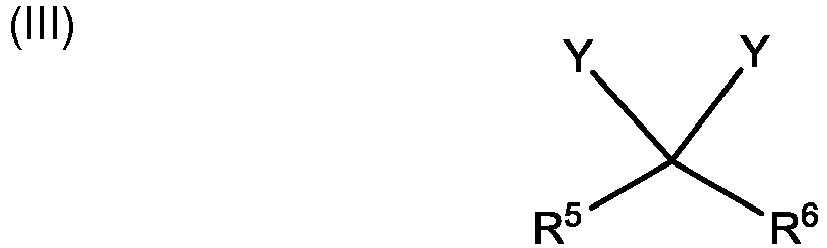
- Y, independently of one another, are (I), (II), or further constituents of the polycondensate,
- R5 is H, CH3, COOH or a substituted or unsubstituted aromatic or heteroaromatic compound having 5 to 10 C atoms, preferably H,
- R6 is H, CH3, COOH or a substituted or unsubstituted aromatic or heteroaromatic compound having 5 to 10 C atoms, preferably H.
- The polycondensates are typically prepared by a process in which
(I) at least one structural unit consisting of an aromatic or heteroaromatic moiety bearing a polyether side chain (for example poly(ethyleneglycol)monophenyl ether) and (II) at least one structural unit consisting of an aromatic or heteroaromatic moiety bearing at least one phosphoric acid ester group and/or a salt of the phosphoric acid ester group (for example phenoxyethanol phosphoric acid ester) are reacted with (IIIa) a monomer having a keto group. Preferably the monomer having a keto group is represented by the general formula (IIIa),
- R7 is H, CH3, COOH or a substituted or unsubstituted aromatic or heteroaromatic compound having 5 to 10 C atoms, preferably H,
- R8 is H, CH3, COOH or a substituted or unsubstituted aromatic or heteroaromatic compound having 5 to 10 C atoms, preferably H.
- Preferably the monomer having a keto group is selected from the group of ketones, preferably being an aldehyde, most preferably formaldehyde. Examples for chemicals according to general structure (IIIa) are formaldehyde, acetaldehyde, acetone, glyoxylic acid and/or benzaldehyde. Formaldehyde is preferable.
- Typically R5 and R6 in structural unit (III), independently of one another, are H, COOH or methyl. Most preferably H.
- In another preferred embodiment of the invention the molar ratio of the structural units [(I) + (II)] : (III) is 1: 0.8 to 3 in the polycondensate.
- Preferably the polycondensation is carried out in the presence of an acidic catalyst, this catalyst preferably being sulphuric acid, methanesulphonic acid, para-toluenesulphonic acid or mixtures thereof. The polycondensation and the phosphation are advantageously carried out at a temperature between 20 and 150 °C and a pressure between 1 and 10 bar. In particular, a temperature range between 80 and 130°C has proved to be expedient. The duration of the reaction may be between 0.1 and 24 hours, depending on temperature, the chemical nature of the monomers used and the desired degree of crosslinking.
- Crosslinking can preferably occur if monosubstituted monomers of structural unit I and/or II are used because the condensation reaction can occur in the two ortho positions and the para position. Once the desired degree of polycondensation has been reached, which can also be determined, for example, by measurement of the viscosity of the reaction mixture, the reaction mixture is cooled.
- The reaction mixture might be subjected to a thermal after treatment at a pH between 8 and 13 and a temperature between 60 and 130°C after the end of the condensation and phosphation reaction. As a result of the thermal after treatment, which advantageously lasts for between 5 minutes and 5 hours, it is possible substantially to reduce the aldehyde content, in particular the formaldehyde content, in the reaction solution. Alternatively the reaction mixture can be subjected to a vacuum treatment or other methods known in the prior art to reduce the content of (form)aldehyde.
- In order to obtain a better shelf life and better product properties, it is advantageous to treat the reaction solutions with basic compounds. It is therefore to be regarded as being preferred to react the reaction mixture after the end of the reaction with a basic sodium, potassium, ammonium or calcium compound. Sodium hydroxide, potassium hydroxide, ammonium hydroxide or calcium hydroxide has proved to be particularly expedient here, it being regarded as being preferred to neutralize the reaction mixture. However, other alkali metal and alkaline earth metal salts and salts of organic amine are suitable as salts of the phosphated polycondensates as well.
- Mixed salts of the phosphated polycondensates can also be prepared by reaction of the polycondensates with at least two basic compounds.
- The catalyst used can also be separated off. This can conveniently be done via the salt formed during the neutralization. If sulphuric acid is used as a catalyst and the reaction solution is treated with calcium hydroxide, the calcium sulphate formed can be separated off, for example, in a simple manner by filtration.
- Furthermore, by adjusting the pH of the reaction solution to 1.0 to 4.0, in particular 1.5 to 2.0, the phosphated polycondensate can be separated from the aqueous salt solution by phase separation and can be isolated. The phosphated polycondensate can then be taken up in the desired amount of water. However, other methods known to the person skilled in the art, such as dialysis, ultrafiltration or the use of an ion exchanger, are also suitable for separating off the catalyst.
- In a further embodiment of the invention the reaction is carried out completely or partially in the presence of an aqueous solution containing a viscosity enhancer polymer, selected from the group of polysaccharide derivatives and/or (co)polymers with an average molecular weight Mw higher than 500.000 g/mol, more preferably higher than 1.000.000 g/mol, the (co)polymers containing structural units derived (preferably by free radical polymerization) from non-ionic (meth)acrylamide monomer derivatives and/or sulphonic acid monomer derivatives. It is possible that the viscosity enhancer polymer is added at the beginning, during the process or at the end of the process. For example it can be added to the aqueous solution of the comb polymer, to the calcium compound and/or the silicate compound. The viscosity enhancer polymer can also be used during the process of preparing a hardening accelerator composition by reaction of a calcium compound, preferably a calcium salt, most preferably a water-soluble calcium salt with a silicon dioxide containing component. Preferably the viscosity enhancer polymer is added at the end of the reaction (at the end of the reactants addition) in order to prevent any particles to be destabilized and to keep the best stability. The viscosity enhancer has a stabilizing function in that segregation (aggregation and sedimentation) of for example calcium silicate hydrate) can be prevented. Preferably the viscosity enhancers are used at a dosage from 0.001 to 10 weight %, more preferably 0.001 to 1 weight % with respect to the weight of the hardening accelerator suspension. The viscosity enhancer polymer preferably should be dosed in a way that a plastic viscosity of the hardening accelerator suspensions higher than 80 mPa·s is obtained.
- As polysaccharide derivative preference is given to cellulose ethers, for example alkylcelluloses such as methylcellulose, ethylcellulose, propylcellulose and methylethylcellulose, hydroxyalkylcelluloses such as hydroxyethylcellulose (HEC), hydroxypropylcellulose (HPC) and hydroxyethylhydroxypropylcellulose, alkylhydroxyalkylcelluloses such as methylhydroxyethylcelluose (MHEC), methylhydroxypropylcelluose (MHPC) and propylhydroxypropylcellulose. Preference is given to the cellulose ether derivatives methylcellulose (MC), hydroxypropylcellulose (HPC), hydroxyethylcellulose (HEC) and ethylhydroxyethylcellulose (EHEC), and particular preference is given to methylhydroxyethylcelluose (MHEC) and methylhydroxypropylcelluose (MHPC). The abovementioned cellulose ether derivatives, which can in each case be obtained by appropriate alkylation or alkoxylation of cellulose, are preferably present as non ionic structures, however it would be possible to use for example also carboxymethylcellulose (CMC). In addition, preference is also given to using non ionic starch ether derivatives such as hydroxypropylstarch, hydroxyethylstarch and methylhydroxypropylstarch. Preference is given to hydroxypropylstarch. Preferable are also microbially produced polysaccharides such as welan gum and/or xanthans and naturally occurring polysaccharides such as alginates, carregeenans and galactomannans. These can be obtained from appropriate natural products by extractive processes, for example in the case of alginates and carregeenans from algae, in the case of galactomannans from carob seeds.
- The viscosity enhancer (co)polymers with a weight average molecular weight Mw higher than 500.000 g/mol, more preferably higher than 1.000.000 g/mol can be produced (preferably by free radical polymerization) from non-ionic (meth)acrylamide monomer derivatives and/or sulphonic acid monomer derivatives. The respective monomers can be selected for example from the group of acrylamide, preferably acrylamide, methacrylamide, N-methylacrylamide, N-methylmethacrylamide, N,N-dimethylacrylamide, N-ethylacrylamide, N,N-diethylacrylamide, N-cyclohexylacrylamide, N-benzylacrylamide, N,N-dimethylaminopropylacrylamide, N,N-dimethylaminoethylacrylamide and/or N-tert-butylacrylamide and/or sulphonic acid monomer derivatives selected from the group of styrene sulphonic acid, 2-acrylamido-2-methylpropanesulphonic acid, 2-methacrylamido-2-methylpropanesulphonic acid, 2-acrylamidobutanesulphonic acid, and/or 2-acrylamido-2,4,4-trimethylpentanesulphonic acid or the salts of the acids mentioned. It is preferable that the viscosity enhancer contains more than 50 mol %, more preferably more than 70 mol % of structural units derived from non-ionic (meth)acrylamide monomer derivatives and/or sulphonic acid monomer derivatives. Other structural units preferably being contained in the copolymers can be derived from for example the monomers (meth)acrylic acid, esters of (meth)acrylic acid with branched or non-branched C1 to C10 alcohols, vinyl acetate, vinyl proprionate and/or styrene.
- In a further embodiment of the invention the viscosity enhancer polymer is a polysaccharide derivative selected from the group of methylcellulose, hydroxyethylcellulose (HEC), hydroxypropylcellulose (HPC), methylhydroxyethylcellulose (MHEC), methylhydroxypropylcellulose (MHPC) and/or (co)polymers with an average molecular weight Mw higher than 500.000 g/mol, more preferably higher than 1.000.000 g/mol, the (co)polymers containing structural units derived (preferably by free radical polymerization) from non-ionic (meth)acrylamide monomer derivatives selected from the group of acrylamide, preferably acrylamide, methacrylamide, N-methylacrylamide, N-methylmethacrylamide, N,N-dimethylacrylamide, N-ethylacrylamide, N,N-diethylacrylamide, N-cyclohexylacrylamide, N-benzylacrylamide, N,N-dimethylaminopropylacrylamide, N,N-dimethylaminoethylacrylamide and/or N-tert-butylacrylamide and/or sulphonic acid monomer derivatives selected from the group of 2-acrylamido-2-methylpropanesulphonic acid, 2-methacrylamido-2-methylpropanesulphonic acid, 2-acrylamidobutanesulphonic acid, and/or 2-acrylamido-2,4,4-trimethylpentanesulphonic acid or the salts of the acids mentioned.
- Within the group of non-ionic (meth)acrylamide monomer derivatives preference is given to methylacrylamide, N,N-dimethylacrylamide and/or methacrylamide, and particular preference is given to acrylamide. Within the group of sulphonic acid monomers 2-acrylamido-2-methylpropanesulphonic acid (AMPS) and its salts are preferable. The viscosity enhancer polymers can be added at the beginning of the process or at any other time.
- In a further embodiment of the invention the reaction is carried out completely or partially in the presence of an aqueous solution containing hardening accelerators selected from the group of alkanolamines, preferably triisopropanolamine and/or tetrahydroxyethyl ethylene diamine (THEED). Preferably the alkanolamines are used at a dosage from 0.01 to 2.5 weight % with respect to the weight of hydraulic binder, preferably cement. Synergistic effects could be found when using amines, especially triisopropanolamine and tetrahydroxyethyl ethylene diamine, with respect to the early strength development of hydraulic binder systems, especially cementitious systems. Preferably the amine is added at the end of the reaction.
- In another embodiment the reaction is carried out completely or partially in the presence of an aqueous solution containing setting retarders selected from the group of citric acid, tartaric acid, gluconic acid, phosphonic acid, amino-trimethylenphosphonic acid, ethylendiaminotetra(methylenphosphonic) acid, diethylentriaminopenta(methylenephosphonic) acid, in each case including the respective salts of the acids, pyrophosphates, pentaborates, metaborates and/or sugars (e.g. glucose, molasses). The advantage of the addition of setting retarders is that the open time can be controlled and in particular if necessary can be prolonged. The term "open-time" is understood by the person skilled in the art as the time interval after preparing the hydraulic binder mixture until the point of time at which the fluidity is considered as not sufficient anymore to allow a proper workability and the placement of the hydraulic binder mixture. The open-time depends on the specific requirements at the job site and on the type of application. As a rule the precast industry requires between 30 and 45 minutes and the ready-mix concrete industry requires about 90 minutes of open-time. Preferably the setting retarders are used at a dosage from 0.01 to 0.5 weight % with respect to the weight of hydraulic binder, preferably cement. The retarders can be added at the beginning of the process or at any other time.
- In a preferred embodiment the hardening accelerator composition obtained according to any of the above mentioned embodiments is dried, preferably by a spray drying process. The drying method is not especially limited, another possible drying method is for example the use of a fluid bed dryer. It is generally known that water, also if only in low quantities, is detrimental to many binders, especially cement, because of undesired premature hydration processes. Powder products with their typically very low content of water are advantageous compared to aqueous systems because it is possible to mix them into cement and/or other binders like gypsum, calcium sulphate hemihydrate (bassanite), anhydrous calcium sulphate, slags, preferably ground granulated blast furnace slag, fly ash, silica dust, metakaolin, natural pozzolan, calcined oil shale, calcium sulphoaluminate cement and/or calcium aluminate cement.
- The process described above provides a hardening accelerator composition .
- The composition, preferably aqueous hardening accelerator suspension, contains a water-soluble comb polymer suitable as plasticizer for hydraulic binders and calcium silicate hydrate particles with a particle diameter smaller than 500 nm, preferably smaller than 300 nm, more preferably smaller than 200 nm, the particle size of the calcium silicate hydrate being measured by analytical ultracentrifugation, is concerned.
- The analysis of calcium silicate hydrate is possible by X-ray diffraction (XRD) as the calcium silicate hydrate phase of the product is characterized by typical X-ray diffraction (XRD) reflexes in the diffraction pattern. Depending on the formed calcium silicate hydrate phase the peaks vary according to Saito, F.; Mi, G., Hanada, M.: Mechanochemical synthesis of hydrated calcium silicates by room temperature grinding, Solid State Ionics, 1997, 101-103, pp. 37- 43. Typical reflexes are at d-values of 11-14 Å, 5.0-5.6 Å, 3.0 - 3.1 Å, and 2.76-2.83 Å according to a mixture of different calcium silicate hydrate phases like tobermorite and xonotlite with a crystallite size smaller than 20 nm (please compare with the example in
figure 1 ). -
Figure 1 shows the x-ray diffraction pattern (XRD) of a sample of calcium silicate hydrate according to this invention, synthesized from Ca(OH)2 and microsilica in liquid suspension with the comb polymer Melflux® 267L and the phosphated polycondensate P1 (please compare with table 1 for the structure of P1) by milling in a planetary ball mill for 80 minutes (Acc. M3 of table 3). The measured curve (2)) is compared with a calculated curve (1)) from the structure of tobermorite (ICSD: 100405) and shows the similarity between tobermorite and the synthesized calcium silicate hydrate sample. The calculation was done by Rietveld refinement with the software Topas 4.2 (Bruker). -
Figure 1 : Comparison of diffraction patterns of tobermorite (calculated 1)) and a measured accelerator composition according to this invention (2))
Preferably the measurement of the particle diameter is done at a temperature of 25 °C via the analytical ultracentrifuge Beckman Model Optima XLI from Beckman Coulter GmbH. The analytical method of ultracentrifugation was chosen because methods like light scattering are not suitable for the particularly small particles of this invention (particularly for diameters below about 100 nm).
According to the description in H. Cölfen, 'Analytical Ultracentrifugation of Nanoparticles', in Encyclopedia of Nanoscience and Nanotechnology, (American Scientific Publishers, 2004), pp. 67-88, the particle size distribution is measured via analytical ultracentrifugation as described in the following chapter. For the measurement the commercially available analytical ultracentrifuge "Beckman Model Optima XLI," from Beckman Coulter GmbH, 47807 Krefeld is used.
The samples are diluted with water to a suitable concentration. This concentration is typically between 1 and 40 g/l solid content of the sample (the samples infigure 2 were diluted to a concentration of 30 g/l). Preferably a relatively high dilution is chosen. The concentration to be chosen is preferably adapted according to the content of the calcium silicate hydrate particles in the sample to be analyzed. The suitable range can be easily found by the person skilled in the art and is particularly determined by the factors transparency of the sample and the measuring sensitivity. Typically the rotation speed of the ultracentrifuge is selected in the range from 2.000 to 20.000 rotations per minute (in the examples offigure 2 the rotation speed was 10.000 rotations per minute). The rotation speed can be chosen according to the needs of the specific sample, a higher speed of the ultracentrifuge will be preferably chosen when relatively small particles are involved and vice versa. The sedimentation rate s of the calcium silicate hydrate particles is measured with interference optics at 25 °C and is extracted from the interference data by a suitable evaluation software, for example Sedfit (http://www.analyticalultracentrifugation.com/default.htm).
According to the Stokes-Einstein Equation
η is the dynamic viscosity of the medium and was measured at 25 °C with a Brookfield LVDV-I viscosimeter at a rotation speed of 5 rounds per minute with the spindle number 1.s is the sedimentation rate of the particles.
Δ ρ is the difference of density at 25 °C between the the calcium silicate hydrate particles and the medium. The density of the calcium silicate hydrate particles is estimated to be 2,1g/cm3 according to a comparison with literature data. The density of the medium is estimated to be 1 g/cm3 (for a diluted aqueous solution). The influence of Δ ρ on the absolute values of the particle diameter d is supposed to be small and therefore the influence of the estimation of Δ ρ is also small. -
Figure 2 : Particle size distribution of a calcium silicate hydrate, synthesized according to the present invention (1) and according to the state-of-art (2)
The conditions of the measurement were the following: 30 g/l solid content of Acc.5, which equals to an active solid content of about 10g/l), rotation speed of the ultracentrifuge 10.000 r.p.m, temperature of the measurement 25 °C, density of calcium silicate hydrate was estimated to be 2.1 g/cm3 and the density of the medium was estimated to be 1 g/ cm3 (for a diluted aqueous system). The dynamic viscosity of the diluted solution was 8.9 ·10-4 Pa s at 25 °C, corresponding to a diluted aqueous system. -
Figure 2 shows the size distribution (mass weighted signal (g(D)) of calcium silicate hydrate particles as a function of the diameter of the particles (under the assumption that the particles are spherical) . A particle size below 500 nm, preferably below 300 nm and 200 nm was reached. No particles with a diameter larger than about 130 nm were found in the measurement. The integral in the region from 0 to 150 nm equals to 100 %. As a comparison the state-of-art calcium silicate hydrate particles (Acc. 29 in table 2) show no detectable particles in this region. The detected particles were larger than 1.000 nm. - Preferably the composition contains
- i) 0.1 to 75, preferably 0.1 to 50, the most preferably 0.1 to 10 % by weight of calcium silicate hydrate,
- ii) 0.001 to 60, preferably 0.1 to 30, most preferably 0.1 to 10 % by weight of water-soluble comb polymer suitable as a plasticizer for hydraulic binders,
- iii) 24 to 99, more preferably 50 to 99, most preferably 70 to 99 % by weight of water.
- Typically the calcium silicate hydrate in the composition, preferably aqueous hardening accelerator suspension, is foshagite, hillebrandite, xonotlite, nekoite, clinotobermorite , 9Å-tobermorite (riversiderite), 11Å-tobermorite, 14 Å-tobermorite (plombierite), jennite, metajennite, calcium chondrodite, afwillite, α - C2SH, dellaite, jaffeite, rosenhahnite, killalaite and/or suolunite.
- More preferably the calcium silicate hydrate in the composition, preferably aqueous hardening accelerator suspension, is xonotlite, 9Å - tobermorite (riversiderite), 11Å-tobermorite, 14 Å - tobermorite (plombierite), jennite, metajennite, afwillite and/or jaffeite.
- In a preferred embodiment of the invention the molar ratio of calcium to silicon in the calcium silicate hydrate in the composition, preferably aqueous hardening accelerator suspension, is from 0.6 to 2, preferably 1.1 to 1.8.
- In a further preferred embodiment of the invention the molar ratio of calcium to water in the calcium silicate hydrate is from 0.6 to 6, preferably 0.6 to 2, more preferably 0.8 to 2. Said ranges are similar to those found for example in calcium silicate hydrate phases, which are formed during the hydration of cement. Advantage is a good acceleration effect for hydraulic binders.
- It is particularly advantageous to use the hardening accelerators according to this invention in combination with cements containing a relatively high content of soluble sulphates (from 0.1 to 5 weight % with respect to the cement). Such cements are commercially available or the water-soluble sulphate salt can be added to the cement. Said cement is preferably rich in anhydrous aluminate phases. Preferably the water-soluble sulphate is selected from sodium and/or potassium sulphate. Combining the soluble sulphates and hardening accelerators according to this invention results into a synergetic hardening acceleration effect of cement.
- The composition, preferably aqueous hardening accelerator suspension, contains preferably hardening accelerators selected from the group of alkanolamines, preferably triisopropanolamine and / or tetrahydroxyethyl ethylene diamine (THEED). Preferably the alkanolamines are used at a dosage from 0.01 to 2.5 weight % with respect to the weight of hydraulic binder, preferably cement. Synergistic effects could be found when using amines, especially triisopropanolamine and tetrahydroxyethyl ethylene diamine, with respect to the early strength development of hydraulic binder systems, especially cementitious systems.
- The composition, preferably aqueous hardening accelerator suspension, contains preferably setting retarders selected from the group of citric acid, tartaric acid, gluconic acid, phosphonic acid, amino-trimethylenphosphonic acid, ethylendiaminotetra(methylenephosphonic) acid, diethylentriaminopenta(methylenphosphonic) acid, in each case including the respective salts of the acids, pyrophosphates, pentaborates, metaborates and/or sugars (e.g. glucose, molasses). The advantage of the addition of setting retarders is that the open-time can be controlled and in particular if necessary can be prolonged. Preferably the setting retarders are used at a dosage from 0.01 to 0.5 weight % with respect to the weight of hydraulic binder, preferably cement.
- The compositions, preferably aqueous hardening accelerator suspensions can also contain any formulation component typically used in the field of construction chemicals, preferably defoamers, air entrainers, retarders, shrinkage reducers, redispersible powders, other hardening accelerators, anti-freezing agents and/or anti-efflorescence agents.
- The invention concerns also a composition, preferably a hardening accelerator composition, which is in powder form. The powder product can be obtained from the aqueous product by for example spray drying or drying in a fluid bed dryer.
- The hardening accelerator composition is used in building material mixtures containing cement, gypsum, anhydrite, slag, preferably ground granulated blast furnace slag, fly ash, silica dust, metakaolin, natural pozzolans, calcined oil shale, calcium sulphoaluminate cement and/or calcium aluminate cement, preferably in building material mixtures which contain substantially cement as a hydraulic binder.
- Gypsum comprises in this context all possible calcium sulphate carriers with different amounts of crystal water molecules, like for example also calcium sulphate hemihydrate.
- The hardening accelerator composition can also be used for reducing the permeability, preferably the water penetration depth according to DIN EN 12390-8. of hardened building material mixtures with respect to aqueous liquids, the building material mixtures containing cement, gypsum, anhydrite, slag, preferably ground granulated blast furnace slag, fly ash, silica dust, metakaolin, natural pozzolans, calcined oil shale, calcium sulpho aluminate cement and/or calcium aluminate cement, preferably the building material mixtures contain substantially cement as a hydraulic binder.
- The permeability of building materials with respect to water and aqueous liquids is a parameter, which has an important influence on the durability of concrete. Damage to concrete structures for example is to a very high degree due to the ingress of water from the environment. The term " aqueous liquids" means in this context water, which might contain aggressive substances like salts (e.g. chloride ions, sulphate ions...) For building material mixtures it is decisive that the permeation of water can be reduced in order to obtain a higher durability.
- The measurement of the water penetration depth is a good indicator how a cementitious material can resist to damages from the environment, for example leaching, weathering or sulphate attack. The test shows in how far a material can be impermeable to the penetration of aggressive aqueous agents. A decrease of the water penetration depth is consequently information about the durability of the concrete. A long durability is a very important property required by concrete producers and contractors. The reduced water penetration depth found in the experimental tests using the accelerator compositions of this invention were very surprising. It is believed that the positive effect of the accelerators on this material property is due to different structures of the hydration products in the concrete, which reduce the porosity of the concrete.
- The building material mixtures, which contain a composition, preferably an aqueous hardening accelerator suspension, according to this invention and cement, gypsum, anhydrite, slag, preferably ground granulated blast furnace slag, fly ash, silica dust, metakaolin, natural pozzolans, calcined oil shale, calcium sulpho aluminate cement and/or calcium aluminate cement. Preferably the building material mixtures contain substantially cement as a hydraulic binder. The hardening accelerator composition is contained in the building material mixture preferably at a dosage of 0.05 weight % to 5 weight % with respect to the clinker weight.
- For illustration the term building material mixtures can mean mixtures in dry or aqueous form and in the hardened or plastic state. Dry building material mixtures could be for example mixtures of said binders, preferably cement and the hardening accelerator compositions (preferably in powder form) according to this invention. Mixtures in aqueous form, usually in the form of slurries, pastes, fresh mortar or fresh concrete are produced by the addition of water to the binder component(s) and the hardening accelerator composition, they transform then from the plastic to the hardened state.
- A reactor, equipped with heating and stirrer is charged with a compound according to structural unit (I), for example polyethylenglycol monophenylether (in the following called PhPEG), a compound according to structural unit (II), for example polyethylenglycol monophenylether phosphate or phenoxyethanol phosphate (in the following called "phosphate") and a keton compound (IIIa), for example formaldehyde (paraformaladehyde can be used as well as aqueous formaldehyde or trioxane). The reaction mixture is heated to temperatures typically between 90 °C and 120 °C and the polycondensation is started by the addition of the acid catalyst (typically sulfuric acid or methansulfonic acid). Typically the reaction mixture is stirred for 1 to 6 hours until the desired molecular weight range has been achieved. The polycondensate is than diluted with water and neutralized to obtain a solution with 25 - 80 weight % solid content. Details of the process and the respective monomers according to the general procedure are summarized in table 1. In the table "Phosphate" type A means phenoxyethanol phosphate, B is polyethylenglycol monophenylether phosphate with 4 to 5 ethylene glycol units in average and C means polyethylenglycol monophenylether phosphate with 3 to 4 ethylene glycol units in average. The formaldehyde source F is a 30.5 % aqueous solution of formaldehyde, P is paraformaldehyde and T is trioxane. The Acid type S is sulphuric acid and M is methane sulfonic acid.
Table 1: Polymer composition of phosphated polycondensates Example PhPEG Mn [g/mol] " Phosphate type CH2O source Acid type Reaction Temp. Reaction Time Solid Content Mol. Weight Mw [g] [g] [g] [g] [°C] [min] [%] [g/mol] P1 5000 B PF S 110 300 47.2 34200 800 140 58 32 P2 3500 B PF M 100 360 43.4 27680 175 36.8 6.3 14 - Ca(OH)2 powder and fumed silica (Sigma Aldrich) were used as starting materials for synthesis. 14.83 g of Ca(OH)2 was mixed with 153 g CO2 free water in which 5.37 g of the used polymer was dissolved. 12.01 g of fumed SiO2 (Sigma Aldrich) was mixed with the Ca(OH)2 slurry. The resulting slurry was put into a planetary ball mill (Fritsch Pulverisette 4) equipped with ZrO2 grinding tools of 250 ml in volume. 100 grinding bodies with 10 mm in diameter were used. The relative ratio of the rotations during the grinding process was - 2.18. The total grinding time was 80 minutes, stopped after each 20 minutes for holding temperature in the paste below 70 °C. Grinding bodies were separated after the milling process by sieving the paste and rinsing with CO2 free water. The resulting suspension has a solid content of 13.5 weight-% determined after heating the suspension for 14 hours at 45 °C and reaching a constant weight.
- As polymers were used:
- (i) comb-type polymer Melflux® PCE 267L/40% N.D. (commercial polycarboxylate ether, Mw= 70.000 g/mol measured by G.P.C.)
- (ii) polycondensate, according to example 1 of the invention (indicated as P1)
- In table 3 are summarized the different accelerator types synthesized by the procedure described above. The weight of polymers is according to the solid content of the polymer suspensions.
Table 2: composition of hardening accelerators ID Polymer Weight polymer [g] Solid content of suspension (%) Acc. M1 - - 5.5 Acc. M2 Melflux®267L/40 % 5.16 10.1 Acc. M3 Melflux®267L/40 % P1 0.51 4.65 26.9 - Accelerator M1 is the reference accelerator which was synthesized without polymer according the process described above.
- The synthesis details of samples M1 to M3 (M2 and M3 are according to this invention, M1 is a comparison example without comb polymer) are summarized in table 2.
- The influence of the hardening accelerators was tested on the cement Karlstadt 42.5 R by the measurement of the heat release by heat flow calorimetry. The accelerator suspension was mixed with the batching water and the resulting suspension mixed with 20 g of the cement. The water to cement (w/c) ratio was set to 0.32. The dosage of the accelerators to be tested is expressed as weight percentage of solid content with respect to the cement weight. The heat flow curves are presented by
Figure 3 . The addition of the hardening accelerator described in the invention accelerates the acceleration period (defined in H. F. W. Taylor (1997): Cement Chemistry, 2nd edition, p. 212ff). The effect is summarized in Table 11. -
Heat flow curve 1 represents the blank (Karlstadt cement only), curves 2 to 4 show the results for Karlstadt cement with addition of 0.6 weight % of the respective accelerator (curve 2: Acc. M1 not according to this invention, curve 3: Acc. M2 and curve 4: Acc. M3).Table 3: Time of minimal heat flow and 1st heat flow maximum in the main period of hydration according to figure 3. Sample Min [h] 1. Max [h] Δ [h] Acceleration [%] Karlstadt without Acc. 1.7 9.4 7.7 ± 0 + 0.6 wt.-% Acc. M1 1.2 8.3 7.1 -8 + 0.6 wt.-% Acc. M2 1.1 6.7 5.6 - 27 + 0.6 wt.-% Acc. M3 1.1 6.7 5.6 - 27 - The compressive and tensile strength were measured on mortars prepared from the following ingredients according to EN 196-1:
- 225 g of total water
- 450 g of cement
- 1350 g of norm-sand
- The accelerator according to the invention was mixed with the batching water before addition to the cement. Water from the accelerator suspension is included in the total water content.
The addition of the accelerator is given in active solid content (calcium silicate hydrate) in the acceleration suspension with respect to the cement content of the mortar. - Steel forms are filled with the mortar mix and then were cured at 20 °C.
- The measurements of compressive and flexural strength were performed after 6 h, 10 h and 24 hours.
Table 4: Mortar test results Compressive Strength [N/mm2] Flexural Strength [N/mm2] ID Accelerator 6 h 10 h 24 h 6 h 10 h 24 h 1 - ∼0 3.0 18.1 ∼0 0.78 4.25 2 + 0.35 wt.-% Acc. M1 1.0 3.1 18.7 0.24 0.83 4.23 3 + 0.35 wt.-% Acc. M2 1.8 4.6 19.9 0.30 1.31 3.97 4 + 0.35 wt.-% Acc. M3 ∼0 4.0 19.5 0.20 1.17 4.51 - The mortar test results show that a significant improvement of both compressive and flexural early strength could be obtained.


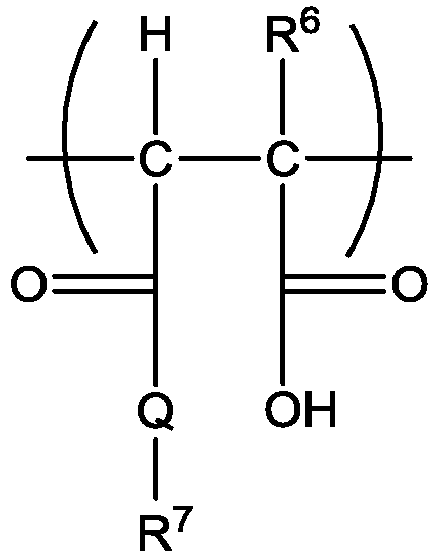


Claims (16)
- Process for the preparation of a hardening accelerator composition by reaction of a calcium compound, preferably a calcium salt, most preferably a water-soluble calcium salt, with a silicon dioxide containing component under alkaline conditions at a temperature not exceeding 80°C and by applying milling, the reaction being carried out in the presence of an aqueous solution of a water-soluble comb polymer suitable as a plasticizer for hydraulic binders
- Process according to Claim 1, wherein the calcium compound is calcium hydroxide and/or calcium oxide.
- Process according to Claim 1 or 2, wherein the silicon dioxide containing compound is selected from the group of microsilica, pyrogenic silica, precipitated silica, blast furnace slag, and/or quartz sand.
- Process according to any of Claims 1 to 3, wherein the pH-value is higher than 9.
- Process according to any of Claims 1 to 4, wherein the molar ratio of calcium from the calcium compound to silicon from the silicon dioxide containing component is from 0.6 to 2, preferably 1.1 to 1.8.
- Process according to any of Claims 1 to 5, wherein the weight ratio of water to the sum of calcium compound and silicon dioxide containing component in the composition is from 2 to 10.
- Process according to any of Claims 1 to 6, wherein the water-soluble comb polymer is a copolymer which contains, on the main chain, side chains having ether functions and acid functions.
- Process according to any of Claims 1 to 7, wherein the water-soluble comb polymer is a copolymer which is produced by free radical polymerization in the presence of acid monomer, preferably carboxylic acid monomer, and polyether macromonomer, so that altogether at least 45 mol %, preferably at least 80 mol %, of all structural units of the copolymer are produced by incorporation of acid monomer, preferably carboxylic acid monomer, and polyether macromonomer in the form of polymerized units.
- Process according to Claim 8, wherein a structural unit is produced in the copolymer by incorporation of the acid monomer in the form of polymerized units, which structural unit is in accordance with one of the general formulae (Ia), (Ib), (Ic) and/or (Id)
 R1 is H or a non-branched or branched C1 - C4 alkyl group;X is NH-(CnH2n), where n = 1, 2, 3 or 4 or O-(CnH2n), where n = 1, 2, 3 or 4, or is not present;R2 is SO3H, PO3H2, O-PO3H2 or para-substituted C6H4-SO3H, or, if X is not present, R2 is OH;
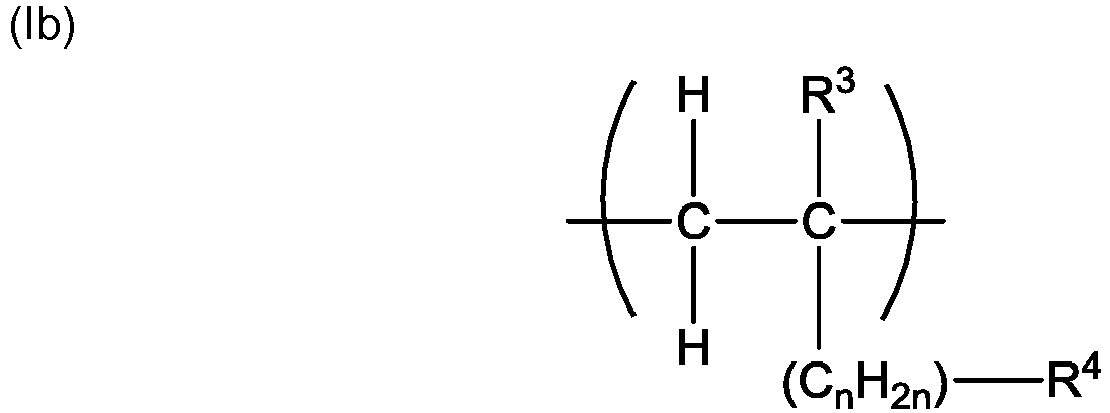 R3 is H or a non-branched or a branched C1 - C4 alkyl group;n = 0, 1, 2, 3 or 4;R4 is SO3H, PO3H2, O-PO3H2 or para-substituted C6H4-SO3H;
 R5 is H or a non-branched or a branched C1 - C4 alkyl group;Z is O or NH;
 R6 is H or a non-branched or branched C1 - C4 alkyl group;Q is NH or O;R7 is H, (CnH2n)-SO3H where n = 0, 1, 2, 3 or 4, (CnH2n)-OH where n = 0, 1, 2, 3 or 4, (CnH2n)-PO3H2 where n = 0, 1, 2, 3 or 4, (CnH2n)-OPO3H2 where n= 0, 1, 2, 3 or 4, (C6H4)-SO3H, (C6H4)-PO3H2, (C6H4)-OPO3H2 and/or (CmH2m)e-O-(A'O)α-R9 where m = 0, 1, 2, 3 or 4, e = 0, 1, 2, 3 or 4, A' = Cx'H2x' where x' = 2, 3, 4 or 5 or CH2CH(C6H5), α= an integer from 1 to 350, where R9 is a non-branched or a branched C1 - C4 alkyl group.
 - Process according to Claim 8 or 9, wherein a structural unit is produced in the copolymer by incorporation of the polyether macromonomer in the form of polymerized units, which structural unit is in accordance with one of the general formulae (IIa), (IIb) and/or (IIc)
 R10, R11 and R12 are, independently of one another, are H or a non-branched or a branched C1 - C4 alkyl group;E is a non-branched or branched C1 - C6 alkylene group, a cyclohexylen group, CH2-C6H10, ortho-, meta- or para-substituted C6H4 or is not present;G is O, NH or CO-NH, with the proviso that, if E is not present, G is also not present;A is CxH2x, where x = 2, 3, 4 or 5 (preferably x = 2), or CH2CH(C6H5);n is 0, 1, 2, 3, 4 or 5;a is an integer from 2 to 350 (preferably 10 - 200);R13 is H, a non-branched or a branched C1 - C4 alkyl group, CO-NH2, or COCH3;
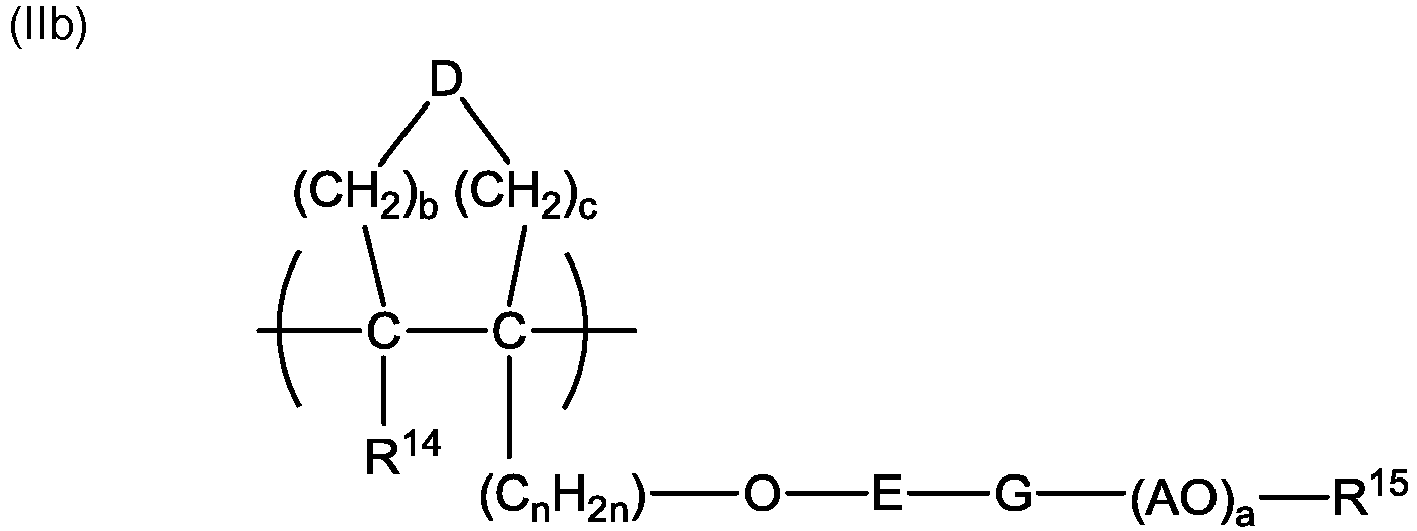 R14 is H or a non-branched or branched C1 - C4 alkyl group;E is a non-branched or branched C1 - C6 alkylene group, a cyclohexylen group, CH2-C6H10, ortho-, meta- or para-substituted C6H4, or is not present;G is not present, O, NH or CO-NH, with the proviso that, if E is not present, G is also not present;A is CxH2x, where x = 2, 3, 4 or 5, or CH2CH(C6H5);n is 0, 1, 2, 3, 4 or 5a is an integer from 2 to 350;D is not present, NH or O, with the proviso that, if D is not present: b = 0, 1, 2, 3 or 4 and c = 0, 1, 2, 3 or 4, where b + c = 3 or 4, and
with the proviso that if D is NH or O: b = 0, 1, 2 or 3, c = 0, 1, 2 or 3, where b + c = 2 or 3;R15 is H, a non-branched or branched C1 - C4 alkyl group, CO-NH2, or COCH3;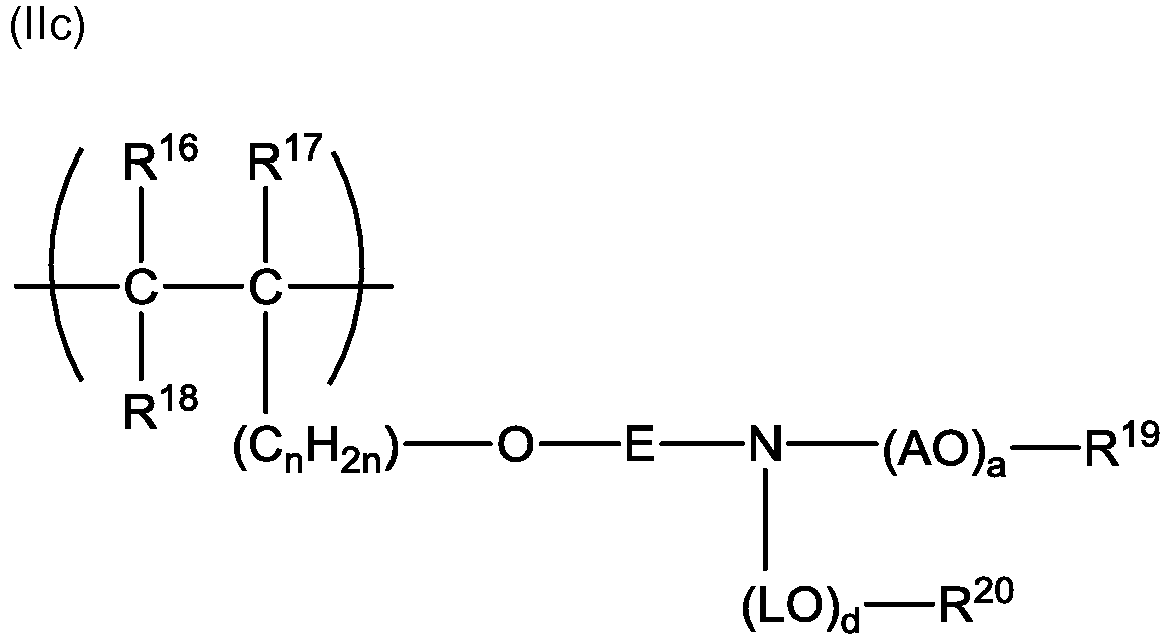 R16, R17 and R18 are, independently of one another, H or a non-branched or branched C1 - C4 alkyl group;E is a non-branched or branched C1 - C6 alkylene group, a cyclohexylen group, CH2-C6H10, ortho-, meta- or para-substituted C6H4 or is not present,A is CxH2x, where x = 2, 3, 4 or 5, or CH2CH(C6H5);n is 0, 1, 2, 3, 4 or 5;L is CxH2x, where x = 2, 3, 4 or 5, or CH2-CH(C6H5);a is an integer from 2 to 350;d is an integer from 1 to 350;R19 is H or a non-branched or a branched C1 - C4 alkyl group,R20 is H or a non-branched C1 - C4 alkyl group.
 - Process according to any of Claims 8 to 10, wherein a structural unit is produced in the copolymer by incorporation of the polyether macromonomer in the form of polymerized units, which structural unit is in accordance with the general formula (IId)
 R21, R22 and R23 are, independently of one another, are H or a non-branched or branched C1 - C4 alkyl group;A is CxH2x, where x = 2, 3, 4 or 5, or CH2CH(C6H5);a is an integer from 2 to 350;R24 is H or a non-branched or a branched C1 - C4 alkyl group, preferably a C1 - C4 alkyl group.
 - Process according to any of Claims 8 to 11, wherein polycondensates containing(I) at least one structural unit consisting of an aromatic or heteroaromatic moiety bearing a polyether side chain and(II) at least one structural unit consisting of an aromatic or heteroaromatic moiety bearing at least one phosphoric acid ester group and/or its saltare present in the aqueous solution which contains a water-soluble comb polymer.
- Process according to Claim 12, wherein in the polycondensate the structural units (I) and (II) are represented by the following general formulae
 A is a substituted or unsubstituted aromatic or heteroaromatic compound having 5 to 10 C atoms;B is N, NH or O;n is 2 if B is N and n is 1 if B is NH or O;R1 and R2, independently of one another, are a branched or straight C1- to C10-alkyl radical, C5- to C8-cycloalkyl radical, aryl radical, heteroaryl radical or H;a is an integer from 1 to 300;X is a branched or straight C1- to C10-alkyl radical, C5- to C8-cycloalkyl radical, aryl radical, heteroaryl radical or H;
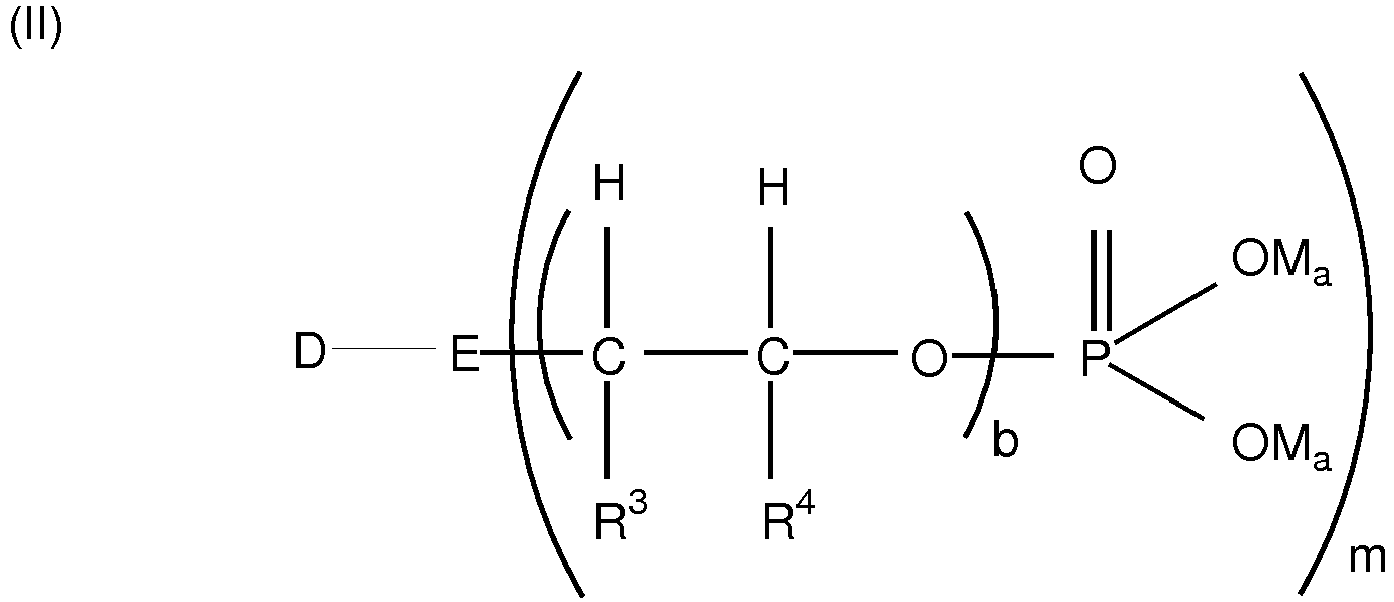 D is a substituted or unsubstituted heteroaromatic compound having 5 to 10 C atoms;E is N, NH or O;m is 2 if E is N and m is 1 if E is NH or O;R3 and R4, independently of one another, are a branched or straight C1- to C10-alkyl radical, C5- to C8-cycloalkyl radical, aryl radical, heteroaryl radical or H;b is an integer from 1 to 300;M is an alkali metal ion, alkaline earth metal ion, ammonium ion, organic ammonium ion and/or H;a is 1 or in the case of alkaline earth metal ions is 1/2.
 - Process according to any of Claims 1 to 13, wherein the reaction is carried out completely or partially in the presence of an aqueous solution containing a viscosity enhancer polymer, selected from the group of polysaccharide derivatives and/or (co)polymers with an average molecular weight Mw higher than 500.000 g/mol, more preferably higher than 1.000.000 g/mol, the (co)polymers containing structural units derived (preferably by free radical polymerization) from non-ionic (meth)acrylamide monomer derivatives and/or sulphonic acid monomer derivatives.
- Process according to Claim 14, wherein the viscosity enhancer polymer is a polysaccharide derivative selected from the group of methylcellulose, hydroxyethylcellulose (HEC), hydroxypropylcellulose (HPC), methylhydroxyethylcellulose (MHEC), methylhydroxypropylcellulose (MHPC) and/or (co)polymers with an average molecular weight Mw higher than 500.000 g/mol, more preferably higher than 1.000.000 g/mol, the (co)polymers containing structural units derived (preferably by free radical polymerization) from non-ionic (meth)acrylamide monomer derivatives selected from the group of acrylamide, preferably acrylamide, methacrylamide, N-methylacrylamide, N-methylmethacrylamide, N,N-dimethylacrylamide, N-ethylacrylamide, N,N-diethylacrylamide, N-cyclohexylacrylamide, N-benzylacrylamide, N,N-dimethylaminopropylacrylamide, N,N-dimethylaminoethylacrylamide and/or N-tert-butylacrylamide and/or sulphonic acid monomer derivatives selected from the group of 2-acrylamido-2-methylpropanesulphonic acid, 2-methacrylamido-2-methylpropanesulphonic acid, 2-acrylamidobutanesulphonic acid, and/or 2-acrylamido-2,4,4-trimethylpentanesulphonic acid or the salts of the acids mentioned.
- A process for accelerating the hardening of a building material mixture comprising cement as a hydraulic binder, which process comprises providing a hardening accelerator composition by a process of any one of claims 1 to 15 and adding the hardening accelerator composition to the building material mixture.
Priority Applications (1)
| Application Number | Priority Date | Filing Date | Title |
|---|---|---|---|
| PL13179257T PL2664595T3 (en) | 2008-09-02 | 2009-09-02 | Process for preparing a plasticizer-containing hardening accelerator composition |
Applications Claiming Priority (3)
| Application Number | Priority Date | Filing Date | Title |
|---|---|---|---|
| EP08163468 | 2008-09-02 | ||
| PCT/EP2009/061334 WO2010026155A1 (en) | 2008-09-02 | 2009-09-02 | Plasticizer-containing hardening accelerator composition |
| EP09782505.3A EP2321235B1 (en) | 2008-09-02 | 2009-09-02 | Use of a plasticizer-containing hardening accelerator composition |
Related Parent Applications (2)
| Application Number | Title | Priority Date | Filing Date |
|---|---|---|---|
| EP09782505.3A Division EP2321235B1 (en) | 2008-09-02 | 2009-09-02 | Use of a plasticizer-containing hardening accelerator composition |
| EP09782505.3A Division-Into EP2321235B1 (en) | 2008-09-02 | 2009-09-02 | Use of a plasticizer-containing hardening accelerator composition |
Publications (3)
| Publication Number | Publication Date |
|---|---|
| EP2664595A2 EP2664595A2 (en) | 2013-11-20 |
| EP2664595A3 EP2664595A3 (en) | 2014-10-01 |
| EP2664595B1 true EP2664595B1 (en) | 2018-11-21 |
Family
ID=41404379
Family Applications (4)
| Application Number | Title | Priority Date | Filing Date |
|---|---|---|---|
| EP13179258.2A Active EP2664596B1 (en) | 2008-09-02 | 2009-09-02 | Process for preparing a plasticizer-containing hardening accelerator composition |
| EP09782505.3A Active EP2321235B1 (en) | 2008-09-02 | 2009-09-02 | Use of a plasticizer-containing hardening accelerator composition |
| EP13179257.4A Active EP2664595B1 (en) | 2008-09-02 | 2009-09-02 | Process for preparing a plasticizer-containing hardening accelerator composition |
| EP16195850.9A Active EP3153482B1 (en) | 2008-09-02 | 2009-09-02 | Plasticizer-containing hardening accelerator composition |
Family Applications Before (2)
| Application Number | Title | Priority Date | Filing Date |
|---|---|---|---|
| EP13179258.2A Active EP2664596B1 (en) | 2008-09-02 | 2009-09-02 | Process for preparing a plasticizer-containing hardening accelerator composition |
| EP09782505.3A Active EP2321235B1 (en) | 2008-09-02 | 2009-09-02 | Use of a plasticizer-containing hardening accelerator composition |
Family Applications After (1)
| Application Number | Title | Priority Date | Filing Date |
|---|---|---|---|
| EP16195850.9A Active EP3153482B1 (en) | 2008-09-02 | 2009-09-02 | Plasticizer-containing hardening accelerator composition |
Country Status (21)
| Country | Link |
|---|---|
| US (1) | US8653186B2 (en) |
| EP (4) | EP2664596B1 (en) |
| JP (4) | JP6071199B2 (en) |
| CN (2) | CN108947375B (en) |
| AU (1) | AU2009289267B2 (en) |
| BR (1) | BRPI0918283A2 (en) |
| CA (1) | CA2735705C (en) |
| DE (1) | DE202009017741U1 (en) |
| DK (3) | DK2664596T3 (en) |
| ES (4) | ES2730882T3 (en) |
| HR (1) | HRP20191076T1 (en) |
| HU (4) | HUE044019T2 (en) |
| LT (3) | LT2664595T (en) |
| MX (1) | MX2011002357A (en) |
| PL (4) | PL2664596T3 (en) |
| PT (1) | PT2321235T (en) |
| RU (1) | RU2520105C2 (en) |
| SI (1) | SI2321235T1 (en) |
| TR (3) | TR201901118T4 (en) |
| TW (1) | TW201016629A (en) |
| WO (1) | WO2010026155A1 (en) |
Families Citing this family (154)
| Publication number | Priority date | Publication date | Assignee | Title |
|---|---|---|---|---|
| PT2321235T (en) | 2008-09-02 | 2019-06-25 | Construction Research & Technology Gmbh | Use of a plasticizer-containing hardening accelerator composition |
| EP2448994B1 (en) | 2009-06-30 | 2013-08-14 | Basf Se | Method for the phosphine-initialized production of hyperbranched polyols |
| AU2010294400B2 (en) * | 2009-09-02 | 2014-03-20 | Basf Construction Solutions Gmbh | Formulation and its use |
| AU2010291308B2 (en) * | 2009-09-02 | 2014-08-14 | Construction Research & Technology Gmbh | Sprayable hydraulic binder composition and method of use |
| JP5762415B2 (en) * | 2009-09-02 | 2015-08-12 | コンストラクション リサーチ アンド テクノロジー ゲーエムベーハーConstruction Research & Technology GmbH | Curing accelerator composition containing phosphorylated polycondensate |
| AU2011219771B2 (en) * | 2010-02-25 | 2014-06-26 | Construction Research & Technology Gmbh | Hardening accelerator composition containing dispersants |
| FR2958931B1 (en) * | 2010-04-20 | 2012-05-18 | Lafarge Sa | RAPID HYDRAULIC BINDER FOR CONCRETE PARTS AND WORKS |
| CA2788620C (en) * | 2010-04-21 | 2018-04-24 | Basf Se | Use of csh suspensions in well cementing |
| US9409820B2 (en) | 2010-04-21 | 2016-08-09 | Basf Se | Use of CSH suspensions in well cementing |
| US8435930B2 (en) | 2010-07-15 | 2013-05-07 | Lafarge | Low density cementitious compositions using lime kiln dust |
| AR082207A1 (en) | 2010-07-15 | 2012-11-21 | Lafarge Sa | A CEMENTICIOUS BINDING, A FRAGUABLE CEMENTIC COMPOSITION, AND A CEMENTATION METHOD THAT USES |
| EP2423175A1 (en) | 2010-08-24 | 2012-02-29 | Sika Technology AG | Accelerator for hydraulic binders |
| CN107082618A (en) * | 2010-10-11 | 2017-08-22 | 巴斯夫聚合建材有限公司 | Gypsum slurry containing dispersant |
| AU2011335173B2 (en) * | 2010-11-29 | 2015-07-09 | Construction Research & Technology Gmbh | Powdered accelerator |
| EP2465835B1 (en) | 2010-12-17 | 2013-09-18 | BASF Construction Polymers GmbH | Method for continuous production of mortar compositions |
| US8561701B2 (en) * | 2010-12-21 | 2013-10-22 | Halliburton Energy Services, Inc. | Methods for cementing in a subterranean formation using a cement composition containing calcium silicate hydrate seeds |
| CN103492341B (en) * | 2011-04-21 | 2016-06-08 | 建筑研究和技术有限公司 | Enhancer compositions |
| US9434648B2 (en) * | 2011-04-21 | 2016-09-06 | Construction Research & Technology Gmbh | Accelerator composition |
| JP6066117B2 (en) * | 2011-04-21 | 2017-01-25 | コンストラクション リサーチ アンド テクノロジー ゲーエムベーハーConstruction Research & Technology GmbH | Accelerator composition |
| ES2745743T3 (en) | 2011-05-26 | 2020-03-03 | Saint Gobain Weber | Hydraulic binder comprising an accelerator, its use and preparation procedure for a construction material |
| WO2013052732A1 (en) | 2011-10-07 | 2013-04-11 | Boral Industries Inc. | Inorganic polymer/organic polymer composites and methods of making same |
| US8864901B2 (en) | 2011-11-30 | 2014-10-21 | Boral Ip Holdings (Australia) Pty Limited | Calcium sulfoaluminate cement-containing inorganic polymer compositions and methods of making same |
| RU2617852C9 (en) * | 2011-12-05 | 2017-08-30 | Сикэ Текнолоджи Аг | Process for producing hardening accelerators for mineral binder compositions |
| EP2607329A1 (en) * | 2011-12-23 | 2013-06-26 | Sika Technology AG | Accelerator |
| EP2615073B1 (en) | 2012-01-13 | 2018-04-04 | Construction Research & Technology GmbH | Dispersion agent for inorganic particles |
| BR112014018874B1 (en) | 2012-02-08 | 2020-10-20 | Basf Se | aqueous cement-free dispersion, processes for preparing an aqueous dispersion, and a powdered polymer composition, powdered polymer composition, use of an aqueous dispersion, aqueous formulation of hydraulic fastening compositions, and hydraulic fastening composition in the form of powder |
| US8883907B2 (en) | 2012-02-08 | 2014-11-11 | Basf Se | Aqueous dispersion |
| FR2989082B1 (en) * | 2012-04-05 | 2015-03-13 | Chryso | ADJUVANT FOR HYDRAULIC COMPOSITIONS |
| CA2871720C (en) * | 2012-04-11 | 2020-07-21 | Construction Research & Technology Gmbh | Polycondensation product based on aromatic compounds, method for the preparation and use thereof |
| US20150148456A1 (en) * | 2012-05-29 | 2015-05-28 | Construction Research & Technology Gmbh | Method for the production of solid accelerators for construction material mixtures |
| WO2013178417A1 (en) * | 2012-05-29 | 2013-12-05 | Construction Research & Technology Gmbh | Pulverulent accelerator |
| FR2992961B1 (en) * | 2012-07-04 | 2014-08-29 | Chryso | METHOD OF CREATING PATTERNS ON A CONCRETE SURFACE |
| EP2687498A1 (en) * | 2012-07-20 | 2014-01-22 | Construction Research & Technology GmbH | Additive for hydraulic dissolving masses |
| EP2687496A1 (en) * | 2012-07-20 | 2014-01-22 | BASF Construction Polymers GmbH | Synthesis and use of plaster seeding material |
| DE102012106658B3 (en) | 2012-07-23 | 2013-09-26 | ThyssenKrupp Resource Technologies AG | Use of hydration accelerating germs as an additive for cement and / or concrete |
| CN102757213B (en) * | 2012-07-26 | 2013-11-06 | 石家庄铁道大学 | Method for preparing side slope grouting slurry for widening silty-fine sand embankment |
| EP2882696B1 (en) * | 2012-08-13 | 2019-04-10 | Construction Research & Technology GmbH | Process for preparing a hardening accelerator composition |
| CA2881217C (en) * | 2012-08-13 | 2019-04-02 | Construction Research & Technology Gmbh | Hardening accelerator composition for cementitious compositions |
| NO20121086A1 (en) * | 2012-09-25 | 2014-03-26 | Yara Int Asa | Antifreeze composition for production of resistant concrete under cold temperature conditions |
| US20150299040A1 (en) * | 2012-11-09 | 2015-10-22 | Verdant Cement Llc | Molten salt synthesis for manufacture of cement precursors |
| CN102964077B (en) * | 2012-11-20 | 2015-01-21 | 中山市东峻混凝土有限公司 | Stabilizing reinforcing agent for compounding polycarboxylate superplasticizer, preparation method and application |
| CN102976654B (en) * | 2012-12-04 | 2014-12-10 | 江苏苏博特新材料股份有限公司 | Polycarboxylic superplasticizer and application thereof |
| KR101617067B1 (en) | 2013-01-18 | 2016-05-02 | (주)엘지하우시스 | Exterior insulation mortar for cold weather and construction method of exterior insulation system using the same |
| MX382381B (en) * | 2013-01-25 | 2025-03-13 | Basf Se | HARDENING ACCELERATING COMPOSITION. |
| EP2759337A1 (en) | 2013-01-25 | 2014-07-30 | Basf Se | Additive for hydraulically setting masses |
| EP2769964A1 (en) | 2013-02-26 | 2014-08-27 | Construction Research & Technology GmbH | Additive for hydraulic setting compositions |
| EP2695866B1 (en) | 2013-05-24 | 2019-04-24 | Basf Se | Modified rheology additive |
| US10759716B2 (en) * | 2013-05-30 | 2020-09-01 | Sika Technology Ag | Accelerator for mineral binders |
| EP3019455B1 (en) | 2013-07-12 | 2019-07-03 | Sika Technology AG | Additive combination comprising a grinding aid and a concrete admixture for accelerating the hydration of cementitious binders |
| EP2826827B1 (en) * | 2013-07-18 | 2019-06-12 | Basf Se | CMP composition comprising abrasive particles containing ceria |
| EP2842921A1 (en) | 2013-08-27 | 2015-03-04 | Construction Research & Technology GmbH | Novel fibers, methods for their preparation and use in the manufacture of reinforced elements |
| KR101385237B1 (en) * | 2013-08-27 | 2014-04-16 | 이코넥스 주식회사 | Preparation of nano calcium silicate hydrate using silica fume |
| EP2842927A1 (en) | 2013-08-29 | 2015-03-04 | BASF Construction Polymers GmbH | Hardening accelerator containing ettringite and calcium silicate hydrate |
| US9796622B2 (en) | 2013-09-09 | 2017-10-24 | Saudi Arabian Oil Company | Development of high temperature low density cement |
| NO20131392A1 (en) * | 2013-10-21 | 2015-04-22 | Yara Int Asa | |
| ES2635167T3 (en) | 2013-11-27 | 2017-10-02 | Fundación Tecnalia Research & Innovation | Method for manufacturing cementitious C-S-H seeds |
| ITMI20132059A1 (en) * | 2013-12-10 | 2015-06-11 | Mapei Spa | ACCELERATING ADDITIVE FOR CEMENTITIOUS COMPOSITIONS |
| EP2886580A1 (en) | 2013-12-20 | 2015-06-24 | Construction Research & Technology GmbH | Additive for rheology improvement of inorganic binders |
| EP2896603A1 (en) * | 2014-01-21 | 2015-07-22 | Basf Se | Calcium sulphate composition including an additive |
| EP2899171A1 (en) * | 2014-01-22 | 2015-07-29 | Construction Research & Technology GmbH | Additive for hydraulic setting masses |
| EP2899162A1 (en) * | 2014-01-22 | 2015-07-29 | Basf Se | Synthesis and use of CaSO4 based hardening accelerators |
| EP2876094A1 (en) | 2014-04-03 | 2015-05-27 | Basf Se | Cement and calcium sulphate based binder composition |
| CN103951308B (en) * | 2014-04-17 | 2015-08-19 | 山东卓星化工有限公司 | Sulfonic group modified Soxylat A 25-7 superplasticizer and preparation method thereof |
| EP2952492A1 (en) * | 2014-06-06 | 2015-12-09 | Basf Se | Composition based on calcium silicate hydrate |
| CN104402288A (en) * | 2014-10-29 | 2015-03-11 | 上海建工集团股份有限公司 | Calcium silicate hydrate gel solution early strength agent and preparation method thereof |
| KR101713828B1 (en) * | 2014-11-04 | 2017-03-10 | (주)에스엠테크 | Cementless promotion-type admixture, and cementless composition comprising it |
| CN107108362B (en) * | 2014-12-18 | 2020-11-10 | 巴斯夫欧洲公司 | Construction chemical composition for tile mortar |
| US10377674B2 (en) * | 2015-02-02 | 2019-08-13 | Carolyn Dry | Concrete coatings and compositions that absorb carbon dioxide |
| WO2016135182A1 (en) | 2015-02-27 | 2016-09-01 | Basf Se | Use of csh-seed modified fibers in oil field applications |
| US10144673B2 (en) | 2015-04-21 | 2018-12-04 | Basf Se | Method for producing a calcium silicate hydrate-comprising hardening accelerator in powder form |
| TR201906112T4 (en) * | 2015-04-30 | 2019-05-21 | Construction Research & Technology Gmbh | Accelerator composition. |
| AT517291A1 (en) | 2015-05-26 | 2016-12-15 | Holcim Technology Ltd | concrete composition |
| US10968108B2 (en) | 2015-05-29 | 2021-04-06 | Fundacion Tecnalia Research & Innovation | Method for the manufacture of calcium silicate hydrate used as hardening accelerator in concrete and cement-based materials, calcium silicate hydrate manufactured with said method |
| EP3313801B1 (en) * | 2015-06-26 | 2020-08-05 | Construction Research & Technology GmbH | Additive for hydraulically setting compositions |
| JP7277139B2 (en) * | 2015-08-21 | 2023-05-18 | ビーエーエスエフ ソシエタス・ヨーロピア | Accelerator composition |
| AU2016341065B2 (en) * | 2015-10-21 | 2020-08-27 | Sika Technology Ag | Additive for internal post treatment of mineral binder compositions |
| CA3000052C (en) * | 2015-11-10 | 2023-09-12 | Yara International Asa | Calcium nitrate for reducing the pore size distribution of a hardened cementitious composition and steel reinforced concrete having an elevated resistance towards carbonation |
| FR3043675B1 (en) * | 2015-11-17 | 2022-11-11 | Lafarge Sa | ULTRA-LIGHT MINERAL FOAM AND METHOD FOR MANUFACTURING THEREOF |
| JP6905795B2 (en) * | 2015-12-16 | 2021-07-21 | コンストラクション リサーチ アンド テクノロジー ゲーエムベーハーConstruction Research & Technology GmbH | Sprayed concrete composition and its manufacturing method |
| ES2836699T3 (en) | 2015-12-17 | 2021-06-28 | Construction Research & Technology Gmbh | Polycondensate based water reducer |
| RU2616964C1 (en) * | 2016-03-09 | 2017-04-18 | Федеральное государственное бюджетное образовательное учреждение высшего профессионального образования "Петербургский государственный университет путей сообщения Императора Александра I" | High-strength concrete |
| DE102016207858A1 (en) | 2016-05-06 | 2017-11-09 | Baustoffwerke Löbnitz GmbH & Co. KG | insulation |
| MX2018013793A (en) | 2016-05-09 | 2019-03-21 | Construction Research & Technology Gmbh | Method for treatment of slag. |
| EP3468936B1 (en) | 2016-06-09 | 2021-02-17 | Basf Se | Hydration control mixture for mortar and cement compositions |
| EP3468934B1 (en) | 2016-06-09 | 2020-06-03 | Basf Se | Construction chemical compositions comprising a bisulfite adduct of glyoxylic acid |
| ES3046732T3 (en) | 2016-07-18 | 2025-12-02 | Ecole Polytechnique Fed Lausanne Epfl | Hardening acceleration/hardening retardation composition for building materials |
| JP6831508B2 (en) * | 2016-07-25 | 2021-02-17 | 学校法人福岡大学 | How to repair concrete |
| WO2018077772A1 (en) | 2016-10-31 | 2018-05-03 | Basf Se | Additive for construction chemical compositions |
| US11814320B2 (en) | 2016-11-09 | 2023-11-14 | Sika Technology Ag | Hardening accelerator |
| CN107311504B (en) * | 2016-12-26 | 2020-10-23 | 江苏苏博特新材料股份有限公司 | Admixture for improving strength of cement-based material, preparation method and application thereof |
| CA3047382A1 (en) * | 2016-12-27 | 2018-07-05 | Construction Research & Technology Gmbh | Strength enhancing admixture for cementitious compositions |
| MY196346A (en) * | 2017-02-22 | 2023-03-24 | Denka Company Ltd | Hardening agent for ready-mix shipped rapid-hardening concrete, ready-mix shipped rapid-hardening concrete material, ready-mix shipped rapid-hardening concrete composition, and method for preparing same |
| WO2018154013A1 (en) | 2017-02-22 | 2018-08-30 | Cirkel Gmbh & Co. Kg | Oxidic composition having a content of semi-ordered calcium silicate hydrate |
| US11667569B2 (en) | 2017-02-22 | 2023-06-06 | Basf Se | Composition containing a semi-ordered calcium silicate hydrate |
| DE102017205822A1 (en) | 2017-04-05 | 2018-10-11 | Baustoffwerke Löbnitz GmbH & Co. KG | Method and device for producing porous mineral building material |
| RU2659432C1 (en) * | 2017-04-10 | 2018-07-02 | Общество с ограниченной ответственностью "Экспонента" | Rheology regulator for inorganic binder-based dispersion systems |
| WO2018200563A1 (en) * | 2017-04-25 | 2018-11-01 | GCP Applied Technologies, Inc. | Agents for enhancing cement strength |
| CN106986572B (en) * | 2017-04-25 | 2020-08-14 | 北京工业大学 | Method for preparing concrete reinforcing agent by using hyperbranched polymer |
| CN107235650B (en) * | 2017-07-03 | 2020-05-05 | 中建西部建设西南有限公司 | A kind of water-based nano-composite early-strength admixture and preparation method thereof |
| EP3700967B1 (en) | 2017-10-27 | 2024-04-03 | Basf Se | Spray drying method |
| FR3073220B1 (en) * | 2017-11-07 | 2022-11-11 | Hoffmann Jb Tech | METHOD FOR PREPARING AN ETHRINGITE BINDER FOR THE MANUFACTURE OF BUILDING MATERIALS |
| KR20200128572A (en) | 2018-03-09 | 2020-11-13 | 더스틴 에이. 하트만 | Novel composition for improved concrete performance |
| KR102749832B1 (en) | 2018-03-22 | 2025-01-03 | 더스틴 에이. 하트만 | Method for manufacturing improved finished concrete products |
| EP3543220A1 (en) * | 2018-03-22 | 2019-09-25 | Sika Technology Ag | Production of calcium hydroxide nanoparticles and their use as accelerators in mineral binder compositions |
| US12157706B2 (en) | 2018-03-22 | 2024-12-03 | E5 Incorporated | Compositions for improved concrete performance |
| CN112105591A (en) * | 2018-05-31 | 2020-12-18 | Sika技术股份公司 | Method for plasticizing a cement containing belite-calcium sulphoaluminate-ferrite |
| CN108585559A (en) * | 2018-06-06 | 2018-09-28 | 上海美澎材料科技有限公司 | A kind of cement base crystallization master batch material and preparation method |
| WO2020007664A1 (en) * | 2018-07-06 | 2020-01-09 | Basf Se | Composition for flowable fire-resistant materials |
| DE102018212322A1 (en) | 2018-07-24 | 2020-01-30 | Baustoffwerke Löbnitz GmbH & Co. KG | Process for the production of porous mineral building material with improved strength |
| CN112513197A (en) | 2018-08-13 | 2021-03-16 | 巴斯夫欧洲公司 | High-performance wetting agents by using carrier materials |
| CA3111868A1 (en) | 2018-10-02 | 2020-04-09 | Sika Technology Ag | Activation of ground granulated blast furnace slag |
| CN109020423A (en) * | 2018-10-19 | 2018-12-18 | 济南大学 | A kind of high resistance to corrosion self-compacting concrete for ocean engineering |
| US20220250986A1 (en) | 2019-06-03 | 2022-08-11 | Basf Se | Use of an additive kit in 3d printing of a construction material composition |
| CN110395939B (en) * | 2019-06-19 | 2022-04-22 | 科之杰新材料集团有限公司 | Waterproof enhanced alkali-free liquid accelerator and preparation method thereof |
| RU2717021C1 (en) * | 2019-07-17 | 2020-03-17 | Федеральное государственное бюджетное образовательное учреждение высшего образования "Петербургский государственный университет путей сообщения Императора Александра I" | High-strength concrete |
| US11866366B2 (en) | 2019-09-03 | 2024-01-09 | Specification Products, Inc. | Wear-resistant concrete formulations and methods for their preparation |
| CN110759654A (en) * | 2019-12-05 | 2020-02-07 | 长江师范学院 | A kind of aluminate-based cement with high performance under high temperature conditions and preparation method thereof |
| CN110981269A (en) * | 2019-12-31 | 2020-04-10 | 上海三瑞高分子材料股份有限公司 | Cement early strength agent composition and preparation method thereof |
| KR102181656B1 (en) * | 2020-01-03 | 2020-11-23 | 주식회사 삼표산업 | Early Strength Additives Preparation Method and Early Strength Concrete |
| RU2729547C1 (en) * | 2020-02-07 | 2020-08-07 | Федеральное государственное бюджетное образовательное учреждение высшего образования "Петербургский государственный университет путей сообщения Императора Александра I" | Heat-insulating concrete |
| EP4110744A1 (en) | 2020-02-27 | 2023-01-04 | Basf Se | Uncharged clay blocking agent |
| CN111470794B (en) * | 2020-03-05 | 2021-05-28 | 武汉理工大学 | A kind of calcium aluminosilicate hydrate nanocrystalline nucleus early strength agent and preparation method thereof |
| TWI717228B (en) | 2020-03-11 | 2021-01-21 | 彩興股份有限公司 | Concrete hardener composition |
| WO2021185718A1 (en) | 2020-03-20 | 2021-09-23 | Basf Se | Environmentally friendly construction material compositions having improved early strength |
| EP3916067B1 (en) | 2020-05-27 | 2023-07-12 | Bind-X GmbH | Biocementation mixture for dust suppression |
| WO2021254802A1 (en) | 2020-06-18 | 2021-12-23 | Basf Se | Hydration control mixture for mortar and cement compositions |
| CN113913167B (en) * | 2020-07-08 | 2023-05-30 | 中国石油化工股份有限公司 | Free liquid control agent for well cementation cement paste and preparation method and application thereof |
| CN112062494A (en) * | 2020-09-16 | 2020-12-11 | 天津炬实科技发展股份有限公司 | Inorganic mineral reinforcing agent |
| WO2022071281A1 (en) * | 2020-09-30 | 2022-04-07 | 株式会社大阪ソーダ | Rubber composition |
| WO2022073961A1 (en) | 2020-10-09 | 2022-04-14 | Basf Se | Process for producing calcium silicate hydrate |
| RU2754844C1 (en) * | 2020-10-22 | 2021-09-08 | Общество с ограниченной ответственностью «Оренбургский пропант» | Water-based acrylic polymer for cement composition and method for its preparation |
| CN112405734B (en) * | 2020-11-10 | 2022-05-10 | 漳州市德根工贸有限公司 | Plywood production process and equipment thereof |
| US20250320159A1 (en) * | 2020-11-18 | 2025-10-16 | Socpra Sciences Et Genie S.E.C. | Use of carrageenan as a viscosity-modifying admixture in a flowable cementitious suspensions |
| EP4347529A1 (en) | 2021-05-27 | 2024-04-10 | Basf Se | Dispersion composition comprising a cement-based sealing slurry and an additive mixture |
| CN113354315B (en) * | 2021-07-09 | 2022-11-22 | 贵州大学 | Method for producing high-silicon sulphoaluminate cement by using phosphorus acid insoluble slag |
| EP4119519A1 (en) | 2021-07-12 | 2023-01-18 | Mapei S.p.A. | Strength enhancing admixture for low-carbon cementitious compositions |
| MX2024002444A (en) | 2021-08-27 | 2024-03-08 | Construction Research & Technology Gmbh | Use of a colloidal polymer inorganic hybrid material as a construction composition additive. |
| EP4194419A1 (en) | 2021-12-08 | 2023-06-14 | Holcim Technology Ltd | Method for increasing the strength of a hydraulic binder and a mineral accelerator therefore |
| CN114736565B (en) * | 2022-03-29 | 2023-11-28 | 上海保立佳新材料有限公司 | Hardening agent and raw material composition, preparation method and application thereof |
| EP4511346B1 (en) | 2022-04-21 | 2026-03-18 | Construction Research & Technology GmbH | Process for the preparation of a calcium silicate hydrate seed composition useful as a hardening accelerator for cementitious compositions |
| WO2023209082A1 (en) | 2022-04-29 | 2023-11-02 | Basf Se | Combinations of an organic polymer and calcium silicate hydrate for producing mineral water-proofing membranes |
| KR102447563B1 (en) * | 2022-05-11 | 2022-09-26 | 주식회사 다온코리아 | Crack repair material of concrete structure and crack repair method using the same |
| CN114804709B (en) * | 2022-05-23 | 2023-03-28 | 广西科达新材料集团有限公司 | Nano calcium silicate hydrate polycarboxylic acid early strength agent and preparation method thereof |
| CA3258324A1 (en) | 2022-06-22 | 2023-12-28 | Construction Research & Technology Gmbh | Hardening accelerator composition for cementitious compositions, cementitious composition and process for accelerating the hardening of a cementitious composition |
| EP4353699A1 (en) | 2022-10-12 | 2024-04-17 | Mapei S.p.A. | Low carbon concrete admixture |
| EP4378909A1 (en) | 2022-11-29 | 2024-06-05 | Sika Technology AG | Accelerators for mineral binder compositions |
| WO2024180241A1 (en) | 2023-03-01 | 2024-09-06 | Construction Research & Technology Gmbh | Improved shotcrete compositions |
| EP4516759A1 (en) | 2023-09-01 | 2025-03-05 | Construction Research & Technology GmbH | Low carbon footprint construction material with improved early and late strengths |
| EP4534499A1 (en) | 2023-10-06 | 2025-04-09 | Sika Technology AG | Producing hardenig accelerators for mineral binders |
| EP4574798A1 (en) * | 2023-12-18 | 2025-06-25 | Hilti Aktiengesellschaft | An expediting composition for accelerating the hardening of calcium aluminate cements |
| EP4574796A1 (en) * | 2023-12-18 | 2025-06-25 | Hilti Aktiengesellschaft | A process for the preparation of an expediting composition suitable for accelerating the hardening of calcium aluminate cements |
| WO2025132259A1 (en) | 2023-12-18 | 2025-06-26 | Holcim Technology Ltd | Method for producing a composition suitable as a setting and/or hardening accelerator for a hydraulic binder |
| EP4574797A1 (en) * | 2023-12-18 | 2025-06-25 | Hilti Aktiengesellschaft | An expediting composition for accelerating the hardening of calcium aluminate cements |
| EP4574792A1 (en) | 2023-12-22 | 2025-06-25 | A2A Ambiente SpA | Method for simultaneous production of artificial aggregates and salt from solid waste incinerator plants |
Family Cites Families (32)
| Publication number | Priority date | Publication date | Assignee | Title |
|---|---|---|---|---|
| US2204113A (en) | 1937-09-30 | 1940-06-11 | Goodrich Co B F | Calcium silicate and method of preparing the same |
| RO94695B1 (en) * | 1986-04-14 | 1988-08-16 | Institutul Politehnic "Traian Vuia" | Process for obtaining the calcium silicate as xonotlit and synthetic wollastonit |
| DE3800091A1 (en) | 1987-08-28 | 1989-07-13 | Sandoz Ag | COPOLYMERS, THEIR PRODUCTION AND USE |
| US5295184A (en) * | 1991-05-30 | 1994-03-15 | Davox Corporation | Dynamically adjustable call pacing system |
| US5332041A (en) | 1992-12-30 | 1994-07-26 | Halliburton Company | Set-activated cementitious compositions and methods |
| FR2708592B1 (en) * | 1993-07-29 | 1995-09-29 | Lafarge Coppee | Accelerating and hardening agent for silicic hydraulic binders. |
| US5355954A (en) | 1993-11-02 | 1994-10-18 | Halliburton Company | Utilizing drilling fluid in well cementing operations |
| DE4411797A1 (en) | 1994-04-06 | 1995-10-12 | Sueddeutsche Kalkstickstoff | Sulphanilic acid-contg. melamine-formaldehyde] condensate prepn. |
| DE19609614A1 (en) | 1995-03-17 | 1996-09-19 | Sueddeutsche Kalkstickstoff | Water soluble polycondensate, used as cement additive |
| JPH08286645A (en) * | 1995-04-14 | 1996-11-01 | Toshiba Syst Technol Kk | Plant monitoring equipment |
| KR100523506B1 (en) * | 1995-08-03 | 2005-10-24 | Peptide and O-glycan inhibitors of selectin mediated inflammation | |
| TW419447B (en) * | 1996-02-22 | 2001-01-21 | Nippon Catalytic Chem Ind | Cement composition |
| JP3423853B2 (en) * | 1996-02-22 | 2003-07-07 | 株式会社日本触媒 | Cement admixture and cement composition |
| RU2095327C1 (en) * | 1996-03-21 | 1997-11-10 | Общество С Ограниченной Ответственностью "Предприятие Мастер Бетон" | Method of preparing concrete mix |
| EP1044175B1 (en) * | 1998-08-14 | 2002-11-20 | Mbt Holding Ag | High pozzolan cement mixtures |
| JP2000095554A (en) | 1998-09-18 | 2000-04-04 | Taiheiyo Cement Corp | Ultra-high strength cement composition |
| US6170574B1 (en) | 1999-01-14 | 2001-01-09 | Downhole Solutions, Inc. | Method of forming cement seals in downhole pipes |
| JP4323016B2 (en) * | 1999-08-23 | 2009-09-02 | 太平洋セメント株式会社 | Cement additive and cement kneaded material |
| EP1138696A1 (en) * | 2000-03-29 | 2001-10-04 | Sika AG, vorm. Kaspar Winkler & Co. | Polymers for cement dispersing admixtures |
| JP2002187758A (en) * | 2000-12-19 | 2002-07-05 | Matsushita Electric Works Ltd | Production process for inorganic cement plate |
| US7041167B2 (en) | 2001-03-05 | 2006-05-09 | James Hardie International Finance B.V. | Low density accelerant and strength enhancing additive for cementitious products and methods of using same |
| US6733583B2 (en) | 2001-03-14 | 2004-05-11 | Capitol Aggregates, Ltd. | Process for producing a blended cement having enhanced cementitious properties capable of combination with class C fly ash |
| US6832652B1 (en) | 2003-08-22 | 2004-12-21 | Bj Services Company | Ultra low density cementitious slurries for use in cementing of oil and gas wells |
| FR2866330B1 (en) | 2004-02-13 | 2006-08-18 | Eiffage Tp | ULTRA HIGH PERFORMANCE, AUTOPLACING CONCRETE, PROCESS FOR PREPARING THE SAME AND USE THEREOF |
| DE102004050395A1 (en) | 2004-10-15 | 2006-04-27 | Construction Research & Technology Gmbh | Polycondensation product based on aromatic or heteroaromatic compounds, process for its preparation and its use |
| WO2006138277A2 (en) * | 2005-06-14 | 2006-12-28 | United States Gypsum Company | Modifiers for gypsum slurries and method of using them |
| US7273949B2 (en) | 2005-08-05 | 2007-09-25 | Halliburton Energy Services, Inc. | Salts and methods for their preparation |
| DE102005060947A1 (en) | 2005-12-20 | 2007-06-28 | Construction Research & Technology Gmbh | Powdered polycondensation products |
| PL2066595T3 (en) * | 2006-09-20 | 2015-05-29 | Heidelbergcement Ag | Binder comprising portland cement and lime hydrate |
| PT2321235T (en) | 2008-09-02 | 2019-06-25 | Construction Research & Technology Gmbh | Use of a plasticizer-containing hardening accelerator composition |
| US9434648B2 (en) * | 2011-04-21 | 2016-09-06 | Construction Research & Technology Gmbh | Accelerator composition |
| US20120270969A1 (en) * | 2011-04-21 | 2012-10-25 | Manfred Bichler | Accelerator Composition |
-
2009
- 2009-09-02 PT PT09782505T patent/PT2321235T/en unknown
- 2009-09-02 WO PCT/EP2009/061334 patent/WO2010026155A1/en not_active Ceased
- 2009-09-02 ES ES09782505T patent/ES2730882T3/en active Active
- 2009-09-02 HR HRP20191076 patent/HRP20191076T1/en unknown
- 2009-09-02 LT LTEP13179257.4T patent/LT2664595T/en unknown
- 2009-09-02 AU AU2009289267A patent/AU2009289267B2/en active Active
- 2009-09-02 HU HUE09782505A patent/HUE044019T2/en unknown
- 2009-09-02 HU HUE13179257A patent/HUE042656T2/en unknown
- 2009-09-02 JP JP2011525533A patent/JP6071199B2/en active Active
- 2009-09-02 BR BRPI0918283A patent/BRPI0918283A2/en not_active IP Right Cessation
- 2009-09-02 TR TR2019/01118T patent/TR201901118T4/en unknown
- 2009-09-02 MX MX2011002357A patent/MX2011002357A/en active IP Right Grant
- 2009-09-02 PL PL13179258T patent/PL2664596T3/en unknown
- 2009-09-02 TW TW98129620A patent/TW201016629A/en unknown
- 2009-09-02 LT LTEP09782505.3T patent/LT2321235T/en unknown
- 2009-09-02 HU HUE13179258A patent/HUE042657T2/en unknown
- 2009-09-02 CN CN201810933412.9A patent/CN108947375B/en active Active
- 2009-09-02 EP EP13179258.2A patent/EP2664596B1/en active Active
- 2009-09-02 US US13/061,063 patent/US8653186B2/en active Active
- 2009-09-02 DK DK13179258.2T patent/DK2664596T3/en active
- 2009-09-02 TR TR2019/08413T patent/TR201908413T4/en unknown
- 2009-09-02 ES ES13179257T patent/ES2711314T3/en active Active
- 2009-09-02 HU HUE16195850A patent/HUE069967T2/en unknown
- 2009-09-02 CA CA2735705A patent/CA2735705C/en active Active
- 2009-09-02 ES ES16195850T patent/ES3001632T3/en active Active
- 2009-09-02 PL PL16195850.9T patent/PL3153482T3/en unknown
- 2009-09-02 DE DE200920017741 patent/DE202009017741U1/en not_active Expired - Lifetime
- 2009-09-02 PL PL13179257T patent/PL2664595T3/en unknown
- 2009-09-02 EP EP09782505.3A patent/EP2321235B1/en active Active
- 2009-09-02 PL PL09782505T patent/PL2321235T3/en unknown
- 2009-09-02 SI SI200931979T patent/SI2321235T1/en unknown
- 2009-09-02 DK DK09782505.3T patent/DK2321235T3/en active
- 2009-09-02 RU RU2011112305/03A patent/RU2520105C2/en active
- 2009-09-02 EP EP13179257.4A patent/EP2664595B1/en active Active
- 2009-09-02 LT LTEP13179258.2T patent/LT2664596T/en unknown
- 2009-09-02 DK DK13179257.4T patent/DK2664595T3/en active
- 2009-09-02 CN CN200980143821.8A patent/CN102216234B/en active Active
- 2009-09-02 ES ES13179258T patent/ES2711343T3/en active Active
- 2009-09-02 EP EP16195850.9A patent/EP3153482B1/en active Active
- 2009-09-02 TR TR2019/01059T patent/TR201901059T4/en unknown
-
2015
- 2015-05-07 JP JP2015095104A patent/JP6133355B2/en not_active Expired - Fee Related
- 2015-09-28 JP JP2015189841A patent/JP2016000695A/en active Pending
-
2018
- 2018-02-23 JP JP2018030451A patent/JP6622335B2/en active Active
Non-Patent Citations (2)
| Title |
|---|
| H. MATSUYAMA ET AL: "The formation of C-S-H/polymer complexes with superplasticizing polymers", CONCRETE SCIENCE AND ENGINEERING, vol. 1, 1 September 1999 (1999-09-01), pages 148 - 156, XP055255307 * |
| MARKUS ARNOLD: "Polymergesteuerte Kristallisation von Calciumhydroxid und Calciumsilicathydrat", DISSERTATION ZUR ERLANGUNG DES GARDES EINES DOKTORS DER NATUURWISSENSCHAFT, 1 January 2004 (2004-01-01), pages 3pp, I-VII, 1 - 180, XP055255314 * |
Also Published As
Similar Documents
| Publication | Publication Date | Title |
|---|---|---|
| EP2321235B1 (en) | Use of a plasticizer-containing hardening accelerator composition | |
| US9045377B2 (en) | Hardening accelerator composition containing phosphated polycondensates | |
| JP6381551B2 (en) | Curing accelerator composition | |
| US20120216724A1 (en) | Sulphonic Acid And Aromatic Groups Containing Hardening Accelerator Compositions | |
| US9650298B2 (en) | Hardening accelerator composition for cementitious compositions | |
| HK1163051A (en) | Plasticizer-containing hardening accelerator composition |
Legal Events
| Date | Code | Title | Description |
|---|---|---|---|
| PUAI | Public reference made under article 153(3) epc to a published international application that has entered the european phase |
Free format text: ORIGINAL CODE: 0009012 |
|
| AC | Divisional application: reference to earlier application |
Ref document number: 2321235 Country of ref document: EP Kind code of ref document: P |
|
| AK | Designated contracting states |
Kind code of ref document: A2 Designated state(s): AT BE BG CH CY CZ DE DK EE ES FI FR GB GR HR HU IE IS IT LI LT LU LV MC MK MT NL NO PL PT RO SE SI SK SM TR |
|
| PUAL | Search report despatched |
Free format text: ORIGINAL CODE: 0009013 |
|
| AK | Designated contracting states |
Kind code of ref document: A3 Designated state(s): AT BE BG CH CY CZ DE DK EE ES FI FR GB GR HR HU IE IS IT LI LT LU LV MC MK MT NL NO PL PT RO SE SI SK SM TR |
|
| RIC1 | Information provided on ipc code assigned before grant |
Ipc: C04B 40/00 20060101ALI20140826BHEP Ipc: C04B 28/02 20060101AFI20140826BHEP |
|
| 17P | Request for examination filed |
Effective date: 20150401 |
|
| RBV | Designated contracting states (corrected) |
Designated state(s): AT BE BG CH CY CZ DE DK EE ES FI FR GB GR HR HU IE IS IT LI LT LU LV MC MK MT NL NO PL PT RO SE SI SK SM TR |
|
| TPAC | Observations filed by third parties |
Free format text: ORIGINAL CODE: EPIDOSNTIPA |
|
| 17Q | First examination report despatched |
Effective date: 20160502 |
|
| STAA | Information on the status of an ep patent application or granted ep patent |
Free format text: STATUS: EXAMINATION IS IN PROGRESS |
|
| RIC1 | Information provided on ipc code assigned before grant |
Ipc: C04B 103/14 20060101ALN20171013BHEP Ipc: C04B 40/00 20060101AFI20171013BHEP Ipc: C04B 28/02 20060101ALI20171013BHEP |
|
| REG | Reference to a national code |
Ref country code: DE Ref legal event code: R079 Ref document number: 602009055854 Country of ref document: DE Free format text: PREVIOUS MAIN CLASS: C04B0028020000 Ipc: C04B0040000000 |
|
| RIC1 | Information provided on ipc code assigned before grant |
Ipc: C04B 103/14 20060101ALN20180528BHEP Ipc: C04B 40/00 20060101AFI20180528BHEP Ipc: C04B 28/02 20060101ALI20180528BHEP |
|
| GRAP | Despatch of communication of intention to grant a patent |
Free format text: ORIGINAL CODE: EPIDOSNIGR1 |
|
| STAA | Information on the status of an ep patent application or granted ep patent |
Free format text: STATUS: GRANT OF PATENT IS INTENDED |
|
| INTG | Intention to grant announced |
Effective date: 20180718 |
|
| GRAS | Grant fee paid |
Free format text: ORIGINAL CODE: EPIDOSNIGR3 |
|
| GRAA | (expected) grant |
Free format text: ORIGINAL CODE: 0009210 |
|
| STAA | Information on the status of an ep patent application or granted ep patent |
Free format text: STATUS: THE PATENT HAS BEEN GRANTED |
|
| AC | Divisional application: reference to earlier application |
Ref document number: 2321235 Country of ref document: EP Kind code of ref document: P |
|
| AK | Designated contracting states |
Kind code of ref document: B1 Designated state(s): AT BE BG CH CY CZ DE DK EE ES FI FR GB GR HR HU IE IS IT LI LT LU LV MC MK MT NL NO PL PT RO SE SI SK SM TR |
|
| REG | Reference to a national code |
Ref country code: CH Ref legal event code: EP |
|
| REG | Reference to a national code |
Ref country code: IE Ref legal event code: FG4D |
|
| REG | Reference to a national code |
Ref country code: DE Ref legal event code: R096 Ref document number: 602009055854 Country of ref document: DE |
|
| REG | Reference to a national code |
Ref country code: AT Ref legal event code: REF Ref document number: 1067338 Country of ref document: AT Kind code of ref document: T Effective date: 20181215 |
|
| REG | Reference to a national code |
Ref country code: RO Ref legal event code: EPE |
|
| REG | Reference to a national code |
Ref country code: SE Ref legal event code: TRGR |
|
| REG | Reference to a national code |
Ref country code: NO Ref legal event code: T2 Effective date: 20181121 |
|
| REG | Reference to a national code |
Ref country code: NL Ref legal event code: FP |
|
| PG25 | Lapsed in a contracting state [announced via postgrant information from national office to epo] |
Ref country code: IS Free format text: LAPSE BECAUSE OF FAILURE TO SUBMIT A TRANSLATION OF THE DESCRIPTION OR TO PAY THE FEE WITHIN THE PRESCRIBED TIME-LIMIT Effective date: 20190321 Ref country code: BG Free format text: LAPSE BECAUSE OF FAILURE TO SUBMIT A TRANSLATION OF THE DESCRIPTION OR TO PAY THE FEE WITHIN THE PRESCRIBED TIME-LIMIT Effective date: 20190221 Ref country code: HR Free format text: LAPSE BECAUSE OF FAILURE TO SUBMIT A TRANSLATION OF THE DESCRIPTION OR TO PAY THE FEE WITHIN THE PRESCRIBED TIME-LIMIT Effective date: 20181121 |
|
| REG | Reference to a national code |
Ref country code: ES Ref legal event code: FG2A Ref document number: 2711314 Country of ref document: ES Kind code of ref document: T3 Effective date: 20190503 |
|
| PG25 | Lapsed in a contracting state [announced via postgrant information from national office to epo] |
Ref country code: PT Free format text: LAPSE BECAUSE OF FAILURE TO SUBMIT A TRANSLATION OF THE DESCRIPTION OR TO PAY THE FEE WITHIN THE PRESCRIBED TIME-LIMIT Effective date: 20190321 Ref country code: GR Free format text: LAPSE BECAUSE OF FAILURE TO SUBMIT A TRANSLATION OF THE DESCRIPTION OR TO PAY THE FEE WITHIN THE PRESCRIBED TIME-LIMIT Effective date: 20190222 |
|
| REG | Reference to a national code |
Ref country code: HU Ref legal event code: AG4A Ref document number: E042656 Country of ref document: HU |
|
| PG25 | Lapsed in a contracting state [announced via postgrant information from national office to epo] |
Ref country code: DK Free format text: LAPSE BECAUSE OF FAILURE TO SUBMIT A TRANSLATION OF THE DESCRIPTION OR TO PAY THE FEE WITHIN THE PRESCRIBED TIME-LIMIT Effective date: 20181121 |
|
| REG | Reference to a national code |
Ref country code: DE Ref legal event code: R097 Ref document number: 602009055854 Country of ref document: DE |
|
| REG | Reference to a national code |
Ref country code: DK Ref legal event code: T3 Effective date: 20190822 Ref country code: DK Ref legal event code: EGE Effective date: 20190822 |
|
| PG25 | Lapsed in a contracting state [announced via postgrant information from national office to epo] |
Ref country code: SK Free format text: LAPSE BECAUSE OF FAILURE TO SUBMIT A TRANSLATION OF THE DESCRIPTION OR TO PAY THE FEE WITHIN THE PRESCRIBED TIME-LIMIT Effective date: 20181121 Ref country code: EE Free format text: LAPSE BECAUSE OF FAILURE TO SUBMIT A TRANSLATION OF THE DESCRIPTION OR TO PAY THE FEE WITHIN THE PRESCRIBED TIME-LIMIT Effective date: 20181121 Ref country code: SM Free format text: LAPSE BECAUSE OF FAILURE TO SUBMIT A TRANSLATION OF THE DESCRIPTION OR TO PAY THE FEE WITHIN THE PRESCRIBED TIME-LIMIT Effective date: 20181121 |
|
| PLBE | No opposition filed within time limit |
Free format text: ORIGINAL CODE: 0009261 |
|
| STAA | Information on the status of an ep patent application or granted ep patent |
Free format text: STATUS: NO OPPOSITION FILED WITHIN TIME LIMIT |
|
| 26N | No opposition filed |
Effective date: 20190822 |
|
| PG25 | Lapsed in a contracting state [announced via postgrant information from national office to epo] |
Ref country code: SI Free format text: LAPSE BECAUSE OF FAILURE TO SUBMIT A TRANSLATION OF THE DESCRIPTION OR TO PAY THE FEE WITHIN THE PRESCRIBED TIME-LIMIT Effective date: 20181121 |
|
| PG25 | Lapsed in a contracting state [announced via postgrant information from national office to epo] |
Ref country code: SE Free format text: LAPSE BECAUSE OF NON-PAYMENT OF DUE FEES Effective date: 20190903 |
|
| REG | Reference to a national code |
Ref country code: SE Ref legal event code: EUG |
|
| PG25 | Lapsed in a contracting state [announced via postgrant information from national office to epo] |
Ref country code: MC Free format text: LAPSE BECAUSE OF FAILURE TO SUBMIT A TRANSLATION OF THE DESCRIPTION OR TO PAY THE FEE WITHIN THE PRESCRIBED TIME-LIMIT Effective date: 20181121 |
|
| PG25 | Lapsed in a contracting state [announced via postgrant information from national office to epo] |
Ref country code: IE Free format text: LAPSE BECAUSE OF NON-PAYMENT OF DUE FEES Effective date: 20190902 |
|
| REG | Reference to a national code |
Ref country code: BE Ref legal event code: MM Effective date: 20190930 |
|
| PG25 | Lapsed in a contracting state [announced via postgrant information from national office to epo] |
Ref country code: BE Free format text: LAPSE BECAUSE OF NON-PAYMENT OF DUE FEES Effective date: 20190930 |
|
| PG25 | Lapsed in a contracting state [announced via postgrant information from national office to epo] |
Ref country code: CY Free format text: LAPSE BECAUSE OF FAILURE TO SUBMIT A TRANSLATION OF THE DESCRIPTION OR TO PAY THE FEE WITHIN THE PRESCRIBED TIME-LIMIT Effective date: 20181121 |
|
| PG25 | Lapsed in a contracting state [announced via postgrant information from national office to epo] |
Ref country code: MT Free format text: LAPSE BECAUSE OF FAILURE TO SUBMIT A TRANSLATION OF THE DESCRIPTION OR TO PAY THE FEE WITHIN THE PRESCRIBED TIME-LIMIT Effective date: 20181121 |
|
| REG | Reference to a national code |
Ref country code: AT Ref legal event code: UEP Ref document number: 1067338 Country of ref document: AT Kind code of ref document: T Effective date: 20181121 |
|
| PG25 | Lapsed in a contracting state [announced via postgrant information from national office to epo] |
Ref country code: MK Free format text: LAPSE BECAUSE OF FAILURE TO SUBMIT A TRANSLATION OF THE DESCRIPTION OR TO PAY THE FEE WITHIN THE PRESCRIBED TIME-LIMIT Effective date: 20181121 |
|
| P01 | Opt-out of the competence of the unified patent court (upc) registered |
Effective date: 20230524 |
|
| PGFP | Annual fee paid to national office [announced via postgrant information from national office to epo] |
Ref country code: NL Payment date: 20250724 Year of fee payment: 17 |
|
| PGFP | Annual fee paid to national office [announced via postgrant information from national office to epo] |
Ref country code: LU Payment date: 20250829 Year of fee payment: 17 |
|
| REG | Reference to a national code |
Ref country code: CH Ref legal event code: U11 Free format text: ST27 STATUS EVENT CODE: U-0-0-U10-U11 (AS PROVIDED BY THE NATIONAL OFFICE) Effective date: 20251001 |
|
| PGFP | Annual fee paid to national office [announced via postgrant information from national office to epo] |
Ref country code: FI Payment date: 20250912 Year of fee payment: 17 |
|
| PGFP | Annual fee paid to national office [announced via postgrant information from national office to epo] |
Ref country code: LT Payment date: 20250724 Year of fee payment: 17 Ref country code: DK Payment date: 20250911 Year of fee payment: 17 Ref country code: DE Payment date: 20250722 Year of fee payment: 17 |
|
| PGFP | Annual fee paid to national office [announced via postgrant information from national office to epo] |
Ref country code: NO Payment date: 20250909 Year of fee payment: 17 |
|
| PGFP | Annual fee paid to national office [announced via postgrant information from national office to epo] |
Ref country code: TR Payment date: 20250901 Year of fee payment: 17 Ref country code: PL Payment date: 20250729 Year of fee payment: 17 Ref country code: IT Payment date: 20250825 Year of fee payment: 17 |
|
| PGFP | Annual fee paid to national office [announced via postgrant information from national office to epo] |
Ref country code: HU Payment date: 20250813 Year of fee payment: 17 Ref country code: GB Payment date: 20250717 Year of fee payment: 17 |
|
| PGFP | Annual fee paid to national office [announced via postgrant information from national office to epo] |
Ref country code: FR Payment date: 20250721 Year of fee payment: 17 Ref country code: AT Payment date: 20250827 Year of fee payment: 17 |
|
| PGFP | Annual fee paid to national office [announced via postgrant information from national office to epo] |
Ref country code: CZ Payment date: 20250820 Year of fee payment: 17 |
|
| PGFP | Annual fee paid to national office [announced via postgrant information from national office to epo] |
Ref country code: RO Payment date: 20250807 Year of fee payment: 17 |
|
| PGFP | Annual fee paid to national office [announced via postgrant information from national office to epo] |
Ref country code: LV Payment date: 20250721 Year of fee payment: 17 |
|
| PGFP | Annual fee paid to national office [announced via postgrant information from national office to epo] |
Ref country code: CH Payment date: 20251001 Year of fee payment: 17 |
|
| PGFP | Annual fee paid to national office [announced via postgrant information from national office to epo] |
Ref country code: ES Payment date: 20251017 Year of fee payment: 17 |