EP2663117A2 - Method for determining the number and/or capabilities of user equipments in a geographic area of an access network and corresponding user equipment, base station and computer program product - Google Patents
Method for determining the number and/or capabilities of user equipments in a geographic area of an access network and corresponding user equipment, base station and computer program product Download PDFInfo
- Publication number
- EP2663117A2 EP2663117A2 EP13002123.1A EP13002123A EP2663117A2 EP 2663117 A2 EP2663117 A2 EP 2663117A2 EP 13002123 A EP13002123 A EP 13002123A EP 2663117 A2 EP2663117 A2 EP 2663117A2
- Authority
- EP
- European Patent Office
- Prior art keywords
- user equipments
- geographic area
- base transceiver
- transceiver station
- user equipment
- Prior art date
- Legal status (The legal status is an assumption and is not a legal conclusion. Google has not performed a legal analysis and makes no representation as to the accuracy of the status listed.)
- Granted
Links
Images
Classifications
-
- H—ELECTRICITY
- H04—ELECTRIC COMMUNICATION TECHNIQUE
- H04W—WIRELESS COMMUNICATION NETWORKS
- H04W24/00—Supervisory, monitoring or testing arrangements
- H04W24/08—Testing, supervising or monitoring using real traffic
Definitions
- the present invention relates a method for determining the number of user equipment in a geographic area of an access network of a public land mobile network.
- the present invention further relates to a user equipment for use in a geographic area of an access network of a public land mobile network, and to a base transceiver station for determining the number of user equipments in a geographic area of an access network of a public land mobile network.
- the procedure to track the dedicated cell of a user or of a user equipment in a public land mobile network and to notify user equipments about incoming connection requests is important for the functionality of mobile networks.
- the possibility to get knowledge of the dedicated cell a user or a user equipment is camping on is important, e.g., for a voice call and more generally in any case that data of other network entities, like gateways etc., are to be sent to a specific user equipment.
- An object of the present invention is to provide a simple solution for determining the number of user equipment in a geographic area of an access network of a public land mobile network.
- the object of the present invention is achieved by a method for determining the number of user equipments in a geographic area of an access network of a public land mobile network, wherein the access network comprises at least one base transceiver station, wherein a plurality of user equipments in the geographic area receive control signals from the base transceiver station, wherein the method comprises the following steps:
- the object of the present invention is also achieved by a method for determining the number of user equipments in a geographic area of an access network of a public land mobile network, wherein the access network comprises at least one base transceiver station, wherein a plurality of user equipments in the geographic area receive control signals from the base transceiver station, wherein the method comprises the following steps:
- the number of user equipments that are camping on the radio cell can be determined by regularly updating the value of the current number of user equipments. It is especially advantageous that the base transceiver station, when updating value of the current number of user equipments, does not need to send any message or information to any user equipment individually (e.g. by means of indicating a user equipment specific identity information such as an IMSI number or the like) but it is possible to determine the number of user equipments in the radio cell by adjusting or updating the current number of user equipments, i.e. tracking just the newly incoming user equipments (e.g.
- the user equipments changing from a neighbouring cell to the concerned radio cell or the user equipments starting to camp on the public land mobile network as well as the newly leaving user equipments (e.g. changing from the concerned radio cell to a neighbouring radio cell or the user equipments leaving the radio cell (and hence the base transceiver station) by finishing to camp on the public land mobile network).
- the previous number is zero, when the method starts operating for the first time, i.e. for example upon booting the base transceiver station.
- each current number becomes the previous number in the next pass of the method, respectively.
- a further advantage according to the present invention relates to a reduction of signalling traffic compared to applying a conventional paging procedure to all user equipments within the coverage area of the base transceiver station:
- the conventional paging process involves a signalling traffic not only between the user equipment and the base transceiver station but also between the base transceiver station and these hierarchically higher network elements.
- This additional signalling traffic can be eliminated or at least greatly reduced according to the present invention as the knowledge about the number of user equipments - especially those user equipments in idle mode - is only needed locally at the base transceiver station.
- such subgroups consist of one specific kind of user equipment, like the subgroup of all fast moving user equipments. Knowing the number of user equipments being part of a subgroup allows adapting the method of the present invention with respect to the specific subgroup. In this way, it is advantageously possible to reduce the signal traffic.
- a further advantage of the present invention is that the base transceiver station can determinate the number of user equipments according to the method of the present invention, even if one or more of the user equipments cannot give notice of their presence, because for example the power supply of the user equipment fails. Such a situation would typically lead to a systematic error in counting the user equipments. Taking the identify information into account the user equipments, that are not able to give notice of their presence, can be count in.
- the base transceiver station it is advantageous that knowledge exists at the base transceiver station about the number of user equipments - especially user equipments in a passive mode or in idle mode of the plurality of user equipments in the radio cell, of the first group of user equipments and of the second group of user equipments - within the coverage area of the base transceiver station.
- an a priori knowledge about the number of user equipments within the coverage area of the base transceiver station is important to derive an accurate decision, e.g. whether the transceiver of the base transceiver station can be switched off for energy saving reasons.
- an accurate decision e.g. whether the transceiver of the base transceiver station can be switched off for energy saving reasons.
- a passive mode i.e.
- the base transceiver station may not be switched off since the likelihood that a certain number of user equipments will have the need for connectivity within a certain time can be high. Furthermore, with an increasing number of machine to machine devices (such as meters, vending machines or the like), there is a high likelihood that a certain number of devices, i.e. user equipments, are rather located at fixed places and - during normal usage - do not move at all.
- machine to machine devices such as meters, vending machines or the like
- the knowledge about which base transceiver stations within the public land mobile network provide the coverage to such user equipments is beneficial and allows to greatly enhance the paging signalling, since such devices (user equipments) do not need to be paged in wider areas (such as the complete respective location area or tracking area) than the respective radio cell of the base transceiver station.
- the knowledge about the availability of idle mode user equipments within the coverage area of the base transceiver station is allowing an end to end connectivity check and to identify possible otherwise non-detectable failures on the radio frequency units, especially of the base transceiver station.
- the current number of user equipments in the geographic area is updated in the second step by adding, to the previous number of user equipments, the number of the first group of user equipments having entered the geographic area during the first step, and wherein the current number of user equipments in the geographic area is updated in the second step by subtracting, from the previous number of user equipments, the number of the second group of user equipments having left the geographic area during the first step.
- an identity information element is sent to the base transceiver station by each user equipment in the first group of user equipments, wherein the current number of user equipments in the geographic area is updated in the second step dependent on the identity information elements sent by the user equipments of the first group of user equipments.
- the inventive method concerns a method for determining the number and/or capabilities of user equipments in a geographic area of an access network of a public land mobile network.
- the identity information element provides an information about the identity of the user equipment such that a first user equipment can be distinguished or discriminated from a second user equipment.
- a simple method to ensure to not count a user equipment several times is to implement an method that an user equipment has to announce its existence exactly one time in a certain defined time period. So the BTS can assume that after a request for announcement the user equipment does not indicate itself several time in this time period.
- the identity information element does not necessarily need to comprise the information about the identity of the user equipment such that the identity of the user (of that user equipment) can be derived from such an information about the identity.
- the level of data privacy protection of personal data of users within the public land mobile network can be enhanced - or is not reduced by the implementation of the inventive method - because the base transceiver stations of the public land mobile network are able to distinguish between different user equipments (and preferably and advantageously are also able to obtain (general) information about different user equipments, such as the respective capabilities or type of user equipment) and are therefore enabled to provide an enhanced service level but do not have access to individual and personal data or information regarding the user equipments camping on the base transceiver station.
- a number derived from the IMSI number (e.g. the IMSI number in an encrypted form) according to a predefined algorithm is transmitted to the base transceiver station as part of the identity information element.
- control signals received by the user equipments from the base transceiver station are sent on a control channel, especially a broadcast control channel (BCCH) of the base transceiver station.
- BCCH broadcast control channel
- DRX discontinuous reception
- the identification information element comprises an indication related to the identity of the user equipment and at least one out of the following pieces of information:
- the base transceiver station not only receives information about the existence of the respective user equipment but also regarding the capabilities of the user equipment and regarding further pieces of information related to the user equipment such as the status and/or the capabilities and/or the record of previous usage of the user equipment.
- the indication related to the current status of the user equipment refers, e.g., to whether the user equipment is in idle mode.
- the indication related to the capabilities of the user equipment especially refers, e.g. to:
- the base transceiver station and a further base transceiver station of a further geographic area of the access network of the public land mobile network exchange data such that:
- base transceiver stations especially neighbouring base transceiver stations exchange information, especially comprising at least part of the identity information element of concerned user equipments for such user equipments that change between different radio cells, i.e. that change the base transceiver station.
- an identity information leave element is sent to the base transceiver station by at least part of the user equipments in the second group of user equipments.
- a user equipment on the point to leave a radio cell i.e. to leave the radio coverage related with a base transceiver station
- indicates this to the base transceiver station e.g. as part of the handover process.
- the transmission of the identity information element in the second step to the base transceiver station occurs at most once during a predetermined counting time interval.
- the base transceiver station at maximum receives one identity information element per counting time interval.
- the counting time interval is a predetermined time interval, e.g. 30 seconds.
- the present invention relates to a user equipment for use in a geographic area of an access network of a public land mobile network, wherein the access network comprises at least one base transceiver station, wherein the user equipment receives control signals from the base transceiver station, wherein the user equipment is configured such that an identity information element is sent to the base transceiver station in case that the user equipment enters the geographic area.
- the user equipment provides the identity information element to the base transceiver station when entering the radio cell served by the base transceiver station. It is advantageous according to the present invention that - by means of the information received from the different user equipments - the base transceiver station is able to provide a better and more focused service to the user equipment.
- the user equipment is configured such that the identity information element is sent in case that the user equipment is in a passive state or in a passive mode of operation.
- the user equipment is configured such that the transmission of the identity information element to the base transceiver station occurs at most once during a predetermined counting time interval.
- the base transceiver station at maximum receives one identity information element per counting time interval.
- the counting time interval is a predetermined time interval, e.g. 30 seconds.
- the present invention relates to a base transceiver station for determining the number of user equipments in a geographic area of an access network of a public land mobile network, wherein the access network comprises the base transceiver station, wherein a plurality of user equipments in the geographic area receive control signals from the base transceiver station, wherein the base transceiver station is configured to detect a first group of user equipments entering the geographic area and a second group of user equipments leaving the geographic area, wherein a previous number of user equipments corresponds to the number of user equipments in the geographic area prior to the detection of the first and second group of user equipments and wherein an identity information element is sent to the base transceiver station by each user equipment in the first group of user equipments, wherein the base transceiver station is further configured to update a current number of user equipments in the geographic area based on the previous number of user equipments in the geographic area and based on both the number of the first group of user equipments as well as the number of the second group of user
- the present invention also relates to a base transceiver station for determining the number of user equipments in a geographic area of an access network of a public land mobile network, wherein the access network comprises the base transceiver station, wherein a plurality of user equipments in the geographic area receive control signals from the base transceiver station, wherein the base transceiver station is configured to detect a first group of user equipments entering the geographic area and a second group of user equipments leaving the geographic area, wherein a previous number of user equipments corresponds to the number of user equipments in the geographic area prior to the detection of the first and second group of user equipments, wherein the base transceiver station is further configured to update a current number of user equipments in the geographic area based on the previous number of user equipments in the geographic area and based on both the number of the first group of user equipments as well as the number of the second group of user equipments.
- the base transceiver station tracks the number of user equipments in the radio cell by taking into account the number of user equipments entering the radio cell during a time interval (first group of user equipments) and the number of user equipments leaving the radio cell during a time interval (second group of user equipments).
- the time interval especially corresponds to the first step of the method according to the present invention.
- the user equipments newly entering the radio cell preferably provide an identity information element sent to the base transceiver station such that the base transceiver station is able to discriminate between different user equipments.
- the base transceiver station is able to provide a better and more focused service to the user equipment.
- the base transceiver station is configured such that the current number of user equipments in the geographic area is updated by adding, to the previous number of user equipments, the number of the first group of user equipments having entered the geographic area, and wherein the base transceiver station is further configured such that the current number of user equipments in the geographic area is updated by subtracting, from the previous number of user equipments, the number of the second group of user equipments having left the geographic area.
- the present invention relates to a program comprising a computer readable program code which, when executed on a computer or on a user equipment or on a base transceiver station, causes the computer or the user equipment or the base transceiver station to perform the inventive method.
- the present invention relates to computer program product for using a user equipment with a base transceiver station, the computer program product comprising a computer program stored on a storage medium, the computer program comprising program code which, when executed on a computer or on the user equipment or on the base transceiver station, causes the computer or the user equipment or the base transceiver station to perform the inventive method.
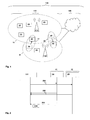
- Figure 1 schematically illustrates a geographic area of a public land mobile network comprising a core network and an access network as well as a plurality of user equipments.
- Figure 2 schematically illustrates a communication diagram between a base transceiver station and a user equipment according to the present invention.
- a geographic area 10 (and a further geographic area 11) of a public land mobile network 100 is schematically shown, the public land mobile network 100 comprising an access network 110 and a core network 120.
- the public land mobile network 100 comprising an access network 110 and a core network 120.
- a plurality of user equipment 20 are located, camping on a radio cell served by a base transceiver station 111 for the geographic area 10.
- the further geographic area 11 is served by a further base transceiver station 112 and comprises likewise a plurality of user equipments 20.
- the core network 120 is only schematically shown by means of a cloud representation.
- the public land mobile network 100 (especially the core network 120) comprises typically various network elements such as an MSC (Mobile Switching Center), a SGSN (Serving GPRS Support Node), a MME (Mobility Management Entity), preferably a plurality of network element thereof.
- MSC Mobile Switching Center
- SGSN Serving GPRS Support Node
- MME Mobility Management Entity
- These network element are hierarchically higher network elements than the base transceiver station 111 or the further base transceiver station 112.
- a conventional paging event of a user equipment would be
- the base transceiver station 111 detects a first group 21 of user equipments 20 entering the geographic area 10 and a second group 22 of user equipments 20 leaving the geographic area 10, wherein a previous number of user equipments 20 corresponds to the number of user equipments 20 in the geographic area 10 prior to or at the beginning of the first step, and, in a second step, a current number of user equipments 20 in the geographic area 10 is updated based on the previous number of user equipments 20 in the geographic area 10 and based on both the number of the first group 21 of user equipments 20 as well as the number of the second group 22 of user equipments 20.
- the first group 21 of user equipments 20 is represented by a single user equipment 20 leaving the further geographic area 11 (therefore this user equipment 20 is represented with a dashed line in the further geographic area 11) and entering the geographic area 10.
- the second group 22 of user equipments 20 is represented by a single user equipment 20 leaving the geographic area 10 (therefore this user equipment 20 is represented with a dashed line in the geographic area 10) and entering the further geographic area 11.
- the number of user equipments within the radio cell (i.e. the geographic area 10) of the base transceiver station 111 can be established without the need that such an establishment is triggered by a hierarchically higher network element. Additionally, there is no need to individually specify any user equipments by means of a specific request to the user equipment.
- FIG. 2 a communication diagram between the base transceiver station 111 and a user equipment 20 belonging to the first group 21 of user equipments 20 as well as a user equipment 20 belonging to the second group 22 of user equipments 20 is schematically shown.
- the premise is that the user equipment 20 of the second group 22 is camping on the radio cell (i.e. the geographic area 10) served by the base transceiver station 111, but currently leaving the geographic area 10.
- the user equipment 20 of the first group 21 is currently starting to camp on the radio cell (i.e. the geographic area 10) served by the base transceiver station 111 (i.e. this user equipment 20 is currently entering the geographic area 10).
- control signals 201, 202 are sent from the base transceiver station 111 to the user equipment 20 of the first group 21 of user equipments 20 (i.e. the user equipment 20 of the first group 21 is obliged to hear (i.e. tune its antenna(e) and radio frequency circuitry to) the control signals 201, 202 of the base transceiver station 111.
- the identity information element 220 preferably comprises not only the information that the user equipment 20 exists but also additional information such as
- the base transceiver station 111 processes the information received by the identity information elements 220 from the plurality of user equipments 20 of the first group 21, i.e. entering the radio cell (or geographic area 10).
Landscapes
- Engineering & Computer Science (AREA)
- Computer Networks & Wireless Communication (AREA)
- Signal Processing (AREA)
- Mobile Radio Communication Systems (AREA)
Abstract
-- in a first step, the base transceiver station detects a first group of user equipments entering the geographic area and a second group of user equipments leaving the geographic area, wherein a previous number of user equipments corresponds to the number of user equipments in the geographic area prior to or at the beginning of the first step
-- in a second step, a current number of user equipments in the geographic area is updated based on the previous number of user equipments in the geographic area and based on both the number of the first group of user equipments as well as the number of the second group of user equipments.
Description
- The present invention relates a method for determining the number of user equipment in a geographic area of an access network of a public land mobile network.
- The present invention further relates to a user equipment for use in a geographic area of an access network of a public land mobile network, and to a base transceiver station for determining the number of user equipments in a geographic area of an access network of a public land mobile network.
- The procedure to track the dedicated cell of a user or of a user equipment in a public land mobile network and to notify user equipments about incoming connection requests is important for the functionality of mobile networks. The possibility to get knowledge of the dedicated cell a user or a user equipment is camping on is important, e.g., for a voice call and more generally in any case that data of other network entities, like gateways etc., are to be sent to a specific user equipment.
- Generally, there are two possible schemes to track the dedicated cell of a user equipment:
- (1) The user equipment does announce its presence within a certain radio cell at each radio cell change while moving between different radio cells of the public land mobile network. The public land mobile network keeps track about each and every radio cell change.
- (2) The user equipment is paged (i.e. the base transceiver station of a radio cell or of a plurality of radio cells transmit a certain identification which is associated with a certain user equipment on the broadcast channel) and it is indicated to the user equipment to contact the base transceiver station (or another node of the public land mobile network), i.e. to make the public land mobile network aware about the current cell of the user equipment.
- However, knowledge about whether a user equipment is within a coverage range of a certain radio cell would be beneficial, especially for counting purposes of user equipments within a specific radio cell.
- In current public land mobile networks of the second, third and fourth generation (GERAN, UTRAN, eUTRAN) as well as in other radio access technologies, paging requests are
- -- originated by hierarchically higher network elements or network entities, like the MSC (Mobile Switching Center), SGSN (Serving GPRS Support Node), MME (Mobility Management Entity), etc., and
- -- dedicated to a single user equipment in order to make it aware about incoming calls or messages, connection requests or data to be received by that specific user equipment from the hierarchically higher network element or network entity.
- An object of the present invention is to provide a simple solution for determining the number of user equipment in a geographic area of an access network of a public land mobile network.
- The object of the present invention is achieved by a method for determining the number of user equipments in a geographic area of an access network of a public land mobile network, wherein the access network comprises at least one base transceiver station, wherein a plurality of user equipments in the geographic area receive control signals from the base transceiver station, wherein the method comprises the following steps:
- -- in a first step, the base transceiver station detects a first group of user equipments entering the geographic area and a second group of user equipments leaving the geographic area, wherein a previous number of user equipments corresponds to the number of user equipments in the geographic area prior to or at the beginning of the first step and wherein during the first step, an identity information element is sent to the base transceiver station by each user equipment in the first group of user equipments,
- -- in a second step, a current number of user equipments in the geographic area is updated based on the previous number of user equipments in the geographic area and based on both the number of the first group of user equipments as well as the number of the second group of user equipments, wherein the current number of user equipments in the geographic area is updated in the second step dependent on the identity information elements sent by the user equipments of the first group of user equipments.
- The object of the present invention is also achieved by a method for determining the number of user equipments in a geographic area of an access network of a public land mobile network, wherein the access network comprises at least one base transceiver station, wherein a plurality of user equipments in the geographic area receive control signals from the base transceiver station, wherein the method comprises the following steps:
- -- in a first step, the base transceiver station detects a first group of user equipments entering the geographic area and a second group of user equipments leaving the geographic area, wherein a previous number of user equipments corresponds to the number of user equipments in the geographic area prior to or at the beginning of the first step
- -- in a second step, a current number of user equipments in the geographic area is updated based on the previous number of user equipments in the geographic area and based on both the number of the first group of user equipments as well as the number of the second group of user equipments.
- It is thereby advantageously possible according to the present invention that, at the level of the base transceiver station, the number of user equipments that are camping on the radio cell can be determined by regularly updating the value of the current number of user equipments. It is especially advantageous that the base transceiver station, when updating value of the current number of user equipments, does not need to send any message or information to any user equipment individually (e.g. by means of indicating a user equipment specific identity information such as an IMSI number or the like) but it is possible to determine the number of user equipments in the radio cell by adjusting or updating the current number of user equipments, i.e. tracking just the newly incoming user equipments (e.g. the user equipments changing from a neighbouring cell to the concerned radio cell or the user equipments starting to camp on the public land mobile network) as well as the newly leaving user equipments (e.g. changing from the concerned radio cell to a neighbouring radio cell or the user equipments leaving the radio cell (and hence the base transceiver station) by finishing to camp on the public land mobile network). In particular, the previous number is zero, when the method starts operating for the first time, i.e. for example upon booting the base transceiver station. After the method is accomplished for the first time, each current number becomes the previous number in the next pass of the method, respectively.A further advantage according to the present invention relates to a reduction of signalling traffic compared to applying a conventional paging procedure to all user equipments within the coverage area of the base transceiver station: As conventional paging requests are originated by hierarchically higher network elements or network entities (like the MSC (Mobile Switching Center), SGSN (Serving GPRS Support Node), MME (Mobility Management Entity)), the conventional paging process involves a signalling traffic not only between the user equipment and the base transceiver station but also between the base transceiver station and these hierarchically higher network elements. This additional signalling traffic can be eliminated or at least greatly reduced according to the present invention as the knowledge about the number of user equipments - especially those user equipments in idle mode - is only needed locally at the base transceiver station.
- It is further more advantageously possible to determine the number of user equipments being a part of a subgroup of the user equipments in the geographic area of an access network of the public land mobile network using at least a part of the identity information of each user equipment. For example, such subgroups consist of one specific kind of user equipment, like the subgroup of all fast moving user equipments. Knowing the number of user equipments being part of a subgroup allows adapting the method of the present invention with respect to the specific subgroup. In this way, it is advantageously possible to reduce the signal traffic.
In particular, it is possible to determine both the number of all user equipments in a geographic area of an access network of a public land mobile network and the number of each subgroup of user equipments in a geographic area of an access network of a public land mobile network by applying the method of the present invention.
A further advantage of the present invention is that the base transceiver station can determinate the number of user equipments according to the method of the present invention, even if one or more of the user equipments cannot give notice of their presence, because for example the power supply of the user equipment fails. Such a situation would typically lead to a systematic error in counting the user equipments. Taking the identify information into account the user equipments, that are not able to give notice of their presence, can be count in. - According to the present invention, it is advantageous that knowledge exists at the base transceiver station about the number of user equipments - especially user equipments in a passive mode or in idle mode of the plurality of user equipments in the radio cell, of the first group of user equipments and of the second group of user equipments - within the coverage area of the base transceiver station.
For energy saving reasons of the base transceiver station, an a priori knowledge about the number of user equipments within the coverage area of the base transceiver station is important to derive an accurate decision, e.g. whether the transceiver of the base transceiver station can be switched off for energy saving reasons. E.g. in case that there are many user equipments in a passive mode (i.e. in idle mode) within the coverage area of the base transceiver station, the base transceiver station may not be switched off since the likelihood that a certain number of user equipments will have the need for connectivity within a certain time can be high.
Furthermore, with an increasing number of machine to machine devices (such as meters, vending machines or the like), there is a high likelihood that a certain number of devices, i.e. user equipments, are rather located at fixed places and - during normal usage - do not move at all. The knowledge about which base transceiver stations within the public land mobile network provide the coverage to such user equipments (as well as a capability reporting of such user equipments such as "fixed machine to machine device") is beneficial and allows to greatly enhance the paging signalling, since such devices (user equipments) do not need to be paged in wider areas (such as the complete respective location area or tracking area) than the respective radio cell of the base transceiver station.
Additionally, for operation and maintenance reasons, especially for an end to end connectivity check, the knowledge about the availability of idle mode user equipments within the coverage area of the base transceiver station is allowing an end to end connectivity check and to identify possible otherwise non-detectable failures on the radio frequency units, especially of the base transceiver station.
Furthermore, applications such as - -- the dynamical allocation of spectrum to different radio access technologies or
- -- the adaption of cell reselection parameters (e.g. in case of radio cells of different radio access technologies are colocated) or
- -- direct to direct communication applications (e.g. to provide assistance to the user equipment as a direct to direct device regarding switching to a proximity discovery functionality)
- According to a preferred embodiment of the present invention, the current number of user equipments in the geographic area is updated in the second step by adding, to the previous number of user equipments, the number of the first group of user equipments having entered the geographic area during the first step, and wherein the current number of user equipments in the geographic area is updated in the second step by subtracting, from the previous number of user equipments, the number of the second group of user equipments having left the geographic area during the first step.
- Thereby, it is advantageously possible according to such an embodiment of the present invention to easily determine the number of user equipments in the radio cell of the base transceiver station.
- According to a further preferred embodiment of the present invention, during the first step, an identity information element is sent to the base transceiver station by each user equipment in the first group of user equipments, wherein the current number of user equipments in the geographic area is updated in the second step dependent on the identity information elements sent by the user equipments of the first group of user equipments. According to such an embodiment of the present invention, the inventive method concerns a method for determining the number and/or capabilities of user equipments in a geographic area of an access network of a public land mobile network.
- According to the present invention, it is advantageously possible that the identity information element provides an information about the identity of the user equipment such that a first user equipment can be distinguished or discriminated from a second user equipment. A simple method to ensure to not count a user equipment several times is to implement an method that an user equipment has to announce its existence exactly one time in a certain defined time period. So the BTS can assume that after a request for announcement the user equipment does not indicate itself several time in this time period.
- However, the identity information element does not necessarily need to comprise the information about the identity of the user equipment such that the identity of the user (of that user equipment) can be derived from such an information about the identity. Thereby, it is advantageously possible according to the present invention that the level of data privacy protection of personal data of users within the public land mobile network can be enhanced - or is not reduced by the implementation of the inventive method - because the base transceiver stations of the public land mobile network are able to distinguish between different user equipments (and preferably and advantageously are also able to obtain (general) information about different user equipments, such as the respective capabilities or type of user equipment) and are therefore enabled to provide an enhanced service level but do not have access to individual and personal data or information regarding the user equipments camping on the base transceiver station. For example, it is possible and preferred according to the present invention that instead of the transmission of, e.g., the IMSI number of a user equipment, a number derived from the IMSI number (e.g. the IMSI number in an encrypted form) according to a predefined algorithm is transmitted to the base transceiver station as part of the identity information element.
- According to the present invention, it is furthermore preferred that the control signals received by the user equipments from the base transceiver station are sent on a control channel, especially a broadcast control channel (BCCH) of the base transceiver station.
- Thereby, it is advantageously possible to easily reach all user equipments served by the base transceiver station, even such user equipments that are in a passive mode, especially in the idle mode. Typically, user equipments are configured to save power consumption as much as possible to enhance standby times. Therefore, public land mobile networks implement the concept of discontinuous reception (DRX). This concept allows battery powered devices like mobile phones as user equipments to optimise the power consumption by implementing a so-called "sleep mode" most of the time while no communication is ongoing. Typically, "wakeup-times" are defined during which the user equipments can be reached by the broadcast control channel of the base transceiver station, i.e. the user equipments listen to the broadcast control channel perhaps not at any occasion of a "wakeup-time" but at least regularly (such as, e.g., every 30 seconds or the like).
- According to the present invention, it is furthermore preferred that the identification information element comprises an indication related to the identity of the user equipment and at least one out of the following pieces of information:
- -- an indication related to the current status of the user equipment,
- -- an indication related to the capabilities of the user equipment,
- -- an indication related to a record of previous usage of the user equipment,
- Thereby, it is advantageously possible according to the present invention that the base transceiver station not only receives information about the existence of the respective user equipment but also regarding the capabilities of the user equipment and regarding further pieces of information related to the user equipment such as the status and/or the capabilities and/or the record of previous usage of the user equipment. The indication related to the current status of the user equipment refers, e.g., to whether the user equipment is in idle mode. The indication related to the capabilities of the user equipment especially refers, e.g. to:
- -- the possible set of radio access technologies the user equipment is able to be used (this is especially helpful in case that a base transceiver station regarding a radio access technology should be switched off (especially for energy saving reasons): It should be assured that all user equipments can nevertheless be served, at least by using another radio access technology); and/or
- -- the device category of the user equipment, i.e. e.g. whether the user equipment is a machine to machine device or whether the user equipment is enabled for device to device communication (also called peer to peer communication) or whether the user equipment is used in a fixed location (fixed device); and/or
- -- the user category assigned to the user equipment (or assigned to the IMSI number), i.e. whether a gold customer or a silver customer or the like is present in the radio cell.
- According to the present invention, it is furthermore preferred that the base transceiver station and a further base transceiver station of a further geographic area of the access network of the public land mobile network exchange data such that:
- -- regarding the first group of user equipments at least part of the identity information elements relating to these user equipments are sent to the further base transceiver station and/or
- -- regarding the second group of user equipments at least part of the identity information elements relating to these user equipments are received from the further base transceiver station.
- Thereby, it is advantageously possible that base transceiver stations, especially neighbouring base transceiver stations exchange information, especially comprising at least part of the identity information element of concerned user equipments for such user equipments that change between different radio cells, i.e. that change the base transceiver station.
- According to the present invention, it is furthermore preferred that an identity information leave element is sent to the base transceiver station by at least part of the user equipments in the second group of user equipments.
- Thereby, it is advantageously possible that a user equipment on the point to leave a radio cell (i.e. to leave the radio coverage related with a base transceiver station) indicates this to the base transceiver station, e.g. as part of the handover process.
- It is furthermore preferred according to the present invention that the transmission of the identity information element in the second step to the base transceiver station occurs at most once during a predetermined counting time interval.
- Thereby, it is advantageously possible according to the present invention that the base transceiver station at maximum receives one identity information element per counting time interval. The counting time interval is a predetermined time interval, e.g. 30 seconds. Thereby, it is ensured that the identity information element of a user equipment is counted by base transceiver station only once during the counting time interval; however, a user equipment tries as long as the user equipment is successful, i.e. until a setup is done, (or until a time out is reached) to access the control channel to transfer the identity information element.
- Furthermore, the present invention relates to a user equipment for use in a geographic area of an access network of a public land mobile network, wherein the access network comprises at least one base transceiver station, wherein the user equipment receives control signals from the base transceiver station, wherein the user equipment is configured such that an identity information element is sent to the base transceiver station in case that the user equipment enters the geographic area.
- The user equipment provides the identity information element to the base transceiver station when entering the radio cell served by the base transceiver station. It is advantageous according to the present invention that - by means of the information received from the different user equipments - the base transceiver station is able to provide a better and more focused service to the user equipment.
- It is furthermore preferred according to the present invention - also with respect to the user equipment - that the user equipment is configured such that the identity information element is sent in case that the user equipment is in a passive state or in a passive mode of operation.
- It is furthermore preferred according to the present invention that the user equipment is configured such that the transmission of the identity information element to the base transceiver station occurs at most once during a predetermined counting time interval.
- Thereby, it is advantageously possible according to the present invention that the base transceiver station at maximum receives one identity information element per counting time interval. The counting time interval is a predetermined time interval, e.g. 30 seconds. Thereby, it is ensured that the identity information element of a user equipment is counted by base transceiver station only once during the counting time interval; however, a user equipment tries as long as the user equipment is successful, i.e. until a setup is done, (or until a time out is reached) to access the control channel to transfer the identity information element.
- Additionally, the present invention relates to a base transceiver station for determining the number of user equipments in a geographic area of an access network of a public land mobile network, wherein the access network comprises the base transceiver station, wherein a plurality of user equipments in the geographic area receive control signals from the base transceiver station, wherein the base transceiver station is configured to detect a first group of user equipments entering the geographic area and a second group of user equipments leaving the geographic area, wherein a previous number of user equipments corresponds to the number of user equipments in the geographic area prior to the detection of the first and second group of user equipments and wherein an identity information element is sent to the base transceiver station by each user equipment in the first group of user equipments,, wherein the base transceiver station is further configured to update a current number of user equipments in the geographic area based on the previous number of user equipments in the geographic area and based on both the number of the first group of user equipments as well as the number of the second group of user equipments and wherein the current number of user equipments in the geographic area is updated dependent on the identity information elements sent by the user equipments of the first group of user equipments.
- In addition the present invention also relates to a base transceiver station for determining the number of user equipments in a geographic area of an access network of a public land mobile network, wherein the access network comprises the base transceiver station, wherein a plurality of user equipments in the geographic area receive control signals from the base transceiver station, wherein the base transceiver station is configured to detect a first group of user equipments entering the geographic area and a second group of user equipments leaving the geographic area, wherein a previous number of user equipments corresponds to the number of user equipments in the geographic area prior to the detection of the first and second group of user equipments, wherein the base transceiver station is further configured to update a current number of user equipments in the geographic area based on the previous number of user equipments in the geographic area and based on both the number of the first group of user equipments as well as the number of the second group of user equipments.
- The base transceiver station tracks the number of user equipments in the radio cell by taking into account the number of user equipments entering the radio cell during a time interval (first group of user equipments) and the number of user equipments leaving the radio cell during a time interval (second group of user equipments). The time interval especially corresponds to the first step of the method according to the present invention. The user equipments newly entering the radio cell preferably provide an identity information element sent to the base transceiver station such that the base transceiver station is able to discriminate between different user equipments. It is advantageous according to the present invention that - by means of determining the number of user equipments within the radio cell and preferably by means of additionally using the information received from the different user equipments - the base transceiver station is able to provide a better and more focused service to the user equipment.
- It is furthermore preferred according to the present invention - also with respect to the base transceiver station - that the base transceiver station is configured such that the current number of user equipments in the geographic area is updated by adding, to the previous number of user equipments, the number of the first group of user equipments having entered the geographic area, and wherein the base transceiver station is further configured such that the current number of user equipments in the geographic area is updated by subtracting, from the previous number of user equipments, the number of the second group of user equipments having left the geographic area.
- According to further preferred embodiments of the present invention - also with respect to the user equipment - it is preferred that the identification information element comprises an indication related to the identity of the user equipment and at least one out of the following pieces of information:
- -- an indication related to the current status of the user equipment,
- -- an indication related to the capabilities of the user equipment,
- -- an indication related to a record of previous usage of the user equipment,
- Additionally, the present invention relates to a program comprising a computer readable program code which, when executed on a computer or on a user equipment or on a base transceiver station, causes the computer or the user equipment or the base transceiver station to perform the inventive method.
- Still additionally, the present invention relates to computer program product for using a user equipment with a base transceiver station, the computer program product comprising a computer program stored on a storage medium, the computer program comprising program code which, when executed on a computer or on the user equipment or on the base transceiver station, causes the computer or the user equipment or the base transceiver station to perform the inventive method.
- These and other characteristics, features and advantages of the present invention will become apparent from the following detailed description, taken in conjunction with the accompanying drawings, which illustrate, by way of example, the principles of the invention. The description is given for the sake of example only, without limiting the scope of the invention. The reference figures quoted below refer to the attached drawings.
-
Figure 1 schematically illustrates a geographic area of a public land mobile network comprising a core network and an access network as well as a plurality of user equipments. -
Figure 2 schematically illustrates a communication diagram between a base transceiver station and a user equipment according to the present invention. - The present invention will be described with respect to particular embodiments and with reference to certain drawings but the invention is not limited thereto but only by the claims. The drawings described are only schematic and are nonlimiting. In the drawings, the size of some of the elements may be exaggerated and not drawn on scale for illustrative purposes.
- Where an indefinite or definite article is used when referring to a singular noun, e.g. "a", "an", "the", this includes a plural of that noun unless something else is specifically stated.
- Furthermore, the terms first, second, third and the like in the description and in the claims are used for distinguishing between similar elements and not necessarily for describing a sequential or chronological order. It is to be understood that the terms so used are interchangeable under appropriate circumstances and that the embodiments of the invention described herein are capable of operation in other sequences than described or illustrated herein.
- In
Figure 1 , a geographic area 10 (and a further geographic area 11) of a public landmobile network 100 is schematically shown, the public landmobile network 100 comprising anaccess network 110 and acore network 120. In thegeographic area 10, a plurality ofuser equipment 20 are located, camping on a radio cell served by abase transceiver station 111 for thegeographic area 10. The furthergeographic area 11 is served by a furtherbase transceiver station 112 and comprises likewise a plurality ofuser equipments 20. - The
core network 120 is only schematically shown by means of a cloud representation. The public land mobile network 100 (especially the core network 120) comprises typically various network elements such as an MSC (Mobile Switching Center), a SGSN (Serving GPRS Support Node), a MME (Mobility Management Entity), preferably a plurality of network element thereof. These network element are hierarchically higher network elements than thebase transceiver station 111 or the furtherbase transceiver station 112. In case that thegeographic area 10 and the furthergeographic area 11 belong to the same location area or tracking area of the public landmobile network 100, a conventional paging event of a user equipment would be - -- initiated by the hierarchically higher network elements,
- -- be paged both in
geographic area 10 and in furthergeographic area 11, i.e. in the whole of the corresponding location area or tracking area, and - -- directed to
user equipments 20 that are individually indicated by the paging request message. - According to the present invention, all these requirements of a conventional paging event does not apply in case that, in a first step, the
base transceiver station 111 detects afirst group 21 ofuser equipments 20 entering thegeographic area 10 and asecond group 22 ofuser equipments 20 leaving thegeographic area 10, wherein a previous number ofuser equipments 20 corresponds to the number ofuser equipments 20 in thegeographic area 10 prior to or at the beginning of the first step, and, in a second step, a current number ofuser equipments 20 in thegeographic area 10 is updated based on the previous number ofuser equipments 20 in thegeographic area 10 and based on both the number of thefirst group 21 ofuser equipments 20 as well as the number of thesecond group 22 ofuser equipments 20. InFigure 1 , thefirst group 21 ofuser equipments 20 is represented by asingle user equipment 20 leaving the further geographic area 11 (therefore thisuser equipment 20 is represented with a dashed line in the further geographic area 11) and entering thegeographic area 10. Likewise, thesecond group 22 ofuser equipments 20 is represented by asingle user equipment 20 leaving the geographic area 10 (therefore thisuser equipment 20 is represented with a dashed line in the geographic area 10) and entering the furthergeographic area 11. - Thereby, it is advantageously possible according to the present invention that the number of user equipments within the radio cell (i.e. the geographic area 10) of the
base transceiver station 111 can be established without the need that such an establishment is triggered by a hierarchically higher network element. Additionally, there is no need to individually specify any user equipments by means of a specific request to the user equipment. - In
Figure 2 , a communication diagram between thebase transceiver station 111 and auser equipment 20 belonging to thefirst group 21 ofuser equipments 20 as well as auser equipment 20 belonging to thesecond group 22 ofuser equipments 20 is schematically shown. - The premise is that the
user equipment 20 of thesecond group 22 is camping on the radio cell (i.e. the geographic area 10) served by thebase transceiver station 111, but currently leaving thegeographic area 10. This means that control signals 201, 202 are sent or have previously (prior to starting the handover procedure to another radio cell) been sent from thebase transceiver station 111 to theuser equipment 20 of thesecond group 22 ofuser equipments 20. Furthermore, theuser equipment 20 of thefirst group 21 is currently starting to camp on the radio cell (i.e. the geographic area 10) served by the base transceiver station 111 (i.e. thisuser equipment 20 is currently entering the geographic area 10). This means that control signals 201, 202 are sent from thebase transceiver station 111 to theuser equipment 20 of thefirst group 21 of user equipments 20 (i.e. theuser equipment 20 of thefirst group 21 is obliged to hear (i.e. tune its antenna(e) and radio frequency circuitry to) the control signals 201, 202 of thebase transceiver station 111. - Upon Entering of the
user equipment 20 of thefirst group 21 ofuser equipments 20, thisuser equipment 20 sends aradio frequency signal 203 comprising anidentity information element 220 to thebase transceiver station 111. Theidentity information element 220 preferably comprises not only the information that theuser equipment 20 exists but also additional information such as - -- an indication related to the current status of the
user equipment 20, and/or - -- an indication related to the capabilities of the
user equipment 20, and/or - -- an indication related to a record of previous usage of the
user equipment 20, - Thereby, it is possible according to the present invention that the
base transceiver station 111 processes the information received by theidentity information elements 220 from the plurality ofuser equipments 20 of thefirst group 21, i.e. entering the radio cell (or geographic area 10).
On the contrary, the second scheme has benefits in case of rather fast moving (i.e. very mobile) user equipments as only a minimum of signalling occurs in case of such fast moving user equipments since the user equipment does not have to announce its presence at each radio cell change and thus there is rather limited signalling in case the user equipment moves between different locations of the public land mobile network. However, the second scheme leads to a rather high signalling load in many radio cells in case the user equipment needs to be paged since (due to the fact that the public land mobile network is not aware about the precise location of the user equipment) paging messages need to be broadcast in many or all radio cells while the user equipment is only present in one radio cell.
In order to keep the related signalling between different nodes or components of the public land mobile network as well as between the user equipment and the nodes of the public land mobile network comparably low, the two tracking schemes are combined in 2G (second generation) public land mobile networks (such as the GERAN (GSM EDGE Radio Access Network) network), in 3G (third generation) public land mobile networks (such as the UTRAN (UMTS Terrestrial Radio Access Network) network, and in 4G (fourth generation) public land mobile networks (such as the eUTRAN (Evolved UTRAN) network).
In 2G public land mobile networks, a number of radio cells can be combined to a so called location area (LA). Within a location area, which is identified by a specific identifier on the broadcast channel, the user equipment is allowed to freely move within the location area and to camp on each radio cell (i.e. to have a radio connection to the respective base transceiver station of the radio cell) without the need to notify the public land mobile network. Just in case the user equipment changes between radio cells which are members of different location areas, the user equipment has to inform the network that, in case of a paging need, the user equipment has to be paged in the new location area. Such a combined scheme of tracking a user equipment allows - depending on the network planning - to find a trade off between, on the one hand, the signalling needs for the signalling for location update reasons between the user equipment and the public land mobile network and, on the other hand, the signalling needs on broadcast channels within radio cells for paging purposes.
Other tracking schemes to cope with user equipment mobility are implemented in eUTRAN public land mobile networks, allowing to track a user equipment on different location granularity, either on location area level, UTRAN routing area (RA), eUTRAN tracking area (TA) level or even the radio cell level (for a limited number of user equipments).
Claims (12)
- Method for determining the number of user equipments (20) in a geographic area (10) of an access network (110) of a public land mobile network (100), wherein the access network (110) comprises at least one base transceiver station (111), wherein a plurality of user equipments (20) in the geographic area (10) receive control signals (201, 202) from the base transceiver station (111), wherein the method comprises the following steps:-- in a first step, the base transceiver station (111) detects a first group (21) of user equipments (20) entering the geographic area (10) and a second group (22) of user equipments (20) leaving the geographic area (10), wherein a previous number of user equipments (20) corresponds to the number of user equipments (20) in the geographic area (10) prior to or at the beginning of the first step and wherein during the first step, an identity information element (220) is sent to the base transceiver station (111) by each user equipment (20) in the first group (21) of user equipments (20),-- in a second step, a current number of user equipments (20) in the geographic area (10) is updated based on the previous number of user equipments (20) in the geographic area (10) and based on both the number of the first group (21) of user equipments (20) as well as the number of the second group (22) of user equipments (20), wherein the current number of user equipments (20) in the geographic area is updated in the second step dependent on the identity information elements (220) sent by the user equipments (20) of the first group (21) of user equipments (20).
- Method according to claim 1, wherein the plurality of user equipments (20), the first group (21) of user equipments (20), and the second group (22) of user equipments (20) are in a passive state or in a passive mode of operation.
- Method according to any the preceding claims, wherein the current number of user equipments (20) in the geographic area is updated in the second step by adding, to the previous number of user equipments (20), the number of the first group (21) of user equipments (20) having entered the geographic area (10) during the first step, and wherein the current number of user equipments (20) in the geographic area (10) is updated in the second step by subtracting, from the previous number of user equipments (20), the number of the second group (22) of user equipments (20) having left the geographic area (10) during the first step.
- Method according to any the preceding claims, wherein the control signals (201, 202) received by the user equipments (20) from the base transceiver station (111) are sent on a control channel, especially a broadcast control channel of the base transceiver station (111).
- Method according to any the preceding claims, wherein the identification information element (220) comprises an indication related to the identity of the user equipment (20) and at least one out of the following pieces of information:-- an indication related to the current status of the user equipment (20),-- an indication related to the capabilities of the user equipment (20),-- an indication related to a record of previous usage of the user equipment (20), wherein the indication related to the capabilities of the user equipment (20) especially relates to an information regarding to: the possible set of radio access technologies the user equipment (20) is able to be used, and/or the device category of the user equipment (20), and/or the user category assigned to the user equipment (20).
- Method according to any the preceding claims, wherein the base transceiver station (111) and a further base transceiver station (112) of a further geographic area (11) of the access network (110) of the public land mobile network (100) exchange data such that:-- regarding the first group (21) of user equipments (20) at least part of the identity information elements (220) relating to these user equipments (20) are sent to the further base transceiver station (112) and/or-- regarding the second group (22) of user equipments (20) at least part of the identity information elements (220) relating to these user equipments (20) are received from the further base transceiver station (112).
- Method according to any the preceding claims, wherein an identity information leave element is sent to the base transceiver station (111) by at least part of the user equipments (20) in the second group (22) of user equipments (20).
- Base transceiver station (111) for determining the number of user equipments (20) in a geographic area (10) of an access network (110) of a public land mobile network (100), wherein the access network (110) comprises the base transceiver station (111), wherein a plurality of user equipments (20) in the geographic area (10) receive control signals (201, 202) from the base transceiver station (111), wherein the base transceiver station (111) is configured to detect a first group (21) of user equipments (20) entering the geographic area (10) and a second group (22) of user equipments (20) leaving the geographic area (10), wherein a previous number of user equipments (20) corresponds to the number of user equipments (20) in the geographic area (10) prior to the detection of the first and second group (21, 22) of user equipments (20), and wherein an identity information element (220) is sent to the base transceiver station (111) by each user equipment (20) in the first group (21) of user equipments (20), wherein the base transceiver station (111) is further configured to update a current number of user equipments (20) in the geographic area (10) based on the previous number of user equipments (20) in the geographic area (10) and based on both the number of the first group (21) of user equipments (20) as well as the number of the second group (22) of user equipments (20)and wherein the current number of user equipments (20) in the geographic area is updated dependent on the identity information elements (220) sent by the user equipments (20) of the first group (21) of user equipments (20).
- Base transceiver station (111) according to claim 8, wherein the base transceiver station (111) is configures such that the current number of user equipments (20) in the geographic area is updated by adding, to the previous number of user equipments (20), the number of the first group (21) of user equipments (20) having entered the geographic area (10), and wherein the base transceiver station (111) is further configured such that the current number of user equipments (20) in the geographic area (10) is updated by subtracting, from the previous number of user equipments (20), the number of the second group (22) of user equipments (20) having left the geographic area (10).
- Base transceiver station (111) according to claim 8 or 9, wherein the identification information element (220) comprises an indication related to the identity of the user equipment (20) and at least one out of the following pieces of information:-- an indication related to the current status of the user equipment (20),-- an indication related to the capabilities of the user equipment (20),-- an indication related to a record of previous usage of the user equipment (20), wherein the indication related to the capabilities of the user equipment (20) especially relates to an information regarding to: the possible set of radio access technologies the user equipment (20) is able to be used, and/or the device category of the user equipment (20), and/or the user category assigned to the user equipment (20).
- Program comprising a computer readable program code which, when executed on a computer or on a user equipment (20) or on a base transceiver station (111), causes the computer or the user equipment (20) or the base transceiver station (111) to perform a method according one of claims 1 to 8.
- Computer program product for using a user equipment (20) with a base transceiver station (111), the computer program product comprising a computer program stored on a storage medium, the computer program comprising program code which, when executed on a computer or on the user equipment (20) or on the base transceiver station (111), causes the computer or the user equipment (20) or the base transceiver station (111) to perform a method according one of claims 1 to 8.
Applications Claiming Priority (1)
| Application Number | Priority Date | Filing Date | Title |
|---|---|---|---|
| DE102012008865A DE102012008865A1 (en) | 2012-05-07 | 2012-05-07 | A method for determining the number and / or capabilities of terminals in a geographic area of an access network, terminal for use in a geographic area of an access network, base transceiver station for determining the number of terminals in a geographic area of an access network, program and computer program product |
Publications (3)
| Publication Number | Publication Date |
|---|---|
| EP2663117A2 true EP2663117A2 (en) | 2013-11-13 |
| EP2663117A3 EP2663117A3 (en) | 2015-07-01 |
| EP2663117B1 EP2663117B1 (en) | 2017-01-18 |
Family
ID=48326043
Family Applications (1)
| Application Number | Title | Priority Date | Filing Date |
|---|---|---|---|
| EP13002123.1A Active EP2663117B1 (en) | 2012-05-07 | 2013-04-23 | Method for determining the number of user equipments in a geographic area of an access network, corresponding base transceiver station, program and computer program product |
Country Status (5)
| Country | Link |
|---|---|
| EP (1) | EP2663117B1 (en) |
| DE (1) | DE102012008865A1 (en) |
| ES (1) | ES2621077T3 (en) |
| HU (1) | HUE035535T2 (en) |
| PL (1) | PL2663117T3 (en) |
Family Cites Families (6)
| Publication number | Priority date | Publication date | Assignee | Title |
|---|---|---|---|---|
| DE19638798A1 (en) * | 1996-09-20 | 1998-03-26 | Deutsche Telekom Mobil | Traffic data acquisition method especially for vehicle |
| GB2392348B (en) * | 2002-08-21 | 2006-01-11 | Vodafone Limited | Telecommunications system |
| DE10333793B4 (en) * | 2003-07-24 | 2010-03-18 | Vodafone Holding Gmbh | Method and system for generating information data |
| WO2010092457A1 (en) * | 2009-02-10 | 2010-08-19 | Nokia Corporation | Method, apparatus and computer program product for transfer of capability support information in a multi-rat environment |
| DE102009023131A1 (en) * | 2009-03-03 | 2010-09-09 | T-Mobile International Ag | Local person density identifying and recording method for use in urban environment, involves assigning geographical position and/or geographical area to terminal based on location of base station |
| IT1402750B1 (en) * | 2010-10-29 | 2013-09-18 | Vodafone Omnitel Nv | METHOD AND SYSTEM TO ESTIMATE THE NUMBER OF MOBILE TERMINALS INSIDE A GEOGRAPHICAL AREA. |
-
2012
- 2012-05-07 DE DE102012008865A patent/DE102012008865A1/en not_active Ceased
-
2013
- 2013-04-23 PL PL13002123T patent/PL2663117T3/en unknown
- 2013-04-23 ES ES13002123.1T patent/ES2621077T3/en active Active
- 2013-04-23 EP EP13002123.1A patent/EP2663117B1/en active Active
- 2013-04-23 HU HUE13002123A patent/HUE035535T2/en unknown
Non-Patent Citations (1)
| Title |
|---|
| None |
Also Published As
| Publication number | Publication date |
|---|---|
| HUE035535T2 (en) | 2018-05-28 |
| ES2621077T3 (en) | 2017-06-30 |
| DE102012008865A1 (en) | 2013-11-07 |
| EP2663117B1 (en) | 2017-01-18 |
| PL2663117T3 (en) | 2017-09-29 |
| EP2663117A3 (en) | 2015-07-01 |
Similar Documents
| Publication | Publication Date | Title |
|---|---|---|
| US9439140B2 (en) | Method for managing the state of micro base stations by following the variations of traffic requirements, and associated controller device | |
| US10912058B2 (en) | Discontinuous reception communication synchronization method and apparatus | |
| EP4412315A1 (en) | Terminal device wake-up method and apparatus in communication network, and readable storage medium | |
| US12581458B2 (en) | Energy efficient paging procedure for dual-mode user equipment | |
| US10624057B2 (en) | Telecommunications apparatus and methods | |
| EP2987373B1 (en) | Telecommunications apparatus and method | |
| CN102026372B (en) | System broadcast message update notification, reading method and device | |
| CN103209481B (en) | Notice, read method and the equipment that system broadcast message updates | |
| CN102835160A (en) | Network node control for facilitating relocation | |
| KR102571290B1 (en) | System and method for tracking the mobility of user equipment | |
| EP2663105B1 (en) | Method for determining the number of user equipments in a geographic area of an access network, user equipment for use in a geographic area of an access network, base transceiver station for determining the number of user equipments in a geographic area of an access network, program and computer program product | |
| US9832710B1 (en) | Method and system for controlled broadcasting of system identification | |
| EP2848011B1 (en) | Method for determining the number and/or capabilities of user equipments in a geographic area of an access network, user equipment for use in a geographic area of an access network, base transceiver station for determining the number of user equipments in a geographic area of an access network, program and computer program product | |
| EP2663117B1 (en) | Method for determining the number of user equipments in a geographic area of an access network, corresponding base transceiver station, program and computer program product | |
| EP2747490A1 (en) | Session termination in an energy-efficient cellular wireless telecommunications system | |
| US20170238247A1 (en) | Method and apparatus for tracking idle devices | |
| Chao et al. | Optimizing power saving in cellular networks for machine-to-machine (M2M) communications | |
| JP2020014148A (en) | User equipment and management device in mobile communication network |
Legal Events
| Date | Code | Title | Description |
|---|---|---|---|
| PUAI | Public reference made under article 153(3) epc to a published international application that has entered the european phase |
Free format text: ORIGINAL CODE: 0009012 |
|
| AK | Designated contracting states |
Kind code of ref document: A2 Designated state(s): AL AT BE BG CH CY CZ DE DK EE ES FI FR GB GR HR HU IE IS IT LI LT LU LV MC MK MT NL NO PL PT RO RS SE SI SK SM TR |
|
| AX | Request for extension of the european patent |
Extension state: BA ME |
|
| PUAL | Search report despatched |
Free format text: ORIGINAL CODE: 0009013 |
|
| AK | Designated contracting states |
Kind code of ref document: A3 Designated state(s): AL AT BE BG CH CY CZ DE DK EE ES FI FR GB GR HR HU IE IS IT LI LT LU LV MC MK MT NL NO PL PT RO RS SE SI SK SM TR |
|
| AX | Request for extension of the european patent |
Extension state: BA ME |
|
| RIC1 | Information provided on ipc code assigned before grant |
Ipc: H04W 24/00 20090101AFI20150522BHEP |
|
| 17P | Request for examination filed |
Effective date: 20160104 |
|
| RBV | Designated contracting states (corrected) |
Designated state(s): AL AT BE BG CH CY CZ DE DK EE ES FI FR GB GR HR HU IE IS IT LI LT LU LV MC MK MT NL NO PL PT RO RS SE SI SK SM TR |
|
| REG | Reference to a national code |
Ref country code: DE Ref legal event code: R079 Ref document number: 602013016637 Country of ref document: DE Free format text: PREVIOUS MAIN CLASS: H04W0024000000 Ipc: H04W0024080000 |
|
| RIC1 | Information provided on ipc code assigned before grant |
Ipc: H04W 24/08 20090101AFI20160719BHEP |
|
| GRAP | Despatch of communication of intention to grant a patent |
Free format text: ORIGINAL CODE: EPIDOSNIGR1 |
|
| INTG | Intention to grant announced |
Effective date: 20160907 |
|
| GRAS | Grant fee paid |
Free format text: ORIGINAL CODE: EPIDOSNIGR3 |
|
| GRAA | (expected) grant |
Free format text: ORIGINAL CODE: 0009210 |
|
| AK | Designated contracting states |
Kind code of ref document: B1 Designated state(s): AL AT BE BG CH CY CZ DE DK EE ES FI FR GB GR HR HU IE IS IT LI LT LU LV MC MK MT NL NO PL PT RO RS SE SI SK SM TR |
|
| REG | Reference to a national code |
Ref country code: GB Ref legal event code: FG4D |
|
| REG | Reference to a national code |
Ref country code: CH Ref legal event code: EP |
|
| REG | Reference to a national code |
Ref country code: AT Ref legal event code: REF Ref document number: 863521 Country of ref document: AT Kind code of ref document: T Effective date: 20170215 |
|
| REG | Reference to a national code |
Ref country code: IE Ref legal event code: FG4D |
|
| REG | Reference to a national code |
Ref country code: RO Ref legal event code: EPE |
|
| REG | Reference to a national code |
Ref country code: DE Ref legal event code: R096 Ref document number: 602013016637 Country of ref document: DE |
|
| REG | Reference to a national code |
Ref country code: NL Ref legal event code: FP |
|
| REG | Reference to a national code |
Ref country code: FR Ref legal event code: PLFP Year of fee payment: 5 |
|
| REG | Reference to a national code |
Ref country code: LT Ref legal event code: MG4D |
|
| REG | Reference to a national code |
Ref country code: ES Ref legal event code: FG2A Ref document number: 2621077 Country of ref document: ES Kind code of ref document: T3 Effective date: 20170630 |
|
| PG25 | Lapsed in a contracting state [announced via postgrant information from national office to epo] |
Ref country code: HR Free format text: LAPSE BECAUSE OF FAILURE TO SUBMIT A TRANSLATION OF THE DESCRIPTION OR TO PAY THE FEE WITHIN THE PRESCRIBED TIME-LIMIT Effective date: 20170118 Ref country code: LT Free format text: LAPSE BECAUSE OF FAILURE TO SUBMIT A TRANSLATION OF THE DESCRIPTION OR TO PAY THE FEE WITHIN THE PRESCRIBED TIME-LIMIT Effective date: 20170118 Ref country code: NO Free format text: LAPSE BECAUSE OF FAILURE TO SUBMIT A TRANSLATION OF THE DESCRIPTION OR TO PAY THE FEE WITHIN THE PRESCRIBED TIME-LIMIT Effective date: 20170418 Ref country code: FI Free format text: LAPSE BECAUSE OF FAILURE TO SUBMIT A TRANSLATION OF THE DESCRIPTION OR TO PAY THE FEE WITHIN THE PRESCRIBED TIME-LIMIT Effective date: 20170118 Ref country code: IS Free format text: LAPSE BECAUSE OF FAILURE TO SUBMIT A TRANSLATION OF THE DESCRIPTION OR TO PAY THE FEE WITHIN THE PRESCRIBED TIME-LIMIT Effective date: 20170518 |
|
| REG | Reference to a national code |
Ref country code: GR Ref legal event code: EP Ref document number: 20170400902 Country of ref document: GR Effective date: 20170804 |
|
| PG25 | Lapsed in a contracting state [announced via postgrant information from national office to epo] |
Ref country code: RS Free format text: LAPSE BECAUSE OF FAILURE TO SUBMIT A TRANSLATION OF THE DESCRIPTION OR TO PAY THE FEE WITHIN THE PRESCRIBED TIME-LIMIT Effective date: 20170118 Ref country code: LV Free format text: LAPSE BECAUSE OF FAILURE TO SUBMIT A TRANSLATION OF THE DESCRIPTION OR TO PAY THE FEE WITHIN THE PRESCRIBED TIME-LIMIT Effective date: 20170118 Ref country code: SE Free format text: LAPSE BECAUSE OF FAILURE TO SUBMIT A TRANSLATION OF THE DESCRIPTION OR TO PAY THE FEE WITHIN THE PRESCRIBED TIME-LIMIT Effective date: 20170118 Ref country code: BG Free format text: LAPSE BECAUSE OF FAILURE TO SUBMIT A TRANSLATION OF THE DESCRIPTION OR TO PAY THE FEE WITHIN THE PRESCRIBED TIME-LIMIT Effective date: 20170418 Ref country code: PT Free format text: LAPSE BECAUSE OF FAILURE TO SUBMIT A TRANSLATION OF THE DESCRIPTION OR TO PAY THE FEE WITHIN THE PRESCRIBED TIME-LIMIT Effective date: 20170518 |
|
| REG | Reference to a national code |
Ref country code: DE Ref legal event code: R097 Ref document number: 602013016637 Country of ref document: DE |
|
| PG25 | Lapsed in a contracting state [announced via postgrant information from national office to epo] |
Ref country code: SK Free format text: LAPSE BECAUSE OF FAILURE TO SUBMIT A TRANSLATION OF THE DESCRIPTION OR TO PAY THE FEE WITHIN THE PRESCRIBED TIME-LIMIT Effective date: 20170118 Ref country code: EE Free format text: LAPSE BECAUSE OF FAILURE TO SUBMIT A TRANSLATION OF THE DESCRIPTION OR TO PAY THE FEE WITHIN THE PRESCRIBED TIME-LIMIT Effective date: 20170118 |
|
| PLBE | No opposition filed within time limit |
Free format text: ORIGINAL CODE: 0009261 |
|
| STAA | Information on the status of an ep patent application or granted ep patent |
Free format text: STATUS: NO OPPOSITION FILED WITHIN TIME LIMIT |
|
| PG25 | Lapsed in a contracting state [announced via postgrant information from national office to epo] |
Ref country code: SM Free format text: LAPSE BECAUSE OF FAILURE TO SUBMIT A TRANSLATION OF THE DESCRIPTION OR TO PAY THE FEE WITHIN THE PRESCRIBED TIME-LIMIT Effective date: 20170118 Ref country code: DK Free format text: LAPSE BECAUSE OF FAILURE TO SUBMIT A TRANSLATION OF THE DESCRIPTION OR TO PAY THE FEE WITHIN THE PRESCRIBED TIME-LIMIT Effective date: 20170118 |
|
| REG | Reference to a national code |
Ref country code: CH Ref legal event code: PL |
|
| 26N | No opposition filed |
Effective date: 20171019 |
|
| REG | Reference to a national code |
Ref country code: IE Ref legal event code: MM4A |
|
| PG25 | Lapsed in a contracting state [announced via postgrant information from national office to epo] |
Ref country code: MC Free format text: LAPSE BECAUSE OF FAILURE TO SUBMIT A TRANSLATION OF THE DESCRIPTION OR TO PAY THE FEE WITHIN THE PRESCRIBED TIME-LIMIT Effective date: 20170118 |
|
| PG25 | Lapsed in a contracting state [announced via postgrant information from national office to epo] |
Ref country code: SI Free format text: LAPSE BECAUSE OF FAILURE TO SUBMIT A TRANSLATION OF THE DESCRIPTION OR TO PAY THE FEE WITHIN THE PRESCRIBED TIME-LIMIT Effective date: 20170118 Ref country code: LU Free format text: LAPSE BECAUSE OF NON-PAYMENT OF DUE FEES Effective date: 20170423 Ref country code: LI Free format text: LAPSE BECAUSE OF NON-PAYMENT OF DUE FEES Effective date: 20170430 Ref country code: CH Free format text: LAPSE BECAUSE OF NON-PAYMENT OF DUE FEES Effective date: 20170430 |
|
| REG | Reference to a national code |
Ref country code: BE Ref legal event code: MM Effective date: 20170430 |
|
| REG | Reference to a national code |
Ref country code: FR Ref legal event code: PLFP Year of fee payment: 6 |
|
| PG25 | Lapsed in a contracting state [announced via postgrant information from national office to epo] |
Ref country code: IE Free format text: LAPSE BECAUSE OF NON-PAYMENT OF DUE FEES Effective date: 20170423 |
|
| REG | Reference to a national code |
Ref country code: HU Ref legal event code: AG4A Ref document number: E035535 Country of ref document: HU |
|
| PG25 | Lapsed in a contracting state [announced via postgrant information from national office to epo] |
Ref country code: BE Free format text: LAPSE BECAUSE OF NON-PAYMENT OF DUE FEES Effective date: 20170430 |
|
| PG25 | Lapsed in a contracting state [announced via postgrant information from national office to epo] |
Ref country code: MT Free format text: LAPSE BECAUSE OF NON-PAYMENT OF DUE FEES Effective date: 20170423 |
|
| REG | Reference to a national code |
Ref country code: AT Ref legal event code: UEP Ref document number: 863521 Country of ref document: AT Kind code of ref document: T Effective date: 20170118 |
|
| PG25 | Lapsed in a contracting state [announced via postgrant information from national office to epo] |
Ref country code: CY Free format text: LAPSE BECAUSE OF NON-PAYMENT OF DUE FEES Effective date: 20170118 |
|
| PG25 | Lapsed in a contracting state [announced via postgrant information from national office to epo] |
Ref country code: MK Free format text: LAPSE BECAUSE OF FAILURE TO SUBMIT A TRANSLATION OF THE DESCRIPTION OR TO PAY THE FEE WITHIN THE PRESCRIBED TIME-LIMIT Effective date: 20170118 |
|
| PG25 | Lapsed in a contracting state [announced via postgrant information from national office to epo] |
Ref country code: AL Free format text: LAPSE BECAUSE OF FAILURE TO SUBMIT A TRANSLATION OF THE DESCRIPTION OR TO PAY THE FEE WITHIN THE PRESCRIBED TIME-LIMIT Effective date: 20170118 |
|
| PGFP | Annual fee paid to national office [announced via postgrant information from national office to epo] |
Ref country code: NL Payment date: 20250422 Year of fee payment: 13 |
|
| PGFP | Annual fee paid to national office [announced via postgrant information from national office to epo] |
Ref country code: DE Payment date: 20250417 Year of fee payment: 13 Ref country code: PL Payment date: 20250410 Year of fee payment: 13 |
|
| PGFP | Annual fee paid to national office [announced via postgrant information from national office to epo] |
Ref country code: ES Payment date: 20250519 Year of fee payment: 13 |
|
| PGFP | Annual fee paid to national office [announced via postgrant information from national office to epo] |
Ref country code: HU Payment date: 20250425 Year of fee payment: 13 |
|
| PGFP | Annual fee paid to national office [announced via postgrant information from national office to epo] |
Ref country code: IT Payment date: 20250430 Year of fee payment: 13 |
|
| PGFP | Annual fee paid to national office [announced via postgrant information from national office to epo] |
Ref country code: FR Payment date: 20250422 Year of fee payment: 13 |
|
| PGFP | Annual fee paid to national office [announced via postgrant information from national office to epo] |
Ref country code: GR Payment date: 20250416 Year of fee payment: 13 |
|
| PGFP | Annual fee paid to national office [announced via postgrant information from national office to epo] |
Ref country code: AT Payment date: 20250416 Year of fee payment: 13 Ref country code: RO Payment date: 20250414 Year of fee payment: 13 |
|
| PGFP | Annual fee paid to national office [announced via postgrant information from national office to epo] |
Ref country code: TR Payment date: 20250415 Year of fee payment: 13 |
|
| PGFP | Annual fee paid to national office [announced via postgrant information from national office to epo] |
Ref country code: CZ Payment date: 20250410 Year of fee payment: 13 |
|
| PGFP | Annual fee paid to national office [announced via postgrant information from national office to epo] |
Ref country code: GB Payment date: 20260324 Year of fee payment: 14 |