EP2662376A1 - Process for preparing torisel - Google Patents
Process for preparing torisel Download PDFInfo
- Publication number
- EP2662376A1 EP2662376A1 EP11855154.8A EP11855154A EP2662376A1 EP 2662376 A1 EP2662376 A1 EP 2662376A1 EP 11855154 A EP11855154 A EP 11855154A EP 2662376 A1 EP2662376 A1 EP 2662376A1
- Authority
- EP
- European Patent Office
- Prior art keywords
- solution
- yield
- mixed solution
- mixture
- aqueous phase
- Prior art date
- Legal status (The legal status is an assumption and is not a legal conclusion. Google has not performed a legal analysis and makes no representation as to the accuracy of the status listed.)
- Granted
Links
- CBPNZQVSJQDFBE-FUXHJELOSA-N Temsirolimus Chemical compound C1C[C@@H](OC(=O)C(C)(CO)CO)[C@H](OC)C[C@@H]1C[C@@H](C)[C@H]1OC(=O)[C@@H]2CCCCN2C(=O)C(=O)[C@](O)(O2)[C@H](C)CC[C@H]2C[C@H](OC)/C(C)=C/C=C/C=C/[C@@H](C)C[C@@H](C)C(=O)[C@H](OC)[C@H](O)/C(C)=C/[C@@H](C)C(=O)C1 CBPNZQVSJQDFBE-FUXHJELOSA-N 0.000 title claims abstract description 30
- 238000004519 manufacturing process Methods 0.000 title abstract description 5
- 229940100411 torisel Drugs 0.000 title abstract description 5
- 238000000034 method Methods 0.000 claims abstract description 25
- JOXIMZWYDAKGHI-UHFFFAOYSA-N toluene-4-sulfonic acid Chemical compound CC1=CC=C(S(O)(=O)=O)C=C1 JOXIMZWYDAKGHI-UHFFFAOYSA-N 0.000 claims abstract description 14
- QFJCIRLUMZQUOT-HPLJOQBZSA-N sirolimus Chemical class C1C[C@@H](O)[C@H](OC)C[C@@H]1C[C@@H](C)[C@H]1OC(=O)[C@@H]2CCCCN2C(=O)C(=O)[C@](O)(O2)[C@H](C)CC[C@H]2C[C@H](OC)/C(C)=C/C=C/C=C/[C@@H](C)C[C@@H](C)C(=O)[C@H](OC)[C@H](O)/C(C)=C/[C@@H](C)C(=O)C1 QFJCIRLUMZQUOT-HPLJOQBZSA-N 0.000 claims abstract description 11
- PTBDIHRZYDMNKB-UHFFFAOYSA-N 2,2-Bis(hydroxymethyl)propionic acid Chemical compound OCC(C)(CO)C(O)=O PTBDIHRZYDMNKB-UHFFFAOYSA-N 0.000 claims abstract description 10
- OZGSEIVTQLXWRO-UHFFFAOYSA-N 2,4,6-trichlorobenzoyl chloride Chemical compound ClC(=O)C1=C(Cl)C=C(Cl)C=C1Cl OZGSEIVTQLXWRO-UHFFFAOYSA-N 0.000 claims abstract description 10
- 150000003934 aromatic aldehydes Chemical class 0.000 claims abstract description 10
- ZAHRKKWIAAJSAO-UHFFFAOYSA-N rapamycin Natural products COCC(O)C(=C/C(C)C(=O)CC(OC(=O)C1CCCCN1C(=O)C(=O)C2(O)OC(CC(OC)C(=CC=CC=CC(C)CC(C)C(=O)C)C)CCC2C)C(C)CC3CCC(O)C(C3)OC)C ZAHRKKWIAAJSAO-UHFFFAOYSA-N 0.000 claims abstract description 10
- 229960002930 sirolimus Drugs 0.000 claims abstract description 10
- HUMNYLRZRPPJDN-UHFFFAOYSA-N benzaldehyde Chemical compound O=CC1=CC=CC=C1 HUMNYLRZRPPJDN-UHFFFAOYSA-N 0.000 claims abstract description 8
- AVPYQKSLYISFPO-UHFFFAOYSA-N 4-chlorobenzaldehyde Chemical compound ClC1=CC=C(C=O)C=C1 AVPYQKSLYISFPO-UHFFFAOYSA-N 0.000 claims abstract description 4
- QNGNSVIICDLXHT-UHFFFAOYSA-N para-ethylbenzaldehyde Natural products CCC1=CC=C(C=O)C=C1 QNGNSVIICDLXHT-UHFFFAOYSA-N 0.000 claims abstract description 4
- BEOBZEOPTQQELP-UHFFFAOYSA-N 4-(trifluoromethyl)benzaldehyde Chemical compound FC(F)(F)C1=CC=C(C=O)C=C1 BEOBZEOPTQQELP-UHFFFAOYSA-N 0.000 claims abstract description 3
- 239000003054 catalyst Substances 0.000 claims abstract description 3
- ZRSNZINYAWTAHE-UHFFFAOYSA-N p-methoxybenzaldehyde Chemical compound COC1=CC=C(C=O)C=C1 ZRSNZINYAWTAHE-UHFFFAOYSA-N 0.000 claims abstract description 3
- XEKOWRVHYACXOJ-UHFFFAOYSA-N Ethyl acetate Chemical compound CCOC(C)=O XEKOWRVHYACXOJ-UHFFFAOYSA-N 0.000 claims description 60
- 239000000243 solution Substances 0.000 claims description 38
- 239000011259 mixed solution Substances 0.000 claims description 36
- 239000012074 organic phase Substances 0.000 claims description 34
- 239000008346 aqueous phase Substances 0.000 claims description 28
- 229960000235 temsirolimus Drugs 0.000 claims description 25
- QFJCIRLUMZQUOT-UHFFFAOYSA-N temsirolimus Natural products C1CC(O)C(OC)CC1CC(C)C1OC(=O)C2CCCCN2C(=O)C(=O)C(O)(O2)C(C)CCC2CC(OC)C(C)=CC=CC=CC(C)CC(C)C(=O)C(OC)C(O)C(C)=CC(C)C(=O)C1 QFJCIRLUMZQUOT-UHFFFAOYSA-N 0.000 claims description 25
- QAOWNCQODCNURD-UHFFFAOYSA-N Sulfuric acid Chemical compound OS(O)(=O)=O QAOWNCQODCNURD-UHFFFAOYSA-N 0.000 claims description 20
- 239000000203 mixture Substances 0.000 claims description 20
- YMWUJEATGCHHMB-UHFFFAOYSA-N Dichloromethane Chemical compound ClCCl YMWUJEATGCHHMB-UHFFFAOYSA-N 0.000 claims description 18
- XLYOFNOQVPJJNP-UHFFFAOYSA-N water Substances O XLYOFNOQVPJJNP-UHFFFAOYSA-N 0.000 claims description 18
- YXFVVABEGXRONW-UHFFFAOYSA-N Toluene Chemical compound CC1=CC=CC=C1 YXFVVABEGXRONW-UHFFFAOYSA-N 0.000 claims description 16
- VHYFNPMBLIVWCW-UHFFFAOYSA-N 4-Dimethylaminopyridine Chemical compound CN(C)C1=CC=NC=C1 VHYFNPMBLIVWCW-UHFFFAOYSA-N 0.000 claims description 14
- RTZKZFJDLAIYFH-UHFFFAOYSA-N Diethyl ether Chemical compound CCOCC RTZKZFJDLAIYFH-UHFFFAOYSA-N 0.000 claims description 14
- WYURNTSHIVDZCO-UHFFFAOYSA-N Tetrahydrofuran Chemical compound C1CCOC1 WYURNTSHIVDZCO-UHFFFAOYSA-N 0.000 claims description 14
- CDBYLPFSWZWCQE-UHFFFAOYSA-L Sodium Carbonate Chemical class [Na+].[Na+].[O-]C([O-])=O CDBYLPFSWZWCQE-UHFFFAOYSA-L 0.000 claims description 12
- 239000007864 aqueous solution Substances 0.000 claims description 12
- 238000010898 silica gel chromatography Methods 0.000 claims description 12
- JGFZNNIVVJXRND-UHFFFAOYSA-N N,N-Diisopropylethylamine (DIPEA) Chemical compound CCN(C(C)C)C(C)C JGFZNNIVVJXRND-UHFFFAOYSA-N 0.000 claims description 10
- 239000003960 organic solvent Substances 0.000 claims description 10
- ZMANZCXQSJIPKH-UHFFFAOYSA-N Triethylamine Chemical compound CCN(CC)CC ZMANZCXQSJIPKH-UHFFFAOYSA-N 0.000 claims description 9
- CSCPPACGZOOCGX-UHFFFAOYSA-N Acetone Chemical compound CC(C)=O CSCPPACGZOOCGX-UHFFFAOYSA-N 0.000 claims description 8
- YLQBMQCUIZJEEH-UHFFFAOYSA-N tetrahydrofuran Natural products C=1C=COC=1 YLQBMQCUIZJEEH-UHFFFAOYSA-N 0.000 claims description 7
- IJGRMHOSHXDMSA-UHFFFAOYSA-N Atomic nitrogen Chemical compound N#N IJGRMHOSHXDMSA-UHFFFAOYSA-N 0.000 claims description 6
- UHOVQNZJYSORNB-UHFFFAOYSA-N Benzene Chemical compound C1=CC=CC=C1 UHOVQNZJYSORNB-UHFFFAOYSA-N 0.000 claims description 6
- LFQSCWFLJHTTHZ-UHFFFAOYSA-N Ethanol Chemical compound CCO LFQSCWFLJHTTHZ-UHFFFAOYSA-N 0.000 claims description 6
- OKKJLVBELUTLKV-UHFFFAOYSA-N Methanol Chemical compound OC OKKJLVBELUTLKV-UHFFFAOYSA-N 0.000 claims description 6
- JUJWROOIHBZHMG-UHFFFAOYSA-N Pyridine Chemical compound C1=CC=NC=C1 JUJWROOIHBZHMG-UHFFFAOYSA-N 0.000 claims description 6
- DKGAVHZHDRPRBM-UHFFFAOYSA-N Tert-Butanol Chemical compound CC(C)(C)O DKGAVHZHDRPRBM-UHFFFAOYSA-N 0.000 claims description 6
- 229910001873 dinitrogen Inorganic materials 0.000 claims description 6
- 125000006727 (C1-C6) alkenyl group Chemical group 0.000 claims description 4
- 125000004191 (C1-C6) alkoxy group Chemical group 0.000 claims description 4
- 125000004169 (C1-C6) alkyl group Chemical group 0.000 claims description 4
- 125000006728 (C1-C6) alkynyl group Chemical group 0.000 claims description 4
- HEDRZPFGACZZDS-UHFFFAOYSA-N Chloroform Chemical compound ClC(Cl)Cl HEDRZPFGACZZDS-UHFFFAOYSA-N 0.000 claims description 4
- LCGLNKUTAGEVQW-UHFFFAOYSA-N Dimethyl ether Chemical group COC LCGLNKUTAGEVQW-UHFFFAOYSA-N 0.000 claims description 4
- KFZMGEQAYNKOFK-UHFFFAOYSA-N Isopropanol Chemical compound CC(C)O KFZMGEQAYNKOFK-UHFFFAOYSA-N 0.000 claims description 4
- JLTDJTHDQAWBAV-UHFFFAOYSA-N N,N-dimethylaniline Chemical compound CN(C)C1=CC=CC=C1 JLTDJTHDQAWBAV-UHFFFAOYSA-N 0.000 claims description 4
- 239000002253 acid Substances 0.000 claims description 4
- 239000003513 alkali Substances 0.000 claims description 4
- 239000011230 binding agent Substances 0.000 claims description 4
- 125000005843 halogen group Chemical group 0.000 claims description 4
- 125000004435 hydrogen atom Chemical group [H]* 0.000 claims description 4
- 125000002887 hydroxy group Chemical group [H]O* 0.000 claims description 4
- BZLVMXJERCGZMT-UHFFFAOYSA-N methyl tert-butyl ether Substances COC(C)(C)C BZLVMXJERCGZMT-UHFFFAOYSA-N 0.000 claims description 4
- 229910052757 nitrogen Chemical group 0.000 claims description 4
- 125000004433 nitrogen atom Chemical group N* 0.000 claims description 4
- 125000005245 nitryl group Chemical group [N+](=O)([O-])* 0.000 claims description 4
- 230000001376 precipitating effect Effects 0.000 claims description 4
- 238000013517 stratification Methods 0.000 claims description 4
- VZGDMQKNWNREIO-UHFFFAOYSA-N tetrachloromethane Chemical compound ClC(Cl)(Cl)Cl VZGDMQKNWNREIO-UHFFFAOYSA-N 0.000 claims description 4
- 125000000876 trifluoromethoxy group Chemical group FC(F)(F)O* 0.000 claims description 4
- 125000002023 trifluoromethyl group Chemical group FC(F)(F)* 0.000 claims description 4
- UMJSCPRVCHMLSP-UHFFFAOYSA-N pyridine Natural products COC1=CC=CN=C1 UMJSCPRVCHMLSP-UHFFFAOYSA-N 0.000 claims description 3
- WSLDOOZREJYCGB-UHFFFAOYSA-N 1,2-Dichloroethane Chemical compound ClCCCl WSLDOOZREJYCGB-UHFFFAOYSA-N 0.000 claims description 2
- MCTWTZJPVLRJOU-UHFFFAOYSA-N 1-methyl-1H-imidazole Chemical compound CN1C=CN=C1 MCTWTZJPVLRJOU-UHFFFAOYSA-N 0.000 claims description 2
- RGUKYNXWOWSRET-UHFFFAOYSA-N 4-pyrrolidin-1-ylpyridine Chemical compound C1CCCN1C1=CC=NC=C1 RGUKYNXWOWSRET-UHFFFAOYSA-N 0.000 claims description 2
- CTQNGGLPUBDAKN-UHFFFAOYSA-N O-Xylene Chemical compound CC1=CC=CC=C1C CTQNGGLPUBDAKN-UHFFFAOYSA-N 0.000 claims description 2
- 229910052799 carbon Inorganic materials 0.000 claims description 2
- 125000004432 carbon atom Chemical group C* 0.000 claims description 2
- 238000001035 drying Methods 0.000 claims description 2
- 238000010438 heat treatment Methods 0.000 claims description 2
- 230000007935 neutral effect Effects 0.000 claims description 2
- 125000004430 oxygen atom Chemical group O* 0.000 claims description 2
- 239000002994 raw material Substances 0.000 claims description 2
- 238000010992 reflux Methods 0.000 claims description 2
- 239000002904 solvent Substances 0.000 claims description 2
- 229910052717 sulfur Inorganic materials 0.000 claims description 2
- 125000004434 sulfur atom Chemical group 0.000 claims description 2
- 239000008096 xylene Substances 0.000 claims description 2
- 150000001875 compounds Chemical class 0.000 claims 1
- VEXZGXHMUGYJMC-UHFFFAOYSA-M Chloride anion Chemical compound [Cl-] VEXZGXHMUGYJMC-UHFFFAOYSA-M 0.000 abstract 1
- 150000002009 diols Chemical class 0.000 abstract 1
- 238000006243 chemical reaction Methods 0.000 description 28
- 235000019439 ethyl acetate Nutrition 0.000 description 18
- 239000007787 solid Substances 0.000 description 15
- 239000000047 product Substances 0.000 description 11
- CSNNHWWHGAXBCP-UHFFFAOYSA-L Magnesium sulfate Chemical compound [Mg+2].[O-][S+2]([O-])([O-])[O-] CSNNHWWHGAXBCP-UHFFFAOYSA-L 0.000 description 8
- UIIMBOGNXHQVGW-UHFFFAOYSA-M Sodium bicarbonate Chemical compound [Na+].OC([O-])=O UIIMBOGNXHQVGW-UHFFFAOYSA-M 0.000 description 8
- HPALAKNZSZLMCH-UHFFFAOYSA-M sodium;chloride;hydrate Chemical class O.[Na+].[Cl-] HPALAKNZSZLMCH-UHFFFAOYSA-M 0.000 description 8
- 229910000030 sodium bicarbonate Inorganic materials 0.000 description 4
- 235000017557 sodium bicarbonate Nutrition 0.000 description 4
- 229910000029 sodium carbonate Inorganic materials 0.000 description 4
- 208000008839 Kidney Neoplasms Diseases 0.000 description 3
- 102000013530 TOR Serine-Threonine Kinases Human genes 0.000 description 3
- 108010065917 TOR Serine-Threonine Kinases Proteins 0.000 description 3
- 150000008064 anhydrides Chemical class 0.000 description 3
- 239000003814 drug Substances 0.000 description 3
- 239000003480 eluent Substances 0.000 description 3
- 239000003208 petroleum Substances 0.000 description 3
- 125000006239 protecting group Chemical group 0.000 description 3
- 230000002194 synthesizing effect Effects 0.000 description 3
- SVTBMSDMJJWYQN-UHFFFAOYSA-N 2-methylpentane-2,4-diol Chemical compound CC(O)CC(C)(C)O SVTBMSDMJJWYQN-UHFFFAOYSA-N 0.000 description 2
- 206010038389 Renal cancer Diseases 0.000 description 2
- HEDRZPFGACZZDS-MICDWDOJSA-N Trichloro(2H)methane Chemical compound [2H]C(Cl)(Cl)Cl HEDRZPFGACZZDS-MICDWDOJSA-N 0.000 description 2
- IJOOHPMOJXWVHK-UHFFFAOYSA-N chlorotrimethylsilane Chemical compound C[Si](C)(C)Cl IJOOHPMOJXWVHK-UHFFFAOYSA-N 0.000 description 2
- 230000006837 decompression Effects 0.000 description 2
- 229940079593 drug Drugs 0.000 description 2
- 201000010982 kidney cancer Diseases 0.000 description 2
- HXITXNWTGFUOAU-UHFFFAOYSA-N phenylboronic acid Chemical compound OB(O)C1=CC=CC=C1 HXITXNWTGFUOAU-UHFFFAOYSA-N 0.000 description 2
- 230000004083 survival effect Effects 0.000 description 2
- 238000010189 synthetic method Methods 0.000 description 2
- 238000005160 1H NMR spectroscopy Methods 0.000 description 1
- HEWZVZIVELJPQZ-UHFFFAOYSA-N 2,2-dimethoxypropane Chemical compound COC(C)(C)OC HEWZVZIVELJPQZ-UHFFFAOYSA-N 0.000 description 1
- 102000004190 Enzymes Human genes 0.000 description 1
- 108090000790 Enzymes Proteins 0.000 description 1
- 206010028980 Neoplasm Diseases 0.000 description 1
- 208000006265 Renal cell carcinoma Diseases 0.000 description 1
- 108010073929 Vascular Endothelial Growth Factor A Proteins 0.000 description 1
- 102000005789 Vascular Endothelial Growth Factors Human genes 0.000 description 1
- 108010019530 Vascular Endothelial Growth Factors Proteins 0.000 description 1
- CBPNZQVSJQDFBE-SREVRWKESA-N [(1S,2R,4S)-4-[(2R)-2-[(1R,9S,12S,15R,16E,18R,19R,21R,23S,24E,26E,28E,30S,32R,35R)-1,18-dihydroxy-19,30-dimethoxy-15,17,21,23,29,35-hexamethyl-2,3,10,14,20-pentaoxo-11,36-dioxa-4-azatricyclo[30.3.1.04,9]hexatriaconta-16,24,26,28-tetraen-12-yl]propyl]-2-methoxycyclohexyl] 3-hydroxy-2-(hydroxymethyl)-2-methylpropanoate Chemical compound C[C@@H]1CC[C@@H]2C[C@@H](/C(=C/C=C/C=C/[C@H](C[C@H](C(=O)[C@@H]([C@@H](/C(=C/[C@H](C(=O)C[C@H](OC(=O)[C@@H]3CCCCN3C(=O)C(=O)[C@@]1(O2)O)[C@H](C)C[C@@H]4CC[C@@H]([C@@H](C4)OC)OC(=O)C(C)(CO)CO)C)/C)O)OC)C)C)/C)OC CBPNZQVSJQDFBE-SREVRWKESA-N 0.000 description 1
- 125000000217 alkyl group Chemical group 0.000 description 1
- 239000002870 angiogenesis inducing agent Substances 0.000 description 1
- 239000006227 byproduct Substances 0.000 description 1
- 201000011510 cancer Diseases 0.000 description 1
- 230000010261 cell growth Effects 0.000 description 1
- 230000004663 cell proliferation Effects 0.000 description 1
- 238000006482 condensation reaction Methods 0.000 description 1
- 230000007547 defect Effects 0.000 description 1
- 230000032050 esterification Effects 0.000 description 1
- 238000005886 esterification reaction Methods 0.000 description 1
- 238000002474 experimental method Methods 0.000 description 1
- 230000012010 growth Effects 0.000 description 1
- 239000003112 inhibitor Substances 0.000 description 1
- 230000000750 progressive effect Effects 0.000 description 1
- 102000004169 proteins and genes Human genes 0.000 description 1
- 108090000623 proteins and genes Proteins 0.000 description 1
- 239000011734 sodium Substances 0.000 description 1
- 230000001360 synchronised effect Effects 0.000 description 1
- 238000002626 targeted therapy Methods 0.000 description 1
- 229940126585 therapeutic drug Drugs 0.000 description 1
- 239000005051 trimethylchlorosilane Substances 0.000 description 1
- 238000007039 two-step reaction Methods 0.000 description 1
Images

Classifications
-
- C—CHEMISTRY; METALLURGY
- C07—ORGANIC CHEMISTRY
- C07D—HETEROCYCLIC COMPOUNDS
- C07D498/00—Heterocyclic compounds containing in the condensed system at least one hetero ring having nitrogen and oxygen atoms as the only ring hetero atoms
- C07D498/12—Heterocyclic compounds containing in the condensed system at least one hetero ring having nitrogen and oxygen atoms as the only ring hetero atoms in which the condensed system contains three hetero rings
- C07D498/18—Bridged systems
-
- Y—GENERAL TAGGING OF NEW TECHNOLOGICAL DEVELOPMENTS; GENERAL TAGGING OF CROSS-SECTIONAL TECHNOLOGIES SPANNING OVER SEVERAL SECTIONS OF THE IPC; TECHNICAL SUBJECTS COVERED BY FORMER USPC CROSS-REFERENCE ART COLLECTIONS [XRACs] AND DIGESTS
- Y02—TECHNOLOGIES OR APPLICATIONS FOR MITIGATION OR ADAPTATION AGAINST CLIMATE CHANGE
- Y02P—CLIMATE CHANGE MITIGATION TECHNOLOGIES IN THE PRODUCTION OR PROCESSING OF GOODS
- Y02P20/00—Technologies relating to chemical industry
- Y02P20/50—Improvements relating to the production of bulk chemicals
- Y02P20/55—Design of synthesis routes, e.g. reducing the use of auxiliary or protecting groups
Definitions
- the invention relates to the field of medical technology, and more particularly to a method for synthesizing temsirolimus (Torisel).
- Torisel is a major therapeutic drug for the treatment of progressive renal cell carcinoma, is the first drug for treatment of targeted therapy of kidney cancer, and is the only listed specific inhibitor of mTOR kinase.
- mTOR kinase is an important protein to control cell proliferation, growth, and survival.
- Temsirolimus is able to inhibit mTOR kinase, lower the level of some angiogenesis factors, such as the vascular endothelial growth factor, inhibit the growth of new vessels, and finally lead to the death of cancer cells.
- Torisel is the only drug capable of significantly prolonging survival in patients with kidney cancer.
- the method includes: protecting the 31- and 42-hydroxyl radicals by trimethylchlorosilane; selectively removing a 42-protecting group to yield intermediate B-1; carrying out a condensation reaction between the intermediate B-1 and the anhydride; and finally removing a 32-protecting group to yield temsirolimus ( WO 0123395 ).
- the yield of the method is increased to 47%, the method has multiple reaction steps and a complicate process.
- FIG. 4 Warren, Chew, US 2005033046
- FIG. 5 Another improved method is shown in FIG. 5 (Gu, jianxin, US 2005234086 ).
- the method includes: enzyme catalyzing rapamycin, carrying out reaction between 42-hydroxyl radical of rapamycin and alkyl group protected 2,2-dimethylol propionic acid, and removing the protecting group to yield temsirolimus.
- the method has high yield, but high production cost.
- a method for preparing temsirolimus comprises:
- intermediate II dissolving the intermediate II, an alkali, and 2,4,6-trichlorobenzoyl chloride, in a first organic solvent to form a mixture; allowing the mixture to react in the presence of nitrogen gas at a temperature of between -20 and 40°C for between 4 and 5 h; adjusting the temperature of the mixture to -10°C; adding rapamycin and an acid binding agent to the mixture, allowing the mixture to react overnight at room temperature; and separating a product by silica gel column chromatography to yield intermediate III represented by the following formula: in which, R represents the same structure as that of the intermediate II; and
- the substituted aromatic aldehyde in step 1) is selected from the group consisting of benzaldehyde, p-methoxybenzaldehyde, p-chlorobenzaldehyde, and 4-(trifluoromethyl)benzaldehyde.
- a molar ratio between 2,2-dimethylol propionic acid and the substituted aromatic aldehyde is 1:1.
- a dosage of p-toluenesulfonic acid is between 10 and 20 wt. % of that of the substituted aromatic aldehyde.
- a molar ratio between rapamicin, the intermediate II, and 2,4,6-trichlorobenzoyl chloride in step 2) is 1:1-1.3:1-1.2.
- the first organic solvent is selected from the group consisting of toluene, benzene, xylene, ether, methyl tert-butyl ether, tetrahydrofuran, dichloromethane, chloroform, carbon tetrachloride, 1,2-dichloroethane, and ethyl acetate.
- the alkali is selected from the group consisting of triethylamine, N,N-diisopropylethylamine, and N,N-dimethylaniline.
- the acid binding agent is selected from the group consisting of pyridine, 4-dimethylaminopyridine (DMAP), 4-pyrrolidinopyridine, and N-methylimidazole.
- a molar ratio between the intermediate III and the dilute sulfuric acid is 1:4-10.
- the second organic solvent is selected from the group consisting of ether, methyl tert-butyl ether, tetrahydrofuran, methanol, ethanol, isopropanol, tert-butyl alcohol, and acetone.
- the method for synthesizing temsirolimus of the invention employs two-step reactions to yield the product, has a high yield of 35.6% (compared with 20% in the first reported synthetic method), simplified synthetic steps (compared with WO0123395 and US2005033046 ) and thus low production cost.
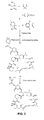
- FIG. 1 is a synthetic route for temsirolimus in accordance with one embodiment of the invention
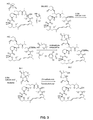
- FIG. 2 is a synthetic route for temsirolimus in US5362718 ;
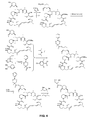
- FIG. 3 is a synthetic route for temsirolimus in WO0123395 ;
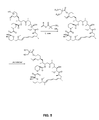
- FIG. 4 is a synthetic route for temsirolimus in US2005033046 ;
- FIG. 5 is a synthetic route for temsirolimus in US2005234086 .
- reaction solution was heated to the temperature of 14°C to react. After the reaction lasted for 14 h, 30 mL of water and 30 mL of ethyl acetate were added to the reaction solution and stirred for 10 min. A resulting mixture was then transferred to the separating funnel to separate an organic phase from an aqueous phase. After that, the organic phase was washed by using the 2N sulfuric solution (10 mL ⁇ 2), water (10 mL), a 5% sodium bicarbonate aqueous solution (10 mL), and saturated brine (10 mL), respectively, and dried by using anhydrous magnesium sulfate.
- reaction solution was heated to the temperature of 14°C to react. After the reaction lasted for 14 h, 30 mL of water and 30 mL of ethyl acetate were added to the reaction solution and stirred for 10 min. A resulting mixture was then transferred to the separating funnel to separate an organic phase from an aqueous phase. After that, the organic phase was washed by using the 2N sulfuric solution (10 mL ⁇ 2), water (10 mL), a 5% sodium bicarbonate aqueous solution (10 mL), and saturated brine (10 mL), respectively, and dried by using anhydrous magnesium sulfate. Finally, a resulting product was filtrated, precipitated, and separated by silica gel column chromatography to yield a white solid intermediate III-2. 0.12 g of the white solid intermediate III-2 was obtained, and the yield thereof was 48.6%.
- the mixed solution was stirred for 20 min and then transferred to the separating funnel to separate the organic phase from the aqueous phase.
- 20 mL ⁇ 2 of ethyl acetate was used to extract the aqueous phase to produce a new organic phase.
- the two organic phases were combined, washed respectively by 20 mL of sodium carbonate aqueous solution, 30 mL of water, and 20 mL of saturated brine, and dried by using anhydrous magnesium sulfate.
- a resulting organic phase was filtrated, precipitated, and separated by silica gel column chromatography to yield a white solid temsirolimus. 0.08 g of white solid temsirolimus was obtained, and the yield thereof was 71.5%.
- reaction solution was heated to the temperature of 14°C to react. After the reaction lasted for 14 h, 30 mL of water and 30 mL of ethyl acetate were added to the reaction solution and stirred for 10 min. A resulting mixture was then transferred to the separating funnel to separate an organic phase from an aqueous phase. After that, the organic phase was washed by using a 2N sulfuric solution (10 mL ⁇ 2), water (10 mL), a 5% sodium bicarbonate aqueous solution (10 mL), and saturated brine (10 mL), respectively, and dried by using anhydrous magnesium sulfate.
- a resulting product was filtrated, precipitated, and separated by silica gel column chromatography (between 200 and 300 mesh, an eluent comprising petroleum ether and acetic ether according to a ratio of 1:1) to yield a white solid intermediate III-1. 0.10 g of the white solid intermediate III-1 was obtained, and the yield thereof was 40.0%.
- the mixed solution was stirred for 20 min and then transferred to the separating funnel to separate the organic phase from the aqueous phase.
- 20 mL ⁇ 2 of ethyl acetate was used to extract the aqueous phase to produce a new organic phase.
- the two organic phases were combined, washed respectively by 20 mL of sodium carbonate aqueous solution, 30 mL of water, and 20 mL of saturated brine, and dried by using anhydrous magnesium sulfate.
- a resulting organic phase was filtrated, precipitated, and separated by silica gel column chromatography to yield a white solid temsirolimus. 0.07 g of white solid temsirolimus was obtained, and the yield thereof was 70.0%.
- the mixed solution was stirred for 20 min and then transferred to the separating funnel to separate the organic phase from the aqueous phase.
- 20 mL ⁇ 2 of ethyl acetate was used to extract the aqueous phase to produce a new organic phase.
- the two organic phases were combined, washed respectively by 20 mL of sodium carbonate aqueous solution, 30 mL of water, and 20 mL of saturated brine, and dried by using anhydrous magnesium sulfate.
- a resulting organic phase was filtrated, precipitated, and separated by silica gel column chromatography to yield a white solid temsirolimus. 0.07 g of white solid temsirolimus was obtained, and the yield thereof was 70.0%.
Landscapes
- Chemical & Material Sciences (AREA)
- Organic Chemistry (AREA)
- Nitrogen And Oxygen Or Sulfur-Condensed Heterocyclic Ring Systems (AREA)
- Pharmaceuticals Containing Other Organic And Inorganic Compounds (AREA)
Abstract
Description
- The invention relates to the field of medical technology, and more particularly to a method for synthesizing temsirolimus (Torisel).
- Torisel is a major therapeutic drug for the treatment of progressive renal cell carcinoma, is the first drug for treatment of targeted therapy of kidney cancer, and is the only listed specific inhibitor of mTOR kinase. mTOR kinase is an important protein to control cell proliferation, growth, and survival. As a medicine for treating kidney cancers, Temsirolimus is able to inhibit mTOR kinase, lower the level of some angiogenesis factors, such as the vascular endothelial growth factor, inhibit the growth of new vessels, and finally lead to the death of cancer cells. Currently, Torisel is the only drug capable of significantly prolonging survival in patients with kidney cancer.
- In 1994, Jerauld, S.Skotnicki, et al. first taught a method for preparing Temsirolimus and the bioactivity thereof (
US 5,362,718 ), as shown inFIG. 2 . The method includes: carrying out reaction between 2,2-dimethylol propionic acid and 2,4,6-trichlorobenzoyl chloride under the protection of 2,2-dimethoxypropane to yield an anhydride; condensing the anhydride with rapamycin, separating intermediate A-1, and finally removing a protecting group to yield Temsirolimus. However, the method has defects that it is difficult to separate a product from a by-product produced by synchronous esterification of 31- and 42-hydroxyl radicals, and the total yield is only 20%. - Shaw, Chia-Cheng, et al. modified the synthetic method as shown in
FIG. 3 . The method includes: protecting the 31- and 42-hydroxyl radicals by trimethylchlorosilane; selectively removing a 42-protecting group to yield intermediate B-1; carrying out a condensation reaction between the intermediate B-1 and the anhydride; and finally removing a 32-protecting group to yield temsirolimus (WO 0123395 - Further improvement is shown in
FIG. 4 (Warren, Chew,US 2005033046 ), including: protecting 2,2-dimethylol propionic acid by phenylboronic acid, and removing the protecting group by 2-methyl-2,4-pentanediol to yield temsirolimus. And another improved method is shown inFIG. 5 (Gu, jianxin,US 2005234086 ). The method includes: enzyme catalyzing rapamycin, carrying out reaction between 42-hydroxyl radical of rapamycin and alkyl group protected 2,2-dimethylol propionic acid, and removing the protecting group to yield temsirolimus. The method has high yield, but high production cost. - Thus, methods for synthesizing temsirolimus in the prior art are disadvantageous in low yield, multiple reaction steps, complicate process, and high production cost.
- In view of the above-described problems, it is one objective of the invention to provide a method for preparing temsirolimus that has a simple process, low cost, and high efficiency.
- To achieve the above objective, in accordance with one embodiment of the invention, there is provided a method for preparing temsirolimus, and the method comprises:
- 1) preparing a solution comprising: a raw material comprising 2,2-dimethylol propionic acid and a substituted aromatic aldehyde, a catalyst comprising p-toluenesulfonic acid, and a solvent comprising methylbenzene; heating and refluxing the solution for 8 h; precipitating a product; adding a saturated sodium carbonate aqueous solution and ether to the solution; allowing a resulting mixture to stand for stratification; separating an aqueous phase from an organic phase; adjusting pH value of the aqueous phase to be neutral; filtrating, and drying the aqueous phase to yield intermediate II represented by the following formula:
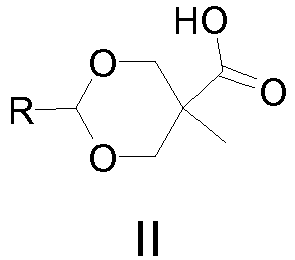

- 2) dissolving the intermediate II, an alkali, and 2,4,6-trichlorobenzoyl chloride, in a first organic solvent to form a mixture; allowing the mixture to react in the presence of nitrogen gas at a temperature of between -20 and 40°C for between 4 and 5 h; adjusting the temperature of the mixture to -10°C; adding rapamycin and an acid binding agent to the mixture, allowing the mixture to react overnight at room temperature; and separating a product by silica gel column chromatography to yield intermediate III represented by the following formula:

- 3) dissolving the intermediate III in a second organic solvent, adding a dilute sulfuric acid to the second organic solvent to yield a mixed solution; allowing the mixed solution to react at a temperature of between -10 and 20°C for between 60 and 80 h; adding ethyl acetate and water to the mixed solution, allowing the mixed solution to stand for stratification; separating an aqueous phase from an organic phase; extracting the aqueous phase by ethyl acetate to produce a new organic phase; combining the two organic phases, precipitating and purifying a resulting product by silica gel column chromatography to yield temsirolimus.
- The substituted aromatic aldehyde in step 1) is selected from the group consisting of benzaldehyde, p-methoxybenzaldehyde, p-chlorobenzaldehyde, and 4-(trifluoromethyl)benzaldehyde. A molar ratio between 2,2-dimethylol propionic acid and the substituted aromatic aldehyde is 1:1. A dosage of p-toluenesulfonic acid is between 10 and 20 wt. % of that of the substituted aromatic aldehyde.
- A molar ratio between rapamicin, the intermediate II, and 2,4,6-trichlorobenzoyl chloride in step 2) is 1:1-1.3:1-1.2. The first organic solvent is selected from the group consisting of toluene, benzene, xylene, ether, methyl tert-butyl ether, tetrahydrofuran, dichloromethane, chloroform, carbon tetrachloride, 1,2-dichloroethane, and ethyl acetate. The alkali is selected from the group consisting of triethylamine, N,N-diisopropylethylamine, and N,N-dimethylaniline. The acid binding agent is selected from the group consisting of pyridine, 4-dimethylaminopyridine (DMAP), 4-pyrrolidinopyridine, and N-methylimidazole.
- A molar ratio between the intermediate III and the dilute sulfuric acid is 1:4-10. The second organic solvent is selected from the group consisting of ether, methyl tert-butyl ether, tetrahydrofuran, methanol, ethanol, isopropanol, tert-butyl alcohol, and acetone.
- Advantages of the invention are summarized as follows: the method for synthesizing temsirolimus of the invention employs two-step reactions to yield the product, has a high yield of 35.6% (compared with 20% in the first reported synthetic method), simplified synthetic steps (compared with
WO0123395 US2005033046 ) and thus low production cost. -
FIG. 1 is a synthetic route for temsirolimus in accordance with one embodiment of the invention; -
FIG. 2 is a synthetic route for temsirolimus inUS5362718 ; -
FIG. 3 is a synthetic route for temsirolimus inWO0123395 -
FIG. 4 is a synthetic route for temsirolimus inUS2005033046 ; and -
FIG. 5 is a synthetic route for temsirolimus inUS2005234086 . - For further illustrating the invention, experiments detailing a method for preparing temsirolimus are described below. It should be noted that the following examples are intended to describe and not to limit the invention.
- 1) To a 100 mL single-mouth bottle 0.80 g (5.9 mmol) of 2,2-dimethylol propionic acid, 0.63 g (5.9 mmol) of benzaldehyde, 0.1 g of p-toluenesulfonic acid, and 40 mL of toluene were added to form a solution. The solution was then heated and refluxed for 8 h. Thereafter, the solution was cooled to room temperature and a product precipitated in a decompression condition. 30 mL of saturated sodium carbonate aqueous solution was added to the solution to from a mixture. After being stirred for 20 min, the mixture was transferred to a separating funnel, and was extracted by using 30 mL×3 of ether whereby separating an aqueous phase from an organic phase. A 2 N sulfuric acid was then added to the aqueous phase to neutralize the pH value thereof. Finally, the aqueous phase was filtrated and dried to a constant weight to yield intermediate II-1, the formula of which is as follows. 1.09 g of the intermediate II-1 was obtained, and the yield thereof was 82.3%.

- 2) To a 100 mL four-mouth bottle 0.06 g (0.284 mmol) of the intermediate II-1, 6 mL of dichloromethane, 0.06 g (0.438 mmol) of N,N-diisopropylethylamine, and 0.06 g (0.263 mmol) of 2,4,6-trichlorobenzoyl chloride were added to form a reaction solution. The reaction solution was stirred in the presence of nitrogen gas at the temperature of 14°C for 4 h, and was then cooled to the temperature of -10°C. 0.02 g (0.219 mmol) of rapamycin and 0.05 g (0.438 mmol) of DMAP were added to the reaction solution. Thereafter, the reaction solution was heated to the temperature of 14°C to react. After the reaction lasted for 14 h, 30 mL of water and 30 mL of ethyl acetate were added to the reaction solution and stirred for 10 min. A resulting mixture was then transferred to the separating funnel to separate an organic phase from an aqueous phase. After that, the organic phase was washed by using the 2N sulfuric solution (10 mL×2), water (10 mL), a 5% sodium bicarbonate aqueous solution (10 mL), and saturated brine (10 mL), respectively, and dried by using anhydrous magnesium sulfate. Finally, a resulting product was filtrated, precipitated, and separated by silica gel column chromatography (between 200 and 300 mesh, an eluent comprising petroleum ether and acetic ether according to a ratio of 1:1) to yield a white solid intermediate III-1. 0.12 g of the white solid intermediate III-1 was obtained, and the yield thereof was 49.0%.

- 3) 0.12 g (0.11 mmol) of the intermediate III-1, and 10 mL of tetrahydrofuran were added to a 100 mL single-mouth bottle, respectively, to yield a mixed solution. Then, the mixed solution was cooled to the temperature of 0°C below, and 0.3 mL (0.6 mmol) of the 2 N sulfuric acid was dropped to the mixed solution. After that, the temperature of the mixed solution was raised to 14°C, and the mixed solution was maintained at such a temperature for 80 h to react. Thereafter, 30 mL of ethyl acetate and 20 mL of water were added to the mixed solution. The mixed solution was stirred for 20 min and then transferred to the separating funnel to separate the organic phase from the aqueous phase. 20 mL×2 of ethyl acetate was used to extract the aqueous phase to produce a new organic phase. Then, the two organic phases were combined, washed respectively by 20 mL of sodium carbonate aqueous solution, 30 mL of water, and 20 mL of saturated brine, and dried by using anhydrous magnesium sulfate. Finally, a resulting organic phase was filtrated, precipitated, and separated by silica gel column chromatography to yield 0.08 g of a white solid temsirolimus, and the yield thereof was 72.7%. MS:[M+Na]+1052.6; 1H NMR (CDCl3, 300MHz):4.70(m, 1 H), 3.86(d, 2H), 3.81 (d, 2H), 1.12(s, 3H).
- 1) To a 100 mL single-mouth bottle 0.80 g (5.9 mmol) of 2,2-dimethylol propionic acid, 0.83 g (5.9 mmol) of p-chlorobenzaldehyde, 0.13 g of p-toluenesulfonic acid, and 40 mL of toluene were added to form a solution. The solution was then heated and refluxed for 8 h. Thereafter, the solution was cooled to room temperature and a product precipitated in a decompression condition. 30 mL of saturated sodium carbonate aqueous solution was added to the solution to from a mixture. After being stirred for 20 min, the mixture was transferred to a separating funnel, and was extracted by using 30 mL×3 of ether whereby separating an aqueous phase from an organic phase. A 2 N sulfuric acid was then added to the aqueous phase to neutralize the pH value thereof. Finally, the aqueous phase was filtrated and dried to a constant weight to yield intermediate II-2, the formula of which is as follows. 1.28 g of the intermediate II-2 was obtained, and the yield thereof was 84.3%.

- 2) To a 100 mL four-mouth bottle 0.07 g (0.284 mmol) of the intermediate II-2, 6 mL of dichloromethane, 0.06 g (0.438 mmol) of N,N-diisopropylethylamine, and 0.06 g (0.263 mmol) of 2,4,6-trichlorobenzoyl chloride were added to form a reaction solution. The reaction solution was stirred in the presence of nitrogen gas at the temperature of 14°C for 4 h, and was then cooled to the temperature of -10°C. 0.02 g (0.219 mmol) of rapamycin and 0.05 g (0.438 mmol) of DMAP were added to the reaction solution. Thereafter, the reaction solution was heated to the temperature of 14°C to react. After the reaction lasted for 14 h, 30 mL of water and 30 mL of ethyl acetate were added to the reaction solution and stirred for 10 min. A resulting mixture was then transferred to the separating funnel to separate an organic phase from an aqueous phase. After that, the organic phase was washed by using the 2N sulfuric solution (10 mL×2), water (10 mL), a 5% sodium bicarbonate aqueous solution (10 mL), and saturated brine (10 mL), respectively, and dried by using anhydrous magnesium sulfate. Finally, a resulting product was filtrated, precipitated, and separated by silica gel column chromatography to yield a white solid intermediate III-2. 0.12 g of the white solid intermediate III-2 was obtained, and the yield thereof was 48.6%.

- 3) 0.12 g (0.10 mmol) of the intermediate III-2, and 10 mL of tetrahydrofuran were added to a 100 mL single-mouth bottle, respectively, to yield a mixed solution. Then, the mixed solution was cooled to the temperature of 0°C below, and 0.3 mL (0.6 mmol) of the 2 N diluted sulfuric acid was dropped to the mixed solution. After that, the temperature of the mixed solution was raised to 14°C, and the mixed solution was maintained at such a temperature for 80 h to react. Thereafter, 30 mL of ethyl acetate and 20 mL of water were added to the mixed solution. The mixed solution was stirred for 20 min and then transferred to the separating funnel to separate the organic phase from the aqueous phase. 20 mL×2 of ethyl acetate was used to extract the aqueous phase to produce a new organic phase. Then, the two organic phases were combined, washed respectively by 20 mL of sodium carbonate aqueous solution, 30 mL of water, and 20 mL of saturated brine, and dried by using anhydrous magnesium sulfate. Finally, a resulting organic phase was filtrated, precipitated, and separated by silica gel column chromatography to yield a white solid temsirolimus. 0.08 g of white solid temsirolimus was obtained, and the yield thereof was 71.5%.
- To a 100 mL four-mouth bottle 0.06 g (0.284 mmol) of the intermediate II-1 obtained from Example 1, 6 mL of dichloromethane, 0.04 g (0.438 mmol) of triethylamine, and 0.06 g (0.263 mmol) of 2,4,6-trichlorobenzoyl chloride were added to form a reaction solution. The reaction solution was stirred in the presence of nitrogen gas at the temperature of 14°C for 4 h, and was then cooled to the temperature of -10°C. 0.02 g (0.219 mmol) of rapamycin and 0.05 g (0.438 mmol) of DMAP were added to the reaction solution. Thereafter, the reaction solution was heated to the temperature of 14°C to react. After the reaction lasted for 14 h, 30 mL of water and 30 mL of ethyl acetate were added to the reaction solution and stirred for 10 min. A resulting mixture was then transferred to the separating funnel to separate an organic phase from an aqueous phase. After that, the organic phase was washed by using a 2N sulfuric solution (10 mL×2), water (10 mL), a 5% sodium bicarbonate aqueous solution (10 mL), and saturated brine (10 mL), respectively, and dried by using anhydrous magnesium sulfate. Finally, a resulting product was filtrated, precipitated, and separated by silica gel column chromatography (between 200 and 300 mesh, an eluent comprising petroleum ether and acetic ether according to a ratio of 1:1) to yield a white solid intermediate III-1. 0.11 g of the white solid intermediate III-1 was obtained, and the yield thereof was 44.0%.
- To a 100 mL four-mouth bottle 0.06 g (0.284 mmol) of the intermediate II-1 obtained from Example 1, 6 mL of dichloromethane, 0.06 g (0.438 mmol) of N,N-diisopropylethylamine, and 0.06 g (0.263 mmol) of 2,4,6-trichlorobenzoyl chloride were added to form a reaction solution. The reaction solution was stirred in the presence of nitrogen gas at the temperature of 14°C for 4 h, and was then cooled to the temperature of -10°C. 0.02 g (0.219 mmol) of rapamycin and 0.04 g (0.438 mmol) of pyridine were added to the reaction solution. Thereafter, the reaction solution was heated to the temperature of 14°C to react. After the reaction lasted for 14 h, 30 mL of water and 30 mL of ethyl acetate were added to the reaction solution and stirred for 10 min. A resulting mixture was then transferred to the separating funnel to separate an organic phase from an aqueous phase. After that, the organic phase was washed by using a 2N sulfuric solution (10 mL×2), water (10 mL), a 5% sodium bicarbonate aqueous solution (10 mL), and saturated brine (10 mL), respectively, and dried by using anhydrous magnesium sulfate. Finally, a resulting product was filtrated, precipitated, and separated by silica gel column chromatography (between 200 and 300 mesh, an eluent comprising petroleum ether and acetic ether according to a ratio of 1:1) to yield a white solid intermediate III-1. 0.10 g of the white solid intermediate III-1 was obtained, and the yield thereof was 40.0%.
- 0.12 g (0.10 mmol) of the intermediate III-1 obtained from Example 1, and 10 mL of tetrahydrofuran were added to a 100 mL single-mouth bottle, respectively, to yield a mixed solution. Then, the mixed solution was cooled to the temperature of 0°C below, and 0.4 mL (0.8 mmol) of a 2 N sulfuric acid was dropped to the mixed solution. After that, the temperature of the mixed solution was raised to 14°C, and the mixed solution was maintained at such a temperature for 68 h to react. Thereafter, 30 mL of ethyl acetate and 20 mL of water were added to the mixed solution. The mixed solution was stirred for 20 min and then transferred to the separating funnel to separate the organic phase from the aqueous phase. 20 mL×2 of ethyl acetate was used to extract the aqueous phase to produce a new organic phase. Then, the two organic phases were combined, washed respectively by 20 mL of sodium carbonate aqueous solution, 30 mL of water, and 20 mL of saturated brine, and dried by using anhydrous magnesium sulfate. Finally, a resulting organic phase was filtrated, precipitated, and separated by silica gel column chromatography to yield a white solid temsirolimus. 0.07 g of white solid temsirolimus was obtained, and the yield thereof was 70.0%.
- 0.12 g (0.10 mmol) of the intermediate III-1 obtained from Example 1, and 10 mL of acetone were added to a 100 mL single-mouth bottle, respectively, to yield a mixed solution. Then, the mixed solution was cooled to the temperature of 0°C below, and 0.4 mL (0.8 mmol) of a 2 N sulfuric acid was dropped to the mixed solution. After that, the temperature of the mixed solution was raised to 14°C, and the mixed solution was maintained at such a temperature for 68 h to react. Thereafter, 30 mL of ethyl acetate and 20 mL of water were added to the mixed solution. The mixed solution was stirred for 20 min and then transferred to the separating funnel to separate the organic phase from the aqueous phase. 20 mL×2 of ethyl acetate was used to extract the aqueous phase to produce a new organic phase. Then, the two organic phases were combined, washed respectively by 20 mL of sodium carbonate aqueous solution, 30 mL of water, and 20 mL of saturated brine, and dried by using anhydrous magnesium sulfate. Finally, a resulting organic phase was filtrated, precipitated, and separated by silica gel column chromatography to yield a white solid temsirolimus. 0.07 g of white solid temsirolimus was obtained, and the yield thereof was 70.0%.
Claims (4)
- A method for preparing temsirolimus, the method comprising:1) preparing a solution comprising: a raw material comprising 2,2-dimethylol propionic acid and a substituted aromatic aldehyde, a catalyst comprising p-toluenesulfonic acid, and a solvent comprising methylbenzene; heating and refluxing the solution for 8 h; precipitating a product; adding a saturated sodium carbonate aqueous solution and ether to the solution; allowing a resulting mixture to stand for stratification; separating an aqueous phase from an organic phase; adjusting pH value of the aqueous phase to be neutral; filtrating, and drying the aqueous phase to yield intermediate II represented by the following formula:


R1 represents a hydrogen atom, between one and five C1-C6 alkyls, between one and five C1-C6 alkoxys, between one and five C1-C6 alkenyls, between one and five C1-C6 alkynyls, between one and five hydroxyls, one or two methylenedioxys (OCH2O), one or two ethylenedioxys (OCH2CH2O), between one and five halogen atoms, between one and five nitryls, between one and five trifluoromethyls, or between one and five trifluoromethoxys;
Y represents nitrogen atom, oxygen atom, or sulfur atom; and
R2 represents hydrogen atom, between one and four C1-C6 alkyls, between one and four C1-C6 alkoxys, between one and four C1-C6 alkenyls, between one and four C1-C6 alkynyls, between one and four hydroxyls, between one and four halogen atoms, between one and four nitryls, between one and four trifluoromethyls, or between one and four trifluoromethoxys;2) dissolving the intermediate II, an alkali, and 2,4,6-trichlorobenzoyl chloride, in a first organic solvent to form a mixture; allowing the mixture to react in the presence of nitrogen gas at a temperature of between -20 and 40°C for between 4 and 5 h; adjusting the temperature of the mixture to -10°C; adding rapamycin and an acid binding agent to the mixture, allowing the mixture to react overnight at room temperature; and separating a product by silica gel column chromatography to yield intermediate III represented by the following formula: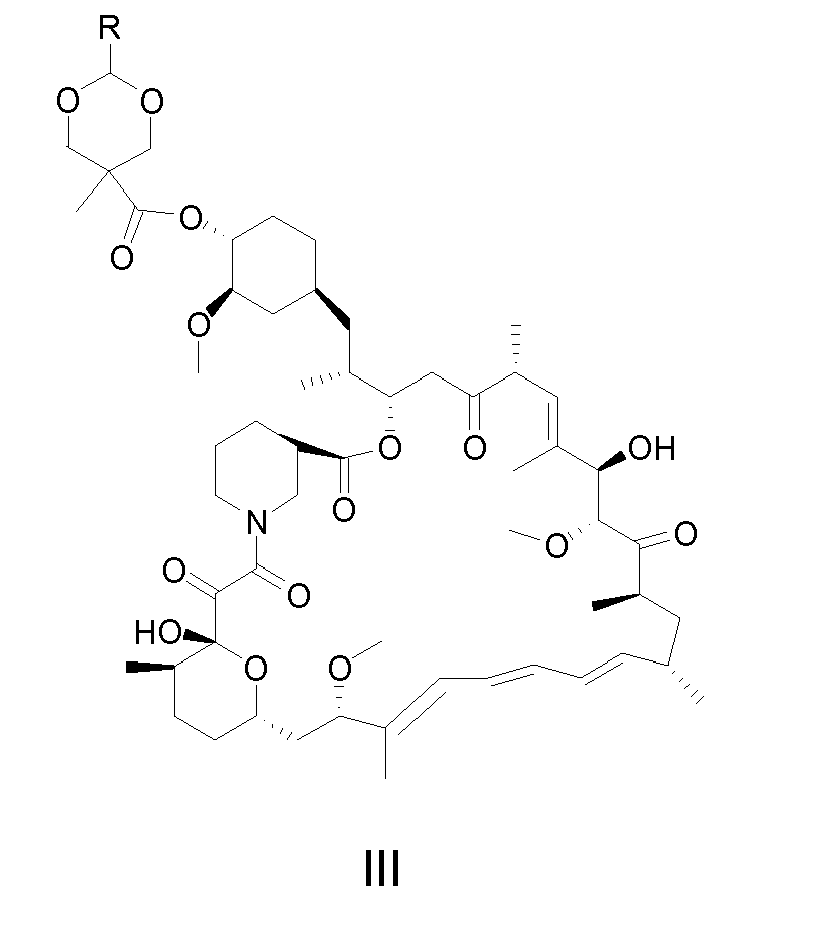 3) dissolving the intermediate III in a second organic solvent, adding a dilute sulfuric acid to the second organic solvent to yield a mixed solution; allowing the mixed solution to react at a temperature of between -10 and 20°C for between 60 and 80 h; adding ethyl acetate and water to the mixed solution, allowing the mixed solution to stand for stratification; separating an aqueous phase from an organic phase; extracting the aqueous phase by ethyl acetate to produce a new organic phase; combining the two organic phases, precipitating and purifying a resulting product by silica gel column chromatography to yield the compound.
 - The method of claim 1, characterized in that
the substituted aromatic aldehyde is selected from the group consisting of benzaldehyde, p-methoxybenzaldehyde, p-chlorobenzaldehyde, and 4-(trifluoromethyl)benzaldehyde;
a molar ratio between 2,2-dimethylol propionic acid and the substituted aromatic aldehyde is 1:1; and
a dosage of p-toluenesulfonic acid is between 10 and 20 wt. % of that of the substituted aromatic aldehyde. - The method of claim 1, characterized in that
a molar ratio between rapamicin, the intermediate II, and 2,4,6-trichlorobenzoyl chloride in step 2) is 1:1-1.3:1-1.2;
the first organic solvent is selected from the group consisting of toluene, benzene, xylene, ether, methyl tert-butyl ether, tetrahydrofuran, dichloromethane, chloroform, carbon tetrachloride, 1,2-dichloroethane, and ethyl acetate;
the alkali is selected from the group consisting of triethylamine, N,N-diisopropylethylamine, and N,N-dimethylaniline; and
the acid binding agent is selected from the group consisting of pyridine, 4-dimethylaminopyridine (DMAP), 4-pyrrolidinopyridine, and N-methylimidazole. - The method of claim 1, characterized in that
a molar ratio between the intermediate III and the dilute sulfuric acid is 1:4-10; and
the second organic solvent is selected from the group consisting of ether, methyl tert-butyl ether, tetrahydrofuran, methanol, ethanol, isopropanol, tert-butyl alcohol, and acetone.
Applications Claiming Priority (2)
| Application Number | Priority Date | Filing Date | Title |
|---|---|---|---|
| CN201110002893XA CN102020662B (en) | 2011-01-07 | 2011-01-07 | Method for preparing torisel |
| PCT/CN2011/074080 WO2012092740A1 (en) | 2011-01-07 | 2011-05-16 | Process for preparing torisel |
Publications (3)
| Publication Number | Publication Date |
|---|---|
| EP2662376A1 true EP2662376A1 (en) | 2013-11-13 |
| EP2662376A4 EP2662376A4 (en) | 2014-07-02 |
| EP2662376B1 EP2662376B1 (en) | 2016-11-30 |
Family
ID=43862477
Family Applications (1)
| Application Number | Title | Priority Date | Filing Date |
|---|---|---|---|
| EP11855154.8A Not-in-force EP2662376B1 (en) | 2011-01-07 | 2011-05-16 | Process for preparing torisel |
Country Status (4)
| Country | Link |
|---|---|
| US (1) | US9018373B2 (en) |
| EP (1) | EP2662376B1 (en) |
| CN (1) | CN102020662B (en) |
| WO (1) | WO2012092740A1 (en) |
Families Citing this family (3)
| Publication number | Priority date | Publication date | Assignee | Title |
|---|---|---|---|---|
| CN102020662B (en) * | 2011-01-07 | 2013-02-13 | 天津市炜杰科技有限公司 | Method for preparing torisel |
| CN102807571A (en) * | 2012-05-25 | 2012-12-05 | 上海现代制药股份有限公司 | Method used for preparing temsirolimus and suitable for industrial production |
| CN102796115B (en) * | 2012-05-25 | 2015-07-15 | 上海现代制药股份有限公司 | Method for preparing temsirolimus |
Family Cites Families (8)
| Publication number | Priority date | Publication date | Assignee | Title |
|---|---|---|---|---|
| US5362718A (en) | 1994-04-18 | 1994-11-08 | American Home Products Corporation | Rapamycin hydroxyesters |
| TWI256395B (en) | 1999-09-29 | 2006-06-11 | Wyeth Corp | Regioselective synthesis of rapamycin derivatives |
| JP4227649B2 (en) | 2003-08-07 | 2009-02-18 | ワイス | Regioselective synthesis of CCI-779 |
| CN1942477A (en) * | 2004-04-14 | 2007-04-04 | 惠氏公司 | Proline CCI-779 (proline-rapamycin 42-ester with 2,2-bis (hydroxymethyl) propionic acid) and two-step enzymatic synthesis of proline CCI-779 and CCI-779 using microbial lipase |
| MXPA06011883A (en) * | 2004-04-14 | 2006-12-14 | Wyeth Corp | Proline cci-779 (proline-rapamycin 42-ester with 2,2-bis (hydroxymethyl) propionic acid) and two-step enzymatic synthesis of proline cci-779 and cci-779 using microbial lipase. |
| US8754207B2 (en) * | 2009-09-25 | 2014-06-17 | Cadila Healthcare Limited | Process for the preparation of rapamycin derivatives |
| WO2011092564A2 (en) * | 2010-01-28 | 2011-08-04 | Fresenius Kabi Oncology Ltd | Process for the preparation of temsirolimus and its intermediates |
| CN102020662B (en) * | 2011-01-07 | 2013-02-13 | 天津市炜杰科技有限公司 | Method for preparing torisel |
-
2011
- 2011-01-07 CN CN201110002893XA patent/CN102020662B/en active Active
- 2011-05-16 EP EP11855154.8A patent/EP2662376B1/en not_active Not-in-force
- 2011-05-16 WO PCT/CN2011/074080 patent/WO2012092740A1/en not_active Ceased
-
2013
- 2013-07-03 US US13/935,476 patent/US9018373B2/en not_active Expired - Fee Related
Also Published As
| Publication number | Publication date |
|---|---|
| CN102020662A (en) | 2011-04-20 |
| EP2662376B1 (en) | 2016-11-30 |
| CN102020662B (en) | 2013-02-13 |
| US9018373B2 (en) | 2015-04-28 |
| EP2662376A4 (en) | 2014-07-02 |
| WO2012092740A1 (en) | 2012-07-12 |
| US20130296572A1 (en) | 2013-11-07 |
Similar Documents
| Publication | Publication Date | Title |
|---|---|---|
| Hasaninejad et al. | Silica bonded n-propyl-4-aza-1-azoniabicyclo [2.2. 2] octane chloride (SB-DABCO): A highly efficient, reusable and new heterogeneous catalyst for the synthesis of 4H-benzo [b] pyran derivatives | |
| CN1829722B (en) | Regioselective synthesis of CCI-779 | |
| CN101665484B (en) | Method for preparing lenalidomide | |
| EP2844647B1 (en) | Process for preparation of optically pure and optionally substituted 2-(1-hydroxy-alkyl)-chromen-4-one derivatives and their use in preparing pharmaceuticals | |
| EP2662376B1 (en) | Process for preparing torisel | |
| KR101787789B1 (en) | Process for producing pyripyropene derivatives | |
| CN110183445B (en) | Synthetic method of moxifloxacin and its derivatives | |
| EP2872477B1 (en) | Process for the preparation of ingenol-3-angelate from 20-deoxy-ingenol | |
| CN106083539B (en) | A kind of synthetic method of list fluorine methoxyl group or the deuterated methoxy base class compound of single fluorine | |
| CN101250176A (en) | A kind of flavonol sulfonate derivative and its synthesis method | |
| Clarke et al. | Synthesis of thio-and oxo-analogues of isopsoralen | |
| CN104072495B (en) | The preparation method of natural product alkaloid A aptamine | |
| EP2662377B1 (en) | Process for synthesis of torisel | |
| CN102516350B (en) | Glycyrrhetinic acid modifier with antitumor activity and preparation method thereof | |
| CN102276556B (en) | Preparation method of 4-benzyl piperazi ethyliminumacyl (formimidoyl benzol) hydrazine compounds | |
| CN118702664B (en) | A method for preparing (-)EGCG by photocatalytic debenzylation reaction | |
| CN113372375A (en) | Preparation method of temsirolimus intermediate | |
| CN102807571A (en) | Method used for preparing temsirolimus and suitable for industrial production | |
| JPWO2019230848A1 (en) | Method for producing polymerizable compound | |
| CN114057792B (en) | Temsirolimus intermediate compounds | |
| CN108503582B (en) | Microwave-assisted synthesis of 2-(1H)-quinolinones | |
| CN118255831A (en) | Preparation method of drospirenone intermediate | |
| CN106518826A (en) | High-selectivity preparation method for 7-methoxy-6/8-hydroxy coumarin | |
| CN106518825B (en) | A kind of chemoselective monomethylation method of coumarin catechol compound | |
| CN117209503A (en) | A method for synthesizing 5,6-dihydroimidazo[1,2-c]quinazoline and its derivatives |
Legal Events
| Date | Code | Title | Description |
|---|---|---|---|
| PUAI | Public reference made under article 153(3) epc to a published international application that has entered the european phase |
Free format text: ORIGINAL CODE: 0009012 |
|
| 17P | Request for examination filed |
Effective date: 20130802 |
|
| AK | Designated contracting states |
Kind code of ref document: A1 Designated state(s): AL AT BE BG CH CY CZ DE DK EE ES FI FR GB GR HR HU IE IS IT LI LT LU LV MC MK MT NL NO PL PT RO RS SE SI SK SM TR |
|
| DAX | Request for extension of the european patent (deleted) | ||
| RIC1 | Information provided on ipc code assigned before grant |
Ipc: C07D 498/18 20060101AFI20140521BHEP |
|
| A4 | Supplementary search report drawn up and despatched |
Effective date: 20140604 |
|
| GRAP | Despatch of communication of intention to grant a patent |
Free format text: ORIGINAL CODE: EPIDOSNIGR1 |
|
| INTG | Intention to grant announced |
Effective date: 20160629 |
|
| RAP1 | Party data changed (applicant data changed or rights of an application transferred) |
Owner name: TIANJIN WEIJIE TECHNOLOGY CO., LTD. |
|
| GRAS | Grant fee paid |
Free format text: ORIGINAL CODE: EPIDOSNIGR3 |
|
| GRAA | (expected) grant |
Free format text: ORIGINAL CODE: 0009210 |
|
| AK | Designated contracting states |
Kind code of ref document: B1 Designated state(s): AL AT BE BG CH CY CZ DE DK EE ES FI FR GB GR HR HU IE IS IT LI LT LU LV MC MK MT NL NO PL PT RO RS SE SI SK SM TR |
|
| REG | Reference to a national code |
Ref country code: CH Ref legal event code: EP Ref country code: GB Ref legal event code: FG4D |
|
| REG | Reference to a national code |
Ref country code: AT Ref legal event code: REF Ref document number: 849691 Country of ref document: AT Kind code of ref document: T Effective date: 20161215 |
|
| REG | Reference to a national code |
Ref country code: IE Ref legal event code: FG4D |
|
| REG | Reference to a national code |
Ref country code: DE Ref legal event code: R096 Ref document number: 602011033014 Country of ref document: DE |
|
| PG25 | Lapsed in a contracting state [announced via postgrant information from national office to epo] |
Ref country code: LV Free format text: LAPSE BECAUSE OF FAILURE TO SUBMIT A TRANSLATION OF THE DESCRIPTION OR TO PAY THE FEE WITHIN THE PRESCRIBED TIME-LIMIT Effective date: 20161130 |
|
| REG | Reference to a national code |
Ref country code: LT Ref legal event code: MG4D |
|
| REG | Reference to a national code |
Ref country code: NL Ref legal event code: MP Effective date: 20161130 |
|
| REG | Reference to a national code |
Ref country code: AT Ref legal event code: MK05 Ref document number: 849691 Country of ref document: AT Kind code of ref document: T Effective date: 20161130 |
|
| PG25 | Lapsed in a contracting state [announced via postgrant information from national office to epo] |
Ref country code: LT Free format text: LAPSE BECAUSE OF FAILURE TO SUBMIT A TRANSLATION OF THE DESCRIPTION OR TO PAY THE FEE WITHIN THE PRESCRIBED TIME-LIMIT Effective date: 20161130 Ref country code: GR Free format text: LAPSE BECAUSE OF FAILURE TO SUBMIT A TRANSLATION OF THE DESCRIPTION OR TO PAY THE FEE WITHIN THE PRESCRIBED TIME-LIMIT Effective date: 20170301 Ref country code: NO Free format text: LAPSE BECAUSE OF FAILURE TO SUBMIT A TRANSLATION OF THE DESCRIPTION OR TO PAY THE FEE WITHIN THE PRESCRIBED TIME-LIMIT Effective date: 20170228 Ref country code: SE Free format text: LAPSE BECAUSE OF FAILURE TO SUBMIT A TRANSLATION OF THE DESCRIPTION OR TO PAY THE FEE WITHIN THE PRESCRIBED TIME-LIMIT Effective date: 20161130 |
|
| PG25 | Lapsed in a contracting state [announced via postgrant information from national office to epo] |
Ref country code: FI Free format text: LAPSE BECAUSE OF FAILURE TO SUBMIT A TRANSLATION OF THE DESCRIPTION OR TO PAY THE FEE WITHIN THE PRESCRIBED TIME-LIMIT Effective date: 20161130 Ref country code: HR Free format text: LAPSE BECAUSE OF FAILURE TO SUBMIT A TRANSLATION OF THE DESCRIPTION OR TO PAY THE FEE WITHIN THE PRESCRIBED TIME-LIMIT Effective date: 20161130 Ref country code: ES Free format text: LAPSE BECAUSE OF FAILURE TO SUBMIT A TRANSLATION OF THE DESCRIPTION OR TO PAY THE FEE WITHIN THE PRESCRIBED TIME-LIMIT Effective date: 20161130 Ref country code: AT Free format text: LAPSE BECAUSE OF FAILURE TO SUBMIT A TRANSLATION OF THE DESCRIPTION OR TO PAY THE FEE WITHIN THE PRESCRIBED TIME-LIMIT Effective date: 20161130 Ref country code: PL Free format text: LAPSE BECAUSE OF FAILURE TO SUBMIT A TRANSLATION OF THE DESCRIPTION OR TO PAY THE FEE WITHIN THE PRESCRIBED TIME-LIMIT Effective date: 20161130 Ref country code: PT Free format text: LAPSE BECAUSE OF FAILURE TO SUBMIT A TRANSLATION OF THE DESCRIPTION OR TO PAY THE FEE WITHIN THE PRESCRIBED TIME-LIMIT Effective date: 20170330 Ref country code: RS Free format text: LAPSE BECAUSE OF FAILURE TO SUBMIT A TRANSLATION OF THE DESCRIPTION OR TO PAY THE FEE WITHIN THE PRESCRIBED TIME-LIMIT Effective date: 20161130 |
|
| PG25 | Lapsed in a contracting state [announced via postgrant information from national office to epo] |
Ref country code: NL Free format text: LAPSE BECAUSE OF FAILURE TO SUBMIT A TRANSLATION OF THE DESCRIPTION OR TO PAY THE FEE WITHIN THE PRESCRIBED TIME-LIMIT Effective date: 20161130 |
|
| PG25 | Lapsed in a contracting state [announced via postgrant information from national office to epo] |
Ref country code: EE Free format text: LAPSE BECAUSE OF FAILURE TO SUBMIT A TRANSLATION OF THE DESCRIPTION OR TO PAY THE FEE WITHIN THE PRESCRIBED TIME-LIMIT Effective date: 20161130 Ref country code: CZ Free format text: LAPSE BECAUSE OF FAILURE TO SUBMIT A TRANSLATION OF THE DESCRIPTION OR TO PAY THE FEE WITHIN THE PRESCRIBED TIME-LIMIT Effective date: 20161130 Ref country code: DK Free format text: LAPSE BECAUSE OF FAILURE TO SUBMIT A TRANSLATION OF THE DESCRIPTION OR TO PAY THE FEE WITHIN THE PRESCRIBED TIME-LIMIT Effective date: 20161130 Ref country code: RO Free format text: LAPSE BECAUSE OF FAILURE TO SUBMIT A TRANSLATION OF THE DESCRIPTION OR TO PAY THE FEE WITHIN THE PRESCRIBED TIME-LIMIT Effective date: 20161130 Ref country code: SK Free format text: LAPSE BECAUSE OF FAILURE TO SUBMIT A TRANSLATION OF THE DESCRIPTION OR TO PAY THE FEE WITHIN THE PRESCRIBED TIME-LIMIT Effective date: 20161130 |
|
| PG25 | Lapsed in a contracting state [announced via postgrant information from national office to epo] |
Ref country code: BE Free format text: LAPSE BECAUSE OF FAILURE TO SUBMIT A TRANSLATION OF THE DESCRIPTION OR TO PAY THE FEE WITHIN THE PRESCRIBED TIME-LIMIT Effective date: 20161130 Ref country code: BG Free format text: LAPSE BECAUSE OF FAILURE TO SUBMIT A TRANSLATION OF THE DESCRIPTION OR TO PAY THE FEE WITHIN THE PRESCRIBED TIME-LIMIT Effective date: 20170228 Ref country code: SM Free format text: LAPSE BECAUSE OF FAILURE TO SUBMIT A TRANSLATION OF THE DESCRIPTION OR TO PAY THE FEE WITHIN THE PRESCRIBED TIME-LIMIT Effective date: 20161130 Ref country code: LU Free format text: LAPSE BECAUSE OF NON-PAYMENT OF DUE FEES Effective date: 20170531 |
|
| REG | Reference to a national code |
Ref country code: DE Ref legal event code: R097 Ref document number: 602011033014 Country of ref document: DE |
|
| PLBE | No opposition filed within time limit |
Free format text: ORIGINAL CODE: 0009261 |
|
| STAA | Information on the status of an ep patent application or granted ep patent |
Free format text: STATUS: NO OPPOSITION FILED WITHIN TIME LIMIT |
|
| 26N | No opposition filed |
Effective date: 20170831 |
|
| PG25 | Lapsed in a contracting state [announced via postgrant information from national office to epo] |
Ref country code: SI Free format text: LAPSE BECAUSE OF FAILURE TO SUBMIT A TRANSLATION OF THE DESCRIPTION OR TO PAY THE FEE WITHIN THE PRESCRIBED TIME-LIMIT Effective date: 20161130 |
|
| REG | Reference to a national code |
Ref country code: DE Ref legal event code: R119 Ref document number: 602011033014 Country of ref document: DE |
|
| REG | Reference to a national code |
Ref country code: CH Ref legal event code: PL |
|
| GBPC | Gb: european patent ceased through non-payment of renewal fee |
Effective date: 20170516 |
|
| PG25 | Lapsed in a contracting state [announced via postgrant information from national office to epo] |
Ref country code: MC Free format text: LAPSE BECAUSE OF FAILURE TO SUBMIT A TRANSLATION OF THE DESCRIPTION OR TO PAY THE FEE WITHIN THE PRESCRIBED TIME-LIMIT Effective date: 20161130 |
|
| REG | Reference to a national code |
Ref country code: IE Ref legal event code: MM4A |
|
| PG25 | Lapsed in a contracting state [announced via postgrant information from national office to epo] |
Ref country code: CH Free format text: LAPSE BECAUSE OF NON-PAYMENT OF DUE FEES Effective date: 20170531 Ref country code: LI Free format text: LAPSE BECAUSE OF NON-PAYMENT OF DUE FEES Effective date: 20170531 |
|
| REG | Reference to a national code |
Ref country code: FR Ref legal event code: ST Effective date: 20180131 |
|
| PG25 | Lapsed in a contracting state [announced via postgrant information from national office to epo] |
Ref country code: LU Free format text: LAPSE BECAUSE OF NON-PAYMENT OF DUE FEES Effective date: 20170516 |
|
| PG25 | Lapsed in a contracting state [announced via postgrant information from national office to epo] |
Ref country code: GB Free format text: LAPSE BECAUSE OF NON-PAYMENT OF DUE FEES Effective date: 20170516 Ref country code: DE Free format text: LAPSE BECAUSE OF NON-PAYMENT OF DUE FEES Effective date: 20171201 Ref country code: IE Free format text: LAPSE BECAUSE OF NON-PAYMENT OF DUE FEES Effective date: 20170516 |
|
| PG25 | Lapsed in a contracting state [announced via postgrant information from national office to epo] |
Ref country code: FR Free format text: LAPSE BECAUSE OF NON-PAYMENT OF DUE FEES Effective date: 20170531 |
|
| PG25 | Lapsed in a contracting state [announced via postgrant information from national office to epo] |
Ref country code: MT Free format text: LAPSE BECAUSE OF NON-PAYMENT OF DUE FEES Effective date: 20170516 |
|
| PG25 | Lapsed in a contracting state [announced via postgrant information from national office to epo] |
Ref country code: HU Free format text: LAPSE BECAUSE OF FAILURE TO SUBMIT A TRANSLATION OF THE DESCRIPTION OR TO PAY THE FEE WITHIN THE PRESCRIBED TIME-LIMIT; INVALID AB INITIO Effective date: 20110516 |
|
| PG25 | Lapsed in a contracting state [announced via postgrant information from national office to epo] |
Ref country code: CY Free format text: LAPSE BECAUSE OF NON-PAYMENT OF DUE FEES Effective date: 20161130 |
|
| PG25 | Lapsed in a contracting state [announced via postgrant information from national office to epo] |
Ref country code: MK Free format text: LAPSE BECAUSE OF FAILURE TO SUBMIT A TRANSLATION OF THE DESCRIPTION OR TO PAY THE FEE WITHIN THE PRESCRIBED TIME-LIMIT Effective date: 20161130 |
|
| PG25 | Lapsed in a contracting state [announced via postgrant information from national office to epo] |
Ref country code: TR Free format text: LAPSE BECAUSE OF FAILURE TO SUBMIT A TRANSLATION OF THE DESCRIPTION OR TO PAY THE FEE WITHIN THE PRESCRIBED TIME-LIMIT Effective date: 20161130 |
|
| PG25 | Lapsed in a contracting state [announced via postgrant information from national office to epo] |
Ref country code: AL Free format text: LAPSE BECAUSE OF FAILURE TO SUBMIT A TRANSLATION OF THE DESCRIPTION OR TO PAY THE FEE WITHIN THE PRESCRIBED TIME-LIMIT Effective date: 20161130 Ref country code: IS Free format text: LAPSE BECAUSE OF FAILURE TO SUBMIT A TRANSLATION OF THE DESCRIPTION OR TO PAY THE FEE WITHIN THE PRESCRIBED TIME-LIMIT Effective date: 20170330 |
|
| PGFP | Annual fee paid to national office [announced via postgrant information from national office to epo] |
Ref country code: IT Payment date: 20210513 Year of fee payment: 11 |
|
| PG25 | Lapsed in a contracting state [announced via postgrant information from national office to epo] |
Ref country code: IT Free format text: LAPSE BECAUSE OF NON-PAYMENT OF DUE FEES Effective date: 20220516 |