EP2662357A1 - Novel bicyclic compound or salt thereof - Google Patents
Novel bicyclic compound or salt thereof Download PDFInfo
- Publication number
- EP2662357A1 EP2662357A1 EP12732119.8A EP12732119A EP2662357A1 EP 2662357 A1 EP2662357 A1 EP 2662357A1 EP 12732119 A EP12732119 A EP 12732119A EP 2662357 A1 EP2662357 A1 EP 2662357A1
- Authority
- EP
- European Patent Office
- Prior art keywords
- group
- carbon atoms
- compound
- optionally
- optionally substituted
- Prior art date
- Legal status (The legal status is an assumption and is not a legal conclusion. Google has not performed a legal analysis and makes no representation as to the accuracy of the status listed.)
- Granted
Links
- 0 CC(C)Nc1cc(-c2c(cccc3-[n]4cnc(/C(/C=N)=C\[N+]C)c4)c3ccn2)ccc1C(*)=O Chemical compound CC(C)Nc1cc(-c2c(cccc3-[n]4cnc(/C(/C=N)=C\[N+]C)c4)c3ccn2)ccc1C(*)=O 0.000 description 2
- VOHPZHIGJGZVBS-UHFFFAOYSA-N CC(C)(C)Nc1cc(-c2c(cccc3-[n]4cnc(-c5cccnc5)c4)c3ccn2)ccc1C(N)=O Chemical compound CC(C)(C)Nc1cc(-c2c(cccc3-[n]4cnc(-c5cccnc5)c4)c3ccn2)ccc1C(N)=O VOHPZHIGJGZVBS-UHFFFAOYSA-N 0.000 description 1
- KQXMPPKLYCLMTC-UHFFFAOYSA-O CC1(C=CN=C2c3ccc(C([NH3+])=O)c(NC(CC4)CCC4O)c3)C2=CC=CC1c1nnc(-c2ccccc2)[o]1 Chemical compound CC1(C=CN=C2c3ccc(C([NH3+])=O)c(NC(CC4)CCC4O)c3)C2=CC=CC1c1nnc(-c2ccccc2)[o]1 KQXMPPKLYCLMTC-UHFFFAOYSA-O 0.000 description 1
- DDEWTOKKVINSHO-UHFFFAOYSA-N CCc1nc(-c(cc2)cc(NC(CC3)CCC3O)c2C(N)=O)c(cccc2-c3cc(cccc4)c4nc3)c2n1 Chemical compound CCc1nc(-c(cc2)cc(NC(CC3)CCC3O)c2C(N)=O)c(cccc2-c3cc(cccc4)c4nc3)c2n1 DDEWTOKKVINSHO-UHFFFAOYSA-N 0.000 description 1
- RDIRFFHAYUPGNC-UHFFFAOYSA-N COc1cncc(-c2cccc3c(-c4ccc(C(N)=O)c(NC(CC5)CCC5O)c4)nccc23)c1 Chemical compound COc1cncc(-c2cccc3c(-c4ccc(C(N)=O)c(NC(CC5)CCC5O)c4)nccc23)c1 RDIRFFHAYUPGNC-UHFFFAOYSA-N 0.000 description 1
- JUTXJVJTZMQAGM-UHFFFAOYSA-O Cc1nc(-c(cc2)cc(NCC3=CC3)c2C(N)=O)c(cccc2-[n]3cnc(C(C=N)=C[NH2+]C)c3)c2c1 Chemical compound Cc1nc(-c(cc2)cc(NCC3=CC3)c2C(N)=O)c(cccc2-[n]3cnc(C(C=N)=C[NH2+]C)c3)c2c1 JUTXJVJTZMQAGM-UHFFFAOYSA-O 0.000 description 1
- CNAVLQRGURYBLU-UHFFFAOYSA-N NC(c(c(NC(CC1)CCC1O)c1)ccc1-c1c(cccc2-c3cc(NC(CO)=O)cnc3)c2ccn1)=O Chemical compound NC(c(c(NC(CC1)CCC1O)c1)ccc1-c1c(cccc2-c3cc(NC(CO)=O)cnc3)c2ccn1)=O CNAVLQRGURYBLU-UHFFFAOYSA-N 0.000 description 1
- ABINKEPDSHFJGL-UHFFFAOYSA-N NC(c(c(NC(CC1)CCC1O)c1)ccc1-c1c(cccc2-c3cnc(-c4ccccc4)[s]3)c2ccn1)=O Chemical compound NC(c(c(NC(CC1)CCC1O)c1)ccc1-c1c(cccc2-c3cnc(-c4ccccc4)[s]3)c2ccn1)=O ABINKEPDSHFJGL-UHFFFAOYSA-N 0.000 description 1
- ONCUJFXCPOWKAV-UHFFFAOYSA-N NC(c(ccc(-c1c(cccc2-[n]3cnc(-c4cccnc4)c3)c2nc(C(F)(F)F)c1)c1)c1N)=O Chemical compound NC(c(ccc(-c1c(cccc2-[n]3cnc(-c4cccnc4)c3)c2nc(C(F)(F)F)c1)c1)c1N)=O ONCUJFXCPOWKAV-UHFFFAOYSA-N 0.000 description 1
Images

Classifications
-
- C—CHEMISTRY; METALLURGY
- C07—ORGANIC CHEMISTRY
- C07D—HETEROCYCLIC COMPOUNDS
- C07D403/00—Heterocyclic compounds containing two or more hetero rings, having nitrogen atoms as the only ring hetero atoms, not provided for by group C07D401/00
- C07D403/02—Heterocyclic compounds containing two or more hetero rings, having nitrogen atoms as the only ring hetero atoms, not provided for by group C07D401/00 containing two hetero rings
- C07D403/04—Heterocyclic compounds containing two or more hetero rings, having nitrogen atoms as the only ring hetero atoms, not provided for by group C07D401/00 containing two hetero rings directly linked by a ring-member-to-ring-member bond
-
- A—HUMAN NECESSITIES
- A61—MEDICAL OR VETERINARY SCIENCE; HYGIENE
- A61K—PREPARATIONS FOR MEDICAL, DENTAL OR TOILETRY PURPOSES
- A61K31/00—Medicinal preparations containing organic active ingredients
- A61K31/33—Heterocyclic compounds
- A61K31/395—Heterocyclic compounds having nitrogen as a ring hetero atom, e.g. guanethidine or rifamycins
- A61K31/435—Heterocyclic compounds having nitrogen as a ring hetero atom, e.g. guanethidine or rifamycins having six-membered rings with one nitrogen as the only ring hetero atom
- A61K31/4353—Heterocyclic compounds having nitrogen as a ring hetero atom, e.g. guanethidine or rifamycins having six-membered rings with one nitrogen as the only ring hetero atom ortho- or peri-condensed with heterocyclic ring systems
- A61K31/4375—Heterocyclic compounds having nitrogen as a ring hetero atom, e.g. guanethidine or rifamycins having six-membered rings with one nitrogen as the only ring hetero atom ortho- or peri-condensed with heterocyclic ring systems the heterocyclic ring system containing a six-membered ring having nitrogen as a ring heteroatom, e.g. quinolizines, naphthyridines, berberine, vincamine
-
- A—HUMAN NECESSITIES
- A61—MEDICAL OR VETERINARY SCIENCE; HYGIENE
- A61K—PREPARATIONS FOR MEDICAL, DENTAL OR TOILETRY PURPOSES
- A61K31/00—Medicinal preparations containing organic active ingredients
- A61K31/33—Heterocyclic compounds
- A61K31/395—Heterocyclic compounds having nitrogen as a ring hetero atom, e.g. guanethidine or rifamycins
- A61K31/435—Heterocyclic compounds having nitrogen as a ring hetero atom, e.g. guanethidine or rifamycins having six-membered rings with one nitrogen as the only ring hetero atom
- A61K31/44—Non condensed pyridines; Hydrogenated derivatives thereof
- A61K31/4427—Non condensed pyridines; Hydrogenated derivatives thereof containing further heterocyclic ring systems
- A61K31/4439—Non condensed pyridines; Hydrogenated derivatives thereof containing further heterocyclic ring systems containing a five-membered ring with nitrogen as a ring hetero atom, e.g. omeprazole
-
- A—HUMAN NECESSITIES
- A61—MEDICAL OR VETERINARY SCIENCE; HYGIENE
- A61K—PREPARATIONS FOR MEDICAL, DENTAL OR TOILETRY PURPOSES
- A61K31/00—Medicinal preparations containing organic active ingredients
- A61K31/33—Heterocyclic compounds
- A61K31/395—Heterocyclic compounds having nitrogen as a ring hetero atom, e.g. guanethidine or rifamycins
- A61K31/435—Heterocyclic compounds having nitrogen as a ring hetero atom, e.g. guanethidine or rifamycins having six-membered rings with one nitrogen as the only ring hetero atom
- A61K31/47—Quinolines; Isoquinolines
- A61K31/4709—Non-condensed quinolines and containing further heterocyclic rings
-
- A—HUMAN NECESSITIES
- A61—MEDICAL OR VETERINARY SCIENCE; HYGIENE
- A61K—PREPARATIONS FOR MEDICAL, DENTAL OR TOILETRY PURPOSES
- A61K31/00—Medicinal preparations containing organic active ingredients
- A61K31/33—Heterocyclic compounds
- A61K31/395—Heterocyclic compounds having nitrogen as a ring hetero atom, e.g. guanethidine or rifamycins
- A61K31/435—Heterocyclic compounds having nitrogen as a ring hetero atom, e.g. guanethidine or rifamycins having six-membered rings with one nitrogen as the only ring hetero atom
- A61K31/47—Quinolines; Isoquinolines
- A61K31/472—Non-condensed isoquinolines, e.g. papaverine
- A61K31/4725—Non-condensed isoquinolines, e.g. papaverine containing further heterocyclic rings
-
- A—HUMAN NECESSITIES
- A61—MEDICAL OR VETERINARY SCIENCE; HYGIENE
- A61K—PREPARATIONS FOR MEDICAL, DENTAL OR TOILETRY PURPOSES
- A61K31/00—Medicinal preparations containing organic active ingredients
- A61K31/33—Heterocyclic compounds
- A61K31/395—Heterocyclic compounds having nitrogen as a ring hetero atom, e.g. guanethidine or rifamycins
- A61K31/495—Heterocyclic compounds having nitrogen as a ring hetero atom, e.g. guanethidine or rifamycins having six-membered rings with two or more nitrogen atoms as the only ring heteroatoms, e.g. piperazine or tetrazines
- A61K31/4965—Non-condensed pyrazines
- A61K31/497—Non-condensed pyrazines containing further heterocyclic rings
-
- A—HUMAN NECESSITIES
- A61—MEDICAL OR VETERINARY SCIENCE; HYGIENE
- A61K—PREPARATIONS FOR MEDICAL, DENTAL OR TOILETRY PURPOSES
- A61K31/00—Medicinal preparations containing organic active ingredients
- A61K31/33—Heterocyclic compounds
- A61K31/395—Heterocyclic compounds having nitrogen as a ring hetero atom, e.g. guanethidine or rifamycins
- A61K31/495—Heterocyclic compounds having nitrogen as a ring hetero atom, e.g. guanethidine or rifamycins having six-membered rings with two or more nitrogen atoms as the only ring heteroatoms, e.g. piperazine or tetrazines
- A61K31/50—Pyridazines; Hydrogenated pyridazines
- A61K31/501—Pyridazines; Hydrogenated pyridazines not condensed and containing further heterocyclic rings
-
- A—HUMAN NECESSITIES
- A61—MEDICAL OR VETERINARY SCIENCE; HYGIENE
- A61K—PREPARATIONS FOR MEDICAL, DENTAL OR TOILETRY PURPOSES
- A61K31/00—Medicinal preparations containing organic active ingredients
- A61K31/33—Heterocyclic compounds
- A61K31/395—Heterocyclic compounds having nitrogen as a ring hetero atom, e.g. guanethidine or rifamycins
- A61K31/495—Heterocyclic compounds having nitrogen as a ring hetero atom, e.g. guanethidine or rifamycins having six-membered rings with two or more nitrogen atoms as the only ring heteroatoms, e.g. piperazine or tetrazines
- A61K31/505—Pyrimidines; Hydrogenated pyrimidines, e.g. trimethoprim
- A61K31/506—Pyrimidines; Hydrogenated pyrimidines, e.g. trimethoprim not condensed and containing further heterocyclic rings
-
- A—HUMAN NECESSITIES
- A61—MEDICAL OR VETERINARY SCIENCE; HYGIENE
- A61K—PREPARATIONS FOR MEDICAL, DENTAL OR TOILETRY PURPOSES
- A61K31/00—Medicinal preparations containing organic active ingredients
- A61K31/33—Heterocyclic compounds
- A61K31/395—Heterocyclic compounds having nitrogen as a ring hetero atom, e.g. guanethidine or rifamycins
- A61K31/495—Heterocyclic compounds having nitrogen as a ring hetero atom, e.g. guanethidine or rifamycins having six-membered rings with two or more nitrogen atoms as the only ring heteroatoms, e.g. piperazine or tetrazines
- A61K31/505—Pyrimidines; Hydrogenated pyrimidines, e.g. trimethoprim
- A61K31/517—Pyrimidines; Hydrogenated pyrimidines, e.g. trimethoprim ortho- or peri-condensed with carbocyclic ring systems, e.g. quinazoline, perimidine
-
- A—HUMAN NECESSITIES
- A61—MEDICAL OR VETERINARY SCIENCE; HYGIENE
- A61K—PREPARATIONS FOR MEDICAL, DENTAL OR TOILETRY PURPOSES
- A61K31/00—Medicinal preparations containing organic active ingredients
- A61K31/33—Heterocyclic compounds
- A61K31/395—Heterocyclic compounds having nitrogen as a ring hetero atom, e.g. guanethidine or rifamycins
- A61K31/535—Heterocyclic compounds having nitrogen as a ring hetero atom, e.g. guanethidine or rifamycins having six-membered rings with at least one nitrogen and one oxygen as the ring hetero atoms, e.g. 1,2-oxazines
- A61K31/5375—1,4-Oxazines, e.g. morpholine
- A61K31/5377—1,4-Oxazines, e.g. morpholine not condensed and containing further heterocyclic rings, e.g. timolol
-
- A—HUMAN NECESSITIES
- A61—MEDICAL OR VETERINARY SCIENCE; HYGIENE
- A61P—SPECIFIC THERAPEUTIC ACTIVITY OF CHEMICAL COMPOUNDS OR MEDICINAL PREPARATIONS
- A61P35/00—Antineoplastic agents
-
- A—HUMAN NECESSITIES
- A61—MEDICAL OR VETERINARY SCIENCE; HYGIENE
- A61P—SPECIFIC THERAPEUTIC ACTIVITY OF CHEMICAL COMPOUNDS OR MEDICINAL PREPARATIONS
- A61P35/00—Antineoplastic agents
- A61P35/02—Antineoplastic agents specific for leukemia
-
- A—HUMAN NECESSITIES
- A61—MEDICAL OR VETERINARY SCIENCE; HYGIENE
- A61P—SPECIFIC THERAPEUTIC ACTIVITY OF CHEMICAL COMPOUNDS OR MEDICINAL PREPARATIONS
- A61P43/00—Drugs for specific purposes, not provided for in groups A61P1/00-A61P41/00
-
- C—CHEMISTRY; METALLURGY
- C07—ORGANIC CHEMISTRY
- C07D—HETEROCYCLIC COMPOUNDS
- C07D401/00—Heterocyclic compounds containing two or more hetero rings, having nitrogen atoms as the only ring hetero atoms, at least one ring being a six-membered ring with only one nitrogen atom
- C07D401/02—Heterocyclic compounds containing two or more hetero rings, having nitrogen atoms as the only ring hetero atoms, at least one ring being a six-membered ring with only one nitrogen atom containing two hetero rings
- C07D401/04—Heterocyclic compounds containing two or more hetero rings, having nitrogen atoms as the only ring hetero atoms, at least one ring being a six-membered ring with only one nitrogen atom containing two hetero rings directly linked by a ring-member-to-ring-member bond
-
- C—CHEMISTRY; METALLURGY
- C07—ORGANIC CHEMISTRY
- C07D—HETEROCYCLIC COMPOUNDS
- C07D401/00—Heterocyclic compounds containing two or more hetero rings, having nitrogen atoms as the only ring hetero atoms, at least one ring being a six-membered ring with only one nitrogen atom
- C07D401/14—Heterocyclic compounds containing two or more hetero rings, having nitrogen atoms as the only ring hetero atoms, at least one ring being a six-membered ring with only one nitrogen atom containing three or more hetero rings
-
- C—CHEMISTRY; METALLURGY
- C07—ORGANIC CHEMISTRY
- C07D—HETEROCYCLIC COMPOUNDS
- C07D403/00—Heterocyclic compounds containing two or more hetero rings, having nitrogen atoms as the only ring hetero atoms, not provided for by group C07D401/00
- C07D403/14—Heterocyclic compounds containing two or more hetero rings, having nitrogen atoms as the only ring hetero atoms, not provided for by group C07D401/00 containing three or more hetero rings
-
- C—CHEMISTRY; METALLURGY
- C07—ORGANIC CHEMISTRY
- C07D—HETEROCYCLIC COMPOUNDS
- C07D413/00—Heterocyclic compounds containing two or more hetero rings, at least one ring having nitrogen and oxygen atoms as the only ring hetero atoms
- C07D413/02—Heterocyclic compounds containing two or more hetero rings, at least one ring having nitrogen and oxygen atoms as the only ring hetero atoms containing two hetero rings
- C07D413/04—Heterocyclic compounds containing two or more hetero rings, at least one ring having nitrogen and oxygen atoms as the only ring hetero atoms containing two hetero rings directly linked by a ring-member-to-ring-member bond
-
- C—CHEMISTRY; METALLURGY
- C07—ORGANIC CHEMISTRY
- C07D—HETEROCYCLIC COMPOUNDS
- C07D417/00—Heterocyclic compounds containing two or more hetero rings, at least one ring having nitrogen and sulfur atoms as the only ring hetero atoms, not provided for by group C07D415/00
- C07D417/02—Heterocyclic compounds containing two or more hetero rings, at least one ring having nitrogen and sulfur atoms as the only ring hetero atoms, not provided for by group C07D415/00 containing two hetero rings
- C07D417/04—Heterocyclic compounds containing two or more hetero rings, at least one ring having nitrogen and sulfur atoms as the only ring hetero atoms, not provided for by group C07D415/00 containing two hetero rings directly linked by a ring-member-to-ring-member bond
-
- C—CHEMISTRY; METALLURGY
- C07—ORGANIC CHEMISTRY
- C07D—HETEROCYCLIC COMPOUNDS
- C07D471/00—Heterocyclic compounds containing nitrogen atoms as the only ring hetero atoms in the condensed system, at least one ring being a six-membered ring with one nitrogen atom, not provided for by groups C07D451/00 - C07D463/00
- C07D471/02—Heterocyclic compounds containing nitrogen atoms as the only ring hetero atoms in the condensed system, at least one ring being a six-membered ring with one nitrogen atom, not provided for by groups C07D451/00 - C07D463/00 in which the condensed system contains two hetero rings
- C07D471/04—Ortho-condensed systems
Definitions
- the present invention relates to a bicyclic compound or a salt thereof, and a pharmaceutical agent comprising the same, particularly, an agent for prevention and/or treatment of cancer etc. based on an HSP90 inhibitory effect.
- a group of proteins called molecular chaperones have various functions such as the formation promotion or maintenance of functional structures of other proteins, the promotion of normal association, the prevention of unnecessary aggregation, protection from degradation, and the promotion of secretion (Non Patent Document 1).
- the molecular chaperone HSP90 is found as abundant as approximately 1 to 2% of all intracellular soluble proteins and, unlike other chaperone proteins, is not required for the biosynthesis of the majority of polypeptides (Non Patent Document 1).
- Signaling-related factors e.g., ERBB1/EGFR, ERBB2/HER2, MET, IGF1R, KDR/VEGFR, FLT3, ZAP70, KIT, CHUK/IKK, BRAF, RAF1, SRC, and AKT
- cell cycle regulatory factors e.g., CDK4, CDK6, Cyclin D, PLK1, and BIRC5
- transcriptional regulators e.g., HIF-1 ⁇ , p53, androgen receptor, estrogen receptor, and progesterone receptor
- HSP90 is deeply involved in cell growth and survival by maintaining the normal functions of these proteins.
- HSP90 is required for the normal functions of mutant or chimeric factors (e.g., BCR-ABL and NPM-ALK) which cause malignant transformation or cancer exacerbation, indicating the importance of HSP90, particularly, for processes such as malignant transformation and the survival, growth, exacerbation, and metastasis of cancer (Non Patent Document 2).
- mutant or chimeric factors e.g., BCR-ABL and NPM-ALK
- Non Patent Document 4 When the chaperone functions of HSP90 are suppressed by a specific inhibitor such as geldanamycin, its client protein is inactivated, destabilized, and degraded, resulting in induced cell growth arrest or apoptosis (Non Patent Document 4).
- a specific inhibitor such as geldanamycin
- its client protein is inactivated, destabilized, and degraded, resulting in induced cell growth arrest or apoptosis
- Non Patent Document 4 In terms of the physiological functions of HSP90, such an HSP90 inhibitor is characterized by being capable of simultaneously inhibiting a plurality of signaling pathways involved in cancer survival and growth and as such, can serve as a drug having extensive and effective anticancer effects.
- the HSP90 inhibitor is expected to serve as a drug with high cancer selectivity from the finding that cancer cell-derived HSP90 is more highly active than normal cell-derived HSP90 and has high affinity for ATP or inhibitors (Non Patent Document 5).
- HSP90 inhibitors are currently under clinical development as anticancer agents.
- Development of the geldanamycin derivative 17-allylamino-17-desmethoxygeldanamycin (17-AAG) which is most ahead of others, is underway as a single agent and is also under trial in combination with various anticancer agents (Non Patent Documents 3 and 4).
- the problems of 17-AAG such as poor solubility, instability in solutions, low oral absorbability, and hepatotoxicity, have been pointed out (Non Patent Documents 4 and 5).
- a new type of HSP90 inhibitor has been demanded.
- these HSP90 inhibitors not only have anticancer effects but may serve as therapeutic agents for, for example, autoimmune diseases, inflammatory diseases, central nervous system diseases (such as Parkinson's disease, Alzheimer's disease, and Huntington's disease), viral infectious diseases, cardiovascular diseases (Non Patent Documents 2 and 6).
- the present inventors have conducted diligent studies on a compound having an HSP90 inhibitory effect and consequently found that a novel compound represented by the general formula (I) shown below wherein R 1 represents a monocyclic or bicyclic unsaturated heterocyclic group has an excellent inhibitory effect on HSP90, further has an excellent cytostatic effect on cancer cells, and is useful as an agent for prevention or treatment of a disease involving HSP90, particularly, an anticancer agent.
- the present invention has been completed.
- the present invention provides a compound represented by the following general formula (I) or a salt thereof:
- the present invention also provides a pharmaceutical agent comprising the compound represented by the general formula (I) or the salt thereof.
- the present invention further provides a pharmaceutical composition comprising the compound represented by the general formula (I) or the salt thereof, and a pharmaceutically acceptable carrier.
- the present invention further provides the compound represented by the general formula (I) or the salt thereof for the prevention or treatment of a disease involving HSP90, particularly, cancer.
- the present invention further provides use of the compound represented by the general formula (I) or the salt thereof for the production of an agent for prevention or treatment of a disease involving HSP90, particularly, cancer.
- the present invention further provides a method for preventing or treating a disease involving HSP90, particularly, cancer, comprising administering an effective amount of the compound represented by the general formula (I) or the salt thereof.
- the present invention provides a novel compound represented by the general formula (I) or a salt thereof, which is useful as an HSP90 inhibitor.
- the compound of the present invention or the salt thereof has been shown to have excellent HSP90 inhibitory activity and exhibit a cytostatic effect on cancer cells.
- the compound of the present invention or the salt thereof is useful as an agent for prevention and/or treatment of a disease involving HSP90, for example, cancer, based on the excellent HSP90 inhibitory effect.
- the compound of the present invention represented by the general formula (I) is a bicyclic compound characteristically having a monocyclic or bicyclic unsaturated heterocyclic group at position 8 of a skeleton such as quinoline or quinazoline or at position 5 of a skeleton such as isoquinoline, and is a novel compound which has not been described in any of the Documents of Citation List.
- examples of the "substituent” include a halogen atom, a hydroxyl group, a cyano group, an amino group, a nitro group, an oxo group, a carboxyl group, a carbamoyl group, an alkyl group, a cycloalkyl group, an alkenyl group, an alkynyl group, an alkoxy group, an acyl group, an acyloxy group, an alkoxycarbonyl group, a saturated heterocyclic group, an unsaturated heterocyclic group, an aromatic hydrocarbon group, a halogenoalkyl group, an aralkyl group, an unsaturated heterocyclic alkyl group, an alkylamino group, an acylamino group, an alkoxycarbonylamino group, an aralkyloxy group, an aminoacyloxy group, an unsaturated heterocyclic acyloxy group, and an alkyl-unsaturated heterocyclic group.
- halogen atom examples include a chlorine atom, a bromine atom, a fluorine atom, and an iodine atom.
- the alkyl group as the substituent preferably refers to a linear or branched alkyl group having 1 to 6 carbon atoms. Examples thereof include a methyl group, an ethyl group, a n-propyl group, an isopropyl group, a n-butyl group, an isobutyl group, a sec-butyl group, a tert-butyl group, a pentyl group, and a hexyl group.
- the cycloalkyl group as the substituent preferably refers to a cycloalkyl group having 3 to 7 carbon atoms. Examples thereof include a cyclopropyl group, a cyclobutyl group, a cyclopentyl group, a cyclohexyl group, and a cycloheptyl group.
- the alkenyl group as the substituent preferably refers to an alkenyl group having 2 to 6 carbon atoms and containing a carbon-carbon double bond. Examples thereof include a vinyl group, an allyl group, a methylvinyl group, a propenyl group, a butenyl group, a pentenyl group, and a hexenyl group.
- the alkynyl group as the substituent preferably refers to an alkynyl group having 2 to 6 carbon atoms and containing a carbon-carbon triple bond. Examples thereof include an ethynyl group and a propargyl
- the alkoxy group as the substituent preferably refers to a linear or branched alkoxy group having 1 to 6 carbon atoms. Examples thereof include a methoxy group, an ethoxy group, a n-propoxy group, an isopropoxy group, a n-butoxy group, an isobutoxy group, and a tert-butoxy group.
- the acyl group as the substituent preferably refers to an alkanoyl group having 1 to 6 carbon atoms or an aroyl group having 7 to 12 carbon atoms.
- acyloxy group as the substituent refers to an oxy group substituted by the acyl group as exemplified above and is preferably an oxy group substituted by an alkanoyl group having 1 to 6 carbon atoms or an aroyl group having 7 to 12 carbon atoms.
- Examples thereof include a formyloxy group, an acetoxy group, a propionyloxy group, a n-butyryloxy group, an isobutyryloxy group, a valeryloxy group, an isovaleryloxy group, a pivaloyloxy group, and a benzoyloxy group.
- the alkoxycarbonyl group as the substituent refers to a carbonyl group substituted by the alkoxy group as exemplified above and is preferably a carbonyl group substituted by an alkoxy group having 1 to 6 carbon atoms.
- Examples thereof include a methoxycarbonyl group, an ethoxycarbonyl group, a n-propoxycarbonyl group, an isopropoxycarbonyl group, a n-butoxycarbonyl group, an isobutoxycarbonyl group, a sec-butoxycarbonyl group, and a tert-butoxycarbonyl group.
- the saturated heterocyclic group as the substituent preferably refers to a monocyclic or bicyclic 5- to 10-membered saturated heterocyclic group having 1 to 4 heteroatoms selected from N, S, and O.
- Examples thereof include a pyrrolidinyl group, a piperidinyl group, a piperazinyl group, a hexamethyleneimino group, a morpholino group, a thiomorpholino group, a homopiperazinyl group, a tetrahydrofuranyl group, a tetrahydropyranyl group, a methylenedioxyphenyl group, an ethylenedioxyphenyl group, and a dihydrobenzofuranyl group.
- the unsaturated heterocyclic group as the substituent preferably refers to a monocyclic or bicyclic 5- to 10-membered unsaturated.heterocyclic group having 1 to 4 heteroatoms selected from N, S, and O.
- Examples thereof include an imidazolyl group, a thienyl group, a furyl group, a pyrrolyl group, an oxazolyl group, an isoxazolyl group, a thiazolyl group, an isothiazolyl group, a pyrazolyl group, a triazolyl group, a tetrazolyl group, a pyridyl group, a pyrazyl group, a pyrimidinyl group, a pyridazinyl group, an indolyl group, an isoindolyl group, an indazolyl group, a benzofuranyl group, a benzimidazolyl group, a benzoxazolyl
- the halogenoalkyl group as the substituent refers to a group in which one to all hydrogen atoms of the alkyl group as exemplified above are replaced by the halogen atom(s) as exemplified above, and is preferably a group in which one to all hydrogen atoms of the linear or branched alkyl group having 1 to 6 carbon atoms are replaced by the halogen atom(s). Examples thereof include a difluoromethyl group and a trifluoromethyl group.
- the aralkyl group as the substituent preferably refers to a linear or branched alkyl group having 1 to 6 carbon atoms substituted by an aromatic hydrocarbon group having 6 to 14 carbon atoms. Examples thereof include a benzyl group, a phenylethyl group, a phenylpropyl group, a naphthylmethyl group, and a naphthylethyl group.
- the saturated heterocyclic alkyl group as the substituent refers to the alkyl group, as exemplified above, substituted by the saturated heterocyclic group as exemplified above and is preferably the linear or branched alkyl group having 1 to 6 carbon atoms substituted by a monocyclic 5- to 7-membered unsaturated heterocyclic group having 1 or 2 heteroatoms selected from N, S, and O. Examples thereof include a morpholinomethyl group and a piperidinylethyl group.
- the alkylamino group as the substituent refers to an amino group monosubstituted or disubstituted by the alkyl group as exemplified above and is preferably an amino group monosubstituted or disubstituted by a linear or branched alkyl group having 1 to 6 carbon atoms. Examples thereof include a methylamino group, an ethylamino group, a diethylamino group, a methylethylamino group, a cyclobutylmethylamino group, a dimethylaminomethyl group, and a 2-hydroxyethyl(methyl)aminomethyl group.
- the acylamino group as the substituent refers to an amino group substituted by the acyl group as exemplified above and is preferably an amino group substituted by an alkanoyl group having 1 to 6 carbon atoms or an aroyl group having 7 to 12 carbon atoms.
- Examples thereof include a formylamino group, an acetylamino group, a propionylamino group, a butyrylamino group, a 2-methylpropionylamino group, a pivaloylamino group, a pentanoylamino group, a 3-methylbutyrylamino group, and a hexanoylamino group.
- the alkoxycarbonylamino group as the substituent refers to an amino group substituted by the alkoxycarbonyl group as exemplified above and is preferably an amino group substituted by a carbonyl group bonded to an alkoxy group having 1 to 6 carbon atoms.
- Examples thereof include a methoxycarbonylamino group, an ethoxycarbonylamino group, a propoxycarbonylamino group, an isopropoxycarbonylamino group, a n-butoxycarbonylamino group, an isobutoxycarbonylamino group, a sec-butoxycarbonylamino group, and a tert-butoxycarbonylamino group.
- the aralkyloxy group as the substituent refers to an oxy group having the aralkyl group as exemplified above and is preferably an oxy group substituted by a linear or branched alkyl group having 1 to 6 carbon atoms bonded to an aromatic hydrocarbon group having 6 to 14 carbon atoms. Examples thereof include a benzyloxy group, a phenethyloxy group, a phenylpropyloxy group, a naphthylmethyloxy group, and a naphthylethyloxy group.
- the aminoacyloxy group as the substituent refers to an oxy group substituted by the acyl group, as exemplified above, bonded to an amino group and is preferably an oxy group substituted by an alkanoyl group having 1 to 6 carbon atoms or an aroyl group having 7 to 12 carbon atoms bonded to an amino group. Examples thereof include an aminoacetoxy group, a 2-aminopropionyloxy group, and a 2-amino-4-methylpentanoyloxy group.
- the saturated heterocyclic acyloxy group as the substituent refers to an oxy group substituted by the acyl group, as exemplified above, bonded to the saturated heterocyclic group as exemplified above and is preferably an oxy group substituted by the alkanoyl group having 1 to 6 carbon atoms or the aroyl group having 7 to 12 carbon atoms bonded to the monocyclic or bicyclic 5- to 10-membered saturated heterocyclic group having 1 to 4 heteroatoms selected from N, S, and O. Examples thereof include a morpholinoacetoxy group.
- At least one of X 1 , X 2 , X 3 , and X 4 represents N or N-oxide and the rest thereof are the same or different and each represent C-R 2 .
- X 2 is C-R 2
- at least one of X 1 , X 3 , and X 4 is N or N-oxide and each of the rest of X 1 , X 3 , and X 4 is CH.
- Examples of the bicyclic skeleton in the general formula (I) based on these definitions of X 1 to X 4 include the following structures:
- R 1 and R 2 are as defined above.
- (A-1), (A-2), (A-3), (A-8), (A-9), (A-10), and (A-15) are preferred.
- (A-1), (A-2), and (A-3) are preferred.
- the "monocyclic or bicyclic unsaturated heterocyclic group having 1 to 4 heteroatoms selected from N, S, and O" in the "optionally substituted monocyclic or bicyclic unsaturated heterocyclic group having 1 to 4 heteroatoms selected from N, S, and O" represented by R 1 is preferably a monocyclic or bicyclic 5- to 10-membered unsaturated heterocyclic group having 1 to 3 heteroatoms selected from N, S, and O, more preferably a monocyclic 5- to 6-membered unsaturated heterocyclic group having 1 to 3 heteroatoms selected from N, S, and O, or a bicyclic 9- to 10-membered unsaturated heterocyclic group having 1 to 3 heteroatoms selected from N, S, and O.
- Examples of the unsaturated heterocyclic group include an imidazolyl group, a pyrazolyl group, a thienyl group, a furyl group, a pyrrolyl group, an oxazolyl group, an isoxazolyl group, a thiazolyl group, an isothiazolyl group, a pyrazolyl group, a triazolyl group, a tetrazolyl group, a pyridyl group, a pyrazyl group, a pyrimidinyl group, a pyridazinyl group, an indolyl group, an isoindolyl group, a pyrrolopyridyl group, an indazolyl group, a methylenedioxyphenyl group, an ethylenedioxyphenyl group, a benzofuranyl group, a dihydrobenzofuranyl group, a benzimidazolyl group, a be
- the unsaturated heterocyclic group is preferably an imidazolyl group, a thiazolyl group, an oxadiazolyl group, a thiadiazolyl group, a pyridyl group, a pyrazyl group, a pyrimidinyl group, a pyridazinyl group, a pyridopyrazyl group, a quinolyl group, an imidazopyridyl group, or a pyrrolopyridyl group, more preferably a quinolyl group, an imidazopyridyl group, a pyridopyrazyl group, a pyridyl group, an imidazolyl group, a pyrrolopyridyl group, or a pyrimidinyl group, further preferably a quinolyl group, an imidazopyridyl group, a pyridyl group, an imidazolyl group, or
- examples of the "substituent" in the unsaturated heterocyclic group represented by R 1 include the substituent as exemplified above. The number thereof is 1 to 3.
- the substituent is preferably a halogen atom, an amino group, an optionally substituted alkyl group having 1 to 6 carbon atoms, an optionally substituted alkoxy group having 1 to 6 carbon atoms, an optionally substituted alkylamino group having 1 to 6 carbon atoms, an optionally substituted acyl group having 1 to 6 carbon atoms, an optionally substituted carbamoyl group, an optionally substituted acylamino group having 1 to 6 carbon atoms, an optionally substituted aromatic hydrocarbon group, an optionally substituted unsaturated heterocyclic group, or an optionally substituted saturated heterocyclic group.
- the substituent is more preferably a halogen atom; an amino group; an alkyl group having 1 to 6 carbon atoms and optionally having a substituent selected from a hydroxyl group, an amino group, an alkoxycarbonylamino group having 1 to 6 carbon atoms, and a saturated heterocyclic group; an alkoxy group having 1 to 6 carbon atoms; an alkylamino group having 1 to 6 carbon atoms and optionally having a cycloalkyl group having 3 to 7 carbon atoms; an acyl group having 1 to 6 carbon atoms; a carbamoyl group optionally having a substituent selected from an alkyl group having 1 to 6 carbon atoms, a saturated heterocyclic group optionally substituted by an alkyl group having 1 to 6 carbon atoms, and an aromatic hydrocarbon group; an acylamino group having 1 to 6 carbon atoms and optionally having a hydroxyl group; an unsaturated heterocyclic group optionally having a substituent selected from an
- the substituent is even more preferably a halogen atom; an amino group; an alkyl group having 1 to 6 carbon atoms and optionally having a hydroxyl group; an alkoxy group having 1 to 6 carbon atoms; an alkylamino group having 1 to 6 carbon atoms; an acyl group having 1 to 6 carbon atoms; an acylamino group having 1 to 6 carbon atoms and optionally having a hydroxyl group; an unsaturated heterocyclic group optionally having a substituent selected from an alkyl group having 1 to 6 carbon atoms and a halogenoalkyl group having 1 to 6 carbon atoms; or an aromatic hydrocarbon group.
- the substituent is further preferably an alkyl group having 1 to 6 carbon atoms; an alkylamino group having 1 to 6 carbon atoms; an acyl group having 1 to 6 carbon atoms; an acylamino group having 1 to 6 carbon atoms and optionally having a hydroxyl group; or an unsaturated heterocyclic group optionally having a substituent selected from an alkyl group having 1 to 6 carbon atoms and a halogenoalkyl group having 1 to 6 carbon atoms.
- Examples of the halogen atom which may substitute on the unsaturated heterocyclic group represented by R 1 include the halogen atom as exemplified above. A bromine atom is preferred.
- Examples of the "optionally substituted alkyl group having 1 to 6 carbon atoms" which may substitute on the unsaturated heterocyclic group represented by R 1 include the alkyl group having 1 to 6 carbon atoms as exemplified above which optionally has the substituent.
- An alkyl group having 1 to 6 carbon atoms and optionally having a substituent selected from a hydroxyl group, an amino group, an alkoxycarbonylamino group having 1 to 6 carbon atoms, and a saturated heterocyclic group is preferred.
- a methyl group, an ethyl group, a n-propyl group, an isopropyl group, a hydroxymethyl group, an aminoethyl group, a tert-butoxycarbonylaminoethyl group, a morpholinomethyl group is preferred.
- Examples of the "optionally substituted alkoxy group having 1 to 6 carbon atoms" which may substitute on the unsaturated heterocyclic group represented by R 1 include the alkoxy group having 1 to 6 carbon atoms as exemplified above which optionally has the substituent.
- An unsubstituted alkoxy group having 1 to 6 carbon atoms is preferred. More specifically, a methoxy group or an ethoxy group is preferred.
- Examples of the "optionally substituted alkylamino group having 1 to 6 carbon atoms" which may substitute on the unsaturated heterocyclic group represented by R 1 include the alkylamino group having 1 to 6 carbon atoms as exemplified above which optionally has the substituent.
- An alkylamino group having 1 to 6 carbon atoms and optionally having a cycloalkyl group having 3 to 7 carbon atoms is preferred. More specifically, for example, a methylamino group, an ethylamino group, a n-propylamino group, a cyclobutylmethylamino group is preferred.
- the "optionally substituted acyl group" which may substitute on the unsaturated heterocyclic group represented by R 1 include the acyl group having 1 to 6 carbon atoms as exemplified above which optionally has the substituent.
- An unsubstituted acyl group having 1 to 6 carbon atoms is preferred. More specifically, for example, a formyl group, an acetyl group, a propionyl group is preferred.
- the "optionally substituted carbamoyl group" which may substitute on the unsaturated heterocyclic group represented by R 1 include the carbamoyl group as exemplified above which optionally has the substituent.
- a carbamoyl group optionally having a substituent selected from an alkyl group having 1 to 6 carbon atoms, a saturated heterocyclic group optionally substituted by an alkyl group having 1 to 6 carbon atoms, and an aromatic hydrocarbon group is preferred.
- a methylcarbamoyl group an ethylcarbamoyl group, a n-propylcarbamoyl group, a (1-methylpiperidin-4-yl)carbamoyl group, a phenylcarbamoyl group is preferred.
- Examples of the "optionally substituted acylamino group having 1 to 6 carbon atoms" which may substitute on the unsaturated heterocyclic group represented by R 1 include the acylamino group having 1 to 6 carbon atoms as exemplified above which optionally has the substituent.
- An acylamino group having 1 to 6 carbon atoms and optionally having a hydroxyl group is preferred. More specifically, an acetylamino group, a 2-hydroxyacetylamino group, or a propionylamino group is preferred.
- Examples of the "optionally substituted unsaturated heterocyclic group" which may substitute on the unsaturated heterocyclic group represented by R 1 include the unsaturated heterocyclic group as exemplified above which optionally has the substituent.
- An unsaturated heterocyclic group optionally having a substituent selected from an alkyl group having 1 to 6 carbon atoms and a halogenoalkyl group having 1 to 6 carbon atoms is preferred.
- a 1-methyl-1H-pyrazol-4-yl group a 1-ethyl-1H-pyrazol-4-yl group, a 1-isopropyl-1H-pyrazol-4-yl group, a 1-isobutyl-1H-pyrazol-4-yl group, a 1-difluoromethyl-1H-pyrazol-4-yl group, a 1-oxidopyridin-3-yl group, a pyridin-3-yl group, a pyridin-4-yl group, or a 6-methylpyridin-3-yl group is preferred.
- Examples of the "optionally substituted aromatic hydrocarbon group" which may substitute on the unsaturated heterocyclic group represented by R 1 include the aromatic hydrocarbon group as exemplified above which optionally has the substituent.
- An unsubstituted aromatic hydrocarbon group is preferred. More specifically, for example, a phenyl group, a naphthyl group is preferred.
- R 1 is preferably an optionally substituted monocyclic or bicyclic 5- to 10-membered unsaturated heterocyclic group having 1 to 3 heteroatoms selected from N, S, and O, more preferably a monocyclic or bicyclic 5- to 10-membered unsaturated heterocyclic group having 1 to 3 heteroatoms selected from N, S, and O and optionally having a substituent selected from a halogen atom, an amino group, an optionally substituted alkyl group having 1 to 6 carbon atoms, an optionally substituted alkoxy group having 1 to 6 carbon atoms, an optionally substituted alkylamino group having 1 to 6 carbon atoms, an optionally substituted acyl group having 1 to 6 carbon atoms, an optionally substituted acylamino group having 1 to 6 carbon atoms, an optionally substituted carbamoyl group, an optionally substituted aromatic hydrocarbon group, an optionally substituted unsaturated heterocyclic group, and an optionally substituted saturated heterocyclic group.
- a monocyclic 5- to 6-membered unsaturated heterocyclic group having 1 to 3 heteroatoms selected from N, S, and O or a bicyclic 9- to 10-membered unsaturated heterocyclic group having 1 to 3 heteroatoms selected from N, S, and O is more preferred, which optionally has a substituent selected from: a halogen atom; an amino group; an alkyl group having 1 to 6 carbon atoms and optionally having a substituent selected from a hydroxyl group, an amino group, an alkoxycarbonylamino group having 1 to 6 carbon atoms, and a saturated heterocyclic group; an alkoxy group having 1 to 6 carbon atoms; an alkylamino group having 1 to 6 carbon atoms and optionally having a cycloalkyl group having 3 to 7 carbon atoms; an acyl group having 1 to 6 carbon atoms; a carbamoyl group optionally having a substituent selected from an alkyl group having 1 to 6 carbon atom
- R 1 is even more preferably a monocyclic 5- to 6-membered unsaturated heterocyclic group having 1 to 3 heteroatoms selected from N, S, and O and optionally having a substituent selected from: a halogen atom; an amino group; an alkyl group having 1 to 6 carbon atoms and optionally having a substituent selected from a hydroxyl group, an amino group, an alkoxycarbonylamino group having 1 to 6 carbon atoms, and a saturated heterocyclic group; an alkoxy group having 1 to 6 carbon atoms; an alkylamino group having 1 to 6 carbon atoms and optionally having a cycloalkyl group having 3 to 7 carbon atoms; an acyl group having 1 to 6 carbon atoms; a carbamoyl group optionally having a substituent selected from an alkyl group having 1 to 6 carbon atoms, a saturated heterocyclic group optionally substituted by an alkyl group having 1 to 6 carbon atoms, and an aromatic hydrocarbon group
- R 1 is further preferably a monocyclic 5- to 6-membered unsaturated heterocyclic group having 1 to 3 heteroatoms selected from N, S, and O and optionally having a substituent selected from: a halogen atom; an amino group; an alkyl group having 1 to 6 carbon atoms and optionally having a substituent selected from a hydroxyl group, an amino group, and an alkoxycarbonylamino group having 1 to 6 carbon atoms; an alkoxy group having 1 to 6 carbon atoms; an alkylamino group having 1 to 6 carbon atoms and optionally having a cycloalkyl group having 3 to 7 carbon atoms; an acylamino group having 1 to 6 carbon atoms and optionally having a hydroxyl group; an unsaturated heterocyclic group optionally having a substituent selected from an alkyl group having 1 to 6 carbon atoms and a halogenoalkyl group having 1 to 6 carbon atoms; and an aromatic hydrocarbon group, or further preferably
- R 1 is further preferably a monocyclic 5- to 6-membered unsaturated heterocyclic group having 1 to 3 heteroatoms selected from N, S, and O and optionally having a substituent selected from: an alkyl group having 1 to 6 carbon atoms; an alkylamino group having 1 to 6 carbon atoms; an acylamino group having 1 to 6 carbon atoms and optionally having a hydroxyl group; and an unsaturated heterocyclic group optionally having a substituent selected from an alkyl group having 1 to 6 carbon atoms and a halogenoalkyl group having 1 to 6 carbon atoms, or further preferably a bicyclic 9- to 10-membered unsaturated heterocyclic group having 1 to 3 heteroatoms selected from N, S, and O and optionally having a substituent selected from an alkyl group having 1 to 6 carbon atoms and an acyl group having 1 to 6 carbon atoms.
- R 1 is further preferably a monocyclic 5- to 6-membered unsaturated heterocyclic group having 1 to 3 heteroatoms selected from N, S, and O or a bicyclic 9- to 10-membered unsaturated heterocyclic group having 1 to 3 heteroatoms selected from N, S, and O, which optionally has a substituent selected from: a halogen atom; an amino group; an alkyl group having 1 to 6 carbon atoms and optionally having a substituent selected from a hydroxyl group, an amino group, an alkoxycarbonylamino group having 1 to 6 carbon atoms, and a saturated heterocyclic group; an alkoxy group having 1 to 6 carbon atoms; an alkylamino group having 1 to 6 carbon atoms and optionally having a cycloalkyl group having 3 to 7 carbon atoms; an acyl group having 1 to 6 carbon atoms; a carbamoyl group optionally having a substituent selected from an alkyl group having 1 to 6 carbon atom
- R 1 is further preferably a monocyclic 5- to 6-membered unsaturated heterocyclic group having 1 to 3 heteroatoms selected from N, S, and O and optionally having a substituent selected from: a halogen atom; an amino group; an alkyl group having 1 to 6 carbon atoms and optionally having a substituent selected from a hydroxyl group, an amino group, an alkoxycarbonylamino group having 1 to 6 carbon atoms, and a saturated heterocyclic group; an alkoxy group having 1 to 6 carbon atoms; an alkylamino group having 1 to 6 carbon atoms and optionally having a cycloalkyl group having 3 to 7 carbon atoms; an acyl group having 1 to 6 carbon atoms; a carbamoyl group optionally having a substituent selected from an alkyl group having 1 to 6 carbon atoms, a saturated heterocyclic group optionally substituted by an alkyl group having 1 to 6 carbon atoms, and an aromatic hydrocarbon group; an
- R 1 is further preferably a monocyclic 5- to 6-membered unsaturated heterocyclic group having 1 to 3 heteroatoms selected from N, S, and O and optionally having a substituent selected from: a halogen atom; an amino group; an alkyl group having 1 to 6 carbon atoms and optionally having a substituent selected from a hydroxyl group, an amino group, and an alkoxycarbonylamino group having 1 to 6 carbon atoms; an alkoxy group having 1 to 6 carbon atoms; an alkylamino group having 1 to 6 carbon atoms and optionally having a cycloalkyl group having 3 to 7 carbon atoms; an acylamino group having 1 to 6 carbon atoms and optionally having a hydroxyl group; an unsaturated heterocyclic group optionally having a substituent selected from an alkyl group having 1 to 6 carbon atoms and a halogenoalkyl group having 1 to 6 carbon atoms; and an aromatic hydrocarbon group, or further preferably
- R 1 is further preferably an unsaturated heterocyclic group selected from an imidazolyl group, a thiazolyl group, an oxadiazolyl group, a thiadiazolyl group, a pyridyl group, a pyrazyl group, a pyrimidinyl group, and a pyridazinyl group, optionally having a substituent selected from: an alkyl group having 1 to 6 carbon atoms; an alkylamino group having 1 to 6 carbon atoms; an acylamino group having 1 to 6 carbon atoms and optionally having a hydroxyl group; and an unsaturated heterocyclic group optionally having a substituent selected from an alkyl group having 1 to 6 carbon atoms and a halogenoalkyl group having 1 to 6 carbon atoms, or further preferably an unsaturated heterocyclic group selected from a pyridopyrazyl group, a quinolyl group, an imidazopyrid
- R 1 is particularly preferably an imidazolyl group or a pyridyl group optionally having a substituent selected from: an alkyl group having 1 to 6 carbon atoms; an alkylamino group having 1 to 6 carbon atoms; an acylamino group having 1 to 6 carbon atoms and optionally having a hydroxyl group; and an unsaturated heterocyclic group optionally having a substituent selected from an alkyl group having 1 to 6 carbon atoms and a halogenoalkyl group having 1 to 6 carbon atoms, or particularly preferably a quinolyl group optionally having a substituent selected from an alkyl group having 1 to 6 carbon atoms and an acyl group having 1 to 6 carbon atoms.
- R 1 include a thiazol-5-yl group, a 2-phenylthiazol-5-yl group, a 5-phenyl-1,3,4-oxadiazol-2-yl group, a 5-phenyl-1,3,4-thiadiazol-2-yl group, a 4-bromo-1H-imidazol-1-yl group, a 4-acetyl-1H-imidazol-1-yl group, a 4-phenyl-1H-imidazol-1-yl group, a 4-(pyridin-3-yl)-1H-imidazol-1-yl group, a 4-(pyridin-4-yl)-1H-imidazol-1-yl group, a 4-(1-oxidopyridin-3-yl)-1H-imidazol-1-yl group, a 4-(6-methylpyridin-3-yl)-1H-imidazol-1-yl group, a 4-(1-methyl-1H-pyra
- R 1 is more preferably a 4-(1-methyl-1H-pyrazol-4-yl)-1H-imidazol-1-yl group, a quinolin-3-yl group, a 4-(pyridin-3-yl)-1H-imidazol-1-yl group, a 4-(6-methylpyridin-3-yl)-1H-imidazol-1-yl group, a 4-(1-difluoromethyl-1H-pyrazol-4-yl)-1H-imidazol-1-yl group, a 4-(pyridin-4-yl)-1H-imidazol-1-yl group, a 4-phenyl-1H-imidazol-1-yl group, or a 4-(1-ethyl-1H-pyrazol-4-yl)-1H-imidazol-1-yl group, particularly preferably a 4-(1-methyl-1H-pyrazol-4-yl)-1H-imidazol-1-yl group, a quin
- examples of the "optionally substituted alkyl group having 1 to 6 carbon atoms" represented by R 2 include the alkyl group having 1 to 6 carbon atoms as exemplified above which optionally has the substituent.
- An alkyl group having 1 to 6 carbon atoms and optionally having a substituent selected from a halogen atom and a saturated heterocyclic group is preferred.
- a methyl group, an ethyl group, a n-propyl group, an isopropyl group, a n-butyl group, an isobutyl group, a sec-butyl group, a tert-butyl group, a pentyl group, a hexyl group, a trifluoromethyl group, or a morpholinomethyl group is preferred.
- examples of the "optionally substituted cycloalkyl group having 3 to 7 carbon atoms" represented by R 2 include the cycloalkyl group having 3 to 7 carbon atoms as exemplified above which optionally has the substituent.
- An unsubstituted cycloalkyl group having 3 to 7 carbon atoms is preferred. More specifically, a cyclopropyl group is preferred.
- examples of the "optionally substituted alkenyl group having 2 to 6 carbon atoms" represented by R 2 include the alkenyl group having 2 to 6 carbon atoms as exemplified above which optionally has the substituent.
- An unsubstituted alkenyl group having 2 to 6 carbon atoms is preferred. More specifically, a vinyl group is preferred.
- R 2 is preferably a hydrogen atom; an alkyl group having 1 to 6 carbon atoms and optionally having a substituent selected from a halogen atom and a saturated heterocyclic group; or a cycloalkyl group having 3 to 7 carbon atoms, more preferably a hydrogen atom; an alkyl group having 1 to 6 carbon atoms and optionally having a halogen atom; or a cycloalkyl group having 3 to 7 carbon atoms.
- Y 1 , Y 2 , Y 3 , and Y 4 represent C-R 4 and the rest thereof are the same or different and each represent CH or N.
- Y 4 is C-R 4 or N and each of Y 1 to Y 3 is CH, or each of Y 2 to Y 4 is CH and Y 1 is C-R 4 .
- R 3 and R 4 are as defined above.
- examples of the "halogen atom” represented by R 3 include the halogen atom as exemplified above. A bromine atom is preferred.
- examples of the "alkyl group having 1 to 6 carbon atoms” represented by R 3 include the alkyl group as exemplified above. A methyl group is preferred.
- examples of the "alkoxy group having 1 to 6 carbon atoms” represented by R 3 include the alkoxy group as exemplified above. A methoxy group is preferred.
- R 3 is preferably a hydrogen atom, a cyano group, an alkoxy group having 1 to 6 carbon atoms, or -CO-R 5 , more preferably a cyano group or -CO-R 5 , further preferably -CO-R 5 .
- examples of the "optionally substituted alkylamino group having 1 to 6 carbon atoms" represented by R 5 include the alkylamino group having 1 to 6 carbon atoms as exemplified above which optionally has the substituent.
- An alkylamino group having 1 to 6 carbon atoms and optionally having an alkylamino group having 1 to 6 carbon atoms (the alkyl moiety is optionally substituted by a hydroxyl group) is preferred. More specifically, a 2-hydroxyethylmethylaminomethylamino group or a dimethylaminomethylamino group is preferred.
- R 5 is more preferably an amino group or an alkylamino group having 1 to 6 carbon atoms and optionally having an alkylamino group having 1 to 6 carbon atoms (the alkyl moiety is optionally substituted by a hydroxyl group), particularly preferably an amino group.
- examples of the "halogen atom” represented by R 4 include the halogen atom as exemplified above. A chlorine atom or a fluorine atom is preferred.
- examples of the "alkyl group having 1 to 6 carbon atoms” represented by R 4 include the alkyl group having 1 to 6 carbon atoms as exemplified above. A methyl group, an ethyl group, a n-propyl group, or an isopropyl group is preferred.
- examples of the "alkoxy group having 1 to 6 carbon atoms" represented by R 4 include the alkoxy group having 1 to 6 carbon atoms as exemplified above. A methoxy group is preferred.
- R 4 is preferably a hydrogen atom, a halogen atom, an alkyl group having 1 to 6 carbon atoms, an alkoxy group having 1 to 6 carbon atoms, or -N(R 7 )(R 8 ), more preferably a halogen atom, an alkyl group having 1 to 6 carbon atoms, or -N(R 7 )(R 8 ), particularly preferably -N(R 7 )(R 8 ).
- examples of the "optionally substituted alkylamino group having 1 to 6 carbon atoms" represented by R 6 include the alkylamino group having 1 to 6 carbon atoms as exemplified above which optionally has the substituent.
- R 6 is preferably an amino group or an alkylamino group having 1 to 6 carbon atoms, particularly preferably an amino group.
- examples of the "optionally substituted alkyl group having 1 to 6 carbon atoms" represented by R 7 or R 8 include the alkyl group having 1 to 6 carbon atoms as exemplified above which optionally has the substituent.
- An alkyl group having 1 to 6 carbon atoms and optionally having a substituent selected from an alkoxy group having 1 to 6 carbon atoms, a cycloalkyl group having 3 to 7 carbon atoms, a saturated heterocyclic group, and an unsaturated heterocyclic group is preferred.
- a methyl group, an ethyl group, a n-propyl group, an isopropyl group, a n-butyl group, an isobutyl group, a sec-butyl group, a tert-butyl group, a cyclopropylmethyl group, a 2-methoxyethyl group, a 2-isopropoxyethyl group, a tetrahydrofuranmethyl group, or a 2-pyridylethyl group is preferred.
- examples of the "optionally substituted cycloalkyl group having 3 to 7 carbon atoms" represented by R 7 or R 8 include the cycloalkyl group having 3 to 7 carbon atoms as exemplified above which optionally has the substituent.
- a cycloalkyl group having 3 to 7 carbon atoms and optionally having a substituent selected from a hydroxyl group, an amino group, an aminoacyloxy group, and an unsaturated heterocyclic acyloxy group is preferred.
- a 4-hydroxycyclohexyl group, a cycloheptyl group, a 4-(aminoacetoxy)cyclohexyl group, a 4-(2-aminopropionyloxy)cyclohexyl group, a 4-(2-amino-4-methylpentanoyloxy)cyclohexyl group, or a 4-(morpholinoacetoxy)cyclohexyl group is preferred.
- examples of the "optionally substituted aromatic hydrocarbon group" represented by R 7 or R 8 include the aromatic hydrocarbon group having 6 to 14 carbon atoms as exemplified above which optionally has the substituent.
- examples of the "optionally substituted saturated heterocyclic group" represented by R 7 or R 8 include the saturated heterocyclic group as exemplified above which optionally has the substituent.
- a saturated heterocyclic group optionally having an alkyl group having 1 to 6 carbon atoms is preferred. More specifically, for example, a 1-methylpiperidin-4-yl group is preferred.
- examples of the "optionally substituted unsaturated heterocyclic group" represented by R 7 or R 8 include the unsaturated heterocyclic group as exemplified above which optionally has the substituent.
- the "saturated heterocyclic group" which may be formed together by R 7 and R 8 together with the nitrogen atom bonded thereto refers to a monocyclic or bicyclic saturated heterocyclic group having, preferably, 1 to 4 atoms selected from an oxygen atom, a nitrogen atom, and a sulfur atom, and refers to, for example, a pyrrolidinyl group, a piperidinyl group, a piperazinyl group, a hexamethyleneimino group, a morpholino group, a thiomorpholino group, a homopiperazinyl group, a tetrahydrofuranyl group, or a tetrahydropyranyl group.
- the combination of R 7 and R 8 is preferably a hydrogen atom as R 7 combined with a hydrogen atom, an optionally substituted alkyl group having 1 to 6 carbon atoms, an optionally substituted cycloalkyl group having 3 to 7 carbon atoms, or an optionally substituted monocyclic or bicyclic saturated heterocyclic group having 1 to 4 heteroatoms selected from N, S, and O as R 8 , more preferably a hydrogen atom as R 7 combined with a hydrogen atom; an alkyl group having 1 to 6 carbon atoms and optionally having a substituent selected from an alkoxy group having 1 to 6 carbon atoms, a cycloalkyl group having 3 to 7 carbon atoms, a saturated heterocyclic group, and an unsaturated heterocyclic group; a cycloalkyl group having 3 to 7 carbon atoms and optionally having a substituent selected from a hydroxyl group, an amino group, an aminoacyloxy group and a saturated heterocyclic group
- examples of the "optionally substituted cycloalkyl group having 3 to 7 carbon atoms” represented by R 9 include the cycloalkyl group having 3 to 7 carbon atoms as exemplified above which optionally has the substituent.
- examples of the "aromatic hydrocarbon group" in the “optionally substituted aromatic hydrocarbon group” represented by R 9 include the aromatic hydrocarbon group having 6 to 14 carbon atoms as exemplified above which optionally has the substituent.
- R 9 is preferably an optionally substituted cycloalkyl group having 3 to 7 carbon atoms, or an optionally substituted aromatic hydrocarbon group having 6 to 14 carbon atoms.
- the compound of the present invention is preferably a compound represented by the general formula (I) wherein X 2 is C-R 2 , at least one of X 1 , X 3 , and X 4 is N or N-oxide and each of the rest of X 1 , X 3 , and X 4 is CH, Y 4 is C-R 4 or N and each of Y 1 to Y 3 is CH, or each of Y 2 to Y 4 is CH and Y 1 is C-R 4 , R 1 is an optionally substituted monocyclic or bicyclic unsaturated heterocyclic group having 1 to 4 heteroatoms selected from N, S, and O, R 2 is a hydrogen atom; an alkyl group having 1 to 6 carbon atoms and optionally having a substituent selected from a halogen atom and a saturated heterocyclic group; or a cycloalkyl group having 3 to 7 carbon atoms, R 3 is a cyano group or -CO-R 5 wherein R 5 is an amino
- the compound of the present invention can be produced according to, for example, the following reaction scheme:
- Z 1 and Z 2 each represent a halogen atom, and R 1 and R 2 are as defined above.
- This step involves reacting an easily available compound represented by the general formula (1) or (5) with an oxidizing agent to produce an isoquinoline oxide compound represented by the general formula (2) or (X).
- the oxidizing agent include hydrogen peroxide and meta-chloroperbenzoic acid.
- the oxidizing agent is preferably meta-chloroperbenzoic acid and is preferably used at 1 to 5 equivalents.
- the reaction temperature is preferably 0°C to the boiling point of a solvent.
- the reaction time is preferably 30 minutes to 50 hours.
- a halogen solvent e.g., chloroform and dichloromethane
- a hydrocarbon solvent e.g., hexane, heptane, and toluene
- an ether solvent e.g., ethylene glycol dimethyl ether and tetrahydrofuran
- a mixed solvent thereof can be used as a reaction solvent.
- This step involves introducing R 1 to the compound represented by the general formula (2) by a Suzuki coupling method based on reaction with a boronic acid and a halogen compound or a coupling method using an azole to produce an isoquinoline compound represented by the general formula (3).
- the Suzuki coupling method can be performed according to the method described in Chemical Review, 1995, 95, 2457-2483 .
- a palladium complex such as tetrakis(triphenylphosphine)palladium (Pd(PPh 3 ) 4 ), [1-1'-bis(diphenylphosphino)ferrocene]dichloropalladium (PdCl 2 dppf), or tris(dibenzylideneacetone)dipalladium (Pd 2 dba 3 ) can be used in the reaction.
- combinations of palladium with various phosphine ligands may be used.
- the boronic acid or boronic acid ester corresponding to R 1 can be synthesized by a usual method known in the art.
- the coupling method using an azole can be carried out at a reaction temperature of room temperature to the boiling point of a solvent using 1 to 10 equivalents of the azole in the presence of a base.
- a base examples include sodium carbonate, potassium carbonate, cesium carbonate, tripotassium phosphate, and sodium hydride.
- the azole examples include imidazole, pyrazole, triazole, thiazole, and oxazole.
- the reaction time can be 30 minutes to 50 hours. Alternatively, the reaction may be performed by the addition of a metal such as palladium or copper.
- the solvent used is not particularly limited as long as the solvent is inert to this reaction.
- an ether solvent e.g., tetrahydrofuran, 1,2-dimethoxyethane, and dioxane
- an aprotic highly polar solvent e.g., dimethylformamide, dimethylacetamide, and dimethyl sulfoxide
- a mixed solvent thereof e.g., a mixed solvent thereof.
- Z 1 in the compound represented by the general formula (2) is converted to dihydroxyboron or dialkoxyboron.
- the isoquinoline compound represented by the general formula (3) can be produced by the Suzuki coupling method or the coupling method using an azole in the same way as above.
- This step involves introducing Z 2 to the compound represented by the general formula (2), (3), or (8) through reaction with a halogenating agent to produce an isoquinoline compound represented by the general formula (4) or (5).
- a halogenating agent include phosphorus oxychloride, phosphorus oxybromide, thionyl chloride, and tetrabutyl ammonium bromide.
- the halogenating agent is preferably phosphorus oxychloride and is preferably used at 1 to 5 equivalents.
- the reaction temperature is preferably 0°C to the boiling point of a solvent.
- the reaction time is preferably 30 minutes to 50 hours.
- a halogen solvent e.g., chloroform and dichloromethane
- a hydrocarbon solvent e.g., hexane, heptane, and toluene
- an ether solvent e.g., ethylene glycol dimethyl ether and tetrahydrofuran
- a mixed solvent thereof can be used as a reaction solvent.
- This step involves introducing an alkoxy group to Z 2 in the compound represented by the general formula (5) through reaction with benzyl alcohol to produce an isoquinoline compound represented by the general formula (6).
- One or more of potassium hydroxide, sodium hydroxide, potassium carbonate, and sodium carbonate can be used as a base and is preferably used at 1 to 5 equivalents.
- TDA or PEG can be used as an additive and is preferably used at 0.1 to 1 equivalents.
- the reaction temperature is preferably 0°C to the boiling point of a solvent.
- the reaction time is preferably 30 minutes to 50 hours.
- a hydrocarbon solvent e.g., hexane, heptane, and toluene
- an ether solvent e.g., ethylene glycol dimethyl ether and tetrahydrofuran
- a reaction solvent e.g., ethylene glycol dimethyl ether and tetrahydrofuran
- This step involves introducing R 1 to the compound represented by the general formula (6) by a Suzuki coupling method based on reaction with a boronic acid and a halogen compound or a coupling method using an azole to produce a heterocyclic compound represented by the general formula (7).
- This step can be carried out in the same way as in ⁇ Step 2>.
- This step involves hydrogenating the compound represented by the general formula (7) and deprotecting the benzyl group to produce a heterocyclic compound represented by the general formula (8).
- the hydrogen source include hydrogen and cyclohexene.
- the hydrogen source is preferably cyclohexene and is preferably used at 1 to 100 equivalents.
- the reaction temperature is preferably 0°C to the boiling point of a solvent.
- the reaction time is preferably 30 minutes to 50 hours.
- An alcohol solvent e.g., ethanol and methanol
- Z 1 , Z 2 , R 2 , R 3 , Y 1 , Y 2 , Y 3 , and Y 4 are as defined above.
- This step involves subjecting the compound represented by the general formula (5) to a Suzuki coupling method based on reaction with a boronic acid and a halogen compound or a coupling method using an azole to produce an isoquinoline compound represented by the general formula (11).
- This step can be carried out in the same way as in ⁇ Step 2>.
- This step involves producing an isoquinoline compound represented by the general formula (12) through oxidation reaction from the compound represented by the general formula (11). This step can be carried out in the same way as in ⁇ Step 1>.
- Z 1 , R 2 , and X 4 are as defined above.
- This step involves reacting the compound represented by the general formula (13) with beta keto ester, beta formyl ester, or alkoxymethylene-substituted Meldrum's acid for cyclization to produce a heterocyclic compound represented by the general formula (14).
- an acid promoting the cyclization include sulfuric acid, hydrochloric acid, polyphosphoric acid, and nitric acid.
- the acid is preferably polyphosphoric acid and is preferably used at 1 to 1000 equivalents.
- the reaction temperature is preferably 0°C to 250°C.
- the reaction time is preferably 30 minutes to 50 hours.
- a halogen solvent e.g., chloroform and dichloromethane
- a hydrocarbon solvent e.g., hexane, heptane, and toluene
- an ether solvent e.g., ethylene glycol dimethyl ether, tetrahydrofuran, and Dowtherm
- a mixed solvent thereof can be used as a reaction solvent.
- Z 1 , R 2 , and X 4 are as defined above.
- This step involves reacting the compound represented by the general formula (15) with corresponding ester, orthoester, or aldehyde for cyclization to produce a heterocyclic compound represented by the general formula (16).
- ester a base is used for promoting the reaction.
- the base include sodium hydroxide, sodium ethylate, and sodium methylate.
- the base is preferably sodium ethylate and is preferably used at 0.1 to 100 equivalents.
- an acid is used for promoting the reaction.
- the acid include hydrochloric acid, sulfuric acid, tosylic acid, and mesylic acid.
- the acid is preferably tosylic acid and is preferably used at 0.1 to 100 equivalents.
- an inorganic salt is used for promoting the reaction.
- the inorganic salt include iron chloride, iron bromide, and iron iodide.
- the inorganic salt is preferably iron chloride and is preferably used at 0.1 to 100 equivalents.
- the reaction temperature is preferably 0°C to 150°C.
- the reaction time is preferably 30 minutes to 50 hours.
- a highly polar solvent e.g., ethanol, methanol, water, DMF, NMP, and DMSO
- a highly polar solvent e.g., ethanol, methanol, water, DMF, NMP, and DMSO
- Z 1 , Z 2 , R 1 , R 2 , R 3 , X 3 , X 4 , Y 1 , Y 2 , Y 3 , and Y 4 are as defined above.
- This step involves subjecting the compound represented by the general formula (17) to a Suzuki coupling method based on reaction with a boronic acid and a halogen compound or a coupling method using an azole to produce a heterocyclic compound represented by the general formula (18).
- This step can be carried out in the same way as in ⁇ Step 2>.
- This step involves introducing Z 2 to the compound represented by the general formula (18) through reaction with a halogenating agent to produce a heterocyclic compound represented by the general formula (19).
- This step can be carried out in the same way as in ⁇ Step 3>.
- Z 1 , Z 2 , R 2 , R 3 , X 1 , X 2 , X 3 , Y 1 , Y 2 , Y 3 , and Y 4 are as defined above.
- This step involves reacting the compound represented by the general formula (20) with alkoxymethylene-substituted Meldrum's acid for cyclization to produce a heterocyclic compound represented by the general formula (21).
- This step can be carried out in the same way as in ⁇ Step 9>.
- This step involves reacting Z 2 in the compound represented by the general formula (21) with a boronic acid by a Suzuki coupling method to produce a compound represented by the general formula (22).
- This step can be carried out in the same way as in ⁇ Step 2> using the Suzuki coupling method.
- This step involves introducing Z 2 to the compound represented by the general formula (22) through reaction with a halogenating agent to produce a heterocyclic compound represented by the general formula (23).
- This step can be carried out in the same way as in ⁇ Step 3>.
- Z 1 , Z 2 , R 1 , R 2 , R 3 , X 1 , X 2 , X 3 , X 4 , Y 1 , Y 2 , Y 3 , and Y 4 are as defined above.
- This step involves reacting Z 2 in the compound represented by the general formula (25) with a boronic acid by a Suzuki coupling method to produce the compound represented by the general formula (I).
- This step can be carried out in the same way as in ⁇ Step 2> using the Suzuki coupling method.
- This step involves subjecting the compound represented by the general formula (26) to a Suzuki coupling method based on reaction with a boronic acid and a halogen compound or a coupling method using an azole to produce the compound represented by the general formula (I).
- This step can be carried out in the same way as in ⁇ Step 2>.
- the heterocyclic group represented by R 1 , the alkyl group represented by R 2 , the substituent (such as nitrile, ester, or nitro group) represented by R 3 , or R 4 in any of Y 1 , Y 2 , Y 3 , and Y 4 in the general formula (I) can be subjected to reaction by a usual method known in the art at any stage to produce the desired compound.
- R 1 containing a nitrogen atom N-oxide can be synthesized through oxidation reaction.
- R 2 can be halogenated at the benzyl position and subjected to substitution reaction with a nucleophilic agent.
- a carboxamide compound can be produced by a usual hydrolysis method known in the art.
- a carboxylic acid compound can be produced by hydrolysis and can be further reacted with amine to produce the desired amide compound.
- an amino compound can be produced by catalytic reduction etc. and can be further reacted with carboxylic acid, isocyanate, etc. to produce the desired amide compound, urea compound, etc.
- the desired amine compound or thioether compound can be produced.
- a protective group may be introduced, if necessary, to the reactive substituent in advance by means known per se in the art and removed, after the intended reaction, by means known in the art to produce each compound.
- the compound of interest obtained in each of these steps is recovered from the reaction mixture according to a routine method.
- the reaction mixture is appropriately neutralized, and insoluble matter, if present, is removed by filtration.
- the reaction solution is subjected to extraction with a water-immiscible organic solvent such as toluene, ethyl acetate, or chloroform.
- the organic layer containing the compound of interest is concentrated under reduced pressure to distill off the solvent.
- the compound of interest is obtained.
- the obtained compound of interest can be separated and purified, if necessary, by a routine method, for example, recrystallization, reprecipitation, or any of other methods routinely used for the separation and purification of usual organic compounds (e.g., column adsorption chromatography using a carrier such as silica gel, alumina, or magnesium-silica gel Florisil; partition column chromatography or ion-exchange chromatography using a carrier such as Sephadex LH-20 (manufactured by GE Healthcare Japan Corp.
- a carrier such as silica gel, alumina, or magnesium-silica gel Florisil
- partition column chromatography or ion-exchange chromatography using a carrier such as Sephadex LH-20 (manufactured by GE Healthcare Japan Corp.
- Compound (I) may have isomers such as optical isomers, stereoisomers, positional isomers, and rotational isomers. Any one of these isomers and mixtures thereof are also encompassed by compound (I).
- compound (I) may have optical isomers.
- an optical isomer separated from a racemate is also encompassed by compound (I).
- Compound (I) may be in a crystalline form. Compounds having single crystal forms and crystal polymorphs are also encompassed by compound (I). The crystals can be produced by crystallization using a crystallization method known per se in the art. Compound (I) may be in a solvate (e.g., hydrate) or non-solvate form. Both of them are encompassed by compound (I).
- solvate e.g., hydrate
- a prodrug of compound (I) or the salt thereof refers to a compound which is converted to the compound (I) due to a reaction induced by, for example, an enzyme, gastric acid under physiological conditions in vivo , i.e., a compound which is converted to the compound (I) through, for example, enzymatic oxidation, reduction, hydrolysis or a compound which is converted to the compound (I) through hydrolysis etc. induced by gastric acid etc.
- the prodrug of compound (I) may be a compound which is converted to the compound (I) under physiological conditions as described in pages 163 to 198 of Vol. 7 Molecular Design in "Iyakuhin No Kaihatsu (Pharmaceutical Development in English)” published by Hirokawa Shoten Co., Ltd. (1990 ).
- the compound (I) of the present invention has excellent HSP90 inhibitory activity and excellent cancer cell growth inhibitory activity and is useful as a pharmaceutical agent such as an anticancer agent. Also, the compound (I) of the present invention is highly soluble in water and orally administrable and as such, is useful as an orally administrable pharmaceutical agent such as an orally administrable anticancer agent.
- malignant tumors to which compound (I) can be applied include head and neck cancer, esophageal cancer, gastric cancer, colon cancer, rectal cancer, liver cancer, cystic duct cancer, biliary cancer, pancreatic cancer, lung cancer, breast cancer, ovary cancer, uterine cervix cancer, uterine body cancer, renal cancer, bladder cancer, prostatic cancer, orchioncus, bone and soft-tissue sarcoma, leukemia, malignant lymphoma, multiple sclerosis, skin cancer, brain tumor, and mesothelioma.
- compound (I) of the present invention is mixed, if necessary, with a pharmaceutically acceptable carrier to prepare a pharmaceutical composition.
- a pharmaceutically acceptable carrier e.g., a pharmaceutically acceptable carrier.
- the forms may be any of, for example, oral formulations, injections, suppositories, ointments, and patches.
- an oral formulation is adopted.
- These dosage forms can each be produced by a routine formulation method known by those skilled in the art.
- Various organic or inorganic carrier materials routinely used as pharmaceutical materials are used as the pharmaceutically acceptable carrier. Solid preparations are formulated using, for example, an excipient, a binder, a disintegrant, a lubricant, a coloring agent.
- Liquid preparations are formulated using, for example, a solvent, a solubilizer, a suspending agent, a tonicity agent, a buffer, a soothing agent.
- pharmaceutical additives such as an antiseptic, an antioxidant, a coloring agent, a sweetening agent, and a stabilizer may be used, if necessary.
- the compound (I) of the present invention is supplemented with an excipient or with, if necessary, for example, an excipient, a binder, a disintegrant, a lubricant, a coloring agent, a corrigent. Then, tablets, coated tablets, granules, powders, capsules, etc. can be produced by a routine method.
- the compound (I) of the present invention is supplemented with, for example, a pH adjuster, a buffer, a stabilizer, a tonicity agent, a local anesthetic. Hypodermic, intramuscular, and intravenous injections can be produced by a routine method.
- the amount of the compound (I) of the present invention to be contained in each of the dosage units described above varies depending on the symptoms of a recipient patient or the dosage form, etc. In general, approximately 0.05 to 1000 mg for oral formulations, approximately 0.01 to 500 mg for injections, or approximately 1 to 1000 mg for suppositories is desirable per unit dosage.
- the daily dose of a drug having any of the dosage forms differs depending on the symptoms, body weight, age, sex, etc. of a patient and cannot be normalized.
- the daily dose in adult (body weight: 50 kg) can be usually approximately 0.05 to 5000 mg, preferably 0.1 to 1000 mg, which is preferably administered once a day or at approximately two or three divided doses per day.
- Me methyl
- Et ethyl
- tBu tert-butyl
- Ph phenyl
- Ac acetyl
- Boc tert-butoxycarbonyl
- TFA trifluoroacetic acid
- MsOH methanesulfonic acid
- DMF dimethylformamide
- THF tetrahydrofuran
- NMP N-methylpyrrolidinone
- CDI carbonyldiimidazole.
- Aqueous meta-chloroperbenzoic acid (65%, 29 g) was added to a solution of 5-bromoisoquinoline (20.7 g) in chloroform (250 ml), and the mixture was stirred at room temperature for 1 hour.
- the reaction solution was neutralized with an aqueous sodium hydroxide solution with cooling in an ice bath and partitioned into organic and aqueous layers.
- the organic layer was washed with brine.
- the organic layer thus washed was dried over anhydrous sodium sulfate.
- the solvent was distilled off, and small amounts of chloroform and diethyl ether were added to the residue.
- the deposit was filtrated to obtain compound (1a) (11.8 g, 50%).
- the solvent was distilled off, and the residue was then purified by neutral silica gel column chromatography (chloroform/methanol) to obtain a white solid (2.60 g).
- the obtained white solid (2.60 g) and carbon-supported palladium hydroxide (2.60 g) were suspended in cyclohexene (68 ml) and ethanol (34 ml), and the suspension was stirred at 80°C for 4 hours in a nitrogen atmosphere. After cooling, a mixed solution of chloroform and methanol (5:1) was added thereto, and insoluble matter was filtered off using celite. The solvent in the filtrate was distilled off. Then, chloroform was added to the residue, and the deposit was filtrated to obtain a white solid (1.47 g).
- Pd(PPh 3 ) 4 (0.012 g) was added to a solution of compound (1d) (0.062 g), 4-cyano-3-(ethylamino)phenylboronic acid pinacol ester (0.071 g), and an aqueous sodium carbonate solution (2 M, 1.5 mL) in ethylene glycol dimethyl ether (3.0 mL) in a nitrogen atmosphere, and the mixture was stirred at 85°C for 3 hours.
- the reaction solution was partitioned between ethyl acetate and water. The organic layer was washed with brine and then dried over anhydrous sodium sulfate. The solvent was distilled off, and the obtained residue was used in the next reaction.
- Pd(PPh 3 ) 4 (0.013 g) was added to a solution of compound (2b) (0.102 g), 3-amino-5-bromopyridine (0.042 g), and an aqueous sodium carbonate solution (2 M, 1.5 mL) in ethylene glycol dimethyl ether (3 mL) in a nitrogen atmosphere, and the mixture was stirred at 85°C for 3 hours.
- the reaction solution was partitioned between ethyl acetate and water. The organic layer was washed with brine and then dried over anhydrous sodium sulfate. The solvent was distilled off.
- the aqueous layer was rendered acidic with hydrochloric acid, and the deposit was filtered and washed with water.
- the filtration residue was dried under reduced pressure to obtain a white solid (1.36 g).
- Phosphorus oxychloride 13 ml was added to the obtained white solid (1.36 g), and the mixture was heated to reflux for 2 hours.
- the solvent was distilled off under reduced pressure, and chloroform was added to the residue.
- the reaction solution was neutralized with an aqueous sodium hydroxide solution with cooling in an ice bath and partitioned into organic and aqueous layers.
- the organic layer was washed with brine.
- the organic layer thus washed was dried over anhydrous sodium sulfate.
- the solvent was distilled off, and the residue was purified by neutral silica gel column chromatography (chloroform/methanol) to obtain compound (3b) (1.08 g, yield based on 2 steps: 38%) as a white solid.
- Pd(PPh 3 ) 4 (0.011 g) was added to a solution of compound (3b) (0.07 g), 4-cyano-3-(ethylamino)phenylboronic acid pinacol ester (0.065 g), and an aqueous sodium carbonate solution (2 M, 1.5 mL) in ethylene glycol dimethyl ether (3.0 mL) in a nitrogen atmosphere, and the mixture was stirred at 85°C for 3 hours.
- the reaction solution was partitioned between ethyl acetate and water. The organic layer was washed with brine and then dried over anhydrous sodium sulfate. The solvent was distilled off, and the obtained residue was used in the next reaction.
- EDCI hydrochloride (18.4 g) and 1-hydroxybenzotriazole (9.5 g) were added to a solution of 2-amino-3-iodobenzoic acid (16.4 g) synthesized using the method described in Journal of Medicinal Chemistry, 2004, 47 (6), 1448-1464 in DMF (120 mL), and subsequently ammonia water (21.2 ml) was added thereto.
- the reaction solution was stirred at room temperature for 3 hours. Water was added to the reaction solution, and the deposit was filtrated and dried under reduced pressure to obtain 2-amino-3-iodobenzamide (12.8 g).
- PdCl 2 dppf (0.458 g) was added to a solution of compound (3a) (2.72 g), 3-quinolineboronic acid (1.66 g), and an aqueous sodium carbonate solution (2 M, 2.7 mL) in ethylene glycol dimethyl ether (5.3 mL) in a nitrogen atmosphere, and the mixture was stirred at 150°C for 10 minutes under microwave irradiation.
- the reaction solution was partitioned between ethyl acetate and water. The organic layer was washed with brine and then dried over anhydrous sodium sulfate. The solvent was distilled off. Chloroform was added to the obtained residue, and the deposit was collected by filtration.
- the filtration residue (2.20 g) was used in the next reaction without being purified.
- Phosphorus oxychloride (10 ml) was added to the obtained filtration residue (2.20 g), and the mixture was heated to reflux for 2 hours.
- the solvent was distilled off under reduced pressure, and chloroform was added to the residue.
- the reaction solution was neutralized with an aqueous sodium hydroxide solution with cooling in an ice bath and partitioned into organic and aqueous layers. The organic layer was washed with brine. The organic layer thus washed was dried over anhydrous sodium sulfate.
- 3-(1-Chloroisoquinolin-5-yl)quinoline was obtained according to Example 5(1) using compound (1a) instead of compound (3a) and Pd(PPh 3 ) 4 instead of PdCl 2 dppf.
- Compound (6) was obtained as a white solid (yield based on 4 steps: 57%) according to Example 1(5) using the obtained 3-(1-chloroisoquinolin-5-yl)quinoline instead of compound (1d) and 4-cyano-3-(4-hydroxycyclohexylamino)phenylboronic acid pinacol ester instead of 4-cyano-3-(ethylamino)phenylboronic acid pinacol ester.
- 5-Bromo-3-methylisoquinoline-2-oxide was obtained according to Example 1(1) using 5-bromo-3-methylisoquinoline instead of 5-bromoisoquinoline.
- Compound (7) was obtained as a white solid (yield based on 5 steps: 14%) according to Example 6 using the obtained 5-bromo-3-methylisoquinoline-2-oxide instead of compound (1a).
- Compound (8a) was obtained as a white solid (yield based on 2 steps: 61%) according to Examples 1(1) and 1(2) using 5-bromo-3-methylisoquinoline instead of 5-bromoisoquinoline.
- 5-Bromo-3-methylisoquinoline-2-oxide was obtained according to Example 1(1) using 5-bromo-3-methylisoquinoline instead of 5-bromoisoquinoline.
- 3-(1-Chloro-3-methylisoquinolin-5-yl)quinoline was obtained according to Example 5(1) using the obtained 5-bromo-3-methylisoquinoline-2-oxide instead of compound (3a) and Pd(PPh 3 ) 4 instead of PdCl 2 dppf.
- a suspension of the obtained 3-(1-chloro-3-methylisoquinolin-5-yl)quinoline (0.151 g), NBS (0.098 g), and AIBN (0.017 g) in carbon tetrachloride (5 ml) was heated to reflux overnight.
- Compound (31) was obtained as a pale yellow solid (yield based on 7 steps: 1%) according to Example 1(5) using the obtained 4-((1-chloro-5-(quinolin-3-yl)isoquinolin-3-yl)methyl)morpholine instead of compound (1d) and 4-cyano-3-(4-hydroxycyclohexylamino)phenylboronic acid pinacol ester instead of 4-cyano-3-(ethylamino)phenylboronic acid pinacol ester.
- Trifluoroacetic acid (2 ml) was added to a solution of the residue in methylene chloride (4 ml), and the mixture was stirred overnight at room temperature.
- the reaction solution was partitioned between chloroform and water.
- the organic layer was neutralized with an aqueous sodium bicarbonate solution and washed with brine.
- the organic layer thus washed was dried over anhydrous sodium sulfate.
- the solvent was distilled off, and the residue was purified by neutral silica gel column chromatography (chloroform/methanol) to obtain compound (33) (0.54 g, yield based on 2 steps: 72%) as a white solid.
- Compound (68) was obtained as a white solid (yield based on 6 steps: 18%) according to Example 66 using 4-cyano-3-(cyclopropylmethylamino)phenylboronic acid pinacol ester instead of 4-cyano-3-(ethylamino)phenylboronic acid pinacol ester.
- Compound (78) was obtained as a pale yellow solid (yield based on 4 steps: 30%) according to Example 76 using 3-amino-4-cyanophenylboronic acid pinacol ester instead of 3-(tert-butylamino)-4-cyanophenylboronic acid pinacol ester.
- reaction solution was neutralized with an aqueous sodium bicarbonate solution with cooling in an ice bath and partitioned into organic and aqueous layers.
- the organic layer was washed with brine.
- the organic layer thus washed was dried over anhydrous sodium sulfate.
- the solvent was distilled off, and the residue was purified by neutral silica gel column chromatography (chloroform/methanol) to obtain 4-chloro-8-(quinolin-3-yl)-2-(trifluoromethyl)quinazoline (0.43 g) as a white solid.
- Compound (116) was obtained as a pale yellow solid (yield based on 6 steps: 13%) according to Example 115 using propionaldehyde instead of cyclopropanecarbaldehyde.
- Phosphorus oxychloride (5.9 ml) was added to 8-bromoquinolin-4(1H)-one (9 g), and the mixture was heated to reflux for 2 hours. The solvent was distilled off under reduced pressure, and chloroform was added to the residue. The reaction solution was neutralized with an aqueous sodium hydroxide solution with cooling in an ice bath and partitioned into organic and aqueous layers. The organic layer was washed with brine. The organic layer thus washed was dried over anhydrous sodium sulfate.
- Compound (120) was obtained as a pale yellow solid (yield based on 5 steps: 3%) according to Example 3(3) using the obtained 4'-chloro-4'-ethyl-3,8'-biquinoline instead of compound (3b) and 3-amino-4-cyanophenylboronic acid pinacol ester instead of 4-cyano-3-(ethylamino)phenylboronic acid pinacol ester.
- Compound (121) was obtained as a pale yellow solid (yield based on 5 steps: 14%) according to Example 120 using methyl 3-isopropyl-3-oxopropanoate instead of ethyl 3-oxopentanoate.
- Compound (122) was obtained as a pale yellow solid (yield based on 5 steps: 3%) according to Example 103 using 5-(1H-imidazol-4-yl)pyridine dihydrochloride instead of 4-(1H-imidazol-4-yl)-1-methyl-1H-pyrazole hydrochloride and 3-amino-4-cyanophenylboronic acid pinacol ester instead of 3-(tert-butylamino)-4-cyanophenylboronic acid pinacol ester.
- Compound (124) was obtained as a pale yellow solid (yield based on 5 steps: 2%) according to Example 103 using 5-(1H-imidazol-4-yl)-2-methylpyridin 2 hydrochloride instead of 4-(1H-imidazol-4-yl)-1-methyl-1H-pyrazol hydrochloride and 3-amino-4-cyanophenylboronic acid pinacol ester instead of 3-(tert-butylamino)-4-cyanophenylboronic acid pinacol ester.
- Compound (126) was obtained as a white solid (yield based on 3 steps: 40%) according to Example 6 using 3-(tert-butylamino)-4-cyanophenylboronic acid pinacol ester instead of 4-cyano-3-(4-hydroxycyclohexylamino)phenylboronic acid pinacol ester.
- Compound (132) was obtained as a pale yellow solid (yield based on 6 steps: 2.2%) according to Example 130 using 3-amino-4-cyanophenylboronic acid pinacol ester instead of 3-(tert-butylamino)-4-cyanophenylboronic acid pinacol ester.
- Compound (133) was obtained as a pale yellow solid (yield based on 6 steps: 7.3%) according to Example 131 using 3-amino-4-cyanophenylboronic acid pinacol ester instead of 3-(tert-butylamino)-4-cyanophenylboronic acid pinacol ester.
- 3-(5-Bromoisoquinolin-1-yl)quinoline was obtained according to Example 2(1) using 3-quinolineboronic acid instead of 4-cyano-3-(4-hydroxycyclohexylamino)phenylboronic acid pinacol ester.
- a compound of Comparative Example 1 was obtained as a pale yellow solid (yield based on 3 steps: 24%) according to Example 2(3) using the obtained 3-(5-bromoisoquinolin-1-yl)quinoline instead of compound (2b) and 4-cyano-3-(4-hydroxycyclohexylamino)phenylboronic acid pinacol ester instead of 4-cyano-3-(ethylamino)phenylboronic acid pinacol ester.
- Tosylic acid dihydrate (0.038 g) was added to a suspension of 2-amino-3-iodobenzamide (0.513 g) supplemented with methyl orthoformate (5 ml) and NMP (1 ml), and the mixture was heated to reflux for 3 hours. After cooling, water was added to the reaction solution, and the deposit was filtrated and dried under reduced pressure to obtain 8-iodoquinazolin-4(1H)-one (0.481 g). Phosphorus oxychloride (10 ml) was added to the obtained 8-iodoquinazolin-4(1H)-one (1.17 g), and the mixture was heated to reflux for 8 hours.
- the solvent was distilled off under reduced pressure, and chloroform was added to the residue.
- the reaction solution was neutralized with an aqueous sodium hydroxide solution with cooling in an ice bath and partitioned into organic and aqueous layers.
- the organic layer was washed with brine.
- the organic layer thus washed was dried over anhydrous sodium sulfate.
- the solvent was distilled off, and the residue was purified by neutral silica gel column chromatography (chloroform/ethyl acetate) to obtain 4-chloro-8-iodoquinazoline (0.946 g).
- a compound of Comparative Example 2 was obtained as a pale yellow solid (yield based on 5 steps: 10%) according to Example 79 using the obtained 4-(4-chloroquinazolin-8-yl)-2-(4-hydroxycyclohexylamino)benzonitrile instead of compound (4b) and 3-quinolineboronic acid instead of 3-(tert-butylamino)-4-cyanophenylboronic acid pinacol ester.
- a purified HSP90 solution was prepared as follows: a human HSP90 alpha gene (NCBI Reference Sequence accession no. NM_005348) region corresponding to amino acids 2 to 236 of human HSP90 alpha protein (NCBI Reference Sequence accession no. NP_005339; full length: 732 amino acids) was inserted to pET-19b (Novagen; Merck KGaA) to construct a plasmid pET-HSP90N for expression of the HSP90 N-terminal protein having a His-tag at the N-terminus.
- pET-19b Novagen; Merck KGaA
- E coli (BL21(DE3), Stratagene Corp.) was transformed with pET-HSP90N and then cultured at 37°C for 4 hours in the presence of 0.5 mM isopropyl-beta-D-thiogalactopyranoside (Sigma-Aldrich Corp.). The collected E . coli was suspended in a lysis buffer (50 mM Tris-HCl (pH 7.5), 200 mM NaCl) and sonicated. The sonicated cell solution was centrifuged (40,000 ⁇ g, 20 minutes), and the supernatant was used as a crude extract.
- a lysis buffer 50 mM Tris-HCl (pH 7.5), 200 mM NaCl
- This crude extract was fractionated using Ni Sepharose High Performance (GE Healthcare Japan Corp.) chromatography and HiLoad 26/60 Superdex 75 pg (GE Healthcare Japan Corp.). Then, a fraction of HSP90 protein concentrates was prepared in a solution containing 50 mM Tris-HCl (pH 7.5) and 20% glycerol as a purified HSP90 solution. The purified HSP90 solution was divided and stored at -80°C until use.
- HSP90-binding activity was determined by an AlphaScreen competitive assay system.
- the purified HSP90 solution was diluted with a binding buffer (50 mM Tris-HCl (pH 7.5), 150 mM NaCl, 0.1% Triton-X 100, 1 mM DTT, 0.1% BSA) and added to a 384-well plate (#3673, Corning Inc.) containing test substances. After reaction at room temperature for 2 hours, biotinylated geldanamycin was added thereto at a concentration of 40 nM/well and further reacted for 1 hour.
- a binding buffer 50 mM Tris-HCl (pH 7.5), 150 mM NaCl, 0.1% Triton-X 100, 1 mM DTT, 0.1% BSA
- Detection mix (20 mM HEPES-KOH (pH 7.5), 0.5% BSA, 0.04 mg/mL Nickel Chelate Acceptor beads, 0.04 mg/mL Streptavidin-coated Donor beads) (#6760619C, PerkinElmer, Inc.) was added to each well in an amount equal to the amount of the reaction solution and reacted at room temperature for 1 hour in the dark. Then, fluorescence intensity was measured using Multilabel Plate Reader EnVision (PerkinElmer, Inc.). Percent inhibition (%) of the binding of biotinylated geldanamycin by each compound of the present invention was determined according to the formula shown below with the fluorescence signal of no test substance addition group as a control. A concentration at which the addition of each compound inhibited the binding of biotinylated geldanamycin to 50% compared with the control was determined (IC 50 ( ⁇ M)) and used as a relative index for HSP90 binding.
- the compounds of the present invention exhibited excellent HSP90-binding activity, whereas none of the comparative compounds exhibited HSP90-binding activity (Table 29).
- SK-BR-3 cells purchased from American Type Culture Collection were inoculated at a concentration of 5,000 cells/well to a 96-well plate (#353075, BD Biosciences). After culture at 37°C for 24 hours in a 5% CO 2 incubator, each test substance was added thereto, and the cells were further cultured for 72 hours. A 25% glutaraldehyde solution (#17025-25, Nacalai Tesque, Inc.) was added thereto at a concentration of 20 ⁇ L/well per 200 ⁇ L of the medium, and the plate was incubated at room temperature for 20 minutes to fix the cells. The plate was washed with water and dried.
- Percent inhibition (%) of cell growth by each compound of the present invention was determined according to the formula shown below with the absorbance of no drug addition group as a control. A concentration at which the addition of each compound inhibited the number of cells to 50% compared with the control was determined (IC 50 ( ⁇ M)).
- the compounds of the present invention inhibited the growth of the breast cancer cells SK-BR-3, whereas none of the comparative compounds inhibited the growth of SK-BR-3 (Table 29).
- Example HSP-binding activity IC50 ( ⁇ M) Cell growth inhibition IC50 ( ⁇ M) Example HSP-binding activity IC50 ( ⁇ M) Cell growth inhibition IC50 ( ⁇ M)
- Example HSP-binding activity IC50 ( ⁇ M) Cell growth inhibition IC50 ( ⁇ M) 1 0.19 0.12 58 0.25 1.44 97 0.16 0.02 2 0.06 0.15 59 0.10 0.09 98 0.08 0.02 3 0.19 0.01 60 0.17 0.15 99 0.27 0.04 4 0.34 0.28 61 0.19 0.07 100 0.34 0.26 5 1.44 0.09 62 0.21 0.26 101 0.12 0.12 6 0.17 0.03 63 0.27 0.03 102 0.25 0.63 7 0.15 0.01 64 0.17 0.01 103 0.12 0.01 8 0.10 0.02 65 0.22 0.01 104 0.06 0.01 9 0.27 0.05 66 0.15 0.02 105 0.40 0.02 11 0.48 0.11 67 0.21 0.02 106 0.10 0.00 12 0.07 0.17 68 0.19
Landscapes
- Chemical & Material Sciences (AREA)
- Health & Medical Sciences (AREA)
- Organic Chemistry (AREA)
- General Health & Medical Sciences (AREA)
- Veterinary Medicine (AREA)
- Medicinal Chemistry (AREA)
- Public Health (AREA)
- Pharmacology & Pharmacy (AREA)
- Life Sciences & Earth Sciences (AREA)
- Animal Behavior & Ethology (AREA)
- Epidemiology (AREA)
- Nuclear Medicine, Radiotherapy & Molecular Imaging (AREA)
- General Chemical & Material Sciences (AREA)
- Chemical Kinetics & Catalysis (AREA)
- Hematology (AREA)
- Oncology (AREA)
- Engineering & Computer Science (AREA)
- Bioinformatics & Cheminformatics (AREA)
- Pharmaceuticals Containing Other Organic And Inorganic Compounds (AREA)
- Nitrogen Condensed Heterocyclic Rings (AREA)
- Quinoline Compounds (AREA)
- Plural Heterocyclic Compounds (AREA)
Abstract
any one or two of Y1, Y2, Y3, and Y4 represent C-R4 and the rest thereof are the same or different and each represent CH or N;
R1 represents an optionally substituted monocyclic or bicyclic unsaturated heterocyclic group having 1 to 4 heteroatoms selected from N, S, and O;
R2 represents a hydrogen atom, an optionally substituted alkyl group having 1 to 6 carbon atoms etc.;
R3 represents a hydrogen atom, -CO-R5 etc.;
R4 represents a hydrogen atom, -CO-R6, -N(R7)(R8) etc.;
R5 represents a hydroxyl group, an amino group etc.;
R6 represents a hydroxyl group etc.;
R7 and R8 are the same or different and each represent a hydrogen atom, an optionally substituted alkyl group having 1 to 6 carbon atoms etc.; and R9 represents an optionally substituted cycloalkyl group having 3 to 7 carbon atoms etc.
Description
- The present invention relates to a bicyclic compound or a salt thereof, and a pharmaceutical agent comprising the same, particularly, an agent for prevention and/or treatment of cancer etc. based on an HSP90 inhibitory effect.
- A group of proteins called molecular chaperones have various functions such as the formation promotion or maintenance of functional structures of other proteins, the promotion of normal association, the prevention of unnecessary aggregation, protection from degradation, and the promotion of secretion (Non Patent Document 1). The molecular chaperone HSP90 is found as abundant as approximately 1 to 2% of all intracellular soluble proteins and, unlike other chaperone proteins, is not required for the biosynthesis of the majority of polypeptides (Non Patent Document 1). Signaling-related factors (e.g., ERBB1/EGFR, ERBB2/HER2, MET, IGF1R, KDR/VEGFR, FLT3, ZAP70, KIT, CHUK/IKK, BRAF, RAF1, SRC, and AKT), cell cycle regulatory factors (e.g., CDK4, CDK6, Cyclin D, PLK1, and BIRC5), and transcriptional regulators (e.g., HIF-1α, p53, androgen receptor, estrogen receptor, and progesterone receptor) are known as main client proteins whose structural formation or stability is controlled through interaction with HSP90 (Non Patent Documents 2 and 3). HSP90 is deeply involved in cell growth and survival by maintaining the normal functions of these proteins. In addition, HSP90 is required for the normal functions of mutant or chimeric factors (e.g., BCR-ABL and NPM-ALK) which cause malignant transformation or cancer exacerbation, indicating the importance of HSP90, particularly, for processes such as malignant transformation and the survival, growth, exacerbation, and metastasis of cancer (Non Patent Document 2).
- When the chaperone functions of HSP90 are suppressed by a specific inhibitor such as geldanamycin, its client protein is inactivated, destabilized, and degraded, resulting in induced cell growth arrest or apoptosis (Non Patent Document 4). In terms of the physiological functions of HSP90, such an HSP90 inhibitor is characterized by being capable of simultaneously inhibiting a plurality of signaling pathways involved in cancer survival and growth and as such, can serve as a drug having extensive and effective anticancer effects. Also, the HSP90 inhibitor is expected to serve as a drug with high cancer selectivity from the finding that cancer cell-derived HSP90 is more highly active than normal cell-derived HSP90 and has high affinity for ATP or inhibitors (Non Patent Document 5).
- A plurality of HSP90 inhibitors are currently under clinical development as anticancer agents. Development of the geldanamycin derivative 17-allylamino-17-desmethoxygeldanamycin (17-AAG), which is most ahead of others, is underway as a single agent and is also under trial in combination with various anticancer agents (Non Patent Documents 3 and 4). Unfortunately, the problems of 17-AAG, such as poor solubility, instability in solutions, low oral absorbability, and hepatotoxicity, have been pointed out (Non Patent Documents 4 and 5). Thus, a new type of HSP90 inhibitor has been demanded. Reportedly, these HSP90 inhibitors not only have anticancer effects but may serve as therapeutic agents for, for example, autoimmune diseases, inflammatory diseases, central nervous system diseases (such as Parkinson's disease, Alzheimer's disease, and Huntington's disease), viral infectious diseases, cardiovascular diseases (Non Patent Documents 2 and 6).
-
- [Patent Document 1] International Publication No.
WO2007/035620 - [Patent Document 2] International Publication No.
WO2008/024978 -
- [Non Patent Document 1] Nature Reviews Cancer 5, 761-772 (2005)
- [Non Patent Document 2] TRENDS in Molecular Medicine 6, 17-27 (2004)
- [Non Patent Document 3] Clin Can Res 15, 9-14 (2009)
- [Non Patent Document 4] Current Opinion in Pharmacology 8, 370-374 (2008)
- [Non Patent Document 5] Drug Resistance Updates 12, 17-27 (2009)
- [Non Patent Document 6] BMC Neuroscience 9 (Suppl 2), 2008
- An object of the present invention is to provide a novel bicyclic compound which has an HSP90 inhibitory effect and a carcinostatic effect. Another object of the present invention is to provide a pharmaceutical agent which is based on the HSP90 inhibitory effect and is useful in the prevention and/or treatment of a disease involving HSP90, particularly, cancer.
- The present inventors have conducted diligent studies on a compound having an HSP90 inhibitory effect and consequently found that a novel compound represented by the general formula (I) shown below wherein R1 represents a monocyclic or bicyclic unsaturated heterocyclic group has an excellent inhibitory effect on HSP90, further has an excellent cytostatic effect on cancer cells, and is useful as an agent for prevention or treatment of a disease involving HSP90, particularly, an anticancer agent. On the basis of the findings, the present invention has been completed.
- Specifically, the present invention provides a compound represented by the following general formula (I) or a salt thereof:
-

-
- wherein at least one of X1, X2, X3, and X4 represents N or N-oxide and the rest thereof are the same or different and each represent C-R2;
- any one or two of Y1, Y2, Y3, and Y4 represent C-R4 and the rest thereof are the same or different and each represent CH or N;
- R1 represents an optionally substituted monocyclic or bicyclic unsaturated heterocyclic group having 1 to 4 heteroatoms selected from N, S, and O ;
- R2 represents a hydrogen atom, an optionally substituted alkyl group having 1 to 6 carbon atoms, an optionally substituted cycloalkyl group having 3 to 7 carbon atoms, or an optionally substituted alkenyl group having 2 to 6 carbon atoms;
- R3 represents a hydrogen atom, a halogen atom, a cyano group, an alkyl group having 1 to 6 carbon atoms, an alkoxy group having 1 to 6 carbon atoms, or -CO-R5;
- R4 represents a halogen atom, a cyano group, an alkyl group having 1 to 6 carbon atoms, an alkoxy group having 1 to 6 carbon atoms, -CO-R6, -N(R7)(R8), or -S-R9;
- R5 represents a hydroxyl group, an amino group, or an optionally substituted alkylamino group having 1 to 6 carbon atoms;
- R6 represents a hydroxyl group, an amino group optionally having a hydroxyl group, or an optionally substituted alkylamino group having 1 to 6 carbon atoms;
- R7 and R8 are the same or different and each represent a hydrogen atom, an optionally substituted alkyl group having 1 to 6 carbon atoms, an optionally substituted cycloalkyl group having 3 to 7 carbon atoms, an optionally substituted aromatic hydrocarbon group, an optionally substituted saturated heterocyclic group, or an optionally substituted unsaturated heterocyclic group, or R7 and R8 together form a saturated heterocyclic group together with the nitrogen atom bonded thereto; and
- R9 represents an optionally substituted cycloalkyl group having 3 to 7 carbon atoms, or an optionally substituted aromatic hydrocarbon group.
- The present invention also provides a pharmaceutical agent comprising the compound represented by the general formula (I) or the salt thereof.
The present invention further provides a pharmaceutical composition comprising the compound represented by the general formula (I) or the salt thereof, and a pharmaceutically acceptable carrier.
The present invention further provides the compound represented by the general formula (I) or the salt thereof for the prevention or treatment of a disease involving HSP90, particularly, cancer.
The present invention further provides use of the compound represented by the general formula (I) or the salt thereof for the production of an agent for prevention or treatment of a disease involving HSP90, particularly, cancer.
The present invention further provides a method for preventing or treating a disease involving HSP90, particularly, cancer, comprising administering an effective amount of the compound represented by the general formula (I) or the salt thereof. - The present invention provides a novel compound represented by the general formula (I) or a salt thereof, which is useful as an HSP90 inhibitor.
The compound of the present invention or the salt thereof has been shown to have excellent HSP90 inhibitory activity and exhibit a cytostatic effect on cancer cells. Thus, the compound of the present invention or the salt thereof is useful as an agent for prevention and/or treatment of a disease involving HSP90, for example, cancer, based on the excellent HSP90 inhibitory effect. - The compound of the present invention represented by the general formula (I) is a bicyclic compound characteristically having a monocyclic or bicyclic unsaturated heterocyclic group at position 8 of a skeleton such as quinoline or quinazoline or at position 5 of a skeleton such as isoquinoline, and is a novel compound which has not been described in any of the Documents of Citation List.
- In the present specification, examples of the "substituent" include a halogen atom, a hydroxyl group, a cyano group, an amino group, a nitro group, an oxo group, a carboxyl group, a carbamoyl group, an alkyl group, a cycloalkyl group, an alkenyl group, an alkynyl group, an alkoxy group, an acyl group, an acyloxy group, an alkoxycarbonyl group, a saturated heterocyclic group, an unsaturated heterocyclic group, an aromatic hydrocarbon group, a halogenoalkyl group, an aralkyl group, an unsaturated heterocyclic alkyl group, an alkylamino group, an acylamino group, an alkoxycarbonylamino group, an aralkyloxy group, an aminoacyloxy group, an unsaturated heterocyclic acyloxy group, and an alkyl-unsaturated heterocyclic group. The number of the substituent, if present, is typically 1 to 3.
- Examples of the halogen atom as the substituent include a chlorine atom, a bromine atom, a fluorine atom, and an iodine atom.
The alkyl group as the substituent preferably refers to a linear or branched alkyl group having 1 to 6 carbon atoms. Examples thereof include a methyl group, an ethyl group, a n-propyl group, an isopropyl group, a n-butyl group, an isobutyl group, a sec-butyl group, a tert-butyl group, a pentyl group, and a hexyl group.
The cycloalkyl group as the substituent preferably refers to a cycloalkyl group having 3 to 7 carbon atoms. Examples thereof include a cyclopropyl group, a cyclobutyl group, a cyclopentyl group, a cyclohexyl group, and a cycloheptyl group.
The alkenyl group as the substituent preferably refers to an alkenyl group having 2 to 6 carbon atoms and containing a carbon-carbon double bond. Examples thereof include a vinyl group, an allyl group, a methylvinyl group, a propenyl group, a butenyl group, a pentenyl group, and a hexenyl group.
The alkynyl group as the substituent preferably refers to an alkynyl group having 2 to 6 carbon atoms and containing a carbon-carbon triple bond. Examples thereof include an ethynyl group and a propargyl group. - The alkoxy group as the substituent preferably refers to a linear or branched alkoxy group having 1 to 6 carbon atoms. Examples thereof include a methoxy group, an ethoxy group, a n-propoxy group, an isopropoxy group, a n-butoxy group, an isobutoxy group, and a tert-butoxy group.
The acyl group as the substituent preferably refers to an alkanoyl group having 1 to 6 carbon atoms or an aroyl group having 7 to 12 carbon atoms. Examples thereof include a formyl group, an acetyl group, a propionyl group, a n-butyryl group, an isobutyryl group, a valeryl group, an isovaleryl group, a pivaloyl group, and a benzoyl group.
The acyloxy group as the substituent refers to an oxy group substituted by the acyl group as exemplified above and is preferably an oxy group substituted by an alkanoyl group having 1 to 6 carbon atoms or an aroyl group having 7 to 12 carbon atoms. Examples thereof include a formyloxy group, an acetoxy group, a propionyloxy group, a n-butyryloxy group, an isobutyryloxy group, a valeryloxy group, an isovaleryloxy group, a pivaloyloxy group, and a benzoyloxy group.
The alkoxycarbonyl group as the substituent refers to a carbonyl group substituted by the alkoxy group as exemplified above and is preferably a carbonyl group substituted by an alkoxy group having 1 to 6 carbon atoms. Examples thereof include a methoxycarbonyl group, an ethoxycarbonyl group, a n-propoxycarbonyl group, an isopropoxycarbonyl group, a n-butoxycarbonyl group, an isobutoxycarbonyl group, a sec-butoxycarbonyl group, and a tert-butoxycarbonyl group. - The saturated heterocyclic group as the substituent preferably refers to a monocyclic or bicyclic 5- to 10-membered saturated heterocyclic group having 1 to 4 heteroatoms selected from N, S, and O. Examples thereof include a pyrrolidinyl group, a piperidinyl group, a piperazinyl group, a hexamethyleneimino group, a morpholino group, a thiomorpholino group, a homopiperazinyl group, a tetrahydrofuranyl group, a tetrahydropyranyl group, a methylenedioxyphenyl group, an ethylenedioxyphenyl group, and a dihydrobenzofuranyl group.
- The unsaturated heterocyclic group as the substituent preferably refers to a monocyclic or bicyclic 5- to 10-membered unsaturated.heterocyclic group having 1 to 4 heteroatoms selected from N, S, and O. Examples thereof include an imidazolyl group, a thienyl group, a furyl group, a pyrrolyl group, an oxazolyl group, an isoxazolyl group, a thiazolyl group, an isothiazolyl group, a pyrazolyl group, a triazolyl group, a tetrazolyl group, a pyridyl group, a pyrazyl group, a pyrimidinyl group, a pyridazinyl group, an indolyl group, an isoindolyl group, an indazolyl group, a benzofuranyl group, a benzimidazolyl group, a benzoxazolyl group, a benzothiazolyl group, a purinyl group, a quinolyl group, an isoquinolyl group, a quinazolinyl group, and a quinoxalyl group.
The aromatic hydrocarbon group as the substituent preferably refers to an aromatic hydrocarbon group having 6 to 14 carbon atoms. Examples thereof include a phenyl group and a naphthyl group. - The halogenoalkyl group as the substituent refers to a group in which one to all hydrogen atoms of the alkyl group as exemplified above are replaced by the halogen atom(s) as exemplified above, and is preferably a group in which one to all hydrogen atoms of the linear or branched alkyl group having 1 to 6 carbon atoms are replaced by the halogen atom(s). Examples thereof include a difluoromethyl group and a trifluoromethyl group.
- The aralkyl group as the substituent preferably refers to a linear or branched alkyl group having 1 to 6 carbon atoms substituted by an aromatic hydrocarbon group having 6 to 14 carbon atoms. Examples thereof include a benzyl group, a phenylethyl group, a phenylpropyl group, a naphthylmethyl group, and a naphthylethyl group.
The saturated heterocyclic alkyl group as the substituent refers to the alkyl group, as exemplified above, substituted by the saturated heterocyclic group as exemplified above and is preferably the linear or branched alkyl group having 1 to 6 carbon atoms substituted by a monocyclic 5- to 7-membered unsaturated heterocyclic group having 1 or 2 heteroatoms selected from N, S, and O. Examples thereof include a morpholinomethyl group and a piperidinylethyl group. - The alkylamino group as the substituent refers to an amino group monosubstituted or disubstituted by the alkyl group as exemplified above and is preferably an amino group monosubstituted or disubstituted by a linear or branched alkyl group having 1 to 6 carbon atoms. Examples thereof include a methylamino group, an ethylamino group, a diethylamino group, a methylethylamino group, a cyclobutylmethylamino group, a dimethylaminomethyl group, and a 2-hydroxyethyl(methyl)aminomethyl group.
The acylamino group as the substituent refers to an amino group substituted by the acyl group as exemplified above and is preferably an amino group substituted by an alkanoyl group having 1 to 6 carbon atoms or an aroyl group having 7 to 12 carbon atoms. Examples thereof include a formylamino group, an acetylamino group, a propionylamino group, a butyrylamino group, a 2-methylpropionylamino group, a pivaloylamino group, a pentanoylamino group, a 3-methylbutyrylamino group, and a hexanoylamino group.
The alkoxycarbonylamino group as the substituent refers to an amino group substituted by the alkoxycarbonyl group as exemplified above and is preferably an amino group substituted by a carbonyl group bonded to an alkoxy group having 1 to 6 carbon atoms. Examples thereof include a methoxycarbonylamino group, an ethoxycarbonylamino group, a propoxycarbonylamino group, an isopropoxycarbonylamino group, a n-butoxycarbonylamino group, an isobutoxycarbonylamino group, a sec-butoxycarbonylamino group, and a tert-butoxycarbonylamino group. - The aralkyloxy group as the substituent refers to an oxy group having the aralkyl group as exemplified above and is preferably an oxy group substituted by a linear or branched alkyl group having 1 to 6 carbon atoms bonded to an aromatic hydrocarbon group having 6 to 14 carbon atoms. Examples thereof include a benzyloxy group, a phenethyloxy group, a phenylpropyloxy group, a naphthylmethyloxy group, and a naphthylethyloxy group.
The aminoacyloxy group as the substituent refers to an oxy group substituted by the acyl group, as exemplified above, bonded to an amino group and is preferably an oxy group substituted by an alkanoyl group having 1 to 6 carbon atoms or an aroyl group having 7 to 12 carbon atoms bonded to an amino group. Examples thereof include an aminoacetoxy group, a 2-aminopropionyloxy group, and a 2-amino-4-methylpentanoyloxy group. - The saturated heterocyclic acyloxy group as the substituent refers to an oxy group substituted by the acyl group, as exemplified above, bonded to the saturated heterocyclic group as exemplified above and is preferably an oxy group substituted by the alkanoyl group having 1 to 6 carbon atoms or the aroyl group having 7 to 12 carbon atoms bonded to the monocyclic or bicyclic 5- to 10-membered saturated heterocyclic group having 1 to 4 heteroatoms selected from N, S, and O. Examples thereof include a morpholinoacetoxy group.
- In the general formula (I), at least one of X1, X2, X3, and X4 represents N or N-oxide and the rest thereof are the same or different and each represent C-R2. Preferably, in the general formula (I), X2 is C-R2, at least one of X1, X3, and X4 is N or N-oxide and each of the rest of X1, X3, and X4 is CH. Examples of the bicyclic skeleton in the general formula (I) based on these definitions of X1 to X4 include the following structures:
-


- wherein R1 and R2 are as defined above.
- Of these skeletons, (A-1), (A-2), (A-3), (A-8), (A-9), (A-10), and (A-15) are preferred. Particularly, (A-1), (A-2), and (A-3) are preferred.
- In the general formula (I), the "monocyclic or bicyclic unsaturated heterocyclic group having 1 to 4 heteroatoms selected from N, S, and O" in the "optionally substituted monocyclic or bicyclic unsaturated heterocyclic group having 1 to 4 heteroatoms selected from N, S, and O" represented by R1 is preferably a monocyclic or bicyclic 5- to 10-membered unsaturated heterocyclic group having 1 to 3 heteroatoms selected from N, S, and O, more preferably a monocyclic 5- to 6-membered unsaturated heterocyclic group having 1 to 3 heteroatoms selected from N, S, and O, or a bicyclic 9- to 10-membered unsaturated heterocyclic group having 1 to 3 heteroatoms selected from N, S, and O. Examples of the unsaturated heterocyclic group include an imidazolyl group, a pyrazolyl group, a thienyl group, a furyl group, a pyrrolyl group, an oxazolyl group, an isoxazolyl group, a thiazolyl group, an isothiazolyl group, a pyrazolyl group, a triazolyl group, a tetrazolyl group, a pyridyl group, a pyrazyl group, a pyrimidinyl group, a pyridazinyl group, an indolyl group, an isoindolyl group, a pyrrolopyridyl group, an indazolyl group, a methylenedioxyphenyl group, an ethylenedioxyphenyl group, a benzofuranyl group, a dihydrobenzofuranyl group, a benzimidazolyl group, a benzoxazolyl group, a benzothiazolyl group, a purinyl group, a quinolyl group, a tetrahydroquinolyl group, an isoquinolyl group, a quinazolinyl group, and a quinoxalinyl group. The unsaturated heterocyclic group is preferably an imidazolyl group, a thiazolyl group, an oxadiazolyl group, a thiadiazolyl group, a pyridyl group, a pyrazyl group, a pyrimidinyl group, a pyridazinyl group, a pyridopyrazyl group, a quinolyl group, an imidazopyridyl group, or a pyrrolopyridyl group, more preferably a quinolyl group, an imidazopyridyl group, a pyridopyrazyl group, a pyridyl group, an imidazolyl group, a pyrrolopyridyl group, or a pyrimidinyl group, further preferably a quinolyl group, an imidazopyridyl group, a pyridyl group, an imidazolyl group, or a pyrrolopyridyl group, particularly preferably a quinolyl group, a pyridyl group, or an imidazolyl group.
- In the general formula (I), examples of the "substituent" in the unsaturated heterocyclic group represented by R1 include the substituent as exemplified above. The number thereof is 1 to 3.
The substituent is preferably a halogen atom, an amino group, an optionally substituted alkyl group having 1 to 6 carbon atoms, an optionally substituted alkoxy group having 1 to 6 carbon atoms, an optionally substituted alkylamino group having 1 to 6 carbon atoms, an optionally substituted acyl group having 1 to 6 carbon atoms, an optionally substituted carbamoyl group, an optionally substituted acylamino group having 1 to 6 carbon atoms, an optionally substituted aromatic hydrocarbon group, an optionally substituted unsaturated heterocyclic group, or an optionally substituted saturated heterocyclic group. - The substituent is more preferably a halogen atom; an amino group; an alkyl group having 1 to 6 carbon atoms and optionally having a substituent selected from a hydroxyl group, an amino group, an alkoxycarbonylamino group having 1 to 6 carbon atoms, and a saturated heterocyclic group; an alkoxy group having 1 to 6 carbon atoms; an alkylamino group having 1 to 6 carbon atoms and optionally having a cycloalkyl group having 3 to 7 carbon atoms; an acyl group having 1 to 6 carbon atoms; a carbamoyl group optionally having a substituent selected from an alkyl group having 1 to 6 carbon atoms, a saturated heterocyclic group optionally substituted by an alkyl group having 1 to 6 carbon atoms, and an aromatic hydrocarbon group; an acylamino group having 1 to 6 carbon atoms and optionally having a hydroxyl group; an unsaturated heterocyclic group optionally having a substituent selected from an alkyl group having 1 to 6 carbon atoms and a halogenoalkyl group having 1 to 6 carbon atoms; or an aromatic hydrocarbon group.
- The substituent is even more preferably a halogen atom; an amino group; an alkyl group having 1 to 6 carbon atoms and optionally having a hydroxyl group; an alkoxy group having 1 to 6 carbon atoms; an alkylamino group having 1 to 6 carbon atoms; an acyl group having 1 to 6 carbon atoms; an acylamino group having 1 to 6 carbon atoms and optionally having a hydroxyl group; an unsaturated heterocyclic group optionally having a substituent selected from an alkyl group having 1 to 6 carbon atoms and a halogenoalkyl group having 1 to 6 carbon atoms; or an aromatic hydrocarbon group.
The substituent is further preferably an alkyl group having 1 to 6 carbon atoms; an alkylamino group having 1 to 6 carbon atoms; an acyl group having 1 to 6 carbon atoms; an acylamino group having 1 to 6 carbon atoms and optionally having a hydroxyl group; or an unsaturated heterocyclic group optionally having a substituent selected from an alkyl group having 1 to 6 carbon atoms and a halogenoalkyl group having 1 to 6 carbon atoms. - Examples of the halogen atom which may substitute on the unsaturated heterocyclic group represented by R1 include the halogen atom as exemplified above. A bromine atom is preferred.
Examples of the "optionally substituted alkyl group having 1 to 6 carbon atoms" which may substitute on the unsaturated heterocyclic group represented by R1 include the alkyl group having 1 to 6 carbon atoms as exemplified above which optionally has the substituent. An alkyl group having 1 to 6 carbon atoms and optionally having a substituent selected from a hydroxyl group, an amino group, an alkoxycarbonylamino group having 1 to 6 carbon atoms, and a saturated heterocyclic group is preferred. More specifically, for example, a methyl group, an ethyl group, a n-propyl group, an isopropyl group, a hydroxymethyl group, an aminoethyl group, a tert-butoxycarbonylaminoethyl group, a morpholinomethyl group is preferred. - Examples of the "optionally substituted alkoxy group having 1 to 6 carbon atoms" which may substitute on the unsaturated heterocyclic group represented by R1 include the alkoxy group having 1 to 6 carbon atoms as exemplified above which optionally has the substituent. An unsubstituted alkoxy group having 1 to 6 carbon atoms is preferred. More specifically, a methoxy group or an ethoxy group is preferred.
- Examples of the "optionally substituted alkylamino group having 1 to 6 carbon atoms" which may substitute on the unsaturated heterocyclic group represented by R1 include the alkylamino group having 1 to 6 carbon atoms as exemplified above which optionally has the substituent. An alkylamino group having 1 to 6 carbon atoms and optionally having a cycloalkyl group having 3 to 7 carbon atoms is preferred. More specifically, for example, a methylamino group, an ethylamino group, a n-propylamino group, a cyclobutylmethylamino group is preferred.
- The "optionally substituted acyl group" which may substitute on the unsaturated heterocyclic group represented by R1 include the acyl group having 1 to 6 carbon atoms as exemplified above which optionally has the substituent. An unsubstituted acyl group having 1 to 6 carbon atoms is preferred. More specifically, for example, a formyl group, an acetyl group, a propionyl group is preferred.
- The "optionally substituted carbamoyl group" which may substitute on the unsaturated heterocyclic group represented by R1 include the carbamoyl group as exemplified above which optionally has the substituent. A carbamoyl group optionally having a substituent selected from an alkyl group having 1 to 6 carbon atoms, a saturated heterocyclic group optionally substituted by an alkyl group having 1 to 6 carbon atoms, and an aromatic hydrocarbon group is preferred. More specifically, for example, a methylcarbamoyl group, an ethylcarbamoyl group, a n-propylcarbamoyl group, a (1-methylpiperidin-4-yl)carbamoyl group, a phenylcarbamoyl group is preferred.
- Examples of the "optionally substituted acylamino group having 1 to 6 carbon atoms" which may substitute on the unsaturated heterocyclic group represented by R1 include the acylamino group having 1 to 6 carbon atoms as exemplified above which optionally has the substituent. An acylamino group having 1 to 6 carbon atoms and optionally having a hydroxyl group is preferred. More specifically, an acetylamino group, a 2-hydroxyacetylamino group, or a propionylamino group is preferred.
- Examples of the "optionally substituted unsaturated heterocyclic group" which may substitute on the unsaturated heterocyclic group represented by R1 include the unsaturated heterocyclic group as exemplified above which optionally has the substituent. An unsaturated heterocyclic group optionally having a substituent selected from an alkyl group having 1 to 6 carbon atoms and a halogenoalkyl group having 1 to 6 carbon atoms is preferred. More specifically, a 1-methyl-1H-pyrazol-4-yl group, a 1-ethyl-1H-pyrazol-4-yl group, a 1-isopropyl-1H-pyrazol-4-yl group, a 1-isobutyl-1H-pyrazol-4-yl group, a 1-difluoromethyl-1H-pyrazol-4-yl group, a 1-oxidopyridin-3-yl group, a pyridin-3-yl group, a pyridin-4-yl group, or a 6-methylpyridin-3-yl group is preferred.
- Examples of the "optionally substituted aromatic hydrocarbon group" which may substitute on the unsaturated heterocyclic group represented by R1 include the aromatic hydrocarbon group as exemplified above which optionally has the substituent. An unsubstituted aromatic hydrocarbon group is preferred. More specifically, for example, a phenyl group, a naphthyl group is preferred.
- R1 is preferably an optionally substituted monocyclic or bicyclic 5- to 10-membered unsaturated heterocyclic group having 1 to 3 heteroatoms selected from N, S, and O,
more preferably a monocyclic or bicyclic 5- to 10-membered unsaturated heterocyclic group having 1 to 3 heteroatoms selected from N, S, and O and optionally having a substituent selected from a halogen atom, an amino group, an optionally substituted alkyl group having 1 to 6 carbon atoms, an optionally substituted alkoxy group having 1 to 6 carbon atoms, an optionally substituted alkylamino group having 1 to 6 carbon atoms, an optionally substituted acyl group having 1 to 6 carbon atoms, an optionally substituted acylamino group having 1 to 6 carbon atoms, an optionally substituted carbamoyl group, an optionally substituted aromatic hydrocarbon group, an optionally substituted unsaturated heterocyclic group, and an optionally substituted saturated heterocyclic group. - Of these groups, a monocyclic 5- to 6-membered unsaturated heterocyclic group having 1 to 3 heteroatoms selected from N, S, and O or a bicyclic 9- to 10-membered unsaturated heterocyclic group having 1 to 3 heteroatoms selected from N, S, and O is more preferred, which optionally has a substituent selected from: a halogen atom; an amino group; an alkyl group having 1 to 6 carbon atoms and optionally having a substituent selected from a hydroxyl group, an amino group, an alkoxycarbonylamino group having 1 to 6 carbon atoms, and a saturated heterocyclic group; an alkoxy group having 1 to 6 carbon atoms; an alkylamino group having 1 to 6 carbon atoms and optionally having a cycloalkyl group having 3 to 7 carbon atoms; an acyl group having 1 to 6 carbon atoms; a carbamoyl group optionally having a substituent selected from an alkyl group having 1 to 6 carbon atoms, a saturated heterocyclic group optionally substituted by an alkyl group having 1 to 6 carbon atoms, and an aromatic hydrocarbon group; an acylamino group having 1 to 6 carbon atoms and optionally having a hydroxyl group; an unsaturated heterocyclic group optionally having a substituent selected from an alkyl group having 1 to 6 carbon atoms and a halogenoalkyl group having 1 to 6 carbon atoms; and an aromatic hydrocarbon group.
- Also, R1 is even more preferably a monocyclic 5- to 6-membered unsaturated heterocyclic group having 1 to 3 heteroatoms selected from N, S, and O and optionally having a substituent selected from: a halogen atom; an amino group; an alkyl group having 1 to 6 carbon atoms and optionally having a substituent selected from a hydroxyl group, an amino group, an alkoxycarbonylamino group having 1 to 6 carbon atoms, and a saturated heterocyclic group; an alkoxy group having 1 to 6 carbon atoms; an alkylamino group having 1 to 6 carbon atoms and optionally having a cycloalkyl group having 3 to 7 carbon atoms; an acyl group having 1 to 6 carbon atoms; a carbamoyl group optionally having a substituent selected from an alkyl group having 1 to 6 carbon atoms, a saturated heterocyclic group optionally substituted by an alkyl group having 1 to 6 carbon atoms, and an aromatic hydrocarbon group; an acylamino group having 1 to 6 carbon atoms and optionally having a hydroxyl group; an unsaturated heterocyclic group optionally having a substituent selected from an alkyl group having 1 to 6 carbon atoms and a halogenoalkyl group having 1 to 6 carbon atoms; and an aromatic hydrocarbon group, or even more preferably a bicyclic 9- to 10-membered unsaturated heterocyclic group having 1 to 3 heteroatoms selected from N, S, and O and optionally having a substituent selected from an alkyl group having 1 to 6 carbon atoms and optionally having a saturated heterocyclic group, and an acyl group having 1 to 6 carbon atoms.
- R1 is further preferably a monocyclic 5- to 6-membered unsaturated heterocyclic group having 1 to 3 heteroatoms selected from N, S, and O and optionally having a substituent selected from: a halogen atom; an amino group; an alkyl group having 1 to 6 carbon atoms and optionally having a substituent selected from a hydroxyl group, an amino group, and an alkoxycarbonylamino group having 1 to 6 carbon atoms; an alkoxy group having 1 to 6 carbon atoms; an alkylamino group having 1 to 6 carbon atoms and optionally having a cycloalkyl group having 3 to 7 carbon atoms; an acylamino group having 1 to 6 carbon atoms and optionally having a hydroxyl group; an unsaturated heterocyclic group optionally having a substituent selected from an alkyl group having 1 to 6 carbon atoms and a halogenoalkyl group having 1 to 6 carbon atoms; and an aromatic hydrocarbon group, or further preferably a bicyclic 9- to 10-membered unsaturated heterocyclic group having 1 to 3 heteroatoms selected from N, S, and O and optionally having a substituent selected from an alkyl group having 1 to 6 carbon atoms and optionally having a saturated heterocyclic group, and an acyl group having 1 to 6 carbon atoms.
R1 is further preferably a monocyclic 5- to 6-membered unsaturated heterocyclic group having 1 to 3 heteroatoms selected from N, S, and O and optionally having a substituent selected from: an alkyl group having 1 to 6 carbon atoms; an alkylamino group having 1 to 6 carbon atoms; an acylamino group having 1 to 6 carbon atoms and optionally having a hydroxyl group; and an unsaturated heterocyclic group optionally having a substituent selected from an alkyl group having 1 to 6 carbon atoms and a halogenoalkyl group having 1 to 6 carbon atoms, or further preferably a bicyclic 9- to 10-membered unsaturated heterocyclic group having 1 to 3 heteroatoms selected from N, S, and O and optionally having a substituent selected from an alkyl group having 1 to 6 carbon atoms and an acyl group having 1 to 6 carbon atoms. - R1 is further preferably a monocyclic 5- to 6-membered unsaturated heterocyclic group having 1 to 3 heteroatoms selected from N, S, and O or a bicyclic 9- to 10-membered unsaturated heterocyclic group having 1 to 3 heteroatoms selected from N, S, and O, which optionally has a substituent selected from: a halogen atom; an amino group; an alkyl group having 1 to 6 carbon atoms and optionally having a substituent selected from a hydroxyl group, an amino group, an alkoxycarbonylamino group having 1 to 6 carbon atoms, and a saturated heterocyclic group; an alkoxy group having 1 to 6 carbon atoms; an alkylamino group having 1 to 6 carbon atoms and optionally having a cycloalkyl group having 3 to 7 carbon atoms; an acyl group having 1 to 6 carbon atoms; a carbamoyl group optionally having a substituent selected from an alkyl group having 1 to 6 carbon atoms, a saturated heterocyclic group optionally substituted by an alkyl group having 1 to 6 carbon atoms, and an aromatic hydrocarbon group; an acylamino group having 1 to 6 carbon atoms and optionally having a hydroxyl group; an unsaturated heterocyclic group optionally having a substituent selected from an alkyl group having 1 to 6 carbon atoms and a halogenoalkyl group having 1 to 6 carbon atoms; and an aromatic hydrocarbon group, wherein the monocyclic or bicyclic unsaturated heterocyclic group is an imidazolyl group, a pyrazolyl group, a thienyl group, a furyl group, a pyrrolyl group, an oxazolyl group, an isoxazolyl group, a thiazolyl group, an isothiazolyl group, a pyrazolyl group, a triazolyl group, a tetrazolyl group, a pyridyl group, a pyrazyl group, a pyrimidinyl group, a pyridazinyl group, an indolyl group, an isoindolyl group, a pyrrolopyridyl group, an indazolyl group, a methylenedioxyphenyl group, an ethylenedioxyphenyl group, a benzofuranyl group, a dihydrobenzofuranyl group, a benzimidazolyl group, a benzoxazolyl group, a benzothiazolyl group, a purinyl group, a quinolyl group, a tetrahydroquinolyl group, an isoquinolyl group, a quinazolinyl group, or a quinoxalyl group.
- R1 is further preferably a monocyclic 5- to 6-membered unsaturated heterocyclic group having 1 to 3 heteroatoms selected from N, S, and O and optionally having a substituent selected from: a halogen atom; an amino group; an alkyl group having 1 to 6 carbon atoms and optionally having a substituent selected from a hydroxyl group, an amino group, an alkoxycarbonylamino group having 1 to 6 carbon atoms, and a saturated heterocyclic group; an alkoxy group having 1 to 6 carbon atoms; an alkylamino group having 1 to 6 carbon atoms and optionally having a cycloalkyl group having 3 to 7 carbon atoms; an acyl group having 1 to 6 carbon atoms; a carbamoyl group optionally having a substituent selected from an alkyl group having 1 to 6 carbon atoms, a saturated heterocyclic group optionally substituted by an alkyl group having 1 to 6 carbon atoms, and an aromatic hydrocarbon group; an acylamino group having 1 to 6 carbon atoms and optionally having a hydroxyl group; an unsaturated heterocyclic group optionally having a substituent selected from an alkyl group having 1 to 6 carbon atoms and a halogenoalkyl group having 1 to 6 carbon atoms; and an aromatic hydrocarbon group, or further preferably a bicyclic 9- to 10-membered unsaturated heterocyclic group having 1 to 3 heteroatoms selected from N, S, and O and optionally having a substituent selected from an alkyl group having 1 to 6 carbon atoms and optionally having a saturated heterocyclic group, and an acyl group having 1 to 6 carbon atoms, wherein the monocyclic or bicyclic unsaturated heterocyclic group is an imidazolyl group, a pyrazolyl group, a thienyl group, a furyl group, a pyrrolyl group, an oxazolyl group, an isoxazolyl group, a thiazolyl group, an isothiazolyl group, a pyrazolyl group, a triazolyl group, a tetrazolyl group, a pyridyl group, a pyrazyl group, a pyrimidinyl group, a pyridazinyl group, an indolyl group, an isoindolyl group, a pyrrolopyridyl group, an indazolyl group, a methylenedioxyphenyl group, an ethylenedioxyphenyl group, a benzofuranyl group, a dihydrobenzofuranyl group, a benzimidazolyl group, a benzoxazolyl group, a benzothiazolyl group, a purinyl group, a quinolyl group, a tetrahydroquinolyl group, an isoquinolyl group, a quinazolinyl group, or a quinoxalyl group.
- R1 is further preferably a monocyclic 5- to 6-membered unsaturated heterocyclic group having 1 to 3 heteroatoms selected from N, S, and O and optionally having a substituent selected from: a halogen atom; an amino group; an alkyl group having 1 to 6 carbon atoms and optionally having a substituent selected from a hydroxyl group, an amino group, and an alkoxycarbonylamino group having 1 to 6 carbon atoms; an alkoxy group having 1 to 6 carbon atoms; an alkylamino group having 1 to 6 carbon atoms and optionally having a cycloalkyl group having 3 to 7 carbon atoms; an acylamino group having 1 to 6 carbon atoms and optionally having a hydroxyl group; an unsaturated heterocyclic group optionally having a substituent selected from an alkyl group having 1 to 6 carbon atoms and a halogenoalkyl group having 1 to 6 carbon atoms; and an aromatic hydrocarbon group, or further preferably a bicyclic 9- to 10-membered unsaturated heterocyclic group having 1 to 3 heteroatoms selected from N, S, and O and optionally having a substituent selected from an alkyl group having 1 to 6 carbon atoms and optionally having a saturated heterocyclic group, and an acyl group having 1 to 6 carbon atoms, wherein the monocyclic or bicyclic unsaturated heterocyclic group is an imidazolyl group, a thiazolyl group, an oxadiazolyl group, a thiadiazolyl group, a pyridyl group, a pyrazyl group, a pyrimidinyl group, a pyridazinyl group, a pyridopyrazyl group, a quinolyl group, an imidazopyridyl group, or a pyrrolopyridyl group.
R1 is further preferably an unsaturated heterocyclic group selected from an imidazolyl group, a thiazolyl group, an oxadiazolyl group, a thiadiazolyl group, a pyridyl group, a pyrazyl group, a pyrimidinyl group, and a pyridazinyl group, optionally having a substituent selected from: an alkyl group having 1 to 6 carbon atoms; an alkylamino group having 1 to 6 carbon atoms; an acylamino group having 1 to 6 carbon atoms and optionally having a hydroxyl group; and an unsaturated heterocyclic group optionally having a substituent selected from an alkyl group having 1 to 6 carbon atoms and a halogenoalkyl group having 1 to 6 carbon atoms, or further preferably an unsaturated heterocyclic group selected from a pyridopyrazyl group, a quinolyl group, an imidazopyridyl group, and a pyrrolopyridyl group, optionally having a substituent selected from an alkyl group having 1 to 6 carbon atoms and an acyl group having 1 to 6 carbon atoms.
R1 is particularly preferably an imidazolyl group or a pyridyl group optionally having a substituent selected from: an alkyl group having 1 to 6 carbon atoms; an alkylamino group having 1 to 6 carbon atoms; an acylamino group having 1 to 6 carbon atoms and optionally having a hydroxyl group; and an unsaturated heterocyclic group optionally having a substituent selected from an alkyl group having 1 to 6 carbon atoms and a halogenoalkyl group having 1 to 6 carbon atoms, or particularly preferably a quinolyl group optionally having a substituent selected from an alkyl group having 1 to 6 carbon atoms and an acyl group having 1 to 6 carbon atoms. - Specifically, preferable examples of R1 include a thiazol-5-yl group, a 2-phenylthiazol-5-yl group, a 5-phenyl-1,3,4-oxadiazol-2-yl group, a 5-phenyl-1,3,4-thiadiazol-2-yl group, a 4-bromo-1H-imidazol-1-yl group, a 4-acetyl-1H-imidazol-1-yl group, a 4-phenyl-1H-imidazol-1-yl group, a 4-(pyridin-3-yl)-1H-imidazol-1-yl group, a 4-(pyridin-4-yl)-1H-imidazol-1-yl group, a 4-(1-oxidopyridin-3-yl)-1H-imidazol-1-yl group, a 4-(6-methylpyridin-3-yl)-1H-imidazol-1-yl group, a 4-(1-methyl-1H-pyrazol-4-yl)-1H-imidazol-1-yl group, a 4-(1-ethyl-1H-pyrazol-4-yl)-1H-imidazol-1-yl group, a 4-(1-isopropyl-1H-pyrazol-4-yl)-1H-imidazol-1-yl group, a 4-(1-isobutyl-1H-pyrazol-4-yl)-1H-imidazol-1-yl group, a 4-(1-difluoromethyl-1H-pyrazol-4-yl)-1H-imidazol-1-yl group, a 5-(6-ethylamino)pyrazin-2-yl group, a pyridin-3-yl group, a 5-aminopyridin-3-yl group, a 5-(hydroxymethyl)pyridin-3-yl group, a 5-(2-aminoethyl)pyridin-3-yl group, a 5-(tert-butoxycarbonylaminoethyl)pyridin-3-yl group, a 5-(morpholinomethyl)pyridin-3-yl group, a 5-methoxypyridin-3-yl group, a 6-methoxypyridin-3-yl group, a 5-(methylamino)pyridin-3-yl group, a 5-(propylamino)pyridin-3-yl group, a 5-(cyclobutylmethylamino)pyridin-3-yl group, a 5-acetamidopyridin-3-yl group, a 5-(2-hydroxyacetamido)pyridin-3-yl group, a 6-methylcarbamoyl-pyridin-3-yl group, a 4-propylcarbamoyl-pyridin-3-yl group, a 5-(1-methylpiperidin-4-yl)carbamoyl-pyridin-3-yl group, a 6-phenylcarbamoyl-pyridin-3-yl group, a pyrimidin-5-yl group, a 6-methoxypyridazin-3-yl group, a quinolin-3-yl group, a 6-methylquinolin-3-yl group, a 7-methylquinolin-3-yl group, a 6-(morpholinomethyl)quinolin-3-yl group, a 7-formylquinolin-3-yl group, a 1H-imidazo[4,5-b]pyridin-6-yl group, a 2-methyl-1H-imidazo[4,5-b]pyridin-6-yl group, a 2-ethyl-1H-imidazo[4,5-b]pyridin-6-yl group, a 7-methyl-1H-imidazo[4,5-b]pyridin-6-yl group, a 1H-pyrrolo[2,3-b]pyridin-5-yl group, a 1H-pyrrolo[3,2-b]pyridin-6-yl group, and a pyrido[2,3-b]pyrazin-7-yl group. R1 is more preferably a 4-(1-methyl-1H-pyrazol-4-yl)-1H-imidazol-1-yl group, a quinolin-3-yl group, a 4-(pyridin-3-yl)-1H-imidazol-1-yl group, a 4-(6-methylpyridin-3-yl)-1H-imidazol-1-yl group, a 4-(1-difluoromethyl-1H-pyrazol-4-yl)-1H-imidazol-1-yl group, a 4-(pyridin-4-yl)-1H-imidazol-1-yl group, a 4-phenyl-1H-imidazol-1-yl group, or a 4-(1-ethyl-1H-pyrazol-4-yl)-1H-imidazol-1-yl group, particularly preferably a 4-(1-methyl-1H-pyrazol-4-yl)-1H-imidazol-1-yl group, a quinolin-3-yl group, or a 4-(pyridin-3-yl)-1H-imidazol-1-yl group.
- In the general formula (I), examples of the "optionally substituted alkyl group having 1 to 6 carbon atoms" represented by R2 include the alkyl group having 1 to 6 carbon atoms as exemplified above which optionally has the substituent. An alkyl group having 1 to 6 carbon atoms and optionally having a substituent selected from a halogen atom and a saturated heterocyclic group is preferred. More specifically, a methyl group, an ethyl group, a n-propyl group, an isopropyl group, a n-butyl group, an isobutyl group, a sec-butyl group, a tert-butyl group, a pentyl group, a hexyl group, a trifluoromethyl group, or a morpholinomethyl group is preferred.
- In the general formula (I), examples of the "optionally substituted cycloalkyl group having 3 to 7 carbon atoms" represented by R2 include the cycloalkyl group having 3 to 7 carbon atoms as exemplified above which optionally has the substituent. An unsubstituted cycloalkyl group having 3 to 7 carbon atoms is preferred. More specifically, a cyclopropyl group is preferred.
- In the general formula (I), examples of the "optionally substituted alkenyl group having 2 to 6 carbon atoms" represented by R2 include the alkenyl group having 2 to 6 carbon atoms as exemplified above which optionally has the substituent. An unsubstituted alkenyl group having 2 to 6 carbon atoms is preferred. More specifically, a vinyl group is preferred.
- R2 is preferably a hydrogen atom; an alkyl group having 1 to 6 carbon atoms and optionally having a substituent selected from a halogen atom and a saturated heterocyclic group; or a cycloalkyl group having 3 to 7 carbon atoms, more preferably a hydrogen atom; an alkyl group having 1 to 6 carbon atoms and optionally having a halogen atom; or a cycloalkyl group having 3 to 7 carbon atoms.
- Any one or two of Y1, Y2, Y3, and Y4 represent C-R4 and the rest thereof are the same or different and each represent CH or N. Of them, preferably, Y4 is C-R4 or N and each of Y1 to Y3 is CH, or each of Y2 to Y4 is CH and Y1 is C-R4. These preferred aspects are represented by the following structural formulas:
-

- wherein R3 and R4 are as defined above.
- Of these structures, (b1) and (b2) are more preferred, and (b1) is particularly preferred.
- In the general formula (I), examples of the "halogen atom" represented by R3 include the halogen atom as exemplified above. A bromine atom is preferred.
In the general formula (I), examples of the "alkyl group having 1 to 6 carbon atoms" represented by R3 include the alkyl group as exemplified above. A methyl group is preferred.
In the general formula (I), examples of the "alkoxy group having 1 to 6 carbon atoms" represented by R3 include the alkoxy group as exemplified above. A methoxy group is preferred.
R3 is preferably a hydrogen atom, a cyano group, an alkoxy group having 1 to 6 carbon atoms, or -CO-R5, more preferably a cyano group or -CO-R5, further preferably -CO-R5. - In the general formula (I), examples of the "optionally substituted alkylamino group having 1 to 6 carbon atoms" represented by R5 include the alkylamino group having 1 to 6 carbon atoms as exemplified above which optionally has the substituent. An alkylamino group having 1 to 6 carbon atoms and optionally having an alkylamino group having 1 to 6 carbon atoms (the alkyl moiety is optionally substituted by a hydroxyl group) is preferred. More specifically, a 2-hydroxyethylmethylaminomethylamino group or a dimethylaminomethylamino group is preferred.
R5 is more preferably an amino group or an alkylamino group having 1 to 6 carbon atoms and optionally having an alkylamino group having 1 to 6 carbon atoms (the alkyl moiety is optionally substituted by a hydroxyl group), particularly preferably an amino group. - In the general formula (I), examples of the "halogen atom" represented by R4 include the halogen atom as exemplified above. A chlorine atom or a fluorine atom is preferred.
In the general formula (I), examples of the "alkyl group having 1 to 6 carbon atoms" represented by R4 include the alkyl group having 1 to 6 carbon atoms as exemplified above. A methyl group, an ethyl group, a n-propyl group, or an isopropyl group is preferred. - In the general formula (I), examples of the "alkoxy group having 1 to 6 carbon atoms" represented by R4 include the alkoxy group having 1 to 6 carbon atoms as exemplified above. A methoxy group is preferred.
- R4 is preferably a hydrogen atom, a halogen atom, an alkyl group having 1 to 6 carbon atoms, an alkoxy group having 1 to 6 carbon atoms, or -N(R7)(R8), more preferably a halogen atom, an alkyl group having 1 to 6 carbon atoms, or -N(R7)(R8), particularly preferably -N(R7)(R8).
- In the general formula (I), examples of the "optionally substituted alkylamino group having 1 to 6 carbon atoms" represented by R6 include the alkylamino group having 1 to 6 carbon atoms as exemplified above which optionally has the substituent.
- R6 is preferably an amino group or an alkylamino group having 1 to 6 carbon atoms, particularly preferably an amino group.
- In the general formula (I), examples of the "optionally substituted alkyl group having 1 to 6 carbon atoms" represented by R7 or R8 include the alkyl group having 1 to 6 carbon atoms as exemplified above which optionally has the substituent. An alkyl group having 1 to 6 carbon atoms and optionally having a substituent selected from an alkoxy group having 1 to 6 carbon atoms, a cycloalkyl group having 3 to 7 carbon atoms, a saturated heterocyclic group, and an unsaturated heterocyclic group is preferred. More specifically, a methyl group, an ethyl group, a n-propyl group, an isopropyl group, a n-butyl group, an isobutyl group, a sec-butyl group, a tert-butyl group, a cyclopropylmethyl group, a 2-methoxyethyl group, a 2-isopropoxyethyl group, a tetrahydrofuranmethyl group, or a 2-pyridylethyl group is preferred.
In the general formula (I), examples of the "optionally substituted cycloalkyl group having 3 to 7 carbon atoms" represented by R7 or R8 include the cycloalkyl group having 3 to 7 carbon atoms as exemplified above which optionally has the substituent. A cycloalkyl group having 3 to 7 carbon atoms and optionally having a substituent selected from a hydroxyl group, an amino group, an aminoacyloxy group, and an unsaturated heterocyclic acyloxy group is preferred. More specifically, a 4-hydroxycyclohexyl group, a cycloheptyl group, a 4-(aminoacetoxy)cyclohexyl group, a 4-(2-aminopropionyloxy)cyclohexyl group, a 4-(2-amino-4-methylpentanoyloxy)cyclohexyl group, or a 4-(morpholinoacetoxy)cyclohexyl group is preferred. - In the general formula (I), examples of the "optionally substituted aromatic hydrocarbon group" represented by R7 or R8 include the aromatic hydrocarbon group having 6 to 14 carbon atoms as exemplified above which optionally has the substituent.
- In the general formula (I), examples of the "optionally substituted saturated heterocyclic group" represented by R7 or R8 include the saturated heterocyclic group as exemplified above which optionally has the substituent. A saturated heterocyclic group optionally having an alkyl group having 1 to 6 carbon atoms is preferred. More specifically, for example, a 1-methylpiperidin-4-yl group is preferred.
- In the general formula (I), examples of the "optionally substituted unsaturated heterocyclic group" represented by R7 or R8 include the unsaturated heterocyclic group as exemplified above which optionally has the substituent.
In the general formula (I), the "saturated heterocyclic group" which may be formed together by R7 and R8 together with the nitrogen atom bonded thereto refers to a monocyclic or bicyclic saturated heterocyclic group having, preferably, 1 to 4 atoms selected from an oxygen atom, a nitrogen atom, and a sulfur atom, and refers to, for example, a pyrrolidinyl group, a piperidinyl group, a piperazinyl group, a hexamethyleneimino group, a morpholino group, a thiomorpholino group, a homopiperazinyl group, a tetrahydrofuranyl group, or a tetrahydropyranyl group. - In the general formula (I), the combination of R7 and R8 is preferably a hydrogen atom as R7 combined with a hydrogen atom, an optionally substituted alkyl group having 1 to 6 carbon atoms, an optionally substituted cycloalkyl group having 3 to 7 carbon atoms, or an optionally substituted monocyclic or bicyclic saturated heterocyclic group having 1 to 4 heteroatoms selected from N, S, and O as R8, more preferably a hydrogen atom as R7 combined with a hydrogen atom; an alkyl group having 1 to 6 carbon atoms and optionally having a substituent selected from an alkoxy group having 1 to 6 carbon atoms, a cycloalkyl group having 3 to 7 carbon atoms, a saturated heterocyclic group, and an unsaturated heterocyclic group; a cycloalkyl group having 3 to 7 carbon atoms and optionally having a substituent selected from a hydroxyl group, an amino group, an aminoacyloxy group and a saturated heterocyclic acyloxy group; or a monocyclic or bicyclic saturated heterocyclic group having 1 to 4 heteroatoms selected from N, S, and O and optionally having an alkyl group having 1 to 6 carbon atoms as R8, further preferably a hydrogen atom as R7 combined with a hydrogen atom; an alkyl group having 1 to 6 carbon atoms and optionally having a substituent selected from an alkoxy group having 1 to 6 carbon atoms, a cycloalkyl group having 3 to 7 carbon atoms, a saturated heterocyclic group, and an unsaturated heterocyclic group; or a cycloalkyl group having 3 to 7 carbon atoms and optionally having a substituent selected from a hydroxyl group, an amino group, an aminoacyloxy group, and a saturated heterocyclic acyloxy group as R8.
- In the general formula (I), examples of the "optionally substituted cycloalkyl group having 3 to 7 carbon atoms" represented by R9 include the cycloalkyl group having 3 to 7 carbon atoms as exemplified above which optionally has the substituent.
In the general formula (I), examples of the "aromatic hydrocarbon group" in the "optionally substituted aromatic hydrocarbon group" represented by R9 include the aromatic hydrocarbon group having 6 to 14 carbon atoms as exemplified above which optionally has the substituent. - R9 is preferably an optionally substituted cycloalkyl group having 3 to 7 carbon atoms, or an optionally substituted aromatic hydrocarbon group having 6 to 14 carbon atoms.
- The compound of the present invention is preferably a compound represented by the general formula (I) wherein X2 is C-R2, at least one of X1, X3, and X4 is N or N-oxide and each of the rest of X1, X3, and X4 is CH, Y4 is C-R4 or N and each of Y1 to Y3 is CH, or each of Y2 to Y4 is CH and Y1 is C-R4, R1 is an optionally substituted monocyclic or bicyclic unsaturated heterocyclic group having 1 to 4 heteroatoms selected from N, S, and O, R2 is a hydrogen atom; an alkyl group having 1 to 6 carbon atoms and optionally having a substituent selected from a halogen atom and a saturated heterocyclic group; or a cycloalkyl group having 3 to 7 carbon atoms, R3 is a cyano group or -CO-R5 wherein R5 is an amino group or an alkylamino group having 1 to 6 carbon atoms and optionally having an alkylamino group having 1 to 6 carbon atoms (the alkyl moiety is optionally substituted by a hydroxyl group), and R4 is a hydrogen atom, a halogen atom, an alkyl group having 1 to 6 carbon atoms, an alkoxy group having 1 to 6 carbon atoms, or -N(R7)(R8) wherein R7 is a hydrogen atom, and R8 is a hydrogen atom; an alkyl group having 1 to 6 carbon atoms and optionally having a substituent selected from an alkoxy group having 1 to 6 carbon atoms, a cycloalkyl group having 3 to 7 carbon atoms, a saturated heterocyclic group, and an unsaturated heterocyclic group; a cycloalkyl group having 3 to 7 carbon atoms and optionally having a substituent selected from a hydroxyl group, an amino group, an aminoacyloxy group, and a saturated heterocyclic acyloxy group; or a monocyclic or bicyclic saturated heterocyclic group having 1 to 4 heteroatoms selected from N, S, and O and optionally having an alkyl group having 1 to 6 carbon atoms,
more preferably a compound represented by the general formula (I) wherein X2 is C-R2, X4 is CH, at least one of X1 and X3 is N or N-oxide and the other of X1 and X3 is CH, Y4 is C-R4 or N and each of Y1 to Y3 is CH, or each of Y2 to Y4 is CH and Y1 is C-R4, R1 is an optionally substituted monocyclic or bicyclic unsaturated heterocyclic group having 1 to 4 heteroatoms selected from N, S, and O, R2 is a hydrogen atom; an alkyl group having 1 to 6 carbon atoms and optionally having a halogen atom; or a cycloalkyl group having 3 to 7 carbon atoms, R3 is -CO-R5 wherein R5 is an amino group, and R4 is a halogen atom, an alkyl group having 1 to 6 carbon atoms, or -N(R7)(R8) wherein R7 is a hydrogen atom, and R8 is a hydrogen atom; an alkyl group having 1 to 6 carbon atoms and optionally having a substituent selected from an alkoxy group having 1 to 6 carbon atoms, a cycloalkyl group having 3 to 7 carbon atoms, a saturated heterocyclic group, and an unsaturated heterocyclic group; or a cycloalkyl group having 3 to 7 carbon atoms and optionally having a substituent selected from a hydroxyl group, an amino group, an aminoacyloxy group, and a saturated heterocyclic acyloxy group,
particularly preferably a compound represented by the general formula (I) wherein X2 is C-R2, X4 is CH, at least one of X1 and X3 is N or N-oxide and the other of X1 and X3 is CH, Y4 is C-R4 or N and each of Y1 to Y3 is CH, or each of Y2 to Y4 is CH and Y1 is C-R4, R1 is a monocyclic 5- to 6-membered unsaturated heterocyclic group having 1 to 3 heteroatoms selected from N, S, and O and optionally having a substituent selected from: an alkyl group having 1 to 6 carbon atoms; an alkylamino group having 1 to 6 carbon atoms; an acylamino group having 1 to 6 carbon atoms and optionally having a hydroxyl group; and an unsaturated heterocyclic group optionally having a substituent selected from an alkyl group having 1 to 6 carbon atoms and a halogenoalkyl group having 1 to 6 carbon atoms, or a bicyclic 9- to 10-membered unsaturated heterocyclic group having 1 to 3 heteroatoms selected from N, S, and O and optionally having a substituent selected from an alkyl group having 1 to 6 carbon atoms and an acyl group having 1 to 6 carbon atoms, R2 is a hydrogen atom; an alkyl group having 1 to 6 carbon atoms and optionally having a halogen atom; or a cycloalkyl group having 3 to 7 carbon atoms, R3 is -CO-R5 wherein R5 is an amino group, and R4 is a halogen atom, an alkyl group having 1 to 6 carbon atoms, or - N(R7) (R8) wherein R7 is a hydrogen atom, and R8 is a hydrogen atom; an alkyl group having 1 to 6 carbon atoms and optionally having a substituent selected from an alkoxy group having 1 to 6 carbon atoms, a cycloalkyl group having 3 to 7 carbon atoms, a saturated heterocyclic group, and an unsaturated heterocyclic group; or a cycloalkyl group having 3 to 7 carbon atoms and optionally having a substituent selected from a hydroxyl group, an amino group, an aminoacyloxy group, and a saturated heterocyclic acyloxy group. - The compound of the present invention can be produced according to, for example, the following reaction scheme:
-

- In the
reaction scheme 1, Z1 and Z2 each represent a halogen atom, and R1 and R2 are as defined above. - This step involves reacting an easily available compound represented by the general formula (1) or (5) with an oxidizing agent to produce an isoquinoline oxide compound represented by the general formula (2) or (X). Examples of the oxidizing agent include hydrogen peroxide and meta-chloroperbenzoic acid. The oxidizing agent is preferably meta-chloroperbenzoic acid and is preferably used at 1 to 5 equivalents. The reaction temperature is preferably 0°C to the boiling point of a solvent. The reaction time is preferably 30 minutes to 50 hours. A halogen solvent (e.g., chloroform and dichloromethane), a hydrocarbon solvent (e.g., hexane, heptane, and toluene), or an ether solvent (e.g., ethylene glycol dimethyl ether and tetrahydrofuran), or a mixed solvent thereof can be used as a reaction solvent.
- This step involves introducing R1 to the compound represented by the general formula (2) by a Suzuki coupling method based on reaction with a boronic acid and a halogen compound or a coupling method using an azole to produce an isoquinoline compound represented by the general formula (3).
- The Suzuki coupling method can be performed according to the method described in Chemical Review, 1995, 95, 2457-2483. A palladium complex such as tetrakis(triphenylphosphine)palladium (Pd(PPh3)4), [1-1'-bis(diphenylphosphino)ferrocene]dichloropalladium (PdCl2dppf), or tris(dibenzylideneacetone)dipalladium (Pd2dba3) can be used in the reaction. Alternatively, combinations of palladium with various phosphine ligands may be used. The boronic acid or boronic acid ester corresponding to R1 can be synthesized by a usual method known in the art.
- The coupling method using an azole can be carried out at a reaction temperature of room temperature to the boiling point of a solvent using 1 to 10 equivalents of the azole in the presence of a base. Examples of the base that can be used include sodium carbonate, potassium carbonate, cesium carbonate, tripotassium phosphate, and sodium hydride. Examples of the azole that can be used include imidazole, pyrazole, triazole, thiazole, and oxazole. The reaction time can be 30 minutes to 50 hours. Alternatively, the reaction may be performed by the addition of a metal such as palladium or copper.
The solvent used is not particularly limited as long as the solvent is inert to this reaction. For example, an ether solvent (e.g., tetrahydrofuran, 1,2-dimethoxyethane, and dioxane) or an aprotic highly polar solvent (e.g., dimethylformamide, dimethylacetamide, and dimethyl sulfoxide), or a mixed solvent thereof can be used. In the case of using an easily available halogen compound corresponding to R1, Z1 in the compound represented by the general formula (2) is converted to dihydroxyboron or dialkoxyboron. Then, the isoquinoline compound represented by the general formula (3) can be produced by the Suzuki coupling method or the coupling method using an azole in the same way as above. - This step involves introducing Z2 to the compound represented by the general formula (2), (3), or (8) through reaction with a halogenating agent to produce an isoquinoline compound represented by the general formula (4) or (5).
Examples of the halogenating agent include phosphorus oxychloride, phosphorus oxybromide, thionyl chloride, and tetrabutyl ammonium bromide. The halogenating agent is preferably phosphorus oxychloride and is preferably used at 1 to 5 equivalents. The reaction temperature is preferably 0°C to the boiling point of a solvent. The reaction time is preferably 30 minutes to 50 hours. A halogen solvent (e.g., chloroform and dichloromethane), a hydrocarbon solvent (e.g., hexane, heptane, and toluene), or an ether solvent (e.g., ethylene glycol dimethyl ether and tetrahydrofuran), or a mixed solvent thereof can be used as a reaction solvent. - This step involves introducing an alkoxy group to Z2 in the compound represented by the general formula (5) through reaction with benzyl alcohol to produce an isoquinoline compound represented by the general formula (6).
One or more of potassium hydroxide, sodium hydroxide, potassium carbonate, and sodium carbonate can be used as a base and is preferably used at 1 to 5 equivalents. TDA or PEG can be used as an additive and is preferably used at 0.1 to 1 equivalents. The reaction temperature is preferably 0°C to the boiling point of a solvent. The reaction time is preferably 30 minutes to 50 hours. A hydrocarbon solvent (e.g., hexane, heptane, and toluene) or an ether solvent (e.g., ethylene glycol dimethyl ether and tetrahydrofuran), or a mixed solvent thereof can be used as a reaction solvent. - This step involves introducing R1 to the compound represented by the general formula (6) by a Suzuki coupling method based on reaction with a boronic acid and a halogen compound or a coupling method using an azole to produce a heterocyclic compound represented by the general formula (7).
This step can be carried out in the same way as in <Step 2>. - This step involves hydrogenating the compound represented by the general formula (7) and deprotecting the benzyl group to produce a heterocyclic compound represented by the general formula (8).
Examples of the hydrogen source include hydrogen and cyclohexene. The hydrogen source is preferably cyclohexene and is preferably used at 1 to 100 equivalents. The reaction temperature is preferably 0°C to the boiling point of a solvent. The reaction time is preferably 30 minutes to 50 hours. An alcohol solvent (e.g., ethanol and methanol) can be used as a reaction solvent. -

- In the reaction scheme 2, Z1, Z2, R2, R3, Y1, Y2, Y3, and Y4 are as defined above.
- This step involves subjecting the compound represented by the general formula (5) to a Suzuki coupling method based on reaction with a boronic acid and a halogen compound or a coupling method using an azole to produce an isoquinoline compound represented by the general formula (11).
This step can be carried out in the same way as in <Step 2>. - This step involves producing an isoquinoline compound represented by the general formula (12) through oxidation reaction from the compound represented by the general formula (11).
This step can be carried out in the same way as in <Step 1>. -

- In the reaction scheme 3, Z1, R2, and X4 are as defined above.
- This step involves reacting the compound represented by the general formula (13) with beta keto ester, beta formyl ester, or alkoxymethylene-substituted Meldrum's acid for cyclization to produce a heterocyclic compound represented by the general formula (14).
Examples of an acid promoting the cyclization include sulfuric acid, hydrochloric acid, polyphosphoric acid, and nitric acid. The acid is preferably polyphosphoric acid and is preferably used at 1 to 1000 equivalents. The reaction temperature is preferably 0°C to 250°C. The reaction time is preferably 30 minutes to 50 hours. A halogen solvent (e.g., chloroform and dichloromethane), a hydrocarbon solvent (e.g., hexane, heptane, and toluene), or an ether solvent (e.g., ethylene glycol dimethyl ether, tetrahydrofuran, and Dowtherm), or a mixed solvent thereof can be used as a reaction solvent. -

- In the reaction scheme 4, Z1, R2, and X4 are as defined above.
- This step involves reacting the compound represented by the general formula (15) with corresponding ester, orthoester, or aldehyde for cyclization to produce a heterocyclic compound represented by the general formula (16). In the case of using ester, a base is used for promoting the reaction. Examples of the base include sodium hydroxide, sodium ethylate, and sodium methylate. The base is preferably sodium ethylate and is preferably used at 0.1 to 100 equivalents.
In the case of using orthoester, an acid is used for promoting the reaction. Examples of the acid include hydrochloric acid, sulfuric acid, tosylic acid, and mesylic acid. The acid is preferably tosylic acid and is preferably used at 0.1 to 100 equivalents.
In the case of using aldehyde, an inorganic salt is used for promoting the reaction. Examples of the inorganic salt include iron chloride, iron bromide, and iron iodide. The inorganic salt is preferably iron chloride and is preferably used at 0.1 to 100 equivalents.
The reaction temperature is preferably 0°C to 150°C. The reaction time is preferably 30 minutes to 50 hours. A highly polar solvent (e.g., ethanol, methanol, water, DMF, NMP, and DMSO) can be used as a reaction solvent. -

- In the reaction scheme 5, Z1, Z2, R1, R2, R3, X3, X4, Y1, Y2, Y3, and Y4 are as defined above.
- This step involves subjecting the compound represented by the general formula (17) to a Suzuki coupling method based on reaction with a boronic acid and a halogen compound or a coupling method using an azole to produce a heterocyclic compound represented by the general formula (18).
This step can be carried out in the same way as in <Step 2>. - This step involves introducing Z2 to the compound represented by the general formula (18) through reaction with a halogenating agent to produce a heterocyclic compound represented by the general formula (19).
This step can be carried out in the same way as in <Step 3>. -

- In the reaction scheme 6, Z1, Z2, R2, R3, X1, X2, X3, Y1, Y2, Y3, and Y4 are as defined above.
- This step involves reacting the compound represented by the general formula (20) with alkoxymethylene-substituted Meldrum's acid for cyclization to produce a heterocyclic compound represented by the general formula (21).
This step can be carried out in the same way as in <Step 9>. - This step involves reacting Z2 in the compound represented by the general formula (21) with a boronic acid by a Suzuki coupling method to produce a compound represented by the general formula (22).
This step can be carried out in the same way as in <Step 2> using the Suzuki coupling method. - This step involves introducing Z2 to the compound represented by the general formula (22) through reaction with a halogenating agent to produce a heterocyclic compound represented by the general formula (23).
This step can be carried out in the same way as in <Step 3>. -

- In the reaction scheme 7, Z1, Z2, R1, R2, R3, X1, X2, X3, X4, Y1, Y2, Y3, and Y4 are as defined above.
- This step involves reacting Z2 in the compound represented by the general formula (25) with a boronic acid by a Suzuki coupling method to produce the compound represented by the general formula (I).
This step can be carried out in the same way as in <Step 2> using the Suzuki coupling method. - This step involves subjecting the compound represented by the general formula (26) to a Suzuki coupling method based on reaction with a boronic acid and a halogen compound or a coupling method using an azole to produce the compound represented by the general formula (I).
This step can be carried out in the same way as in <Step 2>. - The heterocyclic group represented by R1, the alkyl group represented by R2, the substituent (such as nitrile, ester, or nitro group) represented by R3, or R4 in any of Y1, Y2, Y3, and Y4 in the general formula (I) can be subjected to reaction by a usual method known in the art at any stage to produce the desired compound.
For example, in the case of R1 containing a nitrogen atom, N-oxide can be synthesized through oxidation reaction. R2 can be halogenated at the benzyl position and subjected to substitution reaction with a nucleophilic agent. In the case of a nitrile group as R3, a carboxamide compound can be produced by a usual hydrolysis method known in the art. Alternatively, in the case of an ester group as R3, a carboxylic acid compound can be produced by hydrolysis and can be further reacted with amine to produce the desired amide compound. In the case of a nitro group as R3, an amino compound can be produced by catalytic reduction etc. and can be further reacted with carboxylic acid, isocyanate, etc. to produce the desired amide compound, urea compound, etc.
For example, in the case of a halogen atom as R4, the desired amine compound or thioether compound can be produced. - In <
Step 1> to <Step 17> above, if a reactive substituent that causes reaction other than the intended one is present in substituent introduction or functional group conversion, a protective group may be introduced, if necessary, to the reactive substituent in advance by means known per se in the art and removed, after the intended reaction, by means known in the art to produce each compound. After the completion of reaction, the compound of interest obtained in each of these steps is recovered from the reaction mixture according to a routine method. For example, the reaction mixture is appropriately neutralized, and insoluble matter, if present, is removed by filtration. Then, the reaction solution is subjected to extraction with a water-immiscible organic solvent such as toluene, ethyl acetate, or chloroform. After washing with water etc., the organic layer containing the compound of interest is concentrated under reduced pressure to distill off the solvent. In this way, the compound of interest is obtained. The obtained compound of interest can be separated and purified, if necessary, by a routine method, for example, recrystallization, reprecipitation, or any of other methods routinely used for the separation and purification of usual organic compounds (e.g., column adsorption chromatography using a carrier such as silica gel, alumina, or magnesium-silica gel Florisil; partition column chromatography or ion-exchange chromatography using a carrier such as Sephadex LH-20 (manufactured by GE Healthcare Japan Corp. (formerly Pharmacia)), Amberlite XAD-11 (manufactured by Rohm and Haas Company), or Diaion HP-20 (manufactured by Mitsubishi Chemical Corp.); or normal-phase or reverse-phase column chromatography using silica gel or alkylated silica gel; preferably, silica gel column chromatography). Compound (I) obtained in a free form can be converted to its pharmacologically acceptable salt by a method known per se in the art or a method equivalent thereto. Alternatively, compound (I) obtained in a salt form can be converted to a free form or any of other salts of interest by a method known per se in the art or a method equivalent thereto. - Compound (I) may have isomers such as optical isomers, stereoisomers, positional isomers, and rotational isomers. Any one of these isomers and mixtures thereof are also encompassed by compound (I). For example, compound (I) may have optical isomers. In such a case, an optical isomer separated from a racemate is also encompassed by compound (I). These isomers can be obtained each individually as a single compound by synthesis and separation approaches (concentration, solvent extraction, column chromatography, recrystallization, etc.) known per se in the art.
- Compound (I) may be in a crystalline form. Compounds having single crystal forms and crystal polymorphs are also encompassed by compound (I). The crystals can be produced by crystallization using a crystallization method known per se in the art. Compound (I) may be in a solvate (e.g., hydrate) or non-solvate form. Both of them are encompassed by compound (I).
- Compounds labeled with isotopes (e.g., 3H, 14C, 35S, and 125I) are also encompassed by compound (I).
A prodrug of compound (I) or the salt thereof (hereinafter, abbreviated to compound (I)) refers to a compound which is converted to the compound (I) due to a reaction induced by, for example, an enzyme, gastric acid under physiological conditions in vivo, i.e., a compound which is converted to the compound (I) through, for example, enzymatic oxidation, reduction, hydrolysis or a compound which is converted to the compound (I) through hydrolysis etc. induced by gastric acid etc. Alternatively, the prodrug of compound (I) may be a compound which is converted to the compound (I) under physiological conditions as described in pages 163 to 198 of Vol. 7 Molecular Design in "Iyakuhin No Kaihatsu (Pharmaceutical Development in English)" published by Hirokawa Shoten Co., Ltd. (1990). - The compound (I) of the present invention has excellent HSP90 inhibitory activity and excellent cancer cell growth inhibitory activity and is useful as a pharmaceutical agent such as an anticancer agent. Also, the compound (I) of the present invention is highly soluble in water and orally administrable and as such, is useful as an orally administrable pharmaceutical agent such as an orally administrable anticancer agent. Examples of malignant tumors to which compound (I) can be applied include head and neck cancer, esophageal cancer, gastric cancer, colon cancer, rectal cancer, liver cancer, cystic duct cancer, biliary cancer, pancreatic cancer, lung cancer, breast cancer, ovary cancer, uterine cervix cancer, uterine body cancer, renal cancer, bladder cancer, prostatic cancer, orchioncus, bone and soft-tissue sarcoma, leukemia, malignant lymphoma, multiple sclerosis, skin cancer, brain tumor, and mesothelioma.
- In order to use the compound (I) of the present invention as a pharmaceutical agent, compound (I) is mixed, if necessary, with a pharmaceutically acceptable carrier to prepare a pharmaceutical composition. Various dosage forms can be adopted according to preventive or therapeutic purposes. The forms may be any of, for example, oral formulations, injections, suppositories, ointments, and patches. Preferably, an oral formulation is adopted. These dosage forms can each be produced by a routine formulation method known by those skilled in the art.
Various organic or inorganic carrier materials routinely used as pharmaceutical materials are used as the pharmaceutically acceptable carrier. Solid preparations are formulated using, for example, an excipient, a binder, a disintegrant, a lubricant, a coloring agent. Liquid preparations are formulated using, for example, a solvent, a solubilizer, a suspending agent, a tonicity agent, a buffer, a soothing agent. In addition, pharmaceutical additives such as an antiseptic, an antioxidant, a coloring agent, a sweetening agent, and a stabilizer may be used, if necessary. - In the case of preparing oral solid preparations, the compound (I) of the present invention is supplemented with an excipient or with, if necessary, for example, an excipient, a binder, a disintegrant, a lubricant, a coloring agent, a corrigent. Then, tablets, coated tablets, granules, powders, capsules, etc. can be produced by a routine method.
In the case of preparing injections, the compound (I) of the present invention is supplemented with, for example, a pH adjuster, a buffer, a stabilizer, a tonicity agent, a local anesthetic. Hypodermic, intramuscular, and intravenous injections can be produced by a routine method. - The amount of the compound (I) of the present invention to be contained in each of the dosage units described above varies depending on the symptoms of a recipient patient or the dosage form, etc. In general, approximately 0.05 to 1000 mg for oral formulations, approximately 0.01 to 500 mg for injections, or approximately 1 to 1000 mg for suppositories is desirable per unit dosage.
The daily dose of a drug having any of the dosage forms differs depending on the symptoms, body weight, age, sex, etc. of a patient and cannot be normalized. The daily dose in adult (body weight: 50 kg) can be usually approximately 0.05 to 5000 mg, preferably 0.1 to 1000 mg, which is preferably administered once a day or at approximately two or three divided doses per day. - Hereinafter, the present invention will be described specifically with reference to Examples and Test Examples. However, these examples are provided for illustrative purposes and do not limit the scope of the present invention. 1H-NMR spectra were measured using tetramethylsilane (TMS) as an internal standard. δ values for chemical shifts were indicated by ppm. The chemical shifts were indicated with the number of protons, an absorption pattern, and a coupling constant (J value) within parentheses.
The following symbols related to absorption patterns are used: s = singlet, d = doublet, t = triplet, q = quartet, dd = double doublet, ddd = double double doublet, dt = double triplet, m = multiplet, br = broad, and br s = broad singlet.
Also, the following symbols related to the structural formulas of compounds may be used: Me = methyl, Et = ethyl, tBu = tert-butyl, Ph = phenyl, Ac = acetyl, Boc = tert-butoxycarbonyl, TFA = trifluoroacetic acid, MsOH = methanesulfonic acid, DMF = dimethylformamide, THF = tetrahydrofuran, NMP = N-methylpyrrolidinone, and CDI = carbonyldiimidazole. - Aqueous meta-chloroperbenzoic acid (65%, 29 g) was added to a solution of 5-bromoisoquinoline (20.7 g) in chloroform (250 ml), and the mixture was stirred at room temperature for 1 hour. The reaction solution was neutralized with an aqueous sodium hydroxide solution with cooling in an ice bath and partitioned into organic and aqueous layers. The organic layer was washed with brine. The organic layer thus washed was dried over anhydrous sodium sulfate. Then, the solvent was distilled off, and small amounts of chloroform and diethyl ether were added to the residue. The deposit was filtrated to obtain compound (1a) (11.8 g, 50%).
- Phosphorus oxychloride (5 ml) was added to a suspension of compound (1a) (7.83 g) in chloroform (120 ml), and the mixture was stirred overnight at 50°C. The solvent was distilled off under reduced pressure, and chloroform was added to the residue. The reaction solution was neutralized with an aqueous sodium hydroxide solution with cooling in an ice bath and partitioned into organic and aqueous layers. The organic layer was washed with brine. The organic layer thus washed was dried over anhydrous sodium sulfate. Then, the solvent was distilled off, and small amounts of chloroform and diethyl ether were added to the residue. The deposit was filtrated to obtain compound (1b) (5.83 g, 65%) as a white solid.
- A suspension of compound (1b) (0.242 g), benzyl alcohol (0.162 g), potassium hydroxide (0.224 g), potassium carbonate (0.138 g), and tris(2-(2-methoxyethoxy)ethyl)amine (0.032 ml) in toluene (6 ml) was stirred at 120°C for 1 hour. The reaction solution was partitioned between ethyl acetate and water. The organic layer was washed with brine and then dried over anhydrous sodium sulfate. The solvent was distilled off, and the residue was then purified by neutral silica gel column chromatography (n-hexane/ethyl acetate) to obtain compound (1c) (0.621 g, 99%) as a pale yellow solid.
- Compound (1c) (3.03 g), 4-(1H-imidazol-4-yl)-1-methyl-1H-pyrazole hydrochloride (1.96 g), 8-quinolinol (0.280 g), copper(I) oxide (0.280 g), PEG (Mn = 3400) (1.90 g), and cesium carbonate (12.5 g) were suspended in DMSO (20 ml). The suspension was purged with nitrogen, then sealed in the tube, and stirred overnight at 125°C. After cooling, the reaction solution was partitioned between ethyl acetate and water. The organic layer was washed with brine and then dried over anhydrous sodium sulfate. The solvent was distilled off, and the residue was then purified by neutral silica gel column chromatography (chloroform/methanol) to obtain a white solid (2.60 g). The obtained white solid (2.60 g) and carbon-supported palladium hydroxide (2.60 g) were suspended in cyclohexene (68 ml) and ethanol (34 ml), and the suspension was stirred at 80°C for 4 hours in a nitrogen atmosphere. After cooling, a mixed solution of chloroform and methanol (5:1) was added thereto, and insoluble matter was filtered off using celite. The solvent in the filtrate was distilled off. Then, chloroform was added to the residue, and the deposit was filtrated to obtain a white solid (1.47 g). Phosphorus oxychloride (7.6 ml) was added to the obtained white solid (1.11 g), and the mixture was heated to reflux for 2 hours. The solvent was distilled off under reduced pressure, and chloroform was added to the residue. The reaction solution was neutralized with an aqueous sodium hydroxide solution with cooling in an ice bath and partitioned into organic and aqueous layers. The organic layer was washed with brine. The organic layer thus washed was dried over anhydrous sodium sulfate. Then, the solvent was distilled off, and small amounts of chloroform and diethyl ether were added to the residue. The deposit was filtrated to obtain compound (1d) (0.929 g, yield based on 3 steps: 33%) as a white solid.
- Pd(PPh3)4 (0.012 g) was added to a solution of compound (1d) (0.062 g), 4-cyano-3-(ethylamino)phenylboronic acid pinacol ester (0.071 g), and an aqueous sodium carbonate solution (2 M, 1.5 mL) in ethylene glycol dimethyl ether (3.0 mL) in a nitrogen atmosphere, and the mixture was stirred at 85°C for 3 hours. The reaction solution was partitioned between ethyl acetate and water. The organic layer was washed with brine and then dried over anhydrous sodium sulfate. The solvent was distilled off, and the obtained residue was used in the next reaction. An aqueous sodium hydroxide solution (4 M, 0.093 mL) and a 30% aqueous hydrogen peroxide solution (0.045 mL) were added to a solution of the obtained residue in DMSO (3 mL) and ethanol (1.5 mL) at room temperature, and the mixture was stirred for 30 minutes. Water was added to the reaction solution, and the deposit was collected by filtration, then washed with water and ether by sprinkling, and then dried under reduced pressure to obtain compound (1) (0.040 g, yield based on 2 steps: 45%) as a pale yellow solid.
- Pd(PPh3)4 (1.39 g) was added to a solution of compound (1b) (5.83 g), 4-cyano-3-(4-hydroxycyclohexylamino)phenylboronic acid pinacol ester (7.80 g), and an aqueous sodium carbonate solution (2 M, 40 mL) in ethylene glycol dimethyl ether (80 mL) in a nitrogen atmosphere, and the mixture was stirred at 85°C for 3 hours. The reaction solution was partitioned between ethyl acetate and water. The organic layer was washed with brine and then dried over anhydrous sodium sulfate. The solvent was distilled off, and the residue was purified by neutral silica gel column chromatography (chloroform/methanol) to obtain compound (2a) (14.8 g, yield: 62%) as a white solid.
- A suspension of compound (2a) (2.56 g), bis(pinacolato)diboron (1.79 g), PdCl2dppf (0.478 g), and potassium acetate (2.3 g) in dioxane (20 mL) was stirred at 85°C for 3 hours in a nitrogen atmosphere. Chloroform was added to the reaction solution, and insoluble matter was filtered off using celite. The solvent in the filtrate was distilled off, and the obtained residue was purified by neutral silica gel column chromatography (n-hexane/ethyl acetate) to obtain compound (2b) (1.38 g, 50%) as a white solid.
- Pd(PPh3)4 (0.013 g) was added to a solution of compound (2b) (0.102 g), 3-amino-5-bromopyridine (0.042 g), and an aqueous sodium carbonate solution (2 M, 1.5 mL) in ethylene glycol dimethyl ether (3 mL) in a nitrogen atmosphere, and the mixture was stirred at 85°C for 3 hours. The reaction solution was partitioned between ethyl acetate and water. The organic layer was washed with brine and then dried over anhydrous sodium sulfate. The solvent was distilled off. An aqueous sodium hydroxide solution (4 M, 0.093 mL) and a 30% aqueous hydrogen peroxide solution (0.045 mL) were added to a solution of the obtained residue in DMSO (3 mL) and ethanol (1.5 mL) at room temperature, and the mixture was stirred for 30 minutes. Water was added to the reaction solution, and the deposit was collected by filtration, then washed with water and ether by sprinkling, and then dried under reduced pressure to obtain compound (2) (0.045 g, yield based on 2 steps: 45%) as a pale yellow solid.
- A mixture of 2-iodoaniline (25.0 g), ethyl 4,4,4-trifluoro-3-oxobutanoate (20.8 g), and PPA (78.0 g) was stirred at 180°C for 1 hour. After cooling, the reaction solution was neutralized with an aqueous sodium hydroxide solution, and the deposit was filtered and washed with water. The filtrate was rendered acidic with hydrochloric acid, and the deposit was filtered and washed with water. The filtration residues were dried under reduced pressure to obtain compound (3a) (16.2 g, 42%) as a white solid.
- Compound (3a) (2.58 g), 4-(1H-imidazol-4-yl)-1-methyl-1H-pyrazole hydrochloride (1.54 g), 8-quinolinol (0.220 g), copper(I) oxide (0.220 g), PEG (Mn = 3400) (1.50 g), and cesium carbonate (9.80 g) were suspended in DMSO (16 ml). The suspension was purged with nitrogen, then sealed in the tube, and stirred overnight at 125°C. After cooling, a mixed solution of chloroform and methanol (5:1) was added thereto, and insoluble matter was filtered off using celite. The aqueous layer was rendered acidic with hydrochloric acid, and the deposit was filtered and washed with water. The filtration residue was dried under reduced pressure to obtain a white solid (1.36 g). Phosphorus oxychloride (13 ml) was added to the obtained white solid (1.36 g), and the mixture was heated to reflux for 2 hours. The solvent was distilled off under reduced pressure, and chloroform was added to the residue. The reaction solution was neutralized with an aqueous sodium hydroxide solution with cooling in an ice bath and partitioned into organic and aqueous layers. The organic layer was washed with brine. The organic layer thus washed was dried over anhydrous sodium sulfate. Then, the solvent was distilled off, and the residue was purified by neutral silica gel column chromatography (chloroform/methanol) to obtain compound (3b) (1.08 g, yield based on 2 steps: 38%) as a white solid.
- Pd(PPh3)4 (0.011 g) was added to a solution of compound (3b) (0.07 g), 4-cyano-3-(ethylamino)phenylboronic acid pinacol ester (0.065 g), and an aqueous sodium carbonate solution (2 M, 1.5 mL) in ethylene glycol dimethyl ether (3.0 mL) in a nitrogen atmosphere, and the mixture was stirred at 85°C for 3 hours. The reaction solution was partitioned between ethyl acetate and water. The organic layer was washed with brine and then dried over anhydrous sodium sulfate. The solvent was distilled off, and the obtained residue was used in the next reaction. An aqueous sodium hydroxide solution (4 M, 0.093 mL) and a 30% aqueous hydrogen peroxide solution (0.045 mL) were added to a solution of the obtained residue in DMSO (3 mL) and ethanol (1.5 mL) at room temperature, and the mixture was stirred for 30 minutes. Water was added to the reaction solution, and the deposit was collected by filtration, then washed with water and ether by sprinkling, and then dried under reduced pressure to obtain compound (3) (0.061 g, yield based on 2 steps: 65%) as a pale yellow solid.
- EDCI hydrochloride (18.4 g) and 1-hydroxybenzotriazole (9.5 g) were added to a solution of 2-amino-3-iodobenzoic acid (16.4 g) synthesized using the method described in Journal of Medicinal Chemistry, 2004, 47 (6), 1448-1464 in DMF (120 mL), and subsequently ammonia water (21.2 ml) was added thereto. The reaction solution was stirred at room temperature for 3 hours. Water was added to the reaction solution, and the deposit was filtrated and dried under reduced pressure to obtain 2-amino-3-iodobenzamide (12.8 g). 60% sodium hydride (2.29 g) was added to a solution of the obtained 2-amino-3-iodobenzamide (5.0 g) in ethanol (95 ml), then ethyl trifluoroacetate (10.8 g) was added thereto, and the mixture was heated to reflux for 15 hours. After cooling, water was added thereto, and the reaction solution was rendered acidic by the addition of 6 N hydrochloric acid. Then, the deposit was filtrated and dried under reduced pressure to obtain compound (4a) (6.4 g, yield based on 2 steps: 77%).
- Compound (4b) was obtained (yield based on 2 steps: 52%) according to Example 3(2) using compound (4a) instead of compound (3a).
- Compound (4) was obtained as a pale yellow solid (yield based on 2 steps: 16%) according to Example 1(5) using compound (4b) instead of compound (1d) and 3-amino-4-cyanophenylboronic acid pinacol ester instead of 4-cyano-3-(ethylamino)phenylboronic acid pinacol ester.
- PdCl2dppf (0.458 g) was added to a solution of compound (3a) (2.72 g), 3-quinolineboronic acid (1.66 g), and an aqueous sodium carbonate solution (2 M, 2.7 mL) in ethylene glycol dimethyl ether (5.3 mL) in a nitrogen atmosphere, and the mixture was stirred at 150°C for 10 minutes under microwave irradiation. The reaction solution was partitioned between ethyl acetate and water. The organic layer was washed with brine and then dried over anhydrous sodium sulfate. The solvent was distilled off. Chloroform was added to the obtained residue, and the deposit was collected by filtration. The filtration residue (2.20 g) was used in the next reaction without being purified. Phosphorus oxychloride (10 ml) was added to the obtained filtration residue (2.20 g), and the mixture was heated to reflux for 2 hours. The solvent was distilled off under reduced pressure, and chloroform was added to the residue. The reaction solution was neutralized with an aqueous sodium hydroxide solution with cooling in an ice bath and partitioned into organic and aqueous layers. The organic layer was washed with brine. The organic layer thus washed was dried over anhydrous sodium sulfate. Then, the solvent was distilled off, and the residue was purified by neutral silica gel column chromatography (n-hexane/ethyl acetate) to obtain compound (5a) (1.76 g, yield based on 2 steps: 61%) as a white solid.
- Compound (5) was obtained as a pale yellow solid (yield based on 2 steps: 90%) according to Example 3(3) using compound (5a) instead of compound (3b) and 3-(tert-butylamino)-4-cyanophenylboronic acid pinacol ester instead of 4-cyano-3-(ethylamino)phenylboronic acid pinacol ester.
- 3-(1-Chloroisoquinolin-5-yl)quinoline was obtained according to Example 5(1) using compound (1a) instead of compound (3a) and Pd(PPh3)4 instead of PdCl2dppf. Compound (6) was obtained as a white solid (yield based on 4 steps: 57%) according to Example 1(5) using the obtained 3-(1-chloroisoquinolin-5-yl)quinoline instead of compound (1d) and 4-cyano-3-(4-hydroxycyclohexylamino)phenylboronic acid pinacol ester instead of 4-cyano-3-(ethylamino)phenylboronic acid pinacol ester.
- 5-Bromo-3-methylisoquinoline-2-oxide was obtained according to Example 1(1) using 5-bromo-3-methylisoquinoline instead of 5-bromoisoquinoline. Compound (7) was obtained as a white solid (yield based on 5 steps: 14%) according to Example 6 using the obtained 5-bromo-3-methylisoquinoline-2-oxide instead of compound (1a).
- Compound (8a) was obtained as a white solid (yield based on 2 steps: 61%) according to Examples 1(1) and 1(2) using 5-bromo-3-methylisoquinoline instead of 5-bromoisoquinoline.
- 4-(5-Bromo-3-methylisoquinolin-1-yl)-2-(4-hydroxycyclohexylamino)benzonitrile was obtained according to Example 2(1) using compound (8a) instead of compound (1b). 5-Bromo-1-(4-cyano-3-(4-hydroxycyclohexylamino)phenyl)-3-methylisoquinoline-2-oxide was obtained according to Example 1(1) using the obtained 4-(5-bromo-3-methylisoquinolin-1-yl)-2-(4-hydroxycyclohexylamino)benzonitrile instead of 5-bromoisoquinoline. Compound (8) was obtained (yield based on 4 steps: 9%) according to Example 1(5) using the obtained 5-bromo-1-(4-cyano-3-(4-hydroxycyclohexylamino)phenyl)-3-methylisoquinoline-2-oxide instead of compound (1d) and 3-quinolineboronic acid instead of 4-cyano-3-(ethylamino)phenylboronic acid pinacol ester.
- Compound (9) was obtained as a pale yellow solid (yield based on 2 steps: 60%) according to Example 2(3) using 3-bromo-6-methylquinoline instead of 3-amino-5-bromopyridine.
- Compound (10) was obtained as a pale yellow solid (yield based on 2 steps: 19%) according to Example 2(3) using 6-bromo-7-methyl-1H-imidazo[4,5-b]pyridine instead of 3-amino-5-bromopyridine and PdCl2dppf instead of Pd(PPh3)4.
- Compound (11) was obtained as a pale yellow solid (yield based on 2 steps: 63%) according to Example 2(3) using 3-bromo-7-methylquinolin instead of 3-amino-5-bromopyridine.
- Compound (12) was obtained as a pale yellow solid (yield based on 2 steps: 17%) according to Example 2(3) using 6-bromo-1H-imidazo[4,5-b]pyridine instead of 3-amino-5-bromopyridine and PdCl2dppf instead of Pd(PPh3)4.
- Compound (13) was obtained as a pale yellow solid (yield based on 2 steps: 30%) according to Example 2(3) using 7-bromo-pyrido[2,3-b]pyrazin instead of 3-amino-5-bromopyridine.
- Compound (14) was obtained as a pale yellow solid (yield based on 2 steps: 68%) according to Example 2(3) using 5-bromo-1H-pyrrolo[2,3-b]pyridine instead of 3-amino-5-bromopyridine and PdCl2dppf instead of Pd(PPh3)4.
- Compound (15) was obtained as a pale yellow solid (yield based on 2 steps: 58%) according to Example 2(3) using 3-bromopyridin instead of 3-amino-5-bromopyridine.
- Compound (16) was obtained as a pale yellow solid (yield based on 2 steps: 57%) according to Example 2(3) using 3-bromo-6-methoxypyridin instead of 3-amino-5-bromopyridine.
- Compound (17) was obtained as a pale yellow solid (yield based on 2 steps: 40%) according to Example 2(3) using 3-bromo-5-(hydroxymethyl)pyridin instead of 3-amino-5-bromopyridine.
- Compound (18) was obtained as a pale yellow solid (yield based on 2 steps: 75%) according to Example 2(3) using 5-bromothiazol instead of 3-amino-5-bromopyridine.
- Compound (19) was obtained as a pale yellow solid (yield based on 2 steps: 49%) according to Example 2(3) using tert-butyl 2-(5-bromopyridin-3-yl)ethylcarbamate instead of 3-amino-5-bromopyridine.
- A solution of compound (19) (0.047 g) in TFA was stirred at room temperature for 3 hours. The solvent was distilled off, and chloroform was added to the residue. The reaction solution was neutralized with an aqueous sodium bicarbonate solution and partitioned into organic and aqueous layers. The organic layer was washed with brine and then dried over anhydrous sodium sulfate. The solvent was distilled off, and diethyl ether was added to the residue. The deposit was filtrated to obtain compound (20) (0.022 g, yield: 60%) as a white solid.
- Compound (21) was obtained as a pale yellow solid (yield based on 2 steps: 40%) according to Example 2(3) using 2-bromo-5-phenyl-1,3,4-oxadiazol instead of 3-amino-5-bromopyridine.
- Compound (22) was obtained as a pale yellow solid (yield based on 2 steps: 55%) according to Example 2(3) using 5-bromo-2-phenylthiazol instead of 3-amino-5-bromopyridine.
- Compound (23) was obtained as a pale yellow solid (yield based on 2 steps: 30%) according to Example 2(3) using 2-bromo-5-phenyl-1,3,4-thiadiazol instead of 3-amino-5-bromopyridine.
- Compound (24) was obtained as a pale yellow solid (yield based on 2 steps: 64%) according to Example 2(3) using 3-bromo-5-methoxypyridin instead of 3-amino-5-bromopyridine.
- 1-Chloro-5-(4-(pyridin-4-yl)-1H-imidazol-1-yl)isoquinoline was obtained according to Example 1(4) using 4-(1H-imidazol-4-yl)pyridine dihydrochloride instead of 4-(1H-imidazol-4-yl)-1-methyl-1H-pyrazole hydrochloride. Compound (25) was obtained as a pale yellow solid (yield based on 5 steps: 3%) according to Example 1(5) using the obtained 1-chloro-5-(4-pyridin-4-yl)-1H-imidazol-1-yl)isoquinoline instead of compound (1d) and 4-cyano-3-(4-hydroxycyclohexylamino)phenylboronic acid pinacol ester instead of 4-cyano-3-(ethylamino)phenylboronic acid pinacol ester.
- Compound (26) was obtained as a pale yellow solid (yield based on 2 steps: 57%) according to Example 2(3) using 4-((5-bromopyridin-3-yl)methyl)morpholine instead of 3-amino-5-bromopyridine.
- Compound (27) was obtained as a pale yellow solid (yield based on 2 steps: 58%) according to Example 2(3) using N-(5-bromopyridin-3yl)acetamide instead of 3-amino-5-bromopyridine.
- Compound (28) was obtained as a pale yellow solid (yield based on 2 steps: 25%) according to Example 2(3) using 2-(5-bromopyridin-3-ylamino)-2-oxoethylacetate instead of 3-amino-5-bromopyridine.
- Compound (29) was obtained as a pale yellow solid (yield based on 2 steps: 65%) according to Example 2(3) using 5-bromo-N-propylnicotinamide instead of 3-amino-5-bromopyridine.
- Compound (30) was obtained as a pale yellow solid (yield based on 2 steps: 41%) according to Example 2(3) using 5-bromo-N-(1-methylpiperidin-4-yl)nicotinamide instead of 3-amino-5-bromopyridine.
- 5-Bromo-3-methylisoquinoline-2-oxide was obtained according to Example 1(1) using 5-bromo-3-methylisoquinoline instead of 5-bromoisoquinoline. 3-(1-Chloro-3-methylisoquinolin-5-yl)quinoline was obtained according to Example 5(1) using the obtained 5-bromo-3-methylisoquinoline-2-oxide instead of compound (3a) and Pd(PPh3)4 instead of PdCl2dppf. A suspension of the obtained 3-(1-chloro-3-methylisoquinolin-5-yl)quinoline (0.151 g), NBS (0.098 g), and AIBN (0.017 g) in carbon tetrachloride (5 ml) was heated to reflux overnight. After cooling, insoluble matter was filtered off using celite. THF (3 ml), morpholine (0.1 ml), and diisopropylethylamine (0.2 ml) were added to the filtrate, and the mixture was stirred at room temperature for 3 hours. The solvent was distilled off, and the residue was partitioned between ethyl acetate and water. The organic layer was washed with brine. The organic layer thus washed was dried over anhydrous sodium sulfate. Then, the solvent was distilled off, and the residue was purified by neutral silica gel column chromatography (chloroform/methanol) to obtain 4-((1-chloro-5-(quinolin-3-yl)isoquinolin-3-yl)methyl)morpholine (25 mg). Compound (31) was obtained as a pale yellow solid (yield based on 7 steps: 1%) according to Example 1(5) using the obtained 4-((1-chloro-5-(quinolin-3-yl)isoquinolin-3-yl)methyl)morpholine instead of compound (1d) and 4-cyano-3-(4-hydroxycyclohexylamino)phenylboronic acid pinacol ester instead of 4-cyano-3-(ethylamino)phenylboronic acid pinacol ester.
- 1-Chloro-5-(4-(pyridin-3-yl)-1H-imidazol-1-yl)isoquinoline was obtained according to Example 1(4) using 3-(1H-imidazol-4-yl)pyridine dihydrochloride instead of 4-(1H-imidazol-4-yl)-1-methyl-1H-pyrazole hydrochloride. Compound (32) was obtained as a pale yellow solid (yield based on 5 steps: 1%) according to Example 1(5) using the obtained 1-chloro-5-(4-pyridin-3-yl)-1H-imidazol-1-yl)isoquinoline instead of compound (1d) and 4-cyano-3-(4-hydroxycyclohexylamino)phenylboronic acid pinacol ester instead of 4-cyano-3-(ethylamino)phenylboronic acid pinacol ester.
- A solution of compound (6) (0.67 g), 2-(t-butoxycarbonylamino)acetic acid (0.60 g), EDCI hydrochloride (0.675 g), and 4-N,N-dimethylaminopyridine (0.017 g) in dimethylformamide (9 ml) was stirred overnight at room temperature. The reaction solution was partitioned between ethyl acetate and water. The organic layer was washed with brine. The organic layer thus washed was dried over anhydrous sodium sulfate. Then, the solvent was distilled off, and the residue was used in the next reaction without being purified. Trifluoroacetic acid (2 ml) was added to a solution of the residue in methylene chloride (4 ml), and the mixture was stirred overnight at room temperature. The reaction solution was partitioned between chloroform and water. The organic layer was neutralized with an aqueous sodium bicarbonate solution and washed with brine. The organic layer thus washed was dried over anhydrous sodium sulfate. Then, the solvent was distilled off, and the residue was purified by neutral silica gel column chromatography (chloroform/methanol) to obtain compound (33) (0.54 g, yield based on 2 steps: 72%) as a white solid.
- Tert-butyl 5-(1-(4-carbamoyl-3-(4-hydroxycyclohexylamino)phenyl)isoquinolin-5-yl)pyridin-3-yl(methyl)carbamate was obtained according to Example 2(3) using tert-butyl 5-bromopyridin-3-yl(methyl)carbamate instead of 3-amino-5-bromopyridine. A solution of the obtained compound (0.070 g) in trifluoroacetic acid (2 ml) was stirred at room temperature for 1 hour. The solvent was distilled off. Then, potassium carbonate (0.5 g) and methanol (3 ml) were added to the residue, and the mixture was stirred at room temperature for 1 hour. Water was added to the reaction solution, followed by extraction with ethyl acetate. The organic layer was washed with water and brine in this order and then dried over anhydrous sodium sulfate. The solvent was distilled off, and acetonitrile was then added to the residue. The deposit was filtrated to obtain compound (34) (0.036 g, yield based on 3 steps: 51%) as a pale yellow solid.
- Compound (35) was obtained as a pale yellow solid (0.036 g, yield based on 3 steps: 17%) according to Example 34 using 5-bromopyridin-3-yl(propyl)carbamate instead of tert-butyl 5-bromopyridin-3-yl(methyl)carbamate.
- Compound (36) was obtained as a pale yellow solid (0.036 g, yield based on 3 steps: 39%) according to Example 34 using 5-bromopyridin-3-yl(cyclopropylmethyl)carbamate instead of tert-butyl 5-bromopyridin-3-yl(methyl)carbamate.
- A solution of paraformaldehyde (0.122 g), 2-(methylamino)ethanol (0.330 g), and acetic acid (0.13 ml) in ethanol (4 ml) was stirred at 80°C for 2 hours. After cooling, a solution of compound (6) (0.200 g) in methylene chloride (4 ml) was added to the reaction solution, and the mixture was stirred overnight at room temperature. The reaction solution was partitioned between chloroform and water. The organic layer was neutralized with an aqueous sodium bicarbonate solution, then washed with brine, and then dried over anhydrous sodium sulfate. The solvent was distilled off, and the residue was then purified by neutral silica gel column chromatography (chloroform/methanol) to obtain compound (37) (0.130 g, 56%) as a pale yellow solid.
- A solution of compound (6) (0.050 g) and N,N-dimethylmethylene ammonium iodide (0.025 g) in methylene chloride (1 ml) was stirred overnight at room temperature. The reaction solution was partitioned between chloroform and water. The organic layer was neutralized with an aqueous sodium bicarbonate solution, then washed with brine, and then dried over anhydrous sodium sulfate. The solvent was distilled off, and the residue was then purified by neutral silica gel column chromatography (chloroform/methanol) to obtain compound (38) (0.053 g, 95%) as a pale yellow solid.
- Compound (39) was obtained as a pale yellow solid (yield based on 2 steps: 59%) according to Example 2(3) using 6-bromo-1H-pyrrolo[3,2-b]pyridine instead of 3-amino-5-bromopyridine and PdCl2dppf instead of Pd(PPh3)4.
- Compound (40) was obtained as a pale yellow solid (yield based on 2 steps: 23%) according to Example 2(3) using 6-bromo-2-methyl-1H-pyrrolo[4,5-b]pyridine instead of 3-amino-5-bromopyridine.
- Compound (41) was obtained as a pale yellow solid (yield based on 2 steps: 47%) according to Example 2(3) using 6-bromo-2-ethyl-1H-pyrrolo[4,5-b]pyridine instead of 3-amino-5-bromopyridine and PdCl2dppf instead of Pd(PPh3)4.
- Compound (42) was obtained as a white solid (yield based on 4 steps: 37%) according to Example 6 using 4-cyanophenylboronic acid instead of 4-cyano-3-(4-hydroxycyclohexylamino)phenylboronic acid pinacol ester.
- Compound (43) was obtained as a pale yellow solid (yield based on 2 steps: 54%) according to Example 2(3) using 5-bromopyrimidin instead of 3-amino-5-bromopyridine.
- Compound (44) was obtained as a white solid (yield based on 4 steps: 33%) according to Example 6 using 4-cyano-2,5-dimethylphenylboronic acid instead of 4-cyano-3-(4-hydroxycyclohexylamino)phenylboronic acid pinacol ester.
- Compound (45) was obtained as a pale yellow solid (yield based on 2 steps: 20%) according to Example 2(3) using 3-bromo-7-formylquinolin instead of 3-amino-5-bromopyridine.
- Compound (46) was obtained as a pale yellow solid (yield based on 2 steps: 30%) according to Example 2(3) using 2-amino-6-bromopyrazin instead of 3-amino-5-bromopyridine.
- Compound (47) was obtained as a pale yellow solid (yield based on 2 steps: 51%) according to Example 2(3) using 2-bromo-5-methoxypyridazin instead of 3-amino-5-bromopyridine.
- Compound (48) was obtained as a pale yellow solid (yield based on 2 steps: 53%) according to Example 1(5) using 4-cyano-3-(4-hydroxycyclohexylamino)phenylboronic acid pinacol ester instead of 4-cyano-3-(ethylamino)phenylboronic acid pinacol ester.
- Compound (49) was obtained as a pale yellow solid (yield based on 2 steps: 45%) according to Example 2(3) using 4-((3 bromoquinolin-6-yl)methyl)morpholine instead of 3-amino-5-bromopyridine.
- Compound (50) was obtained as a pale yellow solid (yield based on 5 steps: 9%) according to Example 32 using 4-cyano-2-methylphenylboronic acid instead of 4-cyano-3-(4-hydroxycyclohexylamino)phenylboronic acid pinacol ester.
- Compound (51) was obtained as a pale yellow solid (yield based on 5 steps: 14%) according to Example 25 using 4-cyano-2-methylphenylboronic acid instead of 4-cyano-3-(4-hydroxycyclohexylamino)phenylboronic acid pinacol ester.
- A suspension of compound (2b) (0.188 g), 4-(1H-imidazol-4-yl)-1-isobutyl-1H-pyrazole (0.0837 g), and copper(I) oxide (0.003 g) in MeOH (200 mL) was stirred, open to air, at room temperature for 2 days. Chloroform was added to the reaction solution, which was then filtered using celite. The solvent was distilled off, and the residue was purified by neutral silica gel column chromatography (chloroform/methanol) to obtain a white solid. An aqueous sodium hydroxide solution (4 M, 0.093 mL) and a 30% aqueous hydrogen peroxide solution (0.045 mL) were added to a solution of the obtained white solid in DMSO (3 mL) and ethanol (1.5 mL) at room temperature, and the mixture was stirred for 30 minutes. Water was added to the reaction solution, and the deposit was collected by filtration, then washed with water and ether by sprinkling, and then dried under reduced pressure to obtain compound (52) (0.040 g, yield based on 2 steps: 26%) as a pale yellow solid.
- Compound (53) was obtained as a pale yellow solid (yield based on 2 steps: 8%) according to Example 52 using 4-(1H-imidazol-4-yl)-1-isopropyl-1H-pyrazole instead of 4-(1H-imidazol-4-yl)-1-isobutyl-1H-pyrazole.
- Compound (54) was obtained as a pale yellow solid (yield based on 2 steps: 22%) according to Example 52 using 4-bromo-1H-imidazol instead of 4-(1H-imidazol-4-yl)-1-isobutyl-1H-pyrazole.
- Compound (55) was obtained as a pale yellow solid (yield based on 2 steps: 20%) according to Example 52 using 4-acetyl-1H-imidazol instead of 4-(1H-imidazol-4-yl)-1-isobutyl-1H-pyrazole.
- Compound (56) was obtained as a pale yellow solid (yield based on 2 steps: 56%) according to Example 2(3) using 5-bromo-N-propylpicolinamide instead of 3-amino-5-bromopyridine.
- Compound (57) was obtained as a pale yellow solid (yield based on 2 steps: 55%) according to Example 2(3) using 5-bromo-N-phenylpicolinamide instead of 3-amino-5-bromopyridine.
- Compound (58) was obtained as a pale yellow solid (yield based on 2 steps: 53%) according to Example 1(5) using 4-cyano-3-methylaminophenylboronic acid pinacol ester instead of 4-cyano-3-(ethylamino)phenylboronic acid pinacol ester.
- Compound (59) was obtained as a pale yellow solid (yield based on 2 steps: 55%) according to Example 1(5) using 4-cyano-3-((tetrahydrofuran-2-yl)methylamino)phenylboronic acid pinacol ester instead of 4-cyano-3-(ethylamino)phenylboronic acid pinacol ester.
- Compound (60) was obtained as a pale yellow solid (yield based on 2 steps: 52%) according to Example 1(5) using 4-cyano-3-(2-(pyridin-2-yl)ethylamino)phenylboronic acid pinacol ester instead of 4-cyano-3-(ethylamino)phenylboronic acid pinacol ester.
- Compound (61) was obtained as a pale yellow solid (yield based on 2 steps: 34%) according to Example 1(5) using 4-cyano-3-(isopropylamino)phenylboronic acid pinacol ester instead of 4-cyano-3-(ethylamino)phenylboronic acid pinacol ester.
- Compound (62) was obtained as a pale yellow solid (yield based on 2 steps: 55%) according to Example 1(5) using 4-cyano-3-(2-methoxyethylamino)phenylboronic acid pinacol ester instead of 4-cyano-3-(ethylamino)phenylboronic acid pinacol ester.
- Compound (63) was obtained as a pale yellow solid (yield based on 2 steps: 59%) according to Example 1(5) using 4-cyano-3-(cycloheptylamino)phenylboronic acid pinacol ester instead of 4-cyano-3-(ethylamino)phenylboronic acid pinacol ester.
- Compound (64) was obtained as a pale yellow solid (yield based on 2 steps: 64%) according to Example 3(3) using 4-cyano-3-(isopropylamino)phenylboronic acid pinacol ester instead of 4-cyano-3-(ethylamino)phenylboronic acid pinacol ester.
- Compound (65) was obtained as a pale yellow solid (yield based on 2 steps: 50%) according to Example 3(3) using 4-cyano-3-(cyclopropylmethylamino)phenylboronic acid pinacol ester instead of 4-cyano-3-(ethylamino)phenylboronic acid pinacol ester.
- 1-(Benzyloxy)-5-bromo-3-methylisoquinoline was obtained according to Example 1(3) using compound (8a) instead of compound (1b). 1-Chloro-3-methyl-5-(4-(1-methyl-1H-pyrazol-4-yl)-1H-imidazol-1-yl)isoquinoline was obtained according to Example 1(4) using the obtained 1-(benzyloxy)-5-bromo-3-methylisoquinoline instead of compound (1c). Compound (66) was obtained as a white solid (yield based on 6 steps: 27%) according to Example 1(5) using the obtained 1-chloro-3-methyl-5-(4-(1-methyl-1H-pyrazol-4-yl)-1H-imidazol-1-yl)isoquinoline instead of compound (1d).
- Compound (67) was obtained as a pale yellow solid (yield based on 6 steps: 19%) according to Example 66 using 4-cyano-3-(isopropylamino)phenylboronic acid pinacol ester instead of 4-cyano-3-(ethylamino)phenylboronic acid pinacol ester.
- Compound (68) was obtained as a white solid (yield based on 6 steps: 18%) according to Example 66 using 4-cyano-3-(cyclopropylmethylamino)phenylboronic acid pinacol ester instead of 4-cyano-3-(ethylamino)phenylboronic acid pinacol ester.
- Compound (69) was obtained as a pale yellow solid (yield based on 2 steps: 77%) according to Example 3(3) using 3-amino-4-cyanophenylboronic acid pinacol ester instead of 4-cyano-3-(ethylamino)phenylboronic acid pinacol ester.
- Compound (70) was obtained as a pale yellow solid (yield based on 2 steps: 24%) according to Example 3(3) using 4-cyano-3-fluorophenylboronic acid instead of 4-cyano-3-(ethylamino)phenylboronic acid pinacol ester.
- Compound (71) was obtained as a white solid (yield based on 6 steps: 22%) according to Example 66 using 3-amino-4-cyanophenylboronic acid pinacol ester instead of 4-cyano-3-(ethylamino)phenylboronic acid pinacol ester.
- A suspension of 3-amino-2-chloropyridine (17.6 g) and 5-(methoxymethylene)-2,2-dimethyl-1,3-dioxane-4,6-dione (25.5 g) in isopropanol (274 ml) was heated to reflux for 5 minutes. After cooling, the deposit was filtrated to obtain 5-((2-chloropyridin-3-ylamino)methylene)-2,2-dimethyl-1,3-dioxane-4,6-dione (34.8 g). The obtained 5-((2-chloropyridin-3-ylamino)methylene)-2,2-dimethyl-1,3-dioxane-4,6-dione (8.2 g) was gradually added to Dowtherm heated to 220°C, and the mixture was heated at 220°C for 30 minutes. After cooling, hexane (300 ml) was added to the reaction solution, and the deposit was filtrated to obtain 8-chloro-1,7-naphthyridin-4(1H)-one (2.02 g). 4-(4-Chloro-1,7-naphthyridin-8-yl)-2-(ethylamino)benzonitrile (0.107 g) was obtained according to Example 5(1) using the obtained 8-chloro-1,7-naphthyridin-4(1H)-one (0.295 g) instead of compound (3a) and 4-cyano-3-(ethylamino)phenylboronic acid pinacol ester instead of 3-quinolineboronic acid. A suspension of the obtained 4-(4-chloro-1,7-naphthyridin-8-yl)-2-(ethylamino)benzonitrile (0.0491 g), 4-(1H-imidazol-4-yl)-1-methyl-1H-pyrazole hydrochloride (0.035 g), copper(II) oxide nanoparticles (006 g), and potassium carbonate (0.0883 g) in DMF (1.5 ml) was stirred overnight at 125°C. The reaction solution was partitioned between ethyl acetate and water. The organic layer was washed with brine. The organic layer thus washed was dried over anhydrous sodium sulfate. Then, the solvent was distilled off, and the residue was purified by neutral silica gel column chromatography (chloroform/methanol) to obtain 2-(ethylamino)-4-(4-(4-(1-methyl-1H-pyrazol-4-yl)-1H-imidazol-1-yl)-1,7-naphthyridin-8yl)benzonitrile. An aqueous sodium hydroxide solution (4 M, 0.093 mL) and a 30% aqueous hydrogen peroxide solution (0.045 mL) were added to a solution of the obtained 2-(ethylamino)-4-(4-(4-(1-methyl-1H-pyrazol-4-yl)-1H-imidazol-1-yl)-1,7-naphthyridin-8yl)benzonitrile in DMSO (3 mL) at room temperature, and the mixture was stirred for 30 minutes. Water was added to the reaction solution, and the deposit was collected by filtration, then washed with water and ether by sprinkling, and then dried under reduced pressure to obtain compound (72) (0.040 g, yield based on 6 steps: 4%) as a pale yellow solid.
- Compound (73) was obtained as a pale yellow solid (yield based on 2 steps: 16%) according to Example 3(3) using 2-amino-4-cyanophenylboronic acid pinacol ester instead of 4-cyano-3-(ethylamino)phenylboronic acid pinacol ester.
- Compound (74) was obtained as a white solid (yield based on 6 steps: 12%) according to Example 66 using 2-amino-4-cyanophenylboronic acid pinacol ester instead of 4-cyano-3-(ethylamino)phenylboronic acid pinacol ester.
- Compound (75) was obtained as a white solid (yield based on 2 steps: 14%) according to Example 4(3) using 2-amino-4-cyanophenylboronic acid pinacol ester instead of 3-amino-4-cyanophenylboronic acid pinacol ester.
- 4-Chloro-8-(4-(pyridin-3-yl)-1H-imidazol-1 yl)-2-(trifluoromethyl)quinoline was obtained according to Example 3(2) using 3-(1H-imidazol-4-yl)pyridin 2 hydrochloride instead of 4-(1H-imidazol-4-yl)-1-methyl-1H-pyrazole hydrochloride. Compound (76) was obtained as a pale yellow solid (yield based on 4 steps: 32%) according to Example 3(3) using the obtained 4-chloro-8-(4-(pyridin-3-yl)-1H-imidazol-1-yl)-2-(trifluoromethyl)quinoline instead of compound (3b) and 3-(tert-butylamino)-4-cyanophenylboronic acid pinacol ester instead of 4-cyano-3-(ethylamino)phenylboronic acid pinacol ester.
- Compound (77) was obtained as a pale yellow solid (yield based on 4 steps: 30%) according to Example 76 using 4-cyano-3-(ethylamino)phenylboronic acid pinacol ester instead of 3-(tert-butylamino)-4-cyanophenylboronic acid pinacol ester.
- Compound (78) was obtained as a pale yellow solid (yield based on 4 steps: 30%) according to Example 76 using 3-amino-4-cyanophenylboronic acid pinacol ester instead of 3-(tert-butylamino)-4-cyanophenylboronic acid pinacol ester.
- A suspension of compound (4b) (0.757 g), 3-(tert-butylamino)-4-cyanophenylboronic acid pinacol ester (0.720 g), PdCl2dppf (0.163 g), and potassium phosphate (1.30 g) in dioxane (10 ml) was stirred overnight at 90°C in a nitrogen atmosphere. After cooling, chloroform was added thereto, and insoluble matter was filtered off using celite. The solvent in the filtrate was distilled off under reduced pressure. The residue was purified by neutral silica gel column chromatography (chloroform/methanol) to obtain 2-(tert-butylamino)-4-(8-(4-(1-methyl-1H-pyrazol-4-yl)-1H-imidazol-1-yl)quinazolin-4-yl)benzonitrile (0.655 g) as a white solid. An aqueous sodium hydroxide solution (4 M, 0.640 mL) and a 30% aqueous hydrogen peroxide solution (0.300 mL) were added to a solution of the obtained 2-(tert-butylamino)-4-(8-(4-(1-methyl-1H-pyrazol-4-yl)-1H-imidazol-1-yl)quinazolin-4-yl)benzonitrile (0.655 g) in DMSO (8 mL) and ethanol (4 mL) at room temperature, and the mixture was stirred for 30 minutes. Water was added to the reaction solution, and the deposit was collected by filtration, then washed with water and ether by sprinkling, and then dried under reduced pressure to obtain compound (79) (0.530 g, yield based on 2 steps: 50%) as a pale yellow solid.
- Compound (80) was obtained as a pale yellow solid (yield based on 2 steps: 40%) according to Example 79 using 4-cyano-3-(ethylamino)phenylboronic acid pinacol ester instead of 3-(tert-butylamino)-4-cyanophenylboronic acid pinacol ester.
- Compound (81) was obtained as a pale yellow solid (yield based on 2 steps: 16%) according to Example 3(3) using 3-chloro-4-cyanophenylboronic acid pinacol ester instead of 4-cyano-3-(ethylamino)phenylboronic acid pinacol ester.
- Compound (82) was obtained as a white solid (yield based on 6 steps: 18%) according to Example 66 using 3-chloro-4-cyanophenylboronic acid pinacol ester instead of 4-cyano-3-(ethylamino)phenylboronic acid pinacol ester.
- Compound (83) was obtained as a pale yellow solid (yield based on 2 steps: 40%) according to Example 3(3) using 6-cyanopyridin-3-ylboronic acid instead of 4-cyano-3-(ethylamino)phenylboronic acid pinacol ester.
- Compound (84) was obtained as a white solid (yield based on 2 steps: 68%) according to Example 3(3) using 4-cyano-2-methylphenylboronic acid instead of 4-cyano-3-(ethylamino)phenylboronic acid pinacol ester.
- Compound (85) was obtained as a pale yellow solid (yield based on 2 steps: 31%) according to Example 79 using 4-cyano-2-methylphenylboronic acid instead of 3-(tert-butylamino)-4-cyanophenylboronic acid pinacol ester.
- Compound (86) was obtained as a pale yellow solid (yield based on 2 steps: 66%) according to Example 3(3) using 3-(tert-butylamino)-4-cyanophenylboronic acid pinacol ester instead of 4-cyano-3-(ethylamino)phenylboronic acid pinacol ester.
- Compound (87) was obtained as a pale yellow solid (yield based on 2 steps: 35%) according to Example 3(3) using 4-cyano-2-(propylamino)phenylboronic acid pinacol ester instead of 4-cyano-3-(ethylamino)phenylboronic acid pinacol ester.
- Compound (88) was obtained as a pale yellow solid (yield based on 4 steps: 15%) according to Example 76 using 6-cyanopyridin-3-ylboronic acid instead of 3-(tert-butylamino)-4-cyanophenylboronic acid pinacol ester.
- 4-Chloro-8-(4-(1-ethyl-1H-pyrazol-4-yl)-1H-imidazol-1-yl)-2-(trifluoromethyl)quinoline was obtained according to Example 3(2) using 4-(1H-imidazol-4-yl)-1-ethyl-1H-pyrazole hydrochloride instead of 4-(1H-imidazol-4-yl)-1-methyl-1H-pyrazole hydrochloride. Compound (89) was obtained as a pale yellow solid (yield based on 4 steps: 13%) according to Example 3(3) using the obtained 4-chloro-8-(4-(1-ethyl-1H-pyrazol-4-yl)-1H-imidazol-1-yl)-2-(trifluoromethyl)quinoline instead of compound (3b).
- Compound (90) was obtained as a pale yellow solid (yield based on 4 steps: 15%) according to Example 89 using 3-(tert-butylamino)-4-cyanophenylboronic acid pinacol ester instead of 4-cyano-3-(ethylamino)phenylboronic acid pinacol ester.
- 4-Chloro-8-(4-(1-(difluoromethyl)-1H-pyrazol-4-yl)-1H-imidazol-1-yl)-2-(trifluoromethyl)quinoline was obtained according to Example 3(2) using 1-(difluoromethyl)-4-(1H-imidazol-4-yl)-1H-pyrazole hydrochloride instead of 4-(1H-imidazol-4-yl)-1-methyl-1H-pyrazole hydrochloride. Compound (91) was obtained as a pale yellow solid (yield based on 4 steps: 10%) according to Example 3(3) using the obtained 4-chloro-8-(4-(1-(difluoromethyl)-1H-pyrazol-4-yl)-1H-imidazol-1-yl)-2-(trifluoromethyl)quinoline instead of compound (3b).
- Compound (92) was obtained as a pale yellow solid (yield based on 4 steps: 14%) according to Example 91 using 3-(tert-butylamino)-4-cyanophenylboronic acid pinacol ester instead of 4-cyano-3-(ethylamino)phenylboronic acid pinacol ester.
- Compound (93) was obtained as a pale yellow solid (yield based on 6 steps: 19%) according to Example 66 using 3-(tert-butylamino)-4-cyanophenylboronic acid pinacol ester instead of 4-cyano-3-(ethylamino)phenylboronic acid pinacol ester.
- Compound (94) was obtained as a pale yellow solid (yield based on 4 steps: 15%) according to Example 91 using 4-cyano-2-methylphenylboronic acid instead of 4-cyano-3-(ethylamino)phenylboronic acid pinacol ester.
- Compound (95) was obtained as a pale yellow solid (yield based on 6 steps: 22%) according to Example 66 using 4-cyano-2-methylphenylboronic acid instead of 4-cyano-3-(ethylamino)phenylboronic acid pinacol ester.
- Compound (96) was obtained as a pale yellow solid (yield based on 2 steps: 59%) according to Example 1(5) using 3-(tert-butylamino)-4-cyanophenylboronic acid pinacol ester instead of 4-cyano-3-(ethylamino)phenylboronic acid pinacol ester.
- 8-Bromo-2-methylquinolin-4(1H)-one was obtained according to Example 3(1) using 2-bromoaniline instead of 2-iodoaniline and ethyl 3-oxobutanoate instead of ethyl 4,4,4-trifluoro-3-oxobutanoate. 4-Chloro-2-methyl-8-(4-(1-methyl-1H-pyrazol-4-yl)-1H-imidazol-1-yl)quinoline was obtained according to Example 3(2) using the obtained 8-bromo-2-methylquinolin-4(1H)-one instead of compound (3a). Compound. (97) was obtained as a pale yellow solid (yield based on 5 steps: 9%) according to Example 3(3) using the obtained 4-chloro-2-methyl-8-(4-(1-methyl-1H-pyrazol-4-yl)-1H-imidazol-1-yl)quinoline instead of compound (3b) and 3-(tert-butylamino)-4-cyanophenylboronic acid pinacol ester instead of 4-cyano-3-(ethylamino)phenylboronic acid pinacol ester.
- Compound (98) was obtained as a pale yellow solid (yield based on 5 steps: 3%) according to Example 97 using 4-cyano-3-(2-methoxyethylamino)phenylboronic acid pinacol ester instead of 3-(tert-butylamino)-4-cyanophenylboronic acid pinacol ester.
- 4-Chloro-8-(4-(6-methylpyridin-3-yl)-1H-imidazol-1-yl)-2-(trifluoromethyl)quinoline was obtained according to Example 3(2) using 5-(1H-imidazol-4-yl)-2-methylpyridine dihydrochloride instead of 4-(1H-imidazol-4-yl)-1-methyl-1H-pyrazole hydrochloride. Compound (99) was obtained as a pale yellow solid (yield based on 4 steps: 15%) according to Example 3(3) using the obtained 4-chloro-8-(4-(6-methylpyridin-3-yl)-1H-imidazol-1-yl)-2-(trifluoromethyl)quinoline instead of compound (3b) and 3-(tert-butylamino)-4-cyanophenylboronic acid pinacol ester instead of 4-cyano-3-(ethylamino)phenylboronic acid pinacol ester.
- Compound (100) was obtained as a pale yellow solid (yield based on 4 steps: 14%) according to Example 99 using 4-cyano-2-methylphenylboronic acid instead of 3-(tert-butylamino)-4-cyanophenylboronic acid pinacol ester.
- Compound (101) was obtained as a pale yellow solid (yield based on 5 steps: 4%) according to Example 97 using 3-amino-4-cyanophenylboronic acid pinacol ester instead of 3-(tert-butylamino)-4-cyanophenylboronic acid pinacol ester.
- Compound (102) was obtained as a pale yellow solid (yield based on 5 steps: 5%) according to Example 97 using 4-cyano-2-methylphenylboronic acid pinacol ester instead of 3-(tert-butylamino)-4-cyanophenylboronic acid pinacol ester.
- 8-Bromo-2-ethylquinolin-4(1H)-one was obtained according to Example 3(1) using 2-bromoaniline instead of 2-iodoaniline and ethyl 3-oxopentanoate instead of ethyl 4,4,4-trifluoro-3-oxobutanoate. 4-Chloro-2-ethyl-8-(4-(1-methyl-1H-pyrazol-4-yl)-1H-imidazol-1-yl)quinoline was obtained according to Example 3(2) using the obtained 8-bromo-2-ethylquinolin-4(1H)-one instead of compound (3a). Compound (103) was obtained as a pale yellow solid (yield based on 5 steps: 1%) according to Example 3(3) using the obtained 4-chloro-2-ethyl-8-(4-(1-methyl-1H-pyrazol-4-yl)-1H-imidazol-1-yl)quinoline instead of compound (3b) and 3-(tert-butylamino)-4-cyanophenylboronic acid pinacol ester instead of 4-cyano-3-(ethylamino)phenylboronic acid pinacol ester.
- Compound (104) was obtained as a pale yellow solid (yield based on 5 steps: 1%) according to Example 103 using 3-amino-4-cyanophenylboronic acid pinacol ester instead of 3-(tert-butylamino)-4-cyanophenylboronic acid pinacol ester.
- 8-Bromo-2-cyclopropylquinolin-4(1H)-one was obtained according to Example 3(1) using 2-bromoaniline instead of 2-iodoaniline and ethyl 3-cyclopropyl-3-oxopropanoate instead of ethyl 4,4,4-trifluoro-3-oxobutanoate. 4-Chloro-2-cyclopropyl-8-(4-(1-methyl-1H-pyrazol-4-yl)-1H-imidazol-1-yl)quinoline was obtained according to Example 3(2) using the obtained 8-bromo-2-cyclopropylquinolin-4(1H)-one instead of compound (3a). Compound (105) was obtained as a pale yellow solid (yield based on 5 steps: 0.4%) according to Example 3(3) using the obtained 4-chloro-2-cyclopropyl-8-(4-(1-methyl-1H-pyrazol-4-yl)-1H-imidazol-1-yl)quinoline instead of compound (3b) and 3-(tert-butylamino)-4-cyanophenylboronic acid pinacol ester instead of 4-cyano-3-(ethylamino)phenylboronic acid pinacol ester.
- Compound (106) was obtained as a pale yellow solid (yield based on 5 steps: 0.3%) according to Example 105 using 3-amino-4-cyanophenylboronic acid pinacol ester instead of 3-(tert-butylamino)-4-cyanophenylboronic acid pinacol ester.
- 4-Chloro-8-(4-phenyl-1H-imidazol-1-yl)-2-(trifluoromethyl)quinoline was obtained according to Example 3(2) using 4-phenyl-1H-imidazole instead of 4-(1H-imidazol-4-yl)-1-methyl-1H-pyrazole hydrochloride. Compound (107) was obtained as a pale yellow solid (yield based on 4 steps: 44%) according to Example 3(3) using the obtained 4-chloro-8-(4-phenyl-1H-imidazol-1-yl)-2-(trifluoromethyl)quinoline instead of compound (3b) and 3-(tert-butylamino)-4-cyanophenylboronic acid pinacol ester instead of 4-cyano-3-(ethylamino)phenylboronic acid pinacol ester.
- Compound (108) was obtained as a pale yellow solid (yield based on 4 steps: 30%) according to Example 107 using 3-amino-4-cyanophenylboronic acid pinacol ester instead of 3-(tert-butylamino)-4-cyanophenylboronic acid pinacol ester.
- Compound (109) was obtained as a pale yellow solid (yield based on 4 steps: 40%) according to Example 107 using 4-cyano-3-(2-isopropoxyethylamino)phenylboronic acid pinacol ester instead of 3-(tert-butylamino)-4-cyanophenylboronic acid pinacol ester.
- Compound (110) was obtained as a pale yellow solid (yield based on 2 steps: 72%) according to Example 5(2) using 3-amino-4-cyanophenylboronic acid pinacol ester instead of 3-(tert-butylamino)-4-cyanophenylboronic acid pinacol ester.
- Compound (111) was obtained as a pale yellow solid (yield based on 2 steps: 42%) according to Example 5(2) using 4-cyano 3-(2-isopropoxyethylamino)phenylboronic acid pinacol ester instead of 3-(tert-butylamino)-4-cyanophenylboronic acid pinacol ester.
- 8-bromo-2-isopropylquinolin-4(1H)-one was obtained according to Example 3(1) using ethyl 3-isopropyl-3-oxopropanoate instead of ethyl 4,4,4-trifluoro-3-oxobutanoate. 4-Chloro-2-isopropyl-8-(4-(1-methyl-1H-pyrazol-4-yl)-1H-imidazol-1-yl)quinoline was obtained according to Example 3(2) using the obtained 8-bromo-2-isopropylquinolin-4(1H)-one instead of compound (3a). Compound (112) was obtained as a pale yellow solid (yield based on 5 steps: 17%) according to Example 3(3) using the obtained 4-chloro-2-isopropyl-8-(4-(1-methyl-1H-pyrazol-4-yl)-1H-imidazol-1-yl)quinoline instead of compound (3b) and 3-(tert-butylamino)-4-cyanophenylboronic acid pinacol ester instead of 4-cyano-3-(ethylamino)phenylboronic acid pinacol ester.
- Compound (113) was obtained as a pale yellow solid (yield based on 5 steps: 8%) according to Example 112 using 3-amino-4-cyanophenylboronic acid pinacol ester instead of 3-(tert-butylamino)-4-cyanophenylboronic acid pinacol ester.
- Compound (114a) was obtained (yield based on 2 steps: 59%) according to Example 4(1) using 2-amino-3-chlorobenzoic acid instead of 2-amino-3-iodobenzoic acid.
- A suspension of compound (114a) (0.57 g), 3-quinolineboronic acid (0.45 g), Pd2dba3 (0.031 g), X-Phos (0064 g), and potassium phosphate (1.4 g) in butanol was stirred at 100°C for 15 hours in a nitrogen atmosphere. After cooling, the reaction solution was partitioned between ethyl acetate and water. The organic layer was washed with brine and then dried over anhydrous sodium sulfate. The solvent was distilled off, and the residue was then purified by neutral silica gel column chromatography (chloroform/methanol) to obtain 8-(quinolin-3-yl)-2-(trifluoromethyl)quinazolin-4(1H)-one (0.49 g) as a white solid. Phosphorus oxychloride (5 ml) was added to the obtained 8-(quinolin-3-yl)-2-(trifluoromethyl)quinazolin-4(1H)-one (0.49 g), and the mixture was heated to reflux for 13 hours. The solvent was distilled off under reduced pressure, and ethyl acetate was added to the residue. The reaction solution was neutralized with an aqueous sodium bicarbonate solution with cooling in an ice bath and partitioned into organic and aqueous layers. The organic layer was washed with brine. The organic layer thus washed was dried over anhydrous sodium sulfate. Then, the solvent was distilled off, and the residue was purified by neutral silica gel column chromatography (chloroform/methanol) to obtain 4-chloro-8-(quinolin-3-yl)-2-(trifluoromethyl)quinazoline (0.43 g) as a white solid. Compound (114) was obtained as a yellow solid (yield based on 4 steps: 25%) according to Example 1(5) using the obtained 4-chloro-8-(quinolin-3-yl)-2-(trifluoromethyl)quinazoline instead of compound (1d) and 4-cyano-3-(4-hydroxycyclohexylamino)phenylboronic acid pinacol ester instead of 4-cyano-3-(ethylamino)phenylboronic acid pinacol ester.
- EDCI hydrochloride (22.0 g) and 1-hydroxybenzotriazole (11.4 g) were added to a solution of 2-amino-3-chlorobenzoic acid (12.8 g) in DMF (100 mL), and subsequently ammonia water (22.0 ml) was added thereto. The reaction solution was stirred at room temperature for 3 hours. Water was added to the reaction solution, and the deposit was filtrated and dried under reduced pressure to obtain 2-amino-3-chlorobenzamide (9.7 g). Iron(III) chloride hexahydrate (6.3 g) and cyclopropanecarbaldehyde (1.3 ml) were added to a suspension of the obtained 2-amino-3-chlorobenzamide (2.0 g) in water (30 ml), and the mixture was stirred overnight at 100°C. After cooling, water was added to the reaction solution, and the deposit was filtrated and dried under reduced pressure to obtain 8-chloro-2-cyclopropylquinazolin-4(1H)-one (2.0 g). Compound (115) was obtained as a yellow solid (yield based on 6 steps: 18%) according to Example 114(2) using the obtained 8-chloro-2-cyclopropylquinazolin-4(1H)-one instead of compound (114a).
- Compound (116) was obtained as a pale yellow solid (yield based on 6 steps: 13%) according to Example 115 using propionaldehyde instead of cyclopropanecarbaldehyde.
- A suspension of 2-bromoaniline (20.9 g) and 5-(methoxymethylene)-2,2-dimethyl-1,3-dioxane-4,6-dione (22.6 g) in 2-propanol (240 ml) was heated to reflux for 1 hour. The reaction solution was cooled to 0°C, and the deposit was then filtrated to obtain a pale yellow solid (35.0 g). A suspension of the obtained pale yellow solid (10.0 g) in Dowtherm (100 ml) was heated at 210°C for 1 hour. After cooling, hexane (100 ml) was added to the reaction solution, and the deposit was filtrated to obtain 8-bromoquinolin-4(1H)-one (6.3 g). Phosphorus oxychloride (5.9 ml) was added to 8-bromoquinolin-4(1H)-one (9 g), and the mixture was heated to reflux for 2 hours. The solvent was distilled off under reduced pressure, and chloroform was added to the residue. The reaction solution was neutralized with an aqueous sodium hydroxide solution with cooling in an ice bath and partitioned into organic and aqueous layers. The organic layer was washed with brine. The organic layer thus washed was dried over anhydrous sodium sulfate. Then, the solvent was distilled off, and the residue was purified by neutral silica gel column chromatography (chloroform/methanol) to obtain 8-bromo-4-chloroquinoline (8.3 g) as a white solid.
Pd(PPh3)4 (0.0581 g) was added to a solution of the obtained 8-bromo-4-chloroquinoline (0.242 g), 3-quinolineboronic acid (0.163 g), and an aqueous sodium carbonate solution (2 M, 1.5 mL) in ethylene glycol dimethyl ether (3.0 mL) in a nitrogen atmosphere, and the mixture was stirred at 85°C for 3 hours. The reaction solution was partitioned between ethyl acetate and water. The organic layer was washed with brine and then dried over anhydrous sodium sulfate. The solvent was distilled off, and the residue was purified by neutral silica gel column chromatography (chloroform/methanol) to obtain 4'-chloro-3,8'-biquinoline (0.114 g) as a white solid. Compound (117) was obtained as a pale yellow solid (yield based on 6 steps: 37%) according to Example 3(3) using the obtained 4'-chloro-3,8'-biquinoline instead of compound (3b) and 4-cyano-3-(4-hydroxycyclohexylamino)phenylboronic acid pinacol ester instead of 4-cyano-3-(ethylamino)phenylboronic acid pinacol ester. - Compound (118) was obtained as a pale yellow solid (yield based on 4 steps: 15%) according to Example 99 using 3-amino-4-cyanophenylboronic acid pinacol ester instead of 3-(tert-butylamino)-4-cyanophenylboronic acid pinacol ester.
- A suspension of 2-bromoaniline (20.9 g) and 5-(methoxymethylene)-2,2-dimethyl-1,3-dioxane-4,6-dione (22.6 g) in 2-propanol (240 ml) was heated to reflux for 1 hour. The reaction solution was cooled to 0°C, and the deposit was then filtrated to obtain a pale yellow solid (35.0 g). A suspension of the obtained pale yellow solid (10.0 g) in Dowtherm (100 ml) was heated at 210°C for 1 hour. After cooling, hexane (100 ml) was added to the reaction solution, and the deposit was filtrated to obtain 8-bromoquinolin-4(1H)-one (6.3 g). Thionyl chloride (5.9 ml) was added to 8-bromoquinolin-4(1H)-one (9.0 g), and the mixture was heated to reflux for 2 hours. The solvent was distilled off under reduced pressure, and chloroform was added to the residue. The reaction solution was neutralized with an aqueous sodium hydroxide solution with cooling in an ice bath and partitioned into organic and aqueous layers. The organic layer was washed with brine. The organic layer thus washed was dried over anhydrous sodium sulfate. Then, the solvent was distilled off, and the residue was purified by neutral silica gel column chromatography (chloroform/methanol) to obtain 8-bromo-4-chloroquinoline (8.3 g) as a white solid. The obtained 8-bromo-4-chloroquinoline (0.050 g), 4-(1H-imidazol-4-yl)-1-methyl-1H-pyrazole hydrochloride (0.045 g), 8-quinolinol (0.0045 g), copper(I) oxide (0.0015 g), PEG (Mn = 3400) (0.010 g), and cesium carbonate (0.17 g) were suspended in DMSO (2.1 ml). The suspension was purged with nitrogen, then sealed in the tube, and stirred at 110°C for 2 hours. After cooling, the reaction solution was partitioned between ethyl acetate and water. The organic layer was washed with brine and then dried over anhydrous sodium sulfate to obtain 8-bromo-4-(4-(1-methyl-1H-pyrazol-4-yl)-1H-imidazol-1-yl)quinoline as a pale yellow solid (0.073 g). Compound (119) was obtained as a pale yellow solid (yield based on 6 steps: 17%) according to Example 1(5) using the obtained 8-bromo-4-(4-(1-methyl-1H-pyrazol-4-yl)-1H-imidazol-1-yl)quinoline instead of compound (1d)
- 8-Bromo-2-ethylquinolin-4(1H)-one was obtained according to Example 3(1) using 2-bromoaniline instead of 2-iodoaniline and ethyl 3-oxopentanoate instead of ethyl 4,4,4-trifluoro-3-oxobutanoate. 4'-Chloro-4'-ethyl-3,8'-biquinoline was obtained according to Example 5(1) using the obtained 8-bromo-2-ethylquinolin-4(1H)-one instead of compound (3a). Compound (120) was obtained as a pale yellow solid (yield based on 5 steps: 3%) according to Example 3(3) using the obtained 4'-chloro-4'-ethyl-3,8'-biquinoline instead of compound (3b) and 3-amino-4-cyanophenylboronic acid pinacol ester instead of 4-cyano-3-(ethylamino)phenylboronic acid pinacol ester.
- Compound (121) was obtained as a pale yellow solid (yield based on 5 steps: 14%) according to Example 120 using methyl 3-isopropyl-3-oxopropanoate instead of ethyl 3-oxopentanoate.
- Compound (122) was obtained as a pale yellow solid (yield based on 5 steps: 3%) according to Example 103 using 5-(1H-imidazol-4-yl)pyridine dihydrochloride instead of 4-(1H-imidazol-4-yl)-1-methyl-1H-pyrazole hydrochloride and 3-amino-4-cyanophenylboronic acid pinacol ester instead of 3-(tert-butylamino)-4-cyanophenylboronic acid pinacol ester.
- Compound (123) was obtained as a pale yellow solid (yield based on 5 steps: 5%) according to Example 112 using 5-(1H-imidazol-4-yl)pyridin 2 hydrochloride instead of 4-(1H-imidazol-4-yl)-1-methyl-1H-pyrazol hydrochloride and 3-amino-4-cyanophenylboronic acid pinacol ester instead of 3-(tert-butylamino)-4-cyanophenylboronic acid pinacol ester.
- Compound (124) was obtained as a pale yellow solid (yield based on 5 steps: 2%) according to Example 103 using 5-(1H-imidazol-4-yl)-2-methylpyridin 2 hydrochloride instead of 4-(1H-imidazol-4-yl)-1-methyl-1H-pyrazol hydrochloride and 3-amino-4-cyanophenylboronic acid pinacol ester instead of 3-(tert-butylamino)-4-cyanophenylboronic acid pinacol ester.
- Compound (125) was obtained as a pale yellow solid (yield based on 5 steps: 4%) according to Example 112 using 5-(1H-imidazol-4-yl)-2-methylpyridin 2 hydrochloride instead of 4-(1H-imidazol-4-yl)-1-methyl-1H-pyrazol hydrochloride and 3-amino-4-cyanophenylboronic acid pinacol ester instead of 3-(tert-butylamino)-4-cyanophenylboronic acid pinacol ester.
- Compound (126) was obtained as a white solid (yield based on 3 steps: 40%) according to Example 6 using 3-(tert-butylamino)-4-cyanophenylboronic acid pinacol ester instead of 4-cyano-3-(4-hydroxycyclohexylamino)phenylboronic acid pinacol ester.
- Compound (127) was obtained as a pale yellow solid (yield based on 5 steps: 18%) according to Example 32 using 3-(tert-butylamino)-4-cyanophenylboronic acid pinacol ester instead of 4-cyano-3-(4-hydroxycyclohexylamino)phenylboronic acid pinacol ester.
- Compound (128) was obtained as a pale yellow solid (yield based on 2 steps: 56%) according to Example 1(5) using 3-amino-4-cyanophenylboronic acid pinacol ester instead of 4-cyano-3-(ethylamino)phenylboronic acid pinacol ester.
- 8-Bromo-2-isopropylquinolin-4(1H)-one was obtained according to Example 3(1) using 2-bromoaniline instead of 2-iodoaniline and methyl 3-isopropyl-3-oxopropanoate instead of ethyl 3-oxopentanoate. 4-Chloro-2-isopropyl-8-(4-(pyridin-3-yl)-1H-imidazol-1-yl)quinoline was obtained according to Example 3(2) using the obtained 8-bromo-2-isopropylquinolin-4(1H)-one instead of compound (3a) and 5-(1H-imidazol-4-yl)pyridine dihydrochloride instead of 4-(1H-imidazol-4-yl)-1-methyl-1H-pyrazole hydrochloride. 3-(1-(4-Chloro-2-isopropylquinolin-8-yl)-1H-imidazol-4-yl)pyridine 1-oxide was obtained according to Example 1(1) using the obtained 4-chloro-2-isopropyl-8-(4-(pyridin-3-yl)-1H-imidazol-1-yl)quinoline instead of 5-bromoisoquinoline. Compound (129) was obtained (yield based on 5 steps: 1.5%) according to Example 2(1) using the obtained 3-(1-(4-chloro-2-isopropylquinolin-8-yl)-1H-imidazol-4-yl)pyridine 1-oxide instead of compound (1b) and 3-amino-4-carbamoylphenylboronic acid hydrochloride instead of 4-cyano-3-(4-hydroxycyclohexylamino)phenylboronic acid pinacol ester.
- A suspension of 2-bromoaniline (20.9 g) and 5-(methoxymethylene)-2,2-dimethyl-1,3-dioxane-4,6-dione (22.6 g) in isopropanol (240 ml) was heated to reflux for 1 hour. After cooling, the deposit was filtrated to obtain 5-((2-bromophenylamino)methylene)-2,2-dimethyl-1,3-dioxane-4,6-dione (34.8 g). A suspension of the obtained 5-((2-bromophenylamino)methylene)-2,2-dimethyl-1,3-dioxane-4,6-dione (10.8) in Dowtherm (100 ml) was heated at 210°C for 1 hour. After cooling, hexane (100 ml) was added to the reaction solution. The deposit was filtrated to obtain 8-bromoquinolin-4(1H)-one (6.3 g). 4-Chloro-8-(4-(1-methyl-1H-pyrazol-4-yl)-1H-imidazol-1-yl)quinoline was obtained according to Example 3(2) using the obtained 8-bromoquinolin-4(1H)-one instead of compound (3a). Compound (130) was obtained as a pale yellow solid (yield based on 6 steps: 3.4%) according to Example 3(3) using 3-(tert-butylamino)-4-cyanophenylboronic acid pinacol ester instead of 4-cyano-3-(ethylamino)phenylboronic acid pinacol ester.
- Compound (131) was obtained as a pale yellow solid (yield based on 6 steps: 8.0%) according to Example 130 using 5-(1H-imidazol-4-yl)pyridine dihydrochloride instead of 4-(1H-imidazol-4-yl)-1-methyl-1H-pyrazole hydrochloride.
- Compound (132) was obtained as a pale yellow solid (yield based on 6 steps: 2.2%) according to Example 130 using 3-amino-4-cyanophenylboronic acid pinacol ester instead of 3-(tert-butylamino)-4-cyanophenylboronic acid pinacol ester.
- Compound (133) was obtained as a pale yellow solid (yield based on 6 steps: 7.3%) according to Example 131 using 3-amino-4-cyanophenylboronic acid pinacol ester instead of 3-(tert-butylamino)-4-cyanophenylboronic acid pinacol ester.
- 3-(5-Bromoisoquinolin-1-yl)quinoline was obtained according to Example 2(1) using 3-quinolineboronic acid instead of 4-cyano-3-(4-hydroxycyclohexylamino)phenylboronic acid pinacol ester. A compound of Comparative Example 1 was obtained as a pale yellow solid (yield based on 3 steps: 24%) according to Example 2(3) using the obtained 3-(5-bromoisoquinolin-1-yl)quinoline instead of compound (2b) and 4-cyano-3-(4-hydroxycyclohexylamino)phenylboronic acid pinacol ester instead of 4-cyano-3-(ethylamino)phenylboronic acid pinacol ester.
- Tosylic acid dihydrate (0.038 g) was added to a suspension of 2-amino-3-iodobenzamide (0.513 g) supplemented with methyl orthoformate (5 ml) and NMP (1 ml), and the mixture was heated to reflux for 3 hours. After cooling, water was added to the reaction solution, and the deposit was filtrated and dried under reduced pressure to obtain 8-iodoquinazolin-4(1H)-one (0.481 g). Phosphorus oxychloride (10 ml) was added to the obtained 8-iodoquinazolin-4(1H)-one (1.17 g), and the mixture was heated to reflux for 8 hours. The solvent was distilled off under reduced pressure, and chloroform was added to the residue. The reaction solution was neutralized with an aqueous sodium hydroxide solution with cooling in an ice bath and partitioned into organic and aqueous layers. The organic layer was washed with brine. The organic layer thus washed was dried over anhydrous sodium sulfate. Then, the solvent was distilled off, and the residue was purified by neutral silica gel column chromatography (chloroform/ethyl acetate) to obtain 4-chloro-8-iodoquinazoline (0.946 g). 4-(4-Chloroquinazolin-8-yl)-2-(4-hydroxycyclohexylamino)benzonitrile was obtained according to Example 2(1) using the obtained 4-chloro-8-iodoquinazoline instead of compound (1b) and PdCl2dppf instead of Pd(PPh3)4. A compound of Comparative Example 2 was obtained as a pale yellow solid (yield based on 5 steps: 10%) according to Example 79 using the obtained 4-(4-chloroquinazolin-8-yl)-2-(4-hydroxycyclohexylamino)benzonitrile instead of compound (4b) and 3-quinolineboronic acid instead of 3-(tert-butylamino)-4-cyanophenylboronic acid pinacol ester.
- Compound (1b) (0.050 g), 4-(1H-imidazol-4-yl)-1-methyl-1H-pyrazole hydrochloride (0.045 g), 8-quinolinol (0.0045 g), copper(I) oxide (0.0015 g), PEG (Mn = 3400) (0.010 g), and cesium carbonate (0.17 g) were suspended in DMSO (2.1 ml). The suspension was purged with nitrogen, then sealed in the tube, and stirred at 110°C for 2 hours. After cooling, the reaction solution was partitioned between ethyl acetate and water. The organic layer was washed with brine and then dried over anhydrous sodium sulfate to obtain a pale yellow solid (0.073 g). A compound of Comparative Example 3 was obtained as a pale yellow solid (0.035 g, yield based on 3 steps: 39%) according to Example 1(5) using the obtained pale yellow solid (0.073 g) instead of compound (1d).
- The structural formulas and physical properties of the compounds synthesized in Examples and Comparative Examples above are shown in the following tables:
-
[Table 1] Cpd No. Structural formula Physical property 1 
1H-NMR (DMSO-d6 ) : δ 8.65 (1H, d, J = 5. 9 Hz), 8.15-8.22 (2H, m), 7.9-8.15 (4 H, m), 7.73-7.82 (4H, m), 7.52 (1H, d, J = 6.1 Hz), 7.27 (1H, brs), 6.88 (1H, s), 6.79 (1H, d, J = 8.9 Hz), 3.87 (3H, s), 3.05-3.25 (2H, m), 1.20 (3H, t, J = 7.1 Hz) ; LRMS (ESI) m/z 438 [M+H]+. 2 
1H-NMR (DMSO-d6 ) : δ 8.57 (1H, d, J = 5. 9 Hz), 8.30 (1H, d, J = 7.6 Hz), 8.03-8. 09 (2H, m), 7.93 (1H, brs), 7.66-7.80 (5H, m), 7.23 (1H, brs), 7.04 (1H, s), 6.91 (1H, s), 6.7 3 (1H, d, J = 8.1 Hz), 5.53 (2H, s), 4.50 (1H, d, J = 4.1 Hz), 3.92 (3H, s), 3.30-3.60 (2H, m), 1.7 5 - 2.05 (4H, m), 1.10-1.35 (4H, m) ; LRM S (ESI) m/z 454 [M+H] +. 3 
1H-NMR (DMSO-d6 ) : δ 8.20-8.31 (2H, m), 8.11 (1H, d, J = 7.3 Hz), 7.80-8.11 (7H, m), 7.73 (1H, s), 7.32 (1H, brs), 6.85 (1H, s), 6.74 (1H, d, J=7.9Hz), 3.88 (3H, s), 3.10-3.50 (2H, m), 1.20 (3H, t. J=7. 1Hz) ; LRMS (ESI) m/z 506 [M+H]+. 4 
1H-NMR (DMSO-d6 ) : δ 8.36 (1H, d, J=7. 3Hz), 8.33 (1H, s), 8.26 (1H, d, J=8.5 Hz), 8.05 (1H, t, J=8.1Hz), 7.90-8.0 0 (3H, m), 7.79 (1H, d, J=7.8Hz), 7.73 (1H, s), 7.31 (1H, brs), 7.18 (1H, s), 6.85-6.95 (3H, m), 3.88 (3H, s) ; LRMS (ESI) m/z 479 [M+H] +. 5 
1H-NMR (DMSO-d 6) : δ 9.28 (1H, s), 8.6 6 (1H, s), 8.58 (1H, s), 8.20 (1H, d, J= 7.1Hz), 7.76-8.15 (8H, m), 7.68 (1H, t, J=7.4Hz), 7.31 (1H, brs), 7.01 (1 H, s), 6.75 (1H. d, J=7.8Hz), 1.35 (9 H, s) ; LRMS (ESI) m/z 515 [M+H] +. -
[Table 2] 6 
1H-NMR (DMSO-d6 ) : δ 9.07 (1H, d, J=2. 2Hz), 8.58-8.62 (2H, m), 7.70-8.40 (11H, m), 7.25 (1H, brs), 6.94 (1H, s), 6.77 (1H, d, J=8.5Hz), 4.51 (1H, d, J=4.2Hz), 3.30-3.60 (2H, m), 1.75 -2.05 (4H, m), 1.20-1.35 (4H, m) ;LRM S (ESI) m/z 489 [M+H] +. 7 
1H-NMR (DMSO-d6 ) : δ 9.05 (1H, d, J=2. 2Hz), 8.56 (1H, d, J=2.2Hz), 7.64-8. 35 (10H, m), 7.52 (1H, s), 7.25 (1H, br s), 6.90 (1H, s), 6.74 (1H, d, J=7.8H z), 4.52 (1H, d, J=4.4Hz), 3.30-3.60 (2H, m), 2.59 (3H, s), 1.75-2.05 (4H, m), 1.20-1.35 (4H, m) ;LRMS (ESI) m/z 503 [M+H] +. 8 
1H-NMR (DMSO-d6 ) : δ 9.04 (1H, d, J=2. 2Hz), 8.55 (1H, s), 8.28 (1H, d, J=7. 8 Hz), 8.15 (1H, t, J=8.6Hz), 7.60-8.0 5 (7H, m), 7.39 (1H, d, J=7.1Hz), 7.25 (1H, brs), 6.77 (1H, s), 6.53 (1H, d, J =8.3Hz), 4.51 (1H, d, J=4.4Hz), 3.30 -3.60 (2H, m), 2.50 (3H, s), 1.75-2.0 5 (4H, m), 1.20-1.35 (4H, m) ;LRMS (ES I) m/z 519 [M+H]+. 9 
1H-NMR (DMSO-d6 ) : δ 8.98 (1H, d, J=2. 2Hz), 8.58 (1H, d, J=5.8Hz), 8.46 (1 H, d, J=1.9Hz), 8.32 (1H, d, J=7.6H z), 8.14 (1H, d, J=8.5Hz), 8.05 (1H, d, J=8.5Hz), 7.86-7.99 (3H, m), 7.69 -7.81 (4H, m), 7.24 (1H, brs), 6.93 (1 H, s), 6.76 (2H, d, J=8.1Hz), 4.51 (1 H, d, J=4.2Hz), 3.30-3.60 (2H, m), 2. 57 (3H, s), 1.75-2.05 (4H, m), 1.20-1.35 (4H, m) ; LRMS (ESI) m/z 503 [M+ H] +. 10 
1H-NMR (DMSQ-d6 ) : δ 8.45-8.60 (2H, m), 8.10-8.35 (3H, m), 7.98 (1H, br s), 7.70-7.83 (3H, m), 7.18-7.30 (2 H, m), 6.95 (1H, s), 6.76 (1H, d, J=8.3 Hz), 4.51 (1H, d, J=3.7Hz), 3.30-3.6 (2H, m), 2.30 (3H, s), 1.75-2.05 (4 H, m), 1.20-1.35 (4H, m); LRMS (ESI) m /z 493 [M+H] +. -
[Table 3] 11 
1H-NMR (DMSO-d6 ) : δ 9.01 (1H, d, J=2. 2Hz), 8.59 (1H, d, J=5.9Hz), 8.52 (1 H, s), 8.32 (1H, d, J=8.0Hz), 8.13 (1 H, d, J=8.3Hz), 8.02 (1H, d, J=8.3H z), 7.90-7.99 (3H, m), 7.75-7.82 (2 H, m), 7.70 (1H, d, J=6. 3Hz), 7.57 (1 H, d, J=9.0Hz), 7.23 (1H, brs), 6.93 (1H, s), 6.76 (1H, d, J=8.1Hz), 4.51 (1H, d, J=4.2Hz), 3.30-3.60 (2H, m), 2.60 (3H, s), 1.75-2.05 (4H, m), 1.20 - 1.35 (4H, m) ; LRMS (ESI) m/z 503 [M+ H] +. 12 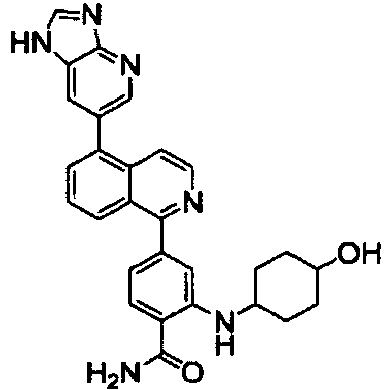
1H-NMR (DMSO-d6 ) : δ 8.41-8.61 (3H, m), 8.10-8.35 (3H, m), 7.98 (1H, b r s), 7.70-7.85 (4H, m), 7.32 (1H, br s), 6.92 (1H, s), 6.75 (1H, d, J=8.2H z), 4.51 (1H, d, J=4.1Hz), 3.30-3.60 (2H, m), 1.75-2.05 (4H, m), 1.20-1.3 5 (4H, m) ; LRMS (ESI) m/z 479 [M+H] +. 13 
1H-NMR (DMSO-d6 ) : δ 9.36 (1H, d, J=2. 4Hz), 9.25 (1H, s), 9.19 (1H, s), 8.76 (1H, d, J=2.4Hz), 8.61(1H, d, J=5.9H z), 8.30-8.35 (1H, m), 8.19 (1H, d, J= 8.8Hz), 8.02 (1H, d, J=7.1Hz), 7.95 (1H, brs), 7.72-7.85 (3H, m) 7.23 (1 H, brs), 6.93 (1H, s), 6.77 (1H, d, J= 7.8Hz), 4.51 (1H, d, J=4.2Hz), 3.30-3.60 (2H, m), 1.75-2.05 (4H, m), 1.20 -1.35 (4H, m) ;LRMS (ESI) m/z 491 [M+ H] +. 14 
1H-NMR (DMSO-d6 ) : δ 11.87 (1H, s), 8. 56 (1H, d, J=6.1Hz), 8.34 (1H, d, J=1. 9Hz), 8.32 (1H, d, J=7.8Hz), 8.12 (1 H, d, J=1.9Hz), 8.07 (1H, d, J=7.8H z), 7.94 (1H, brs), 7.68-7.85 (4H, m), 7.61 (1H, t, J=2.9Hz), 7.23 (1H, b rs), 6.93 (1H, s), 6.76 (1H, d, J=8.0H z), 6.55-6.60 (1H, m), 4.51 (1H, d, J= 4. 4Hz), 3.30-3.60 (2H, m), 1.75-2.0 5 (4H, m), 1.20-1.35 (4H, m) ; LRMS (ES I) m/z 478 [M+H] +. 15 
1H-NMR (DMSO-d6 ) : δ 8.70-8.80 (2H, m), 8.58 (1H, dd, J=5.9, 1.7Hz), 8.29 -8.33 (1H, m), 8.11 (1H, d, J=8.3Hz), 7.85-8.03 (2H, m), 7.70-7.83 (3H, m), 7.59-7.65(2H, m), 7.23 (1H, br s), 6.91 (1H, s), 6.74 (1H, d, J=8.0H z), 4.51 (1H, d, J=3.9Hz), 3.30-3.60 (2H, m), 1.75-2.05 (4H, m), 1.10-1.3 5 (4H, m) ; LRMS (ESI) m/z 439 [M+H] +. -
[Table 4] 16 
1H-NMR (DMSO-d6 ) : δ 8.52 (1H, d, J=5. 8Hz), 8.36 (1H, d, J=3.6Hz), 8.31 (1 H, d, J=7.3Hz), 8.07 (1H, t, J=4. 2H z), 7.93 (1H, brs) 7.65-7. 80 (4H, m), 7.18-7. 3 (3H, m), 6.91 (1H, s), 6.74 (1H, d, J=8.0Hz), 4.51 (1H, d, J= 3.9Hz), 3.48 (3H, s), 3.30-3.60 (2H, m), 1.75-2.05 (4H, m), 1.10-1.35 (4 H, m) ; LRMS (ES) m/z 469 [M+H] +. 17 
1H-NMR (DMSO-d6 ) : δ 8.67 (1H, s), 8.6 1 (1H, s), 8.59 (1H, d, J=6.1Hz), 8.28 -8.35 (1H, m) 8.10 (1H, d, J=8.6Hz), 7.89-8.00 (2H, m), 7.70-7.80 (3H, m), 7.63 (1H, d, J=5.9Hz), 7.22 (1H, b rs), 6.91 (1H, s), 6.74 (1H, d, J=8.1H z), 5.45 (1H, t, J=5.9Hz), 4.68 (1H, d, J=5.8Hz), 4.51 (1H, d, J=4.2Hz), 3.30-3.60 (2H, m), 1.75-2.05 (4H, m), 1.10-1.35 (4H, m) ; LRMS (ESI) m/z 469 [M+H] +. 18 
1H-NMR (DMSO-d6 ) : δ 9.34 (1H, s), 8.6 4 (1H, d, J=5.8Hz), 8.31 (1H, d, J=7.6 Hz), 8.19 (1H, s), 8.10 (1H, d, J=8.8H z), 7.87-7.98 (3H, m), 7.68-7.80 (2 H, m), 7.23 (1H, brs), 6.90 (1H, s), 6. 72 (1H, d, J=7.8Hz), 4.51 (1H, d, J=3. 9Hz), 3.30-3.6 (2H, m), 1.75-2.05 (4H, m), 1.10-1.35 (4H, m) ; LRMS (ES I) m/z 445 [M+H] +. 19 
1H-NMR (DMSO-d6 ) : δ 8.52-8.61 (3H, m), 8.29-8.36 (1H, m), 8.10 (1H, d, J= 8.6Hz), 7.93 (1H, brs), 7.63-7.85 (5 H, m), 7.23 (1H, brs), 6.97 (1H, brs), 6.91 (1H, s), 6,74 (1H, d, J=8.1Hz), 4.51 (1H, d, J=4.2Hz), 3.30-3.60 (4 H, m), 2.85 (1H, t, J=6.6Hz), 1.75-2. 05 (4H, m), 1.32 (9H, s), 1.10-1.35 (4 H, m) ; LRMS (ESI) m/z 582 [M+H] +. 20 
1H-NMR (DMSO-d6 ) : δ 8.50-8.60 (3H, m), 8.31 (1H, d, J=7.3Hz), 8.09 (1H, d, J=7.8Hz), 7.92 (1H, brs), 7.61-7. 8 (5H, m), 7.22 (1H, brs), 6.91 (1H, s), 6.74 (1H, d, J=8.1Hz), 4.51 (1H, d, J=4.2Hz), 3.30-3.60 (2H, m), 2.75 -2.9 (4H, m), 1.75-2.05 (4H, m), 1.1 0-1.35 (4H, m) ;LRMS (ESI) m/z 482 [M +H] +. -
[Table 5] 21 
1H-NMR (DMSO-d6 ) : δ 9.07 (1H, d, J=6. 1Hz), 8.81 (1H, d, J=5.9Hz), 8.68 (1 H, d, J=7.3Hz), 8.20-8.38 (4H, m), 7. 85-8.00 (2H, m), 7.79 (1H, d, J=8.0H z), 7.15 - 7.2 3 (3H, m), 7. 25 (1H, b r s), 6.93 (1H, s), 6.74 (1H, d, J=9.3H z), 4.50 (1H, d, J=4.4Hz), 3.30-3.60 (2H, m), 1.75-2.05 (4H, m), 1.10-1.3 5 (4H, m) ; LRMS (ESI) m/z 506 [M+H] +. 22 
1H-NMR (DMSO-d6 ) : δ 8.66 (1H, d, J=6. 1Hz), 8.30-8.50 (1H, m), 8.19 (1H, s), 7.98-8.15 (5H, m), 7.96 (1H, br s), 7.61-7.70 (2H, m), 7.52-7.61 (3 H, m), 7.23 (1H, brs), 6.91 (1H, s), 6. 73 (1H, d, J=7. 8Hz), 4.51 (1H, d, J=4. 2Hz), 3.30-3.60 (2H, m), 1.75-2.05 (4H, m), 1.10-1.35 (4H, m) ; LRMS (ES I) m/z 521 [M+H]+. 23 
1H-NMR (DMSO-d6 ) : δ 8.74 (1H, d, J = 5. 8Hz), 8.63 (1H, d, J=5.9Hz), 8.22-8. 36 (3H, m), 8.08-8.15 (2H, m), 7.94 (1 H, brs), 7.77-7.85 (2H, m), 7.60-7.6 8 (3H, m), 7.24 (1H, brs), 6.93 (1H, s), 6.75 (1H, d, J=7.8Hz), 4.51 (1H, d, J=4.2Hz), 3.30-3.60 (2H, m), 1.75 -2.05 (4H, m), 1.10-1.35 (4H, m) ; LRM S (ESI) m/z 522 [M+H]+. 24 
1H-NMR (DMSO-d6 ) : δ 8.58 (1H, d, J=5. 8Hz), 8.45 (1H, d, J=2.7Hz), 8.29-8. 35 (2H, m), 8.10 (1H, d, J=8.6Hz), 7.9 5 (1H, brs), 7.55-7.85 (5H, m), 7.24 (1H, brs), 6.90 (1H, s), 6.74 (1H, d, J =9.3Hz), 4.51 (1H, d, J=4.2Hz), 3.92 (3H, s), 3.30-3.60 (2H, m), 1.75-2.0 5 (4H, m), 1.10-1.35 (4H, m) ; LRMS (ES I) m/z 469 [M+H]+. 25 
1H-NMR (DMSO-d6 ) : δ 8.68 (1H, d, J=5. 9Hz), 8.59 (1H, d, J=6.1Hz), 8.45 (1 H, d, J=1.2Hz), 8.33 (1H, d, J=7.8H z), 8.23 (1H, d, J=1.2Hz), 8.20 (1H, d, J=8.5Hz), 8.02 (1H, d, J=6.4Hz), 7.78-8.00 (5H, m), 7.52 (1H, d, J=6.9 Hz), 7.26 (1H, brs), 6.91 (1H, s), 6.7 5 (1H, d, J=7.8Hz), 4.51 (1H, d, J=4. 2 Hz), 3.30-3.60 (2H, m), 1.75-2.05 (4 H, m), 1.10-1.35 (4H, m) LRMS (ESI) m /z 5 0 5 [M + H]+. -
[Table 6] 26 
1H-NMR (DMSO-d6 ) : δ 8.62-8.68 (2H, m), 8.58 (1H, d, J=5.8Hz), 8.32 (1H, d, J=7.6Hz), 7.71-8.00 (6H, m), 7.61 (1H, d, J=6.1Hz), 7.24 (1H, brs), 6.9 1 (1H, s), 6.74 (1H, d, J=8.0Hz), 4.51 (1H, d, J=4.2Hz), 3.65 (2H, s), 3.30-3.60 (6H, m) 2.40-2.50 (4H, m), 1.75 -2.05 (4H, m), 1.10-1.35 (4H, m) ; LRM S (ESI) m/z 538 [M+H]+. 27 
1H-NMR (DMSO-d6 ) : δ 8.83 (1H, d, J=2. 2Hz), 8.59 (1H, d, J=6.1Hz), 8.41 (1 H, d, J=1.7Hz), 8.31 (1H, t, J=7.6H z), 8.26 (1H, s), 8.10 (1H, d, J=8.8H z), 7.61-8.00 (5H, m), 7.23 (1H, br s), 6.93 (1H, s), 6.74 (1H, d, J=8.3H z), 4.51 (1H, d, J=4.4Hz), 3.30-3.90 (2H, m), 1.75-2.05 (4H, m), 1.10-1.3 (4H, m) ; LRMS (ESI) m/z 496 [M+H]+. 28 
1H-NMR (DMSO-d6 ) : δ 9.03 (1H, d, J=2. 4Hz), 8.59 (1H, d, J=6.1Hz), 8.45 (1 H, d, J=1.9Hz), 8.36 (1H, t, J=2.2H z), 8.31 (1H, d, J=7.6Hz), 7.66-8.00 (5H, m), 7.23 (1H, brs), 6.92 (1H, s), 6.74 (1H, d, J=7.8Hz), 5.82 (1H, t, J= 5.9Hz), 4.51 (1H, d, J=4.4Hz), 4.07 (1H, d, J=5.6Hz), 3.30-3.90 (2H, m), 1.75-2.05 (4H, m), 1.10-1.35 (4H, m) ; LRMS (ESI) m/z 512 [M+H]+. 29 
1H-NMR (DMSO-d6 ) : δ 9.14 (1H. s), 8.8 7 (1H, s), 8.75 (1H, brs), 8.60 (1H, d, J=5.8Hz), 8.29-8.39 (2H, m), 8.13 (1 H, d, J=2.2Hz), 7.73-8.00 (5H, m), 7. 62 (1H, d, J=6. 1Hz), 7.23 (1H, brs), 6.91 (1H, s), 6.74 (1H, d, J=8.0Hz), 4.51 (1H, d, J=4.2Hz), 3.30-3.90 (4 H, m) 1.75-2.05 (4H, m), 1.57 (2H, q. J=7.1Hz), 1.10-1.35 (4H, m), 0.92 (3 H, t, J=7.1Hz) ; LRMS (ESI) m/z 524 [M +H]+. 30 
1H-NMR (DMSO-d6 ) : δ 9.14 (1H, d, J=2. 2Hz), 8.87 (1H, d, J=2.2Hz), 8.60 (1 H, d, J=6.1Hz), 8.53 (1H, d, J=7.6H z), 8.36 (1H, t, J=2.2Hz), 8.32 (1H, d, J=6.1Hz), 7.23 (1H, brs), 6.91 (1 H, s), 6.74 (1H, d, J=9.2Hz), 4.51 (1 H, d, J=4.1Hz), 3.30-3.90 (3H, m), 2. 70-2.80 (2H, m), 2.17 (3H, s), 1.75 - 2.05 (10 H, m), 1.10-1.35 (4H, m) ; LRM S (ESI) m/z 579 [M+H]+. -
[Table 7] 31 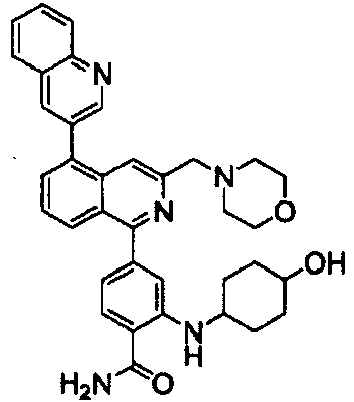
1H-NMR (DMSO-d6 ) : δ 9.08(1H, d, J=2. 2Hz), 8.59 (1H, d, J=2.2Hz), 8.32 (1 H, d, J=7.3Hz), 7.70-8.20 (10H, m), 7.25 (1H, brs), 6.91 (1H, s), 6.76 (1 H, d, J=8.1Hz), 4.52 (1H, d, J=4.2H z), 3.74 (2H, s), 3.30-3.60 (6H, m), 1.75-2.05 (4H, m), 1.10-1.35 (4H, m) ; LRMS (ESI) m/z 588 [M+H] +. 32 
1H-NMR (DMSO-d6 ) : δ 9.13 (1H, s), 8.6 8 (1H, d, J=6.1Hz), 8.48 (1H, d, J=4. 6 Hz), 8.16-8.35 (5H, m), 8.01 (1H, d, J =7.3Hz), 7.9 5 (1H, brs), 7.76-7.83 (2H, m), 7.25 (1H, brs), 6.92 (1H, s), 6. 75 (1H, d, J=9.3Hz), 4.51 (1H, d, J= 4.2Hz), 3.30-3.60 (2H, m), 1.75-2.0 5 (4H, m), 1.10-1.35 (4H, m) ; LRMS (ES I) m/z 505 [M+H]+. 33 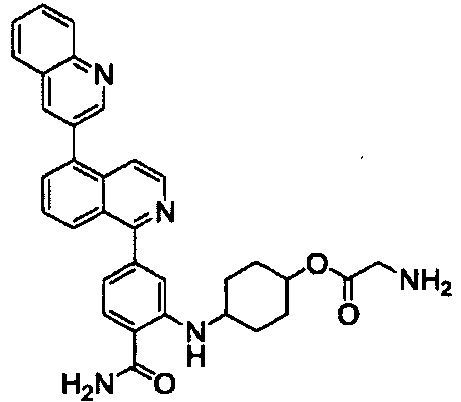
1H-NMR (DMSO-d6 ) : δ 9.07 (1H, d, J=2. 2Hz), 8.55-8.62 (2H, m), 8.38 (1H, d, J=7.8Hz), 7.70-8.40 (10H, m), 7. 27 (1H, brs), 6.97 (1H, s), 6.78 (1H, d, J =8.1Hz), 4.60-4.75 (1H, m), 3.45-3. 60 (1H, m), 3.21 (2H, s), 1.75-2.15 (4 H, m), 1.30-1.65 (6H, m) ; LRMS (ESI) m /z 546 [M+H] +. 34 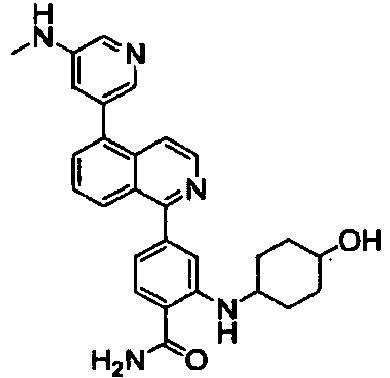
1H-NMR (DMSO-d6 ) : δ 8.57 (1H, d, J=5. 6Hz), 8.31 (1H, d, J=7.3Hz), 7.65-8. 10 (8H, m), 7.23 (1H, brs), 6.98 (1H, s), 6.90 (1H, s), 6.73 (1H, d, J=8.1H z), 6.14 (1H, brs), 4.51 (1H, d, J=3.9 Hz), 3.30-3.90 (2H, m), 2.77 (1H, d, J =4.9Hz), 1.75-2.05 (4H, m), 1.10-1. 35 (4H, m) ; LRMS (ESI) m/z 468 [M+H] + 35 
1H-NMR (DMSO-d6 ) : δ 8.57 (1H, d, J=6. 1Hz), 8.30 (1H, d, J=8.0Hz), 7.65-8. 10 (8H, m), 7.23 (1H, brs), 7.00 (1H, s), 6.90 (1H, s), 6.73 (1H, d, J=7.6H z) 6.11 (1H, brs), 4.51 (1H, d, J=3.9 Hz), 3.30-3.90 (2H, m), 3.00-3.05 (2 H, m), 1.75-2.05 (4H, m), 1.50-1.60 (2H, m), 1.10-1.35 (4H, m), 0.96 (3H, t, J=5.1Hz) ; LRMS (ESI) m/z 496 [M+ H]+. -
[Table 8] 36 
1H-NMR (DMSO-d6 ) : δ 8.57 (1H, d, J=6. 1Hz), 8.31 (1H, d, J=7.6Hz), 7.65-8. 10 (8H, m), 7.22 (1H, brs), 7.00 (1H, s), 6.90 (1H, s), 6.73 (1H, d, J=8.3H z), 6.06 (1H, brs), 4.51 (1H, d, J=3.9 Hz), 3.30-3.90 (2H, m), 3.05-3.15 (2 H, m), 2.50-2.60 (1H, m), 1.75-2.10 (10H, m), 1.10-1.35 (4H, m) ; LRMS (ES I) m/z 521 [M + H]+. 37 
1H-NMR (DMSO-d6 ) : δ 9.07 (1H, d, J=2. 2Hz), 8.67 (1H, t, J=6.1Hz), 8.62-8. 57 (2H, m), 8.19-8.09 (3H, m), 7. 97-7.68 (7H, m), 6.95 (1H, s), 6. 82 (1H, d, J=8.1Hz), 4.53 (1H, d, J=4.1Hz), 4.46 (1H, t, J=5.4Hz), 4.19 (2H, d, J= 5.9Hz), 3.58-3.37 (4H, m), 2.58 (2H, t, J=6. 3Hz), 2.29 (3H, s), 2.05-1.74 (4H, m), 1.32-1.15 (4H, m). 38 
1H-NMR (DMSO-d6 ) : δ 9.07 (1H, d, J=2. 2Hz), 8.70 (1H, t, J=6.1Hz), 8.62-8. 57 (2H, m), 8.20-8.10 (3H, m), 7.98-7.68 (7H, m), 6.95 (1H, s), 6.82 (1H, d, J=7.8Hz), 4.52 (1H, d, J=4.1Hz), 4.08 (2H, d, J=5.9Hz), 3.52-3.8 (2 H, m), 2.23 (6H, s), 2.05-1.77 (4H, m), 1.30-1.19 (4H, m). 39 
1H-NMR (DMSO-d6 ) : δ 11.49 (1H, s), 8. 56 (1H, d, J=6.1 Hz), 8.46 (1H, s), 8. 3 2 (1H, d, J=7.6Hz), 8.08 (1H, d, J=8.6 Hz), 7.70-8.00 (7H, m), 7.24 (1H, br s), 6.93 (1H, s), 6.76 (1H, d, J=8.0H z), 6.67-6.71 (1H, m), 4.52 (1H, d, J= 4.2Hz), 3. 30-3.65 (2H, m), 1.75-2.0 5 (4H, m), 1. 1 0-1. 35 (4H, m) ; LRMS (ES I) m/z 478 [M+H]+. 40 
1H-NMR (DMSO-d6 ) : δ 8.56 (1H, d, J=5. 9Hz), 8.29-8.44 (5H, m), 7.64-8.10 (7H, m), 7.24 (1H, brs), 6.91 (1H, s), 6.75 (1H, d. J=7.8Hz), 4.52 (1H, d, J= 4.1Hz), 3.30-3.65 (2H, m), 2.59 (3H, s), 1.75-2.05 (4H, m), 1.10-1.35 (4 H, m) ; LRMS (ESI) m/z 493 [M+H]+. -
[Table 9] 41 
1H-NMR (DMSO-d6 ) : δ 8.56 (1H, d, J=5. 9Hz) . 8.38 (1H, brs), 8.31 (1H, d, J= 7.6Hz), 7.65-8.10 (7H,m), 7.24 (1H, brs), 6.92 (1H, s), 6.75 (1H, d, J=8.1 Hz), 4.51 (1H, d, J=4.2Hz), 3.30-3.6 5 (2H, m), 2.93 (2H, q, J=7.6Hz), 1.75 -2.05 (4H, m), 1.38 (3H, t, J=7.6Hz), 1.10-1.35 (4H, m) ; LRMS (ESI) m/z 50 7 [M+H]+. 42 
1H-NMR (DMSO-d6 ) : δ 9.07 (1H, d, J=2. 2Hz), 8.58-8.62 (2H, m), 8.07-8.17 (6H, m), 7.69-7.96 (7H, m) 7.51 (1H, brs) ; LRMS (ESI) m/z 376 [M+H]+. 43 
1H-NMR (DMSO-d6 ) : δ 9.36 (1H, s), 9.0 4 (2H, s), 8.61 (1H, d, J=6.1Hz), 8.32 (1H, d, J=7.6Hz), 8.15 (1H, d, J=8.6H z), 7.75-8.00 (4H, m), 7.64 (1H, d, J= 6.1Hz), 7.24 (1H, brs), 6.91 (1H, s), 6.74 (1H, d, J=8.0 Hz), 4.51 (1H, d, J= 4.2Hz), 3.30-3.60 (2H, m), 1.75-2.0 5 (4H, m), 1.10-1.35 (4H, m) ; LRMS (ES I) m/z 440 [M+H]+. 44 
1H-NMR (DMSO-d6 ) : δ 9.09 (1H, d, J=2. 4Hz), 8.62 (1H, d, J=2.4Hz), 8.61 (1 H, d, J=5.8Hz), 7.44 (2H, s), 7.20 (1 H, s), 2.42 (3H, s), 2.01 (3H, s) ; LRMS (ESI) m/z 404 [M+H]+. 45 
1H-NMR (DMSO-d6 ) : δ 10.33 (1H, s), 7. 68-8.80 (12H, m), 7.75-7.82 (2H, m) 7.25 (1H, brs), 6.93 (1H, s), 6.76 (1 H, d, J=7.8Hz), 4.52 (1H, d, J=4.1H z), 3.30-3.60 (2H, m), 1.75-2.05 (4 H, m), 1.20-1.35 (4H, m) ; LRMS (ESI) m /z 517 [M+H]+. -
[Table 10] 46 
1H-NMR (DMSO-d6 ) : δ 8.57 (1H, d, J=5. 4Hz), 8.30 (1H, d, J=7.6Hz), 7.67-8. 11 (8H, m), 7.18-7.35 (2H, m), 6.90 (1 H, s), 6.73 (1H, d, J=8.0Hz), 4.51 (1 H, d, J=4.2Hz), 3.30-3.60 (4H, m), 1. 75-2.05 (4H, m), 1.10-1.35 (7H, m) ; L RMS (ESI) m/z 483 [M+H]+. 47 
1H-NMR (DMSO-d6 ) : δ 8.60 (1H, d, J=5. 8Hz), 8.31 (1H, d, J=7.6Hz), 8.15 (1 H, d, J=8.5Hz), 7.75-8.02 (6H,m), 7. 45 (1H, d, J=9.3Hz), 7.24 (1H, brs), 6.92 (1H, s), 6.75 (1H, d, J=8.1Hz), 4.51 (1H, d, J=4.4Hz), 4.16 (3H, s), 3.30-3.60 (2H, m), 1.75-2.05 (4H, m), 1.10-1.35 (4H, m) ; LRMS (ESI) m/z 470 [M+H]+. 48 
1H-NMR (DMSO-d6 ) : δ 8.66 (1H, d, J=5. 9Hz), 8.32 (1H, d, J=7.3Hz), 8.15 (1 H, d, J=8.3Hz), 8.03 (1H, s), 8.00-7. 91 (3H,m), 7.82-7.72 (4H, m), 7.53 (1 H, d, J=5.9Hz), 7.26 (1H, brs), 6.91 (1H, s), 6.74 (1H, d, J=8.1Hz), 4.52 (1H, d, J=4.1Hz), 3.88 (3H, s), 3.53-3.31 (2H, m), 2.05-1.73 (4H, m), 1.33 -1.15 (4H, m). 49 
1H-NMR (DMSO-d6 ) : δ 9.01 (1H, d, J=1. 7Hz). 8.58 (1H, d, J=5.8 5Hz), 8.54 (1 H, d, J=2.2Hz), 8.32 (1H, d, J=7.8H z), 7.63-8.08 (8H, m), 7.69 (1H, d, J= 5.9Hz) 7.24 (1H, brs), 6.92 (1H, s), 6.75 (1H, d, J=8.1Hz), 4.51 (1H, d, J= 3.9Hz), 3.69 (2H, s), 3.58-3.64 (4H, m), 3.30-3.60 (2H, m), 2.40-2.48 (4 H, m), 1.75-2.05 (4H, m), 1.20-1.35 (4H, m) ; LRMS (ESI) m/z 588 [M+H]+. 50 
1H-NMR (DMSO-d6 ) : δ 9.13 (1H, s), 8.7 0 (1H, d, J=5.9Hz), 8.47 (1H, d, J=3. 7 Hz), 8.35 (1H, s), 8.25 (1H, brs), 8.2 3 (1H, s), 8.08 (1H, brs), 8.01 (1H, d, J=6.8Hz), 7.95 (1H, s), 7.87 (1H, d, J =8.1Hz), 7.67 (1H, t, J=7.8Hz), 7.67 (1H, d, J=8.5Hz), 7.60 (1H, d, J=6.1H z), 7.37-7.50 (3H, m), 2.06 (3H, s) ; L RMS (ESI) m/z 406 [M+H]+. -
[Table 11] 51 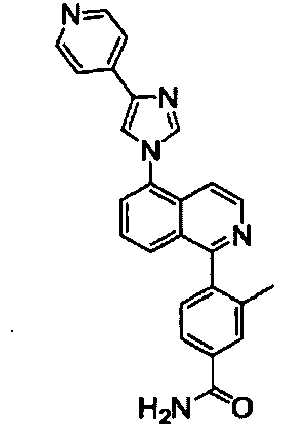
1H-NMR (DMSO-d6 ) : δ 8.70 (1H, d, J=5. 9Hz). 8.58 (2H, d, J=6.1Hz), 8.50 (1 H, d, J=1.0Hz), 8.25 (1H, d, J=1Hz), 8. 08 (1H, brs), 8.02 (1H, d, J=7.1H z), 7.95 (1H, s), 7.83-7.90 (3H, m). 7.76 (1H, t, J=7.9Hz), 7.68 (1H, d, J= 8. 5Hz), 7.58 (1H, d, J=6.1Hz), 7.46 (1H, s), 7.39 (1H, d, J=7.8Hz), 2.05 (3H, s) ; LRMS (ESI) m/z 406 [M+H]+. 52 
1H-NMR (DMSO-d 6 ) : δ 8.66 (1H, d, J=5. 9Hz), 8.32 (1H, d, J=6.4Hz), 8.15 (1 H, d, J=8.6Hz), 8.03 (1H, s), 8.00 (1 H, s), 7.94 (1H, d, J=7.3Hz), 7.75-7. 82 (4H, m), 7.54 (1H, d, J=5.8Hz), 7.2 5 (1H, brs), 6.91 (1H, s), 6.74 (1H, d, J=8.0Hz), 4.51 (1H, d, J=4.4Hz), 3.9 5 (1H, d, J=7.3Hz), 3.30-3.60 (2H, m), 1.75-2.25 (5H, m), 1.10-1.35 (4 H, m), 0.88 (6H, d, J=6.8Hz) ;LRMS (ES I) m/z 549 [M+H]+. 53 
1H-NMR (DMSO-d 6 ) : δ 8.60-8.70 (1N, m), 7.48-8.40 (11H, m), 7.15-7.35 (1 H, m), 6.70-6.98 (2H, m), 4.45-4.60 (2H, m), 3.30-3.60 (2H, m), 1.75-2.2 5 (4H, m), 1.10-1.60 (10H, m) ; LRMS (E SI) m/z 536 [M+H] +. 54 
1H-NMR (DMSO-d6 ) : δ 8.67 (1H, d, J=5. 9Hz), 8.28-8.37 (1H, m), 8.18 (1H, d, J=8.6Hz), 8.09 (1H, s), 7.75-8.00 (5 H, m), 7.43 (1H, d, J=5.8Hz), 7.25 (1 H, brs), 6.89 (1H, s), 6.73 (1H, d, J= 8. 3Hz), 4.20 (1H, brs), 3.30-3.60 (2 H, m), 1.75-2.05 (4H, m), 1.10-1.35 (4H, m) ; LRMS (ESI) m/z 507 [M+H] +. 55 
1H-NMR (DMSO-d 6 ) δ 8.57 (1H, d, J=5. 8Hz), 8.28 (1H, d, J=7.6Hz), 8.08-7. 98 (2H, m), 7.91 (1H, brs), 7.88-7.70 (3H, m), 7.63 (3H, t, J=7.7Hz), 7.21 (1H, brs), 6.88 (1H, s), 6.71 (1H, d, J =8. 1Hz), 4.50 (1H, d, J=4.1Hz), 3.54 -3.22 (2H, m), 2.50 (3H, s), 2.08-1.7 0 (4H, m), 1.35-1.10 (4H, m). -
[Table 12] 56 
1H-NMR(DMSO-d6 ) : δ 8.91 (1H, d, J=4. 9Hz), 8.78 (1H, d, J=1.0Hz), 8.58 (1 H, d, J=5.9Hz), 8.31 (1H, d, J=7.6H z), 8.10-8.23 (3H, m), 7.94 (1H, br s), 7.86 (1H, d, J=6.8Hz), 7.71-7.79 (2H, m), 7.62 (1H, d, J=6.1Hz), 7.24 (1H, brs), 6.90 (1H, s), 6.73 (1H, d, J =8.1Hz), 4.51 (1H, d, J=4.2Hz), 3.30 -3.60 (2H, m), 3.46 (3H, d, J=4.6Hz), 1.75-2.05 (4H, m), 1.10-1.35 (4H, m) ; LRMS (ESI) m/z 496 [M+H]+. 57 
1H-NMR (DMS O-d6 ) : δ 10.77(1H, s), 8. 89 (1H, s), 8.60 (1H, d, J=6.1Hz), 8.2 5-8.40 (3H, m), 8.15 (1H, d, J=8.5H z), 7.75-8.05 (6H, m), 7.66 (1H, d, J= 5. 9Hz), 7.39 (2H, t, J=7.8Hz), 7.25 (1H, brs), 7.14 (1H, t, J=7.3Hz), 6.9 1 (1H, s), 6.74 (1H, d, J=8.1Hz), 4.51 (1H, d, J=4.2Hz), 3.30-3.60 (2H, m), 1.75-2.05 (4H, m), 1.10-1.35 (4H, m) ; LRMS (ESI) m/z 558 [M+H]+. 58 
1H-NMR (DMSO-d 6 ) : δ 8.65 (1H, d, J=5. 9Hz), 8.15-8.25 (2H, m), 7.74-8.05 (8H, m), 7.52 (1H, d, J=5.9Hz), 7.29 (1H, brs), 6.86 (1H, s), 6.79 (1H, d, J =7.6Hz), 3.87 (3H, s), 2.81 (3H, d, J= 4.9Hz) ; LRMS (ESI) m/z 424 [M+H] +. 59 
1H-NMR (DMSO-d 6 ) : δ 8.65 (1H, d, J=6. 1Hz), 8.42 (1H, t, J=5.2Hz), 8.18 (1 H, d, J=8.8Hz), 8.04-7.91 (4H, m), 7. 82-7.73 (4H, m), 7.52 (1H, d, J=5.9H z), 7.27 (1H, brs), 6.94 (1H, d, J=1.2 Hz), 6.80 (1H, d. J=8.1Hz), 4.08-3.9 9 (1H, m), 3.88 (3H, s), 3.83-3.75 (1 H, m), 3.70-3.62 (1H, m), 3.31-3.23 (1H, m), 3.18-3.08 (1H, m), 2.01-1.7 5 (3H, m), 1.65-1.52 (1H, m). 60 
1H-NMR (DMSO-d 6 ) : δ 8.66 (1H, d, J=5. 9Hz), 8.54-8.35 (3H, m), 8.18 (1H, d, J=8.5Hz), 8.05-7.91 (4H, m), 7.84-7.66 (5H, m), 7.53 (1H, d, J=5.9Hz), 7.36-7.24 (2H, m), 6.98 (1H, s), 6.81 (1H, d, J=8.1Hz), 3.88 (3H, s), 3.43 (2H, q, J=6.6Hz), 2.93 (2H, t, J=6.6H z) . -
[Table 13] 61 
1H-NMR (DMSO-d6 ) : δ 8.66 (1H, d, J=5. 9Hz), 8.24 (1H, d, J=7.3Hz), 8.17 (1 H, d, J=8.3Hz), 7.90-8.05 (4H, m), 7. 73-7.80 (5H, m), 7.52 (1H, d, J=5.9H z), 7.25 (1H, brs), 6.89 (1H, s), 6.76 (1H, d, J=7.6Hz), 3.88 (3H, s), 3.60-3.70 (1H, m), 1.18 (6H, d, J=6.1Hz) ; L RMS (ESI) m/z 452 [M+H] +. 62 
1H-NMR (CDCl3) 8.66 (1H, d, J=5.9H z), 8.27 (1H, d, J=8.5Hz), 8.12 (1H, b rs), 7.55-7.82 (6H, m), 7.34 (1H, d, J =1.2Hz), 7.01 (1H, d, J=1.5Hz), 6.89 (1H, dd, J=8.1, 1.5Hz), 3.98 (3H, s), 3.65 (2H, t, J=5.6Hz), 3.39-3.45 (5 H, m) ; LRMS (ESI) m/z 468 [M+H] +. 63 
1H-NMR (DMSO-d 6 ) : δ 8.66 (1H, d, J=6. 1Hz), 8.42 (1H, d, J=7.1Hz), 8.19 (1 H, d, J=8.5Hz), 7.90-8.05 (4H, m), 7. 72-7.81 (4H, m), 7.52 (1H, d, J=5.9H z), 7.25 (1H, brs), 6.83 (1H, s), 6.77 (1H, d, J=7.8Hz), 3.88 (3H, s), 3.00-3.20 (1H, m), 1.35-2.00 (12H, m) ;LRM S (ESI) m/z 505 [M+H] +. 64 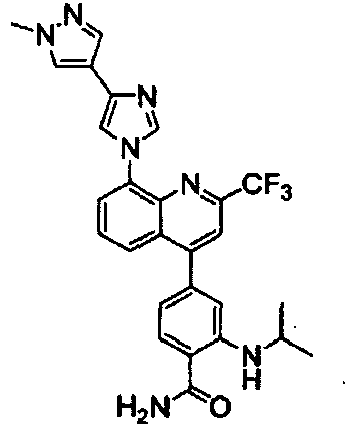
1H-NMR (DMSO-d 6 ) : δ 8.26-8.33 (2H, m), 7.87-8.13 (9H, m), 7.81 (1H, d, J= 8.3Hz), 7,73 (1H, s), 7.29 (1H, brs), 6. 86 (1H, s), 6.71 (1H, dd, J=7.9,1.5 9Hz), 3.88 (3H, s), 3,65-3.75 (1H, m), 1.17 (6H, d, J=6.1Hz) ; LRMS (ESI) m/z 520 [M+H] +. 65 
1H-NMR (DMSO-d 6 ) : δ 8.41 (1H, t, J=4. 6Hz), 8.28 (1H, s), 8.11 (1H, d, J=7.6 Hz), 7.80-8.05 (8H, m), 7.73 (1H, s), 7. 30 (1H, brs), 6.84 (1H, s), 6.74 (1 H, d, J=8.1Hz), 3.88 (3H, s), 3.02 (2 H, t, J=6.0Hz), 1.00-1.20 (1H, m), 0. 47-0.55 (2H, m), 0.20-26 (2H, m) ;LRM S (ESI) m/z 531 [M+H] +. -
[Table 14] 66 
1H-NMR (DMSO-d 6 ) : δ 8.16-8.26 (1H, m), 8.10 (1H, d, J=8.5Hz), 7.64-8.03 (8H, m), 7.33 (1H, s), 7.26 (1H, brs), 6.84 (1H, s), 6.76 (1H, d, J=8.1Hz), 3.88 (3H, s), 3.05-3.25 (2H, m), 2.62 (3H, s), 1.20 (3H, t, J=7.1Hz) ; LRMS (ESI) m/z 452 [M+H] +. 67 
1H-NMR (DMSO-d 6 ) : δ 8.25 (1H, d. J=7. 1Hz), 8.10 (1H, d, J=8.5Hz), 7.64-8. 03 (8H, m), 7.33 (1H, s), 7.24 (1H, br s), 6.85 (1H, s), 6.74 (1H, d. J=8.1H z), 3.88 (3H, s), 3.55-3.70 (1H, m), 2.62 (3H, s), 1.17 (3H, t, J=6.1Hz) ;L RMS (ESI) m/z 466 [M+H] +. 68 
1H-NMR (DMSO-d 6 ) : δ 8.32-8.40 (1H, m), 8.09 (1H, d, J=8.8Hz), 7.64-8.05 (8H, m), 7.33 (1H, s), 7.26 (1H, brs), 6.84 (1H, s), 6.75 (1H, d, J=7.8Hz), 3.88 (3H, s), 2.98-3.05 (2H, m), 2.62 (3H, s), 1.00-1.25 (1H, m), 0.48-0.5 5 (2H, m), 0.22-0.30 (2H, m) ; LRMS (ES I) m/z 478 [M+H] +. 69 
1H-NMR (DMSO-d 6 ) : δ 8.29 (1H, s), 8.1 1 (1H, d, J=7.3Hz), 8.04 (1H, d, J=8.5 Hz), 7.80-8.00 (5H, m), 7.77 (1H, d, J =8.1Hz), 7.72 (1H, s), 7.25 (1H, br s), 6.93 (1H, s), 6.85 (2H, s), 6.72 (1 H, d, J=7.6Hz), 3.88 (3H, s) ; LRMS (ES I) m/z 478 [M+H] +. 70 
1H-NMR (DMSO-d 6 ) : δ 8.25-8.35 (1H, m), 8.05-8.20 (2H, m), 7.63-8.00 (9 H, m), 7.50-7.60 (1H, m), 3.88 (3H, s) ; LRMS (ESI) m/z 481 [M+H] +. -
[Table 15] 71 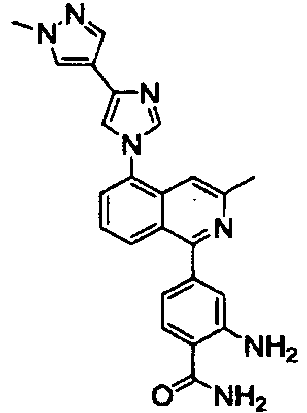
1H-NMR (DMSO-d 6 ) : δ 8.11 (1H, d, J=8. 8Hz), 8.00 (1H, d, J=1.5Hz), 7.97 (1 H, s), 7.86 (2H, d, J=6.8Hz), 7.65-7. 75 (4H, m), 7.32 (1H, s), 7.19 (1H, br s), 6.98 (1H, d, J=1.7Hz), 6.78 (2H, b rs), 6.73 (1H, dd, J=8.2, 1.6Hz), 3.8 8 (3H, s), 2.62 (3H, s) ; LRMS (ESI) m/z 424 [M+H] +. 72 
1H-NMR (DMSO-d 6) : δ 9.16 (1H, d, J=4. 4Hz), 8.78 (1H, d, J=5.6Hz), 8.20 (1 H, s), 8.08 (1H, brs), 8.01 (1H, s), 7. 88-7.98 (3H, m), 7.83 (1H, d, J=5. H z), 7.76 (1H, s), 7.73 (1H, d, J=8.3H z), 7.14-7. 30 (3H, m), 3.88 (3H, s), 2.62 (3H, s) ; LRMS (ESI) m/z 439 [M+H] +. 73 
1H-NMR (DMSO-d 6 ) : δ 8.30 (1H, s), 8.0 8 (1H, d, J=7.6Hz), 7.96 (1H, s), 7.80 -7.98 (4H, m), 7.73 (1H, s), 7.68 (1H, d, J=8.5Hz), 7.35 (1H, s), 7.30 (1H, b rs), 7.20 (1H, d, J=8.1Hz), 7.13 (1H, d, J=8.1Hz), 5.12 (2H, brs), 3.88 (3 H, s) ; LRMS (ESI) m/z 478 [M+H] +. 74 
1H-NMR (DMSO-d 6 ) : δ 7.98 (1H, s), 7.8 3-7.90 (4H, m), 7.75 (1H, s), 7.72 (1 H, s), 7.64 (1H, d, J=7.9Hz), 7.38 (1 H, s), 7.32 (1H, s), 7.28 (1H, brs), 7. 14-7.22 (2H, m), 5.19 (2H, brs), 3.88 (3H, s), 2.63 (3H, s) ; LRMS (ESI) m/z 424 [M+H] +. 75 
1H-NMR (DMSO-d 6 ) : δ 8.25-8.40 (2H, m), 7.80-8.10 (5H, m), 7.74 (1H, br s), 7.15-7.45 (4H, m), 5.53 (2H, br s) ; LRMS (ESI) m/z 479 [M+H] +. -
[Table 16] 76 
1H-NMR (DMSO-d6 ) : δ 9.11 (1H, d, J=2. 0Hz) , 8.58 (1H, s), 8.47 (1H, dd, J=4. 88, 1.5Hz), 8.41 (2H, s), 8.15-8.23 (2H, m), 8.07 (1H, d, J=8.8Hz), 7.90-8.02 (3H, m), 7.82 (1H, d, J=8.3Hz), 7.45 (1H, dd, J=7.9, 5.0Hz), 7.32 (1 H, brs), 6.99 (1H, s), 6.74 (1H, d, J= 8.1Hz), 1.35 (9H, s) ; LRMS (ESI) m/z 531 [M+H] +. 77 
1H-NMR (DMSO-d 6 ) : δ 9.11 (1H, s), 8.5 1-8.44 (1H, m), 8.42 (1H, s), 8.41 (1 H, s), 8.32-8.1 6 (3H, m), 8.13-7.80 (5H, m), 7.50-7.42 (1H, m), 7.33 (1H, brs), 6.86 (1H, s), 6.75 (1H, d, J=7.8 Hz), 3.23-3.14 (2H, m), 1.21 (3H, t, J =7.1Hz) 78 
1H-NMR (DMSO-d6 ) : δ 9.11 (1H, s), 8.4 7 (1H, d, J=4.6Hz), 8.42 (2H, s), 8.26 -8.16 (2H, m), 8.09 (1H, d, J=7.8Hz), 8.03-7.90 (3H, m), 7.78 (1H, d, J=8.1 Hz), 7.46 (1H, dd, J=7.4, 4.8Hz), 7.2 7 (1H, brs), 6.94 (1H, s), 6.86 (2H, br s), 6.74 (1H, d, J=8.5Hz) 79 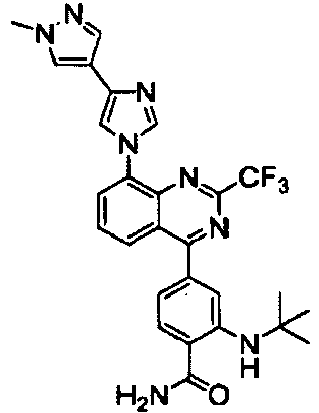
1H-NMR (DMSO-d6 ) : δ 8.51 (1H, s), 8.3 5 (1H, d, J=7.8Hz), 8.32 (1H, s), 8.24 (1H, d, J=8.5Hz), 8.00-8.07 (2H, m), 7.97 (1H, s), 7.93 (1H, s), 7.83 (1H, d, J=7.8Hz), 7.73 (1H, s), 7.37 (1H, b rs), 7.25 (1H, s), 6.93 (1H, d, J=7.8H z), 3.88 (3H, s), 1.36 (9H, s) ; LRMS (E SI) m/z 535 [M+H] +. 80 
1H-NMR (DMSO-d6 ) : δ 8.36 (1H, d, J=7. 6Hz), 8.33 (1H, s), 8.29-8.20 (2H, m), 8.09-8.00 (2H, m), 7.98 (1H, s), 7.93 (1H, s), 7.87 (1H, d, J=8.1Hz), 7.74 (1H, s), 7.40 (1H, brs), 7.03 (1 H, s), 6.94 (1H, d, J=7.6Hz), 3.89 (3 H, s), 3.23-3.14 (2H, m), 1.22 (3H, t, J=7.1Hz) -
[Table 17] 81 
1H-NMR (DMSO-d6 ) : δ 8.28 (1H, d, J=1. 5Hz), 8.14 (1H, dd, J=7.1, 1.7Hz), 8. 07 (1H, s), 8.02 (1H, brs), 7.98-7.87 (4H, m), 7.83 (1H, d, J=1.7Hz), 7.75 (1H, s), 7.73-7.63 (3H, m), 3.87 (3H, s) 82 
1H-NMR (DMSO-d6 ) : δ 8.06-7.95 (4H, m), 7.89 (1H, d, J=7.3Hz), 7.78-7.62 (7H, m), 7.38 (1H, s), 3.87 (3H, s), 2. 63 (3H, s) 83 
1H-NMR (DMSO-d6) : δ 8.90 (1H, s), 8.2 5-8.35 (4H, m), 8.21 (1H, s), 8.15 (1 H, t, J=4.4Hz), 7.88-7.98 (4H, m), 7.82 (1H, brs), 7.3 (1H, s), 3.88 (3H, s) ; LRMS (ESI) m/z 464 [M+H]+. 84 
1H-NMR (DMSO-d6 ) : δ 8.31 (1H, s), 8.1 3-8.07 (2H, m), 8.02 (1H, s), 7.99-7. 94 (2H, m), 7.92-7.82 (3H, m), 7.72 (1 H, s), 7.53-7.45 (2H, m), 7.42 (1H, d, J=7.8Hz), 3.88 (3H, s), 2.06 (3H, s) 85 
1H-NMR (DMSO-d6 ) : δ 8.40-8.35 (2H, m), 8.14 (1H, brs), 8.03-7.91 (5H, m), 7.81-7.72 (2H, m), 7.60-7.50 (2 H, m), 3.89 (3H, s), 2.18 (3H, s) -
[Table 18] 86 
1H-NMR (DMSO-d6 ) : δ 8.58 (1H, s), 8.2 8 (1H, d, J=1.5 Hz), 8.11 (1H, d, J=6.1 Hz), 7.87-8.05 (6H, m), 7.81 (1H, d, J =8.1 Hz), 7.72 (1H, s), 7.31 (1H, br s), 6.98 (1H, d, J=1.5 Hz), 6.73 (1H, d d, J=7.8, 1.5 Hz), 3.88 (3H, s), 1.34 (9H, s) ; LRMS (ESI) m/z 534 [M+H]+. 87 
1H-NMR (DMSO-d6 ) : δ 8.30 (1H, s), 8.0 7 (1H, d, J=7.3Hz), 8.00 (1H, brs), 7.96 (1H, s), 7.91 (1H, s), 7.89 (1H, s), 7.82 (1H, t, J=8.2Hz), 7.73 (1H, s), 7.63 (1H, d, J=8.8 Hz), 7.36 (1H, b r s), 7.22-7.30 (2H, m), 7.14 (1H, d, J= 7.8 Hz), 4.94 (1H, brs), 3.88 (3H, s), 2.90-3.10 (2H, m), 1.40-1.50 (2H, m), 0.77 (3H, t, J=7.3Hz) ; LRMS (ESI) m/z 520 [M+H]+. 88 
1H-NMR (DMSO-d6) : δ 9.11 (1H, s), 8.9 0 (1H, s), 8.40-8.50 (3H, m), 8.19-8.35 (7H, m), 7.93-8.02 (2H, m), 7.82 (1 H, brs), 7.44-7.49 (1H, m) ; LRMS (ES I) m/z 461 [M+H]+. 89 
1H-NMR (DMSO-d6 ) : δ 8. 24-8.30 (2H, m), 8.11 (1H, d, J=7.3Hz), 7.95-8.06 (4H, m), 7.86-7.93 (2H, m), 7.82 (1H, d, J=8.1 Hz), 7.74 (1H, s) 7.32 (1H, br s), 6.84 (1H, s) 6.74 (1H, dd, J=7.9, 1.6Hz), 4.17 (2H, q, J=7.2Hz), 3.10-3.25 (2H, m), 1. 41 (3H, t, J=7.2Hz), 1.20 (3H, t, J=7.1Hz) ; LRMS (ESI) m/z 520 [M+H]+. 90 
1H-NMR (DMSO-d6 ) : δ 8.58 (1H, s), 8.2 8 (1H, s), 8.10 (1H, d, J=7.3Hz), 7.70 -8.15 (7H, m), 7.31 (1H, brs), 6.98 (1 H, s), 6.73 (1H, d, J=8.1Hz), 4.17 (2 H, q, J=7.2Hz), 1.40 (3H, t, J=7.2H z), 1.34 (9H, s) ; LRMS (ESI) m/z 548 [M+H]+. -
[Table 19] 91 
1H-NMR (DMSO-d6 ) : δ 8.47 (1H, s), 8.3 3 (1H, s), 8.26 (1H, t, J=5.2 Hz), 7.80 -8.16 (9H, m), 7.31 (1H, brs), 6.85 (1 H, s) 6.74 (1H, d, J=9.0Hz), 3.10-3.2 5 (2H, m), 1.20 (3H, t, J=7.1Hz) ; LRMS (ESI) m/z 520 [M+H]+. 92 
1H-NMR (DMSO-d6 ) : δ 8.58 (1H, s), 8.4 7 (1H, s), 8.33 (1H, d, J=1.2Hz), 7.79 -8.15 (9H, m), 7.31 (1H, brs), 6.99 (1 H, d, J=1.2Hz), 6.74 (1H, dd, J=8.1, 1.5Hz), 1.35 (9H, s) ; LRMS (ESI) m/z 570 [M+H]+. 93 
1H-NMR (DMSO-d6 ) : δ 8.49 (1H, s), 8.1 2 (1H, d, J=8.5Hz), 8.01 (1H, s), 7.97 (1H, s), 7.96 (1H, brs), 7.85 (1H, d, J =7.3Hz), 7.75 (1H, d, J=8.1Hz), 7.74 (2H, s), 7.67 (1H, t, J=7.8 Hz), 7.33 (1H, s), 7.26 (1H, brs), 7.06 (1H, s), 6. 77 (1H, d, J=8.1 Hz), 3.87 (3H, s), 2. 62 (3H, s), 1.33 (9H, s) ; LRMS (ESI) m/z 480 [M+H]+. 94 
1H-NMR (DMSO-d6 ) : δ 8.47 (1H, s), 8.3 6 (1H, s), 7.85-8.15 (9H, m), 7.53 (1 H, d, J=8.3Hz), 7.49 (1H, brs), 7.43 (1H, d, J=7.8Hz), 2.06 (3H, s) ; LRMS (ESI) m/z 513 [M+H]+. 95 
1H-NMR (DMSO-d6 ) : δ 8.07 (1H, brs), 8.03 (1H, d, J=1.2Hz), 7.97 (1H, s), 7.94 (1H, s), 7.87 (1H, s), 7.85 (1H, s), 7.77 (1H, d, J=1.2Hz), 7.74 (1H, s), 7.56-7.66 (2H, m), 7.45 (1H, br s), 7.36-7.40 (2H, m), 3.88 (3H, s), 2. 63 (3H, s), 2.05 (3H, s) ; LRMS (ESI) m/z 423 [M+H]+. -
[Table 20] 96 
1H-NMR (DMSO-d6 ) : δ 8.66 (1H, d, J=5. 9Hz), 8.49 (1H, s), 8.19 (1H, d, J=8.3 Hz), 7.90-8.05 (4H, m), 7.71-7.81 (4 H, m), 7.52 (1H, d, J=5.9Hz), 7.26 (1 H, brs), 7.09 (1H, s), 3.87 (3H, s), 1. 35 (9H, s) ; LRMS (ESI) m/z 466 [M+H]+ 97 
1H-NMR (DMSO-d6 ) : δ 8.53 (1H, s), 8.2 4 (1H, d, J=1.2 Hz), 7.85-8.00 (4H, m), 7.82 (1H, d, J=1.2Hz), 7.77 (1H, d, J=8.1Hz), 7.72 (1H, s), 7.63 (1H, t, J=7.9Hz), 7.49 (1H, s), 7.26 (1H, b rs), 6. 91 (1H, d, J=1.2Hz), 6.65 (1H, d, J=8.1Hz), 3.87 (3H, s), 2.70 (3H, s), 1.34 (9H, s) ; LRMS (ESI) m/z 480 [M+H]+. 98 
1H-NMR (DMSO-d6 ) : δ 8.36 (1H, brs), 8.10 (1H, d, J=8.8Hz), 7.63-8.02 (8 H, m), 7.33 (1H, s), 7.24 (1H, brs), 6. 89 (1H, s), 6.77 (1H, d, J=8.1Hz), 3. 8 7 (3H, s), 3.48-3.58 (2H, m), 2.62 (3 H, s) ; LRMS (ESI) m/z 482 [M+H]+. 99 
1H-NMR (DMSO-d6 ) : δ 8.97 (1H, d, J=2.0 Hz), 8.58 (1H, s), 8.39 (1H, d, J=1.2 Hz), 8.34 (1H, d, J=1.2Hz), 8.17 (1H, d, J=7.3Hz), 7. 90-8.20 (7H, m), 7.81 (1H, d, J=8.1Hz), 7.31 (1H, d, J=8.1H z), 7.31 (1H, brs), 6.99 (1H, d, J=1. 5 Hz), 6.74 (1H, dd, J=7.9, 1.6Hz), 2.0 6 (3H, s), 1.35 (9H, s) ; LRMS (ESI) m/z 545 [M+H]+. 100 
1H-NMR (DMSO-d6 ) : δ 8.97 (1H, s), 8.4 2 (1H, s), 8.36 (1H, s), 7.85-8.23 (7 H, m), 7.54 (1H, d, J=8.5Hz), 7.49 (1 H, brs) 7.43 (1H, d, J=7.8Hz), 7.31 (1H, d, J=8.1Hz), 2.06 (3H, s) ; LRMS (ESI) m/z 488 [M+H]+. -
[Table 21] 101 
1H-NMR (DMSO-d6 ) : δ 8.24 (1H, s), 7. 6 0 - 7.96 (8H, m), 7.46 (1H, s), 7.20 (1 H, brs), 6.85 (1H, s), 6.80 (2H, brs), 6. 63 (1H, d, J=8.1 Hz), 3. 87 (3H, s), 2. 69 (3H, s) ; LRMS (ESI) m/z 424 [M+ H]+. 102 
1H-NMR (DMSO-d6 ) δ 8.27 (1H, d, J=1. 2 Hz), 8.06 (1H, brs), 7. 95 (2H, s), 7. 83 - 7.89 (3H, m), 7.73 (1H, s), 7.58 (1 H, t, J=7.9 Hz), 7. 44 (2H, s), 7. 34 (1 H, d, J=7.6 Hz), 3.87 (3H, s), 2.70 (3 H, s), 2.05 (3H, s) ; LRMS (ESI) m/z 42 3 [M+H]+. 103 
1H-NMR (DMSO-d6 ) : δ 8.53 (1H, s), 8.3 0 (1H, s), 7.59-8.00 (5H, m), 7.77 (1 H, d, J=8.1Hz), 7.72 (1H, s), 7.64 (1 H, t, J=7.9Hz), 7.49 (1H, s), 7.26 (1 H, brs), 6.92 (1H, s), 6.66 (1H, d, J= 7.8Hz), 3.87 (3H, s), 3.01 (2H, q, J= 7.5Hz), 1.30-1.40 (12H, m) ; LRMS (ES I) m/z 494 [M+H]+. 104 
1H-NMR (DMSO-d6 ) : δ 8.30 (1H, d, J=1.0 Hz), 7.94 (1H, s), 7.84-7.93 (4H, m) 7.70-7.75 (2H, m), 7.64 (1H, t, J= 7.9 Hz), 7.46 (1H, s), 7.20 (1H, brs), 6.85 (1H, d, J=1.2 Hz), 6.80 (2H, b r s), 6.64 (1H, dd, J=8.2, 1.6Hz), 3.87 (3H, s), 2.99 (2H, q, J=7.5 Hz), 1.33 (1H, t, J=7.4 Hz) ; LRMS (ESI) m/z 438 [M+H]+. 105 
1H-NMR (DMSO-d6 ) : δ 8.53 (1H, s), 8.2 3 (1H, s), 7.70-7.79 (7H, m), 7.53-7. 62 (2H, m), 7.26 (1H, brs), 6.91 (1H, s), 6.66 (1H, d, J=7.6Hz), 3.88 (3H, s), 2.30-2.45 (1H, m), 1.34 (9H, s) ; L RMS (ESI) m/z 506 [M+H]+. -
[Table 22] 106 
1H-NMR (DMSO-d6 ) : δ 8.20 (1H, s), 7.94 (1H, s), 7.79-7.88 (4H, m), 7.69-7. 75 (2H, m), 7.58 (1H, t, J=7.9Hz), 7.5 2 (1H, s), 7.20 (1H, brs), 6.85 (1H, s), 6.79 (2H, brs), 6.64 (1H, d, J=7.8 Hz), 3.87 (3H, s), 2.35-2.45 (1H, m), 1.02-1.12 (4H, m) ; LRMS (ESI) m/z 45 0 [M+H]+. 107 
1H-NMR (DMSO-d6 ) : δ 8.58 (1H, s), 8.3 6 (1H, s), 8.27 (1H, s), 8.17 (1H, d, J= 7.1Hz), 7.60-8.19 (6H, m), 7.81 (1H, d, J=8.1Hz), 7.42 (2H, t, J=7.6 Hz), 7.31 (1H, brs), 7.26 (1H, t, J=7.3H z), 6.99 (1H, s), 6.74 (1H, d, J=8.1H z), 1.35 (9H, s) ; LRMS (ESI) m/z 474 [M+H]+. 108 
1H-NMR (DMSO-d6 ) : δ 8.36 (1H, s), 8.2 8 (1H, s), 8.18 (1H, d, J=7.3Hz), 8.06 (1H, d, J=8.8Hz), 7.85-7.99 (5H, m), 7.77 (1H, d, J=8.1Hz), 7.42 (2H, t, J= 7.6 Hz), 7.26 (1H, t, J=7.3Hz), 6.93 (1H, s), 6.86 (2H, brs), 6.72 (1H, d, J =8.1 Hz) ; LRMS (ESI) m/z 474 [M+H]+. 109 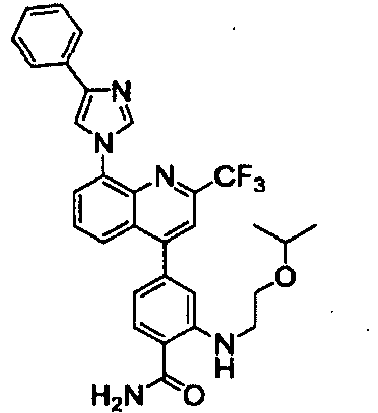
1H-NMR (DMSO-d6 ) δ 8.48 (1H, s), 8.3 6 (1H, s), 8.27 (1H, s), 8.18 (1H, d, J= 7.6Hz), 7.79-8.10 (7H, m), 7.22-7.4 6 (4H, m), 6.90 (1H, s), 6.75 (1H, d, J= 7.8 Hz), 3.50-3.68 (3H, m), 3.26-3.4 8 (5H, m), 1.10 (1H, d, J=6.1Hz) ; LRMS (ESI) m/z 560 [M+H]+. 110 
1H-NMR (DMSO-d6 ) : δ 9.28 (1H, d, J=2. 2 Hz), 8.67 (1H, d, J=2.0Hz), 8.21 (1 H, d, J=6.8Hz), 8.06-8.15 (3H, m), 7. 88-7.99 (3H, m), 7.84 (1H, t, J=7.2H z), 7.78 (1H, d, J=8.1Hz), 7.69 (1H, t, J=7.6Hz), 7.25 (1H, brs), 6.95 (1 H, d, J=1.5Hz), 6.85 (2H, brs), 6.74 (1H, dd, J=8.2, 1.9Hz) ; LRMS (ESI) m/ z 459 [M+H]+. -
[Table 23] 111 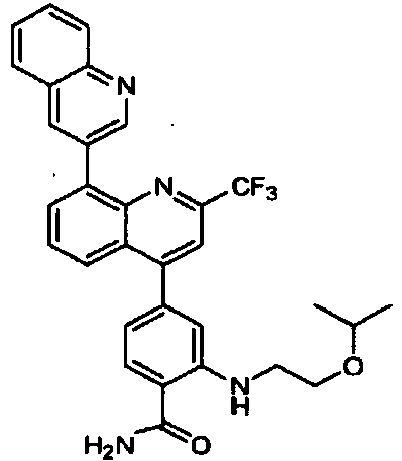
1H-NMR (DMSO-d6 ) : δ 9.27 (1H, s), 8. 6 7 (1H, s), 8.48 (1H, brs), 8.21 (1H, d, J=6.3Hz), 7.65-8.16 (9H, m), 7.31 (1 H, brs), 6.91 (1H, s), 6.77 (1H, d, J= 7.3 Hz), 3.50-3.60 (3H, m), 3.24-3.4 2 (5H, m), 1.02-1.04 (6H, d, J=6.6H z) ; LRMS (ESI) m/z 545 [M+H]+. 112 
1H-NMR (DMSO-d6 ) : δ 8.54 (1H, s), 8.3 4 (1H, s), 7.85-8.00 (5H, m), 7.77 (1 H, d, J=8.3Hz), 7.72 (1H, s), 7.65 (1 H, t, J=7.9Hz), 7.52 (1H, s), 7.27 (1 H, brs), 6.92 (1H, s), 6.67 (1H, d, J= 7.3 Hz), 3.87 (3H, s), 1.25-1.43 (15 H, m) ; LRMS (ESI) m/z 508 [M+H]+. 113 
1H-NMR (DMSO-d6 ) : δ 8.34 (1H, s), 7.8 3-7.96 (5H, m), 7.70-7.75 (2H, m), 7. 64 (1H, t, J=8.1Hz), 7.50 (1H, s), 7.2 1 (1H, brs), 6.86 (1H, s), 6.80 (2H, br s), 6.64 (1H, d, J=9.3Hz), 3.87 (3H, s), 3.20-3.35 (1H, m), 1.33 (6H, d, J= 6.8 Hz) ; LRMS (ESI) m/z 452 [M+H] +. 114 
1H-NMR (DMSO-d6 ) : δ 9.31 (1H, d, J=2. 2Hz), 8.73 (1H, d, J=2.0Hz), 8.48 (1 H, d, J=7.1Hz), 8.34 (1H, d, J=7.6H z), 8.29 (1H, d, J=8.5 Hz), 8.16-7.98 (4H, m), 7.89-7.82 (2H, m), 7.71 (1H, t, J=7.6Hz), 7.36 (1H, brs), 7.10 (1 H, s), 6.90 (1H, d, J=8.1Hz), 4.52 (1 H, d, J=4.4Hz), 3.52-3.44 (1H, m), 3. 39-3.32 (1H, m), 2.07-1.95 (2H, m), 1.89-1.71 (2H, m), 1.32-1.20 (4H, m) ; L RMS (ESI) m/z 558 [M+H]+. 115 
1H-NMR (DMSO-d6 ) : δ 9.30 (1H, d, J=1. 7Hz), 8.67 (1H, s), 8.29 (1H, d, J=7.6 Hz), 8.21 (1H, d, J=7.1Hz), 8.14-8.0 4 (3H, m), 7.99 (1H, brs), 7.85-7.67 (4H, m), 7.30 (1H, brs), 7.02 (1H, s), 6. 83 (1H, d, J=8.1 Hz), 4.52 (1H, d, J= 4.1Hz), 3.52-3.44 (1H, m), 3.39-3.3 2 (1H, m), 2.36-2.28 (1H, m), 2.07-1. 95 (2H, m), 1.89-1.71 (2H, m), 1.32-1.20 (4H, m), 1.13-1.04 (4H, m) ; LRMS (ESI) m/z 530 [M+H] +. -
[Table 24] 116 
1H-NMR (DMSO-d6 ) : δ 9.35 (1H, d, J=2. 2Hz), 8.71 (1H, s), 8.32 (1H, d, J=5.9 Hz), 8.26 (1H, d, J=7.3Hz), 8.14-8.0 8 (3H, m), 7.99 (1H, brs), 7.86-7.79 (3H, m), 7.69 (1H, t, J=7.7Hz), 7.30 (1H, brs), 7.03 (1H, s), 6.84 (1H, d, J =7.8Hz), 4.52 (1H, d, J=4.4Hz), 3.52 -3.44 (1H, m), 3.39-3.32 (1H, m), 3.0 7 (2H, q, J=7.5Hz), 2.07-1.95 (2H, m), 1.89-1.71 (2H, m), 1.34 (3H, t, J= 7.6Hz), 1.32-1.20 (4H, m) ; LRMS (ES 1) m/z 518 [M+H]+. 117 
1H-NMR (DMSO-d6 ) : δ 9.22 (1H, d, J=2. 0Hz), 8.96 (1H, d, J=4.4Hz), 8.59 (1 H, s), 8.34 (1H, d, J=7.9Hz), 7.70-8. 14 (8H, m), 7.67 (1H, t, J=7.4Hz), 7.5 5 (1H, d, J=4.4Hz), 7.25 (1H, brs), 6. 83 (1H, s), 6.66 (1H, d, J=8.1Hz), 4.5 1 (1H, d, J=4.2Hz), 3.30-3.60 (2H, m), 1.75-2.05 (4H, m), 1.20-1.35 (4 H, m) ; LRMS (ES1) m/z 489 [M+H] +. 118 
1H-NMR (DMSO-d6 ) : δ 8.96 (1H, d, J=1. 7Hz), 8.39 (1H, d, J=1.2Hz), 8.34 (1 H, d, J=1.0Hz), 8.18 (1H, d, J=7.6H z), 7.85-8.13 (5H, m), 7.77 (1H, d, J= 8. 1Hz), 7.30 (1H, d, J=8.1Hz), 7. 25 (1H, brs), 6.93 (1H, d, J=1.5Hz). 6.8 5 (2H, brs), 6.72 (1H, dd, J=8.2, 1.6H z), 2.49 (3H, s) ; LRMS (ESI) m/z 489 [M+H] +. 119 
1H-NMR (DMSO-d6 ) : δ 9.01 (1H, d, J=4. 6Hz), 8.17-8.08 (2H, m), 8.00 (1H, s), 7.93-7.66 (8H, m), 7.17 (1H, br s), 6.88 (1H, s), 6.79 (1H, d, J=8.3H z), 3.88 (3H, s), 3.21-3.10 (2H, m), 1.21 (3H, t, J=7.1Hz). 120 
1H-NMR (DMSO-d6 ) : δ 9.32 (1H, s), 8.6 3 (1H, s), 7.60-8.20 (9H, m), 7.41 (1 H, s), 7.20 (1H, brs), 6.87 (1H, s), 6. 80 (2H, brs), 6.66 (1H, d, J=7.8Hz), 2.92 (2H, q, J=7.6Hz), 1.28 (3H, t, J= 7.3Hz) ; LRMS (ESI) m/z 419 [M+H]+. -
[Table 25] 121 
1H-NMR (DMSO-d6 ) : δ 9.35 (1H, d, J=2. 2Hz), 8.67 (1H, d, J=2.0Hz), 7.62-8. 1 (9H, m), 7.44 (1H, s), 7.20 (1H, br s), 6.88 (1H, d, J=1.5Hz), 6.82 (1H, b rs), 6.67 (1H, dd, J=8.1, 1.7Hz), 3.2 0-3.30 (1H, m), 1.27 (6H, d, J=6.8H z) ; LRMS (ESI) m/z 433 [M+H]+. 122 
1H-NMR (DMSO-d6 ) : δ 9.11 (1H, d, J=2. 2Hz), 8.38-8.50 (3H, m), 8.22 (1H, d, J=7.8Hz), 7.81-8.02 (3H, m), 7.73 (1 H, d, J=8.1Hz), 7.67 (1H, t, J=8.1H z), 7.49 (1H, s), 7.44 (1H, dd, J=7.8, 4.9Hz), 7.21 (1H, brs), 6.86 (1H, d, J =1.2Hz), 6.81 (2H, brs), 6.65 (1H, d, J=8.1Hz), 3.00 (2H, q, J=7.4Hz), 1.3 4 (3H, t, J=7.6Hz); LRMS (ESI) m/z 43 5 [M+H]+. 123 
1H-NMR (DMSO-d6 ) : δ 9.14 (1H, s), 8.3 5-8.60 (3H, m), 8.26 (1H, d, J=7.6H z), 7.80-8.04 (3H, m), 7.63-7.78 (2 H, m), 7.4-7.58 (2H, m) 7.21 (1H, b r s), 6.82-6.93 (3H, m), 6.65 (1H, d, J= 8. 3Hz), 3.20-3.48 (1H, m), 1.33 (6H, d, J=6.8Hz); LRMS (ESI) m/z 449 [M+ H]+. 124 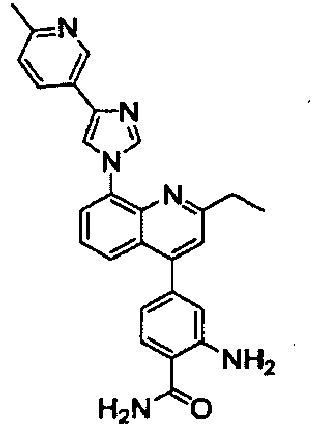
1H-NMR (DMSO-d6 ) : δ 8.97 (1H, s), 8.4 1 (1H, s), 8.33 (1H, s), 8.10 (1H, dd, J =7.8, 2.0Hz), 7.82-7.99 (3H, m), 7.7 3 (1H, d, J=8.1Hz), 7.67 (1H, t, J=7.8 Hz), 7.48 (1H, s), 7.29 (1H, d, J=8.1H z), 7.21 (1H, brs), 6.86 (1H, s), 6.81 (2H, brs), 6.64 (1H, d, J=8.1Hz), 2.9 9 (2H, q, J=7.6Hz), 2.49 (3H, s), 1.34 (3H, t, J=7.6Hz) ; LRMS (ESI) m/z 44.9 [M+H]+. 125 
1H-NMR (DMSO-d6 ) : δ 8.97 (1H, d, J=2. 0Hz), 8.44 (1H, s), 8.35 (1H, s), 8.10 (1H, dd, J=8.1, 1.7Hz), 7.97 (1H, d, J =7.6Hz), 7.83-7.95 (2H, m), 7.73 (1 H, d, J=8.1Hz), 7.67 (1H, t, J=8.1H z), 7.51 (1H, s), 7.31 (1H, d, J=8.3H z), 7.21 (1H, brs), 6.87 (1H, s), 6.81 (2H, brs), 6.65 (1H, d, J=8.1Hz), 3.2 0-3.48 (1H, m), 2.49 (3H, s), 1.33 (6 H, d, J=7.1Hz); LRMS (ESI) m/z 463 [M +H]+. -
[Table 26] 126 
1H-NMR (DMSO-d6 ) : δ 9.07 (1H, d, J=2. 2Hz), 8.58-8.61 (2H, m), 8.49 (1H, s), 8.09-8.21 (3H, m), 7.69-7.99 (7 H, m), 7.25 (1H, brs), 7.11 (1H, d, J= 1.5Hz), 6.81 (1H, dd, J=7.9, 1.3Hz), 1.36 (9H, s); LRMS (ESI) m/z 447 [M+ H]+. 127 
1H-NMR (DMSO-d6 ) : δ 9.12 (1H, d, J=2. 2Hz), 8.68 (1H, d, J=6,1Hz), 8.50 (1 H, s), 8.47 (1H, dd, J=4.8, 1.3Hz), 8. 31 (13-(tert-butylamino)-4-cyanophenylboronic acid pinacol ester H, s), 8.19-8.16 (3H, m), 8.00 (1H, d, J=7.3Hz), 7.96 (1H, b rs), 7.75-7.83 (2H, m), 7.54 (1H, d, J = 5.9Hz), 7.45 (1H, dd, J=7.9, 4.8H z), 7.27 (1H, brs), 7.09 (1H, s), 6.79 (1H, d, J=8.1Hz), 1.35 (9H, s) ; LRMS (ESI) m/z 463 [M+H]+. 128 
1H-NMR (DMSO-d6 ) : δ 8.64 (1H, d, J=5. 9Hz), 8.17 (1H, d, J=8.5Hz), 8.02 (1 H, s), 7.97 (1H, s), 7.93 (1H, d, J=7.1 Hz), 7.88 (1H, brs), 7.70-7.80 (4H, m), 7.51 (1H, d, J=6.1Hz), 7.20 (1H, b rs), 7.00 (1H, d, J=1.5Hz), 6.73-6.8 2 (3H, m), 3.87 (3H, s); LRMS (ESI) m/z 410 [M+H]+. 129 
1H-NMR (DMSO-d6 ) : δ 8.71 (1H, s), 8.5 1 (1H, s), 8.46 (1H, s) 8.11 (1H, d, J= 6.3Hz), 8.02-7.85 (3H, m), 7.81 (1H, d, J=8.1Hz), 7.74 (1H, d, J=8.1Hz), 7.69 (1H, t, J=7.9Hz), 7.52 (1H, s), 7.47 (1H, t, J=7.2Hz), 7.22 (1H, br s), 6.87 (1H, s), 6.82 (2H, s), 6.66 (1 H, d, J=8.1Hz), 3.30-3.22 (1H, m), 1. 33 (6H, d, J=6.8Hz); LRMS (ESI) m/z 4 65 [M+H]+. 130 
1H-NMR (DMSO-d6 ) : δ 9.02 (1H, d, J=3. 9Hz), 8.54 (1H, s), 8.18 (1H, s), 8.02 -7.92 (4H, m), 7.83-7.70 (4H, m), 7.6 1 (1H, d, J=4.1Hz), 7.27 (1H, brs), 6. 94 (1H, s), 6.68 (1H, d, J=8.1Hz), 3.8 8 (3H, s), 1.35 (9H, s); LRMS (ESI) m/z 466 [M+H]+. -
[Table 27] 131 
1H-NMR (DMSO-d6) : δ 9.11 (1H, s), 9.0 3 (1H, d, J=3.9Hz), 8.54 (1H, s), 8.46 (1H, d, J=4.4Hz), 8.34 (1H, s), 8.31 (1H, s), 8.22 (1H, d, J=7.8Hz), 8.09-7.92 (3H, m), 7.85-7.73 (2H, m), 7.63 (1H, d, J=3,9Hz), 7.44 (1H, t, J=6.0H z), 7.28 (1H, brs), 6.94 (1H, s), 6.69 (1H, d, J=7.6Hz) 1.35 (9H, s) ;LRMS (E SI) m/z 463 [M+H]+. 132 
1H-NMR (DMSO-d6) : δ 9.01 (1H, d, J=4. 1Hz), 8.17 (1H, s), 8.00-7.80 (5H, m), 7.77-7.69 (3H, m), 7.56 (1H, d, J= 4. 4Hz), 7.21 (1H, brs), 6.89-6.78 (3 H, m), 6.65 (1H, d, J=9.0Hz), 3.88 (3 H, s); LRMS (ESI) m/z 410 [M+H]+. 133 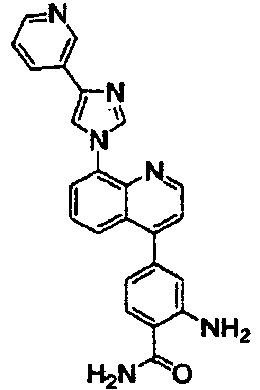
1H-NMR (DMSO-d6) : δ 9.02 (1H, d, J=4. 4Hz), 8.36-8.20 (4H, m), 8.04-7.97 (2H, m), 7.88 (1H, brs), 7.81-7.72 (2 H, m), 7.63-7.32 (3H, m), 7.22 (1H, br s), 6.88 (1H, s), 6.83 (2H, s), 6.66 (1 H, d, J=8.3Hz) ; LRMS (ESI) m/z 407 [M +H]+. Comp. Ex. 1 
1H-NMR (DMSO-d6 ) : δ 9.22 (1H, d, J=2. 2Hz), 8.74 (1H, d, J=2.0Hz), 8.66 (1 H, d, J=6.1Hz), 8.35 (1H, d, J=7.6H z), 8.20-8.30 (3H, m), 7.70-7.96 (7 H, m), 7.22 (1H, brs), 6.78 (1H, s), 6. 63 (1H, dd, J=8.1, 1.2Hz), 4.51 (1H, d, J=4.2Hz), 3.30-3.60 (2H, m), 1.75 -2.05 (4H, m), 1.20-1.35 (4H, m); LRM S (ESI) m/z 489 [M+H]+. Comp. Ex. 2 
1H-NMR (DMSO-d6 ) : δ 9.41 (1H, s), 9.3 1 (1H, d, J=2.2Hz), 8.90 (1H, d, J=1.7 Hz), 8.10-8.28 (5H, m), 7.68-7.96 (5 H, m), 7.16 (1H, brs), 7.01 (1H, s), 6. 80 (1H, d, J=8.1Hz), 4.52 (1H, d, J=4. 2Hz), 3.30-3.60 (2H, m), 1.75-2.05 (4H, m), 1.20-1.35 (4H, m) ; LRMS(ES 1) m/z 490 [M+H]+. -
[Table 28] Comp. Ex. 3 
1H-NMR (DMSO-d6) : δ 8.45 (1H, d, J=5. 9Hz), 8.27-8.20 (2H, m), 8.07 (1H, d, J=8.1Hz), 8.01 (1H, s), 7.94 (2H, s), 7.90-7.76 (5H, m), 7.25 (1H, brs), 6. 73 (1H, s), 6.66 (1H, d, J=7. 8Hz), 3.8 8 (3H, s), 3.200-3.13 (2H, m), 1.20 (3 H, t, J=7.1Hz). - First, a purified HSP90 solution was prepared as follows: a human HSP90 alpha gene (NCBI Reference Sequence accession no. NM_005348) region corresponding to amino acids 2 to 236 of human HSP90 alpha protein (NCBI Reference Sequence accession no. NP_005339; full length: 732 amino acids) was inserted to pET-19b (Novagen; Merck KGaA) to construct a plasmid pET-HSP90N for expression of the HSP90 N-terminal protein having a His-tag at the N-terminus. E. coli (BL21(DE3), Stratagene Corp.) was transformed with pET-HSP90N and then cultured at 37°C for 4 hours in the presence of 0.5 mM isopropyl-beta-D-thiogalactopyranoside (Sigma-Aldrich Corp.). The collected E. coli was suspended in a lysis buffer (50 mM Tris-HCl (pH 7.5), 200 mM NaCl) and sonicated. The sonicated cell solution was centrifuged (40,000 × g, 20 minutes), and the supernatant was used as a crude extract. This crude extract was fractionated using Ni Sepharose High Performance (GE Healthcare Japan Corp.) chromatography and HiLoad 26/60 Superdex 75 pg (GE Healthcare Japan Corp.). Then, a fraction of HSP90 protein concentrates was prepared in a solution containing 50 mM Tris-HCl (pH 7.5) and 20% glycerol as a purified HSP90 solution. The purified HSP90 solution was divided and stored at -80°C until use.
- HSP90-binding activity was determined by an AlphaScreen competitive assay system. The purified HSP90 solution was diluted with a binding buffer (50 mM Tris-HCl (pH 7.5), 150 mM NaCl, 0.1% Triton-
X 100, 1 mM DTT, 0.1% BSA) and added to a 384-well plate (#3673, Corning Inc.) containing test substances. After reaction at room temperature for 2 hours, biotinylated geldanamycin was added thereto at a concentration of 40 nM/well and further reacted for 1 hour. Detection mix (20 mM HEPES-KOH (pH 7.5), 0.5% BSA, 0.04 mg/mL Nickel Chelate Acceptor beads, 0.04 mg/mL Streptavidin-coated Donor beads) (#6760619C, PerkinElmer, Inc.) was added to each well in an amount equal to the amount of the reaction solution and reacted at room temperature for 1 hour in the dark. Then, fluorescence intensity was measured using Multilabel Plate Reader EnVision (PerkinElmer, Inc.). Percent inhibition (%) of the binding of biotinylated geldanamycin by each compound of the present invention was determined according to the formula shown below with the fluorescence signal of no test substance addition group as a control. A concentration at which the addition of each compound inhibited the binding of biotinylated geldanamycin to 50% compared with the control was determined (IC50 (µM)) and used as a relative index for HSP90 binding. -

- T: Signal of well with test substance addition
- C: Signal of well without test substance addition.
- As a result, the compounds of the present invention exhibited excellent HSP90-binding activity, whereas none of the comparative compounds exhibited HSP90-binding activity (Table 29).
- Cell growth was assayed by a crystal violet staining method. SK-BR-3 cells (HTB-30) purchased from American Type Culture Collection were inoculated at a concentration of 5,000 cells/well to a 96-well plate (#353075, BD Biosciences). After culture at 37°C for 24 hours in a 5% CO2 incubator, each test substance was added thereto, and the cells were further cultured for 72 hours. A 25% glutaraldehyde solution (#17025-25, Nacalai Tesque, Inc.) was added thereto at a concentration of 20 µL/well per 200 µL of the medium, and the plate was incubated at room temperature for 20 minutes to fix the cells. The plate was washed with water and dried. Then, a solution containing 0.05% crystal violet (#038-17792, Wako Pure Chemical Industries, Ltd.) and 20% methanol was added thereto at a concentration of 100 µL/well, and the plate was incubated at room temperature for 20 minutes to stain the cells. The plate was washed with water and dried. A mixed solution of 0.05 M NaH2PO4 and ethanol (mixed in equal amounts) was added thereto at a concentration of 100 µL/well. Absorbance was measured at 540 nm using a microplate reader (MTP-450, Corona Electric Co., Ltd.) and used as an index for the number of cells per well. Percent inhibition (%) of cell growth by each compound of the present invention was determined according to the formula shown below with the absorbance of no drug addition group as a control. A concentration at which the addition of each compound inhibited the number of cells to 50% compared with the control was determined (IC50 (µM)).
-

- T: Absorbance of well with test substance addition
- C: Absorbance of well without test substance addition.
- As a result, the compounds of the present invention inhibited the growth of the breast cancer cells SK-BR-3, whereas none of the comparative compounds inhibited the growth of SK-BR-3 (Table 29).
-
[Table 29] Example HSP-binding activity IC50 (µM) Cell growth inhibition IC50 (µM) Example HSP-binding activity IC50 (µM) Cell growth inhibition IC50 (µM) Example HSP-binding activity IC50 (µM) Cell growth inhibition IC50 (µM) 1 0.19 0.12 58 0.25 1.44 97 0.16 0.02 2 0.06 0.15 59 0.10 0.09 98 0.08 0.02 3 0.19 0.01 60 0.17 0.15 99 0.27 0.04 4 0.34 0.28 61 0.19 0.07 100 0.34 0.26 5 1.44 0.09 62 0.21 0.26 101 0.12 0.12 6 0.17 0.03 63 0.27 0.03 102 0.25 0.63 7 0.15 0.01 64 0.17 0.01 103 0.12 0.01 8 0.10 0.02 65 0.22 0.01 104 0.06 0.01 9 0.27 0.05 66 0.15 0.02 105 0.40 0.02 11 0.48 0.11 67 0.21 0.02 106 0.10 0.00 12 0.07 0.17 68 0.19 0.01 107 3.39 0.24 13 0.45 0.58 69 0.15 0.02 108 3.75 0.34 14 1.50 0.34 70 0.21 0.06 109 4.36 0.21 15 0.14 0.21 71 0.17 0.21 110 0.38 0.10 17 0.10 0.28 72 0.74 1.74 111 0.84 0.06 19 2.69 0.88 73 0.19 0.07 112 0.50 0.02 24 0.65 0.69 74 0.44 1.12 113 0.08 0.01 25 0.13 0.11 75 0.21 0.33 114 0.07 0.01 27 0.15 0.54 76 0.20 0.04 115 0.14 0.01 28 0.23 0.50 77 0.17 0.01 117 0.29 0.05 31 0.80 0.58 78 0.18 0.03 118 0.25 0.06 32 0.08 0.02 79 0.32 0.02 119 0.83 0.84 33 0.45 0.08 80 0.14 0.02 120 0.19 0.03 34 0.14 0.05 81 0.87 0.76 121 0.18 0.02 35 1.49 0.46 83 0.21 0.10 122 0.09 0.01 37 0.37 0.06 84 0.22 0.11 123 0.16 0.01 38 0.98 0.04 85 0.31 0.42 124 0.13 0.02 39 0.13 0.01 86 0.10 0.01 125 0.16 0.01 40 0.15 0.54 87 0.28 0.08 126 1.53 0.35 41 0.39 1.27 88 0.35 0.07 127 0.21 0.05 43 0.69 1.10 89 0.22 0.01 128 0.31 1.06 45 0.22 0.03 90 0.58 0.03 129 0.09 0.01 48 0.07 0.02 91 0.23 0.01 130 0.11 0.06 49 1.56 0.40 92 0.79 0.02 131 0.26 0.14 52 0.28 0.11 93 0.10 0.02 132 0.32 0.96 53 0.12 0.04 94 0.50 0.11 133 0.84 1.32 54 0.47 0.48 95 0.40 1.02 Comp. Ex. 1 >100 8.42 56 0.37 0.47 96 0.14 0.06 Comp. Ex. 2 >100 >10 Comp. Ex. 3 >100 7.63
Claims (18)
- A compound represented by the following general formula (I) or a salt thereof:
 wherein at least one of X1, X2, X3, and X4 represents N or N-oxide and the rest thereof are the same or different and each represent C-R2;any one or two of Y1, Y2, Y3, and Y4 represent C-R4 and the rest thereof are the same or different and each represent CH or N;R1 represents an optionally substituted monocyclic or bicyclic unsaturated heterocyclic group having 1 to 4 heteroatoms selected from N, S, and O;R2 represents a hydrogen atom, an optionally substituted alkyl group having 1 to 6 carbon atoms, an optionally substituted cycloalkyl group having 3 to 7 carbon atoms, or an optionally substituted alkenyl group having 2 to 6 carbon atoms;R3 represents a hydrogen atom, a halogen atom, a cyano group, an alkyl group having 1 to 6 carbon atoms, an alkoxy group having 1 to 6 carbon atoms, or -CO-R5;R4 represents a hydrogen atom, a halogen atom, an alkyl group having 1 to 6 carbon atoms, an alkoxy group having 1 to 6 carbon atoms, -CO-R6, -N(R7)(R8), or -S-R9;R5 represents a hydroxyl group, an amino group, or an optionally substituted alkylamino group having 1 to 6 carbon atoms;R6 represents a hydroxyl group, an amino group optionally having a hydroxyl group, or an optionally substituted alkylamino group having 1 to 6 carbon atoms;R7 and R8 are the same or different and each represent a hydrogen atom, an optionally substituted alkyl group having 1 to 6 carbon atoms, an optionally substituted cycloalkyl group having 3 to 7 carbon atoms, an optionally substituted aromatic hydrocarbon group, an optionally substituted saturated heterocyclic group, or an optionally substituted unsaturated heterocyclic group, or R7 and R8 together form a saturated heterocyclic group together with the nitrogen atom bonded thereto; andR9 represents an optionally substituted cycloalkyl group having 3 to 7 carbon atoms, or an optionally substituted aromatic hydrocarbon group.
 - The compound according to claim 1 or a salt thereof, wherein R1 is an optionally substituted monocyclic or bicyclic 5- to 10-membered unsaturated heterocyclic group having 1 to 3 heteroatoms selected from N, S, and O.
- The compound according to claim 1 or 2 or a salt thereof, wherein X2 is C-R2, at least one of X1, X3 and X4 is N or N-oxide and each of the rest of X1, X3 and X4 is CH.
- The compound according to any one of claims 1 to 3 or a salt thereof, wherein R2 is a hydrogen atom; an alkyl group having 1 to 6 carbon atoms and optionally having a substituent selected from a halogen atom and a saturated heterocyclic group; or an optionally substituted cycloalkyl group having 3 to 7 carbon atoms.
- The compound according to any one of claims 1 to 4 or a salt thereof, wherein R3 is a cyano group or -CO-R5 wherein R5 is an amino group or an alkylamino group having 1 to 6 carbon atoms and optionally having an alkylamino group having 1 to 6 carbon atoms (the alkyl moiety is optionally substituted by a hydroxyl group).
- The compound according to any one of claims 1 to 5 or a salt thereof, wherein R4 is a hydrogen atom, a halogen atom, an alkyl group having 1 to 6 carbon atoms, an alkoxy group having 1 to 6 carbon atoms, or -N(R7)(R8) wherein R7 is a hydrogen atom, and R8 is a hydrogen atom; an alkyl group having 1 to 6 carbon atoms and optionally having a substituent selected from an alkoxy group having 1 to 6 carbon atoms, a cycloalkyl group having 3 to 7 carbon atoms, a saturated heterocyclic group, and an unsaturated heterocyclic group; a cycloalkyl group having 3 to 7 carbon atoms and optionally having a substituent selected from a hydroxyl group, an amino group, an aminoacyloxy group, and a saturated heterocyclic acyloxy group; or a monocyclic or bicyclic saturated heterocyclic group having 1 to 4 heteroatoms selected from N, S, and O and optionally having an alkyl group having 1 to 6 carbon atoms.
- The compound according to any one of claims 1 to 6 or a salt thereof, wherein Y4 is C-R4 or N and each of Y1 to Y3 is CH, or each of Y2 to Y4 is CH and Y1 is C-R4.
- The compound according to any one of claims 1 to 7 or a salt thereof, wherein in the general formula (I), X2 is C-R2, X4 is CH, at least one of X1 and X3 is N or N-oxide and the other of X1 and X3 is CH, Y4 is C-R4 or N and each of Y1 to Y3 is CH, or each of Y2 to Y4 is CH and Y1 is C-R4, R1 is an optionally substituted monocyclic or bicyclic unsaturated heterocyclic group having 1 to 4 heteroatoms selected from N, S, and O, R2 is a hydrogen atom; an alkyl group having 1 to 6 carbon atoms and optionally having a halogen atom; or a cycloalkyl group having 3 to 7 carbon atoms, R3 is -CO-R5 wherein R5 is an amino group, and R4 is a halogen atom, an alkyl group having 1 to 6 carbon atoms, or -N(R7)(R8) wherein R7 is a hydrogen atom, and R8 is a hydrogen atom; an alkyl group having 1 to 6 carbon atoms and optionally having a substituent selected from an alkoxy group having 1 to 6 carbon atoms, a cycloalkyl group having 3 to 7 carbon atoms, a saturated heterocyclic group, and an unsaturated heterocyclic group; a cycloalkyl group having 3 to 7 carbon atoms and optionally having a substituent selected from a hydroxyl group, an amino group, an aminoacyloxy group, and a saturated heterocyclic acyloxy group; or a monocyclic or bicyclic saturated heterocyclic group having 1 to 4 heteroatoms selected from N, S, and O and optionally having an alkyl group having 1 to 6 carbon atoms.
- The compound according to any one of claims 1 to 8 or a salt thereof, wherein in the general formula (I), X2 is C-R2, X4 is CH, at least one of X1 and X3 is N or N-oxide and the other of X1 and X3 is CH, Y4 is C-R4 or N and each of Y1 to Y3 is CH, or each of Y2 to Y4 is CH and Y1 is C-R4, R1 is a monocyclic 5- to 6-membered unsaturated heterocyclic group having 1 to 3 heteroatoms selected from N, S, and O and optionally having a substituent selected from: an alkyl group having 1 to 6 carbon atoms; an alkylamino group having 1 to 6 carbon atoms; an acylamino group having 1 to 6 carbon atoms and optionally having a hydroxyl group; and an unsaturated heterocyclic group optionally having a substituent selected from an alkyl group having 1 to 6 carbon atoms and a halogenoalkyl group having 1 to 6 carbon atoms, or a bicyclic 9- to 10-membered unsaturated heterocyclic group having 1 to 3 heteroatoms selected from N, S, and O and optionally having a substituent selected from an alkyl group having 1 to 6 carbon atoms and an acyl group having 1 to 6 carbon atoms, R2 is a hydrogen atom; an alkyl group having 1 to 6 carbon atoms and optionally having a halogen atom; or a cycloalkyl group having 3 to 7 carbon atoms, R3 is -CO-R5 wherein R5 is an amino group, and R4 is a halogen atom, an alkyl group having 1 to 6 carbon atoms, or -N(R7)(R8) wherein R7 is a hydrogen atom, and R8 is a hydrogen atom; an alkyl group having 1 to 6 carbon atoms and optionally having a substituent selected from an alkoxy group having 1 to 6 carbon atoms, a cycloalkyl group having 3 to 7 carbon atoms, a saturated heterocyclic group, and an unsaturated heterocyclic group; or a cycloalkyl group having 3 to 7 carbon atoms and optionally having a substituent selected from a hydroxyl group, an amino group, an aminoacyloxy group, and a saturated heterocyclic acyloxy group.
- A pharmaceutical composition comprising a compound according to any one of claims 1 to 9 or a salt thereof, and a pharmaceutically acceptable carrier.
- An agent for prevention or treatment of a disease involving HSP90, comprising a compound according to any one of claims 1 to 9 or a salt thereof.
- An anticancer agent comprising a compound according to any one of claims 1 to 7 or a salt thereof.
- The compound according to any one of claims 1 to 9 or the salt thereof for the prevention or treatment of a disease involving HSP90.
- The compound according to any one of claims 1 to 9 or the salt thereof for the prevention or treatment of cancer.
- Use of a compound according to any one of claims 1 to 9 or a salt thereof for the production of an agent for prevention or treatment of a disease involving HSP90.
- Use of a compound according to any one of claims 1 to 9 or a salt thereof for the production of an agent for prevention or treatment of cancer.
- A method for preventing or treating a disease involving HSP90, comprising administering an effective amount of a compound according to any one of claims 1 to 9 or a salt thereof.
- A method for preventing or treating cancer, comprising administering a compound according to any one of claims 1 to 9 or a salt thereof.
Applications Claiming Priority (2)
| Application Number | Priority Date | Filing Date | Title |
|---|---|---|---|
| JP2011002104 | 2011-01-07 | ||
| PCT/JP2012/050141 WO2012093708A1 (en) | 2011-01-07 | 2012-01-06 | Novel bicyclic compound or salt thereof |
Publications (3)
| Publication Number | Publication Date |
|---|---|
| EP2662357A1 true EP2662357A1 (en) | 2013-11-13 |
| EP2662357A4 EP2662357A4 (en) | 2014-07-30 |
| EP2662357B1 EP2662357B1 (en) | 2016-08-03 |
Family
ID=46457558
Family Applications (1)
| Application Number | Title | Priority Date | Filing Date |
|---|---|---|---|
| EP12732119.8A Not-in-force EP2662357B1 (en) | 2011-01-07 | 2012-01-06 | Bicyclic compounds or salts thereof for use in the treatment of cancer |
Country Status (13)
| Country | Link |
|---|---|
| US (1) | US8912181B2 (en) |
| EP (1) | EP2662357B1 (en) |
| JP (1) | JP5792201B2 (en) |
| KR (1) | KR20140025327A (en) |
| CN (1) | CN103313970B (en) |
| AU (1) | AU2012204651A1 (en) |
| BR (1) | BR112013017520A2 (en) |
| CA (1) | CA2824013A1 (en) |
| ES (1) | ES2598830T3 (en) |
| MX (1) | MX2013007938A (en) |
| RU (1) | RU2013136895A (en) |
| TW (1) | TW201309668A (en) |
| WO (1) | WO2012093708A1 (en) |
Families Citing this family (9)
| Publication number | Priority date | Publication date | Assignee | Title |
|---|---|---|---|---|
| PT2452940E (en) | 2009-07-10 | 2015-02-27 | Taiho Pharmaceutical Co Ltd | Azabicyclo compound and salt thereof |
| BR112016003247B1 (en) * | 2013-08-22 | 2022-05-10 | Taiho Pharmaceutical Co., Ltd | COMPOUND SUBSTITUTED BY QUINOLINE, PHARMACEUTICAL COMPOSITION COMPRISING SUCH COMPOUND AND ITS USE |
| WO2015050235A1 (en) | 2013-10-02 | 2015-04-09 | 大鵬薬品工業株式会社 | RESISTANT MUTANT 90 kDA HEAT SHOCK PROTEIN |
| CN104744459A (en) * | 2013-12-27 | 2015-07-01 | 中国药科大学 | Synthetic method of pyridopyridone and derivatives thereof |
| JP6537601B2 (en) * | 2015-05-12 | 2019-07-03 | 大鵬薬品工業株式会社 | Crystal of azabicyclic compound |
| WO2018079310A1 (en) | 2016-10-31 | 2018-05-03 | 大鵬薬品工業株式会社 | Selective inhibitor of exon 20 insertion mutant egfr |
| PL3677266T3 (en) | 2017-09-01 | 2024-07-01 | Taiho Pharmaceutical Co., Ltd. | Exon 18 and/or exon 21 mutant egfr selective inhibitor |
| WO2022144042A1 (en) * | 2020-12-31 | 2022-07-07 | 杭州领业医药科技有限公司 | Crystal form of tas-116, and preparation method therefor, pharmaceutical composition, and use therefor |
| CN117050010B (en) * | 2023-10-11 | 2024-01-05 | 湖南工程学院 | A kind of synthesis method of 2,2’-biquinoline and its derivatives |
Family Cites Families (13)
| Publication number | Priority date | Publication date | Assignee | Title |
|---|---|---|---|---|
| JPS57203068A (en) * | 1981-06-08 | 1982-12-13 | Teikoku Hormone Mfg Co Ltd | Novel 1-phenylisoquinoline derivative |
| AR028782A1 (en) * | 2000-07-05 | 2003-05-21 | Taisho Pharmaceutical Co Ltd | TETRAHYDROPIRIDINE OR PIPERIDINE HETEROCICLIC DERIVATIVES |
| DE102005022977A1 (en) * | 2005-05-19 | 2006-12-07 | Merck Patent Gmbh | Phenylchinazolinderivate |
| US20070185184A1 (en) | 2005-09-16 | 2007-08-09 | Serenex, Inc. | Carbazole derivatives |
| WO2008024978A2 (en) | 2006-08-24 | 2008-02-28 | Serenex, Inc. | Tetrahydroindolone and tetrahydroindazolone derivatives |
| WO2008026704A1 (en) * | 2006-08-31 | 2008-03-06 | Kyowa Hakko Kogyo Co., Ltd. | Isoquinoline derivative |
| ATE541841T1 (en) | 2007-11-15 | 2012-02-15 | Boehringer Ingelheim Int | INHIBITORS OF REPLICATION OF THE HUMAN IMMUNODEFICIENCY VIRUS |
| US8450343B2 (en) | 2007-12-06 | 2013-05-28 | Xianhai Huang | Gamma secretase modulators |
| FR2928645A1 (en) | 2008-03-14 | 2009-09-18 | Sanofi Aventis Sa | NOVEL CARBAZOLE DERIVATIVES INHIBITORS OF HSP90, COMPOSITIONS CONTAINING SAME AND USE THEREOF |
| GB0807910D0 (en) * | 2008-04-30 | 2008-06-04 | Glaxo Group Ltd | Compounds |
| WO2010042489A2 (en) | 2008-10-06 | 2010-04-15 | Emory University | Aminoquinoline derived heat shock protein 90 inhibitors, methods of preparing same, and methods for their use |
| CN102439003A (en) | 2009-03-19 | 2012-05-02 | 赛诺菲 | Hsp90 inhibiting indazole derivatives, compositions containing same and use thereof |
| PT2452940E (en) | 2009-07-10 | 2015-02-27 | Taiho Pharmaceutical Co Ltd | Azabicyclo compound and salt thereof |
-
2012
- 2012-01-06 TW TW101100719A patent/TW201309668A/en unknown
- 2012-01-06 MX MX2013007938A patent/MX2013007938A/en not_active Application Discontinuation
- 2012-01-06 JP JP2012551881A patent/JP5792201B2/en not_active Expired - Fee Related
- 2012-01-06 US US13/978,613 patent/US8912181B2/en not_active Expired - Fee Related
- 2012-01-06 EP EP12732119.8A patent/EP2662357B1/en not_active Not-in-force
- 2012-01-06 CA CA2824013A patent/CA2824013A1/en not_active Abandoned
- 2012-01-06 RU RU2013136895/04A patent/RU2013136895A/en not_active Application Discontinuation
- 2012-01-06 KR KR1020137017452A patent/KR20140025327A/en not_active Withdrawn
- 2012-01-06 CN CN201280004872.4A patent/CN103313970B/en not_active Expired - Fee Related
- 2012-01-06 AU AU2012204651A patent/AU2012204651A1/en not_active Abandoned
- 2012-01-06 BR BR112013017520A patent/BR112013017520A2/en not_active IP Right Cessation
- 2012-01-06 WO PCT/JP2012/050141 patent/WO2012093708A1/en not_active Ceased
- 2012-01-06 ES ES12732119.8T patent/ES2598830T3/en active Active
Also Published As
| Publication number | Publication date |
|---|---|
| CN103313970A (en) | 2013-09-18 |
| KR20140025327A (en) | 2014-03-04 |
| TW201309668A (en) | 2013-03-01 |
| MX2013007938A (en) | 2013-11-01 |
| WO2012093708A1 (en) | 2012-07-12 |
| US20130296320A1 (en) | 2013-11-07 |
| RU2013136895A (en) | 2015-02-20 |
| ES2598830T3 (en) | 2017-01-30 |
| EP2662357A4 (en) | 2014-07-30 |
| EP2662357B1 (en) | 2016-08-03 |
| BR112013017520A2 (en) | 2016-09-27 |
| CN103313970B (en) | 2016-09-07 |
| JP5792201B2 (en) | 2015-10-07 |
| US8912181B2 (en) | 2014-12-16 |
| AU2012204651A1 (en) | 2013-08-01 |
| CA2824013A1 (en) | 2012-07-12 |
| HK1185079A1 (en) | 2014-02-07 |
| JPWO2012093708A1 (en) | 2014-06-09 |
Similar Documents
| Publication | Publication Date | Title |
|---|---|---|
| EP2662357B1 (en) | Bicyclic compounds or salts thereof for use in the treatment of cancer | |
| RU2745035C1 (en) | Fgfr inhibitor and its application | |
| CN102131801B (en) | 1, 2 disubstituted heterocyclic compounds | |
| KR102007056B1 (en) | Substituted benzylindazoles for use as bub1 kinase inhibitors in the treatment of hyperproliferative diseases | |
| TWI464168B (en) | 1h-imidazo[4,5-c]quinolinone derivatives | |
| CN107849040A (en) | Tricyclic derivative compound, its preparation method, and pharmaceutical composition containing it | |
| HU227972B1 (en) | Phthalazines with angiogenesis inhibiting activity and pharmaceutical compositions containing them | |
| TWI601724B (en) | Imidazo quinoline derivatives and salts thereof, preparation process and pharmaceutical use thereof | |
| US20130310374A1 (en) | Substituted Imidazoquinoline Derivatives | |
| EA012178B1 (en) | Pyridine methylene azolidinones and use thereof | |
| TWI793877B (en) | Heterocyclic compound as diacrylglycerol kinases inhibitor and use thereof | |
| JP2025510762A (en) | Bcl-xL inhibitors | |
| JP2024534208A (en) | PARP7 inhibitors and uses thereof | |
| CN103596953B (en) | Pyrido naphthyridine type PI3K and mTOR double inhibitor and preparation and application thereof | |
| CN119661531A (en) | Imidazolone compounds and preparation methods and applications thereof | |
| HK1185079B (en) | Novel bicyclic compound or salt thereof |
Legal Events
| Date | Code | Title | Description |
|---|---|---|---|
| PUAI | Public reference made under article 153(3) epc to a published international application that has entered the european phase |
Free format text: ORIGINAL CODE: 0009012 |
|
| 17P | Request for examination filed |
Effective date: 20130704 |
|
| AK | Designated contracting states |
Kind code of ref document: A1 Designated state(s): AL AT BE BG CH CY CZ DE DK EE ES FI FR GB GR HR HU IE IS IT LI LT LU LV MC MK MT NL NO PL PT RO RS SE SI SK SM TR |
|
| DAX | Request for extension of the european patent (deleted) | ||
| A4 | Supplementary search report drawn up and despatched |
Effective date: 20140630 |
|
| RIC1 | Information provided on ipc code assigned before grant |
Ipc: A61K 31/497 20060101ALI20140624BHEP Ipc: A61P 43/00 20060101ALI20140624BHEP Ipc: A61K 31/5377 20060101ALI20140624BHEP Ipc: A61K 31/501 20060101ALI20140624BHEP Ipc: A61K 31/506 20060101ALI20140624BHEP Ipc: A61K 31/517 20060101ALI20140624BHEP Ipc: C07D 403/14 20060101ALI20140624BHEP Ipc: C07D 417/04 20060101ALI20140624BHEP Ipc: C07D 403/04 20060101ALI20140624BHEP Ipc: A61K 31/4375 20060101ALI20140624BHEP Ipc: C07D 413/04 20060101ALI20140624BHEP Ipc: C07D 215/12 20060101AFI20140624BHEP Ipc: C07D 401/04 20060101ALI20140624BHEP Ipc: A61K 31/4725 20060101ALI20140624BHEP Ipc: A61P 35/00 20060101ALI20140624BHEP Ipc: C07D 401/14 20060101ALI20140624BHEP Ipc: C07D 471/04 20060101ALI20140624BHEP Ipc: A61P 35/02 20060101ALI20140624BHEP Ipc: C07D 405/14 20060101ALI20140624BHEP Ipc: A61K 31/4709 20060101ALI20140624BHEP |
|
| GRAP | Despatch of communication of intention to grant a patent |
Free format text: ORIGINAL CODE: EPIDOSNIGR1 |
|
| GRAJ | Information related to disapproval of communication of intention to grant by the applicant or resumption of examination proceedings by the epo deleted |
Free format text: ORIGINAL CODE: EPIDOSDIGR1 |
|
| GRAP | Despatch of communication of intention to grant a patent |
Free format text: ORIGINAL CODE: EPIDOSNIGR1 |
|
| INTG | Intention to grant announced |
Effective date: 20150731 |
|
| INTG | Intention to grant announced |
Effective date: 20150814 |
|
| GRAS | Grant fee paid |
Free format text: ORIGINAL CODE: EPIDOSNIGR3 |
|
| INTG | Intention to grant announced |
Effective date: 20160105 |
|
| GRAA | (expected) grant |
Free format text: ORIGINAL CODE: 0009210 |
|
| AK | Designated contracting states |
Kind code of ref document: B1 Designated state(s): AL AT BE BG CH CY CZ DE DK EE ES FI FR GB GR HR HU IE IS IT LI LT LU LV MC MK MT NL NO PL PT RO RS SE SI SK SM TR |
|
| REG | Reference to a national code |
Ref country code: GB Ref legal event code: FG4D |
|
| REG | Reference to a national code |
Ref country code: CH Ref legal event code: EP Ref country code: AT Ref legal event code: REF Ref document number: 817248 Country of ref document: AT Kind code of ref document: T Effective date: 20160815 |
|
| REG | Reference to a national code |
Ref country code: IE Ref legal event code: FG4D |
|
| REG | Reference to a national code |
Ref country code: DE Ref legal event code: R096 Ref document number: 602012021221 Country of ref document: DE |
|
| REG | Reference to a national code |
Ref country code: NL Ref legal event code: MP Effective date: 20160803 |
|
| REG | Reference to a national code |
Ref country code: LT Ref legal event code: MG4D |
|
| REG | Reference to a national code |
Ref country code: FR Ref legal event code: PLFP Year of fee payment: 6 |
|
| REG | Reference to a national code |
Ref country code: AT Ref legal event code: MK05 Ref document number: 817248 Country of ref document: AT Kind code of ref document: T Effective date: 20160803 |
|
| REG | Reference to a national code |
Ref country code: ES Ref legal event code: FG2A Ref document number: 2598830 Country of ref document: ES Kind code of ref document: T3 Effective date: 20170130 |
|
| PG25 | Lapsed in a contracting state [announced via postgrant information from national office to epo] |
Ref country code: FI Free format text: LAPSE BECAUSE OF FAILURE TO SUBMIT A TRANSLATION OF THE DESCRIPTION OR TO PAY THE FEE WITHIN THE PRESCRIBED TIME-LIMIT Effective date: 20160803 Ref country code: HR Free format text: LAPSE BECAUSE OF FAILURE TO SUBMIT A TRANSLATION OF THE DESCRIPTION OR TO PAY THE FEE WITHIN THE PRESCRIBED TIME-LIMIT Effective date: 20160803 Ref country code: RS Free format text: LAPSE BECAUSE OF FAILURE TO SUBMIT A TRANSLATION OF THE DESCRIPTION OR TO PAY THE FEE WITHIN THE PRESCRIBED TIME-LIMIT Effective date: 20160803 Ref country code: LT Free format text: LAPSE BECAUSE OF FAILURE TO SUBMIT A TRANSLATION OF THE DESCRIPTION OR TO PAY THE FEE WITHIN THE PRESCRIBED TIME-LIMIT Effective date: 20160803 Ref country code: NL Free format text: LAPSE BECAUSE OF FAILURE TO SUBMIT A TRANSLATION OF THE DESCRIPTION OR TO PAY THE FEE WITHIN THE PRESCRIBED TIME-LIMIT Effective date: 20160803 Ref country code: IS Free format text: LAPSE BECAUSE OF FAILURE TO SUBMIT A TRANSLATION OF THE DESCRIPTION OR TO PAY THE FEE WITHIN THE PRESCRIBED TIME-LIMIT Effective date: 20161203 Ref country code: NO Free format text: LAPSE BECAUSE OF FAILURE TO SUBMIT A TRANSLATION OF THE DESCRIPTION OR TO PAY THE FEE WITHIN THE PRESCRIBED TIME-LIMIT Effective date: 20161103 |
|
| PG25 | Lapsed in a contracting state [announced via postgrant information from national office to epo] |
Ref country code: AT Free format text: LAPSE BECAUSE OF FAILURE TO SUBMIT A TRANSLATION OF THE DESCRIPTION OR TO PAY THE FEE WITHIN THE PRESCRIBED TIME-LIMIT Effective date: 20160803 Ref country code: GR Free format text: LAPSE BECAUSE OF FAILURE TO SUBMIT A TRANSLATION OF THE DESCRIPTION OR TO PAY THE FEE WITHIN THE PRESCRIBED TIME-LIMIT Effective date: 20161104 Ref country code: PL Free format text: LAPSE BECAUSE OF FAILURE TO SUBMIT A TRANSLATION OF THE DESCRIPTION OR TO PAY THE FEE WITHIN THE PRESCRIBED TIME-LIMIT Effective date: 20160803 Ref country code: PT Free format text: LAPSE BECAUSE OF FAILURE TO SUBMIT A TRANSLATION OF THE DESCRIPTION OR TO PAY THE FEE WITHIN THE PRESCRIBED TIME-LIMIT Effective date: 20161205 Ref country code: SE Free format text: LAPSE BECAUSE OF FAILURE TO SUBMIT A TRANSLATION OF THE DESCRIPTION OR TO PAY THE FEE WITHIN THE PRESCRIBED TIME-LIMIT Effective date: 20160803 Ref country code: LV Free format text: LAPSE BECAUSE OF FAILURE TO SUBMIT A TRANSLATION OF THE DESCRIPTION OR TO PAY THE FEE WITHIN THE PRESCRIBED TIME-LIMIT Effective date: 20160803 |
|
| PG25 | Lapsed in a contracting state [announced via postgrant information from national office to epo] |
Ref country code: EE Free format text: LAPSE BECAUSE OF FAILURE TO SUBMIT A TRANSLATION OF THE DESCRIPTION OR TO PAY THE FEE WITHIN THE PRESCRIBED TIME-LIMIT Effective date: 20160803 Ref country code: RO Free format text: LAPSE BECAUSE OF FAILURE TO SUBMIT A TRANSLATION OF THE DESCRIPTION OR TO PAY THE FEE WITHIN THE PRESCRIBED TIME-LIMIT Effective date: 20160803 |
|
| REG | Reference to a national code |
Ref country code: DE Ref legal event code: R097 Ref document number: 602012021221 Country of ref document: DE |
|
| PG25 | Lapsed in a contracting state [announced via postgrant information from national office to epo] |
Ref country code: BE Free format text: LAPSE BECAUSE OF FAILURE TO SUBMIT A TRANSLATION OF THE DESCRIPTION OR TO PAY THE FEE WITHIN THE PRESCRIBED TIME-LIMIT Effective date: 20160803 Ref country code: DK Free format text: LAPSE BECAUSE OF FAILURE TO SUBMIT A TRANSLATION OF THE DESCRIPTION OR TO PAY THE FEE WITHIN THE PRESCRIBED TIME-LIMIT Effective date: 20160803 Ref country code: SM Free format text: LAPSE BECAUSE OF FAILURE TO SUBMIT A TRANSLATION OF THE DESCRIPTION OR TO PAY THE FEE WITHIN THE PRESCRIBED TIME-LIMIT Effective date: 20160803 Ref country code: SK Free format text: LAPSE BECAUSE OF FAILURE TO SUBMIT A TRANSLATION OF THE DESCRIPTION OR TO PAY THE FEE WITHIN THE PRESCRIBED TIME-LIMIT Effective date: 20160803 Ref country code: BG Free format text: LAPSE BECAUSE OF FAILURE TO SUBMIT A TRANSLATION OF THE DESCRIPTION OR TO PAY THE FEE WITHIN THE PRESCRIBED TIME-LIMIT Effective date: 20161103 Ref country code: CZ Free format text: LAPSE BECAUSE OF FAILURE TO SUBMIT A TRANSLATION OF THE DESCRIPTION OR TO PAY THE FEE WITHIN THE PRESCRIBED TIME-LIMIT Effective date: 20160803 |
|
| PLBE | No opposition filed within time limit |
Free format text: ORIGINAL CODE: 0009261 |
|
| STAA | Information on the status of an ep patent application or granted ep patent |
Free format text: STATUS: NO OPPOSITION FILED WITHIN TIME LIMIT |
|
| 26N | No opposition filed |
Effective date: 20170504 |
|
| PG25 | Lapsed in a contracting state [announced via postgrant information from national office to epo] |
Ref country code: SI Free format text: LAPSE BECAUSE OF FAILURE TO SUBMIT A TRANSLATION OF THE DESCRIPTION OR TO PAY THE FEE WITHIN THE PRESCRIBED TIME-LIMIT Effective date: 20160803 |
|
| REG | Reference to a national code |
Ref country code: CH Ref legal event code: PL |
|
| PG25 | Lapsed in a contracting state [announced via postgrant information from national office to epo] |
Ref country code: MC Free format text: LAPSE BECAUSE OF FAILURE TO SUBMIT A TRANSLATION OF THE DESCRIPTION OR TO PAY THE FEE WITHIN THE PRESCRIBED TIME-LIMIT Effective date: 20160803 |
|
| PG25 | Lapsed in a contracting state [announced via postgrant information from national office to epo] |
Ref country code: CH Free format text: LAPSE BECAUSE OF NON-PAYMENT OF DUE FEES Effective date: 20170131 Ref country code: LI Free format text: LAPSE BECAUSE OF NON-PAYMENT OF DUE FEES Effective date: 20170131 |
|
| REG | Reference to a national code |
Ref country code: IE Ref legal event code: MM4A |
|
| PG25 | Lapsed in a contracting state [announced via postgrant information from national office to epo] |
Ref country code: LU Free format text: LAPSE BECAUSE OF NON-PAYMENT OF DUE FEES Effective date: 20170106 |
|
| REG | Reference to a national code |
Ref country code: FR Ref legal event code: PLFP Year of fee payment: 7 |
|
| PG25 | Lapsed in a contracting state [announced via postgrant information from national office to epo] |
Ref country code: IE Free format text: LAPSE BECAUSE OF NON-PAYMENT OF DUE FEES Effective date: 20170106 |
|
| PG25 | Lapsed in a contracting state [announced via postgrant information from national office to epo] |
Ref country code: MT Free format text: LAPSE BECAUSE OF NON-PAYMENT OF DUE FEES Effective date: 20170106 |
|
| PG25 | Lapsed in a contracting state [announced via postgrant information from national office to epo] |
Ref country code: AL Free format text: LAPSE BECAUSE OF FAILURE TO SUBMIT A TRANSLATION OF THE DESCRIPTION OR TO PAY THE FEE WITHIN THE PRESCRIBED TIME-LIMIT Effective date: 20160803 |
|
| PGFP | Annual fee paid to national office [announced via postgrant information from national office to epo] |
Ref country code: FR Payment date: 20181213 Year of fee payment: 8 |
|
| PGFP | Annual fee paid to national office [announced via postgrant information from national office to epo] |
Ref country code: DE Payment date: 20181228 Year of fee payment: 8 Ref country code: GB Payment date: 20190102 Year of fee payment: 8 Ref country code: IT Payment date: 20190121 Year of fee payment: 8 Ref country code: ES Payment date: 20190204 Year of fee payment: 8 |
|
| PG25 | Lapsed in a contracting state [announced via postgrant information from national office to epo] |
Ref country code: HU Free format text: LAPSE BECAUSE OF FAILURE TO SUBMIT A TRANSLATION OF THE DESCRIPTION OR TO PAY THE FEE WITHIN THE PRESCRIBED TIME-LIMIT; INVALID AB INITIO Effective date: 20120106 |
|
| PG25 | Lapsed in a contracting state [announced via postgrant information from national office to epo] |
Ref country code: CY Free format text: LAPSE BECAUSE OF NON-PAYMENT OF DUE FEES Effective date: 20160803 |
|
| PG25 | Lapsed in a contracting state [announced via postgrant information from national office to epo] |
Ref country code: MK Free format text: LAPSE BECAUSE OF FAILURE TO SUBMIT A TRANSLATION OF THE DESCRIPTION OR TO PAY THE FEE WITHIN THE PRESCRIBED TIME-LIMIT Effective date: 20160803 |
|
| PG25 | Lapsed in a contracting state [announced via postgrant information from national office to epo] |
Ref country code: TR Free format text: LAPSE BECAUSE OF FAILURE TO SUBMIT A TRANSLATION OF THE DESCRIPTION OR TO PAY THE FEE WITHIN THE PRESCRIBED TIME-LIMIT Effective date: 20160803 |
|
| REG | Reference to a national code |
Ref country code: DE Ref legal event code: R119 Ref document number: 602012021221 Country of ref document: DE |
|
| GBPC | Gb: european patent ceased through non-payment of renewal fee |
Effective date: 20200106 |
|
| PG25 | Lapsed in a contracting state [announced via postgrant information from national office to epo] |
Ref country code: FR Free format text: LAPSE BECAUSE OF NON-PAYMENT OF DUE FEES Effective date: 20200131 Ref country code: GB Free format text: LAPSE BECAUSE OF NON-PAYMENT OF DUE FEES Effective date: 20200106 Ref country code: DE Free format text: LAPSE BECAUSE OF NON-PAYMENT OF DUE FEES Effective date: 20200801 |
|
| PG25 | Lapsed in a contracting state [announced via postgrant information from national office to epo] |
Ref country code: IT Free format text: LAPSE BECAUSE OF NON-PAYMENT OF DUE FEES Effective date: 20200106 |
|
| REG | Reference to a national code |
Ref country code: ES Ref legal event code: FD2A Effective date: 20210602 |
|
| PG25 | Lapsed in a contracting state [announced via postgrant information from national office to epo] |
Ref country code: ES Free format text: LAPSE BECAUSE OF NON-PAYMENT OF DUE FEES Effective date: 20200107 |