EP2658175A1 - A network using a hard-state point-to-point protocol - Google Patents
A network using a hard-state point-to-point protocol Download PDFInfo
- Publication number
- EP2658175A1 EP2658175A1 EP13163388.5A EP13163388A EP2658175A1 EP 2658175 A1 EP2658175 A1 EP 2658175A1 EP 13163388 A EP13163388 A EP 13163388A EP 2658175 A1 EP2658175 A1 EP 2658175A1
- Authority
- EP
- European Patent Office
- Prior art keywords
- service
- network
- protocol
- point
- signaling
- Prior art date
- Legal status (The legal status is an assumption and is not a legal conclusion. Google has not performed a legal analysis and makes no representation as to the accuracy of the status listed.)
- Granted
Links
Images


Classifications
-
- H—ELECTRICITY
- H04—ELECTRIC COMMUNICATION TECHNIQUE
- H04L—TRANSMISSION OF DIGITAL INFORMATION, e.g. TELEGRAPHIC COMMUNICATION
- H04L41/00—Arrangements for maintenance, administration or management of data switching networks, e.g. of packet switching networks
- H04L41/04—Network management architectures or arrangements
-
- H—ELECTRICITY
- H04—ELECTRIC COMMUNICATION TECHNIQUE
- H04L—TRANSMISSION OF DIGITAL INFORMATION, e.g. TELEGRAPHIC COMMUNICATION
- H04L41/00—Arrangements for maintenance, administration or management of data switching networks, e.g. of packet switching networks
- H04L41/34—Signalling channels for network management communication
- H04L41/344—Out-of-band transfers
-
- H—ELECTRICITY
- H04—ELECTRIC COMMUNICATION TECHNIQUE
- H04L—TRANSMISSION OF DIGITAL INFORMATION, e.g. TELEGRAPHIC COMMUNICATION
- H04L41/00—Arrangements for maintenance, administration or management of data switching networks, e.g. of packet switching networks
- H04L41/50—Network service management, e.g. ensuring proper service fulfilment according to agreements
- H04L41/5077—Network service management, e.g. ensuring proper service fulfilment according to agreements wherein the managed service relates to simple transport services, i.e. providing only network infrastructure
-
- H—ELECTRICITY
- H04—ELECTRIC COMMUNICATION TECHNIQUE
- H04L—TRANSMISSION OF DIGITAL INFORMATION, e.g. TELEGRAPHIC COMMUNICATION
- H04L45/00—Routing or path finding of packets in data switching networks
- H04L45/02—Topology update or discovery
- H04L45/10—Routing in connection-oriented networks, e.g. X.25 or ATM
-
- H—ELECTRICITY
- H04—ELECTRIC COMMUNICATION TECHNIQUE
- H04L—TRANSMISSION OF DIGITAL INFORMATION, e.g. TELEGRAPHIC COMMUNICATION
- H04L45/00—Routing or path finding of packets in data switching networks
- H04L45/42—Centralised routing
-
- H—ELECTRICITY
- H04—ELECTRIC COMMUNICATION TECHNIQUE
- H04L—TRANSMISSION OF DIGITAL INFORMATION, e.g. TELEGRAPHIC COMMUNICATION
- H04L45/00—Routing or path finding of packets in data switching networks
- H04L45/44—Distributed routing
-
- H—ELECTRICITY
- H04—ELECTRIC COMMUNICATION TECHNIQUE
- H04L—TRANSMISSION OF DIGITAL INFORMATION, e.g. TELEGRAPHIC COMMUNICATION
- H04L47/00—Traffic control in data switching networks
- H04L47/70—Admission control; Resource allocation
- H04L47/82—Miscellaneous aspects
- H04L47/829—Topology based
-
- H—ELECTRICITY
- H04—ELECTRIC COMMUNICATION TECHNIQUE
- H04L—TRANSMISSION OF DIGITAL INFORMATION, e.g. TELEGRAPHIC COMMUNICATION
- H04L43/00—Arrangements for monitoring or testing data switching networks
- H04L43/08—Monitoring or testing based on specific metrics, e.g. QoS, energy consumption or environmental parameters
- H04L43/0805—Monitoring or testing based on specific metrics, e.g. QoS, energy consumption or environmental parameters by checking availability
- H04L43/0811—Monitoring or testing based on specific metrics, e.g. QoS, energy consumption or environmental parameters by checking availability by checking connectivity
-
- H—ELECTRICITY
- H04—ELECTRIC COMMUNICATION TECHNIQUE
- H04L—TRANSMISSION OF DIGITAL INFORMATION, e.g. TELEGRAPHIC COMMUNICATION
- H04L45/00—Routing or path finding of packets in data switching networks
- H04L45/50—Routing or path finding of packets in data switching networks using label swapping, e.g. multi-protocol label switch [MPLS]
-
- H—ELECTRICITY
- H04—ELECTRIC COMMUNICATION TECHNIQUE
- H04L—TRANSMISSION OF DIGITAL INFORMATION, e.g. TELEGRAPHIC COMMUNICATION
- H04L45/00—Routing or path finding of packets in data switching networks
- H04L45/62—Wavelength based
Definitions
- One important aspect of dynamic provisioning of services on transport networks is signaling of service specific policies and parameters along the path(s), taken by the services.
- This invention proposes using the PCEP protocol (RFC5440), designed by IETF for the purpose of the communication between path computation clients and servers in the context of PCE Based Architecture (RFC4655) to be used as a signaling protocol for GMPLS controlled dynamic service provisioning on transport networks.
- a soft state signaling protocol requires maintaining of a protocol state for each service on each network interface used by the service.
- the said state contains all service configuration information and thus fully reflects the current state of the service in the data plane on the interface in question (i.e. network resources currently used by the service, how the resources are configured and bound in cross-connects, etc.).
- a service modification is neccessary, a new signaling update must be delivered to each service node, carrying full set of service parameters appropriately modified.
- the protocol software on each node is supposed to use the received information to update the protocol state associated with every interface used by the service, and reconfigure the interfaces accordingly.
- all nodes involved in the service are supposed to send and receive periodic refreshes - signaling updates with unmodified content - to/from their respective neighbors.
- Such refreshes are meant to say that the service is still alive and functioning properly.
- the refreshes may be missed occasionally; however, if a configured number of subsequent refreshes are not received, this is supposed to be interpreted as the service either has been implicitly deleted or is not functioning.
- the protocol states on all interfaces used by the service are supposed to be removed, and network resources released.
- any unexpectedly received refresh is supposed to be interpreted as an implicit service setup or reroute, with protocol states and interface configurations are to be adjusted accordingly.
- Soft state signaling protocol such as RSVP-TE
- IP/MPLS networks because of the following network characteristics:
- soft state signaling protocols provide resonably reliable self-healing environments that respond equally well to frequently changing service paradigms and various network failures. For example, as soon as a network failure happens, the affected services will stop receiving signaling refreshes. In this case the services will be quickly released on the nodes affected by the failure and re-established shortly along the healthy paths (as soon as IP routing protocols converge, the services are routed away from the failure).
- the IP/MPLS services controlled by a soft state signaling protocol, are self-healing and adoptive when affected by network failures and/or network reconfigurations, and they self-destroy cleanly and reliably when they are not needed any longer.
- Circuit-switched transport networks have very different characteristics compared to IP/MPLS networks. Transport network service placement, replacement, protection against and restoration after failures need to be tightly controlled. Normally, once set, the services are rarely modified. Importantly, because of non-congruency of the control and data planes of network elements making up transport networks, it cannot be assumed that if a service is disturbed in control plane, it is disfunctional. In other words, a service may carry user traffic even when the control plane communication between network elements involved in the service is broken. For example, missed signaling refreshes for a given service mean disturbance in the control plane with respect to the service. However, releasing the service just because of the missed refreshes may hit unjustifiably perfectly healthy user traffic flows.
- RSVP-TE based protocols have other serious shortfalls: inflexible signaling paradigm, inability to function under condition of control plane connectivity disruption, inability to signal incremental and sequence critical modifications, lack of message flow control, etc.
- RSVP-TE is not able to handle control plane connectivity disruptions.
- RSVP-TE based protocols function hop-by-hop. If one of the RSVP-TE controllers along a service path has stopped working for whatever reason, the signaling flow is disrupted, and the service becomes unmanageable (albeit remains functional in the data plane). For example, a RSVP-TE based protocol provides no clean way to tear down, modify or reroute a service without straying the network resources allocated for the service, when one of the RSVP-TE controllers along the service path has crashed because of a hardware failure or a software bug. This is a serious operational problem, exacerbated even further by the lack of a mechanism to notify the management plane (and eventually the user) about control plane connectivity problems.
- RSVP-TE to is not able to signal incremental and/or sequence critical updates
- RSVP-TE service setup or modify message (Path message) must contain entire information about service (full control plane state), and because RSVP-TE messages could be occassionally lost even under normal - network failure free - conditions (due to unreliable IP datagram transport used by RSVP-TE), it is impossible to signal service changes in increments. Furthermore, for the same reasons and also because RSVP-TE does not mandate any order as to how the RSVP-TE objects should appear in the message, it is awkward to signal via RSVP-TE provisioning operations that require a certain sequence in which they must be performed.
- RSVP-TE based protocols do not have message flow control because of the IP datagram based transport used by RSVP-TE to propagate its messages along the service path. For example, the situation can arise when frequent service modifications signaled by a service ingress RSVP-TE controller overwhelms a slower neighboring transit node. Note that this problem does not exist when a protocol uses TCP based transport to distribute its messages. BGP and LDP are two popular examples of such protocol.
- This invention is directed to a network using a hard-state point-to-point protocol such as the PCEP protocol (RFC5440), designed by IETF for the purpose of the communication between path computation clients and servers in the context of PCE Based Architecture (RFC4655) to be used as a signaling protocol in a control place of the network and in particular for GMPLS controlled dynamic service provisioning on transport networks.
- PCEP protocol RRC5440
- ROC4655 PCE Based Architecture
- PCEP protocol is designed to allow for a RSVP-TE controller in the role of PCC (path computation client) to outsource the path selection function for a given service to a remote Path Computation Element (path computation server) instead of performing the path computation locally.
- the service configuration parameters could serve as path computation constraints and/or optimization criterions, they need to be signaled to the PCE.
- the resulting paths produced by the PCE must be signaled back to requester (in this case, the RSVP-TE controller) in the format of the ready to be signaled RSVP-TE Explicit Route Objects.
- This means that semantics and encoding of the PCEP signaling objects is similar (often identical) to the semantics and encoding of RSVP-TE signaling objects.
- the switching to using the PCEP instead of RSVP-TE as a signaling protocol should be a relatively fast and easy process.
- PCEP is a hard state protocol based on a reliable TCP transport. It does save the expenses of a soft state protocol.
- the PCEP protocol state is much smaller than the RSVP-TE protocol state, it only contains service configuration information that needs to be applied to the service interfaces at the moment, rather than entire information about the service (as is in the case with the RSVP-TE protocol).
- PCEP requires any state duplications necessary to maintain soft states (for example, such duplications are required to distinguish refreshes from service modification messages).
- PCEP is a point-to-point rather than hop-by-hop protocol, and as such, allows for all signaling patterns shown in Fig. 2 , including the start-n-spoke paradigm (when a single entity, such as NMS, signals the service configuration parameters to each network element individually and in an arbitrary order).
- This makes possible to use PCEP not only as a signaling protocol in control plane solutions, but also as a management protocol in pure management plane and/or mixed (control and management plane) solutions.
- PCEP can cope with control plane connectivity disruptions much better than a RSVP-TE based protocol.
- PCEP it is possible to signal service release, modification, reroute, etc. requests around temporarily non-responsive controllers, thus making services disrupted in control plane still manageable.
- PCEP does allow service (re-) configurations incrementally, with each incremental service modification being signaled in a separate message.
- sequence critical operations e.g. per-channel power equalization performed after a WDM layer network tunnel is set up or torn down
- TCP based protocol PCEP inherently provides a message flow control for its speakers. Specifically, if one of them issues signaling updates at a rate that a recipient of the updates is not able to process, the situation is quickly detected and the "chatty" speaker is slowed down to an acceptable rate.
Landscapes
- Engineering & Computer Science (AREA)
- Computer Networks & Wireless Communication (AREA)
- Signal Processing (AREA)
- Data Exchanges In Wide-Area Networks (AREA)
Abstract
Description
- One important aspect of dynamic provisioning of services on transport networks is signaling of service specific policies and parameters along the path(s), taken by the services. This invention proposes using the PCEP protocol (RFC5440), designed by IETF for the purpose of the communication between path computation clients and servers in the context of PCE Based Architecture (RFC4655) to be used as a signaling protocol for GMPLS controlled dynamic service provisioning on transport networks.
- Currently the GMPLS RSVP-TE protocol (RFC3473) is widely deployed in GMPLS controlled transport networks. The main reason why the said protocol is practically the only choice for GMPLS signaling protocol is because it is derived from the RSVP-TE protocol (RFC3209, RFC2205), which is deployed with great success in IP/MPLS networks in the last 10-12 years. This level of success could be largely credited to the soft state nature of the protocol.
- In a nutshell, a soft state signaling protocol requires maintaining of a protocol state for each service on each network interface used by the service. The said state contains all service configuration information and thus fully reflects the current state of the service in the data plane on the interface in question (i.e. network resources currently used by the service, how the resources are configured and bound in cross-connects, etc.). Whenever a service modification is neccessary, a new signaling update must be delivered to each service node, carrying full set of service parameters appropriately modified. The protocol software on each node is supposed to use the received information to update the protocol state associated with every interface used by the service, and reconfigure the interfaces accordingly. At the time when the service is not being modified, all nodes involved in the service, are supposed to send and receive periodic refreshes - signaling updates with unmodified content - to/from their respective neighbors. Such refreshes are meant to say that the service is still alive and functioning properly. The refreshes may be missed occasionally; however, if a configured number of subsequent refreshes are not received, this is supposed to be interpreted as the service either has been implicitly deleted or is not functioning. In this case the protocol states on all interfaces used by the service are supposed to be removed, and network resources released. Likewise, any unexpectedly received refresh is supposed to be interpreted as an implicit service setup or reroute, with protocol states and interface configurations are to be adjusted accordingly.
- Soft state signaling protocol, such as RSVP-TE, works very well on IP/MPLS networks because of the following network characteristics:
- a) Large number of dynamic short-lived flows of traffic that change frequently their paths accross the network;
- b) Network elements (IP routers) have congruent control and data planes (i.e. use the same network resources for transporting user traffic and control plane messages)
- On such networks soft state signaling protocols provide resonably reliable self-healing environments that respond equally well to frequently changing service paradigms and various network failures. For example, as soon as a network failure happens, the affected services will stop receiving signaling refreshes. In this case the services will be quickly released on the nodes affected by the failure and re-established shortly along the healthy paths (as soon as IP routing protocols converge, the services are routed away from the failure). In short, the IP/MPLS services, controlled by a soft state signaling protocol, are self-healing and adoptive when affected by network failures and/or network reconfigurations, and they self-destroy cleanly and reliably when they are not needed any longer.
- Circuit-switched transport networks, however, have very different characteristics compared to IP/MPLS networks. Transport network service placement, replacement, protection against and restoration after failures need to be tightly controlled. Normally, once set, the services are rarely modified. Importantly, because of non-congruency of the control and data planes of network elements making up transport networks, it cannot be assumed that if a service is disturbed in control plane, it is disfunctional. In other words, a service may carry user traffic even when the control plane communication between network elements involved in the service is broken. For example, missed signaling refreshes for a given service mean disturbance in the control plane with respect to the service. However, releasing the service just because of the missed refreshes may hit unjustifiably perfectly healthy user traffic flows. So, on the one hand, in sharp contrast to IP/MPLS networks, the soft state nature of a signaling protocol gives no advantages (as compared to using a hard state signaling protocol - a reliable protocol that does not require refresh updates). On the other hand, the price for using a soft state protocol, such as GMPLS RSVP-TE still needs to be paid, which is extremely high in terms of:
- a) Memory: RSVP based protocols are notoriously known for huge protocol states, which in case of GMPLS RSVP-TE could be as high as 15Kbyte per state;
- b) Bandwidth in DCN (Data Communication Network - a separate IP network used for control and management plane communication between transport network elements and NMS). The scarce DCN resources are consumed by the protocol updates (even at times when the services do not experience any changes);
- c) Network element CPU consumed on generating and processing of the large and semantically complex protocol updates (even at times when the services do not experience any changes)
- In addition to being unjustifiably expensive, RSVP-TE based protocols have other serious shortfalls: inflexible signaling paradigm, inability to function under condition of control plane connectivity disruption, inability to signal incremental and sequence critical modifications, lack of message flow control, etc.
- There are only two ways to manipulate services (creating/modifying/deleting) using a conventional RSVP-TE based signaling protocol as illustrated in
Figure 1 : - a) One-way end to end: starting on service ingress node, then hop-by-hop to every transit node and finishing on the service egress node;
- b) Two-way end to end: starting on the ingress node, then hop-by-hop to every transit node, then reversing direction on egress node and going back hop-by-hop over all transit nodes and finishing on the ingress node.
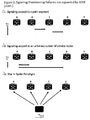
- When using a conventional RSVP-TE based signaling protocol it is impossible to realize many useful signaling patterns such as shown in
Fig. 2 , in particular: - a) end to end from egress node hop-by-hop towards ingress node;
- b) start from a transit node in either or both directions;
- c) scope signaling to a path sgment (as opposed to end-to end);
- d) scope signaling to an arbitrary subset of service nodes;
- e) star-n-spoke paradigm (used by the management plane when the service provisioning is controlled by NMS): signal separately to each service node.
- Further RSVP-TE is not able to handle control plane connectivity disruptions.
- RSVP-TE based protocols function hop-by-hop. If one of the RSVP-TE controllers along a service path has stopped working for whatever reason, the signaling flow is disrupted, and the service becomes unmanageable (albeit remains functional in the data plane). For example, a RSVP-TE based protocol provides no clean way to tear down, modify or reroute a service without straying the network resources allocated for the service, when one of the RSVP-TE controllers along the service path has crashed because of a hardware failure or a software bug. This is a serious operational problem, exacerbated even further by the lack of a mechanism to notify the management plane (and eventually the user) about control plane connectivity problems.
- Moreover RSVP-TE to is not able to signal incremental and/or sequence critical updates
- Because RSVP-TE service setup or modify message (Path message) must contain entire information about service (full control plane state), and because RSVP-TE messages could be occassionally lost even under normal - network failure free - conditions (due to unreliable IP datagram transport used by RSVP-TE), it is impossible to signal service changes in increments. Furthermore, for the same reasons and also because RSVP-TE does not mandate any order as to how the RSVP-TE objects should appear in the message, it is awkward to signal via RSVP-TE provisioning operations that require a certain sequence in which they must be performed.
- There is also a lack of message flow control in RSVP-TE.
- RSVP-TE based protocols do not have message flow control because of the IP datagram based transport used by RSVP-TE to propagate its messages along the service path. For example, the situation can arise when frequent service modifications signaled by a service ingress RSVP-TE controller overwhelms a slower neighboring transit node. Note that this problem does not exist when a protocol uses TCP based transport to distribute its messages. BGP and LDP are two popular examples of such protocol.
- In the following possible embodiments of the network using a method for dynamic provisioning are described with reference to the enclosed figures.
-
Fig. 1 illustrates the operations of a conventional RSVP-TE based signaling protocol; -
Fig. 2 illustrates signaling/provisioning patterns not supported by RSVP but in a network according to the present invention by performing a dynamic service provisioning using a hard-state point-to-point protocol. - This invention is directed to a network using a hard-state point-to-point protocol such as the PCEP protocol (RFC5440), designed by IETF for the purpose of the communication between path computation clients and servers in the context of PCE Based Architecture (RFC4655) to be used as a signaling protocol in a control place of the network and in particular for GMPLS controlled dynamic service provisioning on transport networks.
- PCEP protocol is designed to allow for a RSVP-TE controller in the role of PCC (path computation client) to outsource the path selection function for a given service to a remote Path Computation Element (path computation server) instead of performing the path computation locally. Because the service configuration parameters could serve as path computation constraints and/or optimization criterions, they need to be signaled to the PCE. Also, the resulting paths produced by the PCE must be signaled back to requester (in this case, the RSVP-TE controller) in the format of the ready to be signaled RSVP-TE Explicit Route Objects. This means that semantics and encoding of the PCEP signaling objects is similar (often identical) to the semantics and encoding of RSVP-TE signaling objects. Considering that and also the fact that PCEP is easily extendable when/if new objects are needed to be introduced, the switching to using the PCEP instead of RSVP-TE as a signaling protocol should be a relatively fast and easy process.
- PCEP is a hard state protocol based on a reliable TCP transport. It does save the expenses of a soft state protocol. In particular, the PCEP protocol state is much smaller than the RSVP-TE protocol state, it only contains service configuration information that needs to be applied to the service interfaces at the moment, rather than entire information about the service (as is in the case with the RSVP-TE protocol). Nor PCEP requires any state duplications necessary to maintain soft states (for example, such duplications are required to distinguish refreshes from service modification messages).
- In case of PCEP neither DCN bandwidth nor network element CPU time is wasted on generating, distributing and processing of protocol refreshes.
- PCEP is a point-to-point rather than hop-by-hop protocol, and as such, allows for all signaling patterns shown in
Fig. 2 , including the start-n-spoke paradigm (when a single entity, such as NMS, signals the service configuration parameters to each network element individually and in an arbitrary order). This makes possible to use PCEP not only as a signaling protocol in control plane solutions, but also as a management protocol in pure management plane and/or mixed (control and management plane) solutions. For the same reason, PCEP can cope with control plane connectivity disruptions much better than a RSVP-TE based protocol. In particular, with PCEP it is possible to signal service release, modification, reroute, etc. requests around temporarily non-responsive controllers, thus making services disrupted in control plane still manageable. - As a hard state reliable protocol PCEP does allow service (re-) configurations incrementally, with each incremental service modification being signaled in a separate message. For the same reason the sequence critical operations (e.g. per-channel power equalization performed after a WDM layer network tunnel is set up or torn down) present no problem when controlled by PCEP, because the operations could be signaled in separate messages issued and processed in a required order.
- Finally, as a TCP based protocol PCEP inherently provides a message flow control for its speakers. Specifically, if one of them issues signaling updates at a rate that a recipient of the updates is not able to process, the situation is quickly detected and the "chatty" speaker is slowed down to an acceptable rate.
Claims (10)
- A network using a hard-state point-to-point protocol as a signaling protocol during dynamic service provisioning in a control plane of said network.
- The network according to claim 1,
wherein the point-to-point protocol comprises a path computation element communication protocol (PCEP). - The network according to claim 1 or 2,
wherein said network comprises a management plane using a hard state point-to-point protocol. - The network according to claim 3,
wherein said hard-state point-to-point protocol used in the management plane comprises a path computation element communication protocol (PCEP). - The network according to one of the preceeding claims 1 to 4,
wherein service reconfigurations are performed incrementally, with each incremental service modification signaled in a separate message. - The network according to one of the preceeding claims 1 to 5,
wherein said network is a circuit-switched transport network. - The network according to one of the preceeding claims 1 to 6,
wherein said network is adapted to perform service management of services according to service provisioning signaling patterns comprising:- a one-way end to end pattern starting on a service ingress node via transit nodes to a service egress node;- a two way end to end pattern starting on a service ingress node via transit nodes to a service egress node and then back in reverse direction via the transit nodes to the service ingress node;- a one-way end to end pattern starting from a service egress node via transit nodes to a service ingress node;- a two way pattern starting from a transit node in either or both directions via transit nodes to a service ingress node and/or service egress node;- a pattern wherein signaling is scoped to a path segment;- a pattern wherein signaling is scoped to an arbitrary subset of nodes;- a star-n-spoke pattern, wherein a single entity signals service configuration parameters to each node individually and in an arbitrary order. - The network according to one of the preceeding claims 1 to 7,
wherein said hard-state point-to-point signaling protocol is adapted to signal a service release, a service modification, a service reroute and requests around temporarily non response controllers of nodes. - The network of claim 7 or 8,
wherein the entity is a NMS. - A method for dynamic service provisioning in a network,
wherein a hard-state point-to-point protocol is used as a signaling protocol during dynamic service provisioning in a control plane of said network.
Applications Claiming Priority (2)
| Application Number | Priority Date | Filing Date | Title |
|---|---|---|---|
| US201261637840P | 2012-04-24 | 2012-04-24 | |
| US13/826,142 US9391923B2 (en) | 2012-04-24 | 2013-03-14 | Using path computation element communication protocol (PCEP) as a signalling protocol during dynamic service provision in networks |
Publications (2)
| Publication Number | Publication Date |
|---|---|
| EP2658175A1 true EP2658175A1 (en) | 2013-10-30 |
| EP2658175B1 EP2658175B1 (en) | 2017-08-23 |
Family
ID=48139732
Family Applications (1)
| Application Number | Title | Priority Date | Filing Date |
|---|---|---|---|
| EP13163388.5A Active EP2658175B1 (en) | 2012-04-24 | 2013-04-11 | A network using a hard-state point-to-point protocol |
Country Status (2)
| Country | Link |
|---|---|
| US (1) | US9391923B2 (en) |
| EP (1) | EP2658175B1 (en) |
Families Citing this family (1)
| Publication number | Priority date | Publication date | Assignee | Title |
|---|---|---|---|---|
| US8942226B2 (en) * | 2012-10-05 | 2015-01-27 | Ciena Corporation | Software defined networking systems and methods via a path computation and control element |
Citations (3)
| Publication number | Priority date | Publication date | Assignee | Title |
|---|---|---|---|---|
| WO2000072550A1 (en) * | 1999-05-21 | 2000-11-30 | Telefonaktiebolaget Lm Ericsson (Publ) | Communication system and method in an ip network |
| EP2009848A1 (en) * | 2007-06-29 | 2008-12-31 | Alcatel Lucent | Computing a path in a label switched network |
| US20100232316A1 (en) * | 2006-06-27 | 2010-09-16 | Attila Takacs | Forced medium access control (mac) learning in bridged ethernet networks |
-
2013
- 2013-03-14 US US13/826,142 patent/US9391923B2/en active Active
- 2013-04-11 EP EP13163388.5A patent/EP2658175B1/en active Active
Patent Citations (3)
| Publication number | Priority date | Publication date | Assignee | Title |
|---|---|---|---|---|
| WO2000072550A1 (en) * | 1999-05-21 | 2000-11-30 | Telefonaktiebolaget Lm Ericsson (Publ) | Communication system and method in an ip network |
| US20100232316A1 (en) * | 2006-06-27 | 2010-09-16 | Attila Takacs | Forced medium access control (mac) learning in bridged ethernet networks |
| EP2009848A1 (en) * | 2007-06-29 | 2008-12-31 | Alcatel Lucent | Computing a path in a label switched network |
Also Published As
| Publication number | Publication date |
|---|---|
| EP2658175B1 (en) | 2017-08-23 |
| US20130279514A1 (en) | 2013-10-24 |
| US9391923B2 (en) | 2016-07-12 |
Similar Documents
| Publication | Publication Date | Title |
|---|---|---|
| US11750464B2 (en) | Global network state management | |
| US10187301B2 (en) | Establishing label switched paths having refresh interval independent fast reroute facility protection | |
| EP2878100B1 (en) | System, method and apparatus for signaling and responding to ero expansion failure in inter domain te lsp | |
| US10382341B2 (en) | Label switched path preemption avoidance | |
| US9148364B2 (en) | System, method and apparatus for efficient management of S-PMSI resource in RSVP P2MP multicast networks | |
| EP3507951B1 (en) | Bandwidth management in a non-blocking network fabric | |
| KR101909364B1 (en) | A method to provide elasticity in transport network virtualisation | |
| US8958332B2 (en) | Dynamic packet traffic performance adjustment systems and methods | |
| WO2019141118A1 (en) | Method, device and storage medium for creation of bi-directional segment routing tunnel | |
| US11588725B2 (en) | Method and apparatus for path computation | |
| EP2717526A1 (en) | Software defined networking systems and methods via a path computation and control element | |
| WO2013188773A1 (en) | Global state resynchronization for path computation element failure during a reoptimization process | |
| US8913490B1 (en) | Selective notification for label switched path re-routing | |
| EP2658175B1 (en) | A network using a hard-state point-to-point protocol | |
| EP3430768B1 (en) | Management of analytics tasks in a programmable network | |
| WO2017143958A1 (en) | System, method and apparatus for implementing fast reroute (frr) | |
| US10715420B2 (en) | System, method and apparatus for implementing fast reroute (FRR) | |
| Nguyen et al. | A MPLS/LDP distributed architecture for next generation routers |
Legal Events
| Date | Code | Title | Description |
|---|---|---|---|
| PUAI | Public reference made under article 153(3) epc to a published international application that has entered the european phase |
Free format text: ORIGINAL CODE: 0009012 |
|
| AK | Designated contracting states |
Kind code of ref document: A1 Designated state(s): AL AT BE BG CH CY CZ DE DK EE ES FI FR GB GR HR HU IE IS IT LI LT LU LV MC MK MT NL NO PL PT RO RS SE SI SK SM TR |
|
| AX | Request for extension of the european patent |
Extension state: BA ME |
|
| 17P | Request for examination filed |
Effective date: 20140404 |
|
| RBV | Designated contracting states (corrected) |
Designated state(s): AL AT BE BG CH CY CZ DE DK EE ES FI FR GB GR HR HU IE IS IT LI LT LU LV MC MK MT NL NO PL PT RO RS SE SI SK SM TR |
|
| STAA | Information on the status of an ep patent application or granted ep patent |
Free format text: STATUS: EXAMINATION IS IN PROGRESS |
|
| 17Q | First examination report despatched |
Effective date: 20161124 |
|
| REG | Reference to a national code |
Ref country code: DE Ref legal event code: R079 Ref document number: 602013025338 Country of ref document: DE Free format text: PREVIOUS MAIN CLASS: H04L0012240000 Ipc: H04L0012751000 |
|
| GRAP | Despatch of communication of intention to grant a patent |
Free format text: ORIGINAL CODE: EPIDOSNIGR1 |
|
| STAA | Information on the status of an ep patent application or granted ep patent |
Free format text: STATUS: GRANT OF PATENT IS INTENDED |
|
| RIC1 | Information provided on ipc code assigned before grant |
Ipc: H04L 12/721 20130101ALI20170330BHEP Ipc: H04L 12/751 20130101AFI20170330BHEP Ipc: H04L 12/24 20060101ALI20170330BHEP |
|
| INTG | Intention to grant announced |
Effective date: 20170419 |
|
| GRAS | Grant fee paid |
Free format text: ORIGINAL CODE: EPIDOSNIGR3 |
|
| GRAA | (expected) grant |
Free format text: ORIGINAL CODE: 0009210 |
|
| STAA | Information on the status of an ep patent application or granted ep patent |
Free format text: STATUS: THE PATENT HAS BEEN GRANTED |
|
| AK | Designated contracting states |
Kind code of ref document: B1 Designated state(s): AL AT BE BG CH CY CZ DE DK EE ES FI FR GB GR HR HU IE IS IT LI LT LU LV MC MK MT NL NO PL PT RO RS SE SI SK SM TR |
|
| REG | Reference to a national code |
Ref country code: GB Ref legal event code: FG4D |
|
| REG | Reference to a national code |
Ref country code: CH Ref legal event code: EP |
|
| REG | Reference to a national code |
Ref country code: AT Ref legal event code: REF Ref document number: 922416 Country of ref document: AT Kind code of ref document: T Effective date: 20170915 |
|
| REG | Reference to a national code |
Ref country code: IE Ref legal event code: FG4D |
|
| GRAT | Correction requested after decision to grant or after decision to maintain patent in amended form |
Free format text: ORIGINAL CODE: EPIDOSNCDEC |
|
| REG | Reference to a national code |
Ref country code: DE Ref legal event code: R096 Ref document number: 602013025338 Country of ref document: DE |
|
| RAP2 | Party data changed (patent owner data changed or rights of a patent transferred) |
Owner name: ADVA OPTICAL NETWORKING SE |
|
| REG | Reference to a national code |
Ref country code: NL Ref legal event code: MP Effective date: 20170823 |
|
| REG | Reference to a national code |
Ref country code: LT Ref legal event code: MG4D |
|
| REG | Reference to a national code |
Ref country code: AT Ref legal event code: MK05 Ref document number: 922416 Country of ref document: AT Kind code of ref document: T Effective date: 20170823 |
|
| PG25 | Lapsed in a contracting state [announced via postgrant information from national office to epo] |
Ref country code: NO Free format text: LAPSE BECAUSE OF FAILURE TO SUBMIT A TRANSLATION OF THE DESCRIPTION OR TO PAY THE FEE WITHIN THE PRESCRIBED TIME-LIMIT Effective date: 20171123 Ref country code: SE Free format text: LAPSE BECAUSE OF FAILURE TO SUBMIT A TRANSLATION OF THE DESCRIPTION OR TO PAY THE FEE WITHIN THE PRESCRIBED TIME-LIMIT Effective date: 20170823 Ref country code: HR Free format text: LAPSE BECAUSE OF FAILURE TO SUBMIT A TRANSLATION OF THE DESCRIPTION OR TO PAY THE FEE WITHIN THE PRESCRIBED TIME-LIMIT Effective date: 20170823 Ref country code: NL Free format text: LAPSE BECAUSE OF FAILURE TO SUBMIT A TRANSLATION OF THE DESCRIPTION OR TO PAY THE FEE WITHIN THE PRESCRIBED TIME-LIMIT Effective date: 20170823 Ref country code: LT Free format text: LAPSE BECAUSE OF FAILURE TO SUBMIT A TRANSLATION OF THE DESCRIPTION OR TO PAY THE FEE WITHIN THE PRESCRIBED TIME-LIMIT Effective date: 20170823 Ref country code: AT Free format text: LAPSE BECAUSE OF FAILURE TO SUBMIT A TRANSLATION OF THE DESCRIPTION OR TO PAY THE FEE WITHIN THE PRESCRIBED TIME-LIMIT Effective date: 20170823 Ref country code: FI Free format text: LAPSE BECAUSE OF FAILURE TO SUBMIT A TRANSLATION OF THE DESCRIPTION OR TO PAY THE FEE WITHIN THE PRESCRIBED TIME-LIMIT Effective date: 20170823 |
|
| PG25 | Lapsed in a contracting state [announced via postgrant information from national office to epo] |
Ref country code: ES Free format text: LAPSE BECAUSE OF FAILURE TO SUBMIT A TRANSLATION OF THE DESCRIPTION OR TO PAY THE FEE WITHIN THE PRESCRIBED TIME-LIMIT Effective date: 20170823 Ref country code: PL Free format text: LAPSE BECAUSE OF FAILURE TO SUBMIT A TRANSLATION OF THE DESCRIPTION OR TO PAY THE FEE WITHIN THE PRESCRIBED TIME-LIMIT Effective date: 20170823 Ref country code: LV Free format text: LAPSE BECAUSE OF FAILURE TO SUBMIT A TRANSLATION OF THE DESCRIPTION OR TO PAY THE FEE WITHIN THE PRESCRIBED TIME-LIMIT Effective date: 20170823 Ref country code: GR Free format text: LAPSE BECAUSE OF FAILURE TO SUBMIT A TRANSLATION OF THE DESCRIPTION OR TO PAY THE FEE WITHIN THE PRESCRIBED TIME-LIMIT Effective date: 20171124 Ref country code: BG Free format text: LAPSE BECAUSE OF FAILURE TO SUBMIT A TRANSLATION OF THE DESCRIPTION OR TO PAY THE FEE WITHIN THE PRESCRIBED TIME-LIMIT Effective date: 20171123 Ref country code: IS Free format text: LAPSE BECAUSE OF FAILURE TO SUBMIT A TRANSLATION OF THE DESCRIPTION OR TO PAY THE FEE WITHIN THE PRESCRIBED TIME-LIMIT Effective date: 20171223 Ref country code: RS Free format text: LAPSE BECAUSE OF FAILURE TO SUBMIT A TRANSLATION OF THE DESCRIPTION OR TO PAY THE FEE WITHIN THE PRESCRIBED TIME-LIMIT Effective date: 20170823 |
|
| PG25 | Lapsed in a contracting state [announced via postgrant information from national office to epo] |
Ref country code: DK Free format text: LAPSE BECAUSE OF FAILURE TO SUBMIT A TRANSLATION OF THE DESCRIPTION OR TO PAY THE FEE WITHIN THE PRESCRIBED TIME-LIMIT Effective date: 20170823 Ref country code: RO Free format text: LAPSE BECAUSE OF FAILURE TO SUBMIT A TRANSLATION OF THE DESCRIPTION OR TO PAY THE FEE WITHIN THE PRESCRIBED TIME-LIMIT Effective date: 20170823 Ref country code: CZ Free format text: LAPSE BECAUSE OF FAILURE TO SUBMIT A TRANSLATION OF THE DESCRIPTION OR TO PAY THE FEE WITHIN THE PRESCRIBED TIME-LIMIT Effective date: 20170823 |
|
| REG | Reference to a national code |
Ref country code: DE Ref legal event code: R097 Ref document number: 602013025338 Country of ref document: DE |
|
| PG25 | Lapsed in a contracting state [announced via postgrant information from national office to epo] |
Ref country code: EE Free format text: LAPSE BECAUSE OF FAILURE TO SUBMIT A TRANSLATION OF THE DESCRIPTION OR TO PAY THE FEE WITHIN THE PRESCRIBED TIME-LIMIT Effective date: 20170823 Ref country code: SM Free format text: LAPSE BECAUSE OF FAILURE TO SUBMIT A TRANSLATION OF THE DESCRIPTION OR TO PAY THE FEE WITHIN THE PRESCRIBED TIME-LIMIT Effective date: 20170823 Ref country code: IT Free format text: LAPSE BECAUSE OF FAILURE TO SUBMIT A TRANSLATION OF THE DESCRIPTION OR TO PAY THE FEE WITHIN THE PRESCRIBED TIME-LIMIT Effective date: 20170823 Ref country code: SK Free format text: LAPSE BECAUSE OF FAILURE TO SUBMIT A TRANSLATION OF THE DESCRIPTION OR TO PAY THE FEE WITHIN THE PRESCRIBED TIME-LIMIT Effective date: 20170823 |
|
| PLBE | No opposition filed within time limit |
Free format text: ORIGINAL CODE: 0009261 |
|
| STAA | Information on the status of an ep patent application or granted ep patent |
Free format text: STATUS: NO OPPOSITION FILED WITHIN TIME LIMIT |
|
| 26N | No opposition filed |
Effective date: 20180524 |
|
| PG25 | Lapsed in a contracting state [announced via postgrant information from national office to epo] |
Ref country code: SI Free format text: LAPSE BECAUSE OF FAILURE TO SUBMIT A TRANSLATION OF THE DESCRIPTION OR TO PAY THE FEE WITHIN THE PRESCRIBED TIME-LIMIT Effective date: 20170823 |
|
| PG25 | Lapsed in a contracting state [announced via postgrant information from national office to epo] |
Ref country code: MC Free format text: LAPSE BECAUSE OF FAILURE TO SUBMIT A TRANSLATION OF THE DESCRIPTION OR TO PAY THE FEE WITHIN THE PRESCRIBED TIME-LIMIT Effective date: 20170823 |
|
| REG | Reference to a national code |
Ref country code: CH Ref legal event code: PL |
|
| REG | Reference to a national code |
Ref country code: BE Ref legal event code: MM Effective date: 20180430 |
|
| REG | Reference to a national code |
Ref country code: IE Ref legal event code: MM4A |
|
| PG25 | Lapsed in a contracting state [announced via postgrant information from national office to epo] |
Ref country code: LU Free format text: LAPSE BECAUSE OF NON-PAYMENT OF DUE FEES Effective date: 20180411 |
|
| PG25 | Lapsed in a contracting state [announced via postgrant information from national office to epo] |
Ref country code: BE Free format text: LAPSE BECAUSE OF NON-PAYMENT OF DUE FEES Effective date: 20180430 Ref country code: CH Free format text: LAPSE BECAUSE OF NON-PAYMENT OF DUE FEES Effective date: 20180430 Ref country code: LI Free format text: LAPSE BECAUSE OF NON-PAYMENT OF DUE FEES Effective date: 20180430 |
|
| PG25 | Lapsed in a contracting state [announced via postgrant information from national office to epo] |
Ref country code: IE Free format text: LAPSE BECAUSE OF NON-PAYMENT OF DUE FEES Effective date: 20180411 Ref country code: FR Free format text: LAPSE BECAUSE OF NON-PAYMENT OF DUE FEES Effective date: 20180430 |
|
| PG25 | Lapsed in a contracting state [announced via postgrant information from national office to epo] |
Ref country code: MT Free format text: LAPSE BECAUSE OF NON-PAYMENT OF DUE FEES Effective date: 20180411 |
|
| PG25 | Lapsed in a contracting state [announced via postgrant information from national office to epo] |
Ref country code: TR Free format text: LAPSE BECAUSE OF FAILURE TO SUBMIT A TRANSLATION OF THE DESCRIPTION OR TO PAY THE FEE WITHIN THE PRESCRIBED TIME-LIMIT Effective date: 20170823 |
|
| PG25 | Lapsed in a contracting state [announced via postgrant information from national office to epo] |
Ref country code: HU Free format text: LAPSE BECAUSE OF FAILURE TO SUBMIT A TRANSLATION OF THE DESCRIPTION OR TO PAY THE FEE WITHIN THE PRESCRIBED TIME-LIMIT; INVALID AB INITIO Effective date: 20130411 Ref country code: PT Free format text: LAPSE BECAUSE OF FAILURE TO SUBMIT A TRANSLATION OF THE DESCRIPTION OR TO PAY THE FEE WITHIN THE PRESCRIBED TIME-LIMIT Effective date: 20170823 |
|
| PG25 | Lapsed in a contracting state [announced via postgrant information from national office to epo] |
Ref country code: CY Free format text: LAPSE BECAUSE OF FAILURE TO SUBMIT A TRANSLATION OF THE DESCRIPTION OR TO PAY THE FEE WITHIN THE PRESCRIBED TIME-LIMIT Effective date: 20170823 Ref country code: MK Free format text: LAPSE BECAUSE OF NON-PAYMENT OF DUE FEES Effective date: 20170823 |
|
| PG25 | Lapsed in a contracting state [announced via postgrant information from national office to epo] |
Ref country code: AL Free format text: LAPSE BECAUSE OF FAILURE TO SUBMIT A TRANSLATION OF THE DESCRIPTION OR TO PAY THE FEE WITHIN THE PRESCRIBED TIME-LIMIT Effective date: 20170823 |
|
| REG | Reference to a national code |
Ref country code: DE Ref legal event code: R079 Ref document number: 602013025338 Country of ref document: DE Free format text: PREVIOUS MAIN CLASS: H04L0012751000 Ipc: H04L0045020000 |
|
| P01 | Opt-out of the competence of the unified patent court (upc) registered |
Effective date: 20230630 |
|
| REG | Reference to a national code |
Ref country code: DE Ref legal event code: R081 Ref document number: 602013025338 Country of ref document: DE Owner name: ADTRAN NETWORKS SE, DE Free format text: FORMER OWNER: ADVA OPTICAL NETWORKING SE, 98617 MEININGEN, DE |
|
| PGFP | Annual fee paid to national office [announced via postgrant information from national office to epo] |
Ref country code: GB Payment date: 20260324 Year of fee payment: 14 |
|
| PGFP | Annual fee paid to national office [announced via postgrant information from national office to epo] |
Ref country code: DE Payment date: 20260420 Year of fee payment: 14 |