EP2657878A2 - Connecting a device to a wireless access point - Google Patents
Connecting a device to a wireless access point Download PDFInfo
- Publication number
- EP2657878A2 EP2657878A2 EP13164331.4A EP13164331A EP2657878A2 EP 2657878 A2 EP2657878 A2 EP 2657878A2 EP 13164331 A EP13164331 A EP 13164331A EP 2657878 A2 EP2657878 A2 EP 2657878A2
- Authority
- EP
- European Patent Office
- Prior art keywords
- coded information
- security key
- access point
- wireless access
- connect
- Prior art date
- Legal status (The legal status is an assumption and is not a legal conclusion. Google has not performed a legal analysis and makes no representation as to the accuracy of the status listed.)
- Ceased
Links
Images


Classifications
-
- G—PHYSICS
- G06—COMPUTING OR CALCULATING; COUNTING
- G06F—ELECTRIC DIGITAL DATA PROCESSING
- G06F21/00—Security arrangements for protecting computers, components thereof, programs or data against unauthorised activity
- G06F21/30—Authentication, i.e. establishing the identity or authorisation of security principals
- G06F21/31—User authentication
- G06F21/36—User authentication by graphic or iconic representation
-
- G—PHYSICS
- G06—COMPUTING OR CALCULATING; COUNTING
- G06F—ELECTRIC DIGITAL DATA PROCESSING
- G06F21/00—Security arrangements for protecting computers, components thereof, programs or data against unauthorised activity
- G06F21/30—Authentication, i.e. establishing the identity or authorisation of security principals
- G06F21/44—Program or device authentication
-
- H—ELECTRICITY
- H04—ELECTRIC COMMUNICATION TECHNIQUE
- H04W—WIRELESS COMMUNICATION NETWORKS
- H04W12/00—Security arrangements; Authentication; Protecting privacy or anonymity
- H04W12/04—Key management, e.g. using generic bootstrapping architecture [GBA]
-
- H—ELECTRICITY
- H04—ELECTRIC COMMUNICATION TECHNIQUE
- H04W—WIRELESS COMMUNICATION NETWORKS
- H04W12/00—Security arrangements; Authentication; Protecting privacy or anonymity
- H04W12/50—Secure pairing of devices
-
- G—PHYSICS
- G06—COMPUTING OR CALCULATING; COUNTING
- G06F—ELECTRIC DIGITAL DATA PROCESSING
- G06F2221/00—Indexing scheme relating to security arrangements for protecting computers, components thereof, programs or data against unauthorised activity
- G06F2221/21—Indexing scheme relating to G06F21/00 and subgroups addressing additional information or applications relating to security arrangements for protecting computers, components thereof, programs or data against unauthorised activity
- G06F2221/2129—Authenticate client device independently of the user
-
- H—ELECTRICITY
- H04—ELECTRIC COMMUNICATION TECHNIQUE
- H04W—WIRELESS COMMUNICATION NETWORKS
- H04W12/00—Security arrangements; Authentication; Protecting privacy or anonymity
- H04W12/08—Access security
-
- H—ELECTRICITY
- H04—ELECTRIC COMMUNICATION TECHNIQUE
- H04W—WIRELESS COMMUNICATION NETWORKS
- H04W12/00—Security arrangements; Authentication; Protecting privacy or anonymity
- H04W12/60—Context-dependent security
- H04W12/69—Identity-dependent
- H04W12/77—Graphical identity
-
- H—ELECTRICITY
- H04—ELECTRIC COMMUNICATION TECHNIQUE
- H04W—WIRELESS COMMUNICATION NETWORKS
- H04W84/00—Network topologies
- H04W84/02—Hierarchically pre-organised networks, e.g. paging networks, cellular networks, WLAN [Wireless Local Area Network] or WLL [Wireless Local Loop]
- H04W84/10—Small scale networks; Flat hierarchical networks
- H04W84/12—WLAN [Wireless Local Area Networks]
Definitions
- an electronic device e.g., a mobile device
- a wireless access point WAP
- the WAP may be password protected.
- the device attempting to connect to the WAP may have to supply a valid security key to connect to the WAP.
- a user utilizes the device attempting to connect to the WAP to scan for available WAPs in the vicinity and selects a particular WAP to connect to. The device may then prompt the user to enter the security key for that WAP. If the user enters the correct security key, the device may then connect to the WAP to attain access to the corresponding network.
- USB Universal Serial Bus
- WPA Wi-Fi Protected Access
- a method to connect a device wirelessly to a network a method of coding information including a security key for connecting a device to a wireless access point, a corresponding apparatus and a corresponding non-transitory computer-readable medium as specified in the independent claims are provided.
- Embodiments are given in the dependent claims. If not explicitly stated otherwise, the features of different embodiments can be freely combined with each other.
- the term 'capturing' information e.g. a code, as used herein relates to any kind of automatically receiving said information by a device.
- the capturing may comprise taking an image by an optical sensor (e.g. a camera), recording a sound or a noise by an acoustic sensor (e.g. a microphone) or the like.
- the capturing of the information may be executed passively by a sensor merely receiving some form of signal or may include the stimulation of an emission of a signal comprising the information.
- the capturing device may illuminate the medium comprising the information for enabling its camera to capture the reflected light.
- the expression 'coded information' as used herein encompasses any kind of data comprising, in encoded form, some information which needs to be protected from unauthorized access. Said information may be a security key.
- the expression 'security key' as used herein relates to data which enables a device to connect to a wireless access point, wherein any device not being in the possession of said security key is prohibited from accessing the wireless access point and thus is prohibited from accessing the network.
- the expression 'wireless access point' (WAP) as used herein relates to a device that allows wireless devices to connect to a wired network using e.g. Wi-Fi, or related standards.
- the WAP may e.g. connect to a router (via a wired network) if it's a standalone device, or may be part of a router itself.
- a WAP may be, for example, Linksys "WAP54G" 802.11g Wireless Access Point.
- the invention relates to a computer-implemented method to connect a device wirelessly to a network.
- the method comprises:
- Said features may be advantageous as highly complex (and therefore secure) secret keys can be used and can easily be entered into the device without using a security token or a USB-stick (which might be considered as a security risk due to the danger of malware infecting a system upon connection of the USB stick).
- a security token or a USB-stick which might be considered as a security risk due to the danger of malware infecting a system upon connection of the USB stick.
- the installation and configuration of a wireless network is greatly facilitated and may be executed fully automatically once a user has captured the coded information via an appropriate sensor of the device.
- the coded information is captured, the secret key is decoded and used for connecting the device to the WAP in a fully automated manner. This increases the speed of connecting to the network compared to the manual entry of the secret key and is also more secure as the user does not have to memorize the secret key which may therefore be long and complex.
- the coded information is a QR code.
- the coded information is captured from a display of an electronic device. Said feature may be advantageous as the coded information may vary over time and may be used for different purposes and corresponding application programs.
- the electronic device includes the wireless access point.
- a smart phone may comprise a WAP for connecting to a mobile phone network.
- the smart phone may in addition comprise a camera for capturing the coded information from a printout or a screen of another device.
- the coded information is an image and the coded information is captured from a configuration sheet.
- the coded information is data hiding and encoding the secret key by means of a steganographic algorithm.
- the coded information may be a steganographic image comprising the secret key as a "hidden” watermark. Said features may be advantageous as the mere existence of a secret code or a "secret” is hidden from prying eyes, thereby further increasing the security of the method.
- the wireless access point is secured by one of Wi-Fi Protected Access, Wi-Fi Protected Access II, and Wired Equivalent Privacy. Access to the WAP is only granted to devices which are operable to authenticate themselves via the secret key.
- the coded information includes an identifier identifying the wireless access point. Said feature may be advantageous as once the device has captured the coded information comprising the secret key and the identifier of the WAP, the device may connect to the identified WAP in a fully automated manner. Thus, the time and effort necessary for setting up a network, e.g. a WLAN network at home, may be reduced significantly.
- the invention relates to a computer-implemented method comprising:
- the coded information is generated by taking the secret key as input in the form of plain text, whereby the coded information, e.g. an image, an audio clip or a video, comprises the secret key in a non-human-readable form.
- the coded information is created by applying a steganographic algorithm on the secret key and optionally some additional data, e.g. an image wherein the secret key shall be hidden. Said features may provide for a particularly secure way of providing an access key to a device for enabling the device to connect to a WAP: even in case an unauthorized person should get in possession of the coding information, he or she will not be able to extract or memorize the secret key. Only in case said unauthorized person would be in possession of the coding information and of a device running the corresponding decoding algorithm, said person would be able to connect said device to the WAP.
- the invention relates to an apparatus comprising:
- the coded information is a QR code.
- the coded information is captured from a display of an electronic device.
- the electronic device includes the wireless access point.
- the wireless access point is secured by one of Wi-Fi Protected Access, Wi-Fi Protected Access II, and Wired Equivalent Privacy.
- the coded information includes an identifier identifying the wireless access point.
- the invention relates to an apparatus comprising:
- the invention relates to a non-transitory computer-readable medium embodied with computer-executable instructions for causing a computer to execute instructions, the computer instructions comprising:
- the coded information is a QR code.
- the coded information is captured from a display of an electronic device.
- the electronic device includes the wireless access point.
- the coded information includes an identifier identifying the wireless access point.
- Embodiments may be discussed in systems to efficiently connect to wireless access point(s).
- An electronic device may capture coded information.
- the coded information may include a security key to connect to a wireless access point, and the coded information may be an image, an audio clip, or a video.
- the coded information may be a Quick Response Code.
- the coded information may be captured from a display of a second electronic device.
- the second electronic device may include the wireless access point.
- the coded information may be an image and the coded information may be captured from a configuration sheet.
- the wireless access point may be secured by one of Wi-Fi Protected Access, Wi-Fi Protected Access II, and Wired Equivalent Privacy.
- the coded information may include an identifier identifying the wireless access point.
- an electronic device may code information including a security key.
- the security key may be required to connect to a wireless access point and the coded information may be an image, an audio clip, or a video.
- the electronic device may display the coded information on a display of the electronic device.
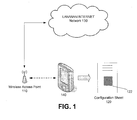
- FIG. 1 illustrates a device connected to a WAP according to an embodiment.
- a wireless access point (WAP) 110 may be connected to a network 130 such as a wide area network (WAN), a local area network (LAN), or the Internet.
- a device 140 may connect to the WAP 110 to access the network 130.
- the WAP 110 may include built-in security to only allow authorized devices to connect to the WAP 110.
- a security key or password
- the device 140 may acquire the security key required to connect to the WAP 110 from a configuration sheet 120. After acquiring the security key from the configuration sheet 120, the device 140 may supply the security key to the WAP 110 in order to gain access to the network 130.
- the device 140 may acquire the security key required to connect to the WAP 110 by capturing one or more images 122 from the configuration sheet 120.
- the image 122 may encode the security key based on a predetermined protocol.
- the protocol may be a standardized protocol.
- image 122 may be a Quick Response Code (QR Code), which is a type of matrix bar code with a large storage capacity.
- QR Code Quick Response Code
- a standard QR Code can encode up to 7,089 characters of numeric data, up to 4,296 alphanumeric characters of data, or up to 2,953 8-bit bytes of data.
- the device 140 may include component(s) to capture and decode the coded information (i.e., the security key) in image 122.
- the captured coded information may be transferred to a component which decodes the coded information to obtain the security key.
- the component capturing the coded information and the component decoding the coded information may be a single component.
- the component(s) capturing/decoding the coded information may include hardware, software, or a combination of both hardware and software.
- device 140 may be a mobile phone. The mobile phone 140 may capture image 122 via a built-in camera. An application installed in mobile phone 140 may then retrieve the coded information from the captured image 122 and decode the coded information to obtain the security key required for connecting to WAP 110.
- WAP 110 may initially be protected by a default security key selected by the manufacturer or seller of the WAP 110.
- the format of the default security key may depend on the security protocols available on WAP 110.
- the WAP 110 may employ Wi-Fi Protected Access II (WPA2) as the security protocol. Since a WPA2 security key may be long and hard to remember, the manufacturer may include a configuration sheet 120 to provide convenient and secure access to WAP 110.
- the configuration sheet 120 may include an image 122, which is a coded representation of the initial default security key.
- the configuration sheet 120 may include a QR Code representing the security key.
- the image 122 may be printed on the WAP 110 itself.
- the user of WAP 110 may scan/capture the QR Code 122 using a device 140 such as a mobile phone. Device 140 may decode QR Code 122 to obtain the security key and connect to WAP 110.
- access to WAP 110 may be a service that a seller desires to selectively provide to paying customers.
- access to WAP 110 may be a service that a seller desires to provide to customers who purchase another product.
- the coffee shop may want to selectively limit the Internet access to customers who purchase a product, such as a coffee, from the coffee shop.
- the coffee shop may do so by password protecting the WAP 110 of the coffee shop, and providing the password through an image 122, such as a QR Code, printed on the receipt (a type of configuration sheet 120) of each coffee purchase.
- the QR Code 122 may be printed on any material bundled with the coffee including the coffee cup, the coffee cup insulator, etc.
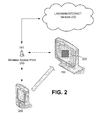
- FIG. 2 illustrates a device connected to a WAP according to an embodiment.
- a WAP 210 may be connected to a network 230 such as a WAN, LAN, or the Internet.
- a first device 240 may connect to the WAP 210 to access the network 230.
- the WAP 210 may include built-in security to only allow authorized devices to connect to the WAP 210.
- a security key (or password) may be required to connect to the WAP 210.
- a second device 250 may have access to the security key needed to connect to WAP 210.
- the first device 240 may acquire the security key required to connect to the WAP 210 from the second device 250. After acquiring the security key from the second device 250, the first device 240 may supply the security key to the WAP 210 in order to gain access to the network 230.
- the first device 240 may capture coded information 222 from the second device 250, and decode the coded information 222 to obtain the security key required to connect to the WAP 210.
- the coded information 222 may be an image(s), audio, and/or video.
- the coded information 222 may convey the security key based on a predetermined protocol.
- the protocol may be a standardized protocol.
- coded information 222 may be a QR Code.
- the protocol is supported and used by an apparatus which creates the coded information comprising the security key. Said protocol is also supported and used by the apparatus decoding the coded information for extracting the security key.
- the first device 240 may include component(s) to capture and decode the coded information 222 (i.e., the security key).
- the component(s) may vary based on the coded information 222.
- the coded information 222 may be an image such as a QR Code displayed on, for example, a monitor of the second device 250.
- the first device 240 may capture image 222 via a built-in camera.
- An application installed in mobile phone 240 may then retrieve the coded information from the captured image 222 and decode the coded information to obtain the security key required for connecting to WAP 210.
- the coded information 222 may be an audio clip which may be played, for example, through audio speakers of the second device 250.
- the first device 240 may capture the audio 222 via a built-in microphone. The first device 240 may then retrieve the coded information from the captured audio 222 and decode the coded information to obtain the security key.
- the coded information 222 may be a video which may be displayed, for example, on a monitor of second device 250.
- the first device 240 may capture the video 222 via a built-in video camera. The first device 240 may then retrieve the coded information from the captured video 222 and decode the coded information to obtain the security key.
- the second device 250 may be connected to the WAP 210 via a wireline or wireless connection.
- the settings of WAP 210 may be configured through the second device 250.
- the security key required to connect to WAP 210 may be changed using the second device 250.
- the second device 250 may automatically generate coded information 222 representing the current security key to WAP 210 when the security key of WAP 210 is changed.
- the second device may display (if the coded information is an image or video) or play (if the coded information is audio) the coded information.
- an application running on device 250 may display/play the coded information 222 when a user interacts with the application and indicates that he/she requires the coded information 222.
- the second device 250 may require authentication to display/play the coded information 222.
- the WAP 210 and the second device 250 may be integrated as shown in FIG. 4 (the device with a WAP 410).
- the device with WAP 410 may be a mobile phone with tethering capabilities.
- Device 440 may connect to the device with WAP 410 to access the network 430.
- the device with WAP 410 may include built-in security to only allow authorized devices to connect to the device with WAP 410.
- the device 440 may acquire the security key required to connect to the device with WAP 410 from the device with WAP 410 itself. This may be accomplished through coded information 422, which the device 440 may decode to obtain the security key.
- the device 440 may then supply the security key to the device with WAP 410 in order to gain access to the network 230.
- the details of capturing the coded information 422, decoding the information, and connecting to the WAP of device 410 have been previously explained in the discussion pertaining to FIG. 2 .
- FIG. 3 is a flow diagram illustrating a process for connecting to a WAP according to an embodiment.
- a device such as a mobile phone, may capture coded information which includes a security key to connect to a particular WAP (box 302). As explained with respect to FIGs. 1 and 2 , there are different sources from which the coded information may be captured (for example, from a configuration sheet or another device). The coded information may be decoded by the device to obtain the security key required for connecting to the particular WAP (box 304). The device may scan for available WAPs visible to the device (box 306). Once the particular WAP to connect to is identified, the device may connect to the particular WAP (box 308).
- the coded information may further include an identifier indicating the particular WAP so that the user does not have to manually enter (or remember) the name of the WAP. Therefore, the device connecting to the WAP may automatically do so without much manual intervention (i.e., the user may not have to indicate to the device which WAP he/she is trying to connect to). Thus, in an embodiment, step 306 may be skipped. Including the identifier indicating the particular WAP may also be useful in instances where the particular WAP is hidden. Specifically, a hidden WAP cannot be seen by scanning for all available WAPs in the vicinity, but rather the device needs to know the exact identifier of the WAP, such as the name of the WAP, in order to connect to it.
- some of the steps in FIG. 3 may be manually initiated by a user.
- the device may display the decoded security key to the user, and the user may have to copy and paste the decoded security key to another application in the device which interfaces with the WAP.
- the user may have to initiate scanning for WAPs on the device to identify the available WAPs and pick the particular WAP which the user wants the device to connect to.
- the steps shown in FIG. 3 may be performed in a different order and/or some steps may be performed in parallel.
- decoding the coded information to obtain the security key (box 304) may be performed in parallel with scanning for available WAPs (box 306).
- scanning for available WAPs (box 306) may be performed prior to capturing the coded information (box 302).
- WAPs may incorporate any type of wireless security protocol including Wi-Fi Protected Access (WPA), Wi-Fi Protected Access II (WPA2), and Wired Equivalent Privacy (WEP).
- WPA Wi-Fi Protected Access
- WPA2 Wi-Fi Protected Access II
- WEP Wired Equivalent Privacy
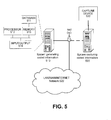
- FIG. 5 shows an exemplary architecture in an embodiment of the invention.
- the system generating coded information 510 may be coupled to a network 520 and to WAP 550.
- the system generating coded information 510 may include a desktop computer, laptop computer, tablet PC, client computer, mobile phone, central computer in a vehicle, and any other computer.
- a system capturing coded information 530 may include a capture device 532 to capture the coded information.
- the capture device 532 may include a still camera, a video camera, a barcode scanner, and/or a microphone.
- the system capturing coded information 530 may include hardware and/or software to capture and/or decode coded information.
- Each of the systems 510, 530 in FIG. 5 may include a processing device 512, memory 513, a database 511, and an input/output interface 514, all of which may be interconnected via a system bus.
- the output interface 514 may include a computer monitor, a tablet PC screen, a mobile phone screen, and any other displays.
- each of the systems 510, 530 may have an architecture with modular hardware and/or software systems that include additional and/or different systems communicating through one or more networks.
- the modular design may enable a business to add, exchange, and upgrade systems, including using systems from different vendors in some embodiments. Because of the highly customized nature of these systems, different embodiments may have different types, quantities, and configurations of systems depending on the environment and organizational demands.
- memory 513 may contain different components for retrieving, presenting, changing, and saving data.
- Memory 513 may include a variety of memory devices, for example, Dynamic Random Access Memory (DRAM), Static RAM (SRAM), flash memory, cache memory, and other memory devices. Additionally, for example, memory 513 and processing device(s) 512 may be distributed across several different computers that collectively comprise a system.
- DRAM Dynamic Random Access Memory
- SRAM Static RAM
- flash memory cache memory
- processing device(s) 512 may be distributed across several different computers that collectively comprise a system.
- Database 511 may include any type of data storage adapted to searching and retrieval.
- the database 511 may include SAP database (SAP DB), Informix, Oracle, DB2, Sybase, and other such database systems.
- Processing device 512 may perform computation and control functions of a system and comprises a suitable central processing unit (CPU).
- Processing device 512 may comprise a single integrated circuit, such as a microprocessing device, or may comprise any suitable number of integrated circuit devices and/or circuit boards working in cooperation to accomplish the functions of a processing device.
- Processing device 512 may execute computer programs, such as object-oriented computer programs, within memory 513.
- FIGs. 1-5 devices are illustrated as smart phones and desktop computers for discussion purposes, but a person having ordinary skill in the art will appreciate that the principles of the present invention are not so limited. Embodiments of the present invention find application with devices including personal computers (both desktop and laptop computers), tablet computers, handheld computing devices, computer servers, media players, e-book readers, and/or dedicated video conferencing equipment.
Landscapes
- Engineering & Computer Science (AREA)
- Computer Security & Cryptography (AREA)
- Theoretical Computer Science (AREA)
- Computer Hardware Design (AREA)
- Software Systems (AREA)
- Physics & Mathematics (AREA)
- General Engineering & Computer Science (AREA)
- General Physics & Mathematics (AREA)
- Computer Networks & Wireless Communication (AREA)
- Signal Processing (AREA)
- Mobile Radio Communication Systems (AREA)
- Telephone Function (AREA)
Abstract
- capturing (302) coded information, wherein the coded information includes a security key to connect to a wireless access point (110, 210, 410, 550), and the coded information is one of an image (122, 222, 422), an audio clip, and a video;
- decoding (304) the coded information to obtain the security key; and
connecting (308) the device to the wireless access point by means of the security key.
Description
- Using an electronic device (e.g., a mobile device) to wirelessly access a network such as the Internet usually entails connecting the device to a wireless access point (WAP) which is in turn connected to the network. To prevent unauthorized devices from connecting to the WAP, the WAP may be password protected. Specifically, the device attempting to connect to the WAP may have to supply a valid security key to connect to the WAP. Traditionally, a user utilizes the device attempting to connect to the WAP to scan for available WAPs in the vicinity and selects a particular WAP to connect to. The device may then prompt the user to enter the security key for that WAP. If the user enters the correct security key, the device may then connect to the WAP to attain access to the corresponding network.
- This traditional approach is problematic since the user has to either 1) type in the security key manually, or 2) copy the key onto an Universal Serial Bus (USB) drive and plug the USB drive into a USB port of the device attempting to connect to the WAP. Given that current security protocols such as Wi-Fi Protected Access (WPA) require long security keys, typing in the security key manually is cumbersome and error prone. Using an USB drive can be problematic since the device may not have a USB port and/or users may not have easy access to a USB drive.
- A method to connect a device wirelessly to a network, a method of coding information including a security key for connecting a device to a wireless access point, a corresponding apparatus and a corresponding non-transitory computer-readable medium as specified in the independent claims are provided. Embodiments are given in the dependent claims. If not explicitly stated otherwise, the features of different embodiments can be freely combined with each other.
- The term 'capturing' information, e.g. a code, as used herein relates to any kind of automatically receiving said information by a device. Depending on the medium comprising the information, the capturing may comprise taking an image by an optical sensor (e.g. a camera), recording a sound or a noise by an acoustic sensor (e.g. a microphone) or the like. The capturing of the information may be executed passively by a sensor merely receiving some form of signal or may include the stimulation of an emission of a signal comprising the information. For example, the capturing device may illuminate the medium comprising the information for enabling its camera to capture the reflected light.
- The expression 'coded information' as used herein encompasses any kind of data comprising, in encoded form, some information which needs to be protected from unauthorized access. Said information may be a security key.
- The expression 'security key' as used herein relates to data which enables a device to connect to a wireless access point, wherein any device not being in the possession of said security key is prohibited from accessing the wireless access point and thus is prohibited from accessing the network.
- The expression 'wireless access point' (WAP) as used herein relates to a device that allows wireless devices to connect to a wired network using e.g. Wi-Fi, or related standards. The WAP may e.g. connect to a router (via a wired network) if it's a standalone device, or may be part of a router itself. A WAP may be, for example, Linksys "WAP54G" 802.11g Wireless Access Point.
- In one aspect, the invention relates to a computer-implemented method to connect a device wirelessly to a network. The method comprises:
- capturing coded information, wherein the coded information includes a security key, the security key being required to connect the device to a wireless access point, and the coded information is one of an image, an audio clip, and a video;
- decoding the coded information to obtain the security key; and
- connecting the device to the wireless access point by means of the security key.
- Said features may be advantageous as highly complex (and therefore secure) secret keys can be used and can easily be entered into the device without using a security token or a USB-stick (which might be considered as a security risk due to the danger of malware infecting a system upon connection of the USB stick). Thus, the mental burden of a user interacting with the device for connecting the device to the network is reduced and the security is increased as longer secret keys can be used.
- In a further advantageous aspect, the installation and configuration of a wireless network is greatly facilitated and may be executed fully automatically once a user has captured the coded information via an appropriate sensor of the device.
- According to embodiments the coded information is captured, the secret key is decoded and used for connecting the device to the WAP in a fully automated manner. This increases the speed of connecting to the network compared to the manual entry of the secret key and is also more secure as the user does not have to memorize the secret key which may therefore be long and complex.
- According to embodiments the coded information is a QR code.
- According to embodiments the coded information is captured from a display of an electronic device. Said feature may be advantageous as the coded information may vary over time and may be used for different purposes and corresponding application programs.
- According to embodiments the electronic device includes the wireless access point. For example, a smart phone may comprise a WAP for connecting to a mobile phone network. The smart phone may in addition comprise a camera for capturing the coded information from a printout or a screen of another device.
- According to embodiments the coded information is an image and the coded information is captured from a configuration sheet.
- According to embodiments, the coded information is data hiding and encoding the secret key by means of a steganographic algorithm. For example, the coded information may be a steganographic image comprising the secret key as a "hidden" watermark. Said features may be advantageous as the mere existence of a secret code or a "secret" is hidden from prying eyes, thereby further increasing the security of the method.
- According to embodiments the wireless access point is secured by one of Wi-Fi Protected Access, Wi-Fi Protected Access II, and Wired Equivalent Privacy. Access to the WAP is only granted to devices which are operable to authenticate themselves via the secret key.
- According to embodiments the coded information includes an identifier identifying the wireless access point. Said feature may be advantageous as once the device has captured the coded information comprising the secret key and the identifier of the WAP, the device may connect to the identified WAP in a fully automated manner. Thus, the time and effort necessary for setting up a network, e.g. a WLAN network at home, may be reduced significantly.
- In a further aspect, the invention relates to a computer-implemented method comprising:
- coding information including a security key, wherein the security key is required to connect to a wireless access point and the coded information is one of an image, an audio clip, and a video; and
- at least one of a) displaying the coded information on a display of an electronic device and b) playing the coded information via at least an audio speaker of the electronic device.
- According to embodiments, the coded information is generated by taking the secret key as input in the form of plain text, whereby the coded information, e.g. an image, an audio clip or a video, comprises the secret key in a non-human-readable form. According to some embodiments, the coded information is created by applying a steganographic algorithm on the secret key and optionally some additional data, e.g. an image wherein the secret key shall be hidden. Said features may provide for a particularly secure way of providing an access key to a device for enabling the device to connect to a WAP: even in case an unauthorized person should get in possession of the coding information, he or she will not be able to extract or memorize the secret key. Only in case said unauthorized person would be in possession of the coding information and of a device running the corresponding decoding algorithm, said person would be able to connect said device to the WAP.
- In a further aspect, the invention relates to an apparatus comprising:
- at least one of a camera and a microphone to capture coded information, wherein the coded information includes a security key to connect to a wireless access point, and the coded information is one of an image, an audio clip, and a video;
- a processor for executing computer instructions, the processor configured to decode the coded information to obtain the security key, and connect to the wireless access point by means of the security key.
- According to embodiments the coded information is a QR code.
- According to embodiments the coded information is captured from a display of an electronic device.
- According to embodiments the electronic device includes the wireless access point.
- According to embodiments the wireless access point is secured by one of Wi-Fi Protected Access, Wi-Fi Protected Access II, and Wired Equivalent Privacy.
- According to embodiments the coded information includes an identifier identifying the wireless access point.
- In a further aspect, the invention relates to an apparatus comprising:
- a processor for executing computer instructions, the processor configured to code information including a security key, wherein the security key is required to connect to a wireless access point and the coded information is one of an image, an audio clip, and a video; and
- at least one of a) a display to display the coded information and b) at least an audio speaker to play the coded information.
- In a further aspect, the invention relates to a non-transitory computer-readable medium embodied with computer-executable instructions for causing a computer to execute instructions, the computer instructions comprising:
- capturing coded information, wherein the coded information includes a security key to connect to a wireless access point, and the coded information is one of an image, an audio clip, and a video;
- decoding the coded information to obtain the security key; and
- connecting a device to the wireless access point.
- According to embodiments the coded information is a QR code.
- According to embodiments the coded information is captured from a display of an electronic device.
- According to embodiments the electronic device includes the wireless access point.
- According to embodiments the coded information includes an identifier identifying the wireless access point.
-
- FIG. 1
- illustrates a device connected to a WAP according to an embodiment.
- FIG. 2
- illustrates a device connected to a WAP according to an embodiment.
- FIG. 3
- is a flow diagram illustrating a process for connecting to a WAP according to an embodiment.
- FIG. 4
- illustrates a device connected to a WAP according to an embodiment.
- FIG. 5
- shows an exemplary architecture in an embodiment.
- Embodiments may be discussed in systems to efficiently connect to wireless access point(s). An electronic device may capture coded information. The coded information may include a security key to connect to a wireless access point, and the coded information may be an image, an audio clip, or a video. In an embodiment, the coded information may be a Quick Response Code. In an embodiment, the coded information may be captured from a display of a second electronic device. In an embodiment, the second electronic device may include the wireless access point. In an embodiment, the coded information may be an image and the coded information may be captured from a configuration sheet. In an embodiment, the wireless access point may be secured by one of Wi-Fi Protected Access, Wi-Fi Protected Access II, and Wired Equivalent Privacy. In an embodiment, the coded information may include an identifier identifying the wireless access point.
- In an embodiment, an electronic device may code information including a security key. The security key may be required to connect to a wireless access point and the coded information may be an image, an audio clip, or a video. The electronic device may display the coded information on a display of the electronic device.
-
FIG. 1 illustrates a device connected to a WAP according to an embodiment. A wireless access point (WAP) 110 may be connected to a network 130 such as a wide area network (WAN), a local area network (LAN), or the Internet. Adevice 140 may connect to theWAP 110 to access the network 130. Typically, theWAP 110 may include built-in security to only allow authorized devices to connect to theWAP 110. For example, a security key (or password) may be required to connect to theWAP 110. Thedevice 140 may acquire the security key required to connect to theWAP 110 from a configuration sheet 120. After acquiring the security key from the configuration sheet 120, thedevice 140 may supply the security key to theWAP 110 in order to gain access to the network 130. - In an embodiment, the
device 140 may acquire the security key required to connect to theWAP 110 by capturing one ormore images 122 from the configuration sheet 120. Theimage 122 may encode the security key based on a predetermined protocol. In an embodiment, the protocol may be a standardized protocol. For example,image 122 may be a Quick Response Code (QR Code), which is a type of matrix bar code with a large storage capacity. A standard QR Code can encode up to 7,089 characters of numeric data, up to 4,296 alphanumeric characters of data, or up to 2,953 8-bit bytes of data. - In an embodiment, based on the predetermined protocol, the
device 140 may include component(s) to capture and decode the coded information (i.e., the security key) inimage 122. In a further embodiment, the captured coded information may be transferred to a component which decodes the coded information to obtain the security key. In an embodiment, the component capturing the coded information and the component decoding the coded information may be a single component. In an embodiment, the component(s) capturing/decoding the coded information may include hardware, software, or a combination of both hardware and software. For example,device 140 may be a mobile phone. Themobile phone 140 may captureimage 122 via a built-in camera. An application installed inmobile phone 140 may then retrieve the coded information from the capturedimage 122 and decode the coded information to obtain the security key required for connecting toWAP 110. - In an example embodiment,
WAP 110 may initially be protected by a default security key selected by the manufacturer or seller of theWAP 110. The format of the default security key may depend on the security protocols available onWAP 110. For example, theWAP 110 may employ Wi-Fi Protected Access II (WPA2) as the security protocol. Since a WPA2 security key may be long and hard to remember, the manufacturer may include a configuration sheet 120 to provide convenient and secure access toWAP 110. The configuration sheet 120 may include animage 122, which is a coded representation of the initial default security key. For example, the configuration sheet 120 may include a QR Code representing the security key. In an embodiment, theimage 122 may be printed on theWAP 110 itself. The user ofWAP 110 may scan/capture theQR Code 122 using adevice 140 such as a mobile phone.Device 140 may decodeQR Code 122 to obtain the security key and connect toWAP 110. - In an example embodiment, access to
WAP 110 may be a service that a seller desires to selectively provide to paying customers. In another embodiment, access toWAP 110 may be a service that a seller desires to provide to customers who purchase another product. For example, it is common for coffee shops to provide wireless Internet access (through WAP 110) to individuals who are within the vicinity of the coffee shop. The coffee shop may want to selectively limit the Internet access to customers who purchase a product, such as a coffee, from the coffee shop. In an embodiment, the coffee shop may do so by password protecting theWAP 110 of the coffee shop, and providing the password through animage 122, such as a QR Code, printed on the receipt (a type of configuration sheet 120) of each coffee purchase. In another embodiment, theQR Code 122 may be printed on any material bundled with the coffee including the coffee cup, the coffee cup insulator, etc. -
FIG. 2 illustrates a device connected to a WAP according to an embodiment. AWAP 210 may be connected to a network 230 such as a WAN, LAN, or the Internet. Afirst device 240 may connect to theWAP 210 to access the network 230. Typically, theWAP 210 may include built-in security to only allow authorized devices to connect to theWAP 210. For example, a security key (or password) may be required to connect to theWAP 210. In an embodiment, asecond device 250 may have access to the security key needed to connect toWAP 210. Thefirst device 240 may acquire the security key required to connect to theWAP 210 from thesecond device 250. After acquiring the security key from thesecond device 250, thefirst device 240 may supply the security key to theWAP 210 in order to gain access to the network 230. - In an embodiment, the
first device 240 may capturecoded information 222 from thesecond device 250, and decode the codedinformation 222 to obtain the security key required to connect to theWAP 210. The codedinformation 222 may be an image(s), audio, and/or video. The codedinformation 222 may convey the security key based on a predetermined protocol. In an embodiment, the protocol may be a standardized protocol. For example,coded information 222 may be a QR Code. The protocol is supported and used by an apparatus which creates the coded information comprising the security key. Said protocol is also supported and used by the apparatus decoding the coded information for extracting the security key. - In an embodiment, the
first device 240 may include component(s) to capture and decode the coded information 222 (i.e., the security key). The component(s) may vary based on the codedinformation 222. In an example embodiment, the codedinformation 222 may be an image such as a QR Code displayed on, for example, a monitor of thesecond device 250. Thefirst device 240 may captureimage 222 via a built-in camera. An application installed inmobile phone 240 may then retrieve the coded information from the capturedimage 222 and decode the coded information to obtain the security key required for connecting toWAP 210. - In an example embodiment, the coded
information 222 may be an audio clip which may be played, for example, through audio speakers of thesecond device 250. Thefirst device 240 may capture the audio 222 via a built-in microphone. Thefirst device 240 may then retrieve the coded information from the capturedaudio 222 and decode the coded information to obtain the security key. - In an example embodiment, the coded
information 222 may be a video which may be displayed, for example, on a monitor ofsecond device 250. Thefirst device 240 may capture thevideo 222 via a built-in video camera. Thefirst device 240 may then retrieve the coded information from the capturedvideo 222 and decode the coded information to obtain the security key. - In an embodiment, the
second device 250 may be connected to theWAP 210 via a wireline or wireless connection. The settings ofWAP 210 may be configured through thesecond device 250. For example, the security key required to connect to WAP 210 may be changed using thesecond device 250. In an embodiment, thesecond device 250 may automatically generatecoded information 222 representing the current security key to WAP 210 when the security key ofWAP 210 is changed. The second device may display (if the coded information is an image or video) or play (if the coded information is audio) the coded information. For example, an application running ondevice 250 may display/play the codedinformation 222 when a user interacts with the application and indicates that he/she requires the codedinformation 222. In an embodiment, thesecond device 250 may require authentication to display/play the codedinformation 222. - In an embodiment, the
WAP 210 and thesecond device 250 may be integrated as shown inFIG. 4 (the device with a WAP 410). For example, the device withWAP 410 may be a mobile phone with tethering capabilities.Device 440 may connect to the device withWAP 410 to access the network 430. The device withWAP 410 may include built-in security to only allow authorized devices to connect to the device withWAP 410. In an embodiment, thedevice 440 may acquire the security key required to connect to the device withWAP 410 from the device withWAP 410 itself. This may be accomplished through codedinformation 422, which thedevice 440 may decode to obtain the security key. Thedevice 440 may then supply the security key to the device withWAP 410 in order to gain access to the network 230. The details of capturing the codedinformation 422, decoding the information, and connecting to the WAP ofdevice 410 have been previously explained in the discussion pertaining toFIG. 2 . -
FIG. 3 is a flow diagram illustrating a process for connecting to a WAP according to an embodiment. A device, such as a mobile phone, may capture coded information which includes a security key to connect to a particular WAP (box 302). As explained with respect toFIGs. 1 and2 , there are different sources from which the coded information may be captured (for example, from a configuration sheet or another device). The coded information may be decoded by the device to obtain the security key required for connecting to the particular WAP (box 304). The device may scan for available WAPs visible to the device (box 306). Once the particular WAP to connect to is identified, the device may connect to the particular WAP (box 308). - In an embodiment, in addition to the security key, the coded information may further include an identifier indicating the particular WAP so that the user does not have to manually enter (or remember) the name of the WAP. Therefore, the device connecting to the WAP may automatically do so without much manual intervention (i.e., the user may not have to indicate to the device which WAP he/she is trying to connect to). Thus, in an embodiment, step 306 may be skipped. Including the identifier indicating the particular WAP may also be useful in instances where the particular WAP is hidden. Specifically, a hidden WAP cannot be seen by scanning for all available WAPs in the vicinity, but rather the device needs to know the exact identifier of the WAP, such as the name of the WAP, in order to connect to it.
- In an embodiment, some of the steps in
FIG. 3 may be manually initiated by a user. For example, the device may display the decoded security key to the user, and the user may have to copy and paste the decoded security key to another application in the device which interfaces with the WAP. In an embodiment, the user may have to initiate scanning for WAPs on the device to identify the available WAPs and pick the particular WAP which the user wants the device to connect to. - In an embodiment, the steps shown in
FIG. 3 may be performed in a different order and/or some steps may be performed in parallel. For example, in an embodiment, decoding the coded information to obtain the security key (box 304) may be performed in parallel with scanning for available WAPs (box 306). Similarly, in an embodiment, scanning for available WAPs (box 306) may be performed prior to capturing the coded information (box 302). - In an embodiment, WAPs may incorporate any type of wireless security protocol including Wi-Fi Protected Access (WPA), Wi-Fi Protected Access II (WPA2), and Wired Equivalent Privacy (WEP).
-
FIG. 5 shows an exemplary architecture in an embodiment of the invention. The system generatingcoded information 510 may be coupled to anetwork 520 and toWAP 550. The system generatingcoded information 510 may include a desktop computer, laptop computer, tablet PC, client computer, mobile phone, central computer in a vehicle, and any other computer. - A system capturing
coded information 530 may include acapture device 532 to capture the coded information. Thecapture device 532 may include a still camera, a video camera, a barcode scanner, and/or a microphone. The system capturingcoded information 530 may include hardware and/or software to capture and/or decode coded information. - Each of the
systems FIG. 5 may include aprocessing device 512,memory 513, adatabase 511, and an input/output interface 514, all of which may be interconnected via a system bus. Theoutput interface 514 may include a computer monitor, a tablet PC screen, a mobile phone screen, and any other displays. In various embodiments, each of thesystems - In an embodiment,
memory 513 may contain different components for retrieving, presenting, changing, and saving data.Memory 513 may include a variety of memory devices, for example, Dynamic Random Access Memory (DRAM), Static RAM (SRAM), flash memory, cache memory, and other memory devices. Additionally, for example,memory 513 and processing device(s) 512 may be distributed across several different computers that collectively comprise a system. -
Database 511 may include any type of data storage adapted to searching and retrieval. Thedatabase 511 may include SAP database (SAP DB), Informix, Oracle, DB2, Sybase, and other such database systems. -
Processing device 512 may perform computation and control functions of a system and comprises a suitable central processing unit (CPU).Processing device 512 may comprise a single integrated circuit, such as a microprocessing device, or may comprise any suitable number of integrated circuit devices and/or circuit boards working in cooperation to accomplish the functions of a processing device.Processing device 512 may execute computer programs, such as object-oriented computer programs, withinmemory 513. - In
FIGs. 1-5 devices are illustrated as smart phones and desktop computers for discussion purposes, but a person having ordinary skill in the art will appreciate that the principles of the present invention are not so limited. Embodiments of the present invention find application with devices including personal computers (both desktop and laptop computers), tablet computers, handheld computing devices, computer servers, media players, e-book readers, and/or dedicated video conferencing equipment. - The foregoing description has been presented for purposes of illustration and description. It is not exhaustive and does not limit embodiments of the invention to the precise forms disclosed. Modifications and variations are possible in light of the above teachings or may be acquired from the practicing embodiments consistent with the invention. For example, some of the described embodiments may include software and hardware, but some systems and methods consistent with the present invention may be implemented in software or hardware alone. Additionally, although aspects of the present invention are described as being stored in memory, this may include other computer readable media, such as secondary storage devices, for example, solid state drives, or DVD ROM; the Internet or other propagation medium; or other forms of RAM or ROM.
Claims (15)
- A computer-implemented method to connect a device (140, 240, 440) wirelessly to a network (130, 230, 430) comprising:- capturing (302) coded information, wherein the coded information includes a security key, the security key being required to connect the device to a wireless access point (110, 210, 410550), and the coded information is one of an image (122, 222, 422), an audio clip, and a video;- decoding (304) the coded information to obtain the security key; and- connecting (308) the device to the wireless access point by means of the security key.
- The method of claim 1, wherein the coded information is a QR code.
- The method of claim any one of the previous claims, wherein the coded information is captured from a display of an electronic device (410).
- The method of claim 3, wherein the electronic device (410) includes the wireless access point.
- The method of any one of the previous claims, wherein the coded information is an image and the coded information is captured from a configuration sheet.
- The method of any one of the previous claims, wherein the wireless access point is secured by one of Wi-Fi Protected Access, Wi-Fi Protected Access II, and Wired Equivalent Privacy.
- The method of any one of the previous claims, wherein the coded information includes an identifier identifying the wireless access point.
- A computer-implemented method comprising:- coding information including a security key, wherein the security key is required to connect to a wireless access point (110 210, 410) and the coded information is one of an image (122, 222, 422), an audio clip, and a video; and- at least one of a) displaying the coded information on a display of an electronic device (410) and b) playing the coded information via at least an audio speaker of the electronic device.
- The computer-implemented method of claim 8, wherein the coding of the information comprises applying a steganographic algorithm on input data for calculating the coding information, the coding information comprising the security key as a steganographic secret.
- An apparatus (140, 240, 440, 530) comprising:- at least one of a camera and a microphone to capture coded information, wherein the coded information includes a security key to connect to a wireless access point (110, 210, 410, 550), and the coded information is one of an image (122, 222; 422), an audio clip, and a video;- a processor for executing computer instructions, the processor configured to:decode the coded information to obtain the security key, andconnect to the wireless access point by means of the security key.
- The apparatus of claim 10, wherein the coded information is captured from a display of an electronic device.
- The apparatus of claim 11, wherein the electronic device includes the wireless access point.
- The apparatus of any one of claims 9-12, wherein the coded information includes an identifier identifying the wireless access point.
- An apparatus (510) comprising:- a processor for executing computer instructions, the processor configured to code information including a security key, wherein the security key is required to connect to a wireless access point and the coded information is one of an image, an audio clip, and a video; and- at least one of a) a display to display the coded information and b) at least an audio speaker to play the coded information.
- A non-transitory computer-readable medium embodied with computer-executable instructions for causing a computer to execute instructions, the computer instructions comprising:- capturing (302) coded information, wherein the coded information includes a security key, the security key being required to connect a device comprising the non-transitory computer-readable medium to a wireless access point (110, 210, 410, 550), and the coded information is one of an image (122, 222, 422), an audio clip, and a video;- decoding (304) the coded information to obtain the security key; and- connecting (308) a device to the wireless access point.
Priority Applications (1)
| Application Number | Priority Date | Filing Date | Title |
|---|---|---|---|
| US14/261,816 US9467860B2 (en) | 2012-04-25 | 2014-04-25 | Wireless security configuration |
Applications Claiming Priority (1)
| Application Number | Priority Date | Filing Date | Title |
|---|---|---|---|
| US13/455,989 US9495530B2 (en) | 2012-04-25 | 2012-04-25 | Wireless security configuration |
Publications (2)
| Publication Number | Publication Date |
|---|---|
| EP2657878A2 true EP2657878A2 (en) | 2013-10-30 |
| EP2657878A3 EP2657878A3 (en) | 2013-11-27 |
Family
ID=48143120
Family Applications (1)
| Application Number | Title | Priority Date | Filing Date |
|---|---|---|---|
| EP13164331.4A Ceased EP2657878A3 (en) | 2012-04-25 | 2013-04-18 | Connecting a device to a wireless access point |
Country Status (3)
| Country | Link |
|---|---|
| US (1) | US9495530B2 (en) |
| EP (1) | EP2657878A3 (en) |
| CN (1) | CN103379489A (en) |
Cited By (6)
| Publication number | Priority date | Publication date | Assignee | Title |
|---|---|---|---|---|
| WO2015066248A1 (en) * | 2013-11-04 | 2015-05-07 | Microsoft Corporation | Delivery of shared wifi credentials |
| WO2015069605A1 (en) * | 2013-11-06 | 2015-05-14 | Microsoft Technology Licensing, Llc | Network access |
| EP2879422A1 (en) * | 2013-11-27 | 2015-06-03 | Samsung Electro-Mechanics Co., Ltd. | Bridge device controlling system, bridge device, and bridge device controlling method |
| FR3020910A1 (en) * | 2014-05-07 | 2015-11-13 | Airbus Operations Sas | SYSTEM FOR CONNECTING A MOBILE DEVICE TO A WIRELESS NETWORK OF AN AIRCRAFT |
| EP3026394A1 (en) * | 2014-11-28 | 2016-06-01 | Baidu Online Network Technology (Beijing) Co., Ltd | Method and system for updating in-vehicle navigation map, in-vehicle navigation device and mobile terminal |
| EP3065466A4 (en) * | 2013-11-19 | 2016-11-09 | Huawei Device Co Ltd | Method for accessing wi-fi hotspot device, wi-fi hotspot device, and user equipment |
Families Citing this family (13)
| Publication number | Priority date | Publication date | Assignee | Title |
|---|---|---|---|---|
| US20140068727A1 (en) * | 2012-09-05 | 2014-03-06 | Apple Inc. | Wi-fi credential sharing using images |
| US9070000B2 (en) | 2012-10-18 | 2015-06-30 | Dell Products L.P. | Secondary information for an information handling system matrix bar code function |
| US8997241B2 (en) * | 2012-10-18 | 2015-03-31 | Dell Products L.P. | Secure information handling system matrix bar code |
| US9400965B2 (en) | 2013-05-21 | 2016-07-26 | Sap Se | Platform for modeling and embedding business scenarios in bar codes |
| US9128947B2 (en) | 2013-06-14 | 2015-09-08 | Sap Se | Quick response in software applications |
| CN104883343A (en) * | 2014-02-28 | 2015-09-02 | 致伸科技股份有限公司 | Online sharing method, system and business machine thereof |
| CN103987107A (en) * | 2014-05-07 | 2014-08-13 | 华晶科技股份有限公司 | High-frequency audio connection establishing method and wireless access point device |
| US10305966B2 (en) * | 2014-05-23 | 2019-05-28 | Anders Edvard Trell | System for authorization of access |
| CN104955044B (en) * | 2015-05-29 | 2019-05-21 | 北京奇虎科技有限公司 | Target network access and its guidance method and its corresponding terminal |
| CN104883720A (en) * | 2015-05-29 | 2015-09-02 | 北京奇虎科技有限公司 | Object network access method, object network access guiding and control methods, and corresponding terminals |
| JP6407190B2 (en) * | 2016-03-24 | 2018-10-17 | キヤノン株式会社 | COMMUNICATION DEVICE, COMMUNICATION DEVICE CONTROL METHOD, AND PROGRAM |
| WO2020118450A1 (en) | 2018-12-15 | 2020-06-18 | Genetec Inc. | Method and system for enrolling a camera into a video surveillance system |
| US11190737B2 (en) | 2020-04-30 | 2021-11-30 | Genetec Inc. | Method and system for identifying a video camera of a video surveillance environment |
Citations (2)
| Publication number | Priority date | Publication date | Assignee | Title |
|---|---|---|---|---|
| US20090116066A1 (en) * | 2007-11-05 | 2009-05-07 | Seiko Epson Corporation | Sending device, information output device, presence server, content transmission system, and output condition transmission method |
| EP2107509A2 (en) * | 2008-03-31 | 2009-10-07 | Fujitsu Limited | Tag specifying apparatus, tag specifying method, and tag specifying program |
Family Cites Families (18)
| Publication number | Priority date | Publication date | Assignee | Title |
|---|---|---|---|---|
| US7185816B1 (en) * | 2000-05-04 | 2007-03-06 | Symbol Technologies, Inc. | Bar code and method of forming a bar code having color for encoding supplemental information |
| US7613479B2 (en) * | 2003-09-15 | 2009-11-03 | At&T Mobility Ii Llc | Automatic device configuration to receive network services |
| US20050245235A1 (en) * | 2004-04-29 | 2005-11-03 | Sarosh Vesuna | System and method for wireless network security |
| US20060117174A1 (en) * | 2004-11-29 | 2006-06-01 | Arcadyan Technology Corporation | Method of auto-configuration and auto-prioritizing for wireless security domain |
| JP2006261938A (en) * | 2005-03-16 | 2006-09-28 | Sony Corp | COMMUNICATION SYSTEM, COMMUNICATION DEVICE AND METHOD, RECORDING MEDIUM, AND PROGRAM |
| KR100725057B1 (en) * | 2005-11-03 | 2007-06-08 | 삼성전자주식회사 | Video call device and method in portable wireless terminal |
| GB0705431D0 (en) * | 2007-03-21 | 2007-05-02 | Skype Ltd | Connecting a camera to a network |
| US9171344B2 (en) * | 2007-10-30 | 2015-10-27 | Onemednet Corporation | Methods, systems, and devices for managing medical images and records |
| AU2009249272B2 (en) * | 2008-05-18 | 2014-11-20 | Google Llc | Secured electronic transaction system |
| US8576773B2 (en) * | 2009-06-30 | 2013-11-05 | Intel Corporation | Wireless access point with digital television capabilities |
| US20110150266A1 (en) * | 2009-12-22 | 2011-06-23 | Dirk Hohndel | Automated security control using encoded security information |
| EP2385480A1 (en) | 2010-05-05 | 2011-11-09 | Deutsche Telekom AG | Method for controlling a communication device, communication device, system, and computer program product |
| TW201201037A (en) * | 2010-06-22 | 2012-01-01 | Novatek Microelectronics Corp | Electronic apparatus, display driving apparatus, and digital content displaying method |
| US8549600B2 (en) * | 2011-03-11 | 2013-10-01 | Abbott Point Of Care Inc. | Systems, methods and analyzers for establishing a secure wireless network in point of care testing |
| US9268545B2 (en) * | 2011-03-31 | 2016-02-23 | Intel Corporation | Connecting mobile devices, internet-connected hosts, and cloud services |
| US20120284782A1 (en) * | 2011-05-05 | 2012-11-08 | Hakim Abdul Karim | Method and system for facilitating secure electronic transactions |
| US20130195088A1 (en) * | 2012-01-30 | 2013-08-01 | Novatel Wireless, Inc. | Mobile hotspot device and battery |
| US20130262687A1 (en) * | 2012-03-29 | 2013-10-03 | Ryan L. Avery | Connecting a mobile device as a remote control |
-
2012
- 2012-04-25 US US13/455,989 patent/US9495530B2/en active Active
-
2013
- 2013-03-15 CN CN201310082927XA patent/CN103379489A/en active Pending
- 2013-04-18 EP EP13164331.4A patent/EP2657878A3/en not_active Ceased
Patent Citations (2)
| Publication number | Priority date | Publication date | Assignee | Title |
|---|---|---|---|---|
| US20090116066A1 (en) * | 2007-11-05 | 2009-05-07 | Seiko Epson Corporation | Sending device, information output device, presence server, content transmission system, and output condition transmission method |
| EP2107509A2 (en) * | 2008-03-31 | 2009-10-07 | Fujitsu Limited | Tag specifying apparatus, tag specifying method, and tag specifying program |
Non-Patent Citations (1)
| Title |
|---|
| ANONYMOUS: "Decorating a QR Code - Part Two | qrworld", 4 August 2011 (2011-08-04), pages 1 - 6, XP055132608, Retrieved from the Internet <URL:http://qrworld.wordpress.com/2011/08/04/decorating-a-qr-code-%E2%80%93-part-two/> [retrieved on 20140731] * |
Cited By (13)
| Publication number | Priority date | Publication date | Assignee | Title |
|---|---|---|---|---|
| WO2015066248A1 (en) * | 2013-11-04 | 2015-05-07 | Microsoft Corporation | Delivery of shared wifi credentials |
| US10575347B2 (en) | 2013-11-04 | 2020-02-25 | Microsoft Technology Licensing, Llc | Delivery of shared WiFi credentials |
| US9491617B2 (en) | 2013-11-06 | 2016-11-08 | Microsoft Technology Licensing, Llc | Network access |
| KR20160081973A (en) * | 2013-11-06 | 2016-07-08 | 마이크로소프트 테크놀로지 라이센싱, 엘엘씨 | Network access |
| WO2015069605A1 (en) * | 2013-11-06 | 2015-05-14 | Microsoft Technology Licensing, Llc | Network access |
| KR102119922B1 (en) | 2013-11-06 | 2020-06-05 | 마이크로소프트 테크놀로지 라이센싱, 엘엘씨 | Network access |
| EP3065466A4 (en) * | 2013-11-19 | 2016-11-09 | Huawei Device Co Ltd | Method for accessing wi-fi hotspot device, wi-fi hotspot device, and user equipment |
| US10601811B2 (en) | 2013-11-19 | 2020-03-24 | Huawei Device Co., Ltd. | Method for connecting to WLAN hotspot device, WLAN hotspot device, and user equipment |
| US10819705B2 (en) | 2013-11-19 | 2020-10-27 | Huawei Device Co., Ltd. | Method for connecting to Wi-Fi hotspot device, Wi-Fi hotspot device, and user equipment |
| EP2879422A1 (en) * | 2013-11-27 | 2015-06-03 | Samsung Electro-Mechanics Co., Ltd. | Bridge device controlling system, bridge device, and bridge device controlling method |
| FR3020910A1 (en) * | 2014-05-07 | 2015-11-13 | Airbus Operations Sas | SYSTEM FOR CONNECTING A MOBILE DEVICE TO A WIRELESS NETWORK OF AN AIRCRAFT |
| US10172171B2 (en) | 2014-05-07 | 2019-01-01 | Airbus Operations (S.A.S.) | System for connecting a mobile device to a wireless network of an aircraft |
| EP3026394A1 (en) * | 2014-11-28 | 2016-06-01 | Baidu Online Network Technology (Beijing) Co., Ltd | Method and system for updating in-vehicle navigation map, in-vehicle navigation device and mobile terminal |
Also Published As
| Publication number | Publication date |
|---|---|
| EP2657878A3 (en) | 2013-11-27 |
| US20130291074A1 (en) | 2013-10-31 |
| US9495530B2 (en) | 2016-11-15 |
| CN103379489A (en) | 2013-10-30 |
Similar Documents
| Publication | Publication Date | Title |
|---|---|---|
| EP2657878A2 (en) | Connecting a device to a wireless access point | |
| US9467860B2 (en) | Wireless security configuration | |
| US9178890B1 (en) | Passwordless strong authentication using trusted devices | |
| US8485438B2 (en) | Mobile computing device authentication using scannable images | |
| US10979421B2 (en) | Identity authentication using a barcode | |
| US9805182B1 (en) | Authentication using a client device and a mobile device | |
| US20120199647A1 (en) | Method and apparatus for managing user devices and contents by using quick response codes | |
| JP2007102778A (en) | User authentication system and method therefor | |
| JP2013524314A (en) | Authentication method and system using portable terminal | |
| CN102799799B (en) | Password protection carrier generates method and apparatus | |
| TW201108699A (en) | Authentication method and system | |
| CN107895105B (en) | Password processing method, terminal equipment and computer readable storage medium | |
| WO2018113577A1 (en) | Online ticket check method and system based on client interface, and smart device | |
| CN102970307A (en) | Password safety system and password safety method | |
| JP2018018261A (en) | Authentication system | |
| US9166788B2 (en) | Method and device for obtaining a security key | |
| CN108073820A (en) | Security processing, device and the mobile terminal of data | |
| US20180124034A1 (en) | Image based method, system and computer program product to authenticate user identity | |
| JP2020095687A (en) | Information processing device, information processing method, and information processing program | |
| US20130090059A1 (en) | Identity verification | |
| CN105577378A (en) | Identity authentication method, apparatus, and system | |
| JP2020140735A (en) | Devices and methods for camera-based user authentication for content access | |
| KR102289145B1 (en) | System, method and apparatus for preventing forgery and falsification of digital id | |
| KR101717079B1 (en) | Image key certification method and system related to redundancy of color histogram information | |
| TW201408108A (en) | Connection establishment methods and related connection management systems and portable devices and computer program products thereof |
Legal Events
| Date | Code | Title | Description |
|---|---|---|---|
| PUAL | Search report despatched |
Free format text: ORIGINAL CODE: 0009013 |
|
| PUAI | Public reference made under article 153(3) epc to a published international application that has entered the european phase |
Free format text: ORIGINAL CODE: 0009012 |
|
| AK | Designated contracting states |
Kind code of ref document: A2 Designated state(s): AL AT BE BG CH CY CZ DE DK EE ES FI FR GB GR HR HU IE IS IT LI LT LU LV MC MK MT NL NO PL PT RO RS SE SI SK SM TR |
|
| AX | Request for extension of the european patent |
Extension state: BA ME |
|
| AK | Designated contracting states |
Kind code of ref document: A3 Designated state(s): AL AT BE BG CH CY CZ DE DK EE ES FI FR GB GR HR HU IE IS IT LI LT LU LV MC MK MT NL NO PL PT RO RS SE SI SK SM TR |
|
| AX | Request for extension of the european patent |
Extension state: BA ME |
|
| RIC1 | Information provided on ipc code assigned before grant |
Ipc: G06F 21/36 20130101AFI20131023BHEP |
|
| 17P | Request for examination filed |
Effective date: 20140430 |
|
| RBV | Designated contracting states (corrected) |
Designated state(s): AL AT BE BG CH CY CZ DE DK EE ES FI FR GB GR HR HU IE IS IT LI LT LU LV MC MK MT NL NO PL PT RO RS SE SI SK SM TR |
|
| 17Q | First examination report despatched |
Effective date: 20140806 |
|
| RAP1 | Party data changed (applicant data changed or rights of an application transferred) |
Owner name: SAP SE |
|
| STAA | Information on the status of an ep patent application or granted ep patent |
Free format text: STATUS: THE APPLICATION HAS BEEN REFUSED |
|
| 18R | Application refused |
Effective date: 20150505 |