EP2657324A1 - Process for the production of bio-lubricant from methyl biodiesel and bio-lubricant obtained by said process - Google Patents
Process for the production of bio-lubricant from methyl biodiesel and bio-lubricant obtained by said process Download PDFInfo
- Publication number
- EP2657324A1 EP2657324A1 EP13164145.8A EP13164145A EP2657324A1 EP 2657324 A1 EP2657324 A1 EP 2657324A1 EP 13164145 A EP13164145 A EP 13164145A EP 2657324 A1 EP2657324 A1 EP 2657324A1
- Authority
- EP
- European Patent Office
- Prior art keywords
- biodiesel
- methyl
- bio
- lubricant
- production
- Prior art date
- Legal status (The legal status is an assumption and is not a legal conclusion. Google has not performed a legal analysis and makes no representation as to the accuracy of the status listed.)
- Withdrawn
Links
- 239000003225 biodiesel Substances 0.000 title claims abstract description 51
- 239000000314 lubricant Substances 0.000 title claims abstract description 32
- 238000000034 method Methods 0.000 title claims abstract description 30
- 125000002496 methyl group Chemical group [H]C([H])([H])* 0.000 title claims abstract description 27
- 238000004519 manufacturing process Methods 0.000 title claims abstract description 15
- 239000003921 oil Substances 0.000 claims abstract description 18
- 239000000203 mixture Substances 0.000 claims abstract description 15
- 241000221089 Jatropha Species 0.000 claims abstract description 14
- 239000004359 castor oil Substances 0.000 claims abstract description 13
- 235000019438 castor oil Nutrition 0.000 claims abstract description 13
- ZEMPKEQAKRGZGQ-XOQCFJPHSA-N glycerol triricinoleate Natural products CCCCCC[C@@H](O)CC=CCCCCCCCC(=O)OC[C@@H](COC(=O)CCCCCCCC=CC[C@@H](O)CCCCCC)OC(=O)CCCCCCCC=CC[C@H](O)CCCCCC ZEMPKEQAKRGZGQ-XOQCFJPHSA-N 0.000 claims abstract description 13
- XKGDWZQXVZSXAO-ADYSOMBNSA-N Ricinoleic Acid methyl ester Chemical compound CCCCCC[C@@H](O)C\C=C/CCCCCCCC(=O)OC XKGDWZQXVZSXAO-ADYSOMBNSA-N 0.000 claims abstract description 9
- XKGDWZQXVZSXAO-SFHVURJKSA-N Ricinolsaeure-methylester Natural products CCCCCC[C@H](O)CC=CCCCCCCCC(=O)OC XKGDWZQXVZSXAO-SFHVURJKSA-N 0.000 claims abstract description 9
- XKGDWZQXVZSXAO-UHFFFAOYSA-N ricinoleic acid methyl ester Natural products CCCCCCC(O)CC=CCCCCCCCC(=O)OC XKGDWZQXVZSXAO-UHFFFAOYSA-N 0.000 claims abstract description 9
- QYDYPVFESGNLHU-UHFFFAOYSA-N elaidic acid methyl ester Natural products CCCCCCCCC=CCCCCCCCC(=O)OC QYDYPVFESGNLHU-UHFFFAOYSA-N 0.000 claims abstract description 8
- QYDYPVFESGNLHU-KHPPLWFESA-N methyl oleate Chemical compound CCCCCCCC\C=C/CCCCCCCC(=O)OC QYDYPVFESGNLHU-KHPPLWFESA-N 0.000 claims abstract description 8
- 229940073769 methyl oleate Drugs 0.000 claims abstract description 8
- 238000006243 chemical reaction Methods 0.000 claims description 31
- ZJCCRDAZUWHFQH-UHFFFAOYSA-N Trimethylolpropane Chemical compound CCC(CO)(CO)CO ZJCCRDAZUWHFQH-UHFFFAOYSA-N 0.000 claims description 24
- 230000002255 enzymatic effect Effects 0.000 claims description 16
- 239000003054 catalyst Substances 0.000 claims description 13
- 150000001298 alcohols Polymers 0.000 claims description 9
- 239000000047 product Substances 0.000 claims description 9
- 108090001060 Lipase Proteins 0.000 claims description 8
- 239000004367 Lipase Substances 0.000 claims description 8
- 102000004882 Lipase Human genes 0.000 claims description 8
- 235000019421 lipase Nutrition 0.000 claims description 8
- LFQSCWFLJHTTHZ-UHFFFAOYSA-N Ethanol Chemical compound CCO LFQSCWFLJHTTHZ-UHFFFAOYSA-N 0.000 claims description 7
- 238000013019 agitation Methods 0.000 claims description 6
- XLYOFNOQVPJJNP-UHFFFAOYSA-N water Substances O XLYOFNOQVPJJNP-UHFFFAOYSA-N 0.000 claims description 6
- 239000003153 chemical reaction reagent Substances 0.000 claims description 5
- HDLJVCMDXSAOHU-UHFFFAOYSA-N C(CCCCCCCC=C/CCCCCCCC)(=O)O.C(CCCCCCCC=C/CCCCCCCC)(=O)O.C(CCCCCCCC=C/CCCCCCCC)(=O)O.C(O)CCC Chemical compound C(CCCCCCCC=C/CCCCCCCC)(=O)O.C(CCCCCCCC=C/CCCCCCCC)(=O)O.C(CCCCCCCC=C/CCCCCCCC)(=O)O.C(O)CCC HDLJVCMDXSAOHU-UHFFFAOYSA-N 0.000 claims description 4
- PDTBRPOIVMBVNJ-BUWKIYKJSA-N C(CCCCCCCC=C/C[C@H](O)CCCCCC)(=O)O.C(CCCCCCCC=C/C[C@H](O)CCCCCC)(=O)O.C(CCCCCCCC=C/C[C@H](O)CCCCCC)(=O)O.C(O)CCC Chemical compound C(CCCCCCCC=C/C[C@H](O)CCCCCC)(=O)O.C(CCCCCCCC=C/C[C@H](O)CCCCCC)(=O)O.C(CCCCCCCC=C/C[C@H](O)CCCCCC)(=O)O.C(O)CCC PDTBRPOIVMBVNJ-BUWKIYKJSA-N 0.000 claims description 4
- 230000003647 oxidation Effects 0.000 claims description 4
- 238000007254 oxidation reaction Methods 0.000 claims description 4
- 241000222175 Diutina rugosa Species 0.000 claims description 3
- 241001661345 Moesziomyces antarcticus Species 0.000 claims description 3
- 241000235403 Rhizomucor miehei Species 0.000 claims description 3
- 150000001875 compounds Chemical class 0.000 claims description 3
- 238000004128 high performance liquid chromatography Methods 0.000 claims description 3
- 238000004811 liquid chromatography Methods 0.000 claims description 3
- SLCVBVWXLSEKPL-UHFFFAOYSA-N neopentyl glycol Chemical compound OCC(C)(C)CO SLCVBVWXLSEKPL-UHFFFAOYSA-N 0.000 claims description 3
- 101150071434 BAR1 gene Proteins 0.000 claims 1
- 238000004458 analytical method Methods 0.000 claims 1
- 238000001914 filtration Methods 0.000 claims 1
- 239000004615 ingredient Substances 0.000 claims 1
- 238000012544 monitoring process Methods 0.000 claims 1
- WXZMFSXDPGVJKK-UHFFFAOYSA-N pentaerythritol Chemical compound OCC(CO)(CO)CO WXZMFSXDPGVJKK-UHFFFAOYSA-N 0.000 claims 1
- 239000012264 purified product Substances 0.000 claims 1
- WTTJVINHCBCLGX-UHFFFAOYSA-N (9trans,12cis)-methyl linoleate Natural products CCCCCC=CCC=CCCCCCCCC(=O)OC WTTJVINHCBCLGX-UHFFFAOYSA-N 0.000 abstract description 3
- PKIXXJPMNDDDOS-UHFFFAOYSA-N Methyl linoleate Natural products CCCCC=CCCC=CCCCCCCCC(=O)OC PKIXXJPMNDDDOS-UHFFFAOYSA-N 0.000 abstract description 3
- 229940049918 linoleate Drugs 0.000 abstract description 3
- OYHQOLUKZRVURQ-HZJYTTRNSA-M 9-cis,12-cis-Octadecadienoate Chemical compound CCCCC\C=C/C\C=C/CCCCCCCC([O-])=O OYHQOLUKZRVURQ-HZJYTTRNSA-M 0.000 abstract 1
- 235000019198 oils Nutrition 0.000 description 16
- 235000004443 Ricinus communis Nutrition 0.000 description 9
- 108090000790 Enzymes Proteins 0.000 description 8
- 102000004190 Enzymes Human genes 0.000 description 8
- 240000000528 Ricinus communis Species 0.000 description 8
- 238000006555 catalytic reaction Methods 0.000 description 6
- 239000002994 raw material Substances 0.000 description 6
- 239000000126 substance Substances 0.000 description 6
- OYHQOLUKZRVURQ-HZJYTTRNSA-N Linoleic acid Chemical compound CCCCC\C=C/C\C=C/CCCCCCCC(O)=O OYHQOLUKZRVURQ-HZJYTTRNSA-N 0.000 description 5
- OKKJLVBELUTLKV-MICDWDOJSA-N deuteriomethanol Chemical compound [2H]CO OKKJLVBELUTLKV-MICDWDOJSA-N 0.000 description 5
- 238000005809 transesterification reaction Methods 0.000 description 5
- PEDCQBHIVMGVHV-UHFFFAOYSA-N Glycerine Chemical compound OCC(O)CO PEDCQBHIVMGVHV-UHFFFAOYSA-N 0.000 description 4
- 150000002148 esters Chemical class 0.000 description 4
- OKKJLVBELUTLKV-UHFFFAOYSA-N Methanol Chemical compound OC OKKJLVBELUTLKV-UHFFFAOYSA-N 0.000 description 3
- 239000002551 biofuel Substances 0.000 description 3
- 230000015572 biosynthetic process Effects 0.000 description 3
- 235000014113 dietary fatty acids Nutrition 0.000 description 3
- 230000000694 effects Effects 0.000 description 3
- 229930195729 fatty acid Natural products 0.000 description 3
- 239000000194 fatty acid Substances 0.000 description 3
- 235000020778 linoleic acid Nutrition 0.000 description 3
- 235000021313 oleic acid Nutrition 0.000 description 3
- ZQPPMHVWECSIRJ-KTKRTIGZSA-N oleic acid group Chemical group C(CCCCCCC\C=C/CCCCCCCC)(=O)O ZQPPMHVWECSIRJ-KTKRTIGZSA-N 0.000 description 3
- 238000003786 synthesis reaction Methods 0.000 description 3
- 235000015112 vegetable and seed oil Nutrition 0.000 description 3
- 239000008158 vegetable oil Substances 0.000 description 3
- OKTJSMMVPCPJKN-UHFFFAOYSA-N Carbon Chemical compound [C] OKTJSMMVPCPJKN-UHFFFAOYSA-N 0.000 description 2
- OKTJSMMVPCPJKN-IGMARMGPSA-N Carbon-12 Chemical compound [12C] OKTJSMMVPCPJKN-IGMARMGPSA-N 0.000 description 2
- 108090000371 Esterases Proteins 0.000 description 2
- 108010084311 Novozyme 435 Proteins 0.000 description 2
- 230000008901 benefit Effects 0.000 description 2
- 239000011942 biocatalyst Substances 0.000 description 2
- 239000006227 byproduct Substances 0.000 description 2
- 229910052799 carbon Inorganic materials 0.000 description 2
- 125000004432 carbon atom Chemical group C* 0.000 description 2
- 238000009833 condensation Methods 0.000 description 2
- 230000005494 condensation Effects 0.000 description 2
- 230000008034 disappearance Effects 0.000 description 2
- 238000005516 engineering process Methods 0.000 description 2
- 125000001495 ethyl group Chemical group [H]C([H])([H])C([H])([H])* 0.000 description 2
- 150000004665 fatty acids Chemical class 0.000 description 2
- 239000000446 fuel Substances 0.000 description 2
- 235000011187 glycerol Nutrition 0.000 description 2
- 239000008187 granular material Substances 0.000 description 2
- 125000002887 hydroxy group Chemical group [H]O* 0.000 description 2
- WCYWZMWISLQXQU-UHFFFAOYSA-N methyl Chemical class [CH3] WCYWZMWISLQXQU-UHFFFAOYSA-N 0.000 description 2
- 238000002360 preparation method Methods 0.000 description 2
- 238000000746 purification Methods 0.000 description 2
- WBHHMMIMDMUBKC-XLNAKTSKSA-N ricinelaidic acid Chemical compound CCCCCC[C@@H](O)C\C=C\CCCCCCCC(O)=O WBHHMMIMDMUBKC-XLNAKTSKSA-N 0.000 description 2
- 229960003656 ricinoleic acid Drugs 0.000 description 2
- FEUQNCSVHBHROZ-UHFFFAOYSA-N ricinoleic acid Natural products CCCCCCC(O[Si](C)(C)C)CC=CCCCCCCCC(=O)OC FEUQNCSVHBHROZ-UHFFFAOYSA-N 0.000 description 2
- 238000000926 separation method Methods 0.000 description 2
- WRIDQFICGBMAFQ-UHFFFAOYSA-N (E)-8-Octadecenoic acid Natural products CCCCCCCCCC=CCCCCCCC(O)=O WRIDQFICGBMAFQ-UHFFFAOYSA-N 0.000 description 1
- LQJBNNIYVWPHFW-UHFFFAOYSA-N 20:1omega9c fatty acid Natural products CCCCCCCCCCC=CCCCCCCCC(O)=O LQJBNNIYVWPHFW-UHFFFAOYSA-N 0.000 description 1
- QSBYPNXLFMSGKH-UHFFFAOYSA-N 9-Heptadecensaeure Natural products CCCCCCCC=CCCCCCCCC(O)=O QSBYPNXLFMSGKH-UHFFFAOYSA-N 0.000 description 1
- 235000014698 Brassica juncea var multisecta Nutrition 0.000 description 1
- 235000006008 Brassica napus var napus Nutrition 0.000 description 1
- 240000000385 Brassica napus var. napus Species 0.000 description 1
- 235000006618 Brassica rapa subsp oleifera Nutrition 0.000 description 1
- 235000004977 Brassica sinapistrum Nutrition 0.000 description 1
- 241000196324 Embryophyta Species 0.000 description 1
- 241000221017 Euphorbiaceae Species 0.000 description 1
- 244000068988 Glycine max Species 0.000 description 1
- 235000010469 Glycine max Nutrition 0.000 description 1
- 244000020551 Helianthus annuus Species 0.000 description 1
- 235000003222 Helianthus annuus Nutrition 0.000 description 1
- ZQPPMHVWECSIRJ-UHFFFAOYSA-N Oleic acid Natural products CCCCCCCCC=CCCCCCCCC(O)=O ZQPPMHVWECSIRJ-UHFFFAOYSA-N 0.000 description 1
- 239000005642 Oleic acid Substances 0.000 description 1
- 108010039491 Ricin Proteins 0.000 description 1
- 239000000654 additive Substances 0.000 description 1
- 230000015556 catabolic process Effects 0.000 description 1
- 238000001311 chemical methods and process Methods 0.000 description 1
- 208000012839 conversion disease Diseases 0.000 description 1
- 238000001816 cooling Methods 0.000 description 1
- 238000006731 degradation reaction Methods 0.000 description 1
- 239000002283 diesel fuel Substances 0.000 description 1
- 238000005265 energy consumption Methods 0.000 description 1
- 238000000605 extraction Methods 0.000 description 1
- 239000012530 fluid Substances 0.000 description 1
- 235000013305 food Nutrition 0.000 description 1
- 230000003301 hydrolyzing effect Effects 0.000 description 1
- QXJSBBXBKPUZAA-UHFFFAOYSA-N isooleic acid Natural products CCCCCCCC=CCCCCCCCCC(O)=O QXJSBBXBKPUZAA-UHFFFAOYSA-N 0.000 description 1
- OYHQOLUKZRVURQ-IXWMQOLASA-N linoleic acid Natural products CCCCC\C=C/C\C=C\CCCCCCCC(O)=O OYHQOLUKZRVURQ-IXWMQOLASA-N 0.000 description 1
- 239000010687 lubricating oil Substances 0.000 description 1
- 238000002156 mixing Methods 0.000 description 1
- 239000010690 paraffinic oil Substances 0.000 description 1
- 239000003208 petroleum Substances 0.000 description 1
- 239000000843 powder Substances 0.000 description 1
- 239000012429 reaction media Substances 0.000 description 1
- 239000011541 reaction mixture Substances 0.000 description 1
- 238000011084 recovery Methods 0.000 description 1
- 241000894007 species Species 0.000 description 1
- 125000001424 substituent group Chemical group 0.000 description 1
- 150000003626 triacylglycerols Chemical class 0.000 description 1
- 235000021122 unsaturated fatty acids Nutrition 0.000 description 1
- 150000004670 unsaturated fatty acids Chemical class 0.000 description 1
Images

Classifications
-
- C—CHEMISTRY; METALLURGY
- C10—PETROLEUM, GAS OR COKE INDUSTRIES; TECHNICAL GASES CONTAINING CARBON MONOXIDE; FUELS; LUBRICANTS; PEAT
- C10M—LUBRICATING COMPOSITIONS; USE OF CHEMICAL SUBSTANCES EITHER ALONE OR AS LUBRICATING INGREDIENTS IN A LUBRICATING COMPOSITION
- C10M177/00—Special methods of preparation of lubricating compositions; Chemical modification by after-treatment of components or of the whole of a lubricating composition, not covered by other classes
-
- C—CHEMISTRY; METALLURGY
- C10—PETROLEUM, GAS OR COKE INDUSTRIES; TECHNICAL GASES CONTAINING CARBON MONOXIDE; FUELS; LUBRICANTS; PEAT
- C10M—LUBRICATING COMPOSITIONS; USE OF CHEMICAL SUBSTANCES EITHER ALONE OR AS LUBRICATING INGREDIENTS IN A LUBRICATING COMPOSITION
- C10M105/00—Lubricating compositions characterised by the base-material being a non-macromolecular organic compound
- C10M105/08—Lubricating compositions characterised by the base-material being a non-macromolecular organic compound containing oxygen
- C10M105/32—Esters
- C10M105/38—Esters of polyhydroxy compounds
-
- C—CHEMISTRY; METALLURGY
- C10—PETROLEUM, GAS OR COKE INDUSTRIES; TECHNICAL GASES CONTAINING CARBON MONOXIDE; FUELS; LUBRICANTS; PEAT
- C10M—LUBRICATING COMPOSITIONS; USE OF CHEMICAL SUBSTANCES EITHER ALONE OR AS LUBRICATING INGREDIENTS IN A LUBRICATING COMPOSITION
- C10M2207/00—Organic non-macromolecular hydrocarbon compounds containing hydrogen, carbon and oxygen as ingredients in lubricant compositions
- C10M2207/28—Esters
- C10M2207/281—Esters of (cyclo)aliphatic monocarboxylic acids
- C10M2207/2815—Esters of (cyclo)aliphatic monocarboxylic acids used as base material
-
- C—CHEMISTRY; METALLURGY
- C10—PETROLEUM, GAS OR COKE INDUSTRIES; TECHNICAL GASES CONTAINING CARBON MONOXIDE; FUELS; LUBRICANTS; PEAT
- C10M—LUBRICATING COMPOSITIONS; USE OF CHEMICAL SUBSTANCES EITHER ALONE OR AS LUBRICATING INGREDIENTS IN A LUBRICATING COMPOSITION
- C10M2207/00—Organic non-macromolecular hydrocarbon compounds containing hydrogen, carbon and oxygen as ingredients in lubricant compositions
- C10M2207/28—Esters
- C10M2207/283—Esters of polyhydroxy compounds
- C10M2207/2835—Esters of polyhydroxy compounds used as base material
-
- C—CHEMISTRY; METALLURGY
- C10—PETROLEUM, GAS OR COKE INDUSTRIES; TECHNICAL GASES CONTAINING CARBON MONOXIDE; FUELS; LUBRICANTS; PEAT
- C10N—INDEXING SCHEME ASSOCIATED WITH SUBCLASS C10M RELATING TO LUBRICATING COMPOSITIONS
- C10N2020/00—Specified physical or chemical properties or characteristics, i.e. function, of component of lubricating compositions
- C10N2020/01—Physico-chemical properties
- C10N2020/02—Viscosity; Viscosity index
-
- C—CHEMISTRY; METALLURGY
- C10—PETROLEUM, GAS OR COKE INDUSTRIES; TECHNICAL GASES CONTAINING CARBON MONOXIDE; FUELS; LUBRICANTS; PEAT
- C10N—INDEXING SCHEME ASSOCIATED WITH SUBCLASS C10M RELATING TO LUBRICATING COMPOSITIONS
- C10N2030/00—Specified physical or chemical properties which is improved by the additive characterising the lubricating composition, e.g. multifunctional additives
- C10N2030/02—Pour-point; Viscosity index
-
- C—CHEMISTRY; METALLURGY
- C10—PETROLEUM, GAS OR COKE INDUSTRIES; TECHNICAL GASES CONTAINING CARBON MONOXIDE; FUELS; LUBRICANTS; PEAT
- C10N—INDEXING SCHEME ASSOCIATED WITH SUBCLASS C10M RELATING TO LUBRICATING COMPOSITIONS
- C10N2030/00—Specified physical or chemical properties which is improved by the additive characterising the lubricating composition, e.g. multifunctional additives
- C10N2030/10—Inhibition of oxidation, e.g. anti-oxidants
-
- C—CHEMISTRY; METALLURGY
- C10—PETROLEUM, GAS OR COKE INDUSTRIES; TECHNICAL GASES CONTAINING CARBON MONOXIDE; FUELS; LUBRICANTS; PEAT
- C10N—INDEXING SCHEME ASSOCIATED WITH SUBCLASS C10M RELATING TO LUBRICATING COMPOSITIONS
- C10N2030/00—Specified physical or chemical properties which is improved by the additive characterising the lubricating composition, e.g. multifunctional additives
- C10N2030/64—Environmental friendly compositions
-
- C—CHEMISTRY; METALLURGY
- C10—PETROLEUM, GAS OR COKE INDUSTRIES; TECHNICAL GASES CONTAINING CARBON MONOXIDE; FUELS; LUBRICANTS; PEAT
- C10N—INDEXING SCHEME ASSOCIATED WITH SUBCLASS C10M RELATING TO LUBRICATING COMPOSITIONS
- C10N2070/00—Specific manufacturing methods for lubricant compositions
Definitions
- the present invention describes a process for the production of bio-lubricant from castor oil methyl biodiesel (methyl ricinoleate) and/or from Jatropha oil methyl biodiesel (mixture of methyl oleate and linoleate) as well as the following products: basic oil, methylolpropane trioleate and methylolpropane triricinoleate obtained by the respective processes.
- Castor or ricin is the seed of Ricinus communis L., a species of the Euphorbiaceae family.
- the main product derived from this plant is castor bean oil, or castor oil.
- Brazil is the third largest grower and producer of castor beans, behind only India and China.
- the composition of castor bean oil or castor oil is approximately 90% ricinoleic acid, which differentiates it from all other vegetable oils.
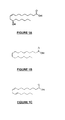
- Ricinoleic acid ( Figure 1A ) is a fatty acid comprising 18 carbon atoms with a double bond between carbon 9 and 10 and a hydroxyl in carbon 12 of its chain.
- Jatropha comprises an oilseed rich in oleic and linoleic acids, from which biodiesel can be produced.
- Oleic acid ( Figure 1 B) is also a fatty acid comprising 18 carbon atoms having a double bond in carbon 9. However, it does not have a hydroxyl in carbon 12.
- Linoleic acid is an unsaturated fatty acid with 18 carbons having two unsaturates.
- Jatropha has great potential as a raw material for the synthesis of bio-lubricants, with the great advantage that neither are foodstuffs, that is to say that there is no competition from food usage, as is the case with Soya, canola, sunflower and other oilseeds.
- Brazilian patent application PI 0520104-7 concerns a process for preparation of a bio-fuel mixture comprising a fraction of fatty acid alkyl ester and at least one fraction of glycerine containing substituents forming mono and/or diglycerides and/or triglycerides and also a device for preparation of said mixture.
- the glycerine fraction corresponds to at least 1% by weight of the fuel mixture.
- the bio-fuel mixture can be used as a fuel in diesel engines without additional cooling, and/or can be added to a conventional diesel fuel mixture.
- Application MU 8902161-4 concerns the use of Jatropha oil, extracted from the seeds and purified, as a replacement for naphthenic and paraffinic oils, derived from petroleum, as an insulating fluid for high voltage transformers.
- the present invention deals with the synthesis of lubricants from Jatropha oil biodiesel, and not an insulating oil.
- the focus is solely on the extraction and purification of vegetable oil and the subsequent mixing with additives, while with the present invention there is a chemical reaction.
- the technology developed and described in the present invention has the main benefit that the bio-lubricants obtained from the castor oil methyl biodiesel and the Jatropha oil methyl biodiesel are biodegradable.
- bio-lubricants obtained from castor oil methyl biodiesel and from Jatropha oil methyl biodiesel, by the enzymatic route represent new products and processes which are important and responsible for the diversification of the line of lubricants previously existing in the market.
- bio-lubricants from castor oil methyl biodiesel (methyl ricinoleate) and from Jatropha oil methyl biodiesel (mixture of methyl oleate and linoleate) proposed in the invention takes place through enzymatic catalysis and has as the principal step the transesterification reaction of the biodiesel with a polyhydroxylated alcohol, with subsequent purification and separation of the product: methanol (D) and bio-lubricant (E, F).
- the reaction is performed in batch type reactors, thermostatically controlled and with agitation of 700 rpm. Removal of the alcohol formed as a by-product takes place under a vacuum of 0.01 bar (1 kPa) to increase the reaction conversion.
- TMP trimethylolpropane
- the reaction mixture is heated to a temperature that may vary between 40°C and 55°C, and then the lipase is added, in a proportion of 1% - 4% w/w in relation to the weight of the mixture of biodiesel plus TMP.
- the system is agitated at 700 rpm and a vacuum of 0.01 bar (1 kPa) is created.
- the reactor is unloaded and the mixture is filtered and centrifuged to separate the enzyme and stored in the freezer at a temperature of -10°C.
- the methanol (D) formed is collected during the process by means of a gas condensation system. Separation of the methanol from the reaction medium increases the conversion of the process.
- Figure 2 shows the transesterification reaction of the methyl ricinoleate (A) with the TMP, in the presence of the enzymatic catalyst (C) with methanol (D) and the basic lubricating oil methylolpropane tri-ricinoleate (E) being obtained.
- TMP the neopentyl glycol and pentaerithrytol alcohols.
- Candida rugosa Lipomod 34P - Biocatalysts
- Candida antarctica Novozym 435 - Novozymes
- Rhizomucor miehei Lipozym IM RM - Novozymes
- Table 1 Typical properties of the enzyme Lipomod 34P (biocatalysts). TABLE 1 PROPERTIES VALUES Activity 115 000 Lipase U/g (typical) 65 000 Esterase U/g (approx.) Biological source Candida rugosa Form White powder Working pH 5-8 Working temperature 40°C - 55°C Table 2: Typical properties of the enzyme Novozym 435 (Novozymes).
- the reaction is performed in batch type reactors with agitation at 700 rpm. These reactors have a volume of 50 ml and are thermostatically controlled. When removal of the alcohol formed as a by-product is necessary, the system is placed under a vacuum of 0.01 bar (1 kPa) with the consequence that the conversion is increased.
- Trimethylolpropane - TMP (5% - 12% w/w with regard to the weight of the biodiesel plus TMP) and water, in a proportion of 1% - 11 % w/w with regard to the weight of the biodiesel plus TMP are initially added to the reactor.
- the reaction temperature is between 40°C and 55°C.
- the lipase is added when the reactor is at the reaction temperature, in a proportion of 1% - 4% w/w with regard to the weight of reagents: biodiesel plus TMP. Agitation is maintained at a speed of 700 rpm and the pressure in the range 0.01 bar (1 kPa).
- the reactor is unloaded and the mixture is filtered and centrifuged to separate the enzyme and stored at a temperature of - 10°C.
- the reactions can occur in a range of pressures of between 0.01 bar and 1 bar (10 3 and 10 5 Pa).
- the methanol (D) formed is collected during the reaction by means of a gas condensation system.
- Figure 3 illustrates the transesterification reaction of the methyl oleate (B) with the TMP, in the presence of the enzymatic catalyst (C) with methanol (D) and the basic oil methylolpropane trioleate (F) being obtained.
- neopentyl glycol and pentaerithrytol alcohols and the enzymatic catalysts mentioned above are used.
- the viscosity (VI) and pour point values of the bio-lubricant obtained in the chemical process are equivalent to those of the bio-lubricant obtained in the enzymatic process. But the oxidation stability of the bio-lubricant provides a better result when the catalysis is enzymatic.
- the process developed uses commercial enzymatic catalysts and milder process conditions and in this way makes it possible to obtain bio-lubricants with excellent physico-chemical and performance properties, with less energy expenditure, which makes the process described here viable.
Landscapes
- Chemical & Material Sciences (AREA)
- Chemical Kinetics & Catalysis (AREA)
- General Chemical & Material Sciences (AREA)
- Oil, Petroleum & Natural Gas (AREA)
- Organic Chemistry (AREA)
- Health & Medical Sciences (AREA)
- Emergency Medicine (AREA)
- Liquid Carbonaceous Fuels (AREA)
- Fats And Perfumes (AREA)
Abstract
Description
- The present invention describes a process for the production of bio-lubricant from castor oil methyl biodiesel (methyl ricinoleate) and/or from Jatropha oil methyl biodiesel (mixture of methyl oleate and linoleate) as well as the following products: basic oil, methylolpropane trioleate and methylolpropane triricinoleate obtained by the respective processes.
- Castor or ricin is the seed of Ricinus communis L., a species of the Euphorbiaceae family. The main product derived from this plant is castor bean oil, or castor oil.
- Brazil is the third largest grower and producer of castor beans, behind only India and China. The composition of castor bean oil or castor oil is approximately 90% ricinoleic acid, which differentiates it from all other vegetable oils.
- Ricinoleic acid (
Figure 1A ) is a fatty acid comprising 18 carbon atoms with a double bond between carbon 9 and 10 and a hydroxyl in carbon 12 of its chain. - There is no other vegetable oil produced commercially with this characteristic. This structural characteristic gives said oil a high viscosity and solubility in alcohol at temperatures ranging from 0°C to 30°C.
- It is from castor oil that the raw material known as methyl biodiesel is obtained.
- Jatropha comprises an oilseed rich in oleic and linoleic acids, from which biodiesel can be produced. Oleic acid (
Figure 1 B) is also a fatty acid comprising 18 carbon atoms having a double bond in carbon 9. However, it does not have a hydroxyl in carbon 12. - Linoleic acid is an unsaturated fatty acid with 18 carbons having two unsaturates.
- Together with the castor bean, Jatropha has great potential as a raw material for the synthesis of bio-lubricants, with the great advantage that neither are foodstuffs, that is to say that there is no competition from food usage, as is the case with Soya, canola, sunflower and other oilseeds.
- In the following a number of documents are cited relating to this technology. Nonetheless, all of these differ in terms of the process and the compounds that are objects of this invention.
- Brazilian patent application
PI 0520104-7 - Said patent application presents a use that differs from that proposed by the present invention since the use of the castor oil is for the production of bio-fuel while with this invention it is for the production of bio-lubricant. The chemical reactions, despite being transesterification reactions, have reaction conditions, raw materials and catalysts that are different.
- Application
MU 8902161-4 - Said application presents a use that differs from that of the present invention. The present invention deals with the synthesis of lubricants from Jatropha oil biodiesel, and not an insulating oil. In addition, in that document the focus is solely on the extraction and purification of vegetable oil and the subsequent mixing with additives, while with the present invention there is a chemical reaction.
- A publication from 2006 (Silva, J. A. C.; Desenvolvimento de um Lubrificante Biodegradável a partir de Ésteres do Biodiesel da Mamona [Development of a biodegradable lubricant from castor bean biodiesel esters], MSc dissertation, COPPE/UFRJ, Rio de Janeiro, RJ, Brazil), describes a process for the synthesis of bio-lubricants from castor bean ethyl biodiesel by means of chemical catalysis. In this case the raw material, despite deriving from castor beans, uses an ethyl biodiesel and the catalyst is chemical while in the present invention methyl biodiesel is involved and the catalysis is enzymatic. In addition, the process reaction conditions are different from the process conditions of this invention due, for example, to the absence of water.
- The technology developed and described in the present invention has the main benefit that the bio-lubricants obtained from the castor oil methyl biodiesel and the Jatropha oil methyl biodiesel are biodegradable.
- The process for obtaining bio-lubricants obtained from castor oil methyl biodiesel and from Jatropha oil methyl biodiesel, by the enzymatic route, also features:
- a) high selectivity of enzymes;
- b) high yields in the conversion of the esters;
- c) milder reaction conditions, avoiding degradation of the reagents and products;
- d) less energy consumption due to lower temperatures;
- e) biodegradability of the catalyst; and
- f) ease of recovery of the enzymatic catalyst.
- That is to say that the bio-lubricants obtained from castor oil methyl biodiesel and from Jatropha oil methyl biodiesel, by the enzymatic route, represent new products and processes which are important and responsible for the diversification of the line of lubricants previously existing in the market.
-
-
Figures 1A, 1B and 1C show the ricinoleic, oleic and linoleic acids, respectively, in their structural formulas. -
Figure 2 shows the transesterificaton reaction of the methyl ricinoleate (A) with trimethylolpropane (TMP) in the presence of an enzymatic catalyst (C). -
Figure 3 shows the transesterification reaction of the methyl oleate (B) with trimethylolpropane (TMP) in the presence of an enzymatic catalyst (C). - The production of bio-lubricants from castor oil methyl biodiesel (methyl ricinoleate) and from Jatropha oil methyl biodiesel (mixture of methyl oleate and linoleate) proposed in the invention takes place through enzymatic catalysis and has as the principal step the transesterification reaction of the biodiesel with a polyhydroxylated alcohol, with subsequent purification and separation of the product: methanol (D) and bio-lubricant (E, F).
- The reaction is performed in batch type reactors, thermostatically controlled and with agitation of 700 rpm. Removal of the alcohol formed as a by-product takes place under a vacuum of 0.01 bar (1 kPa) to increase the reaction conversion.
- A mixture of trimethylolpropane (TMP) (5% - 12% w/w with regard to the weight of the biodiesel plus TMP) and water, in a proportion of 1% - 11 % w/w in relation to the weight of biodiesel plus TMP, is initially added to the reactor. Once the TMP has solubilised in the water, the methyl ricinoleate is added, in a proportion of 77% - 94% w/w in relation to the weight of the biodiesel plus TMP.
- The reaction mixture is heated to a temperature that may vary between 40°C and 55°C, and then the lipase is added, in a proportion of 1% - 4% w/w in relation to the weight of the mixture of biodiesel plus TMP. The system is agitated at 700 rpm and a vacuum of 0.01 bar (1 kPa) is created.
- At the end of the reaction, the reactor is unloaded and the mixture is filtered and centrifuged to separate the enzyme and stored in the freezer at a temperature of -10°C.
- The conversion of the reagent (methyl ricinoleate) into products is calculated on the basis of the disappearance of this, monitored by means of liquid chromatography (HPLC).
- Some reactions are carried out at a pressure of 1 bar (1x10⁵ Pa). However, the process takes place in the range of pressures of between 0.01 bar and 1 bar (103 and 105 Pa).
- The methanol (D) formed is collected during the process by means of a gas condensation system. Separation of the methanol from the reaction medium increases the conversion of the process.
-
Figure 2 shows the transesterification reaction of the methyl ricinoleate (A) with the TMP, in the presence of the enzymatic catalyst (C) with methanol (D) and the basic lubricating oil methylolpropane tri-ricinoleate (E) being obtained. - The following alcohols can be used: TMP, the neopentyl glycol and pentaerithrytol alcohols.
- As enzymatic catalysts (C) the following lipases are used: Candida rugosa (Lipomod 34P - Biocatalysts); Candida antarctica (Novozym 435 - Novozymes) and Rhizomucor miehei (Lipozym IM RM - Novozymes). These are all commercial enzymes, with Novozym and Lipozym being immobilised.
- The physico-chemical properties of the lipases and their respective hydrolytic activities, as provided by the manufacturers, are shown in Tables 1, 2 and 3 below.
Table 1: Typical properties of the enzyme Lipomod 34P (biocatalysts). TABLE 1 PROPERTIES VALUES Activity 115 000 Lipase U/g (typical) 65 000 Esterase U/g (approx.) Biological source Candida rugosa Form White powder Working pH 5-8 Working temperature 40°C - 55°C Table 2: Typical properties of the enzyme Novozym 435 (Novozymes). TABLE 2 PROPERTIES VALUES Activity 10 000 Lipase U/g (typical) Biological source Candida Antarctica Form Immobilised granulate Working pH - Working temperature - Table 3: Typical properties of the enzyme Lipozym IM RM (Novozymes). TABLE 3 PROPERTIES VALUES Activity 150 Esterase U/g (approx.) Biological source Rhizomucor miehei Form Immobilised granulate Working pH - Working temperature - - The reaction is performed in batch type reactors with agitation at 700 rpm. These reactors have a volume of 50 ml and are thermostatically controlled. When removal of the alcohol formed as a by-product is necessary, the system is placed under a vacuum of 0.01 bar (1 kPa) with the consequence that the conversion is increased.
- Trimethylolpropane - TMP (5% - 12% w/w with regard to the weight of the biodiesel plus TMP) and water, in a proportion of 1% - 11 % w/w with regard to the weight of the biodiesel plus TMP are initially added to the reactor. The reaction temperature is between 40°C and 55°C. The lipase is added when the reactor is at the reaction temperature, in a proportion of 1% - 4% w/w with regard to the weight of reagents: biodiesel plus TMP. Agitation is maintained at a speed of 700 rpm and the pressure in the range 0.01 bar (1 kPa).
- At the end of the reaction, the reactor is unloaded and the mixture is filtered and centrifuged to separate the enzyme and stored at a temperature of - 10°C.
- The conversion of the reagent, methyl oleate, into products is calculated on the basis of the disappearance of that which is monitored by liquid chromatography (HPLC).
- The reactions can occur in a range of pressures of between 0.01 bar and 1 bar (103 and 105 Pa).
- The methanol (D) formed is collected during the reaction by means of a gas condensation system.
-
Figure 3 illustrates the transesterification reaction of the methyl oleate (B) with the TMP, in the presence of the enzymatic catalyst (C) with methanol (D) and the basic oil methylolpropane trioleate (F) being obtained. - The neopentyl glycol and pentaerithrytol alcohols and the enzymatic catalysts mentioned above are used.
- The following results are obtained:
- conversion of 80% to 99% of the ester (castor oil and Jatropha oil biodiesel);
- viscosity of the bio-lubricant at 100°C: from 6 cSt to 25 cSt;
- viscosity index (VI) of the bio-lubricant: from 120 to 160;
- pour point of the bio-lubricant: from -12°C to -39°C; and
- oxidation stability (RPVOT) of the bio-lubricant: 65 minutes.
- Comparing the results obtained in the present invention with those obtained by chemical catalysis, there is a major improvement in the conversion since with chemical catalysis the conversion is 40% to 50% of the ester (castor oil and Jatropha oil biodiesel).
- The viscosity (VI) and pour point values of the bio-lubricant obtained in the chemical process are equivalent to those of the bio-lubricant obtained in the enzymatic process. But the oxidation stability of the bio-lubricant provides a better result when the catalysis is enzymatic.
- The process developed uses commercial enzymatic catalysts and milder process conditions and in this way makes it possible to obtain bio-lubricants with excellent physico-chemical and performance properties, with less energy expenditure, which makes the process described here viable.
Claims (11)
- Process for the production of bio-lubricant from methyl biodiesel, characterised in that it comprises the steps:adding the following ingredients in the respective concentrations and order, to the reactor:- polyhydroxylated alcohol in a range of 5% - 12% w/w with regard to the weight of the biodiesel plus the weight of the alcohol;- water in a concentration of 1% - 11 % w/w with regard to the weight of biodiesel plus the weight of alcohol;- methyl biodiesel, in a range of concentration of 77% - 94% with regard to the weight of the biodiesel plus the weight of alcohol, once the polyhydroxylated alcohol has solubilised in the water; and- enzymatic catalyst, in a proportion of 1% - 4% w/w with regard to the weight of the biodiesel plus the weight of the alcohol;- agitation of the system preferably by means comprising rotation and preferably at 500 to 900, more preferably 600 to 800 especially about 700 rpm at least at the start of agitation;- maintaining the reaction temperature at between 40°C - 55°C and the pressure at between 0.01 bar - 1 bar (103 and 105 Pa);- monitoring the reaction kinetics preferably by liquid chromatography (HPLC);- unloading the reactor once the reaction has achieved the desired conversion;- filtering and/or centrifuging the mixture obtained; and- storing the purified product preferably at a temperature of -15°C to -5°C, more preferably about -10°C and optionally for further analysis.
- Process for the production of bio-lubricant from methyl biodiesel, according to claim 1, characterised in that the polyhydroxylated alcohol is trimethylolpropane (TMP), neopentyl glycol or pentaerythritol.
- Process for the production of bio-lubricant from methyl biodiesel, according to claim 1, characterised in that the methyl biodiesel is methyl ricinoleate and/or methyl oleate and/or a mixture of these reagents in any proportion.
- Process for the production of bio-lubricant from methyl biodiesel, according to claim 1, characterised in that the enzymatic catalyst is a lipase.
- Process for the production of bio-lubricant from methyl biodiesel, according to claim 4, characterised in that the lipase is Candida rugosa, Candida antarctica and Rhizomucor miehei.
- Process for the production of bio-lubricant from methyl biodiesel, according to claims 1, 2, 3, 4 and 5, characterised in that the reaction is performed in batch type reactors, thermostatically controlled and with agitation of 700 rpm.
- Process for the production of bio-lubricant from methyl biodiesel, according to claims 1, 2, 3, 4, 5 and 6, characterised in that the conversion of castor oil or Jatropha oil biodiesel is 80% to 99%.
- Process for the production of bio-lubricant from methyl biodiesel, according to claims 1, 2, 3, 4, 5, 6 and 7, characterised in that when the polyhydroxylated alcohol is trimethylolpropane (TMP) and the methyl biodiesel is methyl ricinoleate, the product obtained is methylolpropane tri-ricinoleate (E).
- Process for the production of bio-lubricant from methyl biodiesel, according to claims 1, 2, 3, 4, 5, 6 and 7, characterised in that when the polyhydroxylated alcohol is trimethylolpropane (TMP) and the methyl biodiesel is methyl oleate, the product obtained is methylolpropane tri-oleate (F).
- Compound obtained by the process, as defined in claim 8, characterised by it being methylolpropane tri-ricinoleate (E) with a:- viscosity at 100°C of 6 cSt to 25 cSt;- viscosity index (VI) of 120 to 160;- pour point of -12°C to -39°C; and- oxidation stability (RPVOT) of 65 minutes.
- Compound obtained by the process, as defined in claim 9, characterised by it being methylolpropane tri-oleate (F) with a:- viscosity at 100°C of 6 cSt to 25 cSt;- viscosity index (VI) of 120 to 160;- pour point of -12°C to -39°C; and- oxidation stability (RPVOT) of 65 minutes.
Applications Claiming Priority (1)
| Application Number | Priority Date | Filing Date | Title |
|---|---|---|---|
| BRPI1209727 | 2012-04-26 |
Publications (1)
| Publication Number | Publication Date |
|---|---|
| EP2657324A1 true EP2657324A1 (en) | 2013-10-30 |
Family
ID=48128176
Family Applications (1)
| Application Number | Title | Priority Date | Filing Date |
|---|---|---|---|
| EP13164145.8A Withdrawn EP2657324A1 (en) | 2012-04-26 | 2013-04-17 | Process for the production of bio-lubricant from methyl biodiesel and bio-lubricant obtained by said process |
Country Status (1)
| Country | Link |
|---|---|
| EP (1) | EP2657324A1 (en) |
Cited By (1)
| Publication number | Priority date | Publication date | Assignee | Title |
|---|---|---|---|---|
| US20210189442A1 (en) * | 2017-10-20 | 2021-06-24 | Petróleo Brasileiro S. A. - Petrobras | Process for producing esters and biolubricants, catalysed by fermented solid |
Citations (5)
| Publication number | Priority date | Publication date | Assignee | Title |
|---|---|---|---|---|
| WO1996007751A1 (en) * | 1994-09-07 | 1996-03-14 | Raision Tehtaat Oy Ab | An enzymatic process for preparing a synthetic ester from a vegetable oil |
| BRPI0520104A (en) | 2005-02-17 | 2008-06-10 | Fraunhofer Ges Forschung | biofuel mixture, and, process and device for the preparation thereof |
| CN101475467A (en) * | 2009-01-16 | 2009-07-08 | 刘阳 | Novel process for synthesizing polyatomic alcohol ester by lipase catalysis |
| CN101519847A (en) * | 2009-03-31 | 2009-09-02 | 中国石油化工集团公司 | Short-fiber oil agent for aromatic polyamide fiber |
| EP2336277A1 (en) * | 2008-10-06 | 2011-06-22 | JX Nippon Oil & Energy Corporation | Lubricating oil composition |
-
2013
- 2013-04-17 EP EP13164145.8A patent/EP2657324A1/en not_active Withdrawn
Patent Citations (5)
| Publication number | Priority date | Publication date | Assignee | Title |
|---|---|---|---|---|
| WO1996007751A1 (en) * | 1994-09-07 | 1996-03-14 | Raision Tehtaat Oy Ab | An enzymatic process for preparing a synthetic ester from a vegetable oil |
| BRPI0520104A (en) | 2005-02-17 | 2008-06-10 | Fraunhofer Ges Forschung | biofuel mixture, and, process and device for the preparation thereof |
| EP2336277A1 (en) * | 2008-10-06 | 2011-06-22 | JX Nippon Oil & Energy Corporation | Lubricating oil composition |
| CN101475467A (en) * | 2009-01-16 | 2009-07-08 | 刘阳 | Novel process for synthesizing polyatomic alcohol ester by lipase catalysis |
| CN101519847A (en) * | 2009-03-31 | 2009-09-02 | 中国石油化工集团公司 | Short-fiber oil agent for aromatic polyamide fiber |
Non-Patent Citations (7)
| Title |
|---|
| CECILIA ORELLANA KERMAN ET AL: "Biolubricant synthesis using immobilised lipase: Process optimisation of trimethylolpropane oleate production", PROCESS BIOCHEMISTRY, ELSEVIER, NL, vol. 46, no. 12, 8 August 2011 (2011-08-08), pages 2225 - 2231, XP028328596, ISSN: 1359-5113, [retrieved on 20110817], DOI: 10.1016/J.PROCBIO.2011.08.006 * |
| DATABASE CA [online] CHEMICAL ABSTRACTS SERVICE, COLUMBUS, OHIO, US; PAN, CUI-ZHEN ET AL: "Preparation of oleic acid trimethylolpropane ester", XP002699156, retrieved from STN Database accession no. 2011:380762 * |
| DATABASE CA [online] CHEMICAL ABSTRACTS SERVICE, COLUMBUS, OHIO, US; YIN, SHU-HUA ET AL: "Study on synthesis and application of green lubricating trimethylolpropane oleic acid ester", XP002699155, retrieved from STN Database accession no. 2009:1600302 * |
| DATABASE CA [online] CHEMICAL ABSTRACTS SERVICE, COLUMBUS, OHIO, US; ZHANG, RUIBO ET AL: "Oiling agent for aromatic polyamide staple fiber", XP002699154, retrieved from STN Database accession no. 2009:1079993 * |
| PAN, CUI-ZHEN ET AL: "Preparation of oleic acid trimethylolpropane ester", TIANJIN GONGYE DAXUE XUEBAO , 29(6), 47-49 CODEN: TGDXAV; ISSN: 1671-024X, 2010 * |
| SILVA, J. A. C.: "Desenvolvimento de um Lubrificante Biodegradavel a partir de Esteres do Biodiesel da Mamona", MSC DISSERTATION, 2006 |
| YIN, SHU-HUA ET AL: "Study on synthesis and application of green lubricating trimethylolpropane oleic acid ester", HUAXUE GONGCHENGSHI , 23(10), 60-62 CODEN: HGUOAP; ISSN: 1002-1124, 2009 * |
Cited By (3)
| Publication number | Priority date | Publication date | Assignee | Title |
|---|---|---|---|---|
| US20210189442A1 (en) * | 2017-10-20 | 2021-06-24 | Petróleo Brasileiro S. A. - Petrobras | Process for producing esters and biolubricants, catalysed by fermented solid |
| AU2018351874B2 (en) * | 2017-10-20 | 2023-09-14 | Petróleo Brasileiro S. A. - Petrobras | Process for producing esters and biolubricants, catalysed by fermented solid |
| US11866761B2 (en) * | 2017-10-20 | 2024-01-09 | Petróleo Brasileiro S.A.—Petrobras | Process for producing esters and biolubricants, catalysed by fermented solid |
Similar Documents
| Publication | Publication Date | Title |
|---|---|---|
| Papadaki et al. | Bioprocess development for biolubricant production using microbial oil derived via fermentation from confectionery industry wastes | |
| Uosukainen et al. | Transesterification of trimethylolpropane and rapeseed oil methyl ester to environmentally acceptable lubricants | |
| EP0807184B1 (en) | An enzymatic process for preparing a synthetic ester from a vegetable oil | |
| US5713965A (en) | Production of biodiesel, lubricants and fuel and lubricant additives | |
| Nor et al. | Optimization and lubrication properties of Malaysian crude palm oil fatty acids based neopentyl glycol diester green biolubricant | |
| Ma et al. | Enzyme-catalyzed synthesis and properties of polyol ester biolubricant produced from Rhodotorula glutinis lipid | |
| Cvengroš et al. | Properties of alkyl esters base on castor oil | |
| US20100028961A1 (en) | Biogical production of fuels | |
| Wafti et al. | Immobilized lipase-catalyzed transesterification for synthesis of biolubricant from palm oil methyl ester and trimethylolpropane | |
| CN101688150A (en) | Biodiesel production | |
| JP5001287B2 (en) | Process for the preparation of hydrocarbon fuels | |
| US7473791B2 (en) | Method for synthesizing biodiesel from renewable oils | |
| Zorn et al. | In situ transesterification of marine microalgae biomass via heterogeneous acid catalysis | |
| Uliana et al. | Acidity reduction of enzymatic biodiesel using alkaline washing | |
| Kanda et al. | Supercritical methanol-induced esterification of microalgal lipids employing biomineralized cell walls as the catalyst | |
| CA2595235C (en) | Production and use of monoglycerides | |
| Brenneis et al. | Alcoholysis of waste fats with 2‐ethyl‐1‐hexanol using Candida antarctica lipase A in large‐scale tests | |
| JP2015059176A (en) | Method for producing biolubricant from methyl biodiesel and biolubricant obtained by the method | |
| CN111699262B (en) | Method for producing esters and biological lubricants by solid catalysis of fermentation | |
| BR102012009727A2 (en) | PROCESS FOR THE PRODUCTION OF BIOLUBRICANT FROM METAL AND BIOLUBRICANT BIODIESEL OBTAINED BY THE PROCEDURE | |
| KR101727292B1 (en) | Producing Method of Biodiesel Using Acid Oil Derived From Soapstock and Enzymes | |
| da Silva | Biodegradable lubricants and their production via chemical catalysis | |
| Ksor et al. | Sustainable base oils from non-edible fats: performance of esterified, epoxidized, and hydroxylated brown grease | |
| US20150240173A1 (en) | Hydroesterification process for producing biodiesel from wet microalgae biomass | |
| Wei et al. | Chemical conversion process for biodiesel production |
Legal Events
| Date | Code | Title | Description |
|---|---|---|---|
| PUAI | Public reference made under article 153(3) epc to a published international application that has entered the european phase |
Free format text: ORIGINAL CODE: 0009012 |
|
| AK | Designated contracting states |
Kind code of ref document: A1 Designated state(s): AL AT BE BG CH CY CZ DE DK EE ES FI FR GB GR HR HU IE IS IT LI LT LU LV MC MK MT NL NO PL PT RO RS SE SI SK SM TR |
|
| AX | Request for extension of the european patent |
Extension state: BA ME |
|
| 17P | Request for examination filed |
Effective date: 20140109 |
|
| RBV | Designated contracting states (corrected) |
Designated state(s): AL AT BE BG CH CY CZ DE DK EE ES FI FR GB GR HR HU IE IS IT LI LT LU LV MC MK MT NL NO PL PT RO RS SE SI SK SM TR |
|
| STAA | Information on the status of an ep patent application or granted ep patent |
Free format text: STATUS: THE APPLICATION IS DEEMED TO BE WITHDRAWN |
|
| 18D | Application deemed to be withdrawn |
Effective date: 20140501 |