EP2657292A1 - Acrylic copolymer resin composition - Google Patents
Acrylic copolymer resin composition Download PDFInfo
- Publication number
- EP2657292A1 EP2657292A1 EP10861207.8A EP10861207A EP2657292A1 EP 2657292 A1 EP2657292 A1 EP 2657292A1 EP 10861207 A EP10861207 A EP 10861207A EP 2657292 A1 EP2657292 A1 EP 2657292A1
- Authority
- EP
- European Patent Office
- Prior art keywords
- acrylic copolymer
- resin composition
- phosphorus
- groups
- copolymer resin
- Prior art date
- Legal status (The legal status is an assumption and is not a legal conclusion. Google has not performed a legal analysis and makes no representation as to the accuracy of the status listed.)
- Granted
Links
Classifications
-
- C—CHEMISTRY; METALLURGY
- C08—ORGANIC MACROMOLECULAR COMPOUNDS; THEIR PREPARATION OR CHEMICAL WORKING-UP; COMPOSITIONS BASED THEREON
- C08L—COMPOSITIONS OF MACROMOLECULAR COMPOUNDS
- C08L43/00—Compositions of homopolymers or copolymers of compounds having one or more unsaturated aliphatic radicals, each having only one carbon-to-carbon double bond, and containing boron, silicon, phosphorus, selenium, tellurium or a metal; Compositions of derivatives of such polymers
- C08L43/02—Homopolymers or copolymers of monomers containing phosphorus
-
- C—CHEMISTRY; METALLURGY
- C08—ORGANIC MACROMOLECULAR COMPOUNDS; THEIR PREPARATION OR CHEMICAL WORKING-UP; COMPOSITIONS BASED THEREON
- C08L—COMPOSITIONS OF MACROMOLECULAR COMPOUNDS
- C08L33/00—Compositions of homopolymers or copolymers of compounds having one or more unsaturated aliphatic radicals, each having only one carbon-to-carbon double bond, and only one being terminated by only one carboxyl radical, or of salts, anhydrides, esters, amides, imides or nitriles thereof; Compositions of derivatives of such polymers
- C08L33/04—Homopolymers or copolymers of esters
- C08L33/06—Homopolymers or copolymers of esters of esters containing only carbon, hydrogen and oxygen, which oxygen atoms are present only as part of the carboxyl radical
- C08L33/10—Homopolymers or copolymers of methacrylic acid esters
- C08L33/12—Homopolymers or copolymers of methyl methacrylate
-
- C—CHEMISTRY; METALLURGY
- C08—ORGANIC MACROMOLECULAR COMPOUNDS; THEIR PREPARATION OR CHEMICAL WORKING-UP; COMPOSITIONS BASED THEREON
- C08L—COMPOSITIONS OF MACROMOLECULAR COMPOUNDS
- C08L51/00—Compositions of graft polymers in which the grafted component is obtained by reactions only involving carbon-to-carbon unsaturated bonds; Compositions of derivatives of such polymers
- C08L51/04—Compositions of graft polymers in which the grafted component is obtained by reactions only involving carbon-to-carbon unsaturated bonds; Compositions of derivatives of such polymers grafted on to rubbers
-
- C—CHEMISTRY; METALLURGY
- C09—DYES; PAINTS; POLISHES; NATURAL RESINS; ADHESIVES; COMPOSITIONS NOT OTHERWISE PROVIDED FOR; APPLICATIONS OF MATERIALS NOT OTHERWISE PROVIDED FOR
- C09K—MATERIALS FOR MISCELLANEOUS APPLICATIONS, NOT PROVIDED FOR ELSEWHERE
- C09K21/00—Fireproofing materials
- C09K21/06—Organic materials
- C09K21/12—Organic materials containing phosphorus
-
- C—CHEMISTRY; METALLURGY
- C09—DYES; PAINTS; POLISHES; NATURAL RESINS; ADHESIVES; COMPOSITIONS NOT OTHERWISE PROVIDED FOR; APPLICATIONS OF MATERIALS NOT OTHERWISE PROVIDED FOR
- C09K—MATERIALS FOR MISCELLANEOUS APPLICATIONS, NOT PROVIDED FOR ELSEWHERE
- C09K21/00—Fireproofing materials
- C09K21/14—Macromolecular materials
-
- C—CHEMISTRY; METALLURGY
- C08—ORGANIC MACROMOLECULAR COMPOUNDS; THEIR PREPARATION OR CHEMICAL WORKING-UP; COMPOSITIONS BASED THEREON
- C08K—Use of inorganic or non-macromolecular organic substances as compounding ingredients
- C08K5/00—Use of organic ingredients
- C08K5/49—Phosphorus-containing compounds
-
- C—CHEMISTRY; METALLURGY
- C08—ORGANIC MACROMOLECULAR COMPOUNDS; THEIR PREPARATION OR CHEMICAL WORKING-UP; COMPOSITIONS BASED THEREON
- C08L—COMPOSITIONS OF MACROMOLECULAR COMPOUNDS
- C08L2205/00—Polymer mixtures characterised by other features
- C08L2205/03—Polymer mixtures characterised by other features containing three or more polymers in a blend
Definitions
- the present invention relates to an acrylic copolymer resin composition, and more particularly to an acrylic copolymer resin composition that meets all requirements in terms of flame retardancy, scratch resistance, impact resistance and transparency.
- Thermoplastic resins have lower specific gravities, better moldability and better impact resistance than glass and metal. With the recent trend toward low-priced, large-scale, lightweight electrical/electronic products, plastic articles have rapidly replaced glass and metal in many applications.
- thermoplastic resins are increasingly required to have good resistance to external impacts and scratches and good flame retardancy representing high fire resistance.
- Another requirement of thermoplastic resins is high transparency, which is advantageous in obtaining high colorability and satisfactory design effects of design colors such as gradation colors.
- scratch resistance, flame retardancy, impact resistance and transparency is improved, deterioration of the other physical properties is inevitable.
- there is a need to develop a resin composition that meets all requirements in terms of flame retardancy, scratch resistance, impact resistance and transparency.
- An aspect of the present invention is to provide an acrylic copolymer resin composition with excellent flame retardancy, scratch resistance, impact resistance and transparency.
- Another aspect of the present invention is to provide a molded article including the acrylic copolymer resin composition.
- an acrylic copolymer resin composition may include
- the phosphorus-containing acrylic copolymer may be a copolymer of monomers represented by Formula 1 and 2: wherein R 1 is -H or -(CH 2 ) n -CH 3 , n is an integer from 0 to 5, R 3 is t is an integer from 0 to 10, R 4 and R 5 are each independently -(O) p (CH 2 ) q X, p is an integer from 0 or 1, q is an integer from 0 to 5, and X comprises methyl, cyclohexyl, phenyl, methylphenyl, methylethylphenyl, propylphenyl, methoxyphenyl, cyclohexylphenyl, chlorophenyl, bromophenyl, phenylphenyl and benzylphenyl groups; and wherein R 1 is -H or -(CH 2 ) n -CH 3 , n is an integer from 0 to 5, R 2 is
- the monomer represented by Formula 1 may be included in an amount of at least 35 mol%, based on a base resin including (A) and (B).
- the monomer represented by Formula 1 may be included in an amount of 20 to 70 mol%, based on the phosphorus-containing acrylic copolymer.
- the phosphorus-containing acrylic copolymer may have a weight average molecular weight of 50,000 to 200,000 g/mol.
- the phosphorus-containing acrylic copolymer may be included in an amount of 40 to 85% by weight, based on the total weight of the base resin including (A) and (B).
- the polymethyl methacrylate may have a weight average molecular weight of 30,000 to 150,000 g/mol.
- the polymethyl methacrylate may be included in an amount of 15 to 60% by weight, based on the total weight of the base resin including (A) and (B).
- the transparent soft acrylate resin may be included in an amount of 1 to 18 parts by weight, based on 100 parts by total weight of the base resin including (A) and (B).
- the acrylic copolymer resin composition may further include a phosphorus-based flame retardant.
- the acrylic copolymer resin composition of the present invention is excellent in flame retardancy, scratch resistance, impact resistance and transparency. In addition, the acrylic copolymer resin composition of the present invention is prevented from deterioration in transmittance despite increased flame retardancy, scratch resistance and impact resistance.
- the present invention may provide an acrylic copolymer resin composition including
- the phosphorus-containing acrylic copolymer may be a copolymer of monomers represented by Formula 1 and 2: wherein R 1 is -H or -(CH 2 ) n -CH 3 , n is an integer from 0 to 5, R 3 is t is an integer from 0 to 10, R 4 and R 5 are each independently -(O) p (CH 2 ) q X, p is an integer from 0 or 1, q is an integer from 0 to 5, and X comprises methyl, cyclohexyl, phenyl, methylphenyl, methylethylphenyl, propylphenyl, methoxyphenyl, cyclohexylphenyl, chlorophenyl, bromophenyl, phenylphenyl and benzylphenyl groups; and wherein R 1 is -H or -(CH 2 ) n -CH 3 , n is an integer from 0 to 5, R 2 is -(CH
- the monomer represented by Formula 1 may be included in an amount of at least 35 mol%, preferably 35 to 50 mol%, based on the base resin including the phosphorus-containing acrylic copolymer (A) and the polymethyl methacrylate (B). Within this range, not only improved transparency, scratch resistance and impact resistance but also high flame retardancy rating can be ensured.
- the monomer represented by Formula 1 may be included in an amount of 20 to 70 mol%, preferably 30 to 55 mol%, based on the phosphorus-containing acrylic copolymer. Within this range, polymerization stability and flame retardancy can be advantageously ensured.
- the monomer represented by Formula 1 may include at least one phosphonate selected from the group consisting of, but not limited to, dimethyl(methacryloyloxymethyl)phosphonate, diethyl(methacryloyloxymethyl)phosphonate, dimethyl(acryloyloxymethyl)phosphonate, diethyl(acryloyloxymethyl)phosphonate, methylethyl(methacryloyloxymethyl)phosphonate, methylethyl(acryloyloxymethyl)phosphonate, dimethyl(methacryloyloxyethyl)phosphonate, diethyl(methacryloyloxyethyl)phosphonate, and dipropyl(methacryloyloxyethyl)phosphonate.
- phosphonate selected from the group consisting of, but not limited to, dimethyl(methacryloyloxymethyl)phosphonate, diethyl(methacryloyloxymethyl)phosphonate, dimethyl(acryloyloxy
- the monomer represented by Formula 2 may include at least one methacrylate or acrylate selected from the group consisting of, but not limited to, methyl methacrylate, ethyl methacrylate, propyl methacrylate, methyl acrylate, ethyl acrylate, propyl acrylate, cyclohexyl methacrylate, and phenyl methacrylate.
- the phosphorus-containing acrylic copolymer may be prepared by bulk polymerization, emulsion polymerization or suspension polymerization of a mixture of the monomers represented by Formula 1 and 2. Suspension polymerization may be preferred.
- the polymerization temperature and time may be appropriately determined. For example, the polymerization may be performed at a temperature of 65 to 125 °C, preferably 70 to 120 °C, for about 2 to about 8 hours, but is not limited to these conditions.
- the monomer mixture may further include at least one additive selected from polymerization initiators, chain transfer agents, suspension stabilizers, suspension stabilization aids, flame retardants, surfactants, nucleating agents, coupling agents, fillers, plasticizers, impact-reinforcing agents, lubricants, antibacterial agents, release agents, heat stabilizers, antioxidants, light stabilizers, compatibilizers, inorganic additives, colorants, stabilizers, lubricating agents, antistatic agents, pigments, dyes, and flame-proofing agents.
- additives selected from polymerization initiators, chain transfer agents, suspension stabilizers, suspension stabilization aids, flame retardants, surfactants, nucleating agents, coupling agents, fillers, plasticizers, impact-reinforcing agents, lubricants, antibacterial agents, release agents, heat stabilizers, antioxidants, light stabilizers, compatibilizers, inorganic additives, colorants, stabilizers, lubricating agents, antistatic agents, pigments, dyes, and flame-proof
- the phosphorus-containing acrylic copolymer may have a weight average molecular weight of 50,000 to 200,000 g/mol, preferably 80,000 to 150,000 g/mol. Within this range, impact resistance is maintained and good polymerization stability can be ensured.
- the phosphorus-containing acrylic copolymer may be included in an amount of 40 to 85% by weight, preferably 65 to 85% by weight, based on the total weight of the base resin including the phosphorus-containing acrylic copolymer (A) and the polymethyl methacrylate (B). Within this range, transmittance may be maintained and flame retardancy can be advantageously ensured.
- the polymethyl methacrylate may be prepared from a methyl methacrylate monomer by a suitable polymerization process.
- the polymethyl methacrylate may have a weight average molecular weight of 30,000 to 150,000 g/mol, preferably 35,000 to 95,000 g/mol. Within this range, good transmittance, flowability and impact strength can be ensured.
- the polymethyl methacrylate may be included in an amount of 15 to 60% by weight, preferably 15 to 35% by weight, based on the total weight of the base resin including the phosphorus-containing acrylic copolymer (A) and the polymethyl methacrylate (B). Within this range, transmittance can be advantageously maintained.
- the transparent soft acrylate resin can improve the impact resistance of the mixture of the phosphorus-containing acrylic copolymer and the polymethyl methacrylate while maintaining the transparency of the mixture.
- the mixing of the polymethyl methacrylate with the phosphorus-containing acrylic copolymer leads to an increase in flame retardancy rating, impact resistance and scratch resistance but may cause a decrease in transmittance.
- the transparent soft acrylate resin can maintain the transmittance of the mixture of the phosphorus-containing acrylic copolymer and the polymethyl methacrylate.
- the transparent soft acrylate resin may have a refractive index of 1.485 to 1.51. Within this range, high transmittance can be advantageously ensured.
- the transparent soft acrylate resin may be included in an amount of 1 to 18 parts by weight, preferably 5 to 15 parts by weight, more preferably 5 to 10 parts by weight, based on 100 parts by weight of the base resin including the phosphorus-containing acrylic copolymer (A) and the polymethyl methacrylate (B). Within this range, improved impact resistance can be obtained, and flame retardancy rating and transmittance can be prevented from deterioration.
- the glass transition temperature of the transparent soft acrylate resin may be from 15 to 30 °C.
- the transparent soft acrylate resin may have a surface hardness of 70 or less, as measured on a 0.2 ⁇ 0.1 ⁇ m thick specimen using a durometer (GS-706N type A, TECLOCK).
- the transparent soft acrylate resin may have a total light transmittance of 88% or more, as evaluated on a 3 mm thick specimen in accordance with ASTM D1003.
- the transparent soft acrylate resin may have a structure in which a vinyl monomer is grafted onto an acrylic rubber core.
- the vinyl monomer may include at least one monomer selected from the group consisting of, but not limited to, aromatic vinyl monomers, cyanide vinyl monomers, (meth)acrylic monomers, styrenic monomers, acrylonitrile, styrene, and acrylate monomers.
- the transparent soft acrylate resin may have a structure in which methyl methacrylate and styrene are grafted onto a butyl acrylate rubber core, but is not limited to this structure.
- the acrylic copolymer resin composition may further include a phosphorus-based flame retardant.
- the phosphorus-based flame retardant is added to impart the resin composition with flame retardancy.
- the phosphorus-based flame retardant may be any of those known in the art, including red phosphorus, phosphonates and phosphinates.
- the phosphorus-based flame retardant may be represented by Formula 3: wherein R 4 , R 5 , R 7 and R 8 are each independently a C 6 -C 20 aryl group or a C 6 -C 20 aryl group substituted with C 1 -C 20 alkyl group, R 6 is a moiety derived from resorcinol, hydroquinol, bisphenol-A or bisphenol-S as a dialcohol, and n is an integer from 0 to 10.
- the phosphorus-based flame retardant of Formula 3 wherein n is 0 may be, for example, triphenyl phosphate, tricresyl phosphate, cresyl diphenyl phosphate, trixylyl phosphate, tri(2,4,6-trimethylphenyl)phosphate, tri(2,4-di-tert-butylphenyl)phosphate or tri(2,6-di-tert-butylphenyl)phosphate.
- the phosphorus-based flame retardant of Formula 3 wherein n is 1 may be, for example, resorcinol bis(diphenyl phosphate), hydroquinol bis(diphenyl phosphate), bisphenol A-bis(diphenyl phosphate), resorcinol bis(2,6-di-tert-butylphenyl phosphate) or hydroquinol bis(2,6-dimethylphenyl phosphate).
- the phosphorus-based flame retardant of Formula 3 wherein n is 2 or greater may exist in the form of an oligomeric mixture.
- the phosphorus-based flame retardant may be represented by Formula 4: wherein each R 9 represents a substituent independently selected from C 1 -C 20 alkyl groups, C 6 -C 20 aryl groups, C 6 -C 20 aryl groups substituted with C 1 -C 20 alkyl, C 6 -C 20 aralkyl groups, C 1 -C 20 alkoxy groups, C 6 -C 20 aryloxy groups, amino groups, or hydroxyl groups, k and j are each independently an integer from 0 to 10, the C 1 -C 20 alkoxy groups or C 6 -C 20 aryloxy groups may be optionally substituted with at least one C 1 -C 20 alkyl groups, C 6 -C 20 aryl groups, amino groups or hydroxyl groups, R 10 is a moiety derived from a C 6 -C 20 dioxyaryl group or a C 6 -C 20 dioxyaryl group substituted with C 1 -C 20 alkyl, and n representing the
- the phosphorus-based flame retardant may be included in an amount of 0 to 20 parts by weight, preferably 0 to 10 parts by weight, based on 100 parts by weight of the acrylic copolymer resin composition.
- the acrylic copolymer resin composition may further include one or more additives.
- additives may include, but are not limited to, anti-drip agents, impact-reinforcing agents, antioxidants, plasticizers, heat stabilizers, light stabilizers, compatibilizers, pigments, dyes, inorganic additives, antibacterial agents, and antistatic agents.
- the resin composition of the present invention may have a flame retardancy rating of V1 or V0, as evaluated on 1/16", 1/12", 1/10" and 1/8" thick specimens in accordance with UL94.
- the resin composition of the present invention may have a total light transmittance of 85% or more, as evaluated on a 2.5 mm thick specimen in accordance with ASTM D1003.
- the resin composition of the present invention may have a scratch width of 260 ⁇ m to 290 ⁇ m, as measured on a 3.2 mm thick specimen by a ball-type scratch profile (BSP) test.
- BSP ball-type scratch profile
- the resin composition of the present invention may have an impact strength of 10 to 30 kgf.cm/cm, as measured on a 1/4" thick specimen in accordance with ASTM D-256.
- the resin composition of the present invention can be prepared by a suitable method known in the art.
- the resin composition of the present invention may be prepared in the form of pellets.
- the constituent components and optionally other additives are simultaneously mixed, melt-extruded in an extruder, and pelletized.
- the pellets may be molded into a plastic article by injection molding or extrusion molding.
- the present invention also provides a molded article produced by molding the acrylic copolymer resin composition.
- molding processes suitable for the production of the molded article include, but are not limited to, extrusion, injection molding and casting, which are widely known to those skilled in the art.
- the components were mixed in the amounts (parts by weight, based on solid content) shown in Tables 1 and 2, and then a heat stabilizer and an antioxidant were added thereto to prepare resin compositions.
- the extrudate was produced in the form of pellets.
- the pellets were processed into a 100 x 100 mm specimen for scratch resistance evaluation, 1/16", 1/12", 1/10" and 1/8" thick specimens for flame retardancy evaluation, a 1/4" thick specimen for Izod unnotched impact strength evaluation, and a 2.5 mm thick specimen for the transmittance measurement using a 10 oz injection molding machine at 200-220 °C. After standing at 23 °C and 50% relative humidity for 48 hr, the physical properties of the specimens were evaluated. The results are shown in Tables 3 and 4.
- the impact strength (kgf.cm/cm) of the specimen was measured according to ASTM D-256.
- the flame retardancy of the specimens was evaluated according to UL 94.
- the char yield (%) at 700 °C was determined by measuring the remaining amount of char at 700 °C after TGA at a heating rate of 20 °C/min under a nitrogen atmosphere, and calculating the proportion of the remaining amount relative to the initial amount of char.
- the acrylic copolymer resin compositions of Examples 1-6 showed excellent flame retardancy, scratch resistance, impact resistance and transmittance.
- the resin compositions of Examples 1-6 each including the monomer represented by Formula 1 in an amount of 35% by weight or more with respect to the weight of the base resin including (A) and (B), had better flame retardancy ratings than the resin composition of Comparative Example 1.
- the acrylic copolymer resin compositions of Examples 1-5 including the transparent soft acrylate resin had better flame retardancy ratings, scratch resistance, impact resistance and transmittances than the resin compositions of Comparative Examples 2-6.
- the use of the transparent soft acrylate resin within the content range defined in the present invention led to an improvement in the impact resistance of the resin compositions while maintaining the flame retardancy rating and transmittance of the resin compositions (see Examples 1-6 and Comparative Example 7).
Landscapes
- Chemical & Material Sciences (AREA)
- Organic Chemistry (AREA)
- Health & Medical Sciences (AREA)
- Chemical Kinetics & Catalysis (AREA)
- Medicinal Chemistry (AREA)
- Polymers & Plastics (AREA)
- Engineering & Computer Science (AREA)
- Materials Engineering (AREA)
- Compositions Of Macromolecular Compounds (AREA)
- Manufacture Of Macromolecular Shaped Articles (AREA)
- Addition Polymer Or Copolymer, Post-Treatments, Or Chemical Modifications (AREA)
Abstract
Description
- The present invention relates to an acrylic copolymer resin composition, and more particularly to an acrylic copolymer resin composition that meets all requirements in terms of flame retardancy, scratch resistance, impact resistance and transparency.
- Thermoplastic resins have lower specific gravities, better moldability and better impact resistance than glass and metal. With the recent trend toward low-priced, large-scale, lightweight electrical/electronic products, plastic articles have rapidly replaced glass and metal in many applications.
- Under such circumstances, the functions and appearance performance of thermoplastic resins as exterior materials are gaining importance. Thermoplastic resins are increasingly required to have good resistance to external impacts and scratches and good flame retardancy representing high fire resistance. Another requirement of thermoplastic resins is high transparency, which is advantageous in obtaining high colorability and satisfactory design effects of design colors such as gradation colors. Generally, when either of the required physical properties of thermoplastic resins, such as scratch resistance, flame retardancy, impact resistance and transparency, is improved, deterioration of the other physical properties is inevitable. Thus, there is a need to develop a resin composition that meets all requirements in terms of flame retardancy, scratch resistance, impact resistance and transparency.
- An aspect of the present invention is to provide an acrylic copolymer resin composition with excellent flame retardancy, scratch resistance, impact resistance and transparency.
- Another aspect of the present invention is to provide a molded article including the acrylic copolymer resin composition.
- In accordance with one aspect of the present invention, an acrylic copolymer resin composition may include
- (A) a phosphorus-containing acrylic copolymer,
- (B) a polymethyl methacrylate, and
- (C) a transparent soft acrylate resin.
- In one embodiment, the phosphorus-containing acrylic copolymer may be a copolymer of monomers represented by Formula 1 and 2:

is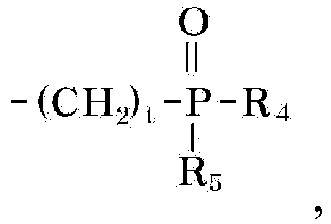
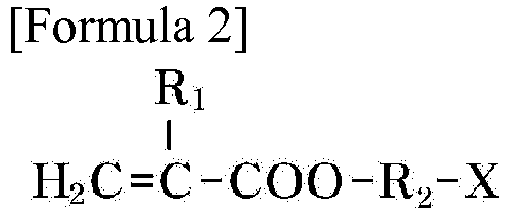
- In one embodiment, the monomer represented by Formula 1 may be included in an amount of at least 35 mol%, based on a base resin including (A) and (B).
- In one embodiment, the monomer represented by Formula 1 may be included in an amount of 20 to 70 mol%, based on the phosphorus-containing acrylic copolymer.
- In one embodiment, the phosphorus-containing acrylic copolymer may have a weight average molecular weight of 50,000 to 200,000 g/mol.
- In one embodiment, the phosphorus-containing acrylic copolymer may be included in an amount of 40 to 85% by weight, based on the total weight of the base resin including (A) and (B).
- In one embodiment, the polymethyl methacrylate may have a weight average molecular weight of 30,000 to 150,000 g/mol.
- In one embodiment, the polymethyl methacrylate may be included in an amount of 15 to 60% by weight, based on the total weight of the base resin including (A) and (B).
- In one embodiment, the transparent soft acrylate resin may be included in an amount of 1 to 18 parts by weight, based on 100 parts by total weight of the base resin including (A) and (B).
- In one embodiment, the acrylic copolymer resin composition may further include a phosphorus-based flame retardant.
- The acrylic copolymer resin composition of the present invention is excellent in flame retardancy, scratch resistance, impact resistance and transparency. In addition, the acrylic copolymer resin composition of the present invention is prevented from deterioration in transmittance despite increased flame retardancy, scratch resistance and impact resistance.
- The present invention may provide an acrylic copolymer resin composition including
- (A) a phosphorus-containing acrylic copolymer,
- (B) a polymethyl methacrylate, and
- (C) a transparent soft acrylate resin.
- The phosphorus-containing acrylic copolymer may be a copolymer of monomers represented by Formula 1 and 2:


- The monomer represented by Formula 1 may be included in an amount of at least 35 mol%, preferably 35 to 50 mol%, based on the base resin including the phosphorus-containing acrylic copolymer (A) and the polymethyl methacrylate (B). Within this range, not only improved transparency, scratch resistance and impact resistance but also high flame retardancy rating can be ensured.
- The monomer represented by Formula 1 may be included in an amount of 20 to 70 mol%, preferably 30 to 55 mol%, based on the phosphorus-containing acrylic copolymer. Within this range, polymerization stability and flame retardancy can be advantageously ensured.
- The monomer represented by Formula 1 may include at least one phosphonate selected from the group consisting of, but not limited to, dimethyl(methacryloyloxymethyl)phosphonate, diethyl(methacryloyloxymethyl)phosphonate, dimethyl(acryloyloxymethyl)phosphonate, diethyl(acryloyloxymethyl)phosphonate, methylethyl(methacryloyloxymethyl)phosphonate, methylethyl(acryloyloxymethyl)phosphonate, dimethyl(methacryloyloxyethyl)phosphonate, diethyl(methacryloyloxyethyl)phosphonate, and dipropyl(methacryloyloxyethyl)phosphonate.
- The monomer represented by Formula 2 may include at least one methacrylate or acrylate selected from the group consisting of, but not limited to, methyl methacrylate, ethyl methacrylate, propyl methacrylate, methyl acrylate, ethyl acrylate, propyl acrylate, cyclohexyl methacrylate, and phenyl methacrylate.
- The phosphorus-containing acrylic copolymer may be prepared by bulk polymerization, emulsion polymerization or suspension polymerization of a mixture of the monomers represented by Formula 1 and 2. Suspension polymerization may be preferred. The polymerization temperature and time may be appropriately determined. For example, the polymerization may be performed at a temperature of 65 to 125 °C, preferably 70 to 120 °C, for about 2 to about 8 hours, but is not limited to these conditions. The monomer mixture may further include at least one additive selected from polymerization initiators, chain transfer agents, suspension stabilizers, suspension stabilization aids, flame retardants, surfactants, nucleating agents, coupling agents, fillers, plasticizers, impact-reinforcing agents, lubricants, antibacterial agents, release agents, heat stabilizers, antioxidants, light stabilizers, compatibilizers, inorganic additives, colorants, stabilizers, lubricating agents, antistatic agents, pigments, dyes, and flame-proofing agents.
- The phosphorus-containing acrylic copolymer may have a weight average molecular weight of 50,000 to 200,000 g/mol, preferably 80,000 to 150,000 g/mol. Within this range, impact resistance is maintained and good polymerization stability can be ensured.
- The phosphorus-containing acrylic copolymer may be included in an amount of 40 to 85% by weight, preferably 65 to 85% by weight, based on the total weight of the base resin including the phosphorus-containing acrylic copolymer (A) and the polymethyl methacrylate (B). Within this range, transmittance may be maintained and flame retardancy can be advantageously ensured.
- The polymethyl methacrylate may be prepared from a methyl methacrylate monomer by a suitable polymerization process.
- The polymethyl methacrylate may have a weight average molecular weight of 30,000 to 150,000 g/mol, preferably 35,000 to 95,000 g/mol. Within this range, good transmittance, flowability and impact strength can be ensured.
- The polymethyl methacrylate may be included in an amount of 15 to 60% by weight, preferably 15 to 35% by weight, based on the total weight of the base resin including the phosphorus-containing acrylic copolymer (A) and the polymethyl methacrylate (B). Within this range, transmittance can be advantageously maintained.
- The transparent soft acrylate resin can improve the impact resistance of the mixture of the phosphorus-containing acrylic copolymer and the polymethyl methacrylate while maintaining the transparency of the mixture. The mixing of the polymethyl methacrylate with the phosphorus-containing acrylic copolymer leads to an increase in flame retardancy rating, impact resistance and scratch resistance but may cause a decrease in transmittance. The transparent soft acrylate resin can maintain the transmittance of the mixture of the phosphorus-containing acrylic copolymer and the polymethyl methacrylate.
- The transparent soft acrylate resin may have a refractive index of 1.485 to 1.51. Within this range, high transmittance can be advantageously ensured.
- The transparent soft acrylate resin may be included in an amount of 1 to 18 parts by weight, preferably 5 to 15 parts by weight, more preferably 5 to 10 parts by weight, based on 100 parts by weight of the base resin including the phosphorus-containing acrylic copolymer (A) and the polymethyl methacrylate (B). Within this range, improved impact resistance can be obtained, and flame retardancy rating and transmittance can be prevented from deterioration.
- The glass transition temperature of the transparent soft acrylate resin may be from 15 to 30 °C. The transparent soft acrylate resin may have a surface hardness of 70 or less, as measured on a 0.2 ± 0.1 µm thick specimen using a durometer (GS-706N type A, TECLOCK). The transparent soft acrylate resin may have a total light transmittance of 88% or more, as evaluated on a 3 mm thick specimen in accordance with ASTM D1003.
- The transparent soft acrylate resin may have a structure in which a vinyl monomer is grafted onto an acrylic rubber core. The vinyl monomer may include at least one monomer selected from the group consisting of, but not limited to, aromatic vinyl monomers, cyanide vinyl monomers, (meth)acrylic monomers, styrenic monomers, acrylonitrile, styrene, and acrylate monomers. For example, the transparent soft acrylate resin may have a structure in which methyl methacrylate and styrene are grafted onto a butyl acrylate rubber core, but is not limited to this structure.
- The acrylic copolymer resin composition may further include a phosphorus-based flame retardant. The phosphorus-based flame retardant is added to impart the resin composition with flame retardancy. The phosphorus-based flame retardant may be any of those known in the art, including red phosphorus, phosphonates and phosphinates.
- For example, the phosphorus-based flame retardant may be represented by Formula 3:

- The phosphorus-based flame retardant of Formula 3 wherein n is 0 may be, for example, triphenyl phosphate, tricresyl phosphate, cresyl diphenyl phosphate, trixylyl phosphate, tri(2,4,6-trimethylphenyl)phosphate, tri(2,4-di-tert-butylphenyl)phosphate or tri(2,6-di-tert-butylphenyl)phosphate. The phosphorus-based flame retardant of Formula 3 wherein n is 1 may be, for example, resorcinol bis(diphenyl phosphate), hydroquinol bis(diphenyl phosphate), bisphenol A-bis(diphenyl phosphate), resorcinol bis(2,6-di-tert-butylphenyl phosphate) or hydroquinol bis(2,6-dimethylphenyl phosphate). The phosphorus-based flame retardant of Formula 3 wherein n is 2 or greater may exist in the form of an oligomeric mixture.
- Alternatively, the phosphorus-based flame retardant may be represented by Formula 4:

- The phosphorus-based flame retardant may be included in an amount of 0 to 20 parts by weight, preferably 0 to 10 parts by weight, based on 100 parts by weight of the acrylic copolymer resin composition.
- The acrylic copolymer resin composition may further include one or more additives. Examples of such additives may include, but are not limited to, anti-drip agents, impact-reinforcing agents, antioxidants, plasticizers, heat stabilizers, light stabilizers, compatibilizers, pigments, dyes, inorganic additives, antibacterial agents, and antistatic agents.
- The resin composition of the present invention may have a flame retardancy rating of V1 or V0, as evaluated on 1/16", 1/12", 1/10" and 1/8" thick specimens in accordance with UL94. The resin composition of the present invention may have a total light transmittance of 85% or more, as evaluated on a 2.5 mm thick specimen in accordance with ASTM D1003. The resin composition of the present invention may have a scratch width of 260 µm to 290 µm, as measured on a 3.2 mm thick specimen by a ball-type scratch profile (BSP) test. The resin composition of the present invention may have an impact strength of 10 to 30 kgf.cm/cm, as measured on a 1/4" thick specimen in accordance with ASTM D-256.
- The resin composition of the present invention can be prepared by a suitable method known in the art. For example, the resin composition of the present invention may be prepared in the form of pellets. In this case, the constituent components and optionally other additives are simultaneously mixed, melt-extruded in an extruder, and pelletized. The pellets may be molded into a plastic article by injection molding or extrusion molding.
- The present invention also provides a molded article produced by molding the acrylic copolymer resin composition. Examples of molding processes suitable for the production of the molded article include, but are not limited to, extrusion, injection molding and casting, which are widely known to those skilled in the art.
- Next, the present invention will be better appreciated from the following examples and comparative examples. It should be understood that these examples are provided for illustration only and are not to be construed in any way as limiting the scope of the present invention.
- Descriptions of details apparent to those skilled in the art will be omitted.
- The specifications of components used in Examples 1-6 and Comparative Examples 1-7 are as follows:
- (A1) A phosphorus-containing acrylic copolymer having a weight average molecular weight of 150,000 g/mol was prepared by suspension polymerization of 50 mol% of methyl methacrylate and 50 mol% of diethyl(acryloyloxyethyl)phosphonate.
- (A2) A phosphorus-containing acrylic copolymer having a weight average molecular weight of 80,000 g/mol was prepared by suspension polymerization of 50 mol% of methyl methacrylate and 50 mol% of diethyl(acryloyloxymethyl)phosphonate.
- (B1) A polymethyl methacrylate having a weight average molecular weight of 90,000 g/mol was used.
- (B2) A polymethyl methacrylate having a weight average molecular weight of 35,000 g/mol was used.
- (C) A core-shell type transparent soft acrylate resin (Kane AceM-210, Kaneka) was used. The transparent soft acrylate resin had a core composed of butyl acrylate and a shell composed of MMA(methyl methacrylate) and styrene.
- The components were mixed in the amounts (parts by weight, based on solid content) shown in Tables 1 and 2, and then a heat stabilizer and an antioxidant were added thereto to prepare resin compositions. Each of the resin compositions was melted, kneaded and extruded using a twin-screw extruder (L/D = 35, diameter = 45 mm). The extrudate was produced in the form of pellets. The pellets were processed into a 100 x 100 mm specimen for scratch resistance evaluation, 1/16", 1/12", 1/10" and 1/8" thick specimens for flame retardancy evaluation, a 1/4" thick specimen for Izod unnotched impact strength evaluation, and a 2.5 mm thick specimen for the transmittance measurement using a 10 oz injection molding machine at 200-220 °C. After standing at 23 °C and 50% relative humidity for 48 hr, the physical properties of the specimens were evaluated. The results are shown in Tables 3 and 4.
- The impact strength (kgf.cm/cm) of the specimen was measured according to ASTM D-256.
- The total light transmittance (%) of the specimen was evaluated according to ASTM D1003. Specifically, the total light transmittance of the specimen was determined using a haze meter (NDH 2000, Nippon Denshoku) according to the following equation:

- It is estimated that the total light transmittance is proportional to transparency.
- The flame retardancy of the specimens was evaluated according to UL 94.
- The char yield (%) at 700 °C was determined by measuring the remaining amount of char at 700 °C after TGA at a heating rate of 20 °C/min under a nitrogen atmosphere, and calculating the proportion of the remaining amount relative to the initial amount of char.
- The scratch resistance (BSP width, µm) of the specimen was measured by a ball-type scratch profile (BSP) test. Specifically, the resin surface was scratched (10-20 mm long) using a spherical metal tip having a diameter of 0.7 mm at a load of 1,000 g and a rate of 75 mm/min. The profile of the scratches was measured by surface scanning using a metal stylus tip (diameter = 2 µm) of a contact type surface profile analyzer (XP-1). The scratch width (µm), indicative of scratch resistance, was determined from the measured scratch profile. A reduction in scratch width means an increase in scratch resistance.
TABLE 1 Example 1 2 3 4 5 6 A1 70 - 70 - 80 70 A2 - 70 - 70 - - B1 30 30 - - 20 - B2 - - 30 30 - 30 C 10 10 10 10 10 15 Remarks 35 35 35 35 40 35 TABLE 2 Comparative Example 1 2 3 4 5 6 7 A1 60 70 - 70 - 80 70 A2 - - 70 - 70 - - B1 40 30 30 - - 20 - B2 - - - 30 30 - 30 C - - - - - - 20 Remarks 30 35 35 35 35 40 35 Remarks: Contents (mol%) of the monomer represented by Formula 1 in the base resin including (A1) or (A2) and (B1) or (B2)
TABLE 3 Example 1 2 3 4 5 6 Impact strength (kgf.cm/cm) 20 15 15 13 11 23 Total light transmittance (%) 87% 86% 88% 86% 88% 84% Flame retardancy rating 1/16" V1 V1 V1 V1 V1 Fail 1/12" V0 V0 V0 V0 V0 Fail 1/10" V0 V0 V0 V0 V0 V1 1/8" V0 V0 V0 V0 V0 V1 Char yield (%) 19.3 18.5 18.1 19.1 18.7 15.7 BSP width (µm) 270 269 268 273 277 283 TABLE 4 Comparative Example 1 2 3 4 5 6 7 Impact strength (kgf.cm/cm) 11 10 8 7 7 5 30 Total light transmittance (%) 79% 82% 80% 84% 81% 83% 76% Flame retardancy rating 1/16" Fail Vo Vo Vo Vo Vo Fail 1/12" Fail Vo Vo Vo Vo Vo Fail 1/10" Fail Vo Vo Vo Vo Vo Fail 1/8" Fail Vo Vo Vo Vo Vo Fail Char yield (%) 6 21 20.5 21.3 19.8 21 14 BSP width (µm) 220 230 235 233 231 240 300 - As can be seen from the results in Tables 3 and 4, the acrylic copolymer resin compositions of Examples 1-6 showed excellent flame retardancy, scratch resistance, impact resistance and transmittance. The resin compositions of Examples 1-6, each including the monomer represented by Formula 1 in an amount of 35% by weight or more with respect to the weight of the base resin including (A) and (B), had better flame retardancy ratings than the resin composition of Comparative Example 1. The acrylic copolymer resin compositions of Examples 1-5 including the transparent soft acrylate resin had better flame retardancy ratings, scratch resistance, impact resistance and transmittances than the resin compositions of Comparative Examples 2-6. The use of the transparent soft acrylate resin within the content range defined in the present invention led to an improvement in the impact resistance of the resin compositions while maintaining the flame retardancy rating and transmittance of the resin compositions (see Examples 1-6 and Comparative Example 7).
Claims (12)
- An acrylic copolymer resin composition comprising(A) a phosphorus-containing acrylic copolymer,(B) a polymethyl methacrylate, and(C) a transparent soft acrylate resin,wherein the phosphorus-containing acrylic copolymer (A) and the polymethyl methacrylate (B) in amounts of 40 to 85% by weight and 15 to 60% by weight, respectively, based on the total weight of a base resin comprising the phosphorus-containing acrylic copolymer (A) and the polymethyl methacrylate (B), and the transparent soft acrylate resin in an amount of 1 to 18 parts by weight, based on 100 parts by weight of the base resin.
- The acrylic copolymer resin composition according to claim 1, wherein the phosphorus-containing acrylic copolymer is a copolymer of monomers represented by Formula 1 and 2:


- The acrylic copolymer resin composition according to claim 2, wherein the monomer represented by Formula 1 is present in an amount of at least 35 mol%, based on the base resin.
- The acrylic copolymer resin composition according to claim 2, wherein the monomer represented by Formula 1 is present in an amount of 20 to 70 mol%, based on the phosphorus-containing acrylic copolymer.
- The acrylic copolymer resin composition according to claim 1, wherein the phosphorus-containing acrylic copolymer has a weight average molecular weight of 50,000 to 200,000 g/mol.
- The acrylic copolymer resin composition according to claim 1, wherein the transparent soft acrylate resin has a structure in which a vinyl monomer is grafted onto an acrylic rubber core.
- The acrylic copolymer resin composition according to claim 1, wherein the transparent soft acrylate resin has a refractive index of 1.485 to 1.51, as measured on a 2.5 mm thick specimen.
- The acrylic copolymer resin composition according to claim 1, further comprising a phosphorus-based flame retardant.
- The acrylic copolymer resin composition according to claim 8, wherein the phosphorus-based flame retardant is represented by Formula 3 or 4:


- The acrylic copolymer resin composition according to claim 1, further comprising one or more additives comprising anti-drip agents, impact-reinforcing agents, antioxidants, plasticizers, heat stabilizers, light stabilizers, compatibilizers, pigments, dyes, inorganic additives, antibacterial agents, and antistatic agents.
- The acrylic copolymer resin composition according to claim 1, wherein the acrylic copolymer resin composition has a total light transmittance of 85% or more, as evaluated on a 2.5 mm thick specimen in accordance with ASTM D1003.
- The acrylic copolymer resin composition according to claim 1, wherein the acrylic copolymer resin composition has a scratch width of 260 µm to 290 pom, as measured on a 3.2 mm thick specimen by a ball-type scratch profile (BSP) test.
Applications Claiming Priority (2)
| Application Number | Priority Date | Filing Date | Title |
|---|---|---|---|
| KR1020100133980A KR101411004B1 (en) | 2010-12-23 | 2010-12-23 | Acrylic copolymer resin composition |
| PCT/KR2010/009531 WO2012086867A1 (en) | 2010-12-23 | 2010-12-29 | Acrylic copolymer resin composition |
Publications (3)
| Publication Number | Publication Date |
|---|---|
| EP2657292A1 true EP2657292A1 (en) | 2013-10-30 |
| EP2657292A4 EP2657292A4 (en) | 2014-06-04 |
| EP2657292B1 EP2657292B1 (en) | 2019-09-04 |
Family
ID=46314122
Family Applications (1)
| Application Number | Title | Priority Date | Filing Date |
|---|---|---|---|
| EP10861207.8A Not-in-force EP2657292B1 (en) | 2010-12-23 | 2010-12-29 | Acrylic copolymer resin composition |
Country Status (4)
| Country | Link |
|---|---|
| EP (1) | EP2657292B1 (en) |
| JP (1) | JP5706540B2 (en) |
| KR (1) | KR101411004B1 (en) |
| WO (1) | WO2012086867A1 (en) |
Cited By (6)
| Publication number | Priority date | Publication date | Assignee | Title |
|---|---|---|---|---|
| EP2599832A4 (en) * | 2010-07-28 | 2013-12-18 | Cheil Ind Inc | TRANSPARENT THERMOPLASTIC RESIN COMPOSITION HAVING SUPERIOR FIRE RESISTANCE AND HEAT RESISTANCE PROPERTIES |
| US9005491B2 (en) | 2011-06-29 | 2015-04-14 | Cheil Industries Inc. | Photosensitive resin composition for color filter and color filter using the same |
| US9127157B2 (en) | 2010-11-05 | 2015-09-08 | Cheil Industries Inc. | Flame-retardant and scratch-resistant polycarbonate resin composition |
| US9340670B2 (en) | 2010-12-14 | 2016-05-17 | Cheil Industries Inc. | Flame-retardant polycarbonate resin composition with scratch resistance |
| WO2016205015A1 (en) * | 2015-06-15 | 2016-12-22 | Union Carbide Chemicals & Plastics Technology Llc | Polymer blend in granular form and process for making same |
| US9864272B2 (en) | 2012-12-07 | 2018-01-09 | Samsung Sdi Co., Ltd. | Photosensitive resin composition for color filter, and color filter using the same |
Families Citing this family (3)
| Publication number | Priority date | Publication date | Assignee | Title |
|---|---|---|---|---|
| WO2014088153A1 (en) * | 2012-12-07 | 2014-06-12 | 제일모직 주식회사 | (metha)acrylic copolymer, and thermoplastic resin comprising same |
| US12350388B2 (en) | 2021-09-10 | 2025-07-08 | B/E Aerospace, Inc. | Methods for measuring and quantifying surface cleanability of articles |
| KR20240094284A (en) | 2022-12-16 | 2024-06-25 | 롯데케미칼 주식회사 | Environment-friendly transparent thermoplastic resin composition and article produced therefrom |
Family Cites Families (16)
| Publication number | Priority date | Publication date | Assignee | Title |
|---|---|---|---|---|
| US3030347A (en) * | 1960-04-25 | 1962-04-17 | Rohm & Haas | Dialkylphosphonoalkyl acrylate and methacrylate copolymers |
| JPS4620823B1 (en) * | 1967-06-05 | 1971-06-11 | ||
| JPS56161414A (en) * | 1980-05-19 | 1981-12-11 | Kao Corp | Production of self-crosslinking water-absorbing resin |
| KR100309581B1 (en) * | 1998-05-19 | 2001-09-26 | 구광시 | An acryl resin having a capsulated impact-reinforcement agent, and a process of preparing for the same. |
| KR100401326B1 (en) * | 2001-06-08 | 2003-10-10 | 제일모직주식회사 | Flame Retardant Thermoplastic Resin Composition |
| FR2828685A1 (en) * | 2001-08-14 | 2003-02-21 | Atofina | Compounds comprising a carboxylic ester function of an alkyl phosphonate and their preparation, useful as charge coatings or dispersants on metals and as monomers for polymerisation |
| JP2006131803A (en) * | 2004-11-08 | 2006-05-25 | Mitsubishi Rayon Co Ltd | Impact modifier and impact resin composition |
| KR100799605B1 (en) * | 2006-05-04 | 2008-01-30 | 제일모직주식회사 | Resin Composition Excellent in Scratch Resistance |
| KR100832518B1 (en) * | 2006-12-22 | 2008-05-26 | 제일모직주식회사 | Phosphorus flame retardant copolymer and flame retardant thermoplastic resin composition using same |
| KR20080089122A (en) * | 2007-03-30 | 2008-10-06 | 제일모직주식회사 | Flame retardant copolymer and flame retardant thermoplastic resin composition using same |
| WO2008120854A1 (en) * | 2007-03-30 | 2008-10-09 | Cheil Industries Inc. | Flameproof copolymer and flame retardant thermoplastic resin composition using thereof |
| KR20100067235A (en) * | 2008-12-11 | 2010-06-21 | 제일모직주식회사 | Flameproof crosslinked copolymer and method of preparing the same |
| KR20110077881A (en) * | 2009-12-30 | 2011-07-07 | 제일모직주식회사 | Phosphorus acrylic copolymer resin excellent in transparency and flame retardancy and its composition |
| KR101351614B1 (en) * | 2010-11-05 | 2014-02-17 | 제일모직주식회사 | Polycarbonate resin composition with flame retardancy and scratch resistance |
| KR20120048384A (en) * | 2010-11-05 | 2012-05-15 | 제일모직주식회사 | Acrylic resin with flame retardancy and method for preparing the same |
| KR101374360B1 (en) * | 2010-12-14 | 2014-03-18 | 제일모직주식회사 | Polycarbonate resin composition with flame retardancy and scratch resistance |
-
2010
- 2010-12-23 KR KR1020100133980A patent/KR101411004B1/en not_active Expired - Fee Related
- 2010-12-29 WO PCT/KR2010/009531 patent/WO2012086867A1/en not_active Ceased
- 2010-12-29 JP JP2013545990A patent/JP5706540B2/en not_active Expired - Fee Related
- 2010-12-29 EP EP10861207.8A patent/EP2657292B1/en not_active Not-in-force
Cited By (8)
| Publication number | Priority date | Publication date | Assignee | Title |
|---|---|---|---|---|
| EP2599832A4 (en) * | 2010-07-28 | 2013-12-18 | Cheil Ind Inc | TRANSPARENT THERMOPLASTIC RESIN COMPOSITION HAVING SUPERIOR FIRE RESISTANCE AND HEAT RESISTANCE PROPERTIES |
| US9587058B2 (en) | 2010-07-28 | 2017-03-07 | Samsung Sdi Co., Ltd. | Transparent thermoplastic resin composition |
| US9127157B2 (en) | 2010-11-05 | 2015-09-08 | Cheil Industries Inc. | Flame-retardant and scratch-resistant polycarbonate resin composition |
| US9340670B2 (en) | 2010-12-14 | 2016-05-17 | Cheil Industries Inc. | Flame-retardant polycarbonate resin composition with scratch resistance |
| US9005491B2 (en) | 2011-06-29 | 2015-04-14 | Cheil Industries Inc. | Photosensitive resin composition for color filter and color filter using the same |
| US9864272B2 (en) | 2012-12-07 | 2018-01-09 | Samsung Sdi Co., Ltd. | Photosensitive resin composition for color filter, and color filter using the same |
| WO2016205015A1 (en) * | 2015-06-15 | 2016-12-22 | Union Carbide Chemicals & Plastics Technology Llc | Polymer blend in granular form and process for making same |
| US10392503B2 (en) | 2015-06-15 | 2019-08-27 | Rohm And Haas Company | Polymer blend in granular form and process for making same |
Also Published As
| Publication number | Publication date |
|---|---|
| JP2014500381A (en) | 2014-01-09 |
| WO2012086867A1 (en) | 2012-06-28 |
| EP2657292B1 (en) | 2019-09-04 |
| EP2657292A4 (en) | 2014-06-04 |
| JP5706540B2 (en) | 2015-04-22 |
| KR20120072159A (en) | 2012-07-03 |
| KR101411004B1 (en) | 2014-06-23 |
Similar Documents
| Publication | Publication Date | Title |
|---|---|---|
| EP2657292B1 (en) | Acrylic copolymer resin composition | |
| EP2810990B1 (en) | Non-halogen-based, flame-retardant, high-stiffness polycarbonate resin composition | |
| US20110160400A1 (en) | Phosphoric and Acrylic Copolymer Resin Having Excellent Transparency and Flame Retardancy and Resin Composition Including the Same | |
| KR101309808B1 (en) | Flame retardant polycarbonate resin composition having good scratch resistance and impact resistance and molded article using the same | |
| KR101293787B1 (en) | Transparent Thermoplastic Resin Composition with Excellent Flame-resistance and Heat-resistance | |
| US20070155857A1 (en) | Flame Retardant Polycarbonate Resin Composition Having Good Impact, High Heat Resistance | |
| KR101817680B1 (en) | Polycarbonate based resin composition with flame resistance and molded articles thereof | |
| EP2796506B1 (en) | Thermoplastic resin composition and molded products thereof | |
| US20070208128A1 (en) | Polycarbonate resin composition with improved light reflectance and flame retardancy | |
| US9273173B2 (en) | Flame retardant acrylic-based copolymer, resin composition comprising same and molding form thereof | |
| US10138372B2 (en) | Polycarbonate resin composition and article molded therefrom | |
| EP2471865A1 (en) | Polycarbonate resin composition having good mold release properties and good appearance and molded article using the same | |
| US9340670B2 (en) | Flame-retardant polycarbonate resin composition with scratch resistance | |
| KR101411009B1 (en) | Polycarbonate resin composition and an article comprising the polycarbonate resin composition | |
| EP3208312B1 (en) | Thermoplastic resin composition having excellent transparency and mechanical strength, and molded product comprising same | |
| KR101262306B1 (en) | Polycarbonate resin composition with excellent flame retardancy | |
| KR20180072378A (en) | Resin compositions and articles using the same | |
| KR101262309B1 (en) | Polycarbonate resin composition with excellent flame retardancy | |
| KR101161299B1 (en) | Polycarbonate Resin Composition Having Good Scratch Resistance | |
| KR20130070415A (en) | Scratch resistant polycarbonate resin composition and articles comprising thereof | |
| WO2025154717A1 (en) | Polycarbonate-based resin composition and molded article thereof | |
| KR20120090107A (en) | Thermoplastic resin composition having good thermal stability | |
| KR20140086775A (en) | Thermoplastic resin composition and article comprising the same |
Legal Events
| Date | Code | Title | Description |
|---|---|---|---|
| PUAI | Public reference made under article 153(3) epc to a published international application that has entered the european phase |
Free format text: ORIGINAL CODE: 0009012 |
|
| 17P | Request for examination filed |
Effective date: 20130624 |
|
| AK | Designated contracting states |
Kind code of ref document: A1 Designated state(s): AL AT BE BG CH CY CZ DE DK EE ES FI FR GB GR HR HU IE IS IT LI LT LU LV MC MK MT NL NO PL PT RO RS SE SI SK SM TR |
|
| RIN1 | Information on inventor provided before grant (corrected) |
Inventor name: LEE, JIN SEONG Inventor name: KIM, MAN SUK Inventor name: KANG, YONG HEE Inventor name: LEE, BYUN KUN Inventor name: KWON, KEE HAE Inventor name: CHUNG, JIN HWA Inventor name: YOON, JONG TAE |
|
| DAX | Request for extension of the european patent (deleted) | ||
| A4 | Supplementary search report drawn up and despatched |
Effective date: 20140506 |
|
| RIC1 | Information provided on ipc code assigned before grant |
Ipc: C09K 21/14 20060101ALI20140428BHEP Ipc: C08L 33/04 20060101ALI20140428BHEP Ipc: C09K 21/12 20060101ALI20140428BHEP Ipc: C08L 33/14 20060101AFI20140428BHEP Ipc: C08K 5/49 20060101ALN20140428BHEP Ipc: C08L 33/12 20060101ALI20140428BHEP Ipc: C08L 43/02 20060101ALI20140428BHEP Ipc: C08K 5/52 20060101ALI20140428BHEP |
|
| RAP1 | Party data changed (applicant data changed or rights of an application transferred) |
Owner name: SAMSUNG SDI CO., LTD. |
|
| RAP1 | Party data changed (applicant data changed or rights of an application transferred) |
Owner name: LOTTE ADVANCED MATERIALS CO., LTD. |
|
| STAA | Information on the status of an ep patent application or granted ep patent |
Free format text: STATUS: EXAMINATION IS IN PROGRESS |
|
| 17Q | First examination report despatched |
Effective date: 20180905 |
|
| REG | Reference to a national code |
Ref country code: DE Ref legal event code: R079 Ref document number: 602010060947 Country of ref document: DE Free format text: PREVIOUS MAIN CLASS: C08L0033140000 Ipc: C08L0033120000 |
|
| RIC1 | Information provided on ipc code assigned before grant |
Ipc: C08L 51/04 20060101ALI20190205BHEP Ipc: C08L 43/02 20060101ALI20190205BHEP Ipc: C09K 21/14 20060101ALI20190205BHEP Ipc: C09K 21/12 20060101ALI20190205BHEP Ipc: C08L 33/12 20060101AFI20190205BHEP |
|
| GRAP | Despatch of communication of intention to grant a patent |
Free format text: ORIGINAL CODE: EPIDOSNIGR1 |
|
| STAA | Information on the status of an ep patent application or granted ep patent |
Free format text: STATUS: GRANT OF PATENT IS INTENDED |
|
| INTG | Intention to grant announced |
Effective date: 20190320 |
|
| GRAS | Grant fee paid |
Free format text: ORIGINAL CODE: EPIDOSNIGR3 |
|
| GRAA | (expected) grant |
Free format text: ORIGINAL CODE: 0009210 |
|
| STAA | Information on the status of an ep patent application or granted ep patent |
Free format text: STATUS: THE PATENT HAS BEEN GRANTED |
|
| AK | Designated contracting states |
Kind code of ref document: B1 Designated state(s): AL AT BE BG CH CY CZ DE DK EE ES FI FR GB GR HR HU IE IS IT LI LT LU LV MC MK MT NL NO PL PT RO RS SE SI SK SM TR |
|
| REG | Reference to a national code |
Ref country code: GB Ref legal event code: FG4D |
|
| REG | Reference to a national code |
Ref country code: CH Ref legal event code: EP |
|
| REG | Reference to a national code |
Ref country code: AT Ref legal event code: REF Ref document number: 1175290 Country of ref document: AT Kind code of ref document: T Effective date: 20190915 |
|
| REG | Reference to a national code |
Ref country code: DE Ref legal event code: R096 Ref document number: 602010060947 Country of ref document: DE |
|
| REG | Reference to a national code |
Ref country code: IE Ref legal event code: FG4D |
|
| REG | Reference to a national code |
Ref country code: NL Ref legal event code: FP |
|
| REG | Reference to a national code |
Ref country code: LT Ref legal event code: MG4D |
|
| PG25 | Lapsed in a contracting state [announced via postgrant information from national office to epo] |
Ref country code: BG Free format text: LAPSE BECAUSE OF FAILURE TO SUBMIT A TRANSLATION OF THE DESCRIPTION OR TO PAY THE FEE WITHIN THE PRESCRIBED TIME-LIMIT Effective date: 20191204 Ref country code: LT Free format text: LAPSE BECAUSE OF FAILURE TO SUBMIT A TRANSLATION OF THE DESCRIPTION OR TO PAY THE FEE WITHIN THE PRESCRIBED TIME-LIMIT Effective date: 20190904 Ref country code: HR Free format text: LAPSE BECAUSE OF FAILURE TO SUBMIT A TRANSLATION OF THE DESCRIPTION OR TO PAY THE FEE WITHIN THE PRESCRIBED TIME-LIMIT Effective date: 20190904 Ref country code: NO Free format text: LAPSE BECAUSE OF FAILURE TO SUBMIT A TRANSLATION OF THE DESCRIPTION OR TO PAY THE FEE WITHIN THE PRESCRIBED TIME-LIMIT Effective date: 20191204 Ref country code: SE Free format text: LAPSE BECAUSE OF FAILURE TO SUBMIT A TRANSLATION OF THE DESCRIPTION OR TO PAY THE FEE WITHIN THE PRESCRIBED TIME-LIMIT Effective date: 20190904 Ref country code: FI Free format text: LAPSE BECAUSE OF FAILURE TO SUBMIT A TRANSLATION OF THE DESCRIPTION OR TO PAY THE FEE WITHIN THE PRESCRIBED TIME-LIMIT Effective date: 20190904 |
|
| PG25 | Lapsed in a contracting state [announced via postgrant information from national office to epo] |
Ref country code: ES Free format text: LAPSE BECAUSE OF FAILURE TO SUBMIT A TRANSLATION OF THE DESCRIPTION OR TO PAY THE FEE WITHIN THE PRESCRIBED TIME-LIMIT Effective date: 20190904 Ref country code: GR Free format text: LAPSE BECAUSE OF FAILURE TO SUBMIT A TRANSLATION OF THE DESCRIPTION OR TO PAY THE FEE WITHIN THE PRESCRIBED TIME-LIMIT Effective date: 20191205 Ref country code: RS Free format text: LAPSE BECAUSE OF FAILURE TO SUBMIT A TRANSLATION OF THE DESCRIPTION OR TO PAY THE FEE WITHIN THE PRESCRIBED TIME-LIMIT Effective date: 20190904 Ref country code: AL Free format text: LAPSE BECAUSE OF FAILURE TO SUBMIT A TRANSLATION OF THE DESCRIPTION OR TO PAY THE FEE WITHIN THE PRESCRIBED TIME-LIMIT Effective date: 20190904 Ref country code: LV Free format text: LAPSE BECAUSE OF FAILURE TO SUBMIT A TRANSLATION OF THE DESCRIPTION OR TO PAY THE FEE WITHIN THE PRESCRIBED TIME-LIMIT Effective date: 20190904 |
|
| REG | Reference to a national code |
Ref country code: AT Ref legal event code: MK05 Ref document number: 1175290 Country of ref document: AT Kind code of ref document: T Effective date: 20190904 |
|
| PG25 | Lapsed in a contracting state [announced via postgrant information from national office to epo] |
Ref country code: RO Free format text: LAPSE BECAUSE OF FAILURE TO SUBMIT A TRANSLATION OF THE DESCRIPTION OR TO PAY THE FEE WITHIN THE PRESCRIBED TIME-LIMIT Effective date: 20190904 Ref country code: EE Free format text: LAPSE BECAUSE OF FAILURE TO SUBMIT A TRANSLATION OF THE DESCRIPTION OR TO PAY THE FEE WITHIN THE PRESCRIBED TIME-LIMIT Effective date: 20190904 Ref country code: IT Free format text: LAPSE BECAUSE OF FAILURE TO SUBMIT A TRANSLATION OF THE DESCRIPTION OR TO PAY THE FEE WITHIN THE PRESCRIBED TIME-LIMIT Effective date: 20190904 Ref country code: AT Free format text: LAPSE BECAUSE OF FAILURE TO SUBMIT A TRANSLATION OF THE DESCRIPTION OR TO PAY THE FEE WITHIN THE PRESCRIBED TIME-LIMIT Effective date: 20190904 Ref country code: PL Free format text: LAPSE BECAUSE OF FAILURE TO SUBMIT A TRANSLATION OF THE DESCRIPTION OR TO PAY THE FEE WITHIN THE PRESCRIBED TIME-LIMIT Effective date: 20190904 Ref country code: PT Free format text: LAPSE BECAUSE OF FAILURE TO SUBMIT A TRANSLATION OF THE DESCRIPTION OR TO PAY THE FEE WITHIN THE PRESCRIBED TIME-LIMIT Effective date: 20200106 |
|
| PG25 | Lapsed in a contracting state [announced via postgrant information from national office to epo] |
Ref country code: CZ Free format text: LAPSE BECAUSE OF FAILURE TO SUBMIT A TRANSLATION OF THE DESCRIPTION OR TO PAY THE FEE WITHIN THE PRESCRIBED TIME-LIMIT Effective date: 20190904 Ref country code: SK Free format text: LAPSE BECAUSE OF FAILURE TO SUBMIT A TRANSLATION OF THE DESCRIPTION OR TO PAY THE FEE WITHIN THE PRESCRIBED TIME-LIMIT Effective date: 20190904 Ref country code: SM Free format text: LAPSE BECAUSE OF FAILURE TO SUBMIT A TRANSLATION OF THE DESCRIPTION OR TO PAY THE FEE WITHIN THE PRESCRIBED TIME-LIMIT Effective date: 20190904 Ref country code: IS Free format text: LAPSE BECAUSE OF FAILURE TO SUBMIT A TRANSLATION OF THE DESCRIPTION OR TO PAY THE FEE WITHIN THE PRESCRIBED TIME-LIMIT Effective date: 20200224 |
|
| REG | Reference to a national code |
Ref country code: DE Ref legal event code: R097 Ref document number: 602010060947 Country of ref document: DE |
|
| PLBE | No opposition filed within time limit |
Free format text: ORIGINAL CODE: 0009261 |
|
| STAA | Information on the status of an ep patent application or granted ep patent |
Free format text: STATUS: NO OPPOSITION FILED WITHIN TIME LIMIT |
|
| PG2D | Information on lapse in contracting state deleted |
Ref country code: IS |
|
| PG25 | Lapsed in a contracting state [announced via postgrant information from national office to epo] |
Ref country code: DK Free format text: LAPSE BECAUSE OF FAILURE TO SUBMIT A TRANSLATION OF THE DESCRIPTION OR TO PAY THE FEE WITHIN THE PRESCRIBED TIME-LIMIT Effective date: 20190904 Ref country code: IS Free format text: LAPSE BECAUSE OF FAILURE TO SUBMIT A TRANSLATION OF THE DESCRIPTION OR TO PAY THE FEE WITHIN THE PRESCRIBED TIME-LIMIT Effective date: 20200105 |
|
| REG | Reference to a national code |
Ref country code: CH Ref legal event code: PL |
|
| 26N | No opposition filed |
Effective date: 20200605 |
|
| REG | Reference to a national code |
Ref country code: BE Ref legal event code: MM Effective date: 20191231 |
|
| PG25 | Lapsed in a contracting state [announced via postgrant information from national office to epo] |
Ref country code: MC Free format text: LAPSE BECAUSE OF FAILURE TO SUBMIT A TRANSLATION OF THE DESCRIPTION OR TO PAY THE FEE WITHIN THE PRESCRIBED TIME-LIMIT Effective date: 20190904 Ref country code: SI Free format text: LAPSE BECAUSE OF FAILURE TO SUBMIT A TRANSLATION OF THE DESCRIPTION OR TO PAY THE FEE WITHIN THE PRESCRIBED TIME-LIMIT Effective date: 20190904 |
|
| GBPC | Gb: european patent ceased through non-payment of renewal fee |
Effective date: 20191229 |
|
| PG25 | Lapsed in a contracting state [announced via postgrant information from national office to epo] |
Ref country code: FR Free format text: LAPSE BECAUSE OF NON-PAYMENT OF DUE FEES Effective date: 20191231 Ref country code: LU Free format text: LAPSE BECAUSE OF NON-PAYMENT OF DUE FEES Effective date: 20191229 Ref country code: IE Free format text: LAPSE BECAUSE OF NON-PAYMENT OF DUE FEES Effective date: 20191229 Ref country code: GB Free format text: LAPSE BECAUSE OF NON-PAYMENT OF DUE FEES Effective date: 20191229 |
|
| PG25 | Lapsed in a contracting state [announced via postgrant information from national office to epo] |
Ref country code: BE Free format text: LAPSE BECAUSE OF NON-PAYMENT OF DUE FEES Effective date: 20191231 Ref country code: CH Free format text: LAPSE BECAUSE OF NON-PAYMENT OF DUE FEES Effective date: 20191231 Ref country code: LI Free format text: LAPSE BECAUSE OF NON-PAYMENT OF DUE FEES Effective date: 20191231 |
|
| PGFP | Annual fee paid to national office [announced via postgrant information from national office to epo] |
Ref country code: DE Payment date: 20201216 Year of fee payment: 11 |
|
| PGFP | Annual fee paid to national office [announced via postgrant information from national office to epo] |
Ref country code: NL Payment date: 20201214 Year of fee payment: 11 |
|
| PG25 | Lapsed in a contracting state [announced via postgrant information from national office to epo] |
Ref country code: CY Free format text: LAPSE BECAUSE OF FAILURE TO SUBMIT A TRANSLATION OF THE DESCRIPTION OR TO PAY THE FEE WITHIN THE PRESCRIBED TIME-LIMIT Effective date: 20190904 |
|
| PG25 | Lapsed in a contracting state [announced via postgrant information from national office to epo] |
Ref country code: HU Free format text: LAPSE BECAUSE OF FAILURE TO SUBMIT A TRANSLATION OF THE DESCRIPTION OR TO PAY THE FEE WITHIN THE PRESCRIBED TIME-LIMIT; INVALID AB INITIO Effective date: 20101229 Ref country code: MT Free format text: LAPSE BECAUSE OF FAILURE TO SUBMIT A TRANSLATION OF THE DESCRIPTION OR TO PAY THE FEE WITHIN THE PRESCRIBED TIME-LIMIT Effective date: 20190904 |
|
| PG25 | Lapsed in a contracting state [announced via postgrant information from national office to epo] |
Ref country code: TR Free format text: LAPSE BECAUSE OF FAILURE TO SUBMIT A TRANSLATION OF THE DESCRIPTION OR TO PAY THE FEE WITHIN THE PRESCRIBED TIME-LIMIT Effective date: 20190904 |
|
| PG25 | Lapsed in a contracting state [announced via postgrant information from national office to epo] |
Ref country code: MK Free format text: LAPSE BECAUSE OF FAILURE TO SUBMIT A TRANSLATION OF THE DESCRIPTION OR TO PAY THE FEE WITHIN THE PRESCRIBED TIME-LIMIT Effective date: 20190904 |
|
| REG | Reference to a national code |
Ref country code: DE Ref legal event code: R119 Ref document number: 602010060947 Country of ref document: DE |
|
| REG | Reference to a national code |
Ref country code: NL Ref legal event code: MM Effective date: 20220101 |
|
| PG25 | Lapsed in a contracting state [announced via postgrant information from national office to epo] |
Ref country code: NL Free format text: LAPSE BECAUSE OF NON-PAYMENT OF DUE FEES Effective date: 20220101 |
|
| PG25 | Lapsed in a contracting state [announced via postgrant information from national office to epo] |
Ref country code: DE Free format text: LAPSE BECAUSE OF NON-PAYMENT OF DUE FEES Effective date: 20220701 |