EP2657238A1 - Macrolide compound having anticancer effect - Google Patents
Macrolide compound having anticancer effect Download PDFInfo
- Publication number
- EP2657238A1 EP2657238A1 EP11851233.4A EP11851233A EP2657238A1 EP 2657238 A1 EP2657238 A1 EP 2657238A1 EP 11851233 A EP11851233 A EP 11851233A EP 2657238 A1 EP2657238 A1 EP 2657238A1
- Authority
- EP
- European Patent Office
- Prior art keywords
- cancer
- compound
- heterocyclyl
- heteroaryl
- alkyl
- Prior art date
- Legal status (The legal status is an assumption and is not a legal conclusion. Google has not performed a legal analysis and makes no representation as to the accuracy of the status listed.)
- Withdrawn
Links
Images





Classifications
-
- C—CHEMISTRY; METALLURGY
- C07—ORGANIC CHEMISTRY
- C07D—HETEROCYCLIC COMPOUNDS
- C07D493/00—Heterocyclic compounds containing oxygen atoms as the only ring hetero atoms in the condensed system
- C07D493/12—Heterocyclic compounds containing oxygen atoms as the only ring hetero atoms in the condensed system in which the condensed system contains three hetero rings
- C07D493/16—Peri-condensed systems
-
- A—HUMAN NECESSITIES
- A61—MEDICAL OR VETERINARY SCIENCE; HYGIENE
- A61P—SPECIFIC THERAPEUTIC ACTIVITY OF CHEMICAL COMPOUNDS OR MEDICINAL PREPARATIONS
- A61P35/00—Antineoplastic agents
-
- A—HUMAN NECESSITIES
- A61—MEDICAL OR VETERINARY SCIENCE; HYGIENE
- A61P—SPECIFIC THERAPEUTIC ACTIVITY OF CHEMICAL COMPOUNDS OR MEDICINAL PREPARATIONS
- A61P35/00—Antineoplastic agents
- A61P35/02—Antineoplastic agents specific for leukemia
-
- A—HUMAN NECESSITIES
- A61—MEDICAL OR VETERINARY SCIENCE; HYGIENE
- A61P—SPECIFIC THERAPEUTIC ACTIVITY OF CHEMICAL COMPOUNDS OR MEDICINAL PREPARATIONS
- A61P43/00—Drugs for specific purposes, not provided for in groups A61P1/00-A61P41/00
-
- C—CHEMISTRY; METALLURGY
- C07—ORGANIC CHEMISTRY
- C07D—HETEROCYCLIC COMPOUNDS
- C07D493/00—Heterocyclic compounds containing oxygen atoms as the only ring hetero atoms in the condensed system
- C07D493/12—Heterocyclic compounds containing oxygen atoms as the only ring hetero atoms in the condensed system in which the condensed system contains three hetero rings
- C07D493/18—Bridged systems
Definitions
- the present invention relates to a novel macrolide compound having a cell growth-inhibiting activity. More specifically, the invention relates to an anticancer drug containing, as an active ingredient, a novel macrolide compound having a cell growth-inhibiting activity or a pharmaceutically acceptable salt thereof.
- Exiguolide is one of macrocyclic lactones isolated from sponges and is known to have an activity of inhibiting maturation of ova and spermatozoa of Hemicentrotus pulcherrimus (Non Patent Literature 1).
- Exiguolide has a 20-membered cyclic macrolide structure including a partial structure similar to bryostatins.
- chemical synthesis of exiguolide total synthesis of (+)exiguolide has been published by a group of Seoul National University in 2008 (Non Patent Literature 2), and total synthesis of (-)exiguolide has been published by the present inventors in 2010 (Non Patent Literature 3).
- macrolide compounds naturally exist, and macrolide compounds having various bioactivities, such as antibacterial agents, antifungal agents, and immunosuppressive agents, are known.
- macrolide antibiotics are particularly useful. For example, erythromycin discovered from Streptomyces and its analogs such as clarithromycin are known.
- the macrolide compounds include many compounds showing anticancer activities through cytotoxicity or immune activity (Patent Literatures 1 to 7).
- Bryostatins are one example thereof.
- Bryostatins are natural macrolide compounds isolated from marine organisms, and not less than twenty analogs are known.
- bryostatins are under many clinical tests for, for example, leukemia or Alzheimer dementia and are expected to show advantageous effects in combination with other anticancer drugs or effects of overcoming multiple drug resistance.
- the structure of exiguolides can be recognized as a simplified analog of the bryostatins (Non Patent Literature 4), and exiguolides are expected to have various bioactivities. However, any bioactivity, such as a cell growth-inhibiting activity or anticancer activity, has not been verified in the exiguolide.
- the present inventors have examined the anticancer activity of (-)exiguolide by a drug sensitivity test using a panel of 39 human cultured cancer cell lines and analyzed the growth-inhibiting effects on various cancer cells and characteristics thereof. Furthermore, the inventors have synthesized various analogs of (-)exiguolide and have investigated the cell growth-inhibiting effect thereof.
- X 1 represents any one of the following formulae: (wherein, R 1 represents H, alkyl, aryl, heteroaryl, heterocyclyl, -CONRi-, -NRiCO-, -C(O)-, -S-, -S(O)-, or-S(O) 2 -; and R 2 , R 3 , and R 4 each independently represent H, alkyl, alkenyl, alkynyl, aryl, heteroaryl, heterocyclyl, -CONRi-, -NRiCO-, -C(O)-, -S-, -S(O)-, or -S(O) 2 -); X 2 and X 3 each Independently represent H, alkyl, alkenyl, alkynyl, aryl, heteroaryl, heterocyclyl, -O-, - OC(O)-
- the present invention also provides a cell growth inhibitor containing the above-mentioned compound or a pharmaceutically acceptable salt thereof.
- a cell growth inhibitor containing the above-mentioned compound or a pharmaceutically acceptable salt thereof.
- the cells as a subject on which the inhibitor acts include cancer cell.
- the present invention also provides an anticancer drug containing the above-mentioned compound or a pharmaceutically acceptable salt thereof.
- Examples of the cancer as a target on which the anticancer drug or the cell growth inhibitor of the present invention acts include pancreatic cancer, colon cancer, liver cancer, brain cancer, lung cancer, squamous cell carcinoma, bladder cancer, gastric cancer, pancreatic cancer, prostatic cancer, kidney cancer, colorectal cancer, breast cancer, head cancer, neck cancer, esophageal cancer, gynecological cancer, thyroid cancer, lymphoma, chronic leukemia, and acute leukemia.
- the anticancer drug and the cell growth inhibitor of the present invention are expected to be effective on lung cancer and lung cancer cells.
- the present invention provides a novel macrolide compound having a cell growth-inhibiting activity.
- the macrolide compound of the present invention exhibits remarkable cell growth-inhibiting effects on specific cancer cells, while showing low activities on normal cells.
- the macrolide compound may have a mechanism of action different from those of conventionally known anticancer drugs with a high probability and is therefore expected to show advantageous effects in combination with other anticancer drugs or effects of overcoming multiple drug resistance.
- alkyl means a saturated straight-chain (unbranched) or branched, noncyclic hydrocarbon having 1 to 10, preferably 1 to 5, carbon atoms.
- saturated straight-chain (unbranched) alkyl include -methyl, -ethyl, -n-propyl, -n-butyl, -n-pentyl, -n-hexyl, -n-heptyl, -n-octyl, -n-nonyl, and n-decyl; and typical examples of saturated branched alkyl, include -isopropyl, -sec-butyl, -isobutyl, -tert-butyl, -isopentyl, 2-methylbutyl, 3-methylbutyl, 2-methylpentyl, 3-methylpentyl, 4-methylpentyl, 2-methylhexyl, 3-methylhexyl, 4-methylhexyl
- alkenyl means a straight-chain or branched, noncyclic hydrocarbon having 2 to 10, preferably 1 to 5, carbon atoms and having at least one carbon-carbon double bond.
- Typical examples of the straight-chain or branched (C 2 to C 10 ) alkenyl include -vinyl, -allyl, -1-butenyl, -2-butenyl,-isobutylenyl, -1-pentenyl, -2-pentenyl, -3-methyl-1-butenyl, -2-methyl-2-butenyl, -2,3-dimethyl-2-butenyl,-1-hexenyl, -2-hexenyl, -3-hexenyl, -1-heptenyl, -2-heptenyl, -3-heptenyl, -1-octenyl, -2-octenyl, -3-octenyl, -1-noneny
- alkynyl means a straight-chain or branched, noncyclic hydrocarbon having 2 to 10, preferably 2 to 5, carbon atoms and having at least one carbon-carbon triple bond.
- Typical examples of the straight-chain or branched (C 2 to C 10 ) alkynyl include -acetylenyl, -propynyl, -1-butynyl, -2-butynyl, -1-pentynyl, -2-pentynyl, -3-methyl-1-butynyl, - 4-pentynyl, -1-hexynyl, -2-hexynyl, -5-hexynyl, -1-heptynyl, -2-heptynyl, -6-heptynyl, -1-octynyl, -2-octynyl, -7-octynyl, -1-n
- aryl means a carbocyclic aromatic group having 5 to 10 ring atoms. Typical examples thereof include, but not limited to, phenyl, tolyl, anthracenyl, fluorenyl, indenyl, azulenyl, pyridinyl, and naphthyl, and also include benzo-fused carbocyclic moieties such as 5,6,7,8-tetrahydronaphthyl.
- the carbocyclic aromatic group may be substituted or not substituted. In one embodiment, the carbocyclic aromatic group is a phenyl group.
- heteroaryl means a 5 to 1.0-membered aromatic heterocycle having at least one hetero atom selected from nitrogen, oxygen, and sulfur atoms and having at least one carbon atom and includes both monocycle and bicycle.
- Typical examples of the heteroaryl include triazolyl, tetrazolyl, oxadiazolyl, pyridyl, furyl, benzofuranyl, thiophenyl, benzothiophenyl, quinolinyl, pyrrolyl, indolyl, oxazolyl, benzoxazolyl, imidazolyl, benzoimidazolyl, thiazolyl, benzothiazolyl, isoxazolyl, pyrazolyl, isothiazolyl, pyridazinyl, pyrimidinyl, pyrazinyl, triazinyl, cinnolinyl, phthalazinyl, quinazolinyl,
- heterocyclyl means saturated or unsaturated 5 to 7-membered monocyclic or 7 to 10-membered bicyclic heterocycle having 1 to 4 hetero atoms independently selected from nitrogen, oxygen, and sulfur atoms, wherein the nitrogen and sulfur hetero atoms are optionally oxidized, and the nitrogen hetero atom is optionally quaternized, and includes a bicycle formed by condensation of any of these heterocyclyls to a benzene ring.
- the heterocyclyl can bond via an appropriate hetero atom or carbon atom.
- the heteroaryls defined above are included in the heterocyclyl.
- heterocyclyl examples include morpholinyl, pyrrolidinonyl, pyrrolidinyl, piperidinyl, hydantoinyl, valerolactamyl, oxiranyl, oxetanyl, tetrahydrofuranyl, tetrahydropyranyl, tetrahydropyridinyl, tetrahydropyrimidinyl, tetrahydrothiophenyl, and tetrahydrothiopyranyl.
- the term "pharmaceutically acceptable salt” means a salt prepared from a pharmaceutically acceptable non-toxic acid or base, of which examples include inorganic acids and bases and organic acids and bases.
- examples of the pharmaceutically acceptable base addition salt suitable for the compound of the present invention include, but not limited to, metal salts formed from aluminum, calcium, lithium, magnesium, potassium, sodium, and zinc; and organic salts formed from lysine, N,N'-dibenzylethylenediamine, chloroprocaine, choline, diethanolamine, ethylenediamine, meglumine (N-methylglucamine), and procaine.
- non-toxic acid examples include, but not limited to, inorganic and organic acids, such as acetic acid, alginic acid, anthranilic acid, benzenesulfonic acid, benzoic acid, camphorsulfonic acid, citric acid, ethenesulfonic acid, formic acid, fumaric acid, furoic acid, galacturonic acid, gluconic acid, glucuronic acid, glutamic acid, glycolic acid, hydrobromic acid, hydrochloric acid, isethionic acid, lactic acid, maleic acid, maleic acid, mandelic acid, methanesulfonic acid, mucic acid, nitric acid, pamoic acid, pantothenic acid, phenylacetic acid, phosphoric acid, propionic acid, salicylic acid, stearic acid, succinic acid, sulfanilic acid, sulfuric acid, tartaric acid, and p-toluenesulfonic acid.
- inorganic and organic acids such
- non-toxic acid examples include hydrochloric acid, hydrobromic acid, phosphoric acid, sulfuric acid, and methanesulfonic acid.
- specific examples of the salt include hydrochlorides and mesylates.
- Other salts are known in the art and are described in, for example, Remington's Pharmaceutical Sciences, 18th Eds.
- the compound or a pharmaceutically acceptable salt thereof of the present invention may be in a solvate, hydrate, clathrate, or prodrug form.
- solvate means the compound or a salt thereof of the present invention further including a stoichiometric or non-stoichiometric amount of solvent bound by non-covalent intermolecular forces.
- the solvent is preferably volatile, non-toxic, and/or compatible with administration to human in a very small amount.
- hydrate means the compound or a salt thereof of the present invention further including a stoichiometric or non-stoichiometric amount of water bound by non-covalent intermolecular forces.
- clathrate means the compound or a salt thereof of the present invention in a crystal lattice form having spaces (e.g., channels) including guest molecules (e.g., solvent or water) trapped therein.
- prodrug means the compound of the present invention that can provide an active compound (in particular, a compound of the present invention) through hydrolysis, oxidation, or another reaction under biological conditions (in vitro or in vivo).
- examples of the prodrug include, but not limited to, metabolites of the compound of the present invention containing biohydrolyzable moieties such as biohydrolyzable amide, biohydrolyzable ester, biohydrolyzable carbamate, biohydrolyzable carbonate, biohydrolyzable ureide, and biohydrolyzable phosphate analogs.
- the prodrug of a compound having a carboxyl functional group is preferably a lower alkyl ester of carboxylic acid.
- the carboxylate ester can be more conveniently prepared by esterifying any of carboxylic acid moieties existing on the molecule.
- the prodrug can be typically prepared by a known method such as a method described in, for examples, Burger' s Medicinal Chemistry and Drug Discovery 6th Ed.
- cell growth inhibitor is a drug that inhibits growth of cells.
- the type of cells is not limited, but it is preferable that the inhibitor less act on normal cells and show the growth-inhibiting effect on specific cancer cells only, in light of using as an anticancer drug described below.
- anticancer drugs is a pharmaceutical composition that is used for treatment or prevention of cancer.
- treatment includes eradication, removal, reedy, or inhibition of primary, local, or metastatic cancer tissue and also includes minimization or delay of the progress of cancer.
- prevention includes prevention of recurrence, progress, or occurrence of cancer in a patient.
- the macrolide compounds according to the present invention are (-)exiguolide and its analogs and exhibit growth-inhibiting activities on cells showing abnormal growth, such as cancer cells.
- Exiguolide is, as described above, one of macrocyclic lactones isolated from sponges and is known to have an activity of inhibiting maturation of ova and spermatozoa of Hemicentrotus pulcherrimus.
- Exiguolide has a 20-membered cyclic macrolide structure including a partial structure similar to bryostatins.
- the macrolide compound of the present invention is represented by Formula (I) :
- X 1 represents any one of the following formulae: wherein, R 1 represents H, alkyl, aryl, heteroaryl, heterocyclyl, -CONRi-, -NRiCO-, -C(O)-, -S-, -S(O)-, or - S(O) 2 -; and R 2 , R 3 , and R 4 , each independently represent H, alkyl, alkenyl, alkynyl, aryl, heteroaryl, heterocyclyl, -CONRi-, -NRiCO-, -C(O)-, -S-, -S(O)-, or -S(O) 2 -.
- X 2 and X 3 each independently represent H, alkyl, alkenyl, alkynyl, aryl, heteroaryl, heterocyclyl, -O-, - OC(O)-, -CONRi-, -C(O)-, -S-, -S(O)-, -S(O) 2 -, -NRi-, or -NRiCO-.
- X 4 and X 5 each independently represent H, alkyl, alkenyl, alkynyl, aryl, heteroaryl, or heterocyclyl.
- Each Ri and each Rii independently represent H, alkyl, alkenyl, alkynyl, aryl, heteroaryl, or heterocyclyl.
- the macrolide compound of the present invention is represented by Formula (II):
- X 1 represents any one of the following formulae: wherein, R 1 represents H, alkyl, aryl, heteroaryl, heterocyclyl, -CONRi-, -NRiCO-, -C(O)-, -S-, -S(O)-, or - S(O) 2 -; and R 2 , R 3 , and R 4 each independently represent H, alkyl, alkenyl, alkynyl, aryl, heteroaryl, heterocyclyl, -CONRi-, -NRiCO-, -C(O)-, -S-, -S(O)-, or -S(O) 2 -.
- X 3 and X 4 each independently represent H, alkyl, alkenyl, alkynyl, aryl, heteroaryl, or heterocyclyl.
- Each Ri and each Rii independently represent H, alkyl, alkenyl, alkynyl, aryl, heteroaryl, or heterocyclyl.
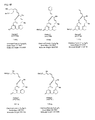
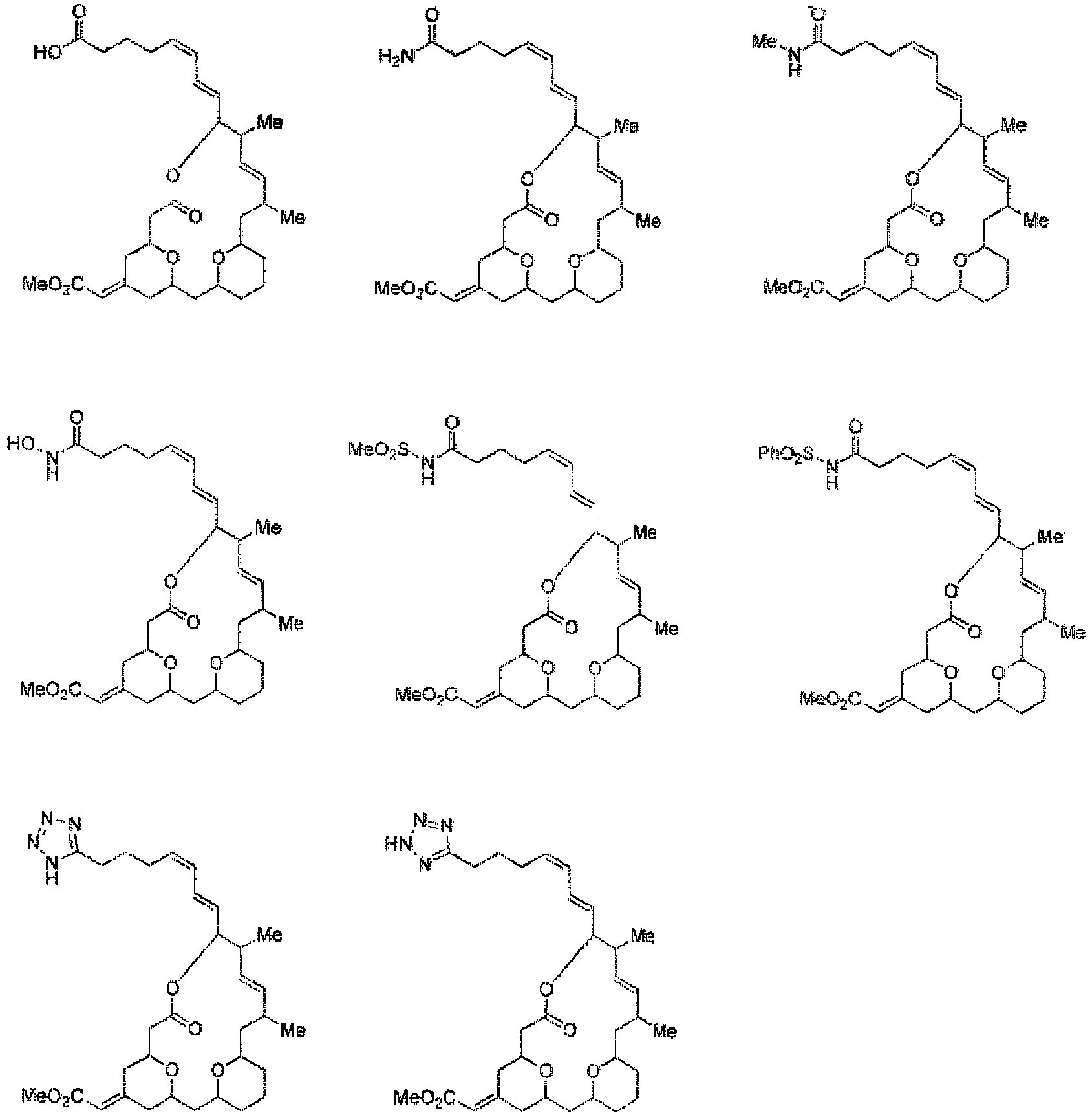
- Analogs 1 to 8 shown in Figures 1A and 1B are examples of the macrolide compound of the present invention.
- Other examples of the macrolide compound of the present invention are shown below:
- the macrolide compound of the present invention can be produced, for example, by synthesizing (-)exiguolide by the method established by the present inventors ( Fuwa H. et al., Org. Lett., 12(3), 2010, pp. 584-587 : Reference Example) and introducing a desired substituent to the (-)exiguolide by a known method in the art.
- (-)exiguolide can be synthesized by (i) constructing two tetrahydropyrane rings through an intramolecular conjugate addition reaction and a reductive etherification, (ii) forming a large-membered ring lactone skeleton through macrolactonization or ring-closing metathesis, and (iii) introducing a side chain through a Suzuki-Miyaura reaction.
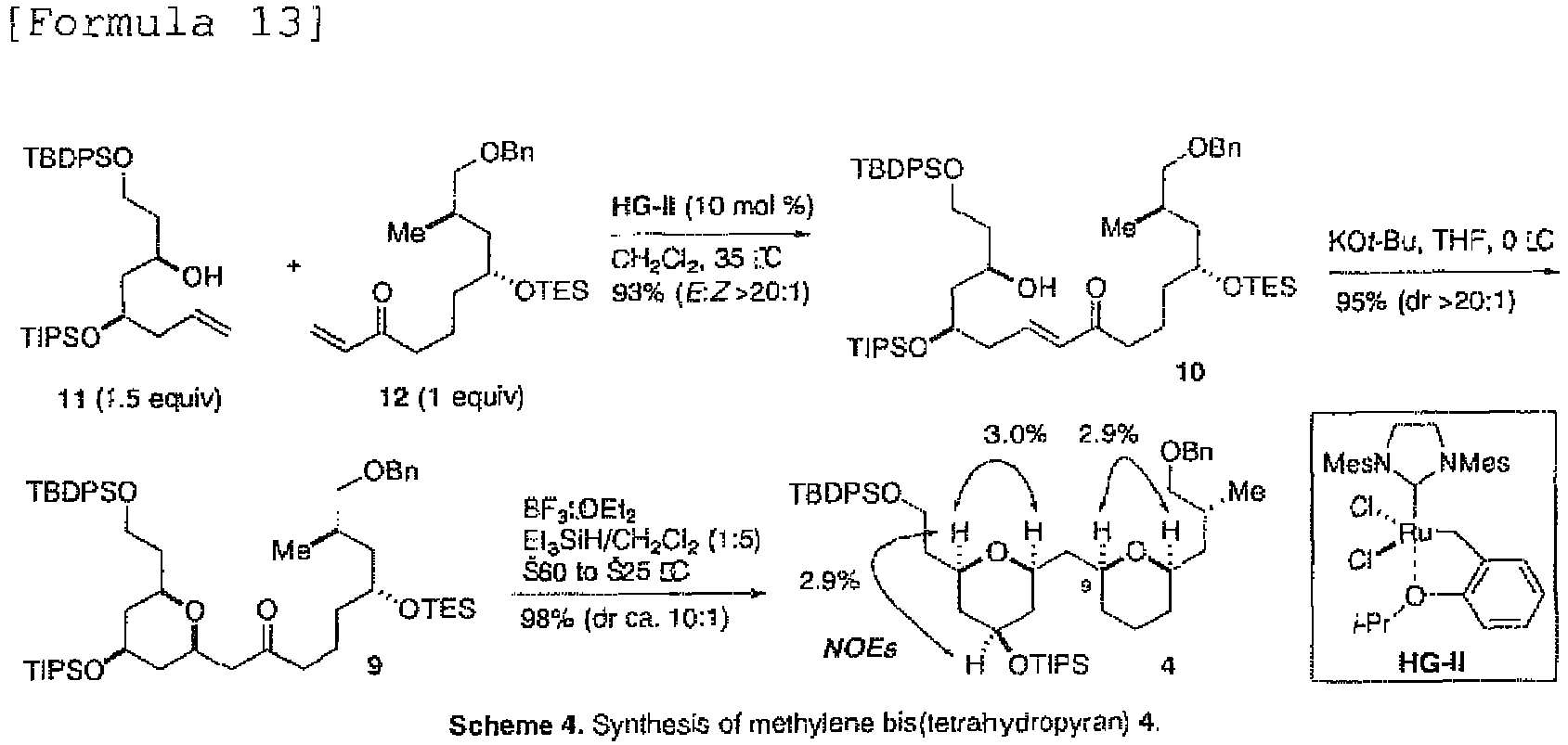
- the (i) stereoselective construction of the tetrahydropyrane rings by an intramolecular conjugate addition reaction and a reductive etherification correspond to a series of steps of converting compound 10 in Scheme 4 of Reference Example described below into compound 9 and then into compound 4.
- the (ii) construction of a large-membered ring lactone structure by macrolactonization or ring-closing metathesis corresponds to a step of converting compound 25 in Scheme 6 of Reference Example into compound 22 and a step of converting compound 5 in Scheme 5 into compound 22.
- the (iii) stereoselective introduction of a side chain by a Suzuki-Miyaura reaction corresponds to a step of converting compound 3 in Scheme 6 into compound 1.
- the cell cycle is a process composed of growth of a daughter cell generated by cell division to a mother cell and cell division of the mother cell to generate daughter cells.
- the cell cycle can be divided into a G0 phase, a G1 phase, an S phase, a G2 phase, and an M phase.
- the G0 phase is a resting phase of the cell where the cell is not actively preparing itself for growth;
- the G1 phase is a phase of starting preparation for cell growth;
- the S phase is a synthesis phase for replicating DNA;
- the G2 phase is a phase of cell growth from DNA synthesis till occurrence of mitosis; and the M phase is the mitotic phase.
- the cell cycle proceeds by cooperation with various molecules.
- a molecule that accelerates the cell cycle is abnormally enhanced. For example, if it is possible to specifically inhibit a molecule that accelerates the transition from the G1 phase to the S phase, the abnormally enhanced cell cycle can be stopped to inhibit cell growth.
- the "cell growth inhibitor" of the present invention is a drug that inhibits growth of cells.
- the macrolide compound of the present invention has a possibility of inhibiting cell growth by stopping the cell cycle.
- the "cell growth inhibitor” of the present invention contains an effective dose of a compound represented by Formula (I) or (II) or a pharmaceutically acceptable salt thereof.
- the term “effective dose” means a sufficient amount for inhibiting the growth of target cells.
- the term “effective dose” means a sufficient amount for inhibiting the growth of target cells only without significantly affecting normal cells.
- the term “effective dose” also includes a sufficient amount of the compound of the present invention for modulating (e.g., activating or inhibiting, preferably inhibiting) ligase activity either in vitro or in vivo.
- the cancer may be any cancer, and examples thereof include pancreatic cancer, colon cancer, liver cancer, brain cancer, lung cancer, squamous cell carcinoma, bladder cancer, gastric cancer, pancreatic cancer, prostatic cancer, kidney cancer, colorectal cancer, breast cancer, head cancer, neck cancer, esophageal cancer, gynecological cancer, thyroid cancer, lymphoma, chronic leukemia, and acute leukemia.
- the macrolide compound of the present invention shows a remarkable cell growth-inhibiting effect on specific cancer cells only and does not significantly affect normal cells.
- specific cancer cells are, for example, lung cancer cells.
- the cell growth inhibitor of the present invention may be used in vitro or in vivo.
- the administration may be oral or parenteral.
- Parenteral administration is particularly preferred, and specific examples thereof include injection, transnasal administration, pulmonary administration, and transdermal administration.
- the infection include intravenous injection, intramuscular injection, intraperitoneal injection, and subcutaneous injection.
- the route of administration can be appropriately selected depending on the age and symptoms of a patient.
- the dose of the cell growth inhibitor of the present invention is appropriately determined depending on the purpose, the route of administration, etc. In inhibition of cell growth in vitro, the dose is appropriately controlled depending on the culture scale.
- the dose in each administration can be selected in the range of 0.0001 to 1000 mg per 1 kg of body weight.
- a dose in each patient can be selected in the range of 0.001 to 100000 mg/body.
- the cell growth inhibitor of the present invention is not limited to these doses.
- the cell growth inhibitor of the present invention may contain a pharmaceutically acceptable carrier and additive.
- the carrier and additive include, but not limited to, surfactants, fillers, coloring agents, flavoring agents, preservatives, stabilizers, buffers, suspending agents, isotonizing agents, binding agents, disintegrators, lubricants, fluidizing agents, and corrigents.
- the present invention provides an anticancer drug containing a therapeutically effective dose of a compound represented by Formula (I) or (II) or a pharmaceutically acceptable salt thereof.
- the term “effective dose” means a sufficient amount of the compound of the present invention for destruction, remedy, inhibition, or removal of primary, local, or metastatic cancer cells or cancer tissue; delay or minimization of the progress of cancer; or provision of advantages for treating cancer.
- the term “effective dose” also includes a sufficient amount of the compound of the present invention for inducing death of cancer or neoplasm cells.
- the term “effective dose” includes a sufficient amount of the compound of the present invention for modulating (e.g., activating or inhibiting, preferably inhibiting) ligase activity either in vitro or in vivo.
- the cancer to be treated may be any cancer, and examples thereof include pancreatic cancer, colon cancer, liver cancer, brain cancer, lung cancer, squamous cell carcinoma, bladder cancer, gastric cancer, pancreatic cancer, prostatic cancer, kidney cancer, colorectal cancer, breast cancer, head cancer, neck cancer, esophageal cancer, gynecological cancer, thyroid cancer, lymphoma, chronic leukemia, and acute leukemia.
- the anticancer drug of the present invention is predicted to be particularly effective on lung cancer from the results of a drug sensitivity test .
- the anticancer drug of the present invention can be administered either orally or parenterally.
- Parenteral administration is particularly preferred, and specific examples thereof include injection, transnasal administration, pulmonary administration, and transdermal administration,
- systemic or local administration can be performed by, for example, intravenous injection, intramuscular injection, intraperitoneal injection, or subcutaneous injection.
- the route of administration can be appropriately selected depending on the age and symptoms of a patient.
- the dose in each administration can be selected in the range of 0.0001 to 1000 mg, preferably 0.001 to 100 mg, and more preferably 0.01 to 10 mg, per 1 kg of body weight.
- a dose in each patient can be selected in the range of 0.001 to 100000 mg/body, preferably 0.01 to 1000 mg/body, and more preferably 0.1 to 100 mg/body.
- the anticancer drug of the present invention is not limited to these doses.
- the anticancer drug of the present invention can be formulated in accordance with a common method (e.g., Remington's Pharmaceutical Science, latest edition, Mark Publishing Company, Easton, U.S.A .) and may contain a pharmaceutically acceptable carrier and additive.
- a pharmaceutically acceptable carrier and additive include, but not limited to, surfactants, fillers, coloring agents, flavoring agents, preservatives, stabilizers, buffers, suspending agents, isotonizing agents, binding agents, disintegrators, lubricants, fluidizing agents, and corrigents.
- the mechanism and the phase of the activity of the anticancer drug of the present invention are likely different from those of known drugs. Specifically, a mechanism of stopping the cell cycle at the G1 phase is predicted. It is therefore expected to show advantageous effects in combination with other anticancer drugs or effects of overcoming multiple drug resistance.
- the (E,Z,E)-triene side chain of compound 1 was stereoselectively introduced at the final stage of the total synthesis by a Suzuki-Miyaura reaction of vinylboric acid ester 2 and vinyl iodide 3 (Scheme 1).
- Scheme 1 vinylboric acid ester 2 and vinyl iodide 3
- route A via ring-closing metathesis (RCM) using methylene bis(tetrahydropyran) 4 as a common synthetic intermediate and route B via macrolactonization were designed. That is, route A was expected that compound 3 can be prepared by RCM of triene 5 and that compound 5 can be induced from compound 4 through esterification.
- route B it was expected that compound 3 can be prepared through macrolactonization of hydroxycarboxylic acid 7 by a Yamaguchi method and that compound 7 can be synthesized from compound 4 through stereoselective formation of a C16-C17 double bond by a Julia-Kocienski reaction. It was believed that common intermediate 4 can be prepared by reductive etherification of silyloxyketone 9 and that silyloxyketone 9 can be synthesized by an intramozecular conjugate addition reaction of hydroxyenone 10. Compound 10 was synthesized by an olefin cross metathesis (CM) reaction of hydroxyolefin 11 and enone 12, which are non-cyclic segments that can be easily prepared.
- CM olefin cross metathesis
- Compound 11 was synthesized using homoallylic alcohol 13 prepared by Keck asymmetric allylation as a starting material (Scheme 2). The hydroxy group of compound 13 was protected and was then induced into aldehyde 14 by oxidatively cleaving the double bond. Compound 14 was diastereoselectively allylated by allyltrimethylsilane in the presence of a magnesium bromide-diethyl ether complex to give homoallylic alcohol 15 having a desired stereochemistry as a single stereoisomer. Subsequent conversion of the protecting group gives hydroxyolefin 11.
- Compound 12 was synthesized using aldehyde 16, which is easily available from (S)-Roche ester through five stages, as a starting material (Scheme 3).
- Compound 16 was homologated by Brown asymmetric allylation and subsequent CM using a Grubbs second generation catalyst (G-II) to induce unsaturated ester 17. After catalytic reduction of compound 17, the resulting ester was converted into Weinreb amide, and the free hydroxy group was further silylated to give compound 18.
- Compound 18 was reacted with vinyl lithium to synthesize enone 12.
- compound 9 was reacted with a boron trifluoride-diethyl ether complex in dichloromethane in the presence of a large excess amount of triethylsilane, and compound 4 was isolated in a yield of 98% as a diastereomer mixture of about 10:1 with respect to the C9-position.
- Compound 4 was efficiently constructed with a considerably high convergence by appropriately arranging functional groups necessary for ring formation in Compounds 11 and 12 in advance and utilizing a high functional group acceptability and strong carbon-carbon bond forming ability of olefin metathesis. Actually, compound 4 could be readily synthesized in a gram scale.
- Alcohol generated by hydrogenolysis of Compound 4 was subjected to Dess-Martin oxidation to give aldehyde 19.
- the aldehyde 19 was converted into olefin 20 by methylenation (Scheme 5).
- the t-butyl diphenyl silyl group of compound 20 was selectively removed, and the resulting alcohol was oxidized into carboxylic acid 21.
- Compound 21 and alcohol 6 were condensed to induce triene 5, and its RCM was investigated under various conditions.
- RCM was investigated using a G-II catalyst in dichloromethane at reflux or in toluene at 70°C.
- a G-II catalyst in dichloromethane at reflux or in toluene at 70°C.
- the catalyst was decomposed in the initial stage of the reaction.
- the reaction was performed using an HG-II catalyst in toluene at 80°C for 1 day.
- compound 22 was given in a yield of 30%, and 18% of raw material 5 was recovered.
- target compound 22 could be prepared in a yield of 52% (raw material recovery: 24%) by performing this reaction in 1,2-dichloroethane at 75°C with only a trace amount of compound 22' generated.
- titanium tetraisopropoxide and 2,6-dichloro-1,4-benzoquinone were investigated as additives, but were not useful in this reaction.
- the formulae of analogs 1 and 2 are those representing compounds III and IV, respectively.
- Compound III was synthesized by a Suzuki-Miyaura reaction of compound I described in a publication ( H. Fuwa and M. Sasaki, Organic Letters, 12, 574-577 (2010 )) and (Z)-vinylboric acid pinacol ester II described in a publication ( H. Fuwa and M. Sasaki, Organic Letters, 12, 574-577 (2010 )).
- Compound IV was prepared by acetylation of compound III with acetic anhydride and pyridine.
- Trisdibenzylideneacetone dipalladium (2.5 mg, 0.0027 mmol) and triphenyl arsenic (6.8 mg, 0.022 mmol) were added to 1 mL of a solution of alcohol I (9.6 mg, 0-019 mmol) and (Z)-vinyl tin V (34.6 mg, 0.0925 mmol) in N,N-dimethylformamide at room temperature.
- the reaction solution was stirred at room temperature for 6.5 hours, and the reaction was terminated with a saturated aqueous sodium bicarbonate solution while cooling with ice.
- the reaction mixture was extracted with ethyl acetate, and the organic layer was washed with a saturated saline solution.
- the crude purified product was purified by silica gel column chromatography (Fuji Silysia BW-300 silica gel; eluent: 7.5% ethyl acetate/hexane) to give compound IX (3.0 mg, 93%) as a colorless liquid.
- the crude purified product was purified by silica gel column chromatography (Fuji Silysia BW-300 silica gel; eluent: 7 to 10% ethyl acetate/hexane) to give compound X (3.2 mg, 94%) as a colorless liquid.
- the crude purified product was purified by silica gel column chromatography (Fuji Silysia BW-300 silica gel; eluent: 7% ethyl acetate/hexane) and then by thin-layer chromatography (E. Merck silica gel 60 F 254 plates (0.25-mm thickness), 25 mm ⁇ 25 mm, eluted with 8% methyl acetate/hexane twice and then with 12% ethyl acetate/hexane) to give compound XIV (3.0 mg, yield: 73%) as a colorless liquid.
- the reaction mixture was extracted with ethyl acetate, and the organic layer was washed with a saturated saline solution. The organic layer was dried over anhydrous sodium sulfate, the desiccant was removed by filtration, and the filtrate was concentrated under reduced pressure.
- the crude product was purified by silica gel column chromatography (Fuji Silysia BW-300 silica gel; eluent: 5% ethyl acetate/hexane) to give compound XIII (7.3 mg, yield: 100%) as a colorless liquid.
- Test Example 1 Drug sensitivity test for exiguolide using a panel of human cultured cancer cell lines
- the test was performed by seeding seven lung cancer cell lines, six gastric cancer cell lines, five colon cancer cell lines, five ovarian cancer cell lines, six brain cancer cell lines, five breast cancer cell lines, two kidney cancer cell lines, two prostatic cancer cell lines, and one melanoma cell line, 39 cell lines in total, in a 96-well plate, adding a sample solution containing a predetermined concentration of exiguolide to each well on the following day, culturing the cell lines for two days, and measuring the cell growth by colorimetry with sulforhodamine B.
- the measurement results were input into a computer, and the sensitivity patterns (growth rate and finger print, described below) of each cell line on exiguolide were analyzed using three parameters, GI 50 , TGI, and LC 50 , as indices.
- the data were also subjected to analysis comparing with sensitivities on known compounds showing cell growth-inhibiting activities.
- the average of log GI 50 values of all cell lines tested was determined.
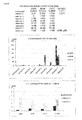
- the difference between this average and log GI 50 value of each cell line (e.g., how much the GI 50 of each cell line is high or low relative to the average is shown as logarithmic value) was determined, and the results were drawn as a bar graph extending left or right from the center showing the average log GI 50 value (scale: 0) to form finger prints ( Figure 4 ).
- a cell line having higher sensitivity is drawn as a longer bar extending to the right side.
- Tables 1 and 2 show extracts from the results.
- remarkable sensitivities to exiguolide were recognized in human lung cancer cell lines NCI-H460 (human lung large cell carcinoma) and A549 (human lung adenocarcinoma), a human ovarian cancer cell line SK-OV-3 (human ovarian carcinoma), and a human gastric cancer cell line MKN-74 (human gastric carcinoma).
- Exiguolide inhibited the growth of NCI-H460, A549, and SK-OV-3 cell lines at a GI 50 value of less than a micromole.
- the antiproliferative activities of bryostatin 1, which has a similar structure, against NCI-H460, A549, and SK-OV-3 cell lines are known to be -5.6, -5.4, and -5.3, respectively (National Cancer Institute database: http://dtp.nci.nih.gov/branches/btb/ivclsp.html), and it was confirmed that exiguolide shows a human cancer cell growth-inhibiting activity 10 to 1000 times higher than that of bryostatin 1.
- Exiguolide showed slight correlations with three drugs: pirarubicin, mitomycin C, and SM-5887, shown in Table 2, but no correlation was recognized with other 100 or more drugs. This suggests a possibility that exiguolide inhibits growth of cells through a mechanism of action different from those of known anticancer drugs.
- Antiproliferative activities of exiguolide and its analogs shown in Examples were examined using A549 and H460 cell lines derived from lung cancer and an A172 cell line derived from human glioblastoma cells. Each cell line was maintained in an RPMI 1640 medium supplemented with 10% fetal bovine serum (in the cases of the H460 cell line and the A172 cell line) or in a DMEM medium supplemented with 10% fetal bovine serum (in the case of the A549 cell line). Cells in the proliferative phase were seeded in a 96-well plate in triplicate and were cultured for 72 hours in the presence of the compound at various concentrations.
- an Alamar Blue solution (Invitrogen Corporation) was added to each culture in an amount of 1/10 of that of the medium, followed by leaving to stand for 3 hours.
- the fluorescence intensity was measured with Fluoroskan Ascent (Thermo Fisher Scientific K.K.).
- Human umbilical vein endothelial cells (HUVECs) were used as a normal cell control group.
- the fluorescence intensities of experimental groups were determined as relative intensities to that of the control group and were plotted.
- the concentration of a compound for achieving the 50% growth inhibition (IC 50 ) of each cancer cell line was calculated by a non-linear regression model of standard slope using the GraphPad Prism software.
- analogs 1, 4, and 7 showed remarkable cell growth-inhibiting effects.
- the growth-inhibiting effects of the analogs are comparable to that of (-)exiguolide, and active induction of cell death was observed (no data are shown).
- An analog that shows not only growth inhibition but also induction of cell death has high possibility of utility as an anticancer drug.
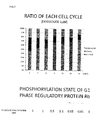
- the cell-cycle arrest activity of exiguolide was investigated.
- the H460 cell line was exposed to 1 ⁇ M of exiguolide, and the ratio of cells at each cell cycle phase was measured with a flow cytometer.
- the DNA staining reagent used was propidium iodide.
- the A549 cell line was exposed to exiguolide (0.01 to 5 ⁇ M) for 72 hours, and then the activity of a cell cycle regulator, Rb, was measured by Wester blotting.
- the subcutaneous tumors were recognized from the body surface, and the change in tumor diameter was measured with a vernier caliper. Tumor growth of the A549 cell line is slower than that of the H460 cell line, and therefore the mice inoculated with the A549 cell line were observed for a longer period than the mice inoculates with the H460 cell line. After completion of the observation, the mice were euthanized with halothane. The tumors were extracted and were subjected to observation of the size, weight, and pathological findings.
- a relative tumor weight ratio of less than 50% is recognized to have an antitumor effect. It was confirmed from the results shown above that exiguolide has a remarkable antitumor effect on specific cancer cell lines.
- the present invention provides a novel macrolide compound having cell growth-inhibiting activity.
- the macrolide compound of the present invention exhibits a remarkable cell growth-inhibiting effect on specific cancer cells, compared to that on normal cells.
- the macrolide compound has high possibility of acting on the cell cycle at a phase different from that in conventionally known anticancer drugs and is therefore expected to show advantageous effects in combination with other anticancer drug or effects of overcoming multiple drug resistance.
Landscapes
- Organic Chemistry (AREA)
- Chemical & Material Sciences (AREA)
- Health & Medical Sciences (AREA)
- Nuclear Medicine, Radiotherapy & Molecular Imaging (AREA)
- Life Sciences & Earth Sciences (AREA)
- Chemical Kinetics & Catalysis (AREA)
- General Chemical & Material Sciences (AREA)
- Medicinal Chemistry (AREA)
- Veterinary Medicine (AREA)
- Pharmacology & Pharmacy (AREA)
- Public Health (AREA)
- Animal Behavior & Ethology (AREA)
- General Health & Medical Sciences (AREA)
- Bioinformatics & Cheminformatics (AREA)
- Engineering & Computer Science (AREA)
- Hematology (AREA)
- Oncology (AREA)
- Pharmaceuticals Containing Other Organic And Inorganic Compounds (AREA)
- Heterocyclic Carbon Compounds Containing A Hetero Ring Having Oxygen Or Sulfur (AREA)
Abstract
Description
- The present invention relates to a novel macrolide compound having a cell growth-inhibiting activity. More specifically, the invention relates to an anticancer drug containing, as an active ingredient, a novel macrolide compound having a cell growth-inhibiting activity or a pharmaceutically acceptable salt thereof.
- Exiguolide is one of macrocyclic lactones isolated from sponges and is known to have an activity of inhibiting maturation of ova and spermatozoa of Hemicentrotus pulcherrimus (Non Patent Literature 1). Exiguolide has a 20-membered cyclic macrolide structure including a partial structure similar to bryostatins. Regarding chemical synthesis of exiguolide, total synthesis of (+)exiguolide has been published by a group of Seoul National University in 2008 (Non Patent Literature 2), and total synthesis of (-)exiguolide has been published by the present inventors in 2010 (Non Patent Literature 3).
- Various macrolide compounds naturally exist, and macrolide compounds having various bioactivities, such as antibacterial agents, antifungal agents, and immunosuppressive agents, are known. Among these compounds, macrolide antibiotics are particularly useful. For example, erythromycin discovered from Streptomyces and its analogs such as clarithromycin are known.
- It is also known that the macrolide compounds include many compounds showing anticancer activities through cytotoxicity or immune activity (
Patent Literatures 1 to 7). Bryostatins are one example thereof. Bryostatins are natural macrolide compounds isolated from marine organisms, and not less than twenty analogs are known. At present, bryostatins are under many clinical tests for, for example, leukemia or Alzheimer dementia and are expected to show advantageous effects in combination with other anticancer drugs or effects of overcoming multiple drug resistance. The structure of exiguolides can be recognized as a simplified analog of the bryostatins (Non Patent Literature 4), and exiguolides are expected to have various bioactivities. However, any bioactivity, such as a cell growth-inhibiting activity or anticancer activity, has not been verified in the exiguolide. -
- Patent Literature
- Patent Literature 1:
JP1992-352783T - Patent Literature 2:
JP1995-504913T - Patent Literature 3:
JP1995-504914T - Patent Literature 4:
JP1997-505596T - Patent Literature 5:
WO2007/004621 - Patent Literature 6:
JP2004-210648A - Patent Literature 7:
JP2007-512256T -
- Non Patent Literature 1: Ohta S. et al., Tetrahedron Letters 47(12), 2006, pp. 1957-1960
- Non Patent Literature 2: Kwon et al., Angewandte Chemie International Edition, 47(9), 2008, pp. 1733-1735
- Non Patent Literature 3: Fuwa H. et al., Organic Letters, 12(3), 2010, pp. 584-587
- Non Patent Literature 4: Cossy J. , Comptes Rendus Chimie, 11(11-12), 2008, pp. 1477-1482
- It is an object of the present invention to provide a novel macrolide compound that can be expected to have cell growth-inhibiting activity and a pharmaceutical composition containing the compound for treating cancer.
- The present inventors have examined the anticancer activity of (-)exiguolide by a drug sensitivity test using a panel of 39 human cultured cancer cell lines and analyzed the growth-inhibiting effects on various cancer cells and characteristics thereof. Furthermore, the inventors have synthesized various analogs of (-)exiguolide and have investigated the cell growth-inhibiting effect thereof.
- As a result, it was found that (-)exiguolide and its analogs show significant cell growth-inhibiting effects on specific cancer cells and that the effects are remarkably higher than those of known bryostatins (bryostatin 1) that are similar in structure to (-) exiguolide. Furthermore, it was found that the mechanism and the phase (cell cycle) of the activity are likely different from those of known anticancer drugs.
- That is, the present invention relates to a compound represented by Formula (I) or (II):


X2 and X3 each Independently represent H, alkyl, alkenyl, alkynyl, aryl, heteroaryl, heterocyclyl, -O-, - OC(O)-, -CONRi-, -C(O)-, -S-, -S(O)-, -S(O)2-, -NRi-, or -NRiCO-;
X4 and X5 each independently represent H, alkyl, alkenyl, alkynyl, aryl, heteroaryl, or heterocyclyl;
A-B represents CH2-CH2, CH=CH, CH2-O, or O-CH2; and
each Ri and each Rii independently represent H, alkyl, alkenyl, alkynyl, aryl, heteroaryl, or heterocyclyl,

X2 represents =O, =NC(O)-, =NS(O)2-, =CRi-, =CRiC(O)-, =CRiC(O)O-, =CRiC(O)NRii-, =CRiC(O)S-, =C(C(O)-)2,
=C(C(O)O-)2, =C(C(O)Ri) (C(O)Rii), or
=C(C(O)ORi) (C(O)ORii);
X3 and X4 each independently represent H, alkyl-, alkenyl, alkynyl, aryl, heteroaryl, or heterocyclyl;
A-B represents CH2-CH2, CH=CH, CH2-O, or O-CH2; and
each Ri and each Rii independently represent H, alkyl, alkenyl, alkynyl, aryl, heteroaryl, or heterocyclyl,
or a pharmaceutically acceptable salt of the compound. - The present invention also provides a cell growth inhibitor containing the above-mentioned compound or a pharmaceutically acceptable salt thereof.
Examples of the cells as a subject on which the inhibitor acts include cancer cell. - The present invention also provides an anticancer drug containing the above-mentioned compound or a pharmaceutically acceptable salt thereof.
- Examples of the cancer as a target on which the anticancer drug or the cell growth inhibitor of the present invention acts include pancreatic cancer, colon cancer, liver cancer, brain cancer, lung cancer, squamous cell carcinoma, bladder cancer, gastric cancer, pancreatic cancer, prostatic cancer, kidney cancer, colorectal cancer, breast cancer, head cancer, neck cancer, esophageal cancer, gynecological cancer, thyroid cancer, lymphoma, chronic leukemia, and acute leukemia.
- In particular, the anticancer drug and the cell growth inhibitor of the present invention are expected to be effective on lung cancer and lung cancer cells.
- The present invention provides a novel macrolide compound having a cell growth-inhibiting activity. The macrolide compound of the present invention exhibits remarkable cell growth-inhibiting effects on specific cancer cells, while showing low activities on normal cells. In addition, the macrolide compound may have a mechanism of action different from those of conventionally known anticancer drugs with a high probability and is therefore expected to show advantageous effects in combination with other anticancer drugs or effects of overcoming multiple drug resistance.
-
- [
Figure 1A] Figure 1A shows the structures of (-) exiguolide and itsanalogs 1 to 3. - [
Figure 1B] Figure 1B shows the structures of (-) exiguolide and itsanalogs 4 to 8. - [
Figure 2] Figure 2 shows the results (each parameter) of a drug sensitivity test of (-)exiguolide using a panel of human cultured cancer cell lines. - [
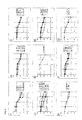
Figure 3] Figure 3 shows the results (dose-response curves of cell growth rate) of a drug sensitivity test of (-)exiguolide using a panel of human cultured cancer cell lines, where in each graph, the vertical axis represents the cell growth rate (%); and the horizontal axis represents the drug concentration (M). - [
Figure 4] Figure 4 shows the results (finger print) of a drug sensitivity test of (-)exiguolide using a panel of human cultured cancer cell lines. - [
Figure 5A] Figure 5A shows antiproliferative activities of (-)exiguolide and itsanalogs 1 to 3 on A549, H460, and A172 cell lines, where in each graph, the vertical axis represents the cell growth rate (%); and the horizontal axis represents the drug concentration (M). - [
Figure 5B] Figure 5B shows antiproliferative activities of (-)exiguolide and itsanalogs 4 to 8 on A549, H460, and A172 cell lines, where in each graph, the vertical axis represents the cell growth rate (%); and the horizontal axis represents the drug concentration (M). - [
Figure 6] Figure 6 shows 50% growth inhibition concentration (IC50) levels of (-)exiguolide and itsanalogs 1 to 8 on H460, A549, A172, and HUVEC cell lines, where the graph at the center shows comparison of IC50 levels of exiguolide andanalogs 1 to 8 for each cell line (the bars in the graph represent IC50 levels for H460, A549, and A172 cell lines from the left); and the lower graph shows comparison of IC50 levels of exiguolide andanalogs analog 1, andanalog 4 from the left). - [
Figure 7] Figure 7 shows the results of investigation for cell-cycle arrest activity of exiguolide, where the upper is a graph showing ratios of phases of each cell cycle; and the lower shows the results of observation of phosphorylation state of G1 phase regulatory protein Rb by Western blotting. - [
Figure 8] Figure 8 shows the results of an in vivo antitumor activity test of exiguolide in immunodeficient mice bearing tumors induced by human lung cancer cell line H460, where in the graph, the vertical axis (relative volume) represents the relative values when the estimated tumor volume on theday 0 is defined as 1; and the horizontal axis (day) represents the number of days from the start of administration. - [
Figure 9] Figure 9 shows the results of an in vivo antitumor activity test of exiguolide in immunodeficient mice bearing tumors induced by human lung cancer cell line A549, where in the graph, the vertical axis (relative volume) represents the relative values when the estimated tumor volume on theday 0 is defined as 1; and the horizontal axis (day) represents the number of days from the start of administration. - This description includes the contents as disclosed in the description of Japanese Patent Application No.
2010-286945 - Throughout the description, the term "alkyl" means a saturated straight-chain (unbranched) or branched, noncyclic hydrocarbon having 1 to 10, preferably 1 to 5, carbon atoms. Typical examples of the saturated straight-chain (unbranched) alkyl include -methyl, -ethyl, -n-propyl, -n-butyl, -n-pentyl, -n-hexyl, -n-heptyl, -n-octyl, -n-nonyl, and n-decyl; and typical examples of saturated branched alkyl, include -isopropyl, -sec-butyl, -isobutyl, -tert-butyl, -isopentyl, 2-methylbutyl, 3-methylbutyl, 2-methylpentyl, 3-methylpentyl, 4-methylpentyl, 2-methylhexyl, 3-methylhexyl, 4-methylhexyl, 5-methylhexyl, 2,3-dimethylbutyl, 2,3-dimethylpentyl, 2,4-dimethylpentyl, 2,3-dimethylhexyl, 2,4-dimethylhexyl, 2,5-dimethylhexyl, 2,2-dimethylpentyl, 2,2-dimethylhexyl, 3,3-dimethylpentyl, 3,3-dimethylhexyl, 4,4-dimethylhexyl, 2-ethylpentyl, 3-ethylpentyl, 2-ethylhexyl, 3-ethylhexyl, 4-ethylhexyl, 2-methyl-2-ethylpentyl, 2-methyl-3-ethylpentyl, 2-methyl-4-ethylpentyl, 2-methyl-2-ethylhexyl, 2-methyl-3-ethylhexyl, 2-methyl-4-ethylhexyl, 2,2-diethylpentyl, 3,3-diethylhexyl, 2,2-diethylhexyl, and 3,3-diethylhexyl.
- Throughout the description, the term "alkenyl," means a straight-chain or branched, noncyclic hydrocarbon having 2 to 10, preferably 1 to 5, carbon atoms and having at least one carbon-carbon double bond. Typical examples of the straight-chain or branched (C2 to C10) alkenyl include -vinyl, -allyl, -1-butenyl, -2-butenyl,-isobutylenyl, -1-pentenyl, -2-pentenyl, -3-methyl-1-butenyl, -2-methyl-2-butenyl, -2,3-dimethyl-2-butenyl,-1-hexenyl, -2-hexenyl, -3-hexenyl, -1-heptenyl, -2-heptenyl, -3-heptenyl, -1-octenyl, -2-octenyl, -3-octenyl, -1-nonenyl, -2-nonenyl, -3-nonenyl, -1-decenyl, -2-decenyl, and -3-decenyl. The alkenyl group may be substituted or not substituted.
- Throughout the description, the term "alkynyl" means a straight-chain or branched, noncyclic hydrocarbon having 2 to 10, preferably 2 to 5, carbon atoms and having at least one carbon-carbon triple bond. Typical examples of the straight-chain or branched (C2 to C10) alkynyl include -acetylenyl, -propynyl, -1-butynyl, -2-butynyl, -1-pentynyl, -2-pentynyl, -3-methyl-1-butynyl, - 4-pentynyl, -1-hexynyl, -2-hexynyl, -5-hexynyl, -1-heptynyl, -2-heptynyl, -6-heptynyl, -1-octynyl, -2-octynyl, -7-octynyl, -1-nonynyl, -2-nonynyl, -8-nonynyl, -1-decynyl, -2-decynyl, and -9-decynyl. The alkynyl group may be substituted or not substituted.
- Throughout the description, the term "aryl" means a carbocyclic aromatic group having 5 to 10 ring atoms. Typical examples thereof include, but not limited to, phenyl, tolyl, anthracenyl, fluorenyl, indenyl, azulenyl, pyridinyl, and naphthyl, and also include benzo-fused carbocyclic moieties such as 5,6,7,8-tetrahydronaphthyl. The carbocyclic aromatic group may be substituted or not substituted. In one embodiment, the carbocyclic aromatic group is a phenyl group.
- Throughout the description, the term "heteroaryl" means a 5 to 1.0-membered aromatic heterocycle having at least one hetero atom selected from nitrogen, oxygen, and sulfur atoms and having at least one carbon atom and includes both monocycle and bicycle. Typical examples of the heteroaryl include triazolyl, tetrazolyl, oxadiazolyl, pyridyl, furyl, benzofuranyl, thiophenyl, benzothiophenyl, quinolinyl, pyrrolyl, indolyl, oxazolyl, benzoxazolyl, imidazolyl, benzoimidazolyl, thiazolyl, benzothiazolyl, isoxazolyl, pyrazolyl, isothiazolyl, pyridazinyl, pyrimidinyl, pyrazinyl, triazinyl, cinnolinyl, phthalazinyl, quinazolinyl, pyrimidyl, oxetanyl, azepinyl, piperazinyl, morpholinyl, dioxanyl, thiethanyl, and oxazolyl.
- Throughout the description, the term "heterocyclyl" means saturated or unsaturated 5 to 7-membered monocyclic or 7 to 10-membered bicyclic heterocycle having 1 to 4 hetero atoms independently selected from nitrogen, oxygen, and sulfur atoms, wherein the nitrogen and sulfur hetero atoms are optionally oxidized, and the nitrogen hetero atom is optionally quaternized, and includes a bicycle formed by condensation of any of these heterocyclyls to a benzene ring. The heterocyclyl can bond via an appropriate hetero atom or carbon atom. The heteroaryls defined above are included in the heterocyclyl. Typical examples of the heterocyclyl include morpholinyl, pyrrolidinonyl, pyrrolidinyl, piperidinyl, hydantoinyl, valerolactamyl, oxiranyl, oxetanyl, tetrahydrofuranyl, tetrahydropyranyl, tetrahydropyridinyl, tetrahydropyrimidinyl, tetrahydrothiophenyl, and tetrahydrothiopyranyl.
- Throughout the description, the term "pharmaceutically acceptable salt" means a salt prepared from a pharmaceutically acceptable non-toxic acid or base, of which examples include inorganic acids and bases and organic acids and bases. Examples of the pharmaceutically acceptable base addition salt suitable for the compound of the present invention include, but not limited to, metal salts formed from aluminum, calcium, lithium, magnesium, potassium, sodium, and zinc; and organic salts formed from lysine, N,N'-dibenzylethylenediamine, chloroprocaine, choline, diethanolamine, ethylenediamine, meglumine (N-methylglucamine), and procaine. Examples of the suitable non-toxic acid include, but not limited to, inorganic and organic acids, such as acetic acid, alginic acid, anthranilic acid, benzenesulfonic acid, benzoic acid, camphorsulfonic acid, citric acid, ethenesulfonic acid, formic acid, fumaric acid, furoic acid, galacturonic acid, gluconic acid, glucuronic acid, glutamic acid, glycolic acid, hydrobromic acid, hydrochloric acid, isethionic acid, lactic acid, maleic acid, maleic acid, mandelic acid, methanesulfonic acid, mucic acid, nitric acid, pamoic acid, pantothenic acid, phenylacetic acid, phosphoric acid, propionic acid, salicylic acid, stearic acid, succinic acid, sulfanilic acid, sulfuric acid, tartaric acid, and p-toluenesulfonic acid. Specific examples of the non-toxic acid include hydrochloric acid, hydrobromic acid, phosphoric acid, sulfuric acid, and methanesulfonic acid. Accordingly, specific examples of the salt include hydrochlorides and mesylates. Other salts are known in the art and are described in, for example, Remington's Pharmaceutical Sciences, 18th Eds.
- The compound or a pharmaceutically acceptable salt thereof of the present invention may be in a solvate, hydrate, clathrate, or prodrug form.
- Herein, the term "solvate" means the compound or a salt thereof of the present invention further including a stoichiometric or non-stoichiometric amount of solvent bound by non-covalent intermolecular forces. The solvent is preferably volatile, non-toxic, and/or compatible with administration to human in a very small amount.
- The term "hydrate" means the compound or a salt thereof of the present invention further including a stoichiometric or non-stoichiometric amount of water bound by non-covalent intermolecular forces.
- The term "clathrate" means the compound or a salt thereof of the present invention in a crystal lattice form having spaces (e.g., channels) including guest molecules (e.g., solvent or water) trapped therein.
- The term "prodrug" means the compound of the present invention that can provide an active compound (in particular, a compound of the present invention) through hydrolysis, oxidation, or another reaction under biological conditions (in vitro or in vivo). Examples of the prodrug include, but not limited to, metabolites of the compound of the present invention containing biohydrolyzable moieties such as biohydrolyzable amide, biohydrolyzable ester, biohydrolyzable carbamate, biohydrolyzable carbonate, biohydrolyzable ureide, and biohydrolyzable phosphate analogs. The prodrug of a compound having a carboxyl functional group is preferably a lower alkyl ester of carboxylic acid. The carboxylate ester can be more conveniently prepared by esterifying any of carboxylic acid moieties existing on the molecule. The prodrug can be typically prepared by a known method such as a method described in, for examples, Burger' s Medicinal Chemistry and Drug Discovery 6th Ed.
- Throughout the description, the term "cell growth inhibitor" is a drug that inhibits growth of cells. The type of cells is not limited, but it is preferable that the inhibitor less act on normal cells and show the growth-inhibiting effect on specific cancer cells only, in light of using as an anticancer drug described below.
- Throughout the description, the term "anticancer drugs" is a pharmaceutical composition that is used for treatment or prevention of cancer. The term "treatment" includes eradication, removal, reedy, or inhibition of primary, local, or metastatic cancer tissue and also includes minimization or delay of the progress of cancer. The term "prevention" includes prevention of recurrence, progress, or occurrence of cancer in a patient.
- The macrolide compounds according to the present invention are (-)exiguolide and its analogs and exhibit growth-inhibiting activities on cells showing abnormal growth, such as cancer cells.
- Exiguolide is, as described above, one of macrocyclic lactones isolated from sponges and is known to have an activity of inhibiting maturation of ova and spermatozoa of Hemicentrotus pulcherrimus. Exiguolide has a 20-membered cyclic macrolide structure including a partial structure similar to bryostatins.
- In one embodiment, the macrolide compound of the present invention is represented by Formula (I) :

- In the formula, X1 represents any one of the following formulae:

- X2 and X3 each independently represent H, alkyl, alkenyl, alkynyl, aryl, heteroaryl, heterocyclyl, -O-, - OC(O)-, -CONRi-, -C(O)-, -S-, -S(O)-, -S(O)2-, -NRi-, or -NRiCO-.
- X4 and X5 each independently represent H, alkyl, alkenyl, alkynyl, aryl, heteroaryl, or heterocyclyl.
- A-B represents CH2-CH2, CH=CH, CH2-O, or O-CH2.
- Each Ri and each Rii independently represent H, alkyl, alkenyl, alkynyl, aryl, heteroaryl, or heterocyclyl.
- In another embodiment, the macrolide compound of the present invention is represented by Formula (II):

- In the formula, X1 represents any one of the following formulae:

- X2 represents =O, =NC(O)-, =NS(O)2- , =CRi-, =CRiC(O)-, =CRiC(O)O-, =CRiC(O)NRii-, =CRiC(O)S-, =C(C(O)-)2,
=C(C(O)O-)2, =C(C(O)Ri) (C(O)Rii), or
=C(C(O)ORi)(C(O)ORii). - X3 and X4 each independently represent H, alkyl, alkenyl, alkynyl, aryl, heteroaryl, or heterocyclyl.
- A-B represents CH2-CH2, CH=CH, CH2-O, or O-CH2.
- Each Ri and each Rii independently represent H, alkyl, alkenyl, alkynyl, aryl, heteroaryl, or heterocyclyl.
-
Analogs 1 to 8 shown inFigures 1A and1B are examples of the macrolide compound of the present invention. Other examples of the macrolide compound of the present invention are shown below: -



- The macrolide compound of the present invention can be produced, for example, by synthesizing (-)exiguolide by the method established by the present inventors (Fuwa H. et al., Org. Lett., 12(3), 2010, pp. 584-587:
Reference Example) and introducing a desired substituent to the (-)exiguolide by a known method in the art. - That is, (-)exiguolide can be synthesized by (i) constructing two tetrahydropyrane rings through an intramolecular conjugate addition reaction and a reductive etherification, (ii) forming a large-membered ring lactone skeleton through macrolactonization or ring-closing metathesis, and (iii) introducing a side chain through a Suzuki-Miyaura reaction.
- Herein, the (i) stereoselective construction of the tetrahydropyrane rings by an intramolecular conjugate addition reaction and a reductive etherification correspond to a series of steps of converting
compound 10 inScheme 4 of Reference Example described below intocompound 9 and then intocompound 4. The (ii) construction of a large-membered ring lactone structure by macrolactonization or ring-closing metathesis corresponds to a step of convertingcompound 25 inScheme 6 of Reference Example intocompound 22 and a step of convertingcompound 5 inScheme 5 intocompound 22. The (iii) stereoselective introduction of a side chain by a Suzuki-Miyaura reaction corresponds to a step of convertingcompound 3 inScheme 6 intocompound 1. - Cells proliferate through a cell cycle. The cell cycle is a process composed of growth of a daughter cell generated by cell division to a mother cell and cell division of the mother cell to generate daughter cells. The cell cycle can be divided into a G0 phase, a G1 phase, an S phase, a G2 phase, and an M phase. The G0 phase is a resting phase of the cell where the cell is not actively preparing itself for growth; the G1 phase is a phase of starting preparation for cell growth; the S phase is a synthesis phase for replicating DNA; the G2 phase is a phase of cell growth from DNA synthesis till occurrence of mitosis; and the M phase is the mitotic phase. The cell cycle proceeds by cooperation with various molecules.
- It is important to know in which stage of the cell cycle each drug acts, from the point of determining the effect of the drug on cell growth. In some carcinomas, a molecule that accelerates the cell cycle is abnormally enhanced. For example, if it is possible to specifically inhibit a molecule that accelerates the transition from the G1 phase to the S phase, the abnormally enhanced cell cycle can be stopped to inhibit cell growth.
- As described above, the "cell growth inhibitor" of the present invention is a drug that inhibits growth of cells. The macrolide compound of the present invention has a possibility of inhibiting cell growth by stopping the cell cycle.
- The "cell growth inhibitor" of the present invention contains an effective dose of a compound represented by Formula (I) or (II) or a pharmaceutically acceptable salt thereof.
- Herein, the term "effective dose" means a sufficient amount for inhibiting the growth of target cells. In the case of using the cell growth inhibitor as a therapeutic agent, the term "effective dose" means a sufficient amount for inhibiting the growth of target cells only without significantly affecting normal cells. The term "effective dose" also includes a sufficient amount of the compound of the present invention for modulating (e.g., activating or inhibiting, preferably inhibiting) ligase activity either in vitro or in vivo.
- Preferred examples of the target cell are cancer cells. The cancer may be any cancer, and examples thereof include pancreatic cancer, colon cancer, liver cancer, brain cancer, lung cancer, squamous cell carcinoma, bladder cancer, gastric cancer, pancreatic cancer, prostatic cancer, kidney cancer, colorectal cancer, breast cancer, head cancer, neck cancer, esophageal cancer, gynecological cancer, thyroid cancer, lymphoma, chronic leukemia, and acute leukemia.
- It has been confirmed that the macrolide compound of the present invention shows a remarkable cell growth-inhibiting effect on specific cancer cells only and does not significantly affect normal cells. Such specific cancer cells are, for example, lung cancer cells.
- The cell growth inhibitor of the present invention may be used in vitro or in vivo. In the case of using the inhibitor in vivo, the administration may be oral or parenteral. Parenteral administration is particularly preferred, and specific examples thereof include injection, transnasal administration, pulmonary administration, and transdermal administration. Examples of the infection include intravenous injection, intramuscular injection, intraperitoneal injection, and subcutaneous injection. The route of administration can be appropriately selected depending on the age and symptoms of a patient.
- The dose of the cell growth inhibitor of the present invention is appropriately determined depending on the purpose, the route of administration, etc. In inhibition of cell growth in vitro, the dose is appropriately controlled depending on the culture scale. In administration to human, for example, the dose in each administration can be selected in the range of 0.0001 to 1000 mg per 1 kg of body weight. Alternatively, for example, a dose in each patient can be selected in the range of 0.001 to 100000 mg/body. However, the cell growth inhibitor of the present invention is not limited to these doses.
- The cell growth inhibitor of the present invention may contain a pharmaceutically acceptable carrier and additive. Examples of the carrier and additive include, but not limited to, surfactants, fillers, coloring agents, flavoring agents, preservatives, stabilizers, buffers, suspending agents, isotonizing agents, binding agents, disintegrators, lubricants, fluidizing agents, and corrigents. Other conventional carriers can be also used appropriately, and specific examples thereof include light anhydrous silicic acid, lactose, crystalline cellulose, mannitol, starch, calcium carmellose, sodium carmellose, hydroxypropyl cellulose, hydroxypropylmethyl cellulose, polyvinylacetal diethylaminoacetate, polyvinylpyrrolidone, gelatin, middle-chain fatty acid triglyceride, polyoxyethylene hydrogenated
castor oil 60, sucrose, carboxymethyl cellulose, corn starch, and inorganic salts. - The present invention provides an anticancer drug containing a therapeutically effective dose of a compound represented by Formula (I) or (II) or a pharmaceutically acceptable salt thereof.
- Here, the term "effective dose" means a sufficient amount of the compound of the present invention for destruction, remedy, inhibition, or removal of primary, local, or metastatic cancer cells or cancer tissue; delay or minimization of the progress of cancer; or provision of advantages for treating cancer. The term "effective dose" also includes a sufficient amount of the compound of the present invention for inducing death of cancer or neoplasm cells. In addition, the term "effective dose" includes a sufficient amount of the compound of the present invention for modulating (e.g., activating or inhibiting, preferably inhibiting) ligase activity either in vitro or in vivo.
- The cancer to be treated may be any cancer, and examples thereof include pancreatic cancer, colon cancer, liver cancer, brain cancer, lung cancer, squamous cell carcinoma, bladder cancer, gastric cancer, pancreatic cancer, prostatic cancer, kidney cancer, colorectal cancer, breast cancer, head cancer, neck cancer, esophageal cancer, gynecological cancer, thyroid cancer, lymphoma, chronic leukemia, and acute leukemia.
- The anticancer drug of the present invention is predicted to be particularly effective on lung cancer from the results of a drug sensitivity test .
- The anticancer drug of the present invention can be administered either orally or parenterally. Parenteral administration is particularly preferred, and specific examples thereof include injection, transnasal administration, pulmonary administration, and transdermal administration, In injection administration, systemic or local administration can be performed by, for example, intravenous injection, intramuscular injection, intraperitoneal injection, or subcutaneous injection. The route of administration can be appropriately selected depending on the age and symptoms of a patient.
- The dose in each administration can be selected in the range of 0.0001 to 1000 mg, preferably 0.001 to 100 mg, and more preferably 0.01 to 10 mg, per 1 kg of body weight. Alternatively, for example, a dose in each patient can be selected in the range of 0.001 to 100000 mg/body, preferably 0.01 to 1000 mg/body, and more preferably 0.1 to 100 mg/body. However, the anticancer drug of the present invention is not limited to these doses.
- The anticancer drug of the present invention can be formulated in accordance with a common method (e.g., Remington's Pharmaceutical Science, latest edition, Mark Publishing Company, Easton, U.S.A.) and may contain a pharmaceutically acceptable carrier and additive. Examples of the carrier and additive include, but not limited to, surfactants, fillers, coloring agents, flavoring agents, preservatives, stabilizers, buffers, suspending agents, isotonizing agents, binding agents, disintegrators, lubricants, fluidizing agents, and corrigents. Other conventional carriers can be also used appropriately, and specific examples thereof include light anhydrous silicic acid, lactose, crystalline cellulose, mannitol, starch, calcium carmellose, sodium carmellose, hydroxypropyl cellulose, hydroxypropylmethyl cellulose, polyvinylacetal diethylaminoacetate, polyvinylpyrrolidone, gelatin, middle-chain fatty acid triglyceride, polyoxyethylene hydrogenated
castor oil 60, sucrose, carboxymethyl cellulose, corn starch, and inorganic salts. - The mechanism and the phase of the activity of the anticancer drug of the present invention are likely different from those of known drugs. Specifically, a mechanism of stopping the cell cycle at the G1 phase is predicted. It is therefore expected to show advantageous effects in combination with other anticancer drugs or effects of overcoming multiple drug resistance.
- The present invention will now be specifically described by Reference Examples, Examples, and Test Examples, but is not limited to these Examples and Test Examples.
- The (E,Z,E)-triene side chain of
compound 1 was stereoselectively introduced at the final stage of the total synthesis by a Suzuki-Miyaura reaction of vinylboricacid ester 2 and vinyl iodide 3 (Scheme 1). In construction of the macrolactone ring ofcompound 3, route A via ring-closing metathesis (RCM) using methylene bis(tetrahydropyran) 4 as a common synthetic intermediate and route B via macrolactonization were designed. That is, route A was expected thatcompound 3 can be prepared by RCM oftriene 5 and thatcompound 5 can be induced fromcompound 4 through esterification. In route B, it was expected thatcompound 3 can be prepared through macrolactonization ofhydroxycarboxylic acid 7 by a Yamaguchi method and thatcompound 7 can be synthesized fromcompound 4 through stereoselective formation of a C16-C17 double bond by a Julia-Kocienski reaction. It was believed that common intermediate 4 can be prepared by reductive etherification ofsilyloxyketone 9 and thatsilyloxyketone 9 can be synthesized by an intramozecular conjugate addition reaction ofhydroxyenone 10.Compound 10 was synthesized by an olefin cross metathesis (CM) reaction of hydroxyolefin 11 andenone 12, which are non-cyclic segments that can be easily prepared. -

- Compound 11 was synthesized using
homoallylic alcohol 13 prepared by Keck asymmetric allylation as a starting material (Scheme 2). The hydroxy group ofcompound 13 was protected and was then induced into aldehyde 14 by oxidatively cleaving the double bond. Compound 14 was diastereoselectively allylated by allyltrimethylsilane in the presence of a magnesium bromide-diethyl ether complex to givehomoallylic alcohol 15 having a desired stereochemistry as a single stereoisomer. Subsequent conversion of the protecting group gives hydroxyolefin 11. -

-
Compound 12 was synthesized using aldehyde 16, which is easily available from (S)-Roche ester through five stages, as a starting material (Scheme 3). Compound 16 was homologated by Brown asymmetric allylation and subsequent CM using a Grubbs second generation catalyst (G-II) to induceunsaturated ester 17. After catalytic reduction ofcompound 17, the resulting ester was converted into Weinreb amide, and the free hydroxy group was further silylated to give compound 18. Compound 18 was reacted with vinyl lithium to synthesizeenone 12.
-
Compounds 11 and 12 were reacted with each other in dichloromethane in the presence of 10 mol% of Hoveyda-Grubbs second generation catalyst (HG-II) at 35°C to givehydroxyenone 10 in a high yield as a single stereoisomer (Scheme 4). Subsequently,compound 10 was treated with potassium t-butoxide in tetrahydrofuran at 0°C to allow smooth proceeding of the intramolecular conjugate addition reaction to givetarget silyloxyketone 9 in a yield of 95% as a single stereoisomer. Finally,compound 9 was reacted with a boron trifluoride-diethyl ether complex in dichloromethane in the presence of a large excess amount of triethylsilane, andcompound 4 was isolated in a yield of 98% as a diastereomer mixture of about 10:1 with respect to the C9-position.Compound 4 was efficiently constructed with a considerably high convergence by appropriately arranging functional groups necessary for ring formation inCompounds 11 and 12 in advance and utilizing a high functional group acceptability and strong carbon-carbon bond forming ability of olefin metathesis. Actually,compound 4 could be readily synthesized in a gram scale. -
- Alcohol generated by hydrogenolysis of
Compound 4 was subjected to Dess-Martin oxidation to givealdehyde 19. Thealdehyde 19 was converted intoolefin 20 by methylenation (Scheme 5). The t-butyl diphenyl silyl group ofcompound 20 was selectively removed, and the resulting alcohol was oxidized intocarboxylic acid 21.Compound 21 andalcohol 6 were condensed to inducetriene 5, and its RCM was investigated under various conditions. - RCM was investigated using a G-II catalyst in dichloromethane at reflux or in toluene at 70°C. As a result, only a trace amount of
target compound 22 was generated, and the catalyst was decomposed in the initial stage of the reaction. Accordingly, the reaction was performed using an HG-II catalyst in toluene at 80°C for 1 day. As a result,compound 22 was given in a yield of 30%, and 18% ofraw material 5 was recovered. A reaction for a longer time or at a higher temperature, however, did not increase the yield ofcompound 22, but generated the compound 22' at the same degree as a by-product. This is believed that an active species of RCM, a ruthenium methylidene complex, reacted with iodinated vinyl moieties to generate the by-product. On the other hand,target compound 22 could be prepared in a yield of 52% (raw material recovery: 24%) by performing this reaction in 1,2-dichloroethane at 75°C with only a trace amount of compound 22' generated. In addition, titanium tetraisopropoxide and 2,6-dichloro-1,4-benzoquinone were investigated as additives, but were not useful in this reaction. -


- Constriction of a 20-membered ring by a Yamaguchi method was investigated (Scheme 6). A Julia-Kocienski reaction between
aldehyde 19 and separatelyprepared sulfone 8 was investigated. As a result, target (E)-olefin 23 was isolated in a yield of 63% (raw material recovery: 23%) by treatingcompound 8 with lithium bis(trimethylsilyl)amide in tetrahydrofuran/hexamethyl phosphoamide (4:1) at -78°C to generate a corresponding anion, then addingcompound 20 thereto, and gradually warming the reaction solution to room temperature. The t-butyl diphenylsilyl group ofcompound 23 was selectively removed, and the resulting alcohol was converted intoester 24 by two-stage oxidation and methylesterification. It was found that deprotection was most efficiently achieved by treating the p-methoxybenzyl group ofcompound 24 with a boron trifluoride-diethyl ether complex in the presence of triethylsilane, andalcohol 25 was prepared in a yield of 89%.Compound 25 was hydrolyzed, and the resulting hydroxycarboxylic acid was macrolactonized by a Yamaguchi method. As a result, a 20-membered ring lactone 22 was isolated in a yield of 94% (the sum of two stages). The alcohol prepared by removing the triisopropylsilyl group ofcompound 22 was oxidized to quantitatively giveketone 26.Compound 26 was subjected to a Horner-Madsworth-Emmons reaction usingchiral phosphonate 27 and sodium bis(trimethylsilyl)amide to givecompound 3 as a mixture of E/Z isomers (E/Z = ca. 1:5) in a yield of 94%. These isomers could be separated by silica gel column chromatography. Lastly, stereoselective introduction of a (E, Z, E)-triene side chain was performed. That is, the Suzuki-Miyaura reaction ofcompound 3 andvinylboric acid ester 2 smoothly proceeded in tetrahydrofuran at room temperature by using tris(dibenzylideneacetone)dipalladium complex/triphenyl arsenic catalyst and silver oxide to successively give compound(-)-1 as a single isomer in a yield of 73%. The various spectral data (1H and 13C NMR spectra and high-resolution mass spectrometry spectra) of the synthetic product, compound (-)-1, completely agreed with those of the natural product. The specific rotation ([α]24D -121.5 (c = 0.22, chloroform)) of the synthetic product. also well agreed with that ([α]25D -92.5 (c = 0.069, chloroform)) of the natural product. -

- (1) The formulae of
analogs -

- (2) The formulae of
analogs -

- (3) The formulae of
analogs -


- (4) The formulae of
analogs -


-

- Silver oxide (22.8 mg, 0.0984 mmol), trisdibenzylideneacetone dipalladium (2.7 mg, 0.0029 mmol), and triphenyl arsenic (7.2 mg, 0.024 mmol) were added to 1.1 mL of a mixture solution of alcohol I (10.2 mg, 0.0197 mmol) and (Z)-vinylboric acid pinacol ester II (29.2 mg, 0.110 mmol) in tetrahydrofuran/water (volume ratio: 10:1) at room temperature. The reaction mixture was stirred at room temperature for 20 minutes, and then insoluble were removed by filtration through Celite. The filtrate was concentrated under reduced pressure. The crude product was purified by silica gel column chromatography (Fuji Silysia BW-300 silica gel; eluent: 40 to 60 ethyl acetate/hexane) to give compound III (10.0 mg, yield: 96%) as a light-yellow liquid.
- [α]25D =-121.4 (c = 0.14, benzene); IR (thin film) 3454, 2928, 1737, 1436, 1372, 1326, 1263, 1183, 1157, 1090, 1039, 975, 903, 680 cm-1; 1H-NMR (600 MHz, deuterated chloroform): δ = 6.66 (dd, J = 15.1, 11.3 Hz, 1H), 6.37 (d, J = 11.3 Hz, 1H), 6.18 (dd, J = 11.3, 11.3 Hz, 1H), 5.96 (dd, J = 11.3, 11.3 Hz, 1H), 5.66 (dd, J = 15.1, 6.9 Hz, 1H), 5. 53 (dd, J = 15.1, 9.6 Hz, 1H), 5.23 (m, 1H), 5.06 (dd, J = 15.1, 9.6 Hz, 1H), 3.85-3.74 (m, 2H), 3.68 (s, 3H), 3.27 (m, 1H), 3.20 (m, 1H), 3.12 (m, 1H), 3.10 (s, 2H), 2.56 (m, 1H), 2.53 (dd, J = 14.1, 11.0 Hz, 1H), 2. 43 (dd, J = 14.1, 2.8 Hz, 1H), 2. 32 (m, 1H), 1.96 (m, 1H), 1.84 (m, 1H), 1.83 (s, 3H), 1.77-1.72 (m, 2H), 1.62 (m, 1H), 1.54-1.01 (m, 13H), 0.92 ppm (d, J = 6.5 Hz, 3H); 13C-NMR (150 MHz, deuterated benzene): δ = 170.7, 170.3, 135.8, 133.2, 133.1, 132.2, 128.5, 126.1, 124.3, 78.0, 75.7, 75.3, 72.9, 72.1, 67.7, 50.9, 44.9, 44.4, 43.5, 42.4, 41.3, 41.2, 40.2, 33.1, 32.7, 32.0, 24.3, 21.9, 16.9, 14.5 ppm; HRMS (ESI): m/z Calcd.: 553.3136 [(M+Na)+]; Found: 553.3148.
-

- Acetic anhydride (0.5 mL) was added to 0.5 mL of a solution of compound III (2.6 mg, 0.0049 mmol) in pyridine, and the reaction solution was stirred overnight at room temperature. The reaction solution was concentrated under reduced pressure, followed by purification by silica gel column chromatography (Fuji Silysia BW-300 silica gel; eluent: 10 to 30% ethyl acetate/hexane) to give compound IV (2.4 mg, yield: 86%) as a colorless liquid.
- [α]23D = -111.8 (c = 0.12, benzene); 1H NMR (600 MHz, deuterated benzene) : δ = 6.95 (dd, J = 15.1, 11.3 Hz, 1H), 6.38 (d, J = 11.7 Hz, 1H), 6. 16 (dd, J = 11.7, 11.0 Hz, 1H), 5.98 (dd, J = 11.3, 11.0 Hz, 1H), 5.82 (dd, J = 14.8, 9.6 Hz, 1H), 5.73 (dd, J = 15.1, 6.8 Hz, 1H), 5.65 (m, 1H), 5.12 (dd, J = 15.1, 9.6 Hz, 1H), 4.83 (m, 1H), 3.71 (m, 1H), 3.50 (m, 1H), 3.40 (m, 1H), 3.26 (s, 3H), 2.97 (m, 1H), 2.87 (m, 1H), 2.80 (s, 2H), 2.38-2.30 (m, 2H), 2.03 (dd, J = 14.4, 2.8 Hz, 1H), 1.95 (dd, J = 12.7, 11.3 Hz, 1H), 1.72-1.44 (m, 12H), 1.38 (m, 1H), 1.32-1.01 (m, 9H), 0.99 ppm (d, J = 6.9 Hz, 3H); 13C NMR (150 MHz, deuterated benzene): δ = 170.9, 170.2, 169.4, 135.9, 133.2, 133.1, 132.1, 128.5, 126.1, 124.3, 78.3, 75.9, 75.4, 73.0, 72.1, 70.3, 51.2, 45.2, 44.5, 43.8, 42.7, 41.3, 37.6, 36.6, 33.4, 32.9, 32.2, 24.5, 22.1, 20.8, 16.6, 14.7 ppm; HRMS (ESI): m/z Calcd.: 595.3241 [(M+Na)+]; Found: 595.3260.
-

- Acetic anhydride (0.5 mL) was added to 0.5 mL of a solution of compound VI (5.6 mg, 0.012 mmol) in pyridine, and the reaction solution was stirred overnight at room temperature. The reaction solution was concentrated under reduced pressure. The crude product was purified by silica gel column chromatography (Fuji Silysia BW-300 silica gel; eluent: 10 to 20% ethyl acetate/hexane) to give compound VII (5.7 mg, yield: 93%) as a mixture of unseparated geometric isomers with a ratio of 5:1 (the ratio of isomers was estimated based on the 1H-NMR spectrum; and the double bond at the C22-position of the main product exhibited Z geometric isomerism).
- [α]23D = -49.3 (c = 0.57, chloroform); IR (thin film): 2927, 2862, 1740, 1453, 1373, 1325, 1239, 1188, 1160, 1090, 1031, 975, 905, 677 cm-1; 1H-NMR (600 MHz, deuterated chloroform, signal of the major product): δ = 6.49 (dd, J = 15.1, 11.0 Hz, 1H), 5.94 (dd, J = 11.3, 11.0 Hz, 1H), 5.58 (dd, J = 15.1, 6.8 Hz, 1H), 5.52 (dd, J = 15.1, 9.3 Hz, 1H), 5.45 (m, 1H), 5.21 (m, 1H), 5.06 (m, 1H), 4.90 (m, 1H), 3.85 (dddd, J = 11.3, 11.3, 2.4, 2.4 Hz, 1H), 3.26 (m, 1H), 3.20-3.13 (m, 2H), 2.53 (m, 1H), 2.50 (dd, J = 14.0, 10.6 Hz, 1H), 2.40 (dd, J = 14.0, 3.1 Hz, 1H), 2.34 (m, 1H), 2.18-2.13 (m, 2H), 2.06 (m, 1H), 2.01 (s, 3H), 1.98 (m, 1H), 1.89 (m, 1H), 1.77-1.70 (m, 2H), 1.62 (m, 1H), 1.54-1.00 (m, 15H), 0.92 (d, J = 6.9 Hz, 3H), 0.89 ppm (t, J = 7.2 Hz, 3H); 13C-NMR (150 MHz, deuterated chloroform, signal of the major product) : δ = 170.8, 170.5, 135.3, 133.5, 132.6, 129.7, 128.0, 127.6, 78.7, 76.0, 75.2, 72.7, 72.0, 70.2, 44.1, 43.1, 42.0, 41.4, 37.2, 36.3, 33.0, 32.4, 31-7, 31.6, 27.5, 23.9, 22.3, 21.8, 21.2, 14.3, 13.9 ppm; HRMS (ESI): m/z Calcd.: 539. 3343 [(M+Na)+]; Found: 539.3340.
-
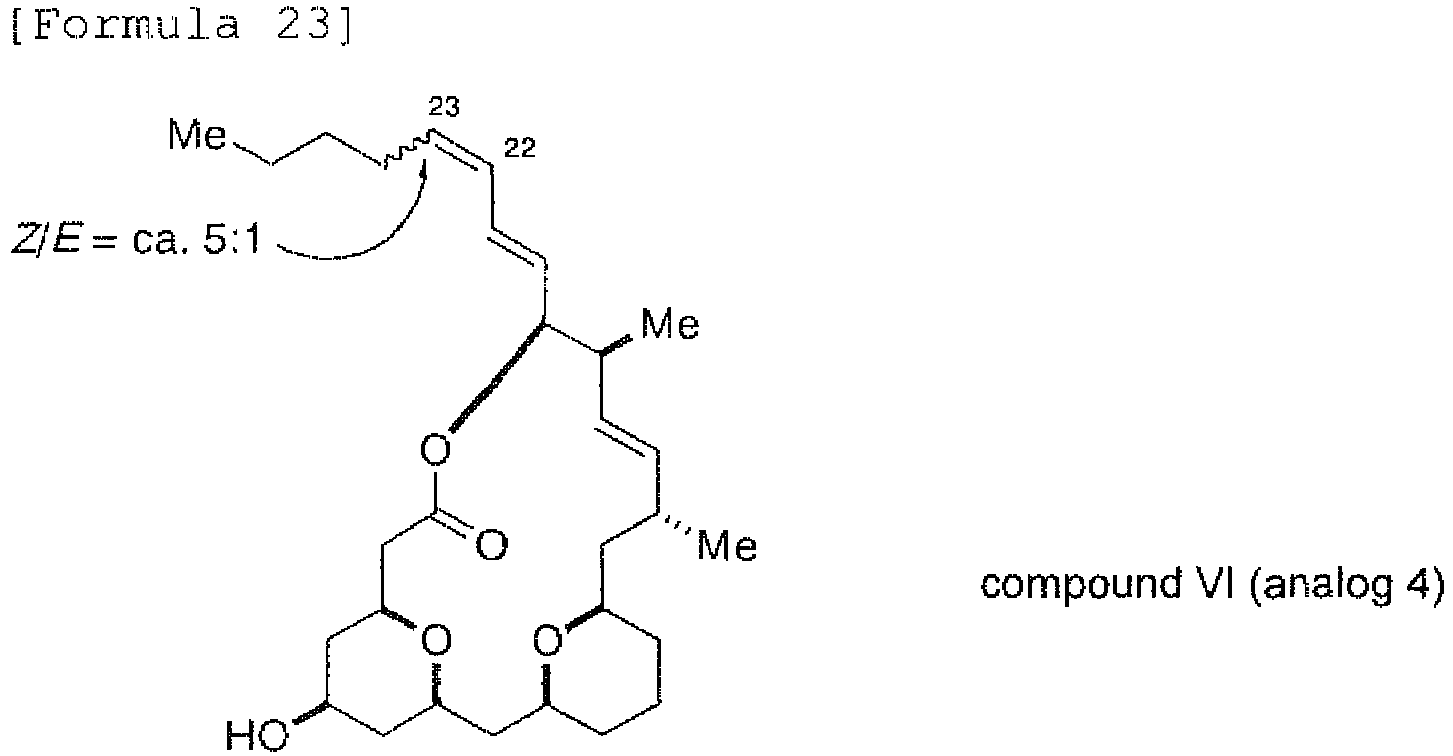
- Trisdibenzylideneacetone dipalladium (2.5 mg, 0.0027 mmol) and triphenyl arsenic (6.8 mg, 0.022 mmol) were added to 1 mL of a solution of alcohol I (9.6 mg, 0-019 mmol) and (Z)-vinyl tin V (34.6 mg, 0.0925 mmol) in N,N-dimethylformamide at room temperature. The reaction solution was stirred at room temperature for 6.5 hours, and the reaction was terminated with a saturated aqueous sodium bicarbonate solution while cooling with ice. The reaction mixture was extracted with ethyl acetate, and the organic layer was washed with a saturated saline solution. The organic layer was dried over anhydrous sodium sulfate, the desiccant was removed by filtration, and the filtrate was concentrated under reduced pressure. The crude product was purified by silica gel column chromatography (Fuji Silysia BW-300 silica gel; eluent : 30 to 45% ethyl acetate/hexane) to give compound VI (5.6 mg, yield: 64%) as a mixture of unseparated geometric isomers with a ratio of 5:1 (the ratio of isomers was estimated based on the 1H-NMR spectrum; and the double bond at the C22-position of the main product exhibited Z geometric isomerism).
- [α]24D = -43.4 (c = 0.50, chloroform); IR (thin film): 3443, 2927, 2862, 1738, 1461, 1372, 1322, 1183, 1122, 1090, 1040, 975, 900, 678 cm-1; 1H-NMR (600 MHz, deuterated chloroform, signal of the major product): δ = 6.49 (dd, J = 15.4, 11.3 Hz, 1H), 5.95 (dd, J = 11.3, 11.0 Hz, 1H), 5.58 (dd, J = 15.1, 6.8 Hz, 1H), 5.52 (dd, J = 15.1, 9.7 Hz, 1H), 5.45 (m, 1H), 5.21 (m, 1H), 5.06 (m, 1H), 3.84 (m, 1H), 3.79 (dddd, J = 11.3, 11.0, 2.5, 2.0 Hz, 1H), 3.27 (m, 1H), 3.19 (m, 1H), 3.11 (m, 1H), 2.54 (m, 1H), 2.52 (dd, J = 14.4, 11.0 Hz, 1H), 2.41 (dd, J = 14.4, 2.8 Hz, 1H), 2.34 (m, 1H), 2.18-2.14 (m, 2H), 1.96 (m, 1H), 1.84 (m, 1H), 1.77-1.71 (m, 2H), 1.62 (m, 1H), 1.54-1.00 (m, 17H), 0.92 (d, J = 6.9 Hz, 3H), 0.89 ppm (t, J = 7.2 Hz, 3H); 13C-NMR (150 MHz, deuterated chloroform, signal of the major product): δ = 171.0, 135.3, 133.4, 132.6, 129.8, 127.8, 127.6, 78.6, 76.0, 75.3, 72.8, 72.2, 68.1, 44.2, 43.1, 42.0, 41.4, 41.1, 40.2, 33.0, 32.4, 31.7, 31.6, 27.5, 23.9, 22.3, 21.8, 14.3, 13.9 ppm; HRMS (ESI): m/z Calcd.: 497.3237 [(M+Na)+]; Found: 497.3233.
-

- Silver oxide (7.1 mg, 0.031 mmol),
trisdibenzylideneacetone dipalladium (0.8 mg, 0.0009 mmol), and triphenyl arsenic (2.2 mg, 0.0072 mmol) were added to 0.55 mL of a mixture solution of vinyl iodide VIII (3.5 mg, 0.0061 mmol) and phenylboronic acid piconal ester (10.0 mg, 0.0376 mmol) in tetrahydrofuran/water (volume ratio: 10:1) at room temperature. The reaction mixture was stirred at room temperature for 30 minutes. Insolubles were removed by filtration through Celite, and the filtrate was concentrated under reduced pressure. The crude purified product was purified by silica gel column chromatography (Fuji Silysia BW-300 silica gel; eluent: 7.5% ethyl acetate/hexane) to give compound IX (3.0 mg, 93%) as a colorless liquid. - [a]23 D = -61.7 (c = 0.30, chloroform); IR (thin film) : 2928, 1718, 1651, 1435, 1373, 1236, 1154, 1090, 969, 748, 678 cm-1; 1H-NMR (600 MHz, deuterated chloroform): δ = 7.36 (d, J = 7.6 Hz, 2H), 7.29 (dd, J = 7.9, 7.6 Hz, 2H), 7.22 (dd, J = 7.9, 7.9 Hz, 1H), 6.56 (d, J = 15.8 Hz, 1H), 6.16 (dd, J = 15.8, 6.5 Hz, 1H), 5.68 (s, 1H), 5.56 (dd, J = 15.1, 9.2 Hz, 1H), 5.35 (m, 1H), 5.10 (dd, J = 15.1, 9.6 Hz, 1H), 3.87 (app. d, J = 13.4 Hz, 1H), 3.87 (m, 1H), 3.67 (s, 3H), 3.31 (m, 1H), 3.23-3.16 (m, 2H), 2.61-2.49 (m, 3H), 2.43 (m, 1H), 2.22 (dd, J = 12.4, 12.4 Hz, 1H), 2.12 (app. d, J = 13.4 Hz, 1H), 1.97 (dd, J = 12.7, 12.4 Hz, 1H), 1.80-1.73 (m, 2H), 1.63-1.47 (m, 2H), 1.45 (ddd, J = 14.1, 11.3, 2.8 Hz, 1H), 1.40 (m, 1H), 1.25-1.04 (m, 7H), 0.93 ppm (d, J = 6.5 Hz, 3H); 13C-NMR (150 MHz, deuterated chloroform): δ = 170.7, 166.8, 156.7, 136.5, 135.5, 132.5, 132.0, 128.5 (2C), 127.7, 126.7, 126.5 (2C), 115.0, 78.7, 76.0, 75.4, 74.9, 74.1, 51.0, 44.1, 43.1, 42.5, 42.1, 41.6, 34.8, 33.1, 32.5, 31.5, 23.9, 21.8, 14.4 ppm; HRMS (ESI): m/z Calcd.: 545.28374 [(M4-Na)+] Found: 545.2881.
-


- Silver oxide (8.3 mg, 0.036 mmol),
trisdibenzylideneacetone dipalladium (1.0 mg, 0.0011 mmol), and triphenyl arsenic (2.6 mg, 0.0085 mmol) were added to 1.1 mL of a mixture solvent of vinyl iodide VIII (4.1 mg, 0.0072 mmol) and vinylboronic acid piconal ester (5.0 mg, 0.032 mmol) in tetrahydrofuran/water (volume ratio: 10:1) at room temperature. The reaction mixture was stirred at room temperature for 1 hour. Insolubles were removed by filtration through Celite, and the filtrate was concentrated under reduced pressure. The crude purified product was purified by silica gel column chromatography (Fuji Silysia BW-300 silica gel; eluent: 7 to 10% ethyl acetate/hexane) to give compound X (3.2 mg, 94%) as a colorless liquid. - [α]23 D = -75.9 9 (c = 0.32, chloroform); IR (thin film): 2929, 1738, 1652, 1435, 1373, 1236, 1090, 1045, 1008, 975, 903, 858, 679cm-1; 1H-NMR (600 MHz, deuterated chloroform): δ = 6.33 (ddd, J = 16.8, 10.4, 10.3 Hz, 1H), 6.19 (dd, J = 15.1, 10.3 Hz, 1H), 5.68 (s, 1H), 5. 64 (dd, J = 15. 1, 6.2 Hz, 1H), 5.52 (dd, J = 15.1, 9.6 Hz, 1H), 5.23-5.17 (m, 2H), 5.10 (app. d, J = 10.0 Hz, 1H), 5.06 (dd, J = 15.1, 9.6 Hz, 1H), 3.86 (app. d, J = 13.4 Hz, 1H), 3.79 (m, 1H), 3.67 (s, 3H), 3.29 (m, 1H), 3.20-3.14 (m, 2H), 2.56-2.46 (m, 3H), 2.32 (dddd, J = 16.1, 7.3, 6. 9, 2.1 Hz, 1H), 2.20 (dd, J = 12.7, 12.0 Hz, 1H), 2.11 (app. d, J = 13.4 Hz, 1H), 1.95 (dd, J = 12.7, 12.7 Hz, 1H), 1.78-1.71 (m, 2H), 1.61-1.47 (m, 2H), 1.43 (ddd, J = 14.1, 11.3, 2.8 Hz, 1H), 1.38 (m, 1H), 1.25-1.03 (m, 4H), 1.03 (d, J = 6.8 Hz, 3H), 0.92ppm (d, J = 6.9 Hz, 3H); 13C-NMR (150 MHz, deuterated chloroform) : δ = 170.7, 166.8, 156.7, 135.4, 132.6, 132.5, 130.8, 117.9, 115.0, 78.2, 76.0, 75.3, 74.9, 74.1, 51.0, 44.0, 43.1, 42.5, 41.9, 41.5, 34.8, 33.0, 32.4, 32.6, 23.9, 21.8, 14.3ppm HRMS (ESI) : m/z Calcd.: 495.2717 [(M+Na)+]; Found: 495.2598.
-


- Silver oxide (16.0 mg, 0.0690 mmol), trisdibenzylideneacetone dipalladium (1.9 mg, 0.0021 mmol), and triphenyl arsenic (5.1 mg, 0.017 mmol) were added to 1.1 mL of a mixture solution of ketone XI (7.1 mg, 0.014 mmol) and (Z)-vinylboric acid pinacol ester II (15.2 mg, 0.0571 mmol) in tetrahydrofuran/water (volume ratio: 10:1) at room temperature. The reaction mixture was stirred at room temperature for 20 minutes. Insolubles were removed by filtration through Celite, and the filtrate was concentrated under reduced pressure. The crude product was purified by silica gel column chromatography (Fuji Silysia BW-300 silica gel; eluent: 20 to 30% ethyl acetate/hexane) to give compound XII (7.4 mg, yield: 100%) as a colorless liquid.
- [α]23 D = -84.2 (c = 0.74, benzene); IR (thin film): 2928, 17737, 1433, 1370, 1329, 1257, 1214, 1156, 1091, 973, 949, 680 cm-1; 1H-NMR (600 MHz, deuterated benzene): δ = 6.93 (dd, J = 14.8, 11.7 Hz, 1H), 6.37 (d, J = 11.7 Hz, 1H), 6.17 (dd, J = 11.3, 11. 3 Hz, 1H), 5.98 (dd, J = 11.0, 11.0 Hz, 1H), 5.77-5.65 (m, 3H), 5.13 (dd, J = 15.1, 9.6 Hz, 1H), 3.78 (m, 1H), 3.47 (m, 1H), 3.39 (m, 1H), 3.27 (s, 3H), 3.06 (m, 1H), 2.83 (m, 1H), 2.80 (s, 2H), 2.36 (dddd, J = 16.1, 7.2, 7.2, 1.7 Hz, 1H), 2.22 (dd, J = 14.4, 10.7 Hz, 1H), 1.99-1.81 (m, 5H), 1.78 (dd, J = 14, 12.0 Hz, 1H), 1.69 (s, 3H), 1.65 (m, 1H), 1.56 (m, 1H), 1.49 (m, 1H), 1.41 (m, 1H), 1.28-1.20 (m, 3H), 1.18 (d, J = 6.9 Hz, 3H), 1.07-1.00 (m, 2H), 0.99 ppm (d, J = 6.8 Hz, 3H); 13C-NMR (150 MHz, deuterated benzene): δ = 204.0, 170.9, 169.7, 136.0, 133.3, 133.0, 131.8, 128.5, 127.9, 126.3, 124.2, 78.3, 75.9, 75.2, 74.5, 73.2, 51.2, 47.7, 46.4, 45.2, 44.4, 43.8, 42.6, 41.3, 33.5, 32.8, 32.1, 24.9, 24.4, 22.1, 16.7, 14.6 ppm; HRMS (ESI): m/z Calcd.: 551.2979 [(M+Na)+]; Found: 55.2974.
-
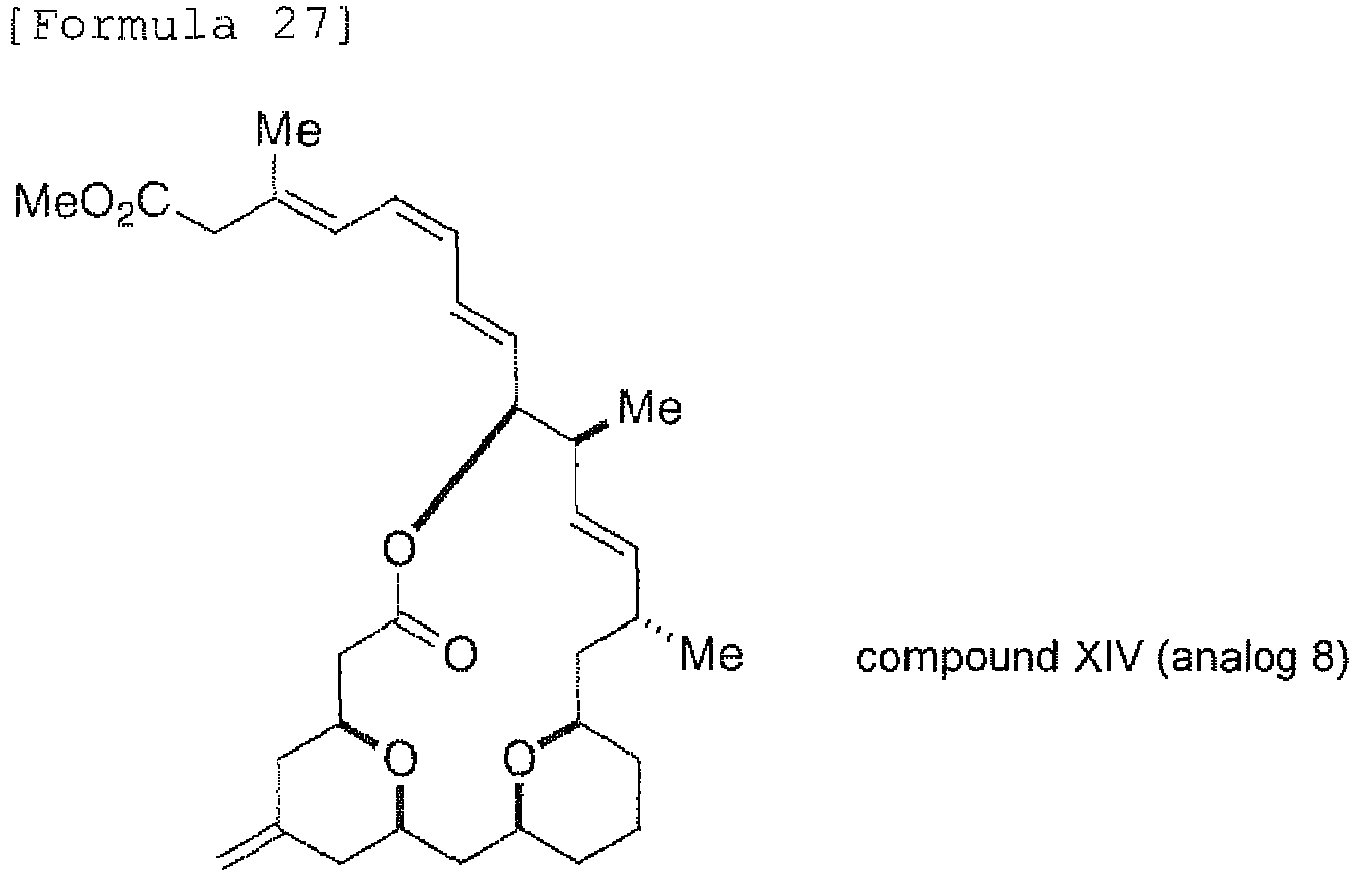
- Silver oxide (9.0 mg, 0.039 mmol),
trisdibenzylideneacetone dipalladium (1.1 mg, 0.0012 mmol), and triphenyl arsenic (2.9 mg, 0.0095 mmol) were added to 1.1 mL of a mixture solvent of olefin XIII (4.0 mg, 0.0078 mmol) and (Z)-vinylboric acid pinacol ester II (9.6 mg, 0.036 mmol) in tetrahydrofuran/water (volume ratio: 10:1) at room temperature. The reaction mixture was stirred at room temperature for 20 minutes. Insoluble were removed by filtration through Celite, and the filtrate was concentrated under reduced pressure.
The crude purified product was purified by silica gel column chromatography (Fuji Silysia BW-300 silica gel; eluent: 7% ethyl acetate/hexane) and then by thin-layer chromatography (E. Merck silica gel 60 F254 plates (0.25-mm thickness), 25 mm × 25 mm, eluted with 8% methyl acetate/hexane twice and then with 12% ethyl acetate/hexane) to give compound XIV (3.0 mg, yield: 73%) as a colorless liquid. - [α]24 D = -69.2 (c = 0.23, chloroform); IR (thin film): 2930, 1739, 1434, 1368, 1328, 1255, 1214, 1156, 1092, 1045, 976 cm-1; 1H-NMR (600 MHz, deuterated benzene): δ = 6.95 (dd, J = 15.1, 11.3 Hz, 1H), 6.38 (d, J = 9.6 Hz, 1H), 6.16 (dd, J = 11.3, 11.3 Hz, 1H), 5.98 (dd, J = 11.3, 11.3 Hz, 1H), 5.86 (dd, J = 15.1, 9.6 Hz, 1H), 5.75 (dd, J = 14.8, 6.8 Hz, 1H), 5.69 (m, 1H), 5.13 (dd, J = 14.8, 9.6 Hz, 1H), 4.66 (s, 1H), 4.65 (s, 1H), 3.77 (dddd, J = 11.0, 10.6, 3.1, 2.8 Hz, 1H), 3. 56 (m, 1H), 3.43 (m, 1H), 3.26 (s, 3H), 3.08 (m, 1H), 2.90 (m, 1H), 2.80 (s, 2H), 2.40-2.34 (m, 2H), 2.13 (dd, J = 14.8, 2.8 Hz, 1H), 2.01 (m, 1H), 1.89-1.71 (m, 4H), 1.69 (s, 3H), 1.65 (m, 1H), 1.59-1.42 (m, 4H), 1.32-1.21 (m, 2H), 1.20 (d, J = 6.9 Hz, 3H), 1.14 (m, 1H), 1.06 (m, 1H), 0.99 ppm (d, J = 6.5 Hz, 3H); 13C-NMR (150 MHz, deuterated benzene): δ = 170. 9, 170.4, 144.5, 135.9, 133.2, 133.1, 132.2, 128.5, 126.1, 124.3, 109.3, 78.2, 76.0, 75.9, 75.5, 75.0, 51.2, 45.2, 44.8, 43.8, 42.7, 41.6, 40.9, 39.9, 33.4, 32.9, 32.2, 24.5, 22.1, 16.6, 14.7 ppm; HRMS (ESI): m/z Calcd.: 549.3187 [(M+Na)+]; Found: 549.3187.
-

- A solution (1 mL) of ketone XI (7.3 mg, 0.014 mmol) and 1-tert-butyl-5-methanesulfonyl-1H-tetrazole (28.6 mg, 0.140 mmol) in tetrahydrofuran was cooled to -78°C, and to this solution was slowly dropwise added sodium bis(trimethylsilyl)amide (1.0 M tetrahydrofuran solution, 0.140 mL, 0.14 mmol). The reaction solution was slowly warmed to -17°C over 85 minutes, and then a saturated aqueous ammonium chloride solution was added thereto to terminate the reaction. The reaction mixture was extracted with ethyl acetate, and the organic layer was washed with a saturated saline solution. The organic layer was dried over anhydrous sodium sulfate, the desiccant was removed by filtration, and the filtrate was concentrated under reduced pressure. The crude product was purified by silica gel column chromatography (Fuji Silysia BW-300 silica gel; eluent: 5% ethyl acetate/hexane) to give compound XIII (7.3 mg, yield: 100%) as a colorless liquid.
- [α]25 D = -22.4 (c = 0.36, chloroform); IR (thin film): 2929, 1740, 1431, 1368, 1326, 1254, 1214, 1179, 1154, 1091, 1045, 975, 946, 894, 680 cm-1; 1H-NMR (600 MHz, deuterated chloroform): δ = 6.49 (dd, J = 14.5, 6.2 Hz, 1H), 6.33 (dd, J = 14.5, 1.1 Hz, 1H), 5.48 (dd, J = 15.1, 9.6 Hz, 1H), 5.12 (m, 1H), 5.07 (dd, J = 15.1, 9.6 Hz, 1H), 4.729 (s, 1H), 4.726 (s, 1H), 3.74 (m, 1H), 3.23 (m, 1H), 3.15 (m, 1H), 3.07 (m, 1H), 2.53 (m, 1H), 2.51 (dd, J = 14.1, 10.3 Hz, 1H), 2.46 (dd, J = 14.1, 3.4 Hz, 1H), 2.37 (dddd, J = 16.2, 7.2, 6.9, 1.7 Hz, 1H), 2.22 (app. d, J = 12.7 Hz, 1H), 2.11 (app. d, J = 13.1 Hz, 1H), 2.04 (app. d, J = 12.7 Hz, 1H), 1.99 (app. d, J = 1:3.1 Hz, 1H), 1.77-1.70 (m, 2H), 1.62 (m, 1H), 1.50-1.40 (m, 3H), 1.37 (m, 1H), 1.25-1.01 (m, 6H), 0.91 ppm (d, J = 6.8 Hz, 3H); 13C-NMR (150 MHz, deuterated chloroform): δ = 170.8, 143.8, 142.9, 136.0, 131.7, 109.5, 79.5, 79.3, 76.0, 75.7, 75.2, 74.7, 44.2, 43.0, 41.4, 41.1, 40.6, 39.8, 32.9, 32.4, 31.6, 23.9, 21.7, 14.3 ppm; HRMS (ESI): m/z Calcd.: 537.1472 [(M+Na)+]; Fond: 538.1499.
- The anticancer activity of exiguolide was examined by an in vitro drug sensitivity test using a panel of 39 human cultured cancer cell lines, by Professor Yamori, Molecular Pharmacology, Cancer Chemotherapy Center of Japanese Foundation for Cancer Research upon request.
- The test was performed by seeding seven lung cancer cell lines, six gastric cancer cell lines, five colon cancer cell lines, five ovarian cancer cell lines, six brain cancer cell lines, five breast cancer cell lines, two kidney cancer cell lines, two prostatic cancer cell lines, and one melanoma cell line, 39 cell lines in total, in a 96-well plate, adding a sample solution containing a predetermined concentration of exiguolide to each well on the following day, culturing the cell lines for two days, and measuring the cell growth by colorimetry with sulforhodamine B. The measurement results were input into a computer, and the sensitivity patterns (growth rate and finger print, described below) of each cell line on exiguolide were analyzed using three parameters, GI50, TGI, and LC50, as indices. The data were also subjected to analysis comparing with sensitivities on known compounds showing cell growth-inhibiting activities.
- The growth rate percentages were plotted with respect to drug concentrations (logarithm) for each cell line, and the growth rates (%) were summarized on each organ cancer (
Figure 3 : dose-response curves). In each curve, the concentrations at the points at which thegrowth rates 50%, 0%, and -50% intersect horizontal lines correspond to log GI50, log TGI, and log LC50, respectively. - The average of log GI50 values of all cell lines tested was determined. The difference between this average and log GI50 value of each cell line (e.g., how much the GI50 of each cell line is high or low relative to the average is shown as logarithmic value) was determined, and the results were drawn as a bar graph extending left or right from the center showing the average log GI50 value (scale: 0) to form finger prints (
Figure 4 ). A cell line having higher sensitivity is drawn as a longer bar extending to the right side. - The results are shown in
Figures 2 to 4 . Tables 1 and 2 show extracts from the results. As shown in Table 1, remarkable sensitivities to exiguolide were recognized in human lung cancer cell lines NCI-H460 (human lung large cell carcinoma) and A549 (human lung adenocarcinoma), a human ovarian cancer cell line SK-OV-3 (human ovarian carcinoma), and a human gastric cancer cell line MKN-74 (human gastric carcinoma). -
[Table 1] GI50 against human cultured cancer cell lines Cell line Log GI50 [b] GI50 [b] µM] LC50 [c] [µM] NCl-H460 -8.00 0.01 > 100 A549 -6.19 0.65 > 100 SK-OV-3 -6.15 0.70 > 100 MKN74 -6.16 0.69 > 100 [b] GI50 = 50% Concentration inducing 50% growth inhibition
[c] LC50 = 50% Concentration inducing 50% cell death - Exiguolide inhibited the growth of NCI-H460, A549, and SK-OV-3 cell lines at a GI50 value of less than a micromole. The antiproliferative activities of
bryostatin 1, which has a similar structure, against NCI-H460, A549, and SK-OV-3 cell lines are known to be -5.6, -5.4, and -5.3, respectively (National Cancer Institute database:
http://dtp.nci.nih.gov/branches/btb/ivclsp.html), and it was confirmed that exiguolide shows a human cancer cell growth-inhibitingactivity 10 to 1000 times higher than that ofbryostatin 1. - Exiguolide showed slight correlations with three drugs: pirarubicin, mitomycin C, and SM-5887, shown in Table 2, but no correlation was recognized with other 100 or more drugs. This suggests a possibility that exiguolide inhibits growth of cells through a mechanism of action different from those of known anticancer drugs.
-
[Table 2] Correlation with known drugs Rank Compound r[a] Molecular targets/ Drug type 1 Pirarubicin 0.561 DNA intercalater 2 Mitomycin C 0.556 DNA alkylating drugs 3 SM-5887 0.537 DNA topoisomerase II inhibitors [a] r = Correlation coefficient - Antiproliferative activities of exiguolide and its analogs shown in Examples were examined using A549 and H460 cell lines derived from lung cancer and an A172 cell line derived from human glioblastoma cells. Each cell line was maintained in an RPMI 1640 medium supplemented with 10% fetal bovine serum (in the cases of the H460 cell line and the A172 cell line) or in a DMEM medium supplemented with 10% fetal bovine serum (in the case of the A549 cell line). Cells in the proliferative phase were seeded in a 96-well plate in triplicate and were cultured for 72 hours in the presence of the compound at various concentrations. At the completion of the cultured period, an Alamar Blue solution (Invitrogen Corporation) was added to each culture in an amount of 1/10 of that of the medium, followed by leaving to stand for 3 hours.
The fluorescence intensity was measured with Fluoroskan Ascent (Thermo Fisher Scientific K.K.). Human umbilical vein endothelial cells (HUVECs) were used as a normal cell control group. The fluorescence intensities of experimental groups were determined as relative intensities to that of the control group and were plotted. The concentration of a compound for achieving the 50% growth inhibition (IC50) of each cancer cell line was calculated by a non-linear regression model of standard slope using the GraphPad Prism software. - The results are shown in
Figures 5A and5B andFigure 6 . The IC50 of (-)exiguolide was 0.28 µM for H460, 0.59 µM for A549, and 0.46 µM for A172. In other analogs (analogs 1 to 8), IC50 was in the range of 2 to 100 µM. In contrast, the IC50 for HUVECs was about 10 times higher than that for cancer cells. - Among the analogs,
analogs - The cell-cycle arrest activity of exiguolide was investigated. The H460 cell line was exposed to 1 µM of exiguolide, and the ratio of cells at each cell cycle phase was measured with a flow cytometer. The DNA staining reagent used was propidium iodide. The A549 cell line was exposed to exiguolide (0.01 to 5 µM) for 72 hours, and then the activity of a cell cycle regulator, Rb, was measured by Wester blotting.
- The results are shown in
Figure 7 . The exposure to exiguolide consistently increased the ratio of the G1 phase in cell cycle. This suggests that the cell cycle was arrested at the G1 phase. It was believed that the phosphorylation by a G1-regulating protein, Rb, decreased with an increase in concentration of exiguolide to decrease the activity of Rb. It was believed from these results that exiguolide arrests the cell cycle at G1 phase by controlling the Rb protein to exhibit the cell growth-inhibiting effect. - Immunodeficient mice (BALB/cAJcl-nu/nu) were subcutaneously inoculated with human lung cancer cells (H460, A549, etc.). When the subcutaneous tumor volume reached approximately 200 mm3, the mice were divided into an exiguolide administration group (n=2) and a control group (n=4) at random. The administration group was intraperitoneally administered with 0.2 mg/kg of exiguolide, and the control group with PBS (200 µL) and DMSO (5 to 10 µL), every day (once a day). The mice inoculated with the H460 cell line and the A549 cell line were observed for 15 days and 25 days, respectively. The subcutaneous tumors were recognized from the body surface, and the change in tumor diameter was measured with a vernier caliper. Tumor growth of the A549 cell line is slower than that of the H460 cell line, and therefore the mice inoculated with the A549 cell line were observed for a longer period than the mice inoculates with the H460 cell line. After completion of the observation, the mice were euthanized with halothane. The tumors were extracted and were subjected to observation of the size, weight, and pathological findings.
- The results are shown in
Figure 8 (H460) andFigure 9 (A549). In each graph, the vertical axis (relative volume) represents the relative values of the estimated tumor volume of each group to that on theday 0, where the estimated tumor volume is expressed using a major axis "a" and a minor axis "b" by (a x b2)/2. - The relative tumor weight ratios (administration group/control group) at the end of the experiment were 3.35/19.52 = 0.17 (17%) and 1.17/3.52 = 0.33 (33%) in the H460 cell line. In general, a relative tumor weight ratio of less than 50% is recognized to have an antitumor effect. It was confirmed from the results shown above that exiguolide has a remarkable antitumor effect on specific cancer cell lines.
- All publications, patents, and patent applications cited in this description are herein incorporated by reference in their entirety.
- The present invention provides a novel macrolide compound having cell growth-inhibiting activity. The macrolide compound of the present invention exhibits a remarkable cell growth-inhibiting effect on specific cancer cells, compared to that on normal cells. The macrolide compound has high possibility of acting on the cell cycle at a phase different from that in conventionally known anticancer drugs and is therefore expected to show advantageous effects in combination with other anticancer drug or effects of overcoming multiple drug resistance.
Claims (8)
- A compound represented by Formula (I) or (II):


X2 and X3 each independently represent H, alkyl, alkenyl, alkynyl, aryl, heteroaryl, heterocyclyl, -O-, - OC(O)-, -CONRi-, -C(O)-, -S-, -S(O)-, -S(O)2-, -NRi-, or -NRiCO-;
X4 and X5 each independently represent H, alkyl, alkenyl, alkynyl, aryl, heteroaryl, or heterocyclyl;
A-B represents CH2-CH2, CH=CH, CH2-O, or O-CH2; and
each Ri and each Rii independently represent H, alkyl, alkenyl, alkynyl, aryl., heteroaryl, or heterocyclyl,

X2 represents =O, =NC(O)-, =NS(O)2-, =CRi-, =CRiC(O)-, =CRiC(O)O-, =CRiC(O)NRii-, =CRiC(O)S-, =C(C(O)]-)2, =C(C(O)O-)2, =C(C(O)Ri) (C(O)Rii), or -C(C(O)ORi)(C(O)ORii);
X3 and X4 each independently represent H, alkyl, alkenyl, alkynyl, aryl, heteroaryl, or heterocyclyl;
A-B represents CH2-CH2, CH=CH, CH2-O, or O-CH2; and
each Ri and each Rii independently represent H, alkyl, alkenyl, alkynyl, acryl, heteroaryl, or heterocyclyl,
or a pharmaceutically acceptable salt of the compound. - A cell growth inhibitor comprising the compound or a pharmaceutically acceptable salt thereof according to Claim 1.
- The cell growth inhibitor according to Claim 2,
wherein the inhibitor inhibits the growth of cancer cells. - The cell growth inhibitor according to Claim 3,
wherein the cancer is selected from the group consisting of pancreatic cancer, colon cancer, liver cancer, brain cancer, lung cancer, squamous cell carcinoma, bladder cancer, gastric cancer, pancreatic cancer, prostatic cancer, kidney cancer, colorectal cancer, breast cancer, head cancer, neck cancer, esophageal cancer, gynecological cancer, thyroid cancer, lymphoma, chronic leukemia, and acute leukemia. - The cell growth inhibitor according to Claim 3,
wherein the cancer is lung cancer. - An anticancer drug comprising the compound or a pharmaceutically acceptable salt thereof according to Claim 1.
- The anticancer drug according to Claim 6, wherein the cancer is selected from the group consisting of pancreatic cancer, colon cancer, liver cancer, brain cancer, lung cancer, squamous cell carcinoma, bladder cancer, gastric cancer, pancreatic cancer, prostatic cancer, kidney cancer, colorectal cancer, breast cancer, head cancer, neck cancer, esophageal cancer, gynecological cancer, thyroid cancer, lymphoma, chronic leukemia, and acute leukemia.
- The anticancer drug according to Claim 7, wherein the cancer is lung cancer.
Applications Claiming Priority (2)
| Application Number | Priority Date | Filing Date | Title |
|---|---|---|---|
| JP2010286945 | 2010-12-24 | ||
| PCT/JP2011/006057 WO2012086114A1 (en) | 2010-12-24 | 2011-10-28 | Macrolide compound having anticancer effect |
Publications (2)
| Publication Number | Publication Date |
|---|---|
| EP2657238A1 true EP2657238A1 (en) | 2013-10-30 |
| EP2657238A4 EP2657238A4 (en) | 2014-06-18 |
Family
ID=46313409
Family Applications (1)
| Application Number | Title | Priority Date | Filing Date |
|---|---|---|---|
| EP11851233.4A Withdrawn EP2657238A4 (en) | 2010-12-24 | 2011-10-28 | MACROLIDE HAVING AN ANTICANCER EFFECT |
Country Status (4)
| Country | Link |
|---|---|
| US (1) | US8957228B2 (en) |
| EP (1) | EP2657238A4 (en) |
| JP (1) | JP5773503B2 (en) |
| WO (1) | WO2012086114A1 (en) |
Families Citing this family (1)
| Publication number | Priority date | Publication date | Assignee | Title |
|---|---|---|---|---|
| JP7334927B2 (en) * | 2019-03-12 | 2023-08-29 | 学校法人大阪医科薬科大学 | Anti-cancer agent |
Family Cites Families (9)
| Publication number | Priority date | Publication date | Assignee | Title |
|---|---|---|---|---|
| JPH04352783A (en) | 1991-05-27 | 1992-12-07 | Taisho Pharmaceut Co Ltd | 12-membered ring macrolide compound |
| US5306716A (en) | 1992-03-20 | 1994-04-26 | Merck & Co., Inc. | Methods of achieving antileukemia activity using 16-membered-macrolide-type compounds |
| US5324720A (en) | 1992-03-20 | 1994-06-28 | Merck & Co., Inc. | Methods of achieving antitumor activity using 16-membered-macrolide-type compounds |
| US5385909A (en) | 1993-11-22 | 1995-01-31 | American Home Products Corporation | Heterocyclic esters of rapamycin |
| US5985595A (en) | 1995-06-07 | 1999-11-16 | The University Of Connecticut | Early detection of Borrelia infection |
| FI974424A7 (en) | 1995-06-07 | 1998-02-04 | Univ Connecticut | Early diagnostic test |
| JP2004210648A (en) | 2002-12-27 | 2004-07-29 | Sumitomo Pharmaceut Co Ltd | Novel macrolide compound and method for producing the same |
| JP2007512256A (en) | 2003-11-18 | 2007-05-17 | リブ−エックス ファーマシューティカルズ,インコーポレイテッド | Bifunctional macrolide heterocyclic compounds, methods of producing them and methods of using them |
| EP1900746A4 (en) | 2005-07-01 | 2008-10-29 | Toudai Tlo Ltd | Versipelostatin derivative, anti-cancer agent and processes for production of the derivative and agent |
-
2011
- 2011-10-28 WO PCT/JP2011/006057 patent/WO2012086114A1/en not_active Ceased
- 2011-10-28 EP EP11851233.4A patent/EP2657238A4/en not_active Withdrawn
- 2011-10-28 US US13/995,519 patent/US8957228B2/en not_active Expired - Fee Related
- 2011-10-28 JP JP2012549602A patent/JP5773503B2/en not_active Expired - Fee Related
Non-Patent Citations (5)
| Title |
|---|
| COSSY ET AL: "Exiguolide, a simplified analogue of the bryostatins by Nature?", COMPTES RENDUS - CHIMIE, ELSEVIER, PARIS, FR, vol. 11, no. 11-12, 1 November 2008 (2008-11-01), pages 1477-1482, XP025761354, ISSN: 1631-0748, DOI: 10.1016/J.CRCI.2008.08.007 [retrieved on 2008-10-15] * |
| CYRIL COOK ET AL: "Total Synthesis of (-)-Exiguolide", ORGANIC LETTERS, vol. 12, no. 4, 19 February 2010 (2010-02-19), pages 744-747, XP055111035, ISSN: 1523-7060, DOI: 10.1021/ol902829e * |
| HARUHIKO FUWA ET AL: "Total Synthesis of (-)-Exiguolide", ORGANIC LETTERS, vol. 12, no. 3, 5 February 2010 (2010-02-05), pages 584-587, XP055111038, ISSN: 1523-7060, DOI: 10.1021/ol902778y * |
| OHTA S ET AL: "Exiguolide, a new macrolide from the marine sponge Geodia exigua", TETRAHEDRON LETTERS, PERGAMON, GB, vol. 47, no. 12, 20 March 2006 (2006-03-20), pages 1957-1960, XP025003745, ISSN: 0040-4039, DOI: 10.1016/J.TETLET.2006.01.062 [retrieved on 2006-03-20] * |
| See also references of WO2012086114A1 * |
Also Published As
| Publication number | Publication date |
|---|---|
| EP2657238A4 (en) | 2014-06-18 |
| WO2012086114A1 (en) | 2012-06-28 |
| JP5773503B2 (en) | 2015-09-02 |
| JPWO2012086114A1 (en) | 2014-05-22 |
| US8957228B2 (en) | 2015-02-17 |
| US20130281714A1 (en) | 2013-10-24 |
Similar Documents
| Publication | Publication Date | Title |
|---|---|---|
| Carruthers | Cycloaddition reactions in organic synthesis | |
| Zhang et al. | New approaches for the synthesis of erythrinan alkaloids | |
| CN111518016B (en) | CSF1R inhibitor intermediate and preparation method thereof | |
| CA2723689C (en) | Synthesis of (+) cortistatin a and related compounds | |
| McNamara et al. | Catalyst and substituent effects on the rhodium (II)-catalysed intramolecular Buchner reaction | |
| Formánek et al. | Synthesis and migrastatic activity of cytochalasin analogues lacking a macrocyclic moiety | |
| WO2013112622A1 (en) | (1r,4r) 7-oxo-2-azabicyclo[2.2.2]oct-5-ene and derivatives thereof | |
| US8957228B2 (en) | Macrolide compound having anticancer effect | |
| JPWO2012036287A1 (en) | Novel cortisatin A analogs and uses thereof | |
| RU2168513C2 (en) | Derivatives of taxane, method of their synthesis and pharmaceutical composition | |
| Yaragorla et al. | Formal total synthesis of (−)-balanol: a potent PKC inhibitor | |
| Li et al. | Exploration of a proposed biomimetic synthetic route to plumarellide. Development of a facile transannular Diels–Alder reaction from a macrocyclic enedione leading to a new 5, 6, 7-tricyclic ring system | |
| Paterson et al. | Total synthesis and biological evaluation of novel C2–C6 region analogues of dictyostatin | |
| Tatsuta et al. | The first total synthesis of vinaxanthone, a fungus metabolite possessing multiple bioactivities | |
| Naysmith et al. | Synthesis of highly substituted pyranonaphthalene spiroketals related to the griseusins using a Hauser–Kraus annulation strategy | |
| CN114195814A (en) | Hydroxy naphthalenone-phenylboronic acid compound, preparation method and application | |
| Shiono et al. | A pyrrocidine derivative produced by fungus Neonectria ramulariae In-2 isolated from a Beetle Holotrichia picea | |
| Carmichael et al. | One-pot synthesis of [6-5-6] tricyclic products via a double Diels-Alder/Nazarov tandem reaction of unsymmetrically substituted cross-conjugated diynones | |
| Nishi et al. | Lewis acid-catalyzed formal [4+ 4] cycloaddition of cyclobutanones with silyloxydienes | |
| Meyer et al. | Synthesis of novel C-9 carbon substituted derivatives of artemisinin | |
| Yadav et al. | Stereoselective total synthesis of 10-epi-tirandamycin E | |
| CA2546823A1 (en) | 9-amino-podophyllotoxin derivatives, method for the production thereof and pharmaceutical compositions containing said derivatives | |
| JP6004372B2 (en) | Heterocyclic compounds having anticancer activity | |
| Chiacchio et al. | Recent advances in the synthesis of isoxazolidines | |
| Kelebekli et al. | Oxazolidinone polycyclitols. Stereospecific synthesis of novel aminocarbasugars with oxazolidinone ring |
Legal Events
| Date | Code | Title | Description |
|---|---|---|---|
| PUAI | Public reference made under article 153(3) epc to a published international application that has entered the european phase |
Free format text: ORIGINAL CODE: 0009012 |
|
| 17P | Request for examination filed |
Effective date: 20130627 |
|
| AK | Designated contracting states |
Kind code of ref document: A1 Designated state(s): AL AT BE BG CH CY CZ DE DK EE ES FI FR GB GR HR HU IE IS IT LI LT LU LV MC MK MT NL NO PL PT RO RS SE SI SK SM TR |
|
| DAX | Request for extension of the european patent (deleted) | ||
| A4 | Supplementary search report drawn up and despatched |
Effective date: 20140519 |
|
| RIC1 | Information provided on ipc code assigned before grant |
Ipc: A61P 35/02 20060101ALI20140513BHEP Ipc: A61P 35/00 20060101ALI20140513BHEP Ipc: C07D 493/18 20060101AFI20140513BHEP Ipc: A61K 31/365 20060101ALI20140513BHEP |
|
| 17Q | First examination report despatched |
Effective date: 20150529 |
|
| STAA | Information on the status of an ep patent application or granted ep patent |
Free format text: STATUS: THE APPLICATION IS DEEMED TO BE WITHDRAWN |
|
| 18D | Application deemed to be withdrawn |
Effective date: 20160719 |