EP2657200A1 - Li2O-A12O3-SiO2 CHRYSTALLIZABLE GLASS AND Li2O-A12O3-SiO2 CRYSTALLISED GLASS OBTAINED BY CHRYTALLIZING SAME - Google Patents
Li2O-A12O3-SiO2 CHRYSTALLIZABLE GLASS AND Li2O-A12O3-SiO2 CRYSTALLISED GLASS OBTAINED BY CHRYTALLIZING SAME Download PDFInfo
- Publication number
- EP2657200A1 EP2657200A1 EP11841844.1A EP11841844A EP2657200A1 EP 2657200 A1 EP2657200 A1 EP 2657200A1 EP 11841844 A EP11841844 A EP 11841844A EP 2657200 A1 EP2657200 A1 EP 2657200A1
- Authority
- EP
- European Patent Office
- Prior art keywords
- glass
- sio
- content
- crystallizable
- zro
- Prior art date
- Legal status (The legal status is an assumption and is not a legal conclusion. Google has not performed a legal analysis and makes no representation as to the accuracy of the status listed.)
- Withdrawn
Links
Images
Classifications
-
- C—CHEMISTRY; METALLURGY
- C03—GLASS; MINERAL OR SLAG WOOL
- C03C—CHEMICAL COMPOSITION OF GLASSES, GLAZES OR VITREOUS ENAMELS; SURFACE TREATMENT OF GLASS; SURFACE TREATMENT OF FIBRES OR FILAMENTS MADE FROM GLASS, MINERALS OR SLAGS; JOINING GLASS TO GLASS OR OTHER MATERIALS
- C03C3/00—Glass compositions
- C03C3/04—Glass compositions containing silica
- C03C3/076—Glass compositions containing silica with 40% to 90% silica, by weight
- C03C3/083—Glass compositions containing silica with 40% to 90% silica, by weight containing aluminium oxide or an iron compound
- C03C3/085—Glass compositions containing silica with 40% to 90% silica, by weight containing aluminium oxide or an iron compound containing an oxide of a divalent metal
-
- C—CHEMISTRY; METALLURGY
- C03—GLASS; MINERAL OR SLAG WOOL
- C03C—CHEMICAL COMPOSITION OF GLASSES, GLAZES OR VITREOUS ENAMELS; SURFACE TREATMENT OF GLASS; SURFACE TREATMENT OF FIBRES OR FILAMENTS MADE FROM GLASS, MINERALS OR SLAGS; JOINING GLASS TO GLASS OR OTHER MATERIALS
- C03C10/00—Devitrified glass ceramics, i.e. glass ceramics having a crystalline phase dispersed in a glassy phase and constituting at least 50% by weight of the total composition
- C03C10/0018—Devitrified glass ceramics, i.e. glass ceramics having a crystalline phase dispersed in a glassy phase and constituting at least 50% by weight of the total composition containing SiO2, Al2O3 and monovalent metal oxide as main constituents
- C03C10/0027—Devitrified glass ceramics, i.e. glass ceramics having a crystalline phase dispersed in a glassy phase and constituting at least 50% by weight of the total composition containing SiO2, Al2O3 and monovalent metal oxide as main constituents containing SiO2, Al2O3, Li2O as main constituents
-
- C—CHEMISTRY; METALLURGY
- C03—GLASS; MINERAL OR SLAG WOOL
- C03C—CHEMICAL COMPOSITION OF GLASSES, GLAZES OR VITREOUS ENAMELS; SURFACE TREATMENT OF GLASS; SURFACE TREATMENT OF FIBRES OR FILAMENTS MADE FROM GLASS, MINERALS OR SLAGS; JOINING GLASS TO GLASS OR OTHER MATERIALS
- C03C3/00—Glass compositions
- C03C3/04—Glass compositions containing silica
- C03C3/076—Glass compositions containing silica with 40% to 90% silica, by weight
- C03C3/089—Glass compositions containing silica with 40% to 90% silica, by weight containing boron
- C03C3/091—Glass compositions containing silica with 40% to 90% silica, by weight containing boron containing aluminium
- C03C3/093—Glass compositions containing silica with 40% to 90% silica, by weight containing boron containing aluminium containing zinc or zirconium
-
- C—CHEMISTRY; METALLURGY
- C03—GLASS; MINERAL OR SLAG WOOL
- C03C—CHEMICAL COMPOSITION OF GLASSES, GLAZES OR VITREOUS ENAMELS; SURFACE TREATMENT OF GLASS; SURFACE TREATMENT OF FIBRES OR FILAMENTS MADE FROM GLASS, MINERALS OR SLAGS; JOINING GLASS TO GLASS OR OTHER MATERIALS
- C03C3/00—Glass compositions
- C03C3/04—Glass compositions containing silica
- C03C3/076—Glass compositions containing silica with 40% to 90% silica, by weight
- C03C3/095—Glass compositions containing silica with 40% to 90% silica, by weight containing rare earths
-
- C—CHEMISTRY; METALLURGY
- C03—GLASS; MINERAL OR SLAG WOOL
- C03C—CHEMICAL COMPOSITION OF GLASSES, GLAZES OR VITREOUS ENAMELS; SURFACE TREATMENT OF GLASS; SURFACE TREATMENT OF FIBRES OR FILAMENTS MADE FROM GLASS, MINERALS OR SLAGS; JOINING GLASS TO GLASS OR OTHER MATERIALS
- C03C3/00—Glass compositions
- C03C3/04—Glass compositions containing silica
- C03C3/076—Glass compositions containing silica with 40% to 90% silica, by weight
- C03C3/097—Glass compositions containing silica with 40% to 90% silica, by weight containing phosphorus, niobium or tantalum
Definitions
- the present invention relates to a Li 2 O-Al 2 O 3 -SiO 2 -based crystallizable glass and to a Li 2 O-Al 2 O 3 -SiO 2 -based crystallized glass obtained by crystallizing the same and suitable for heat resistant applications such as a front window or fireproof window of a kerosene stove, a wood stove, and the like.
- a Li 2 O-Al 2 O 3 -SiO 2 -based crystallized glass has been conventionally used as a material for: a front window of a kerosene stove, a wood stove, or the like; a substrate for a high-tech product such as a substrate for a color filter or an image sensor; a setter for firing an electronic part; a tray for a microwave oven; a top plate for induction heating cooking; a window glass for a fire protection door; or the like.
- Patent Literatures 1 to 3 each discloses a Li 2 O-Al 2 O 3 -SiO 2 -based crystallized glass comprising a Li 2 O-Al 2 O 3 -SiO 2 -based crystal, such as a ⁇ -quartz solid solution (Li 2 O ⁇ Al 2 O 3 ⁇ nSiO 2 (provided that n ⁇ 2)) or a ⁇ -spodumene solid solution (Li 2 O ⁇ Al 2 O 3 ⁇ nSiO 2 (provided that n ⁇ 4)), precipitated therein as a main crystal.
- a ⁇ -quartz solid solution Li 2 O ⁇ Al 2 O 3 ⁇ nSiO 2 (provided that n ⁇ 2)
- a ⁇ -spodumene solid solution Li 2 O ⁇ Al 2 O 3 ⁇ nSiO 2 (provided that n ⁇ 4)
- the Li 2 O-Al 2 O 3 -SiO 2 -based crystallized glass has a low thermal expansion coefficient and a high mechanical strength, and hence has excellent thermal characteristics.
- Such crystallized glass can be usually manufactured by forming a Li 2 O-Al 2 O 3 -SiO 2 -based crystallizable glass which comprises nucleating components such as TiO 2 and ZrO 2 into a desired shape by a press method or a rollout method, applying heat treatment thereto at a temperature of about 600 to 800°C to form crystal nuclei, and subsequently applying heat treatment to the resultant glass at a temperature of about 800 to 1000°C to cause ⁇ -quartz solid solution crystals to precipitate.
- a sheet-like crystallized glass can be manufactured by: forming molten glass into a sheet-like shape by a rollout method which involves interposing the molten glass between a pair of forming rolls and subjecting the molten glass to roll forming while quenching it; and then applying heat treatment to the sheet-like glass to cause crystallization.
- manufacturing a sheet-like crystallized glass by the rollout method involves: the problem in that, with the deterioration of the surfaces of the rolls, irregularities of the surfaces of the rolls are transcribed to glass surfaces, resulting in difficulty in providing a highly smooth glass; and the problem in that a glass having a lager size in the width direction cannot be formed due to limitation of the size of the forming rolls.
- the method also involves the problem in that molten glass needs to be quenched between the forming rolls, and hence the production speed cannot be increased.
- Patent Literatures 3 and 4 propose a float method, wherein a molten glass is floated on a molten metal tin bath (float bath) to form the molten glass into a sheet-like glass, and then the sheet-like glass is applied heat treatment to cause crystallization, thereby providing a sheet-like crystallized glass.
- a molten glass is floated on a molten metal tin bath (float bath) to form the molten glass into a sheet-like glass, and then the sheet-like glass is applied heat treatment to cause crystallization, thereby providing a sheet-like crystallized glass.
- molten glass is formed into a sheet-like glass on a high-temperature float bath over as long a time as about 10 to 30 minutes.
- the molten glass is cooled much more gradually in the float method than in a rollout method in which the molten glass is cooled to be formed for as short a time as a few seconds to several tens of seconds. Therefore, as disclosed in, for example, Patent Literature 4, devitrification is liable to occur even in a glass designed in consideration of forming molten glass into a sheet-like glass by the float method.
- a crystallizable glass provided through a forming step and an annealing step may break owing to the difference in thermal expansion coefficient between a devitrified part and glass. Further, even if a crystallizable glass is provided without any break, a break is liable to occur in a heat treatment step (crystallization step) necessary for crystallizing glass.
- Patent Literature 5 proposes a crystallizable glass which resists devitrification even if formed by the float method and does not break in the forming step through the crystallization step, and in which Li 2 O-Al 2 O 3 -SiO 2 -based crystals can be precipitated as a main crystal by heat treatment of the glass after forming, and also proposes a crystallized glass formed by crystallizing the crystallizable glass.
- the crystallizable glass disclosed in Patent Literature 5 has the problem in that the crystallizable glass is liable to be cloudy in the crystallization step, thus being unlikely to provide a highly transparent crystallized glass, although the crystallizable glass resists devitrification and is suitable for float forming.
- the present invention intends to provide a Li 2 O-Al 2 O 3 -SiO 2 -based crystallizable glass which is hard to become cloudy and therefore is highly transparent even when being manufactured by, for example, float forming, and to provide a Li 2 O-Al 2 O 3 -SiO 2 -based crystallized glass formed by crystallizing the Li 2 O-Al 2 O 3 -SiO 2 -based crystallizable glass.
- the inventors of the present invention have made various studies and experiments and have consequently found that the above-mentioned problems can be solved by a Li 2 O-Al 2 O 3 -SiO 2 -based crystallizable glass having a particular glass composition, and thus propose the present invention.
- the present invention relates to a Li 2 O-Al 2 O 3 -SiO 2 -based crystallizable glass characterized by comprising, as a glass composition in terms of mass%, 55 to 75% of SiO 2 , 19 to 24% of Al 2 O 3 , 3 to 4% of Li 2 O, 1.5 to 2.8% of TiO 2 , 3.8 to 4.8% of TiO 2 +ZrO 2 , and 0.1 to 0.5% of SnO 2 , and satisfying a relationship of 4 ⁇ Li 2 O+O.741MgO+0.367ZnO ⁇ 4.5.
- Li 2 O-Al 2 O 3 -SiO 2 -based crystallizable glass When a Li 2 O-Al 2 O 3 -SiO 2 -based crystallizable glass satisfies the composition range described above, such the glass can exert the effects of being hard to devitrify during float forming and being hard to become cloudy in the crystallization step. The mechanism thereof is described below.
- the inventors of the present invention have first examined what kinds of crystals precipitate in devitrification part occurred in a Li 2 O-Al 2 O 3 -SiO 2 -based crystallizable glass during float forming, and have found that the precipitated crystals in the devitrification part are mullite, ⁇ -spodumene, and ZrO 2 .
- the inventors have found that the precipitation of mullite can be suppressed by restricting the content of Al 2 O 3 to 24% or less. Further, when the content of Al 2 O 3 is too large, other kinds of crystal in addition to mullite tend to precipitate, thereby being liable to cause cloud, and hence the content of Al 2 O 3 should be restricted to 24% or less from the viewpoint of providing a highly transparent material as well.
- Al 2 O 3 has the effect of muting the coloring caused by Fe which is mixed as an impurity in glass. Thus, when the content of Al 2 O 3 is too small, the coloring caused by Fe becomes heightened, resulting in reducing the transparency of the glass, and hence the content of Al 2 O 3 needs to be 19% or more in order to provide a highly transparent material.
- the inventors have found that the precipitation of ⁇ -spodumene can be suppressed by reducing the contents of Li 2 O, MgO, and ZnO and is most susceptible to the content of, in particular, Li 2 O among them. It is therefore required to restrict the value of Li 2 O+0.741MgO+0.367ZnO to 4.5 or less and the content of Li 2 O to 4% or less. Note that the coefficients of MgO and ZnO are added for calculating the content of each component in terms of Li 2 O mole.
- Li 2 O, MgO, and ZnO when the contents of Li 2 O, MgO, and ZnO are too large, the coloring caused by Fe which is mixed as an impurity becomes heightened, resulting in reducing the transparency of the glass. Li 2 O, MgO, and ZnO, together with Al 2 O 3 , precipitate as a main crystal. Therefore, as the contents of Li 2 O, MgO, and ZnO are larger, the content of Al 2 O 3 is liable to be smaller in the glass phase of the coloring phase caused by Fe, probably leading to heightening of such the coloring. Thus, the value of Li 2 O+0.741MgO+0.367ZnO is preferably restricted to the above-mentioned range from the viewpoint of providing a highly transparent material as well.
- the inventors have found that the precipitation of ZrO 2 crystals occurs in synchronization with the precipitation of ⁇ -spodumene. To be specific, the inventors have found that ZrO 2 crystals are liable to precipitate when the temperature of molten glass lowers and then rises again in a forming step.
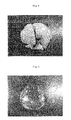
- FIG. 1 is a photograph of an outer appearance of a sample obtained by cooling Li 2 O-Al 2 O 3 -SiO 2 -based molten glass to 1150°C, leaving it standing still for 10 hours to cause ⁇ -spodumene crystals to precipitate, then reheating it to 1340°C, and leaving it standing still for 1 hour.
- FIG. 2 shows a photograph of an outer appearance of a sample obtained by leaving Li 2 O-Al 2 O 3 -SiO 2 -based molten glass standing still at 1340°C. It is found that the sample obtained by first precipitating ⁇ -spodumene crystals and then increasing temperature is devitrified in stark white due to the precipitation of ZrO 2 crystals.
- the glass As described previously, as the contents of Li 2 O, MgO, and ZnO are smaller, the glass increasingly resists devitrification and is advantageous for forming. However, when the contents thereof are too small, the glass is conversely liable to be cloudy in the crystallization step, and hence a highly transparent crystallized glass is difficult to be provided. Thus, the value of Li 2 O+0.741MgO+0.367ZnO needs to be restricted to 4 or more, and, in particular, the content of Li 2 O needs to be restricted to 3% or more.
- TiO 2 and ZrO 2 are components for forming a crystal nucleus and have the function of preventing a crystal particle from coarsening, thereby suppressing the cloudiness of glass.
- the total content of TiO 2 and ZrO 2 needs to be 3.8% or more.
- an excessive content of TiO 2 may cause coloring of glass to reduce transparency thereof, and accelerate the precipitation of ⁇ -spodumene.
- the Li 2 O-Al 2 O 3 -SiO 2 -based crystallizable glass of the present invention is preferable to be manufactured by float forming.
- the Li 2 O-Al 2 O 3 -SiO 2 -based crystallizable glass of the present invention is preferable to further comprise 0.05 to 1.5% of B 2 O 3 .
- the Li 2 O-Al 2 O 3 -SiO 2 -based crystallizable glass of the present invention is preferable to comprise 0.1% or more of MgO.
- MgO is a component that is dissolved as a solid solution in a Li 2 O-Al 2 O 3 -SiO 2 -based crystal and has the effect of increasing the thermal expansion coefficient of the Li 2 O-Al 2 O 3 -SiO 2 -based crystal.
- the addition of MgO enables the achievement of a desired near zero thermal expansion coefficient.
- the Li 2 O-Al 2 O 3 -SiO 2 -based crystallizable glass of the present invention is preferable to further comprise 0.2% or less of Nd 2 O 3 .
- Patent Literature 6 proposes that Nd 2 O 3 should be added as a complementary coloring agent in order to cope with a coloring problem.
- this method is, so to speak, a technology involving converting yellow coloring to an achromatic color by superimposing blue coloring caused by Nd 2 O 3 over the yellow coloring, resulting in the occurrence of the problem in that the transmittance in a visible region deteriorates, the outer appearance of the resultant glass looks dark, and hence the transparency thereof is liable to be impaired.
- the content of Nd 2 O 3 needs to be restricted to 0.2% or less, thereby being able to provide a glass excellent in transparency.
- the Li 2 O-Al 2 O 3 -SiO 2 -based crystallizable glass of the present invention is preferable to further comprise 60 to 300 ppm of Fe 2 O 3 .
- a Li 2 O-Al 2 O 3 -SiO 2 -based crystallizable glass having less coloring and being excellent in transparency can be provided.
- the present invention also relates to a Li 2 O-Al 2 O 3 -SiO 2 -based crystallized glass, which is obtained by crystallizing any one of the above-mentioned Li 2 O-Al 2 O 3 -SiO 2 -based crystallizable glasses.
- the Li 2 O-Al 2 O 3 -SiO 2 -based crystallized glass of the present invention is preferable to have, at a thickness of 3 mm, a b* value of 4.5 or less in terms of L*a*b* representation based on a CIE standard.
- the Li 2 O-Al 2 O 3 -SiO 2 -based crystallized glass of the present invention is preferable to have, at a thickness of 1.1 mm, a transmittance of 82.5% or more at a wavelength of 400 nm.
- the Li 2 O-Al 2 O 3 -SiO 2 -based crystallized glass of the present invention is preferable to have a thermal expansion coefficient of -2.5 ⁇ 10 -7 /°C to 2.5 ⁇ 10 -7 /°C at 30 to 380°C.
- the present invention also relates to a production method for any one of the above-mentioned Li 2 O-Al 2 O 3 -SiO 2 -based crystallizable glasses, comprising the steps of: (1) melting raw powder materials to provide molten glass; (2) fining the molten glass; (3) transporting the molten glass being fined to a forming section through a feeder; and (4) forming the molten glass in the forming section, wherein the molten glass is kept at a temperature equal to or more than a liquidus temperature of ⁇ -spodumene in the step (2) or (3).
- a Li 2 O-Al 2 O 3 -SiO 2 -based crystallizable glass of the present invention is characterized by comprising, as a glass composition in terms of mass%, 55 to 75% of SiO 2 , 19 to 24% of Al 2 O 3 , 3 to 4% of Li 2 O, 1.5 to 2.8% of TiO 2 , 3.8 to 4.8% of TiO 2 +ZrO 2 , and 0.1 to 0.5% of SnO 2 , and satisfying a relationship of 4 ⁇ Li 2 O+0.741MgO+0.367ZnO ⁇ 4.5.
- SiO 2 is a component that forms a network of the glass and constitutes a Li 2 O-Al 2 O 3 -SiO 2 -based crystal.
- the content of SiO 2 is preferably 55 to 75%, more preferably 58 to 70%, particularly preferably 60 to 68%.
- the thermal expansion coefficient of the glass tends to increase, with the result that a crystallized glass excellent in thermal shock resistance becomes hard to be provided, and moreover, the chemical durability of the glass tends to deteriorate.
- Al 2 O 3 is a component that forms a network of the glass and constitutes a Li 2 O-Al 2 O 3 -SiO 2 -based crystal. Further, Al 2 O 3 is present in a residual glass phase in a crystallized glass to reduce the degree of coloring caused by TiO 2 and Fe 2 O 3 and enhanced by SnO 2 .
- the content of Al 2 O 3 is preferably 19 to 24%, particularly preferably 20 to 23.5%. When the content of Al 2 O 3 is less than 19%, the thermal expansion coefficient of glass tends to increase, with the result that a crystallized glass excellent in thermal shock resistance is not easily provided, and moreover, the chemical durability of the glass tends to deteriorate.
- the effect of reducing the degree of coloring caused by TiO 2 and Fe 2 O 3 and enhanced by SnO 2 cannot be easily obtained.
- the content of Al 2 O 3 is more than 24%, the meltability of the glass deteriorates, the viscosity of the molten glass becomes larger, and hence the glass cannot be easily fined and forming of the glass tends to be difficult.
- mullite crystals tend to precipitate to devitrify the glass and the glass is liable to break. Further, the glass is liable to be cloudy.
- Li 2 O is a component that constitutes a Li 2 O-Al 2 O 3 -SiO 2 -based crystal, and is a component that gives a significant influence to the crystallinity and lowers the viscosity of the glass, thereby improving the meltability and formability of the glass.
- the content of Li 2 O is preferably 3 to 4%, particularly preferably 3.1 to 3.9%.
- the content of Li 2 O is less than 3%, the glass is liable to be cloudy in a crystallization step with the result that a highly transparent crystallized glass is difficult to be provided.
- the content of Li 2 O is more than 4%, the glass is liable to devitrify due to ⁇ -spodumene crystals.
- TiO 2 is a component that serves as a nucleating agent for causing crystals to precipitate in the crystallization step.
- the content of TiO 2 is preferably 1.5 to 2.8%, more preferably 1.6 to 2.6%, particularly preferably 1.7 to 2.4%.
- the content of TiO 2 is less than 1.5%, crystal nuclei are not formed sufficiently and coarse crystals precipitate, with the result that the resultant crystallized glass may become cloudy or may break.
- the content of TiO 2 is more than 2.8%, coloring of the glass tends to be enhanced. In addition, the glass tends to devitrify and is liable to break because TiO 2 has the function of accelerating the precipitation of ⁇ -spodumene crystals.
- ZrO 2 is a nucleating component for causing crystals to precipitate in the crystallization step as TiO 2 is.
- the content of ZrO 2 is preferably 0 to 4%, more preferably 1 to 3.5%, particularly preferably 1.5 to 3%. When the content of ZrO 2 is more than 4%, the glass tends to devitrify during melting, and hence forming of the glass becomes difficult.
- the content of TiO 2 +ZrO 2 is preferably 3.8 to 4.8%, more preferably 3.9 to 4.7%, particularly preferably 4 to 4.6%.
- the content of TiO 2 +ZrO 2 is less than 3.8%, the amount of crystal nuclei in the glass becomes insufficient, causing coarse crystals to precipitate, with the result that the resultant crystallized glass is liable to be cloudy.
- the content of TiO 2 +ZrO 2 is more than 4.8%, the glass is liable to be colored or devitrified.
- the value of Li 2 O+0.741MgO+0.367ZnO satisfies the ranges of preferably 4 to 4.5 and particularly preferably 4.1 to 4.4.
- the value of Li 2 O+0.741MgO+0.367ZnO is less than 4, the glass is liable to be cloudy in the crystallization step, with the result that a highly transparent crystallized glass is difficult to be provided.
- each of the MgO and ZnO components is not particularly limited as long as the above-mentioned range is satisfied, but the content is preferably restricted to, for example, the following range.
- MgO is a component that is dissolved as a solid solution in a Li 2 O-Al 2 O 3 -SiO 2 -based crystal and has the effect of increasing the thermal expansion coefficient of the Li 2 O-Al 2 O 3 -SiO 2 -based crystal.
- the thermal expansion coefficient of the glass is liable to be a larger minus value.
- adding MgO leads to a desired near zero thermal expansion coefficient of the glass.
- the content of MgO is preferably 0 to 1.5%, particularly preferably 0.1 to 1.2%. When the content of MgO is more than 1.5%, the crystallinity becomes too strong, with the result that the glass tends to devitrify and is liable to break.
- ZnO is a component that is dissolved as a solid solution in a Li 2 O-Al 2 O 3 -SiO 2 -based crystal as MgO is.
- the content of ZnO is preferably 0 to 2%, more preferably 0 to 1.5%, particularly preferably 0.1 to 1.2%.
- the content of ZnO is more than 2%, the crystallinity becomes too strong, and hence, when the glass is formed while being cooled gradually, the glass tends to devitrify. As a result, the glass is liable to break, and hence it tends to be difficult to form the glass by a float method.
- the Li 2 O-Al 2 O 3 -SiO 2 -based crystallizable glass has a high viscosity, so that it becomes difficult to make bubbles in the molten glassrisetodisappear during manufacturing process.
- a fining agent must be needed essentially.
- the fining agent include, in general, As 2 O 3 , Sb 2 O 3 , SnO 2 , SO 3 , and halogens.
- the content of each of As 2 O 3 and Sb 2 O 3 is preferable to restrict to less than 0.1%.
- SnO 2 therefore is the most suitable as a fining agent for manufacturing the Li 2 O-Al 2 O 3 -SiO 2 -based crystallizable glass.
- the content of SnO 2 is preferably 0.1 to 0.5%, more preferably 0.1 to 0.4%, particularly preferably 0.1 to 0.3%.
- the content of SnO 2 is less than 0.1%, the effect of SnO 2 as a fining agent is difficult to be obtained.
- the content of SnO 2 is more than 0.5%, coloring caused by TiO 2 and Fe 2 O 3 prevails, and hence the crystallized glass is liable to be tinged with yellow.
- SnO 2 has the function of raising the devitrification speed of ⁇ -spodumene, though details about the mechanism thereof are unknown. Accordingly, too large an addition amount of SnO 2 is liable to cause devitrification.
- Nd 2 O 3 which serves as a colorant
- the content of Nd 2 O 3 is preferably 0.2% or less, more preferably 0.1% or less, particularly preferably substantially free of Nd 2 O 3 (specifically 100 ppm or less).
- Nd 2 O 3 is a rare earth oxide, which leads to increase of material cost. Avoiding substantial use of Nd 2 O 3 , an inexpensive Li 2 O-Al 2 O 3 -SiO 2 -based crystallized glass can be easily provided. Note that, when priority is put on less coloring rather than higher transparency, Nd 2 O 3 may be added at, for example, about 500 ppm.
- the content of Fe 2 O 3 is preferably 300 ppm or less, more preferably 250 ppm or less, particularly preferably 200 ppm or less.
- the content of Fe 2 O 3 is preferably as small as possible because the degree of coloring lowers.
- Li 2 O-Al 2 O 3 -SiO 2 -based crystallizable glass of the present invention the following various components may be added in addition to the above-mentioned components.
- B 2 O 3 has the effect of suppressing the precipitation of ⁇ -spodumene.
- B 2 O 3 also has the effect of accelerating the dissolution of a SiO 2 raw material in a glass melting step.
- the content of B 2 O 3 is preferably 0.05 to 1.5%, particularly preferably 0.1 to 1%.
- the content of B 2 O 3 is less than 0.05%, the effects are difficult to be obtained.
- the content of B 2 O 3 is more than 1.5%, the glass is liable to be cloudy and therefore a highly transparent glass is difficult to be provided.
- B 2 O 3 is concentrated in the residual glass phase by crystallization, resulting in the reduction of the viscosity of the residual glass phase. Thus, when the resultant crystallized glass is used under high temperature, the crystallized glass is liable to be softened and deformed.
- P 2 O 5 is a component that accelerates the phase separation of glass and assists the formation of crystal nucleus.
- the content of P 2 O 5 is preferably 0 to 3%, more preferably 0.1 to 3%, particularly preferably 1 to 2%.
- the glass is liable to undergo phase separation in a melting step, with the result that a glass having a predetermined composition is difficult to be provided and the glass tends to be opaque.
- Na 2 O, K 2 O, CaO, SrO, and BaO at a total content of preferably 0 to 2%, particularly preferably 0.1 to 2%, in order to reduce the viscosity of the glass and improve the meltability and formability thereof.
- the total content of these components is more than 2%, the glass is liable to devitrify.
- the Li 2 O-Al 2 O 3 -SiO 2 -based crystallizable glass of the present invention can be manufactured by a method comprising the steps of: (1) melting raw powder materials to provide molten glass; (2) fining the molten glass; (3) transporting the molten glass being fined to a forming section through a feeder; and (4) forming the molten glass in the forming section.
- the molten glass is preferably kept at a temperature equal to or more than the liquidus temperature of ⁇ -spodumene in the step (2) or (3) by the following reason.
- the molten glass from the above with a burner or the like in the fining chamber and the feeder to the forming section, so that the temperature of the molten glass rises to a temperature higher, by 50°C or more, than the liquidus temperature of ⁇ -spodumene, preferably to a temperature higher by 100°C or more.
- the feeder section whose temperature is particularly liable to lower, it is preferred to apply such means as heating the molten glass by electrodes made of Pt or the like and inserted in the molten glass, or forming the internal walls of the feeder with a precious metal such as Pt and applying an electric current to the internal walls to heat the molten glass.
- raw powder materials for Li 2 O, Al 2 O 3 , and SiO 2 which are main components, include lithium carbonate, silica sand,silicastone,aluminumoxide,and aluminum hydroxide.
- spodumene can be given as an inexpensive raw material for Li 2 O, but spodumene generally includes Fe 2 O 3 in a large amount in many cases, and hence the usage of spodumene needs to be restricted.
- raw materials for ZrO 2 in which Fe 2 O 3 is liable to be mixed, it is preferred to use zirconium silicate in which the content of Fe 2 O 3 is 0.5% or less or high-purity ZrO 2 .
- the Li 2 O-Al 2 O 3 -SiO 2 -based crystallized glass of the present invention can be produced by crystallizing the Li 2 O-Al 2 O 3 -SiO 2 -based crystallizable glass as mentioned-above.
- a crystallization method a method involving applying heat treatment to a formed Li 2 O-Al 2 O 3 -SiO 2 -based crystallizable glass, for example, at 600 to 800°C for 1 to 5 hours, thereby causing crystal nuclei to form, and then further applying heat treatment to the resultant glass at 800 to 950°C for 0.5 to 3 hours, thereby causing Li 2 O-Al 2 O 3 -SiO 2 -based crystals to precipitate as a main crystal.
- the Li 2 O-Al 2 O 3 -SiO 2 -based crystallized glass of the present invention at a thickness of 3 mm, has a b* value of 4.5 or less, particularly preferably 4 or less, in terms of L*a*b* representation based on the CIE standard. Also, it is preferred that the Li 2 O-Al 2 O 3 -SiO 2 -based crystallized glass of the present invention, at a thickness of 1.1 mm, has a transmittance of 82.5% or more, particularly preferably 83% or more, at a wavelength of 400 nm.
- the Li 2 O-Al 2 O 3 -SiO 2 -based crystallized glass of the present invention is used for heat resistant applications, and hence preferably has a thermal expansion coefficient as close to zero as possible.
- the thermal expansion coefficient is preferably -2.5 ⁇ 10 -7 /°C to 2.5 ⁇ 10 -7 /°C, particularly preferably -1.5 ⁇ 10 -7 /°C to 1.5 ⁇ 10 -7 /°C in the temperature range of 30 to 380°C.
- the thermal expansion coefficient is out of the above-mentioned range, the risk of break of the crystallized glass is liable to increase.
- the Li 2 O-Al 2 O 3 -SiO 2 -based crystallized glass of the present invention may be subjected to post-processing such as cutting, polishing or bending processing, or to painting and the like on the surface.
- Li 2 O-Al 2 O 3 -SiO 2 -based crystallizable glass and Li 2 O-Al 2 O 3 -SiO 2 -based crystallized glass of the present invention are described by way of examples.
- Tables 1 and 2 show Examples 1 to 3 according to the present invention and Comparative Examples 1 to 8.
- Example Comparative Example 1 2 3 1 2 3 4 Glass composition (mass%) S i O 2 65.7 65.1 65.5 63.8 67.2 65.7 65.8 Al 2 O 3 22.2 21.9 21.8 24.8 18.5 22.2 22.1 Li 2 O 3.7 3.8 3.6 3.9 3.8 4.4 2.9 Na 2 O 0.4 0.4 0.4 0.2 0.4 0.4 K 2 0 0.3 0.3 0.3 0.3 0.3 0.3 MgO 0.7 0.6 0.7 0.5 0.8 10 BaO 1.2 1.2 1.2 0.7 2.1 1.2 1.2 ZnO 0.4 0.7 0.5 TiO 2 2.0 2.0 2.0 2.0 2.0 2.0 2.0 2.0 2.0 2.0 2.0 2.0 2.0 2.0 2.0 2.0 2.0 2.0 2.0 2.0 2.0 2.0 2.0 2.0 2.0 2.0 2.0 2.0 2.0 2.0 2.0 2.0 2.0 2.0 2.0 2.0 2.0 2.0 2.0 2.0 2.0 2.0 2.0 2.0 2.0 2.0 2.0 2.0 2.0 2.0 2.0 2.0 2.0 2.0 2.0 2.0 2.0 2.0 2.0 2.0 2.0 2.0 2.0 2.0 2.0 2.0 2.0 2.0 2.0 2.0 2.0 2.0 2.0 2.0 2.0 2.0 2.0 2.0 2.0 2.0 2.0 2.0 2.0 2.0 2.0 2.0 2.0 2.0 2.0 2.0 2.0 2.0 2.0 2.0 2.0 2.0 2.0 2.0 2.0 2.0 2.0 2.0 2.0 2.0 2.0 2.0 2.0 2.0 2.0
- each sample was prepared as described below. First, raw materials in the forms of an oxide, a hydroxide, a carbonate, a nitrate, and the like were blended and uniformly mixed so that a glass having each of the compositions shown in the tables was obtained. Then, the raw materials were loaded into a platinum crucible and melted at 1600°C for 20 hours. Subsequently, the molten glass was poured on a carbon surface plate and was formed into a glass sheet with a thickness of 5 mm by using rollers, and the glass sheet was then cooled at a temperature drop rate of 100°C/h from 700°C to room temperature in an annealing furnace. Thus, each sample of Li 2 O-Al 2 O 3 -SiO 2 -based crystallizable glass was prepared.
- Each sample of Li 2 O-Al 2 O 3 -SiO 2 -based crystallizable glass thus obtained was crystallized under the schedule of a nucleation step at 780°C for 1 hour through a crystal growth step at 890°C for 0.5 hour, thereby obtaining each Li 2 O-Al 2 O 3 -SiO 2 -based crystallized glass.
- the temperature rise rate from room temperature to a nucleation temperature was set to 400°C/h
- the temperature rise rate from the nucleation temperature to a crystal growth temperature was set to 300°C/h
- the temperature drop rate from the crystal growth temperature to room temperature was set to 500°C/h.
- Each of the resulting Li 2 O-Al 2 O 3 -SiO 2 -based crystallized glasses was evaluated for its transparency.
- a Li 2 O-Al 2 O 3 -SiO 2 -based crystallized glass sample was ground into a glass sheet with a thickness of 3 mm, the surfaces of the glass sheet were optically polished, and the polished glass sheet was then subjected to measurement with a spectrophotometer to determine a b* value.
- the glass sheet with a thickness of 3 mm was further ground into a glass sheet with a thickness of 1.1 mm, the surfaces of the glass sheet were optically polished, and the polished glass sheet was then subjected to measurement of a transmittance at a wavelength of 400 nm with a spectrophotometer. Note that, when a sample was clearly cloudy and had no transparency on the basis of appearance observation, such the sample was not subject to measurement and represented by "cloudy.”
- Devitrification property under temperature drop was evaluated in such the manner that the Li 2 O-Al 2 O 3 -SiO 2 -based crystallizable glass was remelted at 1500°C for 30 minutes, the molten glass was then loaded into a temperature gradient electric furnace, and then, at each temperature, time at which crystals started precipitating to cause devitrification was measured.
- the temperature drop rate in float forming when it took 3 minutes or longer to cause devitrification, such the sample was represented by " ⁇ " as being able to be applied to float forming. When it took less than 3 minutes to cause devitrification, such the sample was represented by " ⁇ " as being unable to be applied to float forming because of tendency of devitrification.
- each example provided the Li 2 O-Al 2 O 3 -SiO 2 -based crystallizable glass that was more resistant to devitrification in comparison to comparative examples and was able to be applied to float forming, and provided the Li 2 O-Al 2 O 3 -SiO 2 -based crystallized glass that was less cloudy, less colored, and more highly transparent in comparison to comparative examples.
Landscapes
- Chemical & Material Sciences (AREA)
- Engineering & Computer Science (AREA)
- Geochemistry & Mineralogy (AREA)
- Life Sciences & Earth Sciences (AREA)
- Chemical Kinetics & Catalysis (AREA)
- General Chemical & Material Sciences (AREA)
- Materials Engineering (AREA)
- Organic Chemistry (AREA)
- Ceramic Engineering (AREA)
- Crystallography & Structural Chemistry (AREA)
- Dispersion Chemistry (AREA)
- Glass Compositions (AREA)
- Re-Forming, After-Treatment, Cutting And Transporting Of Glass Products (AREA)
Abstract
Description
- The present invention relates to a Li2O-Al2O3-SiO2-based crystallizable glass and to a Li2O-Al2O3-SiO2-based crystallized glass obtained by crystallizing the same and suitable for heat resistant applications such as a front window or fireproof window of a kerosene stove, a wood stove, and the like.
- A Li2O-Al2O3-SiO2-based crystallized glass has been conventionally used as a material for: a front window of a kerosene stove, a wood stove, or the like; a substrate for a high-tech product such as a substrate for a color filter or an image sensor; a setter for firing an electronic part; a tray for a microwave oven; a top plate for induction heating cooking; a window glass for a fire protection door; or the like. For example, Patent Literatures 1 to 3 each discloses a Li2O-Al2O3-SiO2-based crystallized glass comprising a Li2O-Al2O3-SiO2-based crystal, such as a β-quartz solid solution (Li2O·Al2O3·nSiO2 (provided that n≥2)) or a β-spodumene solid solution (Li2O·Al2O3·nSiO2 (provided that n≥4)), precipitated therein as a main crystal.
- The Li2O-Al2O3-SiO2-based crystallized glass has a low thermal expansion coefficient and a high mechanical strength, and hence has excellent thermal characteristics. Such crystallized glass can be usually manufactured by forming a Li2O-Al2O3-SiO2-based crystallizable glass which comprises nucleating components such as TiO2 and ZrO2 into a desired shape by a press method or a rollout method, applying heat treatment thereto at a temperature of about 600 to 800°C to form crystal nuclei, and subsequently applying heat treatment to the resultant glass at a temperature of about 800 to 1000°C to cause β-quartz solid solution crystals to precipitate.
- For example, a sheet-like crystallized glass can be manufactured by: forming molten glass into a sheet-like shape by a rollout method which involves interposing the molten glass between a pair of forming rolls and subjecting the molten glass to roll forming while quenching it; and then applying heat treatment to the sheet-like glass to cause crystallization. However, manufacturing a sheet-like crystallized glass by the rollout method involves: the problem in that, with the deterioration of the surfaces of the rolls, irregularities of the surfaces of the rolls are transcribed to glass surfaces, resulting in difficulty in providing a highly smooth glass; and the problem in that a glass having a lager size in the width direction cannot be formed due to limitation of the size of the forming rolls. Further, the method also involves the problem in that molten glass needs to be quenched between the forming rolls, and hence the production speed cannot be increased.
- In order to solve such problems, Patent Literatures 3 and 4 propose a float method, wherein a molten glass is floated on a molten metal tin bath (float bath) to form the molten glass into a sheet-like glass, and then the sheet-like glass is applied heat treatment to cause crystallization, thereby providing a sheet-like crystallized glass.
-
- Patent Literature 1:
JP 11-228180 A - Patent Literature 2:
JP 11-228181 A - Patent Literature 3:
JP 2001-354429 A - Patent Literature 4:
JP 2001-354446 A - Patent Literature 5:
JP 2010-1206 A - Patent Literature 6:
US 4093468 - In the case of a float method, molten glass is formed into a sheet-like glass on a high-temperature float bath over as long a time as about 10 to 30 minutes. Thus, the molten glass is cooled much more gradually in the float method than in a rollout method in which the molten glass is cooled to be formed for as short a time as a few seconds to several tens of seconds. Therefore, as disclosed in, for example, Patent Literature 4, devitrification is liable to occur even in a glass designed in consideration of forming molten glass into a sheet-like glass by the float method. As a result, a crystallizable glass provided through a forming step and an annealing step may break owing to the difference in thermal expansion coefficient between a devitrified part and glass. Further, even if a crystallizable glass is provided without any break, a break is liable to occur in a heat treatment step (crystallization step) necessary for crystallizing glass.
- Then, Patent Literature 5 proposes a crystallizable glass which resists devitrification even if formed by the float method and does not break in the forming step through the crystallization step, and in which Li2O-Al2O3-SiO2-based crystals can be precipitated as a main crystal by heat treatment of the glass after forming, and also proposes a crystallized glass formed by crystallizing the crystallizable glass. However, the crystallizable glass disclosed in Patent Literature 5 has the problem in that the crystallizable glass is liable to be cloudy in the crystallization step, thus being unlikely to provide a highly transparent crystallized glass, although the crystallizable glass resists devitrification and is suitable for float forming.
- In view of the foregoing, the present invention intends to provide a Li2O-Al2O3-SiO2-based crystallizable glass which is hard to become cloudy and therefore is highly transparent even when being manufactured by, for example, float forming, and to provide a Li2O-Al2O3-SiO2-based crystallized glass formed by crystallizing the Li2O-Al2O3-SiO2-based crystallizable glass.
- The inventors of the present invention have made various studies and experiments and have consequently found that the above-mentioned problems can be solved by a Li2O-Al2O3-SiO2-based crystallizable glass having a particular glass composition, and thus propose the present invention.
- That is, the present invention relates to a Li2O-Al2O3-SiO2-based crystallizable glass characterized by comprising, as a glass composition in terms of mass%, 55 to 75% of SiO2, 19 to 24% of Al2O3, 3 to 4% of Li2O, 1.5 to 2.8% of TiO2, 3.8 to 4.8% of TiO2+ZrO2, and 0.1 to 0.5% of SnO2, and satisfying a relationship of 4≤Li2O+O.741MgO+0.367ZnO≤4.5.
- When a Li2O-Al2O3-SiO2-based crystallizable glass satisfies the composition range described above, such the glass can exert the effects of being hard to devitrify during float forming and being hard to become cloudy in the crystallization step. The mechanism thereof is described below.
- The inventors of the present invention have first examined what kinds of crystals precipitate in devitrification part occurred in a Li2O-Al2O3-SiO2-based crystallizable glass during float forming, and have found that the precipitated crystals in the devitrification part are mullite, β-spodumene, and ZrO2.
- Then the inventors have found that the precipitation of mullite can be suppressed by restricting the content of Al2O3 to 24% or less. Further, when the content of Al2O3 is too large, other kinds of crystal in addition to mullite tend to precipitate, thereby being liable to cause cloud, and hence the content of Al2O3 should be restricted to 24% or less from the viewpoint of providing a highly transparent material as well. Note that Al2O3 has the effect of muting the coloring caused by Fe which is mixed as an impurity in glass. Thus, when the content of Al2O3 is too small, the coloring caused by Fe becomes heightened, resulting in reducing the transparency of the glass, and hence the content of Al2O3 needs to be 19% or more in order to provide a highly transparent material.
- Also the inventors have found that the precipitation of β-spodumene can be suppressed by reducing the contents of Li2O, MgO, and ZnO and is most susceptible to the content of, in particular, Li2O among them. It is therefore required to restrict the value of Li2O+0.741MgO+0.367ZnO to 4.5 or less and the content of Li2O to 4% or less. Note that the coefficients of MgO and ZnO are added for calculating the content of each component in terms of Li2O mole.
- Further, when the contents of Li2O, MgO, and ZnO are too large, the coloring caused by Fe which is mixed as an impurity becomes heightened, resulting in reducing the transparency of the glass. Li2O, MgO, and ZnO, together with Al2O3, precipitate as a main crystal. Therefore, as the contents of Li2O, MgO, and ZnO are larger, the content of Al2O3 is liable to be smaller in the glass phase of the coloring phase caused by Fe, probably leading to heightening of such the coloring. Thus, the value of Li2O+0.741MgO+0.367ZnO is preferably restricted to the above-mentioned range from the viewpoint of providing a highly transparent material as well.
- Next, the inventors have found that the precipitation of ZrO2 crystals occurs in synchronization with the precipitation of β-spodumene. To be specific, the inventors have found that ZrO2 crystals are liable to precipitate when the temperature of molten glass lowers and then rises again in a forming step. Detailed examinations of this phenomenon have revealed that β-spodumene precipitates in a portion in which the temperature of the molten glass partially lowers, thereby causing reductions in the concentrations of Li2O, MgO, ZnO, Al2O3, and SiO2 in the glass composition of the surrounding portions of the β-spodumene crystals, relatively increasing in the concentration of ZrO2, and resulting in the precipitation of the ZrO2 crystals. When the temperature of the molten glass is increased by reheating, the β-spodumene crystals easily dissolve, but the ZrO2 crystals are relatively hard to dissolve, resulting in the remaining of only the ZrO2 crystals.
-
FIG. 1 is a photograph of an outer appearance of a sample obtained by cooling Li2O-Al2O3-SiO2-based molten glass to 1150°C, leaving it standing still for 10 hours to cause β-spodumene crystals to precipitate, then reheating it to 1340°C, and leaving it standing still for 1 hour.FIG. 2 shows a photograph of an outer appearance of a sample obtained by leaving Li2O-Al2O3-SiO2-based molten glass standing still at 1340°C. It is found that the sample obtained by first precipitating β-spodumene crystals and then increasing temperature is devitrified in stark white due to the precipitation of ZrO2 crystals. The finding confirms that the above-mentioned precipitation mechanism of ZrO2 crystals is correct. Thus, the value of Li2O+0.741MgO+0.367ZnO needs to be restricted to the above-mentioned range in order to render the precipitation of ZrO2 crystals to be hard to occur as well. - As described previously, as the contents of Li2O, MgO, and ZnO are smaller, the glass increasingly resists devitrification and is advantageous for forming. However, when the contents thereof are too small, the glass is conversely liable to be cloudy in the crystallization step, and hence a highly transparent crystallized glass is difficult to be provided. Thus, the value of Li2O+0.741MgO+0.367ZnO needs to be restricted to 4 or more, and, in particular, the content of Li2O needs to be restricted to 3% or more.
- In order to suppress the cloudiness of glass, the contents of TiO2 and ZrO2 are also necessary to be adjusted in addition to the above. TiO2 and ZrO2 are components for forming a crystal nucleus and have the function of preventing a crystal particle from coarsening, thereby suppressing the cloudiness of glass. In order to obtain a highly transparent material by suppressing the cloudiness, the total content of TiO2 and ZrO2 needs to be 3.8% or more. However, when the content of each of TiO2 and ZrO2 is too large, other problems may arise. That is, an excessive content of TiO2 may cause coloring of glass to reduce transparency thereof, and accelerate the precipitation of β-spodumene. Also, when the content of ZrO2 is too large, ZrO2 crystals are liable to precipitate. Thus, when the content of TiO2 is restricted to 1.5 to 2.8% and the content of TiO2+ZrO2 is restricted to 4.8% or less, the occurrence of these problems can be prevented.
- The Li2O-Al2O3-SiO2-based crystallizable glass of the present invention is preferable to be manufactured by float forming.
- The Li2O-Al2O3-SiO2-based crystallizable glass of the present invention is preferable to further comprise 0.05 to 1.5% of B2O3.
- By the above-mentioned structure, the precipitation of β-spodumene can be suppressed in the crystallization step.
- The Li2O-Al2O3-SiO2-based crystallizable glass of the present invention is preferable to comprise 0.1% or more of MgO.
- MgO is a component that is dissolved as a solid solution in a Li2O-Al2O3-SiO2-based crystal and has the effect of increasing the thermal expansion coefficient of the Li2O-Al2O3-SiO2-based crystal. The addition of MgO enables the achievement of a desired near zero thermal expansion coefficient.
- The Li2O-Al2O3-SiO2-based crystallizable glass of the present invention is preferable to further comprise 0.2% or less of Nd2O3.
- For example, Patent Literature 6 proposes that Nd2O3 should be added as a complementary coloring agent in order to cope with a coloring problem. However, this method is, so to speak, a technology involving converting yellow coloring to an achromatic color by superimposing blue coloring caused by Nd2O3 over the yellow coloring, resulting in the occurrence of the problem in that the transmittance in a visible region deteriorates, the outer appearance of the resultant glass looks dark, and hence the transparency thereof is liable to be impaired. Thus, the content of Nd2O3 needs to be restricted to 0.2% or less, thereby being able to provide a glass excellent in transparency.
- The Li2O-Al2O3-SiO2-based crystallizable glass of the present invention is preferable to further comprise 60 to 300 ppm of Fe2O3.
- By the above-mentioned structure, a Li2O-Al2O3-SiO2-based crystallizable glass having less coloring and being excellent in transparency can be provided.
- The present invention also relates to a Li2O-Al2O3-SiO2-based crystallized glass, which is obtained by crystallizing any one of the above-mentioned Li2O-Al2O3-SiO2-based crystallizable glasses.
- The Li2O-Al2O3-SiO2-based crystallized glass of the present invention is preferable to have, at a thickness of 3 mm, a b* value of 4.5 or less in terms of L*a*b* representation based on a CIE standard.
- The Li2O-Al2O3-SiO2-based crystallized glass of the present invention is preferable to have, at a thickness of 1.1 mm, a transmittance of 82.5% or more at a wavelength of 400 nm.
- The Li2O-Al2O3-SiO2-based crystallized glass of the present invention is preferable to have a thermal expansion coefficient of -2.5×10⁻⁷/°C to 2.5×10⁻⁷/°C at 30 to 380°C.
- The present invention also relates to a production method for any one of the above-mentioned Li2O-Al2O3-SiO2-based crystallizable glasses, comprising the steps of: (1) melting raw powder materials to provide molten glass; (2) fining the molten glass; (3) transporting the molten glass being fined to a forming section through a feeder; and (4) forming the molten glass in the forming section, wherein the molten glass is kept at a temperature equal to or more than a liquidus temperature of β-spodumene in the step (2) or (3).
- It is possible to prevent, by the production method, the precipitation of undesirable ZrO2 crystals that cause devitrification in a fining chamber or a feeder.
-
-
FIG. 1 is a photograph of an outer appearance of a sample obtained by cooling Li2O-Al2O3-SiO2-based molten glass to 1150°C, leaving it standing still for 10 hours to cause β-spodumene crystals to precipitate, then reheating it to 1340°C, and leaving it standing still for 1 hour. -
FIG. 2 is a photograph of an outer appearance of a sample obtained by leaving Li2O-Al2O3-SiO2-based molten glass standing still at 1340°C. - A Li2O-Al2O3-SiO2-based crystallizable glass of the present invention is characterized by comprising, as a glass composition in terms of mass%, 55 to 75% of SiO2, 19 to 24% of Al2O3, 3 to 4% of Li2O, 1.5 to 2.8% of TiO2, 3.8 to 4.8% of TiO2+ZrO2, and 0.1 to 0.5% of SnO2, and satisfying a relationship of 4≤Li2O+0.741MgO+0.367ZnO≤4.5.
- The reasons why the glass composition is restricted as above are described below. Note that in the following description of the content of each component, "%" refers to "mass%," unless otherwise specified.
- SiO2 is a component that forms a network of the glass and constitutes a Li2O-Al2O3-SiO2-based crystal. The content of SiO2 is preferably 55 to 75%, more preferably 58 to 70%, particularly preferably 60 to 68%. When the content of SiO2 is less than 55%, the thermal expansion coefficient of the glass tends to increase, with the result that a crystallized glass excellent in thermal shock resistance becomes hard to be provided, and moreover, the chemical durability of the glass tends to deteriorate. On the other hand, when the content of SiO2 is more than 75%, the meltability of the glass deteriorates, the viscosity of the molten glass becomes larger, and hence the glass cannot be easily fined and forming of the glass tends to be difficult.
- Al2O3 is a component that forms a network of the glass and constitutes a Li2O-Al2O3-SiO2-based crystal. Further, Al2O3 is present in a residual glass phase in a crystallized glass to reduce the degree of coloring caused by TiO2 and Fe2O3 and enhanced by SnO2. The content of Al2O3 is preferably 19 to 24%, particularly preferably 20 to 23.5%. When the content of Al2O3 is less than 19%, the thermal expansion coefficient of glass tends to increase, with the result that a crystallized glass excellent in thermal shock resistance is not easily provided, and moreover, the chemical durability of the glass tends to deteriorate. In addition, the effect of reducing the degree of coloring caused by TiO2 and Fe2O3 and enhanced by SnO2 cannot be easily obtained. On the other hand, when the content of Al2O3 is more than 24%, the meltability of the glass deteriorates, the viscosity of the molten glass becomes larger, and hence the glass cannot be easily fined and forming of the glass tends to be difficult. In addition, mullite crystals tend to precipitate to devitrify the glass and the glass is liable to break. Further, the glass is liable to be cloudy.
- Li2O is a component that constitutes a Li2O-Al2O3-SiO2-based crystal, and is a component that gives a significant influence to the crystallinity and lowers the viscosity of the glass, thereby improving the meltability and formability of the glass. The content of Li2O is preferably 3 to 4%, particularly preferably 3.1 to 3.9%. When the content of Li2O is less than 3%, the glass is liable to be cloudy in a crystallization step with the result that a highly transparent crystallized glass is difficult to be provided. On the other hand, when the content of Li2O is more than 4%, the glass is liable to devitrify due to β-spodumene crystals.
- TiO2 is a component that serves as a nucleating agent for causing crystals to precipitate in the crystallization step. The content of TiO2 is preferably 1.5 to 2.8%, more preferably 1.6 to 2.6%, particularly preferably 1.7 to 2.4%. When the content of TiO2 is less than 1.5%, crystal nuclei are not formed sufficiently and coarse crystals precipitate, with the result that the resultant crystallized glass may become cloudy or may break. When the content of TiO2 is more than 2.8%, coloring of the glass tends to be enhanced. In addition, the glass tends to devitrify and is liable to break because TiO2 has the function of accelerating the precipitation of β-spodumene crystals.
- ZrO2 is a nucleating component for causing crystals to precipitate in the crystallization step as TiO2 is. The content of ZrO2 is preferably 0 to 4%, more preferably 1 to 3.5%, particularly preferably 1.5 to 3%. When the content of ZrO2 is more than 4%, the glass tends to devitrify during melting, and hence forming of the glass becomes difficult.
- In the Li2O-Al2O3-SiO2-based crystallizable glass of the present invention, the content of TiO2+ZrO2 is preferably 3.8 to 4.8%, more preferably 3.9 to 4.7%, particularly preferably 4 to 4.6%. When the content of TiO2+ZrO2 is less than 3.8%, the amount of crystal nuclei in the glass becomes insufficient, causing coarse crystals to precipitate, with the result that the resultant crystallized glass is liable to be cloudy. On the other hand, when the content of TiO2+ZrO2 is more than 4.8%, the glass is liable to be colored or devitrified.
- In the Li2O-Al2O3-SiO2-based crystallizable glass of the present invention, the value of Li2O+0.741MgO+0.367ZnO satisfies the ranges of preferably 4 to 4.5 and particularly preferably 4.1 to 4.4. When the value of Li2O+0.741MgO+0.367ZnO is less than 4, the glass is liable to be cloudy in the crystallization step, with the result that a highly transparent crystallized glass is difficult to be provided. On the other hand, when the value of Li2O+0.741MgO+0.367ZnO is more than 4.5, devitrification due to β-spodumene crystals and ZrO2 crystals is liable to occur, and the content of Al2O3 in the glass phase in the crystallized glass decreases, with the result that the suppressing effect of Al2O3 on coloring is difficult to be obtained.
- Note that the content of each of the MgO and ZnO components is not particularly limited as long as the above-mentioned range is satisfied, but the content is preferably restricted to, for example, the following range.
- MgO is a component that is dissolved as a solid solution in a Li2O-Al2O3-SiO2-based crystal and has the effect of increasing the thermal expansion coefficient of the Li2O-Al2O3-SiO2-based crystal. Within the composition range according to the present invention, the thermal expansion coefficient of the glass is liable to be a larger minus value. However, adding MgO leads to a desired near zero thermal expansion coefficient of the glass. The content of MgO is preferably 0 to 1.5%, particularly preferably 0.1 to 1.2%. When the content of MgO is more than 1.5%, the crystallinity becomes too strong, with the result that the glass tends to devitrify and is liable to break.
- ZnO is a component that is dissolved as a solid solution in a Li2O-Al2O3-SiO2-based crystal as MgO is. The content of ZnO is preferably 0 to 2%, more preferably 0 to 1.5%, particularly preferably 0.1 to 1.2%. When the content of ZnO is more than 2%, the crystallinity becomes too strong, and hence, when the glass is formed while being cooled gradually, the glass tends to devitrify. As a result, the glass is liable to break, and hence it tends to be difficult to form the glass by a float method.
- The Li2O-Al2O3-SiO2-based crystallizable glass has a high viscosity, so that it becomes difficult to make bubbles in the molten glassrisetodisappear during manufacturing process. Thus, a fining agent must be needed essentially. Examples of the fining agent include, in general, As2O3, Sb2O3, SnO2, SO3, and halogens.
- Among them, substantial addition of As2O3 and Sb2O3 are preferable to be avoided, since As2O3 and Sb2O3 are reduced into a colloid during float forming, so that the transparency of the glass is impaired. To be specific, the content of each of As2O3 and Sb2O3 is preferable to restrict to less than 0.1%.
- Cl evaporates and bonds with water in the air, yielding HCl, which erodes the metal parts of forming facilities, and hence the addition of Cl is preferable to be avoided. Further, as for SO3, the amount of SO3 that can dissolve in a crystallized glass of this kind is very small, and hence the function of SO3 as a fining agent cannot be expected.
- SnO2 therefore is the most suitable as a fining agent for manufacturing the Li2O-Al2O3-SiO2-based crystallizable glass. The content of SnO2 is preferably 0.1 to 0.5%, more preferably 0.1 to 0.4%, particularly preferably 0.1 to 0.3%. When the content of SnO2 is less than 0.1%, the effect of SnO2 as a fining agent is difficult to be obtained. On the other hand, when the content of SnO2 is more than 0.5%, coloring caused by TiO2 and Fe2O3 prevails, and hence the crystallized glass is liable to be tinged with yellow. Further, SnO2 has the function of raising the devitrification speed of β-spodumene, though details about the mechanism thereof are unknown. Accordingly, too large an addition amount of SnO2 is liable to cause devitrification.
- It is preferable to restrict the content of Nd2O3, which serves as a colorant, because Nd2O3 reduces the transparency of the glass. To be specific, the content of Nd2O3 is preferably 0.2% or less, more preferably 0.1% or less, particularly preferably substantially free of Nd2O3 (specifically 100 ppm or less). As a result, a Li2O-Al2O3-SiO2-based crystallized glass having high transparency and a constant color tone can be provided. Further, Nd2O3 is a rare earth oxide, which leads to increase of material cost. Avoiding substantial use of Nd2O3, an inexpensive Li2O-Al2O3-SiO2-based crystallized glass can be easily provided. Note that, when priority is put on less coloring rather than higher transparency, Nd2O3 may be added at, for example, about 500 ppm.
- It is preferable to restrict the content of Fe2O3 which is mixed as an impurity component. The content of Fe2O3 is preferably 300 ppm or less, more preferably 250 ppm or less, particularly preferably 200 ppm or less. The content of Fe2O3 is preferably as small as possible because the degree of coloring lowers. However, in order to control the content of Fe2O3 within the range of, for example, less than 60 ppm, it is necessary to use a high-purity raw material or the like, with the result that an inexpensive Li2O-Al2O3-SiO2-based crystallized glass cannot be provided.
- In the Li2O-Al2O3-SiO2-based crystallizable glass of the present invention, the following various components may be added in addition to the above-mentioned components.
- B2O3 has the effect of suppressing the precipitation of β-spodumene. In addition, B2O3 also has the effect of accelerating the dissolution of a SiO2 raw material in a glass melting step. The content of B2O3 is preferably 0.05 to 1.5%, particularly preferably 0.1 to 1%. When the content of B2O3 is less than 0.05%, the effects are difficult to be obtained. On the other hand, when the content of B2O3 is more than 1.5%, the glass is liable to be cloudy and therefore a highly transparent glass is difficult to be provided. Further, B2O3 is concentrated in the residual glass phase by crystallization, resulting in the reduction of the viscosity of the residual glass phase. Thus, when the resultant crystallized glass is used under high temperature, the crystallized glass is liable to be softened and deformed.
- P2O5 is a component that accelerates the phase separation of glass and assists the formation of crystal nucleus. The content of P2O5 is preferably 0 to 3%, more preferably 0.1 to 3%, particularly preferably 1 to 2%. When the content of P2O5 is more than 3%, the glass is liable to undergo phase separation in a melting step, with the result that a glass having a predetermined composition is difficult to be provided and the glass tends to be opaque.
- Further, it is possible to add Na2O, K2O, CaO, SrO, and BaO at a total content of preferably 0 to 2%, particularly preferably 0.1 to 2%, in order to reduce the viscosity of the glass and improve the meltability and formability thereof. When the total content of these components is more than 2%, the glass is liable to devitrify.
- The Li2O-Al2O3-SiO2-based crystallizable glass of the present invention can be manufactured by a method comprising the steps of: (1) melting raw powder materials to provide molten glass; (2) fining the molten glass; (3) transporting the molten glass being fined to a forming section through a feeder; and (4) forming the molten glass in the forming section. Here, the molten glass is preferably kept at a temperature equal to or more than the liquidus temperature of β-spodumene in the step (2) or (3) by the following reason.
- As described previously, when β-spodumene crystals precipitate and then ZrO2 crystals successively precipitate, even when the temperature of the molten glass rises afterward, the ZrO2 crystals are difficult to dissolve again. Thus, it is necessary to prevent the temperature of part or the entire part of the molten glass from lowering to a temperature lower than the liquidus temperature of β-spodumene, particularly in the fining chamber near the forming section, and in the feeder between the fining chamber and the forming section. When the temperature of the molten glass lowers and once ZrO2 crystals precipitate, even if the molten glass is reheated, the ZrO2 crystals remain in the molten glass and flow out to the forming section as it is.
- In order to prevent such the phenomenon, it is preferred to heat the molten glass from the above with a burner or the like in the fining chamber and the feeder to the forming section, so that the temperature of the molten glass rises to a temperature higher, by 50°C or more, than the liquidus temperature of β-spodumene, preferably to a temperature higher by 100°C or more. Besides, in the feeder section whose temperature is particularly liable to lower, it is preferred to apply such means as heating the molten glass by electrodes made of Pt or the like and inserted in the molten glass, or forming the internal walls of the feeder with a precious metal such as Pt and applying an electric current to the internal walls to heat the molten glass.
- Examples of raw powder materials for Li2O, Al2O3, and SiO2, which are main components, include lithium carbonate, silica sand,silicastone,aluminumoxide,and aluminum hydroxide. Further, spodumene can be given as an inexpensive raw material for Li2O, but spodumene generally includes Fe2O3 in a large amount in many cases, and hence the usage of spodumene needs to be restricted. As for raw materials for ZrO2, in which Fe2O3 is liable to be mixed, it is preferred to use zirconium silicate in which the content of Fe2O3 is 0.5% or less or high-purity ZrO2.
- The Li2O-Al2O3-SiO2-based crystallized glass of the present invention can be produced by crystallizing the Li2O-Al2O3-SiO2-based crystallizable glass as mentioned-above.
- There is given, as a crystallization method, a method involving applying heat treatment to a formed Li2O-Al2O3-SiO2-based crystallizable glass, for example, at 600 to 800°C for 1 to 5 hours, thereby causing crystal nuclei to form, and then further applying heat treatment to the resultant glass at 800 to 950°C for 0.5 to 3 hours, thereby causing Li2O-Al2O3-SiO2-based crystals to precipitate as a main crystal.
- It is preferred that the Li2O-Al2O3-SiO2-based crystallized glass of the present invention, at a thickness of 3 mm, has a b* value of 4.5 or less, particularly preferably 4 or less, in terms of L*a*b* representation based on the CIE standard. Also, it is preferred that the Li2O-Al2O3-SiO2-based crystallized glass of the present invention, at a thickness of 1.1 mm, has a transmittance of 82.5% or more, particularly preferably 83% or more, at a wavelength of 400 nm.
- The Li2O-Al2O3-SiO2-based crystallized glass of the present invention is used for heat resistant applications, and hence preferably has a thermal expansion coefficient as close to zero as possible. Specifically, the thermal expansion coefficient is preferably -2.5×10⁻⁷/°C to 2.5×10⁻⁷/°C, particularly preferably -1.5×10⁻⁷/°C to 1.5×10⁻⁷/°C in the temperature range of 30 to 380°C. When the thermal expansion coefficient is out of the above-mentioned range, the risk of break of the crystallized glass is liable to increase.
- The Li2O-Al2O3-SiO2-based crystallized glass of the present invention may be subjected to post-processing such as cutting, polishing or bending processing, or to painting and the like on the surface.
- Hereinafter, the Li2O-Al2O3-SiO2-based crystallizable glass and Li2O-Al2O3-SiO2-based crystallized glass of the present invention are described by way of examples.
- Tables 1 and 2 show Examples 1 to 3 according to the present invention and Comparative Examples 1 to 8.
-
[Table 1] Example Comparative Example 1 2 3 1 2 3 4 Glass composition (mass%) SiO2 65.7 65.1 65.5 63.8 67.2 65.7 65.8 Al2O3 22.2 21.9 21.8 24.8 18.5 22.2 22.1 Li2O 3.7 3.8 3.6 3.9 3.8 4.4 2.9 Na2O 0.4 0.4 0.4 0.2 0.4 0.4 0.4 K20 0.3 0.3 0.3 0.3 0.3 0.3 0.3 MgO 0.7 0.6 0.7 0.5 0.8 10 BaO 1.2 1.2 1.2 0.7 2.1 1.2 1.2 ZnO 0.4 0.7 0.5 TiO2 2.0 2.0 2.0 2.0 2.0 2.0 2.0 ZrO2 2.2 2.2 2.2 2.2 2.2 2.2 2.2 P2O5 1.4 1.4 1.4 1.4 2.5 1.4 1.4 B2O3 0.3 0.05 SnO2 0.2 0.4 0.2 0.2 0.2 0.2 0.2 Li+0.741Mg+0.367Zn 4.2 4.4 4.4 4.3 4.4 4.4 3.8 Ti+Zr 4.2 4.2 4.2 4.2 4.2 4.2 4.2 b* value 3.4 4.3 3.8 4.4 5.2 3.6 Cloudy Transmittance at 400 nm (%) 85.1 83 84.2 82.8 79.5 84.8 Cloudy Devitrification property under temperature drop ○ ○ ○ × ○ × ○ -
[Table 2] Comparative Example 5 6 7 8 Glass composition (mass%) SiO2 65.4 66.4 65.3 66.1 Al2O3 22.0 22.3 22.0 22.2 Li2O 3.6 3.6 4.2 3.4 Na2O 0.4 0.4 0.4 0.4 K2O 0.3 0.3 0.3 0.3 MgO 0.7 0.7 0.8 0.6 BaO 1.0 1.2 1.2 1.2 ZnO TiO2 2.8 1.3 2.0 2.0 ZrO2 2.2 2.2 2.2 2.2 P2O5 1.4 1.4 1.4 1.4 B2O3 SnO2 0.2 0.2 0.2 0.2 Li+0.741Mg+0.367Zn 4.1 4.1 4.8 3.8 Ti+Zr 5.0 3.5 4.2 4.2 b* value 4.8 Cloudy 4.9 Cloudy Transmittance at 400 nm (%) 81.5 Cloudy 80.7 Cloudy Devitrification property under temperature drop × ○ × ○ - Each sample was prepared as described below. First, raw materials in the forms of an oxide, a hydroxide, a carbonate, a nitrate, and the like were blended and uniformly mixed so that a glass having each of the compositions shown in the tables was obtained. Then, the raw materials were loaded into a platinum crucible and melted at 1600°C for 20 hours. Subsequently, the molten glass was poured on a carbon surface plate and was formed into a glass sheet with a thickness of 5 mm by using rollers, and the glass sheet was then cooled at a temperature drop rate of 100°C/h from 700°C to room temperature in an annealing furnace. Thus, each sample of Li2O-Al2O3-SiO2-based crystallizable glass was prepared.
- Each sample of Li2O-Al2O3-SiO2-based crystallizable glass thus obtained was crystallized under the schedule of a nucleation step at 780°C for 1 hour through a crystal growth step at 890°C for 0.5 hour, thereby obtaining each Li2O-Al2O3-SiO2-based crystallized glass. Note that the temperature rise rate from room temperature to a nucleation temperature was set to 400°C/h, the temperature rise rate from the nucleation temperature to a crystal growth temperature was set to 300°C/h, and the temperature drop rate from the crystal growth temperature to room temperature was set to 500°C/h.
- Each of the resulting Li2O-Al2O3-SiO2-based crystallized glasses was evaluated for its transparency. In order to make evaluation on the transparency, a Li2O-Al2O3-SiO2-based crystallized glass sample was ground into a glass sheet with a thickness of 3 mm, the surfaces of the glass sheet were optically polished, and the polished glass sheet was then subjected to measurement with a spectrophotometer to determine a b* value. Further, the glass sheet with a thickness of 3 mm was further ground into a glass sheet with a thickness of 1.1 mm, the surfaces of the glass sheet were optically polished, and the polished glass sheet was then subjected to measurement of a transmittance at a wavelength of 400 nm with a spectrophotometer. Note that, when a sample was clearly cloudy and had no transparency on the basis of appearance observation, such the sample was not subject to measurement and represented by "cloudy."
- Devitrification property under temperature drop was evaluated in such the manner that the Li2O-Al2O3-SiO2-based crystallizable glass was remelted at 1500°C for 30 minutes, the molten glass was then loaded into a temperature gradient electric furnace, and then, at each temperature, time at which crystals started precipitating to cause devitrification was measured. In consideration of the temperature drop rate in float forming, when it took 3 minutes or longer to cause devitrification, such the sample was represented by "○" as being able to be applied to float forming. When it took less than 3 minutes to cause devitrification, such the sample was represented by "×" as being unable to be applied to float forming because of tendency of devitrification.
- As evident from Tables 1 and 2, it was found that each example provided the Li2O-Al2O3-SiO2-based crystallizable glass that was more resistant to devitrification in comparison to comparative examples and was able to be applied to float forming, and provided the Li2O-Al2O3-SiO2-based crystallized glass that was less cloudy, less colored, and more highly transparent in comparison to comparative examples.
Claims (11)
- A Li2O-Al2O3-SiO2-based crystallizable glass, comprising, as a glass composition in terms of mass%, 55 to 75% of SiO2, 19 to 24% of Al2O3, 3 to 4% of Li2O, 1.5 to 2.8% of TiO2, 3.8 to 4.8% of TiO2+ZrO2, and 0.1 to 0.5% of SnO2, and satisfying a relationship of 4≤Li2O+0.741MgO+0.367ZnO≤4.5.
- The Li2O-Al2O3-SiO2-based crystallizable glass according to claim 1, wherein the Li2O-Al2O3-SiO2-based crystallizable glass is manufactured by float forming.
- The Li2O-Al2O3-SiO2-based crystallizable glass according to claim 1 or 2, further comprising 0.05 to 1.5% of B2O3.
- The Li2O-Al2O3-SiO2-based crystallizable glass according to any one of claims 1 to 3, comprising 0.1% or more of MgO.
- The Li2O-Al2O3-SiO2-based crystallizable glass according to any one of claims 1 to 4, further comprising 0.2% or less of Nd2O3.
- The Li2O-Al2O3-SiO2-based crystallizable glass according to any one of claims 1 to 5, further comprising 60 to 300 ppm of Fe2O3.
- A Li2O-Al2O3-SiO2-based crystallized glass, which is obtained by crystallizing the Li2O-Al2O3-SiO2-based crystallizable glass according to any one of claims 1 to 6.
- The Li2O-Al2O3-SiO2-based crystallized glass according to claim 7, wherein the Li2O-Al2O3-SiO2-based crystallized glass, at a thickness of 3 mm, has a b* value of 4.5 or less in terms of L*a*b* representation based on a CIE standard.
- The Li2O-Al2O3-SiO2-based crystallized glass according to claim 7 or 8, wherein the Li2O-Al2O3-SiO2-based crystallized glass, at a thickness of 1.1 mm, has a transmittance of 82.5% or more at a wavelength of 400 nm.
- The Li2O-Al2O3-SiO2-based crystallized glass according to any one of claims 7 to 9, wherein the Li2O-Al2O3-SiO2-based crystallized glass has a thermal expansion coefficient of -2.5×10⁻⁷/°C to 2.5×10⁻⁷/°C at 30 to 380°C.
- A production method for the Li2O-Al2O3-SiO2-based crystallizable glass according to any one of claims 1 to 6, comprising the steps of:(1) melting raw powder materials to provide molten glass;(2) fining the molten glass;(3) transporting the molten glass being fined to a forming section through a feeder; and(4) forming the molten glass in the forming section,wherein the molten glass is kept at a temperature equal to or more than a liquidus temperature of β-spodumene in the step (2) or (3).
Applications Claiming Priority (2)
| Application Number | Priority Date | Filing Date | Title |
|---|---|---|---|
| JP2010257490A JP2012106887A (en) | 2010-11-18 | 2010-11-18 | Li2O-Al2O3-SiO2 CRYSTALLINE GLASS AND Li2O-Al2O3-SiO2 CRYSTALLIZED GLASS OBTAINED BY CRYSTALLIZING THE SAME |
| PCT/JP2011/075502 WO2012066948A1 (en) | 2010-11-18 | 2011-11-04 | Li2o-al2o3-sio2 crystalline glass and li2o-al2o3-sio2 crystallized glass obtained by crystallizing same |
Publications (2)
| Publication Number | Publication Date |
|---|---|
| EP2657200A1 true EP2657200A1 (en) | 2013-10-30 |
| EP2657200A4 EP2657200A4 (en) | 2017-09-27 |
Family
ID=46083883
Family Applications (1)
| Application Number | Title | Priority Date | Filing Date |
|---|---|---|---|
| EP11841844.1A Withdrawn EP2657200A4 (en) | 2010-11-18 | 2011-11-04 | Li2O-A12O3-SiO2 CHRYSTALLIZABLE GLASS AND Li2O-A12O3-SiO2 CRYSTALLISED GLASS OBTAINED BY CHRYTALLIZING SAME |
Country Status (4)
| Country | Link |
|---|---|
| US (1) | US20130225388A1 (en) |
| EP (1) | EP2657200A4 (en) |
| JP (1) | JP2012106887A (en) |
| WO (1) | WO2012066948A1 (en) |
Families Citing this family (9)
| Publication number | Priority date | Publication date | Assignee | Title |
|---|---|---|---|---|
| JP6410077B2 (en) * | 2014-06-20 | 2018-10-24 | 日本電気硝子株式会社 | Crystallized glass, window glass, bulletproof window glass, and method for producing crystallized glass |
| FR3036700B1 (en) | 2015-05-29 | 2021-04-16 | Eurokera | LITHIUM ALUMINOSILICATE VITROCERAMICS, TRANSPARENT, ESSENTIALLY COLORLESS, TIN-REFINED, WITH IMPROVED MICROSTRUCTURE AND IMPROVED THERMAL EXPANSION PROPERTIES |
| CN105271759A (en) * | 2015-09-30 | 2016-01-27 | 江苏耀兴安全玻璃有限公司 | Preparation method of glass ceramic |
| FR3069240B1 (en) | 2017-07-21 | 2021-04-23 | Eurokera | SPODUMENE-BETA VITROCERAMICS, WHITE, OPALESCENT OR OPAQUE, LOW TITANIUM CONTENT, TIN REFINED |
| DE202018102534U1 (en) | 2017-12-22 | 2018-05-15 | Schott Ag | Transparent, colored lithium aluminum silicate glass-ceramic |
| DE102018110855A1 (en) | 2017-12-22 | 2018-06-28 | Schott Ag | Glass-ceramic with reduced lithium content |
| US12281036B2 (en) * | 2019-07-12 | 2025-04-22 | Corning Incorporated | Methods for forming glass ceramic articles |
| JP7234856B2 (en) * | 2019-08-20 | 2023-03-08 | Agc株式会社 | Manufacturing method of lithium aluminosilicate glass and float glass plate |
| CN116568648A (en) * | 2020-11-30 | 2023-08-08 | 康宁股份有限公司 | Ion-exchangeable glass compositions with improved toughness, surface stress and fracture resistance |
Family Cites Families (15)
| Publication number | Priority date | Publication date | Assignee | Title |
|---|---|---|---|---|
| US4093468A (en) | 1977-03-23 | 1978-06-06 | Corning Glass Works | Process to obtain transparent colorless and glass-ceramics so obtained |
| JP3997593B2 (en) | 1998-02-19 | 2007-10-24 | 日本電気硝子株式会社 | Li2O-Al2O3-SiO2 based crystallized glass |
| JPH11228181A (en) | 1998-02-19 | 1999-08-24 | Nippon Electric Glass Co Ltd | Li2-al2o3-sio2 based glass ceramics |
| DE10017698B9 (en) | 2000-04-08 | 2007-11-29 | Schott Ag | Cleaning-friendly glass ceramic body |
| DE10017701C2 (en) * | 2000-04-08 | 2002-03-07 | Schott Glas | Floated flat glass |
| ATE431812T1 (en) * | 2000-08-24 | 2009-06-15 | Schott Ag | TRANSPARENT GLASS CERAMIC THAT CAN BE COLORED DARK WITH THE ADDITIVE OF VANADIUM OXIDE |
| JP2006199538A (en) * | 2005-01-20 | 2006-08-03 | Huzhou Daikyo Hari Seihin Yugenkoshi | The manufacturing method of Li2O-Al2O3-SiO2 type crystallized glass and crystallized glass, and Li2O-Al2O3-SiO2 type crystallized glass. |
| JP2007197310A (en) * | 2005-12-28 | 2007-08-09 | Nippon Electric Glass Co Ltd | Crystallized glass, reflection mirror base material and reflection mirror using the same |
| ATE396960T1 (en) * | 2006-03-20 | 2008-06-15 | Schott Ag | OPTICALLY DETECABLE FLOATABLE ARSENIC-FREE AND ANTIMONY-FREE CERAMIZABLE LITHIUM ALUMINOSILICATE GLASS |
| US7476633B2 (en) * | 2006-03-31 | 2009-01-13 | Eurokera | β-spodumene glass-ceramic materials and process for making the same |
| JP2008030978A (en) * | 2006-07-26 | 2008-02-14 | Nippon Electric Glass Co Ltd | Setter for heat treatment of glass substrate |
| FR2908130B1 (en) * | 2006-11-07 | 2009-10-23 | Snc Eurokera Soc En Nom Collec | FLOATING OF VITROCERAMIC |
| FR2909374B1 (en) * | 2006-11-30 | 2016-11-25 | Soc En Nom Collectif Dite : Eurokera | CLEAR, COLORLESS, COLORLESS BETA-QUARTZ GLAZE WITH LOW TIO2 CONTENT; ARTICLES THEREOF VITROCERAMIC; PRECURSOR GLASSES, METHODS OF PREPARATION |
| JP5673909B2 (en) * | 2008-05-19 | 2015-02-18 | 日本電気硝子株式会社 | Crystalline glass and crystallized glass obtained by crystallizing the same |
| FR2955574B1 (en) * | 2010-01-22 | 2014-08-08 | Eurokera | BETA-QUARTZ VITROCERAMICS; ARTICLES THEREOF VITROCERAMIC; METHODS OF OBTAINING; PRECURSOR LENSES. |
-
2010
- 2010-11-18 JP JP2010257490A patent/JP2012106887A/en active Pending
-
2011
- 2011-11-04 EP EP11841844.1A patent/EP2657200A4/en not_active Withdrawn
- 2011-11-04 US US13/883,857 patent/US20130225388A1/en not_active Abandoned
- 2011-11-04 WO PCT/JP2011/075502 patent/WO2012066948A1/en not_active Ceased
Non-Patent Citations (1)
| Title |
|---|
| See references of WO2012066948A1 * |
Also Published As
| Publication number | Publication date |
|---|---|
| EP2657200A4 (en) | 2017-09-27 |
| US20130225388A1 (en) | 2013-08-29 |
| WO2012066948A1 (en) | 2012-05-24 |
| JP2012106887A (en) | 2012-06-07 |
Similar Documents
| Publication | Publication Date | Title |
|---|---|---|
| US9126859B2 (en) | Li2O—Al2O3—SiO2—based crystallized glass | |
| US20130225388A1 (en) | Li2O-Al2O3-SiO2 CRYSTALLIZABLE GLASS AND Li2O-AI2O3-SiO2 CRYSTALLIZED GLASS OBTAINED BY CRYSTALLIZING SAME | |
| EP2284131B1 (en) | Crystallizable glass and crystallized glass obtained by crystallizing the same | |
| EP2202207B1 (en) | Glass composition for substrate and method for producing the same | |
| EP2883846B1 (en) | Li2o-al2o3-sio2-based crystallized glass and method for producing the same | |
| US8507392B2 (en) | LAS-type float glass | |
| JP7410462B2 (en) | Li2O-Al2O3-SiO2 system crystallized glass | |
| JP6835659B2 (en) | Crystallizable Lithium Aluminum Silicate Glass, and Transparent Glass Ceramics Made From It, and Methods for Making Glass and Glass Ceramics, and Use of Glass Ceramics. | |
| US12583784B2 (en) | Li2O—Al2O3—SiO2-based crystallized glass | |
| EP2660214A1 (en) | Crystallized glass | |
| US20110283738A1 (en) | Crystallized glass and top plate for cooking device comprising same | |
| EP2371775A1 (en) | Glass substrate and process for producing same | |
| JP6331322B2 (en) | Li2O-Al2O3-SiO2 based crystallized glass | |
| KR20230066267A (en) | Li2O-Al2O3-SiO2 based crystallized glass | |
| CN119551907A (en) | Lithium aluminum silicate glass, glass ceramics made therefrom, production method and use thereof | |
| CN118206288A (en) | Transparent glass ceramic, in particular as cover plate | |
| US11286198B2 (en) | LAS system crystalline glass, LAS system crystallized glass, method for producing LAS system crystalline glass, and method for producing LAS system crystallized glass | |
| WO2023119775A1 (en) | Li2o-al2o3-sio2-system crystallized glass | |
| WO2023084935A1 (en) | Li2o-al2o3-sio2-based crystallized glass | |
| WO2023238793A1 (en) | Zno-al2o3-sio2 glass and method for producing same | |
| JP6421795B2 (en) | Li2O-Al2O3-SiO2 based crystallized glass |
Legal Events
| Date | Code | Title | Description |
|---|---|---|---|
| PUAI | Public reference made under article 153(3) epc to a published international application that has entered the european phase |
Free format text: ORIGINAL CODE: 0009012 |
|
| 17P | Request for examination filed |
Effective date: 20130508 |
|
| AK | Designated contracting states |
Kind code of ref document: A1 Designated state(s): AL AT BE BG CH CY CZ DE DK EE ES FI FR GB GR HR HU IE IS IT LI LT LU LV MC MK MT NL NO PL PT RO RS SE SI SK SM TR |
|
| DAX | Request for extension of the european patent (deleted) | ||
| RIC1 | Information provided on ipc code assigned before grant |
Ipc: C03C 10/12 20060101ALI20170811BHEP Ipc: C03C 3/097 20060101ALI20170811BHEP Ipc: C03B 32/02 20060101AFI20170811BHEP |
|
| RA4 | Supplementary search report drawn up and despatched (corrected) |
Effective date: 20170824 |
|
| STAA | Information on the status of an ep patent application or granted ep patent |
Free format text: STATUS: EXAMINATION IS IN PROGRESS |
|
| 17Q | First examination report despatched |
Effective date: 20190121 |
|
| STAA | Information on the status of an ep patent application or granted ep patent |
Free format text: STATUS: THE APPLICATION IS DEEMED TO BE WITHDRAWN |
|
| 18D | Application deemed to be withdrawn |
Effective date: 20190601 |