EP2656892A1 - Chromatography method - Google Patents
Chromatography method Download PDFInfo
- Publication number
- EP2656892A1 EP2656892A1 EP12002828.7A EP12002828A EP2656892A1 EP 2656892 A1 EP2656892 A1 EP 2656892A1 EP 12002828 A EP12002828 A EP 12002828A EP 2656892 A1 EP2656892 A1 EP 2656892A1
- Authority
- EP
- European Patent Office
- Prior art keywords
- separation unit
- column
- loaded
- separation
- bound
- Prior art date
- Legal status (The legal status is an assumption and is not a legal conclusion. Google has not performed a legal analysis and makes no representation as to the accuracy of the status listed.)
- Withdrawn
Links
- 238000000034 method Methods 0.000 title claims abstract description 115
- 238000004587 chromatography analysis Methods 0.000 title description 56
- 238000000926 separation method Methods 0.000 claims description 506
- 239000012530 fluid Substances 0.000 claims description 114
- 238000004891 communication Methods 0.000 claims description 87
- 238000011068 loading method Methods 0.000 claims description 79
- 238000005406 washing Methods 0.000 claims description 58
- 239000012504 chromatography matrix Substances 0.000 claims description 55
- 239000007788 liquid Substances 0.000 claims description 50
- 239000002904 solvent Substances 0.000 claims description 42
- 239000002245 particle Substances 0.000 claims description 39
- 239000011148 porous material Substances 0.000 claims description 35
- 239000012535 impurity Substances 0.000 claims description 22
- 229960000074 biopharmaceutical Drugs 0.000 claims description 8
- 238000004519 manufacturing process Methods 0.000 claims description 7
- 241000700605 Viruses Species 0.000 claims description 5
- 230000002779 inactivation Effects 0.000 claims description 4
- 238000005119 centrifugation Methods 0.000 claims description 3
- 238000011118 depth filtration Methods 0.000 claims description 3
- 238000005498 polishing Methods 0.000 claims description 3
- 238000011146 sterile filtration Methods 0.000 claims description 2
- 230000027455 binding Effects 0.000 abstract description 66
- 238000001042 affinity chromatography Methods 0.000 abstract description 20
- 239000000872 buffer Substances 0.000 description 80
- 102000004169 proteins and genes Human genes 0.000 description 67
- 108090000623 proteins and genes Proteins 0.000 description 67
- FAPWRFPIFSIZLT-UHFFFAOYSA-M Sodium chloride Chemical compound [Na+].[Cl-] FAPWRFPIFSIZLT-UHFFFAOYSA-M 0.000 description 58
- 239000007983 Tris buffer Substances 0.000 description 53
- 239000000243 solution Substances 0.000 description 47
- 238000004140 cleaning Methods 0.000 description 42
- 239000003446 ligand Substances 0.000 description 40
- LENZDBCJOHFCAS-UHFFFAOYSA-N tris Chemical compound OCC(N)(CO)CO LENZDBCJOHFCAS-UHFFFAOYSA-N 0.000 description 38
- 239000000463 material Substances 0.000 description 34
- DHMQDGOQFOQNFH-UHFFFAOYSA-N Glycine Chemical compound NCC(O)=O DHMQDGOQFOQNFH-UHFFFAOYSA-N 0.000 description 32
- NBIIXXVUZAFLBC-UHFFFAOYSA-N Phosphoric acid Chemical compound OP(O)(O)=O NBIIXXVUZAFLBC-UHFFFAOYSA-N 0.000 description 32
- 239000011780 sodium chloride Substances 0.000 description 29
- 239000012071 phase Substances 0.000 description 28
- 239000011159 matrix material Substances 0.000 description 26
- 230000008569 process Effects 0.000 description 26
- 239000011347 resin Substances 0.000 description 26
- 229920005989 resin Polymers 0.000 description 26
- 238000010828 elution Methods 0.000 description 25
- 238000000746 purification Methods 0.000 description 24
- HEMHJVSKTPXQMS-UHFFFAOYSA-M Sodium hydroxide Chemical compound [OH-].[Na+] HEMHJVSKTPXQMS-UHFFFAOYSA-M 0.000 description 22
- 239000000203 mixture Substances 0.000 description 18
- 238000005516 engineering process Methods 0.000 description 17
- 239000004471 Glycine Substances 0.000 description 16
- 229910000147 aluminium phosphate Inorganic materials 0.000 description 16
- 150000001875 compounds Chemical class 0.000 description 16
- QTBSBXVTEAMEQO-UHFFFAOYSA-M Acetate Chemical compound CC([O-])=O QTBSBXVTEAMEQO-UHFFFAOYSA-M 0.000 description 15
- QTBSBXVTEAMEQO-UHFFFAOYSA-N Acetic acid Chemical compound CC(O)=O QTBSBXVTEAMEQO-UHFFFAOYSA-N 0.000 description 15
- -1 or NT- 6) Proteins 0.000 description 15
- 239000008351 acetate buffer Substances 0.000 description 14
- 238000003556 assay Methods 0.000 description 14
- 238000012546 transfer Methods 0.000 description 13
- 238000004113 cell culture Methods 0.000 description 12
- 238000002474 experimental method Methods 0.000 description 12
- VYPSYNLAJGMNEJ-UHFFFAOYSA-N Silicium dioxide Chemical compound O=[Si]=O VYPSYNLAJGMNEJ-UHFFFAOYSA-N 0.000 description 11
- 238000005342 ion exchange Methods 0.000 description 11
- 238000004255 ion exchange chromatography Methods 0.000 description 10
- UHOVQNZJYSORNB-UHFFFAOYSA-N Benzene Chemical compound C1=CC=CC=C1 UHOVQNZJYSORNB-UHFFFAOYSA-N 0.000 description 9
- 239000012634 fragment Substances 0.000 description 9
- 239000002699 waste material Substances 0.000 description 9
- 238000005349 anion exchange Methods 0.000 description 8
- 210000004027 cell Anatomy 0.000 description 8
- 239000000356 contaminant Substances 0.000 description 8
- 230000003247 decreasing effect Effects 0.000 description 8
- 238000009826 distribution Methods 0.000 description 8
- 239000003463 adsorbent Substances 0.000 description 7
- 238000005341 cation exchange Methods 0.000 description 7
- 238000010924 continuous production Methods 0.000 description 7
- 230000002209 hydrophobic effect Effects 0.000 description 7
- 229920001184 polypeptide Polymers 0.000 description 7
- 108090000765 processed proteins & peptides Proteins 0.000 description 7
- 238000011084 recovery Methods 0.000 description 7
- 239000007790 solid phase Substances 0.000 description 7
- LFQSCWFLJHTTHZ-UHFFFAOYSA-N Ethanol Chemical compound CCO LFQSCWFLJHTTHZ-UHFFFAOYSA-N 0.000 description 6
- 239000012515 MabSelect SuRe Substances 0.000 description 6
- 239000000427 antigen Substances 0.000 description 6
- 238000013459 approach Methods 0.000 description 6
- 238000013375 chromatographic separation Methods 0.000 description 6
- 230000003993 interaction Effects 0.000 description 6
- 102000004196 processed proteins & peptides Human genes 0.000 description 6
- 238000012545 processing Methods 0.000 description 6
- 239000002594 sorbent Substances 0.000 description 6
- NWUYHJFMYQTDRP-UHFFFAOYSA-N 1,2-bis(ethenyl)benzene;1-ethenyl-2-ethylbenzene;styrene Chemical compound C=CC1=CC=CC=C1.CCC1=CC=CC=C1C=C.C=CC1=CC=CC=C1C=C NWUYHJFMYQTDRP-UHFFFAOYSA-N 0.000 description 5
- 229920000936 Agarose Polymers 0.000 description 5
- 102000036639 antigens Human genes 0.000 description 5
- 108091007433 antigens Proteins 0.000 description 5
- 239000003599 detergent Substances 0.000 description 5
- 229920000136 polysorbate Polymers 0.000 description 5
- 239000000377 silicon dioxide Substances 0.000 description 5
- 238000001179 sorption measurement Methods 0.000 description 5
- 230000009870 specific binding Effects 0.000 description 5
- 239000011534 wash buffer Substances 0.000 description 5
- 239000012541 Fractogel® Substances 0.000 description 4
- 241000989747 Maba Species 0.000 description 4
- 102100029268 Neurotrophin-3 Human genes 0.000 description 4
- 108090000099 Neurotrophin-4 Proteins 0.000 description 4
- 230000008901 benefit Effects 0.000 description 4
- 229920001577 copolymer Polymers 0.000 description 4
- 230000007423 decrease Effects 0.000 description 4
- 239000004615 ingredient Substances 0.000 description 4
- NOESYZHRGYRDHS-UHFFFAOYSA-N insulin Chemical compound N1C(=O)C(NC(=O)C(CCC(N)=O)NC(=O)C(CCC(O)=O)NC(=O)C(C(C)C)NC(=O)C(NC(=O)CN)C(C)CC)CSSCC(C(NC(CO)C(=O)NC(CC(C)C)C(=O)NC(CC=2C=CC(O)=CC=2)C(=O)NC(CCC(N)=O)C(=O)NC(CC(C)C)C(=O)NC(CCC(O)=O)C(=O)NC(CC(N)=O)C(=O)NC(CC=2C=CC(O)=CC=2)C(=O)NC(CSSCC(NC(=O)C(C(C)C)NC(=O)C(CC(C)C)NC(=O)C(CC=2C=CC(O)=CC=2)NC(=O)C(CC(C)C)NC(=O)C(C)NC(=O)C(CCC(O)=O)NC(=O)C(C(C)C)NC(=O)C(CC(C)C)NC(=O)C(CC=2NC=NC=2)NC(=O)C(CO)NC(=O)CNC2=O)C(=O)NCC(=O)NC(CCC(O)=O)C(=O)NC(CCCNC(N)=N)C(=O)NCC(=O)NC(CC=3C=CC=CC=3)C(=O)NC(CC=3C=CC=CC=3)C(=O)NC(CC=3C=CC(O)=CC=3)C(=O)NC(C(C)O)C(=O)N3C(CCC3)C(=O)NC(CCCCN)C(=O)NC(C)C(O)=O)C(=O)NC(CC(N)=O)C(O)=O)=O)NC(=O)C(C(C)CC)NC(=O)C(CO)NC(=O)C(C(C)O)NC(=O)C1CSSCC2NC(=O)C(CC(C)C)NC(=O)C(NC(=O)C(CCC(N)=O)NC(=O)C(CC(N)=O)NC(=O)C(NC(=O)C(N)CC=1C=CC=CC=1)C(C)C)CC1=CN=CN1 NOESYZHRGYRDHS-UHFFFAOYSA-N 0.000 description 4
- 230000008929 regeneration Effects 0.000 description 4
- 238000011069 regeneration method Methods 0.000 description 4
- 238000001542 size-exclusion chromatography Methods 0.000 description 4
- 239000000126 substance Substances 0.000 description 4
- 238000010977 unit operation Methods 0.000 description 4
- 108060003951 Immunoglobulin Proteins 0.000 description 3
- 108090000723 Insulin-Like Growth Factor I Proteins 0.000 description 3
- 102000004218 Insulin-Like Growth Factor I Human genes 0.000 description 3
- 239000007832 Na2SO4 Substances 0.000 description 3
- 108010025020 Nerve Growth Factor Proteins 0.000 description 3
- 229920002684 Sepharose Polymers 0.000 description 3
- PMZURENOXWZQFD-UHFFFAOYSA-L Sodium Sulfate Chemical compound [Na+].[Na+].[O-]S([O-])(=O)=O PMZURENOXWZQFD-UHFFFAOYSA-L 0.000 description 3
- 101710120037 Toxin CcdB Proteins 0.000 description 3
- 150000001413 amino acids Chemical class 0.000 description 3
- 239000012491 analyte Substances 0.000 description 3
- 239000003729 cation exchange resin Substances 0.000 description 3
- 239000001913 cellulose Substances 0.000 description 3
- 229920002678 cellulose Polymers 0.000 description 3
- 239000000919 ceramic Substances 0.000 description 3
- 239000005289 controlled pore glass Substances 0.000 description 3
- 230000001186 cumulative effect Effects 0.000 description 3
- 238000009792 diffusion process Methods 0.000 description 3
- 108020001507 fusion proteins Proteins 0.000 description 3
- 102000037865 fusion proteins Human genes 0.000 description 3
- 150000004676 glycans Chemical class 0.000 description 3
- 239000003102 growth factor Substances 0.000 description 3
- 102000018358 immunoglobulin Human genes 0.000 description 3
- 239000003456 ion exchange resin Substances 0.000 description 3
- 229920003303 ion-exchange polymer Polymers 0.000 description 3
- 239000012160 loading buffer Substances 0.000 description 3
- 108010026228 mRNA guanylyltransferase Proteins 0.000 description 3
- 239000012516 mab select resin Substances 0.000 description 3
- 229920002401 polyacrylamide Polymers 0.000 description 3
- 229920001282 polysaccharide Polymers 0.000 description 3
- 239000005017 polysaccharide Substances 0.000 description 3
- 238000011027 product recovery Methods 0.000 description 3
- 108020003175 receptors Proteins 0.000 description 3
- 102000005962 receptors Human genes 0.000 description 3
- 230000002829 reductive effect Effects 0.000 description 3
- 230000001105 regulatory effect Effects 0.000 description 3
- 150000003839 salts Chemical class 0.000 description 3
- 238000004062 sedimentation Methods 0.000 description 3
- 229910052938 sodium sulfate Inorganic materials 0.000 description 3
- 238000003860 storage Methods 0.000 description 3
- GPRLSGONYQIRFK-MNYXATJNSA-N triton Chemical compound [3H+] GPRLSGONYQIRFK-MNYXATJNSA-N 0.000 description 3
- JVGOEGSMSPAINF-UHFFFAOYSA-N 1,3-bis(ethenyl)-1,3-diazinan-2-one Chemical compound C=CN1CCCN(C=C)C1=O JVGOEGSMSPAINF-UHFFFAOYSA-N 0.000 description 2
- HMYBDZFSXBJDGL-UHFFFAOYSA-N 1,3-bis(ethenyl)imidazolidin-2-one Chemical compound C=CN1CCN(C=C)C1=O HMYBDZFSXBJDGL-UHFFFAOYSA-N 0.000 description 2
- WULAHPYSGCVQHM-UHFFFAOYSA-N 2-(2-ethenoxyethoxy)ethanol Chemical compound OCCOCCOC=C WULAHPYSGCVQHM-UHFFFAOYSA-N 0.000 description 2
- DIHXSRXTECMMJY-MURFETPASA-N 2-[dimethyl-[(9z,12z)-octadeca-9,12-dienyl]azaniumyl]acetate Chemical group CCCCC\C=C/C\C=C/CCCCCCCC[N+](C)(C)CC([O-])=O DIHXSRXTECMMJY-MURFETPASA-N 0.000 description 2
- BFSVOASYOCHEOV-UHFFFAOYSA-N 2-diethylaminoethanol Chemical compound CCN(CC)CCO BFSVOASYOCHEOV-UHFFFAOYSA-N 0.000 description 2
- VUIWJRYTWUGOOF-UHFFFAOYSA-N 2-ethenoxyethanol Chemical compound OCCOC=C VUIWJRYTWUGOOF-UHFFFAOYSA-N 0.000 description 2
- OJXVWULQHYTXRF-UHFFFAOYSA-N 3-ethenoxypropan-1-ol Chemical compound OCCCOC=C OJXVWULQHYTXRF-UHFFFAOYSA-N 0.000 description 2
- HMBNQNDUEFFFNZ-UHFFFAOYSA-N 4-ethenoxybutan-1-ol Chemical compound OCCCCOC=C HMBNQNDUEFFFNZ-UHFFFAOYSA-N 0.000 description 2
- BCTDCDYHRUIHSF-UHFFFAOYSA-N 5-ethenoxypentan-1-ol Chemical compound OCCCCCOC=C BCTDCDYHRUIHSF-UHFFFAOYSA-N 0.000 description 2
- ASPUDHDPXIBNAP-UHFFFAOYSA-N 6-ethenoxyhexan-1-ol Chemical compound OCCCCCCOC=C ASPUDHDPXIBNAP-UHFFFAOYSA-N 0.000 description 2
- IJGRMHOSHXDMSA-UHFFFAOYSA-N Atomic nitrogen Chemical compound N#N IJGRMHOSHXDMSA-UHFFFAOYSA-N 0.000 description 2
- 102000007350 Bone Morphogenetic Proteins Human genes 0.000 description 2
- 108010007726 Bone Morphogenetic Proteins Proteins 0.000 description 2
- 102000014914 Carrier Proteins Human genes 0.000 description 2
- VYZAMTAEIAYCRO-UHFFFAOYSA-N Chromium Chemical compound [Cr] VYZAMTAEIAYCRO-UHFFFAOYSA-N 0.000 description 2
- 102000007644 Colony-Stimulating Factors Human genes 0.000 description 2
- 108010071942 Colony-Stimulating Factors Proteins 0.000 description 2
- 239000012605 Fractogel® EMD TMAE Substances 0.000 description 2
- 102000004877 Insulin Human genes 0.000 description 2
- 108090001061 Insulin Proteins 0.000 description 2
- 102000015696 Interleukins Human genes 0.000 description 2
- 108010063738 Interleukins Proteins 0.000 description 2
- TWRXJAOTZQYOKJ-UHFFFAOYSA-L Magnesium chloride Chemical compound [Mg+2].[Cl-].[Cl-] TWRXJAOTZQYOKJ-UHFFFAOYSA-L 0.000 description 2
- CSNNHWWHGAXBCP-UHFFFAOYSA-L Magnesium sulfate Chemical compound [Mg+2].[O-][S+2]([O-])([O-])[O-] CSNNHWWHGAXBCP-UHFFFAOYSA-L 0.000 description 2
- 108090000742 Neurotrophin 3 Proteins 0.000 description 2
- 102000003683 Neurotrophin-4 Human genes 0.000 description 2
- 102100033857 Neurotrophin-4 Human genes 0.000 description 2
- 108010038512 Platelet-Derived Growth Factor Proteins 0.000 description 2
- 102000010780 Platelet-Derived Growth Factor Human genes 0.000 description 2
- 229920001213 Polysorbate 20 Polymers 0.000 description 2
- 108090000103 Relaxin Proteins 0.000 description 2
- 102000003743 Relaxin Human genes 0.000 description 2
- DBMJMQXJHONAFJ-UHFFFAOYSA-M Sodium laurylsulphate Chemical compound [Na+].CCCCCCCCCCCCOS([O-])(=O)=O DBMJMQXJHONAFJ-UHFFFAOYSA-M 0.000 description 2
- 102100033571 Tissue-type plasminogen activator Human genes 0.000 description 2
- 108010009583 Transforming Growth Factors Proteins 0.000 description 2
- 102000009618 Transforming Growth Factors Human genes 0.000 description 2
- 108010073929 Vascular Endothelial Growth Factor A Proteins 0.000 description 2
- 102000005789 Vascular Endothelial Growth Factors Human genes 0.000 description 2
- 108010019530 Vascular Endothelial Growth Factors Proteins 0.000 description 2
- MOOIXEMFUKBQLJ-UHFFFAOYSA-N [1-(ethenoxymethyl)cyclohexyl]methanol Chemical compound C=COCC1(CO)CCCCC1 MOOIXEMFUKBQLJ-UHFFFAOYSA-N 0.000 description 2
- 238000005571 anion exchange chromatography Methods 0.000 description 2
- 239000003957 anion exchange resin Substances 0.000 description 2
- 239000012062 aqueous buffer Substances 0.000 description 2
- 238000010923 batch production Methods 0.000 description 2
- 238000010364 biochemical engineering Methods 0.000 description 2
- 239000003114 blood coagulation factor Substances 0.000 description 2
- 229940112869 bone morphogenetic protein Drugs 0.000 description 2
- 150000001768 cations Chemical class 0.000 description 2
- 230000008859 change Effects 0.000 description 2
- 238000012512 characterization method Methods 0.000 description 2
- 150000001793 charged compounds Chemical class 0.000 description 2
- 238000011210 chromatographic step Methods 0.000 description 2
- 239000012539 chromatography resin Substances 0.000 description 2
- 229940047120 colony stimulating factors Drugs 0.000 description 2
- 239000003431 cross linking reagent Substances 0.000 description 2
- 230000001747 exhibiting effect Effects 0.000 description 2
- 238000011062 flow through chromatography Methods 0.000 description 2
- 125000000524 functional group Chemical group 0.000 description 2
- 229940125396 insulin Drugs 0.000 description 2
- 102000028416 insulin-like growth factor binding Human genes 0.000 description 2
- 108091022911 insulin-like growth factor binding Proteins 0.000 description 2
- 229940047122 interleukins Drugs 0.000 description 2
- 230000000670 limiting effect Effects 0.000 description 2
- QSHDDOUJBYECFT-UHFFFAOYSA-N mercury Chemical compound [Hg] QSHDDOUJBYECFT-UHFFFAOYSA-N 0.000 description 2
- 229910052753 mercury Inorganic materials 0.000 description 2
- 239000003900 neurotrophic factor Substances 0.000 description 2
- WWZKQHOCKIZLMA-UHFFFAOYSA-N octanoic acid Chemical compound CCCCCCCC(O)=O WWZKQHOCKIZLMA-UHFFFAOYSA-N 0.000 description 2
- 230000036961 partial effect Effects 0.000 description 2
- 230000000704 physical effect Effects 0.000 description 2
- 239000000256 polyoxyethylene sorbitan monolaurate Substances 0.000 description 2
- 235000010486 polyoxyethylene sorbitan monolaurate Nutrition 0.000 description 2
- 235000010482 polyoxyethylene sorbitan monooleate Nutrition 0.000 description 2
- 229920000053 polysorbate 80 Polymers 0.000 description 2
- 229940068965 polysorbates Drugs 0.000 description 2
- 230000001172 regenerating effect Effects 0.000 description 2
- 238000004366 reverse phase liquid chromatography Methods 0.000 description 2
- 229910052708 sodium Inorganic materials 0.000 description 2
- 239000011734 sodium Substances 0.000 description 2
- 239000004094 surface-active agent Substances 0.000 description 2
- 238000012784 weak cation exchange Methods 0.000 description 2
- NVKAWKQGWWIWPM-ABEVXSGRSA-N 17-β-hydroxy-5-α-Androstan-3-one Chemical group C1C(=O)CC[C@]2(C)[C@H]3CC[C@](C)([C@H](CC4)O)[C@@H]4[C@@H]3CC[C@H]21 NVKAWKQGWWIWPM-ABEVXSGRSA-N 0.000 description 1
- JKMHFZQWWAIEOD-UHFFFAOYSA-N 2-[4-(2-hydroxyethyl)piperazin-1-yl]ethanesulfonic acid Chemical compound OCC[NH+]1CCN(CCS([O-])(=O)=O)CC1 JKMHFZQWWAIEOD-UHFFFAOYSA-N 0.000 description 1
- LMVGXBRDRZOPHA-UHFFFAOYSA-N 2-[dimethyl-[3-(16-methylheptadecanoylamino)propyl]azaniumyl]acetate Chemical compound CC(C)CCCCCCCCCCCCCCC(=O)NCCC[N+](C)(C)CC([O-])=O LMVGXBRDRZOPHA-UHFFFAOYSA-N 0.000 description 1
- TYIOVYZMKITKRO-UHFFFAOYSA-N 2-[hexadecyl(dimethyl)azaniumyl]acetate Chemical compound CCCCCCCCCCCCCCCC[N+](C)(C)CC([O-])=O TYIOVYZMKITKRO-UHFFFAOYSA-N 0.000 description 1
- SNQVCAOGQHOSEN-UHFFFAOYSA-N 2-[methyl(octadecyl)amino]acetic acid Chemical compound CCCCCCCCCCCCCCCCCCN(C)CC(O)=O SNQVCAOGQHOSEN-UHFFFAOYSA-N 0.000 description 1
- MPNXSZJPSVBLHP-UHFFFAOYSA-N 2-chloro-n-phenylpyridine-3-carboxamide Chemical compound ClC1=NC=CC=C1C(=O)NC1=CC=CC=C1 MPNXSZJPSVBLHP-UHFFFAOYSA-N 0.000 description 1
- DVLFYONBTKHTER-UHFFFAOYSA-N 3-(N-morpholino)propanesulfonic acid Chemical compound OS(=O)(=O)CCCN1CCOCC1 DVLFYONBTKHTER-UHFFFAOYSA-N 0.000 description 1
- NUFBIAUZAMHTSP-UHFFFAOYSA-N 3-(n-morpholino)-2-hydroxypropanesulfonic acid Chemical compound OS(=O)(=O)CC(O)CN1CCOCC1 NUFBIAUZAMHTSP-UHFFFAOYSA-N 0.000 description 1
- DIROHOMJLWMERM-UHFFFAOYSA-N 3-[dimethyl(octadecyl)azaniumyl]propane-1-sulfonate Chemical compound CCCCCCCCCCCCCCCCCC[N+](C)(C)CCCS([O-])(=O)=O DIROHOMJLWMERM-UHFFFAOYSA-N 0.000 description 1
- 208000030507 AIDS Diseases 0.000 description 1
- 108010059616 Activins Proteins 0.000 description 1
- 102000005606 Activins Human genes 0.000 description 1
- QGZKDVFQNNGYKY-UHFFFAOYSA-O Ammonium Chemical compound [NH4+] QGZKDVFQNNGYKY-UHFFFAOYSA-O 0.000 description 1
- 239000004475 Arginine Substances 0.000 description 1
- 101800001288 Atrial natriuretic factor Proteins 0.000 description 1
- 102400001282 Atrial natriuretic peptide Human genes 0.000 description 1
- 101800001890 Atrial natriuretic peptide Proteins 0.000 description 1
- 102100022005 B-lymphocyte antigen CD20 Human genes 0.000 description 1
- LSNNMFCWUKXFEE-UHFFFAOYSA-M Bisulfite Chemical compound OS([O-])=O LSNNMFCWUKXFEE-UHFFFAOYSA-M 0.000 description 1
- 102000015081 Blood Coagulation Factors Human genes 0.000 description 1
- 108010039209 Blood Coagulation Factors Proteins 0.000 description 1
- 102000013585 Bombesin Human genes 0.000 description 1
- 108010051479 Bombesin Proteins 0.000 description 1
- 102100031092 C-C motif chemokine 3 Human genes 0.000 description 1
- 101710155856 C-C motif chemokine 3 Proteins 0.000 description 1
- 102000017420 CD3 protein, epsilon/gamma/delta subunit Human genes 0.000 description 1
- 101150013553 CD40 gene Proteins 0.000 description 1
- 108010009575 CD55 Antigens Proteins 0.000 description 1
- 102000008203 CTLA-4 Antigen Human genes 0.000 description 1
- 108010021064 CTLA-4 Antigen Proteins 0.000 description 1
- 229940045513 CTLA4 antagonist Drugs 0.000 description 1
- 102000055006 Calcitonin Human genes 0.000 description 1
- 108060001064 Calcitonin Proteins 0.000 description 1
- UXVMQQNJUSDDNG-UHFFFAOYSA-L Calcium chloride Chemical compound [Cl-].[Cl-].[Ca+2] UXVMQQNJUSDDNG-UHFFFAOYSA-L 0.000 description 1
- 108010078791 Carrier Proteins Proteins 0.000 description 1
- KRKNYBCHXYNGOX-UHFFFAOYSA-K Citrate Chemical compound [O-]C(=O)CC(O)(CC([O-])=O)C([O-])=O KRKNYBCHXYNGOX-UHFFFAOYSA-K 0.000 description 1
- 102100022641 Coagulation factor IX Human genes 0.000 description 1
- GUBGYTABKSRVRQ-WFVLMXAXSA-N DEAE-cellulose Chemical compound OC1C(O)C(O)C(CO)O[C@H]1O[C@@H]1C(CO)OC(O)C(O)C1O GUBGYTABKSRVRQ-WFVLMXAXSA-N 0.000 description 1
- 230000004568 DNA-binding Effects 0.000 description 1
- 102000016911 Deoxyribonucleases Human genes 0.000 description 1
- 108010053770 Deoxyribonucleases Proteins 0.000 description 1
- 108090000204 Dipeptidase 1 Proteins 0.000 description 1
- 241000196324 Embryophyta Species 0.000 description 1
- 102000004190 Enzymes Human genes 0.000 description 1
- 108090000790 Enzymes Proteins 0.000 description 1
- 102000003951 Erythropoietin Human genes 0.000 description 1
- 108090000394 Erythropoietin Proteins 0.000 description 1
- CTKXFMQHOOWWEB-UHFFFAOYSA-N Ethylene oxide/propylene oxide copolymer Chemical compound CCCOC(C)COCCO CTKXFMQHOOWWEB-UHFFFAOYSA-N 0.000 description 1
- 108010076282 Factor IX Proteins 0.000 description 1
- 108010054218 Factor VIII Proteins 0.000 description 1
- 102000001690 Factor VIII Human genes 0.000 description 1
- 108091006020 Fc-tagged proteins Proteins 0.000 description 1
- 102000018233 Fibroblast Growth Factor Human genes 0.000 description 1
- 108050007372 Fibroblast Growth Factor Proteins 0.000 description 1
- 102000012673 Follicle Stimulating Hormone Human genes 0.000 description 1
- 108010079345 Follicle Stimulating Hormone Proteins 0.000 description 1
- 230000005526 G1 to G0 transition Effects 0.000 description 1
- 102400000321 Glucagon Human genes 0.000 description 1
- 108060003199 Glucagon Proteins 0.000 description 1
- 102000006771 Gonadotropins Human genes 0.000 description 1
- 108010086677 Gonadotropins Proteins 0.000 description 1
- 108010017080 Granulocyte Colony-Stimulating Factor Proteins 0.000 description 1
- 102000004269 Granulocyte Colony-Stimulating Factor Human genes 0.000 description 1
- 108010017213 Granulocyte-Macrophage Colony-Stimulating Factor Proteins 0.000 description 1
- 102100039620 Granulocyte-macrophage colony-stimulating factor Human genes 0.000 description 1
- 108010051696 Growth Hormone Proteins 0.000 description 1
- 102000018997 Growth Hormone Human genes 0.000 description 1
- 239000000095 Growth Hormone-Releasing Hormone Substances 0.000 description 1
- 239000007995 HEPES buffer Substances 0.000 description 1
- 102100031573 Hematopoietic progenitor cell antigen CD34 Human genes 0.000 description 1
- 101000897405 Homo sapiens B-lymphocyte antigen CD20 Proteins 0.000 description 1
- 101000777663 Homo sapiens Hematopoietic progenitor cell antigen CD34 Proteins 0.000 description 1
- 101001012157 Homo sapiens Receptor tyrosine-protein kinase erbB-2 Proteins 0.000 description 1
- 108010000521 Human Growth Hormone Proteins 0.000 description 1
- 102000002265 Human Growth Hormone Human genes 0.000 description 1
- 239000000854 Human Growth Hormone Substances 0.000 description 1
- 102000008100 Human Serum Albumin Human genes 0.000 description 1
- 108091006905 Human Serum Albumin Proteins 0.000 description 1
- DGAQECJNVWCQMB-PUAWFVPOSA-M Ilexoside XXIX Chemical compound C[C@@H]1CC[C@@]2(CC[C@@]3(C(=CC[C@H]4[C@]3(CC[C@@H]5[C@@]4(CC[C@@H](C5(C)C)OS(=O)(=O)[O-])C)C)[C@@H]2[C@]1(C)O)C)C(=O)O[C@H]6[C@@H]([C@H]([C@@H]([C@H](O6)CO)O)O)O.[Na+] DGAQECJNVWCQMB-PUAWFVPOSA-M 0.000 description 1
- 102000018071 Immunoglobulin Fc Fragments Human genes 0.000 description 1
- 108010091135 Immunoglobulin Fc Fragments Proteins 0.000 description 1
- 102000008394 Immunoglobulin Fragments Human genes 0.000 description 1
- 108010021625 Immunoglobulin Fragments Proteins 0.000 description 1
- 102000017727 Immunoglobulin Variable Region Human genes 0.000 description 1
- 108010067060 Immunoglobulin Variable Region Proteins 0.000 description 1
- 108090001117 Insulin-Like Growth Factor II Proteins 0.000 description 1
- 102100025947 Insulin-like growth factor II Human genes 0.000 description 1
- 108010008212 Integrin alpha4beta1 Proteins 0.000 description 1
- 102000006992 Interferon-alpha Human genes 0.000 description 1
- 108010047761 Interferon-alpha Proteins 0.000 description 1
- 102000003996 Interferon-beta Human genes 0.000 description 1
- 108090000467 Interferon-beta Proteins 0.000 description 1
- 102000014150 Interferons Human genes 0.000 description 1
- 108010050904 Interferons Proteins 0.000 description 1
- ODKSFYDXXFIFQN-BYPYZUCNSA-P L-argininium(2+) Chemical compound NC(=[NH2+])NCCC[C@H]([NH3+])C(O)=O ODKSFYDXXFIFQN-BYPYZUCNSA-P 0.000 description 1
- 235000017858 Laurus nobilis Nutrition 0.000 description 1
- 102000004895 Lipoproteins Human genes 0.000 description 1
- 108090001030 Lipoproteins Proteins 0.000 description 1
- 102000009151 Luteinizing Hormone Human genes 0.000 description 1
- 108010073521 Luteinizing Hormone Proteins 0.000 description 1
- 102000004083 Lymphotoxin-alpha Human genes 0.000 description 1
- 108090000542 Lymphotoxin-alpha Proteins 0.000 description 1
- 239000007993 MOPS buffer Substances 0.000 description 1
- 108010046938 Macrophage Colony-Stimulating Factor Proteins 0.000 description 1
- 102000007651 Macrophage Colony-Stimulating Factor Human genes 0.000 description 1
- 102000009571 Macrophage Inflammatory Proteins Human genes 0.000 description 1
- 108010009474 Macrophage Inflammatory Proteins Proteins 0.000 description 1
- 108010052285 Membrane Proteins Proteins 0.000 description 1
- 102100030173 Muellerian-inhibiting factor Human genes 0.000 description 1
- 101710122877 Muellerian-inhibiting factor Proteins 0.000 description 1
- 206010028980 Neoplasm Diseases 0.000 description 1
- 108090000028 Neprilysin Proteins 0.000 description 1
- 102000003729 Neprilysin Human genes 0.000 description 1
- 102000015336 Nerve Growth Factor Human genes 0.000 description 1
- 108090000095 Neurotrophin-6 Proteins 0.000 description 1
- 229910019142 PO4 Inorganic materials 0.000 description 1
- 102000003982 Parathyroid hormone Human genes 0.000 description 1
- 108090000445 Parathyroid hormone Proteins 0.000 description 1
- 102000001938 Plasminogen Activators Human genes 0.000 description 1
- 108010001014 Plasminogen Activators Proteins 0.000 description 1
- 239000002202 Polyethylene glycol Substances 0.000 description 1
- 108010076181 Proinsulin Proteins 0.000 description 1
- 101800004937 Protein C Proteins 0.000 description 1
- 102000017975 Protein C Human genes 0.000 description 1
- 102100030086 Receptor tyrosine-protein kinase erbB-2 Human genes 0.000 description 1
- 102100029986 Receptor tyrosine-protein kinase erbB-3 Human genes 0.000 description 1
- 101710100969 Receptor tyrosine-protein kinase erbB-3 Proteins 0.000 description 1
- 102100029981 Receptor tyrosine-protein kinase erbB-4 Human genes 0.000 description 1
- 101710100963 Receptor tyrosine-protein kinase erbB-4 Proteins 0.000 description 1
- 108010008281 Recombinant Fusion Proteins Proteins 0.000 description 1
- 102000007056 Recombinant Fusion Proteins Human genes 0.000 description 1
- 102100028255 Renin Human genes 0.000 description 1
- 108090000783 Renin Proteins 0.000 description 1
- 101800001700 Saposin-D Proteins 0.000 description 1
- 102000007562 Serum Albumin Human genes 0.000 description 1
- 108010071390 Serum Albumin Proteins 0.000 description 1
- 102100022831 Somatoliberin Human genes 0.000 description 1
- 101710142969 Somatoliberin Proteins 0.000 description 1
- QAOWNCQODCNURD-UHFFFAOYSA-L Sulfate Chemical compound [O-]S([O-])(=O)=O QAOWNCQODCNURD-UHFFFAOYSA-L 0.000 description 1
- RAHZWNYVWXNFOC-UHFFFAOYSA-N Sulphur dioxide Chemical group O=S=O RAHZWNYVWXNFOC-UHFFFAOYSA-N 0.000 description 1
- 102000019197 Superoxide Dismutase Human genes 0.000 description 1
- 108010012715 Superoxide dismutase Proteins 0.000 description 1
- 108091008874 T cell receptors Proteins 0.000 description 1
- 102000016266 T-Cell Antigen Receptors Human genes 0.000 description 1
- 235000005212 Terminalia tomentosa Nutrition 0.000 description 1
- 244000125380 Terminalia tomentosa Species 0.000 description 1
- 108090000190 Thrombin Proteins 0.000 description 1
- 108010000499 Thromboplastin Proteins 0.000 description 1
- 102000002262 Thromboplastin Human genes 0.000 description 1
- 102000011923 Thyrotropin Human genes 0.000 description 1
- 108010061174 Thyrotropin Proteins 0.000 description 1
- 108090000373 Tissue Plasminogen Activator Proteins 0.000 description 1
- 108050006955 Tissue-type plasminogen activator Proteins 0.000 description 1
- 108090001012 Transforming Growth Factor beta Proteins 0.000 description 1
- 102000004887 Transforming Growth Factor beta Human genes 0.000 description 1
- 102000011117 Transforming Growth Factor beta2 Human genes 0.000 description 1
- 102400001320 Transforming growth factor alpha Human genes 0.000 description 1
- 101800004564 Transforming growth factor alpha Proteins 0.000 description 1
- 101800000304 Transforming growth factor beta-2 Proteins 0.000 description 1
- 108090000097 Transforming growth factor beta-3 Proteins 0.000 description 1
- 102000056172 Transforming growth factor beta-3 Human genes 0.000 description 1
- 108060008682 Tumor Necrosis Factor Proteins 0.000 description 1
- 102000000852 Tumor Necrosis Factor-alpha Human genes 0.000 description 1
- 102100040245 Tumor necrosis factor receptor superfamily member 5 Human genes 0.000 description 1
- XSQUKJJJFZCRTK-UHFFFAOYSA-N Urea Chemical compound NC(N)=O XSQUKJJJFZCRTK-UHFFFAOYSA-N 0.000 description 1
- 102000003990 Urokinase-type plasminogen activator Human genes 0.000 description 1
- 108090000435 Urokinase-type plasminogen activator Proteins 0.000 description 1
- 238000005411 Van der Waals force Methods 0.000 description 1
- 239000002253 acid Substances 0.000 description 1
- 150000007513 acids Chemical class 0.000 description 1
- 238000007563 acoustic spectroscopy Methods 0.000 description 1
- 230000009471 action Effects 0.000 description 1
- 230000004913 activation Effects 0.000 description 1
- 239000000488 activin Substances 0.000 description 1
- 239000000654 additive Substances 0.000 description 1
- 238000004220 aggregation Methods 0.000 description 1
- 230000002776 aggregation Effects 0.000 description 1
- 102000015395 alpha 1-Antitrypsin Human genes 0.000 description 1
- 108010050122 alpha 1-Antitrypsin Proteins 0.000 description 1
- 229940024142 alpha 1-antitrypsin Drugs 0.000 description 1
- OBETXYAYXDNJHR-UHFFFAOYSA-N alpha-ethylcaproic acid Natural products CCCCC(CC)C(O)=O OBETXYAYXDNJHR-UHFFFAOYSA-N 0.000 description 1
- 125000000539 amino acid group Chemical group 0.000 description 1
- 125000003277 amino group Chemical group 0.000 description 1
- 238000004458 analytical method Methods 0.000 description 1
- 210000004102 animal cell Anatomy 0.000 description 1
- 125000000129 anionic group Chemical group 0.000 description 1
- 230000001455 anti-clotting effect Effects 0.000 description 1
- 238000011091 antibody purification Methods 0.000 description 1
- 239000007864 aqueous solution Substances 0.000 description 1
- ODKSFYDXXFIFQN-UHFFFAOYSA-N arginine Natural products OC(=O)C(N)CCCNC(N)=N ODKSFYDXXFIFQN-UHFFFAOYSA-N 0.000 description 1
- 238000000149 argon plasma sintering Methods 0.000 description 1
- 102000006635 beta-lactamase Human genes 0.000 description 1
- 108091008324 binding proteins Proteins 0.000 description 1
- DNDCVAGJPBKION-DOPDSADYSA-N bombesin Chemical compound C([C@@H](C(=O)N[C@@H](CC(C)C)C(=O)N[C@@H](CCSC)C(N)=O)NC(=O)CNC(=O)[C@@H](NC(=O)[C@H](C)NC(=O)[C@H](CC=1NC2=CC=CC=C2C=1)NC(=O)[C@H](CCC(N)=O)NC(=O)[C@H](CC(N)=O)NC(=O)CNC(=O)[C@H](CC(C)C)NC(=O)[C@H](CCCNC(N)=N)NC(=O)[C@H](CCC(N)=O)NC(=O)[C@H]1NC(=O)CC1)C(C)C)C1=CN=CN1 DNDCVAGJPBKION-DOPDSADYSA-N 0.000 description 1
- 108010006025 bovine growth hormone Proteins 0.000 description 1
- 210000004556 brain Anatomy 0.000 description 1
- 125000000484 butyl group Chemical group [H]C([*])([H])C([H])([H])C([H])([H])C([H])([H])[H] 0.000 description 1
- 229960004015 calcitonin Drugs 0.000 description 1
- BBBFJLBPOGFECG-VJVYQDLKSA-N calcitonin Chemical compound N([C@H](C(=O)N[C@@H](CC(C)C)C(=O)NCC(=O)N[C@@H](CCCCN)C(=O)N[C@@H](CC(C)C)C(=O)N[C@@H](CO)C(=O)N[C@@H](CCC(N)=O)C(=O)N[C@@H](CCC(O)=O)C(=O)N[C@@H](CC(C)C)C(=O)N[C@@H](CC=1NC=NC=1)C(=O)N[C@@H](CCCCN)C(=O)N[C@@H](CC(C)C)C(=O)N[C@@H](CCC(N)=O)C(=O)N[C@@H]([C@@H](C)O)C(=O)N[C@@H](CC=1C=CC(O)=CC=1)C(=O)N1[C@@H](CCC1)C(=O)N[C@@H](CCCNC(N)=N)C(=O)N[C@@H]([C@@H](C)O)C(=O)N[C@@H](CC(N)=O)C(=O)N[C@@H]([C@@H](C)O)C(=O)NCC(=O)N[C@@H](CO)C(=O)NCC(=O)N[C@@H]([C@@H](C)O)C(=O)N1[C@@H](CCC1)C(N)=O)C(C)C)C(=O)[C@@H]1CSSC[C@H](N)C(=O)N[C@@H](CO)C(=O)N[C@@H](CC(N)=O)C(=O)N[C@@H](CC(C)C)C(=O)N[C@@H](CO)C(=O)N[C@@H]([C@@H](C)O)C(=O)N1 BBBFJLBPOGFECG-VJVYQDLKSA-N 0.000 description 1
- 239000001110 calcium chloride Substances 0.000 description 1
- 229910001628 calcium chloride Inorganic materials 0.000 description 1
- 239000004202 carbamide Substances 0.000 description 1
- 239000001768 carboxy methyl cellulose Substances 0.000 description 1
- 235000010948 carboxy methyl cellulose Nutrition 0.000 description 1
- 150000007942 carboxylates Chemical class 0.000 description 1
- 150000001732 carboxylic acid derivatives Chemical class 0.000 description 1
- 239000008112 carboxymethyl-cellulose Substances 0.000 description 1
- 229940105329 carboxymethylcellulose Drugs 0.000 description 1
- NSQLIUXCMFBZME-MPVJKSABSA-N carperitide Chemical compound C([C@H]1C(=O)NCC(=O)NCC(=O)N[C@@H](CCCNC(N)=N)C(=O)N[C@@H](CCSC)C(=O)N[C@@H](CC(O)=O)C(=O)N[C@@H](CCCNC(N)=N)C(=O)N[C@H](C(NCC(=O)N[C@@H](C)C(=O)N[C@@H](CCC(N)=O)C(=O)N[C@@H](CO)C(=O)NCC(=O)N[C@@H](CC(C)C)C(=O)NCC(=O)N[C@@H](CSSC[C@@H](C(=O)N1)NC(=O)[C@H](CO)NC(=O)[C@H](CO)NC(=O)[C@H](CCCNC(N)=N)NC(=O)[C@H](CCCNC(N)=N)NC(=O)[C@H](CC(C)C)NC(=O)[C@@H](N)CO)C(=O)N[C@@H](CC(N)=O)C(=O)N[C@@H](CO)C(=O)N[C@@H](CC=1C=CC=CC=1)C(=O)N[C@@H](CCCNC(N)=N)C(=O)N[C@@H](CC=1C=CC(O)=CC=1)C(O)=O)=O)[C@@H](C)CC)C1=CC=CC=C1 NSQLIUXCMFBZME-MPVJKSABSA-N 0.000 description 1
- 238000005277 cation exchange chromatography Methods 0.000 description 1
- 229940023913 cation exchange resins Drugs 0.000 description 1
- 125000002091 cationic group Chemical group 0.000 description 1
- 230000009920 chelation Effects 0.000 description 1
- 239000003153 chemical reaction reagent Substances 0.000 description 1
- 238000005352 clarification Methods 0.000 description 1
- 230000002301 combined effect Effects 0.000 description 1
- 238000011437 continuous method Methods 0.000 description 1
- 210000001151 cytotoxic T lymphocyte Anatomy 0.000 description 1
- 238000001514 detection method Methods 0.000 description 1
- ZKKLPDLKUGTPME-UHFFFAOYSA-N diazanium;bis(sulfanylidene)molybdenum;sulfanide Chemical class [NH4+].[NH4+].[SH-].[SH-].S=[Mo]=S ZKKLPDLKUGTPME-UHFFFAOYSA-N 0.000 description 1
- 239000003085 diluting agent Substances 0.000 description 1
- 239000012149 elution buffer Substances 0.000 description 1
- 239000002158 endotoxin Substances 0.000 description 1
- 230000002255 enzymatic effect Effects 0.000 description 1
- 229940088598 enzyme Drugs 0.000 description 1
- 238000011067 equilibration Methods 0.000 description 1
- 229940105423 erythropoietin Drugs 0.000 description 1
- 238000001125 extrusion Methods 0.000 description 1
- 229960004222 factor ix Drugs 0.000 description 1
- 230000002349 favourable effect Effects 0.000 description 1
- 229940126864 fibroblast growth factor Drugs 0.000 description 1
- 238000001914 filtration Methods 0.000 description 1
- 229940028334 follicle stimulating hormone Drugs 0.000 description 1
- 230000006870 function Effects 0.000 description 1
- 239000007789 gas Substances 0.000 description 1
- 102000034356 gene-regulatory proteins Human genes 0.000 description 1
- 108091006104 gene-regulatory proteins Proteins 0.000 description 1
- 239000011521 glass Substances 0.000 description 1
- MASNOZXLGMXCHN-ZLPAWPGGSA-N glucagon Chemical compound C([C@@H](C(=O)N[C@H](C(=O)N[C@@H](CCC(N)=O)C(=O)N[C@@H](CC=1C2=CC=CC=C2NC=1)C(=O)N[C@@H](CC(C)C)C(=O)N[C@@H](CCSC)C(=O)N[C@@H](CC(N)=O)C(=O)N[C@@H]([C@@H](C)O)C(O)=O)C(C)C)NC(=O)[C@H](CC(O)=O)NC(=O)[C@H](CCC(N)=O)NC(=O)[C@H](C)NC(=O)[C@H](CCCNC(N)=N)NC(=O)[C@H](CCCNC(N)=N)NC(=O)[C@H](CO)NC(=O)[C@H](CC(O)=O)NC(=O)[C@H](CC(C)C)NC(=O)[C@H](CC=1C=CC(O)=CC=1)NC(=O)[C@H](CCCCN)NC(=O)[C@H](CO)NC(=O)[C@H](CC=1C=CC(O)=CC=1)NC(=O)[C@H](CC(O)=O)NC(=O)[C@H](CO)NC(=O)[C@@H](NC(=O)[C@H](CC=1C=CC=CC=1)NC(=O)[C@@H](NC(=O)CNC(=O)[C@H](CCC(N)=O)NC(=O)[C@H](CO)NC(=O)[C@@H](N)CC=1NC=NC=1)[C@@H](C)O)[C@@H](C)O)C1=CC=CC=C1 MASNOZXLGMXCHN-ZLPAWPGGSA-N 0.000 description 1
- 229960004666 glucagon Drugs 0.000 description 1
- 229930182470 glycoside Natural products 0.000 description 1
- 239000002622 gonadotropin Substances 0.000 description 1
- 239000000122 growth hormone Substances 0.000 description 1
- 229960000789 guanidine hydrochloride Drugs 0.000 description 1
- PJJJBBJSCAKJQF-UHFFFAOYSA-N guanidinium chloride Chemical compound [Cl-].NC(N)=[NH2+] PJJJBBJSCAKJQF-UHFFFAOYSA-N 0.000 description 1
- 239000012561 harvest cell culture fluid Substances 0.000 description 1
- 230000002607 hemopoietic effect Effects 0.000 description 1
- 125000004051 hexyl group Chemical group [H]C([H])([H])C([H])([H])C([H])([H])C([H])([H])C([H])([H])C([H])([H])* 0.000 description 1
- 238000004128 high performance liquid chromatography Methods 0.000 description 1
- 229940088597 hormone Drugs 0.000 description 1
- 239000005556 hormone Substances 0.000 description 1
- 239000001257 hydrogen Substances 0.000 description 1
- 229910052739 hydrogen Inorganic materials 0.000 description 1
- 238000004191 hydrophobic interaction chromatography Methods 0.000 description 1
- 238000010191 image analysis Methods 0.000 description 1
- 238000003384 imaging method Methods 0.000 description 1
- 229940051026 immunotoxin Drugs 0.000 description 1
- 239000002596 immunotoxin Substances 0.000 description 1
- 231100000608 immunotoxin Toxicity 0.000 description 1
- 230000002637 immunotoxin Effects 0.000 description 1
- 230000006872 improvement Effects 0.000 description 1
- 239000000893 inhibin Substances 0.000 description 1
- ZPNFWUPYTFPOJU-LPYSRVMUSA-N iniprol Chemical compound C([C@H]1C(=O)NCC(=O)NCC(=O)N[C@H]2CSSC[C@H]3C(=O)N[C@@H](CCCCN)C(=O)N[C@@H](C)C(=O)N[C@@H](CCCNC(N)=N)C(=O)N[C@H](C(N[C@H](C(=O)N[C@@H](CCCNC(N)=N)C(=O)N[C@@H](CC=4C=CC(O)=CC=4)C(=O)N[C@@H](CC=4C=CC=CC=4)C(=O)N[C@@H](CC=4C=CC(O)=CC=4)C(=O)N[C@@H](CC(N)=O)C(=O)N[C@@H](C)C(=O)N[C@@H](CCCCN)C(=O)N[C@@H](C)C(=O)NCC(=O)N[C@@H](CC(C)C)C(=O)N[C@@H](CSSC[C@H](NC(=O)[C@H](CC(O)=O)NC(=O)[C@H](CCC(O)=O)NC(=O)[C@H](C)NC(=O)[C@H](CO)NC(=O)[C@H](CCCCN)NC(=O)[C@H](CC=4C=CC=CC=4)NC(=O)[C@H](CC(N)=O)NC(=O)[C@H](CC(N)=O)NC(=O)[C@H](CCCNC(N)=N)NC(=O)[C@H](CCCCN)NC(=O)[C@H](C)NC(=O)[C@H](CCCNC(N)=N)NC2=O)C(=O)N[C@@H](CCSC)C(=O)N[C@@H](CCCNC(N)=N)C(=O)N[C@@H]([C@@H](C)O)C(=O)N[C@@H](CSSC[C@H](NC(=O)[C@H](CC=2C=CC=CC=2)NC(=O)[C@H](CC(O)=O)NC(=O)[C@H]2N(CCC2)C(=O)[C@@H](N)CCCNC(N)=N)C(=O)N[C@@H](CC(C)C)C(=O)N[C@@H](CCC(O)=O)C(=O)N2[C@@H](CCC2)C(=O)N2[C@@H](CCC2)C(=O)N[C@@H](CC=2C=CC(O)=CC=2)C(=O)N[C@@H]([C@@H](C)O)C(=O)NCC(=O)N2[C@@H](CCC2)C(=O)N3)C(=O)NCC(=O)NCC(=O)N[C@@H](C)C(O)=O)C(=O)N[C@@H](CCC(N)=O)C(=O)N[C@H](C(=O)N[C@@H](CC=2C=CC=CC=2)C(=O)N[C@H](C(=O)N1)C(C)C)[C@@H](C)O)[C@@H](C)CC)=O)[C@@H](C)CC)C1=CC=C(O)C=C1 ZPNFWUPYTFPOJU-LPYSRVMUSA-N 0.000 description 1
- 108010044426 integrins Proteins 0.000 description 1
- 102000006495 integrins Human genes 0.000 description 1
- 229940079322 interferon Drugs 0.000 description 1
- 239000002563 ionic surfactant Substances 0.000 description 1
- 150000002632 lipids Chemical class 0.000 description 1
- 238000004811 liquid chromatography Methods 0.000 description 1
- 229940066294 lung surfactant Drugs 0.000 description 1
- 239000003580 lung surfactant Substances 0.000 description 1
- 229940040129 luteinizing hormone Drugs 0.000 description 1
- 229920002521 macromolecule Polymers 0.000 description 1
- 229910001629 magnesium chloride Inorganic materials 0.000 description 1
- 229910052943 magnesium sulfate Inorganic materials 0.000 description 1
- 238000005259 measurement Methods 0.000 description 1
- 230000007246 mechanism Effects 0.000 description 1
- 229910052751 metal Inorganic materials 0.000 description 1
- 239000002184 metal Substances 0.000 description 1
- 229910021645 metal ion Inorganic materials 0.000 description 1
- 125000002496 methyl group Chemical group [H]C([H])([H])* 0.000 description 1
- 230000000813 microbial effect Effects 0.000 description 1
- 238000012434 mixed-mode chromatography Methods 0.000 description 1
- 230000004048 modification Effects 0.000 description 1
- 238000012986 modification Methods 0.000 description 1
- 238000012544 monitoring process Methods 0.000 description 1
- NZXVYLJKFYSEPO-UHFFFAOYSA-N n-[3-(dimethylamino)propyl]-16-methylheptadecanamide Chemical compound CC(C)CCCCCCCCCCCCCCC(=O)NCCCN(C)C NZXVYLJKFYSEPO-UHFFFAOYSA-N 0.000 description 1
- 229940053128 nerve growth factor Drugs 0.000 description 1
- 229940032018 neurotrophin 3 Drugs 0.000 description 1
- 229910052757 nitrogen Inorganic materials 0.000 description 1
- 238000002429 nitrogen sorption measurement Methods 0.000 description 1
- 239000002736 nonionic surfactant Substances 0.000 description 1
- 230000003287 optical effect Effects 0.000 description 1
- 238000005457 optimization Methods 0.000 description 1
- 210000000056 organ Anatomy 0.000 description 1
- 239000003960 organic solvent Substances 0.000 description 1
- 230000002138 osteoinductive effect Effects 0.000 description 1
- 239000000199 parathyroid hormone Substances 0.000 description 1
- 229960001319 parathyroid hormone Drugs 0.000 description 1
- 238000010647 peptide synthesis reaction Methods 0.000 description 1
- 230000010412 perfusion Effects 0.000 description 1
- 230000002572 peristaltic effect Effects 0.000 description 1
- 125000001997 phenyl group Chemical group [H]C1=C([H])C([H])=C(*)C([H])=C1[H] 0.000 description 1
- NBIIXXVUZAFLBC-UHFFFAOYSA-K phosphate Chemical compound [O-]P([O-])([O-])=O NBIIXXVUZAFLBC-UHFFFAOYSA-K 0.000 description 1
- 239000010452 phosphate Substances 0.000 description 1
- 229940127126 plasminogen activator Drugs 0.000 description 1
- 229920003023 plastic Polymers 0.000 description 1
- 239000004033 plastic Substances 0.000 description 1
- 229920001983 poloxamer Polymers 0.000 description 1
- 229920001993 poloxamer 188 Polymers 0.000 description 1
- 229940044519 poloxamer 188 Drugs 0.000 description 1
- 229920001223 polyethylene glycol Polymers 0.000 description 1
- 229920000193 polymethacrylate Polymers 0.000 description 1
- 239000000244 polyoxyethylene sorbitan monooleate Substances 0.000 description 1
- 229920001451 polypropylene glycol Polymers 0.000 description 1
- 229950008882 polysorbate Drugs 0.000 description 1
- 229940068977 polysorbate 20 Drugs 0.000 description 1
- 229940068968 polysorbate 80 Drugs 0.000 description 1
- OXCMYAYHXIHQOA-UHFFFAOYSA-N potassium;[2-butyl-5-chloro-3-[[4-[2-(1,2,4-triaza-3-azanidacyclopenta-1,4-dien-5-yl)phenyl]phenyl]methyl]imidazol-4-yl]methanol Chemical compound [K+].CCCCC1=NC(Cl)=C(CO)N1CC1=CC=C(C=2C(=CC=CC=2)C2=N[N-]N=N2)C=C1 OXCMYAYHXIHQOA-UHFFFAOYSA-N 0.000 description 1
- 238000002360 preparation method Methods 0.000 description 1
- 125000002924 primary amino group Chemical group [H]N([H])* 0.000 description 1
- 125000001436 propyl group Chemical group [H]C([*])([H])C([H])([H])C([H])([H])[H] 0.000 description 1
- 108010087851 prorelaxin Proteins 0.000 description 1
- 229960000856 protein c Drugs 0.000 description 1
- 230000004850 protein–protein interaction Effects 0.000 description 1
- 238000010188 recombinant method Methods 0.000 description 1
- 230000000717 retained effect Effects 0.000 description 1
- 230000002441 reversible effect Effects 0.000 description 1
- 238000007873 sieving Methods 0.000 description 1
- 239000000741 silica gel Substances 0.000 description 1
- 229910002027 silica gel Inorganic materials 0.000 description 1
- HSFQBFMEWSTNOW-UHFFFAOYSA-N sodium;carbanide Chemical group [CH3-].[Na+] HSFQBFMEWSTNOW-UHFFFAOYSA-N 0.000 description 1
- 239000007787 solid Substances 0.000 description 1
- 241000894007 species Species 0.000 description 1
- 229910001220 stainless steel Inorganic materials 0.000 description 1
- 239000010935 stainless steel Substances 0.000 description 1
- 238000010561 standard procedure Methods 0.000 description 1
- 230000003068 static effect Effects 0.000 description 1
- 238000012799 strong cation exchange Methods 0.000 description 1
- 239000000758 substrate Substances 0.000 description 1
- KDYFGRWQOYBRFD-UHFFFAOYSA-L succinate(2-) Chemical compound [O-]C(=O)CCC([O-])=O KDYFGRWQOYBRFD-UHFFFAOYSA-L 0.000 description 1
- 235000000346 sugar Nutrition 0.000 description 1
- 150000008163 sugars Chemical class 0.000 description 1
- BDHFUVZGWQCTTF-UHFFFAOYSA-M sulfonate Chemical compound [O-]S(=O)=O BDHFUVZGWQCTTF-UHFFFAOYSA-M 0.000 description 1
- 229940104261 taurate Drugs 0.000 description 1
- ZRKFYGHZFMAOKI-QMGMOQQFSA-N tgfbeta Chemical compound C([C@H](NC(=O)[C@H](C(C)C)NC(=O)CNC(=O)[C@H](CCC(O)=O)NC(=O)[C@H](CCCNC(N)=N)NC(=O)[C@H](CC(N)=O)NC(=O)[C@H](CC(C)C)NC(=O)[C@H]([C@@H](C)O)NC(=O)[C@H](CCC(O)=O)NC(=O)[C@H]([C@@H](C)O)NC(=O)[C@H](CC(C)C)NC(=O)CNC(=O)[C@H](C)NC(=O)[C@H](CO)NC(=O)[C@H](CCC(N)=O)NC(=O)[C@@H](NC(=O)[C@H](C)NC(=O)[C@H](C)NC(=O)[C@@H](NC(=O)[C@H](CC(C)C)NC(=O)[C@@H](N)CCSC)C(C)C)[C@@H](C)CC)C(=O)N[C@@H]([C@@H](C)O)C(=O)N[C@@H](C(C)C)C(=O)N[C@@H](CC=1C=CC=CC=1)C(=O)N[C@@H](C)C(=O)N1[C@@H](CCC1)C(=O)N[C@@H]([C@@H](C)O)C(=O)N[C@@H](CC(N)=O)C(=O)N[C@@H](CCC(O)=O)C(=O)N[C@@H](C)C(=O)N[C@@H](CC=1C=CC=CC=1)C(=O)N[C@@H](CCCNC(N)=N)C(=O)N[C@@H](C)C(=O)N[C@@H](CC(C)C)C(=O)N1[C@@H](CCC1)C(=O)N1[C@@H](CCC1)C(=O)N[C@@H](CCCNC(N)=N)C(=O)N[C@@H](CCC(O)=O)C(=O)N[C@@H](CCCNC(N)=N)C(=O)N[C@@H](CO)C(=O)N[C@@H](CCCNC(N)=N)C(=O)N[C@@H](CC(C)C)C(=O)N[C@@H](CC(C)C)C(O)=O)C1=CC=C(O)C=C1 ZRKFYGHZFMAOKI-QMGMOQQFSA-N 0.000 description 1
- 125000003396 thiol group Chemical group [H]S* 0.000 description 1
- 229960004072 thrombin Drugs 0.000 description 1
- 210000001519 tissue Anatomy 0.000 description 1
- 108010042974 transforming growth factor beta4 Proteins 0.000 description 1
- 210000002700 urine Anatomy 0.000 description 1
- VBEQCZHXXJYVRD-GACYYNSASA-N uroanthelone Chemical compound C([C@@H](C(=O)N[C@H](C(=O)N[C@@H](CS)C(=O)N[C@@H](CC(N)=O)C(=O)N[C@@H](CS)C(=O)N[C@H](C(=O)N[C@@H]([C@@H](C)CC)C(=O)NCC(=O)N[C@@H](CC=1C=CC(O)=CC=1)C(=O)N[C@@H](CO)C(=O)NCC(=O)N[C@@H](CC(O)=O)C(=O)N[C@@H](CCCNC(N)=N)C(=O)N[C@@H](CS)C(=O)N[C@@H](CCC(N)=O)C(=O)N[C@@H]([C@@H](C)O)C(=O)N[C@@H](CCCNC(N)=N)C(=O)N[C@@H](CC(O)=O)C(=O)N[C@@H](CC(C)C)C(=O)N[C@@H](CCCNC(N)=N)C(=O)N[C@@H](CC=1C2=CC=CC=C2NC=1)C(=O)N[C@@H](CC=1C2=CC=CC=C2NC=1)C(=O)N[C@@H](CCC(O)=O)C(=O)N[C@@H](CC(C)C)C(=O)N[C@@H](CCCNC(N)=N)C(O)=O)C(C)C)[C@@H](C)O)NC(=O)[C@H](CO)NC(=O)[C@H](CC(O)=O)NC(=O)[C@H](CC(C)C)NC(=O)[C@H](CO)NC(=O)[C@H](CCC(O)=O)NC(=O)[C@@H](NC(=O)[C@H](CC=1NC=NC=1)NC(=O)[C@H](CCSC)NC(=O)[C@H](CS)NC(=O)[C@@H](NC(=O)CNC(=O)CNC(=O)[C@H](CC(N)=O)NC(=O)[C@H](CC(C)C)NC(=O)[C@H](CS)NC(=O)[C@H](CC=1C=CC(O)=CC=1)NC(=O)CNC(=O)[C@H](CC(O)=O)NC(=O)[C@H](CC=1C=CC(O)=CC=1)NC(=O)[C@H](CO)NC(=O)[C@H](CO)NC(=O)[C@H]1N(CCC1)C(=O)[C@H](CS)NC(=O)CNC(=O)[C@H]1N(CCC1)C(=O)[C@H](CC=1C=CC(O)=CC=1)NC(=O)[C@H](CO)NC(=O)[C@@H](N)CC(N)=O)C(C)C)[C@@H](C)CC)C1=CC=C(O)C=C1 VBEQCZHXXJYVRD-GACYYNSASA-N 0.000 description 1
- 229960005356 urokinase Drugs 0.000 description 1
- 230000003612 virological effect Effects 0.000 description 1
Images










Classifications
-
- B—PERFORMING OPERATIONS; TRANSPORTING
- B01—PHYSICAL OR CHEMICAL PROCESSES OR APPARATUS IN GENERAL
- B01D—SEPARATION
- B01D15/00—Separating processes involving the treatment of liquids with solid sorbents; Apparatus therefor
- B01D15/08—Selective adsorption, e.g. chromatography
- B01D15/26—Selective adsorption, e.g. chromatography characterised by the separation mechanism
- B01D15/38—Selective adsorption, e.g. chromatography characterised by the separation mechanism involving specific interaction not covered by one or more of groups B01D15/265 and B01D15/30 - B01D15/36, e.g. affinity, ligand exchange or chiral chromatography
- B01D15/3804—Affinity chromatography
-
- B—PERFORMING OPERATIONS; TRANSPORTING
- B01—PHYSICAL OR CHEMICAL PROCESSES OR APPARATUS IN GENERAL
- B01D—SEPARATION
- B01D15/00—Separating processes involving the treatment of liquids with solid sorbents; Apparatus therefor
- B01D15/08—Selective adsorption, e.g. chromatography
- B01D15/10—Selective adsorption, e.g. chromatography characterised by constructional or operational features
- B01D15/18—Selective adsorption, e.g. chromatography characterised by constructional or operational features relating to flow patterns
- B01D15/1814—Recycling of the fraction to be distributed
- B01D15/1821—Simulated moving beds
-
- B—PERFORMING OPERATIONS; TRANSPORTING
- B01—PHYSICAL OR CHEMICAL PROCESSES OR APPARATUS IN GENERAL
- B01D—SEPARATION
- B01D15/00—Separating processes involving the treatment of liquids with solid sorbents; Apparatus therefor
- B01D15/08—Selective adsorption, e.g. chromatography
- B01D15/10—Selective adsorption, e.g. chromatography characterised by constructional or operational features
- B01D15/18—Selective adsorption, e.g. chromatography characterised by constructional or operational features relating to flow patterns
- B01D15/1864—Selective adsorption, e.g. chromatography characterised by constructional or operational features relating to flow patterns using two or more columns
- B01D15/1871—Selective adsorption, e.g. chromatography characterised by constructional or operational features relating to flow patterns using two or more columns placed in series
-
- G—PHYSICS
- G01—MEASURING; TESTING
- G01N—INVESTIGATING OR ANALYSING MATERIALS BY DETERMINING THEIR CHEMICAL OR PHYSICAL PROPERTIES
- G01N30/00—Investigating or analysing materials by separation into components using adsorption, absorption or similar phenomena or using ion-exchange, e.g. chromatography or field flow fractionation
- G01N30/02—Column chromatography
- G01N30/26—Conditioning of the fluid carrier; Flow patterns
- G01N30/38—Flow patterns
- G01N30/46—Flow patterns using more than one column
- G01N30/461—Flow patterns using more than one column with serial coupling of separation columns
-
- G—PHYSICS
- G01—MEASURING; TESTING
- G01N—INVESTIGATING OR ANALYSING MATERIALS BY DETERMINING THEIR CHEMICAL OR PHYSICAL PROPERTIES
- G01N30/00—Investigating or analysing materials by separation into components using adsorption, absorption or similar phenomena or using ion-exchange, e.g. chromatography or field flow fractionation
- G01N30/02—Column chromatography
- G01N30/26—Conditioning of the fluid carrier; Flow patterns
- G01N30/38—Flow patterns
- G01N30/46—Flow patterns using more than one column
- G01N30/468—Flow patterns using more than one column involving switching between different column configurations
-
- G—PHYSICS
- G01—MEASURING; TESTING
- G01N—INVESTIGATING OR ANALYSING MATERIALS BY DETERMINING THEIR CHEMICAL OR PHYSICAL PROPERTIES
- G01N30/00—Investigating or analysing materials by separation into components using adsorption, absorption or similar phenomena or using ion-exchange, e.g. chromatography or field flow fractionation
- G01N30/02—Column chromatography
- G01N30/26—Conditioning of the fluid carrier; Flow patterns
- G01N30/38—Flow patterns
- G01N30/44—Flow patterns using recycling of the fraction to be distributed
Definitions
- the present invention is directed to a continuous chromatography method and to an apparatus to be used in such method.
- the method allows the use of high operational velocity while maintaining high binding capacities.
- the purification of biopharmaceutical molecules involves using chromatographic separation methods as one of wide established technologies.
- the usual application involves capture and polishing of the target molecule.
- Various chromatographic methods and resins can be applied to fulfill these tasks (e.g. normal phase, reversed phase, size exclusion and ion exchange chromatography modes). In special areas this has developed to more specific and more efficient separation methods such as affinity chromatography.
- the current state of art of the antibody purification is the use of ProtA modified affinity chromatography support materials to bind and separate the target molecule from the greater part of most abundant impurities (host cell proteins, host cell DNA, sugars, amino acids, growth factors and etc.).
- chromatographic resins with various properties are available today in the market, providing an opportunity for the customer to find the one best suited to his application.
- the main differences in those products are physical (support material, particle size, particle shape and pore size) as well as chemical properties (ProtA ligand, ligand density, support matrix type) which influence the binding capacity, mass transfer properties, compressibility and robustness.
- binding capacity strongly depends on the affinity ligand, its density on the surface and its accessibility. Due to the improvements in the modification technologies, high binding capacities > 30 g/L can be reached at residence times of > 3 min independently from the support matrix chemistry.
- mass transfer properties are quite variable, causing radical differences in the application.
- Film mass transfer and pore diffusion are two main parameters, which influence the target molecule diffusivity towards the adsorption sites.
- Film mass transfer is mainly influenced by the particle size and shape. The smaller the particle and the interparticle volume the greater the mass transfer and the flow resistance. Therefore, for the analytical scale applications smaller particle size is used to assure a fast mass transfer and high efficiency.
- the industrial scale operations are performed at ⁇ 3 bar operation pressures. Bigger particles (60 ⁇ m - 120 ⁇ m) are usually chosen.
- the pore diffusion is one of the most influential properties defining the mass transfer. It was shown that some materials exhibit wide pores (50 - 500 nm) to enable a fast mass transfer. But these materials show low binding capacities ( ⁇ 20 g/L), due to the low surface area. To enhance binding capacity, higher surface area is required, usually achieved through smaller pore size. Materials exhibiting ⁇ 100 nm pore sizes have shown 40 g/L (Prosep-vA High Capacity (Millipore Bioprocessing, Consett, UK) binding capacities, even more ⁇ 70 nm pore size exhibiting materials have shown 56 g/L (Prosep-vA Ultra (Millipore Bioprocessing, Consett, UK) binding capacities.
- Support materials with wide pore size distribution in the comparable range have shown also similar binding capacities (MabSelect Sure ® (GE Healthcare, Uppsala, Sweden). Due to the smaller pore size, the diffusion of the target molecule is slower, requiring certain target molecule residence time to achieve binding capacities above 40 g/l.
- the usual range of used residence times is in the range 3-6 minutes to assure that the target molecule diffuses towards the binding sites. This is important in the chromatographic process loading phase, where the support material is treated with a solution containing target molecule.
- the rest of the necessary affinity chromatography method steps can be performed faster to assure a shorter processing time.
- the operational velocity in this case is influenced by the support material rigidity.
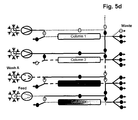
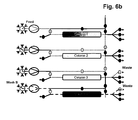
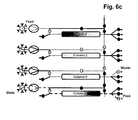
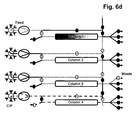
- More than 60% total binding capacities of affinity resins without or with low ⁇ 5% target molecule losses during loading can be achieved using more than 800 and even more than1000 cm/h velocities by efficiently transferring the leached target molecule from a first capture affinity column onto a second capture affinity column during the load. Simultaneously at least a third column is used for the other chromatographic process steps to enable a parallel unit operation. This results in >20% binding capacity increase if compared directly (the same unit operation conditions) to batch unit operation and > 3 times decrease in operation time (usual batch unit operation is performed at 300 cm/h). This does not only work for affinity chromatography applications but also for ion exchange chromatography applications.
- the present invention is consequently directed to a method of purifying target molecules from one or more impurities in a sample, the method comprising the steps of
- the feed has a velocity above 1000 cm/h.
- step a three, four or five separation units having the same chromatography matrix are provided in step a). In a very preferred embodiment, only three separation units having the same chromatography matrix are provided in step a).
- the chromatography matrix is an affinity chromatography matrix.
- the chromatography matrix of the separation units comprises particles with average particle size diameter (d50) between 40 and 120 ⁇ m. More preferably between 55 and 100 ⁇ m.
- the chromatography matrix of the separation units comprises particles with average pore diameters in the range between 40 nm and 300 nm. More preferably the pores of the particles that are present in the separation units have pores with average pore diameters in the range between 50 and 150 nm. More preferred, the pores of the particles have average pore diameters in the range between 60 nm and 100 nm.
- the separation unit that is being loaded is not only part of the loading time but over the whole loading time in fluid communication with the next separation unit in the circle.
- steps b), c) and d) the fluid communication between the separation unit that is being loaded and the next separation unit in the circle starts in the second half of the loading time.
- the wash liquid eluting from said loaded separation unit is directed to the inlet of another separation unit.
- the wash liquid eluting from said loaded separation unit is directed to the feedstock.
- the invention is also directed to an apparatus comprising
- target molecule refers to any molecule, substance or compound or mixtures thereof that shall be isolated, separated or purified from one or more impurities in a sample.
- the target molecule is a protein or a mixture of two or more proteins.
- the target molecule is an antibody.
- a "target molecule” or “target compound” could be an undesired compound that shall be removed from one or more desired compounds.
- antibody refers to a protein which has the ability to specifically bind to an antigen.
- antibodies are having a basic four-polypeptide chain structure consisting of two heavy and two light chains, said chains being stabilized, for example, by interchain disulfide bonds.
- Antibodies may be monoclonal or polyclonal and may exist in monomeric or polymeric form, for example, IgM antibodies which exist in pentameric form and/or IgA antibodies which exist in monomeric, dimeric or multimeric form.
- Antibodies may also include multispecific antibodies (e.g., bispecific antibodies), and antibody fragments so long as they retain, or are modified to comprise, a ligand-specific binding domain.
- fragment refers to a part or portion of an antibody or antibody chain comprising fewer amino acid residues than an intact or complete antibody or antibody chain. Fragments can be obtained via chemical or enzymatic treatment of an intact or complete antibody or antibody chain. Fragments can also be obtained by recombinant means. When produced recombinantly, fragments may be expressed alone or as part of a larger protein called a fusion protein. Exemplary fragments include Fab, Fab', F(ab')2, Fc and/or Fv fragments. Exemplary fusion proteins include Fc fusion proteins. According to the present invention fusion proteins are also encompassed by the term "antibody".
- an antibody is an Fc region containing protein, e.g., an immunoglobulin.
- an Fc region containing protein is a recombinant protein which includes the Fc region of an immunoglobulin fused to another polypeptide or a fragment thereof.
- Exemplary polypeptides include, e.g., renin; a growth hormone, including human growth hormone and bovine growth hormone; growth hormone releasing factor; parathyroid hormone; thyroid stimulating hormone; lipoproteins; ⁇ - 1 -antitrypsin; insulin ⁇ -chain; insulin ⁇ -chain; proinsulin; follicle stimulating hormone; calcitonin; luteinizing hormone; glucagon; clotting factors such as factor VIIIC, factor IX, tissue factor, and von Willebrands factor; anti-clotting factors such as Protein C; atrial natriuretic factor; lung surfactant; a plasminogen activator, such as urokinase or human urine or tissue-type plasminogen activator (t-PA); bombesin; thrombin; hemopoietic growth factor; tumor necrosis factor - ⁇ and - ⁇ ; enkephalinase; RANTES (regulated on activation normally T- cell expressed and secreted); human macrophage inflammatory
- sample refers to any composition or mixture that contains a target molecule.
- Samples may be derived from biological or other sources.
- Biological sources include eukaryotic and prokaryotic sources, such as plant and animal cells, tissues and organs.
- the sample may also include diluents, buffers, detergents, and contaminating species, debris and the like that are found mixed with the target molecule.
- the sample may be "partially purified” (i.e., having been subjected to one or more purification steps, such as filtration steps) or may be obtained directly from a host cell or organism producing the target molecule (e.g., the sample may comprise harvested cell culture fluid).
- impurity refers to any foreign or objectionable molecule, including a biological macromolecule such as DNA, RNA, one or more host cell proteins, endotoxins, lipids and one or more additives which may be present in a sample containing the target molecule that is being separated from one or more of the foreign or objectionable molecules using a process of the present invention.
- such impurity may include any reagent which is used in a step which may occur prior to the method of the invention.
- purifying refers to increasing the degree of purity of a target molecule from a composition or sample comprising the target molecule and one or more impurities. Typically, the degree of purity of the target molecule is increased by removing (completely or partially) at least one impurity from the composition.
- binding and elute mode and "bind and elute process,” as used interchangeably herein, refer to a product separation technique in which at least one product contained in a sample (e.g., an Fc region containing protein) binds to a chromatographic resin or media and is subsequently eluted.
- a sample e.g., an Fc region containing protein
- the term "reservoir” as used herein refers to any container, tank or bag, which may be used to store any buffer to be used when performing the method of the invention or the sample or any other liquid that shall be used in the method of the invention. Additionally a “reservoir” is any container, tank or bag that is used to collect the output of a process step (e.g., an eluate from a column).
- chromatography refers to any kind of technique which separates an analyte of interest (e.g. a target molecule) from other molecules present in a mixture.
- analyte of interest e.g. a target molecule
- the target molecule is separated from other molecules as a result of differences in rates at which the individual molecules of the mixture migrate through a stationary medium under the influence of a moving phase, or in bind and elute processes.
- matrix or "chromatography matrix” are used interchangeably herein and refer to any kind of particulate sorbent, resin or solid phase which in a separation process separates a target molecule (e.g., an Fc region containing protein such as an immunoglobulin) from other molecules present in a mixture.
- a target molecule e.g., an Fc region containing protein such as an immunoglobulin
- the matrix consisting of resin particles can be put in columns or cartriges.
- materials for forming the matrix include polysaccharides (such as agarose and cellulose); and other mechanically stable matrices such as silica (e.g. controlled pore glass), poly(styrenedivinyl)benzene, polyacrylamide, ceramic particles and derivatives of any of the above.
- the matrix carries one ore more types of ligands.
- a “ligand” is a functional group that is attached to the chromatography matrix and that determines the binding properties of the matrix.
- ligands include, but are not limited to, ion exchange groups, hydrophobic interaction groups, hydrophilic interaction groups, thiophilic interactions groups, metal affinity groups, affinity groups, bioaffinity groups, and mixed mode groups (combinations of the aforementioned).
- Some preferred ligands that can be used herein include, but are not limited to, strong cation exchange groups, such as sulphopropyl, sulfonic acid; strong anion exchange groups, such as trimethylammonium chloride; weak cation exchange groups, such as carboxylic acid; weak anion exchange groups, such as N5N diethylamino or DEAE; hydrophobic interaction groups, such as phenyl, butyl, propyl, hexyl; and affinity groups, such as Protein A, Protein G, and Protein L.
- strong cation exchange groups such as sulphopropyl, sulfonic acid
- strong anion exchange groups such as trimethylammonium chloride
- weak cation exchange groups such as carboxylic acid
- weak anion exchange groups such as N5N diethylamino or DEAE
- hydrophobic interaction groups such as phenyl, butyl, propyl, hexyl
- affinity groups such as Protein A, Protein G, and Protein
- affinity chromatography refers to a protein separation technique in which a target protein (e.g., an Fc region containing protein of interest or antibody) is specifically bound to a ligand which is specific for the target protein.
- a target protein e.g., an Fc region containing protein of interest or antibody
- a ligand is generally referred to as a biospecific ligand.
- the biospecific ligand e.g., Protein A or a functional variant thereof
- the target protein generally retains its specific binding affinity for the biospecific ligand during the chromatographic steps, while other solutes and/or proteins in the mixture do not bind appreciably or specifically to the ligand.
- Binding of the target protein to the immobilized ligand allows contaminating proteins or protein impurities to be passed through the chromatography matrix while the target protein remains specifically bound to the immobilized ligand on the solid phase material.
- the specifically bound target protein is then removed in active form from the immobilized ligand under suitable conditions (e.g., low pH, high pH, high salt, competing ligand etc.), and passed through the chromatographic column with the elution buffer, free of the contaminating proteins or protein impurities that were earlier allowed to pass through the column.
- suitable conditions e.g., low pH, high pH, high salt, competing ligand etc.
- Any component can be used as a ligand for purifying its respective specific binding protein, e.g. antibody.
- Protein A is used as a ligand for an Fc region containing target protein.
- the conditions for elution from the biospecific ligand (e.g., Protein A) of the target protein (e.g., an Fc region containing protein) can be readily determined by one of ordinary skill in the art.
- Protein G or Protein L or a functional variant thereof may be used as a biospecific ligand.
- a biospecific ligand such as Protein A is used at a pH range of 5-9 for binding to an Fc region containing protein, washing or re-equilibrating the biospecific ligand /target protein conjugate, followed by elution with a buffer having pH about or below 4 which contains at least one salt.
- ion-exchange and “ion-exchange chromatography” refers to the chromatographic process in which a solute or analyte of interest (e.g., an Fc region containing target protein) in a mixture interacts with a charged compound linked (such as by covalent attachment) to a solid phase ion exchange material such that the solute or analyte of interest interacts non-specifically with the charged compound more or less than solute impurities or contaminants in the mixture.
- contaminating solutes in the mixture elute from a column of the ion exchange material faster or slower than the solute of interest or are bound to or excluded from the resin relative to the solute of interest.
- Ion-exchange chromatography specifically includes cation exchange, anion exchange, and mixed mode ion exchange chromatography.
- cation exchange chromatography can bind the target molecule (e.g., an Fc region containing target protein) followed by elution (cation exchange bind and elution chromatography or "CIEX”) or can predominately bind the impurities while the target molecule "flows through” the column (cation exchange flow through chromatography FT-CIEX).
- Anion exchange chromatography can bind the target molecule (e.g., an Fc region containing target protein) followed by elution or can predominately bind the impurities while the target molecule "flows through” the column.
- the anion exchange chromatography step is performed in a flow through mode.
- ion exchange matrix refers to a chromatography matrix that is negatively charged (i.e. a cation exchange resin) or positively charged (i.e. an anion exchange resin).
- the charge may be provided by attaching one or more charged ligands to the matrix, e.g. by covalent linking.
- the charge may be an inherent property of the matrix (e.g. as is the case for silica, which has an overall negative charge).
- a "cation exchange matrix” refers to a chromatography matrix which is negatively charged, and which thus has free cations for exchange with cations in an aqueous solution passed over or through the solid phase.
- a negatively charged ligand attached to the solid phase to form the cation exchange resin may, e.g., be a carboxylate or sulfonate.
- Commercially available cation exchange resins include carboxy-methyl-cellulose, sulphopropyl (SP) immobilized on agarose (e.g., SP-SEPHAROSE FAST FLOWTM or SP-SEPHAROSE HIGH PERFORMANCETM, from Pharmacia) and sulphonyl immobilized on agarose (e.g. S-SEPHAROSE FAST FLOWTM from Pharmacia).
- SP sulphopropyl
- SP sulphopropyl
- S-SEPHAROSE FAST FLOWTM from Pharmacia
- a “mixed mode ion exchange matrix” refers to a chromatography matrix which is covalently modified with cationic and/or anionic and hydrophobic moieties.
- a commercially available mixed mode ion exchange resin is BAKERBOND ABXTM (J. T. Baker, Phillipsburg, N.J.) containing weak cation exchange groups, a low concentration of anion exchange groups, and hydrophobic ligands attached to a silica gel solid phase support matrix.
- Mixed mode cation exchange materials typically have cation exchange groups and hydrophobic moieties.
- Suitable mixed mode cation exchange materials are Capto® MMC (GE Healthcare) and Eshmuno ® HCX (Merck).
- Mixed mode anion exchange materials typically have anion exchange groups and hydrophobic moieties.
- Suitable mixed mode anion exchange materials are Capto ® Adhere (GE Healthcare).
- anion exchange matrix is used herein to refer to a chromatography matrix which is positively charged, e.g. having one or more positively charged ligands, such as quaternary amino groups, attached thereto.
- commercially available anion exchange resins include DEAE cellulose, QAE SEPHADEXTM and FAST Q SEPHAROSETM (Pharmacia).
- Peferred materials are Fractogel® EMD TMAE, Fractogel® EMD TMAE highcap, Eshmuno ® Q and Fractogel® EMD DEAE..
- Protein A and “Prot A” are used interchangeably herein and encompasses Protein A recovered from a native source thereof, Protein A produced synthetically (e.g., by peptide synthesis or by recombinant techniques), and variants thereof which retain the ability to bind proteins which have a CH 2 /CH 3 region, such as an Fc region.
- Protein A can be purchased commercially from Repligen, Pharmacia and Fermatech. Protein A is generally immobilized on a chromatography matrix.
- the term “ProA” also refers to an affinity chromatography matrix or column containing chromatographic solid support matrix to which is covalently attached Protein A.
- An interaction compliant with such value for the binding constant is termed "high affinity binding" in the present context.
- such functional derivative or variant of Protein A comprises at least part of a functional IgG binding domain of wild-type Protein A, selected from the natural domains E, D, A, B, C or engineered mutants thereof which have retained IgG binding functionality.
- Protein A derivatives or variants engineered to allow a single-point attachment may also be used in the affinity chromatography step in the claimed methods.
- Single point attachment generally means that the protein moiety is attached via a single covalent bond to a chromatographic support material of the Protein A affinity chromatography. Such single-point attachment may also occur by use of suitably reactive residues which are placed at an exposed amino acid position, namely in a loop, close to the N- or C-terminus or elsewhere on the outer circumference of the protein fold. Suitable reactive groups are e.g. sulfhydryl or amino functions.
- affinity chromatography matrix is used herein to refer to a chromatography matrix which carries ligands suitable for affinity chromatography.
- the ligands e.g., Protein A or a functional variant thereof
- an affinity chromatography matrix is a proteinA matrix.
- An affinity chromatography matrix typically binds the target molecules with high specificity based on a lock/key mechanism such as antigen/antibody or enzyme/receptor binding.
- affinity matrices are matrices carrying protein A ligands like Protein A SEPHAROSE TM or PROSEP ® -A.
- binding refers to the generally reversible binding of the target molecule to a ligand through the combined effects of spatial complementarity of e.g. protein and ligand structures at a binding site coupled with electrostatic forces, hydrogen bonding, hydrophobic forces, and/or van der Waals forces at the binding site.
- spatial complementarity e.g. protein and ligand structures at a binding site coupled with electrostatic forces, hydrogen bonding, hydrophobic forces, and/or van der Waals forces at the binding site.
- Non-limiting examples of specific binding includes antibody-antigen binding, enzyme- substrate binding, enzyme-cofactor binding, metal ion chelation, DNA binding protein-DNA binding, regulatory protein-protein interactions, and the like. Ideally, in affinity chromatography specific binding occurs with an affinity of about 10 "4 to 10 "8 M in free solution.
- detergent refers to ionic and nonionic surfactants such as polysorbates (e.g. polysorbates 20 or 80); poloxamers (e.g. poloxamer 188); Triton; sodium dodecyl sulfate (SDS); sodium laurel sulfate; sodium octyl glycoside; lauryl-, myristyl-, linoleyl-, or stearyl-sulfobetaine; lauryl-, myristyl-, linoleyl- or stearyl-sarcosine; linoleyl-, myristyl-, or cetyl-betaine; lauroamidopropyl-, cocamidopropyl-, linoleamidopropyl-, myristamidopropyl-, palmidopropyl-, or isostearamidopropyl-betaine (e.g.
- Useful detergents is a polysorbate, such as polysorbate 20 (TWEEN 20®.) or polysorbate 80 (TWEEN 80®.) or various acids, such as octanoic acid.
- a “buffer” is a solution that resists changes in pH by the action of its acid-base conjugate components.
- Various buffers which can be employed depending, for example, on the desired pH of the buffer are described in Buffers.
- Non- limiting examples of buffers include MES, MOPS, MOPSO, Tris, HEPES, phosphate, acetate, citrate, succinate, and ammonium buffers, as well as combinations of these.
- buffer or “solvent” is used for any liquid composition that is used to load, wash, elute and reequilibrate the separation units.
- a buffer is used to load the sample or composition comprising the target molecule (e.g., an Fc region containing target protein) and one or more impurities onto a chromatography column (e.g., an affinity column or an ion exchange column).
- the buffer has a conductivity and/or pH such that the target molecule is bound to the chromatography matrix while ideally all the impurities are not bound and flow through the column.
- a buffer When “loading" a separation column to "flow through” a target molecule a buffer is used to load the sample or composition comprising the target molecule (e.g., an Fc region containing target protein) and one or more impurities onto a chromatography column (e.g., an affinity column or an ion exchange column).
- the buffer has a conductivity and/or pH such that the target molecule is not bound to the chromatography matrix and flow through to column while ideally all the impurities are bound the column.
- reequilibrating refers to the use of a buffer to re-equilibrate the chromatography matrix prior to loading the target molecule.
- the loading buffer is used for reequilibrating.
- wash or “washing” a chromatography matrix is meant passing an appropriate liquid, e.g. a buffer through or over the matrix. Typically washing is used to remove weakly bound contaminants from the matrix prior to eluting the target molecule and/or to remove non-bound or weakly bound target molecule after loading.
- the wash buffer and the loading buffer are be the same.
- virus inactivation buffer it is used to inactivate certain present virus prior to eluting the target molecule.
- the virus inactivation buffer differs from loading buffer since it may contain detergent/detergents or have different properties (pH/conductivity/salts and their amounts).
- a molecule e.g., a polypeptide of interest or an impurity
- a chromatography matrix is meant to remove the molecule therefrom by altering the solution conditions such that buffer competes with the molecule of interest for the ligand sites on the chromatography resin.
- a non-limiting example is to elute a molecule from an ion exchange resin by altering the ionic strength of the buffer surrounding the ion exchange material such that the buffer competes with the molecule for the charged sites on the ion exchange material.
- a "separation unit” is an equipment onto which a chromatographic separation step can be performed.
- a separation unit typically is a chromatography column or chromatography cartridge which is filled with a sorbent matrix.
- Chromatography columns are known to a person skilled in the art. They typically comprise a column tube with end-fittings for fluid-inlet and fluid-outlet. The column tube is filled with a suitable chromatography matrix.
- a "continuous" process is a process that is not run in the batch mode.
- new sample is loaded onto one or more separation units continuously without any breaks in between.
- the feed never stops.
- a "semi continuous process” is a process in which the feed is interrupted at least once, typically several times in a sequential manner.
- a "connecting line” is any tube, hose, pipe or channel which is suitable for flowing liquids there through.
- a connecting line can be interrupted by one or more valves.
- a connecting line might be straight or branched.
- in fluid connection means that there is a connecting line between the two parts of the apparatus so that liquid can flow from one part to the other.
- This connecting line can be direct or it can be interrupted by one or more valves, by a separation unit or other parts of the apparatus.
- in fluid connection encompasses a fluid connection that is permanent but it also encompasses a fluid connection that is not permanent and is made of a connecting line that is e.g. interrupted by one or more valves so that the flow of liquid through the connecting line can started and stopped whenever necessary.
- most of the parts of the apparatus that are in fluid connection have a fluid connection that is not permanent.
- a buffer reservoir is in fluid connection with a separation unit this means that a flow of the buffer to the column can be realized if necessary but typically there is at least one valve located in the connecting line between the reservoir and the separation unit so that the liquid flow can be stopped when necessary and started when necessary.
- fluid communication describes the status in which a "fluid connection” is actually used by flowing liquid through the connecting line. If two parts of the system are partly in fluid communication it means that the fluid communication is not permanent and the liquid is not permanently flowing from one part to the other but only part of the time. Typically the flow of the liquid between two parts of the system is started and/or stopped with the aid of valves that direct the liquid flow.
- a "fluid inlet” or “inlet” is any means that enables the introduction of liquid.
- a separation unit inlet is for example the end-fitting of a chromatography column to which a connecting line can be connected.
- An inlet can also be a valve that provides the introduction of liquid in a connecting line.
- a inlet can also be the end of a connecting line.
- An "outlet” or “fluid outlet” is any means that enables the withdraw of a liquid.
- a separation unit outlet is for example the end-fitting of a chromatography column to which a connecting line can be connected.
- An outlet can also be a valve that provides the introduction of liquid in a connecting line.
- a outlet can also be the end of a connecting line.
- a "fluid selection valve” is any means that enables a fluid communication selectively between any connected fluid and the system part.
- a fluid selection valve is for example the valve prior the separation unit inlet, to which the connecting lines can be connected and selectively chosen which can enable the fluid communication between the selected line and the separation unit inlet.
- a fluid selection valve is for example the valve after the separation unit outlet, to which the connecting lines can be connected and selectively chosen which can enable the fluid communication between the selected line and the separation unit outlet.
- a fluid selection valve can also be a valve that provides the introduction of liquid in a connecting line.
- a fluid selection valve can also be the end of a connecting line.
- a “solvent selection valve” is a fluid selection valve that enables a fluid communication selectively between any connected solvent reservoir and the system part.
- a solvent selection valve is for example the valve prior the solvent pump, to which the connecting lines can be connected from the solvent reservoirs and selectively chosen which can enable the fluid communication between the selected solvent and the pump.
- a "fluid selection valve” and “solvent selection valve” can be of identical type or of different type.
- a solvent delivery system is a system that enable the delivery of liquid.
- the solvent delivery system of an apparatus comprises at least one reservoir and at least one pump to transport the liquid from the reservoir to another part of the apparatus which is in liquid connection with the reservoir. It is known to a person skilled in the art that every time liquid is transferred from a reservoir to a separation unit this is done with the aid of a pump.
- the pumps can also be used to mix two or more liquid streams coming from two or more reservoirs.
- feed refers to a liquid which contains two or more compounds to be separated.
- compound is used in a broad sense for any entity such as a molecule, chemical compound, cell etc.
- the feed is the sample containing the target molecule.
- break-through means the point of time during feed addition to a chromatography matrix or separation unit such as a packed chromatography column when the compound that is adsorbed onto the matrix first appears in the outflow.
- break-through is the point of time when loss of target compound begins.
- regeneration means herein a process of treating a chromatography matrix to make it useful again in chromatography.
- regeneration will include release of bound compounds, also known as elution of compounds, as well as re-equilibration with the appropriate adsorption buffer.
- regeneration may also include cleaning in place (CIP).
- flow programming means a deliberate change in feed flow rate during application of feed to a chromatography column.
- capture means in the context of a chromatography method the first chromatography step, wherein a large amount of target compound is captured.
- Frull binding means the point in time when a chromatography matrix e.g. in a packed chromatography column has adsorbed so much of a target compound that it cannot adsorb more under the given conditions. Typically, full binding is reached when a matrix has adsorbed more than 60% of its original capacity estimated during corresponding static binding capacity measurements.
- Loading time means the time required to saturate an adsorbent such as a packed chromatography column to its "full binding" state.
- average particle size diameter or d50 means the average particle size distribution value at 50% of the cumulative particle size distribution.
- average pore size means the average pore size distribution value at 50% of the cumulative pore size distribution.
- the present invention for the first time provides a method for a continuous chromatography process which allows to maintain high binding capacity at low residence time.
- the productivity (g (target molecule)/ ml (packed bed)/ h (production time) is usually in the range of 6-10 greater than the one of batch process.
- the method according to the present invention is based on the combination of a certain type of chromatography matrix with a certain type of continuous chromatography process.
- the chromatography matrix to be used in the method according to the present invention is a particulate sorbent.
- the average sorbent particle size (d50) is between 30 and 200 ⁇ m.
- the pores have an average pore size between 40 nm and 300 nm.
- the average size of the particles is between 40 and 120 ⁇ m, more preferably between 55 and 100 ⁇ m In another preferred embodiment, the particles have pores of average pore size in the range between 50 and 150 nm, most preferred between 60 and 100 nm.
- Average pore size values and average particle size values are defined as the value where half of the population resides above this point, and half resides below this point. For particle size distributions the average pore size is called the d50.
- the d50 is the size in microns that splits the distribution with half above and half below this diameter. D50 corresponds to 50% of the cumulative size distribution.
- the standard methods for the particle size estimation can be imaging and image analysis, light scaterring technologies, sieving technologies, sedimentation technigues, acoustic spectroscopy technologies and other.
- K.K. Unger et al. "Particled packed columns and monolithic columns in high-performance liquid chromatography - comparison and critical appraisal" J. Chrom. A. 1184 (2008) 393 - 415 ).
- the used characterization method given for the average particle diameter value estimation was light scattering.
- laser diffraction is used for particles with diameters up to 30 nm and single-particle optical sensing (SPOS) is used for particles with diameters between 0.5 nm - 400 nm.
- the pore size can be measured by the inversive size exclusion chromatography, mercury intrusion, gas adsorption technologies, etc. ( M. T Subscribes et al., "Textural characterization of native and n-alky-bonded silica monoliths by mercury intrusion/extrusion, inverse size exclusion chromatography and nitrogen sorption", J. Chrom. A, 2008 ).
- the pore volume can be estimated by the same methods, used for the pore size estimation.
- inverse size exclusion chromatography is used for matrices which cannot be measured in the dry state as their physical properties change when the matrices are dried.
- nitrogen adsorption methods are used for matrices which can be measured in the dry state.
- the particles can be regularly or irregularly formed. They can be made of any material suitable as chromatographic sorbent, like polysaccharides (such as agarose and cellulose); and other mechanically stable matrices such as silica (e.g. controlled pore glass), poly(styrenedivinyl)benzene, polyacrylamide, polymethacrylates, ceramic particles or copolymers of hydrophilically substituted alkyl vinyl ethers like 1,2-ethanediol monovinyl ether, 1,3-propanediol monovinyl ether, 1,4-butanediol monovinyl ether, 1,5-pentanediol monovinyl ether, 1,6-hexanediol monovinyl ether, diethylene glycol monovinyl ether or cyclohexanedimethanol monovinyl ether and crosslinking agents like divinylethyleneurea (1,3-divinylimidazolin-2-one)
- the particles to be used as chromatography matrix typically carry affinity ligands like Protein A or a functional variant thereof or ion exchange ligands.
- the method according to the present invention is based on the use of at least three separation units having the same chromatography matrix which are connected so that liquid can at least flow from one separation unit to the subsequent one and from the last to the first separation unit. That means, all separation units of the system are connected in a circle ( Figure 1 ).
- the method comprises the steps of:
- the feed never stops and has a velocity above 800 cm/h. Preferably it has a velocity above 1000 cm/h.
- the chromatography matrix of the separation units comprises particles with an average particle diameter between 30 and 200 ⁇ m with average pore diameters in the range between 40 nm and 300 nm.
- additional washing step can be done ( Figure 2b ) to wash the contaminants from the separation unit.
- the washing is done in two or more steps with two or more different washing buffers.
- a first washing step with a first washing buffer can be used to wash unbound or weakly bound target molecule from the separation unit ( Figure 2a ) and a second washing step using a second washing buffer can be used to wash contaminants from the separation unit ( Figure 2b ).
- the solution containing unbound or weakly bound target molecule usually during the washing phase can be redirected to the feedstock solution or to a dedicated outlet.
- the solution containing unbound or weakly bound target molecule usually during the washing phase can be redirected to another separation unit.
- the cleaning in place is performed ( Figure 2d ) after elution of the bound target molecule and before the reequilibration steps.
- a single solvent delivery system can be dedicated for feed delivery ( Figure 4 ).
- the separation unit that is loaded with the target molecule is loaded to the maximum at the given conditions, that means it is loaded to full binding .
- the separation unit that is loaded with the target molecule is over the whole loading time in fluid communication with another separation unit.
- the separation unit that is loaded is only part of the loading time in fluid communication with another separation unit.
- the said two separation units are only in fluid communication during the whole or parts of the second half of the loading time. This is due to the fact, that when loading starts, typically all target molecules are bound to the separation unit that is loaded. Only when this separation unit is already partly loaded, it might happen that target molecules are not bound and pass through the separation unit. In batch chromatography, typically, loading is stopped when too many target molecules start to pass through the separation unit.
- the outlet of said separation unit is connected with the inlet of another separation unit so that the target molecule that has not bound to the first separation unit is bound to the second.
- a person skilled in the art can easily determine when during loading the amount of target molecule that is not bound to the separation unit that is loaded is that high that the outlet of said separation unit needs to be connected to the inlet of another separation unit.
- the outlet of the separation unit or the separation units that are washed is in liquid communication with the inlet of another separation unit so that target molecules removed by said washing are not lost but loaded onto the other separation unit.
- the outlet of the separation unit or the separation units that are washed is in a liquid communication with the previous separation unit so that target molecules removed by said washing are not lost but loaded onto the previous separation unit.
- such method comprises
- the system has solvent delivery systems (at least two as indicated in Figure 4 ), three separation units, fluid communication channels between the solvent delivery systems and separation units, separation unit inlets and outlets, swiching valves to redirect the solvent flow to the separation unit and from the separation unit.
- the Figure 1 shows solvent selection valves prior solvent delivery systems to select the necessary solvent for the required process step or sub-step. A person skilled in the art can decide based on the specific process parameters like type of the solvent delivery systems, separation units and means to control solvent flow etc. based on selected application and requirements thereof.
- FIG. 2a-e schematically shows the steps of the method according to the present invention with a three column system.
- the feed has been switched to the inlet of separation unit 1, flows through separation unit 1, whereby at least part of the target molecules are bound to separation unit 1.
- the outlet of separation unit 1 is in liquid communication with the inlet of separation unit 2 so that all parts of the feed that have not bound to separation unit 1 are additionally passed through separation unit 2. This enables target molecules that have not bound to separation unit 1 to bind to separation unit 2.
- the outlet of separation unit 2 is connected to the waste. While loading separation unit 1 and 2, separation unit 3 which has been loaded before is e.g.
- the outlet of the separation unit 3 can be connected to a collecting tank or to another unit where the weakly bound or unbound target molecule removed by said wash is further processed ( Figure 2a ). As long as the target molecule is eluted from separation unit 3 the outlet of separation unit 3 is connected to a target molecule collecting tank (indicated with "product" in Figure 2c ) or to another unit where the target molecule is further processed (not shown in Figure 2c ).
- the outlet of separation unit 3 is connected to one of the outlets as shown in Figure 2b , Figure 2d and Figure 2e .
- clean in place and reequilibrate steps on separation unit 3 can be performed a reversed flow mode as shown in Figure 2d and Figure 2e .
- the feed is switched to the inlet of separation unit 2 and flows through separation unit 2, whereby at least part of the target molecules are bound to separation unit 2.
- the outlet of separation unit 2 is in liquid communication with the inlet of separation unit 3 so that all parts of the feed that have not bound to separation unit 2 are additionally passed through separation unit 3. This enables target molecules that have not bound to separation unit 2 to bind to separation unit 3.
- the outlet of separation unit 3 is connected to the waste. While loading separation unit 2 and 3, separation unit 1 which has been loaded before is e.g. washed, eluted, undergoes cleaning in place and reequlibration and all other process steps that might be necessary and are different from loading.
- the outlet of the separation unit 1 can be connected to a collecting tank or to another unit where the weakly bound or unbound target molecule removed by said wash is further processed. As long as the target molecule is eluted from separation unit 1 the outlet of separation unit 1 is connected to a target molecule collecting tank or to another unit where the target molecule is further processed. For other process steps, the outlet of separation unit 1 is connected to one of the outlets. Optionally, clean in place and reequilibrate steps on separation unit 1 can be performed a reversed flow mode .
- the feed is switched to the inlet of separation unit 3 and flows through separation unit 3, whereby at least part of the target molecules are bound to separation unit 3.
- the outlet of separation unit 3 is in liquid communication with the inlet of separation unit 1 so that all parts of the feed that have not bound to separation unit 3 are additionally passed through separation unit 1. This enables target molecules that have not bound to separation unit 3 to bind to separation unit 1.
- the outlet of separation unit 1 is connected to the waste. While loading separation unit 3 and 1, separation unit 2 which has been loaded before is e.g. washed, eluted, undergoes cleaning in place and reequlibration and all other process steps that might be necessary and are different from loading.
- the outlet of the separation unit 2 can be connected to a collecting tank or to another unit where the weakly bound or unbound target molecule removed by said wash is further processed. As long as the target molecule is eluted from separation unit 2 the outlet of separation unit 2 is connected to a target molecule collecting tank or to another unit where the target molecule is further processed. For other process steps, the outlet of separation unit 2 is connected to one of the outlets. Optionally, clean in place and reequilibrate steps on separation unit 2 can be performed a reversed flow mode.
- the feed is again switched to separation unit 1 ( Figure 3a ) and the process step as described in Figure 2a-e is performed again.
- the process steps are performed more than two times.
- the wash liquid that is used for washing the loaded separation unit to remove unbound or weakly bound target molecules, when being eluted form the loaded separation unit is not directed to selected system outlet but to the inlet of another separation unit. This ensures that target molecules that might be eluted from the loaded separation unit during washing does not go to outlet but is bound onto another separation unit.
- FIG. 6a-e schematically shows the steps of the method according to the present invention with a four column system.
- the feed has been switched to the inlet of separation unit 1, flows through separation unit 1, whereby at least part of the target molecules are bound to separation unit 1.
- the outlet of separation unit 1 is in liquid communication with the inlet of separation unit 2 so that all parts of the feed that have not bound to separation unit 1 are additionally passed through separation unit 2. This enables target molecules that have not bound to separation unit 1 to bind to separation unit 2.
- the outlet of separation unit 2 is connected to the waste. While loading separation unit 1 and 2, separation unit 4 which has been loaded before is e.g.
- the outlet of the separation unit 4 can be in fluid communication with the inlet of the separation unit 3 (not shown in Figure 6a ) or with outlet of the separation unit 3 ( Figure 6a ).
- the separation unit 3 can be in fluid communication with separation unit 2 ( Figure 6b-e ).
- the outlet of separation unit 4 is connected to a target molecule collecting tank (indicated with "product" in Figure 6c ) or to another unit where the target molecule is further processed (not shown in Figure 6c ).
- the outlet of separation unit 4 is connected to one of the outlets as shown in Figure 6b , Figure 6d and Figure 6e .
- clean in place and reequilibrate steps on separation unit 4 can be performed a reversed flow mode as shown in Figure 4d and Figure 4e ..
- the feed has been switched to the inlet of separation unit 2, flows through separation unit 2, whereby at least part of the target molecules are bound to separation unit 2.
- the outlet of separation unit 2 is in liquid communication with the inlet of separation unit 3 so that all parts of the feed that have not bound to separation unit 2 are additionally passed through separation unit 3. This enables target molecules that have not bound to separation unit 2 to bind to separation unit 3.
- the outlet of separation unit 3 is connected to the waste. While loading separation unit 2 and 3, separation unit 1 which has been loaded before is e.g. washed, eluted, undergoes cleaning in place and reequlibration and all other process steps that might be necessary and are different from loading.
- the outlet of the separation unit 1 is in fluid communication with the separation unit 4 where the weakly bound or unbound target molecule removed by said wash, and not bound to the separation unit 1 are additionally passed through the separation unit 4.
- This enables target molecules that have not bound to separation unit 1 to bind to separation unit 4.
- the outlet of the separation unit 1 can be in fluid communication with the inlet of the separation unit 4 or with outlet of the separation unit 4.
- the separation unit 4 can be in fluid communication with separation unit 3.
- the outlet of separation unit 1 is connected to a target molecule collecting tank or to another unit where the target molecule is further processed.
- the outlet of separation unit 1 is connected to one of the outlets.
- clean in place and reequilibrate steps on separation unit 1 can be performed as reversed flow mode.
- the feed has been switched to the inlet of separation unit 3, flows through separation unit 3, whereby at least part of the target molecules are bound to separation unit 3.
- the outlet of separation unit 3 is in liquid communication with the inlet of separation unit 4 so that all parts of the feed that have not bound to separation unit 3 are additionally passed through separation unit 4. This enables target molecules that have not bound to separation unit 3 to bind to separation unit 4.
- the outlet of separation unit 4 is connected to the waste. While loading separation unit 3 and 4, separation unit 2 which has been loaded before is e.g. washed, eluted, undergoes cleaning in place and reequlibration and all other process steps that might be necessary and are different from loading.
- the outlet of the separation unit 2 is in fluid communication with the separation unit 1 where the weakly bound or unbound target molecule removed by said wash, and not bound to the separation unit 2 are additionally passed through the separation unit 1.
- This enables target molecules that have not bound to separation unit 2 to bind to separation unit 1.
- the outlet of the separation unit 2 can be in fluid communication with the inlet of the separation unit 1 or with outlet of the separation unit 1.
- the separation unit 1 can be in fluid communication with separation unit 4.
- the outlet of separation unit 2 is connected to a target molecule collecting tank or to another unit where the target molecule is further processed.
- the outlet of separation unit 2 is connected to one of the outlets.
- clean in place and reequilibrate steps on separation unit 2 can be performed in a reversed flow mode.
- the feed has been switched to the inlet of separation unit 4, flows through separation unit 4, whereby at least part of the target molecules are bound to separation unit 4.
- the outlet of separation unit 4 is in liquid communication with the inlet of separation unit 1 so that all parts of the feed that have not bound to separation unit 4 are additionally passed through separation unit 1. This enables target molecules that have not bound to separation unit 4 to bind to separation unit 1.
- the outlet of separation unit 1 is connected to the waste. While loading separation unit 4 and 1, separation unit 3 which has been loaded before is e.g. washed, eluted, undergoes cleaning in place and reequlibration and all other process steps that might be necessary and are different from loading.
- the outlet of the separation unit 3 is in fluid communication with the separation unit 2 where the weakly bound or unbound target molecule removed by said wash, and not bound to the separation unit 3 are additionally passed through the separation unit 2.
- This enables target molecules that have not bound to separation unit 3 to bind to separation unit 2.
- the outlet of the separation unit 3 can be in fluid communication with the inlet of the separation unit 2 or with outlet of the separation unit 2.
- the separation unit 2 can be in fluid communication with separation unit 1.
- the outlet of separation unit 3 is connected to a target molecule collecting tank or to another unit where the target molecule is further processed.
- the outlet of separation unit 3 is connected to one of the outlets.
- clean in place and reequilibrate steps on separation unit 3 can be performed in a reversed flow mode.
- the feed is again switched to separation unit 1 ( Figure 5a ) and the process step as described in Figure6a-e is performed again.
- the process steps are performed more than two times.
- separation unit 1 undergoes other steps like additional washing (e.g the removal of molecules other then target molecules) ( Figure 7b ), CIP, elution, reequilibration, the inlet on separation unit 3 is connected to the outlet of separation unit 2 so that at least in part of the loading time, due to the fluid communication between separation unit 2 and 3, unbound target molecule that is eluted from separation unit 2 can be bound to separation unit 3.
- additional washing e.g the removal of molecules other then target molecules
- the present invention is also directed to a liquid chromatography system ( Figure 1 ) for separating at least one target molecule from feed, which system is composed of at least three separation units connected in a circle, each separation unit comprising a chromatography matrix packed in a column. Each separation unit is provided with means for inlet and outlet of liquid. Said means for inlet are at least connected to the solvent delivery system and to the outlet of the previous separation unit in the circle.
- Said means of outlet are at least connected to a reservoir or waste and to the inlet of the next separation unit in the circle.
- the outlet of each separation unit in the circle is connected with the inlet of each separation unit in the circle so that fluid communication is possible between the outlet of any selected separation unit with the inlet of any other selected separation unit.
- the connecting lines are preferably branched close to each fluid inlet and close to each fluid outlet.
- All connecting lines located between the outlet of one separation unit and the inlet of the next separation unit the circle are provided with "on-off' valves for selecting the inlet stream, wherein the inlet stream can be directly connected with a solvent delivery system or is directly connected with the outlet of the previous column. Additionally, all outlets are provided with "on-off" valves to select between the solvent stream directions, wherein the said solvent can be directed towards waste or solvent reservoir or towards the inlet of another separation unit.
- This setup enables a capture of the leached product from the first capture separation unit (at the end of loading) on the second separation unit (just reequilibrated and ready for capture). This enables to use higher throughputs and binding capacities without the loss of target molecule.
- the selection of the solvent before the solvent delivery system is done with solvent selection valve with at least two inlets but more like with four and more.
- the on/off valves are located on the connecting lines in order to stop the flow of the solvent through this line.
- the system can contain just the two solvent delivery system but still be able the perform with the three column methods given above ( Figure 4 ).
- system according to the present invention might contain of four separation units ( Figure 5a ; Figure 6a )
- the apparatus further comprises one or more detectors.
- the detectors can be used for control of sample transfer between the columns, for the analysis of sample quality, monitoring etc.
- the detectors can be located wherever suitable, typically they are located prior to the fluid inlet and/or after the fluid outlet of the separation columns. Examples of suitable detectors are pH detectors, UV detectors, infrared detectors or detectors measuring conductivity.
- the apparatus further comprises a computer system.
- the detectors as well as the pumps and valves are connected to the computer system.
- This computer system enables control of the pumps and valves and detectors.
- the computer system comprises a software and algorithms that allow the apparatus to be used in a partly or fully automated mode.
- the apparatus comprises a computer system wherein the events (e.g. detector signals) can be used as triggers for the control.
- the events e.g. detector signals
- the system may additionally comprise filter units, detection units or other equipment that may be needed or suitable in a chromatographic separation procedure.
- the apparatus according to the present invention comprises columns, valves, reservoirs and other equipment that is typically used in chromatography systems.
- the separation units might for example be stainless steel columns, plastic columns or glass columns that are filled with the respective chromatography matrices and have suitable end-fittings for solvent inlet and outlet.
- the apparatus according to the present invention comprises 3 or more, preferably 3, 4 or 5, most preferred 3 separation units having the same chromatography matrix.
- the apparatus also comprises at least two buffer reservoirs and at least two pumps, also called the solvent delivery system, which provide for the storage and provision of the buffers needed e.g. for the loading, washing and the elution of the target molecules.
- all separation units have at least one fluid inlet that is connected to at least one buffer reservoir.
- the apparatus according to the present invention has three separation units and two solvent delivery systems.
- the apparatus can comprise additional reservoirs for other buffers, cleaning in place, reequilibration, etc.
- the preferred solvent selection valves for the choice of the solvent prior pump are valves having numerous solvent inlets and 1 solvent outlet which can be connected directly to pump. The amount of the required inlets would correspond to the amount of the used different buffers specifically to individual application. Any pumps which assure solvent flow could be used including peristaltic pumps, isocratic pumps, gradient pumps, high pressure pumps and the like, low pressure pumps and the like.
- the preferred fluid selection valves for the choice of the fluid introduction prior a system part fluid inlet are valves having numerous fluid inlets and 1 outlet which can be connected to the system part fluid inlet.
- the preferred fluid selection valves for the choice of the fluid withdraw after the system part fluid outlet are valves having numerous fluid outlets and 1 inlet which can be connected to the system part fluid outlet.
- At least one solvent delivery system is connected to the feedstock reservoir, assuring a constant feedstock stream to the apparatus.
- This enables a continuous operation in the respect of continuous feed stream.
- the range of the feed stream might be controlled in order to assure required column binding in the given time range.
- target molecule amount in the feed stream is a decisive criteria for the feed stream.
- the flow rate of the feed is controlled to improve the productivity of each column and more preferably it is kept in the range depending on the target molecule amount in the feed stream.
- the flow rate of one or more additional liquid streams are controlled.
- the apparatus further comprises an additional reservoir for cleaning in place.
- Cleaning in place is a technology known to the person skilled in the art. Cleaning in place is the removal of very tightly bound, precipitated or denatured substances from the chromatography matrix. If such contaminants are not removed from the chromatography matrix they might affect the chromatographic properties of the column, decreasing binding capacity and come off in subsequent runs which results in carryover of contaminants or product between cycles.
- a standard CIP protocols typically includes one to five washes with one to three column volumes of aqueous buffers comprising ingredients like
- Concentration of the ingredients like NaOH, the contact time of the CIP buffer on the column as well as the frequency of performing the CIP can be adjusted and determined by the person skilled in the art.
- the apparatus according to the present invention preferably has at least one reservoir containing a CIP buffer.
- the CIP buffer can be used for the CIP of all separation units if suitable. Then the buffer reservoir is in liquid connection with all separation units in a way that the flow of the CIP buffer can be directed to each of the columns independently. Cleaning in place washes can be performed after each separation cycle. Typically CIP is done after every second, third, fourth, fifth, sixth, seventh, eighth, ninth or tenth separation cycle depending on the sample and thus the amount and type of contaminants that might contaminate the separation unit.
- the apparatus comprises an additional reservoir for bound impurity partial or total removal from the adsorbent (wash).
- Impurity purification, especially removal of HCP and DNA are playing the major role in the biopharmaceutical compound production as host cell DNA levels in biopharmaceutical compounds are regulated by the FDA. It is possible to reduce the number of the bound HCP and DNA levels on the adsorbent through the additional exposure of the loaded adsorbent to various solutions. This technology is known to the person skilled in the art.
- a standard wash protocols typically includes one to ten washes with one to twenty column volumes of aqueous buffers comprising ingredients like
- Concentration of the ingredients like NaCl, the contact time of the wash buffer on the column, the buffer pH value as well as the frequency of performing the wash can be adjusted and determined by the person skilled in the art.
- washing steps are carried out with different buffers.
- each adsorbent is washed by multiple washing steps.
- the system comprises three or more separation units with an affinity chromatography matrix.
- Suitable affinity matrices are matrices having Protein A, Protein G, Protein L or Protein r functional groups (e.g. Prosep® Highcap (Merck Millipore), Prosep® Ultra Plus (Merck Millipore), Poros® Prot A(Life Technologies), A650F (Tosoh), MabSelect® Sure (GE).
- the affinity chromatography matrix to be used in the apparatus according to the present invention comprises particles with average diameters between 40 and 200 ⁇ m, preferred diameters and pore sizes have been given above when describing the method according to the present invention.
- the particles can be regularly or irregularly formed. They can be made of any material suitable as chromatographic sorbent, like polysaccharides (such as agarose and cellulose); and other mechanically stable matrices such as silica (e.g. controlled pore glass), poly(styrenedivinyl)benzene, polyacrylamide, polymthqacrylates, ceramic particles or copolymers of hydrophilically substituted alkyl vinyl ethers like 1,2-ethanediol monovinyl ether, 1,3-propanediol monovinyl ether, 1,4-butanediol monovinyl ether, 1,5-pentanediol monovinyl ether, 1,6-hexanediol monovinyl ether, diethylene glycol monovinyl ether or cyclohexanedimethanol monovinyl ether and crosslinking agents like divinylethyleneurea (1,3-divinylimidazolin-2-one
- the described apparatus can be connected to a bioreactor, perfusion bioreactor and/or purification methodology applied for the partial impurity removal (like cell debris, etc.), like depth filters, centrifugation, clarification, sedimentation, fluctuation technologies that assures a constant feed stream.
- a bioreactor, perfusion bioreactor and/or purification methodology applied for the partial impurity removal like cell debris, etc.
- the partial impurity removal like cell debris, etc.
- the partial impurity removal like cell debris, etc.
- the purification methodology like depth filters, centrifugation, clarification, sedimentation, fluctuation technologies that assures a constant feed stream.
- the product outlet stream can be directly connected to other purification techniques, such as ion exchange chromatography, mixed mode chromatography, reversed phase chromatography, HIC chromatography, SEC chromatography modes, depth filtration, sedimentation, fluctuation technologies, etc. or gathered in the reservoir, surge bag, storage bag.
- purification techniques such as ion exchange chromatography, mixed mode chromatography, reversed phase chromatography, HIC chromatography, SEC chromatography modes, depth filtration, sedimentation, fluctuation technologies, etc.
- the product outlet stream is connected to a reservoir, where at least one elution pool from a single adsorbent fits, wherein a continuous or semi-continuous withdraw of the pooled solution can be performed, enabling a direct connection to the following purification technologies.
- an appropriate column diameter and length has to be chosen to assure an optimum operation. More preferably the adsorbent bed height should be shorter then 10cm and even more preferably 4-6 cm height. This influences the pressure drop on the column that in the industrial scale application is not to exceed 3 bars. The advantage is the operation at 1000cm/h and greater without exceeding pressure limitations.
- the monoclonal antibody mAb-x in cell culture (SP 2/0) solution which had 1 mg/ml monoclonal antibody composing a fraction of 21% of all components in the solution (according to analytical SEC), where HCP amount was 600000 ng/mg antibody (according to immunoenzymetric assay SP 2/0), was purified on the ProtA resin (PUP) under the following conditions. Chromatography columns: PUP resin was packed in a 16 x 55 mm column; the column was then equilibrated with 25 mM PBS buffer pH 7.2 at 33.3 ml/min. In total three columns were packed. To prepare the sample: monoclonal antibody cell culture solution was filtered through a 0,45 ⁇ m filter.
- the solution conductivity was at about 16 mS/cm and pH6.4. All three columns were attached to a continuous chromatographic system, enabling a connection between the first column and the second column, as well as a connection between the second column and the third column and a connection between the third column and the first column. The whole experiment is divided in three steps. As the first step is started first column is connected with the second column.
- This column group is loaded with the prepared sample at 1500 cm/h, while the third column is washed at 1500cm/h for at least 3 CV with 25mM TRIS and 1,5 M NaCl buffer pH 7, then washed at 1500cm/h for at least 3 CV with 25mM TRIS buffer pH 7.2, then eluted at 1500cm/h with 50mM glycine buffer pH 2.7, following by column cleaning at 1500cm/h with 150mM phosphoric acid, following by reequilibration at 1500cm/h with 25mM TRIS buffer pH7.2.
- the second column is connected with the third column.
- This column group is loaded with the prepared sample at 1500 cm/h, while the first column is washed at 1500cm/h for at least 3 CV with 25mM TRIS and 1,5 M NaCl buffer pH 7, then washed at 1500cm/h for at least 3 CV with 25mM TRIS buffer pH 7.2, then eluted at 1500cm/h with 50mM glycine buffer pH 2.7, following by column cleaning at 1500cm/h with 150mM phosphoric acid, following by reequilibration at 1500cm/h with 25mM TRIS buffer pH7.2.
- the third column is connected with the first column.
- This column group is loaded with the prepared sample at 1500 cm/h, while the second column is washed at 1500cm/h for at least 3 CV with 25mM TRIS and 1,5 M NaCl buffer pH 7, then washed at 1500cm/h for at least 3 CV with 25mM TRIS buffer pH 7.2, then eluted at 1500cm/h with 50mM glycine buffer pH 2.7, following by column cleaning at 1500cm/h with 150mM phosphoric acid, following by reequilibration at 1500cm/h with 25mM TRIS buffer pH7.2.
- the named steps were repeated at least 100 times and the steady state operation was obtained in the second cycle.
- the UV signal traces are given in Figure 9 , showing all process step UV traces that each column is going through in each single cycle.
- Starting with a wash of loaded first column simultaneously loading the next column in the series coupled with after the next column in the series.
- the previously loaded column is eluted (first peak) CIPed and reequilibrated.
- the loading of the next column is done and the load is switched onto the column after the next in the series followed by the first column, consequently proceeding with the necessary process for the next column including wash, elution (second peak), CIP and reequilibration.
- wash, elution (second peak), CIP and reequilibration At the same time after the next and first columns are being loaded.
- the loading of the after the next column is done and the load is switched to the first column followed by the next column, consequently proceeding with the necessary process for the after the next column including wash, elution (third peak), CIP and reequilibration.
- the eluted fractions contained 7-9 mg/ml antibody (see Figure 10 ) resulting in >35mg/ml packed bed binding capacity and ⁇ 5% target molecule loss and the average productivity of 50g/ml/h (compared to batch operation the productivity was 9.6g/ml/h), that composed 99.9% of all components (according to analytical SEC), where HCP amount was 120-250 ppm (according to immunoenzymetric assay SP 2/0) (see Figure 11 ). The amount of the leached ProtA remained stable throughout all experiment resulting in the values between 10-60 ppm.
- the monoclonal antibody mAb-y in cell culture (CHO) solution which had 0,5 mg/ml monoclonal antibody composing a fraction of 9% of all components in the solution (according to analytical SEC), where HCP amount was 250000 ng/mg antibody (according to immunoenzymetric assay CHO), was purified on the ProtA resin (PUP) under the following conditions. Chromatography columns: PUP resin was packed in a 16 x 55 mm column; the column was then equilibrated with 25 mM PBS buffer pH 7.2 at 33.3 ml/min. In total three columns were packed. To prepare the sample: monoclonal antibody cell culture solution was filtered through a 0,45 ⁇ m filter.
- the solution conductivity was at about 14 mS/cm and pH6.8. All three columns were attached to a continuous chromatographic system, enabling a connection between the first column and the second column, as well as a connection between the second column and the third column and a connection between the third column and the first column. The whole experiment is divided in three steps. As the first step is started first column is connected with the second column.
- This column group is loaded with the prepared sample at 1500 cm/h, while the third column is washed at 1500cm/h for at least 5 CV with 25mM TRIS and 0,05 M NaCl buffer pH 7, then washed at 1500cm/h for at least 3 CV with 25mM TRIS buffer pH 7.2, then eluted at 1500cm/h with 50mM glycine buffer pH 2.8, following by column cleaning at 1500cm/h with 150mM phosphoric acid, following by reequilibration at 1500cm/h with 25mM TRIS buffer pH7.0.
- the second column is connected with the third column.
- This column group is loaded with the prepared sample at 1500 cm/h, while the first column is washed at 1500cm/h for at least 5 CV with 25mM TRIS and 0,05 M NaCl buffer pH 7, then washed at 1500cm/h for at least 3 CV with 25mM TRIS buffer pH 7.2, then eluted at 1500cm/h with 50mM glycine buffer pH 2.8, following by column cleaning at 1500cm/h with 150mM phosphoric acid, following by reequilibration at 1500cm/h with 25mM TRIS buffer pH7.2.
- the third column is connected with the first column.
- This column group is loaded with the prepared sample at 1500 cm/h, while the second column is washed at 1500cm/h for at least 5 CV with 25mM TRIS and 0,05 M NaCl buffer pH 7, then washed at 1500cm/h for at least 3 CV with 25mM TRIS buffer pH 7.2, then eluted at 1500cm/h with 50mM glycine buffer pH 2.8, following by column cleaning at 1500cm/h with 150mM phosphoric acid, following by reequilibration at 1500cm/h with 25mM TRIS buffer pH7.2.
- the experimental conditions were compared to two individual batch cases, where the standard conditions of batch purification were applied using 4 minutes residence time for the loading and washing, elution, CIP and reequilibration conditions identical to the ones given above. And to the second case where the loading of a standard batch operation was performed at 0,22 minutes residence time.
- the obtained productivity in this case was 19,4 g/ml/h.
- the monoclonal antibody mAb-z in cell culture (CHO-DG44) solution which had 1 mg/ml monoclonal antibody composing a fraction of 14% of all components in the solution (according to analytical SEC), where HCP amount was 200000 ng/mg antibody (according to immunoenzymetric assay CHO), was purified on the ProtA resin (PUP) under the following conditions. Chromatography columns: PUP resin was packed in a 16 x 55 mm column; the column was then equilibrated with 25 mM PBS buffer pH 7.2 at 33.3 ml/min. In total three columns were packed. To prepare the sample: monoclonal antibody cell culture solution was filtered through a 0,45 ⁇ m filter.
- the solution conductivity was at about 13 mS/cm and pH6.2. All three columns were attached to a continuous chromatographic system, enabling a connection between the first column and the second column, as well as a connection between the second column and the third column and a connection between the third column and the first column. The whole experiment is divided in three steps. As the first step is started first column is connected with the second column.
- This column group is loaded with the prepared sample at 1500 cm/h, while the third column is washed at 1500cm/h for at least 5 CV with 25mM TRIS and 0,05 M NaCl buffer pH 7, then washed at 1500cm/h for at least 3 CV with 25mM TRIS buffer pH 7.2, then eluted at 1500cm/h with 50mM glycine buffer pH 2.8, following by column cleaning at 1500cm/h with 150mM phosphoric acid, following by reequilibration at 1500cm/h with 25mM TRIS buffer pH7.0.
- the second column is connected with the third column.
- This column group is loaded with the prepared sample at 1500 cm/h, while the first column is washed at 1500cm/h for at least 5 CV with 25mM TRIS and 0,05 M NaCl buffer pH 7, then washed at 1500cm/h for at least 3 CV with 25mM TRIS buffer pH 7.2, then eluted at 1500cm/h with 50mM glycine buffer pH 2.8, following by column cleaning at 1500cm/h with 150mM phosphoric acid, following by reequilibration at 1500cm/h with 25mM TRIS buffer pH7.2.
- the third column is connected with the first column.
- This column group is loaded with the prepared sample at 1500 cm/h, while the second column is washed at 1500cm/h for at least 5 CV with 25mM TRIS and 0,05 M NaCl buffer pH 7, then washed at 1500cm/h for at least 3 CV with 25mM TRIS buffer pH 7.2, then eluted at 1500cm/h with 50mM glycine buffer pH 2.8, following by column cleaning at 1500cm/h with 150mM phosphoric acid, following by reequilibration at 1500cm/h with 25mM TRIS buffer pH7.2.
- the experimental conditions were compared to two individual batch cases, where the standard conditions of batch purification were applied using 4 minutes residence time for the loading and washing, elution, CIP and reequilibration conditions identical to the ones given above. And to the second case where the loading of a standard batch operation was performed at 0,22 minutes residence time. The obtained productivity in this case was 45,13 g/ml/h.
- the monoclonal antibody mAb-z in cell culture (NH0) solution which had 2,4 mg/ml monoclonal antibody composing a fraction of 35% of all components in the solution (according to analytical SEC), where HCP amount was 350000 ng/mg antibody (according to immunoenzymetric assay NH0), was purified on the ProtA resin (PUP) under the following conditions. Chromatography columns: PUP resin was packed in a 16 x 55 mm column; the column was then equilibrated with 25 mM PBS buffer pH 7.2 at 33.3 ml/min. In total three columns were packed. To prepare the sample: monoclonal antibody cell culture solution was filtered through a 0,45 ⁇ m filter.
- the solution conductivity was at about 17 mS/cm and pH5.8. All three columns were attached to a continuous chromatographic system, enabling a connection between the first column and the second column, as well as a connection between the second column and the third column and a connection between the third column and the first column. The whole experiment is divided in three steps. As the first step is started first column is connected with the second column.
- This column group is loaded with the prepared sample at 1032 cm/h, while the third column is washed at 1500cm/h for at least 5 CV with 25mM TRIS and 0,05 M NaCl buffer pH 7, then washed at 1500cm/h for at least 3 CV with 25mM TRIS buffer pH 7.2, then eluted at 1500cm/h with 50mM glycine buffer pH 2.8, following by column cleaning at 1500cm/h with 150mM phosphoric acid, following by reequilibration at 1500cm/h with 25mM TRIS buffer pH7.0.
- the second column is connected with the third column.
- This column group is loaded with the prepared sample at 1032 cm/h, while the first column is washed at 1500cm/h for at least 5 CV with 25mM TRIS and 0,05 M NaCl buffer pH 7, then washed at 1500cm/h for at least 3 CV with 25mM TRIS buffer pH 7.2, then eluted at 1500cm/h with 50mM glycine buffer pH 2.8, following by column cleaning at 1500cm/h with 150mM phosphoric acid, following by reequilibration at 1500cm/h with 25mM TRIS buffer pH7.2.
- the third column is connected with the first column.
- This column group is loaded with the prepared sample at 1032 cm/h, while the second column is washed at 1500cm/h for at least 5 CV with 25mM TRIS and 0,05 M NaCl buffer pH 7, then washed at 1500cm/h for at least 3 CV with 25mM TRIS buffer pH 7.2, then eluted at 1500cm/h with 50mM glycine buffer pH 2.8, following by column cleaning at 1500cm/h with 150mM phosphoric acid, following by reequilibration at 1500cm/h with 25mM TRIS buffer pH7.2.
- the experimental conditions were compared to two individual batch cases, where the standard conditions of batch purification were applied using 4 minutes residence time for the loading and washing, elution, CIP and reequilibration conditions identical to the ones given above. And to the second case where the loading of a standard batch operation was performed at 0,32 minutes residence time.
- the obtained productivity in this case was 101,95 g/ml/h.
- the monoclonal antibody mAb-x in cell culture (SP2/0) solution which had 3,5 mg/ml monoclonal antibody composing a fraction of 45% of all components in the solution (according to analytical SEC), where HCP amount was 450000 ng/mg antibody (according to immunoenzymetric assay SP2/0), was purified on the ProtA resin (PUP) under the following conditions. Chromatography columns: PUP resin was packed in a 16 x 55 mm column; the column was then equilibrated with 25 mM PBS buffer pH 7.2 at 33.3 ml/min. In total three columns were packed. To prepare the sample: monoclonal antibody cell culture solution was filtered through a 0,45 ⁇ m filter.
- the solution conductivity was at about 17 mS/cm and pH5.8. All three columns were attached to a continuous chromatographic system, enabling a connection between the first column and the second column, as well as a connection between the second column and the third column and a connection between the third column and the first column. The whole experiment is divided in three steps. As the first step is started first column is connected with the second column.
- This column group is loaded with the prepared sample at 920 cm/h, while the third column is washed at 1500cm/h for at least 5 CV with 25mM TRIS and 0,05 M NaCl buffer pH 7, then washed at 1500cm/h for at least 3 CV with 25mM TRIS buffer pH 7.2, then eluted at 1500cm/h with 50mM glycine buffer pH 2.8, following by column cleaning at 1500cm/h with 150mM phosphoric acid, following by reequilibration at 1500cm/h with 25mM TRIS buffer pH7.0.
- the second column is connected with the third column.
- This column group is loaded with the prepared sample at 920 cm/h, while the first column is washed at 1500cm/h for at least 5 CV with 25mM TRIS and 0,05 M NaCl buffer pH 7, then washed at 1500cm/h for at least 3 CV with 25mM TRIS buffer pH 7.2, then eluted at 1500cm/h with 50mM glycine buffer pH 2.8, following by column cleaning at 1500cm/h with 150mM phosphoric acid, following by reequilibration at 1500cm/h with 25mM TRIS buffer pH7.2.
- the third column is connected with the first column.
- This column group is loaded with the prepared sample at 920 cm/h, while the second column is washed at 1500cm/h for at least 5 CV with 25mM TRIS and 0,05 M NaCl buffer pH 7, then washed at 1500cm/h for at least 3 CV with 25mM TRIS buffer pH 7.2, then eluted at 1500cm/h with 50mM glycine buffer pH 2.8, following by column cleaning at 1500cm/h with 150mM phosphoric acid, following by reequilibration at 1500cm/h with 25mM TRIS buffer pH7.2.
- the eluted fractions resulted in >57,1mg/ml packed bed binding capacity and ⁇ 5% target molecule loss in the loading and ⁇ 5% target molecule loss in the elution resulting in 90% product recovery and the average productivity of 572g/ml/h (compared to batch operation the productivity was 46,19g/ml/h), that composed 99.9% of all components (according to analytical SEC), where the average HCP amount was 2100 ppm (according to immunoenzymetric assay SP2/0).
- the experimental conditions were compared to two individual batch cases, where the standard conditions of batch purification were applied using 4 minutes residence time for the loading and washing, elution, CIP and reequilibration conditions identical to the ones given above. And to the second case where the loading of a standard batch operation was performed at 0,36 minutes residence time. The obtained productivity in this case was 88,7 g/ml/h.
- MabSelect Sure can be used in the application as well, such as MabSelect Sure, though it must be taken into account, that the operational conditions are not the same as the shown above for the PUP material.
- MabSelect Sure usually is applied at 500cm/h and MabSelect Xtra at 300cm/h. Please see the figure below displaying the difference in the achievable binding capacity for the operation in the batch and in our continuous approach for three different materials (PUP, MabSelect Xtra, MabSelect Sure) and two different mAb titers (1 mg and 5 mg/ml).
- the monoclonal antibody mAb-x in cell culture (SP2/0) solution which had 0,68 mg/ml monoclonal antibody composing a fraction of 10% of all components in the solution (according to analytical SEC), where HCP amount was 450000 ng/mg antibody (according to immunoenzymetric assay SP2/0), was purified on the ProtA resin (MabSelect Sure) under the following conditions. Chromatography columns: MabSelect Sure resin was packed in a 10 x 60 mm column; the column was then equilibrated with 25 mM PBS buffer pH 7.2 at 20 ml/min. In total three columns were packed. To prepare the sample: monoclonal antibody cell culture solution was filtered through a 0,45 ⁇ m filter.
- the solution conductivity was at about 16 mS/cm and pH6.8. All three columns were attached to a continuous chromatographic system, enabling a connection between the first column and the second column, as well as a connection between the second column and the third column and a connection between the third column and the first column. The whole experiment is divided in three steps. As the first step is started first column is connected with the second column.
- This column group is loaded with the prepared sample at 917,2 cm/h, while the third column is washed at 1000cm/h for at least 5 CV with 50mM acetate and 1,5 M NaCl buffer pH 6,8, then washed at 1000cm/h for at least 3 CV with 50mM acetate buffer pH 6.8, then eluted with 20mM acetic acid buffer pH 3,2, following by column cleaning at with 50mM sodium hydroxyde, following by reequilibration with 50mM acetate buffer pH6.8.
- the second column is connected with the third column.
- This column group is loaded with the prepared sample at 917,2 cm/h, while the first column is washed at 1000cm/h for at least 5 CV with 50mM acetate and 1,5 M NaCl buffer pH 6,8, then washed at 1000cm/h for at least 3 CV with 50mM acetate buffer pH 6.8, then eluted with 20mM acetic acid buffer pH 3,2, following by column cleaning at with 50mM sodium hydroxyde, following by reequilibration with 50mM acetate buffer pH6.8.
- the third column is connected with the first column.
- This column group is loaded with the prepared sample at 917,2 cm/h, while the second column is washed at 1000cm/h for at least 5 CV with 50mM acetate and 1,5 M NaCl buffer pH 6,8, then washed at 1000cm/h for at least 3 CV with 50mM acetate buffer pH 6.8, then eluted with 20mM acetic acid buffer pH 3,2, following by column cleaning at with 50mM sodium hydroxyde, following by reequilibration with 50mM acetate buffer pH6.8.
- the eluted fractions resulted in >38mg/ml packed bed binding capacity and ⁇ 5% target molecule loss in the loading and ⁇ 2% target molecule loss in the elution resulting in 93% product recovery and the average productivity of 102g/ml/h (compared to batch operation the productivity was 12,1 g/ml/h), that composed 99.9% of all components (according to analytical SEC), where HCP amount was in between 120-150 ppm (according to immunoenzymetric assay SP2/0).
- the monoclonal antibody mAb-y in post-ProtA elution pool solution which had 5,5 mg/ml monoclonal antibody composing a fraction of 98% of all components in the solution (according to analytical SEC), where HCP amount was 2000 ng/mg antibody (according to immunoenzymetric assay CHO), was purified on the ion exchange resin (Eshmuno S) under the following conditions. Chromatography columns: Eshmuno S resin was packed in a 16 x 63 mm column; the column was then equilibrated with 50 mM acetate buffer pH 4.5 at 33 ml/min. In total four columns were packed.
- the whole experiment for the three column approach is divided in three steps.
- first column is connected with the second column.
- This column group is loaded with the prepared sample at 810 cm/h, while the third column is washed at 1000cm/h for at least 3 CV with 50mM acetate pH 4,5, then eluted with 50mM TRIS buffer, 250 mM NaCl, pH 7,5, following by column cleaning at with 500mM sodium hydroxyde, following by reequilibration with 50mM acetate buffer pH4.5.
- the second column is connected with the third column.
- This column group is loaded with the prepared sample at 810 cm/h, while the first column is washed at 1000cm/h for at least 3 CV with 50mM acetate pH 4,5, then eluted with 50mM TRIS buffer, 250 mM NaCl, pH 7,5, following by column cleaning at with 500mM sodium hydroxyde, following by reequilibration with 50mM acetate buffer pH4.5.
- the third column is connected with the first column.
- This column group is loaded with the prepared sample at 810 cm/h, while the second column is washed at 1000cm/h for at least 3 CV with 50mM acetate pH 4,5, then eluted with 50mM TRIS buffer, 250 mM NaCl, pH 7,5, following by column cleaning at with 500mM sodium hydroxyde, following by reequilibration with 50mM acetate buffer pH4.5.
- the named steps were repeated at least twice.
- the whole experiment for the four column approach is divided in four steps.
- first column is connected with the second column.
- This column group is loaded with the prepared sample at 810 cm/h, while the forth column is washed at 810cm/h for at least 3 CV with 50mM acetate pH 4,5 and is connected with the third column, then the third column is connected to the second column, and the forth column is washed at 1000cm/h with 50 mM acetate pH 4,5, then eluted with 50mM TRIS buffer, 250 mM NaCl, pH 7,5, following by column cleaning at with 500mM sodium hydroxyde, following by reequilibration with 50mM acetate buffer pH4.5.
- the second column is connected with the third column.
- This column group is loaded with the prepared sample at 810 cm/h, while the first column is washed at 810cm/h for at least 3 CV with 50mM acetate pH 4,5 and is connected with the forth column, then the forth column is connected to the third column, and the fist column is washed at 1000cm/h with 50 mM acetate pH 4,5, then eluted with 50mM TRIS buffer, 250 mM NaCl, pH 7,5, following by column cleaning at with 500mM sodium hydroxyde, following by reequilibration with 50mM acetate buffer pH4.5.
- the third step is started the third column is connected with the forth column.
- This column group is loaded with the prepared sample at 810 cm/h, while the second column is washed at 810cm/h for at least 3 CV with 50mM acetate pH 4,5 and is connected with the first column, then the first column is connected to the forth column, and the second column is washed at 1000cm/h with 50 mM acetate pH 4,5, then eluted with 50mM TRIS buffer, 250 mM NaCl, pH 7,5, following by column cleaning at with 500mM sodium hydroxyde, following by reequilibration with 50mM acetate buffer pH4.5.
- the forth column is connected with the first column.
- This column group is loaded with the prepared sample at 810 cm/h, while the third column is washed at 810cm/h for at least 3 CV with 50mM acetate pH 4,5 and is connected with the second column, then the second column is connected to the first column, and the third column is washed at 1000cm/h with 50 mM acetate pH 4,5, then eluted with 50mM TRIS buffer, 250 mM NaCl, pH 7,5, following by column cleaning at with 500mM sodium hydroxyde, following by reequilibration with 50mM acetate buffer pH4.5.
- the eluted fractions resulted in >55mg/ml packed bed binding capacity and ⁇ 5% target molecule loss in the loading and ⁇ 4% target molecule loss in the elution for the three column concept resulting in 91 % product recovery for the three column concept and 96% recovery for the four column concept.
- the average productivity of 666g/ml/h for three column concept and of 720 g/ml/h for the four column concept (compared to batch operation the productivity was 76,8 g/ml/h), that composed 99.9% of all components (according to analytical SEC), where HCP amount was in between 400-430 ppm (according to immunoenzymetric assay CHO).
Landscapes
- Chemical & Material Sciences (AREA)
- Analytical Chemistry (AREA)
- Chemical Kinetics & Catalysis (AREA)
- Life Sciences & Earth Sciences (AREA)
- Biochemistry (AREA)
- Health & Medical Sciences (AREA)
- Physics & Mathematics (AREA)
- General Health & Medical Sciences (AREA)
- General Physics & Mathematics (AREA)
- Immunology (AREA)
- Pathology (AREA)
- Sustainable Development (AREA)
- Treatment Of Liquids With Adsorbents In General (AREA)
- Peptides Or Proteins (AREA)
Abstract
The present invention is directed to a continuous affinity chromatography method and to an apparatus to be used in such method. The method allows the use of high operational velocity while maintaining high binding capacities.
Description
- The present invention is directed to a continuous chromatography method and to an apparatus to be used in such method. The method allows the use of high operational velocity while maintaining high binding capacities.
- The purification of biopharmaceutical molecules involves using chromatographic separation methods as one of wide established technologies. The usual application involves capture and polishing of the target molecule. Various chromatographic methods and resins can be applied to fulfill these tasks (e.g. normal phase, reversed phase, size exclusion and ion exchange chromatography modes). In special areas this has developed to more specific and more efficient separation methods such as affinity chromatography. The current state of art of the antibody purification is the use of ProtA modified affinity chromatography support materials to bind and separate the target molecule from the greater part of most abundant impurities (host cell proteins, host cell DNA, sugars, amino acids, growth factors and etc.). More than 30 chromatographic resins with various properties are available today in the market, providing an opportunity for the customer to find the one best suited to his application. The main differences in those products are physical (support material, particle size, particle shape and pore size) as well as chemical properties (ProtA ligand, ligand density, support matrix type) which influence the binding capacity, mass transfer properties, compressibility and robustness.
- The binding capacity strongly depends on the affinity ligand, its density on the surface and its accessibility. Due to the improvements in the modification technologies, high binding capacities > 30 g/L can be reached at residence times of > 3 min independently from the support matrix chemistry.
- On the other hand, mass transfer properties are quite variable, causing radical differences in the application. Film mass transfer and pore diffusion are two main parameters, which influence the target molecule diffusivity towards the adsorption sites. Film mass transfer is mainly influenced by the particle size and shape. The smaller the particle and the interparticle volume the greater the mass transfer and the flow resistance. Therefore, for the analytical scale applications smaller particle size is used to assure a fast mass transfer and high efficiency. But due to the pressure resistance issues, the industrial scale operations are performed at < 3 bar operation pressures. Bigger particles (60 µm - 120 µm) are usually chosen.
- Due to the above mentioned issues, the pore diffusion is one of the most influential properties defining the mass transfer. It was shown that some materials exhibit wide pores (50 - 500 nm) to enable a fast mass transfer. But these materials show low binding capacities (∼20 g/L), due to the low surface area. To enhance binding capacity, higher surface area is required, usually achieved through smaller pore size. Materials exhibiting ∼100 nm pore sizes have shown 40 g/L (Prosep-vA High Capacity (Millipore Bioprocessing, Consett, UK) binding capacities, even more ∼70 nm pore size exhibiting materials have shown 56 g/L (Prosep-vA Ultra (Millipore Bioprocessing, Consett, UK) binding capacities. Support materials with wide pore size distribution in the comparable range have shown also similar binding capacities (MabSelect Sure ® (GE Healthcare, Uppsala, Sweden). Due to the smaller pore size, the diffusion of the target molecule is slower, requiring certain target molecule residence time to achieve binding capacities above 40 g/l. The usual range of used residence times is in the range 3-6 minutes to assure that the target molecule diffuses towards the binding sites. This is important in the chromatographic process loading phase, where the support material is treated with a solution containing target molecule. The rest of the necessary affinity chromatography method steps (such as wash, elution, Strip, cleaning in place, reequilibration, etc.) can be performed faster to assure a shorter processing time. The operational velocity in this case is influenced by the support material rigidity.
- Nevertheless, after the application of this specific, very selective method for about 20 years, there is an increasing need for further method optimization in pursuit of higher economic efficiency and productivity (g (target molecule)/ml (stationary phase)/ h (operation time). The current status is to use big columns for higher throughput in the expense of higher investment for the higher resin amounts. Sometimes columns of 1.2 meter diameter and 10-20 cm bed height are used for mAb purification. It was recognized that there is an alternative technology that might enable economic processing, namely continuous chromatography. The basics of this method is higher resin utilization while loading to 80% of resin binding capacity instead of 60% as in standard batch without product loss, shorter operation times through splitting the sequential batch process into the parallel operation on numerous columns and therefore enabling the usage of smaller columns.
- In continuous chromatography, several identical columns are connected in an arrangement that allows columns to be operated in series and/or in parallel, depending on the method requirements. Thus, all columns can be run in principle simultaneously, but slightly shifted in method steps. The procedure can be repeated, so that each column is loaded, eluted, and regenerated several times in the process. Compared to "conventional" chromatography, wherein a single chromatography cycle is based on several consecutive steps, such as loading, wash, elution and regeneration, in continuous chromatography based on multiple identical columns all these steps occur simultaneously but on different columns each. Continuous chromatography operation results in a better utilization of chromatography resin, reduced processing time and reduced buffer requirements, all of which benefits process economy. Continuous chromatography is sometimes denoted simulated moving bed (SMB) chromatography.
- In the current years this simulated moving bed (SMB) technology was introduced to the biopharmaceutical market as well, especially to the purification of antibodies. If previously in normal batch chromatography the loading of the chromatographic column was stopped at a specific percentage of target molecule breakthrough, so now the loading can be continued in order to increase the binding capacity without target molecule losses, since a brake through fraction is loaded on the column that is following the first one.
- Nevertheless, for a better economic efficiency the processing time is of the major importance since it directly influences productivity. The increase in the binding capacity is already increasing the productivity by the level on how much more material can be bound to the surface (∼ 20 - 40 %), but decreasing the residence time required for the target molecule to be bound on the modified surface would enhance the economic efficiency even more. Presumably, decreasing the residence time to 0.3 min will lead to 10 times increased productivity if compared to 3 min residence time. Unfortunately, decreasing the residence time during the target molecule adsorption phase leads to the decrease in the dynamic binding capacity since the rate of the mass transfer is decreased. Consequently, column loading is typically performed with velocities going up to about 600 cm/h as disclosed in
US 20090209736 . But as it is also actually stated in E. Mahajan et el., Journal of Chromatography A, 1227 (2012) 154-162, at higher flow rates the column binding capacity is reduced so that high flow rates are not feasible for column loading. - Surprisingly we found that an appropriate support material physical property (particle size, pore size) selection coupled with a certain continuous chromatography method enables loading velocities above 800 cm/h and more.
- More than 60% total binding capacities of affinity resins without or with low < 5% target molecule losses during loading can be achieved using more than 800 and even more than1000 cm/h velocities by efficiently transferring the leached target molecule from a first capture affinity column onto a second capture affinity column during the load. Simultaneously at least a third column is used for the other chromatographic process steps to enable a parallel unit operation. This results in >20% binding capacity increase if compared directly (the same unit operation conditions) to batch unit operation and > 3 times decrease in operation time (usual batch unit operation is performed at 300 cm/h). This does not only work for affinity chromatography applications but also for ion exchange chromatography applications.
- The present invention is consequently directed to a method of purifying target molecules from one or more impurities in a sample, the method comprising the steps of
- a) providing at least three separation units having the same chromatography matrix which are connected so that liquid can flow from one separation unit to the subsequent one and from the last to the first separation unit
- b) feeding the sample on a first separation unit so that while the sample is loaded on this separation unit wherein the sample is at a first pH and conductivity enabling the target molecules to be bound to this separation unit, said separation unit is at least part of the loading time in fluid communication with the next separation unit so that target molecules not bound to said first separation unit can bind to the next separation unit, at the same time at least washing, eluting and/or reequilibrating one separation unit different from the separation unit that is being loaded and from the one that is in fluid communication with the separation unit that is being loaded
- c) switching the feed to the next separation unit
- d) feeding the sample on the said next separation unit so that while the sample is being loaded on said next separation unit wherein the sample is at a first pH and conductivity enabling the target molecules to be bound to said next separation unit, said next separation unit is at least part of the loading time in fluid communication with the separation unit after the next so that target molecules not bound to said next separation unit can bind to the separation unit after the next, at the same time at least washing, eluting and/or reequilibrating one separation unit different from the separation unit that is being loaded and from the one that is in fluid communication with the separation unit that is being loaded
- e) repeating steps c) and d) one or more times,
characterized in that the feed flow never stops and has a velocity above 800 cm/h and that the chromatography matrix of the separation units comprises particles with an average diameter between 30 and 200 µm and with average pore diameters in the range between 40 nm and 300 nm. - In a preferred embodiment, the feed has a velocity above 1000 cm/h.
- In a preferred embodiment, three, four or five separation units having the same chromatography matrix are provided in step a). In a very preferred embodiment, only three separation units having the same chromatography matrix are provided in step a).
- In a preferred embodiment, the chromatography matrix is an affinity chromatography matrix.
- In another preferred embodiment, the chromatography matrix of the separation units comprises particles with average particle size diameter (d50) between 40 and 120µm. More preferably between 55 and 100 µm.
- In another preferred embodiment, the chromatography matrix of the separation units comprises particles with average pore diameters in the range between 40 nm and 300 nm. More preferably the pores of the particles that are present in the separation units have pores with average pore diameters in the range between 50 and 150 nm. More preferred, the pores of the particles have average pore diameters in the range between 60 nm and 100 nm.
- In a preferred embodiment, in steps b), c) and d), the separation unit that is being loaded is not only part of the loading time but over the whole loading time in fluid communication with the next separation unit in the circle.
- In another preferred embodiment in steps b), c) and d), the fluid communication between the separation unit that is being loaded and the next separation unit in the circle starts in the second half of the loading time.
- In another embodiment, when washing the loaded separation unit, the wash liquid eluting from said loaded separation unit is directed to the inlet of another separation unit.
- In another embodiment, when washing the loaded separation unit, the wash liquid eluting from said loaded separation unit is directed to the feedstock.
- The invention is also directed to an apparatus comprising
- at least three separation units having the same chromatography matrix which are connected with connecting lines so that liquid can flow from one separation unit to the subsequent one and from the last to the first separation unit and wherein each connecting line between two separation units comprises at least one on/off valve
- a solvent delivery system that is in fluid connection with the inlet of each separation unit via a branch in the connecting line between the separation units close to the inlet of each separation unit
- a fluid outlet line branching from each connecting line between the separation units close to the outlet of a separation unit comprising a line with at least two branches, each branch having an on/of valve.
- In a preferred embodiment the biopharmaceutical production process further comprises one or more of the following steps:
- depth filtration
- centrifugation
- virus inactivation
- at least one flow-through chromatography step, also called flow through polishing
- sterile filtration
-
-
Figure 1 shows a schematic view of a preferred embodiment of the apparatus according to the present invention. It shows the three capture separation units (ProtA, or IEX), the connections to solvent reserviours A, B, C, D, E, F as well as the connecting lines, valves and pumps. -
Figure 2a-e schematically shows a part of the three column continuous process, where first and second separation units are in fluid communication during the loading phase (feed) and the third separation unit, different from the separation unit that is loaded and from the one that is in fluid communication with the separation unit that is loaded, is undergoing various process sub-steps: a) washing with solution A, b) washing with solution B, c) eluting the bound target molecule, d) cleaning in place and e) regenerating the separation unit. -
Figure 3a-c schematically shows a selected part of the three column continuous process for the highlighted fluid communication during the loading phase, where in a)separation unit 1 is in fluid communication withseparation unit 2 during the loading andseparation unit 3 is in washing phase, b)separation unit 2 is in fluid communication withseparation unit 3 andseparation unit 1 is in washing phase, c)separation unit 3 is in the fluid communication withseparation unit 1 andseparation unit 2 is in washing phase. -
Figure 4 shows a setup that is mainly restricted to the essential features of three separation units and two solvent delivery systems. -
Figure 5a-d schematically shows a selected part of the four column continuous process for the highlighted fluid communication during the loading phase, where in a)separation unit 1 is in fluid communication withseparation unit 2 during the loading andseparation unit 4 is in fluid communication withseparation unit 3 for the washing phase, b)separation unit 2 is in fluid communication withseparation unit 3 andseparation unit 1 is in fluid communication withseparation unit 4 for the washing phase, c)separation unit 3 is in the fluid communication withseparation unit 4 andseparation unit 2 is in fluid communication withseparation unit 1 for the washing phase, d)separation unit 4 is in the fluid communication withseparation unit 1 andseparation unit 3 is in fluid communication withseparation unit 2 for the washing phase. -
Figure 6a-e schematically shows a part of the four column continuous process, where first and second separation units are in fluid communication during the loading phase (feed) and the forth separation unit, different from the separation unit that is loaded and from the one that is in fluid communication with the separation unit that is loaded, is undergoing various process sub-steps: a) washing with solution A and transferring the so said wash solution from this separation unit to the previous that is in the fluid communication with a separation unit that is being washed, b) washing with solution B, c) eluting the bound target molecule, d) cleaning in place and e) regenerating the separation unit. -
Figure 7a schematically shows alternative flow path for a wash of weakly or unbound target molecules elucidating the transfer of said molecules to the other separation unit. WhereasFigure 7b shows a flow path for a wash of impurities. -
Figure 8 shows a compelling advantage of continuous chromatography over the standard batch methods, expressed in binding capacity over residence time for the ProSep vA Ultra Plus resin. -
Figure 9 shows an overlay of the UV signal traces for a 103 cycle run on three separation unit continuous chromatography system in mAbA purification experiment applying ProSep vA Ultra Plus columns. -
Figure 10 shows an mAbA input concentrations and mAb elution concentrations for a 103 cycle run on three separation unit continuous chromatography system applying ProSep vA Ultra Plus columns. -
Figure 11 shows HCP concentration in the elution pools for a 103 cycle run on three separation unit continuous chromatography system applying ProSep vA Ultra Plus columns for the purification of mAbA. -
Figure 12 shows dynamic binding capacity for various Prot A resins and various mAb concentrations in batch and continuous operation modes. - Note the legend where material is not given refers to the PUP material. All columns had the same dimentions of 0,8 * 10 cm.
-
Figure 13 shows a compelling advantage of continuous chromatography over the standard batch methods, expressed in binding capacity over residence time for the Eshmuno S resin. -
Figure 14 shows an overlay of the UV signal traces for a run on three separation unit continuous chromatography system in mAbA purification experiment applying Eshmuno S columns. - Before describing the present invention in detail, it is to be understood that this invention is not limited to specific compositions or process steps, as such may vary. It must be noted that, as used in this specification and the appended claims, the singular form "a", "an" and "the" include plural referents unless the context clearly dictates otherwise. Thus, for example, reference to "a ligand" includes a plurality of ligands and reference to "an antibody" includes a plurality of antibodies and the like.
- Unless defined otherwise, all technical and scientific terms used herein have the same meaning as commonly understood by one of ordinary skill in the art to which this invention is related. The following terms are defined for purposes of the invention as described herein.
- As used herein the term "target molecule" or "target compound" refers to any molecule, substance or compound or mixtures thereof that shall be isolated, separated or purified from one or more impurities in a sample. In a preferred embodiment, the target molecule is a protein or a mixture of two or more proteins. In a very preferred embodiment, the target molecule is an antibody. Alternatively a "target molecule" or "target compound" could be an undesired compound that shall be removed from one or more desired compounds.
- The term "antibody" refers to a protein which has the ability to specifically bind to an antigen. Typically, antibodies are having a basic four-polypeptide chain structure consisting of two heavy and two light chains, said chains being stabilized, for example, by interchain disulfide bonds. Antibodies may be monoclonal or polyclonal and may exist in monomeric or polymeric form, for example, IgM antibodies which exist in pentameric form and/or IgA antibodies which exist in monomeric, dimeric or multimeric form. Antibodies may also include multispecific antibodies (e.g., bispecific antibodies), and antibody fragments so long as they retain, or are modified to comprise, a ligand-specific binding domain. The term "fragment" refers to a part or portion of an antibody or antibody chain comprising fewer amino acid residues than an intact or complete antibody or antibody chain. Fragments can be obtained via chemical or enzymatic treatment of an intact or complete antibody or antibody chain. Fragments can also be obtained by recombinant means. When produced recombinantly, fragments may be expressed alone or as part of a larger protein called a fusion protein. Exemplary fragments include Fab, Fab', F(ab')2, Fc and/or Fv fragments. Exemplary fusion proteins include Fc fusion proteins. According to the present invention fusion proteins are also encompassed by the term "antibody".
- As discussed above, in some embodiments, an antibody is an Fc region containing protein, e.g., an immunoglobulin. In some embodiments, an Fc region containing protein is a recombinant protein which includes the Fc region of an immunoglobulin fused to another polypeptide or a fragment thereof. Exemplary polypeptides include, e.g., renin; a growth hormone, including human growth hormone and bovine growth hormone; growth hormone releasing factor; parathyroid hormone; thyroid stimulating hormone; lipoproteins; α- 1 -antitrypsin; insulin α-chain; insulin β-chain; proinsulin; follicle stimulating hormone; calcitonin; luteinizing hormone; glucagon; clotting factors such as factor VIIIC, factor IX, tissue factor, and von Willebrands factor; anti-clotting factors such as Protein C; atrial natriuretic factor; lung surfactant; a plasminogen activator, such as urokinase or human urine or tissue-type plasminogen activator (t-PA); bombesin; thrombin; hemopoietic growth factor; tumor necrosis factor -α and -β; enkephalinase; RANTES (regulated on activation normally T- cell expressed and secreted); human macrophage inflammatory protein (MIP-1-α); a serum albumin such as human serum albumin; Muellerian-inhibiting substance; relaxin α-chain; relaxin β-chain; prorelaxin; mouse gonadotropin-associated peptide; a microbial protein, such as β-lactamase; DNase; IgE; a cytotoxic T-lymphocyte associated antigen (CTLA) (e.g., CTLA-4); inhibin; activin; vascular endothelial growth factor (VEGF); receptors for hormones or growth factors; Protein A or D; rheumatoid factors; a neurotrophic factor such as bone- derived neurotrophic factor (BDNF), neurotrophin-3, -4, -5, or -6 (NT-3, NT-4, NT-5, or NT- 6), or a nerve growth factor such as NGF-β.; platelet-derived growth factor (PDGF); fibroblast growth factor such as αFGF and βFGF; epidermal growth factor (EGF); transforming growth factor (TGF) such as TGF-alpha and TGF-β, including TGF-βI, TGF-β2, TGF-β3, TGF-β4, or TGF-β5; insulin-like growth factor-I and -II (IGF-I and IGF-11); des(I-3)-IGF-I (brain IGF-I), insulin-like growth factor binding proteins (IGFBPs); CD proteins such as CD3, CD4, CD8, CD 19 CD20, CD34, and CD40; erythropoietin; osteoinductive factors; immunotoxins; a bone morphogenetic protein (BMP); an interferon such as interferon-α, -β, and -y; colony stimulating factors (CSFs), e.g., M-CSF, GM-CSF, and G-CSF; interleukins (ILs), e.g., IL-I to IL-10; superoxide dismutase; T-cell receptors; surface membrane proteins; decay accelerating factor; viral antigen such as, for example, a portion of the AIDS envelope; transport proteins; homing receptors; addressins; regulatory proteins; integrins such as CDI Ia, CDI Ib, CDI Ic, CD 18, an ICAM, VLA-4 and VCAM; a tumor associated antigen such as HER2, HER3 or HER4 receptor; and fragments and/or variants of any of the above-listed polypeptides. In addition, an antibody according to the present invention is any protein or polypeptide, fragment or variant thereof, that binds specifically to any of the above-listed polypeptides.
- As used herein, and unless stated otherwise, the term "sample" refers to any composition or mixture that contains a target molecule. Samples may be derived from biological or other sources. Biological sources include eukaryotic and prokaryotic sources, such as plant and animal cells, tissues and organs. The sample may also include diluents, buffers, detergents, and contaminating species, debris and the like that are found mixed with the target molecule. The sample may be "partially purified" (i.e., having been subjected to one or more purification steps, such as filtration steps) or may be obtained directly from a host cell or organism producing the target molecule (e.g., the sample may comprise harvested cell culture fluid).
- The term "impurity" or "contaminant" as used herein, refers to any foreign or objectionable molecule, including a biological macromolecule such as DNA, RNA, one or more host cell proteins, endotoxins, lipids and one or more additives which may be present in a sample containing the target molecule that is being separated from one or more of the foreign or objectionable molecules using a process of the present invention.
- Additionally, such impurity may include any reagent which is used in a step which may occur prior to the method of the invention.
- The terms "purifying," "separating," or "isolating," as used interchangeably herein, refer to increasing the degree of purity of a target molecule from a composition or sample comprising the target molecule and one or more impurities. Typically, the degree of purity of the target molecule is increased by removing (completely or partially) at least one impurity from the composition.
- The terms "bind and elute mode" and "bind and elute process," as used interchangeably herein, refer to a product separation technique in which at least one product contained in a sample (e.g., an Fc region containing protein) binds to a chromatographic resin or media and is subsequently eluted.
- As used herein, the term "reservoir" as used herein, refers to any container, tank or bag, which may be used to store any buffer to be used when performing the method of the invention or the sample or any other liquid that shall be used in the method of the invention. Additionally a "reservoir" is any container, tank or bag that is used to collect the output of a process step (e.g., an eluate from a column).
- The term "chromatography" refers to any kind of technique which separates an analyte of interest (e.g. a target molecule) from other molecules present in a mixture. Usually, the target molecule is separated from other molecules as a result of differences in rates at which the individual molecules of the mixture migrate through a stationary medium under the influence of a moving phase, or in bind and elute processes.
- The term "matrix" or "chromatography matrix" are used interchangeably herein and refer to any kind of particulate sorbent, resin or solid phase which in a separation process separates a target molecule (e.g., an Fc region containing protein such as an immunoglobulin) from other molecules present in a mixture. Usually, the target molecule is separated from other molecules as a result of differences in rates at which the individual molecules of the mixture migrate through the matrix under the influence of a moving phase, or in bind and elute processes. The matrix consisting of resin particles can be put in columns or cartriges. Examples of materials for forming the matrix include polysaccharides (such as agarose and cellulose); and other mechanically stable matrices such as silica (e.g. controlled pore glass), poly(styrenedivinyl)benzene, polyacrylamide, ceramic particles and derivatives of any of the above. Typically the matrix carries one ore more types of ligands.
- A "ligand" is a functional group that is attached to the chromatography matrix and that determines the binding properties of the matrix. Examples of "ligands" include, but are not limited to, ion exchange groups, hydrophobic interaction groups, hydrophilic interaction groups, thiophilic interactions groups, metal affinity groups, affinity groups, bioaffinity groups, and mixed mode groups (combinations of the aforementioned). Some preferred ligands that can be used herein include, but are not limited to, strong cation exchange groups, such as sulphopropyl, sulfonic acid; strong anion exchange groups, such as trimethylammonium chloride; weak cation exchange groups, such as carboxylic acid; weak anion exchange groups, such as N5N diethylamino or DEAE; hydrophobic interaction groups, such as phenyl, butyl, propyl, hexyl; and affinity groups, such as Protein A, Protein G, and Protein L.
- The term "affinity chromatography" refers to a protein separation technique in which a target protein (e.g., an Fc region containing protein of interest or antibody) is specifically bound to a ligand which is specific for the target protein. Such a ligand is generally referred to as a biospecific ligand. In some embodiments, the biospecific ligand (e.g., Protein A or a functional variant thereof) is covalently attached to a chromatography matrix material and is accessible to the target protein in solution as the solution contacts the chromatography matrix. The target protein generally retains its specific binding affinity for the biospecific ligand during the chromatographic steps, while other solutes and/or proteins in the mixture do not bind appreciably or specifically to the ligand. Binding of the target protein to the immobilized ligand allows contaminating proteins or protein impurities to be passed through the chromatography matrix while the target protein remains specifically bound to the immobilized ligand on the solid phase material. The specifically bound target protein is then removed in active form from the immobilized ligand under suitable conditions (e.g., low pH, high pH, high salt, competing ligand etc.), and passed through the chromatographic column with the elution buffer, free of the contaminating proteins or protein impurities that were earlier allowed to pass through the column. Any component can be used as a ligand for purifying its respective specific binding protein, e.g. antibody. However, in various methods according to the present invention, Protein A is used as a ligand for an Fc region containing target protein. The conditions for elution from the biospecific ligand (e.g., Protein A) of the target protein (e.g., an Fc region containing protein) can be readily determined by one of ordinary skill in the art. In some embodiments, Protein G or Protein L or a functional variant thereof may be used as a biospecific ligand. In some embodiments, a biospecific ligand such as Protein A is used at a pH range of 5-9 for binding to an Fc region containing protein, washing or re-equilibrating the biospecific ligand /target protein conjugate, followed by elution with a buffer having pH about or below 4 which contains at least one salt.
- The term "ion-exchange" and "ion-exchange chromatography" refers to the chromatographic process in which a solute or analyte of interest (e.g., an Fc region containing target protein) in a mixture interacts with a charged compound linked (such as by covalent attachment) to a solid phase ion exchange material such that the solute or analyte of interest interacts non-specifically with the charged compound more or less than solute impurities or contaminants in the mixture. The contaminating solutes in the mixture elute from a column of the ion exchange material faster or slower than the solute of interest or are bound to or excluded from the resin relative to the solute of interest. "Ion-exchange chromatography" specifically includes cation exchange, anion exchange, and mixed mode ion exchange chromatography. For example, cation exchange chromatography can bind the target molecule (e.g., an Fc region containing target protein) followed by elution (cation exchange bind and elution chromatography or "CIEX") or can predominately bind the impurities while the target molecule "flows through" the column (cation exchange flow through chromatography FT-CIEX). Anion exchange chromatography can bind the target molecule (e.g., an Fc region containing target protein) followed by elution or can predominately bind the impurities while the target molecule "flows through" the column. In some embodiments and as demonstrated in the Examples set forth herein, the anion exchange chromatography step is performed in a flow through mode.
- The phrase "ion exchange matrix" refers to a chromatography matrix that is negatively charged (i.e. a cation exchange resin) or positively charged (i.e. an anion exchange resin). The charge may be provided by attaching one or more charged ligands to the matrix, e.g. by covalent linking. Alternatively, or in addition, the charge may be an inherent property of the matrix (e.g. as is the case for silica, which has an overall negative charge).
- A "cation exchange matrix" refers to a chromatography matrix which is negatively charged, and which thus has free cations for exchange with cations in an aqueous solution passed over or through the solid phase. A negatively charged ligand attached to the solid phase to form the cation exchange resin may, e.g., be a carboxylate or sulfonate. Commercially available cation exchange resins include carboxy-methyl-cellulose, sulphopropyl (SP) immobilized on agarose (e.g., SP-SEPHAROSE FAST FLOW™ or SP-SEPHAROSE HIGH PERFORMANCE™, from Pharmacia) and sulphonyl immobilized on agarose (e.g. S-SEPHAROSE FAST FLOW™ from Pharmacia). Preferred is Fractogel® EMD SO3 Fractogel® EMD SE Highcap, Eshmuno ® S and Fractogel ® EMD COO (Merck).
- A "mixed mode ion exchange matrix" refers to a chromatography matrix which is covalently modified with cationic and/or anionic and hydrophobic moieties. A commercially available mixed mode ion exchange resin is BAKERBOND ABX™ (J. T. Baker, Phillipsburg, N.J.) containing weak cation exchange groups, a low concentration of anion exchange groups, and hydrophobic ligands attached to a silica gel solid phase support matrix. Mixed mode cation exchange materials typically have cation exchange groups and hydrophobic moieties. Suitable mixed mode cation exchange materials are Capto® MMC (GE Healthcare) and Eshmuno ® HCX (Merck). Mixed mode anion exchange materials typically have anion exchange groups and hydrophobic moieties. Suitable mixed mode anion exchange materials are Capto ® Adhere (GE Healthcare).
- The term "anion exchange matrix" is used herein to refer to a chromatography matrix which is positively charged, e.g. having one or more positively charged ligands, such as quaternary amino groups, attached thereto. Commercially available anion exchange resins include DEAE cellulose, QAE SEPHADEX™ and FAST Q SEPHAROSE™ (Pharmacia). Peferred materials are Fractogel® EMD TMAE, Fractogel® EMD TMAE highcap, Eshmuno ® Q and Fractogel® EMD DEAE..
- The terms "Protein A" and "Prot A" are used interchangeably herein and encompasses Protein A recovered from a native source thereof, Protein A produced synthetically (e.g., by peptide synthesis or by recombinant techniques), and variants thereof which retain the ability to bind proteins which have a CH2/CH3 region, such as an Fc region. Protein A can be purchased commercially from Repligen, Pharmacia and Fermatech. Protein A is generally immobilized on a chromatography matrix. The term "ProA" also refers to an affinity chromatography matrix or column containing chromatographic solid support matrix to which is covalently attached Protein A.
- A functional derivative, fragment or variant of Protein A used in the methods according to the present invention may be characterized by a binding constant of at least K=IO"8 M, and preferably K=IO"9 M, for the Fc region of mouse IgG2a or human IgGI . An interaction compliant with such value for the binding constant is termed "high affinity binding" in the present context. Preferably, such functional derivative or variant of Protein A comprises at least part of a functional IgG binding domain of wild-type Protein A, selected from the natural domains E, D, A, B, C or engineered mutants thereof which have retained IgG binding functionality.
- Also, Protein A derivatives or variants engineered to allow a single-point attachment may also be used in the affinity chromatography step in the claimed methods.
- Single point attachment generally means that the protein moiety is attached via a single covalent bond to a chromatographic support material of the Protein A affinity chromatography. Such single-point attachment may also occur by use of suitably reactive residues which are placed at an exposed amino acid position, namely in a loop, close to the N- or C-terminus or elsewhere on the outer circumference of the protein fold. Suitable reactive groups are e.g. sulfhydryl or amino functions.
- The term "affinity chromatography matrix" is used herein to refer to a chromatography matrix which carries ligands suitable for affinity chromatography. Typically the ligands (e.g., Protein A or a functional variant thereof) are covalently attached to a chromatography matrix material and are accessible to the target molceule in solution as the solution contacts the chromatography matrix. One example of an affinity chromatography matrix is a proteinA matrix. An affinity chromatography matrix typically binds the target molecules with high specificity based on a lock/key mechanism such as antigen/antibody or enzyme/receptor binding.
- Examples of affinity matrices are matrices carrying protein A ligands like Protein A SEPHAROSE™ or PROSEP®-A.
- The term " binding" as used herein to describe interactions between a target molecule (e.g., an Fc region containing protein) and a ligand attached to a matrix (e.g., Protein A bound to a solid phase matrix or resin), refers to the generally reversible binding of the target molecule to a ligand through the combined effects of spatial complementarity of e.g. protein and ligand structures at a binding site coupled with electrostatic forces, hydrogen bonding, hydrophobic forces, and/or van der Waals forces at the binding site. Generally, the greater the spatial complementarity and the stronger the other forces at the binding site, the greater will be the binding specificity of a protein for its respective ligand. Non-limiting examples of specific binding includes antibody-antigen binding, enzyme- substrate binding, enzyme-cofactor binding, metal ion chelation, DNA binding protein-DNA binding, regulatory protein-protein interactions, and the like. Ideally, in affinity chromatography specific binding occurs with an affinity of about 10"4 to 10"8 M in free solution.
- The term "detergent" refers to ionic and nonionic surfactants such as polysorbates (e.g. polysorbates 20 or 80); poloxamers (e.g. poloxamer 188); Triton; sodium dodecyl sulfate (SDS); sodium laurel sulfate; sodium octyl glycoside; lauryl-, myristyl-, linoleyl-, or stearyl-sulfobetaine; lauryl-, myristyl-, linoleyl- or stearyl-sarcosine; linoleyl-, myristyl-, or cetyl-betaine; lauroamidopropyl-, cocamidopropyl-, linoleamidopropyl-, myristamidopropyl-, palmidopropyl-, or isostearamidopropyl-betaine (e.g. lauroamidopropyl); myristamidopropyl-, palmidopropyl-, or isostearamidopropyl-dimethylamine; sodium methyl cocoyl-, or disodium methyl oleyl-taurate; and the MONAQU AT™ series (Mona Industries, Inc., Paterson, N. J.), Useful detergents is a polysorbate, such as polysorbate 20 (
TWEEN 20®.) or polysorbate 80 (TWEEN 80®.) or various acids, such as octanoic acid. - A "buffer" is a solution that resists changes in pH by the action of its acid-base conjugate components. Various buffers which can be employed depending, for example, on the desired pH of the buffer are described in Buffers. A Guide for the Preparation and Use of Buffers in Biological Systems, Gueffroy, D., ed. Calbiochem Corporation (1975). Non- limiting examples of buffers include MES, MOPS, MOPSO, Tris, HEPES, phosphate, acetate, citrate, succinate, and ammonium buffers, as well as combinations of these.
- According to the present invention the term "buffer" or "solvent" is used for any liquid composition that is used to load, wash, elute and reequilibrate the separation units.
- When "loading" a separation column a buffer is used to load the sample or composition comprising the target molecule (e.g., an Fc region containing target protein) and one or more impurities onto a chromatography column (e.g., an affinity column or an ion exchange column). The buffer has a conductivity and/or pH such that the target molecule is bound to the chromatography matrix while ideally all the impurities are not bound and flow through the column.
- When "loading" a separation column to "flow through" a target molecule a buffer is used to load the sample or composition comprising the target molecule (e.g., an Fc region containing target protein) and one or more impurities onto a chromatography column (e.g., an affinity column or an ion exchange column). The buffer has a conductivity and/or pH such that the target molecule is not bound to the chromatography matrix and flow through to column while ideally all the impurities are bound the column.
- The term "reequilibrating " refers to the use of a buffer to re-equilibrate the chromatography matrix prior to loading the target molecule. Typically, the loading buffer is used for reequilibrating.
- By "wash" or "washing" a chromatography matrix is meant passing an appropriate liquid, e.g. a buffer through or over the matrix. Typically washing is used to remove weakly bound contaminants from the matrix prior to eluting the target molecule and/or to remove non-bound or weakly bound target molecule after loading.
- In this case, typically, the wash buffer and the loading buffer are be the same. In case virus inactivation buffer is used, it is used to inactivate certain present virus prior to eluting the target molecule. In this case, typically, the virus inactivation buffer differs from loading buffer since it may contain detergent/detergents or have different properties (pH/conductivity/salts and their amounts).
- To "elute" a molecule (e.g., a polypeptide of interest or an impurity) from a chromatography matrix is meant to remove the molecule therefrom by altering the solution conditions such that buffer competes with the molecule of interest for the ligand sites on the chromatography resin. A non-limiting example is to elute a molecule from an ion exchange resin by altering the ionic strength of the buffer surrounding the ion exchange material such that the buffer competes with the molecule for the charged sites on the ion exchange material.
- According to the present invention a "separation unit" is an equipment onto which a chromatographic separation step can be performed. A separation unit typically is a chromatography column or chromatography cartridge which is filled with a sorbent matrix. Chromatography columns are known to a person skilled in the art. They typically comprise a column tube with end-fittings for fluid-inlet and fluid-outlet. The column tube is filled with a suitable chromatography matrix.
- According to the present invention a "continuous" process is a process that is not run in the batch mode. In a continuous process according to the invention new sample is loaded onto one or more separation units continuously without any breaks in between. In a continuous process according to the present invention, the feed never stops.
- According to the present invention, a "semi continuous process" is a process in which the feed is interrupted at least once, typically several times in a sequential manner.
- According to the invention "sequential" is two times or more than two times.
- According to the present invention a "connecting line" is any tube, hose, pipe or channel which is suitable for flowing liquids there through. A connecting line can be interrupted by one or more valves. A connecting line might be straight or branched.
- According to the present invention if two parts of an apparatus are "in fluid connection" it means that there is a connecting line between the two parts of the apparatus so that liquid can flow from one part to the other. This connecting line can be direct or it can be interrupted by one or more valves, by a separation unit or other parts of the apparatus. The term "in fluid connection" encompasses a fluid connection that is permanent but it also encompasses a fluid connection that is not permanent and is made of a connecting line that is e.g. interrupted by one or more valves so that the flow of liquid through the connecting line can started and stopped whenever necessary. Typically, most of the parts of the apparatus that are in fluid connection have a fluid connection that is not permanent. For example, if a buffer reservoir is in fluid connection with a separation unit this means that a flow of the buffer to the column can be realized if necessary but typically there is at least one valve located in the connecting line between the reservoir and the separation unit so that the liquid flow can be stopped when necessary and started when necessary.
- If a flow of liquid is actually realized between two part of the apparatus that are in liquid connection and thus liquid is flowing through the connecting line between the two parts, these two parts are in "fluid communication". Consequently, "fluid communication" according to the present invention describes the status in which a "fluid connection" is actually used by flowing liquid through the connecting line. If two parts of the system are partly in fluid communication it means that the fluid communication is not permanent and the liquid is not permanently flowing from one part to the other but only part of the time. Typically the flow of the liquid between two parts of the system is started and/or stopped with the aid of valves that direct the liquid flow.
- A "fluid inlet" or "inlet" is any means that enables the introduction of liquid. A separation unit inlet is for example the end-fitting of a chromatography column to which a connecting line can be connected. An inlet can also be a valve that provides the introduction of liquid in a connecting line. A inlet can also be the end of a connecting line.
- An "outlet" or "fluid outlet" is any means that enables the withdraw of a liquid. A separation unit outlet is for example the end-fitting of a chromatography column to which a connecting line can be connected. An outlet can also be a valve that provides the introduction of liquid in a connecting line. A outlet can also be the end of a connecting line.
- A "fluid selection valve" is any means that enables a fluid communication selectively between any connected fluid and the system part. A fluid selection valve is for example the valve prior the separation unit inlet, to which the connecting lines can be connected and selectively chosen which can enable the fluid communication between the selected line and the separation unit inlet. A fluid selection valve is for example the valve after the separation unit outlet, to which the connecting lines can be connected and selectively chosen which can enable the fluid communication between the selected line and the separation unit outlet. A fluid selection valve can also be a valve that provides the introduction of liquid in a connecting line. A fluid selection valve can also be the end of a connecting line.
- A "solvent selection valve" is a fluid selection valve that enables a fluid communication selectively between any connected solvent reservoir and the system part. A solvent selection valve is for example the valve prior the solvent pump, to which the connecting lines can be connected from the solvent reservoirs and selectively chosen which can enable the fluid communication between the selected solvent and the pump.
- A "fluid selection valve" and "solvent selection valve" can be of identical type or of different type.
- A solvent delivery system is a system that enable the delivery of liquid. Typically the solvent delivery system of an apparatus comprises at least one reservoir and at least one pump to transport the liquid from the reservoir to another part of the apparatus which is in liquid connection with the reservoir. It is known to a person skilled in the art that every time liquid is transferred from a reservoir to a separation unit this is done with the aid of a pump. The pumps can also be used to mix two or more liquid streams coming from two or more reservoirs.
- The term "feed" refers to a liquid which contains two or more compounds to be separated. In this context, the term "compound" is used in a broad sense for any entity such as a molecule, chemical compound, cell etc. Typically, the feed is the sample containing the target molecule.
- The term "break-through" means the point of time during feed addition to a chromatography matrix or separation unit such as a packed chromatography column when the compound that is adsorbed onto the matrix first appears in the outflow. In other words, the "break-through" is the point of time when loss of target compound begins.
- The term "regeneration" means herein a process of treating a chromatography matrix to make it useful again in chromatography. Thus, "regeneration" will include release of bound compounds, also known as elution of compounds, as well as re-equilibration with the appropriate adsorption buffer. As will be discussed below, "regeneration" may also include cleaning in place (CIP).
- The term "flow programming" means a deliberate change in feed flow rate during application of feed to a chromatography column.
- The term "capture" means in the context of a chromatography method the first chromatography step, wherein a large amount of target compound is captured.
- "Full binding" means the point in time when a chromatography matrix e.g. in a packed chromatography column has adsorbed so much of a target compound that it cannot adsorb more under the given conditions. Typically, full binding is reached when a matrix has adsorbed more than 60% of its original capacity estimated during corresponding static binding capacity measurements.
- Loading time means the time required to saturate an adsorbent such as a packed chromatography column to its "full binding" state.
- The term "average particle size diameter" or d50 means the average particle size distribution value at 50% of the cumulative particle size distribution.
- The term "average pore size" means the average pore size distribution value at 50% of the cumulative pore size distribution.
- The present invention for the first time provides a method for a continuous chromatography process which allows to maintain high binding capacity at low residence time.
- Therefore it is not only fast, but also an economical purification (capture) technology, usually increasing the productivity of the named step by a factor of > 2. In our new, innovative methodology, the productivity (g (target molecule)/ ml (packed bed)/ h (production time) is usually in the range of 6-10 greater than the one of batch process.
- The method according to the present invention is based on the combination of a certain type of chromatography matrix with a certain type of continuous chromatography process.
- The chromatography matrix to be used in the method according to the present invention is a particulate sorbent. The average sorbent particle size (d50) is between 30 and 200 µm. The pores have an average pore size between 40 nm and 300 nm.
- In a preferred embodiment, the average size of the particles is between 40 and 120 µm, more preferably between 55 and 100 µm In another preferred embodiment, the particles have pores of average pore size in the range between 50 and 150 nm, most preferred between 60 and 100 nm.
- Average pore size values and average particle size values are defined as the value where half of the population resides above this point, and half resides below this point. For particle size distributions the average pore size is called the d50.
- The d50 is the size in microns that splits the distribution with half above and half below this diameter. D50 corresponds to 50% of the cumulative size distribution.
- The standard methods for the particle size estimation can be imaging and image analysis, light scaterring technologies, sieving technologies, sedimentation technigues, acoustic spectroscopy technologies and other. (K.K. Unger et al. "Particled packed columns and monolithic columns in high-performance liquid chromatography - comparison and critical appraisal" J. Chrom. A. 1184 (2008) 393 - 415). The used characterization method given for the average particle diameter value estimation was light scattering. According to the present invention, laser diffraction is used for particles with diameters up to 30 nm and single-particle optical sensing (SPOS) is used for particles with diameters between 0.5 nm - 400 nm.
- The pore size can be measured by the inversive size exclusion chromatography, mercury intrusion, gas adsorption technologies, etc. (M. Thommes et al., "Textural characterization of native and n-alky-bonded silica monoliths by mercury intrusion/extrusion, inverse size exclusion chromatography and nitrogen sorption", J. Chrom. A, 2008).
- The pore volume can be estimated by the same methods, used for the pore size estimation. According to the present invention, for the average pore size estimation and the average pore volume estimation inverse size exclusion chromatography is used for matrices which cannot be measured in the dry state as their physical properties change when the matrices are dried. For matrices which can be measured in the dry state the nitrogen adsorption methods are used.
- The particles can be regularly or irregularly formed. They can be made of any material suitable as chromatographic sorbent, like polysaccharides (such as agarose and cellulose); and other mechanically stable matrices such as silica (e.g. controlled pore glass), poly(styrenedivinyl)benzene, polyacrylamide, polymethacrylates, ceramic particles or copolymers of hydrophilically substituted alkyl vinyl ethers like 1,2-ethanediol monovinyl ether, 1,3-propanediol monovinyl ether, 1,4-butanediol monovinyl ether, 1,5-pentanediol monovinyl ether, 1,6-hexanediol monovinyl ether, diethylene glycol monovinyl ether or cyclohexanedimethanol monovinyl ether and crosslinking agents like divinylethyleneurea (1,3-divinylimidazolin-2-one) or divinylpropyleneurea (1,3-divinyltetrahydropyrimidin-2-one) and derivatives of any of the above. Examples of copolymers of hydrophilically substituted alkyl vinyl ethers are disclosed in
EP 1910433 . Preferred are materials which show a high rigidity so that velocities above 1000 cm/h can be applied. - As the method according to the present invention is preferably based on affinity or ion exchange chromatography, the particles to be used as chromatography matrix typically carry affinity ligands like Protein A or a functional variant thereof or ion exchange ligands.
- The method according to the present invention is based on the use of at least three separation units having the same chromatography matrix which are connected so that liquid can at least flow from one separation unit to the subsequent one and from the last to the first separation unit. That means, all separation units of the system are connected in a circle (
Figure 1 ). - The method comprises the steps of:
- a) providing at least three separation units having the same matrix, preferably an affinity or ion exchange chromatography matrix, which are connected so that liquid can flow from one separation unit to the subsequent one and from the last to the first separation unit;
- b) feeding the sample on a first separation unit so that while the sample is loaded on this separation unit wherein the sample is at a pH and conductivity enabling the target molecules to be bound to this separation unit, said separation unit is at least part of the loading time in fluid communication with the next separation unit so that target molecules not bound to said first separation unit can bind to the next separation unit (
Figure 2a ), at the same time at least eluting (Figure 2c ), and reequilibrating (Figure 2e ) one separation unit different from the separation unit that is loaded and from the one that is in fluid communication with the separation unit that is loaded. That means that the other process steps like washing, eluting and reequilibrating that are needed in a chromatographic separation process are performed on one or more of those separation units that are not in fluid communication with the separation unit or units that are being loaded. - c) switching the feed to the next separation unit. That means when the separation unit that has just been loaded is fully loaded, the sample feed to this separation unit is stopped and by simultaneous handling of the valves of the system without interruption directed to the separation unit that is next in the circle (
Figure 3b ). The separation unit that is next in the circle is the one which was before at least part of the loading time connected to the outlet of the separation unit that has been loaded. Consequently, this separation unit is already partly loaded with those target molecules that have not been bound to the first separation unit. - d) feeding the sample on the next separation unit so that while the sample is loaded on said next separation unit wherein the sample is at a pH and conductivity enabling the target molecules to be bound to said next separation unit, said next separation unit is at least part of the loading time in fluid communication with the separation unit after the next so that target molecules not bound to said next separation unit can bind to the separation unit after the next, at the same time at least eluting and reequilibrating one separation unit different from the separation unit that is loaded and from the one that is in fluid communication with the separation unit that is loaded
- e) repeating steps c) and d) one or more times,
- During the time in which the continuous method according to the present invention is performed, the feed never stops and has a velocity above 800 cm/h. Preferably it has a velocity above 1000 cm/h.
- And the chromatography matrix of the separation units comprises particles with an average particle diameter between 30 and 200 µm with average pore diameters in the range between 40 nm and 300 nm.
- In a preferred embodiment additional washing step can be done (
Figure 2b ) to wash the contaminants from the separation unit. - In a preferred embodiment the washing is done in two or more steps with two or more different washing buffers. For example, a first washing step with a first washing buffer can be used to wash unbound or weakly bound target molecule from the separation unit (
Figure 2a ) and a second washing step using a second washing buffer can be used to wash contaminants from the separation unit (Figure 2b ). - In a preferred embodiment the solution containing unbound or weakly bound target molecule, usually during the washing phase can be redirected to the feedstock solution or to a dedicated outlet.
- In a preferred embodiment the solution containing unbound or weakly bound target molecule, usually during the washing phase can be redirected to another separation unit.
- In another preferred embodiment the cleaning in place is performed (
Figure 2d ) after elution of the bound target molecule and before the reequilibration steps. - In another preferred embodiment a single solvent delivery system can be dedicated for feed delivery (
Figure 4 ). - In a preferred embodiment, the separation unit that is loaded with the target molecule is loaded to the maximum at the given conditions, that means it is loaded to full binding .
- In one embodiment of the present invention, the separation unit that is loaded with the target molecule is over the whole loading time in fluid communication with another separation unit.
- In another embodiment, the separation unit that is loaded is only part of the loading time in fluid communication with another separation unit. In a preferred embodiment, the said two separation units are only in fluid communication during the whole or parts of the second half of the loading time. This is due to the fact, that when loading starts, typically all target molecules are bound to the separation unit that is loaded. Only when this separation unit is already partly loaded, it might happen that target molecules are not bound and pass through the separation unit. In batch chromatography, typically, loading is stopped when too many target molecules start to pass through the separation unit. In the method according to the present invention, at least during this last phase of loading when the target molecules start to pass through the separation unit without being bound, the outlet of said separation unit is connected with the inlet of another separation unit so that the target molecule that has not bound to the first separation unit is bound to the second. A person skilled in the art can easily determine when during loading the amount of target molecule that is not bound to the separation unit that is loaded is that high that the outlet of said separation unit needs to be connected to the inlet of another separation unit.
- In one embodiment, the outlet of the separation unit or the separation units that are washed is in liquid communication with the inlet of another separation unit so that target molecules removed by said washing are not lost but loaded onto the other separation unit. This approach is especially suitable when the system comprises 4 or more separation units.
- In one embodiment, the outlet of the separation unit or the separation units that are washed is in a liquid communication with the previous separation unit so that target molecules removed by said washing are not lost but loaded onto the previous separation unit.
- In one embodiment, such method comprises
- a) providing at least four separation units having the same affinity or ion exchange chromatography matrix which are connected so that liquid can flow from one separation unit to the subsequent one and from the last to the first separation unit;
- b) feeding the sample on a first separation unit so that while the sample is loaded on this separation unit wherein the sample is at a pH and conductivity enabling the target molecules to be bound to this separation unit, said separation unit is at least part of the loading time in fluid communication with the next separation unit so that target molecules not bound to said first separation unit can bind to the next separation unit (
Figure 5a ), at the same time at least washing one separation unit that is in a liquid communication with the previous separation unit so that target molecules removed by said washing are not lost but loaded onto the previous separation unit (Figure 6a ). Then sequentially eluting (Figure 6c ), and reequilibrating (Figure 6e ) one separation unit different from the separation unit that is loaded and from the one that is in fluid communication with the separation unit that is loaded. That means that the other process steps like washing, eluting and reequilibrating that are needed in a chromatographic separation process are performed on one or more of those separation units that are not in fluid communication with the separation unit or units that are being loaded. - c) switching the feed to the next separation unit. That means when the separation unit that has just been loaded is fully loaded, the sample feed to this separation unit is stopped and by simultaneous handling of the valves of the system without interruption directed to the separation unit that is next in the circle (
Figure 5b ). The separation unit that is next in the circle is the one which was before at least part of the loading time connected to the outlet of the separation unit that has been loaded. Consequently, this separation unit is already partly loaded with those target molecules that have not been bound to the first separation unit. - d) feeding the sample on the next separation unit so that while the sample is loaded on said next separation unit wherein the sample is at a pH and conductivity enabling the target molecules to be bound to said next separation unit, said the next separation unit is at least part of the loading time in fluid communication with after the next separation unit so that target molecules not bound to said first separation unit can bind to the after the next separation unit (
Figure 6b ), at the same time at least washing one separation unit that is in a liquid communication with the previous separation unit so that target molecules removed by said washing are not lost but loaded onto the previous separation unit. Then sequentially eluting, and reequilibrating one separation unit different from the separation unit that is loaded and from the one that is in fluid communication with the separation unit that is loaded. That means that the other process steps like washing, eluting and reequilibrating that are needed in a chromatographic separation process are performed on one or more of those separation units that are not in fluid communication with the separation unit or units that are being loaded. - e) repeating steps c) and d) one or more times,
- The process described above in steps b) to e) and illustrated in
Figure 6 can also be performed by connecting three separation units for loading. That means that ife.g. separation unit 1 is loaded, it is in fluid communication withseparation unit 2 andseparation unit 3 is in fluid communication withseparation unit 2 butseparation unit separation unit 4. Whenseparation units separation unit 4 is typically in a stand by mode. A person skilled in the art can decide based on the specific process parameters like type of matrix, type of sample, flow rate etc. whether it is favourable to connect three separation units for loading or only two.Figure 1 schematically shows the three separation unit system, suitable for the continuous chromatography method described below. The system has solvent delivery systems (at least two as indicated inFigure 4 ), three separation units, fluid communication channels between the solvent delivery systems and separation units, separation unit inlets and outlets, swiching valves to redirect the solvent flow to the separation unit and from the separation unit. Optionally theFigure 1 shows solvent selection valves prior solvent delivery systems to select the necessary solvent for the required process step or sub-step. A person skilled in the art can decide based on the specific process parameters like type of the solvent delivery systems, separation units and means to control solvent flow etc. based on selected application and requirements thereof. -
Figure 2a-e schematically shows the steps of the method according to the present invention with a three column system. InFigure 2a the feed has been switched to the inlet ofseparation unit 1, flows throughseparation unit 1, whereby at least part of the target molecules are bound toseparation unit 1. The outlet ofseparation unit 1 is in liquid communication with the inlet ofseparation unit 2 so that all parts of the feed that have not bound toseparation unit 1 are additionally passed throughseparation unit 2. This enables target molecules that have not bound toseparation unit 1 to bind toseparation unit 2. The outlet ofseparation unit 2 is connected to the waste. Whileloading separation unit separation unit 3 which has been loaded before is e.g. washed (Figure 2a andFigure 2b ), eluted (Figure 2c ), undergoes cleaning in place (Figure 2d ) and reequlibration (Figure 2e ) and all other process steps that might be necessary and are different from loading. The outlet of theseparation unit 3 can be connected to a collecting tank or to another unit where the weakly bound or unbound target molecule removed by said wash is further processed (Figure 2a ). As long as the target molecule is eluted fromseparation unit 3 the outlet ofseparation unit 3 is connected to a target molecule collecting tank (indicated with "product" inFigure 2c ) or to another unit where the target molecule is further processed (not shown inFigure 2c ). For other process steps, the outlet ofseparation unit 3 is connected to one of the outlets as shown inFigure 2b ,Figure 2d andFigure 2e . Optionally, clean in place and reequilibrate steps onseparation unit 3 can be performed a reversed flow mode as shown inFigure 2d andFigure 2e . - In a next step that is shown in
Figure 3b , the feed is switched to the inlet ofseparation unit 2 and flows throughseparation unit 2, whereby at least part of the target molecules are bound toseparation unit 2. The outlet ofseparation unit 2 is in liquid communication with the inlet ofseparation unit 3 so that all parts of the feed that have not bound toseparation unit 2 are additionally passed throughseparation unit 3. This enables target molecules that have not bound toseparation unit 2 to bind toseparation unit 3. The outlet ofseparation unit 3 is connected to the waste. Whileloading separation unit separation unit 1 which has been loaded before is e.g. washed, eluted, undergoes cleaning in place and reequlibration and all other process steps that might be necessary and are different from loading. The outlet of theseparation unit 1 can be connected to a collecting tank or to another unit where the weakly bound or unbound target molecule removed by said wash is further processed. As long as the target molecule is eluted fromseparation unit 1 the outlet ofseparation unit 1 is connected to a target molecule collecting tank or to another unit where the target molecule is further processed. For other process steps, the outlet ofseparation unit 1 is connected to one of the outlets. Optionally, clean in place and reequilibrate steps onseparation unit 1 can be performed a reversed flow mode .. - In a next step that is shown in
Figure 3c , the feed is switched to the inlet ofseparation unit 3 and flows throughseparation unit 3, whereby at least part of the target molecules are bound toseparation unit 3. The outlet ofseparation unit 3 is in liquid communication with the inlet ofseparation unit 1 so that all parts of the feed that have not bound toseparation unit 3 are additionally passed throughseparation unit 1. This enables target molecules that have not bound toseparation unit 3 to bind toseparation unit 1. The outlet ofseparation unit 1 is connected to the waste. Whileloading separation unit separation unit 2 which has been loaded before is e.g. washed, eluted, undergoes cleaning in place and reequlibration and all other process steps that might be necessary and are different from loading. The outlet of theseparation unit 2 can be connected to a collecting tank or to another unit where the weakly bound or unbound target molecule removed by said wash is further processed. As long as the target molecule is eluted fromseparation unit 2 the outlet ofseparation unit 2 is connected to a target molecule collecting tank or to another unit where the target molecule is further processed. For other process steps, the outlet ofseparation unit 2 is connected to one of the outlets. Optionally, clean in place and reequilibrate steps onseparation unit 2 can be performed a reversed flow mode. - In the next step, the feed is again switched to separation unit 1 (
Figure 3a ) and the process step as described inFigure 2a-e is performed again. Typically, the process steps are performed more than two times. - As can be seen from the description of the process shown in
Figures 2a-e andFigure 3 a-c , the feed never stops and in each process step (one process step is shown inFigure 2a-e ), target molecule is eluted from at least one separation unit. - In another embodiment of the present invention the wash liquid that is used for washing the loaded separation unit to remove unbound or weakly bound target molecules, when being eluted form the loaded separation unit, is not directed to selected system outlet but to the inlet of another separation unit. This ensures that target molecules that might be eluted from the loaded separation unit during washing does not go to outlet but is bound onto another separation unit.
-
Figure 6a-e schematically shows the steps of the method according to the present invention with a four column system. InFigure 6a the feed has been switched to the inlet ofseparation unit 1, flows throughseparation unit 1, whereby at least part of the target molecules are bound toseparation unit 1. The outlet ofseparation unit 1 is in liquid communication with the inlet ofseparation unit 2 so that all parts of the feed that have not bound toseparation unit 1 are additionally passed throughseparation unit 2. This enables target molecules that have not bound toseparation unit 1 to bind toseparation unit 2. The outlet ofseparation unit 2 is connected to the waste. Whileloading separation unit separation unit 4 which has been loaded before is e.g. washed (Figure 6a andFigure 6b ), eluted (Figure 6c ), undergoes cleaning in place (Figure 6d ) and reequlibration (Figure 6e ) and all other process steps that might be necessary and are different from loading. During the washing phase or a part of the washing phase ofseparation unit 4, the outlet of theseparation unit 4 is in fluid communication with theseparation unit 3 where the weakly bound or unbound target molecule removed by said wash, and not bound to theseparation unit 4 are additionally passed through theseparation unit 3. This enables target molecules that have not bound toseparation unit 4 to bind to separation unit 3 (Figure 6a ). Additionally the outlet of theseparation unit 4 can be in fluid communication with the inlet of the separation unit 3 (not shown inFigure 6a ) or with outlet of the separation unit 3 (Figure 6a ). Furthermore, theseparation unit 3 can be in fluid communication with separation unit 2 (Figure 6b-e ). As long as the target molecule is eluted fromseparation unit 4 the outlet ofseparation unit 4 is connected to a target molecule collecting tank (indicated with "product" inFigure 6c ) or to another unit where the target molecule is further processed (not shown inFigure 6c ). For other process steps, the outlet ofseparation unit 4 is connected to one of the outlets as shown inFigure 6b ,Figure 6d andFigure 6e . Optionally, clean in place and reequilibrate steps onseparation unit 4 can be performed a reversed flow mode as shown inFigure 4d and Figure 4e .. - In a next step that is shown in
Figure 5b , the feed has been switched to the inlet ofseparation unit 2, flows throughseparation unit 2, whereby at least part of the target molecules are bound toseparation unit 2. The outlet ofseparation unit 2 is in liquid communication with the inlet ofseparation unit 3 so that all parts of the feed that have not bound toseparation unit 2 are additionally passed throughseparation unit 3. This enables target molecules that have not bound toseparation unit 2 to bind toseparation unit 3. The outlet ofseparation unit 3 is connected to the waste. Whileloading separation unit separation unit 1 which has been loaded before is e.g. washed, eluted, undergoes cleaning in place and reequlibration and all other process steps that might be necessary and are different from loading. During the washing phase or a part of the washing phase ofseparation unit 1, the outlet of theseparation unit 1 is in fluid communication with theseparation unit 4 where the weakly bound or unbound target molecule removed by said wash, and not bound to theseparation unit 1 are additionally passed through theseparation unit 4. This enables target molecules that have not bound toseparation unit 1 to bind toseparation unit 4. Additionally the outlet of theseparation unit 1 can be in fluid communication with the inlet of theseparation unit 4 or with outlet of theseparation unit 4. Furthermore, theseparation unit 4 can be in fluid communication withseparation unit 3. As long as the target molecule is eluted fromseparation unit 1 the outlet ofseparation unit 1 is connected to a target molecule collecting tank or to another unit where the target molecule is further processed. For other process steps, the outlet ofseparation unit 1 is connected to one of the outlets. Optionally, clean in place and reequilibrate steps onseparation unit 1 can be performed as reversed flow mode. - In a next step that is shown in
Figure 5c , the feed has been switched to the inlet ofseparation unit 3, flows throughseparation unit 3, whereby at least part of the target molecules are bound toseparation unit 3. The outlet ofseparation unit 3 is in liquid communication with the inlet ofseparation unit 4 so that all parts of the feed that have not bound toseparation unit 3 are additionally passed throughseparation unit 4. This enables target molecules that have not bound toseparation unit 3 to bind toseparation unit 4. The outlet ofseparation unit 4 is connected to the waste. Whileloading separation unit separation unit 2 which has been loaded before is e.g. washed, eluted, undergoes cleaning in place and reequlibration and all other process steps that might be necessary and are different from loading. During the washing phase or a part of the washing phase ofseparation unit 2, the outlet of theseparation unit 2 is in fluid communication with theseparation unit 1 where the weakly bound or unbound target molecule removed by said wash, and not bound to theseparation unit 2 are additionally passed through theseparation unit 1. This enables target molecules that have not bound toseparation unit 2 to bind toseparation unit 1. Additionally the outlet of theseparation unit 2 can be in fluid communication with the inlet of theseparation unit 1 or with outlet of theseparation unit 1. Furthermore, theseparation unit 1 can be in fluid communication withseparation unit 4. As long as the target molecule is eluted fromseparation unit 2 the outlet ofseparation unit 2 is connected to a target molecule collecting tank or to another unit where the target molecule is further processed. For other process steps, the outlet ofseparation unit 2 is connected to one of the outlets. Optionally, clean in place and reequilibrate steps onseparation unit 2 can be performed in a reversed flow mode. - In a next step that is shown in
Figure 5d , the feed has been switched to the inlet ofseparation unit 4, flows throughseparation unit 4, whereby at least part of the target molecules are bound toseparation unit 4. The outlet ofseparation unit 4 is in liquid communication with the inlet ofseparation unit 1 so that all parts of the feed that have not bound toseparation unit 4 are additionally passed throughseparation unit 1. This enables target molecules that have not bound toseparation unit 4 to bind toseparation unit 1. The outlet ofseparation unit 1 is connected to the waste. Whileloading separation unit separation unit 3 which has been loaded before is e.g. washed, eluted, undergoes cleaning in place and reequlibration and all other process steps that might be necessary and are different from loading. During the washing phase or a part of the washing phase ofseparation unit 3, the outlet of theseparation unit 3 is in fluid communication with theseparation unit 2 where the weakly bound or unbound target molecule removed by said wash, and not bound to theseparation unit 3 are additionally passed through theseparation unit 2. This enables target molecules that have not bound toseparation unit 3 to bind toseparation unit 2. Additionally the outlet of theseparation unit 3 can be in fluid communication with the inlet of theseparation unit 2 or with outlet of theseparation unit 2. Furthermore, theseparation unit 2 can be in fluid communication withseparation unit 1. As long as the target molecule is eluted fromseparation unit 3 the outlet ofseparation unit 3 is connected to a target molecule collecting tank or to another unit where the target molecule is further processed. For other process steps, the outlet ofseparation unit 3 is connected to one of the outlets. Optionally, clean in place and reequilibrate steps onseparation unit 3 can be performed in a reversed flow mode. - In the next step, the feed is again switched to separation unit 1 (
Figure 5a ) and the process step as described inFigure6a-e is performed again. Typically, the process steps are performed more than two times. - In a system with three separation units, typically, at a certain time in the process, one
separation unit 1 is fully loaded and needs to be washed, oneseparation unit 2 is connected to feed to be fully loaded and oneseparation unit 3 has been eluted and reequilibrated. According to the present invention, at least part of the loading time ofseparation unit 2, the outlet ofseparation unit 2 will be in fluid communication with the inlet ofseparation unit 3 so that unbound target molecule can be bound toseparation unit 3. As this fluid connection is typically only necessary during the part of the loading, in the beginning of the loading it is additionally possible to connect the outlet ofseparation unit 1 with the inlet of separation unit 2 (Figure 7a ). In such case two fluid communications would be possible for theseparation unit 2, one containing feedstream, another containing weakly bound or unbound target molecules removed fromseparation unit 1 during so said washing phase (Figure 7a ). This fluid communication should be maintained during washing of loadedseparation unit 1 so that target molecules that might be eluted fromseparation unit 1 during washing can be captured onseparation unit 2. After washing is completed, the fluid communication betweenseparation unit separation unit 1 undergoes other steps like additional washing (e.g the removal of molecules other then target molecules) (Figure 7b ), CIP, elution, reequilibration, the inlet onseparation unit 3 is connected to the outlet ofseparation unit 2 so that at least in part of the loading time, due to the fluid communication betweenseparation unit separation unit 2 can be bound toseparation unit 3. - It can be easily understood that the same steps are also performed when the feed is shifted to the next separation unit - with the respective separation units.
- The present invention is also directed to a liquid chromatography system (
Figure 1 ) for separating at least one target molecule from feed, which system is composed of at least three separation units connected in a circle, each separation unit comprising a chromatography matrix packed in a column. Each separation unit is provided with means for inlet and outlet of liquid. Said means for inlet are at least connected to the solvent delivery system and to the outlet of the previous separation unit in the circle. - Said means of outlet are at least connected to a reservoir or waste and to the inlet of the next separation unit in the circle. In a preferred embodiment, the outlet of each separation unit in the circle is connected with the inlet of each separation unit in the circle so that fluid communication is possible between the outlet of any selected separation unit with the inlet of any other selected separation unit.
- In the system according to the present invention, the connecting lines are preferably branched close to each fluid inlet and close to each fluid outlet.
- All connecting lines located between the outlet of one separation unit and the inlet of the next separation unit the circle are provided with "on-off' valves for selecting the inlet stream, wherein the inlet stream can be directly connected with a solvent delivery system or is directly connected with the outlet of the previous column. Additionally, all outlets are provided with "on-off" valves to select between the solvent stream directions, wherein the said solvent can be directed towards waste or solvent reservoir or towards the inlet of another separation unit. This setup enables a capture of the leached product from the first capture separation unit (at the end of loading) on the second separation unit (just reequilibrated and ready for capture). This enables to use higher throughputs and binding capacities without the loss of target molecule.
- Additionally, the selection of the solvent before the solvent delivery system is done with solvent selection valve with at least two inlets but more like with four and more.
- In one embodiment, preferably, the on/off valves are located on the connecting lines in order to stop the flow of the solvent through this line. Additionally the system can contain just the two solvent delivery system but still be able the perform with the three column methods given above (
Figure 4 ). - In another embodiment the system according to the present invention might contain of four separation units (
Figure 5a ;Figure 6a ) - In another preferred embodiment, the apparatus further comprises one or more detectors. The detectors can be used for control of sample transfer between the columns, for the analysis of sample quality, monitoring etc. The detectors can be located wherever suitable, typically they are located prior to the fluid inlet and/or after the fluid outlet of the separation columns. Examples of suitable detectors are pH detectors, UV detectors, infrared detectors or detectors measuring conductivity.
- In another preferred embodiment the apparatus further comprises a computer system. The detectors as well as the pumps and valves are connected to the computer system. This computer system enables control of the pumps and valves and detectors. Preferably, the computer system comprises a software and algorithms that allow the apparatus to be used in a partly or fully automated mode.
- In another preferred embodiment, the apparatus comprises a computer system wherein the events (e.g. detector signals) can be used as triggers for the control.
- The system may additionally comprise filter units, detection units or other equipment that may be needed or suitable in a chromatographic separation procedure.
- The apparatus according to the present invention comprises columns, valves, reservoirs and other equipment that is typically used in chromatography systems. The separation units might for example be stainless steel columns, plastic columns or glass columns that are filled with the respective chromatography matrices and have suitable end-fittings for solvent inlet and outlet.
- The apparatus according to the present invention comprises 3 or more, preferably 3, 4 or 5, most preferred 3 separation units having the same chromatography matrix.
- The apparatus also comprises at least two buffer reservoirs and at least two pumps, also called the solvent delivery system, which provide for the storage and provision of the buffers needed e.g. for the loading, washing and the elution of the target molecules. Typically all separation units have at least one fluid inlet that is connected to at least one buffer reservoir.
- In a very preferred embodiment the apparatus according to the present invention has three separation units and two solvent delivery systems.
- In the following the description of the apparatus and the method are focused on an apparatus with three capture separation units having the same chromatography matrix. This is not meant to be restrictive but to make the description more comprehensive. A person skilled in the art can transfer the description also to systems with more than three units as described above.
- In other embodiments, the apparatus can comprise additional reservoirs for other buffers, cleaning in place, reequilibration, etc.
- Typically the reservoirs and the separation units are connected via connecting lines, valves and pumps. The preferred solvent selection valves for the choice of the solvent prior pump are valves having numerous solvent inlets and 1 solvent outlet which can be connected directly to pump. The amount of the required inlets would correspond to the amount of the used different buffers specifically to individual application. Any pumps which assure solvent flow could be used including peristaltic pumps, isocratic pumps, gradient pumps, high pressure pumps and the like, low pressure pumps and the like. The preferred fluid selection valves for the choice of the fluid introduction prior a system part fluid inlet are valves having numerous fluid inlets and 1 outlet which can be connected to the system part fluid inlet. The preferred fluid selection valves for the choice of the fluid withdraw after the system part fluid outlet are valves having numerous fluid outlets and 1 inlet which can be connected to the system part fluid outlet.
- In a preferred embodiment, at least one solvent delivery system is connected to the feedstock reservoir, assuring a constant feedstock stream to the apparatus. This enables a continuous operation in the respect of continuous feed stream. The range of the feed stream might be controlled in order to assure required column binding in the given time range. Usually, for the affinity applications target molecule amount in the feed stream is a decisive criteria for the feed stream.
- In another preferred embodiment, the flow rate of the feed is controlled to improve the productivity of each column and more preferably it is kept in the range depending on the target molecule amount in the feed stream.
- In another preferred embodiment the flow rate of one or more additional liquid streams are controlled.
- In another preferred embodiment, the apparatus further comprises an additional reservoir for cleaning in place. Cleaning in place (CIP) is a technology known to the person skilled in the art. Cleaning in place is the removal of very tightly bound, precipitated or denatured substances from the chromatography matrix. If such contaminants are not removed from the chromatography matrix they might affect the chromatographic properties of the column, decreasing binding capacity and come off in subsequent runs which results in carryover of contaminants or product between cycles.
- A standard CIP protocols typically includes one to five washes with one to three column volumes of aqueous buffers comprising ingredients like
- 6 M guanidine hydrochloride
- 10 mM to 500 mM NaOH
- 10 mM to 500 mM NaOH and 1 M NaCl,
- 50 mM NaOH and 1 M Na2SO4,
- 150mM phosphoric acid solution,
- 6M urea,
- 20% ethanol,
- 20% ethanol and 0.5M acetic acid,
- 20% ethanol and 2M acetic acid,
- 1 % Tween or Triton® surfactant X-1 00 or the like.
- Concentration of the ingredients like NaOH, the contact time of the CIP buffer on the column as well as the frequency of performing the CIP can be adjusted and determined by the person skilled in the art.
- The apparatus according to the present invention preferably has at least one reservoir containing a CIP buffer. The CIP buffer can be used for the CIP of all separation units if suitable. Then the buffer reservoir is in liquid connection with all separation units in a way that the flow of the CIP buffer can be directed to each of the columns independently. Cleaning in place washes can be performed after each separation cycle. Typically CIP is done after every second, third, fourth, fifth, sixth, seventh, eighth, ninth or tenth separation cycle depending on the sample and thus the amount and type of contaminants that might contaminate the separation unit.
- In another preferred embodiment, the apparatus comprises an additional reservoir for bound impurity partial or total removal from the adsorbent (wash). Impurity purification, especially removal of HCP and DNA are playing the major role in the biopharmaceutical compound production as host cell DNA levels in biopharmaceutical compounds are regulated by the FDA. It is possible to reduce the number of the bound HCP and DNA levels on the adsorbent through the additional exposure of the loaded adsorbent to various solutions. This technology is known to the person skilled in the art. A standard wash protocols typically includes one to ten washes with one to twenty column volumes of aqueous buffers comprising ingredients like
- 0,02 M to 2 M NaCl,
- 0,02 M to 2 M NaCl and Na2SO4
- 0,02 M to 2 M Na2SO4,
- 0,02 M to 2 M CaCl2
- 0,02 M to 2 M MgCl2,
- 0,02 M to 2 M MgSO4,
- 10-20% organic solvents,
- 10-20% polyethylene glycol and polypropylene glycol,
- 0.5M amino acids such as arginine and glycine,
- 0,1-1% Tween or Triton® surfactant X-1 00 or the like.
- Concentration of the ingredients like NaCl, the contact time of the wash buffer on the column, the buffer pH value as well as the frequency of performing the wash can be adjusted and determined by the person skilled in the art.
- In another preferred embodiment the washing steps are carried out with different buffers.
- In another preferred embodiment each adsorbent is washed by multiple washing steps.
- In one embodiment, the system comprises three or more separation units with an affinity chromatography matrix. Suitable affinity matrices are matrices having Protein A, Protein G, Protein L or Protein r functional groups (e.g. Prosep® Highcap (Merck Millipore), Prosep® Ultra Plus (Merck Millipore), Poros® Prot A(Life Technologies), A650F (Tosoh), MabSelect® Sure (GE).
- The affinity chromatography matrix to be used in the apparatus according to the present invention comprises particles with average diameters between 40 and 200 µm, preferred diameters and pore sizes have been given above when describing the method according to the present invention.
- The particles can be regularly or irregularly formed. They can be made of any material suitable as chromatographic sorbent, like polysaccharides (such as agarose and cellulose); and other mechanically stable matrices such as silica (e.g. controlled pore glass), poly(styrenedivinyl)benzene, polyacrylamide, polymthqacrylates, ceramic particles or copolymers of hydrophilically substituted alkyl vinyl ethers like 1,2-ethanediol monovinyl ether, 1,3-propanediol monovinyl ether, 1,4-butanediol monovinyl ether, 1,5-pentanediol monovinyl ether, 1,6-hexanediol monovinyl ether, diethylene glycol monovinyl ether or cyclohexanedimethanol monovinyl ether and crosslinking agents like divinylethyleneurea (1,3-divinylimidazolin-2-one) or divinylpropyleneurea (1,3-divinyltetrahydropyrimidin-2-one) and derivatives of any of the above. Examples of copolymers of hydrophilically substituted alkyl vinyl ethers are disclosed in
EP 1910433 . Preferred are materials which show a high rigidity so that velocities above 1000 cm/h can be applied. - In other preferred embodiment, the described apparatus can be connected to a bioreactor, perfusion bioreactor and/or purification methodology applied for the partial impurity removal (like cell debris, etc.), like depth filters, centrifugation, clarification, sedimentation, fluctuation technologies that assures a constant feed stream. This is not only essential for the method requirement for a need of continuous feed stream, but would provide shorter processing time and maintained product quality (like lower levels of aggregation, etc.) while avoiding long storage times between the target molecule production and/or feed stream purification and target molecule capture.
- In another preferred embodiment, the product outlet stream can be directly connected to other purification techniques, such as ion exchange chromatography, mixed mode chromatography, reversed phase chromatography, HIC chromatography, SEC chromatography modes, depth filtration, sedimentation, fluctuation technologies, etc. or gathered in the reservoir, surge bag, storage bag.
- In another preferred experiment, the product outlet stream is connected to a reservoir, where at least one elution pool from a single adsorbent fits, wherein a continuous or semi-continuous withdraw of the pooled solution can be performed, enabling a direct connection to the following purification technologies. This would assure not only more constant conditions (in comparison to standard chromatography elution profile) for the following purification technologies in respect to target concentration, pH and conductivity values, but would assure faster processing since smaller processed target molecule amounts can be directly purified with further technologies in order to enable shorter total purification process.
- In another preferred embodiment an appropriate column diameter and length has to be chosen to assure an optimum operation. More preferably the adsorbent bed height should be shorter then 10cm and even more preferably 4-6 cm height. This influences the pressure drop on the column that in the industrial scale application is not to exceed 3 bars. The advantage is the operation at 1000cm/h and greater without exceeding pressure limitations.
- The monoclonal antibody mAb-x in cell culture (
SP 2/0) solution, which had 1 mg/ml monoclonal antibody composing a fraction of 21% of all components in the solution (according to analytical SEC), where HCP amount was 600000 ng/mg antibody (according toimmunoenzymetric assay SP 2/0), was purified on the ProtA resin (PUP) under the following conditions. Chromatography columns: PUP resin was packed in a 16 x 55 mm column; the column was then equilibrated with 25 mM PBS buffer pH 7.2 at 33.3 ml/min. In total three columns were packed. To prepare the sample: monoclonal antibody cell culture solution was filtered through a 0,45 µm filter. The solution conductivity was at about 16 mS/cm and pH6.4. All three columns were attached to a continuous chromatographic system, enabling a connection between the first column and the second column, as well as a connection between the second column and the third column and a connection between the third column and the first column. The whole experiment is divided in three steps. As the first step is started first column is connected with the second column. This column group is loaded with the prepared sample at 1500 cm/h, while the third column is washed at 1500cm/h for at least 3 CV with 25mM TRIS and 1,5 M NaCl buffer pH 7, then washed at 1500cm/h for at least 3 CV with 25mM TRIS buffer pH 7.2, then eluted at 1500cm/h with 50mM glycine buffer pH 2.7, following by column cleaning at 1500cm/h with 150mM phosphoric acid, following by reequilibration at 1500cm/h with 25mM TRIS buffer pH7.2. - As the second step is started the second column is connected with the third column. This column group is loaded with the prepared sample at 1500 cm/h, while the first column is washed at 1500cm/h for at least 3 CV with 25mM TRIS and 1,5 M NaCl buffer pH 7, then washed at 1500cm/h for at least 3 CV with 25mM TRIS buffer pH 7.2, then eluted at 1500cm/h with 50mM glycine buffer pH 2.7, following by column cleaning at 1500cm/h with 150mM phosphoric acid, following by reequilibration at 1500cm/h with 25mM TRIS buffer pH7.2.
- As the third step is started the third column is connected with the first column. This column group is loaded with the prepared sample at 1500 cm/h, while the second column is washed at 1500cm/h for at least 3 CV with 25mM TRIS and 1,5 M NaCl buffer pH 7, then washed at 1500cm/h for at least 3 CV with 25mM TRIS buffer pH 7.2, then eluted at 1500cm/h with 50mM glycine buffer pH 2.7, following by column cleaning at 1500cm/h with 150mM phosphoric acid, following by reequilibration at 1500cm/h with 25mM TRIS buffer pH7.2.
- The named steps were repeated at least 100 times and the steady state operation was obtained in the second cycle. The UV signal traces are given in
Figure 9 , showing all process step UV traces that each column is going through in each single cycle. Starting with a wash of loaded first column simultaneously loading the next column in the series coupled with after the next column in the series. As still the named columns are being loaded the previously loaded column is eluted (first peak) CIPed and reequilibrated. At the 18th minute the loading of the next column is done and the load is switched onto the column after the next in the series followed by the first column, consequently proceeding with the necessary process for the next column including wash, elution (second peak), CIP and reequilibration. At the same time after the next and first columns are being loaded. At the 36th minute the loading of the after the next column is done and the load is switched to the first column followed by the next column, consequently proceeding with the necessary process for the after the next column including wash, elution (third peak), CIP and reequilibration. - The eluted fractions contained 7-9 mg/ml antibody (see
Figure 10 ) resulting in >35mg/ml packed bed binding capacity and <5% target molecule loss and the average productivity of 50g/ml/h (compared to batch operation the productivity was 9.6g/ml/h), that composed 99.9% of all components (according to analytical SEC), where HCP amount was 120-250 ppm (according toimmunoenzymetric assay SP 2/0) (seeFigure 11 ). The amount of the leached ProtA remained stable throughout all experiment resulting in the values between 10-60 ppm. - Following examples were done to explore the potential difference in the binding capacity value dependency on the residence time for the batch and for the described continuous chromatography method. As indicated in
Figure 8 , the binding capacity values measured till 1% brake through values for the standard batch operation were decreasing with decreasing residence values resulting in <20mg/ml binding capacities for <0,45min residence time. In contrast the binding capacity values for a continuous chromatography methods remained >35 mg/ml in the measured range of >0.2 min residence time. The current example was done on pure mAb-x example and at different initial titers (1mg/ml and 5 mg/ml). - Based on these results feedstock examples are given below:
- The monoclonal antibody mAb-y in cell culture (CHO) solution, which had 0,5 mg/ml monoclonal antibody composing a fraction of 9% of all components in the solution (according to analytical SEC), where HCP amount was 250000 ng/mg antibody (according to immunoenzymetric assay CHO), was purified on the ProtA resin (PUP) under the following conditions. Chromatography columns: PUP resin was packed in a 16 x 55 mm column; the column was then equilibrated with 25 mM PBS buffer pH 7.2 at 33.3 ml/min. In total three columns were packed. To prepare the sample: monoclonal antibody cell culture solution was filtered through a 0,45 µm filter. The solution conductivity was at about 14 mS/cm and pH6.8. All three columns were attached to a continuous chromatographic system, enabling a connection between the first column and the second column, as well as a connection between the second column and the third column and a connection between the third column and the first column. The whole experiment is divided in three steps. As the first step is started first column is connected with the second column. This column group is loaded with the prepared sample at 1500 cm/h, while the third column is washed at 1500cm/h for at least 5 CV with 25mM TRIS and 0,05 M NaCl buffer pH 7, then washed at 1500cm/h for at least 3 CV with 25mM TRIS buffer pH 7.2, then eluted at 1500cm/h with 50mM glycine buffer pH 2.8, following by column cleaning at 1500cm/h with 150mM phosphoric acid, following by reequilibration at 1500cm/h with 25mM TRIS buffer pH7.0.
- As the second step is started the second column is connected with the third column. This column group is loaded with the prepared sample at 1500 cm/h, while the first column is washed at 1500cm/h for at least 5 CV with 25mM TRIS and 0,05 M NaCl buffer pH 7, then washed at 1500cm/h for at least 3 CV with 25mM TRIS buffer pH 7.2, then eluted at 1500cm/h with 50mM glycine buffer pH 2.8, following by column cleaning at 1500cm/h with 150mM phosphoric acid, following by reequilibration at 1500cm/h with 25mM TRIS buffer pH7.2.
- As the third step is started the third column is connected with the first column. This column group is loaded with the prepared sample at 1500 cm/h, while the second column is washed at 1500cm/h for at least 5 CV with 25mM TRIS and 0,05 M NaCl buffer pH 7, then washed at 1500cm/h for at least 3 CV with 25mM TRIS buffer pH 7.2, then eluted at 1500cm/h with 50mM glycine buffer pH 2.8, following by column cleaning at 1500cm/h with 150mM phosphoric acid, following by reequilibration at 1500cm/h with 25mM TRIS buffer pH7.2.
- The named steps were repeated at least twice.
- The eluted fractions resulted in >37mg/ml packed bed binding capacity and <5% target molecule loss and the average productivity of 136,12g/ml/h (compared to batch operation the productivity was 7.12g/ml/h), that composed 99.9% of all components (according to analytical SEC), where the average HCP amount was 1300 ppm (according to immunoenzymetric assay CHO).
RT Velocity Recovery BC Productivity Purity (min) (cm/h) (%) (mg/ml) (g/L/h) (ppm) Batch slow 4 83 95 38,7 7,12 1251 Batch fast 0,22 1500 95 7,01 19,4 1198 Conti 3columns 0,22 1500 95 37,1 136,12 1300 - The experimental conditions were compared to two individual batch cases, where the standard conditions of batch purification were applied using 4 minutes residence time for the loading and washing, elution, CIP and reequilibration conditions identical to the ones given above. And to the second case where the loading of a standard batch operation was performed at 0,22 minutes residence time. The obtained productivity in this case was 19,4 g/ml/h.
- The monoclonal antibody mAb-z in cell culture (CHO-DG44) solution, which had 1 mg/ml monoclonal antibody composing a fraction of 14% of all components in the solution (according to analytical SEC), where HCP amount was 200000 ng/mg antibody (according to immunoenzymetric assay CHO), was purified on the ProtA resin (PUP) under the following conditions. Chromatography columns: PUP resin was packed in a 16 x 55 mm column; the column was then equilibrated with 25 mM PBS buffer pH 7.2 at 33.3 ml/min. In total three columns were packed. To prepare the sample: monoclonal antibody cell culture solution was filtered through a 0,45 µm filter. The solution conductivity was at about 13 mS/cm and pH6.2. All three columns were attached to a continuous chromatographic system, enabling a connection between the first column and the second column, as well as a connection between the second column and the third column and a connection between the third column and the first column. The whole experiment is divided in three steps. As the first step is started first column is connected with the second column. This column group is loaded with the prepared sample at 1500 cm/h, while the third column is washed at 1500cm/h for at least 5 CV with 25mM TRIS and 0,05 M NaCl buffer pH 7, then washed at 1500cm/h for at least 3 CV with 25mM TRIS buffer pH 7.2, then eluted at 1500cm/h with 50mM glycine buffer pH 2.8, following by column cleaning at 1500cm/h with 150mM phosphoric acid, following by reequilibration at 1500cm/h with 25mM TRIS buffer pH7.0.
- As the second step is started the second column is connected with the third column. This column group is loaded with the prepared sample at 1500 cm/h, while the first column is washed at 1500cm/h for at least 5 CV with 25mM TRIS and 0,05 M NaCl buffer pH 7, then washed at 1500cm/h for at least 3 CV with 25mM TRIS buffer pH 7.2, then eluted at 1500cm/h with 50mM glycine buffer pH 2.8, following by column cleaning at 1500cm/h with 150mM phosphoric acid, following by reequilibration at 1500cm/h with 25mM TRIS buffer pH7.2.
- As the third step is started the third column is connected with the first column. This column group is loaded with the prepared sample at 1500 cm/h, while the second column is washed at 1500cm/h for at least 5 CV with 25mM TRIS and 0,05 M NaCl buffer pH 7, then washed at 1500cm/h for at least 3 CV with 25mM TRIS buffer pH 7.2, then eluted at 1500cm/h with 50mM glycine buffer pH 2.8, following by column cleaning at 1500cm/h with 150mM phosphoric acid, following by reequilibration at 1500cm/h with 25mM TRIS buffer pH7.2.
- The named steps were repeated at least twice.
- The eluted fractions resulted in >37mg/ml packed bed binding capacity and <5% target molecule loss and the average productivity of 271,4g/ml/h (compared to batch operation the productivity was 14.27g/ml/h), that composed 99.9% of all components (according to analytical SEC), where the average HCP amount was 1551 ppm (according to immunoenzymetric assay CHO).
RT (min) Velocity (cm/h) Recovery (%) BC (mg/ml) Productivity (g/L/h) Purity (ppm) Batch slow 4 83 95 38,7 14,27 1500 Batch fast 0,22 1500 95 7,01 45,13 1487 Conti 3columns 0,22 1500 96 37,1 271,4 1551 - The experimental conditions were compared to two individual batch cases, where the standard conditions of batch purification were applied using 4 minutes residence time for the loading and washing, elution, CIP and reequilibration conditions identical to the ones given above. And to the second case where the loading of a standard batch operation was performed at 0,22 minutes residence time. The obtained productivity in this case was 45,13 g/ml/h.
- The monoclonal antibody mAb-z in cell culture (NH0) solution, which had 2,4 mg/ml monoclonal antibody composing a fraction of 35% of all components in the solution (according to analytical SEC), where HCP amount was 350000 ng/mg antibody (according to immunoenzymetric assay NH0), was purified on the ProtA resin (PUP) under the following conditions. Chromatography columns: PUP resin was packed in a 16 x 55 mm column; the column was then equilibrated with 25 mM PBS buffer pH 7.2 at 33.3 ml/min. In total three columns were packed. To prepare the sample: monoclonal antibody cell culture solution was filtered through a 0,45 µm filter. The solution conductivity was at about 17 mS/cm and pH5.8. All three columns were attached to a continuous chromatographic system, enabling a connection between the first column and the second column, as well as a connection between the second column and the third column and a connection between the third column and the first column. The whole experiment is divided in three steps. As the first step is started first column is connected with the second column. This column group is loaded with the prepared sample at 1032 cm/h, while the third column is washed at 1500cm/h for at least 5 CV with 25mM TRIS and 0,05 M NaCl buffer pH 7, then washed at 1500cm/h for at least 3 CV with 25mM TRIS buffer pH 7.2, then eluted at 1500cm/h with 50mM glycine buffer pH 2.8, following by column cleaning at 1500cm/h with 150mM phosphoric acid, following by reequilibration at 1500cm/h with 25mM TRIS buffer pH7.0.
- As the second step is started the second column is connected with the third column. This column group is loaded with the prepared sample at 1032 cm/h, while the first column is washed at 1500cm/h for at least 5 CV with 25mM TRIS and 0,05 M NaCl buffer pH 7, then washed at 1500cm/h for at least 3 CV with 25mM TRIS buffer pH 7.2, then eluted at 1500cm/h with 50mM glycine buffer pH 2.8, following by column cleaning at 1500cm/h with 150mM phosphoric acid, following by reequilibration at 1500cm/h with 25mM TRIS buffer pH7.2.
- As the third step is started the third column is connected with the first column. This column group is loaded with the prepared sample at 1032 cm/h, while the second column is washed at 1500cm/h for at least 5 CV with 25mM TRIS and 0,05 M NaCl buffer pH 7, then washed at 1500cm/h for at least 3 CV with 25mM TRIS buffer pH 7.2, then eluted at 1500cm/h with 50mM glycine buffer pH 2.8, following by column cleaning at 1500cm/h with 150mM phosphoric acid, following by reequilibration at 1500cm/h with 25mM TRIS buffer pH7.2.
- The named steps were repeated at least twice.
- The eluted fractions resulted in >30mg/ml packed bed binding capacity and <5% target molecule loss and the average productivity of 407,24g/ml/h (compared to batch operation the productivity was 34.97g/ml/h), that composed 99.9% of all components (according to analytical SEC), where the average HCP amount was 900 ppm (according to immunoenzymetric assay NH0).
RT (min) Velocity (cm/h) Recovery (%) BC (mg/ml) Productivity (g/L/h) Purity (ppm) Batch slow 4 83 95 38,7 34,97 700 Batch fast 0,32 1032 95 9,6 101,95 1200 Conti 3columns 0, 32 1032 95 30 407,24 900 - The experimental conditions were compared to two individual batch cases, where the standard conditions of batch purification were applied using 4 minutes residence time for the loading and washing, elution, CIP and reequilibration conditions identical to the ones given above. And to the second case where the loading of a standard batch operation was performed at 0,32 minutes residence time. The obtained productivity in this case was 101,95 g/ml/h.
- The monoclonal antibody mAb-x in cell culture (SP2/0) solution, which had 3,5 mg/ml monoclonal antibody composing a fraction of 45% of all components in the solution (according to analytical SEC), where HCP amount was 450000 ng/mg antibody (according to immunoenzymetric assay SP2/0), was purified on the ProtA resin (PUP) under the following conditions. Chromatography columns: PUP resin was packed in a 16 x 55 mm column; the column was then equilibrated with 25 mM PBS buffer pH 7.2 at 33.3 ml/min. In total three columns were packed. To prepare the sample: monoclonal antibody cell culture solution was filtered through a 0,45 µm filter. The solution conductivity was at about 17 mS/cm and pH5.8. All three columns were attached to a continuous chromatographic system, enabling a connection between the first column and the second column, as well as a connection between the second column and the third column and a connection between the third column and the first column. The whole experiment is divided in three steps. As the first step is started first column is connected with the second column. This column group is loaded with the prepared sample at 920 cm/h, while the third column is washed at 1500cm/h for at least 5 CV with 25mM TRIS and 0,05 M NaCl buffer pH 7, then washed at 1500cm/h for at least 3 CV with 25mM TRIS buffer pH 7.2, then eluted at 1500cm/h with 50mM glycine buffer pH 2.8, following by column cleaning at 1500cm/h with 150mM phosphoric acid, following by reequilibration at 1500cm/h with 25mM TRIS buffer pH7.0.
- As the second step is started the second column is connected with the third column. This column group is loaded with the prepared sample at 920 cm/h, while the first column is washed at 1500cm/h for at least 5 CV with 25mM TRIS and 0,05 M NaCl buffer pH 7, then washed at 1500cm/h for at least 3 CV with 25mM TRIS buffer pH 7.2, then eluted at 1500cm/h with 50mM glycine buffer pH 2.8, following by column cleaning at 1500cm/h with 150mM phosphoric acid, following by reequilibration at 1500cm/h with 25mM TRIS buffer pH7.2.
- As the third step is started the third column is connected with the first column. This column group is loaded with the prepared sample at 920 cm/h, while the second column is washed at 1500cm/h for at least 5 CV with 25mM TRIS and 0,05 M NaCl buffer pH 7, then washed at 1500cm/h for at least 3 CV with 25mM TRIS buffer pH 7.2, then eluted at 1500cm/h with 50mM glycine buffer pH 2.8, following by column cleaning at 1500cm/h with 150mM phosphoric acid, following by reequilibration at 1500cm/h with 25mM TRIS buffer pH7.2.
- The named steps were repeated at least twice.
- The eluted fractions resulted in >57,1mg/ml packed bed binding capacity and <5% target molecule loss in the loading and ∼5% target molecule loss in the elution resulting in 90% product recovery and the average productivity of 572g/ml/h (compared to batch operation the productivity was 46,19g/ml/h), that composed 99.9% of all components (according to analytical SEC), where the average HCP amount was 2100 ppm (according to immunoenzymetric assay SP2/0).
RT (min) Velocity (cm/h) Recovery (%) BC (mg/ml) Productivity (g/L/h) Purity (ppm) Batch slow 4 83 95 38,7 46,19 1800 Batch fast 0,36 920 90 9,6 88, 7 1700 Conti 3columns 0,36 920 90 57,2 572 2100 - The experimental conditions were compared to two individual batch cases, where the standard conditions of batch purification were applied using 4 minutes residence time for the loading and washing, elution, CIP and reequilibration conditions identical to the ones given above. And to the second case where the loading of a standard batch operation was performed at 0,36 minutes residence time. The obtained productivity in this case was 88,7 g/ml/h.
- Other materials can be used in the application as well, such as MabSelect Sure, though it must be taken into account, that the operational conditions are not the same as the shown above for the PUP material. Just as an example MabSelect Sure usually is applied at 500cm/h and MabSelect Xtra at 300cm/h. Please see the figure below displaying the difference in the achievable binding capacity for the operation in the batch and in our continuous approach for three different materials (PUP, MabSelect Xtra, MabSelect Sure) and two different mAb titers (1 mg and 5 mg/ml).
- The monoclonal antibody mAb-x in cell culture (SP2/0) solution, which had 0,68 mg/ml monoclonal antibody composing a fraction of 10% of all components in the solution (according to analytical SEC), where HCP amount was 450000 ng/mg antibody (according to immunoenzymetric assay SP2/0), was purified on the ProtA resin (MabSelect Sure) under the following conditions. Chromatography columns: MabSelect Sure resin was packed in a 10 x 60 mm column; the column was then equilibrated with 25 mM PBS buffer pH 7.2 at 20 ml/min. In total three columns were packed. To prepare the sample: monoclonal antibody cell culture solution was filtered through a 0,45 µm filter. The solution conductivity was at about 16 mS/cm and pH6.8. All three columns were attached to a continuous chromatographic system, enabling a connection between the first column and the second column, as well as a connection between the second column and the third column and a connection between the third column and the first column. The whole experiment is divided in three steps. As the first step is started first column is connected with the second column. This column group is loaded with the prepared sample at 917,2 cm/h, while the third column is washed at 1000cm/h for at least 5 CV with 50mM acetate and 1,5 M
NaCl buffer pH acid buffer pH - As the second step is started the second column is connected with the third column. This column group is loaded with the prepared sample at 917,2 cm/h, while the first column is washed at 1000cm/h for at least 5 CV with 50mM acetate and 1,5 M
NaCl buffer pH acid buffer pH - As the third step is started the third column is connected with the first column. This column group is loaded with the prepared sample at 917,2 cm/h, while the second column is washed at 1000cm/h for at least 5 CV with 50mM acetate and 1,5 M
NaCl buffer pH acid buffer pH - The named steps were repeated at least twice.
- The eluted fractions resulted in >38mg/ml packed bed binding capacity and <5% target molecule loss in the loading and ∼2% target molecule loss in the elution resulting in 93% product recovery and the average productivity of 102g/ml/h (compared to batch operation the productivity was 12,1 g/ml/h), that composed 99.9% of all components (according to analytical SEC), where HCP amount was in between 120-150 ppm (according to immunoenzymetric assay SP2/0).
RT (min) Velocity (cm/h) Recovery (%) BC (mg/ml) Productivity g/L/h) Purity (ppm) Batch slow 3 122 95 35,5 12,1 133 Conti 3columns 0,39 917,2 93 38,38 102,34 120-150 - As discussed earlier the continuous chromatography concept described above may be used in different chromatography modes (e.g. ion exchange chromatography). Please see
Figure 13 for the potential of this described approach expressed in the scale of binding capacity vs. the residence time. For a single column packed with Eshmuno S operation the binding capacity for mAb x decreases with the decreasing residence time due to the mass transfer resistance. For a continuous chromatography approach, the binding capacity does not decrease till certain residence time values showing the potential of higher productivity at shorter residence time values. Additionally the binding capacity values are higher at investigated residence time window. The examples to this case are given below: - The monoclonal antibody mAb-y in post-ProtA elution pool solution, which had 5,5 mg/ml monoclonal antibody composing a fraction of 98% of all components in the solution (according to analytical SEC), where HCP amount was 2000 ng/mg antibody (according to immunoenzymetric assay CHO), was purified on the ion exchange resin (Eshmuno S) under the following conditions. Chromatography columns: Eshmuno S resin was packed in a 16 x 63 mm column; the column was then equilibrated with 50 mM acetate buffer pH 4.5 at 33 ml/min. In total four columns were packed.
- To prepare the sample: monoclonal antibody post-ProtA solution was filtered through a 0,45 µm filter. The solution conductivity was at about 2 mS/cm and pH4.8. Accordingly, three or four columns were attached to a continuous chromatographic system, enabling a connection between the first column and the second column, as well as a connection between the second column and the third column and a connection between the third column and the first column or enabling a connection between the first column and the second column, as well as a connection between the second column and the third column and a connection between the third column and the forth column and the connection between the forth column and the first column.
- The whole experiment for the three column approach is divided in three steps. As the first step is started first column is connected with the second column. This column group is loaded with the prepared sample at 810 cm/h, while the third column is washed at 1000cm/h for at least 3 CV with
50mM acetate pH 4,5, then eluted with 50mM TRIS buffer, 250 mM NaCl, pH 7,5, following by column cleaning at with 500mM sodium hydroxyde, following by reequilibration with 50mM acetate buffer pH4.5. - As the second step is started the second column is connected with the third column. This column group is loaded with the prepared sample at 810 cm/h, while the first column is washed at 1000cm/h for at least 3 CV with
50mM acetate pH 4,5, then eluted with 50mM TRIS buffer, 250 mM NaCl, pH 7,5, following by column cleaning at with 500mM sodium hydroxyde, following by reequilibration with 50mM acetate buffer pH4.5. - As the third step is started the third column is connected with the first column. This column group is loaded with the prepared sample at 810 cm/h, while the second column is washed at 1000cm/h for at least 3 CV with
50mM acetate pH 4,5, then eluted with 50mM TRIS buffer, 250 mM NaCl, pH 7,5, following by column cleaning at with 500mM sodium hydroxyde, following by reequilibration with 50mM acetate buffer pH4.5. The named steps were repeated at least twice. - Accordingly, the whole experiment for the four column approach is divided in four steps. As the first step is started first column is connected with the second column. This column group is loaded with the prepared sample at 810 cm/h, while the forth column is washed at 810cm/h for at least 3 CV with
50mM acetate pH 4,5 and is connected with the third column, then the third column is connected to the second column, and the forth column is washed at 1000cm/h with 50mM acetate pH 4,5, then eluted with 50mM TRIS buffer, 250 mM NaCl, pH 7,5, following by column cleaning at with 500mM sodium hydroxyde, following by reequilibration with 50mM acetate buffer pH4.5. - As the second step is started the second column is connected with the third column. This column group is loaded with the prepared sample at 810 cm/h, while the first column is washed at 810cm/h for at least 3 CV with
50mM acetate pH 4,5 and is connected with the forth column, then the forth column is connected to the third column, and the fist column is washed at 1000cm/h with 50mM acetate pH 4,5, then eluted with 50mM TRIS buffer, 250 mM NaCl, pH 7,5, following by column cleaning at with 500mM sodium hydroxyde, following by reequilibration with 50mM acetate buffer pH4.5. As the third step is started the third column is connected with the forth column. This column group is loaded with the prepared sample at 810 cm/h, while the second column is washed at 810cm/h for at least 3 CV with50mM acetate pH 4,5 and is connected with the first column, then the first column is connected to the forth column, and the second column is washed at 1000cm/h with 50mM acetate pH 4,5, then eluted with 50mM TRIS buffer, 250 mM NaCl, pH 7,5, following by column cleaning at with 500mM sodium hydroxyde, following by reequilibration with 50mM acetate buffer pH4.5. - As the forth step is started the forth column is connected with the first column. This column group is loaded with the prepared sample at 810 cm/h, while the third column is washed at 810cm/h for at least 3 CV with
50mM acetate pH 4,5 and is connected with the second column, then the second column is connected to the first column, and the third column is washed at 1000cm/h with 50mM acetate pH 4,5, then eluted with 50mM TRIS buffer, 250 mM NaCl, pH 7,5, following by column cleaning at with 500mM sodium hydroxyde, following by reequilibration with 50mM acetate buffer pH4.5. - The named steps were repeated at least twice.
- The eluted fractions resulted in >55mg/ml packed bed binding capacity and <5% target molecule loss in the loading and ∼4% target molecule loss in the elution for the three column concept resulting in 91 % product recovery for the three column concept and 96% recovery for the four column concept. The average productivity of 666g/ml/h for three column concept and of 720 g/ml/h for the four column concept (compared to batch operation the productivity was 76,8 g/ml/h), that composed 99.9% of all components (according to analytical SEC), where HCP amount was in between 400-430 ppm (according to immunoenzymetric assay CHO).
RT (min) Velocity (cm/h) Recovery (%) BC (mg/ml) Productivity (g/L/h) Purity (ppm) Batch slow 3 120 95 45,67 76,8 425 Batch fast 0,48 810 94 22,43 172,56 418 Conti 3columns 0,48 810 91 55,5 666 408 Conti 4columns 0,48 810 96 60 720 433
Claims (11)
- Method of purifying target molecules from one or more impurities in a sample, the method comprising the steps ofa) providing at least three separation units having the same chromatography matrix which are connected so that liquid can at least flow from one separation unit to the subsequent one and from the last to the first separation unitb) feeding the sample on a first separation unit so that while the sample is loaded on this separation unit wherein the sample is at a first pH and conductivity enabling the target molecules to be bound to this separation unit, said separation unit is at least part of the loading time in fluid communication with the next separation unit so that target molecules not bound to said first separation unit can bind to the next separation unit, at the same time at least washing, eluting and reequilibrating one separation unit different from the separation unit that is being loaded and from the one that is in fluid communication with the separation unit that is being loadedc) switching the feed to the next separation unitd) feeding the sample on the next separation unit so that while the sample is being loaded on said next separation unit wherein the sample is at a first pH and conductivity enabling the target molecules to be bound to said next separation unit, said next separation unit is at least part of the loading time in fluid communication with the separation unit after the next so that target molecules not bound to said next separation unit can bind to the separation unit after the next, at the same time at least washing, eluting and/or reequilibrating one separation unit different from the separation unit that is being loaded and from the one that is in fluid communication with the separation unit that is being loadede) repeating steps c) and d) one or more times,
characterized in that the feed never stops and has a velocity above 800 cm/h and that the chromatography matrix of the separation units comprises particles with a diameter between 40 and 200 µm and with pore diameters in the range between 50 nm and 200 nm. - Method according to claim 1, characterized in that the feed has a velocity above 800 cm/h.
- Method according to claims 1 or 2, characterized in that three, four or five separation units having the same chromatography matrix are provided in step a).
- Method according to one or more of claims 1 to 3, characterized in that the chromatography matrix of the separation units comprises particles with a diameter between 55 and 100 µm.
- Method according to one or more of claims 1 to 4, characterized in that the chromatography matrix of the separation units comprises particles with pore diameters in the range between 60 nm and 100 nm.
- Method according to one or more of claims 1 to 5, characterized in that in steps b), c) and d), the separation unit that is being loaded is not only part of the loading time but over the whole loading time in fluid communication with the next separation unit.
- Method according to one or more of claims 1 to 5, characterized in that in steps b), c) and d), the fluid communication between the separation unit that is being loaded and the next separation unit starts in the second half of the loading time.
- Method according to one or more of claims 1 to 7, characterized in that when washing the loaded separation unit, the wash liquid eluting from said loaded separation unit is directed to the inlet of another separation unit.
- Apparatus comprising- at least three separation units having the same chromatography matrix which are connected with connecting lines so that liquid can flow from one separation unit to the subsequent one and from the last to the first separation unit and wherein each connecting line between two separation units comprises at least one on/off valve- a solvent delivery system that is in fluid connection with the inlet of each separation unit via a branch in the connecting line between the separation units close to the inlet of each separation unit- a fluid outlet line branching from each connecting line between the separation units close to the outlet of a separation unit comprising a line with at least two branches, each branch having an on/of valve.
- Biopharmaceutical production process comprising the method according to the present invention.
- Biopharmaceutical production process according to claim 10 characterized in that biopharmaceutical production process further comprises one or more of the following steps:- depth filtration- centrifugation- virus inactivation- flowthrough polishing- sterile filtration
Priority Applications (7)
| Application Number | Priority Date | Filing Date | Title |
|---|---|---|---|
| EP12002828.7A EP2656892A1 (en) | 2012-04-23 | 2012-04-23 | Chromatography method |
| EP13713084.5A EP2841176B1 (en) | 2012-04-23 | 2013-03-26 | Chromatography method |
| JP2015507400A JP2015520667A (en) | 2012-04-23 | 2013-03-26 | Chromatographic method |
| PCT/EP2013/000910 WO2013159858A1 (en) | 2012-04-23 | 2013-03-26 | Chromatography method |
| KR1020147032736A KR102070566B1 (en) | 2012-04-23 | 2013-03-26 | Chromatography method |
| ES13713084T ES2855182T3 (en) | 2012-04-23 | 2013-03-26 | Chromatography method |
| US13/866,060 US9149738B2 (en) | 2012-04-23 | 2013-04-19 | Chromatography method |
Applications Claiming Priority (1)
| Application Number | Priority Date | Filing Date | Title |
|---|---|---|---|
| EP12002828.7A EP2656892A1 (en) | 2012-04-23 | 2012-04-23 | Chromatography method |
Publications (1)
| Publication Number | Publication Date |
|---|---|
| EP2656892A1 true EP2656892A1 (en) | 2013-10-30 |
Family
ID=46052507
Family Applications (2)
| Application Number | Title | Priority Date | Filing Date |
|---|---|---|---|
| EP12002828.7A Withdrawn EP2656892A1 (en) | 2012-04-23 | 2012-04-23 | Chromatography method |
| EP13713084.5A Active EP2841176B1 (en) | 2012-04-23 | 2013-03-26 | Chromatography method |
Family Applications After (1)
| Application Number | Title | Priority Date | Filing Date |
|---|---|---|---|
| EP13713084.5A Active EP2841176B1 (en) | 2012-04-23 | 2013-03-26 | Chromatography method |
Country Status (6)
| Country | Link |
|---|---|
| US (1) | US9149738B2 (en) |
| EP (2) | EP2656892A1 (en) |
| JP (1) | JP2015520667A (en) |
| KR (1) | KR102070566B1 (en) |
| ES (1) | ES2855182T3 (en) |
| WO (1) | WO2013159858A1 (en) |
Cited By (8)
| Publication number | Priority date | Publication date | Assignee | Title |
|---|---|---|---|---|
| WO2015110806A1 (en) * | 2014-01-21 | 2015-07-30 | National Nuclear Laboratory Limited | Multi-column separation apparatus and method |
| CN110198771A (en) * | 2017-03-29 | 2019-09-03 | Emd密理博公司 | Apparatus for processing biological fluids |
| EP3116527B1 (en) | 2014-03-11 | 2019-09-04 | Laboratoire Français du Fractionnement et des Biotechnologies | Method for preparing human plasma proteins |
| CN110536731A (en) * | 2017-03-29 | 2019-12-03 | Emd密理博公司 | Apparatus for handling biological fluids |
| US20200002373A1 (en) * | 2018-07-02 | 2020-01-02 | Regeneron Pharmaceuticals, Inc. | Systems and methods for preparing a polypeptide from a mixture |
| US10865224B2 (en) | 2012-06-29 | 2020-12-15 | Emd Millipore Corporation | Purification of biological molecules |
| CN115006884A (en) * | 2022-06-28 | 2022-09-06 | 江南大学 | An online decoupled simulated moving bed separation system and method for separating xylose and arabinose |
| US11835501B2 (en) | 2015-07-13 | 2023-12-05 | Sartorius Stedim Chromatography Systems Ltd. | Optimizing operating binding capacity for a multiple column chromatography process |
Families Citing this family (40)
| Publication number | Priority date | Publication date | Assignee | Title |
|---|---|---|---|---|
| AU2014226126B2 (en) | 2013-03-08 | 2019-02-14 | Genzyme Corporation | Continuous purification of therapeutic proteins |
| TWI709569B (en) | 2014-01-17 | 2020-11-11 | 美商健臻公司 | Sterile chromatography resin and use thereof in manufacturing processes |
| TWI709570B (en) | 2014-01-17 | 2020-11-11 | 美商健臻公司 | Sterile chromatography and manufacturing processes |
| US11286292B2 (en) | 2014-02-07 | 2022-03-29 | Cmc Biologics A/S | Bioreactor arrangement and continuous process for producing and capturing a biopolymer |
| NZ724826A (en) | 2014-04-16 | 2022-07-29 | Cmc Biologics As | A high cell density fill and draw fermentation process |
| RU2017101727A (en) * | 2014-06-25 | 2018-07-25 | ДжейЭйчЭл БИОТЕК, ИНК. | METHODS AND REAGENTS FOR CLEANING PROTEINS |
| US11566082B2 (en) | 2014-11-17 | 2023-01-31 | Cytiva Bioprocess R&D Ab | Mutated immunoglobulin-binding polypeptides |
| EP3230729B1 (en) | 2014-12-12 | 2024-03-06 | Cytiva Sweden AB | System for preparing solutions for chromatography |
| EP3037513A1 (en) * | 2015-05-13 | 2016-06-29 | Bayer Technology Services GmbH | Method for the continuous elution of a product from chromatography columns |
| GB201515339D0 (en) * | 2015-08-28 | 2015-10-14 | Ge Healthcare Bio Sciences Ab | A seperation matrix and a method of seperating antibodies |
| US10730908B2 (en) | 2016-05-11 | 2020-08-04 | Ge Healthcare Bioprocess R&D Ab | Separation method |
| WO2017194593A1 (en) | 2016-05-11 | 2017-11-16 | Ge Healthcare Bioprocess R&D Ab | Method of cleaning and/or sanitizing a separation matrix |
| US10889615B2 (en) | 2016-05-11 | 2021-01-12 | Cytiva Bioprocess R&D Ab | Mutated immunoglobulin-binding polypeptides |
| US10703774B2 (en) | 2016-09-30 | 2020-07-07 | Ge Healthcare Bioprocess R&D Ab | Separation method |
| US10513537B2 (en) | 2016-05-11 | 2019-12-24 | Ge Healthcare Bioprocess R&D Ab | Separation matrix |
| WO2017194592A1 (en) | 2016-05-11 | 2017-11-16 | Ge Healthcare Bioprocess R&D Ab | Method of storing a separation matrix |
| JP7031934B2 (en) | 2016-05-11 | 2022-03-08 | サイティバ・バイオプロセス・アールアンドディ・アクチボラグ | Separation matrix |
| US10654887B2 (en) | 2016-05-11 | 2020-05-19 | Ge Healthcare Bio-Process R&D Ab | Separation matrix |
| US11519851B2 (en) * | 2016-09-17 | 2022-12-06 | C Technologies Inc. | Monitoring of compounds |
| US12448411B2 (en) | 2016-09-30 | 2025-10-21 | Cytiva Bioprocess R&D Ab | Separation method |
| GB201622343D0 (en) * | 2016-12-29 | 2017-02-15 | Ge Healthcare Bio Sciences Ab | Method in bioprocess purification system |
| AU2018212974B2 (en) | 2017-01-30 | 2023-08-24 | Regeneron Pharmaceuticals, Inc. | Compositions and methods for reducing bioburden in chromatography |
| GB201703116D0 (en) | 2017-02-27 | 2017-04-12 | Ge Healthcare Bioprocess R&D Ab | A seperation matrix and a method of seperating antibodies |
| GB201710130D0 (en) | 2017-06-26 | 2017-08-09 | Ge Healthcare Bioprocess R & D Ab | A Method of seperation |
| CN107793469B (en) * | 2017-10-16 | 2021-07-30 | 上海药明生物技术有限公司 | Affinity purification process for removing protein content of host cell |
| GB201806752D0 (en) * | 2018-04-25 | 2018-06-06 | Ge Healthcare Bioprocess R&D Ab | Method in bioprocess system |
| GB201810772D0 (en) | 2018-06-29 | 2018-08-15 | Ge Healthcare Bio Sciences Ab | Method in bioprocess purification system |
| MY207066A (en) * | 2018-08-17 | 2025-01-28 | Regeneron Pharma | Method and chromatography system for determining amount and purity of a multimeric protein |
| AU2019332764B2 (en) | 2018-08-31 | 2025-05-29 | Genzyme Corporation | Sterile chromatography resin and use thereof in manufacturing processes |
| US10981950B2 (en) * | 2019-01-31 | 2021-04-20 | Joanna Pezzini | Therapeutic protein flow kit for a continuous purification system |
| AR119264A1 (en) * | 2019-06-05 | 2021-12-09 | Genentech Inc | METHOD FOR REUSE OF CHROMATOGRAPHY |
| FR3099066B1 (en) | 2019-07-26 | 2021-08-13 | Novasep Process | Purification process of a target substance with viral inactivation |
| US11906510B2 (en) * | 2020-03-20 | 2024-02-20 | Stanford Junior University | Metabolic profiling by reverse-phase/ion-exchange mass spectrometry |
| EP4126899A1 (en) | 2020-03-25 | 2023-02-08 | Merck Patent GmbH | Reuse of intein-bound resins for protein purification |
| CA3198265A1 (en) * | 2020-11-20 | 2022-05-27 | Nicolas-Julian HILBOLD | Buffers and methods for purifying proteins |
| JP2024509877A (en) * | 2021-03-10 | 2024-03-05 | アムジエン・インコーポレーテツド | Recombinant protein purification method |
| US20240382878A1 (en) | 2021-09-28 | 2024-11-21 | Merck Patent Gmbh | Integrated solution for process intensification using inline constantly pressurized tank: "icpt" |
| KR20240046607A (en) | 2021-09-28 | 2024-04-09 | 메르크 파텐트 게엠베하 | Method for monitoring chromatography resins during continuous chromatography operations |
| US20250041760A1 (en) * | 2023-07-31 | 2025-02-06 | Agilent Technologies, Inc. | Column comprising particles |
| WO2025031868A1 (en) | 2023-08-08 | 2025-02-13 | Cytiva Sweden Ab | Multi modular chromatography system |
Citations (5)
| Publication number | Priority date | Publication date | Assignee | Title |
|---|---|---|---|---|
| US6409922B1 (en) * | 1997-12-25 | 2002-06-25 | Organo Corporation | Chromatographic separation process and chromatographic separator |
| EP1910433A1 (en) | 2005-08-03 | 2008-04-16 | Merck Patent GmbH | Hydrophilic crosslinked polymer |
| US20090209736A1 (en) | 2006-06-16 | 2009-08-20 | Theoleyre Marc-Andre | Multicolumn sequential separation process |
| EP2108423A1 (en) * | 2008-03-31 | 2009-10-14 | Ampac Fine Chemicals LLC | Simulated moving bed chromatography for strongly retained compounds |
| CN101948399A (en) * | 2010-10-11 | 2011-01-19 | 江南大学 | Method for continuously separating and purifying valine in fermentation liquor by using simulated moving bed chromatography |
Family Cites Families (12)
| Publication number | Priority date | Publication date | Assignee | Title |
|---|---|---|---|---|
| JP4603114B2 (en) * | 1999-09-07 | 2010-12-22 | オルガノ株式会社 | Method and apparatus for separating a plurality of components contained in a liquid |
| US7691645B2 (en) * | 2001-01-09 | 2010-04-06 | Agilent Technologies, Inc. | Immunosubtraction method |
| CA2581208A1 (en) * | 2004-08-30 | 2006-03-09 | Lonza Biologics Plc. | Affinity- plus ion exchange- chromatography for purifying antibodies |
| EP1775001A1 (en) * | 2005-10-13 | 2007-04-18 | Xendo Holding B.V. | Device for chromatographic separations |
| US8362217B2 (en) | 2006-12-21 | 2013-01-29 | Emd Millipore Corporation | Purification of proteins |
| WO2008079302A2 (en) | 2006-12-21 | 2008-07-03 | Millipore Corporation | Purification of proteins |
| US8569464B2 (en) | 2006-12-21 | 2013-10-29 | Emd Millipore Corporation | Purification of proteins |
| RU2474585C2 (en) | 2007-01-22 | 2013-02-10 | Дженентек, Инк. | Precipitating and purifying proteins with polyelectrolytes |
| WO2008153472A1 (en) * | 2007-06-15 | 2008-12-18 | Ge Healthcare Bio-Sciences Ab | Chromatography method |
| CN102165312B (en) * | 2008-09-25 | 2015-04-22 | Jsr株式会社 | Filler for affinity chromatography |
| WO2010074702A1 (en) | 2008-12-16 | 2010-07-01 | Millipore Corporation | Purification of proteins |
| KR102006097B1 (en) * | 2010-03-31 | 2019-07-31 | 제이에스알 가부시끼가이샤 | Filler for affinity chromatography |
-
2012
- 2012-04-23 EP EP12002828.7A patent/EP2656892A1/en not_active Withdrawn
-
2013
- 2013-03-26 KR KR1020147032736A patent/KR102070566B1/en active Active
- 2013-03-26 ES ES13713084T patent/ES2855182T3/en active Active
- 2013-03-26 WO PCT/EP2013/000910 patent/WO2013159858A1/en not_active Ceased
- 2013-03-26 JP JP2015507400A patent/JP2015520667A/en active Pending
- 2013-03-26 EP EP13713084.5A patent/EP2841176B1/en active Active
- 2013-04-19 US US13/866,060 patent/US9149738B2/en active Active
Patent Citations (5)
| Publication number | Priority date | Publication date | Assignee | Title |
|---|---|---|---|---|
| US6409922B1 (en) * | 1997-12-25 | 2002-06-25 | Organo Corporation | Chromatographic separation process and chromatographic separator |
| EP1910433A1 (en) | 2005-08-03 | 2008-04-16 | Merck Patent GmbH | Hydrophilic crosslinked polymer |
| US20090209736A1 (en) | 2006-06-16 | 2009-08-20 | Theoleyre Marc-Andre | Multicolumn sequential separation process |
| EP2108423A1 (en) * | 2008-03-31 | 2009-10-14 | Ampac Fine Chemicals LLC | Simulated moving bed chromatography for strongly retained compounds |
| CN101948399A (en) * | 2010-10-11 | 2011-01-19 | 江南大学 | Method for continuously separating and purifying valine in fermentation liquor by using simulated moving bed chromatography |
Non-Patent Citations (5)
| Title |
|---|
| BUFFERS: "A Guide for the Preparation and Use of Buffers in Biological Systems", 1975, CALBIOCHEM CORPORATION |
| E. MAHAJAN, JOURNAL OF CHROMATOGRAPHY A, vol. 1227, 2012, pages 154 - 162 |
| K.K. UNGER ET AL.: "Particled packed columns and monolithic columns in high-performance liquid chromatography - comparison and critical appraisal", J. CHROM. A., vol. 1184, 2008, pages 393 - 415 |
| M. THOMMES ET AL.: "Textural characterization of native and n-alky-bonded silica monoliths by mercury intrusion/extrusion, inverse size exclusion chromatography and nitrogen sorption", J. CHROM. A, 2008 |
| T. MÜLLER-SPÄTH ET AL: "Two step capture and purification of IgG2 using multicolumn countercurrent solvent gradient purification (MCSGP)", BIOTECHNOLOGY AND BIOENGINEERING, vol. 107, no. 6, 15 December 2010 (2010-12-15), pages 974 - 984, XP055005554, ISSN: 0006-3592, DOI: 10.1002/bit.22887 * |
Cited By (20)
| Publication number | Priority date | Publication date | Assignee | Title |
|---|---|---|---|---|
| US10865224B2 (en) | 2012-06-29 | 2020-12-15 | Emd Millipore Corporation | Purification of biological molecules |
| US11022586B2 (en) | 2014-01-21 | 2021-06-01 | National Nuclear Laboratory Limited | Multi-column separation apparatus and method |
| WO2015110806A1 (en) * | 2014-01-21 | 2015-07-30 | National Nuclear Laboratory Limited | Multi-column separation apparatus and method |
| GB2544143A (en) * | 2014-01-21 | 2017-05-10 | Nat Nuclear Laboratory Ltd | Multi-column separation apparatus and method |
| GB2544143B (en) * | 2014-01-21 | 2021-03-10 | Nat Nuclear Laboratory Limited | Multi-column separation apparatus and method |
| EP3116527B1 (en) | 2014-03-11 | 2019-09-04 | Laboratoire Français du Fractionnement et des Biotechnologies | Method for preparing human plasma proteins |
| US11835501B2 (en) | 2015-07-13 | 2023-12-05 | Sartorius Stedim Chromatography Systems Ltd. | Optimizing operating binding capacity for a multiple column chromatography process |
| CN110198771A (en) * | 2017-03-29 | 2019-09-03 | Emd密理博公司 | Apparatus for processing biological fluids |
| CN110536731A (en) * | 2017-03-29 | 2019-12-03 | Emd密理博公司 | Apparatus for handling biological fluids |
| CN114570061B (en) * | 2017-03-29 | 2024-10-29 | Emd密理博公司 | Device for treating biological fluids |
| US11679340B2 (en) | 2017-03-29 | 2023-06-20 | Emd Millipore Corporation | Installation for treating biological liquid |
| US11110373B2 (en) | 2017-03-29 | 2021-09-07 | Emd Millipore Corporation | Installation for treating biological liquid |
| CN110536731B (en) * | 2017-03-29 | 2022-04-01 | Emd密理博公司 | Device for chromatographic treatment of biological fluids |
| CN114570061A (en) * | 2017-03-29 | 2022-06-03 | Emd密理博公司 | Device for treating biological fluids |
| US20200002373A1 (en) * | 2018-07-02 | 2020-01-02 | Regeneron Pharmaceuticals, Inc. | Systems and methods for preparing a polypeptide from a mixture |
| US11884698B2 (en) * | 2018-07-02 | 2024-01-30 | Regeneron Pharmaceuticals, Inc. | Systems and methods for preparing a polypeptide from a mixture |
| CN112638931A (en) * | 2018-07-02 | 2021-04-09 | 里珍纳龙药品有限公司 | Use of multiple hydrophobic interaction chromatography in the preparation of polypeptides from mixtures |
| AU2019299321B2 (en) * | 2018-07-02 | 2026-01-08 | Regeneron Pharmaceuticals, Inc. | Use of multiple hydrophobic interaction chromatography for preparing a polypeptide from a mixture |
| CN115006884B (en) * | 2022-06-28 | 2023-08-15 | 江南大学 | Online decoupling type simulated moving bed separation system and method for separating xylose and arabinose by using same |
| CN115006884A (en) * | 2022-06-28 | 2022-09-06 | 江南大学 | An online decoupled simulated moving bed separation system and method for separating xylose and arabinose |
Also Published As
| Publication number | Publication date |
|---|---|
| ES2855182T3 (en) | 2021-09-23 |
| WO2013159858A1 (en) | 2013-10-31 |
| US9149738B2 (en) | 2015-10-06 |
| EP2841176B1 (en) | 2020-12-23 |
| KR102070566B1 (en) | 2020-01-29 |
| EP2841176A1 (en) | 2015-03-04 |
| JP2015520667A (en) | 2015-07-23 |
| KR20150005996A (en) | 2015-01-15 |
| US20130280788A1 (en) | 2013-10-24 |
Similar Documents
| Publication | Publication Date | Title |
|---|---|---|
| EP2656892A1 (en) | Chromatography method | |
| US11590434B2 (en) | Method and apparatus for chromatographic purification | |
| US10865224B2 (en) | Purification of biological molecules | |
| EP2462157B1 (en) | Methods for purifying a target protein from one or more impurities in a sample | |
| US7662930B2 (en) | Polishing steps used in multi-step protein purification processes | |
| EP2985076A2 (en) | Purification of immunoglobulins from plasma |
Legal Events
| Date | Code | Title | Description |
|---|---|---|---|
| PUAI | Public reference made under article 153(3) epc to a published international application that has entered the european phase |
Free format text: ORIGINAL CODE: 0009012 |
|
| 17P | Request for examination filed |
Effective date: 20120423 |
|
| AK | Designated contracting states |
Kind code of ref document: A1 Designated state(s): AL AT BE BG CH CY CZ DE DK EE ES FI FR GB GR HR HU IE IS IT LI LT LU LV MC MK MT NL NO PL PT RO RS SE SI SK SM TR |
|
| AX | Request for extension of the european patent |
Extension state: BA ME |
|
| STAA | Information on the status of an ep patent application or granted ep patent |
Free format text: STATUS: THE APPLICATION IS DEEMED TO BE WITHDRAWN |
|
| 18D | Application deemed to be withdrawn |
Effective date: 20140501 |