EP2653445B1 - The method of graphene oxide chemical reduction - Google Patents
The method of graphene oxide chemical reduction Download PDFInfo
- Publication number
- EP2653445B1 EP2653445B1 EP13164131.8A EP13164131A EP2653445B1 EP 2653445 B1 EP2653445 B1 EP 2653445B1 EP 13164131 A EP13164131 A EP 13164131A EP 2653445 B1 EP2653445 B1 EP 2653445B1
- Authority
- EP
- European Patent Office
- Prior art keywords
- graphene oxide
- reduction
- hypophosphite
- chemical reduction
- sulphur dioxide
- Prior art date
- Legal status (The legal status is an assumption and is not a legal conclusion. Google has not performed a legal analysis and makes no representation as to the accuracy of the status listed.)
- Active
Links
Images


Classifications
-
- B—PERFORMING OPERATIONS; TRANSPORTING
- B82—NANOTECHNOLOGY
- B82Y—SPECIFIC USES OR APPLICATIONS OF NANOSTRUCTURES; MEASUREMENT OR ANALYSIS OF NANOSTRUCTURES; MANUFACTURE OR TREATMENT OF NANOSTRUCTURES
- B82Y40/00—Manufacture or treatment of nanostructures
-
- B—PERFORMING OPERATIONS; TRANSPORTING
- B82—NANOTECHNOLOGY
- B82Y—SPECIFIC USES OR APPLICATIONS OF NANOSTRUCTURES; MEASUREMENT OR ANALYSIS OF NANOSTRUCTURES; MANUFACTURE OR TREATMENT OF NANOSTRUCTURES
- B82Y30/00—Nanotechnology for materials or surface science, e.g. nanocomposites
-
- C—CHEMISTRY; METALLURGY
- C01—INORGANIC CHEMISTRY
- C01B—NON-METALLIC ELEMENTS; COMPOUNDS THEREOF; METALLOIDS OR COMPOUNDS THEREOF NOT COVERED BY SUBCLASS C01C
- C01B32/00—Carbon; Compounds thereof
- C01B32/15—Nano-sized carbon materials
- C01B32/182—Graphene
- C01B32/184—Preparation
-
- C—CHEMISTRY; METALLURGY
- C01—INORGANIC CHEMISTRY
- C01B—NON-METALLIC ELEMENTS; COMPOUNDS THEREOF; METALLOIDS OR COMPOUNDS THEREOF NOT COVERED BY SUBCLASS C01C
- C01B32/00—Carbon; Compounds thereof
- C01B32/15—Nano-sized carbon materials
- C01B32/182—Graphene
- C01B32/184—Preparation
- C01B32/19—Preparation by exfoliation
- C01B32/192—Preparation by exfoliation starting from graphitic oxides
Definitions
- the subject of the invention is a method of graphene oxide chemical reduction. More particularly, the invention relates to a graphene oxide reduction method, in particular in the form of suspension of its flakes in a solution, by subjecting it to a suitable chemical substance under certain conditions.
- Graphene oxide is a product of flake graphite oxidation with strong oxidizers, Hummer's method is commonly used for this purpose.
- Graphene oxide is a specific chemical individual, stoichiometry of which may vary within wide limits.
- stoichiometry of which may vary within wide limits.
- it is an insulator.
- reduced graphene oxide is required in the form of suspensions, layers, and as a powder.
- the first used reducing agent was hydrazine [1, 2], it appeared to be a very good compound, as the products of reduction reaction, in this case, are nitrogen and water.
- the great disadvantage of hydrazine is its toxicity and the need for performing the reduction over several hours. Therefore, more convenient and environmentally-friendly reducing agents have been sought.
- Polish patent application no. P-318531 discloses a method of removing arsenic compounds and recovering elemental arsenic from solids (after dissolving) or liquids containing arsenic compounds (e.g. from waste and effluents) by adequate chemical reduction of these compounds.
- a method of graphene oxide chemical reduction according to the invention is characterized in that the graphene oxide is subjected to chemical reduction with hypophosphorous acid and/or hypophosphite ions, in an acidic medium with a pH from 0 to 4.5, wherein sulphur dioxide, sulphurous acid or a salt thereof is used as a reduction catalyst, then the precipitate of reduced graphene oxide is separated from the solution.
- sulphurous acid or a salt thereof such as sodium sulphite may be used.
- these compounds decompose with the release of sulphur dioxide.
- catalytic activity for the reaction that is the subject of the application have sulphur ions (IV). They also have a reducing effect. Therefore, we can also say that there is a synergistic action of the reducing agents (hypophosphorous acid and/or hypophosphite ions and sulphur dioxide).
- the reduction is carried out in an acidic medium with a pH from 0 to 2, preferably from 0 to 1.
- the reaction temperature is maintained in the range from 30 °C to 90 °C, preferably from 70 °C to 80 °C.
- the compounds which produce hypophosphorous acid and/or hypophosphite ions in the aqueous solutions are used as reducing agents, and more preferably alkali metal hypophosphites are used as reducing agents, most preferably sodium and/or potassium and/or ammonium hypophosphite.
- hypophosphorous acid and/or hypophosphite ions are used in the amount of from a stoichiometric equivalent to twenty times, more preferably from two to four times the excess relative to reduced graphene oxide.
- sulphur dioxide is used as the reduction catalyst, preferably in a molar ratio of sulphur to hypophosphite of 1:10.
- sulphur dioxide originating from the decomposition of sulphurous acid or a salt thereof is used as the reduction catalyst, which takes place in a strongly acidic medium.
- graphene oxide is dispersed in an aqueous solution or in an organic solvent or a mixture of water and organic solvents well miscible with water.
- the chemical reduction is assisted by ultrasound.
- Graphene oxide suspension with a concentration of 10mg/ml was diluted with 70 ml of deionized water. The oxide was dispersed using an ultrasonic probe. 10 ml of 10% sodium hypophosphite solution, acidified with sulphuric acid was added to the suspension. It was sonicated for 1.5 hour until the suspension reached a temperature of 90 °C and after adding 0.1 g of sodium sulphite the process was conducted for 1 more hour. Upon completion of the reduction a black suspension consisting of very small agglomerates was obtained. Upon completion of the reduction, precipitate was filtered, washed with deionized water and dried. The product after compression had a surface resistance as in example II.
- Graphene oxide after reduction with the method according to the present invention has a much lower resistivity compared to the value cited in the literature. This reflects a very high quality of reduced graphene oxide obtained by the method according to the invention.
- Reduced graphene oxide obtained in the above examples was characterized and the results are illustrated in fig. 1 -4 .
Landscapes
- Chemical & Material Sciences (AREA)
- Engineering & Computer Science (AREA)
- Nanotechnology (AREA)
- Organic Chemistry (AREA)
- Materials Engineering (AREA)
- Physics & Mathematics (AREA)
- Inorganic Chemistry (AREA)
- Condensed Matter Physics & Semiconductors (AREA)
- General Physics & Mathematics (AREA)
- Crystallography & Structural Chemistry (AREA)
- Manufacturing & Machinery (AREA)
- Composite Materials (AREA)
- Carbon And Carbon Compounds (AREA)
Description
- The subject of the invention is a method of graphene oxide chemical reduction. More particularly, the invention relates to a graphene oxide reduction method, in particular in the form of suspension of its flakes in a solution, by subjecting it to a suitable chemical substance under certain conditions.
- Graphene oxide, GO is a product of flake graphite oxidation with strong oxidizers, Hummer's method is commonly used for this purpose. Presently, many companies offer graphene oxide as a commercial product in the form of aqueous suspensions or powder. Graphene oxide is a specific chemical individual, stoichiometry of which may vary within wide limits. Unfortunately, due to the presence of numerous functional groups it is an insulator. From the point of view of industrial application and current research - it is highly desirable in a reduced form - that is, in the form of graphene, because after the reduction its electrical conductivity increases by several orders. For further applications, reduced graphene oxide is required in the form of suspensions, layers, and as a powder.
- So far, the attempts to carry out a reduction of graphene oxide included the following methods: chemical, electrochemical, thermal, ultraviolet, with microwaves. Among them, chemical reduction method is considered to be the most economical and allows for easy scale-up. So far, a number of reducing agents have been used, but each of them had some drawbacks.
- The first used reducing agent was hydrazine [1, 2], it appeared to be a very good compound, as the products of reduction reaction, in this case, are nitrogen and water. The great disadvantage of hydrazine is its toxicity and the need for performing the reduction over several hours. Therefore, more convenient and environmentally-friendly reducing agents have been sought. The literature contains reports of reduction attempts in alkaline [3, 4], aqueous at high temperature [5], green tea [6], vitamin C [7], sodium hydrosulphite [8], hydriodic acid [9], sugar [10], alcohol [11], urea [12], sodium borohydride [13, 14], amine [15-18], zinc [19, 20] solutions, subsequently number of reducing agents' [21] solutions, aqueous solution of soluble inorganic salt [22] or in the presence of hypophosphorous acid-iodine mixture [23]. However, these reducing agents did not provide an effective recovery of electrical conductivity. The numbers above in the square brackets refer to the following publications of the prior art:
- 1. J. Mater. Chem. 16 (2006) 155-158, S. Stankovich et al., "Stable aqueous dispersions of graphitic nanoplatelets via the reduction of exfoliated graphite oxide in the presence of poly(sodium 4-styrenesulfonate)"
- 2. Nature (2006) 442, 282, S. Stankovich et al., "Graphene-based composite materials"
- 3. Adv. Mater. 20 (2008) 4490-4493, Xiaobin Fan et al., "Deoxygenation of Exfoliated Graphite Oxide under Alkaline Conditions: A Green Route to Graphene Preparation"
- 4. Angew. Chem. Int. Ed. 50 (2011) 3173-3177, Jonathan P. Rourke et al., "The Real Graphene Oxide Revealed: Stripping the Oxidative Debris from the Graphene-like Sheets"
- 5. ACS Nano 5 (2011) 1253-1268, Ken-Hsuan Liao et al., "Aqueous only Route toward Graphene from Graphite Oxide"
- 6. ACS Appl. Mater. Interfaces 3 (2011) 1127-1133, Yan Wang, ZiXing Shi, Jie Yin, "Facile synthesis of Soluble Graphene via a Green Reduction of Graphene Oxide in Tea Solution and Its Biocomposites"
- 7. J. Phys. Chem. C 114 (2010) 6426-6432, M. J. Fernandez-Merino et al., "Vitamin C Is an Ideal Substitute for Hydrazine in the Reduction of Graphene Oxide Suspensions"
- 8. Nanotechnology 22 (2011) 045704 (6pp), Tiannan Zhou et al., "A simple and efficient method to prepare graphene by reduction of graphite oxide with sodium hydrosulfite"
- 9. Carbon 48 (2010) 4466-4474, Songfeng Pei et al., "Direct reduction of graphene oxide films into highly conductive and flexible graphene films by hydrohalic acids"
- 10.ACS Nano 4 (2010) 2429-2437, Chengzhou Zhu et al., "Reducing Sugar: New Functional Molecules for the Green Synthesis of Graphene Nanosheets"
- 11.J. Mater. Chem. (2010), Daniel R. Dreyer et al., "Reduction of graphite oxide using alcohols"
- 12. Carbon 48 (2010) 3463-3470, S. Wakeland et al., "Production of graphene from graphite oxide using urea as expansion-reduction agent "
- 13. Carbon 49 (2011) 3024-3030, Junfeng Li et al., "A method for the catalytic reduction of graphene oxide at temperatures below 1500 C"
- 14.Adv. Funct. Mater. 19 (2009) 1987-1992, Hyeon-Jin Shin et al., "Efficient Reduction of Graphite Oxide by Sodium Borohydride and Its Effect on Electrical Conductance"
- 15. Carbon 49 (2011) 3158-3164, Sen Liu et al., "A method for the production of reduced graphene oxide using benzylamine as a reducing and stabilizing agent and its subsequent decoration with Ag nanoparticles for enzymeless hydrogen peroxide detection"
- 16. Colloids and Surfaces A: Physicochem. Eng. Aspects 384 (2011) 543-548, Tuan Anh Pham et al., One-step reduction of graphene oxide with L-glutatione"
- 17. Nanotechnology 22 (2011) 325601 (7pp), Dezhi Chen, Lidong Li, Lin Guo, "An environment-friendly preparation of reduced graphene oxide nanosheets via amino acid"
- 18.J. Phys. Chem. C. 115 (2011) 11957-11961, Xuejiao Zhou et al., "Reducing Graphene Oxide via Hydroxylamine : A Simple and Efficient Route to Graphene"
- 19.Journal of Alloys and Compounds 509 (2011) 10086-10091, Tian Lv et al., "enhanced photocatalytic degradation of methylene blue by ZnO-reduced graphene oxide composite synthesized via microwave-assisted reaction"
- 20. Carbon 49 (2011) 5389-5397, Xiaoguang Mei, Jianyong Ouyang, "Ultrasonication-assisted ultrafast reduction of graphene oxide by zinc power at room temperature"
- 21. Nano Lett. 8 (2008) 1679-1682, Yongchao Si, Edward T. Samulski, "Synthesis of Water Soluble Graphene"
- 22. Patent application
CN101774574 - 23.Chemical Communications 34 (2011) 1359-7345, Hai Dinh Pham et al., "Synthesis of the chemically converted graphene xerogel with superior electrical conductivity"
- Publication [23] is considered the closest prior art for the present invention.
- Polish patent application no.
P-318531 - Surprisingly, it was found that the chemical reaction described in the application P-318531 is also suitable for the reduction of graphene oxide, in particular in the form of suspension of its flakes in a solution. Bromate arsenic referred to in the application P-318531 and graphene oxide are completely different chemical compounds. In addition, graphene oxide is a compound of widely variable stoichiometry and - as mentioned above - of strange chemical properties. Finally, application no.
P-318531 - A method of graphene oxide chemical reduction according to the invention is characterized in that the graphene oxide is subjected to chemical reduction with hypophosphorous acid and/or hypophosphite ions, in an acidic medium with a pH from 0 to 4.5, wherein sulphur dioxide, sulphurous acid or a salt thereof is used as a reduction catalyst, then the precipitate of reduced graphene oxide is separated from the solution.
- Instead of introducing a sulphur dioxide gas into a reduced GO suspension, sulphurous acid or a salt thereof, such as sodium sulphite may be used. In strongly acidic medium, these compounds decompose with the release of sulphur dioxide. Generally speaking, catalytic activity for the reaction that is the subject of the application have sulphur ions (IV). They also have a reducing effect. Therefore, we can also say that there is a synergistic action of the reducing agents (hypophosphorous acid and/or hypophosphite ions and sulphur dioxide).
- Preferably, the reduction is carried out in an acidic medium with a pH from 0 to 2, preferably from 0 to 1.
- Preferably, the reaction temperature is maintained in the range from 30 °C to 90 °C, preferably from 70 °C to 80 °C.
- Preferably, the compounds which produce hypophosphorous acid and/or hypophosphite ions in the aqueous solutions are used as reducing agents, and more preferably alkali metal hypophosphites are used as reducing agents, most preferably sodium and/or potassium and/or ammonium hypophosphite.
- Preferably, hypophosphorous acid and/or hypophosphite ions are used in the amount of from a stoichiometric equivalent to twenty times, more preferably from two to four times the excess relative to reduced graphene oxide.
- In preferred embodiment of the invention, sulphur dioxide is used as the reduction catalyst, preferably in a molar ratio of sulphur to hypophosphite of 1:10.
- Preferably, sulphur dioxide originating from the decomposition of sulphurous acid or a salt thereof is used as the reduction catalyst, which takes place in a strongly acidic medium.
- Preferably, graphene oxide is dispersed in an aqueous solution or in an organic solvent or a mixture of water and organic solvents well miscible with water.
- In preferred embodiment of the invention, the chemical reduction is assisted by ultrasound.
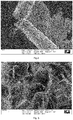
- The invention will now be further described in the preferred embodiments, with reference to the accompanying drawings, in which:
- Fig. 1
- shows a characteristic Raman spectrum of reduced graphene oxide,
- fig. 2
- shows SEM image of the dried graphene powder at low magnification,
- fig. 3
- shows SEM image of the graphene powder at high magnification with a visible structure consisting of single flakes, and
- fig. 4
- shows FTIR spectrum of reduced graphene oxide with a small amount of functional groups.
- A reducing mixture was prepared: 0.01 g of ammonium iodide, 9g of hydrated sodium hypophosphite, 1.21 g of sodium sulphite was dissolved in 100 ml of deionized water. Separately, 50 mg of graphene oxide was distributed in 40 ml of deionized water by means of ultrasound. Graphene oxide suspension , GO) was acidified to pH = 1 and heated to 90 °C. Then 12 ml of previously prepared reducing mixture was added. During reduction immediate precipitation of a black precipitate was observed, which indicates a successful spontaneous reduction. The product was filtered, washed with deionized water and dried. The product after compression had a surface resistance of ∼2 400 Ω/square
- Graphene oxide suspension was prepared, containing 0.15 g of GO. It was acidified with sulphuric acid H2SO4 to pH=1. 80ml of the prepared suspension was heated to 95 °C and stirred. Then 9ml of 10% sodium hypophosphite solution was added, and sulphur dioxide gas was let in through the reduced graphene oxide suspension. During reduction black precipitate was observed. Upon completion of the reduction (approximately 1 hour), precipitate was filtered, washed with deionized water and dried. The product after compression had a surface resistance of ∼400 Ω/square.
- Graphene oxide suspension with a concentration of 10mg/ml was diluted with 70 ml of deionized water. The oxide was dispersed using an ultrasonic probe. 10 ml of 10% sodium hypophosphite solution, acidified with sulphuric acid was added to the suspension. It was sonicated for 1.5 hour until the suspension reached a temperature of 90 °C and after adding 0.1 g of sodium sulphite the process was conducted for 1 more hour. Upon completion of the reduction a black suspension consisting of very small agglomerates was obtained. Upon completion of the reduction, precipitate was filtered, washed with deionized water and dried. The product after compression had a surface resistance as in example II.
- 50 mg of dry GO was weighed and poured into 60 ml of N-methylpyrrolidone. The oxide was distributed in a solvent using ultrasounds. Gray-brown suspension was obtained. Reducing mixture was added, that is approx. 0.05 g of sodium sulphite and 1 g of sodium hypophosphite, and then the solution was acidified with approx. 2 ml of sulphuric acid. Precipitation of graphene oxide in the form of floccules was observed. The mixture was heated to 95 °C and stirred for 3 hours. Upon completion of the reduction the floccules turned black and fell off. Upon completion of the reduction, precipitate was filtered, washed with deionized water and dried. The product after compression had a surface resistance of ∼1000 Ω/square.
- According to the following literature data [22,23], surface resistance of chemically reduced graphene oxide is approximately 43 000 Ω/square.
- 22. L. Grande et al., Particuology 10(2012) 1-8
- 23. B. Marinho et al., Powder Technol. (2012), doi: 10.1016/ j.powtec.2012.01.24
- Graphene oxide after reduction with the method according to the present invention has a much lower resistivity compared to the value cited in the literature. This reflects a very high quality of reduced graphene oxide obtained by the method according to the invention.
- Reduced graphene oxide obtained in the above examples was characterized and the results are illustrated in
fig. 1 -4 .
Claims (10)
- A method of graphene oxide chemical reduction, characterized in that the graphene oxide is subjected to chemical reduction with hypophosphorous acid and/or hypophosphite ions, in an acidic medium with a pH from 0 to 4.5, wherein sulphur dioxide, sulphurous acid or a salt thereof is used as a reduction catalyst, then the precipitate of reduced graphene oxide is separated from the solution.
- The method according to claim 1, characterized in that the reduction is carried out in an acidic medium with a pH from 0 to 2, preferably from 0 to 1.
- The method according to claim 1 or 2, characterized in that the reaction temperature is maintained in the range from 30 °C to 90 °C, preferably from 70 °C to 80 °C.
- The method according to any one of the preceding claims, characterized in that the compounds which produce hypophosphorous acid and/or hypophosphite ions in the aqueous solutions are used as reducing agents.
- The method according to claim 4, characterized in that alkali metal hypophosphites, preferably sodium and/or potassium and/or ammonium hypophosphite are used as the reducing agents.
- The method according to any one of the preceding claims, characterized in that hypophosphorous acid and/or hypophosphite ions are used in the amount of from a stoichiometric equivalent to twenty times, more preferably from two to four times the excess relative to reduced graphene oxide.
- The method according to any one of the preceding claims, characterized in that sulphur dioxide is used as the reduction catalyst, in a molar ratio of sulphur to hypophosphite of 1:10.
- The method according to any one of the preceding claims, characterized in that sulphur dioxide originating from the decomposition of sulphurous acid or a salt thereof is used as the reduction catalyst, which takes place in a strongly acidic medium.
- The method according to any one of the preceding claims, characterized in that graphene oxide is dispersed in an aqueous solution or in an organic solvent or a mixture of water and organic solvents well miscible with water.
- The method according to any one of the preceding claims, characterized in that the chemical reduction is assisted by ultrasound.
Priority Applications (1)
| Application Number | Priority Date | Filing Date | Title |
|---|---|---|---|
| PL13164131T PL2653445T3 (en) | 2012-04-19 | 2013-04-17 | The method of graphene oxide chemical reduction |
Applications Claiming Priority (1)
| Application Number | Priority Date | Filing Date | Title |
|---|---|---|---|
| PL398886A PL398886A1 (en) | 2012-04-19 | 2012-04-19 | A method of chemical reduction of graphene oxide |
Publications (2)
| Publication Number | Publication Date |
|---|---|
| EP2653445A1 EP2653445A1 (en) | 2013-10-23 |
| EP2653445B1 true EP2653445B1 (en) | 2017-10-11 |
Family
ID=48095736
Family Applications (1)
| Application Number | Title | Priority Date | Filing Date |
|---|---|---|---|
| EP13164131.8A Active EP2653445B1 (en) | 2012-04-19 | 2013-04-17 | The method of graphene oxide chemical reduction |
Country Status (2)
| Country | Link |
|---|---|
| EP (1) | EP2653445B1 (en) |
| PL (2) | PL398886A1 (en) |
Families Citing this family (8)
| Publication number | Priority date | Publication date | Assignee | Title |
|---|---|---|---|---|
| WO2015066691A1 (en) * | 2013-11-04 | 2015-05-07 | University Of Florida Research Foundation, Inc. | Slow-release fertilizer compositions with graphene oxide films and methods of making slow-release fertilizer compositions |
| CN104787751B (en) * | 2014-01-16 | 2017-11-03 | 中国科学院宁波材料技术与工程研究所 | A kind of graphene powder and preparation method thereof |
| CN103980893B (en) * | 2014-05-30 | 2015-07-01 | 太原理工大学 | One-step preparation method of multicolor fluorescent functionalized graphene quantum dots |
| CN103990435B (en) * | 2014-06-11 | 2016-06-08 | 河北工业大学 | A kind of tourmaline/scion grafting modification sulfur-bearing graphene oxide composite adsorbing material and preparation method thereof |
| EP3103768A1 (en) * | 2015-06-09 | 2016-12-14 | Nokia Technologies Oy | Reduced graphene oxide, its derivatives, preparation method and ink thereof |
| US20190276319A1 (en) * | 2016-08-31 | 2019-09-12 | Rutgers, The State University Of New Jersey | High-Quality Graphene and Method of Producing Same Via Microwave Reduction of Graphene Oxide |
| CN107161984B (en) * | 2017-06-28 | 2019-07-16 | 华南理工大学 | A kind of method that ascorbic acid/tea polyphenols synergistic effect prepares graphene |
| CN117444224B (en) * | 2023-10-16 | 2026-01-30 | 中国建筑材料科学研究总院有限公司 | A gold powder for LTCC conductor paste and its preparation method |
Family Cites Families (2)
| Publication number | Priority date | Publication date | Assignee | Title |
|---|---|---|---|---|
| PL184418B1 (en) | 1997-02-18 | 2002-10-31 | Inst Tech Material Elekt | Method of removing arsenic compounds and recovering elementary arsenic form solid or liquid material containing arsenic compounds, in particular from production wastes and effluents |
| CN101774574A (en) * | 2010-01-22 | 2010-07-14 | 湘潭大学 | Preparation method of graphene inorganic nanocomposite |
-
2012
- 2012-04-19 PL PL398886A patent/PL398886A1/en unknown
-
2013
- 2013-04-17 PL PL13164131T patent/PL2653445T3/en unknown
- 2013-04-17 EP EP13164131.8A patent/EP2653445B1/en active Active
Non-Patent Citations (1)
| Title |
|---|
| None * |
Also Published As
| Publication number | Publication date |
|---|---|
| PL398886A1 (en) | 2013-10-28 |
| PL2653445T3 (en) | 2018-04-30 |
| EP2653445A1 (en) | 2013-10-23 |
Similar Documents
| Publication | Publication Date | Title |
|---|---|---|
| EP2653445A1 (en) | The method of graphene oxide chemical reduction | |
| Guo et al. | One pot preparation of reduced graphene oxide (RGO) or Au (Ag) nanoparticle-RGO hybrids using chitosan as a reducing and stabilizing agent and their use in methanol electrooxidation | |
| Potbhare et al. | Bioinspired graphene-based metal oxide nanocomposites for photocatalytic and electrochemical performances: an updated review | |
| Aunkor et al. | The green reduction of graphene oxide | |
| Fang et al. | Janus electrochemical exfoliation of two-dimensional materials | |
| Kairi et al. | Toward high production of graphene flakes–a review on recent developments in their synthesis methods and scalability | |
| Yang et al. | Ultrafast delamination of graphite into high‐quality graphene using alternating currents | |
| Zhang et al. | Graphene oxide reduced and modified by environmentally friendly glycylglycine and its excellent catalytic performance | |
| Deosarkar et al. | Process intensification of uniform loading of SnO2 nanoparticles on graphene oxide nanosheets using a novel ultrasound assisted in situ chemical precipitation method | |
| CN103910354B (en) | Method for preparing graphene through large-scale aqueous phase | |
| KR101147259B1 (en) | Continuous method and apparatus of purifying Carbon Nanotube | |
| JP2023123617A (en) | Production of graphene | |
| Li et al. | Electrochemically active MnO2/RGO nanocomposites using Mn powder as the reducing agent of GO and the MnO2 precursor | |
| Li et al. | Using glucosamine as a reductant to prepare reduced graphene oxide and its nanocomposites with metal nanoparticles | |
| Zhou et al. | Graphene oxide-FePO4 nanocomposite: Synthesis, characterization and photocatalytic properties as a Fenton-like catalyst | |
| US20230012274A1 (en) | Water-redispersible graphene powder | |
| Rahaman et al. | Polymer nanocomposites containing graphene: preparation, properties, and applications | |
| Chen et al. | Synthesis of superior dispersions of reduced graphene oxide | |
| Zhang et al. | A green and facile approach for the synthesis of water-dispersible reduced graphene oxide based on ionic liquids | |
| WO2018050839A1 (en) | Production of functionalised graphene | |
| WO2014033274A1 (en) | Nanostructured carbon-based material | |
| Zhang | Chemically derived graphene: functionalization, properties and applications | |
| CN102107871B (en) | Method for preparing graphene | |
| Nasrollahzadeh et al. | Functionalized-graphene and graphene oxide: fabrication and application in catalysis | |
| Pang et al. | Generalized syntheses of nanocrystal–graphene hybrids in high-boiling-point organic solvents |
Legal Events
| Date | Code | Title | Description |
|---|---|---|---|
| PUAI | Public reference made under article 153(3) epc to a published international application that has entered the european phase |
Free format text: ORIGINAL CODE: 0009012 |
|
| AK | Designated contracting states |
Kind code of ref document: A1 Designated state(s): AL AT BE BG CH CY CZ DE DK EE ES FI FR GB GR HR HU IE IS IT LI LT LU LV MC MK MT NL NO PL PT RO RS SE SI SK SM TR |
|
| AX | Request for extension of the european patent |
Extension state: BA ME |
|
| 17P | Request for examination filed |
Effective date: 20131224 |
|
| RBV | Designated contracting states (corrected) |
Designated state(s): AL AT BE BG CH CY CZ DE DK EE ES FI FR GB GR HR HU IE IS IT LI LT LU LV MC MK MT NL NO PL PT RO RS SE SI SK SM TR |
|
| 17Q | First examination report despatched |
Effective date: 20140428 |
|
| REG | Reference to a national code |
Ref country code: DE Ref legal event code: R079 Ref document number: 602013027723 Country of ref document: DE Free format text: PREVIOUS MAIN CLASS: C01B0031040000 Ipc: C01B0032184000 |
|
| GRAP | Despatch of communication of intention to grant a patent |
Free format text: ORIGINAL CODE: EPIDOSNIGR1 |
|
| RIC1 | Information provided on ipc code assigned before grant |
Ipc: C01B 32/192 20170101ALI20170411BHEP Ipc: B82Y 40/00 20110101ALI20170411BHEP Ipc: B82Y 30/00 20110101ALI20170411BHEP Ipc: C01B 32/184 20170101AFI20170411BHEP |
|
| STAA | Information on the status of an ep patent application or granted ep patent |
Free format text: STATUS: GRANT OF PATENT IS INTENDED |
|
| INTG | Intention to grant announced |
Effective date: 20170518 |
|
| GRAS | Grant fee paid |
Free format text: ORIGINAL CODE: EPIDOSNIGR3 |
|
| GRAA | (expected) grant |
Free format text: ORIGINAL CODE: 0009210 |
|
| STAA | Information on the status of an ep patent application or granted ep patent |
Free format text: STATUS: THE PATENT HAS BEEN GRANTED |
|
| AK | Designated contracting states |
Kind code of ref document: B1 Designated state(s): AL AT BE BG CH CY CZ DE DK EE ES FI FR GB GR HR HU IE IS IT LI LT LU LV MC MK MT NL NO PL PT RO RS SE SI SK SM TR |
|
| REG | Reference to a national code |
Ref country code: GB Ref legal event code: FG4D |
|
| REG | Reference to a national code |
Ref country code: CH Ref legal event code: EP |
|
| REG | Reference to a national code |
Ref country code: IE Ref legal event code: FG4D |
|
| REG | Reference to a national code |
Ref country code: AT Ref legal event code: REF Ref document number: 935833 Country of ref document: AT Kind code of ref document: T Effective date: 20171115 |
|
| REG | Reference to a national code |
Ref country code: DE Ref legal event code: R096 Ref document number: 602013027723 Country of ref document: DE |
|
| REG | Reference to a national code |
Ref country code: NL Ref legal event code: MP Effective date: 20171011 |
|
| REG | Reference to a national code |
Ref country code: LT Ref legal event code: MG4D |
|
| REG | Reference to a national code |
Ref country code: AT Ref legal event code: MK05 Ref document number: 935833 Country of ref document: AT Kind code of ref document: T Effective date: 20171011 |
|
| PG25 | Lapsed in a contracting state [announced via postgrant information from national office to epo] |
Ref country code: NL Free format text: LAPSE BECAUSE OF FAILURE TO SUBMIT A TRANSLATION OF THE DESCRIPTION OR TO PAY THE FEE WITHIN THE PRESCRIBED TIME-LIMIT Effective date: 20171011 |
|
| PG25 | Lapsed in a contracting state [announced via postgrant information from national office to epo] |
Ref country code: NO Free format text: LAPSE BECAUSE OF FAILURE TO SUBMIT A TRANSLATION OF THE DESCRIPTION OR TO PAY THE FEE WITHIN THE PRESCRIBED TIME-LIMIT Effective date: 20180111 Ref country code: FI Free format text: LAPSE BECAUSE OF FAILURE TO SUBMIT A TRANSLATION OF THE DESCRIPTION OR TO PAY THE FEE WITHIN THE PRESCRIBED TIME-LIMIT Effective date: 20171011 Ref country code: LT Free format text: LAPSE BECAUSE OF FAILURE TO SUBMIT A TRANSLATION OF THE DESCRIPTION OR TO PAY THE FEE WITHIN THE PRESCRIBED TIME-LIMIT Effective date: 20171011 Ref country code: SE Free format text: LAPSE BECAUSE OF FAILURE TO SUBMIT A TRANSLATION OF THE DESCRIPTION OR TO PAY THE FEE WITHIN THE PRESCRIBED TIME-LIMIT Effective date: 20171011 Ref country code: ES Free format text: LAPSE BECAUSE OF FAILURE TO SUBMIT A TRANSLATION OF THE DESCRIPTION OR TO PAY THE FEE WITHIN THE PRESCRIBED TIME-LIMIT Effective date: 20171011 |
|
| PG25 | Lapsed in a contracting state [announced via postgrant information from national office to epo] |
Ref country code: HR Free format text: LAPSE BECAUSE OF FAILURE TO SUBMIT A TRANSLATION OF THE DESCRIPTION OR TO PAY THE FEE WITHIN THE PRESCRIBED TIME-LIMIT Effective date: 20171011 Ref country code: GR Free format text: LAPSE BECAUSE OF FAILURE TO SUBMIT A TRANSLATION OF THE DESCRIPTION OR TO PAY THE FEE WITHIN THE PRESCRIBED TIME-LIMIT Effective date: 20180112 Ref country code: BG Free format text: LAPSE BECAUSE OF FAILURE TO SUBMIT A TRANSLATION OF THE DESCRIPTION OR TO PAY THE FEE WITHIN THE PRESCRIBED TIME-LIMIT Effective date: 20180111 Ref country code: RS Free format text: LAPSE BECAUSE OF FAILURE TO SUBMIT A TRANSLATION OF THE DESCRIPTION OR TO PAY THE FEE WITHIN THE PRESCRIBED TIME-LIMIT Effective date: 20171011 Ref country code: IS Free format text: LAPSE BECAUSE OF FAILURE TO SUBMIT A TRANSLATION OF THE DESCRIPTION OR TO PAY THE FEE WITHIN THE PRESCRIBED TIME-LIMIT Effective date: 20180211 Ref country code: LV Free format text: LAPSE BECAUSE OF FAILURE TO SUBMIT A TRANSLATION OF THE DESCRIPTION OR TO PAY THE FEE WITHIN THE PRESCRIBED TIME-LIMIT Effective date: 20171011 Ref country code: AT Free format text: LAPSE BECAUSE OF FAILURE TO SUBMIT A TRANSLATION OF THE DESCRIPTION OR TO PAY THE FEE WITHIN THE PRESCRIBED TIME-LIMIT Effective date: 20171011 |
|
| REG | Reference to a national code |
Ref country code: DE Ref legal event code: R097 Ref document number: 602013027723 Country of ref document: DE |
|
| PG25 | Lapsed in a contracting state [announced via postgrant information from national office to epo] |
Ref country code: EE Free format text: LAPSE BECAUSE OF FAILURE TO SUBMIT A TRANSLATION OF THE DESCRIPTION OR TO PAY THE FEE WITHIN THE PRESCRIBED TIME-LIMIT Effective date: 20171011 Ref country code: DK Free format text: LAPSE BECAUSE OF FAILURE TO SUBMIT A TRANSLATION OF THE DESCRIPTION OR TO PAY THE FEE WITHIN THE PRESCRIBED TIME-LIMIT Effective date: 20171011 Ref country code: CZ Free format text: LAPSE BECAUSE OF FAILURE TO SUBMIT A TRANSLATION OF THE DESCRIPTION OR TO PAY THE FEE WITHIN THE PRESCRIBED TIME-LIMIT Effective date: 20171011 Ref country code: SK Free format text: LAPSE BECAUSE OF FAILURE TO SUBMIT A TRANSLATION OF THE DESCRIPTION OR TO PAY THE FEE WITHIN THE PRESCRIBED TIME-LIMIT Effective date: 20171011 |
|
| PLBE | No opposition filed within time limit |
Free format text: ORIGINAL CODE: 0009261 |
|
| STAA | Information on the status of an ep patent application or granted ep patent |
Free format text: STATUS: NO OPPOSITION FILED WITHIN TIME LIMIT |
|
| PG25 | Lapsed in a contracting state [announced via postgrant information from national office to epo] |
Ref country code: SM Free format text: LAPSE BECAUSE OF FAILURE TO SUBMIT A TRANSLATION OF THE DESCRIPTION OR TO PAY THE FEE WITHIN THE PRESCRIBED TIME-LIMIT Effective date: 20171011 Ref country code: RO Free format text: LAPSE BECAUSE OF FAILURE TO SUBMIT A TRANSLATION OF THE DESCRIPTION OR TO PAY THE FEE WITHIN THE PRESCRIBED TIME-LIMIT Effective date: 20171011 Ref country code: IT Free format text: LAPSE BECAUSE OF FAILURE TO SUBMIT A TRANSLATION OF THE DESCRIPTION OR TO PAY THE FEE WITHIN THE PRESCRIBED TIME-LIMIT Effective date: 20171011 |
|
| 26N | No opposition filed |
Effective date: 20180712 |
|
| REG | Reference to a national code |
Ref country code: DE Ref legal event code: R119 Ref document number: 602013027723 Country of ref document: DE |
|
| PG25 | Lapsed in a contracting state [announced via postgrant information from national office to epo] |
Ref country code: MC Free format text: LAPSE BECAUSE OF FAILURE TO SUBMIT A TRANSLATION OF THE DESCRIPTION OR TO PAY THE FEE WITHIN THE PRESCRIBED TIME-LIMIT Effective date: 20171011 Ref country code: SI Free format text: LAPSE BECAUSE OF FAILURE TO SUBMIT A TRANSLATION OF THE DESCRIPTION OR TO PAY THE FEE WITHIN THE PRESCRIBED TIME-LIMIT Effective date: 20171011 |
|
| REG | Reference to a national code |
Ref country code: CH Ref legal event code: PL |
|
| REG | Reference to a national code |
Ref country code: BE Ref legal event code: MM Effective date: 20180430 |
|
| PG25 | Lapsed in a contracting state [announced via postgrant information from national office to epo] |
Ref country code: DE Free format text: LAPSE BECAUSE OF NON-PAYMENT OF DUE FEES Effective date: 20181101 Ref country code: LU Free format text: LAPSE BECAUSE OF NON-PAYMENT OF DUE FEES Effective date: 20180417 |
|
| PG25 | Lapsed in a contracting state [announced via postgrant information from national office to epo] |
Ref country code: BE Free format text: LAPSE BECAUSE OF NON-PAYMENT OF DUE FEES Effective date: 20180430 Ref country code: LI Free format text: LAPSE BECAUSE OF NON-PAYMENT OF DUE FEES Effective date: 20180430 Ref country code: CH Free format text: LAPSE BECAUSE OF NON-PAYMENT OF DUE FEES Effective date: 20180430 |
|
| PG25 | Lapsed in a contracting state [announced via postgrant information from national office to epo] |
Ref country code: FR Free format text: LAPSE BECAUSE OF NON-PAYMENT OF DUE FEES Effective date: 20180430 |
|
| PG25 | Lapsed in a contracting state [announced via postgrant information from national office to epo] |
Ref country code: MT Free format text: LAPSE BECAUSE OF NON-PAYMENT OF DUE FEES Effective date: 20180417 |
|
| PG25 | Lapsed in a contracting state [announced via postgrant information from national office to epo] |
Ref country code: TR Free format text: LAPSE BECAUSE OF FAILURE TO SUBMIT A TRANSLATION OF THE DESCRIPTION OR TO PAY THE FEE WITHIN THE PRESCRIBED TIME-LIMIT Effective date: 20171011 |
|
| PG25 | Lapsed in a contracting state [announced via postgrant information from national office to epo] |
Ref country code: HU Free format text: LAPSE BECAUSE OF FAILURE TO SUBMIT A TRANSLATION OF THE DESCRIPTION OR TO PAY THE FEE WITHIN THE PRESCRIBED TIME-LIMIT; INVALID AB INITIO Effective date: 20130417 Ref country code: PT Free format text: LAPSE BECAUSE OF FAILURE TO SUBMIT A TRANSLATION OF THE DESCRIPTION OR TO PAY THE FEE WITHIN THE PRESCRIBED TIME-LIMIT Effective date: 20171011 |
|
| PG25 | Lapsed in a contracting state [announced via postgrant information from national office to epo] |
Ref country code: MK Free format text: LAPSE BECAUSE OF NON-PAYMENT OF DUE FEES Effective date: 20171011 Ref country code: CY Free format text: LAPSE BECAUSE OF FAILURE TO SUBMIT A TRANSLATION OF THE DESCRIPTION OR TO PAY THE FEE WITHIN THE PRESCRIBED TIME-LIMIT Effective date: 20171011 |
|
| PG25 | Lapsed in a contracting state [announced via postgrant information from national office to epo] |
Ref country code: AL Free format text: LAPSE BECAUSE OF FAILURE TO SUBMIT A TRANSLATION OF THE DESCRIPTION OR TO PAY THE FEE WITHIN THE PRESCRIBED TIME-LIMIT Effective date: 20171011 |
|
| PGFP | Annual fee paid to national office [announced via postgrant information from national office to epo] |
Ref country code: IE Payment date: 20230420 Year of fee payment: 11 |
|
| PG25 | Lapsed in a contracting state [announced via postgrant information from national office to epo] |
Ref country code: IE Free format text: LAPSE BECAUSE OF NON-PAYMENT OF DUE FEES Effective date: 20240417 |
|
| PGFP | Annual fee paid to national office [announced via postgrant information from national office to epo] |
Ref country code: GB Payment date: 20260226 Year of fee payment: 14 |
|
| PGFP | Annual fee paid to national office [announced via postgrant information from national office to epo] |
Ref country code: PL Payment date: 20260226 Year of fee payment: 14 |