EP2652007B1 - Star- and tree-shaped branched polymers having flame-retardant properties - Google Patents
Star- and tree-shaped branched polymers having flame-retardant properties Download PDFInfo
- Publication number
- EP2652007B1 EP2652007B1 EP11817519.9A EP11817519A EP2652007B1 EP 2652007 B1 EP2652007 B1 EP 2652007B1 EP 11817519 A EP11817519 A EP 11817519A EP 2652007 B1 EP2652007 B1 EP 2652007B1
- Authority
- EP
- European Patent Office
- Prior art keywords
- acid
- monomers
- monomer
- amino
- polyamides
- Prior art date
- Legal status (The legal status is an assumption and is not a legal conclusion. Google has not performed a legal analysis and makes no representation as to the accuracy of the status listed.)
- Active
Links
Images


Classifications
-
- C—CHEMISTRY; METALLURGY
- C09—DYES; PAINTS; POLISHES; NATURAL RESINS; ADHESIVES; COMPOSITIONS NOT OTHERWISE PROVIDED FOR; APPLICATIONS OF MATERIALS NOT OTHERWISE PROVIDED FOR
- C09K—MATERIALS FOR MISCELLANEOUS APPLICATIONS, NOT PROVIDED FOR ELSEWHERE
- C09K21/00—Fireproofing materials
- C09K21/14—Macromolecular materials
-
- C—CHEMISTRY; METALLURGY
- C08—ORGANIC MACROMOLECULAR COMPOUNDS; THEIR PREPARATION OR CHEMICAL WORKING-UP; COMPOSITIONS BASED THEREON
- C08G—MACROMOLECULAR COMPOUNDS OBTAINED OTHERWISE THAN BY REACTIONS ONLY INVOLVING UNSATURATED CARBON-TO-CARBON BONDS
- C08G63/00—Macromolecular compounds obtained by reactions forming a carboxylic ester link in the main chain of the macromolecule
- C08G63/68—Polyesters containing atoms other than carbon, hydrogen and oxygen
- C08G63/692—Polyesters containing atoms other than carbon, hydrogen and oxygen containing phosphorus
-
- C—CHEMISTRY; METALLURGY
- C08—ORGANIC MACROMOLECULAR COMPOUNDS; THEIR PREPARATION OR CHEMICAL WORKING-UP; COMPOSITIONS BASED THEREON
- C08G—MACROMOLECULAR COMPOUNDS OBTAINED OTHERWISE THAN BY REACTIONS ONLY INVOLVING UNSATURATED CARBON-TO-CARBON BONDS
- C08G63/00—Macromolecular compounds obtained by reactions forming a carboxylic ester link in the main chain of the macromolecule
- C08G63/68—Polyesters containing atoms other than carbon, hydrogen and oxygen
- C08G63/692—Polyesters containing atoms other than carbon, hydrogen and oxygen containing phosphorus
- C08G63/6922—Polyesters containing atoms other than carbon, hydrogen and oxygen containing phosphorus derived from hydroxy carboxylic acids
-
- C—CHEMISTRY; METALLURGY
- C08—ORGANIC MACROMOLECULAR COMPOUNDS; THEIR PREPARATION OR CHEMICAL WORKING-UP; COMPOSITIONS BASED THEREON
- C08G—MACROMOLECULAR COMPOUNDS OBTAINED OTHERWISE THAN BY REACTIONS ONLY INVOLVING UNSATURATED CARBON-TO-CARBON BONDS
- C08G63/00—Macromolecular compounds obtained by reactions forming a carboxylic ester link in the main chain of the macromolecule
- C08G63/68—Polyesters containing atoms other than carbon, hydrogen and oxygen
- C08G63/692—Polyesters containing atoms other than carbon, hydrogen and oxygen containing phosphorus
- C08G63/6924—Polyesters containing atoms other than carbon, hydrogen and oxygen containing phosphorus derived from polycarboxylic acids and polyhydroxy compounds
- C08G63/6926—Dicarboxylic acids and dihydroxy compounds
-
- C—CHEMISTRY; METALLURGY
- C08—ORGANIC MACROMOLECULAR COMPOUNDS; THEIR PREPARATION OR CHEMICAL WORKING-UP; COMPOSITIONS BASED THEREON
- C08G—MACROMOLECULAR COMPOUNDS OBTAINED OTHERWISE THAN BY REACTIONS ONLY INVOLVING UNSATURATED CARBON-TO-CARBON BONDS
- C08G69/00—Macromolecular compounds obtained by reactions forming a carboxylic amide link in the main chain of the macromolecule
- C08G69/42—Polyamides containing atoms other than carbon, hydrogen, oxygen, and nitrogen
-
- C—CHEMISTRY; METALLURGY
- C08—ORGANIC MACROMOLECULAR COMPOUNDS; THEIR PREPARATION OR CHEMICAL WORKING-UP; COMPOSITIONS BASED THEREON
- C08G—MACROMOLECULAR COMPOUNDS OBTAINED OTHERWISE THAN BY REACTIONS ONLY INVOLVING UNSATURATED CARBON-TO-CARBON BONDS
- C08G79/00—Macromolecular compounds obtained by reactions forming a linkage containing atoms other than silicon, sulfur, nitrogen, oxygen, and carbon with or without the latter elements in the main chain of the macromolecule
- C08G79/02—Macromolecular compounds obtained by reactions forming a linkage containing atoms other than silicon, sulfur, nitrogen, oxygen, and carbon with or without the latter elements in the main chain of the macromolecule a linkage containing phosphorus
- C08G79/04—Phosphorus linked to oxygen or to oxygen and carbon
-
- C—CHEMISTRY; METALLURGY
- C08—ORGANIC MACROMOLECULAR COMPOUNDS; THEIR PREPARATION OR CHEMICAL WORKING-UP; COMPOSITIONS BASED THEREON
- C08K—Use of inorganic or non-macromolecular organic substances as compounding ingredients
- C08K5/00—Use of organic ingredients
- C08K5/49—Phosphorus-containing compounds
- C08K5/51—Phosphorus bound to oxygen
- C08K5/53—Phosphorus bound to oxygen bound to oxygen and to carbon only
- C08K5/5313—Phosphinic compounds, e.g. R2=P(:O)OR'
-
- C—CHEMISTRY; METALLURGY
- C08—ORGANIC MACROMOLECULAR COMPOUNDS; THEIR PREPARATION OR CHEMICAL WORKING-UP; COMPOSITIONS BASED THEREON
- C08L—COMPOSITIONS OF MACROMOLECULAR COMPOUNDS
- C08L2201/00—Properties
- C08L2201/02—Flame or fire retardant/resistant
-
- C—CHEMISTRY; METALLURGY
- C08—ORGANIC MACROMOLECULAR COMPOUNDS; THEIR PREPARATION OR CHEMICAL WORKING-UP; COMPOSITIONS BASED THEREON
- C08L—COMPOSITIONS OF MACROMOLECULAR COMPOUNDS
- C08L77/00—Compositions of polyamides obtained by reactions forming a carboxylic amide link in the main chain; Compositions of derivatives of such polymers
- C08L77/06—Polyamides derived from polyamines and polycarboxylic acids
-
- C—CHEMISTRY; METALLURGY
- C08—ORGANIC MACROMOLECULAR COMPOUNDS; THEIR PREPARATION OR CHEMICAL WORKING-UP; COMPOSITIONS BASED THEREON
- C08L—COMPOSITIONS OF MACROMOLECULAR COMPOUNDS
- C08L85/00—Compositions of macromolecular compounds obtained by reactions forming a linkage in the main chain of the macromolecule containing atoms other than silicon, sulfur, nitrogen, oxygen and carbon; Compositions of derivatives of such polymers
- C08L85/02—Compositions of macromolecular compounds obtained by reactions forming a linkage in the main chain of the macromolecule containing atoms other than silicon, sulfur, nitrogen, oxygen and carbon; Compositions of derivatives of such polymers containing phosphorus
Definitions
- the present invention relates to polymers with a complex branched structure, in particular the star- or tree-shaped type, characterized by having phosphorous containing molecules giving flame-retardant property.
- the flame retardance of polymer materials is currently obtained by a process of physical mixing (compounding) of the molten polymer matrix with materials having proven flame-resistant properties (additives).
- the main drawbacks of said process are the difficulty of distributing the additive evenly in the matrix, phase segregations, and possible migration and loss of additive over time.
- the direct consequences of these drawbacks are the need for massive use of additives, increased costs of the material, and often a deterioration in its mechanical properties and loss of properties over time.
- brominated compounds are added in large quantities (up to 23-25% w/w) and need a synergistic agent (usually antimony trioxide) in the quantity of approx. 6-8% w/w; many of these compounds are known to be toxic to humans and the environment, and are consequently governed by national and supranational regulations restricting their manufacture and use.
- Red phosphorus (added in the quantity of 5-10% by weight) presents handling problems (fire risk) and is not suitable for many applications, while metal hydroxides have low efficiency and are used in large quantities (up to 50% by weight), resulting in loss of the properties of the final material and are not commonly used with polyamides and polyesters.
- melamine cyanurate makes it impossible to recycle the material, and precludes some applications. In all cases, the material produced cannot be used in the manufacture of textile fibers due to its incompatibility with spinning techniques.
- WO 98/52991 describes type 6,6 polyamides with flame-retardant properties obtained by polycondensation of at least one dicarboxylic acid, at least one diamine and a carboxyphosphinic acid.
- Polyamides 6 with a complex star- or tree-branched structure obtainable from AB monomers (i.e. monomers having a carboxy function A and an amino function B) in the presence of polyamines and/or polyacids, are also known from US 6 884 865 .
- the polymers according to the invention are polyamides that present advantageous properties because the complex macromolecular architecture (star/tree type) makes it possible to vary the number of terminal functional groups, and consequently the number of phosphorous containing groups which can be introduced to modulate the flame-retardant property, as well as the viscosity of the polymer and other parameters useful for the manufacturing process.
- the invention therefore provides polyamide polymers with a complex branched structure (star- or tree-shaped) obtainable by polymerization of a bifunctional type AB monomer and/or type AA+BB monomers in the presence of:
- the polyamides of the invention have specific, advantageous applications, especially in the textile field, in the preparation of carpets, clothing and furnishings which possess the desired flame-retardant properties.
- the AB monomers used to prepare polyamides according to the invention are selected from caprolactam, 6-aminohexanoic acid, para- or meta-aminobenzoic acid, 11-aminoundecanoic acid, lauryl lactam, and 12-aminododecanoic acid; preferably caprolactam and 6-aminohexanoic acid.
- the AA+BB monomers used to prepare polyamides according to the invention are selected from: 1) as BB monomer, diamine molecules selected from hexamethylenediamine, 1,4-butylenediamine, isophorondiamine, phenylendiamines.
- Diamines can be used alone or as salts of diacids.
- the polyamines according to the invention may have primary or secondary functional group (tertiary amino groups are not considered as they are non reactive).
- suitable polyamines include bis hexamethylene triamine, an hexafunctional amine of formula NH 2 -(CH 2 ) 6 -NH-(CH 2 ) 6 -NH-(CH 2 ) 6 -NH-(CH 2 ) 6 -NH-(CH 2 ) 6 -NH 2 , both deriving from the manufacture of hexamethylenediamine, POSS with amino terminal groups, ethylenediamine oligomers.
- polyacids or their derivatives such as esters and anhydrides
- the polyacids (or their derivatives such as esters and anhydrides) according to the invention are typically selected from trimesic acid, pyromellitic acid, 2,2'-6,6'tetracarboxyethylcyclohexanone or POSS with carboxyl terminal groups.
- the phosphorus containing molecule according to the invention is 2-carboxy ethyl phenyl phosphinic acid (CEPPA).
- the organic acids (or their derivative such as ester and anhydride), the amines and the alcohols with one or two functionalities according to the invention are selected from acetic, benzoic, adipic, suberic and sebacic acid, other long- or short-chain aliphatic mono/diacids, terephthalic acid, isophthalic acid, long- or short-chain aliphatic mono/diamines, aromatic mono/diamines, and long- or short-chain aliphatic mono/dialcohols.
- the polymers according to the invention can have a molecular weight of between 1000 and 70,000 daltons; optimal flame-retardant properties can be obtained with at least 500 ppm of P deriving from the phosphorus functions in the polymer.
- the polymers of the invention can be prepared by synthesis in glass or steel reactors or in an autoclave, under the following conditions.
- Synthesis in glass reactors Polyamides synthesis are conducted in 6 hours, in an oven at 270°C under nitrogen flow and mechanical stirring or at a temperature higher than the polymer melting point.
- Synthesis are conducted in a glass apparatus, whose lower part (the flask) is inserted in the oven, while the upper part is maintained outside it.
- the upper part of the apparatus is fitted with three arms which allow:
- Synthesis in steel reactor Polyamides synthesis are conducted in 6 hours, in an oven at 270°C or at a temperature higher than the polymer melting point, under nitrogen flow, with or without mechanical stirring.
- star or tree architecture is obtained depends on suitable stoichiometry, as known and described in the review by Voit and Lederer, cited above. Also, a mathematical model, in the case of polymers obtained from type AB monomers polymerized in the presence of comonomers giving a star architecture, allows the composition of the final polymer to be estimated, requiring only feed and conversion reached as input data [ C.M. Yuan et al. Macromol. Chem. Phys. 202(10), 2086 (2001 )].
- the present invention allows the preparation of polyamides with a complex architecture and containing phosphorus atoms, bonded to the polymer chain ends, which can be used as masters or directly as basic materials, and can be obtained in the ordinary manufacturing plants used for the various standard materials.
- the molecular weight, the macromolecular architecture and consequently the viscosity in the molten polymer can easily be modulated to facilitate its miscibility in the polymer matrix (such as Nylon 6, Nylon 66, etc.) in the case it is used as a master, and ensure even distribution of the flame-retardant functions throughout the material.
- the invention also enables the number of flame-retardant functions to be programmed, and nanostructured organic/inorganic components to be inserted.
- the material can also be added as master to the matrix by compounding, and the contact time between the active functions of the master and the reactive groups of the matrix does not lead to crosslinking.
- the product can also act as carrier of other additives introduced into the polymer matrix. In view of its nature, it is perfectly compatible with polyamides, and does not present phase segregation. Another advantage is the small amount of phosphorus in the final material (up to 5% by weight), which is not present as free red phosphorus. These characteristics pave the way for obtaining flame-retardant polyamide fibres, which is currently impossible.
- the reagents are introduced simultaneously into the feed.
- a polymer with 460 meq/Kg of CEPPA is obtained.
- a polymer was also prepared using the same monomer ratios, but without CEPPA, to determine its molecular parameters with a mathematical model according to the conversion.
- the reagents are introduced simultaneously into the feed.
- a polymer with 160 meq/Kg of CEPPA is obtained.
- Sample 1 is the sample with the highest multifunctional comonomer concentration; sample 2 has an intermediate concentration, and sample 3 has the lowest concentration.
- sample 1 The quantities of multifunctional amine comonomer in samples 1, 2 and 3 are shown in the table above.
- the diacid containing phosphorus reacts only with its own carboxyl group, leaving free the terminal phosphinic group.
- the modification of the chain terminal changes the hydrodynamic behaviour of the polymer (different Mn values, lower than those measured as linear Nylon 6 in the preceding table); the narrow distribution confirms that the macromolecular architecture of the chain was maintained, and was therefore not modified during the reaction with the diacid phosphorus containing.
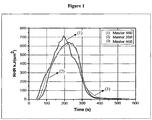
- Figure 1 shows the cone calorimeter analysis of the samples with diacid phosphorus containing: Master 460 (3) is sample 1 in the preceding tables (Example 1), Master 260 (2) is sample 2, and Master 160 (1) is sample 3 (Example 2).
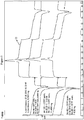
- Thermal stability data with TGA (ThermoGravimetric Analysis), shown in figure 2 , demonstrate that samples start to degrade earlier than a normal PA6 (i.e. at lower, less dangerous temperatures) and take longer to break down completely.
- the higher residue at high temperatures indicates the formation of a larger amount of carbon residues (char), which hinder combustion.
- the mathematical model used estimates the composition of the final polymer using as input data the feed and the conversion obtained; the model provides the percentage of the species formed, indicating their molecular weight and macromolecular architecture.
Landscapes
- Chemical & Material Sciences (AREA)
- Organic Chemistry (AREA)
- Health & Medical Sciences (AREA)
- Chemical Kinetics & Catalysis (AREA)
- Medicinal Chemistry (AREA)
- Polymers & Plastics (AREA)
- Engineering & Computer Science (AREA)
- Materials Engineering (AREA)
- Polyamides (AREA)
- Compositions Of Macromolecular Compounds (AREA)
- Polyesters Or Polycarbonates (AREA)
- Other Resins Obtained By Reactions Not Involving Carbon-To-Carbon Unsaturated Bonds (AREA)
- Addition Polymer Or Copolymer, Post-Treatments, Or Chemical Modifications (AREA)
Description
- The present invention relates to polymers with a complex branched structure, in particular the star- or tree-shaped type, characterized by having phosphorous containing molecules giving flame-retardant property.
- The flame retardance of polymer materials, in particular polyamides, is currently obtained by a process of physical mixing (compounding) of the molten polymer matrix with materials having proven flame-resistant properties (additives). The main drawbacks of said process are the difficulty of distributing the additive evenly in the matrix, phase segregations, and possible migration and loss of additive over time. The direct consequences of these drawbacks are the need for massive use of additives, increased costs of the material, and often a deterioration in its mechanical properties and loss of properties over time. Moreover, the classes of additives currently used present a number of problems: for example, brominated compounds are added in large quantities (up to 23-25% w/w) and need a synergistic agent (usually antimony trioxide) in the quantity of approx. 6-8% w/w; many of these compounds are known to be toxic to humans and the environment, and are consequently governed by national and supranational regulations restricting their manufacture and use. Red phosphorus (added in the quantity of 5-10% by weight) presents handling problems (fire risk) and is not suitable for many applications, while metal hydroxides have low efficiency and are used in large quantities (up to 50% by weight), resulting in loss of the properties of the final material and are not commonly used with polyamides and polyesters. Finally, melamine cyanurate makes it impossible to recycle the material, and precludes some applications. In all cases, the material produced cannot be used in the manufacture of textile fibers due to its incompatibility with spinning techniques. These problems are discussed, for example, in
- "Combustion and fire retardancy of aliphatic nylons" - S.V. Levchik, E.D. Weil, Polym. Int. 49:1033-1073 (2000).
-
WO 98/52991 type -
Polyamides 6 with a complex star- or tree-branched structure, obtainable from AB monomers (i.e. monomers having a carboxy function A and an amino function B) in the presence of polyamines and/or polyacids, are also known fromUS 6 884 865 . - The preparation of branched polymers with a complex structure is discussed in detail in "Hyperbranched and Highly Branched Polymer Architectures: Synthetic Strategies and Major Characterization Aspects". B.I. Voit and A. Lederer Chem. Rev. 2009, 109, 5924-5973.
- It has now been found that it is possible to impart advantageous flame-retardant properties to polymers with a complex (star- or tree-) branched structure, which are obtainable from AB bifunctional monomer and/or type AA+BB monomers and using phosphorous containing molecules as chain enders. The polymers according to the invention are polyamides that present advantageous properties because the complex macromolecular architecture (star/tree type) makes it possible to vary the number of terminal functional groups, and consequently the number of phosphorous containing groups which can be introduced to modulate the flame-retardant property, as well as the viscosity of the polymer and other parameters useful for the manufacturing process.
- The invention therefore provides polyamide polymers with a complex branched structure (star- or tree-shaped) obtainable by polymerization of a bifunctional type AB monomer and/or type AA+BB monomers in the presence of:
- a) One or more polyamines and/or polyacids and/or polyalcohols and/or more generally compounds (such as Polyhedral Oligosilsequioxanes - POSS) having at least three functional groups such as primary or secondary amino functions, carboxylic acid (or their derivatives such as esters and anhydride) or hydroxyl functions;
- b) one or more phosphorus containing molecules reacting with only one reactive group during the polymerization;
- c) optionally one or more carboxylic acids (or their derivatives such as ester and anhydride) and/or amines and/or alcohols having one or two functional groups.
- According to the invention, AB and/or AA+BB monomers with A= -COOH (or his derivative such as ester and anhydride) and B= -NH2 or -OH can be used.
- The polyamides of the invention have specific, advantageous applications, especially in the textile field, in the preparation of carpets, clothing and furnishings which possess the desired flame-retardant properties.
- The AB monomers used to prepare polyamides according to the invention are selected from caprolactam, 6-aminohexanoic acid, para- or meta-aminobenzoic acid, 11-aminoundecanoic acid, lauryl lactam, and 12-aminododecanoic acid; preferably caprolactam and 6-aminohexanoic acid.
- The AA+BB monomers used to prepare polyamides according to the invention are selected from: 1) as BB monomer, diamine molecules selected from hexamethylenediamine, 1,4-butylenediamine, isophorondiamine, phenylendiamines.
- 2) As AA diacids monomers, aliphatic or aromatic dicarboxylic acids (or their ester derivatives) selected from adipic acid, suberic acid, sebacic acid, cyclohexane dicarboxylic acid, and terephthalic/isophthalic acids.
- Diamines can be used alone or as salts of diacids.
- The polyamines according to the invention may have primary or secondary functional group (tertiary amino groups are not considered as they are non reactive). Examples of suitable polyamines include bis hexamethylene triamine, an hexafunctional amine of formula
NH2-(CH2)6-NH-(CH2)6-NH-(CH2)6-NH-(CH2)6-NH-(CH2)6-NH2,
both deriving from the manufacture of hexamethylenediamine, POSS with amino terminal groups, ethylenediamine oligomers. - The polyacids (or their derivatives such as esters and anhydrides) according to the invention are typically selected from trimesic acid, pyromellitic acid, 2,2'-6,6'tetracarboxyethylcyclohexanone or POSS with carboxyl terminal groups.
- The phosphorus containing molecule according to the invention is 2-carboxy ethyl phenyl phosphinic acid (CEPPA).
- The organic acids (or their derivative such as ester and anhydride), the amines and the alcohols with one or two functionalities according to the invention are selected from acetic, benzoic, adipic, suberic and sebacic acid, other long- or short-chain aliphatic mono/diacids, terephthalic acid, isophthalic acid, long- or short-chain aliphatic mono/diamines, aromatic mono/diamines, and long- or short-chain aliphatic mono/dialcohols.
- The polymers according to the invention can have a molecular weight of between 1000 and 70,000 daltons; optimal flame-retardant properties can be obtained with at least 500 ppm of P deriving from the phosphorus functions in the polymer.
- The polymers of the invention can be prepared by synthesis in glass or steel reactors or in an autoclave, under the following conditions.
- Synthesis in glass reactors: Polyamides synthesis are conducted in 6 hours, in an oven at 270°C under nitrogen flow and mechanical stirring or at a temperature higher than the polymer melting point.
- Synthesis are conducted in a glass apparatus, whose lower part (the flask) is inserted in the oven, while the upper part is maintained outside it. The upper part of the apparatus is fitted with three arms which allow:
- a. Entry of nitrogen flow
- b. Passage of stirring rod which provides mechanical stirring of the reaction mixture
- c. Exit of nitrogen flow
- Synthesis in steel reactor: Polyamides synthesis are conducted in 6 hours, in an oven at 270°C or at a temperature higher than the polymer melting point, under nitrogen flow, with or without mechanical stirring.
- It is conducted in a steel reactor fastened with bolts in both the upper and lower parts; the reactor is placed in the oven, and only the top of it emerges; it is also provided with two arms for the entry and exit of nitrogen flows.
- Synthesis in autoclave: As an example the synthesis of
nylon 6 is conducted in two phases, both at 280°C and under mechanical stirring: the first (2h) under pressure (lactam ring opening), and the second (4h) under nitrogen flow (growth of molecular chain through polycondensation). The polymer is extracted from the reactor in the form of cables which are wound on a reel. - Whether the star or tree architecture is obtained depends on suitable stoichiometry, as known and described in the review by Voit and Lederer, cited above. Also, a mathematical model, in the case of polymers obtained from type AB monomers polymerized in the presence of comonomers giving a star architecture, allows the composition of the final polymer to be estimated, requiring only feed and conversion reached as input data [C.M. Yuan et al. Macromol. Chem. Phys. 202(10), 2086 (2001)].
- In particular, the present invention allows the preparation of polyamides with a complex architecture and containing phosphorus atoms, bonded to the polymer chain ends, which can be used as masters or directly as basic materials, and can be obtained in the ordinary manufacturing plants used for the various standard materials. The molecular weight, the macromolecular architecture and consequently the viscosity in the molten polymer can easily be modulated to facilitate its miscibility in the polymer matrix (such as
Nylon 6, Nylon 66, etc.) in the case it is used as a master, and ensure even distribution of the flame-retardant functions throughout the material. - The invention also enables the number of flame-retardant functions to be programmed, and nanostructured organic/inorganic components to be inserted. The material can also be added as master to the matrix by compounding, and the contact time between the active functions of the master and the reactive groups of the matrix does not lead to crosslinking. The product can also act as carrier of other additives introduced into the polymer matrix. In view of its nature, it is perfectly compatible with polyamides, and does not present phase segregation. Another advantage is the small amount of phosphorus in the final material (up to 5% by weight), which is not present as free red phosphorus. These characteristics pave the way for obtaining flame-retardant polyamide fibres, which is currently impossible.
- The invention will be described in greater detail in the following examples, which relate to materials with a polyamide base with a type AB monomer, but can also be extended to the other classes of polymers cited in this invention.
-
Caprolactam 85% mol/mol Aminocaproic acid: 8.15% mol/mol Bis(hexamethylene)triamine (HBHT): 0.95% mol/mol CEPPA: 5.9% mol/mol - The reagents are introduced simultaneously into the feed.
- A polymer with 460 meq/Kg of CEPPA is obtained.
- A polymer was also prepared using the same monomer ratios, but without CEPPA, to determine its molecular parameters with a mathematical model according to the conversion.
-
Caprolactam 89.2% mol/mol Aminocaproic acid: 8.55% mol/mol Bis(hexamethylene)triamine (HBHT): 0.31% mol/mol CEPPA: 1.94% mol/mol - The reagents are introduced simultaneously into the feed.
- A polymer with 160 meq/Kg of CEPPA is obtained.
- Three examples of
polyamide 6 which confirm the architecture of the polymer obtained in the presence of a multifunctional amine co-monomer. To obtain a significant comparison, it should be noted that for anunregulated polyamide 6 with good mechanical properties, the value of the end amine groups is much lower (< 70) and the number of end carboxyl group is equivalent to that of the terminal amines: - Titration of the terminal groups and molecular masses (Mn, expressed in
linear nylon 6 equivalents) and molecular mass dispersion index (D) obtained by Size Exclusion Chromatography (SEC) are reported in the table. -
Sample 1 is the sample with the highest multifunctional comonomer concentration;sample 2 has an intermediate concentration, andsample 3 has the lowest concentration. SEC data are expressed as PA6 linear equivalents; the polymers possess a dispersity value (D) of the molecular masses lower than 2, which confirms the star architecture (D = 2 is the typical value of linear chains for polymers obtained by polycondensation). - Titrations show the very high number of amino end groups compared with the acid groups. This datum also confirms the branched structure of the polymer.
- After reaction with a molecule possessing both -COOH and -POOH acid terminal groups, the following data are obtained:
Sample Mn D Terminal NH2 Terminal COOH Terminal POOH 1 2610 1,65 138 132 315 2 3501 1,76 93 91 176 3 4185 1,89 72 66 133 - The quantities of multifunctional amine comonomer in
samples linear Nylon 6 in the preceding table); the narrow distribution confirms that the macromolecular architecture of the chain was maintained, and was therefore not modified during the reaction with the diacid phosphorus containing. -
Figure 1 shows the cone calorimeter analysis of the samples with diacid phosphorus containing: Master 460 (3) issample 1 in the preceding tables (Example 1), Master 260 (2) issample 2, and Master 160 (1) is sample 3 (Example 2). - In a standard PA6 the RHR (Rate of Heat Release) is approx. 2040 KJ/sm2, whereas in the three samples considered it is a maximum of 700 KJ/sm2, indicating that the rate of heat release is approx. one-third of that of an unstabilised polyamide.
- Thermal stability data with TGA (ThermoGravimetric Analysis), shown in
figure 2 , demonstrate that samples start to degrade earlier than a normal PA6 (i.e. at lower, less dangerous temperatures) and take longer to break down completely. The data, combined with the RHR data, indicate in general a less "violent", less dangerous breakdown of the material, and consequently greater safety of use. Moreover, the higher residue at high temperatures indicates the formation of a larger amount of carbon residues (char), which hinder combustion. - The mathematical model used estimates the composition of the final polymer using as input data the feed and the conversion obtained; the model provides the percentage of the species formed, indicating their molecular weight and macromolecular architecture.
- For example, it gives the results for the number-average molecular weight (Mn) and weight-average molecular weight (Mw), molecular weight distribution (D), percentage of species with linear chain (% lin.) and star-branched chain (% star) of a polymer obtained by maintaining a constant feed and varying the conversion attained during the reaction:
- Feed: Caprolactam; HBHT (0,009 M - 460 meq/Kg) - feed similar to EXAMPLE 1, without CEPPA.
- TGA of PA6 with HBHT+CEPP 460 (curve 1) & pure CEPP (curve 2); shows that CEPP has reacted with the polymer, because the breakdown starts at T much higher than that of the pure compound (
figure 3 ). - TGA of PA6 with HBHT+CEPP 460 (curve 1) & PA6 + 20% melamine cyanurate (curve 2): the second PA6 is a physical mixture commonly used for industrial applications. There is a 20% weight loss, corresponding to melamine loss, between 300°C and 370°C (
figure 4 ). - DSC of PA6 with HBHT+
CEPP curve 1 is pure crystalline PA6. The melting points (downward peaks) are a few degrees lower than those of pure PA6. Crystallizations (curves with upward peaks) have minimal variations (figure 5 ).
| Sample | Mn | D | Terminal NH2 | Terminal COOH |
| 1 | 4177 | 1.53 | 514 | 54 |
| 2 | 5350 | 1.83 | 313 | 48 |
| 3 | 8832 | 1.68 | 191 | 31 |
| Mn | Mw | D | % lin | % star |
| 4242 | 8949 | 2,11 | 25,96 | 74,04 |
| Mn | Mw | D | % lin | % star |
| 6341 | 11274 | 1,778 | 14,80 | 85,20 |
| Mn | Mw | D | % lin | % star |
| 9954 | 13677 | 1,374 | 4,40 | 95,60 |
Claims (5)
- Branched polyamide polymers having a star- or tree-shaped structure obtainable by polymerisation of a bifunctional monomer of type AB and/or of monomers of type AA+BB in the presence of:A) one or more polyamines and/or polyacids and/or polyalcohols and/or Polyhedral Oligosilsequioxanes compounds (POSS) having at least three functional groups selected from primary and/or secondary amino functions and/or carboxylic acids or derivatives thereof and/or hydroxyl functions;B) a phosphorus containing molecule as chain ender, wherein the phosphorus containing molecule is 2-carboxy ethyl phenyl phosphinic acid (CEPPA);C) optionally, one or more carboxylic acids or their ester and anhydride derivatives, and/or amines and/or alcohols having one or two functional groups, wherein the carboxylic acid, the mono- or difunctional amine or alcohol are selected from acetic acid, benzoic acid, adipic acid, suberic acid, sebacic acid, long- or short-chain aliphatic mono/diacids, terephthalic acid, isophthalic acid, long- or short-chain aliphatic mono/diamines, aromatic mono/diamines, long- or short-chain aliphatic mono/dialcohols;wherein monomers AB are selected from caprolactam, 6-amino-hexanoic acid, para or meta amino benzoic acid, 11-aminoundecanoic acid, lauryl lactam, 12-aminododecanoic acid, and wherein monomers of type AA+BB are selected from: as AA monomer, adipic acid, suberic acid, sebacic acid, terephthalic/isophthalic acid, cyclohexane dicarboxylic acid or esters thereof; as BB monomer, hexamethylendiamine, 1,4 butylenediamine, isophorondiamine, phenylendiamines.
- Polyamides as claimed in claim 1, wherein monomers AB or AA+BB are selected from: as AB monomers, caprolactam, 6-amino-hexanoic acid; as AA monomer, adipic acid and as BB monomer, hexamethylenediamine and 1,4-butylenediamine.
- Polyamides as claimed in claim 1, wherein the polyamines are selected from bis hexamethylenetriamine, a hexafunctional amine of formula NH2-(CH2)6-NH-(CH2)6-NH-(CH2)6-NH-(CH2)6-NH-(CH2)6-NH2, polyamines deriving from the production of hexamethylenediamine, POSS with amino terminal groups, ethylenediamine oligomers; the polyacids or their esters and anhydrides are selected from trimesic acid, pyromellitic acid, 2,2'-6,6'-tetracarboxyethylcyclohexanone, POSS with carboxyl terminal groups.
- Polyamides according to one or more of claims 1 to 3, having a molecular weight ranging between 1,000 and 70,000 Daltons.
- Polyamides according to one or more of claims 1 to 4, having a phosphorus content of at least 500 ppm.
Priority Applications (2)
| Application Number | Priority Date | Filing Date | Title |
|---|---|---|---|
| SI201131493T SI2652007T1 (en) | 2010-12-15 | 2011-12-14 | Star- and tree-shaped branched polymers having flame-retardant properties |
| PL11817519T PL2652007T3 (en) | 2010-12-15 | 2011-12-14 | Star- and tree-shaped branched polymers having flame-retardant properties |
Applications Claiming Priority (2)
| Application Number | Priority Date | Filing Date | Title |
|---|---|---|---|
| ITMI2010A002305A IT1403887B1 (en) | 2010-12-15 | 2010-12-15 | POLYMERS WITH COMPLEX MACROMOLECULAR ARCHITECTURE WITH FLAME PROPERTIES |
| PCT/EP2011/072706 WO2012080304A1 (en) | 2010-12-15 | 2011-12-14 | Star- and tree-shaped branched polymers having flame-retardant properties |
Publications (2)
| Publication Number | Publication Date |
|---|---|
| EP2652007A1 EP2652007A1 (en) | 2013-10-23 |
| EP2652007B1 true EP2652007B1 (en) | 2018-03-21 |
Family
ID=43736959
Family Applications (1)
| Application Number | Title | Priority Date | Filing Date |
|---|---|---|---|
| EP11817519.9A Active EP2652007B1 (en) | 2010-12-15 | 2011-12-14 | Star- and tree-shaped branched polymers having flame-retardant properties |
Country Status (13)
| Country | Link |
|---|---|
| US (1) | US9822308B2 (en) |
| EP (1) | EP2652007B1 (en) |
| JP (1) | JP6311917B2 (en) |
| KR (1) | KR101863356B1 (en) |
| CN (1) | CN103270082B (en) |
| BR (1) | BR112013014773A2 (en) |
| ES (1) | ES2671349T3 (en) |
| IT (1) | IT1403887B1 (en) |
| PL (1) | PL2652007T3 (en) |
| PT (1) | PT2652007T (en) |
| SI (1) | SI2652007T1 (en) |
| TR (1) | TR201808712T4 (en) |
| WO (1) | WO2012080304A1 (en) |
Cited By (1)
| Publication number | Priority date | Publication date | Assignee | Title |
|---|---|---|---|---|
| CN117024731A (en) * | 2023-08-10 | 2023-11-10 | 会通新材料(上海)有限公司 | A four-arm star-shaped long-chain polyamide and its preparation method |
Families Citing this family (8)
| Publication number | Priority date | Publication date | Assignee | Title |
|---|---|---|---|---|
| EP2821426A1 (en) | 2013-07-03 | 2015-01-07 | Universita' Degli Studi Di Milano | Polymers with complex macromolecular architecture having flame-retardant properties |
| CN105017445B (en) * | 2015-06-30 | 2017-06-20 | 华南理工大学 | PH response star polymer and micella and composite based on beta cyclodextrin |
| CN113755010A (en) * | 2016-10-25 | 2021-12-07 | 成都拓利科技股份有限公司 | Organic phosphorus flame-retardant copolymerized nylon composition and preparation method thereof |
| US10767012B2 (en) | 2017-04-10 | 2020-09-08 | Firestone Fibers & Textiles Company, Llc | Functionalized polyamides and methods of preparing the same |
| CN108929433B (en) * | 2018-07-20 | 2020-05-15 | 中北大学 | Preparation method of star polymer with cyclodextrin at tail end |
| CN109749080B (en) | 2018-12-26 | 2020-06-09 | 浙江新和成特种材料有限公司 | Semi-aromatic polyamide resin and preparation method thereof |
| CN110041672B (en) * | 2019-04-28 | 2021-06-01 | 杭州大华塑业有限公司 | Flame-retardant polyester film and preparation method thereof |
| CN116769305B (en) * | 2022-03-09 | 2025-02-11 | 珠海万通特种工程塑料有限公司 | A high temperature nylon composition and its preparation method and application |
Family Cites Families (10)
| Publication number | Priority date | Publication date | Assignee | Title |
|---|---|---|---|---|
| US4387184A (en) * | 1979-12-10 | 1983-06-07 | Rhone-Poulenc Industries | Heat stable polyphase polyamide compositions and preparation thereof |
| US5151494A (en) * | 1991-01-04 | 1992-09-29 | Hoechst Celanese Corporation | Flame resistant, low pilling polyester fiber |
| US5750603A (en) | 1997-05-23 | 1998-05-12 | Solutia Inc. | Polymer-bound non-halogen fire resistant compositions |
| US6037421A (en) * | 1997-09-30 | 2000-03-14 | Solutia Inc. | Functionalized polymers |
| FR2812880B1 (en) | 2000-08-09 | 2006-06-16 | Rhodia Eng Plastics Srl | COPOLYAMIDES AND COMPOSITIONS BASED ON THESE COPOLYAMIDES |
| DE10330774A1 (en) * | 2003-07-08 | 2005-03-03 | Schill + Seilacher Ag | Flame retardant modified, phosphorus-containing copolyesters, their use and processes for their preparation |
| ATE518900T1 (en) * | 2004-11-24 | 2011-08-15 | Toyo Boseki | FLAME-RESISTANT POLYESTER AND PRODUCTION PROCESS THEREOF |
| EP1743924A1 (en) * | 2005-07-11 | 2007-01-17 | DSM IP Assets B.V. | Powder paint composition |
| CN101376700B (en) * | 2007-08-30 | 2011-04-06 | 中国石化上海石油化工股份有限公司 | Preparation of flame-retardant polyester for preparing industrial yarn |
| CN101665515B (en) * | 2009-10-20 | 2013-05-08 | 苏州科技学院 | P-N collaborative type flame-retardant compound and preparation method thereof |
-
2010
- 2010-12-15 IT ITMI2010A002305A patent/IT1403887B1/en active
-
2011
- 2011-12-14 CN CN201180059968.6A patent/CN103270082B/en not_active Expired - Fee Related
- 2011-12-14 SI SI201131493T patent/SI2652007T1/en unknown
- 2011-12-14 BR BR112013014773A patent/BR112013014773A2/en not_active IP Right Cessation
- 2011-12-14 EP EP11817519.9A patent/EP2652007B1/en active Active
- 2011-12-14 TR TR2018/08712T patent/TR201808712T4/en unknown
- 2011-12-14 ES ES11817519.9T patent/ES2671349T3/en active Active
- 2011-12-14 KR KR1020137015291A patent/KR101863356B1/en not_active Expired - Fee Related
- 2011-12-14 WO PCT/EP2011/072706 patent/WO2012080304A1/en not_active Ceased
- 2011-12-14 JP JP2013543740A patent/JP6311917B2/en active Active
- 2011-12-14 PL PL11817519T patent/PL2652007T3/en unknown
- 2011-12-14 US US13/993,813 patent/US9822308B2/en not_active Expired - Fee Related
- 2011-12-14 PT PT118175199T patent/PT2652007T/en unknown
Cited By (1)
| Publication number | Priority date | Publication date | Assignee | Title |
|---|---|---|---|---|
| CN117024731A (en) * | 2023-08-10 | 2023-11-10 | 会通新材料(上海)有限公司 | A four-arm star-shaped long-chain polyamide and its preparation method |
Also Published As
| Publication number | Publication date |
|---|---|
| US9822308B2 (en) | 2017-11-21 |
| WO2012080304A1 (en) | 2012-06-21 |
| SI2652007T1 (en) | 2018-07-31 |
| KR101863356B1 (en) | 2018-06-29 |
| CN103270082A (en) | 2013-08-28 |
| IT1403887B1 (en) | 2013-11-08 |
| EP2652007A1 (en) | 2013-10-23 |
| ITMI20102305A1 (en) | 2012-06-16 |
| PT2652007T (en) | 2018-06-06 |
| ES2671349T3 (en) | 2018-06-06 |
| TR201808712T4 (en) | 2018-07-23 |
| US20130281654A1 (en) | 2013-10-24 |
| JP2014503632A (en) | 2014-02-13 |
| BR112013014773A2 (en) | 2016-10-04 |
| PL2652007T3 (en) | 2018-08-31 |
| CN103270082B (en) | 2016-08-17 |
| JP6311917B2 (en) | 2018-04-18 |
| KR20140045299A (en) | 2014-04-16 |
Similar Documents
| Publication | Publication Date | Title |
|---|---|---|
| US9822308B2 (en) | Star-and tree-shaped branched polymers having flame-retardant properties | |
| EP3008110B1 (en) | Method for the continuous manufacture of an aliphatic or partially aromatic polyamide | |
| KR101308018B1 (en) | Polyamide oligomers and their use | |
| EP2726537B1 (en) | Branched polyamide with different blocks | |
| JP6377146B2 (en) | Process for the preparation of aliphatic or partially aromatic polyamides including solid phase polymerization | |
| JP6521951B2 (en) | Process for the continuous preparation of polyamide oligomers and process for the preparation of partially crystalline or amorphous, thermoplastically processable polyamides | |
| US4556697A (en) | Alternating copolyamide prepared on a polymer matrix | |
| EP3700976A1 (en) | Flame-retardant polymer; method for preparing it and thermoplastic polymer composition comprising it | |
| CN105452337B (en) | The polymer with complicated macromolecular structure with fire resistance | |
| CN112812555A (en) | In-situ polymerization type N-P synergistic flame-retardant nylon and preparation method thereof | |
| US20230043028A1 (en) | Reactive phosporous contaning flame retardant and intrinsically flame retardant polymer obtainable by polycondensation with it | |
| EP3008107B1 (en) | Method for the continuous manufacture of an aliphatic or partially aromatic polyamide oligomer | |
| EP0592532A1 (en) | Copolyadipamide containing trimethylhexamethyleneadipamide units and products prepared therefrom. | |
| TWI782323B (en) | Diamine compound, copolymer, and method for manufacturing the same | |
| KR102192621B1 (en) | Xylylenediamine composition and method for producing polyamide resin | |
| TW200306996A (en) | Inherently crosslinkable polyamides |
Legal Events
| Date | Code | Title | Description |
|---|---|---|---|
| PUAI | Public reference made under article 153(3) epc to a published international application that has entered the european phase |
Free format text: ORIGINAL CODE: 0009012 |
|
| 17P | Request for examination filed |
Effective date: 20130611 |
|
| AK | Designated contracting states |
Kind code of ref document: A1 Designated state(s): AL AT BE BG CH CY CZ DE DK EE ES FI FR GB GR HR HU IE IS IT LI LT LU LV MC MK MT NL NO PL PT RO RS SE SI SK SM TR |
|
| AX | Request for extension of the european patent |
Extension state: BA ME |
|
| STAA | Information on the status of an ep patent application or granted ep patent |
Free format text: STATUS: EXAMINATION IS IN PROGRESS |
|
| 17Q | First examination report despatched |
Effective date: 20161122 |
|
| REG | Reference to a national code |
Ref country code: DE Ref legal event code: R079 Ref document number: 602011046778 Country of ref document: DE Free format text: PREVIOUS MAIN CLASS: C08G0063692000 Ipc: C09K0021140000 |
|
| GRAP | Despatch of communication of intention to grant a patent |
Free format text: ORIGINAL CODE: EPIDOSNIGR1 |
|
| STAA | Information on the status of an ep patent application or granted ep patent |
Free format text: STATUS: GRANT OF PATENT IS INTENDED |
|
| RIC1 | Information provided on ipc code assigned before grant |
Ipc: C09K 21/14 20060101AFI20170913BHEP Ipc: C08K 5/5313 20060101ALI20170913BHEP Ipc: C08L 85/02 20060101ALI20170913BHEP Ipc: C08G 69/42 20060101ALI20170913BHEP Ipc: C08L 77/06 20060101ALI20170913BHEP Ipc: C08G 63/692 20060101ALI20170913BHEP |
|
| INTG | Intention to grant announced |
Effective date: 20171002 |
|
| GRAS | Grant fee paid |
Free format text: ORIGINAL CODE: EPIDOSNIGR3 |
|
| GRAA | (expected) grant |
Free format text: ORIGINAL CODE: 0009210 |
|
| STAA | Information on the status of an ep patent application or granted ep patent |
Free format text: STATUS: THE PATENT HAS BEEN GRANTED |
|
| AK | Designated contracting states |
Kind code of ref document: B1 Designated state(s): AL AT BE BG CH CY CZ DE DK EE ES FI FR GB GR HR HU IE IS IT LI LT LU LV MC MK MT NL NO PL PT RO RS SE SI SK SM TR |
|
| AX | Request for extension of the european patent |
Extension state: BA ME |
|
| REG | Reference to a national code |
Ref country code: GB Ref legal event code: FG4D |
|
| REG | Reference to a national code |
Ref country code: CH Ref legal event code: EP |
|
| REG | Reference to a national code |
Ref country code: AT Ref legal event code: REF Ref document number: 981071 Country of ref document: AT Kind code of ref document: T Effective date: 20180415 |
|
| REG | Reference to a national code |
Ref country code: IE Ref legal event code: FG4D |
|
| REG | Reference to a national code |
Ref country code: DE Ref legal event code: R096 Ref document number: 602011046778 Country of ref document: DE |
|
| REG | Reference to a national code |
Ref country code: PT Ref legal event code: SC4A Ref document number: 2652007 Country of ref document: PT Date of ref document: 20180606 Kind code of ref document: T Free format text: AVAILABILITY OF NATIONAL TRANSLATION Effective date: 20180528 Ref country code: ES Ref legal event code: FG2A Ref document number: 2671349 Country of ref document: ES Kind code of ref document: T3 Effective date: 20180606 |
|
| REG | Reference to a national code |
Ref country code: CH Ref legal event code: NV Representative=s name: ISLER AND PEDRAZZINI AG, CH |
|
| REG | Reference to a national code |
Ref country code: NL Ref legal event code: FP |
|
| REG | Reference to a national code |
Ref country code: SE Ref legal event code: TRGR |
|
| PG25 | Lapsed in a contracting state [announced via postgrant information from national office to epo] |
Ref country code: LT Free format text: LAPSE BECAUSE OF FAILURE TO SUBMIT A TRANSLATION OF THE DESCRIPTION OR TO PAY THE FEE WITHIN THE PRESCRIBED TIME-LIMIT Effective date: 20180321 Ref country code: HR Free format text: LAPSE BECAUSE OF FAILURE TO SUBMIT A TRANSLATION OF THE DESCRIPTION OR TO PAY THE FEE WITHIN THE PRESCRIBED TIME-LIMIT Effective date: 20180321 Ref country code: CY Free format text: LAPSE BECAUSE OF FAILURE TO SUBMIT A TRANSLATION OF THE DESCRIPTION OR TO PAY THE FEE WITHIN THE PRESCRIBED TIME-LIMIT Effective date: 20180321 Ref country code: NO Free format text: LAPSE BECAUSE OF FAILURE TO SUBMIT A TRANSLATION OF THE DESCRIPTION OR TO PAY THE FEE WITHIN THE PRESCRIBED TIME-LIMIT Effective date: 20180621 |
|
| REG | Reference to a national code |
Ref country code: LT Ref legal event code: MG4D |
|
| PG25 | Lapsed in a contracting state [announced via postgrant information from national office to epo] |
Ref country code: BG Free format text: LAPSE BECAUSE OF FAILURE TO SUBMIT A TRANSLATION OF THE DESCRIPTION OR TO PAY THE FEE WITHIN THE PRESCRIBED TIME-LIMIT Effective date: 20180621 Ref country code: RS Free format text: LAPSE BECAUSE OF FAILURE TO SUBMIT A TRANSLATION OF THE DESCRIPTION OR TO PAY THE FEE WITHIN THE PRESCRIBED TIME-LIMIT Effective date: 20180321 Ref country code: LV Free format text: LAPSE BECAUSE OF FAILURE TO SUBMIT A TRANSLATION OF THE DESCRIPTION OR TO PAY THE FEE WITHIN THE PRESCRIBED TIME-LIMIT Effective date: 20180321 Ref country code: GR Free format text: LAPSE BECAUSE OF FAILURE TO SUBMIT A TRANSLATION OF THE DESCRIPTION OR TO PAY THE FEE WITHIN THE PRESCRIBED TIME-LIMIT Effective date: 20180622 |
|
| PG25 | Lapsed in a contracting state [announced via postgrant information from national office to epo] |
Ref country code: EE Free format text: LAPSE BECAUSE OF FAILURE TO SUBMIT A TRANSLATION OF THE DESCRIPTION OR TO PAY THE FEE WITHIN THE PRESCRIBED TIME-LIMIT Effective date: 20180321 Ref country code: RO Free format text: LAPSE BECAUSE OF FAILURE TO SUBMIT A TRANSLATION OF THE DESCRIPTION OR TO PAY THE FEE WITHIN THE PRESCRIBED TIME-LIMIT Effective date: 20180321 Ref country code: AL Free format text: LAPSE BECAUSE OF FAILURE TO SUBMIT A TRANSLATION OF THE DESCRIPTION OR TO PAY THE FEE WITHIN THE PRESCRIBED TIME-LIMIT Effective date: 20180321 |
|
| PG25 | Lapsed in a contracting state [announced via postgrant information from national office to epo] |
Ref country code: SK Free format text: LAPSE BECAUSE OF FAILURE TO SUBMIT A TRANSLATION OF THE DESCRIPTION OR TO PAY THE FEE WITHIN THE PRESCRIBED TIME-LIMIT Effective date: 20180321 Ref country code: SM Free format text: LAPSE BECAUSE OF FAILURE TO SUBMIT A TRANSLATION OF THE DESCRIPTION OR TO PAY THE FEE WITHIN THE PRESCRIBED TIME-LIMIT Effective date: 20180321 |
|
| REG | Reference to a national code |
Ref country code: DE Ref legal event code: R097 Ref document number: 602011046778 Country of ref document: DE |
|
| PLBE | No opposition filed within time limit |
Free format text: ORIGINAL CODE: 0009261 |
|
| STAA | Information on the status of an ep patent application or granted ep patent |
Free format text: STATUS: NO OPPOSITION FILED WITHIN TIME LIMIT |
|
| PG25 | Lapsed in a contracting state [announced via postgrant information from national office to epo] |
Ref country code: DK Free format text: LAPSE BECAUSE OF FAILURE TO SUBMIT A TRANSLATION OF THE DESCRIPTION OR TO PAY THE FEE WITHIN THE PRESCRIBED TIME-LIMIT Effective date: 20180321 |
|
| 26N | No opposition filed |
Effective date: 20190102 |
|
| PG25 | Lapsed in a contracting state [announced via postgrant information from national office to epo] |
Ref country code: MC Free format text: LAPSE BECAUSE OF FAILURE TO SUBMIT A TRANSLATION OF THE DESCRIPTION OR TO PAY THE FEE WITHIN THE PRESCRIBED TIME-LIMIT Effective date: 20180321 |
|
| REG | Reference to a national code |
Ref country code: IE Ref legal event code: MM4A |
|
| PG25 | Lapsed in a contracting state [announced via postgrant information from national office to epo] |
Ref country code: IE Free format text: LAPSE BECAUSE OF NON-PAYMENT OF DUE FEES Effective date: 20181214 |
|
| PG25 | Lapsed in a contracting state [announced via postgrant information from national office to epo] |
Ref country code: MT Free format text: LAPSE BECAUSE OF NON-PAYMENT OF DUE FEES Effective date: 20181214 |
|
| PGFP | Annual fee paid to national office [announced via postgrant information from national office to epo] |
Ref country code: SE Payment date: 20191217 Year of fee payment: 9 Ref country code: CZ Payment date: 20191210 Year of fee payment: 9 Ref country code: FI Payment date: 20191209 Year of fee payment: 9 Ref country code: PT Payment date: 20191211 Year of fee payment: 9 Ref country code: NL Payment date: 20191217 Year of fee payment: 9 |
|
| PGFP | Annual fee paid to national office [announced via postgrant information from national office to epo] |
Ref country code: IT Payment date: 20191212 Year of fee payment: 9 Ref country code: FR Payment date: 20191217 Year of fee payment: 9 Ref country code: LU Payment date: 20191220 Year of fee payment: 9 Ref country code: BE Payment date: 20191217 Year of fee payment: 9 Ref country code: SI Payment date: 20191209 Year of fee payment: 9 Ref country code: PL Payment date: 20191210 Year of fee payment: 9 |
|
| PGFP | Annual fee paid to national office [announced via postgrant information from national office to epo] |
Ref country code: CH Payment date: 20191209 Year of fee payment: 9 Ref country code: AT Payment date: 20191212 Year of fee payment: 9 |
|
| PGFP | Annual fee paid to national office [announced via postgrant information from national office to epo] |
Ref country code: GB Payment date: 20191218 Year of fee payment: 9 Ref country code: DE Payment date: 20191220 Year of fee payment: 9 Ref country code: ES Payment date: 20200103 Year of fee payment: 9 |
|
| PG25 | Lapsed in a contracting state [announced via postgrant information from national office to epo] |
Ref country code: MK Free format text: LAPSE BECAUSE OF NON-PAYMENT OF DUE FEES Effective date: 20180321 Ref country code: HU Free format text: LAPSE BECAUSE OF FAILURE TO SUBMIT A TRANSLATION OF THE DESCRIPTION OR TO PAY THE FEE WITHIN THE PRESCRIBED TIME-LIMIT; INVALID AB INITIO Effective date: 20111214 |
|
| PG25 | Lapsed in a contracting state [announced via postgrant information from national office to epo] |
Ref country code: IS Free format text: LAPSE BECAUSE OF FAILURE TO SUBMIT A TRANSLATION OF THE DESCRIPTION OR TO PAY THE FEE WITHIN THE PRESCRIBED TIME-LIMIT Effective date: 20180721 |
|
| REG | Reference to a national code |
Ref country code: DE Ref legal event code: R119 Ref document number: 602011046778 Country of ref document: DE |
|
| REG | Reference to a national code |
Ref country code: FI Ref legal event code: MAE |
|
| REG | Reference to a national code |
Ref country code: AT Ref legal event code: UEP Ref document number: 981071 Country of ref document: AT Kind code of ref document: T Effective date: 20180321 |
|
| PG25 | Lapsed in a contracting state [announced via postgrant information from national office to epo] |
Ref country code: PT Free format text: LAPSE BECAUSE OF NON-PAYMENT OF DUE FEES Effective date: 20210614 Ref country code: FI Free format text: LAPSE BECAUSE OF NON-PAYMENT OF DUE FEES Effective date: 20201214 Ref country code: CZ Free format text: LAPSE BECAUSE OF NON-PAYMENT OF DUE FEES Effective date: 20201214 |
|
| REG | Reference to a national code |
Ref country code: CH Ref legal event code: PL |
|
| REG | Reference to a national code |
Ref country code: SE Ref legal event code: EUG |
|
| REG | Reference to a national code |
Ref country code: NL Ref legal event code: MM Effective date: 20210101 |
|
| REG | Reference to a national code |
Ref country code: AT Ref legal event code: MM01 Ref document number: 981071 Country of ref document: AT Kind code of ref document: T Effective date: 20201214 |
|
| GBPC | Gb: european patent ceased through non-payment of renewal fee |
Effective date: 20201214 |
|
| REG | Reference to a national code |
Ref country code: BE Ref legal event code: MM Effective date: 20201231 |
|
| PG25 | Lapsed in a contracting state [announced via postgrant information from national office to epo] |
Ref country code: NL Free format text: LAPSE BECAUSE OF NON-PAYMENT OF DUE FEES Effective date: 20210101 |
|
| PG25 | Lapsed in a contracting state [announced via postgrant information from national office to epo] |
Ref country code: IT Free format text: LAPSE BECAUSE OF NON-PAYMENT OF DUE FEES Effective date: 20201214 Ref country code: AT Free format text: LAPSE BECAUSE OF NON-PAYMENT OF DUE FEES Effective date: 20201214 Ref country code: LU Free format text: LAPSE BECAUSE OF NON-PAYMENT OF DUE FEES Effective date: 20201214 Ref country code: FR Free format text: LAPSE BECAUSE OF NON-PAYMENT OF DUE FEES Effective date: 20201231 |
|
| PG25 | Lapsed in a contracting state [announced via postgrant information from national office to epo] |
Ref country code: GB Free format text: LAPSE BECAUSE OF NON-PAYMENT OF DUE FEES Effective date: 20201214 Ref country code: CH Free format text: LAPSE BECAUSE OF NON-PAYMENT OF DUE FEES Effective date: 20201231 Ref country code: DE Free format text: LAPSE BECAUSE OF NON-PAYMENT OF DUE FEES Effective date: 20210701 Ref country code: LI Free format text: LAPSE BECAUSE OF NON-PAYMENT OF DUE FEES Effective date: 20201231 Ref country code: SE Free format text: LAPSE BECAUSE OF NON-PAYMENT OF DUE FEES Effective date: 20201215 |
|
| REG | Reference to a national code |
Ref country code: SI Ref legal event code: KO00 Effective date: 20211129 |
|
| REG | Reference to a national code |
Ref country code: ES Ref legal event code: FD2A Effective date: 20220222 |
|
| PG25 | Lapsed in a contracting state [announced via postgrant information from national office to epo] |
Ref country code: SI Free format text: LAPSE BECAUSE OF NON-PAYMENT OF DUE FEES Effective date: 20201215 |
|
| PG25 | Lapsed in a contracting state [announced via postgrant information from national office to epo] |
Ref country code: ES Free format text: LAPSE BECAUSE OF NON-PAYMENT OF DUE FEES Effective date: 20201215 |
|
| PG25 | Lapsed in a contracting state [announced via postgrant information from national office to epo] |
Ref country code: TR Free format text: LAPSE BECAUSE OF NON-PAYMENT OF DUE FEES Effective date: 20201214 |
|
| PG25 | Lapsed in a contracting state [announced via postgrant information from national office to epo] |
Ref country code: BE Free format text: LAPSE BECAUSE OF NON-PAYMENT OF DUE FEES Effective date: 20201231 |
|
| PG25 | Lapsed in a contracting state [announced via postgrant information from national office to epo] |
Ref country code: PL Free format text: LAPSE BECAUSE OF NON-PAYMENT OF DUE FEES Effective date: 20201214 |