EP2650811A1 - Restricted access memory device providing short range communication-based security features and related methods - Google Patents
Restricted access memory device providing short range communication-based security features and related methods Download PDFInfo
- Publication number
- EP2650811A1 EP2650811A1 EP12163629.4A EP12163629A EP2650811A1 EP 2650811 A1 EP2650811 A1 EP 2650811A1 EP 12163629 A EP12163629 A EP 12163629A EP 2650811 A1 EP2650811 A1 EP 2650811A1
- Authority
- EP
- European Patent Office
- Prior art keywords
- memory
- short range
- range communication
- data
- host
- Prior art date
- Legal status (The legal status is an assumption and is not a legal conclusion. Google has not performed a legal analysis and makes no representation as to the accuracy of the status listed.)
- Granted
Links
Images




Classifications
-
- G—PHYSICS
- G06—COMPUTING OR CALCULATING; COUNTING
- G06F—ELECTRIC DIGITAL DATA PROCESSING
- G06F21/00—Security arrangements for protecting computers, components thereof, programs or data against unauthorised activity
- G06F21/30—Authentication, i.e. establishing the identity or authorisation of security principals
- G06F21/31—User authentication
- G06F21/34—User authentication involving the use of external additional devices, e.g. dongles or smart cards
Definitions
- This application relates generally to the field of communications, and more particularly, to electronic devices and related methods that use short range communication such as near field communication (NFC), for example.
- NFC near field communication
- External data storage devices such as universal serial bus (USB) flash drives
- USB universal serial bus
- USB flash drives provide a convenient and relatively inexpensive medium for saving and transporting electronic files between different host computing devices.
- USB universal serial bus
- the portability of such storage devices also makes them more susceptible to being misplaced or stolen, which may be particularly problematic where such devices are used for storing sensitive or confidential information.
- USB flash drives provide data encryption so that information stored on the drive is encrypted. More particularly, the information is inaccessible without a corresponding application installed on a host computer that provides an interface for authentication when the flash drive is connected to the host computer.
- further security or convenience features may be desirable in some instances.
- FIG. 1 is a schematic block diagram of an electronics system in accordance with one example aspect.
- FIG. 2 a schematic block diagram of an example embodiment of the restricted access memory device from the system of FIG. 1 .
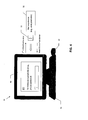
- FIG. 3 is a schematic diagram of the system of FIG. 1 illustrating encrypted data transfer resulting from upon NFC-based authorization.
- FIG. 4 is a schematic diagram of the system of FIG. 1 illustrating encrypted data transfer based upon authorization from a host device.
- FIG. 5 is a flow diagram illustrating method aspects associated with the system and devices of FIGS. 1-4 .
- FIG. 6 is a schematic block diagram illustrating example components that may be used with the mobile communications devices of FIGS. 1 and 2 .
- a restricted access memory device may include a memory, a host interface connector, a short range communication transceiver (e.g., a near field communication (NFC) transceiver), and a processor coupled with the memory and the short range communication transceiver.
- the processor may be capable of storing data in the memory, and reading the data from the memory to the host device via the host interface connector based upon at least one of receiving first authentication data including a password, via the host interface connector, from a memory access application installed on the host device, or receiving second authentication data via the short range communication transceiver without use of the memory access application.
- the memory device may advantageously provide access to the stored data without the use of NFC communication on host devices where the memory access application is previously installed, as well as on host devices where the memory access application is not installed but short range communication authentication is available.
- the processor may be capable of installing the memory access application on the host device based upon the short range communication transceiver.
- the processor may be a cryptographic processor that is further capable of encrypting the data stored in the memory.
- the host interface connector may include a universal serial bus (USB) connector
- the memory may include a flash memory.
- the second authentication data may include a password, challenge-response data, etc.
- the memory device may further include a thumb drive housing carrying the memory, the host interface connector, the short range communication transceiver, and the processor.
- a related electronics system may include a host device, a short range communication device, and a restricted access memory device, such as the one described briefly above.
- a related method is also provided for a memory device, such as the one described briefly above. The method may include storing data in the memory, and reading the data from the memory to the host device via the host interface connector based upon at least one of receiving first authentication data including a password, via the host interface connector, from the memory access application on the host device, or receiving second authentication data from the short range communication device via the short range communication transceiver without use of the memory access application.
- a related computer-readable medium for a restricted access memory device such as the one described briefly above, is also provided.
- the computer-readable medium may have computer executable instructions for causing the memory device to perform steps including storing data in the memory, and reading the data from the memory to the host device via the host interface connector based upon at least one of receiving first authentication data including a password, via the host interface connector, from the memory access application on the host device, or receiving second authentication data via the short range communication transceiver without use of the memory access application.
- the system 30 illustratively includes a host device 31, such as a desktop or laptop computer, tablet computer, or other device to which a restricted access memory device 32 may be connected.
- the memory 32 illustratively includes a housing 33, a memory or memory circuitry (e.g., flash, optical, etc.) 34, a host interface connector 35, a short range communication transceiver, such as a near field communication (NFC) transceiver 36, and associated antenna 37, and a processor 38 coupled with the memory 34, the host interface connector 35, and the NFC transceiver 36.
- a memory or memory circuitry e.g., flash, optical, etc.
- NFC near field communication
- the host interface connector 35 may be a universal serial bus (USB) connector (e.g., standard USB, micro USB, etc.), and the host device 31 may be capable of operating as a USB host.
- USB universal serial bus
- the memory device 32 may be configured as a USB thumb drive, USB flash drive, or USB optical hard drive, for example.
- other communications formats may be used for communicating data between the memory device 32 and the host device 31, such as an Ethernet connector, a wireless communications interface (e.g., Bluetooth, TransferJet, WiFi), etc.
- the short range communication transceiver may also use Bluetooth, TransferJet, or WiFi in some embodiments, for example.
- the processor 38 may be implemented using a combination of hardware (e.g., microprocessor, etc.) and a computer-readable medium having computer-executable instructions for performing the various operations described herein.
- the processor 38 may be capable of storing data in the memory 34, which in some embodiments may include encrypted data.
- the processor 38 may also be capable of cooperating with the host device 31 to install or configure a memory access application 70 on the host device 31 for accessing the stored data. More particularly, the memory access application 70 may be used to read the data from (and optionally write encrypted data to) the memory 34 via the host interface connector 35.
- the memory access application 70 may be installed on the host device 31 to allow the host device to provide first authentication information, such as a password, for authorizing the memory device 32 to provide the requested encrypted data to the host device 31.
- first authentication information such as a password
- the password may be provided to the host device 31 via an input device such as a keyboard or keypad, mouse, touch screen, etc.
- the password may take various forms such as an alphanumeric sequence, a pattern or sequence selection, a spoken word or phrase or other audible input, etc., which verifies that a user is authorized to access the stored data.
- Other suitable forms of user input may also be used to provide passwords.
- the memory device 33 may be an encrypted thumb drive which stores encrypted data in the memory 34 to provide enhanced data protection.
- the memory access application 70 may be stored on the memory device 32 (e.g., as an executable file, etc.) for installation on the host device 31, or the host device 31 may access the memory access application installation file(s) from another source, such as over the Internet, for example.
- the processor 38 may be a cryptographic processor which performs encryption and decryption of the data that is stored in and retrieved from the memory 34 using suitable encryption techniques, although in other embodiments the encryption and decryption operations may be performed externally to the memory device 32. It should be noted, however, that in some embodiments data encryption capabilities or encrypted data storage need not be used.
- One potential drawback of encrypted thumb drives that require installed memory access applications on a host device 31 is that this makes use of the thumb drive on multiple different computers with differing operating systems cumbersome, and in some cases may not be possible. That is, if a user wishes to just briefly access a file from an encrypted thumb drive but is not near a computer with the memory access application 70 already installed, then the user will either have to wait for the installation process (which may not be practical or permissible), or wait until the user is at a computer, etc., where the application has previously been installed. Alternately the memory access application 70 may not be available for or even developed for the computer and/or corresponding operating system of the intended computer which will be used for file access.
- the system 30 may further include a NFC-enabled device, such as a mobile communications device, which may utilize NFC communication to authorize reading of the encrypted data from the memory 34 to the host device 31 via the host interface connector 35, yet advantageously without use of the memory access application 70.
- a NFC-enabled device such as a mobile communications device, which may utilize NFC communication to authorize reading of the encrypted data from the memory 34 to the host device 31 via the host interface connector 35, yet advantageously without use of the memory access application 70.
- the memory device 32 may advantageously be used to read encrypted data to (or write data from) the host device 31 without having to previously install the memory access application 70 on the host device 31.
- the memory access application 70 may optionally be installed on certain host devices 31 so that the memory device 32 may also advantageously be accessed on such devices without a need for a separate NFC-enabled mobile communications device 39.
- the memory device 32 may advantageously be used similar to a traditional encrypted or otherwise access restricted thumb drive with host devices 31 where the memory access application 70 is already installed, and may still be used on other host devices where the memory access application 70 is not installed so long as the memory device is accessible by the host device and is authenticated via NFC communication using the separate NFC device 39.
- Example mobile wireless communications devices which may be enabled for NFC communication and used as the NFC device 39 may include portable or personal media players (e.g., MP3 players, video players, etc.), remote controls (e.g., television or stereo remotes, etc.), portable gaming devices, portable or mobile telephones, smartphones, tablet computers, etc.
- portable or personal media players e.g., MP3 players, video players, etc.
- remote controls e.g., television or stereo remotes, etc.
- portable gaming devices portable or mobile telephones, smartphones, tablet computers, etc.
- other NFC-enabled devices 39 may also be used with the system 30, such as NFC tokens or cards, etc., in some embodiments.
- encrypted data is stored on the memory device 32, which in this case is a USB thumb drive, at Block 52.
- the encrypted data may have been stored on the memory device 32 at the time of manufacture, or it may have been stored during a prior connection with a host device 31, for example.
- the host device 31 is a personal computer having a display 40 and associated keyboard 41 and mouse 42.
- the memory device 32 When the memory device 32 is connected to the host device 31, at Block 53, the memory device may determine if the memory access application 70 has been previously installed on the host device 51, at Block 54, and if not the memory access application 70 may be installed if desired, at Blocks 55-56. More particularly, assuming a compatible computer and operating system, the memory device 32 may load a driver to the host device, which causes the host device 31 to prompt a user if it is desired to run an installation application.
- the NFC device 39 (which in the present example is a NFC-enabled smartphone) may be used to authorize installation of the memory access application 70 on the host device 31, as well as authorize data transfer with the host device 31. For example, if second authentication data is received from the mobile communications device 39 via NFC, then the user may be prompted (either on a display 43 of the mobile communications device or on the display 40 of the host device 31, for example) as to whether installation of the memory access application 70 is desired, or whether data transfer without installation of the memory access application is being authorized, at Blocks 57 and 59.
- NFC may enable restricted access to the device if the computer already is able to generally access the memory device with existing non-restricted applications, such as a generic USB memory interface application.
- access to the memory device 32 is provided based upon proper NFC authentication, which in the example of FIG. 3 , the memory device 32 is recognized as a mass storage device and labeled as a detachable "G: ⁇ " drive, which includes encrypted data organized in "financial" and "work files” folders, although other folder or data storage hierarchies may be used in different embodiments.
- the second authentication data may be an identification (ID) number, key-based challenge-response data, a password as described above, etc., which is exchanged via NFC communication between the NFC device 39 and the NFC transceiver 36.
- ID identification
- the memory access application 70 is installed on the host device 31, then the user has the option to perform data reading (or writing) based upon providing appropriate credentials (i.e., first authentication data) through the host device, such as a password (see FIG. 4 ), challenge-response data, etc., at Block 58.
- appropriate credentials i.e., first authentication data
- FIG. 5 illustratively concludes at Block 60.
- the memory device 32 may advantageously be able to transfer files between host devices 31 on different platforms or having different operating systems.
- the memory access application 70 may not be available for all desired operating systems (e.g., Windows, ios, Android, QNX, etc.).
- the above-described approach allows for encrypted or otherwise restricted access data to be read by a host device 31 that does not have the memory access application 70 installed based solely upon an authenticating NFC communication, so long as it has an appropriate generic interface driver and a compatible connector for the host interface connector 35.
- the NFC transceiver 36 may be powered by a USB (or other) interface with the host device 31 when connected thereto. So, in one example use case, the memory device 32 may be plugged into a Windows platform, enabled or authorized for data transfer with a NFC "kiss" from the NFC device 39, and then moved to an Android tablet and similarly authorized for transfer of the files.
- the memory device 32 may be paired with a respective NFC device 39 in various ways. For example, when a user buys and registers the memory device 32, a phone number, email address, device PIN, etc., associated with the mobile communications device may be provided, to a registration server, which in turn pushes a password or key down to the device over a communications network (e.g., Internet, cellular network, etc.).
- a communications network e.g., Internet, cellular network, etc.
- the memory device 32 may be plugged into a host device 31, such as a user's personal computer, and run through an initial programming sequence where it is paired with a respective mobile communications device 39.
- a paired NFC token (e.g., a passive token) may be sold with the memory device 32 (e.g., as a key chain token, etc.), which is pre-configured to provide the second authentication data to the memory device 32.
- the device 1000 illustratively includes a housing 1200, an optional keyboard or keypad 1400 and an output device 1600.
- the output device shown is a display 1600, which may include a full graphic LCD.
- the display 1600 may have an array of touch sensors associated therewith to define a touch screen that may be used an input device.
- Various types of display technologies may be used, including three-dimensional (3D) displays, in some embodiments. Other types of output devices may alternatively be utilized.
- a processing device 1800 is contained within the housing 1200 and is coupled between the keypad 1400 and the display 1600. The processing device 1800 controls the operation of the display 1600, as well as the overall operation of the mobile device 1000, in response to actuation of keys on the keypad 1400.
- the housing 1200 may be elongated vertically, or may take on other sizes and shapes (including clamshell housing structures).
- the keypad may include a mode selection key, or other hardware or software for switching between text entry and telephony entry.
- FIG. 6 In addition to the processing device 1800, other parts of the mobile device 1000 are shown schematically in FIG. 6 . These include a communications subsystem 1001; a short-range communications subsystem 1020; the keypad 1400 and the display 1600, along with other input/output devices 1060, 1080, 1100 and 1120; as well as memory devices 1160, 1180 and various other device subsystems 1201.
- the mobile device 1000 may include a two-way RF communications device having data and, optionally, voice communications capabilities. In addition, the mobile device 1000 may have the capability to communicate with other computer systems via the Internet.
- Operating system software executed by the processing device 1800 is stored in a persistent store, such as the flash memory 1160, but may be stored in other types of memory devices, such as a read only memory (ROM) or similar storage element.
- system software, specific device applications, or parts thereof may be temporarily loaded into a volatile store, such as the random access memory (RAM) 1180.
- Communications signals received by the mobile device may also be stored in the RAM 1180.
- the processing device 1800 in addition to its operating system functions, enables execution of software applications 1300A-1300N on the device 1000.
- a predetermined set of applications that control basic device operations, such as data and voice communications 1300A and 1300B, may be installed on the device 1000 during manufacture.
- a personal information manager (PIM) application may be installed during manufacture.
- the PIM may be capable of organizing and managing data items, such as e-mail, calendar events, voice mails, appointments, and task items.
- the PIM application may also be capable of sending and receiving data items via a wireless network 1401.
- the PIM data items may be seamlessly integrated, synchronized and updated via the wireless network 1401 with corresponding data items stored or associated with a host computer system.
- the communications subsystem 1001 includes a receiver 1500, a transmitter 1520, and one or more antennas 1540 and 1560.
- the communications subsystem 1001 also includes a processing module, such as a digital signal processor (DSP) 1580, and local oscillators (LOs) 1601.
- DSP digital signal processor
- LOs local oscillators
- a mobile device 1000 may include a communications subsystem 1001 designed to operate with the Mobitex TM , Data TAC TM or General Packet Radio Service (GPRS) mobile data communications networks, and also designed to operate with any of a variety of voice communications networks, such as AMPS, TDMA, CDMA, WCDMA, PCS, GSM, EDGE, etc. Other types of data and voice networks, both separate and integrated, may also be utilized with the mobile device 1000.
- the mobile device 1000 may also be compliant with other communications standards such as 3GSM, 3GPP, UMTS, 4G, wireless local area network (WLAN) or WiFi, etc.
- Network access requirements vary depending upon the type of communication system. For example, in the Mobitex and DataTAC networks, mobile devices are registered on the network using a unique personal identification number or PIN associated with each device. In GPRS networks, however, network access is associated with a subscriber or user of a device. A GPRS device therefore typically involves use of a subscriber identity module, commonly referred to as a SIM card, in order to operate on a GPRS network.
- SIM card subscriber identity module
- the mobile device 1000 may send and receive communications signals over the communication network 1401.
- Signals received from the communications network 1401 by the antenna 1540 are routed to the receiver 1500, which provides for signal amplification, frequency down conversion, filtering, channel selection, etc., and may also provide analog to digital conversion. Analog-to-digital conversion of the received signal allows the DSP 1580 to perform more complex communications functions, such as demodulation and decoding.
- signals to be transmitted to the network 1401 are processed (e.g. modulated and encoded) by the DSP 1580 and are then provided to the transmitter 1520 for digital to analog conversion, frequency up conversion, filtering, amplification and transmission to the communication network 1401 (or networks) via the antenna 1560.
- the DSP 1580 provides for control of the receiver 1500 and the transmitter 1520. For example, gains applied to communications signals in the receiver 1500 and transmitter 1520 may be adaptively controlled through automatic gain control algorithms implemented in the DSP 1580.
- a received signal such as a text message or web page download
- the communications subsystem 1001 is input to the processing device 1800.
- the received signal is then further processed by the processing device 1800 for an output to the display 1600, or alternatively to some other auxiliary I/O device 1060.
- a device may also be used to compose data items, such as e-mail messages, using the keypad 1400 and/or some other auxiliary I/O device 1060, such as a touchpad, a rocker switch, a thumb-wheel, or some other type of input device.
- the composed data items may then be transmitted over the communications network 1401 via the communications subsystem 1001.
- a voice communications mode In a voice communications mode, overall operation of the device is substantially similar to the data communications mode, except that received signals are output to a speaker 1100, and signals for transmission are generated by a microphone 1120.
- Alternative voice or audio I/O subsystems such as a voice message recording subsystem, may also be implemented on the device 1000.
- the display 1600 may also be utilized in voice communications mode, for example to display the identity of a calling party, the duration of a voice call, or other voice call related information.
- the short-range communications subsystem enables communication between the mobile device 1000 and other proximate systems or devices, which need not necessarily be similar devices.
- the short-range communications subsystem may include an infrared device and associated circuits and components, a Bluetooth TM communications module to provide for communication with similarly-enabled systems and devices, or a near field communications (NFC) communications module for communicating with a NFC device or NFC tag via NFC communications.
- Other short-range modules may includes a radio frequency identification (RFID) module, a TransferJet module, etc.
- RFID radio frequency identification
Landscapes
- Engineering & Computer Science (AREA)
- Computer Security & Cryptography (AREA)
- Theoretical Computer Science (AREA)
- Computer Hardware Design (AREA)
- Software Systems (AREA)
- Physics & Mathematics (AREA)
- General Engineering & Computer Science (AREA)
- General Physics & Mathematics (AREA)
- Mobile Radio Communication Systems (AREA)
- Storage Device Security (AREA)
Abstract
Description
- This application relates generally to the field of communications, and more particularly, to electronic devices and related methods that use short range communication such as near field communication (NFC), for example.
- External data storage devices, such as universal serial bus (USB) flash drives, provide a convenient and relatively inexpensive medium for saving and transporting electronic files between different host computing devices. However, the portability of such storage devices also makes them more susceptible to being misplaced or stolen, which may be particularly problematic where such devices are used for storing sensitive or confidential information.
- To provide enhanced security, some USB flash drives provide data encryption so that information stored on the drive is encrypted. More particularly, the information is inaccessible without a corresponding application installed on a host computer that provides an interface for authentication when the flash drive is connected to the host computer. However, despite the existence of such drives, further security or convenience features may be desirable in some instances.
-
FIG. 1 is a schematic block diagram of an electronics system in accordance with one example aspect. -
FIG. 2 a schematic block diagram of an example embodiment of the restricted access memory device from the system ofFIG. 1 . -
FIG. 3 is a schematic diagram of the system ofFIG. 1 illustrating encrypted data transfer resulting from upon NFC-based authorization. -
FIG. 4 is a schematic diagram of the system ofFIG. 1 illustrating encrypted data transfer based upon authorization from a host device. -
FIG. 5 is a flow diagram illustrating method aspects associated with the system and devices ofFIGS. 1-4 . -
FIG. 6 is a schematic block diagram illustrating example components that may be used with the mobile communications devices ofFIGS. 1 and2 . - The present description is made with reference to the accompanying drawings, in which example embodiments are shown. However, many different embodiments may be used, and thus the description should not be construed as limited to the embodiments set forth herein. Rather, these embodiments are provided so that this disclosure will be thorough and complete.
- Generally speaking, a restricted access memory device is disclosed herein which may include a memory, a host interface connector, a short range communication transceiver (e.g., a near field communication (NFC) transceiver), and a processor coupled with the memory and the short range communication transceiver. The processor may be capable of storing data in the memory, and reading the data from the memory to the host device via the host interface connector based upon at least one of receiving first authentication data including a password, via the host interface connector, from a memory access application installed on the host device, or receiving second authentication data via the short range communication transceiver without use of the memory access application. As such, the memory device may advantageously provide access to the stored data without the use of NFC communication on host devices where the memory access application is previously installed, as well as on host devices where the memory access application is not installed but short range communication authentication is available.
- More particularly, the processor may be capable of installing the memory access application on the host device based upon the short range communication transceiver. Furthermore, the processor may be a cryptographic processor that is further capable of encrypting the data stored in the memory. By way of example, the host interface connector may include a universal serial bus (USB) connector, and the memory may include a flash memory. Also by way of example, the second authentication data may include a password, challenge-response data, etc. The memory device may further include a thumb drive housing carrying the memory, the host interface connector, the short range communication transceiver, and the processor.
- A related electronics system is also provided. The system may include a host device, a short range communication device, and a restricted access memory device, such as the one described briefly above. A related method is also provided for a memory device, such as the one described briefly above. The method may include storing data in the memory, and reading the data from the memory to the host device via the host interface connector based upon at least one of receiving first authentication data including a password, via the host interface connector, from the memory access application on the host device, or receiving second authentication data from the short range communication device via the short range communication transceiver without use of the memory access application.
- A related computer-readable medium for a restricted access memory device, such as the one described briefly above, is also provided. The computer-readable medium may have computer executable instructions for causing the memory device to perform steps including storing data in the memory, and reading the data from the memory to the host device via the host interface connector based upon at least one of receiving first authentication data including a password, via the host interface connector, from the memory access application on the host device, or receiving second authentication data via the short range communication transceiver without use of the memory access application.
- Referring initially to
FIGS. 1 and2 , anelectronics system 30 and related method aspects are first described. Thesystem 30 illustratively includes ahost device 31, such as a desktop or laptop computer, tablet computer, or other device to which a restrictedaccess memory device 32 may be connected. In the example shown inFIG. 2 , thememory 32 illustratively includes ahousing 33, a memory or memory circuitry (e.g., flash, optical, etc.) 34, ahost interface connector 35, a short range communication transceiver, such as a near field communication (NFC)transceiver 36, and associatedantenna 37, and aprocessor 38 coupled with thememory 34, thehost interface connector 35, and theNFC transceiver 36. By way of example, thehost interface connector 35 may be a universal serial bus (USB) connector (e.g., standard USB, micro USB, etc.), and thehost device 31 may be capable of operating as a USB host. More particularly, thememory device 32 may be configured as a USB thumb drive, USB flash drive, or USB optical hard drive, for example. However, it should be noted that other communications formats may be used for communicating data between thememory device 32 and thehost device 31, such as an Ethernet connector, a wireless communications interface (e.g., Bluetooth, TransferJet, WiFi), etc. The short range communication transceiver may also use Bluetooth, TransferJet, or WiFi in some embodiments, for example. - By way of example, the
processor 38 may be implemented using a combination of hardware (e.g., microprocessor, etc.) and a computer-readable medium having computer-executable instructions for performing the various operations described herein. Theprocessor 38 may be capable of storing data in thememory 34, which in some embodiments may include encrypted data. Moreover, in some embodiments theprocessor 38 may also be capable of cooperating with thehost device 31 to install or configure amemory access application 70 on thehost device 31 for accessing the stored data. More particularly, thememory access application 70 may be used to read the data from (and optionally write encrypted data to) thememory 34 via thehost interface connector 35. That is, thememory access application 70 may be installed on thehost device 31 to allow the host device to provide first authentication information, such as a password, for authorizing thememory device 32 to provide the requested encrypted data to thehost device 31. By way of example, the password may be provided to thehost device 31 via an input device such as a keyboard or keypad, mouse, touch screen, etc. The password may take various forms such as an alphanumeric sequence, a pattern or sequence selection, a spoken word or phrase or other audible input, etc., which verifies that a user is authorized to access the stored data. Other suitable forms of user input may also be used to provide passwords. - In accordance with one example embodiment, the
memory device 33 may be an encrypted thumb drive which stores encrypted data in thememory 34 to provide enhanced data protection. Thememory access application 70 may be stored on the memory device 32 (e.g., as an executable file, etc.) for installation on thehost device 31, or thehost device 31 may access the memory access application installation file(s) from another source, such as over the Internet, for example. In some example embodiments, theprocessor 38 may be a cryptographic processor which performs encryption and decryption of the data that is stored in and retrieved from thememory 34 using suitable encryption techniques, although in other embodiments the encryption and decryption operations may be performed externally to thememory device 32. It should be noted, however, that in some embodiments data encryption capabilities or encrypted data storage need not be used. - One potential drawback of encrypted thumb drives that require installed memory access applications on a
host device 31 is that this makes use of the thumb drive on multiple different computers with differing operating systems cumbersome, and in some cases may not be possible. That is, if a user wishes to just briefly access a file from an encrypted thumb drive but is not near a computer with thememory access application 70 already installed, then the user will either have to wait for the installation process (which may not be practical or permissible), or wait until the user is at a computer, etc., where the application has previously been installed. Alternately thememory access application 70 may not be available for or even developed for the computer and/or corresponding operating system of the intended computer which will be used for file access. - In this regard, the
system 30 may further include a NFC-enabled device, such as a mobile communications device, which may utilize NFC communication to authorize reading of the encrypted data from thememory 34 to thehost device 31 via thehost interface connector 35, yet advantageously without use of thememory access application 70. That is, thememory device 32 may advantageously be used to read encrypted data to (or write data from) thehost device 31 without having to previously install thememory access application 70 on thehost device 31. Yet, thememory access application 70 may optionally be installed oncertain host devices 31 so that thememory device 32 may also advantageously be accessed on such devices without a need for a separate NFC-enabledmobile communications device 39. That is, thememory device 32 may advantageously be used similar to a traditional encrypted or otherwise access restricted thumb drive withhost devices 31 where thememory access application 70 is already installed, and may still be used on other host devices where thememory access application 70 is not installed so long as the memory device is accessible by the host device and is authenticated via NFC communication using theseparate NFC device 39. - Example mobile wireless communications devices which may be enabled for NFC communication and used as the
NFC device 39 may include portable or personal media players (e.g., MP3 players, video players, etc.), remote controls (e.g., television or stereo remotes, etc.), portable gaming devices, portable or mobile telephones, smartphones, tablet computers, etc. However, it should be noted that other NFC-enableddevices 39 besides mobile communications devices may also be used with thesystem 30, such as NFC tokens or cards, etc., in some embodiments. - The foregoing will be further understood with reference to examples shown in
FIGS. 3 and4 and the flow diagram 50 ofFIG. 5 . In the illustrated example, beginning atBlock 51, encrypted data is stored on thememory device 32, which in this case is a USB thumb drive, atBlock 52. In some instances, the encrypted data may have been stored on thememory device 32 at the time of manufacture, or it may have been stored during a prior connection with ahost device 31, for example. In the illustrated examples, thehost device 31 is a personal computer having adisplay 40 and associatedkeyboard 41 andmouse 42. When thememory device 32 is connected to thehost device 31, atBlock 53, the memory device may determine if thememory access application 70 has been previously installed on thehost device 51, atBlock 54, and if not thememory access application 70 may be installed if desired, at Blocks 55-56. More particularly, assuming a compatible computer and operating system, thememory device 32 may load a driver to the host device, which causes thehost device 31 to prompt a user if it is desired to run an installation application. - In accordance with another aspect, the NFC device 39 (which in the present example is a NFC-enabled smartphone) may be used to authorize installation of the
memory access application 70 on thehost device 31, as well as authorize data transfer with thehost device 31. For example, if second authentication data is received from themobile communications device 39 via NFC, then the user may be prompted (either on adisplay 43 of the mobile communications device or on thedisplay 40 of thehost device 31, for example) as to whether installation of thememory access application 70 is desired, or whether data transfer without installation of the memory access application is being authorized, atBlocks memory device 32 is provided based upon proper NFC authentication, which in the example ofFIG. 3 , thememory device 32 is recognized as a mass storage device and labeled as a detachable "G:\" drive, which includes encrypted data organized in "financial" and "work files" folders, although other folder or data storage hierarchies may be used in different embodiments. The second authentication data may be an identification (ID) number, key-based challenge-response data, a password as described above, etc., which is exchanged via NFC communication between theNFC device 39 and theNFC transceiver 36. - As noted above, if the
memory access application 70 is installed on thehost device 31, then the user has the option to perform data reading (or writing) based upon providing appropriate credentials (i.e., first authentication data) through the host device, such as a password (seeFIG. 4 ), challenge-response data, etc., atBlock 58. The method ofFIG. 5 illustratively concludes atBlock 60. - As a result of the above-described configuration, the
memory device 32 may advantageously be able to transfer files betweenhost devices 31 on different platforms or having different operating systems. For example, thememory access application 70 may not be available for all desired operating systems (e.g., Windows, ios, Android, QNX, etc.). Yet, the above-described approach allows for encrypted or otherwise restricted access data to be read by ahost device 31 that does not have thememory access application 70 installed based solely upon an authenticating NFC communication, so long as it has an appropriate generic interface driver and a compatible connector for thehost interface connector 35. TheNFC transceiver 36 may be powered by a USB (or other) interface with thehost device 31 when connected thereto. So, in one example use case, thememory device 32 may be plugged into a Windows platform, enabled or authorized for data transfer with a NFC "kiss" from theNFC device 39, and then moved to an Android tablet and similarly authorized for transfer of the files. - The
memory device 32 may be paired with arespective NFC device 39 in various ways. For example, when a user buys and registers thememory device 32, a phone number, email address, device PIN, etc., associated with the mobile communications device may be provided, to a registration server, which in turn pushes a password or key down to the device over a communications network (e.g., Internet, cellular network, etc.). In another embodiment, thememory device 32 may be plugged into ahost device 31, such as a user's personal computer, and run through an initial programming sequence where it is paired with a respectivemobile communications device 39. In still another embodiment, a paired NFC token (e.g., a passive token) may be sold with the memory device 32 (e.g., as a key chain token, etc.), which is pre-configured to provide the second authentication data to thememory device 32. - Example components of a
mobile communications device 1000 that may be used in accordance with the above-described embodiments are further described below with reference toFIG. 6 . Thedevice 1000 illustratively includes ahousing 1200, an optional keyboard orkeypad 1400 and an output device 1600. The output device shown is a display 1600, which may include a full graphic LCD. In some embodiments, the display 1600 may have an array of touch sensors associated therewith to define a touch screen that may be used an input device. Various types of display technologies may be used, including three-dimensional (3D) displays, in some embodiments. Other types of output devices may alternatively be utilized. Aprocessing device 1800 is contained within thehousing 1200 and is coupled between thekeypad 1400 and the display 1600. Theprocessing device 1800 controls the operation of the display 1600, as well as the overall operation of themobile device 1000, in response to actuation of keys on thekeypad 1400. - The
housing 1200 may be elongated vertically, or may take on other sizes and shapes (including clamshell housing structures). The keypad may include a mode selection key, or other hardware or software for switching between text entry and telephony entry. - In addition to the
processing device 1800, other parts of themobile device 1000 are shown schematically inFIG. 6 . These include acommunications subsystem 1001; a short-range communications subsystem 1020; thekeypad 1400 and the display 1600, along with other input/output devices memory devices other device subsystems 1201. Themobile device 1000 may include a two-way RF communications device having data and, optionally, voice communications capabilities. In addition, themobile device 1000 may have the capability to communicate with other computer systems via the Internet. - Operating system software executed by the
processing device 1800 is stored in a persistent store, such as theflash memory 1160, but may be stored in other types of memory devices, such as a read only memory (ROM) or similar storage element. In addition, system software, specific device applications, or parts thereof, may be temporarily loaded into a volatile store, such as the random access memory (RAM) 1180. Communications signals received by the mobile device may also be stored in theRAM 1180. - The
processing device 1800, in addition to its operating system functions, enables execution ofsoftware applications 1300A-1300N on thedevice 1000. A predetermined set of applications that control basic device operations, such as data andvoice communications device 1000 during manufacture. In addition, a personal information manager (PIM) application may be installed during manufacture. The PIM may be capable of organizing and managing data items, such as e-mail, calendar events, voice mails, appointments, and task items. The PIM application may also be capable of sending and receiving data items via awireless network 1401. The PIM data items may be seamlessly integrated, synchronized and updated via thewireless network 1401 with corresponding data items stored or associated with a host computer system. - Communication functions, including data and voice communications, are performed through the
communications subsystem 1001, and possibly through the short-range communications subsystem. Thecommunications subsystem 1001 includes areceiver 1500, atransmitter 1520, and one ormore antennas communications subsystem 1001 also includes a processing module, such as a digital signal processor (DSP) 1580, and local oscillators (LOs) 1601. The specific design and implementation of thecommunications subsystem 1001 is dependent upon the communications network in which themobile device 1000 is intended to operate. For example, amobile device 1000 may include acommunications subsystem 1001 designed to operate with the Mobitex™, Data TAC™ or General Packet Radio Service (GPRS) mobile data communications networks, and also designed to operate with any of a variety of voice communications networks, such as AMPS, TDMA, CDMA, WCDMA, PCS, GSM, EDGE, etc. Other types of data and voice networks, both separate and integrated, may also be utilized with themobile device 1000. Themobile device 1000 may also be compliant with other communications standards such as 3GSM, 3GPP, UMTS, 4G, wireless local area network (WLAN) or WiFi, etc. - Network access requirements vary depending upon the type of communication system. For example, in the Mobitex and DataTAC networks, mobile devices are registered on the network using a unique personal identification number or PIN associated with each device. In GPRS networks, however, network access is associated with a subscriber or user of a device. A GPRS device therefore typically involves use of a subscriber identity module, commonly referred to as a SIM card, in order to operate on a GPRS network.
- When required network registration or activation procedures have been completed, the
mobile device 1000 may send and receive communications signals over thecommunication network 1401. Signals received from thecommunications network 1401 by theantenna 1540 are routed to thereceiver 1500, which provides for signal amplification, frequency down conversion, filtering, channel selection, etc., and may also provide analog to digital conversion. Analog-to-digital conversion of the received signal allows theDSP 1580 to perform more complex communications functions, such as demodulation and decoding. In a similar manner, signals to be transmitted to thenetwork 1401 are processed (e.g. modulated and encoded) by theDSP 1580 and are then provided to thetransmitter 1520 for digital to analog conversion, frequency up conversion, filtering, amplification and transmission to the communication network 1401 (or networks) via theantenna 1560. - In addition to processing communications signals, the
DSP 1580 provides for control of thereceiver 1500 and thetransmitter 1520. For example, gains applied to communications signals in thereceiver 1500 andtransmitter 1520 may be adaptively controlled through automatic gain control algorithms implemented in theDSP 1580. - In a data communications mode, a received signal, such as a text message or web page download, is processed by the
communications subsystem 1001 and is input to theprocessing device 1800. The received signal is then further processed by theprocessing device 1800 for an output to the display 1600, or alternatively to some other auxiliary I/O device 1060. A device may also be used to compose data items, such as e-mail messages, using thekeypad 1400 and/or some other auxiliary I/O device 1060, such as a touchpad, a rocker switch, a thumb-wheel, or some other type of input device. The composed data items may then be transmitted over thecommunications network 1401 via thecommunications subsystem 1001. - In a voice communications mode, overall operation of the device is substantially similar to the data communications mode, except that received signals are output to a
speaker 1100, and signals for transmission are generated by a microphone 1120. Alternative voice or audio I/O subsystems, such as a voice message recording subsystem, may also be implemented on thedevice 1000. In addition, the display 1600 may also be utilized in voice communications mode, for example to display the identity of a calling party, the duration of a voice call, or other voice call related information. - The short-range communications subsystem enables communication between the
mobile device 1000 and other proximate systems or devices, which need not necessarily be similar devices. For example, the short-range communications subsystem may include an infrared device and associated circuits and components, a Bluetooth™ communications module to provide for communication with similarly-enabled systems and devices, or a near field communications (NFC) communications module for communicating with a NFC device or NFC tag via NFC communications. Other short-range modules may includes a radio frequency identification (RFID) module, a TransferJet module, etc. - Many modifications and other embodiments will come to the mind of one skilled in the art having the benefit of the teachings presented in the foregoing descriptions and the associated drawings. Therefore, it is understood that various modifications and embodiments are intended to be included within the scope of the appended claims.
Claims (15)
- A restricted access memory device including:a memory;a host interface connector;a short range communication transceiver; anda processor coupled with the memory and the short range communication transceiver and capable of
storing data in the memory, and
reading the data from the memory to the host device via the host interface connector based upon at least one of
receiving first authentication data including a password, via the host interface connector, from a memory access application installed on the host device, or
receiving second authentication data via the short range communication transceiver without use of the memory access application. - The memory device of Claim 1 wherein the processor is capable of installing the memory access application on the host device based upon the short range communication transceiver.
- The memory device of Claim 1 wherein the processor includes a cryptographic processor that is further capable of encrypting the data stored in the memory.
- The memory device of Claim 1 wherein the host interface connector includes a universal serial bus (USB) connector.
- The memory device of Claim 1 wherein the memory includes a flash memory.
- The memory device of Claim 1 wherein the short range communication transceiver comprises a near field communication (NFC) transceiver.
- The memory device of Claim 1 wherein the second authentication data includes a password.
- The memory device of Claim 1 wherein the second authentication data includes challenge-response data.
- The memory device of Claim 1 further including a thumb drive housing carrying the memory, the host interface connector, the short range communication transceiver, and the processor.
- An electronics system including:a host device having a memory access application installed thereon;a short range communication ; anda restricted access memory device including
a memory,
a host interface connector,
a short range communication transceiver, and a processor coupled with the memory and the NFC transceiver and capable of
storing data in the memory, and
reading the data from the memory to the host device via the host interface connector based upon
receiving first authentication data including a password, via the host interface connector, from the memory access application on the host device, or
receiving second authentication data via the short range communication transceiver without use of the memory access application. - The electronics system of Claim 10 wherein the processor is capable of installing the memory access application on the host device based upon the short range communication transceiver.
- The electronics system of Claim 10 wherein the processor includes a cryptographic processor that is further capable of encrypting the data stored in the memory.
- A method for a restricted access memory device including a memory, a host interface connector, and a short range communication transceiver, the method including:storing data in the memory; andreading the data from the memory to a host device via the host interface connector based upon at least one of
receiving first authentication data including a password, via the host interface connector, from a memory access application installed on the host device, or
receiving second authentication data via the short range communication transceiver without use of the memory access application. - The method of Claim 13 wherein installing includes installing the memory access application on the host device based upon the short range communication transceiver.
- The method of Claim 15 further including encrypting the data to be stored in the memory at the memory device.
Priority Applications (2)
| Application Number | Priority Date | Filing Date | Title |
|---|---|---|---|
| EP12163629.4A EP2650811B1 (en) | 2012-04-10 | 2012-04-10 | Restricted access memory device providing short range communication-based security features and related methods |
| CA2812383A CA2812383C (en) | 2012-04-10 | 2013-04-09 | Restricted access memory device providing short range communication-based security features and related methods |
Applications Claiming Priority (1)
| Application Number | Priority Date | Filing Date | Title |
|---|---|---|---|
| EP12163629.4A EP2650811B1 (en) | 2012-04-10 | 2012-04-10 | Restricted access memory device providing short range communication-based security features and related methods |
Publications (3)
| Publication Number | Publication Date |
|---|---|
| EP2650811A1 true EP2650811A1 (en) | 2013-10-16 |
| EP2650811A9 EP2650811A9 (en) | 2014-06-18 |
| EP2650811B1 EP2650811B1 (en) | 2017-11-22 |
Family
ID=46000846
Family Applications (1)
| Application Number | Title | Priority Date | Filing Date |
|---|---|---|---|
| EP12163629.4A Active EP2650811B1 (en) | 2012-04-10 | 2012-04-10 | Restricted access memory device providing short range communication-based security features and related methods |
Country Status (2)
| Country | Link |
|---|---|
| EP (1) | EP2650811B1 (en) |
| CA (1) | CA2812383C (en) |
Citations (5)
| Publication number | Priority date | Publication date | Assignee | Title |
|---|---|---|---|---|
| WO2006027723A1 (en) * | 2004-09-06 | 2006-03-16 | Koninklijke Philips Electronics N.V. | Portable storage device and method for exchanging data |
| US20080303631A1 (en) * | 2007-06-05 | 2008-12-11 | Beekley John S | Mass Storage Device With Locking Mechanism |
| WO2010052722A1 (en) * | 2008-11-10 | 2010-05-14 | Walletex Microelectronics Ltd. | Secure storage device |
| US20100293374A1 (en) * | 2008-07-30 | 2010-11-18 | Bushby Donald P | Secure Portable Memory Storage Device |
| US20110302358A1 (en) * | 2007-02-22 | 2011-12-08 | Super Talent Technology Corp. | Flash-Memory Device with RAID-type Controller |
-
2012
- 2012-04-10 EP EP12163629.4A patent/EP2650811B1/en active Active
-
2013
- 2013-04-09 CA CA2812383A patent/CA2812383C/en active Active
Patent Citations (5)
| Publication number | Priority date | Publication date | Assignee | Title |
|---|---|---|---|---|
| WO2006027723A1 (en) * | 2004-09-06 | 2006-03-16 | Koninklijke Philips Electronics N.V. | Portable storage device and method for exchanging data |
| US20110302358A1 (en) * | 2007-02-22 | 2011-12-08 | Super Talent Technology Corp. | Flash-Memory Device with RAID-type Controller |
| US20080303631A1 (en) * | 2007-06-05 | 2008-12-11 | Beekley John S | Mass Storage Device With Locking Mechanism |
| US20100293374A1 (en) * | 2008-07-30 | 2010-11-18 | Bushby Donald P | Secure Portable Memory Storage Device |
| WO2010052722A1 (en) * | 2008-11-10 | 2010-05-14 | Walletex Microelectronics Ltd. | Secure storage device |
Also Published As
| Publication number | Publication date |
|---|---|
| CA2812383C (en) | 2016-08-09 |
| CA2812383A1 (en) | 2013-10-10 |
| EP2650811A9 (en) | 2014-06-18 |
| EP2650811B1 (en) | 2017-11-22 |
Similar Documents
| Publication | Publication Date | Title |
|---|---|---|
| US8875283B2 (en) | Restricted access memory device providing short range communication-based security features and related methods | |
| EP3139648B1 (en) | Communication device, method and system for establishing communications using the subscriber identity data of another communication device | |
| US8869248B2 (en) | Communication system providing wireless authentication for private data access and related methods | |
| US9077769B2 (en) | Communications system providing enhanced trusted service manager (TSM) verification features and related methods | |
| US9264413B2 (en) | Management of network devices utilizing an authorization token | |
| EP2434793B1 (en) | Mobile wireless communications device establishing wireless communication links based upon near field communication and related methods | |
| KR102054711B1 (en) | Data security system using encryption | |
| CA2749446C (en) | Communication system providing wireless authentication for private data access and related methods | |
| CN103493527B (en) | Personal entry system with authentication feature using near field communication (NFC) and method thereof | |
| WO2012122648A1 (en) | Communications device providing near field communication (nfc) secure element disabling features related methods | |
| US20150020180A1 (en) | Wireless two-factor authentication, authorization and audit system with close proximity between mass storage device and communication device | |
| KR20170080576A (en) | Authentication system and method | |
| CN106447325A (en) | Processing method and device based on NFC (Near Filed Communication), and mobile terminal | |
| CA2812383C (en) | Restricted access memory device providing short range communication-based security features and related methods | |
| US9445266B2 (en) | Smart plug or cradle | |
| US20240235856A1 (en) | Proof of possession establishment during secure onboarding | |
| EP2811724B1 (en) | Mobile wireless communications device providing near field communication (nfc) unlock and tag data change features and related methods | |
| KR20160007926A (en) | Method for Executing Security Application of Mobile Device | |
| EP2712221A1 (en) | Smart plug or cradle | |
| Leinonen et al. | Implementing Open Authentication for Web Services with a Secure Memory Card | |
| KR101513435B1 (en) | Method for Protecting Key Input, and Device for Key Input Protection | |
| EP2610798B1 (en) | Communications system providing enhanced trusted service manager (tsm) verification features and related methods | |
| KR20150023145A (en) | Method for Processing Electronic Signature based on Universal Subscriber Identity Module at a Management Institution | |
| KR20150023144A (en) | Method for Processing Electronic Signature by using Universal Subscriber Identity Module | |
| KR20150023150A (en) | Method for Processing Electronic Signature based on Universal Subscriber Identity Module at a Telegraph Operator |
Legal Events
| Date | Code | Title | Description |
|---|---|---|---|
| PUAI | Public reference made under article 153(3) epc to a published international application that has entered the european phase |
Free format text: ORIGINAL CODE: 0009012 |
|
| 17P | Request for examination filed |
Effective date: 20120410 |
|
| AK | Designated contracting states |
Kind code of ref document: A1 Designated state(s): AL AT BE BG CH CY CZ DE DK EE ES FI FR GB GR HR HU IE IS IT LI LT LU LV MC MK MT NL NO PL PT RO RS SE SI SK SM TR |
|
| AX | Request for extension of the european patent |
Extension state: BA ME |
|
| RAP1 | Party data changed (applicant data changed or rights of an application transferred) |
Owner name: BLACKBERRY LIMITED |
|
| 17Q | First examination report despatched |
Effective date: 20161221 |
|
| REG | Reference to a national code |
Ref country code: DE Ref legal event code: R079 Ref document number: 602012040005 Country of ref document: DE Free format text: PREVIOUS MAIN CLASS: G06F0021000000 Ipc: G06F0012140000 |
|
| GRAP | Despatch of communication of intention to grant a patent |
Free format text: ORIGINAL CODE: EPIDOSNIGR1 |
|
| RIC1 | Information provided on ipc code assigned before grant |
Ipc: G06F 12/14 20060101AFI20170608BHEP Ipc: G06F 21/34 20130101ALI20170608BHEP |
|
| INTG | Intention to grant announced |
Effective date: 20170703 |
|
| GRAS | Grant fee paid |
Free format text: ORIGINAL CODE: EPIDOSNIGR3 |
|
| GRAA | (expected) grant |
Free format text: ORIGINAL CODE: 0009210 |
|
| AK | Designated contracting states |
Kind code of ref document: B1 Designated state(s): AL AT BE BG CH CY CZ DE DK EE ES FI FR GB GR HR HU IE IS IT LI LT LU LV MC MK MT NL NO PL PT RO RS SE SI SK SM TR |
|
| REG | Reference to a national code |
Ref country code: GB Ref legal event code: FG4D |
|
| REG | Reference to a national code |
Ref country code: CH Ref legal event code: EP |
|
| REG | Reference to a national code |
Ref country code: IE Ref legal event code: FG4D |
|
| REG | Reference to a national code |
Ref country code: AT Ref legal event code: REF Ref document number: 949016 Country of ref document: AT Kind code of ref document: T Effective date: 20171215 |
|
| REG | Reference to a national code |
Ref country code: DE Ref legal event code: R096 Ref document number: 602012040005 Country of ref document: DE |
|
| REG | Reference to a national code |
Ref country code: NL Ref legal event code: MP Effective date: 20171122 |
|
| REG | Reference to a national code |
Ref country code: LT Ref legal event code: MG4D |
|
| REG | Reference to a national code |
Ref country code: AT Ref legal event code: MK05 Ref document number: 949016 Country of ref document: AT Kind code of ref document: T Effective date: 20171122 |
|
| REG | Reference to a national code |
Ref country code: FR Ref legal event code: PLFP Year of fee payment: 7 |
|
| PG25 | Lapsed in a contracting state [announced via postgrant information from national office to epo] |
Ref country code: LT Free format text: LAPSE BECAUSE OF FAILURE TO SUBMIT A TRANSLATION OF THE DESCRIPTION OR TO PAY THE FEE WITHIN THE PRESCRIBED TIME-LIMIT Effective date: 20171122 Ref country code: SE Free format text: LAPSE BECAUSE OF FAILURE TO SUBMIT A TRANSLATION OF THE DESCRIPTION OR TO PAY THE FEE WITHIN THE PRESCRIBED TIME-LIMIT Effective date: 20171122 Ref country code: ES Free format text: LAPSE BECAUSE OF FAILURE TO SUBMIT A TRANSLATION OF THE DESCRIPTION OR TO PAY THE FEE WITHIN THE PRESCRIBED TIME-LIMIT Effective date: 20171122 Ref country code: NO Free format text: LAPSE BECAUSE OF FAILURE TO SUBMIT A TRANSLATION OF THE DESCRIPTION OR TO PAY THE FEE WITHIN THE PRESCRIBED TIME-LIMIT Effective date: 20180222 Ref country code: FI Free format text: LAPSE BECAUSE OF FAILURE TO SUBMIT A TRANSLATION OF THE DESCRIPTION OR TO PAY THE FEE WITHIN THE PRESCRIBED TIME-LIMIT Effective date: 20171122 Ref country code: NL Free format text: LAPSE BECAUSE OF FAILURE TO SUBMIT A TRANSLATION OF THE DESCRIPTION OR TO PAY THE FEE WITHIN THE PRESCRIBED TIME-LIMIT Effective date: 20171122 |
|
| PG25 | Lapsed in a contracting state [announced via postgrant information from national office to epo] |
Ref country code: GR Free format text: LAPSE BECAUSE OF FAILURE TO SUBMIT A TRANSLATION OF THE DESCRIPTION OR TO PAY THE FEE WITHIN THE PRESCRIBED TIME-LIMIT Effective date: 20180223 Ref country code: BG Free format text: LAPSE BECAUSE OF FAILURE TO SUBMIT A TRANSLATION OF THE DESCRIPTION OR TO PAY THE FEE WITHIN THE PRESCRIBED TIME-LIMIT Effective date: 20180222 Ref country code: RS Free format text: LAPSE BECAUSE OF FAILURE TO SUBMIT A TRANSLATION OF THE DESCRIPTION OR TO PAY THE FEE WITHIN THE PRESCRIBED TIME-LIMIT Effective date: 20171122 Ref country code: AT Free format text: LAPSE BECAUSE OF FAILURE TO SUBMIT A TRANSLATION OF THE DESCRIPTION OR TO PAY THE FEE WITHIN THE PRESCRIBED TIME-LIMIT Effective date: 20171122 Ref country code: LV Free format text: LAPSE BECAUSE OF FAILURE TO SUBMIT A TRANSLATION OF THE DESCRIPTION OR TO PAY THE FEE WITHIN THE PRESCRIBED TIME-LIMIT Effective date: 20171122 Ref country code: HR Free format text: LAPSE BECAUSE OF FAILURE TO SUBMIT A TRANSLATION OF THE DESCRIPTION OR TO PAY THE FEE WITHIN THE PRESCRIBED TIME-LIMIT Effective date: 20171122 |
|
| PG25 | Lapsed in a contracting state [announced via postgrant information from national office to epo] |
Ref country code: DK Free format text: LAPSE BECAUSE OF FAILURE TO SUBMIT A TRANSLATION OF THE DESCRIPTION OR TO PAY THE FEE WITHIN THE PRESCRIBED TIME-LIMIT Effective date: 20171122 Ref country code: CY Free format text: LAPSE BECAUSE OF FAILURE TO SUBMIT A TRANSLATION OF THE DESCRIPTION OR TO PAY THE FEE WITHIN THE PRESCRIBED TIME-LIMIT Effective date: 20171122 Ref country code: EE Free format text: LAPSE BECAUSE OF FAILURE TO SUBMIT A TRANSLATION OF THE DESCRIPTION OR TO PAY THE FEE WITHIN THE PRESCRIBED TIME-LIMIT Effective date: 20171122 Ref country code: CZ Free format text: LAPSE BECAUSE OF FAILURE TO SUBMIT A TRANSLATION OF THE DESCRIPTION OR TO PAY THE FEE WITHIN THE PRESCRIBED TIME-LIMIT Effective date: 20171122 Ref country code: SK Free format text: LAPSE BECAUSE OF FAILURE TO SUBMIT A TRANSLATION OF THE DESCRIPTION OR TO PAY THE FEE WITHIN THE PRESCRIBED TIME-LIMIT Effective date: 20171122 |
|
| REG | Reference to a national code |
Ref country code: DE Ref legal event code: R097 Ref document number: 602012040005 Country of ref document: DE |
|
| PG25 | Lapsed in a contracting state [announced via postgrant information from national office to epo] |
Ref country code: RO Free format text: LAPSE BECAUSE OF FAILURE TO SUBMIT A TRANSLATION OF THE DESCRIPTION OR TO PAY THE FEE WITHIN THE PRESCRIBED TIME-LIMIT Effective date: 20171122 Ref country code: SM Free format text: LAPSE BECAUSE OF FAILURE TO SUBMIT A TRANSLATION OF THE DESCRIPTION OR TO PAY THE FEE WITHIN THE PRESCRIBED TIME-LIMIT Effective date: 20171122 Ref country code: IT Free format text: LAPSE BECAUSE OF FAILURE TO SUBMIT A TRANSLATION OF THE DESCRIPTION OR TO PAY THE FEE WITHIN THE PRESCRIBED TIME-LIMIT Effective date: 20171122 Ref country code: PL Free format text: LAPSE BECAUSE OF FAILURE TO SUBMIT A TRANSLATION OF THE DESCRIPTION OR TO PAY THE FEE WITHIN THE PRESCRIBED TIME-LIMIT Effective date: 20171122 |
|
| PLBE | No opposition filed within time limit |
Free format text: ORIGINAL CODE: 0009261 |
|
| STAA | Information on the status of an ep patent application or granted ep patent |
Free format text: STATUS: NO OPPOSITION FILED WITHIN TIME LIMIT |
|
| 26N | No opposition filed |
Effective date: 20180823 |
|
| PG25 | Lapsed in a contracting state [announced via postgrant information from national office to epo] |
Ref country code: SI Free format text: LAPSE BECAUSE OF FAILURE TO SUBMIT A TRANSLATION OF THE DESCRIPTION OR TO PAY THE FEE WITHIN THE PRESCRIBED TIME-LIMIT Effective date: 20171122 Ref country code: MC Free format text: LAPSE BECAUSE OF FAILURE TO SUBMIT A TRANSLATION OF THE DESCRIPTION OR TO PAY THE FEE WITHIN THE PRESCRIBED TIME-LIMIT Effective date: 20171122 |
|
| REG | Reference to a national code |
Ref country code: CH Ref legal event code: PL |
|
| REG | Reference to a national code |
Ref country code: BE Ref legal event code: MM Effective date: 20180430 |
|
| REG | Reference to a national code |
Ref country code: IE Ref legal event code: MM4A |
|
| PG25 | Lapsed in a contracting state [announced via postgrant information from national office to epo] |
Ref country code: LU Free format text: LAPSE BECAUSE OF NON-PAYMENT OF DUE FEES Effective date: 20180410 |
|
| PG25 | Lapsed in a contracting state [announced via postgrant information from national office to epo] |
Ref country code: CH Free format text: LAPSE BECAUSE OF NON-PAYMENT OF DUE FEES Effective date: 20180430 Ref country code: LI Free format text: LAPSE BECAUSE OF NON-PAYMENT OF DUE FEES Effective date: 20180430 Ref country code: BE Free format text: LAPSE BECAUSE OF NON-PAYMENT OF DUE FEES Effective date: 20180430 |
|
| PG25 | Lapsed in a contracting state [announced via postgrant information from national office to epo] |
Ref country code: IE Free format text: LAPSE BECAUSE OF NON-PAYMENT OF DUE FEES Effective date: 20180410 |
|
| PG25 | Lapsed in a contracting state [announced via postgrant information from national office to epo] |
Ref country code: MT Free format text: LAPSE BECAUSE OF NON-PAYMENT OF DUE FEES Effective date: 20180410 |
|
| PG25 | Lapsed in a contracting state [announced via postgrant information from national office to epo] |
Ref country code: TR Free format text: LAPSE BECAUSE OF FAILURE TO SUBMIT A TRANSLATION OF THE DESCRIPTION OR TO PAY THE FEE WITHIN THE PRESCRIBED TIME-LIMIT Effective date: 20171122 |
|
| PG25 | Lapsed in a contracting state [announced via postgrant information from national office to epo] |
Ref country code: PT Free format text: LAPSE BECAUSE OF FAILURE TO SUBMIT A TRANSLATION OF THE DESCRIPTION OR TO PAY THE FEE WITHIN THE PRESCRIBED TIME-LIMIT Effective date: 20171122 Ref country code: HU Free format text: LAPSE BECAUSE OF FAILURE TO SUBMIT A TRANSLATION OF THE DESCRIPTION OR TO PAY THE FEE WITHIN THE PRESCRIBED TIME-LIMIT; INVALID AB INITIO Effective date: 20120410 |
|
| PG25 | Lapsed in a contracting state [announced via postgrant information from national office to epo] |
Ref country code: MK Free format text: LAPSE BECAUSE OF NON-PAYMENT OF DUE FEES Effective date: 20171122 |
|
| PG25 | Lapsed in a contracting state [announced via postgrant information from national office to epo] |
Ref country code: AL Free format text: LAPSE BECAUSE OF FAILURE TO SUBMIT A TRANSLATION OF THE DESCRIPTION OR TO PAY THE FEE WITHIN THE PRESCRIBED TIME-LIMIT Effective date: 20171122 Ref country code: IS Free format text: LAPSE BECAUSE OF FAILURE TO SUBMIT A TRANSLATION OF THE DESCRIPTION OR TO PAY THE FEE WITHIN THE PRESCRIBED TIME-LIMIT Effective date: 20180322 |
|
| REG | Reference to a national code |
Ref country code: DE Ref legal event code: R082 Ref document number: 602012040005 Country of ref document: DE Ref country code: DE Ref legal event code: R081 Ref document number: 602012040005 Country of ref document: DE Owner name: MALIKIE INNOVATIONS LTD., IE Free format text: FORMER OWNER: BLACKBERRY LIMITED, WATERLOO, ONTARIO, CA |
|
| REG | Reference to a national code |
Ref country code: GB Ref legal event code: 732E Free format text: REGISTERED BETWEEN 20240620 AND 20240627 |
|
| PGFP | Annual fee paid to national office [announced via postgrant information from national office to epo] |
Ref country code: DE Payment date: 20250428 Year of fee payment: 14 |
|
| PGFP | Annual fee paid to national office [announced via postgrant information from national office to epo] |
Ref country code: FR Payment date: 20250424 Year of fee payment: 14 |
|
| PGFP | Annual fee paid to national office [announced via postgrant information from national office to epo] |
Ref country code: GB Payment date: 20260319 Year of fee payment: 15 |