EP2648712B1 - Arylsulfonamide derivatives for the prevention or treatment of macular oedema - Google Patents
Arylsulfonamide derivatives for the prevention or treatment of macular oedema Download PDFInfo
- Publication number
- EP2648712B1 EP2648712B1 EP11794722.6A EP11794722A EP2648712B1 EP 2648712 B1 EP2648712 B1 EP 2648712B1 EP 11794722 A EP11794722 A EP 11794722A EP 2648712 B1 EP2648712 B1 EP 2648712B1
- Authority
- EP
- European Patent Office
- Prior art keywords
- compound
- treatment
- macular oedema
- prevention
- diabetic
- Prior art date
- Legal status (The legal status is an assumption and is not a legal conclusion. Google has not performed a legal analysis and makes no representation as to the accuracy of the status listed.)
- Active
Links
- 206010025415 Macular oedema Diseases 0.000 title claims description 32
- 201000010230 macular retinal edema Diseases 0.000 title claims description 32
- 238000011282 treatment Methods 0.000 title claims description 23
- 230000002265 prevention Effects 0.000 title claims description 15
- 125000004421 aryl sulphonamide group Chemical group 0.000 title 1
- 150000001875 compounds Chemical class 0.000 claims description 70
- 206010012689 Diabetic retinopathy Diseases 0.000 claims description 24
- 230000009467 reduction Effects 0.000 claims description 15
- 229910019142 PO4 Inorganic materials 0.000 claims description 14
- 239000010452 phosphate Substances 0.000 claims description 14
- 150000003839 salts Chemical class 0.000 claims description 9
- 239000003246 corticosteroid Substances 0.000 claims description 6
- WLCZTRVUXYALDD-IBGZPJMESA-N 7-[[(2s)-2,6-bis(2-methoxyethoxycarbonylamino)hexanoyl]amino]heptoxy-methylphosphinic acid Chemical compound COCCOC(=O)NCCCC[C@H](NC(=O)OCCOC)C(=O)NCCCCCCCOP(C)(O)=O WLCZTRVUXYALDD-IBGZPJMESA-N 0.000 claims description 4
- QAOWNCQODCNURD-UHFFFAOYSA-L Sulfate Chemical compound [O-]S([O-])(=O)=O QAOWNCQODCNURD-UHFFFAOYSA-L 0.000 claims description 3
- 108010081667 aflibercept Proteins 0.000 claims description 2
- 229960000397 bevacizumab Drugs 0.000 claims description 2
- 229940076783 lucentis Drugs 0.000 claims description 2
- 229940092110 macugen Drugs 0.000 claims description 2
- 229940005014 pegaptanib sodium Drugs 0.000 claims description 2
- 229960003876 ranibizumab Drugs 0.000 claims description 2
- 229910021653 sulphate ion Inorganic materials 0.000 claims description 2
- 125000002467 phosphate group Chemical group [H]OP(=O)(O[H])O[*] 0.000 claims 1
- 206010012601 diabetes mellitus Diseases 0.000 description 35
- 241000700159 Rattus Species 0.000 description 23
- 230000002207 retinal effect Effects 0.000 description 15
- 230000000694 effects Effects 0.000 description 12
- NBIIXXVUZAFLBC-UHFFFAOYSA-K phosphate Chemical compound [O-]P([O-])([O-])=O NBIIXXVUZAFLBC-UHFFFAOYSA-K 0.000 description 12
- 241000700157 Rattus norvegicus Species 0.000 description 11
- 239000003889 eye drop Substances 0.000 description 11
- ZSJLQEPLLKMAKR-GKHCUFPYSA-N streptozocin Chemical compound O=NN(C)C(=O)N[C@H]1[C@@H](O)O[C@H](CO)[C@@H](O)[C@@H]1O ZSJLQEPLLKMAKR-GKHCUFPYSA-N 0.000 description 10
- ZSJLQEPLLKMAKR-UHFFFAOYSA-N Streptozotocin Natural products O=NN(C)C(=O)NC1C(O)OC(CO)C(O)C1O ZSJLQEPLLKMAKR-UHFFFAOYSA-N 0.000 description 9
- 229960001052 streptozocin Drugs 0.000 description 9
- 230000002792 vascular Effects 0.000 description 9
- 108010073929 Vascular Endothelial Growth Factor A Proteins 0.000 description 8
- 230000008728 vascular permeability Effects 0.000 description 8
- 210000001525 retina Anatomy 0.000 description 7
- 229940104754 Bradykinin B1 receptor antagonist Drugs 0.000 description 6
- VZCYOOQTPOCHFL-OWOJBTEDSA-N Fumaric acid Chemical compound OC(=O)\C=C\C(O)=O VZCYOOQTPOCHFL-OWOJBTEDSA-N 0.000 description 6
- FAPWRFPIFSIZLT-UHFFFAOYSA-M Sodium chloride Chemical compound [Na+].[Cl-] FAPWRFPIFSIZLT-UHFFFAOYSA-M 0.000 description 6
- 102000005789 Vascular Endothelial Growth Factors Human genes 0.000 description 6
- 108010019530 Vascular Endothelial Growth Factors Proteins 0.000 description 6
- -1 arylsulfonamide compound Chemical class 0.000 description 6
- 239000003144 bradykinin B1 receptor antagonist Substances 0.000 description 6
- 206010028980 Neoplasm Diseases 0.000 description 5
- 208000017442 Retinal disease Diseases 0.000 description 5
- 206010038923 Retinopathy Diseases 0.000 description 5
- 238000011685 brown norway rat Methods 0.000 description 5
- 229960001334 corticosteroids Drugs 0.000 description 5
- 229940012356 eye drops Drugs 0.000 description 5
- 125000004435 hydrogen atom Chemical group [H]* 0.000 description 5
- 230000002829 reductive effect Effects 0.000 description 5
- 201000004569 Blindness Diseases 0.000 description 4
- 108010064593 Intercellular Adhesion Molecule-1 Proteins 0.000 description 4
- 102000015271 Intercellular Adhesion Molecule-1 Human genes 0.000 description 4
- JYGXADMDTFJGBT-VWUMJDOOSA-N hydrocortisone Chemical compound O=C1CC[C@]2(C)[C@H]3[C@@H](O)C[C@](C)([C@@](CC4)(O)C(=O)CO)[C@@H]4[C@@H]3CCC2=C1 JYGXADMDTFJGBT-VWUMJDOOSA-N 0.000 description 4
- 230000002757 inflammatory effect Effects 0.000 description 4
- 108020004999 messenger RNA Proteins 0.000 description 4
- 210000002966 serum Anatomy 0.000 description 4
- 241001465754 Metazoa Species 0.000 description 3
- 206010038886 Retinal oedema Diseases 0.000 description 3
- 230000009471 action Effects 0.000 description 3
- 125000002947 alkylene group Chemical group 0.000 description 3
- 210000004369 blood Anatomy 0.000 description 3
- 239000008280 blood Substances 0.000 description 3
- 210000004204 blood vessel Anatomy 0.000 description 3
- 238000011161 development Methods 0.000 description 3
- 230000018109 developmental process Effects 0.000 description 3
- 231100000673 dose–response relationship Toxicity 0.000 description 3
- 230000012010 growth Effects 0.000 description 3
- 208000014674 injury Diseases 0.000 description 3
- 125000001997 phenyl group Chemical group [H]C1=C([H])C([H])=C(*)C([H])=C1[H] 0.000 description 3
- 150000003013 phosphoric acid derivatives Chemical class 0.000 description 3
- 108020003175 receptors Proteins 0.000 description 3
- 102000005962 receptors Human genes 0.000 description 3
- 238000012360 testing method Methods 0.000 description 3
- VZCYOOQTPOCHFL-UHFFFAOYSA-N trans-butenedioic acid Natural products OC(=O)C=CC(O)=O VZCYOOQTPOCHFL-UHFFFAOYSA-N 0.000 description 3
- 230000004393 visual impairment Effects 0.000 description 3
- AILVBOHFGXNHCC-TZPCGENMSA-N (2s)-2-[[(2s)-1-[(2s)-2-[[(2s)-2-[[2-[[(2s)-1-[(2s)-1-[(2s)-2-[[(2s)-2,6-diaminohexanoyl]amino]-5-(diaminomethylideneamino)pentanoyl]pyrrolidine-2-carbonyl]pyrrolidine-2-carbonyl]amino]acetyl]amino]-3-phenylpropanoyl]amino]-3-hydroxypropanoyl]pyrrolidine- Chemical compound NCCCC[C@H](N)C(=O)N[C@@H](CCCN=C(N)N)C(=O)N1CCC[C@H]1C(=O)N1[C@H](C(=O)NCC(=O)N[C@@H](CC=2C=CC=CC=2)C(=O)N[C@@H](CO)C(=O)N2[C@@H](CCC2)C(=O)N[C@@H](CC=2C=CC=CC=2)C(O)=O)CCC1 AILVBOHFGXNHCC-TZPCGENMSA-N 0.000 description 2
- 125000006273 (C1-C3) alkyl group Chemical group 0.000 description 2
- COXVTLYNGOIATD-HVMBLDELSA-N CC1=C(C=CC(=C1)C1=CC(C)=C(C=C1)\N=N\C1=C(O)C2=C(N)C(=CC(=C2C=C1)S(O)(=O)=O)S(O)(=O)=O)\N=N\C1=CC=C2C(=CC(=C(N)C2=C1O)S(O)(=O)=O)S(O)(=O)=O Chemical compound CC1=C(C=CC(=C1)C1=CC(C)=C(C=C1)\N=N\C1=C(O)C2=C(N)C(=CC(=C2C=C1)S(O)(=O)=O)S(O)(=O)=O)\N=N\C1=CC=C2C(=CC(=C(N)C2=C1O)S(O)(=O)=O)S(O)(=O)=O COXVTLYNGOIATD-HVMBLDELSA-N 0.000 description 2
- 102000004127 Cytokines Human genes 0.000 description 2
- 108090000695 Cytokines Proteins 0.000 description 2
- 201000004624 Dermatitis Diseases 0.000 description 2
- WQZGKKKJIJFFOK-GASJEMHNSA-N Glucose Natural products OC[C@H]1OC(O)[C@H](O)[C@@H](O)[C@@H]1O WQZGKKKJIJFFOK-GASJEMHNSA-N 0.000 description 2
- 101001046870 Homo sapiens Hypoxia-inducible factor 1-alpha Proteins 0.000 description 2
- 208000004454 Hyperalgesia Diseases 0.000 description 2
- 102100022875 Hypoxia-inducible factor 1-alpha Human genes 0.000 description 2
- 208000022559 Inflammatory bowel disease Diseases 0.000 description 2
- 206010024404 Leukostasis Diseases 0.000 description 2
- 201000010183 Papilledema Diseases 0.000 description 2
- 102100038280 Prostaglandin G/H synthase 2 Human genes 0.000 description 2
- 108050003267 Prostaglandin G/H synthase 2 Proteins 0.000 description 2
- 201000004681 Psoriasis Diseases 0.000 description 2
- 206010038934 Retinopathy proliferative Diseases 0.000 description 2
- 238000000692 Student's t-test Methods 0.000 description 2
- 102000009524 Vascular Endothelial Growth Factor A Human genes 0.000 description 2
- 238000013459 approach Methods 0.000 description 2
- 125000003118 aryl group Chemical group 0.000 description 2
- 125000004429 atom Chemical group 0.000 description 2
- 208000010668 atopic eczema Diseases 0.000 description 2
- 210000004155 blood-retinal barrier Anatomy 0.000 description 2
- 230000004378 blood-retinal barrier Effects 0.000 description 2
- 239000001045 blue dye Substances 0.000 description 2
- 201000011510 cancer Diseases 0.000 description 2
- 125000004432 carbon atom Chemical group C* 0.000 description 2
- 230000001684 chronic effect Effects 0.000 description 2
- 238000011260 co-administration Methods 0.000 description 2
- 230000006378 damage Effects 0.000 description 2
- 201000010099 disease Diseases 0.000 description 2
- 208000037265 diseases, disorders, signs and symptoms Diseases 0.000 description 2
- 229940079593 drug Drugs 0.000 description 2
- 239000003814 drug Substances 0.000 description 2
- 239000003792 electrolyte Substances 0.000 description 2
- 229960003699 evans blue Drugs 0.000 description 2
- 238000002474 experimental method Methods 0.000 description 2
- 239000003862 glucocorticoid Substances 0.000 description 2
- 239000008103 glucose Substances 0.000 description 2
- 239000003102 growth factor Substances 0.000 description 2
- 229910052736 halogen Inorganic materials 0.000 description 2
- 150000002367 halogens Chemical class 0.000 description 2
- 229960000890 hydrocortisone Drugs 0.000 description 2
- 230000023404 leukocyte cell-cell adhesion Effects 0.000 description 2
- 238000005259 measurement Methods 0.000 description 2
- 238000001543 one-way ANOVA Methods 0.000 description 2
- 102000004169 proteins and genes Human genes 0.000 description 2
- 108090000623 proteins and genes Proteins 0.000 description 2
- 201000011195 retinal edema Diseases 0.000 description 2
- 230000004233 retinal vasculature Effects 0.000 description 2
- 208000004644 retinal vein occlusion Diseases 0.000 description 2
- 238000001356 surgical procedure Methods 0.000 description 2
- 229940037128 systemic glucocorticoids Drugs 0.000 description 2
- 230000008685 targeting Effects 0.000 description 2
- 238000011200 topical administration Methods 0.000 description 2
- 230000000699 topical effect Effects 0.000 description 2
- 230000008733 trauma Effects 0.000 description 2
- MZOFCQQQCNRIBI-VMXHOPILSA-N (3s)-4-[[(2s)-1-[[(2s)-1-[[(1s)-1-carboxy-2-hydroxyethyl]amino]-4-methyl-1-oxopentan-2-yl]amino]-5-(diaminomethylideneamino)-1-oxopentan-2-yl]amino]-3-[[2-[[(2s)-2,6-diaminohexanoyl]amino]acetyl]amino]-4-oxobutanoic acid Chemical compound OC[C@@H](C(O)=O)NC(=O)[C@H](CC(C)C)NC(=O)[C@H](CCCN=C(N)N)NC(=O)[C@H](CC(O)=O)NC(=O)CNC(=O)[C@@H](N)CCCCN MZOFCQQQCNRIBI-VMXHOPILSA-N 0.000 description 1
- 125000001637 1-naphthyl group Chemical group [H]C1=C([H])C([H])=C2C(*)=C([H])C([H])=C([H])C2=C1[H] 0.000 description 1
- 125000001622 2-naphthyl group Chemical group [H]C1=C([H])C([H])=C2C([H])=C(*)C([H])=C([H])C2=C1[H] 0.000 description 1
- 125000000175 2-thienyl group Chemical group S1C([*])=C([H])C([H])=C1[H] 0.000 description 1
- 125000001541 3-thienyl group Chemical group S1C([H])=C([*])C([H])=C1[H] 0.000 description 1
- ZAMASFSDWVSMSY-UHFFFAOYSA-N 5-[[4-[3-chloro-5-(trifluoromethyl)pyridin-2-yl]oxy-2-methylphenyl]methyl]-1,3-thiazolidine-2,4-dione Chemical compound C=1C=C(CC2C(NC(=O)S2)=O)C(C)=CC=1OC1=NC=C(C(F)(F)F)C=C1Cl ZAMASFSDWVSMSY-UHFFFAOYSA-N 0.000 description 1
- QTBSBXVTEAMEQO-UHFFFAOYSA-M Acetate Chemical compound CC([O-])=O QTBSBXVTEAMEQO-UHFFFAOYSA-M 0.000 description 1
- 206010001052 Acute respiratory distress syndrome Diseases 0.000 description 1
- PQSUYGKTWSAVDQ-ZVIOFETBSA-N Aldosterone Chemical compound C([C@@]1([C@@H](C(=O)CO)CC[C@H]1[C@@H]1CC2)C=O)[C@H](O)[C@@H]1[C@]1(C)C2=CC(=O)CC1 PQSUYGKTWSAVDQ-ZVIOFETBSA-N 0.000 description 1
- PQSUYGKTWSAVDQ-UHFFFAOYSA-N Aldosterone Natural products C1CC2C3CCC(C(=O)CO)C3(C=O)CC(O)C2C2(C)C1=CC(=O)CC2 PQSUYGKTWSAVDQ-UHFFFAOYSA-N 0.000 description 1
- 208000024827 Alzheimer disease Diseases 0.000 description 1
- 210000002237 B-cell of pancreatic islet Anatomy 0.000 description 1
- 208000008035 Back Pain Diseases 0.000 description 1
- 101800004538 Bradykinin Proteins 0.000 description 1
- CPELXLSAUQHCOX-UHFFFAOYSA-M Bromide Chemical compound [Br-] CPELXLSAUQHCOX-UHFFFAOYSA-M 0.000 description 1
- VOVIALXJUBGFJZ-KWVAZRHASA-N Budesonide Chemical compound C1CC2=CC(=O)C=C[C@]2(C)[C@@H]2[C@@H]1[C@@H]1C[C@H]3OC(CCC)O[C@@]3(C(=O)CO)[C@@]1(C)C[C@@H]2O VOVIALXJUBGFJZ-KWVAZRHASA-N 0.000 description 1
- 0 CC[C@](*N=O)(C(C)C)C(C)=*C=C(CC)*C Chemical compound CC[C@](*N=O)(C(C)C)C(C)=*C=C(CC)*C 0.000 description 1
- VEXZGXHMUGYJMC-UHFFFAOYSA-M Chloride anion Chemical compound [Cl-] VEXZGXHMUGYJMC-UHFFFAOYSA-M 0.000 description 1
- KRKNYBCHXYNGOX-UHFFFAOYSA-K Citrate Chemical compound [O-]C(=O)CC(O)(CC([O-])=O)C([O-])=O KRKNYBCHXYNGOX-UHFFFAOYSA-K 0.000 description 1
- FBRAWBYQGRLCEK-AVVSTMBFSA-N Clobetasone butyrate Chemical compound C1CC2=CC(=O)C=C[C@]2(C)[C@]2(F)[C@@H]1[C@@H]1C[C@H](C)[C@@](C(=O)CCl)(OC(=O)CCC)[C@@]1(C)CC2=O FBRAWBYQGRLCEK-AVVSTMBFSA-N 0.000 description 1
- ITRJWOMZKQRYTA-RFZYENFJSA-N Cortisone acetate Chemical compound C1CC2=CC(=O)CC[C@]2(C)[C@@H]2[C@@H]1[C@@H]1CC[C@@](C(=O)COC(=O)C)(O)[C@@]1(C)CC2=O ITRJWOMZKQRYTA-RFZYENFJSA-N 0.000 description 1
- FEWJPZIEWOKRBE-JCYAYHJZSA-N Dextrotartaric acid Chemical compound OC(=O)[C@H](O)[C@@H](O)C(O)=O FEWJPZIEWOKRBE-JCYAYHJZSA-N 0.000 description 1
- 206010012688 Diabetic retinal oedema Diseases 0.000 description 1
- LFQSCWFLJHTTHZ-UHFFFAOYSA-N Ethanol Chemical compound CCO LFQSCWFLJHTTHZ-UHFFFAOYSA-N 0.000 description 1
- 102000003974 Fibroblast growth factor 2 Human genes 0.000 description 1
- 108090000379 Fibroblast growth factor 2 Proteins 0.000 description 1
- WJOHZNCJWYWUJD-IUGZLZTKSA-N Fluocinonide Chemical compound C1([C@@H](F)C2)=CC(=O)C=C[C@]1(C)[C@]1(F)[C@@H]2[C@@H]2C[C@H]3OC(C)(C)O[C@@]3(C(=O)COC(=O)C)[C@@]2(C)C[C@@H]1O WJOHZNCJWYWUJD-IUGZLZTKSA-N 0.000 description 1
- WHZRCUIISKRTJL-YTZKRAOUSA-N Fluocortolone caproate Chemical compound C1([C@@H](F)C2)=CC(=O)C=C[C@]1(C)[C@@H]1[C@@H]2[C@@H]2C[C@@H](C)[C@H](C(=O)COC(=O)CCCCC)[C@@]2(C)C[C@@H]1O WHZRCUIISKRTJL-YTZKRAOUSA-N 0.000 description 1
- 208000010412 Glaucoma Diseases 0.000 description 1
- QXZGBUJJYSLZLT-UHFFFAOYSA-N H-Arg-Pro-Pro-Gly-Phe-Ser-Pro-Phe-Arg-OH Natural products NC(N)=NCCCC(N)C(=O)N1CCCC1C(=O)N1C(C(=O)NCC(=O)NC(CC=2C=CC=CC=2)C(=O)NC(CO)C(=O)N2C(CCC2)C(=O)NC(CC=2C=CC=CC=2)C(=O)NC(CCCN=C(N)N)C(O)=O)CCC1 QXZGBUJJYSLZLT-UHFFFAOYSA-N 0.000 description 1
- MUQNGPZZQDCDFT-JNQJZLCISA-N Halcinonide Chemical compound C1CC2=CC(=O)CC[C@]2(C)[C@]2(F)[C@@H]1[C@@H]1C[C@H]3OC(C)(C)O[C@@]3(C(=O)CCl)[C@@]1(C)C[C@@H]2O MUQNGPZZQDCDFT-JNQJZLCISA-N 0.000 description 1
- 208000032843 Hemorrhage Diseases 0.000 description 1
- 101000738546 Homo sapiens Protein PTHB1 Proteins 0.000 description 1
- 208000035154 Hyperesthesia Diseases 0.000 description 1
- 206010061218 Inflammation Diseases 0.000 description 1
- 208000005615 Interstitial Cystitis Diseases 0.000 description 1
- 102100035792 Kininogen-1 Human genes 0.000 description 1
- CKLJMWTZIZZHCS-REOHCLBHSA-N L-aspartic acid Chemical compound OC(=O)[C@@H](N)CC(O)=O CKLJMWTZIZZHCS-REOHCLBHSA-N 0.000 description 1
- JVTAAEKCZFNVCJ-UHFFFAOYSA-M Lactate Chemical compound CC(O)C([O-])=O JVTAAEKCZFNVCJ-UHFFFAOYSA-M 0.000 description 1
- 208000008930 Low Back Pain Diseases 0.000 description 1
- 208000001344 Macular Edema Diseases 0.000 description 1
- 206010025421 Macule Diseases 0.000 description 1
- FQISKWAFAHGMGT-SGJOWKDISA-M Methylprednisolone sodium succinate Chemical compound [Na+].C([C@@]12C)=CC(=O)C=C1[C@@H](C)C[C@@H]1[C@@H]2[C@@H](O)C[C@]2(C)[C@@](O)(C(=O)COC(=O)CCC([O-])=O)CC[C@H]21 FQISKWAFAHGMGT-SGJOWKDISA-M 0.000 description 1
- 101000836058 Mus musculus Serine protease inhibitor A3C Proteins 0.000 description 1
- 206010061876 Obstruction Diseases 0.000 description 1
- 208000002193 Pain Diseases 0.000 description 1
- 208000037273 Pathologic Processes Diseases 0.000 description 1
- NBIIXXVUZAFLBC-UHFFFAOYSA-N Phosphoric acid Chemical group OP(O)(O)=O NBIIXXVUZAFLBC-UHFFFAOYSA-N 0.000 description 1
- 208000000236 Prostatic Neoplasms Diseases 0.000 description 1
- 101000695708 Rattus norvegicus B1 bradykinin receptor Proteins 0.000 description 1
- 101000836071 Rattus norvegicus Serine protease inhibitor A3K Proteins 0.000 description 1
- 208000013616 Respiratory Distress Syndrome Diseases 0.000 description 1
- 206010038910 Retinitis Diseases 0.000 description 1
- 208000007014 Retinitis pigmentosa Diseases 0.000 description 1
- 241000283984 Rodentia Species 0.000 description 1
- 206010040070 Septic Shock Diseases 0.000 description 1
- 206010041277 Sodium retention Diseases 0.000 description 1
- 108060008682 Tumor Necrosis Factor Proteins 0.000 description 1
- 102000000852 Tumor Necrosis Factor-alpha Human genes 0.000 description 1
- 206010067584 Type 1 diabetes mellitus Diseases 0.000 description 1
- 208000027418 Wounds and injury Diseases 0.000 description 1
- 230000002159 abnormal effect Effects 0.000 description 1
- 238000009825 accumulation Methods 0.000 description 1
- 210000004404 adrenal cortex Anatomy 0.000 description 1
- 201000000028 adult respiratory distress syndrome Diseases 0.000 description 1
- 206010064930 age-related macular degeneration Diseases 0.000 description 1
- FJXOGVLKCZQRDN-PHCHRAKRSA-N alclometasone Chemical compound C([C@H]1Cl)C2=CC(=O)C=C[C@]2(C)[C@@H]2[C@@H]1[C@@H]1C[C@@H](C)[C@@](C(=O)CO)(O)[C@@]1(C)C[C@@H]2O FJXOGVLKCZQRDN-PHCHRAKRSA-N 0.000 description 1
- 229960002478 aldosterone Drugs 0.000 description 1
- 230000000172 allergic effect Effects 0.000 description 1
- 206010053552 allodynia Diseases 0.000 description 1
- 229960003099 amcinonide Drugs 0.000 description 1
- ILKJAFIWWBXGDU-MOGDOJJUSA-N amcinonide Chemical compound O([C@@]1([C@H](O2)C[C@@H]3[C@@]1(C[C@H](O)[C@]1(F)[C@@]4(C)C=CC(=O)C=C4CC[C@H]13)C)C(=O)COC(=O)C)C12CCCC1 ILKJAFIWWBXGDU-MOGDOJJUSA-N 0.000 description 1
- 230000033115 angiogenesis Effects 0.000 description 1
- 230000003110 anti-inflammatory effect Effects 0.000 description 1
- 230000004872 arterial blood pressure Effects 0.000 description 1
- 229940009098 aspartate Drugs 0.000 description 1
- 208000006673 asthma Diseases 0.000 description 1
- WPYMKLBDIGXBTP-UHFFFAOYSA-N benzoic acid Chemical compound OC(=O)C1=CC=CC=C1 WPYMKLBDIGXBTP-UHFFFAOYSA-N 0.000 description 1
- 229960002537 betamethasone Drugs 0.000 description 1
- UREBDLICKHMUKA-DVTGEIKXSA-N betamethasone Chemical compound C1CC2=CC(=O)C=C[C@]2(C)[C@]2(F)[C@@H]1[C@@H]1C[C@H](C)[C@@](C(=O)CO)(O)[C@@]1(C)C[C@@H]2O UREBDLICKHMUKA-DVTGEIKXSA-N 0.000 description 1
- 229960001102 betamethasone dipropionate Drugs 0.000 description 1
- CIWBQSYVNNPZIQ-XYWKZLDCSA-N betamethasone dipropionate Chemical compound C1CC2=CC(=O)C=C[C@]2(C)[C@]2(F)[C@@H]1[C@@H]1C[C@H](C)[C@@](C(=O)COC(=O)CC)(OC(=O)CC)[C@@]1(C)C[C@@H]2O CIWBQSYVNNPZIQ-XYWKZLDCSA-N 0.000 description 1
- 229960005354 betamethasone sodium phosphate Drugs 0.000 description 1
- PLCQGRYPOISRTQ-LWCNAHDDSA-L betamethasone sodium phosphate Chemical compound [Na+].[Na+].C1CC2=CC(=O)C=C[C@]2(C)[C@]2(F)[C@@H]1[C@@H]1C[C@H](C)[C@@](C(=O)COP([O-])([O-])=O)(O)[C@@]1(C)C[C@@H]2O PLCQGRYPOISRTQ-LWCNAHDDSA-L 0.000 description 1
- 229960004311 betamethasone valerate Drugs 0.000 description 1
- SNHRLVCMMWUAJD-SUYDQAKGSA-N betamethasone valerate Chemical compound C1CC2=CC(=O)C=C[C@]2(C)[C@]2(F)[C@@H]1[C@@H]1C[C@H](C)[C@@](C(=O)CO)(OC(=O)CCCC)[C@@]1(C)C[C@@H]2O SNHRLVCMMWUAJD-SUYDQAKGSA-N 0.000 description 1
- 230000015572 biosynthetic process Effects 0.000 description 1
- 230000000903 blocking effect Effects 0.000 description 1
- 230000036770 blood supply Effects 0.000 description 1
- 230000037396 body weight Effects 0.000 description 1
- QXZGBUJJYSLZLT-FDISYFBBSA-N bradykinin Chemical compound NC(=N)NCCC[C@H](N)C(=O)N1CCC[C@H]1C(=O)N1[C@H](C(=O)NCC(=O)N[C@@H](CC=2C=CC=CC=2)C(=O)N[C@@H](CO)C(=O)N2[C@@H](CCC2)C(=O)N[C@@H](CC=2C=CC=CC=2)C(=O)N[C@@H](CCCNC(N)=N)C(O)=O)CCC1 QXZGBUJJYSLZLT-FDISYFBBSA-N 0.000 description 1
- 206010006451 bronchitis Diseases 0.000 description 1
- 229960004436 budesonide Drugs 0.000 description 1
- MIOPJNTWMNEORI-UHFFFAOYSA-N camphorsulfonic acid Chemical compound C1CC2(CS(O)(=O)=O)C(=O)CC1C2(C)C MIOPJNTWMNEORI-UHFFFAOYSA-N 0.000 description 1
- 125000003917 carbamoyl group Chemical group [H]N([H])C(*)=O 0.000 description 1
- 230000023852 carbohydrate metabolic process Effects 0.000 description 1
- 235000021256 carbohydrate metabolism Nutrition 0.000 description 1
- 150000001720 carbohydrates Chemical class 0.000 description 1
- 230000015556 catabolic process Effects 0.000 description 1
- 210000004027 cell Anatomy 0.000 description 1
- 230000020411 cell activation Effects 0.000 description 1
- 230000004087 circulation Effects 0.000 description 1
- 239000007979 citrate buffer Substances 0.000 description 1
- 229960004703 clobetasol propionate Drugs 0.000 description 1
- CBGUOGMQLZIXBE-XGQKBEPLSA-N clobetasol propionate Chemical compound C1CC2=CC(=O)C=C[C@]2(C)[C@]2(F)[C@@H]1[C@@H]1C[C@H](C)[C@@](C(=O)CCl)(OC(=O)CC)[C@@]1(C)C[C@@H]2O CBGUOGMQLZIXBE-XGQKBEPLSA-N 0.000 description 1
- 229960005465 clobetasone butyrate Drugs 0.000 description 1
- 230000009137 competitive binding Effects 0.000 description 1
- BMCQMVFGOVHVNG-TUFAYURCSA-N cortisol 17-butyrate Chemical compound C1CC2=CC(=O)CC[C@]2(C)[C@@H]2[C@@H]1[C@@H]1CC[C@@](C(=O)CO)(OC(=O)CCC)[C@@]1(C)C[C@@H]2O BMCQMVFGOVHVNG-TUFAYURCSA-N 0.000 description 1
- FZCHYNWYXKICIO-FZNHGJLXSA-N cortisol 17-valerate Chemical compound C1CC2=CC(=O)CC[C@]2(C)[C@@H]2[C@@H]1[C@@H]1CC[C@@](C(=O)CO)(OC(=O)CCCC)[C@@]1(C)C[C@@H]2O FZCHYNWYXKICIO-FZNHGJLXSA-N 0.000 description 1
- ALEXXDVDDISNDU-JZYPGELDSA-N cortisol 21-acetate Chemical compound C1CC2=CC(=O)CC[C@]2(C)[C@@H]2[C@@H]1[C@@H]1CC[C@@](C(=O)COC(=O)C)(O)[C@@]1(C)C[C@@H]2O ALEXXDVDDISNDU-JZYPGELDSA-N 0.000 description 1
- 229960003290 cortisone acetate Drugs 0.000 description 1
- 125000004093 cyano group Chemical group *C#N 0.000 description 1
- 125000000753 cycloalkyl group Chemical group 0.000 description 1
- 230000003247 decreasing effect Effects 0.000 description 1
- 230000002950 deficient Effects 0.000 description 1
- 230000003111 delayed effect Effects 0.000 description 1
- 230000008021 deposition Effects 0.000 description 1
- 229960003662 desonide Drugs 0.000 description 1
- WBGKWQHBNHJJPZ-LECWWXJVSA-N desonide Chemical compound C1CC2=CC(=O)C=C[C@]2(C)[C@@H]2[C@@H]1[C@@H]1C[C@H]3OC(C)(C)O[C@@]3(C(=O)CO)[C@@]1(C)C[C@@H]2O WBGKWQHBNHJJPZ-LECWWXJVSA-N 0.000 description 1
- 229960003957 dexamethasone Drugs 0.000 description 1
- UREBDLICKHMUKA-CXSFZGCWSA-N dexamethasone Chemical compound C1CC2=CC(=O)C=C[C@]2(C)[C@]2(F)[C@@H]1[C@@H]1C[C@@H](C)[C@@](C(=O)CO)(O)[C@@]1(C)C[C@@H]2O UREBDLICKHMUKA-CXSFZGCWSA-N 0.000 description 1
- 229960002344 dexamethasone sodium phosphate Drugs 0.000 description 1
- PLCQGRYPOISRTQ-FCJDYXGNSA-L dexamethasone sodium phosphate Chemical compound [Na+].[Na+].C1CC2=CC(=O)C=C[C@]2(C)[C@]2(F)[C@@H]1[C@@H]1C[C@@H](C)[C@@](C(=O)COP([O-])([O-])=O)(O)[C@@]1(C)C[C@@H]2O PLCQGRYPOISRTQ-FCJDYXGNSA-L 0.000 description 1
- 201000011190 diabetic macular edema Diseases 0.000 description 1
- 210000003979 eosinophil Anatomy 0.000 description 1
- 125000001301 ethoxy group Chemical group [H]C([H])([H])C([H])([H])O* 0.000 description 1
- 238000000605 extraction Methods 0.000 description 1
- 210000000416 exudates and transudate Anatomy 0.000 description 1
- 208000030533 eye disease Diseases 0.000 description 1
- 210000003191 femoral vein Anatomy 0.000 description 1
- 239000012530 fluid Substances 0.000 description 1
- 229960001347 fluocinolone acetonide Drugs 0.000 description 1
- FEBLZLNTKCEFIT-VSXGLTOVSA-N fluocinolone acetonide Chemical compound C1([C@@H](F)C2)=CC(=O)C=C[C@]1(C)[C@]1(F)[C@@H]2[C@@H]2C[C@H]3OC(C)(C)O[C@@]3(C(=O)CO)[C@@]2(C)C[C@@H]1O FEBLZLNTKCEFIT-VSXGLTOVSA-N 0.000 description 1
- 229960000785 fluocinonide Drugs 0.000 description 1
- 229960003973 fluocortolone Drugs 0.000 description 1
- GAKMQHDJQHZUTJ-ULHLPKEOSA-N fluocortolone Chemical compound C1([C@@H](F)C2)=CC(=O)C=C[C@]1(C)[C@@H]1[C@@H]2[C@@H]2C[C@@H](C)[C@H](C(=O)CO)[C@@]2(C)C[C@@H]1O GAKMQHDJQHZUTJ-ULHLPKEOSA-N 0.000 description 1
- 229960004437 fluocortolone caproate Drugs 0.000 description 1
- 229960005283 fluocortolone pivalate Drugs 0.000 description 1
- XZBJVIQXJHGUBE-HZMVJJPJSA-N fluocortolone pivalate Chemical compound C1([C@@H](F)C2)=CC(=O)C=C[C@]1(C)[C@@H]1[C@@H]2[C@@H]2C[C@@H](C)[C@H](C(=O)COC(=O)C(C)(C)C)[C@@]2(C)C[C@@H]1O XZBJVIQXJHGUBE-HZMVJJPJSA-N 0.000 description 1
- 125000001153 fluoro group Chemical group F* 0.000 description 1
- 229960002650 fluprednidene acetate Drugs 0.000 description 1
- DEFOZIFYUBUHHU-IYQKUMFPSA-N fluprednidene acetate Chemical compound C1CC2=CC(=O)C=C[C@]2(C)[C@]2(F)[C@@H]1[C@@H]1CC(=C)[C@@](C(=O)COC(=O)C)(O)[C@@]1(C)C[C@@H]2O DEFOZIFYUBUHHU-IYQKUMFPSA-N 0.000 description 1
- 229960002383 halcinonide Drugs 0.000 description 1
- 230000035876 healing Effects 0.000 description 1
- 102000051324 human BBS9 Human genes 0.000 description 1
- 210000005260 human cell Anatomy 0.000 description 1
- 229960001067 hydrocortisone acetate Drugs 0.000 description 1
- 229960001524 hydrocortisone butyrate Drugs 0.000 description 1
- 125000002887 hydroxy group Chemical group [H]O* 0.000 description 1
- 210000003405 ileum Anatomy 0.000 description 1
- 230000003832 immune regulation Effects 0.000 description 1
- 230000028993 immune response Effects 0.000 description 1
- 208000027866 inflammatory disease Diseases 0.000 description 1
- 230000004054 inflammatory process Effects 0.000 description 1
- 230000028709 inflammatory response Effects 0.000 description 1
- 230000002401 inhibitory effect Effects 0.000 description 1
- 230000005764 inhibitory process Effects 0.000 description 1
- 239000007924 injection Substances 0.000 description 1
- 238000002347 injection Methods 0.000 description 1
- 238000007912 intraperitoneal administration Methods 0.000 description 1
- 239000007928 intraperitoneal injection Substances 0.000 description 1
- 230000000302 ischemic effect Effects 0.000 description 1
- 108010050180 kallistatin Proteins 0.000 description 1
- 210000003734 kidney Anatomy 0.000 description 1
- 210000005240 left ventricle Anatomy 0.000 description 1
- 210000000265 leukocyte Anatomy 0.000 description 1
- 239000003446 ligand Substances 0.000 description 1
- 208000018769 loss of vision Diseases 0.000 description 1
- 231100000864 loss of vision Toxicity 0.000 description 1
- 210000004072 lung Anatomy 0.000 description 1
- 208000002780 macular degeneration Diseases 0.000 description 1
- VZCYOOQTPOCHFL-UPHRSURJSA-N maleic acid Chemical compound OC(=O)\C=C/C(O)=O VZCYOOQTPOCHFL-UPHRSURJSA-N 0.000 description 1
- 230000007246 mechanism Effects 0.000 description 1
- 239000012528 membrane Substances 0.000 description 1
- 238000000034 method Methods 0.000 description 1
- 125000002496 methyl group Chemical group [H]C([H])([H])* 0.000 description 1
- 125000000250 methylamino group Chemical group [H]N(*)C([H])([H])[H] 0.000 description 1
- 229960004584 methylprednisolone Drugs 0.000 description 1
- 230000002025 microglial effect Effects 0.000 description 1
- 230000005012 migration Effects 0.000 description 1
- 238000013508 migration Methods 0.000 description 1
- 239000002395 mineralocorticoid Substances 0.000 description 1
- 230000003990 molecular pathway Effects 0.000 description 1
- 229960001664 mometasone Drugs 0.000 description 1
- QLIIKPVHVRXHRI-CXSFZGCWSA-N mometasone Chemical compound C1CC2=CC(=O)C=C[C@]2(C)[C@]2(Cl)[C@@H]1[C@@H]1C[C@@H](C)[C@@](C(=O)CCl)(O)[C@@]1(C)C[C@@H]2O QLIIKPVHVRXHRI-CXSFZGCWSA-N 0.000 description 1
- RMWOBELGMBYWEZ-UHFFFAOYSA-N n-[[4-(4,5-dihydro-1h-imidazol-2-yl)phenyl]methyl]-2-[2-[(4-methoxy-2,6-dimethylphenyl)sulfonyl-methylamino]ethoxy]-n-methylacetamide;phosphoric acid Chemical compound OP(O)(O)=O.CC1=CC(OC)=CC(C)=C1S(=O)(=O)N(C)CCOCC(=O)N(C)CC1=CC=C(C=2NCCN=2)C=C1 RMWOBELGMBYWEZ-UHFFFAOYSA-N 0.000 description 1
- 208000004296 neuralgia Diseases 0.000 description 1
- 208000021722 neuropathic pain Diseases 0.000 description 1
- 201000001119 neuropathy Diseases 0.000 description 1
- 230000007823 neuropathy Effects 0.000 description 1
- 210000000440 neutrophil Anatomy 0.000 description 1
- 239000002547 new drug Substances 0.000 description 1
- 125000000449 nitro group Chemical group [O-][N+](*)=O 0.000 description 1
- 230000001019 normoglycemic effect Effects 0.000 description 1
- 125000004430 oxygen atom Chemical group O* 0.000 description 1
- 208000027753 pain disease Diseases 0.000 description 1
- 210000002741 palatine tonsil Anatomy 0.000 description 1
- 230000001575 pathological effect Effects 0.000 description 1
- 230000009054 pathological process Effects 0.000 description 1
- 230000007170 pathology Effects 0.000 description 1
- 230000037361 pathway Effects 0.000 description 1
- 230000010412 perfusion Effects 0.000 description 1
- 208000033808 peripheral neuropathy Diseases 0.000 description 1
- 150000003904 phospholipids Chemical class 0.000 description 1
- 230000035790 physiological processes and functions Effects 0.000 description 1
- 229940037129 plain mineralocorticoids for systemic use Drugs 0.000 description 1
- 208000008423 pleurisy Diseases 0.000 description 1
- 239000013641 positive control Substances 0.000 description 1
- 229960002794 prednicarbate Drugs 0.000 description 1
- FNPXMHRZILFCKX-KAJVQRHHSA-N prednicarbate Chemical compound C1CC2=CC(=O)C=C[C@]2(C)[C@@H]2[C@@H]1[C@@H]1CC[C@@](C(=O)COC(=O)CC)(OC(=O)OCC)[C@@]1(C)C[C@@H]2O FNPXMHRZILFCKX-KAJVQRHHSA-N 0.000 description 1
- 229960005205 prednisolone Drugs 0.000 description 1
- OIGNJSKKLXVSLS-VWUMJDOOSA-N prednisolone Chemical compound O=C1C=C[C@]2(C)[C@H]3[C@@H](O)C[C@](C)([C@@](CC4)(O)C(=O)CO)[C@@H]4[C@@H]3CCC2=C1 OIGNJSKKLXVSLS-VWUMJDOOSA-N 0.000 description 1
- 229960004618 prednisone Drugs 0.000 description 1
- XOFYZVNMUHMLCC-ZPOLXVRWSA-N prednisone Chemical compound O=C1C=C[C@]2(C)[C@H]3C(=O)C[C@](C)([C@@](CC4)(O)C(=O)CO)[C@@H]4[C@@H]3CCC2=C1 XOFYZVNMUHMLCC-ZPOLXVRWSA-N 0.000 description 1
- 230000007112 pro inflammatory response Effects 0.000 description 1
- 230000008569 process Effects 0.000 description 1
- 230000035755 proliferation Effects 0.000 description 1
- 230000001737 promoting effect Effects 0.000 description 1
- 201000001514 prostate carcinoma Diseases 0.000 description 1
- 230000022558 protein metabolic process Effects 0.000 description 1
- 239000000018 receptor agonist Substances 0.000 description 1
- 229940044601 receptor agonist Drugs 0.000 description 1
- 229940044551 receptor antagonist Drugs 0.000 description 1
- 239000002464 receptor antagonist Substances 0.000 description 1
- 230000001105 regulatory effect Effects 0.000 description 1
- 230000000241 respiratory effect Effects 0.000 description 1
- 230000004044 response Effects 0.000 description 1
- 230000003938 response to stress Effects 0.000 description 1
- 210000001210 retinal vessel Anatomy 0.000 description 1
- 206010039073 rheumatoid arthritis Diseases 0.000 description 1
- 206010039083 rhinitis Diseases 0.000 description 1
- 229920006395 saturated elastomer Polymers 0.000 description 1
- 210000003497 sciatic nerve Anatomy 0.000 description 1
- 230000036303 septic shock Effects 0.000 description 1
- 208000017520 skin disease Diseases 0.000 description 1
- 210000003625 skull Anatomy 0.000 description 1
- 239000011780 sodium chloride Substances 0.000 description 1
- 238000007619 statistical method Methods 0.000 description 1
- 239000003270 steroid hormone Substances 0.000 description 1
- 238000007920 subcutaneous administration Methods 0.000 description 1
- 239000007929 subcutaneous injection Substances 0.000 description 1
- 238000010254 subcutaneous injection Methods 0.000 description 1
- 239000000126 substance Substances 0.000 description 1
- KDYFGRWQOYBRFD-UHFFFAOYSA-L succinate(2-) Chemical compound [O-]C(=O)CCC([O-])=O KDYFGRWQOYBRFD-UHFFFAOYSA-L 0.000 description 1
- 125000000472 sulfonyl group Chemical group *S(*)(=O)=O 0.000 description 1
- 230000001839 systemic circulation Effects 0.000 description 1
- 230000009885 systemic effect Effects 0.000 description 1
- 229940095064 tartrate Drugs 0.000 description 1
- 230000001225 therapeutic effect Effects 0.000 description 1
- 238000002560 therapeutic procedure Methods 0.000 description 1
- 210000001519 tissue Anatomy 0.000 description 1
- 229960003114 tixocortol pivalate Drugs 0.000 description 1
- BISFDZNIUZIKJD-XDANTLIUSA-N tixocortol pivalate Chemical compound C1CC2=CC(=O)CC[C@]2(C)[C@@H]2[C@@H]1[C@@H]1CC[C@@](C(=O)CSC(=O)C(C)(C)C)(O)[C@@]1(C)C[C@@H]2O BISFDZNIUZIKJD-XDANTLIUSA-N 0.000 description 1
- 229960005294 triamcinolone Drugs 0.000 description 1
- GFNANZIMVAIWHM-OBYCQNJPSA-N triamcinolone Chemical compound O=C1C=C[C@]2(C)[C@@]3(F)[C@@H](O)C[C@](C)([C@@]([C@H](O)C4)(O)C(=O)CO)[C@@H]4[C@@H]3CCC2=C1 GFNANZIMVAIWHM-OBYCQNJPSA-N 0.000 description 1
- 229960002117 triamcinolone acetonide Drugs 0.000 description 1
- YNDXUCZADRHECN-JNQJZLCISA-N triamcinolone acetonide Chemical compound C1CC2=CC(=O)C=C[C@]2(C)[C@]2(F)[C@@H]1[C@@H]1C[C@H]3OC(C)(C)O[C@@]3(C(=O)CO)[C@@]1(C)C[C@@H]2O YNDXUCZADRHECN-JNQJZLCISA-N 0.000 description 1
- 125000000876 trifluoromethoxy group Chemical group FC(F)(F)O* 0.000 description 1
- 125000002023 trifluoromethyl group Chemical group FC(F)(F)* 0.000 description 1
- 230000006426 vascular sprouting Effects 0.000 description 1
- 210000005166 vasculature Anatomy 0.000 description 1
- 230000002227 vasoactive effect Effects 0.000 description 1
- 210000003462 vein Anatomy 0.000 description 1
- 230000007998 vessel formation Effects 0.000 description 1
- 230000003612 virological effect Effects 0.000 description 1
- XLYOFNOQVPJJNP-UHFFFAOYSA-N water Substances O XLYOFNOQVPJJNP-UHFFFAOYSA-N 0.000 description 1
- 230000003442 weekly effect Effects 0.000 description 1
Images


Classifications
-
- A—HUMAN NECESSITIES
- A61—MEDICAL OR VETERINARY SCIENCE; HYGIENE
- A61K—PREPARATIONS FOR MEDICAL, DENTAL OR TOILETRY PURPOSES
- A61K31/00—Medicinal preparations containing organic active ingredients
- A61K31/33—Heterocyclic compounds
- A61K31/395—Heterocyclic compounds having nitrogen as a ring hetero atom, e.g. guanethidine or rifamycins
- A61K31/41—Heterocyclic compounds having nitrogen as a ring hetero atom, e.g. guanethidine or rifamycins having five-membered rings with two or more ring hetero atoms, at least one of which being nitrogen, e.g. tetrazole
- A61K31/4164—1,3-Diazoles
-
- A—HUMAN NECESSITIES
- A61—MEDICAL OR VETERINARY SCIENCE; HYGIENE
- A61K—PREPARATIONS FOR MEDICAL, DENTAL OR TOILETRY PURPOSES
- A61K31/00—Medicinal preparations containing organic active ingredients
- A61K31/16—Amides, e.g. hydroxamic acids
- A61K31/18—Sulfonamides
-
- A—HUMAN NECESSITIES
- A61—MEDICAL OR VETERINARY SCIENCE; HYGIENE
- A61K—PREPARATIONS FOR MEDICAL, DENTAL OR TOILETRY PURPOSES
- A61K31/00—Medicinal preparations containing organic active ingredients
- A61K31/56—Compounds containing cyclopenta[a]hydrophenanthrene ring systems; Derivatives thereof, e.g. steroids
-
- A—HUMAN NECESSITIES
- A61—MEDICAL OR VETERINARY SCIENCE; HYGIENE
- A61K—PREPARATIONS FOR MEDICAL, DENTAL OR TOILETRY PURPOSES
- A61K31/00—Medicinal preparations containing organic active ingredients
- A61K31/56—Compounds containing cyclopenta[a]hydrophenanthrene ring systems; Derivatives thereof, e.g. steroids
- A61K31/57—Compounds containing cyclopenta[a]hydrophenanthrene ring systems; Derivatives thereof, e.g. steroids substituted in position 17 beta by a chain of two carbon atoms, e.g. pregnane or progesterone
- A61K31/573—Compounds containing cyclopenta[a]hydrophenanthrene ring systems; Derivatives thereof, e.g. steroids substituted in position 17 beta by a chain of two carbon atoms, e.g. pregnane or progesterone substituted in position 21, e.g. cortisone, dexamethasone, prednisone or aldosterone
-
- A—HUMAN NECESSITIES
- A61—MEDICAL OR VETERINARY SCIENCE; HYGIENE
- A61K—PREPARATIONS FOR MEDICAL, DENTAL OR TOILETRY PURPOSES
- A61K31/00—Medicinal preparations containing organic active ingredients
- A61K31/70—Carbohydrates; Sugars; Derivatives thereof
- A61K31/7088—Compounds having three or more nucleosides or nucleotides
- A61K31/7105—Natural ribonucleic acids, i.e. containing only riboses attached to adenine, guanine, cytosine or uracil and having 3'-5' phosphodiester links
-
- A—HUMAN NECESSITIES
- A61—MEDICAL OR VETERINARY SCIENCE; HYGIENE
- A61K—PREPARATIONS FOR MEDICAL, DENTAL OR TOILETRY PURPOSES
- A61K45/00—Medicinal preparations containing active ingredients not provided for in groups A61K31/00 - A61K41/00
- A61K45/06—Mixtures of active ingredients without chemical characterisation, e.g. antiphlogistics and cardiaca
-
- A—HUMAN NECESSITIES
- A61—MEDICAL OR VETERINARY SCIENCE; HYGIENE
- A61P—SPECIFIC THERAPEUTIC ACTIVITY OF CHEMICAL COMPOUNDS OR MEDICINAL PREPARATIONS
- A61P27/00—Drugs for disorders of the senses
-
- A—HUMAN NECESSITIES
- A61—MEDICAL OR VETERINARY SCIENCE; HYGIENE
- A61P—SPECIFIC THERAPEUTIC ACTIVITY OF CHEMICAL COMPOUNDS OR MEDICINAL PREPARATIONS
- A61P27/00—Drugs for disorders of the senses
- A61P27/02—Ophthalmic agents
-
- A—HUMAN NECESSITIES
- A61—MEDICAL OR VETERINARY SCIENCE; HYGIENE
- A61P—SPECIFIC THERAPEUTIC ACTIVITY OF CHEMICAL COMPOUNDS OR MEDICINAL PREPARATIONS
- A61P3/00—Drugs for disorders of the metabolism
-
- A—HUMAN NECESSITIES
- A61—MEDICAL OR VETERINARY SCIENCE; HYGIENE
- A61P—SPECIFIC THERAPEUTIC ACTIVITY OF CHEMICAL COMPOUNDS OR MEDICINAL PREPARATIONS
- A61P3/00—Drugs for disorders of the metabolism
- A61P3/08—Drugs for disorders of the metabolism for glucose homeostasis
- A61P3/10—Drugs for disorders of the metabolism for glucose homeostasis for hyperglycaemia, e.g. antidiabetics
-
- A—HUMAN NECESSITIES
- A61—MEDICAL OR VETERINARY SCIENCE; HYGIENE
- A61P—SPECIFIC THERAPEUTIC ACTIVITY OF CHEMICAL COMPOUNDS OR MEDICINAL PREPARATIONS
- A61P7/00—Drugs for disorders of the blood or the extracellular fluid
- A61P7/10—Antioedematous agents; Diuretics
-
- A—HUMAN NECESSITIES
- A61—MEDICAL OR VETERINARY SCIENCE; HYGIENE
- A61K—PREPARATIONS FOR MEDICAL, DENTAL OR TOILETRY PURPOSES
- A61K9/00—Medicinal preparations characterised by special physical form
- A61K9/0012—Galenical forms characterised by the site of application
- A61K9/0048—Eye, e.g. artificial tears
Definitions
- Arylsufonamides are known for example from WO 03/106428 , where compounds of formula (I) as well as their salts are disclosed, in which:
- the compounds on account of their mode of action, also find use in the treatment or prevention of any pathological condition in which the B1 receptors of bradykinin are involved and in particular are over-expressed.
- the compounds of formula (I) may, according to the disclosure of WO03/106428 , be used to treat certain respiratory problems such as asthma, bronchitis, pleurisy or rhinitis of allergic and viral origin, certain forms of diabetes, certain skin diseases such as dermatitis, eczema, psoriasis, eye diseases such as glaucoma and retinitis, Alzheimer's disease, septic shock, trauma, especially involving the skull, some cancers, in particular by slowing or inhibiting the proliferation of cancer cells and more particularly cancer of the prostate.
- certain respiratory problems such as asthma, bronchitis, pleurisy or rhinitis of allergic and viral origin
- certain skin diseases such as dermatitis, eczema, psoriasis
- eye diseases such as glaucoma and retinitis
- Alzheimer's disease septic shock
- trauma especially involving the skull
- some cancers in particular by slowing or inhibiting the proliferation of cancer
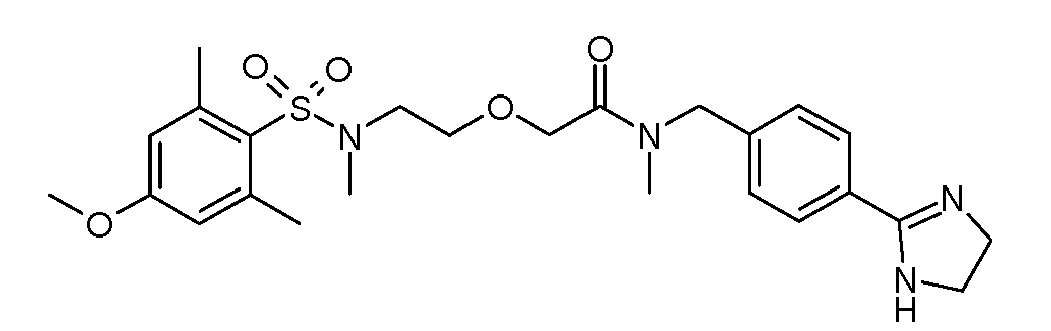
- a compound of formula (I) as defined in claim 1 is considered as being particularly useful in the prevention, treatment and/ or reduction of macular oedema, in particular macular oedema associated with or caused by diabetic retinopathy.
- Such compound is compound N[[5-(4,5-dihydro-1Himidazol-2yl)phenyl]methyl]-2-[2-[-(4-methoxy-2,6-dimethylphenyl)sulfonyl]methylamino]ethoxy]-N-methyl-acetamide or its salts, such as its phosphate, sulphate, or hemisulfate salts.
- FIG. 1 Summarizing the effect of the arylsulfonamide compound n° 49 given as eye drop on retinal vascular permeability in streptozotocin-induced diabetic Brown-Norway (A) and Wistar rats (B).
- Diabetic retinopathy is a major complication that affects between 18% and 45% of diabetic patients, a population which is continuously expending worldwide.
- the number of Americans 40 years or older with diabetic retinopathy and vision-threatening diabetic retinopathy will triple in 2050, from 5.5 million in 2005 to 16.0 million diabetic retinopathy and from 1.2 million in 2005 to 3.4 million for vision-threatening diabetic retinopathy. Increase among those 65 years or older will be more pronounced (2.5 million to 9.9 million for diabetic retinopathy and 0.5 million to 1.9 million for vision-threatening diabetic retinopathy.
- incidence of diabetic macular edema over a 10-year period ranges from 20 to 40% among patients diagnosed before and after the age of 30.
- diabetic retinopathy varies according to the race, type of diabetes, age and arterial blood pressure status.
- the prevalence of proliferative retinopathy, macular oedema and vision-threatening retinopathy is in the range of 2-5%, 5-7% and 6-8%, respectively.
- diabetic retinopathy is characterized by ischemic areas of acellular capillaries, and as diabetes progresses over the time, retinal vascular leakage, vascular sprouting, angiogenesis and hemorrhage occur ultimately leading to loss of vision.
- macular oedema defined as vascular plasma leakage leading to fluid accumulation and the deposition of hard exudates within the center of the macula.
- macular oedema has to be understood independently of the underlying disease causing it, and as being associated with any form of retinopathy. It for example includes macular oedema associated with or caused by diabetic retinopathy, age related macular degeneration, retinitis pigmentosa, ocular surgery, retinal vein occlusion (either central vein occlusion or branch vein occlusion, or both).
- macular oedema are associated with or caused by vision threatening retinopathy, proliferative retinopathy, clinically significant macular oedema, or chronic macular edema during diabetic retinopathy, as well as any other stage of what is usually understood as being a diabetic retinopathy.
- a compound of formula (I), useful to treat or prevent the specific ophthalmologic diseases of the invention, can also be used in association with other active components.
- a compound of formula (I) can be used in association with anti VEGF compounds.
- co-administration in association with a co-administration, or a combination of two active principles.
- the co-administration can be simultaneous, almost simultaneous, or delayed in time by a few days or weeks, for example by up to 4 or 5 weeks.
- VEGF Vascular endothelial growth factor
- VEGF is an endogenous molecule involved in a number of physiological processes, including blood vessel growth at the foetal stage, during injury healing, or for the growth of new vessels in tissues that have a deficient blood supply.
- VEGF is also involved in pathological processes, like the development of tumour blood vasculature which allows for growth and spread of the tumour, or the formation of new blood vessels in the eye that eventually contributes to vision loss.
- Anti-VEGF therapies therefore aim to prevent this abnormal blood vessel formation by blocking VEGF action.
- anti-VEGF compounds examples include Macugen® (Pegaptanib sodium), Lucentis (ranibizumab), Avastatin® (bevacizumab) RhuFab, or VEGF Trap Eye.
- a compound of formula (I) is used in association with anti-VEGF compounds for the prevention, treatment and/ or reduction of macular oedema, and in particular of macular oedema associated with or caused by diabetic retinopathy.
- a compound of formula (I) can also be used in association with corticosteroids.
- Corticosteroids are a class of steroid hormones that are produced in the adrenal cortex. Corticosteroids are involved in a wide range of physiologic systems such as stress response, immune response and regulation of inflammation, carbohydrate metabolism, protein catabolism, blood electrolyte levels, and behavior.
- Glucocorticoids such as cortisol control carbohydrate, fat and protein metabolism and are anti-inflammatory by preventing phospholipid release, decreasing eosinophil action and a number of other mechanisms.
- Mineralocorticoids such as aldosterone control electrolyte and water levels, mainly by promoting sodium retention in the kidney.
- Corticosteroids are generally grouped into four classes, based on chemical structure.
- Group A (short to medium acting glucocorticoids) comprises for example hydrocortisone, hydrocortisone acetate, cortisone acetate, tixocortol pivalate, prednisolone, methylprednisolone, and prednisone.
- Group B comprises triamcinolone acetonide, triamcinolone alcohol, mometasone, amcinonide, budesonide, desonide, fluocinonide, fluocinolone acetonide, and halcinonide.
- Group C comprises betamethasone, betamethasone sodium phosphate, dexamethasone, dexamethasone sodium phosphate, and fluocortolone.
- group D comprises hydrocortisone-17-butyrate, hydrocortisone-17-valerate, aclometasone dipropionate, betamethasone valerate, betamethasone dipropionate, prednicarbate, clobetasone-17-butyrate, clobetasol-17-propionate, fluocortolone caproate, fluocortolone pivalate, and fluprednidene acetate.
- a compound of formula (I) is used in association with corticosteroids for the prevention, treatment and/ or reduction of macular oedema, and in particular macular oedema associated with or caused by diabetic retinopathy.
- the compound of the present invention is compound n°49 as defined above, as well as its pharmaceutically acceptable salts. This compound can be made according to the processes described in WO 03/106428 .
- the pharmaceutically acceptable salts of the compound of interest mentioned above under formula (I) may be chosen from sulfate, hemi-sulfate, fumarate, maleate, tartrate, citrate, lactate, succinate, benzoate, camsylate, acetate, phosphate, chloride, bromide, aspartate or pamoate, for example.
- streptozotocin-treated rats develop an inflammatory retinopathy featured by rupture of the blood-retinal barrier, increase of inflammatory mediators, cytokines and growth factors (VEGF, basic fibroblast growth factor), microglial cell activation and leukostasis.
- VEGF cytokines and growth factors
- Compound n° 49 (fumarate and phosphate salts) was given as eye drop for 7 days to streptozotocin-diabetic pigmented Brown-Norway and non-pigmented Wistar rats and its effect on retinal edema was then determined.
- Brown-Norway or Wistar rats were made diabetic by subcutaneous injection of 65 mg/kg intraperitoneal streptozotocin. Rats with a glycemia ⁇ 350 mg/dl were discarded from the study. Seven days later, Brown-Norway rats were treated twice daily for 7 days with a single eye drop (10 ⁇ l) containing 0.1, 0.3, 1 and 3% phosphate salt of compound n° 49 or its vehicle (Saline Solution). Wistar rats were treated over the same period (from day 7 for 7 days) with a single eye drop (10 ⁇ l) containing 0.3 and 1% fumarate salt of compound n° 49 or its vehicle (Saline Solution). On day 15, retinal vascular leakage was determined by measurement of retinal content of Evans Blue dye.
- retinal vascular permeability was significantly increased in diabetic Brown-Norway and Wistar rats compared to control normoglycemic rats.
- compound n° 49 did not affect glycemia.
- the phosphate salt of compound n° 49 reduced in dose-dependent manner retinal oedema with a maximum of 55%.
- 1% compound n° 49 eye drops reduced retinal edema with a maximum of 58% and 63% (data not shown).
- both 0.3 and 1% compound n° 49 fumarate salt abolished retinal vascular permeability ( Figure 1 ).
- Fig. 1 shows the effect of compound n° 49 given as eye drop on retinal vascular permeability in streptozotocin-induced diabetic Brown-Norway (A) and Wistar rats (B). More specifically, Fig. 1A is the dose-response of compound n° 49 instilled twice a day for 7 days as eye drops (0.1 to 3%) on retinal vascular leakage in streptozotocin-diabetic Brown-Norway rats. Recombinant tissue kallikrein binding protein (rKBP) was used as a reference drug and was given intravitreally 48 hours before vascular leakage measurement. Values are means ⁇ standard error mean of 12 eyes/group (6 rats).
- Fig. 1B shows the effect of compound n° 49 instilled twice a day for 7 days as eye drops (0.3 and 1%) on retinal vascular leakage in streptozotocin-diabetic Wistar rats. Values are means ⁇ standard error mean of 6 to 11 eyes/group. **means P ⁇ 0.01; *** means P ⁇ 0.001 ina one-way ANOVA followed by a Student's t-test.
- the route by which the phosphate salt of compound n° 49 reaches the retina following topical instillation was investigated to determine whether it is mainly by systemic circulation or by the trans- and/or peri-ocular pathway.
- Diabetic Brown-Norway rats were treated with 3% compound n° 49 phosphate in a single eye for 7 days or subcutaneously with matching daily dosage (0.6 mg/rat).
- retinal vascular permeability was significantly reduced by 37% (P ⁇ 0.001) whilst the contralateral eye remained unaffected.
- a daily subcutaneous administration of 0.6 mg compound n° 49 phosphate rat had no effect on retinal vascular permeability.
- Non-diabetic rats (6-8 rats) were used as positive control group without the treatment with STZ or compound n°49 or B (Control group in Figure 2 ).
- Compound B has the following formula:
- vascular permeability was quantified by measuring Evans Blue-albumin leakage from blood vessels into the retina following a documented protocol ( Gao G et al., Diabetologia, 46, 689-698, 2003 ). Briefly, Evans blue was injected through the femoral vein and circulated for 2 h. Then the rats were infused via the left ventricle with prewarmed PBS. Immediately after perfusion, retina were carefully dissected under an operating microscope and homogenized. Evans blue dye concentration in the retina homogenate was measured using a spectrometer and normalized by total protein concentration.
- Figure 2 represents the results of retinal vascular leakage in STZ diabetic rats (3 studies).
- vascular leakage mean in rKBP-treated and vehicle-treated rats was compared using a parametric or non parametric test (depending on variance homogeneity). If the difference between the two means was statistically significant, the means of drug- and vehicle-treated groups were compared using a one-way ANOVA (or a non parametric analysis if the variances are not homogeneous) followed by post-hoc testing.
- P values are inferior to 0.001 ("***") according to Dunnet test; "NS" means non-significant.
- Both Compound n°49 and Compound B were shown to be Bradykinin B1 Receptor Antagonists.
- Compound B had an inhibition constant (Ki) of 1.6 nM for the human B1 receptor and had a pA2 of 7.8.
- Ki was calculated based on the concentration-response curves resulting from competitive binding experiments with [3H]des-Arg10-kallidin, a ligand specific for B1 receptor on HEK293 human cell membranes.
- pA2 was calculated based on the Schild curve resulting from curves of the concentration-response to des-Arg10-kallidin (B1 receptor agonist) on rat ileum.
- Bradykinin B1 Receptor antagonists have not necessary the same activity on macular oedema, especially upon topical administration as demonstrated above. Accordingly, some Bradykinin B1 Receptor Antagonists such as Compound B may have a non-significant activity on macular oedema, whereas a compound of formula (I) (compound n°49) can be used for the prevention, treatment and/ or reduction of macular oedema, in particular associated with or caused by diabetic retinopathy.
- a compound of formula (I) compound n°49
Landscapes
- Health & Medical Sciences (AREA)
- Life Sciences & Earth Sciences (AREA)
- Chemical & Material Sciences (AREA)
- Pharmacology & Pharmacy (AREA)
- Veterinary Medicine (AREA)
- Public Health (AREA)
- General Health & Medical Sciences (AREA)
- Animal Behavior & Ethology (AREA)
- Medicinal Chemistry (AREA)
- Epidemiology (AREA)
- General Chemical & Material Sciences (AREA)
- Organic Chemistry (AREA)
- Nuclear Medicine, Radiotherapy & Molecular Imaging (AREA)
- Chemical Kinetics & Catalysis (AREA)
- Diabetes (AREA)
- Bioinformatics & Cheminformatics (AREA)
- Engineering & Computer Science (AREA)
- Hematology (AREA)
- Obesity (AREA)
- Biochemistry (AREA)
- Molecular Biology (AREA)
- Endocrinology (AREA)
- Emergency Medicine (AREA)
- Ophthalmology & Optometry (AREA)
- Pharmaceuticals Containing Other Organic And Inorganic Compounds (AREA)
- Medicines That Contain Protein Lipid Enzymes And Other Medicines (AREA)
- Acyclic And Carbocyclic Compounds In Medicinal Compositions (AREA)
- Organic Low-Molecular-Weight Compounds And Preparation Thereof (AREA)
- Medicines Containing Antibodies Or Antigens For Use As Internal Diagnostic Agents (AREA)
Description
- Arylsufonamides are known for example from
WO 03/106428 
- R1 represents an aromatic ring that is non-substituted or substituted by one or more atoms or groups of atoms chosen from among the halogens, C1-C3 alkyl groups, C1-C3 alcoxy groups, nitro, cyano, trifluoromethyl or trifluoromethoxy groups,
- R2 represents a hydrogen atom, or a straight, branched or cyclic hydrocarbon chain having 1 to 4 carbon atoms optionally substituted by a phenyl group, by a CONH2 group or by one or more fluorine atoms,
- R3 represents a hydrogen atom, a hydroxy group, or with R4 forms a -CH=N- group or a straight or branched C2-C4 alkylene group,
- R4 represents a hydrogen atom or with R3 forms a -CH=N- group or a straight or branched C2-C4 alkylene group,
- R5 represents a hydrogen atom or a C1-C3 alkyl group,
- R6 represents a hydrogen atom or a halogen,
- Y represents a C2-C4 alkylene group, saturated or unsaturated, straight or branched, optionally interrupted between two carbon atoms by an oxygen atom.
- By aromatic system is meant a phenyl system, a 1- or 2-naphthyl system or a 2- or 3-thienyl system.
- These compounds are described to be useful in the treatment of various forms of pain such as inflammatory hyperalgesia, allodynia, neuropathic pain associated for example with diabetes, neuropathy (constriction of sciatic nerve, lumbago), any form of trauma, surgery (tooth extraction, tonsil removal), interstitial cystitis, inflammatory bowel disease and cancer.
- They are also described to be useful in the treatment of any pathology associated with neutrophil migration, such as acute respiratory distress syndrome, psoriasis, chronic lung obstruction, inflammatory bowel diseases, and rheumatoid arthritis.
- The compounds, on account of their mode of action, also find use in the treatment or prevention of any pathological condition in which the B1 receptors of bradykinin are involved and in particular are over-expressed.
- In addition to the various forms of pain and inflammatory diseases already cited, the compounds of formula (I) may, according to the disclosure of
WO03/106428 - Pruneau D. et al. in "Targeting the kallikrein-kinin system as a new therapeutic approach to diabetic retinopathy", CURRENT OPINION IN INVESTIGATIONAL DRUGS, THOMSON REUTERS (SCIENTIFIC) LTD, LONDON, UK, vol. 11, no. 5, 1 May 2010 (2010-05-01), pages 507-514, and in "Topical Treatment With the Kinin B1 Receptor Antagonist, FOV2304, Inhibits Diabetic Retinopathy (DR) in Rats", 2 May 2010 (2010-05-02), suggest that targeting the pro-inflammatory response via B1R of the KKS system in diabetic retinopathy is a promising approach for treating retinopathy less invasively. These publications do not even suggest the structure of the compound involved in these studies. It has been found according to the present invention that not all bradykinin B1 receptor antagonists are useful in the prevention, treatment and/ or reduction of macular oedema. It has now been found that a compound of formula (I) as well as its pharmaceutically acceptable salts is useful in the prevention, treatment and/ or reduction of macular oedema, and in particular in the treatment of macular oedema caused by or associated with diabetic retinopathy.
- A compound of formula (I) as defined in
claim 1 is considered as being particularly useful in the prevention, treatment and/ or reduction of macular oedema, in particular macular oedema associated with or caused by diabetic retinopathy. Such compound is compound N[[5-(4,5-dihydro-1Himidazol-2yl)phenyl]methyl]-2-[2-[-(4-methoxy-2,6-dimethylphenyl)sulfonyl]methylamino]ethoxy]-N-methyl-acetamide or its salts, such as its phosphate, sulphate, or hemisulfate salts. - This compound is exemplified as compound n° 49 of
WO 03/106428 
- It is referred to in the present specification as "compound n° 49".
- This will be further exemplified by
Fig. 1 , summarizing the effect of the arylsulfonamide compound n° 49 given as eye drop on retinal vascular permeability in streptozotocin-induced diabetic Brown-Norway (A) and Wistar rats (B). - Diabetic retinopathy is a major complication that affects between 18% and 45% of diabetic patients, a population which is continuously expending worldwide. The number of Americans 40 years or older with diabetic retinopathy and vision-threatening diabetic retinopathy will triple in 2050, from 5.5 million in 2005 to 16.0 million diabetic retinopathy and from 1.2 million in 2005 to 3.4 million for vision-threatening diabetic retinopathy. Increase among those 65 years or older will be more pronounced (2.5 million to 9.9 million for diabetic retinopathy and 0.5 million to 1.9 million for vision-threatening diabetic retinopathy. Moreover incidence of diabetic macular edema over a 10-year period ranges from 20 to 40% among patients diagnosed before and after the age of 30. In this respect, this is the leading cause of blindness in working-age population in the United States. Incidence of diabetic retinopathy varies according to the race, type of diabetes, age and arterial blood pressure status. The prevalence of proliferative retinopathy, macular oedema and vision-threatening retinopathy is in the range of 2-5%, 5-7% and 6-8%, respectively. At early stages, diabetic retinopathy is characterized by ischemic areas of acellular capillaries, and as diabetes progresses over the time, retinal vascular leakage, vascular sprouting, angiogenesis and hemorrhage occur ultimately leading to loss of vision. In diabetic patients, there is a relationship between vision loss and clinically significant macular oedema, defined as vascular plasma leakage leading to fluid accumulation and the deposition of hard exudates within the center of the macula.
- As will be further understood from the specification, a compound of formula (I) has been shown to be particularly efficient to treat macular oedema.
- In the context of the present specification, the term "macular oedema" has to be understood independently of the underlying disease causing it, and as being associated with any form of retinopathy. It for example includes macular oedema associated with or caused by diabetic retinopathy, age related macular degeneration, retinitis pigmentosa, ocular surgery, retinal vein occlusion (either central vein occlusion or branch vein occlusion, or both). Other examples of macular oedema are associated with or caused by vision threatening retinopathy, proliferative retinopathy, clinically significant macular oedema, or chronic macular edema during diabetic retinopathy, as well as any other stage of what is usually understood as being a diabetic retinopathy.
- A compound of formula (I), useful to treat or prevent the specific ophthalmologic diseases of the invention, can also be used in association with other active components. For example, a compound of formula (I) can be used in association with anti VEGF compounds.
- In the context of the present specification, by "in association with" it should be understood a co-administration, or a combination of two active principles. The co-administration can be simultaneous, almost simultaneous, or delayed in time by a few days or weeks, for example by up to 4 or 5 weeks.
- Vascular endothelial growth factor (VEGF) is an endogenous molecule involved in a number of physiological processes, including blood vessel growth at the foetal stage, during injury healing, or for the growth of new vessels in tissues that have a deficient blood supply. VEGF is also involved in pathological processes, like the development of tumour blood vasculature which allows for growth and spread of the tumour, or the formation of new blood vessels in the eye that eventually contributes to vision loss. Anti-VEGF therapies therefore aim to prevent this abnormal blood vessel formation by blocking VEGF action.
- Examples of anti-VEGF compounds include Macugen® (Pegaptanib sodium), Lucentis (ranibizumab), Avastatin® (bevacizumab) RhuFab, or VEGF Trap Eye.
- Therefore, in another aspect, a compound of formula (I) is used in association with anti-VEGF compounds for the prevention, treatment and/ or reduction of macular oedema, and in particular of macular oedema associated with or caused by diabetic retinopathy.
- A compound of formula (I) can also be used in association with corticosteroids. Corticosteroids are a class of steroid hormones that are produced in the adrenal cortex. Corticosteroids are involved in a wide range of physiologic systems such as stress response, immune response and regulation of inflammation, carbohydrate metabolism, protein catabolism, blood electrolyte levels, and behavior.
- Glucocorticoids such as cortisol control carbohydrate, fat and protein metabolism and are anti-inflammatory by preventing phospholipid release, decreasing eosinophil action and a number of other mechanisms. Mineralocorticoids such as aldosterone control electrolyte and water levels, mainly by promoting sodium retention in the kidney.
- Corticosteroids are generally grouped into four classes, based on chemical structure. Group A (short to medium acting glucocorticoids) comprises for example hydrocortisone, hydrocortisone acetate, cortisone acetate, tixocortol pivalate, prednisolone, methylprednisolone, and prednisone. Group B comprises triamcinolone acetonide, triamcinolone alcohol, mometasone, amcinonide, budesonide, desonide, fluocinonide, fluocinolone acetonide, and halcinonide. Group C comprises betamethasone, betamethasone sodium phosphate, dexamethasone, dexamethasone sodium phosphate, and fluocortolone. The last group, group D, comprises hydrocortisone-17-butyrate, hydrocortisone-17-valerate, aclometasone dipropionate, betamethasone valerate, betamethasone dipropionate, prednicarbate, clobetasone-17-butyrate, clobetasol-17-propionate, fluocortolone caproate, fluocortolone pivalate, and fluprednidene acetate.
- Therefore, in another aspect, a compound of formula (I) is used in association with corticosteroids for the prevention, treatment and/ or reduction of macular oedema, and in particular macular oedema associated with or caused by diabetic retinopathy.
- The compound of the present invention is compound n°49 as defined above, as well as its pharmaceutically acceptable salts. This compound can be made according to the processes described in
WO 03/106428 - The pharmaceutically acceptable salts of the compound of interest mentioned above under formula (I) may be chosen from sulfate, hemi-sulfate, fumarate, maleate, tartrate, citrate, lactate, succinate, benzoate, camsylate, acetate, phosphate, chloride, bromide, aspartate or pamoate, for example.
- The effect of an arylsulfonamide compound of formula (I) on macular oedema, and in particular on macular oedema associated with or caused by diabetic retinopathy diabetic retinopathy has been investigated as explained below.
- Administration of streptozotocin to rodents produces a massive destruction of pancreatic β-cells, and thus, triggers marked elevation of glycemia and development of a diabetic state which, in part, mimics early stages of
type 1 diabetes. In this regard, streptozotocin-treated rats develop an inflammatory retinopathy featured by rupture of the blood-retinal barrier, increase of inflammatory mediators, cytokines and growth factors (VEGF, basic fibroblast growth factor), microglial cell activation and leukostasis. - Compound n° 49 (fumarate and phosphate salts) was given as eye drop for 7 days to streptozotocin-diabetic pigmented Brown-Norway and non-pigmented Wistar rats and its effect on retinal edema was then determined.
- Male Brown-Norway or Wistar rats were made diabetic by subcutaneous injection of 65 mg/kg intraperitoneal streptozotocin. Rats with a glycemia < 350 mg/dl were discarded from the study. Seven days later, Brown-Norway rats were treated twice daily for 7 days with a single eye drop (10 µl) containing 0.1, 0.3, 1 and 3% phosphate salt of compound n° 49 or its vehicle (Saline Solution). Wistar rats were treated over the same period (from day 7 for 7 days) with a single eye drop (10 µl) containing 0.3 and 1% fumarate salt of compound n° 49 or its vehicle (Saline Solution). On
day 15, retinal vascular leakage was determined by measurement of retinal content of Evans Blue dye. - As shown in
Fig. 1 retinal vascular permeability was significantly increased in diabetic Brown-Norway and Wistar rats compared to control normoglycemic rats. In diabetic Brown-Norway and Wistar rats, compound n° 49 did not affect glycemia. In diabetic Brown-Norway rats, the phosphate salt of compound n° 49 reduced in dose-dependent manner retinal oedema with a maximum of 55%. In two separate preliminary studies, 1% compound n° 49 eye drops reduced retinal edema with a maximum of 58% and 63% (data not shown). In diabetic Wistar rats, both 0.3 and 1% compound n° 49 fumarate salt abolished retinal vascular permeability (Figure 1 ). These data show that in two different rat strains made diabetic with streptozotocin, compound n° 49 markedly reduced rupture of the blood retinal barrier. -
Fig. 1 shows the effect of compound n° 49 given as eye drop on retinal vascular permeability in streptozotocin-induced diabetic Brown-Norway (A) and Wistar rats (B). More specifically,Fig. 1A is the dose-response of compound n° 49 instilled twice a day for 7 days as eye drops (0.1 to 3%) on retinal vascular leakage in streptozotocin-diabetic Brown-Norway rats. Recombinant tissue kallikrein binding protein (rKBP) was used as a reference drug and was given intravitreally 48 hours before vascular leakage measurement. Values are means ± standard error mean of 12 eyes/group (6 rats). *** means that P<0.001in a Student's t-test.
Fig. 1B shows the effect of compound n° 49 instilled twice a day for 7 days as eye drops (0.3 and 1%) on retinal vascular leakage in streptozotocin-diabetic Wistar rats. Values are means ± standard error mean of 6 to 11 eyes/group. **means P<0.01; *** means P<0.001 ina one-way ANOVA followed by a Student's t-test. - The route by which the phosphate salt of compound n° 49 reaches the retina following topical instillation was investigated to determine whether it is mainly by systemic circulation or by the trans- and/or peri-ocular pathway. Diabetic Brown-Norway rats were treated with 3% compound n° 49 phosphate in a single eye for 7 days or subcutaneously with matching daily dosage (0.6 mg/rat). In eyes treated with compound n° 49, retinal vascular permeability was significantly reduced by 37% (P<0.001) whilst the contralateral eye remained unaffected. In addition, a daily subcutaneous administration of 0.6 mg compound n° 49 phosphate rat had no effect on retinal vascular permeability. These data indicate that compound n° 49 phosphate upon topical administration likely reached retinal vasculature through trans-corneal and scleral/choroidal circulation with no or minimal contribution of systemic redistribution.
- In order to explore molecular pathways involved into reduction of retinal vascular permeability by compound n°49 phosphate in diabetic rats, expression of mRNA of cytokines, vasoactive mediators and growth factors was quantified in retina of control and diabetic Wistar rats treated or not with 1% compound n°49 phosphate eye drops for 7 days. Expression of mRNA of B1R, B2R, i-NOS, e-NOS, COX-2, ICAM-1, VEGF-R2, VEGF-a, IL-1β and HIF-1α was increased in diabetic rat retina compared to control by 7.5-fold (P<0.05), 5.5, 15- (P<0.01), 6.5- , 8- (P<0.05), 8- , 5- (P<0.05), 12-, 6.5- (P<0.01) and 7-fold (P<0.05), respectively. Expression of TNF-α mRNA remained unchanged. After 7 days treatment with 1% Compound n°49 eye drops, mRNA expression of B1R, B2R, i-NOS, e-NOS, COX-2, ICAM-1, VEGF-A, IL-1α and HIF-1α was down-regulated to control level whilst expression of VEGF-A was reduced by 50 %. In accordance with the literature (Gardner and Antonetti, 2008), these data show that the retina of diabetic rats displays inflammatory features. Interestingly, compound n° 49 phosphate blunted the retinal inflammatory response associated with the development of diabetes without affecting glycemia.
- The effect of compound n°49 phosphate on leukocyte adhesion to the retinal vasculature of streptozotocin-diabetic Wistar rats was also investigated using the same protocol of administration of compound n°49 phosphate (1% eye drop twice-a-day for 7 days). The number of leukocytes in retinal vessels of diabetic rats was significantly increased compared to control non-diabetic animals (P<0.05). Following treatment with compound n° 49 phosphate, leukostasis in diabetic rats was significantly blunted (P<0.05). These findings are consistent with a reduction of ICAM-1 expression by compound n°49 phosphate, since ICAM-1 has been shown to play a key role in leukocyte adhesion.
- Besides, it has been shown that compound n°49 administered under phosphate salt form has an equivalent activity to the fumarate salt.
- In order to induce diabetes, adult Brown-Norway rats (8-12 weeks of age) were given a single intraperitoneal injection of freshly made streptozotocin (STZ) (50 mg/kg of body weight in 10 mmol/L of citrate buffer, pH 4.5). Serum glucose level was examined 2 days after the STZ injection and weekly thereafter. Only the animals with blood glucose levels higher than 350 mg/dLwere used as diabetic rats.
- Non-diabetic rats (6-8 rats) were used as positive control group without the treatment with STZ or compound n°49 or B (Control group in
Figure 2 ). - Eight (8) days after the onset of diabetes (i.e. on Day 8), the diabetic rats were separated into groups, with 6-8 rats per group (12-16 eye):
- The treatments were as follows:
- From Day 8 to Day 14, animals were treated daily with 10 µl ocular instillation in both eyes of 1% of Compound n°49 (solubilised in physiologic serum (0.9% NaCl) as fumarate salt - "
Cpd 49" group), 1% of Compound B (solubilised in physiologic serum (0.9% NaCl) as dichlorhydrate salt - "Cpd B" group), or corresponding saline vehicle ("Diab" group, i.e. physiologic serum (0.9% NaCl)). In two experiments, a group of diabetic rats were treated by intravitreal route with recombinant kallikrein-binding protein ("rKBP" group) which was used as a positive reference drug. In such conditions, rKBP has been shown to consistently reduce retinal vascular leakage by approximately 50% (Dr. JX Ma, Charlesson LLC, Oklahoma City, Oklahoma, USA). - Compound B has the following formula:

- At Day 14, vascular permeability was quantified by measuring Evans Blue-albumin leakage from blood vessels into the retina following a documented protocol (Gao G et al., Diabetologia, 46, 689-698, 2003). Briefly, Evans blue was injected through the femoral vein and circulated for 2 h. Then the rats were infused via the left ventricle with prewarmed PBS. Immediately after perfusion, retina were carefully dissected under an operating microscope and homogenized. Evans blue dye concentration in the retina homogenate was measured using a spectrometer and normalized by total protein concentration.
-
Figure 2 represents the results of retinal vascular leakage in STZ diabetic rats (3 studies). - First, vascular leakage mean in rKBP-treated and vehicle-treated rats was compared using a parametric or non parametric test (depending on variance homogeneity). If the difference between the two means was statistically significant, the means of drug- and vehicle-treated groups were compared using a one-way ANOVA (or a non parametric analysis if the variances are not homogeneous) followed by post-hoc testing. In
Figure 2 : P values are inferior to 0.001 ("***") according to Dunnet test; "NS" means non-significant. - Both Compound n°49 and Compound B were shown to be Bradykinin B1 Receptor Antagonists. In particular Compound B had an inhibition constant (Ki) of 1.6 nM for the human B1 receptor and had a pA2 of 7.8. Ki was calculated based on the concentration-response curves resulting from competitive binding experiments with [3H]des-Arg10-kallidin, a ligand specific for B1 receptor on HEK293 human cell membranes. pA2 was calculated based on the Schild curve resulting from curves of the concentration-response to des-Arg10-kallidin (B1 receptor agonist) on rat ileum.
- According to the above results, it has been shown that two Bradykinin B1 Receptor antagonists have not necessary the same activity on macular oedema, especially upon topical administration as demonstrated above. Accordingly, some Bradykinin B1 Receptor Antagonists such as Compound B may have a non-significant activity on macular oedema, whereas a compound of formula (I) (compound n°49) can be used for the prevention, treatment and/ or reduction of macular oedema, in particular associated with or caused by diabetic retinopathy.
Claims (7)
- Compound of formula below or one of its pharmaceutically acceptable salts
- Compound for use in the prevention, treatment and/ or reduction of macular oedema according to claim 1, characterised in that said macular oedema is associated with or caused by diabetic retinopathy.
- Compound for use in the prevention, treatment and/ or reduction of macular oedema according to any preceding claim wherein the pharmaceutically acceptable salt is phosphate, sulphate, or hemisulfate.
- Compound for use in the prevention, treatment and/ or reduction of macular oedema according to any preceding claim in association with an anti-VEGF compound.
- Compound for use in the prevention, treatment and/ or reduction of macular oedema according to claim 4 wherein the anti-VEGF compound is Macugen® (Pegaptanib sodium), Lucentis (ranibizumab), Avastatin® (bevacizumab) RhuFab, or VEGF Trap-eye.
- Compound for use in the prevention, treatment and/ or reduction of macular oedema according to any of claims 1 to 3 in association with a corticosteroid.
- Compound for use in the prevention, treatment and/ or reduction of macular oedema according to any preceding claim, characterized in that said compound is topically administered.
Priority Applications (1)
| Application Number | Priority Date | Filing Date | Title |
|---|---|---|---|
| EP11794722.6A EP2648712B1 (en) | 2010-12-09 | 2011-12-09 | Arylsulfonamide derivatives for the prevention or treatment of macular oedema |
Applications Claiming Priority (3)
| Application Number | Priority Date | Filing Date | Title |
|---|---|---|---|
| EP10306381 | 2010-12-09 | ||
| EP11794722.6A EP2648712B1 (en) | 2010-12-09 | 2011-12-09 | Arylsulfonamide derivatives for the prevention or treatment of macular oedema |
| PCT/EP2011/072306 WO2012076685A1 (en) | 2010-12-09 | 2011-12-09 | Arylsulfonamide derivatives for the prevention or treatment of specific ophthalmologic disorders |
Publications (2)
| Publication Number | Publication Date |
|---|---|
| EP2648712A1 EP2648712A1 (en) | 2013-10-16 |
| EP2648712B1 true EP2648712B1 (en) | 2015-10-21 |
Family
ID=43567690
Family Applications (1)
| Application Number | Title | Priority Date | Filing Date |
|---|---|---|---|
| EP11794722.6A Active EP2648712B1 (en) | 2010-12-09 | 2011-12-09 | Arylsulfonamide derivatives for the prevention or treatment of macular oedema |
Country Status (14)
| Country | Link |
|---|---|
| US (1) | US20130315903A1 (en) |
| EP (1) | EP2648712B1 (en) |
| JP (1) | JP2013544871A (en) |
| CN (1) | CN103402507B (en) |
| AR (1) | AR084194A1 (en) |
| AU (1) | AU2011340494B2 (en) |
| BR (1) | BR112013014379A2 (en) |
| CA (1) | CA2820124A1 (en) |
| ES (1) | ES2559223T3 (en) |
| MX (1) | MX2013006527A (en) |
| RU (1) | RU2583929C2 (en) |
| UY (1) | UY33788A (en) |
| WO (1) | WO2012076685A1 (en) |
| ZA (1) | ZA201304121B (en) |
Family Cites Families (6)
| Publication number | Priority date | Publication date | Assignee | Title |
|---|---|---|---|---|
| WO1997030704A2 (en) * | 1996-02-26 | 1997-08-28 | Advanced Research And Technology Institute | Use of carbonic anhydrase inhibitors for treating macular edema |
| FR2840897B1 (en) * | 2002-06-14 | 2004-09-10 | Fournier Lab Sa | NOVEL ARYLSULFONAMIDE DERIVATIVES AND THEIR USE IN THERAPEUTICS |
| WO2008080110A1 (en) * | 2006-12-21 | 2008-07-03 | Alcon, Inc. | Methods for treating macular edema and pathologic ocular angiogenesis using a neuroprotective agent and a receptor tyrosine kinase inhibitor |
| TNSN08110A1 (en) * | 2008-03-11 | 2009-07-14 | Rekik Raouf Dr | Drug delivery to the anterior and posterior segment of the eye from drops |
| RU2393824C1 (en) * | 2009-04-14 | 2010-07-10 | Государственное учреждение "УФИМСКИЙ НАУЧНО-ИССЛЕДОВАТЕЛЬСКИЙ ИНСТИТУТ ГЛАЗНЫХ БОЛЕЗНЕЙ" Академии наук Республики Башкортостан (УфНИИ ГБ АН РБ) | Method of treating macular oedemas of various geneses |
| AR084193A1 (en) * | 2010-12-09 | 2013-04-24 | Fovea Pharmaceuticals | DOSAGE OF ARILSUFONAMIDA DERIVATIVES |
-
2011
- 2011-12-07 AR ARP110104582A patent/AR084194A1/en not_active Application Discontinuation
- 2011-12-09 AU AU2011340494A patent/AU2011340494B2/en not_active Ceased
- 2011-12-09 JP JP2013542559A patent/JP2013544871A/en active Pending
- 2011-12-09 MX MX2013006527A patent/MX2013006527A/en active IP Right Grant
- 2011-12-09 RU RU2013131281/15A patent/RU2583929C2/en not_active IP Right Cessation
- 2011-12-09 CN CN201180065972.3A patent/CN103402507B/en not_active Expired - Fee Related
- 2011-12-09 UY UY0001033788A patent/UY33788A/en unknown
- 2011-12-09 EP EP11794722.6A patent/EP2648712B1/en active Active
- 2011-12-09 BR BR112013014379A patent/BR112013014379A2/en not_active IP Right Cessation
- 2011-12-09 CA CA2820124A patent/CA2820124A1/en not_active Abandoned
- 2011-12-09 US US13/992,314 patent/US20130315903A1/en not_active Abandoned
- 2011-12-09 ES ES11794722.6T patent/ES2559223T3/en active Active
- 2011-12-09 WO PCT/EP2011/072306 patent/WO2012076685A1/en not_active Ceased
-
2013
- 2013-06-05 ZA ZA2013/04121A patent/ZA201304121B/en unknown
Also Published As
| Publication number | Publication date |
|---|---|
| EP2648712A1 (en) | 2013-10-16 |
| CA2820124A1 (en) | 2012-06-14 |
| ZA201304121B (en) | 2014-08-27 |
| HK1186383A1 (en) | 2014-03-14 |
| JP2013544871A (en) | 2013-12-19 |
| BR112013014379A2 (en) | 2016-09-27 |
| CN103402507B (en) | 2016-02-17 |
| UY33788A (en) | 2012-07-31 |
| CN103402507A (en) | 2013-11-20 |
| AR084194A1 (en) | 2013-04-24 |
| US20130315903A1 (en) | 2013-11-28 |
| RU2013131281A (en) | 2015-01-20 |
| WO2012076685A1 (en) | 2012-06-14 |
| ES2559223T3 (en) | 2016-02-11 |
| MX2013006527A (en) | 2014-06-11 |
| RU2583929C2 (en) | 2016-05-10 |
| AU2011340494B2 (en) | 2015-05-14 |
| AU2011340494A1 (en) | 2013-05-02 |
Similar Documents
| Publication | Publication Date | Title |
|---|---|---|
| Stewart | Corticosteroid use for diabetic macular edema: old fad or new trend? | |
| Kim et al. | The effect of topical bevacizumab on corneal neovascularization | |
| EP1802373B1 (en) | Carboxy-amido-triazoles for the localized teatment of ocular diseases | |
| Zhang et al. | Glucocorticoids: structure, signaling and molecular mechanisms in the treatment of diabetic retinopathy and diabetic macular edema | |
| EP3474836B1 (en) | Salbutamol-containing ophthalmic medicament | |
| Li et al. | Dexamethasone attenuates dry eye-induced pyroptosis by regulating the KCNQ1OT1/miR-214 cascade | |
| US20170224815A1 (en) | Method of Preventing and Treating Retinal Microvasculature Inflammation Using C-Met Signaling Pathway Inhibition | |
| US20230097413A1 (en) | Methods and pharmaceutical compositions for the treatment of choroidal neovascularisation | |
| Hartnett et al. | Triamcinolone reduces neovascularization, capillary density and IGF-1 receptor phosphorylation in a model of oxygen-induced retinopathy | |
| AU2011340494B2 (en) | Arylsulfonamide derivatives for the prevention or treatment of specific ophthalmologic disorders | |
| Haritoglou et al. | Fluocinolone acetonide and its potential in the treatment of chronic diabetic macular edema | |
| HK1186383B (en) | Arylsulfonamide derivatives for the prevention or treatment of macular oedema | |
| JP2006518383A (en) | Glucocorticoid formulations for treating pathological ocular angiogenesis | |
| Kusari et al. | Effect of brimonidine on retinal and choroidal neovascularization in a mouse model of retinopathy of prematurity and laser-treated rats | |
| TW201304773A (en) | Arylsulfonamide derivatives for the prevention or treatment of specific ophthalmologic disorders | |
| Palii et al. | Nonpeptide somatostatin receptor agonists specifically target ocular neovascularization via the somatostatin type 2 receptor | |
| US20130253027A1 (en) | Dosages of arylsulfonamide derivatives | |
| Benelli et al. | Trapidil inhibits endothelial cell proliferation and angiogenesis in the chick chorioallantoic membrane and in the rat cornea | |
| EP1633339A1 (en) | Formulations of non-steroidal anti-inflammatory agents to treat pathologic ocular angiogenesis | |
| Theodorakopoulou et al. | Aldosterone synthase inhibitors for uncontrolled and resistant hypertension in CKD: an assessment from bench to bedside | |
| JP2009521511A (en) | Use of anecoltab acetate as an adjunct during follicular surgery | |
| Banz et al. | Calming the Ocular Storm | |
| Roopadevi | A Comparative Study of Efficacy and Safety of Difluprednate Ophthalmic Emulsion 0.05% with Prednisolone Acetate Ophthalmic Suspension 1% for Managing Ocular Inflammation and Pain Following Cataract Surgery | |
| Shakuntala | A Comparative Study of Efficacy of Nepafenac and Prednisolone Acetate in Cataract Surgery Induced Inflammation Vims a Tertiary Care Hospital Bellary | |
| Khan et al. | Renal denervation in resistant hypertension leads to significant improvement in ambulatory daytime systolic blood pressure: a 12-month follow-up audit from a single UK center |
Legal Events
| Date | Code | Title | Description |
|---|---|---|---|
| PUAI | Public reference made under article 153(3) epc to a published international application that has entered the european phase |
Free format text: ORIGINAL CODE: 0009012 |
|
| 17P | Request for examination filed |
Effective date: 20130605 |
|
| AK | Designated contracting states |
Kind code of ref document: A1 Designated state(s): AL AT BE BG CH CY CZ DE DK EE ES FI FR GB GR HR HU IE IS IT LI LT LU LV MC MK MT NL NO PL PT RO RS SE SI SK SM TR |
|
| AX | Request for extension of the european patent |
Extension state: BA ME |
|
| REG | Reference to a national code |
Ref country code: HK Ref legal event code: DE Ref document number: 1186383 Country of ref document: HK |
|
| 17Q | First examination report despatched |
Effective date: 20140407 |
|
| GRAP | Despatch of communication of intention to grant a patent |
Free format text: ORIGINAL CODE: EPIDOSNIGR1 |
|
| INTG | Intention to grant announced |
Effective date: 20150515 |
|
| GRAS | Grant fee paid |
Free format text: ORIGINAL CODE: EPIDOSNIGR3 |
|
| GRAA | (expected) grant |
Free format text: ORIGINAL CODE: 0009210 |
|
| AK | Designated contracting states |
Kind code of ref document: B1 Designated state(s): AL AT BE BG CH CY CZ DE DK EE ES FI FR GB GR HR HU IE IS IT LI LT LU LV MC MK MT NL NO PL PT RO RS SE SI SK SM TR |
|
| AX | Request for extension of the european patent |
Extension state: BA ME |
|
| REG | Reference to a national code |
Ref country code: GB Ref legal event code: FG4D Ref country code: NL Ref legal event code: MP Effective date: 20151021 |
|
| REG | Reference to a national code |
Ref country code: CH Ref legal event code: EP |
|
| REG | Reference to a national code |
Ref country code: AT Ref legal event code: REF Ref document number: 756123 Country of ref document: AT Kind code of ref document: T Effective date: 20151115 |
|
| REG | Reference to a national code |
Ref country code: IE Ref legal event code: FG4D |
|
| REG | Reference to a national code |
Ref country code: FR Ref legal event code: PLFP Year of fee payment: 5 |
|
| REG | Reference to a national code |
Ref country code: DE Ref legal event code: R096 Ref document number: 602011020882 Country of ref document: DE |
|
| PGFP | Annual fee paid to national office [announced via postgrant information from national office to epo] |
Ref country code: DE Payment date: 20151201 Year of fee payment: 5 Ref country code: GB Payment date: 20151209 Year of fee payment: 5 |
|
| REG | Reference to a national code |
Ref country code: ES Ref legal event code: FG2A Ref document number: 2559223 Country of ref document: ES Kind code of ref document: T3 Effective date: 20160211 |
|
| REG | Reference to a national code |
Ref country code: LT Ref legal event code: MG4D |
|
| PGFP | Annual fee paid to national office [announced via postgrant information from national office to epo] |
Ref country code: ES Payment date: 20151127 Year of fee payment: 5 Ref country code: FR Payment date: 20151123 Year of fee payment: 5 |
|
| REG | Reference to a national code |
Ref country code: AT Ref legal event code: MK05 Ref document number: 756123 Country of ref document: AT Kind code of ref document: T Effective date: 20151021 |
|
| PG25 | Lapsed in a contracting state [announced via postgrant information from national office to epo] |
Ref country code: NL Free format text: LAPSE BECAUSE OF FAILURE TO SUBMIT A TRANSLATION OF THE DESCRIPTION OR TO PAY THE FEE WITHIN THE PRESCRIBED TIME-LIMIT Effective date: 20151021 Ref country code: HR Free format text: LAPSE BECAUSE OF FAILURE TO SUBMIT A TRANSLATION OF THE DESCRIPTION OR TO PAY THE FEE WITHIN THE PRESCRIBED TIME-LIMIT Effective date: 20151021 Ref country code: NO Free format text: LAPSE BECAUSE OF FAILURE TO SUBMIT A TRANSLATION OF THE DESCRIPTION OR TO PAY THE FEE WITHIN THE PRESCRIBED TIME-LIMIT Effective date: 20160121 Ref country code: LT Free format text: LAPSE BECAUSE OF FAILURE TO SUBMIT A TRANSLATION OF THE DESCRIPTION OR TO PAY THE FEE WITHIN THE PRESCRIBED TIME-LIMIT Effective date: 20151021 Ref country code: IS Free format text: LAPSE BECAUSE OF FAILURE TO SUBMIT A TRANSLATION OF THE DESCRIPTION OR TO PAY THE FEE WITHIN THE PRESCRIBED TIME-LIMIT Effective date: 20160221 |
|
| PGFP | Annual fee paid to national office [announced via postgrant information from national office to epo] |
Ref country code: IT Payment date: 20160229 Year of fee payment: 5 |
|
| REG | Reference to a national code |
Ref country code: HK Ref legal event code: GR Ref document number: 1186383 Country of ref document: HK |
|
| PG25 | Lapsed in a contracting state [announced via postgrant information from national office to epo] |
Ref country code: PL Free format text: LAPSE BECAUSE OF FAILURE TO SUBMIT A TRANSLATION OF THE DESCRIPTION OR TO PAY THE FEE WITHIN THE PRESCRIBED TIME-LIMIT Effective date: 20151021 Ref country code: FI Free format text: LAPSE BECAUSE OF FAILURE TO SUBMIT A TRANSLATION OF THE DESCRIPTION OR TO PAY THE FEE WITHIN THE PRESCRIBED TIME-LIMIT Effective date: 20151021 Ref country code: BE Free format text: LAPSE BECAUSE OF NON-PAYMENT OF DUE FEES Effective date: 20151231 Ref country code: GR Free format text: LAPSE BECAUSE OF FAILURE TO SUBMIT A TRANSLATION OF THE DESCRIPTION OR TO PAY THE FEE WITHIN THE PRESCRIBED TIME-LIMIT Effective date: 20160122 Ref country code: AT Free format text: LAPSE BECAUSE OF FAILURE TO SUBMIT A TRANSLATION OF THE DESCRIPTION OR TO PAY THE FEE WITHIN THE PRESCRIBED TIME-LIMIT Effective date: 20151021 Ref country code: LV Free format text: LAPSE BECAUSE OF FAILURE TO SUBMIT A TRANSLATION OF THE DESCRIPTION OR TO PAY THE FEE WITHIN THE PRESCRIBED TIME-LIMIT Effective date: 20151021 Ref country code: PT Free format text: LAPSE BECAUSE OF FAILURE TO SUBMIT A TRANSLATION OF THE DESCRIPTION OR TO PAY THE FEE WITHIN THE PRESCRIBED TIME-LIMIT Effective date: 20160222 Ref country code: RS Free format text: LAPSE BECAUSE OF FAILURE TO SUBMIT A TRANSLATION OF THE DESCRIPTION OR TO PAY THE FEE WITHIN THE PRESCRIBED TIME-LIMIT Effective date: 20151021 Ref country code: SE Free format text: LAPSE BECAUSE OF FAILURE TO SUBMIT A TRANSLATION OF THE DESCRIPTION OR TO PAY THE FEE WITHIN THE PRESCRIBED TIME-LIMIT Effective date: 20151021 |
|
| REG | Reference to a national code |
Ref country code: DE Ref legal event code: R097 Ref document number: 602011020882 Country of ref document: DE |
|
| PG25 | Lapsed in a contracting state [announced via postgrant information from national office to epo] |
Ref country code: CZ Free format text: LAPSE BECAUSE OF FAILURE TO SUBMIT A TRANSLATION OF THE DESCRIPTION OR TO PAY THE FEE WITHIN THE PRESCRIBED TIME-LIMIT Effective date: 20151021 Ref country code: MC Free format text: LAPSE BECAUSE OF FAILURE TO SUBMIT A TRANSLATION OF THE DESCRIPTION OR TO PAY THE FEE WITHIN THE PRESCRIBED TIME-LIMIT Effective date: 20151021 Ref country code: LU Free format text: LAPSE BECAUSE OF FAILURE TO SUBMIT A TRANSLATION OF THE DESCRIPTION OR TO PAY THE FEE WITHIN THE PRESCRIBED TIME-LIMIT Effective date: 20151209 |
|
| REG | Reference to a national code |
Ref country code: CH Ref legal event code: PL |
|
| PLBE | No opposition filed within time limit |
Free format text: ORIGINAL CODE: 0009261 |
|
| STAA | Information on the status of an ep patent application or granted ep patent |
Free format text: STATUS: NO OPPOSITION FILED WITHIN TIME LIMIT |
|
| PG25 | Lapsed in a contracting state [announced via postgrant information from national office to epo] |
Ref country code: EE Free format text: LAPSE BECAUSE OF FAILURE TO SUBMIT A TRANSLATION OF THE DESCRIPTION OR TO PAY THE FEE WITHIN THE PRESCRIBED TIME-LIMIT Effective date: 20151021 Ref country code: SK Free format text: LAPSE BECAUSE OF FAILURE TO SUBMIT A TRANSLATION OF THE DESCRIPTION OR TO PAY THE FEE WITHIN THE PRESCRIBED TIME-LIMIT Effective date: 20151021 Ref country code: SM Free format text: LAPSE BECAUSE OF FAILURE TO SUBMIT A TRANSLATION OF THE DESCRIPTION OR TO PAY THE FEE WITHIN THE PRESCRIBED TIME-LIMIT Effective date: 20151021 Ref country code: RO Free format text: LAPSE BECAUSE OF FAILURE TO SUBMIT A TRANSLATION OF THE DESCRIPTION OR TO PAY THE FEE WITHIN THE PRESCRIBED TIME-LIMIT Effective date: 20151021 Ref country code: DK Free format text: LAPSE BECAUSE OF FAILURE TO SUBMIT A TRANSLATION OF THE DESCRIPTION OR TO PAY THE FEE WITHIN THE PRESCRIBED TIME-LIMIT Effective date: 20151021 |
|
| REG | Reference to a national code |
Ref country code: IE Ref legal event code: MM4A |
|
| 26N | No opposition filed |
Effective date: 20160722 |
|
| PG25 | Lapsed in a contracting state [announced via postgrant information from national office to epo] |
Ref country code: CH Free format text: LAPSE BECAUSE OF NON-PAYMENT OF DUE FEES Effective date: 20151231 Ref country code: LI Free format text: LAPSE BECAUSE OF NON-PAYMENT OF DUE FEES Effective date: 20151231 Ref country code: IE Free format text: LAPSE BECAUSE OF NON-PAYMENT OF DUE FEES Effective date: 20151209 |
|
| PG25 | Lapsed in a contracting state [announced via postgrant information from national office to epo] |
Ref country code: SI Free format text: LAPSE BECAUSE OF FAILURE TO SUBMIT A TRANSLATION OF THE DESCRIPTION OR TO PAY THE FEE WITHIN THE PRESCRIBED TIME-LIMIT Effective date: 20151021 |
|
| PG25 | Lapsed in a contracting state [announced via postgrant information from national office to epo] |
Ref country code: BE Free format text: LAPSE BECAUSE OF FAILURE TO SUBMIT A TRANSLATION OF THE DESCRIPTION OR TO PAY THE FEE WITHIN THE PRESCRIBED TIME-LIMIT Effective date: 20151021 |
|
| PG25 | Lapsed in a contracting state [announced via postgrant information from national office to epo] |
Ref country code: HU Free format text: LAPSE BECAUSE OF FAILURE TO SUBMIT A TRANSLATION OF THE DESCRIPTION OR TO PAY THE FEE WITHIN THE PRESCRIBED TIME-LIMIT; INVALID AB INITIO Effective date: 20111209 Ref country code: BG Free format text: LAPSE BECAUSE OF FAILURE TO SUBMIT A TRANSLATION OF THE DESCRIPTION OR TO PAY THE FEE WITHIN THE PRESCRIBED TIME-LIMIT Effective date: 20151021 |
|
| PG25 | Lapsed in a contracting state [announced via postgrant information from national office to epo] |
Ref country code: CY Free format text: LAPSE BECAUSE OF FAILURE TO SUBMIT A TRANSLATION OF THE DESCRIPTION OR TO PAY THE FEE WITHIN THE PRESCRIBED TIME-LIMIT Effective date: 20151021 |
|
| REG | Reference to a national code |
Ref country code: DE Ref legal event code: R119 Ref document number: 602011020882 Country of ref document: DE |
|
| GBPC | Gb: european patent ceased through non-payment of renewal fee |
Effective date: 20161209 |
|
| PG25 | Lapsed in a contracting state [announced via postgrant information from national office to epo] |
Ref country code: MT Free format text: LAPSE BECAUSE OF FAILURE TO SUBMIT A TRANSLATION OF THE DESCRIPTION OR TO PAY THE FEE WITHIN THE PRESCRIBED TIME-LIMIT Effective date: 20151021 |
|
| REG | Reference to a national code |
Ref country code: FR Ref legal event code: ST Effective date: 20170831 |
|
| PG25 | Lapsed in a contracting state [announced via postgrant information from national office to epo] |
Ref country code: IT Free format text: LAPSE BECAUSE OF NON-PAYMENT OF DUE FEES Effective date: 20161209 Ref country code: FR Free format text: LAPSE BECAUSE OF NON-PAYMENT OF DUE FEES Effective date: 20170102 |
|
| PG25 | Lapsed in a contracting state [announced via postgrant information from national office to epo] |
Ref country code: GB Free format text: LAPSE BECAUSE OF NON-PAYMENT OF DUE FEES Effective date: 20161209 Ref country code: DE Free format text: LAPSE BECAUSE OF NON-PAYMENT OF DUE FEES Effective date: 20170701 |
|
| PG25 | Lapsed in a contracting state [announced via postgrant information from national office to epo] |
Ref country code: ES Free format text: LAPSE BECAUSE OF NON-PAYMENT OF DUE FEES Effective date: 20161210 |
|
| REG | Reference to a national code |
Ref country code: ES Ref legal event code: FD2A Effective date: 20180626 |
|
| PG25 | Lapsed in a contracting state [announced via postgrant information from national office to epo] |
Ref country code: TR Free format text: LAPSE BECAUSE OF FAILURE TO SUBMIT A TRANSLATION OF THE DESCRIPTION OR TO PAY THE FEE WITHIN THE PRESCRIBED TIME-LIMIT Effective date: 20151021 Ref country code: MK Free format text: LAPSE BECAUSE OF FAILURE TO SUBMIT A TRANSLATION OF THE DESCRIPTION OR TO PAY THE FEE WITHIN THE PRESCRIBED TIME-LIMIT Effective date: 20151021 |
|
| PG25 | Lapsed in a contracting state [announced via postgrant information from national office to epo] |
Ref country code: AL Free format text: LAPSE BECAUSE OF FAILURE TO SUBMIT A TRANSLATION OF THE DESCRIPTION OR TO PAY THE FEE WITHIN THE PRESCRIBED TIME-LIMIT Effective date: 20151021 |