EP2648184A1 - Method and apparatus for generating a candidate code-vector to code an informational signal - Google Patents
Method and apparatus for generating a candidate code-vector to code an informational signal Download PDFInfo
- Publication number
- EP2648184A1 EP2648184A1 EP13160603.0A EP13160603A EP2648184A1 EP 2648184 A1 EP2648184 A1 EP 2648184A1 EP 13160603 A EP13160603 A EP 13160603A EP 2648184 A1 EP2648184 A1 EP 2648184A1
- Authority
- EP
- European Patent Office
- Prior art keywords
- vector
- code
- inverse
- codeword
- fixed codebook
- Prior art date
- Legal status (The legal status is an assumption and is not a legal conclusion. Google has not performed a legal analysis and makes no representation as to the accuracy of the status listed.)
- Withdrawn
Links
- 239000013598 vector Substances 0.000 title claims abstract description 217
- 238000000034 method Methods 0.000 title claims abstract description 51
- 230000006870 function Effects 0.000 claims abstract description 60
- 238000003786 synthesis reaction Methods 0.000 claims description 40
- 230000015572 biosynthetic process Effects 0.000 claims description 38
- 230000004044 response Effects 0.000 claims description 10
- 239000011159 matrix material Substances 0.000 claims description 8
- 238000012545 processing Methods 0.000 claims description 4
- 238000013139 quantization Methods 0.000 description 16
- 230000014509 gene expression Effects 0.000 description 14
- 230000008569 process Effects 0.000 description 13
- 238000010586 diagram Methods 0.000 description 10
- 230000005284 excitation Effects 0.000 description 10
- 230000003595 spectral effect Effects 0.000 description 9
- 230000003044 adaptive effect Effects 0.000 description 8
- 230000006835 compression Effects 0.000 description 4
- 238000007906 compression Methods 0.000 description 4
- 238000012546 transfer Methods 0.000 description 4
- 230000009471 action Effects 0.000 description 3
- 230000009286 beneficial effect Effects 0.000 description 3
- 238000011156 evaluation Methods 0.000 description 3
- 238000001914 filtration Methods 0.000 description 3
- 238000012549 training Methods 0.000 description 3
- 230000001419 dependent effect Effects 0.000 description 2
- 238000009795 derivation Methods 0.000 description 2
- 238000009826 distribution Methods 0.000 description 2
- 230000004048 modification Effects 0.000 description 2
- 238000012986 modification Methods 0.000 description 2
- 238000005457 optimization Methods 0.000 description 2
- 101100136092 Drosophila melanogaster peng gene Proteins 0.000 description 1
- 238000004891 communication Methods 0.000 description 1
- 238000010276 construction Methods 0.000 description 1
- 238000013461 design Methods 0.000 description 1
- 230000000694 effects Effects 0.000 description 1
- 230000006872 improvement Effects 0.000 description 1
- 230000003993 interaction Effects 0.000 description 1
- 238000012804 iterative process Methods 0.000 description 1
- 230000003287 optical effect Effects 0.000 description 1
- 238000007493 shaping process Methods 0.000 description 1
- 230000005236 sound signal Effects 0.000 description 1
- 238000001308 synthesis method Methods 0.000 description 1
Images





Classifications
-
- G—PHYSICS
- G10—MUSICAL INSTRUMENTS; ACOUSTICS
- G10L—SPEECH ANALYSIS TECHNIQUES OR SPEECH SYNTHESIS; SPEECH RECOGNITION; SPEECH OR VOICE PROCESSING TECHNIQUES; SPEECH OR AUDIO CODING OR DECODING
- G10L19/00—Speech or audio signals analysis-synthesis techniques for redundancy reduction, e.g. in vocoders; Coding or decoding of speech or audio signals, using source filter models or psychoacoustic analysis
-
- G—PHYSICS
- G10—MUSICAL INSTRUMENTS; ACOUSTICS
- G10L—SPEECH ANALYSIS TECHNIQUES OR SPEECH SYNTHESIS; SPEECH RECOGNITION; SPEECH OR VOICE PROCESSING TECHNIQUES; SPEECH OR AUDIO CODING OR DECODING
- G10L19/00—Speech or audio signals analysis-synthesis techniques for redundancy reduction, e.g. in vocoders; Coding or decoding of speech or audio signals, using source filter models or psychoacoustic analysis
- G10L19/04—Speech or audio signals analysis-synthesis techniques for redundancy reduction, e.g. in vocoders; Coding or decoding of speech or audio signals, using source filter models or psychoacoustic analysis using predictive techniques
- G10L19/08—Determination or coding of the excitation function; Determination or coding of the long-term prediction parameters
- G10L19/12—Determination or coding of the excitation function; Determination or coding of the long-term prediction parameters the excitation function being a code excitation, e.g. in code excited linear prediction [CELP] vocoders
-
- G—PHYSICS
- G10—MUSICAL INSTRUMENTS; ACOUSTICS
- G10L—SPEECH ANALYSIS TECHNIQUES OR SPEECH SYNTHESIS; SPEECH RECOGNITION; SPEECH OR VOICE PROCESSING TECHNIQUES; SPEECH OR AUDIO CODING OR DECODING
- G10L19/00—Speech or audio signals analysis-synthesis techniques for redundancy reduction, e.g. in vocoders; Coding or decoding of speech or audio signals, using source filter models or psychoacoustic analysis
- G10L19/04—Speech or audio signals analysis-synthesis techniques for redundancy reduction, e.g. in vocoders; Coding or decoding of speech or audio signals, using source filter models or psychoacoustic analysis using predictive techniques
- G10L19/08—Determination or coding of the excitation function; Determination or coding of the long-term prediction parameters
- G10L19/083—Determination or coding of the excitation function; Determination or coding of the long-term prediction parameters the excitation function being an excitation gain
-
- G—PHYSICS
- G10—MUSICAL INSTRUMENTS; ACOUSTICS
- G10L—SPEECH ANALYSIS TECHNIQUES OR SPEECH SYNTHESIS; SPEECH RECOGNITION; SPEECH OR VOICE PROCESSING TECHNIQUES; SPEECH OR AUDIO CODING OR DECODING
- G10L19/00—Speech or audio signals analysis-synthesis techniques for redundancy reduction, e.g. in vocoders; Coding or decoding of speech or audio signals, using source filter models or psychoacoustic analysis
- G10L19/005—Correction of errors induced by the transmission channel, if related to the coding algorithm
-
- G—PHYSICS
- G10—MUSICAL INSTRUMENTS; ACOUSTICS
- G10L—SPEECH ANALYSIS TECHNIQUES OR SPEECH SYNTHESIS; SPEECH RECOGNITION; SPEECH OR VOICE PROCESSING TECHNIQUES; SPEECH OR AUDIO CODING OR DECODING
- G10L19/00—Speech or audio signals analysis-synthesis techniques for redundancy reduction, e.g. in vocoders; Coding or decoding of speech or audio signals, using source filter models or psychoacoustic analysis
- G10L2019/0001—Codebooks
- G10L2019/0013—Codebook search algorithms
Definitions
- the present disclosure relates, in general, to signal compression systems and, more particularly, to Code Excited Linear Prediction (CELP)-type speech coding systems.
- CELP Code Excited Linear Prediction
- CELP Code Excited Linear Prediction
- FIG. 6 is a block diagram of a CELP encoder 600 of the prior art.
- an input signal s ( n ) such as a speech signal
- LPC Linear Predictive Coding
- the resulting spectral parameters are denoted by the transfer function A ( z ).
- the spectral parameters are applied to an LPC Quantization block 602 that quantizes the spectral parameters to produce quantized spectral parameters A q that are suitable for use in a multiplexer 608.
- the quantized spectral parameters A q are then conveyed to multiplexer 608, and the multiplexer 608 produces a coded bitstream based on the quantized spectral parameters and a set of codebook-related parameters, ⁇ , ⁇ , k, and ⁇ , that are determined by a squared error minimization/parameter quantization block 607.
- the quantized spectral, or Linear Predictive, parameters are also conveyed locally to an LPC synthesis filter 605 that has a corresponding transfer function 1/ A q ( z ).
- LPC synthesis filter 605 also receives a combined excitation signal u ( n ) from a first combiner 610 and produces an estimate of the input signal ⁇ ( n ) based on the quantized spectral parameters A q and the combined excitation signal u ( n ).
- Combined excitation signal u ( n ) is produced as follows.
- An adaptive codebook code-vector c ⁇ is selected from an adaptive codebook (ACB) 603 based on an index parameter ⁇ and the combined excitation signal from the previous subframe u ( n-L ).
- the adaptive codebook code-vector c ⁇ is then weighted based on a gain parameter ⁇ 630 and the weighted adaptive codebook code-vector is conveyed to first combiner 610.
- a fixed codebook code-vector c k is selected from a fixed codebook (FCB) 604 based on an index parameter k .
- the fixed codebook code-vector c k is then weighted based on a gain parameter ⁇ 640 and is also conveyed to first combiner 610.
- First combiner 610 then produces combined excitation signal u ( n ) by combining the weighted version of adaptive codebook code-vector c ⁇ with the weighted version of fixed codebook code-vector c k .
- LPC synthesis filter 605 conveys the input signal estimate ⁇ ( n ) to a second combiner 612.
- the second combiner 612 also receives input signal s ( n ) and subtracts the estimate of the input signal ⁇ ( n ) from the input signal s ( n ).
- the difference between input signal s ( n ) and the input signal estimate ⁇ ( n ) is applied to a perceptual error weighting filter 606, which filter produces a perceptually weighted error signal e ( n ) based on the difference between ⁇ ( n ) and s ( n ) and a weighting function W ( z ).
- Perceptually weighted error signal e ( n ) is then conveyed to squared error minimization/parameter quantization block 607.
- Squared error minimization/parameter quantization block 607 uses the error signal e ( n ) to determine an optimal set of codebook-related parameters ⁇ , ⁇ , k, and ⁇ that produce the best estimate ⁇ ( n ) of the input signal s ( n ).
- FIG. 7 is a block diagram of a decoder 700 of the prior art that corresponds to the encoder 600.
- the coded bitstream produced by the encoder 600 is used by a demultiplexer 708 in the decoder 700 to decode the optimal set of codebook-related parameters, ⁇ , ⁇ 730, k , and ⁇ 740.
- the decoder 700 uses a process that is identical to the synthesis process performed by encoder 600, by using an adaptive codebook 703, a fixed codebook 704, signals u ( n ) and u(n-L) , code-vectors c ⁇ and c k , and a LPC synthesis filter 705 to generate output speech.
- the speech ⁇ ( n ) output by the decoder 700 can be reconstructed as an exact duplicate of the input speech estimate ⁇ ( n ) produced by the encoder 600.
- FIG. 8 is a block diagram of an exemplary encoder 800 of the prior art that utilizes an equivalent, and yet more practical, system compared to the encoding system illustrated by encoder 600.
- encoder 800 it is beneficial to look at the mathematical derivation of encoder 800 from encoder 600.
- the variables are given in terms of their z -transforms.
- the weighting function W ( z ) can be distributed and the input signal estimate ⁇ ( n ) can be decomposed into the filtered sum of the weighted codebook code-vectors:
- E z W z ⁇ S z - W z A q z ⁇ ⁇ ⁇ C ⁇ z + ⁇ ⁇ C k z .
- W ( z ) S ( z ) corresponds to a weighted version of the input signal.
- Equation 6 represents the perceptually weighted error (or distortion) vector e(n) produced by a third combiner 808 of encoder 800 and coupled by the combiner 808 to a squared error minimization/parameter quantization block 807.
- a formula can be derived for minimization of a weighted version of the perceptually weighted error, that is, ⁇ e ⁇ 2 , by squared error minimization/parameter quantization block 807.
- the adaptive codebook (ACB) component is optimized first by assuming the fixed codebook (FCB) contribution is zero, and then the FCB component is optimized using the given (previously optimized) ACB component.
- the ACB/FCB gains that is, codebook-related parameters ⁇ and ⁇ , may or may not be re-optimized, that is, quantized, given the sequentially selected ACB/FCB code-vectors c ⁇ and c k .
- ⁇ * arg min ⁇ x w T ⁇ x w - x w T ⁇ H ⁇ c ⁇ 2 c ⁇ T ⁇ H T ⁇ H ⁇ c ⁇ , where ⁇ * is an optimal ACB index parameter, that is, an ACB index parameter that minimizes the bracketed expression.
- ⁇ is a parameter related to a range of expected values of the pitch lag (or fundamental frequency) of the input signal, and is constrained to a limited set of values that can be represented by a relatively small number of bits.
- Equations 13 and 14 represent the two expressions necessary to determine the optimal ACB index ⁇ and ACB gain ⁇ in a sequential manner. These expressions can now be used to determine the optimal FCB index and gain expressions.
- the vector x w (or x w (n)) is produced by a first combiner 804 that subtracts a filtered past synthetic excitation signal h zir (n) , after filtering past synthetic excitation signal u(n-L) by a weighted synthesis zero input response H zir (z) filter 801, from an output s w (n) of a perceptual error weighting filter W(z) 802 of input speech signal s(n).
- ⁇ Hc ⁇ is a filtered and weighted version of ACB code-vector c ⁇ , that is, ACB code-vector c ⁇ filtered by zero state weighted synthesis filter H zs (z) 815 to generate y(n) and then weighted based on ACB gain parameter ⁇ 830.
- ⁇ Hc k is a filtered and weighted version of FCB code-vector c k , that is, FCB code-vector c k filtered by zero state weighted synthesis filter H zs (z) 805 and then weighted based on FCB gain parameter ⁇ 840.
- k * arg max k x 2 T ⁇ H ⁇ c k 2 c k T ⁇ H T ⁇ H ⁇ c k
- k * is an optimal FCB index parameter, that is, an FCB index parameter that maximizes the bracketed expression.
- the encoder 800 provides a method and apparatus for determining the optimal excitation vector-related parameters ⁇ , ⁇ , k, and ⁇ .
- higher bit rate CELP coding typically requires higher computational complexity due to a larger number of codebook entries that require error evaluation in the closed loop processing.
- Embodiments of the present disclosure can solve a problem of searching higher bit rate codebooks by providing for pre-quantizer candidate generation in a Code Excited Linear Prediction (CELP) speech coder.
- Embodiments can address the problem by generating a plurality of initial FCB candidates through direct quantization of a set of vectors formed using inverse weighting functions and the FCB target signal and then evaluating a weighted error of those initial candidates to produce a better overall code-vector.
- Embodiments can also apply variable weights to vectors and can sum the weighted vectors as part of preselecting candidate code-vectors.
- Embodiments can additionally generate a plurality of initial fixed codebook candidates through direct quantization of a set of vectors formed using inverse weighting functions and the fixed codebook target signal, and can then evaluate the weighted error of those initial candidates to produce a better overall code-vector.
- Other embodiments can also generate a plurality of initial FCB candidates through direct quantization of a set of vectors formed using inverse weighting functions and the FCB target signal, and then evaluating a weighted error of those initial candidates to determine a better initial weighting function for a given pre-quantizer function.
- a method and apparatus can generate a candidate code-vector to code an information signal.
- the method can include receiving an input signal.
- the method can include producing a target vector from the input signal.
- the method can include constructing a plurality of inverse weighting functions based on the target vector.
- the method can include evaluating an error value associated with each of the plurality of inverse weighting functions to produce a Fixed Codebook (FCB) code-vector.
- FCB Fixed Codebook
- the method can include generating a codeword representative of the FCB code-vector, where the codeword can be used by a decoder to generate an approximation of the input signal.
- FIG. 1 is an example block diagram of at least a portion of a coder 100, such as a portion of the coder 600, according to one embodiment.
- the coder 100 can include an input 122, a target vector generator 124, a FCB candidate code-vector generator 110, a FCB 104, a zero state weighted synthesis filter H 105, an error minimization block 107, a first gain parameter ⁇ weighting block 141, a combiner 108, and an output 126.
- the coder 100 can also include a second zero state weighted synthesis filter H 115, a second error minimization block 117, a second gain parameter ⁇ weighting block 142, and a second combiner 118.
- the zero state weighted synthesis filter 105, the error minimization block 107, and the combiner 108, as well as the second zero state weighted synthesis filter H 115, the second error minimization block 117, and the second combiner 118 can operate similarly to the zero state weighted synthesis filter 805, the squared error minimization parameter quantizer 807, and the combiner 808, respectively, as illustrated in FIG. 8 .
- the input 122 can receive and may process an input signal s ( n ).
- the input signal s ( n ) can be a digital or analog input signal.
- the input can be received wirelessly, through a hard-wired connection, from a storage medium, from a microphone, or otherwise received.
- the input signal s ( n ) can be based on an audible signal, such as speech.
- the target vector generator 124 can receive the input signal s ( n ) from the input 122 and can produce a target vector x 2 from the input signal s ( n ).
- the FCB 104 may also use the inverse weighting function result as a means of further reducing the search complexity, for example, by searching only a subset of the total pulse/position combinations.
- the error minimization block 117 may also select one of a plurality of candidate code-vectors c k [ i ] with lower squared sum value of e i as c k i *.
- the fixed codebook 104 may use c k i * as an initial "seed" code-vector which may be iterated upon.
- the inverse weighting function result f ( x 2 , i *) may also be used in this process to help reduce search complexity.
- i * can represent the index value of the optimum candidate codevector c k [ i ] . If the coder 100 does not include the second zero state weighted synthesis filter H 115, the second error minimization block 117, the second gain parameter ⁇ weighting block 142, and the second combiner 118, the remaining blocks can perform the corresponding functions.
- the error minimization block 107 can provide the index i of the candidate codevectors and the index value i * of the optimum candidate codevector and the zero state weighted synthesis filter 105 can receive the candidate code-vectors c k [ i ] (not shown).
- the FCB candidate code-vector generator 110 can construct the plurality of candidate code-vectors c k [ i ] based on the target vector x 2 , based on an inverse filtered vector, and based on a backward filtered vector as described below.
- the plurality of candidate code-vectors c k [ i ] can also be based on the target vector x 2 and based on a sum of a weighted inverse filtered vector and weighted backward filtered vector as described below.
- the error minimization block 117 can evaluate an error vector e i associated with each of the plurality of candidate code-vectors c k [ i ] .
- the error vector can be analyzed to select a single FCB code-vector c k [ i *] , where the FCB code-vector c k [ i *] can be one of the candidate code-vectors c k [ i ] .
- the squared error minimization/parameter quantization block 107 can generate a codeword k representative of the FCB code-vector c k [ i ] .
- the codeword k can be used by a decoder to generate an approximation of the input signal s(n).
- the error minimization block 107 or another element can output the codeword k at the output 126 by transmitting the codeword k and/or storing the codeword k .
- the error minimization block 117 may generate and output the codeword k.
- Each candidate code-vector c k [ i ] can be processed as if it were generated by the FCB 104 by filtering it through the zero state weighted synthesis filter 105 for each candidate c k [ i ] .
- the FCB candidate code-vector generator 110 can evaluate an error value associated with each iteration of the plurality of candidate code-vectors c k [ i ] from the plurality of times to produce a FCB code-vector c k based on the candidate code-vector c k [ i ] with the lowest error value.
- the codeword k can also be generated without iterating it through more than one stage.
- the codeword k can be generated without modification using blocks 104, 105, and 108.
- FCB candidate code-vector generator 110 produces a sufficient number of pulses, it may already be a good approximation of the target signal x 2 without the need for a second stage. It can converge to the best value when it has sufficient bits.
- the c k coming out of the fixed codebook 104 can be identical to the one of the vectors in the initial fixed codebook candidate code-vectors c k [ i ] .
- the FCB 104 may not even exist, such as in high bit rate applications where c k [ i ] may be good enough.
- the candidate code-vector c k [ i ] is equivalent to the final code-vector c k , and the index k may be subsequently transmitted or stored for later use by a decoder.
- Multiple f(x 2 ,i) outputs can be used to determine a codebook output, which can be c k [ i ] or c k .
- c k [ i ] can be a starting point for determining c k , where c k [ i ] can allow for fewer iterations of k and can allow for a better overall result by avoiding local minima.
- the FCB candidate code-vector generator 110 can construct a plurality of candidate code-vectors c k [ i ] , where i can be an index for the candidate code-vectors c k [ i ] .
- the plurality of candidate code-vectors c k [ i ] can be based on the target vector x 2 and can be based on an inverse weighting function, such as f ( x 2 , i ).
- the inverse weighting function can be based on an inverse filtered vector and the inverse filter 210 can construct the inverse filtered vector from the target vector x 2 .
- r can be the inverse filtered vector
- H -1 can be a zero-state weighted synthesis convolution matrix formed from an impulse response of a weighted synthesis filter
- x 2 can be the target vector.
- Other variations are described in other embodiments.
- the inverse weighting function can be based on a backward filtered vector, and the backward filter 220 can construct the backward filtered vector from the target vector x 2 .
- H T can be a transpose of a zero-state weighted synthesis convolution matrix formed from an impulse response of a weighted synthesis filter
- x 2 can be the target vector.
- This expression can be a generalized form for generating a plurality of pre-quantizer candidates that can be assessed for error in the weighted domain.
- the effect of coefficients a i and b i can be to produce a weighted sum of the inverse and backward filtered target vectors, which can then form the set of pre-quantizer candidate vectors.
- Embodiments of the present disclosure can allow various coefficient functions to be incorporated into the weighting of the normalized vectors in Eq. 23.
- N 4
- the sets of coefficients can be: a i ⁇ ⁇ 1.0, 0.667, 0.333, 0.0 ⁇ , and b i ⁇ ⁇ 0.0, 0.333, 0.667, 1.0 ⁇ .
- Another example may incorporate the results of a training algorithm, such as the Linde-Buzo-Gray (or LBG) algorithm, where many values of a and b can be evaluated offline using a training database, and then choosing a i and b i based on the statistical distributions.
- a training algorithm such as the Linde-Buzo-Gray (or LBG) algorithm
- LBG Linde-Buzo-Gray
- Such methods for training are well known in the art.
- B i may be a class of linear phase filtering characteristics intended to shape the residual domain quantization error in a way that more closely resembles that of the error in the weighted domain.
- the weighted signal can then be quantified into a form that can be utilized by the particular FCB coding process.
- U.S. Patent No. 5,754,976 to Adoul and U.S. Patent No. 6,236,960 to Peng hereby incorporated by reference, disclose coding methods that use unit magnitude pulse codebooks that are algebraic in nature. That is, the codebooks are generated on the fly, as opposed to being stored in memory, searching various pulse position and amplitude combinations, finding a low error pulse combination, and then coding the positions and amplitudes using combinatorial techniques to form a codeword k that is subsequently used by a decoder to regenerate c k and further generate an approximation of the input signal s ( n ).
- the codebook disclosed in U.S. Patent No. 6,236,960 can be used to quantify the weighted signal into a form that can be utilized by the particular FCB coding process.
- the i -th pre-quantizer candidate c k i may be obtained from Eq.
- a median search based quantization method may be employed. This can be an iterative process involving finding an optimum pulse configuration satisfying the pulse sum constraint for a given gain and then finding an optimum gain for the optimum pulse configuration.
- a practical example of such a median search based quantization is given in TTU-T Recommendation G.718 entitled "Frame error robust narrow-band and wideband embedded variable bit-rate coding of speech and audio from 8-32 kbit/s", section 6.11.6.2.4, pp.153, which is hereby incorporated by reference.
- the latter method may be used for complexity reasons, especially when the number of non-zero positions in the pre-quantizer candidate, c k i , is relatively high or when the different pre-quantizer candidates have very different pulse locations. In those cases, the efficient search techniques described in the prior art do not necessarily hold.
- a post-search may be conducted to refine the pulse positions, and/or the signs, so that the overall weighted error is reduced further.
- the post-search may be one described by Eq. 29.
- the remaining pulses can be placed by the post search.
- the pre-quantizer stage may place more pulses than allowed by the FCB configuration.
- the post search may remove pulses in a way that attempts to minimize the weighted error.
- the number of pulses can be high enough where a post search is not needed since the pre-quantizer candidates can provide adequate quality for a particular application. In one embodiment, however, the number of pulses in the pre-quantizer vector can be generally equal to the number of pulses allowed by a particular FCB configuration.
- the post search may involve removing a unit magnitude pulse from one position and placing the pulse at a different location that results in a lower weighted error. This process may be repeated until the codebook converges or until a predetermined maximum number of iterations is reached.
- the candidate code-vectors c k [ i ] and the eventual FCB output vector c k may or may not contain the same number of unit magnitude pulses
- another embodiment exists where the candidate codebook for generating c k [ i ] may be different than the codebook for generating c k .
- the best candidate c k [ i *] may generally be used to reduce complexity or improve overall performance of the resulting code-vector c k , by using c k [ i *] as a means for determining the best inverse function f ( x 2 , i *), and then proceeding to use f ( x 2 , i *) as a means for searching a second codebook c ' k .
- the ACB/FCB parameters may be jointly optimized.
- the joint optimization can also be used for evaluation of N pre-quantizer candidates.
- FIG. 3 is an example illustration of a flowchart 300 outlining the operation of the coder 100 according to one embodiment.
- the flowchart 300 illustrates a method that can include the embodiments disclosed above.
- a target vector x 2 can be generated from a received input signal s(n).
- the input signal s(n) can be based on an audible speech input signal.
- a plurality of inverse weighting functions f ( x 2 , i ) can be constructed based on the target vector x 2 .
- a plurality of candidate code-vectors c k [ i ] can also be constructed based on the target vector x 2 and based on an inverse weighting function f ( x 2 , i ).
- the plurality of inverse weighting functions f ( x 2 , i ) (and/or plurality of candidate code-vectors c k [ i ] ) can be constructed based on an inverse filtered vector and based on a backward filtered vector along with the target vector x 2 .
- the plurality of inverse weighting functions f ( x 2 , i ) (and/or plurality of candidate code-vectors c k [ i ] ) can also be constructed based on a sum of a weighted inverse filtered vector and a weighted backward filtered vector along with the target vector x 2 .
- an error value ⁇ associated with each code-vector of the plurality of inverse weighting functions f ( x 2 , i ) (and/or plurality of candidate code-vectors c k [ i ] ) can be evaluated to produce a fixed codebook code-vector c k .
- errors ⁇ [i] of c k [ i ] can be evaluated to produce c k [ i *] , then c k [ i *] can be used as a basis for further searching on c k .
- the value k can be the ultimate codebook index that is output.
- a codeword k representative of the fixed codebook code-vector c k can be generated, where the codeword can be used by a decoder to generate an approximation of the input signal s(n).
- the codeword k can be output.
- the codeword k can be a fixed codebook index parameter codeword k that can be output by transmitting the fixed codebook index parameter k and/or storing the fixed codebook index parameter k.
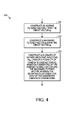
- FIG. 4 is an example illustration of a flowchart 400 outlining the operation of block 320 of FIG. 3 according to one embodiment.
- an inverse filtered vector r can be constructed from the target vector x 2 .
- the inverse weighting function f ( x 2 , i ) of block 320 can be based on the inverse filtered vector r constructed from the target vector x 2 .
- H -1 can be a zero-state weighted synthesis convolution matrix formed from an impulse response of a weighted synthesis filter
- x 2 can be the target vector.
- a backward filtered vector d 2 can be constructed from the target vector x 2 .
- the inverse weighting function f ( x 2 , i ) of block 320 can be based on the backward filtered vector d 2 constructed from the target vector x 2 .
- H T can be a transpose of a zero-state weighted synthesis convolution matrix formed from an impulse response of a weighted synthesis filter
- a plurality of inverse weighting functions f ( x 2 , i ) (and/or plurality of candidate code-vectors c k [ i ] ) can be constructed based on a weighting of the inverse filtered vector r and a weighting of the backward filtered vector d 2 , where the weighting can be different for each of the associated candidate code-vectors c k [ i ] .
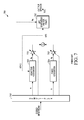
- the candidate code-vectors c k [1] and c k [2] can correspond to factorial pulse coded vectors for different functions f (x 2 , 1) and f (x 2 , 2) of a target vector .
- one of the candidate code-vectors, c k [ i ] can be used as a basis for choosing codeword c k that generates a fixed codebook index parameter k .
- the fixed codebook index parameter k can identify, at least in part, a set of pulse amplitude and position combinations, such as including a pulse amplitude 510 and a position 520, in a codebook.
- the set of pulse amplitude and position combinations can be used for functions f (x 2 , 1) and f (x 2 , 2) for a chosen candidate code-vector c k [i*] , such as, for example, code-vector c k [1] .
- the illustration 500 is only intended as a conceptual example and does not correspond to any actual number of pulses, positions of pulses, code-vectors, or signals.
Landscapes
- Engineering & Computer Science (AREA)
- Computational Linguistics (AREA)
- Signal Processing (AREA)
- Health & Medical Sciences (AREA)
- Audiology, Speech & Language Pathology (AREA)
- Human Computer Interaction (AREA)
- Physics & Mathematics (AREA)
- Acoustics & Sound (AREA)
- Multimedia (AREA)
- Compression, Expansion, Code Conversion, And Decoders (AREA)
Abstract
Description
- The present disclosure relates, in general, to signal compression systems and, more particularly, to Code Excited Linear Prediction (CELP)-type speech coding systems.
- Compression of digital speech and audio signals is well known. Compression is generally required to efficiently transmit signals over a communications channel or to compress the signals for storage on a digital media device, such as a solid-state memory device or computer hard disk. Although many compression techniques exist, one method that has remained very popular for digital speech coding is known as Code Excited Linear Prediction (CELP), which is one of a family of "analysis-by-synthesis" coding algorithms. Analysis-by-synthesis generally refers to a coding process by which multiple parameters of a digital model are used to synthesize a set of candidate signals that are compared to an input signal and analyzed for distortion. A set of parameters that yields a lowest distortion is then either transmitted or stored, and eventually used to reconstruct an estimate of the original input signal. CELP is a particular analysis-by-synthesis method that uses one or more codebooks where each codebook essentially includes sets of code-vectors that are retrieved from the codebook in response to a codebook index.
- For example,
FIG. 6 is a block diagram of aCELP encoder 600 of the prior art. InCELP encoder 600, an input signal s(n), such as a speech signal, is applied to a Linear Predictive Coding (LPC)analysis block 601, where linear predictive coding is used to estimate a short-term spectral envelope. The resulting spectral parameters are denoted by the transfer function A(z). The spectral parameters are applied to anLPC Quantization block 602 that quantizes the spectral parameters to produce quantized spectral parameters Aq that are suitable for use in amultiplexer 608. The quantized spectral parameters Aq are then conveyed to multiplexer 608, and themultiplexer 608 produces a coded bitstream based on the quantized spectral parameters and a set of codebook-related parameters, τ, β, k, and γ, that are determined by a squared error minimization/parameter quantization block 607. - The quantized spectral, or Linear Predictive, parameters are also conveyed locally to an
LPC synthesis filter 605 that has acorresponding transfer function 1/Aq (z).LPC synthesis filter 605 also receives a combined excitation signal u(n) from afirst combiner 610 and produces an estimate of the input signal ŝ(n) based on the quantized spectral parameters Aq and the combined excitation signal u(n). Combined excitation signal u(n) is produced as follows. An adaptive codebook code-vector c τ is selected from an adaptive codebook (ACB) 603 based on an index parameter τ and the combined excitation signal from the previous subframe u(n-L). The adaptive codebook code-vector c τ is then weighted based on again parameter β 630 and the weighted adaptive codebook code-vector is conveyed to first combiner 610. A fixed codebook code-vector c k is selected from a fixed codebook (FCB) 604 based on an index parameter k. The fixed codebook code-vector c k is then weighted based on again parameter γ 640 and is also conveyed to first combiner 610. First combiner 610 then produces combined excitation signal u(n) by combining the weighted version of adaptive codebook code-vector c τ with the weighted version of fixed codebook code-vector c k . -
LPC synthesis filter 605 conveys the input signal estimate ŝ(n) to asecond combiner 612. Thesecond combiner 612 also receives input signal s(n) and subtracts the estimate of the input signal ŝ(n) from the input signal s(n). The difference between input signal s(n) and the input signal estimate ŝ(n) is applied to a perceptualerror weighting filter 606, which filter produces a perceptually weighted error signal e(n) based on the difference between ŝ(n) and s(n) and a weighting function W(z). Perceptually weighted error signal e(n) is then conveyed to squared error minimization/parameter quantization block 607. Squared error minimization/parameter quantization block 607 uses the error signal e(n) to determine an optimal set of codebook-related parameters τ, β, k, and γ that produce the best estimate ŝ(n) of the input signal s(n). -
FIG. 7 is a block diagram of adecoder 700 of the prior art that corresponds to theencoder 600. As one of ordinary skilled in the art realizes, the coded bitstream produced by theencoder 600 is used by ademultiplexer 708 in thedecoder 700 to decode the optimal set of codebook-related parameters, τ,β 730, k, andγ 740. Thedecoder 700 uses a process that is identical to the synthesis process performed byencoder 600, by using anadaptive codebook 703, afixed codebook 704, signals u(n) and u(n-L), code-vectors c τ and c k , and aLPC synthesis filter 705 to generate output speech. Thus, if the coded bitstream produced by theencoder 600 is received by thedecoder 700 without errors, the speech ŝ(n) output by thedecoder 700 can be reconstructed as an exact duplicate of the input speech estimate ŝ(n) produced by theencoder 600. - While the
CELP encoder 600 is conceptually useful, it is not a practical implementation of an encoder where it is desirable to keep computational complexity as low as possible. As a result,FIG. 8 is a block diagram of anexemplary encoder 800 of the prior art that utilizes an equivalent, and yet more practical, system compared to the encoding system illustrated byencoder 600. To better understand the relationship between theencoder 600 and theencoder 800, it is beneficial to look at the mathematical derivation ofencoder 800 fromencoder 600. For the convenience of the reader, the variables are given in terms of their z-transforms. - From
FIG. 6 , it can be seen that the perceptualerror weighting filter 606 produces the weighted error signal e(n) based on a difference between the input signal and the estimated input signal, that is:
- From this expression, the weighting function W(z) can be distributed and the input signal estimate ŝ(n) can be decomposed into the filtered sum of the weighted codebook code-vectors:

- The term W(z)S(z) corresponds to a weighted version of the input signal. By letting the weighted input signal W(z)S(z) be defined as Sw (z) = W(z)S(z) and by further letting the
weighted synthesis filter 605 of theencoder 600 now be defined by a transfer function H(z) = W(z)/Aq (z), Equation 2 can rewritten as follows:
- By using z-transform notation, filter states need not be explicitly defined. Now proceeding using vector notation, where the vector length L is a length of a current speech input subframe, Equation 3 can be rewritten as follows by using the superposition principle:

where: - H is the L x L zero-state weighted synthesis convolution matrix formed from an impulse response of a weighted synthesis filter h(n), such as
synthesis filters 
- h zir is a L x 1 zero-input response of H(z) that is due to a state from a previous speech input subframe,
- s w is the L x 1 perceptually weighted input signal,
- β is the scalar adaptive codebook (ACB) gain,
- c τ is the L x 1 ACB code-vector indicated by index τ,
- γ is the scalar fixed codebook (FCB) gain, and
- c k is the L x 1 FCB code-vector indicated by index k.
- By distributing H, and letting the input target vector x w = s w - h zir , the following expression can be obtained:

- Equation 6 represents the perceptually weighted error (or distortion) vector e(n) produced by a
third combiner 808 ofencoder 800 and coupled by thecombiner 808 to a squared error minimization/parameter quantization block 807. - From the expression above, a formula can be derived for minimization of a weighted version of the perceptually weighted error, that is, ∥e∥2, by squared error minimization/
parameter quantization block 807. A norm of the squared error is given as:
- Note that ∥e∥2 may also be written as

- Due to complexity limitations, practical implementations of speech coding systems typically minimize the squared error in a sequential fashion. That is, the adaptive codebook (ACB) component is optimized first by assuming the fixed codebook (FCB) contribution is zero, and then the FCB component is optimized using the given (previously optimized) ACB component. The ACB/FCB gains, that is, codebook-related parameters β and γ, may or may not be re-optimized, that is, quantized, given the sequentially selected ACB/FCB code-vectors c τ and c k .
- The theory for performing such an example of a sequential optimization process is as follows. First, the norm of the squared error as provided in Equation 7 is modified by setting γ = 0, and then expanded to produce:

- Minimization of the squared error is then determined by taking the partial derivative of ε with respect to β and setting the quantity to zero:

- This yields an optimal ACB gain:

- Substituting the optimal ACB gain back into Equation 8 gives:

where τ* is an optimal ACB index parameter, that is, an ACB index parameter that minimizes the bracketed expression. Typically, τ is a parameter related to a range of expected values of the pitch lag (or fundamental frequency) of the input signal, and is constrained to a limited set of values that can be represented by a relatively small number of bits. Since x w is not dependent on τ, Equation 11 can be rewritten as follows:
- Now, by letting y τ equal the ACB code-vector c τ filtered by
weighted synthesis filter 815, that is, y τ = Hc τ, Equation 13 can be simplified to:
and likewise, Equation 10 can be simplified to:
- Thus Equations 13 and 14 represent the two expressions necessary to determine the optimal ACB index τ and ACB gain β in a sequential manner. These expressions can now be used to determine the optimal FCB index and gain expressions. First, from
FIG. 8 , it can be seen that asecond combiner 806 produces a vector x 2, where x 2 = x w - βHc τ. The vector x w (or xw(n)) is produced by afirst combiner 804 that subtracts a filtered past synthetic excitation signal hzir(n), after filtering past synthetic excitation signal u(n-L) by a weighted synthesis zero input response Hzir(z)filter 801, from an output sw(n) of a perceptual error weighting filter W(z) 802 of input speech signal s(n). The term βHc τ is a filtered and weighted version of ACB code-vector c τ, that is, ACB code-vector c τ filtered by zero state weighted synthesis filter Hzs(z) 815 to generate y(n) and then weighted based on ACBgain parameter β 830. Substituting the expression x 2 = x w - βHc τ into Equation 7 yields:
where γHc k is a filtered and weighted version of FCB code-vector c k , that is, FCB code-vector c k filtered by zero state weighted synthesis filter Hzs(z) 805 and then weighted based on FCBgain parameter γ 840. Similar to the above derivation of the optimal ACB index parameter τ*, it is apparent that:
where k * is an optimal FCB index parameter, that is, an FCB index parameter that maximizes the bracketed expression. By grouping terms that are not dependent on k, that is, by letting

in which the optimal FCB gain γ is given as:
- The
encoder 800 provides a method and apparatus for determining the optimal excitation vector-related parameters τ, β, k, and γ. Unfortunately, higher bit rate CELP coding typically requires higher computational complexity due to a larger number of codebook entries that require error evaluation in the closed loop processing. Thus, there is an opportunity for generating a candidate code-vector to reduce the computational complexity to code an information signal. -
-
FIG. 1 is an example block diagram of at least a portion of a coder, such as a portion of the coder inFIG. 6 , according to one embodiment; -
FIG. 2 is an example block diagram of the FCB candidate code-vector generator according to one embodiment; -
FIG. 3 is an example illustration of a flowchart outlining the operation of a coder according to one embodiment; -
FIG. 4 is an example illustration of a flowchart outlining candidate code-vector construction operation of a coder according to one embodiment; -
FIG. 5 is an example illustration of two conceptual candidate code-vectors c k [i] according to one embodiment; -
FIG. 6 is a block diagram of a Code Excited Linear Prediction (CELP) encoder of the prior art; -
FIG. 7 is a block diagram of a CELP decoder of the prior art; and -
FIG. 8 is a block diagram of another CELP encoder of the prior art. - As discussed above, higher bit rate CELP coding typically requires higher computational complexity due to a larger number of codebook entries that require error evaluation in the closed loop processing. Embodiments of the present disclosure can solve a problem of searching higher bit rate codebooks by providing for pre-quantizer candidate generation in a Code Excited Linear Prediction (CELP) speech coder. Embodiments can address the problem by generating a plurality of initial FCB candidates through direct quantization of a set of vectors formed using inverse weighting functions and the FCB target signal and then evaluating a weighted error of those initial candidates to produce a better overall code-vector. Embodiments can also apply variable weights to vectors and can sum the weighted vectors as part of preselecting candidate code-vectors. Embodiments can additionally generate a plurality of initial fixed codebook candidates through direct quantization of a set of vectors formed using inverse weighting functions and the fixed codebook target signal, and can then evaluate the weighted error of those initial candidates to produce a better overall code-vector. Other embodiments can also generate a plurality of initial FCB candidates through direct quantization of a set of vectors formed using inverse weighting functions and the FCB target signal, and then evaluating a weighted error of those initial candidates to determine a better initial weighting function for a given pre-quantizer function.
- To achieve the above benefits, a method and apparatus can generate a candidate code-vector to code an information signal. The method can include receiving an input signal. The method can include producing a target vector from the input signal. The method can include constructing a plurality of inverse weighting functions based on the target vector. The method can include evaluating an error value associated with each of the plurality of inverse weighting functions to produce a Fixed Codebook (FCB) code-vector. The method can include generating a codeword representative of the FCB code-vector, where the codeword can be used by a decoder to generate an approximation of the input signal.
-
FIG. 1 is an example block diagram of at least a portion of acoder 100, such as a portion of thecoder 600, according to one embodiment. Thecoder 100 can include aninput 122, atarget vector generator 124, a FCB candidate code-vector generator 110, aFCB 104, a zero state weightedsynthesis filter H 105, anerror minimization block 107, a first gain parameterγ weighting block 141, a combiner 108, and anoutput 126. Thecoder 100 can also include a second zero state weightedsynthesis filter H 115, a seconderror minimization block 117, a second gain parameterγ weighting block 142, and a second combiner 118. - The zero state
weighted synthesis filter 105, theerror minimization block 107, and the combiner 108, as well as the second zero state weightedsynthesis filter H 115, the seconderror minimization block 117, and the second combiner 118 can operate similarly to the zero stateweighted synthesis filter 805, the squared errorminimization parameter quantizer 807, and thecombiner 808, respectively, as illustrated inFIG. 8 . A codebook, such as theFCB 104, can include of a set of pulse amplitude and position combinations. Each pulse amplitude and position combination can define L different positions and can include both zero-amplitude pulses and non-zero-amplitude pulses assigned to respective positions p=1, 2, ... L of the combination. - In operation, the
input 122 can receive and may process an input signal s(n). The input signal s(n) can be a digital or analog input signal. The input can be received wirelessly, through a hard-wired connection, from a storage medium, from a microphone, or otherwise received. For example, the input signal s(n) can be based on an audible signal, such as speech. Thetarget vector generator 124 can receive the input signal s(n) from theinput 122 and can produce a target vector x 2 from the input signal s(n). - The FCB candidate code-
vector generator 110 can receive the target vector x 2 and can construct a plurality of candidate code-vectors c k [i] and an inverse weighting function f(x 2,i), where i can be an index for the candidate code-vectors c k [i] where 0 ≤ i < N, and N is at least 2. The plurality of candidate code-vectors c k [i] can be based on the target vector x 2 and can be based on the inverse weighting function. The inverse weighting function can remove weighting from the target vector x 2 in some manner. For example, an inverse weighting function can be based on
FCB 104 may also use the inverse weighting function result as a means of further reducing the search complexity, for example, by searching only a subset of the total pulse/position combinations. Theerror minimization block 117 may also select one of a plurality of candidate code-vectors c k [i] with lower squared sum value of e i as c k i *. That is, after the best candidate code-vector c k i * is found by way of square error minimization, the fixedcodebook 104 may use c k i * as an initial "seed" code-vector which may be iterated upon. The inverse weighting function result f(x 2, i*) may also be used in this process to help reduce search complexity. Thus, i * can represent the index value of the optimum candidate codevector c k [i]. If thecoder 100 does not include the second zero state weightedsynthesis filter H 115, the seconderror minimization block 117, the second gain parameterγ weighting block 142, and the second combiner 118, the remaining blocks can perform the corresponding functions. For example, theerror minimization block 107 can provide the index i of the candidate codevectors and the index value i * of the optimum candidate codevector and the zero stateweighted synthesis filter 105 can receive the candidate code-vectors c k [i] (not shown). - According to an example embodiment, the FCB candidate code-
vector generator 110 can construct the plurality of candidate code-vectors c k [i] based on the target vector x 2, based on an inverse filtered vector, and based on a backward filtered vector as described below. The plurality of candidate code-vectors c k [i] can also be based on the target vector x 2 and based on a sum of a weighted inverse filtered vector and weighted backward filtered vector as described below. - The
error minimization block 117 can evaluate an error vector e i associated with each of the plurality of candidate code-vectors c k [i]. The error vector can be analyzed to select a single FCB code-vector c k [i*], where the FCB code-vector c k [i*] can be one of the candidate code-vectors c k [i]. The squared error minimization/parameter quantization block 107 can generate a codeword k representative of the FCB code-vector c k [i]. The codeword k can be used by a decoder to generate an approximation of the input signal s(n). Theerror minimization block 107 or another element can output the codeword k at theoutput 126 by transmitting the codeword k and/or storing the codeword k. For example, theerror minimization block 117 may generate and output the codeword k. - Each candidate code-vector c k [i] can be processed as if it were generated by the
FCB 104 by filtering it through the zero stateweighted synthesis filter 105 for each candidate c k [i]. The FCB candidate code-vector generator 110 can evaluate an error value associated with each iteration of the plurality of candidate code-vectors c k [i] from the plurality of times to produce a FCB code-vector c k based on the candidate code-vector c k [i] with the lowest error value. - The codeword k can also be generated without iterating it through more than one stage. For example, the codeword k can be generated without
modification using blocks vector generator 110 produces a sufficient number of pulses, it may already be a good approximation of the target signal x 2 without the need for a second stage. It can converge to the best value when it has sufficient bits. Thus, the c k coming out of the fixedcodebook 104 can be identical to the one of the vectors in the initial fixed codebook candidate code-vectors c k [i]. Furthermore, theFCB 104 may not even exist, such as in high bit rate applications where c k [i] may be good enough. In either case, the candidate code-vector c k [i] is equivalent to the final code-vector c k , and the index k may be subsequently transmitted or stored for later use by a decoder. - According to some embodiments, there can be multiple inverse functions f(x2,i), where 1 <= i <= N and N > 1, evaluated for every frame of speech. Multiple f(x2,i) outputs can be used to determine a codebook output, which can be c k [i] or c k . Additionally, c k [i] can be a starting point for determining c k , where c k [i] can allow for fewer iterations of k and can allow for a better overall result by avoiding local minima.
-
FIG. 2 is an example block diagram of the FCB candidate code-vector generator 110 according to one embodiment. The FCB candidate code-vector generator 110 can include aninverse filter 210, abackward filter 220, and another processing block for a FCB candidate code-vector generator 230. - The FCB candidate code-
vector generator 110 can construct a plurality of candidate code-vectors c k [i], where i can be an index for the candidate code-vectors c k [i]. The plurality of candidate code-vectors c k [i] can be based on the target vector x 2 and can be based on an inverse weighting function, such as f(x 2,i). The inverse weighting function can be based on an inverse filtered vector and theinverse filter 210 can construct the inverse filtered vector from the target vector x 2. For example, the inverse filtered vector can be constructed based on r = H -1 x 2, where r can be the inverse filtered vector, where H -1 can be a zero-state weighted synthesis convolution matrix formed from an impulse response of a weighted synthesis filter, and where x 2 can be the target vector. Other variations are described in other embodiments. - The inverse weighting function can be based on a backward filtered vector, and the
backward filter 220 can construct the backward filtered vector from the target vector x 2. For example, the backward filtered vector can be constructed based on d 2 = H T x 2, where d 2 can be the backward filtered vector, where H T can be a transpose of a zero-state weighted synthesis convolution matrix formed from an impulse response of a weighted synthesis filter, and where x 2 can be the target vector. Other variations are described in other embodiments. - According to an example embodiment, recalling from the Background that

if the FCB code-vector is given as:
then the error ε can tend to zero and the input signal s(n) and a corresponding coded output signal ŝ(n) can be identical. Since this is not practical for low rate speech coding systems, only a crude approximation of Eq. 20 is typically generated.U.S. Patent No. 5,754,976 to Adoul , hereby incorporated by reference, discloses one example of the usage of the inverse filtered target signal r = H -1 x 2 as a method for low bit rate pre-selection of the pulse amplitudes of the code-vector c k . - One of the problems in evaluating the error term ε in Eq. 19 is that, while the error ε is evaluated in the weighted synthesis domain, the FCB code-vector c k is generated in the residual domain. Thus, a direct PCM-like quantization of the right hand term in Eq. 20 does not generally produce the minimum possible error in Eq. 19, due to the quantization error generation being in the residual domain as opposed to the weighted synthesis domain. More specifically, the expression:

where QP { } is a P-bit quantization operator, does not generally lead to the global minimum weighted error since the error due to Qp{ } is a residual domain error. In order to achieve the lowest possible error in the weighted domain, many iterations of c k may be necessary to minimize the error ε of Eq. 19. Various embodiments of the present disclosure described below can address this problem by reducing the iterations and by reducing the residual domain error. - First, an i-th pre-quantizer candidate

vector generator 110 using the expression
where f(x 2,i) can be some function of the target vector, and N can be the number of pre-quantizer candidates. This expression can be a generalized form for generating a plurality of pre-quantizer candidates that can be assessed for error in the weighted domain. An example of such a function is given as:
where r = H -1 x 2 is the inverse filtered target signal, d 2 = H T x 2 is the backward filtered target as calculated/defined in Eq. 17, and ai and bi are a set of respective weighting coefficients for iteration i. Here, ∥r∥ can be a norm of the residual domain vector r, such as the inverse filtered target vector r, given by

- Embodiments of the present disclosure can allow various coefficient functions to be incorporated into the weighting of the normalized vectors in Eq. 23. For example, the functions:

where N is the total number of pre-quantizer candidates, can have a linear distribution of values. As an example, if N = 4, the sets of coefficients can be: ai ∈ {1.0, 0.667, 0.333, 0.0}, and bi ∈ {0.0, 0.333, 0.667, 1.0}. Another example may incorporate the results of a training algorithm, such as the Linde-Buzo-Gray (or LBG) algorithm, where many values of a and b can be evaluated offline using a training database, and then choosing ai and bi based on the statistical distributions. Such methods for training are well known in the art. Other functions can also be possible. For example, the following function may be found to be beneficial for certain classes of signals:
where r lpf can be a low pass filtered version of r. Alternatively, the LPF characteristic may be altered as a function of i:
where B i may be a class of linear phase filtering characteristics intended to shape the residual domain quantization error in a way that more closely resembles that of the error in the weighted domain. Yet another method may involve specifying a family of inverse perceptual weighting functions that may also shape the error in a way that is beneficial in shaping the residual domain error:
- The weighted signal can then be quantified into a form that can be utilized by the particular FCB coding process.
U.S. Patent No. 5,754,976 to Adoul andU.S. Patent No. 6,236,960 to Peng , hereby incorporated by reference, disclose coding methods that use unit magnitude pulse codebooks that are algebraic in nature. That is, the codebooks are generated on the fly, as opposed to being stored in memory, searching various pulse position and amplitude combinations, finding a low error pulse combination, and then coding the positions and amplitudes using combinatorial techniques to form a codeword k that is subsequently used by a decoder to regenerate c k and further generate an approximation of the input signal s(n). - According to one embodiment, the codebook disclosed in
U.S. Patent No. 6,236,960 can be used to quantify the weighted signal into a form that can be utilized by the particular FCB coding process. The i-th pre-quantizer candidate

where the round() operator rounds the respective vector elements of gQf(x 2,i) to the nearest integer value, where n represents the n-th element of vector

- Many other ways of determining

- The N different pre-quantizer candidates may then be evaluated according to the following expression (which is based on Eq. 17):

where

where
weighted synthesis filter 105. The latter method may be used for complexity reasons, especially when the number of non-zero positions in the pre-quantizer candidate,
- After the best pre-quantizer candidate


- To further expand on the above embodiments where the candidate code-vectors c k [i] and the eventual FCB output vector c k may or may not contain the same number of unit magnitude pulses, another embodiment exists where the candidate codebook for generating c k [i] may be different than the codebook for generating c k . That is, the best candidate c k [i*] may generally be used to reduce complexity or improve overall performance of the resulting code-vector c k , by using c k [i*] as a means for determining the best inverse function f(x 2,i*), and then proceeding to use f(x 2,i*) as a means for searching a second codebook c' k . Such an example may include using a Factorial Pulse Coded (FPC) codebook for generating c k [i*], and then using a traditional ACELP codebook to generate c' k , wherein the inverse function f(x 2,i*) is used in the secondary codebook search c' k , and the candidate code-vectors c k [i] are discarded. In this way, for example, the pre-selection of pulse signs for the secondary codebook c' k may be based on a plurality of inverse functions f(x 2,i), and not directly on the candidate code-vectors c k [i]. This embodiment may allow performance improvement to existing codecs that use a specific codebook design, while maintaining interoperability and backward compatibility.
- In another embodiment, a very large value of N may be used. For example, if N = 100, then the weighting coefficients [ai bi ] can span a very high resolution set, and can result in a solution that will yield optimal results.
- According to
U.S. Patent No. 7,054,807 to Mittal , which is hereby incorporated by reference, the ACB/FCB parameters may be jointly optimized. The joint optimization can also be used for evaluation of N pre-quantizer candidates. Now Eq. 29 can become:
where Φ' = Φ - yy T and where y can be a scaled backward filtered ACB excitation. Now i * may be determined through brute force computation:
where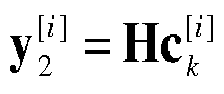
weighted synthesis filter 105 and
-
FIG. 3 is an example illustration of aflowchart 300 outlining the operation of thecoder 100 according to one embodiment. Theflowchart 300 illustrates a method that can include the embodiments disclosed above. - At 310, a target vector x 2 can be generated from a received input signal s(n). The input signal s(n) can be based on an audible speech input signal. At 320, a plurality of inverse weighting functions f(x 2,i) can be constructed based on the target vector x 2. Optionally, a plurality of candidate code-vectors c k [i] can also be constructed based on the target vector x 2 and based on an inverse weighting function f(x 2,i). The plurality of inverse weighting functions f(x 2,i) (and/or plurality of candidate code-vectors c k [i]) can be constructed based on an inverse filtered vector and based on a backward filtered vector along with the target vector x 2. The plurality of inverse weighting functions f(x 2,i) (and/or plurality of candidate code-vectors c k [i]) can also be constructed based on a sum of a weighted inverse filtered vector and a weighted backward filtered vector along with the target vector x 2.
- At 330, an error value ε associated with each code-vector of the plurality of inverse weighting functions f(x 2,i) (and/or plurality of candidate code-vectors c k [ i]) can be evaluated to produce a fixed codebook code-vector c k . For example, errors ε[i] of c k [i] can be evaluated to produce c k [i*], then c k [i*] can be used as a basis for further searching on c k. The value k can be the ultimate codebook index that is output.
- At 340, a codeword k representative of the fixed codebook code-vector c k can be generated, where the codeword can be used by a decoder to generate an approximation of the input signal s(n). At 350, the codeword k can be output. For example, the codeword k can be a fixed codebook index parameter codeword k that can be output by transmitting the fixed codebook index parameter k and/or storing the fixed codebook index parameter k.
-
FIG. 4 is an example illustration of aflowchart 400 outlining the operation ofblock 320 ofFIG. 3 according to one embodiment. At 410, an inverse filtered vector r can be constructed from the target vector x 2. The inverse weighting function f(x 2, i) ofblock 320 can be based on the inverse filtered vector r constructed from the target vector x 2. The inverse filtered vector r can be constructed based on r = H -1 x 2, where r can be the inverse filtered vector, where H -1 can be a zero-state weighted synthesis convolution matrix formed from an impulse response of a weighted synthesis filter, and where x 2 can be the target vector. Other variations are described in other embodiments above. - At 420, a backward filtered vector d 2 can be constructed from the target vector x 2. The inverse weighting function f(x 2, i) of
block 320 can be based on the backward filtered vector d 2 constructed from the target vector x 2. The backward filtered vector d 2 can be constructed based on d 2 = H T x 2, where d 2 can be the backward filtered vector, where H T can be a transpose of a zero-state weighted synthesis convolution matrix formed from an impulse response of a weighted synthesis filter, and where x 2 can be the target vector. Other variations are described in other embodiments above. - At 430, a plurality of inverse weighting functions f(x 2,i) (and/or plurality of candidate code-vectors c k [i]) can be constructed based on a weighting of the inverse filtered vector r and a weighting of the backward filtered vector d 2, where the weighting can be different for each of the associated candidate code-vectors c k [i]. For example, the weighting can be based on

-
FIG. 5 is anexample illustration 500 of two conceptual candidate code-vectors c k [i] for i=1 and i=2 according to one embodiment. The candidate code-vectors c k [1] and c k [2] can correspond to factorial pulse coded vectors for different functions f(x2, 1) and f(x2, 2) of a target vector . As discussed above, one of the candidate code-vectors, c k [i], can be used as a basis for choosing codeword c k that generates a fixed codebook index parameter k. The fixed codebook index parameter k can identify, at least in part, a set of pulse amplitude and position combinations, such as including apulse amplitude 510 and aposition 520, in a codebook. Each pulse amplitude and position combination can define L different positions and can include both zero-amplitude pulses and non-zero-amplitude pulses assigned to respective positions p=1, 2, ... L of the combination. The set of pulse amplitude and position combinations can be used for functions f(x2, 1) and f(x2, 2) for a chosen candidate code-vector c k [i*], such as, for example, code-vector c k [1]. Theillustration 500 is only intended as a conceptual example and does not correspond to any actual number of pulses, positions of pulses, code-vectors, or signals. - While this disclosure has been described with specific embodiments thereof, it is evident that many alternatives, modifications, and variations will be apparent to those skilled in the art. For example, various components of the embodiments may be interchanged, added, or substituted in the other embodiments. Also, all of the elements of each figure are not necessary for operation of the disclosed embodiments. For example, one of ordinary skill in the art of the disclosed embodiments would be enabled to make and use the teachings of the disclosure by simply employing the elements of the independent claims. Accordingly, the embodiments of the disclosure as set forth herein are intended to be illustrative, not limiting. Various changes may be made without departing from the spirit and scope of the disclosure.
- In this document, relational terms such as "first," "second," and the like may be used solely to distinguish one entity or action from another entity or action without necessarily requiring or implying any actual such relationship or order between such entities or actions. The term "coupled," unless otherwise modified, implies that elements may be connected together, but does not require a direct connection. For example, elements may be connected through one or more intervening elements. Furthermore, two elements may be coupled by using physical connections between the elements, by using electrical signals between the elements, by using radio frequency signals between the elements, by using optical signals between the elements, by providing functional interaction between the elements, or by otherwise relating two elements together. Also, relational terms, such as "top," "bottom," "front," "back," "horizontal," "vertical," and the like may be used solely to distinguish a spatial orientation of elements relative to each other and without necessarily implying a spatial orientation relative to any other physical coordinate system. The terms "comprises," "comprising," or any other variation thereof, are intended to cover a non-exclusive inclusion, such that a process, method, article, or apparatus that comprises a list of elements does not include only those elements but may include other elements not expressly listed or inherent to such process, method, article, or apparatus. An element proceeded by "a," "an," or the like does not, without more constraints, preclude the existence of additional identical elements in the process, method, article, or apparatus that comprises the element. Also, the term "another" is defined as at least a second or more. The terms "including," "having," and the like, as used herein, are defined as "comprising."
Claims (18)
- A method comprising:receiving an input signal;producing a target vector from the input signal;constructing a plurality of inverse weighting functions based on the target vector;evaluating an error value associated with each of the plurality of inverse weighting functions to produce a fixed codebook code-vector;generating a codeword representative of the fixed codebook code-vector, where the codeword is for use by a decoder to generate an approximation of the input signal; andoutputting the codeword by one of: transmitting the codeword and storing the codeword.
- The method according to claim 1, wherein the inverse weighting functions are based on an inverse filtered vector constructed from the target vector.
- The method according to claim 2,
wherein the inverse filtered vector is constructed based on r = H -1 x 2,
wherein r comprises the inverse filtered vector,
wherein H -1 comprises a zero-state weighted synthesis convolution matrix formed from an impulse response of a weighted synthesis filter, and
wherein x 2 comprises the target vector. - The method according to claim 1, wherein the inverse weighting functions are based on a backward filtered vector constructed from the target vector.
- The method according to claim 4,
wherein the backward filtered vector is constructed based on d 2 = H T x 2,
wherein d 2 comprises the backward filtered vector,
wherein H T comprises a transpose of a zero-state weighted synthesis convolution matrix formed from an impulse response of a weighted synthesis filter, and
wherein x 2 comprises the target vector. - The method according to claim 1, wherein the constructing comprises:constructing the plurality of inverse weighting functions based on the target vector, based on an inverse filtered vector, and based on a backward filtered vector.
- The method according to claim 1, wherein the constructing comprises:constructing the plurality of inverse weighting functions based on the target vector and based on a sum of a weighted inverse filtered vector and a weighted backward filtered vector.
- The method according to claim 1, wherein the constructing comprises:constructing a plurality of candidate code-vectors based on the plurality of inverse weighting functions based on the target vector.
- The method according to claim 8, further comprising:processing each candidate code-vector using a fixed codebook and through a zero state weighted synthesis filter a plurality of times,wherein the evaluating comprises:evaluating at least one error value associated with each iteration of the plurality of candidate code-vectors from the plurality of times to produce the fixed codebook code-vector based on the candidate code-vector with a lowest error value.
- The method according to claim 1, wherein the input signal is based on audible speech.
- The method according to claim 1, wherein the codeword is used to generate a fixed codebook index parameter that identifies, at least in part, a set of pulse amplitude and position combinations in a codebook used to generate an approximation of the input signal.
- An apparatus comprising:an input configured to receive an input signal;a target vector generator configured to produce a target vector from the input signal;a fixed codebook candidate code-vector generator configured to construct a plurality of inverse weighting functions based on the target vector;an error minimization unit configured to evaluate an error value associated with each of the plurality of inverse weighting functions to produce a fixed codebook code-vector; andan output configured to output a codeword based on the fixed codebook code-vector.
- The apparatus according to claim 12, further comprising:wherein the output is configured to output the codeword by one of transmitting the codeword and storing the codeword.
- The apparatus according to claim 12, wherein the fixed codebook candidate code-vector generator comprises:an inverse filter for constructing an inverse filtered vector from the target vector, where the inverse weighting functions are based on the inverse filtered vector.
- The apparatus according to claim 12, wherein the fixed codebook candidate code-vector generator comprises:a backward filter for constructing a backward filtered vector from the target vector, where the inverse weighting functions are based on the backward filtered vector.
- The apparatus according to claim 12, wherein the fixed codebook candidate code-vector generator is configured to construct a plurality of candidate code-vectors based on based on the plurality of inverse weighting functions based on the target vector.
- The apparatus according to claim 16, further comprising:a combiner configured to generate the error value based on each of the plurality of candidate code-vectors constructed from the fixed codebook candidate code-vector generator.
- The apparatus according to claim 12, further comprising a codeword generator configured to generate the codeword based on the fixed codebook code-vector, where the codeword is for use by a decoder to generate an approximation of the input signal.
Applications Claiming Priority (1)
| Application Number | Priority Date | Filing Date | Title |
|---|---|---|---|
| US13/439,121 US9070356B2 (en) | 2012-04-04 | 2012-04-04 | Method and apparatus for generating a candidate code-vector to code an informational signal |
Publications (1)
| Publication Number | Publication Date |
|---|---|
| EP2648184A1 true EP2648184A1 (en) | 2013-10-09 |
Family
ID=47913226
Family Applications (1)
| Application Number | Title | Priority Date | Filing Date |
|---|---|---|---|
| EP13160603.0A Withdrawn EP2648184A1 (en) | 2012-04-04 | 2013-03-22 | Method and apparatus for generating a candidate code-vector to code an informational signal |
Country Status (6)
| Country | Link |
|---|---|
| US (1) | US9070356B2 (en) |
| EP (1) | EP2648184A1 (en) |
| KR (1) | KR101453200B1 (en) |
| CN (1) | CN103366752B (en) |
| BR (1) | BR102013008010A2 (en) |
| MX (1) | MX2013003443A (en) |
Cited By (2)
| Publication number | Priority date | Publication date | Assignee | Title |
|---|---|---|---|---|
| WO2014070700A1 (en) * | 2012-11-02 | 2014-05-08 | Motorola Mobility Llc | Method and apparatus for generating a candidate code-vector to code an informational signal |
| US9070356B2 (en) | 2012-04-04 | 2015-06-30 | Google Technology Holdings LLC | Method and apparatus for generating a candidate code-vector to code an informational signal |
Families Citing this family (1)
| Publication number | Priority date | Publication date | Assignee | Title |
|---|---|---|---|---|
| CN111736845B (en) * | 2020-06-09 | 2024-07-09 | 阿里巴巴集团控股有限公司 | A coding method and device |
Citations (4)
| Publication number | Priority date | Publication date | Assignee | Title |
|---|---|---|---|---|
| WO1997030525A1 (en) * | 1996-02-15 | 1997-08-21 | Philips Electronics N.V. | Reduced complexity signal transmission system |
| US5754976A (en) | 1990-02-23 | 1998-05-19 | Universite De Sherbrooke | Algebraic codebook with signal-selected pulse amplitude/position combinations for fast coding of speech |
| US6236960B1 (en) | 1999-08-06 | 2001-05-22 | Motorola, Inc. | Factorial packing method and apparatus for information coding |
| US7054807B2 (en) | 2002-11-08 | 2006-05-30 | Motorola, Inc. | Optimizing encoder for efficiently determining analysis-by-synthesis codebook-related parameters |
Family Cites Families (18)
| Publication number | Priority date | Publication date | Assignee | Title |
|---|---|---|---|---|
| US5495555A (en) * | 1992-06-01 | 1996-02-27 | Hughes Aircraft Company | High quality low bit rate celp-based speech codec |
| US5664055A (en) * | 1995-06-07 | 1997-09-02 | Lucent Technologies Inc. | CS-ACELP speech compression system with adaptive pitch prediction filter gain based on a measure of periodicity |
| JPH10149199A (en) * | 1996-11-19 | 1998-06-02 | Sony Corp | Audio encoding method, audio decoding method, audio encoding device, audio decoding device, telephone device, pitch conversion method, and medium |
| CA2636684C (en) * | 1997-12-24 | 2009-08-18 | Mitsubishi Denki Kabushiki Kaisha | A method for speech coding, method for speech decoding and their apparatuses |
| US6330533B2 (en) * | 1998-08-24 | 2001-12-11 | Conexant Systems, Inc. | Speech encoder adaptively applying pitch preprocessing with warping of target signal |
| US7072832B1 (en) * | 1998-08-24 | 2006-07-04 | Mindspeed Technologies, Inc. | System for speech encoding having an adaptive encoding arrangement |
| US6104992A (en) * | 1998-08-24 | 2000-08-15 | Conexant Systems, Inc. | Adaptive gain reduction to produce fixed codebook target signal |
| US6493665B1 (en) * | 1998-08-24 | 2002-12-10 | Conexant Systems, Inc. | Speech classification and parameter weighting used in codebook search |
| US6480822B2 (en) * | 1998-08-24 | 2002-11-12 | Conexant Systems, Inc. | Low complexity random codebook structure |
| CA2252170A1 (en) * | 1998-10-27 | 2000-04-27 | Bruno Bessette | A method and device for high quality coding of wideband speech and audio signals |
| EP1279167B1 (en) * | 2000-04-24 | 2007-05-30 | QUALCOMM Incorporated | Method and apparatus for predictively quantizing voiced speech |
| US7047188B2 (en) | 2002-11-08 | 2006-05-16 | Motorola, Inc. | Method and apparatus for improvement coding of the subframe gain in a speech coding system |
| US7873511B2 (en) * | 2006-06-30 | 2011-01-18 | Fraunhofer-Gesellschaft Zur Foerderung Der Angewandten Forschung E.V. | Audio encoder, audio decoder and audio processor having a dynamically variable warping characteristic |
| US8255222B2 (en) * | 2007-08-10 | 2012-08-28 | Panasonic Corporation | Speech separating apparatus, speech synthesizing apparatus, and voice quality conversion apparatus |
| JP5264913B2 (en) * | 2007-09-11 | 2013-08-14 | ヴォイスエイジ・コーポレーション | Method and apparatus for fast search of algebraic codebook in speech and audio coding |
| US8422569B2 (en) * | 2008-01-25 | 2013-04-16 | Panasonic Corporation | Encoding device, decoding device, and method thereof |
| NO2669468T3 (en) * | 2011-05-11 | 2018-06-02 | ||
| US9070356B2 (en) | 2012-04-04 | 2015-06-30 | Google Technology Holdings LLC | Method and apparatus for generating a candidate code-vector to code an informational signal |
-
2012
- 2012-04-04 US US13/439,121 patent/US9070356B2/en not_active Expired - Fee Related
-
2013
- 2013-03-22 EP EP13160603.0A patent/EP2648184A1/en not_active Withdrawn
- 2013-03-26 MX MX2013003443A patent/MX2013003443A/en active IP Right Grant
- 2013-04-03 BR BR102013008010A patent/BR102013008010A2/en not_active IP Right Cessation
- 2013-04-03 KR KR1020130036390A patent/KR101453200B1/en active Active
- 2013-04-03 CN CN201310116042.7A patent/CN103366752B/en not_active Expired - Fee Related
Patent Citations (4)
| Publication number | Priority date | Publication date | Assignee | Title |
|---|---|---|---|---|
| US5754976A (en) | 1990-02-23 | 1998-05-19 | Universite De Sherbrooke | Algebraic codebook with signal-selected pulse amplitude/position combinations for fast coding of speech |
| WO1997030525A1 (en) * | 1996-02-15 | 1997-08-21 | Philips Electronics N.V. | Reduced complexity signal transmission system |
| US6236960B1 (en) | 1999-08-06 | 2001-05-22 | Motorola, Inc. | Factorial packing method and apparatus for information coding |
| US7054807B2 (en) | 2002-11-08 | 2006-05-30 | Motorola, Inc. | Optimizing encoder for efficiently determining analysis-by-synthesis codebook-related parameters |
Non-Patent Citations (1)
| Title |
|---|
| "Frame error robust narrow-band and wideband embedded variable bit-rate coding of speech and audio from 8-32 kbit/s", ITU-T TELECOMMUNICATION STANDARIZATION SECTOR OF ITU, GENEVA, CH, 1 June 2008 (2008-06-01), pages 1 - 246, XP003028199 * |
Cited By (3)
| Publication number | Priority date | Publication date | Assignee | Title |
|---|---|---|---|---|
| US9070356B2 (en) | 2012-04-04 | 2015-06-30 | Google Technology Holdings LLC | Method and apparatus for generating a candidate code-vector to code an informational signal |
| US9263053B2 (en) | 2012-04-04 | 2016-02-16 | Google Technology Holdings LLC | Method and apparatus for generating a candidate code-vector to code an informational signal |
| WO2014070700A1 (en) * | 2012-11-02 | 2014-05-08 | Motorola Mobility Llc | Method and apparatus for generating a candidate code-vector to code an informational signal |
Also Published As
| Publication number | Publication date |
|---|---|
| KR20130112796A (en) | 2013-10-14 |
| US9070356B2 (en) | 2015-06-30 |
| KR101453200B1 (en) | 2014-10-22 |
| BR102013008010A2 (en) | 2016-11-01 |
| CN103366752A (en) | 2013-10-23 |
| US20130268266A1 (en) | 2013-10-10 |
| CN103366752B (en) | 2016-06-01 |
| MX2013003443A (en) | 2014-05-22 |
Similar Documents
| Publication | Publication Date | Title |
|---|---|---|
| CN100349208C (en) | Diffusion vector generation method and diffusion vector generation device | |
| JP4005359B2 (en) | Speech coding and speech decoding apparatus | |
| WO1994023426A1 (en) | Vector quantizer method and apparatus | |
| CZ304196B6 (en) | LPC parameter quantization vector, speech encoder, and speech signal receiving device | |
| EP3214619A1 (en) | System and method for mixed codebook excitation for speech coding | |
| US7047188B2 (en) | Method and apparatus for improvement coding of the subframe gain in a speech coding system | |
| US9070356B2 (en) | Method and apparatus for generating a candidate code-vector to code an informational signal | |
| US20040093207A1 (en) | Method and apparatus for coding an informational signal | |
| US9263053B2 (en) | Method and apparatus for generating a candidate code-vector to code an informational signal | |
| US7337110B2 (en) | Structured VSELP codebook for low complexity search | |
| CN1808569B (en) | Speech Coder, Orthogonal Retrieval Method and CELP Speech Coding Method | |
| EP2099025A1 (en) | Audio encoding device and audio encoding method | |
| CN100367347C (en) | Speech encoder and speech decoder | |
| US9076442B2 (en) | Method and apparatus for encoding a speech signal | |
| CN101765880A (en) | Speech coding apparatus and speech coding method | |
| JPWO2000063878A1 (en) | Audio encoding device, audio processing device, and audio processing method | |
| EP2515299A1 (en) | Vector quantization device, voice coding device, vector quantization method, and voice coding method | |
| US20050096903A1 (en) | Method and apparatus for performing harmonic noise weighting in digital speech coders | |
| Salami et al. | A fully vector quantised self-excited vocoder | |
| JP2808841B2 (en) | Audio coding method | |
| Juang | Signal Prediction with Input Identification | |
| Lee et al. | Low-Delay Entropy-Constrained Vector Quantization Robust Against Source Mismatch Problem | |
| JPWO2000000963A1 (en) | Audio Encoder |
Legal Events
| Date | Code | Title | Description |
|---|---|---|---|
| PUAI | Public reference made under article 153(3) epc to a published international application that has entered the european phase |
Free format text: ORIGINAL CODE: 0009012 |
|
| AK | Designated contracting states |
Kind code of ref document: A1 Designated state(s): AL AT BE BG CH CY CZ DE DK EE ES FI FR GB GR HR HU IE IS IT LI LT LU LV MC MK MT NL NO PL PT RO RS SE SI SK SM TR |
|
| AX | Request for extension of the european patent |
Extension state: BA ME |
|
| 17P | Request for examination filed |
Effective date: 20140409 |
|
| RBV | Designated contracting states (corrected) |
Designated state(s): AL AT BE BG CH CY CZ DE DK EE ES FI FR GB GR HR HU IE IS IT LI LT LU LV MC MK MT NL NO PL PT RO RS SE SI SK SM TR |
|
| 17Q | First examination report despatched |
Effective date: 20140801 |
|
| STAA | Information on the status of an ep patent application or granted ep patent |
Free format text: STATUS: THE APPLICATION IS DEEMED TO BE WITHDRAWN |
|
| 18D | Application deemed to be withdrawn |
Effective date: 20141212 |
|
| P01 | Opt-out of the competence of the unified patent court (upc) registered |
Effective date: 20230520 |