EP2647666A1 - Tribologically modified polyoxymethylene - Google Patents
Tribologically modified polyoxymethylene Download PDFInfo
- Publication number
- EP2647666A1 EP2647666A1 EP12163359.8A EP12163359A EP2647666A1 EP 2647666 A1 EP2647666 A1 EP 2647666A1 EP 12163359 A EP12163359 A EP 12163359A EP 2647666 A1 EP2647666 A1 EP 2647666A1
- Authority
- EP
- European Patent Office
- Prior art keywords
- molding composition
- polyoxymethylene
- molecular weight
- ranging
- composition according
- Prior art date
- Legal status (The legal status is an assumption and is not a legal conclusion. Google has not performed a legal analysis and makes no representation as to the accuracy of the status listed.)
- Withdrawn
Links
- 229920006324 polyoxymethylene Polymers 0.000 title claims description 95
- -1 polyoxymethylene Polymers 0.000 title claims description 92
- 229930040373 Paraformaldehyde Natural products 0.000 title claims description 68
- 239000000203 mixture Substances 0.000 claims abstract description 131
- 238000000465 moulding Methods 0.000 claims abstract description 90
- 238000000034 method Methods 0.000 claims abstract description 34
- 238000004519 manufacturing process Methods 0.000 claims abstract description 14
- 238000002156 mixing Methods 0.000 claims abstract description 14
- 238000004804 winding Methods 0.000 claims abstract description 6
- 210000000078 claw Anatomy 0.000 claims abstract description 5
- 235000004443 Ricinus communis Nutrition 0.000 claims abstract description 4
- 240000000528 Ricinus communis Species 0.000 claims abstract description 4
- 239000004699 Ultra-high molecular weight polyethylene Substances 0.000 claims description 66
- 229920000785 ultra high molecular weight polyethylene Polymers 0.000 claims description 66
- 125000002887 hydroxy group Chemical group [H]O* 0.000 claims description 18
- 239000002245 particle Substances 0.000 claims description 13
- 239000000155 melt Substances 0.000 claims description 7
- 238000009832 plasma treatment Methods 0.000 claims description 4
- IMROMDMJAWUWLK-UHFFFAOYSA-N Ethenol Chemical group OC=C IMROMDMJAWUWLK-UHFFFAOYSA-N 0.000 claims description 3
- NNBZCPXTIHJBJL-UHFFFAOYSA-N decalin Chemical compound C1CCCC2CCCCC21 NNBZCPXTIHJBJL-UHFFFAOYSA-N 0.000 claims description 2
- WSFSSNUMVMOOMR-UHFFFAOYSA-N Formaldehyde Chemical compound O=C WSFSSNUMVMOOMR-UHFFFAOYSA-N 0.000 description 114
- 239000000835 fiber Substances 0.000 description 41
- 150000001875 compounds Chemical class 0.000 description 38
- 229920000642 polymer Polymers 0.000 description 32
- 239000002253 acid Substances 0.000 description 26
- 230000008569 process Effects 0.000 description 23
- 239000002516 radical scavenger Substances 0.000 description 22
- 239000012783 reinforcing fiber Substances 0.000 description 19
- 150000001732 carboxylic acid derivatives Chemical class 0.000 description 18
- 239000007822 coupling agent Substances 0.000 description 18
- VZXTWGWHSMCWGA-UHFFFAOYSA-N 1,3,5-triazine-2,4-diamine Chemical compound NC1=NC=NC(N)=N1 VZXTWGWHSMCWGA-UHFFFAOYSA-N 0.000 description 16
- 239000000654 additive Substances 0.000 description 15
- UPMLOUAZCHDJJD-UHFFFAOYSA-N 4,4'-Diphenylmethane Diisocyanate Chemical compound C1=CC(N=C=O)=CC=C1CC1=CC=C(N=C=O)C=C1 UPMLOUAZCHDJJD-UHFFFAOYSA-N 0.000 description 14
- 239000003365 glass fiber Substances 0.000 description 14
- 229920001577 copolymer Polymers 0.000 description 12
- 239000011159 matrix material Substances 0.000 description 12
- LYCAIKOWRPUZTN-UHFFFAOYSA-N Ethylene glycol Chemical compound OCCO LYCAIKOWRPUZTN-UHFFFAOYSA-N 0.000 description 11
- 125000005442 diisocyanate group Chemical group 0.000 description 11
- 229940042795 hydrazides for tuberculosis treatment Drugs 0.000 description 11
- 238000012360 testing method Methods 0.000 description 11
- 229930182556 Polyacetal Natural products 0.000 description 10
- JDSHMPZPIAZGSV-UHFFFAOYSA-N melamine Chemical compound NC1=NC(N)=NC(N)=N1 JDSHMPZPIAZGSV-UHFFFAOYSA-N 0.000 description 10
- 229920000877 Melamine resin Polymers 0.000 description 9
- 125000005907 alkyl ester group Chemical group 0.000 description 9
- 125000003118 aryl group Chemical group 0.000 description 9
- 230000000052 comparative effect Effects 0.000 description 8
- 239000011964 heteropoly acid Substances 0.000 description 8
- 238000002844 melting Methods 0.000 description 8
- 230000008018 melting Effects 0.000 description 8
- 238000006116 polymerization reaction Methods 0.000 description 8
- 239000000470 constituent Substances 0.000 description 7
- 239000000178 monomer Substances 0.000 description 7
- 229910000831 Steel Inorganic materials 0.000 description 6
- 125000000217 alkyl group Chemical group 0.000 description 6
- 125000005842 heteroatom Chemical group 0.000 description 6
- 239000000843 powder Substances 0.000 description 6
- 239000010959 steel Substances 0.000 description 6
- GZVHEAJQGPRDLQ-UHFFFAOYSA-N 6-phenyl-1,3,5-triazine-2,4-diamine Chemical compound NC1=NC(N)=NC(C=2C=CC=CC=2)=N1 GZVHEAJQGPRDLQ-UHFFFAOYSA-N 0.000 description 5
- OFOBLEOULBTSOW-UHFFFAOYSA-N Malonic acid Chemical compound OC(=O)CC(O)=O OFOBLEOULBTSOW-UHFFFAOYSA-N 0.000 description 5
- 125000001931 aliphatic group Chemical group 0.000 description 5
- 125000003277 amino group Chemical group 0.000 description 5
- 125000004432 carbon atom Chemical group C* 0.000 description 5
- 125000003178 carboxy group Chemical group [H]OC(*)=O 0.000 description 5
- 239000003795 chemical substances by application Substances 0.000 description 5
- 125000001495 ethyl group Chemical group [H]C([H])([H])C([H])([H])* 0.000 description 5
- 125000000524 functional group Chemical group 0.000 description 5
- 239000008188 pellet Substances 0.000 description 5
- 125000001997 phenyl group Chemical group [H]C1=C([H])C([H])=C(*)C([H])=C1[H] 0.000 description 5
- 239000005056 polyisocyanate Substances 0.000 description 5
- 229920001228 polyisocyanate Polymers 0.000 description 5
- 238000004513 sizing Methods 0.000 description 5
- DVKJHBMWWAPEIU-UHFFFAOYSA-N toluene 2,4-diisocyanate Chemical compound CC1=CC=C(N=C=O)C=C1N=C=O DVKJHBMWWAPEIU-UHFFFAOYSA-N 0.000 description 5
- BGJSXRVXTHVRSN-UHFFFAOYSA-N 1,3,5-trioxane Chemical compound C1OCOCO1 BGJSXRVXTHVRSN-UHFFFAOYSA-N 0.000 description 4
- WNXJIVFYUVYPPR-UHFFFAOYSA-N 1,3-dioxolane Chemical compound C1COCO1 WNXJIVFYUVYPPR-UHFFFAOYSA-N 0.000 description 4
- ICLCCFKUSALICQ-UHFFFAOYSA-N 1-isocyanato-4-(4-isocyanato-3-methylphenyl)-2-methylbenzene Chemical compound C1=C(N=C=O)C(C)=CC(C=2C=C(C)C(N=C=O)=CC=2)=C1 ICLCCFKUSALICQ-UHFFFAOYSA-N 0.000 description 4
- 239000004705 High-molecular-weight polyethylene Substances 0.000 description 4
- 229920000538 Poly[(phenyl isocyanate)-co-formaldehyde] Polymers 0.000 description 4
- 239000004698 Polyethylene Substances 0.000 description 4
- 239000007983 Tris buffer Substances 0.000 description 4
- 150000007513 acids Chemical class 0.000 description 4
- 230000000996 additive effect Effects 0.000 description 4
- 125000003545 alkoxy group Chemical group 0.000 description 4
- POJWUDADGALRAB-UHFFFAOYSA-N allantoin Chemical compound NC(=O)NC1NC(=O)NC1=O POJWUDADGALRAB-UHFFFAOYSA-N 0.000 description 4
- 150000003927 aminopyridines Chemical class 0.000 description 4
- 150000002148 esters Chemical class 0.000 description 4
- YAMHXTCMCPHKLN-UHFFFAOYSA-N imidazolidin-2-one Chemical compound O=C1NCCN1 YAMHXTCMCPHKLN-UHFFFAOYSA-N 0.000 description 4
- ZFSLODLOARCGLH-UHFFFAOYSA-N isocyanuric acid Chemical compound OC1=NC(O)=NC(O)=N1 ZFSLODLOARCGLH-UHFFFAOYSA-N 0.000 description 4
- NIMLQBUJDJZYEJ-UHFFFAOYSA-N isophorone diisocyanate Chemical compound CC1(C)CC(N=C=O)CC(C)(CN=C=O)C1 NIMLQBUJDJZYEJ-UHFFFAOYSA-N 0.000 description 4
- 239000000463 material Substances 0.000 description 4
- PHQOGHDTIVQXHL-UHFFFAOYSA-N n'-(3-trimethoxysilylpropyl)ethane-1,2-diamine Chemical compound CO[Si](OC)(OC)CCCNCCN PHQOGHDTIVQXHL-UHFFFAOYSA-N 0.000 description 4
- 229920000573 polyethylene Polymers 0.000 description 4
- 239000000243 solution Substances 0.000 description 4
- 239000003381 stabilizer Substances 0.000 description 4
- 229920001169 thermoplastic Polymers 0.000 description 4
- JYEUMXHLPRZUAT-UHFFFAOYSA-N 1,2,3-triazine Chemical group C1=CN=NN=C1 JYEUMXHLPRZUAT-UHFFFAOYSA-N 0.000 description 3
- ALQLPWJFHRMHIU-UHFFFAOYSA-N 1,4-diisocyanatobenzene Chemical compound O=C=NC1=CC=C(N=C=O)C=C1 ALQLPWJFHRMHIU-UHFFFAOYSA-N 0.000 description 3
- CDMDQYCEEKCBGR-UHFFFAOYSA-N 1,4-diisocyanatocyclohexane Chemical compound O=C=NC1CCC(N=C=O)CC1 CDMDQYCEEKCBGR-UHFFFAOYSA-N 0.000 description 3
- RTZKZFJDLAIYFH-UHFFFAOYSA-N Diethyl ether Chemical compound CCOCC RTZKZFJDLAIYFH-UHFFFAOYSA-N 0.000 description 3
- 239000004952 Polyamide Substances 0.000 description 3
- NJYZCEFQAIUHSD-UHFFFAOYSA-N acetoguanamine Chemical compound CC1=NC(N)=NC(N)=N1 NJYZCEFQAIUHSD-UHFFFAOYSA-N 0.000 description 3
- 125000004453 alkoxycarbonyl group Chemical group 0.000 description 3
- 125000003917 carbamoyl group Chemical group [H]N([H])C(*)=O 0.000 description 3
- 239000006229 carbon black Substances 0.000 description 3
- 238000010538 cationic polymerization reaction Methods 0.000 description 3
- 239000011248 coating agent Substances 0.000 description 3
- 238000000576 coating method Methods 0.000 description 3
- 230000007547 defect Effects 0.000 description 3
- QGBSISYHAICWAH-UHFFFAOYSA-N dicyandiamide Chemical compound NC(N)=NC#N QGBSISYHAICWAH-UHFFFAOYSA-N 0.000 description 3
- USIUVYZYUHIAEV-UHFFFAOYSA-N diphenyl ether Natural products C=1C=CC=CC=1OC1=CC=CC=C1 USIUVYZYUHIAEV-UHFFFAOYSA-N 0.000 description 3
- 229920001903 high density polyethylene Polymers 0.000 description 3
- 239000004700 high-density polyethylene Substances 0.000 description 3
- 125000004464 hydroxyphenyl group Chemical group 0.000 description 3
- 239000007788 liquid Substances 0.000 description 3
- 239000000314 lubricant Substances 0.000 description 3
- 230000001050 lubricating effect Effects 0.000 description 3
- GPSDUZXPYCFOSQ-UHFFFAOYSA-N m-toluenecarboxylic acid Natural products CC1=CC=CC(C(O)=O)=C1 GPSDUZXPYCFOSQ-UHFFFAOYSA-N 0.000 description 3
- 125000002496 methyl group Chemical group [H]C([H])([H])* 0.000 description 3
- 239000012778 molding material Substances 0.000 description 3
- 229910052750 molybdenum Inorganic materials 0.000 description 3
- 150000002762 monocarboxylic acid derivatives Chemical class 0.000 description 3
- 125000002560 nitrile group Chemical group 0.000 description 3
- 125000005704 oxymethylene group Chemical group [H]C([H])([*:2])O[*:1] 0.000 description 3
- 229920002647 polyamide Polymers 0.000 description 3
- 229920005989 resin Polymers 0.000 description 3
- 239000011347 resin Substances 0.000 description 3
- 150000003839 salts Chemical class 0.000 description 3
- 229920006395 saturated elastomer Polymers 0.000 description 3
- 229910052721 tungsten Inorganic materials 0.000 description 3
- XLYOFNOQVPJJNP-UHFFFAOYSA-N water Substances O XLYOFNOQVPJJNP-UHFFFAOYSA-N 0.000 description 3
- 239000000080 wetting agent Substances 0.000 description 3
- 125000003837 (C1-C20) alkyl group Chemical group 0.000 description 2
- FQERLIOIVXPZKH-UHFFFAOYSA-N 1,2,4-trioxane Chemical compound C1COOCO1 FQERLIOIVXPZKH-UHFFFAOYSA-N 0.000 description 2
- MYRTYDVEIRVNKP-UHFFFAOYSA-N 1,2-Divinylbenzene Chemical compound C=CC1=CC=CC=C1C=C MYRTYDVEIRVNKP-UHFFFAOYSA-N 0.000 description 2
- YJTKZCDBKVTVBY-UHFFFAOYSA-N 1,3-Diphenylbenzene Chemical group C1=CC=CC=C1C1=CC=CC(C=2C=CC=CC=2)=C1 YJTKZCDBKVTVBY-UHFFFAOYSA-N 0.000 description 2
- ATOUXIOKEJWULN-UHFFFAOYSA-N 1,6-diisocyanato-2,2,4-trimethylhexane Chemical compound O=C=NCCC(C)CC(C)(C)CN=C=O ATOUXIOKEJWULN-UHFFFAOYSA-N 0.000 description 2
- QGLRLXLDMZCFBP-UHFFFAOYSA-N 1,6-diisocyanato-2,4,4-trimethylhexane Chemical compound O=C=NCC(C)CC(C)(C)CCN=C=O QGLRLXLDMZCFBP-UHFFFAOYSA-N 0.000 description 2
- ZUHMEUFBTDOKPX-UHFFFAOYSA-N 6-[2-(4,6-diamino-1,3,5-triazin-2-yl)ethyl]-1,3,5-triazine-2,4-diamine Chemical compound NC1=NC(N)=NC(CCC=2N=C(N)N=C(N)N=2)=N1 ZUHMEUFBTDOKPX-UHFFFAOYSA-N 0.000 description 2
- DUZLHGMYNVZMCO-UHFFFAOYSA-N 6-[2-[3-[2-(4,6-diamino-1,3,5-triazin-2-yl)ethyl]-2,4,8,10-tetraoxaspiro[5.5]undecan-9-yl]ethyl]-1,3,5-triazine-2,4-diamine Chemical compound NC1=NC(N)=NC(CCC2OCC3(CO2)COC(CCC=2N=C(N)N=C(N)N=2)OC3)=N1 DUZLHGMYNVZMCO-UHFFFAOYSA-N 0.000 description 2
- VVYBFJSLGGZKFD-UHFFFAOYSA-N 6-[4-(4,6-diamino-1,3,5-triazin-2-yl)butyl]-1,3,5-triazine-2,4-diamine Chemical compound NC1=NC(N)=NC(CCCCC=2N=C(N)N=C(N)N=2)=N1 VVYBFJSLGGZKFD-UHFFFAOYSA-N 0.000 description 2
- POJWUDADGALRAB-PVQJCKRUSA-N Allantoin Natural products NC(=O)N[C@@H]1NC(=O)NC1=O POJWUDADGALRAB-PVQJCKRUSA-N 0.000 description 2
- 229920000089 Cyclic olefin copolymer Polymers 0.000 description 2
- UDSFAEKRVUSQDD-UHFFFAOYSA-N Dimethyl adipate Chemical compound COC(=O)CCCCC(=O)OC UDSFAEKRVUSQDD-UHFFFAOYSA-N 0.000 description 2
- VGGSQFUCUMXWEO-UHFFFAOYSA-N Ethene Chemical compound C=C VGGSQFUCUMXWEO-UHFFFAOYSA-N 0.000 description 2
- 239000005977 Ethylene Substances 0.000 description 2
- UFWIBTONFRDIAS-UHFFFAOYSA-N Naphthalene Chemical compound C1=CC=CC2=CC=CC=C21 UFWIBTONFRDIAS-UHFFFAOYSA-N 0.000 description 2
- KYQCOXFCLRTKLS-UHFFFAOYSA-N Pyrazine Chemical compound C1=CN=CC=N1 KYQCOXFCLRTKLS-UHFFFAOYSA-N 0.000 description 2
- JUJWROOIHBZHMG-UHFFFAOYSA-N Pyridine Chemical compound C1=CC=NC=C1 JUJWROOIHBZHMG-UHFFFAOYSA-N 0.000 description 2
- YGSDEFSMJLZEOE-UHFFFAOYSA-N Salicylic acid Natural products OC(=O)C1=CC=CC=C1O YGSDEFSMJLZEOE-UHFFFAOYSA-N 0.000 description 2
- KKEYFWRCBNTPAC-UHFFFAOYSA-N Terephthalic acid Chemical compound OC(=O)C1=CC=C(C(O)=O)C=C1 KKEYFWRCBNTPAC-UHFFFAOYSA-N 0.000 description 2
- MBHRHUJRKGNOKX-UHFFFAOYSA-N [(4,6-diamino-1,3,5-triazin-2-yl)amino]methanol Chemical compound NC1=NC(N)=NC(NCO)=N1 MBHRHUJRKGNOKX-UHFFFAOYSA-N 0.000 description 2
- VYGUBTIWNBFFMQ-UHFFFAOYSA-N [N+](#[C-])N1C(=O)NC=2NC(=O)NC2C1=O Chemical group [N+](#[C-])N1C(=O)NC=2NC(=O)NC2C1=O VYGUBTIWNBFFMQ-UHFFFAOYSA-N 0.000 description 2
- WNLRTRBMVRJNCN-UHFFFAOYSA-N adipic acid Chemical compound OC(=O)CCCCC(O)=O WNLRTRBMVRJNCN-UHFFFAOYSA-N 0.000 description 2
- 125000003172 aldehyde group Chemical group 0.000 description 2
- 125000002723 alicyclic group Chemical group 0.000 description 2
- 150000007933 aliphatic carboxylic acids Chemical class 0.000 description 2
- 125000002947 alkylene group Chemical group 0.000 description 2
- 229960000458 allantoin Drugs 0.000 description 2
- 239000003963 antioxidant agent Substances 0.000 description 2
- 239000002216 antistatic agent Substances 0.000 description 2
- 230000008901 benefit Effects 0.000 description 2
- WARCRYXKINZHGQ-UHFFFAOYSA-N benzohydrazide Chemical group NNC(=O)C1=CC=CC=C1 WARCRYXKINZHGQ-UHFFFAOYSA-N 0.000 description 2
- WPYMKLBDIGXBTP-UHFFFAOYSA-N benzoic acid Chemical compound OC(=O)C1=CC=CC=C1 WPYMKLBDIGXBTP-UHFFFAOYSA-N 0.000 description 2
- 230000015556 catabolic process Effects 0.000 description 2
- 239000003054 catalyst Substances 0.000 description 2
- 238000013329 compounding Methods 0.000 description 2
- WVIIMZNLDWSIRH-UHFFFAOYSA-N cyclohexylcyclohexane Chemical compound C1CCCCC1C1CCCCC1 WVIIMZNLDWSIRH-UHFFFAOYSA-N 0.000 description 2
- ZWLIYXJBOIDXLL-UHFFFAOYSA-N decanedihydrazide Chemical compound NNC(=O)CCCCCCCCC(=O)NN ZWLIYXJBOIDXLL-UHFFFAOYSA-N 0.000 description 2
- 238000006731 degradation reaction Methods 0.000 description 2
- 230000032798 delamination Effects 0.000 description 2
- KORSJDCBLAPZEQ-UHFFFAOYSA-N dicyclohexylmethane-4,4'-diisocyanate Chemical compound C1CC(N=C=O)CCC1CC1CCC(N=C=O)CC1 KORSJDCBLAPZEQ-UHFFFAOYSA-N 0.000 description 2
- WOZVHXUHUFLZGK-UHFFFAOYSA-N dimethyl terephthalate Chemical compound COC(=O)C1=CC=C(C(=O)OC)C=C1 WOZVHXUHUFLZGK-UHFFFAOYSA-N 0.000 description 2
- 125000000532 dioxanyl group Chemical group 0.000 description 2
- KZTYYGOKRVBIMI-UHFFFAOYSA-N diphenyl sulfone Chemical compound C=1C=CC=CC=1S(=O)(=O)C1=CC=CC=C1 KZTYYGOKRVBIMI-UHFFFAOYSA-N 0.000 description 2
- 238000009826 distribution Methods 0.000 description 2
- TVIDDXQYHWJXFK-UHFFFAOYSA-N dodecanedioic acid Chemical compound OC(=O)CCCCCCCCCCC(O)=O TVIDDXQYHWJXFK-UHFFFAOYSA-N 0.000 description 2
- 238000005516 engineering process Methods 0.000 description 2
- 230000001747 exhibiting effect Effects 0.000 description 2
- 238000001125 extrusion Methods 0.000 description 2
- IVJISJACKSSFGE-UHFFFAOYSA-N formaldehyde;1,3,5-triazine-2,4,6-triamine Chemical compound O=C.NC1=NC(N)=NC(N)=N1 IVJISJACKSSFGE-UHFFFAOYSA-N 0.000 description 2
- QQHJDPROMQRDLA-UHFFFAOYSA-N hexadecanedioic acid Chemical compound OC(=O)CCCCCCCCCCCCCCC(O)=O QQHJDPROMQRDLA-UHFFFAOYSA-N 0.000 description 2
- 229920001519 homopolymer Polymers 0.000 description 2
- WJRBRSLFGCUECM-UHFFFAOYSA-N hydantoin Chemical class O=C1CNC(=O)N1 WJRBRSLFGCUECM-UHFFFAOYSA-N 0.000 description 2
- 238000005470 impregnation Methods 0.000 description 2
- 238000001746 injection moulding Methods 0.000 description 2
- 125000000959 isobutyl group Chemical group [H]C([H])([H])C([H])(C([H])([H])[H])C([H])([H])* 0.000 description 2
- QQVIHTHCMHWDBS-UHFFFAOYSA-N isophthalic acid Chemical compound OC(=O)C1=CC=CC(C(O)=O)=C1 QQVIHTHCMHWDBS-UHFFFAOYSA-N 0.000 description 2
- 125000001449 isopropyl group Chemical group [H]C([H])([H])C([H])(*)C([H])([H])[H] 0.000 description 2
- 150000004715 keto acids Chemical class 0.000 description 2
- 229910052751 metal Inorganic materials 0.000 description 2
- 239000002184 metal Substances 0.000 description 2
- 239000002557 mineral fiber Substances 0.000 description 2
- 125000004108 n-butyl group Chemical group [H]C([H])([H])C([H])([H])C([H])([H])C([H])([H])* 0.000 description 2
- 125000004123 n-propyl group Chemical group [H]C([H])([H])C([H])([H])C([H])([H])* 0.000 description 2
- BDJRBEYXGGNYIS-UHFFFAOYSA-N nonanedioic acid Chemical compound OC(=O)CCCCCCCC(O)=O BDJRBEYXGGNYIS-UHFFFAOYSA-N 0.000 description 2
- 239000002667 nucleating agent Substances 0.000 description 2
- 230000003647 oxidation Effects 0.000 description 2
- 238000007254 oxidation reaction Methods 0.000 description 2
- LPNBBFKOUUSUDB-UHFFFAOYSA-N p-toluenecarboxylic acid Natural products CC1=CC=C(C(O)=O)C=C1 LPNBBFKOUUSUDB-UHFFFAOYSA-N 0.000 description 2
- DHRLEVQXOMLTIM-UHFFFAOYSA-N phosphoric acid;trioxomolybdenum Chemical compound O=[Mo](=O)=O.O=[Mo](=O)=O.O=[Mo](=O)=O.O=[Mo](=O)=O.O=[Mo](=O)=O.O=[Mo](=O)=O.O=[Mo](=O)=O.O=[Mo](=O)=O.O=[Mo](=O)=O.O=[Mo](=O)=O.O=[Mo](=O)=O.O=[Mo](=O)=O.OP(O)(O)=O DHRLEVQXOMLTIM-UHFFFAOYSA-N 0.000 description 2
- IYDGMDWEHDFVQI-UHFFFAOYSA-N phosphoric acid;trioxotungsten Chemical compound O=[W](=O)=O.O=[W](=O)=O.O=[W](=O)=O.O=[W](=O)=O.O=[W](=O)=O.O=[W](=O)=O.O=[W](=O)=O.O=[W](=O)=O.O=[W](=O)=O.O=[W](=O)=O.O=[W](=O)=O.O=[W](=O)=O.OP(O)(O)=O IYDGMDWEHDFVQI-UHFFFAOYSA-N 0.000 description 2
- 229910052698 phosphorus Inorganic materials 0.000 description 2
- XNGIFLGASWRNHJ-UHFFFAOYSA-N phthalic acid Chemical compound OC(=O)C1=CC=CC=C1C(O)=O XNGIFLGASWRNHJ-UHFFFAOYSA-N 0.000 description 2
- WLJVNTCWHIRURA-UHFFFAOYSA-N pimelic acid Chemical compound OC(=O)CCCCCC(O)=O WLJVNTCWHIRURA-UHFFFAOYSA-N 0.000 description 2
- 229920003023 plastic Polymers 0.000 description 2
- 239000004033 plastic Substances 0.000 description 2
- 229920000728 polyester Polymers 0.000 description 2
- 229920001451 polypropylene glycol Polymers 0.000 description 2
- 239000004814 polyurethane Substances 0.000 description 2
- 229920002635 polyurethane Polymers 0.000 description 2
- CYIDZMCFTVVTJO-UHFFFAOYSA-N pyromellitic acid Chemical compound OC(=O)C1=CC(C(O)=O)=C(C(O)=O)C=C1C(O)=O CYIDZMCFTVVTJO-UHFFFAOYSA-N 0.000 description 2
- HNJBEVLQSNELDL-UHFFFAOYSA-N pyrrolidin-2-one Chemical compound O=C1CCCN1 HNJBEVLQSNELDL-UHFFFAOYSA-N 0.000 description 2
- 238000009717 reactive processing Methods 0.000 description 2
- 239000011342 resin composition Substances 0.000 description 2
- CXMXRPHRNRROMY-UHFFFAOYSA-N sebacic acid Chemical compound OC(=O)CCCCCCCCC(O)=O CXMXRPHRNRROMY-UHFFFAOYSA-N 0.000 description 2
- 150000004756 silanes Chemical class 0.000 description 2
- 229910052710 silicon Inorganic materials 0.000 description 2
- TYFQFVWCELRYAO-UHFFFAOYSA-N suberic acid Chemical compound OC(=O)CCCCCCC(O)=O TYFQFVWCELRYAO-UHFFFAOYSA-N 0.000 description 2
- 238000006467 substitution reaction Methods 0.000 description 2
- KDYFGRWQOYBRFD-UHFFFAOYSA-N succinic acid Chemical compound OC(=O)CCC(O)=O KDYFGRWQOYBRFD-UHFFFAOYSA-N 0.000 description 2
- ARCGXLSVLAOJQL-UHFFFAOYSA-N trimellitic acid Chemical compound OC(=O)C1=CC=C(C(O)=O)C(C(O)=O)=C1 ARCGXLSVLAOJQL-UHFFFAOYSA-N 0.000 description 2
- 229910052720 vanadium Inorganic materials 0.000 description 2
- CFQZKFWQLAHGSL-FNTYJUCDSA-N (3e,5e,7e,9e,11e,13e,15e,17e)-18-[(3e,5e,7e,9e,11e,13e,15e,17e)-18-[(3e,5e,7e,9e,11e,13e,15e)-octadeca-3,5,7,9,11,13,15,17-octaenoyl]oxyoctadeca-3,5,7,9,11,13,15,17-octaenoyl]oxyoctadeca-3,5,7,9,11,13,15,17-octaenoic acid Chemical compound OC(=O)C\C=C\C=C\C=C\C=C\C=C\C=C\C=C\C=C\OC(=O)C\C=C\C=C\C=C\C=C\C=C\C=C\C=C\C=C\OC(=O)C\C=C\C=C\C=C\C=C\C=C\C=C\C=C\C=C CFQZKFWQLAHGSL-FNTYJUCDSA-N 0.000 description 1
- VNMOIBZLSJDQEO-UHFFFAOYSA-N 1,10-diisocyanatodecane Chemical compound O=C=NCCCCCCCCCCN=C=O VNMOIBZLSJDQEO-UHFFFAOYSA-N 0.000 description 1
- GFNDFCFPJQPVQL-UHFFFAOYSA-N 1,12-diisocyanatododecane Chemical compound O=C=NCCCCCCCCCCCCN=C=O GFNDFCFPJQPVQL-UHFFFAOYSA-N 0.000 description 1
- ZWVMLYRJXORSEP-UHFFFAOYSA-N 1,2,6-Hexanetriol Chemical compound OCCCCC(O)CO ZWVMLYRJXORSEP-UHFFFAOYSA-N 0.000 description 1
- RBACIKXCRWGCBB-UHFFFAOYSA-N 1,2-Epoxybutane Chemical compound CCC1CO1 RBACIKXCRWGCBB-UHFFFAOYSA-N 0.000 description 1
- ZTNJGMFHJYGMDR-UHFFFAOYSA-N 1,2-diisocyanatoethane Chemical compound O=C=NCCN=C=O ZTNJGMFHJYGMDR-UHFFFAOYSA-N 0.000 description 1
- XGJWQNKXTXSVML-UHFFFAOYSA-N 1,3,5,7-tetraoxocane Chemical compound C1OCOCOCO1 XGJWQNKXTXSVML-UHFFFAOYSA-N 0.000 description 1
- HCITUYXHCZGFEO-UHFFFAOYSA-N 1,3,5-triazine-2,4,6-triamine Chemical compound NC1=NC(N)=NC(N)=N1.N=C1NC(=N)NC(=N)N1 HCITUYXHCZGFEO-UHFFFAOYSA-N 0.000 description 1
- AUAGGMPIKOZAJZ-UHFFFAOYSA-N 1,3,6-trioxocane Chemical compound C1COCOCCO1 AUAGGMPIKOZAJZ-UHFFFAOYSA-N 0.000 description 1
- IVSZLXZYQVIEFR-UHFFFAOYSA-N 1,3-Dimethylbenzene Natural products CC1=CC=CC(C)=C1 IVSZLXZYQVIEFR-UHFFFAOYSA-N 0.000 description 1
- RTTZISZSHSCFRH-UHFFFAOYSA-N 1,3-bis(isocyanatomethyl)benzene Chemical compound O=C=NCC1=CC=CC(CN=C=O)=C1 RTTZISZSHSCFRH-UHFFFAOYSA-N 0.000 description 1
- XSCLFFBWRKTMTE-UHFFFAOYSA-N 1,3-bis(isocyanatomethyl)cyclohexane Chemical compound O=C=NCC1CCCC(CN=C=O)C1 XSCLFFBWRKTMTE-UHFFFAOYSA-N 0.000 description 1
- VGHSXKTVMPXHNG-UHFFFAOYSA-N 1,3-diisocyanatobenzene Chemical compound O=C=NC1=CC=CC(N=C=O)=C1 VGHSXKTVMPXHNG-UHFFFAOYSA-N 0.000 description 1
- IKYNWXNXXHWHLL-UHFFFAOYSA-N 1,3-diisocyanatopropane Chemical compound O=C=NCCCN=C=O IKYNWXNXXHWHLL-UHFFFAOYSA-N 0.000 description 1
- VDFVNEFVBPFDSB-UHFFFAOYSA-N 1,3-dioxane Chemical compound C1COCOC1 VDFVNEFVBPFDSB-UHFFFAOYSA-N 0.000 description 1
- CZLMRJZAHXYRIX-UHFFFAOYSA-N 1,3-dioxepane Chemical compound C1CCOCOC1 CZLMRJZAHXYRIX-UHFFFAOYSA-N 0.000 description 1
- ROHUXHMNZLHBSF-UHFFFAOYSA-N 1,4-bis(isocyanatomethyl)cyclohexane Chemical compound O=C=NCC1CCC(CN=C=O)CC1 ROHUXHMNZLHBSF-UHFFFAOYSA-N 0.000 description 1
- PXGZQGDTEZPERC-UHFFFAOYSA-N 1,4-cyclohexanedicarboxylic acid Chemical compound OC(=O)C1CCC(C(O)=O)CC1 PXGZQGDTEZPERC-UHFFFAOYSA-N 0.000 description 1
- SBJCUZQNHOLYMD-UHFFFAOYSA-N 1,5-Naphthalene diisocyanate Chemical compound C1=CC=C2C(N=C=O)=CC=CC2=C1N=C=O SBJCUZQNHOLYMD-UHFFFAOYSA-N 0.000 description 1
- FWWWRCRHNMOYQY-UHFFFAOYSA-N 1,5-diisocyanato-2,4-dimethylbenzene Chemical compound CC1=CC(C)=C(N=C=O)C=C1N=C=O FWWWRCRHNMOYQY-UHFFFAOYSA-N 0.000 description 1
- DFPJRUKWEPYFJT-UHFFFAOYSA-N 1,5-diisocyanatopentane Chemical compound O=C=NCCCCCN=C=O DFPJRUKWEPYFJT-UHFFFAOYSA-N 0.000 description 1
- VLVVSHOQIJBJAG-UHFFFAOYSA-N 1,6-diisocyanato-2,2,4,4-tetramethylhexane Chemical compound O=C=NCCC(C)(C)CC(C)(C)CN=C=O VLVVSHOQIJBJAG-UHFFFAOYSA-N 0.000 description 1
- 229940008841 1,6-hexamethylene diisocyanate Drugs 0.000 description 1
- QUPKOUOXSNGVLB-UHFFFAOYSA-N 1,8-diisocyanatooctane Chemical compound O=C=NCCCCCCCCN=C=O QUPKOUOXSNGVLB-UHFFFAOYSA-N 0.000 description 1
- SZBXTBGNJLZMHB-UHFFFAOYSA-N 1-chloro-2,4-diisocyanatobenzene Chemical compound ClC1=CC=C(N=C=O)C=C1N=C=O SZBXTBGNJLZMHB-UHFFFAOYSA-N 0.000 description 1
- LFSYUSUFCBOHGU-UHFFFAOYSA-N 1-isocyanato-2-[(4-isocyanatophenyl)methyl]benzene Chemical compound C1=CC(N=C=O)=CC=C1CC1=CC=CC=C1N=C=O LFSYUSUFCBOHGU-UHFFFAOYSA-N 0.000 description 1
- RTBFRGCFXZNCOE-UHFFFAOYSA-N 1-methylsulfonylpiperidin-4-one Chemical compound CS(=O)(=O)N1CCC(=O)CC1 RTBFRGCFXZNCOE-UHFFFAOYSA-N 0.000 description 1
- NVEBCYZIHQCMHT-UHFFFAOYSA-N 2,2-diethylhexanedioic acid Chemical compound CCC(CC)(C(O)=O)CCCC(O)=O NVEBCYZIHQCMHT-UHFFFAOYSA-N 0.000 description 1
- RPJFWCBHJRVFMJ-UHFFFAOYSA-N 2,2-diethyloctanedioic acid Chemical compound CCC(CC)(C(O)=O)CCCCCC(O)=O RPJFWCBHJRVFMJ-UHFFFAOYSA-N 0.000 description 1
- MWIQWRCANQOMBX-UHFFFAOYSA-N 2,2-diethylpentanedioic acid Chemical compound CCC(CC)(C(O)=O)CCC(O)=O MWIQWRCANQOMBX-UHFFFAOYSA-N 0.000 description 1
- BTUDGPVTCYNYLK-UHFFFAOYSA-N 2,2-dimethylglutaric acid Chemical compound OC(=O)C(C)(C)CCC(O)=O BTUDGPVTCYNYLK-UHFFFAOYSA-N 0.000 description 1
- BTVZFIIHBJWMOG-UHFFFAOYSA-N 2,2-dimethylhexanedioic acid Chemical compound OC(=O)C(C)(C)CCCC(O)=O BTVZFIIHBJWMOG-UHFFFAOYSA-N 0.000 description 1
- NBKQMQQTMVZIMB-UHFFFAOYSA-N 2,2-dimethyloctanedioic acid Chemical compound OC(=O)C(C)(C)CCCCCC(O)=O NBKQMQQTMVZIMB-UHFFFAOYSA-N 0.000 description 1
- YJGUVTBNQCVSQB-UHFFFAOYSA-N 2,2-diphenylpropanedioic acid Chemical compound C=1C=CC=CC=1C(C(O)=O)(C(=O)O)C1=CC=CC=C1 YJGUVTBNQCVSQB-UHFFFAOYSA-N 0.000 description 1
- WWYKARMEFKDXSX-UHFFFAOYSA-N 2,3-diethylterephthalic acid Chemical compound CCC1=C(C(O)=O)C=CC(C(O)=O)=C1CC WWYKARMEFKDXSX-UHFFFAOYSA-N 0.000 description 1
- RYRZSXJVEILFRR-UHFFFAOYSA-N 2,3-dimethylterephthalic acid Chemical compound CC1=C(C)C(C(O)=O)=CC=C1C(O)=O RYRZSXJVEILFRR-UHFFFAOYSA-N 0.000 description 1
- QYQCBFCXHDJPPK-UHFFFAOYSA-N 2,5-dimethylbenzohydrazide Chemical compound CC1=CC=C(C)C(C(=O)NN)=C1 QYQCBFCXHDJPPK-UHFFFAOYSA-N 0.000 description 1
- HRIJSYATNFJXHM-UHFFFAOYSA-N 2,6-diamino-1h-1,3,5-triazine-4-thione Chemical compound NC1=NC(=S)N=C(N)N1 HRIJSYATNFJXHM-UHFFFAOYSA-N 0.000 description 1
- GIRFHIQZAZJQGC-UHFFFAOYSA-N 2-(3,5-ditert-butyl-4-hydroxyphenyl)benzohydrazide Chemical compound CC(C)(C)C1=C(O)C(C(C)(C)C)=CC(C=2C(=CC=CC=2)C(=O)NN)=C1 GIRFHIQZAZJQGC-UHFFFAOYSA-N 0.000 description 1
- HVRIYAPIIXWPFD-UHFFFAOYSA-N 2-(3,5-ditert-butyl-4-hydroxyphenyl)propanehydrazide Chemical compound NNC(=O)C(C)C1=CC(C(C)(C)C)=C(O)C(C(C)(C)C)=C1 HVRIYAPIIXWPFD-UHFFFAOYSA-N 0.000 description 1
- MBVGJZDLUQNERS-UHFFFAOYSA-N 2-(trifluoromethyl)-1h-imidazole-4,5-dicarbonitrile Chemical compound FC(F)(F)C1=NC(C#N)=C(C#N)N1 MBVGJZDLUQNERS-UHFFFAOYSA-N 0.000 description 1
- JZOJJFOFIPXGHW-UHFFFAOYSA-N 2-[3-(2-carboxypropan-2-yl)-2,4,8,10-tetraoxospiro[5.5]undecan-9-yl]-2-methylpropanoic acid Chemical compound C1C(=O)C(C(C)(C)C(O)=O)C(=O)CC21CC(=O)C(C(C)(C)C(O)=O)C(=O)C2 JZOJJFOFIPXGHW-UHFFFAOYSA-N 0.000 description 1
- DNUYOWCKBJFOGS-UHFFFAOYSA-N 2-[[10-(2,2-dicarboxyethyl)anthracen-9-yl]methyl]propanedioic acid Chemical compound C1=CC=C2C(CC(C(=O)O)C(O)=O)=C(C=CC=C3)C3=C(CC(C(O)=O)C(O)=O)C2=C1 DNUYOWCKBJFOGS-UHFFFAOYSA-N 0.000 description 1
- ZUHPIMDQNAGSOV-UHFFFAOYSA-N 2-benzyl-2-phenylpropanedioic acid Chemical compound C=1C=CC=CC=1C(C(=O)O)(C(O)=O)CC1=CC=CC=C1 ZUHPIMDQNAGSOV-UHFFFAOYSA-N 0.000 description 1
- POAOYUHQDCAZBD-UHFFFAOYSA-N 2-butoxyethanol Chemical compound CCCCOCCO POAOYUHQDCAZBD-UHFFFAOYSA-N 0.000 description 1
- 125000000143 2-carboxyethyl group Chemical group [H]OC(=O)C([H])([H])C([H])([H])* 0.000 description 1
- KFXLXEQCRFGDRU-UHFFFAOYSA-N 2-methylbenzohydrazide Chemical compound CC1=CC=CC=C1C(=O)NN KFXLXEQCRFGDRU-UHFFFAOYSA-N 0.000 description 1
- FZIIBDOXPQOKBP-UHFFFAOYSA-N 2-methyloxetane Chemical compound CC1CCO1 FZIIBDOXPQOKBP-UHFFFAOYSA-N 0.000 description 1
- ROHTVIURAJBDES-UHFFFAOYSA-N 2-n,2-n-bis(prop-2-enyl)-1,3,5-triazine-2,4,6-triamine Chemical compound NC1=NC(N)=NC(N(CC=C)CC=C)=N1 ROHTVIURAJBDES-UHFFFAOYSA-N 0.000 description 1
- XKDKGANKVZRJMR-UHFFFAOYSA-N 2-n,2-n-diphenyl-1,3,5-triazine-2,4,6-triamine Chemical compound NC1=NC(N)=NC(N(C=2C=CC=CC=2)C=2C=CC=CC=2)=N1 XKDKGANKVZRJMR-UHFFFAOYSA-N 0.000 description 1
- GGHBKCSNURXPNB-UHFFFAOYSA-N 2-n,4-n,6-n-triphenyl-1,3,5-triazine-2,4,6-triamine Chemical compound N=1C(NC=2C=CC=CC=2)=NC(NC=2C=CC=CC=2)=NC=1NC1=CC=CC=C1 GGHBKCSNURXPNB-UHFFFAOYSA-N 0.000 description 1
- GVOXAHOKHXNNBX-UHFFFAOYSA-N 2-n-[2-[(4,6-diamino-1,3,5-triazin-2-yl)amino]ethyl]-1,3,5-triazine-2,4,6-triamine Chemical compound NC1=NC(N)=NC(NCCNC=2N=C(N)N=C(N)N=2)=N1 GVOXAHOKHXNNBX-UHFFFAOYSA-N 0.000 description 1
- CVKGSDYWCFQOKU-UHFFFAOYSA-N 2-n-butyl-1,3,5-triazine-2,4,6-triamine Chemical compound CCCCNC1=NC(N)=NC(N)=N1 CVKGSDYWCFQOKU-UHFFFAOYSA-N 0.000 description 1
- JIHOVGXINXMLLR-UHFFFAOYSA-N 2-n-phenyl-1,3,5-triazine-2,4,6-triamine Chemical compound NC1=NC(N)=NC(NC=2C=CC=CC=2)=N1 JIHOVGXINXMLLR-UHFFFAOYSA-N 0.000 description 1
- XCSGHNKDXGYELG-UHFFFAOYSA-N 2-phenoxyethoxybenzene Chemical compound C=1C=CC=CC=1OCCOC1=CC=CC=C1 XCSGHNKDXGYELG-UHFFFAOYSA-N 0.000 description 1
- QZWKEPYTBWZJJA-UHFFFAOYSA-N 3,3'-Dimethoxybenzidine-4,4'-diisocyanate Chemical compound C1=C(N=C=O)C(OC)=CC(C=2C=C(OC)C(N=C=O)=CC=2)=C1 QZWKEPYTBWZJJA-UHFFFAOYSA-N 0.000 description 1
- ZNWRUFKGBSZSDC-UHFFFAOYSA-N 3,5-ditert-butyl-4-hydroxybenzohydrazide Chemical compound CC(C)(C)C1=CC(C(=O)NN)=CC(C(C)(C)C)=C1O ZNWRUFKGBSZSDC-UHFFFAOYSA-N 0.000 description 1
- RFKSRZIDTYVHLY-UHFFFAOYSA-N 3-(2,3-dihydroxypropoxymethoxy)propane-1,2-diol Chemical class OCC(O)COCOCC(O)CO RFKSRZIDTYVHLY-UHFFFAOYSA-N 0.000 description 1
- VCIXKTLTVMPVQL-UHFFFAOYSA-N 3-[3-(2-carboxyethyl)-2,4,8,10-tetraoxospiro[5.5]undecan-9-yl]propanoic acid Chemical compound C1C(=O)C(CCC(=O)O)C(=O)CC21CC(=O)C(CCC(O)=O)C(=O)C2 VCIXKTLTVMPVQL-UHFFFAOYSA-N 0.000 description 1
- AMUBKBXGFDIMDJ-UHFFFAOYSA-N 3-heptyl-1,2-bis(9-isocyanatononyl)-4-pentylcyclohexane Chemical compound CCCCCCCC1C(CCCCC)CCC(CCCCCCCCCN=C=O)C1CCCCCCCCCN=C=O AMUBKBXGFDIMDJ-UHFFFAOYSA-N 0.000 description 1
- FDNAQCWUERCJBK-UHFFFAOYSA-N 3-hydroxynaphthalene-2-carbohydrazide Chemical compound C1=CC=C2C=C(O)C(C(=O)NN)=CC2=C1 FDNAQCWUERCJBK-UHFFFAOYSA-N 0.000 description 1
- XFNNAMBYJSQXKF-UHFFFAOYSA-N 3-methylbenzohydrazide Chemical compound CC1=CC=CC(C(=O)NN)=C1 XFNNAMBYJSQXKF-UHFFFAOYSA-N 0.000 description 1
- SJECZPVISLOESU-UHFFFAOYSA-N 3-trimethoxysilylpropan-1-amine Chemical compound CO[Si](OC)(OC)CCCN SJECZPVISLOESU-UHFFFAOYSA-N 0.000 description 1
- TUDHVMHIHFAHBE-UHFFFAOYSA-N 4,4-diethylheptanedioic acid Chemical compound OC(=O)CCC(CC)(CC)CCC(O)=O TUDHVMHIHFAHBE-UHFFFAOYSA-N 0.000 description 1
- YDUOHBXBLZGANF-UHFFFAOYSA-N 4,4-dimethylheptanedioic acid Chemical compound OC(=O)CCC(C)(C)CCC(O)=O YDUOHBXBLZGANF-UHFFFAOYSA-N 0.000 description 1
- HAYIPGIFANTODX-UHFFFAOYSA-N 4,6-dimethylbenzene-1,3-dicarboxylic acid Chemical compound CC1=CC(C)=C(C(O)=O)C=C1C(O)=O HAYIPGIFANTODX-UHFFFAOYSA-N 0.000 description 1
- NEQFBGHQPUXOFH-UHFFFAOYSA-N 4-(4-carboxyphenyl)benzoic acid Chemical compound C1=CC(C(=O)O)=CC=C1C1=CC=C(C(O)=O)C=C1 NEQFBGHQPUXOFH-UHFFFAOYSA-N 0.000 description 1
- FDHZNXYLISNHCG-UHFFFAOYSA-N 4-[2-(4-carboxyphenyl)phenyl]benzoic acid Chemical compound C1(=CC=C(C=C1)C(=O)O)C=1C(=CC=CC1)C1=CC=C(C=C1)C(=O)O FDHZNXYLISNHCG-UHFFFAOYSA-N 0.000 description 1
- GWFAEIJQCACWFE-UHFFFAOYSA-N 4-[2-[2-(4-carboxyphenyl)phenyl]phenyl]benzoic acid Chemical compound C1=CC(C(=O)O)=CC=C1C1=CC=CC=C1C1=CC=CC=C1C1=CC=C(C(O)=O)C=C1 GWFAEIJQCACWFE-UHFFFAOYSA-N 0.000 description 1
- IUNWHTOEJCLSRO-UHFFFAOYSA-N 4-hydroxy-3,5-dimethylbenzohydrazide Chemical compound CC1=CC(C(=O)NN)=CC(C)=C1O IUNWHTOEJCLSRO-UHFFFAOYSA-N 0.000 description 1
- WVHBXZSLYFDMQB-UHFFFAOYSA-N 4-hydroxy-3-phenylbenzohydrazide Chemical compound NNC(=O)C1=CC=C(O)C(C=2C=CC=CC=2)=C1 WVHBXZSLYFDMQB-UHFFFAOYSA-N 0.000 description 1
- ZMZGIVVRBMFZSG-UHFFFAOYSA-N 4-hydroxybenzohydrazide Chemical compound NNC(=O)C1=CC=C(O)C=C1 ZMZGIVVRBMFZSG-UHFFFAOYSA-N 0.000 description 1
- MFFVZXOPRXMVET-UHFFFAOYSA-N 4-methylbenzohydrazide Chemical compound CC1=CC=C(C(=O)NN)C=C1 MFFVZXOPRXMVET-UHFFFAOYSA-N 0.000 description 1
- SOFAOOOLIJFQHY-UHFFFAOYSA-N 5-hydrazinyl-5-oxopentane-1,2,3-tricarboxylic acid;12-hydroxyoctadecanehydrazide Chemical compound NNC(=O)CC(C(O)=O)C(C(O)=O)CC(O)=O.CCCCCCC(O)CCCCCCCCCCC(=O)NN SOFAOOOLIJFQHY-UHFFFAOYSA-N 0.000 description 1
- PBNUQCWZHRMSMS-UHFFFAOYSA-N 5-propan-2-ylimidazolidine-2,4-dione Chemical compound CC(C)C1NC(=O)NC1=O PBNUQCWZHRMSMS-UHFFFAOYSA-N 0.000 description 1
- XUXPREDWFVYYBB-UHFFFAOYSA-N 6-[(4,6-diamino-1,3,5-triazin-2-yl)methyl]-1,3,5-triazine-2,4-diamine Chemical compound NC1=NC(N)=NC(CC=2N=C(N)N=C(N)N=2)=N1 XUXPREDWFVYYBB-UHFFFAOYSA-N 0.000 description 1
- KRKKZGDGHDELEL-UHFFFAOYSA-N 6-[2-(4,6-diamino-1,3,5-triazin-2-yl)ethynyl]-1,3,5-triazine-2,4-diamine Chemical compound NC1=NC(N)=NC(C#CC=2N=C(N)N=C(N)N=2)=N1 KRKKZGDGHDELEL-UHFFFAOYSA-N 0.000 description 1
- FNNFAYGKUXMHSH-UHFFFAOYSA-N 6-[2-(4,6-diamino-1,3,5-triazin-2-yl)phenyl]-1,3,5-triazine-2,4-diamine Chemical compound NC1=NC(N)=NC(C=2C(=CC=CC=2)C=2N=C(N)N=C(N)N=2)=N1 FNNFAYGKUXMHSH-UHFFFAOYSA-N 0.000 description 1
- FKMPMGPMZGQACL-UHFFFAOYSA-N 6-[3-(4,6-diamino-1,3,5-triazin-2-yl)propyl]-1,3,5-triazine-2,4-diamine Chemical compound NC1=NC(N)=NC(CCCC=2N=C(N)N=C(N)N=2)=N1 FKMPMGPMZGQACL-UHFFFAOYSA-N 0.000 description 1
- ATQMBWVDBCGSQC-UHFFFAOYSA-N 6-butoxy-1,3,5-triazine-2,4-diamine Chemical compound CCCCOC1=NC(N)=NC(N)=N1 ATQMBWVDBCGSQC-UHFFFAOYSA-N 0.000 description 1
- FMKJZXVUCJWIIV-UHFFFAOYSA-N 6-butyl-1,3,5-triazine-2,4-diamine Chemical compound CCCCC1=NC(N)=NC(N)=N1 FMKJZXVUCJWIIV-UHFFFAOYSA-N 0.000 description 1
- FVFVNNKYKYZTJU-UHFFFAOYSA-N 6-chloro-1,3,5-triazine-2,4-diamine Chemical compound NC1=NC(N)=NC(Cl)=N1 FVFVNNKYKYZTJU-UHFFFAOYSA-N 0.000 description 1
- HAPDXSYZMFVBBH-UHFFFAOYSA-N 6-cyclohexyl-1,3,5-triazine-2,4-diamine Chemical compound NC1=NC(N)=NC(C2CCCCC2)=N1 HAPDXSYZMFVBBH-UHFFFAOYSA-N 0.000 description 1
- YZVJFFKAKLWXOE-UHFFFAOYSA-N 6-heptadecyl-1,3,5-triazine-2,4-diamine Chemical compound CCCCCCCCCCCCCCCCCC1=NC(N)=NC(N)=N1 YZVJFFKAKLWXOE-UHFFFAOYSA-N 0.000 description 1
- SDYWVFWTKNGYJW-UHFFFAOYSA-N 6-hydroxynaphthalene-2-carbohydrazide Chemical compound C1=C(O)C=CC2=CC(C(=O)NN)=CC=C21 SDYWVFWTKNGYJW-UHFFFAOYSA-N 0.000 description 1
- FXXUYUZEWHFQJZ-UHFFFAOYSA-N 6-phenylmethoxy-1,3,5-triazine-2,4-diamine Chemical compound NC1=NC(N)=NC(OCC=2C=CC=CC=2)=N1 FXXUYUZEWHFQJZ-UHFFFAOYSA-N 0.000 description 1
- QTBSBXVTEAMEQO-UHFFFAOYSA-N Acetic acid Chemical group CC(O)=O QTBSBXVTEAMEQO-UHFFFAOYSA-N 0.000 description 1
- NKLQILGKAICSCT-UHFFFAOYSA-N C(C)C1=CC(=C(C=C1C(=O)O)C(=O)O)CC Chemical compound C(C)C1=CC(=C(C=C1C(=O)O)C(=O)O)CC NKLQILGKAICSCT-UHFFFAOYSA-N 0.000 description 1
- 0 CC(*C1NC2O[C@]2NC1)=O Chemical compound CC(*C1NC2O[C@]2NC1)=O 0.000 description 1
- 229920000049 Carbon (fiber) Polymers 0.000 description 1
- XDTMQSROBMDMFD-UHFFFAOYSA-N Cyclohexane Chemical compound C1CCCCC1 XDTMQSROBMDMFD-UHFFFAOYSA-N 0.000 description 1
- JJOJFIHJIRWASH-UHFFFAOYSA-N Eicosanedioic acid Natural products OC(=O)CCCCCCCCCCCCCCCCCCC(O)=O JJOJFIHJIRWASH-UHFFFAOYSA-N 0.000 description 1
- IAYPIBMASNFSPL-UHFFFAOYSA-N Ethylene oxide Chemical compound C1CO1 IAYPIBMASNFSPL-UHFFFAOYSA-N 0.000 description 1
- 229920002430 Fibre-reinforced plastic Polymers 0.000 description 1
- BDAGIHXWWSANSR-UHFFFAOYSA-N Formic acid Chemical group OC=O BDAGIHXWWSANSR-UHFFFAOYSA-N 0.000 description 1
- 239000005057 Hexamethylene diisocyanate Substances 0.000 description 1
- 239000004609 Impact Modifier Substances 0.000 description 1
- CHJJGSNFBQVOTG-UHFFFAOYSA-N N-methyl-guanidine Natural products CNC(N)=N CHJJGSNFBQVOTG-UHFFFAOYSA-N 0.000 description 1
- OIHKYGKXCCDJLK-UHFFFAOYSA-N N=C=O.N=C=O.C1=CC=CC=C1C1=CC=CC=C1 Chemical compound N=C=O.N=C=O.C1=CC=CC=C1C1=CC=CC=C1 OIHKYGKXCCDJLK-UHFFFAOYSA-N 0.000 description 1
- AZSVKORGCIOZHJ-UHFFFAOYSA-N N=C=O.N=C=O.O=C=NCC1(CN=C=O)CCCCC1 Chemical compound N=C=O.N=C=O.O=C=NCC1(CN=C=O)CCCCC1 AZSVKORGCIOZHJ-UHFFFAOYSA-N 0.000 description 1
- SVGOJZDWQSTRIE-UHFFFAOYSA-N N=C=O.O=C=NCC1CCCCC1 Chemical compound N=C=O.O=C=NCC1CCCCC1 SVGOJZDWQSTRIE-UHFFFAOYSA-N 0.000 description 1
- VETYBMDPRMHEAZ-UHFFFAOYSA-N N=C=O.O=C=NCCC1CCCCC1 Chemical compound N=C=O.O=C=NCCC1CCCCC1 VETYBMDPRMHEAZ-UHFFFAOYSA-N 0.000 description 1
- 239000006057 Non-nutritive feed additive Substances 0.000 description 1
- PCNDJXKNXGMECE-UHFFFAOYSA-N Phenazine Natural products C1=CC=CC2=NC3=CC=CC=C3N=C21 PCNDJXKNXGMECE-UHFFFAOYSA-N 0.000 description 1
- 229920002845 Poly(methacrylic acid) Polymers 0.000 description 1
- 239000002202 Polyethylene glycol Substances 0.000 description 1
- 229920000265 Polyparaphenylene Polymers 0.000 description 1
- GOOHAUXETOMSMM-UHFFFAOYSA-N Propylene oxide Chemical compound CC1CO1 GOOHAUXETOMSMM-UHFFFAOYSA-N 0.000 description 1
- CZPWVGJYEJSRLH-UHFFFAOYSA-N Pyrimidine Chemical compound C1=CN=CN=C1 CZPWVGJYEJSRLH-UHFFFAOYSA-N 0.000 description 1
- PPBRXRYQALVLMV-UHFFFAOYSA-N Styrene Natural products C=CC1=CC=CC=C1 PPBRXRYQALVLMV-UHFFFAOYSA-N 0.000 description 1
- 229910052776 Thorium Inorganic materials 0.000 description 1
- ZJCCRDAZUWHFQH-UHFFFAOYSA-N Trimethylolpropane Chemical compound CCC(CO)(CO)CO ZJCCRDAZUWHFQH-UHFFFAOYSA-N 0.000 description 1
- 239000012963 UV stabilizer Substances 0.000 description 1
- 229910052770 Uranium Inorganic materials 0.000 description 1
- XSQUKJJJFZCRTK-UHFFFAOYSA-N Urea Chemical compound NC(N)=O XSQUKJJJFZCRTK-UHFFFAOYSA-N 0.000 description 1
- SYLDOLPANNPVLA-UHFFFAOYSA-N [4-(hydrazinecarbonyl)phenyl] acetate Chemical compound CC(=O)OC1=CC=C(C(=O)NN)C=C1 SYLDOLPANNPVLA-UHFFFAOYSA-N 0.000 description 1
- KXBFLNPZHXDQLV-UHFFFAOYSA-N [cyclohexyl(diisocyanato)methyl]cyclohexane Chemical compound C1CCCCC1C(N=C=O)(N=C=O)C1CCCCC1 KXBFLNPZHXDQLV-UHFFFAOYSA-N 0.000 description 1
- 238000005299 abrasion Methods 0.000 description 1
- 125000004036 acetal group Chemical group 0.000 description 1
- 125000003668 acetyloxy group Chemical group [H]C([H])([H])C(=O)O[*] 0.000 description 1
- 239000002318 adhesion promoter Substances 0.000 description 1
- 239000000853 adhesive Substances 0.000 description 1
- 230000001070 adhesive effect Effects 0.000 description 1
- 239000001361 adipic acid Substances 0.000 description 1
- 235000011037 adipic acid Nutrition 0.000 description 1
- 229910052783 alkali metal Inorganic materials 0.000 description 1
- 150000001340 alkali metals Chemical class 0.000 description 1
- 229910052784 alkaline earth metal Inorganic materials 0.000 description 1
- 150000001342 alkaline earth metals Chemical class 0.000 description 1
- 125000004849 alkoxymethyl group Chemical group 0.000 description 1
- 125000003368 amide group Chemical group 0.000 description 1
- 150000001412 amines Chemical class 0.000 description 1
- MASBWURJQFFLOO-UHFFFAOYSA-N ammeline Chemical compound NC1=NC(N)=NC(O)=N1 MASBWURJQFFLOO-UHFFFAOYSA-N 0.000 description 1
- JFCQEDHGNNZCLN-UHFFFAOYSA-N anhydrous glutaric acid Natural products OC(=O)CCCC(O)=O JFCQEDHGNNZCLN-UHFFFAOYSA-N 0.000 description 1
- ZRALSGWEFCBTJO-UHFFFAOYSA-N anhydrous guanidine Natural products NC(N)=N ZRALSGWEFCBTJO-UHFFFAOYSA-N 0.000 description 1
- 229910052787 antimony Inorganic materials 0.000 description 1
- 239000004760 aramid Substances 0.000 description 1
- 229920006231 aramid fiber Polymers 0.000 description 1
- 238000000149 argon plasma sintering Methods 0.000 description 1
- 229910052785 arsenic Inorganic materials 0.000 description 1
- 125000003710 aryl alkyl group Chemical group 0.000 description 1
- 125000000732 arylene group Chemical group 0.000 description 1
- 239000011324 bead Substances 0.000 description 1
- RWCCWEUUXYIKHB-UHFFFAOYSA-N benzophenone Chemical compound C=1C=CC=CC=1C(=O)C1=CC=CC=C1 RWCCWEUUXYIKHB-UHFFFAOYSA-N 0.000 description 1
- 125000001797 benzyl group Chemical group [H]C1=C([H])C([H])=C(C([H])=C1[H])C([H])([H])* 0.000 description 1
- 230000001588 bifunctional effect Effects 0.000 description 1
- 230000002902 bimodal effect Effects 0.000 description 1
- 239000004305 biphenyl Substances 0.000 description 1
- 235000010290 biphenyl Nutrition 0.000 description 1
- 125000006267 biphenyl group Chemical group 0.000 description 1
- 125000002529 biphenylenyl group Chemical group C1(=CC=CC=2C3=CC=CC=C3C12)* 0.000 description 1
- 238000000071 blow moulding Methods 0.000 description 1
- 239000004202 carbamide Substances 0.000 description 1
- 239000004917 carbon fiber Substances 0.000 description 1
- 125000002915 carbonyl group Chemical group [*:2]C([*:1])=O 0.000 description 1
- 150000007942 carboxylates Chemical class 0.000 description 1
- 229910052804 chromium Inorganic materials 0.000 description 1
- 238000009833 condensation Methods 0.000 description 1
- 230000005494 condensation Effects 0.000 description 1
- 238000007334 copolymerization reaction Methods 0.000 description 1
- 229910052802 copper Inorganic materials 0.000 description 1
- 238000005520 cutting process Methods 0.000 description 1
- 150000004292 cyclic ethers Chemical class 0.000 description 1
- 125000004122 cyclic group Chemical group 0.000 description 1
- 150000001924 cycloalkanes Chemical group 0.000 description 1
- 125000000753 cycloalkyl group Chemical group 0.000 description 1
- 125000002993 cycloalkylene group Chemical group 0.000 description 1
- HUYREUUJFLHEDE-UHFFFAOYSA-N cyclohexanecarbohydrazide Chemical compound NNC(=O)C1CCCCC1 HUYREUUJFLHEDE-UHFFFAOYSA-N 0.000 description 1
- KQWGXHWJMSMDJJ-UHFFFAOYSA-N cyclohexyl isocyanate Chemical compound O=C=NC1CCCCC1 KQWGXHWJMSMDJJ-UHFFFAOYSA-N 0.000 description 1
- 230000009849 deactivation Effects 0.000 description 1
- 230000018044 dehydration Effects 0.000 description 1
- 238000006297 dehydration reaction Methods 0.000 description 1
- 235000014113 dietary fatty acids Nutrition 0.000 description 1
- JLVWYWVLMFVCDI-UHFFFAOYSA-N diethyl benzene-1,3-dicarboxylate Chemical compound CCOC(=O)C1=CC=CC(C(=O)OCC)=C1 JLVWYWVLMFVCDI-UHFFFAOYSA-N 0.000 description 1
- ONIHPYYWNBVMID-UHFFFAOYSA-N diethyl benzene-1,4-dicarboxylate Chemical compound CCOC(=O)C1=CC=C(C(=O)OCC)C=C1 ONIHPYYWNBVMID-UHFFFAOYSA-N 0.000 description 1
- FLKPEMZONWLCSK-UHFFFAOYSA-N diethyl phthalate Chemical compound CCOC(=O)C1=CC=CC=C1C(=O)OCC FLKPEMZONWLCSK-UHFFFAOYSA-N 0.000 description 1
- 238000000113 differential scanning calorimetry Methods 0.000 description 1
- 239000000539 dimer Substances 0.000 description 1
- VNGOYPQMJFJDLV-UHFFFAOYSA-N dimethyl benzene-1,3-dicarboxylate Chemical compound COC(=O)C1=CC=CC(C(=O)OC)=C1 VNGOYPQMJFJDLV-UHFFFAOYSA-N 0.000 description 1
- 125000000118 dimethyl group Chemical group [H]C([H])([H])* 0.000 description 1
- SWSQBOPZIKWTGO-UHFFFAOYSA-N dimethylaminoamidine Natural products CN(C)C(N)=N SWSQBOPZIKWTGO-UHFFFAOYSA-N 0.000 description 1
- 239000006185 dispersion Substances 0.000 description 1
- YTQHSQQSLTYMSL-UHFFFAOYSA-N dodecanohydrazide Chemical compound CCCCCCCCCCCC(=O)NN YTQHSQQSLTYMSL-UHFFFAOYSA-N 0.000 description 1
- 239000000975 dye Substances 0.000 description 1
- 229920001971 elastomer Polymers 0.000 description 1
- 239000000806 elastomer Substances 0.000 description 1
- 238000010894 electron beam technology Methods 0.000 description 1
- 239000003995 emulsifying agent Substances 0.000 description 1
- 230000007613 environmental effect Effects 0.000 description 1
- WLPKFQRBARNCNR-UHFFFAOYSA-N ethene 1,3,5-triazine-2,4,6-triamine Chemical compound C=C.NC1=NC(N)=NC(N)=N1.NC1=NC(N)=NC(N)=N1 WLPKFQRBARNCNR-UHFFFAOYSA-N 0.000 description 1
- 229920001038 ethylene copolymer Polymers 0.000 description 1
- 125000000816 ethylene group Chemical group [H]C([H])([*:1])C([H])([H])[*:2] 0.000 description 1
- 229940117927 ethylene oxide Drugs 0.000 description 1
- 229930195729 fatty acid Natural products 0.000 description 1
- 239000000194 fatty acid Substances 0.000 description 1
- 239000011151 fibre-reinforced plastic Substances 0.000 description 1
- 239000000945 filler Substances 0.000 description 1
- 125000002485 formyl group Chemical class [H]C(*)=O 0.000 description 1
- 229910052732 germanium Inorganic materials 0.000 description 1
- 239000011521 glass Substances 0.000 description 1
- 230000005484 gravity Effects 0.000 description 1
- 239000012760 heat stabilizer Substances 0.000 description 1
- 238000010438 heat treatment Methods 0.000 description 1
- 125000001976 hemiacetal group Chemical group 0.000 description 1
- 150000002391 heterocyclic compounds Chemical class 0.000 description 1
- RRAMGCGOFNQTLD-UHFFFAOYSA-N hexamethylene diisocyanate Chemical compound O=C=NCCCCCCN=C=O RRAMGCGOFNQTLD-UHFFFAOYSA-N 0.000 description 1
- 125000004435 hydrogen atom Chemical group [H]* 0.000 description 1
- 230000007062 hydrolysis Effects 0.000 description 1
- 238000006460 hydrolysis reaction Methods 0.000 description 1
- 230000005661 hydrophobic surface Effects 0.000 description 1
- 150000004679 hydroxides Chemical class 0.000 description 1
- 125000004356 hydroxy functional group Chemical group O* 0.000 description 1
- WGCNASOHLSPBMP-UHFFFAOYSA-N hydroxyacetaldehyde Natural products OCC=O WGCNASOHLSPBMP-UHFFFAOYSA-N 0.000 description 1
- 125000002768 hydroxyalkyl group Chemical group 0.000 description 1
- RXFZJKXZSLVQJV-UHFFFAOYSA-N icosa-8,12-dienedihydrazide Chemical compound NNC(=O)CCCCCCC=CCCC=CCCCCCCC(=O)NN RXFZJKXZSLVQJV-UHFFFAOYSA-N 0.000 description 1
- 125000002883 imidazolyl group Chemical group 0.000 description 1
- 239000003999 initiator Substances 0.000 description 1
- 150000002500 ions Chemical class 0.000 description 1
- 229910052742 iron Inorganic materials 0.000 description 1
- 239000012948 isocyanate Substances 0.000 description 1
- 150000002513 isocyanates Chemical class 0.000 description 1
- 125000000468 ketone group Chemical group 0.000 description 1
- 238000004898 kneading Methods 0.000 description 1
- 229920001684 low density polyethylene Polymers 0.000 description 1
- 239000004702 low-density polyethylene Substances 0.000 description 1
- 229910052748 manganese Inorganic materials 0.000 description 1
- ZQKXQUJXLSSJCH-UHFFFAOYSA-N melamine cyanurate Chemical compound NC1=NC(N)=NC(N)=N1.O=C1NC(=O)NC(=O)N1 ZQKXQUJXLSSJCH-UHFFFAOYSA-N 0.000 description 1
- 150000007974 melamines Chemical class 0.000 description 1
- IJFXRHURBJZNAO-UHFFFAOYSA-N meta--hydroxybenzoic acid Natural products OC(=O)C1=CC=CC(O)=C1 IJFXRHURBJZNAO-UHFFFAOYSA-N 0.000 description 1
- 150000002736 metal compounds Chemical class 0.000 description 1
- GKYQGWCBYOISLC-UHFFFAOYSA-N methyl 2-[3-(1-methoxy-2-methyl-1-oxopropan-2-yl)-2,4,8,10-tetraoxospiro[5.5]undecan-9-yl]-2-methylpropanoate Chemical compound C1C(=O)C(C(C)(C)C(=O)OC)C(=O)CC21CC(=O)C(C(C)(C)C(=O)OC)C(=O)C2 GKYQGWCBYOISLC-UHFFFAOYSA-N 0.000 description 1
- XGXLGEZYAXPRQZ-UHFFFAOYSA-N methyl 3-[3-(3-methoxy-3-oxopropyl)-2,4,8,10-tetraoxospiro[5.5]undecan-9-yl]propanoate Chemical compound C1C(=O)C(CCC(=O)OC)C(=O)CC21CC(=O)C(CCC(=O)OC)C(=O)C2 XGXLGEZYAXPRQZ-UHFFFAOYSA-N 0.000 description 1
- 239000003607 modifier Substances 0.000 description 1
- VMFUMDXVTKTZQY-UHFFFAOYSA-N naphthalene-1-carbohydrazide Chemical compound C1=CC=C2C(C(=O)NN)=CC=CC2=C1 VMFUMDXVTKTZQY-UHFFFAOYSA-N 0.000 description 1
- RXOHFPCZGPKIRD-UHFFFAOYSA-N naphthalene-2,6-dicarboxylic acid Chemical compound C1=C(C(O)=O)C=CC2=CC(C(=O)O)=CC=C21 RXOHFPCZGPKIRD-UHFFFAOYSA-N 0.000 description 1
- RARLPRMZJNIQGU-UHFFFAOYSA-N naphthalene-2-carbohydrazide Chemical compound C1=CC=CC2=CC(C(=O)NN)=CC=C21 RARLPRMZJNIQGU-UHFFFAOYSA-N 0.000 description 1
- 125000001624 naphthyl group Chemical group 0.000 description 1
- 229910052759 nickel Inorganic materials 0.000 description 1
- 229910052758 niobium Inorganic materials 0.000 description 1
- 229910052757 nitrogen Inorganic materials 0.000 description 1
- 125000004433 nitrogen atom Chemical group N* 0.000 description 1
- 229910017464 nitrogen compound Inorganic materials 0.000 description 1
- 150000002830 nitrogen compounds Chemical class 0.000 description 1
- QJGQUHMNIGDVPM-UHFFFAOYSA-N nitrogen group Chemical group [N] QJGQUHMNIGDVPM-UHFFFAOYSA-N 0.000 description 1
- UMRZSTCPUPJPOJ-KNVOCYPGSA-N norbornane Chemical compound C1C[C@H]2CC[C@@H]1C2 UMRZSTCPUPJPOJ-KNVOCYPGSA-N 0.000 description 1
- JFNLZVQOOSMTJK-KNVOCYPGSA-N norbornene Chemical compound C1[C@@H]2CC[C@H]1C=C2 JFNLZVQOOSMTJK-KNVOCYPGSA-N 0.000 description 1
- 230000000269 nucleophilic effect Effects 0.000 description 1
- ZWLPBLYKEWSWPD-UHFFFAOYSA-N o-toluenecarboxylic acid Natural products CC1=CC=CC=C1C(O)=O ZWLPBLYKEWSWPD-UHFFFAOYSA-N 0.000 description 1
- BYTFESSQUGDMQQ-UHFFFAOYSA-N octadecanehydrazide Chemical compound CCCCCCCCCCCCCCCCCC(=O)NN BYTFESSQUGDMQQ-UHFFFAOYSA-N 0.000 description 1
- 239000003921 oil Substances 0.000 description 1
- 239000004209 oxidized polyethylene wax Substances 0.000 description 1
- 235000013873 oxidized polyethylene wax Nutrition 0.000 description 1
- 125000004430 oxygen atom Chemical group O* 0.000 description 1
- 230000000149 penetrating effect Effects 0.000 description 1
- 150000002989 phenols Chemical class 0.000 description 1
- ZUOUZKKEUPVFJK-UHFFFAOYSA-N phenylbenzene Natural products C1=CC=CC=C1C1=CC=CC=C1 ZUOUZKKEUPVFJK-UHFFFAOYSA-N 0.000 description 1
- BCTWNMTZAXVEJL-UHFFFAOYSA-N phosphane;tungsten;tetracontahydrate Chemical compound O.O.O.O.O.O.O.O.O.O.O.O.O.O.O.O.O.O.O.O.O.O.O.O.O.O.O.O.O.O.O.O.O.O.O.O.O.O.O.O.P.[W].[W].[W].[W].[W].[W].[W].[W].[W].[W].[W].[W] BCTWNMTZAXVEJL-UHFFFAOYSA-N 0.000 description 1
- 239000000049 pigment Substances 0.000 description 1
- 239000004014 plasticizer Substances 0.000 description 1
- 229920001200 poly(ethylene-vinyl acetate) Polymers 0.000 description 1
- 229920001223 polyethylene glycol Polymers 0.000 description 1
- 229920005638 polyethylene monopolymer Polymers 0.000 description 1
- 229920000151 polyglycol Polymers 0.000 description 1
- 239000010695 polyglycol Substances 0.000 description 1
- 229920005594 polymer fiber Polymers 0.000 description 1
- 239000002861 polymer material Substances 0.000 description 1
- 230000000379 polymerizing effect Effects 0.000 description 1
- 229920000098 polyolefin Polymers 0.000 description 1
- 229920002689 polyvinyl acetate Polymers 0.000 description 1
- 238000001556 precipitation Methods 0.000 description 1
- 238000012673 precipitation polymerization Methods 0.000 description 1
- 238000002360 preparation method Methods 0.000 description 1
- 238000003825 pressing Methods 0.000 description 1
- 125000002924 primary amino group Chemical group [H]N([H])* 0.000 description 1
- 125000001436 propyl group Chemical group [H]C([*])([H])C([H])([H])C([H])([H])[H] 0.000 description 1
- 239000003586 protic polar solvent Substances 0.000 description 1
- UMJSCPRVCHMLSP-UHFFFAOYSA-N pyridine Natural products COC1=CC=CN=C1 UMJSCPRVCHMLSP-UHFFFAOYSA-N 0.000 description 1
- VHNQIURBCCNWDN-UHFFFAOYSA-N pyridine-2,6-diamine Chemical compound NC1=CC=CC(N)=N1 VHNQIURBCCNWDN-UHFFFAOYSA-N 0.000 description 1
- 150000004040 pyrrolidinones Chemical class 0.000 description 1
- 230000001603 reducing effect Effects 0.000 description 1
- 230000009467 reduction Effects 0.000 description 1
- 239000012744 reinforcing agent Substances 0.000 description 1
- 229910052702 rhenium Inorganic materials 0.000 description 1
- 238000001175 rotational moulding Methods 0.000 description 1
- 230000002000 scavenging effect Effects 0.000 description 1
- 238000007493 shaping process Methods 0.000 description 1
- FZHAPNGMFPVSLP-UHFFFAOYSA-N silanamine Chemical class [SiH3]N FZHAPNGMFPVSLP-UHFFFAOYSA-N 0.000 description 1
- CGFYHILWFSGVJS-UHFFFAOYSA-N silicic acid;trioxotungsten Chemical compound O[Si](O)(O)O.O=[W]1(=O)O[W](=O)(=O)O[W](=O)(=O)O1.O=[W]1(=O)O[W](=O)(=O)O[W](=O)(=O)O1.O=[W]1(=O)O[W](=O)(=O)O[W](=O)(=O)O1.O=[W]1(=O)O[W](=O)(=O)O[W](=O)(=O)O1 CGFYHILWFSGVJS-UHFFFAOYSA-N 0.000 description 1
- 229920002545 silicone oil Polymers 0.000 description 1
- 125000003003 spiro group Chemical group 0.000 description 1
- 239000000126 substance Substances 0.000 description 1
- 239000001384 succinic acid Substances 0.000 description 1
- 230000003746 surface roughness Effects 0.000 description 1
- 238000004381 surface treatment Methods 0.000 description 1
- 238000003856 thermoforming Methods 0.000 description 1
- 239000004416 thermosoftening plastic Substances 0.000 description 1
- 229910052718 tin Inorganic materials 0.000 description 1
- 229910052719 titanium Inorganic materials 0.000 description 1
- RUELTTOHQODFPA-UHFFFAOYSA-N toluene 2,6-diisocyanate Chemical compound CC1=C(N=C=O)C=CC=C1N=C=O RUELTTOHQODFPA-UHFFFAOYSA-N 0.000 description 1
- 150000003918 triazines Chemical class 0.000 description 1
- ITMCEJHCFYSIIV-UHFFFAOYSA-N triflic acid Chemical compound OS(=O)(=O)C(F)(F)F ITMCEJHCFYSIIV-UHFFFAOYSA-N 0.000 description 1
- 125000000391 vinyl group Chemical group [H]C([*])=C([H])[H] 0.000 description 1
- 229920002554 vinyl polymer Polymers 0.000 description 1
- 125000006839 xylylene group Chemical group 0.000 description 1
- 239000010457 zeolite Substances 0.000 description 1
- 239000004711 α-olefin Substances 0.000 description 1
Classifications
-
- C—CHEMISTRY; METALLURGY
- C08—ORGANIC MACROMOLECULAR COMPOUNDS; THEIR PREPARATION OR CHEMICAL WORKING-UP; COMPOSITIONS BASED THEREON
- C08L—COMPOSITIONS OF MACROMOLECULAR COMPOUNDS
- C08L59/00—Compositions of polyacetals; Compositions of derivatives of polyacetals
- C08L59/04—Copolyoxymethylenes
-
- C—CHEMISTRY; METALLURGY
- C08—ORGANIC MACROMOLECULAR COMPOUNDS; THEIR PREPARATION OR CHEMICAL WORKING-UP; COMPOSITIONS BASED THEREON
- C08L—COMPOSITIONS OF MACROMOLECULAR COMPOUNDS
- C08L59/00—Compositions of polyacetals; Compositions of derivatives of polyacetals
-
- C—CHEMISTRY; METALLURGY
- C08—ORGANIC MACROMOLECULAR COMPOUNDS; THEIR PREPARATION OR CHEMICAL WORKING-UP; COMPOSITIONS BASED THEREON
- C08J—WORKING-UP; GENERAL PROCESSES OF COMPOUNDING; AFTER-TREATMENT NOT COVERED BY SUBCLASSES C08B, C08C, C08F, C08G or C08H
- C08J5/00—Manufacture of articles or shaped materials containing macromolecular substances
- C08J5/04—Reinforcing macromolecular compounds with loose or coherent fibrous material
- C08J5/0405—Reinforcing macromolecular compounds with loose or coherent fibrous material with inorganic fibres
- C08J5/043—Reinforcing macromolecular compounds with loose or coherent fibrous material with inorganic fibres with glass fibres
-
- B—PERFORMING OPERATIONS; TRANSPORTING
- B29—WORKING OF PLASTICS; WORKING OF SUBSTANCES IN A PLASTIC STATE IN GENERAL
- B29K—INDEXING SCHEME ASSOCIATED WITH SUBCLASSES B29B, B29C OR B29D, RELATING TO MOULDING MATERIALS OR TO MATERIALS FOR MOULDS, REINFORCEMENTS, FILLERS OR PREFORMED PARTS, e.g. INSERTS
- B29K2059/00—Use of polyacetals, e.g. POM, i.e. polyoxymethylene or derivatives thereof, as moulding material
-
- C—CHEMISTRY; METALLURGY
- C08—ORGANIC MACROMOLECULAR COMPOUNDS; THEIR PREPARATION OR CHEMICAL WORKING-UP; COMPOSITIONS BASED THEREON
- C08J—WORKING-UP; GENERAL PROCESSES OF COMPOUNDING; AFTER-TREATMENT NOT COVERED BY SUBCLASSES C08B, C08C, C08F, C08G or C08H
- C08J2359/00—Characterised by the use of polyacetals containing polyoxymethylene sequences only
- C08J2359/02—Copolyoxymethylenes
-
- C—CHEMISTRY; METALLURGY
- C08—ORGANIC MACROMOLECULAR COMPOUNDS; THEIR PREPARATION OR CHEMICAL WORKING-UP; COMPOSITIONS BASED THEREON
- C08J—WORKING-UP; GENERAL PROCESSES OF COMPOUNDING; AFTER-TREATMENT NOT COVERED BY SUBCLASSES C08B, C08C, C08F, C08G or C08H
- C08J2423/00—Characterised by the use of homopolymers or copolymers of unsaturated aliphatic hydrocarbons having only one carbon-to-carbon double bond; Derivatives of such polymers
- C08J2423/02—Characterised by the use of homopolymers or copolymers of unsaturated aliphatic hydrocarbons having only one carbon-to-carbon double bond; Derivatives of such polymers not modified by chemical after treatment
- C08J2423/04—Homopolymers or copolymers of ethene
- C08J2423/06—Polyethene
-
- C—CHEMISTRY; METALLURGY
- C08—ORGANIC MACROMOLECULAR COMPOUNDS; THEIR PREPARATION OR CHEMICAL WORKING-UP; COMPOSITIONS BASED THEREON
- C08L—COMPOSITIONS OF MACROMOLECULAR COMPOUNDS
- C08L2203/00—Applications
- C08L2203/30—Applications used for thermoforming
-
- C—CHEMISTRY; METALLURGY
- C08—ORGANIC MACROMOLECULAR COMPOUNDS; THEIR PREPARATION OR CHEMICAL WORKING-UP; COMPOSITIONS BASED THEREON
- C08L—COMPOSITIONS OF MACROMOLECULAR COMPOUNDS
- C08L2207/00—Properties characterising the ingredient of the composition
- C08L2207/06—Properties of polyethylene
- C08L2207/068—Ultra high molecular weight polyethylene
Definitions
- the present invention relates to a tribologically modified molding composition, a method for the manufacturing of molded article by melt mixing said molding composition, molded article obtainable therefrom as well as the use of the molding composition for the manufacturing of molded parts used in the automotive industry or for housings, latches, window winding systems, wiper systems, pulleys, sun roof systems, seat adjustments, levers, gears, claws, pivot housings, wiper arms, brackets or seat rails bearings, gears, cams, rollers, sliding elements such as sliding plates, conveyer belt parts such as chain elements and links, castors, fasteners, levers, conveyor system wear strips and guard rails.
- Polyacetal polymers which are commonly referred to as polyoxymethylenes (POMs), have been established as exceptionally useful engineering materials in a variety of applications.
- Polyoxymethylene polymers are widely used in constructing molded parts, such as parts for use in the automotive industry and the electrical industry.
- Polyoxymethylene polymers for instance, have excellent mechanical properties, fatigue resistance, abrasion resistance, chemical resistance, and moldability.
- polyoxymethylene (POM) molding compositions are the reason for their use in numerous applications.
- the polyoxymethylene homo- and -copolymers are provided with additives to adapt the properties to the application, for example by using reinforcing fibers.
- polyoxymethylene polymers have been combined with a tribological modifier for producing polymer compositions well suited for use in tribological applications where the polymer article is in moving contact with metal parts or other plastic parts.
- tribological applications can include embodiments where the polyoxymethylene polymer is formed into gear wheels, pulleys or sliding elements, such as window panes.
- polyoxymethylene polymers when used in tribological applications have a low coefficient of friction and therefore generate very little frictional noise while also experiencing low wear.
- United States Patent No. 5,641,824 discloses a self lubricating melt blend of from about 70 to about 99.5 weight percent of a thermoplastic polymer, e.g., polyoxymethylene, and from about 0.5 to 30 weight percent of a lubricating system containing ultra high molecular weight polyethylene having a weight-average molecular weight of at least about 3 x 10 6 , typically from about 5 x 10 6 to about 6 x 10 6 , together with other components as therein more particularly described.
- the ultra high molecular weight polyethylene component of the compositions disclosed by United States Patent No. 5,641,824 is further described as having an intrinsic viscosity of at least about 28 dl/g and a specific gravity of about 0.93g/cm 3 .
- JP 01 126359A discloses a blend of 100 parts by weight polyacetal, 1 to 6 parts by weight of oil and/or wax and 1 to 15 parts by weight of ultra high molecular weight polyethylene having a particle diameter of less than or equal to 30 ⁇ m.
- US 20030148117 discloses a polyacetal resin composition
- a polyacetal resin composition comprising a polyacetal resin having a melt index of 3.0 or less and, based on the weight of the composition: 0.05 to 3.0 wt % of silicone oil, 0.1 to 5.0 wt % of an elastomer, and 0.1 to 5.0 wt % of ultra high molecular weight polyethylene; the ultra high molecular weight polyethylene component is said to have a weight average molecular weight of not lower than about 1,000,000 and a preferred average particle diameter of 15 to 150 ⁇ m.
- EP 498620A discloses a colored polyacetal resin composition
- a colored polyacetal resin composition comprising: (A) 100 parts by weight of a polyacetal resin, (B) 0.1 to 30 parts by weight, in terms of carbon black, of a substantially uniform dispersion of a carbon black integrated into an ethylenic polymer, the amount of the said polymer being 0.3 to 8 times that of the carbon black, (C) 0.01 to 5 parts by weight of one or more compounds selected from among nitrogen compounds, fatty acid esters and metal compounds consisting of hydroxides, inorganic acid salts and carboxylates of alkali metals and alkaline earth metals, and (D) 0.01 to 5 parts by weight of a hindered phenolic compound.
- EP 498620A discloses the following materials as suitable for use as the polyethylene component of the compositions therein described: low-density polyethylene, high-density polyethylene, ethylene vinyl acetate copolymers, ethylene-acrylic ester copolymers, ethylene- ⁇ -olefin copolymers, modified ethylene copolymers, and polyethylene wax.
- 6,046,141 and PCT/US2005/024413 discloses the use of ultrahigh molecular polyethylene as one of many additional optional processing aids that may be present in molding compositions comprising from about 95 to 99.9 parts by weight of a thermoplastic selected from the class consisting of polyacetals, polyesters, and polyamides and from about 0.1 to 5 parts by weight of an oxidized polyethylene wax.
- a polyoxymethylene composition that has both good wear properties and good surface appearance is desired.
- modified polyoxymethylene compositions have been found to be well suited in tribological applications, further improvements are needed.
- the object of the present invention is the provision of a molding composition which demonstrates lower wear and better sliding properties as well as an improved appearance.
- molding compositions comprising a polyoxymethylene and a hydrophilized ultrahigh molecular weight polyethylene (UHMW-PE) lead to a molding composition which has excellent mechanical properties and especially low wear as well as excellent sliding properties which are required for many applications especially in the automotive industry where the molding composition is formed into gear wheels, pulleys or sliding elements, such as window panes.
- UHMW-PE hydrophilized ultrahigh molecular weight polyethylene
- polyoxymethylene polymers when used in tribological applications have a low coefficient of friction and therefore generate very little frictional noise while also experiencing low wear and an excellent appearance.
- the molding composition according to the present invention comprises at least one polyoxymethylene (A) (hereinafter also referred to as "component (A)").
- Component (A) of the molding composition according to the invention is a polyoxymethylene homo- or -copolymer.
- the polyoxymethylene (A) has a high content of terminal hydroxyl groups and more preferably contains no low molecular weight constituents or only a small proportion thereof.
- Polyoxymethylene (A) preferably has terminal hydroxyl groups, for example hydroxyethylene groups (-OCH 2 CH 2 -OH) and hemiacetal groups (-OCH 2 -OH).
- terminal hydroxyl groups for example hydroxyethylene groups (-OCH 2 CH 2 -OH) and hemiacetal groups (-OCH 2 -OH).
- at least 25 %, preferably at least 50 %, more preferably at least 75 % of the terminal groups of the polyoxymethylene (A) are hydroxyl groups, especially hydroxyethylene groups.
- the content of hydroxyl groups end groups is especially preferred at least 80 %, based on all terminal groups.
- all terminal groups is to be understood as meaning all terminal and - if present - all side terminal groups.
- the POM may also have other terminal groups usual for these polymers. Examples of these are alkoxy groups, formate groups, acetate groups or aldehyde groups.
- the polyoxymethylene (A) is a homo- or copolymer which comprises at least 50 mol-%, preferably at least 75 mol-%, more preferably at least 90 mol-% and most preferably at least 95 mol-% of - CH 2 O-repeat units.
- molding compositions which demonstrate an extremely high impact resistance can be obtained with a polyoxymethylene (A) which has low molecular weight constituents having molecular weights below 10,000 Dalton of less than 15 % by weight, preferably less than 10 % by weight, more preferably less than 7 % by weight and most preferably less than 5 % by weight, based on the total mass of the polyoxymethylene.
- A polyoxymethylene
- the "POM polymers" which can be used as polyoxymethylene (A) generally have a melt volume rate MVR of less than 50 cm 3 /10 min, preferably ranging from 1 to 50 cm 3 /10 min, further preferably ranging from 1 to 20 cm 3 /10 min, more preferably ranging from 2 to 15 cm 3 /10 min and especially ranging from 4 to 13 or 4 to 10 cm 3 /10 min, determined according to ISO 1133 at 190 °C and 2.16 kg.
- polyoxymethylene (A) has a content of terminal hydroxyl groups of at least 4 mmol/kg, preferably at least 10 mmol/kg, more preferably at least 15 mmol/kg and most preferably ranging from 15 to 50 mmol/kg, especially from 18 to 40 mmol/kg, more expecially 20 to 30 mmol/kg.
- the content of terminal hydroxyl groups can be determined as described in K. Kawaguchi, E. Masuda, Y. Tajima, Journal of Applied Polymer Science, Vol. 107, 667-673 (2008 ).
- the preparation of the polyoxymethylene (A) can be carried out by polymerization of polyoxymethylene-forming monomers, such as trioxane or a mixture of trioxane and dioxolane, in the presence of ethylene glycol as a molecular weight regulator.
- the polymerization can be effected as precipitation polymerization or in particular in the melt.
- Initiators which may be used are the compounds known per se, such as trifluoromethane sulfonic acid, these preferably being added as solution in ethylene glycol to the monomer.
- the procedure and termination of the polymerization and working-up of the product obtained can be effected according to processes known per se.
- the molecular weight and hence the MVR value of the resulting polymer can be adjusted.
- the criteria for choice in this respect are known to the person skilled in the art.
- the above-described procedure for the polymerization leads as a rule to polymers having comparatively small proportions of low molecular weight constituents. If a further reduction in the content of low molecular weight constituents were to be desired or required, this can be affected by separating off the low molecular weight fractions of the polymer after the deactivation and the degradation of the unstable fractions after treatment with a basic protic solvent.
- This may be a fractional precipitation from a solution of the stabilized polymer, polymer fractions of different molecular weight distribution being obtained.
- polyoxymethylene (A) which also is obtainable by polymerizing polyoxymethylene forming monomers in the presence of heteropoly acids.
- a polyoxymethylene polymer with hydroxyl terminal groups can be produced using a cationic polymerization process followed by solution hydrolysis to remove any unstable end groups.
- a glycol such as ethylene glycol can be used as a chain terminating agent.
- the cationic polymerization results in a bimodal molecular weight distribution containing low molecular weight constituents.
- the low molecular weight constituents can be significantly reduced by conducting the polymerization using a heteropoly acid such as phosphotungstic acid as the catalyst.
- a heteropoly acid such as phosphotungstic acid
- the amount of low molecular weight constituents can be less than 2% by weight.
- the heteropoly acid is a generic term for polyacids formed by the condensation of different kinds of oxo acids through dehydration and contains a mono- or polynuclear complex ion wherein a hetero element is present in the center and the oxo acid residues are condensed through oxygen atoms.
- Such a heteropoly acid is represented by the formula: H x [M m M' n O z ] y H 2 O
- M represents an element selected from the group consisting of P, Si, Ge, Sn, As, Sb, U, Mn, Re, Cu, Ni, Ti, Co, Fe, Cr, Th and Ce
- M' represents an element selected from the group consisting of W, Mo, V and Nb
- m is 1 to 10
- n 6 to 40
- z is 10 to 100
- x is an integer of 1 or above
- y is 0 to 50.
- the central element (M) in the formula described above may be composed of one or more kinds of elements selected from P and Si and the coordinate element (M') is composed of at least one element selected from W, Mo and V, particularly W or Mo.
- heteropoly acids are selected from the group consisting of phosphomolybdic acid, phosphotungstic acid, phosphomolybdotungstic acid, phosphomolybdovanadic acid, phosphomolybdotungstovanadic acid, phosphotungstovanadic acid, silicotungstic acid, silicomolybdic acid, silicomolybdotungstic acid, silicomolybdotungstovanadic acid and acid salts thereof.
- heteropoly acids selected from 12-molybdophosphoric acid (H 3 PMo 12 O 40 ) and 12-tungstophosphoric acid (H 3 PW 12 O 40 ) and mixtures thereof.
- the heteropoly acid may be dissolved in an alkyl ester of a polybasic carboxylic acid. It has been found that alkyl esters of polybasic carboxylic acid are effective to dissolve the heteropoly acids or salts thereof at room temperature (25°C).
- the alkyl ester of the polybasic carboxylic acid can easily be separated from the production stream since no azeotropic mixtures are formed. Additionally, the alkyl ester of the polybasic carboxylic acid used to dissolve the heteropoly acid or an acid salt thereof fulfils the safety aspects and environmental aspects and, moreover, is inert under the conditions for the manufacturing of oxymethylene polymers.
- the alkyl ester of a polybasic carboxylic acid is an alkyl ester of an aliphatic dicarboxylic acid of the formula: (ROOC)-(CH 2 ) n -(COOR') wherein n is an integer from 2 to 12, preferably 3 to 6 and R and R' represent independently from each other an alkyl group having 1 to 4 carbon atoms, preferably selected from the group consisting of methyl, ethyl, n-propyl, iso-propyl, n-butyl, iso-butyl and tert.-butyl.
- the polybasic carboxylic acid comprises the dimethyl or diethyl ester of the above-mentioned formula, such as a dimethyl adipate (DMA).
- DMA dimethyl adipate
- the alkyl ester of the polybasic carboxylic acid may also be represented by the following formula: (ROOC) 2 -CH-(CH 2 ) m -CH-(COOR') 2 wherein m is an integer from 0 to 10, preferably from 2 to 4 and R and R' are independently from each other alkyl groups having 1 to 4 carbon atoms, preferably selected from the group consisting of methyl, ethyl, n-propyl, iso-propyl, n-butyl, iso-butyl and tert.-butyl.
- Particularly preferred components which can be used to dissolve the heteropoly acid according to the above formula are butantetracarboxylic acid tetratethyl ester or butantetracarboxylic acid tetramethyl ester.
- alkyl ester of a polybasic carboxylic acid are selected from the group consisting of dimethyl glutaric acid, dimethyl adipic acid, dimethyl pimelic acid, dimethyl suberic acid, diethyl glutaric acid, diethyl adipic acid, diethyl pimelic acid, diethyl suberic acid, diemethyl phthalic acid, dimethyl isophthalic acid, dimethyl terephthalic acid, diethyl phthalic acid, diethyl isophthalic acid, diethyl terephthalic acid, butantetracarboxylic acid tetramethylester and butantetracarboxylic acid tetraethylester as well as mixtures thereof.
- Other examples include dimethylisophthalate, diethylisophthalate, dimethylterephthalate or diethylterephthalate.
- the heteropoly acid is dissolved in the alkyl ester of the polybasic carboxylic acid in an amount lower than 5 weight percent, preferably in an amount ranging from 0.01 to 5 weight percent, wherein the weight is based on the entire solution.
- polyoxymethylene (A) can also be a conventional oxymethylene homopolymer and/or oxymethylene copolymer.
- polyoxymethylenes are described for example in DE-A-2947490 which are generally unbranched linear polymers which contain as a rule at least 80 %, preferably at least 90 %, oxymethylene units (-CH 2 -O-).
- polyoxymethylenes comprises both, homopolymers of formaldehyde or its cyclic oligomers, such as trioxane or 1,3,5,7-tetraoxacyclooctane, and corresponding copolymers.
- the follwing components can be used in the polymerization process: ethyleneoxide, 1,2-propyleneoxide, 1,2-butyleneoxide, 1,3-butyleneoxide, 1,3-dioxane, 1,3-dioxolane, 1,3-dioxepane and 1,3,6-trioxocane as cyclic ethers as well as linear oligo- or polyformales, like polydioxolane or polydioxepane.
- polyoxymethylenes which are prepared by copolymerization of trioxane and the formal of trimethylolpropane (ester), of trioxane and the alpha, alpha and the alpha, beta-isomers of glyceryl formal (ester) or of trioxane and the formal of 1,2,6-hexantriol (ester) can be used as polyoxymethylene (A).
- the molding composition of the present invention preferably comprises polyoxymethylene (A) in an amount up to 97 wt.-%, preferably ranging from 40 to 95 wt.-%, more preferably ranging from 55 to 90 wt.-% or 55 to 85 wt.-%, wherein the weight is based on the total weight of the molding composition.
- the molding composition according to the present invention additionally comprises hydrophilized ultra high molecular weight polyethylene (B) (hereinafter also referred to as "component (B)").
- Component (B) of the molding composition according to the invention is a ultra high molecular weight polyethylene which may be hydrophilized by treatment of the surface.
- An exemplary surface treatment method is plasma treatment as described in EP 711319 A1 .
- the hydrophilized polyethylene comprises homo- or copolymers of ethylene.
- At least 50 mol-%, preferably at least 60 mol-%, more preferably at least 70 mol-% or at least 80 mol-%, especially at least 90 mol-%, at least 95 mol-%, in particular at least 97 mol-% or at least 98.5 mol-% of the total monomer units are ethylene.
- the ultra high molecular weight polyethylene which is hydrophilized is a polyethylene homopolymer which is hydrohilized.
- the surface of the ultrahigh molecular weight polyethylene is hydrophilized by oxidation of the surface.
- a typical process is the plasma treatment of the surface.
- the hydrophilized ultrahigh molecular weight polyethylene (B) is obtainable or obtained by a plasma treatment of a ultrahigh molecular weight polyethylene, which preferably has an average molecular weight of more than 10 6 g/mol, more preferably more than about 2.0 ⁇ 10 6 g/mol.
- the hydrophilized UHMW-PE surface may comprise groups selected from the group -OH, -NH 2 , -COOH, -COOOH, -COH, etc.
- the degree of hydrophilization of the UHMW-PE can be adjusted by the time and the conditions of the treatment (see EP 711319 A1 ) as well as the particle size of the UHMW-PE.
- the hydrophobic surface of an ultrahigh molecular weight polyethylene is treated with a mixture comprising 1 to 99.9% by weight of at least one water soluble wetting agent and 0.1 to 99% by weight of at least one water insoluble wetting agent as described in US-5,977,229 .
- a water soluble alkane sulfonate and polyglycol ether such as polypropylene glycol monobutyl ether is used.
- the surface of the UHMW-PE can be hydrophilized by reacting the surface of the UHMW-PE with a monomer comprising an unsaturated group and which is capable of reacting with the surface and attaching polyethylene glycol or polypropylene glycol to the modified surface.
- the unsaturated monomer can be reacted with the surface by irradiation, i.e. with an electron beam as described in US-6,616,918 .
- hydrophilized UHMW-PE together with polyoxymethylene significantly reduces the wear of such compositions and improves the appearance of the molded articles obtained there from.
- formaldehyde emission of the polyoxymethylene mixed with the hydrophilized UHMW-PE did not significantly increase which was unexpected since hydrophilic groups such as -COOH or even -COOOH are known to enhance the degradation of polyoxymethylenes.
- the hydrophilized UHMW-PE may further be characterized by having an acid number of from about more than 0.5 mg KOH/g, preferably about more than 1.0 mg KOH/g, further preferably about 1.5 to about 20 mg KOH/g according to ASTM D 1386.
- the acid number may provide a measure of the extent of hydrophilization or oxidation of the UHMW-PE.
- the hydrophilized UHMW-PE is preferably in the form of a powder, in particular as a micro powder. It has been found that the hydrophilized UHMW-PE in powderous form even further reduces wear and improves the sliding properties.
- the hydrophilized UHMW-PE generally has a mean particle diameter D 50 (volume based and determined by light scattering) in the range of 1 to 5000 ⁇ m.
- the hydrophilized ultrahigh molecular weight polyethylene (B) has a mean particle diameter D 50 ranging from 10 to 500 ⁇ m and particularly preferably from 10 to 150 ⁇ m such as 30 to 130 ⁇ m and especially from 30 to 90 ⁇ m or 90 to 150 ⁇ m.
- the molding composition of the present invention comprises the the hydrophilized ultrahigh molecular weight polyethylene (B) which has an average molecular weight of higher than about 1.0 ⁇ 10 6 g/mol, preferably higher than about 2.0 ⁇ 10 6 g/mol, more preferably higher than about 4.0 ⁇ 10 6 g/mol, especially having an average molecular weight ranging from about 1.0 ⁇ 10 6 g/mol to about 15.0 ⁇ 10 6 g/mol, more especially ranging from about 3.0 ⁇ 10 6 g/mol to about 12.0 ⁇ 10 6 g/mol, determined by viscosimetry.
- Molecular weight may be calculated by way of the Mark-Houwink equation if so desired.
- the viscosity number of the hydrophilized ultrahigh molecular weight polyethylene (B) is higher than 1000 ml/g, more preferably higher than 1500 ml/g, especially ranging from 1800 ml/g to 5000 ml/g, such as ranging from 2000 ml/g to 4300 ml/g (determined according to ISO 1628, part 3; concentration in decahydronaphthalin: 0.0002 g/ml).
- Suitable hydrophilized UHMW-PE is commercially available from Ticona GmbH, Germany under the tradename GUR ® , such as X162 and X163.
- the hydrophilized ultrahigh molecular weight polyethylene (B) is present in the molding composition in an amount up to 30 wt.-%, preferably in an amount ranging from 1 to 25 wt.-%, more preferably ranging from 2.5 to 20 wt.-%, especially 4.5 to 15 wt.-%, such as 5.5 to 12 wt.-%, e.g. 6.5 to 9.5 wt.-%, wherein the amount is based on the total weight of the composition.
- the weight ratio of the hydrophilized ultrahigh molecular weight polyethylene (B) to polyoxymethylene (A) ranges from 1:99 to 1:1, preferably 1:50 to 1:3, more preferably 1:40 to 1:4, further preferably 1:30 to 1:5, especially 1:20 to 1:6 or 1:15 to 1:7.
- Fiber reinforced polyoxymethylene compositions are disclosed in U.S. Patent No. 4, 111,887 , U.S. Patent No. 4,394,468 and US 5,889,102 , which are both incorporated herein by reference. Incorporating reinforcing fibers into polyoxymethylene compositions have provided some improvements in strength. Further improvements, however, are still needed. In particular, a need exists for a fiber reinforced polyoxymethylene composition well suited for use in tribological applications that has enhanced strength and toughness by improving compatibility between the reinforcing fibers and the polymer material.
- molding compositions which comprise additionally reinforcing fibers (D) and preferably coupling agents (C).
- the molding composition of the present invention may additionally comprise at least one coupling agent (C) which is preferably a polyisocanate.
- the coupling agent may provide a linkage between the polyoxymethylene (A) and hydrophilized UHMW-PE and optionally other components present in the molding composition, such as reinforcing fiber (D) and/or the sizing material which is coated on a reinforcing fiber (D).
- any coupling agent which is capable to react with nucleophilic groups such as -OH or -NH 2 can be used.
- the coupling agent is added separately to the other components of the molding composition and can react during a reactive processing step with the other components of the composition.
- the coupling agent may improve the compatibility of the components of the molding composition of the present invention, such as reinforcing fibers (D) or the hydrophilized UHMW-PE (B) with the polymer matrix.
- a suitable coupling agent (C) is a polyisocyanate, preferably a organic diisocyanate, more preferably a polyisocyanate selected from the group consisting of aliphatic diisocyanates, cycloaliphatic diisocyanates, aromatic diisocyanates and mixtures thereof.
- the polyisocyanate is a diisocyanate or a triisocyanate which is more preferably selected from 2,2'-, 2,4'-, and 4,4'-diphenylmethane diisocyanate (MDI); 3,3'-dimethyl-4,4'-biphenylene diisocyanate (TODI); toluene diisocyanate (TDI); polymeric MDI; carbodiimide-modified liquid 4,4'-diphenylmethane diisocyanate; para-phenylene diisocyanate (PPDI); meta-phenylene diisocyanate (MPDI); triphenyl methane-4,4'- and triphenyl methane-4,4"-triisocyanate; naphthylene-1,5-diisocyanate; 2,4'-, 4,4'-, and 2,2-biphenyl diisocyanate; polyphenylene polymethylene polyisocyanate (PMDI) (also
- aromatic polyisocyanates such as 4,4'-diphenylmethane diisocyanate (MDI).
- the molding composition of the present invention may comprise the coupling agent (B) preferably in an amount ranging from 0.1 to 5 weight-%, more preferably ranging from 0.2 to 3 weight-% and most preferably ranging from 0.3 to 1.5 weight-%, wherein the weight is based on the total weight of the composition.
- the molding composition of the present invention may further comprise at least one reinforcing fiber (D).
- Reinforcing fibers of which use may advantageously be made are mineral fibers, such as glass fibers, polymer fibers, in particular organic high-modulus fibers, such as aramid fibers, or metal fibers, such as steel fibers, or carbon fibers or natural fibers, fibers from renewable resources.
- mineral fibers such as glass fibers, polymer fibers, in particular organic high-modulus fibers, such as aramid fibers, or metal fibers, such as steel fibers, or carbon fibers or natural fibers, fibers from renewable resources.
- These fibers may be in modified or unmodified form, e.g. provided with a sizing, or chemically treated, in order to improve adhesion to the plastic. Glass fibers are particularly preferred.
- Glass fibers are provided with a sizing to protect the glassfiber, to smooth the fiber but also to improve the adhesion between the fiber and the matrix material.
- a sizing usually comprises silanes, film forming agents, lubricants, wetting agents, adhesives, optionally antistatic agents and plasticizers, emulsifiers and optionally further additives.
- silanes are aminosilanes, e.g. 3-trimethoxysilylpropylamine, N-(2-aminoethyl)-3-aminopropyltrimethoxy-silane, N-(3-trimethoxysilanylpropyl)ethane-1,2-diamine, 3-(2-aminoethyl-amino)propyltrimethoxysilane, N-[3-(trimethoxysilyl)propyl]-1,2-ethane-diamine.
- aminosilanes e.g. 3-trimethoxysilylpropylamine
- N-(2-aminoethyl)-3-aminopropyltrimethoxy-silane N-(3-trimethoxysilanylpropyl)ethane-1,2-diamine
- 3-(2-aminoethyl-amino)propyltrimethoxysilane N-[3-(trime
- Film forming agents are for example polyvinylacetates, polyesters and polyurethanes. Sizings based on polyurethanes may be used advantageously.
- the reinforcing fibers may be compounded into the polyoxymethylene matrix, for example in an extruder or kneader.
- the reinforcing fibers may also advantageously take the form of continuous-filament fibers sheathed or impregnated with the polyoxymethylene molding composition in a process suitable for this purpose, and then processed or wound up in the form of a continuous strand, or cut to a desired pellet length so that the fiber lengths and pellet lengths are identical.
- An example of a process particularly suitable for this purpose is the pultrusion process.
- the long-fiber-reinforced polyoxymethylene molding composition may be a glass-fiber bundle which has been sheathed with one or more layers of the polyoxymethylene matrix polymer in such a way that the fibers have not been impregnated and mixing of the fibers and the polyacetal matrix polymer does not take place until processing occurs, for example injection molding.
- the fibers have advantageously been impregnated with the polyacetal matrix polymer.
- the reinforcing fibers may also advantageously be impregnated or sheathed in the form of continuous-filament fibers with the remaining parts of the molding composition as defined in the present invention, i.e. the at least one polyoxymethylene (A), optionally the at least one coupling agent (C), the hydrophilized UHMW-PE (B) and other optional components such as a formaldehyde scavenger (E), in a process suitable for this process, and then wound up or processed in the form of a continuous strand, or chopped to a desired pellet length, so that the fiber lengths and pellet lengths are equal.
- A polyoxymethylene
- C the at least one coupling agent
- B hydrophilized UHMW-PE
- E formaldehyde scavenger
- An example of a process particularly suited to this purpose is the pultrusion process.
- the long-fiber-reinforced molding composition of the invention is prepared by the pultrusion process, where
- the impregnation of the fiber bundles with the polymer matrix may also take place by other suitable processes.
- the fibers may be impregnated by a process in which the fiber bundle is saturated by the polymer matrix, wherein the fiber bundle is laid onto carrier equipment, and wherein the carrier equipment, together with the fiber bundle lying thereon, is conducted through impregnating equipment.
- a process of this type is described in EP-A-756 536 .
- the fiber may also be impregnated by a process in which a plastifying extruder is used and a fiber strand is conducted by way of guide apertures and preheating equipment and is wetted with a liquid- film of the polymer matrix in an impregnating apparatus and then is introduced into the plastifying extruder in which the individual fibers are chopped and mixed, the mixture being discharged in the form of a fiber-reinforced polymer composition of the invention, which may be capable of further processing, wherein the following steps can be used:
- the environmentally compatible and cost-effective process described preferably gives a small rod-shaped structure of a certain shape.
- the length of the rod-shaped structure is from 3 to 100 mm, preferably from 4 to 50 mm, and particularly preferably from 5 to 15 mm.
- the diameter of the rod-shaped structure, also termed a pellet, is generally from 1 to 10 mm, from 2 to 8 mm, and particularly preferably from 3 to 6 mm.
- the molding composition of the present invention comprises at least one reinforcing fiber which is a mineral fiber, preferably a glass fiber, more preferably a coated or impregnated glass fiber.
- Glassfibers which are suitable for the molding composition of the present invention are commercially available, e.g. Johns Manville, ThermoFlow ® Chopped Strand 753, OCV Chopped Strand 408 A, Nippon Electric Glass Co. (NEG) Chopped Strand T-651.
- the reinforcing fibers have a diameter of from about 5 microns to about 100 microns.
- the reinforcing fibers are preferably present in the molding composition of the present invention in an amount ranging from 5 to 50 wt.-%, preferably 7 to 45 wt.-% and especially preferably from 10 to 40 wt.-%, wherein the weight is based on the total weight of the composition.
- the molding composition additionally comprises a formaldehyde scavenger (E).
- E formaldehyde scavenger
- Formaldehyde scavengers are additives for scavenging formaldehyde.
- Suitable formaldehyde scavengers are nitrogen-containing stabilizers. Mainly, these are heterocyclic compounds having at least one nitrogen atom as hetero atom which is either adjacent to an amino-substituted carbon atom or to a carbonyl group, for example pyridine, pyrimidine, pyrazine, pyrrolidone, aminopyridine and compounds derived therefrom.
- Advantageous compounds of this nature are aminopyridine and compounds derived therefrom. Any of the aminopyridines is in principle suitable, for example 2,6-diaminopyridine, substituted and dimeric aminopyridines, and mixtures prepared from these compounds.
- Suitable pyrrolidones are imidazolidinone and compounds derived therefrom, such as hydantoines, derivatives of which are particularly advantageous, and those particularly advantageous among these compounds are allantoin and its derivatives.
- Other particularly advantageous compounds are triamino-1,3,5-triazine (melamine) and its derivatives, such as melamine-formaldehyde condensates and methylol melamine. Very particular preference is given to melamine, methylol melamine, melamine-formaldehyde condensates, and allantoin.
- Oligomeric polyamides are also suitable in principle for use as formaldehyde scavengers. The formaldehyde scavenger may be used individually or in combination.
- the aldehyde scavenger (E) can be a guanidine compound which can include an aliphatic guanamine-based compound, an alicyclic guanamine-based compound, an aromatic guanamine-based compound, a hetero atom-containing guanamine-based compound, or the like.
- aliphatic guanamine-based compounds examples include monoguanamines such as acetoguanamine, valeroguanamine, caproguanamine, heptanoguanamine, capryloguanamine or stearoguanamine; alkylene bisguanamines such as succinoguanamine, glutaroguanamine, adipoguanamine, pimeloguanamine, suberoguanamine, azeloguanamine or sebacoguanamine.
- monoguanamines such as acetoguanamine, valeroguanamine, caproguanamine, heptanoguanamine, capryloguanamine or stearoguanamine
- alkylene bisguanamines such as succinoguanamine, glutaroguanamine, adipoguanamine, pimeloguanamine, suberoguanamine, azeloguanamine or sebacoguanamine.
- Examples of the alicyclic guanamine-based compounds include monoguanamines such as cyclohexanecarboguanamine, norbornene carboguanamine, cyclohexenecarboguanamine or norbornane carboguanamine; and derivatives thereof in which the cycloalkane residue is substituted with 1 to 3 functional groups such as alkyl group, hydroxy group, amino group, acetoamino group, nitrile group, carboxy group, alkoxycarbonyl group, carbamoyl group, alkoxy group, phenyl group, cumyl group or hydroxyphenyl group.
- monoguanamines such as cyclohexanecarboguanamine, norbornene carboguanamine, cyclohexenecarboguanamine or norbornane carboguanamine
- derivatives thereof in which the cycloalkane residue is substituted with 1 to 3 functional groups such as alkyl group, hydroxy group, amino group,
- aromatic guanamine-based compounds are monoguanamines such as benzoguanamine and derivatives thereof in which the phenyl residue is substituted with 1 to 5 functional groups such as alkyl group, hydroxy group, amino group, acetoamino group, nitrile group, carboxy group, alkoxy carbonyl group, carbamoyl group, alkoxy group, phenyl group, cumyl group or hydroxyphenyl group, (for example, toluguanamine, xyloguanamine, phenylbenzoguanamine, hydroxybenzoguanamine, 4-(4'-hydroxyphenyl)benzoguanamine, nitrilebenzoguanamine, 3,5-dimethyl-4-hydroxybenzoguanamine, 3,5-di-t-butyl-4-hydroxybenzoguanamine, and the like), naphthoguanamine and derivatives thereof in which the naphthyl residue is substituted with the above functional group; polyguanamines such as phthaloguan
- heteroatom-containing guanamine-based compound examples include acetal group-containing guanamines such as 2,4-diamino-6-(3,3-dimethoxypropyl-s-triazine; dioxane ring-containing guanamines such as [2-(4',6'-diamino-s-triazin-2'-yl)ethyl]-1,3-dioxane or [2-(4',6'-diamino-s-triazin-2'-yl)ethyl]-4-ethyl-4-hydroxymethyl-1,3-dioxane; tetraoxospiro ring-containing guanamines such as CTU-guanamine or CMTU-guanamine; isocyanuric ring-containing guanamines such as 1,3,5-tris(2-(4',6'-diamino-s-triazin-2'-yl)ethyl
- the guanamine-based compound includes a compound in which the hydrogen atom of the amino group of the aforementioned guanamine-based compound is substituted with an alkoxymethyl group such as mono- to tetra-methoxymethylbenzoguanamine, mono- to octa-methoxymethyl-CTU-guanamine, or the like.
- guanamine-based compounds particularly preferable are guanamine, acetoguanamine, benzoguanamine, and CTU-guanamine.
- R 1 -[X-CO-NH-R 3 -NH-CO-NR 2 -R 4 ] o (I), wherein R 1 is a moiety comprising 2 to 20 carbon atoms, preferably an aliphatic or aromatic rest, more preferably the aliphatic or aromatic rest of a polyhydroxy or a polyamino compound having at least 2, preferably 2 to 6 hydroxy and/or amino groups, X is -O- or -NR 2 - R 2 is H, alkyl, cycloalkyl, aryl or aralkyl, R 3 is alkylene, cycloalkylene, arylene or aralkylene, R 4 is a moiety selected from the formula II, III, IV, V, VI and VII - CO-NHR 2 (IV), -HN
- suitable formaldehyde scavengers are imidazolidine-2-one compounds.
- R 1 and R 2 are independently from each other H, C 1 -C 20 -alkyl, OR4, -NO 2 , hydroxyalkyl having 1 to 10 carbon atoms
- R 3 is H, C 1 -C 20 alkyl which is optionally substituted, keto group, aldehyde group, -COOR4, amine or amide group, or an aromatic ring having 5 to 10 carbon atoms
- R 4 is a C 1 - C 4 -alkyl.
- Especially preferred imidazolidine-2-one compounds are:
- aromatic formaldehyde scavengers (E) are very suitable for the molding compositions of the present invention.
- the formaldehyde scavenger (E) has a melting point higher than 235 °C, preferably higher than 250 °C, more preferably higher than 280 °C, most preferably higher than 300 °C and especially higher than 320 °C. Further, it has been found that the pKa value of the formaldehyde scavenger (E) may influence the formaldehyde emission. According to a preferred embodiment, the formaldehyde scavenger (D) has a pKa value ranging from 4.5 to 10, preferably from 4.5 to 6.5.
- formaldehyde scavenger (E) which has at least one triazine moiety.
- formaldehyde scavengers which comprise at least one triazine moiety does not only have excellent formaldehyde reducing properties but also positively influences the mechanical properties of the molding composition.
- Preferred formaldehyde scavengers (E) which comprise a triazine moiety are selected from the group consisting of guanamine, melamine, N-butylmelamine, N-phenylmelamine, N,N-diphenylmelamine, N,N-diallylmelamine, N,N',N"-triphenylmelamine, benzoguanamine, acetoguanamine, 2,4-diamino-6-butyl-sym-triazine, ammeline, 2,4-diamino-6-benzyloxy-sym-triazine, 2,4-diamino-6-butoxy-sym-triazine, 2,4-diamino-6-cyclohexyl-sym-triazine, 2,4-diamino-6-chloro-sym-triazine, 2,4-diamino-6-mercapto-sym-triazine, 2,
- triazine derivatives may be used singly or in combinations of two or more compounds. Guanamines and melamine are preferred, and melamine is particularly preferable.
- Preferred formaldehyde scavengers (E) are hydrazides, more preferably dihydrazides such as sebacic dihydrazide (SDH).
- Examples of the hydrazide compound which can be used in the present invention as formaldehyde scavenger (E) include an aliphatic carboxylic acid hydrazide-based compound, an alicyclic carboxylic acid hydrazide-based compound, an aromatic carboxylic acid hydrazide-based compound, hetero atom-containing carboxylic acid hydrazide-based compound, a polymer-type carboxylic acid hydrazide-based compound, and the like. These carboxylic acid hydrazides can be used alone or in combination of two or more of them.
- Examples of the aliphatic carboxylic acid hydrazide-based compound include: monocarboxylic acid hydrazide (lauric acid hydrazide, stearic acid hydrazide, 12-hydroxystearic acid hydrazide 1,2,3, 4-butane tetracarboxylic acid hydrazide or the like); polycaboxylatic acid hydrazide such as succinic acid mono- or di-hydrazide, glutaric acid mono- or di-hydrazide, adipic acid mono- or di-hydrazide, pimelic acid mono- or di-hydrazide, suberic acid mono- or di-hydrazide, azelaic acid mono- or di-hydrazide, sebacic acid mono- or di-hydrazide, dodecanedioic acid mono- or di-hydrazide, hexadecane dioic acid mono- or di-hydrazide, eicosandioic acid mono
- Examples of the alicyclic carboxylic acid hydrazide-based compound include: monocarboxylic acid hydrazides such as cyclohexane carboxylic acid hydrazide; and polycarboxylic acid hydrazides such as dimer acid mono- or di-hydrazide, trimer acid mono- to tri-hydrazide, 1,2-, 1,3-, or 1,4-cyclohexane dicarboxylic acid mono- or di-hydrazide, cyclohexane tricaboxylic acid mono- to tri-hydrazide, and the like.
- monocarboxylic acid hydrazides such as cyclohexane carboxylic acid hydrazide
- polycarboxylic acid hydrazides such as dimer acid mono- or di-hydrazide, trimer acid mono- to tri-hydrazide, 1,2-, 1,3-, or 1,4-cyclohexane dicarboxylic acid mono- or di-hydra
- aromatic carboxylic acid hydrazide examples include: mono-carboxylic acid hydrazides (benzoic acid hydrazide and functional group substitution products thereof, such as derivatives where functional groups such as alkyl group, hydroxy group, acetoxy group, amino group, acetoamino group, nitrile group, carboxy group, alkoxycarbonyl group, carbamoyl group, alkoxy group, phenyl group, benzyl group, cumyl group, or hydroxyphenyl group are substituted by 1 to 5 phenyl residues of benzoguanamine (for example, o-toluic acid hydrazide, m-toluic acid hydrazide, p-toluic acid hydrazide, 2,4-, 3,4-, 3,5- or 2,5-dimethylbenzoic acid hydrazide, o-, m- or p-hydroxy-benzoic acid hydrazide, o-, m- or p-
- heteroatom-containing carboxylic acid hydrazide-based compound examples include: mono- or di-hydrazide of dioxane ring-containing carboxylic acid hydrazides such as 5-methylol-5-ethyl-2-(1,1-dimethyl-2-carboxyethyl)-1,3-diox ane; tetraoxo spiro ring-containing carboxylic acid hydrazides such as mono- or di-hydrazide of 3,9-bis(2-carboxyethyl)-2,4,8,10-tetraoxospiro[5,5]undecane, mono- or di-hydrazide of 3,9-bis(2-methoxycarbonylethyl)-2,4,8,10-tetraoxospiro[5,5] undecane, mono- or di-hydrazide of 3,9-bis(1,1-dimethyl-1-carboxymethyl)-2,4,8,10-tetraoxos
- the polymer-type carboxylic acid hydrazide-based compounds are exemplified as follows: single polymers or copolymers of poly(meth)acrylic acid hydrazides which may be cross-linked compounds, such as olefin copolymer, vinyl monomer copolymer, styrene copolymer of divinylbenzene crosslinked compound, or bis(meth)acrylic ester crosslinked compound; polymer described in JP-A 55-145529 and JP-A 56-105905 ; commercially available "amino polyacrylic amide APA" Otsuka Chemical Co., Ltd.; and copolymer described in US patent 3574786 .
- dicyandiamide DCD
- zeolites can be used as component (E).
- the formaldehyde scavenger (E) has at least one -NH 2 , preferably at least two -NH 2 groups, most preferably at least three -NH 2 groups.
- a formaldehyde scavenger (E) is melamine.
- the formaldehyde scavenger (E) is preferably present in the composition in an amount of up to 2 weight-%, more preferably in an amount ranging from 0.001 to 1.5 wt.-%, further more preferably ranging from 0.01 to 1.0 wt.-%, most preferably ranging from 0.05 to 0.5 wt.-% and especially ranging from 0.08 to 0.3 weight-%, wherein the weight is based on the total weight of the composition.
- the molding materials or moldings according to the invention can optionally be stabilized and/or modified by known additives.
- Such stabilizers and processing auxiliaries other than the components (C) to (E) (defined above) can be used as optional component (F).
- Possible additives and processing auxiliaries are known to the person skilled in the art.
- Component (F) is usually present in an amount up to 10 wt.-%, preferably from 0.1 to 5 wt.-%, more preferably from 0.2 to 4 wt.-%, especially 0.5 to 3 wt.-%, wherein the amount is based on the total weight of the composition.
- the stabilizers are, for example, antioxidants, acid scavengers, UV stabilizers or heat stabilizers.
- the molding material or the molding may contain processing auxiliaries, for example adhesion promoters, lubricants, nucleating agents, demolding agents, fillers, or antistatic agents and additives which impart a desired property to the molding material or to the molding, such as dyes and/or pigments and/or impact modifiers and/or additional tribological additives other than component (B) and/or glass beads and/or additives imparting electrical conductivity; and mixtures of these additives, but without limiting the scope to said examples.
- processing auxiliaries for example adhesion promoters, lubricants, nucleating agents, demolding agents, fillers, or antistatic agents and additives which impart a desired property to the molding material or to the molding, such as dyes and/or pigments and/or impact modifiers and/or additional tribological additives other than component (B) and/or glass beads and/or additive
- a specially preferred molding composition of the invention comprises
- the reactive processing of the components is typically effected at temperatures from 100 to 260°C, such as from 150 to 220°C, and the duration of mixing is typically from 0.2 to 60 minutes.
- a further embodiment of the present invention is a method for the manufacturing of molded articles comprising melt mixing the molding composition of the present invention.
- a further embodiment of the present invention is a method for the manufacturing of the molding composition of the invention comprising melt mixing the components of the molding compostion.
- melt mixing can be carried out by aggregates molding apparatuses known to the person skilled in the art.
- the melt mixing step is carried out at a temperature ranging from 100 to 280 °C, more preferably from 120 to 260 °C, such as 140 to 240 °C or 180 to 220 °C.
- a further preferred embodiment of the present invention is a process for the manufacturing of a molding composition of the present invention comprising the following step of melt mixing a composition comprising polyoxymethylene (A); hydrophilized ultra high molecular weight polyethylene (B); optionally, at least one coupling agent (C); optionally, at least one reinforcing fiber (D); and optionally at least one formaldehyde scavenger (E), at a temperature ranging from 120 °C to 260 °C.
- A polyoxymethylene
- B hydrophilized ultra high molecular weight polyethylene
- C optionally, at least one coupling agent
- D optionally, at least one reinforcing fiber
- E formaldehyde scavenger
- a further embodiment of the invention is a molding composition which is obtainable by the process of the invention.
- the molding composition of the present disclosure is, if a coupling agent is present, reacted together and compounded prior to being used in a molding process.
- the different components can be melted and mixed together in a conventional single or twin screw extruder at a temperature described above. Extruded strands may be produced by the extruder and pelletized. Prior to compounding, the polymer components may be dried to a moisture content of about 0.05 weight percent or less. If desired, the pelletized compound can be ground to any suitable particle size, such as in the range of from about 100 microns to about 500 microns.
- a further embodiment of the present invention is a molded part obtained or obtainable by molding a molding composition of the present invention, in particular obtained by or obtainable by melt mixing the molding composition of the present invention.
- the molded parts demonstrate the excellent balance of mechanical properties as mentioned above in addition to excellent tribological properties and appearance.
- the molded parts demonstrate an elongation or strain at break (5 mm/min) of higher than 2.0 %, more preferably higher than 2.2 %, especially higher than 2.8 %, determined according to ISO 527.
- the molded parts demonstrate an elongation or strain at break (5 mm/min) of higher than 7.0 %, more preferably higher than 8.0 %, especially higher than 9.0 % or ranging from 8.0 to 15 %, determined according to ISO 527.
- the Charpy notched impact strength (determined at 23 °C according to ISO 179-1/1eA(CNI)) is higher than 6.0, more preferably higher than 8.0 kJ/m 2 , or ranging from 9 to 20 kJ/m 2 , especially in case the molding composition is reinforced.
- the Charpy notched impact strength (determined at 23 °C according to ISO 179-1/1eA(CNI)) is higher than 2.0, more preferably higher than 2.5 kJ/m 2 , or ranging from 3.0 to 10 kJ/m 2 , especially in case the molding composition is not reinforced.
- the molded parts show an excellent tribological behavior.
- the molded parts show an excellent tribological behavior.
- Preferred molded parts are parts used in the automotive industry, especially housings, latches, window winding systems, pulleys, wiper systems, sun roof systems, seat adjustment, levers, gears, claws, pivot housings, brackets or wiper arms.
- the molded parts can be obtained by the molding techniques known in the art such as extrusion, injection molding thermoforming, blow molding, rotational molding and the like.
- the molding composition of the present invention is especially suitable to be used in the manufacturing of molded parts used in the automotive industry.
- a further embodiment of the present invention is the use of the composition according to the present invention for the manufacturing of molded parts used in the automotive industry.
- the molding composition of the invention can be used for several applications where low wear and excellent gliding properties as well as appearance is desired.
- a further embodiment is the use of the composition or molded parts for the manufacturing of molded parts used in the automotive industry or for housings, latches, window winding systems, wiper systems, pulleys, sun roof systems, seat adjustments, levers, gears, claws, pivot housings, wiper arms, brackets or seat rails bearings, gears, cams, rollers, sliding elements such as sliding plates, conveyer belt parts such as chain elements and links, castors, fasteners, levers, conveyor system wear strips and guard rails.
- Ultrahigh-molecular-weight polyethylene powder whose average molecular weight is 5.0 ⁇ 10 6 g/mol (viscosity number: 2400 ml/g) and has an average particle size (D 50 ) of 120 +/- 20 ⁇ m
- Ultrahigh-molecular-weight polyethylene powder whose average molecular weight is 9.2 ⁇ 10 6 g/mol (viscosity number: 3850 ml/g) and has an average particle size (D 50 ) of 60 +/- 20 ⁇ m
- Ultrahigh-molecular-weight polyethylene powder whose average molecular weight is 5.0 ⁇ 10 6 g/mol (viscosity number: 2400 ml/g) and has an average particle size (D 50 ) of 120 +/- 20 ⁇ m, hydrophilized according to the technology described in EP 711319 A1
- Ultrahigh-molecular-weight polyethylene powder whose average molecular weight is 9.2 ⁇ 10 6 g/mol (viscosity number: 3850 ml/g) and has an average particle size (D 50 ) of 60 +/- 20 ⁇ m, hydrophilized according to the technology described in EP 711319 A1 ;
- GF reinforcing fiber (NEG ECS 03 T-651H); sized glass fiber
- additive acid scavenger; antioxidants, nucleating agents; stabilizer
- the molding compositions of the present invention show a good balance between mechanical properties, such as impact resistance and tensile modulus and friction as well as wear properties (which are important especially for automotive applications such as window winding systems or sunroof systems, e.g. pulleys or sliding elements).
Landscapes
- Chemical & Material Sciences (AREA)
- Health & Medical Sciences (AREA)
- Chemical Kinetics & Catalysis (AREA)
- Medicinal Chemistry (AREA)
- Polymers & Plastics (AREA)
- Organic Chemistry (AREA)
- Inorganic Chemistry (AREA)
- Engineering & Computer Science (AREA)
- Manufacturing & Machinery (AREA)
- Materials Engineering (AREA)
- Compositions Of Macromolecular Compounds (AREA)
Abstract
Disclosed is a tribologically modified molding composition, a method for the manufacturing of molded article by melt mixing said molding composition, molded article obtainable therefrom as well as the use of the molding composition for the manufacturing of molded parts used in the automotive industry or for housings, latches, window winding systems, wiper systems, pulleys, sun roof systems, seat adjustments, levers, gears, claws, pivot housings, wiper arms, brackets or seat rails bearings, gears, cams, rollers, sliding elements such as sliding plates, conveyer belt parts such as chain elements and links, castors, fasteners, levers, conveyor system wear strips and guard rails.
Description
- The present invention relates to a tribologically modified molding composition, a method for the manufacturing of molded article by melt mixing said molding composition, molded article obtainable therefrom as well as the use of the molding composition for the manufacturing of molded parts used in the automotive industry or for housings, latches, window winding systems, wiper systems, pulleys, sun roof systems, seat adjustments, levers, gears, claws, pivot housings, wiper arms, brackets or seat rails bearings, gears, cams, rollers, sliding elements such as sliding plates, conveyer belt parts such as chain elements and links, castors, fasteners, levers, conveyor system wear strips and guard rails.
- Polyacetal polymers, which are commonly referred to as polyoxymethylenes (POMs), have been established as exceptionally useful engineering materials in a variety of applications. Polyoxymethylene polymers are widely used in constructing molded parts, such as parts for use in the automotive industry and the electrical industry. Polyoxymethylene polymers, for instance, have excellent mechanical properties, fatigue resistance, abrasion resistance, chemical resistance, and moldability.
- The superior mechanical properties of polyoxymethylene (POM) molding compositions are the reason for their use in numerous applications. To improve their properties, the polyoxymethylene homo- and -copolymers are provided with additives to adapt the properties to the application, for example by using reinforcing fibers.
- In the past, polyoxymethylene polymers have been combined with a tribological modifier for producing polymer compositions well suited for use in tribological applications where the polymer article is in moving contact with metal parts or other plastic parts. For instance, tribological applications can include embodiments where the polyoxymethylene polymer is formed into gear wheels, pulleys or sliding elements, such as window panes. Of particular advantage, polyoxymethylene polymers when used in tribological applications have a low coefficient of friction and therefore generate very little frictional noise while also experiencing low wear.
- Polyoxymethylene compositions that are formulated for tribological applications, for instance, are disclosed in U.S. Patent Application Publication No.
U.S. 2007/0105989 , which is incorporated herein by reference. - It is known to use high molecular weight polyolefins as lubricants to improve the wear resistance of polyoxymethylene resins. For example, United States Patent No.
5,482,987 discloses self-lubricating, low wear compositions containing from about 70 to about 99.5 weight percent of a thermoplastic polymer, e.g., polyoxymethylene, and 0.5 to 30 weight percent of a lubricating system comprising a high molecular weight polyethylene, a high density polyethylene, and other components as therein more particularly described; said high molecular weight polyethylene being further described as exhibiting a molecular weight of at least about 500,000, a density of at least about 0.94 g/cm3, and what is therein termed a mold flow index (MFI) of from about 0.4 to about 2.2 g/10 minutes, and said high density polyethylene being further described as exhibiting a density of about 0.95 g/cm3 and a MFI of about 3.0 g/10 minutes. United States Patent No.5,641,824 discloses a self lubricating melt blend of from about 70 to about 99.5 weight percent of a thermoplastic polymer, e.g., polyoxymethylene, and from about 0.5 to 30 weight percent of a lubricating system containing ultra high molecular weight polyethylene having a weight-average molecular weight of at least about 3 x 10⁶, typically from about 5 x 10⁶ to about 6 x 10⁶, together with other components as therein more particularly described. The ultra high molecular weight polyethylene component of the compositions disclosed by United States Patent No.5,641,824 is further described as having an intrinsic viscosity of at least about 28 dl/g and a specific gravity of about 0.93g/cm3. - The use of ultra high molecular weight polyethylene as an additive in polyoxymethyene compositions is also disclosed by
JP 01 126359A US 200301481 17 . More specifically,JP 01 126359A US 20030148117 discloses a polyacetal resin composition comprising a polyacetal resin having a melt index of 3.0 or less and, based on the weight of the composition: 0.05 to 3.0 wt % of silicone oil, 0.1 to 5.0 wt % of an elastomer, and 0.1 to 5.0 wt % of ultra high molecular weight polyethylene; the ultra high molecular weight polyethylene component is said to have a weight average molecular weight of not lower than about 1,000,000 and a preferred average particle diameter of 15 to 150 µm. -
EP 498620A EP 498620A 6,046,141 andPCT/US2005/024413 discloses the use of ultrahigh molecular polyethylene as one of many additional optional processing aids that may be present in molding compositions comprising from about 95 to 99.9 parts by weight of a thermoplastic selected from the class consisting of polyacetals, polyesters, and polyamides and from about 0.1 to 5 parts by weight of an oxidized polyethylene wax. - While the addition of high molecular weight polyethylene is known to improve many of the wear characteristics of polyoxymethylenes, parts made from blends of polyoxymethylene and high molecular weight polyethylene commonly have a less than desirable surface appearance. More particularly, such blends commonly exhibit pitting, surface roughness, blotches, striations, and/or splaying, defects that may limit their use in applications where surface appearance is important. Without wishing to be bound to theory, some of these surface defects may be indications of blend delamination. In addition to contributing to surface defects, delamination may, in some instances, detract from the wear properties of the blends.
- A polyoxymethylene composition that has both good wear properties and good surface appearance is desired.
- Although modified polyoxymethylene compositions have been found to be well suited in tribological applications, further improvements are needed. In particular, a need exists for a polyoxymethylene composition well suited for use in tribological applications that has improved wear properties.
- The object of the present invention is the provision of a molding composition which demonstrates lower wear and better sliding properties as well as an improved appearance.
- It has surprisingly been found that molding compositions comprising a polyoxymethylene and a hydrophilized ultrahigh molecular weight polyethylene (UHMW-PE) lead to a molding composition which has excellent mechanical properties and especially low wear as well as excellent sliding properties which are required for many applications especially in the automotive industry where the molding composition is formed into gear wheels, pulleys or sliding elements, such as window panes. Of particular advantage, polyoxymethylene polymers when used in tribological applications have a low coefficient of friction and therefore generate very little frictional noise while also experiencing low wear and an excellent appearance.
- An embodiment of the present invention is a molding composition comprising
- a) polyoxymethylene (A) and
- b) hydrophilized ultra high molecular weight polyethylene (B).
- The molding composition according to the present invention comprises at least one polyoxymethylene (A) (hereinafter also referred to as "component (A)"). Component (A) of the molding composition according to the invention is a polyoxymethylene homo- or -copolymer.
- It has surprisingly found that polyoxymethylenes having an increased number of hydroxyl group even demonstrate a further improved wear, i.e. a lower wear rate.
- Preferably, the polyoxymethylene (A) has a high content of terminal hydroxyl groups and more preferably contains no low molecular weight constituents or only a small proportion thereof. Polyoxymethylene (A) preferably has terminal hydroxyl groups, for example hydroxyethylene groups (-OCH2CH2-OH) and hemiacetal groups (-OCH2-OH). According to a preferred embodiment, at least 25 %, preferably at least 50 %, more preferably at least 75 % of the terminal groups of the polyoxymethylene (A) are hydroxyl groups, especially hydroxyethylene groups.
- The content of hydroxyl groups end groups is especially preferred at least 80 %, based on all terminal groups. Within the meaning of the present invention, the term "all terminal groups" is to be understood as meaning all terminal and - if present - all side terminal groups.
- In addition to the terminal hydroxyl groups, the POM may also have other terminal groups usual for these polymers. Examples of these are alkoxy groups, formate groups, acetate groups or aldehyde groups. According to a preferred embodiment of the present invention the polyoxymethylene (A) is a homo- or copolymer which comprises at least 50 mol-%, preferably at least 75 mol-%, more preferably at least 90 mol-% and most preferably at least 95 mol-% of - CH2O-repeat units.
- It has been found that molding compositions which demonstrate an extremely high impact resistance can be obtained with a polyoxymethylene (A) which has low molecular weight constituents having molecular weights below 10,000 Dalton of less than 15 % by weight, preferably less than 10 % by weight, more preferably less than 7 % by weight and most preferably less than 5 % by weight, based on the total mass of the polyoxymethylene.
- The "POM polymers" which can be used as polyoxymethylene (A) generally have a melt volume rate MVR of less than 50 cm3/10 min, preferably ranging from 1 to 50 cm3/10 min, further preferably ranging from 1 to 20 cm3/10 min, more preferably ranging from 2 to 15 cm3/10 min and especially ranging from 4 to 13 or 4 to 10 cm3/10 min, determined according to ISO 1133 at 190 °C and 2.16 kg.
- Preferably, polyoxymethylene (A) has a content of terminal hydroxyl groups of at least 4 mmol/kg, preferably at least 10 mmol/kg, more preferably at least 15 mmol/kg and most preferably ranging from 15 to 50 mmol/kg, especially from 18 to 40 mmol/kg, more expecially 20 to 30 mmol/kg.
- The content of terminal hydroxyl groups can be determined as described in K. Kawaguchi, E. Masuda, Y. Tajima, Journal of Applied Polymer Science, Vol. 107, 667-673 (2008).
- The preparation of the polyoxymethylene (A) can be carried out by polymerization of polyoxymethylene-forming monomers, such as trioxane or a mixture of trioxane and dioxolane, in the presence of ethylene glycol as a molecular weight regulator. The polymerization can be effected as precipitation polymerization or in particular in the melt. Initiators which may be used are the compounds known per se, such as trifluoromethane sulfonic acid, these preferably being added as solution in ethylene glycol to the monomer. The procedure and termination of the polymerization and working-up of the product obtained can be effected according to processes known per se. By a suitable choice of the polymerization parameters, such as duration of polymerization or amount of molecular weight regulator, the molecular weight and hence the MVR value of the resulting polymer can be adjusted. The criteria for choice in this respect are known to the person skilled in the art. The above-described procedure for the polymerization leads as a rule to polymers having comparatively small proportions of low molecular weight constituents. If a further reduction in the content of low molecular weight constituents were to be desired or required, this can be affected by separating off the low molecular weight fractions of the polymer after the deactivation and the degradation of the unstable fractions after treatment with a basic protic solvent.
- This may be a fractional precipitation from a solution of the stabilized polymer, polymer fractions of different molecular weight distribution being obtained.
- Preference is also given to polyoxymethylene (A) which also is obtainable by polymerizing polyoxymethylene forming monomers in the presence of heteropoly acids.
- In one embodiment, a polyoxymethylene polymer with hydroxyl terminal groups can be produced using a cationic polymerization process followed by solution hydrolysis to remove any unstable end groups. During cationic polymerization, a glycol, such as ethylene glycol can be used as a chain terminating agent. The cationic polymerization results in a bimodal molecular weight distribution containing low molecular weight constituents. In one embodiment, the low molecular weight constituents can be significantly reduced by conducting the polymerization using a heteropoly acid such as phosphotungstic acid as the catalyst. When using a heteropoly acid as the catalyst, for instance, the amount of low molecular weight constituents can be less than 2% by weight.
- The heteropoly acid is a generic term for polyacids formed by the condensation of different kinds of oxo acids through dehydration and contains a mono- or polynuclear complex ion wherein a hetero element is present in the center and the oxo acid residues are condensed through oxygen atoms. Such a heteropoly acid is represented by the formula:
Hx[MmM'nOz]yH2O
wherein
M represents an element selected from the group consisting of P, Si, Ge, Sn, As, Sb, U, Mn, Re, Cu, Ni, Ti, Co, Fe, Cr, Th and Ce,
M' represents an element selected from the group consisting of W, Mo, V and Nb,
m is 1 to 10,
n is 6 to 40,
z is 10 to 100,
x is an integer of 1 or above, and
y is 0 to 50. - The central element (M) in the formula described above may be composed of one or more kinds of elements selected from P and Si and the coordinate element (M') is composed of at least one element selected from W, Mo and V, particularly W or Mo.
- Specific examples of heteropoly acids are selected from the group consisting of phosphomolybdic acid, phosphotungstic acid, phosphomolybdotungstic acid, phosphomolybdovanadic acid, phosphomolybdotungstovanadic acid, phosphotungstovanadic acid, silicotungstic acid, silicomolybdic acid, silicomolybdotungstic acid, silicomolybdotungstovanadic acid and acid salts thereof.
- Excellent results have been achieved with heteropoly acids selected from 12-molybdophosphoric acid (H3PMo12O40) and 12-tungstophosphoric acid (H3PW12O40) and mixtures thereof.
- The heteropoly acid may be dissolved in an alkyl ester of a polybasic carboxylic acid. It has been found that alkyl esters of polybasic carboxylic acid are effective to dissolve the heteropoly acids or salts thereof at room temperature (25°C).
- The alkyl ester of the polybasic carboxylic acid can easily be separated from the production stream since no azeotropic mixtures are formed. Additionally, the alkyl ester of the polybasic carboxylic acid used to dissolve the heteropoly acid or an acid salt thereof fulfils the safety aspects and environmental aspects and, moreover, is inert under the conditions for the manufacturing of oxymethylene polymers.
- Preferably the alkyl ester of a polybasic carboxylic acid is an alkyl ester of an aliphatic dicarboxylic acid of the formula:
(ROOC)-(CH2)n-(COOR')
wherein
n is an integer from 2 to 12, preferably 3 to 6 and
R and R' represent independently from each other an alkyl group having 1 to 4 carbon atoms, preferably selected from the group consisting of methyl, ethyl, n-propyl, iso-propyl, n-butyl, iso-butyl and tert.-butyl. - In one embodiment, the polybasic carboxylic acid comprises the dimethyl or diethyl ester of the above-mentioned formula, such as a dimethyl adipate (DMA).
- The alkyl ester of the polybasic carboxylic acid may also be represented by the following formula:
(ROOC)2-CH-(CH2)m-CH-(COOR')2
wherein
m is an integer from 0 to 10, preferably from 2 to 4 and
R and R' are independently from each other alkyl groups having 1 to 4 carbon atoms, preferably selected from the group consisting of methyl, ethyl, n-propyl, iso-propyl, n-butyl, iso-butyl and tert.-butyl. - Particularly preferred components which can be used to dissolve the heteropoly acid according to the above formula are butantetracarboxylic acid tetratethyl ester or butantetracarboxylic acid tetramethyl ester.
- Specific examples of the alkyl ester of a polybasic carboxylic acid are selected from the group consisting of dimethyl glutaric acid, dimethyl adipic acid, dimethyl pimelic acid, dimethyl suberic acid, diethyl glutaric acid, diethyl adipic acid, diethyl pimelic acid, diethyl suberic acid, diemethyl phthalic acid, dimethyl isophthalic acid, dimethyl terephthalic acid, diethyl phthalic acid, diethyl isophthalic acid, diethyl terephthalic acid, butantetracarboxylic acid tetramethylester and butantetracarboxylic acid tetraethylester as well as mixtures thereof. Other examples include dimethylisophthalate, diethylisophthalate, dimethylterephthalate or diethylterephthalate.
- Preferably, the heteropoly acid is dissolved in the alkyl ester of the polybasic carboxylic acid in an amount lower than 5 weight percent, preferably in an amount ranging from 0.01 to 5 weight percent, wherein the weight is based on the entire solution.
- Further, polyoxymethylene (A) can also be a conventional oxymethylene homopolymer and/or oxymethylene copolymer. As component (A) polyoxymethylenes are described for example in
DE-A-2947490 which are generally unbranched linear polymers which contain as a rule at least 80 %, preferably at least 90 %, oxymethylene units (-CH2-O-). As mentioned before, the term polyoxymethylenes comprises both, homopolymers of formaldehyde or its cyclic oligomers, such as trioxane or 1,3,5,7-tetraoxacyclooctane, and corresponding copolymers. For example the follwing components can be used in the polymerization process: ethyleneoxide, 1,2-propyleneoxide, 1,2-butyleneoxide, 1,3-butyleneoxide, 1,3-dioxane, 1,3-dioxolane, 1,3-dioxepane and 1,3,6-trioxocane as cyclic ethers as well as linear oligo- or polyformales, like polydioxolane or polydioxepane. - Further, functionalized polyoxymethylenes which are prepared by copolymerization of trioxane and the formal of trimethylolpropane (ester), of trioxane and the alpha, alpha and the alpha, beta-isomers of glyceryl formal (ester) or of trioxane and the formal of 1,2,6-hexantriol (ester) can be used as polyoxymethylene (A).
- Such POM homo- or copolymers are known per se to the person skilled in the art and are described in the literature.
- The molding composition of the present invention preferably comprises polyoxymethylene (A) in an amount up to 97 wt.-%, preferably ranging from 40 to 95 wt.-%, more preferably ranging from 55 to 90 wt.-% or 55 to 85 wt.-%, wherein the weight is based on the total weight of the molding composition.
- The molding composition according to the present invention additionally comprises hydrophilized ultra high molecular weight polyethylene (B) (hereinafter also referred to as "component (B)"). Component (B) of the molding composition according to the invention is a ultra high molecular weight polyethylene which may be hydrophilized by treatment of the surface. An exemplary surface treatment method is plasma treatment as described in
EP 711319 A1 - According to a preferred embodiment the ultra high molecular weight polyethylene which is hydrophilized is a polyethylene homopolymer which is hydrohilized.
- In general the surface of the ultrahigh molecular weight polyethylene (UHMW-PE) is hydrophilized by oxidation of the surface. A typical process is the plasma treatment of the surface. According to a preferred embodiment the hydrophilized ultrahigh molecular weight polyethylene (B) is obtainable or obtained by a plasma treatment of a ultrahigh molecular weight polyethylene, which preferably has an average molecular weight of more than 106 g/mol, more preferably more than about 2.0·106 g/mol. The hydrophilized UHMW-PE surface may comprise groups selected from the group -OH, -NH2, -COOH, -COOOH, -COH, etc. The degree of hydrophilization of the UHMW-PE can be adjusted by the time and the conditions of the treatment (see
EP 711319 A1 - Further methods to obtain hydrophilized UHMW-PE are described in
US-6,616,918 B andUS-5,977,299 A which are herein incorporated by reference. - In a preferred embodiment the hydrophobic surface of an ultrahigh molecular weight polyethylene is treated with a mixture comprising 1 to 99.9% by weight of at least one water soluble wetting agent and 0.1 to 99% by weight of at least one water insoluble wetting agent as described in
US-5,977,229 . Preferably, a water soluble alkane sulfonate and polyglycol ether, such as polypropylene glycol monobutyl ether is used. - In a further embodiment the surface of the UHMW-PE can be hydrophilized by reacting the surface of the UHMW-PE with a monomer comprising an unsaturated group and which is capable of reacting with the surface and attaching polyethylene glycol or polypropylene glycol to the modified surface.
- The unsaturated monomer can be reacted with the surface by irradiation, i.e. with an electron beam as described in
US-6,616,918 . - It has surprisingly found that the use of hydrophilized UHMW-PE together with polyoxymethylene significantly reduces the wear of such compositions and improves the appearance of the molded articles obtained there from. Surprisingly, the formaldehyde emission of the polyoxymethylene mixed with the hydrophilized UHMW-PE did not significantly increase which was unexpected since hydrophilic groups such as -COOH or even -COOOH are known to enhance the degradation of polyoxymethylenes.
- The hydrophilized UHMW-PE may further be characterized by having an acid number of from about more than 0.5 mg KOH/g, preferably about more than 1.0 mg KOH/g, further preferably about 1.5 to about 20 mg KOH/g according to ASTM D 1386. The acid number may provide a measure of the extent of hydrophilization or oxidation of the UHMW-PE.
- The hydrophilized UHMW-PE is preferably in the form of a powder, in particular as a micro powder. It has been found that the hydrophilized UHMW-PE in powderous form even further reduces wear and improves the sliding properties. The hydrophilized UHMW-PE generally has a mean particle diameter D50 (volume based and determined by light scattering) in the range of 1 to 5000 µm.
- According to a preferred embodiment the hydrophilized ultrahigh molecular weight polyethylene (B) has a mean particle diameter D50 ranging from 10 to 500 µm and particularly preferably from 10 to 150 µm such as 30 to 130 µm and especially from 30 to 90 µm or 90 to 150 µm.
- According to a preferred embodiment the molding composition of the present invention comprises the the hydrophilized ultrahigh molecular weight polyethylene (B) which has an average molecular weight of higher than about 1.0·106 g/mol, preferably higher than about 2.0·106 g/mol, more preferably higher than about 4.0·106 g/mol, especially having an average molecular weight ranging from about 1.0·106 g/mol to about 15.0·106 g/mol, more especially ranging from about 3.0·106 g/mol to about 12.0·106 g/mol, determined by viscosimetry. Molecular weight may be calculated by way of the Mark-Houwink equation if so desired.
- Preferably, the viscosity number of the hydrophilized ultrahigh molecular weight polyethylene (B) is higher than 1000 ml/g, more preferably higher than 1500 ml/g, especially ranging from 1800 ml/g to 5000 ml/g, such as ranging from 2000 ml/g to 4300 ml/g (determined according to ISO 1628, part 3; concentration in decahydronaphthalin: 0.0002 g/ml).
- Suitable hydrophilized UHMW-PE is commercially available from Ticona GmbH, Germany under the tradename GUR®, such as X162 and X163.
- In a preferred embodiment of the molding composition according to the present invention the hydrophilized ultrahigh molecular weight polyethylene (B) is present in the molding composition in an amount up to 30 wt.-%, preferably in an amount ranging from 1 to 25 wt.-%, more preferably ranging from 2.5 to 20 wt.-%, especially 4.5 to 15 wt.-%, such as 5.5 to 12 wt.-%, e.g. 6.5 to 9.5 wt.-%, wherein the amount is based on the total weight of the composition.
- In another preferred embodiment the weight ratio of the hydrophilized ultrahigh molecular weight polyethylene (B) to polyoxymethylene (A) ranges from 1:99 to 1:1, preferably 1:50 to 1:3, more preferably 1:40 to 1:4, further preferably 1:30 to 1:5, especially 1:20 to 1:6 or 1:15 to 1:7.
- In the past, in order to increase the strength and toughness of polyoxymethylene polymers, the polymers have been combined with reinforcing agents, such as glass fibers. Fiber reinforced polyoxymethylene compositions, for instance, are disclosed in
U.S. Patent No. 4, 111,887 ,U.S. Patent No. 4,394,468 andUS 5,889,102 , which are both incorporated herein by reference. Incorporating reinforcing fibers into polyoxymethylene compositions have provided some improvements in strength. Further improvements, however, are still needed. In particular, a need exists for a fiber reinforced polyoxymethylene composition well suited for use in tribological applications that has enhanced strength and toughness by improving compatibility between the reinforcing fibers and the polymer material. - It has been found that specifically good results could be achieved with molding compositions which comprise additionally reinforcing fibers (D) and preferably coupling agents (C).
- As a further component, the molding composition of the present invention may additionally comprise at least one coupling agent (C) which is preferably a polyisocanate.
- The coupling agent may provide a linkage between the polyoxymethylene (A) and hydrophilized UHMW-PE and optionally other components present in the molding composition, such as reinforcing fiber (D) and/or the sizing material which is coated on a reinforcing fiber (D). In principle any coupling agent which is capable to react with nucleophilic groups such as -OH or -NH2 can be used.
- Preferably, the coupling agent is added separately to the other components of the molding composition and can react during a reactive processing step with the other components of the composition.
- Preferred are polyfunctional coupling agents, such as trifunctional or bifunctional agents.
- The coupling agent may improve the compatibility of the components of the molding composition of the present invention, such as reinforcing fibers (D) or the hydrophilized UHMW-PE (B) with the polymer matrix. A suitable coupling agent (C) is a polyisocyanate, preferably a organic diisocyanate, more preferably a polyisocyanate selected from the group consisting of aliphatic diisocyanates, cycloaliphatic diisocyanates, aromatic diisocyanates and mixtures thereof.
- Preferably, the polyisocyanate is a diisocyanate or a triisocyanate which is more preferably selected from 2,2'-, 2,4'-, and 4,4'-diphenylmethane diisocyanate (MDI); 3,3'-dimethyl-4,4'-biphenylene diisocyanate (TODI); toluene diisocyanate (TDI); polymeric MDI; carbodiimide-modified liquid 4,4'-diphenylmethane diisocyanate; para-phenylene diisocyanate (PPDI); meta-phenylene diisocyanate (MPDI); triphenyl methane-4,4'- and triphenyl methane-4,4"-triisocyanate; naphthylene-1,5-diisocyanate; 2,4'-, 4,4'-, and 2,2-biphenyl diisocyanate; polyphenylene polymethylene polyisocyanate (PMDI) (also known as polymeric PMDI); mixtures of MDI and PMDI; mixtures of PMDI and TDI; ethylene diisocyanate; propylene-1,2-diisocyanate; trimethylene diisocyanate; butylenes diisocyanate; bitolylene diisocyanate; tolidine diisocyanate; tetramethylene-1,2-diisocyanate; tetramethylene-1,3-diisocyanate; tetramethylene-1,4-diisocyanate; pentamethylene diisocyanate; 1,6-hexamethylene diisocyanate (HDI); octamethylene diisocyanate; decamethylene diisocyanate; 2,2,4-trimethylhexamethylene diisocyanate; 2,4,4-trimethylhexamethylene diisocyanate; dodecane-1,12-diisocyanate; dicyclohexylmethane diisocyanate; cyclobutane-1,3-diisocyanate; cyclohexane-1,2-diisocyanate; cyclohexane-1,3-diisocyanate; cyclohexane-1,4-diisocyanate; diethylidene diisocyanate; methylcyclohexylene diisocyanate (HTDI); 2,4-methylcyclohexane diisocyanate; 2,6-methylcyclohexane diisocyanate; 4,4'-dicyclohexyl diisocyanate; 2,4'-dicyclohexyl diisocyanate; 1,3,5-cyclohexane triisocyanate; isocyanatomethylcyclohexane isocyanate; 1-isocyanato-3,3,5-trimethyl-5-isocyanatomethylcyclohexane; isocyanatoethylcyclohexane isocyanate; bis(isocyanatomethyl)-cyclohexane diisocyanate; 4,4'-bis(isocyanatomethyl) dicyclohexane; 2,4'-bis(isocyanatomethyl) dicyclohexane; isophorone diisocyanate (IPDI); dimeryl diisocyanate, dodecane-1,12-diisocyanate, 1,10-decamethylene diisocyanate, cyclohexylene-1,2-diisocyanate, 1,10-decamethylene diisocyanate, 1-chlorobenzene-2,4-diisocyanate, furfurylidene diisocyanate, 2,4,4-trimethyl hexamethylene diisocyanate, 2,2,4-trimethyl hexamethylene diisocyanate, dodecamethylene diisocyanate, 1,3-cyclopentane diisocyanate, 1,3-cyclohexane diisocyanate, 1,3-cyclobutane diisocyanate, 1,4-cyclohexane diisocyanate, 4,4'-methylenebis(cyclohexyl isocyanate), 4,4'-methylenebis(phenyl isocyanate), 1-methyl-2,4-cyclohexane diisocyanate, 1-methyl-2,6-cyclohexane diisocyanate, 1,3-bis (isocyanato-methyl)cyclohexane, 1,6-diisocyanato-2,2,4,4-tetra-methylhexane, 1,6-diisocyanato-2,4,4-tetra-trimethylhexane, trans-cyclohexane-1,4-diisocyanate, 3-isocyanato-methyl-3,5,5-trimethylcyclo-hexyl isocyanate, 1-isocyanato-3,3,5-trimethyl-5-isocyanatomethylcyclohexane, cyclo-hexyl isocyanate, dicyclohexylmethane 4,4'-diisocyanate, 1,4-bis(isocyanatomethyl)cyclohexane, m-phenylene diisocyanate, m-xylylene diisocyanate, m-tetramethylxylylene diisocyanate, p-phenylene diisocyanate, p,p'-biphenyl diisocyanate, 3,3'-dimethyl-4,4'-biphenylene diisocyanate, 3,3'-dimethoxy-4,4'-biphenylene diisocyanate, 3,3'-diphenyl-4,4'-biphenylene diisocyanate, 4,4'-biphenylene diisocyanate, 3,3'-dichloro-4,4'-biphenylene diisocyanate, 1,5-naphthalene diisocyanate, 4-chloro-1,3-phenylene diisocyanate, 1,5-tetrahydronaphthalene diisocyanate, metaxylene diisocyanate, 2,4-toluene diisocyanate, 2,4'-diphenylmethane diisocyanate, 2,4-chlorophenylene diisocyanate, 4,4'-diphenylmethane diisocyanate, p,p'-diphenylmethane diisocyanate, 2,4-tolylene diisocyanate, 2,6-tolylene diisocyanate, 2,2-diphenylpropane-4,4'-diisocyanate, 4,4'-toluidine diisocyanate, dianidine diisocyanate, 4,4'-diphenyl ether diisocyanate, 1,3-xylylene diisocyanate, 1,4-naphthylene diisocyanate, azobenzene-4,4'-diisocyanate, diphenyl sulfone-4,4'-diisocyanate, or mixtures thereof.
- Especially preferred are aromatic polyisocyanates, such as 4,4'-diphenylmethane diisocyanate (MDI).
- The molding composition of the present invention may comprise the coupling agent (B) preferably in an amount ranging from 0.1 to 5 weight-%, more preferably ranging from 0.2 to 3 weight-% and most preferably ranging from 0.3 to 1.5 weight-%, wherein the weight is based on the total weight of the composition.
- Additionally, the molding composition of the present invention may further comprise at least one reinforcing fiber (D).
- Reinforcing fibers of which use may advantageously be made are mineral fibers, such as glass fibers, polymer fibers, in particular organic high-modulus fibers, such as aramid fibers, or metal fibers, such as steel fibers, or carbon fibers or natural fibers, fibers from renewable resources.
- These fibers may be in modified or unmodified form, e.g. provided with a sizing, or chemically treated, in order to improve adhesion to the plastic. Glass fibers are particularly preferred.
- Glass fibers are provided with a sizing to protect the glassfiber, to smooth the fiber but also to improve the adhesion between the fiber and the matrix material. A sizing usually comprises silanes, film forming agents, lubricants, wetting agents, adhesives, optionally antistatic agents and plasticizers, emulsifiers and optionally further additives.
- Specific examples of silanes are aminosilanes, e.g. 3-trimethoxysilylpropylamine,
N-(2-aminoethyl)-3-aminopropyltrimethoxy-silane,
N-(3-trimethoxysilanylpropyl)ethane-1,2-diamine,
3-(2-aminoethyl-amino)propyltrimethoxysilane, N-[3-(trimethoxysilyl)propyl]-1,2-ethane-diamine. - Film forming agents are for example polyvinylacetates, polyesters and polyurethanes. Sizings based on polyurethanes may be used advantageously.
- The reinforcing fibers may be compounded into the polyoxymethylene matrix, for example in an extruder or kneader. However, the reinforcing fibers may also advantageously take the form of continuous-filament fibers sheathed or impregnated with the polyoxymethylene molding composition in a process suitable for this purpose, and then processed or wound up in the form of a continuous strand, or cut to a desired pellet length so that the fiber lengths and pellet lengths are identical. An example of a process particularly suitable for this purpose is the pultrusion process.
- According to the invention, the long-fiber-reinforced polyoxymethylene molding composition may be a glass-fiber bundle which has been sheathed with one or more layers of the polyoxymethylene matrix polymer in such a way that the fibers have not been impregnated and mixing of the fibers and the polyacetal matrix polymer does not take place until processing occurs, for example injection molding. However, the fibers have advantageously been impregnated with the polyacetal matrix polymer.
- According to a preferred embodiment of the invention the reinforcing fibers may also advantageously be impregnated or sheathed in the form of continuous-filament fibers with the remaining parts of the molding composition as defined in the present invention, i.e. the at least one polyoxymethylene (A), optionally the at least one coupling agent (C), the hydrophilized UHMW-PE (B) and other optional components such as a formaldehyde scavenger (E), in a process suitable for this process, and then wound up or processed in the form of a continuous strand, or chopped to a desired pellet length, so that the fiber lengths and pellet lengths are equal. An example of a process particularly suited to this purpose is the pultrusion process.
- In one preferred embodiment of the invention, the long-fiber-reinforced molding composition of the invention is prepared by the pultrusion process, where
- i) fiber bundles are conducted through a die charged with a melt made from a polymer matrix comprising at least one polyoxymethylene (A), the at least one coupling agent (C), the hydrophilized UHMW-PE (B) and other optional components such as a formaldehyde scavenger (E),
- ii) the immersed fiber bundles are preferably conducted through a shaping die,
- iii) the fiber bundles are optionally cooled,
- iv) the fiber bundles are optionally postformed, and
- v) the fiber bundles are cut to the length of the structure preferably substantially perpendicular to their running direction, or are wound up in the form of a continuous structure.
- The impregnation of the fiber bundles with the polymer matrix, for example via pultrusion in step i) of the above process, may also take place by other suitable processes. For example, the fibers may be impregnated by a process in which the fiber bundle is saturated by the polymer matrix, wherein the fiber bundle is laid onto carrier equipment, and wherein the carrier equipment, together with the fiber bundle lying thereon, is conducted through impregnating equipment. A process of this type is described in
EP-A-756 536 - The fiber may also be impregnated by a process in which a plastifying extruder is used and a fiber strand is conducted by way of guide apertures and preheating equipment and is wetted with a liquid- film of the polymer matrix in an impregnating apparatus and then is introduced into the plastifying extruder in which the individual fibers are chopped and mixed, the mixture being discharged in the form of a fiber-reinforced polymer composition of the invention, which may be capable of further processing, wherein the following steps can be used:
- a) passing by way of coating nozzles into the inlet of the plastifying extruder, and preferably parallel to the extruder axes and approximately tangentially, the fiber strand is wound up onto an extruder screw and around the extruder screws in an advancing direction, and also drawn into holes in the extruder barrel, whose diameter has been enlarged by at least four times the thickness of the fiber strand, where
- b) preferably in the inlet the right-hand coating nozzle directly applies a film of polymer to one side of the fiber strand, while application to the second side takes place indirectly by pressing the fiber strand into the liquid film of polymer matrix previously applied from the left-hand coating nozzle to the screw shaft, whereupon the individual continuous-filament fibers are subjected to impregnating or penetrating action at the extruder screws on both flat sides of the fiber strand in an inlet and impregnating section and these sides are wetted or saturated by the liquid films of thermoplastic polymer,
- c) and preferably then the fiber strand or the individual fibers thoroughly saturated or thoroughly impregnated with polymer matrix are passed out of the inlet and impregnation section by way of a cutting edge into the short discharge and conveying section of a reduced-diameter barrel, and thus chopped into substantially predetermined lengths.
- An example of the process of this type is described in
DE-A-1 98 36 787 . - The environmentally compatible and cost-effective process described preferably gives a small rod-shaped structure of a certain shape. The length of the rod-shaped structure is from 3 to 100 mm, preferably from 4 to 50 mm, and particularly preferably from 5 to 15 mm. The diameter of the rod-shaped structure, also termed a pellet, is generally from 1 to 10 mm, from 2 to 8 mm, and particularly preferably from 3 to 6 mm.
- According to a preferred embodiment, the molding composition of the present invention comprises at least one reinforcing fiber which is a mineral fiber, preferably a glass fiber, more preferably a coated or impregnated glass fiber. Glassfibers which are suitable for the molding composition of the present invention are commercially available, e.g. Johns Manville, ThermoFlow®Chopped Strand 753, OCV Chopped Strand 408 A, Nippon Electric Glass Co. (NEG) Chopped Strand T-651.
- Preferably, the reinforcing fibers have a diameter of from about 5 microns to about 100 microns.
- The reinforcing fibers are preferably present in the molding composition of the present invention in an amount ranging from 5 to 50 wt.-%, preferably 7 to 45 wt.-% and especially preferably from 10 to 40 wt.-%, wherein the weight is based on the total weight of the composition.
- According to a preferred embodiment of the present invention the molding composition additionally comprises a formaldehyde scavenger (E).
- In the prior art sensitive additives which can react with the coupling agent (C) were believed to be avoided. Consequently, additives which reduce the formaldehyde emission have not been used in the prior art for fiber reinforced polyoxymethylene molding compositions due to the presence of highly reactive isocyanate coupling agents. However, it has surprisingly been found that formaldehyde scavengers can be used in the molding compositions of the present invention and it has been found that the formaldehyde emissions are significantly reduced.
- Formaldehyde scavengers are additives for scavenging formaldehyde. Suitable formaldehyde scavengers are nitrogen-containing stabilizers. Mainly, these are heterocyclic compounds having at least one nitrogen atom as hetero atom which is either adjacent to an amino-substituted carbon atom or to a carbonyl group, for example pyridine, pyrimidine, pyrazine, pyrrolidone, aminopyridine and compounds derived therefrom. Advantageous compounds of this nature are aminopyridine and compounds derived therefrom. Any of the aminopyridines is in principle suitable, for example 2,6-diaminopyridine, substituted and dimeric aminopyridines, and mixtures prepared from these compounds. Other advantageous materials are polyamides and dicyane diamide, urea and its derivatives and also pyrrolidone and compounds derived therefrom. Examples of suitable pyrrolidones are imidazolidinone and compounds derived therefrom, such as hydantoines, derivatives of which are particularly advantageous, and those particularly advantageous among these compounds are allantoin and its derivatives. Other particularly advantageous compounds are triamino-1,3,5-triazine (melamine) and its derivatives, such as melamine-formaldehyde condensates and methylol melamine. Very particular preference is given to melamine, methylol melamine, melamine-formaldehyde condensates, and allantoin. Oligomeric polyamides are also suitable in principle for use as formaldehyde scavengers. The formaldehyde scavenger may be used individually or in combination.
- Further, the aldehyde scavenger (E) can be a guanidine compound which can include an aliphatic guanamine-based compound, an alicyclic guanamine-based compound, an aromatic guanamine-based compound, a hetero atom-containing guanamine-based compound, or the like.
- Examples of the aliphatic guanamine-based compounds include monoguanamines such as acetoguanamine, valeroguanamine, caproguanamine, heptanoguanamine, capryloguanamine or stearoguanamine; alkylene bisguanamines such as succinoguanamine, glutaroguanamine, adipoguanamine, pimeloguanamine, suberoguanamine, azeloguanamine or sebacoguanamine.
- Examples of the alicyclic guanamine-based compounds include monoguanamines such as cyclohexanecarboguanamine, norbornene carboguanamine, cyclohexenecarboguanamine or norbornane carboguanamine; and derivatives thereof in which the cycloalkane residue is substituted with 1 to 3 functional groups such as alkyl group, hydroxy group, amino group, acetoamino group, nitrile group, carboxy group, alkoxycarbonyl group, carbamoyl group, alkoxy group, phenyl group, cumyl group or hydroxyphenyl group.
- Examples of the aromatic guanamine-based compounds are monoguanamines such as benzoguanamine and derivatives thereof in which the phenyl residue is substituted with 1 to 5 functional groups such as alkyl group, hydroxy group, amino group, acetoamino group, nitrile group, carboxy group, alkoxy carbonyl group, carbamoyl group, alkoxy group, phenyl group, cumyl group or hydroxyphenyl group, (for example, toluguanamine, xyloguanamine, phenylbenzoguanamine, hydroxybenzoguanamine, 4-(4'-hydroxyphenyl)benzoguanamine, nitrilebenzoguanamine, 3,5-dimethyl-4-hydroxybenzoguanamine, 3,5-di-t-butyl-4-hydroxybenzoguanamine, and the like), naphthoguanamine and derivatives thereof in which the naphthyl residue is substituted with the above functional group; polyguanamines such as phthaloguanamine, isophthaloguanamine, terephthaloguanamine, naphthalene diguanamine or biphenylene diguanamine; aralkyl- or aralkylene-guanamines such as phenylacetoguanamine, [beta]-phenylpropioguanamine or xylylene bisguanamine.
- Examples of the heteroatom-containing guanamine-based compound include acetal group-containing guanamines such as 2,4-diamino-6-(3,3-dimethoxypropyl-s-triazine; dioxane ring-containing guanamines such as [2-(4',6'-diamino-s-triazin-2'-yl)ethyl]-1,3-dioxane or [2-(4',6'-diamino-s-triazin-2'-yl)ethyl]-4-ethyl-4-hydroxymethyl-1,3-dioxane; tetraoxospiro ring-containing guanamines such as CTU-guanamine or CMTU-guanamine; isocyanuric ring-containing guanamines such as 1,3,5-tris(2-(4',6'-diamino-s-triazin-2'-yl)ethyl)isocyanurate or 1,3,5-tris[3-(4',6'-diamino-s-triazin-2'-yl)propyl]-isocyanurate); imidazoyl ring-containing guanamines such as guanamine compounds described in
JP-A 6-179671 JP-A 7-10871 JP-A 47-41120 JP-A 3-284675 JP-A 7-33766 JP-A 2000-154181 - Furthermore, the guanamine-based compound includes a compound in which the hydrogen atom of the amino group of the aforementioned guanamine-based compound is substituted with an alkoxymethyl group such as mono- to tetra-methoxymethylbenzoguanamine, mono- to octa-methoxymethyl-CTU-guanamine, or the like.
- Among these guanamine-based compounds, particularly preferable are guanamine, acetoguanamine, benzoguanamine, and CTU-guanamine.
- Further formaldehyde scavengers (E) which are linked to oligomers or polymers are also suitable. Examples of these groups of formaldehyde scavengers are shown in formula I.
R1-[X-CO-NH-R3-NH-CO-NR2-R4]o (I),
wherein R1 is a moiety comprising 2 to 20 carbon atoms, preferably an aliphatic or aromatic rest, more preferably the aliphatic or aromatic rest of a polyhydroxy or a polyamino compound having at least 2, preferably 2 to 6 hydroxy and/or amino groups,
X is -O- or -NR2-
R2 is H, alkyl, cycloalkyl, aryl or aralkyl,
R3 is alkylene, cycloalkylene, arylene or aralkylene,
R4 is a moiety selected from the formula II, III, IV, V, VI and VII
- CO-NHR2 (IV),


-HN-C(=NH)-NH-CN (VII),
wherein R5 is H, -CO-CH3 or -CO-C6H5,
o is an integer ranging from 2 to 6 and
p is 1 or 2. - Additionally, suitable formaldehyde scavengers (E) are imidazolidine-2-one compounds. Preference is given to imidazolidine-2-one compounds of the following formula:
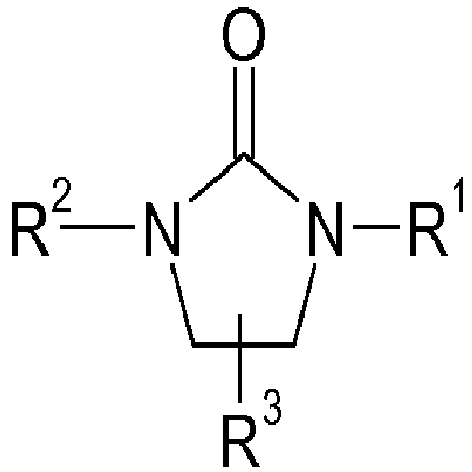
- Especially preferred imidazolidine-2-one compounds are:


- It has been surprisingly found that aromatic formaldehyde scavengers (E) are very suitable for the molding compositions of the present invention.
- According to a preferred embodiment of the present invention, the formaldehyde scavenger (E) has a melting point higher than 235 °C, preferably higher than 250 °C, more preferably higher than 280 °C, most preferably higher than 300 °C and especially higher than 320 °C. Further, it has been found that the pKa value of the formaldehyde scavenger (E) may influence the formaldehyde emission. According to a preferred embodiment, the formaldehyde scavenger (D) has a pKa value ranging from 4.5 to 10, preferably from 4.5 to 6.5.
- Further, preference is given to a formaldehyde scavenger (E) which has at least one triazine moiety. The use of formaldehyde scavengers which comprise at least one triazine moiety does not only have excellent formaldehyde reducing properties but also positively influences the mechanical properties of the molding composition. Preferred formaldehyde scavengers (E) which comprise a triazine moiety are selected from the group consisting of guanamine, melamine, N-butylmelamine, N-phenylmelamine, N,N-diphenylmelamine, N,N-diallylmelamine, N,N',N"-triphenylmelamine, benzoguanamine, acetoguanamine, 2,4-diamino-6-butyl-sym-triazine, ammeline, 2,4-diamino-6-benzyloxy-sym-triazine, 2,4-diamino-6-butoxy-sym-triazine, 2,4-diamino-6-cyclohexyl-sym-triazine, 2,4-diamino-6-chloro-sym-triazine, 2,4-diamino-6-mercapto-sym-triazine, 2,4-dioxy-6-amino-sym-triazine, 2-oxy-4,6-diamino-sym-triazine, 1,1-bis(3,5-diamino-2,4,6-triazinyl)methane, 1,2-bis(3,5-diamino-2,4,6-triazinyl)ethyne (other name: succinoguanamine), 1,3-bis(3,5-diamino-2,4,6-triazinyl)propane, 1,4-bis(3,5-diamino-2,4,6-triazinyl)butane, methylenated melamine, ethylenedimelamine, triguanamine, melamine cyanurate, ethylene dimelamine cyanurate and triguanamine cyanurate.
- These triazine derivatives may be used singly or in combinations of two or more compounds. Guanamines and melamine are preferred, and melamine is particularly preferable.
- Preferred formaldehyde scavengers (E) are hydrazides, more preferably dihydrazides such as sebacic dihydrazide (SDH).
- Examples of the hydrazide compound which can be used in the present invention as formaldehyde scavenger (E) include an aliphatic carboxylic acid hydrazide-based compound, an alicyclic carboxylic acid hydrazide-based compound, an aromatic carboxylic acid hydrazide-based compound, hetero atom-containing carboxylic acid hydrazide-based compound, a polymer-type carboxylic acid hydrazide-based compound, and the like. These carboxylic acid hydrazides can be used alone or in combination of two or more of them.
- Examples of the aliphatic carboxylic acid hydrazide-based compound include: monocarboxylic acid hydrazide (lauric acid hydrazide, stearic acid hydrazide, 12-hydroxystearic acid hydrazide 1,2,3, 4-butane tetracarboxylic acid hydrazide or the like); polycaboxylatic acid hydrazide such as succinic acid mono- or di-hydrazide, glutaric acid mono- or di-hydrazide, adipic acid mono- or di-hydrazide, pimelic acid mono- or di-hydrazide, suberic acid mono- or di-hydrazide, azelaic acid mono- or di-hydrazide, sebacic acid mono- or di-hydrazide, dodecanedioic acid mono- or di-hydrazide, hexadecane dioic acid mono- or di-hydrazide, eicosandioic acid mono- or di-hydrazide, 7,11-octadecadiene-1,18-dicarbohydrazide, and the like. Examples of the alicyclic carboxylic acid hydrazide-based compound include: monocarboxylic acid hydrazides such as cyclohexane carboxylic acid hydrazide; and polycarboxylic acid hydrazides such as dimer acid mono- or di-hydrazide, trimer acid mono- to tri-hydrazide, 1,2-, 1,3-, or 1,4-cyclohexane dicarboxylic acid mono- or di-hydrazide, cyclohexane tricaboxylic acid mono- to tri-hydrazide, and the like. Examples of the aromatic carboxylic acid hydrazide include: mono-carboxylic acid hydrazides (benzoic acid hydrazide and functional group substitution products thereof, such as derivatives where functional groups such as alkyl group, hydroxy group, acetoxy group, amino group, acetoamino group, nitrile group, carboxy group, alkoxycarbonyl group, carbamoyl group, alkoxy group, phenyl group, benzyl group, cumyl group, or hydroxyphenyl group are substituted by 1 to 5 phenyl residues of benzoguanamine (for example, o-toluic acid hydrazide, m-toluic acid hydrazide, p-toluic acid hydrazide, 2,4-, 3,4-, 3,5- or 2,5-dimethylbenzoic acid hydrazide, o-, m- or p-hydroxy-benzoic acid hydrazide, o-, m- or p-acetoxy-benzoic acid hydrazide, 4-hydroxy-3-phenyl-benzoic acid hydrazide, 4-actoxy-3-phenyl-benzoic acid hydrazide, 4-pheny-benzoic acid hydrazide, 4-(4'-phenyl)benzoic acid hydrazide, 4-hydroxy-3,5-dimethyl-benzoic acid hydrazide, 4-hydroxy-3,5-di-t-butyl-benzoic acid hydrazide, 4-hydroxy-3,5-di-t-butylphenyl-benzoic acid hydrazide, and 4-hydroxy-3,5-di-t-butylphenyl-propionic acid hydrazide); [alpha]-or [beta]-naphthoic acid hydrazide and functional substitution products thereof, such as 1-naphthoic acid hydrazide, 2-naphthoic acid hydrazide, 3-hydroxy-2-naphthoic acid hydrazide, or 6-hydroxy-2-naphthoic acid hydrazide; and polycarboxylic acid hydrazides such as isophthalic acid mono- or di-hydrazide, terephthalic acid mono- or di-hydrazide, 1,4-or 2,6-naphthalene dicarboxylic acid mono- or di-hydrazide, 3,3'-, 3,4'- or 4,4'-diphenyldicarboxylic acid mono- or di-hydrazide, diphenylether dicarboxylic acid mono- or di-hydrazide, diphenylmethane dicarboxylic acid mono- or di-hydrazide, diphenylethane dicarboxylic acid mono- or di-hydrazide, diphenoxyethane dicarboxylic acid mono- or di-hydrazide, diphenylsulphone dicarboxylic acid mono- or di-hydrazide, diphenylketone dicarboxylic acid mono-or di-hydrazide, 4,4"-terphenyl dicarboxylic acid mono- or di-hydrazide, 4,4"'-quaterphenyldicarboxylic acid mono- or di-hydrazide, 1,2,4-benzene tricarboxylic acid mono- to tri-hydrazide, pyromellitic acid mono- to tetra-hydrazide, and 1,4,5,8-naphthoic acid mono- to tetra-hydrazide).
- Examples of the heteroatom-containing carboxylic acid hydrazide-based compound include: mono- or di-hydrazide of dioxane ring-containing carboxylic acid hydrazides such as 5-methylol-5-ethyl-2-(1,1-dimethyl-2-carboxyethyl)-1,3-diox ane; tetraoxo spiro ring-containing carboxylic acid hydrazides such as mono- or di-hydrazide of 3,9-bis(2-carboxyethyl)-2,4,8,10-tetraoxospiro[5,5]undecane, mono- or di-hydrazide of 3,9-bis(2-methoxycarbonylethyl)-2,4,8,10-tetraoxospiro[5,5] undecane, mono- or di-hydrazide of 3,9-bis(1,1-dimethyl-1-carboxymethyl)-2,4,8,10-tetraoxospir o[5,5]undecane, or mono- or di-hydrazide of 3,9-bis(1,1-dimethyl-1-methoxycarbonylmethyl)-2,4,8,10-tetraoxospiro[5,5]undecane; isocyanuric ring-containing carboxylic acid hydrazides such as mono- to tri-hydrazide of 1,3,5-tris[2-carboxyethyl]isocyanulate, or mono- to tri-hydrazide of 1,3,5-tris(3-caboxypropyl)isocyanurate; and hydantoin ring-containing carboxylic acid hydrazides such as 1,3-bis(2-hydrazinocarbonylethyl)5-isopropyl hydantoin.
- The polymer-type carboxylic acid hydrazide-based compounds are exemplified as follows: single polymers or copolymers of poly(meth)acrylic acid hydrazides which may be cross-linked compounds, such as olefin copolymer, vinyl monomer copolymer, styrene copolymer of divinylbenzene crosslinked compound, or bis(meth)acrylic ester crosslinked compound; polymer described in
JP-A 55-145529 JP-A 56-105905 US patent 3574786 . - Further, dicyandiamide (DCD) can be used as component (E).
Further, zeolites can be used as component (E). - According to a preferred embodiment of the present invention, the formaldehyde scavenger (E) has at least one -NH2, preferably at least two -NH2 groups, most preferably at least three -NH2 groups.
- It has surprisingly been found that an excellent performance can be achieved with a formaldehyde scavenger (E) which has a melting point which is at least 10 °C, preferably at least 20 °C, more preferably at least 30 °C, even more preferably at least 50 °C higher than the melting point of the polyoxymethylene (A).
- Especially preferred as a formaldehyde scavenger (E) is melamine.
- The formaldehyde scavenger (E) is preferably present in the composition in an amount of up to 2 weight-%, more preferably in an amount ranging from 0.001 to 1.5 wt.-%, further more preferably ranging from 0.01 to 1.0 wt.-%, most preferably ranging from 0.05 to 0.5 wt.-% and especially ranging from 0.08 to 0.3 weight-%, wherein the weight is based on the total weight of the composition.
- The molding materials or moldings according to the invention can optionally be stabilized and/or modified by known additives. Such stabilizers and processing auxiliaries other than the components (C) to (E) (defined above) can be used as optional component (F). Possible additives and processing auxiliaries are known to the person skilled in the art.
- Component (F) is usually present in an amount up to 10 wt.-%, preferably from 0.1 to 5 wt.-%, more preferably from 0.2 to 4 wt.-%, especially 0.5 to 3 wt.-%, wherein the amount is based on the total weight of the composition.
- The stabilizers are, for example, antioxidants, acid scavengers, UV stabilizers or heat stabilizers. In addition, the molding material or the molding may contain processing auxiliaries, for example adhesion promoters, lubricants, nucleating agents, demolding agents, fillers, or antistatic agents and additives which impart a desired property to the molding material or to the molding, such as dyes and/or pigments and/or impact modifiers and/or additional tribological additives other than component (B) and/or glass beads and/or additives imparting electrical conductivity; and mixtures of these additives, but without limiting the scope to said examples.
- A specially preferred molding composition of the invention comprises
- a) a polyoxymethylene having a content of terminal hydroxyl groups of at least 15 mmol/kg and most preferably ranging from 15 to 50 mmol/kg, especially 18 to 40 mmol/kg,
- b) hydrophilized ultra high molecular weight polyethylene having an average molecular weight higher than 1.0.106 g/mol, preferably higher than 2.0·106 g/mol, more preferably higher than 4.0·106 g/mol,
- c) optionally one or more coupling agent, preferably an organic polyisocya n ide,
- d) optionally one or more reinforcing fiber(s) (D), preferably glassfiber(s),
- e) optionally 0.05 to 0.5 wt.-%, preferably 0.08 to 0.3 wt.-% of one or more formaldehyde scavenger (E), preferably an aromatic formaldehyde scavenger, more preferably a formaldehyde scavenger having a melting point higher than 235°C, most preferably a formaldehyde scavenger having a melting point which is at least 10°C higher than the melting point of the polyoxymethylene (A), and especially preferable melamine or a melamine derivative; wherein the weight is based on the total weight of the composition;
wherein the weight ratio of the hydrophilized ultrahigh molecular weight polyethylene (B) to polyoxymethylene (A) ranges from 1:40 to 1:4, further preferably 1:30 to 1:5, especially 1:20 to 1:6 or 1:15 to 1:7. - If coupling agents are present in the molding composition of the present invention the reactive processing of the components is typically effected at temperatures from 100 to 260°C, such as from 150 to 220°C, and the duration of mixing is typically from 0.2 to 60 minutes.
- A further embodiment of the present invention is a method for the manufacturing of molded articles comprising melt mixing the molding composition of the present invention.
- A further embodiment of the present invention is a method for the manufacturing of the molding composition of the invention comprising melt mixing the components of the molding compostion.
- Melt mixing can be carried out by aggregates molding apparatuses known to the person skilled in the art. Preferably the melt mixing step is carried out at a temperature ranging from 100 to 280 °C, more preferably from 120 to 260 °C, such as 140 to 240 °C or 180 to 220 °C.
- A further preferred embodiment of the present invention is a process for the manufacturing of a molding composition of the present invention comprising the following step of melt mixing a composition comprising
polyoxymethylene (A);
hydrophilized ultra high molecular weight polyethylene (B);
optionally, at least one coupling agent (C);
optionally, at least one reinforcing fiber (D); and
optionally at least one formaldehyde scavenger (E), at a temperature ranging from 120 °C to 260 °C. - A preferred embodiment of the process comprises melt mixing a composition comprising:
- polyoxymethylene (A);
- hydrophilized ultra high molecular weight polyethylene (B);
- at least one coupling agent (C);
- at least one reinforcing fiber (D); and
- at least one formaldehyde scavenger (E)
- at a temperature ranging from 120 °C to 260 °C wherein the melting point of the formaldehyde scavenger is at least 10 °C higher than the melt mixing temperature.
- The preferred ranges referred to above in conjunction with the composition of the invention apply also to the process of the invention.
- A further embodiment of the invention is a molding composition which is obtainable by the process of the invention.
- In one embodiment, the molding composition of the present disclosure is, if a coupling agent is present, reacted together and compounded prior to being used in a molding process. For instance, in one embodiment, the different components can be melted and mixed together in a conventional single or twin screw extruder at a temperature described above. Extruded strands may be produced by the extruder and pelletized. Prior to compounding, the polymer components may be dried to a moisture content of about 0.05 weight percent or less. If desired, the pelletized compound can be ground to any suitable particle size, such as in the range of from about 100 microns to about 500 microns.
- A further embodiment of the present invention is a molded part obtained or obtainable by molding a molding composition of the present invention, in particular obtained by or obtainable by melt mixing the molding composition of the present invention.
- The molded parts demonstrate the excellent balance of mechanical properties as mentioned above in addition to excellent tribological properties and appearance.
- Especially in case the molding composition is reinforced, the molded parts demonstrate an elongation or strain at break (5 mm/min) of higher than 2.0 %, more preferably higher than 2.2 %, especially higher than 2.8 %, determined according to ISO 527.
- Especially in case the molding composition is not reinforced, the molded parts demonstrate an elongation or strain at break (5 mm/min) of higher than 7.0 %, more preferably higher than 8.0 %, especially higher than 9.0 % or ranging from 8.0 to 15 %, determined according to ISO 527.
- Further, preferably the Charpy notched impact strength (determined at 23 °C according to ISO 179-1/1eA(CNI)) is higher than 6.0, more preferably higher than 8.0 kJ/m2, or ranging from 9 to 20 kJ/m2,especially in case the molding composition is reinforced.
- Further, preferably the Charpy notched impact strength (determined at 23 °C according to ISO 179-1/1eA(CNI)) is higher than 2.0, more preferably higher than 2.5 kJ/m2, or ranging from 3.0 to 10 kJ/m2,especially in case the molding composition is not reinforced.
- The molded parts show an excellent tribological behavior. The molded parts show preferably a wear rate lower than 15 µm/h, preferably lower than 12 µm/h (Tribology (wear rate versus steel; roughness Rz = 1 µm) was measured by a ball-on-3 plates test setup (MCR 301 test, v = 100 mm/s, F = 5N) from Anton Paar Germany GmbH), especially in case the molding composition is reinforced. The molded parts show an excellent tribological behavior. The molded parts show preferably a wear rate lower than 10 µm/h, preferably lower than 8 µm/h, more preferably lower than 6 µm/h, especially lower than 4 µm/h (Tribology (wear rate versus steel; roughness Rz = 0.1 µm) was measured by a ball-on-3 plates test setup (MCR 301 test, v = 100 mm/s, F = 5N) from Anton Paar Germany GmbH), especially in case the molding composition is not reinforced.
- The coefficient of friction is preferably lower than 0.40, more preferably lower than 0.35, especially lower than 0.30 (Tribology (wear rate versus steel; roughness Rz = 0.1 µm) was measured by a ball-on-3 plates test setup (MCR 301 test, v = 100 mm/s, F = 5N) from Anton Paar Germany GmbH), especially in case the molding composition is not reinforced.
- Preferred molded parts are parts used in the automotive industry, especially housings, latches, window winding systems, pulleys, wiper systems, sun roof systems, seat adjustment, levers, gears, claws, pivot housings, brackets or wiper arms.
- The molded parts can be obtained by the molding techniques known in the art such as extrusion, injection molding thermoforming, blow molding, rotational molding and the like.
- The molding composition of the present invention is especially suitable to be used in the manufacturing of molded parts used in the automotive industry. Thus, a further embodiment of the present invention is the use of the composition according to the present invention for the manufacturing of molded parts used in the automotive industry.
- Due to the excellent mechanical and tribological properties the molding composition of the invention can be used for several applications where low wear and excellent gliding properties as well as appearance is desired.
- A further embodiment is the use of the composition or molded parts for the manufacturing of molded parts used in the automotive industry or for housings, latches, window winding systems, wiper systems, pulleys, sun roof systems, seat adjustments, levers, gears, claws, pivot housings, wiper arms, brackets or seat rails bearings, gears, cams, rollers, sliding elements such as sliding plates, conveyer belt parts such as chain elements and links, castors, fasteners, levers, conveyor system wear strips and guard rails.
- The following examples are presented to further illustrate this invention.
- The examples are not, however, intended to limit the invention in any way.
- The following components were used in the Examples:
- Polyacetal containing 3.4 wt.-% of comonomer dioxolane with an MVR (190°C / 2.16kg) of 7.9 cm3/10min and a portion of terminal OH-groups of 6 - 10 mmol/kg
- Polyacetal containing 3.4 wt.-% of comonomer dioxolane with an MVR (190°C / 2.16kg) of 8.3 cm3/10min and a proportion of terminal OH groups of 20 - 25 mmol/kg
- Ultrahigh-molecular-weight polyethylene powder whose average molecular weight is 5.0·106 g/mol (viscosity number: 2400 ml/g) and has an average particle size (D50) of 120 +/- 20µm
- Ultrahigh-molecular-weight polyethylene powder whose average molecular weight is 9.2·106 g/mol (viscosity number: 3850 ml/g) and has an average particle size (D50) of 60 +/- 20µm
- Ultrahigh-molecular-weight polyethylene powder whose average molecular weight is 5.0·106 g/mol (viscosity number: 2400 ml/g) and has an average particle size (D50) of 120 +/- 20µm, hydrophilized according to the technology described in
EP 711319 A1 - Ultrahigh-molecular-weight polyethylene powder whose average molecular weight is 9.2·106 g/mol (viscosity number: 3850 ml/g) and has an average particle size (D50) of 60 +/- 20µm, hydrophilized according to the technology described in
EP 711319 A1 - GF: reinforcing fiber (NEG ECS 03 T-651H); sized glass fiber
- Additive: acid scavenger; antioxidants, nucleating agents; stabilizer
- All components beside the glass fiber were mixed together. For the compounding a ZSK 25MC, (Werner&Pfleiderer, Germany) was used (zone temperature 190°C, melt temperature about 210°C). The glass fiber, if present, was added using a downstream feeding unit at a suitable position. The screw configuration with kneading elements was chosen so that effective thorough mixing of the components took place during the reactive extrusion as well as an optimal glass fiber length was obtained.
- Unless indicated otherwise all determinations have been carried out at room temperature (23 °C).
- The testing of the prepared molding compositions was performed according to the following standards:
- MVR (190°C; 2.16kg): ISO 1133;
- Charpy notched impact strength: determined at 23 °C according to ISO 179-1/1eA(CNI);
- Tensile modulus, stress at break and elongation at break have been determined according to ISO 527;
- Portion of terminal OH groups in POM has been determined as described in K. Kawaguchi, E. Masuda, Y. Tajima, Journal of Applied Polymer Science, Vol. 107, 667 - 673 (2008).
- Melting point of polyoxymethylene (POM) has been determined with Differential Scanning Calorimetry (DSC); heating rate 10 K/min according to ISO 11357-1, - 2, -3.
- Tribology (wear rate versus steel; roughness Rz = 1 µm) was measured by a ball-on-3 plates test setup (MCR 301 test, v = 100 mm/s, F = 5N) from Anton Paar Germany GmbH in case the compostions were reinforced.
- Tribology (wear rate versus steel; roughness Rz = 0.1 µm) was measured by a ball-on-3 plates test setup (MCR 301 test, v = 100 mm/s, F = 5N) from Anton Paar Germany GmbH in case the compostions were not reinforced.
- The results are listed in the following tables.
- Table 1 shows the molding compositions of the invention (examples 3, 4, 7 and 8) as well as the comparative examples 1, 2, 5 and 6. The amounts referred to in the table for the components are based on the total weight of the composition.
- Table 2 shows a glas fiber reinforced molding composition of the invention (examples 11 and 12) as well as the comparative examples 9 and 10. The amounts referred to in the table for the components are based on the total weight of the composition.
- The molding compositions of the present invention (Examples 11 and 12) show a good balance between mechanical properties, such as impact resistance and tensile modulus and friction as well as wear properties (which are important especially for automotive applications such as window winding systems or sunroof systems, e.g. pulleys or sliding elements).
| Example | POM [wt%] | additive [wt%] | UHMWPE [wt%] | UHMWPE particle size [D50µm] | Dynamic Coefficent of friction (COF) | Wear rate [µm/h] | Modulus [MPa] | Charpy Notched Impact Strength [kJ/m2] | Stress at Break [MPa] | Strain at Break [%] | MVR (190°C, 2,16kg) [cm3/10min] |
| 1 (Comparative) | POM-A [89] | [1] | UHMWPE-C [10] | 120 | 0,31 | 9,4 | 2041 | 2,8 | 44,7 | 11 | 5,2 |
| 2 (Comparative) | POM-A [89] | [1] | UHMWPE-D [10] | 60 | 0,32 | 5,4 | 2080 | 3,3 | 45,2 | 11 | 5,6 |
| 3 | POM-A [89] | [1] | UHMWPE-E [10] | 120 | 0,34 | 7,0 | 2097 | 3,3 | 44,1 | 10 | 5,4 |
| 4 | POM-A [89] | [1] | UHMWPE-F [10] | 60 | 0,29 | 2,5 | 2119 | 3,3 | 45,0 | 11 | 6,0 |
| 5 (Comparative) | POM-B [89] | [1] | UHMWPE-C [10] | 120 | 0,33 | 8,7 | 2072 | 3,5 | 44,6 | 11 | 4,8 |
| 6 (Comparative) | POM-B [89] | [1] | UHMWPE-D [10] | 60 | 0,31 | 4,9 | 2062 | 3,8 | 45,0 | 11 | 5,2 |
| 7 | POM-B [89] | [1] | UHMWPE-E [10] | 120 | 0,36 | 5,7 | 2051 | 3,8 | 43,4 | 10 | 4,9 |
| 8 | POM-B [89] | [1] | UHMWPE-F [10] | 60 | 0,30 | 0,5 | 2017 | 3,3 | 43,7 | 11 | 5,5 |
| Example | POM-B [wt %] | GF [wt%] | additive [wt%] | UHMWPE [wt%] | UHMWPE particle size [D50µm] | Dynamic Coefficient of friction (COF) | Wear rate [µm/h] | Modulus [MPa] | Charpy Notched Impact Strength [kJ/m2] | Stress at Break [MPa] | Strain at Break [%] | MVR (190°C, 2,16kg) [cm3/10 min] |
| 9 (comparative) | 65.6 9 | 26 | [1.31] | UHMWPEC [7] | 120 | 0,24 | 8,6 | 8496 | 8 | 109,9 | 2,3 | 0,6 |
| 10 (comparative) | 65.6 9 | 26 | [1.31] | UHMWPED [7] | 60 | 0,27 | 15,9 | 9398 | 12,2 | 143,5 | 3,2 | 0,6 |
| 11 | 65.6 9 | 26 | [1.31] | UHMWPEE [7] | 120 | 0,27 | 5,8 | 8370 | 8,3 | 113,1 | 2,3 | 0,6 |
| 12 | 65.6 9 | 26 | [1.31] | UHMWPEF [7] | 60 | 0,27 | 12,2 | 8515 | 11,1 | 125,9 | 2,9 | 0,5 |
Claims (15)
- A molding composition comprisinga) polyoxymethylene (A) andb) hydrophilized ultra high molecular weight polyethylene (B).
- A molding composition according to claim 1, wherein at least 25 %, preferably at least 50 %, most preferably at least 75% of the terminal groups of the polyoxymethylene (A) are hydroxyl groups, especially hydroxyethylene groups.
- A molding composition according to at least one of the preceding claims, wherein the polyoxymethylene (A) comprises at least 50 mol-%, preferably at least 70 mol-%, more preferably at least 90 mol-% and most preferably at least 95 mol-% of -CH2O repeat units.
- A molding composition according to at least one of the preceding claims, wherein polyoxymethylene (A) is present in an amount up to 97 wt.-%, preferably ranging from 40 to 95 wt.-%, more preferably ranging from 55 to 90 wt.-% or 55 to 85 wt.-%, wherein the weight is based on the total weight of the molding composition.
- A molding composition according to at least one of the preceding claims, wherein the polyoxymethylene (A) has a content of terminal hydroxyl groups of at least 4 mmol/kg, preferably at least 10 mmol/kg, more preferably at least 15 mmol/kg and most preferably ranging from 15 to 50 mmol/kg, especially 18 to 40 mmol/kg.
- A molding composition according to at least one of the preceding claims, wherein the polyoxymethylene (A) has a melt volume rate MVR of less than 50 cm3/10 min, preferably ranging from 1 to 20 cm3/10 min, more preferably ranging from 2 to 15 cm3/10 min and especially ranging from 4 to 10 cm3/10 min, determined according to ISO 1133 at 190 °C and 2.16 kg.
- A molding composition according to at least one of the preceding claims, wherein the hydrophilized ultrahigh molecular weight polyethylene (B) has an average molecular weight of higher than 1.0·106 g/mol, preferably higher than 2.0·106 g/mol, more preferably higher than 4.0·106 g/mol.
- A molding composition according to at least one of the preceding claims, wherein the hydrophilized ultrahigh molecular weight polyethylene (B) has a viscosity number of higher than 1000 ml/g, more preferably higher than 1500 ml/g, especially ranging from 1800 ml/g to 5000 ml/g, such as ranging from 2000 ml/g to 4300 ml/g (determined according to ISO 1628, part 3; concentration in decahydronaphthalin: 0.0002 g/ml).
- A molding composition according to at least one of the preceding claims, wherein the hydrophilized ultrahigh molecular weight polyethylene (B) has a mean particle diameter D50 ranging from 1 to 5000 µm, preferably from 10 to 500 µm and particularly preferably from 10 to 150 µm such as 30 to 130 µm and especially from 30 to 90 µm or 90 to 150 µm.
- A molding composition according to at least one of the preceding claims, wherein the hydrophilized ultrahigh molecular weight polyethylene (B) is present in the molding composition in an amount up to 30 wt.-%, preferably in an amount ranging from 1 to 25 wt.-%, more preferably ranging from 2.5 to 20 wt.-%, especially 4.5 to 15 wt.-%, such as 5.5 to 12 wt.-%, e.g. 6.5 to 9.5 wt.-%, wherein the amount is based on the total weight of the composition.
- A molding composition according to at least one of the preceding claims, wherein weight ratio of the hydrophilized ultrahigh molecular weight polyethylene (B) to polyoxymethylene (A) ranges from 1:99 to 1:1, preferably 1:50 to 1:3, more preferably 1:40 to 1:4, further preferably 1:30 to 1:5, especially 1:20 to 1:6 or 1:15 to 1:7.
- A molding composition according to at least one of the preceding claims, wherein the hydrophilized ultrahigh molecular weight polyethylene (B) is obtainable or obtained by a plasma treatment of a ultrahigh molecular weight polyethylene.
- Method for the manufacturing of molded articles comprising melt mixing the molding composition according to at least one of the preceding claims.
- Molded article obtainable by the method of claim 13.
- Use of the molding composition according to one or more of claims 1 to 12 or a molded article according to claim 14 for the manufacturing of molded parts used in the automotive industry or for housings, latches, window winding systems, wiper systems, pulleys, sun roof systems, seat adjustments, levers, gears, claws, pivot housings, wiper arms, brackets or seat rails bearings, gears, cams, rollers, sliding elements such as sliding plates, conveyer belt parts such as chain elements and links, castors, fasteners, levers, conveyor system wear strips and guard rails.
Priority Applications (3)
| Application Number | Priority Date | Filing Date | Title |
|---|---|---|---|
| EP12163359.8A EP2647666A1 (en) | 2012-04-05 | 2012-04-05 | Tribologically modified polyoxymethylene |
| PCT/EP2013/055467 WO2013149812A1 (en) | 2012-04-05 | 2013-03-15 | Tribologically modified polyoxymethylene |
| US14/388,950 US20150065654A1 (en) | 2012-04-05 | 2013-03-15 | Tribologically Modified Polyoxymethylene |
Applications Claiming Priority (1)
| Application Number | Priority Date | Filing Date | Title |
|---|---|---|---|
| EP12163359.8A EP2647666A1 (en) | 2012-04-05 | 2012-04-05 | Tribologically modified polyoxymethylene |
Publications (1)
| Publication Number | Publication Date |
|---|---|
| EP2647666A1 true EP2647666A1 (en) | 2013-10-09 |
Family
ID=47882208
Family Applications (1)
| Application Number | Title | Priority Date | Filing Date |
|---|---|---|---|
| EP12163359.8A Withdrawn EP2647666A1 (en) | 2012-04-05 | 2012-04-05 | Tribologically modified polyoxymethylene |
Country Status (3)
| Country | Link |
|---|---|
| US (1) | US20150065654A1 (en) |
| EP (1) | EP2647666A1 (en) |
| WO (1) | WO2013149812A1 (en) |
Cited By (1)
| Publication number | Priority date | Publication date | Assignee | Title |
|---|---|---|---|---|
| US9676935B2 (en) | 2013-12-31 | 2017-06-13 | Hyundai Motor Company | Polyoxymethylene resin composition |
Families Citing this family (4)
| Publication number | Priority date | Publication date | Assignee | Title |
|---|---|---|---|---|
| JP6700178B2 (en) | 2013-10-21 | 2020-05-27 | ティコナ ゲゼルシャフト ミット ベシュレンクテル ハフツング | Intrinsically low friction polyoxymethylene |
| CN108368325A (en) * | 2015-09-30 | 2018-08-03 | 塞拉尼斯销售德国有限公司 | Low-friction, harsh-sounding assembly |
| EP3577168B1 (en) | 2017-03-10 | 2022-09-07 | Celanese Sales Germany GmbH | Polyester polymer compositions |
| CN108314822B (en) * | 2018-02-11 | 2020-09-25 | 内蒙古昊远高分子材料有限公司 | High-temperature-resistant ultra-high molecular weight polyethylene pipe and preparation method thereof |
Citations (30)
| Publication number | Priority date | Publication date | Assignee | Title |
|---|---|---|---|---|
| US3574786A (en) | 1967-12-25 | 1971-04-13 | Asahi Chemical Ind | Polyacetal compositions stabilized with a polymer from a dicarboxylic acid dihydrazide,diamine and urea |
| US4111887A (en) | 1976-12-17 | 1978-09-05 | Celanese Corporation | Reinforced polyoxymethylene molding composition capable of forming composite articles exhibiting improved physical properties |
| JPS55145529A (en) | 1979-05-01 | 1980-11-13 | Otsuka Chem Co Ltd | Formalin adsorbent |
| DE2947490A1 (en) | 1979-11-24 | 1981-06-04 | Hoechst Ag, 6000 Frankfurt | POLYOXYMETHYLENE FIBRIDE AND METHOD FOR THE PRODUCTION THEREOF |
| JPS56105905A (en) | 1980-01-29 | 1981-08-22 | Otsuka Kagaku Yakuhin | Formalin adsorbent |
| US4394468A (en) | 1982-02-03 | 1983-07-19 | Celanese Corporation | Fiber reinforced polyoxymethylene molding compositions |
| EP0110021A2 (en) * | 1982-09-30 | 1984-06-13 | AlliedSignal Inc. | Producing modified high performance polyolefin fiber and film |
| JPH01126359A (en) | 1987-11-11 | 1989-05-18 | Mitsuboshi Belting Ltd | Polyacetal resin composition |
| JPH03284675A (en) | 1990-03-29 | 1991-12-16 | Shikoku Chem Corp | 4(5)-(2',4'-diamino-s-triazinyl-6')-imidazole compound and its synthesis and curing of epoxy resin using the same |
| EP0498620A1 (en) | 1991-02-04 | 1992-08-12 | Polyplastics Co. Ltd. | Colored polyacetal resin composition |
| JPH06179671A (en) | 1992-12-14 | 1994-06-28 | Shikoku Chem Corp | New imidazoline compound and method for curing epoxy resin using the same compound |
| JPH0710871A (en) | 1993-06-19 | 1995-01-13 | Shikoku Chem Corp | Diamino-s-triazine compound having imidaziline ring and curing of epoxy resin therewith |
| JPH0733766A (en) | 1993-07-23 | 1995-02-03 | Shikoku Chem Corp | Diamino-s-triazine compound having imidazole ring and method for preventing copper from rusting using the same compound |
| US5482987A (en) | 1995-02-28 | 1996-01-09 | Hoechst Celanese Corporation | Self-lubricating thermoplastic polymer composition |
| EP0711319A1 (en) | 1993-07-26 | 1996-05-15 | Gvu Ges Fuer Verfahrenstechnik | Process for producing plastics suitable as powder coating material and/or hot-melt-type-adhesive |
| EP0756536A1 (en) | 1994-04-19 | 1997-02-05 | Institut für Verbundwerkstoffe GmbH | Process and device for impregnating fibre bundles |
| US5641824A (en) | 1995-02-28 | 1997-06-24 | Hoechst Celanese Corporation | Thermoplastic polymer composition with improved wear properties |
| US5889102A (en) | 1996-02-23 | 1999-03-30 | Ticona Gmbh | Plastic Molding compositions with low wear |
| US5977299A (en) | 1997-04-07 | 1999-11-02 | Dade Behring Marburg Gmbh | Activated peptides and conjugates |
| US5977229A (en) | 1995-10-02 | 1999-11-02 | Hoechst Aktiengesellschaft | Hydrophilically modified polyethylene resins |
| DE19836787A1 (en) | 1998-08-13 | 2000-02-17 | Dieffenbacher Gmbh Maschf | Process and plasticizing extruder for the production of fiber-reinforced plastics |
| US6046141A (en) | 1997-09-29 | 2000-04-04 | Ticona Gmbh | Thermoplastic molding composition |
| JP2000154181A (en) | 1998-06-10 | 2000-06-06 | Shikoku Chem Corp | New 2-substituted guanamine compound and flame retardant resin composition containing 2-substituted guanamine compound as active component |
| US20030148117A1 (en) | 2002-02-04 | 2003-08-07 | Miki Takada | Polyacetal resin composition and metal insert molding |
| US6616918B2 (en) | 2001-07-19 | 2003-09-09 | L'oreal | Self-tanning composition containing an N-acyl amino acid ester and a self-tanning agent |
| US6790385B2 (en) * | 2000-02-28 | 2004-09-14 | Ticona Gmbh | Slip-modified, electrically conductive polyoxymethylene |
| US6852677B2 (en) * | 2000-06-15 | 2005-02-08 | Ticona Gmbh | Polyoxymethylene moulding compound containing a lubricant, the use thereof and moulded bodies produced therefrom |
| US20070105989A1 (en) | 2005-07-28 | 2007-05-10 | Ticona Gmbh | Low-emission, tribologically modified polyoxymethylene molding compositions and moldings produced hterefrom |
| US20090283931A1 (en) * | 2002-09-10 | 2009-11-19 | Ticona Gmbh | Molded Bodies Containing Polyacetals and Method for Producing Said Molded Bodies |
| US8007916B2 (en) * | 2005-01-28 | 2011-08-30 | Evonik Degussa Gmbh | Process for production of a composite |
Family Cites Families (3)
| Publication number | Priority date | Publication date | Assignee | Title |
|---|---|---|---|---|
| US3398074A (en) * | 1964-10-08 | 1968-08-20 | Kurashiki Rayon Co | Method of manufacturing improved polyoxymethylene graft copolymers using radiation |
| US4670508A (en) * | 1984-01-06 | 1987-06-02 | Mitsui Petrochemical Industries Ltd. | Thermoplastic resin composition |
| JPH08120137A (en) * | 1994-10-26 | 1996-05-14 | Daicel Chem Ind Ltd | Polyacetal resin composition |
-
2012
- 2012-04-05 EP EP12163359.8A patent/EP2647666A1/en not_active Withdrawn
-
2013
- 2013-03-15 WO PCT/EP2013/055467 patent/WO2013149812A1/en not_active Ceased
- 2013-03-15 US US14/388,950 patent/US20150065654A1/en not_active Abandoned
Patent Citations (30)
| Publication number | Priority date | Publication date | Assignee | Title |
|---|---|---|---|---|
| US3574786A (en) | 1967-12-25 | 1971-04-13 | Asahi Chemical Ind | Polyacetal compositions stabilized with a polymer from a dicarboxylic acid dihydrazide,diamine and urea |
| US4111887A (en) | 1976-12-17 | 1978-09-05 | Celanese Corporation | Reinforced polyoxymethylene molding composition capable of forming composite articles exhibiting improved physical properties |
| JPS55145529A (en) | 1979-05-01 | 1980-11-13 | Otsuka Chem Co Ltd | Formalin adsorbent |
| DE2947490A1 (en) | 1979-11-24 | 1981-06-04 | Hoechst Ag, 6000 Frankfurt | POLYOXYMETHYLENE FIBRIDE AND METHOD FOR THE PRODUCTION THEREOF |
| JPS56105905A (en) | 1980-01-29 | 1981-08-22 | Otsuka Kagaku Yakuhin | Formalin adsorbent |
| US4394468A (en) | 1982-02-03 | 1983-07-19 | Celanese Corporation | Fiber reinforced polyoxymethylene molding compositions |
| EP0110021A2 (en) * | 1982-09-30 | 1984-06-13 | AlliedSignal Inc. | Producing modified high performance polyolefin fiber and film |
| JPH01126359A (en) | 1987-11-11 | 1989-05-18 | Mitsuboshi Belting Ltd | Polyacetal resin composition |
| JPH03284675A (en) | 1990-03-29 | 1991-12-16 | Shikoku Chem Corp | 4(5)-(2',4'-diamino-s-triazinyl-6')-imidazole compound and its synthesis and curing of epoxy resin using the same |
| EP0498620A1 (en) | 1991-02-04 | 1992-08-12 | Polyplastics Co. Ltd. | Colored polyacetal resin composition |
| JPH06179671A (en) | 1992-12-14 | 1994-06-28 | Shikoku Chem Corp | New imidazoline compound and method for curing epoxy resin using the same compound |
| JPH0710871A (en) | 1993-06-19 | 1995-01-13 | Shikoku Chem Corp | Diamino-s-triazine compound having imidaziline ring and curing of epoxy resin therewith |
| JPH0733766A (en) | 1993-07-23 | 1995-02-03 | Shikoku Chem Corp | Diamino-s-triazine compound having imidazole ring and method for preventing copper from rusting using the same compound |
| EP0711319A1 (en) | 1993-07-26 | 1996-05-15 | Gvu Ges Fuer Verfahrenstechnik | Process for producing plastics suitable as powder coating material and/or hot-melt-type-adhesive |
| EP0756536A1 (en) | 1994-04-19 | 1997-02-05 | Institut für Verbundwerkstoffe GmbH | Process and device for impregnating fibre bundles |
| US5641824A (en) | 1995-02-28 | 1997-06-24 | Hoechst Celanese Corporation | Thermoplastic polymer composition with improved wear properties |
| US5482987A (en) | 1995-02-28 | 1996-01-09 | Hoechst Celanese Corporation | Self-lubricating thermoplastic polymer composition |
| US5977229A (en) | 1995-10-02 | 1999-11-02 | Hoechst Aktiengesellschaft | Hydrophilically modified polyethylene resins |
| US5889102A (en) | 1996-02-23 | 1999-03-30 | Ticona Gmbh | Plastic Molding compositions with low wear |
| US5977299A (en) | 1997-04-07 | 1999-11-02 | Dade Behring Marburg Gmbh | Activated peptides and conjugates |
| US6046141A (en) | 1997-09-29 | 2000-04-04 | Ticona Gmbh | Thermoplastic molding composition |
| JP2000154181A (en) | 1998-06-10 | 2000-06-06 | Shikoku Chem Corp | New 2-substituted guanamine compound and flame retardant resin composition containing 2-substituted guanamine compound as active component |
| DE19836787A1 (en) | 1998-08-13 | 2000-02-17 | Dieffenbacher Gmbh Maschf | Process and plasticizing extruder for the production of fiber-reinforced plastics |
| US6790385B2 (en) * | 2000-02-28 | 2004-09-14 | Ticona Gmbh | Slip-modified, electrically conductive polyoxymethylene |
| US6852677B2 (en) * | 2000-06-15 | 2005-02-08 | Ticona Gmbh | Polyoxymethylene moulding compound containing a lubricant, the use thereof and moulded bodies produced therefrom |
| US6616918B2 (en) | 2001-07-19 | 2003-09-09 | L'oreal | Self-tanning composition containing an N-acyl amino acid ester and a self-tanning agent |
| US20030148117A1 (en) | 2002-02-04 | 2003-08-07 | Miki Takada | Polyacetal resin composition and metal insert molding |
| US20090283931A1 (en) * | 2002-09-10 | 2009-11-19 | Ticona Gmbh | Molded Bodies Containing Polyacetals and Method for Producing Said Molded Bodies |
| US8007916B2 (en) * | 2005-01-28 | 2011-08-30 | Evonik Degussa Gmbh | Process for production of a composite |
| US20070105989A1 (en) | 2005-07-28 | 2007-05-10 | Ticona Gmbh | Low-emission, tribologically modified polyoxymethylene molding compositions and moldings produced hterefrom |
Non-Patent Citations (1)
| Title |
|---|
| K. KAWAGUCHI; E. MASUDA; Y. TAJIMA, JOURNAL OF APPLIED POLYMER SCIENCE, vol. 107, 2008, pages 667 - 673 |
Cited By (1)
| Publication number | Priority date | Publication date | Assignee | Title |
|---|---|---|---|---|
| US9676935B2 (en) | 2013-12-31 | 2017-06-13 | Hyundai Motor Company | Polyoxymethylene resin composition |
Also Published As
| Publication number | Publication date |
|---|---|
| WO2013149812A1 (en) | 2013-10-10 |
| US20150065654A1 (en) | 2015-03-05 |
Similar Documents
| Publication | Publication Date | Title |
|---|---|---|
| EP2652001B1 (en) | Coupled glass-fiber reinforced polyoxymethylene | |
| EP2581408B1 (en) | Tribologically modified glass-fiber reinforced polyoxymethylene | |
| EP2653497B1 (en) | Weather resistant polyoxymethylene compositions | |
| EP2441786B1 (en) | Glass-fiber reinforced polyoxymethylene | |
| US9062183B2 (en) | Fiber reinforced polyoxymethylene composition with improved thermal properties | |
| US20230055930A1 (en) | Low Noise Polymer Composition | |
| WO2016098026A1 (en) | Polyoxymethylene polymer composition having low friction | |
| WO2013149812A1 (en) | Tribologically modified polyoxymethylene | |
| EP1290087A1 (en) | Slip-modified, electrically conductive polyoxymethylene | |
| US11015031B2 (en) | Reinforced polyoxymethylene composition with low emissions |
Legal Events
| Date | Code | Title | Description |
|---|---|---|---|
| PUAI | Public reference made under article 153(3) epc to a published international application that has entered the european phase |
Free format text: ORIGINAL CODE: 0009012 |
|
| AK | Designated contracting states |
Kind code of ref document: A1 Designated state(s): AL AT BE BG CH CY CZ DE DK EE ES FI FR GB GR HR HU IE IS IT LI LT LU LV MC MK MT NL NO PL PT RO RS SE SI SK SM TR |
|
| AX | Request for extension of the european patent |
Extension state: BA ME |
|
| STAA | Information on the status of an ep patent application or granted ep patent |
Free format text: STATUS: THE APPLICATION IS DEEMED TO BE WITHDRAWN |
|
| 18D | Application deemed to be withdrawn |
Effective date: 20140410 |