EP2647617A1 - Nucleoside analog or salt thereof, oligonucleotide analog, gene expression inhibitor, and nucleic-acid probe for detecting gene - Google Patents
Nucleoside analog or salt thereof, oligonucleotide analog, gene expression inhibitor, and nucleic-acid probe for detecting gene Download PDFInfo
- Publication number
- EP2647617A1 EP2647617A1 EP11844449.6A EP11844449A EP2647617A1 EP 2647617 A1 EP2647617 A1 EP 2647617A1 EP 11844449 A EP11844449 A EP 11844449A EP 2647617 A1 EP2647617 A1 EP 2647617A1
- Authority
- EP
- European Patent Office
- Prior art keywords
- group
- nucleoside analog
- analog
- salt
- substituted
- Prior art date
- Legal status (The legal status is an assumption and is not a legal conclusion. Google has not performed a legal analysis and makes no representation as to the accuracy of the status listed.)
- Granted
Links
- 0 CC(C)N(C(C)C)P([C@](C**)CC#Cc1c(cccc2)c2cc2ccccc12)OCCC#N Chemical compound CC(C)N(C(C)C)P([C@](C**)CC#Cc1c(cccc2)c2cc2ccccc12)OCCC#N 0.000 description 1
Images


Classifications
-
- C—CHEMISTRY; METALLURGY
- C07—ORGANIC CHEMISTRY
- C07C—ACYCLIC OR CARBOCYCLIC COMPOUNDS
- C07C33/00—Unsaturated compounds having hydroxy or O-metal groups bound to acyclic carbon atoms
- C07C33/04—Acyclic alcohols with carbon-to-carbon triple bonds
- C07C33/042—Acyclic alcohols with carbon-to-carbon triple bonds with only one triple bond
- C07C33/044—Alkynediols
-
- C—CHEMISTRY; METALLURGY
- C12—BIOCHEMISTRY; BEER; SPIRITS; WINE; VINEGAR; MICROBIOLOGY; ENZYMOLOGY; MUTATION OR GENETIC ENGINEERING
- C12N—MICROORGANISMS OR ENZYMES; COMPOSITIONS THEREOF; PROPAGATING, PRESERVING, OR MAINTAINING MICROORGANISMS; MUTATION OR GENETIC ENGINEERING; CULTURE MEDIA
- C12N15/00—Mutation or genetic engineering; DNA or RNA concerning genetic engineering, vectors, e.g. plasmids, or their isolation, preparation or purification; Use of hosts therefor
- C12N15/09—Recombinant DNA-technology
- C12N15/11—DNA or RNA fragments; Modified forms thereof; Non-coding nucleic acids having a biological activity
- C12N15/113—Non-coding nucleic acids modulating the expression of genes, e.g. antisense oligonucleotides; Antisense DNA or RNA; Triplex- forming oligonucleotides; Catalytic nucleic acids, e.g. ribozymes; Nucleic acids used in co-suppression or gene silencing
-
- A—HUMAN NECESSITIES
- A61—MEDICAL OR VETERINARY SCIENCE; HYGIENE
- A61P—SPECIFIC THERAPEUTIC ACTIVITY OF CHEMICAL COMPOUNDS OR MEDICINAL PREPARATIONS
- A61P43/00—Drugs for specific purposes, not provided for in groups A61P1/00-A61P41/00
-
- C—CHEMISTRY; METALLURGY
- C07—ORGANIC CHEMISTRY
- C07D—HETEROCYCLIC COMPOUNDS
- C07D213/00—Heterocyclic compounds containing six-membered rings, not condensed with other rings, with one nitrogen atom as the only ring hetero atom and three or more double bonds between ring members or between ring members and non-ring members
- C07D213/02—Heterocyclic compounds containing six-membered rings, not condensed with other rings, with one nitrogen atom as the only ring hetero atom and three or more double bonds between ring members or between ring members and non-ring members having three double bonds between ring members or between ring members and non-ring members
- C07D213/04—Heterocyclic compounds containing six-membered rings, not condensed with other rings, with one nitrogen atom as the only ring hetero atom and three or more double bonds between ring members or between ring members and non-ring members having three double bonds between ring members or between ring members and non-ring members having no bond between the ring nitrogen atom and a non-ring member or having only hydrogen or carbon atoms directly attached to the ring nitrogen atom
- C07D213/60—Heterocyclic compounds containing six-membered rings, not condensed with other rings, with one nitrogen atom as the only ring hetero atom and three or more double bonds between ring members or between ring members and non-ring members having three double bonds between ring members or between ring members and non-ring members having no bond between the ring nitrogen atom and a non-ring member or having only hydrogen or carbon atoms directly attached to the ring nitrogen atom with hetero atoms or with carbon atoms having three bonds to hetero atoms with at the most one bond to halogen, e.g. ester or nitrile radicals, directly attached to ring carbon atoms
- C07D213/72—Nitrogen atoms
- C07D213/73—Unsubstituted amino or imino radicals
-
- C—CHEMISTRY; METALLURGY
- C07—ORGANIC CHEMISTRY
- C07D—HETEROCYCLIC COMPOUNDS
- C07D229/00—Heterocyclic compounds containing rings of less than five members having two nitrogen atoms as the only ring hetero atoms
- C07D229/02—Heterocyclic compounds containing rings of less than five members having two nitrogen atoms as the only ring hetero atoms containing three-membered rings
-
- C—CHEMISTRY; METALLURGY
- C07—ORGANIC CHEMISTRY
- C07D—HETEROCYCLIC COMPOUNDS
- C07D239/00—Heterocyclic compounds containing 1,3-diazine or hydrogenated 1,3-diazine rings
- C07D239/02—Heterocyclic compounds containing 1,3-diazine or hydrogenated 1,3-diazine rings not condensed with other rings
- C07D239/24—Heterocyclic compounds containing 1,3-diazine or hydrogenated 1,3-diazine rings not condensed with other rings having three or more double bonds between ring members or between ring members and non-ring members
- C07D239/28—Heterocyclic compounds containing 1,3-diazine or hydrogenated 1,3-diazine rings not condensed with other rings having three or more double bonds between ring members or between ring members and non-ring members with hetero atoms or with carbon atoms having three bonds to hetero atoms with at the most one bond to halogen, directly attached to ring carbon atoms
- C07D239/46—Two or more oxygen, sulphur or nitrogen atoms
- C07D239/47—One nitrogen atom and one oxygen or sulfur atom, e.g. cytosine
-
- C—CHEMISTRY; METALLURGY
- C07—ORGANIC CHEMISTRY
- C07D—HETEROCYCLIC COMPOUNDS
- C07D239/00—Heterocyclic compounds containing 1,3-diazine or hydrogenated 1,3-diazine rings
- C07D239/02—Heterocyclic compounds containing 1,3-diazine or hydrogenated 1,3-diazine rings not condensed with other rings
- C07D239/24—Heterocyclic compounds containing 1,3-diazine or hydrogenated 1,3-diazine rings not condensed with other rings having three or more double bonds between ring members or between ring members and non-ring members
- C07D239/28—Heterocyclic compounds containing 1,3-diazine or hydrogenated 1,3-diazine rings not condensed with other rings having three or more double bonds between ring members or between ring members and non-ring members with hetero atoms or with carbon atoms having three bonds to hetero atoms with at the most one bond to halogen, directly attached to ring carbon atoms
- C07D239/46—Two or more oxygen, sulphur or nitrogen atoms
- C07D239/52—Two oxygen atoms
- C07D239/54—Two oxygen atoms as doubly bound oxygen atoms or as unsubstituted hydroxy radicals
-
- C—CHEMISTRY; METALLURGY
- C07—ORGANIC CHEMISTRY
- C07F—ACYCLIC, CARBOCYCLIC OR HETEROCYCLIC COMPOUNDS CONTAINING ELEMENTS OTHER THAN CARBON, HYDROGEN, HALOGEN, OXYGEN, NITROGEN, SULFUR, SELENIUM OR TELLURIUM
- C07F9/00—Compounds containing elements of Groups 5 or 15 of the Periodic Table
- C07F9/02—Phosphorus compounds
- C07F9/06—Phosphorus compounds without P—C bonds
- C07F9/22—Amides of acids of phosphorus
- C07F9/24—Esteramides
- C07F9/2404—Esteramides the ester moiety containing a substituent or a structure which is considered as characteristic
- C07F9/2408—Esteramides the ester moiety containing a substituent or a structure which is considered as characteristic of hydroxyalkyl compounds
-
- C—CHEMISTRY; METALLURGY
- C07—ORGANIC CHEMISTRY
- C07F—ACYCLIC, CARBOCYCLIC OR HETEROCYCLIC COMPOUNDS CONTAINING ELEMENTS OTHER THAN CARBON, HYDROGEN, HALOGEN, OXYGEN, NITROGEN, SULFUR, SELENIUM OR TELLURIUM
- C07F9/00—Compounds containing elements of Groups 5 or 15 of the Periodic Table
- C07F9/02—Phosphorus compounds
- C07F9/06—Phosphorus compounds without P—C bonds
- C07F9/22—Amides of acids of phosphorus
- C07F9/24—Esteramides
- C07F9/2404—Esteramides the ester moiety containing a substituent or a structure which is considered as characteristic
- C07F9/2412—Esteramides the ester moiety containing a substituent or a structure which is considered as characteristic of unsaturated acyclic alcohols
-
- C—CHEMISTRY; METALLURGY
- C07—ORGANIC CHEMISTRY
- C07F—ACYCLIC, CARBOCYCLIC OR HETEROCYCLIC COMPOUNDS CONTAINING ELEMENTS OTHER THAN CARBON, HYDROGEN, HALOGEN, OXYGEN, NITROGEN, SULFUR, SELENIUM OR TELLURIUM
- C07F9/00—Compounds containing elements of Groups 5 or 15 of the Periodic Table
- C07F9/02—Phosphorus compounds
- C07F9/06—Phosphorus compounds without P—C bonds
- C07F9/22—Amides of acids of phosphorus
- C07F9/24—Esteramides
- C07F9/2454—Esteramides the amide moiety containing a substituent or a structure which is considered as characteristic
- C07F9/2458—Esteramides the amide moiety containing a substituent or a structure which is considered as characteristic of aliphatic amines
-
- C—CHEMISTRY; METALLURGY
- C07—ORGANIC CHEMISTRY
- C07F—ACYCLIC, CARBOCYCLIC OR HETEROCYCLIC COMPOUNDS CONTAINING ELEMENTS OTHER THAN CARBON, HYDROGEN, HALOGEN, OXYGEN, NITROGEN, SULFUR, SELENIUM OR TELLURIUM
- C07F9/00—Compounds containing elements of Groups 5 or 15 of the Periodic Table
- C07F9/02—Phosphorus compounds
- C07F9/547—Heterocyclic compounds, e.g. containing phosphorus as a ring hetero atom
- C07F9/553—Heterocyclic compounds, e.g. containing phosphorus as a ring hetero atom having one nitrogen atom as the only ring hetero atom
- C07F9/564—Three-membered rings
-
- C—CHEMISTRY; METALLURGY
- C07—ORGANIC CHEMISTRY
- C07F—ACYCLIC, CARBOCYCLIC OR HETEROCYCLIC COMPOUNDS CONTAINING ELEMENTS OTHER THAN CARBON, HYDROGEN, HALOGEN, OXYGEN, NITROGEN, SULFUR, SELENIUM OR TELLURIUM
- C07F9/00—Compounds containing elements of Groups 5 or 15 of the Periodic Table
- C07F9/02—Phosphorus compounds
- C07F9/547—Heterocyclic compounds, e.g. containing phosphorus as a ring hetero atom
- C07F9/553—Heterocyclic compounds, e.g. containing phosphorus as a ring hetero atom having one nitrogen atom as the only ring hetero atom
- C07F9/576—Six-membered rings
- C07F9/58—Pyridine rings
-
- C—CHEMISTRY; METALLURGY
- C07—ORGANIC CHEMISTRY
- C07F—ACYCLIC, CARBOCYCLIC OR HETEROCYCLIC COMPOUNDS CONTAINING ELEMENTS OTHER THAN CARBON, HYDROGEN, HALOGEN, OXYGEN, NITROGEN, SULFUR, SELENIUM OR TELLURIUM
- C07F9/00—Compounds containing elements of Groups 5 or 15 of the Periodic Table
- C07F9/02—Phosphorus compounds
- C07F9/547—Heterocyclic compounds, e.g. containing phosphorus as a ring hetero atom
- C07F9/645—Heterocyclic compounds, e.g. containing phosphorus as a ring hetero atom having two nitrogen atoms as the only ring hetero atoms
- C07F9/6509—Six-membered rings
- C07F9/6512—Six-membered rings having the nitrogen atoms in positions 1 and 3
-
- C—CHEMISTRY; METALLURGY
- C07—ORGANIC CHEMISTRY
- C07H—SUGARS; DERIVATIVES THEREOF; NUCLEOSIDES; NUCLEOTIDES; NUCLEIC ACIDS
- C07H21/00—Compounds containing two or more mononucleotide units having separate phosphate or polyphosphate groups linked by saccharide radicals of nucleoside groups, e.g. nucleic acids
- C07H21/02—Compounds containing two or more mononucleotide units having separate phosphate or polyphosphate groups linked by saccharide radicals of nucleoside groups, e.g. nucleic acids with ribosyl as saccharide radical
-
- C—CHEMISTRY; METALLURGY
- C12—BIOCHEMISTRY; BEER; SPIRITS; WINE; VINEGAR; MICROBIOLOGY; ENZYMOLOGY; MUTATION OR GENETIC ENGINEERING
- C12Q—MEASURING OR TESTING PROCESSES INVOLVING ENZYMES, NUCLEIC ACIDS OR MICROORGANISMS; COMPOSITIONS OR TEST PAPERS THEREFOR; PROCESSES OF PREPARING SUCH COMPOSITIONS; CONDITION-RESPONSIVE CONTROL IN MICROBIOLOGICAL OR ENZYMOLOGICAL PROCESSES
- C12Q1/00—Measuring or testing processes involving enzymes, nucleic acids or microorganisms; Compositions therefor; Processes of preparing such compositions
- C12Q1/68—Measuring or testing processes involving enzymes, nucleic acids or microorganisms; Compositions therefor; Processes of preparing such compositions involving nucleic acids
- C12Q1/6876—Nucleic acid products used in the analysis of nucleic acids, e.g. primers or probes
-
- Y—GENERAL TAGGING OF NEW TECHNOLOGICAL DEVELOPMENTS; GENERAL TAGGING OF CROSS-SECTIONAL TECHNOLOGIES SPANNING OVER SEVERAL SECTIONS OF THE IPC; TECHNICAL SUBJECTS COVERED BY FORMER USPC CROSS-REFERENCE ART COLLECTIONS [XRACs] AND DIGESTS
- Y02—TECHNOLOGIES OR APPLICATIONS FOR MITIGATION OR ADAPTATION AGAINST CLIMATE CHANGE
- Y02P—CLIMATE CHANGE MITIGATION TECHNOLOGIES IN THE PRODUCTION OR PROCESSING OF GOODS
- Y02P20/00—Technologies relating to chemical industry
- Y02P20/50—Improvements relating to the production of bulk chemicals
- Y02P20/55—Design of synthesis routes, e.g. reducing the use of auxiliary or protecting groups
Definitions
- the present invention relates to a nucleoside analog or a salt thereof, an oligonucleotide analog, a gene expression inhibitor, and a nucleic-acid probe for detecting gene.
- RNA interference is defined as an in vivo gene inhibition mechanism in which a short double-stranded RNA, a miRNA and an siRNA inhibit expression of the gene of a target mRNA in vivo.
- the siRNA is a double-stranded RNA which includes complementary base sequences.
- the siRNA combines with a target mRNA in a sequence specific manner.
- the siRNA combined with the target mRNA is incorporated into an RNA-induced silencing complex (RISC), so that the target mRNA is cut.
- RISC RNA-induced silencing complex
- the miRNA is a double-stranded RNA which contains a partially mismatched base pair.
- the miRNA recognizes a target mRNA which partially has a complementary sequence, and combines with the target mRNA. When the miRNA combines with the target mRNA, the target mRNA is destabilized, thereby inhibiting translation of the target mRNA. As a result, expression of a gene is inhibited.
- miRNA precisely control various biological functions such as generation, morphogenesis and cell growth of an organism.
- a pharmaceutical agent utilizing the RNA interference a phenomenon of degrading an mRNA having a base sequence complementary to a double-stranded RNA
- the miRNA is associated with various diseases such as cancer.
- the expression amount of a let-7 miRNA is reduced in a lung cancer patient-derived cancer tissue. It has been reported that prognosis of a lung cancer patient can be determined by measuring the expression amount of the let-7 miRNA. Furthermore, it has been reported that the let-7 miRNA has proliferation-inhibiting effect on lung cancer (see Patent Document 1).
- Patent Document 1 Japanese Unexamined Patent Application Publication No. 2005-192484
- the let-7 miRNA is a normal oligonucleotide. Therefore, the let-7 miRNA is readily degraded by a variety of nucleases present in bloods or cells. Thus, it was difficult to utilize the normal oligonucleotide such as a let-7 miRNA as a miRNA drug.
- a miRNA having increased nuclease resistance and improved gene expression-inhibiting effect compared to the miRNA formed with a normal oligonucleotide is desirable for development of a pharmaceutical drug utilizing the miRNA.
- a report regarding the above hardly exists.
- the miRNA combines with the target mRNA in a state of partially containing a mismatched base pair. Therefore, a plurality of target mRNAs exist with respect to one miRNA. As a result, a human miRNA targets a tremendous number of mRNAs. Accordingly, it was difficult to determine the base sequence of a targeted mRNA. Since determination of the base sequence of a target mRNA leads to elucidation of the miRNA gene expression control mechanism, such a determination is one of the important problems to be studied in the life science field.
- An object of the present invention is to provide a nucleoside analog or a salt thereof and an oligonucleotide analog which have increased nuclease resistance and improved gene expression-inhibiting effect, and a nucleoside analog or a salt thereof and an oligonucleotide analog which can facilitate determination of the base sequence of a target mRNA.
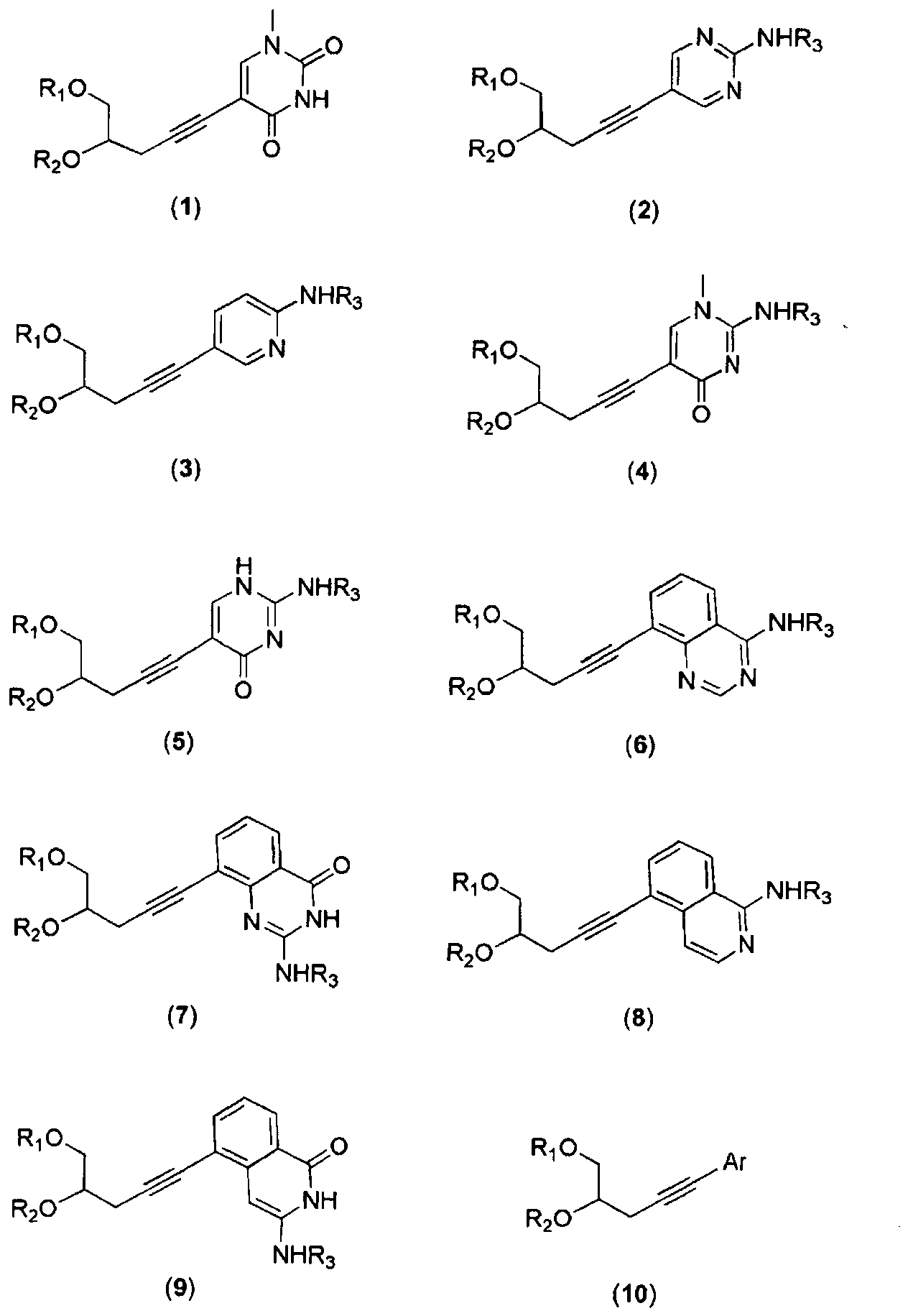
- the nucleoside analog or the salt thereof according to the present invention is characterized by being the general formulae (1) to (10) (wherein R 1 , R 2 , and R 3 are the same or different groups, and each of the R 1 , R 2 , and R 3 is selected from a hydrogen atom, a protecting group for a functional group in nucleic acid synthesis, and a phosphate group; and Ar is one of an aromatic hydrocarbon group and a polyaromatic hydrocarbon group.)
- a portion corresponding to a sugar part of the nucleoside is ring opened, and includes a triple bond.
- the above-described functional group includes a hydroxyl group and an amino group.
- the above-described protecting group is defined as an organic molecule which is introduced so as to protect a functional group such as a hydroxyl group and an amino group from proceeding with a side reaction.
- the Ar in the general formula (10) is an aromatic hydrocarbon group or a polyaromatic hydrocarbon group, and is preferably a naphthalene group, an anthracene group, a phenanthrene group and a pyrene group.
- R 1 is preferably one of a hydrogen atom and a protecting group for a hydroxyl group that is a functional group in nucleic acid synthesis.
- R 2 is preferably selected from a hydrogen atom, a protecting group for a hydroxyl group that is a functional group in nucleic acid synthesis, and a phosphate group.
- R 3 is preferably a hydrogen atom or a protecting group for an amino group that is a functional group in nucleic acid synthesis.
- the protecting group for a hydroxyl group that is a functional group in nucleic acid synthesis may include an aliphatic acyl group (e.g., an acetyl group), an aromatic acyl group (e.g., a benzoyl group), an alkyoxy group, a methyl group substituted with an aryl group (e.g., a benzyl group, a p-methoxybenzyl group, a 4, 4'-dimethoxytrityl group, a 4-monomethoxytrityl group), a silyl group substituted with an aliphatic series (e.g., a tert-butyldimethylsilyl group), and a silyl group substituted with an aromatic series (e.g., a tert-butyldiphenylsilyl group).
- an aliphatic acyl group e.g., an acetyl group
- an aromatic acyl group e.g
- protecting group for an amino group that is a functional group in nucleic acid synthesis may include an aliphatic acyl group, an aromatic acyl group, an alkyoxy group, a methyl group substituted with an aryl group, a silyl group substituted with an aliphatic series, and a silyl group substituted with an aromatic series.
- a sulfonyl group substituted with an aliphatic series a sulfonyl group substituted with an aromatic series (e.g., a p-toluenesulfonyl group), a carbonyl group (e.g., a tert-butoxycarbonyl group, a benzyloxy carbonyl group), an amide group (a dimethylformamide group, a dimethylacetamide group) and the like may be included.
- the phosphate group is preferably a phosphate group protected by a protecting group in nucleic acid synthesis, or an activated phosphate group for solid phase synthesis.
- Specific examples of the phosphate group protected by a protecting group in nucleic acid synthesis may include a 2-chlorophenylphosphate group and a 4-chlorophenylphosphate group.
- activated phosphate group for solid phase synthesis may include -P(OC 2 H 4 CN)(N(CH(CH 3 ) 2 ) 2 ) and -P(OCH 3 )(N(CH(CH 3 ) 2 ) 2 ).
- the nucleoside analog or the salt thereof according to the present invention is characterized by being the general formula (11) below (wherein R 1 and R 2 are the same or different groups, and selected from a hydrogen atom, a protecting group for a hydroxyl group in nucleic acid synthesis, and a phosphate group; X 1 is a photoreactive group that reacts to light and provides active species capable of covalent bonding; and X 2 is an alkyl group or an alkyl group including at least one hydrogen substituted with halogen).
- the photoreactive group in X 1 is defined as a group that absorbs light to generate a highly reactive intermediate carbene and can covalently bond with a target molecule.
- Examples of the alkyl group in X 2 may include an alkyl group having 1 to 5 carbons.
- Examples of the halogen may include fluorine, chloride bromine and iodine.
- a portion corresponding to a sugar part of the nucleoside is ring-opened, and has a triple bond.
- R 1 and R 2 are preferably a group similar to the R 1 and R 2 described in the general formulae (1) to (10).
- X 1 is preferably a diazirine group.
- X 2 is preferably selected from a trifluoromethyl group, a difluoromethyl group and a monofluoromethyl group.
- the oligonucleotide analog according to the present invention is characterized by being an oligonucleotide analog which contains one or more structures represented by any of the formulae (1a) to (10a) as a component (wherein Ar is one of an aromatic hydrocarbon group and a polyaromatic hydrocarbon group).
- the oligonucleotide analog according to the present invention is characterized by being an oligonucleotide analog which contains one or more structures represented by the formula (11a) as a component (wherein X 1 is a photoreactive group that reacts to light and provides active species capable of covalent bonding; and X 2 is an alkyl group or an alkyl group including at least one hydrogen substituted with halogen).
- the photoreactive group in X 1 is defined as a group that absorbs light to generate a highly reactive intermediate carbene and can covalently bond with a target molecule.
- Examples of the alkyl group in X 2 may include an alkyl group having 1 to 5 carbons.
- Examples of the halogen may include fluorine, chloride bromine and iodine.
- X 1 is preferably a diazirine group.
- X 2 is preferably selected from a trifluoromethyl group, a difluoromethyl group and a monofluoromethyl group.
- a portion corresponding to a sugar part of the nucleoside is ring-opened, and has a triple bond.
- An example of an oligonucleotide derivative forming the sugar-part ring-opened nucleoside is a glycol nucleic acid (GNA).
- GNA glycol nucleic acid
- the GNA has a structure in which a glycerol unit is repeated by a phosphoric diester bond.
- S-GNA it is known that the double strand of an (S)-GNA is stabilized due to the gauche effect.
- the stability of a double strand is improved. Furthermore, since the formulae (1a) to (10a) and (11a) have an unsaturated bond, stacking interaction is formed between the oligonucleotides forming a double strand, thereby stabilizing the structure. Accordingly, loss in entropy when forming a double strand is reduced. As a result, it is expected that the double strand is thermodynamically stabilized.
- a salt thereof is defined as a salt of the nucleoside analog and the oligonucleotide analog according to the present invention, since these analogs can be converted into a salt.
- the salt is not particularly limited, examples of the salt may suitably include alkali metal salts such as sodium salts, potassium salts and lithium salts, alkali earth metal salts such as calcium salts and magnesium salts, metal salts such as aluminum salts, iron salts, zinc salts, copper salts, nickel salts and cobalt salts, inorganic salts such as ammonium salts, amine salts as organic salts such as t-octylamine salts, dibenzylamine salts, morpholine salts, glucosamine salts, phenylglycine alkyl ester salts, ethylenediamine salts, N-methylglucamine salts, guanidine salts, diethylamine salts, triethylamine salts, dicyclohex
- the oligonucleotide analog according to the present invention may be a single-stranded oligonucleotide or a double-stranded oligonucleotide.
- the single-stranded oligonucleotide may combine with an oligonucleotide which contains a sequence at least partially complementary to one strand to form a double strand.
- An oligonucleotide is defined as a polymer formed by polymerizing several to 100 nucleotides.
- the gene expression inhibitor according to the present invention is characterized by containing the oligonucleotide analog according to the present invention.
- the gene expression inhibitor is defined as a molecule which encourages a DNA or an mRNA to inhibit the process of replicating, transferring and translating a DNA or an mRNA.
- the nucleic-acid probe for detecting gene according to the present invention is characterized by compring an oligonucleotide analog which contains one or more structures represented by any of the above-described general formula (11a) as a component.
- X 1 is preferably a diazirine group.
- X 2 is preferably selected from a trifluoromethyl group, a difluoromethyl group and a monofluoromethyl group.
- the nucleic-acid probe for detecting gene is defined as a short-stranded DNA or RNA molecule for visualizing and detecting a DNA or an mRNA.
- nucleic-acid probe for detecting gene examples include a DNA microarray which comprises an oligonucleotide analog containing one or more structures represented by the formula (11a) as a component.
- the oligonucleotide analog containing one or more structures of the nucleoside analog according to the present invention (formulae (1) to (11)) as a component
- the portions corresponding to the sugar part and the base part of a normal nucleoside are chemically modified, so that the oligonucleotide analog becomes difficult to be recognized by a nuclease.
- nuclease resistance is increased compared to the normal oligonucleotide.
- the gene expression-inhibiting effect can be increased compared to the normal oligonucleotide by the fact that thermodynamical stability of a miRNA is changed.
- the oligonucleotide analog containing one or more structures of the nucleoside analog according to the present invention functions as a miRNA.
- the miRNA recognizes and combines with a target mRNA which has a partially complementary sequence, so that the target mRNA is destabilized, thereby inhibiting translation of the target mRNA. As a result, gene expression can be inhibited.
- the oligonucleotide analog containing one or more structures of the oligonucleoside analog represented by the formula (11) as a component functions as a nucleic-acid probe for detecting gene.
- the nucleic-acid probe for detecting gene is irradiated by light, active species capable of covalent bonding is formed. Therefore, the nucleic-acid probe for detecting gene is cross-linked with a target mRNA, thereby enabling capturing of the target mRNA.
- the base sequence of the captured mRNA can be determined by utilizing the nucleic-acid probe for detecting gene.
- a sugar part of the nucleoside analog according to the present invention is synthesized by using as a starting material primary alcohol provided with an epoxy group. More particularly, first, after protecting a hydroxyl group of the primary alcohol provided with an epoxy group by a silyl compound, an acetylene group having a terminal protected with a silyl group is introduced when the epoxy group is ring-opened. Subsequently, a hydroxyl group formed by the ring-opening of an epoxy group is protected by the silyl group. Thereafter, the terminal silyl group of the acetylene side chain is selectively removed, thereby to obtain a sugar part precursor which enables a coupling reaction with a base part of the nucleoside analog according to the present invention described below.
- the sugar part of the nucleoside analog according to the present invention is selected from a halogen substitution product in which one hydrogen atom of a heterocyclic ring is substituted with a halogen atom, a halogen substitution product in which one hydrogen atom of an aromatic hydrocarbon is substituted with a halogen atom, and a halogen substitution product in which one hydrogen atom of a polyaromatic hydrocarbon is substituted with a halogen atom.
- the halogen substitution product in which one hydrogen atom of an aromatic hydrocarbon is substituted with a halogen atom includes a halogen substitution product in which one hydrogen atom of the aromatic hydrocarbon, which has a photoreactive group that reacts to light and provides active species capable of covalent bonding as well as an alkyl group or an alkyl group having at least one hydrogen atom substituted with halogen, is substituted with a halogen atom.
- the sugar part precursor and the base part described above are subjected to a coupling reaction in the presence of a palladium catalyst to obtain a coupling body. Thereafter, the silyl group is deprotected, and then processes of extraction, washing and purification are performed. Accordingly, a desired nucleoside analog can be obtained.
- nucleoside analog described as an example of the nucleoside analog represented by a general formula (n) is designated as a nucleoside analog (n) (n is an integer of 1 to 11), utilizing the number (n) given to a general formula.
- this designation does not mean that the nucleoside analog represented by the general formula (n) is limited to the nucleoside analog (n) exemplified in the examples below.
- a nucleoside analog (1) was synthesized by means of Synthesis method 1 shown in [Chemical Formula 5] below.
- TLC thin-layer chromatography
- the compound (13b) (2.5268 g, 8.0 mmol) was added into a 50 ml pear-shaped flask under an argon atmosphere, and dissolved in THF (10 ml), to obtain a solution (A).
- TMS-acetylene (1.656 ml, 12.0 mmol), THF(10 ml), n-BuLi(7.2288 ml, 12.0 mmol) and BF 3 .OEt 2 (1.5968 ml, 13.0 mmol) were added into a 50 ml recovery flask in this order under an argon atmosphere, and finally the solution (A) was added in the mixture.
- the obtained product was reacted at -78°C overnight.
- the compound (13d) (1.7713 g, 3.37 mmol) was dissolved in dry MeOH (35 ml) under an argon atmosphere, and reacted with CH 3 ONa (2.37 ml, 4.39 mmol). After reacting at normal temperature for approximately 1 hour and then observing disappearance of the spots of the raw material by TLC, the product was extracted with ethyl acetate and distilled water, to recover an organic layer. The organic layer was washed with saturated sodium hydrogen carbonate and a saturated salt solution, and dried with anhydrous sodium sulfate.
- a nucleoside analog (3) was synthesized by means of Synthesis method 2 shown in [Chemical Formula 6] below.
- a sugar part (13e) (0.76 g, 3.45 mmol) and a base part (28) (1.87 g, 1.3 eq.) were added into a flask, and dissolved in DMF (35.0 ml).
- Pd(PPh 3 ) 4 (0.40 g, 0.1 eq.) and Cul (0.13 g, 0.2 eq.) were added and stirred, and then TEA (1.20 ml, 2.5 eq.) was added to perform a reaction at 45°C. After stirring overnight, the reaction solution was celite-filtered with EtOAc. After filtering, the filtrate was extracted with EtOAc and H 2 O to recover an organic layer. The organic layer was washed with NaHCO 3 aq.
- a nucleoside analog (5) was synthesized by means of Synthesis method 3 shown in [Chemical Formula 7] below.
- Guanidine hydrochloride (24.8 g, 0.2596 mol) and sodium ethoxide (12.37 g, 0.182 mol) were dissolved in dry ethanol (100 ml), and stirred for 40 minutes. Then the resulting mixture was celite-filtered. The filtrate was decompressed and concentrated using a vacuum evaporator. The obtained oil was transferred into a two-diameter recovery flask. A Dimroth was attached to the two-diameter recovery flask. Into the two-diameter recovery flask, the compound 17 (1.534 g, 2.60 mmol) dissolved in dry ethanol (100 ml) was added, and stirred for 1.5 hours while the temperature was maintained at 96°C.
- the compound (18) (0.793 g, 1.41 mmol) was dissolved in dry MeOH (40 ml) under an argon atmosphere, and then 12 mol/I HCl (0.353 ml, 4.23 mmol) was added. The obtained mixture was stirred for 4 hours while the temperature was maintained at 60°C in an oil bath. After the reaction, the reaction product was decompressed and concentrated using a vacuum evaporator to obtain a nucleoside analog (5). The nucleoside analog (5) was proceeded to the next reaction without post-treatment.
- a nucleoside analog (10) was synthesized by means of Synthesis method 4 shown in [Chemical Formula 8] below.
- nucleoside analog (11) (S)-5-(4-(3-(trifluoromethyl)-3H-diazirin-3-yl)phenyl)pent-4-yne-1, 2-diol>
- a nucleoside analog (11) was synthesized by means of Synthesis method 5 shown in [Chemical Formula 9] below.
- the compound (34) (0.19 g, 0.2 mmol) and HONH 2 HCl (0.040 g, 0.58 mmol, 2.0 eq.) were added into a flask, and dissolved in dry EtOH (3 ml) and dry pyridine (3 ml). The resulting mixture was stirred at 60°C to initiate a reaction. After reacting overnight, the reaction product was extracted with chloromethane and distilled water. The organic layer was washed with saturated sodium hydrogen carbonate and a saturated salt solution, and dried with anhydrous sodium sulfate to decompress and distill away the solvent. The obtained residue was dissolved in an appropriate amount of CH 2 Cl 2 .
- the compound (36) (0.51 g, 0.80 mmol) was dissolved in dry MeOH (16 ml) under an argon atmosphere. Under a light shielding condition, TEA (0.30 ml, 2.0 mmol, 2.5 eq.) and I 2 (0.22 g, 0.88 mmol, 1.1 eq.) were added, to initiate reaction. After 30 minutes, disappearance of the raw material was confirmed. Then, the reaction product was extracted with diethyl ether and sodium thiosulfate. An organic layer was recovered, washed with saturated sodium hydrogen carbonate and a saturated salt solution, and dried with anhydrous sodium sulfate. The solvent was decompressed and distilled away.
- the compound (24) (0.23 g, 0.44 mmol) was added into a flask, and dissolved in dry THF (2.2 ml) under an argon atmosphere. Then, DIPEA (0.39 ml, 2.20 mmol, 5.0 eq.) and an amidite reagent (0.20 ml, 0.88 mmol, 2.0 eq.) were added and stirred. After 30 minutes, completion of the reaction was confirmed by TLC. Then, the reaction product was extracted with CHCl 3 to recover an organic layer. The organic layer was washed with NaHCO 3 aq. and NaCl aq., and the solvent was decompressed and distilled away.
- the compound (30) (1.73 mmol) was added into a flask, and dissolved in pyridine (25 ml). Then, DMTrCl (0.64 g, 1.1 eq.) was added and stirred for 5 hours and 30 minutes. The resulting product was extracted with EtOAc and H 2 O, and washed with NaHCO 3 aq. and NaCl aq.. Then, the washed product was isolated and purified by silica gel column chromatography.
- An amidite body (32) of the compound (31) was obtained in a manner similar to the Synthesis method of the amidite body (25).
- the nucleoside analog (5) (0.29 g, 1.41 mmol) was poured into a flask under an argon atmosphere, and dissolved in dry DMF (14 ml). In the solution, N, N-dimethylformamid dimethylacetal) (1.12 ml, 8.46 mmol) was added. The mixture was stirred for approximately 5 hours while the temperature was maintained at 40°C in an oil bath. The reaction solution was decompressed and concentrated using a vacuum evaporator to obtain a compound (19).
- the nucleoside analog (10) (0.14 g, 0.49 mmol) was poured into a flask, and dissolved in pyridine (2 ml). In the solution, DMTrCl (0.19 g, 0.55 mmol) was poured, and then stirred. After 1 hour, methanol (1 ml) was added to terminate the reaction. The reaction solution was liquid-separated with ethyl acetate, water and NaHCO 3 to recover an organic layer. The organic layer was washed with a saturated salt solution, and dried with anhydrous sodium sulfate. The solvent was decompressed and distilled away.
- the compound (38) (0.73 g, 1.24 mmol) was poured into a flask, and dissolved in THF (6.2 ml, 0.2 mol/l) under an Ar atmosphere. DIPEA (1.08 ml, 6.19 mmol, 5.0 eq.) was added and stirred. Then, i-Pr 2 NP(Cl)OCE (0.55 ml, 2.48 mmol, 2.0 eq.) was dropped. After 1 hour, chloroform was added, and sat. NaHCO 3 and sat. NaCl were used for performing extraction and washing to recover an organic layer. After drying the organic layer with sodium sulfate, the solvent was decompressed and distilled away.
- a CPG resin-linked nucleoside analog (27) was synthesized by means of Synthesis method 11 shown in [Chemical Formula 15] below.
- the compound (24) (90 mg, 0.17 mmol) and DMAP (0.42 mg, 0.02 eq.) were poured into a flask, and dissolved in pyridine (1.7 ml). Then, succinic anhydride (50 mg, 3.0 eq.) was added in the solution under an Ar atmosphere, and the mixture was stirred at room temperature. After stirring for 78 hours, the raw material remained. Therefore, DMAP was added in a small amount and stirred. The reaction was terminated next day, and the reaction solution was extracted to recover an organic layer. The organic layer was decompressed and concentrated using a vacuum evaporator. Thus, a succinyl body (26) was obtained.
- the succinyl body (26) (113.2 mg, 0.18 mmol) was poured into a flask, and dissolved in DMF (4.5 ml, 0.01 mol/l). Then, a CPG resin (0.38 g, 1.0 eq.) and WSC (34.6 mg, 4.0 eq., 0.18 mmol) were quickly added in the solution, and shaken for 3 days. Thereafter, the CPG resin was washed with pyridine. Subsequently, the resin which did not bond to the succinyl body (26) was capped. The washed resin was added in 0.1 mol/I DMAP in pyridine (15 ml), and shaken overnight. After confirming that the reaction solution had turned brown, the reaction was terminated. After the reaction was completed, pyridine, EtOH and CH 3 CN were used in this order to wash the resin. Thus, a CPG resin-linked nucleoside analog (27) (activity: 38.9 ⁇ mol/g) was obtained.
- the ⁇ value of the nucleoside analog (1) was calculated in the method shown below.
- the ⁇ 260 value of normal thymidine is 7400.
- the nucleoside analog (1) contains alkyne, so that the maximum absorption wavelength was shifted to 293nm.
- an oligonucleotide analog was synthesized by the solid-phase phosphoramidite method described below.
- the obtained product was shaken at room temperature for 12 hours, thereby to remove the CPG resin.
- the reaction solution was transferred to an Eppendorf tube, and solid-dried under reduced pressure. Furthermore, TBAF was added in the residue, and the product was subjected to a deprotection treatment of shaking at room temperature for 12 hours.
- the reaction solution was diluted in 0.1 mol/l TEAABuf. (30 ml), and the obtained solution was partially purified by C18 reverse phase column chromatography (Sep-Pak). In the residue, 200 ⁇ l of loading solution (90% formamide in 1 ⁇ TBE) was added, and the intended oligonucleotide was isolated by 20% PAGE. The gel band of the intended oligonucleotide was cut out.
- the gel band was added in each of a 0.1 mol/l TEAA aqueous solution and a 0.1 mol/l EDTA aqueous solution (15 ml), and the resulting product was shaken overnight.
- the filtrate was purified by C18 reverse phase column chromatography (Sep-Pak).
- the oligonucleotide was dissolved in H 2 O (1 mL), and absorbance at 260nm of the obtained diluted solution was measured. Thus, the yield thereof was calculated.
- the purified oligonucleotide was solid-dried in an amount of 30 pmol, and dissolved in 3 ⁇ l of sterile water. Then, after mixing the solution well with 3 ⁇ l of a matrix solution, a sample was applied on a plate. After the sample was solid-dried, the structure thereof was identified by MALDI-TOF/MS.
- T a represents a nucleoside analog (1).
- the value which is ten times the ⁇ value of a monomer was used as the ⁇ value of poly T a .
- the main peak of poly T a in an MALDI-TOFMS represents the value of 2820.1 as Na adduct.
- the stability of a double strand with a complementary DNA or RNA was calculated as a Tm value by a thermal denaturation method, and the calculated value was compared to that of a normal double strand ( ⁇ °C). Measurement condition: 5 to 85°C, sample concentration of 12 ⁇ mol/l, buffer including 10 mmol/l Na Phosphate and 100 mmol/l NaCl.
- Tm measurement The results of Tm measurement are shown in [ Fig. 2 ] and [Table 5]. Measurement condition: 20 to 100°C, sample concentration of 3 ⁇ mol/l, buffer including 10 mmol/l Na Phosphate and 100 mmol/I NaCl.
- 18mer oligonucleotide each introduced a synthesized cytosine analog Cz: nucleoside analog (5) in the oligonucleotide and complementary strands thereof were synthesized.
- the sequence, the calculated molecular weight (calculated), and the measurement result of MALDI-TOF/MS (observed) of each synthesized oligonucleotide analog are shown in [Table 7].
- thermodynamic stability is similar to or superior to that of a normal nucleoside. Even when the number of the sugar-part ring-opened cytosine analogs Cz: nucleoside analogs (5) introduced in the center of the sequence is increased to two, or three, the Tm value was not significantly changed.
- MiR199a has a sequence that targets HCV (Hepatitis C virus). Therefore, it will be reviewed whether a sugar-part ring-opened nucleoside analog can be applied to miRNA, and can be utilized in order to improve guide strand selectivity. Even if one or two of the used nucleoside analog (1): analog T a are introduced, the Tm value will decrease. Therefore, it is considered that the number of the analogs to be introduced in miR199a is up to one per strand. Also, the gene expression inhibiting abilities differ depending on a psi199a5p vector or a psi199a3p vector.
- nucleoside analog (1) analog T a (indicated as Y in [Table 9]). Changes caused by the nucleoside analog (1) in gene expression inhibiting abilities, which is specific to the modified region of miRNA199a, were investigated.
- the gene expression inhibiting abilities were evaluated by introducing miRNA ⁇ 1> to miRNA ⁇ 8> into respective HeLa cells and performing the Dual-Luciferase reporter assay.
- the data regarding miRNA ⁇ 1> to miRNA ⁇ 8> are shown in [Table 10].
- the miR in [Table 10] represents miRNA.
- 5p is a miRNA derived from the arm on the 5' side of a pre-miRNA
- 3p is a miRNA derived from the arm on the 3' side of a pre-miRNA.
- miRNA ⁇ 1> is formed with a normal miR199a5p and a normal miR199a3p.
- the miRNA ⁇ 2> is formed with a miR199a5p- ⁇ 1> and a normal miR199a3p.
- the miRNA ⁇ 3> is formed with a miR199a5p- ⁇ 3> and a normal miR199a3p.
- the miRNA ⁇ 4> is formed with a miR199a5p- ⁇ 4> and a normal miR199a3p.
- the miRNA ⁇ 5> is formed with a miR199a5p- ⁇ 6> and a normal miR199a3p.
- the miRNA ⁇ 6> is formed with a normal miR199a5p and a miR199a3p- ⁇ 3>.
- the miRNA ⁇ 7> is formed with a normal miR199a5p and a miR199a3p- ⁇ 5>.
- the miRNA ⁇ 8> is formed with a normal miR199a5p and a miR199a3p- ⁇ 7>.
- the miRNA ⁇ 3> having a modification in the bulge-out region has the expression inhibiting abilities superior to that of the normal miRNA, but its reverse strand inhibits expression to some extent as well.
- the miRNA ⁇ 6> is observed to have some strand selectivity for the same reasons to in miRNA ⁇ 4> and ⁇ 5>, but the degree of the strand selectivity is small.
- the miRNA ⁇ 7> and ⁇ 8> also show expression inhibition to the same level as in the normal miRNA, but the expression inhibition caused by its reverse strand is observed to some extent.
- strand selectivity can be obtained without reducing expression inhibiting abilities, by introducing a modification on the 3' terminal side to incorporate its reverse strand in RISC, rather than introducing a modification on the 5' terminal side to be destabilized.
- the miRNA containing the nucleoside analog (1) as a component stability was studied by snake venom phosphodiesterase (SVP).
- SVP snake venom phosphodiesterase
- the miRNA containing the nucleoside analog (1) as a component is a single-stranded RNA in which dT (thymidine) in the 3'-overhang is substituted with the nucleoside analog (1).
- the miRNA containing the nucleoside analog (1) as a component was treated with the SVP in a time-dependent manner. After the reaction was terminated, the degraded RNA fragments were analyzed by electrophoresis.
- the analysis results are shown in [ Figs. 5A to 5B ] and [ Fig. 6 ].
- the Ta RNA in [ Fig. 6 ] is a miRNA containing the nucleoside analog (1): T a as a component.
- the RNAs remained without being degraded are shown in a time-dependent manner (from the right side, 0 min, 1 min, 5 min, 10 min, 30 min, 1 h, 3 h, and 6 h).
- the RNA concentration during an enzyme reaction is 1 ⁇ mol/l.
- the buffer used in the enzyme reaction system is not limited as long as it is a buffer suitable for the enzyme, a tris-hydrochloric acid buffer was used.
- EDTA ethylenediaminetetraacetic acid
- T a as a component remains without being degraded at a ratio of 50% or more even after 5 minutes have passed, as compared to the normal miRNA; and that the stability is increased by containing the nucleoside analog (1) as a component.
- the miRNA containing a nucleoside analog (11) as a component was defined as No.2.
- the complementary strand RNAs, in which the bases to be paired with the nucleoside analog (11) were changed, were defined as No.6, No.7 and No.8. Each of the complementary strand RNAs was annealed with No.2.
- each of the annealed samples was irradiated with UV at 365 nmm to initiate a cross-coupling reaction.
- a 5 ⁇ ml aliquot of the sample was taken at each time interval, and a 7 mol/l urea solution (4 ⁇ ml) and a loading buffer (4 ⁇ ml) were added to terminate the reaction.
- investigation was performed by denaturing gel electrophoresis.
- the miRNA containing a nucleoside analog (11) as a component can capture an mRNA in a sequence-specific manner.
- the base sequence of an mRNA targeted by a miRNA can be determined by capturing an mRNA targeted by a miRNA (see Fig. 8 ) and studying the sequence of the captured mRNA.
- an siRNA containing one of the nucleoside analogs (1) to (11) as a component can be synthesized.
- the sequences of the synthesized siRNAs are shown below.
- the synthesized single-stranded siRNAs are 21mer RNAs each containing the nucleoside analog (1) as a component, and 22mer RNAs each containing the nucleoside analog (10) as a component.
- the sequences of the 21 mer RNAs each containing the nucleoside analog (1) as a component is shown in Table 12.
- ON1 and ON2 thymidine is introduced in the dangling-end region at the 3' terminal.
- ON3 and ON4 the nucleoside analog (1) is introduced in the dangling-end region at the 3' terminal.
- ON8 the nucleoside analog (1) is introduced on the 5' terminal end, and thymidine is introduced in the dangling end region at the 3' terminal.
- ON9 the nucleoside analog (1) is introduced on the 3' terminal side, and thymidine is introduced in the dangling end region at the 3' terminal.
- the siRNA ⁇ 1> is a normal siRNA
- the ON1 is a sense strand of the siRNA ⁇ 1> and the ON2 is an antisense strand of the siRNA ⁇ 1>.
- the ON3 is a sense strand of the siRNA ⁇ 2> and the ON4 is an antisense strand of the siRNA ⁇ 2>.
- the ON8 is a sense strand of the siRNA ⁇ 6> and the ON2 is an antisense strand of the siRNA ⁇ 6>.
- the ON9 is a sense strand of the siRNA ⁇ 7> and the ON2 is an antisense strand of the siRNA ⁇ 7>.
- nucleoside analog (10) as a component are shown in Table 14.
- nucleoside analog (10;E) is introduced on the 5' terminal side.
- the sense strand is sense, and the antisense strand is a normal antisense.
- the siRNAantisense the sense strand is a normal sense, and the antisense strand is antisense.
- the results of Tm measurement are shown in [ Fig. 9 ] and [Table 15].
- siRNA ⁇ 1> siRNA ⁇ 2>, siRNA ⁇ 6> and siRNA ⁇ 7> disclosed in [Table 13] and siRNAsense and siRNAantisense disclosed in [Table 15] gene expression inhibiting abilities were investigated.
- a Psi check vector was used for investigating the gene expression inhibiting abilities.
- the samples were prepared so that each siRNA becomes 0.1, 1.0, and 10 nmol/l, and the prepared samples were transfected into HeLa cells. Then, the Dual-Luciferase reporter assay was performed for investigation.
- the results of the gene expression inhibiting abilities of siRNA ⁇ 1>, siRNA ⁇ 2>, siRNA ⁇ 6>, and siRNA ⁇ 7> are shown in [ Fig. 10 ], and the results of the gene expression inhibiting abilities of siRNAsense and siRNAantisense are shown in [ Fig. 11 ].
- siRNA ⁇ 2> presented gene expression inhibiting abilities to the same level as those of a normal siRNA ⁇ 1>, but when the concentration of the sample is low, the gene expression inhibiting abilities become lower than those of a normal siRNA ⁇ 1>. Also, it was shown that the gene expression inhibiting abilities of siRNA ⁇ 6> are decreased compared to those of a normal siRNA. It is considered this is because the introduction of a nucleoside analog (1) on the 5' terminal side of a sense strand in siRNA ⁇ 6> causes a double strand to become unstable, thereby facilitating incorporation of the sense strand. Furthermore, it was found that the siRNA ⁇ 7> has high gene expression inhibiting abilities compared to a normal siRNA.
- nucleoside analog (1) on the 3' terminal side of a sense strand in the siRNA ⁇ 7> causes the 5' terminal side of an anti-sense strand to be destabilized, thereby facilitating incorporation of the anti-sense strand.
- nucleoside analogs (1), (3), (5), (10) and (11) were illustrated as examples of the nucleoside analogs represented by the general formulae (1), (3), (5), (10) and (11), and the synthesis methods thereof were described in detail.
- such nucleoside analogs can be expected to have a similar operation and effect, as long as the nucleoside analogs are nucleoside analogs represented by the general formulae (1), (3), (5), (10) and (11).
- the synthesis methods of such nucleoside analogs are almost similar to the procedures for the illustrated nucleoside analogs (1), (3), (5), (10) and (11).
- each of the nucleoside analogs (2), (4), (6), (7), (8) and (9) can be synthesized almost similarly to the procedures for the illustrated nucleoside analogs (1), (3), (5), (10) and (11), merely by applying starting materials having molecular structures corresponding to the base parts of these nucleoside analogs.
- a sugar part including a hydroxyl group protected with a silyl group and a base part having a halogen substituent are subjected to a coupling reaction in the presence of a palladium catalyst, to obtain a coupling body. Thereafter, a deprotection reaction of the protecting group and a purification process are performed.
- the nucleoside analog having a structure represented by any of the general formulae (2), (4), (6), (7), (8) and (9) can be synthesized.
- RNA drugs Since the activity is increased by introducing the nucleoside analog according to the present invention into a siRNA or a miRNA, application for the development of RNA drugs becomes possible. Furthermore, by introducing a nucleoside analog that introduces a photoreactive group, an mRNA can be captured. The photoreactive group reacts to light and provides active species capable of covalent bonding. Thus, the target of drug development can be explored.
- a treatment method utilizing the oligonucleotide analog according to the present invention can be theoretically designed if the base sequence of a target gene or virus is apparent. Therefore, the treatment method can become a new approach to an intractable disease which has been considered difficult to be cured.
- the present invention can lead to elucidation of the gene control mechanism by an siRNA and a miRNA involved in RNA interference.
- the present invention can be utilized in the study for solving one of the most important problems to be solved in the life science field.
Landscapes
- Chemical & Material Sciences (AREA)
- Organic Chemistry (AREA)
- Life Sciences & Earth Sciences (AREA)
- Health & Medical Sciences (AREA)
- Molecular Biology (AREA)
- Biochemistry (AREA)
- General Health & Medical Sciences (AREA)
- Engineering & Computer Science (AREA)
- Genetics & Genomics (AREA)
- Biotechnology (AREA)
- Zoology (AREA)
- Wood Science & Technology (AREA)
- Bioinformatics & Cheminformatics (AREA)
- General Engineering & Computer Science (AREA)
- Biomedical Technology (AREA)
- Proteomics, Peptides & Aminoacids (AREA)
- Biophysics (AREA)
- Physics & Mathematics (AREA)
- Microbiology (AREA)
- Analytical Chemistry (AREA)
- Plant Pathology (AREA)
- Immunology (AREA)
- General Chemical & Material Sciences (AREA)
- Veterinary Medicine (AREA)
- Medicinal Chemistry (AREA)
- Nuclear Medicine, Radiotherapy & Molecular Imaging (AREA)
- Pharmacology & Pharmacy (AREA)
- Animal Behavior & Ethology (AREA)
- Public Health (AREA)
- Chemical Kinetics & Catalysis (AREA)
- Pharmaceuticals Containing Other Organic And Inorganic Compounds (AREA)
- Saccharide Compounds (AREA)
- Measuring Or Testing Involving Enzymes Or Micro-Organisms (AREA)
- Pyridine Compounds (AREA)
- Acyclic And Carbocyclic Compounds In Medicinal Compositions (AREA)
- Organic Low-Molecular-Weight Compounds And Preparation Thereof (AREA)
Abstract
Description
- The present international application claims priority based on Japanese Patent Application No.
2010-267314 filed November 30, 2010 2011-190048 filed August 31, 2011 - The present invention relates to a nucleoside analog or a salt thereof, an oligonucleotide analog, a gene expression inhibitor, and a nucleic-acid probe for detecting gene.
- A short double-stranded RNA, a microRNA (miRNA) and a small interfering RNA (siRNA) are an oligonucleotide containing a base sequence that is complementary to a target messenger RNA (mRNA). The target mRNA includes a base sequence of, for example, a gene responsible for a disease. RNA interference is defined as an in vivo gene inhibition mechanism in which a short double-stranded RNA, a miRNA and an siRNA inhibit expression of the gene of a target mRNA in vivo.
- The siRNA is a double-stranded RNA which includes complementary base sequences. The siRNA combines with a target mRNA in a sequence specific manner. The siRNA combined with the target mRNA is incorporated into an RNA-induced silencing complex (RISC), so that the target mRNA is cut. If the base sequence of the gene responsible for a disease is apparent, it becomes possible to design and synthesize an siRNA which has a sequence complementary to the gene responsible for a disease. Therefore, the siRNA synthesized as described above can cut the gene responsible for a disease, and inhibit expression of a disease-related protein.
- The miRNA is a double-stranded RNA which contains a partially mismatched base pair. The miRNA recognizes a target mRNA which partially has a complementary sequence, and combines with the target mRNA. When the miRNA combines with the target mRNA, the target mRNA is destabilized, thereby inhibiting translation of the target mRNA. As a result, expression of a gene is inhibited. It has been made clear that miRNA precisely control various biological functions such as generation, morphogenesis and cell growth of an organism. Recently, a pharmaceutical agent utilizing the RNA interference (a phenomenon of degrading an mRNA having a base sequence complementary to a double-stranded RNA) is actively studied. Especially, it is reported that the miRNA is associated with various diseases such as cancer.
- For example, the expression amount of a let-7 miRNA is reduced in a lung cancer patient-derived cancer tissue. It has been reported that prognosis of a lung cancer patient can be determined by measuring the expression amount of the let-7 miRNA. Furthermore, it has been reported that the let-7 miRNA has proliferation-inhibiting effect on lung cancer (see Patent Document 1).
- Patent Document 1: Japanese Unexamined Patent Application Publication No.
2005-192484 - However, the let-7 miRNA is a normal oligonucleotide. Therefore, the let-7 miRNA is readily degraded by a variety of nucleases present in bloods or cells. Thus, it was difficult to utilize the normal oligonucleotide such as a let-7 miRNA as a miRNA drug. A miRNA having increased nuclease resistance and improved gene expression-inhibiting effect compared to the miRNA formed with a normal oligonucleotide is desirable for development of a pharmaceutical drug utilizing the miRNA. However, as long as the inventor knows, a report regarding the above hardly exists.
- Furthermore, the miRNA combines with the target mRNA in a state of partially containing a mismatched base pair. Therefore, a plurality of target mRNAs exist with respect to one miRNA. As a result, a human miRNA targets a tremendous number of mRNAs. Accordingly, it was difficult to determine the base sequence of a targeted mRNA. Since determination of the base sequence of a target mRNA leads to elucidation of the miRNA gene expression control mechanism, such a determination is one of the important problems to be studied in the life science field.
- Under such a background, the present invention is intended to solve the above problems. An object of the present invention is to provide a nucleoside analog or a salt thereof and an oligonucleotide analog which have increased nuclease resistance and improved gene expression-inhibiting effect, and a nucleoside analog or a salt thereof and an oligonucleotide analog which can facilitate determination of the base sequence of a target mRNA.
- A characteristic structure employed in the present invention will be described below.
The nucleoside analog or the salt thereof according to the present invention is characterized by being the general formulae (1) to (10) (wherein R1, R2, and R3 are the same or different groups, and each of the R1, R2, and R3 is selected from a hydrogen atom, a protecting group for a functional group in nucleic acid synthesis, and a phosphate group; and Ar is one of an aromatic hydrocarbon group and a polyaromatic hydrocarbon group.) -


- The Ar in the general formula (10) is an aromatic hydrocarbon group or a polyaromatic hydrocarbon group, and is preferably a naphthalene group, an anthracene group, a phenanthrene group and a pyrene group.
In the above-described formulae (1) to (10), R1 is preferably one of a hydrogen atom and a protecting group for a hydroxyl group that is a functional group in nucleic acid synthesis. R2 is preferably selected from a hydrogen atom, a protecting group for a hydroxyl group that is a functional group in nucleic acid synthesis, and a phosphate group. R3 is preferably a hydrogen atom or a protecting group for an amino group that is a functional group in nucleic acid synthesis. - Specific examples of the protecting group for a hydroxyl group that is a functional group in nucleic acid synthesis may include an aliphatic acyl group (e.g., an acetyl group), an aromatic acyl group (e.g., a benzoyl group), an alkyoxy group, a methyl group substituted with an aryl group (e.g., a benzyl group, a p-methoxybenzyl group, a 4, 4'-dimethoxytrityl group, a 4-monomethoxytrityl group), a silyl group substituted with an aliphatic series (e.g., a tert-butyldimethylsilyl group), and a silyl group substituted with an aromatic series (e.g., a tert-butyldiphenylsilyl group).
- Specific examples of the protecting group for an amino group that is a functional group in nucleic acid synthesis may include an aliphatic acyl group, an aromatic acyl group, an alkyoxy group, a methyl group substituted with an aryl group, a silyl group substituted with an aliphatic series, and a silyl group substituted with an aromatic series. Other than these, a sulfonyl group substituted with an aliphatic series, a sulfonyl group substituted with an aromatic series (e.g., a p-toluenesulfonyl group), a carbonyl group (e.g., a tert-butoxycarbonyl group, a benzyloxy carbonyl group), an amide group (a dimethylformamide group, a dimethylacetamide group) and the like may be included.
- The phosphate group is preferably a phosphate group protected by a protecting group in nucleic acid synthesis, or an activated phosphate group for solid phase synthesis.
Specific examples of the phosphate group protected by a protecting group in nucleic acid synthesis may include a 2-chlorophenylphosphate group and a 4-chlorophenylphosphate group. - Specific examples of the activated phosphate group for solid phase synthesis may include -P(OC2H4CN)(N(CH(CH3)2)2) and -P(OCH3)(N(CH(CH3)2)2).
- The nucleoside analog or the salt thereof according to the present invention is characterized by being the general formula (11) below (wherein R1 and R2 are the same or different groups, and selected from a hydrogen atom, a protecting group for a hydroxyl group in nucleic acid synthesis, and a phosphate group; X1 is a photoreactive group that reacts to light and provides active species capable of covalent bonding; and X2 is an alkyl group or an alkyl group including at least one hydrogen substituted with halogen).
- The photoreactive group in X1 is defined as a group that absorbs light to generate a highly reactive intermediate carbene and can covalently bond with a target molecule.
Examples of the alkyl group in X2 may include an alkyl group having 1 to 5 carbons. Examples of the halogen may include fluorine, chloride bromine and iodine. -

- In the above general formula (11), R1 and R2 are preferably a group similar to the R1 and R2 described in the general formulae (1) to (10).
X1 is preferably a diazirine group. - X2 is preferably selected from a trifluoromethyl group, a difluoromethyl group and a monofluoromethyl group.
Also, the oligonucleotide analog according to the present invention is characterized by being an oligonucleotide analog which contains one or more structures represented by any of the formulae (1a) to (10a) as a component (wherein Ar is one of an aromatic hydrocarbon group and a polyaromatic hydrocarbon group). -


- The photoreactive group in X1 is defined as a group that absorbs light to generate a highly reactive intermediate carbene and can covalently bond with a target molecule.
Examples of the alkyl group in X2 may include an alkyl group having 1 to 5 carbons. Examples of the halogen may include fluorine, chloride bromine and iodine. -

- X2 is preferably selected from a trifluoromethyl group, a difluoromethyl group and a monofluoromethyl group.
Furthermore, in the above general formulae (1a) to (10a) and (11a), a portion corresponding to a sugar part of the nucleoside is ring-opened, and has a triple bond. An example of an oligonucleotide derivative forming the sugar-part ring-opened nucleoside is a glycol nucleic acid (GNA). The GNA has a structure in which a glycerol unit is repeated by a phosphoric diester bond. With respect to an (S)-GNA, it is known that the double strand of an (S)-GNA is stabilized due to the gauche effect. Thus, in the oligonucleotide analog that contains one or more of the similarly-structured formulae (1a) to (10a) and (11a) as a component, it is expected that the stability of a double strand is improved. Furthermore, since the formulae (1a) to (10a) and (11a) have an unsaturated bond, stacking interaction is formed between the oligonucleotides forming a double strand, thereby stabilizing the structure. Accordingly, loss in entropy when forming a double strand is reduced. As a result, it is expected that the double strand is thermodynamically stabilized. - "A salt thereof" according to the present invention is defined as a salt of the nucleoside analog and the oligonucleotide analog according to the present invention, since these analogs can be converted into a salt. Although the salt is not particularly limited, examples of the salt may suitably include alkali metal salts such as sodium salts, potassium salts and lithium salts, alkali earth metal salts such as calcium salts and magnesium salts, metal salts such as aluminum salts, iron salts, zinc salts, copper salts, nickel salts and cobalt salts, inorganic salts such as ammonium salts, amine salts as organic salts such as t-octylamine salts, dibenzylamine salts, morpholine salts, glucosamine salts, phenylglycine alkyl ester salts, ethylenediamine salts, N-methylglucamine salts, guanidine salts, diethylamine salts, triethylamine salts, dicyclohexylamine salts, N,N'-dibenzylethylenediamine salts, chloroprocaine salts, procaine salts, diethanolamine salts, N-benzyl-phenethylamine salts, piperazine salts, tetramethylammonium salts and tris(hydroxymethyl)aminomethane salts, hydrohalic acid salts such as hydrofluoric acid salts, hydrochloric acid salts, hydrobromic acid salts and hydroiodic acid salts, inorganic acid salts such as nitric acid salts, perchloric acid salts, sulfuric acid salts and phosphoric acid salts, lower alkanesulfonic acid salts such as methane sulfonic acid salts, trifluoromethanesulfonic acid salts and ethanesulfonic acid salts, aryl sulfonic acid salts such as benzenesulfonic acid salts and p-toluenesulfonic acid salts, organic acid salts such as acetic acid salts, malic acid salts, fumaric acid salts, succinic acid salts, citric acid salts, tartaric acid salts, oxalic acid salts and maleic acid salts, and amino acid salts such as glycine salts, lysine salts, arginine salts, ornithine salts, glutamic acid salts and aspartic acid salts.
- The oligonucleotide analog according to the present invention may be a single-stranded oligonucleotide or a double-stranded oligonucleotide. The single-stranded oligonucleotide may combine with an oligonucleotide which contains a sequence at least partially complementary to one strand to form a double strand. An oligonucleotide is defined as a polymer formed by polymerizing several to 100 nucleotides.
- The gene expression inhibitor according to the present invention is characterized by containing the oligonucleotide analog according to the present invention.
The gene expression inhibitor is defined as a molecule which encourages a DNA or an mRNA to inhibit the process of replicating, transferring and translating a DNA or an mRNA. - The nucleic-acid probe for detecting gene according to the present invention is characterized by compring an oligonucleotide analog which contains one or more structures represented by any of the above-described general formula (11a) as a component.
In the above general formula (11a), X1 is preferably a diazirine group. - X2 is preferably selected from a trifluoromethyl group, a difluoromethyl group and a monofluoromethyl group.
The nucleic-acid probe for detecting gene is defined as a short-stranded DNA or RNA molecule for visualizing and detecting a DNA or an mRNA. - Examples of such a nucleic-acid probe for detecting gene include a DNA microarray which comprises an oligonucleotide analog containing one or more structures represented by the formula (11a) as a component.
- According to the oligonucleotide analog containing one or more structures of the nucleoside analog according to the present invention (formulae (1) to (11)) as a component, the portions corresponding to the sugar part and the base part of a normal nucleoside are chemically modified, so that the oligonucleotide analog becomes difficult to be recognized by a nuclease. As a result, it is considered that nuclease resistance is increased compared to the normal oligonucleotide. Furthermore, it is considered that the gene expression-inhibiting effect can be increased compared to the normal oligonucleotide by the fact that thermodynamical stability of a miRNA is changed.
- According to the gene expression inhibitor according to the present invention, the oligonucleotide analog containing one or more structures of the nucleoside analog according to the present invention (formulae (1) to (11)) as a component functions as a miRNA. The miRNA recognizes and combines with a target mRNA which has a partially complementary sequence, so that the target mRNA is destabilized, thereby inhibiting translation of the target mRNA. As a result, gene expression can be inhibited.
- Furthermore, the oligonucleotide analog containing one or more structures of the oligonucleoside analog represented by the formula (11) as a component functions as a nucleic-acid probe for detecting gene. When the nucleic-acid probe for detecting gene is irradiated by light, active species capable of covalent bonding is formed. Therefore, the nucleic-acid probe for detecting gene is cross-linked with a target mRNA, thereby enabling capturing of the target mRNA. As a result, the base sequence of the captured mRNA can be determined by utilizing the nucleic-acid probe for detecting gene.
-
-
Fig. 1 is a graph illustrating results of Tm measurement. -
Fig. 2 is a graph illustrating results of Tm measurement. -
Fig. 3 is a graph illustrating results of Tm measurement. - In
Figs. 4A and 4B, Fig. 4A is a graph illustrating results of investigating gene expression inhibiting abilities when a psi199a3p vector is used; andFig. 4B is a graph illustrating results of investigating gene expression inhibiting abilities when a psi199a5p vector is used. - In
Figs. 5A and 5B, Fig. 5A is a gel photograph after electrophoresis for investigating nuclease resistance of a normal RNA; andFig. 5B is a gel photograph after electrophoresis for investigating nuclease resistance of an RNA having a 3' terminal substituted with a nucleoside analog (1). -
Fig. 6 is a graph illustrating results of investigating the nuclease resistance of a normal RNA and the nuclease resistance of an RNA having a 3' terminal substituted with a nucleoside analog (1). -
Fig. 7 is a gel photograph after electrophoresis illustrating results of cross coupling. -
Fig. 8 is an illustrative view of the nucleic-acid probe for detecting gene according to the present invention. -
Fig. 9 is a graph illustrating results of Tm measurement. -
Fig. 10 is a graph illustrating results of investigating gene expression inhibiting abilities of a siRNA containing a nucleoside analog (1) as a component. -
Fig. 11 is a graph illustrating results of investigating gene expression inhibiting abilities of an siRNA containing a nucleoside analog (10) as a component. - Embodiments of the present invention will be described below. Since abbreviations will be used herein, the list of abbreviations used herein will be first shown below.
-
- BF3EOEt: Boron trifluoride etherate
- THF: tetrahydrofuran
- EtOAc: ethyl acetate
- TBDMSCI: tert-Butyldimethylsilyl chloride
- Pd(PPh3): Tetrakis(triphenylphosphine)palladium
- TEA: triethyamine
- TBAF: Tetra-n-butylammonium fluoride
- PdCl2(PPh3)2: Bis(triphenylphosphine)palladium(II) chloride
- TsCl: p-toluenesulfonyl chloride
- DMAP: N,N-dimethyl-4-aminopyridine
- DMTrCl: dimethoxytriphenylmethyl chloride
- DIPEA: N,N-diisopropylethylamine
- Amidite reagent, i-Pr2NP(Cl)OCE :
- 2-cyanoethyldiisopropylchloro-phosphoramidite
- DMF-DMA: N,N-Dimethylformamide dimethyl acetal
- CPG: controlled-pore glass
- WSC: water soluble carbidiimide
- X-phos: 2-Dicyclohexylphosphino-2',4',6',-triisopropylbiphenyl
- NaHCO3 aq.: aqueous solution of sodium hydrogen carbonate
- NaCl aq.: aqueous solution of sodium chloride
- NMR: nuclear magnetic resonance
- CDCl3: Deuterochloroform
- Tm:melting temperature
- Next, the outline of a nucleoside analog and a method of synthesizing the nucleoside analog will be described.
- A sugar part of the nucleoside analog according to the present invention is synthesized by using as a starting material primary alcohol provided with an epoxy group. More particularly, first, after protecting a hydroxyl group of the primary alcohol provided with an epoxy group by a silyl compound, an acetylene group having a terminal protected with a silyl group is introduced when the epoxy group is ring-opened. Subsequently, a hydroxyl group formed by the ring-opening of an epoxy group is protected by the silyl group. Thereafter, the terminal silyl group of the acetylene side chain is selectively removed, thereby to obtain a sugar part precursor which enables a coupling reaction with a base part of the nucleoside analog according to the present invention described below.
- On the other hand, the sugar part of the nucleoside analog according to the present invention is selected from a halogen substitution product in which one hydrogen atom of a heterocyclic ring is substituted with a halogen atom, a halogen substitution product in which one hydrogen atom of an aromatic hydrocarbon is substituted with a halogen atom, and a halogen substitution product in which one hydrogen atom of a polyaromatic hydrocarbon is substituted with a halogen atom. The halogen substitution product in which one hydrogen atom of an aromatic hydrocarbon is substituted with a halogen atom includes a halogen substitution product in which one hydrogen atom of the aromatic hydrocarbon, which has a photoreactive group that reacts to light and provides active species capable of covalent bonding as well as an alkyl group or an alkyl group having at least one hydrogen atom substituted with halogen, is substituted with a halogen atom.
- The sugar part precursor and the base part described above are subjected to a coupling reaction in the presence of a palladium catalyst to obtain a coupling body. Thereafter, the silyl group is deprotected, and then processes of extraction, washing and purification are performed. Accordingly, a desired nucleoside analog can be obtained.
- Next, an embodiment of the present invention will be described with reference to examples. However, the present invention is not limited to these examples. It is noted that, in the examples described below, to facilitate understanding of the relationship between the nucleoside analog exemplified as an example and the general formula explained earlier, the nucleoside analog described as an example of the nucleoside analog represented by a general formula (n) is designated as a nucleoside analog (n) (n is an integer of 1 to 11), utilizing the number (n) given to a general formula. However, this designation does not mean that the nucleoside analog represented by the general formula (n) is limited to the nucleoside analog (n) exemplified in the examples below.
- A nucleoside analog (1) was synthesized by means of
Synthesis method 1 shown in [Chemical Formula 5] below. -


- Imidazole (6.6 g, 97.2 mmol) and DMF (75 ml) were added to (R)-glycidol (2.7 ml, 40.5 mmol) (13a), and the resulting mixture was stirred. Then, TBDPSCI (12.6 ml, 48.6 mmol) was added and reacted at 0°C overnight. Next day, after disappearance of the spots of the raw material was observed by thin-layer chromatography (TLC) (hereinafter referred to as TLC), the product was extracted with ethyl acetate and distilled water, to recover an organic layer. The organic layer was washed with saturated sodium hydrogen carbonate and a saturated salt solution, and dried with anhydrous sodium sulfate. The solvent was evaporated using a vacuum evaporator, and the residue was isolated and purified by silica gel column chromatography (hexane:ethyl acetate=50:1). Thus, a compound (13b) (S)-tert-butyl(oxiran-2-ylmethoxy)diphenylsilane (4.5664 g, 15 mmol, 37%) was obtained as a colorless and transparent liquid.
- 1H NMR(400MHz, CDCl3)δ:7.67-7.65(4H, m), 7.41-7.35(6H, m), 3.83(1H, dd, J=12.0Hz, 3.2Hz), 3.69(1H, dd, J=12.0Hz, 4.8Hz), 3.13-3.09(1H, m), 2.73(1H, dd, J=9.2Hz, 4.0Hz), 2.59(1H, dd, J=5.2Hz, 2.8Hz), 1.0(9H, s). 13C NMR(CDCl3)δ:135.5, 129.7, 127.7, 64.3, 52.2, 44.4, 26.7, 19.2.
- The compound (13b) (2.5268 g, 8.0 mmol) was added into a 50 ml pear-shaped flask under an argon atmosphere, and dissolved in THF (10 ml), to obtain a solution (A). TMS-acetylene (1.656 ml, 12.0 mmol), THF(10 ml), n-BuLi(7.2288 ml, 12.0 mmol) and BF3.OEt2 (1.5968 ml, 13.0 mmol) were added into a 50 ml recovery flask in this order under an argon atmosphere, and finally the solution (A) was added in the mixture. The obtained product was reacted at -78°C overnight. Next day, after disappearance of the spots of the raw material was observed, NH4Cl (20 ml) was added as a buffer to terminate the reaction. The reaction product was extracted with ethyl acetate and distilled water, to recover an organic layer. The organic layer was washed with saturated sodium hydrogen carbonate and a saturated salt solution, and dried with anhydrous sodium sulfate. The resulting product was decompressed and concentrated using a vacuum evaporator, and the residue was isolated and purified by silica gel column chromatography (hexane:ethyl acetate=20:1). Thus, a compound (13c):
- 1H NMR(400MHz, CDCl3)δ:7.56-7.35(4H, m), 7.34-7.18(6H, m), 3.79-3.75(1H, m), 3.62(2H, ddd, J=25.6Hz, 10.4Hz, 4.4Hz), 2.41-2.38(2H, t, J=6.4Hz), 0.96(9H, s), 0.00(9H, s). 13C NMR(CDCl3) δ:135.5, 129.8, 127.8, 102.7, 87.1, 70.2, 66.4, 44.4, 26.8, 19.3, 0.00
- Imidazole (1.103 g, 16.2 mmol), DMF(25 ml) and TBDMSCI (1.238 g, 8.01 mmol) were added into a 50 ml pear-shaped flask under an argon atmosphere, and stirred. After stirring, the resulting solution was used as a solution (B). The compound (13c) (2.2177 g, 5.4 mmol) and DMF (25 ml) were added into a 50 ml recovery flask under an argon atmosphere, and stirred. Then the solution (B) was added, and the obtained mixture was reacted overnight. Next day, after disappearance of the spots of the raw material was observed, the product was extracted with ethyl acetate and distilled water, to recover an organic layer. The organic layer was washed with saturated sodium hydrogen carbonate and a saturated salt solution, and dried with anhydrous sodium sulfate. The resulting product was decompressed and concentrated using a vacuum evaporator, and the residue was isolated and purified by silica gel column chromatography (hexane:ethyl acetate=20:1). Thus, a compound (13d):
- 1H NMR(400MHz, CDCl3)δ:7.56-7.53(4H, m), 7.31-7.22(6H, m), 3.75-3.70(1H, m), 3.51(1H, dd, J=10.2Hz, 4.6Hz), 3.42(1H, dd, J=10.4Hz, 6.0Hz), 2.54(1H, dd, J=17.0Hz, 5.4Hz), 2.25(1H, dd, J=17.0Hz, 7.0Hz), 0.96-0.88(9H, m), 0.77-0.67(9H, m), 0.047-0.00(9H, m), -0.07(3H, s), -0.15(3H, s). 13C NMR(CDCl3)δ:135.5, 129.5, 127.6, 104.7, 85.7, 71.8, 67.0, 26.7, 25.7, 19.2, 18.0, 0.00, -4.67.
- The compound (13d) (1.7713 g, 3.37 mmol) was dissolved in dry MeOH (35 ml) under an argon atmosphere, and reacted with CH3ONa (2.37 ml, 4.39 mmol). After reacting at normal temperature for approximately 1 hour and then observing disappearance of the spots of the raw material by TLC, the product was extracted with ethyl acetate and distilled water, to recover an organic layer. The organic layer was washed with saturated sodium hydrogen carbonate and a saturated salt solution, and dried with anhydrous sodium sulfate. The resulting product was decompressed and concentrated using a vacuum evaporator, and a compound (13e): (S)-2,2,3,3,9,9-hexamethyl-8,8-diphenyl-5-(prop-2-ynyl)-4,7-dioxa-3,8-disiladecane) (1.4488 g, 3.2 mmol 95%) was obtained as a colorless and transparent liquid.
- 1H NMR(400MHz, CDCl3)δ:7.56-7.53(4H, m), 7.29-7.23(6H, m), 3.78-3.75(1H, m), 3.52(2H, ddd, J=21.2Hz, 10.1Hz, 5.5Hz), 2.52(1H, ddd, J=16.8Hz, 5.5Hz, 2.8Hz), 2.29(1H, ddd, J=16.7Hz, 6.2Hz, 2.7Hz), 1.86(1H, t, J=2.7Hz), 0.98(9H, s), 0.79(9H, s), 0.00(3H, s), -0.08(3H, s). 13C NMR(CDCl3)δ:135.5, 129.7, 127.8, 81.8, 71.7, 69.7, 66.9, 26.8, 25.8, 24.4, 19.3, 18.1, -4.72.
- A compound (22) (0.70 g, 2.78 mmol) and the compound (13e) (1.93 g, 1.2 eq.) were dissolved in DMF (27.8 ml). Pd(PPh3)4 (0.16 g, 0.05 eq.) and Cul (0.053 g, 0.1 eq.) were added and stirred, and then TEA (0.97 ml, 2.5 eq.) was added. The mixture was reacted at 40°C. After stirring overnight, the reaction solution was celite-filtered with EtOAc. After filtering, the filtrate was extracted with EtOAc and H2O to recover an organic layer. The organic layer was washed with NaHCO3 aq. and NaCl aq., and concentrated using a vacuum evaporator. The residue was isolated and purified by silica gel column chromatography (using neutral silica, elution solvent: CHCl3:CH3OH=100:1). Thus, a coupling body (23): (S)-5-(4-(tert-butyldimethylsilyloxy)-5-(tert-butyldiphenylsilyloxy)p ent-1-ynyl)-1-methylpyrimidine-2,4(1H,3H)-dione)(yield: 1.62 g) was obtained.
- 1H NMR(CDCl3) δ:8.68(1H, s)7.95(1H, s)7.63-7.10(10H, m)3.88-3.86(3H, t, J=5.96, 5.04)3.63-3.59(1H, dd, J=5.04, 5.04)3.56-3.52(1H, dd, J=5.96, 5.96)3.27(3H, s)2.78-2.72(1H, dd, J=5.96, 5.52)2.55-2.49(1H, dd, J=6.44, 6.44)0.98(9H, s)0.80(9H, s)-0.00(3H, s)-0.07(3H, s) 13C NMR(CDCl3):161.8, 149.9, 146.8, 135.6, 132.0, 127.6, 100.5, 92.6, 71.7, 67.1, 64.3, 36.1 , 31.4, 26.8, 25.7, 19.2, 18.0, -4.65
- The coupling body (23) (1.62 g, 2.78 mmol) was dissolved in THF (11.2 ml), and then 1 mol/I TBAF (5.88 ml, 2.1 eq.) was added and stirred overnight. TLC was used to confirm termination of the reaction, and the resulting product was decompressed and concentrated. Thereafter, the residue was isolated and purified by silica gel column chromatography (neutral silica, CHCl3 only to CHCl3:MeOH=15:1). Thus, a nucleoside analog (1) (yield: 0.33 g, 52.2%) was obtained.
- 1H NMR(DMSO)δ:7.94(1H, s)4.84-4.82(1H, d, J=4.88)4.60-4.57(1H, t, J=5.84-5.60)3.60-3.56(1H, dd, J=5.84, 5.60)3.39-3.35(1H, dd)3.31(1H, s)3.17-3.13(1H, dd)2.54-2.50(1H, dd)2.40-2.35(1H, dd)
- A nucleoside analog (3) was synthesized by means of
Synthesis method 2 shown in [Chemical Formula 6] below. -


- A sugar part (13e) (0.76 g, 3.45 mmol) and a base part (28) (1.87 g, 1.3 eq.) were added into a flask, and dissolved in DMF (35.0 ml). Pd(PPh3)4 (0.40 g, 0.1 eq.) and Cul (0.13 g, 0.2 eq.) were added and stirred, and then TEA (1.20 ml, 2.5 eq.) was added to perform a reaction at 45°C. After stirring overnight, the reaction solution was celite-filtered with EtOAc. After filtering, the filtrate was extracted with EtOAc and H2O to recover an organic layer. The organic layer was washed with NaHCO3 aq. and NaCl aq., and concentrated using a vacuum evaporator. The residue was isolated and purified by silica gel column chromatography (using neutral silica, and CHCl3 as elution solvent). Thus, a coupling body (29): (S)-5-(4-(tert-butyldimethylsilyloxy)-5-(tert-butyldiphenylsilyloxy)p ent-1-ynyl)pyridin-2-amine) (yield: 1.35 g, 71.5%) was obtained.
- The coupling body (29) (1.0 g, 1.73 mmol) was dissolved in THF (17.3 ml), and then 1 mol/I TBAF (3.6 ml, 2.1 eq.) was added. The mixture was stirred overnight. Thereafter, the solvent was removed, and the residue was isolated and purified by silica gel column chromatography (using neutral silica, elution solvent: CHCl3:MeOH=1:0 and above). Thus, a nucleoside analog (3) (yield: 0.47 g) was obtained.
- A nucleoside analog (5) was synthesized by means of
Synthesis method 3 shown in [Chemical Formula 7] below. -

- A compound (16): 5-iodo-1,3-dimethyluracil (0.5 g, 1.88 mmol), PdCl2 (PPh3)2(10.99 mg, 0.01566 mmol), Cul (5.965 mg, 0.03132 mmol), the compound (13e) (0.71 g, 1.566 mmol) and DMF (10 ml) were added into a flask in this order and stirred for 17 hours. After confirming completion of the reaction, the reaction product was extracted with ethyl acetate and distilled water, to recover an organic layer. The organic layer was washed with saturated sodium hydrogen carbonate and a saturated salt solution, and dried with anhydrous sodium sulfate. The organic layer was decompressed and concentrated using a vacuum evaporator. The residue was isolated and purified by silica gel column chromatography (elution solvent: chloroform:methanol=100:1). Thus, a compound (17): (S)-5-(4-(tert-butyldimethylsilyloxy)-5-(tert-butyldiphenylsilyloxy)p ent-1-ynyl)-1,3-dimethylpyrimidine-2,4(1H,3H)-dione (yield: 0.4715 g, 0.8 mmol, 51%, yellow liquid) was obtained.
- 1H NMR(400MHz, CDCl3)δ:7.70-7.63(4H, m), 7.40-7.37(6H, m), 3.96-3.90(1 H, m), 3.69-3.66(1 H, dd, J=10.4Hz, 4.8Hz), 3.63-3.59(1H, dd, J=10.4Hz, 4.8Hz), 3.37(6H, s), 2.85-2.79(1H, dd, J=13.8Hz, 6.00Hz), 2.60-2.55(1H, dd, J=13.8Hz, 6.00Hz), 1.04(9H, s), 0.83(9H, s), 0.06(3H, s), 0.00(3H, s)
- Guanidine hydrochloride (24.8 g, 0.2596 mol) and sodium ethoxide (12.37 g, 0.182 mol) were dissolved in dry ethanol (100 ml), and stirred for 40 minutes. Then the resulting mixture was celite-filtered. The filtrate was decompressed and concentrated using a vacuum evaporator. The obtained oil was transferred into a two-diameter recovery flask. A Dimroth was attached to the two-diameter recovery flask. Into the two-diameter recovery flask, the compound 17 (1.534 g, 2.60 mmol) dissolved in dry ethanol (100 ml) was added, and stirred for 1.5 hours while the temperature was maintained at 96°C. After the reaction was completed, the reaction solution was decompressed and concentrated using a vacuum evaporator. The obtained residue was isolated and purified by silica gel column chromatography (chloroform:methanol =100:1). Thus, a compound (18): (S)-2-amino-5-(4-(tert-butyldimethylsilyloxy)-5-(tert-butyldiphenylsi lyloxy)pent-1-ynyl)pyrimidin-4(1H)-one) (0.813 g, 1.45 mmol, 56%, yellow liquid) was obtained.
- The compound (18) (0.793 g, 1.41 mmol) was dissolved in dry MeOH (40 ml) under an argon atmosphere, and then 12 mol/I HCl (0.353 ml, 4.23 mmol) was added. The obtained mixture was stirred for 4 hours while the temperature was maintained at 60°C in an oil bath. After the reaction, the reaction product was decompressed and concentrated using a vacuum evaporator to obtain a nucleoside analog (5). The nucleoside analog (5) was proceeded to the next reaction without post-treatment.
- A nucleoside analog (10) was synthesized by means of
Synthesis method 4 shown in [Chemical Formula 8] below. -


- Into a flask in which the compound (13e) (0.86 g, 1.89 mmol) was poured, PdCl2(CH3CN)2 (19.6 mg, 75.6 µmol), X-Phos(108 mg, 227 µmol), Cs2CO3 (1.60 g, 4.92 mmol), and 9-chloro anthracene (1.21 g, 5.6 mmol) were put in this order, and then acetonitrile (15 ml) was added for dissolution. The resulting mixture was reacted at 90°C. After reacting overnight, the reaction product was extracted with ethyl acetate and H2O. An aqueous layer was collected, and extracted with ethyl acetate and H2O again. An organic layer was collected, and dried with anhydrous sodium sulfate. The solvent was decompressed and distilled away. (b) The obtained residue was dissolved in THF (15 ml), and TBAF (7.1 ml, 7.11 mmol) was poured and stirred. After the reaction was completed, the solvent was decompressed and distilled away. The residue was purified by silica gel column chromatography (hexane:ethyl acetate=1:1), and the eluate was decompressed and distilled away. Thus, a nucleoside analog (10) (yield: 0.14 g, 26%, brown solid) was obtained.
- 1H NMR(400MHz, CHCl3)δ:1.97-2.00(m, 1H, C1-Hα), 2.52-2.53(m, 1H, C1-Hβ), 3.02-3.04(m, 2H, OH), 3.81-3.85(dd, 1H, C3-Hα, J=5.52, 11.5Hz), 3.95-3.99(dd, 1H, C3-Hβ, J=5.68, 11.5Hz), 4.14-4.20(m, 1 H, C2-H), 7.25-7.28(m, 2H, anthracene), 7.49-7.56(m, 3H, anthracene), 7.99-8.01(m, 2H, anthracene), 8.41-8.51 (m, 2H, anthracene)
- A nucleoside analog (11) was synthesized by means of
Synthesis method 5 shown in [Chemical Formula 9] below. -


- Under an argon atmosphere, a sufficiently dried compound (33): 4'-iodo-2, 2, 2-trifluoroacetophenone (0.18 g, 0.60 mmol) was poured into a flask. Then, PdCl2(PPh3)2 (0.017 g, 0.024 mmol, 0.04 eq.) and Cul(0.009 g, 0.048 mmol, 0.08 eq.) were added, and dissolved in DMF (3 ml). Into this flask, a sufficiently dried compound (13e) (0.30 g, 0.66 mmol, 1.1 eq.) dissolved in DMF (3 ml) and TEA (0.25 ml, 1.8 mmol, 3.0 eq.) were added, and stirred at 80°C to initiate reaction. After stirring overnight and then confirming completion of the reaction, the reaction solution was celite-filtered to decompress and remove the volatile substances. The obtained residue was extracted with ethyl acetate and H2O. The organic layer was washed with saturated sodium hydrogen carbonate and a saturated salt solution, and dried with anhydrous sodium sulfate. The solvent was decompressed and distilled away. The residue was purified by silica gel column chromatography (hexane:ethyl acetate=100:1). Thus, a compound (34): (S)-1-(4-(4-(tert-butyldimethylsilyloxy)-5-(tert-butyldiphenylsilyloxy )pent-1-ynyl)phenyl)-2,2,2-trifluoroetanone) (0.19 g, 0.29 mmol, 50%, brown oil form) was obtained.
- 1H NMR(400MHz, CDCl3)δ:-0.074(s, 3H, -TBDMS), -0.012(s, 3H, -TBDMS), 0.79(s, 9H, -TBDMS), 0.97(s, 9H, -TBDPS), 2.42-2.48(q, J=10.4Hz, 1H), 2.69-2.75(q, J=12.2Hz, 1H), 3.56-3.62(m, 1H), 3.64-3.85(m, 2H), 7.25-7.64(m, 10H, -TBDPS), 7.61-7.62(d, 2H), 7.91-7.93(d, 2H). 19F NMR(372MHz, CDCl3)δ:-87.4(s, 3F, -CF3).
- Under an argon atmosphere, the compound (34) (0.19 g, 0.2 mmol) and HONH2 HCl (0.040 g, 0.58 mmol, 2.0 eq.) were added into a flask, and dissolved in dry EtOH (3 ml) and dry pyridine (3 ml). The resulting mixture was stirred at 60°C to initiate a reaction. After reacting overnight, the reaction product was extracted with chloromethane and distilled water. The organic layer was washed with saturated sodium hydrogen carbonate and a saturated salt solution, and dried with anhydrous sodium sulfate to decompress and distill away the solvent. The obtained residue was dissolved in an appropriate amount of CH2Cl2. Into the flask, TEA (0.24 ml, 1.7 mmol, 4.0 eq.) and TsCl (0.083 g, 0.44 mmol, 1.5 eq.) were added. Then, DMAP as a catalyst was added in a small amount to initiate reaction at room temperature. After reacting overnight, volatile substances were decompressed and removed, and the obtained residue was extracted with chloroform and H2O. The organic layer was washed with saturated sodium hydrogen carbonate and a saturated salt solution, and dried with anhydrous sodium sulfate. The solvent was decompressed and distilled away. The residue was purified by silica gel column chromatography (hexane:ethyl acetate=100:1). Thus, a compound (35): (S)-1-(4-(4-(tert-butyldimethylsilyloxy)-5-(tert-butyldiphenylsilyloxy )pent-1-ynyl)phenyl)-2,2,2-trifluoroethanone O-tosyl oxime) (0.11 g, 0.13 mmol, 48%, whilte solid) was obtained.
- 1H NMR(400MHz, CDCl3)δ:-0.074(s, 3H, -TBDMS), -0.012(s, 3H, -TBDMS), 0.79(s, 9H, -TBDMS), 0.97(s, 9H, -TBDPS), 2.42-2.48(q, J=10.4Hz, 1H), 2.47-2.49(d, 3H, -Ts), 2.69-2.75(q, J=12.2Hz, 1H), 3.56-3.62(m, 1H), 3.64-3.85(m, 2H), 7.25-7.64(m, 10H, -TBDPS), 7.40-7.69(m, 4H, -Ts), 7.61-7.62(d, 2H), 7.91-7.93(d, 2H). 19F NMR(372MHz, CDCl3)δ:-91.5(s, 3F, -CF3).
- Under an argon atmosphere, a sealed tube was cooled to -78°C. Thereafter, the compound (34) (0.11 g, 0.13 mmol) was poured into the sealed tube. Then, THF (4 ml) was added for dissolution. An appropriate amount of NH3 gas was blown into the solution, the tube was sealed, and stirring was performed at normal temperature for 2 days. After cooling to -78°C, the tube was opened, and returned to normal temperature so as to volatilize excess NH3 gas. The volatile solvent was decompressed and concentrated using a vacuum evaporator. The residue was purified by silica gel column chromatography (hexane:ethyl acetate=9:1). Thus, a compound (36): (S)-3-(4-(4-(tert-butyldimethylsilyloxy)-5-(tert-butyldiphenylsilyloxy )pent-1-ynyl)phenyl)-3-(trifluoromethyl)diaziridine (0.79 g, 2.95 mmol, 80%, brown oil) was obtained.
- 1H NMR(400MHz, CDCl3)δ:-0.074(s, 3H, -TBDMS), -0.012(s, 3H, -TBDMS), 0.79(s, 9H, -TBDMS), 0.97(s, 9H, -TBDPS), 2.42-2.48(q, J=10.4Hz, 1H), 2.12-2.74(m, 2H, -NH-NH-), 2.69-2.75(q, J=12.2Hz, 1H), 3.56-3.62(m, 1H), 3.64-3.85(m, 2H), 7.25-7.64(m, 10H, -TBDPS), 7.61-7.62(d, 2H), 7.91-7.93(d, 2H). 19F NMR(372MHz, CDCl3)δ:-91.2(s, 3F, -CF3).
- The compound (36) (0.51 g, 0.80 mmol) was dissolved in dry MeOH (16 ml) under an argon atmosphere. Under a light shielding condition, TEA (0.30 ml, 2.0 mmol, 2.5 eq.) and I2 (0.22 g, 0.88 mmol, 1.1 eq.) were added, to initiate reaction. After 30 minutes, disappearance of the raw material was confirmed. Then, the reaction product was extracted with diethyl ether and sodium thiosulfate. An organic layer was recovered, washed with saturated sodium hydrogen carbonate and a saturated salt solution, and dried with anhydrous sodium sulfate. The solvent was decompressed and distilled away. The residue was purified by silica gel column chromatography (hexane:ethyl acetate=40:1). Thus, a compound (37): (S)-3-(4-(4-(tert-butyldimethylsilyloxy)-5-(tert-butyldiphenylsilyloxy )pent-1-ynyl)phenyl)-3-(trifluoromethyl)-3H-diazirine) (0.48 g, 0.75 mmol, 93%, colorless crystal) was obtained.
- 1H NMR(400MHz, CDCl3)δ:-0.073(s, 3H, -TBDMS), 0.00(s, 3H, -TBDMS), 0.79(s, 9H, -TBDMS), 0.99(s, 9H, -TBDPS), 2.49-2.55(q, 1 H), 2.75-2.80(q, 1 H), 3.53-3.64(m, 1 H), 3.86-4.03(m, 2H), 7.01-7.04(d, 2H), 7.19-7.37(m, 10H, -TBDPS), 7.60-7.63(d, 2H). 19F NMR(372MHz, CDCl3)δ:-80.9(s, 3F, -CF3).
- Under an argon atmosphere, the compound (37) (0.44 g, 0.68 mmol) was added into a flask, and THF (13.6 ml) was added for dissolution. Then, 1.0 mol/I TBAF (1.42 ml, 1.42 mmol, 2.1 eq.) was added to initiate reaction at room temperature. After 2 hours, disappearance of the raw material was confirmed. Then the solvent was decompressed and distilled away. The obtained residue was purified by silica gel column chromatography (chloroform:methanol =50:1). Thus, a nucleoside analog (11) (0.18 g, 0.64 mmol, 94%, colorless crystal) was obtained.
- 1H NMR(400MHz, CDCl3)δ:2.65-2.67(m, 2H, -OH), 3.63-3.67(q, 2H), 3.78-3.81(q, 1H), 3.95-3.97(m, 2H), 7.08-7.10(d, 2H), 7.38-7.41(d, 2H). 19F NMR(372MHz, CDCl3)δ:-80.9(s, 3F, -CF3).
- An amidite body (25) was synthesized by means of
Synthesis method 6 shown in [Chemical Formula 10] below. -

- The nucleoside analog (1) (0.33 g, 1.47 mmol) was poured into a flask, and pyridine (7.25 ml) was added for dissolution. Then, DMTrCl (0.54 g, 1.1 eq.) was added and stirred. After 2 hours, disappearance of the raw material was confirmed by TLC. The resulting product was extracted with EtOAc and H2O to recover an organic layer. The organic layer was washed with NaHCO3 aq. and NaCl aq., and the solvent was decompressed and distilled away. The residue was isolated and purified by silica gel column chromatography (neutral silica, CHCl3 to CHCl3:MeOH=100:1). Thus, a compound (24): (S)-5-(5-(bis(4-methoxyphenyl)(phenyl)methoxy)-4-hydroxypent-1-ynyl)-1-methyl pyrimidine-2,4(1H,3H)-dione (yield: 0.33 g, 43.7%) was obtained.
- 1H NMR(CDCl3)δ:8.07(1H, s)7.45-7.40, 7.34-7.20, 6.84-6.82(14H, m)3.99-3.97(1H, dd)3.80(6H, s)3.38(3H, s)3.26-3.24(2H, m)2.70-2.67(1H, dd)2.51-2.49(1H, d, J=5.21)
- The compound (24) (0.23 g, 0.44 mmol) was added into a flask, and dissolved in dry THF (2.2 ml) under an argon atmosphere. Then, DIPEA (0.39 ml, 2.20 mmol, 5.0 eq.) and an amidite reagent (0.20 ml, 0.88 mmol, 2.0 eq.) were added and stirred. After 30 minutes, completion of the reaction was confirmed by TLC. Then, the reaction product was extracted with CHCl3 to recover an organic layer. The organic layer was washed with NaHCO3 aq. and NaCl aq., and the solvent was decompressed and distilled away. The residue was purified by silica gel column chromatography (EtOAc:Hexane=1:3). Thus, an amidite body (25) (yield: 0.20 g, 63.7% 31P NMR(100MHz)δ:149.1) was obtained.
- An amidite (32) was synthesized by means of
Synthesis method 7 shown in [Chemical Formula 11] below. -

- The nucleoside analog (3) (0.47 g, 1.73 mmol) was poured into a flask, and DMF (17.3 ml) was added for dissolution. Then, DMF-DMA (1.15 ml, 5.0 eq.) was added and stirred at 45°C overnight. Thereafter, the solvent was decompressed and distilled away. Thus, a compound (30): (S)-N'-(5-(4, 5-dihydroxypent-1-ynyl)pyridin-2-yl)-N, N-dimethylformimidamide was obtained.
- The compound (30) (1.73 mmol) was added into a flask, and dissolved in pyridine (25 ml). Then, DMTrCl (0.64 g, 1.1 eq.) was added and stirred for 5 hours and 30 minutes. The resulting product was extracted with EtOAc and H2O, and washed with NaHCO3 aq. and NaCl aq.. Then, the washed product was isolated and purified by silica gel column chromatography. Thus, a compound (31): (S)-N'-(5-(5-(bis(4-methoxyphenyl)(phenyl)methoxy)-4-hydroxypen t-1-ynyl)pyridin-2-yl)-N, N-dimethylformimidamide was obtained.
- An amidite body (32) of the compound (31) was obtained in a manner similar to the Synthesis method of the amidite body (25).
- An amidite (21) was synthesized by means of
Synthesis method 8 shown in [Chemical Formula 12] below. -


- The nucleoside analog (5) (0.29 g, 1.41 mmol) was poured into a flask under an argon atmosphere, and dissolved in dry DMF (14 ml). In the solution, N, N-dimethylformamid dimethylacetal) (1.12 ml, 8.46 mmol) was added. The mixture was stirred for approximately 5 hours while the temperature was maintained at 40°C in an oil bath. The reaction solution was decompressed and concentrated using a vacuum evaporator to obtain a compound (19). Thus, the compound (19): (S,E)-N'-(5-(4, 5-dihydroxypent-1-ynyl)-4-oxo-1, 4-dihydropyrimidin-2-yl)-N,N-dimethylformimidamide was used in the next reaction without post-treatment.
- The compound (19) (0.37 g, 1.41 mmol) was poured into a flask, and dissolved in dry pyridine (10 ml) under an argon atmosphere. In the solution, DMTrCl (0.62 g) was added, and stirred for approximately 5 hours. The reaction solution was decompressed and concentrated using a vacuum evaporator. Thus, a compound (20): (S,E)-N'-(5-(5-(bis(4-methoxyphenyl)(phenyl)methoxy)-4-hydroxyp ent-1-ynyl)-4-oxo-1,4-dihydropyrimidin-2-yl)-N,N-dimethylformimid amide was obtained. The compound (20) was used in the next reaction without post-treatment.
- The compound (20) (0.1952 g, 0.344 mmol) was poured into a flask under an argon atmosphere, and dissolved in THF (1.72 ml, 0.2 mol/l). Next, DIPEA (0.36 ml, 2.06 mmol, 6 eq.) was added and stirred, and i-Pr2NP(Cl)OCE (0.15 ml, 2.06 mmol, 2 eq.) was added dropwise. After 1 hour, chloroform was added in the reaction solution to recover an organic layer. The organic layer was washed with saturated sodium hydrogen carbonate and a saturated salt solution, and dried with anhydrous sodium sulfate. Then the solvent was decompressed and distilled away. The residue was isolated and purified by silica gel column chromatography (ethyl acetate only), and the solvent was distilled away. Thus, an amidite body (21) as a yellow crystal was obtained.
- An amidite (101) was synthesized by means of Synthesis method 9 shown in [Chemical Formula 13] below.
-

- The nucleoside analog (10) (0.14 g, 0.49 mmol) was poured into a flask, and dissolved in pyridine (2 ml). In the solution, DMTrCl (0.19 g, 0.55 mmol) was poured, and then stirred. After 1 hour, methanol (1 ml) was added to terminate the reaction. The reaction solution was liquid-separated with ethyl acetate, water and NaHCO3 to recover an organic layer. The organic layer was washed with a saturated salt solution, and dried with anhydrous sodium sulfate. The solvent was decompressed and distilled away. The residue was purified by silica gel column chromatography (hexane:ethyl acetate=5:1), and the solvent was decompressed and distilled away. Thus a compound (101): (S)-5-(anthrasen-9-yl)-1-(bis(4-methoxyphenyl)(phenyl)methoxy)pe nt-4-yn-2-ol (an orange frothy substance, yield: 0.28 g (98%)) was obtained.
- 1H NMR(400MHz, CHCl3)δ:2.57-2.58(d, 1H, OH, J=4.60Hz), 3.05-3.07(d, 2H, C1-H2, J=6.40Hz), 3.43-3.54(m, 2H, C3-H2), 3.66(s, 6H, OMe), 4.20-4.21(m, 1H, C2-H), 6.75-6.79(m, 5H, benzene), 7.24-7.50(m, 13H, benzene), 7.98-8.00(m, 2H, benzene), 8.39-8.47(m, 3H, benzene)
- The compound (101) (0.26 g, 0.46 mmol) was poured into a flask, and dissolved in THF (2.3 ml). In the solution, DIPEA (0.4 ml) and an amidite reagent (0.21 ml) were added, and stirred at room temperature. After stirring for 45 minutes, the mixture was extracted with chloroform to recover an organic layer. The organic layer was washed with saturated sodium hydrogen carbonate and a saturated salt solution, and dried with anhydrous sodium sulfate. The solvent was decompressed and distilled away, and the residue was purified by silica gel column chromatography (hexane:ethyl acetate=1:1). Thus, a compound (102): (S)-5-(anthrasen-9-yl)-1-(bis(4-methoxyphenyl)(phenyl)methoxy)pe nt-4-yn-2-yl 2-cyanoethyl diisopropylphosphoramidite (an orange frothy substance, yield: 0.28 g (78%)) was obtained.
- An amidite body (39) was synthesized by means of
Synthesis method 10 shown in [Chemical Formula 14] below. -

- The nucleoside analog (11) (0.36 g, 1.26 mmol) was poured into a flask under an argon atmosphere, and dissolved in pyridine (7.2 ml). Then DMTrCl (0.47 g, 1.38 mmol, 1.1 eq.) was added little by little under ice-cold conditions. After 5 hours, the resulting mixture was extracted with sat. NaHCO3 and sat. NaCl, and washed. After drying the organic layer with sodium sulfate, the solvent was decompressed and distilled away. The residue was purified by silica gel column chromatography (hexane:ethyl acetate=2:1). Thus, a compound (38): (S)-1-(bis(4-methoxyphenyl)(phenyl)methoxy)-5-(4-(3-(trifluoromet hyl)-3H-diazirin-3-yl)phenyl)pent-4-yn-2-ol (0.73 g, 1.24 mmol, 98%, yellow crystal) was obtained.
- 1H NMR (400MHz, CDCl3)δ:2.65-2.67(m, 2H, -OH), 3.63-3.67(q, 2H), 3.72(s, 6H, -DMTr), 3.78-3.81(q, 1H), 3.95-3.97(m, 2H), 7.08-7.10(d, 2H), 7.38-7.41(d, 2H).6.72-7.47(m, 16H, DMTr). 19F NMR (372MHz, CDCl3)δ:-81.1(s, 3F, -CF3)
- The compound (38) (0.73 g, 1.24 mmol) was poured into a flask, and dissolved in THF (6.2 ml, 0.2 mol/l) under an Ar atmosphere. DIPEA (1.08 ml, 6.19 mmol, 5.0 eq.) was added and stirred. Then, i-Pr2NP(Cl)OCE (0.55 ml, 2.48 mmol, 2.0 eq.) was dropped. After 1 hour, chloroform was added, and sat. NaHCO3 and sat. NaCl were used for performing extraction and washing to recover an organic layer. After drying the organic layer with sodium sulfate, the solvent was decompressed and distilled away. The residue was isolated and purified by silica gel column chromatography (hexane:ethyl acetate=3:1), and the solvent was distilled away. Thus, an amidite body (39) (0.77 g, 0.98 mmol, 79%, yellow oil form) was obtained.
- 31P NMR (400MHz, CDCl3)δ:149.4 19F NMR(372MHz, CDCl3)δ:-82.0(s, 3F, -CF3)
- A CPG resin-linked nucleoside analog (27) was synthesized by means of Synthesis method 11 shown in [Chemical Formula 15] below.
-

- The compound (24) (90 mg, 0.17 mmol) and DMAP (0.42 mg, 0.02 eq.) were poured into a flask, and dissolved in pyridine (1.7 ml). Then, succinic anhydride (50 mg, 3.0 eq.) was added in the solution under an Ar atmosphere, and the mixture was stirred at room temperature. After stirring for 78 hours, the raw material remained. Therefore, DMAP was added in a small amount and stirred. The reaction was terminated next day, and the reaction solution was extracted to recover an organic layer. The organic layer was decompressed and concentrated using a vacuum evaporator. Thus, a succinyl body (26) was obtained.
- The succinyl body (26) (113.2 mg, 0.18 mmol) was poured into a flask, and dissolved in DMF (4.5 ml, 0.01 mol/l). Then, a CPG resin (0.38 g, 1.0 eq.) and WSC (34.6 mg, 4.0 eq., 0.18 mmol) were quickly added in the solution, and shaken for 3 days. Thereafter, the CPG resin was washed with pyridine. Subsequently, the resin which did not bond to the succinyl body (26) was capped. The washed resin was added in 0.1 mol/I DMAP in pyridine (15 ml), and shaken overnight. After confirming that the reaction solution had turned brown, the reaction was terminated. After the reaction was completed, pyridine, EtOH and CH3CN were used in this order to wash the resin. Thus, a CPG resin-linked nucleoside analog (27) (activity: 38.9 µmol/g) was obtained.
- The ε value of the nucleoside analog (1) was calculated in the method shown below.
- After dissolving a nucleoside analog (1) (1.12 mg) in MilliQ (50 ml) to produce 0.1 mmol/l aqueous solution, the absorbance was measured. Then, the ε value was calculated. The result was ε260: 2820 and ε290: 8630.
- The ε260 value of normal thymidine is 7400. However, the nucleoside analog (1) contains alkyne, so that the maximum absorption wavelength was shifted to 293nm.
Using each CPG resin-linked nucleoside analog or the amidite body of each nucleoside analog, an oligonucleotide analog was synthesized by the solid-phase phosphoramidite method described below. - Synthesis of an oligonucleotide analog was performed on 1 µmol scale. A 3400 DNA automated synthesizer was used. A normal phosphoramidite and an amidite of a synthesized analog body were dissolved in MeCN to give 0.1 mol/l and 0.12 mol/I respectively, and synthesis was performed using an RNA protocol. The synthesis was completed in a state that a DMTr group was removed at the 5' terminal of an oligonucleotide. A CPG resin was dried through Ar gas. The CPG resin to which the oligonucleotide was bonded was transferred into a sample stock tube, and (NH4OH:EtOH=3:1) was added. The obtained product was shaken at room temperature for 12 hours, thereby to remove the CPG resin. The reaction solution was transferred to an Eppendorf tube, and solid-dried under reduced pressure. Furthermore, TBAF was added in the residue, and the product was subjected to a deprotection treatment of shaking at room temperature for 12 hours. The reaction solution was diluted in 0.1 mol/l TEAABuf. (30 ml), and the obtained solution was partially purified by C18 reverse phase column chromatography (Sep-Pak). In the residue, 200 µl of loading solution (90% formamide in 1×TBE) was added, and the intended oligonucleotide was isolated by 20% PAGE. The gel band of the intended oligonucleotide was cut out. Then, the gel band was added in each of a 0.1 mol/l TEAA aqueous solution and a 0.1 mol/l EDTA aqueous solution (15 ml), and the resulting product was shaken overnight. The filtrate was purified by C18 reverse phase column chromatography (Sep-Pak). The oligonucleotide was dissolved in H2O (1 mL), and absorbance at 260nm of the obtained diluted solution was measured. Thus, the yield thereof was calculated. The purified oligonucleotide was solid-dried in an amount of 30 pmol, and dissolved in 3 µl of sterile water. Then, after mixing the solution well with 3 µl of a matrix solution, a sample was applied on a plate. After the sample was solid-dried, the structure thereof was identified by MALDI-TOF/MS.
- The sequence, the calculated molecular weight (calculated), and the MALDI-TOF/MS measurement result (observed) of each synthesized oligonucleotide analogs are shown in Table 1.
-
[Table 1] sequence calculated observed Poly Ta 5'- TaTaTaTaTaTaTaTaTaTa - 3' 2799.8 2799.4 Poly T 5' - TTTTTTTTTT - 3' 2980.0 2978.2 Poly dA 5' - AAAAAAAAAA - 3' 3070.1 3070.2 Poly rA 5' - r (AAAAAAAAAA) - 3' 3230.1 3228.7 - The value which is ten times the ε value of a monomer was used as the ε value of poly Ta. The main peak of poly Ta in an MALDI-TOFMS represents the value of 2820.1 as Na adduct.
- In the synthesized oligonucleotide analog, the stability of a double strand with a complementary DNA or RNA was calculated as a Tm value by a thermal denaturation method, and the calculated value was compared to that of a normal double strand (Δ°C).
Measurement condition: 5 to 85°C, sample concentration of 12 µmol/l, buffer including 10 mmol/l Na Phosphate and 100 mmol/l NaCl. - The measured Tms at 260nm are shown in [
Fig. 1 ] and [Table 2]. -
[Table 2] Tm(°C) Δ°C polyTa - dA 24.6 0.8 polyT - dA 23.8 - polyTa - rA 23.6 1.1 polyT - rA 22.5 - - Furthermore, the enthalpy difference (ΔH°) and the entropy difference ΔS° were calculated by the Van't Hoff plot, and the thermodynamic stabilities of the double strands were compared. The results of calculating ΔH° and ΔS° are shown in [Table 3].
- R=8.315[kJ/mol], 4.1840 kJ/mol=1 kcal/mol.
-
[Table 3] H°[kcal/mol] S°[cal/mol]
Poly T - poly rA -63.3 -175.3 Poly T - poly dA -70.8 -214.7 Poly Ta - poly rA -55.1 -163.0 Poly Ta - poly dA -64.4 -192.5 - Subsequently, base specificity of the analog Ta with RNA was studied. Complementary strands each introduced four types of bases in the center of the strand were prepared. Then, the stabilities of the double strands were compared to each other by measuring Tms.
The sequence, the calculated molecular weight (calculated), and the measurement result of MALDI-TOF/MS (observed) of each synthesized oligonucleotide analog are shown in [Table 4] -
[Table 4] sequence calculated observed A-A 5' - r (GAAGGUCAAUGUAUCUCU) - 3' 7217.0 7215.1 A-U 5' - r (GAAGGUCAUUGUAUCUCU) - 3' 6999.9 6998.1 A-C 5' - r (GAAGGUCACUGUAUCUCU) - 3' 7617.0 7624.3 A-G 5' - r (GAAGGUCAGUGUAUCUCU) - 3' 7400.0 7393.9 U-rU 5' - r (AGAGAUACAUUGACCUUC) - 3' 7586.1 7594.1 U-Ta 5' - r (AGAGAUACATaUGACCUUC) - 3' 7368.3 7363.6 U-2Ta 5' - r (AGAGAUACATaTaGACCUUC) - 3' 7586.0 7594.1 - The results of Tm measurement are shown in [
Fig. 2 ] and [Table 5].
Measurement condition: 20 to 100°C, sample concentration of 3 µmol/l, buffer including 10 mmol/l Na Phosphate and 100 mmol/I NaCl. -
[Table 5] Tm Δ°C A-U : 67.9 - A-Ta : 64.3 -3.6 U-Ta : 60.8 -7.1 C-Ta : 58.6 -9.3 G-Ta : 63.7 -4.2 - The results of Tm measurement are shown in [
Fig. 3 ] and [Table 6]. -
[Table 6] Tm Δ°C A-2Ta : 60.9 -7.0 U-2Ta : 59.1 -8.8 C-2Ta : 57.5 -10.4 G-2Ta : 59.7 -8.2 - Furthermore, 18mer oligonucleotide each introduced a synthesized cytosine analog Cz: nucleoside analog (5) in the oligonucleotide and complementary strands thereof were synthesized. The sequence, the calculated molecular weight (calculated), and the measurement result of MALDI-TOF/MS (observed) of each synthesized oligonucleotide analog are shown in [Table 7].
-
[Table 7] name sequence calculated observed GZ1-ss 5'-d(GAAGGTCAACz GTATCTCT)-3' 5480.6 5474.9 CZ2-ss 5'-d(GAAGGTCAACzCz TATCTCT)-3' 5422.5 5422.5 CZ3-ss 5'-d(GAAGGTCACzCzCz TATCTCT)-3' 5380.5 5382.5 normal-as 5'-d(AGAGATAGGTTGACCTTC)-3' 5538.6 5537.9 normal-as 5'-d(AGAGATAGGGTGACCTTC)-3' 5563.6 5563.1 -
[Table 8] sample Sequence Tm value 1 sense 5'-d(GAAGGTCAATGTATCTCT) -3' 56.7 antisense 3'-d (CTTCCAGTTACATAGAGA) -5' 2 sense 5'-d(GAAGGTCAACZGTATCTCT) -3' 49.7 antisense 3'-d (CTTCCAGTTACATAGAGA) -5' 3 sense 5'-d(GAAGGTCAACzGTATCTCT) -3' 50.7 antisense 3'-d (CTTCCAGTTCCATAGAGA) -5' 4 sense 5'-d(GAAGGTCAACzGTATCTCT) -3' 53.3 antisense 3'-d (CTTCCAGTTTCATAGAGA) -5' 5 sense 5'-d(GAAGGTCAACzGTATCTCT) -3' 59.2 antisense 3'-d (CTTCCAGTTGCATAGAGA) -5' 6 sense 5'-d(GAAGGTCAATGTATCTCT) -3' 54.2 antisense 3'-r (CUUCCAGUUACAUAGAGA) -5' 7 sense 5'-d(GAAGGTCAACzGTATCTCT) -3' 47.5 antisense 3'-r (CUUCCAGUUACAUAGAGA) -5' 8 sense 5'-d(GAAGGTCAACzGTATCTCT) -3' 51.2 antisense 3'-r (CUUCCAGUUCCAUAGAGA) -5' 9 sense 5'-d(GAAGGTCAACzGTATCTCT) -3' 52.1 antisense 3'-r (CUUCCAGUUUCAUAGAGA) -5' 10 sense 5'-d(GAAGGTCAACzGTATCTCT) -3' 56.6 antisense 3'-r (CUUCCAGUUGCAUAGAGA) -5' 11 sense 5'-d(GAAGGTCAACzCzTATCTCT) -3' 57.0 antisense 3'-d (CTTCCAGTTGGATAGAGA) -5' 12 sense 5'-d(GAAGGTCACzCzCzTATCTCT) -3' 58.7 antisense 3'-d (CTTCCAGTGGGATAGAGA) -5' - MiR199a has a sequence that targets HCV (Hepatitis C virus). Therefore, it will be reviewed whether a sugar-part ring-opened nucleoside analog can be applied to miRNA, and can be utilized in order to improve guide strand selectivity. Even if one or two of the used nucleoside analog (1): analog Ta are introduced, the Tm value will decrease. Therefore, it is considered that the number of the analogs to be introduced in miR199a is up to one per strand. Also, the gene expression inhibiting abilities differ depending on a psi199a5p vector or a psi199a3p vector. The reasons why use of the psi199a3p vector especially increase the expression inhibition are considered that existence of adenosine at the 5' terminal facilitates formation of RISC; and existence of a bulge-out region at two locations in miR199a5p facilitates dissociation of a double strand into a single strand. Another reason is considered that, since a lot of AU base pairs are contained on the 5' terminal side of miR199a3p while GC base pairs dominantly exist on the 5' terminal side of miR199a5p, thermodynamic stability was imbalanced.
- Since it is considered that guide selectivity depends on various factors, it was decided to investigate on which region in the analog is most effective to introduce miR199a5p. For this purpose, one base U was substituted with Ta in each of miR199a5p and miR199a3p, so that 14 miRNAs were synthesized in total, and used for assay.
- In miR199a3p and miR199a5p each having a sequence that targets HCV, U in a varied region was substituted with the nucleoside analog (1): analog Ta (indicated as Y in [Table 9]). Changes caused by the nucleoside analog (1) in gene expression inhibiting abilities, which is specific to the modified region of miRNA199a, were investigated.
- The sequences of the synthesized oligonucleotides were shown below.
-
[Table 9] Sequence miR199a5p - <1> 5'- CCCAGYGUUCAGACUACCUGUUC -3' miR199a5p - <3> 5'- CCCAGUGUYCAGACUACCUGUUC -3' miR199a5p - <4> 5'- CCCAGUGUUCAGACYACCUGUUC -3' miR199a5p - <6> 5'- CCCAGUGUUCAGACUACCUGYUC -3' miR199a3p - <3> 5'- ACAGUAGUCUGCACAUYGGUUA -3' miR199a3p - <5> 5'- ACAGUAGUCYGCACAUUGGUUA -3' miR199a3p - <7> 5'- ACAGYAGUCUGCACAUYGGUUA -3' miR199a5p 5'- CCCAGUGUUCAGACUACCUGUUC -3' miR199a3p 5'- ACAGUAGUCUGCACAUUGGUUA -3' - The gene expression inhibiting abilities were evaluated by introducing miRNA<1> to miRNA<8> into respective HeLa cells and performing the Dual-Luciferase reporter assay.
- The data regarding miRNA<1> to miRNA<8> are shown in [Table 10]. The miR in [Table 10] represents miRNA. In the table, 5p is a miRNA derived from the arm on the 5' side of a pre-miRNA, and 3p is a miRNA derived from the arm on the 3' side of a pre-miRNA.
-
[Table 10] miR199a5p miR199a3p miRNA<1> Normal Normal miRNA<2> 5p<1> Normal miRNA<3> 5p<3> Normal miRNA<4> 5p<4> Normal miRNA<5> 5p<6> Normal miRNA<6> Normal 3p<3> miRNA<7> Normal 3p<5> miRNA<8> Normal 3p<7> - The results of investigating gene expression inhibiting abilities are shown in [
Figs. 4A and 4B ].
It was found that the gene expression inhibiting abilities of the miRNA which contains a sugar-part ring-opened nucleoside analog (1): analog Ta as a component have specificity depending on the modified region of miRNA. The miRNA<2> did not significantly inhibit expression with either of the vectors. The miRNA<4> and <5> introduce the analog Ta on the 3' terminal side, thereby to be destabilized. Accordingly, the 5' terminal side of its reverse strand is destabilized so as to be incorporated as a guide strand. Therefore, it is considered that the expression inhibiting abilities are improved compared to the normal miRNA, and expression inhibition by a reverse strand can be suppressed. Also, the miRNA<3> having a modification in the bulge-out region has the expression inhibiting abilities superior to that of the normal miRNA, but its reverse strand inhibits expression to some extent as well. The miRNA<6> is observed to have some strand selectivity for the same reasons to in miRNA<4> and <5>, but the degree of the strand selectivity is small. The miRNA<7> and <8> also show expression inhibition to the same level as in the normal miRNA, but the expression inhibition caused by its reverse strand is observed to some extent. From the above results, it is considered that strand selectivity can be obtained without reducing expression inhibiting abilities, by introducing a modification on the 3' terminal side to incorporate its reverse strand in RISC, rather than introducing a modification on the 5' terminal side to be destabilized. - With respect to the miRNA containing the nucleoside analog (1) as a component, stability was studied by snake venom phosphodiesterase (SVP). The miRNA containing the nucleoside analog (1) as a component is a single-stranded RNA in which dT (thymidine) in the 3'-overhang is substituted with the nucleoside analog (1). The miRNA containing the nucleoside analog (1) as a component was treated with the SVP in a time-dependent manner. After the reaction was terminated, the degraded RNA fragments were analyzed by electrophoresis.
- The analysis results are shown in [
Figs. 5A to 5B ] and [Fig. 6 ]. The Ta RNA in [Fig. 6 ] is a miRNA containing the nucleoside analog (1): Ta as a component.
The RNAs remained without being degraded are shown in a time-dependent manner (from the right side, 0 min, 1 min, 5 min, 10 min, 30 min, 1 h, 3 h, and 6 h). The RNA concentration during an enzyme reaction is 1 µmol/l. Although the buffer used in the enzyme reaction system is not limited as long as it is a buffer suitable for the enzyme, a tris-hydrochloric acid buffer was used. After a certain time has passed, ethylenediaminetetraacetic acid (EDTA) was added, and heated at 100°C for 2 minutes to terminate the reaction. The reaction solution after reaction was investigated by gel electrophoresis, and the survival rate of RNAs remaining without being degraded was measured using reverse-phase high performance liquid chromatograph (HPLC). - From the above results, as shown in [
Fig. 6 ], it was found that the miRNA containing a nucleoside analog (1): Ta as a component remains without being degraded at a ratio of 50% or more even after 5 minutes have passed, as compared to the normal miRNA; and that the stability is increased by containing the nucleoside analog (1) as a component. - Using a miRNA containing a nucleoside analog (11) as a component, it was investigated whether or not its complementary strand can be captured by light irradiation, taking advantage of the fact that the nucleoside analog (11) is a photoreactive residue.
- The miRNA containing a nucleoside analog (11) as a component was defined as No.2. The complementary strand RNAs, in which the bases to be paired with the nucleoside analog (11) were changed, were defined as No.6, No.7 and No.8. Each of the complementary strand RNAs was annealed with No.2.
- Thereafter, under a condition of 0°C, each of the annealed samples was irradiated with UV at 365 nmm to initiate a cross-coupling reaction. A 5µml aliquot of the sample was taken at each time interval, and a 7 mol/l urea solution (4µml) and a loading buffer (4µml) were added to terminate the reaction. After the reaction was terminated, investigation was performed by denaturing gel electrophoresis.
- The sequences of No.2, No.6, No.7 and No.8 are shown in [Table 11]. The results of cross-coupling reaction between No.2 and each RNA are shown in [
Fig. 7 ]. -
[Table 11] No. 2 5' - r (UGA GGU AGU XGGUUG UAU AGU) - 3' No. 6 3' - r (ACU CCA UCA UCC AAC AUA UCA) - F- 5' No. 7 3' - r (ACU CCA UCA UCA AAC AUA UCA) - F- 5' No. 8 3' - F- r (ACU CCA UCA ACC AAC AUA ACA) - 5' 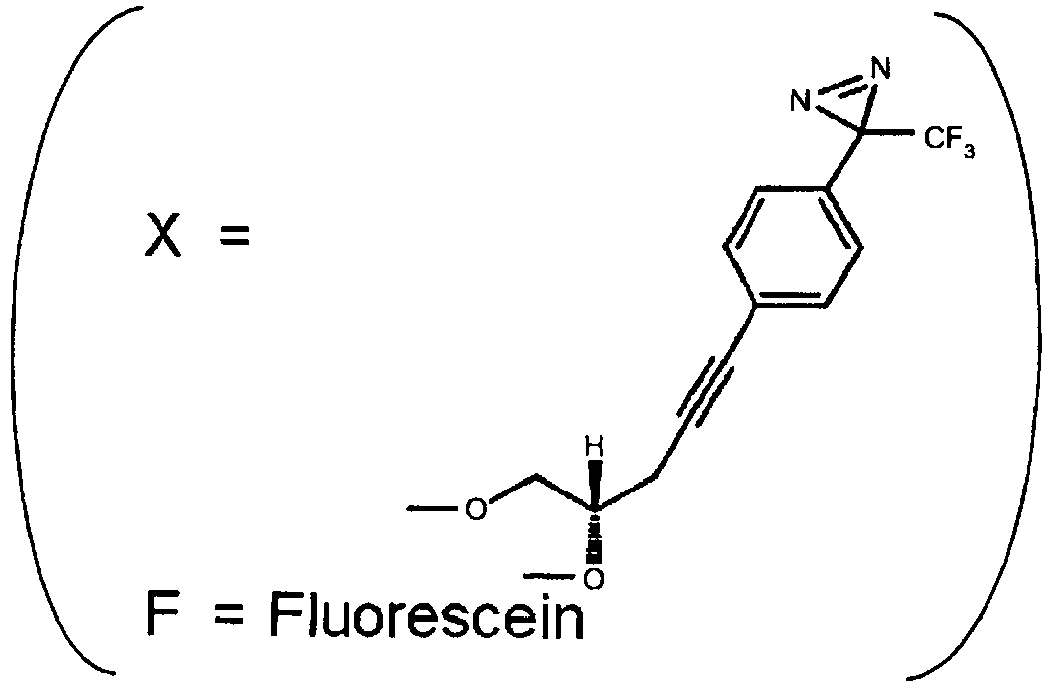
Fig. 8 ) and studying the sequence of the captured mRNA. - Although the embodiments of the present invention have been described above, the present invention is not limited to the above-described embodiment, and can be implemented in other various embodiments.
- For example, an siRNA containing one of the nucleoside analogs (1) to (11) as a component can be synthesized.
The sequences of the synthesized siRNAs are shown below. The synthesized single-stranded siRNAs are 21mer RNAs each containing the nucleoside analog (1) as a component, and 22mer RNAs each containing the nucleoside analog (10) as a component. - The sequences of the 21 mer RNAs each containing the nucleoside analog (1) as a component is shown in Table 12. In ON1 and ON2, thymidine is introduced in the dangling-end region at the 3' terminal. In ON3 and ON4, the nucleoside analog (1) is introduced in the dangling-end region at the 3' terminal. In ON8, the nucleoside analog (1) is introduced on the 5' terminal end, and thymidine is introduced in the dangling end region at the 3' terminal. In ON9, the nucleoside analog (1) is introduced on the 3' terminal side, and thymidine is introduced in the dangling end region at the 3' terminal.
-
[Table 12] RNA Sequence ON1 5'- CUUCUUCGUCGAGACCAUGtt - 3' ON2 5'- CAUGGUCUCGACGAAGAAGtt - 3' ON3 5'- CUUCUUCGUCGAGACCAUGTaTa - 3' ON4 5'- CAUGGUCUCGACGAAGAAGTaTa - 3' ON8 5'- CTaUCUUCGUCGAGACCAUGtt - 3' ON9 5'- CUUCUUCGUCGAGACCATaGtt - 3' -
[Table 13] siRNA sense antisense siRNA<1> ON1 ON2 siRNA<2> ON3 ON4 siRNA<6> ON8 ON2 siRNA<7> ON9 ON2 - The sequences of 22mer siRNAs each containing the nucleoside analog (10) as a component are shown in Table 14. In each of sense and antisense, a nucleoside analog (10;E) is introduced on the 5' terminal side.
-
[Table 14] RNA sequence calculated observed OD normal-sense 5'-CUUCUUCGUCGAGACCAUGtt-3' 6921.3 6922.4 1.40 normal-antisense 5'-CAUGGUCUCGAUGAAGAAGtt-3' 7071.4 7071.2 4.39 sense 5'-ECUUCUUCGUCGAGACCAUGtt-3' 6921.3 6922.4 4.11 antisense 5'-ECAUGGUCUCGAUGAAGAAGtt-3' 7071.4 7071.2 4.00 Fig. 9 ] and [Table 15]. -
[Table 15] siRNA RNA sequence Tm value[°C] native normal-sense 5'-CUUCUUCGUCGAGACCAUGtt-3' 72.2 normal-antisense 5'-CAUGGUCUCGAUGAAGAAGtt-3' sense sense 5'-ECUUCUUCGUCGAGACCAUGtt-3' 76.2 normal-antisense 5'-CAUGGUCUCGAUGAAGAAGtt-3' antisense normal-sense 5'-CUUCUUCGUCGAGACCAUGtt-3' 74.2 antisense 5'-ECAUGGUCUCGAUGAAGAAGtt-3' - With respect to siRNA<1>, siRNA<2>, siRNA<6> and siRNA<7> disclosed in [Table 13] and siRNAsense and siRNAantisense disclosed in [Table 15], gene expression inhibiting abilities were investigated.
- For investigating the gene expression inhibiting abilities, a Psi check vector was used. The samples were prepared so that each siRNA becomes 0.1, 1.0, and 10 nmol/l, and the prepared samples were transfected into HeLa cells. Then, the Dual-Luciferase reporter assay was performed for investigation. The results of the gene expression inhibiting abilities of siRNA<1>, siRNA<2>, siRNA<6>, and siRNA<7> are shown in [
Fig. 10 ], and the results of the gene expression inhibiting abilities of siRNAsense and siRNAantisense are shown in [Fig. 11 ]. - As shown in [
Fig. 10 ], siRNA<2> presented gene expression inhibiting abilities to the same level as those of a normal siRNA<1>, but when the concentration of the sample is low, the gene expression inhibiting abilities become lower than those of a normal siRNA<1>. Also, it was shown that the gene expression inhibiting abilities of siRNA<6> are decreased compared to those of a normal siRNA. It is considered this is because the introduction of a nucleoside analog (1) on the 5' terminal side of a sense strand in siRNA<6> causes a double strand to become unstable, thereby facilitating incorporation of the sense strand. Furthermore, it was found that the siRNA<7> has high gene expression inhibiting abilities compared to a normal siRNA. It is considered that this is because introduction of a nucleoside analog (1) on the 3' terminal side of a sense strand in the siRNA<7> causes the 5' terminal side of an anti-sense strand to be destabilized, thereby facilitating incorporation of the anti-sense strand. - Also, as shown in [
Fig. 11 ], it was found that the gene expression inhibiting abilities of a siRNAsense are increased compared to a normal siRNAnative when the concentration of a sample is high. It was found that the gene expression inhibiting abilities of a siRNAantisense are decreased compared to a normal siRNAnative. - In the above-described embodiments, the nucleoside analogs (1), (3), (5), (10) and (11) were illustrated as examples of the nucleoside analogs represented by the general formulae (1), (3), (5), (10) and (11), and the synthesis methods thereof were described in detail. However, even if some of the groups are different from those of the illustrated nucleoside analogs (1), (3), (5), (10) and (11), such nucleoside analogs can be expected to have a similar operation and effect, as long as the nucleoside analogs are nucleoside analogs represented by the general formulae (1), (3), (5), (10) and (11). Also, the synthesis methods of such nucleoside analogs are almost similar to the procedures for the illustrated nucleoside analogs (1), (3), (5), (10) and (11).
- Also, each of the nucleoside analogs (2), (4), (6), (7), (8) and (9) can be synthesized almost similarly to the procedures for the illustrated nucleoside analogs (1), (3), (5), (10) and (11), merely by applying starting materials having molecular structures corresponding to the base parts of these nucleoside analogs.
- More particularly, a sugar part including a hydroxyl group protected with a silyl group and a base part having a halogen substituent are subjected to a coupling reaction in the presence of a palladium catalyst, to obtain a coupling body. Thereafter, a deprotection reaction of the protecting group and a purification process are performed. Thus, the nucleoside analog having a structure represented by any of the general formulae (2), (4), (6), (7), (8) and (9) can be synthesized.
- Furthermore, the effect of a siRNA containing as a component one or more structures represented by any of the general formulae (2a), (3a) to (9a), and (11a) for a nucleoside analog was also experimentally investigated. The results similar to in the case of introducing the nucleoside analogs (1;Ta) and (10;E) were obtained.
- Since the activity is increased by introducing the nucleoside analog according to the present invention into a siRNA or a miRNA, application for the development of RNA drugs becomes possible. Furthermore, by introducing a nucleoside analog that introduces a photoreactive group, an mRNA can be captured. The photoreactive group reacts to light and provides active species capable of covalent bonding. Thus, the target of drug development can be explored.
- A treatment method utilizing the oligonucleotide analog according to the present invention can be theoretically designed if the base sequence of a target gene or virus is apparent. Therefore, the treatment method can become a new approach to an intractable disease which has been considered difficult to be cured.
- Also, the present invention can lead to elucidation of the gene control mechanism by an siRNA and a miRNA involved in RNA interference. Thus, the present invention can be utilized in the study for solving one of the most important problems to be solved in the life science field.


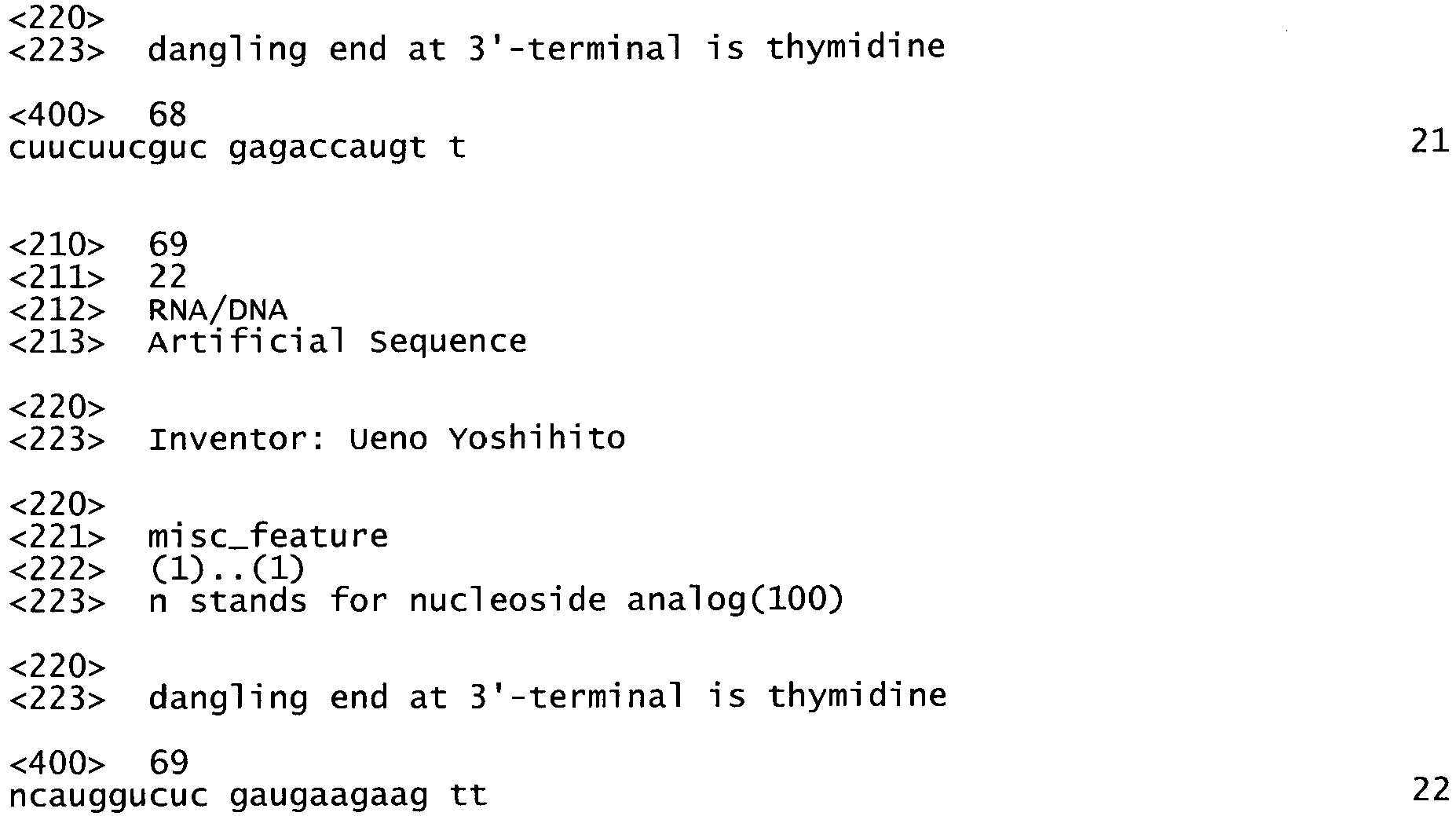
Claims (26)
- A nucleoside analog or a salt thereof represented by any of general formulae (1) to (10):

- The nucleoside analog or the salt thereof according to claim 1,
wherein the R1 is one of a hydrogen atom and a protecting group for a hydroxyl group that is the functional group in nucleic acid synthesis,
wherein the R2 is selected from:a hydrogen atom; the protecting group for a hydroxyl group being a functional group in nucleic acid synthesis; and a phosphate group, and
wherein the R3 is one of a hydrogen atom and a protecting group for an amino group that is the functional group in nucleic acid synthesis. - The nucleoside analog or the salt thereof according to claim 2,
wherein when each of the R1 and the R2 is the protecting group for a hydroxyl group that is the functional group in nucleic acid synthesis, the protecting group for a hydroxyl group that is the functional group in nucleic acid synthesis is selected from an aliphatic acyl group, an aromatic acyl group, an alkyoxy group, a methyl group substituted with an aryl group, a silyl group substituted with an aliphatic series, and a silyl group substituted with an aromatic series. - The nucleoside analog or the salt thereof according to claim 3,
wherein the aliphatic acyl group is an acetyl group,
wherein the aromatic acyl group is a benzoyl group,
wherein the methyl group substituted with an aryl group is selected from a benzyl group, a p-methoxybenzyl group, a 4,4'-dimethoxytrityl group and a 4-monomethoxytrityl group,
wherein the silyl group substituted with an aliphatic series is a tert-butyldimethylsilyl group, and
wherein the silyl group substituted with an aromatic series is a tert-butyldiphenylsilyl group. - The nucleoside analog or the salt thereof according to claim 2,
wherein when the R3 is the protecting group for an amino group that is the functional group in nucleic acid synthesis, the protecting group for an amino group that is the functional group in nucleic acid synthesis is selected from an aliphatic acyl group, an aromatic acyl group, an alkyoxy group, a methyl group substituted with an aryl group, a silyl group substituted with an aliphatic series, a silyl group substituted with an aromatic series, a sulfonyl group substituted with an aliphatic series, a sulfonyl group substituted with an aromatic series, a carbonyl group, and an amide group. - The nucleoside analog or the salt thereof according to claim 5,
wherein the aliphatic acyl group is an acetyl group,
wherein the aromatic acyl group is a benzoyl group,
wherein the methyl group substituted with an aryl group is a benzyl group,
wherein the silyl group substituted with an aliphatic series is tert-butyldimethylsilyl group,
wherein the silyl group substituted with an aromatic series is tert-butyldiphenylsilyl group,
wherein the sulfonyl group substituted with an aromatic series is a p-toluenesulfonyl group,
wherein the carbonyl group is one of a tert-butoxycarbonyl group and a benzyloxy carbonyl group, and
wherein the amide group is one of a dimethylformamide group and a dimethylacetamide group. - The nucleoside analog or the salt thereof according to claim 1,
wherein the phosphate group includes:a phosphate group protected by a protecting group in nucleic acid synthesis; andan activated phosphate group for solid phase synthesis. - The nucleoside analog or the salt thereof according to claim 7,
wherein the phosphate group protected by a protecting group in nucleic acid synthesis is one of a 2-chlorophenylphosphate group and a 4-chlorophenylphosphate group. - The nucleoside analog or the salt thereof according to claim 7,
wherein the activated phosphate group for solid phase synthesis is one of -P(OC2H4CN)(N(CH(CH3)2)2) and -P(OCH3)(N(CH(CH3)2)2). - A nucleoside analog or a salt thereof represented by a general formula (11) below:

wherein X1 is a photoreactive group that reacts to light and provides active species capable of covalent bonding, and
wherein X2 is an alkyl group or an alkyl group including at least one hydrogen substituted with halogen. - The nucleoside analog or the salt thereof according to claim 10,
wherein the X1 is a diazirine group. - The nucleoside analog or the salt thereof according to claim 10,
wherein the X2 is selected from a trifluoromethyl group, a difluoromethyl group and a monofluoromethyl group. - The nucleoside analog or the salt thereof according to claim 10,
wherein the R1 is one of a hydrogen atom and a protecting group for a hydroxyl group in nucleic acid synthesis,
wherein the R2 is selected from: a hydrogen atom; a protecting group for a hydroxyl group in nucleic acid synthesis; and a phosphate group. - The nucleoside analog or the salt thereof according to claim 10,
wherein the phosphate group includes:a phosphate group protected by a protecting group in nucleic acid synthesis; andan activated phosphate group for solid phase synthesis. - The nucleoside analog or the salt thereof according to claim 14,
wherein the phosphate group protected by a protecting group in nucleic acid synthesis is one of a 2-chlorophenylphosphate group and a 4-chlorophenylphosphate group. - The nucleoside analog or the salt thereof according to claim 14,
wherein the activated phosphate group for solid phase synthesis is one of -P(OC2H4CN)(N(CH(CH3)2)2) and -P(OCH3)(N(CH(CH3)2)2). - An oligonucleotide analog containing one or more structures represented by any of formulae (1a) to (10a) as a component,
wherein Ar is one of an aromatic hydrocarbon group or a polyaromatic hydrocarbon group:

- An oligonucleotide analog containing one or more structures represented by a formula (11a) as a component:


wherein X2 is an alkyl group or an alkyl group including at least one hydrogen substituted with halogen. - The oligonucleotide analog according to claim 18,
wherein the X1 is a diazirine group. - The oligonucleotide analog according to claim 18 or claim 19,
wherein the X2 is selected from a trifluoromethyl group, a difluoromethyl group and a monofluoromethyl group. - The oligonucleotide analog according to claim 17 or claim 18,
wherein the oligonucleotide analog is formed one strand. - The oligonucleotide analog according to claim 17 or claim 18,
wherein the oligonucleotide analog is formed a double strand with an oligonucleotide that contains an at least partially complementary sequence. - A gene expression inhibitor, comprising the oligonucleotide analog according to any one of claims 17 to 22.
- A nucleic-acid probe for detecting gene, comprising an oligonucleotide analog, the oligonucleotide analog containg one or more structures represented by a formula (11a) as a component:

wherein X2 is an alkyl group or an alkyl group including at least one hydrogen substituted with halogen. - The nucleic-acid probe for detecting gene according to claim 24,
wherein the X1 is a diazirine group. - The nucleic-acid probe for detecting gene according to claim 24 or claim 25,
wherein the X2 is selected from a trifluoromethyl group, a difluoromethyl group and a monofluoromethyl group.
Applications Claiming Priority (3)
| Application Number | Priority Date | Filing Date | Title |
|---|---|---|---|
| JP2010267314 | 2010-11-30 | ||
| JP2011190048 | 2011-08-31 | ||
| PCT/JP2011/077684 WO2012074012A1 (en) | 2010-11-30 | 2011-11-30 | Nucleoside analog or salt thereof, oligonucleotide analog, gene expression inhibitor, and nucleic-acid probe for detecting gene |
Publications (3)
| Publication Number | Publication Date |
|---|---|
| EP2647617A1 true EP2647617A1 (en) | 2013-10-09 |
| EP2647617A4 EP2647617A4 (en) | 2014-06-18 |
| EP2647617B1 EP2647617B1 (en) | 2016-07-13 |
Family
ID=46171939
Family Applications (1)
| Application Number | Title | Priority Date | Filing Date |
|---|---|---|---|
| EP11844449.6A Active EP2647617B1 (en) | 2010-11-30 | 2011-11-30 | Nucleoside analog or salt thereof, oligonucleotide analog, gene expression inhibitor, and nucleic-acid probe for detecting gene |
Country Status (5)
| Country | Link |
|---|---|
| US (1) | US8865898B2 (en) |
| EP (1) | EP2647617B1 (en) |
| JP (1) | JP5199519B2 (en) |
| CN (1) | CN103237780B (en) |
| WO (1) | WO2012074012A1 (en) |
Families Citing this family (2)
| Publication number | Priority date | Publication date | Assignee | Title |
|---|---|---|---|---|
| CN104837806A (en) * | 2012-12-07 | 2015-08-12 | 开曼化学股份有限公司 | Synthetic method of prostacyclin analog |
| CN111848369B (en) | 2019-04-26 | 2023-06-30 | 北京天一绿甫医药科技有限公司 | Eribulin intermediate and synthesis method and application thereof |
Family Cites Families (9)
| Publication number | Priority date | Publication date | Assignee | Title |
|---|---|---|---|---|
| JPS6479176A (en) * | 1987-02-25 | 1989-03-24 | Taisho Pharmaceutical Co Ltd | Intermediate of acromelic acid |
| JPH0352889A (en) * | 1989-07-19 | 1991-03-07 | Taisho Pharmaceut Co Ltd | pyrrolidine compound |
| UA48150C2 (en) * | 1994-11-02 | 2002-08-15 | Ай-Сі-Ен Фармасьютикалз | Amino acid or amino alcohol derivatives, oligonucleotide |
| JP4120002B2 (en) | 2004-01-07 | 2008-07-16 | 愛知県 | Cancer prognosis determination method using miRNA, cancer gene therapy vector, and cancer therapeutic pharmaceutical composition |
| EP1798225A1 (en) * | 2004-09-16 | 2007-06-20 | Gifu University | Nucleoside analogues or salts thereof |
| WO2009113580A1 (en) * | 2008-03-11 | 2009-09-17 | 独立行政法人科学技術振興機構 | Rna-selective hybridization reagent and utilization of the same |
| WO2009120878A2 (en) * | 2008-03-26 | 2009-10-01 | Alnylam Pharmaceuticals, Inc. | Non-natural ribonucleotides, and methods of use thereof |
| WO2009129036A1 (en) * | 2008-04-14 | 2009-10-22 | Merck & Co., Inc. | Substituted cyclopropyl compounds, compositions containing such compounds and methods of treatment |
| US20120122816A1 (en) * | 2009-02-05 | 2012-05-17 | Resolvyx Pharmaceuticals, Inc. | Compositions and methods for organ preservation |
-
2011
- 2011-11-30 CN CN201180057695.1A patent/CN103237780B/en active Active
- 2011-11-30 JP JP2012529033A patent/JP5199519B2/en active Active
- 2011-11-30 WO PCT/JP2011/077684 patent/WO2012074012A1/en not_active Ceased
- 2011-11-30 EP EP11844449.6A patent/EP2647617B1/en active Active
- 2011-11-30 US US13/990,649 patent/US8865898B2/en active Active
Also Published As
| Publication number | Publication date |
|---|---|
| JP5199519B2 (en) | 2013-05-15 |
| CN103237780A (en) | 2013-08-07 |
| EP2647617B1 (en) | 2016-07-13 |
| US8865898B2 (en) | 2014-10-21 |
| US20140221637A1 (en) | 2014-08-07 |
| EP2647617A4 (en) | 2014-06-18 |
| CN103237780B (en) | 2015-03-04 |
| WO2012074012A1 (en) | 2012-06-07 |
| JPWO2012074012A1 (en) | 2014-05-19 |
Similar Documents
| Publication | Publication Date | Title |
|---|---|---|
| EP3109254B1 (en) | Crosslinked nucleoside and nucleotide | |
| JP5493117B2 (en) | Oligonucleotide derivatives and uses thereof | |
| EP2370451B1 (en) | Method for the synthesis of phosphorus atom modified nucleic acids | |
| CN110678447B (en) | Modified nucleic acid monomer compounds and oligonucleic acid analogs | |
| EP2915815B1 (en) | New modified nucleic acid | |
| JPWO2020158910A1 (en) | 5'-modified nucleoside and nucleotides using it | |
| EP4098746A1 (en) | Single-stranded polynucleotide | |
| EP2511260B1 (en) | Aromatic compound, modification carrier that uses same and is used for synthesizing an oligonucleotide derivative, oligonucleotide derivative, and oligonucleotide construct | |
| WO1998049179A2 (en) | A process for the synthesis of modified p-chiral nucleotide analogues | |
| Osawa et al. | Synthesis of 2′-C, 4′-C-Methyleneoxy-bridged thymidine derivatives and properties of modified oligonucleotides | |
| HK1000191B (en) | Modified oligodeoxyribonucleotides, their preparation and their therapeutic use | |
| HK1000191A1 (en) | Modified oligodeoxyribonucleotides, their preparation and their therapeutic use | |
| EP2647617B1 (en) | Nucleoside analog or salt thereof, oligonucleotide analog, gene expression inhibitor, and nucleic-acid probe for detecting gene | |
| JP5464401B2 (en) | Oligonucleotide derivative, oligonucleotide construct using oligonucleotide derivative, compound for synthesizing oligonucleotide derivative, and method for producing oligonucleotide derivative | |
| CN119285688A (en) | Modified nucleotide monomers and their uses | |
| JP2026513376A (en) | Oligonucleotides, their manufacturing methods, and applications | |
| Seio et al. | Short-RNA selective binding of oligonucleotides modified using adenosine and guanosine derivatives that possess cyclohexyl phosphates as substituents | |
| Carnero et al. | The impact of an extended nucleobase-2′-deoxyribose linker in the biophysical and biological properties of oligonucleotides | |
| Mori et al. | Modified unlocked nucleic acid (MUNA) mitigates off-target effects of small interfering RNAs | |
| JP5424236B2 (en) | Oligonucleotide derivative, oligonucleotide construct using oligonucleotide derivative, compound for synthesizing oligonucleotide derivative, and method for producing oligonucleotide derivative | |
| US9920319B2 (en) | 2′/3′/5′-(R/S)-serinyl functionalized oligonucleotides | |
| EP4596540A1 (en) | Carbocyclic nucleoside, oligonucleotide, preparation method therefor, and medical uses thereof | |
| WO2025261379A1 (en) | Modified nucleoside compound, and use thereof in oligonucleotides | |
| JP6621831B2 (en) | Nucleoside derivatives and uses thereof | |
| JP4805143B2 (en) | Novel artificial RNA modified with 2 'hydroxyl group |
Legal Events
| Date | Code | Title | Description |
|---|---|---|---|
| PUAI | Public reference made under article 153(3) epc to a published international application that has entered the european phase |
Free format text: ORIGINAL CODE: 0009012 |
|
| 17P | Request for examination filed |
Effective date: 20130628 |
|
| AK | Designated contracting states |
Kind code of ref document: A1 Designated state(s): AL AT BE BG CH CY CZ DE DK EE ES FI FR GB GR HR HU IE IS IT LI LT LU LV MC MK MT NL NO PL PT RO RS SE SI SK SM TR |
|
| DAX | Request for extension of the european patent (deleted) | ||
| A4 | Supplementary search report drawn up and despatched |
Effective date: 20140521 |
|
| RIC1 | Information provided on ipc code assigned before grant |
Ipc: C07D 229/02 20060101ALI20140515BHEP Ipc: C12N 15/09 20060101ALI20140515BHEP Ipc: C07F 9/6512 20060101ALI20140515BHEP Ipc: C07D 239/47 20060101ALI20140515BHEP Ipc: C07D 239/54 20060101ALI20140515BHEP Ipc: C12Q 1/68 20060101ALI20140515BHEP Ipc: C07F 9/58 20060101ALI20140515BHEP Ipc: C07F 9/564 20060101ALI20140515BHEP Ipc: C07H 21/00 20060101ALI20140515BHEP Ipc: C07C 33/044 20060101AFI20140515BHEP Ipc: C07D 213/73 20060101ALI20140515BHEP |
|
| 17Q | First examination report despatched |
Effective date: 20150506 |
|
| GRAP | Despatch of communication of intention to grant a patent |
Free format text: ORIGINAL CODE: EPIDOSNIGR1 |
|
| INTG | Intention to grant announced |
Effective date: 20151023 |
|
| GRAS | Grant fee paid |
Free format text: ORIGINAL CODE: EPIDOSNIGR3 |
|
| GRAP | Despatch of communication of intention to grant a patent |
Free format text: ORIGINAL CODE: EPIDOSNIGR1 |
|
| GRAJ | Information related to disapproval of communication of intention to grant by the applicant or resumption of examination proceedings by the epo deleted |
Free format text: ORIGINAL CODE: EPIDOSDIGR1 |
|
| GRAP | Despatch of communication of intention to grant a patent |
Free format text: ORIGINAL CODE: EPIDOSNIGR1 |
|
| INTG | Intention to grant announced |
Effective date: 20160314 |
|
| INTG | Intention to grant announced |
Effective date: 20160322 |
|
| GRAA | (expected) grant |
Free format text: ORIGINAL CODE: 0009210 |
|
| AK | Designated contracting states |
Kind code of ref document: B1 Designated state(s): AL AT BE BG CH CY CZ DE DK EE ES FI FR GB GR HR HU IE IS IT LI LT LU LV MC MK MT NL NO PL PT RO RS SE SI SK SM TR |
|
| REG | Reference to a national code |
Ref country code: GB Ref legal event code: FG4D |
|
| REG | Reference to a national code |
Ref country code: AT Ref legal event code: REF Ref document number: 812161 Country of ref document: AT Kind code of ref document: T Effective date: 20160715 Ref country code: CH Ref legal event code: EP |
|
| REG | Reference to a national code |
Ref country code: IE Ref legal event code: FG4D |
|
| REG | Reference to a national code |
Ref country code: DE Ref legal event code: R096 Ref document number: 602011028222 Country of ref document: DE |
|
| REG | Reference to a national code |
Ref country code: LT Ref legal event code: MG4D |
|
| REG | Reference to a national code |
Ref country code: NL Ref legal event code: MP Effective date: 20160713 |
|
| REG | Reference to a national code |
Ref country code: FR Ref legal event code: PLFP Year of fee payment: 6 |
|
| REG | Reference to a national code |
Ref country code: AT Ref legal event code: MK05 Ref document number: 812161 Country of ref document: AT Kind code of ref document: T Effective date: 20160713 |
|
| PG25 | Lapsed in a contracting state [announced via postgrant information from national office to epo] |
Ref country code: IS Free format text: LAPSE BECAUSE OF FAILURE TO SUBMIT A TRANSLATION OF THE DESCRIPTION OR TO PAY THE FEE WITHIN THE PRESCRIBED TIME-LIMIT Effective date: 20161113 Ref country code: FI Free format text: LAPSE BECAUSE OF FAILURE TO SUBMIT A TRANSLATION OF THE DESCRIPTION OR TO PAY THE FEE WITHIN THE PRESCRIBED TIME-LIMIT Effective date: 20160713 Ref country code: HR Free format text: LAPSE BECAUSE OF FAILURE TO SUBMIT A TRANSLATION OF THE DESCRIPTION OR TO PAY THE FEE WITHIN THE PRESCRIBED TIME-LIMIT Effective date: 20160713 Ref country code: LT Free format text: LAPSE BECAUSE OF FAILURE TO SUBMIT A TRANSLATION OF THE DESCRIPTION OR TO PAY THE FEE WITHIN THE PRESCRIBED TIME-LIMIT Effective date: 20160713 Ref country code: NL Free format text: LAPSE BECAUSE OF FAILURE TO SUBMIT A TRANSLATION OF THE DESCRIPTION OR TO PAY THE FEE WITHIN THE PRESCRIBED TIME-LIMIT Effective date: 20160713 Ref country code: RS Free format text: LAPSE BECAUSE OF FAILURE TO SUBMIT A TRANSLATION OF THE DESCRIPTION OR TO PAY THE FEE WITHIN THE PRESCRIBED TIME-LIMIT Effective date: 20160713 Ref country code: NO Free format text: LAPSE BECAUSE OF FAILURE TO SUBMIT A TRANSLATION OF THE DESCRIPTION OR TO PAY THE FEE WITHIN THE PRESCRIBED TIME-LIMIT Effective date: 20161013 Ref country code: IT Free format text: LAPSE BECAUSE OF FAILURE TO SUBMIT A TRANSLATION OF THE DESCRIPTION OR TO PAY THE FEE WITHIN THE PRESCRIBED TIME-LIMIT Effective date: 20160713 |
|
| PG25 | Lapsed in a contracting state [announced via postgrant information from national office to epo] |
Ref country code: PL Free format text: LAPSE BECAUSE OF FAILURE TO SUBMIT A TRANSLATION OF THE DESCRIPTION OR TO PAY THE FEE WITHIN THE PRESCRIBED TIME-LIMIT Effective date: 20160713 Ref country code: LV Free format text: LAPSE BECAUSE OF FAILURE TO SUBMIT A TRANSLATION OF THE DESCRIPTION OR TO PAY THE FEE WITHIN THE PRESCRIBED TIME-LIMIT Effective date: 20160713 Ref country code: GR Free format text: LAPSE BECAUSE OF FAILURE TO SUBMIT A TRANSLATION OF THE DESCRIPTION OR TO PAY THE FEE WITHIN THE PRESCRIBED TIME-LIMIT Effective date: 20161014 Ref country code: AT Free format text: LAPSE BECAUSE OF FAILURE TO SUBMIT A TRANSLATION OF THE DESCRIPTION OR TO PAY THE FEE WITHIN THE PRESCRIBED TIME-LIMIT Effective date: 20160713 Ref country code: ES Free format text: LAPSE BECAUSE OF FAILURE TO SUBMIT A TRANSLATION OF THE DESCRIPTION OR TO PAY THE FEE WITHIN THE PRESCRIBED TIME-LIMIT Effective date: 20160713 Ref country code: SE Free format text: LAPSE BECAUSE OF FAILURE TO SUBMIT A TRANSLATION OF THE DESCRIPTION OR TO PAY THE FEE WITHIN THE PRESCRIBED TIME-LIMIT Effective date: 20160713 Ref country code: BE Free format text: LAPSE BECAUSE OF NON-PAYMENT OF DUE FEES Effective date: 20160713 Ref country code: PT Free format text: LAPSE BECAUSE OF FAILURE TO SUBMIT A TRANSLATION OF THE DESCRIPTION OR TO PAY THE FEE WITHIN THE PRESCRIBED TIME-LIMIT Effective date: 20161114 |
|
| REG | Reference to a national code |
Ref country code: DE Ref legal event code: R097 Ref document number: 602011028222 Country of ref document: DE |
|
| PG25 | Lapsed in a contracting state [announced via postgrant information from national office to epo] |
Ref country code: EE Free format text: LAPSE BECAUSE OF FAILURE TO SUBMIT A TRANSLATION OF THE DESCRIPTION OR TO PAY THE FEE WITHIN THE PRESCRIBED TIME-LIMIT Effective date: 20160713 Ref country code: RO Free format text: LAPSE BECAUSE OF FAILURE TO SUBMIT A TRANSLATION OF THE DESCRIPTION OR TO PAY THE FEE WITHIN THE PRESCRIBED TIME-LIMIT Effective date: 20160713 |
|
| PLBE | No opposition filed within time limit |
Free format text: ORIGINAL CODE: 0009261 |
|
| STAA | Information on the status of an ep patent application or granted ep patent |
Free format text: STATUS: NO OPPOSITION FILED WITHIN TIME LIMIT |
|
| PG25 | Lapsed in a contracting state [announced via postgrant information from national office to epo] |
Ref country code: SK Free format text: LAPSE BECAUSE OF FAILURE TO SUBMIT A TRANSLATION OF THE DESCRIPTION OR TO PAY THE FEE WITHIN THE PRESCRIBED TIME-LIMIT Effective date: 20160713 Ref country code: DK Free format text: LAPSE BECAUSE OF FAILURE TO SUBMIT A TRANSLATION OF THE DESCRIPTION OR TO PAY THE FEE WITHIN THE PRESCRIBED TIME-LIMIT Effective date: 20160713 Ref country code: BG Free format text: LAPSE BECAUSE OF FAILURE TO SUBMIT A TRANSLATION OF THE DESCRIPTION OR TO PAY THE FEE WITHIN THE PRESCRIBED TIME-LIMIT Effective date: 20161013 Ref country code: SM Free format text: LAPSE BECAUSE OF FAILURE TO SUBMIT A TRANSLATION OF THE DESCRIPTION OR TO PAY THE FEE WITHIN THE PRESCRIBED TIME-LIMIT Effective date: 20160713 Ref country code: CZ Free format text: LAPSE BECAUSE OF FAILURE TO SUBMIT A TRANSLATION OF THE DESCRIPTION OR TO PAY THE FEE WITHIN THE PRESCRIBED TIME-LIMIT Effective date: 20160713 |
|
| 26N | No opposition filed |
Effective date: 20170418 |
|
| REG | Reference to a national code |
Ref country code: CH Ref legal event code: PL |
|
| PG25 | Lapsed in a contracting state [announced via postgrant information from national office to epo] |
Ref country code: CH Free format text: LAPSE BECAUSE OF NON-PAYMENT OF DUE FEES Effective date: 20161130 Ref country code: LI Free format text: LAPSE BECAUSE OF NON-PAYMENT OF DUE FEES Effective date: 20161130 |
|
| REG | Reference to a national code |
Ref country code: IE Ref legal event code: MM4A |
|
| PG25 | Lapsed in a contracting state [announced via postgrant information from national office to epo] |
Ref country code: SI Free format text: LAPSE BECAUSE OF FAILURE TO SUBMIT A TRANSLATION OF THE DESCRIPTION OR TO PAY THE FEE WITHIN THE PRESCRIBED TIME-LIMIT Effective date: 20160713 |
|
| PG25 | Lapsed in a contracting state [announced via postgrant information from national office to epo] |
Ref country code: LU Free format text: LAPSE BECAUSE OF NON-PAYMENT OF DUE FEES Effective date: 20161130 |
|
| REG | Reference to a national code |
Ref country code: FR Ref legal event code: PLFP Year of fee payment: 7 |
|
| PG25 | Lapsed in a contracting state [announced via postgrant information from national office to epo] |
Ref country code: IE Free format text: LAPSE BECAUSE OF NON-PAYMENT OF DUE FEES Effective date: 20161130 |
|
| PG25 | Lapsed in a contracting state [announced via postgrant information from national office to epo] |
Ref country code: CY Free format text: LAPSE BECAUSE OF FAILURE TO SUBMIT A TRANSLATION OF THE DESCRIPTION OR TO PAY THE FEE WITHIN THE PRESCRIBED TIME-LIMIT Effective date: 20160713 Ref country code: HU Free format text: LAPSE BECAUSE OF FAILURE TO SUBMIT A TRANSLATION OF THE DESCRIPTION OR TO PAY THE FEE WITHIN THE PRESCRIBED TIME-LIMIT; INVALID AB INITIO Effective date: 20111130 |
|
| PG25 | Lapsed in a contracting state [announced via postgrant information from national office to epo] |
Ref country code: MC Free format text: LAPSE BECAUSE OF FAILURE TO SUBMIT A TRANSLATION OF THE DESCRIPTION OR TO PAY THE FEE WITHIN THE PRESCRIBED TIME-LIMIT Effective date: 20160713 Ref country code: MK Free format text: LAPSE BECAUSE OF FAILURE TO SUBMIT A TRANSLATION OF THE DESCRIPTION OR TO PAY THE FEE WITHIN THE PRESCRIBED TIME-LIMIT Effective date: 20160713 |
|
| PG25 | Lapsed in a contracting state [announced via postgrant information from national office to epo] |
Ref country code: MT Free format text: LAPSE BECAUSE OF NON-PAYMENT OF DUE FEES Effective date: 20161130 |
|
| PG25 | Lapsed in a contracting state [announced via postgrant information from national office to epo] |
Ref country code: AL Free format text: LAPSE BECAUSE OF FAILURE TO SUBMIT A TRANSLATION OF THE DESCRIPTION OR TO PAY THE FEE WITHIN THE PRESCRIBED TIME-LIMIT Effective date: 20160713 Ref country code: TR Free format text: LAPSE BECAUSE OF FAILURE TO SUBMIT A TRANSLATION OF THE DESCRIPTION OR TO PAY THE FEE WITHIN THE PRESCRIBED TIME-LIMIT Effective date: 20160713 |
|
| REG | Reference to a national code |
Ref country code: DE Ref legal event code: R082 Ref document number: 602011028222 Country of ref document: DE Representative=s name: SIMMONS & SIMMONS LLP, DE |
|
| PGFP | Annual fee paid to national office [announced via postgrant information from national office to epo] |
Ref country code: DE Payment date: 20241007 Year of fee payment: 14 |
|
| PGFP | Annual fee paid to national office [announced via postgrant information from national office to epo] |
Ref country code: GB Payment date: 20241007 Year of fee payment: 14 |
|
| PGFP | Annual fee paid to national office [announced via postgrant information from national office to epo] |
Ref country code: FR Payment date: 20241008 Year of fee payment: 14 |
|
| REG | Reference to a national code |
Ref country code: DE Ref legal event code: R119 Ref document number: 602011028222 Country of ref document: DE |