EP2647526A2 - Vehicle lamp device - Google Patents
Vehicle lamp device Download PDFInfo
- Publication number
- EP2647526A2 EP2647526A2 EP13161825.8A EP13161825A EP2647526A2 EP 2647526 A2 EP2647526 A2 EP 2647526A2 EP 13161825 A EP13161825 A EP 13161825A EP 2647526 A2 EP2647526 A2 EP 2647526A2
- Authority
- EP
- European Patent Office
- Prior art keywords
- control module
- opening
- accommodation chamber
- side unit
- shade
- Prior art date
- Legal status (The legal status is an assumption and is not a legal conclusion. Google has not performed a legal analysis and makes no representation as to the accuracy of the status listed.)
- Granted
Links
- 230000004308 accommodation Effects 0.000 claims abstract description 76
- 238000003780 insertion Methods 0.000 description 10
- 230000037431 insertion Effects 0.000 description 10
- 230000003287 optical effect Effects 0.000 description 6
- 239000000758 substrate Substances 0.000 description 6
- 230000000903 blocking effect Effects 0.000 description 4
- 238000004519 manufacturing process Methods 0.000 description 3
- 238000000034 method Methods 0.000 description 3
- 238000012986 modification Methods 0.000 description 3
- 230000004048 modification Effects 0.000 description 3
- 238000005452 bending Methods 0.000 description 2
- 239000002184 metal Substances 0.000 description 2
- 230000000694 effects Effects 0.000 description 1
- 230000004313 glare Effects 0.000 description 1
- 238000005286 illumination Methods 0.000 description 1
Images




Classifications
-
- B—PERFORMING OPERATIONS; TRANSPORTING
- B60—VEHICLES IN GENERAL
- B60Q—ARRANGEMENT OF SIGNALLING OR LIGHTING DEVICES, THE MOUNTING OR SUPPORTING THEREOF OR CIRCUITS THEREFOR, FOR VEHICLES IN GENERAL
- B60Q1/00—Arrangement of optical signalling or lighting devices, the mounting or supporting thereof or circuits therefor
- B60Q1/0088—Details of electrical connections
- B60Q1/0094—Arrangement of electronic circuits separated from the light source, e.g. mounting of housings for starter circuits for discharge lamps
Definitions
- the invention relates to a vehicle lamp device and, more particularly, to a vehicle lamp device for use in a vehicle such as an automobile.
- a light distribution variable type vehicle headlamp device which forms a low-beam light distribution pattern when light from a light source is blocked with a shade and a high-beam light distribution pattern when the light is not blocked with the shade.
- a vehicle headlamp device has been suggested that forms a special light distribution pattern different from the shape of the standard low-beam or that of the standard high-beam in accordance with the surrounding conditions.
- the high-beam it is necessary to consider glare which causes unconvenience to oncoming vehicles and/or pedestrians while improving the visibility of a driver.
- a vehicular lamp described in JP 2007-179969 A (corresponding to US 2007/0147055 A1 ) has a structure which can optimally set an illumination area of high-beam in accordance with presence or absence of pedestrians, preceding vehicles and/or oncoming vehicles.
- such a configuration may be conceived that a plurality of shades are provided each of which is movable between an advanced position where a portion of light from a light source is blocked and a retreated position where the portion of the light from the light source is not blocked and that the light distribution pattern is switched by switching the position of each shade.
- a low-beam light distribution pattern is formed by placing a first shade in a blocking position
- a special light distribution pattern is formed by placing a second shade in the blocking position and placing the first shade in a non-blocking position
- a high-beam light distribution pattern is formed by placing both the first shade and the second shade in the non-blocking positions.
- a motor such as DC motor may be used to move the shades. Driving the motor is controlled based on a control signal output from a control module.
- shade controls are performed for left and right units.
- different shade controls are performed for left and right units.
- different light distribution patterns are formed by the left side unit, which is disposed on the left side of the vehicle, and the right side unit, which is disposed on the right side of the vehicle. In this case, it is necessary to mount a dedicated control module on each of the left side unit and the right side unit.
- the dedicated control module is mounted on each of the left and right side units, it is naturally required to properly mount a control module for the left side unit in the left side unit and a control module for the right side unit in the right side unit, at the time of manufacturing a vehicle lamp device.
- the invention has been made in view of the above circumstances and provides a technique that enables the control module for the left side unit and the control module for the right side unit to be mounted on suitable units in a vehicle lamp device including the left side unit, which is disposed on the left side of the vehicle, and the right side unit, which is disposed on the right side of the vehicle.
- a vehicle lamp device includes a left side unit and a right side unit.
- the left side unit is to be disposed on a left side of a vehicle.
- the right side unit is to be disposed on a right side of the vehicle.
- the left side unit includes a first control module and a first accommodation chamber.
- the first control module controls an operation of the left side unit.
- the first accommodation chamber is formed with a first opening through which the first control module is configured to be removably inserted into the first accommodation chamber.
- the first accommodation chamber accommodates the first control module.
- the right side unit includes a second control module and a second accommodation chamber. The second control module controls an operation of the right side unit.
- the second accommodation chamber is formed with a second opening through which the second control module is configured to be removably inserted into the second accommodation chamber.
- the second accommodation chamber accommodates the second control module.
- the first control module includes a housing having a contour shape in section perpendicular to a direction in which the first control module is removably inserted into the first accommodation chamber.
- the contour shape of the housing of the first control module is similar to a contour shape of the first opening.
- the second control module includes a housing having a contour shape in section perpendicular to a direction in which the second control module is removably inserted into the second accommodation chamber.
- the contour shape of the housing of the second control module is similar to a contour shape of the second opening.
- the first opening has, in a part of the contour shape thereof, a first right-left discrimination part that allows the first control module to enter the first accommodation chamber through the first opening and that restricts the second control module from entering the first accommodation chamber through the first opening.
- the second opening has, in a part of the contour shape of thereof, a second right-left discrimination part that allows the second control module to enter the second accommodation chamber through the second opening and that restricts the first control module from entering the second accommodation chamber through the second opening.
- each of the first opening and the second opening may have a contour whose base shape is a rectangular shape.
- Each of the first right-left discrimination part and the second right-left discrimination part may be formed by chamfering a corner of the corresponding rectangular shape. Therefore, the first right-left discrimination part and the second right-left discrimination part can be simply formed. Therefore, it is possible to suppress the complexity of the manufacturing process of the vehicle lamp device.
- a vehicle lamp device including a right unit disposed on a right side of a vehicle and a left unit disposed on a left side of the vehicle, it is possible to provide a technique which is capable of mounting a control module for the right unit and a control module for the left unit on suitable units, respectively.
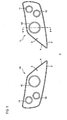
- Fig. 1 is a front view schematically showing a schematic structure of a vehicle lamp device according to an embodiment.
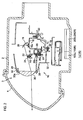
- Fig. 2 is a schematic sectional view taken along a line II-II in Fig. 1 .
- a vehicle headlamp device including a pair of headlamp units which are disposed on the left and right sides of a front part of a vehicle will be described as an example of a vehicle lamp device 1 according to this embodiment.
- the vehicle lamp device 1 includes a left side unit 1L disposed on the left side of the vehicle and a right side unit 1R disposed on the right side of the vehicle. Since the configuration of the left side unit 1L and that of the right side unit 1R are basically the same except having a bilaterally symmetric structure, a lamp unit to be accommodated in a unit will be described with reference to the left side unit 1L, and detailed description on the right side unit 1R will be omitted. Also, since the structures of lamp units 11 and lamp units 12 which are accommodated in the left side unit 1L and the right side unit 1R have been known, detailed description thereon will omitted.
- the left side unit 1L includes a lamp body 2 formed with an opening on a front side of the vehicle and a light transmissive cover 4 attached to cover the opening of the lamp body 2.
- the lamp units 10 to 12 and a first control module 100L are accommodated in a lamp chamber 3 which is defined by the lamp body 2 and the light transmissive cover 4.
- the lamp unit 10 is attached to a bracket 14.
- the bracket 14 is fixed to the lamp body 2 by a support mechanism (not shown).
- a first accommodation chamber 200L is provided in a lower part of the lamp body 2.
- the first control module 100L is accommodated in the first accommodation chamber 200L.
- a second control module 100R is accommodated in a second accommodation chamber 200R.
- the lamp unit 10 includes a heat sink 16, a light source module 18, a reflector 20, a first shade 22, a second shade 24, a shade driving part 26, a lens holder 28, a projection lens 30, and a cover member 32.
- the heat sink 16 is attached to the bracket 14 by a fastening member 50 such as a screw.
- the heat sink 16 includes a light source module mounting surface 16a facing upward in a direction substantially perpendicular to an optical axis of the lamp unit 10.
- the light source module 18 is mounted on the light source module mounting surface 16a.
- the light source module 18 is a light emitting diode (LED), for example.
- the reflector 20 has a substantially dome shape, is disposed above the light source module 18, and is fixed to the heat sink 16.
- the reflector 20 is provided on its inner side with a reflective surface which is configured by a part of a spheroidal surface.
- the reflective surface includes a first focal point and a second focal point which is located on the front side of the lamp relative to the first focal point. A positional relationship between the reflector 20 and the light source module mounting surface 16a is established so that a light emitting part of the light source module 18 substantially coincides with the first focal point of the reflector 20.
- the first shade 22 and the second shade 24 are disposed on the front side of the lamp relative to the reflector 20.
- the first shade 22 and the second shade 24 are movable, independently from each other, in directions indicated by arrows X1 and X2 in Fig. 2 .
- Each of the first shade 22 and the second shade 24 can be in an advanced position (a state shown in Fig. 2 ) where an upper edge of each shade is close to the optical axis.
- each of the first shade 22 and the second shade 24 can be in a retreated position where the upper edge of each shade is far away from the optical axis and is below the optical axis.
- the first shade 22 and the second shade 24 are disposed so that when the first shade 22 and the second shade 24 are in the advanced positions, the respective upper edges thereof substantially overlap with the second focal point of the reflective surface of the reflector 20.
- the upper edge of the first shade 22 is processed to form a cut-off line of a low-beam light distribution pattern when the first shade 22 is in the advanced position.
- the upper edge and side edge of the second shade 24 are processed to form a cut-off line of one-side high light distribution pattern when the second shade 24 is in the advanced position.
- the left side unit 1L forms the low-beam light distribution pattern when the first shade 22 is in the advanced position. Also, the left side unit 1L forms a so-called left-side high light distribution pattern having a high-beam area only on the own-vehicle lane side during the left-hand traffic when the first shade 22 is in the retreated position and the second shade 24 is in the advanced position.
- the left side unit 1L forms a high-beam light distribution pattern when the first shade 22 and the second shade 24 are in the retreated positions.
- the lamp unit 10 of the right side unit 1R forms the low-beam light distribution pattern, the high-beam light distribution pattern, and a so-called right-side high light distribution pattern having a high-beam area only on the oncoming-vehicle lane side during the left-hand traffic.
- the shapes of respective light distribution patterns described above have been known. Therefore, detailed description thereon will be omitted.
- the first shade 22 and the second shade 24 are respectively connected to shade driving parts 26 that moves the shades 22, 24 between the advanced positions and the retreated positions.
- Each shade driving part 26 is implemented by a motor such as a DC motor, for example.
- a connection part 26b configured by a gear such as a spur gear is provided at a leading end of an output shaft 26a of each shade driving part 26.
- a gear part (not shown) to be meshed with the connection part 26b is provided in the lower end portion of each shade.
- the connection parts 26b are meshed with the gear parts to thereby connect the shade driving parts 26 to the first shade 22 and the second shade 24.
- the lens holder 28 is disposed on the front side of the lamp relative to the first shade 22 and the second shade 24.
- the projection lens 30 is fitted to the lens holder 28.
- the projection lens 30 is formed of a plano-convex aspherical lens having a convex front surface and a flat rear surface.
- the projection lens projects a light source image formed on a back focal plane including a back focal point onto a virtual vertical screen in front of the lamp as an inverted image.
- the lens holder 28 holds the projection lens 30 at a position on an optical axis of the lamp unit 10, where its back focal point is substantially matched with the second focal point of the reflective surface of the reflector 20.
- the lens holder 28 is fixed to the heat sink 16 by a fastening member 51 such as a screw.
- the cover member 32 is disposed on an outer periphery of the lens holder 28.
- the cover member 32 is formed with an opening 32a that allows irradiation light from the lamp unit 10 to pass therethrough and is fixed to the heat sink 16 by a fastening member 52 such as a screw.
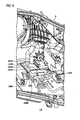
- Fig. 3 is a perspective view showing a schematic structure in the vicinity of the accommodation chamber in the lamp body of the left side unit.
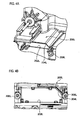
- Fig. 4A is an enlarged perspective view showing a portion in the vicinity of the accommodation chamber of the left side unit.
- Fig. 4B is an enlarged front view showing the portion in the vicinity of the accommodation chamber of the left side unit.
- Fig. 5A is a perspective view showing a schematic structure of the first control module.
- Fig. 5B is a front view showing a schematic structure of the first control module.
- the left side unit 1L includes the first accommodation chamber 200L in the lower space of the lamp body 2.
- the first accommodation chamber 200L is provided on an inner side surface of a bottom wall of the lamp body 2.
- the first control module 100L is accommodated in the first accommodation chamber 200L (see Fig. 3 ).
- the first control module 100L is inserted into and removed from the first accommodation chamber 200L in a direction indicated by an arrow Y1 in Fig. 3 .
- the first accommodation chamber 200L is formed with a first opening 202L through which the first control module 100L is removably inserted.
- the first opening 202L faces the front side of the lamp.
- the first opening 202L has a first right-left discrimination part 204L in a part of a contour shape of the first opening 202L.
- the first right-left discrimination part 204L allows the first control module 100L to enter through the first opening 202L and restricts the second control module 100R from entering through the first opening 202L.
- the first opening 202L has the contour whose base shape is a rectangular shape.
- the first right-left discrimination part 204L has a shape formed by chamfering a corner of the rectangular shape. Specifically, an upper right corner of the first opening 202L is chamfered when viewed from the front side of the lamp, to form the first right-left discrimination part 204L.
- the first right-left discrimination part 204L extends from an end of the first accommodation chamber 200L on the front side of the lamp to an end of the first accommodation chamber 200L on the rear side of the lamp. Insertion holes 206L for fixing the first control module are formed at predetermined positions on the outer periphery of the first accommodation chamber 200L.
- the first control module 100L includes a housing 102L in which a substrate is accommodated.
- a circuit(s) and a device(s) such as a CPU to execute various operations, a ROM to store various control programs, and a RAM used as a work area to store data and/or execute program are mounted on the substrate.
- the first control module 100L is a control unit that controls an operation of the left side unit 1L. More specifically, the first control module 100L controls turning on/off of the lamp units 10 to 12 accommodated in the left side unit 1L and controls the moving of the first shade 22 and the second shade 24 of the lamp unit 10 by controlling driving of the shade driving parts 26.
- a contour shape (see Fig. 5B ) of the housing 102L in section perpendicular to the (the direction indicated by the arrow Y1 in Figs. 3 and 5A ) in which the housing 102L is inserted into and removed from the first accommodation chamber 200L is similar to that of the first opening 202L. Therefore, the housing 102L includes a feature part 104L at a position, corresponding to the first right-left discrimination part 204L of the first opening 202L, on the contour thereof.
- the feature part 104L has a shape corresponding to the first right-left discrimination part 204L.
- the housing 102L has the contour whose base shape is a rectangular shape, and a part of the contour of the housing 102L located inside the rectangular shape, which the base shape, constitutes the feature part 104L.
- the feature part 104L has a shape formed by chamfering a corner of the rectangular shape. Specifically, an upper right corner of the housing 102L is chamfered when viewed from the front side of the lamp, to form the feature part 104L.
- the feature part 104L extends from an end of the housing 102L on the front side of the lamp to an end of the housing 102L on the rear side of the lamp.
- the feature part 104L may be formed by bending a metal plate constituting the housing 102L, for example.
- Attachment parts 106L having insertion holes 106La are provided at predetermined positions on the outer periphery of the housing 102L. Also, a connector 108L is mounted on the substrate accommodated in the housing 102L on the front side of the lamp and is exposed to the outside of the housing 102L.
- a posture of the first control module 100L is determined such that the connector 108L faces the front side of the lamp and a position of the feature part 104L coincides with a position of the first right-left discrimination part 204L, that is, the feature part 104L is located on an upper right side when viewed from the front side of the lamp. Then, the first control module 100L enters the first accommodation chamber 200L through the first opening 202L in a state where the feature part 104L and the first right-left discrimination part 204L are engaged with each other. As shown in Fig.
- the insertion holes 206L for fixing the first control module and the insertion holes 106La of the attachment parts 106L overlap with each other in a state where the first control module 100L is accommodated in the first accommodation chamber 200L, and the first control module 100L is fixed to the lamp body 2 by inserting a fastening member 300 such as a screw is inserted into the insertion holes 106La, 206L. Then, a connection terminal 302 for transmitting and receiving control signals to and from the outside is connected to the connector 108L.
- Fig. 6 is a perspective view showing a schematic structure in the vicinity of the accommodation chamber in the lamp body of the right side unit.
- Fig. 7A is an enlarged perspective view showing a portion in the vicinity of the accommodation chamber of the right side unit.
- Fig. 7B is an enlarged front view showing the portion in the vicinity of the accommodation chamber of the right side unit.
- Fig. 8A is a perspective view showing a schematic structure of the second control module.
- Fig. 8B is a front view showing a schematic structure of the second control module.
- the right side unit 1R includes the second accommodation chamber 200R in the lower space of the lamp body 2.
- the second accommodation chamber 200R is provided on an inner side surface of a bottom wall of the lamp body 2.
- the second control module 100R is accommodated in the second accommodation chamber 200R (see Fig. 6 ).
- the second control module 100R is inserted into and removed from the second accommodation chamber 200R in a direction indicated by an arrow Y2 in Fig. 6 .
- the second accommodation chamber 200R is formed with a second opening 202R through which the second control module 100R is removably inserted.
- the second opening 202R faces the front side of the lamp.
- the second opening 202R has a second right-left discrimination part 204R in a part of a contour shape of the second opening 202R.
- the second right-left discrimination part 204R allows the second control module 100R to enter through the second opening 202R and restricts the first control module 100L to enter through the second opening 202R.
- the second opening 202R has a contour whose base shape is a rectangular shape.
- the second right-left discrimination part 204R has a shape formed by chamfering a corner of the rectangular shape. Specifically, an upper left corner of the second opening 202R is chamfered when viewed from the front side of the lamp, to form the second right-left discrimination part 204R.
- the second right-left discrimination part 204L extends from an end of the second accommodation chamber 200R on the front side of the lamp to an end of the second accommodation chamber 200R on the rear side of the lamp. Insertion holes 206R for fixing the second control module are provided at predetermined positions on the outer periphery of the second accommodation chamber 200R.
- the second control module 100R includes a housing 102R in which a substrate is accommodated. A circuit(s) and a device(s) such as a CPU, a ROM and a RAM are mounted on the substrate.
- the second control module 100R is a control unit that controls an operation of the right side unit 1R. More specifically, the second control module 100R controls turning on/off of the lamp units 10 to 12 contained in the right side unit 1R and controls the moving of the first shade 22 and the second shade 24 of the lamp unit 10 by controlling the driving of the shade driving parts 26.
- a contour shape (see Fig. 8B ) of the housing 102R in section perpendicular to the direction (the direction indicated by the arrow Y2 in Figs. 6 and 8A ) in which the housing 102R is inserted into and removed from the second accommodation chamber 200R is similar to that of the second opening 202R. Therefore, the housing 102R includes a feature part 104R at a position, corresponding to the second right-left discrimination part 204R of the second opening 202R, on the contour thereof.
- the feature part 104R has a shape corresponding to the second right-left discrimination part 204R.
- the housing 102R has the contour whose base shape is a rectangular shape, and a part of the contour of the housing 102R located inside the rectangular shape, which is the base shape, constitutes the feature part 104R.
- the feature part 104R has a shape formed by chamfering a corner of the rectangular shape. Specifically, an upper left corner of the housing 102R is chamfered when viewed from the front side of the lamp to form the feature part 104R.
- the feature part 104R extends from an end of the housing 102R on the front side of the lamp to an end of the housing 102R on the rear side of the lamp.
- the feature part 104R may be formed by bending a metal plate constituting the housing 102R, for example.
- Attachment parts 106R having insertion holes 106Ra are provided at predetermined positions on the outer periphery of the housing 102R. Also, a connector 108R is mounted on the substrate accommodated in the housing 102R on the front side of the lamp and is exposed to the outside of the housing 102R.
- a posture of the second control module 100R is determined such that the connector 108R faces the front side of the lamp and a position of the feature part 104R coincides with a position of the second right-left discrimination part 204R, that is, the feature part 104R is located on an upper left side when viewed from the front side of the lamp. Then, the second control module 100R enters the second accommodation chamber 200R through the second opening 202R in a state where the feature part 104R and the second right-left discrimination part 204R are engaged with each other. As shown in Fig.
- the insertion holes 206R for fixing the second control module and the insertion holes 106Ra of the attachment parts 106R overlap with each other in a state where the second control module 100R is accommodated in the second accommodation chamber 200R, and the second control module 100R is fixed to the lamp body 2 by inserting the fastening member 300 into the insertion holes 106Ra, 206R.
- a connection terminal 302 is connected to the connector 108R.
- the first right-left discrimination part 204L and the second right-left discrimination part 204R are respectively provided at different positions in the first opening 202L of the first accommodation chamber 200L and the second opening 202R of the second accommodation chamber 200R.
- the housing 102L of the first control module 100L includes the feature part 104L at the position corresponding to the first right-left discrimination part 204L.
- the feature part 104L is similar in shape to the first right-left discrimination part 204L.
- the housing 102R of the second control module 100R includes the feature part 104R at the position corresponding to the second right-left discrimination part 204R.
- the feature part 104R is similar in shape to the second right-left discrimination part 204R. Accordingly, although the contour shape of the first opening 202L is similar to that of the housing 102L and the contour shape of the second opening 202R is similar to that of the housing 102R, the contour shape of the first opening 202L is not similar to that of the housing 102R and the contour shape of the second opening 202R is not similar to that of the housing 102L.
- the first control module 100L cannot be accommodated in the second accommodation chamber 200R because the second right-left discrimination part 204R restricts the housing 102L from entering.
- the second control module 100R cannot be accommodated in the first accommodation chamber 200L because the first right-left discrimination part 204L restricts the housing 102R from entering. Accordingly, it is possible to mount the first control module 100L for the left side unit 1L and the second control module 100R for the right side unit 1R on the suitable units, respectively.
- first right-left discrimination part 204L and the second right-left discrimination part 204R may be provided at the same positions when viewed from the front side of the lamp so long as the contour shapes of the first right-left discrimination part 204L and the second right-left discrimination part 204R are different from each other.
- the first opening 202L of the first accommodation chamber 200L provided in the left side unit 1L includes the first right-left discrimination part 204L in the part of the contour shape of the first opening 202L.
- the first right-left discrimination part 204L allows the first control module 100L for the left side unit 1L to enter through the first opening 202L and restricts the second control module 100R for the right side unit 1R from entering through the first opening 202L.
- the second opening 202R of the second accommodation chamber 200R provided in the right side unit 1R includes the second right-left discrimination part 204R in the part of the contour shape of the second opening 202R.
- the second right-left discrimination part 204R allows the second control module 100R to enter through the second opening 202R and restricts the first control module 100L from entering through the second opening 202R. Thereby, it is possible to mount the control module for the right side unit and the control module for the left side unit on the suitable units.
- the first opening 202L and the second opening 202R have the contours whose base shapes are the rectangular shapes.
- the first right-left discrimination part 204L and the second right-left discrimination part 204R are formed by chamfering the corners of the rectangular shapes. Thereby, the first right-left discrimination part 204L and the second right-left discrimination part 204R can be simply formed. Therefore, it is possible to suppress the complexity of the manufacturing process of the vehicle lamp device 1.
Landscapes
- Engineering & Computer Science (AREA)
- Mechanical Engineering (AREA)
- Non-Portable Lighting Devices Or Systems Thereof (AREA)
- Lighting Device Outwards From Vehicle And Optical Signal (AREA)
- Arrangement Of Elements, Cooling, Sealing, Or The Like Of Lighting Devices (AREA)
Abstract
Description
- The invention relates to a vehicle lamp device and, more particularly, to a vehicle lamp device for use in a vehicle such as an automobile.
- In a related art, there has been a light distribution variable type vehicle headlamp device which forms a low-beam light distribution pattern when light from a light source is blocked with a shade and a high-beam light distribution pattern when the light is not blocked with the shade. Further, with the advance in performance of vehicles in recent years, such a vehicle headlamp device has been suggested that forms a special light distribution pattern different from the shape of the standard low-beam or that of the standard high-beam in accordance with the surrounding conditions. Particularly, with regard to the high-beam, it is necessary to consider glare which causes unconvenience to oncoming vehicles and/or pedestrians while improving the visibility of a driver. Therefore, for example, a vehicular lamp described in
JP 2007-179969 A US 2007/0147055 A1 ) has a structure which can optimally set an illumination area of high-beam in accordance with presence or absence of pedestrians, preceding vehicles and/or oncoming vehicles. - In such a situation, the inventor came to recognize the following issues. That is, as an optical unit to implement the switching between the above-described light distribution patterns in a vehicular lamp, for example, such a configuration may be conceived that a plurality of shades are provided each of which is movable between an advanced position where a portion of light from a light source is blocked and a retreated position where the portion of the light from the light source is not blocked and that the light distribution pattern is switched by switching the position of each shade. Specifically, for example, a low-beam light distribution pattern is formed by placing a first shade in a blocking position, a special light distribution pattern is formed by placing a second shade in the blocking position and placing the first shade in a non-blocking position, and a high-beam light distribution pattern is formed by placing both the first shade and the second shade in the non-blocking positions. A motor such as DC motor may be used to move the shades. Driving the motor is controlled based on a control signal output from a control module.
- Here, it may be conceived that different shade controls are performed for left and right units. For example, it may be conceived that different light distribution patterns are formed by the left side unit, which is disposed on the left side of the vehicle, and the right side unit, which is disposed on the right side of the vehicle. In this case, it is necessary to mount a dedicated control module on each of the left side unit and the right side unit.
- In a case where the dedicated control module is mounted on each of the left and right side units, it is naturally required to properly mount a control module for the left side unit in the left side unit and a control module for the right side unit in the right side unit, at the time of manufacturing a vehicle lamp device.
- The invention has been made in view of the above circumstances and provides a technique that enables the control module for the left side unit and the control module for the right side unit to be mounted on suitable units in a vehicle lamp device including the left side unit, which is disposed on the left side of the vehicle, and the right side unit, which is disposed on the right side of the vehicle.
- According to one embodiment, a vehicle lamp device includes a left side unit and a right side unit. The left side unit is to be disposed on a left side of a vehicle. The right side unit is to be disposed on a right side of the vehicle. The left side unit includes a first control module and a first accommodation chamber. The first control module controls an operation of the left side unit. The first accommodation chamber is formed with a first opening through which the first control module is configured to be removably inserted into the first accommodation chamber. The first accommodation chamber accommodates the first control module. The right side unit includes a second control module and a second accommodation chamber. The second control module controls an operation of the right side unit. The second accommodation chamber is formed with a second opening through which the second control module is configured to be removably inserted into the second accommodation chamber. The second accommodation chamber accommodates the second control module. The first control module includes a housing having a contour shape in section perpendicular to a direction in which the first control module is removably inserted into the first accommodation chamber. The contour shape of the housing of the first control module is similar to a contour shape of the first opening. The second control module includes a housing having a contour shape in section perpendicular to a direction in which the second control module is removably inserted into the second accommodation chamber. The contour shape of the housing of the second control module is similar to a contour shape of the second opening. The first opening has, in a part of the contour shape thereof, a first right-left discrimination part that allows the first control module to enter the first accommodation chamber through the first opening and that restricts the second control module from entering the first accommodation chamber through the first opening. The second opening has, in a part of the contour shape of thereof, a second right-left discrimination part that allows the second control module to enter the second accommodation chamber through the second opening and that restricts the first control module from entering the second accommodation chamber through the second opening.
- With this configuration, it is possible to mount the control module for the right side unit and the control module for the left side unit on suitable units.
- In the above configuration, each of the first opening and the second opening may have a contour whose base shape is a rectangular shape. Each of the first right-left discrimination part and the second right-left discrimination part may be formed by chamfering a corner of the corresponding rectangular shape. Thereby, the first right-left discrimination part and the second right-left discrimination part can be simply formed. Therefore, it is possible to suppress the complexity of the manufacturing process of the vehicle lamp device.
- According to the invention, in a vehicle lamp device including a right unit disposed on a right side of a vehicle and a left unit disposed on a left side of the vehicle, it is possible to provide a technique which is capable of mounting a control module for the right unit and a control module for the left unit on suitable units, respectively.
-
-
Fig. 1 is a front view schematically showing a schematic structure of a vehicle lamp device according to an embodiment. -
Fig. 2 is a schematic sectional view taken along a line II-II inFig. 1 . -
Fig. 3 is a perspective view showing a schematic structure in the vicinity of an accommodation chamber in a lamp body of a left side unit. -
Fig. 4A is an enlarged perspective view showing a portion in the vicinity of the accommodation chamber of the left side unit. -
Fig. 4B is an enlarged front view showing the portion in the vicinity of the accommodation chamber of the left side unit. -
Fig. 5A is a perspective view showing a schematic structure of a first control module. -
Fig. 5B is a front view showing a schematic structure of the first control module. -
Fig. 6 is a perspective view showing a schematic structure in the vicinity of an accommodation chamber in a lamp body of a right side unit. -
Fig. 7A is an enlarged perspective view showing a portion in the vicinity of the accommodation chamber of the right side unit. -
Fig. 7B is an enlarged front view showing the portion in the vicinity of the accommodation chamber of the right side unit. -
Fig. 8A is a perspective view showing a schematic structure of a second control module. -
Fig. 8B is a front view showing a schematic structure of the second control module. - Hereinafter, suitable embodiments of the invention will be described with reference to the accompanying drawings. The same or similar reference numerals are allocated to the same or similar elements, parts, and process shown in the drawings, and redundant description thereon will be omitted. Also, the embodiments are illustrative and not intended to limit the invention. It should be noted that all the features and their combinations described in the embodiments are not necessarily regarded as an essential part(s) of the invention.
-
Fig. 1 is a front view schematically showing a schematic structure of a vehicle lamp device according to an embodiment.Fig. 2 is a schematic sectional view taken along a line II-II inFig. 1 . Here, a vehicle headlamp device including a pair of headlamp units which are disposed on the left and right sides of a front part of a vehicle will be described as an example of avehicle lamp device 1 according to this embodiment. - The
vehicle lamp device 1 according to this embodiment includes aleft side unit 1L disposed on the left side of the vehicle and aright side unit 1R disposed on the right side of the vehicle. Since the configuration of theleft side unit 1L and that of theright side unit 1R are basically the same except having a bilaterally symmetric structure, a lamp unit to be accommodated in a unit will be described with reference to theleft side unit 1L, and detailed description on theright side unit 1R will be omitted. Also, since the structures oflamp units 11 andlamp units 12 which are accommodated in theleft side unit 1L and theright side unit 1R have been known, detailed description thereon will omitted. - The
left side unit 1L includes alamp body 2 formed with an opening on a front side of the vehicle and alight transmissive cover 4 attached to cover the opening of thelamp body 2. Thelamp units 10 to 12 and afirst control module 100L are accommodated in alamp chamber 3 which is defined by thelamp body 2 and thelight transmissive cover 4. Thelamp unit 10 is attached to abracket 14. Thebracket 14 is fixed to thelamp body 2 by a support mechanism (not shown). Afirst accommodation chamber 200L is provided in a lower part of thelamp body 2. Thefirst control module 100L is accommodated in thefirst accommodation chamber 200L. It is noted that in theright side unit 1R, asecond control module 100R is accommodated in asecond accommodation chamber 200R. - The
lamp unit 10 includes aheat sink 16, alight source module 18, areflector 20, afirst shade 22, asecond shade 24, ashade driving part 26, alens holder 28, aprojection lens 30, and acover member 32. - The
heat sink 16 is attached to thebracket 14 by afastening member 50 such as a screw. Theheat sink 16 includes a light sourcemodule mounting surface 16a facing upward in a direction substantially perpendicular to an optical axis of thelamp unit 10. Thelight source module 18 is mounted on the light sourcemodule mounting surface 16a. Thelight source module 18 is a light emitting diode (LED), for example. Thereflector 20 has a substantially dome shape, is disposed above thelight source module 18, and is fixed to theheat sink 16. Thereflector 20 is provided on its inner side with a reflective surface which is configured by a part of a spheroidal surface. The reflective surface includes a first focal point and a second focal point which is located on the front side of the lamp relative to the first focal point. A positional relationship between thereflector 20 and the light sourcemodule mounting surface 16a is established so that a light emitting part of thelight source module 18 substantially coincides with the first focal point of thereflector 20. - The
first shade 22 and thesecond shade 24 are disposed on the front side of the lamp relative to thereflector 20. Thefirst shade 22 and thesecond shade 24 are movable, independently from each other, in directions indicated by arrows X1 and X2 inFig. 2 . Each of thefirst shade 22 and thesecond shade 24 can be in an advanced position (a state shown inFig. 2 ) where an upper edge of each shade is close to the optical axis. Also, each of thefirst shade 22 and thesecond shade 24 can be in a retreated position where the upper edge of each shade is far away from the optical axis and is below the optical axis. Thefirst shade 22 and thesecond shade 24 are disposed so that when thefirst shade 22 and thesecond shade 24 are in the advanced positions, the respective upper edges thereof substantially overlap with the second focal point of the reflective surface of thereflector 20. - The upper edge of the
first shade 22 is processed to form a cut-off line of a low-beam light distribution pattern when thefirst shade 22 is in the advanced position. The upper edge and side edge of thesecond shade 24 are processed to form a cut-off line of one-side high light distribution pattern when thesecond shade 24 is in the advanced position. Theleft side unit 1L forms the low-beam light distribution pattern when thefirst shade 22 is in the advanced position. Also, theleft side unit 1L forms a so-called left-side high light distribution pattern having a high-beam area only on the own-vehicle lane side during the left-hand traffic when thefirst shade 22 is in the retreated position and thesecond shade 24 is in the advanced position. Furthermore, theleft side unit 1L forms a high-beam light distribution pattern when thefirst shade 22 and thesecond shade 24 are in the retreated positions. Here, thelamp unit 10 of theright side unit 1R forms the low-beam light distribution pattern, the high-beam light distribution pattern, and a so-called right-side high light distribution pattern having a high-beam area only on the oncoming-vehicle lane side during the left-hand traffic. The shapes of respective light distribution patterns described above have been known. Therefore, detailed description thereon will be omitted. - The
first shade 22 and thesecond shade 24 are respectively connected to shade drivingparts 26 that moves theshades shade driving part 26 is implemented by a motor such as a DC motor, for example. Aconnection part 26b configured by a gear such as a spur gear is provided at a leading end of anoutput shaft 26a of eachshade driving part 26. Meanwhile, a gear part (not shown) to be meshed with theconnection part 26b is provided in the lower end portion of each shade. Theconnection parts 26b are meshed with the gear parts to thereby connect theshade driving parts 26 to thefirst shade 22 and thesecond shade 24. - The
lens holder 28 is disposed on the front side of the lamp relative to thefirst shade 22 and thesecond shade 24. Theprojection lens 30 is fitted to thelens holder 28. Theprojection lens 30 is formed of a plano-convex aspherical lens having a convex front surface and a flat rear surface. The projection lens projects a light source image formed on a back focal plane including a back focal point onto a virtual vertical screen in front of the lamp as an inverted image. Thelens holder 28 holds theprojection lens 30 at a position on an optical axis of thelamp unit 10, where its back focal point is substantially matched with the second focal point of the reflective surface of thereflector 20. Thelens holder 28 is fixed to theheat sink 16 by afastening member 51 such as a screw. Thecover member 32 is disposed on an outer periphery of thelens holder 28. Thecover member 32 is formed with anopening 32a that allows irradiation light from thelamp unit 10 to pass therethrough and is fixed to theheat sink 16 by afastening member 52 such as a screw. - Next, the structure of the control module and the accommodation chamber will be described in detail.
Fig. 3 is a perspective view showing a schematic structure in the vicinity of the accommodation chamber in the lamp body of the left side unit.Fig. 4A is an enlarged perspective view showing a portion in the vicinity of the accommodation chamber of the left side unit.Fig. 4B is an enlarged front view showing the portion in the vicinity of the accommodation chamber of the left side unit.Fig. 5A is a perspective view showing a schematic structure of the first control module.Fig. 5B is a front view showing a schematic structure of the first control module. - As shown in
Fig. 3 ,Fig. 4A and Fig. 4B , theleft side unit 1L includes thefirst accommodation chamber 200L in the lower space of thelamp body 2. Thefirst accommodation chamber 200L is provided on an inner side surface of a bottom wall of thelamp body 2. Thefirst control module 100L is accommodated in thefirst accommodation chamber 200L (seeFig. 3 ). Thefirst control module 100L is inserted into and removed from thefirst accommodation chamber 200L in a direction indicated by an arrow Y1 inFig. 3 . - The
first accommodation chamber 200L is formed with afirst opening 202L through which thefirst control module 100L is removably inserted. In this embodiment, thefirst opening 202L faces the front side of the lamp. Also, thefirst opening 202L has a first right-leftdiscrimination part 204L in a part of a contour shape of thefirst opening 202L. The first right-leftdiscrimination part 204L allows thefirst control module 100L to enter through thefirst opening 202L and restricts thesecond control module 100R from entering through thefirst opening 202L. In this embodiment, thefirst opening 202L has the contour whose base shape is a rectangular shape. A part of the contour of thefirst opening 202L located inside the rectangular shape, which is the base shape, constitutes the first right-leftdiscrimination part 204L. In this embodiment, the first right-leftdiscrimination part 204L has a shape formed by chamfering a corner of the rectangular shape. Specifically, an upper right corner of thefirst opening 202L is chamfered when viewed from the front side of the lamp, to form the first right-leftdiscrimination part 204L. The first right-leftdiscrimination part 204L extends from an end of thefirst accommodation chamber 200L on the front side of the lamp to an end of thefirst accommodation chamber 200L on the rear side of the lamp. Insertion holes 206L for fixing the first control module are formed at predetermined positions on the outer periphery of thefirst accommodation chamber 200L. - As shown in
Fig. 5A and Fig. 5B , thefirst control module 100L includes ahousing 102L in which a substrate is accommodated. A circuit(s) and a device(s) such as a CPU to execute various operations, a ROM to store various control programs, and a RAM used as a work area to store data and/or execute program are mounted on the substrate. Thefirst control module 100L is a control unit that controls an operation of theleft side unit 1L. More specifically, thefirst control module 100L controls turning on/off of thelamp units 10 to 12 accommodated in theleft side unit 1L and controls the moving of thefirst shade 22 and thesecond shade 24 of thelamp unit 10 by controlling driving of theshade driving parts 26. - A contour shape (see
Fig. 5B ) of thehousing 102L in section perpendicular to the (the direction indicated by the arrow Y1 inFigs. 3 and5A ) in which thehousing 102L is inserted into and removed from thefirst accommodation chamber 200L is similar to that of thefirst opening 202L. Therefore, thehousing 102L includes afeature part 104L at a position, corresponding to the first right-leftdiscrimination part 204L of thefirst opening 202L, on the contour thereof. Here, thefeature part 104L has a shape corresponding to the first right-leftdiscrimination part 204L. In this embodiment, thehousing 102L has the contour whose base shape is a rectangular shape, and a part of the contour of thehousing 102L located inside the rectangular shape, which the base shape, constitutes thefeature part 104L. In this embodiment, thefeature part 104L has a shape formed by chamfering a corner of the rectangular shape. Specifically, an upper right corner of thehousing 102L is chamfered when viewed from the front side of the lamp, to form thefeature part 104L. Thefeature part 104L extends from an end of thehousing 102L on the front side of the lamp to an end of thehousing 102L on the rear side of the lamp. Thefeature part 104L may be formed by bending a metal plate constituting thehousing 102L, for example. -
Attachment parts 106L having insertion holes 106La are provided at predetermined positions on the outer periphery of thehousing 102L. Also, aconnector 108L is mounted on the substrate accommodated in thehousing 102L on the front side of the lamp and is exposed to the outside of thehousing 102L. - When the
first control module 100L is inserted into thefirst accommodation chamber 200L, a posture of thefirst control module 100L is determined such that theconnector 108L faces the front side of the lamp and a position of thefeature part 104L coincides with a position of the first right-leftdiscrimination part 204L, that is, thefeature part 104L is located on an upper right side when viewed from the front side of the lamp. Then, thefirst control module 100L enters thefirst accommodation chamber 200L through thefirst opening 202L in a state where thefeature part 104L and the first right-leftdiscrimination part 204L are engaged with each other. As shown inFig. 3 , the insertion holes 206L for fixing the first control module and the insertion holes 106La of theattachment parts 106L overlap with each other in a state where thefirst control module 100L is accommodated in thefirst accommodation chamber 200L, and thefirst control module 100L is fixed to thelamp body 2 by inserting afastening member 300 such as a screw is inserted into the insertion holes 106La, 206L. Then, aconnection terminal 302 for transmitting and receiving control signals to and from the outside is connected to theconnector 108L. -
Fig. 6 is a perspective view showing a schematic structure in the vicinity of the accommodation chamber in the lamp body of the right side unit.Fig. 7A is an enlarged perspective view showing a portion in the vicinity of the accommodation chamber of the right side unit.Fig. 7B is an enlarged front view showing the portion in the vicinity of the accommodation chamber of the right side unit.Fig. 8A is a perspective view showing a schematic structure of the second control module.Fig. 8B is a front view showing a schematic structure of the second control module. - As shown in
Fig. 6 ,Fig. 7A and Fig. 7B , theright side unit 1R includes thesecond accommodation chamber 200R in the lower space of thelamp body 2. Thesecond accommodation chamber 200R is provided on an inner side surface of a bottom wall of thelamp body 2. Thesecond control module 100R is accommodated in thesecond accommodation chamber 200R (seeFig. 6 ). Thesecond control module 100R is inserted into and removed from thesecond accommodation chamber 200R in a direction indicated by an arrow Y2 inFig. 6 . - The
second accommodation chamber 200R is formed with asecond opening 202R through which thesecond control module 100R is removably inserted. In this embodiment, thesecond opening 202R faces the front side of the lamp. Also, thesecond opening 202R has a second right-leftdiscrimination part 204R in a part of a contour shape of thesecond opening 202R. The second right-leftdiscrimination part 204R allows thesecond control module 100R to enter through thesecond opening 202R and restricts thefirst control module 100L to enter through thesecond opening 202R. In this embodiment, thesecond opening 202R has a contour whose base shape is a rectangular shape. A part of the contour of thesecond opening 202R located inside the rectangular shape, which is the base shape, constitutes the second right-leftdiscrimination part 204R. In this embodiment, the second right-leftdiscrimination part 204R has a shape formed by chamfering a corner of the rectangular shape. Specifically, an upper left corner of thesecond opening 202R is chamfered when viewed from the front side of the lamp, to form the second right-leftdiscrimination part 204R. The second right-leftdiscrimination part 204L extends from an end of thesecond accommodation chamber 200R on the front side of the lamp to an end of thesecond accommodation chamber 200R on the rear side of the lamp. Insertion holes 206R for fixing the second control module are provided at predetermined positions on the outer periphery of thesecond accommodation chamber 200R. - As shown in
Fig. 8A and Fig. 8B , thesecond control module 100R includes ahousing 102R in which a substrate is accommodated. A circuit(s) and a device(s) such as a CPU, a ROM and a RAM are mounted on the substrate. Thesecond control module 100R is a control unit that controls an operation of theright side unit 1R. More specifically, thesecond control module 100R controls turning on/off of thelamp units 10 to 12 contained in theright side unit 1R and controls the moving of thefirst shade 22 and thesecond shade 24 of thelamp unit 10 by controlling the driving of theshade driving parts 26. - A contour shape (see
Fig. 8B ) of thehousing 102R in section perpendicular to the direction (the direction indicated by the arrow Y2 inFigs. 6 and8A ) in which thehousing 102R is inserted into and removed from thesecond accommodation chamber 200R is similar to that of thesecond opening 202R. Therefore, thehousing 102R includes afeature part 104R at a position, corresponding to the second right-leftdiscrimination part 204R of thesecond opening 202R, on the contour thereof. Here, thefeature part 104R has a shape corresponding to the second right-leftdiscrimination part 204R. In this embodiment, thehousing 102R has the contour whose base shape is a rectangular shape, and a part of the contour of thehousing 102R located inside the rectangular shape, which is the base shape, constitutes thefeature part 104R. In this embodiment, thefeature part 104R has a shape formed by chamfering a corner of the rectangular shape. Specifically, an upper left corner of thehousing 102R is chamfered when viewed from the front side of the lamp to form thefeature part 104R. Thefeature part 104R extends from an end of thehousing 102R on the front side of the lamp to an end of thehousing 102R on the rear side of the lamp. Thefeature part 104R may be formed by bending a metal plate constituting thehousing 102R, for example. -
Attachment parts 106R having insertion holes 106Ra are provided at predetermined positions on the outer periphery of thehousing 102R. Also, aconnector 108R is mounted on the substrate accommodated in thehousing 102R on the front side of the lamp and is exposed to the outside of thehousing 102R. - When the
second control module 100R is inserted into thesecond accommodation chamber 200R, a posture of thesecond control module 100R is determined such that theconnector 108R faces the front side of the lamp and a position of thefeature part 104R coincides with a position of the second right-leftdiscrimination part 204R, that is, thefeature part 104R is located on an upper left side when viewed from the front side of the lamp. Then, thesecond control module 100R enters thesecond accommodation chamber 200R through thesecond opening 202R in a state where thefeature part 104R and the second right-leftdiscrimination part 204R are engaged with each other. As shown inFig. 6 , the insertion holes 206R for fixing the second control module and the insertion holes 106Ra of theattachment parts 106R overlap with each other in a state where thesecond control module 100R is accommodated in thesecond accommodation chamber 200R, and thesecond control module 100R is fixed to thelamp body 2 by inserting thefastening member 300 into the insertion holes 106Ra, 206R. And, aconnection terminal 302 is connected to theconnector 108R. - As such, in the
vehicle lamp device 1 according to this embodiment, the first right-leftdiscrimination part 204L and the second right-leftdiscrimination part 204R are respectively provided at different positions in thefirst opening 202L of thefirst accommodation chamber 200L and thesecond opening 202R of thesecond accommodation chamber 200R. Then, thehousing 102L of thefirst control module 100L includes thefeature part 104L at the position corresponding to the first right-leftdiscrimination part 204L. Thefeature part 104L is similar in shape to the first right-leftdiscrimination part 204L. Also, thehousing 102R of thesecond control module 100R includes thefeature part 104R at the position corresponding to the second right-leftdiscrimination part 204R. Thefeature part 104R is similar in shape to the second right-leftdiscrimination part 204R. Accordingly, although the contour shape of thefirst opening 202L is similar to that of thehousing 102L and the contour shape of thesecond opening 202R is similar to that of thehousing 102R, the contour shape of thefirst opening 202L is not similar to that of thehousing 102R and the contour shape of thesecond opening 202R is not similar to that of thehousing 102L. - Therefore, even if it is attempted to accommodate the
first control module 100L in thesecond accommodation chamber 200R, thefirst control module 100L cannot be accommodated in thesecond accommodation chamber 200R because the second right-leftdiscrimination part 204R restricts thehousing 102L from entering. Similarly, even if it is attempted to accommodate thesecond control module 100R in thefirst accommodation chamber 200L, thesecond control module 100R cannot be accommodated in thefirst accommodation chamber 200L because the first right-leftdiscrimination part 204L restricts thehousing 102R from entering. Accordingly, it is possible to mount thefirst control module 100L for theleft side unit 1L and thesecond control module 100R for theright side unit 1R on the suitable units, respectively. Meanwhile, the first right-leftdiscrimination part 204L and the second right-leftdiscrimination part 204R may be provided at the same positions when viewed from the front side of the lamp so long as the contour shapes of the first right-leftdiscrimination part 204L and the second right-leftdiscrimination part 204R are different from each other. - As described above, in the
vehicle lamp device 1 according to this embodiment, thefirst opening 202L of thefirst accommodation chamber 200L provided in theleft side unit 1L includes the first right-leftdiscrimination part 204L in the part of the contour shape of thefirst opening 202L. The first right-leftdiscrimination part 204L allows thefirst control module 100L for theleft side unit 1L to enter through thefirst opening 202L and restricts thesecond control module 100R for theright side unit 1R from entering through thefirst opening 202L. Also, thesecond opening 202R of thesecond accommodation chamber 200R provided in theright side unit 1R includes the second right-leftdiscrimination part 204R in the part of the contour shape of thesecond opening 202R. The second right-leftdiscrimination part 204R allows thesecond control module 100R to enter through thesecond opening 202R and restricts thefirst control module 100L from entering through thesecond opening 202R. Thereby, it is possible to mount the control module for the right side unit and the control module for the left side unit on the suitable units. - Also, in the
vehicle lamp device 1 according to this embodiment, thefirst opening 202L and thesecond opening 202R have the contours whose base shapes are the rectangular shapes. The first right-leftdiscrimination part 204L and the second right-leftdiscrimination part 204R are formed by chamfering the corners of the rectangular shapes. Thereby, the first right-leftdiscrimination part 204L and the second right-leftdiscrimination part 204R can be simply formed. Therefore, it is possible to suppress the complexity of the manufacturing process of thevehicle lamp device 1. - The invention is not limited to the above-described embodiments, and various modifications such as design change may be made to the embodiments based on the knowledge of those skilled in the art. Of course, these modifications are also included in the scope of the invention. New embodiments obtained by modifying the modifications described above have respective effects of the combined embodiments and modified embodiments themselves.
Claims (3)
- A vehicle lamp device comprising:a left side unit (1L) to be disposed on a left side of a vehicle; anda right side unit (1R) to be disposed on a right side of the vehicle, whereinthe left side unit (1L) includes
a first control module (100L) that controls an operation of the left side unit (1L), and
a first accommodation chamber (200L) formed with a first opening (202L) through which the first control module (100L) is configured to be removably inserted into the first accommodation chamber (200L), the first accommodation chamber (200L) accommodating the first control module (100L),the right side unit (1R) includes
a second control module (100R) that controls an operation of the right side unit (1R), and
a second accommodation chamber (200R) formed with a second opening (202R) through which the second control module (100R) is configured to be removably inserted into the second accommodation chamber (200R), the second accommodation chamber (200R) accomodating the second control module (100R),the first control module (100L) includes a housing (102L) having a contour shape in section perpendicular to a direction in which the first control module (100L) is removably inserted into the first accommodation chamber (200L),the contour shape of the housing (102L) of the first control module (100L) is similar to a contour shape of the first opening (202L),the second control module (100R) includes a housing (102R) having a contour shape in section perpendicular to a direction in which the second control module (100R) is removably inserted into the second accommodation chamber (200R),the contour shape of the housing (102R) of the second control module (100R) is similar to a contour shape of the second opening (202R),the first opening (202L) has, in a part of the contour shape thereof, a first right-left discrimination part (204L) that allows the first control module (100L) to enter the first accommodation chamber (200L) through the first opening (202L) and that restricts the second control module (100R) from entering the first accommodation chamber (200L) through the first opening (202L), andthe second opening (202R) has, in a part of the contour shape of thereof, a second right-left discrimination part (204R) that allows the second control module (100R) to enter the second accommodation chamber (200R) through the second opening (202R) and that restricts the first control module (100L) from entering the second accommodation chamber (200R) through the second opening (202R). - The vehicle lamp device according to claim 1, wherein
each of the first opening (202L) and the second opening (202R) has a contour whose base shape is a rectangular shape, and
each of the first right-left discrimination part (204L) and the second right-left discrimination part (204R) is formed by chamfering a corner of the corresponding rectangular shape. - The vehicle lamp device according to claim 1, wherein
each of the first opening (202L) and the second opening (202R) has the contour shape which is basically a rectangular shape, and
each of the first right-left discrimination part (204L) and the second right-left discrimination part (204R) is formed by chamfering a corner of the corresponding rectangular shape.
Applications Claiming Priority (1)
| Application Number | Priority Date | Filing Date | Title |
|---|---|---|---|
| JP2012083526A JP5866242B2 (en) | 2012-04-02 | 2012-04-02 | Vehicle lamp device |
Publications (3)
| Publication Number | Publication Date |
|---|---|
| EP2647526A2 true EP2647526A2 (en) | 2013-10-09 |
| EP2647526A3 EP2647526A3 (en) | 2018-04-04 |
| EP2647526B1 EP2647526B1 (en) | 2019-05-22 |
Family
ID=48049804
Family Applications (1)
| Application Number | Title | Priority Date | Filing Date |
|---|---|---|---|
| EP13161825.8A Active EP2647526B1 (en) | 2012-04-02 | 2013-03-29 | Vehicle lamp device |
Country Status (3)
| Country | Link |
|---|---|
| EP (1) | EP2647526B1 (en) |
| JP (1) | JP5866242B2 (en) |
| CN (1) | CN103358978B (en) |
Cited By (1)
| Publication number | Priority date | Publication date | Assignee | Title |
|---|---|---|---|---|
| FR3083179A1 (en) * | 2018-06-29 | 2020-01-03 | Valeo Vision | LIGHT DEVICE FOR A MOTOR VEHICLE |
Families Citing this family (1)
| Publication number | Priority date | Publication date | Assignee | Title |
|---|---|---|---|---|
| CN104100905B (en) * | 2014-06-19 | 2016-07-13 | 安徽湛蓝光电科技有限公司 | LED automobile distance-light integration headlight |
Citations (1)
| Publication number | Priority date | Publication date | Assignee | Title |
|---|---|---|---|---|
| US20070147055A1 (en) | 2005-12-28 | 2007-06-28 | Koito Manufacturing Co., Ltd. | Vehicle lighting device |
Family Cites Families (13)
| Publication number | Priority date | Publication date | Assignee | Title |
|---|---|---|---|---|
| DE19539570B4 (en) * | 1995-10-25 | 2007-02-08 | Automotive Lighting Reutlingen Gmbh | Headlights for vehicles |
| JP3737295B2 (en) * | 1997-11-11 | 2006-01-18 | 株式会社小糸製作所 | Vehicle headlamp |
| JP2000235809A (en) * | 1999-02-15 | 2000-08-29 | Matsushita Electric Works Ltd | Headlight device for vehicles |
| JP3904757B2 (en) * | 1999-04-19 | 2007-04-11 | 株式会社小糸製作所 | Vehicle headlamp |
| JP3720224B2 (en) * | 1999-10-19 | 2005-11-24 | 株式会社小糸製作所 | Vehicle headlamp |
| FR2817325B1 (en) * | 2000-11-29 | 2003-05-30 | Valeo Vision | SIGNAL LIGHT FOR VEHICLE COMPRISING A LAMP HOLDER COMPRISING AN INSULATING SUPPORT ON WHICH THE CONDUCTIVE BLADES ARE BASED |
| JP4236178B2 (en) * | 2004-02-06 | 2009-03-11 | 株式会社小糸製作所 | Vehicle lamp |
| DE202005004481U1 (en) * | 2005-03-19 | 2005-05-25 | Automotive Lighting Reutlingen Gmbh | Headlamp especially for a motor vehicle has electronic apparatus in the housing and a surrounding axial seal between the apparatus and housing |
| JP2009043450A (en) * | 2007-08-06 | 2009-02-26 | Harison Toshiba Lighting Corp | Vehicle lighting |
| JP2009231020A (en) * | 2008-03-21 | 2009-10-08 | Koito Mfg Co Ltd | Headlight device for vehicle |
| FR2936459B1 (en) * | 2008-09-30 | 2010-09-24 | Peugeot Citroen Automobiles Sa | SYSTEM FOR DETROMPING AND PRE-MAINTAINING THE ASSEMBLY OF A SIDE REPEATER OF A SIGNALING FUNCTION FOR A VEHICLE. |
| JP2010198781A (en) * | 2009-02-23 | 2010-09-09 | Panasonic Electric Works Co Ltd | On-vehicle discharge lamp lighting device, vehicular headlamp apparatus, and vehicle |
| JP2011216393A (en) * | 2010-04-01 | 2011-10-27 | Mitsubishi Electric Corp | Lighting control device and headlamp device |
-
2012
- 2012-04-02 JP JP2012083526A patent/JP5866242B2/en not_active Expired - Fee Related
-
2013
- 2013-03-29 EP EP13161825.8A patent/EP2647526B1/en active Active
- 2013-04-02 CN CN201310112217.7A patent/CN103358978B/en not_active Expired - Fee Related
Patent Citations (2)
| Publication number | Priority date | Publication date | Assignee | Title |
|---|---|---|---|---|
| US20070147055A1 (en) | 2005-12-28 | 2007-06-28 | Koito Manufacturing Co., Ltd. | Vehicle lighting device |
| JP2007179969A (en) | 2005-12-28 | 2007-07-12 | Koito Mfg Co Ltd | Vehicle lighting |
Cited By (1)
| Publication number | Priority date | Publication date | Assignee | Title |
|---|---|---|---|---|
| FR3083179A1 (en) * | 2018-06-29 | 2020-01-03 | Valeo Vision | LIGHT DEVICE FOR A MOTOR VEHICLE |
Also Published As
| Publication number | Publication date |
|---|---|
| JP5866242B2 (en) | 2016-02-17 |
| JP2013214386A (en) | 2013-10-17 |
| CN103358978B (en) | 2015-09-02 |
| CN103358978A (en) | 2013-10-23 |
| EP2647526B1 (en) | 2019-05-22 |
| EP2647526A3 (en) | 2018-04-04 |
Similar Documents
| Publication | Publication Date | Title |
|---|---|---|
| CN113048447B (en) | Vehicle guidance lights | |
| EP2620697B1 (en) | Vehicle lighting unit with projection lens and led | |
| CN111196205B (en) | Car light device and high-speed lighting car light module | |
| EP2772682B1 (en) | Vehicle lamp and vehicle lighting system | |
| US8628226B2 (en) | Vehicle headlamp unit having multiple adjacent projection lenses | |
| EP2487408A2 (en) | Automotive headlamp forming multiple light distribution patterns with a single lamp | |
| EP4112383A1 (en) | Vehicle lighting fixture | |
| EP3502547B1 (en) | Vehicle headlamp | |
| JP2017103189A (en) | Headlamps and moving objects | |
| JP2013026185A (en) | Lamp for vehicle | |
| KR20080092275A (en) | Automotive lighting unit | |
| EP2075500B1 (en) | Vehicle headlamp | |
| US10184634B2 (en) | Headlamp including matrix static bending lights optical system | |
| CN104251444B (en) | Vehicle headlight | |
| KR101307976B1 (en) | Multi-layered led module and led headlamp for vehicle comprising the same | |
| US20180142858A1 (en) | Headlight with a modular projection module for enhancing illumination intensity | |
| EP2769879B1 (en) | Lighting apparatus | |
| EP2647526B1 (en) | Vehicle lamp device | |
| KR101491343B1 (en) | Head lamp apparatus for vehicle | |
| KR102223154B1 (en) | Light guide system for vehicle and Head lamp having the same | |
| JP5723418B2 (en) | Vehicle headlamp | |
| JP2020004585A (en) | Vehicle headlights | |
| JP5859893B2 (en) | Optical unit | |
| US20260098623A1 (en) | Lamp for drawing | |
| CN121816481A (en) | Lighting module for a motor vehicle |
Legal Events
| Date | Code | Title | Description |
|---|---|---|---|
| PUAI | Public reference made under article 153(3) epc to a published international application that has entered the european phase |
Free format text: ORIGINAL CODE: 0009012 |
|
| 17P | Request for examination filed |
Effective date: 20130329 |
|
| AK | Designated contracting states |
Kind code of ref document: A2 Designated state(s): AL AT BE BG CH CY CZ DE DK EE ES FI FR GB GR HR HU IE IS IT LI LT LU LV MC MK MT NL NO PL PT RO RS SE SI SK SM TR |
|
| AX | Request for extension of the european patent |
Extension state: BA ME |
|
| PUAL | Search report despatched |
Free format text: ORIGINAL CODE: 0009013 |
|
| AK | Designated contracting states |
Kind code of ref document: A3 Designated state(s): AL AT BE BG CH CY CZ DE DK EE ES FI FR GB GR HR HU IE IS IT LI LT LU LV MC MK MT NL NO PL PT RO RS SE SI SK SM TR |
|
| AX | Request for extension of the european patent |
Extension state: BA ME |
|
| RIC1 | Information provided on ipc code assigned before grant |
Ipc: B60Q 1/00 20060101AFI20180223BHEP |
|
| GRAP | Despatch of communication of intention to grant a patent |
Free format text: ORIGINAL CODE: EPIDOSNIGR1 |
|
| STAA | Information on the status of an ep patent application or granted ep patent |
Free format text: STATUS: GRANT OF PATENT IS INTENDED |
|
| INTG | Intention to grant announced |
Effective date: 20190117 |
|
| GRAS | Grant fee paid |
Free format text: ORIGINAL CODE: EPIDOSNIGR3 |
|
| GRAA | (expected) grant |
Free format text: ORIGINAL CODE: 0009210 |
|
| STAA | Information on the status of an ep patent application or granted ep patent |
Free format text: STATUS: THE PATENT HAS BEEN GRANTED |
|
| AK | Designated contracting states |
Kind code of ref document: B1 Designated state(s): AL AT BE BG CH CY CZ DE DK EE ES FI FR GB GR HR HU IE IS IT LI LT LU LV MC MK MT NL NO PL PT RO RS SE SI SK SM TR |
|
| REG | Reference to a national code |
Ref country code: GB Ref legal event code: FG4D |
|
| REG | Reference to a national code |
Ref country code: CH Ref legal event code: EP |
|
| REG | Reference to a national code |
Ref country code: IE Ref legal event code: FG4D |
|
| REG | Reference to a national code |
Ref country code: DE Ref legal event code: R096 Ref document number: 602013055651 Country of ref document: DE |
|
| REG | Reference to a national code |
Ref country code: AT Ref legal event code: REF Ref document number: 1135701 Country of ref document: AT Kind code of ref document: T Effective date: 20190615 |
|
| REG | Reference to a national code |
Ref country code: NL Ref legal event code: MP Effective date: 20190522 |
|
| REG | Reference to a national code |
Ref country code: LT Ref legal event code: MG4D |
|
| PG25 | Lapsed in a contracting state [announced via postgrant information from national office to epo] |
Ref country code: FI Free format text: LAPSE BECAUSE OF FAILURE TO SUBMIT A TRANSLATION OF THE DESCRIPTION OR TO PAY THE FEE WITHIN THE PRESCRIBED TIME-LIMIT Effective date: 20190522 Ref country code: NO Free format text: LAPSE BECAUSE OF FAILURE TO SUBMIT A TRANSLATION OF THE DESCRIPTION OR TO PAY THE FEE WITHIN THE PRESCRIBED TIME-LIMIT Effective date: 20190822 Ref country code: NL Free format text: LAPSE BECAUSE OF FAILURE TO SUBMIT A TRANSLATION OF THE DESCRIPTION OR TO PAY THE FEE WITHIN THE PRESCRIBED TIME-LIMIT Effective date: 20190522 Ref country code: HR Free format text: LAPSE BECAUSE OF FAILURE TO SUBMIT A TRANSLATION OF THE DESCRIPTION OR TO PAY THE FEE WITHIN THE PRESCRIBED TIME-LIMIT Effective date: 20190522 Ref country code: LT Free format text: LAPSE BECAUSE OF FAILURE TO SUBMIT A TRANSLATION OF THE DESCRIPTION OR TO PAY THE FEE WITHIN THE PRESCRIBED TIME-LIMIT Effective date: 20190522 Ref country code: ES Free format text: LAPSE BECAUSE OF FAILURE TO SUBMIT A TRANSLATION OF THE DESCRIPTION OR TO PAY THE FEE WITHIN THE PRESCRIBED TIME-LIMIT Effective date: 20190522 Ref country code: AL Free format text: LAPSE BECAUSE OF FAILURE TO SUBMIT A TRANSLATION OF THE DESCRIPTION OR TO PAY THE FEE WITHIN THE PRESCRIBED TIME-LIMIT Effective date: 20190522 Ref country code: SE Free format text: LAPSE BECAUSE OF FAILURE TO SUBMIT A TRANSLATION OF THE DESCRIPTION OR TO PAY THE FEE WITHIN THE PRESCRIBED TIME-LIMIT Effective date: 20190522 Ref country code: PT Free format text: LAPSE BECAUSE OF FAILURE TO SUBMIT A TRANSLATION OF THE DESCRIPTION OR TO PAY THE FEE WITHIN THE PRESCRIBED TIME-LIMIT Effective date: 20190922 |
|
| PG25 | Lapsed in a contracting state [announced via postgrant information from national office to epo] |
Ref country code: BG Free format text: LAPSE BECAUSE OF FAILURE TO SUBMIT A TRANSLATION OF THE DESCRIPTION OR TO PAY THE FEE WITHIN THE PRESCRIBED TIME-LIMIT Effective date: 20190822 Ref country code: GR Free format text: LAPSE BECAUSE OF FAILURE TO SUBMIT A TRANSLATION OF THE DESCRIPTION OR TO PAY THE FEE WITHIN THE PRESCRIBED TIME-LIMIT Effective date: 20190823 Ref country code: LV Free format text: LAPSE BECAUSE OF FAILURE TO SUBMIT A TRANSLATION OF THE DESCRIPTION OR TO PAY THE FEE WITHIN THE PRESCRIBED TIME-LIMIT Effective date: 20190522 Ref country code: RS Free format text: LAPSE BECAUSE OF FAILURE TO SUBMIT A TRANSLATION OF THE DESCRIPTION OR TO PAY THE FEE WITHIN THE PRESCRIBED TIME-LIMIT Effective date: 20190522 |
|
| REG | Reference to a national code |
Ref country code: AT Ref legal event code: MK05 Ref document number: 1135701 Country of ref document: AT Kind code of ref document: T Effective date: 20190522 |
|
| PG25 | Lapsed in a contracting state [announced via postgrant information from national office to epo] |
Ref country code: SK Free format text: LAPSE BECAUSE OF FAILURE TO SUBMIT A TRANSLATION OF THE DESCRIPTION OR TO PAY THE FEE WITHIN THE PRESCRIBED TIME-LIMIT Effective date: 20190522 Ref country code: RO Free format text: LAPSE BECAUSE OF FAILURE TO SUBMIT A TRANSLATION OF THE DESCRIPTION OR TO PAY THE FEE WITHIN THE PRESCRIBED TIME-LIMIT Effective date: 20190522 Ref country code: DK Free format text: LAPSE BECAUSE OF FAILURE TO SUBMIT A TRANSLATION OF THE DESCRIPTION OR TO PAY THE FEE WITHIN THE PRESCRIBED TIME-LIMIT Effective date: 20190522 Ref country code: CZ Free format text: LAPSE BECAUSE OF FAILURE TO SUBMIT A TRANSLATION OF THE DESCRIPTION OR TO PAY THE FEE WITHIN THE PRESCRIBED TIME-LIMIT Effective date: 20190522 Ref country code: AT Free format text: LAPSE BECAUSE OF FAILURE TO SUBMIT A TRANSLATION OF THE DESCRIPTION OR TO PAY THE FEE WITHIN THE PRESCRIBED TIME-LIMIT Effective date: 20190522 Ref country code: EE Free format text: LAPSE BECAUSE OF FAILURE TO SUBMIT A TRANSLATION OF THE DESCRIPTION OR TO PAY THE FEE WITHIN THE PRESCRIBED TIME-LIMIT Effective date: 20190522 |
|
| REG | Reference to a national code |
Ref country code: DE Ref legal event code: R097 Ref document number: 602013055651 Country of ref document: DE |
|
| PG25 | Lapsed in a contracting state [announced via postgrant information from national office to epo] |
Ref country code: SM Free format text: LAPSE BECAUSE OF FAILURE TO SUBMIT A TRANSLATION OF THE DESCRIPTION OR TO PAY THE FEE WITHIN THE PRESCRIBED TIME-LIMIT Effective date: 20190522 Ref country code: IT Free format text: LAPSE BECAUSE OF FAILURE TO SUBMIT A TRANSLATION OF THE DESCRIPTION OR TO PAY THE FEE WITHIN THE PRESCRIBED TIME-LIMIT Effective date: 20190522 |
|
| PLBE | No opposition filed within time limit |
Free format text: ORIGINAL CODE: 0009261 |
|
| STAA | Information on the status of an ep patent application or granted ep patent |
Free format text: STATUS: NO OPPOSITION FILED WITHIN TIME LIMIT |
|
| PG25 | Lapsed in a contracting state [announced via postgrant information from national office to epo] |
Ref country code: TR Free format text: LAPSE BECAUSE OF FAILURE TO SUBMIT A TRANSLATION OF THE DESCRIPTION OR TO PAY THE FEE WITHIN THE PRESCRIBED TIME-LIMIT Effective date: 20190522 |
|
| 26N | No opposition filed |
Effective date: 20200225 |
|
| PG25 | Lapsed in a contracting state [announced via postgrant information from national office to epo] |
Ref country code: PL Free format text: LAPSE BECAUSE OF FAILURE TO SUBMIT A TRANSLATION OF THE DESCRIPTION OR TO PAY THE FEE WITHIN THE PRESCRIBED TIME-LIMIT Effective date: 20190522 |
|
| PG25 | Lapsed in a contracting state [announced via postgrant information from national office to epo] |
Ref country code: SI Free format text: LAPSE BECAUSE OF FAILURE TO SUBMIT A TRANSLATION OF THE DESCRIPTION OR TO PAY THE FEE WITHIN THE PRESCRIBED TIME-LIMIT Effective date: 20190522 |
|
| REG | Reference to a national code |
Ref country code: DE Ref legal event code: R119 Ref document number: 602013055651 Country of ref document: DE |
|
| PG25 | Lapsed in a contracting state [announced via postgrant information from national office to epo] |
Ref country code: MC Free format text: LAPSE BECAUSE OF FAILURE TO SUBMIT A TRANSLATION OF THE DESCRIPTION OR TO PAY THE FEE WITHIN THE PRESCRIBED TIME-LIMIT Effective date: 20190522 |
|
| REG | Reference to a national code |
Ref country code: CH Ref legal event code: PL |
|
| REG | Reference to a national code |
Ref country code: BE Ref legal event code: MM Effective date: 20200331 |
|
| PG25 | Lapsed in a contracting state [announced via postgrant information from national office to epo] |
Ref country code: LU Free format text: LAPSE BECAUSE OF NON-PAYMENT OF DUE FEES Effective date: 20200329 |
|
| PG25 | Lapsed in a contracting state [announced via postgrant information from national office to epo] |
Ref country code: CH Free format text: LAPSE BECAUSE OF NON-PAYMENT OF DUE FEES Effective date: 20200331 Ref country code: IE Free format text: LAPSE BECAUSE OF NON-PAYMENT OF DUE FEES Effective date: 20200329 Ref country code: FR Free format text: LAPSE BECAUSE OF NON-PAYMENT OF DUE FEES Effective date: 20200331 Ref country code: LI Free format text: LAPSE BECAUSE OF NON-PAYMENT OF DUE FEES Effective date: 20200331 Ref country code: DE Free format text: LAPSE BECAUSE OF NON-PAYMENT OF DUE FEES Effective date: 20201001 |
|
| PG25 | Lapsed in a contracting state [announced via postgrant information from national office to epo] |
Ref country code: BE Free format text: LAPSE BECAUSE OF NON-PAYMENT OF DUE FEES Effective date: 20200331 |
|
| GBPC | Gb: european patent ceased through non-payment of renewal fee |
Effective date: 20200329 |
|
| PG25 | Lapsed in a contracting state [announced via postgrant information from national office to epo] |
Ref country code: GB Free format text: LAPSE BECAUSE OF NON-PAYMENT OF DUE FEES Effective date: 20200329 |
|
| PG25 | Lapsed in a contracting state [announced via postgrant information from national office to epo] |
Ref country code: MT Free format text: LAPSE BECAUSE OF FAILURE TO SUBMIT A TRANSLATION OF THE DESCRIPTION OR TO PAY THE FEE WITHIN THE PRESCRIBED TIME-LIMIT Effective date: 20190522 Ref country code: CY Free format text: LAPSE BECAUSE OF FAILURE TO SUBMIT A TRANSLATION OF THE DESCRIPTION OR TO PAY THE FEE WITHIN THE PRESCRIBED TIME-LIMIT Effective date: 20190522 |
|
| PG25 | Lapsed in a contracting state [announced via postgrant information from national office to epo] |
Ref country code: MK Free format text: LAPSE BECAUSE OF FAILURE TO SUBMIT A TRANSLATION OF THE DESCRIPTION OR TO PAY THE FEE WITHIN THE PRESCRIBED TIME-LIMIT Effective date: 20190522 Ref country code: IS Free format text: LAPSE BECAUSE OF FAILURE TO SUBMIT A TRANSLATION OF THE DESCRIPTION OR TO PAY THE FEE WITHIN THE PRESCRIBED TIME-LIMIT Effective date: 20190922 |