EP2645784A1 - Method and device for enabling high-speed communication services in multi-technology wireless network - Google Patents
Method and device for enabling high-speed communication services in multi-technology wireless network Download PDFInfo
- Publication number
- EP2645784A1 EP2645784A1 EP13161207.9A EP13161207A EP2645784A1 EP 2645784 A1 EP2645784 A1 EP 2645784A1 EP 13161207 A EP13161207 A EP 13161207A EP 2645784 A1 EP2645784 A1 EP 2645784A1
- Authority
- EP
- European Patent Office
- Prior art keywords
- coverage
- indication
- user equipment
- lte
- radio technology
- Prior art date
- Legal status (The legal status is an assumption and is not a legal conclusion. Google has not performed a legal analysis and makes no representation as to the accuracy of the status listed.)
- Withdrawn
Links
- 238000005516 engineering process Methods 0.000 title claims abstract description 53
- 238000000034 method Methods 0.000 title claims abstract description 21
- 238000004891 communication Methods 0.000 title claims description 4
- 230000007774 longterm Effects 0.000 claims description 7
- 238000012545 processing Methods 0.000 claims description 4
- 238000004590 computer program Methods 0.000 claims description 2
- 238000005259 measurement Methods 0.000 abstract description 10
- 230000005540 biological transmission Effects 0.000 description 2
- 238000003745 diagnosis Methods 0.000 description 2
- 238000010586 diagram Methods 0.000 description 2
- ZRBFEDMQRDRUDG-UHFFFAOYSA-N silicon hexaboride Chemical compound B12B3[Si]45B3B2B4B51 ZRBFEDMQRDRUDG-UHFFFAOYSA-N 0.000 description 2
- 241000700159 Rattus Species 0.000 description 1
- 230000001413 cellular effect Effects 0.000 description 1
- 230000000295 complement effect Effects 0.000 description 1
- 230000002950 deficient Effects 0.000 description 1
- 238000009795 derivation Methods 0.000 description 1
- 230000009977 dual effect Effects 0.000 description 1
- 238000012546 transfer Methods 0.000 description 1
- 230000001960 triggered effect Effects 0.000 description 1
Images

Classifications
-
- H—ELECTRICITY
- H04—ELECTRIC COMMUNICATION TECHNIQUE
- H04W—WIRELESS COMMUNICATION NETWORKS
- H04W36/00—Hand-off or reselection arrangements
- H04W36/24—Reselection being triggered by specific parameters
-
- H—ELECTRICITY
- H04—ELECTRIC COMMUNICATION TECHNIQUE
- H04W—WIRELESS COMMUNICATION NETWORKS
- H04W36/00—Hand-off or reselection arrangements
- H04W36/14—Reselecting a network or an air interface
- H04W36/144—Reselecting a network or an air interface over a different radio air interface technology
- H04W36/1443—Reselecting a network or an air interface over a different radio air interface technology between licensed networks
-
- H—ELECTRICITY
- H04—ELECTRIC COMMUNICATION TECHNIQUE
- H04W—WIRELESS COMMUNICATION NETWORKS
- H04W48/00—Access restriction; Network selection; Access point selection
- H04W48/18—Selecting a network or a communication service
-
- H—ELECTRICITY
- H04—ELECTRIC COMMUNICATION TECHNIQUE
- H04W—WIRELESS COMMUNICATION NETWORKS
- H04W88/00—Devices specially adapted for wireless communication networks, e.g. terminals, base stations or access point devices
- H04W88/02—Terminal devices
- H04W88/06—Terminal devices adapted for operation in multiple networks or having at least two operational modes, e.g. multi-mode terminals
Definitions
- the present invention has its application within the telecommunications sector and, especially, in the industrial area engaged in providing users with User Equipments (UEs) capable of communicating through wide area cellular networks which support multiple wireless communications technologies: Second Generation or 2G (GSM, GPRS), Third Generation or 3G (UMTS, HSPA) and Beyond 3G or 4G (LTE, LTE-Advanced, ).
- GSM Second Generation or 2G
- UMTS Third Generation or 3G
- 3G Third Generation or 4G
- LTE Long Term Evolution-Advanced
- the invention described herein relates to a method and a User Equipment for enabling the optimal provision of high-speed services in multi-Radio Access Technology mobile networks.
- UMTS Universal Mobile Telecommunications System
- UE User Equipment
- GSM 2G radio access technology
- GPRS 2G radio access technology
- the mobile networks have to handle the co-existence of different Radio Technologies such as UMTS-UTRAN (Universal Mobile Telecommunication System-Radio Access Network), Higher Speed Packet Access technologies (HSPA, HSPA+, etc.) implemented in UMTS and Long Term Evolution (LTE) technology, among others, in addition to the existing 2G technologies: the coverage from each of these technologies may substantially overlap.
- UMTS-UTRAN Universal Mobile Telecommunication System-Radio Access Network
- HSPA Higher Speed Packet Access technologies
- LTE Long Term Evolution
- the multi-RAT mobile network operators have to select the most suitable RAT (Radio Access Technology) for delivering services to any given subscriber at any given time, taking account of such issues as whether the subscriber's mobile terminal or User Equipment (UE) is in the idle state or in a connected mode.
- RAT Radio Access Technology
- a Mobile Network Operator may decide to direct the subscriber first to 3G, even if the LTE coverage is good enough, for several reasons (e.g. CS call setup time, efficiency in resource management, network stability); when it does so, each UE is initially connected to 3G radio access.
- the UE supporting 3G and LTE shows a 3G indication in the display of the terminal. From the user's point of view, this displayed 3G indicator could lead to the impression that the LTE network is deficient or that the terminal is not capable of connecting to LTE.
- the present invention serves to address this need by providing the User Equipment (UE) with an indication of available coverage independently of the specific radio technology on which the UE is camped.
- UE User Equipment
- this invention allows the UE and the user to be aware if a RAT providing higher speed access is available in the cell currently covered the connection of the UE, so that the UE can take determined actions on the services requested by the user.
- An aspect of the invention refers to a method for enabling services in multi-technology mobile networks which support a plurality of radio technologies (e.g., HSPA and LTE), which comprises the following steps:
- RAN radio access network
- UE User Equipment
- a further aspect of the invention refers to a computer program product which comprises program code means to be loaded into processing means of a network entity (e.g., RNC or eNodeB) which belongs to a RAN (in a network supporting a plurality of radio technologies)in order to execute the described method.
- a network entity e.g., RNC or eNodeB
- RAN in a network supporting a plurality of radio technologies
- a preferred embodiment of the invention is focused on a method of enabling optimal provision of services in a mobile network supporting at least two radio technologies (e.g., UMTS and LTE).
- the mobile network has the knowledge on the identification of the radio technology, because the Radio Network Controller (RNC) in 3G radio access and the evolved NodeB (enodeB) in 4G-LTE are aware of the available technologies within the geographical area, i.e., within each cell, from which a service is requested, thanks to internal database configured by the mobile network operator in said controller nodes, RNC and eNodeB, of the 3G and 4G radio access networks respectively.
- RNC Radio Network Controller
- enodeB evolved NodeB
- the User Equipment (UE) which requests the service on behalf of a subscriber to said mobile network can be aware of the LTE coverage though the information provided by the lower protocol layers (i.e., Layer 1 or physical layer and Layer 3 RRC -Radio Resource Control- as defined in the Standards) of the radio protocol stack in the UE.
- This information once taken from these lower layers, can be translated to an indicator of LTE coverage and delivered to the user by displaying it at the user's mobile terminal (i.e., the UE), for example, and icon appearing in a certain area of its screen can indicate LTE coverage to the user.
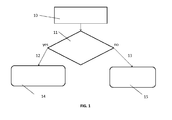
- Figure 1 shows how the RNC can decide upon the radio technology which is to carry the service requested by a UE.
- the RNC knows the identity of the (first or initial) radio technology on which the UE is camped 10 and determines a high speed network indicator 11 (i.e., an indication of coverage provided by a second radio technology which provides a higher speed access than the initial radio technology). Where such second radio technology is indicated as available 12, the RNC decides that the service is to be carried using said high speed network 14 (e.g., LTE network).
- a high speed network indicator 11 i.e., an indication of coverage provided by a second radio technology which provides a higher speed access than the initial radio technology.
- the RNC decides that the service is to be carried using said high speed network 14 (e.g., LTE network).
- the RNC decides 15 either denying the request of service to the UE or carrying the service through the first radio technology on which the UE is initially camped.
- the high speed network indicator e.g., LTE coverage Indicator
- the LTE coverage Indicator can be obtained in different ways:
- the RNC is responsible for UTRAN system information management.
- a new Information Element can be introduced by the MNO to indicate there is an overlapped coverage of an LTE cell.
- a "LTE coverage indication" can be defined as the new Information Element (IE) included in the System Information of the UTRAN.
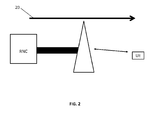
- Figure 2 shows the RNC sending such an IE, an LTE coverage indication message 20, to the UE through the connected NodeB.
- the UE in idle mode can read the LTE coverage indication message 20 whilst in 3G coverage and use it to provide an LTE coverage Indication to the user. This mechanism is only possible if the UE is in idle mode. This is configured directly by the operator.
- SIBs System Information Blocks
- Table 1 shows a partial example of the System Information Block type 5 and 5bis described in 3GPP TS 25.331, V8.1.0 (2007-12 ).
- the system information block type 5 contains parameters for the configuration of the common physical channels in the cell.
- System information block type 5bis uses the same structure as System information block type 5.
- System information block type 5bis is sent instead of system information block type 5 in cells that use Band IV or Band IX or Band X if it is broadcasted.
- Table 1 Information Element/Group name Need Type and reference Semantics description Version SIB6 Indicator MP Boolean TRUE indicates that SIB6 is broadcast in the cell.
- this IE is interpreted as FALSE PhyCH information elements PICH Power offset MP PICH Power offset 10.3.6.50 If the cell is operating in MBSFN mode as indicated in subclause 8.1.1.6.3 the UE behaves as if this IE would not have been received. CHOICE mode MP >FDD >>AICH Power offset MP AICH Power offset 10.3.6.3 If the cell is operating in MBSFN mode as indicated in subclause 8.1.1.6.3 the UE behaves as if this IE would not have been received.
- MP stands for Mandatory Present, i.e., a value for that information is always needed, and no information is provided about a particular default value. If ever the transfer syntax allows absence (e.g., due to extension), then absence leads to an error diagnosis.
- OP means Optional, i.e., the presence or absence is significant and modifies the behaviour of the receiver. However whether the information is present or not does not lead to an error diagnosis.
- Table 2 shows a possible structure of the new Information Element for LTE coverage Indicator proposed before.
- Table 2 Information Element/Group name Need Type and reference Semantics description Version LTE coverage indicator OP Enumerated (LTE coverage indicator) Default is LTE coverage is not present REL-?? ⁇ LTE coverage indicator' means that the UE may consider this cell as part of the LTE coverage area for display
- This way of obtaining an indication of LTE coverage can be applied when the UE is either idle or connected.
- the LTE indicator When the UE is in idle mode in LTE, the LTE indicator is enabled. If the UE is in Idle mode and if LTE cells are part of the neighbour list of the current 3G cell (the list is provided by current standard System Information IEs), the UE measures the LTE signal of the cells indicated in the neighbour list, and if at least one cell with enough signal is available, the LTE Indicator is enabled.
- the LTE Indicator is disabled.
- Figure 3 shows the RNC sending the neighbour list 30 to the UE camped on 3G.
- This UE is assumed to have available both 3G coverage C1 and LTE coverage C2.
- the coverage is provided by the base station BS under the control of the RNC.
- both entities are integrated in a eNodeB; in UMTS, the BS is a NodeB connected to the RNC.
- Compressed mode is a mode triggered by the network as it is defined in 3GPP. In Compressed mode, the transmission and reception are stopped for a short time and the measurements are performed on other frequency or radio technology in that time. After the time is over, the transmission and reception resumes; so, when there is compressed mode, then the UE is able again to measure the LTE signals. Based on these LTE measurements, sent to the RNC with a measurement report 32, the UE can detect or determine 31 whether there is LTE coverage or not.
- the MNO defines a signal quality / power threshold to decide if the LTE coverage is sufficient to warrant the LTE indicator being activated. Otherwise, that is, the UE is in 3G Dedicated mode but not in Compressed mode, the LTE indicator is the one determined at the idle state.
- the same definition of signal threshold to indicate coverage is applicable to 2G. If the UE is in 2G connected mode, the process is similar but it is not needed to do compressed mode, as in 2G the mobile can do LTE measurements without this feature. Once detected the LTE cells, the LTE indicator is enabled. When the UE is in idle mode, the LTE Indicator is enabled in the same way above explained, i.e., if any LTE cell with enough signal is neighbour of the current 2G cell.
- An alternative or complementary implementation of obtaining the LTE indication introduced into the UE Terminal is to define a flag "Very High Speed Coverage Indicator".
- This very high speed indicator takes into account that HSDPA, according to the latest features of 3GPP release 7, 8 and 9, have a performance similar to LTE. These features are for example: Dual Cell, Multicarrier, MIMO, and 64QAM.
- the "Very High Speed Coverage Indicator” can be displayed by the UE when any of the following criteria or a combination of them (e.g., combining criteria i and and any of ii-iv) is met:
- the present invention allows subscribers to receive a meaningful indication of the network capability in their coverage area independently of which technology is actually selected by the mobile network operator in order to carry the service.
Landscapes
- Engineering & Computer Science (AREA)
- Computer Networks & Wireless Communication (AREA)
- Signal Processing (AREA)
- Computer Security & Cryptography (AREA)
- Mobile Radio Communication Systems (AREA)
Abstract
- identifying an initial radio technology on which a UE requesting service is camped, within a current cell,
- determining an indication of coverage of another radio technology available on the current cell which provides higher speed access than the initial one,
- deciding carrying the service, either through the initial radio technology or the other one of higher speed access, according to the previous indication. The indication of coverage can be based on any of the following criteria or a combination of them is met:
i) Terminal is camped on a HSDPA capable or LTE capable cell.
ii) HSDPA signal strength is higher than a threshold.
iii) LTE signal strength is higher than a threshold.
iv) Measurements on the Peak Rate of the UE in a past time and in a location.
Description
- The present invention has its application within the telecommunications sector and, especially, in the industrial area engaged in providing users with User Equipments (UEs) capable of communicating through wide area cellular networks which support multiple wireless communications technologies: Second Generation or 2G (GSM, GPRS), Third Generation or 3G (UMTS, HSPA) and Beyond 3G or 4G (LTE, LTE-Advanced, ...).
- More particularly, the invention described herein relates to a method and a User Equipment for enabling the optimal provision of high-speed services in multi-Radio Access Technology mobile networks.
- In UMTS (Universal Mobile Telecommunications System) cell reselection, a user equipment (UE) typically stays in the 3G radio access technology as long as there is coverage. Only when the 3G coverage vanishes, does a User Equipment (UE) camp on the 2G radio access technology (GSM or GPRS). This means that a subscriber using a 3G phone will camp on 3G unless 3G coverage vanishes. Because cell reselection policies favour camping on the "newest" (i.e. implemented most recently) radio access technology, this causes camping loading and traffic loading tend to be accumulated in the newest Radio Technology.
- With the introduction of 4th Generation (4G) radio technology, the mobile networks have to handle the co-existence of different Radio Technologies such as UMTS-UTRAN (Universal Mobile Telecommunication System-Radio Access Network), Higher Speed Packet Access technologies (HSPA, HSPA+, etc.) implemented in UMTS and Long Term Evolution (LTE) technology, among others, in addition to the existing 2G technologies: the coverage from each of these technologies may substantially overlap.
- The multi-RAT mobile network operators have to select the most suitable RAT (Radio Access Technology) for delivering services to any given subscriber at any given time, taking account of such issues as whether the subscriber's mobile terminal or User Equipment (UE) is in the idle state or in a connected mode.
- Therefore, a Mobile Network Operator (MNO) may decide to direct the subscriber first to 3G, even if the LTE coverage is good enough, for several reasons (e.g. CS call setup time, efficiency in resource management, network stability); when it does so, each UE is initially connected to 3G radio access. As a consequence, the UE supporting 3G and LTE shows a 3G indication in the display of the terminal. From the user's point of view, this displayed 3G indicator could lead to the impression that the LTE network is deficient or that the terminal is not capable of connecting to LTE. From the point of view of service provisioning, once the decision of connection to 3G, instead of 4G, is taken by the MNO, the UE cannot be aware of the 4G coverage and, hence, certain services such as those requiring high-speed access can be affected negatively. There can be scenarios in which the initial selected radio technology, which the UE is camped on, is not the optimal one for carrying the service.
- Today it is possible to implement (in the display of the UE) an indication of the current radio technology (2G, 3G) upon which the UE is camped and whether this technology is able to offer GPRS and/or HSPA. This current capability of the UE is pretty obvious as the UE is already attached to the technology displayed. However, it is not possible to obtain information in one RAT about the signal or presence of other RATs, in order to receive indication and display it in the UE.
- There is therefore a need to optimise service provision, especially provisioning of high-speed communication services, in wireless networks where multiple radio technologies (2G, 3G, 4G,...) provide overlapping coverage to different subscribers, each technology providing their own coverage and Quality of Service (QoS) and subscribers having mobile terminals (User Equipments) which are capable of supporting every technology.
- The present invention serves to address this need by providing the User Equipment (UE) with an indication of available coverage independently of the specific radio technology on which the UE is camped. Thus, this invention allows the UE and the user to be aware if a RAT providing higher speed access is available in the cell currently covered the connection of the UE, so that the UE can take determined actions on the services requested by the user.
- An aspect of the invention refers to a method for enabling services in multi-technology mobile networks which support a plurality of radio technologies (e.g., HSPA and LTE), which comprises the following steps:
- identifying a first radio technology on which a UE requesting a service is camped, within a current cell,
- determining an indication of coverage of a second radio technology available for the UE which provides a higher speed access than the first radio technology,
- deciding carrying the requested service based on the previous indication by determining whether the service is to be carried through the first or the second radio technology in accordance to the indication of coverage.
- Another aspect of the invention deals with a network entity of a radio access network (RAN) (e.g., a Radio Network Controller -RNC- or an evolved NodeB -eNodeB-) which comprises communicating means for exchanging information with a multi-technology capable mobile terminal device or User Equipment (UE) and processing means for performing the method described before.
- A further aspect of the invention refers to a computer program product which comprises program code means to be loaded into processing means of a network entity (e.g., RNC or eNodeB) which belongs to a RAN (in a network supporting a plurality of radio technologies)in order to execute the described method.
- To complete the description that is being made and with the object of assisting in a better understanding of the characteristics of the invention, in accordance with a preferred example of practical embodiment thereof, accompanying said description as an integral part thereof, is a set of drawings wherein, by way of illustration and not restrictively, the following has been represented:
-
Figure 1 shows a flow chart of a method of enabling service provisioning in a mobile network with multiple radio technologies by deciding the optimal radio technology for carrying service, in accordance to an embodiment of the invention. -
Figure 2 shows a flow diagram of a High Speed Network coverage indicator used by the method of enabling optimal service provisioning in multi-RAT networks, in accordance to a preferred embodiment of the invention. -
Figure 3 shows a flow diagram of information on neighbour cells used for obtaining the High Speed Network coverage indicator, in accordance to a possible embodiment of the invention. - A preferred embodiment of the invention is focused on a method of enabling optimal provision of services in a mobile network supporting at least two radio technologies (e.g., UMTS and LTE). The mobile network has the knowledge on the identification of the radio technology, because the Radio Network Controller (RNC) in 3G radio access and the evolved NodeB (enodeB) in 4G-LTE are aware of the available technologies within the geographical area, i.e., within each cell, from which a service is requested, thanks to internal database configured by the mobile network operator in said controller nodes, RNC and eNodeB, of the 3G and 4G radio access networks respectively. The User Equipment (UE) which requests the service on behalf of a subscriber to said mobile network can be aware of the LTE coverage though the information provided by the lower protocol layers (i.e., Layer 1 or physical layer and Layer 3 RRC -Radio Resource Control- as defined in the Standards) of the radio protocol stack in the UE. This information, once taken from these lower layers, can be translated to an indicator of LTE coverage and delivered to the user by displaying it at the user's mobile terminal (i.e., the UE), for example, and icon appearing in a certain area of its screen can indicate LTE coverage to the user.
-
Figure 1 shows how the RNC can decide upon the radio technology which is to carry the service requested by a UE. The RNC knows the identity of the (first or initial) radio technology on which the UE is camped 10 and determines a high speed network indicator 11 (i.e., an indication of coverage provided by a second radio technology which provides a higher speed access than the initial radio technology). Where such second radio technology is indicated as available 12, the RNC decides that the service is to be carried using said high speed network 14 (e.g., LTE network). Otherwise, if the high speed network indicator (e.g., LTE coverage Indicator) indicates there is no coverage from a network ofhigher speed access 13, the RNC decides 15 either denying the request of service to the UE or carrying the service through the first radio technology on which the UE is initially camped. - The LTE coverage Indicator can be obtained in different ways:
- The RNC is responsible for UTRAN system information management. In accordance with 3GPP TS 25.331 a new Information Element can be introduced by the MNO to indicate there is an overlapped coverage of an LTE cell. A "LTE coverage indication" can be defined as the new Information Element (IE) included in the System Information of the UTRAN.
Figure 2 shows the RNC sending such an IE, an LTEcoverage indication message 20, to the UE through the connected NodeB. The UE in idle mode can read the LTEcoverage indication message 20 whilst in 3G coverage and use it to provide an LTE coverage Indication to the user. This mechanism is only possible if the UE is in idle mode. This is configured directly by the operator. - The current standards defining the System Information Blocks (SIBs) of the UTRAN do not specify such an IE on "LTE coverage indication", as shown in the following Table 1. Thefore, the new IE could be introduced with the elements shown in Table 2, based on a suitable SIB from the standards.
- Table 1 shows a partial example of the System Information Block type 5 and 5bis described in 3GPP TS 25.331, V8.1.0 (2007-12). The system information block type 5 contains parameters for the configuration of the common physical channels in the cell. System information block type 5bis uses the same structure as System information block type 5. System information block type 5bis is sent instead of system information block type 5 in cells that use Band IV or Band IX or Band X if it is broadcasted.
Table 1 Information Element/Group name Need Type and reference Semantics description Version SIB6 Indicator MP Boolean TRUE indicates that SIB6 is broadcast in the cell. When the UE receives SIB5 in the System Information Container message, this IE is interpreted as FALSE PhyCH information elements PICH Power offset MP PICH Power offset 10.3.6.50 If the cell is operating in MBSFN mode as indicated in subclause 8.1.1.6.3 the UE behaves as if this IE would not have been received. CHOICE mode MP >FDD >>AICH Power offset MP AICH Power offset 10.3.6.3 If the cell is operating in MBSFN mode as indicated in subclause 8.1.1.6.3 the UE behaves as if this IE would not have been received. >TDD >>PUSCH system information OP PUSCH system information 10.3.6.66 If the cell is operating in MBSFN mode as indicated in subclause 8.1.1.6.3 the UE behaviour upon reception of this IE is unspecified. >>PUSCH system information VHCR OP PUSCH system information VHCR 10.3.6.66a Only for 7.68 Mcps TDD REL-7 If the cell is operating in MBSFN mode as indicated in subclause 8.1.1.6.3 the UE behaviour upon reception of this IE is unspecified. ... - MP stands for Mandatory Present, i.e., a value for that information is always needed, and no information is provided about a particular default value. If ever the transfer syntax allows absence (e.g., due to extension), then absence leads to an error diagnosis.
- OP means Optional, i.e., the presence or absence is significant and modifies the behaviour of the receiver. However whether the information is present or not does not lead to an error diagnosis.
- Table 2 shows a possible structure of the new Information Element for LTE coverage Indicator proposed before.
Table 2 Information Element/Group name Need Type and reference Semantics description Version LTE coverage indicator OP Enumerated (LTE coverage indicator) Default is LTE coverage is not present REL-?? `LTE coverage indicator' means that the UE may consider this cell as part of the LTE coverage area for display - And similarly, a new message can be defined in 2G.
- This way of obtaining an indication of LTE coverage can be applied when the UE is either idle or connected.
- When the UE is in idle mode in LTE, the LTE indicator is enabled. If the UE is in Idle mode and if LTE cells are part of the neighbour list of the current 3G cell (the list is provided by current standard System Information IEs), the UE measures the LTE signal of the cells indicated in the neighbour list, and if at least one cell with enough signal is available, the LTE Indicator is enabled.
- If the UE is in Idle mode camped on 3G but no LTE cells are in the 3G neighbour list, the LTE Indicator is disabled.
-
Figure 3 shows the RNC sending theneighbour list 30 to the UE camped on 3G. This UE is assumed to have available both 3G coverage C1 and LTE coverage C2. The coverage is provided by the base station BS under the control of the RNC. In LTE, both entities are integrated in a eNodeB; in UMTS, the BS is a NodeB connected to the RNC. - If the UE is connected (Dedicated 3G mode) and if there is no list of neighbour cells, then the LTE indicator is disabled. The UE cannot see the LTE cells until it enters Compressed mode. Compressed mode is a mode triggered by the network as it is defined in 3GPP. In Compressed mode, the transmission and reception are stopped for a short time and the measurements are performed on other frequency or radio technology in that time. After the time is over, the transmission and reception resumes; so, when there is compressed mode, then the UE is able again to measure the LTE signals. Based on these LTE measurements, sent to the RNC with a
measurement report 32, the UE can detect or determine 31 whether there is LTE coverage or not. Therefore, the MNO defines a signal quality / power threshold to decide if the LTE coverage is sufficient to warrant the LTE indicator being activated. Otherwise, that is, the UE is in 3G Dedicated mode but not in Compressed mode, the LTE indicator is the one determined at the idle state. - The same definition of signal threshold to indicate coverage is applicable to 2G. If the UE is in 2G connected mode, the process is similar but it is not needed to do compressed mode, as in 2G the mobile can do LTE measurements without this feature. Once detected the LTE cells, the LTE indicator is enabled. When the UE is in idle mode, the LTE Indicator is enabled in the same way above explained, i.e., if any LTE cell with enough signal is neighbour of the current 2G cell.
- An alternative or complementary implementation of obtaining the LTE indication introduced into the UE Terminal is to define a flag "Very High Speed Coverage Indicator". This very high speed indicator takes into account that HSDPA, according to the latest features of 3GPP release 7, 8 and 9, have a performance similar to LTE. These features are for example: Dual Cell, Multicarrier, MIMO, and 64QAM. The "Very High Speed Coverage Indicator" can be displayed by the UE when any of the following criteria or a combination of them (e.g., combining criteria i and and any of ii-iv) is met:
- i) Terminal is camped on a HSDPA capable or LTE capable cell. In this case the operator can consider that HSDPA (with the previous features included) can provide a very high speed indicator to the customer.
- ii) HSDPA signal strength is higher than a threshold configurable by the MNO or derived by the signal power measurements and the idle mode selection criteria described before. In this case the operator considers that the very high speed throughput is reached when the signal is higher than certain level.
- iii) LTE signal strength is higher than a threshold configurable by the MNO or derived by the signal power measurements and the Idle mode selection criteria described before. Similar to the previous item, the high speed throughput even for an LTE network can be considered with a signal level threshold.
- iv) Measurements on the Peak Rate achievable by the UE in a certain past time range, e.g., determining whether the user has been able to reach x Mbps Peak Rate in Downlink or Uplink in the same location in the previous Y minutes. This is directly measurements of throughput and then with configuration parameters, the throughput can be consider very high speed or not.
- The present invention allows subscribers to receive a meaningful indication of the network capability in their coverage area independently of which technology is actually selected by the mobile network operator in order to carry the service.
- Note that in this text, the term "comprises" and its derivations (such as "comprising", etc.) should not be understood in an excluding sense, that is, these terms should not be interpreted as excluding the possibility that what is described and defined may include further elements, steps, etc.
Claims (13)
- A method for enabling services in mobile networks which support multiple radio technologies comprising the step of:- identifying a first radio technology on which a User Equipment requesting a service is camped,
characterized by further comprising:- determining an indication of coverage of a second radio technology which is available for the User Equipment and provides a higher speed access than the first radio technology,- deciding whether carrying the requested service through the first radio technology or the second radio technology in accordance to the determined indication of coverage. - The method according to claim 1, wherein determining the indication of coverage comprises determining whether the User Equipment is able to reach a certain peak rate during a previous range of time in which the User Equipment stays in a same location.
- The method according to any preceding claim, wherein determining the indication of coverage comprises determining whether High Speed Packet Access is available for the User Equipment in a current cell, in which the User Equipment is located.
- The method according to claim 3, wherein determining the indication of coverage further comprises determining whether a measured strength of a signal carried on High Speed Packet Access is higher than a threshold configured by the mobile network operator.
- The method according to any preceding claim, wherein determining the indication of coverage comprises determining whether the radio access network to which the User Equipment is connected provides Long Term Evolution in a certain location.
- . The method according to claim 5, wherein determining the indication of coverage further comprises determining whether a measured strength of a signal carried on Long Term Evolution is higher than a threshold configured by the mobile network operator.
- The method according to any preceding claim, wherein determining the indication of coverage comprises determining whether the current cell has at least a cell providing Long Term Evolution is available for the User Equipment in a cell neighbouring a current cell which the User Equipment is located in.
- The method according to any of claims 5-7, wherein determining the indication of coverage further comprises determining whether there is available coverage of Long Term Evolution in a cell via an Information Element defined in the System Information supplied from the UMTS radio access network.
- The method according to any of claims 5-8, wherein determining the indication of coverage further comprises determining whether there is available coverage of Long Term Evolution in a location by comparing a measured strength of a signal carried on Long Term Evolution when the User Equipment is either in Idle mode or in Compressed mode with a threshold configured by the mobile network operator.
- A Network entity of a radio access network comprising communication means for communicating with a User Equipment which supports multiple radio technologies, characterized by further comprising processing means which performs the method defined in accordance to any of claims 1-9.
- The Network entityaccording to claim 10 which is implemented in a RNC.
- The Network entity according to claim 10 which is implemented in a eNodeB.
- A computer program product comprising program code means which, when loaded into processing means of a node in a radio access network, make said program code means execute the method according to any of claims 1-9.
Applications Claiming Priority (1)
| Application Number | Priority Date | Filing Date | Title |
|---|---|---|---|
| ES201230451A ES2424271B1 (en) | 2012-03-27 | 2012-03-27 | PROCEDURE AND DEVICE FOR ALLOWING HIGH SPEED COMMUNICATION SERVICES IN WIRELESS MULTITECHNOLOGY NETWORK |
Publications (1)
| Publication Number | Publication Date |
|---|---|
| EP2645784A1 true EP2645784A1 (en) | 2013-10-02 |
Family
ID=47998264
Family Applications (1)
| Application Number | Title | Priority Date | Filing Date |
|---|---|---|---|
| EP13161207.9A Withdrawn EP2645784A1 (en) | 2012-03-27 | 2013-03-26 | Method and device for enabling high-speed communication services in multi-technology wireless network |
Country Status (3)
| Country | Link |
|---|---|
| US (1) | US9167494B2 (en) |
| EP (1) | EP2645784A1 (en) |
| ES (1) | ES2424271B1 (en) |
Cited By (1)
| Publication number | Priority date | Publication date | Assignee | Title |
|---|---|---|---|---|
| CN111034275A (en) * | 2017-08-25 | 2020-04-17 | 高通股份有限公司 | Techniques and apparatus for search, measurement, and icon display in new radio non-standalone mode |
Families Citing this family (2)
| Publication number | Priority date | Publication date | Assignee | Title |
|---|---|---|---|---|
| MY178128A (en) * | 2016-01-07 | 2020-10-05 | Nokia Technologies Oy | Method of indication of available radio resources |
| CN115734243A (en) * | 2021-08-26 | 2023-03-03 | 中国移动通信集团浙江有限公司 | 5G coverage optimization method, network equipment and storage medium based on 4G positioning data |
Citations (3)
| Publication number | Priority date | Publication date | Assignee | Title |
|---|---|---|---|---|
| WO2009035243A2 (en) * | 2007-09-10 | 2009-03-19 | Samsung Electronics Co., Ltd. | Apparatus and method for determining radio access technology (rat) for high-speed data service in a mobile communication system |
| US20100099393A1 (en) * | 2008-10-20 | 2010-04-22 | At&T Mobility Ii Llc | Device network technology selection and display in multi-technology wireless environments |
| US20110319073A1 (en) * | 2010-06-28 | 2011-12-29 | Research In Motion Limited | Method And System for Radio Access Technology Selection |
Family Cites Families (2)
| Publication number | Priority date | Publication date | Assignee | Title |
|---|---|---|---|---|
| GB2435364B (en) * | 2006-02-16 | 2008-05-21 | Motorola Inc | Handover between radio networks |
| US8805273B2 (en) * | 2011-11-10 | 2014-08-12 | Motorola Solutions, Inc. | Method and system for roaming in a peer to peer network among radio sites having dynamic rest channel base repeater stations |
-
2012
- 2012-03-27 ES ES201230451A patent/ES2424271B1/en active Active
-
2013
- 2013-03-26 EP EP13161207.9A patent/EP2645784A1/en not_active Withdrawn
- 2013-03-26 US US13/850,980 patent/US9167494B2/en active Active
Patent Citations (3)
| Publication number | Priority date | Publication date | Assignee | Title |
|---|---|---|---|---|
| WO2009035243A2 (en) * | 2007-09-10 | 2009-03-19 | Samsung Electronics Co., Ltd. | Apparatus and method for determining radio access technology (rat) for high-speed data service in a mobile communication system |
| US20100099393A1 (en) * | 2008-10-20 | 2010-04-22 | At&T Mobility Ii Llc | Device network technology selection and display in multi-technology wireless environments |
| US20110319073A1 (en) * | 2010-06-28 | 2011-12-29 | Research In Motion Limited | Method And System for Radio Access Technology Selection |
Non-Patent Citations (1)
| Title |
|---|
| TELECOM ITALIA ET AL: "Support for RAT indicator in idle mode", 3GPP DRAFT; R2-082241, 3RD GENERATION PARTNERSHIP PROJECT (3GPP), MOBILE COMPETENCE CENTRE ; 650, ROUTE DES LUCIOLES ; F-06921 SOPHIA-ANTIPOLIS CEDEX ; FRANCE, vol. RAN WG2, no. Kansas City, USA; 20080429, 29 April 2008 (2008-04-29), XP050140008 * |
Cited By (2)
| Publication number | Priority date | Publication date | Assignee | Title |
|---|---|---|---|---|
| CN111034275A (en) * | 2017-08-25 | 2020-04-17 | 高通股份有限公司 | Techniques and apparatus for search, measurement, and icon display in new radio non-standalone mode |
| CN111034275B (en) * | 2017-08-25 | 2021-07-23 | 高通股份有限公司 | Method and apparatus for search, measurement and icon display in NR non-standalone mode |
Also Published As
| Publication number | Publication date |
|---|---|
| US20130258999A1 (en) | 2013-10-03 |
| ES2424271R1 (en) | 2013-11-14 |
| ES2424271A2 (en) | 2013-09-30 |
| US9167494B2 (en) | 2015-10-20 |
| ES2424271B1 (en) | 2014-09-03 |
Similar Documents
| Publication | Publication Date | Title |
|---|---|---|
| US10194357B2 (en) | Method and apparatus for applying assistance information for traffic steering in wireless communication system | |
| EP2965556B1 (en) | Method and apparatus for handling traffic steering failure in wireless communication system | |
| US10057840B2 (en) | Method for searching base station in plurality of communication systems and apparatus for same | |
| EP2898746B1 (en) | Network nodes, devices and methods therein for enabling device to device communication | |
| EP2343918A2 (en) | Circuit switched fallback | |
| EP3117665B1 (en) | Method and apparatus for updating andsf policy in wireless communication system | |
| WO2013162277A1 (en) | Method and apparatus for selecting cell in wireless communication system | |
| US9877273B2 (en) | Device-to-device communication method, terminal, and network device | |
| EP3117659B1 (en) | Method and apparatus for handling ran assistance information for roaming user equipments in wireless communication system | |
| KR20150035759A (en) | Method for measuring and reporting csi-rs in wireless communication system, and apparatus for supporting same | |
| US9980175B2 (en) | Method and apparatus for performing traffic steering in wireless communication system | |
| EP3178261B1 (en) | Communications system with idle mode terminal balancing | |
| US10149218B2 (en) | Method and apparatus for handling RAN assistance information for cell change in wireless communication system | |
| US20180338268A1 (en) | Method and apparatus for performing application category based traffic steering in wireless communication system | |
| US10404412B2 (en) | Method for interworking performed by base station and base station using same | |
| US20240357483A1 (en) | Communication method and apparatus | |
| US10306696B2 (en) | Method and apparatus for handling RAN assistance information for radio link failure in wireless communication system | |
| US9167494B2 (en) | Method and device for enabling high-speed communication services in multi-technology wireless network | |
| CN102984789A (en) | Method and base stations of multimode user equipment access and multimode user equipment | |
| EP3228128B1 (en) | Efficient communication of network identifiers |
Legal Events
| Date | Code | Title | Description |
|---|---|---|---|
| PUAI | Public reference made under article 153(3) epc to a published international application that has entered the european phase |
Free format text: ORIGINAL CODE: 0009012 |
|
| AK | Designated contracting states |
Kind code of ref document: A1 Designated state(s): AL AT BE BG CH CY CZ DE DK EE ES FI FR GB GR HR HU IE IS IT LI LT LU LV MC MK MT NL NO PL PT RO RS SE SI SK SM TR |
|
| AX | Request for extension of the european patent |
Extension state: BA ME |
|
| 17P | Request for examination filed |
Effective date: 20140402 |
|
| RBV | Designated contracting states (corrected) |
Designated state(s): AL AT BE BG CH CY CZ DE DK EE ES FI FR GB GR HR HU IE IS IT LI LT LU LV MC MK MT NL NO PL PT RO RS SE SI SK SM TR |
|
| 17Q | First examination report despatched |
Effective date: 20190611 |
|
| STAA | Information on the status of an ep patent application or granted ep patent |
Free format text: STATUS: THE APPLICATION HAS BEEN WITHDRAWN |
|
| 18W | Application withdrawn |
Effective date: 20191015 |