EP2645770A2 - A system and method for enhancing lifetime and throughput in a distributed wireless network - Google Patents
A system and method for enhancing lifetime and throughput in a distributed wireless network Download PDFInfo
- Publication number
- EP2645770A2 EP2645770A2 EP13158299.1A EP13158299A EP2645770A2 EP 2645770 A2 EP2645770 A2 EP 2645770A2 EP 13158299 A EP13158299 A EP 13158299A EP 2645770 A2 EP2645770 A2 EP 2645770A2
- Authority
- EP
- European Patent Office
- Prior art keywords
- network
- graph
- node
- self
- nodes
- Prior art date
- Legal status (The legal status is an assumption and is not a legal conclusion. Google has not performed a legal analysis and makes no representation as to the accuracy of the status listed.)
- Granted
Links
Images




Classifications
-
- H—ELECTRICITY
- H04—ELECTRIC COMMUNICATION TECHNIQUE
- H04W—WIRELESS COMMUNICATION NETWORKS
- H04W24/00—Supervisory, monitoring or testing arrangements
- H04W24/02—Arrangements for optimising operational condition
-
- H—ELECTRICITY
- H04—ELECTRIC COMMUNICATION TECHNIQUE
- H04W—WIRELESS COMMUNICATION NETWORKS
- H04W40/00—Communication routing or communication path finding
- H04W40/02—Communication route or path selection, e.g. power-based or shortest path routing
- H04W40/04—Communication route or path selection, e.g. power-based or shortest path routing based on wireless node resources
- H04W40/10—Communication route or path selection, e.g. power-based or shortest path routing based on wireless node resources based on available power or energy
-
- Y—GENERAL TAGGING OF NEW TECHNOLOGICAL DEVELOPMENTS; GENERAL TAGGING OF CROSS-SECTIONAL TECHNOLOGIES SPANNING OVER SEVERAL SECTIONS OF THE IPC; TECHNICAL SUBJECTS COVERED BY FORMER USPC CROSS-REFERENCE ART COLLECTIONS [XRACs] AND DIGESTS
- Y02—TECHNOLOGIES OR APPLICATIONS FOR MITIGATION OR ADAPTATION AGAINST CLIMATE CHANGE
- Y02D—CLIMATE CHANGE MITIGATION TECHNOLOGIES IN INFORMATION AND COMMUNICATION TECHNOLOGIES [ICT], I.E. INFORMATION AND COMMUNICATION TECHNOLOGIES AIMING AT THE REDUCTION OF THEIR OWN ENERGY USE
- Y02D30/00—Reducing energy consumption in communication networks
- Y02D30/70—Reducing energy consumption in communication networks in wireless communication networks
Definitions
- the invention generally relates to the field of signal processing and optimization in distributed wireless networking. More particularly, the invention relates to a system and method for enhancing lifetime and throughput of a distributed wireless network by self-optimization of the network.
- wireless networks have been effectively adopted worldwide for facilitating the support to execute various networking applications.
- the wireless communication has become the de-facto communication medium at homes, work locations, malls, airports, stadiums, colleges, and other necessary mediums.
- the dimensions of the battery operated handheld devices, or more specifically, the nodes in general of the wireless network have been drastically reduced in order to serve variety of applications by means of these handheld devices.
- nodes In general, for facilitating support to execute the applications by means of wireless communication these nodes require high rate of transmission. Additionally, these nodes need to support long periods of use between battery charges. Thus, the lifetime of the nodes becomes crucial and therefore these nodes require enhanced lifetime and higher rate of communication. In order to facilitate the higher transmission rate and enhance the lifetime of the wireless network, optimal techniques are required.
- Wireless networks in general are of two types: centralized network and distributed network.
- a centralized network each wireless node communicates with a central node or base station for usual communication.
- each wireless node communicates with other nodes or its neighbors for computing, communication, storage and other services in a distributed fashion. Therefore, in order to transmit at its optimal rate each node requires control messages to communicate with its neighboring node. Since the wireless network is broadcasting in nature, inter node communications not only hampers the effective rate or throughput of the network, but also reduces the lifetime of the network. In addition to this, the complexity of communication protocols and computation also reduce the lifetime of the network. More specifically, the optimization techniques used in the background requires message passing between the individual nodes.
- each node requires adequate information regarding the power available in the neighboring nodes, interference in other nodes, and maximum capacity, etc. Further, in order to share this information with the nodes, it is evident that more resources in terms of battery power and throughput are required. Finding an optimal solution for the above problem in a real time is very difficult and often ends up with an iterated solution. Therefore it demands more computing power. Thus, as these methods consume more battery power, hence they are not feasible for optimization of the wireless networks.
- each node requires detailed information about the other nodes in the network. Such detail information includes placement of each node in the network, power available, detailed QoS requirement, etc.
- the principal objective of the present invention is to enable enhancement of throughput and lifetime of a distributed wireless network by self-optimizing the said network.
- Yet another objective of the present invention is to provide a system and method for enabling the individual nodes to sense the parameters of the neighboring nodes in the distributed wireless network using self-learning mechanism.
- Yet another objective of the present invention is to enable a system and method for generating a signed-graph to perform self-optimization using parameters of the individual nodes and the sensed parameters of the neighboring nodes.
- Yet another objective of the present invention is to provide a system and method enabling self-optimization using parameters of the individual nodes at different time-scales until a convergence is achieved in the network.
- Still another objective of the present invention is to provide a system and method for implementing a cross-layer based approach to facilitate inter-layer updates amongst the individual protocol layers due to said self-optimization of the parameters at the individual nodes of the network.
- the present invention enables a method for enhancement of throughput and lifetime of a wireless distributed communication network.
- the method of the present invention enables self-optimizing of the network using a signed-graph based technique.
- each individual node is configured to sense different parameters of neighboring nodes in the network.
- the individual nodes based on the sensed parameters are configured to update their parameters by self-optimization technique.
- the self-optimization is achieved by (i) generating a multi-time scale signed graph and (ii) iteratively updating individual parameters until convergence is achieved by the network.
- the updates are carried out using parameter sensing and cross-layer interactions.
- the system of the present invention enables self-optimization of the wireless network by implementing a self-optimization engine on each individual node of the network.
- the said self-optimization engine is adapted to sense multiple parameters of the neighboring nodes in the network to self-optimize the parameters of the individual nodes by updating the individual parameters at multiple time scales until convergence is achieved using a signed graph technique.
- the optimization engine enables a tuning layer software patch that facilitates inter-layer updates amongst the individual layers of the protocol stacks due to updating of parameters of the individual nodes at different time scales in the network.
- the method and system of the present invention enables a self-optimization of the network without requiring any control message passing amongst the individual nodes. This enables power saving at each individual nodes thereby facilitating maximization of throughput and lifetime of each node in the network. Further, the system adopted for self-optimization is less complex and easy to deploy without requiring any other additional infrastructure cost. The self-optimization of the network is such that it is equivalent with the optimal solutions.
- the present invention proposes how to pose a resource allocation problem in the wireless networks as a multi-time scale allocation problem. Further, the present invention proposes how to model the multi-time scale allocation problem as a signed-graph problem. Therefore, the first step in achieving self-optimization is to identify a resource allocation problem in the network and enable to pose the identified problem as a multi-time scale allocation problem that can be solved by implementing signed-graph technique.
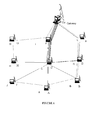
- Figure 1 is a distributed wireless network (100) illustrating a resource allocation problem among individual nodes in the said network according to an exemplary embodiment of the invention.
- the distributed wireless networks comprises of both wireless ad-hoc networks and wireless sensor networks.
- the individual nodes are placed in a distributed manner and each node of the network is transmitting packets to the gateway.
- multiple paths exist between the source node and the gateway.
- each of the wireless nodes is battery powered having a specific maximum power value (P Max ), and is capable of transmitting at a variable power.
- P Max specific maximum power value
- each of the nodes is capable of choosing a suitable modulation scheme for transmission.
- the wireless channel between individual nodes is identical in both directions.
- the model proposed considers log-normal fading and path-loss due to distance.
- multipath loss model like Rayleigh loss model also can be incorporated in formulation without any loss of generality.
- each node executes various network applications which generate packets.
- the nodes while transmitting their own data are also configured to relay the data of other nodes in the network. More specifically, the nodes do not distinguish between self generated data and forwarding data packets. Further, each node is capable of finding its optimal shortest path route to reach a destination node.
- the applications running at different nodes require Quality of Services (QoS) in terms of maximum/average delay, minimum/average throughput, etc.
- QoS Quality of Services
- the applications in turn may use TCP or UDP as the Transport layer protocol. With TCP as the transport layer protocol, the transmission is controlled end-to-end. Apart from this, TCP also employs congestion control/avoidance protocols to control the rate of transmission.
- TCP updates its rate of transmission using an Adaptive Window Management technique by changing the congestion window (cwnd) of a flow; increase with every successful reception of acknowledgement and decrease with every timeouts and multiple duplicate acknowledgements - dupacks (triple Dupacks).
- cwnd congestion window
- TCP guarantees of reception is more important than delay in reception.
- UDP unlike TCP does not control the rate of transmission. Instead, the applications using UDP require hard end-to-end delay bound, failing which the packets get dropped. To provide delay guarantee in-terms of average/maximum delay, an average throughput at the Transport layer is need to be maintained. Since Transport protocols operate on end-to-end mechanism, changes in parameters such as average delay/ maximum delay, cwnd size etc., get reflected only after one Round Trip Time (RTT).
- RTT Round Trip Time
- network layer does not operate on an end-to-end basis.
- routing table generation and updating requires global information (or a cached version of previous global information) for route computation and hence frequent changes of route at node is a costly affair.
- the time duration of change of route at a node depends not only on the state of the concerned node (in wireless networks the battery availability at node and the link capacity associated with the link), but also depends on the state of other nodes.
- period of route computation should be more than the updating period of transport layer. In other words, route change should not be triggered before one RTT and so on.
- MAC as well as PHY layer also updates their power transmission, modulation index at an appropriate time scale such that the effect of interference, channel condition, etc., are mitigated.
- FIG. 1 there may be multiple paths available between nodes; however, a bottleneck may arise between flows while selecting a particular path. For example, as illustrated in figure 1 , bypassing the central node "C" may lead to select a longer path viz. J-A-B-E-D-Gateway instead of J-C-F-Gateway. Thus, resource allocation becomes a problem and hence needs to be mitigated by enabling self-optimization.
- x i (t) is the instantaneous transmission rate of node at time t, where; I is the set of nodes. Each node attempts to maximize its instantaneous rate.
- R i (t) be the routing matrix associated with node i at time t.
- y i (t) defined as the corresponding rate of transmission at Transport Layer, which is either the congestion window size (cwnd) for TCP or average rate of transmission for UDP.
- pi (t) and m i (t) be the transmission power and modulation index of node 'i' at time t respectively.
- lifetime of node 'i' defined as z i (t) representing the duration for which the node can actively participate in the network: transmit-receive-sense etc.
- I i (t) and IO j (t) be the inference observed at node i and node j respectively at time t.
- increase in transmission power at any node i results in increase of interference in other neighboring node j.
- the parameters such as instantaneous transmission rate, routing index, battery availability, transmission power, transport layer rate, etc., are time indexed (at different time scales), they are not reference with time index t.
- the optimization problem posed is therefore needed to be solved to allocate various resources referring the equation (1) as below: max ⁇ U i x i - q i ⁇ x i max z i s . t . , P Min ⁇ P i ⁇ P Max , t di ⁇ t dth
- U i (x i ) is the utility associated with x i
- q i is the cost associated with the transmission of x i
- z i is the lifetime associated with the node i.
- the t di and t dth are the current delay associated with the transmission of HoL (Head of Line) packet of node i and t dth is the maximum delay tolerable by the application at node i respectively (real time packets are dropped if the delay condition is violated).
- U i (x i ) The shape/nature of the utility function U i (x i ) depends upon the transport layer protocols used and application requirements, For example, it is observed that U i (x i ) is convex and double differentiable for TCP, whereas it may not be convex and double differentiable in the case of UDP. UDP can be modeled using approximation techniques. In that case the solution obtained from (1) may not be unique.
- cost qi is similar to packet drops in wired/wireless network due to buffer overflow or due to packet error. It also includes the battery consumption due to transmission or relaying. Cost due to battery consumption increases as the node reduces its battery power. Therefore, to increase lifetime, nodes should minimize the transmission.
- the present invention enables a self-optimization of each node in the network and thereby facilitating the optimization of the entire network.
- the present invention poses the optimization problem observed in equation (1) at different time instances and is modeled as multi-time scale signed-graph problem according to an exemplary embodiment.
- Each node of the network is adapted to solve equation (1) to obtain optimal solution in-terms of transmission power, modulation index, route and transmission rate, etc. More particularly, each node in the wireless network (100) as illustrated in figure 1 attempt to obtain the optimal transmission power, modulation index, route and transmission rate to solve the equation (1).
- each node senses its neighboring information such as interference, routing table (from periodic broadcasts), and congestion through packet acknowledgements etc., thereby obtaining the optimal transmission power and transmission rate using self-optimization. Therefore, each individual node is configured to sense the data from the neighboring nodes using self-learning mechanism and hence does not require message passing thereby enabling power saving and increasing lifetime of each node in the network.
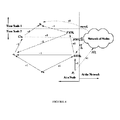
- Figures 2(a) and 2(b) illustrates posing of the resource allocation problem or an optimization problem as a multi-time scale allocation problem solved by implementing a signed-graph based self optimization according to an exemplary embodiment of the invention.
- the present invention proposes a simple, iterative and fair convergence rate signed graph approach enabling a near optimal solution for the optimization of the network.
- the self-optimization based on signed graph approach is on par with the traditional approaches and can be implemented in any distributed system. Further, this approach enables solving optimized power control for reducing TCP congestion and increasing rate
- a signed graph G ( V, E, ⁇ ) is a directed graph, where V is set of nodes and E is the subset of Cartesian product of V ⁇ V and ⁇ : E ( i , j ) ⁇ +1-1 ⁇ .
- a signed graph is strongly connected graph (SCG), if there is a path between every pair of nodes. If there exists a path between any two nodes of a signed graph, path sign can be computed.
- a path sign of a path between two nodes is the product of signs of sequential edges associated along the path between them.
- a signed graph is balanced, if all the cycles of the graph have even number of negative signed edges. From dynamic system perspective, parameters/variables of it are represented as nodes. The interaction between parameters is represented by edges. The edges are labeled as positive or negative, if a parameter activates or inhibits another parameter respectively.
- any dynamic system that attains equilibrium is bounded by several properties as follows:
- the present invention proposes one such method of signed-graph based self-optimization.
- This method implements a multi time scale approach, in which the optimization involves sub-optimization at different time scales.
- each of the nodes in the network implements a self-optimization engine that is adapted to apply a signed-graph based self-optimization for enabling the optimization of the entire network.
- One such self-optimization engine (202) implemented on one of the node in the network is illustrated in figure 2(b).
- Figure 2(b) illustrates sub-optimization at different time scales T 1 , T 2 and T 3 respectively for node 'i'.
- the optimization at different scales is illustrated in figure 2(a) .
- the influence between the variables or parameters is represented as a Weighted Signed Graph (WSG).
- WSG Weighted Signed Graph
- These parameters include instantaneous power, modulation index, rate change, congestion window, and routing table etc.
- Each of the edges of the graph is assigned with a signed weight component having a real value: ⁇ : E ( i , j ) ⁇ xl x ⁇ R ⁇ .
- E ( i , j ) ⁇ xl x ⁇ R ⁇ a signed weight component having a real value: ⁇ : E ( i , j ) ⁇ xl x ⁇ R ⁇ .
- the WSG is generalization of signed graph.
- the notion of balancing, equilibrium, irreducibility, SCG, monotonic properties are also eligible for WSG.
- the WSG proposed has four different goal variables: x i , y i , z i and ⁇ ( rate of transmission - PHY layer capacity, Transport Layer transmission rate - congestion window in TCP, lifetime and overall throughput).
- These goal variables are maximized in different time scales in T 1 , T 2 and T 3 as shown in the figure 2 (b) .
- Control variable P i transmission power
- I i interference
- Sensed parameters includes from a group consisting of but not limited to interference, routing table, congestion and combinations thereof. Further, referring figure 2(b) goal variables are also affected by the self-optimization engine (202) which controls the control variable along with the routing updates. In addition to this, present value of the goal and state variable of a node also impact the goal and state variable of neighboring nodes (204).
- the self-optimization engine (202) at one of the individual nodes in the network (100) enables solving the self-optimization problem by solving the equation (1) in a distributed manner.
- the self-optimization engine (202) solves the problem by iteratively optimizing the individual parameters at the node until convergence is achieved. For example, consider T 1 , T 2 and T 3 are the time scales for each node for each iteration that are varied dynamically such that T 1 ⁇ T 2 ⁇ T 3 .
- the inputs to the optimization engine (202) are P i ,P MIN ,P MAX ,m i ,x i , ⁇ p i , ⁇ y i , ⁇ z i corresponding to current power, minimum, maximum power, current modulation index, current rate, delta power change, delta congestion window, delta battery power respectively.
- the t i 1 , t i 2 , t i 3 , ⁇ T 1 , ⁇ T 2 , ⁇ T 3 are the current time scales and delta changes corresponding to three time scales as depicted in Figure 2(a) .
- the instantaneous P i , m i are updated (by increasing or decreasing power and modulation index; one at a time till the goal variable saturates) s.t x i , ⁇ are maximized.
- the instantaneous P i , m i , y i are updated, s.t x i , ⁇ are maximized.
- each edge interconnecting two parameters/nodes is assigned a sign component based on updating value (increasing or decreasing). For example, if one of the parameter is updated and its current value is decreased, the edge facilitating the interconnection is assigned a negative value and vice-versa.
- the generated signed-graph is balanced if all the possible cycles of the graph have even number of negative signed edges.
- a TCP/IP protocol stack comprises a plurality of layers including an Application layer (302), a Transport Layer (304), a Network Layer (306), a Medium Access Control (MAC) Layer (308) and a Physical Layer (310).
- an Application layer (302)
- a Transport Layer 304
- a Network Layer (306)
- MAC Medium Access Control
- 310 310
- the cross-layer based feedback architecture requires a tuning layer (312) in the form of a software patch that enables layer wise updates in the protocol stack.
- the tuning layer of Transport updates the MAC layer (308) and PHY layer (310) at timescale T 2 (316), that between Network layer and PHY/MAC layer at T 3 (318) and at T 1 (314) between PHY (310) and MAC (308) layers. Since all the layer information can be captured by the self-optimization engine (202) at each node, implementation of the proposed scheme may be made without many changes to the existing layered architecture.
- the self-optimization engines implemented at each of the nodes enable self-optimization of parameters at the said nodes. This enables self-optimization of the entire wireless network constituting the said nodes. These nodes do not enable message passing for providing optimal solution and hence enables battery saving and throughput of the network.
- Each node in the wireless network (100) as shown in figure 1 comprises self-optimization engine like (202) shown on figure 2(b) that achieves self-optimization of the individual node parameters by applying the signed-graph approach.
- the self-optimization engine at various nodes in the network enables solving of self-optimization problem identified in equation (1) by considering the said problem as signed-graph problem and accordingly achieving the self-optimization till convergence is achieved.
- FIG 4 is a working example (400) of self-optimization enabling joint congestion and power control by generating a monotonic signed graph according to an exemplary embodiment of the invention.
- the present invention is adapted to prove the suitability of the self-optimization using Monotonic Signed Graph (MSG) approach as a solution for Joint Optimal Congestion control and Power control (JOCP).
- MSG Monotonic Signed Graph
- JOCP Joint Optimal Congestion control and Power control
- a signed-graph based self-optimization approach is deployed in each participating node of the network.
- the proposed approach does not require any message passing and achieves maximum throughput and minimum power transmission, matching to that of the conventional optimal solution (JOCP). It is observed that the rate of convergence of the proposed approach is within 4-5 Round Trip Times (RTTs).
- RTTs Round Trip Times
- Figure 4 illustrates the proposed monotonic signed graph of the system used for Joint Optimal Congestion control and Power control (JOCP). As illustrated in figure 4 , the weights of each edge of the signed-graph in this proposal are considered to be +1/-1.
- the experimental results by means of MATLAB simulation proves that the optimal solution for Joint Optimal Congestion control and Power control (JOCP) proposed by said Monotonic Signed Graph (MSG) approach is near to optimal solutions.
- the proposed approach does not require message passing and detail information for optimizing the congestion and power in the network and thereby enhances the lifetime and throughput or transmission rate of individual nodes in the network.
- Figures 5(a) , 5(b) , 6(a) and 6(b) collectively illustrate another working example of self-optimization for joint routing and lifetime maximization according to an exemplary embodiment of the invention.
- the method and system of the present invention is adapted to prove the suitability of self-optimization to achieve lifetime and throughput maximization of a wireless network by means of dynamic routing.
- the dynamic routing between the source and destination nodes is computed such that the total cost between the source and the destination is minimized. Cost between the nodes are functions of available battery power (lifetime) and congestion/usage of the link.
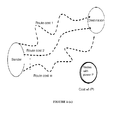
- Figure 5(a) illustrates multiple paths and variable cost between the source and the destination.
- Figure 5(b) illustrates the cost exchange mechanism used for enabling simulation of the proposed technique of self-optimization.
- the cost of a link be defined as the function of available battery power in the node associated with that particular link.
- the cost of a link is defined as the reciprocal of available battery power in the node associated with that link.
- when a node processes a packet it consumes some power in the process of forwarding to the next node. This consumption of power depends on the distance between the sender node and receiver node. When a node has less remaining battery power then the probability of node failure increases.
- the routing metric in this approach shall be the cost depending upon available battery power and battery power changes every time when there is packet transmission in the network.
- FIGS 6 (a) and figure 6 (b) are dynamic route update scheme and non-uniform power division scheme according to an exemplary embodiment of the invention.
- routing update at a particular node 'm' is illustrated in figure 6 (a) .
- the node 'm' already contains routing information about destination node D and receives a broadcast message from node ''
- the node 'm' is adapted to compute its new cost and checks with the existing cost. The node 'm' then replaces the route only if the new cost is less than the existing cost. Further, the node 'm' is configured to forward newly updated information to its neighboring nodes. If the new cost is higher than the older cost, the node 'm' is enabled to discard newly arrived information message and hence doesn't forward any information to the neighboring nodes.
- the node m's battery power reaches to the threshold level (minimum power level)
- These nodes assume that node is power depleted and link is broken and packets can't be delivered through that node.
- Nodes update their tables with new entries when there is a change in the battery power of any node. Since broadcast messages also impact the lifetime of the network, instead of regular update for every data packet transmission, this approach shall broadcast update messages only when there is a change in the power level of a node. For this, non-uniform division of the battery power available is defined at a node for power threshold computation and updating.
- Battery powers in same section/range have same cost and the cost function is modified as inverse battery power of the threshold value of the section.
- a battery power that is in higher levels will be having less cost than a battery power that is in lower levels.
- the battery cost function increases/decreases in discrete steps instead of continuous increase/decrease as battery power decreases/increases.
- the proposed method of multi-time scale, self-optimization enabling enhancement in lifetime and throughput can be implemented for landslide detection using wireless sensor network.
- wireless sensors in the wireless sensor network are deployed in the landslide prone area in a planned or un-planned (sensors can be dropped randomly) manner. In most of the cases, deployment of such sensors may not be possible in a planned manner. Therefore, for accurate sensing, more and more sensors need to be deployed in the target area. Along with accuracy, the life time, efficient transmission and self-maintainability of these sensors are also important.
- the deployed land can be of millions of hectares and can be of difficult terrain (such as hills, jungles, river beds, etc.). It is difficult not only to access (physically) the wireless sensors of this network in these areas, but also to manage such kind of networks. Also, deploying the sensors and replacing old sensors periodically or frequently in un-accessible terrains like hills, river beds, jungles, etc. are not practically viable. Therefore, these sensors should work for a longer lifetime by optimally using battery power available with them. In addition, these nodes need to be reliable in terms of accurate information and quick information sources. Any delay in sensing and communicating may cost human life and other loss.
- the proposed method of multi-time scale, self-optimization is utilized to obtain the dynamic routes between the sensor node and the central location, such that lifetime of the network (hence the lifetime of the nodes) is maximized.
- the present invention enables lifetime and throughput maximization in the wireless networks.
- the present invention enables self-optimization based practical implementable solutions closely matching to optimal solutions in the art.
- the self-optimization method proposed by the present invention is less complex, easy to deploy and does not require any additional infrastructure cost.
- the present invention does not require message passing with the nodes and therefore is scalable with judicious utilization of resources.
- the method of the present invention does not require detailed information about the node placement, power available, detailed QoS requirement, etc during optimization of the wireless networks.
- the present invention enables power saving at each node in the network during optimization of the said network.
- each of the nodes in the network enabling self-optimization of the network can be a machine or other computing device within which a set of instructions, when executed, may cause the machine to perform any one or more of the methodologies discussed above.
- the machine may comprise a small wireless node/sensor, a server computer, a client user computer, a personal computer (PC), a tablet PC, a laptop computer, a desktop computer, or any machine capable of executing a set of instructions (sequential or otherwise) that specify actions to be taken by that machine.
- PC personal computer
- tablet PC a tablet PC
- laptop computer a laptop computer
- desktop computer or any machine capable of executing a set of instructions (sequential or otherwise) that specify actions to be taken by that machine.
- the term "machine” shall also be taken to include any collection of machines that individually or jointly execute a set (or multiple sets) of instructions to perform any one or more of the methodologies discussed herein.
- the machine includes a self-optimization engine, a processor (e.g., a central processing unit (CPU)), and a memory which communicates with each other via a bus.
- the memory stores the instructions when executed, may cause the processor of the machine to adapt the self-optimization engine to perform any one or more of the methodologies discussed above.
Landscapes
- Engineering & Computer Science (AREA)
- Computer Networks & Wireless Communication (AREA)
- Signal Processing (AREA)
- Mobile Radio Communication Systems (AREA)
- Small-Scale Networks (AREA)
- Multi Processors (AREA)
Abstract
Description
- The invention generally relates to the field of signal processing and optimization in distributed wireless networking. More particularly, the invention relates to a system and method for enhancing lifetime and throughput of a distributed wireless network by self-optimization of the network.
- With the advent of digital communication, wireless networks have been effectively adopted worldwide for facilitating the support to execute various networking applications. For example, the wireless communication has become the de-facto communication medium at homes, work locations, malls, airports, stadiums, colleges, and other necessary mediums. Further, due to gradual growth in miniaturization technology, the dimensions of the battery operated handheld devices, or more specifically, the nodes in general of the wireless network have been drastically reduced in order to serve variety of applications by means of these handheld devices.
- In general, for facilitating support to execute the applications by means of wireless communication these nodes require high rate of transmission. Additionally, these nodes need to support long periods of use between battery charges. Thus, the lifetime of the nodes becomes crucial and therefore these nodes require enhanced lifetime and higher rate of communication. In order to facilitate the higher transmission rate and enhance the lifetime of the wireless network, optimal techniques are required.
- In the present scenario, maximization of lifetime and throughput requires frequent exchange of control messages between nodes. However, since wireless networks are broadcasting networks, such control message exchanges not only reduce the effective rate of transmission between nodes, but also impact the overall lifetime of the nodes. This is because, wireless nodes are mainly battery powered and processing of a packet/frame or message for transmission or reception requires energy consumption. Therefore, while optimal techniques are important, they also consume resources in terms of battery and throughput.
- Wireless networks in general are of two types: centralized network and distributed network. In a centralized network, each wireless node communicates with a central node or base station for usual communication. However, in a distributed network, each wireless node communicates with other nodes or its neighbors for computing, communication, storage and other services in a distributed fashion. Therefore, in order to transmit at its optimal rate each node requires control messages to communicate with its neighboring node. Since the wireless network is broadcasting in nature, inter node communications not only hampers the effective rate or throughput of the network, but also reduces the lifetime of the network. In addition to this, the complexity of communication protocols and computation also reduce the lifetime of the network. More specifically, the optimization techniques used in the background requires message passing between the individual nodes. In other terms, each node requires adequate information regarding the power available in the neighboring nodes, interference in other nodes, and maximum capacity, etc. Further, in order to share this information with the nodes, it is evident that more resources in terms of battery power and throughput are required. Finding an optimal solution for the above problem in a real time is very difficult and often ends up with an iterated solution. Therefore it demands more computing power. Thus, as these methods consume more battery power, hence they are not feasible for optimization of the wireless networks.
- Thus, the existing practices of achieving enhancement in lifetime and throughput are complex and difficult to implement. Most of the existing approaches require message passing which is resource consuming and hence are non-scalable. Further, in the existing optimal approaches, each node requires detailed information about the other nodes in the network. Such detail information includes placement of each node in the network, power available, detailed QoS requirement, etc.
- Therefore, in view of the above, there is a long-felt need in the art for a method and system that enables enhancement of lifetime and throughput of wireless network that is scalable, resource-saving, less complex and easy to deploy at each node. More specifically, there is a need for a method and system that enables to avoid passing of control messages amongst the individual nodes in the network and thereby facilitating the self-optimization of the network.
- The principal objective of the present invention is to enable enhancement of throughput and lifetime of a distributed wireless network by self-optimizing the said network.
- Yet another objective of the present invention is to provide a system and method for enabling the individual nodes to sense the parameters of the neighboring nodes in the distributed wireless network using self-learning mechanism.
- Yet another objective of the present invention is to enable a system and method for generating a signed-graph to perform self-optimization using parameters of the individual nodes and the sensed parameters of the neighboring nodes.
- Yet another objective of the present invention is to provide a system and method enabling self-optimization using parameters of the individual nodes at different time-scales until a convergence is achieved in the network.
- Still another objective of the present invention is to provide a system and method for implementing a cross-layer based approach to facilitate inter-layer updates amongst the individual protocol layers due to said self-optimization of the parameters at the individual nodes of the network.
- Before the present methods, systems, and hardware enablement are described, it is to be understood that this invention is not limited to the particular systems, and methodologies described, as there can be multiple possible embodiments of the present invention which are not expressly illustrated in the present disclosure. It is also to be understood that the terminology used in the description is for the purpose of describing the particular versions or embodiments only, and is not intended to limit the scope of the present invention.
- In one of the embodiment, the present invention enables a method for enhancement of throughput and lifetime of a wireless distributed communication network. The method of the present invention enables self-optimizing of the network using a signed-graph based technique. According to this embodiment, each individual node is configured to sense different parameters of neighboring nodes in the network. The individual nodes based on the sensed parameters are configured to update their parameters by self-optimization technique. In this embodiment, the self-optimization is achieved by (i) generating a multi-time scale signed graph and (ii) iteratively updating individual parameters until convergence is achieved by the network. According to the method of the present invention, the updates are carried out using parameter sensing and cross-layer interactions.
- In one of the embodiment, the system of the present invention enables self-optimization of the wireless network by implementing a self-optimization engine on each individual node of the network. The said self-optimization engine is adapted to sense multiple parameters of the neighboring nodes in the network to self-optimize the parameters of the individual nodes by updating the individual parameters at multiple time scales until convergence is achieved using a signed graph technique. Further, the optimization engine enables a tuning layer software patch that facilitates inter-layer updates amongst the individual layers of the protocol stacks due to updating of parameters of the individual nodes at different time scales in the network.
- Thus, the method and system of the present invention enables a self-optimization of the network without requiring any control message passing amongst the individual nodes. This enables power saving at each individual nodes thereby facilitating maximization of throughput and lifetime of each node in the network. Further, the system adopted for self-optimization is less complex and easy to deploy without requiring any other additional infrastructure cost. The self-optimization of the network is such that it is equivalent with the optimal solutions.
- The foregoing summary, as well as the following detailed description of embodiments, is better understood when read in conjunction with the appended drawings. For the purpose of illustrating the invention, there is shown in the drawings example constructions of the invention; however, the invention is not limited to the specific methods and architecture disclosed in the drawings:
-
Figure 1 is a distributed wireless network (100) illustrating a resource allocation problem among individual nodes in the said network according to an exemplary embodiment of the invention. -
Figures 2(a) and 2(b) illustrates posing of said resource allocation problem as a multi-time scale allocation problem solved by implementing a signed graph based self optimization according to an exemplary embodiment of the invention. -
Figure 3 illustrates a cross-layer framework (300) implementing inter-layer updates at multi-time scales according to an exemplary embodiment of the invention. -
Figure 4 illustrates a working example (400) of self-optimization enabling joint congestion and power control by generating a monotonic signed graph according to an exemplary embodiment of the invention. -
Figures 5(a) ,5(b) ,6(a) and6(b) collectively illustrate another working example of self-optimization for joint routing and lifetime maximization according to an exemplary embodiment of the invention. - Some embodiments of this invention, illustrating all its features, will now be discussed in detail. The words "comprising," "having," "containing," and "including," and other forms thereof, are intended to be equivalent in meaning and be open ended in that an item or items following any one of these words is not meant to be an exhaustive listing of such item or items, or meant to be limited to only the listed item or items. It must also be noted that as used herein and in the appended claims, the singular forms "a," "an," and "the" include plural references unless the context clearly dictates otherwise. Although any systems and methods similar or equivalent to those described herein can be used in the practice or testing of embodiments of the present invention, the exemplary, systems and methods are now described. The disclosed embodiments are merely exemplary of the invention, which may be embodied in various forms.
- Various modifications to the embodiment will be readily apparent to those skilled in the art and the generic principles herein may be applied to other embodiments. For example, although the present invention will be described in the context of a system and method for estimating efforts in an application outsourcing, one of ordinary skill in the art will readily recognize that the method and system can be utilized in any situation where a customer is impelled to estimate the efforts in terms of monetary value, resources utilized, hours shelled out for support services etc. Thus, the present invention is not intended to be limited to the embodiments illustrated, but is to be accorded the widest scope consistent with the principles and features described herein. Various embodiments of the present invention will now be described with the help of appended figures.
- The present invention proposes how to pose a resource allocation problem in the wireless networks as a multi-time scale allocation problem. Further, the present invention proposes how to model the multi-time scale allocation problem as a signed-graph problem. Therefore, the first step in achieving self-optimization is to identify a resource allocation problem in the network and enable to pose the identified problem as a multi-time scale allocation problem that can be solved by implementing signed-graph technique.
-
Figure 1 is a distributed wireless network (100) illustrating a resource allocation problem among individual nodes in the said network according to an exemplary embodiment of the invention. As illustrated infigure 1 , the distributed wireless networks comprises of both wireless ad-hoc networks and wireless sensor networks. The individual nodes are placed in a distributed manner and each node of the network is transmitting packets to the gateway. As shown in thefigure 1 , multiple paths exist between the source node and the gateway. In an exemplary embodiment, each of the wireless nodes is battery powered having a specific maximum power value (PMax), and is capable of transmitting at a variable power. - Referring to
figure 1 , in an exemplary embodiment, each of the nodes is capable of choosing a suitable modulation scheme for transmission. Further, according to the present invention, there exists reciprocity in the wireless channel, i.e. the wireless channel between individual nodes is identical in both directions. Further, the model proposed considers log-normal fading and path-loss due to distance. However, in an alternative embodiment, multipath loss model like Rayleigh loss model also can be incorporated in formulation without any loss of generality. - In this exemplary embodiment, each node executes various network applications which generate packets. The nodes while transmitting their own data are also configured to relay the data of other nodes in the network. More specifically, the nodes do not distinguish between self generated data and forwarding data packets. Further, each node is capable of finding its optimal shortest path route to reach a destination node. The applications running at different nodes require Quality of Services (QoS) in terms of maximum/average delay, minimum/average throughput, etc. The applications in turn may use TCP or UDP as the Transport layer protocol. With TCP as the transport layer protocol, the transmission is controlled end-to-end. Apart from this, TCP also employs congestion control/avoidance protocols to control the rate of transmission. TCP updates its rate of transmission using an Adaptive Window Management technique by changing the congestion window (cwnd) of a flow; increase with every successful reception of acknowledgement and decrease with every timeouts and multiple duplicate acknowledgements - dupacks (triple Dupacks). In TCP, guarantee of reception is more important than delay in reception. UDP, unlike TCP does not control the rate of transmission. Instead, the applications using UDP require hard end-to-end delay bound, failing which the packets get dropped. To provide delay guarantee in-terms of average/maximum delay, an average throughput at the Transport layer is need to be maintained. Since Transport protocols operate on end-to-end mechanism, changes in parameters such as average delay/ maximum delay, cwnd size etc., get reflected only after one Round Trip Time (RTT).
- In an exemplary embodiment, unlike transport layer, network layer does not operate on an end-to-end basis. However, routing table generation and updating requires global information (or a cached version of previous global information) for route computation and hence frequent changes of route at node is a costly affair. In practice, the time duration of change of route at a node depends not only on the state of the concerned node (in wireless networks the battery availability at node and the link capacity associated with the link), but also depends on the state of other nodes. However, to provide transparent end-to-end services at the transport layer, period of route computation should be more than the updating period of transport layer. In other words, route change should not be triggered before one RTT and so on. This not only provides transparent services to transport layer protocols, but also saves battery power at a node level and hence the lifetime of the network. Similar to network layer and transport layer updates, MAC as well as PHY layer also updates their power transmission, modulation index at an appropriate time scale such that the effect of interference, channel condition, etc., are mitigated.
- In an exemplary embodiment, as illustrated in
figure 1 , there may be multiple paths available between nodes; however, a bottleneck may arise between flows while selecting a particular path. For example, as illustrated infigure 1 , bypassing the central node "C" may lead to select a longer path viz. J-A-B-E-D-Gateway instead of J-C-F-Gateway. Thus, resource allocation becomes a problem and hence needs to be mitigated by enabling self-optimization. - In an exemplary embodiment, considering the wireless network illustrated in
figure 1 , let xi (t) is the instantaneous transmission rate of node at time t, where; I is the set of nodes. Each node attempts to maximize its instantaneous rate. Let, Ri (t) be the routing matrix associated with node i at time t. According to this exemplary embodiment, consider yi (t) defined as the corresponding rate of transmission at Transport Layer, which is either the congestion window size (cwnd) for TCP or average rate of transmission for UDP. Let bi (t) be the battery power available at time t in node i; bi (t) Max = P MAX. Let pi (t) and mi (t) be the transmission power and modulation index of node 'i' at time t respectively. Consider lifetime of node 'i' defined as zi (t) representing the duration for which the node can actively participate in the network: transmit-receive-sense etc. Let Ii (t) and IOj (t) be the inference observed at node i and node j respectively at time t. In wireless networks, increase in transmission power at any node i results in increase of interference in other neighboring node j. In this exemplary embodiment, though the parameters such as instantaneous transmission rate, routing index, battery availability, transmission power, transport layer rate, etc., are time indexed (at different time scales), they are not reference with time index t. - According to this invention, the optimization problem posed is therefore needed to be solved to allocate various resources referring the equation (1) as below:

- Where, Ui (xi) is the utility associated with xi, qi is the cost associated with the transmission of xi and zi is the lifetime associated with the node i. The tdi and tdth are the current delay associated with the transmission of HoL (Head of Line) packet of node i and tdth is the maximum delay tolerable by the application at node i respectively (real time packets are dropped if the delay condition is violated). The shape/nature of the utility function Ui (xi) depends upon the transport layer protocols used and application requirements, For example, it is observed that Ui (xi) is convex and double differentiable for TCP, whereas it may not be convex and double differentiable in the case of UDP. UDP can be modeled using approximation techniques. In that case the solution obtained from (1) may not be unique.
- The term cost qi is similar to packet drops in wired/wireless network due to buffer overflow or due to packet error. It also includes the battery consumption due to transmission or relaying. Cost due to battery consumption increases as the node reduces its battery power. Therefore, to increase lifetime, nodes should minimize the transmission. With these observations, it is apparent that the objective functions presented in equation (1) are conflicting in nature; the first maximization (utility) results in higher transmission rate whereas the second maximization (lifetime) results in reducing its transmission rate.
- Therefore, the present invention enables a self-optimization of each node in the network and thereby facilitating the optimization of the entire network. The present invention poses the optimization problem observed in equation (1) at different time instances and is modeled as multi-time scale signed-graph problem according to an exemplary embodiment. Each node of the network is adapted to solve equation (1) to obtain optimal solution in-terms of transmission power, modulation index, route and transmission rate, etc. More particularly, each node in the wireless network (100) as illustrated in
figure 1 attempt to obtain the optimal transmission power, modulation index, route and transmission rate to solve the equation (1). In this exemplary embodiment of the invention, each node senses its neighboring information such as interference, routing table (from periodic broadcasts), and congestion through packet acknowledgements etc., thereby obtaining the optimal transmission power and transmission rate using self-optimization. Therefore, each individual node is configured to sense the data from the neighboring nodes using self-learning mechanism and hence does not require message passing thereby enabling power saving and increasing lifetime of each node in the network. -
Figures 2(a) and 2(b) illustrates posing of the resource allocation problem or an optimization problem as a multi-time scale allocation problem solved by implementing a signed-graph based self optimization according to an exemplary embodiment of the invention. - In an exemplary embodiment, the present invention proposes a simple, iterative and fair convergence rate signed graph approach enabling a near optimal solution for the optimization of the network. The self-optimization based on signed graph approach is on par with the traditional approaches and can be implemented in any distributed system. Further, this approach enables solving optimized power control for reducing TCP congestion and increasing rate
- In an exemplary embodiment, a signed graph G(V, E, τ) is a directed graph, where V is set of nodes and E is the subset of Cartesian product of V × V and τ:E(i,j)→{+1-1}. A signed graph is strongly connected graph (SCG), if there is a path between every pair of nodes. If there exists a path between any two nodes of a signed graph, path sign can be computed. A path sign of a path between two nodes is the product of signs of sequential edges associated along the path between them. A signed graph is balanced, if all the cycles of the graph have even number of negative signed edges. From dynamic system perspective, parameters/variables of it are represented as nodes. The interaction between parameters is represented by edges. The edges are labeled as positive or negative, if a parameter activates or inhibits another parameter respectively. In this exemplary embodiment, any dynamic system that attains equilibrium is bounded by several properties as follows:
- ■ The system attains the equilibrium in the process of converging to optimal solution if and if only if it is monotonic.
- ■ If a dynamic system represented by a signed graph is balanced, then it attains equilibrium.
- ■ If a graph is a SCG, then its adjacency matrix is irreducible.
- ■ If a dynamic system is irreducible, it is strongly monotonic.
- ■ A strongly monotonic system attains equilibrium.
- ■ Feasible optimal solutions exist, if and only if the corresponding signed graph of a dynamic system is balanced.
- Referring to
figure 2(b) , the present invention proposes one such method of signed-graph based self-optimization. This method implements a multi time scale approach, in which the optimization involves sub-optimization at different time scales. In an exemplary embodiment, each of the nodes in the network implements a self-optimization engine that is adapted to apply a signed-graph based self-optimization for enabling the optimization of the entire network. One such self-optimization engine (202) implemented on one of the node in the network is illustrated infigure 2(b). Figure 2(b) illustrates sub-optimization at different time scales T1, T2 and T3 respectively for node 'i'. The optimization at different scales is illustrated infigure 2(a) . - In an exemplary embodiment, referring to
figure 2(b) , the influence between the variables or parameters is represented as a Weighted Signed Graph (WSG). These parameters include instantaneous power, modulation index, rate change, congestion window, and routing table etc. Each of the edges of the graph is assigned with a signed weight component having a real value:τ:E(i,j)→{xlx∈R}. Note that the WSG is generalization of signed graph. The notion of balancing, equilibrium, irreducibility, SCG, monotonic properties are also eligible for WSG. As illustrated infigure 2(b) , the WSG proposed has four different goal variables: xi, yi , zi and η ( rate of transmission - PHY layer capacity, Transport Layer transmission rate - congestion window in TCP, lifetime and overall throughput).. These goal variables are maximized in different time scales in T1, T2 and T3 as shown in thefigure 2 (b) . Control variable Pi (transmission power) is updated at each node, whereas the other control variable Ii (interference) is updated by interference it receives from other nodes at a network level, i.e. by sensing various parameters from neighboring nodes in the network, . Sensed parameters includes from a group consisting of but not limited to interference, routing table, congestion and combinations thereof. Further, referringfigure 2(b) goal variables are also affected by the self-optimization engine (202) which controls the control variable along with the routing updates. In addition to this, present value of the goal and state variable of a node also impact the goal and state variable of neighboring nodes (204). - In an exemplary embodiment, the self-optimization engine (202) at one of the individual nodes in the network (100) enables solving the self-optimization problem by solving the equation (1) in a distributed manner. The self-optimization engine (202) solves the problem by iteratively optimizing the individual parameters at the node until convergence is achieved. For example, consider T1, T2 and T3 are the time scales for each node for each iteration that are varied dynamically such that T1 <T2 <T3. The inputs to the optimization engine (202) are Pi,PMIN,PMAX,mi,xi,Δpi,Δyi,Δzi corresponding to current power, minimum, maximum power, current modulation index, current rate, delta power change, delta congestion window, delta battery power respectively. The t i
1 , t i2 , t i3 , δT 1, δT 2 , δT 3 are the current time scales and delta changes corresponding to three time scales as depicted inFigure 2(a) . At the end of time scale T1, the instantaneous Pi, mi are updated (by increasing or decreasing power and modulation index; one at a time till the goal variable saturates) s.t xi , η are maximized. Further, after completing time scale T2, the instantaneous Pi, mi, yi are updated, s.t xi ,η are maximized. Finally the routing table based on lifetime of battery of node i is updated s.t η is maximized at the completion of time scale T3 and also t i1 , t i2 , t i3 are recomputed along with Pi, mi, yi . This process is iteratively implemented till the convergence is achieved. In an exemplary embodiment, while updating of individual parameters, each edge interconnecting two parameters/nodes is assigned a sign component based on updating value (increasing or decreasing). For example, if one of the parameter is updated and its current value is decreased, the edge facilitating the interconnection is assigned a negative value and vice-versa. The generated signed-graph is balanced if all the possible cycles of the graph have even number of negative signed edges. - Referring
figure 3 is a cross-layer framework (300) implementing inter-layer updates at multi-time scales according to an exemplary embodiment of the invention. In this exemplary embodiment, the self-optimization technique in wireless networks is realized using cross-layer approach. As illustrated infigure 3 , a TCP/IP protocol stack comprises a plurality of layers including an Application layer (302), a Transport Layer (304), a Network Layer (306), a Medium Access Control (MAC) Layer (308) and a Physical Layer (310). According to the present invention, the updating of individual parameters at different time scales due to self-optimization using signed-graph optimization is communicated to individual layers involved in the self-optimization. In this, the cross-layer based feedback architecture requires a tuning layer (312) in the form of a software patch that enables layer wise updates in the protocol stack. The tuning layer of Transport updates the MAC layer (308) and PHY layer (310) at timescale T2 (316), that between Network layer and PHY/MAC layer at T3 (318) and at T1 (314) between PHY (310) and MAC (308) layers. Since all the layer information can be captured by the self-optimization engine (202) at each node, implementation of the proposed scheme may be made without many changes to the existing layered architecture. - Thus, the self-optimization engines implemented at each of the nodes enable self-optimization of parameters at the said nodes. This enables self-optimization of the entire wireless network constituting the said nodes. These nodes do not enable message passing for providing optimal solution and hence enables battery saving and throughput of the network. Each node in the wireless network (100) as shown in
figure 1 comprises self-optimization engine like (202) shown onfigure 2(b) that achieves self-optimization of the individual node parameters by applying the signed-graph approach. The self-optimization engine at various nodes in the network enables solving of self-optimization problem identified in equation (1) by considering the said problem as signed-graph problem and accordingly achieving the self-optimization till convergence is achieved. - Referring
figure 4 is a working example (400) of self-optimization enabling joint congestion and power control by generating a monotonic signed graph according to an exemplary embodiment of the invention. - In this exemplary embodiment, as illustrated in
figure 4 , the present invention is adapted to prove the suitability of the self-optimization using Monotonic Signed Graph (MSG) approach as a solution for Joint Optimal Congestion control and Power control (JOCP). A signed-graph based self-optimization approach is deployed in each participating node of the network. The proposed approach does not require any message passing and achieves maximum throughput and minimum power transmission, matching to that of the conventional optimal solution (JOCP). It is observed that the rate of convergence of the proposed approach is within 4-5 Round Trip Times (RTTs). This approach can be widely utilized for implementing cross-layer congestion control in wireless ad-hoc networks, where long-flows are of importance.Figure 4 illustrates the proposed monotonic signed graph of the system used for Joint Optimal Congestion control and Power control (JOCP). As illustrated infigure 4 , the weights of each edge of the signed-graph in this proposal are considered to be +1/-1. The experimental results by means of MATLAB simulation proves that the optimal solution for Joint Optimal Congestion control and Power control (JOCP) proposed by said Monotonic Signed Graph (MSG) approach is near to optimal solutions. However, the proposed approach does not require message passing and detail information for optimizing the congestion and power in the network and thereby enhances the lifetime and throughput or transmission rate of individual nodes in the network. -
Figures 5(a) ,5(b) ,6(a) and6(b) collectively illustrate another working example of self-optimization for joint routing and lifetime maximization according to an exemplary embodiment of the invention. - According to this exemplary embodiment, the method and system of the present invention is adapted to prove the suitability of self-optimization to achieve lifetime and throughput maximization of a wireless network by means of dynamic routing. In this example of self-optimization, the dynamic routing between the source and destination nodes is computed such that the total cost between the source and the destination is minimized. Cost between the nodes are functions of available battery power (lifetime) and congestion/usage of the link.
Figure 5(a) illustrates multiple paths and variable cost between the source and the destination. -
Figure 5(b) illustrates the cost exchange mechanism used for enabling simulation of the proposed technique of self-optimization. For achieving this simulation, let the cost of a link be defined as the function of available battery power in the node associated with that particular link. For simplicity, the cost of a link is defined as the reciprocal of available battery power in the node associated with that link. In this exemplary embodiment, when a node processes a packet, it consumes some power in the process of forwarding to the next node. This consumption of power depends on the distance between the sender node and receiver node. When a node has less remaining battery power then the probability of node failure increases. The routing metric in this approach shall be the cost depending upon available battery power and battery power changes every time when there is packet transmission in the network. It requires dynamic routing in which the cost of the link between two nodes is used as the metric for routing computation.. In this approach, route having minimum cost is used to transmit packet. Hence, nodes having less remaining battery power shall be avoided for transmission and therefore are not depleted. Each node maintains a table providing the least known cost in terms of battery capacity for each destination and the link to arrive the destination node. A node knows its battery power information and it calculates its cost according to defined function and advertises power information to its neighbors using the normal routing broadcasts. The cost-exchange mechanism implemented for simulation is illustrated infigure 5 (b) . - Referring to
figures 6 (a) andfigure 6 (b) are dynamic route update scheme and non-uniform power division scheme according to an exemplary embodiment of the invention. - In an exemplary embodiment, routing update at a particular node 'm' is illustrated in
figure 6 (a) . The node 'm' already contains routing information about destination node D and receives a broadcast message from node '' In this exemplary embodiment, the node 'm' is adapted to compute its new cost and checks with the existing cost. The node 'm' then replaces the route only if the new cost is less than the existing cost. Further, the node 'm' is configured to forward newly updated information to its neighboring nodes. If the new cost is higher than the older cost, the node 'm' is enabled to discard newly arrived information message and hence doesn't forward any information to the neighboring nodes. In this embodiment, when the node m's battery power reaches to the threshold level (minimum power level), it doesn't send information to any other node and hence neighboring nodes doesn't receive any information message from the node 'm' anymore. These nodes assume that node is power depleted and link is broken and packets can't be delivered through that node. Nodes update their tables with new entries when there is a change in the battery power of any node. Since broadcast messages also impact the lifetime of the network, instead of regular update for every data packet transmission, this approach shall broadcast update messages only when there is a change in the power level of a node. For this, non-uniform division of the battery power available is defined at a node for power threshold computation and updating. This is illustrated inFigure 6 (b) . Battery powers in same section/range have same cost and the cost function is modified as inverse battery power of the threshold value of the section. A battery power that is in higher levels will be having less cost than a battery power that is in lower levels. In this embodiment, the battery cost function increases/decreases in discrete steps instead of continuous increase/decrease as battery power decreases/increases. - In an exemplary embodiment, the proposed method of multi-time scale, self-optimization enabling enhancement in lifetime and throughput can be implemented for landslide detection using wireless sensor network.
- In general, wireless sensors in the wireless sensor network are deployed in the landslide prone area in a planned or un-planned (sensors can be dropped randomly) manner. In most of the cases, deployment of such sensors may not be possible in a planned manner. Therefore, for accurate sensing, more and more sensors need to be deployed in the target area. Along with accuracy, the life time, efficient transmission and self-maintainability of these sensors are also important.
- However, deployment of such sensors and effective use of them are quite challenging. For example, the deployed land can be of millions of hectares and can be of difficult terrain (such as hills, jungles, river beds, etc.). It is difficult not only to access (physically) the wireless sensors of this network in these areas, but also to manage such kind of networks. Also, deploying the sensors and replacing old sensors periodically or frequently in un-accessible terrains like hills, river beds, jungles, etc. are not practically viable. Therefore, these sensors should work for a longer lifetime by optimally using battery power available with them. In addition, these nodes need to be reliable in terms of accurate information and quick information sources. Any delay in sensing and communicating may cost human life and other loss.
- In this embodiment, the proposed method of multi-time scale, self-optimization is utilized to obtain the dynamic routes between the sensor node and the central location, such that lifetime of the network (hence the lifetime of the nodes) is maximized. By the use of this technique, sensor nodes can be utilized for a longer period without replacement and landslide can be detected for a prolonged period.
- The present invention enables lifetime and throughput maximization in the wireless networks.
- The present invention enables self-optimization based practical implementable solutions closely matching to optimal solutions in the art.
- The self-optimization method proposed by the present invention is less complex, easy to deploy and does not require any additional infrastructure cost.
- The present invention does not require message passing with the nodes and therefore is scalable with judicious utilization of resources.
- The method of the present invention does not require detailed information about the node placement, power available, detailed QoS requirement, etc during optimization of the wireless networks.
- The present invention enables power saving at each node in the network during optimization of the said network.
- According to exemplary embodiments, each of the nodes in the network enabling self-optimization of the network can be a machine or other computing device within which a set of instructions, when executed, may cause the machine to perform any one or more of the methodologies discussed above. The machine may comprise a small wireless node/sensor, a server computer, a client user computer, a personal computer (PC), a tablet PC, a laptop computer, a desktop computer, or any machine capable of executing a set of instructions (sequential or otherwise) that specify actions to be taken by that machine. Further, while a single machine is illustrated, the term "machine" shall also be taken to include any collection of machines that individually or jointly execute a set (or multiple sets) of instructions to perform any one or more of the methodologies discussed herein.
- The machine includes a self-optimization engine, a processor (e.g., a central processing unit (CPU)), and a memory which communicates with each other via a bus. The memory stores the instructions when executed, may cause the processor of the machine to adapt the self-optimization engine to perform any one or more of the methodologies discussed above.
Claims (15)
- A method for enhancement of throughput and lifetime of a wireless distributed communication network characterized by self-optimizing said network , the method comprising processor implemented steps of:a) sensing different parameters of at least one neighboring machine by at least one individual machine in the communication network ;b) updating at least one parameter of said individual machine based on said sensed parameters of said neighboring machine;c)generating a signed-graph on the basis of the updated parameter of the individual machine, wherein said generated graph comprises at least two nodes representing said updated parameter and at least one edge interconnecting said two nodes;d) optimizing the network parameters by iteratively updating the parameters of the individual machine at different time-scales until the convergence is achieved; ande) communicating inter-layer updates in the individual layers of the transmission protocol stack of the individual machine due to said update of at least one parameter.
- The method of claim 1, wherein said sensed parameters includes from a group consisting of but not limited to interference, routing table, congestion and combinations thereof.
- The method of claim 2, where said parameters are sensed from periodic broadcasts and through packet acknowledgments in the network.
- The method of any of claims 1-3, wherein said updated parameter of the individual machine includes from a group consisting of instantaneous power, modulation index, rate change, congestion window, routing table and combinations thereof.
- The method of any of claims 1-4, wherein said inter-layer communication takes place by implementing a cross-layer approach in the protocol stack that updates the individual layers pertaining to the updated parameter on the individual machine.
- The method of any of claims 1-5, wherein said at least one edge is represented as an interaction between said two interconnected nodes by the said edge.
- The method of any of claims 1-6, wherein said at least one edge in the generated graph is assigned a signed weight component on the basis of increasing or decreasing of the updating parameter from the previous value.
- The method of any of claims 1-7, wherein said graph is balanced if all the possible cycles of the graph have even number of negative signed edges.
- The method of any of claims 1-8, wherein said wireless communication network includes but not limited to a wireless sensor network comprising a plurality of sensor machines deployed together for monitoring applications.
- A system for enhancement of throughput and lifetime of a distributed wireless communication network characterized by self-optimizing said network, the system comprising:a plurality of machines connected in the network,each individual machine including an optimization engine,a processor coupled to a memory,said memory storing instructions such that, when executed by said processor,adapt said self-optimization engine to:a) sense different parameters of at least one neighboring machine;b) update at least one parameter of said individual machine;c) generate a signed-graph on the basis of the updated parameter of the individual machine;d) optimize the network parameters by iteratively updating the parameters of the individual machine at different time-scales until the convergence is achieved; ande) communicate inter-layer updates in the individual layers of the transmission protocol stack of the individual machine.
- The system of claim 10, wherein said inter-layer communication takes place by implementing a cross-layer approach in the protocol stack that updates the individual layers pertaining to the updated parameter on the individual machine.
- The system of claim 11, wherein said implemented cross-layer approach adopts a tuning layer software patch that enables the updates amongst the protocol layers of the individual machine.
- The system of any of claims 10-12, wherein said at least one edge in the generated graph is assigned a signed weight component on the basis of increasing or decreasing of the updating parameter from the previous value.
- The system of any of claims 10-13, wherein said graph is balanced if all the possible cycles of the graph have even number of negative signed edges.
- The system of any of claims 10-14, wherein said wireless communication network includes but not limited to a wireless sensor network comprising a plurality of sensor machines deployed together for monitoring applications.
Applications Claiming Priority (1)
| Application Number | Priority Date | Filing Date | Title |
|---|---|---|---|
| IN809MU2012 | 2012-03-26 |
Publications (3)
| Publication Number | Publication Date |
|---|---|
| EP2645770A2 true EP2645770A2 (en) | 2013-10-02 |
| EP2645770A3 EP2645770A3 (en) | 2014-08-20 |
| EP2645770B1 EP2645770B1 (en) | 2018-05-02 |
Family
ID=47843134
Family Applications (1)
| Application Number | Title | Priority Date | Filing Date |
|---|---|---|---|
| EP13158299.1A Active EP2645770B1 (en) | 2012-03-26 | 2013-03-08 | A system and method for enhancing lifetime and throughput in a distributed wireless network |
Country Status (2)
| Country | Link |
|---|---|
| US (1) | US8958345B2 (en) |
| EP (1) | EP2645770B1 (en) |
Families Citing this family (14)
| Publication number | Priority date | Publication date | Assignee | Title |
|---|---|---|---|---|
| JP6237770B2 (en) * | 2013-05-31 | 2017-11-29 | 富士通株式会社 | Wireless terminal, importance generation method, and wireless communication system |
| US10243832B2 (en) * | 2014-12-23 | 2019-03-26 | Industrial Technology Research Institute | Routing message delivery method applicable to network node and network node using the same and communication network using the same |
| JP2016178544A (en) * | 2015-03-20 | 2016-10-06 | 株式会社東芝 | Wireless communication device and wireless communication system |
| WO2017100195A1 (en) * | 2015-12-09 | 2017-06-15 | Truva Inc. | Environment-aware cross-layer communication protocol in underground oil reservoirs |
| US11382043B1 (en) | 2017-02-14 | 2022-07-05 | Sprint Spectrum L.P. | Methods and systems for selecting coordinated multipoint enhancement mode |
| US10355751B1 (en) | 2017-03-14 | 2019-07-16 | Sprint Spectrum L.P. | Methods and systems for selecting a coordinated multipoint enhancement mode |
| US10700964B1 (en) * | 2019-01-04 | 2020-06-30 | Dropbox, Inc. | Centralized application-layer routing at the edge of an online application service provider network |
| US11835675B2 (en) | 2019-08-07 | 2023-12-05 | Saudi Arabian Oil Company | Determination of geologic permeability correlative with magnetic permeability measured in-situ |
| US11879328B2 (en) | 2021-08-05 | 2024-01-23 | Saudi Arabian Oil Company | Semi-permanent downhole sensor tool |
| US11860077B2 (en) | 2021-12-14 | 2024-01-02 | Saudi Arabian Oil Company | Fluid flow sensor using driver and reference electromechanical resonators |
| US11867049B1 (en) | 2022-07-19 | 2024-01-09 | Saudi Arabian Oil Company | Downhole logging tool |
| US11913329B1 (en) | 2022-09-21 | 2024-02-27 | Saudi Arabian Oil Company | Untethered logging devices and related methods of logging a wellbore |
| CN117997840B (en) * | 2023-12-29 | 2025-10-21 | 国网湖北省电力有限公司信息通信公司 | A congestion propagation path prediction method based on network information mining |
| US12486762B2 (en) | 2024-01-11 | 2025-12-02 | Saudi Arabian Oil Company | Systems and methods for untethered wellbore investigation using modular autonomous device |
Family Cites Families (7)
| Publication number | Priority date | Publication date | Assignee | Title |
|---|---|---|---|---|
| US6414955B1 (en) * | 1999-03-23 | 2002-07-02 | Innovative Technology Licensing, Llc | Distributed topology learning method and apparatus for wireless networks |
| US6990080B2 (en) * | 2000-08-07 | 2006-01-24 | Microsoft Corporation | Distributed topology control for wireless multi-hop sensor networks |
| US6845100B1 (en) | 2000-08-28 | 2005-01-18 | Nokia Mobile Phones Ltd. | Basic QoS mechanisms for wireless transmission of IP traffic |
| US6735448B1 (en) | 2000-11-07 | 2004-05-11 | Hrl Laboratories, Llc | Power management for throughput enhancement in wireless ad-hoc networks |
| US20020118661A1 (en) | 2000-12-22 | 2002-08-29 | Daniel Voce | Method of optimizing random access performance in a mobile communications network using dynamically controlled persistence techniques |
| US7447526B2 (en) * | 2005-10-28 | 2008-11-04 | Samsung Electronics Co., Ltd. | Power-saving method for wireless sensor network |
| US7593342B2 (en) | 2006-03-16 | 2009-09-22 | Mitsubishi Electric Research Laboraties, Inc. | Route selection in cooperative relay networks |
-
2013
- 2013-03-08 EP EP13158299.1A patent/EP2645770B1/en active Active
- 2013-03-25 US US13/849,803 patent/US8958345B2/en active Active
Non-Patent Citations (1)
| Title |
|---|
| None |
Also Published As
| Publication number | Publication date |
|---|---|
| EP2645770A3 (en) | 2014-08-20 |
| US20130250812A1 (en) | 2013-09-26 |
| EP2645770B1 (en) | 2018-05-02 |
| US8958345B2 (en) | 2015-02-17 |
Similar Documents
| Publication | Publication Date | Title |
|---|---|---|
| EP2645770B1 (en) | A system and method for enhancing lifetime and throughput in a distributed wireless network | |
| Zhao et al. | A comprehensive study of RPL and P2P-RPL routing protocols: Implementation, challenges and opportunities | |
| Zhang et al. | A novel multicast routing method with minimum transmission for WSN of cloud computing service | |
| Iova et al. | Using multiparent routing in RPL to increase the stability and the lifetime of the network | |
| Hammoudeh et al. | Adaptive routing in wireless sensor networks: QoS optimisation for enhanced application performance | |
| Veeramanikandan et al. | Publish/subscribe based multi-tier edge computational model in Internet of Things for latency reduction | |
| Yau et al. | Application of reinforcement learning to wireless sensor networks: models and algorithms | |
| Maivizhi et al. | Q-learning based routing for in-network aggregation in wireless sensor networks | |
| Mishra et al. | An evolutionary computing‐based energy‐efficient solution for IoT‐enabled software‐defined sensor network architecture | |
| Vupputuri et al. | Using mobile data collectors to improve network lifetime of wireless sensor networks with reliability constraints | |
| Karthick et al. | Trust-distrust protocol for secure routing in self-organizing networks | |
| Fareen Farzana et al. | Ant-based routing and QoS-effective data collection for mobile wireless sensor network | |
| Jeaunita et al. | A multi-agent reinforcement learning-based optimized routing for QoS in IoT | |
| Cabaniss et al. | Social group detection based routing in delay tolerant networks | |
| Anand et al. | Traffic aware field-based routing for wireless sensor networks | |
| Pham et al. | Routing protocol over lossy links for ISA100. 11a industrial wireless networks | |
| KR20210103628A (en) | Routing Method for Improving Energy Efficiency and Packet Transmission / Reception in RPL-based Wireless Networks | |
| Gangwar et al. | The impact of deployment pattern and routing scheme on the lifetime in multi-sink wireless sensor network | |
| Palaniappan et al. | Proposed energy efficient multi attribute time slot scheduling algorithm for quality of service in wireless sensor network | |
| Teixeira et al. | Wireless sensor network: Improving the network energy consumption | |
| Wang et al. | EQ-RPL: An Energy-Efficient and Quality-Aware Routing Protocol for IoT-Based Low-Power and Lossy Networks | |
| Chatterjee et al. | Reliable multipath wireless sensor network routing protocol scheme for network lifetime maximization | |
| Ramrekha et al. | Standardisation advancements in the area of routing for mobile ad-hoc networks | |
| Stecklina et al. | A fair energy trade multi-hop routing in wireless sensor networks | |
| Anil et al. | Implementation of energy efficient circuit design using A* algorithm in embedded network |
Legal Events
| Date | Code | Title | Description |
|---|---|---|---|
| PUAI | Public reference made under article 153(3) epc to a published international application that has entered the european phase |
Free format text: ORIGINAL CODE: 0009012 |
|
| AK | Designated contracting states |
Kind code of ref document: A2 Designated state(s): AL AT BE BG CH CY CZ DE DK EE ES FI FR GB GR HR HU IE IS IT LI LT LU LV MC MK MT NL NO PL PT RO RS SE SI SK SM TR |
|
| AX | Request for extension of the european patent |
Extension state: BA ME |
|
| PUAL | Search report despatched |
Free format text: ORIGINAL CODE: 0009013 |
|
| AK | Designated contracting states |
Kind code of ref document: A3 Designated state(s): AL AT BE BG CH CY CZ DE DK EE ES FI FR GB GR HR HU IE IS IT LI LT LU LV MC MK MT NL NO PL PT RO RS SE SI SK SM TR |
|
| AX | Request for extension of the european patent |
Extension state: BA ME |
|
| RIC1 | Information provided on ipc code assigned before grant |
Ipc: H04W 40/10 20090101ALI20140711BHEP Ipc: H04W 28/16 20090101AFI20140711BHEP Ipc: H04W 24/02 20090101ALI20140711BHEP |
|
| 17P | Request for examination filed |
Effective date: 20150220 |
|
| RBV | Designated contracting states (corrected) |
Designated state(s): AL AT BE BG CH CY CZ DE DK EE ES FI FR GB GR HR HU IE IS IT LI LT LU LV MC MK MT NL NO PL PT RO RS SE SI SK SM TR |
|
| STAA | Information on the status of an ep patent application or granted ep patent |
Free format text: STATUS: EXAMINATION IS IN PROGRESS |
|
| 17Q | First examination report despatched |
Effective date: 20161028 |
|
| GRAP | Despatch of communication of intention to grant a patent |
Free format text: ORIGINAL CODE: EPIDOSNIGR1 |
|
| STAA | Information on the status of an ep patent application or granted ep patent |
Free format text: STATUS: GRANT OF PATENT IS INTENDED |
|
| INTG | Intention to grant announced |
Effective date: 20171013 |
|
| GRAS | Grant fee paid |
Free format text: ORIGINAL CODE: EPIDOSNIGR3 |
|
| GRAA | (expected) grant |
Free format text: ORIGINAL CODE: 0009210 |
|
| STAA | Information on the status of an ep patent application or granted ep patent |
Free format text: STATUS: THE PATENT HAS BEEN GRANTED |
|
| AK | Designated contracting states |
Kind code of ref document: B1 Designated state(s): AL AT BE BG CH CY CZ DE DK EE ES FI FR GB GR HR HU IE IS IT LI LT LU LV MC MK MT NL NO PL PT RO RS SE SI SK SM TR |
|
| REG | Reference to a national code |
Ref country code: GB Ref legal event code: FG4D |
|
| REG | Reference to a national code |
Ref country code: CH Ref legal event code: EP Ref country code: AT Ref legal event code: REF Ref document number: 996540 Country of ref document: AT Kind code of ref document: T Effective date: 20180515 |
|
| REG | Reference to a national code |
Ref country code: DE Ref legal event code: R096 Ref document number: 602013036763 Country of ref document: DE Ref country code: IE Ref legal event code: FG4D |
|
| REG | Reference to a national code |
Ref country code: NL Ref legal event code: MP Effective date: 20180502 |
|
| REG | Reference to a national code |
Ref country code: LT Ref legal event code: MG4D |
|
| PG25 | Lapsed in a contracting state [announced via postgrant information from national office to epo] |
Ref country code: ES Free format text: LAPSE BECAUSE OF FAILURE TO SUBMIT A TRANSLATION OF THE DESCRIPTION OR TO PAY THE FEE WITHIN THE PRESCRIBED TIME-LIMIT Effective date: 20180502 Ref country code: LT Free format text: LAPSE BECAUSE OF FAILURE TO SUBMIT A TRANSLATION OF THE DESCRIPTION OR TO PAY THE FEE WITHIN THE PRESCRIBED TIME-LIMIT Effective date: 20180502 Ref country code: NO Free format text: LAPSE BECAUSE OF FAILURE TO SUBMIT A TRANSLATION OF THE DESCRIPTION OR TO PAY THE FEE WITHIN THE PRESCRIBED TIME-LIMIT Effective date: 20180802 Ref country code: SE Free format text: LAPSE BECAUSE OF FAILURE TO SUBMIT A TRANSLATION OF THE DESCRIPTION OR TO PAY THE FEE WITHIN THE PRESCRIBED TIME-LIMIT Effective date: 20180502 Ref country code: BG Free format text: LAPSE BECAUSE OF FAILURE TO SUBMIT A TRANSLATION OF THE DESCRIPTION OR TO PAY THE FEE WITHIN THE PRESCRIBED TIME-LIMIT Effective date: 20180802 Ref country code: FI Free format text: LAPSE BECAUSE OF FAILURE TO SUBMIT A TRANSLATION OF THE DESCRIPTION OR TO PAY THE FEE WITHIN THE PRESCRIBED TIME-LIMIT Effective date: 20180502 |
|
| PG25 | Lapsed in a contracting state [announced via postgrant information from national office to epo] |
Ref country code: GR Free format text: LAPSE BECAUSE OF FAILURE TO SUBMIT A TRANSLATION OF THE DESCRIPTION OR TO PAY THE FEE WITHIN THE PRESCRIBED TIME-LIMIT Effective date: 20180803 Ref country code: NL Free format text: LAPSE BECAUSE OF FAILURE TO SUBMIT A TRANSLATION OF THE DESCRIPTION OR TO PAY THE FEE WITHIN THE PRESCRIBED TIME-LIMIT Effective date: 20180502 Ref country code: RS Free format text: LAPSE BECAUSE OF FAILURE TO SUBMIT A TRANSLATION OF THE DESCRIPTION OR TO PAY THE FEE WITHIN THE PRESCRIBED TIME-LIMIT Effective date: 20180502 Ref country code: LV Free format text: LAPSE BECAUSE OF FAILURE TO SUBMIT A TRANSLATION OF THE DESCRIPTION OR TO PAY THE FEE WITHIN THE PRESCRIBED TIME-LIMIT Effective date: 20180502 Ref country code: HR Free format text: LAPSE BECAUSE OF FAILURE TO SUBMIT A TRANSLATION OF THE DESCRIPTION OR TO PAY THE FEE WITHIN THE PRESCRIBED TIME-LIMIT Effective date: 20180502 |
|
| REG | Reference to a national code |
Ref country code: AT Ref legal event code: MK05 Ref document number: 996540 Country of ref document: AT Kind code of ref document: T Effective date: 20180502 |
|
| PG25 | Lapsed in a contracting state [announced via postgrant information from national office to epo] |
Ref country code: RO Free format text: LAPSE BECAUSE OF FAILURE TO SUBMIT A TRANSLATION OF THE DESCRIPTION OR TO PAY THE FEE WITHIN THE PRESCRIBED TIME-LIMIT Effective date: 20180502 Ref country code: SK Free format text: LAPSE BECAUSE OF FAILURE TO SUBMIT A TRANSLATION OF THE DESCRIPTION OR TO PAY THE FEE WITHIN THE PRESCRIBED TIME-LIMIT Effective date: 20180502 Ref country code: DK Free format text: LAPSE BECAUSE OF FAILURE TO SUBMIT A TRANSLATION OF THE DESCRIPTION OR TO PAY THE FEE WITHIN THE PRESCRIBED TIME-LIMIT Effective date: 20180502 Ref country code: PL Free format text: LAPSE BECAUSE OF FAILURE TO SUBMIT A TRANSLATION OF THE DESCRIPTION OR TO PAY THE FEE WITHIN THE PRESCRIBED TIME-LIMIT Effective date: 20180502 Ref country code: AT Free format text: LAPSE BECAUSE OF FAILURE TO SUBMIT A TRANSLATION OF THE DESCRIPTION OR TO PAY THE FEE WITHIN THE PRESCRIBED TIME-LIMIT Effective date: 20180502 Ref country code: EE Free format text: LAPSE BECAUSE OF FAILURE TO SUBMIT A TRANSLATION OF THE DESCRIPTION OR TO PAY THE FEE WITHIN THE PRESCRIBED TIME-LIMIT Effective date: 20180502 Ref country code: CZ Free format text: LAPSE BECAUSE OF FAILURE TO SUBMIT A TRANSLATION OF THE DESCRIPTION OR TO PAY THE FEE WITHIN THE PRESCRIBED TIME-LIMIT Effective date: 20180502 |
|
| REG | Reference to a national code |
Ref country code: DE Ref legal event code: R097 Ref document number: 602013036763 Country of ref document: DE |
|
| PG25 | Lapsed in a contracting state [announced via postgrant information from national office to epo] |
Ref country code: IT Free format text: LAPSE BECAUSE OF FAILURE TO SUBMIT A TRANSLATION OF THE DESCRIPTION OR TO PAY THE FEE WITHIN THE PRESCRIBED TIME-LIMIT Effective date: 20180502 Ref country code: SM Free format text: LAPSE BECAUSE OF FAILURE TO SUBMIT A TRANSLATION OF THE DESCRIPTION OR TO PAY THE FEE WITHIN THE PRESCRIBED TIME-LIMIT Effective date: 20180502 |
|
| PLBE | No opposition filed within time limit |
Free format text: ORIGINAL CODE: 0009261 |
|
| STAA | Information on the status of an ep patent application or granted ep patent |
Free format text: STATUS: NO OPPOSITION FILED WITHIN TIME LIMIT |
|
| 26N | No opposition filed |
Effective date: 20190205 |
|
| PG25 | Lapsed in a contracting state [announced via postgrant information from national office to epo] |
Ref country code: SI Free format text: LAPSE BECAUSE OF FAILURE TO SUBMIT A TRANSLATION OF THE DESCRIPTION OR TO PAY THE FEE WITHIN THE PRESCRIBED TIME-LIMIT Effective date: 20180502 |
|
| PG25 | Lapsed in a contracting state [announced via postgrant information from national office to epo] |
Ref country code: MC Free format text: LAPSE BECAUSE OF FAILURE TO SUBMIT A TRANSLATION OF THE DESCRIPTION OR TO PAY THE FEE WITHIN THE PRESCRIBED TIME-LIMIT Effective date: 20180502 |
|
| PG25 | Lapsed in a contracting state [announced via postgrant information from national office to epo] |
Ref country code: AL Free format text: LAPSE BECAUSE OF FAILURE TO SUBMIT A TRANSLATION OF THE DESCRIPTION OR TO PAY THE FEE WITHIN THE PRESCRIBED TIME-LIMIT Effective date: 20180502 Ref country code: LU Free format text: LAPSE BECAUSE OF NON-PAYMENT OF DUE FEES Effective date: 20190308 |
|
| REG | Reference to a national code |
Ref country code: BE Ref legal event code: MM Effective date: 20190331 |
|
| PG25 | Lapsed in a contracting state [announced via postgrant information from national office to epo] |
Ref country code: IE Free format text: LAPSE BECAUSE OF NON-PAYMENT OF DUE FEES Effective date: 20190308 |
|
| PG25 | Lapsed in a contracting state [announced via postgrant information from national office to epo] |
Ref country code: BE Free format text: LAPSE BECAUSE OF NON-PAYMENT OF DUE FEES Effective date: 20190331 |
|
| PG25 | Lapsed in a contracting state [announced via postgrant information from national office to epo] |
Ref country code: TR Free format text: LAPSE BECAUSE OF FAILURE TO SUBMIT A TRANSLATION OF THE DESCRIPTION OR TO PAY THE FEE WITHIN THE PRESCRIBED TIME-LIMIT Effective date: 20180502 |
|
| PG25 | Lapsed in a contracting state [announced via postgrant information from national office to epo] |
Ref country code: PT Free format text: LAPSE BECAUSE OF FAILURE TO SUBMIT A TRANSLATION OF THE DESCRIPTION OR TO PAY THE FEE WITHIN THE PRESCRIBED TIME-LIMIT Effective date: 20180903 Ref country code: MT Free format text: LAPSE BECAUSE OF NON-PAYMENT OF DUE FEES Effective date: 20190308 |
|
| PG25 | Lapsed in a contracting state [announced via postgrant information from national office to epo] |
Ref country code: CY Free format text: LAPSE BECAUSE OF FAILURE TO SUBMIT A TRANSLATION OF THE DESCRIPTION OR TO PAY THE FEE WITHIN THE PRESCRIBED TIME-LIMIT Effective date: 20180502 |
|
| PG25 | Lapsed in a contracting state [announced via postgrant information from national office to epo] |
Ref country code: IS Free format text: LAPSE BECAUSE OF FAILURE TO SUBMIT A TRANSLATION OF THE DESCRIPTION OR TO PAY THE FEE WITHIN THE PRESCRIBED TIME-LIMIT Effective date: 20180902 |
|
| PG25 | Lapsed in a contracting state [announced via postgrant information from national office to epo] |
Ref country code: HU Free format text: LAPSE BECAUSE OF FAILURE TO SUBMIT A TRANSLATION OF THE DESCRIPTION OR TO PAY THE FEE WITHIN THE PRESCRIBED TIME-LIMIT; INVALID AB INITIO Effective date: 20130308 |
|
| PG25 | Lapsed in a contracting state [announced via postgrant information from national office to epo] |
Ref country code: MK Free format text: LAPSE BECAUSE OF FAILURE TO SUBMIT A TRANSLATION OF THE DESCRIPTION OR TO PAY THE FEE WITHIN THE PRESCRIBED TIME-LIMIT Effective date: 20180502 |
|
| P01 | Opt-out of the competence of the unified patent court (upc) registered |
Effective date: 20230526 |
|
| PGFP | Annual fee paid to national office [announced via postgrant information from national office to epo] |
Ref country code: CH Payment date: 20250401 Year of fee payment: 13 |
|
| REG | Reference to a national code |
Ref country code: CH Ref legal event code: U11 Free format text: ST27 STATUS EVENT CODE: U-0-0-U10-U11 (AS PROVIDED BY THE NATIONAL OFFICE) Effective date: 20260401 |
|
| PGFP | Annual fee paid to national office [announced via postgrant information from national office to epo] |
Ref country code: GB Payment date: 20260309 Year of fee payment: 14 |
|
| PGFP | Annual fee paid to national office [announced via postgrant information from national office to epo] |
Ref country code: DE Payment date: 20260320 Year of fee payment: 14 |
|
| PGFP | Annual fee paid to national office [announced via postgrant information from national office to epo] |
Ref country code: FR Payment date: 20260323 Year of fee payment: 14 |