EP2645558A1 - Add-on boost converter for a solar energy system - Google Patents
Add-on boost converter for a solar energy system Download PDFInfo
- Publication number
- EP2645558A1 EP2645558A1 EP12161448.1A EP12161448A EP2645558A1 EP 2645558 A1 EP2645558 A1 EP 2645558A1 EP 12161448 A EP12161448 A EP 12161448A EP 2645558 A1 EP2645558 A1 EP 2645558A1
- Authority
- EP
- European Patent Office
- Prior art keywords
- boost converter
- converter module
- input
- poles
- output
- Prior art date
- Legal status (The legal status is an assumption and is not a legal conclusion. Google has not performed a legal analysis and makes no representation as to the accuracy of the status listed.)
- Withdrawn
Links
Images

Classifications
-
- G—PHYSICS
- G05—CONTROLLING; REGULATING
- G05F—SYSTEMS FOR REGULATING ELECTRIC OR MAGNETIC VARIABLES
- G05F5/00—Systems for regulating electric variables by detecting deviations in the electric input to the system and thereby controlling a device within the system to obtain a regulated output
-
- H—ELECTRICITY
- H02—GENERATION; CONVERSION OR DISTRIBUTION OF ELECTRIC POWER
- H02J—ELECTRIC POWER NETWORKS; CIRCUIT ARRANGEMENTS OR SYSTEMS FOR SUPPLYING OR DISTRIBUTING ELECTRIC POWER; SYSTEMS FOR STORING ELECTRIC ENERGY
- H02J3/00—Circuit arrangements for AC mains or AC distribution networks
- H02J3/38—Arrangements for feeding a single network from two or more generators or sources in parallel; Arrangements for feeding already energised networks from additional generators or sources in parallel
- H02J3/381—Dispersed generators
-
- H—ELECTRICITY
- H02—GENERATION; CONVERSION OR DISTRIBUTION OF ELECTRIC POWER
- H02J—ELECTRIC POWER NETWORKS; CIRCUIT ARRANGEMENTS OR SYSTEMS FOR SUPPLYING OR DISTRIBUTING ELECTRIC POWER; SYSTEMS FOR STORING ELECTRIC ENERGY
- H02J3/00—Circuit arrangements for AC mains or AC distribution networks
- H02J3/38—Arrangements for feeding a single network from two or more generators or sources in parallel; Arrangements for feeding already energised networks from additional generators or sources in parallel
- H02J3/46—Controlling the sharing of generated power between the generators, sources or networks
-
- H—ELECTRICITY
- H05—ELECTRIC TECHNIQUES NOT OTHERWISE PROVIDED FOR
- H05K—PRINTED CIRCUITS; CASINGS OR CONSTRUCTIONAL DETAILS OF ELECTRIC APPARATUS; MANUFACTURE OF ASSEMBLAGES OF ELECTRICAL COMPONENTS
- H05K13/00—Apparatus or processes specially adapted for manufacturing or adjusting assemblages of electric components
-
- H—ELECTRICITY
- H02—GENERATION; CONVERSION OR DISTRIBUTION OF ELECTRIC POWER
- H02J—ELECTRIC POWER NETWORKS; CIRCUIT ARRANGEMENTS OR SYSTEMS FOR SUPPLYING OR DISTRIBUTING ELECTRIC POWER; SYSTEMS FOR STORING ELECTRIC ENERGY
- H02J2101/00—Supply or distribution of decentralised, dispersed or local electric power generation
- H02J2101/20—Dispersed power generation using renewable energy sources
- H02J2101/22—Solar energy
- H02J2101/24—Photovoltaics
- H02J2101/25—Photovoltaics involving maximum power point tracking control for photovoltaic sources
-
- Y—GENERAL TAGGING OF NEW TECHNOLOGICAL DEVELOPMENTS; GENERAL TAGGING OF CROSS-SECTIONAL TECHNOLOGIES SPANNING OVER SEVERAL SECTIONS OF THE IPC; TECHNICAL SUBJECTS COVERED BY FORMER USPC CROSS-REFERENCE ART COLLECTIONS [XRACs] AND DIGESTS
- Y02—TECHNOLOGIES OR APPLICATIONS FOR MITIGATION OR ADAPTATION AGAINST CLIMATE CHANGE
- Y02E—REDUCTION OF GREENHOUSE GAS [GHG] EMISSIONS, RELATED TO ENERGY GENERATION, TRANSMISSION OR DISTRIBUTION
- Y02E10/00—Energy generation through renewable energy sources
- Y02E10/50—Photovoltaic [PV] energy
- Y02E10/56—Power conversion systems, e.g. maximum power point trackers
-
- Y—GENERAL TAGGING OF NEW TECHNOLOGICAL DEVELOPMENTS; GENERAL TAGGING OF CROSS-SECTIONAL TECHNOLOGIES SPANNING OVER SEVERAL SECTIONS OF THE IPC; TECHNICAL SUBJECTS COVERED BY FORMER USPC CROSS-REFERENCE ART COLLECTIONS [XRACs] AND DIGESTS
- Y10—TECHNICAL SUBJECTS COVERED BY FORMER USPC
- Y10T—TECHNICAL SUBJECTS COVERED BY FORMER US CLASSIFICATION
- Y10T29/00—Metal working
- Y10T29/49—Method of mechanical manufacture
- Y10T29/49002—Electrical device making
- Y10T29/49117—Conductor or circuit manufacturing
Definitions
- a fourth aspect of the invention is use of a boost converter module of the first aspect of the invention in a solar energy system.
Landscapes
- Engineering & Computer Science (AREA)
- Power Engineering (AREA)
- Physics & Mathematics (AREA)
- Electromagnetism (AREA)
- General Physics & Mathematics (AREA)
- Radar, Positioning & Navigation (AREA)
- Automation & Control Theory (AREA)
- Manufacturing & Machinery (AREA)
- Microelectronics & Electronic Packaging (AREA)
- Photovoltaic Devices (AREA)
- Inverter Devices (AREA)
Abstract
Description
- The invention relates to solar energy systems, and more particularly to add-on devices for a existing solar energy system.
- Large scale solar energy systems consist of arrays of photovoltaic devices, such as photovoltaic cells, connected to an inverter. Shading of a single photovoltaic cell or even a part of it causes a significant reduction of output power of the whole array and the solar energy system. Dividing the arrays into smaller arrays and adding inverters alleviates the shading problem because the shaded photovoltaic cell will reduce the output power of a smaller array.
- One of the problems associated with the above arrangement is that it is very labour-intensive and expensive to increase efficiency of the system by adding more inverters and renew wiring systems of the photovoltaic cells whenever a photovoltaic cell is shaded. Shading may be caused by e.g. new buildings or growing trees.
- An object of the present invention is thus to provide a method and an apparatus for implementing the method so as to alleviate the above disadvantages. The objects of the invention are achieved by a method and a device which are characterized by what is stated in the independent claims. The preferred embodiments of the invention are disclosed in the dependent claims.
- A first aspect of the invention is a boost converter module for solar energy system. The boost converter module comprises input poles, output poles and a boost converter unit connected between the input poles and the output poles. The input poles are adapted to be connected to a photovoltaic device feeding an input direct voltage. The boost converter unit is adapted to convert the input direct voltage into an output voltage that is higher than the input direct voltage and to feed the output voltage into the output poles. The boost converter module is characterized in that it comprises a maximum power point tracking unit and in that it further comprises a base and a lid, and input connection means and output connection means on inner surfaces of the base and the lid for connecting at least one wire to the input poles and the output poles. The inner surfaces of the base and the lid are the surfaces which are against or next to each other when the lid is closed.
- In an embodiment, the boost converter module comprises a hinge connecting the base and the lid, and the input connecting means and/or the output connecting means is adapted to connect a wire introduced in said means to the boost converter unit when the hinged lid is pressed against the base.
- In an embodiment, the input connection means and/or the output connection means comprises crimping means for making a crimped connection with a wire introduced in said means when the hinged lid is pressed against the base.
- In an embodiment, the input connection means and/or the output connection means comprises connection needles for penetrating insulation and making a connection with a wire introduced in said means when the hinged lid is pressed against the base.
- In an embodiment, the boost converter module comprises a cable cutter for cutting a wire introduced in said boost converter module when the hinged lid is pressed against the base.
- In an embodiment, the boost converter module is arranged to be powered solely by a photovoltaic device.
- In an embodiment, the input connection means and/or the output connection means is a connector.
- In an embodiment, the boost converter module further comprises an inverter unit.
- In an embodiment, the boost converter module further comprises means for setting a bypass voltage and means for bypassing the boost converter unit when voltage at the input is higher than the set bypass voltage.
- In an embodiment, the boost converter module further comprises means for setting a maximum output voltage.
- In an embodiment, the boost converter module comprises multiple pairs of input poles and means for joining the input poles in order to combine the input power from multiple input poles in to a single input feed.
- A second aspect of the invention is a solar energy system comprising a photovoltaic device and an inverter. The system is characterized in that it further comprises a boost converter module according to the first aspect of the invention.
- A third aspect of the invention is a method for installing a boost converter module to an installed photovoltaic device system. The method is characterized in that the boost converter module comprises a base and a lid, and input connection means and output connection means between the base and the lid, wherein the method comprises the steps of:
- cutting a direct current wire into a first wire and a second wire,
- introducing the first wire in to the input connection means of the boost converter module,
- introducing the second wire in to the output connection means of the boost converter module, and
- pressing the lid of the boost converter module against the base of the boost converter module in order to connect said first wire to the boost converter input poles and said second wire to the boost converter output poles.
- In an embodiment, the cutting of the direct current wire is performed with the boost converter module by pressing the lid of the boost converter module against the base of the boost converter module.
- A fourth aspect of the invention is use of a boost converter module of the first aspect of the invention in a solar energy system.
- An advantageous feature of the arrangement of the invention is that the presented boost converter module can be easily installed to an existing solar power system without changing any other devices.
- In the following the invention will be described in greater detail by means of preferred embodiments with reference to the accompanying drawings, in which
-
Figure 1 illustrates an example of a boost converter module lid open; and -
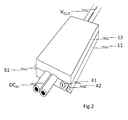
Figure 2 illustrates an example of a boost converter module installed to a wire. -
Figure 1 illustrates an embodiment of a boost converter module. The boost converter module comprises abase 11 and alid 12 and ahinge 51 connecting thebase 11 and thelid 12. Thehinge 51 enables opening and closing of thelid 12. In another embodiment, there could be multiple hinges or the hinge may be omitted or substituted with some other known means for aligning thelid 12 with thebase 11 and locking it therein. - The
base 11 comprises an input having twoinput poles base 11 also comprises an output having twooutput poles input poles output poles - In an embodiment, the boost converter module may be powered solely by photovoltaic devices connected to the input poles. In normal daylight conditions the photovoltaic device provides enough power to the boost converter module to ensure normal operation and a desired output voltage. At sunset, when the power from the photovoltaic device's output power decreases, the boost converter module deactivates itself and may disconnect itself from the system. When the sun rises again, the boost converter module activates itself again and may connect to the system if it was disconnected. The boost converter module needs much less power to activate than inverter devices, so the boost converter module is already properly functioning by the time the inverter device is activated. The power of the photovoltaic devices at sunrise, when it is not sufficient for the inverter device, could be utilized to warm up and/or ventilate the boost converter module to evaporate any water which might have condensed to the boost converter module during nighttime. The boost converter module has to function only when power from photovoltaic device is available, so it does not require other power sources.
- The
input poles output poles lid 12. In another embodiment the input poles and the output poles may be in thelid 12. - The boost converter module comprises a boost converter unit connected between the
input poles output poles lid 12. In a normal operating mode, the boost controller unit raises the voltage from the input to the output so that the output voltage is higher than the input voltage. In a simple embodiment, the boost converter module'sinput poles output poles - The boost converter module may comprise means for setting different voltage thresholds for the boost converter unit. Preferably the boost converter module comprises at least means 41 for setting a bypass voltage and means for bypassing the boost converter unit when voltage at the input is higher than the set bypass voltage. Preferably the boost converter module also comprises means 42 for setting a maximum output voltage. A simple implementation for the means for setting voltage thresholds is to use a
dedicated trimmer input poles output poles - In an embodiment, the boost converter module comprises a maximum power point tracking (MPPT) unit in connection with the boost converter unit. The MPPT unit and the boost converter unit together are capable of drawing maximum power from photovoltaic cells using a wide input voltage range for producing a proper output for e.g. an inverter. Typically the boost controller output will be connected to an inverter device but in an embodiment the boost converter module may also comprise an inverter for producing AC power in a small scale.
- The base 11 may comprise one or
more slots 53 or cavities and thelid 12 can comprise one ormore cutters 52, e.g. a blade. Theblade 52 of thelid 12 protrudes to theslot 53 of thebase 11, and the blade and slot combination is adapted to cut an electric wire between the blade and the slot when thelid 12 is closed. In an embodiment, thelid 12 comprises twoblades 52 and the base 11 twoslots 53 for the blades. When the lid is open, the boost converter module may be introduced around a wire. When the lid is closed, the wire inside the boost converter module is cut close to both input poles and output poles, and the closing of the lid also connects the cut ends of the wire to the input poles and the output poles. - The boost converter module comprises input connection means and output connection means between outer surfaces of the
base 11 and thelid 12, preferably on the inner surfaces of thebase 11 and thelid 12, for connecting wires to theinput poles output poles input poles output poles base 11 and thelid 12. In an embodiment ofFigure 1 , the lid comprisesneedles lid 12 is closed, the needles penetrate an insulation of wire inserted to the input poles and/or the output poles and connect the wire electrically to the boost converter module. In an embodiment, input connection means and/or output connection means comprise means for making a crimp connection with a stripped wire end when thebase 11 and thelid 12 are pressed together. In this case, for example theinput poles input poles lid 12 is pressed against thebase 11. The deforming of the wire fastens it to theinput poles output poles -
Figure 2 illustrates an installed boost converter module having input direct voltage DCIN wire and output voltage VOUT wire connected to the input poles and the output poles, respectively. The boost converter module is typically installed to a wire between a photovoltaic cell and e.g. an inverter of a solar energy system. In large-scale systems the photovoltaic cells are typically in arrays and the boost converter module may be installed to a wire between two photovoltaic cells. When installing the boost converter module, the wire in which the module is to be installed is cut into two wires, a first wire and a second wire. In an embodiment, the cutting of the wire may be performed with a cutter of the boost converter module. - Next, an open end of the first wire connected to the photovoltaic cell is placed into input connection means of the boost converter module. An open end of the second wire connected to, for example, an inverter, a load or another photovoltaic cell is placed into the output connection means of the boost converter module. When the open ends of the wires are in place, the lid of the boost converter module is closed by pressing it against the base of the boost converter module. The closing of the lid electrically connects the first wire to the input poles and the second wire to the output poles and also physically connects the wires to the boost converter module.
- It will be obvious to a person skilled in the art that, as the technology advances, the inventive concept can be implemented in various ways. The invention and its embodiments are not limited to the examples described above but may vary within the scope of the claims.
Claims (15)
- A boost converter module for a solar energy system, the boost converter module comprising input poles (21, 22), output poles (31, 32) and a boost converter unit connected between the input poles (21, 22) and the output poles (31, 32), the input poles (21, 22) being adapted to be connected to a photovoltaic device feeding an input direct voltage (DCIN), the boost converter unit being adapted to convert the input direct voltage (DCIN) into an output voltage (VOUT) that is higher than the input direct voltage (DCIN) and to feed the output voltage (VOUT) into the output poles (31, 32), characterized in that the boost converter module comprises a maximum power point tracking (MPPT) unit, and in that the boost converter module further comprises a base (11) and a lid (12), and input connection means (23, 24) and output connection means (33, 34) on an inner surface of the base (11) and the lid (12) for connecting at least one wire to the input poles (21, 22) and the output poles (31, 32).
- A boost converter module according to claim 1, characterized in that the boost converter module comprises a hinge (51) connecting the base (11) and the lid (12), and the module further comprises at least one of the following: the input connecting means (23, 24) and the output connecting means (33, 34), and is adapted to connect a wire introduced in said means to the boost converter unit when the hinged lid (12) is pressed against the base (11).
- A boost converter module according to claim 1, characterized in that at least one of the following: the input connection means (23, 24) and the output connection means (33, 34), comprises crimping means for making a crimped connection with a wire introduced in said means when the hinged lid (12) is pressed against the base (11).
- A boost converter module according to claim 1, characterized in that at least one of the following: the input connection means (23, 24) and the output connection means (33, 34), comprises connection needles for penetrating an insulation and making a connection with a wire introduced in said means when the hinged lid (12) is pressed against the base (11).
- A boost converter module according to claim 1 or 4, characterized in that the boost converter module comprises a cable cutter (52) for cutting a wire introduced in said boost converter module when the hinged lid (12) is pressed against the base (11).
- A boost converter module according to any one of claims 1 to 5, characterized in that at least one of the following: the input connection means and the output connection means, is a connector.
- A boost converter module according to any one of claims 1 to 6, characterized in that the boost converter module is arranged to be powered solely by a photovoltaic device.
- A boost converter module according to any one of claims 1 to 7, characterized in that the boost converter module further comprises an inverter unit.
- A boost converter module according to any one of claims 1 to 8, characterized in that the boost converter module further comprises means for setting a bypass voltage and means for bypassing the boost converter unit when voltage at the input is higher than the set bypass voltage.
- A boost converter module according to any one of claims 1 to 9, characterized in that the boost converter module further comprises means for setting a maximum output voltage.
- A boost converter module according to any one of claims 1 to 10, characterized in that the boost converter module comprises multiple pairs of input poles (21, 22) and means for joining the input poles in order to combine the input power from the multiple input poles (21, 22) into a single input feed.
- A solar energy system comprising a photovoltaic cell and an inverter, characterized in that the system further comprises a boost converter module according to any one of claims 1 to 11.
- A method for installing a boost converter module to an existing photovoltaic cell system, characterized in that the boost converter module comprises a base (11) and a lid (12), and input connection means (23, 24) and output connection means (33, 34) on an inner surface of the base (11) and the lid (12), wherein the method comprises:- cutting a direct current wire into a first wire and a second wire,- introducing the first wire in to the input connection means (23, 24) of the boost converter module,- introducing the second wire in to the output connection means (33, 34) of the boost converter module, and- pressing the lid (12) of the boost converter module against the base of the boost converter module in order to connect said first wire to the boost converter input poles (21, 22) and said second wire to boost converter output poles (31, 32).
- A method according to claim 13, characterized in that the cutting of the direct current wire is performed with said boost converter module by pressing the lid (12) of the boost converter module against the base (11) of the boost converter module.
- Use of a boost converter module according to any one of claims 1 to 11 in a solar energy system.
Priority Applications (3)
| Application Number | Priority Date | Filing Date | Title |
|---|---|---|---|
| EP12161448.1A EP2645558A1 (en) | 2012-03-27 | 2012-03-27 | Add-on boost converter for a solar energy system |
| US13/850,738 US20130257405A1 (en) | 2012-03-27 | 2013-03-26 | Add-on boost converter for a solar energy system |
| CN201310102896.XA CN103368378B (en) | 2012-03-27 | 2013-03-27 | For the additional boost converter of solar energy system |
Applications Claiming Priority (1)
| Application Number | Priority Date | Filing Date | Title |
|---|---|---|---|
| EP12161448.1A EP2645558A1 (en) | 2012-03-27 | 2012-03-27 | Add-on boost converter for a solar energy system |
Publications (1)
| Publication Number | Publication Date |
|---|---|
| EP2645558A1 true EP2645558A1 (en) | 2013-10-02 |
Family
ID=45999606
Family Applications (1)
| Application Number | Title | Priority Date | Filing Date |
|---|---|---|---|
| EP12161448.1A Withdrawn EP2645558A1 (en) | 2012-03-27 | 2012-03-27 | Add-on boost converter for a solar energy system |
Country Status (3)
| Country | Link |
|---|---|
| US (1) | US20130257405A1 (en) |
| EP (1) | EP2645558A1 (en) |
| CN (1) | CN103368378B (en) |
Families Citing this family (1)
| Publication number | Priority date | Publication date | Assignee | Title |
|---|---|---|---|---|
| WO2016058962A1 (en) | 2014-10-14 | 2016-04-21 | Philips Lighting Holding B.V. | A lighting controller, a lighting system and a method for controlling lighting |
Citations (4)
| Publication number | Priority date | Publication date | Assignee | Title |
|---|---|---|---|---|
| EP1263039A2 (en) * | 2001-05-30 | 2002-12-04 | Canon Kabushiki Kaisha | Housing for power converter, and for photovoltaic element module and power generator using the same |
| US7320616B1 (en) * | 2006-11-10 | 2008-01-22 | Zierick Manufacturing Corp. | Insulation displacement connector assembly and system adapted for surface mounting on printed circuit board and method of using same |
| US20090272559A1 (en) * | 2008-05-03 | 2009-11-05 | Michael Richter | Connection box for solar panel |
| US20120057388A1 (en) * | 2011-03-22 | 2012-03-08 | Paul Garrity | Solar Photovoltaic Inverters |
Family Cites Families (8)
| Publication number | Priority date | Publication date | Assignee | Title |
|---|---|---|---|---|
| US3745228A (en) * | 1971-05-06 | 1973-07-10 | K Vogt | Electrical splice |
| US3920305A (en) * | 1974-01-21 | 1975-11-18 | Ideal Ind | No-strip tap connector |
| US4033661A (en) * | 1974-06-20 | 1977-07-05 | Panduit Corporation | Solderless connector for insulated wires |
| US4614399A (en) * | 1984-07-23 | 1986-09-30 | At&T Technologies, Inc. | Aerial drop wire splicer |
| CN101227090B (en) * | 2007-12-03 | 2011-05-04 | 天津理工大学 | Maximum power tracking controller for photovoltaic power generation based on digital signal processor |
| JP5070111B2 (en) * | 2008-04-03 | 2012-11-07 | 本多通信工業株式会社 | Terminal box for solar cell module |
| DE102009058118A1 (en) * | 2009-12-12 | 2011-06-16 | Lumberg Connect Gmbh | Junction box for solar modules |
| JP2011192809A (en) * | 2010-03-15 | 2011-09-29 | Omron Corp | Power conditioner device and module substrate structure using the same |
-
2012
- 2012-03-27 EP EP12161448.1A patent/EP2645558A1/en not_active Withdrawn
-
2013
- 2013-03-26 US US13/850,738 patent/US20130257405A1/en not_active Abandoned
- 2013-03-27 CN CN201310102896.XA patent/CN103368378B/en not_active Expired - Fee Related
Patent Citations (4)
| Publication number | Priority date | Publication date | Assignee | Title |
|---|---|---|---|---|
| EP1263039A2 (en) * | 2001-05-30 | 2002-12-04 | Canon Kabushiki Kaisha | Housing for power converter, and for photovoltaic element module and power generator using the same |
| US7320616B1 (en) * | 2006-11-10 | 2008-01-22 | Zierick Manufacturing Corp. | Insulation displacement connector assembly and system adapted for surface mounting on printed circuit board and method of using same |
| US20090272559A1 (en) * | 2008-05-03 | 2009-11-05 | Michael Richter | Connection box for solar panel |
| US20120057388A1 (en) * | 2011-03-22 | 2012-03-08 | Paul Garrity | Solar Photovoltaic Inverters |
Also Published As
| Publication number | Publication date |
|---|---|
| CN103368378B (en) | 2016-04-06 |
| CN103368378A (en) | 2013-10-23 |
| US20130257405A1 (en) | 2013-10-03 |
Similar Documents
| Publication | Publication Date | Title |
|---|---|---|
| US11967654B2 (en) | Distributed maximum power point tracking system, structure and process | |
| US7824191B1 (en) | Connector with conductor piercing prongs for a solar panel | |
| CN103733474B (en) | For generating, storing and supply by the system of the electric energy of modularization DC makers generation and the correlation technique for managing the system | |
| EP0817350A3 (en) | Power-supply system involving system interconnection | |
| WO2021206540A1 (en) | Switching matrix for reconfigurable pv modules and systems | |
| US20180331242A1 (en) | Efficient Solar Energy Generation and Conversion System | |
| EP2645558A1 (en) | Add-on boost converter for a solar energy system | |
| Krzywinski | Integrating storage and renewable energy sources into a DC Microgrid using high gain DC DC Boost Converters | |
| KR102237579B1 (en) | A solar power system with integrated windows and its installation methods | |
| CN203984005U (en) | A kind of many MPPT non-isolated photovoltaic grid-connected inverter | |
| CN207099029U (en) | A kind of photovoltaic generating system | |
| WO2017156533A1 (en) | Systems and methods for modular solar power installations | |
| KR101460191B1 (en) | Connector for connecting electronic wiring of adjacent photovoltaic module | |
| CN205565046U (en) | Link T type three -phase bus | |
| CN204928743U (en) | Collection flow box and photovoltaic module power generation system | |
| EP3723281B1 (en) | Power wiring device | |
| CN201904741U (en) | Photovoltaic array type lightning protection junction box | |
| CN208522711U (en) | Terminal box | |
| JP2014050227A (en) | Photovoltaic power generation system and installation method for photovoltaic power generation system | |
| CN121814021A (en) | Junction box assembly of photovoltaic power semiconductor module | |
| NZ756190B2 (en) | Off-grid electrical power system | |
| JP2005158789A (en) | Electrical connection system and electrical connection method for solarlight power generation | |
| CN102403390A (en) | Connecting box of solar photovoltaic assembly | |
| HK40025123A (en) | Modular power supply system | |
| EP3130053A1 (en) | Actuation system |
Legal Events
| Date | Code | Title | Description |
|---|---|---|---|
| PUAI | Public reference made under article 153(3) epc to a published international application that has entered the european phase |
Free format text: ORIGINAL CODE: 0009012 |
|
| AK | Designated contracting states |
Kind code of ref document: A1 Designated state(s): AL AT BE BG CH CY CZ DE DK EE ES FI FR GB GR HR HU IE IS IT LI LT LU LV MC MK MT NL NO PL PT RO RS SE SI SK SM TR |
|
| AX | Request for extension of the european patent |
Extension state: BA ME |
|
| 17P | Request for examination filed |
Effective date: 20140402 |
|
| RBV | Designated contracting states (corrected) |
Designated state(s): AL AT BE BG CH CY CZ DE DK EE ES FI FR GB GR HR HU IE IS IT LI LT LU LV MC MK MT NL NO PL PT RO RS SE SI SK SM TR |
|
| STAA | Information on the status of an ep patent application or granted ep patent |
Free format text: STATUS: THE APPLICATION IS DEEMED TO BE WITHDRAWN |
|
| 18D | Application deemed to be withdrawn |
Effective date: 20161001 |