EP2645280A1 - A rapidly converging atomic physics method and medium to calculate complex non-equilibrium radiative properties of matter with spectroscopic precision. - Google Patents
A rapidly converging atomic physics method and medium to calculate complex non-equilibrium radiative properties of matter with spectroscopic precision. Download PDFInfo
- Publication number
- EP2645280A1 EP2645280A1 EP12305392.8A EP12305392A EP2645280A1 EP 2645280 A1 EP2645280 A1 EP 2645280A1 EP 12305392 A EP12305392 A EP 12305392A EP 2645280 A1 EP2645280 A1 EP 2645280A1
- Authority
- EP
- European Patent Office
- Prior art keywords
- levels
- level
- populations
- atomic
- matrix elements
- Prior art date
- Legal status (The legal status is an assumption and is not a legal conclusion. Google has not performed a legal analysis and makes no representation as to the accuracy of the status listed.)
- Withdrawn
Links
Images


Classifications
-
- G—PHYSICS
- G16—INFORMATION AND COMMUNICATION TECHNOLOGY [ICT] SPECIALLY ADAPTED FOR SPECIFIC APPLICATION FIELDS
- G16C—COMPUTATIONAL CHEMISTRY; CHEMOINFORMATICS; COMPUTATIONAL MATERIALS SCIENCE
- G16C99/00—Subject matter not provided for in other groups of this subclass
-
- G—PHYSICS
- G16—INFORMATION AND COMMUNICATION TECHNOLOGY [ICT] SPECIALLY ADAPTED FOR SPECIFIC APPLICATION FIELDS
- G16C—COMPUTATIONAL CHEMISTRY; CHEMOINFORMATICS; COMPUTATIONAL MATERIALS SCIENCE
- G16C10/00—Computational theoretical chemistry, i.e. ICT specially adapted for theoretical aspects of quantum chemistry, molecular mechanics, molecular dynamics or the like
Definitions
- the standard method for the calculation of the atomic level populations consists in solving an exact atomic system of kinetic differential equations in which all levels and all possible collisional-radiative processes are taken into account.
- the method is applicable to all kind of atomic configurations, in particular to the most complex ones like autoionizing states, multiple excited states, hollow ion/atom states and any combination of hole states.
- the generality of the method combined with the extreme convergence properties to high spectroscopic precision permits also integrated simulations, e.g., hydro simulations, particle kinetic simulations, that have not been possible up to date.
- the iteration is accelerated by calculating refined populations n j i not only from n j i - 1 but from several preceding populations, like, e.g. from n j i - 1 , n j i - 2 , ....
- the chosen density corresponds to an intermediate regime between Corona and Boltzmann to critically test also the collisional-radiative regime (which is the most difficult to treat).
- Fig. 4a shows the results for the "0-iteration," case. One can see that the 0-iteraction provides already a very good approximation to the exact calculations.
- Fig. 4b demonstrates the high convergence properties of the new split iteration numerical procedure. The result for the "1-iteration," case is almost identical to the exact solution providing proof of eq. (3.12).
Landscapes
- Engineering & Computer Science (AREA)
- Computing Systems (AREA)
- Theoretical Computer Science (AREA)
- Life Sciences & Earth Sciences (AREA)
- Bioinformatics & Cheminformatics (AREA)
- Bioinformatics & Computational Biology (AREA)
- Physics & Mathematics (AREA)
- Health & Medical Sciences (AREA)
- General Health & Medical Sciences (AREA)
- Spectroscopy & Molecular Physics (AREA)
- Spectrometry And Color Measurement (AREA)
Abstract
using a computer to perform the following:
- considering an exact atomic system (up to the fine structure level or even above) containing multiple excited levels "j" belonging to M manifolds {α(1)}...{α(M)}, numerous ground and single excited levels "k", and corresponding transition matrix elements,
- performing a reduced system RS from the exact atomic system wherein all j-levels belonging to the manifolds {α(1)}...{α(M)} are lumped together to create one level for each manifold {α(β)}, comprising of all possible methods for generalizing the manifold definition,
- performing an Independent Recovery System of Equations IRSE containing j recovery systems computed from the exact atomic system, each recovery system comprising, instead of all j levels, a level j and a level mj obtained by lumping together all levels from the manifolds, except the j-level itself,
- calculating transition matrix elements W α
- for each recovery system, calculating transition matrix elements Wm

Description
- The present invention relates to the determining of radiative properties of matter like, e.g., plasmas, gases, solids. These radiative properties can be used to diagnose complex matter/plasma conditions and the spectral distribution characterizes the radiation loss in energy and frequency. In particular, the present invention concerns a method to calculate complex non-equilibrium radiative properties and spectral distributions of matter with high spectroscopic precision (corresponding to the fine structure level of atomic quantum mechanical wavefunctions or above).
- Atomic populations kinetics of multiple excited states (autoionizing) is a key-point for the calculations of, e.g., atomic/ionic fractions, radiation losses and spectral distributions. The precise knowledge of the spectral distribution is, e.g., needed for the development of radiation sources and also for any diagnostics via emission spectroscopy (which is a non-perturbative method): applicable if the objet is not accessible because it is, e.g., too hot, too far, too shortly emitting etc...
- The usually large number of atomic levels (thousands up to millions) for rather simple distributions of electrons over the atomic/ionic/molecular shells prevents precise calculations due to limited computational resources. The limitation concerns even the simplest stationary calculations implying that transient or even integrated simulations (means coupled, e.g., to simulations of the macroscopic evolution of matter "Hydro") are almost impossible.
- The spectral distribution I(ω) (means the energy radiated per surface unit, in a certain direction, per solid angle, per second, per angular frequency interval: J/s·m2·sr·2πHz) is the most detailed key-parameter to describe the radiative properties of matter [H.R. Griem, Principles of Plasma Spectroscopy, Cambridge University Press, New York 1997]:

- Here nj is atomic/ionic/matter population density of the upper level j, Aji,ωji, and φji (ω) are the probabilities of radiative transition, transition energy and spectral line shape of the transition j → i, respectively. N is the total number of bound levels (ground states, single and multiple excited states) of all ionization stages.

- The standard method for the calculation of the atomic level populations consists in solving an exact atomic system of kinetic differential equations in which all levels and all possible collisional-radiative processes are taken into account. In this model, the level-population densities nj satisfy the following equations (so called exact atomic system according to standard theory):

- W is the population matrix of all collisional and radiative transition rates connecting the discrete levels j to all other levels in all ionization stages. If a particular transition j → i cannot occur due to physical principles Wji = 0. The population matrix elements are given by:

- The matrix elements describing the radiative and autoionizing processes are given by

- The collisional processes are described by

- Aij : Spontaneous radiative decay rate
- Γij : Autoionization rate
-

-

-

-

- Cij : Electron collisional excitation/deexcitation
- Iij : Electron collisional ionization
- Tij : 3-body recombination
- Rij Radiative recombination
- Dij : Dielectronic capture
- The dots in eq. (1.5) indicate other - in principle possible - processes, like, e.g., charge exchange and heavy particle collisions.
- Nowadays computer codes are freely available that allow the calculation of all necessary energy levels/ wavelengths, collisional and radiative transitions to establish the population matrix (eqs. 1.3-5) for almost all practical applications. This permits to solve numerically the system of equations (1.1, 1.2). A detailed discussion of the transition matrix elements and line profiles is not presented here, as this does not directly concern the present invention and methods are publically available for their efficient calculation, see for example: R.D. Cowan, The Theory of Atomic Structure and Spectra, University of California Press, Berkely 1981; H.R. Griem, Principles of Plasma Spectroscopy, Cambridge University Press, New York 1997; M.F. Gu, The flexible atomic code FAC, Canadian Journal of Physics 86 (5), 675 (2008).
- Although equations (1.1) and (1.2) look rather transparent, the practical application is extremely difficult due to the necessity to include a large number of multiple excited (autoionizing) states to correctly describe:
- 1) all line transitions (from single and multiple excited states) belonging to a certain spectral range of interest,
- 2) the ionic charge state distribution that influences on all atomic populations (nj in eq. 1.1, 1.2) and, in consequence to the spectral distribution of any spectral interval,
- 3) all possible line transitions of all charge states to predict the radiation energy loss of a given system (means eq. (1.1) for frequencies ranging from zero to infinity).
- Even for atoms with only a few numbers of atomic bound electrons the number of requested levels N can be so large that the standard method (means to solve eqs. (1.1) and (1.2) for all levels that need to be taken into account for the precise description of the spectral distribution) turn out to be impractical even for a high level computational infrastructure.
- The Document "A. Burgess, Astrophys. Journal 139, 776 (1964)" describes dielectronic recombination that is one of the most important process influencing on the charge state distribution of atoms and ions. Unfortunately the exact calculation of this process involves the implication of a so large number of levels that direct calculations had only be possible today for certain specific cases. Even for one of the simplest ions (namely He-like ions) the atomic configurations to incorporate dielectronic capture from He-like to Li-like ions requests about thousand states (namely the 1s2lnl'- and 1s3ln1"-configurations) to be included in the system (1.2). It is entirely impractical to include thousands and or even millions of states just for the purpose to calculate a certain type of transition matrix elements (namely Dij, eq. (1.5)) to connect different charge states.
- Let us consider a very simple example to illustrate the various atomic states involved, namely the dielectronic recombination from the H-like ground state 1s:
dielectronic capture : 1s + e → 2p2 LSJ autoionization : 2p2LSJ → 1s + e dielectronic recombination : 2p2LSJ → 1s2p L' S' J' + hωsat 1s2p L'S'J' → 1s2 + hω res - After dielectronic capture into the H-like ground state 1s, the multiple excited state 2p2 is formed (due to different possibilities of coupling orbital and spin quantum numbers of the two electrons numerous different states LSJ are formed from the simple 2p2 configuration). This state can either decay via a non-radiative decay (autoionization) or radiative decay (spontaneous radiative emission). For the case of autoionization of the state 2p2, the original state 1s is "returned" and no effective change in the charge state distribution occurs. If, however, the state 2p2 decays via a radiative decay (corresponding to a photon with energyωsat) the state 1s2p is created which decays by another radiative decay (photon with energy
 ω res ) that produces the state 1s2. Therefore, dielectronic capture following by successive radiative decays produces a different charge state. As the H-like charge state is transformed to a He-like charge state, this ensemble of atomic physics processes leads to an effective recombination that is called "dielectronic recombination". For the above example k=1s, j=2p2 and i=1s2p (see eq. (1.6) below). All configurations 2l2l' contribute in a similar manner to the dielectronic recombination, but also 2lnl' and in general nln'l' which comprises already hundred of states. For more complex configuration in the L, M and N shell, similar consideration leads rapidly to millions of states that need to be considered to simulate the dielectronic recombination to get right only the charge state distribution.
- Moreover, this example shows, that the dielectronic recombination influences also directly on the spectral distribution via spontaneous radiative transitions: the radiative decay of the so called "satellite photon" with energyω sat contributes to the spectral distribution and this contribution might be even larger than the usual resonance line emission of single excited states (photons with energy
 ω res in the above example).
- Based on the theory of Burgess numerous approximations have been developed in order to calculate effective dielectronic recombination rates that avoid explicit incorporation of the multiple autoionizing states in eq. (2-5). In all these approximations it is, however, assumed that effective recombination from one charge stage to another is given by a branching ratio

after dielectronic capture from state "k" to state "j". Aji is the spontaneous transition probability from level j to i and Γjk is the autoionizing rate from level j to level k. Such a method is disclosed in R.D. Cowan, The Theory of Atomic Structure and Spectra, University of California Press, Berkely 1981. - Concerning our simple example, an effective dielectronic recombination rate couples the states 1s and 1s2 thereby avoiding the explicit incorporation of all the nln'l'-sates. This, however, neglects important collisional effects on atomic populations of the multiple excited states that is only well justified in very low-density plasmas (so called Corona-regime). However, even for rather low density plasmas, the complex level structure (that include meta-stable levels) in the L and, particularly, M and N atomic shells of high Z-elements play an important role. The use of effective dielectronic recombination rates even for low density plasmas is then highly questionable as numerous k-states are excited in a collisional radiative regime. In dense plasmas, a Burgess-type approximation is highly unsatisfactory due to the additional absence of further physical effects: ionization from the multiple excited states, collisional redistribution between the multiple excited states, important population of numerous excited states "k" (which can be comprised from ground, single and even multiple excited states).
- Moreover, if charge exchange or photoionzation processes are important population processes for multiple excited states (for example in gas mixtures or for intense radiation sources) the multiple excited states and hollow ion configurations are not linked anymore by dielectronic recombination. Effective rate coefficients according the Burgess theory then entirely fail even in low-density plasmas to describe the situation.
- The Document "A. Bar-Shalom, J. Oreg, W.H. Goldstein, D. Shvarts, A. Zigler, Phys. Rev. A 40, 3183 (1989)", discloses another approach to reduce the huge number of multiple excited states necessary for a precise calculation. This approach, so called Superconfiguration (SC) approach consists in replacing the numerous levels of one configuration by a reduced number of levels to obtain a manageable system (eqs. 1.2) of atomic levels.
Figures 1a,b depict the basic principle of this approach.Fig. 1a shows an exact level system: depicted are two configurations of multiple excited states "j" and "i", k designates ground and single excited states (non-autoionizing). Due to the large number of multiple excited states "j" and "i" the system of differential equations (1.2) is very large and prohibitive for numerical solution. -
Fig. 1b shows an example of a reduced atomic level system. All levels "j" are lumped together into one level αj (note that αj is the level number of the manifold {α} to which j belongs), all levels "i" are replaced by one level αi. The number of levels is therefore drastically reduced and the system of equations (1.2) is reduced to a manageable dimension for numerical calculations. This is the principle of the SC approach: αj and αi are the so-called SC's. In order to link the SC's to each other and to the levels "k", one needs also to lump together all detailed population matrix elements Wij , Wji , Wki, Wik, Wkj and Wjk. This is represented inFig. 1b by the matrix elements Wαiαj, Wαjαi, Wkαi, Wαik, Wkαj, and Wαjk. - However, this reduction method has serious drawbacks:
- a) As all levels "j" and all levels "i" are replaced by one level αi and αi respectively, the spectral distribution originating from the numerous transitions j → i is replaced by only one transition (with artificial energy/line center position). Therefore, all details of the original spectral distribution are destroyed and spectroscopic precision is entirely lost.
- b) In order to calculate the effective matrix elements Wαiαj, W αjα i, W kα i, W αi k, Wkαj and Wαjk one needs in fact to know the detailed populations of each level "j" and level "i" (to be discussed in detail below) requesting in turn the consideration of equations that are linked by the "internal" populations matrix elements Wjj , and Wii , (see
Fig. 1a ). This, however, would request the exact solution of the level system accordingFig. 1a and no advantage of the reduced system is obtained. Therefore numerous additional assumptions are introduced to the reduced system, for example a statistical population between all levels "j" and all levels "i", or a Boltzmann like distribution (designated also as LTE populations in the literature, for Local Temperature thermodynamic Equilibrium) with an artificial temperature (so-called SC-temperature). The precision of these assumptions are difficult to estimate, in fact, their strict justification would again require the solution of the exact atomic level system (Fig. 1a ) which is supposed to be avoided. Numerous variations of the standard SC approach are developed. In short terms, these ideas are essentially based on the reduction of all levels "j" and "i" to numerous SC's to improve the above discussed deficiencies. But this means again that one drives the reduced system towards the exact atomic system (thereby introducing additional assumption how to create numerous SC's from all the levels "j" and "i"). - An object of the present invention is to overcome drawbacks of prior art by providing an accelerated method to determine complex non-equilibrium (transient, non-LTE, non-Maxwellien) radiative properties of matter with spectroscopic precision.
- Another object of the present invention is to provide a highly convergent method.
- In at least preferred embodiments, the present invention provides a method for efficiently determining a complex spectral high resolution distribution of a radiation source by determining populations of matter in atomic levels, the method comprising:
- using a computer to perform the following:
- considering an exact atomic system, up to the fine structure level or even above, containing multiple excited levels "j" belonging to M manifolds {α(1)}...{α(M)}, numerous ground and single excited levels "k", and corresponding transition matrix elements,
- performing a reduced system RS from the exact atomic system wherein all j-levels belonging to the manifolds {α(1)]...{α(M)} are lumped together to create one level for each manifold {α(β)}, β=1 to M
- performing an Independent Recovery System of Equations IRSE containing j recovery systems computed from the exact atomic system, each recovery system comprising, instead of all j levels, a level j and a level mj obtained by lumping together all levels from the manifolds, except the j-level itself,
- calculating transition matrix elements Wαjk and W kαj of RS to determine populations nk of all levels k,
- for each recovery system, calculating transition matrix elements Wmjk , Wkmj , Wmjj and Wjmj from nk to determine a non-statistical excited populations

- According to the invention, during the step of calculating transition matrix elements, all variations of initial levels population assumptions (means for κ=0) including Boltzmann, non-Boltzmann and combinations of Boltzmann and non-Boltzmann initial assumptions may be considered. κ=0 means the "0"-order solution in an n-order iteration scheme (see below) of each level j.
- Concerning the manifold, the invention relates to all possible methods for generalizing the manifold definition including ground and single excited levels k and even mixed manifolds (containing k and j levels).
- Note that αj is the level number in RS of the manifold {α} to which j belongs.
- The present invention develops a new atomic population kinetics and numerical method that, unlike the standard theory, has no need to establish the large exact atomic system that is prohibitive for numerical solutions. Compared to the exact atomic system that contains a huge number of levels coupled via differential equation like eq. (1.1), the number of levels in the RS is highly reduced to a numerically manageable number and one equation of the IRSE is a two level system that allows even an analytical solution. It is therefore advantageous to perform several small size matrices than a few huge size matrices.
- Convergence to the exact solution is obtained with two highly reduced systems and an indirect coupling via a transition matrix. Due to the extremely high convergence properties (even the 0-order is already rather precise) the most complex phenomena related to the radiative properties of matter become accessible via numerical simulations with high spectroscopic precision. This will allow design and optimization studies of almost all radiation sources and diagnostic developments.
- The method is applicable to all kind of atomic configurations, in particular to the most complex ones like autoionizing states, multiple excited states, hollow ion/atom states and any combination of hole states. The generality of the method combined with the extreme convergence properties to high spectroscopic precision permits also integrated simulations, e.g., hydro simulations, particle kinetic simulations, that have not been possible up to date.
- According to the invention, the method further comprises iterative steps from index κ=0..i..imax, with "imax" being the number of iterations, of:
- inserting simultaneously into RS and IRSE the non-statistical excited populations

- refining calculation of transition matrix elements Wαjk and Wkαj of RS from the non-statistical excited populations

- refining calculation of transition matrix elements Wmjk , Wkmj, Wmjj and Wjmj of IRSE from the non-statistical excited populations

- The invention comprises a new splitting technique of atomic levels combined with a new split-iteration numerical procedure. This allows acceleration of numerical calculations by many orders of magnitude and permits simulating even the most complex non-equilibrium radiative properties of matter.
- The iteration steps concern a split-iteration numerical method wherein the iterations RS and IRSE are performed simultaneously in parallel. This permits a highly convergent procedure.
- The present invention allows reducing considerably the requested computational resources in all fields where radiation properties are needed. It might also be interesting for lamp/radiation source production industry to predict radiation loss and detailed spectral distributions (which is, e.g., the quantity to estimate the "quality" of the radiation source, like "cold light", "warm light"). The method of the invention is therefore also highly interesting for non-stationary radiation source development (e.g., radiation sources for microprocessor production by lithography, pulsed power radiation sources driven, e.g., by lasers, pinch plasmas).
- According to the invention, after each iteration, the method further comprises determining if the non-statistical excited populations


- According to the invention, the iteration is accelerated by calculating refined populations


- Advantageously, during the calculations of lumped transition matrix elements W αj k, W kαj, Wkmj, Wmjj and Wjmj , in every iteration step requested non-lumped transition matrix elements Wxy and Wyx (where "x" and "y" designate any level x,y=1..N from the exact atomic system described by eq. (1.2)) are known from pure non-lumped atomic physics calculations beforehand. Therefore, no "atomic physics calculation effort" is requested in the preceding iteration steps and iteration itself is therefore extremely fast. For each iteration, the method further comprises determining weather the matrix elements and the level mj have converged.
- In this respect, the invention also enables the provision of a new non-transitory computer-readable storage medium encoded with computer-executable instructions which, when executed, perform a method for determining complex spatial distribution of a radiation source by determining populations of matter in atomic levels, the method comprising the steps of:
- considering an exact atomic system containing multiple excited levels "j" belonging to M manifolds {α(1)}...{α( M )}, numerous ground and single excited levels "k", and corresponding transition matrix elements,
- performing a reduced system RS from the exact atomic system wherein all j-levels belonging to the manifolds {α(1)}...{α( M )} are lumped together to create one level for each manifold {α(β)}, β=1 to M
- performing an Independent Recovery System of Equations IRSE containing j recovery systems computed from the exact atomic system, each recovery system comprising, instead of all j levels, a level j and a level mj obtained by lumping together all levels from the manifolds, except the j-level itself,
- calculating transition matrix elements W αjk and W kαj of RS to determine populations nk of all levels k,
- for each recovery system, calculating transition matrix elements Wmjk, W kmj, Wmjj and W jmj from nk to determine a non-statistical excited populations

- The new splitting technique allows convergence to the exact solution for any plasma parameters (in particular non-LTE) with a highly reduced system that has the outstanding advantage to avoid establishing the entire exact atomic population kinetic system even for convergence studies. Moreover, it has been shown that the 0-order solution (κ=0, equivalent to an analytic solution) is already of very high quality (spectroscopic precision). Therefore, also transient non-equilibrium radiative properties (e.g., radiation loss calculations, ionic populations for different charge states, spectral distributions of high spectroscopic precision that allows detailed diagnostics) can be additionally accelerated by many orders of magnitude.
- For the purpose of illustrating the invention, there is shown in the drawings a form that is presently preferred; it being understood, however, that this invention is not limited to the precise arrangements and instrumentalities.
-
Figures 1a and 1b respectively illustrate an exact atomic level system and a reduced atomic level system according to prior art, -
Figure 2 is a view illustrating an exact atomic level system for one configuration of levels "j", -
Figure 3 is a view illustrating a reduced atomic level system and one of the j equations of a new Independent Recovery System of equations according to present invention, -
Figures 4a and 4b are graphs illustrating the spectral distribution ("spectra") for titanium Z=22 for 0-iteration (κ=0) and 1-iteration (κ=1), -
Figures 5 is a bloc diagram of an exemplary computer system for implementing a registration method according to the present invention. - While the invention is susceptible to various modifications and alternative forms, specific embodiments thereof are shown by way of example in the drawings and will herein be described in detail. It should be understood, however, that the drawings and detailed description thereto are not intended to limit the invention to the particular form disclosed, but on the contrary, the intention is to cover all modifications, equivalents, and alternatives falling within the spirit and scope of the present invention as defined by the appended claims.
- On
Figure 2 only one configuration αj that contains the levels "j" is presented (the extension to many configurations, like, e.g., presented inFig. 1a is straightforward but will considerably prevent a transparent presentation). - The new atomic physics splitting technique works in the following way: first, the exact atomic system (
Fig. 2 ) of equations (1.2) is transformed to a Reduced System "RS" (Fig. 3 left) lumping levels "j" to one level "αj", second, every level "j" (which does not anymore explicitly appear in the RS) is recovered in an Independent Recovery System of Equations "IRSE" (Fig. 3 right). The number of recovery systems (Fig. 3 right) is exactly identical to the number of all levels "j" in the exact atomic system (Fig. 2 ). The level "mj" in the recovery system is a level that is obtained when lumping together all levels from which "αj" is composed, except the j-level itself (for example, if the configuration "αj" is composed from 10 levels, means j=1...10 and the recovery system for the level j=3 is considered, the level mj is composed of the levels [1, 2, 4, 5, 6, 7, 8, 9, 10]). The levels "k" in the exact atomic system (Fig. 2 ), in the RS and in the IRSE are the same (as indicated inFig. 3 ). - It is already visible at this point that the IRSE is not a usual system of equations according to the standard theory nor to the SC-approach (that contains N-equations for N levels, like, e.g., equations (1.2)) but rather a hierarchic system of equations where each single IRSE-equation contains only the level "j" that is coupled indirectly to all other levels via the transition matrix elements W (see
Fig. 3 , right). The hierarchy manifests itself by the fact that the IRSE is under the control of RS (due to the levels "k") whereas IRSE returns detailed information of level "j" to RS via the matrix elements W αjk and W kαj . Due to the hierarchic communication of the two systems, RS + IRSE contain therefore information for all single levels "j" and level k like the exact atomic system (Fig. 2 ). However, compared to the exact atomic system that contains a huge number of levels coupled via a set of differential equations (eq. 1.2), the number of levels in the RS is highly reduced to a numerically manageable number and one equation of the IRSE is a two level system that allows even an analytical solution. - What remains to establish is the hierarchic link of RS and IRSE via the transition matrix elements W αj k, Wkαj, Wjk, Wkj, Wmjk, Wkmj, Wmjj and W jmj (see
Fig. 3 ) that will allow obtaining exact populations for each level "j" and "k" like the highly inconvenient exact atomic system accordingFig. 2 . This is realized with the highly convergent split-iteration numerical procedure. - The new highly convergent split-iteration numerical procedure can be described as follows.
- The split iteration numerical procedure is a double fold interaction: an external iteration that couples RS and IRSE and an internal iteration (inside IRSE) that couples the level mj to the level j for each IRSE(j). The highly convergent aspect of the present invention is that this numerical procedure avoids performing one iteration after another (which increases the numerical burden considerably) but rather allows a simultaneous iteration of "internal + external iteration" without loss of convergence in each iteration step.
- The new method works as follows. Start with the system RS assuming, for example a Boltzmann distribution of all levels "j" to calculate the transition matrix elements W αjk and W kαj (note that also other assumptions can be made at this step). The solution of RS provides the populations of all levels "k". In order to solve one equation of IRSE, namely IRSE(j), the populations of the levels "k" from RS are inserted in IRSE(j) (for this reason no transition matrix of the type Wkk, is indicated in
Fig. 3 for IRSE) combined also with a Boltzmann distribution of all levels from which "mj" is composed that provides in turn the requested transition matrix elements Wmjk, Wkmj, Wmjj and Wjmj. - The transition matrix elements Wjk, Wkj are known from pure atomic physics calculations beforehand (note that no level lumping and populations is involved for these levels). The solution of the "j's" IRSE equation (denoted like IRSE(j)) provides a non-statistical population of level "j" because the coupling of "j" to mj and k is exact except the assumption for the matrix elements Wmjk, Wkmj, Wmjj and Wjmj . This is called the 0-iteration non-LTE population of level "j":
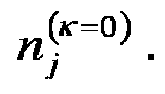

- The next step is the implementation of the new double fold iteration (called split-iteration numerical procedure in the following): the new non-LTE populations

- This new split-iteration numerical procedure is demonstrated to be so highly convergent that even the 0-order solution (which is demonstrated below to be transformable to an analytical solution) allows treating the most complex problems in radiation physics with spectroscopic precision. This allows exploring cases that have never been possible before.
- Below, the detailed set of equations is developed that can be used to implement the present invention for numerical calculations.
- Also a prototype is developed that allows demonstration of the present invention via one of the most difficult atomic physics cases for purposes of the present invention.
- We start from the basic principles in atomic population kinetics (system of equations (1.2)) and compose in the system "RS" the total number of levels N into two parts Nb and Na : the total numbers of ground + single excited levels Nb and multiple excited/autoionizing levels Na (note that also other type of manifolds can be defined including even mixed ones composed from levels belonging to the groups Nb and Na ).

- The total number of levels Na is distributed into M manifolds {α(1)}....{α( M )} with the number of specific levels N α(β) (β=1...M) in each manifold:

- As an example, one can consider the case of He-alpha (1s 2 1 S0-1s2p 1 P 1) satellites from lithium-like ions. The manifolds are of the form: {α(1)}={1s2l2l'} with N α(1) = 16, {α(2)}={1s2l3l'} with N α(2)=66 etc. With the help of these configurations it is possible to reduce the number of equations of the exact atomic system (eq.(1.2)) by using manifold populations n α in the kinetic equations of RS, instead of explicit implementation of all atomic levels "j" belonging to each manifold {α}. Thus the total number of equations of RS Nr, given by Nr=Nb+M, is substantially decreased in comparison to the exact atomic system according standard theory containing N = Nb +Na coupled equations.
- In order to demonstrate the technique of the present invention, the case of one manifold is considered (
Figs. 2 and 3 ). In this case the reduced number of equation Nr becomes equal to Nb + 1 in RS (Fig. 2 ). The population averaged excitationW kα and depopulationW ak atomic rates for the manifold {α} are introduced. This average is given by:

- In Eqs. (3.3, 3.4) the sum is over all specific sublevels j entering the manifold {α}, nj is the population of the level j, whilst Wjk and Wkj are the transition rates (that are known beforehand, see paragraph II.) of the specific transitions between k and j. The populations of the manifold {α} satisfy the normalization condition


- As introduced before, in RS according eq. (3.5), k and k' denote ground and single excited bound states. Therefore, for the specific example considered here, there exist Nb equations for the bound states k and one equation governing the manifold {α}. Considering RS only the spectral distribution from the manifold {α} (due to different bound levels k) is given by:

n α is the population of the manifold alpha obtained from the system of equations Eq. (3.5) andωαk is the averaged energy between the manifold alpha and the specific level k . φ αk is the profile of the transition α→k and A αk is the averaged radiative transition rate of the transition in question. Eq. (3.6) demonstrates that several transitions from specific levels belonging to the manifold alpha are replaced by only one artificial transition from the configuration alpha. As discussed above, the restriction to the RS does not provide the requested exact transition matrix elements that need the knowledge about the exact populations nj (see eq. 3.4). Therefore the normalization condition

- The power of the present invention is that it provides a solution to the problem of the calculation of spectral lines/spectral distribution without any loss of generality and spectroscopic precision. In the present method, to solve the system of eq. (3.5), a non-trivial solution ñj is introduced via IRSE for each specific level j belonging to alpha in order to calculate the averaged rates from eq. (3.4).
- The difference between nj (exact atomic system ES) and ñj (IRSE) is that in the ES that describes the population nj, j interacts with all the Nb bound levels and directly with all the Na -1 autoionization levels. But inside IRSE, that describes the populations ñj , j interacts also with all the Nb bound levels, but the interaction with the N α-1 autoionization levels is indirect and described by means of one effective level denoted as mj as shown in
Fig. 3 (right). By construction, mj is an effective level, containing all levels of the manifold alpha except the level j, for which it is introduced. An effective level mj is defined for each autoionization level j belonging to {α}. The populations ñj and ñmj of level j and mj are described by the reduced kinetic system of two equations (means for each level j there are two equations for each IRSE(j)), that is derived introducing the relaxation matrix elements averaged, over all specific autoionization levels, belonging to mj .W smj andW mjs designate the transition matrix elements while the level s could be bound "k" or autoionization level j (see IRSE inFig. 3 ). These averaged rates describe the collisionnal-radiative processes likeA mjs andA smj for radiative transitions andC mjs andC smj for collision etc. Similar to equations (3.3-4):

- In the two level system (IRSE(j)) that describes the evolution of ñj interacting with ñmj and nk, it is advantageous to write down explicitly certain relaxation channels: radiative decay rates (A), autoionization rates (F), collisional excitation and deexcitation (C), other relaxation channels are designated as (X) (like photo and collisional ionization rates, three body recombination rates, charge exchange, etc.). The two level systems of reduced kinetic equations IRSE(j) for the autoionization states takes then the form:


- The coupling of RS and IRSE is now done with a specific iteration procedure. To compute the averaged rates from eqs. (3.3, 3.4, 3.7, 3. 8), the first iteration step invokes an assumption for the autoionization levels j that belong to {α} (for example, start with a LTE-population inside alpha, but also other assumption are possible. It is important to note that these assumptions concern just the start of the interation procedure and are rapidly abandoned as iteration proceeds). The results from eqs. (3.3, 3.4),


- The numerical calculations (presented via a developed prototype below) show that the 0-iteration provides already a high spectroscopic precision that allows further application for transient/time dependent simulations of the present invention.
- For the first or higher iterations, after 0-iteration, the populations


- As the whole set of IRSE(j) provides all detailed populations "j" from the configuration "alpha" a detailed spectral distribution can be calculated by performing a sum over all specific levels belonging to the manifold alpha while the spectroscopic precision is preserved (which is lost when considering the system RS only,
Figure 1b ):
- Advantageously, the convergence studies are accessible via the numerical values of

- A prototype and successful demonstration of the present invention has been developed for a rather difficult case: numerical calculation of the spectral distribution originating from the multiple excited autoionizing levels 1s2l2l' (lithium-like satellites of the He-alpha resonance line 1s 2 1S 0 -1s2p 1 P 1 and intercombination line 1s 2 1S0 - 1s2p 3P 1). Note, that the difficulty of the 1s2l2l'-configuration arises not so much from the number of levels but from the fact that dielectronic capture and innershell excitation channels are well separated in a high resolution spectral distribution. Therefore any inaccuracy in the present invention is directly visible (and is not masked by line overlap and overlap of different excitation channels). That provides a stringent test of the method. Moreover, the 1s2l2l'-configuration emits also complex intercombination and two electron transitions that are usually very difficult to handle in atomic population kinetics: also these transitions are well separated from the others and imprecisions would likewise be immediately detected in the spectral distribution. Therefore, the chosen test case is well suited to test the present invention.
-
Figures 4a and 4b concern the titanium as a test element (nuclear charge Z=22). In the spectra, a comparison is made between the exact (solid curves) numerical calculations from eq. (1.2) and the analytical reduced kinetic model (dashed curves). The spectra are obtained using Gaussian profiles in order not to mask the comparison with line broadening effects for different densities. -
Figures 4a and 4b show the comparison of exact and (RS+IRSE) for an electron temperature Te=1keV, electron density ne=10+23 cm-3 and different number of iterations. The chosen density corresponds to an intermediate regime between Corona and Boltzmann to critically test also the collisional-radiative regime (which is the most difficult to treat).Fig. 4a shows the results for the "0-iteration," case. One can see that the 0-iteraction provides already a very good approximation to the exact calculations.Fig. 4b demonstrates the high convergence properties of the new split iteration numerical procedure. The result for the "1-iteration," case is almost identical to the exact solution providing proof of eq. (3.12). - Table 1 illustrates detailed convergence studies for a broad range of plasma parameters presenting the ratio R that is defined by

where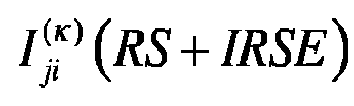
- For high densities, all levels are populated according to Boltzmann and the "0-interaction" case is exact because a Boltzmann hypothesis has been considered for the transition matrix elements


Fig. 3 ) of the present invention which provides immediately a highly corrected non-LTE case.Table 1: Test of convergence of iterations for titanium and for a fixed electronic temperature with four values of electronic densities to cover all regimes from corona, collisional-radiative to Boltzmann. Table 1: Titanium (Z=22) and Te =1 keV Iteration: N° 0 1 2 3 10 Ne = 1.E+10 cm-3 0,993 0,999 0,999 0,999 0,999 Ne = 1.E+20 cm-3 0,978 0,999 0,999 0,999 0,999 Ne = 1.E+23 cm-3 0,957 0,976 0,984 0,988 0,998 Ne = 1.E+25 cm-3 1.000 1.000 1.000 1.000 1.000 - The "0-iteration," case provides already a very high spectroscopic precision. As the 0-iteraction is equivalent to an analytical solution the present invention can directly accelerate transient calculations to spectroscopic precision. Assume that the time dependent evolution of a system is driven by the time dependent plasma parameters ne (t 1) and Te (t1 ). The time tt indicates each time step in the transient simulation. Application of the 0-iteration leads to the following advantageous description. At time step tJ the 0-iteration solution of the present invention provides the populations

Figures 4 ) to be of spectroscopic precision. These populations are used directly for the next time step t i+1 to calculate the transition matrix elements


- Therefore, the present invention will allow further acceleration in transient cases. This will allow for the first time to perform even integrated simulations (hydro, radiation loss and spectral distributions) for very complex cases with spectroscopic precision that had been impossible up to now even for the largest computational resources.
- The present invention of a new atomic physics splitting technique combined with a new split-iteration numerical procedure is for example devoted to the simulation of complex spectral distributions of matter with spectroscopic precision. The procedure enables numerical acceleration by many orders of magnitude and therefore allows to treat even the most complex atomic configurations like multiple excited states, hollow ions, ect. Applications are very wide concerning all type of radiation emission of atoms, ions, molecules, and dense matter with high spectroscopic precision for the spectral distribution and radiation losses.
- The high convergence properties have been proven even for the 0-iteraction thereby providing the possibility to accelerate additionally also numerical transient calculations. This will allow for the first time fully integrated simulations (coupling to hydro and atomic physics) while preserving spectroscopic precision.
- A further outstanding property of the present invention is that at no step the exact solution according to the standard atomic physics theory is requested. Also the convergence is not obtained by refining the atomic system like in standard approaches but just by an additional iteration of the same split atomic system. Therefore even convergence studies do also not need the solution of the exact standard system. Thus is an enormous advantage when attacking problems where the exact atomic system cannot be established even not for a few benchmark simulations.
- It is to be understood that embodiments of the present invention can be implemented in various forms of hardware, software, firmware, special purpose processes, or a combination thereof. In one embodiment, the present invention can be implemented in software as an application program tangible embodied on a computer readable program storage device. The application program can be uploaded to, and executed by, a machine comprising any suitable architecture.
- More precisely,
FIG. 5 is a block diagram of an exemplary computer system for efficiently performing a message passing algorithm. Referring now toFIG. 5 , acomputer system 51 for implementing the present invention can comprise, inter alia, a central processing unit (CPU) 52, amemory 53 and an input/output (I/O)interface 54. Thecomputer system 51 is generally coupled through the I/O interface 54 to adisplay 55 andvarious input devices 56 such as a mouse and a keyboard. The support circuits can include circuits such as cache, power supplies, clock circuits, and a communication bus. Thememory 53 can include random access memory (RAM), read only memory (ROM), disk drive, tape drive, etc., or a combinations thereof. The present invention can be implemented as a routine 57 that is stored inmemory 53 and executed by theCPU 52 to process input data 58 (input data are the transition matrix elements Wxy of the exact atomic system of eqs. 1.3-1.5 which are calculated beforehand, comprising, e.g., the calculations of cross sections and rate coefficients for a large interval of energies and temperatures). As such, thecomputer system 51 is a general purpose computer system that becomes a specific purpose computer system when executing the routine 57 of the present invention. Thecomputer system 51 also includes an operating system and micro instruction code. The various processes and functions described herein can either be part of the micro instruction code or part of the application program (or combination thereof) which is executed via the operating system. In addition, various other peripheral devices can be connected to the computer platform such as an additional data storage device and a printing device. - It is to be further understood that, because some of the constituent system components and method steps depicted in the accompanying figures can be implemented in software, the actual connections between the process steps may differ depending upon the manner in which the present invention is programmed. Given the teachings of the present invention provided herein, one of ordinary skill in the related art will be able to contemplate these and similar implementations or configurations of the present invention.
- The invention allows the reduction of the numerical burden by many orders of magnitudes to calculate non-equilibrium radiative properties with spectroscopic precision. The high convergence properties to the exact solution combined with the fact that the exact equations are never needed in any step of calculations will lead to an important impact in the simulations of the most complex properties of radiation and their technical implementation (computer code programming) of the method.
- Numerous variations and modifications will become apparent to those skilled in the art once the above disclosure is fully appreciated. It is intended that the following claims be interpreted to embrace all such variations and modifications.
Claims (8)
- A method for efficiently determining a complex spectral high resolution distribution of a radiation source by determining populations of matter in atomic levels, the method comprising:using a computer to perform the following:- considering an exact atomic system containing multiple excited levels "j" belonging to M manifolds {α(1)]...{α(M)}, numerous ground and single excited levels "k", and corresponding transition matrix elements,- performing a reduced system RS from the exact atomic system wherein all j-levels belonging to the manifolds {a(1)}...{α(M)} are lumped together to create one level for each manifold {α(β)}, β=1 to M- performing an Independent Recovery System of Equations IRSE containing j recovery systems computed from the exact atomic system, each recovery system comprising, instead of all j levels, a level j and a level mj obtained by lumping together all levels from the manifolds, except the j-level itself,- calculating transition matrix elements Wαjk and Wkαj of RS to determine populations nk of all levels k,- for each recovery system, calculating transition matrix elements Wmjk, Wkmj, Wmjj and Wjmj from nk to determine a non-statistical excited populations nj (κ) of each level j, "κ" being an iteration index ≥0.
- Method according to claim 1, wherein it further comprises iterative steps from index κ =0..i..i,max, "imax" being the number of iterations of:- inserting simultaneously into RS and IRSE the non-statistical excited populations
 - refining calculation of transition matrix elements Wαjk and W kαj of RS from the non-statistical excited populations
 - refining calculation of transition matrix elements Wmjk' Wkmj, Wmjj and Wjmj of IRSE from the non-statistical excited populations
- Method according to claim 2, wherein after each iteration, the method further comprises determining if the non-statistical excited populations nj (i-1) have converged.
- Method according to claim 3, wherein the method further comprises considering numerical values of

- Method according to any of preceding claims, wherein during the calculation of transition matrix elements Wmjk, Wkmj, Wmjj and Wjmj , the method further comprises determining weather the matrix elements and the level mj have converged.
- Method according to any of preceding claims, wherein the iteration is accelerated by calculating refined populations


- Method according to any preceding claims, wherein transition matrix elements Wjk and Wkj of RS are known from pure atomic physics calculations beforehand as no level lumping and populations are involved.
- A non-transitory computer-readable storage medium encoded with computer-executable instructions which, when executed, perform a method for determining complex spatial distribution of a radiation source by determining populations of matter in atomic levels, the method comprising the steps of:- considering an exact atomic system containing multiple excited levels "j" belonging to M manifolds {α(1)}...{α( M )}, numerous ground and single excited levels "k", and corresponding transition matrix elements,- performing a reduced system RS from the exact atomic system wherein all j-levels belonging to the manifolds {α(1)}...{α( M )} are lumped together to create one level for each manifold {α(β)}, β=1 to M- performing an Independent Recovery System of Equations IRSE containing j recovery systems computed from the exact atomic system, each recovery system comprising, instead of all j levels, a level j and a level mj obtained by lumping together all levels from the manifolds, except the j-level itself,- calculating transition matrix elements W αjk and Wkαj of RS to determine populations nk of all levels k,- for each recovery system, calculating transition matrix elements Wmjk , Wkmj , Wmjj and Wjmj from nk to determine a non-statistical excited populations nj (κ) of each level j, "κ" being an iteration index ≥0.
Priority Applications (2)
| Application Number | Priority Date | Filing Date | Title |
|---|---|---|---|
| EP12305392.8A EP2645280A1 (en) | 2012-03-30 | 2012-03-30 | A rapidly converging atomic physics method and medium to calculate complex non-equilibrium radiative properties of matter with spectroscopic precision. |
| PCT/EP2013/056428 WO2013144155A2 (en) | 2012-03-30 | 2013-03-26 | A rapidly converging atomic physics method and medium to calculate complex non-equilibrium radiative properties of matter with spectroscopic precision |
Applications Claiming Priority (1)
| Application Number | Priority Date | Filing Date | Title |
|---|---|---|---|
| EP12305392.8A EP2645280A1 (en) | 2012-03-30 | 2012-03-30 | A rapidly converging atomic physics method and medium to calculate complex non-equilibrium radiative properties of matter with spectroscopic precision. |
Publications (1)
| Publication Number | Publication Date |
|---|---|
| EP2645280A1 true EP2645280A1 (en) | 2013-10-02 |
Family
ID=48190913
Family Applications (1)
| Application Number | Title | Priority Date | Filing Date |
|---|---|---|---|
| EP12305392.8A Withdrawn EP2645280A1 (en) | 2012-03-30 | 2012-03-30 | A rapidly converging atomic physics method and medium to calculate complex non-equilibrium radiative properties of matter with spectroscopic precision. |
Country Status (2)
| Country | Link |
|---|---|
| EP (1) | EP2645280A1 (en) |
| WO (1) | WO2013144155A2 (en) |
Families Citing this family (2)
| Publication number | Priority date | Publication date | Assignee | Title |
|---|---|---|---|---|
| CN114996970B (en) * | 2022-07-07 | 2025-05-02 | 中国原子能科学研究院 | Method and system for simulating the process of irradiation defect generation |
| CN116312838B (en) * | 2023-03-30 | 2025-11-21 | 西安电子科技大学 | Method, system, equipment and medium for measuring CN ultraviolet spectrum radiation characteristics in unbalanced flow |
-
2012
- 2012-03-30 EP EP12305392.8A patent/EP2645280A1/en not_active Withdrawn
-
2013
- 2013-03-26 WO PCT/EP2013/056428 patent/WO2013144155A2/en not_active Ceased
Non-Patent Citations (9)
| Title |
|---|
| "Free Electron Lasers", 14 March 2012, INTECH, ISBN: 978-9-53-510279-3, article ROSMEJ F. B.: "Exotic States of High Density Matter Driven by Intense XUV/X-Ray Free Electron Lasers", pages: 187 - 212, XP055036960 * |
| A. BAR-SHALOM, J. OREG |
| A. BURGESS, ASTROPHYS. JOURNAL, vol. 139, 1964, pages 776 |
| H.R. GRIEM: "Principles of Plasma Spectroscopy", 1997, CAMBRIDGE UNIVERSITY PRESS |
| M.F. GU: "The flexible atomic code FAC", CANADIAN JOURNAL OF PHYSICS, vol. 86, no. 5, 2008, pages 675 |
| R.D. COWAN: "The Theory of Atomic Structure and Spectra", 1981, UNIVERSITY OF CALIFORNIA PRESS |
| ROSMEJ F. B. ET AL: "Broadening and intensity properties of complex autoionizing states", JOURNAL OF QUANTITATIVE SPECTROSCOPY AND RADIATIVE TRANSFER, ELSEVIER SCIENCE, OXFORD, GB, vol. 99, no. 1-3, 1 May 2006 (2006-05-01), pages 548 - 559, XP028049574, ISSN: 0022-4073, [retrieved on 20060501], DOI: 10.1016/J.JQSRT.2005.05.044 * |
| ROSMEJ F. B.: "An alternative method to determine atomic radiative emission", EUROPHYSICS LETTERS: A LETTERS JOURNAL EXPLORING THE FRONTIERS OF PHYSICS, INSTITUTE OF PHYSICS PUBLISHING, BRISTOL, FR, vol. 76, no. 6, 1 December 2006 (2006-12-01), pages 1081 - 1087, XP020099068, ISSN: 0295-5075, DOI: 10.1209/EPL/I2006-10382-3 * |
| W.H. GOLDSTEIN; D. SHVARTS; A. ZIGLER, PHYS. REV., vol. A 40, 1989, pages 3183 |
Also Published As
| Publication number | Publication date |
|---|---|
| WO2013144155A3 (en) | 2014-01-16 |
| WO2013144155A2 (en) | 2013-10-03 |
Similar Documents
| Publication | Publication Date | Title |
|---|---|---|
| Hasegawa et al. | MeV-scale reheating temperature and thermalization of oscillating neutrinos by radiative and hadronic decays of massive particles | |
| Mansbach et al. | Monte Carlo trajectory calculations of atomic excitation and ionization by thermal electrons | |
| Kisiel et al. | Pion, kaon, and proton femtoscopy in Pb-Pb collisions at s NN= 2.76 TeV modeled in (3+ 1) D hydrodynamics | |
| Hall et al. | The weak scale from BBN | |
| Heiter et al. | Production and propagation of ultra-high energy photons using CRPropa 3 | |
| Calisti et al. | Dynamic Stark broadening as the Dicke narrowing effect | |
| Xu et al. | Comparing pion production in transport simulations of heavy-ion collisions at 270 A MeV under controlled conditions | |
| Carlisle | Step IV of the Muon Ionization Cooling Experiment (MICE) and the multiple scattering of muons | |
| Surzhykov et al. | Radiative electron capture into high-Z few-electron ions: Alignment of the excited ionic states | |
| Buyadzhi et al. | Advanced quantum approach in radiative and collisional spectroscopy of multicharged ions in plasmas | |
| Fang et al. | β-decay properties for neutron-rich Kr–Tc isotopes from deformed pn-quasiparticle random-phase approximation calculations with realistic forces | |
| Werner et al. | Heavy ion collisions from s NN of 62.4 GeV down to 7.7 GeV in the EPOS4 framework | |
| Barata et al. | Nonlocal high-pt transport in anisotropic QCD matter | |
| Shilkov | Generalized multigroup approximation and Lebesgue averaging method in particle transport problems | |
| Hasan | Shell model calculations for 18, 19, 20O isotopes by using USDA and USDB interactions | |
| INDRA Collaboration et al. | Thermal and chemical equilibrium for vaporizing sources | |
| Ali-Haïmoud et al. | Radiative transfer effects in primordial hydrogen recombination | |
| Rzesa et al. | Femtoscopy analysis of ultrasoft pion trap at energies available at the CERN Large Hadron Collider | |
| WO2013144155A2 (en) | A rapidly converging atomic physics method and medium to calculate complex non-equilibrium radiative properties of matter with spectroscopic precision | |
| Shaikhislamov et al. | Aeronomy of the upper atmosphere of KELT-9 b | |
| Dzhioev et al. | Superoperator Approach to The Theory of Hot Nuclei and Astrophysical Applications: II—Electron Capture in Stars | |
| Musulmanbekov et al. | Fragmentation of nuclei at intermediate and high energies in modified cascade model | |
| Bettadj et al. | Polarization of the Lyman line emission following radiative recombination of bare ions: effects of relativity and radiation multipoles | |
| Olimov et al. | Monte Carlo modeling of production of three alpha-particles in low energy n+ 1 2 C interactions | |
| Zlochower et al. | Inspiraling black-hole binary spacetimes: Challenges in transitioning from analytical to numerical techniques |
Legal Events
| Date | Code | Title | Description |
|---|---|---|---|
| PUAI | Public reference made under article 153(3) epc to a published international application that has entered the european phase |
Free format text: ORIGINAL CODE: 0009012 |
|
| AK | Designated contracting states |
Kind code of ref document: A1 Designated state(s): AL AT BE BG CH CY CZ DE DK EE ES FI FR GB GR HR HU IE IS IT LI LT LU LV MC MK MT NL NO PL PT RO RS SE SI SK SM TR |
|
| AX | Request for extension of the european patent |
Extension state: BA ME |
|
| 17P | Request for examination filed |
Effective date: 20140331 |
|
| RAX | Requested extension states of the european patent have changed |
Extension state: BA Payment date: 20140331 Extension state: ME Payment date: 20140331 |
|
| RBV | Designated contracting states (corrected) |
Designated state(s): AL AT BE BG CH CY CZ DE DK EE ES FI FR GB GR HR HU IE IS IT LI LT LU LV MC MK MT NL NO PL PT RO RS SE SI SK SM TR |
|
| STAA | Information on the status of an ep patent application or granted ep patent |
Free format text: STATUS: REQUEST FOR EXAMINATION WAS MADE |
|
| STAA | Information on the status of an ep patent application or granted ep patent |
Free format text: STATUS: THE APPLICATION IS DEEMED TO BE WITHDRAWN |
|
| 18D | Application deemed to be withdrawn |
Effective date: 20171003 |