EP2645234A1 - Electronic device - Google Patents
Electronic device Download PDFInfo
- Publication number
- EP2645234A1 EP2645234A1 EP13157602.7A EP13157602A EP2645234A1 EP 2645234 A1 EP2645234 A1 EP 2645234A1 EP 13157602 A EP13157602 A EP 13157602A EP 2645234 A1 EP2645234 A1 EP 2645234A1
- Authority
- EP
- European Patent Office
- Prior art keywords
- display module
- display
- module
- electronic device
- computing module
- Prior art date
- Legal status (The legal status is an assumption and is not a legal conclusion. Google has not performed a legal analysis and makes no representation as to the accuracy of the status listed.)
- Ceased
Links
Images

Classifications
-
- G—PHYSICS
- G09—EDUCATION; CRYPTOGRAPHY; DISPLAY; ADVERTISING; SEALS
- G09G—ARRANGEMENTS OR CIRCUITS FOR CONTROL OF INDICATING DEVICES USING STATIC MEANS TO PRESENT VARIABLE INFORMATION
- G09G5/00—Control arrangements or circuits for visual indicators common to cathode-ray tube indicators and other visual indicators
- G09G5/003—Details of a display terminal, the details relating to the control arrangement of the display terminal and to the interfaces thereto
- G09G5/005—Adapting incoming signals to the display format of the display terminal
-
- G—PHYSICS
- G06—COMPUTING OR CALCULATING; COUNTING
- G06F—ELECTRIC DIGITAL DATA PROCESSING
- G06F3/00—Input arrangements for transferring data to be processed into a form capable of being handled by the computer; Output arrangements for transferring data from processing unit to output unit, e.g. interface arrangements
- G06F3/14—Digital output to display device ; Cooperation and interconnection of the display device with other functional units
- G06F3/147—Digital output to display device ; Cooperation and interconnection of the display device with other functional units using display panels
-
- G—PHYSICS
- G06—COMPUTING OR CALCULATING; COUNTING
- G06F—ELECTRIC DIGITAL DATA PROCESSING
- G06F3/00—Input arrangements for transferring data to be processed into a form capable of being handled by the computer; Output arrangements for transferring data from processing unit to output unit, e.g. interface arrangements
- G06F3/01—Input arrangements or combined input and output arrangements for interaction between user and computer
- G06F3/03—Arrangements for converting the position or the displacement of a member into a coded form
- G06F3/041—Digitisers, e.g. for touch screens or touch pads, characterised by the transducing means
- G06F3/0412—Digitisers structurally integrated in a display
Definitions
- the invention relates to an electronic device and, more particularly, to an electronic device including a display module.
- PC personal computers
- a desktop PC is produced first.
- the desktop PC is heavy and not portable.
- a notebook PC and a tablet PC which are portable are developed.
- the tablet computer is convenient in using.
- the user can put the tablet computer on a desk or legs, and operate it with fingers or a stylus instead of a keyboard or a mouse.
- the tablet computer is light and easy to operate, it is poor in data processing due to a size limitation.
- An electronic device includes a computing module and a display module.
- the computing module executes a first operating system.
- the display module is detachably connected to the computing module. When the display module is in a connection area to connect with the computing module, the display module displays an image of the first operating system, and when the display module is outside the connection area, the display module executes a second operating system and displays an image of the second operating system.
- the electronic device drives the computing module to process data, and makes the display module to assist the computing module, so the limitation of processing capability of the display module can be solved under its light and small feature, and improve its convenience greatly.
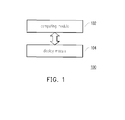
- FIG. 1 is a schematic diagram showing an electronic device in a first embodiment
- FIG. 2 is a schematic diagram showing an electronic device in a second embodiment.
- FIG. 1 is a schematic diagram showing an electronic device in a first embodiment.
- the electronic device 100 includes a computing module 102 and a display module 104.
- the computing module 102 may be a computer host, and the display module 104 may be a tablet computer or a smart mobile phone, which is not limited herein.
- the computing module 102 executes a first operating system, such as Linux or Windows.
- the display module 104 is detachably connected to the computing module 102, and when the display module 104 is connected to the computing module 102, the electronic device 100 can be regarded as a desktop computer or a notebook computer.
- the display module 104 When the display module 104 is detached from the computing module 102 and in a connection area with the computing module 102, the display module 104 continuously receives display data from the computing module 102 to display an image of the first operating system.
- connection between the display module 104 and the computing module 102 when they are detached may be achieved via bluetooth, wireless fidelity (Wi-Fi) or worldwide interoperability for microwave access (WiMAX), which is not limited herein.
- Wi-Fi wireless fidelity
- WiMAX worldwide interoperability for microwave access
- the display module 104 When the display module 104 is in the connection area with the computing module 102, the display module 104 receives an input from the user and outputs a corresponding control command to the computing module 102 to remotely control the computing module 102.
- the display module 104 executes a second operating system and displays an image of the second operating system.
- the second operating system may be a Symbian operation system or an Android operation system, which is not limited herein..
- the display module 104 when the display module 104 is outside the connection area with the computing module 102, it can process the data stored in the display module 104. For example, if the display module 104 is in the connection area, the user uses the computing module 102 to edit a document and transmit it to the display module 104 for storing and displaying. If the display module 104 is moved out of the connection area before the document editing is finished, the user can continue editing in the second operating system according the document stored in the display module 104 after the display module 104 is switched to the second operating system.
- the display module 104 When the display module 104 is in the connection area, the display module 104 can also be switched to the second operating system according to an input of the user. Additionally, when the display module 104 enters the connection area from the outside, the display module 104 pops up a switch massage to ask the user whether to switch the display module to the first operating system or to keep executing the second operating system.
- the electronic device 100 processes data via the computing module 102, and the display module 104 executes display functions. Consequently, the limitation of processing capability of the display module 104 can be solved under its light and small feature.
- the display module 104 is switched to the second operating system, which improves the convenience of the electronic device 100 in usage.
- the computing module 102 can not only be connected to the display module 104, the computing module 102 but also can be connected to a peripheral display module (not shown) to display the image of the first operating system, which enhances the applicability of the electronic device 100.
- the display module may be a projector, and in a classroom, a teacher may hold the display module 104 to remotely control the computing module 102 and project teaching contents via the projector.
- FIG. 2 is a schematic diagram showing an electronic device in a second embodiment.
- the computing module 102 includes a first processing unit 202A, a first memory unit 204A, a first input unit 206A, a first communication unit 208A, a first connecting interface 210A and a first power supply unit 212A.
- the first processing unit 202A is coupled to the first memory unit 204A, the first input unit 206A and the first communication unit 208A
- the first power supply unit 212A is coupled to the first processing unit 202A, the first memory unit 204A, the first input unit 206A and the first communication unit 208A (the coupling connection therebetween is not shown for a concise purpose).
- the first memory unit 204A stores the first operating system, and the first processing unit 202A executes the first operating system.
- the first input unit 206A receives the input signal to control the first processing unit 202A to execute corresponding operations, and the first input unit 206A may be a keyboard, a mouse or a touch control panel.
- the first communication unit 208A transmits the display data to the display module 104 and receives a control command from the display module 104, and the first processing unit 202A executes corresponding operations according to the control command.
- the first power supply unit 212A provides power to the first processing unit 202A, the first memory unit 204A, the first input unit 206A and the first communication unit 208A.
- the display module 104 includes a second processing unit 202B, a second memory unit 204B, a second input unit 206B, a second communication unit 208B, a second connecting interface 210B, a second power supply unit 212B and a display unit 214.
- the second processing unit 202B is coupled to the second memory unit 204B, the second input unit 206B, the second communication unit 208B, the second power supply unit 212B and the display unit 214
- the second power supply unit 212B is coupled to the second processing unit 202B, the second memory unit 204B, the second input unit 206B, the second communication unit 208B, the second power supply unit 212B and the display unit 214 (the coupling connection therebetween is not shown for a concise purpose).
- the second processing unit 202B executes the second operating system and controls the display unit 214 to display an image according to the display data.
- the second input unit 206B receives the input signal to control the second processing unit 202B to execute corresponding application programs or output the corresponding control command to the computing module 102, and the second input unit 206B may be a display touch control panel.
- the second communication unit 208B further detects whether the connection between the display module 104 and the computing module 102 is normal, and it receives the display data from the computing module 102, and the display unit 214 displays an image according to the display data.
- the second memory unit 204B stores the second operating system, and temporarily stores data (such as an editing document) received from the computing module in a latest predetermined time.
- the second power supply unit 212B provides power to the second processing unit 202B, the second memory unit 204B, the second input unit 206B, the second communication unit 208B and the display unit 214.
- the second connecting interface 210B is connected to the first connecting interface 210A, so as to electrically connect the display module 104 to the computing module 102. Furthermore, the display module 104 transmits data to the computing module 102 via the first connecting interface 210A and the second connecting interface 210B.
- the first connecting interface 210A may be fastened to the second connecting interface 210B, which is not limited herein.
- the second processing unit 202B detects a connection state between the display module 104 and the computing module 102 according to the second communication unit 208B, and determines whether the display module 104 is in the connection area to connect with the computing module 102.
- the second processing unit 202B controls the display unit 214 to display an image of the first operating system according to the display data received by the second communication unit 208B, or controls the second communication unit 208B to transmit the control command to the first communication unit 208A according to an input of the user, and the first processing unit 202A executes corresponding operations according to the control command.
- the second processing unit 202B further switches the display module 104 to the second operating system according to an input of the user.
- the second processing unit 202B executes the second operating system. For example, the second processing unit 202B processes data temporarily stored in the second memory unit 204B and received from the computing module in a latest predetermined time. Moreover, when the display module 104 enters the connection area from the outside, the second processing unit 202B controls the display unit 214 to display a switch massage to ask the user whether to switch the display module 104 to the first operating system or continue executing the second operating system.
- the computing module executes data processing, and the display module displays an image.
- the display module executes the second operating system, and greatly improves the convenience of the electronic device in usage.
- the computing module may also be connected to another display module to display the image simultaneously, which enhances the applicability of the electronic device.
Landscapes
- Engineering & Computer Science (AREA)
- Theoretical Computer Science (AREA)
- Physics & Mathematics (AREA)
- General Engineering & Computer Science (AREA)
- General Physics & Mathematics (AREA)
- Human Computer Interaction (AREA)
- Computer Hardware Design (AREA)
- Digital Computer Display Output (AREA)
- Controls And Circuits For Display Device (AREA)
Abstract
Description
- This application claims the priority benefit of Taiwan application serial No.
61/615887, filed on March 27, 2012 - The invention relates to an electronic device and, more particularly, to an electronic device including a display module.
- With information explosion, electronic products become necessary in daily life. As electric science technology develops, electronic devices have more innovations to be user friendly and have more functions.
- In the development history of personal computers (PC), a desktop PC is produced first. However, the desktop PC is heavy and not portable. Thus, a notebook PC and a tablet PC which are portable are developed.
- The tablet computer is convenient in using. The user can put the tablet computer on a desk or legs, and operate it with fingers or a stylus instead of a keyboard or a mouse.
- Although the tablet computer is light and easy to operate, it is poor in data processing due to a size limitation.
- An electronic device includes a computing module and a display module. The computing module executes a first operating system. The display module is detachably connected to the computing module. When the display module is in a connection area to connect with the computing module, the display module displays an image of the first operating system, and when the display module is outside the connection area, the display module executes a second operating system and displays an image of the second operating system.
- As stated above, the electronic device drives the computing module to process data, and makes the display module to assist the computing module, so the limitation of processing capability of the display module can be solved under its light and small feature, and improve its convenience greatly.
- These and other features, aspects and advantages of the present invention will become better understood with regard to the following description, appended claims, and accompanying drawings.
-
FIG. 1 is a schematic diagram showing an electronic device in a first embodiment; and -
FIG. 2 is a schematic diagram showing an electronic device in a second embodiment. -
FIG. 1 is a schematic diagram showing an electronic device in a first embodiment. Please refer toFIG. 1 , theelectronic device 100 includes acomputing module 102 and adisplay module 104. Thecomputing module 102 may be a computer host, and thedisplay module 104 may be a tablet computer or a smart mobile phone, which is not limited herein. - The
computing module 102 executes a first operating system, such as Linux or Windows. Thedisplay module 104 is detachably connected to thecomputing module 102, and when thedisplay module 104 is connected to thecomputing module 102, theelectronic device 100 can be regarded as a desktop computer or a notebook computer. - When the
display module 104 is detached from thecomputing module 102 and in a connection area with thecomputing module 102, thedisplay module 104 continuously receives display data from thecomputing module 102 to display an image of the first operating system. - The "connection" between the
display module 104 and thecomputing module 102 when they are detached may be achieved via bluetooth, wireless fidelity (Wi-Fi) or worldwide interoperability for microwave access (WiMAX), which is not limited herein. - When the
display module 104 is in the connection area with thecomputing module 102, thedisplay module 104 receives an input from the user and outputs a corresponding control command to thecomputing module 102 to remotely control thecomputing module 102. - When the
display module 104 is outside the connection area, thedisplay module 104 executes a second operating system and displays an image of the second operating system. The second operating system may be a Symbian operation system or an Android operation system, which is not limited herein.. - Moreover, when the
display module 104 is outside the connection area with thecomputing module 102, it can process the data stored in thedisplay module 104. For example, if thedisplay module 104 is in the connection area, the user uses thecomputing module 102 to edit a document and transmit it to thedisplay module 104 for storing and displaying. If thedisplay module 104 is moved out of the connection area before the document editing is finished, the user can continue editing in the second operating system according the document stored in thedisplay module 104 after thedisplay module 104 is switched to the second operating system. - When the
display module 104 is in the connection area, thedisplay module 104 can also be switched to the second operating system according to an input of the user. Additionally, when thedisplay module 104 enters the connection area from the outside, thedisplay module 104 pops up a switch massage to ask the user whether to switch the display module to the first operating system or to keep executing the second operating system. - As stated above, when the
display module 104 is in the connection area with thecomputing module 102, theelectronic device 100 processes data via thecomputing module 102, and thedisplay module 104 executes display functions. Consequently, the limitation of processing capability of thedisplay module 104 can be solved under its light and small feature. When thedisplay module 104 is outside the connection area, thedisplay module 104 is switched to the second operating system, which improves the convenience of theelectronic device 100 in usage. - Moreover, the
computing module 102 can not only be connected to thedisplay module 104, thecomputing module 102 but also can be connected to a peripheral display module (not shown) to display the image of the first operating system, which enhances the applicability of theelectronic device 100. For example, the display module may be a projector, and in a classroom, a teacher may hold thedisplay module 104 to remotely control thecomputing module 102 and project teaching contents via the projector. -
FIG. 2 is a schematic diagram showing an electronic device in a second embodiment. In the embodiment, thecomputing module 102 includes afirst processing unit 202A, afirst memory unit 204A, afirst input unit 206A, afirst communication unit 208A, a first connectinginterface 210A and a firstpower supply unit 212A. Thefirst processing unit 202A is coupled to thefirst memory unit 204A, thefirst input unit 206A and thefirst communication unit 208A, and the firstpower supply unit 212A is coupled to thefirst processing unit 202A, thefirst memory unit 204A, thefirst input unit 206A and thefirst communication unit 208A (the coupling connection therebetween is not shown for a concise purpose). - The
first memory unit 204A stores the first operating system, and thefirst processing unit 202A executes the first operating system. Thefirst input unit 206A receives the input signal to control thefirst processing unit 202A to execute corresponding operations, and thefirst input unit 206A may be a keyboard, a mouse or a touch control panel. Thefirst communication unit 208A transmits the display data to thedisplay module 104 and receives a control command from thedisplay module 104, and thefirst processing unit 202A executes corresponding operations according to the control command. The firstpower supply unit 212A provides power to thefirst processing unit 202A, thefirst memory unit 204A, thefirst input unit 206A and thefirst communication unit 208A. - The
display module 104 includes asecond processing unit 202B, asecond memory unit 204B, asecond input unit 206B, asecond communication unit 208B, asecond connecting interface 210B, a secondpower supply unit 212B and adisplay unit 214. Thesecond processing unit 202B is coupled to thesecond memory unit 204B, thesecond input unit 206B, thesecond communication unit 208B, the secondpower supply unit 212B and thedisplay unit 214, and the secondpower supply unit 212B is coupled to thesecond processing unit 202B, thesecond memory unit 204B, thesecond input unit 206B, thesecond communication unit 208B, the secondpower supply unit 212B and the display unit 214 (the coupling connection therebetween is not shown for a concise purpose). - The
second processing unit 202B executes the second operating system and controls thedisplay unit 214 to display an image according to the display data. Thesecond input unit 206B receives the input signal to control thesecond processing unit 202B to execute corresponding application programs or output the corresponding control command to thecomputing module 102, and thesecond input unit 206B may be a display touch control panel. - The
second communication unit 208B further detects whether the connection between thedisplay module 104 and thecomputing module 102 is normal, and it receives the display data from thecomputing module 102, and thedisplay unit 214 displays an image according to the display data. Thesecond memory unit 204B stores the second operating system, and temporarily stores data (such as an editing document) received from the computing module in a latest predetermined time. - The second
power supply unit 212B provides power to thesecond processing unit 202B, thesecond memory unit 204B, thesecond input unit 206B, thesecond communication unit 208B and thedisplay unit 214. The second connectinginterface 210B is connected to thefirst connecting interface 210A, so as to electrically connect thedisplay module 104 to thecomputing module 102. Furthermore, thedisplay module 104 transmits data to thecomputing module 102 via the first connectinginterface 210A and the second connectinginterface 210B. The first connectinginterface 210A may be fastened to the second connectinginterface 210B, which is not limited herein. - The
second processing unit 202B detects a connection state between thedisplay module 104 and thecomputing module 102 according to thesecond communication unit 208B, and determines whether thedisplay module 104 is in the connection area to connect with thecomputing module 102. - As stated above, when the
display module 104 in the connection area, thesecond processing unit 202B controls thedisplay unit 214 to display an image of the first operating system according to the display data received by thesecond communication unit 208B, or controls thesecond communication unit 208B to transmit the control command to thefirst communication unit 208A according to an input of the user, and thefirst processing unit 202A executes corresponding operations according to the control command. Thesecond processing unit 202B further switches thedisplay module 104 to the second operating system according to an input of the user. - When the
display module 104 is outside the connection area, thesecond processing unit 202B executes the second operating system. For example, thesecond processing unit 202B processes data temporarily stored in thesecond memory unit 204B and received from the computing module in a latest predetermined time. Moreover, when thedisplay module 104 enters the connection area from the outside, thesecond processing unit 202B controls thedisplay unit 214 to display a switch massage to ask the user whether to switch thedisplay module 104 to the first operating system or continue executing the second operating system. - In sum, when the display module is in the connection area to connect with the computing module, the computing module executes data processing, and the display module displays an image.
- When the display module is outside the connection area, the display module executes the second operating system, and greatly improves the convenience of the electronic device in usage. Furthermore, the computing module may also be connected to another display module to display the image simultaneously, which enhances the applicability of the electronic device.
- Although the present invention has been described in considerable detail with reference to certain preferred embodiments thereof, the disclosure is not for limiting the scope. Persons having ordinary skill in the art may make various modifications and changes without departing from the scope. Therefore, the scope of the appended claims should not be limited to the description of the preferred embodiments described above.
Claims (13)
- An electronic device (100), comprising:a computing module (102) executing a first operating system; anda display module (104) detachably connected to the computing module (102), wherein when the display module (104) is in a connection area to connect with the computing module (102), the display module (104) displays an image of the first operating system, and when the display module (104) is outside the connection area, the display module (104) executes a second operating system and displays an image of the second operating system.
- The electronic device (100) according to claim 1, wherein when the display module (104) is in the connection area, the display module (104) further receives an input signal and outputs a control command to the computing module (102) to control the computing module (102) to execute a corresponding operation.
- The electronic device (100) according to claim 1, wherein the display module (104) in the connection area, the display module (104) further receives an input signal to switch to the second operating system.
- The electronic device (100) according to claim 1, wherein the computing module (102) is further connected to a peripheral display module and transmits display data to the peripheral display module to display an image of the first operating system.
- The electronic device (100) according to claim 1, wherein the computing module (102) includes:a first memory unit (204A) storing the first operating system; anda first input unit (206A) receiving an input signal to control the computing module (102) to execute a corresponding operation.
- The electronic device (100) according to claim 1, wherein the computing module (102) includes:a first communication unit (208A) transmitting display data to the display module (104) and receiving a control command from the display module (104), wherein the computing module (102) executes a corresponding operation according to the control command.
- The electronic device (100) according to claim 1, wherein the computing module (102) includes:a first connecting interface (210A), wherein the computing module (102) is electrically connected to the display module (104) via the first connecting interface (210A).
- The electronic device (100) according to claim 1, wherein the display module (104) includes:a second memory unit (204B) storing the second operating system and data received from the computing module (102) in a latest predetermined time temporarily; anda second input unit (206B) receiving an input signal to control the display module (104) to execute a corresponding application program or output a corresponding control command to the computing module (102).
- The electronic device (100) according to claim 8, wherein the second input unit (206B) is a display touch control panel.
- The electronic device (100) according to claim 8, wherein the display module (104) includes:a second communication unit (208B) receiving display data from the computing module (102); anda display unit (214) displaying an image according to the display data.
- The electronic device (100) according to claim 10, wherein the second communication unit (208B) further detects whether the connection between the display module (104) and the computing module (102) is normal, and the display module (104) determines whether the display module (104) is in the connection area according to a detecting result of the second communication unit (208B).
- The electronic device (100) according to claim 10, wherein the display module (104) includes:a second power supply unit (212B) coupled to the second input unit (206B), the second communication unit (208B), the second memory unit (204B) and the display unit (214).
- The electronic device (100) according to claim 1, wherein the display module (104) includes:a second connecting interface (210B), wherein the display module (104) is electrically connected to the computing module (102) via the second connecting interface (210B).
Applications Claiming Priority (2)
| Application Number | Priority Date | Filing Date | Title |
|---|---|---|---|
| US201261615887P | 2012-03-27 | 2012-03-27 | |
| TW101135365A TWI540500B (en) | 2012-03-27 | 2012-09-26 | Electronic device |
Publications (1)
| Publication Number | Publication Date |
|---|---|
| EP2645234A1 true EP2645234A1 (en) | 2013-10-02 |
Family
ID=47877813
Family Applications (1)
| Application Number | Title | Priority Date | Filing Date |
|---|---|---|---|
| EP13157602.7A Ceased EP2645234A1 (en) | 2012-03-27 | 2013-03-04 | Electronic device |
Country Status (2)
| Country | Link |
|---|---|
| US (1) | US20130257763A1 (en) |
| EP (1) | EP2645234A1 (en) |
Families Citing this family (2)
| Publication number | Priority date | Publication date | Assignee | Title |
|---|---|---|---|---|
| TWI518486B (en) * | 2013-11-14 | 2016-01-21 | 仁寶電腦工業股份有限公司 | charger |
| CN105843676B (en) * | 2015-01-12 | 2019-05-21 | 华硕电脑股份有限公司 | Electronic system and operating system switching method |
Citations (3)
| Publication number | Priority date | Publication date | Assignee | Title |
|---|---|---|---|---|
| US6671756B1 (en) * | 1999-05-06 | 2003-12-30 | Avocent Corporation | KVM switch having a uniprocessor that accomodate multiple users and multiple computers |
| GB2470625A (en) * | 2009-05-28 | 2010-12-01 | Inst Information Industry | Combinable computer devices |
| US20120166851A1 (en) * | 2010-12-24 | 2012-06-28 | Lenovo (Singapore) Pte. Ltd., Singapore | Systems and methods for sharing a wireless antenna in a hybrid environment |
Family Cites Families (3)
| Publication number | Priority date | Publication date | Assignee | Title |
|---|---|---|---|---|
| US8190564B2 (en) * | 2010-02-25 | 2012-05-29 | Ebay, Inc. | Temporary session data storage |
| US8909838B2 (en) * | 2010-06-24 | 2014-12-09 | Microsoft Corporation | Detachable computer with variable performance computing environment |
| US8682962B2 (en) * | 2010-12-24 | 2014-03-25 | Levono (Singapore) Pte. Ltd. | Systems and methods for communicating and switching between components in a hybrid computing environment |
-
2013
- 2013-03-04 EP EP13157602.7A patent/EP2645234A1/en not_active Ceased
- 2013-03-04 US US13/783,397 patent/US20130257763A1/en not_active Abandoned
Patent Citations (3)
| Publication number | Priority date | Publication date | Assignee | Title |
|---|---|---|---|---|
| US6671756B1 (en) * | 1999-05-06 | 2003-12-30 | Avocent Corporation | KVM switch having a uniprocessor that accomodate multiple users and multiple computers |
| GB2470625A (en) * | 2009-05-28 | 2010-12-01 | Inst Information Industry | Combinable computer devices |
| US20120166851A1 (en) * | 2010-12-24 | 2012-06-28 | Lenovo (Singapore) Pte. Ltd., Singapore | Systems and methods for sharing a wireless antenna in a hybrid environment |
Non-Patent Citations (2)
| Title |
|---|
| ANONYMOUS: "HDMI31 owner's manual", 23 January 2010 (2010-01-23), XP002696254, Retrieved from the Internet <URL:http://www.voxxintlcorp.com/docs/common/HDMI31/HDMI31_OM.pdf> [retrieved on 20130425] * |
| ANONYMOUS: "Wireless KVM Switches let you securely extend your Computers without the need to run cabling", 26 December 2011 (2011-12-26), XP002696255, Retrieved from the Internet <URL:web.archive.org/web/20111226192410/http://www.42u.com/wireless-kvm-switches.htm> [retrieved on 20130426] * |
Also Published As
| Publication number | Publication date |
|---|---|
| US20130257763A1 (en) | 2013-10-03 |
Similar Documents
| Publication | Publication Date | Title |
|---|---|---|
| JP5469652B2 (en) | USB device providing input interface and interface providing method thereof | |
| US10845880B2 (en) | Method, device, and computer-readable medium for controlling tactile interface device interacting with user | |
| US20130002573A1 (en) | Information processing apparatus and a method for controlling the same | |
| US20140355189A1 (en) | Electronic Device and Input Control Method | |
| KR20150057645A (en) | Electronic apparatus, docking apparatus, method of controlling thereof and computer-readable recording medium | |
| KR20190069877A (en) | Electronic device and method for controlling input thereof | |
| CN102662556A (en) | Control method, apparatus and system for computer terminal | |
| US9842589B2 (en) | Voice input device, voice input method and program | |
| CN103207698B (en) | Touch display, method for switching operation mode of touch display and computer system | |
| TWI540500B (en) | Electronic device | |
| US8819584B2 (en) | Information processing apparatus and image display method | |
| US20150245447A1 (en) | Electronic blackboard apparatus displaying an image in accordance with received operational input | |
| US20150081930A1 (en) | Tablet computer | |
| US11762501B2 (en) | Information processing apparatus and control method | |
| CN112783267A (en) | Information processing apparatus, information processing method, and computer program | |
| US20130257763A1 (en) | Electronic device | |
| KR101624178B1 (en) | Portable computer system and method to switch operating system using hotkey | |
| US20190302952A1 (en) | Mobile device, computer input system and computer readable storage medium | |
| US20140180698A1 (en) | Information processing apparatus, information processing method and storage medium | |
| US20180314353A1 (en) | Electronic device and operating method thereof | |
| WO2015096129A1 (en) | Apparatus, system and article for smart card device and associated host device | |
| US20150351144A1 (en) | Wireless transmission apparatus and implementation method thereof | |
| CN105843676A (en) | Electronic system and operating system switching method | |
| JP2015022410A (en) | Multi-mode input system and information processing system | |
| US20140145960A1 (en) | Electronic apparatus, display processing program and display processing method |
Legal Events
| Date | Code | Title | Description |
|---|---|---|---|
| PUAI | Public reference made under article 153(3) epc to a published international application that has entered the european phase |
Free format text: ORIGINAL CODE: 0009012 |
|
| AK | Designated contracting states |
Kind code of ref document: A1 Designated state(s): AL AT BE BG CH CY CZ DE DK EE ES FI FR GB GR HR HU IE IS IT LI LT LU LV MC MK MT NL NO PL PT RO RS SE SI SK SM TR |
|
| AX | Request for extension of the european patent |
Extension state: BA ME |
|
| 17P | Request for examination filed |
Effective date: 20131203 |
|
| RBV | Designated contracting states (corrected) |
Designated state(s): AL AT BE BG CH CY CZ DE DK EE ES FI FR GB GR HR HU IE IS IT LI LT LU LV MC MK MT NL NO PL PT RO RS SE SI SK SM TR |
|
| STAA | Information on the status of an ep patent application or granted ep patent |
Free format text: STATUS: EXAMINATION IS IN PROGRESS |
|
| 17Q | First examination report despatched |
Effective date: 20170811 |
|
| STAA | Information on the status of an ep patent application or granted ep patent |
Free format text: STATUS: THE APPLICATION HAS BEEN REFUSED |
|
| 18R | Application refused |
Effective date: 20181201 |