EP2644590A1 - Synthesis of 2-(3,4-difluorophenyl)cyclopropanamine derivatives and salts - Google Patents
Synthesis of 2-(3,4-difluorophenyl)cyclopropanamine derivatives and salts Download PDFInfo
- Publication number
- EP2644590A1 EP2644590A1 EP12162507.3A EP12162507A EP2644590A1 EP 2644590 A1 EP2644590 A1 EP 2644590A1 EP 12162507 A EP12162507 A EP 12162507A EP 2644590 A1 EP2644590 A1 EP 2644590A1
- Authority
- EP
- European Patent Office
- Prior art keywords
- formula
- compound
- difluorophenyl
- converting
- configuration
- Prior art date
- Legal status (The legal status is an assumption and is not a legal conclusion. Google has not performed a legal analysis and makes no representation as to the accuracy of the status listed.)
- Ceased
Links
- 150000003839 salts Chemical class 0.000 title claims description 7
- 238000003786 synthesis reaction Methods 0.000 title abstract description 14
- 230000015572 biosynthetic process Effects 0.000 title abstract description 12
- QVUBIQNXHRPJKK-UHFFFAOYSA-N 2-(3,4-difluorophenyl)cyclopropan-1-amine Chemical class NC1CC1C1=CC=C(F)C(F)=C1 QVUBIQNXHRPJKK-UHFFFAOYSA-N 0.000 title 1
- 238000002360 preparation method Methods 0.000 claims abstract description 36
- OEKWJQXRCDYSHL-FNOIDJSQSA-N ticagrelor Chemical compound C1([C@@H]2C[C@H]2NC=2N=C(N=C3N([C@H]4[C@@H]([C@H](O)[C@@H](OCCO)C4)O)N=NC3=2)SCCC)=CC=C(F)C(F)=C1 OEKWJQXRCDYSHL-FNOIDJSQSA-N 0.000 claims abstract description 13
- 229960002528 ticagrelor Drugs 0.000 claims abstract description 11
- 150000001875 compounds Chemical class 0.000 claims description 66
- 238000000034 method Methods 0.000 claims description 39
- 230000008569 process Effects 0.000 claims description 30
- CSLVZAGSOJLXCT-NKWVEPMBSA-N (1r,2r)-2-(3,4-difluorophenyl)cyclopropane-1-carboxylic acid Chemical compound OC(=O)[C@@H]1C[C@H]1C1=CC=C(F)C(F)=C1 CSLVZAGSOJLXCT-NKWVEPMBSA-N 0.000 claims description 29
- -1 amine salt Chemical class 0.000 claims description 16
- 238000005888 cyclopropanation reaction Methods 0.000 claims description 10
- 150000001412 amines Chemical class 0.000 claims description 7
- 150000001336 alkenes Chemical class 0.000 claims description 6
- 238000006243 chemical reaction Methods 0.000 claims description 6
- QCQCHGYLTSGIGX-GHXANHINSA-N 4-[[(3ar,5ar,5br,7ar,9s,11ar,11br,13as)-5a,5b,8,8,11a-pentamethyl-3a-[(5-methylpyridine-3-carbonyl)amino]-2-oxo-1-propan-2-yl-4,5,6,7,7a,9,10,11,11b,12,13,13a-dodecahydro-3h-cyclopenta[a]chrysen-9-yl]oxy]-2,2-dimethyl-4-oxobutanoic acid Chemical compound N([C@@]12CC[C@@]3(C)[C@]4(C)CC[C@H]5C(C)(C)[C@@H](OC(=O)CC(C)(C)C(O)=O)CC[C@]5(C)[C@H]4CC[C@@H]3C1=C(C(C2)=O)C(C)C)C(=O)C1=CN=CC(C)=C1 QCQCHGYLTSGIGX-GHXANHINSA-N 0.000 claims description 5
- 150000001540 azides Chemical class 0.000 claims description 5
- 238000005580 one pot reaction Methods 0.000 claims description 3
- 125000004169 (C1-C6) alkyl group Chemical group 0.000 claims 2
- 125000003178 carboxy group Chemical group [H]OC(*)=O 0.000 claims 2
- 125000004185 ester group Chemical group 0.000 claims 2
- FCSKOFQQCWLGMV-UHFFFAOYSA-N 5-{5-[2-chloro-4-(4,5-dihydro-1,3-oxazol-2-yl)phenoxy]pentyl}-3-methylisoxazole Chemical compound O1N=C(C)C=C1CCCCCOC1=CC=C(C=2OCCN=2)C=C1Cl FCSKOFQQCWLGMV-UHFFFAOYSA-N 0.000 claims 1
- 239000000543 intermediate Substances 0.000 abstract description 14
- YWBFPKPWMSWWEA-UHFFFAOYSA-O triazolopyrimidine Chemical class BrC1=CC=CC(C=2N=C3N=CN[N+]3=C(NCC=3C=CN=CC=3)C=2)=C1 YWBFPKPWMSWWEA-UHFFFAOYSA-O 0.000 abstract description 2
- HEDRZPFGACZZDS-MICDWDOJSA-N Trichloro(2H)methane Chemical compound [2H]C(Cl)(Cl)Cl HEDRZPFGACZZDS-MICDWDOJSA-N 0.000 description 50
- OKKJLVBELUTLKV-UHFFFAOYSA-N Methanol Chemical compound OC OKKJLVBELUTLKV-UHFFFAOYSA-N 0.000 description 42
- HTJDQJBWANPRPF-UHFFFAOYSA-N Cyclopropylamine Chemical compound NC1CC1 HTJDQJBWANPRPF-UHFFFAOYSA-N 0.000 description 36
- YXFVVABEGXRONW-UHFFFAOYSA-N Toluene Chemical compound CC1=CC=CC=C1 YXFVVABEGXRONW-UHFFFAOYSA-N 0.000 description 36
- IAZDPXIOMUYVGZ-WFGJKAKNSA-N Dimethyl sulfoxide Chemical compound [2H]C([2H])([2H])S(=O)C([2H])([2H])[2H] IAZDPXIOMUYVGZ-WFGJKAKNSA-N 0.000 description 26
- ILOVAIMDRIXGIU-NKWVEPMBSA-N (1r,2r)-2-(3,4-difluorophenyl)cyclopropane-1-carbonyl azide Chemical compound C1=C(F)C(F)=CC=C1[C@H]1[C@H](C(=O)N=[N+]=[N-])C1 ILOVAIMDRIXGIU-NKWVEPMBSA-N 0.000 description 25
- XLYOFNOQVPJJNP-UHFFFAOYSA-N water Substances O XLYOFNOQVPJJNP-UHFFFAOYSA-N 0.000 description 25
- HEMHJVSKTPXQMS-UHFFFAOYSA-M Sodium hydroxide Chemical compound [OH-].[Na+] HEMHJVSKTPXQMS-UHFFFAOYSA-M 0.000 description 24
- 238000005160 1H NMR spectroscopy Methods 0.000 description 19
- 239000011541 reaction mixture Substances 0.000 description 19
- 239000000243 solution Substances 0.000 description 19
- CSNNHWWHGAXBCP-UHFFFAOYSA-L Magnesium sulfate Chemical compound [Mg+2].[O-][S+2]([O-])([O-])[O-] CSNNHWWHGAXBCP-UHFFFAOYSA-L 0.000 description 18
- 238000004293 19F NMR spectroscopy Methods 0.000 description 17
- IAZDPXIOMUYVGZ-UHFFFAOYSA-N Dimethylsulphoxide Chemical compound CS(C)=O IAZDPXIOMUYVGZ-UHFFFAOYSA-N 0.000 description 15
- VLKZOEOYAKHREP-UHFFFAOYSA-N n-Hexane Chemical compound CCCCCC VLKZOEOYAKHREP-UHFFFAOYSA-N 0.000 description 15
- XEKOWRVHYACXOJ-UHFFFAOYSA-N Ethyl acetate Chemical compound CCOC(C)=O XEKOWRVHYACXOJ-UHFFFAOYSA-N 0.000 description 13
- VEXZGXHMUGYJMC-UHFFFAOYSA-N Hydrochloric acid Chemical compound Cl VEXZGXHMUGYJMC-UHFFFAOYSA-N 0.000 description 13
- JUJWROOIHBZHMG-UHFFFAOYSA-N Pyridine Chemical compound C1=CC=NC=C1 JUJWROOIHBZHMG-UHFFFAOYSA-N 0.000 description 12
- KFESTBSZFJPKJP-JGVFFNPUSA-N methyl (1r,2r)-2-(3,4-difluorophenyl)cyclopropane-1-carboxylate Chemical compound COC(=O)[C@@H]1C[C@H]1C1=CC=C(F)C(F)=C1 KFESTBSZFJPKJP-JGVFFNPUSA-N 0.000 description 12
- 239000000203 mixture Substances 0.000 description 12
- 239000012044 organic layer Substances 0.000 description 12
- 239000000047 product Substances 0.000 description 12
- IXCSERBJSXMMFS-UHFFFAOYSA-N hydrogen chloride Substances Cl.Cl IXCSERBJSXMMFS-UHFFFAOYSA-N 0.000 description 11
- 229910000041 hydrogen chloride Inorganic materials 0.000 description 11
- QVUBIQNXHRPJKK-IMTBSYHQSA-N (1r,2s)-2-(3,4-difluorophenyl)cyclopropan-1-amine Chemical compound N[C@@H]1C[C@H]1C1=CC=C(F)C(F)=C1 QVUBIQNXHRPJKK-IMTBSYHQSA-N 0.000 description 10
- IMYLOCHFFLYHPS-RDNZEXAOSA-N (1r,2s)-2-(3,4-difluorophenyl)cyclopropan-1-amine;hydrochloride Chemical compound Cl.N[C@@H]1C[C@H]1C1=CC=C(F)C(F)=C1 IMYLOCHFFLYHPS-RDNZEXAOSA-N 0.000 description 10
- 229910052943 magnesium sulfate Inorganic materials 0.000 description 9
- FVAUCKIRQBBSSJ-UHFFFAOYSA-M sodium iodide Chemical compound [Na+].[I-] FVAUCKIRQBBSSJ-UHFFFAOYSA-M 0.000 description 9
- USXCMJVQWYNBBU-NKWVEPMBSA-N (1r,2r)-2-(3,4-difluorophenyl)cyclopropane-1-carbohydrazide Chemical compound NNC(=O)[C@@H]1C[C@H]1C1=CC=C(F)C(F)=C1 USXCMJVQWYNBBU-NKWVEPMBSA-N 0.000 description 8
- OHHDNIVVIHGFEI-OWOJBTEDSA-N (e)-3-(3,4-difluorophenyl)prop-2-enenitrile Chemical compound FC1=CC=C(\C=C\C#N)C=C1F OHHDNIVVIHGFEI-OWOJBTEDSA-N 0.000 description 8
- GQHTUMJGOHRCHB-UHFFFAOYSA-N 2,3,4,6,7,8,9,10-octahydropyrimido[1,2-a]azepine Chemical compound C1CCCCN2CCCN=C21 GQHTUMJGOHRCHB-UHFFFAOYSA-N 0.000 description 8
- JWUJQDFVADABEY-UHFFFAOYSA-N 2-methyltetrahydrofuran Chemical compound CC1CCCO1 JWUJQDFVADABEY-UHFFFAOYSA-N 0.000 description 8
- VYPSYNLAJGMNEJ-UHFFFAOYSA-N Silicium dioxide Chemical compound O=[Si]=O VYPSYNLAJGMNEJ-UHFFFAOYSA-N 0.000 description 8
- PXIPVTKHYLBLMZ-UHFFFAOYSA-N Sodium azide Chemical compound [Na+].[N-]=[N+]=[N-] PXIPVTKHYLBLMZ-UHFFFAOYSA-N 0.000 description 8
- 150000001732 carboxylic acid derivatives Chemical class 0.000 description 8
- LPXPTNMVRIOKMN-UHFFFAOYSA-M sodium nitrite Chemical compound [Na+].[O-]N=O LPXPTNMVRIOKMN-UHFFFAOYSA-M 0.000 description 8
- 0 *OC([C@](C1)[C@@]1c(cc1)cc(N)c1N)=O Chemical compound *OC([C@](C1)[C@@]1c(cc1)cc(N)c1N)=O 0.000 description 7
- 239000012230 colorless oil Substances 0.000 description 7
- MZOUEZAMZJVMKH-HWKANZROSA-N methyl (e)-3-(3,4-difluorophenyl)prop-2-enoate Chemical compound COC(=O)\C=C\C1=CC=C(F)C(F)=C1 MZOUEZAMZJVMKH-HWKANZROSA-N 0.000 description 7
- 239000002244 precipitate Substances 0.000 description 7
- 229910000104 sodium hydride Inorganic materials 0.000 description 7
- FQPDRPKWHJKGFR-YUMQZZPRSA-N (1r,2r)-2-(3,4-difluorophenyl)cyclopropane-1-carbonitrile Chemical compound C1=C(F)C(F)=CC=C1[C@H]1[C@H](C#N)C1 FQPDRPKWHJKGFR-YUMQZZPRSA-N 0.000 description 6
- QTBSBXVTEAMEQO-UHFFFAOYSA-N Acetic acid Chemical compound CC(O)=O QTBSBXVTEAMEQO-UHFFFAOYSA-N 0.000 description 6
- RTZKZFJDLAIYFH-UHFFFAOYSA-N Diethyl ether Chemical compound CCOCC RTZKZFJDLAIYFH-UHFFFAOYSA-N 0.000 description 6
- OAKJQQAXSVQMHS-UHFFFAOYSA-N Hydrazine Chemical compound NN OAKJQQAXSVQMHS-UHFFFAOYSA-N 0.000 description 6
- UIIMBOGNXHQVGW-UHFFFAOYSA-M Sodium bicarbonate Chemical compound [Na+].OC([O-])=O UIIMBOGNXHQVGW-UHFFFAOYSA-M 0.000 description 6
- WYURNTSHIVDZCO-UHFFFAOYSA-N Tetrahydrofuran Chemical compound C1CCOC1 WYURNTSHIVDZCO-UHFFFAOYSA-N 0.000 description 6
- 235000019439 ethyl acetate Nutrition 0.000 description 6
- 239000000843 powder Substances 0.000 description 6
- UMJSCPRVCHMLSP-UHFFFAOYSA-N pyridine Natural products COC1=CC=CN=C1 UMJSCPRVCHMLSP-UHFFFAOYSA-N 0.000 description 6
- HXBOHZQZTWAEHJ-DUXPYHPUSA-N (e)-3-(3,4-difluorophenyl)prop-2-enoic acid Chemical compound OC(=O)\C=C\C1=CC=C(F)C(F)=C1 HXBOHZQZTWAEHJ-DUXPYHPUSA-N 0.000 description 5
- GOYDNIKZWGIXJT-UHFFFAOYSA-N 1,2-difluorobenzene Chemical compound FC1=CC=CC=C1F GOYDNIKZWGIXJT-UHFFFAOYSA-N 0.000 description 5
- QAOWNCQODCNURD-UHFFFAOYSA-N Sulfuric acid Chemical compound OS(O)(=O)=O QAOWNCQODCNURD-UHFFFAOYSA-N 0.000 description 5
- 239000003153 chemical reaction reagent Substances 0.000 description 5
- 239000002360 explosive Substances 0.000 description 5
- 231100001261 hazardous Toxicity 0.000 description 5
- 239000007787 solid Substances 0.000 description 5
- 238000003756 stirring Methods 0.000 description 5
- BPLKQGGAXWRFOE-UHFFFAOYSA-M trimethylsulfoxonium iodide Chemical compound [I-].C[S+](C)(C)=O BPLKQGGAXWRFOE-UHFFFAOYSA-M 0.000 description 5
- WEVYAHXRMPXWCK-UHFFFAOYSA-N Acetonitrile Chemical compound CC#N WEVYAHXRMPXWCK-UHFFFAOYSA-N 0.000 description 4
- LVZWSLJZHVFIQJ-UHFFFAOYSA-N Cyclopropane Chemical compound C1CC1 LVZWSLJZHVFIQJ-UHFFFAOYSA-N 0.000 description 4
- WMFOQBRAJBCJND-UHFFFAOYSA-M Lithium hydroxide Chemical compound [Li+].[OH-] WMFOQBRAJBCJND-UHFFFAOYSA-M 0.000 description 4
- KDLHZDBZIXYQEI-UHFFFAOYSA-N Palladium Chemical compound [Pd] KDLHZDBZIXYQEI-UHFFFAOYSA-N 0.000 description 4
- MCQRPQCQMGVWIQ-UHFFFAOYSA-N boron;methylsulfanylmethane Chemical compound [B].CSC MCQRPQCQMGVWIQ-UHFFFAOYSA-N 0.000 description 4
- 239000003054 catalyst Substances 0.000 description 4
- 238000004587 chromatography analysis Methods 0.000 description 4
- 229910052681 coesite Inorganic materials 0.000 description 4
- 229910052906 cristobalite Inorganic materials 0.000 description 4
- BDOLXPFAFMNDOK-UHFFFAOYSA-N oxazaborolidine Chemical compound B1CCON1 BDOLXPFAFMNDOK-UHFFFAOYSA-N 0.000 description 4
- 239000000377 silicon dioxide Substances 0.000 description 4
- 229910052682 stishovite Inorganic materials 0.000 description 4
- FYSNRJHAOHDILO-UHFFFAOYSA-N thionyl chloride Chemical compound ClS(Cl)=O FYSNRJHAOHDILO-UHFFFAOYSA-N 0.000 description 4
- 229910052905 tridymite Inorganic materials 0.000 description 4
- JPHKMYXKNKLNDF-UHFFFAOYSA-N 3,4-difluorobenzaldehyde Chemical compound FC1=CC=C(C=O)C=C1F JPHKMYXKNKLNDF-UHFFFAOYSA-N 0.000 description 3
- WFDIJRYMOXRFFG-UHFFFAOYSA-N Acetic anhydride Chemical compound CC(=O)OC(C)=O WFDIJRYMOXRFFG-UHFFFAOYSA-N 0.000 description 3
- UHOVQNZJYSORNB-UHFFFAOYSA-N Benzene Chemical compound C1=CC=CC=C1 UHOVQNZJYSORNB-UHFFFAOYSA-N 0.000 description 3
- KXDHJXZQYSOELW-UHFFFAOYSA-M Carbamate Chemical compound NC([O-])=O KXDHJXZQYSOELW-UHFFFAOYSA-M 0.000 description 3
- ZMXDDKWLCZADIW-UHFFFAOYSA-N N,N-Dimethylformamide Chemical compound CN(C)C=O ZMXDDKWLCZADIW-UHFFFAOYSA-N 0.000 description 3
- KEAYESYHFKHZAL-UHFFFAOYSA-N Sodium Chemical compound [Na] KEAYESYHFKHZAL-UHFFFAOYSA-N 0.000 description 3
- DKGAVHZHDRPRBM-UHFFFAOYSA-N Tert-Butanol Chemical compound CC(C)(C)O DKGAVHZHDRPRBM-UHFFFAOYSA-N 0.000 description 3
- 239000002253 acid Substances 0.000 description 3
- 230000002378 acidificating effect Effects 0.000 description 3
- 238000013459 approach Methods 0.000 description 3
- 239000000010 aprotic solvent Substances 0.000 description 3
- 239000012043 crude product Substances 0.000 description 3
- 238000002425 crystallisation Methods 0.000 description 3
- 150000002148 esters Chemical class 0.000 description 3
- 239000000706 filtrate Substances 0.000 description 3
- 238000010438 heat treatment Methods 0.000 description 3
- KFESTBSZFJPKJP-UHFFFAOYSA-N methyl 2-(3,4-difluorophenyl)cyclopropane-1-carboxylate Chemical compound COC(=O)C1CC1C1=CC=C(F)C(F)=C1 KFESTBSZFJPKJP-UHFFFAOYSA-N 0.000 description 3
- 238000000634 powder X-ray diffraction Methods 0.000 description 3
- 238000000425 proton nuclear magnetic resonance spectrum Methods 0.000 description 3
- 229910000030 sodium bicarbonate Inorganic materials 0.000 description 3
- 239000012312 sodium hydride Substances 0.000 description 3
- 235000009518 sodium iodide Nutrition 0.000 description 3
- 239000002904 solvent Substances 0.000 description 3
- 231100000331 toxic Toxicity 0.000 description 3
- 230000002588 toxic effect Effects 0.000 description 3
- NOOLISFMXDJSKH-KXUCPTDWSA-N (-)-Menthol Chemical compound CC(C)[C@@H]1CC[C@@H](C)C[C@H]1O NOOLISFMXDJSKH-KXUCPTDWSA-N 0.000 description 2
- LAXRNWSASWOFOT-UHFFFAOYSA-J (cymene)ruthenium dichloride dimer Chemical compound [Cl-].[Cl-].[Cl-].[Cl-].[Ru+2].[Ru+2].CC(C)C1=CC=C(C)C=C1.CC(C)C1=CC=C(C)C=C1 LAXRNWSASWOFOT-UHFFFAOYSA-J 0.000 description 2
- MHINVFNREZODFJ-UHFFFAOYSA-N 1,6-difluorocyclohexa-2,4-diene-1-carbaldehyde Chemical compound FC1C=CC=CC1(F)C=O MHINVFNREZODFJ-UHFFFAOYSA-N 0.000 description 2
- OBTZDIRUQWFRFZ-UHFFFAOYSA-N 2-(5-methylfuran-2-yl)-n-(4-methylphenyl)quinoline-4-carboxamide Chemical compound O1C(C)=CC=C1C1=CC(C(=O)NC=2C=CC(C)=CC=2)=C(C=CC=C2)C2=N1 OBTZDIRUQWFRFZ-UHFFFAOYSA-N 0.000 description 2
- HBAQYPYDRFILMT-UHFFFAOYSA-N 8-[3-(1-cyclopropylpyrazol-4-yl)-1H-pyrazolo[4,3-d]pyrimidin-5-yl]-3-methyl-3,8-diazabicyclo[3.2.1]octan-2-one Chemical class C1(CC1)N1N=CC(=C1)C1=NNC2=C1N=C(N=C2)N1C2C(N(CC1CC2)C)=O HBAQYPYDRFILMT-UHFFFAOYSA-N 0.000 description 2
- QGZKDVFQNNGYKY-UHFFFAOYSA-N Ammonia Chemical compound N QGZKDVFQNNGYKY-UHFFFAOYSA-N 0.000 description 2
- NLXLAEXVIDQMFP-UHFFFAOYSA-N Ammonia chloride Chemical compound [NH4+].[Cl-] NLXLAEXVIDQMFP-UHFFFAOYSA-N 0.000 description 2
- 238000006969 Curtius rearrangement reaction Methods 0.000 description 2
- YXHKONLOYHBTNS-UHFFFAOYSA-N Diazomethane Chemical compound C=[N+]=[N-] YXHKONLOYHBTNS-UHFFFAOYSA-N 0.000 description 2
- OFOBLEOULBTSOW-UHFFFAOYSA-N Malonic acid Chemical compound OC(=O)CC(O)=O OFOBLEOULBTSOW-UHFFFAOYSA-N 0.000 description 2
- 229910017852 NH2NH2 Inorganic materials 0.000 description 2
- 239000007832 Na2SO4 Substances 0.000 description 2
- NQRYJNQNLNOLGT-UHFFFAOYSA-N Piperidine Chemical compound C1CCNCC1 NQRYJNQNLNOLGT-UHFFFAOYSA-N 0.000 description 2
- CDBYLPFSWZWCQE-UHFFFAOYSA-L Sodium Carbonate Chemical compound [Na+].[Na+].[O-]C([O-])=O CDBYLPFSWZWCQE-UHFFFAOYSA-L 0.000 description 2
- PMZURENOXWZQFD-UHFFFAOYSA-L Sodium Sulfate Chemical compound [Na+].[Na+].[O-]S([O-])(=O)=O PMZURENOXWZQFD-UHFFFAOYSA-L 0.000 description 2
- 238000002441 X-ray diffraction Methods 0.000 description 2
- 150000001408 amides Chemical class 0.000 description 2
- 239000013078 crystal Substances 0.000 description 2
- 125000001559 cyclopropyl group Chemical group [H]C1([H])C([H])([H])C1([H])* 0.000 description 2
- FAMRKDQNMBBFBR-BQYQJAHWSA-N diethyl azodicarboxylate Substances CCOC(=O)\N=N\C(=O)OCC FAMRKDQNMBBFBR-BQYQJAHWSA-N 0.000 description 2
- 230000032050 esterification Effects 0.000 description 2
- 238000005886 esterification reaction Methods 0.000 description 2
- FAMRKDQNMBBFBR-UHFFFAOYSA-N ethyl n-ethoxycarbonyliminocarbamate Chemical compound CCOC(=O)N=NC(=O)OCC FAMRKDQNMBBFBR-UHFFFAOYSA-N 0.000 description 2
- 230000007062 hydrolysis Effects 0.000 description 2
- 238000006460 hydrolysis reaction Methods 0.000 description 2
- 239000012948 isocyanate Substances 0.000 description 2
- 150000002513 isocyanates Chemical class 0.000 description 2
- 238000002955 isolation Methods 0.000 description 2
- 125000000468 ketone group Chemical group 0.000 description 2
- 239000010410 layer Substances 0.000 description 2
- 239000000463 material Substances 0.000 description 2
- TZIHFWKZFHZASV-UHFFFAOYSA-N methyl formate Chemical compound COC=O TZIHFWKZFHZASV-UHFFFAOYSA-N 0.000 description 2
- 239000003960 organic solvent Substances 0.000 description 2
- 229910052763 palladium Inorganic materials 0.000 description 2
- YJVFFLUZDVXJQI-UHFFFAOYSA-L palladium(ii) acetate Chemical compound [Pd+2].CC([O-])=O.CC([O-])=O YJVFFLUZDVXJQI-UHFFFAOYSA-L 0.000 description 2
- 238000010992 reflux Methods 0.000 description 2
- 239000012047 saturated solution Substances 0.000 description 2
- 229910052938 sodium sulfate Inorganic materials 0.000 description 2
- 239000011343 solid material Substances 0.000 description 2
- 239000012258 stirred mixture Substances 0.000 description 2
- RIOQSEWOXXDEQQ-UHFFFAOYSA-N triphenylphosphine Chemical compound C1=CC=CC=C1P(C=1C=CC=CC=1)C1=CC=CC=C1 RIOQSEWOXXDEQQ-UHFFFAOYSA-N 0.000 description 2
- DPJYJNYYDJOJNO-NQMVMOMDSA-N (-)-10,2-camphorsultam Chemical compound C1S(=O)(=O)N[C@@H]2C[C@@H]3C(C)(C)[C@]12CC3 DPJYJNYYDJOJNO-NQMVMOMDSA-N 0.000 description 1
- IIPKDNLHLXDNRT-SECBINFHSA-N (1r)-1-(3,4-difluorophenyl)-3-nitropropan-1-ol Chemical compound [O-][N+](=O)CC[C@@H](O)C1=CC=C(F)C(F)=C1 IIPKDNLHLXDNRT-SECBINFHSA-N 0.000 description 1
- IMYLOCHFFLYHPS-SOWVLMPRSA-N (1r,2r)-2-(3,4-difluorophenyl)cyclopropan-1-amine;hydrochloride Chemical compound Cl.N[C@@H]1C[C@@H]1C1=CC=C(F)C(F)=C1 IMYLOCHFFLYHPS-SOWVLMPRSA-N 0.000 description 1
- VSBZGERVJAWYAP-NKWVEPMBSA-N (1r,2r)-2-(3,4-difluorophenyl)cyclopropane-1-carbonyl chloride Chemical compound C1=C(F)C(F)=CC=C1[C@H]1[C@H](C(Cl)=O)C1 VSBZGERVJAWYAP-NKWVEPMBSA-N 0.000 description 1
- PYEJQVYISBUGDU-NKWVEPMBSA-N (1r,2r)-2-(3,4-difluorophenyl)cyclopropane-1-carboxamide Chemical compound NC(=O)[C@@H]1C[C@H]1C1=CC=C(F)C(F)=C1 PYEJQVYISBUGDU-NKWVEPMBSA-N 0.000 description 1
- CSGQGLBCAHGJDR-HUUCEWRRSA-N (4s)-4-propan-2-yl-2-[6-[(4s)-4-propan-2-yl-4,5-dihydro-1,3-oxazol-2-yl]pyridin-2-yl]-4,5-dihydro-1,3-oxazole Chemical compound CC(C)[C@H]1COC(C=2N=C(C=CC=2)C=2OC[C@@H](N=2)C(C)C)=N1 CSGQGLBCAHGJDR-HUUCEWRRSA-N 0.000 description 1
- HLVDWMSYSIMRNI-DUXPYHPUSA-N (e)-3-(3,4-difluorophenyl)prop-2-enoyl chloride Chemical compound FC1=CC=C(\C=C\C(Cl)=O)C=C1F HLVDWMSYSIMRNI-DUXPYHPUSA-N 0.000 description 1
- WBYWAXJHAXSJNI-VOTSOKGWSA-M .beta-Phenylacrylic acid Natural products [O-]C(=O)\C=C\C1=CC=CC=C1 WBYWAXJHAXSJNI-VOTSOKGWSA-M 0.000 description 1
- VYHQBUSVVNQXPV-MUWHJKNJSA-N 1,2-difluoro-4-[(1r,2s)-2-nitrocyclopropyl]benzene Chemical compound [O-][N+](=O)[C@H]1C[C@@H]1C1=CC=C(F)C(F)=C1 VYHQBUSVVNQXPV-MUWHJKNJSA-N 0.000 description 1
- RLFBFKNBBZJWHA-UHFFFAOYSA-N 1-(3,4-difluorophenyl)-3-nitropropan-1-one Chemical compound [O-][N+](=O)CCC(=O)C1=CC=C(F)C(F)=C1 RLFBFKNBBZJWHA-UHFFFAOYSA-N 0.000 description 1
- RYOLLNVCYSUXCP-UHFFFAOYSA-N 2-chloro-1-(3,4-difluorophenyl)ethanol Chemical compound ClCC(O)C1=CC=C(F)C(F)=C1 RYOLLNVCYSUXCP-UHFFFAOYSA-N 0.000 description 1
- VMEDAWUIKFAFJQ-UHFFFAOYSA-N 2-chloro-1-(3,4-difluorophenyl)ethanone Chemical compound FC1=CC=C(C(=O)CCl)C=C1F VMEDAWUIKFAFJQ-UHFFFAOYSA-N 0.000 description 1
- FTSSDMQGEYYVPV-UHFFFAOYSA-N 3-chloro-1-(3,4-difluorophenyl)propan-1-one Chemical compound FC1=CC=C(C(=O)CCCl)C=C1F FTSSDMQGEYYVPV-UHFFFAOYSA-N 0.000 description 1
- INUNLMUAPJVRME-UHFFFAOYSA-N 3-chloropropanoyl chloride Chemical compound ClCCC(Cl)=O INUNLMUAPJVRME-UHFFFAOYSA-N 0.000 description 1
- VPKZWIGZODEBDP-UHFFFAOYSA-N 4-ethenyl-1,2-difluorobenzene Chemical compound FC1=CC=C(C=C)C=C1F VPKZWIGZODEBDP-UHFFFAOYSA-N 0.000 description 1
- 208000004476 Acute Coronary Syndrome Diseases 0.000 description 1
- 206010003178 Arterial thrombosis Diseases 0.000 description 1
- ZODBMFKPHGGGBN-DDVXJBSISA-N CC(C)C1CC[C@@H](C)CC1[C@@]1(C(O)=O)[C@H](C=2C=C(F)C(F)=CC=2)C1 Chemical compound CC(C)C1CC[C@@H](C)CC1[C@@]1(C(O)=O)[C@H](C=2C=C(F)C(F)=CC=2)C1 ZODBMFKPHGGGBN-DDVXJBSISA-N 0.000 description 1
- AKGAWSNFBQATDK-JAHTWCDPSA-N CC(C)[C@H](CC[C@@H](C)C1)[C@@H]1OC(/C=C/c(cc1N)ccc1N)=O Chemical compound CC(C)[C@H](CC[C@@H](C)C1)[C@@H]1OC(/C=C/c(cc1N)ccc1N)=O AKGAWSNFBQATDK-JAHTWCDPSA-N 0.000 description 1
- VAZPATQIWIDKJX-SNOASFMESA-N CC(C)[C@H](CC[C@@H](C)C1)[C@@H]1OC([C@H](C1)[C@@H]1c(cc1)cc(N)c1N)=O Chemical compound CC(C)[C@H](CC[C@@H](C)C1)[C@@H]1OC([C@H](C1)[C@@H]1c(cc1)cc(N)c1N)=O VAZPATQIWIDKJX-SNOASFMESA-N 0.000 description 1
- QPEHZWXCQFKJQO-MNOVXSKESA-N CC(C)[C@H]1C(C)(C)C[C@H](C)CC1 Chemical compound CC(C)[C@H]1C(C)(C)C[C@H](C)CC1 QPEHZWXCQFKJQO-MNOVXSKESA-N 0.000 description 1
- VGCXGMAHQTYDJK-UHFFFAOYSA-N Chloroacetyl chloride Chemical compound ClCC(Cl)=O VGCXGMAHQTYDJK-UHFFFAOYSA-N 0.000 description 1
- LFQSCWFLJHTTHZ-UHFFFAOYSA-N Ethanol Chemical compound CCO LFQSCWFLJHTTHZ-UHFFFAOYSA-N 0.000 description 1
- AVXURJPOCDRRFD-UHFFFAOYSA-N Hydroxylamine Chemical compound ON AVXURJPOCDRRFD-UHFFFAOYSA-N 0.000 description 1
- KFZMGEQAYNKOFK-UHFFFAOYSA-N Isopropanol Chemical compound CC(C)O KFZMGEQAYNKOFK-UHFFFAOYSA-N 0.000 description 1
- MZRVEZGGRBJDDB-UHFFFAOYSA-N N-Butyllithium Chemical compound [Li]CCCC MZRVEZGGRBJDDB-UHFFFAOYSA-N 0.000 description 1
- KFZBSOQIJOBJHJ-NKWVEPMBSA-N NC([C@H](C1)[C@@H]1c(cc1)cc(N)c1N)=O Chemical compound NC([C@H](C1)[C@@H]1c(cc1)cc(N)c1N)=O KFZBSOQIJOBJHJ-NKWVEPMBSA-N 0.000 description 1
- FIWILGQIZHDAQG-UHFFFAOYSA-N NC1=C(C(=O)NCC2=CC=C(C=C2)OCC(F)(F)F)C=C(C(=N1)N)N1N=C(N=C1)C1(CC1)C(F)(F)F Chemical compound NC1=C(C(=O)NCC2=CC=C(C=C2)OCC(F)(F)F)C=C(C(=N1)N)N1N=C(N=C1)C1(CC1)C(F)(F)F FIWILGQIZHDAQG-UHFFFAOYSA-N 0.000 description 1
- 238000005481 NMR spectroscopy Methods 0.000 description 1
- CRBUJVZQLUDCSZ-UHFFFAOYSA-N Nc(c(N)c1)ccc1N=O Chemical compound Nc(c(N)c1)ccc1N=O CRBUJVZQLUDCSZ-UHFFFAOYSA-N 0.000 description 1
- IOVCWXUNBOPUCH-UHFFFAOYSA-M Nitrite anion Chemical compound [O-]N=O IOVCWXUNBOPUCH-UHFFFAOYSA-M 0.000 description 1
- CSLVZAGSOJLXCT-PKPIPKONSA-N OC(C(C1)[C@@H]1c(cc1)cc(F)c1F)=O Chemical compound OC(C(C1)[C@@H]1c(cc1)cc(F)c1F)=O CSLVZAGSOJLXCT-PKPIPKONSA-N 0.000 description 1
- JPYHHZQJCSQRJY-UHFFFAOYSA-N Phloroglucinol Natural products CCC=CCC=CCC=CCC=CCCCCC(=O)C1=C(O)C=C(O)C=C1O JPYHHZQJCSQRJY-UHFFFAOYSA-N 0.000 description 1
- YGYAWVDWMABLBF-UHFFFAOYSA-N Phosgene Chemical compound ClC(Cl)=O YGYAWVDWMABLBF-UHFFFAOYSA-N 0.000 description 1
- 239000005708 Sodium hypochlorite Substances 0.000 description 1
- 208000006011 Stroke Diseases 0.000 description 1
- 208000007536 Thrombosis Diseases 0.000 description 1
- 238000007239 Wittig reaction Methods 0.000 description 1
- HCHKCACWOHOZIP-UHFFFAOYSA-N Zinc Chemical compound [Zn] HCHKCACWOHOZIP-UHFFFAOYSA-N 0.000 description 1
- SCHLPHPIGQOKEA-SNOASFMESA-N [(1r,2s,5r)-5-methyl-2-propan-2-ylcyclohexyl] (1r,2r)-2-(3,4-difluorophenyl)cyclopropane-1-carboxylate Chemical compound CC(C)[C@@H]1CC[C@@H](C)C[C@H]1OC(=O)[C@H]1[C@H](C=2C=C(F)C(F)=CC=2)C1 SCHLPHPIGQOKEA-SNOASFMESA-N 0.000 description 1
- ZZALNDBWZZITDI-JAHTWCDPSA-N [(1r,2s,5r)-5-methyl-2-propan-2-ylcyclohexyl] (e)-3-(3,4-difluorophenyl)prop-2-enoate Chemical compound CC(C)[C@@H]1CC[C@@H](C)C[C@H]1OC(=O)\C=C\C1=CC=C(F)C(F)=C1 ZZALNDBWZZITDI-JAHTWCDPSA-N 0.000 description 1
- XGWAJFWBDDTZOF-DTWKUNHWSA-N [[(1r,2r)-2-(3,4-difluorophenyl)cyclopropanecarbonyl]amino] acetate Chemical compound CC(=O)ONC(=O)[C@@H]1C[C@H]1C1=CC=C(F)C(F)=C1 XGWAJFWBDDTZOF-DTWKUNHWSA-N 0.000 description 1
- 150000001298 alcohols Chemical class 0.000 description 1
- 150000001299 aldehydes Chemical class 0.000 description 1
- 238000005882 aldol condensation reaction Methods 0.000 description 1
- 239000004411 aluminium Substances 0.000 description 1
- 229910052782 aluminium Inorganic materials 0.000 description 1
- XAGFODPZIPBFFR-UHFFFAOYSA-N aluminium Chemical compound [Al] XAGFODPZIPBFFR-UHFFFAOYSA-N 0.000 description 1
- VSCWAEJMTAWNJL-UHFFFAOYSA-K aluminium trichloride Chemical compound Cl[Al](Cl)Cl VSCWAEJMTAWNJL-UHFFFAOYSA-K 0.000 description 1
- 229910021529 ammonia Inorganic materials 0.000 description 1
- 235000019270 ammonium chloride Nutrition 0.000 description 1
- 238000004458 analytical method Methods 0.000 description 1
- 150000004945 aromatic hydrocarbons Chemical class 0.000 description 1
- KHYAFFAGZNCWPT-UHFFFAOYSA-N boron;n,n-diethylaniline Chemical compound [B].CCN(CC)C1=CC=CC=C1 KHYAFFAGZNCWPT-UHFFFAOYSA-N 0.000 description 1
- 229940086777 brilinta Drugs 0.000 description 1
- 150000003857 carboxamides Chemical class 0.000 description 1
- 150000001733 carboxylic acid esters Chemical class 0.000 description 1
- 238000009903 catalytic hydrogenation reaction Methods 0.000 description 1
- 238000013375 chromatographic separation Methods 0.000 description 1
- 238000011097 chromatography purification Methods 0.000 description 1
- 229930016911 cinnamic acid Natural products 0.000 description 1
- 235000013985 cinnamic acid Nutrition 0.000 description 1
- 150000001851 cinnamic acid derivatives Chemical class 0.000 description 1
- 208000029078 coronary artery disease Diseases 0.000 description 1
- 230000008878 coupling Effects 0.000 description 1
- 238000010168 coupling process Methods 0.000 description 1
- 238000005859 coupling reaction Methods 0.000 description 1
- 150000001942 cyclopropanes Chemical class 0.000 description 1
- HWDVTQAXQJQROO-UHFFFAOYSA-N cyclopropylazanide Chemical compound [NH-]C1CC1 HWDVTQAXQJQROO-UHFFFAOYSA-N 0.000 description 1
- 238000001212 derivatisation Methods 0.000 description 1
- 238000000113 differential scanning calorimetry Methods 0.000 description 1
- 238000001938 differential scanning calorimetry curve Methods 0.000 description 1
- DKWOHBPRFZIUQL-UHFFFAOYSA-N dimethyl-methylidene-oxo-$l^{6}-sulfane Chemical compound C[S+](C)([CH2-])=O DKWOHBPRFZIUQL-UHFFFAOYSA-N 0.000 description 1
- MKRTXPORKIRPDG-UHFFFAOYSA-N diphenylphosphoryl azide Chemical compound C=1C=CC=CC=1P(=O)(N=[N+]=[N-])C1=CC=CC=C1 MKRTXPORKIRPDG-UHFFFAOYSA-N 0.000 description 1
- 208000037265 diseases, disorders, signs and symptoms Diseases 0.000 description 1
- 208000035475 disorder Diseases 0.000 description 1
- 239000000428 dust Substances 0.000 description 1
- 230000000694 effects Effects 0.000 description 1
- 238000000132 electrospray ionisation Methods 0.000 description 1
- 150000002170 ethers Chemical class 0.000 description 1
- WKJJNMWERMSARF-DTWKUNHWSA-N ethyl (1r,2r)-2-(3,4-difluorophenyl)cyclopropane-1-carboxylate Chemical compound CCOC(=O)[C@@H]1C[C@H]1C1=CC=C(F)C(F)=C1 WKJJNMWERMSARF-DTWKUNHWSA-N 0.000 description 1
- NLFBCYMMUAKCPC-KQQUZDAGSA-N ethyl (e)-3-[3-amino-2-cyano-1-[(e)-3-ethoxy-3-oxoprop-1-enyl]sulfanyl-3-oxoprop-1-enyl]sulfanylprop-2-enoate Chemical compound CCOC(=O)\C=C\SC(=C(C#N)C(N)=O)S\C=C\C(=O)OCC NLFBCYMMUAKCPC-KQQUZDAGSA-N 0.000 description 1
- YVPJCJLMRRTDMQ-UHFFFAOYSA-N ethyl diazoacetate Chemical compound CCOC(=O)C=[N+]=[N-] YVPJCJLMRRTDMQ-UHFFFAOYSA-N 0.000 description 1
- 238000001704 evaporation Methods 0.000 description 1
- 230000008020 evaporation Effects 0.000 description 1
- 238000000605 extraction Methods 0.000 description 1
- 238000000806 fluorine-19 nuclear magnetic resonance spectrum Methods 0.000 description 1
- 125000002485 formyl group Chemical group [H]C(*)=O 0.000 description 1
- 229910001385 heavy metal Inorganic materials 0.000 description 1
- 238000004128 high performance liquid chromatography Methods 0.000 description 1
- 238000000589 high-performance liquid chromatography-mass spectrometry Methods 0.000 description 1
- 125000002887 hydroxy group Chemical group [H]O* 0.000 description 1
- 150000003949 imides Chemical class 0.000 description 1
- 230000006872 improvement Effects 0.000 description 1
- 238000010952 in-situ formation Methods 0.000 description 1
- 208000015181 infectious disease Diseases 0.000 description 1
- JMMWKPVZQRWMSS-UHFFFAOYSA-N isopropanol acetate Natural products CC(C)OC(C)=O JMMWKPVZQRWMSS-UHFFFAOYSA-N 0.000 description 1
- 229940011051 isopropyl acetate Drugs 0.000 description 1
- GWYFCOCPABKNJV-UHFFFAOYSA-M isovalerate Chemical compound CC(C)CC([O-])=O GWYFCOCPABKNJV-UHFFFAOYSA-M 0.000 description 1
- 239000003446 ligand Substances 0.000 description 1
- 238000004895 liquid chromatography mass spectrometry Methods 0.000 description 1
- 238000004519 manufacturing process Methods 0.000 description 1
- 238000005259 measurement Methods 0.000 description 1
- 238000002844 melting Methods 0.000 description 1
- 230000008018 melting Effects 0.000 description 1
- WBYWAXJHAXSJNI-UHFFFAOYSA-N methyl p-hydroxycinnamate Natural products OC(=O)C=CC1=CC=CC=C1 WBYWAXJHAXSJNI-UHFFFAOYSA-N 0.000 description 1
- LSEFCHWGJNHZNT-UHFFFAOYSA-M methyl(triphenyl)phosphanium;bromide Chemical compound [Br-].C=1C=CC=CC=1[P+](C=1C=CC=CC=1)(C)C1=CC=CC=C1 LSEFCHWGJNHZNT-UHFFFAOYSA-M 0.000 description 1
- 230000002107 myocardial effect Effects 0.000 description 1
- 208000010125 myocardial infarction Diseases 0.000 description 1
- 238000006386 neutralization reaction Methods 0.000 description 1
- 125000000449 nitro group Chemical group [O-][N+](*)=O 0.000 description 1
- 238000000655 nuclear magnetic resonance spectrum Methods 0.000 description 1
- 239000003921 oil Substances 0.000 description 1
- 239000012074 organic phase Substances 0.000 description 1
- QCDYQQDYXPDABM-UHFFFAOYSA-N phloroglucinol Chemical compound OC1=CC(O)=CC(O)=C1 QCDYQQDYXPDABM-UHFFFAOYSA-N 0.000 description 1
- 229960001553 phloroglucinol Drugs 0.000 description 1
- XKJCHHZQLQNZHY-UHFFFAOYSA-N phthalimide Chemical compound C1=CC=C2C(=O)NC(=O)C2=C1 XKJCHHZQLQNZHY-UHFFFAOYSA-N 0.000 description 1
- LPNYRYFBWFDTMA-UHFFFAOYSA-N potassium tert-butoxide Chemical compound [K+].CC(C)(C)[O-] LPNYRYFBWFDTMA-UHFFFAOYSA-N 0.000 description 1
- 230000002265 prevention Effects 0.000 description 1
- 230000005855 radiation Effects 0.000 description 1
- 239000002464 receptor antagonist Substances 0.000 description 1
- 229940044551 receptor antagonist Drugs 0.000 description 1
- 238000001953 recrystallisation Methods 0.000 description 1
- 230000009467 reduction Effects 0.000 description 1
- 239000013557 residual solvent Substances 0.000 description 1
- 229920006395 saturated elastomer Polymers 0.000 description 1
- 229910000029 sodium carbonate Inorganic materials 0.000 description 1
- SUKJFIGYRHOWBL-UHFFFAOYSA-N sodium hypochlorite Chemical compound [Na+].Cl[O-] SUKJFIGYRHOWBL-UHFFFAOYSA-N 0.000 description 1
- 238000001228 spectrum Methods 0.000 description 1
- 208000010110 spontaneous platelet aggregation Diseases 0.000 description 1
- 239000000126 substance Substances 0.000 description 1
- 125000001424 substituent group Chemical group 0.000 description 1
- 125000000999 tert-butyl group Chemical group [H]C([H])([H])C(*)(C([H])([H])[H])C([H])([H])[H] 0.000 description 1
- CQKAPARXKPTKBK-UHFFFAOYSA-N tert-butylazanium;bromide Chemical compound Br.CC(C)(C)N CQKAPARXKPTKBK-UHFFFAOYSA-N 0.000 description 1
- 238000001757 thermogravimetry curve Methods 0.000 description 1
- 231100000167 toxic agent Toxicity 0.000 description 1
- 125000004953 trihalomethyl group Chemical group 0.000 description 1
- 239000003643 water by type Substances 0.000 description 1
Images

Classifications
-
- C—CHEMISTRY; METALLURGY
- C07—ORGANIC CHEMISTRY
- C07C—ACYCLIC OR CARBOCYCLIC COMPOUNDS
- C07C209/00—Preparation of compounds containing amino groups bound to a carbon skeleton
- C07C209/54—Preparation of compounds containing amino groups bound to a carbon skeleton by rearrangement reactions
- C07C209/56—Preparation of compounds containing amino groups bound to a carbon skeleton by rearrangement reactions from carboxylic acids involving a Hofmann, Curtius, Schmidt, or Lossen-type rearrangement
-
- C—CHEMISTRY; METALLURGY
- C07—ORGANIC CHEMISTRY
- C07C—ACYCLIC OR CARBOCYCLIC COMPOUNDS
- C07C211/00—Compounds containing amino groups bound to a carbon skeleton
- C07C211/33—Compounds containing amino groups bound to a carbon skeleton having amino groups bound to carbon atoms of rings other than six-membered aromatic rings
- C07C211/39—Compounds containing amino groups bound to a carbon skeleton having amino groups bound to carbon atoms of rings other than six-membered aromatic rings of an unsaturated carbon skeleton
- C07C211/40—Compounds containing amino groups bound to a carbon skeleton having amino groups bound to carbon atoms of rings other than six-membered aromatic rings of an unsaturated carbon skeleton containing only non-condensed rings
-
- C—CHEMISTRY; METALLURGY
- C07—ORGANIC CHEMISTRY
- C07C—ACYCLIC OR CARBOCYCLIC COMPOUNDS
- C07C243/00—Compounds containing chains of nitrogen atoms singly-bound to each other, e.g. hydrazines, triazanes
- C07C243/24—Hydrazines having nitrogen atoms of hydrazine groups acylated by carboxylic acids
- C07C243/36—Hydrazines having nitrogen atoms of hydrazine groups acylated by carboxylic acids with acylating carboxyl groups bound to carbon atoms of rings other than six-membered aromatic rings
-
- C—CHEMISTRY; METALLURGY
- C07—ORGANIC CHEMISTRY
- C07C—ACYCLIC OR CARBOCYCLIC COMPOUNDS
- C07C247/00—Compounds containing azido groups
- C07C247/20—Compounds containing azido groups with azido groups acylated by carboxylic acids
- C07C247/22—Compounds containing azido groups with azido groups acylated by carboxylic acids with the acylating carboxyl groups bound to hydrogen atoms, to acyclic carbon atoms or to carbon atoms of rings other than six-membered aromatic rings
-
- C—CHEMISTRY; METALLURGY
- C07—ORGANIC CHEMISTRY
- C07C—ACYCLIC OR CARBOCYCLIC COMPOUNDS
- C07C253/00—Preparation of carboxylic acid nitriles
- C07C253/30—Preparation of carboxylic acid nitriles by reactions not involving the formation of cyano groups
-
- C—CHEMISTRY; METALLURGY
- C07—ORGANIC CHEMISTRY
- C07C—ACYCLIC OR CARBOCYCLIC COMPOUNDS
- C07C263/00—Preparation of derivatives of isocyanic acid
- C07C263/12—Preparation of derivatives of isocyanic acid from or via nitrogen analogues of carboxylic acids, e.g. from hydroxamic acids, involving a Hofmann, Curtius or Lossen-type rearrangement
-
- C—CHEMISTRY; METALLURGY
- C07—ORGANIC CHEMISTRY
- C07C—ACYCLIC OR CARBOCYCLIC COMPOUNDS
- C07C269/00—Preparation of derivatives of carbamic acid, i.e. compounds containing any of the groups, the nitrogen atom not being part of nitro or nitroso groups
- C07C269/02—Preparation of derivatives of carbamic acid, i.e. compounds containing any of the groups, the nitrogen atom not being part of nitro or nitroso groups from isocyanates with formation of carbamate groups
-
- C—CHEMISTRY; METALLURGY
- C07—ORGANIC CHEMISTRY
- C07C—ACYCLIC OR CARBOCYCLIC COMPOUNDS
- C07C51/00—Preparation of carboxylic acids or their salts, halides or anhydrides
- C07C51/08—Preparation of carboxylic acids or their salts, halides or anhydrides from nitriles
-
- C—CHEMISTRY; METALLURGY
- C07—ORGANIC CHEMISTRY
- C07C—ACYCLIC OR CARBOCYCLIC COMPOUNDS
- C07C67/00—Preparation of carboxylic acid esters
- C07C67/08—Preparation of carboxylic acid esters by reacting carboxylic acids or symmetrical anhydrides with the hydroxy or O-metal group of organic compounds
-
- C—CHEMISTRY; METALLURGY
- C07—ORGANIC CHEMISTRY
- C07C—ACYCLIC OR CARBOCYCLIC COMPOUNDS
- C07C67/00—Preparation of carboxylic acid esters
- C07C67/30—Preparation of carboxylic acid esters by modifying the acid moiety of the ester, such modification not being an introduction of an ester group
- C07C67/333—Preparation of carboxylic acid esters by modifying the acid moiety of the ester, such modification not being an introduction of an ester group by isomerisation; by change of size of the carbon skeleton
- C07C67/343—Preparation of carboxylic acid esters by modifying the acid moiety of the ester, such modification not being an introduction of an ester group by isomerisation; by change of size of the carbon skeleton by increase in the number of carbon atoms
- C07C67/347—Preparation of carboxylic acid esters by modifying the acid moiety of the ester, such modification not being an introduction of an ester group by isomerisation; by change of size of the carbon skeleton by increase in the number of carbon atoms by addition to unsaturated carbon-to-carbon bonds
-
- C—CHEMISTRY; METALLURGY
- C07—ORGANIC CHEMISTRY
- C07D—HETEROCYCLIC COMPOUNDS
- C07D487/00—Heterocyclic compounds containing nitrogen atoms as the only ring hetero atoms in the condensed system, not provided for by groups C07D451/00 - C07D477/00
- C07D487/02—Heterocyclic compounds containing nitrogen atoms as the only ring hetero atoms in the condensed system, not provided for by groups C07D451/00 - C07D477/00 in which the condensed system contains two hetero rings
- C07D487/04—Ortho-condensed systems
-
- C—CHEMISTRY; METALLURGY
- C07—ORGANIC CHEMISTRY
- C07B—GENERAL METHODS OF ORGANIC CHEMISTRY; APPARATUS THEREFOR
- C07B2200/00—Indexing scheme relating to specific properties of organic compounds
- C07B2200/07—Optical isomers
-
- C—CHEMISTRY; METALLURGY
- C07—ORGANIC CHEMISTRY
- C07C—ACYCLIC OR CARBOCYCLIC COMPOUNDS
- C07C2601/00—Systems containing only non-condensed rings
- C07C2601/02—Systems containing only non-condensed rings with a three-membered ring
Definitions
- the present invention relates to the field of organic synthesis, in particular to the synthesis of specific intermediates suitable for the synthesis of triazolopyrimidine compounds.
- An important triazolopyrimidine compound is ticagrelor (TCG; Brilinta®; 3-[7-[[(1 R ,2 S )-2-(3,4-difluorophenyl)cyclopropyl]amino]-5-(propylthio)- 3H - 1 ,2,3-triazolo[4,5-d]pyrimidin-3-yl]-5-(2-hydroxyethoxy)-(1 S ,2 S ,3 R ,5S)-1,2-cyclopentanediol) having the following structural formula
- Ticagrelor shows pharmaceutical activity by functioning as a P2Y12 receptor antagonist and thus is indicated for the treatment or prevention of thrombotic events, for example stroke, heart attack, acute coronary syndrome or myocardial infection with ST elevation, other coronary artery diseases and arterial thrombosis as well as other disorders related to platelet aggregation ( WO 00/34283 ).
- a process described in WO 11/017108 represents an improvement of the process described above in Scheme 2.
- Use of the most hazardous reagents has been omitted, in situ formation of diazomethane and expensive diphenylphosphoryl azide, (2 R )-bornane-10,2-sultam and palladium acetate, however, still do not satisfy the need for safe and cheap industrial process.
- the overall approach of the improved process is presented in Scheme 3.
- CPA is prepared as shown in Scheme 4.
- First step involves reacting 1,2-difluorobenzene with chloroacetyl chloride in the presence of aluminium trichloride to produce 2-chloro-1-(3,4-difluorophenyl)ethanone.
- the keto group of the latter is then reduced by the use of chiral oxazaborolidine catalyst and borane dimethylsulfide complex to yield 2-chloro-1-(3,4-difluorophenyl)ethanol, which is then reacted with triethylphosphoacetate in the presence of sodium hydride in toluene to produce (1 R, 2 R)- 2-(3,4-difluorophenyl)cyclopropyl carboxylate.
- the ester compound is first converted to amide by methyl formate in the presence of ammonia, said amide is then reacted with sodium hydroxide and sodium hypochlorite to produce CPA.
- keto group of the latter intermediate is in the subsequent step stereochemically reduced to hydroxyl group by the use of chiral oxazaborolidine together with borane dimethyl sulfide or borane- N , N- diethyl aniline complex in the presence of tetrahydrofurane.
- WO 12/001531 describes another alternative synthetic path for preparation of CPA (Scheme 6).
- the starting reagent 3,4-difluorobenzaldehide is reacted with a mixture of methyltriphenylphosphonium bromide, 1,8-diazabicyclo[5.4.0]undec-7-ene (DBU) and toluene to yield 3,4-difluorostyrene.
- DBU 1,8-diazabicyclo[5.4.0]undec-7-ene
- the obtained intermediate is then added to dichloro( p- cymene)ruthenium(II) dimer and ( S , S )-2,6-bis(4-isopropyl-2-oxazolin-2-yl)pyridine, which is followed by addition of ethyl diazoacetate to yield ethyl (1 R ,2 R )-2-(3,4-difluorophenyl)-1-cyclopropanecarboxylate, which is converted to (1 R ,2 R )-2-(3,4-difluorophenyl)-1-cyclopropanecarboxylic acid by hydrolysis in the presence of sodium hydroxide and methanol.
- the obtained carboxylic acid is with aqueous hydroxylamine solution further converted to (1 R ,2 R )-2-(3,4-difluorophenyl)-1-cyclopropanecarboxamide, which is mixed with pyridine and acetic anhydride to yield (1 R ,2 R )- N -(acetyloxy)-2-(3,4-difluorophenyl)-1-cyclopropane carboxamide.
- DBU 1,8-diazabicyclo[5.4.0]undec-7-ene
- the object of the present invention was to provide an industrially applicable and economical process for obtaining (1 R ,2 S )-2-(3,4-difluorophenyl)cyclopropylamine (CPA), an important intermediate in preparation of ticagrelor (TCG).
- the present invention provides a process for the preparation of a compound of formula IX wherein the chiral center * is in its ( R ) or ( S ) configuration, comprising the steps of:
- the present invention provides for isolation of crystalline (1 R, 2 S)- 2 - (3,4-difluorophenyl)cyclopropylamine hydrochloride (CPA .HCl) without previous isolation of CPA base.
- the present invention further provides a novel compound that is useful as an intermediate in the preparation of ticagrelor (TCG).
- Fig. 1 shows an X-Ray diffraction pattern of crystalline (1 R ,2 S )-2-(3,4-difluorophenyl)-cyclopropylamine hydrochloride (CPA. HCl) prepared according to example 18.
- the azide compound of formula VI is converted to a compound of formula IX directly or through a compound of formula VIII as shown in Scheme 7.
- the compound of formula VI can be converted to a compound of formula VIII through isocyanate VII wherein the chiral center * is in its ( R ) or ( S ) configuration.
- the hydrazide V is prepared from trans-2-(3,4-difluorophenyl)-cyclopropanecarboxylic acid IV directly or optionally via ester compound IIIb.
- trans-2-(3,4-difluorophenyl)-cyclopropanecarboxylic acid IV is prepared as shown in Scheme 8.
- the process is based on cyclopropanation of alkene II, which can be prepared from 3,4-difluorobenzaldehyde I through aldol condensation or Wittig reaction.
- the cyclopropanation is carried out with a suitable reagent, for example with trimethylsulfoxonium iodide.
- the substituent Q in compounds of formula II and III can be any group that can be converted to either carboxylic group and allows cyclopropanation of II.
- Q is selected from the group selected of C 1 -C 6 -alkyl carboxylic ester, carboxylic ester with a chiral alcohol such as L-menthol, N -substituted or unsubstituted carboxamide, cyano, hydroxymethyl, formyl, aldehyde, trihalomethyl, imide such as phthalimide etc.
- Cyclopropane III is then hydrolysed under acidic or basic conditions or oxidized to give trans -2-(3,4-difluorophenyl)cyclopropanecarboxylic acid IV.
- the process of Scheme 8 selectively leads to trans-substituted racemic cyclopropanes.
- the enantiomers can be separated from the obtained racemic mixture in any step of preparation of compound IX, using principles in the art such as chromatographic separation, or crystallisation technics after preparation of diastereoisomers by introduction of a chiral moiety or by preparation diastereoisomeric salts with chiral counterion.
- Q is COO(L-menthyl)
- the racemic compound III can be separated to enantiomers by crystallisation as described in WO 01/092200 .
- trans- 2-(3,4-difluorophenyl)-cyclopropanecarboxylic acid IV begins with reacting 1,2-difluorobenzaldehyde and acetonitrile in the presence of a base, preferably KOH or BuLi, to give ( E )-3-(3,4-difluorophenyl)acrylonitrile IIa as a white solid.
- IIa is then transformed to IIIb by cyclopropanation using trimethylsulfoxonium iodide and NaH or NaOH in DMSO.
- Enantiomerically enriched IIIa can be formed from IIa using methods for asymmetric cyclopropanation as described in the literature.
- IIIa is hydrolyzed using basic or acidic conditions, preferably base, most preferably LiOH, to give trans-2-(3,4-difluorophenyl)-cyclopropanecarboxylic acid IV.
- methyl trans -2-(3,4-difluorophenyl)cyclopropanecarboxylate IIIb is prepared from 1,2-difluorobenzaldehyde (Scheme 10).
- step ( E )-3-(3,4-difluorophenyl)acrylic acid IIb is prepared according to the procedure described in WO 01/92200 and WO 01/92263 . This is followed by esterification, for which any acid in MeOH can be used, preferably H 2 SO 4 , to give IIc as white solid, which is subsequently cyclopropanated using trimethylsulfoxonium iodide and NaH or NaOH in DMSO.
- the enantiomerically enriched IIIb can be formed from IIc using methods for asymmetric cyclopropanation as described in the literature.
- the carboxylic acid IV is transformed to trans-2-(3,4-difluorophenyl)-cyclopropanecarbonyl azide VI (Scheme 11).
- IV can be converted directly to hydrazide V or through ester IIIb, which can be prepared by cyclopropanation of IIc as described above, or by esterification of IV using any acid in MeOH, preferably H 2 SO 4 .
- Hydrazide V can be prepared as a white solid compound directly from the carboxylic acid IV by heating it with SOCI 2 in any aprotic solvent, preferably toluene, followed by reaction with hydrazine.
- hydrazide V is prepared by stirring ester IIIb and hydrazine in any solvent, preferably solvent from C 1 -C 6 alcohols, most preferably methanol, in a temperature range from 0 to 150°C, preferably the temperature is 70°C.
- Hydrazide V can be then reacted with nitrite, preferably NaNO 2 in acidic media, preferably in AcOH, to form trans -2-(3,4-difluorophenyl)cyclopropanecarbonyl azide VI.
- nitrite preferably NaNO 2 in acidic media, preferably in AcOH
- the preferred enantiomer can be obtained from the racemic mixture in any step of preparation of compound IX using principles well known in the art.
- the carboxylic acid of formula IV is provided in enantiomerically pure form (1 R ,2 R )-2-(3,4-difluorophenyl)cyclopropanecarboxylic acid (IV').
- Use of enantiomerically pure carboxylic acid IV' gives (1 R ,2 R )-2-(3,4-difluorophenyl)cyclopropanecarbonyl azide (compound VI') according to Scheme 12.
- the enantiomerically pure (1 R ,2 R )-2-(3,4-difluorophenyl)cyclopropanecarbonyl azide VI' or racemic trans -2-(3,4-difluorophenyl)cyclopropanecarbonyl azide VI can then be directly transformed to (1 R ,2 S )-2-(3,4-difluorophenyl)cyclopropanamine (CPA) or trans-2-(3,4- difluorophenyl)cyclopropanamine IX, respectively, by a one-pot reaction as described in WO 01/92200 and WO 01/92263 .
- the carbamate protected amine VIII can also be prepared directly from VI or through isocyanate VII (Scheme 13), which can be prepared by simple heating of compound VI in any aprotic solvent, preferably toluene, at a temperature falling into the range of 25 to 150°C, preferably the temperature is 80°C. VII is then transformed to VIIIa by reaction with t BuOH at 25 to 150°C, preferably at the temperature of reflux, or by reacting KO t Bu in any aprotic solvent at a temperature falling in the range of -50 to 100°C, preferably at 0°C.
- any aprotic solvent preferably toluene
- VIIIa or VIIIa' can also be prepared through one-pot transformation starting from VI or VI', respectively, according to the same reaction conditions as described above.
- the intermediate VIIIa or VIIIa' is hydrolysed by hydrochloric acid in the mixture of methanol and water.
- This mixture is preferred due to unexpected lower solubility of hydrochloride salt in water.
- Said hydrochloride salt is provided in crystalline form and smoothly precipitates from the mixture, giving the product in high yield.
- Such approach is advantageous over the prior art process described in CN102249929 , in which hydrolysis occurs in ethyl acetate/water mixture and the product is finally isolated following the neutralization, as a base from the organic phase.
- the crystalline hydrochloride salt of CPA can be prepared also in the absence of water by introducing gaseous hydrogen chloride, optionally dissolved in an organic solvent, preferably diethyl ether, to a solution comprising CPA base in an organic solvent such as aromatic hydrocarbons or ethers.
- trans- 2-(3,4-difluorophenyl)cyclopropanecarbohydrazide useful in the synthesis of ticagrelor (TCG): wherein the chiral center * is in its ( R ) or ( S ) configuration.
- the intermediate is enantiomerically pure (1 R ,2 R )-2-(3,4-difluorophenyl)cyclopropanecarbohydrazide (V')
- Yet further aspect of the present invention resides in the provision of crystalline trans -2-(3,4-difluorophenyl)cyclopropanamine hydrochloride (IX. HCl), wherein the chiral center * is in its ( R ) or ( S ) configuration.
- the compound IIb was prepared through procedure described in ( WO 2001/92200 and WO 2001/92263 ).
- the compound IV' was prepared through procedure described in WO 2001/92200 and WO 2001/92263 .
- CPA was prepared as above or through procedure described in WO 2001/92200 and WO 2001/92263 .
- CPA (1 R ,2 S )-2-(3,4-difluorophenyl)-cyclopropanamine
- Resulting reaction mixture was stirred at 0°C, for 15 min, then white precipitate was filtered off, washed with water (10 mL) and dried. Filtrate was concentrated to ⁇ 50% of starting volume, white precipitate was again filtered off and dried. White crystals were obtained (5.28 g, 87% yield).
- Reaction mixture was then cooled to 20°C and it was slowly added to a stirred mixture of 37% HCI (aq., 30 mL) and water (10 mL) at 60°C. When all of the solution was added, the reaction mixture was stirred at 60°C for additional 15 min, then it was cooled to 20°C, and organic layer was separated. Water layer was then washed with MeTHF/toluene mixture (2:1, 3 x 30 mL) and neutralized with Na 2 CO 3 . CPA was then extracted to the toluene (2 x 20 mL), combined organic layers were dried over Na 2 SO 4 , salts were filtered off, and to the filtrate HCI (1 M solution in diethyl ether, 7 mL) was added.
Landscapes
- Chemical & Material Sciences (AREA)
- Organic Chemistry (AREA)
- Chemical Kinetics & Catalysis (AREA)
- Engineering & Computer Science (AREA)
- Oil, Petroleum & Natural Gas (AREA)
- Organic Low-Molecular-Weight Compounds And Preparation Thereof (AREA)
Abstract
The present invention relates to the field of organic synthesis and describes the synthesis of specific intermediates suitable for the preparation of triazolopyrimidine compounds such as ticagrelor.
Description
- The present invention relates to the field of organic synthesis, in particular to the synthesis of specific intermediates suitable for the synthesis of triazolopyrimidine compounds.
- An important triazolopyrimidine compound is ticagrelor (TCG; Brilinta®; 3-[7-[[(1R,2S)-2-(3,4-difluorophenyl)cyclopropyl]amino]-5-(propylthio)-3H-1,2,3-triazolo[4,5-d]pyrimidin-3-yl]-5-(2-hydroxyethoxy)-(1S,2S,3R,5S)-1,2-cyclopentanediol) having the following structural formula

- Ticagrelor shows pharmaceutical activity by functioning as a P2Y12 receptor antagonist and thus is indicated for the treatment or prevention of thrombotic events, for example stroke, heart attack, acute coronary syndrome or myocardial infection with ST elevation, other coronary artery diseases and arterial thrombosis as well as other disorders related to platelet aggregation (
WO 00/34283 - All synthetic approaches mentioned above utilize as one of the key intermediates the intermediate CPA ((1R,2S)-2-(3,4-difluorophenyl)cyclopropylamine) of formula

- There are several synthetic paths for preparation of intermediate CPA known in the literature.
- According to
WO 01/92200 WO 01/92263 
- The eight steps synthesis described in Scheme 1 is very long and uses toxic compounds like sodium azide and pyridine. In addition, inorganic azides are potentially explosive. Moreover, the overall yield of the reaction is low.
- Another process for the preparation of CPA is described in Bioorg. Med. Chem. Lett. 2007, 17, 6013-6018. The synthesis of the (1R,2S)-2-(3,4-difluorophenyl)cyclopropylamine begins with derivatisation of substituted cinnamic acid A with Oppolzer's sultam to give B. Diastereoselective cyclopropanation then provides, after recrystallisation, cyclopropylamide C in high chiral purity which is readily saponified to acid D. A four-step Curtius rearrangement gives CPA.

- This 8 steps long synthesis presented in Scheme 2 involves the use of hazardous and explosive materials like sodium hydride, diazomethane and sodium azide. Moreover, highly expensive chiral sultam and palladium acetate are used. In addition, this lengthy process involves column chromatographic purifications, which are generally undesirable in view of large scale industrial applicability.
- A process described in
WO 11/017108 
- According to
WO 08/018822 WO 08/018823 
- The disadvantages of the process described in
WO 08/018822 WO 08/018823 - Another synthetic route for preparing CPA is described in
WO 11/132083 
- The disadvantage of the process described in
WO 11/132083 -
WO 12/001531 
- The disadvantage of the process described in
WO 12/001531 - A major drawback of the hitherto known synthesis schemes for the preparation of CPA is that the synthesis is long and/or expensive, or that environmentally unfriendly reagents are used, which makes the prior art processes unsuitable for large scale preparation of CPA. In addition, in those cases, in which CPA is prepared via (1R,2R)-2-(3,4-difluorophenyl)-1-cyclopropanecarboxylic acid derivatives, a hazardous Curtius rearrangement conducted in the presence of sodium azide is used to convert carboxylic acid to amine. A need therefore remains for an alternative but commercially viable process for preparation of CPA which would at the same time be less hazardous and more environmentally friendly.
- The object of the present invention was to provide an industrially applicable and economical process for obtaining (1R,2S)-2-(3,4-difluorophenyl)cyclopropylamine (CPA), an important intermediate in preparation of ticagrelor (TCG).
- The present invention provides a process for the preparation of a compound of formula IX

- (i) providing a compound of formula V

- (ii) converting the hydrazide of formula V to an azide of formula VI

- (iii) converting the obtained compound of formula VI to provide the compound of formula IX.
- The process defined above allows for preparation or synthesis of (1R,2S)-2-(3,4-difluorophenyl)cyclopropylamine with an industrially applicable and economical process while using environmentally friendly and non-explosive reagents. Preferred embodiments will be described below.
- Furthermore, the present invention provides for isolation of crystalline (1R,2S)-2-(3,4-difluorophenyl)cyclopropylamine hydrochloride (CPA.HCl) without previous isolation of CPA base.
- The present invention further provides a novel compound that is useful as an intermediate in the preparation of ticagrelor (TCG).
-
Fig. 1 shows an X-Ray diffraction pattern of crystalline (1R,2S)-2-(3,4-difluorophenyl)-cyclopropylamine hydrochloride (CPA.HCl) prepared according to example 18. - Aspects and preferred embodiments of the present invention will be described in further detail below, noting however that such aspects as well as embodiments and examples are presented for illustrative purposes only and shall not limit the invention in any way.
- According to one embodiment, the azide compound of formula VI is converted to a compound of formula IX directly or through a compound of formula VIII as shown in Scheme 7.

- Alternatively, the compound of formula VI can be converted to a compound of formula VIII through isocyanate VII

- As presented in Scheme 7, the hydrazide V is prepared from trans-2-(3,4-difluorophenyl)-cyclopropanecarboxylic acid IV directly or optionally via ester compound IIIb.
- According to another embodiment of the present invention, trans-2-(3,4-difluorophenyl)-cyclopropanecarboxylic acid IV is prepared as shown in
Scheme 8.
- The process is based on cyclopropanation of alkene II, which can be prepared from 3,4-difluorobenzaldehyde I through aldol condensation or Wittig reaction. The cyclopropanation is carried out with a suitable reagent, for example with trimethylsulfoxonium iodide. The substituent Q in compounds of formula II and III can be any group that can be converted to either carboxylic group and allows cyclopropanation of II. Preferably, Q is selected from the group selected of C1-C6-alkyl carboxylic ester, carboxylic ester with a chiral alcohol such as L-menthol, N-substituted or unsubstituted carboxamide, cyano, hydroxymethyl, formyl, aldehyde, trihalomethyl, imide such as phthalimide etc. Cyclopropane III is then hydrolysed under acidic or basic conditions or oxidized to give trans-2-(3,4-difluorophenyl)cyclopropanecarboxylic acid IV.
- The process of
Scheme 8 selectively leads to trans-substituted racemic cyclopropanes. The enantiomers can be separated from the obtained racemic mixture in any step of preparation of compound IX, using principles in the art such as chromatographic separation, or crystallisation technics after preparation of diastereoisomers by introduction of a chiral moiety or by preparation diastereoisomeric salts with chiral counterion. For example, if Q is COO(L-menthyl) the racemic compound III can be separated to enantiomers by crystallisation as described inWO 01/092200 - In a particularly preferred embodiment presented in Scheme 9, the synthesis of trans-2-(3,4-difluorophenyl)-cyclopropanecarboxylic acid IV begins with reacting 1,2-difluorobenzaldehyde and acetonitrile in the presence of a base, preferably KOH or BuLi, to give (E)-3-(3,4-difluorophenyl)acrylonitrile IIa as a white solid. IIa is then transformed to IIIb by cyclopropanation using trimethylsulfoxonium iodide and NaH or NaOH in DMSO. Enantiomerically enriched IIIa can be formed from IIa using methods for asymmetric cyclopropanation as described in the literature. In the next step, IIIa is hydrolyzed using basic or acidic conditions, preferably base, most preferably LiOH, to give trans-2-(3,4-difluorophenyl)-cyclopropanecarboxylic acid IV.

- In another preferred embodiment, methyl trans-2-(3,4-difluorophenyl)cyclopropanecarboxylate IIIb is prepared from 1,2-difluorobenzaldehyde (Scheme 10). In the first step (E)-3-(3,4-difluorophenyl)acrylic acid IIb is prepared according to the procedure described in
WO 01/92200 WO 01/92263 
- In the next step, the carboxylic acid IV is transformed to trans-2-(3,4-difluorophenyl)-cyclopropanecarbonyl azide VI (Scheme 11). IV can be converted directly to hydrazide V or through ester IIIb, which can be prepared by cyclopropanation of IIc as described above, or by esterification of IV using any acid in MeOH, preferably H2SO4.
- Hydrazide V can be prepared as a white solid compound directly from the carboxylic acid IV by heating it with SOCI2 in any aprotic solvent, preferably toluene, followed by reaction with hydrazine. Alternatively, hydrazide V is prepared by stirring ester IIIb and hydrazine in any solvent, preferably solvent from C1-C6 alcohols, most preferably methanol, in a temperature range from 0 to 150°C, preferably the temperature is 70°C.
- Hydrazide V can be then reacted with nitrite, preferably NaNO2 in acidic media, preferably in AcOH, to form trans-2-(3,4-difluorophenyl)cyclopropanecarbonyl azide VI.

- The procedure of Scheme 11 does not use explosive inorganic or organic azides. Furthermore, the intermediate hydrazide of formula V is solid and can be optionally purified by crystallisation if needed.
- As discussed above, the preferred enantiomer can be obtained from the racemic mixture in any step of preparation of compound IX using principles well known in the art. In a preferred embodiment, the carboxylic acid of formula IV is provided in enantiomerically pure form (1R,2R)-2-(3,4-difluorophenyl)cyclopropanecarboxylic acid (IV'). Use of enantiomerically pure carboxylic acid IV' gives (1R,2R)-2-(3,4-difluorophenyl)cyclopropanecarbonyl azide (compound VI') according to Scheme 12.

- The enantiomerically pure (1R,2R)-2-(3,4-difluorophenyl)cyclopropanecarbonyl azide VI' or racemic trans-2-(3,4-difluorophenyl)cyclopropanecarbonyl azide VI can then be directly transformed to (1R,2S)-2-(3,4-difluorophenyl)cyclopropanamine (CPA) or trans-2-(3,4-difluorophenyl)cyclopropanamine IX, respectively, by a one-pot reaction as described in
WO 01/92200 WO 01/92263 - Alternatively, the carbamate protected amine VIII can also be prepared directly from VI or through isocyanate VII (Scheme 13), which can be prepared by simple heating of compound VI in any aprotic solvent, preferably toluene, at a temperature falling into the range of 25 to 150°C, preferably the temperature is 80°C. VII is then transformed to VIIIa by reaction with tBuOH at 25 to 150°C, preferably at the temperature of reflux, or by reacting KOtBu in any aprotic solvent at a temperature falling in the range of -50 to 100°C, preferably at 0°C.

- Analogously, in a preferred embodiment presented in Scheme 14 the enantiomerically pure chiral azide (1R,2R)-2-(3,4-difluorophenyl)cyclopropanecarbonyl (VI') is converted to (1R,2R)-2-(3,4-difluorophenyl)cyclopropanamine hydrochloride (CPA)
- VIIIa or VIIIa' can also be prepared through one-pot transformation starting from VI or VI', respectively, according to the same reaction conditions as described above.

- The intermediate VIIIa or VIIIa' is hydrolysed by hydrochloric acid in the mixture of methanol and water. This mixture is preferred due to unexpected lower solubility of hydrochloride salt in water. Said hydrochloride salt is provided in crystalline form and smoothly precipitates from the mixture, giving the product in high yield. Such approach is advantageous over the prior art process described in
CN102249929 , in which hydrolysis occurs in ethyl acetate/water mixture and the product is finally isolated following the neutralization, as a base from the organic phase. - The crystalline hydrochloride salt of CPA can be prepared also in the absence of water by introducing gaseous hydrogen chloride, optionally dissolved in an organic solvent, preferably diethyl ether, to a solution comprising CPA base in an organic solvent such as aromatic hydrocarbons or ethers.
- Further aspect of the present invention resides in the provision of a valuable intermediate trans-2-(3,4-difluorophenyl)cyclopropanecarbohydrazide (compound of formula V), useful in the synthesis of ticagrelor (TCG):

- In a preferred embodiment the intermediate is enantiomerically pure (1R,2R)-2-(3,4-difluorophenyl)cyclopropanecarbohydrazide (V')

- Yet further aspect of the present invention resides in the provision of crystalline trans-2-(3,4-difluorophenyl)cyclopropanamine hydrochloride (IX.HCl), wherein the chiral center * is in its (R) or (S) configuration.

- Further particularly preferred aspect of the present invention resides in the provision of crystalline (1R,2S)-2-(3,4-difluorophenyl)cyclopropanamine hydrochloride (CPA.HCl).

- In the following the present invention will be described in further detail by illustrative, nonlimiting examples.
-

- To a mixture of KOH (3.3 g, 50 mmol, 85%) and MeCN (40 mL) was heated to 80°C, and then I (7.1 g, 50 mmol) was added. The resulting reaction mixture was stirred at 80°C for 1 h, then it was poured into ice (50 g), and water (100 mL) was then added. After extraction with MeTHF (3 x 50 mL), combined organic layers were dried over MgSO4, and then concentrated to afford crude product, which was then recrystallized from hexane to give title compound IIa as colorless crystals (1.67 g, 20% yield). DSC (Onset): 70°C; 1H NMR (CDCl3): 5.83 (d, 1H, J 16.7), 7.19-7.26 (m, 2H), 7.26-7.35 (m, 2H); 19F NMR (CDCl3): -136.6 (m, 1F), -133.2 (m, 1F); MS (ESI) m/z: 166 [MH]+.
-

- The compound IIb was prepared through procedure described in (
WO 2001/92200 WO 2001/92263 - A mixture of IIb (20.0 g, 109 mmol) and H2SO4 (96%, 0.50 g) in MeOH (150 mL) was stirred at 60°C for 3 days, then half of the MeOH was evaporated, 20 mL saturated aq. solution of NaHCO3 was added, and water (50 mL) was added. White precipitate was then filtered off, washed with water and dried to afford title compound IIc as white powder (20.7 g, 90% yield). DSC (Onset): 76°C;1H NMR (CDCl3): 3.82 (s, 3H), 6.36 (d, 1H, J 16.0), 7.19 (m, 1H), 7.26 (m, 1H), 7.35 (m, 1H), 7.60 (d, 1H, J 16.0); MS (ESI) m/z: 199 [MH]+.
-

- To a solution of trimethylsulfoxonium iodide (0.80 g, 3.64 mmol) in dry DMSO (10 mL) was added at 25°C NaH (60%, 0.15 g, 3.64 mmol). The resulting reaction mixture was stirred 30 min at 25°C, then IIa (0.50 g, 3.03 mmol) was added at 0°C, and reaction mixture was stirred at 25°C for 16 h. Water (80 mL) was added, and product was extracted to MeTHF (3 x 20 mL). Combined organic layers were dried over MgSO4, and then concentrated to afford crude product, which was then purified by chromatography (SiO2, hexane:EtOAc) to give title compound IIIa as colorless oil (0.29 g, 53% yield). 1H NMR (CDCl3): 1.41 (m, 1H), 1.54 (m, 1H), 1.65 (m, 1H), 2.61 (m, 1H), 6.87 (m, 1H), 6.92 (m, 1H), 7.11 (m, 1H); MS (ESI) m/z: 213 [MH]+.
-

- To a solution of trimethylsulfoxonium iodide (5.55 g, 25.2 mmol) in dry DMSO (40 mL) was added at 25°C NaH (60%, 1.0 g, 25.2 mmol). The resulting reaction mixture was stirred 30 min at 25°C, then IIc (5.0 g, 25.2 mmol) was added at 0°C, and reaction mixture was stirred at 25°C for 16 h. Water (200 mL) was added, and product was extracted to MeTHF (3 x 50 mL). Combined organic layers were dried over MgSO4, and then concentrated to afford crude product, which was then purified by chromatography (SiO2, hexane:EtOAc) to give title compound IIIb as colorless oil (4.0 g, 75% yield). 1H NMR (CDCl3): 1.26 (m, 1H), 1.60 (m, 1H), 1.85 (m, 1H), 2.49 (m, 1H), 3.72 (s, 3H), 6.83 (m, 1H), 6.89 (m, 1H), 7.06 (m, 1H); 19F NMR (CDCl3): -137.8 (m, 1F), -140.8 (m, 1F); MS (ESI) m/z: 213 [MH]+.
-

- A mixture of IIIa (1.1 g, 6.14 mmol) and 4 M aq. LiOH (35 mL) in iPrOH (20 mL) was stirred at reflux temperature for 3.5 hours. Slowly 10% aq. HCI (70 mL) was added, and product was extracted to MeTHF (3 x 20 mL). Combined organic layers were dried over MgSO4, and then concentrated to afford title compound (IV) as white solid (1.15 g, 95% yield). 1H NMR (CDCl3): 1.38 (m, 1H), 1.69 (m, 1H), 1.88 (m, 1H), 2.59 (m, 1H), 6.87 (m, 1H), 6.93 (m, 1H), 7.11 (m, 1H), 11.94 (br s, 1H); 19F NMR (CDCl3): -137.5 (m, 1F), -140.4 (m, 1F); MS (ESI) mlz: 199 [MH]+.
-

- To a solution of IV (2.0 g, 10.1 mmol) in MeOH (40 mL) H2SO4 (0.2 g, 96%) was added at 0°C. The resulting reaction mixture was stirred at 60°C for 2 h, then saturated solution of NaHCO3 (5 mL) was added, and product was extracted to THF (3 x 20 mL). Combined organic layers were dried over MgSO4, and then concentrated to afford title compound (IIIb) as colorless oil (2.1 g, 98% yield). 1H NMR (CDCl3): 1.26 (m, 1H), 1.60 (m, 1H), 1.85 (m, 1H), 2.49 (m, 1H), 3.72 (s, 3H), 6.83 (m, 1H), 6.89 (m, 1H), 7.06 (m, 1H); 19F NMR (CDCl3): -137.8 (m, 1F), -140.8 (m, 1F); MS (ESI) mlz: 213 [MH]+.
-

- To a solution of IIIb (2.1 g, 9.90 mmol) in MeOH (15 mL) NH2NH2 (1.74 mL, 52% in water) was added at 25°C. The resulting reaction mixture was stirred at 70°C for 16 h, then 1 M NaOH (50 mL) was added, product (V) was filtered off, washed with water (50 mL), and dried in vacuum. White powder was obtained (1.8 g, 86% yield). DSC (Onset): 128.5°C; 1H NMR (DMSO-d6): 1.24 (m, 1H), 1.34 (m, 1H), 1.76 (m, 1H), 2.27 (m, 1H), 4.22 (br s, 2H), 6.98 (m, 1H), 7.20 (m, 1H), 7.30 (m, 1H), 9.18 (br s, 1H); 19F NMR (DMSO-d6): -140.0 (m, 1F), -143.6 (m, 1F); MS (ESI) mlz: 213 [MH]+.
-

- To a solution of V (1.0 g, 4.71 mmol) in AcOH (10 mL) was added under stirring at 25°C NaNO2 (0.36 g, 5.18 mmol). Resulting reaction mixture was stirred at 25°C for 30 min, then water (100 mL) was added, product was extracted to EtOAc (3 x 30 mL), combined organic layers were dried over MgSO4, then concentrated to afford crude compound, which was then purified by chromatography (SiO2, hexane:EtOAc) to afford title compound (VI) as colorless oil (0.65 g, 62% yield). 1H NMR (CDCl3): 1.40 (m, 1H), 1.72 (m, 1H), 1.86 (m, 1H), 2.60 (m, 1H), 6.84 (m, 1H), 6.89 (m, 1H), 7.08 (m, 1H); 19F NMR (CDCl3): -138.3 (m, 1F), -141.1 (m, 1F).
-

- A solution of VI (1.31 g, 5.88 mmol) in toluene (10 mL) was stirred at 80°C for 2 h. Evaporation of the solvent afforded title compound VII as colorless oil (1.07 g, 93% yield).1H NMR (CDCl3): 1.20 (m, 1H), 1.33 (m, 1H), 2.18 (m, 1H), 2.90 (m, 1H), 6.81 (m, 1H), 6.86 (m, 1H), 7.09 (m, 1H); 19F NMR (CDCl3): -137.6 (m, 1F), -140.8 (m, 1F).
-

- A solution of VII (1.0 g, 5.12 mmol) in tBuOH (15 mL) was stirred at 80°C for 24 h. Then water (50 mL) was added, and white solid material was filtered off and dried to afford title compound VIIIa as white powder (1.20 g, 87% yield). 1H NMR (CDCl3): 1.08-1.17 (m, 2H), 1.45 (s, 9H), 2.01 (m, 1H), 2.64 (m, 1H), 4.89 (br s, 1H), 6.89 (m, 1H), 6.96 (m, 1H), 7.03 (m, 1H); 19F NMR (CDCl3): -139.3 (m, 1F), -142.8 (m, 1F); MS (ESI) m/z: 270 [MH]+.
-

- To a solution of VIIIa (0.15 g, 0.56 mmol) in MeOH (3 mL) was added 2 mL of 37% HCI. Resulting reaction mixture was stirred at 25°C for 2 h, then water (5 mL) was added, white precipitate was filtered off, washed with water (2 mL), and dried to afford title compound IX as HCI salt. DSC (Onset): 153°C; 1H NMR (DMSO-d6): 1.20 (m, 1H), 1.45 (m, 1H), 2.40 (m, 1H), 2.78 (m, 1H), 7.05 (m, 1H), 7.25 (m, 1H), 7.32 (m, 1H), 8.76 (br s, 3H); 19F NMR (DMSO-d6): - 138.9 (m, 1F), -142.1 (m, 1F).
-

- The compound IV' was prepared through procedure described in
WO 2001/92200 WO 2001/92263 - To a solution of IV' (4.0 g, 20.2 mmol) in MeOH (60 mL) H2SO4 (0.2 g, 96%) was added at 0°C. The resulting reaction mixture was stirred at 60°C for 2 h, then saturated solution of NaHCO3 (10 mL) was added, and product was extracted to THF (3 x 30 mL). Combined organic layers were dried over MgSO4, and then concentrated to afford title compound (IIIb') as colorless oil (3.94 g, 92% yield). 1H NMR (CDCl3): 1.26 (m, 1H), 1.60 (m, 1H), 1.85 (m, 1H), 2.49 (m, 1H), 3.72 (s, 3H), 6.83 (m, 1H), 6.89 (m, 1H), 7.06 (m, 1H); 19F NMR (CDCl3): -137.8 (m, 1F), -140.8 (m, 1F); MS (ESI) m/z: 213 [MH]+.
-

- To a solution of IIIb' (3.15 g, 14.9 mmol) in MeOH (25 mL) NH2NH2 (2.61 mL, 52% in water) was added at 25°C. The resulting reaction mixture was stirred at 70°C for 16 h, then 1 M NaOH (70 mL) was added, product (V') was filtered off, washed with water (100 mL), and dried in vacuum. White powder was obtained (2.7 g, 86% yield). Melting point: 129°C; 1H NMR (500 MHz, DMSO-d6): 1.24 (m, 1H), 1.34 (m, 1H), 1.76 (m, 1H), 2.27 (m, 1H), 4.22 (br s, 2H), 6.98 (m, 1H), 7.20 (m, 1H), 7.30 (m, 1H), 9.18 (br s, 1H); 19F NMR (470 MHz, DMSO-d6): -140.0 (m, 1F), -143.6 (m, 1F); MS (ESI) m/z: 213 [MH]+.
-
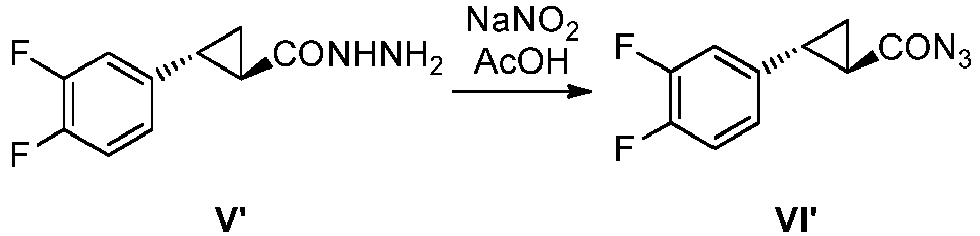
- To a solution of V' (1.7 g, 8.0 mmol) in AcOH (15 mL) was added under stirring at 25°C NaNO2 (0.61 g, 8.8 mmol). Resulting reaction mixture was stirred at 25°C for 30 min, then water (200 mL) was added, product was extracted to MeTHF (3 x 30 mL), combined organic layers were dried over MgSO4, then concentrated to afford crude compound, which was then purified by chromatography (SiO2, hexane:EtOAc) to afford title compound (VI') as colorless oil (1.32 g, 74% yield).1H NMR (CDCl3): 1.40 (m, 1H), 1.72 (m, 1H), 1.86 (m, 1H), 2.60 (m, 1H), 6.84 (m, 1H), 6.89 (m, 1H), 7.08 (m, 1H); 19F NMR (CDCl3): -138.3 (m, 1F), -141.1 (m, 1F).
-

- A solution of VI' (2.6 g, 11.6 mmol) in toluene (20 mL) was stirred at 80°C for 16 h. Then volatile components were evaporated and tBuOH (10 mL) was added. Resulting reaction mixture was stirred at 80°C for 6 days. Then water (50 mL) was added, and white solid material was filtered off and dried to afford title compound VIIIa' as white powder (1.72 g, 55% yield). DSC (Onset): 110°C;1H NMR (CDCl3): 1.08-1.17 (m, 2H), 1.45 (s, 9H), 2.01 (m, 1H), 2.64 (m, 1H), 4.89 (br s, 1H), 6.89 (m, 1H), 6.96 (m, 1H), 7.03 (m, 1H); 19F NMR (CDCl3): -139.3 (m, 1F), -142.8 (m, 1F); MS (ESI) m/z: 270 [MH]+.
-

- To a solution of VIIIa' (0.30 g, 1.12 mmol) in MeOH (10 mL) was added 4 mL of 37% HCI. Resulting reaction mixture was stirred at 25°C for 2 h, then MeOH was partly evaporated, water (10 mL) was added, white precipitate was filtered off, washed with water (5 mL), and dried to afford title compound CPA as HCI salt (0.18 g, 76% yield). DSC (Onset): 200°C; 1H NMR (DMSO-d6): 1.20 (m, 1H), 1.45 (m, 1H), 2.40 (m, 1H), 2.78 (m, 1H), 7.05 (m, 1H), 7.25 (m, 1H), 7.32 (m, 1H), 8.76 (br s, 3H); 19F NMR (DMSO-d6): -138.9 (m, 1F), -142.1 (m, 1F).
- To a 1 M NaOH (20 mL) was added under stirring at 25°C CPA.HCl (0.15 g, 0.78 mmol). Resulting reaction mixture was stirring at 25°C for 15 min, then the product was extracted to MeTHF (3 x 5 mL). Combined organic layers were dried over Na2SO4, then concentrated to afford CPA as yellowish oil (125 mg, 95% yield). 1H NMR (CDCl3): 0.88 (m, 1H), 1.02 (m, 1H), 1.66 (br s, 2H), 1.79 (m, 1H), 2.46 (m, 1H), 6.68-6.77 (m, 2H), 6.98 (m, 1H); 19F NMR (CDCl3): -139.6 (m, 1F), -143.8 (m, 1F);
- CPA was prepared as above or through procedure described in
WO 2001/92200 WO 2001/92263 -

- To a stirred mixture of (1R,2R)-2-(3,4-difluorophenyl)cyclopropanecarbohydrazide (V') (1.67 g, 7.87 mmol), toluene (30 mL), MeTHF (10 mL) and 2 M HCI (aq., 30 mL) at 20°C was added NaNO2 (0.60 g, 8.66 mmol). Resulting reaction mixture was stirred at 20°C for 1 h, then water layer was separated and organic layer was dried over MgSO4. Salts were filtered off and filtrate was stirred while heating at 100 °C for 1 h. Reaction mixture was then cooled to 20°C and it was slowly added to a stirred mixture of 37% HCI (aq., 30 mL) and water (10 mL) at 60°C. When all of the solution was added, the reaction mixture was stirred at 60°C for additional 15 min, then it was cooled to 20°C, and organic layer was separated. Water layer was then washed with MeTHF/toluene mixture (2:1, 3 x 30 mL) and neutralized with Na2CO3. CPA was then extracted to the toluene (2 x 20 mL), combined organic layers were dried over Na2SO4, salts were filtered off, and to the filtrate HCI (1 M solution in diethyl ether, 7 mL) was added. White precipitate was filtered off, washed with toluene (2 x 5 mL) and dried to afford title compound (CPA.HCl) as white powder (0.71 g, 44% yield). 1H NMR (DMSO-d6): 1.20 (m, 1H), 1.45 (m, 1H), 2.40 (m, 1H), 2.78 (m, 1H), 7.05 (m, 1H), 7.25 (m, 1H), 7.32 (m, 1H), 8.76 (br s, 3H); 19F NMR (DMSO-d6): -138.9 (m, 1F), -142.1 (m, 1F).
- Analytical data in examples were obtained with the following hardware:
- X-Ray powder diffraction method:
- Conditions for obtaining powder X-ray diffraction (XRD) patterns: The powder X-ray diffraction patterns were obtained by methods known in the art using Philips X'Pert PRO diffractometer with X'Celerator detector using CuKα radiation (tube operating at 45 kV and 40 mA) in the Bragg-Brentano (reflection) geometry. Data were recorded from 2 to 40 o 2θ in steps of 0.033 o 2θ and the measurement time of 50 seconds per step. Variable divergence and antiscatter slits were used to maintain 12 mm of sample length irradiated.
- Differential Scanning Calorimetry:
- Conditions for obtaining DSC thermograms: Thermograms were obtained with Mettler Toledo DSC822e differential scanning calorimeter. The sample (1-10 mg) was placed in an unsealed aluminium pan with a hole and heated at 10°C/min in the temperature range from 30 °C to 250 °C.
- NMR analysis:
- All the NMR spectra were taken with Bruker Avance III 500 MHz spectrophotometer. 1H NMR spectra were obtained at 500 MHz and 19F NMR spectra were obtained at 470 MHz at 25°C in CDCl3 (7.24 ppm in 1H spectrum) or DMSO-d6 (2.50 ppm in 1H spectrum). Chemical shifts are reported in ppm downfield from an internal TMS standard or relative to the residual solvent signal. Coupling constants (J) are given in hertz (Hz).
- HPLC-MS analysis:
- MS spectra were recorded with LC-MS system composed of Waters Alliance HPLC and Micromass Quattro micro mass spectrometer equipped with electrospray ionisation source.
Claims (12)
- A process for the preparation of a compound of formula IX or a salt thereof
 (i) providing a compound of formula V
 (ii) converting the hydrazide of formula V to an azide of formula VI
 (iii) converting the obtained compound of formula VI to provide the compound of formula IX or a salt thereof.
 - The process according to claim 1, wherein the compound of formula VI obtained in step (ii) is first converted to a compound of formula VIII

said compound VIII being converted to the compound of formula IX. - The process according to claim 2, wherein the compound of formula VI is first converted to a
compound of formula VII
said compound VII being converted to the compound of formula VIII. - The process according to claim 2 or claim 3, wherein the process is conducted as a one-pot process.
- The process according to claim 1, wherein the compound of formula V is prepared by a process comprising:(i) providing a compound of formula IIIb or IV
 (ii) converting the compound of formula IIIb or IV to the compound of formula V.
 - The process according to claim 5, wherein the compound of formula IV is first converted to a compound of formula IIIb, which is then converted to the compound of formula V.
- The process according to claim 5, wherein the compound of formula IV is prepared by a process comprising:(i) providing a compound of formula I
 (ii) converting the compound of formula I to give an alkene of formula II
 (iii) converting the obtained alkene of formula II by reaction of cyclopropanation to give a
compound of formula III (iv) converting the obtained compound of formula III to the compound of formula IV
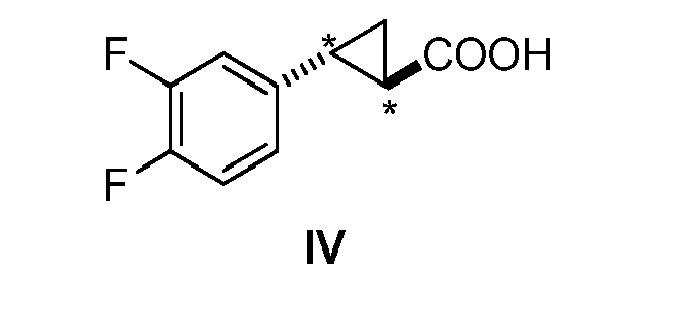 (v) optionally separating the obtained trans-racemate of IV to provide the enantiomerically pure (1R,2R)-2-(3,4-difluorophenyl)cyclopropanecarboxylic acid.
 - The process according to claim 5, wherein the compound of formula IV is the enantiomerically pure (1R,2R)-2-(3,4-difluorophenyl)cyclopropanecarboxylic acid, the process comprising:(i) providing a compound of formula I
 (ii) converting the compound of formula I to give an alkene of formula II
 (iii) converting the obtained alkene of formula II by reaction of cyclopropanation to give a compound of formula III
 (iv) separating the obtained trans-racemate of III to provide the enantiomerically pure compound of formula III', and
 (v) converting the obtained compound of formula III' to (1R,2R)-2-(3,4-difluorophenyl)cyclopropanecarboxylic acid.
 - A compound of the following formula V and stereochemical isomeric forms thereof.

- The process according to claim 1, wherein the salt of IX is a crystalline hydrochloride salt.
- A crystalline hydrochloride salt of the following formula

- Use of any of the compounds of claim 9 to 11 in the preparation of ticagrelor.
Priority Applications (3)
| Application Number | Priority Date | Filing Date | Title |
|---|---|---|---|
| EP12162507.3A EP2644590A1 (en) | 2012-03-30 | 2012-03-30 | Synthesis of 2-(3,4-difluorophenyl)cyclopropanamine derivatives and salts |
| PCT/EP2013/056703 WO2013144295A1 (en) | 2012-03-30 | 2013-03-28 | Synthesis of 2-(3,4-difluorophenyl)cyclopropanamine derivatives and salts |
| CN201380027677.8A CN104603098B (en) | 2012-03-30 | 2013-03-28 | The synthesis of 2-(3,4-difluorophenyl) cyclopropyl amine derivatives and salt |
Applications Claiming Priority (1)
| Application Number | Priority Date | Filing Date | Title |
|---|---|---|---|
| EP12162507.3A EP2644590A1 (en) | 2012-03-30 | 2012-03-30 | Synthesis of 2-(3,4-difluorophenyl)cyclopropanamine derivatives and salts |
Publications (1)
| Publication Number | Publication Date |
|---|---|
| EP2644590A1 true EP2644590A1 (en) | 2013-10-02 |
Family
ID=45928731
Family Applications (1)
| Application Number | Title | Priority Date | Filing Date |
|---|---|---|---|
| EP12162507.3A Ceased EP2644590A1 (en) | 2012-03-30 | 2012-03-30 | Synthesis of 2-(3,4-difluorophenyl)cyclopropanamine derivatives and salts |
Country Status (1)
| Country | Link |
|---|---|
| EP (1) | EP2644590A1 (en) |
Cited By (6)
| Publication number | Priority date | Publication date | Assignee | Title |
|---|---|---|---|---|
| CN103508899A (en) * | 2013-10-23 | 2014-01-15 | 开原亨泰制药股份有限公司 | Method for preparing ticagrelor key intermediate and racemate thereof and special intermediate for implementing method |
| CN104030930A (en) * | 2014-06-20 | 2014-09-10 | 河北序能生物技术有限公司 | Synthetic method of trans-(1R, 2S)-2-(3, 4-difluorophenyl) rolicyprine hydrochloride |
| EP3617181A1 (en) * | 2018-08-30 | 2020-03-04 | Arevipharma GmbH | Synthesis of trans-2-phenylcyclopropylamine or a salt or solvate thereof |
| US11434247B1 (en) | 2017-11-27 | 2022-09-06 | Dart Neuroscience Llc | Substituted furanopyrimidine compounds as PDE1 inhibitors |
| CN117659882A (en) * | 2023-12-25 | 2024-03-08 | 北京宇阳泽丽防水材料有限责任公司 | High-flame-retardance long-service-life thermoplastic polyolefin waterproof coiled material and preparation method thereof |
| US11999738B2 (en) | 2016-12-28 | 2024-06-04 | Dart Neuroscience, Llc | Substituted pyrazolopyrimidinone compounds as PDE2 inhibitors |
Citations (9)
| Publication number | Priority date | Publication date | Assignee | Title |
|---|---|---|---|---|
| WO2000034283A1 (en) | 1998-12-04 | 2000-06-15 | Astrazeneca Ab | Novel triazolo(4,5-d)pyrimidine compounds |
| WO2001092200A1 (en) | 2000-06-02 | 2001-12-06 | Astrazeneca Ab | Process for the preparation of cyclopropyl carboxylic acid esters and derivatives |
| WO2001092263A1 (en) | 2000-06-02 | 2001-12-06 | Astrazeneca Ab | Novel triazolo pyrimidine compounds |
| WO2008018823A1 (en) | 2006-08-05 | 2008-02-14 | Astrazeneca Ab | A process for the preparation of optically active cyclopropylamines |
| WO2008018822A1 (en) | 2006-08-05 | 2008-02-14 | Astrazeneca Ab | Chemical process for preparation of aromatic cyclopropane esters and amides |
| WO2011017108A2 (en) | 2009-07-27 | 2011-02-10 | Auspex Pharmaceuticals, Inc. | Cyclopropyl modulators of p2y12 receptor |
| WO2011132083A2 (en) | 2010-04-20 | 2011-10-27 | Actavis Group Ptc Ehf | Novel process for preparing phenylcyclopropylamine derivatives using novel intermediates |
| CN102249929A (en) | 2011-05-19 | 2011-11-23 | 博瑞生物医药技术(苏州)有限公司 | Method for synthesizing trans-(1R,2S)-2-(3,4-difluorophenyl)cyclopropylamine |
| WO2012001531A2 (en) | 2010-06-30 | 2012-01-05 | Actavis Group Ptc Ehf | Novel processes for the preparation of phenylcyclopropylamine derivatives and use thereof for preparing ticagrelor |
-
2012
- 2012-03-30 EP EP12162507.3A patent/EP2644590A1/en not_active Ceased
Patent Citations (9)
| Publication number | Priority date | Publication date | Assignee | Title |
|---|---|---|---|---|
| WO2000034283A1 (en) | 1998-12-04 | 2000-06-15 | Astrazeneca Ab | Novel triazolo(4,5-d)pyrimidine compounds |
| WO2001092200A1 (en) | 2000-06-02 | 2001-12-06 | Astrazeneca Ab | Process for the preparation of cyclopropyl carboxylic acid esters and derivatives |
| WO2001092263A1 (en) | 2000-06-02 | 2001-12-06 | Astrazeneca Ab | Novel triazolo pyrimidine compounds |
| WO2008018823A1 (en) | 2006-08-05 | 2008-02-14 | Astrazeneca Ab | A process for the preparation of optically active cyclopropylamines |
| WO2008018822A1 (en) | 2006-08-05 | 2008-02-14 | Astrazeneca Ab | Chemical process for preparation of aromatic cyclopropane esters and amides |
| WO2011017108A2 (en) | 2009-07-27 | 2011-02-10 | Auspex Pharmaceuticals, Inc. | Cyclopropyl modulators of p2y12 receptor |
| WO2011132083A2 (en) | 2010-04-20 | 2011-10-27 | Actavis Group Ptc Ehf | Novel process for preparing phenylcyclopropylamine derivatives using novel intermediates |
| WO2012001531A2 (en) | 2010-06-30 | 2012-01-05 | Actavis Group Ptc Ehf | Novel processes for the preparation of phenylcyclopropylamine derivatives and use thereof for preparing ticagrelor |
| CN102249929A (en) | 2011-05-19 | 2011-11-23 | 博瑞生物医药技术(苏州)有限公司 | Method for synthesizing trans-(1R,2S)-2-(3,4-difluorophenyl)cyclopropylamine |
Non-Patent Citations (2)
| Title |
|---|
| BIOORG. MED. CHEM. LETT., vol. 17, 2007, pages 6013 - 6018 |
| SPRINGTHORPE ET AL: "From ATP to AZD6140: The discovery of an orally active reversible P2Y12 receptor antagonist for the prevention of thrombosis", BIOORGANIC & MEDICINAL CHEMISTRY LETTERS, PERGAMON, ELSEVIER SCIENCE, GB, vol. 17, no. 21, 1 November 2007 (2007-11-01), pages 6013 - 6018, XP022267216, ISSN: 0960-894X, DOI: 10.1016/J.BMCL.2007.07.057 * |
Cited By (10)
| Publication number | Priority date | Publication date | Assignee | Title |
|---|---|---|---|---|
| CN103508899A (en) * | 2013-10-23 | 2014-01-15 | 开原亨泰制药股份有限公司 | Method for preparing ticagrelor key intermediate and racemate thereof and special intermediate for implementing method |
| CN103508899B (en) * | 2013-10-23 | 2015-05-27 | 开原亨泰制药股份有限公司 | Method for preparing ticagrelor key intermediate and racemate thereof and special intermediate for implementing method |
| CN104030930A (en) * | 2014-06-20 | 2014-09-10 | 河北序能生物技术有限公司 | Synthetic method of trans-(1R, 2S)-2-(3, 4-difluorophenyl) rolicyprine hydrochloride |
| CN104030930B (en) * | 2014-06-20 | 2016-02-24 | 河北序能生物技术有限公司 | A kind of trans-(1R, 2S)-2-(3,4-difluorophenyl) synthetic method of cyclopropylamine hydrochloride |
| US11999738B2 (en) | 2016-12-28 | 2024-06-04 | Dart Neuroscience, Llc | Substituted pyrazolopyrimidinone compounds as PDE2 inhibitors |
| US11434247B1 (en) | 2017-11-27 | 2022-09-06 | Dart Neuroscience Llc | Substituted furanopyrimidine compounds as PDE1 inhibitors |
| US12006325B2 (en) | 2017-11-27 | 2024-06-11 | Dart Neuroscience, Llc | Substituted furanopyrimidine compounds as PDE1 inhibitors |
| EP3617181A1 (en) * | 2018-08-30 | 2020-03-04 | Arevipharma GmbH | Synthesis of trans-2-phenylcyclopropylamine or a salt or solvate thereof |
| CN117659882A (en) * | 2023-12-25 | 2024-03-08 | 北京宇阳泽丽防水材料有限责任公司 | High-flame-retardance long-service-life thermoplastic polyolefin waterproof coiled material and preparation method thereof |
| CN117659882B (en) * | 2023-12-25 | 2024-06-11 | 北京宇阳泽丽防水材料有限责任公司 | High-flame-retardance long-service-life thermoplastic polyolefin waterproof coiled material and preparation method thereof |
Similar Documents
| Publication | Publication Date | Title |
|---|---|---|
| WO2013144295A1 (en) | Synthesis of 2-(3,4-difluorophenyl)cyclopropanamine derivatives and salts | |
| US7750167B2 (en) | Process for the preparation of asenapine and intermediate products used in said process | |
| EP2628721A1 (en) | Synthesis of 2-(3,4-difluorophenyl)cyclopropanecarboxylic acid | |
| US9227900B2 (en) | Method for preparing 1-(4-chlorophenyl)-2-cyclopropyl-1-propanone and intermediate thereof | |
| US9617241B2 (en) | Intermediate compounds and process for the preparation of efinaconazole | |
| CN107417505B (en) | Preparation method of alpha-halogenated tetramethyl cyclohexanone and (2,3,4, 4-tetramethylcyclopentyl) methyl carboxylic ester | |
| EP0019388B1 (en) | Preparation of trifluoromethyl-substituted phenols and phenates and the preparation, from these phenols and phenates, of nitro- and trifluoromethyl-substituted diphenyl ethers | |
| CN107428648B (en) | Process for the preparation of compounds such as 3-arylbutyraldehyde useful for the synthesis of medetomidine | |
| EP1765764B1 (en) | Process for the preparation of 4,4-difluoro-3-oxobutanoic acid esters | |
| Xiong et al. | Diastereoselective synthesis of pitavastatin calcium via bismuth-catalyzed two-component hemiacetal/oxa-Michael addition reaction | |
| US20230060251A1 (en) | Synthesis of capsaicin derivatives | |
| KR102706151B1 (en) | Method for producing 2,6-dialkylphenylacetic acid | |
| CN113788777B (en) | Method for preparing 1-substituted-3-carbonyl pyrrole | |
| US10562834B2 (en) | Process for preparing substituted crotonic acids | |
| JP6256469B2 (en) | Process for the preparation of spiro [2.5] octane-5,7-dione | |
| KR100968576B1 (en) | Method for preparing 2-acyl-3-amino-2-alkenoate | |
| JP4929717B2 (en) | Process for producing N, N'-dialkoxy-N, N'-dialkyloxamide | |
| JP4030289B2 (en) | Process for producing β-ketonitriles | |
| JP3855686B2 (en) | 3,3-dialkoxy-2-hydroxyimino derivative and process for producing the same | |
| JP4561635B2 (en) | Process for producing 4-alkoxycarbonyltetrahydropyran or tetrahydropyranyl-4-carboxylic acid | |
| JP4374287B2 (en) | Process for producing (Z) -1-phenyl-1-diethylaminocarbonyl-2-hydroxymethylcyclopropane | |
| JP5731403B2 (en) | Process for producing alkyl 5-methyl-5-hexenoate | |
| CN120282952A (en) | Process for producing 1-alkyl-5-hydroxypyrazole | |
| US20190315669A1 (en) | Process for the preparation of hu-910 and crystalline structure thereof | |
| JP2006312644A (en) | Process for producing β-ketonitriles |
Legal Events
| Date | Code | Title | Description |
|---|---|---|---|
| PUAI | Public reference made under article 153(3) epc to a published international application that has entered the european phase |
Free format text: ORIGINAL CODE: 0009012 |
|
| AK | Designated contracting states |
Kind code of ref document: A1 Designated state(s): AL AT BE BG CH CY CZ DE DK EE ES FI FR GB GR HR HU IE IS IT LI LT LU LV MC MK MT NL NO PL PT RO RS SE SI SK SM TR |
|
| AX | Request for extension of the european patent |
Extension state: BA ME |
|
| STAA | Information on the status of an ep patent application or granted ep patent |
Free format text: STATUS: THE APPLICATION HAS BEEN REFUSED |
|
| 18R | Application refused |
Effective date: 20131202 |