EP2643973B1 - Improved ocr for automated stb testing - Google Patents
Improved ocr for automated stb testing Download PDFInfo
- Publication number
- EP2643973B1 EP2643973B1 EP11805510.2A EP11805510A EP2643973B1 EP 2643973 B1 EP2643973 B1 EP 2643973B1 EP 11805510 A EP11805510 A EP 11805510A EP 2643973 B1 EP2643973 B1 EP 2643973B1
- Authority
- EP
- European Patent Office
- Prior art keywords
- image
- filter
- sequence
- configuration
- text
- Prior art date
- Legal status (The legal status is an assumption and is not a legal conclusion. Google has not performed a legal analysis and makes no representation as to the accuracy of the status listed.)
- Active
Links
Images



Classifications
-
- G—PHYSICS
- G06—COMPUTING OR CALCULATING; COUNTING
- G06V—IMAGE OR VIDEO RECOGNITION OR UNDERSTANDING
- G06V10/00—Arrangements for image or video recognition or understanding
- G06V10/20—Image preprocessing
- G06V10/30—Noise filtering
-
- H—ELECTRICITY
- H04—ELECTRIC COMMUNICATION TECHNIQUE
- H04N—PICTORIAL COMMUNICATION, e.g. TELEVISION
- H04N17/00—Diagnosis, testing or measuring for television systems or their details
-
- G—PHYSICS
- G06—COMPUTING OR CALCULATING; COUNTING
- G06F—ELECTRIC DIGITAL DATA PROCESSING
- G06F18/00—Pattern recognition
- G06F18/20—Analysing
- G06F18/22—Matching criteria, e.g. proximity measures
-
- G—PHYSICS
- G06—COMPUTING OR CALCULATING; COUNTING
- G06V—IMAGE OR VIDEO RECOGNITION OR UNDERSTANDING
- G06V20/00—Scenes; Scene-specific elements
- G06V20/40—Scenes; Scene-specific elements in video content
- G06V20/41—Higher-level, semantic clustering, classification or understanding of video scenes, e.g. detection, labelling or Markovian modelling of sport events or news items
-
- H—ELECTRICITY
- H04—ELECTRIC COMMUNICATION TECHNIQUE
- H04N—PICTORIAL COMMUNICATION, e.g. TELEVISION
- H04N17/00—Diagnosis, testing or measuring for television systems or their details
- H04N17/04—Diagnosis, testing or measuring for television systems or their details for receivers
-
- H—ELECTRICITY
- H04—ELECTRIC COMMUNICATION TECHNIQUE
- H04N—PICTORIAL COMMUNICATION, e.g. TELEVISION
- H04N17/00—Diagnosis, testing or measuring for television systems or their details
- H04N17/04—Diagnosis, testing or measuring for television systems or their details for receivers
- H04N17/045—Self-contained testing apparatus
-
- H—ELECTRICITY
- H04—ELECTRIC COMMUNICATION TECHNIQUE
- H04N—PICTORIAL COMMUNICATION, e.g. TELEVISION
- H04N5/00—Details of television systems
- H04N5/44—Receiver circuitry for the reception of television signals according to analogue transmission standards
- H04N5/445—Receiver circuitry for the reception of television signals according to analogue transmission standards for displaying additional information
Definitions
- the present application pertains generally to the automated testing of set-top boxes (STB) and other audio visual equipment.
- a set-top box also known as a digibox or set-top unit (STU) is a device that connects to a television and an external source of signal, turning the signal into content which may then be delivered as an Audiovisual (A/V) signal for display on the television screen or other A/V device.
- A/V Audiovisual
- the external source of signal is provided by a satellite or cable connection.
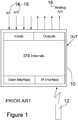
- a typical STB 10 has a number of signal inputs including an RF signal 14, which may for example be from a satellite or cable connection.
- An A/V signal 16 may also be provided as input allowing the set-top box to feed through a signal to a television from a VCR, DVD, Blu-ray disc, Media Juke Box or other similar device.
- the output to the television is an A/V signal 18 which may be provided over a variety of standard interfaces including SCART and HDMI.
- A/V signal 18 may be provided over a variety of standard interfaces including SCART and HDMI.
- buttons and similar controls may be provided on the STB itself.
- the STB may have an infra red (IR) or wireless remote control input configured to operate with a remote control device 12.
- IR infra red
- the STB test system 20 comprises a controller 28 which manages the test function and interacts with the other features of the STB test system.
- the other features include an output interface for controlling a remote control device 12, allowing commands to be sent to the STB and an input interface for receiving the video and/or audio signals from the STB 10.
- This input interface may include an audio capture device 24 for accepting the audio as a test signal and/or a frame grabber 22 or similar device for accepting the video frames from the STB.
- the data captured is then made available to a processor for analysis, which in turn produces a test result and provides this to a user.
- the Test System issues a command or sequence of commands to the STB, suitably via the remote control interface.
- Each frame of video and/or the audio is captured and made to available to the Test System for analysis of the STB response to the commands issued to it.
- tests might include the generation of a "change channel" command to the STB followed by analysis of the audio and/or video outputs to ensure that the channel change command was correctly received and executed by the STB.
- Set-top boxes are complex devices containing a main powerful embedded CPU and various peripheral devices. They generally run a sophisticated operating system (e.g. Linux, or VxWorks) and perform complex functions, and run a large and complex software stack on that operating system. These devices generally present to the users a sophisticated graphical user interface with on-screen menus and graphics. Automation of the testing typically involves, amongst other areas, optical character recognition (OCR) to read text from the screen and compare it with known or expected value, to determine if the user interface presented to the user is as expected.
- OCR optical character recognition
- OCR may be performed on a captured frame or a section of a frame.
- the person configuring the test will identify the section of the frame where text is to be found.
- the person may also configure the test by defining the expected result from the OCR process.
- the expected result may be a predetermined known value or it may obtained elsewhere in the test routine.
- the OCR process may be employed to obtain and store information from the device under test.
- OCR is generally performed by a software component known as an "OCR Engine”.
- OCR Engine There are several OCR engines (software product) generally available for this purpose, i.e. the engines can process images and extract text from them.
- OCR engines conventionally come from the document processing area, which has several differences to images captured from a video stream.
- the resolution of document scanners used to capture document images is generally much greater than the resolution of images, even high definition images, captured from video.
- Documents generally have a fixed foreground/background contrast pattern: generally dark text on a light background.
- the contrast for a given document page is not variable.
- filters to optimise an OCR engine, for example where the page colour is not white.
- contrast on modern dynamic user interfaces can be highly variable.
- transparent panes in the user interface are commonplace and thus the contrast of the text will vary as the background television program changes.
- images captured from video streams can be quite noisy.
- the present inventor's experience has been that the accuracy of a typical OCR engine when employed with captured video may only be in the region of 65-90%.
- a method for determining a suitable configuration for a pre-processing filter to be used before performing OCR on an image is disclosed in CN 101 571 922 A (ZTE COMMUNICATION CO LTD), 4 November 2009. However, this method is based on a comparison between an OCRed text and a reference text input by a user.
- the present application is based on the premise that developing an OCR engine specifically for captured video images may be a costly and time consuming process. Instead, it is desirable to provide a method that improves the performance of existing OCR engines, for example which are intended for scanned documents.
- the present application improves the performance of OCR engines on captured video frames or sections thereof.
- the improvement is obtained by pre-processing the image (the captured frame or a part thereof) before submission to the OCR engine.
- it has been found by the present inventor that by processing an image with an image filter, the performance of the OCR engine may be improved.
- the difficulty is that whilst certain image filters may work perfectly in certain situations they may result in worse performance in others.
- An exemplary test system for testing a STB may generally employ the known STB test system of Figure 2 and thus include a first interface for controlling the operation of a set-top box, for example by sending commands to the STB via an IR remote control.
- a first interface for controlling the operation of a set-top box, for example by sending commands to the STB via an IR remote control.
- other control inputs/interfaces may be employed for example a direct serial connection may be employed if the STB has such an interface available.
- an interface employed to control the STB is commonly employed in conventional test systems for STB's and thus their design and operation would be readily understood and familiar to those skilled in the art.
- the test system is configured to analyse video from the STB along with other outputs including for example audio.
- a second interface is employed to acquire one or more outputs from the STB.
- This second interface may include a frame grabber for capturing the video frames from the STB and/or an analog to digital converter for capturing the audio output from the STB.
- the frame grabber is synchronised to the video frame timing allowing it to capture one complete video frame at a time. It will be appreciated that where a digital output is available from the set-top box, the requirement for an analog frame grabber/audio capture device may be obviated and replaced by a digital interface which directly captures the video frames being transmitted.
- the video may be captured using a video camera directed at the display.
- the system may select a particular region of interest from the frame. The region of interest would typically be predefined during the configuration ⁇ setting up process of a test routine.
- an image processor (filter) 40 is provided to pre-filter the image (which as explained above may either be the entire captured frame or more likely a pre-selected section of the captured frame) before processing by the OCR engine to extract text from the image.
- the filter of the image processor 40 is a configurable filter such that the filter function applied to the image may be varied by the system. More specifically, the configuration for the filter for an image at a particular point in a test routine is suitably pre-set during an initial set-up configuration process where the test routine performed by the test system is prepared.
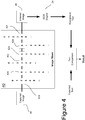
- the configurable filter 40 comprises a sequence of different image filters 42a-f which may be applied sequentially to an image 44 from a captured frame or part thereof.
- each of the filters in the sequence may or may not be used to filter the image.
- the overall filter may be configured by the selection of which particular filters to use.
- each filter may be configurable by one or more parameters (shown by the numerals 0-5 for each filter), which adjust the filter characteristics. One of these parameters, e.g. 0 may indicate that the filter is not be used.
- the filtered image is passed to the OCR engine 24 for processing, where the recognised text may be compared with an expected result to determine the success or not of a particular test. In certain circumstances, there may not be an expected result and in this case, the result may simply be stored for reference or use subsequently in the test routine. This same routine may also be employed in the process to determine the filter configuration as described in greater detail below.
- each of these may be regarded as an image filter. It will be appreciated that a general parameter for a filter may be whether it is employed or not. A specific parameter in the case of removing one or more colour components would be the colour components to be removed, thus in the case of a RGB (Red Green Blue) image, the filter configurations might be removal of:
- an individual parameter might be whether to increase or decrease the contrast or the amount of contrast adjustment.
- the degree of blurring or sharpening would be an individual filter parameter.
- individual parameters may be the degree of scaling and/or the selection of a particular type of interpolation e.g. bi-cubic, linear etc.
- FIG. 5 An exemplary method of selecting a configuration for the filter is shown in Figure 5 .
- a user when configuring the test system may optionally identify a section of the screen (captured frame) to be analysed.
- the user specifies the expected result of the OCR process.
- the expected result is used to compares the output ⁇ OCR result of different filter configurations on a sequence of images to determine the performance of the different filter configurations.
- Each of the sequence of images contains substantially the same text content, i.e. a user visually sees the same text in each image of the sequence. For example, capturing 100 sequential frames of video having an OSD (On Screen Display) box shown would have the same text content visible to a user in the box in each of the frames on the screen.
- OSD On Screen Display
- a bit for bit comparison of the captured frames may well show them to be completely different for the reasons explained above including noise and possibly changing video content behind the OSD box.
- a sequence of images are acquired as an initial step and the same sequence of images are used for comparing the performance of each filter configuration as the on-screen content may time out after a few seconds and an OSD disappear altogether. It will be appreciated that the sequence of images may be obtained as part of this process or they may have been obtained separately and stored.
- a first filter configuration is selected 52 to be used to filter the selected 54 first image in the sequence.
- the first filter configuration may have a "null" setting for each filter which does not alter the image. Pictorially, in figure 4 , this is represented by the setting "0" for a filter.
- This first filter configuration is used to set the filter and the first image is processed 56 by the filter using this configuration to provide a filtered image.
- the filtered image is then passed 58 through the OCR engine and the extracted text compared 60 with the expected result to determine the performance of the filter. It will be appreciated that the expected result need not be the entire of the extracted text but may in fact be a part of the text.
- the person configuring the test may simply require the presence of a particular word in the extracted text rather than an exact match to the whole of the extracted text.
- a decision 62 is then made based on the outcome, where the filter performance is negative (i.e. text not recognised correctly), then the next filter configuration may be selected 52 and the test repeated again. Where the filter performance is determined to be positive, the test may be repeated for the next image in the sequence 54. Where the performance of a particular filter configuration is positive for all images in the sequence, then that configuration may be selected and stored 64 within the test routine for future use in a test process. At which point the configuration process for that aspect of the test is completed.
- all of the filters configurations may be tested with the accuracy of each determined (i.e. in how many of the sequence of images did a filter result in the OCR producing the expected result) and the filter with the best accuracy selected.
- sequence may not be the actual sequence of frames and the training set (sequence of images) may be for example be captured frames chosen at intervals apart.
- the filter configurations to be tested may be chosen in random order via traditional Monte Carlo methods, thus avoiding locally suboptimal blocks of filters if filters are tried in strict order of definition.
- the training set from the live signal, by capturing images "live” and accumulating these captures images on local storage. As long as each new image which arrives is recognised correctly, there is no need to re-train with all existing captured images (since these, by definition, will also have matched already). However once an image is captured which does not match the expected text, the captured images form the training set, and the algorithm starts the search for a better filter using the captured images. Where a further image does not match the expected result with a filter, it may be added to the training set until a suitable training set has been selected.
- This training may be time limited (so that if all images match the expected text for a user-defined time period, the current best filter (configuration) is judged good enough and saved).
- the system Given an image or set of images, it is possible for the system to automatically determine with a high degree of accuracy the expected text without user input. This is based on the observation that while incorrectly recognised text is typically random, the correctly recognised text is always the same. Therefore the system can "guess" that the string which appears most frequently in the recognition results is likely to be the text that the user wanted, and in the majority of cases it will be correct. Thus although the above method refers to the user entering an "expected" text result, it may not be necessary for the user to do this.
- the extracted text from a first image in a sequence may be employed as the "expected" result for the remainder of the images in the sequence, i.e. consistency of result is determined to equate to accuracy of result. It is possible of course that the OCR process may consistently fail to recognise the text correctly and that this alternative variation may not be appropriate.
- the presently described techniques may also be employed directly without a test configuration process.
- the above method has been described with respect to using an initial configuration routine to establish ⁇ store the correct filter parameters for performing a particular test.
- the method may also be used in a live scenario to determine text content from a sequence of captured images.
- a sequence of captured frames (or parts thereof) may be passed through the configurable filter using a first filter setting and then through the OCR engine to provide a text result.
- the text result may be regarded as valid.
- the process may be repeated with a different filter configuration. This process may be repeated, varying the configuration each time, until a valid result is determined. It will be appreciated that this process may be of use generally to video captured from a device under test and may be employed generally to identify text in video content.
Landscapes
- Engineering & Computer Science (AREA)
- Multimedia (AREA)
- Signal Processing (AREA)
- Health & Medical Sciences (AREA)
- Biomedical Technology (AREA)
- General Health & Medical Sciences (AREA)
- Theoretical Computer Science (AREA)
- General Physics & Mathematics (AREA)
- Physics & Mathematics (AREA)
- Data Mining & Analysis (AREA)
- Evolutionary Biology (AREA)
- Life Sciences & Earth Sciences (AREA)
- Bioinformatics & Computational Biology (AREA)
- Evolutionary Computation (AREA)
- Bioinformatics & Cheminformatics (AREA)
- General Engineering & Computer Science (AREA)
- Artificial Intelligence (AREA)
- Computer Vision & Pattern Recognition (AREA)
- Computational Linguistics (AREA)
- Software Systems (AREA)
- Image Analysis (AREA)
- Testing, Inspecting, Measuring Of Stereoscopic Televisions And Televisions (AREA)
- Character Discrimination (AREA)
- Character Input (AREA)
Description
- The present application pertains generally to the automated testing of set-top boxes (STB) and other audio visual equipment.
- A set-top box (STB) also known as a digibox or set-top unit (STU) is a device that connects to a television and an external source of signal, turning the signal into content which may then be delivered as an Audiovisual (A/V) signal for display on the television screen or other A/V device. Most frequently, the external source of signal is provided by a satellite or cable connection.
- As with other consumer products, both manufacturers and suppliers are keen to ensure that products operate correctly and as specified. Initially and to this day, a significant part of the testing is performed manually, whereby a tester issues a command to the STB which may be via the user interface on the STB itself or via a remote control device as illustrated in
Figure 1 , and observes the response of the STB on a TV display. As is shown inFigure 1 , atypical STB 10 has a number of signal inputs including anRF signal 14, which may for example be from a satellite or cable connection. An A/V signal 16 may also be provided as input allowing the set-top box to feed through a signal to a television from a VCR, DVD, Blu-ray disc, Media Juke Box or other similar device. The output to the television is an A/V signal 18 which may be provided over a variety of standard interfaces including SCART and HDMI. To allow the user control the operation of the STB, a number of buttons and similar controls may be provided on the STB itself. Additionally and more commonly employed by users, the STB may have an infra red (IR) or wireless remote control input configured to operate with aremote control device 12. - As manual testing can be time consuming, prone to error and in some instances lacking accuracy, an effort has been made to automate some of these tests. In respect of these automated tests, it will be appreciated that this testing is typically performed on the end product by users without necessarily any detailed knowledge or access to the internal circuitry of the STB. Accordingly, the testing of STB's is generally performed on a "black-box" basis, where only the inputs and outputs are available for modification and examination. Accordingly test methods and systems have been developed specifically for set top boxes, an example of such a system is StormTest™ provided by the S3 Group of Dublin, Ireland which may be employed to test STBs, televisions, and similar devices such as digital media players. An arrangement for a STB test system is shown in
Figure 2 . TheSTB test system 20 comprises acontroller 28 which manages the test function and interacts with the other features of the STB test system. The other features include an output interface for controlling aremote control device 12, allowing commands to be sent to the STB and an input interface for receiving the video and/or audio signals from theSTB 10. This input interface may include anaudio capture device 24 for accepting the audio as a test signal and/or aframe grabber 22 or similar device for accepting the video frames from the STB. The data captured is then made available to a processor for analysis, which in turn produces a test result and provides this to a user. Thus during a typical test, the Test System issues a command or sequence of commands to the STB, suitably via the remote control interface. Each frame of video and/or the audio is captured and made to available to the Test System for analysis of the STB response to the commands issued to it. - Typically, tests might include the generation of a "change channel" command to the STB followed by analysis of the audio and/or video outputs to ensure that the channel change command was correctly received and executed by the STB.
- Set-top boxes are complex devices containing a main powerful embedded CPU and various peripheral devices. They generally run a sophisticated operating system (e.g. Linux, or VxWorks) and perform complex functions, and run a large and complex software stack on that operating system. These devices generally present to the users a sophisticated graphical user interface with on-screen menus and graphics. Automation of the testing typically involves, amongst other areas, optical character recognition (OCR) to read text from the screen and compare it with known or expected value, to determine if the user interface presented to the user is as expected.
- As shown in
Figure 2 , OCR may be performed on a captured frame or a section of a frame. Typically, in configuring a test routine, the person configuring the test will identify the section of the frame where text is to be found. The person may also configure the test by defining the expected result from the OCR process. The expected result may be a predetermined known value or it may obtained elsewhere in the test routine. Additionally, the OCR process may be employed to obtain and store information from the device under test. OCR is generally performed by a software component known as an "OCR Engine". There are several OCR engines (software product) generally available for this purpose, i.e. the engines can process images and extract text from them. However, there are several practical difficulties in using an OCR engine in the context of a frame captured from a STB or device with a display, e.g. a digital television. One of the reasons for this is that OCR engines conventionally come from the document processing area, which has several differences to images captured from a video stream. The resolution of document scanners used to capture document images is generally much greater than the resolution of images, even high definition images, captured from video. - Documents generally have a fixed foreground/background contrast pattern: generally dark text on a light background. In addition, the contrast for a given document page is not variable. Once the OCR engine has determined the foreground and background colours for a page, this will not change. Thus for example it is known to use filters to optimise an OCR engine, for example where the page colour is not white. However contrast on modern dynamic user interfaces can be highly variable. As an example, transparent panes in the user interface are commonplace and thus the contrast of the text will vary as the background television program changes. To make matters worse, images captured from video streams can be quite noisy. As a result, the present inventor's experience has been that the accuracy of a typical OCR engine when employed with captured video may only be in the region of 65-90%.
- It would be beneficial to improve the performance of OCR engines in analysing video images. A method for determining a suitable configuration for a pre-processing filter to be used before performing OCR on an image is disclosed in
CN 101 571 922 A (ZTE COMMUNICATION CO LTD), 4 November 2009. However, this method is based on a comparison between an OCRed text and a reference text input by a user. - In particular, the present invention provides systems and methods in accordance with the claims which follow.
- The present application will now be described with reference to the accompanying drawings in which:
-
Figure 1 is an illustration of an exemplary STB known in the art; -
Figure 2 is an illustration of a conventional prior art STB test system having OCR; -
Figure 3 is a block diagram of an aspect of STB test system according to an embodiment of the present application; -
Figure 4 illustrates an exemplary arrangement for selecting a filter configuration according to another embodiment; and -
Figure 5 illustrates a method for use in the arrangement ofFigure 4 . - The present application is based on the premise that developing an OCR engine specifically for captured video images may be a costly and time consuming process. Instead, it is desirable to provide a method that improves the performance of existing OCR engines, for example which are intended for scanned documents.
- The present application improves the performance of OCR engines on captured video frames or sections thereof. The improvement is obtained by pre-processing the image (the captured frame or a part thereof) before submission to the OCR engine. In particular, it has been found by the present inventor that by processing an image with an image filter, the performance of the OCR engine may be improved. The difficulty is that whilst certain image filters may work perfectly in certain situations they may result in worse performance in others.
- An exemplary test system for testing a STB may generally employ the known STB test system of
Figure 2 and thus include a first interface for controlling the operation of a set-top box, for example by sending commands to the STB via an IR remote control. Although, it will be appreciated that other control inputs/interfaces may be employed for example a direct serial connection may be employed if the STB has such an interface available. It will be appreciated that an interface employed to control the STB is commonly employed in conventional test systems for STB's and thus their design and operation would be readily understood and familiar to those skilled in the art. The test system is configured to analyse video from the STB along with other outputs including for example audio. - Specifically a second interface is employed to acquire one or more outputs from the STB. This second interface may include a frame grabber for capturing the video frames from the STB and/or an analog to digital converter for capturing the audio output from the STB. It will be appreciated that the technology associated with these elements would also be familiar to those skilled in the art. However, suitably the frame grabber is synchronised to the video frame timing allowing it to capture one complete video frame at a time. It will be appreciated that where a digital output is available from the set-top box, the requirement for an analog frame grabber/audio capture device may be obviated and replaced by a digital interface which directly captures the video frames being transmitted. Where the device under test has an integrated display for displaying the video, the video may be captured using a video camera directed at the display. As with existing systems, the system may select a particular region of interest from the frame. The region of interest would typically be predefined during the configuration\setting up process of a test routine.
- In the exemplary embodiment illustrated in
Figure 3 it may be seen that the frame capture and OCR engine\processes are unchanged and instead an image processor (filter) 40 is provided to pre-filter the image (which as explained above may either be the entire captured frame or more likely a pre-selected section of the captured frame) before processing by the OCR engine to extract text from the image. - The filter of the
image processor 40 is a configurable filter such that the filter function applied to the image may be varied by the system. More specifically, the configuration for the filter for an image at a particular point in a test routine is suitably pre-set during an initial set-up configuration process where the test routine performed by the test system is prepared. - The mode of operation will now be explained with reference to the method of determination of a configuration for the configurable filter as shown in
Figure 4 in which theconfigurable filter 40 comprises a sequence ofdifferent image filters 42a-f which may be applied sequentially to animage 44 from a captured frame or part thereof. As will be appreciated from the explanation which follows, each of the filters in the sequence may or may not be used to filter the image. Thus, the overall filter may be configured by the selection of which particular filters to use. Additionally, each filter may be configurable by one or more parameters (shown by the numerals 0-5 for each filter), which adjust the filter characteristics. One of these parameters, e.g. 0 may indicate that the filter is not be used. After filtering has been completed, the filtered image is passed to theOCR engine 24 for processing, where the recognised text may be compared with an expected result to determine the success or not of a particular test. In certain circumstances, there may not be an expected result and in this case, the result may simply be stored for reference or use subsequently in the test routine. This same routine may also be employed in the process to determine the filter configuration as described in greater detail below. - As examples, the following image filters have been determined to improve the accurate detection of text by the OCR engine when operating on colour images:
- Selectively removing one or more colour components from the original image, with or without conversion to greyscale of the resulting image.
- Adjusting image contrast
- Inverting the colours in the image
- Blurring the image
- Sharpening the image
- Zooming the image so that it is scaled up, interpolating pixels from the original image to create the new image.
- It will be appreciated that whilst each of these may be regarded as an image filter. It will be appreciated that a general parameter for a filter may be whether it is employed or not. A specific parameter in the case of removing one or more colour components would be the colour components to be removed, thus in the case of a RGB (Red Green Blue) image, the filter configurations might be removal of:
- a) R
- b) G
- c) B
- d) RG
- e) RB
- f) GB
- In the case of adjusting image contrast, an individual parameter might be whether to increase or decrease the contrast or the amount of contrast adjustment. Similarly, in the case of blurring or sharpening the degree of blurring or sharpening would be an individual filter parameter. In the case of an image filter for "zooming" the image so that it is scaled up, individual parameters may be the degree of scaling and/or the selection of a particular type of interpolation e.g. bi-cubic, linear etc.
- An exemplary method of selecting a configuration for the filter is shown in
Figure 5 . In this exemplary method a user when configuring the test system, and as would be performed conventionally, may optionally identify a section of the screen (captured frame) to be analysed. The user specifies the expected result of the OCR process. The expected result is used to compares the output\OCR result of different filter configurations on a sequence of images to determine the performance of the different filter configurations. Each of the sequence of images contains substantially the same text content, i.e. a user visually sees the same text in each image of the sequence. For example, capturing 100 sequential frames of video having an OSD (On Screen Display) box shown would have the same text content visible to a user in the box in each of the frames on the screen. It will be appreciated however that a bit for bit comparison of the captured frames may well show them to be completely different for the reasons explained above including noise and possibly changing video content behind the OSD box. Suitably, a sequence of images are acquired as an initial step and the same sequence of images are used for comparing the performance of each filter configuration as the on-screen content may time out after a few seconds and an OSD disappear altogether. It will be appreciated that the sequence of images may be obtained as part of this process or they may have been obtained separately and stored. - A first filter configuration is selected 52 to be used to filter the selected 54 first image in the sequence. In the exemplary arrangement of
Figure 4 , a series of filters are applied in a chain to the image. The first filter configuration may have a "null" setting for each filter which does not alter the image. Pictorially, infigure 4 , this is represented by the setting "0" for a filter. This first filter configuration is used to set the filter and the first image is processed 56 by the filter using this configuration to provide a filtered image. The filtered image is then passed 58 through the OCR engine and the extracted text compared 60 with the expected result to determine the performance of the filter. It will be appreciated that the expected result need not be the entire of the extracted text but may in fact be a part of the text. For example, the person configuring the test may simply require the presence of a particular word in the extracted text rather than an exact match to the whole of the extracted text. Adecision 62 is then made based on the outcome, where the filter performance is negative (i.e. text not recognised correctly), then the next filter configuration may be selected 52 and the test repeated again. Where the filter performance is determined to be positive, the test may be repeated for the next image in thesequence 54. Where the performance of a particular filter configuration is positive for all images in the sequence, then that configuration may be selected and stored 64 within the test routine for future use in a test process. At which point the configuration process for that aspect of the test is completed. - Alternatively, all of the filters configurations may be tested with the accuracy of each determined (i.e. in how many of the sequence of images did a filter result in the OCR producing the expected result) and the filter with the best accuracy selected.
- Using this method, it is possible to choose a filter configuration which results in a correct match for the recognised text.
- Whilst the above description refers to a sequence of images having substantially the same text content, it will be appreciated that the sequence may not be the actual sequence of frames and the training set (sequence of images) may be for example be captured frames chosen at intervals apart.
- It will be appreciated that where the method is configured to select the first filter configuration that results in 100% accuracy that the filter configurations to be tested may be chosen in random order via traditional Monte Carlo methods, thus avoiding locally suboptimal blocks of filters if filters are tried in strict order of definition.
- In another variation, it is also possible to generate the training set from the live signal, by capturing images "live" and accumulating these captures images on local storage. As long as each new image which arrives is recognised correctly, there is no need to re-train with all existing captured images (since these, by definition, will also have matched already). However once an image is captured which does not match the expected text, the captured images form the training set, and the algorithm starts the search for a better filter using the captured images. Where a further image does not match the expected result with a filter, it may be added to the training set until a suitable training set has been selected.
- This training may be time limited (so that if all images match the expected text for a user-defined time period, the current best filter (configuration) is judged good enough and saved).
- Given an image or set of images, it is possible for the system to automatically determine with a high degree of accuracy the expected text without user input. This is based on the observation that while incorrectly recognised text is typically random, the correctly recognised text is always the same. Therefore the system can "guess" that the string which appears most frequently in the recognition results is likely to be the text that the user wanted, and in the majority of cases it will be correct. Thus although the above method refers to the user entering an "expected" text result, it may not be necessary for the user to do this. In an alternative variation, the extracted text from a first image in a sequence may be employed as the "expected" result for the remainder of the images in the sequence, i.e. consistency of result is determined to equate to accuracy of result. It is possible of course that the OCR process may consistently fail to recognise the text correctly and that this alternative variation may not be appropriate.
- Thus is it possible, without user intervention of any kind, to determine a set of image processing filters to apply to the captured image which will improve the accuracy of recognition.
- It will be appreciated that whilst the present application has been described generally with respect to testing of STBs, it is equally applicable to testing other devices such as digital televisions, digital media players, DVD players and consumer devices such as mobile phones and PDA's. It will be appreciated that whilst digital televisions, digital media players and DVD players may have a remote control (e.g. IR) input for receiving test commands from the test system, other devices may require a different interface in the test system for sending test commands to the device under test.
- Moreover, it will be appreciated that the presently described techniques may also be employed directly without a test configuration process. In particular, whilst the above method has been described with respect to using an initial configuration routine to establish\store the correct filter parameters for performing a particular test. The method may also be used in a live scenario to determine text content from a sequence of captured images. In such an arrangement, a sequence of captured frames (or parts thereof) may be passed through the configurable filter using a first filter setting and then through the OCR engine to provide a text result. Where the text result is consistent for all (or a significant proportion thereof) of the captured frames, the text result may be regarded as valid. Where the text is not consistent, the process may be repeated with a different filter configuration. This process may be repeated, varying the configuration each time, until a valid result is determined. It will be appreciated that this process may be of use generally to video captured from a device under test and may be employed generally to identify text in video content.
Claims (7)
- A method of determining a suitable configuration for a filter for pre-processing captured video images before performing OCR, the method comprising the step of:a) providing a captured sequence of images containing the same text content, the sequence of images comprising a first image in the sequence and a plurality of subsequent images in the sequence;b) selecting a configuration for a filter for pre-processing the images, from a plurality of available configurations;c) pre-processing the first image in the sequence using the selected filter configuration and submitting the pre-processed first image through an OCR process to extract text from the pre-processed first image;d) pre-processing an image of the plurality of subsequent images in the sequence using the selected filter configuration and submitting the pre-processed image of the plurality of subsequent images through an OCR process to extract text from the pre-processed image of the plurality of subsequent images;e) analysing the extracted text from the pre-processed first image and pre-processed image of the plurality of subsequent images to determine the performance of the filter, wherein the performance is determined to be positive if the extracted text is determined to be correct and wherein the determination of whether the extracted text is correct is made by comparison between the text extracted from the first image in the sequence and the text extracted from the image of the plurality of subsequent images in the sequence; andf) deciding the configuration is suitable and storing the suitable configuration, wherein steps d) through e) are performed on each image of the plurality of subsequent images in the sequence and the determination of whether the configuration is suitable is made when the performance of the selected filter configuration is determined to be positive for each of the plurality of subsequent images;wherein steps d) through e) are repeated for each successive image in the sequence as long as the extracted text is determined to be correct from the preceding image and wherein if the text extracted from an image of the plurality of subsequent images is determined to not be correct, selecting a different configuration for pre-processing the images, and repeating steps c) through f).
- A method according to claim 1, wherein steps b) through e) are repeated for a plurality of different configurations, wherein the configuration comprises the selection of one or more filters from a plurality of different filters or the configuration comprises the selection of a parameter for a filter, or both.
- A method according to any one of claims 1 to 2, wherein the filter comprises a sequence of different filters which are applied in sequence and the configuration comprises the selection of one or more parameters for each filter.
- A system for determining a suitable configuration for a filter for pre-processing captured video images before performing OCR, the system comprising:an image processor comprising the filter for filtering the captured video frame or region thereof to provide a filtered image;an OCR engine for analysing the filtered image to extract text from the image;wherein the system is configured to carry out the method according to any one of claims 1 - 3.
- A test system comprising the system of claim 4, for analysing a captured video frame from a device under test, the test system comprising:a remote control interface for transmitting commands to the device under test;wherein the filtering performed by the image processor is configured using the determined suitable configuration.
- A test system according to claim 5, wherein the filter is adapted to perform one or more of the following on the image:a) selectively remove one or more colour components, with or without conversion to greyscale;b) adjusting image contrast;c) invert colours;d) blurring;e) sharpening the image; andf) zooming the image so that it is scaled up using interpolation.
- A test system according to any one of claims 5 to 6, wherein a filter having a plurality of different filter settings is employed by the image processor and wherein the suitable configuration defines the filter settings to be employed for filtering the captured video frame or region thereof.
Applications Claiming Priority (2)
| Application Number | Priority Date | Filing Date | Title |
|---|---|---|---|
| GB1020101.0A GB2485833A (en) | 2010-11-26 | 2010-11-26 | Improved OCR Using Configurable Filtering for Analysing Set Top Boxes |
| PCT/EP2011/073802 WO2012069662A1 (en) | 2010-11-26 | 2011-12-22 | Improved ocr for automated stb testing |
Publications (3)
| Publication Number | Publication Date |
|---|---|
| EP2643973A1 EP2643973A1 (en) | 2013-10-02 |
| EP2643973B1 true EP2643973B1 (en) | 2018-03-07 |
| EP2643973B8 EP2643973B8 (en) | 2020-11-11 |
Family
ID=43500715
Family Applications (1)
| Application Number | Title | Priority Date | Filing Date |
|---|---|---|---|
| EP11805510.2A Active EP2643973B8 (en) | 2010-11-26 | 2011-12-22 | Improved ocr for automated stb testing |
Country Status (8)
| Country | Link |
|---|---|
| US (2) | US9516304B2 (en) |
| EP (1) | EP2643973B8 (en) |
| BR (1) | BR112013013113B1 (en) |
| CA (1) | CA2831113C (en) |
| DK (1) | DK2643973T3 (en) |
| GB (1) | GB2485833A (en) |
| MY (1) | MY164774A (en) |
| WO (1) | WO2012069662A1 (en) |
Families Citing this family (33)
| Publication number | Priority date | Publication date | Assignee | Title |
|---|---|---|---|---|
| WO2010092585A1 (en) * | 2009-02-16 | 2010-08-19 | Communitake Technologies Ltd. | A system, a method and a computer program product for automated remote control |
| US9836376B2 (en) | 2009-09-24 | 2017-12-05 | Contec, Llc | Method and system for automated test of end-user devices |
| GB2485833A (en) | 2010-11-26 | 2012-05-30 | S3 Res & Dev Ltd | Improved OCR Using Configurable Filtering for Analysing Set Top Boxes |
| US10108515B2 (en) * | 2013-03-01 | 2018-10-23 | Sony Interactive Entertainment LLC | Remotely testing electronic devices using messaging and presence protocol |
| GB2514410A (en) * | 2013-05-24 | 2014-11-26 | Ibm | Image scaling for images including low resolution text |
| US11080777B2 (en) * | 2014-03-31 | 2021-08-03 | Monticello Enterprises LLC | System and method for providing a social media shopping experience |
| US11915303B2 (en) | 2014-03-31 | 2024-02-27 | Monticello Enterprises LLC | System and method for providing a social media shopping experience |
| US11004139B2 (en) | 2014-03-31 | 2021-05-11 | Monticello Enterprises LLC | System and method for providing simplified in store purchases and in-app purchases using a use-interface-based payment API |
| US12008629B2 (en) | 2014-03-31 | 2024-06-11 | Monticello Enterprises LLC | System and method for providing a social media shopping experience |
| US10511580B2 (en) | 2014-03-31 | 2019-12-17 | Monticello Enterprises LLC | System and method for providing a social media shopping experience |
| US10318804B2 (en) * | 2014-06-30 | 2019-06-11 | First American Financial Corporation | System and method for data extraction and searching |
| US9460503B2 (en) | 2015-02-02 | 2016-10-04 | Arris Enterprises, Inc. | Automated video testing using QR codes embedded in a video stream |
| US10320651B2 (en) | 2015-10-30 | 2019-06-11 | Contec, Llc | Hardware architecture for universal testing system: wireless router test |
| US10122611B2 (en) | 2015-09-25 | 2018-11-06 | Contec, Llc | Universal device testing interface |
| US9810735B2 (en) | 2015-09-25 | 2017-11-07 | Contec, Llc | Core testing machine |
| US9960989B2 (en) | 2015-09-25 | 2018-05-01 | Contec, Llc | Universal device testing system |
| US10277497B2 (en) | 2015-09-25 | 2019-04-30 | Contec, Llc | Systems and methods for testing electronic devices using master-slave test architectures |
| US10291959B2 (en) | 2015-09-25 | 2019-05-14 | Contec, Llc | Set top boxes under test |
| US9838295B2 (en) | 2015-11-23 | 2017-12-05 | Contec, Llc | Wireless routers under test |
| US20170126536A1 (en) | 2015-10-30 | 2017-05-04 | Contec, Llc | Hardware Architecture for Universal Testing System: Cable Modem Test |
| US9992084B2 (en) | 2015-11-20 | 2018-06-05 | Contec, Llc | Cable modems/eMTAs under test |
| US9900116B2 (en) | 2016-01-04 | 2018-02-20 | Contec, Llc | Test sequences using universal testing system |
| US9900113B2 (en) | 2016-02-29 | 2018-02-20 | Contec, Llc | Universal tester hardware |
| US10462456B2 (en) | 2016-04-14 | 2019-10-29 | Contec, Llc | Automated network-based test system for set top box devices |
| US10779056B2 (en) | 2016-04-14 | 2020-09-15 | Contec, Llc | Automated network-based test system for set top box devices |
| US10237593B2 (en) | 2016-05-26 | 2019-03-19 | Telefonaktiebolaget Lm Ericsson (Publ) | Monitoring quality of experience (QoE) at audio/video (AV) endpoints using a no-reference (NR) method |
| US10235260B1 (en) | 2016-07-26 | 2019-03-19 | Contec, Llc | Set top box and customer premise equipment (CPE) unit test controller |
| US9848233B1 (en) | 2016-07-26 | 2017-12-19 | Contect, LLC | Set top box and customer premise equipment (CPE) unit test controller |
| US9872070B1 (en) | 2016-07-26 | 2018-01-16 | Contec, Llc | Customer premise equipment (CPE) and set top box quality control test system providing scalability and performance |
| US10230945B2 (en) | 2016-10-17 | 2019-03-12 | Accenture Global Solutions Limited | Dynamic loading and deployment of test files to prevent interruption of test execution |
| US10284456B2 (en) | 2016-11-10 | 2019-05-07 | Contec, Llc | Systems and methods for testing electronic devices using master-slave test architectures |
| KR102478396B1 (en) * | 2017-11-29 | 2022-12-19 | 삼성전자주식회사 | The Electronic Device Recognizing the Text in the Image |
| JP7568945B2 (en) * | 2022-09-05 | 2024-10-17 | ダイキン工業株式会社 | Information terminal, character recognition method, and character recognition program |
Citations (2)
| Publication number | Priority date | Publication date | Assignee | Title |
|---|---|---|---|---|
| US6731788B1 (en) * | 1999-01-28 | 2004-05-04 | Koninklijke Philips Electronics N.V. | Symbol Classification with shape features applied to neural network |
| WO2006134498A2 (en) * | 2005-06-10 | 2006-12-21 | Accenture Global Services Gmbh | Electronic vehicle indentification |
Family Cites Families (26)
| Publication number | Priority date | Publication date | Assignee | Title |
|---|---|---|---|---|
| JPH0358181A (en) * | 1989-07-26 | 1991-03-13 | Nec Corp | Optical character reader |
| US5014328A (en) * | 1990-07-24 | 1991-05-07 | Eastman Kodak Company | Automatic detection and selection of a drop-out color used in conjunction with optical character recognition of preprinted forms |
| US5262860A (en) * | 1992-04-23 | 1993-11-16 | International Business Machines Corporation | Method and system communication establishment utilizing captured and processed visually perceptible data within a broadcast video signal |
| US5647023A (en) * | 1994-07-28 | 1997-07-08 | Lucent Technologies Inc. | Method of nonlinear filtering of degraded document images |
| US5805747A (en) * | 1994-10-04 | 1998-09-08 | Science Applications International Corporation | Apparatus and method for OCR character and confidence determination using multiple OCR devices |
| US6658662B1 (en) * | 1997-06-30 | 2003-12-02 | Sun Microsystems, Inc. | Retrieving information from a broadcast signal |
| US6295387B1 (en) * | 1999-05-27 | 2001-09-25 | Lockheed Martin Corporation | Method and apparatus for determination of verified data |
| CN1459761B (en) * | 2002-05-24 | 2010-04-21 | 清华大学 | Character Recognition Technology Based on Gabor Filter Bank |
| JP4320438B2 (en) * | 2003-06-06 | 2009-08-26 | 独立行政法人 国立印刷局 | Character string extraction processing device for printed matter |
| US9171202B2 (en) * | 2005-08-23 | 2015-10-27 | Ricoh Co., Ltd. | Data organization and access for mixed media document system |
| US7664323B2 (en) * | 2005-01-28 | 2010-02-16 | Microsoft Corporation | Scalable hash-based character recognition |
| US7551782B2 (en) * | 2005-02-15 | 2009-06-23 | Dspv, Ltd. | System and method of user interface and data entry from a video call |
| WO2007052171A2 (en) * | 2005-09-01 | 2007-05-10 | Zvi Haim Lev | System and method for reliable content access using a cellular/wireless device with imaging capabilities |
| JP2007228220A (en) * | 2006-02-23 | 2007-09-06 | Funai Electric Co Ltd | Built-in hard diskdrive television receiver and television receiver |
| US7664317B1 (en) * | 2006-03-23 | 2010-02-16 | Verizon Patent And Licensing Inc. | Video analysis |
| US7787693B2 (en) | 2006-11-20 | 2010-08-31 | Microsoft Corporation | Text detection on mobile communications devices |
| US7995097B2 (en) * | 2007-05-25 | 2011-08-09 | Zoran Corporation | Techniques of motion estimation when acquiring an image of a scene that may be illuminated with a time varying luminance |
| CN101571922A (en) | 2008-05-04 | 2009-11-04 | 中兴通讯股份有限公司 | Character recognition tool for mobile terminal automation testing and method thereof |
| GB2470417B (en) * | 2009-05-22 | 2011-08-03 | S3 Res & Dev Ltd | A test system for a set-top box |
| CN102023966B (en) * | 2009-09-16 | 2014-03-26 | 鸿富锦精密工业(深圳)有限公司 | Computer system and method for comparing contracts |
| US9152883B2 (en) * | 2009-11-02 | 2015-10-06 | Harry Urbschat | System and method for increasing the accuracy of optical character recognition (OCR) |
| US8386121B1 (en) * | 2009-09-30 | 2013-02-26 | The United States Of America As Represented By The Administrator Of National Aeronautics And Space Administration | Optimized tuner selection for engine performance estimation |
| US8737702B2 (en) * | 2010-07-23 | 2014-05-27 | International Business Machines Corporation | Systems and methods for automated extraction of measurement information in medical videos |
| JP5747485B2 (en) * | 2010-11-22 | 2015-07-15 | 株式会社リコー | Information processing apparatus, information processing method, and program |
| GB2485833A (en) | 2010-11-26 | 2012-05-30 | S3 Res & Dev Ltd | Improved OCR Using Configurable Filtering for Analysing Set Top Boxes |
| WO2012088107A1 (en) * | 2010-12-23 | 2012-06-28 | The Directv Group, Inc. | System and method for performing an automated set top box test |
-
2010
- 2010-11-26 GB GB1020101.0A patent/GB2485833A/en not_active Withdrawn
-
2011
- 2011-12-22 CA CA2831113A patent/CA2831113C/en active Active
- 2011-12-22 MY MYPI2013001902A patent/MY164774A/en unknown
- 2011-12-22 US US13/989,777 patent/US9516304B2/en active Active
- 2011-12-22 EP EP11805510.2A patent/EP2643973B8/en active Active
- 2011-12-22 DK DK11805510.2T patent/DK2643973T3/en active
- 2011-12-22 WO PCT/EP2011/073802 patent/WO2012069662A1/en not_active Ceased
- 2011-12-22 BR BR112013013113-6A patent/BR112013013113B1/en active IP Right Grant
-
2016
- 2016-10-31 US US15/338,983 patent/US9942543B2/en active Active
Patent Citations (2)
| Publication number | Priority date | Publication date | Assignee | Title |
|---|---|---|---|---|
| US6731788B1 (en) * | 1999-01-28 | 2004-05-04 | Koninklijke Philips Electronics N.V. | Symbol Classification with shape features applied to neural network |
| WO2006134498A2 (en) * | 2005-06-10 | 2006-12-21 | Accenture Global Services Gmbh | Electronic vehicle indentification |
Also Published As
| Publication number | Publication date |
|---|---|
| EP2643973B8 (en) | 2020-11-11 |
| DK2643973T3 (en) | 2018-06-14 |
| WO2012069662A8 (en) | 2013-01-10 |
| CA2831113A1 (en) | 2012-05-31 |
| US9516304B2 (en) | 2016-12-06 |
| CA2831113C (en) | 2017-05-09 |
| GB2485833A (en) | 2012-05-30 |
| US20130347050A1 (en) | 2013-12-26 |
| MY164774A (en) | 2018-01-30 |
| GB201020101D0 (en) | 2011-01-12 |
| BR112013013113A2 (en) | 2017-10-17 |
| US9942543B2 (en) | 2018-04-10 |
| US20170048519A1 (en) | 2017-02-16 |
| BR112013013113B1 (en) | 2022-02-01 |
| WO2012069662A1 (en) | 2012-05-31 |
| EP2643973A1 (en) | 2013-10-02 |
Similar Documents
| Publication | Publication Date | Title |
|---|---|---|
| US9942543B2 (en) | System and method for improved optical character recognition for automated set-top box testing | |
| US10725892B2 (en) | Method and system for automated testing of a graphical user interface for customer devices | |
| US8077997B2 (en) | Method and apparatus for image processing | |
| MXPA05009704A (en) | Method of viewing audiovisual documents on a receiver, and receiver therefor. | |
| WO2013080752A1 (en) | Display device and television receiver | |
| CN107516097B (en) | Station logo identification method and device | |
| US9386237B2 (en) | Image pickup apparatus and image pickup method | |
| US20120008050A1 (en) | Video processing apparatus and video processing method | |
| US10083516B2 (en) | Method for segmenting a color image and digital microscope | |
| CN103942523A (en) | Sunshine scene recognition method and device | |
| CN109168082B (en) | Mosaic detection implementation method based on fixed video | |
| EP2207361A1 (en) | A test system and method for imaging devices | |
| CN107992256B (en) | Window control method, device and system | |
| CN105979280A (en) | Intelligent television program recognizing method and device | |
| JP4494424B2 (en) | Program and inspection device | |
| CN100417201C (en) | Method for detecting video and audio characteristics of news anchor to segment television news | |
| CN112601080A (en) | Method for judging television monochromatic field signal | |
| KR101397036B1 (en) | Method for outputting images and display unit enabling of the method | |
| JP4459945B2 (en) | Extraction color range setting method | |
| CN113784116B (en) | System for realizing automatic signal interface test | |
| CN105744119B (en) | Video playback device and method for eliminating afterimage thereof | |
| JP4481319B2 (en) | Data setting device | |
| KR101378618B1 (en) | Image processing apparatus and method | |
| CN119991531A (en) | Face enhancement debugging method, device, equipment and storage medium | |
| JP4387398B2 (en) | Data setting device |
Legal Events
| Date | Code | Title | Description |
|---|---|---|---|
| PUAI | Public reference made under article 153(3) epc to a published international application that has entered the european phase |
Free format text: ORIGINAL CODE: 0009012 |
|
| 17P | Request for examination filed |
Effective date: 20130620 |
|
| AK | Designated contracting states |
Kind code of ref document: A1 Designated state(s): AL AT BE BG CH CY CZ DE DK EE ES FI FR GB GR HR HU IE IS IT LI LT LU LV MC MK MT NL NO PL PT RO RS SE SI SK SM TR |
|
| 17Q | First examination report despatched |
Effective date: 20141030 |
|
| DAX | Request for extension of the european patent (deleted) | ||
| RAP1 | Party data changed (applicant data changed or rights of an application transferred) |
Owner name: S3 TV TECHNOLOGY LIMITED |
|
| RAP1 | Party data changed (applicant data changed or rights of an application transferred) |
Owner name: ACCENTURE GLOBAL SOLUTIONS LIMITED |
|
| REG | Reference to a national code |
Ref country code: DE Ref legal event code: R079 Ref document number: 602011046350 Country of ref document: DE Free format text: PREVIOUS MAIN CLASS: H04N0017000000 Ipc: G06K0009000000 |
|
| GRAP | Despatch of communication of intention to grant a patent |
Free format text: ORIGINAL CODE: EPIDOSNIGR1 |
|
| RIC1 | Information provided on ipc code assigned before grant |
Ipc: H04N 17/04 20060101ALI20170907BHEP Ipc: G06K 9/62 20060101ALI20170907BHEP Ipc: G06K 9/00 20060101AFI20170907BHEP Ipc: H04N 17/00 20060101ALI20170907BHEP |
|
| INTG | Intention to grant announced |
Effective date: 20170926 |
|
| GRAS | Grant fee paid |
Free format text: ORIGINAL CODE: EPIDOSNIGR3 |
|
| GRAA | (expected) grant |
Free format text: ORIGINAL CODE: 0009210 |
|
| AK | Designated contracting states |
Kind code of ref document: B1 Designated state(s): AL AT BE BG CH CY CZ DE DK EE ES FI FR GB GR HR HU IE IS IT LI LT LU LV MC MK MT NL NO PL PT RO RS SE SI SK SM TR |
|
| REG | Reference to a national code |
Ref country code: GB Ref legal event code: FG4D |
|
| REG | Reference to a national code |
Ref country code: CH Ref legal event code: EP Ref country code: AT Ref legal event code: REF Ref document number: 977321 Country of ref document: AT Kind code of ref document: T Effective date: 20180315 |
|
| REG | Reference to a national code |
Ref country code: IE Ref legal event code: FG4D |
|
| REG | Reference to a national code |
Ref country code: DE Ref legal event code: R096 Ref document number: 602011046350 Country of ref document: DE |
|
| REG | Reference to a national code |
Ref country code: CH Ref legal event code: NV Representative=s name: MURGITROYD AND COMPANY, CH |
|
| REG | Reference to a national code |
Ref country code: NL Ref legal event code: FP |
|
| REG | Reference to a national code |
Ref country code: DK Ref legal event code: T3 Effective date: 20180607 |
|
| REG | Reference to a national code |
Ref country code: LT Ref legal event code: MG4D |
|
| PG25 | Lapsed in a contracting state [announced via postgrant information from national office to epo] |
Ref country code: LT Free format text: LAPSE BECAUSE OF FAILURE TO SUBMIT A TRANSLATION OF THE DESCRIPTION OR TO PAY THE FEE WITHIN THE PRESCRIBED TIME-LIMIT Effective date: 20180307 Ref country code: CY Free format text: LAPSE BECAUSE OF FAILURE TO SUBMIT A TRANSLATION OF THE DESCRIPTION OR TO PAY THE FEE WITHIN THE PRESCRIBED TIME-LIMIT Effective date: 20180307 Ref country code: ES Free format text: LAPSE BECAUSE OF FAILURE TO SUBMIT A TRANSLATION OF THE DESCRIPTION OR TO PAY THE FEE WITHIN THE PRESCRIBED TIME-LIMIT Effective date: 20180307 Ref country code: HR Free format text: LAPSE BECAUSE OF FAILURE TO SUBMIT A TRANSLATION OF THE DESCRIPTION OR TO PAY THE FEE WITHIN THE PRESCRIBED TIME-LIMIT Effective date: 20180307 Ref country code: FI Free format text: LAPSE BECAUSE OF FAILURE TO SUBMIT A TRANSLATION OF THE DESCRIPTION OR TO PAY THE FEE WITHIN THE PRESCRIBED TIME-LIMIT Effective date: 20180307 Ref country code: NO Free format text: LAPSE BECAUSE OF FAILURE TO SUBMIT A TRANSLATION OF THE DESCRIPTION OR TO PAY THE FEE WITHIN THE PRESCRIBED TIME-LIMIT Effective date: 20180607 |
|
| REG | Reference to a national code |
Ref country code: AT Ref legal event code: MK05 Ref document number: 977321 Country of ref document: AT Kind code of ref document: T Effective date: 20180307 |
|
| PG25 | Lapsed in a contracting state [announced via postgrant information from national office to epo] |
Ref country code: BG Free format text: LAPSE BECAUSE OF FAILURE TO SUBMIT A TRANSLATION OF THE DESCRIPTION OR TO PAY THE FEE WITHIN THE PRESCRIBED TIME-LIMIT Effective date: 20180607 Ref country code: GR Free format text: LAPSE BECAUSE OF FAILURE TO SUBMIT A TRANSLATION OF THE DESCRIPTION OR TO PAY THE FEE WITHIN THE PRESCRIBED TIME-LIMIT Effective date: 20180608 Ref country code: RS Free format text: LAPSE BECAUSE OF FAILURE TO SUBMIT A TRANSLATION OF THE DESCRIPTION OR TO PAY THE FEE WITHIN THE PRESCRIBED TIME-LIMIT Effective date: 20180307 Ref country code: LV Free format text: LAPSE BECAUSE OF FAILURE TO SUBMIT A TRANSLATION OF THE DESCRIPTION OR TO PAY THE FEE WITHIN THE PRESCRIBED TIME-LIMIT Effective date: 20180307 Ref country code: SE Free format text: LAPSE BECAUSE OF FAILURE TO SUBMIT A TRANSLATION OF THE DESCRIPTION OR TO PAY THE FEE WITHIN THE PRESCRIBED TIME-LIMIT Effective date: 20180307 |
|
| PG25 | Lapsed in a contracting state [announced via postgrant information from national office to epo] |
Ref country code: EE Free format text: LAPSE BECAUSE OF FAILURE TO SUBMIT A TRANSLATION OF THE DESCRIPTION OR TO PAY THE FEE WITHIN THE PRESCRIBED TIME-LIMIT Effective date: 20180307 Ref country code: PL Free format text: LAPSE BECAUSE OF FAILURE TO SUBMIT A TRANSLATION OF THE DESCRIPTION OR TO PAY THE FEE WITHIN THE PRESCRIBED TIME-LIMIT Effective date: 20180307 Ref country code: AL Free format text: LAPSE BECAUSE OF FAILURE TO SUBMIT A TRANSLATION OF THE DESCRIPTION OR TO PAY THE FEE WITHIN THE PRESCRIBED TIME-LIMIT Effective date: 20180307 Ref country code: RO Free format text: LAPSE BECAUSE OF FAILURE TO SUBMIT A TRANSLATION OF THE DESCRIPTION OR TO PAY THE FEE WITHIN THE PRESCRIBED TIME-LIMIT Effective date: 20180307 |
|
| PG25 | Lapsed in a contracting state [announced via postgrant information from national office to epo] |
Ref country code: CZ Free format text: LAPSE BECAUSE OF FAILURE TO SUBMIT A TRANSLATION OF THE DESCRIPTION OR TO PAY THE FEE WITHIN THE PRESCRIBED TIME-LIMIT Effective date: 20180307 Ref country code: AT Free format text: LAPSE BECAUSE OF FAILURE TO SUBMIT A TRANSLATION OF THE DESCRIPTION OR TO PAY THE FEE WITHIN THE PRESCRIBED TIME-LIMIT Effective date: 20180307 Ref country code: SM Free format text: LAPSE BECAUSE OF FAILURE TO SUBMIT A TRANSLATION OF THE DESCRIPTION OR TO PAY THE FEE WITHIN THE PRESCRIBED TIME-LIMIT Effective date: 20180307 Ref country code: SK Free format text: LAPSE BECAUSE OF FAILURE TO SUBMIT A TRANSLATION OF THE DESCRIPTION OR TO PAY THE FEE WITHIN THE PRESCRIBED TIME-LIMIT Effective date: 20180307 |
|
| REG | Reference to a national code |
Ref country code: DE Ref legal event code: R097 Ref document number: 602011046350 Country of ref document: DE |
|
| PG25 | Lapsed in a contracting state [announced via postgrant information from national office to epo] |
Ref country code: PT Free format text: LAPSE BECAUSE OF FAILURE TO SUBMIT A TRANSLATION OF THE DESCRIPTION OR TO PAY THE FEE WITHIN THE PRESCRIBED TIME-LIMIT Effective date: 20180709 |
|
| PLBE | No opposition filed within time limit |
Free format text: ORIGINAL CODE: 0009261 |
|
| 26N | No opposition filed |
Effective date: 20181210 |
|
| PG25 | Lapsed in a contracting state [announced via postgrant information from national office to epo] |
Ref country code: SI Free format text: LAPSE BECAUSE OF FAILURE TO SUBMIT A TRANSLATION OF THE DESCRIPTION OR TO PAY THE FEE WITHIN THE PRESCRIBED TIME-LIMIT Effective date: 20180307 |
|
| PG25 | Lapsed in a contracting state [announced via postgrant information from national office to epo] |
Ref country code: MC Free format text: LAPSE BECAUSE OF FAILURE TO SUBMIT A TRANSLATION OF THE DESCRIPTION OR TO PAY THE FEE WITHIN THE PRESCRIBED TIME-LIMIT Effective date: 20180307 Ref country code: LU Free format text: LAPSE BECAUSE OF NON-PAYMENT OF DUE FEES Effective date: 20181222 |
|
| REG | Reference to a national code |
Ref country code: BE Ref legal event code: MM Effective date: 20181231 |
|
| PG25 | Lapsed in a contracting state [announced via postgrant information from national office to epo] |
Ref country code: BE Free format text: LAPSE BECAUSE OF NON-PAYMENT OF DUE FEES Effective date: 20181231 |
|
| PG25 | Lapsed in a contracting state [announced via postgrant information from national office to epo] |
Ref country code: MT Free format text: LAPSE BECAUSE OF NON-PAYMENT OF DUE FEES Effective date: 20181222 |
|
| PG25 | Lapsed in a contracting state [announced via postgrant information from national office to epo] |
Ref country code: TR Free format text: LAPSE BECAUSE OF FAILURE TO SUBMIT A TRANSLATION OF THE DESCRIPTION OR TO PAY THE FEE WITHIN THE PRESCRIBED TIME-LIMIT Effective date: 20180307 |
|
| PG25 | Lapsed in a contracting state [announced via postgrant information from national office to epo] |
Ref country code: HU Free format text: LAPSE BECAUSE OF FAILURE TO SUBMIT A TRANSLATION OF THE DESCRIPTION OR TO PAY THE FEE WITHIN THE PRESCRIBED TIME-LIMIT; INVALID AB INITIO Effective date: 20111222 Ref country code: MK Free format text: LAPSE BECAUSE OF NON-PAYMENT OF DUE FEES Effective date: 20180307 |
|
| PG25 | Lapsed in a contracting state [announced via postgrant information from national office to epo] |
Ref country code: IS Free format text: LAPSE BECAUSE OF FAILURE TO SUBMIT A TRANSLATION OF THE DESCRIPTION OR TO PAY THE FEE WITHIN THE PRESCRIBED TIME-LIMIT Effective date: 20180707 |
|
| PLAA | Information modified related to event that no opposition was filed |
Free format text: ORIGINAL CODE: 0009299DELT |
|
| PLBE | No opposition filed within time limit |
Free format text: ORIGINAL CODE: 0009261 |
|
| R26N | No opposition filed (corrected) |
Effective date: 20181210 |
|
| RAP2 | Party data changed (patent owner data changed or rights of a patent transferred) |
Owner name: ACCENTURE GLOBAL SOLUTIONS LIMITED |
|
| REG | Reference to a national code |
Ref country code: CH Ref legal event code: PK Free format text: BERICHTIGUNG B8 |
|
| 26N | No opposition filed |
Effective date: 20181210 |
|
| REG | Reference to a national code |
Ref country code: DE Ref legal event code: R082 Ref document number: 602011046350 Country of ref document: DE Representative=s name: MURGITROYD & COMPANY, DE Ref country code: DE Ref legal event code: R081 Ref document number: 602011046350 Country of ref document: DE Owner name: ACCENTURE GLOBAL SOLUTIONS LIMITED, IE Free format text: FORMER OWNER: ACCENTURE GLOBAL SERVICES LTD., DUBLIN, IE |
|
| REG | Reference to a national code |
Ref country code: CH Ref legal event code: PK Free format text: BERICHTIGUNG INHABER |
|
| REG | Reference to a national code |
Ref country code: NL Ref legal event code: HC Owner name: ACCENTURE GLOBAL SOLUTIONS LIMITED; IE Free format text: DETAILS ASSIGNMENT: CHANGE OF OWNER(S), CHANGE OF OWNER(S) NAME; FORMER OWNER NAME: ACCENTURE GLOBAL SERVICES LIMITED Effective date: 20210212 |
|
| REG | Reference to a national code |
Ref country code: DE Ref legal event code: R079 Ref document number: 602011046350 Country of ref document: DE Free format text: PREVIOUS MAIN CLASS: G06K0009000000 Ipc: G06V0010000000 |
|
| P01 | Opt-out of the competence of the unified patent court (upc) registered |
Effective date: 20230523 |
|
| PGFP | Annual fee paid to national office [announced via postgrant information from national office to epo] |
Ref country code: NL Payment date: 20241004 Year of fee payment: 14 |
|
| PGFP | Annual fee paid to national office [announced via postgrant information from national office to epo] |
Ref country code: DE Payment date: 20241029 Year of fee payment: 14 |
|
| PGFP | Annual fee paid to national office [announced via postgrant information from national office to epo] |
Ref country code: DK Payment date: 20241212 Year of fee payment: 14 |
|
| PGFP | Annual fee paid to national office [announced via postgrant information from national office to epo] |
Ref country code: GB Payment date: 20241001 Year of fee payment: 14 |
|
| PGFP | Annual fee paid to national office [announced via postgrant information from national office to epo] |
Ref country code: FR Payment date: 20241111 Year of fee payment: 14 |
|
| PGFP | Annual fee paid to national office [announced via postgrant information from national office to epo] |
Ref country code: IT Payment date: 20241112 Year of fee payment: 14 |
|
| PGFP | Annual fee paid to national office [announced via postgrant information from national office to epo] |
Ref country code: CH Payment date: 20250101 Year of fee payment: 14 |
|
| PGFP | Annual fee paid to national office [announced via postgrant information from national office to epo] |
Ref country code: IE Payment date: 20251001 Year of fee payment: 15 |