EP2642346A2 - Image forming apparatus, image forming system, and non-transitory computer-readable recording medium configured to store program for information processing unit - Google Patents
Image forming apparatus, image forming system, and non-transitory computer-readable recording medium configured to store program for information processing unit Download PDFInfo
- Publication number
- EP2642346A2 EP2642346A2 EP13157073.1A EP13157073A EP2642346A2 EP 2642346 A2 EP2642346 A2 EP 2642346A2 EP 13157073 A EP13157073 A EP 13157073A EP 2642346 A2 EP2642346 A2 EP 2642346A2
- Authority
- EP
- European Patent Office
- Prior art keywords
- unit
- proxy
- power
- image forming
- target
- Prior art date
- Legal status (The legal status is an assumption and is not a legal conclusion. Google has not performed a legal analysis and makes no representation as to the accuracy of the status listed.)
- Withdrawn
Links
Images




Classifications
-
- G—PHYSICS
- G03—PHOTOGRAPHY; CINEMATOGRAPHY; ANALOGOUS TECHNIQUES USING WAVES OTHER THAN OPTICAL WAVES; ELECTROGRAPHY; HOLOGRAPHY
- G03G—ELECTROGRAPHY; ELECTROPHOTOGRAPHY; MAGNETOGRAPHY
- G03G15/00—Apparatus for electrographic processes using a charge pattern
- G03G15/50—Machine control of apparatus for electrographic processes using a charge pattern, e.g. regulating differents parts of the machine, multimode copiers, microprocessor control
- G03G15/5004—Power supply control, e.g. power-saving mode, automatic power turn-off
-
- G—PHYSICS
- G03—PHOTOGRAPHY; CINEMATOGRAPHY; ANALOGOUS TECHNIQUES USING WAVES OTHER THAN OPTICAL WAVES; ELECTROGRAPHY; HOLOGRAPHY
- G03G—ELECTROGRAPHY; ELECTROPHOTOGRAPHY; MAGNETOGRAPHY
- G03G15/00—Apparatus for electrographic processes using a charge pattern
- G03G15/50—Machine control of apparatus for electrographic processes using a charge pattern, e.g. regulating differents parts of the machine, multimode copiers, microprocessor control
- G03G15/5075—Remote control machines, e.g. by a host
- G03G15/5087—Remote control machines, e.g. by a host for receiving image data
-
- G—PHYSICS
- G06—COMPUTING OR CALCULATING; COUNTING
- G06F—ELECTRIC DIGITAL DATA PROCESSING
- G06F3/00—Input arrangements for transferring data to be processed into a form capable of being handled by the computer; Output arrangements for transferring data from processing unit to output unit, e.g. interface arrangements
- G06F3/12—Digital output to print unit, e.g. line printer, chain printer
- G06F3/1201—Dedicated interfaces to print systems
- G06F3/1223—Dedicated interfaces to print systems specifically adapted to use a particular technique
- G06F3/1237—Print job management
- G06F3/126—Job scheduling, e.g. queuing, determine appropriate device
- G06F3/1261—Job scheduling, e.g. queuing, determine appropriate device by using alternate printing
-
- H—ELECTRICITY
- H04—ELECTRIC COMMUNICATION TECHNIQUE
- H04N—PICTORIAL COMMUNICATION, e.g. TELEVISION
- H04N1/00—Scanning, transmission or reproduction of documents or the like, e.g. facsimile transmission; Details thereof
- H04N1/00885—Power supply means, e.g. arrangements for the control of power supply to the apparatus or components thereof
- H04N1/00888—Control thereof
- H04N1/00896—Control thereof using a low-power mode, e.g. standby
Definitions
- the present disclosure relates to an image forming apparatus, an image forming system, and a non-transitory computer-readable recording medium in which it is possible to switch among a plurality of power states including an ordinary state and a power-saving state in which power consumption is lower than that in the ordinary state.
- a typical image forming system is known in which a server executes a response process to be executed by an image forming apparatus by proxy when the image forming apparatus is in a power-saving state.
- Another typical image forming system is known in which, when a first image forming apparatus shifts to a power-saving state, a file that the first image forming apparatus stores is transferred to a second image forming apparatus.
- a request to acquire the file that the first image forming apparatus stores is issued from a third image forming apparatus when the first image forming apparatus is in the power-saving state
- the second image forming apparatus transmits the file that the second image forming apparatus stores to the third image forming apparatus.
- the second image forming apparatus transmits the file by proxy until the first image forming apparatus returns from the power-saving state to an ordinary state.
- An image forming apparatus includes a power-state switching unit, a proxy-process executing unit, a proxy-generation-information transmission unit, and a printing-process take-over unit.
- the power-state switching unit switches among a plurality of power states including an ordinary state and a power-saving state in which power consumption is lower than that in the ordinary state.
- the proxy-process executing unit executes a proxy process upon request, the proxy process being a proxy process to halfway through a printing process to be executed by an external target unit.
- the external target unit is a target image forming apparatus that an external information processing unit requests to execute printing.
- the proxy-generation-information transmission unit transmits proxy generation information to the target unit.
- the proxy generation information is information generated by the proxy process executed by the proxy-process executing unit.
- the proxy-generation-information transmission unit transmits the proxy generation information to the target unit when the power of the target unit is in the ordinary state.
- the printing-process take-over unit takes over the printing from halfway based on the received proxy generation information.
- An image forming system includes a plurality of image forming apparatuses and an information processing unit that requests the plurality of image forming apparatuses to execute printing.
- the information processing unit includes a proxy-unit search unit and a proxy-process request unit.
- the proxy-unit search unit searches for a proxy unit serving as the image forming apparatus that executes a proxy process that is a proxy process to halfway through a printing process.
- the proxy process is to be executed by a target unit that is the image forming apparatus requested to execute printing.
- the proxy-process request unit requests the proxy unit found by the proxy-unit search unit to execute the proxy process.
- the proxy-unit search unit searches for the proxy unit when the power of the target unit is in a predetermined power-saving state.
- Each of the plurality of image forming apparatuses includes a power-state switching unit that switches among a plurality of power states including an ordinary state and a power-saving state in which power consumption is lower than that in the ordinary state.
- the proxy unit includes a proxy-process executing unit and a proxy-generation-information transmission unit.
- the proxy-process executing unit executes the proxy process upon request.
- the proxy-generation-information transmission unit transmits proxy generation information to the target unit.
- the proxy generation information is information generated by the proxy process executed by the proxy-process executing unit.
- the proxy-generation-information transmission unit transmits the proxy generation information to the target unit when the power of the target unit is in the ordinary state.
- the target unit includes a printing-process take-over unit that, when receiving the proxy generation information, takes over the printing from halfway based on the proxy generation information.
- a non-transitory computer-readable recording medium that stores a program for an information processing unit according to an aspect of the present disclosure as set forth in claim 10 stores a program for an information processing unit.
- the program is executed by an information processing unit that requests a plurality of image forming apparatuses to switch among a plurality of power states including an ordinary state and a power-saving state in which power consumption is lower than that in the ordinary state to execute printing.
- the program for the information processing unit causes the information processing unit to function as a proxy-unit search unit and a proxy-process request unit.
- the proxy-unit search unit searches for a proxy unit serving as the image forming apparatus that executes a proxy process.
- the proxy process is a proxy process to halfway through a printing process and is to be executed by a target unit that is the image forming apparatus requested to execute printing.
- the proxy-unit search unit searches the proxy unit when the power of the target unit is in the predetermined power-saving state.
- the proxy-process request unit requests the proxy unit found by the proxy-unit search unit to execute the proxy process.
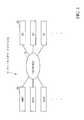
- Fig. 1 shows a block diagram illustrating a configuration of a network system according to an embodiment of the present disclosure
- Fig. 2 shows a block diagram illustrating a configuration of a multifunction peripheral ("MFP") of the network system
- Fig. 3 shows a block diagram illustrating a configuration of a personal computer ("PC") of the network system
- Fig. 4 shows a flowchart illustrating an operation of the PC when requesting the MFP to execute printing
- Fig. 5 shows a flowchart illustrating an the operation of the MFP
- Fig. 6 shows a flowchart illustrating an ordinary printing process of the operations of the MFP
- Fig. 7 shows a flowchart illustrating a proxy-process execution process of the operations of the MFP
- Fig. 8 shows a flowchart illustrating a take-over printing process of the operations of the MFP
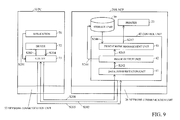
- Fig. 9 shows a schematic diagram illustrating a flow of information in the case where the power of the MFP is in the ordinary state when the PC attempts to transmit print data to the MFP;
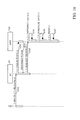
- Fig. 10 shows a sequence diagram of the network system in the case where the power of the MFP is in the ordinary state when the PC attempts to transmit print data to the MFP;
- Fig. 11 shows a diagram illustrating a flow of information in the case where the power of the MFP is in a low-power-saving state when the PC attempts to transmit print data to the MFP;
- Fig. 12 shows a sequence diagram of the network system in the case where the power of the MFP is in the low-power-saving state when the PC attempts to transmit print data to the MFP;
- Fig. 13 shows a schematic diagram illustrating a flow of information in the case where the power of the MFP is in a high-power-saving state when the PC attempts to transmit print data to the MFP;
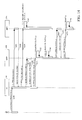
- Fig. 14 shows a sequence diagram of the network system in the case where the power of the MFP is in the high-power-saving state when the PC attempts to transmit print data to the MFP.
- Fig. 1 shows a block diagram illustrating a configuration of a network system 10 according to this embodiment.
- the network system 10 includes a plurality of multifunction peripherals ("MFPs") serving as image forming apparatuses and a plurality of personal computers (“PCs") serving as information processing units that request the MFPs to execute printing.
- MFPs multifunction peripherals
- PCs personal computers
- the plurality of MFPs and the plurality of PCs are connected in order to communicate with each other via a network 11, such as a local area network ("LAN") and the Internet.
- the plurality of MFPs includes a MFP 20.
- the individual constituents of the plurality of MFPs are the same as the constituents of the MFP 20.
- the plurality of PCs includes a PC 50.
- the individual constituents of the plurality of PCs are the same as the constituents of the PC 50.
- the power state of the MFPs can be switched among an ordinary state, a low-power-saving state, which is one of power-saving states in which power consumption is lower than that in the ordinary state, and a high-power-saving state.
- the high-power-saving state is one of power-saving states in which power consumption is lower than the ordinary state and in which power-saving performance is higher than that in the low-power-saving state.
- the time necessary for the MFPs to return from the high-power-saving state to the ordinary state is longer than the time necessary for the MFPs to return from the low-power-saving state to the ordinary state.
- Fig. 2 shows a block diagram illustrating a configuration of the MFP 20.
- the MFP 20 includes an operating unit 21, a display unit 22, a printer 23, a scanner 24, a facsimile communication unit 25, a network communication unit 26, a power-state switching unit 27, a storage unit 30, and a control unit 40.
- the operating unit 21 is an input device, such as a button, to which various user operations are input.
- the display unit 22 is a display device, such as a liquid crystal display ("LCD"), on which various items of information are displayed.
- the printer 23 is a printing device that executes image printing on a recording medium, such as paper.
- the scanner 24 is a reading device that reads an image from a document.
- the facsimile communication unit 25 is a facsimile device that performs facsimile communications via a communication line, such as a public telephone line.
- the network communication unit 26 is a network communication device that performs communications via the network 11.
- the power-state switching unit 27 is a device that switches the power state of the MFP 20.
- the storage unit 30 is a storage device, such as an electrically erasable programmable read-only memory (“EEPROM”) and a hard disk drive (“HDD”), that stores various data, such as programs.
- the control unit 40 controls the entire MFP 20.
- the storage unit 30 can store image data 31 immediately before being printed.
- the control unit 40 includes, for example, a central processing unit (“CPU”), a read only memory (“ROM”) that stores programs and various data in advance, and a random access memory (“RAM”) used as a work area for the CPU.
- the CPU executes programs stored in the ROM or the storage unit 30.
- the control unit 40 functions as a data interpretation unit (“interpreter”) 41, an image output unit (“VIDEO”) 42, a print-engine management unit 43, and a proxy-process management unit 44 by executing programs stored in the storage unit 30.
- the data interpretation unit 41 interprets received data.
- the image output unit 42 generates the image data 31 immediately before being printed.
- the print-engine management unit 43 manages the printer 23.
- the proxy-process management unit 44 manages a proxy process, which is a proxy process to halfway through a printing process to be executed by an external target unit.
- the external target unit is a target MFP that the PC requests to execute printing.
- the data interpretation unit 41 and the image output unit 42 are configured to execute a proxy process when requested to execute the proxy process and constitute a proxy-process executing unit of the present disclosure.
- the proxy-process management unit 44 includes a proxy-generation-information transmission unit 44a and a printing-process take-over unit 44b.
- the proxy-generation-information transmission unit 44a transmits proxy generation information, which is information generated by a proxy process executed by the data interpretation unit 41 and the image output unit 42, to the target unit.
- the printing-process take-over unit 44b takes over printing from halfway therethrough and executes it based on the received proxy generation information.
- the control unit 40 controls the power-state switching unit 27 so that it supplies power to all the components of the MFP 20, including the printer 23.
- the control unit 40 controls the power-state switching unit 27 so that it stops supplying power to the printer 23.
- the control unit 40 controls the power-state switching unit 27 so that it not only stops supplying power to the printer 23, but also stops supplying power to more components of the MFP 20 as compared to the low-power-saving state.
- the control unit 40 causes the power-state switching unit 27 to shift the power of the MFP 20 to the low-power-saving state.
- a predetermined condition is when the period during which no operation is input to the operating unit 21 in the ordinary state reaches a predetermined period or more.
- the control unit 40 causes the power-state switching unit 27 to shift the power of the MFP 20 to the high-power-saving state.
- a predetermined condition is when the period during which no operation is input to the operating unit 21 in the low-power-saving state reaches a predetermined period or more,
- the individual constituents of the plurality ofMFPs are the same as the constituents of the MFP 20. Accordingly, the individual constituents of the plurality of MFPs are also described using the same reference numerals as those of the MFP 20.
- Fig. 3 shows a block diagram illustrating a configuration of the PC 50.
- the PC 50 includes an operating unit 51, a display unit 52, a network communication unit 53, a storage unit 60, and a control unit 70.
- the operating unit 51 is an input device, such as a mouse and a keyboard, to which various user operations are input.
- the display unit 52 is a display device, such as an LCD, on which various items of information are displayed.
- the network communication unit 53 is a network communication device that performs communications via the network 11.
- the storage unit 60 is a storage device, such as a HDD, that stores various data, such as programs.
- the control unit 70 controls the entire PC 50.
- the storage unit 60 stores various application programs 61, a printer driver 62 for controlling the MFPs, and utility software 63 serving as a program for the information processing unit of the present disclosure.
- the application programs 61, the printer driver 62, and the utility software 63 may be installed in the PC 50 at the stage of manufacturing the PC 50, be additionally installed from a storage medium, such as a universal serial bus ("USB") memory, a compact disc (“CD”), and a digital versatile disc (“DVD”), to the PC 50, or be additionally installed to the PC 50 via the network 11.
- a storage medium such as a universal serial bus ("USB") memory, a compact disc (“CD”), and a digital versatile disc (“DVD”)
- the control unit 70 includes, for example, a CPU, a ROM that stores programs and various data in advance, and a RAM used as a work area for the CPU.
- the CPU executes programs stored in the ROM or the storage unit 60.
- the control unit 70 functions as an application 71, a driver 72, and a utility 73 by executing the application programs 61, the printer driver 62, and the utility software 63, respectively.
- the utility 73 includes a proxy-unit search unit 73a, a proxy-process request unit 73b, and a return request unit 73c.
- the proxy-unit search unit 73a searches for a proxy unit serving as an MFP that executes a proxy process, which is a proxy process to halfway through a printing process to be executed by a target unit.
- the target unit is a target MFP that is requested to execute printing.
- the proxy-process request unit 73b requests the proxy unit found by the proxy-unit search unit 73a to execute the proxy process.
- the return request unit 73c requests the target unit to return to the ordinary state.
- the individual constituents of the plurality of PCs are the same as the constituents of the PC 50. Accordingly, the individual constituents of the plurality of PCs are also described using the same reference numerals as those of the PC 50.
- Fig. 4 shows a flowchart illustrating the operation of the PC when requesting the MFP to execute printing.
- the application 71 of the control unit 70 of the PC instructs the utility 73 to request to execute printing to an MFP designated by the user, that is, a target unit, in accordance with a user operation to the operating unit 51 (S201).
- the utility 73 instructs the driver 72 to generate print data, which is requested by the application 71 (S202).
- the driver 72 When the instruction to generate print data is given by the utility 73 in S202, the driver 72 generates print data in response to the instruction from the utility 73 (S203).
- the driver 72 passes the generated print data to the utility 73 (S204).
- the utility 73 checks the state of power of the target unit, given from the application 71 in S201, by using a simple network management protocol (“SNMP") (S205).
- SNMP simple network management protocol
- the return request unit 73c of the utility 73 requests the target unit to return to the ordinary state (S206).
- the utility 73 checks the power state of the target unit by using the SNMP until it is determined that the power of the target unit is in the ordinary state (S207).
- the utility 73 requests the target unit to execute printing by transmitting the print data generated in S203 (S208), and the process shown in Fig. 4 ends.
- the return request unit 73c of the utility 73 requests the target unit to return to the ordinary state (S209).
- the proxy-unit search unit 73a of the utility 73 searches for a proxy unit by using the SNMP(S210).
- the proxy-unit search unit 73a searches for a proxy unit on certain conditions.
- the conditions may include, for example, whether the proxy-unit search unit 73a is an MFP whose power is in the ordinary state, it is an MFP having a function capable of executing a proxy process that causes the same result as that of the target unit, and it is an MFP whose throughput for executing a proxy process is higher than or equal to a predetermined throughput.
- whether the proxy unit is an MFP having a function capable of executing a proxy process that causes the same result as that of the target unit is determined based on a number of conditions.
- Such conditions may include, for example, the following: whether it is an MFP having an emulation program capable of interpreting the print data generated in S203; whether it is an MFP equipped with a recording medium of a size designated as the size of a recording medium on which the print data generated in S203 is to be printed; whether it is an MFP having a printing function designated for the print data generated in S203, such as aggregate printing and two-sided printing; and so on.
- Whether the throughput for executing the proxy process is higher than or equal to a predetermined throughput is determined based on, for example, the capacity of a memory in the MFP and the evaluated value of the performance of the CPU of the MFP.
- the proxy-unit search unit 73a may acquire type names from the MFPs and acquire, among information necessary for searching for a proxy unit, information that has not changed from the default states of the individual types of MFP from a database stored in the PC in advance based on the type names. On the other hand, it is preferable that the proxy-unit search unit 73a directly acquire information that could be changed from the default state due to addition of a memory, such as the capacity of a memory of a MFP. Of course, the proxy-unit search unit 73a may directly acquire all information necessary for searching for a proxy unit from the MFPs.
- the proxy-process request unit 73b of the utility 73 adds proxy-process request information, which is information for requesting a proxy process, to the print data generated in S203 (S211).
- the proxy-process request unit 73b requests the proxy unit, which is found by the proxy-unit search unit 73a in S210, to execute the proxy process by transmitting the print data to which the proxy-process request information is added in S211 to the proxy unit (S212), and the process shown in Fig. 4 ends.
- Fig. 5 shows a flowchart illustrating the operation of the MFP.
- control unit 40 of the MFP executes the process shown in Fig. 5 .
- the data interpretation unit 41 of the control unit 40 determines whether the information transmitted from the outside is print data (S221).
- the data interpretation unit 41 determines whether the print data includes additional proxy-process request information (S222).
- the data interpretation unit 41 determines whether the information transmitted from the outside includes additional proxy-generation-information notification information for giving notification that it is proxy generation information (S223).
- the data interpretation unit 41 executes an ordinary printing process, described later, (S224), and the process shown in Fig. 5 ends.
- the data interpretation unit 41 executes a proxy process execution process, described later, (S225), and the process shown in Fig. 5 ends.
- the data interpretation unit 41 executes a take-over printing process, described later, (S226), and the process shown in Fig. 5 ends.
- the data interpretation unit 41 executes no process, and the process shown in Fig. 5 ends.
- Fig. 6 shows a flowchart illustrating the ordinary printing process shown in Fig. 5 .
- the data interpretation unit 41 interprets the print data transmitted from the outside (S241).
- the data interpretation unit 41 passes the information interpreted in S241 to the image output unit 42 (S242).
- the image output unit 42 When receiving the information passed from the data interpretation unit 41 in S242, the image output unit 42 generates the image data 31 immediately before being printed by performing rasterization thereon based on the information passed from the data interpretation unit 41 (S243).
- the image output unit 42 writes the generated image data 31 into the storage unit 30 (S244).
- the image output unit 42 requests the print-engine management unit 43 to execute printing (S245).
- the print-engine management unit 43 When the print-engine management unit 43 is requested by the image output unit 42 to execute printing in S245, the print-engine management unit 43 reads the image data 31 written in the storage unit 30 in S244 from the storage unit 30 (S246).
- the print-engine management unit 43 prints an image corresponding to the image data 31 read from the storage unit 30 on a recording medium with the printer 23 (S247), and the process shown in Fig. 6 ends.
- Fig. 7 shows a flowchart illustrating the proxy-process execution process shown in Fig. 5 .
- the data interpretation unit 41 notifies the proxy-process management unit 44 of starting the proxy process and the address information of the target unit, which is the target MFP of the print data transmitted from the outside (S261).
- the data interpretation unit 41 interprets the print data transmitted from the outside (S262).
- the data interpretation unit 41 passes the information interpreted in S262 to the image output unit 42 together with the notification that the process is a proxy process (S263).
- the image output unit 42 When receiving the information passed from the data interpretation unit 41 in S263, the image output unit 42 performs rasterization thereon based on the information passed from the data interpretation unit 41 to generate the image data 31 immediately before being printed (S264).
- the image output unit 42 writes the generated image data 31 into the storage unit 30 (S265).
- the process from S262 to S265 is the same as that from S241 to S244 and constitutes the proxy process of the present disclosure.
- the image data 31 generated in S264 is information generated by the proxy process and constitutes the proxy generation information of the present disclosure.
- the image output unit 42 notifies the proxy-process management unit 44 of completion of the generation of the image data 31 and information on the destination of the generated image data 31 in the storage unit 30 (S266).
- the proxy-process management unit 44 checks the power state of the target unit by using the SNMP until it is determined that the power of the target unit whose address information is given in S261 is in the ordinary state (S267).
- the proxy-generation-information transmission unit 44a of the proxy-process management unit 44 reads the image data 31 written in the storage unit 30 in S265 based on the destination information given in S266 (S268).
- the proxy-generation-information transmission unit 44a adds proxy-generation-information notification information to the image data 31 read in S268 (S269).
- the proxy-generation-information transmission unit 44a transmits the image data 31 to which the proxy-generation-information notification information is added in S269 to the target unit whose address information is given in S261 (S270), and the process shown in Fig. 7 ends.
- Fig. 8 shows a flowchart illustrating the take-over printing process shown in Fig. 5 .
- the data interpretation unit 41 notifies the proxy-process management unit 44 that writing of the image data 31, which is proxy generation information, is to be started (S281).
- the data interpretation unit 41 writes the image data 31 transmitted from the outside into the storage unit 30 (S282).
- the data interpretation unit 41 notifies the proxy-process management unit 44 that writing of the image data 31 has ended (S283).
- the printing-process take-over unit 44b of the proxy-process management unit 44 requests the print-engine management unit 43 to execute printing (S284).
- the printing-process take-over unit 44b takes over printing from halfway and executes the printing based on the image data 31, which is proxy generation information transmitted from the outside.
- the print-engine management unit 43 When receiving the request to execute printing from the printing-process take-over unit 44b in S284, the print-engine management unit 43 reads the image data 31 written in the storage unit 30 in S282 (S285).
- the print-engine management unit 43 prints an image corresponding to the image data 31 read from the storage unit 30 on a recording medium with the printer 23 (S286), and the process shown in Fig. 8 ends.
- the overall operation of the network system 10 will be described based on the operations of the PC and the MFP described above.
- MFP 20A a target unit
- Fig. 9 shows a schematic diagram illustrating a flow of information in the case where the power of the MFP 20A is in the ordinary state when the PC 50 attempts to transmit print data to the MFP 20A.
- Fig. 10 shows a sequence diagram illustrating a configuration of the network system 10 in the case where the power of the MFP 20A is in the ordinary state when the PC 50 attempts to transmit print data to the MFP 20A.
- the PC 50 executes the process from S201 to S204 (see Fig. 4 ) and thereafter checks the power state of the MFP 20A (S205).
- control unit 40 of the MFP 20A replies to the PC 50 that the power is in the ordinary state (S302).
- the PC 50 When receiving the reply that the power is in the ordinary state in S302, the PC 50 requests the MFP 20A to execute printing (S208).
- the MFP 20A determines in S221 that the information transmitted from the outside is print data (see Fig. 5 ), determines in S222 that the print data includes no additional proxy-process request information (see Fig. 5 ), and executes the ordinary printing process in S224 (see Fig. 5 ).
- the MFP 20A executes printing on a recording medium with the printer 23 by executing the process from S241 to S247 (see Fig. 6 ).
- Fig. 11 shows a schematic diagram illustrating a flow of information in the case where the power of the MFP 20A is in the low-power-saving state when the PC 50 attempts to transmit print data to the MFP 20A.
- Fig. 12 shows a sequence diagram illustrating a configuration of the network system 10 in the case where the power of the MFP 20A is in the low-power-saving state when the PC 50 attempts to transmit print data to the MFP 20A.
- the PC 50 executes the process from S201 to S204 (see Fig. 4 ) and thereafter checks the power state of the MFP 20A (S205).
- control unit 40 of the MFP 20A replies to the PC 50 that the power is in the low-power-saving state (S322).
- the PC 50 When receiving the reply that the power is in the low-power-saving state in S322, the PC 50 requests the MFP 20A to return to the ordinary state (S206).
- control unit 40 of the MFP 20A controls the power-state switching unit 27 so that the power state is returned from the low-power-saving state to the ordinary state (S323).
- the PC 50 checks the power state of the MFP 20A after the process in S206 until it is determined that the power of the MFP 20A is in the ordinary state (S207).
- control unit 40 of the MFP 20A replies to the PC 50 that the power is in the ordinary state (S324).
- the PC 50 When receiving the reply that the power is in the ordinary state in S324, the PC 50 requests the MFP 20A to execute printing (S208).
- the MFP 20A determines in S221 that the information transmitted from the outside is print data (see Fig. 5 ), determines in S222 that the print data includes no additional proxy-process request information (see Fig. 5 ), and executes the ordinary printing process in S224 (see Fig. 5 ).
- the MFP 20A executes printing on a recording medium with the printer 23 by executing the process from S241 to S247 (see Fig. 6 ).
- Fig. 13 shows a schematic diagram illustrating a flow of information in the case where the power of the MFP 20A is in the high-power-saving state when the PC 50 attempts to transmit print data to the MFP 20A.
- Fig. 14 shows a sequence diagram illustrating a configuration of the network system 10 in the case where the power of the MFP 20A is in the high-power-saving state when the PC 50 attempts to transmit print data to the MFP 20A.
- the PC 50 executes the process from S201 to S204 (see Fig. 4 ) and thereafter checks the power state of the MFP 20A (S205).
- control unit 40 of the MFP 20A replies to the PC 50 that the power is in the high-power-saving state (S342).
- the PC 50 When receiving the reply that the power is in the high-power-saving state in S342, the PC 50 requests the MFP 20A to return to the ordinary state (S209).
- control unit 40 of the MFP 20A controls the power-state switching unit 27 so that the power state is returned from the high-power-saving state to the ordinary state (S343).
- the PC 50 searches for a proxy unit after the process in S209 (S210).
- MFPs other than the MFP 20A reply to the PC 50 with information, such as the power state and information on the functions thereof (S344).
- the PC 50 executes the process in S211 and thereafter requests the found proxy unit (hereinafter referred to as MFP 20B) to execute a proxy process (S212).
- MFP 20B found proxy unit
- the MFP 20B determines in S221 that the information transmitted from the outside is print data (see Fig. 5 ), determines in S222 that the print data includes additional proxy-process request information (see Fig. 5 ), and executes the proxy-process execution process in S225 (see Fig. 5 ).
- the MFP 20B checks the power state of the MFP 20A after executing the process from S261 to S266 (see Fig. 7 ) until it is determined that the power of the MFP 20A is in the ordinary state (S267).
- control unit 40 of the MFP 20A replies to the MFP 20B that the power is in the ordinary state (S345).
- the MFP 20B executes the process in S268 and S269 (see Fig. 7 ) and thereafter transmits the image data 31 to which proxy-generation-information notification information is added to the MFP 20A (S270).
- the MFP 20A determines in S221 that the information transmitted from the outside is not print data (see Fig. 5 ), determines in S223 that the information transmitted from the outside includes additional proxy-generation-information notification information (see Fig. 5 ), and executes the take-over printing process in S226 (see Fig. 5 ).
- the MFP 20A executes printing on a recording medium with the printer 23 by executing the process from S281 to S286 (see Fig. 8 ).
- a proxy process that is a proxy process to halfway through a printing process to be executed by a target MFP is executed by another MFP serving as a proxy unit (S262 to S265). Further, the target MFP takes over the printing from halfway therethrough based on information generated by the proxy process (S284 to S286). This can reduce the first printing time after the power returns from the power-saving state to the ordinary state, as compared with that in the related art.
- an MFP serving as a proxy unit executes a proxy process to halfway through a printing process to be executed by an external target unit (S262 to S265).
- the MFP transmits information generated by the proxy process to the target unit. This can reduce the first printing time of the target unit after the target unit returns from the power-saving state to the ordinary state, as compared with that in the related art.
- the PC that executes the utility software 63 causes a proxy unit to execute a proxy process which is a proxy process to halfway through a printing process to be executed by the target unit (S212). This can reduce the first printing time of the target unit after the target unit returns from the power-saving state to the ordinary state, as compared with that in the related art.
- the network system 10 executes a proxy process that is a proxy process to halfway through a printing process.
- the proxy process is to be executed by the target unit with a proxy unit in parallel with the returning process of the target unit during the time the target unit returns from the high-power-saving state to the ordinary state (S262 to S265).
- the power of the target unit is in the ordinary state (the ordinary state in S267)
- information generated by the proxy process is transmitted to the target unit by the proxy unit (S270), and the target unit takes over the printing from halfway based on the information generated by the proxy process (S284 to S286). This can reduce the first printing time of the target unit after the target unit returns from the high-power-saving state to the ordinary state, as compared that in the related art.
- the network system 10 can cause the target unit to execute final printing on the recording medium, not causing an MFP other than the target unit to execute printing on a recording medium.
- the network system 10 can always generate printing in a target unit designated by the user. Accordingly, the network system 10 offers higher convenience to the user than that of a configuration in which an MFP other than the target unit executes printing on a recording medium by proxy.
- the PC Since the PC searches for an MFP whose power is in the ordinary state as a proxy unit (S210), the PC can cause the MFP in the ordinary state to execute a proxy process. Accordingly, the PC can accelerate proxy-process end time as compared with a configuration in which an MFP in the power-saving state is returned from the power-saving state to the ordinary state and thereafter the MFP executes a proxy process.
- the same print result can be achieved both where the proxy unit executes a proxy process and thereafter the target unit takes over the printing process, and where the target unit singly executes the entire printing process.
- the PC searches for an MFP having a throughput for executing a proxy process higher than a predetermined throughput as a proxy unit (S210), the first printing time of the target unit after the target unit has returned from the power-saving state to the ordinary state can be prevented from extending due to the proxy process of the proxy unit.
- the PC need not have a throughput for executing a proxy process higher than a predetermined throughput as a condition for searching for a proxy unit.
- the PC may adopt another condition as a condition for searching for a proxy unit.
- the PC may set an MFP itself directly designated by the user as a proxy unit.
- the network system 10 is configured such that the PC requests the target unit to return to the ordinary state when the power of the target unit is in the high-power-saving state (the high-power-saving state in S205) (S209).
- the network system 10 may be configured such that the proxy unit requests the target unit to return to the ordinary state when the power of the target unit is in the high-power-saving state.
- the target unit can be returned to the ordinary state earlier than the case where the proxy unit is caused to request the target unit to return to the ordinary state.
- the proxy process of the MFP need not include generation of image data immediately before being printed.
- an MFP serving as a proxy unit may always monitor the power state of the target unit. When the power of the target unit reaches the ordinary state, the image output process of the image output unit 42 may be stopped halfway, and the progress of the image output process and the generated data may be transmitted to the target unit. In this case, the MFP serving as the target unit takes over the image output process that the proxy unit has terminated from halfway.
- the PC determines whether to search for a proxy unit (S210) depending on the kind of the power-saving state of the target unit among the plurality of kinds of power-saving states (the low-power-saving state or the high-power-saving state in S205).
- the PC may be configured to cause a proxy unit to execute a proxy process when the power of the target unit is in the low-power-saving state and when the power of the target unit is in the high-power-saving state.
- the image forming apparatus of the present disclosure is an MFP in this embodiment, it may be an image forming apparatus other than the MFP, such as a printer-specific machine.
- the information processing unit of the present disclosure is a PC in this embodiment, it may be an information processing unit other than the PC.
- each block and/or communication may represent a process of information and/or a transmission of information in accordance with example embodiments and alternative embodiments may be included within the scope of such example embodiments.
- more or fewer blocks and/or functions may be used with any of the ladder diagrams and flow charts discussed herein, and these ladder diagrams and flow charts may be combined with one another, in part or in whole.
Landscapes
- Engineering & Computer Science (AREA)
- Physics & Mathematics (AREA)
- General Physics & Mathematics (AREA)
- Microelectronics & Electronic Packaging (AREA)
- Multimedia (AREA)
- Signal Processing (AREA)
- Theoretical Computer Science (AREA)
- Human Computer Interaction (AREA)
- General Engineering & Computer Science (AREA)
- Accessory Devices And Overall Control Thereof (AREA)
- Facsimiles In General (AREA)
- Control Or Security For Electrophotography (AREA)
- Power Sources (AREA)
Abstract
Description
- This application is based upon, and claims the benefit of priority from, corresponding Japanese Patent Application No.
2012-043115 - The present disclosure relates to an image forming apparatus, an image forming system, and a non-transitory computer-readable recording medium in which it is possible to switch among a plurality of power states including an ordinary state and a power-saving state in which power consumption is lower than that in the ordinary state.
- A typical image forming system is known in which a server executes a response process to be executed by an image forming apparatus by proxy when the image forming apparatus is in a power-saving state.
- Another typical image forming system is known in which, when a first image forming apparatus shifts to a power-saving state, a file that the first image forming apparatus stores is transferred to a second image forming apparatus. When a request to acquire the file that the first image forming apparatus stores is issued from a third image forming apparatus when the first image forming apparatus is in the power-saving state, the second image forming apparatus transmits the file that the second image forming apparatus stores to the third image forming apparatus. The second image forming apparatus transmits the file by proxy until the first image forming apparatus returns from the power-saving state to an ordinary state.
- An image forming apparatus according to an aspect of the present disclosure as set forth in
claim 1 includes a power-state switching unit, a proxy-process executing unit, a proxy-generation-information transmission unit, and a printing-process take-over unit. The power-state switching unit switches among a plurality of power states including an ordinary state and a power-saving state in which power consumption is lower than that in the ordinary state. The proxy-process executing unit executes a proxy process upon request, the proxy process being a proxy process to halfway through a printing process to be executed by an external target unit. The external target unit is a target image forming apparatus that an external information processing unit requests to execute printing. The proxy-generation-information transmission unit transmits proxy generation information to the target unit. The proxy generation information is information generated by the proxy process executed by the proxy-process executing unit. The proxy-generation-information transmission unit transmits the proxy generation information to the target unit when the power of the target unit is in the ordinary state. The printing-process take-over unit takes over the printing from halfway based on the received proxy generation information. - An image forming system according to an aspect of the present disclosure as set forth in claim 3 includes a plurality of image forming apparatuses and an information processing unit that requests the plurality of image forming apparatuses to execute printing. The information processing unit includes a proxy-unit search unit and a proxy-process request unit. The proxy-unit search unit searches for a proxy unit serving as the image forming apparatus that executes a proxy process that is a proxy process to halfway through a printing process. The proxy process is to be executed by a target unit that is the image forming apparatus requested to execute printing. The proxy-process request unit requests the proxy unit found by the proxy-unit search unit to execute the proxy process. The proxy-unit search unit searches for the proxy unit when the power of the target unit is in a predetermined power-saving state. Each of the plurality of image forming apparatuses includes a power-state switching unit that switches among a plurality of power states including an ordinary state and a power-saving state in which power consumption is lower than that in the ordinary state. The proxy unit includes a proxy-process executing unit and a proxy-generation-information transmission unit. The proxy-process executing unit executes the proxy process upon request. The proxy-generation-information transmission unit transmits proxy generation information to the target unit. The proxy generation information is information generated by the proxy process executed by the proxy-process executing unit. The proxy-generation-information transmission unit transmits the proxy generation information to the target unit when the power of the target unit is in the ordinary state. The target unit includes a printing-process take-over unit that, when receiving the proxy generation information, takes over the printing from halfway based on the proxy generation information.
- A non-transitory computer-readable recording medium that stores a program for an information processing unit according to an aspect of the present disclosure as set forth in
claim 10 stores a program for an information processing unit. The program is executed by an information processing unit that requests a plurality of image forming apparatuses to switch among a plurality of power states including an ordinary state and a power-saving state in which power consumption is lower than that in the ordinary state to execute printing. The program for the information processing unit causes the information processing unit to function as a proxy-unit search unit and a proxy-process request unit. The proxy-unit search unit searches for a proxy unit serving as the image forming apparatus that executes a proxy process. The proxy process is a proxy process to halfway through a printing process and is to be executed by a target unit that is the image forming apparatus requested to execute printing. The proxy-unit search unit searches the proxy unit when the power of the target unit is in the predetermined power-saving state. The proxy-process request unit requests the proxy unit found by the proxy-unit search unit to execute the proxy process. - These as well as other aspects, advantages, and alternatives will become apparent to those of ordinary skill in the art by reading the following detailed description with reference where appropriate to the accompanying drawings. Further, it should be understood that the description provided in this summary section and elsewhere in this document is intended to illustrate the claimed subject matter by way of example and not by way of limitation.
- In the accompanying drawings:
-
Fig. 1 shows a block diagram illustrating a configuration of a network system according to an embodiment of the present disclosure; -
Fig. 2 shows a block diagram illustrating a configuration of a multifunction peripheral ("MFP") of the network system; -
Fig. 3 shows a block diagram illustrating a configuration of a personal computer ("PC") of the network system; -
Fig. 4 shows a flowchart illustrating an operation of the PC when requesting the MFP to execute printing; -
Fig. 5 shows a flowchart illustrating an the operation of the MFP; -
Fig. 6 shows a flowchart illustrating an ordinary printing process of the operations of the MFP; -
Fig. 7 shows a flowchart illustrating a proxy-process execution process of the operations of the MFP; -
Fig. 8 shows a flowchart illustrating a take-over printing process of the operations of the MFP; -
Fig. 9 shows a schematic diagram illustrating a flow of information in the case where the power of the MFP is in the ordinary state when the PC attempts to transmit print data to the MFP; -
Fig. 10 shows a sequence diagram of the network system in the case where the power of the MFP is in the ordinary state when the PC attempts to transmit print data to the MFP; -
Fig. 11 shows a diagram illustrating a flow of information in the case where the power of the MFP is in a low-power-saving state when the PC attempts to transmit print data to the MFP; -
Fig. 12 shows a sequence diagram of the network system in the case where the power of the MFP is in the low-power-saving state when the PC attempts to transmit print data to the MFP; -
Fig. 13 shows a schematic diagram illustrating a flow of information in the case where the power of the MFP is in a high-power-saving state when the PC attempts to transmit print data to the MFP; and -
Fig. 14 shows a sequence diagram of the network system in the case where the power of the MFP is in the high-power-saving state when the PC attempts to transmit print data to the MFP. - Example apparatus and method are described herein. Other example embodiments or features may further be utilized, and other changes may be made, without departing from the scope of the subject matter presented herein. In the following detailed description, reference is made to the accompanying drawings, which form a part thereof.
- An embodiment of the present disclosure will be described with reference to the drawings.
- First, the configuration of a network system serving as an image forming system according to this embodiment will be described.
-
Fig. 1 shows a block diagram illustrating a configuration of anetwork system 10 according to this embodiment. - As shown in
Fig. 1 , thenetwork system 10 includes a plurality of multifunction peripherals ("MFPs") serving as image forming apparatuses and a plurality of personal computers ("PCs") serving as information processing units that request the MFPs to execute printing. The plurality of MFPs and the plurality of PCs are connected in order to communicate with each other via anetwork 11, such as a local area network ("LAN") and the Internet. The plurality of MFPs includes aMFP 20. The individual constituents of the plurality of MFPs are the same as the constituents of theMFP 20. The plurality of PCs includes aPC 50. The individual constituents of the plurality of PCs are the same as the constituents of thePC 50. - The power state of the MFPs can be switched among an ordinary state, a low-power-saving state, which is one of power-saving states in which power consumption is lower than that in the ordinary state, and a high-power-saving state. The high-power-saving state is one of power-saving states in which power consumption is lower than the ordinary state and in which power-saving performance is higher than that in the low-power-saving state. The time necessary for the MFPs to return from the high-power-saving state to the ordinary state is longer than the time necessary for the MFPs to return from the low-power-saving state to the ordinary state.
-
Fig. 2 shows a block diagram illustrating a configuration of theMFP 20. - As shown in
Fig. 2 , theMFP 20 includes an operatingunit 21, adisplay unit 22, aprinter 23, ascanner 24, afacsimile communication unit 25, anetwork communication unit 26, a power-state switching unit 27, astorage unit 30, and acontrol unit 40. The operatingunit 21 is an input device, such as a button, to which various user operations are input. Thedisplay unit 22 is a display device, such as a liquid crystal display ("LCD"), on which various items of information are displayed. Theprinter 23 is a printing device that executes image printing on a recording medium, such as paper. Thescanner 24 is a reading device that reads an image from a document. Thefacsimile communication unit 25 is a facsimile device that performs facsimile communications via a communication line, such as a public telephone line. Thenetwork communication unit 26 is a network communication device that performs communications via thenetwork 11. The power-state switching unit 27 is a device that switches the power state of theMFP 20. Thestorage unit 30 is a storage device, such as an electrically erasable programmable read-only memory ("EEPROM") and a hard disk drive ("HDD"), that stores various data, such as programs. Thecontrol unit 40 controls theentire MFP 20. - The
storage unit 30 can storeimage data 31 immediately before being printed. - The
control unit 40 includes, for example, a central processing unit ("CPU"), a read only memory ("ROM") that stores programs and various data in advance, and a random access memory ("RAM") used as a work area for the CPU. The CPU executes programs stored in the ROM or thestorage unit 30. - The
control unit 40 functions as a data interpretation unit ("interpreter") 41, an image output unit ("VIDEO") 42, a print-engine management unit 43, and a proxy-process management unit 44 by executing programs stored in thestorage unit 30. Thedata interpretation unit 41 interprets received data. Theimage output unit 42 generates theimage data 31 immediately before being printed. The print-engine management unit 43 manages theprinter 23. The proxy-process management unit 44 manages a proxy process, which is a proxy process to halfway through a printing process to be executed by an external target unit. The external target unit is a target MFP that the PC requests to execute printing. Thedata interpretation unit 41 and theimage output unit 42 are configured to execute a proxy process when requested to execute the proxy process and constitute a proxy-process executing unit of the present disclosure. - The proxy-
process management unit 44 includes a proxy-generation-information transmission unit 44a and a printing-process take-over unit 44b. The proxy-generation-information transmission unit 44a transmits proxy generation information, which is information generated by a proxy process executed by thedata interpretation unit 41 and theimage output unit 42, to the target unit. The printing-process take-over unit 44b takes over printing from halfway therethrough and executes it based on the received proxy generation information. - When the power of the
MFP 20 is in the ordinary state, thecontrol unit 40 controls the power-state switching unit 27 so that it supplies power to all the components of theMFP 20, including theprinter 23. When the power of theMFP 20 shifts from the ordinary state to the low-power-saving state, thecontrol unit 40 controls the power-state switching unit 27 so that it stops supplying power to theprinter 23. When the power of theMFP 20 shifts from the low-power-saving state to the high-power-saving state, thecontrol unit 40 controls the power-state switching unit 27 so that it not only stops supplying power to theprinter 23, but also stops supplying power to more components of theMFP 20 as compared to the low-power-saving state. When a predetermined condition is satisfied, thecontrol unit 40 causes the power-state switching unit 27 to shift the power of theMFP 20 to the low-power-saving state. An example of such a predetermined condition is when the period during which no operation is input to the operatingunit 21 in the ordinary state reaches a predetermined period or more. Furthermore, when a predetermined condition is satisfied, thecontrol unit 40 causes the power-state switching unit 27 to shift the power of theMFP 20 to the high-power-saving state. An example of such a predetermined condition is when the period during which no operation is input to the operatingunit 21 in the low-power-saving state reaches a predetermined period or more, - The individual constituents of the plurality ofMFPs are the same as the constituents of the
MFP 20. Accordingly, the individual constituents of the plurality of MFPs are also described using the same reference numerals as those of theMFP 20. -
Fig. 3 shows a block diagram illustrating a configuration of thePC 50. - As shown in
Fig. 3 , thePC 50 includes an operatingunit 51, adisplay unit 52, anetwork communication unit 53, astorage unit 60, and acontrol unit 70. The operatingunit 51 is an input device, such as a mouse and a keyboard, to which various user operations are input. Thedisplay unit 52 is a display device, such as an LCD, on which various items of information are displayed. Thenetwork communication unit 53 is a network communication device that performs communications via thenetwork 11. Thestorage unit 60 is a storage device, such as a HDD, that stores various data, such as programs. Thecontrol unit 70 controls theentire PC 50. - The
storage unit 60 storesvarious application programs 61, aprinter driver 62 for controlling the MFPs, andutility software 63 serving as a program for the information processing unit of the present disclosure. - The
application programs 61, theprinter driver 62, and theutility software 63 may be installed in thePC 50 at the stage of manufacturing thePC 50, be additionally installed from a storage medium, such as a universal serial bus ("USB") memory, a compact disc ("CD"), and a digital versatile disc ("DVD"), to thePC 50, or be additionally installed to thePC 50 via thenetwork 11. - The
control unit 70 includes, for example, a CPU, a ROM that stores programs and various data in advance, and a RAM used as a work area for the CPU. The CPU executes programs stored in the ROM or thestorage unit 60. - The
control unit 70 functions as anapplication 71, adriver 72, and autility 73 by executing theapplication programs 61, theprinter driver 62, and theutility software 63, respectively. - The
utility 73 includes a proxy-unit search unit 73a, a proxy-process request unit 73b, and a return request unit 73c. The proxy-unit search unit 73a searches for a proxy unit serving as an MFP that executes a proxy process, which is a proxy process to halfway through a printing process to be executed by a target unit. The target unit is a target MFP that is requested to execute printing. The proxy-process request unit 73b requests the proxy unit found by the proxy-unit search unit 73a to execute the proxy process. When the power of the target unit is in the power-saving state, the return request unit 73c requests the target unit to return to the ordinary state. - The individual constituents of the plurality of PCs are the same as the constituents of the
PC 50. Accordingly, the individual constituents of the plurality of PCs are also described using the same reference numerals as those of thePC 50. - Next, the operation of the
network system 10 will be described. - First, the operation of the PC when requesting the MFP to execute printing will be described.
-
Fig. 4 shows a flowchart illustrating the operation of the PC when requesting the MFP to execute printing. - As shown in
Fig. 4 , theapplication 71 of thecontrol unit 70 of the PC instructs theutility 73 to request to execute printing to an MFP designated by the user, that is, a target unit, in accordance with a user operation to the operating unit 51 (S201). - When the request to execute printing is given to the target unit from the
application 71 in S201, theutility 73 instructs thedriver 72 to generate print data, which is requested by the application 71 (S202). - When the instruction to generate print data is given by the
utility 73 in S202, thedriver 72 generates print data in response to the instruction from the utility 73 (S203). - Then, the
driver 72 passes the generated print data to the utility 73 (S204). - When the print data is given in S204, the
utility 73 checks the state of power of the target unit, given from theapplication 71 in S201, by using a simple network management protocol ("SNMP") (S205). - If it is determined in S205 that the power of the target unit is in the low-power-saving state, the return request unit 73c of the
utility 73 requests the target unit to return to the ordinary state (S206). - Next, the
utility 73 checks the power state of the target unit by using the SNMP until it is determined that the power of the target unit is in the ordinary state (S207). - If it is determined in S205 or S207 that the power of the target unit is in the ordinary state, the
utility 73 requests the target unit to execute printing by transmitting the print data generated in S203 (S208), and the process shown inFig. 4 ends. - If it is determined in S205 that the power state of the target unit is in the high-power-saving state, the return request unit 73c of the
utility 73 requests the target unit to return to the ordinary state (S209). - Next, the proxy-unit search unit 73a of the
utility 73 searches for a proxy unit by using the SNMP(S210). - The proxy-unit search unit 73a searches for a proxy unit on certain conditions. The conditions may include, for example, whether the proxy-unit search unit 73a is an MFP whose power is in the ordinary state, it is an MFP having a function capable of executing a proxy process that causes the same result as that of the target unit, and it is an MFP whose throughput for executing a proxy process is higher than or equal to a predetermined throughput.
- Here, whether the proxy unit is an MFP having a function capable of executing a proxy process that causes the same result as that of the target unit is determined based on a number of conditions. Such conditions may include, for example, the following: whether it is an MFP having an emulation program capable of interpreting the print data generated in S203; whether it is an MFP equipped with a recording medium of a size designated as the size of a recording medium on which the print data generated in S203 is to be printed; whether it is an MFP having a printing function designated for the print data generated in S203, such as aggregate printing and two-sided printing; and so on.
- Whether the throughput for executing the proxy process is higher than or equal to a predetermined throughput is determined based on, for example, the capacity of a memory in the MFP and the evaluated value of the performance of the CPU of the MFP.
- The proxy-unit search unit 73a may acquire type names from the MFPs and acquire, among information necessary for searching for a proxy unit, information that has not changed from the default states of the individual types of MFP from a database stored in the PC in advance based on the type names. On the other hand, it is preferable that the proxy-unit search unit 73a directly acquire information that could be changed from the default state due to addition of a memory, such as the capacity of a memory of a MFP. Of course, the proxy-unit search unit 73a may directly acquire all information necessary for searching for a proxy unit from the MFPs.
- After the process in S210, the proxy-process request unit 73b of the
utility 73 adds proxy-process request information, which is information for requesting a proxy process, to the print data generated in S203 (S211). - Next, the proxy-process request unit 73b requests the proxy unit, which is found by the proxy-unit search unit 73a in S210, to execute the proxy process by transmitting the print data to which the proxy-process request information is added in S211 to the proxy unit (S212), and the process shown in
Fig. 4 ends. - The operation of the MFP will now be described.
-
Fig. 5 shows a flowchart illustrating the operation of the MFP. - When information is sent from the outside, the
control unit 40 of the MFP executes the process shown inFig. 5 . - As shown in
Fig. 5 , thedata interpretation unit 41 of thecontrol unit 40 determines whether the information transmitted from the outside is print data (S221). - If it is determined in S221 that the information transmitted from the outside is print data, the
data interpretation unit 41 determines whether the print data includes additional proxy-process request information (S222). - If it is determined in S221 that the information transmitted from the outside is not print data, the
data interpretation unit 41 determines whether the information transmitted from the outside includes additional proxy-generation-information notification information for giving notification that it is proxy generation information (S223). - If it is determined in S222 that the print data includes no additional proxy-process request information, the
data interpretation unit 41 executes an ordinary printing process, described later, (S224), and the process shown inFig. 5 ends. - In contrast, if it is determined in S222 that the print data includes additional proxy-process request information, the
data interpretation unit 41 executes a proxy process execution process, described later, (S225), and the process shown inFig. 5 ends. - If it is determined in S223 that the information transmitted from the outside includes additional proxy-generation-information notification information, the
data interpretation unit 41 executes a take-over printing process, described later, (S226), and the process shown inFig. 5 ends. - In contrast, if it is determined in S223 that the information transmitted from the outside includes no additional proxy-generation-information notification information, the
data interpretation unit 41 executes no process, and the process shown inFig. 5 ends. -
Fig. 6 shows a flowchart illustrating the ordinary printing process shown inFig. 5 . - As shown in
Fig. 6 , thedata interpretation unit 41 interprets the print data transmitted from the outside (S241). - Next, the
data interpretation unit 41 passes the information interpreted in S241 to the image output unit 42 (S242). - When receiving the information passed from the
data interpretation unit 41 in S242, theimage output unit 42 generates theimage data 31 immediately before being printed by performing rasterization thereon based on the information passed from the data interpretation unit 41 (S243). - Next, the
image output unit 42 writes the generatedimage data 31 into the storage unit 30 (S244). - Then, the
image output unit 42 requests the print-engine management unit 43 to execute printing (S245). - When the print-
engine management unit 43 is requested by theimage output unit 42 to execute printing in S245, the print-engine management unit 43 reads theimage data 31 written in thestorage unit 30 in S244 from the storage unit 30 (S246). - Then, the print-
engine management unit 43 prints an image corresponding to theimage data 31 read from thestorage unit 30 on a recording medium with the printer 23 (S247), and the process shown inFig. 6 ends. -
Fig. 7 shows a flowchart illustrating the proxy-process execution process shown inFig. 5 . - As shown in
Fig. 7 , thedata interpretation unit 41 notifies the proxy-process management unit 44 of starting the proxy process and the address information of the target unit, which is the target MFP of the print data transmitted from the outside (S261). - Next, the
data interpretation unit 41 interprets the print data transmitted from the outside (S262). - Then, the
data interpretation unit 41 passes the information interpreted in S262 to theimage output unit 42 together with the notification that the process is a proxy process (S263). - When receiving the information passed from the
data interpretation unit 41 in S263, theimage output unit 42 performs rasterization thereon based on the information passed from thedata interpretation unit 41 to generate theimage data 31 immediately before being printed (S264). - Next, the
image output unit 42 writes the generatedimage data 31 into the storage unit 30 (S265). - The process from S262 to S265 is the same as that from S241 to S244 and constitutes the proxy process of the present disclosure. The
image data 31 generated in S264 is information generated by the proxy process and constitutes the proxy generation information of the present disclosure. - After the process in S265, the
image output unit 42 notifies the proxy-process management unit 44 of completion of the generation of theimage data 31 and information on the destination of the generatedimage data 31 in the storage unit 30 (S266). - When receiving the notification that the generation of the
image data 31 has ended in S266, the proxy-process management unit 44 checks the power state of the target unit by using the SNMP until it is determined that the power of the target unit whose address information is given in S261 is in the ordinary state (S267). - When it is determined in S267 that the power of the target unit is in the ordinary state, the proxy-generation-information transmission unit 44a of the proxy-
process management unit 44 reads theimage data 31 written in thestorage unit 30 in S265 based on the destination information given in S266 (S268). - Next, the proxy-generation-information transmission unit 44a adds proxy-generation-information notification information to the
image data 31 read in S268 (S269). - Then, the proxy-generation-information transmission unit 44a transmits the
image data 31 to which the proxy-generation-information notification information is added in S269 to the target unit whose address information is given in S261 (S270), and the process shown inFig. 7 ends. -
Fig. 8 shows a flowchart illustrating the take-over printing process shown inFig. 5 . - As shown in
Fig. 8 , thedata interpretation unit 41 notifies the proxy-process management unit 44 that writing of theimage data 31, which is proxy generation information, is to be started (S281). - Next, the
data interpretation unit 41 writes theimage data 31 transmitted from the outside into the storage unit 30 (S282). - Then, the
data interpretation unit 41 notifies the proxy-process management unit 44 that writing of theimage data 31 has ended (S283). - When receiving the notification that writing of the
image data 31 has ended in S283, the printing-process take-over unit 44b of the proxy-process management unit 44 requests the print-engine management unit 43 to execute printing (S284). In other words, the printing-process take-over unit 44b takes over printing from halfway and executes the printing based on theimage data 31, which is proxy generation information transmitted from the outside. - When receiving the request to execute printing from the printing-process take-over unit 44b in S284, the print-
engine management unit 43 reads theimage data 31 written in thestorage unit 30 in S282 (S285). - Next, the print-
engine management unit 43 prints an image corresponding to theimage data 31 read from thestorage unit 30 on a recording medium with the printer 23 (S286), and the process shown inFig. 8 ends. - The overall operation of the
network system 10 will be described based on the operations of the PC and the MFP described above. - First, the overall operation of the
network system 10 will be described in the case where the power of a target unit (hereinafter referred to asMFP 20A) is in the ordinary state when thePC 50 attempts to transmit print data to theMFP 20A. -
Fig. 9 shows a schematic diagram illustrating a flow of information in the case where the power of theMFP 20A is in the ordinary state when thePC 50 attempts to transmit print data to theMFP 20A.Fig. 10 shows a sequence diagram illustrating a configuration of thenetwork system 10 in the case where the power of theMFP 20A is in the ordinary state when thePC 50 attempts to transmit print data to theMFP 20A. - As shown in
Figs. 9 and10 , when the user instructs thePC 50 to perform printing in theMFP 20A via the operating unit 51 (S301), thePC 50 executes the process from S201 to S204 (seeFig. 4 ) and thereafter checks the power state of theMFP 20A (S205). - Then, the
control unit 40 of theMFP 20A replies to thePC 50 that the power is in the ordinary state (S302). - When receiving the reply that the power is in the ordinary state in S302, the
PC 50 requests theMFP 20A to execute printing (S208). - When receiving the request to execute printing in S208, the
MFP 20A determines in S221 that the information transmitted from the outside is print data (seeFig. 5 ), determines in S222 that the print data includes no additional proxy-process request information (seeFig. 5 ), and executes the ordinary printing process in S224 (seeFig. 5 ). - In other words, the
MFP 20A executes printing on a recording medium with theprinter 23 by executing the process from S241 to S247 (seeFig. 6 ). - Next, the overall operation of the
network system 10 will be described in the case where the power of theMFP 20A is in the low-power-saving state when thePC 50 attempts to transmit print data to theMFP 20A. -
Fig. 11 shows a schematic diagram illustrating a flow of information in the case where the power of theMFP 20A is in the low-power-saving state when thePC 50 attempts to transmit print data to theMFP 20A.Fig. 12 shows a sequence diagram illustrating a configuration of thenetwork system 10 in the case where the power of theMFP 20A is in the low-power-saving state when thePC 50 attempts to transmit print data to theMFP 20A. - As shown in
Figs. 11 and12 , when the user instructs thePC 50 to perform printing in theMFP 20A via the operating unit 51 (S321), thePC 50 executes the process from S201 to S204 (seeFig. 4 ) and thereafter checks the power state of theMFP 20A (S205). - Then, the
control unit 40 of the MFP 20Areplies to thePC 50 that the power is in the low-power-saving state (S322). - When receiving the reply that the power is in the low-power-saving state in S322, the
PC 50 requests theMFP 20A to return to the ordinary state (S206). - Then, the
control unit 40 of theMFP 20A controls the power-state switching unit 27 so that the power state is returned from the low-power-saving state to the ordinary state (S323). - The
PC 50 checks the power state of theMFP 20A after the process in S206 until it is determined that the power of theMFP 20A is in the ordinary state (S207). - When the power state returns to the ordinary state, the
control unit 40 of theMFP 20A replies to thePC 50 that the power is in the ordinary state (S324). - When receiving the reply that the power is in the ordinary state in S324, the
PC 50 requests theMFP 20A to execute printing (S208). - When receiving the request to execute printing in S208, the
MFP 20A determines in S221 that the information transmitted from the outside is print data (seeFig. 5 ), determines in S222 that the print data includes no additional proxy-process request information (seeFig. 5 ), and executes the ordinary printing process in S224 (seeFig. 5 ). - In other words, the
MFP 20A executes printing on a recording medium with theprinter 23 by executing the process from S241 to S247 (seeFig. 6 ). - Next, the overall operation of the
network system 10 will be described in the case where the power of theMFP 20A is in the high-power-saving state when thePC 50 attempts to transmit print data to theMFP 20A. -
Fig. 13 shows a schematic diagram illustrating a flow of information in the case where the power of theMFP 20A is in the high-power-saving state when thePC 50 attempts to transmit print data to theMFP 20A.Fig. 14 shows a sequence diagram illustrating a configuration of thenetwork system 10 in the case where the power of theMFP 20A is in the high-power-saving state when thePC 50 attempts to transmit print data to theMFP 20A. - As shown in
Figs. 13 and14 , when the user instructs thePC 50 to perform printing in theMFP 20A via the operating unit 51 (S341), thePC 50 executes the process from S201 to S204 (seeFig. 4 ) and thereafter checks the power state of theMFP 20A (S205). - Then, the
control unit 40 of theMFP 20A replies to thePC 50 that the power is in the high-power-saving state (S342). - When receiving the reply that the power is in the high-power-saving state in S342, the
PC 50 requests theMFP 20A to return to the ordinary state (S209). - Then, the
control unit 40 of theMFP 20A controls the power-state switching unit 27 so that the power state is returned from the high-power-saving state to the ordinary state (S343). - The
PC 50 searches for a proxy unit after the process in S209 (S210). - Then, MFPs other than the
MFP 20A reply to thePC 50 with information, such as the power state and information on the functions thereof (S344). - When receiving the reply in S344, the
PC 50 executes the process in S211 and thereafter requests the found proxy unit (hereinafter referred to asMFP 20B) to execute a proxy process (S212). - When receiving the request to execute a proxy process in S212, the
MFP 20B determines in S221 that the information transmitted from the outside is print data (seeFig. 5 ), determines in S222 that the print data includes additional proxy-process request information (seeFig. 5 ), and executes the proxy-process execution process in S225 (seeFig. 5 ). - In other words, the
MFP 20B checks the power state of theMFP 20A after executing the process from S261 to S266 (seeFig. 7 ) until it is determined that the power of theMFP 20A is in the ordinary state (S267). - When the power state returns to the ordinary state, the
control unit 40 of theMFP 20A replies to theMFP 20B that the power is in the ordinary state (S345). - When receiving the reply that the power is in the ordinary state in S345, the
MFP 20B executes the process in S268 and S269 (seeFig. 7 ) and thereafter transmits theimage data 31 to which proxy-generation-information notification information is added to theMFP 20A (S270). - When the
image data 31 to which proxy-generation-information notification information is added is transmitted from theMFP 20B, theMFP 20A determines in S221 that the information transmitted from the outside is not print data (seeFig. 5 ), determines in S223 that the information transmitted from the outside includes additional proxy-generation-information notification information (seeFig. 5 ), and executes the take-over printing process in S226 (seeFig. 5 ). - In other words, the
MFP 20A executes printing on a recording medium with theprinter 23 by executing the process from S281 to S286 (seeFig. 8 ). - As described above, a proxy process that is a proxy process to halfway through a printing process to be executed by a target MFP is executed by another MFP serving as a proxy unit (S262 to S265). Further, the target MFP takes over the printing from halfway therethrough based on information generated by the proxy process (S284 to S286). This can reduce the first printing time after the power returns from the power-saving state to the ordinary state, as compared with that in the related art.
- As described above, an MFP serving as a proxy unit executes a proxy process to halfway through a printing process to be executed by an external target unit (S262 to S265). In the case where the power of the target unit is in the ordinary state (the ordinary state in S267), the MFP transmits information generated by the proxy process to the target unit. This can reduce the first printing time of the target unit after the target unit returns from the power-saving state to the ordinary state, as compared with that in the related art.
- As described above, the PC that executes the
utility software 63 causes a proxy unit to execute a proxy process which is a proxy process to halfway through a printing process to be executed by the target unit (S212). This can reduce the first printing time of the target unit after the target unit returns from the power-saving state to the ordinary state, as compared with that in the related art. - As described above, when the power of the target unit is in the high-power-saving state, the
network system 10 executes a proxy process that is a proxy process to halfway through a printing process. The proxy process is to be executed by the target unit with a proxy unit in parallel with the returning process of the target unit during the time the target unit returns from the high-power-saving state to the ordinary state (S262 to S265). When the power of the target unit is in the ordinary state (the ordinary state in S267), information generated by the proxy process is transmitted to the target unit by the proxy unit (S270), and the target unit takes over the printing from halfway based on the information generated by the proxy process (S284 to S286). This can reduce the first printing time of the target unit after the target unit returns from the high-power-saving state to the ordinary state, as compared that in the related art. - Also when the power of the target unit is in the high-power-saving state, the
network system 10 can cause the target unit to execute final printing on the recording medium, not causing an MFP other than the target unit to execute printing on a recording medium. In other words, thenetwork system 10 can always generate printing in a target unit designated by the user. Accordingly, thenetwork system 10 offers higher convenience to the user than that of a configuration in which an MFP other than the target unit executes printing on a recording medium by proxy. - Since the PC searches for an MFP whose power is in the ordinary state as a proxy unit (S210), the PC can cause the MFP in the ordinary state to execute a proxy process. Accordingly, the PC can accelerate proxy-process end time as compared with a configuration in which an MFP in the power-saving state is returned from the power-saving state to the ordinary state and thereafter the MFP executes a proxy process.
- Since the PC searches for an MFP having a function capable of executing a proxy process that causes the same result as with the target unit being a proxy unit (S210), the same print result can be achieved both where the proxy unit executes a proxy process and thereafter the target unit takes over the printing process, and where the target unit singly executes the entire printing process.
- Since the PC searches for an MFP having a throughput for executing a proxy process higher than a predetermined throughput as a proxy unit (S210), the first printing time of the target unit after the target unit has returned from the power-saving state to the ordinary state can be prevented from extending due to the proxy process of the proxy unit. The PC need not have a throughput for executing a proxy process higher than a predetermined throughput as a condition for searching for a proxy unit.
- Instead of or in addition to the foregoing conditions, the PC may adopt another condition as a condition for searching for a proxy unit. For example, the PC may set an MFP itself directly designated by the user as a proxy unit.
- In this embodiment, the
network system 10 is configured such that the PC requests the target unit to return to the ordinary state when the power of the target unit is in the high-power-saving state (the high-power-saving state in S205) (S209). However, thenetwork system 10 may be configured such that the proxy unit requests the target unit to return to the ordinary state when the power of the target unit is in the high-power-saving state. In the case where thenetwork system 10 is configured such that the PC requests the target unit to return to the ordinary state when the target unit is in a predetermined power-saving state, the target unit can be returned to the ordinary state earlier than the case where the proxy unit is caused to request the target unit to return to the ordinary state. - The proxy process of the MFP need not include generation of image data immediately before being printed. For example, an MFP serving as a proxy unit may always monitor the power state of the target unit. When the power of the target unit reaches the ordinary state, the image output process of the
image output unit 42 may be stopped halfway, and the progress of the image output process and the generated data may be transmitted to the target unit. In this case, the MFP serving as the target unit takes over the image output process that the proxy unit has terminated from halfway. - In the foregoing embodiment, the PC determines whether to search for a proxy unit (S210) depending on the kind of the power-saving state of the target unit among the plurality of kinds of power-saving states (the low-power-saving state or the high-power-saving state in S205). However, the PC may be configured to cause a proxy unit to execute a proxy process when the power of the target unit is in the low-power-saving state and when the power of the target unit is in the high-power-saving state.
- Although the image forming apparatus of the present disclosure is an MFP in this embodiment, it may be an image forming apparatus other than the MFP, such as a printer-specific machine.
- Although the information processing unit of the present disclosure is a PC in this embodiment, it may be an information processing unit other than the PC.
- The present disclosure is not to be limited in terms of the particular embodiments described in this application, which are intended as illustrations of various aspects. Many modifications and variations can be made without departing from its scope, as will be apparent to those skilled in the art. Functionally equivalent apparatuses and methods within the scope of the disclosure, in addition to those enumerated herein, will be apparent to those skilled in the art from the foregoing descriptions. Such modifications and variations are intended to fall within the scope of the appended claims. With respect to any or all of the ladder diagrams and flow charts in the drawings and as discussed herein, each block and/or communication may represent a process of information and/or a transmission of information in accordance with example embodiments and alternative embodiments may be included within the scope of such example embodiments. Further, more or fewer blocks and/or functions may be used with any of the ladder diagrams and flow charts discussed herein, and these ladder diagrams and flow charts may be combined with one another, in part or in whole.
Claims (15)
- An image forming apparatus comprising:a power-state switching unit (27) configured to switch among a plurality of power states including an ordinary state and a power-saving state in which power consumption is lower than that in the ordinary state;a proxy-process executing unit (41, 42) configured to execute a proxy process upon request, the proxy process being a proxy process to halfway through a printing process to be executed by an external target unit that is a target image forming apparatus that an external information processing unit requests to execute printing;a proxy-generation-information transmission unit (44a) configured to transmit proxy generation information to the target unit when the power of the target unit is in the ordinary state, the proxy generation information being generated by the proxy process executed by the proxy-process executing unit; anda printing-process take-over unit (44b) configured to, when receiving the proxy generation information, take over the printing from halfway based on the proxy generation information.
- The image forming apparatus according to Claim 1, wherein the proxy process includes completion of generating image data immediately before being printed.
- An image forming system (10) comprising:a plurality of image forming apparatuses (20) and an information processing unit (50) configured to request the plurality of image forming apparatuses to execute printing, whereineach of the plurality of the image forming apparatuses includes:a power-state switching unit (27) configured to switch among a plurality of power states including an ordinary state and a power-saving state in which power consumption is lower than that in the ordinary state;the information processing unit includes:a proxy-unit search unit (73a) configured to search for a proxy unit serving as the image forming apparatus that executes a proxy process, which is a proxy process to halfway through a printing process to be executed by a target unit, when the power of the target unit that is the target image forming apparatus requested to execute printing is in the power-saving state; anda proxy-process request unit (73b) configured to request the proxy unit found by the proxy-unit search unit to execute the proxy process;the proxy unit includes:a proxy-process executing unit (41, 42) configured to execute the proxy process upon request; anda proxy-generation-information transmission unit (44a) configured to, when the power of the target unit is in the ordinary state, transmit proxy generation information to the target unit, the proxy generation information being information generated by the proxy process executed by the proxy-process executing unit; andthe target unit includes:a printing-process take-over unit (44b) configured to, when receiving the proxy generation information, take over the printing from halfway based on the proxy generation information.
- The image forming system according to Claim 3, wherein the proxy-unit search unit (73a) is further configured to search for the image forming apparatus whose power is in the ordinary state as the proxy unit.
- The image forming system according to Claim 3, wherein the proxy-unit search unit (73a) is further configured to search, as the proxy unit, for the image forming apparatus having a function capable of executing the proxy process that causes the same result as that of the target unit.
- The image forming system according to Claim 3, wherein the proxy-unit search unit (73a) is further configured to search, as the proxy unit, for the image forming apparatus whose throughput for executing the proxy process is higher than or equal to a predetermined throughput.
- The image forming system according to Claim 3, wherein the information processing unit (50) includes a return request unit (73c) configured to request the target unit to return to the ordinary state when the power of the target unit is in a predetermined power-saving state.
- The image forming system according to Claim 3, wherein
the plurality of power states includes a plurality of kinds of power-saving states; and
the proxy-unit search unit (73a) is further configured to determine whether to search for the proxy unit based on the kind of power-saving state of the target unit among the plurality of kinds of power-saving states. - The image forming system according to Claim 3, wherein the proxy process includes completion of generating of image data immediately before being printed.
- A non-transitory computer-readable recording medium that stores a program for an information processing unit (50), the program being executed by an information processing unit that requests a plurality of image forming apparatuses (20) to execute printing, the apparatuses capable of switching among a plurality of power states including an ordinary state and a power-saving state in which power consumption is lower than that in the ordinary state, wherein the program for the information processing unit causes
the computer to function as
a proxy-unit search unit (73a) configured to search for a proxy unit serving as the image forming apparatus that executes a proxy process, which is a proxy process to halfway through a printing process to be executed by a target unit, when the power of the target unit that is the target image forming apparatus requested to execute printing is in the power-saving state; and
a proxy-process request unit (73b) configured to request the proxy unit found by the proxy-unit search unit to execute the proxy process. - The non-transitory computer-readable recording medium according to Claim 10, wherein the proxy-unit search unit (73a) is further configured to search for the image forming apparatus whose power is in the ordinary state as the proxy unit.
- The non-transitory computer-readable recording medium according to Claim 10, wherein the proxy-unit search unit (73a) is further configured to search, as the proxy unit, for the image forming apparatus having a function capable of executing the proxy process that causes the same result as that of the target unit.
- The non-transitory computer-readable recording medium according to Claim 10, wherein the proxy-unit search unit (73a) is further configured to search, as the proxy unit, for the image forming apparatus whose throughput for executing the proxy process is higher than or equal to a predetermined throughput.
- The non-transitory computer-readable recording medium according to Claim 10, wherein the program causes the information processing unit (50) to implement a return request unit (73 c) configured to request the target unit to return to the ordinary state when the power of the target unit is in a predetermined power-saving state.
- The non-transitory computer-readable recording medium according to Claim 10, wherein the plurality of power states includes a plurality of kinds of power-saving states; and
the proxy-unit search unit (73a) is further configured to determine whether to search for the proxy unit based on the kind of power-saving state of the target unit among the plurality of kinds of power-saving states.
Applications Claiming Priority (1)
| Application Number | Priority Date | Filing Date | Title |
|---|---|---|---|
| JP2012043115A JP5393822B2 (en) | 2012-02-29 | 2012-02-29 | Image forming apparatus, image forming system, and program for information processing apparatus |
Publications (2)
| Publication Number | Publication Date |
|---|---|
| EP2642346A2 true EP2642346A2 (en) | 2013-09-25 |
| EP2642346A3 EP2642346A3 (en) | 2017-10-25 |
Family
ID=47750541
Family Applications (1)
| Application Number | Title | Priority Date | Filing Date |
|---|---|---|---|
| EP13157073.1A Withdrawn EP2642346A3 (en) | 2012-02-29 | 2013-02-27 | Image forming apparatus, image forming system, and non-transitory computer-readable recording medium configured to store program for information processing unit |
Country Status (4)
| Country | Link |
|---|---|
| US (1) | US8917413B2 (en) |
| EP (1) | EP2642346A3 (en) |
| JP (1) | JP5393822B2 (en) |
| CN (1) | CN103297641B (en) |
Families Citing this family (7)
| Publication number | Priority date | Publication date | Assignee | Title |
|---|---|---|---|---|
| JP6184187B2 (en) * | 2013-06-14 | 2017-08-23 | キヤノン株式会社 | Information processing apparatus, information processing system, and information processing apparatus control method |
| KR20150139403A (en) * | 2014-05-30 | 2015-12-11 | 삼성전자주식회사 | Print controlling method of host device connected to image forming apparatus and the host device |
| JP6065887B2 (en) * | 2014-07-28 | 2017-01-25 | コニカミノルタ株式会社 | Management system, image processing apparatus, and protocol sharing program |
| JP6776558B2 (en) * | 2016-03-03 | 2020-10-28 | 株式会社リコー | Information processing equipment, information processing systems, and programs |
| JP6776055B2 (en) | 2016-08-22 | 2020-10-28 | キヤノン株式会社 | Communication equipment and programs |
| JP7147649B2 (en) * | 2019-03-20 | 2022-10-05 | コニカミノルタ株式会社 | Image processing system, image processing device, image processing device control program, information processing device, information processing device control program, and terminal control program |
| JP7757039B2 (en) * | 2021-01-20 | 2025-10-21 | キヤノン株式会社 | Image forming system |
Family Cites Families (12)
| Publication number | Priority date | Publication date | Assignee | Title |
|---|---|---|---|---|
| JP3565180B2 (en) * | 2001-03-30 | 2004-09-15 | ミノルタ株式会社 | Network printing system, service agent server, and program |
| JP3833127B2 (en) * | 2002-03-12 | 2006-10-11 | キヤノン株式会社 | Proxy print processing apparatus, proxy print processing method, program, and storage medium |
| JP2004078267A (en) * | 2002-08-09 | 2004-03-11 | Ricoh Co Ltd | Network print system |
| JP2004334793A (en) | 2003-05-12 | 2004-11-25 | Canon Inc | Peripheral device, server device, client device, network device system, device search method, storage medium storing computer readable program, and program |
| JP2005173689A (en) * | 2003-12-08 | 2005-06-30 | Canon Inc | Information processing apparatus, communication device control method, and storage medium storing computer-readable program |
| US20070070376A1 (en) * | 2005-09-22 | 2007-03-29 | Sharp Laboratories Of America, Inc. | Systems and methods for load balancing the creation of raster data and page description language data on a host |
| JP4419152B2 (en) * | 2007-08-14 | 2010-02-24 | コニカミノルタビジネステクノロジーズ株式会社 | Image forming system and image forming method |
| JP5262498B2 (en) * | 2008-09-17 | 2013-08-14 | 株式会社リコー | Image forming apparatus |
| JP5495542B2 (en) * | 2008-12-11 | 2014-05-21 | キヤノン株式会社 | Image processing system, image processing apparatus, and image processing method |
| JP5274297B2 (en) * | 2009-02-20 | 2013-08-28 | キヤノン株式会社 | Management device, control method thereof, and program |
| JP2010205129A (en) | 2009-03-05 | 2010-09-16 | Canon Inc | Information processing system, and method of controlling information processing system |
| JP5477082B2 (en) * | 2010-03-16 | 2014-04-23 | 株式会社リコー | Information processing apparatus, information processing apparatus control method, and program |
-
2012
- 2012-02-29 JP JP2012043115A patent/JP5393822B2/en not_active Expired - Fee Related
-
2013
- 2013-02-27 EP EP13157073.1A patent/EP2642346A3/en not_active Withdrawn
- 2013-02-27 US US13/778,797 patent/US8917413B2/en not_active Expired - Fee Related
- 2013-02-28 CN CN201310063243.5A patent/CN103297641B/en not_active Expired - Fee Related
Non-Patent Citations (1)
| Title |
|---|
| None |
Also Published As
| Publication number | Publication date |
|---|---|
| JP5393822B2 (en) | 2014-01-22 |
| JP2013178710A (en) | 2013-09-09 |
| EP2642346A3 (en) | 2017-10-25 |
| US8917413B2 (en) | 2014-12-23 |
| US20130222848A1 (en) | 2013-08-29 |
| CN103297641B (en) | 2016-12-28 |
| CN103297641A (en) | 2013-09-11 |
Similar Documents
| Publication | Publication Date | Title |
|---|---|---|
| JP5393822B2 (en) | Image forming apparatus, image forming system, and program for information processing apparatus | |
| JP5645515B2 (en) | Processing system, control method, and program thereof | |
| US20150277810A1 (en) | Network system and image forming method | |
| JP5928498B2 (en) | Information device, computer program, and memory sharing method | |
| JP6218515B2 (en) | Image forming apparatus, image forming apparatus control method, and program | |
| CN102316237B (en) | Image processing system, image processing apparatus and information processor | |
| JP5656459B2 (en) | Job data transmitting apparatus, control method thereof, and program | |
| US9386082B2 (en) | Information processing apparatus, and control method and storage medium therefor | |
| US8363240B2 (en) | Image forming apparatus and method for responding to access request | |
| JP2012060571A (en) | Image processor, job processing method and program | |
| JP5754904B2 (en) | Printing apparatus, printing apparatus control method, and program | |
| JP2012155401A (en) | Printing system, printing device, control method of printing system, control method of printing device, and program | |
| JP2015108857A (en) | System, control method thereof, information processing apparatus, control method thereof and program | |
| JP2006031452A (en) | Image forming apparatus, control method, control program, job management apparatus, job processing method, job management program | |
| JP2007122282A (en) | Distributed processing system and distributed processing method | |
| JP2020072342A (en) | System, method, information processing apparatus and computer program | |
| JP2010176465A (en) | Job control device | |
| JP2006056037A (en) | Image output system and image output method | |
| JP6341016B2 (en) | Image forming system, image forming apparatus, and program | |
| JP2010074432A (en) | Image processing device, method, and system | |
| JP2009134584A (en) | Information processing apparatus management system, information processing apparatus management method, program, and storage medium | |
| JP7732243B2 (en) | Image processing device, image processing system and program | |
| JP2024077076A (en) | IMAGE PROCESSING APPARATUS, CONTROL METHOD FOR IMAGE PROCESSING APPARATUS, AND PROGRAM | |
| JP2019161420A (en) | Information processing system, information processing device, information processing method, and program | |
| JP2005128113A (en) | Image forming apparatus |
Legal Events
| Date | Code | Title | Description |
|---|---|---|---|
| PUAI | Public reference made under article 153(3) epc to a published international application that has entered the european phase |
Free format text: ORIGINAL CODE: 0009012 |
|
| 17P | Request for examination filed |
Effective date: 20130227 |
|
| AK | Designated contracting states |
Kind code of ref document: A2 Designated state(s): AL AT BE BG CH CY CZ DE DK EE ES FI FR GB GR HR HU IE IS IT LI LT LU LV MC MK MT NL NO PL PT RO RS SE SI SK SM TR |
|
| AX | Request for extension of the european patent |
Extension state: BA ME |
|
| PUAL | Search report despatched |
Free format text: ORIGINAL CODE: 0009013 |
|
| AK | Designated contracting states |
Kind code of ref document: A3 Designated state(s): AL AT BE BG CH CY CZ DE DK EE ES FI FR GB GR HR HU IE IS IT LI LT LU LV MC MK MT NL NO PL PT RO RS SE SI SK SM TR |
|
| AX | Request for extension of the european patent |
Extension state: BA ME |
|
| RIC1 | Information provided on ipc code assigned before grant |
Ipc: G03G 15/00 20060101AFI20170919BHEP |
|
| STAA | Information on the status of an ep patent application or granted ep patent |
Free format text: STATUS: EXAMINATION IS IN PROGRESS |
|
| 17Q | First examination report despatched |
Effective date: 20210310 |
|
| STAA | Information on the status of an ep patent application or granted ep patent |
Free format text: STATUS: THE APPLICATION IS DEEMED TO BE WITHDRAWN |
|
| 18D | Application deemed to be withdrawn |
Effective date: 20210721 |