EP2642287A2 - Method for evaluating sensory stimulus component - Google Patents
Method for evaluating sensory stimulus component Download PDFInfo
- Publication number
- EP2642287A2 EP2642287A2 EP13159964.9A EP13159964A EP2642287A2 EP 2642287 A2 EP2642287 A2 EP 2642287A2 EP 13159964 A EP13159964 A EP 13159964A EP 2642287 A2 EP2642287 A2 EP 2642287A2
- Authority
- EP
- European Patent Office
- Prior art keywords
- taste
- sensor
- evaluation
- intensity
- component
- Prior art date
- Legal status (The legal status is an assumption and is not a legal conclusion. Google has not performed a legal analysis and makes no representation as to the accuracy of the status listed.)
- Withdrawn
Links
- 230000001953 sensory effect Effects 0.000 title claims abstract description 142
- 238000000034 method Methods 0.000 title claims abstract description 56
- 235000019640 taste Nutrition 0.000 claims abstract description 264
- 238000011156 evaluation Methods 0.000 claims abstract description 160
- 238000012360 testing method Methods 0.000 claims abstract description 146
- 239000007788 liquid Substances 0.000 claims abstract description 80
- 230000002688 persistence Effects 0.000 claims abstract description 16
- 230000008859 change Effects 0.000 claims abstract description 14
- 238000006243 chemical reaction Methods 0.000 claims description 116
- 235000019658 bitter taste Nutrition 0.000 claims description 41
- 238000001514 detection method Methods 0.000 claims description 36
- 230000004044 response Effects 0.000 claims description 33
- 235000019606 astringent taste Nutrition 0.000 claims description 22
- 238000012545 processing Methods 0.000 claims description 17
- 230000014759 maintenance of location Effects 0.000 claims description 12
- 230000008569 process Effects 0.000 claims description 6
- 230000001186 cumulative effect Effects 0.000 claims description 4
- 230000008447 perception Effects 0.000 description 40
- 239000012528 membrane Substances 0.000 description 37
- 239000000523 sample Substances 0.000 description 25
- 238000005406 washing Methods 0.000 description 23
- 239000003480 eluent Substances 0.000 description 20
- 150000002632 lipids Chemical class 0.000 description 20
- 108091006146 Channels Proteins 0.000 description 19
- WCUXLLCKKVVCTQ-UHFFFAOYSA-M Potassium chloride Chemical compound [Cl-].[K+] WCUXLLCKKVVCTQ-UHFFFAOYSA-M 0.000 description 18
- 229920005597 polymer membrane Polymers 0.000 description 16
- 238000005259 measurement Methods 0.000 description 15
- NOOLISFMXDJSKH-KXUCPTDWSA-N (-)-Menthol Chemical compound CC(C)[C@@H]1CC[C@@H](C)C[C@H]1O NOOLISFMXDJSKH-KXUCPTDWSA-N 0.000 description 11
- 238000004458 analytical method Methods 0.000 description 11
- 150000001875 compounds Chemical class 0.000 description 11
- 235000019643 salty taste Nutrition 0.000 description 11
- LFQSCWFLJHTTHZ-UHFFFAOYSA-N Ethanol Chemical compound CCO LFQSCWFLJHTTHZ-UHFFFAOYSA-N 0.000 description 10
- 239000012088 reference solution Substances 0.000 description 10
- 239000000126 substance Substances 0.000 description 10
- 235000019631 acid taste sensations Nutrition 0.000 description 9
- 239000001103 potassium chloride Substances 0.000 description 9
- 235000011164 potassium chloride Nutrition 0.000 description 9
- LOUPRKONTZGTKE-WZBLMQSHSA-N Quinine Chemical compound C([C@H]([C@H](C1)C=C)C2)C[N@@]1[C@@H]2[C@H](O)C1=CC=NC2=CC=C(OC)C=C21 LOUPRKONTZGTKE-WZBLMQSHSA-N 0.000 description 8
- 235000013305 food Nutrition 0.000 description 8
- 239000012488 sample solution Substances 0.000 description 8
- 235000019583 umami taste Nutrition 0.000 description 8
- FEWJPZIEWOKRBE-UHFFFAOYSA-N Tartaric acid Natural products [H+].[H+].[O-]C(=O)C(O)C(O)C([O-])=O FEWJPZIEWOKRBE-UHFFFAOYSA-N 0.000 description 7
- -1 alkali metal salts Chemical class 0.000 description 7
- 230000006399 behavior Effects 0.000 description 7
- 238000010586 diagram Methods 0.000 description 7
- 239000000243 solution Substances 0.000 description 7
- 235000002906 tartaric acid Nutrition 0.000 description 7
- 239000011975 tartaric acid Substances 0.000 description 7
- 230000000875 corresponding effect Effects 0.000 description 6
- 206010013911 Dysgeusia Diseases 0.000 description 5
- 230000002378 acidificating effect Effects 0.000 description 5
- WVWHRXVVAYXKDE-UHFFFAOYSA-N piperine Natural products O=C(C=CC=Cc1ccc2OCOc2c1)C3CCCCN3 WVWHRXVVAYXKDE-UHFFFAOYSA-N 0.000 description 5
- 238000002360 preparation method Methods 0.000 description 5
- 230000035807 sensation Effects 0.000 description 5
- 235000019615 sensations Nutrition 0.000 description 5
- 230000014860 sensory perception of taste Effects 0.000 description 5
- 238000000926 separation method Methods 0.000 description 5
- 230000036962 time dependent Effects 0.000 description 5
- TUSDEZXZIZRFGC-UHFFFAOYSA-N 1-O-galloyl-3,6-(R)-HHDP-beta-D-glucose Natural products OC1C(O2)COC(=O)C3=CC(O)=C(O)C(O)=C3C3=C(O)C(O)=C(O)C=C3C(=O)OC1C(O)C2OC(=O)C1=CC(O)=C(O)C(O)=C1 TUSDEZXZIZRFGC-UHFFFAOYSA-N 0.000 description 4
- 235000001258 Cinchona calisaya Nutrition 0.000 description 4
- RTZKZFJDLAIYFH-UHFFFAOYSA-N Diethyl ether Chemical compound CCOCC RTZKZFJDLAIYFH-UHFFFAOYSA-N 0.000 description 4
- 239000001263 FEMA 3042 Substances 0.000 description 4
- 239000000232 Lipid Bilayer Substances 0.000 description 4
- BLILOGGUTRWFNI-UHFFFAOYSA-N Monomenthyl succinate Chemical compound CC(C)C1CCC(C)CC1OC(=O)CCC(O)=O BLILOGGUTRWFNI-UHFFFAOYSA-N 0.000 description 4
- LRBQNJMCXXYXIU-PPKXGCFTSA-N Penta-digallate-beta-D-glucose Natural products OC1=C(O)C(O)=CC(C(=O)OC=2C(=C(O)C=C(C=2)C(=O)OC[C@@H]2[C@H]([C@H](OC(=O)C=3C=C(OC(=O)C=4C=C(O)C(O)=C(O)C=4)C(O)=C(O)C=3)[C@@H](OC(=O)C=3C=C(OC(=O)C=4C=C(O)C(O)=C(O)C=4)C(O)=C(O)C=3)[C@H](OC(=O)C=3C=C(OC(=O)C=4C=C(O)C(O)=C(O)C=4)C(O)=C(O)C=3)O2)OC(=O)C=2C=C(OC(=O)C=3C=C(O)C(O)=C(O)C=3)C(O)=C(O)C=2)O)=C1 LRBQNJMCXXYXIU-PPKXGCFTSA-N 0.000 description 4
- WYURNTSHIVDZCO-UHFFFAOYSA-N Tetrahydrofuran Chemical compound C1CCOC1 WYURNTSHIVDZCO-UHFFFAOYSA-N 0.000 description 4
- 239000007864 aqueous solution Substances 0.000 description 4
- LOUPRKONTZGTKE-UHFFFAOYSA-N cinchonine Natural products C1C(C(C2)C=C)CCN2C1C(O)C1=CC=NC2=CC=C(OC)C=C21 LOUPRKONTZGTKE-UHFFFAOYSA-N 0.000 description 4
- 229960000948 quinine Drugs 0.000 description 4
- 235000015523 tannic acid Nutrition 0.000 description 4
- LRBQNJMCXXYXIU-NRMVVENXSA-N tannic acid Chemical compound OC1=C(O)C(O)=CC(C(=O)OC=2C(=C(O)C=C(C=2)C(=O)OC[C@@H]2[C@H]([C@H](OC(=O)C=3C=C(OC(=O)C=4C=C(O)C(O)=C(O)C=4)C(O)=C(O)C=3)[C@@H](OC(=O)C=3C=C(OC(=O)C=4C=C(O)C(O)=C(O)C=4)C(O)=C(O)C=3)[C@@H](OC(=O)C=3C=C(OC(=O)C=4C=C(O)C(O)=C(O)C=4)C(O)=C(O)C=3)O2)OC(=O)C=2C=C(OC(=O)C=3C=C(O)C(O)=C(O)C=3)C(O)=C(O)C=2)O)=C1 LRBQNJMCXXYXIU-NRMVVENXSA-N 0.000 description 4
- 229940033123 tannic acid Drugs 0.000 description 4
- 229920002258 tannic acid Polymers 0.000 description 4
- BXJYLJLZLMXRSH-UHFFFAOYSA-N (1-methyl-4-propan-2-ylcyclohexyl) 3-hydroxybutanoate Chemical compound CC(O)CC(=O)OC1(C)CCC(C(C)C)CC1 BXJYLJLZLMXRSH-UHFFFAOYSA-N 0.000 description 3
- BPIUIOXAFBGMNB-UHFFFAOYSA-N 1-hexoxyhexane Chemical compound CCCCCCOCCCCCC BPIUIOXAFBGMNB-UHFFFAOYSA-N 0.000 description 3
- AOPDRZXCEAKHHW-UHFFFAOYSA-N 1-pentoxypentane Chemical compound CCCCCOCCCCC AOPDRZXCEAKHHW-UHFFFAOYSA-N 0.000 description 3
- CTMTYSVTTGVYAW-FRRDWIJNSA-N 5-[(1r,2s,5r)-5-methyl-2-propan-2-ylcyclohexyl]oxy-5-oxopentanoic acid Chemical class CC(C)[C@@H]1CC[C@@H](C)C[C@H]1OC(=O)CCCC(O)=O CTMTYSVTTGVYAW-FRRDWIJNSA-N 0.000 description 3
- AQZGPSLYZOOYQP-UHFFFAOYSA-N Diisoamyl ether Chemical compound CC(C)CCOCCC(C)C AQZGPSLYZOOYQP-UHFFFAOYSA-N 0.000 description 3
- ZAFNJMIOTHYJRJ-UHFFFAOYSA-N Diisopropyl ether Chemical compound CC(C)OC(C)C ZAFNJMIOTHYJRJ-UHFFFAOYSA-N 0.000 description 3
- LCGLNKUTAGEVQW-UHFFFAOYSA-N Dimethyl ether Chemical compound COC LCGLNKUTAGEVQW-UHFFFAOYSA-N 0.000 description 3
- XEKOWRVHYACXOJ-UHFFFAOYSA-N Ethyl acetate Chemical compound CCOC(C)=O XEKOWRVHYACXOJ-UHFFFAOYSA-N 0.000 description 3
- RWAXQWRDVUOOGG-UHFFFAOYSA-N N,2,3-Trimethyl-2-(1-methylethyl)butanamide Chemical compound CNC(=O)C(C)(C(C)C)C(C)C RWAXQWRDVUOOGG-UHFFFAOYSA-N 0.000 description 3
- 239000000654 additive Substances 0.000 description 3
- POLCUAVZOMRGSN-UHFFFAOYSA-N dipropyl ether Chemical compound CCCOCCC POLCUAVZOMRGSN-UHFFFAOYSA-N 0.000 description 3
- 239000008151 electrolyte solution Substances 0.000 description 3
- 239000000284 extract Substances 0.000 description 3
- ZYTMANIQRDEHIO-KXUCPTDWSA-N isopulegol Chemical compound C[C@@H]1CC[C@@H](C(C)=C)[C@H](O)C1 ZYTMANIQRDEHIO-KXUCPTDWSA-N 0.000 description 3
- 239000000203 mixture Substances 0.000 description 3
- RGOVYLWUIBMPGK-UHFFFAOYSA-N nonivamide Chemical compound CCCCCCCCC(=O)NCC1=CC=C(O)C(OC)=C1 RGOVYLWUIBMPGK-UHFFFAOYSA-N 0.000 description 3
- NFLGAXVYCFJBMK-RKDXNWHRSA-N (+)-isomenthone Natural products CC(C)[C@H]1CC[C@@H](C)CC1=O NFLGAXVYCFJBMK-RKDXNWHRSA-N 0.000 description 2
- XHXUANMFYXWVNG-ADEWGFFLSA-N (-)-Menthyl acetate Chemical compound CC(C)[C@@H]1CC[C@@H](C)C[C@H]1OC(C)=O XHXUANMFYXWVNG-ADEWGFFLSA-N 0.000 description 2
- VISJALGWOBQNEJ-UHFFFAOYSA-N 1-(2-hydroxy-4-methylcyclohexyl)ethanone Chemical compound CC1CCC(C(C)=O)C(O)C1 VISJALGWOBQNEJ-UHFFFAOYSA-N 0.000 description 2
- DURPTKYDGMDSBL-UHFFFAOYSA-N 1-butoxybutane Chemical compound CCCCOCCCC DURPTKYDGMDSBL-UHFFFAOYSA-N 0.000 description 2
- GTMKUOPSEMUACB-UHFFFAOYSA-N 2-(1-methyl-4-propan-2-ylcyclohexyl)oxyethanol Chemical compound CC(C)C1CCC(C)(OCCO)CC1 GTMKUOPSEMUACB-UHFFFAOYSA-N 0.000 description 2
- LTPZLDNFECOIQY-UHFFFAOYSA-N 2-methyl-3-(1-methyl-4-propan-2-ylcyclohexyl)oxypropane-1,2-diol Chemical compound CC(C)C1CCC(C)(OCC(C)(O)CO)CC1 LTPZLDNFECOIQY-UHFFFAOYSA-N 0.000 description 2
- KOCVACNWDMSLBM-UHFFFAOYSA-N 4-(Ethoxymethyl)-2-methoxyphenol Chemical compound CCOCC1=CC=C(O)C(OC)=C1 KOCVACNWDMSLBM-UHFFFAOYSA-N 0.000 description 2
- TZZAKSLHHIJRLL-UHFFFAOYSA-N 4-hydroxy-3-methoxybenzamide Chemical compound COC1=CC(C(N)=O)=CC=C1O TZZAKSLHHIJRLL-UHFFFAOYSA-N 0.000 description 2
- 102100032566 Carbonic anhydrase-related protein 10 Human genes 0.000 description 2
- XHXUANMFYXWVNG-UHFFFAOYSA-N D-menthyl acetate Natural products CC(C)C1CCC(C)CC1OC(C)=O XHXUANMFYXWVNG-UHFFFAOYSA-N 0.000 description 2
- VUNOFAIHSALQQH-UHFFFAOYSA-N Ethyl menthane carboxamide Chemical compound CCNC(=O)C1CC(C)CCC1C(C)C VUNOFAIHSALQQH-UHFFFAOYSA-N 0.000 description 2
- PEDCQBHIVMGVHV-UHFFFAOYSA-N Glycerine Chemical compound OCC(O)CO PEDCQBHIVMGVHV-UHFFFAOYSA-N 0.000 description 2
- 101000867836 Homo sapiens Carbonic anhydrase-related protein 10 Proteins 0.000 description 2
- AKDLSISGGARWFP-UHFFFAOYSA-N Homodihydrocapsaicin Chemical compound COC1=CC(CNC(=O)CCCCCCCC(C)C)=CC=C1O AKDLSISGGARWFP-UHFFFAOYSA-N 0.000 description 2
- LMXFTMYMHGYJEI-UHFFFAOYSA-N Menthoglycol Natural products CC1CCC(C(C)(C)O)C(O)C1 LMXFTMYMHGYJEI-UHFFFAOYSA-N 0.000 description 2
- NFLGAXVYCFJBMK-UHFFFAOYSA-N Menthone Chemical compound CC(C)C1CCC(C)CC1=O NFLGAXVYCFJBMK-UHFFFAOYSA-N 0.000 description 2
- CTGAPJBPSCUFRO-UHFFFAOYSA-N Methylgingerol Chemical compound CCCCCC(O)CC(=O)CCC1=CC=C(OC)C(OC)=C1 CTGAPJBPSCUFRO-UHFFFAOYSA-N 0.000 description 2
- VQEONGKQWIFHMN-UHFFFAOYSA-N Nordihydrocapsaicin Chemical compound COC1=CC(CNC(=O)CCCCCC(C)C)=CC=C1O VQEONGKQWIFHMN-UHFFFAOYSA-N 0.000 description 2
- AZJUJOFIHHNCSV-KCQAQPDRSA-N Polygodial Polymers C[C@@]1([C@H](C(C=O)=CC2)C=O)[C@@H]2C(C)(C)CCC1 AZJUJOFIHHNCSV-KCQAQPDRSA-N 0.000 description 2
- UJNOLBSYLSYIBM-WISYIIOYSA-N [(1r,2s,5r)-5-methyl-2-propan-2-ylcyclohexyl] (2r)-2-hydroxypropanoate Chemical compound CC(C)[C@@H]1CC[C@@H](C)C[C@H]1OC(=O)[C@@H](C)O UJNOLBSYLSYIBM-WISYIIOYSA-N 0.000 description 2
- CZNLTCTYLMYLHL-UHFFFAOYSA-N [6]-Paradol Chemical compound CCCCCCCC(=O)CCC1=CC=C(O)C(OC)=C1 CZNLTCTYLMYLHL-UHFFFAOYSA-N 0.000 description 2
- OHBRHBQMHLEELN-UHFFFAOYSA-N acetic acid;1-butoxybutane Chemical compound CC(O)=O.CCCCOCCCC OHBRHBQMHLEELN-UHFFFAOYSA-N 0.000 description 2
- 229910052783 alkali metal Inorganic materials 0.000 description 2
- 229910052784 alkaline earth metal Inorganic materials 0.000 description 2
- YKPUWZUDDOIDPM-SOFGYWHQSA-N capsaicin Chemical compound COC1=CC(CNC(=O)CCCC\C=C\C(C)C)=CC=C1O YKPUWZUDDOIDPM-SOFGYWHQSA-N 0.000 description 2
- MXXWOMGUGJBKIW-PORYWJCVSA-N chavicine Chemical compound C=1C=C2OCOC2=CC=1/C=C\C=C/C(=O)N1CCCCC1 MXXWOMGUGJBKIW-PORYWJCVSA-N 0.000 description 2
- MXXWOMGUGJBKIW-SRRWRRMSSA-N cis-trans-Piperin Natural products O=C(C=C/C=C/c1ccc2OCOc2c1)N3CCCCC3 MXXWOMGUGJBKIW-SRRWRRMSSA-N 0.000 description 2
- 230000002596 correlated effect Effects 0.000 description 2
- 230000007423 decrease Effects 0.000 description 2
- PXEDJBXQKAGXNJ-QTNFYWBSSA-L disodium L-glutamate Chemical compound [Na+].[Na+].[O-]C(=O)[C@@H](N)CCC([O-])=O PXEDJBXQKAGXNJ-QTNFYWBSSA-L 0.000 description 2
- 238000005516 engineering process Methods 0.000 description 2
- 238000000105 evaporative light scattering detection Methods 0.000 description 2
- 230000003993 interaction Effects 0.000 description 2
- 239000001525 mentha piperita l. herb oil Substances 0.000 description 2
- 229930007503 menthone Natural products 0.000 description 2
- 235000013923 monosodium glutamate Nutrition 0.000 description 2
- 229930014626 natural product Natural products 0.000 description 2
- 235000019477 peppermint oil Nutrition 0.000 description 2
- 230000002085 persistent effect Effects 0.000 description 2
- XZTCTKKANUDQCW-UHFFFAOYSA-N piperamine Natural products C=1C=C2OCOC2=CC=1CCC=CC(=O)N1CCCC1 XZTCTKKANUDQCW-UHFFFAOYSA-N 0.000 description 2
- FPGPDEPMWUWLOV-UHFFFAOYSA-N polygodial Natural products CC1(C)CCCC2(C)C(C=O)C(=CC(O)C12)C=O FPGPDEPMWUWLOV-UHFFFAOYSA-N 0.000 description 2
- 238000000513 principal component analysis Methods 0.000 description 2
- 238000000611 regression analysis Methods 0.000 description 2
- YGSDEFSMJLZEOE-UHFFFAOYSA-M salicylate Chemical compound OC1=CC=CC=C1C([O-])=O YGSDEFSMJLZEOE-UHFFFAOYSA-M 0.000 description 2
- 229960001860 salicylate Drugs 0.000 description 2
- 150000003839 salts Chemical class 0.000 description 2
- 238000012216 screening Methods 0.000 description 2
- 229940073490 sodium glutamate Drugs 0.000 description 2
- 238000001179 sorption measurement Methods 0.000 description 2
- BXOCHUWSGYYSFW-HVWOQQCMSA-N spilanthol Chemical compound C\C=C\C=C/CC\C=C\C(=O)NCC(C)C BXOCHUWSGYYSFW-HVWOQQCMSA-N 0.000 description 2
- YLQBMQCUIZJEEH-UHFFFAOYSA-N tetrahydrofuran Natural products C=1C=COC=1 YLQBMQCUIZJEEH-UHFFFAOYSA-N 0.000 description 2
- 239000003860 topical agent Substances 0.000 description 2
- 238000000870 ultraviolet spectroscopy Methods 0.000 description 2
- ZDPHROOEEOARMN-UHFFFAOYSA-N undecanoic acid Chemical compound CCCCCCCCCCC(O)=O ZDPHROOEEOARMN-UHFFFAOYSA-N 0.000 description 2
- 229940078465 vanillyl butyl ether Drugs 0.000 description 2
- OJYLAHXKWMRDGS-UHFFFAOYSA-N zingerone Chemical compound COC1=CC(CCC(C)=O)=CC=C1O OJYLAHXKWMRDGS-UHFFFAOYSA-N 0.000 description 2
- KONGRWVLXLWGDV-BYGOPZEFSA-N (-)-cubebol Chemical compound CC(C)[C@@H]([C@H]12)CC[C@@H](C)[C@]32[C@@H]1[C@@](C)(O)CC3 KONGRWVLXLWGDV-BYGOPZEFSA-N 0.000 description 1
- 239000001871 (1R,2R,5S)-5-methyl-2-prop-1-en-2-ylcyclohexan-1-ol Substances 0.000 description 1
- WQFGPARDTSBVLU-UHFFFAOYSA-N (1R,2S,3S,4R)-p-Menthane-2,3-diol Chemical class CC(C)C1CCC(C)C(O)C1O WQFGPARDTSBVLU-UHFFFAOYSA-N 0.000 description 1
- HNSGVPAAXJJOPQ-XOKHGSTOSA-N (1r,2s,5r)-n-(4-methoxyphenyl)-5-methyl-2-propan-2-ylcyclohexane-1-carboxamide Chemical compound C1=CC(OC)=CC=C1NC(=O)[C@H]1[C@H](C(C)C)CC[C@@H](C)C1 HNSGVPAAXJJOPQ-XOKHGSTOSA-N 0.000 description 1
- AZJUJOFIHHNCSV-VNHYZAJKSA-N (1s,4as,8as)-5,5,8a-trimethyl-1,4,4a,6,7,8-hexahydronaphthalene-1,2-dicarbaldehyde Chemical compound C[C@@]1([C@@H](C(C=O)=CC2)C=O)[C@@H]2C(C)(C)CCC1 AZJUJOFIHHNCSV-VNHYZAJKSA-N 0.000 description 1
- XZTCTKKANUDQCW-QHHAFSJGSA-N (2E)-Piperamide-C5:1 Chemical compound C=1C=C2OCOC2=CC=1CC/C=C/C(=O)N1CCCC1 XZTCTKKANUDQCW-QHHAFSJGSA-N 0.000 description 1
- BYKNKNBUHGFXQF-VTBWALSUSA-N (2E,8E)-Piperamide-C9:2 Chemical compound C=1C=C2OCOC2=CC=1\C=C/CCCC/C=C/C(=O)N1CCCC1 BYKNKNBUHGFXQF-VTBWALSUSA-N 0.000 description 1
- MXXWOMGUGJBKIW-MFDSWNTHSA-N (2e,4z)-5-(1,3-benzodioxol-5-yl)-1-piperidin-1-ylpenta-2,4-dien-1-one Chemical compound C=1C=C2OCOC2=CC=1\C=C/C=C/C(=O)N1CCCCC1 MXXWOMGUGJBKIW-MFDSWNTHSA-N 0.000 description 1
- MXXWOMGUGJBKIW-BPMFVRGZSA-N (2z,4e)-5-(1,3-benzodioxol-5-yl)-1-piperidin-1-ylpenta-2,4-dien-1-one Chemical compound C=1C=C2OCOC2=CC=1\C=C\C=C/C(=O)N1CCCCC1 MXXWOMGUGJBKIW-BPMFVRGZSA-N 0.000 description 1
- 239000001303 (5-methyl-2-prop-1-en-2-ylcyclohexyl) acetate Substances 0.000 description 1
- XSJPRWBZLUYOOI-UHFFFAOYSA-N (5-methyl-2-propan-2-ylcyclohexyl) 3-hydroxybutanoate Chemical compound CC(O)CC(=O)OC1CC(C)CCC1C(C)C XSJPRWBZLUYOOI-UHFFFAOYSA-N 0.000 description 1
- 239000001605 (5-methyl-2-propan-2-ylcyclohexyl) acetate Substances 0.000 description 1
- OQWKEEOHDMUXEO-UHFFFAOYSA-N (6)-shogaol Natural products CCCCCC=CC(=O)CCC1=CC=C(O)C(OC)=C1 OQWKEEOHDMUXEO-UHFFFAOYSA-N 0.000 description 1
- UUHCCOYKUNWUQJ-CLTKARDFSA-N (6E)-Piperamide-C7:1 Chemical compound C=1C=C2OCOC2=CC=1\C=C/CCCCC(=O)N1CCCC1 UUHCCOYKUNWUQJ-CLTKARDFSA-N 0.000 description 1
- FAXXHNWVMKTOFF-UXBLZVDNSA-N (8E)-9-(1,3-Benzodioxol-5-yl)-1-(1-piperidinyl)-8-nonen-1-one Chemical compound C=1C=C2OCOC2=CC=1/C=C/CCCCCCC(=O)N1CCCCC1 FAXXHNWVMKTOFF-UXBLZVDNSA-N 0.000 description 1
- VBHDFZGBKBFFDM-UITAMQMPSA-N (8E)-Piperamide-C9:1 Chemical compound C=1C=C2OCOC2=CC=1\C=C/CCCCCCC(=O)N1CCCC1 VBHDFZGBKBFFDM-UITAMQMPSA-N 0.000 description 1
- DSSYKIVIOFKYAU-XCBNKYQSSA-N (R)-camphor Chemical compound C1C[C@@]2(C)C(=O)C[C@@H]1C2(C)C DSSYKIVIOFKYAU-XCBNKYQSSA-N 0.000 description 1
- UUHCCOYKUNWUQJ-UHFFFAOYSA-N 1-[(2E)-7-(3,4-methylenedioxyphenyl)-2-heptenoyl]pyrrolidine Natural products C=1C=C2OCOC2=CC=1C=CCCCCC(=O)N1CCCC1 UUHCCOYKUNWUQJ-UHFFFAOYSA-N 0.000 description 1
- XWQSYLYFCJTIEL-UHFFFAOYSA-N 1-[(2E,4E,8E)-9-(3,4-methylenedioxyphenyl)-2,4,8-nonatrienoyl]pyrrolidine Natural products C=1C=C2OCOC2=CC=1C=CCCC=CC=CC(=O)N1CCCC1 XWQSYLYFCJTIEL-UHFFFAOYSA-N 0.000 description 1
- DAEKQBAKLXIBNG-UHFFFAOYSA-N 2,2-diethyl-n-(1-hydroxy-2-methylpropan-2-yl)butanamide Chemical compound CCC(CC)(CC)C(=O)NC(C)(C)CO DAEKQBAKLXIBNG-UHFFFAOYSA-N 0.000 description 1
- PSBALWGXLHHTHS-UHFFFAOYSA-N 2,6-diethyl-5-isopropyl-2-methyl-tetrahydropyran Chemical compound CCC1OC(C)(CC)CCC1C(C)C PSBALWGXLHHTHS-UHFFFAOYSA-N 0.000 description 1
- IFUIILQWHYHIEK-UHFFFAOYSA-N 2-Ethoxy-4-(4-methyl-1,3-dioxolan-2-yl)phenol Chemical compound C1=C(O)C(OCC)=CC(C2OC(C)CO2)=C1 IFUIILQWHYHIEK-UHFFFAOYSA-N 0.000 description 1
- RFGCVZIIIHRESZ-UHFFFAOYSA-N 2-Methoxy-4-(4-methyl-1,3-dioxolan-2-yl)phenol Chemical compound C1=C(O)C(OC)=CC(C2OC(C)CO2)=C1 RFGCVZIIIHRESZ-UHFFFAOYSA-N 0.000 description 1
- FLYONZIBLATPEZ-UHFFFAOYSA-N 2-[(5-methyl-2-propan-2-ylcyclohexanecarbonyl)amino]acetic acid Chemical class CC(C)C1CCC(C)CC1C(=O)NCC(O)=O FLYONZIBLATPEZ-UHFFFAOYSA-N 0.000 description 1
- ZIRBVPHZHDFOQQ-UHFFFAOYSA-N 2-[2-(1-methyl-4-propan-2-ylcyclohexyl)oxyethoxy]ethanol Chemical compound CC(C)C1CCC(C)(OCCOCCO)CC1 ZIRBVPHZHDFOQQ-UHFFFAOYSA-N 0.000 description 1
- HSQIQNXKABCJPA-UHFFFAOYSA-N 2-[2-(2-methyl-5-propan-2-ylcyclohexyl)oxyethoxy]ethanol Chemical compound CC(C)C1CCC(C)C(OCCOCCO)C1 HSQIQNXKABCJPA-UHFFFAOYSA-N 0.000 description 1
- DPHOEPBXSCHFJC-UHFFFAOYSA-N 2-ethoxy-4-[4-[(5-methyl-2-propan-2-ylcyclohexyl)oxymethyl]-1,3-dioxolan-2-yl]phenol Chemical compound C1=C(O)C(OCC)=CC(C2OC(COC3C(CCC(C)C3)C(C)C)CO2)=C1 DPHOEPBXSCHFJC-UHFFFAOYSA-N 0.000 description 1
- OSCILYIQKAVULO-UHFFFAOYSA-N 2-hydroxyethyl hydrogen carbonate;5-methyl-2-propan-2-ylcyclohexan-1-ol Chemical class OCCOC(O)=O.CC(C)C1CCC(C)CC1O OSCILYIQKAVULO-UHFFFAOYSA-N 0.000 description 1
- YYOASUSYHOMOEZ-UHFFFAOYSA-N 2-methoxy-5-[4-[(5-methyl-2-propan-2-ylcyclohexyl)oxymethyl]-1,3-dioxolan-2-yl]phenol Chemical compound C1(CC(C(CC1)C(C)C)OCC1OC(OC1)C1=CC(=C(C=C1)OC)O)C YYOASUSYHOMOEZ-UHFFFAOYSA-N 0.000 description 1
- DCNFPFNLHFFBFM-UHFFFAOYSA-N 3-(1-methyl-4-propan-2-ylcyclohexyl)oxypropan-1-ol Chemical compound CC(C)C1CCC(C)(OCCCO)CC1 DCNFPFNLHFFBFM-UHFFFAOYSA-N 0.000 description 1
- DISYHRKLFBBFAS-UHFFFAOYSA-N 3-(1-methyl-4-propan-2-ylcyclohexyl)oxypropane-1,2-diol Chemical compound CC(C)C1CCC(C)(OCC(O)CO)CC1 DISYHRKLFBBFAS-UHFFFAOYSA-N 0.000 description 1
- MDVYIGJINBYKOM-IBSWDFHHSA-N 3-[(1r,2s,5r)-5-methyl-2-propan-2-ylcyclohexyl]oxypropane-1,2-diol Chemical compound CC(C)[C@@H]1CC[C@@H](C)C[C@H]1OCC(O)CO MDVYIGJINBYKOM-IBSWDFHHSA-N 0.000 description 1
- QKQMGQBOXLMCRD-UHFFFAOYSA-N 4-(1-methyl-4-propan-2-ylcyclohexyl)oxybutan-1-ol Chemical compound CC(C)C1CCC(C)(OCCCCO)CC1 QKQMGQBOXLMCRD-UHFFFAOYSA-N 0.000 description 1
- VLDFMKOUUQYFGF-UHFFFAOYSA-N 4-(butoxymethyl)-2-methoxyphenol Chemical compound CCCCOCC1=CC=C(O)C(OC)=C1 VLDFMKOUUQYFGF-UHFFFAOYSA-N 0.000 description 1
- CCOQPGVQAWPUPE-UHFFFAOYSA-N 4-tert-butylcyclohexan-1-ol Chemical compound CC(C)(C)C1CCC(O)CC1 CCOQPGVQAWPUPE-UHFFFAOYSA-N 0.000 description 1
- JGVWYJDASSSGEK-UHFFFAOYSA-N 5-methyl-2-propan-2-ylidenecyclohexan-1-ol Chemical compound CC1CCC(=C(C)C)C(O)C1 JGVWYJDASSSGEK-UHFFFAOYSA-N 0.000 description 1
- QTBSBXVTEAMEQO-UHFFFAOYSA-M Acetate Chemical compound CC([O-])=O QTBSBXVTEAMEQO-UHFFFAOYSA-M 0.000 description 1
- KAWOEDMUUFFXAM-UHFFFAOYSA-N CC1(C)CCCC2(C)C(C)C(C=O)=CCC21 Polymers CC1(C)CCCC2(C)C(C)C(C=O)=CCC21 KAWOEDMUUFFXAM-UHFFFAOYSA-N 0.000 description 1
- BHPQYMZQTOCNFJ-UHFFFAOYSA-N Calcium cation Chemical compound [Ca+2] BHPQYMZQTOCNFJ-UHFFFAOYSA-N 0.000 description 1
- 235000002566 Capsicum Nutrition 0.000 description 1
- 240000008574 Capsicum frutescens Species 0.000 description 1
- 241000723346 Cinnamomum camphora Species 0.000 description 1
- QDAARMDLSCDBFU-UHFFFAOYSA-N Coumaperine Natural products C1=CC(O)=CC=C1C=CC=CC(=O)N1CCCCC1 QDAARMDLSCDBFU-UHFFFAOYSA-N 0.000 description 1
- QDAARMDLSCDBFU-YPCIICBESA-N Coumaperine Chemical compound C1=CC(O)=CC=C1\C=C\C=C\C(=O)N1CCCCC1 QDAARMDLSCDBFU-YPCIICBESA-N 0.000 description 1
- FBPFZTCFMRRESA-FSIIMWSLSA-N D-Glucitol Natural products OC[C@H](O)[C@H](O)[C@@H](O)[C@H](O)CO FBPFZTCFMRRESA-FSIIMWSLSA-N 0.000 description 1
- FBPFZTCFMRRESA-JGWLITMVSA-N D-glucitol Chemical compound OC[C@H](O)[C@@H](O)[C@H](O)[C@H](O)CO FBPFZTCFMRRESA-JGWLITMVSA-N 0.000 description 1
- NOOLISFMXDJSKH-UHFFFAOYSA-N DL-menthol Natural products CC(C)C1CCC(C)CC1O NOOLISFMXDJSKH-UHFFFAOYSA-N 0.000 description 1
- 239000004386 Erythritol Substances 0.000 description 1
- UNXHWFMMPAWVPI-UHFFFAOYSA-N Erythritol Natural products OCC(O)C(O)CO UNXHWFMMPAWVPI-UHFFFAOYSA-N 0.000 description 1
- WEEGYLXZBRQIMU-UHFFFAOYSA-N Eucalyptol Chemical compound C1CC2CCC1(C)OC2(C)C WEEGYLXZBRQIMU-UHFFFAOYSA-N 0.000 description 1
- 239000001338 FEMA 3805 Chemical class 0.000 description 1
- 239000001493 FEMA 4558 Substances 0.000 description 1
- WKWYNAMJWDRHBP-GQCTYLIASA-N Fagaramide Chemical compound CC(C)CNC(=O)\C=C\C1=CC=C2OCOC2=C1 WKWYNAMJWDRHBP-GQCTYLIASA-N 0.000 description 1
- XWDDIZKKSZLMEB-UHFFFAOYSA-N Feruloyl tyramine Natural products COc1cc(C=CC(=O)Oc2ccc(CCN)cc2)ccc1O XWDDIZKKSZLMEB-UHFFFAOYSA-N 0.000 description 1
- WQZGKKKJIJFFOK-GASJEMHNSA-N Glucose Natural products OC[C@H]1OC(O)[C@H](O)[C@@H](O)[C@@H]1O WQZGKKKJIJFFOK-GASJEMHNSA-N 0.000 description 1
- WHUUTDBJXJRKMK-UHFFFAOYSA-N Glutamic acid Natural products OC(=O)C(N)CCC(O)=O WHUUTDBJXJRKMK-UHFFFAOYSA-N 0.000 description 1
- 101000764872 Homo sapiens Transient receptor potential cation channel subfamily A member 1 Proteins 0.000 description 1
- BHHBIFKHVGSQFJ-UHFFFAOYSA-N Hydroxy-Sanshool Natural products CC=CC=CC=CCCC=CC=CC(=O)NC(C)(C)O BHHBIFKHVGSQFJ-UHFFFAOYSA-N 0.000 description 1
- AZJUJOFIHHNCSV-IPYPFGDCSA-N Isopolygodial Natural products O=C[C@@H]1C(C=O)=CC[C@H]2C(C)(C)CCC[C@@]12C AZJUJOFIHHNCSV-IPYPFGDCSA-N 0.000 description 1
- HLHIVJRLODSUCI-ADEWGFFLSA-N Isopulegol acetate Chemical compound C[C@@H]1CC[C@@H](C(C)=C)[C@H](OC(C)=O)C1 HLHIVJRLODSUCI-ADEWGFFLSA-N 0.000 description 1
- MXCRZZIYKYYFPP-UHFFFAOYSA-N Menthol propylene glycol carbonate Chemical class OC(O)=O.CC(O)CO.CC(C)C1CCC(C)CC1O MXCRZZIYKYYFPP-UHFFFAOYSA-N 0.000 description 1
- 241001465754 Metazoa Species 0.000 description 1
- VHTQQWCWSZHGTL-UHFFFAOYSA-N N-5-(4-hydroxy-3-methoxyphenyl)-2E-pentenoyl piperidine Natural products C1=C(O)C(OC)=CC(CCC=CC(=O)N2CCCCC2)=C1 VHTQQWCWSZHGTL-UHFFFAOYSA-N 0.000 description 1
- NPNNKDMSXVRADT-WEVVVXLNSA-N N-feruloyltyramine Chemical compound C1=C(O)C(OC)=CC(\C=C\C(=O)NCCC=2C=CC(O)=CC=2)=C1 NPNNKDMSXVRADT-WEVVVXLNSA-N 0.000 description 1
- HSNHZGKSAZOEPE-UHFFFAOYSA-N N-trans-feruloyl piperidine Natural products C1=C(O)C(OC)=CC(C=CC(=O)N2CCCCC2)=C1 HSNHZGKSAZOEPE-UHFFFAOYSA-N 0.000 description 1
- AVBCARAQLFOQID-UHFFFAOYSA-N N-trans-feruloyltyramine Natural products COc1cc(C=CC(=O)CNCc2ccc(O)cc2)ccc1O AVBCARAQLFOQID-UHFFFAOYSA-N 0.000 description 1
- NBIIXXVUZAFLBC-UHFFFAOYSA-N Phosphoric acid Chemical group OP(O)(O)=O NBIIXXVUZAFLBC-UHFFFAOYSA-N 0.000 description 1
- 244000203593 Piper nigrum Species 0.000 description 1
- 235000008184 Piper nigrum Nutrition 0.000 description 1
- DYIPBGULDOZWPD-UPZYHHBKSA-N Pipercide Natural products O=C(N[C@H](CC)C)/C=C/C=C/CCCC/C=C/c1cc2OCOc2cc1 DYIPBGULDOZWPD-UPZYHHBKSA-N 0.000 description 1
- RPOYGOULCHMVBB-ADDDGJNWSA-N Pipercide Chemical compound CC(C)CNC(=O)\C=C\C=C\CCCC\C=C\C1=CC=C2OCOC2=C1 RPOYGOULCHMVBB-ADDDGJNWSA-N 0.000 description 1
- DLKOUKNODPCIHZ-UHFFFAOYSA-N Piperettine Natural products C=1C=C2OCOC2=CC=1C=CC=CC=CC(=O)N1CCCCC1 DLKOUKNODPCIHZ-UHFFFAOYSA-N 0.000 description 1
- DLKOUKNODPCIHZ-UMYWTXKFSA-N Piperettine Chemical compound C=1C=C2OCOC2=CC=1/C=C/C=C/C=C/C(=O)N1CCCCC1 DLKOUKNODPCIHZ-UMYWTXKFSA-N 0.000 description 1
- FAXXHNWVMKTOFF-UHFFFAOYSA-N Piperoleine B Natural products C=1C=C2OCOC2=CC=1C=CCCCCCCC(=O)N1CCCCC1 FAXXHNWVMKTOFF-UHFFFAOYSA-N 0.000 description 1
- 241000205407 Polygonum Species 0.000 description 1
- AHEYHYFMDFGWEG-FMQCLRLRSA-N Retrofractamide A Natural products O=C(N[C@@H](CC)C)/C=C/C=C/CC/C=C/c1cc2OCOc2cc1 AHEYHYFMDFGWEG-FMQCLRLRSA-N 0.000 description 1
- BPSWISYORIWKCT-FCGWLDPVSA-N Retrofractamide A Chemical compound CC(C)CNC(=O)\C=C\C=C\CC\C=C\C1=CC=C2OCOC2=C1 BPSWISYORIWKCT-FCGWLDPVSA-N 0.000 description 1
- PSKIOIDCXFHNJA-UHFFFAOYSA-N Sanshool Natural products CC=CC=CC=CCCC=CC=CC(=O)NC(C)C PSKIOIDCXFHNJA-UHFFFAOYSA-N 0.000 description 1
- BQCADISMDOOEFD-UHFFFAOYSA-N Silver Chemical compound [Ag] BQCADISMDOOEFD-UHFFFAOYSA-N 0.000 description 1
- 244000139010 Spilanthes oleracea Species 0.000 description 1
- 235000007892 Spilanthes oleracea Nutrition 0.000 description 1
- 102100026186 Transient receptor potential cation channel subfamily A member 1 Human genes 0.000 description 1
- BZHJMEDXRYGGRV-UHFFFAOYSA-N Vinyl chloride Chemical compound ClC=C BZHJMEDXRYGGRV-UHFFFAOYSA-N 0.000 description 1
- TVXBFESIOXBWNM-UHFFFAOYSA-N Xylitol Natural products OCCC(O)C(O)C(O)CCO TVXBFESIOXBWNM-UHFFFAOYSA-N 0.000 description 1
- 244000131415 Zanthoxylum piperitum Species 0.000 description 1
- 235000008853 Zanthoxylum piperitum Nutrition 0.000 description 1
- OQWKEEOHDMUXEO-BQYQJAHWSA-N [6]-Shogaol Chemical compound CCCCC\C=C\C(=O)CCC1=CC=C(O)C(OC)=C1 OQWKEEOHDMUXEO-BQYQJAHWSA-N 0.000 description 1
- 239000013543 active substance Substances 0.000 description 1
- 230000000996 additive effect Effects 0.000 description 1
- BXOCHUWSGYYSFW-UHFFFAOYSA-N all-trans spilanthol Natural products CC=CC=CCCC=CC(=O)NCC(C)C BXOCHUWSGYYSFW-UHFFFAOYSA-N 0.000 description 1
- 125000003277 amino group Chemical group 0.000 description 1
- QGZKDVFQNNGYKY-UHFFFAOYSA-O ammonium group Chemical group [NH4+] QGZKDVFQNNGYKY-UHFFFAOYSA-O 0.000 description 1
- VZSXTYKGYWISGQ-UHFFFAOYSA-N bamipine Chemical compound C1CN(C)CCC1N(C=1C=CC=CC=1)CC1=CC=CC=C1 VZSXTYKGYWISGQ-UHFFFAOYSA-N 0.000 description 1
- 229960002526 bamipine Drugs 0.000 description 1
- WQZGKKKJIJFFOK-VFUOTHLCSA-N beta-D-glucose Chemical compound OC[C@H]1O[C@@H](O)[C@H](O)[C@@H](O)[C@@H]1O WQZGKKKJIJFFOK-VFUOTHLCSA-N 0.000 description 1
- 235000013614 black pepper Nutrition 0.000 description 1
- 239000008280 blood Substances 0.000 description 1
- 210000004369 blood Anatomy 0.000 description 1
- BYKNKNBUHGFXQF-UHFFFAOYSA-N brachyamide B Natural products C=1C=C2OCOC2=CC=1C=CCCCCC=CC(=O)N1CCCC1 BYKNKNBUHGFXQF-UHFFFAOYSA-N 0.000 description 1
- DNSISZSEWVHGLH-UHFFFAOYSA-N butanamide Chemical compound CCCC(N)=O DNSISZSEWVHGLH-UHFFFAOYSA-N 0.000 description 1
- 229910001424 calcium ion Inorganic materials 0.000 description 1
- 229930008380 camphor Natural products 0.000 description 1
- 229960000846 camphor Drugs 0.000 description 1
- 235000017663 capsaicin Nutrition 0.000 description 1
- 229960002504 capsaicin Drugs 0.000 description 1
- 239000001722 capsicum frutescens oleoresin Substances 0.000 description 1
- 239000001390 capsicum minimum Substances 0.000 description 1
- 229940050948 capsicum oleoresin Drugs 0.000 description 1
- 125000003178 carboxy group Chemical group [H]OC(*)=O 0.000 description 1
- RFFOTVCVTJUTAD-UHFFFAOYSA-N cineole Natural products C1CC2(C)CCC1(C(C)C)O2 RFFOTVCVTJUTAD-UHFFFAOYSA-N 0.000 description 1
- 229960005233 cineole Drugs 0.000 description 1
- NPNNKDMSXVRADT-UHFFFAOYSA-N cis-N-feruloyl tyramine Natural products C1=C(O)C(OC)=CC(C=CC(=O)NCCC=2C=CC(O)=CC=2)=C1 NPNNKDMSXVRADT-UHFFFAOYSA-N 0.000 description 1
- 238000011109 contamination Methods 0.000 description 1
- 230000001276 controlling effect Effects 0.000 description 1
- KONGRWVLXLWGDV-UHFFFAOYSA-N cubebol Natural products C12C(C(C)C)CCC(C)C32C1C(C)(O)CC3 KONGRWVLXLWGDV-UHFFFAOYSA-N 0.000 description 1
- 239000008121 dextrose Substances 0.000 description 1
- 238000009792 diffusion process Methods 0.000 description 1
- XJQPQKLURWNAAH-UHFFFAOYSA-N dihydrocapsaicin Chemical compound COC1=CC(CNC(=O)CCCCCCC(C)C)=CC=C1O XJQPQKLURWNAAH-UHFFFAOYSA-N 0.000 description 1
- RBCYRZPENADQGZ-UHFFFAOYSA-N dihydrocapsaicin Natural products COC1=CC(COC(=O)CCCCCCC(C)C)=CC=C1O RBCYRZPENADQGZ-UHFFFAOYSA-N 0.000 description 1
- 238000007598 dipping method Methods 0.000 description 1
- 230000000694 effects Effects 0.000 description 1
- 230000007613 environmental effect Effects 0.000 description 1
- UNXHWFMMPAWVPI-ZXZARUISSA-N erythritol Chemical compound OC[C@H](O)[C@H](O)CO UNXHWFMMPAWVPI-ZXZARUISSA-N 0.000 description 1
- 235000019414 erythritol Nutrition 0.000 description 1
- 229940009714 erythritol Drugs 0.000 description 1
- 239000010642 eucalyptus oil Substances 0.000 description 1
- 229940044949 eucalyptus oil Drugs 0.000 description 1
- IUGIGWWOEYFTDM-UHFFFAOYSA-N feruperine Natural products C1=C(O)C(OC)=CC(C=CC=CC(=O)N2CCCCC2)=C1 IUGIGWWOEYFTDM-UHFFFAOYSA-N 0.000 description 1
- WKWYNAMJWDRHBP-UHFFFAOYSA-N fragaramide Natural products CC(C)CNC(=O)C=CC1=CC=C2OCOC2=C1 WKWYNAMJWDRHBP-UHFFFAOYSA-N 0.000 description 1
- NLDDIKRKFXEWBK-AWEZNQCLSA-N gingerol Chemical compound CCCCC[C@H](O)CC(=O)CCC1=CC=C(O)C(OC)=C1 NLDDIKRKFXEWBK-AWEZNQCLSA-N 0.000 description 1
- JZLXEKNVCWMYHI-UHFFFAOYSA-N gingerol Natural products CCCCC(O)CC(=O)CCC1=CC=C(O)C(OC)=C1 JZLXEKNVCWMYHI-UHFFFAOYSA-N 0.000 description 1
- 235000002780 gingerol Nutrition 0.000 description 1
- 229960001031 glucose Drugs 0.000 description 1
- 235000013922 glutamic acid Nutrition 0.000 description 1
- 239000004220 glutamic acid Substances 0.000 description 1
- 235000011187 glycerol Nutrition 0.000 description 1
- HHLFWLYXYJOTON-UHFFFAOYSA-N glyoxylic acid Chemical compound OC(=O)C=O HHLFWLYXYJOTON-UHFFFAOYSA-N 0.000 description 1
- ALBYIUDWACNRRB-UHFFFAOYSA-N hexanamide Chemical compound CCCCCC(N)=O ALBYIUDWACNRRB-UHFFFAOYSA-N 0.000 description 1
- JKIHLSTUOQHAFF-UHFFFAOYSA-N homocapsaicin Natural products COC1=CC(CNC(=O)CCCCCC=CC(C)C)=CC=C1O JKIHLSTUOQHAFF-UHFFFAOYSA-N 0.000 description 1
- MLJGZARGNROKAC-VQHVLOKHSA-N homocapsaicin Chemical compound CCC(C)\C=C\CCCCC(=O)NCC1=CC=C(O)C(OC)=C1 MLJGZARGNROKAC-VQHVLOKHSA-N 0.000 description 1
- JZNZUOZRIWOBGG-UHFFFAOYSA-N homocapsaicin-II Natural products COC1=CC(CNC(=O)CCCCC=CCC(C)C)=CC=C1O JZNZUOZRIWOBGG-UHFFFAOYSA-N 0.000 description 1
- GOBFKCLUUUDTQE-UHFFFAOYSA-N homodihydrocapsaicin-II Natural products CCC(C)CCCCCCC(=O)NCC1=CC=C(O)C(OC)=C1 GOBFKCLUUUDTQE-UHFFFAOYSA-N 0.000 description 1
- 150000002430 hydrocarbons Chemical group 0.000 description 1
- 125000002887 hydroxy group Chemical group [H]O* 0.000 description 1
- 238000000338 in vitro Methods 0.000 description 1
- HRMXETZEKQCWBC-UHFFFAOYSA-N isopiperolein B Natural products C=1C=C2OCOC2=CC=1C=CCCCCCCCC(=O)N1CCCC1 HRMXETZEKQCWBC-UHFFFAOYSA-N 0.000 description 1
- 229940095045 isopulegol Drugs 0.000 description 1
- JVTZFYYHCGSXJV-UHFFFAOYSA-N isovanilline Natural products COC1=CC=C(C=O)C=C1O JVTZFYYHCGSXJV-UHFFFAOYSA-N 0.000 description 1
- 238000004811 liquid chromatography Methods 0.000 description 1
- 238000004949 mass spectrometry Methods 0.000 description 1
- 239000001683 mentha spicata herb oil Substances 0.000 description 1
- 229940041616 menthol Drugs 0.000 description 1
- SJOXEWUZWQYCGL-DVOMOZLQSA-N menthyl salicylate Chemical compound CC(C)[C@@H]1CC[C@@H](C)C[C@H]1OC(=O)C1=CC=CC=C1O SJOXEWUZWQYCGL-DVOMOZLQSA-N 0.000 description 1
- 229960004665 menthyl salicylate Drugs 0.000 description 1
- HEBKCHPVOIAQTA-UHFFFAOYSA-N meso ribitol Natural products OCC(O)C(O)C(O)CO HEBKCHPVOIAQTA-UHFFFAOYSA-N 0.000 description 1
- 238000012986 modification Methods 0.000 description 1
- 230000004048 modification Effects 0.000 description 1
- CUNIMRNZTKYNGN-UHFFFAOYSA-N n-(2-hydroxyethyl)-2,3-dimethyl-2-propan-2-ylbutanamide Chemical compound CC(C)C(C)(C(C)C)C(=O)NCCO CUNIMRNZTKYNGN-UHFFFAOYSA-N 0.000 description 1
- MQNYSPJVIUCDEG-UHFFFAOYSA-N n-(5-methyl-2-propan-2-ylcyclohexyl)cyclopropanecarboxamide Chemical compound CC(C)C1CCC(C)CC1NC(=O)C1CC1 MQNYSPJVIUCDEG-UHFFFAOYSA-N 0.000 description 1
- QLHTWDQJPOTDMV-UHFFFAOYSA-N n-[(4-hydroxy-3-methoxyphenyl)methyl]decanamide Chemical compound CCCCCCCCCC(=O)NCC1=CC=C(O)C(OC)=C1 QLHTWDQJPOTDMV-UHFFFAOYSA-N 0.000 description 1
- RLYVZCMMEXADQB-UHFFFAOYSA-N n-[4-(2-amino-2-oxoethyl)phenyl]-5-methyl-2-propan-2-ylcyclohexane-1-carboxamide Chemical compound CC(C)C1CCC(C)CC1C(=O)NC1=CC=C(CC(N)=O)C=C1 RLYVZCMMEXADQB-UHFFFAOYSA-N 0.000 description 1
- FPJRGEOLQICYQZ-UHFFFAOYSA-N n-[4-(cyanomethyl)phenyl]-5-methyl-2-propan-2-ylcyclohexane-1-carboxamide Chemical compound CC(C)C1CCC(C)CC1C(=O)NC1=CC=C(CC#N)C=C1 FPJRGEOLQICYQZ-UHFFFAOYSA-N 0.000 description 1
- DPCSPGOPQYRPCP-UHFFFAOYSA-N n-[4-[4-[3-(dimethylamino)propyl]piperazin-1-yl]phenyl]acetamide Chemical compound C1CN(CCCN(C)C)CCN1C1=CC=C(NC(C)=O)C=C1 DPCSPGOPQYRPCP-UHFFFAOYSA-N 0.000 description 1
- TYANUEJCOOHPGR-UHFFFAOYSA-N n-cyclopropyl-5-methyl-2-propan-2-ylcyclohexane-1-carboxamide Chemical compound CC(C)C1CCC(C)CC1C(=O)NC1CC1 TYANUEJCOOHPGR-UHFFFAOYSA-N 0.000 description 1
- ZYTMANIQRDEHIO-UHFFFAOYSA-N neo-Isopulegol Natural products CC1CCC(C(C)=C)C(O)C1 ZYTMANIQRDEHIO-UHFFFAOYSA-N 0.000 description 1
- LTHCSWBWNVGEFE-UHFFFAOYSA-N octanamide Chemical compound CCCCCCCC(N)=O LTHCSWBWNVGEFE-UHFFFAOYSA-N 0.000 description 1
- WWZKQHOCKIZLMA-UHFFFAOYSA-N octanoic acid Chemical compound CCCCCCCC(O)=O WWZKQHOCKIZLMA-UHFFFAOYSA-N 0.000 description 1
- 239000003921 oil Substances 0.000 description 1
- 235000019198 oils Nutrition 0.000 description 1
- 229930006948 p-menthane-3,8-diol Natural products 0.000 description 1
- 229940116257 pepper extract Drugs 0.000 description 1
- 235000020744 piper nigrum extract Nutrition 0.000 description 1
- 239000001931 piper nigrum l. white Substances 0.000 description 1
- 229950004889 piperamide Drugs 0.000 description 1
- VBHDFZGBKBFFDM-UHFFFAOYSA-N piperamide C9 Natural products C=1C=C2OCOC2=CC=1C=CCCCCCCC(=O)N1CCCC1 VBHDFZGBKBFFDM-UHFFFAOYSA-N 0.000 description 1
- MXXWOMGUGJBKIW-YPCIICBESA-N piperine Chemical compound C=1C=C2OCOC2=CC=1/C=C/C=C/C(=O)N1CCCCC1 MXXWOMGUGJBKIW-YPCIICBESA-N 0.000 description 1
- 229940075559 piperine Drugs 0.000 description 1
- 235000019100 piperine Nutrition 0.000 description 1
- GQIJYUMTOUBHSH-IJIVKGSJSA-N piperyline Chemical compound C=1C=C2OCOC2=CC=1/C=C/C=C/C(=O)N1CCCC1 GQIJYUMTOUBHSH-IJIVKGSJSA-N 0.000 description 1
- QQONPFPTGQHPMA-UHFFFAOYSA-N propylene Natural products CC=C QQONPFPTGQHPMA-UHFFFAOYSA-N 0.000 description 1
- 235000019633 pungent taste Nutrition 0.000 description 1
- 238000004451 qualitative analysis Methods 0.000 description 1
- 230000009467 reduction Effects 0.000 description 1
- 230000011514 reflex Effects 0.000 description 1
- 239000011347 resin Substances 0.000 description 1
- 229920005989 resin Polymers 0.000 description 1
- SJOXEWUZWQYCGL-UHFFFAOYSA-N salicylic acid menthyl ester Natural products CC(C)C1CCC(C)CC1OC(=O)C1=CC=CC=C1O SJOXEWUZWQYCGL-UHFFFAOYSA-N 0.000 description 1
- 210000003296 saliva Anatomy 0.000 description 1
- 238000006748 scratching Methods 0.000 description 1
- 230000002393 scratching effect Effects 0.000 description 1
- 229910052709 silver Inorganic materials 0.000 description 1
- 239000004332 silver Substances 0.000 description 1
- HKZLPVFGJNLROG-UHFFFAOYSA-M silver monochloride Chemical class [Cl-].[Ag+] HKZLPVFGJNLROG-UHFFFAOYSA-M 0.000 description 1
- 238000005549 size reduction Methods 0.000 description 1
- 238000001542 size-exclusion chromatography Methods 0.000 description 1
- 239000000600 sorbitol Substances 0.000 description 1
- 229960002920 sorbitol Drugs 0.000 description 1
- 235000019721 spearmint oil Nutrition 0.000 description 1
- 239000001505 spilanthes acmelia oleracea Substances 0.000 description 1
- 238000010972 statistical evaluation Methods 0.000 description 1
- 230000000638 stimulation Effects 0.000 description 1
- 150000005846 sugar alcohols Chemical class 0.000 description 1
- 230000009967 tasteless effect Effects 0.000 description 1
- 239000012085 test solution Substances 0.000 description 1
- 238000013519 translation Methods 0.000 description 1
- 230000005068 transpiration Effects 0.000 description 1
- ZOGKSXQLOOQXFG-UHFFFAOYSA-N vanillin 3-(l-menthoxy)propane-1,2-diol acetal Chemical compound C1=C(O)C(OC)=CC(C2OC(COC3C(CCC(C)C3)C(C)C)CO2)=C1 ZOGKSXQLOOQXFG-UHFFFAOYSA-N 0.000 description 1
- 239000000811 xylitol Substances 0.000 description 1
- 235000010447 xylitol Nutrition 0.000 description 1
- HEBKCHPVOIAQTA-SCDXWVJYSA-N xylitol Chemical compound OC[C@H](O)[C@@H](O)[C@H](O)CO HEBKCHPVOIAQTA-SCDXWVJYSA-N 0.000 description 1
- 229960002675 xylitol Drugs 0.000 description 1
- 239000001432 zingiber officinale rosc. oleoresin Substances 0.000 description 1
Images


Classifications
-
- G—PHYSICS
- G01—MEASURING; TESTING
- G01N—INVESTIGATING OR ANALYSING MATERIALS BY DETERMINING THEIR CHEMICAL OR PHYSICAL PROPERTIES
- G01N30/00—Investigating or analysing materials by separation into components using adsorption, absorption or similar phenomena or using ion-exchange, e.g. chromatography or field flow fractionation
-
- G—PHYSICS
- G01—MEASURING; TESTING
- G01N—INVESTIGATING OR ANALYSING MATERIALS BY DETERMINING THEIR CHEMICAL OR PHYSICAL PROPERTIES
- G01N30/00—Investigating or analysing materials by separation into components using adsorption, absorption or similar phenomena or using ion-exchange, e.g. chromatography or field flow fractionation
- G01N30/02—Column chromatography
- G01N30/86—Signal analysis
-
- G—PHYSICS
- G01—MEASURING; TESTING
- G01N—INVESTIGATING OR ANALYSING MATERIALS BY DETERMINING THEIR CHEMICAL OR PHYSICAL PROPERTIES
- G01N30/00—Investigating or analysing materials by separation into components using adsorption, absorption or similar phenomena or using ion-exchange, e.g. chromatography or field flow fractionation
- G01N30/02—Column chromatography
- G01N30/62—Detectors specially adapted therefor
- G01N30/78—Detectors specially adapted therefor using more than one detector
-
- G—PHYSICS
- G01—MEASURING; TESTING
- G01N—INVESTIGATING OR ANALYSING MATERIALS BY DETERMINING THEIR CHEMICAL OR PHYSICAL PROPERTIES
- G01N30/00—Investigating or analysing materials by separation into components using adsorption, absorption or similar phenomena or using ion-exchange, e.g. chromatography or field flow fractionation
- G01N30/02—Column chromatography
- G01N30/88—Integrated analysis systems specially adapted therefor, not covered by a single one of the groups G01N30/04 - G01N30/86
-
- G—PHYSICS
- G01—MEASURING; TESTING
- G01N—INVESTIGATING OR ANALYSING MATERIALS BY DETERMINING THEIR CHEMICAL OR PHYSICAL PROPERTIES
- G01N30/00—Investigating or analysing materials by separation into components using adsorption, absorption or similar phenomena or using ion-exchange, e.g. chromatography or field flow fractionation
- G01N30/02—Column chromatography
- G01N30/88—Integrated analysis systems specially adapted therefor, not covered by a single one of the groups G01N30/04 - G01N30/86
- G01N2030/8809—Integrated analysis systems specially adapted therefor, not covered by a single one of the groups G01N30/04 - G01N30/86 analysis specially adapted for the sample
- G01N2030/884—Integrated analysis systems specially adapted therefor, not covered by a single one of the groups G01N30/04 - G01N30/86 analysis specially adapted for the sample organic compounds
Definitions
- the present invention relates to a method for evaluating a test component, specifically a method for evaluating the persistence of a sensory stimulus intensity of a test component acting on skin, inside of the mouth or the like.
- Sensory stimulus components which are contained in skin topical agents, oral compositions or the like and cause a sensation in a user have been evaluated mostly by using sensory statistical evaluation that relies on human senses.
- Other evaluation methods are also available, and examples thereof include a method that measures keratinous moisture levels and transdermal moisture transpiration rates, a method that measures a current perception threshold (CPT), a method that measures blood IgE, an evaluation method based on mouse scratching behaviors, a method that measures in vitro calcium ion concentrations (Patent Document 1), a method that measures an electrocardiogram and a galvanic skin reflex (Patent Document 2), and a method that evaluates active substances with TRPA1 (Patent Document 3).
- a taste perception device which can evaluate taste without relying on the human sense of taste, as disclosed in, for example, Patent Document 4.
- the taste of a sample to be analyzed is evaluated from the potential difference between a lipid membrane electrode and a reference electrode as a reference through interaction of a lipid membrane (polymer membrane) and a chemical substance to be analyzed.
- Patent Document 5 discloses a method for evaluating the intensity of aftertaste by using a taste perception device.
- a taste sensor molecular membrane sensor
- the potential difference of a sample solution relative to the zero potential of a reference solution is measured as the initial taste, and the potential difference when the reference solution is measured again after gently washing the sensor is measured as the aftertaste and the measurement is performed, as follows.
- Step (1) First, a taste sensor is dipped in a reference solution (a substantially tasteless solution containing 30 mM of KCl and 0.3 mM of tartaric acid, corresponding to human saliva) to obtain a membrane potential Vr.
- a reference solution a substantially tasteless solution containing 30 mM of KCl and 0.3 mM of tartaric acid, corresponding to human saliva
- Step (2) The taste sensor is then dipped in a sample solution, bringing a change of the membrane potential to Vs through interaction with the taste substance.
- the membrane potential change "Vs - Vr" is obtained as the first sensor output "relative value", and corresponds to an initial taste such as an acid taste and a salty taste.
- Step (3) Then, the taste sensor is briefly washed with the reference solution.
- Step (3) When a bitterness substance or an astringent substance was adsorbed to the lipid membrane surface in step (3), the membrane potential becomes Vr' upon dipping the taste sensor in the same reference solution used in step (1).
- Step (6) The taste sensor is contacted again with the reference solution. The taste sensor is maintained until the taste sensor signal output becomes stable, and a return of the signal level to the initial level, specifically the level of step (1), is confirmed.
- the present invention has been made in view of these problems, and illustrative aspects of the present invention provide a method for evaluating a sensory stimulus component whereby differences in sensory stimulus, particularly the persistence of a sensory stimulus intensity of a test component (the intensity of the lingering perception of a sensory stimulus component) can be evaluated both objectively and specifically.
- the present inventors conducted intensive studies to solve the foregoing problems, and found that the persistence of a sensory stimulus intensity of a test component can be evaluated by using as an index the taste evaluation data obtained from a taste-analyzing liquid chromatograph system.
- the present invention has been completed on the basis of this finding.
- the present invention provides the following method for evaluating a sensory stimulus component.
- k is the number of taste sensors used for evaluation
- n means the nth sensor
- P n (T) is an absolute value of the sensor reaction at a retention time T
- T max is a time at which the absolute value of the sensor reaction has the maximum value
- T 1 is a certain elapsed time period from the time at which the absolute value of the sensor reaction has the maximum value (T 1 ⁇ T max )
- C n is a coefficient representing a degree of contribution of the nth sensor reaction to the sensory intensity evaluation.
- k is the number of taste sensors used for evaluation
- n means the nth sensor
- P n (t) is an absolute value of the sensor reaction at a retention time t
- T max is a time at which the absolute value of the sensor reaction has the maximum value
- T 1 is a certain elapsed time period from the time at which the absolute value of the sensor reaction has the maximum value (T 1 ⁇ T max )
- C n is a coefficient representing a degree of contribution of the nth sensor reaction to the sensory intensity evaluation.
- the excellent evaluation method for the persistence of a sensory stimulus intensity of a test component in the skin and inside of the mouth can be provided. That is, the present invention enables the objective and specific evaluation of a sensory stimulus component associated with skin and inside of the mouth.
- the evaluation method of the present invention also can be used for the screening of various sensory stimulus components such as a cool sense stimulus component and a warm sense stimulus component, and for the evaluation of skin and oral conditions.
- the present invention provides a method for evaluating the persistence of a sensory stimulus intensity of a sensory stimulus component in the skin and inside of the mouth, using as an index the taste evaluation data of the sensory stimulus component obtained by using a taste-analyzing liquid chromatograph system (hereinafter, the method will also be referred to as "the present evaluation method").
- the present evaluation method can accurately and conveniently evaluate the persistence of a sensory stimulus in a test component perceived in the skin and inside of the mouth.
- sensory stimulus means a stimulus sensation elicited by chemical components contained in skin topical agents, oral compositions or the like, and by other environmental factors. Specific examples thereof include a cool sensation, a warm sensation, a pungent taste (a sense of pain), and an astringent taste in the skin or inside of the mouth.
- the sensory stimulus components are components that elicit stimulus sensations such as above. Specific examples thereof include a cool sense stimulus component, a warm sense stimulus component, a pungent (pain) stimulus component, an astringent stimulus component and the like.
- the sensory stimulus components differ from common basic taste components such as sweetness, bitterness, umami, salty taste, and acid taste.
- the persistence of a sensory stimulus intensity means the duration from the time at which the stimulus intensity reaches the maximum by contacting the sensory stimulus component with the skin or inside of the mouth to the time at which the stimulation is disappeared, that is, the lingering perception of the sensory stimulus component.
- the sensory stimulus is perceived when the sensory stimulus component is contacted with the skin or inside of the mouth.
- the sensory stimulus intensity then reaches the maximum value, and attenuates over time.
- the sensory stimulus becomes more persistent and the lingering perception increases as the attenuation time of the sensory stimulus intensity from the time at which its maximum value is reached becomes longer.
- the taste-analyzing liquid chromatograph system can evaluate the response of a lipid membrane and a test sample from the membrane potential or membrane resistance by contacting the test sample with a plurality of taste sensors that reacts with substances such as potassium chloride (salty taste), tartaric acid (acid taste), sodium glutamate (umami), quinine (bitterness (+)), iso- ⁇ acid (bitterness (-)), and tannic acid (astringency), without separating the test sample (test component) to be analyzed.
- substances such as potassium chloride (salty taste), tartaric acid (acid taste), sodium glutamate (umami), quinine (bitterness (+)), iso- ⁇ acid (bitterness (-)), and tannic acid (astringency
- the taste-analyzing liquid chromatograph system When the taste-analyzing liquid chromatograph system is used in combination of a liquid chromatograph, the test sample to be analyzed is separated in time direction in the separation column of the liquid chromatograph, and the eluent containing the separated individual sample components is contacted with a plurality of taste sensors that reacts with substances such as potassium chloride (salty taste), tartaric acid (acid taste), sodium glutamate (umami), quinine (bitterness (+)), iso- ⁇ acid (bitterness (-)), and tannic acid (astringency).
- the response of the lipid membrane and the sample component can then be evaluated from the membrane potential or membrane resistance.
- the taste-analyzing liquid chromatograph system when used to evaluate food or drink with five kinds of sensors for salty taste, umami, bitterness (+), bitterness (-), and astringency, and detailed information such as five-dimensional taste information with regard to the relationship between the overall taste quality of the food or drink and the taste quality of each component contained in the food or drink can be obtained.
- the eluent continuously contacts with the taste sensors (on-flow). That is, because the analysis is on-flow, an evaluation can be performed over a time course from the time of the sensor reaction at which the test sample is firstly contacted with the taste sensor to the time of the sensor reaction of the taste sensor after the passage of the test sample. That is, time-dependent taste evaluation data can be obtained from each taste sensor.
- the taste-analyzing liquid chromatograph system can also be used to obtain taste evaluation data for the sensory stimulus components, differently for each sensory stimulus component. It should be noted that the sensory stimulus component does not mean the taste itself, as described above. However, for convenience, the measurement data obtained in the taste-analyzing liquid chromatograph system are referred to as "taste evaluation data”.
- the taste evaluation data of a sensory stimulus component obtained by using the taste-analyzing liquid chromatograph system is used as a novel index for specifying the persistence of the sensory stimulus intensity of the sensory stimulus component. Evaluation of the persistency of the sensory stimulus intensity is made possible by determining the continuous (time-course) changes in the intensity of the sensory stimulus component with multi-dimensional taste evaluation data corresponding to the number of taste sensors. Further, according to the present invention, the duration of the sensory stimulus intensity can be evaluated by making use of the time-course taste evaluation data of the intensity of the sensor reaction of the taste sensor, specifically the taste evaluation data of the sensor reaction of the taste sensor during and after the passage of the test sample.
- test sample that can be used to specify a substance in the present invention is not particularly limited, as long as taste evaluation data can be obtained in the taste-analyzing liquid chromatograph system.
- the taste sensor in the taste-analyzing liquid chromatograph system is one that works under the principle of the change in the inherent membrane potential in response to the chemical reaction or adsorption reaction with the taste substances responsible for sweetness, salty taste, and the like in the lipid bilayer membrane present on the surface of the tongue of a living body
- a wide range of test components that can provide taste information by reacting with the lipid bilayer membrane as in the food or drink can be used.
- Such a lipid bilayer membrane includes phosphoric acid group, amino group, ammonium group, hydroxyl group, carboxyl group and hydrocarbon group, and the lipid bilayer membrane generates a membrane potential or a membrane resistance. It is therefore preferable that the test component be one that can be prepared into a liquid form that allows for measurement of such a membrane potential or membrane resistance.
- test component used in the present invention is not particularly limited, as long as it can be used to evaluate the intensity of sensory stimulus. Examples thereof include cool sense stimulus components, warm sense stimulus components, pungent (pain) stimulus components, and astringent stimulus components and the like.
- cool sense stimulus components examples include:
- warm sense stimulus components examples include:
- the taste-analyzing liquid chromatograph system used in the present invention is not particularly limited, and, for example, the system described in JP-A-2007-327801 may be used.
- the liquid chromatograph used may be a commercially available liquid chromatograph, and, for example, a liquid chromatograph available from Shimadzu Corporation may preferably be used.
- the taste sensors used may be commercially available taste sensors, or taste sensors modified for the taste-analyzing liquid chromatograph system. For example, the taste sensors available from Intelligent Sensor Technology, Inc. may preferably be used.
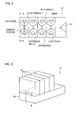
- FIG. 1 is a block diagram of a relevant portion of a first taste-analyzing liquid chromatograph system primarily illustrating the channel configuration.
- FIG. 2 is a schematic top view of a flow sensor of a taste detecting part.
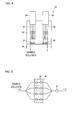
- FIG. 3 is a schematic perspective view of the flow sensor of the taste detecting part.
- FIG. 4 is a cross sectional view taken at line A-A' of FIG. 2 .
- FIG. 5 is a channel block diagram of a flow sensor of the taste detecting part.
- first system In the first taste-analyzing liquid chromatograph system (hereinafter, also referred to as "first system"), as depicted in FIG. 1 , the mobile phase (reference solution), the acidic washing liquid, and the basic washing liquid stored in vessels 10a, 10b, and 10c, respectively, are selected by a first switch valve 11, and are carried by a first flow pump 12 to a port a of a first 6-port 2-position valve 14 via an autosampler 13.
- vessels 15a, 15b, and 15c different additives A, B, and C are stored, respectively, and when a second flow pump 17 is activated, the additive as selected by a second switch valve 16 is carried to the inlet of a mixer 21.
- the adjacent two ports are connected and the states indicated by solid line and dotted line, as shown in FIG. 1 are switched.
- a size-exclusion chromatography column 19 and detectors including an ultraviolet-visible detector (UV-VIS), a fluorescence detector (RF), a refractive index detector (RID), an electric conductivity detector (CDD), an evaporative light scattering detector (ELSD), and a mass spectrometry detector (MS) 20 are provided.
- the port d is connected to the outlet.
- the port b is connected to another inlet of the mixer 21, and the outlet of the mixer 21 is connected to the center port a of a first 7-port 6-position valve 22.
- the first 7-port 6-position valve 22 is configured so that any one of the six ports (only three ports, b, c, and d, are in use in FIG. 1 ) surrounding the single center port a is selectively connected to the center port a.
- the ports c and b of the first 7-port 6-position valve 22 are connected to the ports b and c, respectively, of the second 6-port 2-position valve 23.
- the port d of the first 7-port 6-position valve 22 is connected to the ports e and f of the second 6-port 2-position valve 23.
- the port a of the second 6-port 2-position valve 23 is connected to the inlets of taste sensors A, B, and C of a taste detecting part 30, and the port d of the second 6-port 2-position valve 23 is connected to the inlet of a taste sensor D.
- the outlets of the taste sensors A to D are connected to the port e of the first 6-port 2-position valve 14.
- the taste sensors A to D each correspond to a single sensor block 32, as will be described later.
- the taste sensors A, B, and C are sensors that show a negative (-) behavior, whereas the taste sensor D is a sensor that shows a positive (+) behavior.
- the detection signal from the detector 20 and the detection signal from the taste detecting part 30 are input to a signal processing part 40.
- the signal processing part 40 is configured to include a CPU (Central Processing Unit), or a designated DSP (Digital Signal Processor), along with other components, and stores therein programs for processing the detection signals to obtain information described later.
- a control unit for controlling the valves 14, 22, and 23, the pumps 12 and 17, and the like is also provided, though not illustrated in the figure.
- the taste detecting part 30 is a flow cell detector, and includes a flow sensor 31.
- the flow sensor 31 includes sensor blocks 32 each fabricated by attaching lipid/polymer membranes 33 to the apertures on the bottom surfaces of two cylindrical electrolytic solution retention vessels with a vinyl chloride resin and tetrahydrofuran (THF).
- the flow sensor 31 also includes silver (Ag) electrodes 34 held to plugs 35 and housed inside each sensor block 32, a channel block 36 having formed therein an internal channel used to guide a sample solution to the lipid /polymer membranes 33, and a comparison electrode 37.
- a saturated silver chloride (AgCl) solution electrolytic solution
- a potential response change occurs when a sample solution flown into the channel in the channel block 36 contacts with the lipid/polymer membranes 33.
- the change in potential response is detected by the electrodes 34 via the electrolytic solution, and the detection signal is sent to the signal processing part 40 as described above.
- Two kinds of the lipid/polymer membranes 33 are attached to each sensor block 32, and each of them responds to different sensory stimulus components.
- it is required that the two lipid/polymer membranes 33 attached to the sensor block 32 is not affected by the component dissolved out from the membrane.
- the flow sensor 31 has four sensor blocks 32, each of which has two lipid/polymer membranes 33, enabling an analysis of eight kinds of sensory stimulus components in total.
- sensors that respond to an acid taste, umami, astringency, and a salty taste, and to three kinds of bitterness, and an unspecified, general-purpose sensor are used for analysis.
- the incoming sample solution (mobile phase) through the inlet is branched into four channels, and discharge through the common comparison electrode 37 as a single flow after contacting with the lipid/polymer membranes 33 of each sensor block 32. Because the sample solution channel corresponding to each sensor block 32 is joined on the inlet and outlet sides, when the supply of the mobile phase is stopped, the sample solution containing a component dissolved out from the membrane of one sensor block 32 may be flown into another sensor block by natural diffusion, and the membrane in the sensor block may be contaminated.
- the mobile phase used to introduce a sample is supplied either continuously or at least without interrupting the flow, or check valves are provided on the inlet and outlet sides of the channel of each sensor block 32 to prevent contamination between the sensor membranes even if the supply of the mobile phase is stopped.
- the first 6-port 2-position valve 14 and the second 6-port 2-position valve 23 are set to the states respectively indicated by the dotted lines shown in FIG. 1 , with the port a and the port d of the first 7-port 6-position valve 22 being connected to each other.
- the mobile phase selected by the first switch valve 11 is then carried to the autosampler 13 by the suction with the first flow pump 12.
- a 10 mM KCl or 10 mM KCl + 0.3 mL tartaric acid aqueous solution may be used as the mobile phase, and the flow rate may be set to about 0.1 to 1 mL/min.
- test component When the test solution (test component) is injected into the mobile phase at a predetermined timing with the autosampler 13, the test component in the mobile phase is carried to the mixer 21 via the first 6-port 2-position valve 14.
- the test component passes through the mixer 21, and is carried to the taste detecting part 30 via the ports a and d of the first 7-port 6-position valve 22 and the ports e, f, and parts a, and d of the second 6-port 2-position valve 23.
- the taste sensors A to D each produce a detection signal as the test component passes through the taste detecting part 30, and the detection signals are sent to the signal processing part 40.
- the test component through the taste sensors A to D of the taste detecting part 30 joins and returns to the port e of the first 6-port 2-position valve 14, and is carried to the column 19 through the port f.
- the test component is separated into individual components depending on polarity during the passage through the column 19, and the separated components are eluted out of the column 19 with a time lag.
- the eluent is introduced into the detector 20, and each component in the eluent is sequentially detected over time. That is, the detector sequentially produces a signal according to the type of each test component contained in the eluent, and the signals are sent to the signal processing part 40.
- the first 6-port 2-position valve 14 is switched from the connected state indicated by dotted line in FIG. 1 to the connected state indicated by solid line in FIG. 1 immediately after the test component is introduced into the column 19.
- the eluent through the detector 20 is thus carried to the mixer 21 again through the ports c and b of the first 6-port 2-position valve 14.
- the eluent passes through the mixer 21, and is introduced again into the taste detecting part 30.
- the test component injected by the autosampler 13 is separated by the column 19, a plurality of sample components is introduced into the taste detecting part 30 one after another over a time course, and the taste sensors A to D produce detection signals from these sample components.
- the eluent through the taste detecting part 30 is returned to the port e of the first 6-port 2-position valve 14, and is discharged through the port d.
- the detection signal produced by the taste detecting part 30 from the unseparated test component, the detection signals produced by the taste detecting part 30 from the eluent containing the individual components separated time-dependently, and the detection signals produced by the detector 20 from the eluent containing the individual components separated time-dependently are sent to the signal processing part 40.
- the signal processing part 40 then performs the predetermined arithmetic processes for each of the detection signals to determine information concerning the component being analyzed.
- the detection signal produced by the taste detecting part 30 from the unseparated test component is processed by a principal component analysis, a multiple regression analysis, or other appropriate multivariable analyses to determine information concerning the sensory stimulus intensity of the component as a whole.
- the detection signals produced by the detector 20 from the eluent containing the individual components separated time-dependently are used to create a chromatogram of varying wavelengths, and the peaks appearing in the chromatogram are detected for qualitative analysis to identify each component and estimate the content of each component.
- the detection signals produced by the taste detecting part 30 upon the introduction of the each identified component into the taste detecting part 30 are extracted, and this is processed by a principal component analysis, a multiple regression analysis, or other appropriate multivariable analyses to determine information concerning the sensory stimulus intensity of each component contained in the test component. These results can then be used to analyze, for example, the relationship between the type, amount, and taste quality of each component contained in the test component being analyzed, and the sensory stimulus intensity of the whole test component as a test component mixture.
- the mobile phase is kept on flowing after the introduction of the test component into the taste detecting part 30, and thus, the test component adhered to the lipid/polymer membranes of each taste sensor is washed by the mobile phase, and the detection signal returns to the initial level.
- the detection signal does not easily return to the initial level when the test component has a high concentration and remains in large amounts in the lipid/polymer membranes. According to the foregoing configuration, this can be dealt with by washing the lipid/polymer membranes of the each taste sensor with a washing liquid. For washing, an acidic washing liquid or a basic washing liquid are used depending on the property of the lipid/polymer membranes.
- an acidic washing liquid such as 30% ethanol + 100 mM HCl may be used for the lipid/polymer membranes that show a negative behavior
- a basic washing liquid such as 30% ethanol + 100 mM KCl + 10 mM KOH for the lipid/polymer membranes that show a positive behavior
- the channel configuration described above is adapted to use a combination of valves to avoid mixing of the washing liquids of incompatible properties. That is, for the washing of the taste sensors A, B, and C that show a negative behavior, the first switch valve 11 is used to select the acidic washing liquid, and the first 7-port 6-position valve 22 is set to the connected state shown in FIG. 1 (that is, the port a and the port c are connected to each other), whereas the second 6-port 2-position valve 23 is set to the connected state as indicated by solid line in FIG. 1 .
- the acidic washing liquid carried from the first flow pump 12 is then introduced into the taste detecting part 30 to wash the surfaces of the membranes of each taste sensor. After thorough washing, the first switch valve 11 is switched to select the mobile phase and the washing liquid in the channel is replaced with the mobile phase.
- the first switch valve 11 is used to select the basic washing liquid, and the port a and the port b of the first 7-port 6-position valve 22 are connected to each other, whereas the second 6-port 2-position valve 23 is set to the connected state as indicated by solid line in FIG. 1 .
- the basic washing liquid carried from the first flow pump 12 is then introduced into the taste detecting part 30 to wash the surfaces of the membranes of each taste sensor.
- the first switch valve 11 is switched to select the mobile phase and the washing liquid in the channel is replaced with the mobile phase.
- the mobile phase can be flown into all of the taste sensors A to D to entirely replace the washing liquid with the mobile phase.
- the taste detecting part 30 is used to determine the sensory stimulus intensity of the test component as a whole and the sensory stimulus intensity of each test component.
- separate taste detecting parts may be provided. It should be noted, however, that because the detection properties of taste sensors generally have relatively large individual differences, more accurate results can be obtained by using detection signals from the same taste sensor, if the determination of the sensory stimulus intensity of the same test component as a whole are to be associated with the determination of the sensory stimulus intensity of each test component.
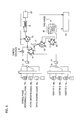
- FIG. 6 is a block diagram of a relevant portion of a second taste-analyzing liquid chromatograph system primarily illustrating the channel configuration.
- same and/or corresponding constituting elements are appended with the same reference numerals.
- the second taste-analyzing liquid chromatograph system (hereinafter, also referred to as "second system”) is configured such that the test component that has passed through the taste detecting part 30 is directly discharged, and is unable to simultaneously determine the sensory stimulus intensity of the test component and the sensory stimulus intensity of each separated test component at one time.
- a second 7-port 6-position valve 18 is switched, and the test component unseparated by the connection of port a and port b, and the eluent containing the test component separated through the column 19 by the connection of port a and port c can be selectively carried to the taste detecting part 30.
- the same analysis performed in the first system can be performed by performing the analysis twice.
- each test component separated by, for example, a separation column may be fractionated into a different vessel with a fraction collector, and the eluent containing the fractioned separate test component may be sequentially introduced into the taste detecting part to obtain a detection signal for each separated test component in the taste sensor.
- the test component to be analyzed is separated in time direction, for example, with a LC (Liquid chromatography) separation column, and the eluent containing the separated individual test components is introduced into the taste detecting part.
- the eluent introduced into the taste detecting part contacts with a plurality of taste sensors, and the taste sensors output detection signals according to the test components contained in the eluent.
- the taste sensors produce different detection signals as the different test components are introduced over a time course.
- the signal processing part then computes information, for example, such as the intensity of lingering perception, concerning the sensory stimulus intensity corresponding to each test component, using the time-dependent detection signals. This makes it possible to specifically obtain the sensory stimulus intensity of each separated test component contained in the test component, instead of the sensory stimulus intensity of the test component as a whole.
- the separated test components which has passed through, for example, the flow cell taste detecting part may be introduced into a detector such as a ultraviolet-visible spectrophotometer or a mass spectrometer, or a liquid sample with the separated components which has passed through a detector such as a flow cell ultraviolet-visible spectrophotometer may be introduced into the taste detecting part.
- a detector such as a ultraviolet-visible spectrophotometer or a mass spectrometer
- a liquid sample with the separated components which has passed through a detector such as a flow cell ultraviolet-visible spectrophotometer may be introduced into the taste detecting part.
- Each separated test component may then be qualified or quantified using the detection signals obtained from the detector, and the type and the content of each separated test component contained in the test component may be correlated with its sensory stimulus intensity for display or output. This makes it possible to individually and clearly obtain information concerning each separated test component contained in the test component, and information concerning the sensory stimulus (for example, lingering perception) of the separated test component.
- the taste-analyzing liquid chromatograph system used in the present invention may be configured to include another taste detecting part (second taste detecting part) that includes a plurality of taste sensors of different response characteristics, in order to detect the sensory stimulus intensity of the unseparated test component.
- second taste detecting part another taste detecting part that includes a plurality of taste sensors of different response characteristics, in order to detect the sensory stimulus intensity of the unseparated test component.
- the second taste detecting part may be separately provided from the original taste detecting part.
- these taste detecting parts it is more preferable to provide these taste detecting parts as a single common detector, and to provide channel switching means that selectively supplies the test component or an eluent containing the separated components to the detector.
- the sensory stimulus intensity of the test component as a whole, and the sensory stimulus intensity of each separated test component contained in the sample can be obtained by a single analysis, and it is possible to efficiently and easily obtain information concerning the degree of the contribution of the sensory stimulus intensity of each separated test component to the sensory stimulus intensity of the test component as a whole, and the relationship between the sensory stimulus intensity of the test component as a whole and the sensory stimulus intensity of each separated test component.
- the taste evaluation data obtained by using the taste-analyzing liquid chromatograph system is used not as taste information, but as an index of the sensory stimulus intensity of the test component, particularly an index of lingering perception intensity.
- the taste evaluation data may be obtained in a multidimensional fashion according to the number of taste sensors used. The following specifically describes an evaluation method.
- the taste evaluation data can be obtained according to the number of taste sensors, and accordingly the test component can be specified, for example, from the taste evaluation data of n dimensions with the use of n-kinds of taste sensors.
- Examples of such taste sensors include a salty taste sensor responsive to the salty taste of potassium chloride, an acid taste sensor responsive to the acid taste of tartaric acid, an umami sensor responsive to the umami of glutamic acid, a bitterness (+) sensor responsive to the bitterness of quinine, a bitterness (-) sensor responsive to the bitterness of iso- ⁇ acid, an astringency sensor responsive to the astringency of tannic acid, and the like.
- the taste evaluation data can be obtained as the intensity of sensor reaction (the absolute value of sensor reaction) through the processing of a detection signal from each taste sensor. Further, in the taste-analyzing liquid chromatograph system, because the analysis is on-flow, the sensor reaction can be evaluated over a time course from the time at which the analyzed test sample is firstly contacted with the taste sensor to the time at which the test sample has passed through the taste sensor. That is, the intensity of the sensor reaction at each taste sensor (the absolute value of sensor reaction) can be obtained as taste evaluation data in a time-dependent fashion.
- the intensity of the sensor reaction from the time at which the test sample is firstly contacted with the taste sensor to time at which the test sample has passed through the taste sensor can be used as an index for the evaluation of the persistence (lingering perception) of the sensory stimulus after a food is swallowed.
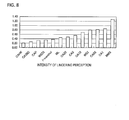
- the sensory stimulus intensity (the intensity of lingering perception) can be evaluated according to the proportion of the magnitude of the sensor reaction intensity with respect to its maximum value (the maximum value of the absolute value of the sensor reaction) as measured after a certain elapsed time period from the time at which the sensor reaction intensity has the maximum value.
- the absolute value of the sensor reaction of the taste sensor in the continuous (on-flow) stable state of the eluent (mobile phase) is taken as zero by initialization.
- the test component prepared beforehand in the autosampler is injected therefrom at a predetermined timing, and is carried to the taste detecting part with the mobile phase.
- the intensity of the sensor reaction (the absolute value of the sensor reaction) at each taste sensor from the time at which the test component is firstly contacted with the taste sensor to the time at which the test component has passed through the taste sensor can then be measured upon the test component contacting with the taste sensor.
- the evaluation value based on the sensor reaction intensity of the sensor stimulus for the test component is represented by the following equation (1).
- k is the number of the taste sensors used for evaluation
- n means the nth sensor
- P n (T) is the absolute value of the sensor reaction at retention time T
- T max is the time at which the absolute value of the sensor reaction has the maximum value
- T 1 is the certain elapsed time period from the time at which the absolute value of the sensor reaction has the maximum value (T 1 ⁇ T max )
- C n is a coefficient representing the degree of the contribution of the nth sensor reaction to the sensory intensity evaluation.
- the sensory stimulus intensity can be evaluated from the cumulative value of the proportion of the magnitude of the sensor reaction intensity with respect to its maximum value (the maximum value of the absolute value of the sensor reaction) as measured after a certain elapsed time period from the time at which the sensor reaction intensity has the maximum value.
- the evaluation value based on the proportion of the magnitude of the sensor reaction intensity of the sensory stimulus for the test component can be represented by the following equation (2).
- k is the number of the taste sensors used for evaluation
- n means the nth sensor
- P n (t) is the absolute value of the sensor reaction at retention time t
- T max is the time at which the absolute value of the sensor reaction has the maximum value
- T 1 is the certain elapsed time from the time at which the absolute value of the sensor reaction has the maximum value (T 1 ⁇ T max )
- C n is a coefficient representing the degree of the contribution of the nth sensor reaction to the sensory intensity evaluation.
- the foregoing method can be performed for the unknown test component, and the evaluation value can be used to evaluate the sensory stimulus intensity of the test component.
- the output of each taste sensor greatly differs for different sensory stimulus components such as the combination of a cool sense stimulus component and a warm sense stimulus component.
- the taste sensor produces similar outputs for similar test components such as two or more kinds of cool sense stimulus components.
- the difference between similar cool sense stimulus components can thus be evaluated by selecting a taste sensor that is more capable of presenting a difference between two or more kinds of cool sense stimulus components, without using the taste evaluation data of all the taste sensors.
- the taste evaluation data that can be used to evaluate the difference between similar test components can be selected by acquiring taste evaluation data for the reference component used as the reference of the sensory stimulus to be evaluated, and selecting the taste evaluation data obtained from the taste sensor capable of evaluating the difference between the test components.
- taste evaluation data for the evaluation of cool sense stimulus components, 1-menthol may be used as the reference component of the sensory stimulus.
- the method used to select the taste evaluation data obtained from the taste sensor for the evaluation of the intensity of the sensory stimulus component is not particularly limited, and any method may be used.
- the maximum value of the absolute value of the sensor reaction is detected in each taste sensor, and the taste evaluation data of two or more kinds of taste sensors having the largest and the subsequent maximum values of the absolute values are selected.
- the characteristic of the sensory stimulus component can be expressed in a numerical value by using the taste evaluation data of the test component as an index, and the test components can be grouped according to the taste evaluation data. That is, the present invention provides a novel grouping scheme of test component based on a novel index. When the grouping based on the novel index using the taste evaluation data is the same as or close to the common grouping, the taste evaluation data may be acquired for a new or unknown test component to easily evaluate whether the test component belongs to which group.
- Such grouping may be performed for all the taste evaluation data of the measured test components. It is also possible to create a two-dimensional scatter diagram from the data of a specific taste sensor that is more capable of presenting a difference between the test components, and to group the test components by visually determining the scattering of the data. Such a taste sensor can be selected by using the method described in the above section (ii) Detection of Differences between Test Components.
- the sensory stimulus components may be estimated as being different when the taste evaluation data are different.
- the taste evaluation data from a taste sensor that is more capable of evaluating the intensity between very similar sensory stimulus components may effectively be used.
- the taste evaluation data obtained for the test component from the taste-analyzing liquid chromatograph system is used as an index, and changes in the taste evaluation data of the test component are evaluated to evaluate the intensity of the sensory stimulus of the test component, particularly the intensity of lingering perception. Further, the intensity of the lingering perception of the sensory stimulus component can be evaluated by using the time-dependent taste evaluation data of the intensity of the sensor reaction in the taste sensor, specifically the taste evaluation data of the sensor reaction in the taste sensor during and after the passage of the test component.
- the test component is measured for a detection signal by each taste sensor, and the detection signal is processed by the signal processing part to obtain taste evaluation data as an absolute value.
- the taste evaluation data may be acquired for the test component as with the case of the food or drink, and the taste evaluation data may be used as information specific to the test component.
- the taste evaluation data of lingering perception can be acquired by measuring the continuous (time-dependent) absolute value of the sensor reaction in the taste sensor from the time at which the test component is firstly contacted with the taste sensor to the time at which the test component has passed through the taste sensor, in the taste-analyzing liquid chromatograph system.
- the following describes methods for evaluating the cool intensity of a cool sense stimulus component, and the intensity of the lingering perception of the cool intensity with the taste-analyzing liquid chromatograph system.
- the taste evaluation data for a cool sense stimulus component can be associated with the actual intensity of the lingering perception by using CA20 (1-menthyl 3-hydroxybutanoate) as the cool sense stimulus component, and 1-menthol, which is a representative cool sense stimulus component, as the reference component of the sensory stimulus.
- the taste-analyzing liquid chromatograph system of the present invention is used to perform measurements and determine the absolute value P(T max ) of sensor reaction at time T max at which the absolute value P(T) of the sensor reaction at retention time T shows the maximum value. Then, the absolute value P(T 1 ) of sensor reaction after a certain elapsed time period T 1 from the time at which the absolute value of the sensor reaction has the maximum value is determined.
- the ratio of the two absolute values (hereinafter, also referred to as "response ratio") represented by the equation (3) below is determined as the value that corresponds to the intensity of the lingering perception of each component.
- FIG. 7 represents the absolute value of each sensor reaction obtained from the process performed for CA 20 (1-menthyl 3-hydroxybutanoate) with the taste-analyzing liquid chromatograph system.
- the absolute value of each sensor reaction increases as the intensity of the sensor reaction increases from the first contact with the taste sensor, and the sensor reaction produces the maximum value P(T max ) at time T max at which the absolute value of the sensor reaction becomes the maximum after about 1 min from the first contact.
- the absolute values of the sensor reactions for bitterness (+), bitterness (-), and astringency take the maximum values at different times (T max ) because there is a time lag among the times at each of which the CA20 contacts with each sensor.
- the sensor membranes specifically the lipid/polymer membranes, have different properties, and a membrane potential change from the steady state occurs when the corresponding taste component is adsorbed to the membrane surface.
- the membrane potential change is either a positive (+) response or a negative (-) response.
- the sensor reaction change from the steady state is observed by taking its absolute value to determine the intensity of the lingering perception of each component.
- the absolute value of sensor reaction decreases over time, and it is preferable that the intensity of the lingering perception of the sensory stimulus be evaluated by using P(T 1 ) obtained at time T 1 at which the response ratio of the absolute value of sensor reaction for the reference component (1-menthol) to P(T max ) is about 0.5.
- the response ratio has a correlation with the sensory evaluation, and can be said as representing a 1:1 relationship with the actual intensity of the lingering perception of the sensory stimulus. This correlative information can thus be used for the evaluation of a cool sense stimulus component of an unknown sensory stimulus lingering perception, without relying on sensory evaluation.
- the degree of contribution (parameter) by which the response ratio of each taste sensor (in the case of a cool sense stimulus component, the response ratio from each of the three sensors responsive to bitterness (+), bitterness (-), and astringency) is associated with the result of sensory evaluation is determined beforehand, and an evaluation value representing the lingering perception intensity of the sensory stimulus of the test component can be calculated by computation from the response ratio and degree of contribution of the test component.
- the sensory evaluation value for the reference component (1-menthol) can be represented by the following equation (4).
- P(T 1 ) is the cool intensity after time T 1
- P(T max ) is the maximum value of the cool intensity
- C is a coefficient indicative of the full score of the sensory evaluation value.
- the evaluation value (m) of the lingering perception intensity of the reference component is then calculated from the equation (5) below, using the response ratio of each taste sensor obtained for the reference component (1-menthol), and the degree of contribution C m .
- m means each taste sensor
- P m (T 1 ) is the absolute value of the intensity value of the taste sensor reaction in the taste sensor m after time T 1
- P m (T max ) is the maximum value of the absolute value of the intensity value of the taste sensor reaction in the taste sensor m
- C m is a coefficient indicative of the degree of contribution of the taste sensor to the evaluation value of the taste sensor m.
- the degree of contribution is specified for each taste sensor, and the evaluation value (m) of each taste sensor is determined.
- the evaluation value as represented by the following equation (1) can then be determined by summing the evaluation value (m) of each taste sensor determined as above.
- k is the number of taste sensors used for evaluation
- n means the nth sensor
- P n (T) is the absolute value of the sensor reaction at retention time T
- T max is the time at which the absolute value of the sensor reaction has the maximum value
- T 1 is the certain elapsed time period from the time at which the absolute value of the sensor reaction has the maximum value (T 1 ⁇ T max )
- C n is a coefficient representing the degree of the contribution of the nth sensor reaction to the sensory intensity evaluation.
- the following describes the evaluation of sensory stimulus intensity according to the cumulative value of the proportion of the magnitude of the sensor reaction intensity with respect to the maximum value of the sensor reaction as measured after a certain elapsed time period.
- the sum of response ratios (T) obtained by summing the response ratios from the equation (6) over time t from the time T max at which the absolute value of the sensor reaction has the maximum value to the time T 1 which is a certain elapsed time period from the time at which the absolute value of the sensor reaction has the maximum value can be represented by the following equation (7).
- x means each taste sensor
- P x (t) is the absolute value of the reaction intensity value of the taste sensor x after time t
- P x (T max ) is the maximum value of the absolute value of the reaction intensity value of the taste sensor x.
- the sensory evaluation value for, for example, the reference component (1-menthol) is represented by the following equation (8).
- P(t) is the cool intensity after time t
- P(T max ) is the maximum value of the cool intensity
- C is a coefficient indicative of the full score of the sensory evaluation value at time t.
- the evaluation value (m) of the lingering perception intensity of the reference component is then determined from the equation (9) below, using the response ratio of each taste sensor obtained for the reference component (1-menthol), and the degree of contribution C m .
- m means each taste sensor
- P m (t) is the absolute value of the intensity value of the taste sensor reaction in the taste sensor m after time t
- P m (T max ) is the maximum value of the absolute value of the intensity value of the taste sensor reaction in the taste sensor m
- C m is a coefficient indicative of the degree of contribution of the taste sensor to the evaluation value of the taste sensor m.
- the degree of contribution is specified for each taste sensor, and the evaluation value (m) of each taste sensor is determined.
- the evaluation value as represented by the following equation (2) can then be determined by summing the evaluation value (m) of each taste sensor determined as above.
- k is the number of taste sensors used for evaluation
- n means the nth sensor
- P n (t) is the absolute value of the sensor reaction at retention time t
- T max is the time at which the absolute value of the sensor reaction has the maximum value
- T 1 is the certain elapsed time from the time at which the absolute value of the sensor reaction has the maximum value (T 1 ⁇ T max )
- C n is a coefficient representing the degree of the contribution of the nth sensor reaction to the sensory intensity evaluation.
- the degree of contribution C n for the response ratio of the taste sensor used for evaluation may be deemed as having the same level of contribution, and the same value may be used to determine the evaluation value.
- a test component of an unknown lingering perception of sensory intensity may be measured in the manner described above, and information such as the response ratio and the degree of contribution may be used to grasp the intensity of the lingering perception of the sensory intensity of the test component.
- the sensory intensity or the intensity of the lingering perception of sensory intensity can be accurately grasped without performing a sensory evaluation for the test component. It is therefore possible to efficiently perform an evaluation with high reproducibility, without being influenced by factors such as the individual differences and the physical conditions of panelists.
- the evaluation target is not limited to the cool sense stimulus component, and the sensory intensity and the lingering perception of sensory intensity can be evaluated also for other sensory stimulus components such as a warm sense stimulus component, by using taste evaluation data from the taste sensors selectively responsive to the sensory stimuli of the test components in the manner described above.
- Taste-analyzing liquid chromatograph system The above-described second taste-analyzing liquid chromatograph system (Shimadzu Corporation)
- Taste sensor The sensor prepared by subjecting TASTE SENSOR SA402B (product name) available from Intelligent Sensor Technology, Inc., to size reduction (the sensor described in JP-A-2007-327801 )
- test component Each cool sense stimulus component (test component) was dissolved in a 30% ethanol aqueous solution to make the final concentration 0.3% (w/w).
- the cool sense stimulus component CA20 was measured according to the following procedure, using the second taste-analyzing liquid chromatograph system (see FIG. 6 ). Because the prepared solution of CA20 is a single compound, measurement was made by bypassing the column 19.
- the first 6-port 2-position valve 14 was set to the state as indicated by solid line in FIG. 6
- the second 7-port 6-position valve 18 was set to the state where the port a was connected to the port b
- the first 7-port 6-position valve 22 was set to the state where the port a was connected to the port d
- the second 6-port 2-position valve 23 was set to the state as indicated by dotted line in FIG. 6 .
- the mobile phase selected by the first switch valve 11 was sucked by the first flow pump 12, and carried to the autosampler 13 from the port a of the first 6-port 2-position valve 14 via the port f.
- KCl (2.24 g/L) and tartaric acid (0.045 g/L) aqueous solution was used as the mobile phase, and the flow rate was set to 0.3 mL/min.
- the preparation solution of CA20 in the mobile phase was carried to the mixer 21 via the port c and port b of the first 6-port 2-position valve 14, and via the port a and port b of the second 7-port 6-position valve 18.
- the second flow pump 17 was not activated, and the preparation solution of CA20 directly passed through the mixer 21 and carried to the taste detecting part 30 via the ports a and d of the first 7-port 6-position valve 22, and the ports f and a and ports e and d of the second 6-port 2-position valve 23.
- each taste sensors A to D produced detection signals as the sample passed through the taste detecting part 30, and the detection signals were sent to the signal processing part 40.
- each detection signal was subjected to a predetermined arithmetic process to obtain information concerning the preparation solution of CA20 (analyzed target). The results are presented in FIG. 7 .
- T max the absolute value of sensor reaction decreases over time, and the intensity of the lingering perception of the sensory stimulus was evaluated by using P(T 1 ) obtained at time T 1 at which the response ratio (the equation (3) above) of the absolute value of sensor reaction for the reference component (1-menthol) to P(T max ) becomes about 0.5.
- the T 1 values were 2 (min), 3 (min), and 3 (min) for the bitterness (+) sensor, the bitterness (-) sensor, and the astringency sensor, respectively.
- T 1 the time at which the response ratio of the reference component (1-menthol) becomes 0.5
- the sample was evaluated as having a smaller lingering perception than the reference component when the response ratio was below 0.5, and as having a larger lingering perception than the reference component when the response ratio was above 0.5.
- k is the number of taste sensors used for evaluation
- n means the nth sensor
- P n (T) is the absolute value of the sensor reaction at retention time T
- T max is the time at which the absolute value of the sensor reaction has the maximum value
- T 1 is the certain elapsed time from the time at which the absolute value of the sensor reaction has the maximum value (T 1 ⁇ T max )
- C n is a coefficient representing the degree of the contribution of the nth sensor reaction to the sensory intensity evaluation.
- the cool sense stimulus component CA1 was measured by using the second taste-analyzing liquid chromatograph system (see FIG. 6 ).
- Cool sense stimulus intensities over the retention times of 2 min and 3 min were determined according to the foregoing equation (1) from the information obtained by the arithmetic process of the detection signal produced by each taste sensor (bitterness (+), bitterness (-), astringency) for the preparation solution of CA1.
- bitterness (+), bitterness (-), astringency for the preparation solution of CA1.
- the results are presented in FIG. 8 .
- cool sense stimulus intensities were determined in the same manner as in Example 1, using as the cool sense stimulus components CA5, CA10, CA20, CA55, CA38D, CAP, CAHK, WS3, WS23, MMS, and ML. The results are presented in FIG. 8 .
- the sensory evaluation of sensory stimulus can be more specifically compared in numerical values, rather than using the human sense, and lingering perception of a sensory stimulus component can be evaluated more conveniently. That is, the evaluation of a sensory stimulus component associated with the skin or inside of the mouth can be performed more objectively and conveniently than the case using sensory evaluations that rely on the human or animal senses.
- the evaluation method of the present invention enables screening of various sensory stimulus components such as cool components and warm components, and evaluations of skin and oral conditions.
Landscapes
- Physics & Mathematics (AREA)
- Health & Medical Sciences (AREA)
- Life Sciences & Earth Sciences (AREA)
- Chemical & Material Sciences (AREA)
- Analytical Chemistry (AREA)
- Biochemistry (AREA)
- General Health & Medical Sciences (AREA)
- General Physics & Mathematics (AREA)
- Immunology (AREA)
- Pathology (AREA)
- Investigating Or Analysing Biological Materials (AREA)
- Sampling And Sample Adjustment (AREA)
Abstract
A method for evaluating a sensory stimulus component in a test component with a taste-analyzing liquid chromatograph system. The method includes: measuring the test component with the taste-analyzing liquid chromatograph system to obtain taste evaluation data; and evaluating a persistence of a sensory stimulus intensity of the test component from a continuous intensity change of the test component using the taste evaluation data as an index.
Description
- This application claims priority from Japanese Patent Application No.
2012-064154 filed on March 21, 2012 - The present invention relates to a method for evaluating a test component, specifically a method for evaluating the persistence of a sensory stimulus intensity of a test component acting on skin, inside of the mouth or the like.
- Sensory stimulus components which are contained in skin topical agents, oral compositions or the like and cause a sensation in a user have been evaluated mostly by using sensory statistical evaluation that relies on human senses.
Other evaluation methods are also available, and examples thereof include a method that measures keratinous moisture levels and transdermal moisture transpiration rates, a method that measures a current perception threshold (CPT), a method that measures blood IgE, an evaluation method based on mouse scratching behaviors, a method that measures in vitro calcium ion concentrations (Patent Document 1), a method that measures an electrocardiogram and a galvanic skin reflex (Patent Document 2), and a method that evaluates active substances with TRPA1 (Patent Document 3). - With regard to taste intensity, a taste perception device is available, which can evaluate taste without relying on the human sense of taste, as disclosed in, for example,
Patent Document 4. In this taste perception device, the taste of a sample to be analyzed is evaluated from the potential difference between a lipid membrane electrode and a reference electrode as a reference through interaction of a lipid membrane (polymer membrane) and a chemical substance to be analyzed. -
Patent Document 5 discloses a method for evaluating the intensity of aftertaste by using a taste perception device. In the method described inPatent Document 5, a taste sensor (molecular membrane sensor) is used to evaluate the taste by two kinds of tastes, the "initial taste" immediately after a food is put in the mouth, and the "aftertaste" that lingers after the food is swallowed. In this method, the potential difference of a sample solution relative to the zero potential of a reference solution is measured as the initial taste, and the potential difference when the reference solution is measured again after gently washing the sensor is measured as the aftertaste and the measurement is performed, as follows.
Step (1): First, a taste sensor is dipped in a reference solution (a substantially tasteless solution containing 30 mM of KCl and 0.3 mM of tartaric acid, corresponding to human saliva) to obtain a membrane potential Vr.
Step (2): The taste sensor is then dipped in a sample solution, bringing a change of the membrane potential to Vs through interaction with the taste substance. The membrane potential change "Vs - Vr" is obtained as the first sensor output "relative value", and corresponds to an initial taste such as an acid taste and a salty taste.
Step (3): Then, the taste sensor is briefly washed with the reference solution.
Step (4): The taste sensor is dipped in the reference solution again to obtain a membrane potential Vr'. When a bitterness substance or an astringent substance was adsorbed to the lipid membrane surface in step (3), the membrane potential becomes Vr' upon dipping the taste sensor in the same reference solution used in step (1). The membrane potential change "Vr' - Vr" is obtained as the second sensor output "CPA value" (CPA = Change of membrane Potential by Adsorption), and corresponds to an aftertaste such as bitterness and astringency.
Step (5): The taste sensor is thoroughly washed with an alcohol washing liquid to completely remove the taste substance adsorbed on the lipid membrane surface.
Step (6): The taste sensor is contacted again with the reference solution. The taste sensor is maintained until the taste sensor signal output becomes stable, and a return of the signal level to the initial level, specifically the level of step (1), is confirmed.
Step (7): If the signal level does not return to the initial level in step (6), step (5) and step (6) are performed again until the signal level returns to the initial level. -
- Patent Document 1:
JP-A-2002-372530 - Patent Document 2:
JP-A-2006-75364 - Patent Document 3:
US 2009/148938 A1 - Patent Document 4:
JP-A-3-163351 - Patent Document 5:
JP-A-2002-243695 - Methods of sensory evaluation by human lack objectivity, and it has been difficult to objectively compare differences in sensory stimulus with specific numerical values. Further, the above-described conventional taste perception devices are intended to evaluate the quality of the initial taste (such as an acid taste and a salty taste) and the aftertaste (such as bitterness and astringency) of the whole sample to be analyzed, and are unable to individually grasp the lingering perception of the various tastes contained in a sample. Accordingly, it has not been possible with the methods of the related art to objectively examine which component has a persistent sensory stimulus intensity.
- The present invention has been made in view of these problems, and illustrative aspects of the present invention provide a method for evaluating a sensory stimulus component whereby differences in sensory stimulus, particularly the persistence of a sensory stimulus intensity of a test component (the intensity of the lingering perception of a sensory stimulus component) can be evaluated both objectively and specifically.
- The present inventors conducted intensive studies to solve the foregoing problems, and found that the persistence of a sensory stimulus intensity of a test component can be evaluated by using as an index the taste evaluation data obtained from a taste-analyzing liquid chromatograph system. The present invention has been completed on the basis of this finding.
- That is, the present invention provides the following method for evaluating a sensory stimulus component.
- [1] A method for evaluating a sensory stimulus component in a test component with a taste-analyzing liquid chromatograph system,
the method comprising:- measuring the test component with the taste-analyzing liquid chromatograph system to obtain taste evaluation data; and
- evaluating a persistence of a sensory stimulus intensity of the test component from a continuous intensity change of the test component using the taste evaluation data as an index.
- [2] The method according to [1], wherein a plurality of similar test components is measured with the taste-analyzing liquid chromatograph system to obtain taste evaluation data, and the test components are distinguished into similar groups to evaluate the persistence of sensory stimulus intensities of the test components using the taste evaluation data as an index.
- [3] The method according to [1] or [2], wherein the taste-analyzing liquid chromatograph system includes:
- (a) a taste detecting part for detecting the sensory stimulus component in the test component over a time course, which includes a plurality of taste sensors each of which has a different response characteristic; and
- (b) a signal processing part that processes a detection signal obtained from the plurality of the taste sensors to determine taste evaluation data concerning each sensory stimulus component.
- [4] The method according to [3], wherein the taste evaluation data is measured by using an intensity of a sensor reaction of the taste sensor as an index.
- [5] The method according to [4], wherein the evaluation is based on a proportion of a magnitude of the intensity of the sensor reaction with respect to a maximum intensity value of the sensor reaction as measured after a certain elapsed time period from a time at which the sensor reaction has the maximum intensity value.
- [6] The method according to [5], wherein the evaluation is based on an evaluation value calculated according to the following equation (1):
-

- wherein k is the number of taste sensors used for evaluation, n means the nth sensor, Pn(T) is an absolute value of the sensor reaction at a retention time T, Tmax is a time at which the absolute value of the sensor reaction has the maximum value, T1 is a certain elapsed time period from the time at which the absolute value of the sensor reaction has the maximum value (T1 ≥ Tmax), and Cn is a coefficient representing a degree of contribution of the nth sensor reaction to the sensory intensity evaluation.
- [7] The method according to [4], wherein the evaluation is based on a cumulative value of a proportion of a magnitude of the intensity of the sensor reaction with respect to a maximum intensity value of the sensor reaction as measured after a certain elapsed time period from a time at which the sensor reaction has the maximum intensity value.
- [8] The method according to [7], wherein the evaluation is based on an evaluation value calculated according to the following equation (2)
-

- wherein k is the number of taste sensors used for evaluation, n means the nth sensor, Pn(t) is an absolute value of the sensor reaction at a retention time t, Tmax is a time at which the absolute value of the sensor reaction has the maximum value, T1 is a certain elapsed time period from the time at which the absolute value of the sensor reaction has the maximum value (T1 ≥ Tmax), and Cn is a coefficient representing a degree of contribution of the nth sensor reaction to the sensory intensity evaluation.
- [9] The method according to any one of [1] to [8], wherein the test component is a cool sense stimulus component or a warm sense stimulus component.
- [10] The method according to [9], wherein the cool sense stimulus component or the warm sense stimulus component reacts with taste sensors responsive to bitterness (+), bitterness (-), and astringency, and the taste evaluation data is measured by using intensities of the sensor reactions of the taste sensors as indices.
- According to the evaluation method of the present invention, the excellent evaluation method for the persistence of a sensory stimulus intensity of a test component in the skin and inside of the mouth can be provided. That is, the present invention enables the objective and specific evaluation of a sensory stimulus component associated with skin and inside of the mouth. The evaluation method of the present invention also can be used for the screening of various sensory stimulus components such as a cool sense stimulus component and a warm sense stimulus component, and for the evaluation of skin and oral conditions.
-
-
FIG. 1 is a block diagram of a relevant portion of a first taste-analyzing liquid chromatograph system primarily illustrating the channel configuration. -
FIG. 2 is a schematic top view of a flow sensor of a taste detecting part. -
FIG. 3 is a schematic perspective view of the flow sensor of the taste detecting part. -
FIG. 4 is a cross sectional view taken at line A-A' ofFIG. 2 . -
FIG. 5 is a channel block diagram of a flow sensor of the taste detecting part. -
FIG. 6 is a block diagram of a relevant portion of a second taste-analyzing liquid chromatograph system primarily illustrating the channel configuration. -
FIG. 7 is a graph representing the result of the evaluation performed for CA20 with respect to taste sensor response and lingering perception. -
FIG. 8 is a graph representing the intensities of lingering perception of each of cool sense stimulus components. - The present invention is described below in detail.
The present invention provides a method for evaluating the persistence of a sensory stimulus intensity of a sensory stimulus component in the skin and inside of the mouth, using as an index the taste evaluation data of the sensory stimulus component obtained by using a taste-analyzing liquid chromatograph system (hereinafter, the method will also be referred to as "the present evaluation method").
The present evaluation method can accurately and conveniently evaluate the persistence of a sensory stimulus in a test component perceived in the skin and inside of the mouth. - As used herein, "sensory stimulus" means a stimulus sensation elicited by chemical components contained in skin topical agents, oral compositions or the like, and by other environmental factors. Specific examples thereof include a cool sensation, a warm sensation, a pungent taste (a sense of pain), and an astringent taste in the skin or inside of the mouth. Note that the sensory stimulus components are components that elicit stimulus sensations such as above. Specific examples thereof include a cool sense stimulus component, a warm sense stimulus component, a pungent (pain) stimulus component, an astringent stimulus component and the like. The sensory stimulus components differ from common basic taste components such as sweetness, bitterness, umami, salty taste, and acid taste.
- The persistence of a sensory stimulus intensity means the duration from the time at which the stimulus intensity reaches the maximum by contacting the sensory stimulus component with the skin or inside of the mouth to the time at which the stimulation is disappeared, that is, the lingering perception of the sensory stimulus component. The sensory stimulus is perceived when the sensory stimulus component is contacted with the skin or inside of the mouth. The sensory stimulus intensity then reaches the maximum value, and attenuates over time. The sensory stimulus becomes more persistent and the lingering perception increases as the attenuation time of the sensory stimulus intensity from the time at which its maximum value is reached becomes longer.
- When the taste-analyzing liquid chromatograph system is used without a liquid chromatograph, the taste-analyzing liquid chromatograph system can evaluate the response of a lipid membrane and a test sample from the membrane potential or membrane resistance by contacting the test sample with a plurality of taste sensors that reacts with substances such as potassium chloride (salty taste), tartaric acid (acid taste), sodium glutamate (umami), quinine (bitterness (+)), iso-α acid (bitterness (-)), and tannic acid (astringency), without separating the test sample (test component) to be analyzed.
When the taste-analyzing liquid chromatograph system is used in combination of a liquid chromatograph, the test sample to be analyzed is separated in time direction in the separation column of the liquid chromatograph, and the eluent containing the separated individual sample components is contacted with a plurality of taste sensors that reacts with substances such as potassium chloride (salty taste), tartaric acid (acid taste), sodium glutamate (umami), quinine (bitterness (+)), iso-α acid (bitterness (-)), and tannic acid (astringency). The response of the lipid membrane and the sample component can then be evaluated from the membrane potential or membrane resistance.
In this manner, when the taste-analyzing liquid chromatograph system is used to evaluate food or drink with five kinds of sensors for salty taste, umami, bitterness (+), bitterness (-), and astringency, and detailed information such as five-dimensional taste information with regard to the relationship between the overall taste quality of the food or drink and the taste quality of each component contained in the food or drink can be obtained. - In the taste-analyzing liquid chromatograph system, the eluent continuously contacts with the taste sensors (on-flow). That is, because the analysis is on-flow, an evaluation can be performed over a time course from the time of the sensor reaction at which the test sample is firstly contacted with the taste sensor to the time of the sensor reaction of the taste sensor after the passage of the test sample. That is, time-dependent taste evaluation data can be obtained from each taste sensor.
- The taste-analyzing liquid chromatograph system can also be used to obtain taste evaluation data for the sensory stimulus components, differently for each sensory stimulus component.
It should be noted that the sensory stimulus component does not mean the taste itself, as described above. However, for convenience, the measurement data obtained in the taste-analyzing liquid chromatograph system are referred to as "taste evaluation data". - According to the present invention, the taste evaluation data of a sensory stimulus component obtained by using the taste-analyzing liquid chromatograph system is used as a novel index for specifying the persistence of the sensory stimulus intensity of the sensory stimulus component. Evaluation of the persistency of the sensory stimulus intensity is made possible by determining the continuous (time-course) changes in the intensity of the sensory stimulus component with multi-dimensional taste evaluation data corresponding to the number of taste sensors.
Further, according to the present invention, the duration of the sensory stimulus intensity can be evaluated by making use of the time-course taste evaluation data of the intensity of the sensor reaction of the taste sensor, specifically the taste evaluation data of the sensor reaction of the taste sensor during and after the passage of the test sample. - The test sample (test component) that can be used to specify a substance in the present invention is not particularly limited, as long as taste evaluation data can be obtained in the taste-analyzing liquid chromatograph system. For example, when the taste sensor in the taste-analyzing liquid chromatograph system is one that works under the principle of the change in the inherent membrane potential in response to the chemical reaction or adsorption reaction with the taste substances responsible for sweetness, salty taste, and the like in the lipid bilayer membrane present on the surface of the tongue of a living body, a wide range of test components that can provide taste information by reacting with the lipid bilayer membrane as in the food or drink can be used. Such a lipid bilayer membrane includes phosphoric acid group, amino group, ammonium group, hydroxyl group, carboxyl group and hydrocarbon group, and the lipid bilayer membrane generates a membrane potential or a membrane resistance. It is therefore preferable that the test component be one that can be prepared into a liquid form that allows for measurement of such a membrane potential or membrane resistance.
- The test component used in the present invention is not particularly limited, as long as it can be used to evaluate the intensity of sensory stimulus. Examples thereof include cool sense stimulus components, warm sense stimulus components, pungent (pain) stimulus components, and astringent stimulus components and the like.
- Examples of the cool sense stimulus components include:
- compounds such as menthol, menthone, camphor, pulegol, isopulegol, cineole, cubebol, menthyl acetate, pulegyl acetate, isopulegyl acetate, menthyl salicylate, pulegyl salicylate, isopulegyl salicylate, 3-(1-menthoxy)propane-1,2-diol, 2-methyl-3-(1-menthoxy)propane-1,2-diol, 2-(1-menthoxy)ethan-1-ol, 3-(1-menthoxy)propan-1-ol, 4-(1-menthoxy)butan-1-ol, menthyl 3-hydroxybutyrate, menthyl glyoxylate, p-menthane-3,8-diol, 1-(2-hydroxy-4-methylcyclohexyl)ethanone, menthyl lactate, menthone glycerin ketal, menthyl-2-pyrrolidone-5-carboxylate, monomenthyl succinate, alkali metal salts of monomenthyl succinate, alkali-earth metal salts of monomenthyl succinate, monomenthyl glutarate, alkali metal salts of monomenthyl glutarate, alkali-earth metal salts of monomenthyl glutarate, N-[[5-methyl-2-(1-methylethyl)cyclohexyl]carbonyl]glycine, p-menthane-3-carboxylic acid glycerol ester, menthol propylene glycol carbonate, menthol ethylene glycol carbonate, p-menthane-2,3-diol, 2-isopropyl-N,2,3-trimethyl butaneamide, N-ethyl-p-menthane-3-carboxamide, 3-(p-menthane-3-carboxamide)ethyl acetate, N-(4-methoxyphenyl)-p-menthane carboxamide, N-ethyl-2,2-diisopropyl butaneamide, N-cyclopropyl-p-menthane carboxamide, N-(4-cyanomethylphenyl)-p-menthane carboxamide, N-(2-pyridin-2-yl)-3-p-menthane carboxamide, N-(2-hydroxyethyl)-2-isopropyl-2,3-dimethylbutaneamide, N-(1,1-dimethyl-2-hydroxyethyl)-2,2-diethylbutaneamide, cyclopropanecarboxylic acid (2-isopropyl-5-methylcyclohexyl)amide, N-ethyl 2,2-diisopropyl butaneamide, N-[4-(2-amino-2-oxoethyl)phenyl]-p-menthane carboxamide, 2-[(2-p-menthoxy)ethoxy]ethanol, 2,6-diethyl-5-isopropyl-2-methyltetrahydropyran, and trans-4-tert-butylcyclohexanol, and racemates of these compounds and optically active forms of these compounds;
- sugar alcohols such as xylitol, erythritol, dextrose, and sorbitol;
- natural products such as Japanese peppermint oil, peppermint oil, spearmint oil, and eucalyptus oil; and
- compounds described in
JP-A-2001-294546 JP-A-2005-343915 JP-A-2007-002005 JP-A-2009-263664 JP-A-2010-254621 JP-A-2010-254622 JP-A-2011-079953 US 4136163 ,US 4150052 ,US 4178459 ,US 4190643 ,US 4193936 ,US 4226988 ,US 4230688 ,US 4032661 ,US 4153679 ,US 4296255 ,US 4459425 ,US 5009893 ,US 5266592 A ,US 5698181 A ,US 5725865 A ,US 5843466 A ,US 6231900 B1 ,US 6277385 B1 ,US 6280762 B1 ,US 6306429 B1 ,US 6432441 B1 ,US 6455080 B1 ,US 6627233 B1 ,US 7078066 B2 ,US 6783783 B2 ,US 6884906 B2 ,US 7030273 B1 ,US 7090832 B2 ,US 2004/0175489 A1 ,US 2004/0191402 A1 ,US 2005/0019445 A1 ,US 2005/0222256 A1 ,US 2005/0265930 A1 ,US 2006/015819 A1 ,US 2006/0249167 A1 ,EP 1689256 A1 ,WO2005/082154 ,WO2005/099473 ,WO2006/058600 ,WO2006/092076 , andWO2006/125334 . - Examples of the warm sense stimulus components include:
- compounds such as vanillyl methyl ether, vanillyl ethyl ether, vanillyl propyl ether, vanillyl isopropyl ether, vanillyl butyl ether, vanillyl amyl ether, vanillyl isoamyl ether, vanillyl hexyl ether, isovanillyl methyl ether, isovanillyl ethyl ether, isovanillyl propyl ether, isovanillyl isopropyl ether, isovanillyl butyl ether, isovanillyl amyl ether, isovanillyl isoamyl ether, isovanillyl hexyl ether, ethylvanillyl methyl ether, ethylvanillyl ethyl ether, ethylvanillyl propyl ether, ethylvanillyl isopropyl ether, ethylvanillyl butyl ether, ethylvanillyl amyl ether, ethylvanillyl isoamyl ether, ethylvanillyl hexyl ether, vanillin propylene glycolacetal, isovanillin propylene glycolacetal, ethylvanillin propylene glycolacetal, vanillyl butyl ether acetic acid ester, isovanillyl butyl ether acetic acid ester, ethylvanillyl butyl ether acetic acid ester, 4-(1-menthoxymethyl)-2-(3'-methoxy-4'-hydroxyphenyl)-1,3-dioxolan, 4-(1-menthoxymethyl)-2-(3'-hydroxy-4'-methoxyphenyl)-1,3-dioxolan, 4-(1-menthoxymethyl)-2-(3'-ethoxy-4'-hydroxyphenyl)-1,3-dioxolan, capsaicin, dihydrocapsaicin, nordihydrocapsaicin, homodihydrocapsaicin, homocapsaicin, biscapsanthin, trishomocapsanthin, nornorcapsanthin, norcapsanthin, capsaicinol, vanillyl caprylamide (octylic acid vanillylamide), pelargonic acid vanillylamide (nonylic acid vanillylamide), vanillyl caproamide (decylic acid vanillyl amide), vanillyl undecamide (undecylic acid vanillyl amide), N-trans-feruloyltyramine, N-5-(4-hydroxy-3-methoxyphenyl)-2E,4E-pentadienoylpiperidine, N-trans-feruloylpiperidine, N-5-(4-hydroxy-3-methoxyphenyl)-2E-pentenoylpiperidine, N-5-(4-hydroxyphenyl)-2E,4E-pentadienoylpiperidine, piperine, isopiperine, chavicine, isochavicine, piperamine, piperettine, piperolein B, retrofractamide A, pipercide, guinensine, piperiline, piperamide C5:1(2E), piperamide C7:1(6E), piperamide C7:2(2E,6E), piperamide C9:1(8E), piperamide C9:2(2E,8E), piperamide C9:3(2E,4E,8E), fagaramide, sanshool-I, sanshool-II, hydroxysanshool, sanshoamide, gingerol, shogaol, zingerone, methylgingerol, paradol, spilanthol, chavicine, polygodial (tadeonal), isopolygodial, and dihydropolygodial, and racemates of these compounds and optically active forms of these compounds;
- natural products such as capsicum oil, capsicum oleoresin, ginger oleoresin, jambu oleoresin (Spilanthes oleracea extract), Zanthoxylum piperitum extract, sanshoamide, black pepper extract, white pepper extract, and polygonum extract; and
- compounds described in
JP-A-8-225564 JP-A-2007-015953 JP-T-2007-510634 JP-T-2008-505868 W02007/013811 ,WO2003/106404 ,EP 1323356 A2 ,DE 10351422 A1 ,US 2005/0181022 A1 , andUS 2008/0038386 A1 . - The taste-analyzing liquid chromatograph system used in the present invention is not particularly limited, and, for example, the system described in
JP-A-2007-327801
The liquid chromatograph used may be a commercially available liquid chromatograph, and, for example, a liquid chromatograph available from Shimadzu Corporation may preferably be used. The taste sensors used may be commercially available taste sensors, or taste sensors modified for the taste-analyzing liquid chromatograph system. For example, the taste sensors available from Intelligent Sensor Technology, Inc. may preferably be used. - The taste-analyzing liquid chromatograph system used in the present invention is described below with reference to the accompanying drawings.
-
FIG. 1 is a block diagram of a relevant portion of a first taste-analyzing liquid chromatograph system primarily illustrating the channel configuration.FIG. 2 is a schematic top view of a flow sensor of a taste detecting part.FIG. 3 is a schematic perspective view of the flow sensor of the taste detecting part.FIG. 4 is a cross sectional view taken at line A-A' ofFIG. 2 .FIG. 5 is a channel block diagram of a flow sensor of the taste detecting part. - In the first taste-analyzing liquid chromatograph system (hereinafter, also referred to as "first system"), as depicted in
FIG. 1 , the mobile phase (reference solution), the acidic washing liquid, and the basic washing liquid stored invessels first switch valve 11, and are carried by afirst flow pump 12 to a port a of a first 6-port 2-position valve 14 via anautosampler 13. Invessels second flow pump 17 is activated, the additive as selected by asecond switch valve 16 is carried to the inlet of amixer 21. - In the first 6-port 2-
position valve 14 and a second 6-port 2-position valve 23 to be described later, the adjacent two ports are connected and the states indicated by solid line and dotted line, as shown inFIG. 1 are switched. Between the ports f and c of the first 6-port 2-position valve 14, a size-exclusion chromatography column 19 and detectors (including an ultraviolet-visible detector (UV-VIS), a fluorescence detector (RF), a refractive index detector (RID), an electric conductivity detector (CDD), an evaporative light scattering detector (ELSD), and a mass spectrometry detector (MS)) 20 are provided. The port d is connected to the outlet. The port b is connected to another inlet of themixer 21, and the outlet of themixer 21 is connected to the center port a of a first 7-port 6-position valve 22. The first 7-port 6-position valve 22 is configured so that any one of the six ports (only three ports, b, c, and d, are in use inFIG. 1 ) surrounding the single center port a is selectively connected to the center port a. - The ports c and b of the first 7-port 6-
position valve 22 are connected to the ports b and c, respectively, of the second 6-port 2-position valve 23. The port d of the first 7-port 6-position valve 22 is connected to the ports e and f of the second 6-port 2-position valve 23. The port a of the second 6-port 2-position valve 23 is connected to the inlets of taste sensors A, B, and C of ataste detecting part 30, and the port d of the second 6-port 2-position valve 23 is connected to the inlet of a taste sensor D. The outlets of the taste sensors A to D are connected to the port e of the first 6-port 2-position valve 14. The taste sensors A to D each correspond to asingle sensor block 32, as will be described later. The taste sensors A, B, and C are sensors that show a negative (-) behavior, whereas the taste sensor D is a sensor that shows a positive (+) behavior. - The detection signal from the
detector 20 and the detection signal from thetaste detecting part 30 are input to asignal processing part 40. Thesignal processing part 40 is configured to include a CPU (Central Processing Unit), or a designated DSP (Digital Signal Processor), along with other components, and stores therein programs for processing the detection signals to obtain information described later. A control unit for controlling thevalves pumps - The
taste detecting part 30 is a flow cell detector, and includes aflow sensor 31.
As illustrated inFIGs. 2 to 5 , theflow sensor 31 includes sensor blocks 32 each fabricated by attaching lipid/polymer membranes 33 to the apertures on the bottom surfaces of two cylindrical electrolytic solution retention vessels with a vinyl chloride resin and tetrahydrofuran (THF). Theflow sensor 31 also includes silver (Ag)electrodes 34 held toplugs 35 and housed inside eachsensor block 32, achannel block 36 having formed therein an internal channel used to guide a sample solution to the lipid /polymer membranes 33, and acomparison electrode 37. - For measurement, a saturated silver chloride (AgCl) solution (electrolytic solution) is charged into the
sensor block 32 so as to immerse the lower portion of theelectrodes 34. A potential response change occurs when a sample solution flown into the channel in thechannel block 36 contacts with the lipid/polymer membranes 33. The change in potential response is detected by theelectrodes 34 via the electrolytic solution, and the detection signal is sent to thesignal processing part 40 as described above. Two kinds of the lipid/polymer membranes 33 are attached to eachsensor block 32, and each of them responds to different sensory stimulus components. Here, it is required that the two lipid/polymer membranes 33 attached to thesensor block 32 is not affected by the component dissolved out from the membrane. Theflow sensor 31 has foursensor blocks 32, each of which has two lipid/polymer membranes 33, enabling an analysis of eight kinds of sensory stimulus components in total. In the present invention, as illustrated inFIG. 2 , sensors that respond to an acid taste, umami, astringency, and a salty taste, and to three kinds of bitterness, and an unspecified, general-purpose sensor are used for analysis. - The incoming sample solution (mobile phase) through the inlet is branched into four channels, and discharge through the
common comparison electrode 37 as a single flow after contacting with the lipid/polymer membranes 33 of eachsensor block 32. Because the sample solution channel corresponding to eachsensor block 32 is joined on the inlet and outlet sides, when the supply of the mobile phase is stopped, the sample solution containing a component dissolved out from the membrane of onesensor block 32 may be flown into another sensor block by natural diffusion, and the membrane in the sensor block may be contaminated. As a countermeasure, the mobile phase used to introduce a sample is supplied either continuously or at least without interrupting the flow, or check valves are provided on the inlet and outlet sides of the channel of eachsensor block 32 to prevent contamination between the sensor membranes even if the supply of the mobile phase is stopped. - The following describes the operation of the first taste-analyzing liquid chromatograph system configured as above. For analysis, the first 6-port 2-
position valve 14 and the second 6-port 2-position valve 23 are set to the states respectively indicated by the dotted lines shown inFIG. 1 , with the port a and the port d of the first 7-port 6-position valve 22 being connected to each other. The mobile phase selected by thefirst switch valve 11 is then carried to theautosampler 13 by the suction with thefirst flow pump 12. Here, for example, a 10 mM KCl or 10 mM KCl + 0.3 mL tartaric acid aqueous solution may be used as the mobile phase, and the flow rate may be set to about 0.1 to 1 mL/min. - When the test solution (test component) is injected into the mobile phase at a predetermined timing with the
autosampler 13, the test component in the mobile phase is carried to themixer 21 via the first 6-port 2-position valve 14. When thesecond flow pump 17 is not activated, the test component passes through themixer 21, and is carried to thetaste detecting part 30 via the ports a and d of the first 7-port 6-position valve 22 and the ports e, f, and parts a, and d of the second 6-port 2-position valve 23. The taste sensors A to D each produce a detection signal as the test component passes through thetaste detecting part 30, and the detection signals are sent to thesignal processing part 40. - The test component through the taste sensors A to D of the
taste detecting part 30 joins and returns to the port e of the first 6-port 2-position valve 14, and is carried to thecolumn 19 through the port f. The test component is separated into individual components depending on polarity during the passage through thecolumn 19, and the separated components are eluted out of thecolumn 19 with a time lag. The eluent is introduced into thedetector 20, and each component in the eluent is sequentially detected over time. That is, the detector sequentially produces a signal according to the type of each test component contained in the eluent, and the signals are sent to thesignal processing part 40. - The first 6-port 2-
position valve 14 is switched from the connected state indicated by dotted line inFIG. 1 to the connected state indicated by solid line inFIG. 1 immediately after the test component is introduced into thecolumn 19. The eluent through thedetector 20 is thus carried to themixer 21 again through the ports c and b of the first 6-port 2-position valve 14. In the manner described above, when thesecond flow pump 17 is inactivated, the eluent passes through themixer 21, and is introduced again into thetaste detecting part 30. Here, because the test component injected by theautosampler 13 is separated by thecolumn 19, a plurality of sample components is introduced into thetaste detecting part 30 one after another over a time course, and the taste sensors A to D produce detection signals from these sample components. The eluent through thetaste detecting part 30 is returned to the port e of the first 6-port 2-position valve 14, and is discharged through the port d. - Based on the above-described flow of the test component and flow of the eluent after the separation of the test component into individual components, the detection signal produced by the
taste detecting part 30 from the unseparated test component, the detection signals produced by thetaste detecting part 30 from the eluent containing the individual components separated time-dependently, and the detection signals produced by thedetector 20 from the eluent containing the individual components separated time-dependently are sent to thesignal processing part 40. Thesignal processing part 40 then performs the predetermined arithmetic processes for each of the detection signals to determine information concerning the component being analyzed. - Specifically, the detection signal produced by the
taste detecting part 30 from the unseparated test component is processed by a principal component analysis, a multiple regression analysis, or other appropriate multivariable analyses to determine information concerning the sensory stimulus intensity of the component as a whole. The detection signals produced by thedetector 20 from the eluent containing the individual components separated time-dependently are used to create a chromatogram of varying wavelengths, and the peaks appearing in the chromatogram are detected for qualitative analysis to identify each component and estimate the content of each component. Further, the detection signals produced by thetaste detecting part 30 upon the introduction of the each identified component into thetaste detecting part 30 are extracted, and this is processed by a principal component analysis, a multiple regression analysis, or other appropriate multivariable analyses to determine information concerning the sensory stimulus intensity of each component contained in the test component. These results can then be used to analyze, for example, the relationship between the type, amount, and taste quality of each component contained in the test component being analyzed, and the sensory stimulus intensity of the whole test component as a test component mixture. - Generally, the mobile phase is kept on flowing after the introduction of the test component into the
taste detecting part 30, and thus, the test component adhered to the lipid/polymer membranes of each taste sensor is washed by the mobile phase, and the detection signal returns to the initial level. However, there are cases where the detection signal does not easily return to the initial level when the test component has a high concentration and remains in large amounts in the lipid/polymer membranes. According to the foregoing configuration, this can be dealt with by washing the lipid/polymer membranes of the each taste sensor with a washing liquid. For washing, an acidic washing liquid or a basic washing liquid are used depending on the property of the lipid/polymer membranes. That is, an acidic washing liquid such as 30% ethanol + 100 mM HCl may be used for the lipid/polymer membranes that show a negative behavior, and a basic washing liquid such as 30% ethanol + 100 mM KCl + 10 mM KOH for the lipid/polymer membranes that show a positive behavior. - The channel configuration described above is adapted to use a combination of valves to avoid mixing of the washing liquids of incompatible properties. That is, for the washing of the taste sensors A, B, and C that show a negative behavior, the
first switch valve 11 is used to select the acidic washing liquid, and the first 7-port 6-position valve 22 is set to the connected state shown inFIG. 1 (that is, the port a and the port c are connected to each other), whereas the second 6-port 2-position valve 23 is set to the connected state as indicated by solid line inFIG. 1 . The acidic washing liquid carried from thefirst flow pump 12 is then introduced into thetaste detecting part 30 to wash the surfaces of the membranes of each taste sensor. After thorough washing, thefirst switch valve 11 is switched to select the mobile phase and the washing liquid in the channel is replaced with the mobile phase. - On the other hand, for the washing of the taste sensor D that shows a positive behavior, the
first switch valve 11 is used to select the basic washing liquid, and the port a and the port b of the first 7-port 6-position valve 22 are connected to each other, whereas the second 6-port 2-position valve 23 is set to the connected state as indicated by solid line inFIG. 1 . The basic washing liquid carried from thefirst flow pump 12 is then introduced into thetaste detecting part 30 to wash the surfaces of the membranes of each taste sensor. After thorough washing, thefirst switch valve 11 is switched to select the mobile phase and the washing liquid in the channel is replaced with the mobile phase. With the port a and the port d of the first 7-port 6-position valve 22 connected to each other and the second 6-port 2-position valve 23 set to the connected state as indicated by dotted line inFIG. 1 , the mobile phase can be flown into all of the taste sensors A to D to entirely replace the washing liquid with the mobile phase. - In the foregoing description, the
taste detecting part 30 is used to determine the sensory stimulus intensity of the test component as a whole and the sensory stimulus intensity of each test component. However, separate taste detecting parts may be provided. It should be noted, however, that because the detection properties of taste sensors generally have relatively large individual differences, more accurate results can be obtained by using detection signals from the same taste sensor, if the determination of the sensory stimulus intensity of the same test component as a whole are to be associated with the determination of the sensory stimulus intensity of each test component. -
FIG. 6 is a block diagram of a relevant portion of a second taste-analyzing liquid chromatograph system primarily illustrating the channel configuration. InFIG. 6 andFIG. 1 , same and/or corresponding constituting elements are appended with the same reference numerals. - Unlike the foregoing first system, the second taste-analyzing liquid chromatograph system (hereinafter, also referred to as "second system") is configured such that the test component that has passed through the
taste detecting part 30 is directly discharged, and is unable to simultaneously determine the sensory stimulus intensity of the test component and the sensory stimulus intensity of each separated test component at one time. Instead, a second 7-port 6-position valve 18 is switched, and the test component unseparated by the connection of port a and port b, and the eluent containing the test component separated through thecolumn 19 by the connection of port a and port c can be selectively carried to thetaste detecting part 30. In this manner, the same analysis performed in the first system can be performed by performing the analysis twice. - Note that the first and second systems are examples of the present invention, and any change, modification, and addition appropriately made within the scope of the present invention fall within the system used in the present invention.
- For example, instead of the foregoing systems in which the test components separated by a separation column or the like are directly introduced into the taste detecting part, each test component separated by, for example, a separation column may be fractionated into a different vessel with a fraction collector, and the eluent containing the fractioned separate test component may be sequentially introduced into the taste detecting part to obtain a detection signal for each separated test component in the taste sensor.
- In the taste-analyzing liquid chromatograph system used in the present invention, the test component to be analyzed is separated in time direction, for example, with a LC (Liquid chromatography) separation column, and the eluent containing the separated individual test components is introduced into the taste detecting part. In the taste detecting part, the eluent introduced into the taste detecting part contacts with a plurality of taste sensors, and the taste sensors output detection signals according to the test components contained in the eluent. The taste sensors produce different detection signals as the different test components are introduced over a time course. The signal processing part then computes information, for example, such as the intensity of lingering perception, concerning the sensory stimulus intensity corresponding to each test component, using the time-dependent detection signals. This makes it possible to specifically obtain the sensory stimulus intensity of each separated test component contained in the test component, instead of the sensory stimulus intensity of the test component as a whole.
- For example, the separated test components which has passed through, for example, the flow cell taste detecting part may be introduced into a detector such as a ultraviolet-visible spectrophotometer or a mass spectrometer, or a liquid sample with the separated components which has passed through a detector such as a flow cell ultraviolet-visible spectrophotometer may be introduced into the taste detecting part. Each separated test component may then be qualified or quantified using the detection signals obtained from the detector, and the type and the content of each separated test component contained in the test component may be correlated with its sensory stimulus intensity for display or output. This makes it possible to individually and clearly obtain information concerning each separated test component contained in the test component, and information concerning the sensory stimulus (for example, lingering perception) of the separated test component.
- The taste-analyzing liquid chromatograph system used in the present invention may be configured to include another taste detecting part (second taste detecting part) that includes a plurality of taste sensors of different response characteristics, in order to detect the sensory stimulus intensity of the unseparated test component.
- In this case, the second taste detecting part may be separately provided from the original taste detecting part. However, from the standpoint of the detection variation and the cost attributed to the individual differences of the taste sensors, it is more preferable to provide these taste detecting parts as a single common detector, and to provide channel switching means that selectively supplies the test component or an eluent containing the separated components to the detector.
- With this configuration, the sensory stimulus intensity of the test component as a whole, and the sensory stimulus intensity of each separated test component contained in the sample can be obtained by a single analysis, and it is possible to efficiently and easily obtain information concerning the degree of the contribution of the sensory stimulus intensity of each separated test component to the sensory stimulus intensity of the test component as a whole, and the relationship between the sensory stimulus intensity of the test component as a whole and the sensory stimulus intensity of each separated test component.
- In the present invention, the taste evaluation data obtained by using the taste-analyzing liquid chromatograph system is used not as taste information, but as an index of the sensory stimulus intensity of the test component, particularly an index of lingering perception intensity. The taste evaluation data may be obtained in a multidimensional fashion according to the number of taste sensors used.
The following specifically describes an evaluation method. - In the taste-analyzing liquid chromatograph system, the taste evaluation data can be obtained according to the number of taste sensors, and accordingly the test component can be specified, for example, from the taste evaluation data of n dimensions with the use of n-kinds of taste sensors.
- Examples of such taste sensors include a salty taste sensor responsive to the salty taste of potassium chloride, an acid taste sensor responsive to the acid taste of tartaric acid, an umami sensor responsive to the umami of glutamic acid, a bitterness (+) sensor responsive to the bitterness of quinine, a bitterness (-) sensor responsive to the bitterness of iso-α acid, an astringency sensor responsive to the astringency of tannic acid, and the like.
- In the taste-analyzing liquid chromatograph system, the taste evaluation data can be obtained as the intensity of sensor reaction (the absolute value of sensor reaction) through the processing of a detection signal from each taste sensor. Further, in the taste-analyzing liquid chromatograph system, because the analysis is on-flow, the sensor reaction can be evaluated over a time course from the time at which the analyzed test sample is firstly contacted with the taste sensor to the time at which the test sample has passed through the taste sensor. That is, the intensity of the sensor reaction at each taste sensor (the absolute value of sensor reaction) can be obtained as taste evaluation data in a time-dependent fashion.
- Further, in the taste-analyzing liquid chromatograph system, the intensity of the sensor reaction from the time at which the test sample is firstly contacted with the taste sensor to time at which the test sample has passed through the taste sensor can be used as an index for the evaluation of the persistence (lingering perception) of the sensory stimulus after a food is swallowed.
- The sensory stimulus intensity (the intensity of lingering perception) can be evaluated according to the proportion of the magnitude of the sensor reaction intensity with respect to its maximum value (the maximum value of the absolute value of the sensor reaction) as measured after a certain elapsed time period from the time at which the sensor reaction intensity has the maximum value.
- That is, in the taste-analyzing liquid chromatograph system, the absolute value of the sensor reaction of the taste sensor in the continuous (on-flow) stable state of the eluent (mobile phase) is taken as zero by initialization.
Then, the test component prepared beforehand in the autosampler is injected therefrom at a predetermined timing, and is carried to the taste detecting part with the mobile phase. The intensity of the sensor reaction (the absolute value of the sensor reaction) at each taste sensor from the time at which the test component is firstly contacted with the taste sensor to the time at which the test component has passed through the taste sensor can then be measured upon the test component contacting with the taste sensor. - Here, the evaluation value based on the sensor reaction intensity of the sensor stimulus for the test component is represented by the following equation (1).
-

- In the equation, k is the number of the taste sensors used for evaluation, n means the nth sensor, Pn(T) is the absolute value of the sensor reaction at retention time T, Tmax is the time at which the absolute value of the sensor reaction has the maximum value, T1 is the certain elapsed time period from the time at which the absolute value of the sensor reaction has the maximum value (T1 ≥ Tmax), and Cn is a coefficient representing the degree of the contribution of the nth sensor reaction to the sensory intensity evaluation.
- The sensory stimulus intensity can be evaluated from the cumulative value of the proportion of the magnitude of the sensor reaction intensity with respect to its maximum value (the maximum value of the absolute value of the sensor reaction) as measured after a certain elapsed time period from the time at which the sensor reaction intensity has the maximum value.
- The evaluation value based on the proportion of the magnitude of the sensor reaction intensity of the sensory stimulus for the test component can be represented by the following equation (2).
-

- In the equation k is the number of the taste sensors used for evaluation, n means the nth sensor, Pn(t) is the absolute value of the sensor reaction at retention time t, Tmax is the time at which the absolute value of the sensor reaction has the maximum value, T1 is the certain elapsed time from the time at which the absolute value of the sensor reaction has the maximum value (T1 ≥ Tmax), and Cn is a coefficient representing the degree of the contribution of the nth sensor reaction to the sensory intensity evaluation.
- Irrespective of which equation is used for the evaluation, the foregoing method can be performed for the unknown test component, and the evaluation value can be used to evaluate the sensory stimulus intensity of the test component.
- In the sensory stimulus measurement of a test component, the output of each taste sensor greatly differs for different sensory stimulus components such as the combination of a cool sense stimulus component and a warm sense stimulus component. For example, the taste sensor produces similar outputs for similar test components such as two or more kinds of cool sense stimulus components. The difference between similar cool sense stimulus components can thus be evaluated by selecting a taste sensor that is more capable of presenting a difference between two or more kinds of cool sense stimulus components, without using the taste evaluation data of all the taste sensors.
- The taste evaluation data that can be used to evaluate the difference between similar test components can be selected by acquiring taste evaluation data for the reference component used as the reference of the sensory stimulus to be evaluated, and selecting the taste evaluation data obtained from the taste sensor capable of evaluating the difference between the test components. For example, for the evaluation of cool sense stimulus components, 1-menthol may be used as the reference component of the sensory stimulus.
- The method used to select the taste evaluation data obtained from the taste sensor for the evaluation of the intensity of the sensory stimulus component is not particularly limited, and any method may be used. In one exemplary method, the maximum value of the absolute value of the sensor reaction is detected in each taste sensor, and the taste evaluation data of two or more kinds of taste sensors having the largest and the subsequent maximum values of the absolute values are selected.
- In the present invention, the characteristic of the sensory stimulus component can be expressed in a numerical value by using the taste evaluation data of the test component as an index, and the test components can be grouped according to the taste evaluation data. That is, the present invention provides a novel grouping scheme of test component based on a novel index. When the grouping based on the novel index using the taste evaluation data is the same as or close to the common grouping, the taste evaluation data may be acquired for a new or unknown test component to easily evaluate whether the test component belongs to which group.
- Such grouping may be performed for all the taste evaluation data of the measured test components. It is also possible to create a two-dimensional scatter diagram from the data of a specific taste sensor that is more capable of presenting a difference between the test components, and to group the test components by visually determining the scattering of the data. Such a taste sensor can be selected by using the method described in the above section (ii) Detection of Differences between Test Components.
- In the present invention, the sensory stimulus components may be estimated as being different when the taste evaluation data are different. For this identity determination, the taste evaluation data from a taste sensor that is more capable of evaluating the intensity between very similar sensory stimulus components may effectively be used.
- As described above, in the present invention, the taste evaluation data obtained for the test component from the taste-analyzing liquid chromatograph system is used as an index, and changes in the taste evaluation data of the test component are evaluated to evaluate the intensity of the sensory stimulus of the test component, particularly the intensity of lingering perception.
Further, the intensity of the lingering perception of the sensory stimulus component can be evaluated by using the time-dependent taste evaluation data of the intensity of the sensor reaction in the taste sensor, specifically the taste evaluation data of the sensor reaction in the taste sensor during and after the passage of the test component. - That is, in the taste-analyzing liquid chromatograph system, the test component is measured for a detection signal by each taste sensor, and the detection signal is processed by the signal processing part to obtain taste evaluation data as an absolute value.
When the persistence (lingering perception) of the sensory stimulus that remains after the sensory stimulus component is swallowed is evaluated in the taste-analyzing liquid chromatograph system, the taste evaluation data may be acquired for the test component as with the case of the food or drink, and the taste evaluation data may be used as information specific to the test component. - The taste evaluation data of lingering perception can be acquired by measuring the continuous (time-dependent) absolute value of the sensor reaction in the taste sensor from the time at which the test component is firstly contacted with the taste sensor to the time at which the test component has passed through the taste sensor, in the taste-analyzing liquid chromatograph system.
- The following describes methods for evaluating the cool intensity of a cool sense stimulus component, and the intensity of the lingering perception of the cool intensity with the taste-analyzing liquid chromatograph system.
- The taste evaluation data for a cool sense stimulus component can be associated with the actual intensity of the lingering perception by using CA20 (1-menthyl 3-hydroxybutanoate) as the cool sense stimulus component, and 1-menthol, which is a representative cool sense stimulus component, as the reference component of the sensory stimulus.
- First, the taste-analyzing liquid chromatograph system of the present invention is used to perform measurements and determine the absolute value P(Tmax) of sensor reaction at time Tmax at which the absolute value P(T) of the sensor reaction at retention time T shows the maximum value.
Then, the absolute value P(T1) of sensor reaction after a certain elapsed time period T1 from the time at which the absolute value of the sensor reaction has the maximum value is determined.
After determining the absolute value P(Tmax) of sensor reaction at Tmax, and the absolute value P(T1) of sensor reaction at T1 for each sample, the ratio of the two absolute values (hereinafter, also referred to as "response ratio") represented by the equation (3) below is determined as the value that corresponds to the intensity of the lingering perception of each component. -

- The following describes how the cool sense stimulus component, the response ratio, and the actual intensity of lingering perception are associated with one another.
This will be described using the actual measurement results, as follows.FIG. 7 represents the absolute value of each sensor reaction obtained from the process performed for CA 20 (1-menthyl 3-hydroxybutanoate) with the taste-analyzing liquid chromatograph system. For the cool sense stimulus component, specific reactions are observed from three taste sensors responsive to bitterness (+), bitterness (-), and astringency. As clearly represented inFIG. 7 , the absolute value of each sensor reaction increases as the intensity of the sensor reaction increases from the first contact with the taste sensor, and the sensor reaction produces the maximum value P(Tmax) at time Tmax at which the absolute value of the sensor reaction becomes the maximum after about 1 min from the first contact. Note that the absolute values of the sensor reactions for bitterness (+), bitterness (-), and astringency take the maximum values at different times (Tmax) because there is a time lag among the times at each of which the CA20 contacts with each sensor. The sensor membranes, specifically the lipid/polymer membranes, have different properties, and a membrane potential change from the steady state occurs when the corresponding taste component is adsorbed to the membrane surface. The membrane potential change is either a positive (+) response or a negative (-) response. In the present invention, the sensor reaction change from the steady state is observed by taking its absolute value to determine the intensity of the lingering perception of each component. - After Tmax, the absolute value of sensor reaction decreases over time, and it is preferable that the intensity of the lingering perception of the sensory stimulus be evaluated by using P(T1) obtained at time T1 at which the response ratio of the absolute value of sensor reaction for the reference component (1-menthol) to P(Tmax) is about 0.5.
- The response ratio has a correlation with the sensory evaluation, and can be said as representing a 1:1 relationship with the actual intensity of the lingering perception of the sensory stimulus. This correlative information can thus be used for the evaluation of a cool sense stimulus component of an unknown sensory stimulus lingering perception, without relying on sensory evaluation.
- That is, the degree of contribution (parameter) by which the response ratio of each taste sensor (in the case of a cool sense stimulus component, the response ratio from each of the three sensors responsive to bitterness (+), bitterness (-), and astringency) is associated with the result of sensory evaluation is determined beforehand, and an evaluation value representing the lingering perception intensity of the sensory stimulus of the test component can be calculated by computation from the response ratio and degree of contribution of the test component.
- For example, the sensory evaluation value for the reference component (1-menthol) can be represented by the following equation (4).
-

- In the equation, P(T1) is the cool intensity after time T1, P(Tmax) is the maximum value of the cool intensity, and C is a coefficient indicative of the full score of the sensory evaluation value.
- The evaluation value (m) of the lingering perception intensity of the reference component is then calculated from the equation (5) below, using the response ratio of each taste sensor obtained for the reference component (1-menthol), and the degree of contribution Cm.
-

- In the equation, m means each taste sensor, Pm(T1) is the absolute value of the intensity value of the taste sensor reaction in the taste sensor m after time T1, Pm(Tmax) is the maximum value of the absolute value of the intensity value of the taste sensor reaction in the taste sensor m, and Cm is a coefficient indicative of the degree of contribution of the taste sensor to the evaluation value of the taste sensor m.
- The degree of contribution is specified for each taste sensor, and the evaluation value (m) of each taste sensor is determined.
- The evaluation value as represented by the following equation (1) can then be determined by summing the evaluation value (m) of each taste sensor determined as above.
-

- In the equation, k is the number of taste sensors used for evaluation, n means the nth sensor, Pn(T) is the absolute value of the sensor reaction at retention time T, Tmax is the time at which the absolute value of the sensor reaction has the maximum value, T1 is the certain elapsed time period from the time at which the absolute value of the sensor reaction has the maximum value (T1 ≥ Tmax), and Cn is a coefficient representing the degree of the contribution of the nth sensor reaction to the sensory intensity evaluation.
- The following describes the evaluation of sensory stimulus intensity according to the cumulative value of the proportion of the magnitude of the sensor reaction intensity with respect to the maximum value of the sensor reaction as measured after a certain elapsed time period.
- When the absolute value of the sensor reaction after an elapsed time t from the time at which the absolute value of the sensor reaction has the maximum value is P(t), the ratio of the two absolute values (response ratio) can be represented by the following equation (6).
-

- The sum of response ratios (T) obtained by summing the response ratios from the equation (6) over time t from the time Tmax at which the absolute value of the sensor reaction has the maximum value to the time T1 which is a certain elapsed time period from the time at which the absolute value of the sensor reaction has the maximum value can be represented by the following equation (7).
-

- In the equation, x means each taste sensor, Px(t) is the absolute value of the reaction intensity value of the taste sensor x after time t, and Px(Tmax) is the maximum value of the absolute value of the reaction intensity value of the taste sensor x.
- The sensory evaluation value for, for example, the reference component (1-menthol) is represented by the following equation (8).
-

- In the equation, P(t) is the cool intensity after time t, P(Tmax) is the maximum value of the cool intensity, and C is a coefficient indicative of the full score of the sensory evaluation value at time t.
- The evaluation value (m) of the lingering perception intensity of the reference component is then determined from the equation (9) below, using the response ratio of each taste sensor obtained for the reference component (1-menthol), and the degree of contribution Cm.
-

- In the equation, m means each taste sensor, Pm(t) is the absolute value of the intensity value of the taste sensor reaction in the taste sensor m after time t, Pm(Tmax) is the maximum value of the absolute value of the intensity value of the taste sensor reaction in the taste sensor m, and Cm is a coefficient indicative of the degree of contribution of the taste sensor to the evaluation value of the taste sensor m.
- The degree of contribution is specified for each taste sensor, and the evaluation value (m) of each taste sensor is determined.
- The evaluation value as represented by the following equation (2) can then be determined by summing the evaluation value (m) of each taste sensor determined as above.
-

- In the equation, k is the number of taste sensors used for evaluation, n means the nth sensor, Pn(t) is the absolute value of the sensor reaction at retention time t, Tmax is the time at which the absolute value of the sensor reaction has the maximum value, T1 is the certain elapsed time from the time at which the absolute value of the sensor reaction has the maximum value (T1 ≥ Tmax), and Cn is a coefficient representing the degree of the contribution of the nth sensor reaction to the sensory intensity evaluation.
- Note that the degree of contribution Cn for the response ratio of the taste sensor used for evaluation may be deemed as having the same level of contribution, and the same value may be used to determine the evaluation value.
- In either method, a test component of an unknown lingering perception of sensory intensity may be measured in the manner described above, and information such as the response ratio and the degree of contribution may be used to grasp the intensity of the lingering perception of the sensory intensity of the test component.
- By determining the sensory intensity or the intensity of the lingering perception of sensory intensity in this manner, the sensory intensity or the intensity of the lingering perception of sensory intensity can be accurately grasped without performing a sensory evaluation for the test component. It is therefore possible to efficiently perform an evaluation with high reproducibility, without being influenced by factors such as the individual differences and the physical conditions of panelists.
- The foregoing description has been given through the case where the sensory intensity of the cool sense stimulus component, and the intensity of the lingering perception of sensory intensity are evaluated by using taste sensors selectively responsive to quinine (bitterness (+)), iso-α acid (bitterness (-)), and tannic acid (astringency) tastes. However, the evaluation target is not limited to the cool sense stimulus component, and the sensory intensity and the lingering perception of sensory intensity can be evaluated also for other sensory stimulus components such as a warm sense stimulus component, by using taste evaluation data from the taste sensors selectively responsive to the sensory stimuli of the test components in the manner described above.
- The present invention is described below in greater detail using examples. It should be noted, however, that the present invention is in no way limited by the following examples.
- In the examples, the following measurement devices were used for measurements.
Taste-analyzing liquid chromatograph system: The above-described second taste-analyzing liquid chromatograph system (Shimadzu Corporation)
Taste sensor: The sensor prepared by subjecting TASTE SENSOR SA402B (product name) available from Intelligent Sensor Technology, Inc., to size reduction (the sensor described inJP-A-2007-327801 - Eluent: a KCl (2.24 g/L) and tartaric acid (0.045 g/L) aqueous solution (taste-analyzing liquid chromatograph system reference solution)
Flow rate: 0.3 mL/min
Detection: Taste sensors (bitterness (+), bitterness (-), astringency, acid taste, umami, salty taste) - In the examples, evaluations were performed for the following compounds (cool sense stimulus components)
CA1: 2-Methyl-3-(1-menthoxy)-1,2-propanediol
CA5: 2-(1-Menthoxy)ethanol
CA10: 3-(1-Menthoxy)-1, 2-propanediol
CA20: 1-Menthyl 3-hydroxybutanoate
CA55: 2-(2-(1-Menthoxy)ethoxy)ethanol
CA38D: p-Menthane-3,8-diol
CAP: 1-Isopulegol
CAHK: 1-(2-Hydroxy-4-methylcyclohexyl)ethanone
WS3: N-Ethyl-p-menthane-3-carboxamide
WS23: 2-Isopropyl-N,2,3-trimethylbutaneamide
MMS: Monomenthyl succinate
ML: Menthyl lactate - Each cool sense stimulus component (test component) was dissolved in a 30% ethanol aqueous solution to make the final concentration 0.3% (w/w).
- The cool sense stimulus component CA20 was measured according to the following procedure, using the second taste-analyzing liquid chromatograph system (see
FIG. 6 ).
Because the prepared solution of CA20 is a single compound, measurement was made by bypassing thecolumn 19. - For the measurement, the first 6-port 2-
position valve 14 was set to the state as indicated by solid line inFIG. 6 , the second 7-port 6-position valve 18 was set to the state where the port a was connected to the port b, the first 7-port 6-position valve 22 was set to the state where the port a was connected to the port d, and the second 6-port 2-position valve 23 was set to the state as indicated by dotted line inFIG. 6 . The mobile phase selected by thefirst switch valve 11 was sucked by thefirst flow pump 12, and carried to theautosampler 13 from the port a of the first 6-port 2-position valve 14 via the port f. Here, a KCl (2.24 g/L) and tartaric acid (0.045 g/L) aqueous solution (reference solution for taste-analyzing liquid chromatograph system) was used as the mobile phase, and the flow rate was set to 0.3 mL/min. - Upon being injected into the mobile phase at a predetermined timing by the
autosampler 13, the preparation solution of CA20 in the mobile phase was carried to themixer 21 via the port c and port b of the first 6-port 2-position valve 14, and via the port a and port b of the second 7-port 6-position valve 18. Here, because the effects from the additives were not measured, thesecond flow pump 17 was not activated, and the preparation solution of CA20 directly passed through themixer 21 and carried to thetaste detecting part 30 via the ports a and d of the first 7-port 6-position valve 22, and the ports f and a and ports e and d of the second 6-port 2-position valve 23. The each taste sensors A to D produced detection signals as the sample passed through thetaste detecting part 30, and the detection signals were sent to thesignal processing part 40. In thesignal processing part 40, each detection signal was subjected to a predetermined arithmetic process to obtain information concerning the preparation solution of CA20 (analyzed target). The results are presented inFIG. 7 . - Specific reactions with the cool sense stimulus components are observed in the three taste sensors responsive to bitterness (+), bitterness (-), and astringency. As clearly represented in
FIG. 7 , the absolute value of each sensor reaction increased as the intensity of the sensor reaction increased from the first contact with the taste sensor, and the sensor reaction produced the maximum value P(Tmax) at time Tmax at which the absolute value of the sensor reaction becomes the maximum after about 1 min from the first contact. - After Tmax, the absolute value of sensor reaction decreases over time, and the intensity of the lingering perception of the sensory stimulus was evaluated by using P(T1) obtained at time T1 at which the response ratio (the equation (3) above) of the absolute value of sensor reaction for the reference component (1-menthol) to P(Tmax) becomes about 0.5. The T1 values were 2 (min), 3 (min), and 3 (min) for the bitterness (+) sensor, the bitterness (-) sensor, and the astringency sensor, respectively.
- By using T1 as the time at which the response ratio of the reference component (1-menthol) becomes 0.5, the sample was evaluated as having a smaller lingering perception than the reference component when the response ratio was below 0.5, and as having a larger lingering perception than the reference component when the response ratio was above 0.5. These results of the evaluations based on the magnitude of the response ratio were found to be correlated with the results of the sensory evaluations actually performed for the samples by a group of trained panelists.
- In the measurement of CA20, reactions occurred mainly in the three taste sensors responsive to bitterness (+), bitterness (-), and astringency. The measurement result found a correlation between the lingering perception evaluation of CA20 using the taste sensors, and the lingering perception evaluation based on sensory evaluation. Because different compounds have different sensor reaction intensities, the sensors produce different maximum values. Further, because the sensors are disposed along the channel, the time at which the maximum value is produced is different for each sensor. Thus, percentage reduction from the maximum value was calculated by taking the ratio of the sensor maximum value to the value after a certain time period (2 or 3 min). The lingering perception concerning the CA20 was calculated according to the following equation (1), by weighting each sensor by a factor of 1 (the degree of contribution; see
FIG. 7 ). -

- In the equation, k is the number of taste sensors used for evaluation, n means the nth sensor, Pn(T) is the absolute value of the sensor reaction at retention time T, Tmax is the time at which the absolute value of the sensor reaction has the maximum value, T1 is the certain elapsed time from the time at which the absolute value of the sensor reaction has the maximum value (T1 ≥ Tmax), and Cn is a coefficient representing the degree of the contribution of the nth sensor reaction to the sensory intensity evaluation.
- As a result, the evaluation value of CA20 is obtained from the equation (1) as follows.

- The cool sense stimulus component CA1 was measured by using the second taste-analyzing liquid chromatograph system (see
FIG. 6 ). - Cool sense stimulus intensities over the retention times of 2 min and 3 min were determined according to the foregoing equation (1) from the information obtained by the arithmetic process of the detection signal produced by each taste sensor (bitterness (+), bitterness (-), astringency) for the preparation solution of CA1. The results are presented in
FIG. 8 . - In Examples 2 to 13, cool sense stimulus intensities were determined in the same manner as in Example 1, using as the cool sense stimulus components CA5, CA10, CA20, CA55, CA38D, CAP, CAHK, WS3, WS23, MMS, and ML. The results are presented in
FIG. 8 . - As shown by the results presented in
FIG. 8 , it was possible to objectively evaluate the differences between the sensory stimuli of the each cool sense stimulus components, and the persistence of the sensory stimulus intensity. - With the evaluation method of the present invention, the sensory evaluation of sensory stimulus can be more specifically compared in numerical values, rather than using the human sense, and lingering perception of a sensory stimulus component can be evaluated more conveniently. That is, the evaluation of a sensory stimulus component associated with the skin or inside of the mouth can be performed more objectively and conveniently than the case using sensory evaluations that rely on the human or animal senses. The evaluation method of the present invention enables screening of various sensory stimulus components such as cool components and warm components, and evaluations of skin and oral conditions.
- All documents cited herein are incorporated by reference.
-
10a, 10b, 10c Vessel 11 First switch valve 12 First flow pump 14 First 6-port 2- position valve 15a, 15b, 15c Vessel 16 Second switch valve 17 Second flow pump 18 Second 7-port 6- position valve 19 Column 20 Detector 21 Mixer 22 First 7-port 6- position valve 23 Second 6-port 2- position valve 30 Taste detecting part 31 Flow sensor 32 Sensor block 33 Polymer membrane 34 Electrode 35 Plug 36 Channel block 37 Comparison electrode 40 Signal processing part A to D Taste sensors
Claims (10)
- A method for evaluating a sensory stimulus component in a test component with a taste-analyzing liquid chromatograph system,
the method comprising:measuring the test component with the taste-analyzing liquid chromatograph system to obtain taste evaluation data; andevaluating a persistence of a sensory stimulus intensity of the test component from a continuous intensity change of the test component using the taste evaluation data as an index. - The method according to claim 1, wherein a plurality of similar test components is measured with the taste-analyzing liquid chromatograph system to obtain taste evaluation data, and the test components are distinguished into similar groups to evaluate the persistence of sensory stimulus intensities of the test components using the taste evaluation data as an index.
- The method according to claim 1 or 2, wherein the taste-analyzing liquid chromatograph system includes:(a) a taste detecting part for detecting the sensory stimulus component in the test component over a time course, which includes a plurality of taste sensors each of which has a different response characteristic; and(b) a signal processing part that processes a detection signal obtained from the plurality of the taste sensors to determine taste evaluation data concerning each sensory stimulus component.
- The method according to claim 3, wherein the taste evaluation data is measured by using an intensity of a sensor reaction of the taste sensor as an index.
- The method according to claim 4, wherein the evaluation is based on a proportion of a magnitude of the intensity of the sensor reaction with respect to a maximum intensity value of the sensor reaction as measured after a certain elapsed time period from a time at which the sensor reaction has the maximum intensity value.
- The method according to claim 5, wherein the evaluation is based on an evaluation value calculated according to the following equation (1)

wherein k is the number of taste sensors used for evaluation, n means the nth sensor, Pn(T) is an absolute value of the sensor reaction at a retention time T, Tmax is a time at which the absolute value of the sensor reaction has the maximum value, T1 is a certain elapsed time period from the time at which the absolute value of the sensor reaction has the maximum value (T1 ≥ Tmax), and Cn is a coefficient representing a degree of contribution of the nth sensor reaction to the sensory intensity evaluation. - The method according to claim 4, wherein the evaluation is based on a cumulative value of a proportion of a magnitude of the intensity of the sensor reaction with respect to a maximum intensity value of the sensor reaction as measured after a certain elapsed time period from a time at which the sensor reaction has the maximum intensity value.
- The method according to claim 7, wherein the evaluation is based on an evaluation value calculated according to the following equation (2)

wherein k is the number of taste sensors used for evaluation, n means the nth sensor, Pn(t) is an absolute value of the sensor reaction at a retention time t, Tmax is a time at which the absolute value of the sensor reaction has the maximum value, T1 is a certain elapsed time period from the time at which the absolute value of the sensor reaction has the maximum value (T1 ≥ Tmax), and Cn is a coefficient representing a degree of contribution of the nth sensor reaction to the sensory intensity evaluation. - The method according to any one of claims 1 to 8, wherein the test component is a cool sense stimulus component or a warm sense stimulus component.
- The method according to claim 9, wherein the cool sense stimulus component or the warm sense stimulus component reacts with taste sensors responsive to bitterness (+), bitterness (-), and astringency, and the taste evaluation data is measured by using intensities of the sensor reactions of the taste sensors as indices.
Applications Claiming Priority (1)
| Application Number | Priority Date | Filing Date | Title |
|---|---|---|---|
| JP2012064154A JP2013195289A (en) | 2012-03-21 | 2012-03-21 | Method for evaluating sense stimulating component |
Publications (1)
| Publication Number | Publication Date |
|---|---|
| EP2642287A2 true EP2642287A2 (en) | 2013-09-25 |
Family
ID=48226939
Family Applications (1)
| Application Number | Title | Priority Date | Filing Date |
|---|---|---|---|
| EP13159964.9A Withdrawn EP2642287A2 (en) | 2012-03-21 | 2013-03-19 | Method for evaluating sensory stimulus component |
Country Status (3)
| Country | Link |
|---|---|
| US (1) | US20130247654A1 (en) |
| EP (1) | EP2642287A2 (en) |
| JP (1) | JP2013195289A (en) |
Cited By (1)
| Publication number | Priority date | Publication date | Assignee | Title |
|---|---|---|---|---|
| CN109991319A (en) * | 2017-12-29 | 2019-07-09 | 武汉科福新药有限责任公司 | Timolol class compound and timolol maleate relative substance separation method and its application |
Families Citing this family (5)
| Publication number | Priority date | Publication date | Assignee | Title |
|---|---|---|---|---|
| JP5806605B2 (en) * | 2011-11-30 | 2015-11-10 | 高砂香料工業株式会社 | Evaluation method of sensory stimulation components |
| RU2555514C1 (en) * | 2014-07-15 | 2015-07-10 | Игорь Геннадиевич Лапшин | Gradient chromatograph for determination of component composition of oil products |
| CN110715989B (en) * | 2019-11-01 | 2022-08-26 | 广西壮族自治区药用植物园 | Determination method and quality detection method for content of feruloyl phenethylamine in murraya paniculata |
| JP7207380B2 (en) * | 2020-09-11 | 2023-01-18 | Tdk株式会社 | Taste estimation model creation method, taste estimation system, and taste estimation program |
| CN113455697A (en) * | 2021-07-30 | 2021-10-01 | 河南中烟工业有限责任公司 | Method for representing and judging tobacco mellowing process by using light absorption value |
Citations (60)
| Publication number | Priority date | Publication date | Assignee | Title |
|---|---|---|---|---|
| US4032661A (en) | 1972-07-20 | 1977-06-28 | Wilkinson Sword Limited | Cyclic sulphoxides and sulphones having a physiological cooling action on the human body |
| US4136163A (en) | 1971-02-04 | 1979-01-23 | Wilkinson Sword Limited | P-menthane carboxamides having a physiological cooling effect |
| US4150052A (en) | 1971-02-04 | 1979-04-17 | Wilkinson Sword Limited | N-substituted paramenthane carboxamides |
| US4153679A (en) | 1972-04-18 | 1979-05-08 | Wilkinson Sword Limited | Acyclic carboxamides having a physiological cooling effect |
| US4178459A (en) | 1971-02-04 | 1979-12-11 | Wilkinson Sword Limited | N-Substituted paramenthane carboxamides |
| US4190643A (en) | 1971-02-04 | 1980-02-26 | Wilkinson Sword Limited | Compositions having a physiological cooling effect |
| US4193936A (en) | 1971-02-04 | 1980-03-18 | Wilkinson Sword Limited | N-substituted paramenthane carboxamides |
| US4226988A (en) | 1971-02-04 | 1980-10-07 | Wilkinson Sword Limited | N-substituted paramenthane carboxamides |
| US4230688A (en) | 1972-04-18 | 1980-10-28 | Wilkinson Sword Limited | Acyclic carboxamides having a physiological cooling effect |
| US4459425A (en) | 1981-11-20 | 1984-07-10 | Takasago Perfumery Co., Ltd. | 3-Levo-Menthoxypropane-1,2-diol |
| US5009893A (en) | 1989-07-17 | 1991-04-23 | Warner-Lambert Company | Breath-freshening edible compositions of methol and a carboxamide |
| JPH03163351A (en) | 1989-11-22 | 1991-07-15 | Anritsu Corp | Taste detecting system |
| US5266592A (en) | 1991-04-05 | 1993-11-30 | Haarmann & Reimer Gmbh | Compositions which have a physiological cooling effect, and active compounds suitable for these compositions |
| JPH08225564A (en) | 1994-10-12 | 1996-09-03 | Takasago Internatl Corp | 4- (1-menthoxymethyl) -2-phenyl-1,3-dioxolane and derivatives thereof, and flavor and aroma compositions containing them |
| US5698181A (en) | 1994-12-09 | 1997-12-16 | Warner-Lambert Company | Breath-freshening edible compositions comprising menthol and an N-substituted-P-menthane carboxamide and methods for preparing same |
| US5725865A (en) | 1995-08-29 | 1998-03-10 | V. Mane Fils S.A. | Coolant compositions |
| US5843466A (en) | 1995-08-29 | 1998-12-01 | V. Mane Fils S.A. | Coolant compositions |
| US6231900B1 (en) | 1995-08-19 | 2001-05-15 | The Procter & Gamble Company | Confectionery product and preparation thereof |
| US6277385B1 (en) | 1992-06-17 | 2001-08-21 | The Procter & Gamble Company | Cooling compositions with reduced stinging |
| US6280762B1 (en) | 1997-04-21 | 2001-08-28 | The Procter & Gamble Company | Center filled confectionery |
| JP2001294546A (en) | 2000-02-28 | 2001-10-23 | Takasago Internatl Corp | (1'R, 2'S, 5'R) 3-1-menthoxyalkane-1-ol cooling sensate |
| US6306429B1 (en) | 1997-04-21 | 2001-10-23 | The Procter & Gamble Company | Confectionery compositions |
| US6432441B1 (en) | 1997-04-21 | 2002-08-13 | The Procter & Gamble Company | Throat soothing compositions |
| JP2002243695A (en) | 2001-02-13 | 2002-08-28 | Anritsu Corp | Aftertaste inspection method and aftertaste inspection device |
| US6455080B1 (en) | 1997-12-29 | 2002-09-24 | Wm. Wrigley Jr., Company | Chewing gum containing controlled release acyclic carboxamide and method of making |
| JP2002372530A (en) | 2001-06-14 | 2002-12-26 | Shiseido Co Ltd | Detection method of skin irritation |
| EP1323356A2 (en) | 2001-12-27 | 2003-07-02 | Haarmann & Reimer Gmbh | Use of ferulic amides as flavouring agents |
| US6627233B1 (en) | 1997-09-18 | 2003-09-30 | Wm. Wrigley Jr. Company | Chewing gum containing physiological cooling agents |
| WO2003106404A1 (en) | 2002-06-17 | 2003-12-24 | Symrise Gmbh & Co. Kg | Use of alkylamidomandelates as flavourings |
| US6783783B2 (en) | 2002-04-19 | 2004-08-31 | Wm. Wrigley Jr. Company | Triple coated confectionery tablet product |
| US20040175489A1 (en) | 2003-03-03 | 2004-09-09 | Wm. Wrigley Jr. Company | Fast flavor release coating for confectionery |
| US20040191402A1 (en) | 2003-03-26 | 2004-09-30 | Wm. Wrigley Jr. Company | Confectionery with fast flavor release jacket coating |
| US6884906B2 (en) | 2003-07-01 | 2005-04-26 | International Flavors & Fragrances Inc. | Menthyl half acid ester derivatives, processes for preparing same, and uses thereof for their cooling/refreshing effect in consumable materials |
| DE10351422A1 (en) | 2003-11-04 | 2005-06-16 | Symrise Gmbh & Co. Kg | Use of alkenecarboxylic acid N-alkylamides as flavoring agents |
| US20050181022A1 (en) | 2003-11-05 | 2005-08-18 | Cai David J. | Confectionary products including agent for controlling weight |
| WO2005082154A1 (en) | 2004-02-26 | 2005-09-09 | Wm. Wrigley Jr. Company | Confections containing a blend of physilogical cooling agents |
| US20050222256A1 (en) | 2004-04-02 | 2005-10-06 | Erman Mark B | Physiological cooling compositions containing highly purified ethyl ester of N-[[5-methyl-2-(1-methylethyl)cyclohexyl] carbonyl]glycine |
| WO2005099473A1 (en) | 2004-04-14 | 2005-10-27 | Firmenich Sa | Cooling composition |
| US20050265930A1 (en) | 2004-05-28 | 2005-12-01 | Erman Mark B | Physiological cooling compositions |
| JP2005343915A (en) | 2004-05-31 | 2005-12-15 | Takasago Internatl Corp | Menthol derivative and cooling sensation agent composition containing the same |
| US20060015819A1 (en) | 1999-08-12 | 2006-01-19 | Hawkins Jeffrey C | Integrated handheld computing and telephony system and services |
| JP2006075364A (en) | 2004-09-09 | 2006-03-23 | Hoyu Co Ltd | Method for evaluating sensory stimulation |
| US7030273B1 (en) | 2005-03-14 | 2006-04-18 | Qaroma, Inc | Compounds with physiological cooling effect |
| WO2006058600A1 (en) | 2004-11-30 | 2006-06-08 | Unilever Plc | Thienopyrimidines as cooling agents |
| US7090832B2 (en) | 2000-11-17 | 2006-08-15 | Firmenich Sa | Cooling agents, pharmaceutical compositions having cooling agents and processes for making and using same |
| EP1689256A1 (en) | 2003-11-19 | 2006-08-16 | Takasago International Corporation | Food products containing a fruit component |
| WO2006092076A2 (en) | 2005-03-02 | 2006-09-08 | Givaudan Sa | Carboxylic acid amides provoking a cooling sensation |
| US20060249167A1 (en) | 2003-11-04 | 2006-11-09 | Giersch Wolfgang K | Flavor ingredients for cooling preparations |
| WO2006125334A1 (en) | 2005-05-27 | 2006-11-30 | Givaudan Sa | Cooling compounds |
| JP2007002005A (en) | 2005-06-21 | 2007-01-11 | Takasago Internatl Corp | Fragrance composition |
| JP2007015953A (en) | 2005-07-06 | 2007-01-25 | Takasago Internatl Corp | Vanillin acetals and sensory stimulant compositions containing the same |
| WO2007013811A2 (en) | 2005-07-29 | 2007-02-01 | Quest International Services B.V. | N-vanillyl urea derivatives as flavour modulating substances |
| JP2007327801A (en) | 2006-06-07 | 2007-12-20 | Shimadzu Corp | Taste analyzer |
| US20080038386A1 (en) | 2006-08-02 | 2008-02-14 | Ashok K Moza | Use of a liquid cooling sensate to provide a pungent, warming or tingling sensate composition |
| JP2008505868A (en) | 2004-07-07 | 2008-02-28 | シムライズ・ゲゼルシヤフト・ミツト・ベシユレンクテル・ハフツング・ウント・コンパニー・コマンジツト・ゲゼルシヤフト | Use of alkoxyalkanoic acid amides and in particular novel alkoxyalkanoic acid amides as flavoring agents |
| US20090148938A1 (en) | 2007-12-06 | 2009-06-11 | Stephen Anthony Gravina | Method for identifying ester coolers |
| JP2009263664A (en) | 2008-04-01 | 2009-11-12 | Takasago Internatl Corp | Cooling sensation agent composition and sensory stimulation agent composition |
| JP2010254621A (en) | 2009-04-24 | 2010-11-11 | Takasago Internatl Corp | (3S) -3-Hydroxybutanoic acid-l-menthyl production method and cooling agent composition |
| JP2010254622A (en) | 2009-04-24 | 2010-11-11 | Takasago Internatl Corp | (3R) -3-Hydroxybutanoic acid-1-menthyl, method for producing the same, and cooling agent composition containing the same |
| JP2011079953A (en) | 2009-10-07 | 2011-04-21 | Takasago Internatl Corp | Cooling sensation agent composition, sensory stimulation agent composition and use of the same |
Family Cites Families (2)
| Publication number | Priority date | Publication date | Assignee | Title |
|---|---|---|---|---|
| JP3680167B2 (en) * | 2001-07-11 | 2005-08-10 | エーザイ株式会社 | Taste identification device and identification method |
| JP4789952B2 (en) * | 2006-12-27 | 2011-10-12 | 株式会社インテリジェントセンサーテクノロジー | Taste recognition device and taste recognition system using the same |
-
2012
- 2012-03-21 JP JP2012064154A patent/JP2013195289A/en active Pending
-
2013
- 2013-03-19 EP EP13159964.9A patent/EP2642287A2/en not_active Withdrawn
- 2013-03-20 US US13/847,549 patent/US20130247654A1/en not_active Abandoned
Patent Citations (64)
| Publication number | Priority date | Publication date | Assignee | Title |
|---|---|---|---|---|
| US4193936A (en) | 1971-02-04 | 1980-03-18 | Wilkinson Sword Limited | N-substituted paramenthane carboxamides |
| US4136163A (en) | 1971-02-04 | 1979-01-23 | Wilkinson Sword Limited | P-menthane carboxamides having a physiological cooling effect |
| US4150052A (en) | 1971-02-04 | 1979-04-17 | Wilkinson Sword Limited | N-substituted paramenthane carboxamides |
| US4226988A (en) | 1971-02-04 | 1980-10-07 | Wilkinson Sword Limited | N-substituted paramenthane carboxamides |
| US4178459A (en) | 1971-02-04 | 1979-12-11 | Wilkinson Sword Limited | N-Substituted paramenthane carboxamides |
| US4190643A (en) | 1971-02-04 | 1980-02-26 | Wilkinson Sword Limited | Compositions having a physiological cooling effect |
| US4230688A (en) | 1972-04-18 | 1980-10-28 | Wilkinson Sword Limited | Acyclic carboxamides having a physiological cooling effect |
| US4153679A (en) | 1972-04-18 | 1979-05-08 | Wilkinson Sword Limited | Acyclic carboxamides having a physiological cooling effect |
| US4296255A (en) | 1972-04-18 | 1981-10-20 | Wilkinson Sword Limited | Acyclic carboxamides having a physiological cooling effect |
| US4032661A (en) | 1972-07-20 | 1977-06-28 | Wilkinson Sword Limited | Cyclic sulphoxides and sulphones having a physiological cooling action on the human body |
| US4459425A (en) | 1981-11-20 | 1984-07-10 | Takasago Perfumery Co., Ltd. | 3-Levo-Menthoxypropane-1,2-diol |
| US5009893A (en) | 1989-07-17 | 1991-04-23 | Warner-Lambert Company | Breath-freshening edible compositions of methol and a carboxamide |
| JPH03163351A (en) | 1989-11-22 | 1991-07-15 | Anritsu Corp | Taste detecting system |
| US5266592A (en) | 1991-04-05 | 1993-11-30 | Haarmann & Reimer Gmbh | Compositions which have a physiological cooling effect, and active compounds suitable for these compositions |
| US6277385B1 (en) | 1992-06-17 | 2001-08-21 | The Procter & Gamble Company | Cooling compositions with reduced stinging |
| JPH08225564A (en) | 1994-10-12 | 1996-09-03 | Takasago Internatl Corp | 4- (1-menthoxymethyl) -2-phenyl-1,3-dioxolane and derivatives thereof, and flavor and aroma compositions containing them |
| US5698181A (en) | 1994-12-09 | 1997-12-16 | Warner-Lambert Company | Breath-freshening edible compositions comprising menthol and an N-substituted-P-menthane carboxamide and methods for preparing same |
| US6231900B1 (en) | 1995-08-19 | 2001-05-15 | The Procter & Gamble Company | Confectionery product and preparation thereof |
| US5725865A (en) | 1995-08-29 | 1998-03-10 | V. Mane Fils S.A. | Coolant compositions |
| US5843466A (en) | 1995-08-29 | 1998-12-01 | V. Mane Fils S.A. | Coolant compositions |
| US6280762B1 (en) | 1997-04-21 | 2001-08-28 | The Procter & Gamble Company | Center filled confectionery |
| US6306429B1 (en) | 1997-04-21 | 2001-10-23 | The Procter & Gamble Company | Confectionery compositions |
| US6432441B1 (en) | 1997-04-21 | 2002-08-13 | The Procter & Gamble Company | Throat soothing compositions |
| US6627233B1 (en) | 1997-09-18 | 2003-09-30 | Wm. Wrigley Jr. Company | Chewing gum containing physiological cooling agents |
| US7078066B2 (en) | 1997-09-18 | 2006-07-18 | Wm. Wrigley Jr. Company | Chewing gum containing physiological cooling agents and method of making |
| US20050019445A1 (en) | 1997-09-18 | 2005-01-27 | Wm. Wrigley Jr. Company | Chewing gum containing physiological cooling agents |
| US6455080B1 (en) | 1997-12-29 | 2002-09-24 | Wm. Wrigley Jr., Company | Chewing gum containing controlled release acyclic carboxamide and method of making |
| US20060015819A1 (en) | 1999-08-12 | 2006-01-19 | Hawkins Jeffrey C | Integrated handheld computing and telephony system and services |
| JP2001294546A (en) | 2000-02-28 | 2001-10-23 | Takasago Internatl Corp | (1'R, 2'S, 5'R) 3-1-menthoxyalkane-1-ol cooling sensate |
| US7090832B2 (en) | 2000-11-17 | 2006-08-15 | Firmenich Sa | Cooling agents, pharmaceutical compositions having cooling agents and processes for making and using same |
| JP2002243695A (en) | 2001-02-13 | 2002-08-28 | Anritsu Corp | Aftertaste inspection method and aftertaste inspection device |
| JP2002372530A (en) | 2001-06-14 | 2002-12-26 | Shiseido Co Ltd | Detection method of skin irritation |
| EP1323356A2 (en) | 2001-12-27 | 2003-07-02 | Haarmann & Reimer Gmbh | Use of ferulic amides as flavouring agents |
| US6783783B2 (en) | 2002-04-19 | 2004-08-31 | Wm. Wrigley Jr. Company | Triple coated confectionery tablet product |
| WO2003106404A1 (en) | 2002-06-17 | 2003-12-24 | Symrise Gmbh & Co. Kg | Use of alkylamidomandelates as flavourings |
| US20040175489A1 (en) | 2003-03-03 | 2004-09-09 | Wm. Wrigley Jr. Company | Fast flavor release coating for confectionery |
| US20040191402A1 (en) | 2003-03-26 | 2004-09-30 | Wm. Wrigley Jr. Company | Confectionery with fast flavor release jacket coating |
| US6884906B2 (en) | 2003-07-01 | 2005-04-26 | International Flavors & Fragrances Inc. | Menthyl half acid ester derivatives, processes for preparing same, and uses thereof for their cooling/refreshing effect in consumable materials |
| JP2007510634A (en) | 2003-11-04 | 2007-04-26 | ジムリス ゲゼルシャフト ミット ベシュレンクテル ハフツング ウント コンパニー コマンディットゲゼルシャフト | Use of alkenecarboxylic acid N-alkylamides as fragrances |
| DE10351422A1 (en) | 2003-11-04 | 2005-06-16 | Symrise Gmbh & Co. Kg | Use of alkenecarboxylic acid N-alkylamides as flavoring agents |
| US20060249167A1 (en) | 2003-11-04 | 2006-11-09 | Giersch Wolfgang K | Flavor ingredients for cooling preparations |
| US20050181022A1 (en) | 2003-11-05 | 2005-08-18 | Cai David J. | Confectionary products including agent for controlling weight |
| EP1689256A1 (en) | 2003-11-19 | 2006-08-16 | Takasago International Corporation | Food products containing a fruit component |
| WO2005082154A1 (en) | 2004-02-26 | 2005-09-09 | Wm. Wrigley Jr. Company | Confections containing a blend of physilogical cooling agents |
| US20050222256A1 (en) | 2004-04-02 | 2005-10-06 | Erman Mark B | Physiological cooling compositions containing highly purified ethyl ester of N-[[5-methyl-2-(1-methylethyl)cyclohexyl] carbonyl]glycine |
| WO2005099473A1 (en) | 2004-04-14 | 2005-10-27 | Firmenich Sa | Cooling composition |
| US20050265930A1 (en) | 2004-05-28 | 2005-12-01 | Erman Mark B | Physiological cooling compositions |
| JP2005343915A (en) | 2004-05-31 | 2005-12-15 | Takasago Internatl Corp | Menthol derivative and cooling sensation agent composition containing the same |
| JP2008505868A (en) | 2004-07-07 | 2008-02-28 | シムライズ・ゲゼルシヤフト・ミツト・ベシユレンクテル・ハフツング・ウント・コンパニー・コマンジツト・ゲゼルシヤフト | Use of alkoxyalkanoic acid amides and in particular novel alkoxyalkanoic acid amides as flavoring agents |
| JP2006075364A (en) | 2004-09-09 | 2006-03-23 | Hoyu Co Ltd | Method for evaluating sensory stimulation |
| WO2006058600A1 (en) | 2004-11-30 | 2006-06-08 | Unilever Plc | Thienopyrimidines as cooling agents |
| WO2006092076A2 (en) | 2005-03-02 | 2006-09-08 | Givaudan Sa | Carboxylic acid amides provoking a cooling sensation |
| US7030273B1 (en) | 2005-03-14 | 2006-04-18 | Qaroma, Inc | Compounds with physiological cooling effect |
| WO2006125334A1 (en) | 2005-05-27 | 2006-11-30 | Givaudan Sa | Cooling compounds |
| JP2007002005A (en) | 2005-06-21 | 2007-01-11 | Takasago Internatl Corp | Fragrance composition |
| JP2007015953A (en) | 2005-07-06 | 2007-01-25 | Takasago Internatl Corp | Vanillin acetals and sensory stimulant compositions containing the same |
| WO2007013811A2 (en) | 2005-07-29 | 2007-02-01 | Quest International Services B.V. | N-vanillyl urea derivatives as flavour modulating substances |
| JP2007327801A (en) | 2006-06-07 | 2007-12-20 | Shimadzu Corp | Taste analyzer |
| US20080038386A1 (en) | 2006-08-02 | 2008-02-14 | Ashok K Moza | Use of a liquid cooling sensate to provide a pungent, warming or tingling sensate composition |
| US20090148938A1 (en) | 2007-12-06 | 2009-06-11 | Stephen Anthony Gravina | Method for identifying ester coolers |
| JP2009263664A (en) | 2008-04-01 | 2009-11-12 | Takasago Internatl Corp | Cooling sensation agent composition and sensory stimulation agent composition |
| JP2010254621A (en) | 2009-04-24 | 2010-11-11 | Takasago Internatl Corp | (3S) -3-Hydroxybutanoic acid-l-menthyl production method and cooling agent composition |
| JP2010254622A (en) | 2009-04-24 | 2010-11-11 | Takasago Internatl Corp | (3R) -3-Hydroxybutanoic acid-1-menthyl, method for producing the same, and cooling agent composition containing the same |
| JP2011079953A (en) | 2009-10-07 | 2011-04-21 | Takasago Internatl Corp | Cooling sensation agent composition, sensory stimulation agent composition and use of the same |
Cited By (2)
| Publication number | Priority date | Publication date | Assignee | Title |
|---|---|---|---|---|
| CN109991319A (en) * | 2017-12-29 | 2019-07-09 | 武汉科福新药有限责任公司 | Timolol class compound and timolol maleate relative substance separation method and its application |
| CN109991319B (en) * | 2017-12-29 | 2021-11-12 | 武汉科福新药有限责任公司 | Timolol compound and separation method and application of timolol maleate related impurities |
Also Published As
| Publication number | Publication date |
|---|---|
| US20130247654A1 (en) | 2013-09-26 |
| JP2013195289A (en) | 2013-09-30 |
Similar Documents
| Publication | Publication Date | Title |
|---|---|---|
| US20130247654A1 (en) | Method for evaluating sensory stimulus component | |
| Starowicz | Analysis of volatiles in food products | |
| Regueiro et al. | Challenges in relating concentrations of aromas and tastes with flavor features of foods | |
| Wang et al. | Untargeted and targeted discrimination of honey collected by Apis cerana and Apis mellifera based on volatiles using HS-GC-IMS and HS-SPME-GC–MS | |
| Kang et al. | Electronic tongue-based discrimination of Korean rice wines (makgeolli) including prediction of sensory evaluation and instrumental measurements | |
| Wu et al. | Comprehensive identification of key compounds in different quality grades of soy sauce-aroma type baijiu by HS-SPME-GC-MS coupled with electronic nose | |
| Smyth et al. | Instrumental methods (spectroscopy, electronic nose, and tongue) as tools to predict taste and aroma in beverages: advantages and limitations | |
| Baldovini et al. | Identification of key odorants in complex mixtures occurring in nature | |
| Brattoli et al. | Gas chromatography analysis with olfactometric detection (GC-O) as a useful methodology for chemical characterization of odorous compounds | |
| Davis et al. | Determination of capsaicinoids in habanero peppers by chemometric analysis of UV spectral data | |
| Shu et al. | Metabolomics identify landscape of food sensory properties | |
| Eckert et al. | Taste evaluation of multicomponent mixtures using a human taste panel, electronic taste sensing systems and HPLC | |
| Njoman et al. | The vulnerability of human sensory evaluation and the promising senses instrumentation | |
| US8137623B2 (en) | Taste analyzing apparatus | |
| Roy et al. | Application of electronic nose and tongue for beverage quality evaluation | |
| Imam et al. | The electronic tongue: An advanced taste-sensing multichannel sensory tool with global selectivity for application in the pharmaceutical and food industry | |
| Dirndorfer et al. | Identification and quantitation of taste-active compounds in dried scallops by combined application of the sensomics and a quantitative NMR approach | |
| Eckert et al. | Quality control of oral herbal products by an electronic tongue—Case study on sage lozenges | |
| Lei et al. | Characterization and comparison of flavor compounds in different specialty chicken meat after stewing | |
| Pionnier et al. | 2. in vivo nonvolatile release during eating of a model cheese: relationships with oral parameters | |
| Dattatreya et al. | Developments and challenges in flavor perception and measurement—a review | |
| Toko et al. | Beer analysis using an electronic tongue | |
| Azcarate et al. | A novel fast quality control strategy for monitoring spoilage on mayonnaise based on modeling second-order front-face fluorescence spectroscopy data | |
| Filip et al. | HPLC determination of the main organic acids in teeth bleaching gels prepared with the natural fruit juices | |
| dos Santos Raymundo et al. | Quantitative determination of the phenolic antioxidants using voltammetric techniques |
Legal Events
| Date | Code | Title | Description |
|---|---|---|---|
| PUAI | Public reference made under article 153(3) epc to a published international application that has entered the european phase |
Free format text: ORIGINAL CODE: 0009012 |
|
| AK | Designated contracting states |
Kind code of ref document: A2 Designated state(s): AL AT BE BG CH CY CZ DE DK EE ES FI FR GB GR HR HU IE IS IT LI LT LU LV MC MK MT NL NO PL PT RO RS SE SI SK SM TR |
|
| AX | Request for extension of the european patent |
Extension state: BA ME |
|
| STAA | Information on the status of an ep patent application or granted ep patent |
Free format text: STATUS: THE APPLICATION HAS BEEN WITHDRAWN |
|
| 18W | Application withdrawn |
Effective date: 20150120 |