EP2641940A1 - Water soluble and water fast dyes for ink jet printing - Google Patents
Water soluble and water fast dyes for ink jet printing Download PDFInfo
- Publication number
- EP2641940A1 EP2641940A1 EP12002048.2A EP12002048A EP2641940A1 EP 2641940 A1 EP2641940 A1 EP 2641940A1 EP 12002048 A EP12002048 A EP 12002048A EP 2641940 A1 EP2641940 A1 EP 2641940A1
- Authority
- EP
- European Patent Office
- Prior art keywords
- dye
- formula
- meaning
- liquid phase
- nhr
- Prior art date
- Legal status (The legal status is an assumption and is not a legal conclusion. Google has not performed a legal analysis and makes no representation as to the accuracy of the status listed.)
- Granted
Links
- 0 *c(cc(c1c(cc2)N)O)cc1c2N=N*(C=C1)C=CC(C(C(C=C2)=C3C=C*2N=Nc(cc2)c(cc(*)cc4O)c4c2N)=O)=C1C3=O Chemical compound *c(cc(c1c(cc2)N)O)cc1c2N=N*(C=C1)C=CC(C(C(C=C2)=C3C=C*2N=Nc(cc2)c(cc(*)cc4O)c4c2N)=O)=C1C3=O 0.000 description 4
Images


Classifications
-
- C—CHEMISTRY; METALLURGY
- C09—DYES; PAINTS; POLISHES; NATURAL RESINS; ADHESIVES; COMPOSITIONS NOT OTHERWISE PROVIDED FOR; APPLICATIONS OF MATERIALS NOT OTHERWISE PROVIDED FOR
- C09D—COATING COMPOSITIONS, e.g. PAINTS, VARNISHES OR LACQUERS; FILLING PASTES; CHEMICAL PAINT OR INK REMOVERS; INKS; CORRECTING FLUIDS; WOODSTAINS; PASTES OR SOLIDS FOR COLOURING OR PRINTING; USE OF MATERIALS THEREFOR
- C09D11/00—Inks
- C09D11/30—Inkjet printing inks
- C09D11/32—Inkjet printing inks characterised by colouring agents
- C09D11/328—Inkjet printing inks characterised by colouring agents characterised by dyes
-
- B—PERFORMING OPERATIONS; TRANSPORTING
- B05—SPRAYING OR ATOMISING IN GENERAL; APPLYING FLUENT MATERIALS TO SURFACES, IN GENERAL
- B05D—PROCESSES FOR APPLYING FLUENT MATERIALS TO SURFACES, IN GENERAL
- B05D1/00—Processes for applying liquids or other fluent materials
- B05D1/26—Processes for applying liquids or other fluent materials performed by applying the liquid or other fluent material from an outlet device in contact with, or almost in contact with, the surface
-
- B—PERFORMING OPERATIONS; TRANSPORTING
- B05—SPRAYING OR ATOMISING IN GENERAL; APPLYING FLUENT MATERIALS TO SURFACES, IN GENERAL
- B05D—PROCESSES FOR APPLYING FLUENT MATERIALS TO SURFACES, IN GENERAL
- B05D1/00—Processes for applying liquids or other fluent materials
- B05D1/28—Processes for applying liquids or other fluent materials performed by transfer from the surfaces of elements carrying the liquid or other fluent material, e.g. brushes, pads, rollers
-
- B—PERFORMING OPERATIONS; TRANSPORTING
- B05—SPRAYING OR ATOMISING IN GENERAL; APPLYING FLUENT MATERIALS TO SURFACES, IN GENERAL
- B05D—PROCESSES FOR APPLYING FLUENT MATERIALS TO SURFACES, IN GENERAL
- B05D3/00—Pretreatment of surfaces to which liquids or other fluent materials are to be applied; After-treatment of applied coatings, e.g. intermediate treating of an applied coating preparatory to subsequent applications of liquids or other fluent materials
- B05D3/04—Pretreatment of surfaces to which liquids or other fluent materials are to be applied; After-treatment of applied coatings, e.g. intermediate treating of an applied coating preparatory to subsequent applications of liquids or other fluent materials by exposure to gases
- B05D3/0406—Pretreatment of surfaces to which liquids or other fluent materials are to be applied; After-treatment of applied coatings, e.g. intermediate treating of an applied coating preparatory to subsequent applications of liquids or other fluent materials by exposure to gases the gas being air
-
- C—CHEMISTRY; METALLURGY
- C09—DYES; PAINTS; POLISHES; NATURAL RESINS; ADHESIVES; COMPOSITIONS NOT OTHERWISE PROVIDED FOR; APPLICATIONS OF MATERIALS NOT OTHERWISE PROVIDED FOR
- C09B—ORGANIC DYES OR CLOSELY-RELATED COMPOUNDS FOR PRODUCING DYES, e.g. PIGMENTS; MORDANTS; LAKES
- C09B29/00—Monoazo dyes prepared by diazotising and coupling
- C09B29/06—Monoazo dyes prepared by diazotising and coupling from coupling components containing amino as the only directing group
- C09B29/08—Amino benzenes
- C09B29/0801—Amino benzenes containing acid groups, e.g. COOH, SO3H, PO3H2, OSO3H, OPO3H2; SO2NHSO2R or salts thereof, R being hydrocarbonyls
- C09B29/0803—Amino benzenes containing acid groups, e.g. COOH, SO3H, PO3H2, OSO3H, OPO3H2; SO2NHSO2R or salts thereof, R being hydrocarbonyls containing SO3H, OSO3H
-
- C—CHEMISTRY; METALLURGY
- C09—DYES; PAINTS; POLISHES; NATURAL RESINS; ADHESIVES; COMPOSITIONS NOT OTHERWISE PROVIDED FOR; APPLICATIONS OF MATERIALS NOT OTHERWISE PROVIDED FOR
- C09B—ORGANIC DYES OR CLOSELY-RELATED COMPOUNDS FOR PRODUCING DYES, e.g. PIGMENTS; MORDANTS; LAKES
- C09B29/00—Monoazo dyes prepared by diazotising and coupling
- C09B29/24—Monoazo dyes prepared by diazotising and coupling from coupling components containing both hydroxyl and amino directing groups
- C09B29/28—Amino naphthols
- C09B29/30—Amino naphtholsulfonic acid
-
- C—CHEMISTRY; METALLURGY
- C09—DYES; PAINTS; POLISHES; NATURAL RESINS; ADHESIVES; COMPOSITIONS NOT OTHERWISE PROVIDED FOR; APPLICATIONS OF MATERIALS NOT OTHERWISE PROVIDED FOR
- C09B—ORGANIC DYES OR CLOSELY-RELATED COMPOUNDS FOR PRODUCING DYES, e.g. PIGMENTS; MORDANTS; LAKES
- C09B31/00—Disazo and polyazo dyes of the type A->B->C, A->B->C->D, or the like, prepared by diazotising and coupling
- C09B31/02—Disazo dyes
- C09B31/08—Disazo dyes from a coupling component "C" containing directive hydroxyl and amino groups
-
- C—CHEMISTRY; METALLURGY
- C09—DYES; PAINTS; POLISHES; NATURAL RESINS; ADHESIVES; COMPOSITIONS NOT OTHERWISE PROVIDED FOR; APPLICATIONS OF MATERIALS NOT OTHERWISE PROVIDED FOR
- C09B—ORGANIC DYES OR CLOSELY-RELATED COMPOUNDS FOR PRODUCING DYES, e.g. PIGMENTS; MORDANTS; LAKES
- C09B33/00—Disazo and polyazo dyes of the types A->K<-B, A->B->K<-C, or the like, prepared by diazotising and coupling
- C09B33/02—Disazo dyes
- C09B33/08—Disazo dyes in which the coupling component is a hydroxy-amino compound
- C09B33/10—Disazo dyes in which the coupling component is a hydroxy-amino compound in which the coupling component is an amino naphthol
-
- C—CHEMISTRY; METALLURGY
- C09—DYES; PAINTS; POLISHES; NATURAL RESINS; ADHESIVES; COMPOSITIONS NOT OTHERWISE PROVIDED FOR; APPLICATIONS OF MATERIALS NOT OTHERWISE PROVIDED FOR
- C09B—ORGANIC DYES OR CLOSELY-RELATED COMPOUNDS FOR PRODUCING DYES, e.g. PIGMENTS; MORDANTS; LAKES
- C09B33/00—Disazo and polyazo dyes of the types A->K<-B, A->B->K<-C, or the like, prepared by diazotising and coupling
- C09B33/18—Trisazo or higher polyazo dyes
- C09B33/22—Trisazo dyes of the type A->B->K<-C
-
- C—CHEMISTRY; METALLURGY
- C09—DYES; PAINTS; POLISHES; NATURAL RESINS; ADHESIVES; COMPOSITIONS NOT OTHERWISE PROVIDED FOR; APPLICATIONS OF MATERIALS NOT OTHERWISE PROVIDED FOR
- C09B—ORGANIC DYES OR CLOSELY-RELATED COMPOUNDS FOR PRODUCING DYES, e.g. PIGMENTS; MORDANTS; LAKES
- C09B33/00—Disazo and polyazo dyes of the types A->K<-B, A->B->K<-C, or the like, prepared by diazotising and coupling
- C09B33/18—Trisazo or higher polyazo dyes
- C09B33/28—Tetrazo dyes of the type A->B->K<-C<-D
-
- C—CHEMISTRY; METALLURGY
- C09—DYES; PAINTS; POLISHES; NATURAL RESINS; ADHESIVES; COMPOSITIONS NOT OTHERWISE PROVIDED FOR; APPLICATIONS OF MATERIALS NOT OTHERWISE PROVIDED FOR
- C09B—ORGANIC DYES OR CLOSELY-RELATED COMPOUNDS FOR PRODUCING DYES, e.g. PIGMENTS; MORDANTS; LAKES
- C09B35/00—Disazo and polyazo dyes of the type A<-D->B prepared by diazotising and coupling
- C09B35/02—Disazo dyes
- C09B35/021—Disazo dyes characterised by two coupling components of the same type
- C09B35/025—Disazo dyes characterised by two coupling components of the same type in which the coupling component is an amine or polyamine
-
- C—CHEMISTRY; METALLURGY
- C09—DYES; PAINTS; POLISHES; NATURAL RESINS; ADHESIVES; COMPOSITIONS NOT OTHERWISE PROVIDED FOR; APPLICATIONS OF MATERIALS NOT OTHERWISE PROVIDED FOR
- C09B—ORGANIC DYES OR CLOSELY-RELATED COMPOUNDS FOR PRODUCING DYES, e.g. PIGMENTS; MORDANTS; LAKES
- C09B35/00—Disazo and polyazo dyes of the type A<-D->B prepared by diazotising and coupling
- C09B35/02—Disazo dyes
- C09B35/039—Disazo dyes characterised by the tetrazo component
-
- C—CHEMISTRY; METALLURGY
- C09—DYES; PAINTS; POLISHES; NATURAL RESINS; ADHESIVES; COMPOSITIONS NOT OTHERWISE PROVIDED FOR; APPLICATIONS OF MATERIALS NOT OTHERWISE PROVIDED FOR
- C09B—ORGANIC DYES OR CLOSELY-RELATED COMPOUNDS FOR PRODUCING DYES, e.g. PIGMENTS; MORDANTS; LAKES
- C09B35/00—Disazo and polyazo dyes of the type A<-D->B prepared by diazotising and coupling
- C09B35/02—Disazo dyes
- C09B35/039—Disazo dyes characterised by the tetrazo component
- C09B35/205—Disazo dyes characterised by the tetrazo component the tetrazo component being a derivative of a diaryl- or triaryl- alkane or-alkene
- C09B35/215—Disazo dyes characterised by the tetrazo component the tetrazo component being a derivative of a diaryl- or triaryl- alkane or-alkene of diarylethane or diarylethene
-
- C—CHEMISTRY; METALLURGY
- C09—DYES; PAINTS; POLISHES; NATURAL RESINS; ADHESIVES; COMPOSITIONS NOT OTHERWISE PROVIDED FOR; APPLICATIONS OF MATERIALS NOT OTHERWISE PROVIDED FOR
- C09B—ORGANIC DYES OR CLOSELY-RELATED COMPOUNDS FOR PRODUCING DYES, e.g. PIGMENTS; MORDANTS; LAKES
- C09B35/00—Disazo and polyazo dyes of the type A<-D->B prepared by diazotising and coupling
- C09B35/02—Disazo dyes
- C09B35/039—Disazo dyes characterised by the tetrazo component
- C09B35/24—Disazo dyes characterised by the tetrazo component the tetrazo component being a derivative of a diaryl amine
-
- C—CHEMISTRY; METALLURGY
- C09—DYES; PAINTS; POLISHES; NATURAL RESINS; ADHESIVES; COMPOSITIONS NOT OTHERWISE PROVIDED FOR; APPLICATIONS OF MATERIALS NOT OTHERWISE PROVIDED FOR
- C09B—ORGANIC DYES OR CLOSELY-RELATED COMPOUNDS FOR PRODUCING DYES, e.g. PIGMENTS; MORDANTS; LAKES
- C09B35/00—Disazo and polyazo dyes of the type A<-D->B prepared by diazotising and coupling
- C09B35/02—Disazo dyes
- C09B35/039—Disazo dyes characterised by the tetrazo component
- C09B35/28—Disazo dyes characterised by the tetrazo component the tetrazo component containing two aryl nuclei linked by at least one of the groups —CON<, —SO2N<, —SO2—, or —SO2—O—
-
- C—CHEMISTRY; METALLURGY
- C09—DYES; PAINTS; POLISHES; NATURAL RESINS; ADHESIVES; COMPOSITIONS NOT OTHERWISE PROVIDED FOR; APPLICATIONS OF MATERIALS NOT OTHERWISE PROVIDED FOR
- C09D—COATING COMPOSITIONS, e.g. PAINTS, VARNISHES OR LACQUERS; FILLING PASTES; CHEMICAL PAINT OR INK REMOVERS; INKS; CORRECTING FLUIDS; WOODSTAINS; PASTES OR SOLIDS FOR COLOURING OR PRINTING; USE OF MATERIALS THEREFOR
- C09D11/00—Inks
-
- Y—GENERAL TAGGING OF NEW TECHNOLOGICAL DEVELOPMENTS; GENERAL TAGGING OF CROSS-SECTIONAL TECHNOLOGIES SPANNING OVER SEVERAL SECTIONS OF THE IPC; TECHNICAL SUBJECTS COVERED BY FORMER USPC CROSS-REFERENCE ART COLLECTIONS [XRACs] AND DIGESTS
- Y02—TECHNOLOGIES OR APPLICATIONS FOR MITIGATION OR ADAPTATION AGAINST CLIMATE CHANGE
- Y02E—REDUCTION OF GREENHOUSE GAS [GHG] EMISSIONS, RELATED TO ENERGY GENERATION, TRANSMISSION OR DISTRIBUTION
- Y02E10/00—Energy generation through renewable energy sources
- Y02E10/50—Photovoltaic [PV] energy
- Y02E10/542—Dye sensitized solar cells
-
- Y—GENERAL TAGGING OF NEW TECHNOLOGICAL DEVELOPMENTS; GENERAL TAGGING OF CROSS-SECTIONAL TECHNOLOGIES SPANNING OVER SEVERAL SECTIONS OF THE IPC; TECHNICAL SUBJECTS COVERED BY FORMER USPC CROSS-REFERENCE ART COLLECTIONS [XRACs] AND DIGESTS
- Y10—TECHNICAL SUBJECTS COVERED BY FORMER USPC
- Y10T—TECHNICAL SUBJECTS COVERED BY FORMER US CLASSIFICATION
- Y10T428/00—Stock material or miscellaneous articles
- Y10T428/24—Structurally defined web or sheet [e.g., overall dimension, etc.]
- Y10T428/24802—Discontinuous or differential coating, impregnation or bond [e.g., artwork, printing, retouched photograph, etc.]
Definitions
- the invention relates to azo dyes of 5-amino-4-hydroxynaphthalene-2-sulfonic acid (CAS: 35400-55-6), also referred to as: desulfo-K-acid), their salts, a method for the preparation of these dyes, or salts thereof, a liquid phase comprising at least one of these dyes, a method for applying the liquid phase on a substrate, a printed matter and the use of these dyes in water-based inks for inkjet printing, in writing utensil or in dyeing solutions for manufacturing color filters for optical and/or opto-electronic applications.
- a first type of substrate comprises a base material and at least one absorbing layer, which absorbing layer is made from or more porous inorganic compounds, e.g. silicon dioxide.
- Other type of substrates are polymers or a base layer coated with one or more polymer layers, by which the ink is absorbed. Thereby the ink causes a swelling of the polymer. This is a rather slow process compared to absorption of ink by porous layers.
- dyes which are used for ink jet printing, should exhibit some important features, amongst them very high brilliance, suitable hue, good saturation. Further, the dyes should exhibit a good light stability, a good resistance against degradation by ozone and an excellent diffusion fastness. Moreover, the dyes should be excellently soluble in aqueous media, e.g.: recording liquids, and should be able penetrate readily into the recording sheet.
- dyes for inkjet printing must match a large variety of very different features. This is, and remains, a challenging task for the development of novel, improved inks.
- preparation of an ink of a specific colour e.g. black
- a specific colour e.g. black
- a first object of the invention is to provide dyes, with which liquid preparations such as inks can be prepared, which inks are usable for producing high quality prints of images, preferably on any kind of substrate. Further, these dyes should show high brilliance and high optical density. Further, these dyes should not show bronzing, when printed on photographic media.
- a dyeing composition such as an ink, a recording liquid, or a textile colorant with at least one of the dyes to a substrate, preferably without using volatile organic solvents.
- dyeing liquids comprising dyes of the present invention can be used to provide dyed substrates, which exhibit a darker color impression than one would expect from the color of the dye itself.
- a dye provides a bluish or brownish color impression.
- a substrate e.g. an ink jet recording sheet, which has been dyed with a dyeing liquid, which comprises only aforementioned dye, renders a black color impression.
- each of the aforementioned aliphatic groups can be linear or branched.
- Aforementioned aliphatic groups may comprise more than one, e.g. two, three or more C-C double or triple bonds in the unsaturated aliphatic group, provided the length of the aliphatic group is 4 or more, e.g. 5, 6, 7, 8 or 9 C-atoms. It is known to those skilled in the art, how many unsaturated bonds may be arranged in a specific unsaturated aliphatic group.
- Aforementioned substituted saturated or unsaturated aliphatic group may have one or more substituents. Each saturated carbon atom may have 1 or 2 substituents. Each unsaturated carbon atom may have one substituent.
- substituents are -F, -Cl, -Br, -I, -NH 2 , -NHCH 3 and - NHC 2 H 5 .
- the substituents at each carbon atom are selected independently from other substituents at the same carbon atom and at adjacent carbon atoms
- aforementioned aliphatic group can have from 1 to 10 carbon atoms, for example 1, 2, 3, 4, 5, 6, 7, 8, 9 or 10 carbon atoms.
- R 6 is a linear or branched saturated aliphatic group having 1 to 6 carbon atoms, or -H.
- M defines a cation, e.g. H + , Li + , Na + , K + , N(H k R 6 m ) + .
- functional groups comprising M represent a salt of cation M and an anion of the functional group.
- -SO 3 M can be described as -SO 3 - M + , -CO 2 M as -CO2 - M + ,- COOM as -COO - M + , -OM as -O - M + and the like.
- each Ar 2 in dye D1 is selected independently from the group consisting of:
- Ar 2 in dye D1 is selected from the group consisting of: or a combination of two or more thereof, wherein each M has the meaning defined above and is selected independently from any other M.
- R 4 is the structure of formula III or the structure of formula VI as defined above.
- Another aspect of the invention is aforementioned dye D2, wherein R 5 is selected from formula IX: or formula X:
- Another aspect of the invention is aforementioned dye D2, wherein M, R 1 , R 2 , R 3 are identical for both fragments of formula I.
- both fragments of formula I are linked to each other in R 4 via one fragment R 5 of formula II.
- Another aspect of the invention is aforementioned dye D2, wherein M, R 2 , R 3 , R 4 are identical for both fragments of formula I.
- both fragments of formula I are linked to each other in R 1 via one fragment R 5 of formula II.
- Ar 1 is selected from the group consisting of:
- a further aspect of the invention is aforementioned dye D2, wherein dye D2 is selected from the group consisting of: wherein X and M are defined as above, wherein M is defined as above. or a fully or partially protonated form of these dyes D2. Also preferred are fully or partially protonated forms of aforementioned dyes D2, in which Na is replaced by another atom selected from the choice described for M above, or a combination of two or more of any of the aforementioned dyes D2.
- the color of dye D1, or dye D2 is black.
- a further aspect of the invention is a method for the preparation of aforementioned dye D1, comprising at least the following steps:
- Diazotising in the context of the present invention is defined as performing a diazotisation reaction at a compound I, which has at least one amino group.
- a general method of performing a diazotisation is described in Organikum, 16. Auflage, 1986, D.8.2.1, in particular on page 539 , methods A and B.
- compound I is diazotised, i.e., the at least one amino group of compound I converted into a diazonium cation.
- Performing a coupling of a diazotized compound I with a coupling component II results in an azo compound comprising aforementioned compounds I and II, which compounds I and II are interconnected by an azo group, which azo group comes from converting the diazonium cation of compound I during the coupling with coupling compound II.
- a general method of performing the coupling reaction is described in Organikum, 16. Auflage, 1986, D.8.3.3 (p. 549-551 ), in particular on page 549, comprising variants A through D.
- the table on page 550 in section D.8.3.3 can be taken into consideration for choosing the best variant for a specific pair of components I and II out of available variants A through D.
- the coupling component II is added to the dispersion of diazotised compound I.
- -R 2 in formulae I, XV and XVII is -H
- -R 2 may be replaced by a protecting group. After having obtained the azo dye carrying the protecting group, the protecting group is cleaved. That way, R 2 is converted back into -H and the azo dye having a -OH group is obtained.
- protecting groups known for -OH one skilled in the art will consider the suitable ones, preferably selected from the group of silyl ethers, ethers, esters and sulfonates.
- a further aspect of the invention is a method for the preparation of aforementioned dye D2, comprising at least the following steps:
- Another aspect of the invention is aforementioned method for preparing dye D1, wherein the process is performed in a one-pot synthesis, preferably in one step.
- Another aspect of the invention is aforementioned method for preparing dye D2, wherein the process is performed in a one-pot synthesis, preferably in one step.
- the term "in one step” refers to a chemical reaction, wherein all reactants are provided before or at the beginning of the reaction.
- the product obtained in the one step reaction is not subjected to a further reaction.
- the product obtained in the one step reaction can be subjected to one or more purification treatment.
- one-pot synthesis also referred to as “one pot reaction” refers to a multi-step chemical reaction carried out in a single reaction vessel.
- a reaction intermediate may be generated in an initial step of reaction, the reaction intermediate is then reacted with other component(s) present in or introduced to the same reaction vessel.
- the reaction intermediate generated is not isolated but serves directly as a reactant in a next step of reaction.
- a one-pot synthesis may consist of 1, 2, 3, 4 or more reaction steps. Purification of the raw product finally obtained by the one-pot synthesis may be performed in a separate step, but optionally be conducted within the one reaction vessel, too.
- the diazotising may be repeated.
- a first component A is diazotised as described above, then coupled to a coupling component B, by which coupling an azo intermediate is obtained.
- Another component A' which may be same or different to component A, is diazotised.
- the aforementioned azo intermediate is now employed as coupling component B', by which coupling another azo intermediate, or the desired dye is obtained.
- this method can be repeated even more often.
- one or more steps may be performed with one or more of the azo intermediates between two diazotising steps, in which protecting groups are removed. This procedure can be followed in order to prepare complex azo dyes having three or more azo groups.
- the azo intermediates themselves can be dyes, too.
- Another aspect of the invention is a dye obtainable by any of the aforementioned methods.
- Another aspect of the invention is a liquid phase comprising
- the liquid phase comprises one or more dyes of the invention, e.g. selected from dye D1, dye D2 or a dye obtainable by a method as mentioned above, or a combination of two or more of said dyes, wherein the amount of said dyes of the invention in the liquid phase is in the range of from 0.5 to 20 wt-%., preferably in the range of from 1 to 15 wt.-%, or in the range of from 2 to 10 wt.-%, each based on the total weight of the liquid phase.
- the liquid phase comprises water in the range of from 20 to 95 %-wt., preferably 50 to 80 wt.-%, each based on the total weight of the liquid phase.
- Another aspect of the invention is a liquid phase, which contains 30 %-wt. or less, preferably 20 %-wt. or less, or 10 %-wt. or less, or no volatile organic compounds.
- the liquid phase further comprises N-methyl-2-pyrrolidone or 2-pyrrolidone or both, in a range of from 1 to 30 wt.-%, preferably 2 to 25 wt.-%, each based on the total weight of the liquid phase.
- the liquid phase comprises one or more of the following additives: biocides, antioxidants, UV stabilisers, rheology modifiers such as thinners or thickeners, pigments, emulsifiers, wetting agents, preservatives, organic solvents, pH-regulating agents such as buffers, or a combination of at least two thereof.
- additives biocides, antioxidants, UV stabilisers, rheology modifiers such as thinners or thickeners, pigments, emulsifiers, wetting agents, preservatives, organic solvents, pH-regulating agents such as buffers, or a combination of at least two thereof.
- the liquid phase is an ink.
- Another aspect of the invention is a method for applying a liquid phase on a substrate comprising at least the following steps:
- a dyed substrate is obtained, which dyed substrate is at least partially covered by a layer of dye, or which dyed substrate has at least partially absorbed the dye, or a combination of both.
- steps P) and ⁇ ), or steps ⁇ ) to ⁇ ) of aforementioned method are repeated one or more times on the same substrate, wherein in each step of repetition a liquid phase is provided, which liquid phase comprises another composition of dyes than any liquid phase provided onto the sample prior to said repetition step.
- Preferred substrates are natural or synthetic fibre materials, porous materials, leather and aluminium, or a combination of two or more thereof.
- aforementioned method of applying a liquid phase comprising one or more of the dyes of the invention is used to print text or images onto any one or more of the aforementioned substrates, or to substantively dye said substrates.
- Another aspect of the invention is a printed article, comprising
- the layer comprising at least one of the aforementioned dyes can be arranged on the surface of the substrate.
- the part of the substrate, which absorbed the liquid phase, and thus the dye is the layer comprising said dye or dyes.
- Another aspect of the invention is a use of a dye according to the invention in water-based inks for inkjet printing, for writing utensils or in dyeing solutions for manufacturing color filters for optical and/or opto-electronic applications.
- a further aspect of the invention is a use of a dye according to the invention for dyeing materials, which comprise cellulose and/or cellulose derivatives, preferably selected from the group consisting of paper, cotton, viscose, celluloid, leather and wool. If said materials are dyed with a dye of the invention, good water fastness is observed. Any method known in the textile and paper industries for dyeing said materials with substantive dyes, in particular for bulk or surface treatment of sized and unsized papers, is appropriate to dye said material with one or more dyes of the invention.
- preferred articles of the aforementioned materials are yarns and piece goods of cotton, viscose and linen. These materials may be dyed from a long liquor or in a continuous process.
- test pattern on test specimen media a left column
- media b right column
- Media a and media b are described below.
- Each test pattern consists of 4 patches.
- the upmost three patches are used for the water fastness test.
- the upmost patch is printed at 40 % printing density.
- Patches two and three are printed at 100 % printing density.
- the bottom patch is divided into two segments, both serving as reference (not subjected to the water fastness test).
- the left segment of the bottom patch is printed at 100 % printing density
- the right segment of the bottom patch is printed at 40 % printing density.
- test patterns printed with an ink of the present invention are shown after having performed the water fastness test as described below.
- the color of the ink/pattern is black.
- the substrate were media a (left pattern) and media b (right side).
- test patterns printed with an ink of the present invention are shown after having performed the water fastness test as described below.
- the substrate were media a (left pattern) and media b (right side).
- test patterns printed with a comparative ink (HP364XL of Hewlett Packard GmbH, Germany) are shown after having performed the water fastness test as described below.
- the color of the ink/pattern is neutral black.
- the substrates were media a (left pattern) and media b (right side).
- the intermediate monoazo compound of formula (1) was prepared in the following way:
- the monoazo dye of formula (1) was obtained in a yield of 70 %, based on the number of moles of aniline-2,5-disulphonic acid.
- the intermediate monoazo compound of formula (1a) was prepared in the following way:
- Compound (1) was prepared in the same way as described for example 1 but the product was not precipitated but directly used for a further reaction step.
- the pH was adjusted to a value of 12 with 24.90g of a 30 wt.-% solution of NaOH and then, the reaction mixture was cooled down to 20°C. 0.09 mol (15.90g) of Benzenesulfonylchloride were slowly added to the reaction mixture by keeping the pH at a value between 11 and 12.
- the pH was adjusted to a value of 0.8 with a 37 wt.-% solution of HCl and 15 wt.-% of EtOH, the wt.-% based on the total reaction volume, were added to the suspension.
- the resulting product was filtered off and the precipitate in the filter was washed with EtOH.
- the monoazo dye of formula (1a) was obtained in a yield of 85 %, based on the number of moles of aniline-2,5-disulphonic acid.
- the intermediate monoazo compound of formula (2a) was prepared as in example 1 but by using 4-Nitroaniline-2-sulphonic acid in place of aniline-2,5-disulphonic acid of example 1.
- Dye 3 was obtained in a yield of 80%, based on the number of moles of sulfanilamide.
- the suspension of the tetrazotised 2,6-diaminoanthraquinone was coupled with 0.12 mol (30.2g, 95 wt.%) of 5-Amino-4-hydroxynaphthalene-2-sulfonic acid at a value of pH between 0.5 and 1.0 and at a temperature of 5-10°C.
- the raw product was filtered off, the precipitate was washed with an ethanol/water mixture (2 : 1), redissolved at pH 12 , and filtered over a mixture of celite and charcoal carbon, and then dialysed by reverse osmosis using a Thomapor® membrane (art. 50436, Reichelt Chemietechnik Heidelberg).Residual water was removed by evaporation and obtained dye 5a was dried.
- Dye 5a was obtained in a yield of 90%, based on the number of moles of 2,6-diaminoanthraquinone.
- dye 5b was prepared using [(8-hydroxy-6-sulfo-1-naphthyl)amino]acetic acid in place of 5-amino-4-hydroxynaphthalene-2-sulfonic acid of example 5a.
- a suspension of tetrazotised 2,6-diaminoanthraquinone was prepared as described for Example 5a. This suspension was then coupled with 0.12 mol (30.2g, 95 wt.-%) of 5-Amino-4-hydroxynaphthalene-2-sulfonic acid at a value of pH between 8.0 and 9.0 and at a temperature of 0-5°C. The raw product was filtered off, the precipitate was washed with an ethanol/water mixture (2 : 1), redissolved at pH 12 , and filtered over a mixture of celite and charcoal carbon, and then dialysed by reverse osmosis using a Thomapor® membrane (art. 50436, Reichelt Chemietechnik Heidelberg). Residual water was removed by evaporation and obtained dye 10 was dried.
- Dye 10 was obtained in a yield of 80%, based on the number of moles of 2,6-diaminoanthraquinone.
- the pH of the mixture was adjusted to 6.5 and the product was filtered off.
- the precipitate was washed with an ethanol/water mixture (2 : 1), redissolved at pH 12 , and filtered over a mixture of celite and charcoal carbon, and then dialysed by reverse osmosis using a Thomapor® membrane (art. 50436, Reichelt Chemietechnik Heidelberg). Residual water was removed by evaporation and resulting dye (15) was dried.
- Dye (15) was obtained in a yield of 60 %, based on the number of moles of 2,6-diaminoanthraquinone.
- This example was prepared as example 15. However, the intermediate prepared in example 2a was used in place of intermediate prepared in example 1 of example 15.
- This example was prepared as example 17a. However, the intermediate of example 2c was used in place of the intermediate prepared in example 2a of example 17a.
- This example was prepared as example 18a. However, the intermediate of example 2c was used in place of the intermediate prepared in example 2a of example 18a.
- This example was prepared as example 20a. However, the intermediate prepared in example 2f was used in place of intermediate 2d of example 20a.
- This example was prepared as example 20a. However, the intermediate prepared in example 2e was used in place of intermediate 2d of example 20a.
- This example was prepared as example 22a. However, intermediate 2b was used in place of intermediate 2c of example 22a.
- This example was prepared as example 22a. However, intermediate 2h was used in place of intermediate 2c of example 22a.
- This example was prepared as example 22a. However, intermediate 2f was used in place of intermediate 2c of example 22a.
- This example was prepared as example 23a. However, intermediate 2g was used in place of 2b of example 23a.
- This example was prepared as example 20c. However, 4-aminobenzenesulfonic acid was used in place of intermediate 2e and dye 5a was used in place of 2,6-diaminoanthraquinone of example 20c.
- This example was prepared as example 24a. However, dye 8 was used in place dye 5a and 4-nitro-2aminobenzenesulfonic acid was used in place of 4-aminobenzenesulfonic acid of example 24a.
- the diazotised compound 1a was coupled with 0.035mol (13.27g, 90 wt.%) of the monosodium salt of 4-amino-5-hydroxynaphthalene-1,7-disulphonic acid (K acid) at a value of pH of 1.5 while maintaining this value of pH by addition of sodium hydroxide.
- K acid 4-amino-5-hydroxynaphthalene-1,7-disulphonic acid
- the reaction was stirred for 5 hours at a temperature between 0° C and 5° C and then warmed up to room temperature.
- the reaction mixture was then filtered to removed the excess of K-acid, thus resulting in intermediate 125.
- the pH of the filtrate was then adjusted to a value of 5.0-6.0 with a 30 wt.-% solution of NaOH.
- Example 2 a solution of diazotised 4-Nitroaniline-2-sulphonic acid prepared in the same way as in Example 1 was added in order to couple the diazotised 4-Nitroaniline-2-sulphonic acid to the intermediate I25.
- the pH was maintained at a value of 5.0 to 6.0 by adding of a 30 wt.-% solution of NaOH.
- the pH of the resulting reaction mixture was then adjusted to a value of 12 with a 30 wt.-% solution of NaOH, warmed to 40 °C and stirred 1 hour at that temperature.
- the mixture was then cooled down to room temperature, the product was precipitated with EtOH and filtered off.
- the precipitated dye 25 was dried.
- Dye 25 was obtained in a 70 % overall yield.
- the diazonium suspension A from the above was added over a period of 30 minutes at a temperature between 0° C and 5° C to a suspension of 0.04 mol ( 10.07g, 95% w.-%) of 5-Amino-4-hydroxynaphthalene-2-sulfonic acid in 100 ml of water under stirring while keeping the value of pH between 0.8 and 1.0 by simultaneous addition of 4.7g of a saturated solution of sodium acetate. After the addition of the diazonium suspension A, stirring was continued for 4 hours at a temperature between 0° C and 5°C.
- a 30 wt.-% solution of NaOH was used to adjust the pH to 8.5.
- the diazonium suspension B was then added over a period of 30 minutes at a temperature between 0° C and 5° C to the reaction mixture while keeping the value of pH between 8 and 10 by a simultaneous addition of a 30 wt.-% solution of sodium hydroxide. After the addition of the diazonium suspension B, stirring was continued for 2 hours at a temperature between 0° C and 5°C.
- 5-Aminoisophthalic acid was diazotized in the same manner as described for aniline-2,5-disulphonic acid in example 1 and then coupled to intermediate 27p2 at a pH value of between 8.0 and 9.0 at a temperature in the range of 0 to 5°C.
- the raw product was purified by reverse osmosis using a Thomapor® membrane (art. 50436, Reichelt Chemietechnik Heidelberg) yielding Dye 27 with a 70 % overall yield.
- Dye 28 was obtained in a 75 % overall yield.
- the dye 26 was precipitated with EtOH, filtered off and dried.
- Dye 29 was obtained with a 70% yield, based on the number of moles of of 2,5-diamino aniline.
- the quantity of the dye in the recording liquid was adjusted so that the absorption spectrum of the recording liquid in the range of the visible light equalled an optical density of 1.0.
- 15 ml of N -methyl-2-pyrrolidone were added.
- the amount of water was adjusted so that the total volume of aforementioned solution was 100 ml. If the dye does not dissolve completely, N -methyl-2-pyrrolidone is added. Then, a spectrum is recorded.
- the optical density of the solution exceeds a value of 1.0, the amount of dye is reduced and the absorption spectra is recorded again. If, however, the optical density of the solution is less than 1.0, the amount of dye is increased and the absorption spectra is recorded again.
- Standardizing recording liquids to an optical density of 1.0 allows comparing different dyes.
- 10 g of recording liquid were prepared by heating the 1/100 th of the amount of dye determined above (0.5 g to 1.0 g), 0.6 g ethylene glycol, 0.3 g propylene-1,2-glycol, 0.3 g 1-methyl-2-pyrrolidone, 0.03 g of an aqueous solution (50 wt.-%) of Olin® 10G (available from Arch Chemicals Inc., Norwalk, USA), 0.03 g Surfinol® 465 (available from Air Products and Chemicals Inc., Allentown, USA) and 0.01 g of a solution of Mergal® K 10N (a biocide, available from Riedel-de-Ha ⁇ n, Seelze, Germany) together with distilled water at a temperature of 50° C under stirring for approximately 1 hour.
- Olin® 10G available from Arch Chemicals Inc., Norwalk, USA
- Surfinol® 465 available from Air Products and Chemicals Inc., Allentown, USA
- Mergal® K 10N a biocide, available from
- the resulting solution was cooled down to a temperature of 20° C, its value of pH was adjusted from 8.5 to 10 with an aqueous solution of sodium hydroxide (30 wt.-%) and the solution was passed through a Millipore® filter of 0.5 ⁇ m pore diameter.
- the ink was filled in an empty cartridge and placed in the yellow channel of the printer settings so that only the pure ink was printed.
- Photoshop 4 Adobe Systems, Inc.
- the printer settings were set to "photo paper pro”
- quality was set to "high”
- color setting parameters to "manual” option.
- the option "none” was chosen.
- a yellow patch was designed in Photoshop and printed with the black ink in the yellow cartridge. The obtained coloured patches were used for the determination of water fastness, light stability, dye saturation and resistance against degradation by ozone.
- the colour coordinates L*a*b* of the coloured square patches were measured with a spectrophotometer Spectrolino® (available from Gretag Macbeth, Regensdorf, Switzerland) in reflection mode (using CIE standard illuminant D65).
- the printed samples were stored for 48, 96 and 192 hours in an ozone chamber, model 903 (available from Satra/Hampden, Great Britain) at a temperature of 30° C, a relative humidity of the air of 50 % and an ozone concentration of 1 ppm at a velocity of the circulating, ozone containing air of 13 mm/s.
- the color density of the coloured square patches of the samples were remeasured providing D II .
- the optical density (UnsoakedPattern OD) of the coloured patterns on the samples was measured with a Spectrolino® densitometer 1 day after it has been printed. Then the samples with the patterns were immersed into de-ionized water at ambient temperature for 1 minute. Then, the samples with the patterns were removed and hung vertically to dry for 1 hour. Separate containers were used for each sample to avoid cross contamination.
- WF Waterfastness of a dye (indicated as WF) was graded in the following way:
- the dyes (25), (26), and (29) have a considerably better stability than black dye (HP364XL).
- the waterfastness (WF) on the recording sheets a and b are listed in Table 3.
- Table 3 Dye Water-fastness (WF) Recording sheet a Recording sheet b Optical Density vis. at 100% print density WF [%] Optical Density vis.
Landscapes
- Chemical & Material Sciences (AREA)
- Organic Chemistry (AREA)
- Life Sciences & Earth Sciences (AREA)
- Engineering & Computer Science (AREA)
- Materials Engineering (AREA)
- Wood Science & Technology (AREA)
- Inks, Pencil-Leads, Or Crayons (AREA)
- Ink Jet Recording Methods And Recording Media Thereof (AREA)
Abstract
Description
- The invention relates to azo dyes of 5-amino-4-hydroxynaphthalene-2-sulfonic acid (CAS: 35400-55-6), also referred to as: desulfo-K-acid), their salts, a method for the preparation of these dyes, or salts thereof, a liquid phase comprising at least one of these dyes, a method for applying the liquid phase on a substrate, a printed matter and the use of these dyes in water-based inks for inkjet printing, in writing utensil or in dyeing solutions for manufacturing color filters for optical and/or opto-electronic applications.
- In ink jet printing, in particular in professional ink jet printing applications, there is an ongoing need for devices providing faster printing (higher throughput) and improved quality. Accordingly, the speed of modem ink jet printers is steadily increased. Today, digital images, captured with digital cameras or generated by scanning of silver halide camera films, can be printed with these modem printers at a quality level that makes these images nearly indistinguishable from classical copies on silver halide materials. These images produced by ink jet printing need to have excellent storage stability even under adverse conditions.
- Along with the improvement of the printing devices, the inks used for these printing devices are subject to steady improvement, too. One of the requirements for these inks is fast adsorption on and/or by the substrate, e.g. a recording sheet. However, types of substrates vary as do the types of absorbing layers on the substrates. A first type of substrate comprises a base material and at least one absorbing layer, which absorbing layer is made from or more porous inorganic compounds, e.g. silicon dioxide. Other type of substrates are polymers or a base layer coated with one or more polymer layers, by which the ink is absorbed. Thereby the ink causes a swelling of the polymer. This is a rather slow process compared to absorption of ink by porous layers.
- Further, dyes, which are used for ink jet printing, should exhibit some important features, amongst them very high brilliance, suitable hue, good saturation. Further, the dyes should exhibit a good light stability, a good resistance against degradation by ozone and an excellent diffusion fastness. Moreover, the dyes should be excellently soluble in aqueous media, e.g.: recording liquids, and should be able penetrate readily into the recording sheet.
- As is described above, dyes for inkjet printing must match a large variety of very different features. This is, and remains, a challenging task for the development of novel, improved inks.
- Accordingly, most of nowadays commercial dyes suffer from one or more of the following disadvantages:
- The dye is not black;
- The hue is not neutral;
- The color of a dye differs on various media;
- Longterm stability against air and/or ozone is little;
- Water fastness is limited, the dye tends to bleeding;
- Water solubility is limited;
- Light fastness is poor;
- Limited ozone stability;
- Fading of the dye is not neutral.
- As a result, preparation of an ink of a specific colour, e.g. black, requires mixing of two or more dyes, and/or adding of volatile organic solvents, and the like.
- Thus, there is an ongoing, urgent need for novel dyes, which are highly water-soluble, which have a neutral hue, an excellent stability against light and/or ozone, an excellent water fastness. Further, aforementioned dyes should not be subject to bleeding in the presence of humidity or water. Besides, a neutral hue is preferred even after degradation by light or ozone.
- Accordingly, a first object of the invention is to provide dyes, with which liquid preparations such as inks can be prepared, which inks are usable for producing high quality prints of images, preferably on any kind of substrate. Further, these dyes should show high brilliance and high optical density. Further, these dyes should not show bronzing, when printed on photographic media.
- It is another object of the invention to provide dyes, which show a good water fastness.
- It is a further object of the invention to provide dyes, which show a good light fastness.
- It is another object of the invention to provide dyes, which show an excellent wearing resistance.
- It is another object of the invention to provide dyes, which show excellent ozone stability.
- It is another object of the invention to provide dyes and inks, which can be stocked over a long time, preferably even at elevated temperatures and/or elevated humidity.
- It is another object of the invention to provide inks, which have no or only little tendency of clogging inkjet nozzles.
- It is another object of the invention to provide dyes and inks, which are non-toxic, not inflammable, not sensitizing and not irritating to the skin of human beings and do not contain carcinogenic agents.
- It is another object to provide inks containing no or only very little amounts of volatile organic solvent.
- It is further object of the invention to provide a method of manufacturing dyes and/or dying compositions, such as inks, recording liquids, textile colorants and dyeing solutions for manufacturing color filters for optical and/or opto-electronic applications, which all have at least some, preferably all of the aforementioned advantageous properties. Further, it is an object of the invention to provide a method of applying a dyeing composition, such as an ink, a recording liquid, or a textile colorant with at least one of the dyes to a substrate, preferably without using volatile organic solvents.
- Surprisingly, it has been found that dyeing liquids comprising dyes of the present invention can be used to provide dyed substrates, which exhibit a darker color impression than one would expect from the color of the dye itself. For example, it has been found that a dye provides a bluish or brownish color impression. However, a substrate, e.g. an ink jet recording sheet, which has been dyed with a dyeing liquid, which comprises only aforementioned dye, renders a black color impression.
- A contribution to the solution of at least one of the above objects is provided by the subject matters of the category-forming claims, whereby the dependent sub-claims of the category-forming independent claims represent preferred aspects of the invention, the subject matter of which likewise makes a contribution to solving at least one of the objects mentioned above.
- A first aspect of the invention is a dye D1 of formula I,

M is selected from the group consisting of H, Li, Na, K, N(HkR6 m),
wherein
each R6 is selected from the group consisting of -H, an substituted or unsubstituted, saturated or unsaturated aliphatic group having 1 to 10 carbon atoms, and
k is an integer selected from 0, 1, 2, 3, 4 and
m=4-k;
If R6 is an aliphatic group, the aliphatic group can be substituted, unsubstituted, saturated, unsaturated, saturated substituted, saturated unsubstituted, unsaturated unsubstituted or unsaturated substituted. Moreover, each of the aforementioned aliphatic groups can be linear or branched.
Aforementioned aliphatic groups may comprise more than one, e.g. two, three or more C-C double or triple bonds in the unsaturated aliphatic group, provided the length of the aliphatic group is 4 or more, e.g. 5, 6, 7, 8 or 9 C-atoms. It is known to those skilled in the art, how many unsaturated bonds may be arranged in a specific unsaturated aliphatic group.
Aforementioned substituted saturated or unsaturated aliphatic group may have one or more substituents. Each saturated carbon atom may have 1 or 2 substituents. Each unsaturated carbon atom may have one substituent. Numerous of the known substituents enter into consideration of those skilled in the art. Preferred substituents are -F, -Cl, -Br, -I, -NH2, -NHCH3 and - NHC2H5. The substituents at each carbon atom are selected independently from other substituents at the same carbon atom and at adjacent carbon atoms Preferably, aforementioned aliphatic group can have from 1 to 10 carbon atoms, for example 1, 2, 3, 4, 5, 6, 7, 8, 9 or 10 carbon atoms.
Preferably, R6 is a linear or branched saturated aliphatic group having 1 to 6 carbon atoms, or -H.
R1 is -H or -N=N-Ar2,
wherein Ar2 is a substituted or unsubstituted monocyclic, polycyclic or condensed, at least one aromatic group containing fragment, which at least one aromatic group comprises at least one five- or one six-membered homo- or heterocyclic structure,
wherein the heterocyclic structure comprises at least one hetero-atom,
which heteroatom is N, O or S;
preferably, Ar2 is a six-membered monocyclic and homo- or heterocyclic structure, further preferred substituted with one to five groups X, wherein X is selected from the group consisting of -SO3M, -SO2NH2 -SO2NHR6, - NHSO2R6, -NO2, -COOM, -COOR, -CH3, -R6, -NH2, -NHR6, -OR6, -OM, - Cl, -Br, -I, -F, -CN, -CO2NHR6, -Ar2, -N=N-Ar2, -SO2R6 and -NHC(=O)-R6, wherein X is preferably -Cl, -Br-, -I, -CN, -SO3M, -NH2, -NHR6 or -R6;
wherein R6 and M are defined as above; if Ar2 comprises at least one heteroatom, N is preferred;
further preferred, Ar2 is selected from substituted or unsubstituted phenylsulphonic acids and naphthalene sulphonates, their M-salts (salts with counter ion M+, wherein M is defined as above) and derivatives of the aforementioned.
R2 is selected from the group consisting of -H, -C(=O)R6, -C(=O)-(CH2)v-Ar2 , -R6,-(CH2)q-X, -C(=O)-(CH2)vAr2, -SO2R6, -SO2Ar2
wherein
X is selected from the group consisting of -SO3M, -SO2NH2, -SO2NHR6,-NHSO2R6, -NO2, -COOM, -CH3, -R6, -NH2, -NHR6, -OR6, -OM, -Cl, -Br,-I, -F, -CN, -CO2NHR6, -Ar2, -SO2R6 and -NHC(=O)-R6
M, R6 and Ar2 are defined as above,
q is an integer in the range of from 1 to 10, and
ν is an integer in the range of from 0 to 10;
R3 is -NHR2 or -N=N-Ar2, wherein
R2 has the meaning as defined above, and
Ar2 has the meaning as defined above;
R4 is -N=N-Ar2, wherein Ar2 has the meaning defined above. - In the context of the present invention M defines a cation, e.g. H+, Li+, Na+, K+, N(HkR6 m)+. Accordingly, functional groups comprising M represent a salt of cation M and an anion of the functional group. Accordingly, -SO3M can be described as -SO3 -M+, -CO2M as -CO2-M+,- COOM as -COO-M+, -OM as -O-M+ and the like.
- According to another aspect of the invention, each Ar2 in dye D1 is selected independently from the group consisting of:
- a) formula III:

r represents the number of X substituents in formula III and is an integer in the range of from 1 to 5, and X has the meaning as defined above, wherein X is preferably -NO2, -SO3M, -SO2NHR6, -C(=O)NHR6, - NHC(=O)R6, -CO2M -CO2R6 and -OR6,
M is as defined above,
R6 has the meaning as defined above; or - b) formula IV:

X has the meaning as defined inclaim 1, wherein X is preferably -CN, - CH3, -OH, -OR6 and -NHR6, and
t represents the number of X substituents in formula IV and is an integer in the range of from 1 to 4, and
R6 has the meaning as defined above; or - c) formula V:

R7 is selected from the group consisting of -R6, -SR6, -AR2 and -NHR6,
Z1 is -OH, -CN, -CO2M, -CO2R6, -NHR6, wherein Z1 is preferably -CN, - CH3 and -CO2M,
Ar2, R6 and M have the meaning as defined above; or - d) formula VI:

each X has the meaning as defined inclaim 1, wherein X is preferably -H, -OH, -NHR6 or -SO3M,
T is selected from the group consisting of C, N or P,
M has the meaning as defined above,
u represents the number of X substituents in formula VI and is an integer
between 0 and 6; - e) formula VII:

X has the meaning as defined inclaim 1, wherein X is preferably -NO2, -CO2M -SO2NHR6, -R6, -NHR6, -NHC(=O)R6 and
w represents the number of X substituents in formula VII and w is 1 or 2
Y is C or N; and
R6 and M have the meaning defined above; - f) formula VIII:

z represents the number of X substituents in formula VIII and z is an integer in the range of from 1 to 4,
Y is C, N, O or S, and
R6 and M have the meaning as defined above. - According to a further aspect of the invention, Ar2 in dye D1 is selected from the group consisting of:


- According to a further aspect of the invention, of dye D1 are two of the groups selected from R1, R3 and R4 are -N=N-Ar2, wherein each Ar2 is selected independently from any other Ar2.
- According to a further aspect of the invention, of dye D1 both groups, R1 and R4 are -N=N-Ar2, wherein each Ar2 is selected independently from any other Ar2.
- A further aspect of the invention is a dye D2 comprising at least two fragments of formula I as defined for dye D1 above and at least one fragment R5 of formula II,
*-N=N-Ar1-N=N-* (II)
wherein Ar1 is a substituted or unsubstituted, monocyclic, polycyclic or condensed, at least one aromatic group containing linker, which at least one aromatic group comprises at least one five- or one six-membered homo- or heterocyclic structure,
wherein the heterocyclic structure comprises at least one hetero-atom, which heteroatom is N, O or S;
preferably, Ar1 comprises two or more aromatic groups; preferably, each of the azo groups is connected to an aromatic group of the linker Ar1, wherein all azo groups are connected either to the same aromatic group of linker Ar1, or to different aromatic groups of Ar1, or some of the azo groups are connected to a first aromatic group of Ar1 and some other azo groups are connected to another aromatic group of Ar1; further, two or more of the aromatic groups of Ar1 can be interconnected by further azo groups;
preferably, Ar1 comprises at least one six-membered monocyclic and homo- or heterocyclic structure, further preferred substituted with one to five groups X,
wherein X is preferably -Cl, -Br-, -I, -CN, -SO3M, -NH2, -NHR6 or -R6, - CO2M, -CO2R, --SO2NHR6, -NO2, -C(=O)NHR6 wherein R6 and M are defined as above; if Ar1 comprises at least one heteroatom, N is preferred;
further preferred, Ar1 comprises at least one substituted or unsubstituted phenylsulphonic acids and naphthalene sulphonates, their M-salts (salts of fragments Ar1, wherein M is defined as above) and derivatives of the aforementioned.
wherein, independently for each fragment of formula I, R2, R3 and M have the meaning as defined for dye D1 above,
wherein R1 and R4 of each fragment of formula I are selected from - a. -H,
- b. -N=N-Ar2 with Ar2 as defined for dye D1 above, or
- c. -R5,
wherein, in each of the two fragments of formula I, at least one of the groups R1 and R4 equals R5 as defined for formula II, and wherein R5 is linked at the positions marked with * to these two fragments of formula I. - A linker in the context of the present invention is a chemical structure, which is connected to at least two azo groups (-N=N-).
- Another aspect of the invention is aforementioned dye D2, wherein in each fragment of formula I, if R1 equals R5, then R4 is the structure of formula III or the structure of formula VI as defined above.
- Another aspect of the invention is aforementioned dye D2, wherein R5 is selected from the group consisting of formula IIa and formula IIb:


each X independently has the meaning as defined for dye D1 above, preferably selected from the group consisting of -SO3H, -CO2H, -OH, -CO2M, - CO2R, -CO2Ar, -CH3, -CN, -SO2NHR6, -NO2, -NHR6 and -Cl,
s independently for each aromatic ring represents the number of X substituents and is an integer selected from 0, 1, 2 and 3,
U1 is selected from the group consisting of -CZ2-, -CZ2-CZ2-, -(SO2)-, -O-, -(C=O)-, -CH=CH-, -NH(C=O)-,

each Z is selected independently from -H, -OH, -CH3,
y is 0 or 1,
U2, U3 are, each individually, selected from -(C=O)- and -(SO2)- preferably - (C=O)-,
R7 is selected from the group consisting of -R6, -Cl, -Br, -I, -F, -OH, and
R6 has the meaning as defined inclaim 1; - Another aspect of the invention is aforementioned dye D2, wherein R5 is selected from formula IX:


- Another aspect of the invention is aforementioned dye D2, wherein M, R1, R2, R3 are identical for both fragments of formula I. Preferably both fragments of formula I are linked to each other in R4 via one fragment R5 of formula II.
- Another aspect of the invention is aforementioned dye D2, wherein M, R2, R3, R4 are identical for both fragments of formula I. Preferably, both fragments of formula I are linked to each other in R1 via one fragment R5 of formula II.
- According to a further aspect of the invention, Ar1 is selected from the group consisting of:
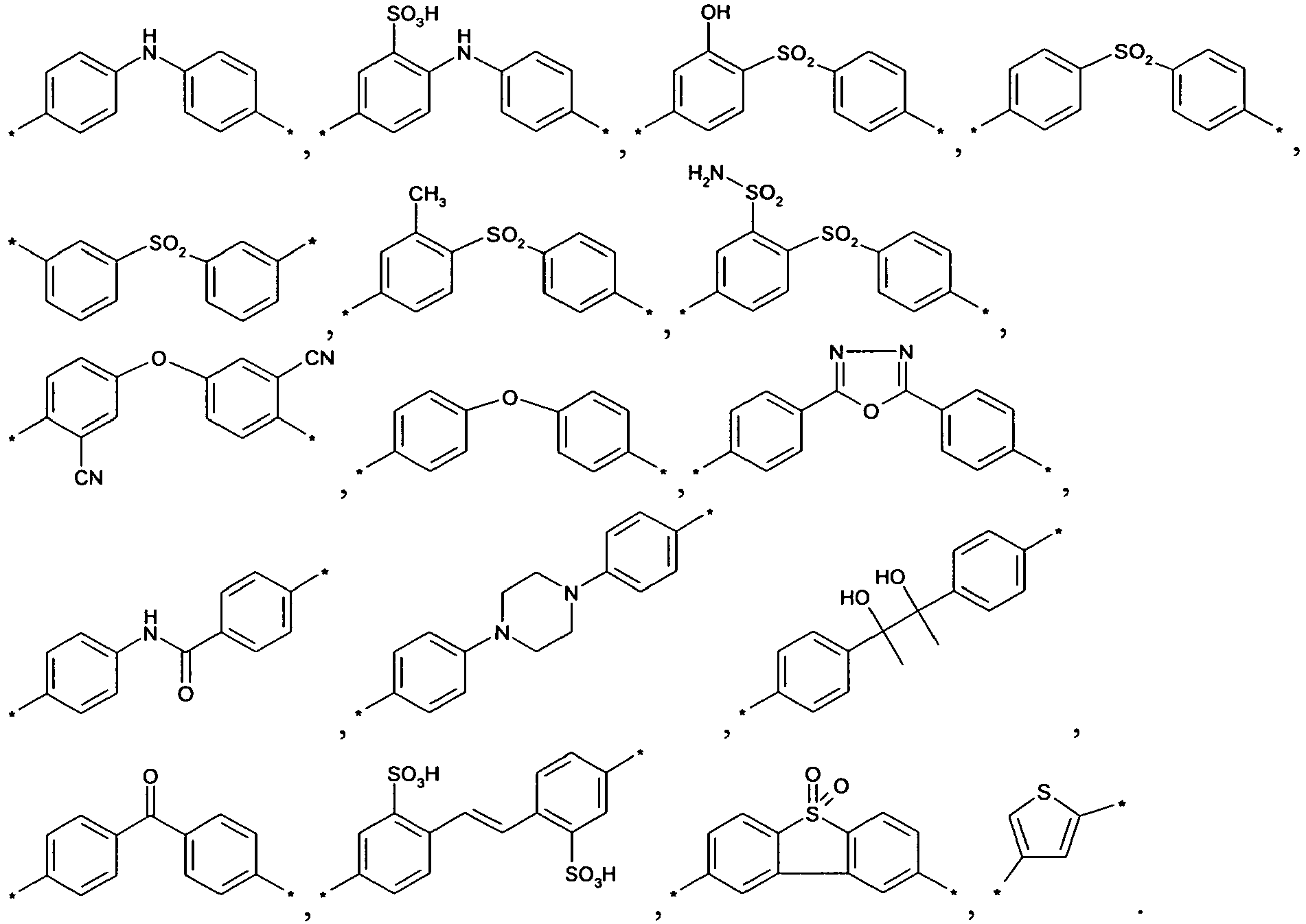
- A further aspect of the invention is aforementioned dye D2, wherein dye D2 is selected from the group consisting of:


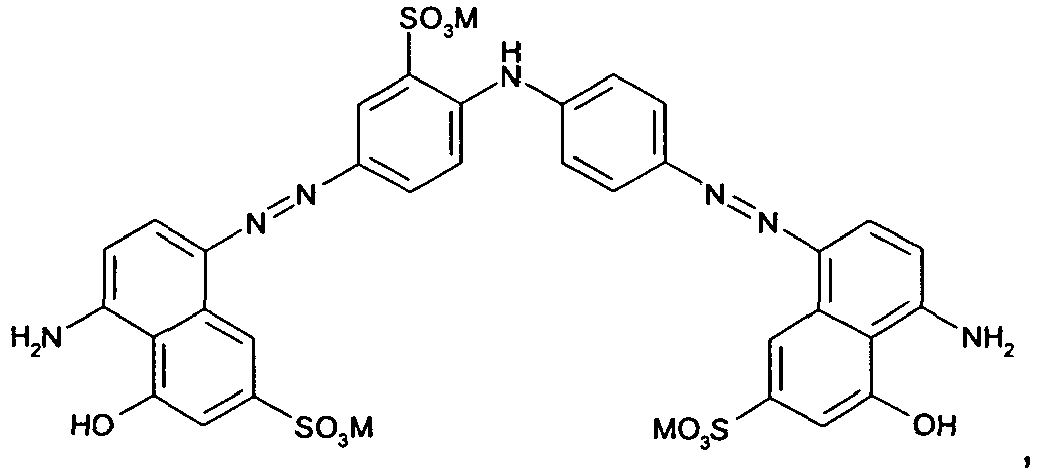


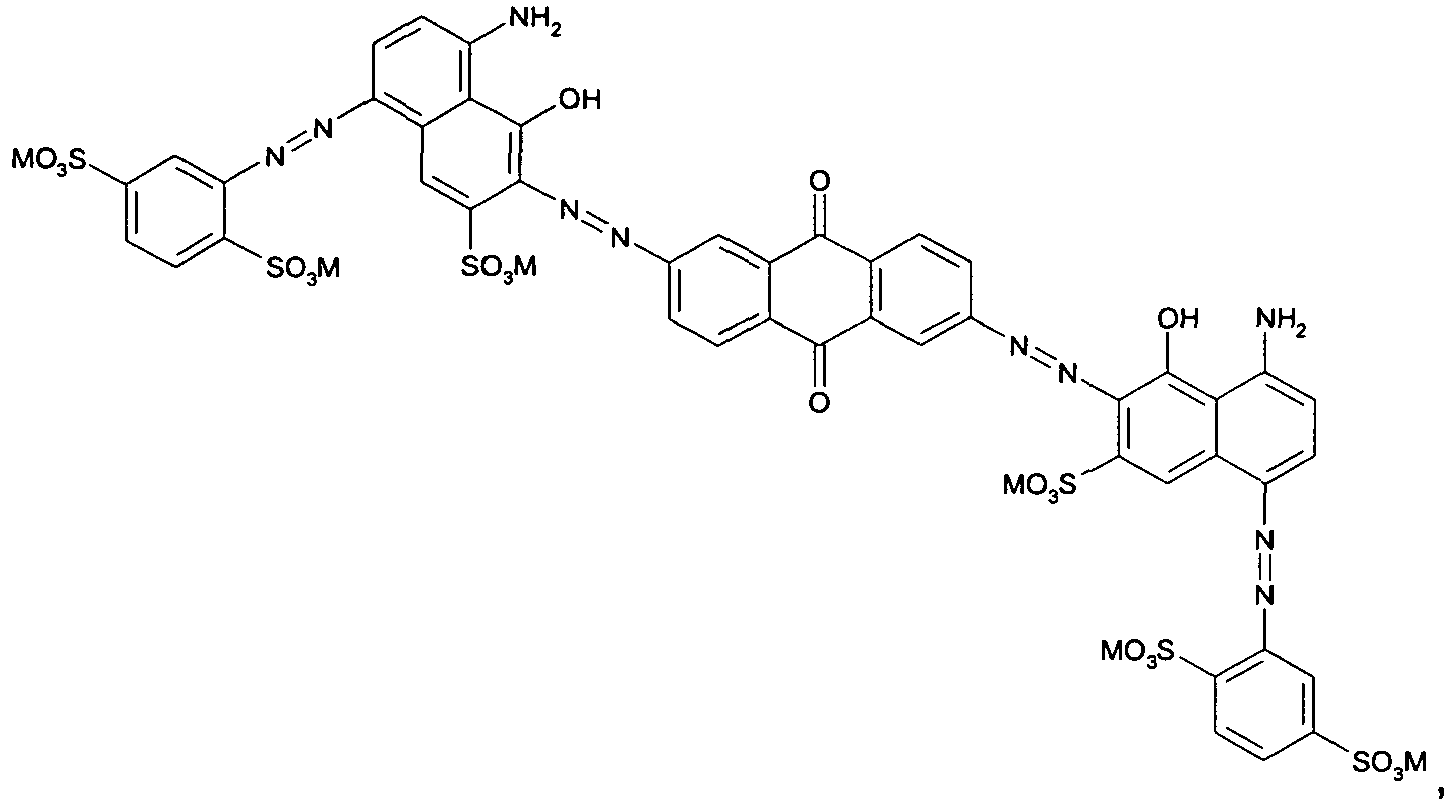


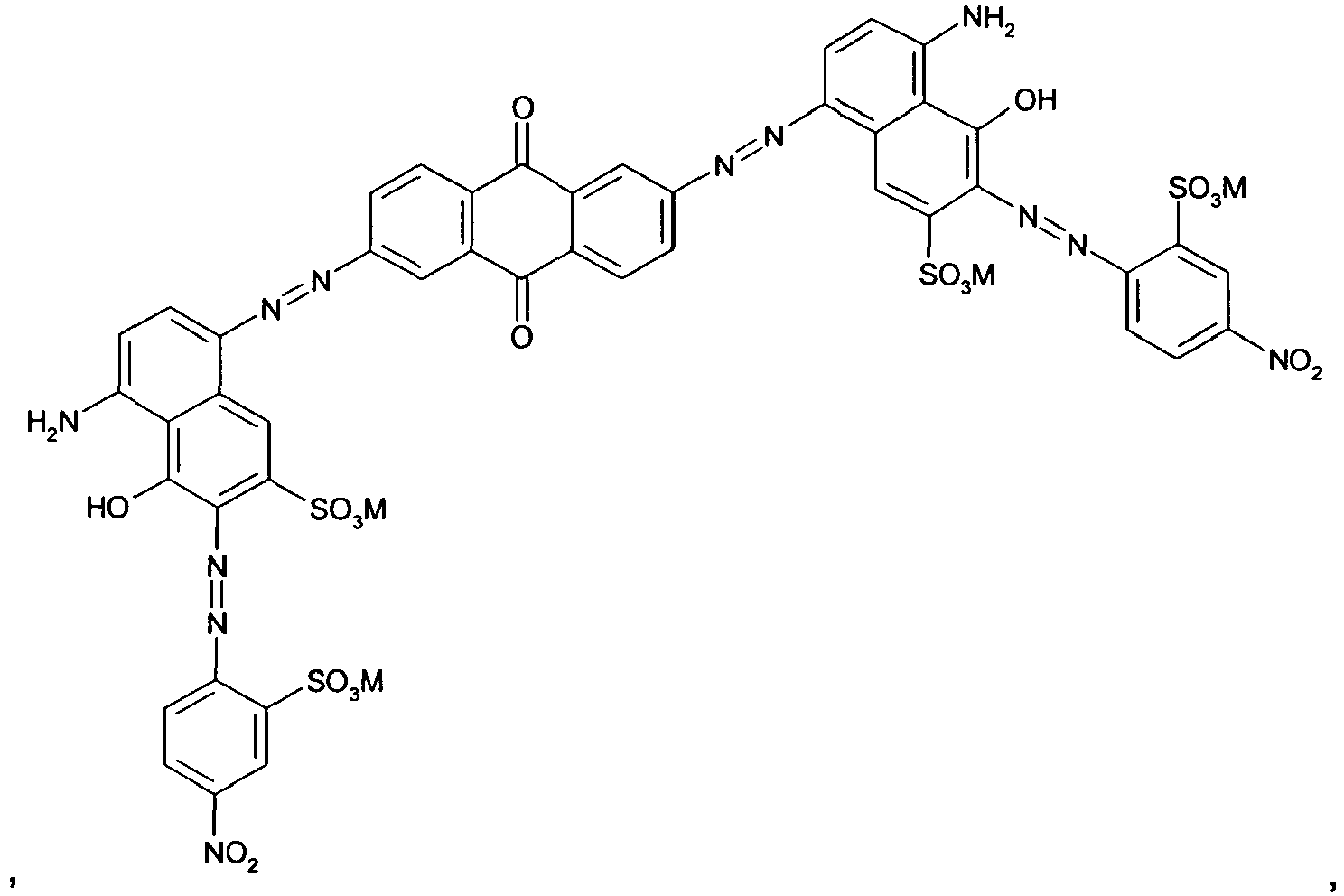


or a fully or partially protonated form of these dyes D2. Also preferred are fully or partially protonated forms of aforementioned dyes D2, in which Na is replaced by another atom selected from the choice described for M above, or a combination of two or more of any of the aforementioned dyes D2. - According to another aspect of the invention, the color of dye D1, or dye D2, is black.
- The term "black dye" in the context of the present invention refers to a dye, which dye's L*a*b* values preferably are in the range of: L <= 40; -15 <= a<= +15; -15 <= b <= +15.
- A further aspect of the invention is a method for the preparation of aforementioned dye D1, comprising at least the following steps:
- α. providing an at least one aromatic group containing compound of formula XIV,
H2N-Ar2 (XIV)
wherein Ar2 has the meaning as defined for Ar2 of dye D1 above; - β. diazotising the at least one aromatic group containing compound of formula XIV;
- γ. coupling the diazotized at least one aromatic group containing compound to a coupling component of formula XV,

wherein at least one of R1 and R4 is -H,
wherein a raw product is obtained, - γ. purifying the raw product to obtain the dye D1.
- Diazotising in the context of the present invention is defined as performing a diazotisation reaction at a compound I, which has at least one amino group. A general method of performing a diazotisation is described in Organikum, 16. Auflage, 1986, D.8.2.1, in particular on page 539, methods A and B. After performing a diazotising reaction, compound I is diazotised, i.e., the at least one amino group of compound I converted into a diazonium cation.
- Performing a coupling of a diazotized compound I with a coupling component II results in an azo compound comprising aforementioned compounds I and II, which compounds I and II are interconnected by an azo group, which azo group comes from converting the diazonium cation of compound I during the coupling with coupling compound II. A general method of performing the coupling reaction is described in Organikum, 16. Auflage, 1986, D.8.3.3 (p. 549-551), in particular on page 549, comprising variants A through D. The table on page 550 in section D.8.3.3 can be taken into consideration for choosing the best variant for a specific pair of components I and II out of available variants A through D.
- According to a further aspect of the invention, it is preferred to perform the diazotisation and coupling without isolating of any intermediate diazotised compound I. In this event, the coupling component II is added to the dispersion of diazotised compound I.
- According to a further aspect of the invention, if - R2 in formulae I, XV and XVII is -H, then -R2 may be replaced by a protecting group. After having obtained the azo dye carrying the protecting group, the protecting group is cleaved. That way, R2 is converted back into -H and the azo dye having a -OH group is obtained. Of the numerous protecting groups known for -OH, one skilled in the art will consider the suitable ones, preferably selected from the group of silyl ethers, ethers, esters and sulfonates.
- A further aspect of the invention is a method for the preparation of aforementioned dye D2, comprising at least the following steps:
- α. providing an at least one aromatic group containing linker of formula XVI,
H2N-Ar1-NH2 (XVI)
wherein Ar1 has the meaning as defined for Ar1 of dye D2 above; - β. diazotising the at least one aromatic group containing linker of formula XVI;
- γ. coupling the diazotized at least one aromatic group containing linker to at least one coupling component of formula XVII,

wherein at least one of R1 and R4 is -H,
wherein a raw product is obtained, - δ. purifying the raw product to obtain the dye D2.
- Another aspect of the invention is aforementioned method for preparing dye D1, wherein the process is performed in a one-pot synthesis, preferably in one step.
- Another aspect of the invention is aforementioned method for preparing dye D2, wherein the process is performed in a one-pot synthesis, preferably in one step.
- The term "in one step" refers to a chemical reaction, wherein all reactants are provided before or at the beginning of the reaction. The product obtained in the one step reaction is not subjected to a further reaction. However, the product obtained in the one step reaction can be subjected to one or more purification treatment.
- The term "one-pot synthesis", also referred to as "one pot reaction", refers to a multi-step chemical reaction carried out in a single reaction vessel. Typically, a reaction intermediate may be generated in an initial step of reaction, the reaction intermediate is then reacted with other component(s) present in or introduced to the same reaction vessel. The reaction intermediate generated is not isolated but serves directly as a reactant in a next step of reaction. A one-pot synthesis may consist of 1, 2, 3, 4 or more reaction steps. Purification of the raw product finally obtained by the one-pot synthesis may be performed in a separate step, but optionally be conducted within the one reaction vessel, too.
- According to another aspect of the invention, the diazotising may be repeated. In this case a first component A is diazotised as described above, then coupled to a coupling component B, by which coupling an azo intermediate is obtained. Another component A', which may be same or different to component A, is diazotised. The aforementioned azo intermediate is now employed as coupling component B', by which coupling another azo intermediate, or the desired dye is obtained. Optionally, this method can be repeated even more often. In a further option, one or more steps may be performed with one or more of the azo intermediates between two diazotising steps, in which protecting groups are removed. This procedure can be followed in order to prepare complex azo dyes having three or more azo groups. The azo intermediates themselves can be dyes, too.
- Another aspect of the invention is a dye obtainable by any of the aforementioned methods.
- Another aspect of the invention is a liquid phase comprising
- 1) at least a dye D1, or at least a dye D2, or a dye obtainable by any of the aforementioned methods, or two or more dyes selected from the aforementioned dyes either of the same type of dye or of different types of the aforementioned dyes, and
- 2) water.
- According to a further aspect of the invention, the liquid phase comprises one or more dyes of the invention, e.g. selected from dye D1, dye D2 or a dye obtainable by a method as mentioned above, or a combination of two or more of said dyes, wherein the amount of said dyes of the invention in the liquid phase is in the range of from 0.5 to 20 wt-%., preferably in the range of from 1 to 15 wt.-%, or in the range of from 2 to 10 wt.-%, each based on the total weight of the liquid phase.
- According to another aspect of the invention, the liquid phase comprises water in the range of from 20 to 95 %-wt., preferably 50 to 80 wt.-%, each based on the total weight of the liquid phase.
- Another aspect of the invention is a liquid phase, which contains 30 %-wt. or less, preferably 20 %-wt. or less, or 10 %-wt. or less, or no volatile organic compounds. Volatile organic compounds in the context of the present invention have a boiling point of less than 250 °C, determined at p = 101.3 kPa, or a vapour pressure of more than 0.27 kPa (2mm Hg) at 25 °C, or both.
- According to another aspect of the invention, the liquid phase further comprises N-methyl-2-pyrrolidone or 2-pyrrolidone or both, in a range of from 1 to 30 wt.-%, preferably 2 to 25 wt.-%, each based on the total weight of the liquid phase.
- According to another aspect of the invention, the liquid phase comprises one or more of the following additives: biocides, antioxidants, UV stabilisers, rheology modifiers such as thinners or thickeners, pigments, emulsifiers, wetting agents, preservatives, organic solvents, pH-regulating agents such as buffers, or a combination of at least two thereof.
- According to another aspect of the invention, the liquid phase is an ink.
- Another aspect of the invention is a method for applying a liquid phase on a substrate comprising at least the following steps:
- α) Providing a substrate, preferably an inkjet recording sheet as mentioned above,
- β) Providing a reservoir comprising the aforementioned liquid phase,
- γ) Transferring of at least a part of the liquid phase from the reservoir to the substrate,
- δ) Removing of water, and optionally solvents, from the substrate.
- By performing aforementioned method, a dyed substrate is obtained, which dyed substrate is at least partially covered by a layer of dye, or which dyed substrate has at least partially absorbed the dye, or a combination of both.
- According to a further aspect of the invention, steps P) and γ), or steps β) to δ) of aforementioned method are repeated one or more times on the same substrate, wherein in each step of repetition a liquid phase is provided, which liquid phase comprises another composition of dyes than any liquid phase provided onto the sample prior to said repetition step.
- Numerous of the known substrates are considered suitable for the aforementioned method. Preferred substrates are natural or synthetic fibre materials, porous materials, leather and aluminium, or a combination of two or more thereof. Preferably, aforementioned method of applying a liquid phase comprising one or more of the dyes of the invention is used to print text or images onto any one or more of the aforementioned substrates, or to substantively dye said substrates.
- Another aspect of the invention is a printed article, comprising
- A. a substrate, and
- B. a layer comprising at least one of aforementioned dye D1, dye D2 or a dye obtainable by the method for the preparation of a
dye D 1 or a dye D2 described above, or a combination of two or more of said dyes. - The layer comprising at least one of the aforementioned dyes can be arranged on the surface of the substrate. In particular with substrates that are able to absorb aforementioned liquid phases comprising aforementioned dye or aforementioned dyes at least partially, then the part of the substrate, which absorbed the liquid phase, and thus the dye, is the layer comprising said dye or dyes.
- Another aspect of the invention is a use of a dye according to the invention in water-based inks for inkjet printing, for writing utensils or in dyeing solutions for manufacturing color filters for optical and/or opto-electronic applications.
- A further aspect of the invention is a use of a dye according to the invention for dyeing materials, which comprise cellulose and/or cellulose derivatives, preferably selected from the group consisting of paper, cotton, viscose, celluloid, leather and wool. If said materials are dyed with a dye of the invention, good water fastness is observed. Any method known in the textile and paper industries for dyeing said materials with substantive dyes, in particular for bulk or surface treatment of sized and unsized papers, is appropriate to dye said material with one or more dyes of the invention. According to a further aspect of the invention, preferred articles of the aforementioned materials are yarns and piece goods of cotton, viscose and linen. These materials may be dyed from a long liquor or in a continuous process.
- The following Examples serve for exemplary elucidation of the invention and are not to interpreted as a restriction.
- The subject matter of the invention is exemplified in the figures. The figures, however, are not intended to limit the scope of the invention or the claims in any way.
- In
Figure 1 , a test pattern on test specimen media a (left column) and media b (right column) is shown. Media a and media b are described below. Each test pattern consists of 4 patches. The upmost three patches are used for the water fastness test. The upmost patch is printed at 40 % printing density. Patches two and three are printed at 100 % printing density. The bottom patch is divided into two segments, both serving as reference (not subjected to the water fastness test). The left segment of the bottom patch is printed at 100 % printing density, the right segment of the bottom patch is printed at 40 % printing density. - In
Figure 2a , test patterns printed with an ink of the present invention, in which dye 13 was used, are shown after having performed the water fastness test as described below. The composition of the ink was for preparing 10 g of ink: 0.57g Dye 13, 1.25g 2-Pyrrolidone, 0.015g of an aqueous solution (50 wt.-%) Olin® 10G (available from Arch Chemicals Inc., Norwalk, USA), 0.0225g Surfinol® 465 (available from Air Products and Chemicals Inc., Allentown, USA) and 3g distilled water. pH = 9. The color of the ink/pattern is black.
The substrate were media a (left pattern) and media b (right side). - In
Figure 2b , test patterns printed with an ink of the present invention, in which dye 19a was used, are shown after having performed the water fastness test as described below. The composition of the ink was for preparing 10 g of ink: 0.58g Dye 19a, 1.25g 2-Pyrrolidone, 0.015g of an aqueous solution (50 wt.-%) Olin® 10G (available from Arch Chemicals Inc., Norwalk, USA), 0.0225g Surfinol® 465 (available from Air Products and Chemicals Inc., Allentown, USA) and 3g distilled water. pH = 9. The color of the ink/pattern is neutral black.
The substrate were media a (left pattern) and media b (right side). - In
Figure 3 , test patterns printed with a comparative ink (HP364XL of Hewlett Packard GmbH, Germany) are shown after having performed the water fastness test as described below. The color of the ink/pattern is neutral black. The substrates were media a (left pattern) and media b (right side). - In
Figure 4 , a printed substrate is shown. - The intermediate monoazo compound of formula (1)

- 0.07 mol (20.3 g) of aniline-2,5-disulphonic acid were dissolved in 80 g of water and 17.5 g of hydrochloric acid (concentration: 37 wt.-%). Then, 0.075 mol (5.17 g) of sodium nitrite in 15 g of water were added at a temperature of 5° C to yield a diazotised solution. Excess of sodium nitrite was removed with 5.8 g of a 10 wt.-% solution of sulfamic acid.
- Then, the solution of diazotised aniline-2,5-disulphonic acid was coupled with 0.075 mol (19.0 g) of 5-Amino-4-hydroxynaphthalene-2-sulfonic acid (95 wt.-%, CAS35400-55-6) at a value of pH in the range of from 0.8 to 1.1 while maintaining this value of pH by the addition of sodium hydroxide. The reaction was stirred for 1.5 hours at a temperature between 0° C and 5° C and was then warmed up to room temperature. The mixture was then stirred for further 2 hours at room temperature (=20 °C) while maintaining the pH value. The reaction mixture was finally cooled down to a temperature of 8° C and then precipitated with EtOH and filtered. The precipitate in the filter was washed with an ethanol/water mixture (2 : 1 Vol./Vol.) and dried in vaccum for 5 hours at 40°C.
- The monoazo dye of formula (1) was obtained in a yield of 70 %, based on the number of moles of aniline-2,5-disulphonic acid.
- The intermediate monoazo compound of formula (1a) was prepared in the following way:

- Compound (1) was prepared in the same way as described for example 1 but the product was not precipitated but directly used for a further reaction step. In this further step, the pH was adjusted to a value of 12 with 24.90g of a 30 wt.-% solution of NaOH and then, the reaction mixture was cooled down to 20°C. 0.09 mol (15.90g) of Benzenesulfonylchloride were slowly added to the reaction mixture by keeping the pH at a value between 11 and 12. After 2 hours the pH was adjusted to a value of 0.8 with a 37 wt.-% solution of HCl and 15 wt.-% of EtOH, the wt.-% based on the total reaction volume, were added to the suspension. The resulting product was filtered off and the precipitate in the filter was washed with EtOH.
- The monoazo dye of formula (1a) was obtained in a yield of 85 %, based on the number of moles of aniline-2,5-disulphonic acid.
- The intermediate monoazo compound of formula (2a)

-

- This example was prepared as example 2a. However, sulfanilamide was used in place of 4-Nitroaniline-2-sulphonic acid of example 2a.
-

- This example was prepared as example 2a. However, 4-Amino-3-nitro benzenesulfonic acid was used in place of 4-Nitroaniline-2-sulphonic acid of example 2a.
-

- This example was prepared as example 2a. However, 2-Aminobenzenesulfonic acid was used in place of 4-Nitroaniline-2-sulphonic acid of example 2a.
-

- This example was prepared as example 2a. However, 4-Aminobenzenesulfonic acid was used in place of 4-Nitroaniline-2-sulphonic acid of example 2a.
-
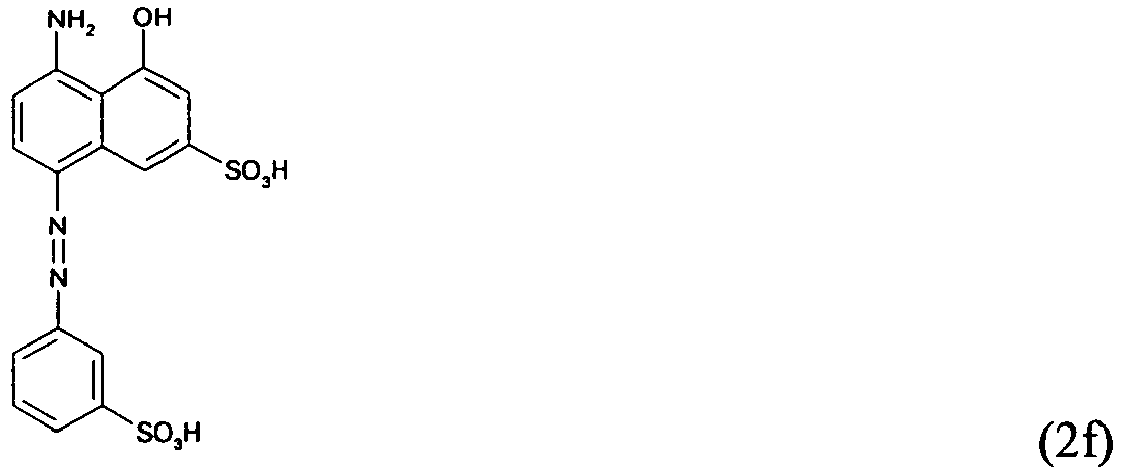
- This example was prepared as example 2a. However, 3-Aminobenzenesulfonic acid was used in place of 4-Nitroaniline-2-sulphonic acid of example 2a.
-

- This example was prepared as example 2a. However, 4-Aminobenzamide was used in place of 4-Nitroaniline-2-sulphonic acid of example 2a.
-

- This example was prepared as example 2a. However, 3-Aminobenzoic acid was used in place of 4-Nitroaniline-2-sulphonic acid of example 2a.
-

- This example was prepared as example 2a. However, 4-Aminobenzoic acid was used in place of 4-Nitroaniline-2-sulphonic acid of example 2a.
-

- 0.012 mol (2.0g) of Sulfanilamide were dissolved in 16g ice water with 6g hydrochloric acid (concentration: 37 wt.-%). 0.012 mol (0.85g) NaNO2 in 10 ml of water were slowly added at a temperature of 0°C to the Sulfanilamide yielding diazotised sulfonamide. The solution of diazotised sulphonamide was then added to 0.011 mol (5.30g) of the intermediate 2 (of example 2), which was dissolved 50 g ice water. The coupling was performed at a pH value between 9 and 11 and at a temperature between 0 and 5°C while maintaining this value of pH by the addition of sodium hydroxide. After 1h the reaction mixture was warmed to room temperature and the pH was adjusted to a value of 5.0 with hydrochloric acid (37 wt.-% solution). The raw product was filtered off and the precipitate was redissolved in water with sodium hydroxide (30 wt.-% solution), then clarified over celite and dialysed by reverse osmosis using a Thomapor® membrane (art. 50436, Reichelt Chemietechnik Heidelberg). After evaporation of residual water, dye 3 was precipitated with EtOH, filtered and the precipitate was dried in vacuum for 5 hours at 40 °C.
- Dye 3 was obtained in a yield of 80%, based on the number of moles of sulfanilamide.
-

- This example was prepared as example 3. However, dye 4 was prepared using Sulfanilamide for both coupling reactions of example 3.
-

- (0.06 mol) 14.4 g of 2,6-diaminoanthraquinone are introduced into 75 ml of concentrated sulfuric acid in the course of 10 min. so that the temperature of the mixture does not exceed 40 °C. After stirring for 30 min. at room temperature, 21.6 ml of 40 wt.-% nitrosylsulfuric acid are slowly added dropwise in such a manner that the temperature is kept between 22 and 25°C. (approx. 20 min.). The mixture is then stirred for 4 hours at room temperature. A brown suspension of
tetrazotised 2,6-diaminoanthraquinone was obtained. - The suspension of the
tetrazotised 2,6-diaminoanthraquinone was coupled with 0.12 mol (30.2g, 95 wt.%) of 5-Amino-4-hydroxynaphthalene-2-sulfonic acid at a value of pH between 0.5 and 1.0 and at a temperature of 5-10°C. The raw product was filtered off, the precipitate was washed with an ethanol/water mixture (2 : 1), redissolved at pH 12 , and filtered over a mixture of celite and charcoal carbon, and then dialysed by reverse osmosis using a Thomapor® membrane (art. 50436, Reichelt Chemietechnik Heidelberg).Residual water was removed by evaporation and obtained dye 5a was dried. - Dye 5a was obtained in a yield of 90%, based on the number of moles of 2,6-diaminoanthraquinone.
-

- This example was prepared as example 5a. However, dye 5b was prepared using [(8-hydroxy-6-sulfo-1-naphthyl)amino]acetic acid in place of 5-amino-4-hydroxynaphthalene-2-sulfonic acid of example 5a.
-

- This example was prepared as example 5a. However, 1,5-diaminoanthraquinone was used in place of 2.6-diaminoanthraquinone of example 5a.
-

- This example was prepared as example 5a. However, 5-Amino-2-[(4-aminophenyl)amino]benzenesulfonic acid was used in place of 2,6-diaminoanthraquinone of example 5a.
-

- This example was prepared as example 5a. However, 4,4'-Diaminodiphenyl Sulfone was used in place of 2,6-diaminoanthraquinone of example 5a.
-

- This example was prepared as example 5a. However, 4,4'-Diamino-2,2'-stilbenedisulfonic acid was used in place of 2,6-diaminoanthraquinone of example 5a.
-

- A suspension of
tetrazotised 2,6-diaminoanthraquinone was prepared as described for Example 5a. This suspension was then coupled with 0.12 mol (30.2g, 95 wt.-%) of 5-Amino-4-hydroxynaphthalene-2-sulfonic acid at a value of pH between 8.0 and 9.0 and at a temperature of 0-5°C. The raw product was filtered off, the precipitate was washed with an ethanol/water mixture (2 : 1), redissolved at pH 12 , and filtered over a mixture of celite and charcoal carbon, and then dialysed by reverse osmosis using a Thomapor® membrane (art. 50436, Reichelt Chemietechnik Heidelberg). Residual water was removed by evaporation and obtained dye 10 was dried. - Dye 10 was obtained in a yield of 80%, based on the number of moles of 2,6-diaminoanthraquinone.
-

- This example was prepared as example 10. However, 1,5-diaminoanthraquinone was used in place of 2.6-diaminoanthraquinone of example 10.
-

- This example was prepared as example 10. However, 5-Amino-2-[(4-aminophenyl)amino]benzenesulfonic acid was used in place of 2,6-diaminoanthraquinone of example 10.
-

- This example was prepared as example 10. However, 4,4'-Diaminodiphenyl Sulfone was used in place of 2,6-diaminoanthraquinone of example 10.
-

- This example was prepared as example 10. However, 4,4'-Diamino-2,2'-stilbenedisulfonic acid was used in place of 2,6-diaminoanthraquinone of example 10.
-

- A suspension of
tetrazotised 2,6-diaminoanthraquinone, prepared as described for Example 5a, was coupled with 0.125 mol (59.1g) of the azo dye intermediate (1) at a value of pH between 8.0 and 9.0 and at a temperature of 0-5°C. The pH of the mixture was adjusted to 6.5 and the product was filtered off. The precipitate was washed with an ethanol/water mixture (2 : 1), redissolved at pH 12 , and filtered over a mixture of celite and charcoal carbon, and then dialysed by reverse osmosis using a Thomapor® membrane (art. 50436, Reichelt Chemietechnik Heidelberg). Residual water was removed by evaporation and resulting dye (15) was dried. - Dye (15) was obtained in a yield of 60 %, based on the number of moles of 2,6-diaminoanthraquinone.
-

- This example was prepared as example 15. However, 1,5-diaminoanthraquinone was used in place of 2.6-diaminoanthraquinone of example 16.
-

- This example was prepared as example 15. However, the intermediate prepared in example 2a was used in place of intermediate prepared in example 1 of example 15.
- This example was prepared as example 17a. However, the intermediate of example 2c was used in place of the intermediate prepared in example 2a of example 17a.
-

- This example was prepared as example 17a. However, the 1,5-diaminoanthraquinone was used in place of 2.6-diaminoanthraquinone of example 17a.
- This example was prepared as example 18a. However, the intermediate of example 2c was used in place of the intermediate prepared in example 2a of example 18a.
-

- This example was prepared as example 15. However, the intermediate of example 2b was used in place of intermediate prepared in example 1 of example 15.
-

- This example was prepared as example 15. However, the intermediate of example 2g was used in place of intermediate prepared in example 1 of example 15.
-

- This example was prepared as example 15. However, the intermediate of example 2d was used in place of
diazotised 2,6-diaminoanthraquinone of example 15. - This example was prepared as example 20a. However, the intermediate prepared in example 2f was used in place of intermediate 2d of example 20a.
- This example was prepared as example 20a. However, the intermediate prepared in example 2e was used in place of intermediate 2d of example 20a.
-

- This example was prepared as example 20c. However, 1,5-diaminoanthraquinone was used in place of 2.6-diaminoanthraquinone of example 20c.
-

- This example was prepared as example 17b. However, 4,4'-Diaminodiphenyl Sulfone was used in place of 2,6-diaminoanthraquinone of example 17b.
-
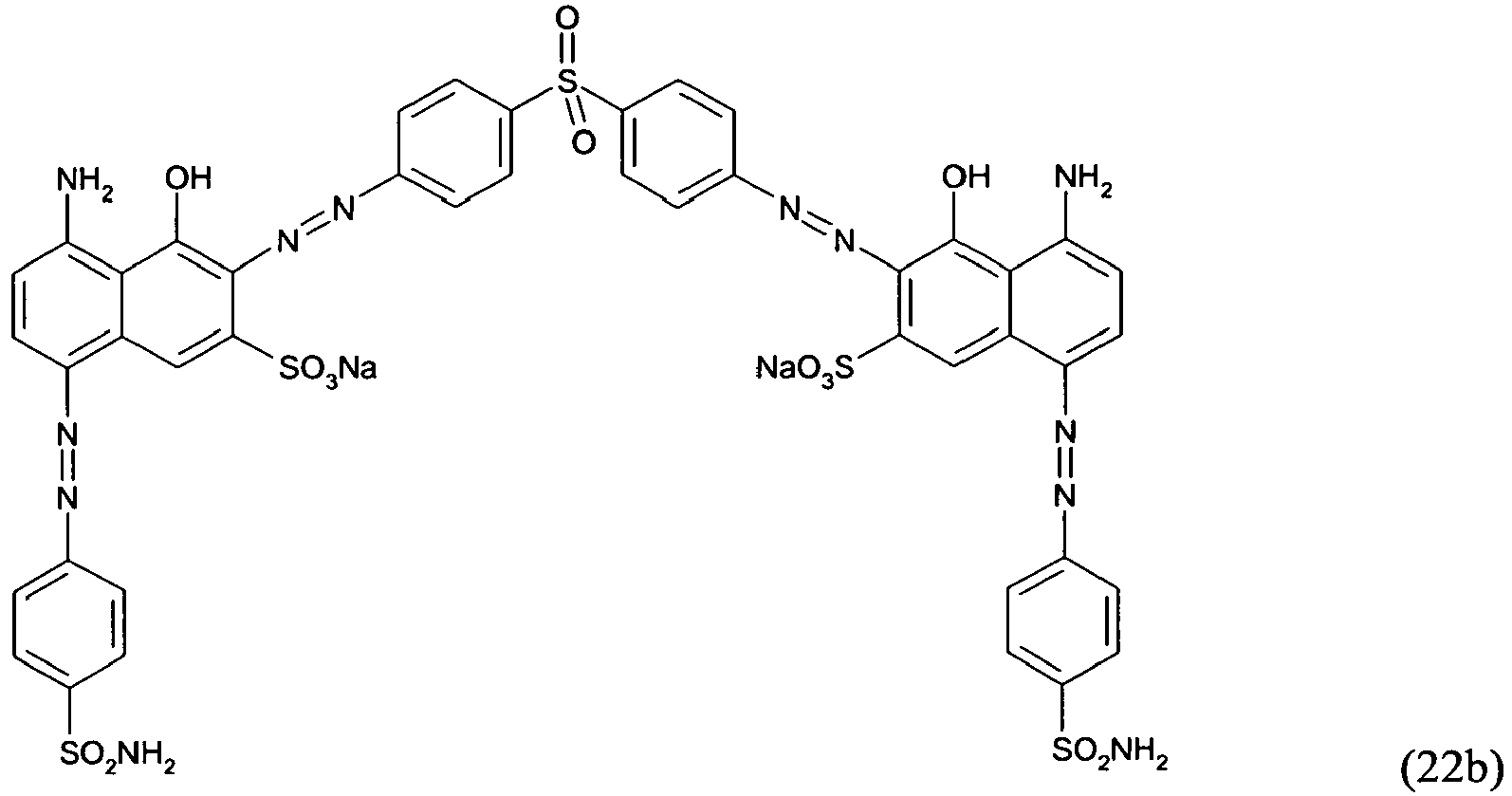
- This example was prepared as example 22a. However, intermediate 2b was used in place of intermediate 2c of example 22a.
-

- This example was prepared as example 22a. However, intermediate 2h was used in place of intermediate 2c of example 22a.
-

- This example was prepared as example 22a. However, intermediate 2f was used in place of intermediate 2c of example 22a.
-

- This example was prepared as example 22b. However, 5-Amino-2-[(4-aminophenyl)amino]benzenesulfonic acid was used in place of 4,4'-Diaminodiphenyl sulfone of example 22b.
-

- This example was prepared as example 23a. However, intermediate 2g was used in place of 2b of example 23a.
-

- This example was prepared as example 20c. However, 4-aminobenzenesulfonic acid was used in place of intermediate 2e and dye 5a was used in place of 2,6-diaminoanthraquinone of example 20c.
-

- This example was prepared as example 24a. However, dye 8 was used in place dye 5a and 4-nitro-2aminobenzenesulfonic acid was used in place of 4-aminobenzenesulfonic acid of example 24a.
-

- 0.03 mol (19.31g) of compound 1a were suspended in 130 g H2O and 7.39 g of a 37 wt-% solution of hydrocarbon chloride. The suspension was then cooled down to 0°C and 0.035mol (2.42g) of NaNO2 in 5g water were slowly added. The suspension was stirred for 2 hours at 0°C. Then, 8.0g of a 10 wt.-% solution of sulfamic acid were added to remove the excess of NaNO2 yielding a suspension of diazotised compound 1a.
- The diazotised compound 1a was coupled with 0.035mol (13.27g, 90 wt.%) of the monosodium salt of 4-amino-5-hydroxynaphthalene-1,7-disulphonic acid (K acid) at a value of pH of 1.5 while maintaining this value of pH by addition of sodium hydroxide. The reaction was stirred for 5 hours at a temperature between 0° C and 5° C and then warmed up to room temperature. The reaction mixture was then filtered to removed the excess of K-acid, thus resulting in intermediate 125. The pH of the filtrate was then adjusted to a value of 5.0-6.0 with a 30 wt.-% solution of NaOH.
- Then, a solution of diazotised 4-Nitroaniline-2-sulphonic acid prepared in the same way as in Example 1 was added in order to couple the diazotised 4-Nitroaniline-2-sulphonic acid to the intermediate I25. During addition, the pH was maintained at a value of 5.0 to 6.0 by adding of a 30 wt.-% solution of NaOH.
- The pH of the resulting reaction mixture was then adjusted to a value of 12 with a 30 wt.-% solution of NaOH, warmed to 40 °C and stirred 1 hour at that temperature. The mixture was then cooled down to room temperature, the product was precipitated with EtOH and filtered off. The precipitated dye 25 was dried.

- Dye 25 was obtained in a 70 % overall yield.
-

- This example was prepared as example 25. However, 4-amino-3-nitrobenzene-1-sulfonic acid was used in place of 4-Nitroaniline sulfonic acid of example 25.
-

- The following compound 27p

- After 0.1 mol (38g, 90 wt.%) of 1-amino-8-naphthol-4,6-disulphonic monosodium salt and 0.12 mol (20.7 g) of benzenesulfonylchloride were subjected to reaction at pH 10.0 to 12.0, at 20°C for 2 hours. The reaction mixture was acidified to a pH value of 4.0 with a 37 wt-% solution of hydrocarbon chloride and the product was filtered and dried.
Intermediate 27p was obtained in a quantitative yield. - 0.04 mol (15 g) of the compound of formula (27p) were suspended at room temperature in 70 ml of water and 30 ml of acetic acid (80 wt-%), cooled down to a temperature between 0° C and 5° C. Then, 10 ml of an aqueous solution of hydrochloric acid (37 wt.-%) were added drop-wise under stirring. Then, 0.042 mol (2.90 g) of sodium nitrite in 10 ml water were added drop-wise at a temperature between 0° C and 5° C. The diazonium suspension A was obtained after removing excess of nitrite through adding sulfamic acid.
- The same suspension (suspension B) was prepared for the second coupling reaction.
- The diazonium suspension A from the above was added over a period of 30 minutes at a temperature between 0° C and 5° C to a suspension of 0.04 mol ( 10.07g, 95% w.-%) of 5-Amino-4-hydroxynaphthalene-2-sulfonic acid in 100 ml of water under stirring while keeping the value of pH between 0.8 and 1.0 by simultaneous addition of 4.7g of a saturated solution of sodium acetate. After the addition of the diazonium suspension A, stirring was continued for 4 hours at a temperature between 0° C and 5°C.
- A 30 wt.-% solution of NaOH was used to adjust the pH to 8.5. The diazonium suspension B was then added over a period of 30 minutes at a temperature between 0° C and 5° C to the reaction mixture while keeping the value of pH between 8 and 10 by a simultaneous addition of a 30 wt.-% solution of sodium hydroxide. After the addition of the diazonium suspension B, stirring was continued for 2 hours at a temperature between 0° C and 5°C.
- The pH was then adjusted to 13.5 with a solution of NaOH (30 wt.-%) and the mixture was heated to 50°C which let to cleavage of the ether bond. The resulting intermediate (27p2) was precipitated with ethanol and dried.

- 5-Aminoisophthalic acid was diazotized in the same manner as described for aniline-2,5-disulphonic acid in example 1 and then coupled to intermediate 27p2 at a pH value of between 8.0 and 9.0 at a temperature in the range of 0 to 5°C. The raw product was purified by reverse osmosis using a Thomapor® membrane (art. 50436, Reichelt Chemietechnik Heidelberg) yielding Dye 27 with a 70 % overall yield.
-

- 0.016 mol (8.0 g) of compound 1a were suspended in 23 g of acetic acid and 50 g of ice water. 4.1 g of H2SO4 (97 wt.-%) were slowly added to the suspension and the mixture was cooled down to 0°C. 0.017 mol (1.15 g) of NaNO2 in 15 ml water were slowly added to the suspension by maintaining the temperature between 0 and 5°C. The reaction mixture was slowly warmed up to 10°C and stirred for 1 hour at that temperature. The excess of nitrite was removed with the addition of sulfamic acid. Then, 0.008 mol (3g, 90wt.%) of 1-amino-8-naphthol-4,6-disulphonic monosodium salt were added to the reaction mixture and the pH was adjusted to a value of 1.0 by adding 13 g of a saturated solution of sodium acetate. The reaction mixture was further stirred for 1 hour at 0-5°C. Then the pH was adjusted to a value of 2.0 by adding 4.8 g of a saturated solution of sodium acetate. After one further hour, the pH was adjusted to a value of 4.0 by adding 25.5 g of a saturated solution of sodium acetate. After another hour, 35.5 g of a 30 wt.-% solution of NaOH were added in order to adjust the pH to a value of 5.0. Then, the reaction mixture was allowed to warm up to room temperature.
- After 1 hour at room temperature, 33 g of a 30 wt.-% solution of NaOH were slowly added and the mixture was stirred at 60°C for 30 minutes. The mixture was then cooled down to room temperature and the pH was adjusted to 4.5 by adding a 37 wt.-% solution of hydrochloric acid. Ethanol was then slowly added to precipitate the product. The precipitated product was worked up by reverse osmosis using a Thomapor® membrane (art. 50436, Reichelt Chemietechnik Heidelberg).
- Dye 28 was obtained in a 75 % overall yield.
-

- 2,5-diamino aniline was diazotized in the same manner as in example 1 and coupled to dye 26 at a pH value of 8.5 to 9.5 and T = 0-5°C. The dye 26 was precipitated with EtOH, filtered off and dried.
- Dye 29 was obtained with a 70% yield, based on the number of moles of of 2,5-diamino aniline.
- Comparison with the commercial available ink HP364XL photo black
- Recording liquids were prepared using the dyes (2) to (29). Recording liquids of known dyes were prepared for comparison.
- For each dye, the quantity of the dye in the recording liquid was adjusted so that the absorption spectrum of the recording liquid in the range of the visible light equalled an optical density of 1.0. As a starting point for adjusting dye concentration, 100 ml of an aqueous solution of 2-5 mg of the dye, buffer to adjust the solution to pH = 7.0, and optionally 15 ml of N-methyl-2-pyrrolidone was prepared. Optionally, 15 ml of N-methyl-2-pyrrolidone were added. The amount of water was adjusted so that the total volume of aforementioned solution was 100 ml. If the dye does not dissolve completely, N-methyl-2-pyrrolidone is added. Then, a spectrum is recorded. If the optical density of the solution exceeds a value of 1.0, the amount of dye is reduced and the absorption spectra is recorded again. If, however, the optical density of the solution is less than 1.0, the amount of dye is increased and the absorption spectra is recorded again.
- The quantity obtained by this measurement is converted in mg/l (e.g. if 4 mg were diluted in 100ml water that yields a 40mg/l concentration to achieve an OD = 1) and is multiplied by 1.8 resulting in the amount of dye in g required per kg ink to prepare the ink. Standardizing recording liquids to an optical density of 1.0 allows comparing different dyes.
- For each dye, 10 g of recording liquid were prepared by heating the 1/100th of the amount of dye determined above (0.5 g to 1.0 g), 0.6 g ethylene glycol, 0.3 g propylene-1,2-glycol, 0.3 g 1-methyl-2-pyrrolidone, 0.03 g of an aqueous solution (50 wt.-%) of Olin® 10G (available from Arch Chemicals Inc., Norwalk, USA), 0.03 g Surfinol® 465 (available from Air Products and Chemicals Inc., Allentown, USA) and 0.01 g of a solution of Mergal® K 10N (a biocide, available from Riedel-de-Haën, Seelze, Germany) together with distilled water at a temperature of 50° C under stirring for approximately 1 hour. The resulting solution was cooled down to a temperature of 20° C, its value of pH was adjusted from 8.5 to 10 with an aqueous solution of sodium hydroxide (30 wt.-%) and the solution was passed through a Millipore® filter of 0.5 µm pore diameter.
- For dyes, which do not completely dissolve according to the aforementioned formulation, the following formulation was used:
- 10 g of recording liquid were prepared by heating the necessary amount of dye (0.5 g to 1.0 g), 25wt.-% 2-Pyrrolidone, 0.3wt.-% of an aqueous solution (50 wt.-%) Olin® 10G (available from Arch Chemicals Inc., Norwalk, USA), 0.45wt.-% Surfinol® 465 (available from Air Products and Chemicals Inc., Allentown, USA). 74.25 wt.-% distilled water under stirring for approximately 1 hour. The resulting solution was cooled down to a temperature of 20° C, its value of pH was adjusted from 9.5 to 10 with an aqueous solution of lithium hydroxide (5 wt.-%) or sodium hydroxide (30 wt.-%) and the solution was passed through a Millipore® filter of 0.5 µm pore diameter.
- Coloured square patches having a density of 1.2±0.3 were printed with an ink jet printer, Model Canon PIXMA iP4000, onto the following recording sheets for ink jet printing:
- a: HP Printing Paper HP 1122 (uncoated paper),
- b: Sterling Papers Standard Glossy Coated stock for Litho Web (coated paper), and
- c: ILFORD Premium Plus Glossy Paper 270 g/m2 (ink jet recording sheet)
- For printing the black square patches, the ink was filled in an empty cartridge and placed in the yellow channel of the printer settings so that only the pure ink was printed. In terms of software, Photoshop 4 (Adobe Systems, Inc.) was used. There, the printer settings were set to "photo paper pro", quality was set to "high", color setting parameters to "manual" option. Regarding the picture type, the option "none" was chosen. A yellow patch was designed in Photoshop and printed with the black ink in the yellow cartridge. The obtained coloured patches were used for the determination of water fastness, light stability, dye saturation and resistance against degradation by ozone.
- The colour coordinates L*a*b* of the coloured square patches were measured with a spectrophotometer Spectrolino® (available from Gretag Macbeth, Regensdorf, Switzerland) in reflection mode (using CIE standard illuminant D65).
- The optical density D0 of the dye in the coloured patches on the printed sample was measured after printing aforementioned patches. Then, the printed samples with the patches were irradiated using a Weather-Ometer® Ci35A (available from Atlas Material Testing Technology, Chicago, USA) with a 6500 W xenon lamp at a temperature of 20° C and relative humidity of 50 % until an illumination of 10 and 20 Megalux hours was reached. Then, the density DI of the dye in the coloured, irradiated patches was measured with a densitometer Spectrolino®. The percent of density loss of the dye in the coloured patches due to illumination with light is calculated according to the formula:

- High values of DLLight indicate good light stability of a dye.
- Light stability of a dye (indicated as DLLight) was graded in the following way:
- A:
- less than 20 % dye density loss
- B:
- 20 % to 30 % dye density loss
- C:
- 30 % to 40 % dye density loss
- D:
- more than 40 % dye density loss
- After measuring the optical density of the coloured square patches (see above), the printed samples were stored for 48, 96 and 192 hours in an ozone chamber, model 903 (available from Satra/Hampden, Great Britain) at a temperature of 30° C, a relative humidity of the air of 50 % and an ozone concentration of 1 ppm at a velocity of the circulating, ozone containing air of 13 mm/s. After storage, the color density of the coloured square patches of the samples were remeasured providing DII. The percent of density loss of the dye in the coloured patches due to the ozone treatment is calculated according to the formula:

- High values of DLOzone indicate good ozone stability of a dye.
- Stability of a dye against degradation by ozone (indicated as DLOzone) was graded in the following way:
- A:
- less than 20 % dye density loss
- B:
- 20 % to 30 % dye density loss
- C:
- 30 % to 40 % dye density loss
- D:
- more than 40 % dye density loss
- Patterns were printed on recording media a and b as described in ISO test 18935:2005(E), Method 3 - Water soak, with the following differences:
- a. the time of immersion in the present tests was set than 1 minute compared ISO 18935:2005(E), in which the time of immersion is set to 1 hour;
- b. only black pattern are prepared according to the procedure described above.
- First, the optical density (UnsoakedPattern OD) of the coloured patterns on the samples was measured with a
Spectrolino® densitometer 1 day after it has been printed. Then the samples with the patterns were immersed into de-ionized water at ambient temperature for 1 minute. Then, the samples with the patterns were removed and hung vertically to dry for 1 hour. Separate containers were used for each sample to avoid cross contamination. The optical density (SoakedPattem OD) of the coloured, water-treated patterns was measured with a Spectrolino® densitometer. The calculated percent water-fastness is given according the following formula:
- Low values of Optical Density Loss indicate good water fastness of a dye.
- Waterfastness of a dye (indicated as WF) was graded in the following way:
- A:
- less than 10% optical density loss
- B:
- 10% to 20% optical density loss
- C:
- 20% to 30% optical density loss
- D:
- 30% to 40% optical density loss
- E:
- > 40% optical density loss
- The absorption maxima λmax in aqueous solution, the colour coordinates on the recording sheet c and the stability against degradation by ozone (DLOzone) as described above, each on recording sheet c, are listed in Table 1.
Table 1 Dye λmax (nm) L*a*b* Stability against degradation by ozone / Recording sheet c 48 h 96 h 192 h 25 661.5 14.1/6.6/-16.9 A B C 26 662 17.1/-1.2/-16.4 A A C 28 719 17.6/-7.1/-12.6 A B C 29 490.5/631.50 6.8/2.3/-0.1 A A B HP364XL 566.5 7.3/12.3/-5.3 B C D - The results in Table 1 immediately show that the dyes (25), (26), (29) according to the invention have a considerably better stability against degradation by ozone than comparative commercial sample of black dye (HP364XL).
- The stability against degradation by light on the recording sheets a and c are listed in Table 2.
Table 2 Dye Stability against degradation by light Recording sheet a Recording sheet c 20 Mluxh 50 Mluxh 100 Mluxh 20 Mluxh 30 Mluxh 50 Mluxh 25 A A B A B B 26 A A A A A B 28 A A B A A B 29 A A C A A A HP364XL A C D B D E - The results in Table 2 immediately show that the dyes (25), (26), (28) and (29) according to the invention have a considerably better stability against degradation by light than comparative commercial sample of black dye (HP364XL).
- With regard to the stability against degradation by both, ozone and light, the dyes (25), (26), and (29) have a considerably better stability than black dye (HP364XL).
- The waterfastness (WF) on the recording sheets a and b are listed in Table 3.
Table 3 Dye Water-fastness (WF) Recording sheet a Recording sheet b Optical Density vis. at 100% print density WF [%] Optical Density vis. at 100% print density WF [%] 4 1.15 D 0.8 A 5a 1.14 A 1.31 A 5b 0.98 B 1.31 A 6 0.98 A 1.30 A 7 1.25 B 1.24 A 8 1.02 A 1.19 A 9 1.19 C 1.17 A 10 1.13 A 1.43 A 12 1.15 B 1.23 A 13 1.05 A 1.28 A 14 1.20 B 1.14 A 15 1.10 C 1.14 E 16 1.14 C 1.16 E 17a 1.04 C 1.41 A 17b 1.03 B 1.43 A 18a 1.19 C 1.25 A 18b 1.05 B 1.22 A 19a 1.01 A 1.34 A 19b 0.96 B 1.50 A 20a 1.03 B 1.44 A 20b 1.03 C 1.41 A 20c 1.02 C 1.46 A 21 1.03 B 1.45 A 22a 0.01 C 1.20 A 22b 0.08 A 1.29 A 22c 0.96 B 1.45 A 22d 1.01 B 1.04 A 23a 1.10 A 1.30 A 23b 1.12 A 1.31 A 24a 1.03 B 1.28 A 24b 1.03 C 1.38 B 27 1.09 C 1.11 C HP364XL 1.09 C 1.21 C - With regard to the water-fastness, the dyes (5b), (7), (12), (14), (17b), (18b), (19b), (20a), (21), (22c), (22d), (23a), (24a) and particularly the dyes (5a), (6), (8), (10), (13), (19a), (22b), (23b) have a considerably better water-fastness than commercial, black dye (HP364XL).
-
- (1) Substrate
- (2) Dye
Claims (25)
- A dye D1 of formula I,

M is selected from the group consisting of H, Li, Na, K, N(HkR6 m),
wherein
each R6 is selected from the group consisting of -H, an substituted or unsubstituted, saturated or unsaturated aliphatic group having 1 to 10 carbon atoms, and
k is an integer selected from 0, 1, 2, 3, 4 and
m = 4 - k,
R1 is -H or -N=N-Ar2,
wherein Ar2 is a substituted or unsubstituted monocyclic, polycyclic or condensed, at least one aromatic group containing fragment, which at least one aromatic group comprises at least one five- or one six-membered homo- or heterocyclic structure,
wherein the heterocyclic structure comprises at least one hetero-atom,
which heteroatom is N, O or S;
R2 is selected from the group consisting of -H, -C(=O)R6, -C(=O)-(CH2)v-Ar2, -R6, - (CH2)q-X, -C(=O)-(CH2)vAr2, -SO2R6, -SO2Ar2
wherein
X is selected from the group consisting of -SO3M, -SO2NH2, -SO2NHR6, - NHSO2R6, -NO2, -COOM, -COOR, -CH3, -R6, -NH2, -NHR6, -OR6, -OM, - Cl, -Br, -I, -F, -CN, -CO2NHR6, -Ar2, -N=N-Ar2, -SO2R6 and -NHC(=O)-R6,
M, R6 and Ar2 are defined as above,
q is an integer in the range of from 1 to 10, and
v is an integer in the range of from 0 to 10;
R3 is -NHR2 or -N=N-Ar2, wherein
R2 has the meaning as defined above, and
Ar2 has the meaning as defined above;
R4 is -N=N-Ar2, wherein Ar2 has the meaning defined above. - The dye D1 according to claim 1, wherein each Ar2 is selected independently from the group consisting of:a) formula III:

r represents the number of X substituents in formula III and is an integer
in the range of from 1 to 5, and X has the meaning as defined in claim 1,
M is as defined in claim 1; orb) formula IV: c) formula V:
R7 is selected from the group consisting of -R6,-SR6, -Ar2, and -NHR6
Z1 is -OH, -NHR6, -CN, -CO2M, -CO2R6 or -NHR6,
Ar2, R6 and M have the meaning as defined in claim 1; ord) formula VI:
each X has the meaning as defined in claim 1, wherein X is preferably -H, -OH, -NHR6 or -SO3M,
T is selected from the group consisting of C, N or P,
M has the meaning as defined in claim 1,
u represents the number of X substituents in formula VI and is an integer
between 0 and 6;e) formula VII:
X has the meaning as defined in claim 1 and
w represents the number of X substituents in formula VII and w is 1 or 2, Y is C or N;f) formula VIII:
X has the meaning as defined above, wherein X is preferably -H, -NO2, - CH3, -Cl, -F, -Br, -SO3M, -SO2R6, -SO2NHR6, -OH, -OR6, -NHR6, - COOM and -COOR6,
w represents the number of X substituents in formula VIII and w is an integer in the range of from 1 to 4,
Y is C, N, O or S, and
R6 and M have the meaning as defined above. - The dye D1 according to any of claims 1 to 2, wherein two of the groups selected from R1, R3 and R4 are -N=N-Ar2, wherein each Ar2 is selected independently from any other Ar2 .
- The dye D1 according to claim 3, wherein R1 and R4 are -N=N-Ar2, wherein each Ar2 is selected independently from any other Ar2.
- A dye D2 comprising two fragments of formula I as defined in claim 1 and one fragment R5 of formula II,
*-N=N-Ar1-N=N-* (II)
wherein Ar1 is a substituted or unsubstituted, monocyclic, polycyclic or condensed,
at least one aromatic group containing linker, which at least one aromatic group comprises at least one five- or one six-membered homo- or heterocyclic structure,
wherein the heterocyclic structure comprises at least one hetero-atom, which heteroatom is N, O or S;
wherein, independently for each fragment of formula I, R2, R3 and M have the meaning as defined in claim 1,
wherein R1 and R4 of each fragment of formula I are selected froma. -H,b. -N=N-Ar2 with Ar2 as defined in claim 1, orc. -R5,wherein, in each of the two fragments of formula I, at least one of the groups R1
and R4 equals R5 as defmed for formula II, and wherein R5 is linked at the positions marked with * to the two fragments of formula I. - The D2 dye according to claim 5, wherein in each fragment of formula I, if R1 equals R5 then R4 is the structure of formula III or the structure of formula VI as defined in claim 2.
- The dye D2 according to claim 5 to 6, wherein R5 is selected from the group consisting of formula IIa and formula IIb:


each X independently has the meaning as defined in claim 1,
s independently for each aromatic ring represents the number of X substituents and is an integer selected from 0, 1, 2 and 3,
U1 is selected from the group consisting of -CZ2-, -CZ2-CZ2-, -(SO2)-, -O-, -(C=O)-, -CH=CH-, -NH(C=O)-,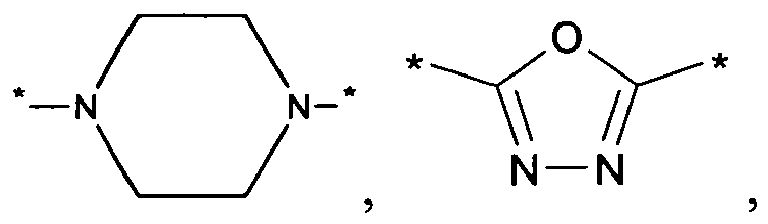

wherein
each Z is selected independently from -H, -OH or -CH3, y is 0 or 1
U2, U3 are, each individually, selected from -(C=O)- and -(SO2)-,
R7 is selected from the group consisting of -R6, -Cl, -Br, -I, -F, -OH, and
R6 has the meaning as defined in claim 1. - The dye D2 according to any of claims 5 to 7, wherein R5 is selected from formula IX:


- The dye D2 according to any of claims 5 to 8, wherein M, R1, R2, R3 are identical for both fragments of formula I, which both fragments of formula I are linked to each other in R4 via one fragment R5 of formula II.
- The dye D2 according to any of claims 5 to 9, wherein M, R2, R3, R4 are identical for both fragments of formula I, which both fragments of formula I are linked to each other in R1 via one fragment R5 of formula II.
- The dye D2 according to claim 5, wherein dye D2 is represented by formula XI:

- The dye D2 according to claim 5, wherein the dye D2 is represented by formula XII:

- The dye D2 according to claim 5, wherein the dye D2 is represented by formula XIIIa:

- The dye D2 according to claim 5, wherein the dye D2 is represented by formula XIIIb:

- A method for the preparation of a dye D1 according to any of claims 1 to 4, comprising at least the following steps:α. providing an at least one aromatic group containing compound of formula XIV,
H2N-Ar2 (XIV)
wherein Ar2 has the meaning as defined in claim 1;β. diazotising the at least one aromatic group containing compound of formula XIV;γ. coupling the diazotized at least one aromatic group containing compound to a coupling component of formula XV,
wherein at least one of R1 and R4 is -H,
wherein a raw product is obtained,δ. purifying the raw product to obtain the dye D1. - A method for the preparation of a dye D2 according to any of claims 5 to 14, comprising at least the following steps:α. providing an at least one aromatic group containing linker of formula XVI,
H2N-Ar1-NH2 (XVI)
wherein Ar1 has the meaning as defined in claim 5;β. diazotising the at least one aromatic group containing linker of formula XVI;γ. coupling the diazotized at least one aromatic group containing linker to at least one coupling component of formula XVII,
wherein at least one of R1 and R4 is -H,
wherein a raw product is obtained,δ. purifying the raw product to obtain the dye D2. - The method of claim 15 or 16, wherein the process is performed in a one-pot synthesis.
- A dye obtainable by the method according to any one of claims 15 to 17.
- A liquid phase comprising1) at least a dye D1 according to any of claims 1 through 4 or a dye D2 according to any of claims 5 through 14 or a dye according to claim 18, and2) water.
- The liquid phase according to claim 19, wherein the liquid phase comprises one or more dyes according to claims 1 through 14 and 18 , wherein the amount of said dyes in the liquid phase is in the range of from 0.5 to 20 wt.-%, based on the total weight of the liquid phase.
- The liquid phase according to claim 19 or 20, wherein the liquid phase further comprises N-methyl-2-pyrrolidone or 2-pyrrolidone in a range of from 1 to 30 wt-%, based on the total weight of the liquid phase.
- The liquid phase according to any of claims 19 through 21, wherein the liquid phase is an ink.
- A method for applying a liquid phase on a substrate comprising at least the following steps
α) Providing a substrate, and
β) Providing a reservoir comprising the liquid phase according to any of claims 19 through 22,
γ) Transferring of at least a part of the liquid phase from the reservoir to the substrate,
δ) Removing of water, and optionally solvents, from the substrate. - A printed article, comprisingA. a substrate, andB. a layer comprising at least a dye D1 according to any of claims 1 through 4 or dye D2 according to any of claims 5 through 14 or a dye according to claim 18.
- A use of a dye according to any of claims 1 through 14 or 18 in water-based inks for inkjet printing, writing utensil, or in dyeing solutions for manufacturing color filters for optical and opto-electronic applications.
Priority Applications (8)
| Application Number | Priority Date | Filing Date | Title |
|---|---|---|---|
| EP12002048.2A EP2641940B1 (en) | 2012-03-22 | 2012-03-22 | Water soluble and water fast dyes for ink jet printing |
| JP2015500799A JP6235552B2 (en) | 2012-03-22 | 2013-03-22 | Water-soluble and water-resistant dyes for inkjet printing |
| HK15104387.6A HK1203991B (en) | 2012-03-22 | 2013-03-22 | Water soluble and water fast dyes for ink jet printing |
| US14/387,208 US9499707B2 (en) | 2012-03-22 | 2013-03-22 | Water soluble and water fast dyes for ink jet printing |
| PCT/EP2013/000878 WO2013139485A1 (en) | 2012-03-22 | 2013-03-22 | Water soluble and water fast dyes for ink jet printing |
| IN2100MUN2014 IN2014MN02100A (en) | 2012-03-22 | 2013-03-22 | |
| KR1020147029563A KR102049963B1 (en) | 2012-03-22 | 2013-03-22 | Water soluble and water fast dyes for ink jet printing |
| CN201380015692.0A CN104379678B (en) | 2012-03-22 | 2013-03-22 | Water-soluble and water-resistant dyes for inkjet printing |
Applications Claiming Priority (1)
| Application Number | Priority Date | Filing Date | Title |
|---|---|---|---|
| EP12002048.2A EP2641940B1 (en) | 2012-03-22 | 2012-03-22 | Water soluble and water fast dyes for ink jet printing |
Publications (3)
| Publication Number | Publication Date |
|---|---|
| EP2641940A1 true EP2641940A1 (en) | 2013-09-25 |
| EP2641940B1 EP2641940B1 (en) | 2025-01-22 |
| EP2641940C0 EP2641940C0 (en) | 2025-01-22 |
Family
ID=45926400
Family Applications (1)
| Application Number | Title | Priority Date | Filing Date |
|---|---|---|---|
| EP12002048.2A Active EP2641940B1 (en) | 2012-03-22 | 2012-03-22 | Water soluble and water fast dyes for ink jet printing |
Country Status (7)
| Country | Link |
|---|---|
| US (1) | US9499707B2 (en) |
| EP (1) | EP2641940B1 (en) |
| JP (1) | JP6235552B2 (en) |
| KR (1) | KR102049963B1 (en) |
| CN (1) | CN104379678B (en) |
| IN (1) | IN2014MN02100A (en) |
| WO (1) | WO2013139485A1 (en) |
Cited By (1)
| Publication number | Priority date | Publication date | Assignee | Title |
|---|---|---|---|---|
| CN117586644A (en) * | 2023-11-22 | 2024-02-23 | 浙江亿得新材料股份有限公司 | Deep black reactive dye, production method and application |
Families Citing this family (2)
| Publication number | Priority date | Publication date | Assignee | Title |
|---|---|---|---|---|
| JP7107198B2 (en) * | 2018-12-07 | 2022-07-27 | 東洋インキScホールディングス株式会社 | Pigment dispersant and pigment composition, coloring composition and color filter using the same |
| JP7607526B2 (en) | 2021-07-09 | 2024-12-27 | 大日精化工業株式会社 | Pigment dispersant, pigment composition, and pigment colorant |
Citations (8)
| Publication number | Priority date | Publication date | Assignee | Title |
|---|---|---|---|---|
| JPS58174458A (en) * | 1982-04-07 | 1983-10-13 | Canon Inc | recording liquid |
| JPS58174462A (en) * | 1982-04-08 | 1983-10-13 | Canon Inc | recording liquid |
| JPS58176256A (en) * | 1982-04-09 | 1983-10-15 | Canon Inc | Recording liquid |
| JPS58176277A (en) * | 1982-04-09 | 1983-10-15 | Canon Inc | Recording liquid |
| JPS6356574A (en) * | 1986-08-27 | 1988-03-11 | Ricoh Co Ltd | water-based ink composition |
| JPH01265205A (en) * | 1988-04-18 | 1989-10-23 | Nippon Kayaku Co Ltd | Polarizing plate |
| JPH1172907A (en) * | 1997-08-28 | 1999-03-16 | Hitachi Chem Co Ltd | Color image forming photosensitive solution and manufacture of color filter by using the same and color filter |
| WO2005052065A1 (en) * | 2003-11-20 | 2005-06-09 | Fujifilm Imaging Colorants Limited | Trisazo-dyestuffs |
Family Cites Families (15)
| Publication number | Priority date | Publication date | Assignee | Title |
|---|---|---|---|---|
| EP0048692B1 (en) * | 1980-09-19 | 1984-04-18 | Ciba-Geigy Ag | Azo coupling process |
| JPS585380A (en) * | 1981-07-01 | 1983-01-12 | Canon Inc | Recording fluid |
| JPS6356573A (en) * | 1986-08-27 | 1988-03-11 | Ricoh Co Ltd | water-based ink composition |
| JPH0792531B2 (en) * | 1987-12-28 | 1995-10-09 | 日本化薬株式会社 | Polarizer |
| EP0373797A1 (en) * | 1988-12-12 | 1990-06-20 | Ilford Ag | Azo dyes and use thereof as image dyes in photographic silver dye bleach materials |
| JP3803394B2 (en) * | 1993-04-21 | 2006-08-02 | 三井化学株式会社 | Azo compound and polarizing film using the compound |
| JPH1088014A (en) * | 1996-09-10 | 1998-04-07 | Sony Corp | Magenta diazo coloring matter, color filter, and solid-state image pickup device |
| US6288217B1 (en) * | 2000-08-18 | 2001-09-11 | Lexmark International, Inc. | Black azo dyes |
| DE50001223D1 (en) * | 2000-12-21 | 2003-03-13 | Ilford Imaging Ch Gmbh | Monoazo dyes, their production and use |
| DE50200372D1 (en) * | 2002-05-27 | 2004-05-27 | Ilford Imaging Ch Gmbh | Monoazo dyes, their production and use |
| WO2003106572A1 (en) * | 2002-06-01 | 2003-12-24 | Avecia Limited | Printing process using specified azo compounds |
| WO2007017631A2 (en) * | 2005-08-08 | 2007-02-15 | Fujifilm Imaging Colorants Limited | Process for printing an image, composition and compound |
| JP5387936B2 (en) * | 2007-06-29 | 2014-01-15 | 株式会社リコー | Azo compound and process for producing the same |
| EP2441805B1 (en) * | 2010-10-16 | 2016-07-20 | Rex-Tone Industries Ltd | Black disazo dyes, their preparation and their use |
| EP2468822B1 (en) * | 2010-12-22 | 2015-06-10 | Rex-Tone Industries Ltd | Black trisazo dyes, their preparation and their use |
-
2012
- 2012-03-22 EP EP12002048.2A patent/EP2641940B1/en active Active
-
2013
- 2013-03-22 WO PCT/EP2013/000878 patent/WO2013139485A1/en not_active Ceased
- 2013-03-22 JP JP2015500799A patent/JP6235552B2/en active Active
- 2013-03-22 US US14/387,208 patent/US9499707B2/en active Active
- 2013-03-22 CN CN201380015692.0A patent/CN104379678B/en active Active
- 2013-03-22 IN IN2100MUN2014 patent/IN2014MN02100A/en unknown
- 2013-03-22 KR KR1020147029563A patent/KR102049963B1/en active Active
Patent Citations (8)
| Publication number | Priority date | Publication date | Assignee | Title |
|---|---|---|---|---|
| JPS58174458A (en) * | 1982-04-07 | 1983-10-13 | Canon Inc | recording liquid |
| JPS58174462A (en) * | 1982-04-08 | 1983-10-13 | Canon Inc | recording liquid |
| JPS58176256A (en) * | 1982-04-09 | 1983-10-15 | Canon Inc | Recording liquid |
| JPS58176277A (en) * | 1982-04-09 | 1983-10-15 | Canon Inc | Recording liquid |
| JPS6356574A (en) * | 1986-08-27 | 1988-03-11 | Ricoh Co Ltd | water-based ink composition |
| JPH01265205A (en) * | 1988-04-18 | 1989-10-23 | Nippon Kayaku Co Ltd | Polarizing plate |
| JPH1172907A (en) * | 1997-08-28 | 1999-03-16 | Hitachi Chem Co Ltd | Color image forming photosensitive solution and manufacture of color filter by using the same and color filter |
| WO2005052065A1 (en) * | 2003-11-20 | 2005-06-09 | Fujifilm Imaging Colorants Limited | Trisazo-dyestuffs |
Non-Patent Citations (3)
| Title |
|---|
| "Organikum", 1986, pages: 539 |
| "Organikum", 1986, pages: 549 - 551 |
| DATABASE CHEMABS [Online] CHEMICAL ABSTRACTS SERVICE, COLUMBUS, OHIO, US; X.Peng et al.: "Properties of some Color-shifted Dyes for Silver-Dye-Bleach Photography", XP002679646, retrieved from STN Database accession no. 1994:311185 * |
Cited By (1)
| Publication number | Priority date | Publication date | Assignee | Title |
|---|---|---|---|---|
| CN117586644A (en) * | 2023-11-22 | 2024-02-23 | 浙江亿得新材料股份有限公司 | Deep black reactive dye, production method and application |
Also Published As
| Publication number | Publication date |
|---|---|
| US20150050466A1 (en) | 2015-02-19 |
| IN2014MN02100A (en) | 2015-09-04 |
| EP2641940B1 (en) | 2025-01-22 |
| KR102049963B1 (en) | 2019-11-28 |
| WO2013139485A1 (en) | 2013-09-26 |
| EP2641940C0 (en) | 2025-01-22 |
| JP6235552B2 (en) | 2017-11-22 |
| US9499707B2 (en) | 2016-11-22 |
| HK1203991A1 (en) | 2015-11-06 |
| KR20150043235A (en) | 2015-04-22 |
| CN104379678B (en) | 2017-07-18 |
| CN104379678A (en) | 2015-02-25 |
| JP2015514137A (en) | 2015-05-18 |
Similar Documents
| Publication | Publication Date | Title |
|---|---|---|
| JP5451556B2 (en) | Dye compound | |
| EP1602695B1 (en) | Water-base black ink composition and colored material | |
| WO2007077931A1 (en) | Trisazo compound, ink composition, recording method and colored matter | |
| WO2008066024A1 (en) | Anthrapyridone compound, salt thereof, magenta ink composition and colored body | |
| WO2005097912A1 (en) | Azo compound, ink composition, and colored object | |
| TWI444437B (en) | Blue, red, and yellow dye compounds, and black ink composition comprising the same | |
| EP2641940B1 (en) | Water soluble and water fast dyes for ink jet printing | |
| JP2009132794A (en) | Azo compound, ink composition, method for recording, and colored material | |
| US20100075047A1 (en) | Anthrapyridone dyes and their preparation and use | |
| CN103097471B (en) | Ink composition, inkjet recording method, and colored material | |
| JP2009185133A (en) | Ink composition, inkjet recording method, and colored material | |
| WO2004013232A1 (en) | Trisazo compounds, water-base ink compositions, and colored articles | |
| JP5712406B2 (en) | Black trisazo dye, method for preparing and using the trisazo dye | |
| KR101314804B1 (en) | Black disazo dyes, their preparation and their use | |
| TW200925159A (en) | Trisazo compound, ink composition, recording method and colored body | |
| TWI699403B (en) | Azo compound, ink composition, recording method and colored body | |
| HK1203991B (en) | Water soluble and water fast dyes for ink jet printing | |
| WO2001062854A1 (en) | Metal chelate azo dye for ink-jet recording, ink-jet recording fluid containing the same, and method of ink-jet recording | |
| EP3221406B1 (en) | Black trisazo dyes, their preparation and use | |
| GB2444016A (en) | Azo compound,ink composition,recording method and colored object | |
| US20180362767A1 (en) | Anthrapyridone Azo Dyes, Their Preparation And Use | |
| DE102006050428A1 (en) | Water-soluble magenta dye useful for producing inkjet printer inks comprises naphthalene mono- and bisazophenylacrylic acid derivatives | |
| HK1115408A (en) | Black dye composition and black ink composition for textile digital printing |
Legal Events
| Date | Code | Title | Description |
|---|---|---|---|
| PUAI | Public reference made under article 153(3) epc to a published international application that has entered the european phase |
Free format text: ORIGINAL CODE: 0009012 |
|
| AK | Designated contracting states |
Kind code of ref document: A1 Designated state(s): AL AT BE BG CH CY CZ DE DK EE ES FI FR GB GR HR HU IE IS IT LI LT LU LV MC MK MT NL NO PL PT RO RS SE SI SK SM TR |
|
| AX | Request for extension of the european patent |
Extension state: BA ME |
|
| 17P | Request for examination filed |
Effective date: 20140325 |
|
| RBV | Designated contracting states (corrected) |
Designated state(s): AL AT BE BG CH CY CZ DE DK EE ES FI FR GB GR HR HU IE IS IT LI LT LU LV MC MK MT NL NO PL PT RO RS SE SI SK SM TR |
|
| 19U | Interruption of proceedings before grant |
Effective date: 20131209 |
|
| 19W | Proceedings resumed before grant after interruption of proceedings |
Effective date: 20150102 |
|
| RAP1 | Party data changed (applicant data changed or rights of an application transferred) |
Owner name: REX-TONE INDUSTRIES LTD |
|
| STAA | Information on the status of an ep patent application or granted ep patent |
Free format text: STATUS: EXAMINATION IS IN PROGRESS |
|
| 17Q | First examination report despatched |
Effective date: 20170908 |
|
| GRAP | Despatch of communication of intention to grant a patent |
Free format text: ORIGINAL CODE: EPIDOSNIGR1 |
|
| STAA | Information on the status of an ep patent application or granted ep patent |
Free format text: STATUS: GRANT OF PATENT IS INTENDED |
|
| INTG | Intention to grant announced |
Effective date: 20240822 |
|
| GRAS | Grant fee paid |
Free format text: ORIGINAL CODE: EPIDOSNIGR3 |
|
| GRAA | (expected) grant |
Free format text: ORIGINAL CODE: 0009210 |
|
| STAA | Information on the status of an ep patent application or granted ep patent |
Free format text: STATUS: THE PATENT HAS BEEN GRANTED |
|
| AK | Designated contracting states |
Kind code of ref document: B1 Designated state(s): AL AT BE BG CH CY CZ DE DK EE ES FI FR GB GR HR HU IE IS IT LI LT LU LV MC MK MT NL NO PL PT RO RS SE SI SK SM TR |
|
| REG | Reference to a national code |
Ref country code: GB Ref legal event code: FG4D |
|
| REG | Reference to a national code |
Ref country code: CH Ref legal event code: EP |
|
| REG | Reference to a national code |
Ref country code: IE Ref legal event code: FG4D |
|
| REG | Reference to a national code |
Ref country code: DE Ref legal event code: R096 Ref document number: 602012081328 Country of ref document: DE |
|
| U01 | Request for unitary effect filed |
Effective date: 20250212 |
|
| U07 | Unitary effect registered |
Designated state(s): AT BE BG DE DK EE FI FR IT LT LU LV MT NL PT RO SE SI Effective date: 20250218 |
|
| U20 | Renewal fee for the european patent with unitary effect paid |
Year of fee payment: 14 Effective date: 20250226 |
|
| PG25 | Lapsed in a contracting state [announced via postgrant information from national office to epo] |
Ref country code: RS Free format text: LAPSE BECAUSE OF FAILURE TO SUBMIT A TRANSLATION OF THE DESCRIPTION OR TO PAY THE FEE WITHIN THE PRESCRIBED TIME-LIMIT Effective date: 20250422 |
|
| PG25 | Lapsed in a contracting state [announced via postgrant information from national office to epo] |
Ref country code: PL Free format text: LAPSE BECAUSE OF FAILURE TO SUBMIT A TRANSLATION OF THE DESCRIPTION OR TO PAY THE FEE WITHIN THE PRESCRIBED TIME-LIMIT Effective date: 20250122 |
|
| PG25 | Lapsed in a contracting state [announced via postgrant information from national office to epo] |
Ref country code: ES Free format text: LAPSE BECAUSE OF FAILURE TO SUBMIT A TRANSLATION OF THE DESCRIPTION OR TO PAY THE FEE WITHIN THE PRESCRIBED TIME-LIMIT Effective date: 20250122 |
|
| PG25 | Lapsed in a contracting state [announced via postgrant information from national office to epo] |
Ref country code: IS Free format text: LAPSE BECAUSE OF FAILURE TO SUBMIT A TRANSLATION OF THE DESCRIPTION OR TO PAY THE FEE WITHIN THE PRESCRIBED TIME-LIMIT Effective date: 20250522 Ref country code: NO Free format text: LAPSE BECAUSE OF FAILURE TO SUBMIT A TRANSLATION OF THE DESCRIPTION OR TO PAY THE FEE WITHIN THE PRESCRIBED TIME-LIMIT Effective date: 20250422 |
|
| PG25 | Lapsed in a contracting state [announced via postgrant information from national office to epo] |
Ref country code: HR Free format text: LAPSE BECAUSE OF FAILURE TO SUBMIT A TRANSLATION OF THE DESCRIPTION OR TO PAY THE FEE WITHIN THE PRESCRIBED TIME-LIMIT Effective date: 20250122 |
|
| PG25 | Lapsed in a contracting state [announced via postgrant information from national office to epo] |
Ref country code: GR Free format text: LAPSE BECAUSE OF FAILURE TO SUBMIT A TRANSLATION OF THE DESCRIPTION OR TO PAY THE FEE WITHIN THE PRESCRIBED TIME-LIMIT Effective date: 20250423 |
|
| PGFP | Annual fee paid to national office [announced via postgrant information from national office to epo] |
Ref country code: CH Payment date: 20250401 Year of fee payment: 14 |
|
| PG25 | Lapsed in a contracting state [announced via postgrant information from national office to epo] |
Ref country code: SM Free format text: LAPSE BECAUSE OF FAILURE TO SUBMIT A TRANSLATION OF THE DESCRIPTION OR TO PAY THE FEE WITHIN THE PRESCRIBED TIME-LIMIT Effective date: 20250122 |
|
| PG25 | Lapsed in a contracting state [announced via postgrant information from national office to epo] |
Ref country code: MC Free format text: LAPSE BECAUSE OF FAILURE TO SUBMIT A TRANSLATION OF THE DESCRIPTION OR TO PAY THE FEE WITHIN THE PRESCRIBED TIME-LIMIT Effective date: 20250122 |
|
| PG25 | Lapsed in a contracting state [announced via postgrant information from national office to epo] |
Ref country code: CZ Free format text: LAPSE BECAUSE OF FAILURE TO SUBMIT A TRANSLATION OF THE DESCRIPTION OR TO PAY THE FEE WITHIN THE PRESCRIBED TIME-LIMIT Effective date: 20250122 |
|
| PG25 | Lapsed in a contracting state [announced via postgrant information from national office to epo] |
Ref country code: SK Free format text: LAPSE BECAUSE OF FAILURE TO SUBMIT A TRANSLATION OF THE DESCRIPTION OR TO PAY THE FEE WITHIN THE PRESCRIBED TIME-LIMIT Effective date: 20250122 |
|
| PLBE | No opposition filed within time limit |
Free format text: ORIGINAL CODE: 0009261 |
|
| STAA | Information on the status of an ep patent application or granted ep patent |
Free format text: STATUS: NO OPPOSITION FILED WITHIN TIME LIMIT |
|
| REG | Reference to a national code |
Ref country code: CH Ref legal event code: L10 Free format text: ST27 STATUS EVENT CODE: U-0-0-L10-L00 (AS PROVIDED BY THE NATIONAL OFFICE) Effective date: 20251203 |
|
| GBPC | Gb: european patent ceased through non-payment of renewal fee |
Effective date: 20250422 |
|
| 26N | No opposition filed |
Effective date: 20251023 |
|
| PG25 | Lapsed in a contracting state [announced via postgrant information from national office to epo] |
Ref country code: GB Free format text: LAPSE BECAUSE OF NON-PAYMENT OF DUE FEES Effective date: 20250422 |
|
| PG25 | Lapsed in a contracting state [announced via postgrant information from national office to epo] |
Ref country code: IE Free format text: LAPSE BECAUSE OF NON-PAYMENT OF DUE FEES Effective date: 20250322 |
|
| REG | Reference to a national code |
Ref country code: CH Ref legal event code: U11 Free format text: ST27 STATUS EVENT CODE: U-0-0-U10-U11 (AS PROVIDED BY THE NATIONAL OFFICE) Effective date: 20260401 |
|
| U20 | Renewal fee for the european patent with unitary effect paid |
Year of fee payment: 15 Effective date: 20260311 |