EP2640030A1 - Capability update in a telecommunications network - Google Patents
Capability update in a telecommunications network Download PDFInfo
- Publication number
- EP2640030A1 EP2640030A1 EP12159010.3A EP12159010A EP2640030A1 EP 2640030 A1 EP2640030 A1 EP 2640030A1 EP 12159010 A EP12159010 A EP 12159010A EP 2640030 A1 EP2640030 A1 EP 2640030A1
- Authority
- EP
- European Patent Office
- Prior art keywords
- capabilities
- sip
- changed
- session
- invite
- Prior art date
- Legal status (The legal status is an assumption and is not a legal conclusion. Google has not performed a legal analysis and makes no representation as to the accuracy of the status listed.)
- Granted
Links
Images


Classifications
-
- H—ELECTRICITY
- H04—ELECTRIC COMMUNICATION TECHNIQUE
- H04L—TRANSMISSION OF DIGITAL INFORMATION, e.g. TELEGRAPHIC COMMUNICATION
- H04L65/00—Network arrangements, protocols or services for supporting real-time applications in data packet communication
- H04L65/10—Architectures or entities
- H04L65/1016—IP multimedia subsystem [IMS]
-
- H—ELECTRICITY
- H04—ELECTRIC COMMUNICATION TECHNIQUE
- H04L—TRANSMISSION OF DIGITAL INFORMATION, e.g. TELEGRAPHIC COMMUNICATION
- H04L65/00—Network arrangements, protocols or services for supporting real-time applications in data packet communication
- H04L65/10—Architectures or entities
- H04L65/1063—Application servers providing network services
-
- H—ELECTRICITY
- H04—ELECTRIC COMMUNICATION TECHNIQUE
- H04L—TRANSMISSION OF DIGITAL INFORMATION, e.g. TELEGRAPHIC COMMUNICATION
- H04L65/00—Network arrangements, protocols or services for supporting real-time applications in data packet communication
- H04L65/1066—Session management
- H04L65/1083—In-session procedures
-
- H—ELECTRICITY
- H04—ELECTRIC COMMUNICATION TECHNIQUE
- H04L—TRANSMISSION OF DIGITAL INFORMATION, e.g. TELEGRAPHIC COMMUNICATION
- H04L65/00—Network arrangements, protocols or services for supporting real-time applications in data packet communication
- H04L65/1066—Session management
- H04L65/1101—Session protocols
- H04L65/1104—Session initiation protocol [SIP]
-
- H—ELECTRICITY
- H04—ELECTRIC COMMUNICATION TECHNIQUE
- H04W—WIRELESS COMMUNICATION NETWORKS
- H04W36/00—Hand-off or reselection arrangements
- H04W36/0005—Control or signalling for completing the hand-off
- H04W36/0011—Control or signalling for completing the hand-off for data sessions of end-to-end connection
-
- H—ELECTRICITY
- H04—ELECTRIC COMMUNICATION TECHNIQUE
- H04W—WIRELESS COMMUNICATION NETWORKS
- H04W36/00—Hand-off or reselection arrangements
- H04W36/0005—Control or signalling for completing the hand-off
- H04W36/0011—Control or signalling for completing the hand-off for data sessions of end-to-end connection
- H04W36/0022—Control or signalling for completing the hand-off for data sessions of end-to-end connection for transferring data sessions between adjacent core network technologies
- H04W36/00224—Control or signalling for completing the hand-off for data sessions of end-to-end connection for transferring data sessions between adjacent core network technologies between packet switched [PS] and circuit switched [CS] network technologies, e.g. circuit switched fallback [CSFB]
- H04W36/00226—Control or signalling for completing the hand-off for data sessions of end-to-end connection for transferring data sessions between adjacent core network technologies between packet switched [PS] and circuit switched [CS] network technologies, e.g. circuit switched fallback [CSFB] wherein the core network technologies comprise IP multimedia system [IMS], e.g. single radio voice call continuity [SRVCC]
-
- H—ELECTRICITY
- H04—ELECTRIC COMMUNICATION TECHNIQUE
- H04W—WIRELESS COMMUNICATION NETWORKS
- H04W36/00—Hand-off or reselection arrangements
- H04W36/14—Reselecting a network or an air interface
- H04W36/144—Reselecting a network or an air interface over a different radio air interface technology
Definitions
- the present invention relates to providing user terminals with capability updates, and more particularly to providing such updates following handovers of terminals between different radio access technologies.
- IP Multimedia (IPMM) services provide a dynamic combination of voice, video, messaging, data, etc, within the same session.
- IPMM IP Multimedia
- IMS IP Multimedia Subsystem
- 3GPP Third Generation Partnership Project
- IMS provides key features to enrich the end-user person-to-person communication experience through the integration and interaction of services.
- IMS allows new rich person-to-person (client-to-client) as well as person-to-content (client-to-server) communications over an IP-based network.
- the IMS makes use of the Session Initiation Protocol (SIP) to set up and control calls or sessions between user terminals (or user terminals and application servers).
- SIP Session Initiation Protocol
- SDP Session Description Protocol
- LTE Long Term Evolution
- SAE System Architecture Evolution
- 3GPP 3rd Generation Partnership Project
- LTE Long Term Evolution
- SAE System Architecture Evolution
- the LTE radio access network technology implements only a packet switched access, in contrast to 2G and 3G (using GERAN and UTRAN radio access network technologies respectively) which provide for both packet switched and circuit switched access.
- 2G and 3G networks packet switched connections are used to carry data whilst circuit switched connections are used for real-time services such as voice calls.
- 4G networks all services will be carried via packet switched connections.
- Enhanced UTRAN or E-UTRAN that call will of course make use of a packet switched connection.
- the call must be switched from a packet switched (PS) access to a circuit switched (CS) access.
- PS packet switched
- CS circuit switched
- An appropriate access handover mechanism is also required in the case of the handover of a call from a PS access using a 3G UTRAN (HSPA) access network to a CS call using either 3G UTRAN access or 2G GSM access.
- HSPA 3G UTRAN
- FIG 1 illustrates schematically a scenario in which a user terminal (or User Equipment, UE, according to 3G terminology) initiates a voice call using a LTE radio access network and is subsequently handed over to a GSM/Edge Radio Access Network (GERAN).
- the call is established using the IMS network described above and which provides a common service control network for the PS and CS domains provided through the LTE, UTRAN, or GERAN radio accesses.
- the IMS includes a Multimedia Telephony (MMTel) Application Server which implements service logic for establishing and controlling voice calls.
- MMTel Multimedia Telephony
- media control In order to implement the access handover, media control must be transferred from the Evolved Packet Core (EPC) network of the 4G domain to an allocated Mobile Switching Centre (MSC) within the 2G/3G domain.
- EPC Evolved Packet Core
- MSC Mobile Switching Centre
- MSS Mobile Switching Centre Server
- eNodeB enhanced Node B
- MME Mobility Management Entity
- the SGW sits in the user plane where it forwards and routes packets to and from the eNodeB and the PDN GW.
- the S/P-GW also serves as the local mobility anchor for inter-eNodeB handovers and roaming between two 3GPP systems.
- the PDN GW (not shown in Figure 1 ) acts as the interface between the radio network and the Packet Data Networks (PDNs), such as the Internet or SIP-based IP Multimedia Subsystem (IMS) networks (fixed and mobile).
- PDN GW is the mobility anchor point for intra-3GPP access system mobility and for mobility between 3GPP access systems and non-3GPP access systems.
- IMS IP Multimedia Subsystem
- ICS Interworking solutions for IMS Centralized Services (ICS) as specified in 3GPP TS 23.292, "IP Multimedia Subsystem (IMS) centralized services; Stage 2", allows IMS sessions using CS bearers to be treated as standard IMS sessions, which is required for the purpose of IMS Service Continuity.
- ICS defines signalling mechanisms between the UE and IMS for transport of information to centralise the service in the IMS, and TS 23.237 "IP Multimedia Subsystem (IMS) Service Continuity" defines the additional procedures needed for service continuity when using CS access for media transport.
- IMS IP Multimedia Subsystem
- SRVCC is applicable to handover to a CS access from a PS access where that PS access is provided by either of a LTE access or a UTRAN (HSPA) access.
- An Access Transfer Control Function is included in the serving (e.g. visited) IMS network.
- This approach is referred to as Rel-10.
- the ATCF acts as a media gateway controller for an Access Transfer Gateway (ATGW) that is also present in the serving IMS network.
- the ATGW acts as an anchor for the IMS media traffic to allow media traffic to be switched quickly from the PS access network to the CS access network via the MSC.
- IMS Service Continuity is provided by the ATCF/ATGW in the serving (visited if roaming) network.
- responsibility for managing radio access handovers is delegated from the SCC AS to the ATGW.
- a SRVCC function is introduced into one of the network MSCs. This may or may not be the same MSC as the Target MSC for the handover.
- the ATCF When the UE performs IMS registration, a decision is made (by the P-CSCF) as to whether or not to include the ATCF in the path. If the ATCF is included, the ATCF reports a Session Transfer Number Single Radio (STN-SR) to the SCC AS in the home IMS network. This STN-SR is recorded by the SCC-AS in the HSS in respect of the ongoing IMS session. The STN-SR points uniquely to the ATCF. When the UE is either initiating or receiving an incoming call, the ATCF makes a decision concerning whether or not to anchor the media in the controlled ATGW.
- STN-SR Session Transfer Number Single Radio
- the redirection of media to the new access will be carried out locally in the serving (e.g. visited) network.
- the anchored media in the ATGW is redirected to the CS side instead of the PS side.
- a VoLTE call is anchored in an ATFC/ATGW function residing between the P-CSCF and the S-CSCF of the served user.
- an ATFC/ATGW function residing between the P-CSCF and the S-CSCF of the served user.
- the architecture described may result in the remote end (UE) of the VoLTE session remaining under the impression that voice session add-on services are still possible despite this no longer being the case as a result of the handover from PS to CS access.
- UE remote end
- the remote end UE might continue to have a 'switch-to-video' or 'video upgrade' icon highlighted in its call window after handover. If the remote end-user selects switch-to-video, that attempt will fail due to the inability of the CS call leg to support video.
- apparatus configured to operate as a Service Centralization and Continuity Application Server, SCC-AS, within an IP Multimedia Subsystem network.
- the apparatus comprises a receiver for receiving a SIP INVITE originating from or sent via an access domain and for determining that the INVITE relates to a handover of a User Equipment, UE, currently served by the SCC-AS, to that access domain and for which a session with a peer UE is ongoing.
- SCC-AS Service Centralization and Continuity Application Server
- the apparatus further comprises a message handler for determining if capabilities for the ongoing session, identified within said INVITE, have changed with respect to capabilities previously associated with the ongoing session and, if it is determined that capabilities have changed, for causing a SIP message to be sent to said peer UE, the message containing the changed capabilities.
- UE configured for use with a mobile communication system offering IP Multimedia Subsystem, IMS, services.
- the UE comprises an IMS client for establishing and controlling a session with a peer UE via the mobile communication system, the client being configured to receive from the system a SIP message relating to the ongoing session, to determine from a Contact header of the received message if the capabilities associated with the ongoing session have changed with respect to previously negotiated capabilities, and, if the capabilities have changed, for updating a user interface of the UE to reflect the changed capabilities.
- a third aspect of the present invention there is provided method of notifying a first User Equipment, UE, of changes to capabilities associated with an IP Multimedia Subsystem enabled session involving the first UE and a second UE.
- the method comprises, following a handover of said second UE from a first to a second access domain, sending from that second access domain to a Service Centralization and Continuity Application Server, SCC-AS, within the second UE's home IMS network, a SIP INVITE including updated session capabilities for the ongoing session.
- SCC-AS Service Centralization and Continuity Application Server
- the method further comprises receiving the SIP INVITE at said SCC-AS and generating a SIP message containing the changed capabilities, sending said SIP message to the first UE, and receiving the SIP message at the first UE, identifying the changed capabilities, and updating a user interface of the first UE to reflect the changed capabilities.
- the 3GPP Single Radio Voice Call Continuity (SRVCC) mechanism provides for the handover of a voice call from a Packet Switched (PS) access to a Circuit Switched (CS) access
- the enhancements introduced in Rel-10 provide for an optimised access handover procedure by delegating certain responsibilities from the SCC-AS in a subscriber's home network to an ATCF in a serving (e.g. visited) network. Problems may arise as a result of a remote end UE being unaware of a handover procedure.
- the SCC-AS sends a re-INVITE or SIP UPDATE with a Contact header containing the current capabilities, e.g. 'MMtel', to the remote end device.
- the remote end UE may remove or grey-out any video related icon, e.g. 'switch-to-video' or 'video upgrade', in order to avoid an end-user "trial and error" experience.
- the aforementioned INVITE resulting from the CS-handover, is sent from the MSC over the I2 (or Mg) interface, via the ATCF and the CSCF, to the SCC-AS which informs the remote end network/UE-B about any new capability in case capabilities have changed compared with the capabilities signalled prior to handover.
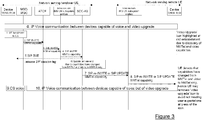
- FIG. 3 illustrates further the general signalling flow associated with this solution (certain signalling is omitted for simplicity).
- an IP voice communication is established between a pair of UEs.
- step 1 for example as a result of one of the users moving out of the LTE coverage area of a network operator, one of the UEs is handed over to a CS access domain.
- step 2 Intrinsic to the known handover procedure is that the responsible MSC in the CS access domain will send a SIP INVITE, step 2, to the IMS network.
- This INVITE is addressed to the ATCF.
- the ATCF will send a further INVITE, steps 3 and 4, to the SCC-AS.
- the INVITE will include the Contact header containing the well-known MMTel service identifier as of 3GPP TS 24.173 in the ICSI feature tag (see 3GPP TS 24.229).
- the SCC-AS may either release the SIP session with the mobile, step 5, or retain that session (e.g. in case the UE wishes to maintain the PS session for the purpose of controlling the CS call).
- the process up to and including step 5 is standard in the Rel_10 IMS architecture.
- Steps 6 to 8 illustrated in Figure 3 are new, and involve the SCC-AS determining that call capabilities have changed, and signalling these to the remote UE, via that UE's IMS CN subsystem, using either a SIP re-INVITE or a SIP UPDATE.
- the receiving UE extracts the capabilities in the Contact header and if, for example, it discovers that there is no longer a video capability, the UE may decide to grey out/remove any video related symbol from the device display. Steps 9 and 10 illustrated in Figure 3 relate to continuation of the voice session between the two UEs.
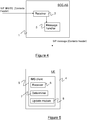
- FIG. 4 illustrates schematically apparatus 1 configured to operate within an IMS network as a SCC-AS.
- the apparatus comprises a receiver 2 for receiving a SIP INVITE originating from a visited mobile network (PLMN) and for determining that the INVITE relates to a handover of a User Equipment, UE, currently served by the SCC-AS, to that visited mobile network and for which a session with a peer UE is ongoing. It further comprises a message handler for determining if capabilities for the ongoing session, identified within said INVITE, have changed with respect to capabilities previously associated with the ongoing session. If it is determined that capabilities have changed, the message handler 3 causes a SIP message to be sent to the peer UE, the message containing the changed capabilities.
- PLMN visited mobile network
- FIG. 5 illustrates schematically a User Equipment UE 4 which includes, amongst certain "standard" UE functionality, an IMS client 5.
- This IMS client is responsible for establishing and controlling a session with a peer UE via the mobile communication system.
- the IMS client 5 includes a receiver 6 for receiving from the system a SIP message relating to the ongoing session, and a determiner 7 for determining from a Contact header of the received message if the capabilities associated with the ongoing session have changed with respect to previously negotiated capabilities.
- the client 5 further comprises an updating module 8 configured, if the capabilities have changed, to update a user interface of the UE to reflect the changed capabilities.
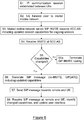
- Figure 6 is a flow diagram further illustrating a method of updating capabilities associated with an ongoing IMS enabled session, so that these capabilities are known to the session participants. The following steps are illustrated in the Figure:
Landscapes
- Engineering & Computer Science (AREA)
- Computer Networks & Wireless Communication (AREA)
- Signal Processing (AREA)
- Multimedia (AREA)
- Business, Economics & Management (AREA)
- General Business, Economics & Management (AREA)
- Mobile Radio Communication Systems (AREA)
Abstract
Description
- The present invention relates to providing user terminals with capability updates, and more particularly to providing such updates following handovers of terminals between different radio access technologies.
- IP Multimedia (IPMM) services provide a dynamic combination of voice, video, messaging, data, etc, within the same session. By growing the numbers of basic applications and the media which it is possible to combine, the number of services offered to the end users will grow, and the inter-personal communication experience will be enriched. This will lead to a new generation of personalised, rich multimedia communication services, including so-called "combinational IP Multimedia" services.
- IP Multimedia Subsystem (IMS) is the technology defined by the Third Generation Partnership Project (3GPP) to provide IP Multimedia services over mobile communication networks. IMS provides key features to enrich the end-user person-to-person communication experience through the integration and interaction of services. IMS allows new rich person-to-person (client-to-client) as well as person-to-content (client-to-server) communications over an IP-based network. The IMS makes use of the Session Initiation Protocol (SIP) to set up and control calls or sessions between user terminals (or user terminals and application servers). The Session Description Protocol (SDP), carried by SIP signalling, is used to describe and negotiate the media components of the session. Whilst SIP was created as a user-to-user protocol, IMS allows operators and service providers to control user access to services and to charge users accordingly. Other protocols are used for media transmission and control, such as Real-time Transport Protocol and Real-time Transport Control Protocol (RTP/RTCP),
- Existing cellular network deployments are dominated by the 2G and 3G standards. The process of rolling out so-called 4G networks has just begun, and it will be many years before 4G network coverage is sufficient to allow 2G and 3G networks to be withdrawn completely. A fundamental requirement for real-time service provision is the seamless handover of services for subscribers moving across cell boundaries of the radio access network (RAN). Given the ongoing co-existence of 2G, 3G and 4G networks, it is particularly desirable to allow for the handover of real-time service connections such as voice calls between the different radio access technologies.
- Considering further the 4G technology, this is being specified under the name LTE (Long Term Evolution) and SAE (System Architecture Evolution) in 3GPP. The LTE radio access network technology implements only a packet switched access, in contrast to 2G and 3G (using GERAN and UTRAN radio access network technologies respectively) which provide for both packet switched and circuit switched access. In 2G and 3G networks, packet switched connections are used to carry data whilst circuit switched connections are used for real-time services such as voice calls. In 4G networks, all services will be carried via packet switched connections. In the case of a voice call initiated when a user is attached to a LTE radio access network (termed Enhanced UTRAN or E-UTRAN), that call will of course make use of a packet switched connection. If it is necessary for the call to be transferred to a 2G or 3G radio access network, e.g. because the user moves out of the coverage area of the E-UTRAN and into that of a GERAN or UTRAN network, the call must be switched from a packet switched (PS) access to a circuit switched (CS) access. Of course, the process for implementing the handover must be seamless such that little or no disruption of the call is perceived by the user. An appropriate access handover mechanism is also required in the case of the handover of a call from a PS access using a 3G UTRAN (HSPA) access network to a CS call using either 3G UTRAN access or 2G GSM access.
-
Figure 1 illustrates schematically a scenario in which a user terminal (or User Equipment, UE, according to 3G terminology) initiates a voice call using a LTE radio access network and is subsequently handed over to a GSM/Edge Radio Access Network (GERAN). The call is established using the IMS network described above and which provides a common service control network for the PS and CS domains provided through the LTE, UTRAN, or GERAN radio accesses. In particular, the IMS includes a Multimedia Telephony (MMTel) Application Server which implements service logic for establishing and controlling voice calls. In order to implement the access handover, media control must be transferred from the Evolved Packet Core (EPC) network of the 4G domain to an allocated Mobile Switching Centre (MSC) within the 2G/3G domain. - Other components illustrated in
Figure 1 are a Mobile Switching Centre Server (MSS) which has support for the GSM access network, an enhanced Node B (eNodeB) which provides inter alia control of radio access within the LTE RAN, a Serving/PDN gateway (S/P-GW), a Mobility Management Entity (MME) (both the S/P-GW and the MME reside within the EPC), and a Home Subscriber Server that resides within a subscriber's home network. - The SGW sits in the user plane where it forwards and routes packets to and from the eNodeB and the PDN GW. The S/P-GW also serves as the local mobility anchor for inter-eNodeB handovers and roaming between two 3GPP systems. The PDN GW (not shown in
Figure 1 ) acts as the interface between the radio network and the Packet Data Networks (PDNs), such as the Internet or SIP-based IP Multimedia Subsystem (IMS) networks (fixed and mobile). The PDN GW is the mobility anchor point for intra-3GPP access system mobility and for mobility between 3GPP access systems and non-3GPP access systems. - Interworking solutions for IMS Centralized Services (ICS) as specified in 3GPP TS 23.292, "IP Multimedia Subsystem (IMS) centralized services;
Stage 2", allows IMS sessions using CS bearers to be treated as standard IMS sessions, which is required for the purpose of IMS Service Continuity. ICS defines signalling mechanisms between the UE and IMS for transport of information to centralise the service in the IMS, and TS 23.237 "IP Multimedia Subsystem (IMS) Service Continuity" defines the additional procedures needed for service continuity when using CS access for media transport. Within the context of TS 23.292 and TS 23.237, the further 3GPP document TS 23.216: "Single Radio Voice Call Continuity (SRVCC);Stage 2", describes a mechanism for handing over a voice call from a PS to a CS access. With reference toFigure 1 , this relies upon ICS and Service Continuity functionality that is implemented in the Service Centralisation and Continuity Application Server (SCC AS) within the IMS (shown co-located with the MMTel AS inFigure 1 ). Whilst effective, the mechanism described in TS 23.216 (identified as Rel-9) involves a relatively long path for handover control signalling given that the SCC AS is located in a user's home network and the signalling may have to pass through an IMS network associated with a visited network (in the case of a roaming subscriber where the serving network is not the home network). Handovers may be delayed as a result, possibly giving rise to interruptions in voice calls. SRVCC is applicable to handover to a CS access from a PS access where that PS access is provided by either of a LTE access or a UTRAN (HSPA) access. - It has been recognised that such a long path for access handover related signalling is undesirable. This problem is addressed in TS 23.237, "IP Multimedia Subsystem (IMS) Service Continuity", which proposes introducing the architecture illustrated in
Figure 2 . An Access Transfer Control Function (ATCF) is included in the serving (e.g. visited) IMS network. This approach is referred to as Rel-10. According to Rel-10, the ATCF acts as a media gateway controller for an Access Transfer Gateway (ATGW) that is also present in the serving IMS network. The ATGW acts as an anchor for the IMS media traffic to allow media traffic to be switched quickly from the PS access network to the CS access network via the MSC. Additional functions of IMS Service Continuity are provided by the ATCF/ATGW in the serving (visited if roaming) network. In particular, responsibility for managing radio access handovers is delegated from the SCC AS to the ATGW. Within the CS core network, a SRVCC function is introduced into one of the network MSCs. This may or may not be the same MSC as the Target MSC for the handover. - When the UE performs IMS registration, a decision is made (by the P-CSCF) as to whether or not to include the ATCF in the path. If the ATCF is included, the ATCF reports a Session Transfer Number Single Radio (STN-SR) to the SCC AS in the home IMS network. This STN-SR is recorded by the SCC-AS in the HSS in respect of the ongoing IMS session. The STN-SR points uniquely to the ATCF. When the UE is either initiating or receiving an incoming call, the ATCF makes a decision concerning whether or not to anchor the media in the controlled ATGW. If the media is anchored at the ATGW, then, when an access handover takes place, the redirection of media to the new access will be carried out locally in the serving (e.g. visited) network. The anchored media in the ATGW is redirected to the CS side instead of the PS side.
- According to the LTE architecture described with reference to
Figure 2 , a VoLTE call is anchored in an ATFC/ATGW function residing between the P-CSCF and the S-CSCF of the served user. In the event of a handover of a UE served by the ATCF, there is no requirement to inform the remote end beyond the SCC-AS point that handover has taken place (in order to shorten voice interruption time), especially as the type of communication, i.e. voice, has not changed. A problem will arise however in the event that handover results in a change to the session capabilities. - The architecture described may result in the remote end (UE) of the VoLTE session remaining under the impression that voice session add-on services are still possible despite this no longer being the case as a result of the handover from PS to CS access. For example if an add-video capability was exchanged during the voice establishment phase - as it may be according to GSMA PRD IR.94 - the remote end UE might continue to have a 'switch-to-video' or 'video upgrade' icon highlighted in its call window after handover. If the remote end-user selects switch-to-video, that attempt will fail due to the inability of the CS call leg to support video.
- It is an object of the present invention to provide a mechanism that allows UEs to be informed promptly of any changes to session capabilities following a handover between access domains, e.g. PS to CS or CS to PS.
- According to a first aspect of the present invention there is provided apparatus configured to operate as a Service Centralization and Continuity Application Server, SCC-AS, within an IP Multimedia Subsystem network. The apparatus comprises a receiver for receiving a SIP INVITE originating from or sent via an access domain and for determining that the INVITE relates to a handover of a User Equipment, UE, currently served by the SCC-AS, to that access domain and for which a session with a peer UE is ongoing. The apparatus further comprises a message handler for determining if capabilities for the ongoing session, identified within said INVITE, have changed with respect to capabilities previously associated with the ongoing session and, if it is determined that capabilities have changed, for causing a SIP message to be sent to said peer UE, the message containing the changed capabilities.
- According to a second aspect of the present invention there is provided User Equipment, UE, configured for use with a mobile communication system offering IP Multimedia Subsystem, IMS, services. The UE comprises an IMS client for establishing and controlling a session with a peer UE via the mobile communication system, the client being configured to receive from the system a SIP message relating to the ongoing session, to determine from a Contact header of the received message if the capabilities associated with the ongoing session have changed with respect to previously negotiated capabilities, and, if the capabilities have changed, for updating a user interface of the UE to reflect the changed capabilities.
- According to a third aspect of the present invention there is provided method of notifying a first User Equipment, UE, of changes to capabilities associated with an IP Multimedia Subsystem enabled session involving the first UE and a second UE. The method comprises, following a handover of said second UE from a first to a second access domain, sending from that second access domain to a Service Centralization and Continuity Application Server, SCC-AS, within the second UE's home IMS network, a SIP INVITE including updated session capabilities for the ongoing session. The method further comprises receiving the SIP INVITE at said SCC-AS and generating a SIP message containing the changed capabilities, sending said SIP message to the first UE, and receiving the SIP message at the first UE, identifying the changed capabilities, and updating a user interface of the first UE to reflect the changed capabilities.
-
-
Figure 1 illustrates schematically a prior art architecture for managing PS to CS handover of voice calls according to 3GPP Rel-9; -
Figure 2 illustrates schematically a prior art architecture for managing PS to CS handover of voice calls according to 3GPP Rel-10; -
Figure 3 illustrates a capability update procedure in the network architecture ofFigure 2 , following a handover; -
Figure 4 illustrates schematically a SCC-AS node for use within an IMS network; -
Figure 5 illustrates schematically a User Equipment configured to a handle in-session capability signalling; and -
Figure 6 is a flow diagram illustrating a method of updating session capabilities following handover of a session. - As has been discussed above, the 3GPP Single Radio Voice Call Continuity (SRVCC) mechanism provides for the handover of a voice call from a Packet Switched (PS) access to a Circuit Switched (CS) access, whilst the enhancements introduced in Rel-10 provide for an optimised access handover procedure by delegating certain responsibilities from the SCC-AS in a subscriber's home network to an ATCF in a serving (e.g. visited) network. Problems may arise as a result of a remote end UE being unaware of a handover procedure.
- In order to avoid this problem, it is proposed here to introduce a mechanism whereby, when the SCC-AS receives an INVITE originating from the MSC after handover, via the ATCF (see GSMA PRD IR.64 or 3GPP TS 23.272 release 10), the SCC-AS checks the INVITE Contact header to determine if the capabilities have been changed compared to the (original) capabilities signalled at initial call establishment. [Note that if the INVITE contains no capabilities at all, and the original call capabilities indicated IP voice, for example by 'MMTel', this can be regarded as the capabilities being unchanged.] If it is determined that the capabilities have changed, the SCC-AS sends a re-INVITE or SIP UPDATE with a Contact header containing the current capabilities, e.g. 'MMtel', to the remote end device. Upon reception of the SIP re-INVITE or UPDATE, the remote end UE may remove or grey-out any video related icon, e.g. 'switch-to-video' or 'video upgrade', in order to avoid an end-user "trial and error" experience.
- Referring to the Rel-10 architecture of
Figure 2 , the aforementioned INVITE, resulting from the CS-handover, is sent from the MSC over the I2 (or Mg) interface, via the ATCF and the CSCF, to the SCC-AS which informs the remote end network/UE-B about any new capability in case capabilities have changed compared with the capabilities signalled prior to handover. -
Figure 3 illustrates further the general signalling flow associated with this solution (certain signalling is omitted for simplicity). Atstep 0, an IP voice communication is established between a pair of UEs. Atstep 1, for example as a result of one of the users moving out of the LTE coverage area of a network operator, one of the UEs is handed over to a CS access domain. Intrinsic to the known handover procedure is that the responsible MSC in the CS access domain will send a SIP INVITE,step 2, to the IMS network. This INVITE is addressed to the ATCF. As is also a requirement of the existing procedures, the ATCF will send a further INVITE, steps 3 and 4, to the SCC-AS. The INVITE will include the Contact header containing the well-known MMTel service identifier as of 3GPP TS 24.173 in the ICSI feature tag (see 3GPP TS 24.229). At this point the SCC-AS may either release the SIP session with the mobile,step 5, or retain that session (e.g. in case the UE wishes to maintain the PS session for the purpose of controlling the CS call). The process up to and includingstep 5 is standard in the Rel_10 IMS architecture.Steps 6 to 8 illustrated inFigure 3 are new, and involve the SCC-AS determining that call capabilities have changed, and signalling these to the remote UE, via that UE's IMS CN subsystem, using either a SIP re-INVITE or a SIP UPDATE. The receiving UE extracts the capabilities in the Contact header and if, for example, it discovers that there is no longer a video capability, the UE may decide to grey out/remove any video related symbol from the device display.Steps 9 and 10 illustrated inFigure 3 relate to continuation of the voice session between the two UEs. -
Figure 4 illustratesschematically apparatus 1 configured to operate within an IMS network as a SCC-AS. The apparatus comprises areceiver 2 for receiving a SIP INVITE originating from a visited mobile network (PLMN) and for determining that the INVITE relates to a handover of a User Equipment, UE, currently served by the SCC-AS, to that visited mobile network and for which a session with a peer UE is ongoing. It further comprises a message handler for determining if capabilities for the ongoing session, identified within said INVITE, have changed with respect to capabilities previously associated with the ongoing session. If it is determined that capabilities have changed, themessage handler 3 causes a SIP message to be sent to the peer UE, the message containing the changed capabilities. -
Figure 5 illustrates schematically aUser Equipment UE 4 which includes, amongst certain "standard" UE functionality, anIMS client 5. This IMS client is responsible for establishing and controlling a session with a peer UE via the mobile communication system. TheIMS client 5 includes areceiver 6 for receiving from the system a SIP message relating to the ongoing session, and adeterminer 7 for determining from a Contact header of the received message if the capabilities associated with the ongoing session have changed with respect to previously negotiated capabilities. Theclient 5 further comprises anupdating module 8 configured, if the capabilities have changed, to update a user interface of the UE to reflect the changed capabilities. -
Figure 6 is a flow diagram further illustrating a method of updating capabilities associated with an ongoing IMS enabled session, so that these capabilities are known to the session participants. The following steps are illustrated in the Figure: - S1. An IP session (e.g. voice) is established between the parties (UEs).
- S2. At some point during the session, one of the UEs is handed over to a further visited mobile network.
- S3. Upon completion of the handover, the further visited mobile network (MSC/MGC) sends a SIP INVITE, via the ATCF and intermediate IMS core network nodes, towards the SCC-AS currently serving the handed over UE. This INVITE includes the updated capabilities for the session.
- S4. The INVITE is received at the SCC-AS.
- S5. The SCC-AS determines whether or not the capabilities have changed.
- S5a. If the capabilities have not changed, the SCC-AS terminates the routing of the INVITE.
- S6. If the capabilities have changed, the SCC-AS generates one of a SIP re-INVITE or UPDATE, including in the message the updated capabilities.
- S7. The SIP messages is sent by the SCC-AS towards the peer, remote end UE.
- S8. The remote end UE receives the SIP message (from the SCC-AS), identifies any changed capabilities, and, in dependence upon the changed capabilities, updates the user interface and/or otherwise alerts the user.
- It will be appreciated by the skilled person that various modifications may be made to the above described embodiments without departing from the scope of the present invention. For example, it will be appreciated that, as an alternative to the SIP re-INVITE and SIP UPDATE messages, other SIP messages may be used to signal the handover to the remote UE. Examples include the SIP INFO and SIP OPTIONS messages. It will also be appreciated that, whilst the embodiment described above is concerned with handover from a LTE to a CS network, the invention may be applied to other (mobile) access domain handover scenarios including the reverse handover scenario, i.e. from a CS to a LTE network. In that particular case, the INVITE sent to the ATCF and relayed to the SCC-AS will originate from the UE that is being handed over (rather than from the MSC in the CS network).
Claims (8)
- Apparatus configured to operate as a Service Centralization and Continuity Application Server, SCC-AS, within an IP Multimedia Subsystem network, the apparatus comprising:a receiver for receiving a SIP INVITE originating from or sent via an access domain and for determining that the INVITE relates to a handover of a User Equipment, UE, currently served by the SCC-AS, to that access domain and for which a session with a peer UE is ongoing;a message handler for determining if capabilities for the ongoing session, identified within said INVITE, have changed with respect to capabilities previously associated with the ongoing session and, if it is determined that capabilities have changed, for causing a SIP message to be sent to said peer UE, the message containing the changed capabilities.
- Apparatus according to claim 1, wherein said message handler is configured to cause one of a SIP re-INVITE, SIP UPDATE, SIP INFO and SIP OPTIONS, containing the changed capabilities, to be sent to said peer UE.
- Apparatus according to claim 1, wherein said capabilities are included within a Contacts header of said INVITE, and said message handler is configured to copy the Contacts header into the SIP message to be sent to the peer UE if it is determined that the capabilities have changed.
- Apparatus according to any one of the preceding claims, wherein the ongoing session is a voice call and the message handler is configured to determine if a video capability for the session has changed as a result of the handover.
- A User Equipment, UE, configured for use with a mobile communication system offering IP Multimedia Subsystem, IMS, services, the UE comprising:an IMS client for establishing and controlling a session with a peer UE via the mobile communication system, the client being configured to receive from the system a SIP message relating to the ongoing session, to determine from a Contact header of the received message if the capabilities associated with the ongoing session have changed with respect to previously negotiated capabilities, and, if the capabilities have changed, for updating a user interface of the UE to reflect the changed capabilities.
- A method of notifying a first User Equipment, UE, of changes to capabilities associated with an IP Multimedia Subsystem enabled session involving the first UE and a second UE, the method comprising:following a handover of said second UE from a first to a second access domain, sending from that second access domain to a Service Centralization and Continuity Application Server, SCC-AS, within the second UE's home IMS network, a SIP INVITE including updated session capabilities for the ongoing session;receiving the SIP INVITE at said SCC-AS and generating a SIP message containing the changed capabilities;sending said SIP message to the first UE; andreceiving the SIP message at the first UE, identifying the changed capabilities,and updating a user interface of the first UE to reflect the changed capabilities.
- A method according to claim 6, wherein the generated message is a SIP re-INVITE, SIP UPDATE, SIP INFO or SIP OPTIONS.
- A method according to claim 6 or 7, wherein said changed capabilities are included within a Contacts header of the SIP INVITE, the method comprising copying that header into the SIP message generated at the SCC-AS.
Priority Applications (2)
| Application Number | Priority Date | Filing Date | Title |
|---|---|---|---|
| EP12159010.3A EP2640030B1 (en) | 2012-03-12 | 2012-03-12 | Capability update in a telecommunications network |
| US13/788,342 US9025553B2 (en) | 2012-03-12 | 2013-03-07 | Capability update in a telecommunications network |
Applications Claiming Priority (1)
| Application Number | Priority Date | Filing Date | Title |
|---|---|---|---|
| EP12159010.3A EP2640030B1 (en) | 2012-03-12 | 2012-03-12 | Capability update in a telecommunications network |
Publications (2)
| Publication Number | Publication Date |
|---|---|
| EP2640030A1 true EP2640030A1 (en) | 2013-09-18 |
| EP2640030B1 EP2640030B1 (en) | 2014-11-12 |
Family
ID=45808328
Family Applications (1)
| Application Number | Title | Priority Date | Filing Date |
|---|---|---|---|
| EP12159010.3A Active EP2640030B1 (en) | 2012-03-12 | 2012-03-12 | Capability update in a telecommunications network |
Country Status (2)
| Country | Link |
|---|---|
| US (1) | US9025553B2 (en) |
| EP (1) | EP2640030B1 (en) |
Cited By (2)
| Publication number | Priority date | Publication date | Assignee | Title |
|---|---|---|---|---|
| WO2017039503A1 (en) * | 2015-09-02 | 2017-03-09 | Telefonaktiebolaget Lm Ericsson (Publ) | First and second radio network nodes and methods performed therein |
| CN108696829A (en) * | 2017-04-10 | 2018-10-23 | 中国移动通信集团河南有限公司 | A kind of supplementary service setting processing method and processing device |
Families Citing this family (12)
| Publication number | Priority date | Publication date | Assignee | Title |
|---|---|---|---|---|
| EP1186144B1 (en) * | 1999-06-08 | 2013-10-23 | The Trustees of Columbia University in the City of New York | Network telephony appliance and system for inter/intranet telephony |
| CN101878631B (en) * | 2007-11-29 | 2016-10-12 | 艾利森电话股份有限公司 | Method and device for end-to-edge media protection in IMS system |
| JP5433062B1 (en) * | 2012-09-07 | 2014-03-05 | 株式会社Nttドコモ | Mobile station and mobile communication method |
| US9369926B2 (en) | 2013-05-08 | 2016-06-14 | Qualcomm Incorporated | Method and apparatus for handover VoLTE call to UMTS PS-based voice call |
| US9544337B2 (en) * | 2013-09-05 | 2017-01-10 | Mitel Mobility Inc | Converged media packet gateway for a novel LTE data and voice core network architecture |
| US10425863B2 (en) * | 2014-10-08 | 2019-09-24 | Nokia Solutions And Networks Oy | Transfer of communication parameters |
| EP3797505B1 (en) * | 2018-06-12 | 2025-02-19 | Samsung Electronics Co., Ltd. | Method and apparatus for identifying in-call capability features |
| CN116158066A (en) * | 2020-07-31 | 2023-05-23 | 联想(新加坡)私人有限公司 | Indicates IP Multimedia System (IMS) capabilities for Evolved Packet System (EPS) fallback |
| US12052296B2 (en) * | 2020-09-24 | 2024-07-30 | Avaya Management L.P. | Methods and systems for maintaining conditional communication sessions using terminable authentication signals |
| US12035420B2 (en) | 2021-11-18 | 2024-07-09 | T-Mobile Usa, Inc. | Breakout gateway control function number modification based on SIP invite header information |
| US11936694B2 (en) | 2021-11-18 | 2024-03-19 | T-Mobile Usa, Inc. | Cross-domain routing based on session initiation protocol information |
| US20250219714A1 (en) * | 2023-12-29 | 2025-07-03 | T-Mobile Usa, Inc. | Enablement of electronic device applications in satellite communication mode |
Citations (1)
| Publication number | Priority date | Publication date | Assignee | Title |
|---|---|---|---|---|
| WO2009130042A2 (en) * | 2008-04-24 | 2009-10-29 | Telefonaktiebolaget L M Ericsson (Publ) | Supporting a session management in case of a transfer between different radio access networks |
Family Cites Families (7)
| Publication number | Priority date | Publication date | Assignee | Title |
|---|---|---|---|---|
| US8208968B2 (en) * | 2009-06-26 | 2012-06-26 | Rockstar Bidco, LP | Mobile fast alerting |
| CN101997846A (en) * | 2009-08-14 | 2011-03-30 | 华为终端有限公司 | Session handling method and device as well as communication system |
| US20110231560A1 (en) * | 2009-09-11 | 2011-09-22 | Arungundram Chandrasekaran Mahendran | User Equipment (UE) Session Notification in a Collaborative Communication Session |
| US8588109B2 (en) * | 2009-12-11 | 2013-11-19 | Verizon Patent And Licensing Inc. | Integrated lawful intercept for internet protocol multimedia subsystem (IMS) over evolved packet core (EPC) |
| US8668107B2 (en) * | 2010-11-16 | 2014-03-11 | Rubbermaid Incorporated | Modular recycler |
| US9294332B2 (en) * | 2011-04-08 | 2016-03-22 | Lg Electronics Inc. | Method and apparatus for IUT in a wireless communication system |
| US9503368B2 (en) * | 2012-02-27 | 2016-11-22 | Metaswitch Networks Ltd. | Routing a call |
-
2012
- 2012-03-12 EP EP12159010.3A patent/EP2640030B1/en active Active
-
2013
- 2013-03-07 US US13/788,342 patent/US9025553B2/en active Active
Patent Citations (1)
| Publication number | Priority date | Publication date | Assignee | Title |
|---|---|---|---|---|
| WO2009130042A2 (en) * | 2008-04-24 | 2009-10-29 | Telefonaktiebolaget L M Ericsson (Publ) | Supporting a session management in case of a transfer between different radio access networks |
Non-Patent Citations (1)
| Title |
|---|
| APPLE INC.: "iPhone User Guide for iOS 5.1 Software", 7 March 2012 (2012-03-07), pages 12 - 13,163-164, XP002678304, Retrieved from the Internet <URL:http://manuals.info.apple.com/en_US/iphone_user_guide.pdf> [retrieved on 20120621] * |
Cited By (2)
| Publication number | Priority date | Publication date | Assignee | Title |
|---|---|---|---|---|
| WO2017039503A1 (en) * | 2015-09-02 | 2017-03-09 | Telefonaktiebolaget Lm Ericsson (Publ) | First and second radio network nodes and methods performed therein |
| CN108696829A (en) * | 2017-04-10 | 2018-10-23 | 中国移动通信集团河南有限公司 | A kind of supplementary service setting processing method and processing device |
Also Published As
| Publication number | Publication date |
|---|---|
| US9025553B2 (en) | 2015-05-05 |
| US20130242942A1 (en) | 2013-09-19 |
| EP2640030B1 (en) | 2014-11-12 |
Similar Documents
| Publication | Publication Date | Title |
|---|---|---|
| US9025553B2 (en) | Capability update in a telecommunications network | |
| US8374173B2 (en) | Packet switched to circuit switched access handovers in an IMS architecture | |
| EP2737678B1 (en) | Methods and apparatus for supporting the implementation of ims service continuity | |
| CN104081841B (en) | Communication means, device and corresponding computer-readable medium | |
| US10027719B2 (en) | Resolving competing handover conditions in wireless networks | |
| KR101414697B1 (en) | Methods and apparatus for session transfer between access networks | |
| EP2316233B1 (en) | Method for supporting network based mobility for a mobile terminal in an ims (ip multimedia subsystem) architecture | |
| CN102687582B (en) | Handoff Latency Optimization | |
| EP2342916B1 (en) | Method and apparatus for sr-vcc revocation procedure | |
| WO2013156061A1 (en) | Failure handling within a network implementing srvcc | |
| EP2605581A1 (en) | Method, system, terminal, and server for transfer of video call between access networks | |
| CN102474763B (en) | Method and apparatus for improving session continuity | |
| CN102769880B (en) | The changing method and system in single wireless voice calling continuity domain |
Legal Events
| Date | Code | Title | Description |
|---|---|---|---|
| PUAI | Public reference made under article 153(3) epc to a published international application that has entered the european phase |
Free format text: ORIGINAL CODE: 0009012 |
|
| AK | Designated contracting states |
Kind code of ref document: A1 Designated state(s): AL AT BE BG CH CY CZ DE DK EE ES FI FR GB GR HR HU IE IS IT LI LT LU LV MC MK MT NL NO PL PT RO RS SE SI SK SM TR |
|
| AX | Request for extension of the european patent |
Extension state: BA ME |
|
| 17P | Request for examination filed |
Effective date: 20140115 |
|
| RBV | Designated contracting states (corrected) |
Designated state(s): AL AT BE BG CH CY CZ DE DK EE ES FI FR GB GR HR HU IE IS IT LI LT LU LV MC MK MT NL NO PL PT RO RS SE SI SK SM TR |
|
| GRAP | Despatch of communication of intention to grant a patent |
Free format text: ORIGINAL CODE: EPIDOSNIGR1 |
|
| RIC1 | Information provided on ipc code assigned before grant |
Ipc: H04L 29/06 20060101AFI20140528BHEP Ipc: H04W 36/00 20090101ALI20140528BHEP Ipc: H04W 36/14 20090101ALI20140528BHEP Ipc: H04W 28/18 20090101ALI20140528BHEP Ipc: H04W 48/08 20090101ALI20140528BHEP |
|
| INTG | Intention to grant announced |
Effective date: 20140619 |
|
| GRAS | Grant fee paid |
Free format text: ORIGINAL CODE: EPIDOSNIGR3 |
|
| GRAA | (expected) grant |
Free format text: ORIGINAL CODE: 0009210 |
|
| AK | Designated contracting states |
Kind code of ref document: B1 Designated state(s): AL AT BE BG CH CY CZ DE DK EE ES FI FR GB GR HR HU IE IS IT LI LT LU LV MC MK MT NL NO PL PT RO RS SE SI SK SM TR |
|
| REG | Reference to a national code |
Ref country code: GB Ref legal event code: FG4D |
|
| REG | Reference to a national code |
Ref country code: CH Ref legal event code: EP |
|
| REG | Reference to a national code |
Ref country code: AT Ref legal event code: REF Ref document number: 696347 Country of ref document: AT Kind code of ref document: T Effective date: 20141115 |
|
| REG | Reference to a national code |
Ref country code: IE Ref legal event code: FG4D |
|
| REG | Reference to a national code |
Ref country code: DE Ref legal event code: R096 Ref document number: 602012003716 Country of ref document: DE Effective date: 20141224 |
|
| REG | Reference to a national code |
Ref country code: NL Ref legal event code: T3 |
|
| REG | Reference to a national code |
Ref country code: AT Ref legal event code: MK05 Ref document number: 696347 Country of ref document: AT Kind code of ref document: T Effective date: 20141112 |
|
| PG25 | Lapsed in a contracting state [announced via postgrant information from national office to epo] |
Ref country code: PT Free format text: LAPSE BECAUSE OF FAILURE TO SUBMIT A TRANSLATION OF THE DESCRIPTION OR TO PAY THE FEE WITHIN THE PRESCRIBED TIME-LIMIT Effective date: 20150312 Ref country code: IS Free format text: LAPSE BECAUSE OF FAILURE TO SUBMIT A TRANSLATION OF THE DESCRIPTION OR TO PAY THE FEE WITHIN THE PRESCRIBED TIME-LIMIT Effective date: 20150312 Ref country code: NO Free format text: LAPSE BECAUSE OF FAILURE TO SUBMIT A TRANSLATION OF THE DESCRIPTION OR TO PAY THE FEE WITHIN THE PRESCRIBED TIME-LIMIT Effective date: 20150212 Ref country code: FI Free format text: LAPSE BECAUSE OF FAILURE TO SUBMIT A TRANSLATION OF THE DESCRIPTION OR TO PAY THE FEE WITHIN THE PRESCRIBED TIME-LIMIT Effective date: 20141112 Ref country code: LT Free format text: LAPSE BECAUSE OF FAILURE TO SUBMIT A TRANSLATION OF THE DESCRIPTION OR TO PAY THE FEE WITHIN THE PRESCRIBED TIME-LIMIT Effective date: 20141112 Ref country code: ES Free format text: LAPSE BECAUSE OF FAILURE TO SUBMIT A TRANSLATION OF THE DESCRIPTION OR TO PAY THE FEE WITHIN THE PRESCRIBED TIME-LIMIT Effective date: 20141112 |
|
| PG25 | Lapsed in a contracting state [announced via postgrant information from national office to epo] |
Ref country code: LV Free format text: LAPSE BECAUSE OF FAILURE TO SUBMIT A TRANSLATION OF THE DESCRIPTION OR TO PAY THE FEE WITHIN THE PRESCRIBED TIME-LIMIT Effective date: 20141112 Ref country code: HR Free format text: LAPSE BECAUSE OF FAILURE TO SUBMIT A TRANSLATION OF THE DESCRIPTION OR TO PAY THE FEE WITHIN THE PRESCRIBED TIME-LIMIT Effective date: 20141112 Ref country code: GR Free format text: LAPSE BECAUSE OF FAILURE TO SUBMIT A TRANSLATION OF THE DESCRIPTION OR TO PAY THE FEE WITHIN THE PRESCRIBED TIME-LIMIT Effective date: 20150213 Ref country code: CY Free format text: LAPSE BECAUSE OF FAILURE TO SUBMIT A TRANSLATION OF THE DESCRIPTION OR TO PAY THE FEE WITHIN THE PRESCRIBED TIME-LIMIT Effective date: 20141112 Ref country code: PL Free format text: LAPSE BECAUSE OF FAILURE TO SUBMIT A TRANSLATION OF THE DESCRIPTION OR TO PAY THE FEE WITHIN THE PRESCRIBED TIME-LIMIT Effective date: 20141112 Ref country code: AT Free format text: LAPSE BECAUSE OF FAILURE TO SUBMIT A TRANSLATION OF THE DESCRIPTION OR TO PAY THE FEE WITHIN THE PRESCRIBED TIME-LIMIT Effective date: 20141112 Ref country code: SE Free format text: LAPSE BECAUSE OF FAILURE TO SUBMIT A TRANSLATION OF THE DESCRIPTION OR TO PAY THE FEE WITHIN THE PRESCRIBED TIME-LIMIT Effective date: 20141112 Ref country code: RS Free format text: LAPSE BECAUSE OF FAILURE TO SUBMIT A TRANSLATION OF THE DESCRIPTION OR TO PAY THE FEE WITHIN THE PRESCRIBED TIME-LIMIT Effective date: 20141112 |
|
| RAP2 | Party data changed (patent owner data changed or rights of a patent transferred) |
Owner name: TELEFONAKTIEBOLAGET L M ERICSSON (PUBL) |
|
| PG25 | Lapsed in a contracting state [announced via postgrant information from national office to epo] |
Ref country code: RO Free format text: LAPSE BECAUSE OF FAILURE TO SUBMIT A TRANSLATION OF THE DESCRIPTION OR TO PAY THE FEE WITHIN THE PRESCRIBED TIME-LIMIT Effective date: 20141112 Ref country code: CZ Free format text: LAPSE BECAUSE OF FAILURE TO SUBMIT A TRANSLATION OF THE DESCRIPTION OR TO PAY THE FEE WITHIN THE PRESCRIBED TIME-LIMIT Effective date: 20141112 Ref country code: EE Free format text: LAPSE BECAUSE OF FAILURE TO SUBMIT A TRANSLATION OF THE DESCRIPTION OR TO PAY THE FEE WITHIN THE PRESCRIBED TIME-LIMIT Effective date: 20141112 Ref country code: SK Free format text: LAPSE BECAUSE OF FAILURE TO SUBMIT A TRANSLATION OF THE DESCRIPTION OR TO PAY THE FEE WITHIN THE PRESCRIBED TIME-LIMIT Effective date: 20141112 Ref country code: DK Free format text: LAPSE BECAUSE OF FAILURE TO SUBMIT A TRANSLATION OF THE DESCRIPTION OR TO PAY THE FEE WITHIN THE PRESCRIBED TIME-LIMIT Effective date: 20141112 |
|
| REG | Reference to a national code |
Ref country code: DE Ref legal event code: R097 Ref document number: 602012003716 Country of ref document: DE |
|
| PLBE | No opposition filed within time limit |
Free format text: ORIGINAL CODE: 0009261 |
|
| STAA | Information on the status of an ep patent application or granted ep patent |
Free format text: STATUS: NO OPPOSITION FILED WITHIN TIME LIMIT |
|
| 26N | No opposition filed |
Effective date: 20150813 |
|
| PG25 | Lapsed in a contracting state [announced via postgrant information from national office to epo] |
Ref country code: LU Free format text: LAPSE BECAUSE OF FAILURE TO SUBMIT A TRANSLATION OF THE DESCRIPTION OR TO PAY THE FEE WITHIN THE PRESCRIBED TIME-LIMIT Effective date: 20150312 Ref country code: MC Free format text: LAPSE BECAUSE OF FAILURE TO SUBMIT A TRANSLATION OF THE DESCRIPTION OR TO PAY THE FEE WITHIN THE PRESCRIBED TIME-LIMIT Effective date: 20141112 |
|
| REG | Reference to a national code |
Ref country code: CH Ref legal event code: PL |
|
| PG25 | Lapsed in a contracting state [announced via postgrant information from national office to epo] |
Ref country code: IT Free format text: LAPSE BECAUSE OF FAILURE TO SUBMIT A TRANSLATION OF THE DESCRIPTION OR TO PAY THE FEE WITHIN THE PRESCRIBED TIME-LIMIT Effective date: 20141112 |
|
| REG | Reference to a national code |
Ref country code: FR Ref legal event code: ST Effective date: 20151130 |
|
| REG | Reference to a national code |
Ref country code: IE Ref legal event code: MM4A |
|
| PG25 | Lapsed in a contracting state [announced via postgrant information from national office to epo] |
Ref country code: IE Free format text: LAPSE BECAUSE OF NON-PAYMENT OF DUE FEES Effective date: 20150312 Ref country code: LI Free format text: LAPSE BECAUSE OF NON-PAYMENT OF DUE FEES Effective date: 20150331 Ref country code: CH Free format text: LAPSE BECAUSE OF NON-PAYMENT OF DUE FEES Effective date: 20150331 |
|
| PG25 | Lapsed in a contracting state [announced via postgrant information from national office to epo] |
Ref country code: FR Free format text: LAPSE BECAUSE OF NON-PAYMENT OF DUE FEES Effective date: 20150331 Ref country code: SI Free format text: LAPSE BECAUSE OF FAILURE TO SUBMIT A TRANSLATION OF THE DESCRIPTION OR TO PAY THE FEE WITHIN THE PRESCRIBED TIME-LIMIT Effective date: 20141112 |
|
| PG25 | Lapsed in a contracting state [announced via postgrant information from national office to epo] |
Ref country code: MT Free format text: LAPSE BECAUSE OF FAILURE TO SUBMIT A TRANSLATION OF THE DESCRIPTION OR TO PAY THE FEE WITHIN THE PRESCRIBED TIME-LIMIT Effective date: 20141112 |
|
| PG25 | Lapsed in a contracting state [announced via postgrant information from national office to epo] |
Ref country code: SM Free format text: LAPSE BECAUSE OF FAILURE TO SUBMIT A TRANSLATION OF THE DESCRIPTION OR TO PAY THE FEE WITHIN THE PRESCRIBED TIME-LIMIT Effective date: 20141112 Ref country code: HU Free format text: LAPSE BECAUSE OF FAILURE TO SUBMIT A TRANSLATION OF THE DESCRIPTION OR TO PAY THE FEE WITHIN THE PRESCRIBED TIME-LIMIT; INVALID AB INITIO Effective date: 20120312 Ref country code: BG Free format text: LAPSE BECAUSE OF FAILURE TO SUBMIT A TRANSLATION OF THE DESCRIPTION OR TO PAY THE FEE WITHIN THE PRESCRIBED TIME-LIMIT Effective date: 20141112 |
|
| PG25 | Lapsed in a contracting state [announced via postgrant information from national office to epo] |
Ref country code: TR Free format text: LAPSE BECAUSE OF FAILURE TO SUBMIT A TRANSLATION OF THE DESCRIPTION OR TO PAY THE FEE WITHIN THE PRESCRIBED TIME-LIMIT Effective date: 20141112 |
|
| PG25 | Lapsed in a contracting state [announced via postgrant information from national office to epo] |
Ref country code: BE Free format text: LAPSE BECAUSE OF FAILURE TO SUBMIT A TRANSLATION OF THE DESCRIPTION OR TO PAY THE FEE WITHIN THE PRESCRIBED TIME-LIMIT Effective date: 20141112 |
|
| PG25 | Lapsed in a contracting state [announced via postgrant information from national office to epo] |
Ref country code: MK Free format text: LAPSE BECAUSE OF FAILURE TO SUBMIT A TRANSLATION OF THE DESCRIPTION OR TO PAY THE FEE WITHIN THE PRESCRIBED TIME-LIMIT Effective date: 20141112 |
|
| PG25 | Lapsed in a contracting state [announced via postgrant information from national office to epo] |
Ref country code: AL Free format text: LAPSE BECAUSE OF FAILURE TO SUBMIT A TRANSLATION OF THE DESCRIPTION OR TO PAY THE FEE WITHIN THE PRESCRIBED TIME-LIMIT Effective date: 20141112 |
|
| REG | Reference to a national code |
Ref country code: DE Ref legal event code: R079 Ref document number: 602012003716 Country of ref document: DE Free format text: PREVIOUS MAIN CLASS: H04L0029060000 Ipc: H04L0065000000 |
|
| PGFP | Annual fee paid to national office [announced via postgrant information from national office to epo] |
Ref country code: GB Payment date: 20230327 Year of fee payment: 12 |
|
| GBPC | Gb: european patent ceased through non-payment of renewal fee |
Effective date: 20240312 |
|
| PG25 | Lapsed in a contracting state [announced via postgrant information from national office to epo] |
Ref country code: GB Free format text: LAPSE BECAUSE OF NON-PAYMENT OF DUE FEES Effective date: 20240312 |
|
| PG25 | Lapsed in a contracting state [announced via postgrant information from national office to epo] |
Ref country code: GB Free format text: LAPSE BECAUSE OF NON-PAYMENT OF DUE FEES Effective date: 20240312 |
|
| PGFP | Annual fee paid to national office [announced via postgrant information from national office to epo] |
Ref country code: DE Payment date: 20260327 Year of fee payment: 15 |
|
| PGFP | Annual fee paid to national office [announced via postgrant information from national office to epo] |
Ref country code: NL Payment date: 20260326 Year of fee payment: 15 |