EP2639724A2 - System and method for processing genome sequence in consideration of seed length - Google Patents
System and method for processing genome sequence in consideration of seed length Download PDFInfo
- Publication number
- EP2639724A2 EP2639724A2 EP12187721.1A EP12187721A EP2639724A2 EP 2639724 A2 EP2639724 A2 EP 2639724A2 EP 12187721 A EP12187721 A EP 12187721A EP 2639724 A2 EP2639724 A2 EP 2639724A2
- Authority
- EP
- European Patent Office
- Prior art keywords
- seed
- length
- target sequence
- sequence
- extracted
- Prior art date
- Legal status (The legal status is an assumption and is not a legal conclusion. Google has not performed a legal analysis and makes no representation as to the accuracy of the status listed.)
- Withdrawn
Links
Images


Classifications
-
- G—PHYSICS
- G16—INFORMATION AND COMMUNICATION TECHNOLOGY [ICT] SPECIALLY ADAPTED FOR SPECIFIC APPLICATION FIELDS
- G16B—BIOINFORMATICS, i.e. INFORMATION AND COMMUNICATION TECHNOLOGY [ICT] SPECIALLY ADAPTED FOR GENETIC OR PROTEIN-RELATED DATA PROCESSING IN COMPUTATIONAL MOLECULAR BIOLOGY
- G16B30/00—ICT specially adapted for sequence analysis involving nucleotides or amino acids
-
- C—CHEMISTRY; METALLURGY
- C12—BIOCHEMISTRY; BEER; SPIRITS; WINE; VINEGAR; MICROBIOLOGY; ENZYMOLOGY; MUTATION OR GENETIC ENGINEERING
- C12Q—MEASURING OR TESTING PROCESSES INVOLVING ENZYMES, NUCLEIC ACIDS OR MICROORGANISMS; COMPOSITIONS OR TEST PAPERS THEREFOR; PROCESSES OF PREPARING SUCH COMPOSITIONS; CONDITION-RESPONSIVE CONTROL IN MICROBIOLOGICAL OR ENZYMOLOGICAL PROCESSES
- C12Q1/00—Measuring or testing processes involving enzymes, nucleic acids or microorganisms; Compositions therefor; Processes of preparing such compositions
- C12Q1/68—Measuring or testing processes involving enzymes, nucleic acids or microorganisms; Compositions therefor; Processes of preparing such compositions involving nucleic acids
- C12Q1/6869—Methods for sequencing
-
- G—PHYSICS
- G06—COMPUTING OR CALCULATING; COUNTING
- G06F—ELECTRIC DIGITAL DATA PROCESSING
- G06F17/00—Digital computing or data processing equipment or methods, specially adapted for specific functions
- G06F17/10—Complex mathematical operations
-
- G—PHYSICS
- G16—INFORMATION AND COMMUNICATION TECHNOLOGY [ICT] SPECIALLY ADAPTED FOR SPECIFIC APPLICATION FIELDS
- G16B—BIOINFORMATICS, i.e. INFORMATION AND COMMUNICATION TECHNOLOGY [ICT] SPECIALLY ADAPTED FOR GENETIC OR PROTEIN-RELATED DATA PROCESSING IN COMPUTATIONAL MOLECULAR BIOLOGY
- G16B30/00—ICT specially adapted for sequence analysis involving nucleotides or amino acids
- G16B30/20—Sequence assembly
-
- G—PHYSICS
- G16—INFORMATION AND COMMUNICATION TECHNOLOGY [ICT] SPECIALLY ADAPTED FOR SPECIFIC APPLICATION FIELDS
- G16B—BIOINFORMATICS, i.e. INFORMATION AND COMMUNICATION TECHNOLOGY [ICT] SPECIALLY ADAPTED FOR GENETIC OR PROTEIN-RELATED DATA PROCESSING IN COMPUTATIONAL MOLECULAR BIOLOGY
- G16B99/00—Subject matter not provided for in other groups of this subclass
Definitions
- the length of a particular read may vary, and in some embodiments, may be about 35 to 500 base pairs (bp) in length. As those skilled in the art would appreciate, the length of read varies depending on the type of genome sequencing technology employed. DNA bases are generally denoted using the letters A, C, G and T. 21.
- the term "target sequence" refers to a reference sequence.. A complete genome sequence may be assembled by mapping a large number of reads outputted from a genome sequencer onto a reference. In some embodiments, the target sequence may be a predetermined reference sequence (e.g., a complete genome sequence of a human) in the analysis of a genome sequence. In other embodiments, a genome sequence generated by a genome sequencer can also be used as the target sequence. 22.
- Target sequences and reads constitute sequences of bases, with bases in DNA being commonly designated as A, C, G or T, depending on the chemical structure of the base.
- a target sequence may contain one or more bases that are of uncertain identity. Such bases are generally denoted as a separate letter, such as "N.” 23.
- the term "seed” is a unit sequence used for mapping reads onto a target sequence. Theoretically, when mapping reads onto a target sequence, all the reads should be sequentially compared with the target sequence, beginning with the first part thereof, in order to estimate the positions in the target sequence from which each read is produced.
- a hash table is constructed by hashing a predetermined length of the target sequence, beginning with the first part thereof, and advancing one base at a time, and then the read is mapped to a position on the target sequence.
- the fragment of the target sequence for hashing becomes a seed.
- a fragment of the read may be a seed.
- the seed length may be smaller than the length of the read(s), and the seed length may also be adjusted depending on the length of the target sequence, and/or the capacity of the constructed hash table. 24. FIG.
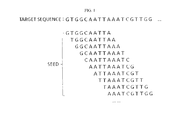
- the seed is extracted by extracting the base sequence of the target sequence one base at a time in a length of 10 bp from the first part thereof. All the extracted seeds have the same length (10 bps in the example shown in FIG. 1 ), but the sequences of the seeds are different from one another depending on the positions of the bases extracted from the target sequence.
- the first extracted seed contains the 1 st to 10 th bases of the target sequence, which is G T G G C A A T T A
- the third extracted seed has the 3 rd to 12 th bases of the target sequence, which is G G C A A T T A A A. 25.
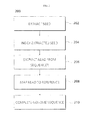
- S200 is a flowchart illustrating an exemplary method for genome sequencing (S200). It allows the assembly of a complete genome sequence by mapping a large quantity of short reads outputted from a genome sequencer onto a target sequence.
- a seed is extracted from a target sequence (S202).
- S202 a target sequence
- a plurality of seeds are extracted by sequentially extracting sequences of bases of a predetermined length from the target sequence, beginning with the first part thereof, and advancing one base at a time.
- the seeds extracted in S202 are hashed using a predetermined hash function, and thereby a hash table is produced (S204).
- the hash table may be keyed with a value generated from the seed.
- the value indicates the location in the target sequence to which the seed corresponds.
- a plurality of reads is extracted from the genome sequencer (S206), and the extracted reads are mapped onto the target sequence using the hash table (S208). 29.
- FIG. 3 is a diagram illustrating an example of the mapping of reads onto a target sequence, in the manner described above.
- the N bp (N is a seed length) of the read extracted in S206 is read out as a seed, and one or more mapping candidate positions of the seed in the target sequence are obtained by searching the hash table.
- the first part of the read is used as a seed, but in practice, the seed may be any part of the read.
- the first part of the read is used as a seed.
- at least one mapping candidate position is generally obtained (In Table 3, two mapping candidates L 1 and L 2 are obtained).
- the number of mapping candidate positions vary depending on seed length. 30.
- the remaining part of the read is compared with the target sequence at each of the mapping candidate positions, to determine an exact mapping position of the read.
- the read does not correspond to the target sequence, but the read corresponds to the target sequence at L 2 .
- the read is mapped to the L 2 position. 31.
- FIG. 4 is a block diagram of an exemplary system for processing a genome sequence 400.
- the system for processing a base sequence 400 may be configured as a separate system, or alternatively, may be included as one element in the system for analyzing a genome sequence.
- an exemplary system for processing a genome sequence 400 includes a seed extractor 402 and an index generator 404. 34.
- the seed extractor 402 extracts a seed from a target sequence.
- the target sequence may be a complete genome sequence to be analyzed, that is, a reference sequence.
- the target sequence of the present invention is not so limited, and may be, for example, the read extracted from the sequencer.
- the target sequence of the present invention includes any kind of genome sequence from which a seed can be extracted.
- the seed extractor 402 may be configured to extract a plurality of seeds by sequentially extracting sequences of bases of a predetermined length from the target sequence, beginning with the first part thereof, and advancing one base at a time.
- the length of the extracted seed may be adjusted based on the number of seeds extracted from the target sequence that have the same nucleotide sequence. For example, if the number of seeds extracted from the target sequence which have the same nucleotide sequence is considered excessive, the seed length may be increased, and vice-versa. 36.
- the index generator 404 indexes the seed extracted from the seed extractor 402.
- the index generator 404 is configured to index the seed by hashing the seed extracted from the seed extractor 402 using a hash function, and generating a hash table using the hashed seed as a key. 37.
- a hash function e.g., a hash function
- generating a hash table e.g., a hash table
- a hash table e.g., a hash table using the hashed seed as a key. 37.
- an exemplary procedure for determining a seed length to be used by the seed extractor 402 will be described. 38.
- the reads outputted from the genome sequencer should be uniformly distributed along the target sequence. To this end, it may be desirable to reduce duplication of the seeds (i.e., reduce the number of seeds having the same sequence).
- the following exemplary target sequence is presented for illustration purposes only. 39.
- ACTCTGGTGCATACCTCCTGGCTGGACTCTGG 40 When a seed having a length of 6 bp is extracted from this target sequence, ACTCTG and CTCTGG are duplicated twice. When the seed length is 3 bp, a seed having a sequence of TGC is duplicated five times. That is, as the seed length is decreased, the number of duplicated seeds increases, and therefore the number of candidate positions in the target sequence onto which reads must be mapped also increases. For example, when the upstream region of the read extracted in this exemplary embodiment has a length of 3 bp and starts with TGC, the corresponding read needs to be compared to a total of 5 candidate positions. For this reason, the mapping time is increased, while the accuracy of the mapping is decreased. 41.
- a seed length S and the number of bases constituting the target sequence is B
- the length of a complete target sequence for extracting a seed is R (when the target sequence is a human base sequence. R is approximately 3 x 10 9 )
- Table 1 shows an average number of duplicated seeds per seed length in a human genome.
- Seed Length 13 14 15 16 Number of Duplicated Seeds 44.70 11.18 2.79 0.70 45.
- k a target value (or set value) of a number of duplicated seeds among the seeds extracted from the target sequence.
- k should satisfy the following Equation.
- an average value of a number of the duplicated seeds should be within the target value.
- k may in some embodiments be 3 or less, and may be 2 or 3.
- the number of mapping candidate positions decreases. Hence, the speed and accuracy of the mapping are increased.
- the seed length is excessively short according to the k value. for example due to the presence of a read not being completely matched with the seed, mapping becomes difficult or the size of the hash table becomes excessively large.
- the k value may be adjusted depending on such factors. 48.
- the seed length (S) in some embodiments may be 15 or more according to Equation 4. Table 2 shows average frequencies of seed appearance in a human genome according to seed length, and FIG. 5 is a graph thereof.
- the frequency per seed is 10 or more, and when the seed length is 15 bp, the frequency per seed is decreased to 3 or less. That is, when the seed length is 15 bp, compared with when the seed length is 14 bp or less, the duplication of seeds may be drastically reduced. 50.
- the seed length may be adjusted based on the capacity of an index generated by the index generator 404, and based on the memory capacity of the system for processing a base sequence 100.
- FIG. 6 is a flowchart of an exemplary method of processing a target sequence (S600). 52. First, a seed is extracted from a target sequence (S602).
- a plurality of seeds are extracted by sequentially extracting sequences of bases of a predetermined length from the target sequence, beginning with the first part thereof, and advancing one base at a time.
- the length of the extracted seed may be adjusted based on the number of seeds extracted from the target sequence that have the same nucleotide sequence. For example, if the number of seeds extracted from the target sequence which have the same nucleotide sequence is determined to be excessive, the seed length may be increased, and vice-versa. Considerations for determining seed length have been described heretofore, and are thus not reiterated. 53. Subsequently, the seed extracted in S602 is indexed (S604).
- a computer-readable recording medium which includes a program for performing methods described herein on a computer.
- the computer-readable recording medium may include a program command, a local data file, and a local data structure, used alone or in combination.
- the medium may be specially designed or configured for the present invention, or known to those of ordinary skill in the field of computer software.
- Examples of the computer-readable recording medium include magnetic media such as a hard disk, a floppy disk and a magnetic tape, optical recording media such as a CD-ROM and a DVD, a magnetic-optical medium such as a floppy disk, and hardware devices specially configured to store and perform program commands such as ROM, RAM and flash memory.
- the program commands may include a high-level language code capable of being executed by a computer using an interpreter, as well as machine language code, which is, for example, made by a compiler. 55.
- the length of a seed extracted in a process for sequencing a base sequence is adjusted to provide for improvements in the speed and accuracy of genome sequencing.
Landscapes
- Life Sciences & Earth Sciences (AREA)
- Physics & Mathematics (AREA)
- Engineering & Computer Science (AREA)
- Theoretical Computer Science (AREA)
- Health & Medical Sciences (AREA)
- General Health & Medical Sciences (AREA)
- Biotechnology (AREA)
- Chemical & Material Sciences (AREA)
- Bioinformatics & Cheminformatics (AREA)
- Evolutionary Biology (AREA)
- Medical Informatics (AREA)
- Spectroscopy & Molecular Physics (AREA)
- Bioinformatics & Computational Biology (AREA)
- Proteomics, Peptides & Aminoacids (AREA)
- Analytical Chemistry (AREA)
- Biophysics (AREA)
- Organic Chemistry (AREA)
- Data Mining & Analysis (AREA)
- General Physics & Mathematics (AREA)
- Mathematical Physics (AREA)
- Wood Science & Technology (AREA)
- Zoology (AREA)
- General Engineering & Computer Science (AREA)
- Microbiology (AREA)
- Pure & Applied Mathematics (AREA)
- Algebra (AREA)
- Computational Mathematics (AREA)
- Immunology (AREA)
- Molecular Biology (AREA)
- Genetics & Genomics (AREA)
- Mathematical Analysis (AREA)
- Biochemistry (AREA)
- Mathematical Optimization (AREA)
- Databases & Information Systems (AREA)
- Software Systems (AREA)
- Measuring Or Testing Involving Enzymes Or Micro-Organisms (AREA)
- Apparatus Associated With Microorganisms And Enzymes (AREA)
- Breeding Of Plants And Reproduction By Means Of Culturing (AREA)
- Information Retrieval, Db Structures And Fs Structures Therefor (AREA)
Abstract
Description
-
- 1. This application claims priority from Korean Patent Application No.
10-2012-0022647, filed on March 6, 2012 -
- 2. The advent of next generation sequencing (NGS), and the reduction in cost of DNA sequencing, make possible large-scale human genome sequencing for research in medical genetics and population genetics. NGS sequencers used for analyzing genome sequences can produce several billions of very short fragment sequences (referred to as "reads"). The genome sequence of an individual is obtained through resequencing (including indexing, mapping and alignment), and by determining the locations of the generated reads in a whole genome sequence.
- 3. Early systems for genome sequencing mainly focused on the accuracy of the sequencing. However, as the use of NGS has become more widespread, the cost of generating each read has significantly dropped, whereas the amount of generated data useful for the sequence analysis has increased. Therefore, there is a need for sequencing technology that can quickly and accurately process high-capacity reads.
-
- 4. In exemplary embodiments, systems and methods are provided for rapidly and accurately sequencing a whole genome. In some embodiments, the target sequence is a whole genome including read sequences extracted from a sequencer.
- 5. According to an aspect of an exemplary embodiment, there is provided a system for processing a genome sequence, which system may include: a seed extractor configured to extract a seed from a whole genome or read sequence; and an index generator configured to index the seed that is extracted from the seed extractor. In some embodiments, the length of the extracted seed may be adjusted based on the number of seeds having same nucleotide sequence extracted from a whole genome. For example, if the number of seeds extracted from a whole genome or read sequences which have the same nucleotide sequence is determined to be excessive, the seed length may be increased, and vice-versa.
- 6. According to an aspect of another exemplary embodiment, there is provided a method for processing a genome sequence, which method may include: extracting a seed from a whole genome or read sequences; and indexing the extracted seed. The length of the extracted seed may be adjusted based on the number of seeds extracted from the target sequence that have the same nucleotide sequence. For example, if the number of seeds extracted from the target sequence which have the same nucleotide sequence is determined to be excessive, the seed length may be increased, and vice-versa.
- 7. According to an aspect of another exemplary embodiment, there is provided a method of processing a base sequence, the method including extracting a seed from the target sequence. In some embodiments thereof the target sequence is a whole genome including read sequences extracted from a sequencer The length of the extracted seed may be adjusted based on the number of seeds extracted from the target sequence that have the same nucleotide sequence. For example, if the number of seeds extracted from the target sequence which have the same nucleotide sequence is determined to be excessive, the seed length may be increased, and vice-versa.
-
- 8. The above and other objects, features and advantages will become more apparent to those of ordinary skill in the art by describing in detail exemplary embodiments with reference to the attached drawings, in which:
- 9.
FIG. 1 is a diagram illustrating an example of extraction of a seed from a genome sequence; - 10.
FIG. 2 is a flowchart illustrating an example of genome sequencing; - 11.
FIG. 3 is a diagram illustrating an example of mapping reads onto a target sequence during genome sequencing; - 12.
FIG. 4 is a block diagram of an exemplary system for processing a genome sequence; - 13.
FIG. 5 is a graph showing average frequencies with which seeds of a particular length appear during human genome sequencing; and - 14.
FIG. 6 is a flowchart illustrating an exemplary method for processing a genome sequence. - 15. Hereinafter, exemplary embodiments will be described in detail. However, it is understood that all exemplary embodiments are not limited to exemplary embodiments disclosed below, but can be implemented in various forms. The following exemplary embodiments are described in order to enable those of ordinary skill in the art to embody and practice exemplary embodiments.
16. Although the terms first, second, etc. may be used to describe various elements, these elements are not limited in their order of appearance or operation by these terms. These terms are only used as expedients to connote the existence of different elements. For example, a first element could be termed a second element, and, similarly, a second element could be termed a first element. The term "and/or" includes any and all combinations of one or more of the associated listed items.
17. When an element is "connected" or "coupled" to another element, it may be directly connected or coupled to the other element, or one or more intervening elements may be present. In contrast, when an element is referred to as being "directly connected" or "directly coupled" to another element, there are no intervening elements present.
18. The terminology used herein is for the purpose of describing particular exemplary embodiments only and is not intended to be limiting of exemplary embodiments. The terms "a," "an" and "the" encompass both singular and plural forms, unless the context clearly indicates otherwise. It will be further understood that the terms "comprises," "comprising," "includes" and/or "including," when used herein, specify the presence of stated features, integers, steps, operations, elements, components and/or groups thereof, but do not preclude the presence or addition of one or more other features, integers, steps, operations, elements, components and/or groups thereof.
19. With reference to the appended drawings, exemplary embodiments will be described in greater detail below. To aid understanding, like numbers refer to like elements throughout the description of the figures, and the description of the same elements will not be reiterated.
20. The term "read" is a fragment of a genome sequence that is sequenced and outputted from a genome sequencer. The length of a particular read may vary, and in some embodiments, may be about 35 to 500 base pairs (bp) in length. As those skilled in the art would appreciate, the length of read varies depending on the type of genome sequencing technology employed. DNA bases are generally denoted using the letters A, C, G and T.
21. The term "target sequence" refers to a reference sequence.. A complete genome sequence may be assembled by mapping a large number of reads outputted from a genome sequencer onto a reference. In some embodiments, the target sequence may be a predetermined reference sequence (e.g., a complete genome sequence of a human) in the analysis of a genome sequence. In other embodiments, a genome sequence generated by a genome sequencer can also be used as the target sequence.
22. Target sequences and reads constitute sequences of bases, with bases in DNA being commonly designated as A, C, G or T, depending on the chemical structure of the base. However, for various reasons (e.g., a sequencing error, a sampling error, etc.), a target sequence may contain one or more bases that are of uncertain identity. Such bases are generally denoted as a separate letter, such as "N."
23. The term "seed" is a unit sequence used for mapping reads onto a target sequence. Theoretically, when mapping reads onto a target sequence, all the reads should be sequentially compared with the target sequence, beginning with the first part thereof, in order to estimate the positions in the target sequence from which each read is produced. However, one disadvantage of this approach is that it requires excessive time and computing resources to map a read. For this reason, in practice, a hash table is constructed by hashing a predetermined length of the target sequence, beginning with the first part thereof, and advancing one base at a time, and then the read is mapped to a position on the target sequence. In some embodiments, the fragment of the target sequence for hashing becomes a seed. However, in other embodiments, a fragment of the read may be a seed. In exemplary embodiments, the seed length may be smaller than the length of the read(s), and the seed length may also be adjusted depending on the length of the target sequence, and/or the capacity of the constructed hash table.
24.FIG. 1 illustrates an example of extraction of a seed from a target sequence. In the example, the seed is extracted by extracting the base sequence of the target sequence one base at a time in a length of 10 bp from the first part thereof. All the extracted seeds have the same length (10 bps in the example shown inFIG. 1 ), but the sequences of the seeds are different from one another depending on the positions of the bases extracted from the target sequence. In the example shown inFIG. 1 , the first extracted seed contains the 1st to 10th bases of the target sequence, which is G T G G C A A T T A, and the third extracted seed has the 3rd to 12th bases of the target sequence, which is G G C A A T T A A A.
25.FIG. 2 is a flowchart illustrating an exemplary method for genome sequencing (S200). It allows the assembly of a complete genome sequence by mapping a large quantity of short reads outputted from a genome sequencer onto a target sequence.
26. First, a seed is extracted from a target sequence (S202). In the exemplary embodiment shown inFIG. 1 , a plurality of seeds are extracted by sequentially extracting sequences of bases of a predetermined length from the target sequence, beginning with the first part thereof, and advancing one base at a time.
27. Subsequently, the seeds extracted in S202 are hashed using a predetermined hash function, and thereby a hash table is produced (S204). The hash table may be keyed with a value generated from the seed. In some embodiments, the value indicates the location in the target sequence to which the seed corresponds.
28. Then, a plurality of reads is extracted from the genome sequencer (S206), and the extracted reads are mapped onto the target sequence using the hash table (S208).
29.FIG. 3 is a diagram illustrating an example of the mapping of reads onto a target sequence, in the manner described above. First, the N bp (N is a seed length) of the read extracted in S206 is read out as a seed, and one or more mapping candidate positions of the seed in the target sequence are obtained by searching the hash table. In this example, the first part of the read is used as a seed, but in practice, the seed may be any part of the read. However, because the accuracy of the first part of the read is generally high, in some embodiments, the first part of the read is used as a seed. In this case, at least one mapping candidate position is generally obtained (In Table 3, two mapping candidates L1 and L2 are obtained). The number of mapping candidate positions vary depending on seed length.
30. Subsequently, the remaining part of the read is compared with the target sequence at each of the mapping candidate positions, to determine an exact mapping position of the read. In the illustrated example, at L1, the read does not correspond to the target sequence, but the read corresponds to the target sequence at L2. As a result, the read is mapped to the L2 position.
31. The reads mapped through the above-described exemplary process are then connected to each other, thereby assembling the genome sequence (S210).
32.FIG. 4 is a block diagram of an exemplary system for processing agenome sequence 400. In this exemplary system, the system for processing abase sequence 400 may be configured as a separate system, or alternatively, may be included as one element in the system for analyzing a genome sequence.
33. As shown inFIG. 4 , an exemplary system for processing agenome sequence 400 includes aseed extractor 402 and anindex generator 404.
34. Theseed extractor 402 extracts a seed from a target sequence. The target sequence may be a complete genome sequence to be analyzed, that is, a reference sequence. However, the target sequence of the present invention is not so limited, and may be, for example, the read extracted from the sequencer. The target sequence of the present invention includes any kind of genome sequence from which a seed can be extracted.
35. Theseed extractor 402 may be configured to extract a plurality of seeds by sequentially extracting sequences of bases of a predetermined length from the target sequence, beginning with the first part thereof, and advancing one base at a time. The length of the extracted seed may be adjusted based on the number of seeds extracted from the target sequence that have the same nucleotide sequence. For example, if the number of seeds extracted from the target sequence which have the same nucleotide sequence is considered excessive, the seed length may be increased, and vice-versa.
36. Theindex generator 404 indexes the seed extracted from theseed extractor 402. Specifically, theindex generator 404 is configured to index the seed by hashing the seed extracted from theseed extractor 402 using a hash function, and generating a hash table using the hashed seed as a key.
37. Hereinafter, an exemplary procedure for determining a seed length to be used by theseed extractor 402 will be described.
38. To increase the accuracy of the genome sequencing generated by processing the reads, in some embodiments, the reads outputted from the genome sequencer should be uniformly distributed along the target sequence. To this end, it may be desirable to reduce duplication of the seeds (i.e., reduce the number of seeds having the same sequence). The following exemplary target sequence is presented for illustration purposes only.
39. ACTCTGGTGCATACCTCCTGGCTGGACTCTGG
40. When a seed having a length of 6 bp is extracted from this target sequence, ACTCTG and CTCTGG are duplicated twice. When the seed length is 3 bp, a seed having a sequence of TGC is duplicated five times. That is, as the seed length is decreased, the number of duplicated seeds increases, and therefore the number of candidate positions in the target sequence onto which reads must be mapped also increases. For example, when the upstream region of the read extracted in this exemplary embodiment has a length of 3 bp and starts with TGC, the corresponding read needs to be compared to a total of 5 candidate positions. For this reason, the mapping time is increased, while the accuracy of the mapping is decreased.
41. Provided that a seed length is S and the number of bases constituting the target sequence is B, seeds capable of being generated according to the seed length are determined using the following Equation:
42. In Equation 1, if a target sequence consists of four bases, A, C, G and T, B = 4, and when an uncertain base (N) is also included, B = 5.
43. Provided that the length of a complete target sequence for extracting a seed is R (when the target sequence is a human base sequence. R is approximately 3 x 10⁹), an average number of seeds having the same sequence throughout the complete target sequence (a quantity of duplicated seeds) may be determined as follows:
44. Table 1 shows an average number of duplicated seeds per seed length in a human genome.[Table 1] Seed Length 13 14 15 16 Number of Duplicated Seeds 44.70 11.18 2.79 0.70 
46. Eventually, the seed length is expressed as the following Equation:
47. In Equation 4, k may in some embodiments be 3 or less, and may be 2 or 3. As the k value decreases (that is, the number of duplicated seeds decreases), the number of mapping candidate positions also decreases. Hence, the speed and accuracy of the mapping are increased. However, when the seed length is excessively short according to the k value. for example due to the presence of a read not being completely matched with the seed, mapping becomes difficult or the size of the hash table becomes excessively large. In some embodiments, the k value may be adjusted depending on such factors.
48. When the target sequence is a human genome sequence, the seed length (S) in some embodiments may be 15 or more according to Equation 4. Table 2 shows average frequencies of seed appearance in a human genome according to seed length, andFIG. 5 is a graph thereof.[Table 2] Seed Length Average Frequency of Seed Appearance 10 2,726.1919 11 681.9731 12 170.9185 13 42.7099 14 10.6470 15 2.6617 16 0.6654 17 0.1664
50. In exemplary embodiments, the seed length may be adjusted based on the capacity of an index generated by theindex generator 404, and based on the memory capacity of the system for processing a base sequence 100. The longer the seed length, the larger the capacity of a hash table generated therefrom. Accordingly, in some circumstances, the capacity of the hash table may exceed the capacity of memory included in the system for processing a base sequence 100. Therefore, in some embodiments for determining seed length, the above capacities are accounted for. For example, when the target sequence is a human genome sequence, in some embodiments which take into account the capacity of the index and the memory capacity (e.g., the capacity of memory of a single node), the seed length may be 30 bp or less.
51.FIG. 6 is a flowchart of an exemplary method of processing a target sequence (S600).
52. First, a seed is extracted from a target sequence (S602). In this example, a plurality of seeds are extracted by sequentially extracting sequences of bases of a predetermined length from the target sequence, beginning with the first part thereof, and advancing one base at a time. The length of the extracted seed may be adjusted based on the number of seeds extracted from the target sequence that have the same nucleotide sequence. For example, if the number of seeds extracted from the target sequence which have the same nucleotide sequence is determined to be excessive, the seed length may be increased, and vice-versa. Considerations for determining seed length have been described heretofore, and are thus not reiterated.
53. Subsequently, the seed extracted in S602 is indexed (S604). Specifically, in this step, the extracted seed is hashed using a hash function, and then the seed is indexed by generating a hash table using a hashed seed as a key.
54. In other embodiments, a computer-readable recording medium is provided which includes a program for performing methods described herein on a computer. The computer-readable recording medium may include a program command, a local data file, and a local data structure, used alone or in combination. The medium may be specially designed or configured for the present invention, or known to those of ordinary skill in the field of computer software. Examples of the computer-readable recording medium include magnetic media such as a hard disk, a floppy disk and a magnetic tape, optical recording media such as a CD-ROM and a DVD, a magnetic-optical medium such as a floppy disk, and hardware devices specially configured to store and perform program commands such as ROM, RAM and flash memory. The program commands may include a high-level language code capable of being executed by a computer using an interpreter, as well as machine language code, which is, for example, made by a compiler.
55. Thus, in exemplary embodiments, the length of a seed extracted in a process for sequencing a base sequence is adjusted to provide for improvements in the speed and accuracy of genome sequencing. - Support table for sequence listing
SEQ ID NO: Sequence Support in application 1 ACTCTGGTGCATACCTCCTGGCTGGACTCTGG p.8, 39th para. 2 GTGGCAATTAAATCGTTGG Fig. 1 3 GTGGCAATTA Fig. 1 ; p.6, 24th para.4 TGGCAATTAA Fig. 1 5 GGCAATTAAA Fig. 1 ; p.6, 24th para.6 GCAATTAAAT Fig. 1 7 CAATTAAATC Fig. 1 8 AATTAAATCG Fig. 1 9 ATTAAATCGT Fig. 1 10 TTAAATCGTT Fig. 1 11 TAAATCGTTG Fig. 1 12 AAATCGTTGG Fig. 1 


Claims (18)
- A system for processing a genome sequence, comprising:a seed extractor configured to extract a seed from a target sequence; andan index generator configured to index the seed extracted from the seed extractor,wherein in said system, the length of the seed extracted by said seed extractor is adjusted based on the number of seeds extracted from said target sequence that have the same nucleotide sequence.
- The system of claim 1, wherein the length of the seed extracted by said seed extractor is adjusted so that the frequency of seeds extracted from said target sequence that have the same nucleotide sequence is not more than a predetermined value.
- The system of claim 1, wherein the length of the seed is adjusted according to the following Equation:

where S is the length of the seed, R is the length of the target sequence, B is the number of bases constituting the target sequence, and k is a set value for the frequency of seeds extracted from said target sequence that have the same nucleotide sequence. - The system of claim 3, wherein k is 3 or less.
- The system of claim 1, wherein when the target sequence is a human genome sequence, the length of the seed is adjusted to 15 bp or more.
- The system of claim 1, wherein said system comprises memory for processing said genome sequence, and wherein the length of the seed is further adjusted based on the capacity of the index generated by said index generator, the capacity of said memory, or both.
- The system of claim 1, wherein when the target sequence is a human genome sequence, the length of the seed is adjusted to 30 bp or less.
- A system for analyzing a genome, comprising the system of any one of claims 1 to 7.
- An apparatus, comprising:at least one processor;a memory; andat least one program,wherein the at least one program is stored in the memory and executed by the at least one processor, said program comprising commands for:extracting a seed from a target sequence;indexing the extracted seed; andadjusting the length of the seed extracted by said seed extractor based on the number of seeds extracted from said target sequence that have the same nucleotide sequence.
- A method for processing a base sequence, comprising the steps of:(1) extracting a seed from a target sequence; and(2) indexing the extracted seed,
wherein in said method, the length of the seed extracted is adjusted based on the number of seeds extracted from said target sequence that have the same nucleotide sequence,
and wherein steps (1) and (2) are performed using the apparatus of Claim 9. - The method of claim 10, wherein the length of the seed extracted is adjusted so that the frequency of seeds extracted from said target sequence that have the same nucleotide sequence is not more than a predetermined value.
- The method of claim 10, wherein the length of the seed is adjusted according to the following Equation:

where S is the length of the seed, R is the length of the target sequence, B is the number of bases constituting the target sequence, and k is a set value for the frequency of seeds extracted from said target sequence that have the same nucleotide sequence. - The method of claim 12, wherein k is 3 or less.
- The method of claim 10, wherein when the target sequence is a human genome sequence, the length of the seed is adjusted to 15 bp or more.
- The method of claim 10, wherein the length of the seed is further adjusted based on the capacity of the index generated by said index generator, the capacity of said memory, or both.
- The method of claim 10, wherein when the target sequence is a human genome sequence, the length of the seed is adjusted to 30 bp or less.
- A method of processing a genome sequence, comprising:extracting a seed from a target sequence,wherein in said method, the length of the seed extracted is adjusted based on the number of seeds extracted from said target sequence that have the same nucleotide sequence,and wherein said seed extraction is performed using the apparatus of Claim 9.
- The method of claim 17, wherein when the target sequence is a human genome sequence, the length of the seed is adjusted to 15 bp or more.
Applications Claiming Priority (1)
| Application Number | Priority Date | Filing Date | Title |
|---|---|---|---|
| KR1020120022647A KR101394339B1 (en) | 2012-03-06 | 2012-03-06 | System and method for processing genome sequence in consideration of seed length |
Publications (2)
| Publication Number | Publication Date |
|---|---|
| EP2639724A2 true EP2639724A2 (en) | 2013-09-18 |
| EP2639724A3 EP2639724A3 (en) | 2014-03-26 |
Family
ID=47520665
Family Applications (1)
| Application Number | Title | Priority Date | Filing Date |
|---|---|---|---|
| EP12187721.1A Withdrawn EP2639724A3 (en) | 2012-03-06 | 2012-10-09 | System and method for processing genome sequence in consideration of seed length |
Country Status (5)
| Country | Link |
|---|---|
| US (1) | US9348968B2 (en) |
| EP (1) | EP2639724A3 (en) |
| JP (1) | JP5781486B2 (en) |
| KR (1) | KR101394339B1 (en) |
| CN (1) | CN103310128B (en) |
Families Citing this family (3)
| Publication number | Priority date | Publication date | Assignee | Title |
|---|---|---|---|---|
| NL2013120B1 (en) * | 2014-07-03 | 2016-09-20 | Genalice B V | A method for finding associated positions of bases of a read on a reference genome. |
| KR102384832B1 (en) * | 2016-10-07 | 2022-04-08 | 일루미나, 인코포레이티드 | Systems and methods for secondary analysis of nucleotide sequencing data |
| KR102377810B1 (en) * | 2020-03-11 | 2022-03-23 | 한국전자통신연구원 | Method for genome sequence alignment and apparatus thereof |
Family Cites Families (5)
| Publication number | Priority date | Publication date | Assignee | Title |
|---|---|---|---|---|
| US4944009A (en) * | 1988-02-25 | 1990-07-24 | Massachusetts Institute Of Technology | Pseudo-random sequence generator |
| CN1309722A (en) * | 1998-05-12 | 2001-08-22 | 罗斯塔英法美蒂克斯公司 | Method, system and equipment for quantitative analysis of gene expression |
| WO2001062965A2 (en) * | 2000-02-22 | 2001-08-30 | Oxford Biomedica (Uk) Limited | Differential expression screening method |
| WO2011137368A2 (en) * | 2010-04-30 | 2011-11-03 | Life Technologies Corporation | Systems and methods for analyzing nucleic acid sequences |
| KR101372947B1 (en) | 2012-02-24 | 2014-03-13 | 삼성에스디에스 주식회사 | System and method for processing reference sequence for analyzing genome sequence |
-
2012
- 2012-03-06 KR KR1020120022647A patent/KR101394339B1/en not_active Expired - Fee Related
- 2012-10-09 EP EP12187721.1A patent/EP2639724A3/en not_active Withdrawn
- 2012-10-12 JP JP2012227078A patent/JP5781486B2/en not_active Expired - Fee Related
- 2012-12-27 US US13/728,116 patent/US9348968B2/en not_active Expired - Fee Related
-
2013
- 2013-01-10 CN CN201310009347.8A patent/CN103310128B/en not_active Expired - Fee Related
Non-Patent Citations (1)
| Title |
|---|
| None |
Also Published As
| Publication number | Publication date |
|---|---|
| US9348968B2 (en) | 2016-05-24 |
| KR101394339B1 (en) | 2014-05-13 |
| US20130238250A1 (en) | 2013-09-12 |
| CN103310128B (en) | 2016-08-24 |
| EP2639724A3 (en) | 2014-03-26 |
| CN103310128A (en) | 2013-09-18 |
| JP5781486B2 (en) | 2015-09-24 |
| JP2013183737A (en) | 2013-09-19 |
| KR20130101711A (en) | 2013-09-16 |
Similar Documents
| Publication | Publication Date | Title |
|---|---|---|
| US11560598B2 (en) | Systems and methods for analyzing circulating tumor DNA | |
| Guo et al. | Microbial community analysis with ribosomal gene fragments from shotgun metagenomes | |
| US20200243164A1 (en) | Systems and methods for patient-specific identification of neoantigens by de novo peptide sequencing for personalized immunotherapy | |
| KR102858552B1 (en) | Method for aligning targeted nucleic acid sequence analysis data | |
| US20160306919A1 (en) | Genome compression and decompression | |
| CN107480470B (en) | Known variation detection method and device based on Bayesian and Poisson distribution test | |
| KR101481457B1 (en) | System and method for aligning genome sequence considering entire read | |
| US9323889B2 (en) | System and method for processing reference sequence for analyzing genome sequence | |
| WO2018060365A1 (en) | Genomic variant ranking system for clinical trial matching | |
| US20160154930A1 (en) | Methods for identification of individuals | |
| US20150248430A1 (en) | Efficient encoding and storage and retrieval of genomic data | |
| WO2010056131A1 (en) | A method and system for analysing data sequences | |
| US9348968B2 (en) | System and method for processing genome sequence in consideration of seed length | |
| US20160078169A1 (en) | Method of and apparatus for providing information on a genomic sequence based personal marker | |
| US20140121986A1 (en) | System and method for aligning genome sequence | |
| US20160098517A1 (en) | Apparatus and method for detecting internal tandem duplication | |
| KR101841265B1 (en) | Method for eliminating bias of targeted sequencing by using nmf | |
| KR101584857B1 (en) | System and method for aligning genome sequnce | |
| Shi et al. | Learning the comparing and converting method of sequence Phred quality score | |
| US20250356951A1 (en) | Genomics alignment probability score rescaler | |
| US9390163B2 (en) | Method, system and software arrangement for detecting or determining similarity regions between datasets | |
| Flibotte et al. | Automated ordering of fingerprinted clones | |
| US10443090B2 (en) | Method and apparatus for detecting translocation | |
| KR101538852B1 (en) | System and method for algning genome seqence in consideration of accuracy | |
| Chen et al. | Enhanced Error Suppression for Accurate Detection of Low‐Frequency Variants |
Legal Events
| Date | Code | Title | Description |
|---|---|---|---|
| PUAI | Public reference made under article 153(3) epc to a published international application that has entered the european phase |
Free format text: ORIGINAL CODE: 0009012 |
|
| 17P | Request for examination filed |
Effective date: 20121009 |
|
| AK | Designated contracting states |
Kind code of ref document: A2 Designated state(s): AL AT BE BG CH CY CZ DE DK EE ES FI FR GB GR HR HU IE IS IT LI LT LU LV MC MK MT NL NO PL PT RO RS SE SI SK SM TR |
|
| AX | Request for extension of the european patent |
Extension state: BA ME |
|
| PUAL | Search report despatched |
Free format text: ORIGINAL CODE: 0009013 |
|
| AK | Designated contracting states |
Kind code of ref document: A3 Designated state(s): AL AT BE BG CH CY CZ DE DK EE ES FI FR GB GR HR HU IE IS IT LI LT LU LV MC MK MT NL NO PL PT RO RS SE SI SK SM TR |
|
| AX | Request for extension of the european patent |
Extension state: BA ME |
|
| RIC1 | Information provided on ipc code assigned before grant |
Ipc: G06F 19/22 20110101AFI20140214BHEP |
|
| STAA | Information on the status of an ep patent application or granted ep patent |
Free format text: STATUS: EXAMINATION IS IN PROGRESS |
|
| 17Q | First examination report despatched |
Effective date: 20180614 |
|
| STAA | Information on the status of an ep patent application or granted ep patent |
Free format text: STATUS: THE APPLICATION IS DEEMED TO BE WITHDRAWN |
|
| 18D | Application deemed to be withdrawn |
Effective date: 20181025 |