EP2639227A1 - A new class of diazepine derivative chelating agents and complexes with paramagnetic metals as MRI contrast agents - Google Patents
A new class of diazepine derivative chelating agents and complexes with paramagnetic metals as MRI contrast agents Download PDFInfo
- Publication number
- EP2639227A1 EP2639227A1 EP12159378.4A EP12159378A EP2639227A1 EP 2639227 A1 EP2639227 A1 EP 2639227A1 EP 12159378 A EP12159378 A EP 12159378A EP 2639227 A1 EP2639227 A1 EP 2639227A1
- Authority
- EP
- European Patent Office
- Prior art keywords
- compound
- formula
- group
- mmol
- preparation
- Prior art date
- Legal status (The legal status is an assumption and is not a legal conclusion. Google has not performed a legal analysis and makes no representation as to the accuracy of the status listed.)
- Withdrawn
Links
- 230000005298 paramagnetic effect Effects 0.000 title claims abstract description 39
- 239000002616 MRI contrast agent Substances 0.000 title claims description 9
- 239000002738 chelating agent Substances 0.000 title abstract description 6
- 125000002576 diazepinyl group Chemical class N1N=C(C=CC=C1)* 0.000 title description 14
- 229910052751 metal Inorganic materials 0.000 title description 7
- 239000002184 metal Substances 0.000 title description 7
- 150000002739 metals Chemical class 0.000 title 1
- 238000002360 preparation method Methods 0.000 claims abstract description 71
- 238000000034 method Methods 0.000 claims abstract description 39
- 229910021645 metal ion Inorganic materials 0.000 claims abstract description 22
- 230000008569 process Effects 0.000 claims abstract description 10
- 150000001875 compounds Chemical class 0.000 claims description 89
- 239000000203 mixture Substances 0.000 claims description 44
- 125000002924 primary amino group Chemical group [H]N([H])* 0.000 claims description 28
- 150000003839 salts Chemical class 0.000 claims description 28
- 125000005647 linker group Chemical group 0.000 claims description 27
- 125000003178 carboxy group Chemical group [H]OC(*)=O 0.000 claims description 19
- 238000003384 imaging method Methods 0.000 claims description 15
- 125000004122 cyclic group Chemical group 0.000 claims description 10
- 125000004432 carbon atom Chemical group C* 0.000 claims description 9
- 125000000008 (C1-C10) alkyl group Chemical group 0.000 claims description 7
- 125000001931 aliphatic group Chemical group 0.000 claims description 7
- 125000006239 protecting group Chemical group 0.000 claims description 7
- 125000003837 (C1-C20) alkyl group Chemical group 0.000 claims description 6
- 125000004169 (C1-C6) alkyl group Chemical group 0.000 claims description 6
- 230000004913 activation Effects 0.000 claims description 6
- 238000007112 amidation reaction Methods 0.000 claims description 6
- 125000002915 carbonyl group Chemical group [*:2]C([*:1])=O 0.000 claims description 6
- 125000000623 heterocyclic group Chemical group 0.000 claims description 6
- 229910052739 hydrogen Inorganic materials 0.000 claims description 6
- 239000001257 hydrogen Substances 0.000 claims description 6
- 125000004429 atom Chemical group 0.000 claims description 5
- 238000003776 cleavage reaction Methods 0.000 claims description 5
- 125000004435 hydrogen atom Chemical class [H]* 0.000 claims description 5
- 229920006395 saturated elastomer Polymers 0.000 claims description 5
- 230000007017 scission Effects 0.000 claims description 5
- 125000000217 alkyl group Chemical group 0.000 claims description 4
- 239000000546 pharmaceutical excipient Substances 0.000 claims description 4
- 125000002813 thiocarbonyl group Chemical group *C(*)=S 0.000 claims description 4
- 125000000882 C2-C6 alkenyl group Chemical group 0.000 claims description 3
- 125000005157 alkyl carboxy group Chemical group 0.000 claims description 3
- 125000000304 alkynyl group Chemical group 0.000 claims description 3
- 210000000746 body region Anatomy 0.000 claims description 3
- 230000009920 chelation Effects 0.000 claims description 3
- 239000003085 diluting agent Substances 0.000 claims description 3
- 125000004051 hexyl group Chemical group [H]C([H])([H])C([H])([H])C([H])([H])C([H])([H])C([H])([H])C([H])([H])* 0.000 claims description 3
- 125000004356 hydroxy functional group Chemical group O* 0.000 claims description 3
- 229910052760 oxygen Inorganic materials 0.000 claims description 3
- NINIDFKCEFEMDL-UHFFFAOYSA-N Sulfur Chemical compound [S] NINIDFKCEFEMDL-UHFFFAOYSA-N 0.000 claims description 2
- 239000005864 Sulphur Substances 0.000 claims description 2
- 125000003368 amide group Chemical group 0.000 claims description 2
- QVGXLLKOCUKJST-UHFFFAOYSA-N atomic oxygen Chemical compound [O] QVGXLLKOCUKJST-UHFFFAOYSA-N 0.000 claims description 2
- 125000004181 carboxyalkyl group Chemical group 0.000 claims description 2
- 125000002704 decyl group Chemical group [H]C([H])([H])C([H])([H])C([H])([H])C([H])([H])C([H])([H])C([H])([H])C([H])([H])C([H])([H])C([H])([H])C([H])([H])* 0.000 claims description 2
- 125000003438 dodecyl group Chemical group [H]C([H])([H])C([H])([H])C([H])([H])C([H])([H])C([H])([H])C([H])([H])C([H])([H])C([H])([H])C([H])([H])C([H])([H])C([H])([H])C([H])([H])* 0.000 claims description 2
- 125000000959 isobutyl group Chemical group [H]C([H])([H])C([H])(C([H])([H])[H])C([H])([H])* 0.000 claims description 2
- 125000002347 octyl group Chemical group [H]C([*])([H])C([H])([H])C([H])([H])C([H])([H])C([H])([H])C([H])([H])C([H])([H])C([H])([H])[H] 0.000 claims description 2
- 125000005740 oxycarbonyl group Chemical group [*:1]OC([*:2])=O 0.000 claims description 2
- 239000001301 oxygen Substances 0.000 claims description 2
- 238000002405 diagnostic procedure Methods 0.000 claims 1
- 239000002872 contrast media Substances 0.000 abstract description 18
- 238000002595 magnetic resonance imaging Methods 0.000 abstract description 15
- 238000004458 analytical method Methods 0.000 abstract description 5
- 238000000105 evaporative light scattering detection Methods 0.000 description 59
- 239000000243 solution Substances 0.000 description 45
- 239000007858 starting material Substances 0.000 description 37
- 238000001644 13C nuclear magnetic resonance spectroscopy Methods 0.000 description 31
- OKKJLVBELUTLKV-UHFFFAOYSA-N Methanol Chemical compound OC OKKJLVBELUTLKV-UHFFFAOYSA-N 0.000 description 21
- YMWUJEATGCHHMB-UHFFFAOYSA-N Dichloromethane Chemical compound ClCCl YMWUJEATGCHHMB-UHFFFAOYSA-N 0.000 description 20
- LRANPJDWHYRCER-UHFFFAOYSA-N 1,2-diazepine Chemical compound N1C=CC=CC=N1 LRANPJDWHYRCER-UHFFFAOYSA-N 0.000 description 19
- HEMHJVSKTPXQMS-UHFFFAOYSA-M Sodium hydroxide Chemical compound [OH-].[Na+] HEMHJVSKTPXQMS-UHFFFAOYSA-M 0.000 description 18
- 238000006243 chemical reaction Methods 0.000 description 18
- HEDRZPFGACZZDS-UHFFFAOYSA-N Chloroform Chemical compound ClC(Cl)Cl HEDRZPFGACZZDS-UHFFFAOYSA-N 0.000 description 16
- JGFZNNIVVJXRND-UHFFFAOYSA-N N,N-Diisopropylethylamine (DIPEA) Chemical compound CCN(C(C)C)C(C)C JGFZNNIVVJXRND-UHFFFAOYSA-N 0.000 description 16
- 239000007787 solid Substances 0.000 description 15
- XLYOFNOQVPJJNP-UHFFFAOYSA-N water Substances O XLYOFNOQVPJJNP-UHFFFAOYSA-N 0.000 description 15
- DTQVDTLACAAQTR-UHFFFAOYSA-N Trifluoroacetic acid Chemical compound OC(=O)C(F)(F)F DTQVDTLACAAQTR-UHFFFAOYSA-N 0.000 description 14
- 125000002496 methyl group Chemical group [H]C([H])([H])* 0.000 description 14
- RTZKZFJDLAIYFH-UHFFFAOYSA-N Diethyl ether Chemical compound CCOCC RTZKZFJDLAIYFH-UHFFFAOYSA-N 0.000 description 11
- DGAQECJNVWCQMB-PUAWFVPOSA-M Ilexoside XXIX Chemical compound C[C@@H]1CC[C@@]2(CC[C@@]3(C(=CC[C@H]4[C@]3(CC[C@@H]5[C@@]4(CC[C@@H](C5(C)C)OS(=O)(=O)[O-])C)C)[C@@H]2[C@]1(C)O)C)C(=O)O[C@H]6[C@@H]([C@H]([C@@H]([C@H](O6)CO)O)O)O.[Na+] DGAQECJNVWCQMB-PUAWFVPOSA-M 0.000 description 11
- 239000011541 reaction mixture Substances 0.000 description 11
- 239000011734 sodium Substances 0.000 description 11
- 229910052708 sodium Inorganic materials 0.000 description 11
- LMDZBCPBFSXMTL-UHFFFAOYSA-N 1-ethyl-3-(3-dimethylaminopropyl)carbodiimide Chemical compound CCN=C=NCCCN(C)C LMDZBCPBFSXMTL-UHFFFAOYSA-N 0.000 description 10
- 229910003317 GdCl3 Inorganic materials 0.000 description 10
- 239000007832 Na2SO4 Substances 0.000 description 10
- PMZURENOXWZQFD-UHFFFAOYSA-L Sodium Sulfate Chemical compound [Na+].[Na+].[O-]S([O-])(=O)=O PMZURENOXWZQFD-UHFFFAOYSA-L 0.000 description 10
- 150000002148 esters Chemical class 0.000 description 10
- MEANOSLIBWSCIT-UHFFFAOYSA-K gadolinium trichloride Chemical compound Cl[Gd](Cl)Cl MEANOSLIBWSCIT-UHFFFAOYSA-K 0.000 description 10
- 238000004128 high performance liquid chromatography Methods 0.000 description 10
- -1 monophosphate ester Chemical class 0.000 description 10
- 229910052938 sodium sulfate Inorganic materials 0.000 description 10
- SSCYAEBCAFDXBU-UHFFFAOYSA-N 2-[4-(carboxymethyl)-1,4-diazepan-1-yl]acetic acid Chemical compound OC(=O)CN1CCCN(CC(O)=O)CC1 SSCYAEBCAFDXBU-UHFFFAOYSA-N 0.000 description 9
- 239000003446 ligand Substances 0.000 description 9
- 229910052757 nitrogen Inorganic materials 0.000 description 9
- VEXZGXHMUGYJMC-UHFFFAOYSA-N Hydrochloric acid Chemical compound Cl VEXZGXHMUGYJMC-UHFFFAOYSA-N 0.000 description 7
- 239000007788 liquid Substances 0.000 description 7
- 239000002904 solvent Substances 0.000 description 7
- 125000000999 tert-butyl group Chemical group [H]C([H])([H])C(*)(C([H])([H])[H])C([H])([H])[H] 0.000 description 7
- 0 *CCCCC(N*)=O Chemical compound *CCCCC(N*)=O 0.000 description 6
- LFQSCWFLJHTTHZ-UHFFFAOYSA-N Ethanol Chemical compound CCO LFQSCWFLJHTTHZ-UHFFFAOYSA-N 0.000 description 6
- XEKOWRVHYACXOJ-UHFFFAOYSA-N Ethyl acetate Chemical compound CCOC(C)=O XEKOWRVHYACXOJ-UHFFFAOYSA-N 0.000 description 6
- UIIMBOGNXHQVGW-UHFFFAOYSA-M Sodium bicarbonate Chemical compound [Na+].OC([O-])=O UIIMBOGNXHQVGW-UHFFFAOYSA-M 0.000 description 6
- YXFVVABEGXRONW-UHFFFAOYSA-N Toluene Chemical compound CC1=CC=CC=C1 YXFVVABEGXRONW-UHFFFAOYSA-N 0.000 description 6
- 238000010668 complexation reaction Methods 0.000 description 6
- ZQWPRMPSCMSAJU-UHFFFAOYSA-N cyclohexanecarboxylic acid methyl ester Natural products COC(=O)C1CCCCC1 ZQWPRMPSCMSAJU-UHFFFAOYSA-N 0.000 description 6
- JQVDAXLFBXTEQA-UHFFFAOYSA-N dibutylamine Chemical compound CCCCNCCCC JQVDAXLFBXTEQA-UHFFFAOYSA-N 0.000 description 6
- 125000001495 ethyl group Chemical group [H]C([H])([H])C([H])([H])* 0.000 description 6
- 238000003818 flash chromatography Methods 0.000 description 6
- 125000000267 glycino group Chemical group [H]N([*])C([H])([H])C(=O)O[H] 0.000 description 6
- 239000012074 organic phase Substances 0.000 description 6
- 239000000047 product Substances 0.000 description 6
- FVAUCKIRQBBSSJ-UHFFFAOYSA-M sodium iodide Chemical compound [Na+].[I-] FVAUCKIRQBBSSJ-UHFFFAOYSA-M 0.000 description 6
- WWTBZEKOSBFBEM-SPWPXUSOSA-N (2s)-2-[[2-benzyl-3-[hydroxy-[(1r)-2-phenyl-1-(phenylmethoxycarbonylamino)ethyl]phosphoryl]propanoyl]amino]-3-(1h-indol-3-yl)propanoic acid Chemical compound N([C@@H](CC=1C2=CC=CC=C2NC=1)C(=O)O)C(=O)C(CP(O)(=O)[C@H](CC=1C=CC=CC=1)NC(=O)OCC=1C=CC=CC=1)CC1=CC=CC=C1 WWTBZEKOSBFBEM-SPWPXUSOSA-N 0.000 description 5
- ZAFNJMIOTHYJRJ-UHFFFAOYSA-N Diisopropyl ether Chemical compound CC(C)OC(C)C ZAFNJMIOTHYJRJ-UHFFFAOYSA-N 0.000 description 5
- PEDCQBHIVMGVHV-UHFFFAOYSA-N Glycerol Natural products OCC(O)CO PEDCQBHIVMGVHV-UHFFFAOYSA-N 0.000 description 5
- FAPWRFPIFSIZLT-UHFFFAOYSA-M Sodium chloride Chemical compound [Na+].[Cl-] FAPWRFPIFSIZLT-UHFFFAOYSA-M 0.000 description 5
- 239000008280 blood Substances 0.000 description 5
- 210000004369 blood Anatomy 0.000 description 5
- 229940126208 compound 22 Drugs 0.000 description 5
- 125000001301 ethoxy group Chemical group [H]C([H])([H])C([H])([H])O* 0.000 description 5
- 238000009472 formulation Methods 0.000 description 5
- 238000000746 purification Methods 0.000 description 5
- 239000000725 suspension Substances 0.000 description 5
- QUMCIHKVKQYNPA-RUZDIDTESA-N C1(CCCCC1)CN1[C@@H](C=2N(C=3C=NC(=NC1=3)NC1=C(C=C(C(=O)NC3CCN(CC3)C)C=C1)OC)C(=NN=2)C)CC Chemical compound C1(CCCCC1)CN1[C@@H](C=2N(C=3C=NC(=NC1=3)NC1=C(C=C(C(=O)NC3CCN(CC3)C)C=C1)OC)C(=NN=2)C)CC QUMCIHKVKQYNPA-RUZDIDTESA-N 0.000 description 4
- NQTADLQHYWFPDB-UHFFFAOYSA-N N-Hydroxysuccinimide Chemical compound ON1C(=O)CCC1=O NQTADLQHYWFPDB-UHFFFAOYSA-N 0.000 description 4
- JUJWROOIHBZHMG-UHFFFAOYSA-N Pyridine Chemical compound C1=CC=NC=C1 JUJWROOIHBZHMG-UHFFFAOYSA-N 0.000 description 4
- 229940125898 compound 5 Drugs 0.000 description 4
- 125000004433 nitrogen atom Chemical group N* 0.000 description 4
- 239000012044 organic layer Substances 0.000 description 4
- 239000003960 organic solvent Substances 0.000 description 4
- AOSZTAHDEDLTLQ-AZKQZHLXSA-N (1S,2S,4R,8S,9S,11S,12R,13S,19S)-6-[(3-chlorophenyl)methyl]-12,19-difluoro-11-hydroxy-8-(2-hydroxyacetyl)-9,13-dimethyl-6-azapentacyclo[10.8.0.02,9.04,8.013,18]icosa-14,17-dien-16-one Chemical compound C([C@@H]1C[C@H]2[C@H]3[C@]([C@]4(C=CC(=O)C=C4[C@@H](F)C3)C)(F)[C@@H](O)C[C@@]2([C@@]1(C1)C(=O)CO)C)N1CC1=CC=CC(Cl)=C1 AOSZTAHDEDLTLQ-AZKQZHLXSA-N 0.000 description 3
- DAAXYQZSKBPJOX-FQEVSTJZSA-N (2S)-2-amino-3-[4-[5-[3-(4-hydroxyphenyl)-4-methoxyphenyl]-1,2,4-oxadiazol-3-yl]phenyl]propanoic acid Chemical compound COC1=C(C=C(C=C1)C2=NC(=NO2)C3=CC=C(C=C3)C[C@@H](C(=O)O)N)C4=CC=C(C=C4)O DAAXYQZSKBPJOX-FQEVSTJZSA-N 0.000 description 3
- LJIOTBMDLVHTBO-CUYJMHBOSA-N (2s)-2-amino-n-[(1r,2r)-1-cyano-2-[4-[4-(4-methylpiperazin-1-yl)sulfonylphenyl]phenyl]cyclopropyl]butanamide Chemical compound CC[C@H](N)C(=O)N[C@]1(C#N)C[C@@H]1C1=CC=C(C=2C=CC(=CC=2)S(=O)(=O)N2CCN(C)CC2)C=C1 LJIOTBMDLVHTBO-CUYJMHBOSA-N 0.000 description 3
- VUDZSIYXZUYWSC-DBRKOABJSA-N (4r)-1-[(2r,4r,5r)-3,3-difluoro-4-hydroxy-5-(hydroxymethyl)oxolan-2-yl]-4-hydroxy-1,3-diazinan-2-one Chemical compound FC1(F)[C@H](O)[C@@H](CO)O[C@H]1N1C(=O)N[C@H](O)CC1 VUDZSIYXZUYWSC-DBRKOABJSA-N 0.000 description 3
- FRJJJAKBRKABFA-TYFAACHXSA-N (4r,6s)-6-[(e)-2-[6-chloro-4-(4-fluorophenyl)-2-propan-2-ylquinolin-3-yl]ethenyl]-4-hydroxyoxan-2-one Chemical compound C(\[C@H]1OC(=O)C[C@H](O)C1)=C/C=1C(C(C)C)=NC2=CC=C(Cl)C=C2C=1C1=CC=C(F)C=C1 FRJJJAKBRKABFA-TYFAACHXSA-N 0.000 description 3
- APJSHECCIRQQDV-ZRDIBKRKSA-N (e)-3-[4-hydroxy-3-(5,5,8,8-tetramethyl-3-pentoxy-6,7-dihydronaphthalen-2-yl)phenyl]prop-2-enoic acid Chemical compound CCCCCOC1=CC(C(CCC2(C)C)(C)C)=C2C=C1C1=CC(\C=C\C(O)=O)=CC=C1O APJSHECCIRQQDV-ZRDIBKRKSA-N 0.000 description 3
- DPRJPRMZJGWLHY-HNGSOEQISA-N (e,3r,5s)-7-[5-(4-fluorophenyl)-3-propan-2-yl-1-pyrazin-2-ylpyrazol-4-yl]-3,5-dihydroxyhept-6-enoic acid Chemical compound OC(=O)C[C@H](O)C[C@H](O)/C=C/C=1C(C(C)C)=NN(C=2N=CC=NC=2)C=1C1=CC=C(F)C=C1 DPRJPRMZJGWLHY-HNGSOEQISA-N 0.000 description 3
- ZLGYVWRJIZPQMM-HHHXNRCGSA-N 2-azaniumylethyl [(2r)-2,3-di(dodecanoyloxy)propyl] phosphate Chemical compound CCCCCCCCCCCC(=O)OC[C@H](COP(O)(=O)OCCN)OC(=O)CCCCCCCCCCC ZLGYVWRJIZPQMM-HHHXNRCGSA-N 0.000 description 3
- MWDVCHRYCKXEBY-LBPRGKRZSA-N 3-chloro-n-[2-oxo-2-[[(1s)-1-phenylethyl]amino]ethyl]benzamide Chemical compound N([C@@H](C)C=1C=CC=CC=1)C(=O)CNC(=O)C1=CC=CC(Cl)=C1 MWDVCHRYCKXEBY-LBPRGKRZSA-N 0.000 description 3
- TZKBVRDEOITLRB-UHFFFAOYSA-N 4-methyl-n-[4-[(4-methylpiperazin-1-yl)methyl]-3-(trifluoromethyl)phenyl]-3-[2-(1h-pyrazolo[3,4-b]pyridin-5-yl)ethynyl]benzamide Chemical compound C1CN(C)CCN1CC(C(=C1)C(F)(F)F)=CC=C1NC(=O)C1=CC=C(C)C(C#CC=2C=C3C=NNC3=NC=2)=C1 TZKBVRDEOITLRB-UHFFFAOYSA-N 0.000 description 3
- RRELDGDKULRRDM-UHFFFAOYSA-N 6-[2-chloro-4-nitro-5-(oxan-4-yloxy)anilino]-3,4-dihydro-1H-quinolin-2-one Chemical compound [O-][N+](=O)c1cc(Cl)c(Nc2ccc3NC(=O)CCc3c2)cc1OC1CCOCC1 RRELDGDKULRRDM-UHFFFAOYSA-N 0.000 description 3
- QTBSBXVTEAMEQO-UHFFFAOYSA-M Acetate Chemical compound CC([O-])=O QTBSBXVTEAMEQO-UHFFFAOYSA-M 0.000 description 3
- CSCPPACGZOOCGX-UHFFFAOYSA-N Acetone Chemical compound CC(C)=O CSCPPACGZOOCGX-UHFFFAOYSA-N 0.000 description 3
- UHOVQNZJYSORNB-UHFFFAOYSA-N Benzene Chemical compound C1=CC=CC=C1 UHOVQNZJYSORNB-UHFFFAOYSA-N 0.000 description 3
- NZSQBRZWARZNQH-ZWOACCQCSA-N C1(CC1)NC(=O)O[C@H]1C(C2CC[C@]3([C@@]4(CC[C@@]5(C(C4CCC3[C@]2(CC1)C)[C@@H](CC5)[C@H](C)O)C(=O)O)C)C)(C)C Chemical compound C1(CC1)NC(=O)O[C@H]1C(C2CC[C@]3([C@@]4(CC[C@@]5(C(C4CCC3[C@]2(CC1)C)[C@@H](CC5)[C@H](C)O)C(=O)O)C)C)(C)C NZSQBRZWARZNQH-ZWOACCQCSA-N 0.000 description 3
- 229940126657 Compound 17 Drugs 0.000 description 3
- IAZDPXIOMUYVGZ-UHFFFAOYSA-N Dimethylsulphoxide Chemical compound CS(C)=O IAZDPXIOMUYVGZ-UHFFFAOYSA-N 0.000 description 3
- 229910052688 Gadolinium Inorganic materials 0.000 description 3
- HPKJGHVHQWJOOT-ZJOUEHCJSA-N N-[(2S)-3-cyclohexyl-1-oxo-1-({(2S)-1-oxo-3-[(3S)-2-oxopyrrolidin-3-yl]propan-2-yl}amino)propan-2-yl]-1H-indole-2-carboxamide Chemical compound C1C(CCCC1)C[C@H](NC(=O)C=1NC2=CC=CC=C2C=1)C(=O)N[C@@H](C[C@H]1C(=O)NCC1)C=O HPKJGHVHQWJOOT-ZJOUEHCJSA-N 0.000 description 3
- OPFJDXRVMFKJJO-ZHHKINOHSA-N N-{[3-(2-benzamido-4-methyl-1,3-thiazol-5-yl)-pyrazol-5-yl]carbonyl}-G-dR-G-dD-dD-dD-NH2 Chemical compound S1C(C=2NN=C(C=2)C(=O)NCC(=O)N[C@H](CCCN=C(N)N)C(=O)NCC(=O)N[C@H](CC(O)=O)C(=O)N[C@H](CC(O)=O)C(=O)N[C@H](CC(O)=O)C(N)=O)=C(C)N=C1NC(=O)C1=CC=CC=C1 OPFJDXRVMFKJJO-ZHHKINOHSA-N 0.000 description 3
- KKOSJVWUOHEQKA-HSZRJFAPSA-N PE(10:0/10:0) Chemical compound CCCCCCCCCC(=O)OC[C@H](COP(O)(=O)OCCN)OC(=O)CCCCCCCCC KKOSJVWUOHEQKA-HSZRJFAPSA-N 0.000 description 3
- 229930040373 Paraformaldehyde Natural products 0.000 description 3
- RWRDLPDLKQPQOW-UHFFFAOYSA-N Pyrrolidine Chemical compound C1CCNC1 RWRDLPDLKQPQOW-UHFFFAOYSA-N 0.000 description 3
- KZVWEOXAPZXAFB-BQFCYCMXSA-N Temocaprilat Chemical compound C([C@H](N[C@H]1CS[C@@H](CN(C1=O)CC(=O)O)C=1SC=CC=1)C(O)=O)CC1=CC=CC=C1 KZVWEOXAPZXAFB-BQFCYCMXSA-N 0.000 description 3
- ZMANZCXQSJIPKH-UHFFFAOYSA-N Triethylamine Chemical compound CCN(CC)CC ZMANZCXQSJIPKH-UHFFFAOYSA-N 0.000 description 3
- NELWQUQCCZMRPB-UBPLGANQSA-N [(2r,3r,4r,5r)-4-acetyloxy-5-(4-amino-5-ethenyl-2-oxopyrimidin-1-yl)-2-methyloxolan-3-yl] acetate Chemical compound CC(=O)O[C@@H]1[C@H](OC(C)=O)[C@@H](C)O[C@H]1N1C(=O)N=C(N)C(C=C)=C1 NELWQUQCCZMRPB-UBPLGANQSA-N 0.000 description 3
- 230000002378 acidificating effect Effects 0.000 description 3
- 235000001014 amino acid Nutrition 0.000 description 3
- 150000001413 amino acids Chemical class 0.000 description 3
- 150000001450 anions Chemical class 0.000 description 3
- 125000003118 aryl group Chemical group 0.000 description 3
- 238000003556 assay Methods 0.000 description 3
- AEULIVPVIDOLIN-UHFFFAOYSA-N cep-11981 Chemical compound C1=C2C3=C4CNC(=O)C4=C4C5=CN(C)N=C5CCC4=C3N(CC(C)C)C2=CC=C1NC1=NC=CC=N1 AEULIVPVIDOLIN-UHFFFAOYSA-N 0.000 description 3
- 239000003795 chemical substances by application Substances 0.000 description 3
- 229940126086 compound 21 Drugs 0.000 description 3
- 150000004696 coordination complex Chemical class 0.000 description 3
- 239000006185 dispersion Substances 0.000 description 3
- 235000019439 ethyl acetate Nutrition 0.000 description 3
- 238000002474 experimental method Methods 0.000 description 3
- UIWYJDYFSGRHKR-UHFFFAOYSA-N gadolinium atom Chemical compound [Gd] UIWYJDYFSGRHKR-UHFFFAOYSA-N 0.000 description 3
- KUCDOJMOTMEEOF-UHFFFAOYSA-N gtpl6345 Chemical compound C1=CC(OC)=CC=C1N1C(=O)C(SC=2C3=C4NCCOC4=CN=2)=C3N=C1 KUCDOJMOTMEEOF-UHFFFAOYSA-N 0.000 description 3
- 125000005842 heteroatom Chemical group 0.000 description 3
- RAXXELZNTBOGNW-UHFFFAOYSA-N imidazole Natural products C1=CNC=N1 RAXXELZNTBOGNW-UHFFFAOYSA-N 0.000 description 3
- ZCGHLLAHRBMQLF-UHFFFAOYSA-N methyl 6-nitrohexanoate Chemical compound COC(=O)CCCCC[N+]([O-])=O ZCGHLLAHRBMQLF-UHFFFAOYSA-N 0.000 description 3
- 239000000693 micelle Substances 0.000 description 3
- PHVXTQIROLEEDB-UHFFFAOYSA-N n-[2-(2-chlorophenyl)ethyl]-4-[[3-(2-methylphenyl)piperidin-1-yl]methyl]-n-pyrrolidin-3-ylbenzamide Chemical compound CC1=CC=CC=C1C1CN(CC=2C=CC(=CC=2)C(=O)N(CCC=2C(=CC=CC=2)Cl)C2CNCC2)CCC1 PHVXTQIROLEEDB-UHFFFAOYSA-N 0.000 description 3
- MUJNAWXXOJRNGK-UHFFFAOYSA-N n-[3-(6-methyl-1,2,3,4-tetrahydrocarbazol-9-yl)propyl]cyclohexanamine Chemical compound C1=2CCCCC=2C2=CC(C)=CC=C2N1CCCNC1CCCCC1 MUJNAWXXOJRNGK-UHFFFAOYSA-N 0.000 description 3
- 229920002866 paraformaldehyde Polymers 0.000 description 3
- 239000002243 precursor Substances 0.000 description 3
- 230000005855 radiation Effects 0.000 description 3
- 229910000030 sodium bicarbonate Inorganic materials 0.000 description 3
- 239000011780 sodium chloride Substances 0.000 description 3
- 239000000758 substrate Substances 0.000 description 3
- GLGNXYJARSMNGJ-VKTIVEEGSA-N (1s,2s,3r,4r)-3-[[5-chloro-2-[(1-ethyl-6-methoxy-2-oxo-4,5-dihydro-3h-1-benzazepin-7-yl)amino]pyrimidin-4-yl]amino]bicyclo[2.2.1]hept-5-ene-2-carboxamide Chemical compound CCN1C(=O)CCCC2=C(OC)C(NC=3N=C(C(=CN=3)Cl)N[C@H]3[C@H]([C@@]4([H])C[C@@]3(C=C4)[H])C(N)=O)=CC=C21 GLGNXYJARSMNGJ-VKTIVEEGSA-N 0.000 description 2
- LAJAFFLJAJMYLK-CVOKMOJFSA-N (1s,2s,3r,4r)-3-[[5-chloro-2-[[(7s)-4-methoxy-7-morpholin-4-yl-6,7,8,9-tetrahydro-5h-benzo[7]annulen-3-yl]amino]pyrimidin-4-yl]amino]bicyclo[2.2.1]hept-5-ene-2-carboxamide Chemical compound N1([C@H]2CCC3=CC=C(C(=C3CC2)OC)NC=2N=C(C(=CN=2)Cl)N[C@H]2[C@H]([C@@]3([H])C[C@@]2(C=C3)[H])C(N)=O)CCOCC1 LAJAFFLJAJMYLK-CVOKMOJFSA-N 0.000 description 2
- SZUVGFMDDVSKSI-WIFOCOSTSA-N (1s,2s,3s,5r)-1-(carboxymethyl)-3,5-bis[(4-phenoxyphenyl)methyl-propylcarbamoyl]cyclopentane-1,2-dicarboxylic acid Chemical compound O=C([C@@H]1[C@@H]([C@](CC(O)=O)([C@H](C(=O)N(CCC)CC=2C=CC(OC=3C=CC=CC=3)=CC=2)C1)C(O)=O)C(O)=O)N(CCC)CC(C=C1)=CC=C1OC1=CC=CC=C1 SZUVGFMDDVSKSI-WIFOCOSTSA-N 0.000 description 2
- IWZSHWBGHQBIML-ZGGLMWTQSA-N (3S,8S,10R,13S,14S,17S)-17-isoquinolin-7-yl-N,N,10,13-tetramethyl-2,3,4,7,8,9,11,12,14,15,16,17-dodecahydro-1H-cyclopenta[a]phenanthren-3-amine Chemical compound CN(C)[C@H]1CC[C@]2(C)C3CC[C@@]4(C)[C@@H](CC[C@@H]4c4ccc5ccncc5c4)[C@@H]3CC=C2C1 IWZSHWBGHQBIML-ZGGLMWTQSA-N 0.000 description 2
- 125000000923 (C1-C30) alkyl group Chemical group 0.000 description 2
- 125000006528 (C2-C6) alkyl group Chemical group 0.000 description 2
- ONBQEOIKXPHGMB-VBSBHUPXSA-N 1-[2-[(2s,3r,4s,5r)-3,4-dihydroxy-5-(hydroxymethyl)oxolan-2-yl]oxy-4,6-dihydroxyphenyl]-3-(4-hydroxyphenyl)propan-1-one Chemical compound O[C@@H]1[C@H](O)[C@@H](CO)O[C@H]1OC1=CC(O)=CC(O)=C1C(=O)CCC1=CC=C(O)C=C1 ONBQEOIKXPHGMB-VBSBHUPXSA-N 0.000 description 2
- TXLHNFOLHRXMAU-UHFFFAOYSA-N 2-(4-benzylphenoxy)-n,n-diethylethanamine;hydron;chloride Chemical compound Cl.C1=CC(OCCN(CC)CC)=CC=C1CC1=CC=CC=C1 TXLHNFOLHRXMAU-UHFFFAOYSA-N 0.000 description 2
- CODBZFJPKJDNDT-UHFFFAOYSA-N 2-[[5-[3-(dimethylamino)propyl]-2-methylpyridin-3-yl]amino]-9-(trifluoromethyl)-5,7-dihydropyrimido[5,4-d][1]benzazepine-6-thione Chemical compound CN(C)CCCC1=CN=C(C)C(NC=2N=C3C4=CC=C(C=C4NC(=S)CC3=CN=2)C(F)(F)F)=C1 CODBZFJPKJDNDT-UHFFFAOYSA-N 0.000 description 2
- VQMIUUBKKPIDBN-UHFFFAOYSA-N 4-(hydroxymethyl)cyclohexane-1-carboxylic acid Chemical compound OCC1CCC(C(O)=O)CC1 VQMIUUBKKPIDBN-UHFFFAOYSA-N 0.000 description 2
- KUZSBKJSGSKPJH-VXGBXAGGSA-N 5-[(9R)-6-[(3R)-3-methylmorpholin-4-yl]-11-oxa-1,3,5-triazatricyclo[7.4.0.02,7]trideca-2,4,6-trien-4-yl]pyrazin-2-amine Chemical compound C[C@@H]1COCCN1c1nc(nc2N3CCOC[C@H]3Cc12)-c1cnc(N)cn1 KUZSBKJSGSKPJH-VXGBXAGGSA-N 0.000 description 2
- MITGKKFYIJJQGL-UHFFFAOYSA-N 9-(4-chlorobenzoyl)-6-methylsulfonyl-2,3-dihydro-1H-carbazol-4-one Chemical compound ClC1=CC=C(C(=O)N2C3=CC=C(C=C3C=3C(CCCC2=3)=O)S(=O)(=O)C)C=C1 MITGKKFYIJJQGL-UHFFFAOYSA-N 0.000 description 2
- VEXZGXHMUGYJMC-UHFFFAOYSA-M Chloride anion Chemical compound [Cl-] VEXZGXHMUGYJMC-UHFFFAOYSA-M 0.000 description 2
- RGSFGYAAUTVSQA-UHFFFAOYSA-N Cyclopentane Chemical compound C1CCCC1 RGSFGYAAUTVSQA-UHFFFAOYSA-N 0.000 description 2
- QOSSAOTZNIDXMA-UHFFFAOYSA-N Dicylcohexylcarbodiimide Chemical compound C1CCCCC1N=C=NC1CCCCC1 QOSSAOTZNIDXMA-UHFFFAOYSA-N 0.000 description 2
- SIKJAQJRHWYJAI-UHFFFAOYSA-N Indole Chemical compound C1=CC=C2NC=CC2=C1 SIKJAQJRHWYJAI-UHFFFAOYSA-N 0.000 description 2
- WMFOQBRAJBCJND-UHFFFAOYSA-M Lithium hydroxide Chemical compound [Li+].[OH-] WMFOQBRAJBCJND-UHFFFAOYSA-M 0.000 description 2
- 238000012307 MRI technique Methods 0.000 description 2
- WAEMQWOKJMHJLA-UHFFFAOYSA-N Manganese(2+) Chemical compound [Mn+2] WAEMQWOKJMHJLA-UHFFFAOYSA-N 0.000 description 2
- UFWIBTONFRDIAS-UHFFFAOYSA-N Naphthalene Chemical compound C1=CC=CC2=CC=CC=C21 UFWIBTONFRDIAS-UHFFFAOYSA-N 0.000 description 2
- 206010028980 Neoplasm Diseases 0.000 description 2
- KDLHZDBZIXYQEI-UHFFFAOYSA-N Palladium Chemical compound [Pd] KDLHZDBZIXYQEI-UHFFFAOYSA-N 0.000 description 2
- NBIIXXVUZAFLBC-UHFFFAOYSA-N Phosphoric acid Chemical compound OP(O)(O)=O NBIIXXVUZAFLBC-UHFFFAOYSA-N 0.000 description 2
- GLUUGHFHXGJENI-UHFFFAOYSA-N Piperazine Chemical compound C1CNCCN1 GLUUGHFHXGJENI-UHFFFAOYSA-N 0.000 description 2
- NQRYJNQNLNOLGT-UHFFFAOYSA-N Piperidine Chemical compound C1CCNCC1 NQRYJNQNLNOLGT-UHFFFAOYSA-N 0.000 description 2
- KAESVJOAVNADME-UHFFFAOYSA-N Pyrrole Chemical compound C=1C=CNC=1 KAESVJOAVNADME-UHFFFAOYSA-N 0.000 description 2
- YTPLMLYBLZKORZ-UHFFFAOYSA-N Thiophene Chemical compound C=1C=CSC=1 YTPLMLYBLZKORZ-UHFFFAOYSA-N 0.000 description 2
- KSQVGVMZECCPAT-AEFFLSMTSA-N [(1R)-4-phenyl-1-[[(2R)-2-(pyrazine-2-carbonylamino)pentanoyl]amino]butyl]boronic acid Chemical compound B([C@H](CCCC1=CC=CC=C1)NC(=O)[C@@H](CCC)NC(=O)C2=NC=CN=C2)(O)O KSQVGVMZECCPAT-AEFFLSMTSA-N 0.000 description 2
- LNUFLCYMSVYYNW-ZPJMAFJPSA-N [(2r,3r,4s,5r,6r)-2-[(2r,3r,4s,5r,6r)-6-[(2r,3r,4s,5r,6r)-6-[(2r,3r,4s,5r,6r)-6-[[(3s,5s,8r,9s,10s,13r,14s,17r)-10,13-dimethyl-17-[(2r)-6-methylheptan-2-yl]-2,3,4,5,6,7,8,9,11,12,14,15,16,17-tetradecahydro-1h-cyclopenta[a]phenanthren-3-yl]oxy]-4,5-disulfo Chemical compound O([C@@H]1[C@@H](COS(O)(=O)=O)O[C@@H]([C@@H]([C@H]1OS(O)(=O)=O)OS(O)(=O)=O)O[C@@H]1[C@@H](COS(O)(=O)=O)O[C@@H]([C@@H]([C@H]1OS(O)(=O)=O)OS(O)(=O)=O)O[C@@H]1[C@@H](COS(O)(=O)=O)O[C@H]([C@@H]([C@H]1OS(O)(=O)=O)OS(O)(=O)=O)O[C@@H]1C[C@@H]2CC[C@H]3[C@@H]4CC[C@@H]([C@]4(CC[C@@H]3[C@@]2(C)CC1)C)[C@H](C)CCCC(C)C)[C@H]1O[C@H](COS(O)(=O)=O)[C@@H](OS(O)(=O)=O)[C@H](OS(O)(=O)=O)[C@H]1OS(O)(=O)=O LNUFLCYMSVYYNW-ZPJMAFJPSA-N 0.000 description 2
- MXZROTBGJUUXID-UHFFFAOYSA-I [Gd+3].[O-]C(=O)CN(CC([O-])=O)CCN(CC(=O)[O-])CCN(CC([O-])=O)C(C([O-])=O)COCC1=CC=CC=C1 Chemical compound [Gd+3].[O-]C(=O)CN(CC([O-])=O)CCN(CC(=O)[O-])CCN(CC([O-])=O)C(C([O-])=O)COCC1=CC=CC=C1 MXZROTBGJUUXID-UHFFFAOYSA-I 0.000 description 2
- 239000000654 additive Substances 0.000 description 2
- 238000002583 angiography Methods 0.000 description 2
- 239000007864 aqueous solution Substances 0.000 description 2
- 239000002585 base Substances 0.000 description 2
- AJRQIXBBIDPNGK-BVSLBCMMSA-N benzyl n-[(2s)-1-[[(2s)-1-(1,3-benzothiazol-2-yl)-1-oxo-3-[(3s)-2-oxopyrrolidin-3-yl]propan-2-yl]amino]-4-methyl-1-oxopentan-2-yl]carbamate Chemical compound N([C@@H](CC(C)C)C(=O)N[C@@H](C[C@H]1C(NCC1)=O)C(=O)C=1SC2=CC=CC=C2N=1)C(=O)OCC1=CC=CC=C1 AJRQIXBBIDPNGK-BVSLBCMMSA-N 0.000 description 2
- MTRNNCLQPVCDLF-UHFFFAOYSA-N benzyl-[2-(benzylazaniumyl)ethyl]azanium;diacetate Chemical compound CC(O)=O.CC(O)=O.C=1C=CC=CC=1CNCCNCC1=CC=CC=C1 MTRNNCLQPVCDLF-UHFFFAOYSA-N 0.000 description 2
- 125000006251 butylcarbonyl group Chemical group 0.000 description 2
- 229910052799 carbon Inorganic materials 0.000 description 2
- 229940126543 compound 14 Drugs 0.000 description 2
- 229940125758 compound 15 Drugs 0.000 description 2
- 229940126142 compound 16 Drugs 0.000 description 2
- 229940125810 compound 20 Drugs 0.000 description 2
- 238000010511 deprotection reaction Methods 0.000 description 2
- 238000003745 diagnosis Methods 0.000 description 2
- LAWOZCWGWDVVSG-UHFFFAOYSA-N dioctylamine Chemical compound CCCCCCCCNCCCCCCCC LAWOZCWGWDVVSG-UHFFFAOYSA-N 0.000 description 2
- 230000000694 effects Effects 0.000 description 2
- 230000002349 favourable effect Effects 0.000 description 2
- 239000000706 filtrate Substances 0.000 description 2
- 238000004108 freeze drying Methods 0.000 description 2
- 238000007306 functionalization reaction Methods 0.000 description 2
- ZPDFIIGFYAHNSK-UHFFFAOYSA-K gadobutrol Chemical compound [Gd+3].OCC(O)C(CO)N1CCN(CC([O-])=O)CCN(CC([O-])=O)CCN(CC([O-])=O)CC1 ZPDFIIGFYAHNSK-UHFFFAOYSA-K 0.000 description 2
- DPNNNPAKRZOSMO-UHFFFAOYSA-K gadoteridol Chemical compound [Gd+3].CC(O)CN1CCN(CC([O-])=O)CCN(CC([O-])=O)CCN(CC([O-])=O)CC1 DPNNNPAKRZOSMO-UHFFFAOYSA-K 0.000 description 2
- ZUUBRGCTXRXCLV-UHFFFAOYSA-N gtpl6357 Chemical compound C1=CC(OC)=CC=C1N1C(=O)C(SC=2C3=C(NC4CC4)C=CN=2)=C3C=C1 ZUUBRGCTXRXCLV-UHFFFAOYSA-N 0.000 description 2
- JAXFJECJQZDFJS-XHEPKHHKSA-N gtpl8555 Chemical compound OC(=O)C[C@H](N)C(=O)N[C@@H](CCC(O)=O)C(=O)N[C@@H](C(C)C)C(=O)N[C@@H](C(C)C)C(=O)N1CCC[C@@H]1C(=O)N[C@H](B1O[C@@]2(C)[C@H]3C[C@H](C3(C)C)C[C@H]2O1)CCC1=CC=C(F)C=C1 JAXFJECJQZDFJS-XHEPKHHKSA-N 0.000 description 2
- 230000003993 interaction Effects 0.000 description 2
- 150000002500 ions Chemical class 0.000 description 2
- 230000002045 lasting effect Effects 0.000 description 2
- 230000005923 long-lasting effect Effects 0.000 description 2
- 230000005291 magnetic effect Effects 0.000 description 2
- 238000005259 measurement Methods 0.000 description 2
- 230000004089 microcirculation Effects 0.000 description 2
- 150000007522 mineralic acids Chemical class 0.000 description 2
- GMTCPFCMAHMEMT-UHFFFAOYSA-N n-decyldecan-1-amine Chemical compound CCCCCCCCCCNCCCCCCCCCC GMTCPFCMAHMEMT-UHFFFAOYSA-N 0.000 description 2
- 125000000449 nitro group Chemical group [O-][N+](*)=O 0.000 description 2
- 230000003287 optical effect Effects 0.000 description 2
- 150000007524 organic acids Chemical class 0.000 description 2
- PFGVNLZDWRZPJW-OPAMFIHVSA-N otamixaban Chemical compound C([C@@H](C(=O)OC)[C@@H](C)NC(=O)C=1C=CC(=CC=1)C=1C=C[N+]([O-])=CC=1)C1=CC=CC(C(N)=N)=C1 PFGVNLZDWRZPJW-OPAMFIHVSA-N 0.000 description 2
- 239000008188 pellet Substances 0.000 description 2
- 150000003904 phospholipids Chemical class 0.000 description 2
- 125000003367 polycyclic group Chemical group 0.000 description 2
- BWHMMNNQKKPAPP-UHFFFAOYSA-L potassium carbonate Chemical compound [K+].[K+].[O-]C([O-])=O BWHMMNNQKKPAPP-UHFFFAOYSA-L 0.000 description 2
- 239000002244 precipitate Substances 0.000 description 2
- UMJSCPRVCHMLSP-UHFFFAOYSA-N pyridine Natural products COC1=CC=CN=C1 UMJSCPRVCHMLSP-UHFFFAOYSA-N 0.000 description 2
- 230000009467 reduction Effects 0.000 description 2
- 238000009877 rendering Methods 0.000 description 2
- 238000001542 size-exclusion chromatography Methods 0.000 description 2
- 235000009518 sodium iodide Nutrition 0.000 description 2
- LPXPTNMVRIOKMN-UHFFFAOYSA-M sodium nitrite Chemical compound [Na+].[O-]N=O LPXPTNMVRIOKMN-UHFFFAOYSA-M 0.000 description 2
- 229910052717 sulfur Inorganic materials 0.000 description 2
- 239000004094 surface-active agent Substances 0.000 description 2
- BNWCETAHAJSBFG-UHFFFAOYSA-N tert-butyl 2-bromoacetate Chemical compound CC(C)(C)OC(=O)CBr BNWCETAHAJSBFG-UHFFFAOYSA-N 0.000 description 2
- VZCYOOQTPOCHFL-UHFFFAOYSA-N trans-butenedioic acid Natural products OC(=O)C=CC(O)=O VZCYOOQTPOCHFL-UHFFFAOYSA-N 0.000 description 2
- JQSHBVHOMNKWFT-DTORHVGOSA-N varenicline Chemical compound C12=CC3=NC=CN=C3C=C2[C@H]2C[C@@H]1CNC2 JQSHBVHOMNKWFT-DTORHVGOSA-N 0.000 description 2
- 238000005406 washing Methods 0.000 description 2
- ORZHVTYKPFFVMG-UHFFFAOYSA-N xylenol orange Chemical compound OC(=O)CN(CC(O)=O)CC1=C(O)C(C)=CC(C2(C3=CC=CC=C3S(=O)(=O)O2)C=2C=C(CN(CC(O)=O)CC(O)=O)C(O)=C(C)C=2)=C1 ORZHVTYKPFFVMG-UHFFFAOYSA-N 0.000 description 2
- SLKDGVPOSSLUAI-PGUFJCEWSA-N 1,2-dihexadecanoyl-sn-glycero-3-phosphoethanolamine zwitterion Chemical compound CCCCCCCCCCCCCCCC(=O)OC[C@H](COP(O)(=O)OCCN)OC(=O)CCCCCCCCCCCCCCC SLKDGVPOSSLUAI-PGUFJCEWSA-N 0.000 description 1
- RYHBNJHYFVUHQT-UHFFFAOYSA-N 1,4-Dioxane Chemical compound C1COCCO1 RYHBNJHYFVUHQT-UHFFFAOYSA-N 0.000 description 1
- ZPDFIIGFYAHNSK-CTHHTMFSSA-K 2-[4,10-bis(carboxylatomethyl)-7-[(2r,3s)-1,3,4-trihydroxybutan-2-yl]-1,4,7,10-tetrazacyclododec-1-yl]acetate;gadolinium(3+) Chemical compound [Gd+3].OC[C@@H](O)[C@@H](CO)N1CCN(CC([O-])=O)CCN(CC([O-])=O)CCN(CC([O-])=O)CC1 ZPDFIIGFYAHNSK-CTHHTMFSSA-K 0.000 description 1
- VJHKNWLEYDGEOW-UHFFFAOYSA-N 2-[6-[bis(carboxymethyl)amino]-4-(carboxymethyl)-6-[5-(dibutylamino)-5-oxopentyl]-1,4-diazepan-1-yl]acetic acid Chemical compound CCCCN(CCCC)C(=O)CCCCC1(N(CC(O)=O)CC(O)=O)CN(CC(O)=O)CCN(CC(O)=O)C1 VJHKNWLEYDGEOW-UHFFFAOYSA-N 0.000 description 1
- AXYPIWIUSSSWCQ-UHFFFAOYSA-N 2-[6-[bis(carboxymethyl)amino]-4-(carboxymethyl)-6-[5-(didecylamino)-5-oxopentyl]-1,4-diazepan-1-yl]acetic acid Chemical compound CCCCCCCCCCN(CCCCCCCCCC)C(=O)CCCCC1(N(CC(O)=O)CC(O)=O)CN(CC(O)=O)CCN(CC(O)=O)C1 AXYPIWIUSSSWCQ-UHFFFAOYSA-N 0.000 description 1
- FLSAAGZSLJKCJJ-UHFFFAOYSA-N 2-[6-[bis(carboxymethyl)amino]-4-(carboxymethyl)-6-[5-(didodecylamino)-5-oxopentyl]-1,4-diazepan-1-yl]acetic acid Chemical compound CCCCCCCCCCCCN(CCCCCCCCCCCC)C(=O)CCCCC1(N(CC(O)=O)CC(O)=O)CN(CC(O)=O)CCN(CC(O)=O)C1 FLSAAGZSLJKCJJ-UHFFFAOYSA-N 0.000 description 1
- IRDCPHSUSRHKMP-UHFFFAOYSA-N 2-[6-[bis(carboxymethyl)amino]-4-(carboxymethyl)-6-[5-(dihexylamino)-5-oxopentyl]-1,4-diazepan-1-yl]acetic acid Chemical compound CCCCCCN(CCCCCC)C(=O)CCCCC1(N(CC(O)=O)CC(O)=O)CN(CC(O)=O)CCN(CC(O)=O)C1 IRDCPHSUSRHKMP-UHFFFAOYSA-N 0.000 description 1
- XBAAKBCUXMAWLN-UHFFFAOYSA-N 2-[6-[bis(carboxymethyl)amino]-4-(carboxymethyl)-6-[5-(dioctylamino)-5-oxopentyl]-1,4-diazepan-1-yl]acetic acid Chemical compound CCCCCCCCN(CCCCCCCC)C(=O)CCCCC1(N(CC(O)=O)CC(O)=O)CN(CC(O)=O)CCN(CC(O)=O)C1 XBAAKBCUXMAWLN-UHFFFAOYSA-N 0.000 description 1
- SZNILIWUUKKNPE-UHFFFAOYSA-N 2-nitrocyclohexan-1-one Chemical compound [O-][N+](=O)C1CCCCC1=O SZNILIWUUKKNPE-UHFFFAOYSA-N 0.000 description 1
- SJSIHSLNLYLNAU-UHFFFAOYSA-N 2-propyloxane-4-carboxylic acid Chemical compound CCCC1CC(C(O)=O)CCO1 SJSIHSLNLYLNAU-UHFFFAOYSA-N 0.000 description 1
- HBAQYPYDRFILMT-UHFFFAOYSA-N 8-[3-(1-cyclopropylpyrazol-4-yl)-1H-pyrazolo[4,3-d]pyrimidin-5-yl]-3-methyl-3,8-diazabicyclo[3.2.1]octan-2-one Chemical class C1(CC1)N1N=CC(=C1)C1=NNC2=C1N=C(N=C2)N1C2C(N(CC1CC2)C)=O HBAQYPYDRFILMT-UHFFFAOYSA-N 0.000 description 1
- WEVYAHXRMPXWCK-UHFFFAOYSA-N Acetonitrile Chemical compound CC#N WEVYAHXRMPXWCK-UHFFFAOYSA-N 0.000 description 1
- VHUUQVKOLVNVRT-UHFFFAOYSA-N Ammonium hydroxide Chemical compound [NH4+].[OH-] VHUUQVKOLVNVRT-UHFFFAOYSA-N 0.000 description 1
- 239000004475 Arginine Substances 0.000 description 1
- CKLJMWTZIZZHCS-UHFFFAOYSA-N Aspartic acid Chemical compound OC(=O)C(N)CC(O)=O CKLJMWTZIZZHCS-UHFFFAOYSA-N 0.000 description 1
- SPJMPMPSFVQVES-BYPYZUCNSA-N CC[C@]1(N)OC1 Chemical compound CC[C@]1(N)OC1 SPJMPMPSFVQVES-BYPYZUCNSA-N 0.000 description 1
- OYPRJOBELJOOCE-UHFFFAOYSA-N Calcium Chemical compound [Ca] OYPRJOBELJOOCE-UHFFFAOYSA-N 0.000 description 1
- 241000819038 Chichester Species 0.000 description 1
- KRKNYBCHXYNGOX-UHFFFAOYSA-K Citrate Chemical compound [O-]C(=O)CC(O)(CC([O-])=O)C([O-])=O KRKNYBCHXYNGOX-UHFFFAOYSA-K 0.000 description 1
- JPVYNHNXODAKFH-UHFFFAOYSA-N Cu2+ Chemical compound [Cu+2] JPVYNHNXODAKFH-UHFFFAOYSA-N 0.000 description 1
- PMPVIKIVABFJJI-UHFFFAOYSA-N Cyclobutane Chemical compound C1CCC1 PMPVIKIVABFJJI-UHFFFAOYSA-N 0.000 description 1
- XDTMQSROBMDMFD-UHFFFAOYSA-N Cyclohexane Chemical compound C1CCCCC1 XDTMQSROBMDMFD-UHFFFAOYSA-N 0.000 description 1
- LVZWSLJZHVFIQJ-UHFFFAOYSA-N Cyclopropane Chemical compound C1CC1 LVZWSLJZHVFIQJ-UHFFFAOYSA-N 0.000 description 1
- QXNVGIXVLWOKEQ-UHFFFAOYSA-N Disodium Chemical compound [Na][Na] QXNVGIXVLWOKEQ-UHFFFAOYSA-N 0.000 description 1
- VTLYFUHAOXGGBS-UHFFFAOYSA-N Fe3+ Chemical compound [Fe+3] VTLYFUHAOXGGBS-UHFFFAOYSA-N 0.000 description 1
- VZCYOOQTPOCHFL-OWOJBTEDSA-N Fumaric acid Chemical compound OC(=O)\C=C\C(O)=O VZCYOOQTPOCHFL-OWOJBTEDSA-N 0.000 description 1
- YLQBMQCUIZJEEH-UHFFFAOYSA-N Furan Chemical compound C=1C=COC=1 YLQBMQCUIZJEEH-UHFFFAOYSA-N 0.000 description 1
- WHUUTDBJXJRKMK-UHFFFAOYSA-N Glutamic acid Natural products OC(=O)C(N)CCC(O)=O WHUUTDBJXJRKMK-UHFFFAOYSA-N 0.000 description 1
- 102000008100 Human Serum Albumin Human genes 0.000 description 1
- 108091006905 Human Serum Albumin Proteins 0.000 description 1
- UFHFLCQGNIYNRP-UHFFFAOYSA-N Hydrogen Chemical compound [H][H] UFHFLCQGNIYNRP-UHFFFAOYSA-N 0.000 description 1
- KFZMGEQAYNKOFK-UHFFFAOYSA-N Isopropanol Chemical compound CC(C)O KFZMGEQAYNKOFK-UHFFFAOYSA-N 0.000 description 1
- AHLPHDHHMVZTML-BYPYZUCNSA-N L-Ornithine Chemical compound NCCC[C@H](N)C(O)=O AHLPHDHHMVZTML-BYPYZUCNSA-N 0.000 description 1
- ODKSFYDXXFIFQN-BYPYZUCNSA-P L-argininium(2+) Chemical compound NC(=[NH2+])NCCC[C@H]([NH3+])C(O)=O ODKSFYDXXFIFQN-BYPYZUCNSA-P 0.000 description 1
- WHUUTDBJXJRKMK-VKHMYHEASA-N L-glutamic acid Chemical compound OC(=O)[C@@H](N)CCC(O)=O WHUUTDBJXJRKMK-VKHMYHEASA-N 0.000 description 1
- KDXKERNSBIXSRK-YFKPBYRVSA-N L-lysine Chemical compound NCCCC[C@H](N)C(O)=O KDXKERNSBIXSRK-YFKPBYRVSA-N 0.000 description 1
- KDXKERNSBIXSRK-UHFFFAOYSA-N Lysine Natural products NCCCCC(N)C(O)=O KDXKERNSBIXSRK-UHFFFAOYSA-N 0.000 description 1
- 239000004472 Lysine Substances 0.000 description 1
- FYYHWMGAXLPEAU-UHFFFAOYSA-N Magnesium Chemical compound [Mg] FYYHWMGAXLPEAU-UHFFFAOYSA-N 0.000 description 1
- 241001465754 Metazoa Species 0.000 description 1
- 239000012359 Methanesulfonyl chloride Substances 0.000 description 1
- 238000007126 N-alkylation reaction Methods 0.000 description 1
- MBBZMMPHUWSWHV-BDVNFPICSA-N N-methylglucamine Chemical compound CNC[C@H](O)[C@@H](O)[C@H](O)[C@H](O)CO MBBZMMPHUWSWHV-BDVNFPICSA-N 0.000 description 1
- CTQNGGLPUBDAKN-UHFFFAOYSA-N O-Xylene Chemical compound CC1=CC=CC=C1C CTQNGGLPUBDAKN-UHFFFAOYSA-N 0.000 description 1
- SUHOOTKUPISOBE-UHFFFAOYSA-N O-phosphoethanolamine Chemical compound NCCOP(O)(O)=O SUHOOTKUPISOBE-UHFFFAOYSA-N 0.000 description 1
- AHLPHDHHMVZTML-UHFFFAOYSA-N Orn-delta-NH2 Natural products NCCCC(N)C(O)=O AHLPHDHHMVZTML-UHFFFAOYSA-N 0.000 description 1
- UTJLXEIPEHZYQJ-UHFFFAOYSA-N Ornithine Natural products OC(=O)C(C)CCCN UTJLXEIPEHZYQJ-UHFFFAOYSA-N 0.000 description 1
- MUBZPKHOEPUJKR-UHFFFAOYSA-N Oxalic acid Chemical compound OC(=O)C(O)=O MUBZPKHOEPUJKR-UHFFFAOYSA-N 0.000 description 1
- 229910019142 PO4 Inorganic materials 0.000 description 1
- JPYHHZQJCSQRJY-UHFFFAOYSA-N Phloroglucinol Natural products CCC=CCC=CCC=CCC=CCCCCC(=O)C1=C(O)C=C(O)C=C1O JPYHHZQJCSQRJY-UHFFFAOYSA-N 0.000 description 1
- ZLMJMSJWJFRBEC-UHFFFAOYSA-N Potassium Chemical compound [K] ZLMJMSJWJFRBEC-UHFFFAOYSA-N 0.000 description 1
- WTKZEGDFNFYCGP-UHFFFAOYSA-N Pyrazole Chemical compound C=1C=NNC=1 WTKZEGDFNFYCGP-UHFFFAOYSA-N 0.000 description 1
- VYPSYNLAJGMNEJ-UHFFFAOYSA-N Silicium dioxide Chemical compound O=[Si]=O VYPSYNLAJGMNEJ-UHFFFAOYSA-N 0.000 description 1
- QAOWNCQODCNURD-UHFFFAOYSA-N Sulfuric acid Chemical compound OS(O)(=O)=O QAOWNCQODCNURD-UHFFFAOYSA-N 0.000 description 1
- 239000007983 Tris buffer Substances 0.000 description 1
- 239000002253 acid Substances 0.000 description 1
- 230000001476 alcoholic effect Effects 0.000 description 1
- 239000003513 alkali Substances 0.000 description 1
- 229910052783 alkali metal Inorganic materials 0.000 description 1
- 229910000147 aluminium phosphate Inorganic materials 0.000 description 1
- 230000009435 amidation Effects 0.000 description 1
- 150000001408 amides Chemical class 0.000 description 1
- 150000001412 amines Chemical class 0.000 description 1
- 239000012736 aqueous medium Substances 0.000 description 1
- ODKSFYDXXFIFQN-UHFFFAOYSA-N arginine Natural products OC(=O)C(N)CCCNC(N)=N ODKSFYDXXFIFQN-UHFFFAOYSA-N 0.000 description 1
- 235000003704 aspartic acid Nutrition 0.000 description 1
- 239000012298 atmosphere Substances 0.000 description 1
- JUHORIMYRDESRB-UHFFFAOYSA-N benzathine Chemical compound C=1C=CC=CC=1CNCCNCC1=CC=CC=C1 JUHORIMYRDESRB-UHFFFAOYSA-N 0.000 description 1
- 125000001797 benzyl group Chemical group [H]C1=C([H])C([H])=C(C([H])=C1[H])C([H])([H])* 0.000 description 1
- KGNDCEVUMONOKF-UGPLYTSKSA-N benzyl n-[(2r)-1-[(2s,4r)-2-[[(2s)-6-amino-1-(1,3-benzoxazol-2-yl)-1,1-dihydroxyhexan-2-yl]carbamoyl]-4-[(4-methylphenyl)methoxy]pyrrolidin-1-yl]-1-oxo-4-phenylbutan-2-yl]carbamate Chemical compound C1=CC(C)=CC=C1CO[C@H]1CN(C(=O)[C@@H](CCC=2C=CC=CC=2)NC(=O)OCC=2C=CC=CC=2)[C@H](C(=O)N[C@@H](CCCCN)C(O)(O)C=2OC3=CC=CC=C3N=2)C1 KGNDCEVUMONOKF-UGPLYTSKSA-N 0.000 description 1
- OQFSQFPPLPISGP-UHFFFAOYSA-N beta-carboxyaspartic acid Natural products OC(=O)C(N)C(C(O)=O)C(O)=O OQFSQFPPLPISGP-UHFFFAOYSA-N 0.000 description 1
- 230000015572 biosynthetic process Effects 0.000 description 1
- 125000000484 butyl group Chemical group [H]C([*])([H])C([H])([H])C([H])([H])C([H])([H])[H] 0.000 description 1
- 239000011575 calcium Substances 0.000 description 1
- 229910052791 calcium Inorganic materials 0.000 description 1
- 150000001718 carbodiimides Chemical class 0.000 description 1
- 125000005243 carbonyl alkyl group Chemical group 0.000 description 1
- 239000012304 carboxyl activating agent Substances 0.000 description 1
- 125000002057 carboxymethyl group Chemical group [H]OC(=O)C([H])([H])[*] 0.000 description 1
- 239000000969 carrier Substances 0.000 description 1
- 239000003054 catalyst Substances 0.000 description 1
- 150000001768 cations Chemical class 0.000 description 1
- 238000005119 centrifugation Methods 0.000 description 1
- 239000013522 chelant Substances 0.000 description 1
- 229920001429 chelating resin Polymers 0.000 description 1
- 238000004587 chromatography analysis Methods 0.000 description 1
- BFGKITSFLPAWGI-UHFFFAOYSA-N chromium(3+) Chemical compound [Cr+3] BFGKITSFLPAWGI-UHFFFAOYSA-N 0.000 description 1
- 229940125773 compound 10 Drugs 0.000 description 1
- 229940125833 compound 23 Drugs 0.000 description 1
- 229940039231 contrast media Drugs 0.000 description 1
- 125000000753 cycloalkyl group Chemical group 0.000 description 1
- 125000006639 cyclohexyl carbonyl group Chemical group 0.000 description 1
- 238000006264 debenzylation reaction Methods 0.000 description 1
- 230000001419 dependent effect Effects 0.000 description 1
- 125000005265 dialkylamine group Chemical group 0.000 description 1
- 235000014113 dietary fatty acids Nutrition 0.000 description 1
- 238000004090 dissolution Methods 0.000 description 1
- 238000004821 distillation Methods 0.000 description 1
- NLQFUUYNQFMIJW-UHFFFAOYSA-N dysprosium(III) oxide Inorganic materials O=[Dy]O[Dy]=O NLQFUUYNQFMIJW-UHFFFAOYSA-N 0.000 description 1
- BOXVSFHSLKQLNZ-UHFFFAOYSA-K dysprosium(iii) chloride Chemical compound Cl[Dy](Cl)Cl BOXVSFHSLKQLNZ-UHFFFAOYSA-K 0.000 description 1
- 238000002330 electrospray ionisation mass spectrometry Methods 0.000 description 1
- 125000004672 ethylcarbonyl group Chemical group [H]C([H])([H])C([H])([H])C(*)=O 0.000 description 1
- 238000001704 evaporation Methods 0.000 description 1
- 230000029142 excretion Effects 0.000 description 1
- 239000000194 fatty acid Substances 0.000 description 1
- 229930195729 fatty acid Natural products 0.000 description 1
- 238000001914 filtration Methods 0.000 description 1
- 125000000524 functional group Chemical group 0.000 description 1
- OCDAWJYGVOLXGZ-VPVMAENOSA-K gadobenate dimeglumine Chemical compound [Gd+3].CNC[C@H](O)[C@@H](O)[C@H](O)[C@H](O)CO.CNC[C@H](O)[C@@H](O)[C@H](O)[C@H](O)CO.OC(=O)CN(CC([O-])=O)CCN(CC([O-])=O)CCN(CC(O)=O)C(C([O-])=O)COCC1=CC=CC=C1 OCDAWJYGVOLXGZ-VPVMAENOSA-K 0.000 description 1
- 229940096814 gadobenate dimeglumine Drugs 0.000 description 1
- 229960003411 gadobutrol Drugs 0.000 description 1
- CMIHHWBVHJVIGI-UHFFFAOYSA-N gadolinium(III) oxide Inorganic materials [O-2].[O-2].[O-2].[Gd+3].[Gd+3] CMIHHWBVHJVIGI-UHFFFAOYSA-N 0.000 description 1
- HJMVEMSORPXESV-UHFFFAOYSA-N gadolinium;2-[5,5,6-tris(carboxymethyl)-1,2,3,4-tetrazacyclododec-6-yl]acetic acid Chemical compound [Gd].OC(=O)CC1(CC(O)=O)CCCCCCNNNNC1(CC(O)=O)CC(O)=O HJMVEMSORPXESV-UHFFFAOYSA-N 0.000 description 1
- 229940016115 gadoterate meglumine Drugs 0.000 description 1
- RYHQMKVRYNEBNJ-BMWGJIJESA-K gadoterate meglumine Chemical compound [Gd+3].CNC[C@H](O)[C@@H](O)[C@H](O)[C@H](O)CO.OC(=O)CN1CCN(CC([O-])=O)CCN(CC([O-])=O)CCN(CC([O-])=O)CC1 RYHQMKVRYNEBNJ-BMWGJIJESA-K 0.000 description 1
- GFSTXYOTEVLASN-UHFFFAOYSA-K gadoteric acid Chemical compound [Gd+3].OC(=O)CN1CCN(CC([O-])=O)CCN(CC([O-])=O)CCN(CC([O-])=O)CC1 GFSTXYOTEVLASN-UHFFFAOYSA-K 0.000 description 1
- 229960005451 gadoteridol Drugs 0.000 description 1
- 235000013922 glutamic acid Nutrition 0.000 description 1
- 239000004220 glutamic acid Substances 0.000 description 1
- 150000002314 glycerols Chemical class 0.000 description 1
- DMEGYFMYUHOHGS-UHFFFAOYSA-N heptamethylene Natural products C1CCCCCC1 DMEGYFMYUHOHGS-UHFFFAOYSA-N 0.000 description 1
- 239000008240 homogeneous mixture Substances 0.000 description 1
- 238000000265 homogenisation Methods 0.000 description 1
- 238000005984 hydrogenation reaction Methods 0.000 description 1
- 230000007062 hydrolysis Effects 0.000 description 1
- 238000006460 hydrolysis reaction Methods 0.000 description 1
- PZOUSPYUWWUPPK-UHFFFAOYSA-N indole Natural products CC1=CC=CC2=C1C=CN2 PZOUSPYUWWUPPK-UHFFFAOYSA-N 0.000 description 1
- RKJUIXBNRJVNHR-UHFFFAOYSA-N indolenine Natural products C1=CC=C2CC=NC2=C1 RKJUIXBNRJVNHR-UHFFFAOYSA-N 0.000 description 1
- 239000004615 ingredient Substances 0.000 description 1
- 239000007972 injectable composition Substances 0.000 description 1
- 229910001853 inorganic hydroxide Inorganic materials 0.000 description 1
- 230000003834 intracellular effect Effects 0.000 description 1
- 125000001449 isopropyl group Chemical group [H]C([H])([H])C([H])(*)C([H])([H])[H] 0.000 description 1
- ZLVXBBHTMQJRSX-VMGNSXQWSA-N jdtic Chemical compound C1([C@]2(C)CCN(C[C@@H]2C)C[C@H](C(C)C)NC(=O)[C@@H]2NCC3=CC(O)=CC=C3C2)=CC=CC(O)=C1 ZLVXBBHTMQJRSX-VMGNSXQWSA-N 0.000 description 1
- 239000002502 liposome Substances 0.000 description 1
- 230000007774 longterm Effects 0.000 description 1
- 239000011777 magnesium Substances 0.000 description 1
- 229910052749 magnesium Inorganic materials 0.000 description 1
- VZCYOOQTPOCHFL-UPHRSURJSA-N maleic acid Chemical compound OC(=O)\C=C/C(O)=O VZCYOOQTPOCHFL-UPHRSURJSA-N 0.000 description 1
- 239000002609 medium Substances 0.000 description 1
- 229960003194 meglumine Drugs 0.000 description 1
- QARBMVPHQWIHKH-UHFFFAOYSA-N methanesulfonyl chloride Chemical compound CS(Cl)(=O)=O QARBMVPHQWIHKH-UHFFFAOYSA-N 0.000 description 1
- 125000004674 methylcarbonyl group Chemical group CC(=O)* 0.000 description 1
- 125000001570 methylene group Chemical group [H]C([H])([*:1])[*:2] 0.000 description 1
- 239000012452 mother liquor Substances 0.000 description 1
- SYSQUGFVNFXIIT-UHFFFAOYSA-N n-[4-(1,3-benzoxazol-2-yl)phenyl]-4-nitrobenzenesulfonamide Chemical class C1=CC([N+](=O)[O-])=CC=C1S(=O)(=O)NC1=CC=C(C=2OC3=CC=CC=C3N=2)C=C1 SYSQUGFVNFXIIT-UHFFFAOYSA-N 0.000 description 1
- MJCJUDJQDGGKOX-UHFFFAOYSA-N n-dodecyldodecan-1-amine Chemical compound CCCCCCCCCCCCNCCCCCCCCCCCC MJCJUDJQDGGKOX-UHFFFAOYSA-N 0.000 description 1
- PXSXRABJBXYMFT-UHFFFAOYSA-N n-hexylhexan-1-amine Chemical compound CCCCCCNCCCCCC PXSXRABJBXYMFT-UHFFFAOYSA-N 0.000 description 1
- 230000007935 neutral effect Effects 0.000 description 1
- 150000002828 nitro derivatives Chemical class 0.000 description 1
- 239000012299 nitrogen atmosphere Substances 0.000 description 1
- 229960003104 ornithine Drugs 0.000 description 1
- 125000001147 pentyl group Chemical group C(CCCC)* 0.000 description 1
- 125000004675 pentylcarbonyl group Chemical group C(CCCC)C(=O)* 0.000 description 1
- 239000008194 pharmaceutical composition Substances 0.000 description 1
- QCDYQQDYXPDABM-UHFFFAOYSA-N phloroglucinol Chemical compound OC1=CC(O)=CC(O)=C1 QCDYQQDYXPDABM-UHFFFAOYSA-N 0.000 description 1
- 229960001553 phloroglucinol Drugs 0.000 description 1
- 235000021317 phosphate Nutrition 0.000 description 1
- UEZVMMHDMIWARA-UHFFFAOYSA-M phosphonate Chemical compound [O-]P(=O)=O UEZVMMHDMIWARA-UHFFFAOYSA-M 0.000 description 1
- 150000003013 phosphoric acid derivatives Chemical class 0.000 description 1
- 239000011591 potassium Substances 0.000 description 1
- 229910052700 potassium Inorganic materials 0.000 description 1
- 229910000027 potassium carbonate Inorganic materials 0.000 description 1
- 239000000843 powder Substances 0.000 description 1
- 238000001556 precipitation Methods 0.000 description 1
- 125000001436 propyl group Chemical group [H]C([*])([H])C([H])([H])C([H])([H])[H] 0.000 description 1
- 125000004673 propylcarbonyl group Chemical group 0.000 description 1
- 150000003254 radicals Chemical class 0.000 description 1
- DOSGOCSVHPUUIA-UHFFFAOYSA-N samarium(3+) Chemical compound [Sm+3] DOSGOCSVHPUUIA-UHFFFAOYSA-N 0.000 description 1
- 235000010288 sodium nitrite Nutrition 0.000 description 1
- 159000000000 sodium salts Chemical class 0.000 description 1
- 238000000527 sonication Methods 0.000 description 1
- 238000003756 stirring Methods 0.000 description 1
- 239000000126 substance Substances 0.000 description 1
- KDYFGRWQOYBRFD-UHFFFAOYSA-L succinate(2-) Chemical compound [O-]C(=O)CCC([O-])=O KDYFGRWQOYBRFD-UHFFFAOYSA-L 0.000 description 1
- 150000003467 sulfuric acid derivatives Chemical class 0.000 description 1
- 238000003786 synthesis reaction Methods 0.000 description 1
- KMFNBNQPDQLKJW-UHFFFAOYSA-N tert-butyl 2-[4-[2-[(2-methylpropan-2-yl)oxy]-2-oxoethyl]-1,4-diazepan-1-yl]acetate Chemical compound CC(C)(C)OC(=O)CN1CCCN(CC(=O)OC(C)(C)C)CC1 KMFNBNQPDQLKJW-UHFFFAOYSA-N 0.000 description 1
- YWJLBDGYXFELSW-UHFFFAOYSA-N tert-butyl 2-[6-[bis[2-[(2-methylpropan-2-yl)oxy]-2-oxoethyl]amino]-6-[5-(dibutylamino)-5-oxopentyl]-4-[2-[(2-methylpropan-2-yl)oxy]-2-oxoethyl]-1,4-diazepan-1-yl]acetate Chemical compound CCCCN(CCCC)C(=O)CCCCC1(N(CC(=O)OC(C)(C)C)CC(=O)OC(C)(C)C)CN(CC(=O)OC(C)(C)C)CCN(CC(=O)OC(C)(C)C)C1 YWJLBDGYXFELSW-UHFFFAOYSA-N 0.000 description 1
- CDEVALJSXYPHCZ-UHFFFAOYSA-N tert-butyl 2-[6-[bis[2-[(2-methylpropan-2-yl)oxy]-2-oxoethyl]amino]-6-[5-(didecylamino)-5-oxopentyl]-4-[2-[(2-methylpropan-2-yl)oxy]-2-oxoethyl]-1,4-diazepan-1-yl]acetate Chemical compound CCCCCCCCCCN(CCCCCCCCCC)C(=O)CCCCC1(N(CC(=O)OC(C)(C)C)CC(=O)OC(C)(C)C)CN(CC(=O)OC(C)(C)C)CCN(CC(=O)OC(C)(C)C)C1 CDEVALJSXYPHCZ-UHFFFAOYSA-N 0.000 description 1
- VRKYDKQKZWJDOY-UHFFFAOYSA-N tert-butyl 2-[6-[bis[2-[(2-methylpropan-2-yl)oxy]-2-oxoethyl]amino]-6-[5-(didodecylamino)-5-oxopentyl]-4-[2-[(2-methylpropan-2-yl)oxy]-2-oxoethyl]-1,4-diazepan-1-yl]acetate Chemical compound CCCCCCCCCCCCN(CCCCCCCCCCCC)C(=O)CCCCC1(N(CC(=O)OC(C)(C)C)CC(=O)OC(C)(C)C)CN(CC(=O)OC(C)(C)C)CCN(CC(=O)OC(C)(C)C)C1 VRKYDKQKZWJDOY-UHFFFAOYSA-N 0.000 description 1
- PSKHXWJAAWISBJ-UHFFFAOYSA-N tert-butyl 2-[6-[bis[2-[(2-methylpropan-2-yl)oxy]-2-oxoethyl]amino]-6-[5-(dihexylamino)-5-oxopentyl]-4-[2-[(2-methylpropan-2-yl)oxy]-2-oxoethyl]-1,4-diazepan-1-yl]acetate Chemical compound CCCCCCN(CCCCCC)C(=O)CCCCC1(N(CC(=O)OC(C)(C)C)CC(=O)OC(C)(C)C)CN(CC(=O)OC(C)(C)C)CCN(CC(=O)OC(C)(C)C)C1 PSKHXWJAAWISBJ-UHFFFAOYSA-N 0.000 description 1
- CXJJOIGYYRCUGN-UHFFFAOYSA-N tert-butyl 2-[6-[bis[2-[(2-methylpropan-2-yl)oxy]-2-oxoethyl]amino]-6-[5-(dioctylamino)-5-oxopentyl]-4-[2-[(2-methylpropan-2-yl)oxy]-2-oxoethyl]-1,4-diazepan-1-yl]acetate Chemical compound CCCCCCCCN(CCCCCCCC)C(=O)CCCCC1(N(CC(=O)OC(C)(C)C)CC(=O)OC(C)(C)C)CN(CC(=O)OC(C)(C)C)CCN(CC(=O)OC(C)(C)C)C1 CXJJOIGYYRCUGN-UHFFFAOYSA-N 0.000 description 1
- 150000003512 tertiary amines Chemical class 0.000 description 1
- 125000000383 tetramethylene group Chemical group [H]C([H])([*:1])C([H])([H])C([H])([H])C([H])([H])[*:2] 0.000 description 1
- WROMPOXWARCANT-UHFFFAOYSA-N tfa trifluoroacetic acid Chemical compound OC(=O)C(F)(F)F.OC(=O)C(F)(F)F WROMPOXWARCANT-UHFFFAOYSA-N 0.000 description 1
- 229930192474 thiophene Natural products 0.000 description 1
- 230000000699 topical effect Effects 0.000 description 1
- 230000009466 transformation Effects 0.000 description 1
- 230000007704 transition Effects 0.000 description 1
- 238000012800 visualization Methods 0.000 description 1
- 239000008096 xylene Substances 0.000 description 1
Classifications
-
- A—HUMAN NECESSITIES
- A61—MEDICAL OR VETERINARY SCIENCE; HYGIENE
- A61K—PREPARATIONS FOR MEDICAL, DENTAL OR TOILETRY PURPOSES
- A61K49/00—Preparations for testing in vivo
- A61K49/06—Nuclear magnetic resonance [NMR] contrast preparations; Magnetic resonance imaging [MRI] contrast preparations
- A61K49/08—Nuclear magnetic resonance [NMR] contrast preparations; Magnetic resonance imaging [MRI] contrast preparations characterised by the carrier
- A61K49/10—Organic compounds
- A61K49/101—Organic compounds the carrier being a complex-forming compound able to form MRI-active complexes with paramagnetic metals
- A61K49/106—Organic compounds the carrier being a complex-forming compound able to form MRI-active complexes with paramagnetic metals the complex-forming compound being cyclic, e.g. DOTA
-
- C—CHEMISTRY; METALLURGY
- C07—ORGANIC CHEMISTRY
- C07D—HETEROCYCLIC COMPOUNDS
- C07D243/00—Heterocyclic compounds containing seven-membered rings having two nitrogen atoms as the only ring hetero atoms
- C07D243/06—Heterocyclic compounds containing seven-membered rings having two nitrogen atoms as the only ring hetero atoms having the nitrogen atoms in positions 1 and 4
- C07D243/08—Heterocyclic compounds containing seven-membered rings having two nitrogen atoms as the only ring hetero atoms having the nitrogen atoms in positions 1 and 4 not condensed with other rings
-
- C—CHEMISTRY; METALLURGY
- C07—ORGANIC CHEMISTRY
- C07F—ACYCLIC, CARBOCYCLIC OR HETEROCYCLIC COMPOUNDS CONTAINING ELEMENTS OTHER THAN CARBON, HYDROGEN, HALOGEN, OXYGEN, NITROGEN, SULFUR, SELENIUM OR TELLURIUM
- C07F9/00—Compounds containing elements of Groups 5 or 15 of the Periodic Table
- C07F9/02—Phosphorus compounds
- C07F9/547—Heterocyclic compounds, e.g. containing phosphorus as a ring hetero atom
- C07F9/645—Heterocyclic compounds, e.g. containing phosphorus as a ring hetero atom having two nitrogen atoms as the only ring hetero atoms
Definitions
- the present invention generally relates to a new class of diazepine-derivatives as chelating agents for paramagnetic metal ions, and the use of the thus formed paramagnetic complexes as contrast agents.
- a variety of chelating agents in the form of complex with metal ions are known in the art, for the use as contrast agent, particularly as MRI (magnetic resonance imaging) contrast agents, whereby the metal ion is a paramagnetic metal ion (see e.g. EP0292689 ).
- Said complexes are characterised by peculiar values of relaxivity (r1).
- the relaxivity is an intrinsic property of the paramagnetic complexes, useful to predict their ability to increase the nuclear magnetic relaxation rate of vicinal water protons. It has been observed, in fact, that the higher the relaxation rates, the more enhanced the contrast imaging properties of the compounds are.
- WO00/30688 discloses a class of amphipatic polyamino-polycarboxylic chelating agents and paramagnetic metal complexes thereof as MRI contrast agents, particularly useful for the blood pool imaging, characterised in having a tetra-aza cyclic or a tri-aza linear backbone.
- WO03/008390 generally refers to a series of multidentate aza ligands, either linear or cyclic, variously functionalised and able to complex a paramagnetic metal ions such as Fe 2+ , Gd 3+ or Mn 2+ .
- the present invention refers to a new class of derivatives of formula (I), or a pharmaceutically acceptable salt thereof: wherein:
- the invention provides a process for the preparation of the present compounds of formula (I) or a pharmaceutical acceptable salt thereof: comprising the steps of:
- the invention refers to a derivative of formula (I) in the form of a complex with a paramagnetic metal ion, useful as contrast agent for MRI analysis.
- composition comprising a chelate derivative of formula (I), or a pharmaceutical salt thereof, in the form of a complex with a paramagnetic metal ion in admixture with one or more physiologically acceptable carriers or excipients.
- compositions are useful as contrast agent in MRI techniques e.g. as blood pool agents, for the imaging of blood micro circulation in tumour or as contrast agent for angiography.
- compositions can be used in a method for imaging body regions comprising administering to a subject to be imaged a diagnostically effective amount of the composition of the invention.
- the present invention refers to a method for operating an imaging system, preferably MRI system, comprising the steps of:
- the present invention refers to a method of diagnosis comprising the administration of an effective dose of a composition of the invention to the human or animal body, examining the body with a diagnostic device and compiling data from the examination.
- said method of diagnosis is a MRI method.
- linear or branched C 1 -C 6 alkyl group means a linear or branched chain comprising from 1 to 6 carbon atoms such as: methyl, ethyl, propyl, iso-propyl, butyl, iso-butyl, tert-butyl, pentyl, hexyl and the like.
- linear or branched C 1 -C 10 and C 1 -C 20 alkyl group mean a linear or branched chain comprising from 1 to 10 or from 1 to 20 carbon atoms
- C 1 -C 30 alkyl group means a linear or branched chain comprising from 1 to 30 carbon atoms.
- aliphatic C 3 -C 10 cyclic or heterocyclic group optionally substituted means a carbon cyclic ring having from 3 to 10 carbon atoms, optionally interrupted by one or more heteroatoms such as: N, S, or O.
- Such aliphatic cyclic groups can be isolated (i.e. not embedded in other rings) or fused to one or more ring to constitute a polycyclic moiety.
- any heteroatom with free unsatisfied valences is assumed to have hydrogen atom to fulfil the valences.
- Non limiting examples of aliphatic C 3 -C 10 cyclic groups are: cyclopropane, cyclobutane, cyclopentane, cyclohexane and the like.
- Non limiting examples of aliphatic C 3 -C 10 heterocyclic groups are: pyrrolidine, piperidine, dioxane, and the like.
- aromatic C 6 -C 10 cyclic or heterocyclic group optionally substituted means an aromatic carbon cyclic ring having from 6 to 10 carbon atoms, optionally interrupted by one or more heteroatoms such as: N, O or S.
- Such aliphatic cyclic groups can be isolated (i.e. not embedded in other rings) or fused to one or more ring to constitute a polycyclic moiety.
- Non limiting examples of aromatic C 6 -C 10 cyclic groups are: benzene, toluene, xylene, naphthalene, and the like.
- Non limiting examples of aromatic C 6 -C 10 heterocyclic groups are: pyridine, piperazine, thiophene, imidazole, pyrazole, pyrrole, furane, indole and the like.
- oxycarbonyl-(C 1 -C 30 )alkyl means a group of formula -O(CO)-(C 1 -C 30 )alkyl, wherein (C 1 -C 30 )alkyl is as above defined.
- -(C 1 -C 6 )alkylcarboxy group means a group wherein a divalent (C 1 -C 6 )alkyl group is bonded to a carboxylic group of formula -COOR 1 , wherein R 1 is as above defined.
- pharmaceutical acceptable means that the carrier, diluent excipients and/or salt should be compatible with the other ingredients of the formulation.
- complex or "paramagnetic complex” comprises within its meaning an adduct between a chelating moiety or ligand and a metal or paramagnetic metal ion respectively.
- the chelating moiety comprises at least one donor atom bound to the central metal ion.
- a formula with chemical bonds shown as solid lines and not as wedges or dashed lines contemplates each possible isomer, e.g. each enantiomer and diastereoisomer, and a mixture of isomers such as racemic mixture.
- the compounds herein described can contain one or more asymmetric centres and thus potentially give rise to diastereoisomers and optical isomers.
- the present invention includes all such possible diastereoisomer as well as their racemic mixtures, their substantially pure resolved enantiomers, all possible geometric isomers, and pharmaceutical acceptable salts thereof.
- the present invention refers to a new class of derivatives of formula (I), or a pharmaceutical acceptable salt thereof: wherein:
- the Y group has the formula: (Y') 2 -N- wherein preferred Y' residues are: the same, a C 1 -C 20 alkyl chain, preferably a C 2 -C 15 alkyl chain, even more preferably selected from: C 4 H 9 , C 6 H 13 , C 8 H 17 , C 10 H 21 and C 12 H 25
- preferred Y groups have the formulae: wherein # indicated the point of attachment to the linker L, the latter as defined below.
- Y has the formula: Y'-NH- and wherein Y', is an optionally substituted C 1 -C 10 alkyl group, more preferably a C 2 -C 6 alkyl group, interrupted by one or more group of formula:
- Y has the formula: Y'-NH- , wherein Y' is a linear alkyl group having 4 to 6 carbon atoms, interrupted by one or more group of formula:
- Y is a phospholipid having the formula: Y'-NH- wherein Y' is a C 2 -C 6 alkyl group, interrupted by one or more group of formula: further substituted with at least one, preferably 2 or even 3, carboxyalkyl group(s) having from 9 to 20 carbon atoms, even more preferably from 8 to 18. It follows that Y can also be a monophosphate ester of a substituted or partially substituted glycerol, having at least one functional group of said glycerol being esterified by a saturated or unsaturated aliphatic fatty acid, and the other two functions of the phosphoric acid being either free or salified with alkali or earth-alkali metals.
- Y is selected from: , and wherein # indicated the point of attachment to the linker L, the latter as herein defined.
- the linker L is a divalent group which connects the diazepine moiety to the Y group, thus providing a proper distance that can be suitably selected.
- the linker L is a carbonyl-alkyl derivative selected from: an optionally substituted C 1 -C 6 linear alkyl group derivative and a cycloalkyl C 6 -C 8 residue, having a carbonyl function at the terminal side connected to the Y group.
- Examples of preferred linkers L are: methylcarbonyl, ethylcarbonyl, propylcarbonyl, butylcarbonyl, pentylcarbonyl and linear or cyclic hexylcarbonyl. Even more preferably, the linker L is selected from:
- the linker L is bound at one side to the Y group, and on the other side to the diazepine core.
- the Y group of formula Y'-NH- or (Y') 2 -N- presents a terminal nitrogen atom and preferably, the linker L is bound to Y through the secondary -NH- nitrogen atom, or equally preferably, via the tertiary -N- nitrogen atom, as part of an amidic functionality.
- preferred L-Y- systems are selected from: wherein Y' is as above described according to any one of the preferred embodiment, and # indicates the point of attachment to the diazepine core of the derivative of formula (I) of the invention.
- the present invention refers to a new class of derivatives and pharmaceutical acceptable salts thereof, according to a formula (I) selected from the group consisting of: and wherein R I-IV are as herein defined.
- the groups R I , R II , R III and R IV are preferably a carboxylic derivative or a salt thereof, e.g. a group of formula: -R 2 -COOR 1 or -R 2 -COO - M + wherein
- the R 2 group is a bivalent radical selected from: methylene, ethylene, propylene and butylene, being methylene more preferred.
- the groups R I-IV are, the same, a carboxymethyl group of formula -CH 2 -COOH or -R 2 -COO - M + as formerly defined, whereby, preferred compounds of formula (I) of the invention have the following general formula (I'): or a salt thereof, wherein, Y and L are as above described, also according to any one of the preferred embodiment.
- Preferred compounds of formula (I) of the invention are selected from: and or a pharmaceutically acceptable salt thereof.
- the invention relates to the compounds of the formula (I) or a pharmaceutical salt thereof as extensively herein described, in the form of a complex with a paramagnetic metal ion, preferably selected from: Gd(III), Mn(II), Cr(III), Cu(II), Fe(III), Pr(III), Nd(III), Sm(III), Tb(III), Yb(III), Dy(III), Ho(III) and Er(III), whereas Gd(III) and Dy(III) are particularly preferred.
- a paramagnetic metal ion preferably selected from: Gd(III), Mn(II), Cr(III), Cu(II), Fe(III), Pr(III), Nd(III), Sm(III), Tb(III), Yb(III), Dy(III), Ho(III) and Er(III), whereas Gd(III) and Dy(III) are particularly preferred.
- paramagnetic amphiphilic complexes can be prepared by analogy with other known procedures used in the art for the preparation of paramagnetic metal complexes, such as reaction of the precursor derivative of formula (I) with the metal of choice, the latter e.g. in the form of oxide, chloride or acetate, in a suitable solvent, typically water (for a general reference see WO00/30688 ) or even in organic solvent/water mixtures, typically depending on the source of metal ion employed.
- a suitable solvent typically water (for a general reference see WO00/30688 ) or even in organic solvent/water mixtures, typically depending on the source of metal ion employed.
- compound of formula (I), also when in the form of amphiphilic complex as above explained, are generally in the form of a salt with physiologically acceptable bases or physiologically acceptable ions of organic or inorganic acids.
- preferred bases are selected from: primary, secondary, tertiary amines, basic aminoacids and inorganic hydroxides of sodium, potassium, magnesium, calcium or mixture thereof.
- Preferred anions of organic acid are: acetate, succinate, citrate, fumarate, maleate, oxalate; whereas preferred anions of inorganic acids are selected from: hydrogen halides, sulphates, phosphates, phosphonate and the like.
- Suitable salts can also be formed with cations or anions of aminoacids selected from: lysine, arginine, ornithine, aspartic or glutamic acid, and the like.
- Preferred compounds of formula (I) in the form of paramagnetic amphiphilic complexes or salts thereof, according to the present invention are selected from: and
- the present paramagnetic complexes or pharmaceutically acceptable salts thereof are suitable for the use as MRI contrast agent.
- the compounds of formula (I) of the invention in their form of paramagnetic metal complex, advantageously, show remarkably high relaxivity values, in particular when compared to known contrast agent commercially available and employed in diagnostic experiments.
- the relaxivity of the compounds of the invention is in fact unexpectedly high when compared to some other well known compounds used as contrast agent in MRI, such as e.g. gadolinium-tetraazacyclododecanetetraacetic acid (Gd-DOTA).
- Gd-DOTA gadolinium-tetraazacyclododecanetetraacetic acid
- the amphiphilic complex of the invention dissolve in aqueous solution and in human plasma and when lipophilic able to penetrate phospholipid bilayers and to interact with intracellular water protons increasing their relaxation rates.
- conventional gadolinium chelates are highly hydrophilic and not taken up spontaneously by cells.
- the invention relates to the use of a compound of formula (I) in the form of amphiphilic paramagnetic metal complex, or a pharmaceutical acceptable salt thereof, for the preparation of a MRI contrast agent.
- a compound of formula (I) in the form of amphiphilic paramagnetic metal complex, or a pharmaceutical acceptable salt thereof, for the preparation of a MRI contrast agent.
- paramagnetic complexes or pharmaceutically acceptable salt thereof can be conveniently used in the preparation of MRI contrast agents or formulations, particularly useful as blood pool agent, for the imaging of blood microcirculation in tumour, as contrast agent for angiography, as well as for the imaging of inflamed tissues in general.
- the present invention refers to pharmaceutical acceptable compositions comprising the derivatives of formula (I), or a pharmaceutical salt thereof, in the form of a complex in admixture with one or more physiologically acceptable excipients, diluents or solvents.
- the present compositions can be suitably formulated for administration by any convenient route, e.g. formulated for oral, parenteral, topical (including ophthalmic and nasal), or in a form suitable for administration by inhalation or insufflation (either through the mouth or nose).
- Such compositions are preferably injectable compositions, adapted for use as contrast agent in imaging techniques, in particular for MR imaging techniques, and can conveniently be formulated in aqueous solutions or dispersions at a physiologically acceptable pH.
- the present compounds can be formulated in micelles or in liposomes with physiologically acceptable additives i.e. selected from surfactants amphiphatic compounds and/or stealth compounds, such as PEG.
- physiologically acceptable additives i.e. selected from surfactants amphiphatic compounds and/or stealth compounds, such as PEG.
- such formulations comprise a derivative of formula (I) in the form of a paramagnetic complex or a salt thereof, in admixture with one or more surfactant and/or amphipatic compounds.
- compositions comprising the present compounds in supramolecular aggregates such as micelles
- aqueous liquid carrier such as water or saline, neat or buffered, and depending, e.g., on the selected components, the dispersion can be achieved by gentle stirring or by homogenisation, microfluidization or sonication.
- compositions of the invention can be collected, and even stored, as solid according to known methods, e.g. by lyophilization and the like.
- the dry form (porous lumps or free flowing powder) is particularly convenient for long-term storage.
- the formulation can then be reconstituted before usage by dispersion of the lyophilized in a physiologically acceptable liquid carrier, thus obtaining a suspension corresponding to the early formulation and directly usable as MRI contrast agent.
- the invention relates to a kit of parts comprising the above described lyophilized components and separately the liquid carrier.
- the lyophilized components may be stored under a dry, inert atmosphere whereas the carrier liquid may further contain isotonic additives and other physiologically acceptable components, such as amino acids or the like.
- the compounds of formula (I) of the invention can be prepared by a process comprising at first the formation an adduct between the selected linker L and the diazepine moiety, followed by activation of the carboxylic function on the terminal side of the linker, and subsequent amidation with the selected Y group. Finally, the protecting groups, where present in the obtained product, are removed and the derivative is optionally complexed with a selected paramagnetic metal.
- the adduct between the linker L and the diazepine moiety as starting material of the present process is obtained by reaction of a suitable nitro derivative, which is a precursor of the selected linker moiety, with N,N'-dibenzylethylenediamine, which is the precursor of the diazepine core of the present derivatives, followed by reduction and functionalization of the nitro group, typically by hydrogenation and subsequent N-alkylation under basic conditions.
- a suitable nitro derivative which is a precursor of the selected linker moiety
- N,N'-dibenzylethylenediamine which is the precursor of the diazepine core of the present derivatives
- said adduct between the linker and the diazepine moiety can advantageously be prepared and used as building block for the preparation of a series of derivatives of formula (I) by varying the selected moiety Y.
- the process of the invention can be generally represented by the processes for the preparation of derivative 12a, wherein the compound 5 is the starting adduct, as indicated in the Scheme 1 below:
- the adduct 5 between the linker and the diazepine moiety is prepared by reaction of N , N '-dibenzyethylenediamine diacetate and an alcoholic solution of 6-nitrohexanoic acid methyl ester 1 , in the presence of paraformaldehyde followed by: reduction and debenzylation of the nitro group 2, functionalization of the amine nitrogen atom 3 and selective cleavage of the terminal carboxylic group 4, as indicated in Scheme 2, herein below:
- step b) can be carried out e.g. according to procedures generally known in organic chemistry for the activation of carboxylic functions, typically by reaction with a carboxyl activating agent, such as N -hydroxysuccinimide (NHS) in the presence of a carbodiimide such as dicyclohexylcarbodiimide (DCC) or 1-ethyl-3-(3-dimethylaminopropyl)-carbodiimide (EDC), in a molar ratio of at least 1:1 or preferably in a slight excess with respect to the starting material, e.g.
- a carboxyl activating agent such as N -hydroxysuccinimide (NHS)
- a carbodiimide such as dicyclohexylcarbodiimide (DCC) or 1-ethyl-3-(3-dimethylaminopropyl)-carbodiimide (EDC)
- DCC dicyclohexylcarbodiimide
- EDC
- step b) is conducted in the presence of N -hydroxysuccinimide (NHS) and EDC in a molar ratio from 1:1 to 1:1.1 with respect to the starting material, and in the presence of CH 2 Cl 2 .
- NMS N -hydroxysuccinimide
- EDC EDC
- step c) is then subjected according to step c) to an amidation reaction between the thus activated carboxylic terminal group of the linker L and the nitrogen atom of the selected Y residue for instance dibutylamine, generally in the presence of a diisopropylethylamine (DIPEA).
- DIPEA diisopropylethylamine
- the amidation reaction is carried out by dissolving the activated compound obtained after step b) in CHCl 3 and adding for instance dibutylamine and DIPEA in this order in a molar ratio from 1:1 to 1:1.7 with respect to the activated starting material.
- the solution is then stirred for a proper frame of time at a selected temperature, typically at room temperature ( e.g. at a temperature comprised from 15 to 30° C) generally for a period up to 20-24 hours.
- the thus formed amide product can be conveniently worked up, e.g. by washing with water and by evaporating the separated organic phase, generally under vacuum or distillation procedure.
- the product of formula (I) is obtained in a protected form, e.g. preferably as tert-butyl ester derivative, in high yield (about 80%) and with a high degree of purity (about 95-99% HPLC).
- step d) the derivatives of formula (I) obtained in their carboxylic protected form, can be readily deprotected under conditions known in the art, and dependent for instance on the kind of protecting group actually employed in step a).
- protecting group For a general reference on the choice of possible protecting groups, see “ Greene's protective groups in organic synthesis” Wiley 14th Ed .
- the carboxylic function is protected as tert-butyl ester, and the deprotection is carried out under acidic conditions, typically in the presence of trifluoroacetic acid (TFA) and an organic apolar solvent such as CH 2 Cl 2 .
- TFA trifluoroacetic acid
- organic apolar solvent such as CH 2 Cl 2 .
- the thus obtained compounds of formula (I) can suitably be reacted with a metal ion containing compound in order to obtain the corresponding metal complex derivatives.
- Said transformation is typically carried out by reaction with an inorganic or organic salt or oxide of the selected metal, operating in the presence of a solvent such as water or organic solvent, e.g. CHCl 3 or MeOH, or mixture thereof.
- Preferred counter ions are chloride or acetate, and preferred salts are: GdCl 3 , DyCl 3 , Gd(OAc) 3 or Dy(OAc) 3 , whereas preferred oxides are: Gd 2 O 3 or Dy 2 O 3 .
- the derivatives of formula (I) of the present invention in the form of a paramagnetic complex, are endowed with a particularly high degree of relaxivity (generally indicated as r 1p ) and long lasting activity and stability, as demonstrated in the present Experimental part, Table I and Table II.
- Relaxivity (r 1p ) is an intrinsic property of paramagnetic complexes which characterizes their ability to increase the nuclear magnetic relaxation rate of vicinal protons. High relaxation rates, i.e. high relaxivity values, ensure increased contrast in the image, which makes possible to obtain diagnostic information in a short time frame.
- a long lasting activity and stability ensure both a visualization of the contrast agent for a proper frame of time, thus allowing a better and clear identifications of the regions analysed during the imaging method, and a proper excretion time from the body, thus avoiding unnecessary retaining of the contrast media within the sample.
- the present derivatives are particularly suitable for the use in the preparation of a diagnostic composition to be used in MRI techniques.
- the present invention provides a method for imaging of body regions comprising administering to a subject to be imaged a diagnostically effective amount of a composition of the invention.
- said method is a MRI method comprising administering to a subject to be imaged a diagnostically effective amount of a composition of the invention comprising a compound of formula (I) in the form of complex with a paramagnetic metal ion, wherein said metal ion is preferably selected from Gd 3+ and Dy 3+ .
- the present invention thus refers to a method for operating an imaging system, comprising the steps of:
- the invention refers to a MRI methods comprising the steps of:
- the present invention advantageously provides a new class of diazepine of formula (I) and pharmaceutical salts thereof, obtainable by a straight full and convenient process, useful for the preparation of paramagnetic complexes, employable e.g. as contrast agent in MRI analysis. Even further, the relaxivity (r 1p ) values of the present paramagnetic complexes are surprisingly high, thus rendering them a valid and convenient alternative to the prior art complexes as MRI contrast agents.
- the present complexes can be administrated as pharmaceutical compositions, showing a high relaxation rate and stability, thus allowing a low dosage.
- Example 1.2a Preparation of compound 7a: 6-[Bis[2-[(1,1-dimethyl)ethoxy]-2-oxoethyl]amino]-6-[(13R)-10-hydroxy-10-oxido-5,16-dioxo-13-(1-oxodecyl)oxy]-9,11,15-trioxa-6-aza-10-phosphapentacos-1-yl]-tetrahydro-1H-1,4-diazepine-1,4(5H)-diacetic acid bis[(1,1-dimethyl)ethyl]ester
- That solid was suspended in H 2 O, dissolved at pH 6-7 by addition of 5% aq NaHCO 3 and precipitated at pH 2 by addition of 1M HCl. The solid was filtered and dried at reduced pressure (P 2 O 5 ) to obtain the ligands 8(a-c) according to the data below.
- Example 1.3c Preparation of compound 8c 6-[Bis[2-[(carboxy)methyl]amino]-6-[(13R)-10-hydroxy-10-oxido-5,16-dioxo-13-(1-oxoesadecyl)oxy]-9,11,15-trioxa-6-aza-10-phosphanonacos-1-yl]-tetrahydro-1H-1,4-diazepine-1,4(5H)-diacetic acid
- Example 1.4 Complexation in aqueous media. General Procedure.
- the ligands 8(a-c) (1 eq) was suspended in H 2 O (concentration 5%; starting pH 1-2) and dissolved at pH 6.5-7 by addition of 5% aq NaHCO 3 .
- a titrated solution of GdCl 3 (1 eq) was added in portions. The solution was stirred at room temperature and pH was maintained by addition of 5% aq NaHCO 3 .
- the complexation was monitored by HPLC-ELSD and with Xylenol Orange assay.
- the crude complexes were isolated by lyophilization and were purified from salts by size exclusion chromatography to give 9(a-c).
- the ligand 8b was complexed alternatively in organic media.
- Ligand 8b (0.506 g; 0.475 mmol) was dissolved in CHCl 3 (70 mL) and a solution of Gd(OAc) 3 0.011 M in 10:1 v/v MeOH/H 2 O (29.1 mL; 0.309 mmol) was added in portions. Subsequently, the pH was adjusted to 7 using pyridine. The complexation was monitored by HPLC-ELSD and with Xylenol Orange assay and finally the solution was evaporated under reduced pressure.
- the ligands 11(a-e) (1 eq) were suspended in H 2 O (concentration 5% w/v; starting pH 1-2), and dissolved at pH 6.5-7 by addition of 2N NaOH. A titrated solution of GdCl 3 (1 eq) was added in portions. The mixture was stirred at room temperature and pH was maintained by addition of 0.1N NaOH. The complexation was monitored by HPLC-ELSD and with Xilenol Orange assay. The mixture was evaporated to reduce the solvent volume. Complexes 12a and 12b were purified from salts by size exclusion chromatography while complexes 12c, 12d and 12e were isolated by precipitation and filtration.
- the compound 19 (9.52 g; 37.3 mmol) was dissolved in CH 3 CN (400 mL) then freshly grounded K 2 CO 3 (23.19 g; 167.8 mmol) and Na 2 SO 4 (15.88 g; 111.8 mmol) were added.
- t -butyl bromoacetate (24.6 mL; 167.8 mmol) was added and the orange mixture was stirred at 80 °C for 16 h.
- the salts were filtered off, and the filtrate was evaporated to residue that was dissolved in EtOAc (200 mL) and the solution washed with H 2 O (3 x 70 mL) and saturated aq. NaCl (70 mL).
- r 1p values clearly demonstrate that the compounds of the present invention are endowed with a high relaxivity, as measured in water, HSA and even in plasma.
- the present derivatives show a remarked increased relaxivity, thus rendering them particularly suitable as MRI contrast agents.
- Table II Stability at 37°C of different diazepine complexes determined through r 1p (mM -1 s -1 ) measurement in different media at 0.47T, 25 °C.
- Table II shows that the relaxivity values r 1p of the amphiphilic complexes of the invention remain substantially stable over the time, thus providing a favourable lasting time during the experiment. In its turn, this means that the present amphiphilic complexes can be administered and detected during MRI experiments allowing a clear and exhaustive analysis of the image over a suitable frame of time.
Landscapes
- Chemical & Material Sciences (AREA)
- Health & Medical Sciences (AREA)
- Organic Chemistry (AREA)
- Nuclear Medicine, Radiotherapy & Molecular Imaging (AREA)
- Life Sciences & Earth Sciences (AREA)
- General Health & Medical Sciences (AREA)
- Medicinal Chemistry (AREA)
- Animal Behavior & Ethology (AREA)
- Epidemiology (AREA)
- Public Health (AREA)
- Veterinary Medicine (AREA)
- Radiology & Medical Imaging (AREA)
- Biochemistry (AREA)
- Molecular Biology (AREA)
- Medicines Containing Antibodies Or Antigens For Use As Internal Diagnostic Agents (AREA)
Abstract
The present invention relates to a new class of diazepine-derivatives as chelating agents for paramagnetic metal ions, the process for their preparation, and use of such paramagnetic complexes as contrast agents, particularly suitable for Magnetic Resonance Imaging (MRI) analysis.
Description
- The present invention generally relates to a new class of diazepine-derivatives as chelating agents for paramagnetic metal ions, and the use of the thus formed paramagnetic complexes as contrast agents.
- A variety of chelating agents in the form of complex with metal ions are known in the art, for the use as contrast agent, particularly as MRI (magnetic resonance imaging) contrast agents, whereby the metal ion is a paramagnetic metal ion (see e.g.
EP0292689 ). Said complexes are characterised by peculiar values of relaxivity (r1). The relaxivity is an intrinsic property of the paramagnetic complexes, useful to predict their ability to increase the nuclear magnetic relaxation rate of vicinal water protons. It has been observed, in fact, that the higher the relaxation rates, the more enhanced the contrast imaging properties of the compounds are. In particular, it is convenient to obtain high relaxivity values in order to get physiological information in a short frame of time, with advantages in terms of both image quality and clearance of the patient (see as general references: "The Chemistry of Contrast Agents in Medical Magnetic Resonance Imaging" Merbach et al, Eds. John Wiley and sons, Chichester, 2011 and Caravan P. et al, Chem. Rev. 1999, 99, 2293-2352).WO00/30688 -
WO03/008390 - Despite the potentiality of the chelating derivatives of the prior art in the complexation of paramagnetic metal ions for the use as MRI agents, there is still the need of a new class of chelating agents, able to form paramagnetic complexes, and also showing a favourable lasting activity and stability. Unexpectedly we have now found a new class of diazepine derivatives useful for the preparation of the corresponding paramagnetic complexes, showing a high relaxivity and also high stability, for the use in magnetic resonance imaging (MRI) techniques.
- The present invention refers to a new class of derivatives of formula (I), or a pharmaceutically acceptable salt thereof:
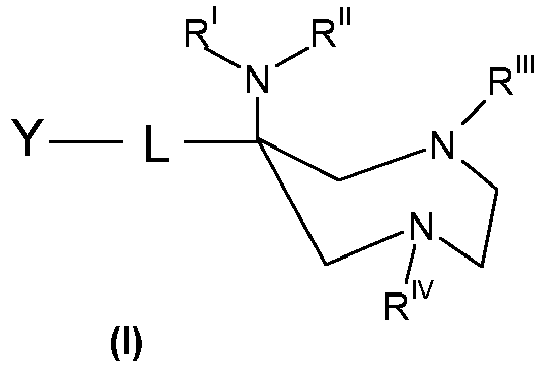
- Y
- is a group of formula: Y'-NH- or (Y')2-N-, wherein Y' is the same or different selected from: a linear or branched saturated or unsaturated C1-C20 alkyl group; a C1-C10 alkyl group interrupted by one or more atom or group selected from: -P-, -O-(HO-P=O)-O- and optionally substituted by one or more group selected from:
hydroxy -OH, carboxy -COOR1, oxycarbonyl-(C1-C30)alkyl and oxycarbonyl-(C2-C30)alkenyl group;
wherein R1 is selected from: hydrogen H and a linear or branched C1-C10 alkyl group; - L
- is a bivalent linker selected from: aliphatic C3-C10 cyclic or heterocyclic ring, linear or branched C1-C6 alkyl group and C2-C6 alkenyl or alkynyl group, optionally substituted and optionally interrupted with a group or atom selected from: carbonyl -C=O, thiocarbonyl -C=S, amino -NR1-, carboxy - COO-, oxy-carbonyl -OCO-, amido -NR1CO- or -CONR1-, oxygen -O- and sulphur -S-, wherein R1 is as above defined;
- RI-IV
- are each independently selected from: hydrogen H, carboxy -COOR1, and -(C1-C6)alkylcarboxy group; wherein R1 is as above defined.
- In a further aspect, the invention provides a process for the preparation of the present compounds of formula (I) or a pharmaceutical acceptable salt thereof:

- a) preparation of an compound of formula:

- b) activation of said terminal carboxylic function of the linker,
- c) amidation reaction between the product of step b) and the Y group as herein defined;
- d) cleavage of any protecting group to give the derivative of formula (I); and optionally
- e) chelation with a paramagnetic metal ion, to give the derivative of formula (I) in the form of a paramagnetic complex.
- According to another aspect, the invention refers to a derivative of formula (I) in the form of a complex with a paramagnetic metal ion, useful as contrast agent for MRI analysis.
- It is a further aspect of the invention a pharmaceutically acceptable composition comprising a chelate derivative of formula (I), or a pharmaceutical salt thereof, in the form of a complex with a paramagnetic metal ion in admixture with one or more physiologically acceptable carriers or excipients.
- Said compositions, in particular, are useful as contrast agent in MRI techniques e.g. as blood pool agents, for the imaging of blood micro circulation in tumour or as contrast agent for angiography.
- The present compositions can be used in a method for imaging body regions comprising administering to a subject to be imaged a diagnostically effective amount of the composition of the invention.
- Therefore, in another aspect, the present invention refers to a method for operating an imaging system, preferably MRI system, comprising the steps of:
- a) submitting a subject pre-treated with a composition of the invention, and positioned in said imaging system, to a radiation frequency selected to interact with the active substrate of said composition; and
- b) recording a signal from said interaction.
- In another embodiment, the present invention refers to a method of diagnosis comprising the administration of an effective dose of a composition of the invention to the human or animal body, examining the body with a diagnostic device and compiling data from the examination. In a preferred embodiment, said method of diagnosis is a MRI method.
- Unless otherwise provided, the term linear or branched C1-C6 alkyl group means a linear or branched chain comprising from 1 to 6 carbon atoms such as: methyl, ethyl, propyl, iso-propyl, butyl, iso-butyl, tert-butyl, pentyl, hexyl and the like.
- Similarly, the terms linear or branched C1-C10 and C1-C20 alkyl group mean a linear or branched chain comprising from 1 to 10 or from 1 to 20 carbon atoms, whereas the term C1-C30 alkyl group means a linear or branched chain comprising from 1 to 30 carbon atoms.
- The term aliphatic C3-C10 cyclic or heterocyclic group optionally substituted means a carbon cyclic ring having from 3 to 10 carbon atoms, optionally interrupted by one or more heteroatoms such as: N, S, or O. Such aliphatic cyclic groups can be isolated (i.e. not embedded in other rings) or fused to one or more ring to constitute a polycyclic moiety. Unless otherwise provided, it should be noted that any heteroatom with free unsatisfied valences is assumed to have hydrogen atom to fulfil the valences. Non limiting examples of aliphatic C3-C10 cyclic groups are: cyclopropane, cyclobutane, cyclopentane, cyclohexane and the like. Non limiting examples of aliphatic C3-C10 heterocyclic groups are: pyrrolidine, piperidine, dioxane, and the like.
- The term aromatic C6-C10 cyclic or heterocyclic group optionally substituted means an aromatic carbon cyclic ring having from 6 to 10 carbon atoms, optionally interrupted by one or more heteroatoms such as: N, O or S. Such aliphatic cyclic groups can be isolated (i.e. not embedded in other rings) or fused to one or more ring to constitute a polycyclic moiety. Non limiting examples of aromatic C6-C10 cyclic groups are: benzene, toluene, xylene, naphthalene, and the like.
- Non limiting examples of aromatic C6-C10 heterocyclic groups are: pyridine, piperazine, thiophene, imidazole, pyrazole, pyrrole, furane, indole and the like.
- The term oxycarbonyl-(C1-C30)alkyl means a group of formula -O(CO)-(C1-C30)alkyl, wherein (C1-C30)alkyl is as above defined.
- The term -(C1-C6)alkylcarboxy group means a group wherein a divalent (C1-C6)alkyl group is bonded to a carboxylic group of formula -COOR1, wherein R1 is as above defined.
- The term "pharmaceutical acceptable" as used herein means that the carrier, diluent excipients and/or salt should be compatible with the other ingredients of the formulation.
- The term "complex" or "paramagnetic complex" comprises within its meaning an adduct between a chelating moiety or ligand and a metal or paramagnetic metal ion respectively. The chelating moiety comprises at least one donor atom bound to the central metal ion.
- Unless stated otherwise, a formula with chemical bonds shown as solid lines and not as wedges or dashed lines contemplates each possible isomer, e.g. each enantiomer and diastereoisomer, and a mixture of isomers such as racemic mixture. The compounds herein described can contain one or more asymmetric centres and thus potentially give rise to diastereoisomers and optical isomers. Unless stated to the contrary, the present invention includes all such possible diastereoisomer as well as their racemic mixtures, their substantially pure resolved enantiomers, all possible geometric isomers, and pharmaceutical acceptable salts thereof.
- In a first aspect, the present invention refers to a new class of derivatives of formula (I), or a pharmaceutical acceptable salt thereof:

- Y is a group of formula: Y'-NH- or (Y')2-N-, wherein Y' is, preferably the same, a linear or branched C1-C20 alkyl group, or a C1-C10 alkyl group interrupted by -P- or -O-(HO-P=O)-O, and optionally substituted by hydroxy -OH, carboxy -COOR1, oxycarbonyl-(C1-C30)alkyl and oxycarbonyl-(C2-C30)alkenyl group;
- Accordingly, the derivatives of the invention comprise up to 2 residues Y' linked to the linker moiety L preferably via an amidic function formed by the nitrogen atom of the Y group and a terminal carbonyl (-C=O) or thiocarbonyl (-C=S) function, present at least at one end of the selected linker L as herein described.
- In a preferred embodiment, the Y group has the formula:
(Y')2-N-
wherein preferred Y' residues are: the same, a C1-C20 alkyl chain, preferably a C2-C15 alkyl chain, even more preferably selected from: C4H9, C6H13, C8H17, C10H21 and C12H25 - Accordingly, preferred Y groups have the formulae:

- Equally preferred are derivatives of formula (I) of the invention, wherein Y has the formula:
Y'-NH-
and wherein Y', is an optionally substituted C1-C10 alkyl group, more preferably a C2-C6 alkyl group, interrupted by one or more group of formula:
- Even more preferably, Y has the formula: Y'-NH- , wherein Y' is a linear alkyl group having 4 to 6 carbon atoms, interrupted by one or more group of formula:

- Also preferably, Y is a phospholipid having the formula: Y'-NH- wherein Y' is a C2-C6 alkyl group, interrupted by one or more group of formula:

- Accordingly, in a still preferred embodiment, Y is selected from:


- According to a further embodiment, within the new class of derivatives of formula (I) of the present invention, the linker L is a divalent group which connects the diazepine moiety to the Y group, thus providing a proper distance that can be suitably selected.
- In a preferred embodiment, the linker L is an optionally substituted linear or branched C1-C6 alkyl or C2-C6 alkenyl or alkynyl group, or a C3-C8 cyclic group, preferably, functionalised at one terminal side with a thiocarbonyl group (-C=S), or more preferably with a carbonyl group (-C=O) as the connection point with the terminal nitrogen atom of the Y residue in the derivatives of formula (I) of the present invention.
- In a still preferred embodiment, the linker L is a carbonyl-alkyl derivative selected from: an optionally substituted C1-C6 linear alkyl group derivative and a cycloalkyl C6-C8 residue, having a carbonyl function at the terminal side connected to the Y group. Examples of preferred linkers L are: methylcarbonyl, ethylcarbonyl, propylcarbonyl, butylcarbonyl, pentylcarbonyl and linear or cyclic hexylcarbonyl. Even more preferably, the linker L is selected from:
- butyl carbonyl of formula:

- Cyclohexyl carbonyl of formula:

- As formerly indicated, the linker L is bound at one side to the Y group, and on the other side to the diazepine core. As shown above, the Y group of formula Y'-NH- or (Y')2-N- presents a terminal nitrogen atom and preferably, the linker L is bound to Y through the secondary -NH- nitrogen atom, or equally preferably, via the tertiary -N- nitrogen atom, as part of an amidic functionality.
- In this respect, preferred L-Y- systems are selected from:

- In an even more preferred embodiment, the present invention refers to a new class of derivatives and pharmaceutical acceptable salts thereof, according to a formula (I) selected from the group consisting of:


- In the class of derivatives of formula (I) of the invention, and according to any one of the above preferred embodiment, the groups RI, RII, RIII and RIV are preferably a carboxylic derivative or a salt thereof, e.g. a group of formula:
-R2-COOR1 or -R2-COO- M+
wherein - R2 is a bond or a C1-C6 alkyl residue;
- R1 is as above defined, preferably hydrogen;
- and M+ is a counterion. e.g. a metal ion as herein below specified.
- In a still further embodiment, the R2 group is a bivalent radical selected from: methylene, ethylene, propylene and butylene, being methylene more preferred. In a still preferred embodiment, the groups RI-IV are, the same, a carboxymethyl group of formula -CH2-COOH or -R2-COO- M+ as formerly defined, whereby, preferred compounds of formula (I) of the invention have the following general formula (I'):


- All the above formulae refer to the compounds in an optical pure form as well as component of a racemic mixture thereof.
- In another aspect, the invention relates to the compounds of the formula (I) or a pharmaceutical salt thereof as extensively herein described, in the form of a complex with a paramagnetic metal ion, preferably selected from: Gd(III), Mn(II), Cr(III), Cu(II), Fe(III), Pr(III), Nd(III), Sm(III), Tb(III), Yb(III), Dy(III), Ho(III) and Er(III), whereas Gd(III) and Dy(III) are particularly preferred. Of note, such paramagnetic amphiphilic complexes can be prepared by analogy with other known procedures used in the art for the preparation of paramagnetic metal complexes, such as reaction of the precursor derivative of formula (I) with the metal of choice, the latter e.g. in the form of oxide, chloride or acetate, in a suitable solvent, typically water (for a general reference see
WO00/30688 - Even further, compound of formula (I), also when in the form of amphiphilic complex as above explained, are generally in the form of a salt with physiologically acceptable bases or physiologically acceptable ions of organic or inorganic acids. In this respect, preferred bases are selected from: primary, secondary, tertiary amines, basic aminoacids and inorganic hydroxides of sodium, potassium, magnesium, calcium or mixture thereof. Preferred anions of organic acid are: acetate, succinate, citrate, fumarate, maleate, oxalate; whereas preferred anions of inorganic acids are selected from: hydrogen halides, sulphates, phosphates, phosphonate and the like. Suitable salts can also be formed with cations or anions of aminoacids selected from: lysine, arginine, ornithine, aspartic or glutamic acid, and the like.
- Preferred compounds of formula (I) in the form of paramagnetic amphiphilic complexes or salts thereof, according to the present invention are selected from:


- In a further embodiment, the present paramagnetic complexes or pharmaceutically acceptable salts thereof are suitable for the use as MRI contrast agent.
- The compounds of formula (I) of the invention, in their form of paramagnetic metal complex, advantageously, show remarkably high relaxivity values, in particular when compared to known contrast agent commercially available and employed in diagnostic experiments. As evident from the Table 1 in the herein included experimental part, the relaxivity of the compounds of the invention is in fact unexpectedly high when compared to some other well known compounds used as contrast agent in MRI, such as e.g. gadolinium-tetraazacyclododecanetetraacetic acid (Gd-DOTA). Of note, the amphiphilic complex of the invention dissolve in aqueous solution and in human plasma and when lipophilic able to penetrate phospholipid bilayers and to interact with intracellular water protons increasing their relaxation rates. On the contrary, conventional gadolinium chelates are highly hydrophilic and not taken up spontaneously by cells.
- Therefore, in a further embodiment, the invention relates to the use of a compound of formula (I) in the form of amphiphilic paramagnetic metal complex, or a pharmaceutical acceptable salt thereof, for the preparation of a MRI contrast agent. Even further, such paramagnetic complexes or pharmaceutically acceptable salt thereof, can be conveniently used in the preparation of MRI contrast agents or formulations, particularly useful as blood pool agent, for the imaging of blood microcirculation in tumour, as contrast agent for angiography, as well as for the imaging of inflamed tissues in general.
- According to a further aspect, the present invention refers to pharmaceutical acceptable compositions comprising the derivatives of formula (I), or a pharmaceutical salt thereof, in the form of a complex in admixture with one or more physiologically acceptable excipients, diluents or solvents. The present compositions can be suitably formulated for administration by any convenient route, e.g. formulated for oral, parenteral, topical (including ophthalmic and nasal), or in a form suitable for administration by inhalation or insufflation (either through the mouth or nose). Such compositions are preferably injectable compositions, adapted for use as contrast agent in imaging techniques, in particular for MR imaging techniques, and can conveniently be formulated in aqueous solutions or dispersions at a physiologically acceptable pH.
- According to further embodiments the compounds of the invention, the present compounds can be formulated in micelles or in liposomes with physiologically acceptable additives i.e. selected from surfactants amphiphatic compounds and/or stealth compounds, such as PEG. According to this embodiment, such formulations comprise a derivative of formula (I) in the form of a paramagnetic complex or a salt thereof, in admixture with one or more surfactant and/or amphipatic compounds.
- Of note, the compositions comprising the present compounds in supramolecular aggregates such as micelles, is obtained using known techniques, for instance as described in
WO97/00087 - The compositions of the invention can be collected, and even stored, as solid according to known methods, e.g. by lyophilization and the like. In this respect, the dry form (porous lumps or free flowing powder) is particularly convenient for long-term storage. The formulation can then be reconstituted before usage by dispersion of the lyophilized in a physiologically acceptable liquid carrier, thus obtaining a suspension corresponding to the early formulation and directly usable as MRI contrast agent. In another aspect, the invention relates to a kit of parts comprising the above described lyophilized components and separately the liquid carrier. In particular, the lyophilized components may be stored under a dry, inert atmosphere whereas the carrier liquid may further contain isotonic additives and other physiologically acceptable components, such as amino acids or the like.
- The compounds of formula (I) of the invention can be prepared by a process comprising at first the formation an adduct between the selected linker L and the diazepine moiety, followed by activation of the carboxylic function on the terminal side of the linker, and subsequent amidation with the selected Y group. Finally, the protecting groups, where present in the obtained product, are removed and the derivative is optionally complexed with a selected paramagnetic metal.
- The adduct between the linker L and the diazepine moiety as starting material of the present process is obtained by reaction of a suitable nitro derivative, which is a precursor of the selected linker moiety, with N,N'-dibenzylethylenediamine, which is the precursor of the diazepine core of the present derivatives, followed by reduction and functionalization of the nitro group, typically by hydrogenation and subsequent N-alkylation under basic conditions. As clearly supported and illustrated in the present experimental part, said adduct between the linker and the diazepine moiety can advantageously be prepared and used as building block for the preparation of a series of derivatives of formula (I) by varying the selected moiety Y.
- Therefore, it is an aspect of the invention a process for the preparation of the above defined compounds of formula (I):

- a) preparation of an adduct of formula:

- b) activation of said terminal carboxylic function of the linker,
- c) amidation reaction between the product of step b) and the Y group as above defined;
- d) cleavage of any protecting group to give the derivative of formula (I); and optionally
- e) chelation with a paramagnetic metal ion, to give the derivative of formula (I) in the form of a paramagnetic complex.
- According to an illustrative example, the process of the invention can be generally represented by the processes for the preparation of derivative 12a, wherein the compound 5 is the starting adduct, as indicated in the Scheme 1 below:

- In particular, the adduct 5 between the linker and the diazepine moiety is prepared by reaction of N,N'-dibenzyethylenediamine diacetate and an alcoholic solution of 6-nitrohexanoic acid methyl ester 1, in the presence of paraformaldehyde followed by: reduction and debenzylation of the nitro group 2, functionalization of the amine nitrogen atom 3 and selective cleavage of the terminal carboxylic group 4, as indicated in Scheme 2, herein below:

- The diazepine adduct, as generally represented by 5, is subjected to the activation of the terminal carboxylic function as per step b) of the present process. In this direction, step b) can be carried out e.g. according to procedures generally known in organic chemistry for the activation of carboxylic functions, typically by reaction with a carboxyl activating agent, such as N-hydroxysuccinimide (NHS) in the presence of a carbodiimide such as dicyclohexylcarbodiimide (DCC) or 1-ethyl-3-(3-dimethylaminopropyl)-carbodiimide (EDC), in a molar ratio of at least 1:1 or preferably in a slight excess with respect to the starting material, e.g. in a molar ratio up to 1:1.5, in a proper organic solvent, such as an apolar organic solvent selected from: CHCl3, CH2Cl2 and the like. Preferably, step b) is conducted in the presence of N-hydroxysuccinimide (NHS) and EDC in a molar ratio from 1:1 to 1:1.1 with respect to the starting material, and in the presence of CH2Cl2. The thus obtained derivative is then subjected according to step c) to an amidation reaction between the thus activated carboxylic terminal group of the linker L and the nitrogen atom of the selected Y residue for instance dibutylamine, generally in the presence of a diisopropylethylamine (DIPEA). Preferably, the amidation reaction is carried out by dissolving the activated compound obtained after step b) in CHCl3 and adding for instance dibutylamine and DIPEA in this order in a molar ratio from 1:1 to 1:1.7 with respect to the activated starting material. The solution is then stirred for a proper frame of time at a selected temperature, typically at room temperature (e.g. at a temperature comprised from 15 to 30° C) generally for a period up to 20-24 hours. The thus formed amide product can be conveniently worked up, e.g. by washing with water and by evaporating the separated organic phase, generally under vacuum or distillation procedure. After purification, for instance by chromatography, the product of formula (I) is obtained in a protected form, e.g. preferably as tert-butyl ester derivative, in high yield (about 80%) and with a high degree of purity (about 95-99% HPLC).
- According to step d) the derivatives of formula (I) obtained in their carboxylic protected form, can be readily deprotected under conditions known in the art, and dependent for instance on the kind of protecting group actually employed in step a). For a general reference on the choice of possible protecting groups, see "Greene's protective groups in organic synthesis" Wiley 14th Ed.
- In a preferred embodiment, the carboxylic function is protected as tert-butyl ester, and the deprotection is carried out under acidic conditions, typically in the presence of trifluoroacetic acid (TFA) and an organic apolar solvent such as CH2Cl2.
- After deprotection, the thus obtained compounds of formula (I) can suitably be reacted with a metal ion containing compound in order to obtain the corresponding metal complex derivatives. Said transformation is typically carried out by reaction with an inorganic or organic salt or oxide of the selected metal, operating in the presence of a solvent such as water or organic solvent, e.g. CHCl3 or MeOH, or mixture thereof. Preferred counter ions are chloride or acetate, and preferred salts are: GdCl3, DyCl3, Gd(OAc)3 or Dy(OAc)3, whereas preferred oxides are: Gd2O3 or Dy2O3.
- As formerly reported, the derivatives of formula (I) of the present invention, in the form of a paramagnetic complex, are endowed with a particularly high degree of relaxivity (generally indicated as r1p) and long lasting activity and stability, as demonstrated in the present Experimental part, Table I and Table II. Relaxivity (r1p) is an intrinsic property of paramagnetic complexes which characterizes their ability to increase the nuclear magnetic relaxation rate of vicinal protons. High relaxation rates, i.e. high relaxivity values, ensure increased contrast in the image, which makes possible to obtain diagnostic information in a short time frame. On the other hand, a long lasting activity and stability ensure both a visualization of the contrast agent for a proper frame of time, thus allowing a better and clear identifications of the regions analysed during the imaging method, and a proper excretion time from the body, thus avoiding unnecessary retaining of the contrast media within the sample.
- Therefore, the present derivatives are particularly suitable for the use in the preparation of a diagnostic composition to be used in MRI techniques. Hence, according to another aspect, the present invention provides a method for imaging of body regions comprising administering to a subject to be imaged a diagnostically effective amount of a composition of the invention. Preferably said method is a MRI method comprising administering to a subject to be imaged a diagnostically effective amount of a composition of the invention comprising a compound of formula (I) in the form of complex with a paramagnetic metal ion, wherein said metal ion is preferably selected from Gd3+ and Dy3+.
- The present invention thus refers to a method for operating an imaging system, comprising the steps of:
- a) submitting a subject pre-treated with a composition of the invention and positioned in said imaging system, to a radiation frequency selected to interact with the active substrate of said composition; and
- b) recording a signal from said interaction.
- Even more preferably, the invention refers to a MRI methods comprising the steps of:
- a) submitting a subject pre-treated with a composition of the invention comprising a compound of formula (I) in the form of a paramagnetic complex, to a radiation frequency selected to excite nuclear spin transitions in a non-zero nuclear spin nuclei of said active substrate; and
- b) recording a MR signal from said excited nuclei.
- As extensively reported above, the present invention advantageously provides a new class of diazepine of formula (I) and pharmaceutical salts thereof, obtainable by a straight full and convenient process, useful for the preparation of paramagnetic complexes, employable e.g. as contrast agent in MRI analysis. Even further, the relaxivity (r1p) values of the present paramagnetic complexes are surprisingly high, thus rendering them a valid and convenient alternative to the prior art complexes as MRI contrast agents. Advantageously, the present complexes can be administrated as pharmaceutical compositions, showing a high relaxation rate and stability, thus allowing a low dosage.
- The following examples are only representative of the invention and are not intended to limit its scope.
-

- Compound 5 was prepared in five steps according to the procedure described in
US2006018830 as illustrated in the Scheme 2 below.
- Commercially available 2-nitrocyclohexanone was refluxed in MeOH in presence of Amberlyst A21 to give 6-nitrohexanoic acid methyl ester 1. Reaction of 1 with N,N'-dibenzylethylenediamine diacetate and paraformaldehyde gave diazepine 2 which was firstly hydrogenated to 3 and then alkylated with t-butyl bromoacetate to give pentaester 4. Selective hydrolysis of 4 by means of LiOH in THF/H2O gave 5. Overall yield 13 %.
- Compound 5 (14.6 g; 0.022 mol) was dissolved in CH2Cl2 (350 mL), then NHS was added (3.75 g; 0.033 mol) and the mixture was cooled at 0 °C with an ice-bath. A solution of EDC (6.25 g; 0.033 mol) in CH2Cl2 (150 mL) was added drop wise, then the reaction solution was stirred for 24 h at room temperature. The mixture was washed with H2O (3 x 150 mL). The organic phase was dried (Na2SO4), filtered and evaporated to give 6 as a yellow oil (15.42 g; 0.020 mol).
Yield 92%.
Analytical data: - Mr: 768.94 (C38H64N4O12)
- 1H- and 13C-NMR and MS are compatible with the structure
- Compound 6 (1 eq) was dissolved in CHCl3 (concentration 1% w/v). The suitable phosphoethanolamine (1eq) (1,2-didecanoyl-sn-glycero-3-phosphoethanolamine, DLPE or DPPE) and diisopropylethylamine (DIPEA) (1.7 eq) were added in this order. The solution was stirred at room temperature from 3h to 24h. The mixture was washed subsequently with H2O (1 x 50 mL), acidic H2O (pH 4-5 with HCl; 1 x 50 mL) and H2O (1 x 50 mL). The organic phase was dried (Na2SO4), filtered and evaporated. The crude thus obtained was purified by flash chromatography to give compounds 7(a-c) as a white solid.
- Starting materials: Compound 6 (797 mg; 1.04 mmol); 1,2-didecanoyl-sn-glycero-3-phosphoethanolamine (543 mg; 1.04 mmol)
Compound 7a (937 mg; 0.796 mmol). Yield 77%.
Analytical data: - HPLC-ELSD: ELSD 100% (area %); UV 89.1% (area %)
- Mr: 1177.50 (C59H109N4O17P)
- 1H- and 13C-NMR and MS are compatible with the structure
- Starting materials: Compound 6 (700 mg; 0.91 mmol); 1,2-dilauroyl-sn-glycero-3-phosphoethanolamine DLPE (500 mg; 0.86 mmol)
Compound 7b (927 mg; 0.751 mmol). Yield 87%.
Analytical data: - HPLC-ELSD: ELSD 100% (area %); UV 80.0% (area %)
- Mr: 1233.61 (C63H117N4O17P)
- 1H- and 13C-NMR and MS are compatible with the structure
- Starting materials: Compound 6 (1.92 g; 2.50 mmol); 1,2-dipalmitoyl-sn-glycero-3-phosphoethanolamine DPPE (1.73 g; 2.50 mmol).
Compound 7c (2.79 g; 2.07 mmol). Yield 83%.
Analytical data: - HPLC-ELSD: ELSD 100% (area %); UV 89.0% (area %)
- Mr: 1345.82 (C71H133N4O17P)
- 1H- and 13C-NMR and MS are compatible with the structure
- Compound 7(a-c) (1 eq) was dissolved in CH2Cl2 (concentration 2-4% w/v) and the solution was stirred and cooled at 0° C, then TFA (6 eq) was added drop wise. The reaction mixture was stirred for 1 h at room temperature. The orange solution was evaporated and the residue was dissolved in fresh TFA (30 eq) was added. This solution was stirred for 80 h at room temperature; the reaction was monitored by MS and HPLC-ELSD. The mixture was evaporated and the residue was treated with diisopropyl ether to obtain a white solid that was centrifuged and washed with diisopropyl ether (2 x 30 mL). That solid was suspended in H2O, dissolved at pH 6-7 by addition of 5% aq NaHCO3 and precipitated at pH 2 by addition of 1M HCl. The solid was filtered and dried at reduced pressure (P2O5) to obtain the ligands 8(a-c) according to the data below.
- Starting material: Compound 7a (885 mg; 0.752 mmol).
Compound 8a (669 mg; 0.702 mmol); Yield 93%
Analytical data: - HPLC-ELSD: ELSD 92.3% (area %)
- Mr: 953.07 (C43H77N4O17P)
- Complexometric Titer (1.001 mM GdCl3): 95.7%
- 1H- and 13C-NMR and MS are compatible with the structure
- Starting material: Compound 7b (875 mg; 0.709 mmol).
Compound 8b (750 mg; 0.642 mmol); Yield 91%
Analytical data: - HPLC-ELSD: ELSD 75.5% (area %)
- Mr: 1009.18 (C47H85N4O17P)
- 1H- and 13C-NMR and MS are compatible with the structure
- Starting material: Compound 7c (2.79 g; 2.07 mmol)
Compound 8c (1.77 g; 1.58 mmol); Yield 76%
Analytical data: - HPLC-ELSD: ELSD 95.3% (area %)
- Mr: 1121.39 (C55H101N4O17P)
- Complexometric Titer (1.001 mM GdCl3): 95.7%
- 1H- and 13C-NMR and MS are compatible with the structure
- The ligands 8(a-c) (1 eq) was suspended in H2O (concentration 5%; starting pH 1-2) and dissolved at pH 6.5-7 by addition of 5% aq NaHCO3. A titrated solution of GdCl3 (1 eq) was added in portions. The solution was stirred at room temperature and pH was maintained by addition of 5% aq NaHCO3. The complexation was monitored by HPLC-ELSD and with Xylenol Orange assay. The crude complexes were isolated by lyophilization and were purified from salts by size exclusion chromatography to give 9(a-c).
- Starting material: Compound 8a (400 mg; 0.438 mmol)
Compound 9a (257 mg; 0.228 mmol); Yield 52%
Analytical data: - HPLC-ELSD: ELSD 98.9% (area %)
- Mr: 1129.28 (C43H73GdN4NaO17P)
- MS is compatible with the structure
- Starting material: Compound 8b (690 mg; 0.590 mmol)
Compound 9b (614 mg; 0.518 mmol); Yield 88%
Analytical data: - HPLC-ELSD: ELSD 95.6% (area %)
- Mr: 1185.39 (C47H81GdN4NaO17P)
- MS is compatible with the structure
- Starting material: Compound 8c (500 mg; 0.435 mmol)
Compound 9c (517 mg; 0.398 mmol); Yield: 92%
Analytical data: - HPLC-ELSD: ELSD 99.2 % (area %) [8]
- Mr: 1297.60 (C55H97GdN4NaO17P)
- MS is compatible with the structure
- The ligand 8b was complexed alternatively in organic media. Ligand 8b (0.506 g; 0.475 mmol) was dissolved in CHCl3 (70 mL) and a solution of Gd(OAc)3 0.011 M in 10:1 v/v MeOH/H2O (29.1 mL; 0.309 mmol) was added in portions. Subsequently, the pH was adjusted to 7 using pyridine. The complexation was monitored by HPLC-ELSD and with Xylenol Orange assay and finally the solution was evaporated under reduced pressure. The residue was dissolved subsequently in 1:1 v/v MeOH/toluene (3 x 30 mL) and CHCl3 (3 x 30 mL) and evaporated after each dissolution then the oily residue was suspended in H2O and lyophilized. The white solid was suspended in H2O, adjusted to pH 7 and lyophilized; the latter treatment was repeated twice to obtain Compound 9b as a white solid (0.750 g). Quantitative yield.
Analytical data: HPLC-ELSD: ELSD 82.6% (area %)
Mr: 1185.39 (C47H81GdN4NaO17P).
MS is compatible with the structure - Compounds 12(a-e) are prepared according to the Scheme 4:

- Compound 6 prepared according to Example 1.1a (1 eq) was dissolved in CHCl3 (concentration 1-3% w/v) then the suitable dialkylamine (1 eq) and DIPEA (1.7 eq) were added subsequently. The reaction solution was stirred at room temperature for 24 h then was washed subsequently with H2O (1 x 50 mL), acidic H2O (pH 4-5 with HCl; 1 x 70 mL) and H2O (1 x 50 mL). The organic phase was dried (Na2SO4), filtered and evaporated. The crude thus obtained was purified by flash chromatography to give compounds 10(a-e) as an oil, according to the results as indicated below:
- Starting materials: Compound 6 (1.50 g; 1.95 mmol); dibutylamine (0.332 mL; 1.95 mmol)
Compound 10a (1.51 g; 1.93 mmol). Yield 98 %
Analytical data: - HPLC-ELSD: ELSD 95.8 % (area %); UV 92.0 % (area %)
- Mr: 783.10 (C42H78N4O9)
- 1H- and 13C-NMR and MS are compatible with the structure
- Starting materials: Compound 6 (2.50 g; 3.25 mmol); dihexylamine (0.758 mL; 3.25 mmol)
Compound 10b (1.70 g; 2.03 mmol). Yield: 62 %.
Analytical data: - HPLC-ELSD: ELSD 99.0 % (area %); UV 99.5 % (area %)
- Mr: 839.21 (C46H86N4O9).
- 1H- and 13C-NMR and MS are compatible with the structure
- Starting materials: Compound 6 (2.50 g; 3.25 mmol); dioctylamine (0.981 mL; 3.25 mmol)
Compound 10c (2.16 g; 2.41 mmol). Yield: 74 %.
Analytical data: - HPLC-ELSD: ELSD 98.7 % (area %); UV 99.3 % (area %)
- Mr: 895.31 (C50H94N4O9)
- 1H- and 13C-NMR and MS are compatible with the structure
- Starting materials: Compound 6 (1.92 g; 2.50 mmol); didecylamine (0.743 g; 2.50 mmol)
Compound 10d (2.26 g; 2.38 mmol). Yield: 95 %.
Analytical data: - HPLC-ELSD: ELSD 95.3 % (area %); UV 87.7 % (area %)
- Mr: 951.42 (C54H102N4O9)
- 1H- and 13C-NMR and MS are compatible with the structure
- Starting materials: Compound 6 (3.13 g; 4.07 mmol); didodecylamine (1.44 g; 4.07 mmol)
Compound 10e (4.30 g; 4.27 mmol). Yield: 105 % (solvent residue). Analytical data: - HPLC-ELSD: ELSD 89.7 % (area %); UV 93.0 % (area %)
- Mr: 1007.53 (C58H110N4O9).
- 1H- and 13C-NMR and MS are compatible with the structure
- Compound 10(a-e) (1 eq) was dissolved in CH2Cl2 (20-50 mL) and the solution obtained was stirred and cooled at 0° C, then TFA (6 eq) was added drop wise. The reaction mixture was stirred for 1 h at room temperature. The orange solution was evaporated and the residue was dissolved in fresh TFA (50 eq). This solution was stirred for 80 h; the reaction was monitored by MS and HPLC-ELSD. The mixture was evaporated and the residue was treated with diisopropyl ether (70 mL) to obtain a white precipitate that was filtered or centrifuged, washed with diisopropyl ether (2 x 20 mL) and dried at reduced pressure (P2O5; NaOH pellets). This procedure was applied to obtain ligands 11a, 11b and 11c as solid. Conversely for 11d and 11e, after the ether treatment, the crude ether was suspended in H2O, dissolved at pH 6-7 by addition of 2N NaOH and precipitated at pH 2 by addition of 1M HCl. The solid was filtered and dried at reduced pressure (P2O5) to obtain ligands 11d and 11e as white solids.
- Starting material: Compound 10a (1.40 g; 1.79 mmol)
Compound 11a: (0.868 g; 1.55 mmol); Yield: 86 %
Analytical data: - HPLC-ELSD: ELSD 93.0 % (area %)
- Mr: 558.67 (C26H46N4O9)
- 1H- and 13C-NMR and MS are compatible with the structure
- Starting material: Compound 10b (1.70 g; 2.03 mmol)
Compound 11b: (1.28 g; 2.08 mmol); Quantitative yield
Analytical data: - HPLC-ELSD: ELSD 57.7 % (area %)
- Mr: 614.78 (C30H54N4O9)
- 1H- and 13C-NMR and MS are compatible with the structure
- Starting material: Compound 10c (2.16 g; 2.41 mmol)
Compound 11c (1.31 g; 1.95 mmol); Yield: 81 %
Analytical data: - HPLC-ELSD: ELSD 78.6 % (area %)
- Mr: 670.45 (C34H62N4O9)
- Complexometric Titer (0.963 mM GdCl3): 95 %
- 1H- and 13C-NMR and MS are compatible with the structure
- Starting material: Compound 10d (2.20 g; 2.31 mmol)
Compound 11d (1.08 g; 1.48 mmol); Yield: 64 %
Analytical data: - HPLC-ELSD: ELSD 95.7 % (area %)
- Mr: 726.99 (C38H70N4O9)
- Complexometric Titer (1.001 mM GdCl3): 94 %
- 1H- and 13C-NMR and MS are compatible with the structure
- Starting material: Compound 10e (4.30 g; 4.27 mmol);
Compound 11e (2.83 g; 3.61 mmol); Yield: 85 %
Analytical data: - HPLC-ELSD: ELSD 82.4 % (area %).
- Mr: 783.10 (C42H78N4O9).
- 1H- and 13C-NMR and MS are compatible with the structure
- The ligands 11(a-e) (1 eq) were suspended in H2O (concentration 5% w/v; starting pH 1-2), and dissolved at pH 6.5-7 by addition of 2N NaOH. A titrated solution of GdCl3 (1 eq) was added in portions. The mixture was stirred at room temperature and pH was maintained by addition of 0.1N NaOH. The complexation was monitored by HPLC-ELSD and with Xilenol Orange assay. The mixture was evaporated to reduce the solvent volume. Complexes 12a and 12b were purified from salts by size exclusion chromatography while complexes 12c, 12d and 12e were isolated by precipitation and filtration.
- Starting material: Compound 11a (0.800 g; 1.16 mmol);
Compound 12a: (0.715 g; 0.97 mmol); Yield: 84 %
Analytical data: - HPLC-ELSD: ELSD 93.9 % (area %)
- Mr: 735.89 (C26H42GdNaN4O9)
- KF: 10.01 %
- MS is compatible with the structure
- Starting material: Compound 11b (1.28 g; 1.49 mmol);
Compound 12b (0.550 g; 0.70 mmol); Yield: 47 %
Analytical data: - HPLC-ELSD: ELSD 98.0 % (area %)
- Mr: 790.99 (C30H50GdN4NaO9)
- KF: 12.63 %
- MS is compatible with the structure
- Starting material: Compound 11c (1.14 g; 1.27 mmol);
Compound 12c (1.03 g; 1.22 mmol); Yield: 96 %
Analytical data: - HPLC-ELSD: ELSD 100.0 % (area %)
- Mr: 847.10 (C34H58GdN4NaO9)
- KF: 5.07 %
- MS is compatible with the structure
- Starting material: Compound 11d (1.1 g; 1.48 mmol);
Compound 12d (1.12 g; 1.24 mmol); Yield 90 %
Analytical data: - HPLC-ELSD: ELSD 94.6 % (area %)
- Mr: 903.20 (C38H66GdN4NaO9)
- MS is compatible with the structure
- Starting material: Compound 11e (1.10 g; 1.37 mmol);
Compound 12e (1.02 g; 1.06 mmol); Yield: 78 %
Analytical data: - HPLC-ELSD: ELSD 94.3 % (area %)
- Mr: 959.31 (C42H74GdN4NaO9).
- MS is compatible with the structure
- Compound 21 is prepared according to the Scheme 5:

- Concentrated H2SO4 (15 mL) was added to a solution of trans-4-hydroxymethylcyclohexane carboxylic acid 13 (15 g; 94.8 mmol) in MeOH (300 mL) then the reaction mixture was stirred and refluxed for 4 h. The solution was concentrated under reduced pressure and basified by addition of aq. NH4OH; the white solid was filtered off and the mother liquor was extracted with EtOAc (3 x 70 mL). The combined organic layers were washed with saturated aq. NaCl, dried (Na2SO4) and evaporated at reduced pressure to give 14 as a yellow liquid (17.26 g) that was employed in the following reaction without further purification.
Quantitative yield.
Analytical data: - Mr: 172.22 (C9H16O3)
- 1H- and 13C-NMR and MS are compatible with the structure
- To a solution of compound 14 (17.26 g) in THF (450 mL) stirred at 0° C was added triethylamine (39.4 mL; 284.5 mmol) followed by methanesulfonyl chloride (14.9 mL; 151.7 mmol). The mixture was stirred at 0° C for additional 10 min then the reaction mixture was stirred at room temperature for 2 h. The reaction mixture was filtered through a Celite (0,01-0,04 mm) bed that was then washed with fresh THF; the resulting solution was evaporated under reduced pressure to give 15 as a yellow oil (30.95 g) that was employed in the following reaction without further purification.
Quantitative yield.
Analytical data: - Mr: 250.30 (C10H18O5S)
- 1H- and 13C-NMR and MS are compatible with the structure
- A solution of compound 15 (30.95 g) and sodium iodide (42.64 g; 284.5 mmol) in acetone (450 mL) was stirred at room temperature for 2 h then refluxed for 3.5 h. After 60 h at room temperature additional NaI (5 g; 17.7 mmol) was added and the solution was refluxed for further 7 hours. The reaction was monitored by TLC. The solvent was evaporated under reduced pressure and the yellow residue was treated with diethyl ether; the insoluble salts were filtered off and washed with fresh diethyl ether. The filtrate was evaporated and the dark yellow crude was purified by flash chromatography to give 16 as a yellow liquid (22.43 g; 79.5 mmol).
Yield: 84 %
Analytical data: - Mr: 282.12 (C9H15IO2)
- 1H- and 13C-NMR and MS are compatible with the structure
- Compound 16 (21.92 g; 77.7 mmol) was added to a solution of sodium nitrite (10.72 g; 155.4 mmol) and phloroglucinol (10.78 g; 85.4 mmol) in DMSO (1 L) and the solution was stirred at room temperature under a N2 atmosphere for 48 h. The reaction mixture was diluted with H2O (3 L) and extracted with Et2O. The organic layer was dried (Na2SO4) and evaporated to give a crude that was purified by flash chromatography. Compound 17 (10.35 g; 51.4 mmol) was afforded as a pale yellow liquid. Yield: 66 %
Analytical data: - HPLC: 97.9 % (HPLC Area %)
- Mr: 201.22 (C9H15NO4)
- 1H- and 13C-NMR and MS are compatible with the structure
- A suspension of N,N'-dibenzylethylenediamine diacetate (18.29 g; 50.7 mmol) in EtOH (400 mL) was stirred at 60° C until a clear solution was obtained; paraformaldehyde (4.57 g; 152.2 mmol) was added and the suspension was heated at 80° C for 1.5 h to give a dark orange clear solution. A solution of compound 17 (10.21 g; 50.7 mmol) in EtOH was added dropwise and the final solution was stirred at 80° C for 6 h; the reaction was monitored by HPLC. After 15 h at room temperature, the resulting precipitate was filtered, washed with EtOH and dried under vacuum to give 18 as a white solid (17.88 g; 38.4 mmol).
Yield: 76%
Analytical data: - HPLC: 99.6 % (HPLC Area %)
- Mr: 465.59 (C27H35N3O4)
- 1H- and 13C-NMR and MS are compatible with the structure.
- A suspension of compound 18 (17.88 g; 38.4 mmol) in THF (200 mL) was stirred at 40° C until a clear solution was obtained then the solution was diluted with MeOH (150 mL). A suspension of 5% Pd/C (10.66 g) in MeOH (50 mL) was added and the mixture was hydrogenated at 40° C for 11 h at ambient pressure. The catalyst was filtered off and the solution was evaporated to give 19 as a greenish oil (9.57 g; 37.4 mmol). This product was used in the following without purification.
Yield: 98 %
Analytical data: - Mr: 255.36 (C13H25N3O2)
- 1H- and 13C-NMR and MS are compatible with the structure.
- The compound 19 (9.52 g; 37.3 mmol) was dissolved in CH3CN (400 mL) then freshly grounded K2CO3 (23.19 g; 167.8 mmol) and Na2SO4 (15.88 g; 111.8 mmol) were added. t-butyl bromoacetate (24.6 mL; 167.8 mmol) was added and the orange mixture was stirred at 80 °C for 16 h. The salts were filtered off, and the filtrate was evaporated to residue that was dissolved in EtOAc (200 mL) and the solution washed with H2O (3 x 70 mL) and saturated aq. NaCl (70 mL). The organic phase was dried (Na2SO4), filtered and evaporated. The crude (27.36 g) was purified with flash chromatography to give 20 as a pale yellow oil (5.34 g; 7.5 mmol).
Yield: 20 %
Analytical data: - Mr: 711.93 (C37H65N3O10)
- 1H- and 13C-NMR and MS are compatible with the structure
- 2N NaOH (7.12 mL; 14.2 mmol) was added to a solution of compound 20 in i-PrOH (100 mL) stirred at room temperature then H2O (5.5 mL) was added until a homogeneous mixture was obtained. The solution was stirred for 5.5 h at room temperature, as the reaction was not completed, the solution was stored at -20° C for 15 h. The temperature was allowed to raise to room temperature and the reaction mixture was stirred for further 3 h. The pH was corrected to 7 with 2N HCl (7.12 mL) and the solution was evaporated under reduced pressure at room temperature. The residue was suspended in H2O (80 mL), acidified with 2N HCl (7.12 mL) and extracted with EtOAc. The organic layer was dried (Na2SO4) and evaporated to give 21 as a white solid (4.5 g; 6.45 mmol). Yield: 90 %
Analytical data: - Mr: 697.91 (C36H63N3O10).
- 1H- and 13C-NMR and MS are compatible with the structure.
- Compounds 25 (a-c) are prepared according to the Scheme 6:
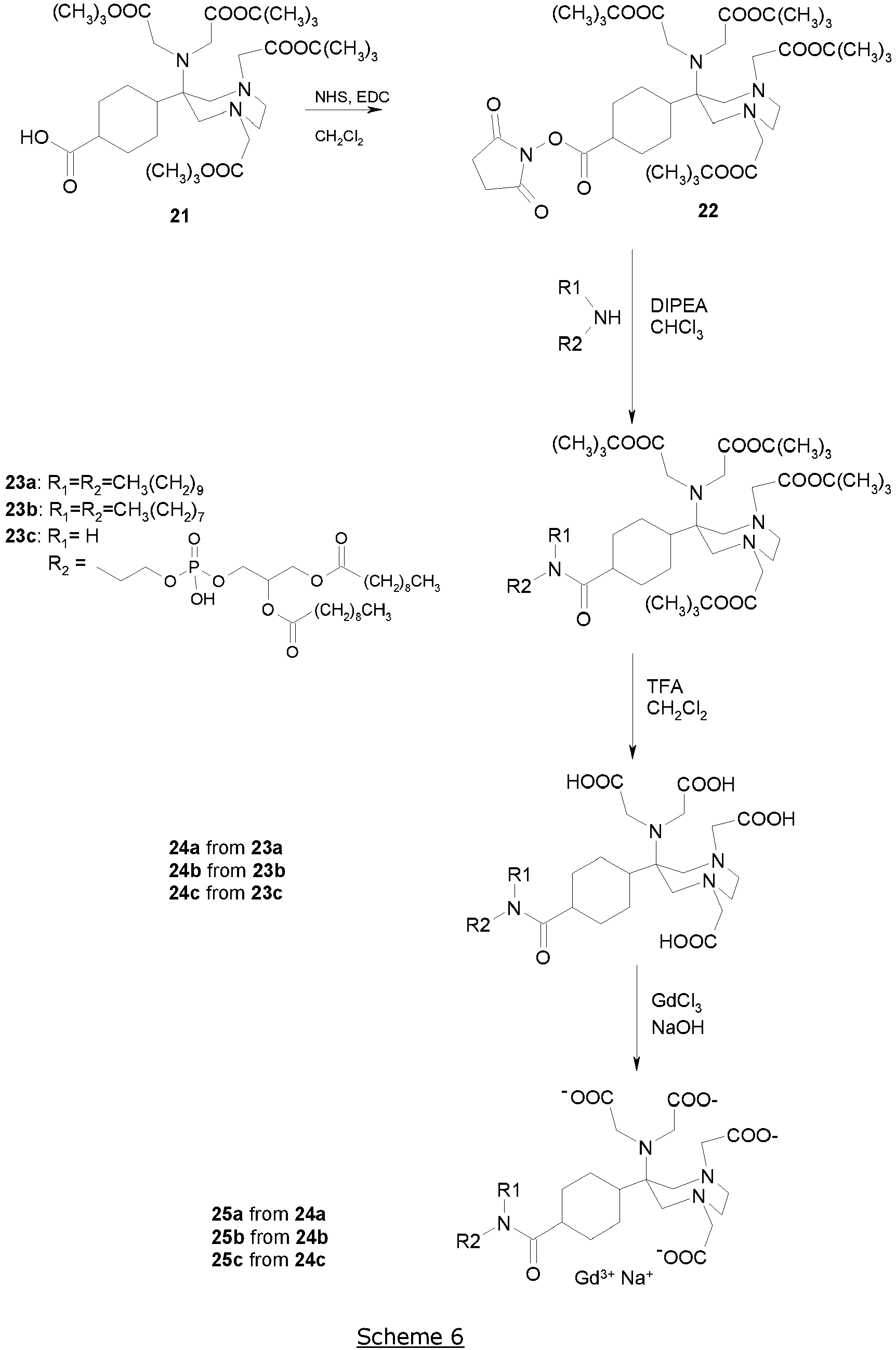
- NHS (0.27g; 2.3 mmol) was added to a solution of 21 (1.09g; 1.6 mmol) in CH2Cl2 (50 mL) stirred at 0° C, then a solution of EDC (0.45g; 2.3 mmol) in CH2Cl2 (50 mL) was added dropwise. The reaction mixture was stirred at room temperature for 49 h; the reaction was monitored by TLC. The final solution was washed with H2O (3 x 40 mL) and the organic layer was dried (Na2SO4) and evaporated to give 22 as a solid (1.35 g) that was used in the next step without further purification. Quantitative Yield.
- The corresponding amine (1-1.3 eq) was added to a solution of compound 22 (1 eq) in CHCl3 (concentration 2%) followed by addition of DIPEA (1.7 eq). The mixture was stirred at room temperature for 64-72 h. As the reaction solution became neutral, additional DIPEA (1.7 eq) was added and the reaction mixture was stirred at room temperature for further 2-21 h. The reaction mixture was then washed subsequently with H2O (35 mL), with diluted aq. HCl until pH of washing was acid (3 x 40 mL) and with H2O (35 mL). The organic phase was dried (Na2SO4) and evaporated to give a viscous yellowish crude that was purified by flash chromatography to give 23(a-c) as a yellow oil, according to the following data:
- Starting materials: Compound 22 (1.18 g; 1.48 mmol); didecylamine (0.44 g;1.48 mmol)
Compound 23a (075 g; 0.77 mmol). Yield: 52%
Mr: 977.46 (C56H104N4O9)
1H- and 13C-NMR and MS are compatible with the structure - Starting materials: Compound 22 (0.74 g; 0.93 mmol); dioctylamine (0.74 g; 0.93 mmol)
Compound 23b (0.30 g; 0.33 mmol). Yield: 35%
Mr: 921.35 (C52H96N4O9)
1H- and 13C-NMR and MS are compatible with the structure. - Starting materials: Compound 22 (1.35 g; 1.56 mmol); 1,2-didecanoyl-sn-glycero-3-phosphoethanolamine (0.81 g; 1.56 mmol)
Compound 23c (0.84 g; 0.70 mmol). Yield: 45%
Mr: 1203.54 (C61H111N4O17P)
1H- and 13C-NMR and MS are compatible with the structure - TFA (6 eq) was added dropwise to a solution of compound 23(a-c) (1 eq) in CH2Cl2 (50 mL) stirred at 0° C. The reaction mixture was stirred for 1 hour at room temperature then evaporated to residue that was dissolved with fresh TFA (350 eq); the solution was then stirred at room temperature for 24-28 h. The reaction was monitored by ESI-MS. The TFA was evaporated and the residue was treated with iPr2O (40-60 mL) to give a white solid that was isolated by centrifugation and dried (at reduced pressure and at 30° C in the presence of NaOH pellets) to give 24(a-c) according to the following data:
- Starting material: Compound 23a (0.75 g; 0.77 mmol)
Compound 24a (0.41 g; 0.54 mmol); Yield: 70%
Analytical data: - HPLC-ELSD: 94.1% (HPLC Area %)
- Mr: 753.03 (C40H72N4O9)
- Complexometric Titer: (0,001 M GdCl3): 81.7%
- 1H- and 13C-NMR and MS are compatible with the structure.
- Starting material: Compound 23b (0.30 g; 0.33 mmol)
Compound 24b (0.21 g; 0.30 mmol); Yield: 90%
Analytical data: - HPLC-ELSD: 98% (HPLC Area %)
- Mr: 696.92 (C36H64N4O9)
- Complexometric Titer: (0,001 M GdCl3): 77%
- 1H- and 13C-NMR and MS are compatible with the structure
- Starting material: Compound 23c (0.84 g; 0.70 mmol)
Compound 24c (0.67 g; 0.69 mmol); Yield: 98%
Analytical data: - HPLC-ELSD: 96.2 % (HPLC Area %) [13]
- Mr: 979.11 (C45H79N4O17P)
- Complexometric Titer: (0,001 M GdCl3): 96.9%
- 1H- and 13C-NMR and MS are compatible with the structure.
- The titled compounds were prepared according to the procedure described in Example 2.3.
- Starting material: Compound 24a (0.32 g; 0.43 mmol)
Compound 25a (0.33 g; 0.35 mmol); Yield: 83 %
Analytical data: - HPLC-ELSD: 95.2 % (% HPLC Area) [13]
- Mr: 929.24 (C40H68GdN4 NaO9)
- TGA: 5.7%
- MS is compatible with the structure.
- Starting material: Compound 24b (0.18 g; 0.26 mmol)
Compound 25b (46 mg; 0.05 mmol); Yield:19%
Analytical data: - Mr: 873.13 (C36H60GdN4 NaO9)
- MS is compatible with the structure.
- Starting material: Compound 24c (0.35 g; 0.36 mmol)
Compound 25c (0.31 g; 0.27 mmol); Yield: 77 %
Analytical data: - Mr: 1155.32 (C45H75GdN4 NaO17P)
- TGA: 9%
- KF: 11.6%.
- MS is compatible with the structure
- For all the compounds, longitudinal relaxation times (T1) at 20 MHz and at 25 °C on a mq20 Minispec instrument (Bruker Biospin, Germany) were measured in water, human serum albumin at physiological concentration and human plasma. Millimolar relaxivity r1p was thus determined from T1 measurements using the following equation:

wherein Ri 1obs is the observed relaxation time of the selected contrast agent, T1obs is the observed longitudinal relaxation time of the solution and the indexes i and j relate to the contrast agent and to the medium respectively. The above r1p values clearly demonstrate that the compounds of the present invention are endowed with a high relaxivity, as measured in water, HSA and even in plasma. In particular, when compared to known contrast agent broadly used in MRI analysis, such as Gd-DOTA, Gd-BOPTA and Gd-BT-DO3A, the present derivatives show a remarked increased relaxivity, thus rendering them particularly suitable as MRI contrast agents.Table II: Stability at 37°C of different diazepine complexes determined through r1p (mM-1 s-1) measurement in different media at 0.47T, 25 °C. 12d To 2h 5h r1p (mM-1s-1) Water 23.5 20.4 15.8 HSA 4% 46.7 --- 40.9 Human plasma 45.2 39.2 34.7 12e To 2h 4h r1p (mM-1s-1) Water 33.4 31.3 30.4 Human plasma 36.2 35.2 32.3 9a To 2h 5h r1p (mM-1s-1) Water 11.7 --- 11.1 HSA 4% 32.7 --- 30.8 9b To 1h 4h r1p (mM-1s-1) Water 16.7 15.9 15.5 Human plasma 32.5 30.9 28.3 25a To 2h 5h r1p (mM-1s-1) Water 23.9 --- 23.4 HSA 4% 45.8 --- 40.4 - Table II shows that the relaxivity values r1p of the amphiphilic complexes of the invention remain substantially stable over the time, thus providing a favourable lasting time during the experiment. In its turn, this means that the present amphiphilic complexes can be administered and detected during MRI experiments allowing a clear and exhaustive analysis of the image over a suitable frame of time.
| Water | HSA 4% | Human plasma | |
| r1p (mM-1s-1) | |||
| 12a | 14.0 | 20.0 | 15.8 |
| 12b | 13.0 | 31.5 | 33.7 |
| 12c | 13.3 | 54.2 | 50.2 |
| 12d | 23.5 | 46.7 | 45.2 |
| 12e | 33.4 | 40.4 | 36.2 |
| 9a | 11.7 | 32.7 | 34.2 |
| 9b | 16.7 | 32.0 | 32.5 |
| 9c | 28.3 | 26.7 | 30.6 |
| 25a | 23.9 | 45.8 | 41.1 |
| 25b | 14.6 | 41.0 | 39.1 |
| 25c | 14.7 | 40.2 | 43.0 |
| Gd-DOTAa | 3.61 | 4.11 | 4.51 |
| Gd-HP-DO3Ab | 3.32 | 3.85 | 4.80 |
| Gd-BT-DO3Ac | 3.75 | 4.31 | 5.76 |
| GD-BOPTAd | 4.6 | 8.9 | 8.7 |
| aGd-DOTA: Gadoterate meglumine | |||
| [[1,4,7,10-tetraazacyclododecane-1,4,7,10-tetraacetato(4-)]gadolinate(1-)] meglumine | |||
| bGd-HP-DO3A: Gadoteridol | |||
| [10-(2-hydroxyprop-1-yl)-1,4,7,10-tetraazacyclododecane-1,4,7-triacetato (3-)]gadolinium | |||
| cGd-BT-DO3A: Gadobutrol | |||
| [[10-[(2R,3S)-2,3-dihydroxy-1-(hydroxymethyl)prop-1-yl]-1,4,7,10-tetraaza-cyclododecane-1,4,7-triacetato(3-)]gadolinium | |||
| dGD-BOPTA: Gadobenate dimeglumine | |||
| [[4-(carboxy)-5,8,11-tris(carboxymethyl)-1-phenyl-2-oxa-5,8,11-triazatridecan-13-oato(5-)]gadolinate(2-)]dimeglumine | |||
Claims (17)
- A compound of formula (I):

wherein:Y is a group of formula: Y'-NH- or (Y')2-N-, wherein Y' is the same or different selected from: a linear or branched saturated or unsaturated C1-C20 alkyl group; a C1-C10 alkyl group interrupted by one or more atom or group selected from: -P-, - O-(HO-P=O)-O- and optionally substituted by one or more group selected from: hydroxy -OH, carboxy -COOR1, oxycarbonyl-(C1-C30)alkyl and oxycarbonyl-(C2-C30)alkenyl group; wherein R1 is selected from: hydrogen H and a linear or branched C1-C10 alkyl group;L is a bivalent linker selected from: aliphatic C3-C10 cyclic or heterocyclic ring, linear or branched C1-C6 alkyl group and C2-C6 alkenyl or alkynyl group, optionally substituted and optionally interrupted with a group or atom selected from: carbonyl -C=O, thiocarbonyl -C=S, amino -NR1-, carboxy - COO-, oxy-carbonyl -OCO-, amido -NR1CO- or -CONR1-, oxygen -O- and sulphur -S-, wherein R1 is as above defined;RI-IV are each independently selected from: hydrogen H, carboxy -COOR1, and -(C1-C6)alkylcarboxy group; wherein R1 is as above defined. - A compound of formula (I) according to claim 1 wherein Y has the formula: Y'-NH- , and Y' is a linear alkyl group having 5 carbon atoms, interrupted by one or more group of formula:

- A compound of formula (I) according to claim 2, further substituted with 2 carboxyalkyl groups having from 9 to 20 carbon atoms.
- A compound of formula (I) according to claims 1-3, wherein Y is selected from:


- A compound of formula (I) according to claim 1, wherein Y is a group of formula (Y')2-N- and wherein Y' is the same linear or branched C1-C20 alkyl group.
- A compound of formula (I) according to claim 5, wherein Y' is selected from: linear C4H9, C6H13, C8H17, C10H21 and C12H25.
- A compound of formula (I) according to claims 5-6 wherein Y is selected from:

- A compound of formula (I) according to any one of claims 1-7 selected from the group consisting of:


- A compound of formula (I) according to any one of the preceding claims selected from:


- A compound of formula (I) as defined in any one of the claims from 1 to 9, in the form of a complex with a paramagnetic metal ion.
- A compound of formula (I) according to claim 10, wherein the metal ion is Gd3+ or Dy3+ .
- A compound of formula (I) in the form of a complex according to any one of claims 10-11 selected from:


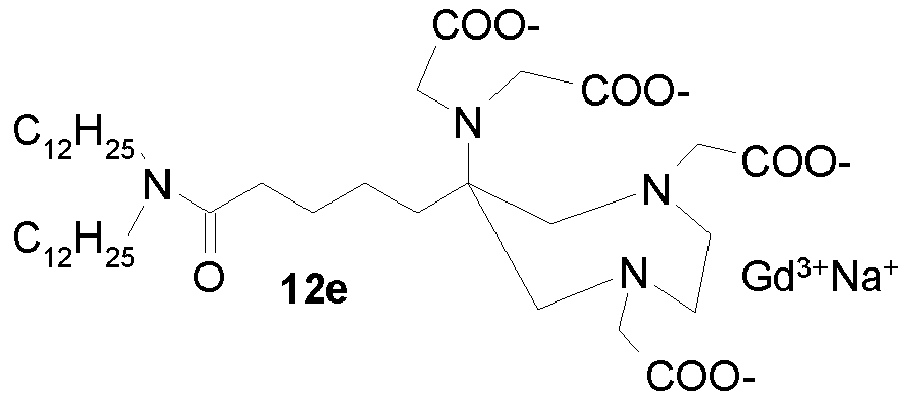


- A process for the preparation of the compounds of formula (I) as defined in claim1:
 a) preparation of an adduct of formula:
 b) activation of said terminal carboxylic function of the linker,c) amidation reaction between the product of step b) and the Y group;d) cleavage of any protecting group to give the derivative of formula (I); and optionallye) chelation with a paramagnetic metal ion, to give the derivative of formula (I) in the form of a paramagnetic complex.
 - A compound of formula (I) in the form of a complex as defined in claims 10-12 for use as a MRI contrast agent.
- A pharmaceutically acceptable composition comprising a derivative of formula (I), or pharmaceutical acceptable salt thereof, in the form of a complex as defined in any one of the claims 10-12, in admixture with one or more physiologically acceptable carrier, diluent or excipient.
- A method for imaging body regions comprising pre-administering to a subject to be imaged a diagnostically effective amount of the compounds according to any one of claims 10-12 or the composition according to claim 15 and acquiring MR images.
- A MRI diagnostic method comprising pre-administration of a diagnostically effective amount of the compounds according to any one of claims 10-12 or the composition according to claim 15 and acquisition of MR images.
Priority Applications (8)
| Application Number | Priority Date | Filing Date | Title |
|---|---|---|---|
| EP12159378.4A EP2639227A1 (en) | 2012-03-14 | 2012-03-14 | A new class of diazepine derivative chelating agents and complexes with paramagnetic metals as MRI contrast agents |
| AU2013231301A AU2013231301B2 (en) | 2012-03-14 | 2013-03-13 | A new class of diazepine derivative chelating agents and complexes with paramagnetic metals thereof as MRI contrast agents |
| PCT/EP2013/055094 WO2013135750A1 (en) | 2012-03-14 | 2013-03-13 | A new class of diazepine derivative chelating agents and complexes with paramagnetic metals thereof as mri contrast agents |
| JP2014561430A JP6375231B2 (en) | 2012-03-14 | 2013-03-13 | A new class of diazepine derivative chelating agents and their complexes with paramagnetic metals as MRI contrast agents |
| CN201380014181.7A CN104203926B (en) | 2012-03-14 | 2013-03-13 | Novel chelating agents of diaza* derivatives and their complexes with paramagnetic metals as MRI contrast agents |
| CA2863784A CA2863784C (en) | 2012-03-14 | 2013-03-13 | A new class of diazepine derivative chelating agents and complexes with paramagnetic metals thereof as mri contrast agents |
| US14/384,414 US9259491B2 (en) | 2012-03-14 | 2013-03-13 | Class of diazepine derivative chelating agents and complexes with paramagnetic metals thereof as MRI contrast agents |
| EP13708844.9A EP2834222B1 (en) | 2012-03-14 | 2013-03-13 | Diazepine derivative chelating agents and complexes with paramagnetic metals thereof as mri contrast agents |
Applications Claiming Priority (1)
| Application Number | Priority Date | Filing Date | Title |
|---|---|---|---|
| EP12159378.4A EP2639227A1 (en) | 2012-03-14 | 2012-03-14 | A new class of diazepine derivative chelating agents and complexes with paramagnetic metals as MRI contrast agents |
Publications (1)
| Publication Number | Publication Date |
|---|---|
| EP2639227A1 true EP2639227A1 (en) | 2013-09-18 |
Family
ID=47846054
Family Applications (2)
| Application Number | Title | Priority Date | Filing Date |
|---|---|---|---|
| EP12159378.4A Withdrawn EP2639227A1 (en) | 2012-03-14 | 2012-03-14 | A new class of diazepine derivative chelating agents and complexes with paramagnetic metals as MRI contrast agents |
| EP13708844.9A Active EP2834222B1 (en) | 2012-03-14 | 2013-03-13 | Diazepine derivative chelating agents and complexes with paramagnetic metals thereof as mri contrast agents |
Family Applications After (1)
| Application Number | Title | Priority Date | Filing Date |
|---|---|---|---|
| EP13708844.9A Active EP2834222B1 (en) | 2012-03-14 | 2013-03-13 | Diazepine derivative chelating agents and complexes with paramagnetic metals thereof as mri contrast agents |
Country Status (7)
| Country | Link |
|---|---|
| US (1) | US9259491B2 (en) |
| EP (2) | EP2639227A1 (en) |
| JP (1) | JP6375231B2 (en) |
| CN (1) | CN104203926B (en) |
| AU (1) | AU2013231301B2 (en) |
| CA (1) | CA2863784C (en) |
| WO (1) | WO2013135750A1 (en) |
Cited By (1)
| Publication number | Priority date | Publication date | Assignee | Title |
|---|---|---|---|---|
| WO2014037498A3 (en) * | 2012-09-07 | 2014-07-24 | Bracco Imaging Spa | Paramagnetic solid lipid nanoparticles (pslns) containing metal amphiphilic complexes for mri. |
Families Citing this family (5)
| Publication number | Priority date | Publication date | Assignee | Title |
|---|---|---|---|---|
| EP3003395B1 (en) | 2013-05-30 | 2019-07-17 | Bracco Imaging S.p.A | Fluorescent solid lipid nanoparticles composition and preparation thereof |
| BR112018015143A2 (en) | 2016-02-09 | 2018-12-18 | Bracco Suisse Sa | recombinant chimeric protein for selectin targeting |
| WO2017147418A1 (en) | 2016-02-24 | 2017-08-31 | Ohio State Innovation Foundation | Methods and devices for contrast agent magnetic resonance imaging |
| DE102017129405A1 (en) | 2017-12-11 | 2019-06-13 | Universitätsklinikum Jena | New DAZA chelators as ligands in liver imaging |
| EP3880635B1 (en) | 2018-11-12 | 2023-01-04 | Bracco Imaging SPA | Chelating aazta conjugate, complexes thereof and use |
Citations (4)
| Publication number | Priority date | Publication date | Assignee | Title |
|---|---|---|---|---|
| EP0292689A2 (en) | 1987-04-24 | 1988-11-30 | Bracco International B.V. | Substituted 1,4,7-triscarboxymethyl-1,4,7,10-tetraazacyclo-dodecane and analogs |
| WO1997000087A1 (en) | 1995-06-15 | 1997-01-03 | Bracco Research S.A. | Blood-pool imaging compositions use and method |
| WO2003008390A1 (en) | 2001-07-17 | 2003-01-30 | Bracco Imaging S.P.A. | Multidentate aza ligands able to complex metal ions and the use thereof in diagnostics and therapy |
| WO2006136564A1 (en) * | 2005-06-24 | 2006-12-28 | Bracco Imaging S.P.A. | Multidentate aza ligands able to complex metal ions and the use thereof in diagnostics and therapy |
Family Cites Families (9)
| Publication number | Priority date | Publication date | Assignee | Title |
|---|---|---|---|---|
| DE3930674A1 (en) * | 1989-09-11 | 1991-03-21 | Diagnostikforschung Inst | BIFUNCTIONAL CHELATE FORMERS FOR COMPLEXING TC AND RE-ISOTOPES, METHOD FOR THE PRODUCTION AND DISPLAY OF CONJUGATES THEREOF AND THEIR USE IN DIAGNOSTICS AND THERAPY |
| EP1105162A1 (en) * | 1998-08-10 | 2001-06-13 | Bracco Research S.A. | Combination of a positive mri contrast agent with a negative mri contrast agent |
| US6342598B1 (en) | 1998-11-26 | 2002-01-29 | Bracco International B.V. | Amphipatic polycarboxylic chelates and complexes with paramagnetic metals as MRI contrast agents |
| FR2795412B1 (en) * | 1999-06-23 | 2001-07-13 | Adir | NOVEL QUATERNARY AMMONIUM DERIVATIVES, THEIR PREPARATION PROCESS AND THE PHARMACEUTICAL COMPOSITIONS CONTAINING THEM |
| US7922998B2 (en) | 2003-01-13 | 2011-04-12 | Bracco Imaging S.P.A. | Gastrin releasing peptide compounds |
| GB0305422D0 (en) * | 2003-03-10 | 2003-04-16 | Univ Open | Detection, monitoring and treatment of cancer |
| CN1993357B (en) * | 2004-07-02 | 2011-10-19 | 伯拉考成像股份公司 | High relaxation contrast agents containing chelating moieties with polyhydroxylated substituents for magnetic resonance imaging (MRI) |
| EP1964846A1 (en) * | 2007-02-27 | 2008-09-03 | Bracco Imaging, S.P.A. | Process for the preparation of contrast agents |
| FR2939318B1 (en) * | 2008-12-10 | 2012-07-13 | Guerbet Sa | ENCAPSULATION SYSTEM FOR IMAGING CEST WITH QUELATE Q HIGHER OR EQUAL TO 2 |
-
2012
- 2012-03-14 EP EP12159378.4A patent/EP2639227A1/en not_active Withdrawn
-
2013
- 2013-03-13 CA CA2863784A patent/CA2863784C/en active Active
- 2013-03-13 AU AU2013231301A patent/AU2013231301B2/en active Active
- 2013-03-13 CN CN201380014181.7A patent/CN104203926B/en active Active
- 2013-03-13 WO PCT/EP2013/055094 patent/WO2013135750A1/en not_active Ceased
- 2013-03-13 US US14/384,414 patent/US9259491B2/en active Active
- 2013-03-13 EP EP13708844.9A patent/EP2834222B1/en active Active
- 2013-03-13 JP JP2014561430A patent/JP6375231B2/en active Active
Patent Citations (4)
| Publication number | Priority date | Publication date | Assignee | Title |
|---|---|---|---|---|
| EP0292689A2 (en) | 1987-04-24 | 1988-11-30 | Bracco International B.V. | Substituted 1,4,7-triscarboxymethyl-1,4,7,10-tetraazacyclo-dodecane and analogs |
| WO1997000087A1 (en) | 1995-06-15 | 1997-01-03 | Bracco Research S.A. | Blood-pool imaging compositions use and method |
| WO2003008390A1 (en) | 2001-07-17 | 2003-01-30 | Bracco Imaging S.P.A. | Multidentate aza ligands able to complex metal ions and the use thereof in diagnostics and therapy |
| WO2006136564A1 (en) * | 2005-06-24 | 2006-12-28 | Bracco Imaging S.P.A. | Multidentate aza ligands able to complex metal ions and the use thereof in diagnostics and therapy |
Non-Patent Citations (2)
| Title |
|---|
| "The Chemistry of Contrast Agents in Medical Magnetic Resonance Imaging", 2011, JOHN WILEY AND SONS |
| CARAVAN P., CHEM. REV., vol. 99, 1999, pages 2293 - 2352 |
Cited By (2)
| Publication number | Priority date | Publication date | Assignee | Title |
|---|---|---|---|---|
| WO2014037498A3 (en) * | 2012-09-07 | 2014-07-24 | Bracco Imaging Spa | Paramagnetic solid lipid nanoparticles (pslns) containing metal amphiphilic complexes for mri. |
| US10039843B2 (en) | 2012-09-07 | 2018-08-07 | Bracco Imaging S.P.A. | Paramagnetic solid lipid nanoparticles (pSLNs) containing metal amphiphilic complexes for MRI |
Also Published As
| Publication number | Publication date |
|---|---|
| JP2015509966A (en) | 2015-04-02 |
| US9259491B2 (en) | 2016-02-16 |
| CA2863784A1 (en) | 2013-09-19 |
| WO2013135750A1 (en) | 2013-09-19 |
| AU2013231301B2 (en) | 2017-01-05 |
| US20150037261A1 (en) | 2015-02-05 |
| AU2013231301A1 (en) | 2014-08-28 |
| CA2863784C (en) | 2018-04-17 |
| CN104203926B (en) | 2017-12-15 |
| JP6375231B2 (en) | 2018-08-15 |
| CN104203926A (en) | 2014-12-10 |
| EP2834222B1 (en) | 2016-03-09 |
| EP2834222A1 (en) | 2015-02-11 |
Similar Documents
| Publication | Publication Date | Title |
|---|---|---|
| KR102703336B1 (en) | Dimer contrast agent | |
| KR102703312B1 (en) | Contrast agent | |
| EP2834222B1 (en) | Diazepine derivative chelating agents and complexes with paramagnetic metals thereof as mri contrast agents | |
| US20020098152A1 (en) | Amphipatic polycarboxylic chelates and complexes with paramagnetic metals as MRI contrast agents | |
| JP6909234B2 (en) | Contrast | |
| FR2883562A1 (en) | LIPOPHILIC CHELATES AND THEIR USE IN IMAGING | |
| JP7145156B2 (en) | dimer contrast agent | |
| WO1995009848A2 (en) | Polyazacycloalkanes as dichelants | |
| US20090104124A1 (en) | Paramagnetic Complexes with Pendant Crown Compounds Showing Improved Targeting- Specificity as MRI Contrast Agents | |
| ES2835065T3 (en) | Contrast agents | |
| HK1257515A1 (en) | Dimeric contrast agents | |
| HK1257515B (en) | Dimeric contrast agents |
Legal Events
| Date | Code | Title | Description |
|---|---|---|---|
| PUAI | Public reference made under article 153(3) epc to a published international application that has entered the european phase |
Free format text: ORIGINAL CODE: 0009012 |
|
| AK | Designated contracting states |
Kind code of ref document: A1 Designated state(s): AL AT BE BG CH CY CZ DE DK EE ES FI FR GB GR HR HU IE IS IT LI LT LU LV MC MK MT NL NO PL PT RO RS SE SI SK SM TR |
|
| AX | Request for extension of the european patent |
Extension state: BA ME |
|
| STAA | Information on the status of an ep patent application or granted ep patent |
Free format text: STATUS: THE APPLICATION IS DEEMED TO BE WITHDRAWN |
|
| 18D | Application deemed to be withdrawn |
Effective date: 20140309 |