EP2639215B1 - Preparation method for salts of kukoamine b - Google Patents
Preparation method for salts of kukoamine b Download PDFInfo
- Publication number
- EP2639215B1 EP2639215B1 EP11840357.5A EP11840357A EP2639215B1 EP 2639215 B1 EP2639215 B1 EP 2639215B1 EP 11840357 A EP11840357 A EP 11840357A EP 2639215 B1 EP2639215 B1 EP 2639215B1
- Authority
- EP
- European Patent Office
- Prior art keywords
- compound
- acid
- reaction
- kukoamine
- added
- Prior art date
- Legal status (The legal status is an assumption and is not a legal conclusion. Google has not performed a legal analysis and makes no representation as to the accuracy of the status listed.)
- Active
Links
- 0 B=Cc1c(*)ccc(CCC(CC(CCCCN(C)CCCCN*)=C)=[U])c1 Chemical compound B=Cc1c(*)ccc(CCC(CC(CCCCN(C)CCCCN*)=C)=[U])c1 0.000 description 4
- LHHKQWQTBCTDQM-UHFFFAOYSA-N COc(ccc(CCC(O)=O)c1)c1OC Chemical compound COc(ccc(CCC(O)=O)c1)c1OC LHHKQWQTBCTDQM-UHFFFAOYSA-N 0.000 description 1
- HBJOTLDIXXSWDK-UHFFFAOYSA-N N#CCCN(CCCCN(CCCNC(CCc(cc1)cc(OCc2ccccc2)c1OCc1ccccc1)=O)OC(c1ccccc1)=O)C(CCc(cc1OCc2ccccc2)ccc1OCc1ccccc1)=O Chemical compound N#CCCN(CCCCN(CCCNC(CCc(cc1)cc(OCc2ccccc2)c1OCc1ccccc1)=O)OC(c1ccccc1)=O)C(CCc(cc1OCc2ccccc2)ccc1OCc1ccccc1)=O HBJOTLDIXXSWDK-UHFFFAOYSA-N 0.000 description 1
- SGFYAYKYXXULMY-UHFFFAOYSA-N O=C(CCc(cc1)cc(OCc2ccccc2)c1OCc1ccccc1)OCc1ccccc1 Chemical compound O=C(CCc(cc1)cc(OCc2ccccc2)c1OCc1ccccc1)OCc1ccccc1 SGFYAYKYXXULMY-UHFFFAOYSA-N 0.000 description 1
- DZAUWHJDUNRCTF-UHFFFAOYSA-N OC(CCc(cc1)cc(O)c1O)=O Chemical compound OC(CCc(cc1)cc(O)c1O)=O DZAUWHJDUNRCTF-UHFFFAOYSA-N 0.000 description 1
- CMJUFYXQKNNYFD-UHFFFAOYSA-N OC(CCc(cc1)cc(OCc2ccccc2)c1OCc1ccccc1)=O Chemical compound OC(CCc(cc1)cc(OCc2ccccc2)c1OCc1ccccc1)=O CMJUFYXQKNNYFD-UHFFFAOYSA-N 0.000 description 1
Images





Classifications
-
- C—CHEMISTRY; METALLURGY
- C07—ORGANIC CHEMISTRY
- C07C—ACYCLIC OR CARBOCYCLIC COMPOUNDS
- C07C309/00—Sulfonic acids; Halides, esters, or anhydrides thereof
- C07C309/01—Sulfonic acids
- C07C309/02—Sulfonic acids having sulfo groups bound to acyclic carbon atoms
- C07C309/03—Sulfonic acids having sulfo groups bound to acyclic carbon atoms of an acyclic saturated carbon skeleton
- C07C309/04—Sulfonic acids having sulfo groups bound to acyclic carbon atoms of an acyclic saturated carbon skeleton containing only one sulfo group
-
- A—HUMAN NECESSITIES
- A61—MEDICAL OR VETERINARY SCIENCE; HYGIENE
- A61P—SPECIFIC THERAPEUTIC ACTIVITY OF CHEMICAL COMPOUNDS OR MEDICINAL PREPARATIONS
- A61P29/00—Non-central analgesic, antipyretic or antiinflammatory agents, e.g. antirheumatic agents; Non-steroidal antiinflammatory drugs [NSAID]
-
- A—HUMAN NECESSITIES
- A61—MEDICAL OR VETERINARY SCIENCE; HYGIENE
- A61P—SPECIFIC THERAPEUTIC ACTIVITY OF CHEMICAL COMPOUNDS OR MEDICINAL PREPARATIONS
- A61P31/00—Antiinfectives, i.e. antibiotics, antiseptics, chemotherapeutics
- A61P31/04—Antibacterial agents
-
- C—CHEMISTRY; METALLURGY
- C07—ORGANIC CHEMISTRY
- C07C—ACYCLIC OR CARBOCYCLIC COMPOUNDS
- C07C229/00—Compounds containing amino and carboxyl groups bound to the same carbon skeleton
- C07C229/02—Compounds containing amino and carboxyl groups bound to the same carbon skeleton having amino and carboxyl groups bound to acyclic carbon atoms of the same carbon skeleton
- C07C229/04—Compounds containing amino and carboxyl groups bound to the same carbon skeleton having amino and carboxyl groups bound to acyclic carbon atoms of the same carbon skeleton the carbon skeleton being acyclic and saturated
- C07C229/24—Compounds containing amino and carboxyl groups bound to the same carbon skeleton having amino and carboxyl groups bound to acyclic carbon atoms of the same carbon skeleton the carbon skeleton being acyclic and saturated having more than one carboxyl group bound to the carbon skeleton, e.g. aspartic acid
-
- C—CHEMISTRY; METALLURGY
- C07—ORGANIC CHEMISTRY
- C07C—ACYCLIC OR CARBOCYCLIC COMPOUNDS
- C07C235/00—Carboxylic acid amides, the carbon skeleton of the acid part being further substituted by oxygen atoms
- C07C235/02—Carboxylic acid amides, the carbon skeleton of the acid part being further substituted by oxygen atoms having carbon atoms of carboxamide groups bound to acyclic carbon atoms and singly-bound oxygen atoms bound to the same carbon skeleton
- C07C235/32—Carboxylic acid amides, the carbon skeleton of the acid part being further substituted by oxygen atoms having carbon atoms of carboxamide groups bound to acyclic carbon atoms and singly-bound oxygen atoms bound to the same carbon skeleton the carbon skeleton containing six-membered aromatic rings
- C07C235/34—Carboxylic acid amides, the carbon skeleton of the acid part being further substituted by oxygen atoms having carbon atoms of carboxamide groups bound to acyclic carbon atoms and singly-bound oxygen atoms bound to the same carbon skeleton the carbon skeleton containing six-membered aromatic rings having the nitrogen atoms of the carboxamide groups bound to hydrogen atoms or to acyclic carbon atoms
-
- C—CHEMISTRY; METALLURGY
- C07—ORGANIC CHEMISTRY
- C07C—ACYCLIC OR CARBOCYCLIC COMPOUNDS
- C07C309/00—Sulfonic acids; Halides, esters, or anhydrides thereof
- C07C309/01—Sulfonic acids
- C07C309/25—Sulfonic acids having sulfo groups bound to carbon atoms of rings other than six-membered aromatic rings of a carbon skeleton
-
- C—CHEMISTRY; METALLURGY
- C07—ORGANIC CHEMISTRY
- C07C—ACYCLIC OR CARBOCYCLIC COMPOUNDS
- C07C309/00—Sulfonic acids; Halides, esters, or anhydrides thereof
- C07C309/01—Sulfonic acids
- C07C309/28—Sulfonic acids having sulfo groups bound to carbon atoms of six-membered aromatic rings of a carbon skeleton
- C07C309/29—Sulfonic acids having sulfo groups bound to carbon atoms of six-membered aromatic rings of a carbon skeleton of non-condensed six-membered aromatic rings
- C07C309/30—Sulfonic acids having sulfo groups bound to carbon atoms of six-membered aromatic rings of a carbon skeleton of non-condensed six-membered aromatic rings of six-membered aromatic rings substituted by alkyl groups
-
- C—CHEMISTRY; METALLURGY
- C07—ORGANIC CHEMISTRY
- C07C—ACYCLIC OR CARBOCYCLIC COMPOUNDS
- C07C53/00—Saturated compounds having only one carboxyl group bound to an acyclic carbon atom or hydrogen
- C07C53/08—Acetic acid
-
- C—CHEMISTRY; METALLURGY
- C07—ORGANIC CHEMISTRY
- C07C—ACYCLIC OR CARBOCYCLIC COMPOUNDS
- C07C53/00—Saturated compounds having only one carboxyl group bound to an acyclic carbon atom or hydrogen
- C07C53/08—Acetic acid
- C07C53/10—Salts thereof
-
- C—CHEMISTRY; METALLURGY
- C07—ORGANIC CHEMISTRY
- C07C—ACYCLIC OR CARBOCYCLIC COMPOUNDS
- C07C53/00—Saturated compounds having only one carboxyl group bound to an acyclic carbon atom or hydrogen
- C07C53/122—Propionic acid
-
- C—CHEMISTRY; METALLURGY
- C07—ORGANIC CHEMISTRY
- C07C—ACYCLIC OR CARBOCYCLIC COMPOUNDS
- C07C53/00—Saturated compounds having only one carboxyl group bound to an acyclic carbon atom or hydrogen
- C07C53/124—Acids containing four carbon atoms
-
- C—CHEMISTRY; METALLURGY
- C07—ORGANIC CHEMISTRY
- C07C—ACYCLIC OR CARBOCYCLIC COMPOUNDS
- C07C55/00—Saturated compounds having more than one carboxyl group bound to acyclic carbon atoms
- C07C55/02—Dicarboxylic acids
- C07C55/06—Oxalic acid
-
- C—CHEMISTRY; METALLURGY
- C07—ORGANIC CHEMISTRY
- C07C—ACYCLIC OR CARBOCYCLIC COMPOUNDS
- C07C55/00—Saturated compounds having more than one carboxyl group bound to acyclic carbon atoms
- C07C55/02—Dicarboxylic acids
- C07C55/08—Malonic acid
-
- C—CHEMISTRY; METALLURGY
- C07—ORGANIC CHEMISTRY
- C07C—ACYCLIC OR CARBOCYCLIC COMPOUNDS
- C07C55/00—Saturated compounds having more than one carboxyl group bound to acyclic carbon atoms
- C07C55/02—Dicarboxylic acids
- C07C55/10—Succinic acid
-
- C—CHEMISTRY; METALLURGY
- C07—ORGANIC CHEMISTRY
- C07C—ACYCLIC OR CARBOCYCLIC COMPOUNDS
- C07C55/00—Saturated compounds having more than one carboxyl group bound to acyclic carbon atoms
- C07C55/02—Dicarboxylic acids
- C07C55/14—Adipic acid
-
- C—CHEMISTRY; METALLURGY
- C07—ORGANIC CHEMISTRY
- C07C—ACYCLIC OR CARBOCYCLIC COMPOUNDS
- C07C57/00—Unsaturated compounds having carboxyl groups bound to acyclic carbon atoms
- C07C57/02—Unsaturated compounds having carboxyl groups bound to acyclic carbon atoms with only carbon-to-carbon double bonds as unsaturation
- C07C57/13—Dicarboxylic acids
- C07C57/145—Maleic acid
-
- C—CHEMISTRY; METALLURGY
- C07—ORGANIC CHEMISTRY
- C07C—ACYCLIC OR CARBOCYCLIC COMPOUNDS
- C07C57/00—Unsaturated compounds having carboxyl groups bound to acyclic carbon atoms
- C07C57/02—Unsaturated compounds having carboxyl groups bound to acyclic carbon atoms with only carbon-to-carbon double bonds as unsaturation
- C07C57/13—Dicarboxylic acids
- C07C57/15—Fumaric acid
-
- C—CHEMISTRY; METALLURGY
- C07—ORGANIC CHEMISTRY
- C07C—ACYCLIC OR CARBOCYCLIC COMPOUNDS
- C07C57/00—Unsaturated compounds having carboxyl groups bound to acyclic carbon atoms
- C07C57/30—Unsaturated compounds having carboxyl groups bound to acyclic carbon atoms containing six-membered aromatic rings
- C07C57/42—Unsaturated compounds having carboxyl groups bound to acyclic carbon atoms containing six-membered aromatic rings having unsaturation outside the rings
- C07C57/44—Cinnamic acid
-
- C—CHEMISTRY; METALLURGY
- C07—ORGANIC CHEMISTRY
- C07C—ACYCLIC OR CARBOCYCLIC COMPOUNDS
- C07C59/00—Compounds having carboxyl groups bound to acyclic carbon atoms and containing any of the groups OH, O—metal, —CHO, keto, ether, groups, groups, or groups
- C07C59/01—Saturated compounds having only one carboxyl group and containing hydroxy or O-metal groups
- C07C59/08—Lactic acid
-
- C—CHEMISTRY; METALLURGY
- C07—ORGANIC CHEMISTRY
- C07C—ACYCLIC OR CARBOCYCLIC COMPOUNDS
- C07C59/00—Compounds having carboxyl groups bound to acyclic carbon atoms and containing any of the groups OH, O—metal, —CHO, keto, ether, groups, groups, or groups
- C07C59/235—Saturated compounds containing more than one carboxyl group
- C07C59/245—Saturated compounds containing more than one carboxyl group containing hydroxy or O-metal groups
-
- C—CHEMISTRY; METALLURGY
- C07—ORGANIC CHEMISTRY
- C07C—ACYCLIC OR CARBOCYCLIC COMPOUNDS
- C07C59/00—Compounds having carboxyl groups bound to acyclic carbon atoms and containing any of the groups OH, O—metal, —CHO, keto, ether, groups, groups, or groups
- C07C59/235—Saturated compounds containing more than one carboxyl group
- C07C59/245—Saturated compounds containing more than one carboxyl group containing hydroxy or O-metal groups
- C07C59/255—Tartaric acid
-
- C—CHEMISTRY; METALLURGY
- C07—ORGANIC CHEMISTRY
- C07C—ACYCLIC OR CARBOCYCLIC COMPOUNDS
- C07C59/00—Compounds having carboxyl groups bound to acyclic carbon atoms and containing any of the groups OH, O—metal, —CHO, keto, ether, groups, groups, or groups
- C07C59/235—Saturated compounds containing more than one carboxyl group
- C07C59/245—Saturated compounds containing more than one carboxyl group containing hydroxy or O-metal groups
- C07C59/265—Citric acid
-
- C—CHEMISTRY; METALLURGY
- C07—ORGANIC CHEMISTRY
- C07C—ACYCLIC OR CARBOCYCLIC COMPOUNDS
- C07C59/00—Compounds having carboxyl groups bound to acyclic carbon atoms and containing any of the groups OH, O—metal, —CHO, keto, ether, groups, groups, or groups
- C07C59/40—Unsaturated compounds
- C07C59/42—Unsaturated compounds containing hydroxy or O-metal groups
- C07C59/48—Unsaturated compounds containing hydroxy or O-metal groups containing six-membered aromatic rings
- C07C59/50—Mandelic acid
-
- C—CHEMISTRY; METALLURGY
- C07—ORGANIC CHEMISTRY
- C07C—ACYCLIC OR CARBOCYCLIC COMPOUNDS
- C07C63/00—Compounds having carboxyl groups bound to a carbon atoms of six-membered aromatic rings
- C07C63/04—Monocyclic monocarboxylic acids
- C07C63/06—Benzoic acid
Definitions
- the present invention relates to the field of pharmaceutical technology, particularly to a method for preparing the salts of kukoamine B, as further defined in the claims.
- Sepsis also known as systemic inflammatory response syndrome (SIRS) induced by infection
- SIRS systemic inflammatory response syndrome
- ICU intensive care unit
- the existing principal clinical treatments of sepsis are initial antibiotic administration and remedy of hypoxic ischemic damage, which adopt conventional treatments of organ failure and shock, and there is no specific treatment for it up to now.
- medication to sepsis empirically adopts non-specific drugs, e.g. glucocorticoids, insulin, immunomodulator, etc., but their curative effect is still uncertain.
- anti-lipid A monoclonal antibody HA-1A was used in the treatment of sepsis after burn injury and trauma in the US Army during the Gulf War. Centoxin also was clinically used in some European country and Japan. However due to its possible adverse effect to septic shock, Centoxin failed to obtain approval by US Food and Drug Administration (FDA) in 1992 and then disappeared from the European market as well.
- FDA US Food and Drug Administration
- rhAPC Recombinant human activated protein C
- rhAPC is the only drug approved by FDA for sepsis treatment so far (Trade name Xigris). Result of clinical trial shows that rhAPC, which obtain FDA marketing approval in November 2011, can reduce the 28-day mortality of patients suffering sepsis.
- PAMPs pathogen-associated molecular patterns
- PRRs pattern recognition receptors
- Kukoamine B is a naturally exsisting alkaloid isolating from Lycii cortex., one kind of traditional Chinese herbs, the chemical structure of which is as follows:
- Kukoamine B which exists in the form of free alkali, was first isolated from Lycii cortex. by Shinji Funayama of Japan in 1995 ( S. Funayama, G. Zhang & S. Nozoe. Phytochemistry. 1995; 38: 1529-1531 ). There is no research about biological activity of kukoamine B reported, other than methods of extraction, isolation, purification and structural characterization thereof. The use of kukoamine B in the preparation of drugs for the prevention and treatment of sepsis and autoimmune disease has been disclosed in the earlier Chinese patent application filed by applicant (Chinese patent application No. 201010156503.X ).
- the present disclosure provides salts of kukoamine B and a preparation method thereof, as well as the use of salts of kukoamine B and pharmaceutical compositions containing them in preparation of drugs for preventing and treating sepsi.
- Using salts of kukoamine B and pharmaceutical compositions containing them for sepsis treatment has a novel mechanism of action, reliable curative effect and safety, and provides a new approach for the treatment of sepsis.
- A is inorganic acid, including a hydrogenhalogenide or oxo-acid or organic acid, including carboxylic acid, hydroxy acid, sulfoacid and acidic amino acid.
- the salts of kukoamine B are acid salts, which are formed by the basic group in the molecular structure of kukoamine B, including inorganic acid salts and organic acid salts.
- the hydrogenhalogenide is any one of hydrochloric acid and hydrobromic acid.
- the oxo-acid is any one of sulfuric acid, phosphoric acid, and nitric acid.
- the inorganic acid is preferably any one of hydrochloric acid, hydrobromic acid, sulfuric acid, and phosphoric acid.
- the carboxylic acid is any one of acetic acid, propionic acid, butyric acid, oxalic acid, malonic acid, succinic acid, adipic acid, benzoic acid, phenylpropionic acid, cinnamic acid, stearic acid, trifluoroacetic acid, maleic acid, fumaric acid, nicotinic acid, and palmitic acid.
- the hydroxy acid is any one of malic acid, citric acid, lactic acid, hydroxybutyric acid, lactobionic acid, tartaric acid, mandelic acid, gluconic acid, glucuronic acid, and ascorbic acid.
- the sulfoacid is any one of methanesulfonic acid, benzenesulfonic acid, p-toluenesulfonic acid, and camphorsulfonic acid.
- the acidic amino acid is any one of glutamic acid and aspartic acid.
- the organic acid preferably is any one of acetic acid, maleic acid, succinic acid, malic acid, lactic acid, tartaric acid, methanesulfonic acid, p-toluenesulfonic acid, glutamic acid, and aspartic acid.
- the acids in salts of kukoamine B are selected from a variety of inorganic acids and/ or organic acids.
- two or three representative acids are selected from each category of pharmaceutically acceptable acids for illustrating common problems in the preparation of salts of kukoamine B, including: hydrochloric acid and hydrobromic acid selected from inorganic hydrogenacid; sulfuric acid and phosphoric acid selected from inorganic oxacid; acetic acid, maleic acid and succinic acid selected from organic carboxylic acids; malic acid, lactic acid and tartaric acid selected from organic hydroxy acids; methanesulfonic acid and p-toluenesulfonic acid selected from organic sulfoacid; glutamic acid and aspartic acid selected from organic acidic amino acids.
- inorganic acids and/ or organic acids can be used in the preparation of salts of kukoamine B in the same manner.
- the drugs made from salts of kukoamine B and pharmaceutical compositions containing them for the prevention and treatment of sepsis can be taken through gastrointestinal drug delivery in the dosage form like powders, tablets, granules, capsules, solutions, emulsions, suspensions, etc.; or through parenteral drug delivery by injection administration, intra-cavity administration, transmucosal administration, etc.
- the optimal dosages for adults are 0.1-15 mg per kilogram of body weight per day, and the administration can be made one or more times per day.
- the salts of kukoamine B are prepared through a series of chemical synthesis with 3,4-Dimethoxyhydrocinnamic acid (or 3,4-Dihydroxyphenyl Propionic acid) and butanediamine as reactants, particularly as follows:
- compositions of salts of kukoamine B including above-mentioned salts of kukoamine B as active ingredient and pharmaceutically acceptable carrier and/ or diluent.
- compositions of salts of kukoamine B include salts of kukoamine B as active ingredient and pharmaceutically acceptable carrier and/ or diluent.
- the salts of kukoamine B can be used in the preparation of drugs for preventing and treating sepsis.
- the action mechanism of using salts of kukoamine B and the pharmaceutical compositions containing them for preventing and treating sepsis is based on concurrently antagonizing the multiple PAMPs inducing sepsis, and differents from drugs such as glucocorticoids, insulin, drugs antagonizing inflammatory mediators, anticoagulant, polypeptide antagonizing LPS, and monoclonal antibody antagonizing lipid A.
- drugs such as glucocorticoids, insulin, drugs antagonizing inflammatory mediators, anticoagulant, polypeptide antagonizing LPS, and monoclonal antibody antagonizing lipid A.
- the present invention selects many kinds of inorganic acids and/ or organic acids for the description of common problems in the preparation of salts of kukoamine B.
- salts of kukoamine B can be prepared from similar inorganic acids and/ or organic acids by methods well known in the art.
- LPS and CpG DNA are key factors responsible for sepsis. Therefore, the antagonism of drugs on LPS and CpG DNA reflect their preventive and therapeutic effects on sepsis.
- the disclosed embodiments are merely preferred examples of the present invention, and are not intended to limit the disclosure in any way. All reagents used herein are analytical grade, unless expressly specified otherwise.
- reaction solution is filtrated, extracted with ethyl acetate, washed sequentially with water and saturated salt water, and dried with anhydrous sodium sulfate, and then compound f3 is collected by suction filtration.
- 14.4g of sodium hydroxide is dissolved in 80 ml of water, added with 85g of compound f3, then added with 80 ml of methanol, and heated to 90°C to perform reflux reaction, and the reaction is monitored via TLC.
- reaction solution is dried by rotary evaporation, then poured into a beaker, added with concentrated hydrochloric acid to make it strongly acidic, and filtrated, and then the filter cake is collected and dried. 60g of yellow compound f is obtained and the yield is 69%.
- the reaction equation is expressed as follows:
- Steps (1) through (10) are identical to the steps (1) through (10) in embodiment 1, respectively; (11) 1g of compound k and 0.71g of succinic acid are putted into an autoclave, added with 30 ml of mixed solution containing MeOH, THF and water with the volume ratio of 3:1:1, and then added with 0.2g of Pd/C catalyst after the solution goes clear. Aeration is applied to ensure the reaction system in hydrogen under 10 MPa. The reaction solution is heated to 45°C to carry out the reaction, and the reaction is monitored via TLC. After reaction is completed, the reaction solution is treated by suction filtration and concentrated up to dryness, and dark green semisolid is obtained.
- Steps (1) through (10) are identical to the steps (1) through (10) in embodiment 1, respectively; (11) 1g of compound k and 0.5 ml of lactic acid are putted into an autoclave, added with 30 ml of mixed solution containing MeOH, THF and water with the volume ratio of 3:1:1, and then added with 0.2g of Pd/C catalyst after the solution goes clear. Aeration is applied to ensure the reaction system in hydrogen under 10 MPa. The reaction solution is heated to 45°C to carry out the reaction, and the reaction is monitored via TLC. After reaction is completed, the reaction solution is treated by suction filtration and concentrated up to dryness, and yellow semisolid is obtained.
- Steps (1) through (10) are identical to the steps (1) through (10) in embodiment 1, respectively; (11) 1g of compound k and 0.9g of tartaric acid are putted into an autoclave, added with 30 ml of mixed solution containing MeOH, THF and water with the volume ratio of 3:1:1, and then added with 0.2g of Pd/C catalyst after the solution goes clear. Aeration is applied to ensure the reaction system in hydrogen under 10 MPa. The reaction solution is heated to 45°C to carry out the reaction, and the reaction is monitored via TLC. After reaction is completed, the reaction solution is treated by suction filtration and concentrated up to dryness, and yellow semisolid is obtained.
- the pale yellow semisolid is added with 30 ml of ethanol, treated by ultrasonic vibration, standing for some time to precipitate, and then the supernatant is discarded; this process is repeated for several times. Finally, 355mg of pale yellow solid powder is obtained by suction filtration.
- the reaction equation is expressed as follows:
- Steps (1) through (10) are identical to the steps (1) through (10) in embodiment 1, respectively; (11) 1g of compound k and 1g of p-toluenesulfonic acid are putted into an autoclave, added with 30 ml of mixed solution containing MeOH, THF and water with the volume ratio of 3:1:1, and then added with 0.2g of Pd/C catalyst after the solution goes clear. Aeration is applied to ensure the reaction system in hydrogen under 10 MPa. The reaction solution is heated to 45°C to carry out the reaction, and the reaction is monitored via TLC. After reaction is completed, the reaction solution is treated by suction filtration and concentrated up to dryness, and pale yellow semisolid is obtained.
- the pale yellow semisolid is added with 30 ml of ethanol, treated by ultrasonic vibration, standing for some time to precipitate, and then the supernatant is discarded; this process is repeated for several times. Finally, 396mg of pale yellow solid powder is obtained by suction filtration.
- the reaction equation is expressed as follows:
- Steps (1) through (10) are identical to the steps (1) through (10) in embodiment 1, respectively; (11) 1.0g of compound k and 0.88g of glutamic acid are putted into an autoclave, added with 30 ml of mixed solution containing MeOH, THF and water with the volume ratio of 3:1:1, and then added with 0.2g of Pd/C catalyst after the solution goes clear. Aeration is applied to ensure the reaction system in hydrogen under 10 MPa. The reaction solution is heated to 45°C to carry out the reaction, and the reaction is monitored via TLC. After reaction is completed, the reaction solution is treated by suction filtration and concentrated up to dryness, and pale yellow semisolid is obtained.
- the pale yellow powdered solid is identified as kukoamine B glutamate, the chemical structure of which is shown as follows:
- Steps (1) through (10) are identical to the steps (1) through (10) in embodiment 1, respectively; (11) 1.0g of compound k and 0.4 ml of acetic acid are putted into an autoclave, added with 30 ml of mixed solution containing MeOH, THF and water with the volume ratio of 3:1:1, and then added with 0.2g of Pd/C catalyst after the solution goes clear. Aeration is applied to ensure the reaction system in hydrogen under 10 MPa. The reaction solution is heated to 45°C to carry out the reaction, and the reaction is monitored via TLC. After reaction is completed, the reaction solution is treated by suction filtration and concentrated up to dryness, and pale yellow semisolid is obtained.
- the pale yellow semisolid is added with 30 ml of ethanol, treated by ultrasonic vibration, standing for some time to precipitate, and then the supernatant is discarded; this process is repeated for several times. Finally, 330mg of pale yellow solid powder is obtained by suction filtration.
- the reaction equation is expressed as follows:
- Steps (1) through (10) are identical to the steps (1) through (10) in embodiment 1, respectively; (11) 1g of compound k and 0.64 ml of hydrochloric acid are putted into an autoclave, added with 30 ml of mixed solution containing MeOH, THF and water with the volume ratio of 3:1:1, and then added with 0.2g of Pd/C catalyst after the solution goes clear. Aeration is applied to ensure the reaction system in hydrogen under 10 MPa. The reaction solution is heated to 45°C to carry out the reaction, and the reaction is monitored via TLC. After reaction is completed, the reaction solution is treated by suction filtration and concentrated up to dryness, and yellow semisolid is obtained.
- Steps (1) through (10) are identical to the steps (1) through (10) in embodiment 1, respectively; (11) 1.0g of compound k and 0.4 ml of sulfuric acid are putted into an autoclave, added with 30 ml of mixed solution containing MeOH, THF and water with the volume ratio of 3:1:1, and then added with 0.2g of Pd/C catalyst after the solution goes clear. Aeration is applied to ensure the reaction system in hydrogen under 10 MPa. The reaction solution is heated to 45°C to carry out the reaction, and the reaction is monitored via TLC. After reaction is completed, the reaction solution is treated by suction filtration and concentrated up to dryness, and pale yellow semisolid is obtained.
- the pale yellow semisolid is added with 30 ml of ethanol, treated by ultrasonic vibration, standing for some time to precipitate, and then the supernatant is discarded; this process is repeated for several times. Finally, 355mg of pale yellow solid powder is obtained by suction filtration.
- the reaction equation is expressed as follows:
- Steps (1) through (10) are identical to the steps (1) through (10) in embodiment 1, respectively; (11) 1.0g of compound k and 0.7g of maleic acid are putted into an autoclave, added with 30 ml of mixed solution containing MeOH, THF and water with the volume ratio of 3:1:1, and then added with 0.2g of Pd/C catalyst after the solution goes clear. Aeration is applied to ensure the reaction system in hydrogen under 10 MPa. The reaction solution is heated to 45°C to carry out the reaction, and the reaction is monitored via TLC. After reaction is completed, the reaction solution is treated by suction filtration and concentrated up to dryness, and yellow semisolid is obtained.
- Steps (1) through (10) are identical to the steps (1) through (10) in embodiment 1, respectively; (11) 1.0g of compound k and 0.8g of aspartic acid are putted into an autoclave, added with 30 ml of mixed solution containing MeOH, THF and water with the volume ratio of 3:1:1, and then added with 0.2g of Pd/C catalyst after the solution goes clear. Aeration is applied to ensure the reaction system in hydrogen under 10 MPa. The reaction solution is heated to 45°C to carry out the reaction, and the reaction is monitored via TLC. After reaction is completed, the reaction solution is treated by suction filtration and concentrated up to dryness, and pale yellow semisolid is obtained.
- the pale yellow semisolid is added with 30 ml of ethanol, treated by ultrasonic vibration, standing for some time to precipitate, and then the supernatant is discarded; this process is repeated for several times. Finally, 374mg of pale yellow solid powder is obtained by suction filtration.
- the reaction equation is expressed as follows:
- Steps (1) through (10) are identical to the steps (1) through (10) in embodiment 1, respectively; (11) 1.0g of compound k and 0.5 ml of hydrobromic acid are putted into an autoclave, added with 30 ml of mixed solution containing MeOH, THF and water with the volume ratio of 3:1:1, and then added with 0.2g of Pd/C catalyst after the solution goes clear. Aeration is applied to ensure the reaction system in hydrogen under 10 MPa. The reaction solution is heated to 45°C to carry out the reaction, and the reaction is monitored via TLC. After reaction is completed, the reaction solution is treated by suction filtration and concentrated up to dryness, and pale yellow semisolid is obtained.
- the pale yellow semisolid is added with 30 ml of ethanol, treated by ultrasonic vibration, standing for some time to precipitate, and then the supernatant is discarded; this process is repeated for several times. Finally, 345mg of pale yellow solid powder is obtained by suction filtration.
- the reaction equation is expressed as follows:
- Steps (1) through (10) are identical to the steps (1) through (10) in embodiment 1, respectively; (11) 1.0g of compound k and 0.4 ml of phosphoric acid are putted into an autoclave, added with 30 ml of mixed solution containing MeOH, THF and water with the volume ratio of 3:1:1, and then added with 0.2g of Pd/C catalyst after the solution goes clear. Aeration is applied to ensure the reaction system in hydrogen under 10 MPa. The reaction solution is heated to 45°C to carry out the reaction, and the reaction is monitored via TLC. After reaction is completed, the reaction solution is treated by suction filtration and concentrated up to dryness, and pale yellow semisolid is obtained.
- the pale yellow semisolid is added with 30 ml of ethanol, treated by ultrasonic vibration, standing for some time to precipitate, and then the supernatant is discarded; this process is repeated for several times. Finally, 354mg of pale yellow solid powder is obtained by suction filtration.
- the reaction equation is expressed as follows:
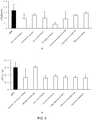
- Figure 1 shows the binding reaction of salts of kukoamine B with lipid A.
- Figure 1A shows the results of kukoamine B malate, kukoamine B succinate, kukoamine B lactate, kukoamine B tartrate, kukoamine B methanesulfonate, kukoamine B hydrochlorate, and kukoamine B sulfate;
- Figure 1B shows the results of kukoamine B p-toluenesulfonate, kukoamine B glutamate, kukoamine B acetate, kukoamine B maleate, kukoamine B aspartate, kukoamine B hydrobromide, and kukoamine B phosphate.
- the neutralizing test is carried out according to the manufacturer's instructions of 32 Well Kinetic Tube Reader (ATi321-06) endotoxin detector, which mainly comprises the following steps:
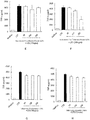
- FIG. 2 Each of the salts of kukoamine B can neutralize LPS in vitro, and the results are shown in Figure 2 .
- Figure 2A shows the results of kukoamine B malate, kukoamine B succinate, kukoamine B lactate, kukoamine B tartrate, kukoamine B methanesulfonate, kukoamine B hydrochlorate, and kukoamine B sulfate
- Figure 2B shows the results of kukoamine B p-toluenesulfonate, kukoamine B glutamate, kukoamine B acetate, kukoamine B maleate, kukoamine B aspartate, kukoamine B hydrobromide, and kukoamine B phosphate.
- RAW264.7 cells are diluted to 1 ⁇ 10 6 /ml in DMEM culture medium, added into a 96-well cell culture plate (200 ⁇ l per well), and incubated at 37 °C in a 5% CO 2 humidified incubator for 4 h, and then the supernatant is replaced with 200 ⁇ l of serum-free DMEM culture medium after cells attachment.
- each well is added with LPS (final concentration of 100 ng/ml), and then added with one of the salts of kukoamine B (including kukoamine B malate, kukoamine B succinate, kukoamine B lactate, kukoamine B tartrate, kukoamine B methanesulfonate, kukoamine B p-toluenesulfonate, kukoamine B glutamate, kukoamine B acetate, kukoamine B hydrochlorate, and kukoamine B sulfate) to obtain the final concentration of 0, 50, 100, and 200 ⁇ M, respectively.
- the control group contains no LPS.
- Figure 3A is the result of kukoamine B malate;
- Figure 3B is the result of kukoamine B succinate;
- Figure 3C is the result of kukoamine B lactate;
- Figure 3D is the result of kukoamine B tartrate;
- Figure 3E is the result of kukoamine B methanesulfonate;
- Figure 3F is the result of kukoamine B p-toluenesulfonate;
- Figure 3G is the result of kukoamine B glutamate;
- Figure 3H is the result of kukoamine B acetate;
- Figure 3I is the result of kukoamine B hydrochlorate;
- Figure 3J is the results of kukoamine B sulfate.
- RAW264.7 cells are diluted to 1 ⁇ 10 6 /ml in DMEM culture medium, added into a 96-well cell culture plate (200 ⁇ l per well), and incubated at 37 °C in a 5% CO 2 humidified incubator for 4 h, and then the supernatant is replaced with 200 ⁇ l of serum-free DMEM culture medium after cells attachment.
- each well is added with CpG DNA (final concentration of 10 ⁇ g/ml), and then added with one of the salts of kukoamine B (including kukoamine B malate, kukoamine B succinate, kukoamine B lactate, kukoamine B tartrate, kukoamine B methanesulfonate, kukoamine B p-toluenesulfonate, kukoamine B glutamate, kukoamine B acetate, kukoamine B hydrochlorate, and kukoamine B sulfate) to obtain the final concentration of 0, 50, 100, and 200 ⁇ M, respectively.
- the control group contains no CpG DNA. Then, the incubation goes on for 4h. The supernatant is collected to measure the concentration of TNF- ⁇ according to the manufacturer's instructions of ELISA kit.
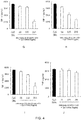
- Figure 4 Each of the salts of kukoamine B can inhibit the release of TNF- ⁇ , inflammatory mediators, in RAW264.7 cells induced by CpG DNA, and the results are shown in Figure 4 .
- Figure 4A is the result of kukoamine B malate
- Figure 4B is the result of kukoamine B succinate
- Figure 4C is the result of kukoamine B lactate
- Figure 4D is the result of kukoamine B tartrate
- Figure 4E is the result of kukoamine B methanesulfonate
- Figure 4F is the result of kukoamine B p-toluenesulfonate
- Figure 4G is the result of kukoamine B glutamate
- Figure 4H is the result of kukoamine B acetate
- Figure 4I is the result of kukoamine B hydrochlorate
- Figure 4J is the results of kukoamine B sulfate.
- Balb/c mice each of 19- 21g, half of which being male and half female, are divided into six groups randomly, including control group, antibiotic group, antibiotic and kukoamine B hydrochlorate group, antibiotic and kukoamine B methanesulfonate group, antibiotic and kukoamine B p-toluenesulfonate group, and antibiotic and kukoamine B benzene sulfonate group.
- Each group contains 20 mice. The mice are narcotized with anesthesia machine; the vapor concentration of isoflurane is 5%; the pressure of the mixed gas is 1MPa; anesthesia time is about 5 min.
- mice model are setup by cecal ligation and puncture (CLP) comprising the following steps: the mice are maintained supine position, and the abdomen skin is disinfected with iodophor; the skin, muscular layer and peritoneum below the midpoint of linea alba 0.3 cm are cutted open with ophthalmic scissors (the length of the incisions is 0.8 CM); the muscular layer is picked up with ophthalmic forceps, and the enterocoelia is explored with ophthalmic forceps; the cecum is pulled out and ligated with No. 4 suture at 0.5 CM from the end of cecum; then, the cecum is vertically punctured with No.
- CLP cecal ligation and puncture
- mice in control group are injected with 0.2 ml of sterile saline through tail vein; the mice in antibiotic group are injected with antibiotic (ampicillin sodium-sulbactam sodium) at a dosage of 80 mg/kg body weight through tail vein at 4 hours after surgery; the mice in other four groups are separately injected with kukoamine B hydrochlorate, kukoamine B methanesulfonate, kukoamine B p-toluenesulfonate and kukoamine B benzene sulfonate at a dosage of 2.5 mg/kg body weight at a time through tail vein at 0, 4, 12, 20, 28, 36, 44, 52, 60 and 68 hours after surgery.
- the general status and mortality rate of mice are observed in 7 days after surgery, and the survival rates between control group and medicated group are compared.
- the mortality rate of CLP control group in 7 days is 95%.
- the survival rate of the mice treated with ampicillin sodium-sulbactam sodium (80 mg/kg) is 15%.
- kukoamine B hydrochlorate and kukoamine B p-toluenesulfonate could improve the survival rate of mice to 20%
- kukoamine B benzene sulfonate could improve the survival rate of mice to 30%
- kukoamine B methanesulfonate could improve the survival rate of mice to 50%.
Landscapes
- Chemical & Material Sciences (AREA)
- Organic Chemistry (AREA)
- Health & Medical Sciences (AREA)
- Life Sciences & Earth Sciences (AREA)
- Public Health (AREA)
- General Chemical & Material Sciences (AREA)
- Medicinal Chemistry (AREA)
- Nuclear Medicine, Radiotherapy & Molecular Imaging (AREA)
- Chemical Kinetics & Catalysis (AREA)
- Pharmacology & Pharmacy (AREA)
- Veterinary Medicine (AREA)
- Animal Behavior & Ethology (AREA)
- General Health & Medical Sciences (AREA)
- Oncology (AREA)
- Communicable Diseases (AREA)
- Pain & Pain Management (AREA)
- Rheumatology (AREA)
- Pharmaceuticals Containing Other Organic And Inorganic Compounds (AREA)
- Acyclic And Carbocyclic Compounds In Medicinal Compositions (AREA)
- Organic Low-Molecular-Weight Compounds And Preparation Thereof (AREA)
Description
- The present invention relates to the field of pharmaceutical technology, particularly to a method for preparing the salts of kukoamine B, as further defined in the claims.
- Sepsis, also known as systemic inflammatory response syndrome (SIRS) induced by infection, is common complication of burn injury, trauma, tumor and infectious diseases, and now has been globally recognized as the leading cause of mortality in intensive care unit (ICU). The existing principal clinical treatments of sepsis are initial antibiotic administration and remedy of hypoxic ischemic damage, which adopt conventional treatments of organ failure and shock, and there is no specific treatment for it up to now. Usually, medication to sepsis empirically adopts non-specific drugs, e.g. glucocorticoids, insulin, immunomodulator, etc., but their curative effect is still uncertain. In 1990s, anti-lipid A monoclonal antibody HA-1A (Centoxin) was used in the treatment of sepsis after burn injury and trauma in the US Army during the Gulf War. Centoxin also was clinically used in some European country and Japan. However due to its possible adverse effect to septic shock, Centoxin failed to obtain approval by US Food and Drug Administration (FDA) in 1992 and then disappeared from the European market as well. Recombinant human activated protein C (rhAPC) is the only drug approved by FDA for sepsis treatment so far (Trade name Xigris). Result of clinical trial shows that rhAPC, which obtain FDA marketing approval in November 2011, can reduce the 28-day mortality of patients suffering sepsis. However, result of the second clinical trial shows that there is no difference in 28- day mortality between rhAPC group and control group. In another clinical trial in 2007, rhAPC exhibits not only no effect in increasing the survival rate of patients suffering sepsis, but also the adverse effect of inducing severe bleeding tendency in patients. Therefore, the organizing institution of this clinical trial does not recommend rhAPC as clinical drug for sepsis treatment.
- The discovery of pathogen-associated molecular patterns (PAMPs) and pattern recognition receptors (PRRs) thereof have produced a qualitative upgrade on knowledge of sepsis. It has been proven that the pathogenesis of sepsis is that the PAMPs (including lipopolysaccharide/ endotoxin (LPS), bacterial genomic DNA (CpG DNA), and peptideglycan (PGN)) of pathogens are recognized by corresponding PRRs in the membranes of or intracellular of inflammatory cells in non-specific immune system after the invasion of pathogens into organism, which process will cause inflammatory cells to be activated and release inflammatory mediators, resulting systemic inflammatory response and then organ damage. Because of the failure of existing treatments, e.g. antagonizing the important effector molecules in inflammatory response, correction of the disorders of coagulation and complement system, and antagonizing LPS alone, searching for drugs which could antagonize multiple major PAMPs (LPS, CpG DNA, PGN, etc.) concurrently and blocking the onset of sepsis at the source may bring a breakthrough on the sepsis treatment.
- Kukoamine B is a naturally exsisting alkaloid isolating from Lycii cortex., one kind of traditional Chinese herbs, the chemical structure of which is as follows:

- Kukoamine B, which exists in the form of free alkali, was first isolated from Lycii cortex. by Shinji Funayama of Japan in 1995 (S. Funayama, G. Zhang & S. Nozoe. Phytochemistry. 1995; 38: 1529-1531). There is no research about biological activity of kukoamine B reported, other than methods of extraction, isolation, purification and structural characterization thereof. The use of kukoamine B in the preparation of drugs for the prevention and treatment of sepsis and autoimmune disease has been disclosed in the earlier Chinese patent application filed by applicant (Chinese patent application No.
201010156503.X - The difference among kukoamine B contents in various Lycii cortex. from different habitats and picking time is comparatively large. Therefore, extraction, isolation and purification of kukoamine B from plants for the preparation of drugs for preventing and treating sepsis have such defects as instability in source, high production costs and high energy consumption. Chemical synthesis may provide a new method for the preparation of kukoamine B. Karigiannis et al. Tetrahedron Letters 39(28): 5117-5120 (1998) describes fragment syntheses of all four isomers of the spermine alkaloid kukoamine. As compared with naturally occurring kukoamine B, salts of kukoamine B exists in the form of salt and has a new chemical structure. The total chemical synthesis method of salts of kukoamine B has not been disclosed by any patents and literatures so far. Until now, there is also no report about the use of salts of kukoamine B in the treatment of sepsis, particularly through antagonizing multiple PAMPs (LPS and CpG DNA) concurrently.
- Aiming at the problems mentioned above, the present disclosure provides salts of kukoamine B and a preparation method thereof, as well as the use of salts of kukoamine B and pharmaceutical compositions containing them in preparation of drugs for preventing and treating sepsi. Using salts of kukoamine B and pharmaceutical compositions containing them for sepsis treatment has a novel mechanism of action, reliable curative effect and safety, and provides a new approach for the treatment of sepsis.
- The chemical structure of salts of kukoamine B is as follows:

- Wherein, A is inorganic acid, including a hydrogenhalogenide or oxo-acid or organic acid, including carboxylic acid, hydroxy acid, sulfoacid and acidic amino acid.
- The salts of kukoamine B are acid salts, which are formed by the basic group in the molecular structure of kukoamine B, including inorganic acid salts and organic acid salts.
- The hydrogenhalogenide is any one of hydrochloric acid and hydrobromic acid.
- The oxo-acid is any one of sulfuric acid, phosphoric acid, and nitric acid.
- The inorganic acid is preferably any one of hydrochloric acid, hydrobromic acid, sulfuric acid, and phosphoric acid.
- The carboxylic acid is any one of acetic acid, propionic acid, butyric acid, oxalic acid, malonic acid, succinic acid, adipic acid, benzoic acid, phenylpropionic acid, cinnamic acid, stearic acid, trifluoroacetic acid, maleic acid, fumaric acid, nicotinic acid, and palmitic acid.
- The hydroxy acid is any one of malic acid, citric acid, lactic acid, hydroxybutyric acid, lactobionic acid, tartaric acid, mandelic acid, gluconic acid, glucuronic acid, and ascorbic acid.
- The sulfoacid is any one of methanesulfonic acid, benzenesulfonic acid, p-toluenesulfonic acid, and camphorsulfonic acid.
- The acidic amino acid is any one of glutamic acid and aspartic acid.
- The organic acid preferably is any one of acetic acid, maleic acid, succinic acid, malic acid, lactic acid, tartaric acid, methanesulfonic acid, p-toluenesulfonic acid, glutamic acid, and aspartic acid.
- The acids in salts of kukoamine B are selected from a variety of inorganic acids and/ or organic acids. Hereinafter, two or three representative acids are selected from each category of pharmaceutically acceptable acids for illustrating common problems in the preparation of salts of kukoamine B, including: hydrochloric acid and hydrobromic acid selected from inorganic hydrogenacid; sulfuric acid and phosphoric acid selected from inorganic oxacid; acetic acid, maleic acid and succinic acid selected from organic carboxylic acids; malic acid, lactic acid and tartaric acid selected from organic hydroxy acids; methanesulfonic acid and p-toluenesulfonic acid selected from organic sulfoacid; glutamic acid and aspartic acid selected from organic acidic amino acids. Although the experiments of the present disclosure only show the results from the four inorganic acids and ten organic acids mentioned above, other inorganic acids and/ or organic acids (including acids exemplified or not exemplified herein) can be used in the preparation of salts of kukoamine B in the same manner. The drugs made from salts of kukoamine B and pharmaceutical compositions containing them for the prevention and treatment of sepsis can be taken through gastrointestinal drug delivery in the dosage form like powders, tablets, granules, capsules, solutions, emulsions, suspensions, etc.; or through parenteral drug delivery by injection administration, intra-cavity administration, transmucosal administration, etc. The optimal dosages for adults are 0.1-15 mg per kilogram of body weight per day, and the administration can be made one or more times per day.
- The salts of kukoamine B are prepared through a series of chemical synthesis with 3,4-Dimethoxyhydrocinnamic acid (or 3,4-Dihydroxyphenyl Propionic acid) and butanediamine as reactants, particularly as follows:
- (1) Reaction is carried out by compound I having the following structural formula I with hydrobromic acid at 100-160°C, to generate compound II, and the stoichiometric ratio of compound I to hydrobromic acid is 1: 2-5;

- (2) Compound II is dissolved in N, N- dimethylformamide to make the reaction system be in the N, N- dimethylformamide solution environment; and then potassium carbonate and benzyl chloride are added; the reaction is carried out at 60-100°C to generate compound III; the stoichiometric ratio of compound II: potassium carbonate: benzyl chloride is 1: 3-6: 3-5;

- (3) Compound III is added into sodium hydroxide solution; then methanol is added to make the reaction system be in the methanol solution environment; the reaction is carried out at 40-90°C to generate compound IV; the stoichiometric ratio of compound III to sodium hydroxide is 1: 1-3;

- (4) Compound IV is dissolved in dichloromethane and then added with N, N -dimethylformamide to make the reaction system be in environment of mixed solution containing N, N- dimethylformamide and dichloromethane; then thionyl chloride is added; the reaction is carried out at 45-65°C to generate compound V; the stoichiometric ratio of compound IV to thionyl chloride is 1: 1-2;

- (5) Compound VI is added with sodium hydroxide solution and then added with ethanol solution of Di-tert-butyl dicarbonate; the reaction is carried out at room temperature to generate compound VII; the stoichiometric ratio of sodium hydroxide: compound VI: Di-tert-butyl dicarbonate is 1-2: 1: 0.5-1;


- (6) Compound VII is dissolved in methanol to make the reaction system be in the methanol solution environment, and then added with methanol solution of acrylonitril; the reaction is carried out at room temperature to generate compound VIII; the stoichiometric ratio of compound VII to acrylonitril is 1: 1-2;

- (7) Compound VIII is added with tetrahydrofuran and triethylamine to make the reaction system be in environment of mixed solution containing tetrahydrofuran and triethylamine, and then added with tetrahydrofuran solution of benzyl chloroformate; the reaction is carried out at room temperature to generate compound IX; the stoichiometric ratio of compound VIII to benzyl chloroformate is 1: 1-2;

- (8) Compound IX is put into an autoclave, and added with saturated methanol solution of ammonia until compound IX is completely dissolved; and then, Raney nickel, the mass of which is equivalent to 10-50% of the compound IX, is added into the reaction solution; aeration is applied to ensure the reaction system in hydrogen under 1-10 MPa; the reaction is carried out at 35-50°C to generate compound X;

- (9) Compound X is dissolved in dichloromethane, and then added with triethylamine to make the reaction system be in environment of mixed solution containing dichloromethane and triethylamine; then, the dichloromethane solution of compound V is added into reaction solution at a temperature below 0°C; the reaction generates compound XI; the stoichiometric ratio of compound X to compound V is 1: 1-1.5;

- (10) Compound XI is dissolved in dichloromethane to make the reaction system be in the dichloromethane environment, and then added with trifluoroacetic acid; the reaction is carried out at room temperature to generate compound XII; the stoichiometric ratio of compound XI to trifluoroacetic acid is 1: 2-5;

- (11) Compound XII is dissolved in methanol, and then added with triethylamine to make the reaction system be in environment of mixed solution containing methanol and triethylamine; the reaction system is heated to 50-80°C and added with methanol solution of acrylonitril; the reaction solution is cooled down to room temperature to carry out the reaction, which generates compound XIII; the stoichiometric ratio of compound XII to acrylonitril is 1: 1-2;

- (12) Compound XIII is dissolved in dichloromethane, and then added with triethylamine to make the reaction system be in environment of mixed solution containing dichloromethane and triethylamine; the dichloromethane solution of compound V is added into the reaction system at a temperature below 0°C; the reaction generates compound XIV; the stoichiometric ratio of compound XIII to compound V is 1: 1-1.5;

- (13) Compound XIV is putted into an autoclave, and added with mixed solution containing saturated methanol solution of ammonia and tetrahydrofuran until compound XIV is completely dissolved, such that the reaction system is in environment of solution thereof; and then, Raney nickel, the mass of which is equivalent to 10-50% of the compound XIV, is added into the reaction system; aeration is applied to ensure the reaction system in hydrogen under 1-10 MPa; the reaction is carried out at 35-50°C to generate compound XV;

- (14) Compound XV and any one of the above-mentioned acids are putted into an autoclave, and added with mixed solution containing methanol, tetrahydrofuran and water until compound XV is completely dissolved, such that the reaction system is in environment of solution thereof; and then, Pd/C (palladium-carbon catalyst), the mass of which is equivalent to 10-30% of the compound XV, is added into the reaction system; aeration is applied to ensure the reaction system in hydrogen under 1-10 MPa; the reaction is carried out at 25-45°C to generate salt of kukoamine B; the stoichiometric ratio of compound XV to acid is 1: 1-8.
- Pharmaceutical compositions of salts of kukoamine B, including above-mentioned salts of kukoamine B as active ingredient and pharmaceutically acceptable carrier and/ or diluent.
- The use of salts of kukoamine B in the preparation of drugs for the prevention and treatment of sepsis;
The use of the pharmaceutical compositions of salts of kukoamine B in the preparation of drugs for the prevention and treatment of sepsis. - Experiments conducted by the applicant demonstrate that the above-mentioned synthetic reaction may yield 15% salts of kukoamine B.
- The pharmaceutical compositions of salts of kukoamine B include salts of kukoamine B as active ingredient and pharmaceutically acceptable carrier and/ or diluent.
- The salts of kukoamine B can be used in the preparation of drugs for preventing and treating sepsis.
- Through pharmacological test, the applicant demonstrates that:
- (1) Salts of kukoamine B could bind with lipid A, the active center of LPS;
- (2) Salts of kukoamine B could neutralize LPS in vitro in a dose dependent manner;
- (3) Salts of kukoamine B could respectively inhibit the release of inflammatory mediators in RAW 264.7 cells induced by LPS and CpG DNA in a dose dependent manner.
- The action mechanism of using salts of kukoamine B and the pharmaceutical compositions containing them for preventing and treating sepsis is based on concurrently antagonizing the multiple PAMPs inducing sepsis, and differents from drugs such as glucocorticoids, insulin, drugs antagonizing inflammatory mediators, anticoagulant, polypeptide antagonizing LPS, and monoclonal antibody antagonizing lipid A. By means of concurrently antagonizing multiple pathogen-associated molecular, the salts of kukoamine B and the pharmaceutical compositions containing them can significantly inhibit the inflammatory response induced by them.
- The present invention selects many kinds of inorganic acids and/ or organic acids for the description of common problems in the preparation of salts of kukoamine B. However, it is to be understood by those skilled in the art that salts of kukoamine B can be prepared from similar inorganic acids and/ or organic acids by methods well known in the art.
-
-
Figure 1 shows the binding reaction of salts of kukoamine B with lipid A. WhereinFigure 1A shows the results of kukoamine B malate, kukoamine B succinate, kukoamine B lactate, kukoamine B tartrate, kukoamine B methanesulfonate, kukoamine B hydrochlorate, and kukoamine B sulfate;Figure 1B shows the results of kukoamine B p-toluenesulfonate, kukoamine B glutamate, kukoamine B acetate, kukoamine B maleate, kukoamine B aspartate, kukoamine B hydrobromide, and kukoamine B phosphate. -
Figure 2 shows the neutralization of salts of kukoamine B with LPS in vitro. WhereinFigure 2A shows the results of kukoamine B malate, kukoamine B succinate, kukoamine B lactate, kukoamine B tartrate, kukoamine B methanesulfonate, kukoamine B hydrochlorate, and kukoamine B sulfate;Figure 2B shows the results of kukoamine B p-toluenesulfonate, kukoamine B glutamate, kukoamine B acetate, kukoamine B maleate, kukoamine B aspartate, kukoamine B hydrobromide, and kukoamine B phosphate. -
Figure 3 shows the inhibition of salts of kukoamine B on the release of inflammatory mediators in RAW264.7 cells induced by LPS. WhereinFigure 3A, 3B, 3C, 3D ,3E, 3F, 3G, 3H ,3I and 3J show the results of kukoamine B malate, kukoamine B succinate, kukoamine B lactate, kukoamine B tartrate, kukoamine B methanesulfonate, kukoamine B p-toluenesulfonate, kukoamine B glutamate, kukoamine B acetate, kukoamine B hydrochlorate, and kukoamine B sulfate, respectively. -
Figure 4 shows the inhibition of salts of kukoamine B on the release of inflammatory mediators in RAW264.7 cells induced by CpG DNA. WhereinFigure 4A, 4B ,4C, 4D ,4E, 4F ,4G, 4H, 4I and 4J show the results of kukoamine B malate, kukoamine B succinate, kukoamine B lactate, kukoamine B tartrate, kukoamine B methanesulfonate, kukoamine B p-toluenesulfonate, kukoamine B glutamate, kukoamine B acetate, kukoamine B hydrochlorate, and kukoamine B sulfate, respectively. -
Figure 5 shows the protective effect of the kukoamine B hydrochlorate, kukoamine B methanesulfonate, kukoamine B p-toluenesulfonate and kukoamine B benzene sulfonate to the sepsis model of mice, respectively. - LPS and CpG DNA are key factors responsible for sepsis. Therefore, the antagonism of drugs on LPS and CpG DNA reflect their preventive and therapeutic effects on sepsis.
- The following embodiments are detailed description of the present disclosure, in which, kukoamine B malate, kukoamine B succinate, kukoamine B lactate, kukoamine B tartrate, kukoamine B methanesulfonate, kukoamine B p-toluenesulfonate, kukoamine B glutamate, kukoamine B acetate, kukoamine B hydrochlorate, and kukoamine B sulfate, all of which are mature for pharmaceutical use, are preferably selected for illustration. However, it is to be understood that the disclosed embodiments are merely preferred examples of the present invention, and are not intended to limit the disclosure in any way. All reagents used herein are analytical grade, unless expressly specified otherwise.
- The following is a list of abbreviations for reference.
TLC Thin-layer chromatography DMF N, N- dimethylformamide MeOH Methanol HCl Hydrochloric acid (Boc)2O Di-tert-butyl dicarbonate DCM Dichloromethane EtOH Ethanol THF Tetrahydrofuran Cbz-Cl Benzyl chloroformate Raney Ni Raney nickel MPa Megapascal h Hour TFA Trifluoroacetic acid rt Room temperature Pd/C Palladium-carbon catalyst NMR Nuclear magnetic resonance PBS Phosphate buffered solution M Moles per liter Arc second Arc second - 1.1 Methods: (1) 50g of compound f1 is dissolved in 100 ml of hydrobromic acid solution (40% concentration), then heated to 140°C to carry out the reaction, and the reaction is monitored via TLC. After reaction is completed, the reaction solution is cooled down and then yellow crystals precipitate out. The yellow crystals are collected by suction filtration and washed with small quantity of petroleum ether, and then 40g of yellow solid compounds f2 are obtained. Next, 40g of compound f2 is dissolved in 120 ml of DMF, added with 116g of potassium carbonate and 86 ml of benzyl chloride, and then heated to 80°C to carry out the reaction, and the reaction is monitored via TLC. After reaction is completed, the reaction solution is filtrated, extracted with ethyl acetate, washed sequentially with water and saturated salt water, and dried with anhydrous sodium sulfate, and then compound f3 is collected by suction filtration. Next, 14.4g of sodium hydroxide is dissolved in 80 ml of water, added with 85g of compound f3, then added with 80 ml of methanol, and heated to 90°C to perform reflux reaction, and the reaction is monitored via TLC. After reaction is completed, the reaction solution is dried by rotary evaporation, then poured into a beaker, added with concentrated hydrochloric acid to make it strongly acidic, and filtrated, and then the filter cake is collected and dried. 60g of yellow compound f is obtained and the yield is 69%. The reaction equation is expressed as follows:

- (2) 20g of butanediamine (compound a) is added into a 500 ml round bottom flask, and added with 23 ml of 28% sodium hydroxide solution. After butanediamine has been completely dissolved, 200 ml of 12.5% ethanol solution of (Boc)2O is dropwise added into the reaction solution at room temperature while agitating. The reaction is carried out under ceaseless agitation at room temperature and monitored via TLC. After reaction is completed, the reaction solution is concentrated by rotary evaporation to remove ethanol, and extracted with DCM for several times until full extraction. The organic layers are merged, washed with saturated salt water, dried with anhydrous sodium sulfate, and treated by suction filtration after standing for some time. After concentration, 13.7 g of compound b, a colorless oil-like substance, is obtained, and the yield is 64%. The reaction equation is expressed as follows:

- (3) 27g of compound b is dissolved in 60 ml of methanol, and added with mixed solution containing 12ml of acrylonitril and 20 ml of methanol dropwise at room temperature. The reaction is carried out under ceaseless agitation at room temperature and monitored via TLC. After reaction is completed, the reaction solution is concentrated by rotary evaporation, and 31g of compound c, a colorless oil-like substance, is obtained with the yield of 88.6%. The reaction equation is expressed as follows:

- (4) 30g of compound c is added into a 250 ml round bottom flask, added with 80 ml of THF and 26 ml of triethylamine, and added with the solution containing 21 ml of Cbz-Cl and 50 ml of THF dropwise at room temperature while agitating. The reaction is carried out under ceaseless agitation at room temperature and monitored via TLC. After reaction is completed, the reaction solution is concentrated by rotary evaporation to remove organic solvents, extracted with ethyl acetate, washed sequentially with 1 mol/L HCl solution for 3 times, water, and saturated salt water, dried with anhydrous sodium sulfate, and then treated by suction filtration after standing for some time. After concentration, pale yellow oil-like substance is obtained, added with certain amount of petroleum ether, and stirred. Then, large amount of white solid precipitate out, which is treated by suction filtration, and washed with petroleum ether. 40g of air dried compound d, a white solid, is obtained and the yield is 86%. The reaction equation is expressed as follows:

- (5) 15g of compound d is putted into an autoclave, added with 150 ml of saturated methanol solution of ammonia to dissolve compound d, and then added with 4.5g of Raney Ni after the solution goes clear. Aeration is applied to ensure the reaction system in hydrogen under 5-10 MPa. The reaction solution is heated to 50°C to carry out the reaction while agitating, and the reaction is monitored via TLC. After reaction is completed, the reaction solution is treated by suction filtration with diatomaceous earth. After concentration, 13.8g of compound e, a blue oil-like substance, is obtained, and the yield is 92%. The reaction equation is expressed as follows:

- (6) 13.1 g of compound f is dissolved in 40 ml of anhydrous DCM, added with 0.1 ml of DMF, and dropwise added with 3.9 ml of thionyl chloride under ceaseless agitation at room temperature. The reaction solution is heated to 45-65°C to reflux for 5h while agitating. Then, the reaction solution is concentrated by rotary evaporation to remove DCM, and
compound f 0 is obtained. The newly obtainedcompound f 0 is added with anhydrous toluene, and treated by rotary evaporation to remove excess thionyl chloride. Besides, 13.8g compound e is dissolved in 50 ml of anhydrous DCM, added with 12 ml of triethylamine, and dropwise added with the DCM solution of newly obtained compound f 0 (10% of concentration) at 0°C. The reaction is monitored via TLC. After reaction is completed, the reaction solution is treated by suction filtration, concentrated, extracted with diethyl ether, and washed sequentially with saturated potassium carbonate solution for three times, 1 mol/L HCL solution, water, and saturated salt water. Then, the extract is dried with anhydrous sodium sulfate, standing for some time, treated by suction filtration, and then dried by rotary evaporation. 23g of compound g, a red oil-like substance, is obtained, and the yield is 88%. The reaction equation is expressed as follows:
- (7) 13g of compound g is dissolved in 30 ml of DCM, added with 5 ml of TFA, and ceaselessly agitated at room temperature, and the reaction is monitored via TLC. After reaction is completed, the reaction solution is concentrated by rotary evaporation to remove DCM, extracted with ethyl acetate, washed sequentially with water and saturated salt water, dried with anhydrous sodium sulfate, standing for some time, and then treated by suction filtration. After concentration, 11g of compound h, a red oil-like substance, is obtained, and the yield is 85%. The reaction equation is expressed as follows:

- (8) 18.1g of compound h is dissolved in 40 ml of MeOH, added with 8 ml of triethylamine, heated to 60°C, and added with mixed solution containing 2.1 ml of acrylon and 15 ml of methanol dropwise while agitating. Then, the reaction solution is gradually cooled down to room temperature, ceaselessly agitated to carry out reaction, and the reaction is monitored via TLC. After reaction is completed, the reaction solution is concentrated by rotary evaporation to remove organic solvent, and compound i is obtained. The reaction equation is expressed as follows:

- (9) 10.5g of compound f is putted into a 100 ml round bottom flask, added with 35ml of anhydrous DCM, added with two drops (0.1 ml) of DMF, dropwise added with 2.6 ml of thionyl chloride, and heated to 45-65°C to reflux for 4h. Then, the reaction solution is concentrated by rotary evaporation to remove DCM, and
compound f 0 is obtained. The newly obtainedcompound f 0 is added with anhydrous toluene, and treated by rotary evaporation to remove excess thionyl chloride. Besides, 19.6g of compound i is dissolved in 50 ml of anhydrous DCM, added with 12 ml of triethylamine, and dropwise added with the DCM solution of newly obtained compound f 0 (10% of concentration) at 0°C, and the reaction is monitored via TLC. After reaction is completed, the reaction solution is treated by suction filtration, concentrated, extracted with ethyl acetate, washed sequentially with saturated potassium carbonate solution for three times, 1 mol/L HCl solution, water, and saturated salt water, dried with anhydrous sodium sulfate, standing for some time, treated by suction filtration, dried by rotary evaporation to obtain a red oil-like substance. The red oil-like substance is isolated by silica gel column chromatography for silica gel of 200-300 mesh as stationary phase and ethyl acetate-petroleum ether (2:1) as mobile phase. All the eluant is collected and concentrated up to dryness. 21g of compound j is obtained, and the yield is 79%. The reaction equation is expressed as follows:

- (11) 1g of compound k and 0.8g of malic acid are putted into an autoclave, added with 30 ml of mixed solution containing MeOH, THF and water with the volume ratio of 3:1:1, and then added with 0.2g of Pd/C catalyst after the solution goes clear. Aeration is applied to ensure the reaction system in hydrogen under 10 MPa. The reaction solution is heated to 45°C to carry out the reaction, and the reaction is monitored via TLC. After reaction is completed, the reaction solution is treated by suction filtration and concentrated up to dryness, and dark green semisolid is obtained. The dark green semisolid is added with 30 ml of ethanol, treated by ultrasonic vibration, standing for some time to precipitate, and then the supernatant is discarded; this process is repeated for several times. Finally, 407mg of dark green solid powder is obtained by suction filtration. The reaction equation is expressed as follows:

- 1.2 Results: 407 mg of dark green solid powder is obtained. UV spectrum: λmax nm = 280 (methanol); mass spectrometry: [M+H]+ m/z 531.36; H-nuclear magnetic resonance (1H-NMR) (400 MHz, D2O): δ (ppm) 6.88-6.73 (m, 6H), 4.41(s, 1H), 3.43-3.23 (m, 6H), 2.86-2.59 (m, 16H), 1.87-1.41 (m, 8H). The dark green solid powder is identified as kukoamine B malate, the chemical structure of which is shown as follows:

- 2.1 Methods: Steps (1) through (10) are identical to the steps (1) through (10) in
embodiment 1, respectively;
(11) 1g of compound k and 0.71g of succinic acid are putted into an autoclave, added with 30 ml of mixed solution containing MeOH, THF and water with the volume ratio of 3:1:1, and then added with 0.2g of Pd/C catalyst after the solution goes clear. Aeration is applied to ensure the reaction system in hydrogen under 10 MPa. The reaction solution is heated to 45°C to carry out the reaction, and the reaction is monitored via TLC. After reaction is completed, the reaction solution is treated by suction filtration and concentrated up to dryness, and dark green semisolid is obtained. The dark green semisolid is added with 30 ml of ethanol, treated by ultrasonic vibration, standing for some time to precipitate, and then the supernatant is discarded; this process is repeated for several times. Finally, 365mg of dark green solid powder is obtained by suction filtration. The reaction equation is expressed as follows:
- 2.2 Results: 365 mg of dark green powdered solid is obtained. UV spectrum: λmax nm = 280 (methanol); mass spectrometry: [M+H]+ m/z 531.36. The dark green powdered solid is identified as kukoamine B succinate, the chemical structure of which is shown as follows:

- 3.1 Methods: Steps (1) through (10) are identical to the steps (1) through (10) in
embodiment 1, respectively;
(11) 1g of compound k and 0.5 ml of lactic acid are putted into an autoclave, added with 30 ml of mixed solution containing MeOH, THF and water with the volume ratio of 3:1:1, and then added with 0.2g of Pd/C catalyst after the solution goes clear. Aeration is applied to ensure the reaction system in hydrogen under 10 MPa. The reaction solution is heated to 45°C to carry out the reaction, and the reaction is monitored via TLC. After reaction is completed, the reaction solution is treated by suction filtration and concentrated up to dryness, and yellow semisolid is obtained. The yellow semisolid is added with 30 ml of ethanol, treated by ultrasonic vibration, standing for some time to precipitate, and then the supernatant is discarded; this process is repeated for several times. Finally, 340mg of yellow solid powder is obtained by suction filtration. The reaction equation is expressed as follows:
- 3.2 Results: 340 mg of yellow powdered solid is obtained. UV spectrum: λmax nm = 280 (methanol); mass spectrometry: [M+H]+ m/z 531.36. The yellow powdered solid is identified as kukoamine B lactate, the chemical structure of which is shown as follows:

- 4.1 Methods: Steps (1) through (10) are identical to the steps (1) through (10) in
embodiment 1, respectively;
(11) 1g of compound k and 0.9g of tartaric acid are putted into an autoclave, added with 30 ml of mixed solution containing MeOH, THF and water with the volume ratio of 3:1:1, and then added with 0.2g of Pd/C catalyst after the solution goes clear. Aeration is applied to ensure the reaction system in hydrogen under 10 MPa. The reaction solution is heated to 45°C to carry out the reaction, and the reaction is monitored via TLC. After reaction is completed, the reaction solution is treated by suction filtration and concentrated up to dryness, and yellow semisolid is obtained. The yellow semisolid is added with 30 ml of ethanol, treated by ultrasonic vibration, standing for some time to precipitate, and then the supernatant is discarded; this process is repeated for several times. Finally, 383mg of yellow solid powder is obtained by suction filtration. The reaction equation is expressed as follows: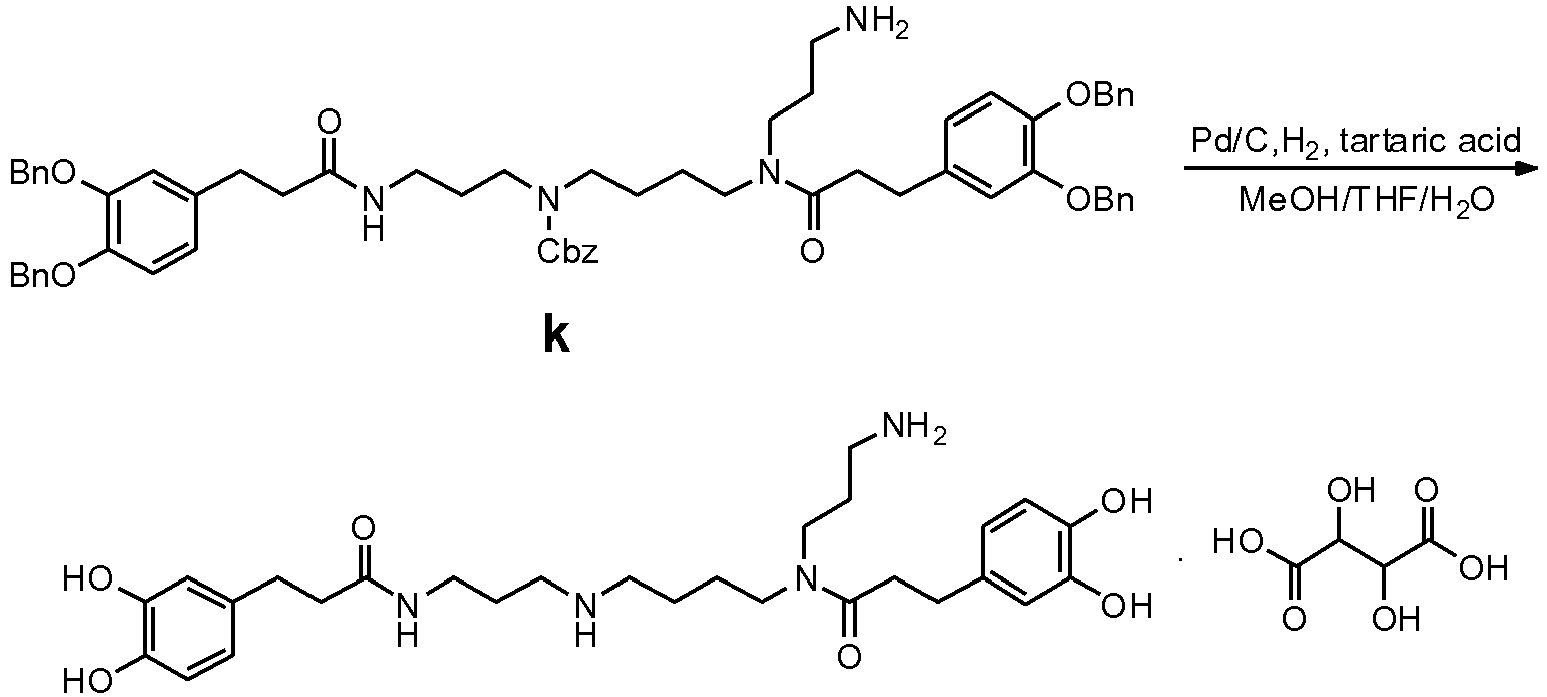
- 4.2 Results: 383 mg of yellow powdered solid is obtained. UV spectrum: λmax nm = 280 (methanol); mass spectrometry: [M+H]+ m/z 531.36. The yellow powdered solid is identified as kukoamine B tartrate, the chemical structure of which is shown as follows:

- (11) 1.0g of compound k and 0.58g of methanesulfonic acid are putted into an autoclave, added with 30 ml of mixed solution containing MeOH, THF and water with the volume ratio of 3:1:1, and then added with 0.2g of Pd/C catalyst after the solution goes clear. Aeration is applied to ensure the reaction system in hydrogen under 10 MPa. The reaction solution is heated to 45°C to carry out the reaction, and the reaction is monitored via TLC. After reaction is completed, the reaction solution is treated by suction filtration and concentrated up to dryness, and pale yellow semisolid is obtained. The pale yellow semisolid is added with 30 ml of ethanol, treated by ultrasonic vibration, standing for some time to precipitate, and then the supernatant is discarded; this process is repeated for several times. Finally, 355mg of pale yellow solid powder is obtained by suction filtration. The reaction equation is expressed as follows:

- 5.2 Results: 355mg of pale yellow powdered solid is obtained. UV spectrum: λmax nm = 280 (methanol); mass spectrometry: [M+H]+ m/z 531.36. The pale yellow powdered solid is identified as kukoamine B methanesulfonate, the chemical structure of which is shown as follows:

- 6.1 Methods: Steps (1) through (10) are identical to the steps (1) through (10) in
embodiment 1, respectively;
(11) 1g of compound k and 1g of p-toluenesulfonic acid are putted into an autoclave, added with 30 ml of mixed solution containing MeOH, THF and water with the volume ratio of 3:1:1, and then added with 0.2g of Pd/C catalyst after the solution goes clear. Aeration is applied to ensure the reaction system in hydrogen under 10 MPa. The reaction solution is heated to 45°C to carry out the reaction, and the reaction is monitored via TLC. After reaction is completed, the reaction solution is treated by suction filtration and concentrated up to dryness, and pale yellow semisolid is obtained. The pale yellow semisolid is added with 30 ml of ethanol, treated by ultrasonic vibration, standing for some time to precipitate, and then the supernatant is discarded; this process is repeated for several times. Finally, 396mg of pale yellow solid powder is obtained by suction filtration. The reaction equation is expressed as follows:
- 6.2 Results: 396mg of pale yellow powdered solid is obtained. UV spectrum: λmax nm = 280 (methanol); mass spectrometry: [M+H]+ m/z 531.36. The pale yellow powdered solid is identified as kukoamine B p-toluenesulfonate, the chemical structure of which is shown as follows:

- 7.1 Methods: Steps (1) through (10) are identical to the steps (1) through (10) in
embodiment 1, respectively;
(11) 1.0g of compound k and 0.88g of glutamic acid are putted into an autoclave, added with 30 ml of mixed solution containing MeOH, THF and water with the volume ratio of 3:1:1, and then added with 0.2g of Pd/C catalyst after the solution goes clear. Aeration is applied to ensure the reaction system in hydrogen under 10 MPa. The reaction solution is heated to 45°C to carry out the reaction, and the reaction is monitored via TLC. After reaction is completed, the reaction solution is treated by suction filtration and concentrated up to dryness, and pale yellow semisolid is obtained. The pale yellow semisolid is added with 30 ml of ethanol, treated by ultrasonic vibration, standing for some time to precipitate, and then the supernatant is discarded; this process is repeated for several times. Finally, 380mg of pale yellow solid powder is obtained by suction filtration. The reaction equation is expressed as follows:

- 8.1 Methods: Steps (1) through (10) are identical to the steps (1) through (10) in
embodiment 1, respectively;
(11) 1.0g of compound k and 0.4 ml of acetic acid are putted into an autoclave, added with 30 ml of mixed solution containing MeOH, THF and water with the volume ratio of 3:1:1, and then added with 0.2g of Pd/C catalyst after the solution goes clear. Aeration is applied to ensure the reaction system in hydrogen under 10 MPa. The reaction solution is heated to 45°C to carry out the reaction, and the reaction is monitored via TLC. After reaction is completed, the reaction solution is treated by suction filtration and concentrated up to dryness, and pale yellow semisolid is obtained. The pale yellow semisolid is added with 30 ml of ethanol, treated by ultrasonic vibration, standing for some time to precipitate, and then the supernatant is discarded; this process is repeated for several times. Finally, 330mg of pale yellow solid powder is obtained by suction filtration. The reaction equation is expressed as follows:
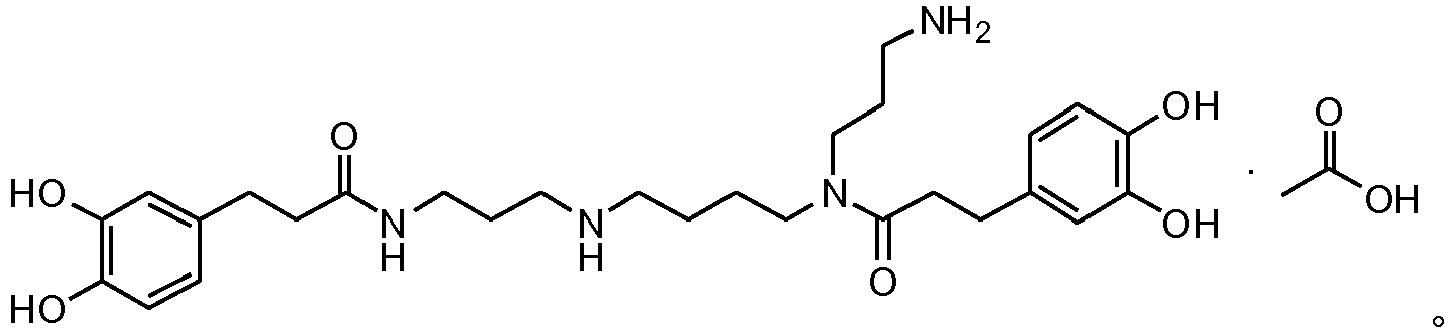
- 8.2 Results: 330mg of pale yellow powdered solid is obtained. UV spectrum: λmax nm = 280 (methanol); mass spectrometry: [M+H]+ m/z 531.36. The pale yellow powdered solid is identified as kukoamine B acetate, the chemical structure of which is shown as follows:
- 9.1 Methods: Steps (1) through (10) are identical to the steps (1) through (10) in
embodiment 1, respectively;
(11) 1g of compound k and 0.64 ml of hydrochloric acid are putted into an autoclave, added with 30 ml of mixed solution containing MeOH, THF and water with the volume ratio of 3:1:1, and then added with 0.2g of Pd/C catalyst after the solution goes clear. Aeration is applied to ensure the reaction system in hydrogen under 10 MPa. The reaction solution is heated to 45°C to carry out the reaction, and the reaction is monitored via TLC. After reaction is completed, the reaction solution is treated by suction filtration and concentrated up to dryness, and yellow semisolid is obtained. The yellow semisolid is added with 30 ml of ethanol, treated by ultrasonic vibration, standing for some time to precipitate, and then the supernatant is discarded; this process is repeated for several times. Finally, 320mg of yellow solid powder is obtained by suction filtration. The reaction equation is expressed as follows:
- 9.2 Results: 320mg of yellow powdered solid is obtained. UV spectrum: λmax nm = 280 (methanol); mass spectrometry: [M+H]+ m/z 531.36. The yellow powdered solid is identified as kukoamine B hydrochlorate, the chemical structure of which is shown as follows:

- 10.1 Methods: Steps (1) through (10) are identical to the steps (1) through (10) in
embodiment 1, respectively;
(11) 1.0g of compound k and 0.4 ml of sulfuric acid are putted into an autoclave, added with 30 ml of mixed solution containing MeOH, THF and water with the volume ratio of 3:1:1, and then added with 0.2g of Pd/C catalyst after the solution goes clear. Aeration is applied to ensure the reaction system in hydrogen under 10 MPa. The reaction solution is heated to 45°C to carry out the reaction, and the reaction is monitored via TLC. After reaction is completed, the reaction solution is treated by suction filtration and concentrated up to dryness, and pale yellow semisolid is obtained. The pale yellow semisolid is added with 30 ml of ethanol, treated by ultrasonic vibration, standing for some time to precipitate, and then the supernatant is discarded; this process is repeated for several times. Finally, 355mg of pale yellow solid powder is obtained by suction filtration. The reaction equation is expressed as follows:
- 10.2 Results: 355mg of pale yellow powdered solid is obtained. UV spectrum: λmax nm = 280 (methanol); mass spectrometry: [M+H]+ m/z 531.36. The pale yellow powdered solid is identified as kukoamine B sulfate, the chemical structure of which is shown as follows:

- 11.1 Methods: Steps (1) through (10) are identical to the steps (1) through (10) in
embodiment 1, respectively;
(11) 1.0g of compound k and 0.7g of maleic acid are putted into an autoclave, added with 30 ml of mixed solution containing MeOH, THF and water with the volume ratio of 3:1:1, and then added with 0.2g of Pd/C catalyst after the solution goes clear. Aeration is applied to ensure the reaction system in hydrogen under 10 MPa. The reaction solution is heated to 45°C to carry out the reaction, and the reaction is monitored via TLC. After reaction is completed, the reaction solution is treated by suction filtration and concentrated up to dryness, and yellow semisolid is obtained. The yellow semisolid is added with 30 ml of ethanol, treated by ultrasonic vibration, standing for some time to precipitate, and then the supernatant is discarded; this process is repeated for several times. Finally, 365mg of yellow solid powder is obtained by suction filtration. The reaction equation is expressed as follows:
- 11.2 Results: 365mg of yellow powdered solid is obtained. UV spectrum: λmaxnm = 280 (methanol); mass spectrometry: [M+H]+ m/z 531.36. The yellow powdered solid is identified as kukoamine B maleate, the chemical structure of which is shown as follows:

- 12.1 Methods: Steps (1) through (10) are identical to the steps (1) through (10) in
embodiment 1, respectively;
(11) 1.0g of compound k and 0.8g of aspartic acid are putted into an autoclave, added with 30 ml of mixed solution containing MeOH, THF and water with the volume ratio of 3:1:1, and then added with 0.2g of Pd/C catalyst after the solution goes clear. Aeration is applied to ensure the reaction system in hydrogen under 10 MPa. The reaction solution is heated to 45°C to carry out the reaction, and the reaction is monitored via TLC. After reaction is completed, the reaction solution is treated by suction filtration and concentrated up to dryness, and pale yellow semisolid is obtained. The pale yellow semisolid is added with 30 ml of ethanol, treated by ultrasonic vibration, standing for some time to precipitate, and then the supernatant is discarded; this process is repeated for several times. Finally, 374mg of pale yellow solid powder is obtained by suction filtration. The reaction equation is expressed as follows:
- 12.2 Results: 374mg of pale yellow powdered solid is obtained. UV spectrum: λmax nm = 280 (methanol); mass spectrometry: [M+H]+ m/z 531.36. The pale yellow powdered solid is identified as kukoamine B aspartate, the chemical structure of which is shown as follows:

- 13.1 Methods: Steps (1) through (10) are identical to the steps (1) through (10) in
embodiment 1, respectively;
(11) 1.0g of compound k and 0.5 ml of hydrobromic acid are putted into an autoclave, added with 30 ml of mixed solution containing MeOH, THF and water with the volume ratio of 3:1:1, and then added with 0.2g of Pd/C catalyst after the solution goes clear. Aeration is applied to ensure the reaction system in hydrogen under 10 MPa. The reaction solution is heated to 45°C to carry out the reaction, and the reaction is monitored via TLC. After reaction is completed, the reaction solution is treated by suction filtration and concentrated up to dryness, and pale yellow semisolid is obtained. The pale yellow semisolid is added with 30 ml of ethanol, treated by ultrasonic vibration, standing for some time to precipitate, and then the supernatant is discarded; this process is repeated for several times. Finally, 345mg of pale yellow solid powder is obtained by suction filtration. The reaction equation is expressed as follows:
- 13.2 Results: 345mg of pale yellow powdered solid is obtained. UV spectrum: λmax nm = 280 (methanol); mass spectrometry: [M+H]+ m/z 531.36. The pale yellow powdered solid is identified as kukoamine B hydrobromide, the chemical structure of which is shown as follows:

- 14.1 Methods: Steps (1) through (10) are identical to the steps (1) through (10) in
embodiment 1, respectively;
(11) 1.0g of compound k and 0.4 ml of phosphoric acid are putted into an autoclave, added with 30 ml of mixed solution containing MeOH, THF and water with the volume ratio of 3:1:1, and then added with 0.2g of Pd/C catalyst after the solution goes clear. Aeration is applied to ensure the reaction system in hydrogen under 10 MPa. The reaction solution is heated to 45°C to carry out the reaction, and the reaction is monitored via TLC. After reaction is completed, the reaction solution is treated by suction filtration and concentrated up to dryness, and pale yellow semisolid is obtained. The pale yellow semisolid is added with 30 ml of ethanol, treated by ultrasonic vibration, standing for some time to precipitate, and then the supernatant is discarded; this process is repeated for several times. Finally, 354mg of pale yellow solid powder is obtained by suction filtration. The reaction equation is expressed as follows:
- 14.2 Results: 354mg of pale yellow powdered solid is obtained. UV spectrum: λmax nm = 280 (methanol); mass spectrometry: [M+H]+ m/z 531.36. The pale yellow powdered solid is identified as kukoamine B phosphate, the chemical structure of which is shown as follows:

- 15.1 Methods: The affinity assay is carried out according to the methods disclosed in the Chinese patent titled "Use of an active ingredient or active substance selected and isolated from traditional Chinese herbs in the preparation of drugs for treating sepsis" (Chinese patent Number
ZL 200510070677.3 - (1) Lipid A is immobilized on the reacting surfaces of non-derivative cuvettes according to the instructions of immobilization of lipid in the manufacturer's instructions of IAsys plus Affinity Sensor. Wherein, the end of hydrophobic side chain of lipid A was immobilized on cuvette, and the hydrophilic end is floating outside, which act as target site of binding reaction;
- (2) 1mg of each of the salts, including kukoamine B hydrochlorate, kukoamine B hydrobromide, kukoamine B sulfate, kukoamine B phosphate, kukoamine B acetate, kukoamine B maleate, kukoamine B succinate, kukoamine B malate, kukoamine B lactate, kukoamine B tartrate, kukoamine B methanesulfonate, kukoamine B p-toluenesulfonate, kukoamine B glutamate, and kukoamine B aspartate, is fully dissolved by 1ml of PBS solution (0.01 M, pH 7.4), respectively;
- (3) 5 µl of each of the solution obtained in step (2) is added into the affinity sensor's cuvettes (containing 45 µl of PBS solution) previously immobilized with lipid A to carry out the reaction, respectively;
- (4) The binding reaction is carried out for 3 min, and the binding curves are recorded;
- (5) Each of the cuvettes is washed with 50 µl of PBS solution for 3 times, and dissociation curves are recorded;
- (6) Each of the cuvettes is washed with 0.1 M HCl solution for 3 times, and the regeneration curves are recorded.
- 15.2 Results: Each of the salts of kukoamine B mentioned above can bind with lipid A, and the binding curves are shown in
Figure 1. Figure 1 shows the binding reaction of salts of kukoamine B with lipid A. WhereinFigure 1A shows the results of kukoamine B malate, kukoamine B succinate, kukoamine B lactate, kukoamine B tartrate, kukoamine B methanesulfonate, kukoamine B hydrochlorate, and kukoamine B sulfate;Figure 1B shows the results of kukoamine B p-toluenesulfonate, kukoamine B glutamate, kukoamine B acetate, kukoamine B maleate, kukoamine B aspartate, kukoamine B hydrobromide, and kukoamine B phosphate. - 16.1 Methods: The neutralizing test is carried out according to the manufacturer's instructions of 32 Well Kinetic Tube Reader (ATi321-06) endotoxin detector, which mainly comprises the following steps:
- (1) Each of the salts, including kukoamine B hydrochlorate, kukoamine B hydrobromide, kukoamine B sulfate, kukoamine B phosphate, kukoamine B acetate, kukoamine B maleate, kukoamine B succinate, kukoamine B malate, kukoamine B lactate, kukoamine B tartrate, kukoamine B methanesulfonate, kukoamine B p-toluenesulfonate, kukoamine B glutamate, and kukoamine B aspartate, is prepared into 20 µM solution with nonpyrogenic water, respectively;
- (2) 100 µl of each of the solution obtained in step (1) is separately mixed with equal volume of LPS solution (0.25 ng/ml). At the same time, the control group is established, which is a mixed solution containing 100 µl of nonpyrogenic water and equal volume of LPS solution (0.25 ng/ml). The LPS group and control group are incubated at 37°C for 30 min. Then, 100 µl of the reaction solutions of LPS group and control group are separately added into a detector tube containing 100 µl of TAL reagents, and LPS value of each group are detected by kinetic turbidimetric limulus test according to the manufacturer's instructions of 32 Well Kinetic Tube Reader (ATi321-06) Bacterial Endotoxin Detection system. The test of each concentration is repeated three times;
- 16.2 Results: Each of the salts of kukoamine B can neutralize LPS in vitro, and the results are shown in
Figure 2 . WhereinFigure 2A shows the results of kukoamine B malate, kukoamine B succinate, kukoamine B lactate, kukoamine B tartrate, kukoamine B methanesulfonate, kukoamine B hydrochlorate, and kukoamine B sulfate;Figure 2B shows the results of kukoamine B p-toluenesulfonate, kukoamine B glutamate, kukoamine B acetate, kukoamine B maleate, kukoamine B aspartate, kukoamine B hydrobromide, and kukoamine B phosphate. - 17.1 Methods: RAW264.7 cells are diluted to 1×10⁶/ml in DMEM culture medium, added into a 96-well cell culture plate (200 µl per well), and incubated at 37 °C in a 5% CO2 humidified incubator for 4 h, and then the supernatant is replaced with 200 µl of serum-free DMEM culture medium after cells attachment. Next, each well is added with LPS (final concentration of 100 ng/ml), and then added with one of the salts of kukoamine B (including kukoamine B malate, kukoamine B succinate, kukoamine B lactate, kukoamine B tartrate, kukoamine B methanesulfonate, kukoamine B p-toluenesulfonate, kukoamine B glutamate, kukoamine B acetate, kukoamine B hydrochlorate, and kukoamine B sulfate) to obtain the final concentration of 0, 50, 100, and 200 µM, respectively. The control group contains no LPS. Then, the incubation goes on for 4h. The supernatant is collected to measure the concentration of TNF-α according to the manufacturer's instructions of ELISA kit. 17.2 Results: Each of the salts of kukoamine B can inhibit the release of TNF-α, inflammatory mediators, in RAW264.7 cells induced by LPS, and the results are shown in
Figure 3 . Wherein,Figure 3A is the result of kukoamine B malate;Figure 3B is the result of kukoamine B succinate;Figure 3C is the result of kukoamine B lactate;Figure 3D is the result of kukoamine B tartrate;Figure 3E is the result of kukoamine B methanesulfonate;Figure 3F is the result of kukoamine B p-toluenesulfonate;Figure 3G is the result of kukoamine B glutamate;Figure 3H is the result of kukoamine B acetate;Figure 3I is the result of kukoamine B hydrochlorate; andFigure 3J is the results of kukoamine B sulfate. - 17.1 Methods: RAW264.7 cells are diluted to 1×10⁶/ml in DMEM culture medium, added into a 96-well cell culture plate (200 µl per well), and incubated at 37 °C in a 5% CO2 humidified incubator for 4 h, and then the supernatant is replaced with 200 µl of serum-free DMEM culture medium after cells attachment. Next, each well is added with CpG DNA (final concentration of 10 µg/ml), and then added with one of the salts of kukoamine B (including kukoamine B malate, kukoamine B succinate, kukoamine B lactate, kukoamine B tartrate, kukoamine B methanesulfonate, kukoamine B p-toluenesulfonate, kukoamine B glutamate, kukoamine B acetate, kukoamine B hydrochlorate, and kukoamine B sulfate) to obtain the final concentration of 0, 50, 100, and 200 µM, respectively. The control group contains no CpG DNA. Then, the incubation goes on for 4h. The supernatant is collected to measure the concentration of TNF-α according to the manufacturer's instructions of ELISA kit.
- 18.2 Results: Each of the salts of kukoamine B can inhibit the release of TNF-α, inflammatory mediators, in RAW264.7 cells induced by CpG DNA, and the results are shown in
Figure 4 . Wherein,Figure 4A is the result of kukoamine B malate;Figure 4B is the result of kukoamine B succinate;Figure 4C is the result of kukoamine B lactate;Figure 4D is the result of kukoamine B tartrate;Figure 4E is the result of kukoamine B methanesulfonate;Figure 4F is the result of kukoamine B p-toluenesulfonate;Figure 4G is the result of kukoamine B glutamate;Figure 4H is the result of kukoamine B acetate;Figure 4I is the result of kukoamine B hydrochlorate; andFigure 4J is the results of kukoamine B sulfate. - 120 Balb/c mice, each of 19- 21g, half of which being male and half female, are divided into six groups randomly, including control group, antibiotic group, antibiotic and kukoamine B hydrochlorate group, antibiotic and kukoamine B methanesulfonate group, antibiotic and kukoamine B p-toluenesulfonate group, and antibiotic and kukoamine B benzene sulfonate group. Each group contains 20 mice. The mice are narcotized with anesthesia machine; the vapor concentration of isoflurane is 5%; the pressure of the mixed gas is 1MPa; anesthesia time is about 5 min. The mice model are setup by cecal ligation and puncture (CLP) comprising the following steps: the mice are maintained supine position, and the abdomen skin is disinfected with iodophor; the skin, muscular layer and peritoneum below the midpoint of linea alba 0.3 cm are cutted open with ophthalmic scissors (the length of the incisions is 0.8 CM); the muscular layer is picked up with ophthalmic forceps, and the enterocoelia is explored with ophthalmic forceps; the cecum is pulled out and ligated with No. 4 suture at 0.5 CM from the end of cecum; then, the cecum is vertically punctured with No. 12 needle, and squeezed to extrude contents; finally, the cecum is putted back and the incision is stitched. Thereafter, the mice in control group are injected with 0.2 ml of sterile saline through tail vein; the mice in antibiotic group are injected with antibiotic (ampicillin sodium-sulbactam sodium) at a dosage of 80 mg/kg body weight through tail vein at 4 hours after surgery; the mice in other four groups are separately injected with kukoamine B hydrochlorate, kukoamine B methanesulfonate, kukoamine B p-toluenesulfonate and kukoamine B benzene sulfonate at a dosage of 2.5 mg/kg body weight at a time through tail vein at 0, 4, 12, 20, 28, 36, 44, 52, 60 and 68 hours after surgery. The general status and mortality rate of mice are observed in 7 days after surgery, and the survival rates between control group and medicated group are compared.
- 19.2 Results: The mortality rate of CLP control group in 7 days is 95%. The survival rate of the mice treated with ampicillin sodium-sulbactam sodium (80 mg/kg) is 15%. When treated with the combination of salts of kukoamine B and antibiotic, kukoamine B hydrochlorate and kukoamine B p-toluenesulfonate could improve the survival rate of mice to 20%, kukoamine B benzene sulfonate could improve the survival rate of mice to 30%, and kukoamine B methanesulfonate could improve the survival rate of mice to 50%. The results indicate that kukoamine B hydrochlorate, kukoamine B methanesulfonate, kukoamine B p-toluenesulfonate and kukoamine B benzene sulfonate have protective effects to the sepsis model of mice, wherein kukoamine B methanesulfonate has the best effect. The results are shown in
Figure 5 .
Claims (1)
- A method for preparing the salts of kukoamine B having the chemical structure as follows:
 (1) reaction is carried out by compound I having the following structural formula I with hydrobromic acid at 100-160°C, to generate compound II, and the stoichiometric ratio of compound I to hydrobromic acid is 1: 2-5;
 (2) compound II is dissolved in N,N-dimethylformamide to make the reaction system be in the N,N-dimethylformamide solution environment; and then potassium carbonate and benzyl chloride are added; the reaction is carried out at 60-100°C to generate compound III; the stoichiometric ratio of compound II: potassium carbonate: benzyl chloride is 1: 3-6: 3-5;
 (3) compound III is added into sodium hydroxide solution; then methanol is added to make the reaction system be in the methanol solution environment; the reaction is carried out at 40-90°C to generate compound IV; the stoichiometric ratio of compound III to sodium hydroxide is 1: 1-3;
 (4) compound IV is dissolved in dichloromethane and then added with N,N-dimethylformamide to make the reaction system be in environment of mixed solution containing N,N-dimethylformamide and dichloromethane; then thionyl chloride is added; the reaction is carried out at 45-65°C to generate compound V; the stoichiometric ratio of compound IV to thionyl chloride is 1: 1-2;
 (5) compound VI is added with sodium hydroxide solution and then added with ethanol solution of Di-tert-butyl dicarbonate; the reaction is carried out at room temperature to generate compound VII; the stoichiometric ratio of sodium hydroxide: compound VI: Di-tert-butyl dicarbonate is 1-2: 1: 0.5-1;
 (6) compound VII is dissolved in methanol to make the reaction system be in the methanol solution environment, and then added with methanol solution of acrylonitril; the reaction is carried out at room temperature to generate compound VIII; the stoichiometric ratio of compound VII to acrylonitril is 1: 1-2;
 (7) compound VIII is added with tetrahydrofuran and triethylamine to make the reaction system be in environment of mixed solution containing tetrahydrofuran and triethylamine, and then added with tetrahydrofuran solution of benzyl chloroformate; the reaction is carried out at room temperature to generate compound IX; the stoichiometric ratio of compound VIII to benzyl chloroformate is 1: 1-2;
 (8) compound IX is putted into an autoclave, and added with saturated methanol solution of ammonia until compound IX is completely dissolved; and then, Raney nickel, the mass of which is equivalent to 10-50% of the compound IX, is added into the reaction solution; aeration is applied to ensure the reaction system in hydrogen under 1-10 MPa; the reaction is carried out at 35-50°C to generate compound X;
 (9) compound X is dissolved in dichloromethane, and then added with trimethylamine to make the reaction system be in environment of mixed solution containing dichloromethane and triethylamine; then, the dichloromethane solution of compound V is added into reaction solution at a temperature below 0°C; the reaction generates compound XI; the stoichiometric ratio of compound X to compound V is 1: 1-1.5;
 (10) compound XI is dissolved in dichloromethane to make the reaction system be in the dichloromethane environment, and then added with trifluoroacetic acid; the reaction is carried out at room temperature to generate compound XII; the stoichiometric ratio of compound XI to trifluoroacetic acid is 1: 2-5;
 (11) compound XII is dissolved in methanol, and then added with triethylamine to make the reaction system be in environment of mixed solution containing methanol and triethylamine; the reaction system is heated to 50-80°C and added with methanol solution of acrylonitril; the reaction solution is cooled down to room temperature to carry out the reaction, which generates compound XIII; the stoichiometric ratio of compound XII to acrylonitril is 1: 1-2;
 (12) compound XIII is dissolved in dichloromethane, and then added with triethylamine to make the reaction system be in environment of mixed solution containing dichloromethane and triethylamine; the dichloromethane solution of compound V is added into the reaction system at a temperature below 0°C; the reaction generates compound XIV; the stoichiometric ratio of compound XIII to compound V is 1: 1-1.5;
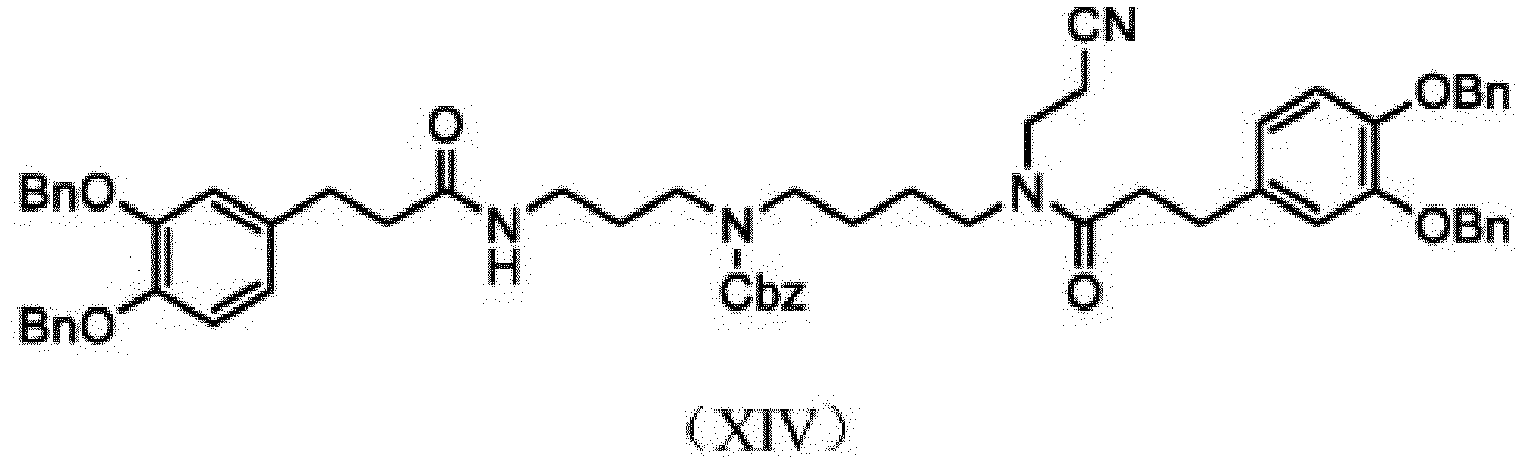 (13) compound XIV is putted into an autoclave, and added with mixed solution containing saturated methanol solution of ammonia and tetrahydrofuran until compound XIV is completely dissolved, such that the reaction system is in environment of solution thereof; and then, Raney nickel, the mass of which is equivalent to 10-50% of the compound XIV, is added into the reaction system; aeration is applied to ensure the reaction system in hydrogen under 1-10 MPa; the reaction is carried out at 35-50°C to generate compound XV;
 (14) compound XV and anyone of the acids hydrochloric acid, hydrobromic acid, sulfuric acid, phosphoric acid, nitric acid, acetic acid, propionic acid, butyric acid, oxalic acid, malonic acid, succinic acid, adipic acid, benzoic acid, phenylpropionic acid, cinnamic acid, stearic acid, trifluoroacetic acid, maleic acid, fumaric acid, nicotinic acid, palmitic acid, malic acid, citric acid, lactic acid, hydroxybutyric acid, lactobionic acid, tartaric acid, mandelic acid, gluconic acid, glucuronic acid, ascorbic acid, methanesulfonic acid, benzenesulfonic acid, p-toluenesulfonic acid, camphorsulfonic acid, glutamic acid, and aspartic acid are putted into an autoclave, and added with mixed solution containing methanol, tetrahydrofuran and water until compound XV is completely dissolved, such that the reaction system is in environment of solution thereof; and then, palladium-carbon catalyst, the mass of which is equivalent to 10-30% of the compound XV, is added into the reaction system; aeration is applied to ensure the reaction system in hydrogen under 1-10 MPa; the reaction is carried out at 25-45 °C to generate salt of kukoamine B; the stoichiometric ratio of compound XV to acid is 1: 1-8.
Applications Claiming Priority (2)
| Application Number | Priority Date | Filing Date | Title |
|---|---|---|---|
| CN201010539028.4A CN102464591B (en) | 2010-11-10 | 2010-11-10 | Kukoamine B salt and preparation method and purposes |
| PCT/CN2011/000479 WO2012062026A1 (en) | 2010-11-10 | 2011-03-21 | Salts of kukoamine b, preparation method and use thereof |
Publications (3)
| Publication Number | Publication Date |
|---|---|
| EP2639215A1 EP2639215A1 (en) | 2013-09-18 |
| EP2639215A4 EP2639215A4 (en) | 2014-04-23 |
| EP2639215B1 true EP2639215B1 (en) | 2017-10-11 |
Family
ID=46050336
Family Applications (1)
| Application Number | Title | Priority Date | Filing Date |
|---|---|---|---|
| EP11840357.5A Active EP2639215B1 (en) | 2010-11-10 | 2011-03-21 | Preparation method for salts of kukoamine b |
Country Status (7)
| Country | Link |
|---|---|
| US (1) | US9365504B2 (en) |
| EP (1) | EP2639215B1 (en) |
| JP (2) | JP5809286B2 (en) |
| CN (1) | CN102464591B (en) |
| CA (1) | CA2817263C (en) |
| IL (1) | IL225972A (en) |
| WO (1) | WO2012062026A1 (en) |
Families Citing this family (13)
| Publication number | Priority date | Publication date | Assignee | Title |
|---|---|---|---|---|
| CN101829075B (en) | 2010-04-27 | 2011-07-20 | 中国人民解放军第三军医大学第一附属医院 | Applications of kukoamine A and kukoamine B |
| CN102641240B (en) * | 2012-05-22 | 2014-07-16 | 天津红日药业股份有限公司 | Kukoamine B salt injection and preparation method thereof |
| CN104418761A (en) * | 2013-09-03 | 2015-03-18 | 香港城市大学 | Separation method of picrocoamine |
| CN103769060B (en) * | 2014-01-23 | 2015-10-21 | 重庆安体新生物技术有限公司 | For adsorbent and the Preparation method and use of bacteria removal endotoxin, DNA and peptide glycan |
| CN103819356A (en) * | 2014-02-12 | 2014-05-28 | 天津红日药业股份有限公司 | Preparation method and use of kukoamine B analogue or medicinal salts thereof |
| CN104725278B (en) * | 2015-01-23 | 2017-01-25 | 天津红日药业股份有限公司 | Preparation method for intermediate of Kukoamine B |
| CN105330563B (en) * | 2015-10-12 | 2018-12-07 | 天津红日药业股份有限公司 | For the reference compound in the control of Kukoamine B quality |
| CN105348137B (en) * | 2015-10-29 | 2018-06-12 | 重庆安体新生物技术有限公司 | Polyamine derivative pharmaceutical salts and preparation method and purposes |
| CN110491455B (en) * | 2019-07-22 | 2023-01-24 | 广州中医药大学(广州中医药研究院) | Application of lycium barbarum extract in preparation of antitumor drugs |
| CN110963940A (en) * | 2019-12-24 | 2020-04-07 | 广州中医药大学(广州中医药研究院) | Cortex lycii radicis B derivative compound and preparation method and application thereof |
| CN114773218B (en) * | 2022-06-02 | 2024-06-04 | 云南省药物研究所 | Preparation method of cortex lycii radicis-element |
| CN117105808B (en) * | 2022-08-29 | 2024-08-02 | 武汉武药科技有限公司 | Polyamine derivative medicinal salt, crystal form and preparation method thereof |
| CN115557857B (en) * | 2022-10-09 | 2024-05-24 | 天津红日药业股份有限公司 | Kukoamine B intermediate and preparation method thereof and preparation method of kukoamine B mesylate |
Family Cites Families (2)
| Publication number | Priority date | Publication date | Assignee | Title |
|---|---|---|---|---|
| KR100517738B1 (en) * | 2003-06-03 | 2005-09-30 | 김영숙 | manufacture method thereof and a scorched rice snack have Chinese matrimony vine |
| CN101829075B (en) * | 2010-04-27 | 2011-07-20 | 中国人民解放军第三军医大学第一附属医院 | Applications of kukoamine A and kukoamine B |
-
2010
- 2010-11-10 CN CN201010539028.4A patent/CN102464591B/en active Active
-
2011
- 2011-03-21 EP EP11840357.5A patent/EP2639215B1/en active Active
- 2011-03-21 CA CA2817263A patent/CA2817263C/en active Active
- 2011-03-21 US US13/884,558 patent/US9365504B2/en active Active
- 2011-03-21 JP JP2013538030A patent/JP5809286B2/en active Active
- 2011-03-21 WO PCT/CN2011/000479 patent/WO2012062026A1/en not_active Ceased
-
2013
- 2013-04-25 IL IL225972A patent/IL225972A/en active IP Right Grant
-
2015
- 2015-09-10 JP JP2015178139A patent/JP2016029053A/en active Pending
Non-Patent Citations (2)
| Title |
|---|
| JIANG ZHENG: "CN101829075 A 20100915", MACHINE TRANSLATION, 27 April 2010 (2010-04-27), XP055320992 * |
| SHINJI FUNAYAMA ET AL: "Kukoamine B, a spermine alkaloid from Lycium chinense", PHYTOCHEMISTRY, vol. 38, no. 6, 1 April 1995 (1995-04-01), pages 1529 - 1531, XP055086442, ISSN: 0031-9422, DOI: 10.1016/0031-9422(94)00826-F * |
Also Published As
| Publication number | Publication date |
|---|---|
| CA2817263C (en) | 2017-01-24 |
| CA2817263A1 (en) | 2012-05-18 |
| EP2639215A4 (en) | 2014-04-23 |
| WO2012062026A1 (en) | 2012-05-18 |
| JP2014501708A (en) | 2014-01-23 |
| IL225972A (en) | 2016-09-29 |
| JP5809286B2 (en) | 2015-11-10 |
| IL225972A0 (en) | 2013-06-27 |
| US20130289112A1 (en) | 2013-10-31 |
| CN102464591B (en) | 2016-08-24 |
| CN102464591A (en) | 2012-05-23 |
| EP2639215A1 (en) | 2013-09-18 |
| JP2016029053A (en) | 2016-03-03 |
| US9365504B2 (en) | 2016-06-14 |
Similar Documents
| Publication | Publication Date | Title |
|---|---|---|
| EP2639215A1 (en) | Salts of kukoamine b, preparation method and use thereof | |
| WO2022078352A1 (en) | Crystal forms of glp-1r agonists and uses thereof | |
| CN106810582B (en) | Compounds, preparation methods and applications of glucopyranosyl derivatives | |
| NO157452B (en) | ANALOGY PROCEDURE FOR THE PREPARATION OF A THERAPEUTIC ACTIVE BISPIDIN DERIVATIVE. | |
| TW482769B (en) | Amino-lipopeptide antifungal agents | |
| WO2018068696A1 (en) | Pegylated sinomenine and derivative thereof and preparation method and use of same | |
| CN115869312A (en) | PDC (polycrystalline diamond compact) antitumor drug as well as preparation method and application thereof | |
| KR20130087391A (en) | Dibenzocyclooctene lignan derivatives and uses thereof in treatment of viral hepatitis | |
| TW201615694A (en) | Main chain polyamines | |
| US7659308B2 (en) | Concentricolide and its derivatives, process for preparing them, pharmaceutical composition comprising the same and its use | |
| CN106866652A (en) | Bit derivant of jamaicin 12 with insulin-sensitizing activity and preparation method thereof | |
| CN107033154A (en) | Opiate receptor antagonist conjugate and its application | |
| CN105439889B (en) | A kind of vanillic aldehyde amine noval chemical compound, its preparation method and medical usage | |
| WO2024020409A1 (en) | Therapeutic compounds, formulations, and use thereof | |
| CN102276521A (en) | Kukoamine B analogue, and pharmaceutically acceptable salt, preparation method and application thereof | |
| CN101307043B (en) | 6,8-dimethylol chrysin and 6,8-dimethylol ether chrysin, method for preparing same and pharmaceutical use | |
| CN116284018A (en) | Preparation method and application of furo [2,3-b ] quinoline derivative | |
| KR20130018623A (en) | N1-cyclic amine-n2-substituted biguanide derivatives, methods of preparing the same and pharmaceutical composition comprising the same | |
| TW202342467A (en) | Preparation method of nitrogen-containing heterocyclic compound | |
| EP4251188A1 (en) | Cyclic peptides with antimicrobial properties | |
| KR101987853B1 (en) | Novel macrolide-based compounds, preparation method thereof, and pharmaceutical composition for preventing or treating malaria containing the same | |
| CN110511201B (en) | A class of 3'-aminoalkoxy-luteolin derivatives and their preparation method and application | |
| CN101311167B (en) | 1-phenyl glyoxaline alkane -2,4-dione derivates and uses thereof | |
| CN100494177C (en) | Bi-amido heterocyclic derivative with antitumour activity and its preparation method and use | |
| CN106478542A (en) | A kind of macrolide derivative salt, Preparation Method And The Use |
Legal Events
| Date | Code | Title | Description |
|---|---|---|---|
| PUAI | Public reference made under article 153(3) epc to a published international application that has entered the european phase |
Free format text: ORIGINAL CODE: 0009012 |
|
| 17P | Request for examination filed |
Effective date: 20130610 |
|
| AK | Designated contracting states |
Kind code of ref document: A1 Designated state(s): AL AT BE BG CH CY CZ DE DK EE ES FI FR GB GR HR HU IE IS IT LI LT LU LV MC MK MT NL NO PL PT RO RS SE SI SK SM TR |
|
| DAX | Request for extension of the european patent (deleted) | ||
| A4 | Supplementary search report drawn up and despatched |
Effective date: 20140320 |
|
| RIC1 | Information provided on ipc code assigned before grant |
Ipc: C07C 35/34 20060101AFI20140314BHEP Ipc: A61P 29/00 20060101ALI20140314BHEP Ipc: A61K 31/165 20060101ALI20140314BHEP |
|
| STAA | Information on the status of an ep patent application or granted ep patent |
Free format text: STATUS: EXAMINATION IS IN PROGRESS |
|
| 17Q | First examination report despatched |
Effective date: 20161124 |
|
| REG | Reference to a national code |
Ref country code: DE Ref legal event code: R079 Ref document number: 602011042396 Country of ref document: DE Free format text: PREVIOUS MAIN CLASS: C07C0035340000 Ipc: C07C0235340000 |
|
| GRAP | Despatch of communication of intention to grant a patent |
Free format text: ORIGINAL CODE: EPIDOSNIGR1 |
|
| STAA | Information on the status of an ep patent application or granted ep patent |
Free format text: STATUS: GRANT OF PATENT IS INTENDED |
|
| RIC1 | Information provided on ipc code assigned before grant |
Ipc: C07C 53/10 20060101ALI20170404BHEP Ipc: C07C 235/34 20060101AFI20170404BHEP Ipc: C07C 55/14 20060101ALI20170404BHEP Ipc: C07C 59/50 20060101ALI20170404BHEP Ipc: C07C 63/06 20060101ALI20170404BHEP Ipc: C07C 57/145 20060101ALI20170404BHEP Ipc: C07C 59/255 20060101ALI20170404BHEP Ipc: C07C 57/44 20060101ALI20170404BHEP Ipc: C07C 229/24 20060101ALI20170404BHEP Ipc: C07C 55/06 20060101ALI20170404BHEP Ipc: C07C 53/08 20060101ALI20170404BHEP Ipc: C07C 59/08 20060101ALI20170404BHEP Ipc: C07C 53/122 20060101ALI20170404BHEP Ipc: C07C 309/25 20060101ALI20170404BHEP Ipc: C07C 309/04 20060101ALI20170404BHEP Ipc: C07C 309/30 20060101ALI20170404BHEP Ipc: C07C 55/10 20060101ALI20170404BHEP Ipc: C07C 55/08 20060101ALI20170404BHEP Ipc: C07C 59/245 20060101ALI20170404BHEP Ipc: C07C 59/265 20060101ALI20170404BHEP |
|
| INTG | Intention to grant announced |
Effective date: 20170508 |
|
| GRAS | Grant fee paid |
Free format text: ORIGINAL CODE: EPIDOSNIGR3 |
|
| GRAA | (expected) grant |
Free format text: ORIGINAL CODE: 0009210 |
|
| STAA | Information on the status of an ep patent application or granted ep patent |
Free format text: STATUS: THE PATENT HAS BEEN GRANTED |
|
| AK | Designated contracting states |
Kind code of ref document: B1 Designated state(s): AL AT BE BG CH CY CZ DE DK EE ES FI FR GB GR HR HU IE IS IT LI LT LU LV MC MK MT NL NO PL PT RO RS SE SI SK SM TR |
|
| REG | Reference to a national code |
Ref country code: GB Ref legal event code: FG4D |
|
| REG | Reference to a national code |
Ref country code: CH Ref legal event code: EP |
|
| REG | Reference to a national code |
Ref country code: IE Ref legal event code: FG4D |
|
| REG | Reference to a national code |
Ref country code: AT Ref legal event code: REF Ref document number: 935870 Country of ref document: AT Kind code of ref document: T Effective date: 20171115 |
|
| REG | Reference to a national code |
Ref country code: DE Ref legal event code: R096 Ref document number: 602011042396 Country of ref document: DE |
|
| REG | Reference to a national code |
Ref country code: NL Ref legal event code: MP Effective date: 20171011 |
|
| REG | Reference to a national code |
Ref country code: LT Ref legal event code: MG4D |
|
| REG | Reference to a national code |
Ref country code: AT Ref legal event code: MK05 Ref document number: 935870 Country of ref document: AT Kind code of ref document: T Effective date: 20171011 |
|
| REG | Reference to a national code |
Ref country code: FR Ref legal event code: PLFP Year of fee payment: 8 |
|
| PG25 | Lapsed in a contracting state [announced via postgrant information from national office to epo] |
Ref country code: NL Free format text: LAPSE BECAUSE OF FAILURE TO SUBMIT A TRANSLATION OF THE DESCRIPTION OR TO PAY THE FEE WITHIN THE PRESCRIBED TIME-LIMIT Effective date: 20171011 |
|
| PG25 | Lapsed in a contracting state [announced via postgrant information from national office to epo] |
Ref country code: LT Free format text: LAPSE BECAUSE OF FAILURE TO SUBMIT A TRANSLATION OF THE DESCRIPTION OR TO PAY THE FEE WITHIN THE PRESCRIBED TIME-LIMIT Effective date: 20171011 Ref country code: NO Free format text: LAPSE BECAUSE OF FAILURE TO SUBMIT A TRANSLATION OF THE DESCRIPTION OR TO PAY THE FEE WITHIN THE PRESCRIBED TIME-LIMIT Effective date: 20180111 Ref country code: FI Free format text: LAPSE BECAUSE OF FAILURE TO SUBMIT A TRANSLATION OF THE DESCRIPTION OR TO PAY THE FEE WITHIN THE PRESCRIBED TIME-LIMIT Effective date: 20171011 Ref country code: ES Free format text: LAPSE BECAUSE OF FAILURE TO SUBMIT A TRANSLATION OF THE DESCRIPTION OR TO PAY THE FEE WITHIN THE PRESCRIBED TIME-LIMIT Effective date: 20171011 Ref country code: SE Free format text: LAPSE BECAUSE OF FAILURE TO SUBMIT A TRANSLATION OF THE DESCRIPTION OR TO PAY THE FEE WITHIN THE PRESCRIBED TIME-LIMIT Effective date: 20171011 |
|
| PG25 | Lapsed in a contracting state [announced via postgrant information from national office to epo] |
Ref country code: BG Free format text: LAPSE BECAUSE OF FAILURE TO SUBMIT A TRANSLATION OF THE DESCRIPTION OR TO PAY THE FEE WITHIN THE PRESCRIBED TIME-LIMIT Effective date: 20180111 Ref country code: AT Free format text: LAPSE BECAUSE OF FAILURE TO SUBMIT A TRANSLATION OF THE DESCRIPTION OR TO PAY THE FEE WITHIN THE PRESCRIBED TIME-LIMIT Effective date: 20171011 Ref country code: LV Free format text: LAPSE BECAUSE OF FAILURE TO SUBMIT A TRANSLATION OF THE DESCRIPTION OR TO PAY THE FEE WITHIN THE PRESCRIBED TIME-LIMIT Effective date: 20171011 Ref country code: RS Free format text: LAPSE BECAUSE OF FAILURE TO SUBMIT A TRANSLATION OF THE DESCRIPTION OR TO PAY THE FEE WITHIN THE PRESCRIBED TIME-LIMIT Effective date: 20171011 Ref country code: GR Free format text: LAPSE BECAUSE OF FAILURE TO SUBMIT A TRANSLATION OF THE DESCRIPTION OR TO PAY THE FEE WITHIN THE PRESCRIBED TIME-LIMIT Effective date: 20180112 Ref country code: HR Free format text: LAPSE BECAUSE OF FAILURE TO SUBMIT A TRANSLATION OF THE DESCRIPTION OR TO PAY THE FEE WITHIN THE PRESCRIBED TIME-LIMIT Effective date: 20171011 Ref country code: IS Free format text: LAPSE BECAUSE OF FAILURE TO SUBMIT A TRANSLATION OF THE DESCRIPTION OR TO PAY THE FEE WITHIN THE PRESCRIBED TIME-LIMIT Effective date: 20180211 |
|
| REG | Reference to a national code |
Ref country code: DE Ref legal event code: R097 Ref document number: 602011042396 Country of ref document: DE |
|
| PG25 | Lapsed in a contracting state [announced via postgrant information from national office to epo] |
Ref country code: DK Free format text: LAPSE BECAUSE OF FAILURE TO SUBMIT A TRANSLATION OF THE DESCRIPTION OR TO PAY THE FEE WITHIN THE PRESCRIBED TIME-LIMIT Effective date: 20171011 Ref country code: CZ Free format text: LAPSE BECAUSE OF FAILURE TO SUBMIT A TRANSLATION OF THE DESCRIPTION OR TO PAY THE FEE WITHIN THE PRESCRIBED TIME-LIMIT Effective date: 20171011 Ref country code: EE Free format text: LAPSE BECAUSE OF FAILURE TO SUBMIT A TRANSLATION OF THE DESCRIPTION OR TO PAY THE FEE WITHIN THE PRESCRIBED TIME-LIMIT Effective date: 20171011 Ref country code: SK Free format text: LAPSE BECAUSE OF FAILURE TO SUBMIT A TRANSLATION OF THE DESCRIPTION OR TO PAY THE FEE WITHIN THE PRESCRIBED TIME-LIMIT Effective date: 20171011 |
|
| PLBE | No opposition filed within time limit |
Free format text: ORIGINAL CODE: 0009261 |
|
| STAA | Information on the status of an ep patent application or granted ep patent |
Free format text: STATUS: NO OPPOSITION FILED WITHIN TIME LIMIT |
|
| PG25 | Lapsed in a contracting state [announced via postgrant information from national office to epo] |
Ref country code: SM Free format text: LAPSE BECAUSE OF FAILURE TO SUBMIT A TRANSLATION OF THE DESCRIPTION OR TO PAY THE FEE WITHIN THE PRESCRIBED TIME-LIMIT Effective date: 20171011 Ref country code: PL Free format text: LAPSE BECAUSE OF FAILURE TO SUBMIT A TRANSLATION OF THE DESCRIPTION OR TO PAY THE FEE WITHIN THE PRESCRIBED TIME-LIMIT Effective date: 20171011 Ref country code: RO Free format text: LAPSE BECAUSE OF FAILURE TO SUBMIT A TRANSLATION OF THE DESCRIPTION OR TO PAY THE FEE WITHIN THE PRESCRIBED TIME-LIMIT Effective date: 20171011 |
|
| 26N | No opposition filed |
Effective date: 20180712 |
|
| REG | Reference to a national code |
Ref country code: CH Ref legal event code: PL |
|
| PG25 | Lapsed in a contracting state [announced via postgrant information from national office to epo] |
Ref country code: MC Free format text: LAPSE BECAUSE OF FAILURE TO SUBMIT A TRANSLATION OF THE DESCRIPTION OR TO PAY THE FEE WITHIN THE PRESCRIBED TIME-LIMIT Effective date: 20171011 Ref country code: SI Free format text: LAPSE BECAUSE OF FAILURE TO SUBMIT A TRANSLATION OF THE DESCRIPTION OR TO PAY THE FEE WITHIN THE PRESCRIBED TIME-LIMIT Effective date: 20171011 |
|
| REG | Reference to a national code |
Ref country code: BE Ref legal event code: MM Effective date: 20180331 |
|
| REG | Reference to a national code |
Ref country code: IE Ref legal event code: MM4A |
|
| PG25 | Lapsed in a contracting state [announced via postgrant information from national office to epo] |
Ref country code: LU Free format text: LAPSE BECAUSE OF NON-PAYMENT OF DUE FEES Effective date: 20180321 |
|
| PG25 | Lapsed in a contracting state [announced via postgrant information from national office to epo] |
Ref country code: IE Free format text: LAPSE BECAUSE OF NON-PAYMENT OF DUE FEES Effective date: 20180321 |
|
| PG25 | Lapsed in a contracting state [announced via postgrant information from national office to epo] |
Ref country code: BE Free format text: LAPSE BECAUSE OF NON-PAYMENT OF DUE FEES Effective date: 20180331 Ref country code: CH Free format text: LAPSE BECAUSE OF NON-PAYMENT OF DUE FEES Effective date: 20180331 Ref country code: LI Free format text: LAPSE BECAUSE OF NON-PAYMENT OF DUE FEES Effective date: 20180331 |
|
| PG25 | Lapsed in a contracting state [announced via postgrant information from national office to epo] |
Ref country code: MT Free format text: LAPSE BECAUSE OF NON-PAYMENT OF DUE FEES Effective date: 20180321 |
|
| PG25 | Lapsed in a contracting state [announced via postgrant information from national office to epo] |
Ref country code: TR Free format text: LAPSE BECAUSE OF FAILURE TO SUBMIT A TRANSLATION OF THE DESCRIPTION OR TO PAY THE FEE WITHIN THE PRESCRIBED TIME-LIMIT Effective date: 20171011 |
|
| PG25 | Lapsed in a contracting state [announced via postgrant information from national office to epo] |
Ref country code: HU Free format text: LAPSE BECAUSE OF FAILURE TO SUBMIT A TRANSLATION OF THE DESCRIPTION OR TO PAY THE FEE WITHIN THE PRESCRIBED TIME-LIMIT; INVALID AB INITIO Effective date: 20110321 Ref country code: PT Free format text: LAPSE BECAUSE OF FAILURE TO SUBMIT A TRANSLATION OF THE DESCRIPTION OR TO PAY THE FEE WITHIN THE PRESCRIBED TIME-LIMIT Effective date: 20171011 |
|
| PG25 | Lapsed in a contracting state [announced via postgrant information from national office to epo] |
Ref country code: CY Free format text: LAPSE BECAUSE OF FAILURE TO SUBMIT A TRANSLATION OF THE DESCRIPTION OR TO PAY THE FEE WITHIN THE PRESCRIBED TIME-LIMIT Effective date: 20171011 Ref country code: MK Free format text: LAPSE BECAUSE OF NON-PAYMENT OF DUE FEES Effective date: 20171011 |
|
| PG25 | Lapsed in a contracting state [announced via postgrant information from national office to epo] |
Ref country code: AL Free format text: LAPSE BECAUSE OF FAILURE TO SUBMIT A TRANSLATION OF THE DESCRIPTION OR TO PAY THE FEE WITHIN THE PRESCRIBED TIME-LIMIT Effective date: 20171011 |
|
| PGFP | Annual fee paid to national office [announced via postgrant information from national office to epo] |
Ref country code: IT Payment date: 20250331 Year of fee payment: 15 |
|
| PGFP | Annual fee paid to national office [announced via postgrant information from national office to epo] |
Ref country code: GB Payment date: 20260214 Year of fee payment: 16 |
|
| PGFP | Annual fee paid to national office [announced via postgrant information from national office to epo] |
Ref country code: DE Payment date: 20260320 Year of fee payment: 16 |
|
| PGFP | Annual fee paid to national office [announced via postgrant information from national office to epo] |
Ref country code: FR Payment date: 20260213 Year of fee payment: 16 |